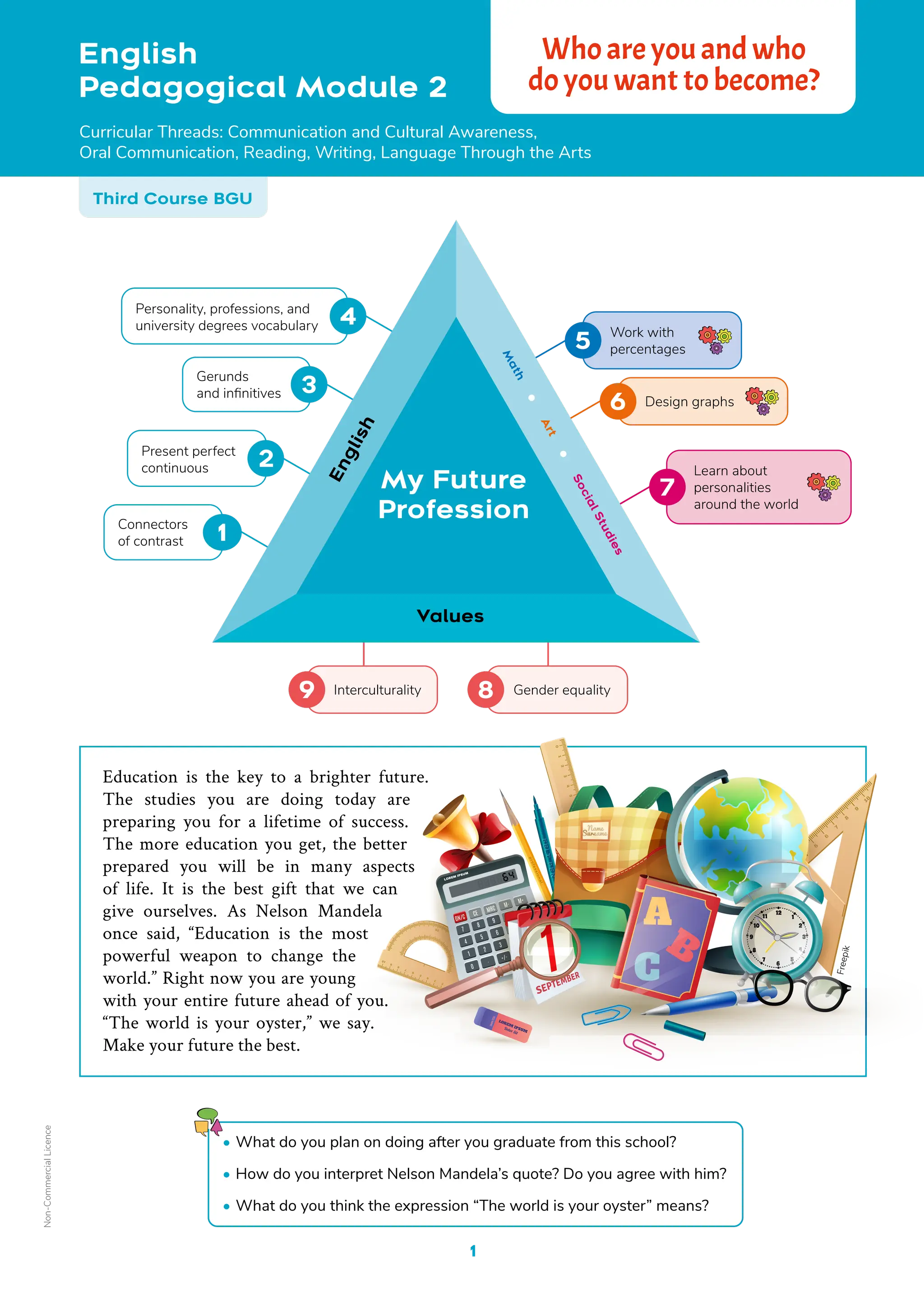
Learn about
personalities
around the world
7
Work with
percentages
5
Design graphs
6
Connectors
of contrast 1
Present perfect
continuous 2
Gerunds
and infinitives 3
Personality, professions, and
university degrees vocabulary 4
Gender equality
Interculturality 8
9
My Future
Profession
E
n
g
l
i
s
h
M
a
t
h
A
r
t
S
o
c
i
a
l
S
t
u
d
i
e
s
Values
Third Course BGU
English
Pedagogical Module 2
Curricular Threads: Communication and Cultural Awareness,
Oral Communication, Reading, Writing, Language Through the Arts
Who are you and who
do you want to become?
• What do you plan on doing after you graduate from this school?
• How do you interpret Nelson Mandela’s quote? Do you agree with him?
• What do you think the expression “The world is your oyster” means?
1
Education is the key to a brighter future.
The studies you are doing today are
preparing you for a lifetime of success.
The more education you get, the better
prepared you will be in many aspects
of life. It is the best gift that we can
give ourselves. As Nelson Mandela
once said, “Education is the most
powerful weapon to change the
world.” Right now you are young
with your entire future ahead of you.
“The world is your oyster,” we say.
Make your future the best.
F
re
e
p
ik
Non-Commercial
Licence
Social Studies
Communication and Cultural Awareness
Do you think that people from the same country are similar to each other?
Lesson A
Freepik
2
Personalities Around the World
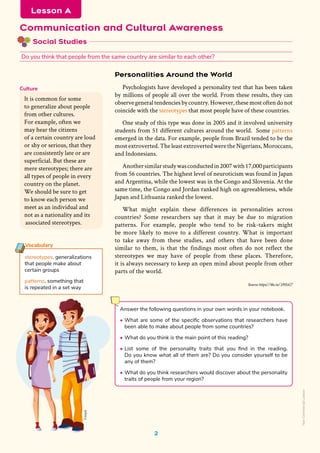
Psychologists have developed a personality test that has been taken
by millions of people all over the world. From these results, they can
observegeneraltendenciesbycountry.However,thesemostoftendonot
coincide with the stereotypes that most people have of these countries.
One study of this type was done in 2005 and it involved university
students from 51 different cultures around the world. Some patterns
emerged in the data. For example, people from Brazil tended to be the
most extroverted. The least extroverted were the Nigerians, Moroccans,
and Indonesians.
Anothersimilarstudywasconductedin2007with17,000participants
from 56 countries. The highest level of neuroticism was found in Japan
and Argentina, while the lowest was in the Congo and Slovenia. At the
same time, the Congo and Jordan ranked high on agreeableness, while
Japan and Lithuania ranked the lowest.
What might explain these differences in personalities across
countries? Some researchers say that it may be due to migration
patterns. For example, people who tend to be risk-takers might
be more likely to move to a different country. What is important
to take away from these studies, and others that have been done
similar to them, is that the findings most often do not reflect the
stereotypes we may have of people from these places. Therefore,
it is always necessary to keep an open mind about people from other
parts of the world.
Source: https://bbc.in/3392zG7
It is common for some
to generalize about people
from other cultures.
For example, often we
may hear the citizens
of a certain country are loud
or shy or serious, that they
are consistently late or are
superficial. But these are
mere stereotypes; there are
all types of people in every
country on the planet.
We should be sure to get
to know each person we
meet as an individual and
not as a nationality and its
associated stereotypes.
Culture
Vocabulary
stereotypes. generalizations
that people make about
certain groups
patterns. something that
is repeated in a set way
Answer the following questions in your own words in your notebook.
• What are some of the specific observations that researchers have
been able to make about people from some countries?
• What do you think is the main point of this reading?
• List some of the personality traits that you find in the reading.
Do you know what all of them are? Do you consider yourself to be
any of them?
• What do you think researchers would discover about the personality
traits of people from your region?
Non-Commercial
Licence
Freepik
3
Oral Communication
Tip
Normally we use adjectives
to describe someone’s
personality. However,
sometimes we can use
nouns. For example,
to be a “people person”
means you are someone
who likes being around
and working with people.
Career Advice
Vocabulary
tech savvy. someone who
works well with technology
human resources.
a department in a company
or institution that takes care
of the well-being and rights
of the workers
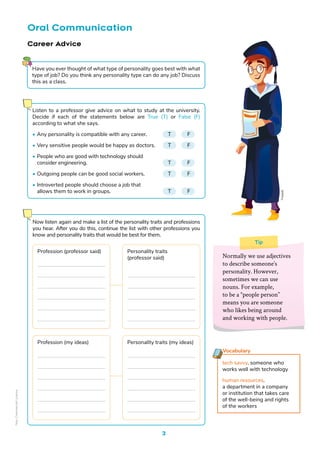
Listen to a professor give advice on what to study at the university.
Decide if each of the statements below are True (T) or False (F)
according to what she says.
• Any personality is compatible with any career. T F
• Very sensitive people would be happy as doctors. T F
• People who are good with technology should
consider engineering.					T F
• Outgoing people can be good social workers.		 T F
• Introverted people should choose a job that
allows them to work in groups.			 T F
Have you ever thought of what type of personality goes best with what
type of job? Do you think any personality type can do any job? Discuss
this as a class.
Now listen again and make a list of the personality traits and professions
you hear. After you do this, continue the list with other professions you
know and personality traits that would be best for them.
Profession (professor said) Personality traits
(professor said)
Profession (my ideas) Personality traits (my ideas)
Non-Commercial
Licence
QUIZ: What Career is Best for You?
There are many quizzes and tests that help you
to determine what profession would be the best for
you according to your personality. Take this test to
see what field would be ideal for you. Answer each
question honestly.
Reading
Do you think you know what career matches best with your personality?
• On the weekends, I prefer to:
a. go out hiking in the mountains.
b. write a story or read a novel.
c. work on my computer.
d. talk with my friends and family.
• When I have the choice of what show
to watch on TV, I choose:
a. “survivor” or some outdoor program.
b. a classic movie like Titanic.
c. a show about technology.
d. a sitcom or drama.
• The subject I like the most in school is:
a. physical education.
b. language arts or English.
c. computers or physics.
d. social studies.
• The person I admire the most is:
a. an adventurer.
b. a writer.
c. a scientist.
d. a humanitarian.
• When I think of my future profession, it is most
important for me to:
a. be able to be outside.
b. be able to use my writing skills.
c. be able to work with computers
or do scientific experiments.
d. be able to make a difference in someone’s life.
If your answers were…
Mostly As: You would be best working outdoors.
You can be a botanist (someone who studies
plants), an archaeologist (someone who studies
ruins and bones of previous eras), or even
as an extreme tour guide, taking tourists
to climb mountains around the country.
Mostly Bs: You should consider working with
something that has to do with languages.
You could be a linguist (a scientist who studies
how human language works from a social
and structural perspective), a writer (of novels
or even movie scripts!), an editor, a translator
or interpreter, or a language teacher.
Mostly Cs: You would be best as a scientist
because you are technical. You can be a physicist,
a chemist, or an engineer. You could also work
as a computer programmer or perhaps a doctor.
Mostly Ds: You need to choose a career in which
you can help others. You can be a psychologist,
a social worker, or even a teacher. You would also
be a good anthropologist (someone who studies
human evolution and societies) or sociologist
(someone who studies human behavior and
relationships between people and groups).
Vocabulary
field. area
translator. a professional who changes written
texts from one language to another
interpretor. a professional who changes oral
texts from one language to another
Freepik
4
Non-Commercial
Licence
5
Writing
Giving Advice
Tip
To use connectors of contrast,
you need two ideas that oppose
each other. A opposes B.
For example: “You should
think about your future,
however you shouldn’t
stress too much.”
Other words that show
juxtaposition are nevertheless,
nonetheless, although, on the
other hand, yet.
Imagine you are the writer of an advice column in a local newspaper.
Your job is to answer letters that people write, looking for advice.
A 17-year-old wrote you the following letter:
Respond to this person’s letter in 3 paragraphs: 1 introductory
paragraph, 1 paragraph of support, and 1 conclusion paragraph. Write
80-100 words. Be sure to use modal verbs like should, could, and
might as well as connecting words that show contrast like however,
on the other hand, although, nevertheless. First organize your ideas
below, then write the essay in your notebook.
• Introduction: In your introduction, you should thank the person for the
letter and show you understand their problem.
• Supporting paragraph: In the supporting paragraph, you should give
your advice and the reasons for you giving this advice.
• Conclusion: In the conclusion, you should summarize what you have
said in your letter and give the student your best wishes.
Dear Sir or Madame:
I need help! I am graduating this year but I don’t know what
to study at the university! I am a good student, but I don’t know
how to make this very important decision! Do you have any
advice to give me? Thank you in advance!
Sincerely,
17-year-old who is very confused!
Freepik
Non-Commercial
Licence
Language Through the Arts
6
Careers in the Arts
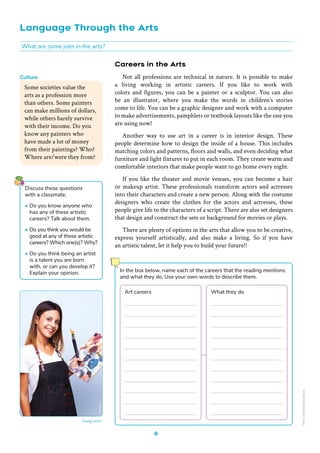
Not all professions are technical in nature. It is possible to make
a living working in artistic careers. If you like to work with
colors and figures, you can be a painter or a sculptor. You can also
be an illustrator, where you make the words in children’s stories
come to life. You can be a graphic designer and work with a computer
to make advertisements, pamphlets or textbook layouts like the one you
are using now!
Another way to use art in a career is in interior design. These
people determine how to design the inside of a house. This includes
matching colors and patterns, floors and walls, and even deciding what
furniture and light fixtures to put in each room. They create warm and
comfortable interiors that make people want to go home every night.
If you like the theater and movie venues, you can become a hair
or makeup artist. These professionals transform actors and actresses
into their characters and create a new person. Along with the costume
designers who create the clothes for the actors and actresses, these
people give life to the characters of a script. There are also set designers
that design and construct the sets or background for movies or plays.
There are plenty of options in the arts that allow you to be creative,
express yourself artistically, and also make a living. So if you have
an artistic talent, let it help you to build your future!!
Some societies value the
arts as a profession more
than others. Some painters
can make millions of dollars,
while others barely survive
with their income. Do you
know any painters who
have made a lot of money
from their paintings? Who?
Where are/were they from?
Culture
Discuss these questions
with a classmate.
• Do you know anyone who
has any of these artistic
careers? Talk about them.
• Do you think you would be
good at any of these artistic
careers? Which one(s)? Why?
• Do you think being an artist
is a talent you are born
with, or can you develop it?
Explain your opinion.
What are some jobs in the arts?
In the box below, name each of the careers that the reading mentions
and what they do. Use your own words to describe them.
Art careers What they do
Freepik
Young artist
Non-Commercial
Licence
Oral Communication
University Degrees
7
endless. without end
scholarships. economic
assistance to help you
pay for your studies
Vocabulary
Discuss the following questions with a partner.
• Do you know someone who has a Bachelor’s degree? A Master’s?
A PhD? What did he or she study? Where? What is he or she
working as now?
• What do you think you would like to study? What degree do you
plan on getting?
• If money is not a factor, do you think that everyone is capable
of getting a PhD? Explain your opinion.
What university degrees do you know?
Freepik
College graduates
Listen to a university student talk about the different degrees that
are available. As you listen, complete the sentences with what she says.
• The first degree you can get after graduating high school
is called a		 degree.
• This degree can be done in years.
• A Master’s degree can be done you complete
a Bachelor’s.
• It is possible to do a Master’s in another		 .
• 			 can help you to pay for your Master’s studies.
• In 			 , you can teach Bachelor’s students
and get your Master’s degree for free!
• After a Master’s, you can go on and study a doctorate or a .
F
re
e
p
ik
Non-Commercial
Licence
8
Studying Abroad
Studying abroad was just a dream for many people 50 years ago,
but now it is a reality for several students. Many universities offer
study abroad programs for a semester or a year. Universities
establish agreements with foreign schools and are able
to do a student exchange program. For example,
if a university in Mexico has an exchange program
with a university in Canada, they can send
Mexican students to study in Canada,
and Canadian students can go study
in Mexico. The students take classes
related to their major while earning
credit for their home university.
Most of these students live with
a host family for the time
they are there, where they get
to experience daily life in the
host country’s culture. Learning
in a different environment opens your
eyes to many new things. Living in another
country doesn’t only teach you academic lessons,
but life lessons as well. Being far away from home isn’t
easy, but it’s worth it. It is very important to take advantage
of any of these opportunities that your university may offer you.
It is the chance of a lifetime, and the memories you create will last
forever. Students never regret doing it!
host. a person or entity
that receives guests
regret. feel bad about doing
or not doing something
entail. include, mean
Vocabulary
Studying abroad means
to go to another country
and attend school there.
This can be done in high
school or in college. It can
be done for one semester
or an entire academic year.
Why do you think some
students would want
to study abroad?
Culture
Answer the following questions regarding the reading.
• What does “study abroad” mean?
• If a university has an agreement established with another,
what does that entail?
• What are the advantages of studying abroad?
• Do you think you would like to spend a semester or year abroad?
Where?
Observe the use of the
gerund (-ing) form and the
infinitive (to + verb) in the
text. Underline the gerund
and circle the infinitive.
What do you observe about
how these forms are used?
Check your answer with
your classmates, then with
your teacher.
The gerund is used…
The infinitive is used…
Communication and Cultural Awareness
Lesson B
Freepik
Grammar Note
Non-Commercial
Licence
Oral Communication
Scholarships
Listen to a university employee talk about the different scholarships
that are available and answer the questions that follow.
• What do you have to pay for at public universities?
• How do you qualify for the economic scholarship?
• How can you receive a scholarship based on merit?
• Is there a discount for someone who belongs to a club?
• From what other source can you get a scholarship?
9
Do you know anyone who has received a scholarship? Who? For what?
Imagine you own a private business and you want to offer a scholarship
to a few students. What would be the requirements for them to earn
the scholarship? What would the scholarship be for? How much
money would you offer? Write down your ideas here and then share
them with a classmate.
Freepik
Freepik
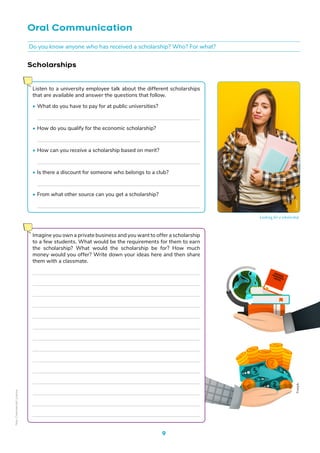
Looking for a scholarship
Non-Commercial
Licence
10
Now answer the questions
about the text. Discuss your
answers with a classmate.
• What is the author
of the blog’s view
on househusbands?
How can you tell?
• What are some advantages
of a woman being the
breadwinner and a man
staying at home?
• How do you feel as a young
man or woman about the
idea of househusbands?
Explain your opinion.
Reading
The Rise of Househusbands
Wehaveallheardtheterms“housewife”and“stay-
at-home-mom”, but what about “househusband”
or “stay-at-home-dad”? These names are becoming
more and more common as women pursue
professional careers and land important gigs. When
a couple has a child in today’s economic conditions,
usually both the mother and the father are forced
to work. But sometimes families can choose which
parent should stay home, and which should be the
breadwinner for the family. This doesn’t necessarily
mean that the parent who stays home earns
no money; with technology on the rise, it is quite
possible to work from home using the internet.
Studies have demonstrated that there are several
advantages to a woman being the primary source
of income for a family. First, women on average
have been shown to be more fiscally responsible,
cautiously and carefully taking care of the family’s
finances. Furthermore, women have been known
to multi-task better than men; in other words, they
can do several activities at once. This helps most
women to be able to balance work and family more
successfully than most men.
A man who sacrifices his
career to give his partner the
opportunity to excel in hers
is an example of gender equality.
For many generations
and in many cultures,
women have put their
professional dreams
on the back burner
to take care of their
household. When
couples are able
to swap their roles
of “breadwinner” and “homemaker”, there is a new-
found level of respect between them. Not only that,
but a man also ends up appreciating all women more
when he shares the work that so many of them still
do (while sometimes even keeping up with a full-
time professional job).
So ladies, don’t give up your career ambitions.
The sky is the limit for you too!!
Adapted from: https://bit.ly/2W79gqZ
A woman who stays at home is called a housewife.
What jobs does she typically do around the house?
Using context, draw a line to match the phrases from the text with their
meanings to better understand what you read.
Househusbands Give less importance to something
Men who stay home and do chores
Excel in
Do well in something
To land a gig Increasing
On the rise
To get a job
Put on the back burner
Someone who earns money for a family
Breadwinner Exchange
Furthermore
In addition
Swap
F
re
e
p
ik
Non-Commercial
Licence
11
A Persuasive Essay
A persuasive essay has as its purpose the goal
of convincing someone of something or to do
something. Usually a persuasive essay is written
to convince the reader to think a certain way about
a certain topic. A persuasive essay uses a formal
register of language and is normally centered around
three main arguments with supporting details.
Step 1
Think of the topics we have seen so far in this module.
Choose one that you feel particularly passionate
about to write your persuasive essay. It has to be
a topic that has arguments on both sides. Your teacher
must approve your topic before you start writing.
Step 2
Once your teacher has approved your topic, you can
begin to write ideas for each of the five paragraphs
you will write. Remember that each paragraph
should be centered around one main idea, and all the
sentences in that paragraph should be related to that
idea. Remember to support your opinion with FACTS
(statistics, quotes from experts, etc.) Write down some
of your ideas here.
Introduction
(here you introduce your point of view and briefly
mention your supporting reasons):
Supporting idea #1:
Supporting idea #2
Supporting idea #3
Conclusion
(Here you basically repeat what you had said in your
introduction, but using other words):
You should also anticipate possible counterarguments
and present your arguments against them. In other
words, let’s say your topic is that women should
be the breadwinners. Someone on the other side
of the debate could say that women should stay
home because children are usually closer to their
mothers and need them more. What can you present
as an argument against this point?
Step 3
Using what you wrote above, begin to develop a draft
(first version) in your notebook. Your essay should
have five paragraphs and be between 100-120 words.
Try to avoid the first person (“I”) as much as possible
Instead of saying, “I think” or “I believe women should
be the breadwinners of the family”, simply state it as,
“Women should be the breadwinners of the family.”
This has a stronger effect.
Step 4
Once you have a draft, share it with a classmate.
Ask for their feedback. They should tell you about the
following things:
Content: Are the arguments solid?
		 Are they logical?
		 Are they well-supported?
Organization: Does the paper flow well?
		 Does it have transitions?
Language: Are the correct words used?
		 Are verbs conjugated correctly?
Mechanics: Are there any spelling
		 or punctuation mistakes?
Step 5
Take your classmates comments and improve your
essay to make a final version you will turn in to your
teacher. Be sure you read it one more time before you
turn it in to see if you can catch any mistakes!
Writing
Non-Commercial
Licence
12
Language Through the Arts
Theater Professionals
Not all professions involve people sitting in an office from 8:00am
to 5:00pm Monday through Friday. Some university degrees allow
you to work on a stage or behind the scenes. These are known as theater
professionals. These are many different people who have studied
to be able to do different jobs that a theater production requires.
First, there are the actors and actresses. These are the people who
bring the characters of the production to life. They need to be able
to do many things like sing, act, and dance. The majority of actors and
actresses have university degrees in acting. A university that is well
known for its acting program is Columbia University in New York.
Besides actors and actresses, there are many other people that
contribute to making your theater experience amazing. There are the
writers and producers. They write and edit the script for the plays
or musicals down to the very last detail, including gestures, facial
expressions, and movement of the characters. These professionals most
likely studied playwriting. The best universities for this field are New
York University and Columbia University in Chicago.
Then there are the musicians. These are professionals who have
studied for years to perfect their skills on their particular instrument.
They have practiced for hundreds of hours to refine their technique.
They have to be versatile and be willing and able to play any musical
genre from rock to jazz to classical. The conductor leads them
in each song. Many musicians study music at one of the best schools
in the world, the Berklee College of Music in Boston.
There are also stagehands, who help move the sets and props. There
are costume, hair, and makeup artists that bring the characters to life.
The light and sound technicians give the production illumination
and sound respectively. As you can see, a lot of people are involved
in making a theater production as spectacular as it is!
Going to the theater
is a popular form
of entertainment in many
countries around the world.
Perhaps the most famous
theater district is Broadway
in New York City.
There you can see all the
plays and musicals that have
ever been performed. Where
can you go to the theater
in your country?
Culture
versatile. flexible, able
to do many different things
be willing to. have
the predisposition
to do something
Vocabulary
Do you think you would
enjoy any of these jobs?
Which one(s)?
List the different jobs that people can have related to the theater
and what each one does.
Theater jobs What they do
Freepik
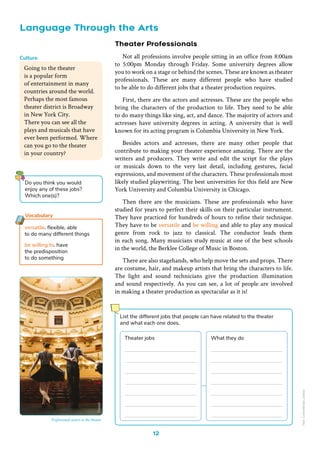
Professional actors in the theater
Non-Commercial
Licence
13
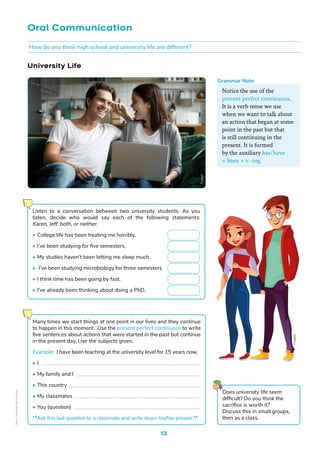
University Life
Does university life seem
difficult? Do you think the
sacrifice is worth it?
Discuss this in small groups,
then as a class.
Oral Communication
Freepik
Listen to a conversation between two university students. As you
listen, decide who would say each of the following statements:
Karen, Jeff, both, or neither.
• College life has been treating me horribly.
• I’ve been studying for five semesters.
• My studies haven’t been letting me sleep much.
• I’ve been studying microbiology for three semesters.
• I think time has been going by fast.
• I’ve already been thinking about doing a PhD.
Many times we start things at one point in our lives and they continue
to happen in this moment. Use the present perfect continuous to write
five sentences about actions that were started in the past but continue
in the present day. Use the subjects given.
Example: I have been teaching at the university level for 15 years now.
• I ___________________________________________________________
• My family and I ______________________________________________
• This country _________________________________________________
• My classmates _______________________________________________
• You (question) _______________________________________________
**Ask this last question to a classmate and write down his/her answer.**
How do you think high school and university life are different?
Freepik
Notice the use of the
present perfect continuous.
It is a verb tense we use
when we want to talk about
an action that began at some
point in the past but that
is still continuing in the
present. It is formed
by the auxiliary has/have
+ been + v -ing
Grammar Note
Non-Commercial
Licence
14
Achievement Level - Speaking
Group activity
After having completed half of this module, maybe you have been thinking
moreaboutwhatyouwouldliketobeandwhatcareerwouldbebestforyou.
In groups of three, take turns discussing your future plans. Consider the
following questions:
a. What career would you like to have?
b. What aspects of your personality would be good for this career?
c. What would be some difficulties in this career?
2
Achievement Level - Vocabulary
Individual activity
You and your classmates are very close to graduation. Write a brief
paragraph about what you have been doing this year to prepare for the
next phase of your lives. What have your teachers been doing? Write at
least five sentences using the present perfect continuous.
3
14
Assessment
Achievement Level - Listening
Individual activity
Listen to this doctor talk about his education and professional
experience and decide if each sentence is True (T), False (F),
or not mentioned (NM).
a. Becoming a doctor takes many years of study.		 T F NM
b. Not all doctors study medicine for their Bachelor’s. T F NM
c. A Bachelor’s degree lasts six years.				 T F NM
d. A dermatologist specializes in women.			 T F NM
e. In internships you work with surgeons.			 T F NM
1
Non-Commercial
Licence
15
Assessment Who are you and who do you want to become?
I check the box that most applies to me
Topics I do it very well
I do it
somewhat well
I can improve
I can’t do it
without help
Use the present perfect continuous to make statements
and ask questions
Understand and use vocabulary about personalities
Understand and explain different professions
Self-evaluation
I’m completing this self-evaluation based on what I learned in the module.
Achievement Level - Reading
Individual activity
Read this paragraph about the advantages of going to college and answer the
questions that follow.
For each of the testaments below from college grads, decide what reason
of the seven listed in the paragraph it most corresponds to. Write a number
1-7 in the blank. You will not use all the numbers.
“I absolutely love the job I have. I couldn’t be happier in it.”
“I love traveling all over the world learning about other countries.”
“I just got my first job out of college and I already make $1000 a month.”
“I spent a lot of sleepless nights studying in college, but it was worth it.”
“I don’t have to worry about being poor because I know I can get a job.”
4
There are seven advantages of getting a university degree. The first
is pretty obvious: a college graduate on average earns more money that
a non-graduate. Second, earning more money means a lower risk of living
in poverty. Third, college graduates tend to be more satisfied with the job
they end up getting than non-grads. Fourth, the cost of not going to college
is rising. This means that life is economically more difficult for non-grads.
Fifth, the great majority of college grads claim that the years of study
are worth it, both professionally and personally. Sixth, a college degree
in your major prepares you better for your dream job than not having one.
And lastly, college graduates have been found to be happier and healthier
overall than non-grads. They smoke less, travel and volunteer more, and are
overall more content with life.
Non-Commercial
Licence
Project 1
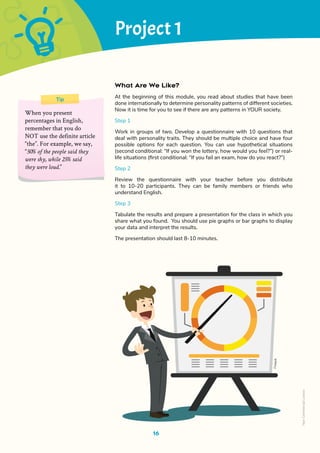
What Are We Like?
At the beginning of this module, you read about studies that have been
done internationally to determine personality patterns of different societies.
Now it is time for you to see if there are any patterns in YOUR society.
Step 1
Work in groups of two. Develop a questionnaire with 10 questions that
deal with personality traits. They should be multiple choice and have four
possible options for each question. You can use hypothetical situations
(second conditional: “If you won the lottery, how would you feel?”) or real-
life situations (first conditional: “If you fail an exam, how do you react?”)
Step 2
Review the questionnaire with your teacher before you distribute
it to 10-20 participants. They can be family members or friends who
understand English.
Step 3
Tabulate the results and prepare a presentation for the class in which you
share what you found. You should use pie graphs or bar graphs to display
your data and interpret the results.
The presentation should last 8-10 minutes.
16
Tip
When you present
percentages in English,
remember that you do
NOT use the definite article
“the”. For example, we say,
“50% of the people said they
were shy, while 25% said
they were loud.”
Free
pik
Non-Commercial
Licence
17
Let’s Review
Vocabulary
Let’s remember some of the words you learned
in the first half of this module. Form a sentence
with each of the following words.
Bachelor’s, Master’s, PhD, scholarships, study
abroad, househusband
1.
2.
3.
4.
5.
Reading
Remember that you read about scholarships.
What did you learn that was useful for you?
Reading
Remember that you read about househusbands.
What was the most interesting thing you learned?
Grammar
Complete each sentence with something that
is true for you. Keep in mind the conditionals.
1. If I don’t know what to study at the university...
2. My friends and I will get scholarships if…
3. I would study something I didn’t like if…
4. If I hadn’t studied at this school, …
Non-Commercial
Licence
Math
Communication and Cultural Awareness
Lesson C
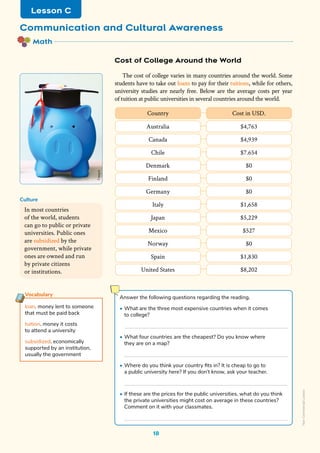
The cost of college varies in many countries around the world. Some
students have to take out loans to pay for their tuitions, while for others,
university studies are nearly free. Below are the average costs per year
of tuition at public universities in several countries around the world.
18
In most countries
of the world, students
can go to public or private
universities. Public ones
are subsidized by the
government, while private
ones are owned and run
by private citizens
or institutions.
Culture
Vocabulary
loan. money lent to someone
that must be paid back
tuition. money it costs
to attend a university
subsidized. economically
supported by an institution,
usually the government
Cost of College Around the World
Country Cost in USD.
Australia $4,763
Canada $4,939
Chile $7.654
Denmark $0
Finland $0
Germany $0
Italy $1,658
Japan $5,229
Mexico $527
Norway $0
Spain $1,830
United States $8,202
Answer the following questions regarding the reading.
• What are the three most expensive countries when it comes
to college?
• What four countries are the cheapest? Do you know where
they are on a map?
• Where do you think your country fits in? It is cheap to go to
a public university here? If you don’t know, ask your teacher.
• If these are the prices for the public universities, what do you think
the private universities might cost on average in these countries?
Comment on it with your classmates.
Freepik
Non-Commercial
Licence
19
Oral Communication
Tip
Remember that there
are three different levels
of university degrees.
The first is Bachelor’s,
which lasts four to five
years. The second
is Master’s, which lasts
usually two years, then
PhD, which is another
three to four years.
Scholarships for Graduate Studies in the United States
Freep
ik
Vocabulary
unaware. a state of not
knowing something
assistantship. in this context,
economic aid in exchange for
working for the university
Listen to a professor from the United States talk about studying
a Master’s or PhD there. Decide if each statement is True (T)
or False (F). If it is false, correct it to make it a true statement.
• Not many people know about the opportunity
to get a Master’s and PhD in the U.S. at no cost. T F
• There is one type of assistantship available
at U.S. universities.					 T F
• In a teaching assistantship, you help a professor
gather data.						T F
• If you study a Master’s in Sociology, you can teach
basic psychology.					T F
• With an assistantship, your tuition is free, and you
can also make some money.				 T F
Now listen again. Pay attention to the advantages of studying a
Master’s or PhD in the U.S. Write a short paragraph of 50-65 words to
try to convince a friend to do a Master’s o PhD. Think of the advantages
on a personal and professional level.
What professions require many years of university studies?
Non-Commercial
Licence
20
Trade schools
For those people who are not interested in any four-year plans
of study at universities and prefer to work with their hands, there are
trade schools. What’s important is to continue your education.
There are many different job opportunities that are offered
when you complete a degree in a trade school. If you want to work
on people’s houses, you can study to become a plumber or an electrician.
A plumber fixes anything that has to do with water in the house, while
an electrician specializes in lighting and electrical work. You can also
be a construction manager, supervising people building a house.
There are also technical careers (that involve two years of study)
intechnology.Youcanbeacomputerprogrammer,designingnewvideo
games and computer programs to make our lives easier. You can also
be a web developer, creating and improving websites for individuals
or companies. Electronical engineer is another option, where you build
and repair electronic equipment.
If you prefer to work outside, there are a few options you can study.
A garden and landscaping designer can help to create a paradise outside
for residents. You can also study environmental science and work
in forests to protect our flora and fauna. Or there are petroleum
engineers that work on getting the oil out of the earth.
As you can see, there are several options if studying at a four-year
university is not for you. Just try to combine what you are good at and
what you love, and you should find the perfect job for you!
Reading
What jobs do you know of that do not require a four-year university degree?
Do you know anyone who does these jobs?
trade. a job that is normally
manual and requires
special training
Vocabulary
Discuss the following
questions in groups
of two or three.
• What personality traits
do you think it would
be good to have for each
of these professions? Why?
• Which of these
professions seems most
interesting to you?
In the chart below, list the options of technical careers
and describe them in one sentence each.
Career What they do
F
re
e
p
ik
Non-Commercial
Licence
Step 2
Take the ideas you wrote above and develop them into a short essay
in your notebook of 80-100 words. Start by introducing yourself,
and then address all the topics in order. Make sure each paragraph
is centered around one main idea. In your conclusion, thank the
readers for their time and consideration. Be sure to use the present
perfect continuous to talk about activities you have been doing
to prepare you for the university.
Step 3
Exchange your paper with a partner and read your partner’s paper.
Comment on aspects like content, organization, grammar, punctuation,
and vocabulary.
21
To talk about things
you have been doing for
a period of time (and are still
doing now), you can use the
present perfect continuous.
This is formed using three
parts: has/have + been +
verb in -ing.
It is used to talk about events
that started in the past
but are still continuing
in the present.
For example:
My friends and I have been
studying English for ten years.
(We started ten years ago
and are still studying now.)
Grammar Note
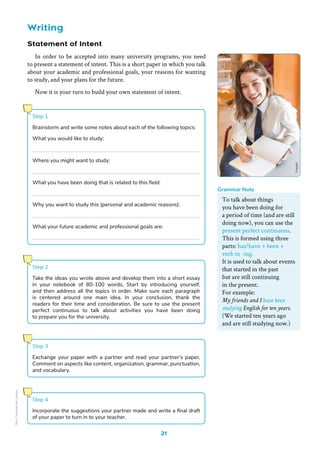
Statement of Intent
In order to be accepted into many university programs, you need
to present a statement of intent. This is a short paper in which you talk
about your academic and professional goals, your reasons for wanting
to study, and your plans for the future.
Now it is your turn to build your own statement of intent.
Writing
Step 4
Incorporate the suggestions your partner made and write a final draft
of your paper to turn in to your teacher.
Step 1
Brainstorm and write some notes about each of the following topics:
What you would like to study:
Where you might want to study:
What you have been doing that is related to this field:
Why you want to study this (personal and academic reasons):
What your future academic and professional goals are:
Freepik
Non-Commercial
Licence
22
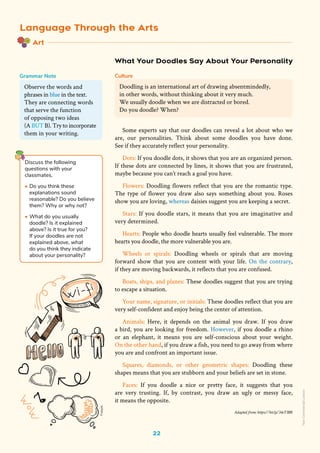
Some experts say that our doodles can reveal a lot about who we
are, our personalities. Think about some doodles you have done.
See if they accurately reflect your personality.
Dots: If you doodle dots, it shows that you are an organized person.
If these dots are connected by lines, it shows that you are frustrated,
maybe because you can’t reach a goal you have.
Flowers: Doodling flowers reflect that you are the romantic type.
The type of flower you draw also says something about you. Roses
show you are loving, whereas daisies suggest you are keeping a secret.
Stars: If you doodle stars, it means that you are imaginative and
very determined.
Hearts: People who doodle hearts usually feel vulnerable. The more
hearts you doodle, the more vulnerable you are.
Wheels or spirals: Doodling wheels or spirals that are moving
forward show that you are content with your life. On the contrary,
if they are moving backwards, it reflects that you are confused.
Boats, ships, and planes: These doodles suggest that you are trying
to escape a situation.
Your name, signature, or initials: These doodles reflect that you are
very self-confident and enjoy being the center of attention.
Animals: Here, it depends on the animal you draw. If you draw
a bird, you are looking for freedom. However, if you doodle a rhino
or an elephant, it means you are self-conscious about your weight.
On the other hand, if you draw a fish, you need to go away from where
you are and confront an important issue.
Squares, diamonds, or other geometric shapes: Doodling these
shapes means that you are stubborn and your beliefs are set in stone.
Faces: If you doodle a nice or pretty face, it suggests that you
are very trusting. If, by contrast, you draw an ugly or messy face,
it means the opposite.
Adapted from: https://bit.ly/34eT3BR
Doodling is an international art of drawing absentmindedly,
in other words, without thinking about it very much.
We usually doodle when we are distracted or bored.
Do you doodle? When?
Culture
What Your Doodles Say About Your Personality
Discuss the following
questions with your
classmates.
• Do you think these
explanations sound
reasonable? Do you believe
them? Why or why not?
• What do you usually
doodle? Is it explained
above? Is it true for you?
If your doodles are not
explained above, what
do you think they indicate
about your personality?
Observe the words and
phrases in blue in the text.
They are connecting words
that serve the function
of opposing two ideas
(A BUT B). Try to incorporate
them in your writing.
Grammar Note
Freepik
Language Through the Arts
Art
Non-Commercial
Licence
23
Oral Communication
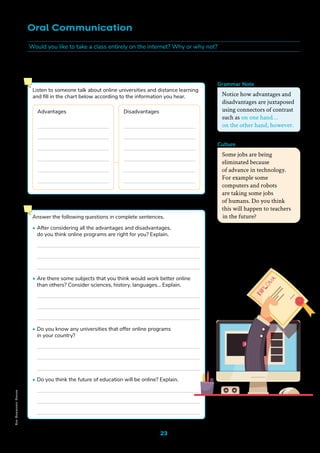
Some jobs are being
eliminated because
of advance in technology.
For example some
computers and robots
are taking some jobs
of humans. Do you think
this will happen to teachers
in the future?
Culture
Freepik
Answer the following questions in complete sentences.
• After considering all the advantages and disadvantages,
do you think online programs are right for you? Explain.
• Are there some subjects that you think would work better online
than others? Consider sciences, history, languages… Explain.
• Do you know any universities that offer online programs
in your country?
• Do you think the future of education will be online? Explain.
Would you like to take a class entirely on the internet? Why or why not?
Listen to someone talk about online universities and distance learning
and fill in the chart below according to the information you hear.
Advantages Disadvantages
Notice how advantages and
disadvantages are juxtaposed
using connectors of contrast
such as on one hand…
on the other hand, however.
Grammar Note
Distance Learning
Non-Commercial
Licence
24
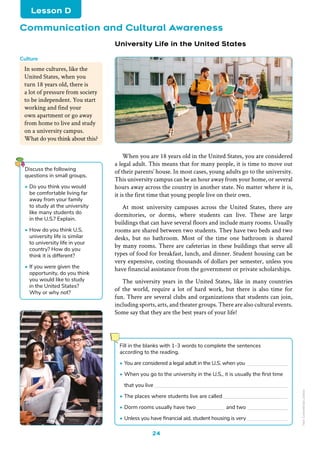
When you are 18 years old in the United States, you are considered
a legal adult. This means that for many people, it is time to move out
of their parents’ house. In most cases, young adults go to the university.
This university campus can be an hour away from your home, or several
hours away across the country in another state. No matter where it is,
it is the first time that young people live on their own.
At most university campuses across the United States, there are
dormitories, or dorms, where students can live. These are large
buildings that can have several floors and include many rooms. Usually
rooms are shared between two students. They have two beds and two
desks, but no bathroom. Most of the time one bathroom is shared
by many rooms. There are cafeterias in these buildings that serve all
types of food for breakfast, lunch, and dinner. Student housing can be
very expensive, costing thousands of dollars per semester, unless you
have financial assistance from the government or private scholarships.
The university years in the United States, like in many countries
of the world, require a lot of hard work, but there is also time for
fun. There are several clubs and organizations that students can join,
including sports, arts, and theater groups. There are also cultural events.
Some say that they are the best years of your life!
In some cultures, like the
United States, when you
turn 18 years old, there is
a lot of pressure from society
to be independent. You start
working and find your
own apartment or go away
from home to live and study
on a university campus.
What do you think about this?
Culture
Tongpatong
Freepik
Freepik
Tongpatong
Freepik
Freepik
/
Vgstockstudio
University Life in the United States
Discuss the following
questions in small groups.
• Do you think you would
be comfortable living far
away from your family
to study at the university
like many students do
in the U.S.? Explain.
• How do you think U.S.
university life is similar
to university life in your
country? How do you
think it is different?
• If you were given the
opportunity, do you think
you would like to study
in the United States?
Why or why not?
Communication and Cultural Awareness
Lesson D
Fill in the blanks with 1-3 words to complete the sentences
according to the reading.
• You are considered a legal adult in the U.S. when you
• When you go to the university in the U.S., it is usually the first time
that you live
• The places where students live are called
• Dorm rooms usually have two		 and two
• Unless you have financial aid, student housing is very
Non-Commercial
Licence
25
Oral Communication
Freepik
2. Judge your own personality based on these characteristics
• Are you an introvert (I) or an extrovert (E)? Write I or E.
• Do you follow your senses (S) or intuition (N)? Write S or N.
• Are you a thinker (T) or a feeler (F)? Write T or F.
• Do you tend to judge (J) or perceive (P)? Write J or P
Now put the four letters you wrote above together in order.
Write them here:
3. Go online at school or at home and take the test.
https://www.16personalities.com/free-personality-test
Write your result in four letters here:
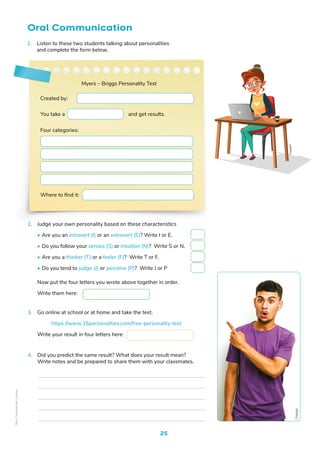
1. Listen to these two students talking about personalities
and complete the form below.
Created by:
Where to find it:
You take a and get results.
Myers – Briggs Personality Test
Four categories:
4. Did you predict the same result? What does your result mean?
Write notes and be prepared to share them with your classmates.
Fre
epik
Non-Commercial
Licence
Reading
26
Advice for a High School Student Preparing for College
Have you ever given a younger person advice?
In this reading, again we can observe the use of gerunds and
infinitives. What are the patterns you can observe? Write them below.
Gerunds are used
Inifitives are used
3. Telling the truth will always get you further
than lying. If you do something wrong, like cheat
on a test, always tell the truth. Your professors
will appreciate you much more for being honest
than continuing to try to cover your error up.
4. Studying is important, but so is enjoying life.
Some students become so involved with their
studies that they don’t make time for fun. This
is not good. You should find a balance where
you can be successful in your classes, but also
do healthy activities you like.
5. Establishing and maintaining a support system
is crucial. We all need someone to lean on when
times get tough. Knowing you have a circle
of friends and family that you can count on when
you are going through difficult moments is what
will help you make it through them.
I hope these tips help you. And remember, like
in other aspects of life, attitude is everything.
If you maintain a positive attitude throughout your
university experience, you will most certainly have
the time of your life!
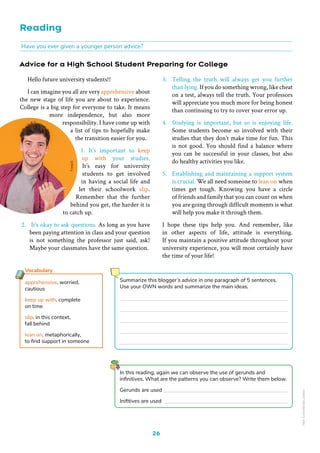
Hello future university students!!
I can imagine you all are very apprehensive about
the new stage of life you are about to experience.
College is a big step for everyone to take. It means
more independence, but also more
responsibility. I have come up with
a list of tips to hopefully make
the transition easier for you.
1. It’s important to keep
up with your studies.
It’s easy for university
students to get involved
in having a social life and
let their schoolwork slip.
Remember that the further
behind you get, the harder it is
to catch up.
2. It’s okay to ask questions. As long as you have
been paying attention in class and your question
is not something the professor just said, ask!
Maybe your classmates have the same question.
apprehensive. worried,
cautious
keep up with. complete
on time
slip. in this context,
fall behind
lean on. metaphorically,
to find support in someone
Vocabulary
Summarize this blogger’s advice in one paragraph of 5 sentences.
Use your OWN words and summarize the main ideas.
Non-Commercial
Licence
27
Writing
Writing a Resume
When you start applying for jobs, you will need to give the employers
a copy of your resume, or CV (for curriculum vitae in Latin). This is basically
a summarized story of your academic and professional life. The most recent
events come first. Look at the example below and use it to write your own
in your notebook. Your teacher will tell you if you should make up some
information, or only include information that is true for you.
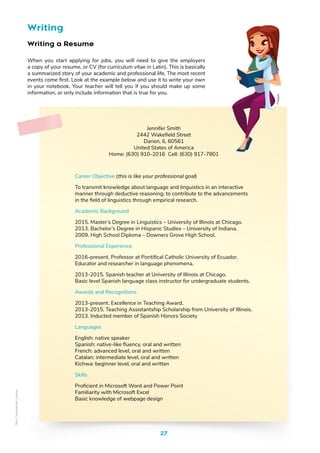
Jennifer Smith
2442 Wakefield Street
Darien, IL 60561
United States of America
Home: (630) 910-2016 Cell: (630) 917-7801
Career Objective (this is like your professional goal)
To transmit knowledge about language and linguistics in an interactive
manner through deductive reasoning; to contribute to the advancements
in the field of linguistics through empirical research.
Academic Background
2015. Master’s Degree in Linguistics – University of Illinois at Chicago.
2013. Bachelor’s Degree in Hispanic Studies – University of Indiana.
2009. High School Diploma – Downers Grove High School.
Professional Experience
2016-present. Professor at Pontifical Catholic University of Ecuador.
Educator and researcher in language phenomena.
2013-2015. Spanish teacher at University of Illinois at Chicago.
Basic level Spanish language class instructor for undergraduate students.
Awards and Recognitions
2013-present. Excellence in Teaching Award.
2013-2015. Teaching Assistantship Scholarship from University of Illinois.
2013. Inducted member of Spanish Honors Society
Languages
English: native speaker
Spanish: native-like fluency, oral and written
French: advanced level, oral and written
Catalan: intermediate level, oral and written
Kichwa: beginner level, oral and written
Skills
Proficient in Microsoft Word and Power Point
Familiarity with Microsoft Excel
Basic knowledge of webpage design
Freepik
Non-Commercial
Licence
gap. space
burden. the main
responsibility
Vocabulary
Oral Communication
28
The Wage Gap
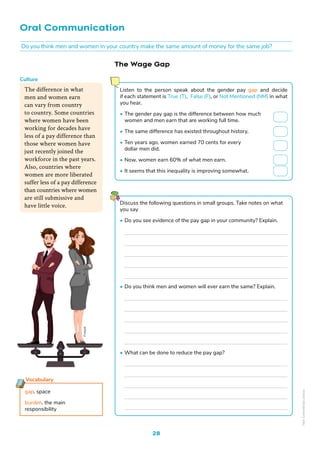
Listen to the person speak about the gender pay gap and decide
if each statement is True (T), False (F), or Not Mentioned (NM) in what
you hear.
• The gender pay gap is the difference between how much
women and men earn that are working full time.
• The same difference has existed throughout history.
• Ten years ago, women earned 70 cents for every
dollar men did.
• Now, women earn 60% of what men earn.
• It seems that this inequality is improving somewhat.
The difference in what
men and women earn
can vary from country
to country. Some countries
where women have been
working for decades have
less of a pay difference than
those where women have
just recently joined the
workforce in the past years.
Also, countries where
women are more liberated
suffer less of a pay difference
than countries where women
are still submissive and
have little voice.
Culture
Freepik
Discuss the following questions in small groups. Take notes on what
you say
• Do you see evidence of the pay gap in your community? Explain.
• Do you think men and women will ever earn the same? Explain.
• What can be done to reduce the pay gap?
Do you think men and women in your country make the same amount of money for the same job?
Non-Commercial
Licence
Freepik
29
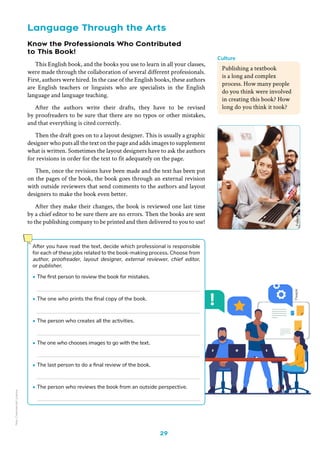
Language Through the Arts
Know the Professionals Who Contributed
to This Book!
This English book, and the books you use to learn in all your classes,
were made through the collaboration of several different professionals.
First, authors were hired. In the case of the English books, these authors
are English teachers or linguists who are specialists in the English
language and language teaching.
After the authors write their drafts, they have to be revised
by proofreaders to be sure that there are no typos or other mistakes,
and that everything is cited correctly.
Then the draft goes on to a layout designer. This is usually a graphic
designerwhoputsallthetextonthepageandaddsimagestosupplement
what is written. Sometimes the layout designers have to ask the authors
for revisions in order for the text to fit adequately on the page.
Then, once the revisions have been made and the text has been put
on the pages of the book, the book goes through an external revision
with outside reviewers that send comments to the authors and layout
designers to make the book even better.
After they make their changes, the book is reviewed one last time
by a chief editor to be sure there are no errors. Then the books are sent
to the publishing company to be printed and then delivered to you to use!
Publishing a textbook
is a long and complex
process. How many people
do you think were involved
in creating this book? How
long do you think it took?
Culture
After you have read the text, decide which professional is responsible
for each of these jobs related to the book-making process. Choose from
author, proofreader, layout designer, external reviewer, chief editor,
or publisher.
• The first person to review the book for mistakes.
• The one who prints the final copy of the book.
• The person who creates all the activities.
• The one who chooses images to go with the text.
• The last person to do a final review of the book.
• The person who reviews the book from an outside perspective.
Freepik
Non-Commercial
Licence
Assessment
Achievement Level - Writing
Individual activity
Write a paragraph of 50-75 words in which you state what you plan to do after
you graduate this year. Include your studies and the job you hope to have.
Use phrases like “I hope to”, “I plan on”, “I expect to” and pay attention
to whether you have to use the gerund (-ing form) or the infinitive (to + verb).
Write it in your notebook.
1
Achievement Level - Speaking
Group activity
After having completed this module, maybe you have been thinking more
about what you would like to be, and what career would be best for you.
In groups of three, discuss your future plans. What career would you like
to have? What aspects of your personality would be good for this career?
3
Achievement Level - Reading/Vocabulary
Individual activity
Read each of the descriptions of professions below and match it with its name.
Write the letter on the line. There is one extra profession.
a. computer programmer d. politician
b. archaeologist e. teacher
c. fashion designer f. psychologist
• I am the profession that prepares all other professions. What’s the hardest
part? Seeing that you may not be able to help everyone. But the best part
is knowing that your influence can last a lifetime.
• Ilovetoworkwithbonesanddigforancienttreasures.It’shardworksometimes,
but it is so rewarding to discover parts of history.
• My main job is to serve others. After all, that’s what I was elected for!
• I am a creator, and I even consider myself an artist. Everyone thinks my job
is simple and that everyone can do it, but some people can’t even match their
own outfits!
• Myjobisverysolitary.Ihavetospendalotoftimewithamachineandsometimes
that gets lonely. But I am motivated knowing that I am creating things that will
make people’s lives easier and even entertain them!
2
30
Non-Commercial
Licence
Assessment Who are you and who do you want to become?
Achievement Level - Speaking
Group activity
Pretend you and a partner are participating in a job interview. Decide what
job you each would like to interview for. Create a list of eight questions that
an employer can ask an interviewee. Consider topics such as academic and
working history, personality, classwork, strengths and weaknesses, etc. Write
them in your notebook so you don’t forget them. First, one of you is the employer
and the other is the interviewee, then switch roles. Your teacher will evaluate each
of you individually.
4
I check the box that most applies to me
Topics I do it very well
I do it
somewhat well
I can improve
I can’t do it
without help
Use gerunds and infinitives correctly
Talk about different personalities
Understand and talk about different university degrees
Self-evaluation
I’m completing this self-evaluation based on what I learned in the module.
Achievement Level - Grammar
Individual activity
Read the following sentences about university life. Choose the correct verb from
the box and write it in either the gerund (-ing) form or the infinitive (to + verb).
There is one extra verb.
5
study remember drink procrastinate forget write
• 			 is very common on college campuses, but only
do it in moderation so it doesn’t affect your health and studies.
• It’s difficult for some students 			 everything they have
to do, so it’s important 		 it down somewhere in order (not)
			.
• 			 is waiting to the last minute to do something, like
an assignment or study for an exam.
31
Non-Commercial
Licence
32
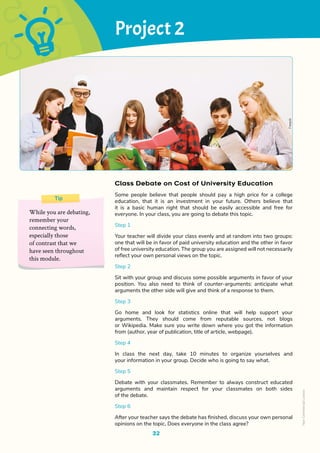
Class Debate on Cost of University Education
Some people believe that people should pay a high price for a college
education, that it is an investment in your future. Others believe that
it is a basic human right that should be easily accessible and free for
everyone. In your class, you are going to debate this topic.
Step 1
Your teacher will divide your class evenly and at random into two groups:
one that will be in favor of paid university education and the other in favor
of free university education. The group you are assigned will not necessarily
reflect your own personal views on the topic.
Step 2
Sit with your group and discuss some possible arguments in favor of your
position. You also need to think of counter-arguments: anticipate what
arguments the other side will give and think of a response to them.
Step 3
Go home and look for statistics online that will help support your
arguments. They should come from reputable sources, not blogs
or Wikipedia. Make sure you write down where you got the information
from (author, year of publication, title of article, webpage).
Step 4
In class the next day, take 10 minutes to organize yourselves and
your information in your group. Decide who is going to say what.
Step 5
Debate with your classmates. Remember to always construct educated
arguments and maintain respect for your classmates on both sides
of the debate.
Step 6
After your teacher says the debate has finished, discuss your own personal
opinions on the topic. Does everyone in the class agree?
Tip
While you are debating,
remember your
connecting words,
especially those
of contrast that we
have seen throughout
this module.
Project 2
Freepik
Non-Commercial
Licence

INGLES_3_BACH_MODULO_2.pdf

  • 1.
    Learn about personalities around theworld 7 Work with percentages 5 Design graphs 6 Connectors of contrast 1 Present perfect continuous 2 Gerunds and infinitives 3 Personality, professions, and university degrees vocabulary 4 Gender equality Interculturality 8 9 My Future Profession E n g l i s h M a t h A r t S o c i a l S t u d i e s Values Third Course BGU English Pedagogical Module 2 Curricular Threads: Communication and Cultural Awareness, Oral Communication, Reading, Writing, Language Through the Arts Who are you and who do you want to become? • What do you plan on doing after you graduate from this school? • How do you interpret Nelson Mandela’s quote? Do you agree with him? • What do you think the expression “The world is your oyster” means? 1 Education is the key to a brighter future. The studies you are doing today are preparing you for a lifetime of success. The more education you get, the better prepared you will be in many aspects of life. It is the best gift that we can give ourselves. As Nelson Mandela once said, “Education is the most powerful weapon to change the world.” Right now you are young with your entire future ahead of you. “The world is your oyster,” we say. Make your future the best. F re e p ik Non-Commercial Licence
  • 2.
    Social Studies Communication andCultural Awareness Do you think that people from the same country are similar to each other? Lesson A Freepik 2 Personalities Around the World Psychologists have developed a personality test that has been taken by millions of people all over the world. From these results, they can observegeneraltendenciesbycountry.However,thesemostoftendonot coincide with the stereotypes that most people have of these countries. One study of this type was done in 2005 and it involved university students from 51 different cultures around the world. Some patterns emerged in the data. For example, people from Brazil tended to be the most extroverted. The least extroverted were the Nigerians, Moroccans, and Indonesians. Anothersimilarstudywasconductedin2007with17,000participants from 56 countries. The highest level of neuroticism was found in Japan and Argentina, while the lowest was in the Congo and Slovenia. At the same time, the Congo and Jordan ranked high on agreeableness, while Japan and Lithuania ranked the lowest. What might explain these differences in personalities across countries? Some researchers say that it may be due to migration patterns. For example, people who tend to be risk-takers might be more likely to move to a different country. What is important to take away from these studies, and others that have been done similar to them, is that the findings most often do not reflect the stereotypes we may have of people from these places. Therefore, it is always necessary to keep an open mind about people from other parts of the world. Source: https://bbc.in/3392zG7 It is common for some to generalize about people from other cultures. For example, often we may hear the citizens of a certain country are loud or shy or serious, that they are consistently late or are superficial. But these are mere stereotypes; there are all types of people in every country on the planet. We should be sure to get to know each person we meet as an individual and not as a nationality and its associated stereotypes. Culture Vocabulary stereotypes. generalizations that people make about certain groups patterns. something that is repeated in a set way Answer the following questions in your own words in your notebook. • What are some of the specific observations that researchers have been able to make about people from some countries? • What do you think is the main point of this reading? • List some of the personality traits that you find in the reading. Do you know what all of them are? Do you consider yourself to be any of them? • What do you think researchers would discover about the personality traits of people from your region? Non-Commercial Licence
  • 3.
    Freepik 3 Oral Communication Tip Normally weuse adjectives to describe someone’s personality. However, sometimes we can use nouns. For example, to be a “people person” means you are someone who likes being around and working with people. Career Advice Vocabulary tech savvy. someone who works well with technology human resources. a department in a company or institution that takes care of the well-being and rights of the workers Listen to a professor give advice on what to study at the university. Decide if each of the statements below are True (T) or False (F) according to what she says. • Any personality is compatible with any career. T F • Very sensitive people would be happy as doctors. T F • People who are good with technology should consider engineering. T F • Outgoing people can be good social workers. T F • Introverted people should choose a job that allows them to work in groups. T F Have you ever thought of what type of personality goes best with what type of job? Do you think any personality type can do any job? Discuss this as a class. Now listen again and make a list of the personality traits and professions you hear. After you do this, continue the list with other professions you know and personality traits that would be best for them. Profession (professor said) Personality traits (professor said) Profession (my ideas) Personality traits (my ideas) Non-Commercial Licence
  • 4.
    QUIZ: What Careeris Best for You? There are many quizzes and tests that help you to determine what profession would be the best for you according to your personality. Take this test to see what field would be ideal for you. Answer each question honestly. Reading Do you think you know what career matches best with your personality? • On the weekends, I prefer to: a. go out hiking in the mountains. b. write a story or read a novel. c. work on my computer. d. talk with my friends and family. • When I have the choice of what show to watch on TV, I choose: a. “survivor” or some outdoor program. b. a classic movie like Titanic. c. a show about technology. d. a sitcom or drama. • The subject I like the most in school is: a. physical education. b. language arts or English. c. computers or physics. d. social studies. • The person I admire the most is: a. an adventurer. b. a writer. c. a scientist. d. a humanitarian. • When I think of my future profession, it is most important for me to: a. be able to be outside. b. be able to use my writing skills. c. be able to work with computers or do scientific experiments. d. be able to make a difference in someone’s life. If your answers were… Mostly As: You would be best working outdoors. You can be a botanist (someone who studies plants), an archaeologist (someone who studies ruins and bones of previous eras), or even as an extreme tour guide, taking tourists to climb mountains around the country. Mostly Bs: You should consider working with something that has to do with languages. You could be a linguist (a scientist who studies how human language works from a social and structural perspective), a writer (of novels or even movie scripts!), an editor, a translator or interpreter, or a language teacher. Mostly Cs: You would be best as a scientist because you are technical. You can be a physicist, a chemist, or an engineer. You could also work as a computer programmer or perhaps a doctor. Mostly Ds: You need to choose a career in which you can help others. You can be a psychologist, a social worker, or even a teacher. You would also be a good anthropologist (someone who studies human evolution and societies) or sociologist (someone who studies human behavior and relationships between people and groups). Vocabulary field. area translator. a professional who changes written texts from one language to another interpretor. a professional who changes oral texts from one language to another Freepik 4 Non-Commercial Licence
  • 5.
    5 Writing Giving Advice Tip To useconnectors of contrast, you need two ideas that oppose each other. A opposes B. For example: “You should think about your future, however you shouldn’t stress too much.” Other words that show juxtaposition are nevertheless, nonetheless, although, on the other hand, yet. Imagine you are the writer of an advice column in a local newspaper. Your job is to answer letters that people write, looking for advice. A 17-year-old wrote you the following letter: Respond to this person’s letter in 3 paragraphs: 1 introductory paragraph, 1 paragraph of support, and 1 conclusion paragraph. Write 80-100 words. Be sure to use modal verbs like should, could, and might as well as connecting words that show contrast like however, on the other hand, although, nevertheless. First organize your ideas below, then write the essay in your notebook. • Introduction: In your introduction, you should thank the person for the letter and show you understand their problem. • Supporting paragraph: In the supporting paragraph, you should give your advice and the reasons for you giving this advice. • Conclusion: In the conclusion, you should summarize what you have said in your letter and give the student your best wishes. Dear Sir or Madame: I need help! I am graduating this year but I don’t know what to study at the university! I am a good student, but I don’t know how to make this very important decision! Do you have any advice to give me? Thank you in advance! Sincerely, 17-year-old who is very confused! Freepik Non-Commercial Licence
  • 6.
    Language Through theArts 6 Careers in the Arts Not all professions are technical in nature. It is possible to make a living working in artistic careers. If you like to work with colors and figures, you can be a painter or a sculptor. You can also be an illustrator, where you make the words in children’s stories come to life. You can be a graphic designer and work with a computer to make advertisements, pamphlets or textbook layouts like the one you are using now! Another way to use art in a career is in interior design. These people determine how to design the inside of a house. This includes matching colors and patterns, floors and walls, and even deciding what furniture and light fixtures to put in each room. They create warm and comfortable interiors that make people want to go home every night. If you like the theater and movie venues, you can become a hair or makeup artist. These professionals transform actors and actresses into their characters and create a new person. Along with the costume designers who create the clothes for the actors and actresses, these people give life to the characters of a script. There are also set designers that design and construct the sets or background for movies or plays. There are plenty of options in the arts that allow you to be creative, express yourself artistically, and also make a living. So if you have an artistic talent, let it help you to build your future!! Some societies value the arts as a profession more than others. Some painters can make millions of dollars, while others barely survive with their income. Do you know any painters who have made a lot of money from their paintings? Who? Where are/were they from? Culture Discuss these questions with a classmate. • Do you know anyone who has any of these artistic careers? Talk about them. • Do you think you would be good at any of these artistic careers? Which one(s)? Why? • Do you think being an artist is a talent you are born with, or can you develop it? Explain your opinion. What are some jobs in the arts? In the box below, name each of the careers that the reading mentions and what they do. Use your own words to describe them. Art careers What they do Freepik Young artist Non-Commercial Licence
  • 7.
    Oral Communication University Degrees 7 endless.without end scholarships. economic assistance to help you pay for your studies Vocabulary Discuss the following questions with a partner. • Do you know someone who has a Bachelor’s degree? A Master’s? A PhD? What did he or she study? Where? What is he or she working as now? • What do you think you would like to study? What degree do you plan on getting? • If money is not a factor, do you think that everyone is capable of getting a PhD? Explain your opinion. What university degrees do you know? Freepik College graduates Listen to a university student talk about the different degrees that are available. As you listen, complete the sentences with what she says. • The first degree you can get after graduating high school is called a degree. • This degree can be done in years. • A Master’s degree can be done you complete a Bachelor’s. • It is possible to do a Master’s in another . • can help you to pay for your Master’s studies. • In , you can teach Bachelor’s students and get your Master’s degree for free! • After a Master’s, you can go on and study a doctorate or a . F re e p ik Non-Commercial Licence
  • 8.
    8 Studying Abroad Studying abroadwas just a dream for many people 50 years ago, but now it is a reality for several students. Many universities offer study abroad programs for a semester or a year. Universities establish agreements with foreign schools and are able to do a student exchange program. For example, if a university in Mexico has an exchange program with a university in Canada, they can send Mexican students to study in Canada, and Canadian students can go study in Mexico. The students take classes related to their major while earning credit for their home university. Most of these students live with a host family for the time they are there, where they get to experience daily life in the host country’s culture. Learning in a different environment opens your eyes to many new things. Living in another country doesn’t only teach you academic lessons, but life lessons as well. Being far away from home isn’t easy, but it’s worth it. It is very important to take advantage of any of these opportunities that your university may offer you. It is the chance of a lifetime, and the memories you create will last forever. Students never regret doing it! host. a person or entity that receives guests regret. feel bad about doing or not doing something entail. include, mean Vocabulary Studying abroad means to go to another country and attend school there. This can be done in high school or in college. It can be done for one semester or an entire academic year. Why do you think some students would want to study abroad? Culture Answer the following questions regarding the reading. • What does “study abroad” mean? • If a university has an agreement established with another, what does that entail? • What are the advantages of studying abroad? • Do you think you would like to spend a semester or year abroad? Where? Observe the use of the gerund (-ing) form and the infinitive (to + verb) in the text. Underline the gerund and circle the infinitive. What do you observe about how these forms are used? Check your answer with your classmates, then with your teacher. The gerund is used… The infinitive is used… Communication and Cultural Awareness Lesson B Freepik Grammar Note Non-Commercial Licence
  • 9.
    Oral Communication Scholarships Listen toa university employee talk about the different scholarships that are available and answer the questions that follow. • What do you have to pay for at public universities? • How do you qualify for the economic scholarship? • How can you receive a scholarship based on merit? • Is there a discount for someone who belongs to a club? • From what other source can you get a scholarship? 9 Do you know anyone who has received a scholarship? Who? For what? Imagine you own a private business and you want to offer a scholarship to a few students. What would be the requirements for them to earn the scholarship? What would the scholarship be for? How much money would you offer? Write down your ideas here and then share them with a classmate. Freepik Freepik Looking for a scholarship Non-Commercial Licence
  • 10.
    10 Now answer thequestions about the text. Discuss your answers with a classmate. • What is the author of the blog’s view on househusbands? How can you tell? • What are some advantages of a woman being the breadwinner and a man staying at home? • How do you feel as a young man or woman about the idea of househusbands? Explain your opinion. Reading The Rise of Househusbands Wehaveallheardtheterms“housewife”and“stay- at-home-mom”, but what about “househusband” or “stay-at-home-dad”? These names are becoming more and more common as women pursue professional careers and land important gigs. When a couple has a child in today’s economic conditions, usually both the mother and the father are forced to work. But sometimes families can choose which parent should stay home, and which should be the breadwinner for the family. This doesn’t necessarily mean that the parent who stays home earns no money; with technology on the rise, it is quite possible to work from home using the internet. Studies have demonstrated that there are several advantages to a woman being the primary source of income for a family. First, women on average have been shown to be more fiscally responsible, cautiously and carefully taking care of the family’s finances. Furthermore, women have been known to multi-task better than men; in other words, they can do several activities at once. This helps most women to be able to balance work and family more successfully than most men. A man who sacrifices his career to give his partner the opportunity to excel in hers is an example of gender equality. For many generations and in many cultures, women have put their professional dreams on the back burner to take care of their household. When couples are able to swap their roles of “breadwinner” and “homemaker”, there is a new- found level of respect between them. Not only that, but a man also ends up appreciating all women more when he shares the work that so many of them still do (while sometimes even keeping up with a full- time professional job). So ladies, don’t give up your career ambitions. The sky is the limit for you too!! Adapted from: https://bit.ly/2W79gqZ A woman who stays at home is called a housewife. What jobs does she typically do around the house? Using context, draw a line to match the phrases from the text with their meanings to better understand what you read. Househusbands Give less importance to something Men who stay home and do chores Excel in Do well in something To land a gig Increasing On the rise To get a job Put on the back burner Someone who earns money for a family Breadwinner Exchange Furthermore In addition Swap F re e p ik Non-Commercial Licence
  • 11.
    11 A Persuasive Essay Apersuasive essay has as its purpose the goal of convincing someone of something or to do something. Usually a persuasive essay is written to convince the reader to think a certain way about a certain topic. A persuasive essay uses a formal register of language and is normally centered around three main arguments with supporting details. Step 1 Think of the topics we have seen so far in this module. Choose one that you feel particularly passionate about to write your persuasive essay. It has to be a topic that has arguments on both sides. Your teacher must approve your topic before you start writing. Step 2 Once your teacher has approved your topic, you can begin to write ideas for each of the five paragraphs you will write. Remember that each paragraph should be centered around one main idea, and all the sentences in that paragraph should be related to that idea. Remember to support your opinion with FACTS (statistics, quotes from experts, etc.) Write down some of your ideas here. Introduction (here you introduce your point of view and briefly mention your supporting reasons): Supporting idea #1: Supporting idea #2 Supporting idea #3 Conclusion (Here you basically repeat what you had said in your introduction, but using other words): You should also anticipate possible counterarguments and present your arguments against them. In other words, let’s say your topic is that women should be the breadwinners. Someone on the other side of the debate could say that women should stay home because children are usually closer to their mothers and need them more. What can you present as an argument against this point? Step 3 Using what you wrote above, begin to develop a draft (first version) in your notebook. Your essay should have five paragraphs and be between 100-120 words. Try to avoid the first person (“I”) as much as possible Instead of saying, “I think” or “I believe women should be the breadwinners of the family”, simply state it as, “Women should be the breadwinners of the family.” This has a stronger effect. Step 4 Once you have a draft, share it with a classmate. Ask for their feedback. They should tell you about the following things: Content: Are the arguments solid? Are they logical? Are they well-supported? Organization: Does the paper flow well? Does it have transitions? Language: Are the correct words used? Are verbs conjugated correctly? Mechanics: Are there any spelling or punctuation mistakes? Step 5 Take your classmates comments and improve your essay to make a final version you will turn in to your teacher. Be sure you read it one more time before you turn it in to see if you can catch any mistakes! Writing Non-Commercial Licence
  • 12.
    12 Language Through theArts Theater Professionals Not all professions involve people sitting in an office from 8:00am to 5:00pm Monday through Friday. Some university degrees allow you to work on a stage or behind the scenes. These are known as theater professionals. These are many different people who have studied to be able to do different jobs that a theater production requires. First, there are the actors and actresses. These are the people who bring the characters of the production to life. They need to be able to do many things like sing, act, and dance. The majority of actors and actresses have university degrees in acting. A university that is well known for its acting program is Columbia University in New York. Besides actors and actresses, there are many other people that contribute to making your theater experience amazing. There are the writers and producers. They write and edit the script for the plays or musicals down to the very last detail, including gestures, facial expressions, and movement of the characters. These professionals most likely studied playwriting. The best universities for this field are New York University and Columbia University in Chicago. Then there are the musicians. These are professionals who have studied for years to perfect their skills on their particular instrument. They have practiced for hundreds of hours to refine their technique. They have to be versatile and be willing and able to play any musical genre from rock to jazz to classical. The conductor leads them in each song. Many musicians study music at one of the best schools in the world, the Berklee College of Music in Boston. There are also stagehands, who help move the sets and props. There are costume, hair, and makeup artists that bring the characters to life. The light and sound technicians give the production illumination and sound respectively. As you can see, a lot of people are involved in making a theater production as spectacular as it is! Going to the theater is a popular form of entertainment in many countries around the world. Perhaps the most famous theater district is Broadway in New York City. There you can see all the plays and musicals that have ever been performed. Where can you go to the theater in your country? Culture versatile. flexible, able to do many different things be willing to. have the predisposition to do something Vocabulary Do you think you would enjoy any of these jobs? Which one(s)? List the different jobs that people can have related to the theater and what each one does. Theater jobs What they do Freepik Professional actors in the theater Non-Commercial Licence
  • 13.
    13 University Life Does universitylife seem difficult? Do you think the sacrifice is worth it? Discuss this in small groups, then as a class. Oral Communication Freepik Listen to a conversation between two university students. As you listen, decide who would say each of the following statements: Karen, Jeff, both, or neither. • College life has been treating me horribly. • I’ve been studying for five semesters. • My studies haven’t been letting me sleep much. • I’ve been studying microbiology for three semesters. • I think time has been going by fast. • I’ve already been thinking about doing a PhD. Many times we start things at one point in our lives and they continue to happen in this moment. Use the present perfect continuous to write five sentences about actions that were started in the past but continue in the present day. Use the subjects given. Example: I have been teaching at the university level for 15 years now. • I ___________________________________________________________ • My family and I ______________________________________________ • This country _________________________________________________ • My classmates _______________________________________________ • You (question) _______________________________________________ **Ask this last question to a classmate and write down his/her answer.** How do you think high school and university life are different? Freepik Notice the use of the present perfect continuous. It is a verb tense we use when we want to talk about an action that began at some point in the past but that is still continuing in the present. It is formed by the auxiliary has/have + been + v -ing Grammar Note Non-Commercial Licence
  • 14.
    14 Achievement Level -Speaking Group activity After having completed half of this module, maybe you have been thinking moreaboutwhatyouwouldliketobeandwhatcareerwouldbebestforyou. In groups of three, take turns discussing your future plans. Consider the following questions: a. What career would you like to have? b. What aspects of your personality would be good for this career? c. What would be some difficulties in this career? 2 Achievement Level - Vocabulary Individual activity You and your classmates are very close to graduation. Write a brief paragraph about what you have been doing this year to prepare for the next phase of your lives. What have your teachers been doing? Write at least five sentences using the present perfect continuous. 3 14 Assessment Achievement Level - Listening Individual activity Listen to this doctor talk about his education and professional experience and decide if each sentence is True (T), False (F), or not mentioned (NM). a. Becoming a doctor takes many years of study. T F NM b. Not all doctors study medicine for their Bachelor’s. T F NM c. A Bachelor’s degree lasts six years. T F NM d. A dermatologist specializes in women. T F NM e. In internships you work with surgeons. T F NM 1 Non-Commercial Licence
  • 15.
    15 Assessment Who areyou and who do you want to become? I check the box that most applies to me Topics I do it very well I do it somewhat well I can improve I can’t do it without help Use the present perfect continuous to make statements and ask questions Understand and use vocabulary about personalities Understand and explain different professions Self-evaluation I’m completing this self-evaluation based on what I learned in the module. Achievement Level - Reading Individual activity Read this paragraph about the advantages of going to college and answer the questions that follow. For each of the testaments below from college grads, decide what reason of the seven listed in the paragraph it most corresponds to. Write a number 1-7 in the blank. You will not use all the numbers. “I absolutely love the job I have. I couldn’t be happier in it.” “I love traveling all over the world learning about other countries.” “I just got my first job out of college and I already make $1000 a month.” “I spent a lot of sleepless nights studying in college, but it was worth it.” “I don’t have to worry about being poor because I know I can get a job.” 4 There are seven advantages of getting a university degree. The first is pretty obvious: a college graduate on average earns more money that a non-graduate. Second, earning more money means a lower risk of living in poverty. Third, college graduates tend to be more satisfied with the job they end up getting than non-grads. Fourth, the cost of not going to college is rising. This means that life is economically more difficult for non-grads. Fifth, the great majority of college grads claim that the years of study are worth it, both professionally and personally. Sixth, a college degree in your major prepares you better for your dream job than not having one. And lastly, college graduates have been found to be happier and healthier overall than non-grads. They smoke less, travel and volunteer more, and are overall more content with life. Non-Commercial Licence
  • 16.
    Project 1 What AreWe Like? At the beginning of this module, you read about studies that have been done internationally to determine personality patterns of different societies. Now it is time for you to see if there are any patterns in YOUR society. Step 1 Work in groups of two. Develop a questionnaire with 10 questions that deal with personality traits. They should be multiple choice and have four possible options for each question. You can use hypothetical situations (second conditional: “If you won the lottery, how would you feel?”) or real- life situations (first conditional: “If you fail an exam, how do you react?”) Step 2 Review the questionnaire with your teacher before you distribute it to 10-20 participants. They can be family members or friends who understand English. Step 3 Tabulate the results and prepare a presentation for the class in which you share what you found. You should use pie graphs or bar graphs to display your data and interpret the results. The presentation should last 8-10 minutes. 16 Tip When you present percentages in English, remember that you do NOT use the definite article “the”. For example, we say, “50% of the people said they were shy, while 25% said they were loud.” Free pik Non-Commercial Licence
  • 17.
    17 Let’s Review Vocabulary Let’s remembersome of the words you learned in the first half of this module. Form a sentence with each of the following words. Bachelor’s, Master’s, PhD, scholarships, study abroad, househusband 1. 2. 3. 4. 5. Reading Remember that you read about scholarships. What did you learn that was useful for you? Reading Remember that you read about househusbands. What was the most interesting thing you learned? Grammar Complete each sentence with something that is true for you. Keep in mind the conditionals. 1. If I don’t know what to study at the university... 2. My friends and I will get scholarships if… 3. I would study something I didn’t like if… 4. If I hadn’t studied at this school, … Non-Commercial Licence
  • 18.
    Math Communication and CulturalAwareness Lesson C The cost of college varies in many countries around the world. Some students have to take out loans to pay for their tuitions, while for others, university studies are nearly free. Below are the average costs per year of tuition at public universities in several countries around the world. 18 In most countries of the world, students can go to public or private universities. Public ones are subsidized by the government, while private ones are owned and run by private citizens or institutions. Culture Vocabulary loan. money lent to someone that must be paid back tuition. money it costs to attend a university subsidized. economically supported by an institution, usually the government Cost of College Around the World Country Cost in USD. Australia $4,763 Canada $4,939 Chile $7.654 Denmark $0 Finland $0 Germany $0 Italy $1,658 Japan $5,229 Mexico $527 Norway $0 Spain $1,830 United States $8,202 Answer the following questions regarding the reading. • What are the three most expensive countries when it comes to college? • What four countries are the cheapest? Do you know where they are on a map? • Where do you think your country fits in? It is cheap to go to a public university here? If you don’t know, ask your teacher. • If these are the prices for the public universities, what do you think the private universities might cost on average in these countries? Comment on it with your classmates. Freepik Non-Commercial Licence
  • 19.
    19 Oral Communication Tip Remember thatthere are three different levels of university degrees. The first is Bachelor’s, which lasts four to five years. The second is Master’s, which lasts usually two years, then PhD, which is another three to four years. Scholarships for Graduate Studies in the United States Freep ik Vocabulary unaware. a state of not knowing something assistantship. in this context, economic aid in exchange for working for the university Listen to a professor from the United States talk about studying a Master’s or PhD there. Decide if each statement is True (T) or False (F). If it is false, correct it to make it a true statement. • Not many people know about the opportunity to get a Master’s and PhD in the U.S. at no cost. T F • There is one type of assistantship available at U.S. universities. T F • In a teaching assistantship, you help a professor gather data. T F • If you study a Master’s in Sociology, you can teach basic psychology. T F • With an assistantship, your tuition is free, and you can also make some money. T F Now listen again. Pay attention to the advantages of studying a Master’s or PhD in the U.S. Write a short paragraph of 50-65 words to try to convince a friend to do a Master’s o PhD. Think of the advantages on a personal and professional level. What professions require many years of university studies? Non-Commercial Licence
  • 20.
    20 Trade schools For thosepeople who are not interested in any four-year plans of study at universities and prefer to work with their hands, there are trade schools. What’s important is to continue your education. There are many different job opportunities that are offered when you complete a degree in a trade school. If you want to work on people’s houses, you can study to become a plumber or an electrician. A plumber fixes anything that has to do with water in the house, while an electrician specializes in lighting and electrical work. You can also be a construction manager, supervising people building a house. There are also technical careers (that involve two years of study) intechnology.Youcanbeacomputerprogrammer,designingnewvideo games and computer programs to make our lives easier. You can also be a web developer, creating and improving websites for individuals or companies. Electronical engineer is another option, where you build and repair electronic equipment. If you prefer to work outside, there are a few options you can study. A garden and landscaping designer can help to create a paradise outside for residents. You can also study environmental science and work in forests to protect our flora and fauna. Or there are petroleum engineers that work on getting the oil out of the earth. As you can see, there are several options if studying at a four-year university is not for you. Just try to combine what you are good at and what you love, and you should find the perfect job for you! Reading What jobs do you know of that do not require a four-year university degree? Do you know anyone who does these jobs? trade. a job that is normally manual and requires special training Vocabulary Discuss the following questions in groups of two or three. • What personality traits do you think it would be good to have for each of these professions? Why? • Which of these professions seems most interesting to you? In the chart below, list the options of technical careers and describe them in one sentence each. Career What they do F re e p ik Non-Commercial Licence
  • 21.
    Step 2 Take theideas you wrote above and develop them into a short essay in your notebook of 80-100 words. Start by introducing yourself, and then address all the topics in order. Make sure each paragraph is centered around one main idea. In your conclusion, thank the readers for their time and consideration. Be sure to use the present perfect continuous to talk about activities you have been doing to prepare you for the university. Step 3 Exchange your paper with a partner and read your partner’s paper. Comment on aspects like content, organization, grammar, punctuation, and vocabulary. 21 To talk about things you have been doing for a period of time (and are still doing now), you can use the present perfect continuous. This is formed using three parts: has/have + been + verb in -ing. It is used to talk about events that started in the past but are still continuing in the present. For example: My friends and I have been studying English for ten years. (We started ten years ago and are still studying now.) Grammar Note Statement of Intent In order to be accepted into many university programs, you need to present a statement of intent. This is a short paper in which you talk about your academic and professional goals, your reasons for wanting to study, and your plans for the future. Now it is your turn to build your own statement of intent. Writing Step 4 Incorporate the suggestions your partner made and write a final draft of your paper to turn in to your teacher. Step 1 Brainstorm and write some notes about each of the following topics: What you would like to study: Where you might want to study: What you have been doing that is related to this field: Why you want to study this (personal and academic reasons): What your future academic and professional goals are: Freepik Non-Commercial Licence
  • 22.
    22 Some experts saythat our doodles can reveal a lot about who we are, our personalities. Think about some doodles you have done. See if they accurately reflect your personality. Dots: If you doodle dots, it shows that you are an organized person. If these dots are connected by lines, it shows that you are frustrated, maybe because you can’t reach a goal you have. Flowers: Doodling flowers reflect that you are the romantic type. The type of flower you draw also says something about you. Roses show you are loving, whereas daisies suggest you are keeping a secret. Stars: If you doodle stars, it means that you are imaginative and very determined. Hearts: People who doodle hearts usually feel vulnerable. The more hearts you doodle, the more vulnerable you are. Wheels or spirals: Doodling wheels or spirals that are moving forward show that you are content with your life. On the contrary, if they are moving backwards, it reflects that you are confused. Boats, ships, and planes: These doodles suggest that you are trying to escape a situation. Your name, signature, or initials: These doodles reflect that you are very self-confident and enjoy being the center of attention. Animals: Here, it depends on the animal you draw. If you draw a bird, you are looking for freedom. However, if you doodle a rhino or an elephant, it means you are self-conscious about your weight. On the other hand, if you draw a fish, you need to go away from where you are and confront an important issue. Squares, diamonds, or other geometric shapes: Doodling these shapes means that you are stubborn and your beliefs are set in stone. Faces: If you doodle a nice or pretty face, it suggests that you are very trusting. If, by contrast, you draw an ugly or messy face, it means the opposite. Adapted from: https://bit.ly/34eT3BR Doodling is an international art of drawing absentmindedly, in other words, without thinking about it very much. We usually doodle when we are distracted or bored. Do you doodle? When? Culture What Your Doodles Say About Your Personality Discuss the following questions with your classmates. • Do you think these explanations sound reasonable? Do you believe them? Why or why not? • What do you usually doodle? Is it explained above? Is it true for you? If your doodles are not explained above, what do you think they indicate about your personality? Observe the words and phrases in blue in the text. They are connecting words that serve the function of opposing two ideas (A BUT B). Try to incorporate them in your writing. Grammar Note Freepik Language Through the Arts Art Non-Commercial Licence
  • 23.
    23 Oral Communication Some jobsare being eliminated because of advance in technology. For example some computers and robots are taking some jobs of humans. Do you think this will happen to teachers in the future? Culture Freepik Answer the following questions in complete sentences. • After considering all the advantages and disadvantages, do you think online programs are right for you? Explain. • Are there some subjects that you think would work better online than others? Consider sciences, history, languages… Explain. • Do you know any universities that offer online programs in your country? • Do you think the future of education will be online? Explain. Would you like to take a class entirely on the internet? Why or why not? Listen to someone talk about online universities and distance learning and fill in the chart below according to the information you hear. Advantages Disadvantages Notice how advantages and disadvantages are juxtaposed using connectors of contrast such as on one hand… on the other hand, however. Grammar Note Distance Learning Non-Commercial Licence
  • 24.
    24 When you are18 years old in the United States, you are considered a legal adult. This means that for many people, it is time to move out of their parents’ house. In most cases, young adults go to the university. This university campus can be an hour away from your home, or several hours away across the country in another state. No matter where it is, it is the first time that young people live on their own. At most university campuses across the United States, there are dormitories, or dorms, where students can live. These are large buildings that can have several floors and include many rooms. Usually rooms are shared between two students. They have two beds and two desks, but no bathroom. Most of the time one bathroom is shared by many rooms. There are cafeterias in these buildings that serve all types of food for breakfast, lunch, and dinner. Student housing can be very expensive, costing thousands of dollars per semester, unless you have financial assistance from the government or private scholarships. The university years in the United States, like in many countries of the world, require a lot of hard work, but there is also time for fun. There are several clubs and organizations that students can join, including sports, arts, and theater groups. There are also cultural events. Some say that they are the best years of your life! In some cultures, like the United States, when you turn 18 years old, there is a lot of pressure from society to be independent. You start working and find your own apartment or go away from home to live and study on a university campus. What do you think about this? Culture Tongpatong Freepik Freepik Tongpatong Freepik Freepik / Vgstockstudio University Life in the United States Discuss the following questions in small groups. • Do you think you would be comfortable living far away from your family to study at the university like many students do in the U.S.? Explain. • How do you think U.S. university life is similar to university life in your country? How do you think it is different? • If you were given the opportunity, do you think you would like to study in the United States? Why or why not? Communication and Cultural Awareness Lesson D Fill in the blanks with 1-3 words to complete the sentences according to the reading. • You are considered a legal adult in the U.S. when you • When you go to the university in the U.S., it is usually the first time that you live • The places where students live are called • Dorm rooms usually have two and two • Unless you have financial aid, student housing is very Non-Commercial Licence
  • 25.
    25 Oral Communication Freepik 2. Judgeyour own personality based on these characteristics • Are you an introvert (I) or an extrovert (E)? Write I or E. • Do you follow your senses (S) or intuition (N)? Write S or N. • Are you a thinker (T) or a feeler (F)? Write T or F. • Do you tend to judge (J) or perceive (P)? Write J or P Now put the four letters you wrote above together in order. Write them here: 3. Go online at school or at home and take the test. https://www.16personalities.com/free-personality-test Write your result in four letters here: 1. Listen to these two students talking about personalities and complete the form below. Created by: Where to find it: You take a and get results. Myers – Briggs Personality Test Four categories: 4. Did you predict the same result? What does your result mean? Write notes and be prepared to share them with your classmates. Fre epik Non-Commercial Licence
  • 26.
    Reading 26 Advice for aHigh School Student Preparing for College Have you ever given a younger person advice? In this reading, again we can observe the use of gerunds and infinitives. What are the patterns you can observe? Write them below. Gerunds are used Inifitives are used 3. Telling the truth will always get you further than lying. If you do something wrong, like cheat on a test, always tell the truth. Your professors will appreciate you much more for being honest than continuing to try to cover your error up. 4. Studying is important, but so is enjoying life. Some students become so involved with their studies that they don’t make time for fun. This is not good. You should find a balance where you can be successful in your classes, but also do healthy activities you like. 5. Establishing and maintaining a support system is crucial. We all need someone to lean on when times get tough. Knowing you have a circle of friends and family that you can count on when you are going through difficult moments is what will help you make it through them. I hope these tips help you. And remember, like in other aspects of life, attitude is everything. If you maintain a positive attitude throughout your university experience, you will most certainly have the time of your life! Hello future university students!! I can imagine you all are very apprehensive about the new stage of life you are about to experience. College is a big step for everyone to take. It means more independence, but also more responsibility. I have come up with a list of tips to hopefully make the transition easier for you. 1. It’s important to keep up with your studies. It’s easy for university students to get involved in having a social life and let their schoolwork slip. Remember that the further behind you get, the harder it is to catch up. 2. It’s okay to ask questions. As long as you have been paying attention in class and your question is not something the professor just said, ask! Maybe your classmates have the same question. apprehensive. worried, cautious keep up with. complete on time slip. in this context, fall behind lean on. metaphorically, to find support in someone Vocabulary Summarize this blogger’s advice in one paragraph of 5 sentences. Use your OWN words and summarize the main ideas. Non-Commercial Licence
  • 27.
    27 Writing Writing a Resume Whenyou start applying for jobs, you will need to give the employers a copy of your resume, or CV (for curriculum vitae in Latin). This is basically a summarized story of your academic and professional life. The most recent events come first. Look at the example below and use it to write your own in your notebook. Your teacher will tell you if you should make up some information, or only include information that is true for you. Jennifer Smith 2442 Wakefield Street Darien, IL 60561 United States of America Home: (630) 910-2016 Cell: (630) 917-7801 Career Objective (this is like your professional goal) To transmit knowledge about language and linguistics in an interactive manner through deductive reasoning; to contribute to the advancements in the field of linguistics through empirical research. Academic Background 2015. Master’s Degree in Linguistics – University of Illinois at Chicago. 2013. Bachelor’s Degree in Hispanic Studies – University of Indiana. 2009. High School Diploma – Downers Grove High School. Professional Experience 2016-present. Professor at Pontifical Catholic University of Ecuador. Educator and researcher in language phenomena. 2013-2015. Spanish teacher at University of Illinois at Chicago. Basic level Spanish language class instructor for undergraduate students. Awards and Recognitions 2013-present. Excellence in Teaching Award. 2013-2015. Teaching Assistantship Scholarship from University of Illinois. 2013. Inducted member of Spanish Honors Society Languages English: native speaker Spanish: native-like fluency, oral and written French: advanced level, oral and written Catalan: intermediate level, oral and written Kichwa: beginner level, oral and written Skills Proficient in Microsoft Word and Power Point Familiarity with Microsoft Excel Basic knowledge of webpage design Freepik Non-Commercial Licence
  • 28.
    gap. space burden. themain responsibility Vocabulary Oral Communication 28 The Wage Gap Listen to the person speak about the gender pay gap and decide if each statement is True (T), False (F), or Not Mentioned (NM) in what you hear. • The gender pay gap is the difference between how much women and men earn that are working full time. • The same difference has existed throughout history. • Ten years ago, women earned 70 cents for every dollar men did. • Now, women earn 60% of what men earn. • It seems that this inequality is improving somewhat. The difference in what men and women earn can vary from country to country. Some countries where women have been working for decades have less of a pay difference than those where women have just recently joined the workforce in the past years. Also, countries where women are more liberated suffer less of a pay difference than countries where women are still submissive and have little voice. Culture Freepik Discuss the following questions in small groups. Take notes on what you say • Do you see evidence of the pay gap in your community? Explain. • Do you think men and women will ever earn the same? Explain. • What can be done to reduce the pay gap? Do you think men and women in your country make the same amount of money for the same job? Non-Commercial Licence
  • 29.
    Freepik 29 Language Through theArts Know the Professionals Who Contributed to This Book! This English book, and the books you use to learn in all your classes, were made through the collaboration of several different professionals. First, authors were hired. In the case of the English books, these authors are English teachers or linguists who are specialists in the English language and language teaching. After the authors write their drafts, they have to be revised by proofreaders to be sure that there are no typos or other mistakes, and that everything is cited correctly. Then the draft goes on to a layout designer. This is usually a graphic designerwhoputsallthetextonthepageandaddsimagestosupplement what is written. Sometimes the layout designers have to ask the authors for revisions in order for the text to fit adequately on the page. Then, once the revisions have been made and the text has been put on the pages of the book, the book goes through an external revision with outside reviewers that send comments to the authors and layout designers to make the book even better. After they make their changes, the book is reviewed one last time by a chief editor to be sure there are no errors. Then the books are sent to the publishing company to be printed and then delivered to you to use! Publishing a textbook is a long and complex process. How many people do you think were involved in creating this book? How long do you think it took? Culture After you have read the text, decide which professional is responsible for each of these jobs related to the book-making process. Choose from author, proofreader, layout designer, external reviewer, chief editor, or publisher. • The first person to review the book for mistakes. • The one who prints the final copy of the book. • The person who creates all the activities. • The one who chooses images to go with the text. • The last person to do a final review of the book. • The person who reviews the book from an outside perspective. Freepik Non-Commercial Licence
  • 30.
    Assessment Achievement Level -Writing Individual activity Write a paragraph of 50-75 words in which you state what you plan to do after you graduate this year. Include your studies and the job you hope to have. Use phrases like “I hope to”, “I plan on”, “I expect to” and pay attention to whether you have to use the gerund (-ing form) or the infinitive (to + verb). Write it in your notebook. 1 Achievement Level - Speaking Group activity After having completed this module, maybe you have been thinking more about what you would like to be, and what career would be best for you. In groups of three, discuss your future plans. What career would you like to have? What aspects of your personality would be good for this career? 3 Achievement Level - Reading/Vocabulary Individual activity Read each of the descriptions of professions below and match it with its name. Write the letter on the line. There is one extra profession. a. computer programmer d. politician b. archaeologist e. teacher c. fashion designer f. psychologist • I am the profession that prepares all other professions. What’s the hardest part? Seeing that you may not be able to help everyone. But the best part is knowing that your influence can last a lifetime. • Ilovetoworkwithbonesanddigforancienttreasures.It’shardworksometimes, but it is so rewarding to discover parts of history. • My main job is to serve others. After all, that’s what I was elected for! • I am a creator, and I even consider myself an artist. Everyone thinks my job is simple and that everyone can do it, but some people can’t even match their own outfits! • Myjobisverysolitary.Ihavetospendalotoftimewithamachineandsometimes that gets lonely. But I am motivated knowing that I am creating things that will make people’s lives easier and even entertain them! 2 30 Non-Commercial Licence
  • 31.
    Assessment Who areyou and who do you want to become? Achievement Level - Speaking Group activity Pretend you and a partner are participating in a job interview. Decide what job you each would like to interview for. Create a list of eight questions that an employer can ask an interviewee. Consider topics such as academic and working history, personality, classwork, strengths and weaknesses, etc. Write them in your notebook so you don’t forget them. First, one of you is the employer and the other is the interviewee, then switch roles. Your teacher will evaluate each of you individually. 4 I check the box that most applies to me Topics I do it very well I do it somewhat well I can improve I can’t do it without help Use gerunds and infinitives correctly Talk about different personalities Understand and talk about different university degrees Self-evaluation I’m completing this self-evaluation based on what I learned in the module. Achievement Level - Grammar Individual activity Read the following sentences about university life. Choose the correct verb from the box and write it in either the gerund (-ing) form or the infinitive (to + verb). There is one extra verb. 5 study remember drink procrastinate forget write • is very common on college campuses, but only do it in moderation so it doesn’t affect your health and studies. • It’s difficult for some students everything they have to do, so it’s important it down somewhere in order (not) . • is waiting to the last minute to do something, like an assignment or study for an exam. 31 Non-Commercial Licence
  • 32.
    32 Class Debate onCost of University Education Some people believe that people should pay a high price for a college education, that it is an investment in your future. Others believe that it is a basic human right that should be easily accessible and free for everyone. In your class, you are going to debate this topic. Step 1 Your teacher will divide your class evenly and at random into two groups: one that will be in favor of paid university education and the other in favor of free university education. The group you are assigned will not necessarily reflect your own personal views on the topic. Step 2 Sit with your group and discuss some possible arguments in favor of your position. You also need to think of counter-arguments: anticipate what arguments the other side will give and think of a response to them. Step 3 Go home and look for statistics online that will help support your arguments. They should come from reputable sources, not blogs or Wikipedia. Make sure you write down where you got the information from (author, year of publication, title of article, webpage). Step 4 In class the next day, take 10 minutes to organize yourselves and your information in your group. Decide who is going to say what. Step 5 Debate with your classmates. Remember to always construct educated arguments and maintain respect for your classmates on both sides of the debate. Step 6 After your teacher says the debate has finished, discuss your own personal opinions on the topic. Does everyone in the class agree? Tip While you are debating, remember your connecting words, especially those of contrast that we have seen throughout this module. Project 2 Freepik Non-Commercial Licence