In partnership with 
ingenie Young Driver Report 
November 2014
Contents 
Introduction 
Young Driver Report in numbers 
Statement from RoadSafe director Adrian Walsh 
Statement from ingenie founder and CEO Richard King 
Statement from ingenie ambassador Gary Lineker 
Statement from motoring expert Quentin Willson 
What’s the problem? 
• 20% of serious crashes involve under-25s 
• Only 12% take the recommended number of lessons 
• 95% of crashes are down to attitude to risk 
• An inbuilt disadvantage 
• The average insurance premium for a new driver is £1,997 
The telematics solution 
• Real-world evidence: the real picture of young driver behaviour 
• Telematics and behaviour change 
Proof it works 
• Young drivers can be safe drivers 
• Engagement with feedback 
• The parental factor 
• Intervention stops crashes 
• Proof in numbers 
Now is the time for telematics 
• Telematics technology is all around us 
• The wider benefits of telematics technology 
In summary 
• ingenie’s call to action 
Sources 
Appendix 
The ingenie Young Driver Report is part of the 2014 / 2015 Quindell Thought Leadership Series 
1 - 2 
3 - 4 
5 
6 
7 
8 
10 
10 - 11 
12 - 13 
13 
14 
17 - 20 
21 
24 - 25 
26 - 27 
28 - 29 
30 - 31 
32 - 33 
35 - 36 
37 
40 - 41 
42 - 44 
45 - 57
Telematics insurance cuts crashes and saves lives by 
making young drivers better, safer motorists. With the 
right incentives, it has the potential to make a serious 
difference to road safety in the UK. 
Every year, more than 490,000* newly qualified young 
drivers take to the road on their own for the first 
time. Passing the driving test is a defining moment 
and opens many doors: socially, domestically, 
academically and financially through better job 
prospects. 
But of those 490,000 new licence holders, nearly 50,000 
will crash in their first six months of driving alone.** For 
the majority, this isn’t because they’re reckless, but 
because many will lack the cognitive maturity and 
experience of an adult over 25, and so are less able to 
perceive potential hazards and react accordingly. 
50,000 new drivers will 
crash in their first six 
months of driving 
Telematics insurance can help with this. It has the 
potential to be much more than a means to getting 
young people on the road in a way they can afford. By 
providing ongoing post-test mentoring, incentive and 
support, it can help them become better, safer drivers. 
Since we launched ingenie in 2011, we have collected 
well over 200 million miles of data, which tells us that 
telematics technology can save lives. This report 
combines our own insight with industry data and the 
views of 1,000 young drivers to paint a compelling 
picture of the role telematics can play in young drivers’ 
development. 
The report also calls for the government to take steps to 
support the uptake of telematics insurance. Telematics 
has come of age, with one in two young drivers getting 
a telematics insurance quote. 
To allow insurers to lower the cost of telematics 
insurance and therefore encourage more young 
drivers to make this choice, we are calling for a seven-year 
exemption on Insurance Premium Tax for new 
young drivers if they opt for telematics insurance. As 
well as making a significant contribution to reducing 
young driver risk, increased take-up would help cut 
fraud and reduce the pressure on emergency services. 
In so doing, it would recoup the loss of tax income to 
the Exchequer by more than three times. 
Telematics has the potential to save more lives than 
any other road safety policy presented so far as a 
solution to the young driver problem, and there is a 
moral obligation – as well as a very clear economic 
responsibility – for government, industry, road safety 
campaigners and the general public to support it. 
*Actual figures = 493,625 (2013-2014) 475,324 (2012-2013) 519,410 (2011-2012) pass 
rates 17-25. Department for Transport, DSA1203: Car pass rates by age (17 to 25 year 
olds), Great Britain, 2013-2014 
** Based on Department for Transport, Reported Road Casualties, Great Britain, 
2012; assuming 50% drive regularly and one-in-five of those crash 
ingenie Young Driver Report 2014 
1 
Introduction
Young drivers need a different approach 
20% of serious road incidents involve under-25s despite 
this age group making up just 8% of all road users.1 
There is a public misconception that passing the test 
is a badge of excellence, rather than a minimum 
standard. Many young drivers have little private 
practice while they learn to drive, limiting their miles 
on the road. In addition, it is accepted science that 
the frontal cortex – the human brain’s risk assessment 
centre – isn’t fully developed until around the age of 
25. For these reasons, most young drivers need some 
form of ‘co-pilot’ in the early months. 
20% of serious road 
incidents involve under- 
25s 
Young drivers are not all reckless 
70% of ingenie customers drive so safely that they 
enjoy a performance-related discount on their 
premiums,2 showing that the vast majority are safe, 
responsible drivers. Many do make mistakes, but with 
the right coaching we have seen that they very quickly 
improve, regardless of age or gender. 
Restrictions are not the answer 
The driving test already demands a high level of 
practical ability and theoretical knowledge, proved by 
the fact that one in every two 17 to 25-year-olds fails.3 
Making the test even more difficult is therefore not the 
answer. Neither is restricting young drivers’ freedoms. 
Given that just 8% of ingenie’s young driver crashes 
happen at night,4 imposing night-time driving curfews 
would not only have a minimal impact on casualty 
Introduction 
rates, but would be counterproductive to social 
mobility and growth. 
With feedback and 
incentives, it is possible 
to motivate even 
reckless drivers 
Telematics builds safer drivers 
After one year with ingenie, young drivers halve their 
crash risk. Over 90% engage with automatic telematics 
feedback about their performance and those who 
engage with it most frequently are the least likely 
to crash.5 Despite young drivers’ natural propensity 
for distraction and greater risk-taking, with the right 
feedback and incentives, it is possible to motivate even 
reckless drivers to change their behaviour. 
Sources can be found on pages 42 to 44 
ingenie was awarded the Prince 
Michael International Road 
Safety Award in 2013, for our use 
of telematics to help under-25s 
become safer drivers. 
2
ingenie Young Driver Report 2014 
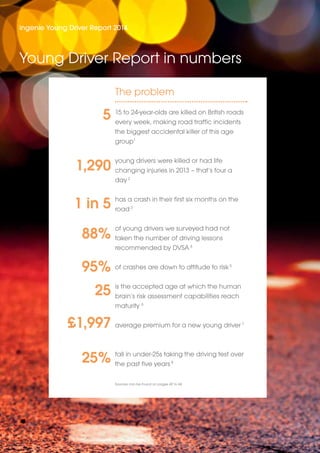
The problem 
15 to 24-year-olds are killed on British roads 
every week, making road traffic incidents 
the biggest accidental killer of this age 
group1 
young drivers were killed or had life 
changing injuries in 2013 – that’s four a 
day 2 
has a crash in their first six months on the 
road 3 
of young drivers we surveyed had not 
taken the number of driving lessons 
recommended by DVSA 4 
of crashes are down to attitude to risk 5 
is the accepted age at which the human 
brain’s risk assessment capabilities reach 
maturity 6 
average premium for a new young driver 7 
fall in under-25s taking the driving test over 
the past five years 8 
Sources can be found on pages 42 to 44 
3 
Young Driver Report in numbers 
5 
1,290 
1 in 5 
88% 
95% 
25 
£1,997 
25%
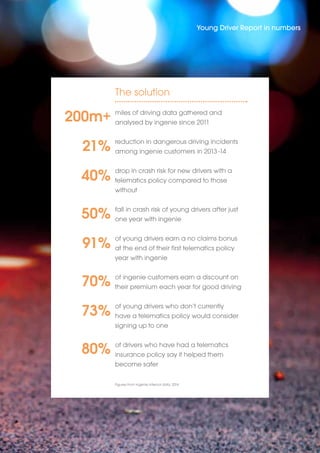
The solution 
Young Driver Report in numbers 
miles of driving data gathered and 
analysed by ingenie since 2011 
reduction in dangerous driving incidents 
among ingenie customers in 2013 -14 
drop in crash risk for new drivers with a 
telematics policy compared to those 
without 
fall in crash risk of young drivers after just 
one year with ingenie 
of young drivers earn a no claims bonus 
at the end of their first telematics policy 
year with ingenie 
of ingenie customers earn a discount on 
their premium each year for good driving 
of young drivers who don’t currently 
have a telematics policy would consider 
signing up to one 
of drivers who have had a telematics 
insurance policy say it helped them 
become safer 
Figures from ingenie internal data, 2014 
200m+ 
21% 
40% 
50% 
91% 
70% 
73% 
80% 
4
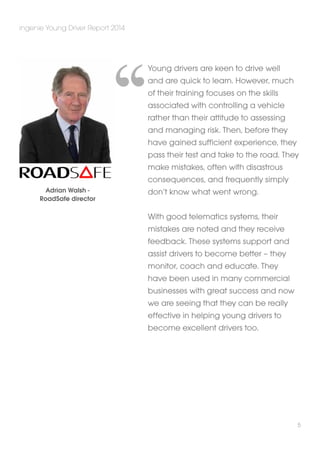
Young drivers are keen to drive well 
and are quick to learn. However, much 
of their training focuses on the skills 
associated with controlling a vehicle 
rather than their attitude to assessing 
and managing risk. Then, before they 
have gained sufficient experience, they 
pass their test and take to the road. They 
make mistakes, often with disastrous 
consequences, and frequently simply 
don’t know what went wrong. 
With good telematics systems, their 
mistakes are noted and they receive 
feedback. These systems support and 
assist drivers to become better – they 
monitor, coach and educate. They 
have been used in many commercial 
businesses with great success and now 
we are seeing that they can be really 
effective in helping young drivers to 
become excellent drivers too. 
Adrian Walsh - 
RoadSafe director 
5 
ingenie Young Driver Report 2014
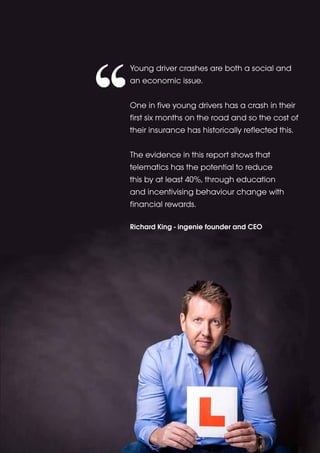
Young driver crashes are both a social and 
an economic issue. 
One in five young drivers has a crash in their 
first six months on the road and so the cost of 
their insurance has historically reflected this. 
The evidence in this report shows that 
telematics has the potential to reduce 
this by at least 40%, through education 
and incentivising behaviour change with 
financial rewards. 
Richard King - ingenie founder and CEO
As a father, I know all too well how it feels when your child passes 
their driving test. It’s a proud moment, but you can’t help worrying 
and hoping they’re going to be sensible. 
Having the black box means they get a co-pilot as they hit the 
road for the first time, and the great thing about this is the peace 
of mind it gives us parents. I have the ingenie app on my phone 
so I can see how the boys are doing, and if I notice things slipping 
I’ll give them a ring. It puts an end to arguing about their driving 
and starts a conversation about the facts. 
I’m very proud to have been involved with ingenie since the start, 
and I believe this report will do a lot to build the recognition that 
black box insurance deserves in road safety. 
Gary Lineker - ingenie ambassador 
ingenie Young Driver Report 2014
For novice drivers, I believe telematics 
is the most significant development in 
road safety since the L-plate. By giving 
new road users a regular analysis of 
their skills behind the wheel, the process 
of learning is extended far beyond the 
driving test. 
Giving feedback on a young driver’s 
road behaviour during those critical – 
and frighteningly dangerous – years 
allows them to constantly improve and 
self-examine both their abilities and 
shortcomings. 
Think of it as having a virtual driving 
instructor in the passenger seat for 
several years and you immediately see 
the enormous value of this technology. 
I’d like to see every new driver in the UK 
benefit from the continuous learning 
curve that in-car telematics brings. 
Quentin Willson - 
Motoring Journalist 
8
What’s the problem? 
• 20% of serious crashes involve under-25s 
• Only 12% take the recommended number of lessons 
• 95% of crashes are down to attitude to risk 
• Young people have an inbuilt disadvantage when it comes to safety 
• The average insurance premium for a new young driver is £1,997 
Elizabeth Jarratt, 19 - ingenie customer
20% of serious crashes involve 
under-25s 
Road incidents are still the biggest cause of accidental 
death for the 15 to 24 age group in the UK,1 and 
despite much discussion of the problem over the 
past decade, successive governments have failed to 
identify a solution. 
Department for Transport (DfT) statistics show that 20% 
of all Killed or Seriously Injured (KSI) crashes involve 
drivers aged 17 to 24 – even though this age group 
constitutes just 8% of all licence holders. In 2013 alone, 
1,290 young drivers were killed or had life changing 
injuries.2 That’s four a day. 
Only 12% take the 
recommended number of 
lessons 
The education available to young learners is good 
development for the practical and theoretical skills 
needed to drive a car, but it’s important to remember 
that the driving test is the minimum required standard; 
it is the entry level to driving, not, as many think, a 
certificate of driving excellence. 
Although there is no legal minimum requirement for the 
number of hours’ driving experience required to take 
the test, the DVSA recommends 47 hours of lessons and 
20 hours of private practice. 
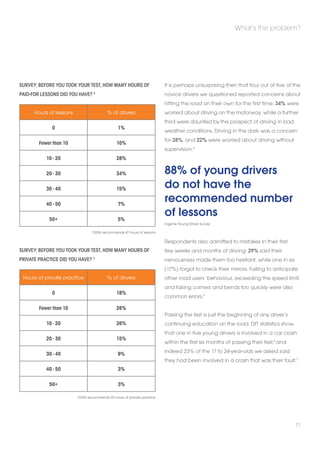
However, only 12% of 17 to 24-year-olds responding 
to a survey commissioned by ingenie said they had 
undertaken at least the recommended number of 
driving lessons, while just a third got the recommended 
amount of private practice under their belt. Almost one 
in five didn’t undertake any private practice at all.1 
ingenie Young Driver Report 2014 
10 
What’s the problem? 
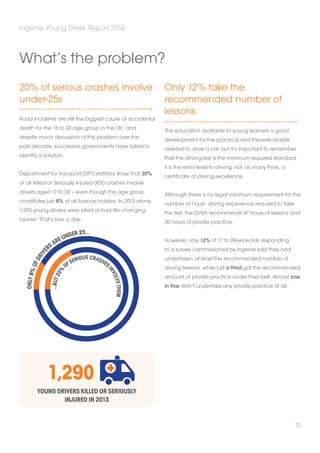
only 8% oF drivers are under 25... 
...but 20% oF serious crashes involve theM 
1,290 
young drivers Killed or seriously 
inJURED in 2013
Survey: Before you took your test, how many hours of 
paid-for lessons did you have? 2 
Hours of lessons % of drivers 
0 1% 
Fewer than 10 10% 
10 - 20 28% 
20 - 30 34% 
30 - 40 15% 
40 - 50 7% 
50+ 5% 
DVSA recommends 47 hours of lessons 
Survey: Before you took your test, how many hours of 
private practice did you have? 3 
Hours of private practice % of drivers 
0 18% 
Fewer than 10 26% 
10 - 20 26% 
20 - 30 15% 
30 - 40 9% 
40 - 50 3% 
50+ 3% 
DVSA recommends 20 hours of private practice 
What’s the problem? 
It is perhaps unsurprising then that four out of five of the 
novice drivers we questioned reported concerns about 
hitting the road on their own for the first time: 34% were 
worried about driving on the motorway, while a further 
third were daunted by the prospect of driving in bad 
weather conditions. Driving in the dark was a concern 
for 28%, and 22% were worried about driving without 
supervision.4 
88% of young drivers 
do not have the 
recommended number 
of lessons 
ingenie Young Driver Survey 
Respondents also admitted to mistakes in their first 
few weeks and months of driving: 29% said their 
nervousness made them too hesitant, while one in six 
(17%) forgot to check their mirrors. Failing to anticipate 
other road users’ behaviour, exceeding the speed limit, 
and taking corners and bends too quickly were also 
common errors.5 
Passing the test is just the beginning of any driver’s 
continuing education on the road. DfT statistics show 
that one in five young drivers is involved in a car crash 
within the first six months of passing their test,6 and 
indeed 23% of the 17 to 24-year-olds we asked said 
they had been involved in a crash that was their fault.7 
11
95% of crashes are down to 
attitude to risk1 
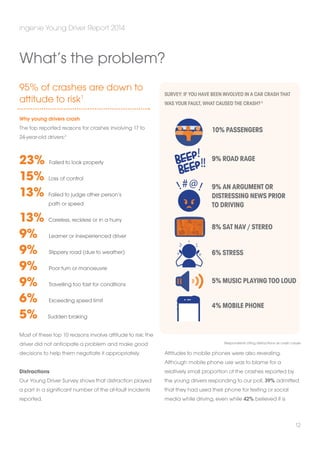
Why young drivers crash 
The top reported reasons for crashes involving 17 to 
24-year-old drivers:2 
23% Failed to look properly 
15% Loss of control 
13% Failed to judge other person’s 
path or speed 
13% Careless, reckless or in a hurry 
9% Learner or inexperienced driver 
9% Slippery road (due to weather) 
9% Poor turn or manoeuvre 
9% Travelling too fast for conditions 
6% Exceeding speed limit 
5% Sudden braking 
Most of these top 10 reasons involve attitude to risk: the 
driver did not anticipate a problem and make good 
decisions to help them negotiate it appropriately. 
Distractions 
Our Young Driver Survey shows that distraction played 
a part in a significant number of the at-fault incidents 
reported. 
Survey: If you have been involved in a car crash that 
was your fault, what caused the crash? 3 
10% Passengers 
9% Road rage 
9% An argument or 
distressing news prior 
to driving 
8% Sat nav / stereo 
6% STress 
5% Music playing too loud 
4% Mobile phone 
Respondents citing distractions as crash cause 
#@ 
Attitudes to mobile phones were also revealing. 
Although mobile phone use was to blame for a 
relatively small proportion of the crashes reported by 
the young drivers responding to our poll, 39% admitted 
that they had used their phone for texting or social 
media while driving, even while 42% believed it is 
ingenie Young Driver Report 2014 
12 
What’s the problem?
illegal to use a phone in any way behind the wheel.4 
This demonstrates the lack of guidance about ‘real life’ 
driving situations and general driving attitude during 
the learning process. 
The current driving education process is focused on 
mechanical skills and road rules theory, and while 
the driving test is rigorous in these respects, it does not 
account for the social pressures and emotional issues 
young drivers must contend with. 
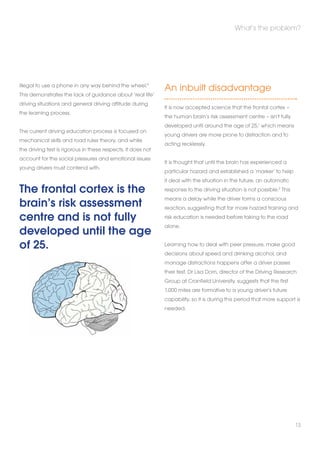
The frontal cortex is the 
brain’s risk assessment 
centre and is not fully 
developed until the age 
of 25. 
What’s the problem? 
An inbuilt disadvantage 
It is now accepted science that the frontal cortex – 
the human brain’s risk assessment centre – isn’t fully 
developed until around the age of 25,1 which means 
young drivers are more prone to distraction and to 
acting recklessly. 
It is thought that until the brain has experienced a 
particular hazard and established a ‘marker’ to help 
it deal with the situation in the future, an automatic 
response to the driving situation is not possible.2 This 
means a delay while the driver forms a conscious 
reaction, suggesting that far more hazard training and 
risk education is needed before taking to the road 
alone. 
Learning how to deal with peer pressure, make good 
decisions about speed and drinking alcohol, and 
manage distractions happens after a driver passes 
their test. Dr Lisa Dorn, director of the Driving Research 
Group at Cranfield University, suggests that the first 
1,000 miles are formative to a young driver’s future 
capability, so it is during this period that more support is 
needed. 
13
The average insurance 
premium for a new young 
driver is £1,9971 
More crashes mean more money. While young drivers 
remain such a high risk, the cost of insurance will be 
prohibitive for many. The cost of repairs to a car is 
minimal in relative terms; the real cost is in personal 
injury. Hundreds of thousands of pounds are required 
to even begin reparation for the impact that crash 
injuries can have. 
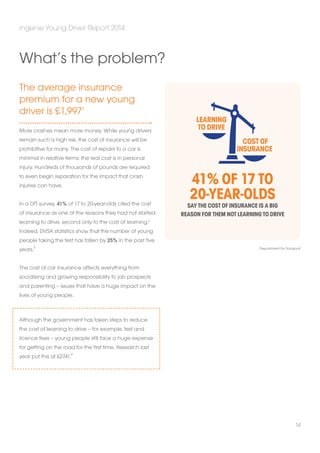
In a DfT survey, 41% of 17 to 20-year-olds cited the cost 
of insurance as one of the reasons they had not started 
learning to drive, second only to the cost of learning.2 
Indeed, DVSA statistics show that the number of young 
people taking the test has fallen by 25% in the past five 
years.3 
The cost of car insurance affects everything from 
socialising and growing responsibility to job prospects 
and parenting – issues that have a huge impact on the 
lives of young people. 
Although the government has taken steps to reduce 
the cost of learning to drive – for example, test and 
licence fees – young people still face a huge expense 
for getting on the road for the first time. Research last 
year put this at £2741.4 
Department for Transport 
ingenie Young Driver Report 2014 
14 
What’s the problem? 
Cost of 
insurance 
Learning 
to drive 
41% of 17 to 
20-year-olds 
say the cost of insurance is a big 
reason For them not learning to drive
14 
I remember tweeting about 
my frustration of not being 
able to find an affordable 
insurance policy. 
Elizabeth Jarratt
The telematics solution 
• Real-world evidence of how young people actually drive 
• Challenging the stereotypes that lead to restrictive measures 
• Telematics and behaviour change 
Benjamin Fisher, 18 - ingenie customer
Real-world evidence: the 
real picture of young driver 
behaviour 
Thanks to telematics, we no longer need to speculate 
on how young people drive, because real world data 
can tell us: when and where they’re on the road, their 
propensity for risk, and how receptive they are to 
feedback. 
The data generated by telematics devices used in ‘pay 
how you drive’ insurance policies makes it possible 
to treat every driver as an individual, giving young 
drivers the opportunity to have a level of control over 
their insurance costs by incentivising good driving with 
reduced premiums. 
While statistics show that, as a group, young drivers 
pose the greatest risk for an insurer, some may be 
exceptionally conscientious – and yet the insurance 
industry still assesses them by the majority’s risk. 
Male drivers are just 
as likely to improve as 
female drivers, and a 
17-year-old driver has 
the same potential for 
behaviour change as a 
21-year-old.1 
What we know about young drivers 
Analysis of over 200 million miles of telematics data 
reveals strong patterns that have allowed us to develop 
the best possible young driver support. 
Having context for where an individual is displaying 
reckless driving behaviour means they can be made 
aware of specific mistakes they make in particular 
situations. If they show a pattern of harsh braking in 
a certain area, it could be that they’re not making 
appropriate decisions for the kind of road they’re on. 
We can then give them advice for dealing with that 
kind of road, so they can avoid a crash. 
Ingenie has collected OVER 200 million miles 
of telematics data showing: 
ingenie Young Driver Report 2014 
17 
The telematics solution 
Speed 
Acceleration 
Braking 
Cornering
The telematics solution 
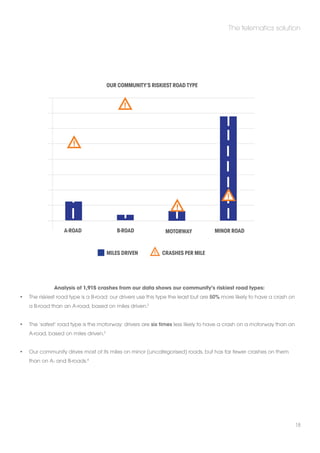
Analysis of 1,915 crashes from our data shows our community’s riskiest road types: 
• The riskiest road type is a B-road: our drivers use this type the least but are 50% more likely to have a crash on 
a B-road than an A-road, based on miles driven.2 
• The ‘safest’ road type is the motorway: drivers are six times less likely to have a crash on a motorway than an 
A-road, based on miles driven.3 
• Our community drives most of its miles on minor (uncategorised) roads, but has far fewer crashes on them 
than on A- and B-roads.4 
18 
! 
! 
! 
! 
Our community’s riskiest road type 
a-road B-road Motorway minor Road 
Miles driven ! crashes per mile
Restrictions are not the answer 
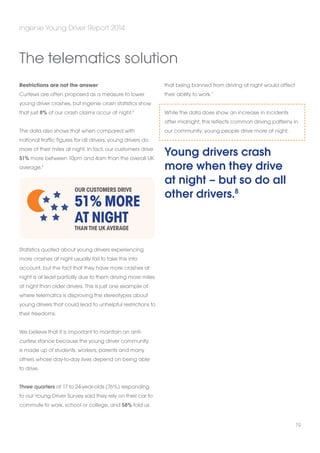
Curfews are often proposed as a measure to lower 
young driver crashes, but ingenie crash statistics show 
that just 8% of our crash claims occur at night.5 
The data also shows that when compared with 
national traffic figures for all drivers, young drivers do 
more of their miles at night. In fact, our customers drive 
51% more between 10pm and 4am than the overall UK 
average.6 
Statistics quoted about young drivers experiencing 
more crashes at night usually fail to take this into 
account, but the fact that they have more crashes at 
night is at least partially due to them driving more miles 
at night than older drivers. This is just one example of 
where telematics is disproving the stereotypes about 
young drivers that could lead to unhelpful restrictions to 
their freedoms. 
We believe that it is important to maintain an anti-curfew 
stance because the young driver community 
is made up of students, workers, parents and many 
others whose day-to-day lives depend on being able 
to drive. 
Three quarters of 17 to 24-year-olds (76%) responding 
to our Young Driver Survey said they rely on their car to 
commute to work, school or college, and 58% told us 
that being banned from driving at night would affect 
their ability to work.7 
While the data does show an increase in incidents 
after midnight, this reflects common driving patterns in 
our community: young people drive more at night. 
Young drivers crash 
more when they drive 
at night – but so do all 
other drivers.8 
ingenie Young Driver Report 2014 
19 
The telematics solution 
Our customers drive 
51% more 
at night 
than the UK average
The telematics solution 
20 
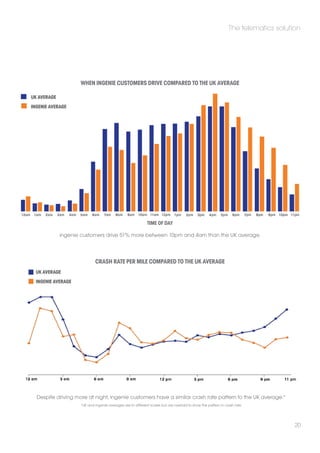
When ingenie customers drive compared to the UK average 
TimE of Day 
UK Average 
ingenie average 
ingenie customers drive 51% more between 10pm and 4am than the UK average. 
Crash rate per mile compared to the UK average 
Despite driving more at night, ingenie customers have a similar crash rate pattern to the UK average.* 
*UK and ingenie averages are to different scales but are overlaid to show the pattern in crash rate 
UK Average 
ingenie average
Telematics and behaviour 
change 
Reckless driving has been a risk for years but until the 
introduction of telematics insurance, it had largely 
gone undetected. As telematics becomes more 
widely accepted as a way to get more affordable car 
insurance, the recorded number of reckless drivers 
inevitably increases. 
There is a danger that telematics could be used 
to automatically exclude these high-risk drivers, by 
cancelling the policies that show behaviour typically 
leading to a claim. This growing group of drivers 
with cancelled policies would then find it extremely 
difficult to obtain affordable insurance again. Instead 
of building a generation of better, safer drivers, the 
insurance industry would have created a generation of 
uninsurable drivers. 
ingenie believes that telematics insurers have a moral 
duty to avoid this outcome by encouraging positive 
change in young drivers who are willing to improve. 
The minority of young people driving recklessly has a 
huge impact on the cost of insurance as well as road 
safety in general. But telematics can affect behaviour 
change if it is used to support them, and even reckless 
drivers can be inspired to become more conscientious 
with the right intervention, as evidenced by the success 
of ingenie’s Driver Behaviour Unit (DBU). 
The DBU gives additional support to drivers displaying 
reckless tendencies – not just warning of what may 
happen if they continue to drive poorly, but also giving 
practical advice to aid improvement. 
In nine out of 10 cases, our team of trained advisers 
is able to influence a positive change in the driver’s 
attitude, resulting in long-term safer driving.1 In this way, 
we avoid cancelling the policies of all but the most 
unacceptably dangerous drivers. 
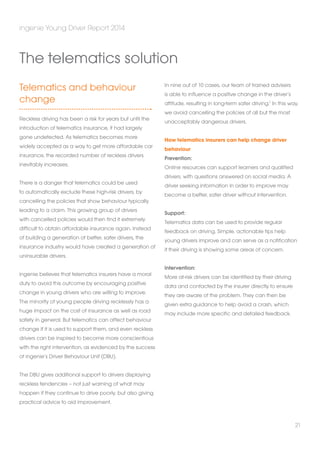
How telematics insurers can help change driver 
behaviour 
Prevention: 
Online resources can support learners and qualified 

drivers, with questions answered on social media. A 
driver seeking information in order to improve may 
become a better, safer driver without intervention. 
Support: 
Telematics data can be used to provide regular 
feedback on driving. Simple, actionable tips help 
young drivers improve and can serve as a notification 
if their driving is showing some areas of concern. 
Intervention: 
More at-risk drivers can be identified by their driving 
data and contacted by the insurer directly to ensure 
they are aware of the problem. They can then be 
given extra guidance to help avoid a crash, which 
may include more specific and detailed feedback. 
ingenie Young Driver Report 2014 
21 
The telematics solution
22 
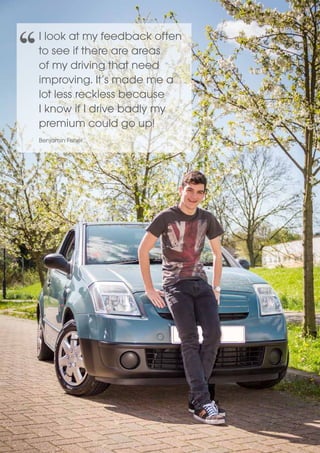
I look at my feedback often 
to see if there are areas 
of my driving that need 
improving. It’s made me a 
lot less reckless because 
I know if I drive badly my 
premium could go up! 
Benjamin Fisher
Proof it works 
• Young drivers can be safe drivers 
• More engagement means less risk 
• Supporting parents and giving them peace of mind 
• Changing behaviour with psychological models 
Faith Mitchell , 19 - ingenie customer
ingenie Young Driver Report 2014 
Proof it works 
Young drivers can be safe 
drivers 
We can see that the majority of young people have 
the potential to drive well because 
70% of the ingenie 
community earns a 
discount for good 
driving1 
and 91% of ingenie customers earn a No Claims 
Discount at the end of their first year with ingenie.2 
Our data also shows clear evidence of long-term 
behaviour change, with customers halving their risk of 
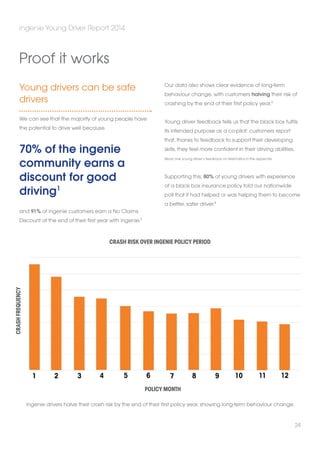
crashing by the end of their first policy year.3 
Young driver feedback tells us that the black box fulfils 
its intended purpose as a co-pilot: customers report 
that, thanks to feedback to support their developing 
skills, they feel more confident in their driving abilities. 
Read one young driver’s feedback on telematics in the appendix. 
Supporting this, 80% of young drivers with experience 
of a black box insurance policy told our nationwide 
poll that it had helped or was helping them to become 
a better, safer driver.4 
24 
Crash risk over ingenie policy period 
Policy month 
Crash frequency 
ingenie drivers halve their crash risk by the end of their first policy year, showing long-term behaviour change.
Proof it works 
How ingenie changes driver behaviour 
Using telematics to positively affect driving behaviour is 
vital to ensuring that our roads become safer. 
ingenie achieves this through preventative road safety 
awareness, driving engagement with feedback, 
supporting parents in their involvement, and 
intervention for the minority of drivers who need it. 
We will show that telematics is already helping young 
drivers to improve, and – with a lower claim frequency 
associated with those drivers who work on their 
feedback – establish a good driving record that should 
help them secure affordable insurance in the future. 
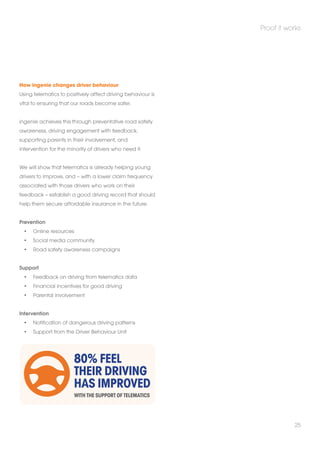
Prevention 
• Online resources 
• Social media community 
• Road safety awareness campaigns 
Support 
• Feedback on driving from telematics data 
• Financial incentives for good driving 
• Parental involvement 
Intervention 
• Notification of dangerous driving patterns 
• Support from the Driver Behaviour Unit 
25 
80% feel 
their driving 
has improved 
with the support of telematics
Engagement with feedback 
The driving performance feedback that is integral to 
performance-linked telematics insurance policies has 
a marked effect on driver behaviour if it is engaged 
with regularly. ingenie data shows a significant positive 
correlation between a driver’s engagement with 
feedback and their driving score, which is in turn linked 
to claim frequency. 
The data collected by ingenie’s black box is used to 
generate a driving score out of 100. The higher the 
score, the lower the crash risk. 
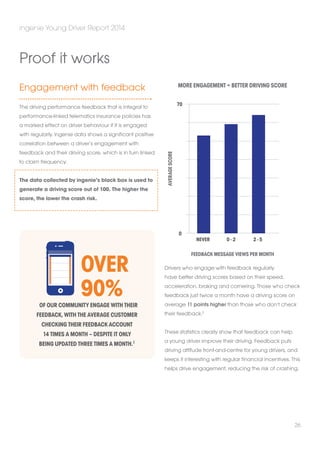
Never 0 - 2 
70 
Drivers who engage with feedback regularly 
have better driving scores based on their speed, 
acceleration, braking and cornering. Those who check 
feedback just twice a month have a driving score on 
average 11 points higher than those who don’t check 
their feedback.2 
These statistics clearly show that feedback can help 
a young driver improve their driving. Feedback puts 
driving attitude front-and-centre for young drivers, and 
keeps it interesting with regular financial incentives. This 
helps drive engagement, reducing the risk of crashing. 
ingenie Young Driver Report 2014 
26 
Proof it works 
of our community engage with their 
feedback, with the average customer 
checking their feedback account 
14 times a month – despite it only 
being updated three times a month.1 
More engagement = better driving score 
Feedback message views per month 
0 
2 - 5 
Average score 
Over 
90%
40% 
0% 
0-9 
Proof it works 
20-29 40-49 60-69 80-89 100 
27 
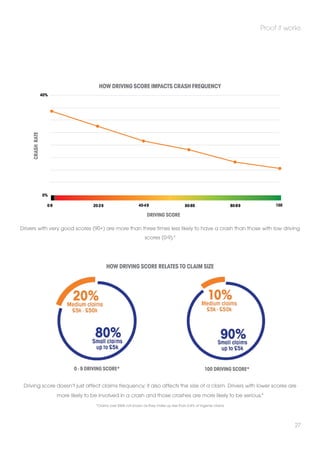
How driving score impacts crash frequency 
DRIVING SCORE 
CRASH rate 
Drivers with very good scores (90+) are more than three times less likely to have a crash than those with low driving 
scores (0-9).3 
How driving score relates to claim size 
0 - 9 DRIVING SCORE* 100 DRIVING SCORE* 
Driving score doesn’t just affect claims frequency; it also affects the size of a claim. Drivers with lower scores are 
more likely to be involved in a crash and those crashes are more likely to be serious.4 
*Claims over £50k not shown as they make up less than 0.4% of ingenie claims
ingenie Young Driver Report 2014 
The parental factor 
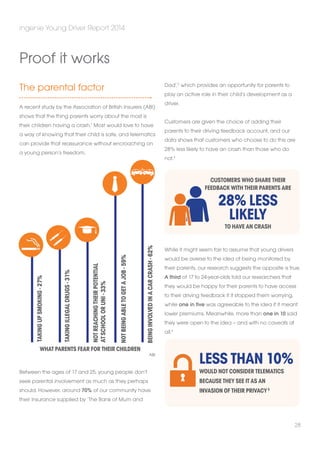
A recent study by the Association of British Insurers (ABI) 
shows that the thing parents worry about the most is 
their children having a crash.1 Most would love to have 
a way of knowing that their child is safe, and telematics 
can provide that reassurance without encroaching on 
a young person’s freedom. 
Between the ages of 17 and 25, young people don’t 
seek parental involvement as much as they perhaps 
should. However, around 70% of our community have 
their insurance supplied by ‘The Bank of Mum and 
Dad’,2 which provides an opportunity for parents to 
play an active role in their child’s development as a 
driver. 
Customers are given the choice of adding their 
parents to their driving feedback account, and our 
data shows that customers who choose to do this are 
28% less likely to have an crash than those who do 
not.3 
While it might seem fair to assume that young drivers 
would be averse to the idea of being monitored by 
their parents, our research suggests the opposite is true. 
A third of 17 to 24-year-olds told our researchers that 
they would be happy for their parents to have access 
to their driving feedback if it stopped them worrying, 
while one in five was agreeable to the idea if it meant 
lower premiums. Meanwhile, more than one in 10 said 
they were open to the idea – and with no caveats at 
all.4 
what parents fear for their children 
ABI 
Customers who share their 
feedback with their parents are 
28% less 
likely 
to have an crash 
being involved in a car crash - 62% 
not being able to get a Job - 59% 
not reaching their Potential 
at school or uni - 33% 
taKing illegal drugs - 31% 
taKing uP sMoKing - 27% 
28 
Proof it works 
Less than 10% 
would not consider telematics 
because they see it as an 
invasion of their privacy 5
Proof it works 
29 
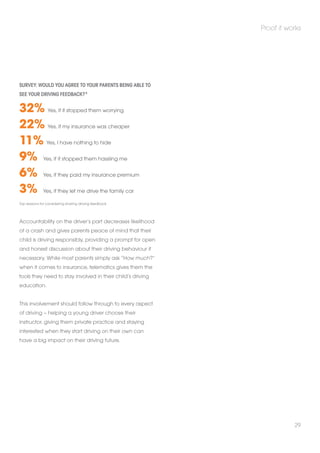
Survey: Would you agree to your parents being able to 
see your driving feedback? 6 
32% Yes, if it stopped them worrying 
22% Yes, if my insurance was cheaper 
11% Yes, I have nothing to hide 
9% Yes, if it stopped them hassling me 
6% Yes, if they paid my insurance premium 
3% Yes, if they let me drive the family car 
Top reasons for considering sharing driving feedback 
Accountability on the driver’s part decreases likelihood 
of a crash and gives parents peace of mind that their 
child is driving responsibly, providing a prompt for open 
and honest discussion about their driving behaviour if 
necessary. While most parents simply ask “How much?” 
when it comes to insurance, telematics gives them the 
tools they need to stay involved in their child’s driving 
education. 
This involvement should follow through to every aspect 
of driving – helping a young driver choose their 
instructor, giving them private practice and staying 
interested when they start driving on their own can 
have a big impact on their driving future.
Intervention stops crashes 
Just one conversation changes behaviour – and 
behaviour change saves lives 
The use of scores linked to driving behaviour enables 
identification of drivers who are ‘a crash waiting to 
happen’. Feedback is sent to make them aware of the 
risk, and these ‘Dangerous’ driving messages also act 
as a trigger for psychology-trained advisers to make 
contact and encourage behaviour change – before 
the crash happens. 
How it works 
ingenie’s Driver Behaviour Unit (DBU) contacts the most 
reckless drivers in the community, carrying out a five to 
10-minute discussion of the driving issue and providing 
practical advice. 
Driving data is used to give context to discussions of 
particular driving events, for example, what the speed 
limit was on the road where a ‘Dangerous’ driving 
message was generated. The advisers then follow up 
with an email summarising the call, which reiterates 
the problem and the solution to encourage long-term 
behaviour change. 
See appendix for more detailed information about the DBU. 
ingenie Young Driver Report 2014 
30 
Proof it works 
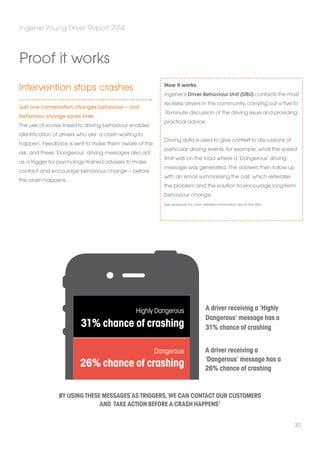
A driver receiving a ‘Highly 
Dangerous’ message has a 
31% chance of crashing 
A driver receiving a 
‘Dangerous’ message has a 
26% chance of crashing 
Highly Dangerous 
31% chance of crashing 
Dangerous 
26% chance of crashing 
By using these messages as triggers, we can contact our customers 
and take action before a crash happens1
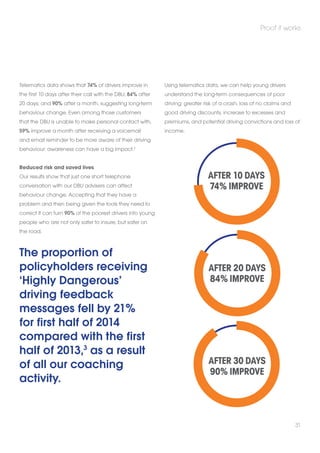
Telematics data shows that 74% of drivers improve in 
the first 10 days after their call with the DBU; 84% after 
20 days; and 90% after a month, suggesting long-term 
behaviour change. Even among those customers 
that the DBU is unable to make personal contact with, 
59% improve a month after receiving a voicemail 
and email reminder to be more aware of their driving 
behaviour: awareness can have a big impact.2 
Reduced risk and saved lives 
Our results show that just one short telephone 
conversation with our DBU advisers can affect 
behaviour change. Accepting that they have a 
problem and then being given the tools they need to 
correct it can turn 90% of the poorest drivers into young 
people who are not only safer to insure, but safer on 
the road. 
The proportion of 
policyholders receiving 
‘Highly Dangerous’ 
driving feedback 
messages fell by 21% 
for first half of 2014 
compared with the first 
half of 2013,3 as a result 
of all our coaching 
activity. 
Proof it works 
Using telematics data, we can help young drivers 
understand the long-term consequences of poor 
driving: greater risk of a crash, loss of no claims and 
good driving discounts, increase to excesses and 
premiums, and potential driving convictions and loss of 
income. 
31 
After 10 days 
74% improve 
After 20 days 
84% improve 
After 30 days 
90% improve
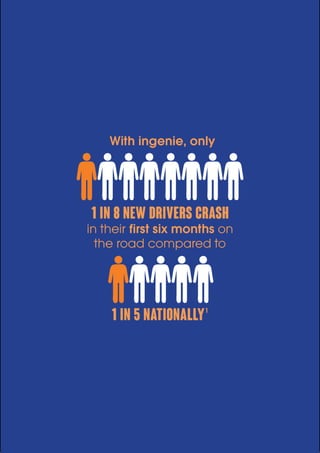
With ingenie, only 
1 in 8 new drivers crash 
in their first six months on 
the road compared to 
1 in 5 nationally1
Proof it works 
33 
Proof in numbers 
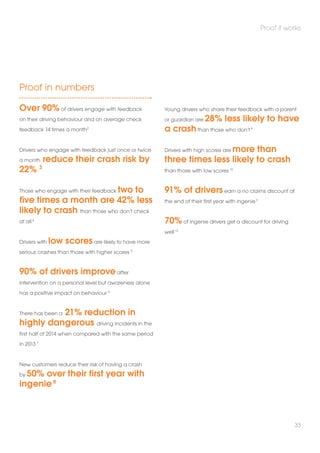
Over 90% of drivers engage with feedback 
on their driving behaviour and on average check 
feedback 14 times a month2 
Drivers who engage with feedback just once or twice 
a month reduce their crash risk by 
22% 3 
Those who engage with their feedback two to 
five times a month are 42% less 
likely to crash than those who don’t check 
at all 4 
Drivers with low scores are likely to have more 
serious crashes than those with higher scores 5 
90% of drivers improve after 
intervention on a personal level but awareness alone 
has a positive impact on behaviour 6 
There has been a 21% reduction in 
highly dangerous driving incidents in the 
first half of 2014 when compared with the same period 
in 2013 7 
New customers reduce their risk of having a crash 
by 50% over their first year with 
ingenie 8 
Young drivers who share their feedback with a parent 
or guardian are 28% less likely to have 
a crash than those who don’t 9 
Drivers with high scores are more than 
three times less likely to crash 
than those with low scores 10 
91% of drivers earn a no claims discount at 
the end of their first year with ingenie11 
70% of ingenie drivers get a discount for driving 
well12
Now is the time for 
telematics 
• Telematics is all around us 
• Out-dated perceptions are changing 
• One in two young drivers now chooses to get a telematics 
Danelia Solari, 19 - ingenie customer 
insurance quote 
• Telematics can have wider benefits to society
Telematics technology is all 
around us 
Telematics is not a new technology and is steadily 
becoming part of daily life, especially in motoring. 
From hands-free calling systems to crash alerts and 
synched driving apps, connectivity is on the rise – and 
telematics insurance fits right in. 
Perceptions are changing 
The question of whether telematics insurance is an 
intrusive ‘Big Brother’-style technology is out-dated. With 
the ever-rising popularity of social media networks and 
location-based apps, today’s generation of young 
drivers is the most connected there has ever been. 
Privacy is judged intuitively: the give-and-take of 
personal data for intelligent services is a daily decision, 
and not a difficult one. In order for these services 
to function to their full potential, they must have 
data – and this is recognised and embraced by the 
connected generation. 
Increasing popularity of telematics insurance among 
young drivers 
For young people, the main driving concern is 
financial; for their parents it’s safety.1 Telematics 
insurance offers both an answer: savings for the 
driver if they drive well and peace of mind for their 
parents that there is some influence over their son’s or 
daughter’s driving behaviour. 
One in two new young drivers now opts to get a quote 
for black box insurance.2 This choice is important, 
because the introduction of mandatory telematics 
would surely give rise to resentment and resistance, 
negating the potential that the technology has for 
improving road safety. The increasing popularity of 
telematics insurance shows that young people want 
the choice to take responsibility for their driving and 
are prepared to work for lower insurance costs. 
In fact, 73% of 17 to 24-year-olds who don’t already 
have a telematics insurance policy say they would 
consider taking the plunge.3 Unsurprisingly, many are 
drawn by the cheaper premiums such policies offer, 
and the promise of further discounts for safe driving 
offers a further incentive. 
Interestingly, for a quarter, the attraction lies in the 
opportunity to prove they are responsible drivers, while 
a similar proportion like the idea of the technology 
helping them to improve their driving skills. Avoiding 
family friction is another important reason given. 
73% would consider a 
telematics insurance 
policy.4 
ingenie Young Driver Report 2014 
35 
Now is the time for telematics
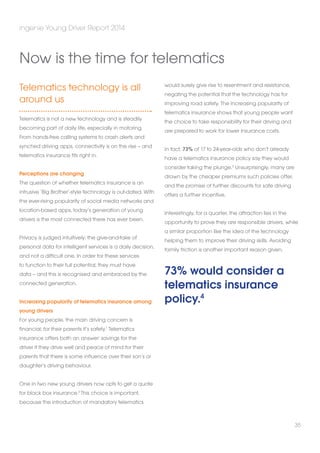
Survey: What would make you consider a telematics 
insurance policy? 5 
46% 
31% 
28% 
25% 
23% 
17% 
15% 
11% 
10% 
Financial incentives make safe driving attractive 
We can see that cheaper insurance is the most 
compelling reason for young drivers to choose a 
telematics policy. This can be offered in three ways, 
which benefit the driver financially and in terms of their 
development: 
A lower premium upfront: ingenie customers report 
saving an average of £750 on their starting price.6 
Regular discounts over the year for good driving: 
reviewing the cost of insurance regularly – rather 
than once a year – keeps the incentive fresh. ingenie 
does this by reviewing policies three times a year and 
offering a discount of up to 21% over the year. 
Now is the time for telematics 
Savings at renewal: a year of driving data allows the 
insurer to assess risk more accurately for the renewal 
price. After one year with us, our customers’ insurance 
comes down by an average of 50%, around £800.7 
Partnerships between telematics insurers and car 
manufacturers 
Car manufacturers are answering the demand for 
connected cars with telematics partnerships. ingenie 
recently launched a deal with Vauxhall, giving 18 to 
20-year-old drivers a year of insurance for £99 when 
they buy a new Corsa. 
At the time of writing this report, more than 1,000 
young drivers had chosen the telematics option 
in the scheme’s first weeks, which shows that such 
partnerships are working to get young drivers more 
invested in safe driving.8 
36 
Cheaper insurance premiums 
The promise of discounts for good driving 
The reassurance my car would be tracked 
quickly if stolen 
To prove I am a safe and responsible driver 
To help me improve my driving skills 
To stop my parents worrying 
The reassurance that someone is watching 
out for me 
To avoid my parents restricting my driving 
To avoid family rows
The wider benefits of 
telematics insurance 
Telematics helps reduce fraudulent claims 
Data showing the time and location of incidents 
helps drivers fight fraudulent claims made against 
them – and also minimises fraudulent claims within the 
insurer’s own customer base. This transparency makes 
insurance much clearer for all parties. 
Telematics eases pressure on the emergency services 
Through GPS data, telematics gives police support in 
recovering stolen vehicles. Wider-spread adoption of 
telematics could also lend support to other emergency 
services, for example crash reporting. 
Using telematics for stolen car recovery means the 
customer doesn’t have to make a claim, helping them 
keep their no claims discount and avoid increases in 
their insurance costs. 
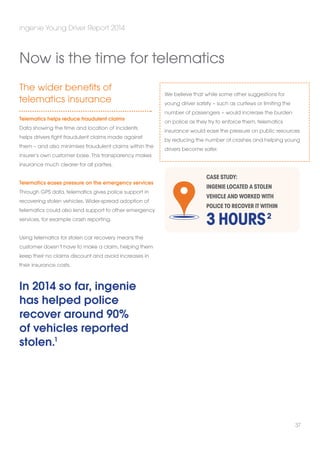
In 2014 so far, ingenie 
has helped police 
recover around 90% 
of vehicles reported 
stolen.1 
We believe that while some other suggestions for 
young driver safety – such as curfews or limiting the 
number of passengers – would increase the burden 
on police as they try to enforce them, telematics 
insurance would ease the pressure on public resources 
by reducing the number of crashes and helping young 
drivers become safer. 
ingenie Young Driver Report 2014 
37 
Now is the time for telematics 
CASE STUDY: 
ingenie located a stolen 
vehicle and worked with 
police to recover it within 
3 HOURS 
2
The black box has 
actually been useful and 
made me become the 
best driver I could be. 
Daniela Solari
In summary 
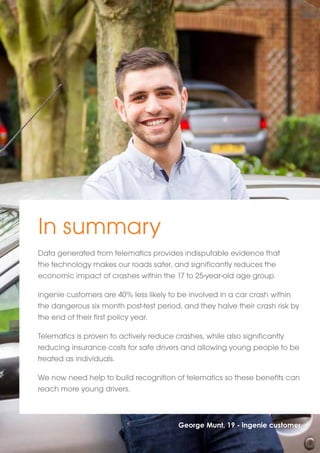
Data generated from telematics provides indisputable evidence that 
the technology makes our roads safer, and significantly reduces the 
economic impact of crashes within the 17 to 25-year-old age group. 
ingenie customers are 40% less likely to be involved in a car crash within 
the dangerous six month post-test period, and they halve their crash risk by 
the end of their first policy year. 
Telematics is proven to actively reduce crashes, while also significantly 
reducing insurance costs for safe drivers and allowing young people to be 
treated as individuals. 
We now need help to build recognition of telematics so these benefits can 
reach more young drivers. 
George Munt, 19 - ingenie customer
Government endorsement 
Telematics offers the most robust, transparent and 
effective solution to the young driver problem to 
date, and industry statistics and consumer research 
show a growing public appetite. However, even while 
telematics insurance increases in popularity, the 
market is still in its infancy. 
ingenie is clear that telematics must continue to be 
offered on an opt-in basis and not made mandatory, 
so that young drivers buy into its benefits on their terms. 
The industry now needs help to build awareness of 
these benefits and drive take-up. 
We therefore call on the government to publicly 
acknowledge telematics’ role in improving young 
driver safety, and its proven potential to save lives. 
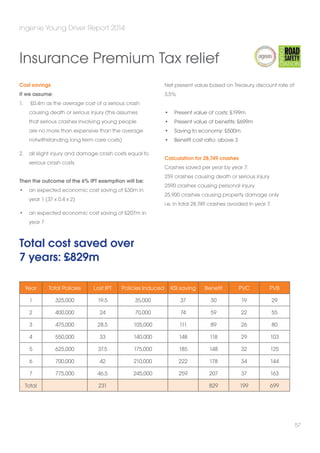
There is a 6% standard 
rate tax on car 
insurance premiums 
(IPT). This adds more 
than £100 to the average 
cost of insurance for a 
new young driver. 
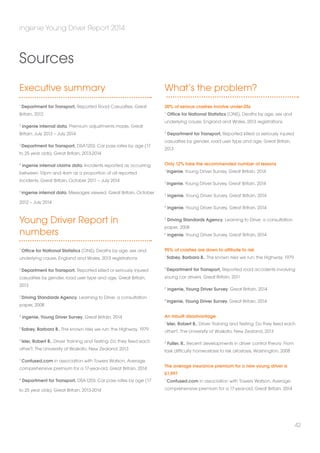
0% Insurance Premium Tax on telematics policies 
ingenie calls on the government to introduce a seven-year 
IPT exemption for new young drivers investing in a 
telematics insurance policy. 
According to calculations provided by The Road Safety 
Foundation and Ageas UK, if all new drivers opted for 
telematics in the first two years of their licence, this 
could save 28,749 crashes anually by year seven, 
delivering a £500 million saving to the UK economy 
– a saving that would outweigh the loss of IPT to the 
Treasury by more than three times.1 
Removing this tax burden would enable telematics 
insurance providers to offset the current high cost of 
the technology and reduce premiums accordingly, 
attracting more first-time drivers. 
We have demonstrated the impact that telematics 
insurance can have on young driver behaviour, how 
it can make insurance more affordable for young 
people, and how it can help make our roads safer. 
We now need help to build more recognition of 
telematics. Government acknowledgment and support 
would increase awareness and take-up, and start to 
improve general driving ability on a much wider scale 
– potentially saving many lives. 
If the next generation of new drivers can be influenced 
by telematics to develop a better driving DNA, the 
long-term impact is huge: as our roads and vehicles 
grow safer, so do our drivers. 
ingenie Young Driver Report 2014 
40 
ingenie’s call to action 
IPT relief taken from The Road Safety 
Foundation ‘Making Road Safety Pay’ report 
commissioned by Ageas UK – November 
2014. For the full calculation, see appendix.
In summary 
44 
7-year IPT exemption on telematics 
policies for new young drivers 
Encouraging new young drivers to 
choose telematics insurance 
by removing the 
6% Insurance 
Premium Tax 
would cut 
28,749 crashes 
annually by year 7 
at a cost of 
£199 million 
to the Treasury 
and would 
save the economy 
£500 million
Executive summary 
1 Department for Transport, Reported Road Casualties, Great 
Britain, 2012 
2 ingenie internal data, Premium adjustments made, Great 
Britain, July 2013 – July 2014 
3 Department for Transport, DSA1203: Car pass rates by age (17 
to 25 year olds), Great Britain, 2013-2014 
4 ingenie internal claims data, Incidents reported as occurring 
between 10pm and 4am as a proportion of all reported 
incidents, Great Britain, October 2011 – July 2014 
5 ingenie internal data, Messages viewed, Great Britain, October 
2012 – July 2014 
Young Driver Report in 
numbers 
1 Office for National Statistics (ONS), Deaths by age, sex and 
underlying cause, England and Wales, 2013 registrations 
2 Department for Transport, Reported killed or seriously injured 
casualties by gender, road user type and age, Great Britain, 
2013 
3 Driving Standards Agency, Learning to Drive: a consultation 
paper, 2008 
4 ingenie, Young Driver Survey, Great Britain, 2014 
5 Sabey, Barbara B., The known risks we run: the Highway, 1979 
6 Isler, Robert B., Driver Training and Testing: Do they feed each 
other?, The University of Waikato, New Zealand, 2013 
7 Confused.com in association with Towers Watson, Average 
comprehensive premium for a 17-year-old, Great Britain, 2014 
8 Department for Transport, DSA1203: Car pass rates by age (17 
to 25 year olds), Great Britain, 2013-2014 
What’s the problem? 
20% of serious crashes involve under-25s 
1 Office for National Statistics (ONS), Deaths by age, sex and 
underlying cause, England and Wales, 2013 registrations 
2 Department for Transport, Reported killed or seriously injured 
casualties by gender, road user type and age, Great Britain, 
2013 
Only 12% take the recommended number of lessons 
1 ingenie, Young Driver Survey, Great Britain, 2014 
2 ingenie, Young Driver Survey, Great Britain, 2014 
3 ingenie, Young Driver Survey, Great Britain, 2014 
4 ingenie, Young Driver Survey, Great Britain, 2014 
5 Driving Standards Agency, Learning to Drive: a consultation 
paper, 2008 
6 ingenie, Young Driver Survey, Great Britain, 2014 
95% of crashes are down to attitude to risk 
1 Sabey, Barbara B., The known risks we run: the Highway, 1979 
2 Department for Transport, Reported road accidents involving 
young car drivers, Great Britain, 2011 
3 ingenie, Young Driver Survey, Great Britain, 2014 
4 ingenie, Young Driver Survey, Great Britain, 2014 
An inbuilt disadvantage 
1 Isler, Robert B., Driver Training and Testing: Do they feed each 
other?, The University of Waikato, New Zealand, 2013 
2 Fuller, R., Recent developments in driver control theory: From 
task difficulty homeostasis to risk allostasis, Washington, 2008 
The average insurance premium for a new young driver is 
£1,997 
1 Confused.com in association with Towers Watson, Average 
comprehensive premium for a 17-year-old, Great Britain, 2014 
ingenie Young Driver Report 2014 
42 
Sources
2 Department for Transport, NTS0203: Reasons for not learning to 
drive by age, England, 2013 
3 Department for Transport, DSA1203: Car pass rates by age (17 
to 25 year olds), Great Britain, 2013-2014 
4 MoneySupermarket, The cost of learning to drive, UK, 2013 
The telematics solution 
Real-world evidence: the real picture of young driver behaviour 
1 ingenie internal data, Messages generated, Great Britain, 
October 2012 – July 2014 
2 ingenie internal data, Claims experience, Great Britain, 
October 2011 – July 2014 
3 ingenie internal data, Claims experience, Great Britain, 
October 2011 – July 2014 
4 ingenie internal data, Claims experience, Great Britain, 
October 2011 – July 2014 
5 ingenie internal claims data, Crashes occurring between 10pm 
and 4am as a proportion of all reported incidents, Great Britain, 
Oct 2011 – July 2014 
6 ingenie internal data, Great Britain, October 2011 – July 2014. 
National data derived from incidents reported to police from 
STATS19 data published by Department for Transport, 2005-2013 
and Traffic Distribution Data (TRA0307) also from Department for 
Transport, 2013. 
7 ingenie, Young Driver Survey, Great Britain, 2014 
Telematics and behaviour change 
1 ingenie internal data, Calls made by the DBU, Great Britain, 
May 2014 
Proof it works 
Young drivers can be safe drivers 
1 ingenie internal data, Premium adjustments made, Great 
Britain, October 2011 – May 2014 
In summary 
2 ingenie internal data, Customers completing first full policy 
year with ingenie, Great Britain, October 2011 – June 2014 
3 ingenie internal data, Claims experience, Great Britain, 
October 2011 – June 2014 
4 ingenie, Young Driver Survey, Great Britain, 2014 
Engagement with feedback 
1 ingenie internal data, Message views, Great Britain, October 
2012 – August 2014 
2 ingenie internal data, Message views, Great Britain, October 
2012 – August 2014 
3 ingenie internal data, Claims experience, Great Britain, 
October 2012 – May 2014 
4 ingenie internal data, Claims experience, Great Britain, 
October 2012 – May 2014 
Intervention stops crashes 
1 ingenie internal data, Messages generated, Great Britain, 
January – June 2013 as compared with January – June 2014 
2 ingenie internal data, Calls made by the DBU, Great Britain, 
May 2014 
3 ingenie internal data, Messages generated, Great Britain, 
January – June 2013 as compared with January – June 2014 
The parental factor 
1 Association of British Insurers, Campaign for safe young drivers 
survey, Great Britain, 2014 
2 ingenie internal data, Great Britain, 2013 – 2014 
3 ingenie internal data, Claims experience, Great Britain, 
October 2011 – March 2014 
4 ingenie, Young Driver Survey, Great Britain, 2014 
5 ingenie, Young Driver Survey, Great Britain, 2014 
6 ingenie, Young Driver Survey, Great Britain, 2014 
43
Proof in numbers 
1 Driving Standards Agency, Learning to Drive: a consultation 
paper, 2008; ingenie internal data, Claims experience, Great 
Britain, October 2011 – May 2014 
2 ingenie internal data, Message views, Great Britain, October 
2012 – August 2014 
3 ingenie internal data, Claims experience, Great Britain, 
October 2012 – May 2014 
4 ingenie internal data, Claims experience, Great Britain, 
October 2012 – May 2014 
5 ingenie internal data, Claims experience, Great Britain, 
October 2011 – May 2014 
6 ingenie internal data, Calls made by the DBU, Great Britain, 
May 2014 
7 ingenie internal data, Messages generated, Great Britain, 
January – June 2013 as compared with January – June 2014 
8 ingenie internal data, Claims experience, Great Britain, 
October 2011 – May 2014 
9 ingenie internal data, Claims experience, Great Britain, 
October 2011 – March 2014 
10 ingenie internal data, Premium adjustments made, Great 
Britain, October 2011 – May 2014 
11 ingenie internal data, Customers completing first full policy 
year with ingenie, Great Britain, October 2011 – June 2014 
12 ingenie internal data, Premium adjustments made, Great 
Britain, October 2011 – May 2014 
Now is the time for telematics 
Telematics technology is all around us 
1 ingenie, Focus groups, Great Britain, 2011 
2 MoneySupermarket, Great Britain, 2013 
3 ingenie, Young Driver Survey, Great Britain, 2014 
4 ingenie, Young Driver Survey, Great Britain, 2014 
5 ingenie, Young Driver Survey, Great Britain, 2014 
6 ingenie internal data, Customer responses, Great Britain, 
March 2014 to April 2014 
7 ingenie internal data, ingenie renewals, Great Britain, January 
2014 to March 2014 
8 ingenie internal data, Sales made, Great Britain, 2014 
The wider benefits of telematics insurance 
1 ingenie, Stolen vehicle recovery logs, Great Britain, 2014 
2 ingenie, Stolen vehicle recovery logs, Great Britain, 2014 
ingenie’s call to action 
1 Ageas, IPT relief calculation, The Road Safety Foundation 
‘Making Road Safety Pay’ report commissioned by Ageas UK, 
November 2014. Full calculation can be found on page 62. 
ingenie Young Driver Report 2014 
44 
Sources
Appendix 
ingenie’s unique approach 
How we developed a young driver insurance product 
How ingenie works 
• How we assess driving behaviour 
• How we determine risk level 
• How we talk to our customers 
• How we act as a co-pilot 
• How we affect behaviour change 
My experience with ingenie’s Driver Behaviour Unit by Emily McRae 
One young driver’s feedback on telematics insurance 
Insurance Premium Tax relief calculations provided by the Road Safety Foundation 
and Ageas UK 
RoadSafe’s support of the ingenie Young Driver Report 
46 
47 - 51 
52 - 54 
55 
56 - 57 
58
ingenie Young Driver Report 2014 
How we developed a young 
driver insurance product 
ingenie spent two years in development before 
launching, working with experts in telematics 
engineering, young driver psychology and road safety 
to tailor the product to appeal to the minds of young 
drivers. Alongside this work, we also conducted focus 
groups with young drivers and parents, asking how 
they felt about car insurance and what they wanted 
from a telematics product. 
With the rise of comparison websites, brand loyalty 
in insurance is a thing of the past. Most young drivers 
remember the name of the comparison website they 
used to find the best deal – not the name of the insurer. 
In most cases, the only time a young driver engages 
with their insurer is once a year to change or renew 
their policy, or to make a claim.We encountered 
a general feeling that an insurer – as a provider of 
a compulsory product – is just like any other utility 
provider. And what 19-year-old checks their water 
meter several times a month for feedback on their 
usage? 
This real-life feedback showed us what we had to 
prove wrong: that an insurer is never going to be on 
their side. We set out to smash any preconceptions 
young drivers might have of a traditional insurer. We 
aimed to be social, collaborative and accessible – 
and definitely on their side. 
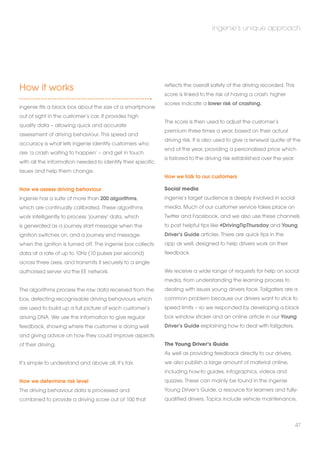
The industry treats 
us with caution 
46 
ingenie’s unique approach 
As young drivers we 
get stereotyped - 
they bump up prices 
and suspicion 
It’s ridiculous, 
I feel like they just 
don’t want me
How it works 
ingenie fits a black box about the size of a smartphone 
out of sight in the customer’s car. It provides high 
quality data – allowing quick and accurate 
assessment of driving behaviour. This speed and 
accuracy is what lets ingenie identify customers who 
are ‘a crash waiting to happen’ – and get in touch 
with all the information needed to identify their specific 
issues and help them change. 
How we assess driving behaviour 
ingenie has a suite of more than 200 algorithms, 
which are continually calibrated. These algorithms 
work intelligently to process ‘journey’ data, which 
is generated as a journey start message when the 
ignition switches on, and a journey end message 
when the ignition is turned off. The ingenie box collects 
data at a rate of up to 10Hz (10 pulses per second) 
across three axes, and transmits it securely to a single 
authorised server via the EE network. 
The algorithms process the raw data received from the 
box, detecting recognisable driving behaviours which 
are used to build up a full picture of each customer’s 
driving DNA. We use this information to give regular 
feedback, showing where the customer is doing well 
and giving advice on how they could improve aspects 
of their driving. 
It’s simple to understand and above all, it’s fair. 
How we determine risk level 
The driving behaviour data is processed and 
combined to provide a driving score out of 100 that 
ingenie’s unique approach 
reflects the overall safety of the driving recorded. This 
score is linked to the risk of having a crash: higher 
scores indicate a lower risk of crashing. 
The score is then used to adjust the customer’s 
premium three times a year, based on their actual 
driving risk. It is also used to give a renewal quote at the 
end of the year, providing a personalised price which 
is tailored to the driving risk established over the year. 
How we talk to our customers 
Social media 
ingenie’s target audience is deeply involved in social 
media. Much of our customer service takes place on 
Twitter and Facebook, and we also use these channels 
to post helpful tips like #DrivingTipThursday and Young 
Driver’s Guide articles. There are quick tips in the 
app as well, designed to help drivers work on their 
feedback. 
We receive a wide range of requests for help on social 
media, from understanding the learning process to 
dealing with issues young drivers face. Tailgaters are a 
common problem because our drivers want to stick to 
speed limits – so we responded by developing a black 
box window sticker and an online article in our Young 
Driver’s Guide explaining how to deal with tailgaters. 
The Young Driver’s Guide 
As well as providing feedback directly to our drivers, 
we also publish a large amount of material online, 
including how-to guides, infographics, videos and 
quizzes. These can mainly be found in the ingenie 
Young Driver’s Guide, a resource for learners and fully-qualified 
drivers. Topics include vehicle maintenance, 
47
driving lessons, buying and selling cars, car insurance 
and general rules of the road. 
Connecting with our community 
The more engagement we can build with a driver, 
the more they will improve – so initiatives that drive 
engagement and continue driver education are 
integral to ingenie’s approach to road safety. 
Using Facebook and Twitter to build a community that 
talks to each other has been at the heart of ingenie’s 
offering since the beginning. Social media has helped 
us normalise telematics insurance and establish a 
collaborative approach to behaviour change. 
We see a lot of our drivers sharing their ingenie 
feedback on social media, particularly when they 
have received a discount. This is creating a positive 
upswing in the number of young people who see 
driving well as an obvious choice over driving 
recklessly: saving money is definitely cool. 
How we act as a co-pilot 
Feedback messages 
The data collected by the black box is used to provide 
feedback to the driver via short, Twitter-style messages 
through the ingenie app or in their online account. 
We send feedback every 10 days – but we find that 
the average ingenie customer actually checks their 
account much more than that. 
The driving score generated by the data is given out 
of 100. We review premiums every three months and 
the higher the driver’s score, the bigger the discount 
they could get – up to 21% off over the year. If they 
drive poorly, they may have their premium increased 
– by a maximum of 10% – so there is a big incentive to 
improve. 
The feedback system follows a traffic light scale: 
green ‘Good’ to red ‘Dangerous’, with black ‘Highly 
Dangerous’ reserved for extreme driving behaviour. 
This system makes feedback easy to understand at a 
glance. 
The messages were developed with psychologists, to 
ensure that they resonate with the mind of a young 
driver. They serve as a notification of how well the 
driver is doing and a channel for short, sharp advice. 
This last point is important: feedback is supplied as a 
push notification from the app. Unlike a letter, call or 
even email, young people constantly pick up push 
notifications. The fact that our drivers also check their 
account and driving score at other times shows that 
the system is engaging enough for us to get past the 
view we encountered in focus groups: that an insurer is 
just another utility provider. 
Over 90% of our customers engage with their driving 
feedback, and on average they check their messages 
14 times a month1 – even though their feedback is 
only updated three times a month. The ingenie app 
has allowed us to break through traditional feelings 
about a compulsory product and become more than 
just an insurer: we’re a co-pilot. 
How we affect behaviour change 
The Driver Behaviour Unit 
To support our feedback system, we developed the 
ingenie Young Driver Report 2014 
48 
ingenie’s unique approach
ingenie Driver Behaviour Unit (DBU): an extension of our 
contact centre, designed to improve our community’s 
driving. From its early days, the DBU made a big 
impact; over the past year we’ve developed the team 
even further and seen significant results. 
Advisers with psychology backgrounds work with 
drivers exhibiting dangerous driving patterns to help 
them understand the potential consequences and 
ultimately become safer on the road. These advisers 
are all young themselves, have taken advanced 
driver training and employ specialised techniques for 
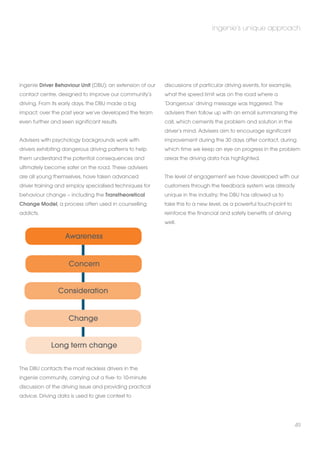
behaviour change – including the Transtheoretical 
Change Model, a process often used in counselling 
addicts. 
Concern 
The DBU contacts the most reckless drivers in the 
ingenie community, carrying out a five- to 10-minute 
discussion of the driving issue and providing practical 
advice. Driving data is used to give context to 
ingenie’s unique approach 
discussions of particular driving events, for example, 
what the speed limit was on the road where a 
‘Dangerous’ driving message was triggered. The 
advisers then follow up with an email summarising the 
call, which cements the problem and solution in the 
driver’s mind. Advisers aim to encourage significant 
improvement during the 30 days after contact, during 
which time we keep an eye on progress in the problem 
areas the driving data has highlighted. 
The level of engagement we have developed with our 
customers through the feedback system was already 
unique in the industry; the DBU has allowed us to 
take this to a new level, as a powerful touch-point to 
reinforce the financial and safety benefits of driving 
well. 
49 
Awareness 
Consideration 
Change 
Long term change
ingenie Young Driver Report 2014 
50 
ingenie’s unique approach 
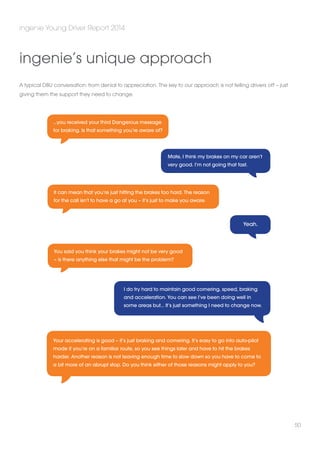
A typical DBU conversation: from denial to appreciation. The key to our approach is not telling drivers off – just 
giving them the support they need to change. 
Mate, I think my brakes on my car aren’t 
very good. I’m not going that fast. 
Yeah. 
…you received your third Dangerous message 
for braking. Is that something you’re aware of? 
It can mean that you’re just hitting the brakes too hard. The reason 
for the call isn’t to have a go at you – it’s just to make you aware. 
You said you think your brakes might not be very good 
– is there anything else that might be the problem? 
I do try hard to maintain good cornering, speed, braking 
and acceleration. You can see I’ve been doing well in 
some areas but… It’s just something I need to change now. 
Your accelerating is good – it’s just braking and cornering. It’s easy to go into auto-pilot 
mode if you’re on a familiar route, so you see things later and have to hit the brakes 
harder. Another reason is not leaving enough time to slow down so you have to come to 
a bit more of an abrupt stop. Do you think either of those reasons might apply to you?
ingenie’s unique approach 
51 
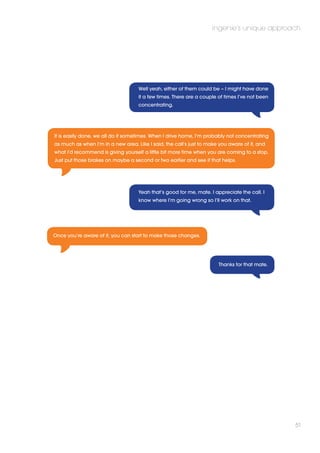
Well yeah, either of them could be – I might have done 
it a few times. There are a couple of times I’ve not been 
concentrating. 
It is easily done, we all do it sometimes. When I drive home, I’m probably not concentrating 
as much as when I’m in a new area. Like I said, the call’s just to make you aware of it, and 
what I’d recommend is giving yourself a little bit more time when you are coming to a stop. 
Just put those brakes on maybe a second or two earlier and see if that helps. 
Yeah that’s good for me, mate. I appreciate the call. I 
know where I’m going wrong so I’ll work on that. 
Thanks for that mate. 
Once you’re aware of it, you can start to make those changes.
My experience with the 
Driver Behaviour Unit 
By Emily McRae
When I received the call from DBU I did realise that I 
was driving fast but I didn’t think it was that bad. I think 
I had been driving too fast regularly as I was driving to 
and from work along motorways and not paying much 
attention to my speed. 
I drove fast because I wasn’t really concentrating 
on my speed, more on the other cars and I was just 
keeping up with them. I did tell my mum and she was 
annoyed because it meant that my insurance for 
that quarter had gone up. She also told me to stick to 
speed limit, which I do now. 
When I was contacted by the DBU I felt a bit ashamed 
that I had been driving so fast and also relieved that 
they called me and told me, otherwise I might have 
carried on. I completely understood and agreed with 
what the DBU was saying so I was more than happy to 
work with them. 
When I spoke to the DBU adviser she just told me to 
keep an eye on my speed and not worry about what 
speed other drivers were doing. I immediately knew 
that I had to stop driving so fast and pretty much 
stopped straight away. 
I think in the long term it has really improved my driving 
because I concentrate on what I’m doing a lot more 
now and I’m not really worrying about other drivers to 
an extent, although obviously you have to be aware of 
what’s going on around you. 
The DBU helped me because it just made me realise 
how driving too fast is dangerous, and it was nice to 
have the call and then have the check-up to make 
sure I had improved and was okay. 
I concentrate a lot more on my speed and look out for 
the speed limit signs to see if it’s changing. I feel a lot 
better now that I’m sticking to the speed limits and I’m 
saving more fuel too. 
I am waiting to see my end of year premium but my 
driving score has improved dramatically! It was at 
about 16 out of 100 which is obviously very low, but 
now it’s at 81. I would definitely recommend the DBU 
because they really helped me improve. 
Emily worked on her driving feedback with the DBU 
and increased her score out of 100 from 16 to 81, 
halving her likelihood of crashing. 
ingenie Young Driver Report 2014 
53 
My experience with the 
Driver Behaviour Unit
My experience with the Driver Behaviour Unit 
2 
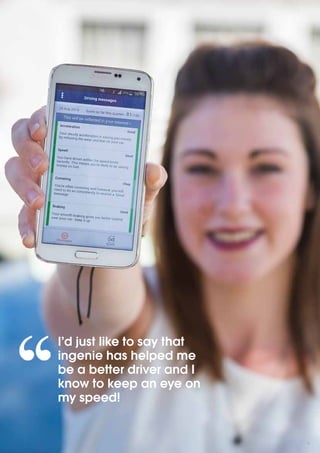
I’d just like to say that 
ingenie has helped me 
be a better driver and I 
know to keep an eye on 
my speed!
ingenie Young Driver Report 2014 
Lauren emailed us recently to say how much she’s benefitted from having a black box. Over her first year with us, 
Lauren has often had all ‘Good’ messages in her feedback, but has had a few ‘Needs Improvement’ messages, 
and one ‘Unsafe’ message. However, she has always been motivated to get back to driving well – which is why 
she’s enjoyed a great discount and renewal price this year. 
“I insured my first car almost a year ago with ingenie. The cost of my first year’s insurance was around £1,080 for 
a Citroen C3 with both my parents as additional drivers. I had just turned 19 at the time of taking the insurance 
out so £1,080 was quite a low price compared to other providers. 
Over the course of the year I have enjoyed receiving my driving feedback as it is interesting to know what 
kind of driver I am. I have had a couple of slip ups, sometimes for harsh braking or cornering, but when these 
flash up on my driving feedback it warned and encouraged me to take the feedback on board and make a 
conscious effort to improve this for next time. I also found it helpful with each feedback that I was told how many 
miles I had driven since my last feedback. I have also received around £80 back over the course of the year for 
my good driving feedback. This is a good incentive to be a safe driver. 
I know when I first insured my car I was slightly worried about having the ‘black box’ fitted because I had just 
passed my driving test, so I wasn’t the world’s best driver, however as the year has gone on I have found that 
the box has actually improved my driving a lot and taught me some important driving skills. I also find it very 
reassuring that the black box also acts as a tracker if my car was ever stolen. 
Thankfully, I haven’t been involved in any kind of crash in my car so I haven’t had to make a claim - so I can’t 
comment on that part! 
As the year since I first insured my car is almost up, I recently received my renewal premium. I was worrying 
about receiving it as I thought it might still be expensive however it has almost halved! I am amazed (and 
relieved). So I will definitely be renewing my insurance with ingenie.” 
Lauren Easton, 20 
24 September 2014 
55 
One young driver’s feedback on 
telematics insurance
The following calculations outline the IPT relief taken 
from the Road Safety Foundation ‘Making Road Safety 
Pay’ report commissioned by Ageas UK – November 
2014 
Treasury revenue forgone 
If we assume: 
1. the current volume of telematics policies is at 
300,000 (of approximately 20m motor insurance 
policies in the UK market) 
2. approximately 250,000 (20% of segment) of these 
policyholders are under 25 years old (of a total 
under-25s market of 1.25m) 
3. there will be a natural market growth of 40,000 
telematics policies per annum 
4. the VAT exemption will encourage marketing 
activity based on the tax relief and societal 
approval, which will induce an annual growth of 
35,000 additional under-25 telematics policies per 
annum 
5. there is an average telematics insurance premium 
of £1,000 
If we assume: 
• a gross cost to Treasury in lost IPT in the first year of 
£1000 x .06 x (250,000 + 75,000) = £19.5m lost 
• an expected 245,000 additional policies in place 
induced by the tax relief and associated marketing 
after the 7th year 
• a rise in lost IPT to £46.5m in the 7th year with 
775,000 under-25s policies in place (broadly two 
thirds of under-25s (62% penetration)) 
Expected total lost in IPT 
over 7 years: £231m 
Reduction in road crashes 
If we assume: 
1. there will be a serious crash reduction of 30% for 
telematics policy holders 
2. under-25s account for 22% of 20,000 serious 
crashes annually 
3. an additional 35,000 policyholders in year 1 and 
245,000 in total by year 7 
Then the outcome of the 6% IPT exemption will be: 
• an expected reduction of 37 serious crashes in year 
1 (20,000 x .22 x.3 x 35,000/1,250,000) 
• an expected reduction of 259 serious crashes by 
year 7 (20,000 x .22 x .3 x 245,000/1,250,000) 
• an expected reduction of 2,590 personal injury 
crashes and 25,900 damage crashes per annum 
by year 7 
Expected annual 
reduction in road 
crashes by year 7: 28,749 
56 
Insurance Premium Tax relief
ingenie Young Driver Report 2014 
Cost savings 
If we assume: 
1. £0.4m as the average cost of a serious crash 
causing death or serious injury (this assumes 
that serious crashes involving young people 
are no more than expensive than the average 
notwithstanding long term care costs) 
2. all slight injury and damage crash costs equal to 
serious crash costs 
Then the outcome of the 6% IPT exemption will be: 
• an expected economic cost saving of £30m in 
year 1 (37 x 0.4 x 2) 
• an expected economic cost saving of £207m in 
year 7 
Total cost saved over 
7 years: £829m 
Net present value based on Treasury discount rate of 
3.5% 
• Present value of costs: £199m 
• Present value of benefits: £699m 
• Saving to economy: £500m 
• Benefit cost ratio: above 3 
Calculation for 28,749 crashes 
Crashes saved per year by year 7: 
259 crashes causing death or serious injury 
2590 crashes causing personal injury 
25,900 crashes causing property damage only 
i.e. in total 28,749 crashes avoided in year 7. 
Year Total Policies Lost IPT Policies Induced KSI saving Benefit PVC PVB 
1 325,000 19.5 35,000 37 30 19 29 
2 400,000 24 70,000 74 59 22 55 
3 475,000 28.5 105,000 111 89 26 80 
4 550,000 33 140,000 148 118 29 103 
5 625,000 37.5 175,000 185 148 32 125 
6 700,000 42 210,000 222 178 34 144 
7 775,000 46.5 245,000 259 207 37 163 
Total 231 829 199 699 
57 
Insurance Premium Tax relief
RoadSafe’s support of the ingenie Young Driver Report 
RoadSafe is acknowledged as a leading forum for promoting and devising solutions to road safety 
problems. 
Its mission is to reduce road deaths and injuries by supporting and encouraging partnerships 
between the private sector and road safety professionals, to promote the safe design and use of 
vehicles and roads by sharing knowledge and encouraging innovation. 
RoadSafe fully supports the Safe System approach to road safety management which sees the 
road user as the weakest link in the transport chain, unpredictable and capable of error, education 
and information efforts notwithstanding. 
RoadSafe is urging a fresh approach to preparing young drivers using a holistic and structured plan 
of education and training that addresses all goals of driver education, along with the development 
of a new type of instructor. The approach should be to educate potential drivers to cope with the 
risks they face, rather than simply to enable them to pilot a vehicle along roads. 
Telematics can achieve much of this, and RoadSafe has been pleased to collaborate with ingenie 
in the preparation of this important report. 
Adrian Walsh 
RoadSafe director 
www.roadsafe.com 
58
59 
About ingenie 
ingenie is an innovative young driver insurer that uses telematics technology to reward safe driving by lowering 
premiums. We build a picture of a driver’s individual style, awareness and safety on the road, rewarding those who 
drive well with cheaper insurance premiums and helping those who need improvement become safer. 
ingenie was awarded the prestigious Prince Michael International Road Safety Award in 2013 in recognition of its 
work to help make young drivers safer on the road, and received the Insurance Start-up Award at the 2014 British 
Insurance Awards. 
ingenie is owned by Quindell plc, a provider of sector-leading expertise in software, consultancy and technology, 
with key markets including insurance and telecommunications. 
Since launching in 2011, ingenie has been lucky to have Gary Lineker, BBC sports presenter, as our ambassador. 
www.ingenie.com
For media enquiries 
Will Powell, Bell Pottinger 
+44 (0)20 7861 2452 
press@ingenie.com 
/ingenieinsurance @ingenie /company/ingenie-limited

The ingenie Young Driver Report

  • 1.
    In partnership with ingenie Young Driver Report November 2014
  • 2.
    Contents Introduction YoungDriver Report in numbers Statement from RoadSafe director Adrian Walsh Statement from ingenie founder and CEO Richard King Statement from ingenie ambassador Gary Lineker Statement from motoring expert Quentin Willson What’s the problem? • 20% of serious crashes involve under-25s • Only 12% take the recommended number of lessons • 95% of crashes are down to attitude to risk • An inbuilt disadvantage • The average insurance premium for a new driver is £1,997 The telematics solution • Real-world evidence: the real picture of young driver behaviour • Telematics and behaviour change Proof it works • Young drivers can be safe drivers • Engagement with feedback • The parental factor • Intervention stops crashes • Proof in numbers Now is the time for telematics • Telematics technology is all around us • The wider benefits of telematics technology In summary • ingenie’s call to action Sources Appendix The ingenie Young Driver Report is part of the 2014 / 2015 Quindell Thought Leadership Series 1 - 2 3 - 4 5 6 7 8 10 10 - 11 12 - 13 13 14 17 - 20 21 24 - 25 26 - 27 28 - 29 30 - 31 32 - 33 35 - 36 37 40 - 41 42 - 44 45 - 57
  • 3.
    Telematics insurance cutscrashes and saves lives by making young drivers better, safer motorists. With the right incentives, it has the potential to make a serious difference to road safety in the UK. Every year, more than 490,000* newly qualified young drivers take to the road on their own for the first time. Passing the driving test is a defining moment and opens many doors: socially, domestically, academically and financially through better job prospects. But of those 490,000 new licence holders, nearly 50,000 will crash in their first six months of driving alone.** For the majority, this isn’t because they’re reckless, but because many will lack the cognitive maturity and experience of an adult over 25, and so are less able to perceive potential hazards and react accordingly. 50,000 new drivers will crash in their first six months of driving Telematics insurance can help with this. It has the potential to be much more than a means to getting young people on the road in a way they can afford. By providing ongoing post-test mentoring, incentive and support, it can help them become better, safer drivers. Since we launched ingenie in 2011, we have collected well over 200 million miles of data, which tells us that telematics technology can save lives. This report combines our own insight with industry data and the views of 1,000 young drivers to paint a compelling picture of the role telematics can play in young drivers’ development. The report also calls for the government to take steps to support the uptake of telematics insurance. Telematics has come of age, with one in two young drivers getting a telematics insurance quote. To allow insurers to lower the cost of telematics insurance and therefore encourage more young drivers to make this choice, we are calling for a seven-year exemption on Insurance Premium Tax for new young drivers if they opt for telematics insurance. As well as making a significant contribution to reducing young driver risk, increased take-up would help cut fraud and reduce the pressure on emergency services. In so doing, it would recoup the loss of tax income to the Exchequer by more than three times. Telematics has the potential to save more lives than any other road safety policy presented so far as a solution to the young driver problem, and there is a moral obligation – as well as a very clear economic responsibility – for government, industry, road safety campaigners and the general public to support it. *Actual figures = 493,625 (2013-2014) 475,324 (2012-2013) 519,410 (2011-2012) pass rates 17-25. Department for Transport, DSA1203: Car pass rates by age (17 to 25 year olds), Great Britain, 2013-2014 ** Based on Department for Transport, Reported Road Casualties, Great Britain, 2012; assuming 50% drive regularly and one-in-five of those crash ingenie Young Driver Report 2014 1 Introduction
  • 4.
    Young drivers needa different approach 20% of serious road incidents involve under-25s despite this age group making up just 8% of all road users.1 There is a public misconception that passing the test is a badge of excellence, rather than a minimum standard. Many young drivers have little private practice while they learn to drive, limiting their miles on the road. In addition, it is accepted science that the frontal cortex – the human brain’s risk assessment centre – isn’t fully developed until around the age of 25. For these reasons, most young drivers need some form of ‘co-pilot’ in the early months. 20% of serious road incidents involve under- 25s Young drivers are not all reckless 70% of ingenie customers drive so safely that they enjoy a performance-related discount on their premiums,2 showing that the vast majority are safe, responsible drivers. Many do make mistakes, but with the right coaching we have seen that they very quickly improve, regardless of age or gender. Restrictions are not the answer The driving test already demands a high level of practical ability and theoretical knowledge, proved by the fact that one in every two 17 to 25-year-olds fails.3 Making the test even more difficult is therefore not the answer. Neither is restricting young drivers’ freedoms. Given that just 8% of ingenie’s young driver crashes happen at night,4 imposing night-time driving curfews would not only have a minimal impact on casualty Introduction rates, but would be counterproductive to social mobility and growth. With feedback and incentives, it is possible to motivate even reckless drivers Telematics builds safer drivers After one year with ingenie, young drivers halve their crash risk. Over 90% engage with automatic telematics feedback about their performance and those who engage with it most frequently are the least likely to crash.5 Despite young drivers’ natural propensity for distraction and greater risk-taking, with the right feedback and incentives, it is possible to motivate even reckless drivers to change their behaviour. Sources can be found on pages 42 to 44 ingenie was awarded the Prince Michael International Road Safety Award in 2013, for our use of telematics to help under-25s become safer drivers. 2
  • 5.
    ingenie Young DriverReport 2014 The problem 15 to 24-year-olds are killed on British roads every week, making road traffic incidents the biggest accidental killer of this age group1 young drivers were killed or had life changing injuries in 2013 – that’s four a day 2 has a crash in their first six months on the road 3 of young drivers we surveyed had not taken the number of driving lessons recommended by DVSA 4 of crashes are down to attitude to risk 5 is the accepted age at which the human brain’s risk assessment capabilities reach maturity 6 average premium for a new young driver 7 fall in under-25s taking the driving test over the past five years 8 Sources can be found on pages 42 to 44 3 Young Driver Report in numbers 5 1,290 1 in 5 88% 95% 25 £1,997 25%
  • 6.
    The solution YoungDriver Report in numbers miles of driving data gathered and analysed by ingenie since 2011 reduction in dangerous driving incidents among ingenie customers in 2013 -14 drop in crash risk for new drivers with a telematics policy compared to those without fall in crash risk of young drivers after just one year with ingenie of young drivers earn a no claims bonus at the end of their first telematics policy year with ingenie of ingenie customers earn a discount on their premium each year for good driving of young drivers who don’t currently have a telematics policy would consider signing up to one of drivers who have had a telematics insurance policy say it helped them become safer Figures from ingenie internal data, 2014 200m+ 21% 40% 50% 91% 70% 73% 80% 4
  • 7.
    Young drivers arekeen to drive well and are quick to learn. However, much of their training focuses on the skills associated with controlling a vehicle rather than their attitude to assessing and managing risk. Then, before they have gained sufficient experience, they pass their test and take to the road. They make mistakes, often with disastrous consequences, and frequently simply don’t know what went wrong. With good telematics systems, their mistakes are noted and they receive feedback. These systems support and assist drivers to become better – they monitor, coach and educate. They have been used in many commercial businesses with great success and now we are seeing that they can be really effective in helping young drivers to become excellent drivers too. Adrian Walsh - RoadSafe director 5 ingenie Young Driver Report 2014
  • 8.
    Young driver crashesare both a social and an economic issue. One in five young drivers has a crash in their first six months on the road and so the cost of their insurance has historically reflected this. The evidence in this report shows that telematics has the potential to reduce this by at least 40%, through education and incentivising behaviour change with financial rewards. Richard King - ingenie founder and CEO
  • 9.
    As a father,I know all too well how it feels when your child passes their driving test. It’s a proud moment, but you can’t help worrying and hoping they’re going to be sensible. Having the black box means they get a co-pilot as they hit the road for the first time, and the great thing about this is the peace of mind it gives us parents. I have the ingenie app on my phone so I can see how the boys are doing, and if I notice things slipping I’ll give them a ring. It puts an end to arguing about their driving and starts a conversation about the facts. I’m very proud to have been involved with ingenie since the start, and I believe this report will do a lot to build the recognition that black box insurance deserves in road safety. Gary Lineker - ingenie ambassador ingenie Young Driver Report 2014
  • 10.
    For novice drivers,I believe telematics is the most significant development in road safety since the L-plate. By giving new road users a regular analysis of their skills behind the wheel, the process of learning is extended far beyond the driving test. Giving feedback on a young driver’s road behaviour during those critical – and frighteningly dangerous – years allows them to constantly improve and self-examine both their abilities and shortcomings. Think of it as having a virtual driving instructor in the passenger seat for several years and you immediately see the enormous value of this technology. I’d like to see every new driver in the UK benefit from the continuous learning curve that in-car telematics brings. Quentin Willson - Motoring Journalist 8
  • 11.
    What’s the problem? • 20% of serious crashes involve under-25s • Only 12% take the recommended number of lessons • 95% of crashes are down to attitude to risk • Young people have an inbuilt disadvantage when it comes to safety • The average insurance premium for a new young driver is £1,997 Elizabeth Jarratt, 19 - ingenie customer
  • 12.
    20% of seriouscrashes involve under-25s Road incidents are still the biggest cause of accidental death for the 15 to 24 age group in the UK,1 and despite much discussion of the problem over the past decade, successive governments have failed to identify a solution. Department for Transport (DfT) statistics show that 20% of all Killed or Seriously Injured (KSI) crashes involve drivers aged 17 to 24 – even though this age group constitutes just 8% of all licence holders. In 2013 alone, 1,290 young drivers were killed or had life changing injuries.2 That’s four a day. Only 12% take the recommended number of lessons The education available to young learners is good development for the practical and theoretical skills needed to drive a car, but it’s important to remember that the driving test is the minimum required standard; it is the entry level to driving, not, as many think, a certificate of driving excellence. Although there is no legal minimum requirement for the number of hours’ driving experience required to take the test, the DVSA recommends 47 hours of lessons and 20 hours of private practice. However, only 12% of 17 to 24-year-olds responding to a survey commissioned by ingenie said they had undertaken at least the recommended number of driving lessons, while just a third got the recommended amount of private practice under their belt. Almost one in five didn’t undertake any private practice at all.1 ingenie Young Driver Report 2014 10 What’s the problem? only 8% oF drivers are under 25... ...but 20% oF serious crashes involve theM 1,290 young drivers Killed or seriously inJURED in 2013
  • 13.
    Survey: Before youtook your test, how many hours of paid-for lessons did you have? 2 Hours of lessons % of drivers 0 1% Fewer than 10 10% 10 - 20 28% 20 - 30 34% 30 - 40 15% 40 - 50 7% 50+ 5% DVSA recommends 47 hours of lessons Survey: Before you took your test, how many hours of private practice did you have? 3 Hours of private practice % of drivers 0 18% Fewer than 10 26% 10 - 20 26% 20 - 30 15% 30 - 40 9% 40 - 50 3% 50+ 3% DVSA recommends 20 hours of private practice What’s the problem? It is perhaps unsurprising then that four out of five of the novice drivers we questioned reported concerns about hitting the road on their own for the first time: 34% were worried about driving on the motorway, while a further third were daunted by the prospect of driving in bad weather conditions. Driving in the dark was a concern for 28%, and 22% were worried about driving without supervision.4 88% of young drivers do not have the recommended number of lessons ingenie Young Driver Survey Respondents also admitted to mistakes in their first few weeks and months of driving: 29% said their nervousness made them too hesitant, while one in six (17%) forgot to check their mirrors. Failing to anticipate other road users’ behaviour, exceeding the speed limit, and taking corners and bends too quickly were also common errors.5 Passing the test is just the beginning of any driver’s continuing education on the road. DfT statistics show that one in five young drivers is involved in a car crash within the first six months of passing their test,6 and indeed 23% of the 17 to 24-year-olds we asked said they had been involved in a crash that was their fault.7 11
  • 14.
    95% of crashesare down to attitude to risk1 Why young drivers crash The top reported reasons for crashes involving 17 to 24-year-old drivers:2 23% Failed to look properly 15% Loss of control 13% Failed to judge other person’s path or speed 13% Careless, reckless or in a hurry 9% Learner or inexperienced driver 9% Slippery road (due to weather) 9% Poor turn or manoeuvre 9% Travelling too fast for conditions 6% Exceeding speed limit 5% Sudden braking Most of these top 10 reasons involve attitude to risk: the driver did not anticipate a problem and make good decisions to help them negotiate it appropriately. Distractions Our Young Driver Survey shows that distraction played a part in a significant number of the at-fault incidents reported. Survey: If you have been involved in a car crash that was your fault, what caused the crash? 3 10% Passengers 9% Road rage 9% An argument or distressing news prior to driving 8% Sat nav / stereo 6% STress 5% Music playing too loud 4% Mobile phone Respondents citing distractions as crash cause #@ Attitudes to mobile phones were also revealing. Although mobile phone use was to blame for a relatively small proportion of the crashes reported by the young drivers responding to our poll, 39% admitted that they had used their phone for texting or social media while driving, even while 42% believed it is ingenie Young Driver Report 2014 12 What’s the problem?
  • 15.
    illegal to usea phone in any way behind the wheel.4 This demonstrates the lack of guidance about ‘real life’ driving situations and general driving attitude during the learning process. The current driving education process is focused on mechanical skills and road rules theory, and while the driving test is rigorous in these respects, it does not account for the social pressures and emotional issues young drivers must contend with. The frontal cortex is the brain’s risk assessment centre and is not fully developed until the age of 25. What’s the problem? An inbuilt disadvantage It is now accepted science that the frontal cortex – the human brain’s risk assessment centre – isn’t fully developed until around the age of 25,1 which means young drivers are more prone to distraction and to acting recklessly. It is thought that until the brain has experienced a particular hazard and established a ‘marker’ to help it deal with the situation in the future, an automatic response to the driving situation is not possible.2 This means a delay while the driver forms a conscious reaction, suggesting that far more hazard training and risk education is needed before taking to the road alone. Learning how to deal with peer pressure, make good decisions about speed and drinking alcohol, and manage distractions happens after a driver passes their test. Dr Lisa Dorn, director of the Driving Research Group at Cranfield University, suggests that the first 1,000 miles are formative to a young driver’s future capability, so it is during this period that more support is needed. 13
  • 16.
    The average insurance premium for a new young driver is £1,9971 More crashes mean more money. While young drivers remain such a high risk, the cost of insurance will be prohibitive for many. The cost of repairs to a car is minimal in relative terms; the real cost is in personal injury. Hundreds of thousands of pounds are required to even begin reparation for the impact that crash injuries can have. In a DfT survey, 41% of 17 to 20-year-olds cited the cost of insurance as one of the reasons they had not started learning to drive, second only to the cost of learning.2 Indeed, DVSA statistics show that the number of young people taking the test has fallen by 25% in the past five years.3 The cost of car insurance affects everything from socialising and growing responsibility to job prospects and parenting – issues that have a huge impact on the lives of young people. Although the government has taken steps to reduce the cost of learning to drive – for example, test and licence fees – young people still face a huge expense for getting on the road for the first time. Research last year put this at £2741.4 Department for Transport ingenie Young Driver Report 2014 14 What’s the problem? Cost of insurance Learning to drive 41% of 17 to 20-year-olds say the cost of insurance is a big reason For them not learning to drive
  • 17.
    14 I remembertweeting about my frustration of not being able to find an affordable insurance policy. Elizabeth Jarratt
  • 18.
    The telematics solution • Real-world evidence of how young people actually drive • Challenging the stereotypes that lead to restrictive measures • Telematics and behaviour change Benjamin Fisher, 18 - ingenie customer
  • 19.
    Real-world evidence: the real picture of young driver behaviour Thanks to telematics, we no longer need to speculate on how young people drive, because real world data can tell us: when and where they’re on the road, their propensity for risk, and how receptive they are to feedback. The data generated by telematics devices used in ‘pay how you drive’ insurance policies makes it possible to treat every driver as an individual, giving young drivers the opportunity to have a level of control over their insurance costs by incentivising good driving with reduced premiums. While statistics show that, as a group, young drivers pose the greatest risk for an insurer, some may be exceptionally conscientious – and yet the insurance industry still assesses them by the majority’s risk. Male drivers are just as likely to improve as female drivers, and a 17-year-old driver has the same potential for behaviour change as a 21-year-old.1 What we know about young drivers Analysis of over 200 million miles of telematics data reveals strong patterns that have allowed us to develop the best possible young driver support. Having context for where an individual is displaying reckless driving behaviour means they can be made aware of specific mistakes they make in particular situations. If they show a pattern of harsh braking in a certain area, it could be that they’re not making appropriate decisions for the kind of road they’re on. We can then give them advice for dealing with that kind of road, so they can avoid a crash. Ingenie has collected OVER 200 million miles of telematics data showing: ingenie Young Driver Report 2014 17 The telematics solution Speed Acceleration Braking Cornering
  • 20.
    The telematics solution Analysis of 1,915 crashes from our data shows our community’s riskiest road types: • The riskiest road type is a B-road: our drivers use this type the least but are 50% more likely to have a crash on a B-road than an A-road, based on miles driven.2 • The ‘safest’ road type is the motorway: drivers are six times less likely to have a crash on a motorway than an A-road, based on miles driven.3 • Our community drives most of its miles on minor (uncategorised) roads, but has far fewer crashes on them than on A- and B-roads.4 18 ! ! ! ! Our community’s riskiest road type a-road B-road Motorway minor Road Miles driven ! crashes per mile
  • 21.
    Restrictions are notthe answer Curfews are often proposed as a measure to lower young driver crashes, but ingenie crash statistics show that just 8% of our crash claims occur at night.5 The data also shows that when compared with national traffic figures for all drivers, young drivers do more of their miles at night. In fact, our customers drive 51% more between 10pm and 4am than the overall UK average.6 Statistics quoted about young drivers experiencing more crashes at night usually fail to take this into account, but the fact that they have more crashes at night is at least partially due to them driving more miles at night than older drivers. This is just one example of where telematics is disproving the stereotypes about young drivers that could lead to unhelpful restrictions to their freedoms. We believe that it is important to maintain an anti-curfew stance because the young driver community is made up of students, workers, parents and many others whose day-to-day lives depend on being able to drive. Three quarters of 17 to 24-year-olds (76%) responding to our Young Driver Survey said they rely on their car to commute to work, school or college, and 58% told us that being banned from driving at night would affect their ability to work.7 While the data does show an increase in incidents after midnight, this reflects common driving patterns in our community: young people drive more at night. Young drivers crash more when they drive at night – but so do all other drivers.8 ingenie Young Driver Report 2014 19 The telematics solution Our customers drive 51% more at night than the UK average
  • 22.
    The telematics solution 20 When ingenie customers drive compared to the UK average TimE of Day UK Average ingenie average ingenie customers drive 51% more between 10pm and 4am than the UK average. Crash rate per mile compared to the UK average Despite driving more at night, ingenie customers have a similar crash rate pattern to the UK average.* *UK and ingenie averages are to different scales but are overlaid to show the pattern in crash rate UK Average ingenie average
  • 23.
    Telematics and behaviour change Reckless driving has been a risk for years but until the introduction of telematics insurance, it had largely gone undetected. As telematics becomes more widely accepted as a way to get more affordable car insurance, the recorded number of reckless drivers inevitably increases. There is a danger that telematics could be used to automatically exclude these high-risk drivers, by cancelling the policies that show behaviour typically leading to a claim. This growing group of drivers with cancelled policies would then find it extremely difficult to obtain affordable insurance again. Instead of building a generation of better, safer drivers, the insurance industry would have created a generation of uninsurable drivers. ingenie believes that telematics insurers have a moral duty to avoid this outcome by encouraging positive change in young drivers who are willing to improve. The minority of young people driving recklessly has a huge impact on the cost of insurance as well as road safety in general. But telematics can affect behaviour change if it is used to support them, and even reckless drivers can be inspired to become more conscientious with the right intervention, as evidenced by the success of ingenie’s Driver Behaviour Unit (DBU). The DBU gives additional support to drivers displaying reckless tendencies – not just warning of what may happen if they continue to drive poorly, but also giving practical advice to aid improvement. In nine out of 10 cases, our team of trained advisers is able to influence a positive change in the driver’s attitude, resulting in long-term safer driving.1 In this way, we avoid cancelling the policies of all but the most unacceptably dangerous drivers. How telematics insurers can help change driver behaviour Prevention: Online resources can support learners and qualified drivers, with questions answered on social media. A driver seeking information in order to improve may become a better, safer driver without intervention. Support: Telematics data can be used to provide regular feedback on driving. Simple, actionable tips help young drivers improve and can serve as a notification if their driving is showing some areas of concern. Intervention: More at-risk drivers can be identified by their driving data and contacted by the insurer directly to ensure they are aware of the problem. They can then be given extra guidance to help avoid a crash, which may include more specific and detailed feedback. ingenie Young Driver Report 2014 21 The telematics solution
  • 24.
    22 I lookat my feedback often to see if there are areas of my driving that need improving. It’s made me a lot less reckless because I know if I drive badly my premium could go up! Benjamin Fisher
  • 25.
    Proof it works • Young drivers can be safe drivers • More engagement means less risk • Supporting parents and giving them peace of mind • Changing behaviour with psychological models Faith Mitchell , 19 - ingenie customer
  • 26.
    ingenie Young DriverReport 2014 Proof it works Young drivers can be safe drivers We can see that the majority of young people have the potential to drive well because 70% of the ingenie community earns a discount for good driving1 and 91% of ingenie customers earn a No Claims Discount at the end of their first year with ingenie.2 Our data also shows clear evidence of long-term behaviour change, with customers halving their risk of crashing by the end of their first policy year.3 Young driver feedback tells us that the black box fulfils its intended purpose as a co-pilot: customers report that, thanks to feedback to support their developing skills, they feel more confident in their driving abilities. Read one young driver’s feedback on telematics in the appendix. Supporting this, 80% of young drivers with experience of a black box insurance policy told our nationwide poll that it had helped or was helping them to become a better, safer driver.4 24 Crash risk over ingenie policy period Policy month Crash frequency ingenie drivers halve their crash risk by the end of their first policy year, showing long-term behaviour change.
  • 27.
    Proof it works How ingenie changes driver behaviour Using telematics to positively affect driving behaviour is vital to ensuring that our roads become safer. ingenie achieves this through preventative road safety awareness, driving engagement with feedback, supporting parents in their involvement, and intervention for the minority of drivers who need it. We will show that telematics is already helping young drivers to improve, and – with a lower claim frequency associated with those drivers who work on their feedback – establish a good driving record that should help them secure affordable insurance in the future. Prevention • Online resources • Social media community • Road safety awareness campaigns Support • Feedback on driving from telematics data • Financial incentives for good driving • Parental involvement Intervention • Notification of dangerous driving patterns • Support from the Driver Behaviour Unit 25 80% feel their driving has improved with the support of telematics
  • 28.
    Engagement with feedback The driving performance feedback that is integral to performance-linked telematics insurance policies has a marked effect on driver behaviour if it is engaged with regularly. ingenie data shows a significant positive correlation between a driver’s engagement with feedback and their driving score, which is in turn linked to claim frequency. The data collected by ingenie’s black box is used to generate a driving score out of 100. The higher the score, the lower the crash risk. Never 0 - 2 70 Drivers who engage with feedback regularly have better driving scores based on their speed, acceleration, braking and cornering. Those who check feedback just twice a month have a driving score on average 11 points higher than those who don’t check their feedback.2 These statistics clearly show that feedback can help a young driver improve their driving. Feedback puts driving attitude front-and-centre for young drivers, and keeps it interesting with regular financial incentives. This helps drive engagement, reducing the risk of crashing. ingenie Young Driver Report 2014 26 Proof it works of our community engage with their feedback, with the average customer checking their feedback account 14 times a month – despite it only being updated three times a month.1 More engagement = better driving score Feedback message views per month 0 2 - 5 Average score Over 90%
  • 29.
    40% 0% 0-9 Proof it works 20-29 40-49 60-69 80-89 100 27 How driving score impacts crash frequency DRIVING SCORE CRASH rate Drivers with very good scores (90+) are more than three times less likely to have a crash than those with low driving scores (0-9).3 How driving score relates to claim size 0 - 9 DRIVING SCORE* 100 DRIVING SCORE* Driving score doesn’t just affect claims frequency; it also affects the size of a claim. Drivers with lower scores are more likely to be involved in a crash and those crashes are more likely to be serious.4 *Claims over £50k not shown as they make up less than 0.4% of ingenie claims
  • 30.
    ingenie Young DriverReport 2014 The parental factor A recent study by the Association of British Insurers (ABI) shows that the thing parents worry about the most is their children having a crash.1 Most would love to have a way of knowing that their child is safe, and telematics can provide that reassurance without encroaching on a young person’s freedom. Between the ages of 17 and 25, young people don’t seek parental involvement as much as they perhaps should. However, around 70% of our community have their insurance supplied by ‘The Bank of Mum and Dad’,2 which provides an opportunity for parents to play an active role in their child’s development as a driver. Customers are given the choice of adding their parents to their driving feedback account, and our data shows that customers who choose to do this are 28% less likely to have an crash than those who do not.3 While it might seem fair to assume that young drivers would be averse to the idea of being monitored by their parents, our research suggests the opposite is true. A third of 17 to 24-year-olds told our researchers that they would be happy for their parents to have access to their driving feedback if it stopped them worrying, while one in five was agreeable to the idea if it meant lower premiums. Meanwhile, more than one in 10 said they were open to the idea – and with no caveats at all.4 what parents fear for their children ABI Customers who share their feedback with their parents are 28% less likely to have an crash being involved in a car crash - 62% not being able to get a Job - 59% not reaching their Potential at school or uni - 33% taKing illegal drugs - 31% taKing uP sMoKing - 27% 28 Proof it works Less than 10% would not consider telematics because they see it as an invasion of their privacy 5
  • 31.
    Proof it works 29 Survey: Would you agree to your parents being able to see your driving feedback? 6 32% Yes, if it stopped them worrying 22% Yes, if my insurance was cheaper 11% Yes, I have nothing to hide 9% Yes, if it stopped them hassling me 6% Yes, if they paid my insurance premium 3% Yes, if they let me drive the family car Top reasons for considering sharing driving feedback Accountability on the driver’s part decreases likelihood of a crash and gives parents peace of mind that their child is driving responsibly, providing a prompt for open and honest discussion about their driving behaviour if necessary. While most parents simply ask “How much?” when it comes to insurance, telematics gives them the tools they need to stay involved in their child’s driving education. This involvement should follow through to every aspect of driving – helping a young driver choose their instructor, giving them private practice and staying interested when they start driving on their own can have a big impact on their driving future.
  • 32.
    Intervention stops crashes Just one conversation changes behaviour – and behaviour change saves lives The use of scores linked to driving behaviour enables identification of drivers who are ‘a crash waiting to happen’. Feedback is sent to make them aware of the risk, and these ‘Dangerous’ driving messages also act as a trigger for psychology-trained advisers to make contact and encourage behaviour change – before the crash happens. How it works ingenie’s Driver Behaviour Unit (DBU) contacts the most reckless drivers in the community, carrying out a five to 10-minute discussion of the driving issue and providing practical advice. Driving data is used to give context to discussions of particular driving events, for example, what the speed limit was on the road where a ‘Dangerous’ driving message was generated. The advisers then follow up with an email summarising the call, which reiterates the problem and the solution to encourage long-term behaviour change. See appendix for more detailed information about the DBU. ingenie Young Driver Report 2014 30 Proof it works A driver receiving a ‘Highly Dangerous’ message has a 31% chance of crashing A driver receiving a ‘Dangerous’ message has a 26% chance of crashing Highly Dangerous 31% chance of crashing Dangerous 26% chance of crashing By using these messages as triggers, we can contact our customers and take action before a crash happens1
  • 33.
    Telematics data showsthat 74% of drivers improve in the first 10 days after their call with the DBU; 84% after 20 days; and 90% after a month, suggesting long-term behaviour change. Even among those customers that the DBU is unable to make personal contact with, 59% improve a month after receiving a voicemail and email reminder to be more aware of their driving behaviour: awareness can have a big impact.2 Reduced risk and saved lives Our results show that just one short telephone conversation with our DBU advisers can affect behaviour change. Accepting that they have a problem and then being given the tools they need to correct it can turn 90% of the poorest drivers into young people who are not only safer to insure, but safer on the road. The proportion of policyholders receiving ‘Highly Dangerous’ driving feedback messages fell by 21% for first half of 2014 compared with the first half of 2013,3 as a result of all our coaching activity. Proof it works Using telematics data, we can help young drivers understand the long-term consequences of poor driving: greater risk of a crash, loss of no claims and good driving discounts, increase to excesses and premiums, and potential driving convictions and loss of income. 31 After 10 days 74% improve After 20 days 84% improve After 30 days 90% improve
  • 34.
    With ingenie, only 1 in 8 new drivers crash in their first six months on the road compared to 1 in 5 nationally1
  • 35.
    Proof it works 33 Proof in numbers Over 90% of drivers engage with feedback on their driving behaviour and on average check feedback 14 times a month2 Drivers who engage with feedback just once or twice a month reduce their crash risk by 22% 3 Those who engage with their feedback two to five times a month are 42% less likely to crash than those who don’t check at all 4 Drivers with low scores are likely to have more serious crashes than those with higher scores 5 90% of drivers improve after intervention on a personal level but awareness alone has a positive impact on behaviour 6 There has been a 21% reduction in highly dangerous driving incidents in the first half of 2014 when compared with the same period in 2013 7 New customers reduce their risk of having a crash by 50% over their first year with ingenie 8 Young drivers who share their feedback with a parent or guardian are 28% less likely to have a crash than those who don’t 9 Drivers with high scores are more than three times less likely to crash than those with low scores 10 91% of drivers earn a no claims discount at the end of their first year with ingenie11 70% of ingenie drivers get a discount for driving well12
  • 36.
    Now is thetime for telematics • Telematics is all around us • Out-dated perceptions are changing • One in two young drivers now chooses to get a telematics Danelia Solari, 19 - ingenie customer insurance quote • Telematics can have wider benefits to society
  • 37.
    Telematics technology isall around us Telematics is not a new technology and is steadily becoming part of daily life, especially in motoring. From hands-free calling systems to crash alerts and synched driving apps, connectivity is on the rise – and telematics insurance fits right in. Perceptions are changing The question of whether telematics insurance is an intrusive ‘Big Brother’-style technology is out-dated. With the ever-rising popularity of social media networks and location-based apps, today’s generation of young drivers is the most connected there has ever been. Privacy is judged intuitively: the give-and-take of personal data for intelligent services is a daily decision, and not a difficult one. In order for these services to function to their full potential, they must have data – and this is recognised and embraced by the connected generation. Increasing popularity of telematics insurance among young drivers For young people, the main driving concern is financial; for their parents it’s safety.1 Telematics insurance offers both an answer: savings for the driver if they drive well and peace of mind for their parents that there is some influence over their son’s or daughter’s driving behaviour. One in two new young drivers now opts to get a quote for black box insurance.2 This choice is important, because the introduction of mandatory telematics would surely give rise to resentment and resistance, negating the potential that the technology has for improving road safety. The increasing popularity of telematics insurance shows that young people want the choice to take responsibility for their driving and are prepared to work for lower insurance costs. In fact, 73% of 17 to 24-year-olds who don’t already have a telematics insurance policy say they would consider taking the plunge.3 Unsurprisingly, many are drawn by the cheaper premiums such policies offer, and the promise of further discounts for safe driving offers a further incentive. Interestingly, for a quarter, the attraction lies in the opportunity to prove they are responsible drivers, while a similar proportion like the idea of the technology helping them to improve their driving skills. Avoiding family friction is another important reason given. 73% would consider a telematics insurance policy.4 ingenie Young Driver Report 2014 35 Now is the time for telematics
  • 38.
    Survey: What wouldmake you consider a telematics insurance policy? 5 46% 31% 28% 25% 23% 17% 15% 11% 10% Financial incentives make safe driving attractive We can see that cheaper insurance is the most compelling reason for young drivers to choose a telematics policy. This can be offered in three ways, which benefit the driver financially and in terms of their development: A lower premium upfront: ingenie customers report saving an average of £750 on their starting price.6 Regular discounts over the year for good driving: reviewing the cost of insurance regularly – rather than once a year – keeps the incentive fresh. ingenie does this by reviewing policies three times a year and offering a discount of up to 21% over the year. Now is the time for telematics Savings at renewal: a year of driving data allows the insurer to assess risk more accurately for the renewal price. After one year with us, our customers’ insurance comes down by an average of 50%, around £800.7 Partnerships between telematics insurers and car manufacturers Car manufacturers are answering the demand for connected cars with telematics partnerships. ingenie recently launched a deal with Vauxhall, giving 18 to 20-year-old drivers a year of insurance for £99 when they buy a new Corsa. At the time of writing this report, more than 1,000 young drivers had chosen the telematics option in the scheme’s first weeks, which shows that such partnerships are working to get young drivers more invested in safe driving.8 36 Cheaper insurance premiums The promise of discounts for good driving The reassurance my car would be tracked quickly if stolen To prove I am a safe and responsible driver To help me improve my driving skills To stop my parents worrying The reassurance that someone is watching out for me To avoid my parents restricting my driving To avoid family rows
  • 39.
    The wider benefitsof telematics insurance Telematics helps reduce fraudulent claims Data showing the time and location of incidents helps drivers fight fraudulent claims made against them – and also minimises fraudulent claims within the insurer’s own customer base. This transparency makes insurance much clearer for all parties. Telematics eases pressure on the emergency services Through GPS data, telematics gives police support in recovering stolen vehicles. Wider-spread adoption of telematics could also lend support to other emergency services, for example crash reporting. Using telematics for stolen car recovery means the customer doesn’t have to make a claim, helping them keep their no claims discount and avoid increases in their insurance costs. In 2014 so far, ingenie has helped police recover around 90% of vehicles reported stolen.1 We believe that while some other suggestions for young driver safety – such as curfews or limiting the number of passengers – would increase the burden on police as they try to enforce them, telematics insurance would ease the pressure on public resources by reducing the number of crashes and helping young drivers become safer. ingenie Young Driver Report 2014 37 Now is the time for telematics CASE STUDY: ingenie located a stolen vehicle and worked with police to recover it within 3 HOURS 2
  • 40.
    The black boxhas actually been useful and made me become the best driver I could be. Daniela Solari
  • 41.
    In summary Datagenerated from telematics provides indisputable evidence that the technology makes our roads safer, and significantly reduces the economic impact of crashes within the 17 to 25-year-old age group. ingenie customers are 40% less likely to be involved in a car crash within the dangerous six month post-test period, and they halve their crash risk by the end of their first policy year. Telematics is proven to actively reduce crashes, while also significantly reducing insurance costs for safe drivers and allowing young people to be treated as individuals. We now need help to build recognition of telematics so these benefits can reach more young drivers. George Munt, 19 - ingenie customer
  • 42.
    Government endorsement Telematicsoffers the most robust, transparent and effective solution to the young driver problem to date, and industry statistics and consumer research show a growing public appetite. However, even while telematics insurance increases in popularity, the market is still in its infancy. ingenie is clear that telematics must continue to be offered on an opt-in basis and not made mandatory, so that young drivers buy into its benefits on their terms. The industry now needs help to build awareness of these benefits and drive take-up. We therefore call on the government to publicly acknowledge telematics’ role in improving young driver safety, and its proven potential to save lives. There is a 6% standard rate tax on car insurance premiums (IPT). This adds more than £100 to the average cost of insurance for a new young driver. 0% Insurance Premium Tax on telematics policies ingenie calls on the government to introduce a seven-year IPT exemption for new young drivers investing in a telematics insurance policy. According to calculations provided by The Road Safety Foundation and Ageas UK, if all new drivers opted for telematics in the first two years of their licence, this could save 28,749 crashes anually by year seven, delivering a £500 million saving to the UK economy – a saving that would outweigh the loss of IPT to the Treasury by more than three times.1 Removing this tax burden would enable telematics insurance providers to offset the current high cost of the technology and reduce premiums accordingly, attracting more first-time drivers. We have demonstrated the impact that telematics insurance can have on young driver behaviour, how it can make insurance more affordable for young people, and how it can help make our roads safer. We now need help to build more recognition of telematics. Government acknowledgment and support would increase awareness and take-up, and start to improve general driving ability on a much wider scale – potentially saving many lives. If the next generation of new drivers can be influenced by telematics to develop a better driving DNA, the long-term impact is huge: as our roads and vehicles grow safer, so do our drivers. ingenie Young Driver Report 2014 40 ingenie’s call to action IPT relief taken from The Road Safety Foundation ‘Making Road Safety Pay’ report commissioned by Ageas UK – November 2014. For the full calculation, see appendix.
  • 43.
    In summary 44 7-year IPT exemption on telematics policies for new young drivers Encouraging new young drivers to choose telematics insurance by removing the 6% Insurance Premium Tax would cut 28,749 crashes annually by year 7 at a cost of £199 million to the Treasury and would save the economy £500 million
  • 44.
    Executive summary 1Department for Transport, Reported Road Casualties, Great Britain, 2012 2 ingenie internal data, Premium adjustments made, Great Britain, July 2013 – July 2014 3 Department for Transport, DSA1203: Car pass rates by age (17 to 25 year olds), Great Britain, 2013-2014 4 ingenie internal claims data, Incidents reported as occurring between 10pm and 4am as a proportion of all reported incidents, Great Britain, October 2011 – July 2014 5 ingenie internal data, Messages viewed, Great Britain, October 2012 – July 2014 Young Driver Report in numbers 1 Office for National Statistics (ONS), Deaths by age, sex and underlying cause, England and Wales, 2013 registrations 2 Department for Transport, Reported killed or seriously injured casualties by gender, road user type and age, Great Britain, 2013 3 Driving Standards Agency, Learning to Drive: a consultation paper, 2008 4 ingenie, Young Driver Survey, Great Britain, 2014 5 Sabey, Barbara B., The known risks we run: the Highway, 1979 6 Isler, Robert B., Driver Training and Testing: Do they feed each other?, The University of Waikato, New Zealand, 2013 7 Confused.com in association with Towers Watson, Average comprehensive premium for a 17-year-old, Great Britain, 2014 8 Department for Transport, DSA1203: Car pass rates by age (17 to 25 year olds), Great Britain, 2013-2014 What’s the problem? 20% of serious crashes involve under-25s 1 Office for National Statistics (ONS), Deaths by age, sex and underlying cause, England and Wales, 2013 registrations 2 Department for Transport, Reported killed or seriously injured casualties by gender, road user type and age, Great Britain, 2013 Only 12% take the recommended number of lessons 1 ingenie, Young Driver Survey, Great Britain, 2014 2 ingenie, Young Driver Survey, Great Britain, 2014 3 ingenie, Young Driver Survey, Great Britain, 2014 4 ingenie, Young Driver Survey, Great Britain, 2014 5 Driving Standards Agency, Learning to Drive: a consultation paper, 2008 6 ingenie, Young Driver Survey, Great Britain, 2014 95% of crashes are down to attitude to risk 1 Sabey, Barbara B., The known risks we run: the Highway, 1979 2 Department for Transport, Reported road accidents involving young car drivers, Great Britain, 2011 3 ingenie, Young Driver Survey, Great Britain, 2014 4 ingenie, Young Driver Survey, Great Britain, 2014 An inbuilt disadvantage 1 Isler, Robert B., Driver Training and Testing: Do they feed each other?, The University of Waikato, New Zealand, 2013 2 Fuller, R., Recent developments in driver control theory: From task difficulty homeostasis to risk allostasis, Washington, 2008 The average insurance premium for a new young driver is £1,997 1 Confused.com in association with Towers Watson, Average comprehensive premium for a 17-year-old, Great Britain, 2014 ingenie Young Driver Report 2014 42 Sources
  • 45.
    2 Department forTransport, NTS0203: Reasons for not learning to drive by age, England, 2013 3 Department for Transport, DSA1203: Car pass rates by age (17 to 25 year olds), Great Britain, 2013-2014 4 MoneySupermarket, The cost of learning to drive, UK, 2013 The telematics solution Real-world evidence: the real picture of young driver behaviour 1 ingenie internal data, Messages generated, Great Britain, October 2012 – July 2014 2 ingenie internal data, Claims experience, Great Britain, October 2011 – July 2014 3 ingenie internal data, Claims experience, Great Britain, October 2011 – July 2014 4 ingenie internal data, Claims experience, Great Britain, October 2011 – July 2014 5 ingenie internal claims data, Crashes occurring between 10pm and 4am as a proportion of all reported incidents, Great Britain, Oct 2011 – July 2014 6 ingenie internal data, Great Britain, October 2011 – July 2014. National data derived from incidents reported to police from STATS19 data published by Department for Transport, 2005-2013 and Traffic Distribution Data (TRA0307) also from Department for Transport, 2013. 7 ingenie, Young Driver Survey, Great Britain, 2014 Telematics and behaviour change 1 ingenie internal data, Calls made by the DBU, Great Britain, May 2014 Proof it works Young drivers can be safe drivers 1 ingenie internal data, Premium adjustments made, Great Britain, October 2011 – May 2014 In summary 2 ingenie internal data, Customers completing first full policy year with ingenie, Great Britain, October 2011 – June 2014 3 ingenie internal data, Claims experience, Great Britain, October 2011 – June 2014 4 ingenie, Young Driver Survey, Great Britain, 2014 Engagement with feedback 1 ingenie internal data, Message views, Great Britain, October 2012 – August 2014 2 ingenie internal data, Message views, Great Britain, October 2012 – August 2014 3 ingenie internal data, Claims experience, Great Britain, October 2012 – May 2014 4 ingenie internal data, Claims experience, Great Britain, October 2012 – May 2014 Intervention stops crashes 1 ingenie internal data, Messages generated, Great Britain, January – June 2013 as compared with January – June 2014 2 ingenie internal data, Calls made by the DBU, Great Britain, May 2014 3 ingenie internal data, Messages generated, Great Britain, January – June 2013 as compared with January – June 2014 The parental factor 1 Association of British Insurers, Campaign for safe young drivers survey, Great Britain, 2014 2 ingenie internal data, Great Britain, 2013 – 2014 3 ingenie internal data, Claims experience, Great Britain, October 2011 – March 2014 4 ingenie, Young Driver Survey, Great Britain, 2014 5 ingenie, Young Driver Survey, Great Britain, 2014 6 ingenie, Young Driver Survey, Great Britain, 2014 43
  • 46.
    Proof in numbers 1 Driving Standards Agency, Learning to Drive: a consultation paper, 2008; ingenie internal data, Claims experience, Great Britain, October 2011 – May 2014 2 ingenie internal data, Message views, Great Britain, October 2012 – August 2014 3 ingenie internal data, Claims experience, Great Britain, October 2012 – May 2014 4 ingenie internal data, Claims experience, Great Britain, October 2012 – May 2014 5 ingenie internal data, Claims experience, Great Britain, October 2011 – May 2014 6 ingenie internal data, Calls made by the DBU, Great Britain, May 2014 7 ingenie internal data, Messages generated, Great Britain, January – June 2013 as compared with January – June 2014 8 ingenie internal data, Claims experience, Great Britain, October 2011 – May 2014 9 ingenie internal data, Claims experience, Great Britain, October 2011 – March 2014 10 ingenie internal data, Premium adjustments made, Great Britain, October 2011 – May 2014 11 ingenie internal data, Customers completing first full policy year with ingenie, Great Britain, October 2011 – June 2014 12 ingenie internal data, Premium adjustments made, Great Britain, October 2011 – May 2014 Now is the time for telematics Telematics technology is all around us 1 ingenie, Focus groups, Great Britain, 2011 2 MoneySupermarket, Great Britain, 2013 3 ingenie, Young Driver Survey, Great Britain, 2014 4 ingenie, Young Driver Survey, Great Britain, 2014 5 ingenie, Young Driver Survey, Great Britain, 2014 6 ingenie internal data, Customer responses, Great Britain, March 2014 to April 2014 7 ingenie internal data, ingenie renewals, Great Britain, January 2014 to March 2014 8 ingenie internal data, Sales made, Great Britain, 2014 The wider benefits of telematics insurance 1 ingenie, Stolen vehicle recovery logs, Great Britain, 2014 2 ingenie, Stolen vehicle recovery logs, Great Britain, 2014 ingenie’s call to action 1 Ageas, IPT relief calculation, The Road Safety Foundation ‘Making Road Safety Pay’ report commissioned by Ageas UK, November 2014. Full calculation can be found on page 62. ingenie Young Driver Report 2014 44 Sources
  • 47.
    Appendix ingenie’s uniqueapproach How we developed a young driver insurance product How ingenie works • How we assess driving behaviour • How we determine risk level • How we talk to our customers • How we act as a co-pilot • How we affect behaviour change My experience with ingenie’s Driver Behaviour Unit by Emily McRae One young driver’s feedback on telematics insurance Insurance Premium Tax relief calculations provided by the Road Safety Foundation and Ageas UK RoadSafe’s support of the ingenie Young Driver Report 46 47 - 51 52 - 54 55 56 - 57 58
  • 48.
    ingenie Young DriverReport 2014 How we developed a young driver insurance product ingenie spent two years in development before launching, working with experts in telematics engineering, young driver psychology and road safety to tailor the product to appeal to the minds of young drivers. Alongside this work, we also conducted focus groups with young drivers and parents, asking how they felt about car insurance and what they wanted from a telematics product. With the rise of comparison websites, brand loyalty in insurance is a thing of the past. Most young drivers remember the name of the comparison website they used to find the best deal – not the name of the insurer. In most cases, the only time a young driver engages with their insurer is once a year to change or renew their policy, or to make a claim.We encountered a general feeling that an insurer – as a provider of a compulsory product – is just like any other utility provider. And what 19-year-old checks their water meter several times a month for feedback on their usage? This real-life feedback showed us what we had to prove wrong: that an insurer is never going to be on their side. We set out to smash any preconceptions young drivers might have of a traditional insurer. We aimed to be social, collaborative and accessible – and definitely on their side. The industry treats us with caution 46 ingenie’s unique approach As young drivers we get stereotyped - they bump up prices and suspicion It’s ridiculous, I feel like they just don’t want me
  • 49.
    How it works ingenie fits a black box about the size of a smartphone out of sight in the customer’s car. It provides high quality data – allowing quick and accurate assessment of driving behaviour. This speed and accuracy is what lets ingenie identify customers who are ‘a crash waiting to happen’ – and get in touch with all the information needed to identify their specific issues and help them change. How we assess driving behaviour ingenie has a suite of more than 200 algorithms, which are continually calibrated. These algorithms work intelligently to process ‘journey’ data, which is generated as a journey start message when the ignition switches on, and a journey end message when the ignition is turned off. The ingenie box collects data at a rate of up to 10Hz (10 pulses per second) across three axes, and transmits it securely to a single authorised server via the EE network. The algorithms process the raw data received from the box, detecting recognisable driving behaviours which are used to build up a full picture of each customer’s driving DNA. We use this information to give regular feedback, showing where the customer is doing well and giving advice on how they could improve aspects of their driving. It’s simple to understand and above all, it’s fair. How we determine risk level The driving behaviour data is processed and combined to provide a driving score out of 100 that ingenie’s unique approach reflects the overall safety of the driving recorded. This score is linked to the risk of having a crash: higher scores indicate a lower risk of crashing. The score is then used to adjust the customer’s premium three times a year, based on their actual driving risk. It is also used to give a renewal quote at the end of the year, providing a personalised price which is tailored to the driving risk established over the year. How we talk to our customers Social media ingenie’s target audience is deeply involved in social media. Much of our customer service takes place on Twitter and Facebook, and we also use these channels to post helpful tips like #DrivingTipThursday and Young Driver’s Guide articles. There are quick tips in the app as well, designed to help drivers work on their feedback. We receive a wide range of requests for help on social media, from understanding the learning process to dealing with issues young drivers face. Tailgaters are a common problem because our drivers want to stick to speed limits – so we responded by developing a black box window sticker and an online article in our Young Driver’s Guide explaining how to deal with tailgaters. The Young Driver’s Guide As well as providing feedback directly to our drivers, we also publish a large amount of material online, including how-to guides, infographics, videos and quizzes. These can mainly be found in the ingenie Young Driver’s Guide, a resource for learners and fully-qualified drivers. Topics include vehicle maintenance, 47
  • 50.
    driving lessons, buyingand selling cars, car insurance and general rules of the road. Connecting with our community The more engagement we can build with a driver, the more they will improve – so initiatives that drive engagement and continue driver education are integral to ingenie’s approach to road safety. Using Facebook and Twitter to build a community that talks to each other has been at the heart of ingenie’s offering since the beginning. Social media has helped us normalise telematics insurance and establish a collaborative approach to behaviour change. We see a lot of our drivers sharing their ingenie feedback on social media, particularly when they have received a discount. This is creating a positive upswing in the number of young people who see driving well as an obvious choice over driving recklessly: saving money is definitely cool. How we act as a co-pilot Feedback messages The data collected by the black box is used to provide feedback to the driver via short, Twitter-style messages through the ingenie app or in their online account. We send feedback every 10 days – but we find that the average ingenie customer actually checks their account much more than that. The driving score generated by the data is given out of 100. We review premiums every three months and the higher the driver’s score, the bigger the discount they could get – up to 21% off over the year. If they drive poorly, they may have their premium increased – by a maximum of 10% – so there is a big incentive to improve. The feedback system follows a traffic light scale: green ‘Good’ to red ‘Dangerous’, with black ‘Highly Dangerous’ reserved for extreme driving behaviour. This system makes feedback easy to understand at a glance. The messages were developed with psychologists, to ensure that they resonate with the mind of a young driver. They serve as a notification of how well the driver is doing and a channel for short, sharp advice. This last point is important: feedback is supplied as a push notification from the app. Unlike a letter, call or even email, young people constantly pick up push notifications. The fact that our drivers also check their account and driving score at other times shows that the system is engaging enough for us to get past the view we encountered in focus groups: that an insurer is just another utility provider. Over 90% of our customers engage with their driving feedback, and on average they check their messages 14 times a month1 – even though their feedback is only updated three times a month. The ingenie app has allowed us to break through traditional feelings about a compulsory product and become more than just an insurer: we’re a co-pilot. How we affect behaviour change The Driver Behaviour Unit To support our feedback system, we developed the ingenie Young Driver Report 2014 48 ingenie’s unique approach
  • 51.
    ingenie Driver BehaviourUnit (DBU): an extension of our contact centre, designed to improve our community’s driving. From its early days, the DBU made a big impact; over the past year we’ve developed the team even further and seen significant results. Advisers with psychology backgrounds work with drivers exhibiting dangerous driving patterns to help them understand the potential consequences and ultimately become safer on the road. These advisers are all young themselves, have taken advanced driver training and employ specialised techniques for behaviour change – including the Transtheoretical Change Model, a process often used in counselling addicts. Concern The DBU contacts the most reckless drivers in the ingenie community, carrying out a five- to 10-minute discussion of the driving issue and providing practical advice. Driving data is used to give context to ingenie’s unique approach discussions of particular driving events, for example, what the speed limit was on the road where a ‘Dangerous’ driving message was triggered. The advisers then follow up with an email summarising the call, which cements the problem and solution in the driver’s mind. Advisers aim to encourage significant improvement during the 30 days after contact, during which time we keep an eye on progress in the problem areas the driving data has highlighted. The level of engagement we have developed with our customers through the feedback system was already unique in the industry; the DBU has allowed us to take this to a new level, as a powerful touch-point to reinforce the financial and safety benefits of driving well. 49 Awareness Consideration Change Long term change
  • 52.
    ingenie Young DriverReport 2014 50 ingenie’s unique approach A typical DBU conversation: from denial to appreciation. The key to our approach is not telling drivers off – just giving them the support they need to change. Mate, I think my brakes on my car aren’t very good. I’m not going that fast. Yeah. …you received your third Dangerous message for braking. Is that something you’re aware of? It can mean that you’re just hitting the brakes too hard. The reason for the call isn’t to have a go at you – it’s just to make you aware. You said you think your brakes might not be very good – is there anything else that might be the problem? I do try hard to maintain good cornering, speed, braking and acceleration. You can see I’ve been doing well in some areas but… It’s just something I need to change now. Your accelerating is good – it’s just braking and cornering. It’s easy to go into auto-pilot mode if you’re on a familiar route, so you see things later and have to hit the brakes harder. Another reason is not leaving enough time to slow down so you have to come to a bit more of an abrupt stop. Do you think either of those reasons might apply to you?
  • 53.
    ingenie’s unique approach 51 Well yeah, either of them could be – I might have done it a few times. There are a couple of times I’ve not been concentrating. It is easily done, we all do it sometimes. When I drive home, I’m probably not concentrating as much as when I’m in a new area. Like I said, the call’s just to make you aware of it, and what I’d recommend is giving yourself a little bit more time when you are coming to a stop. Just put those brakes on maybe a second or two earlier and see if that helps. Yeah that’s good for me, mate. I appreciate the call. I know where I’m going wrong so I’ll work on that. Thanks for that mate. Once you’re aware of it, you can start to make those changes.
  • 54.
    My experience withthe Driver Behaviour Unit By Emily McRae
  • 55.
    When I receivedthe call from DBU I did realise that I was driving fast but I didn’t think it was that bad. I think I had been driving too fast regularly as I was driving to and from work along motorways and not paying much attention to my speed. I drove fast because I wasn’t really concentrating on my speed, more on the other cars and I was just keeping up with them. I did tell my mum and she was annoyed because it meant that my insurance for that quarter had gone up. She also told me to stick to speed limit, which I do now. When I was contacted by the DBU I felt a bit ashamed that I had been driving so fast and also relieved that they called me and told me, otherwise I might have carried on. I completely understood and agreed with what the DBU was saying so I was more than happy to work with them. When I spoke to the DBU adviser she just told me to keep an eye on my speed and not worry about what speed other drivers were doing. I immediately knew that I had to stop driving so fast and pretty much stopped straight away. I think in the long term it has really improved my driving because I concentrate on what I’m doing a lot more now and I’m not really worrying about other drivers to an extent, although obviously you have to be aware of what’s going on around you. The DBU helped me because it just made me realise how driving too fast is dangerous, and it was nice to have the call and then have the check-up to make sure I had improved and was okay. I concentrate a lot more on my speed and look out for the speed limit signs to see if it’s changing. I feel a lot better now that I’m sticking to the speed limits and I’m saving more fuel too. I am waiting to see my end of year premium but my driving score has improved dramatically! It was at about 16 out of 100 which is obviously very low, but now it’s at 81. I would definitely recommend the DBU because they really helped me improve. Emily worked on her driving feedback with the DBU and increased her score out of 100 from 16 to 81, halving her likelihood of crashing. ingenie Young Driver Report 2014 53 My experience with the Driver Behaviour Unit
  • 56.
    My experience withthe Driver Behaviour Unit 2 I’d just like to say that ingenie has helped me be a better driver and I know to keep an eye on my speed!
  • 57.
    ingenie Young DriverReport 2014 Lauren emailed us recently to say how much she’s benefitted from having a black box. Over her first year with us, Lauren has often had all ‘Good’ messages in her feedback, but has had a few ‘Needs Improvement’ messages, and one ‘Unsafe’ message. However, she has always been motivated to get back to driving well – which is why she’s enjoyed a great discount and renewal price this year. “I insured my first car almost a year ago with ingenie. The cost of my first year’s insurance was around £1,080 for a Citroen C3 with both my parents as additional drivers. I had just turned 19 at the time of taking the insurance out so £1,080 was quite a low price compared to other providers. Over the course of the year I have enjoyed receiving my driving feedback as it is interesting to know what kind of driver I am. I have had a couple of slip ups, sometimes for harsh braking or cornering, but when these flash up on my driving feedback it warned and encouraged me to take the feedback on board and make a conscious effort to improve this for next time. I also found it helpful with each feedback that I was told how many miles I had driven since my last feedback. I have also received around £80 back over the course of the year for my good driving feedback. This is a good incentive to be a safe driver. I know when I first insured my car I was slightly worried about having the ‘black box’ fitted because I had just passed my driving test, so I wasn’t the world’s best driver, however as the year has gone on I have found that the box has actually improved my driving a lot and taught me some important driving skills. I also find it very reassuring that the black box also acts as a tracker if my car was ever stolen. Thankfully, I haven’t been involved in any kind of crash in my car so I haven’t had to make a claim - so I can’t comment on that part! As the year since I first insured my car is almost up, I recently received my renewal premium. I was worrying about receiving it as I thought it might still be expensive however it has almost halved! I am amazed (and relieved). So I will definitely be renewing my insurance with ingenie.” Lauren Easton, 20 24 September 2014 55 One young driver’s feedback on telematics insurance
  • 58.
    The following calculationsoutline the IPT relief taken from the Road Safety Foundation ‘Making Road Safety Pay’ report commissioned by Ageas UK – November 2014 Treasury revenue forgone If we assume: 1. the current volume of telematics policies is at 300,000 (of approximately 20m motor insurance policies in the UK market) 2. approximately 250,000 (20% of segment) of these policyholders are under 25 years old (of a total under-25s market of 1.25m) 3. there will be a natural market growth of 40,000 telematics policies per annum 4. the VAT exemption will encourage marketing activity based on the tax relief and societal approval, which will induce an annual growth of 35,000 additional under-25 telematics policies per annum 5. there is an average telematics insurance premium of £1,000 If we assume: • a gross cost to Treasury in lost IPT in the first year of £1000 x .06 x (250,000 + 75,000) = £19.5m lost • an expected 245,000 additional policies in place induced by the tax relief and associated marketing after the 7th year • a rise in lost IPT to £46.5m in the 7th year with 775,000 under-25s policies in place (broadly two thirds of under-25s (62% penetration)) Expected total lost in IPT over 7 years: £231m Reduction in road crashes If we assume: 1. there will be a serious crash reduction of 30% for telematics policy holders 2. under-25s account for 22% of 20,000 serious crashes annually 3. an additional 35,000 policyholders in year 1 and 245,000 in total by year 7 Then the outcome of the 6% IPT exemption will be: • an expected reduction of 37 serious crashes in year 1 (20,000 x .22 x.3 x 35,000/1,250,000) • an expected reduction of 259 serious crashes by year 7 (20,000 x .22 x .3 x 245,000/1,250,000) • an expected reduction of 2,590 personal injury crashes and 25,900 damage crashes per annum by year 7 Expected annual reduction in road crashes by year 7: 28,749 56 Insurance Premium Tax relief
  • 59.
    ingenie Young DriverReport 2014 Cost savings If we assume: 1. £0.4m as the average cost of a serious crash causing death or serious injury (this assumes that serious crashes involving young people are no more than expensive than the average notwithstanding long term care costs) 2. all slight injury and damage crash costs equal to serious crash costs Then the outcome of the 6% IPT exemption will be: • an expected economic cost saving of £30m in year 1 (37 x 0.4 x 2) • an expected economic cost saving of £207m in year 7 Total cost saved over 7 years: £829m Net present value based on Treasury discount rate of 3.5% • Present value of costs: £199m • Present value of benefits: £699m • Saving to economy: £500m • Benefit cost ratio: above 3 Calculation for 28,749 crashes Crashes saved per year by year 7: 259 crashes causing death or serious injury 2590 crashes causing personal injury 25,900 crashes causing property damage only i.e. in total 28,749 crashes avoided in year 7. Year Total Policies Lost IPT Policies Induced KSI saving Benefit PVC PVB 1 325,000 19.5 35,000 37 30 19 29 2 400,000 24 70,000 74 59 22 55 3 475,000 28.5 105,000 111 89 26 80 4 550,000 33 140,000 148 118 29 103 5 625,000 37.5 175,000 185 148 32 125 6 700,000 42 210,000 222 178 34 144 7 775,000 46.5 245,000 259 207 37 163 Total 231 829 199 699 57 Insurance Premium Tax relief
  • 60.
    RoadSafe’s support ofthe ingenie Young Driver Report RoadSafe is acknowledged as a leading forum for promoting and devising solutions to road safety problems. Its mission is to reduce road deaths and injuries by supporting and encouraging partnerships between the private sector and road safety professionals, to promote the safe design and use of vehicles and roads by sharing knowledge and encouraging innovation. RoadSafe fully supports the Safe System approach to road safety management which sees the road user as the weakest link in the transport chain, unpredictable and capable of error, education and information efforts notwithstanding. RoadSafe is urging a fresh approach to preparing young drivers using a holistic and structured plan of education and training that addresses all goals of driver education, along with the development of a new type of instructor. The approach should be to educate potential drivers to cope with the risks they face, rather than simply to enable them to pilot a vehicle along roads. Telematics can achieve much of this, and RoadSafe has been pleased to collaborate with ingenie in the preparation of this important report. Adrian Walsh RoadSafe director www.roadsafe.com 58
  • 61.
    59 About ingenie ingenie is an innovative young driver insurer that uses telematics technology to reward safe driving by lowering premiums. We build a picture of a driver’s individual style, awareness and safety on the road, rewarding those who drive well with cheaper insurance premiums and helping those who need improvement become safer. ingenie was awarded the prestigious Prince Michael International Road Safety Award in 2013 in recognition of its work to help make young drivers safer on the road, and received the Insurance Start-up Award at the 2014 British Insurance Awards. ingenie is owned by Quindell plc, a provider of sector-leading expertise in software, consultancy and technology, with key markets including insurance and telecommunications. Since launching in 2011, ingenie has been lucky to have Gary Lineker, BBC sports presenter, as our ambassador. www.ingenie.com
  • 62.
    For media enquiries Will Powell, Bell Pottinger +44 (0)20 7861 2452 press@ingenie.com /ingenieinsurance @ingenie /company/ingenie-limited