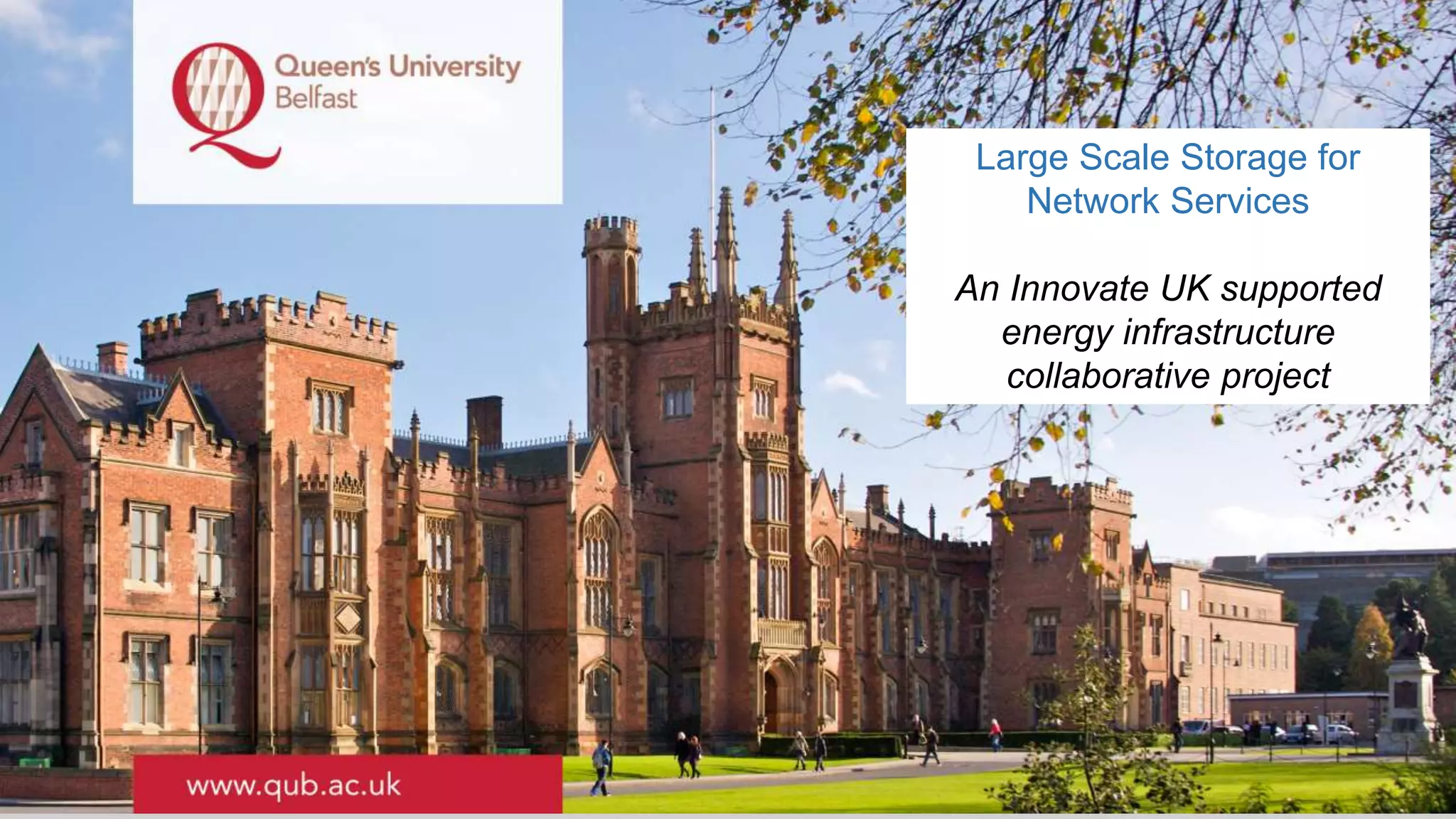
Large Scale Storage for
Network Services
An Innovate UK supported
energy infrastructure
collaborative project
The Research Excellence Framework (REF) is the system for assessing the quality of
research in UK higher education institutions:
• Queen’s is joint 8th university in the UK based on research intensity
• Over 75 per cent of research activity at Queen’s was judged to be internationally
excellent or world-leading
• Queen’s has out-performed the sector on research impact, with almost 60 per cent of
areas achieving 100 per cent of their return ranked at 3* or 4*
Electrical and Electronic Engineering
• Ranks in the top ten in the UK
• 89 per cent of our research activity was judged to be internationally excellent or world-
leading
QUEENS UNIVERSITY is in the top 1% of universities globally
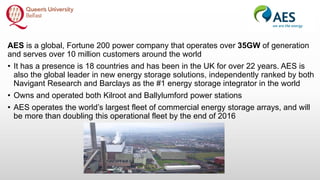
AES is a global, Fortune 200 power company that operates over 35GW of generation
and serves over 10 million customers around the world
• It has a presence is 18 countries and has been in the UK for over 22 years. AES is
also the global leader in new energy storage solutions, independently ranked by both
Navigant Research and Barclays as the #1 energy storage integrator in the world
• Owns and operated both Kilroot and Ballylumford power stations
• AES operates the world’s largest fleet of commercial energy storage arrays, and will
be more than doubling this operational fleet by the end of 2016
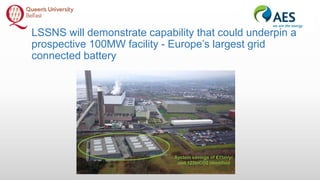
LSSNS will demonstrate capability that could underpin a
prospective 100MW facility - Europe’s largest grid
connected battery
What makes a good project?
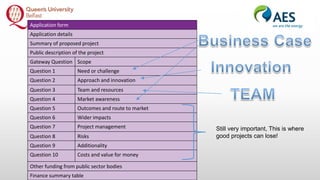
Application form
Application details
Summary of proposed project
Public description of the project
Gateway Question Scope
Question 1 Need or challenge
Question 2 Approach and innovation
Question 3 Team and resources
Question 4 Market awareness
Question 5 Outcomes and route to market
Question 6 Wider impacts
Question 7 Project management
Question 8 Risks
Question 9 Additionality
Question 10 Costs and value for money
Other funding from public sector bodies
Finance summary table
Still very important, This is where
good projects can lose!
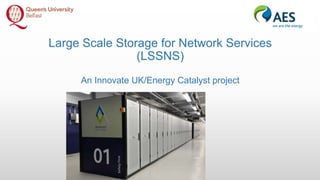
Large Scale Storage for Network Services
(LSSNS)
An Innovate UK/Energy Catalyst project
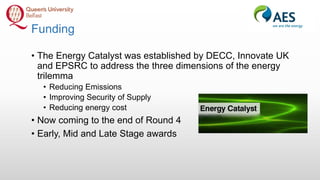
Funding
• The Energy Catalyst was established by DECC, Innovate UK
and EPSRC to address the three dimensions of the energy
trilemma
• Reducing Emissions
• Improving Security of Supply
• Reducing energy cost
• Now coming to the end of Round 4
• Early, Mid and Late Stage awards
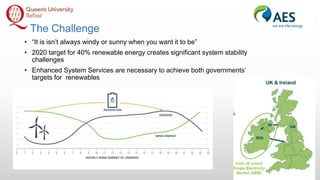
The Challenge
• “It is isn’t always windy or sunny when you want it to be”
• 2020 target for 40% renewable energy creates significant system stability
challenges
• Enhanced System Services are necessary to achieve both governments’
targets for renewables
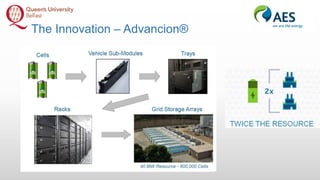
The Innovation – Advancion®
The Project
• AES and QUB engaged at promotion event in June 2014
• Decision to apply for late stage award
• Must be collaborative and business led
• 25% funding for large companies, 100% academia
• £4.3m, 30 month project.
• To deliver and characterise 10MW/5MWh transmission system connected
battery
• Awarded January 2015, with £736k of grant support
• AES to install and operate resource - operational December 2015
• QUB to perform monitoring and modelling activity
• Provide independent assessment
LSSNS- Impact
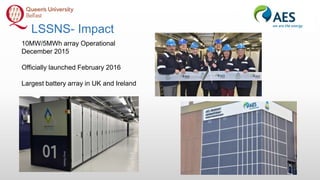
10MW/5MWh array Operational
December 2015
Officially launched February 2016
Largest battery array in UK and Ireland
LSSNS- Impact
Reflections
• Excellent “scope” match from conception
• Clear VALUE proposition and route to market
• New to market INNOVATION in system deployment
• AES led project but proposal was co-developed with QUB
• Small TEAM was augmented with participation of additional
stakeholders on the Project Steering Group
• Funding a supporting but not decisive factor for AES
• Funding enabled
• Collaboration with QUB for independent assessment
• Engagement with stakeholders
• Acceleration of deployment
Mr Conor Quinn,
Business Alliance Manager, QUB
T: 07527 397 492
E: c.quinn@qub.ac.uk

Infrastructure Seminar | Queens AES | Conor Quinn | Case Study

  • 1.
    Large Scale Storagefor Network Services An Innovate UK supported energy infrastructure collaborative project
  • 2.
    The Research ExcellenceFramework (REF) is the system for assessing the quality of research in UK higher education institutions: • Queen’s is joint 8th university in the UK based on research intensity • Over 75 per cent of research activity at Queen’s was judged to be internationally excellent or world-leading • Queen’s has out-performed the sector on research impact, with almost 60 per cent of areas achieving 100 per cent of their return ranked at 3* or 4* Electrical and Electronic Engineering • Ranks in the top ten in the UK • 89 per cent of our research activity was judged to be internationally excellent or world- leading QUEENS UNIVERSITY is in the top 1% of universities globally
  • 3.
    AES is aglobal, Fortune 200 power company that operates over 35GW of generation and serves over 10 million customers around the world • It has a presence is 18 countries and has been in the UK for over 22 years. AES is also the global leader in new energy storage solutions, independently ranked by both Navigant Research and Barclays as the #1 energy storage integrator in the world • Owns and operated both Kilroot and Ballylumford power stations • AES operates the world’s largest fleet of commercial energy storage arrays, and will be more than doubling this operational fleet by the end of 2016
  • 4.
    LSSNS will demonstratecapability that could underpin a prospective 100MW facility - Europe’s largest grid connected battery
  • 5.
    What makes agood project?
  • 9.
    Application form Application details Summaryof proposed project Public description of the project Gateway Question Scope Question 1 Need or challenge Question 2 Approach and innovation Question 3 Team and resources Question 4 Market awareness Question 5 Outcomes and route to market Question 6 Wider impacts Question 7 Project management Question 8 Risks Question 9 Additionality Question 10 Costs and value for money Other funding from public sector bodies Finance summary table Still very important, This is where good projects can lose!
  • 10.
    Large Scale Storagefor Network Services (LSSNS) An Innovate UK/Energy Catalyst project
  • 11.
    Funding • The EnergyCatalyst was established by DECC, Innovate UK and EPSRC to address the three dimensions of the energy trilemma • Reducing Emissions • Improving Security of Supply • Reducing energy cost • Now coming to the end of Round 4 • Early, Mid and Late Stage awards
  • 12.
    The Challenge • “Itis isn’t always windy or sunny when you want it to be” • 2020 target for 40% renewable energy creates significant system stability challenges • Enhanced System Services are necessary to achieve both governments’ targets for renewables
  • 13.
    The Innovation –Advancion®
  • 14.
    The Project • AESand QUB engaged at promotion event in June 2014 • Decision to apply for late stage award • Must be collaborative and business led • 25% funding for large companies, 100% academia • £4.3m, 30 month project. • To deliver and characterise 10MW/5MWh transmission system connected battery • Awarded January 2015, with £736k of grant support • AES to install and operate resource - operational December 2015 • QUB to perform monitoring and modelling activity • Provide independent assessment
  • 15.
    LSSNS- Impact 10MW/5MWh arrayOperational December 2015 Officially launched February 2016 Largest battery array in UK and Ireland
  • 16.
  • 17.
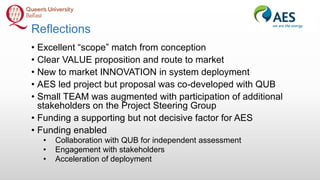
    Reflections • Excellent “scope”match from conception • Clear VALUE proposition and route to market • New to market INNOVATION in system deployment • AES led project but proposal was co-developed with QUB • Small TEAM was augmented with participation of additional stakeholders on the Project Steering Group • Funding a supporting but not decisive factor for AES • Funding enabled • Collaboration with QUB for independent assessment • Engagement with stakeholders • Acceleration of deployment
  • 18.
    Mr Conor Quinn, BusinessAlliance Manager, QUB T: 07527 397 492 E: c.quinn@qub.ac.uk

Editor's Notes

  • #13 o The system services remunerated on a Dispatch Dependent basis are:  Ramping Margin (1, 3, 8 hour)  Primary, Secondary, Tertiary and Replacement Reserves  Fast Frequency Response o The system services that are remunerated on a Capability basis are:  Synchronous Inertial Response  Dynamic Reactive Power  Fast Post Fault Active Power Recovery  Steady State Reactive Power