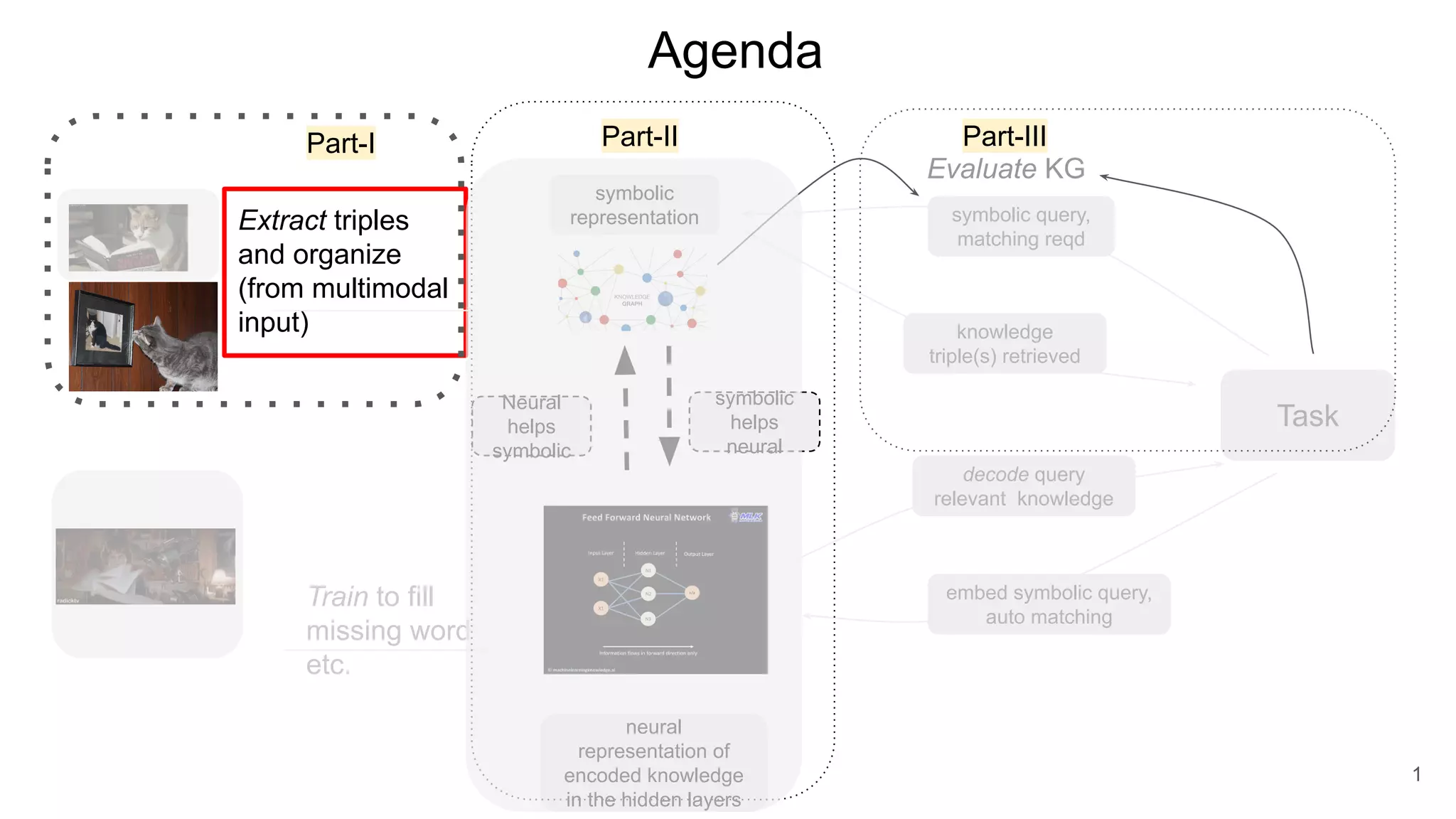
Extract triples
and organize
(from multimodal
input)
Train to fill
missing word
etc.
Task
symbolic
representation
neural
representation of
encoded knowledge
in the hidden layers
symbolic query,
matching reqd
knowledge
triple(s) retrieved
decode query
relevant knowledge
embed symbolic query,
auto matching
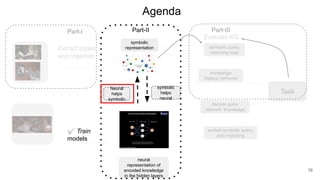
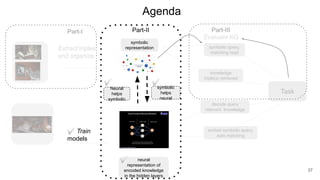
Neural
helps
symbolic
symbolic
helps
neural
Part-II
Part-I
Evaluate KG
Part-III
Agenda
1
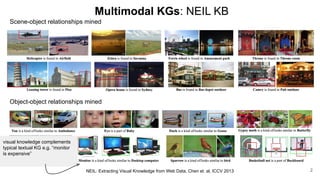
Multimodal KGs: NEIL KB
NEIL: Extracting Visual Knowledge from Web Data, Chen et. al, ICCV 2013
Scene-object relationships mined
Object-object relationships mined
visual knowledge complements
typical textual KG e.g. “monitor
is expensive”
2
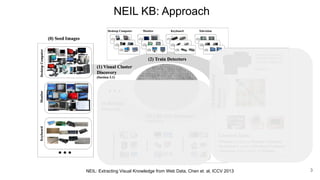
NEIL KB: Approach
NEIL: Extracting Visual Knowledge from Web Data, Chen et. al, ICCV 2013 3
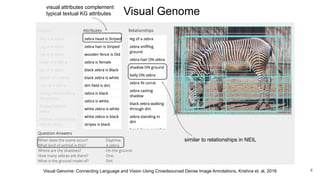
Visual Genome
Visual Genome: Connecting Language and Vision Using Crowdsourced Dense Image Annotations, Krishna et. al, 2016
similar to relationships in NEIL
visual attributes complement
typical textual KG attributes
4
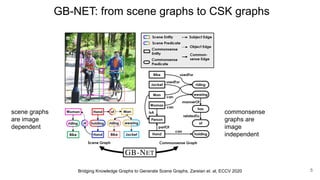
GB-NET: from scene graphs to CSK graphs
Bridging Knowledge Graphs to Generate Scene Graphs, Zareian et. al, ECCV 2020 5
scene graphs
are image
dependent
commonsense
graphs are
image
independent
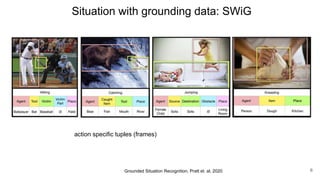
Situation with grounding data: SWiG
Grounded Situation Recognition, Pratt et. al, 2020 6
action specific tuples (frames)
Extract triples
and organize
Train to fill
missing word
etc.
Task
symbolic
representation
neural
representation of
encoded knowledge
in the hidden layers
symbolic query,
matching reqd
knowledge
triple(s) retrieved
decode query
relevant knowledge
embed symbolic query,
auto matching
Neural
helps
symbolic
symbolic
helps
neural
Part-II
Part-I
Evaluate KG
Part-III
✅
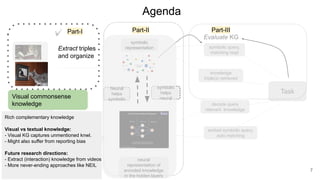
Rich complementary knowledge
Visual vs textual knowledge:
- Visual KG captures unmentioned knwl.
- Might also suffer from reporting bias
Future research directions:
- Extract (interaction) knowledge from videos
- More never-ending approaches like NEIL
Visual commonsense
knowledge
Agenda
Agenda
7
Extract triples
and organize
Train to fill
missing word
etc.
Task
symbolic
representation
neural
representation of
encoded knowledge
in the hidden layers
symbolic query,
matching reqd
knowledge
triple(s) retrieved
decode query
relevant knowledge
embed symbolic query,
auto matching
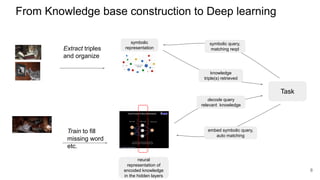
From Knowledge base construction to Deep learning
8
Extract triples
and organize
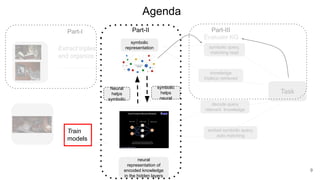
Train
models
Task
symbolic
representation
neural
representation of
encoded knowledge
in the hidden layers
symbolic query,
matching reqd
knowledge
triple(s) retrieved
decode query
relevant knowledge
embed symbolic query,
auto matching
Neural
helps
symbolic
symbolic
helps
neural
Part-II
Part-I
Evaluate KG
Part-III
Agenda
9
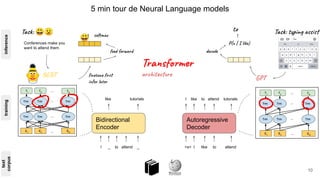
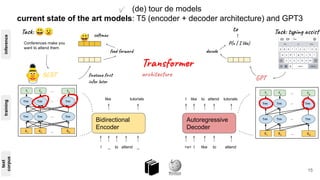
5 min tour de Neural Language models
Bidirectional
Encoder
I _ to attend _
like tutorials
Autoregressive
Decoder
GPT
BERT
<s> I like to attend
I like to attend tutorials
text
corpus
training
inference
Task: 😀😕
Conferences make you
want to attend them
feed forward
😀 softmax
Task: typing assist
P(x | I like)
decode
to
finetune first
infer later
Transformer
architecture
10
Credit: All the nice Transformer illustrations taken from
http://jalammar.github.io/illustrated-transformer/
GPT
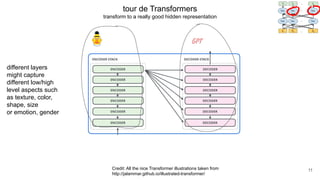
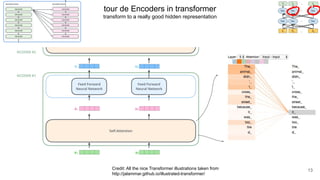
tour de Transformers
transform to a really good hidden representation
11
different layers
might capture
different low/high
level aspects such
as texture, color,
shape, size
or emotion, gender
Credit: All the nice Transformer illustrations taken from
http://jalammar.github.io/illustrated-transformer/
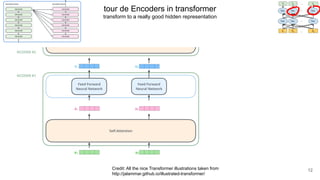
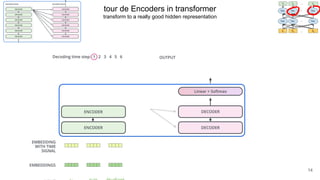
tour de Encoders in transformer
transform to a really good hidden representation
12
Credit: All the nice Transformer illustrations taken from
http://jalammar.github.io/illustrated-transformer/
tour de Encoders in transformer
transform to a really good hidden representation
13
Credit: All the nice Transformer illustrations taken from
http://jalammar.github.io/illustrated-transformer/
tour de Encoders in transformer
transform to a really good hidden representation
14
✅ (de) tour de models
current state of the art models: T5 (encoder + decoder architecture) and GPT3
Bidirectional
Encoder
I _ to attend _
like tutorials
Autoregressive
Decoder
GPT
BERT
<s> I like to attend
I like to attend tutorials
text
corpus
training
inference
Task: 😀😕
Conferences make you
want to attend them
feed forward
😀 softmax
Task: typing assist
P(x | I like)
decode
to
Transformer
architecture
finetune first
infer later
15
Extract triples
and organize
✅ Train
models
Task
symbolic
representation
neural
representation of
encoded knowledge
in the hidden layers
symbolic query,
matching reqd
knowledge
triple(s) retrieved
decode query
relevant knowledge
embed symbolic query,
auto matching
Neural
helps
symbolic
symbolic
helps
neural
Part-II
Part-I
Evaluate KG
Part-III
Agenda
16
1 of 4 : concept knowledge in neural LMs
untuned model3
is
not great
tuned model4
is
much better (like with
any neural LM)
[4] Weir et al., 2020
[5] Forbes et al., 2019
[3] Bar Ilan demo., as of 2021 :
link
can also distinguish based on properties: “X
has fur” vs “X has fur and is big”
BERT
low correlation with human elicit
properties but are coherent.
😐
😀
17
1 of 4 : concept knowledge in neural LMs
untuned model3
tuned model4
[4] Weir et al., 2020
[5] Forbes et al., 2019
[3] Bar Ilan demo., as of 2021 :
link
can also distinguish based on properties: “X
has fur” vs “X has fur and is big”
BERT
“neural language representations still only learn
associations that are explicitly written down”5
,
even after being explicitly trained on a knowledge
graph of objects and affordances.
“Perceptual or visual concepts such as smooth, can’t
be learned from text alone”4
,
😔
😔
18
autoregressive model2
(GPT fine-tuned on ConceptNet)
[2] COMeT demo., Bosselut et. al,
as of 2021: link
[1] (again, untuned is bad)
AllenNLP demo GPT2, as of 2021 : link
GPT
promising knowledge
😀
19
2 of 4 : multi-relational & visual knowledge in neural LMs
autoregressive model2
(GPT fine-tuned on ConceptNet)
autoregressive model1
(GPT2 not fine-tuned)
[2] COMeT demo., Bosselut et. al,
as of 2021: link
[1] AllenNLP demo GPT2, as of
2021 : link
😔
“Do not handle mutual exclusivity well and suffer
from frequency bias (in general the outputs may
be incoherent or inconsistent) ”4
,
“Perceptual or visual concepts still hard to learn”4
,
😔
20
GPT
2 of 4 : multi-relational & visual knowledge in neural LMs
“Learn Perceptual or visual concepts”4
,
😔 → 😌
[6] Park et al., ECCV 2020
https://visualcomet.xyz
Task: Generate events before, after and intents at present given an image, and a description of the event
in the image, and a plausible scene/location. Uses visual and language transformer.
21
“Learn Perceptual or visual concepts”4
,
😔 → 😌
[6] Park et al., ECCV 2020
https://visualcomet.xyz
Task: Generate events before, after and intents at present given an image, and a description of the event
in the image, and a plausible scene/location
Great start, future models could make fewer assumptions.
😔
Output can still be inconsistent and incoherent.
😔
22
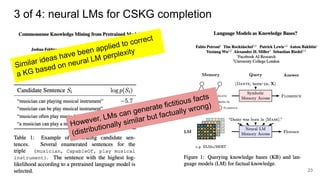
3 of 4: neural LMs for CSKG completion
Similar ideas have been applied to correct
a KG based on neural LM perplexity
23
However, LMs can generate fictitious facts
(distributionally similar but factually wrong)
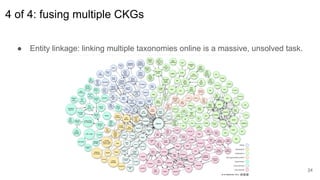
4 of 4: fusing multiple CKGs
● Entity linkage: linking multiple taxonomies online is a massive, unsolved task.
24
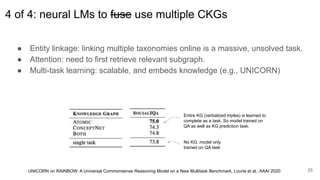
4 of 4: neural LMs to fuse use multiple CKGs
● Entity linkage: linking multiple taxonomies online is a massive, unsolved task.
● Attention: need to first retrieve relevant subgraph.
● Multi-task learning: scalable, and embeds knowledge (e.g., UNICORN)
No KG, model only
trained on QA task
Entire KG (verbalized triples) is learned to
complete as a task. So model trained on
QA as well as KG prediction task.
UNICORN on RAINBOW: A Universal Commonsense Reasoning Model on a New Multitask Benchmark, Lourie et al., AAAI 2020 25
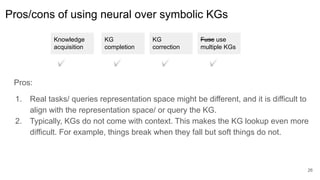
Pros/cons of using neural over symbolic KGs
Pros:
1. Real tasks/ queries representation space might be different, and it is difficult to
align with the representation space/ or query the KG.
2. Typically, KGs do not come with context. This makes the KG lookup even more
difficult. For example, things break when they fall but soft things do not.
Knowledge
acquisition
KG
completion
KG
correction
Fuse use
multiple KGs
✅ ✅ ✅ ✅
26
Pros/cons of using neural over symbolic KGs
Cons:
1. Symbolic KGs are more interpretable and easily debuggable, but neural
models are hard to probe.
2. Promising direction of multi-task learning for using multiple KGs, but more work
is needed.
3. LMs can generate fictitious facts-- this requires more work. e.g., grounding the
knowledge to an established source such as Wikipedia.
4. More work is required (BOTH in symbolic and neural) to acquire perceptually
grounded/ unmentioned knowledge, e.g, visual COMeT with fewer assumptions
in the input -- and we need to make the output more consistent.
27
Extract triples
and organize
✅ Train
models
Task
symbolic
representation
neural
representation of
encoded knowledge
in the hidden layers
symbolic query,
matching reqd
knowledge
triple(s) retrieved
decode query
relevant knowledge
embed symbolic query,
auto matching
Neural
helps
symbolic
symbolic
helps
neural
Part-II
Part-I
Evaluate KG
Part-III
✅
✅
Agenda
28
Robustness
[d1]
Can CSK help neural models
[d1]: Cycle-Consistency for Robust Visual QA, Shah et. al 2019
[d2]: AdvEntuRe: Adversarial Training for Textual Entailment with
Knowledge-Guided Examples, Kang et. al 2018
[d3] Generating Natural Language Explanations for Visual QA
Using Scene Graphs and Visual Attention, Ghosh et al., 2018
[d4] Visual Genome: Connecting Language and Vision Using
Crowdsourced Dense Image Annotations, Krishna et. al, 2016
Generating adversarial examples
guided by commonsense knowledge[d2]
Explainability
[d3]
Using attention map generated by a QA
model (top right) to identify relevant
components of a scene graph[d4]
29
[d5]: Tandon et. al 2018 : ProStruct
[d6]..[d10]: upcoming slides
Can CSK help neural models
Limited training data
[d5] Difficult to find training data for all types of scenarios,
esp. rarely mentioned rules and facts
● Are shiny surfaces typically hard?
● What’s bigger the moon or a wolf?
● If I put my socks in the drawer,
will they still be there tomorrow?
Inject commonsense knowledge[d6,d7,...d10]
to compensate for limited training data
30
Injecting commonsense knowledge into DL models
free-form triples
canonical triples
verbalized tripes
preconstructed KG
on-the-fly generated KG
sentences
paragraphs
rules
commonsense knowledge
scoring
attention
augmented input
multitask learning
injection method
Task
31
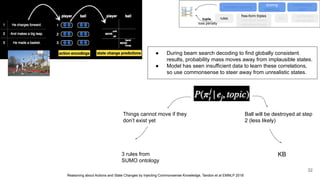
Reasoning about Actions and State Changes by Injecting Commonsense Knowledge, Tandon et al EMNLP 2018
free-form triples
canonical triples
verbalized tripes
KG
sentences
paragraphs
rules
scoring
attention
augmented
input
multitask learning
tuple,
loss penalty
Ball will be destroyed at step
2 (less likely)
Things cannot move if they
don’t exist yet
● During beam search decoding to find globally consistent
results, probability mass moves away from implausible states.
● Model has seen insufficient data to learn these correlations,
so use commonsense to steer away from unrealistic states.
KB
3 rules from
SUMO ontology
32
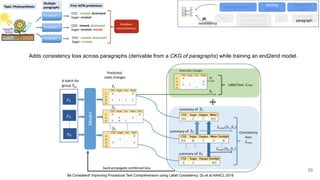
Be Consistent! Improving Procedural Text Comprehension using Label Consistency. Du et al NAACL 2019
Adds consistency loss across paragraphs (derivable from a CKG of paragraphs) while training an end2end model.
free-form triples
canonical triples
verbalized tripes
KG
sentences
paragraphs
rules
scoring
attention
augmented
input
multitask learning
IR,
consistency
33
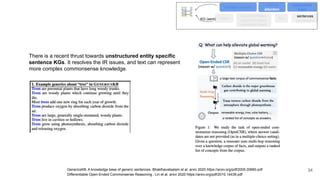
GenericsKB: A knowledge base of generic sentences. Bhakthavatsalam et al. arxiv 2020 https://arxiv.org/pdf/2005.00660.pdf
Differentiable Open-Ended Commonsense Reasoning , Lin et al. arxiv 2020 https://arxiv.org/pdf/2010.14439.pdf
There is a recent thrust towards unstructured entity specific
sentence KGs. It resolves the IR issues, and text can represent
more complex commonsense knowledge.
free-form triples
canonical triples
verbalized tripes
KG
sentences
paragraphs
rules
scoring
attention
augmented
input
multitask learning
KG (sent)
34
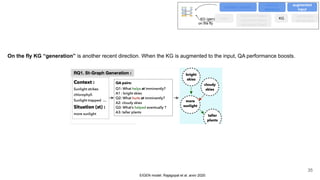
EIGEN model. Rajagopal et al. arxiv 2020
On the fly KG “generation” is another recent direction. When the KG is augmented to the input, QA performance boosts.
free-form triples
canonical triples
verbalized tripes
KG
sentences
paragraphs
rules
scoring
attention
augmented
input
multitask learning
KG (gen)
on the fly
35
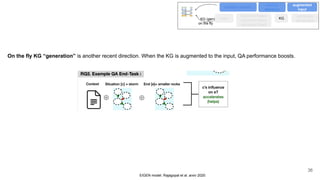
EIGEN model. Rajagopal et al. arxiv 2020
On the fly KG “generation” is another recent direction. When the KG is augmented to the input, QA performance boosts.
free-form triples
canonical triples
verbalized tripes
KG
sentences
paragraphs
rules
scoring
attention
augmented
input
multitask learning
KG (gen)
on the fly
36
Extract triples
and organize
✅ Train
models
Task
symbolic
representation
neural
representation of
encoded knowledge
in the hidden layers
symbolic query,
matching reqd
knowledge
triple(s) retrieved
decode query
relevant knowledge
embed symbolic query,
auto matching
Neural
helps
symbolic
symbolic
helps
neural
Part-II
Part-I
Evaluate KG
Part-III
✅ ✅
✅
Agenda
37
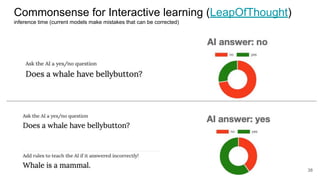
Commonsense for Interactive learning (LeapOfThought)
inference time (current models make mistakes that can be corrected)
38
Commonsense for Interactive learning (LeapOfThought)
inference time (current models make mistakes that can be corrected)
- + Clearly shows that models will lack CSK and will benefit from having it.
- Model throws away the valuable user feedback after using locally.
- (risk) Model may learn false or fake information if the user tricks it.
Leap-Of-Thought: Teaching Pre-Trained Models to Systematically Reason Over Implicit Knowledge, Talmor et al , NeurIPS 2020 39
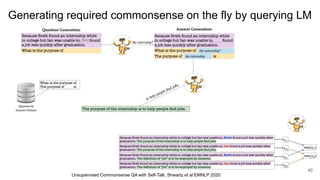
Generating required commonsense on the fly by querying LM
Unsupervised Commonsense QA with Self-Talk, Shwartz et al EMNLP 2020
40
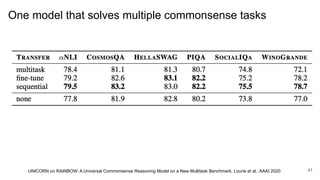
One model that solves multiple commonsense tasks
UNICORN on RAINBOW: A Universal Commonsense Reasoning Model on a New Multitask Benchmark, Lourie et al., AAAI 2020 41
Extract triples
and organize
symbolic
representation symbolic query,
matching reqd
knowledge
triple(s) retrieved
Neural
helps
symbolic
symbolic
helps
neural
Part-II
Part-I
Evaluate KG
Part-III
✅
High level overview
of neural LMs
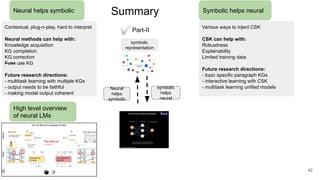
Contextual, plug-n-play, hard to interpret
Neural methods can help with:
Knowledge acquisition
KG completion
KG correction
Fuse use KG
Future research directions:
- multitask learning with multiple KGs
- output needs to be faithful
- making model output coherent
Neural helps symbolic Symbolic helps neural
Various ways to inject CSK
CSK can help with:
Robustness
Explainability
Limited training data
Future research directions:
- topic specific paragraph KGs
- interactive learning with CSK
- multitask learning unified models
Summary
42

Information to Wisdom: Commonsense Knowledge Extraction and Compilation - Part 2

  • 1.
    Extract triples and organize (frommultimodal input) Train to fill missing word etc. Task symbolic representation neural representation of encoded knowledge in the hidden layers symbolic query, matching reqd knowledge triple(s) retrieved decode query relevant knowledge embed symbolic query, auto matching Neural helps symbolic symbolic helps neural Part-II Part-I Evaluate KG Part-III Agenda 1
  • 2.
    Multimodal KGs: NEILKB NEIL: Extracting Visual Knowledge from Web Data, Chen et. al, ICCV 2013 Scene-object relationships mined Object-object relationships mined visual knowledge complements typical textual KG e.g. “monitor is expensive” 2
  • 3.
    NEIL KB: Approach NEIL:Extracting Visual Knowledge from Web Data, Chen et. al, ICCV 2013 3
  • 4.
    Visual Genome Visual Genome:Connecting Language and Vision Using Crowdsourced Dense Image Annotations, Krishna et. al, 2016 similar to relationships in NEIL visual attributes complement typical textual KG attributes 4
  • 5.
    GB-NET: from scenegraphs to CSK graphs Bridging Knowledge Graphs to Generate Scene Graphs, Zareian et. al, ECCV 2020 5 scene graphs are image dependent commonsense graphs are image independent
  • 6.
    Situation with groundingdata: SWiG Grounded Situation Recognition, Pratt et. al, 2020 6 action specific tuples (frames)
  • 7.
    Extract triples and organize Trainto fill missing word etc. Task symbolic representation neural representation of encoded knowledge in the hidden layers symbolic query, matching reqd knowledge triple(s) retrieved decode query relevant knowledge embed symbolic query, auto matching Neural helps symbolic symbolic helps neural Part-II Part-I Evaluate KG Part-III ✅ Rich complementary knowledge Visual vs textual knowledge: - Visual KG captures unmentioned knwl. - Might also suffer from reporting bias Future research directions: - Extract (interaction) knowledge from videos - More never-ending approaches like NEIL Visual commonsense knowledge Agenda Agenda 7
  • 8.
    Extract triples and organize Trainto fill missing word etc. Task symbolic representation neural representation of encoded knowledge in the hidden layers symbolic query, matching reqd knowledge triple(s) retrieved decode query relevant knowledge embed symbolic query, auto matching From Knowledge base construction to Deep learning 8
  • 9.
    Extract triples and organize Train models Task symbolic representation neural representationof encoded knowledge in the hidden layers symbolic query, matching reqd knowledge triple(s) retrieved decode query relevant knowledge embed symbolic query, auto matching Neural helps symbolic symbolic helps neural Part-II Part-I Evaluate KG Part-III Agenda 9
  • 10.
    5 min tourde Neural Language models Bidirectional Encoder I _ to attend _ like tutorials Autoregressive Decoder GPT BERT <s> I like to attend I like to attend tutorials text corpus training inference Task: 😀😕 Conferences make you want to attend them feed forward 😀 softmax Task: typing assist P(x | I like) decode to finetune first infer later Transformer architecture 10
  • 11.
    Credit: All thenice Transformer illustrations taken from http://jalammar.github.io/illustrated-transformer/ GPT tour de Transformers transform to a really good hidden representation 11 different layers might capture different low/high level aspects such as texture, color, shape, size or emotion, gender
  • 12.
    Credit: All thenice Transformer illustrations taken from http://jalammar.github.io/illustrated-transformer/ tour de Encoders in transformer transform to a really good hidden representation 12
  • 13.
    Credit: All thenice Transformer illustrations taken from http://jalammar.github.io/illustrated-transformer/ tour de Encoders in transformer transform to a really good hidden representation 13
  • 14.
    Credit: All thenice Transformer illustrations taken from http://jalammar.github.io/illustrated-transformer/ tour de Encoders in transformer transform to a really good hidden representation 14
  • 15.
    ✅ (de) tourde models current state of the art models: T5 (encoder + decoder architecture) and GPT3 Bidirectional Encoder I _ to attend _ like tutorials Autoregressive Decoder GPT BERT <s> I like to attend I like to attend tutorials text corpus training inference Task: 😀😕 Conferences make you want to attend them feed forward 😀 softmax Task: typing assist P(x | I like) decode to Transformer architecture finetune first infer later 15
  • 16.
    Extract triples and organize ✅Train models Task symbolic representation neural representation of encoded knowledge in the hidden layers symbolic query, matching reqd knowledge triple(s) retrieved decode query relevant knowledge embed symbolic query, auto matching Neural helps symbolic symbolic helps neural Part-II Part-I Evaluate KG Part-III Agenda 16
  • 17.
    1 of 4: concept knowledge in neural LMs untuned model3 is not great tuned model4 is much better (like with any neural LM) [4] Weir et al., 2020 [5] Forbes et al., 2019 [3] Bar Ilan demo., as of 2021 : link can also distinguish based on properties: “X has fur” vs “X has fur and is big” BERT low correlation with human elicit properties but are coherent. 😐 😀 17
  • 18.
    1 of 4: concept knowledge in neural LMs untuned model3 tuned model4 [4] Weir et al., 2020 [5] Forbes et al., 2019 [3] Bar Ilan demo., as of 2021 : link can also distinguish based on properties: “X has fur” vs “X has fur and is big” BERT “neural language representations still only learn associations that are explicitly written down”5 , even after being explicitly trained on a knowledge graph of objects and affordances. “Perceptual or visual concepts such as smooth, can’t be learned from text alone”4 , 😔 😔 18
  • 19.
    autoregressive model2 (GPT fine-tunedon ConceptNet) [2] COMeT demo., Bosselut et. al, as of 2021: link [1] (again, untuned is bad) AllenNLP demo GPT2, as of 2021 : link GPT promising knowledge 😀 19 2 of 4 : multi-relational & visual knowledge in neural LMs
  • 20.
    autoregressive model2 (GPT fine-tunedon ConceptNet) autoregressive model1 (GPT2 not fine-tuned) [2] COMeT demo., Bosselut et. al, as of 2021: link [1] AllenNLP demo GPT2, as of 2021 : link 😔 “Do not handle mutual exclusivity well and suffer from frequency bias (in general the outputs may be incoherent or inconsistent) ”4 , “Perceptual or visual concepts still hard to learn”4 , 😔 20 GPT 2 of 4 : multi-relational & visual knowledge in neural LMs
  • 21.
    “Learn Perceptual orvisual concepts”4 , 😔 → 😌 [6] Park et al., ECCV 2020 https://visualcomet.xyz Task: Generate events before, after and intents at present given an image, and a description of the event in the image, and a plausible scene/location. Uses visual and language transformer. 21
  • 22.
    “Learn Perceptual orvisual concepts”4 , 😔 → 😌 [6] Park et al., ECCV 2020 https://visualcomet.xyz Task: Generate events before, after and intents at present given an image, and a description of the event in the image, and a plausible scene/location Great start, future models could make fewer assumptions. 😔 Output can still be inconsistent and incoherent. 😔 22
  • 23.
    3 of 4:neural LMs for CSKG completion Similar ideas have been applied to correct a KG based on neural LM perplexity 23 However, LMs can generate fictitious facts (distributionally similar but factually wrong)
  • 24.
    4 of 4:fusing multiple CKGs ● Entity linkage: linking multiple taxonomies online is a massive, unsolved task. 24
  • 25.
    4 of 4:neural LMs to fuse use multiple CKGs ● Entity linkage: linking multiple taxonomies online is a massive, unsolved task. ● Attention: need to first retrieve relevant subgraph. ● Multi-task learning: scalable, and embeds knowledge (e.g., UNICORN) No KG, model only trained on QA task Entire KG (verbalized triples) is learned to complete as a task. So model trained on QA as well as KG prediction task. UNICORN on RAINBOW: A Universal Commonsense Reasoning Model on a New Multitask Benchmark, Lourie et al., AAAI 2020 25
  • 26.
    Pros/cons of usingneural over symbolic KGs Pros: 1. Real tasks/ queries representation space might be different, and it is difficult to align with the representation space/ or query the KG. 2. Typically, KGs do not come with context. This makes the KG lookup even more difficult. For example, things break when they fall but soft things do not. Knowledge acquisition KG completion KG correction Fuse use multiple KGs ✅ ✅ ✅ ✅ 26
  • 27.
    Pros/cons of usingneural over symbolic KGs Cons: 1. Symbolic KGs are more interpretable and easily debuggable, but neural models are hard to probe. 2. Promising direction of multi-task learning for using multiple KGs, but more work is needed. 3. LMs can generate fictitious facts-- this requires more work. e.g., grounding the knowledge to an established source such as Wikipedia. 4. More work is required (BOTH in symbolic and neural) to acquire perceptually grounded/ unmentioned knowledge, e.g, visual COMeT with fewer assumptions in the input -- and we need to make the output more consistent. 27
  • 28.
    Extract triples and organize ✅Train models Task symbolic representation neural representation of encoded knowledge in the hidden layers symbolic query, matching reqd knowledge triple(s) retrieved decode query relevant knowledge embed symbolic query, auto matching Neural helps symbolic symbolic helps neural Part-II Part-I Evaluate KG Part-III ✅ ✅ Agenda 28
  • 29.
    Robustness [d1] Can CSK helpneural models [d1]: Cycle-Consistency for Robust Visual QA, Shah et. al 2019 [d2]: AdvEntuRe: Adversarial Training for Textual Entailment with Knowledge-Guided Examples, Kang et. al 2018 [d3] Generating Natural Language Explanations for Visual QA Using Scene Graphs and Visual Attention, Ghosh et al., 2018 [d4] Visual Genome: Connecting Language and Vision Using Crowdsourced Dense Image Annotations, Krishna et. al, 2016 Generating adversarial examples guided by commonsense knowledge[d2] Explainability [d3] Using attention map generated by a QA model (top right) to identify relevant components of a scene graph[d4] 29
  • 30.
    [d5]: Tandon et.al 2018 : ProStruct [d6]..[d10]: upcoming slides Can CSK help neural models Limited training data [d5] Difficult to find training data for all types of scenarios, esp. rarely mentioned rules and facts ● Are shiny surfaces typically hard? ● What’s bigger the moon or a wolf? ● If I put my socks in the drawer, will they still be there tomorrow? Inject commonsense knowledge[d6,d7,...d10] to compensate for limited training data 30
  • 31.
    Injecting commonsense knowledgeinto DL models free-form triples canonical triples verbalized tripes preconstructed KG on-the-fly generated KG sentences paragraphs rules commonsense knowledge scoring attention augmented input multitask learning injection method Task 31
  • 32.
    Reasoning about Actionsand State Changes by Injecting Commonsense Knowledge, Tandon et al EMNLP 2018 free-form triples canonical triples verbalized tripes KG sentences paragraphs rules scoring attention augmented input multitask learning tuple, loss penalty Ball will be destroyed at step 2 (less likely) Things cannot move if they don’t exist yet ● During beam search decoding to find globally consistent results, probability mass moves away from implausible states. ● Model has seen insufficient data to learn these correlations, so use commonsense to steer away from unrealistic states. KB 3 rules from SUMO ontology 32
  • 33.
    Be Consistent! ImprovingProcedural Text Comprehension using Label Consistency. Du et al NAACL 2019 Adds consistency loss across paragraphs (derivable from a CKG of paragraphs) while training an end2end model. free-form triples canonical triples verbalized tripes KG sentences paragraphs rules scoring attention augmented input multitask learning IR, consistency 33
  • 34.
    GenericsKB: A knowledgebase of generic sentences. Bhakthavatsalam et al. arxiv 2020 https://arxiv.org/pdf/2005.00660.pdf Differentiable Open-Ended Commonsense Reasoning , Lin et al. arxiv 2020 https://arxiv.org/pdf/2010.14439.pdf There is a recent thrust towards unstructured entity specific sentence KGs. It resolves the IR issues, and text can represent more complex commonsense knowledge. free-form triples canonical triples verbalized tripes KG sentences paragraphs rules scoring attention augmented input multitask learning KG (sent) 34
  • 35.
    EIGEN model. Rajagopalet al. arxiv 2020 On the fly KG “generation” is another recent direction. When the KG is augmented to the input, QA performance boosts. free-form triples canonical triples verbalized tripes KG sentences paragraphs rules scoring attention augmented input multitask learning KG (gen) on the fly 35
  • 36.
    EIGEN model. Rajagopalet al. arxiv 2020 On the fly KG “generation” is another recent direction. When the KG is augmented to the input, QA performance boosts. free-form triples canonical triples verbalized tripes KG sentences paragraphs rules scoring attention augmented input multitask learning KG (gen) on the fly 36
  • 37.
    Extract triples and organize ✅Train models Task symbolic representation neural representation of encoded knowledge in the hidden layers symbolic query, matching reqd knowledge triple(s) retrieved decode query relevant knowledge embed symbolic query, auto matching Neural helps symbolic symbolic helps neural Part-II Part-I Evaluate KG Part-III ✅ ✅ ✅ Agenda 37
  • 38.
    Commonsense for Interactivelearning (LeapOfThought) inference time (current models make mistakes that can be corrected) 38
  • 39.
    Commonsense for Interactivelearning (LeapOfThought) inference time (current models make mistakes that can be corrected) - + Clearly shows that models will lack CSK and will benefit from having it. - Model throws away the valuable user feedback after using locally. - (risk) Model may learn false or fake information if the user tricks it. Leap-Of-Thought: Teaching Pre-Trained Models to Systematically Reason Over Implicit Knowledge, Talmor et al , NeurIPS 2020 39
  • 40.
    Generating required commonsenseon the fly by querying LM Unsupervised Commonsense QA with Self-Talk, Shwartz et al EMNLP 2020 40
  • 41.
    One model thatsolves multiple commonsense tasks UNICORN on RAINBOW: A Universal Commonsense Reasoning Model on a New Multitask Benchmark, Lourie et al., AAAI 2020 41
  • 42.
    Extract triples and organize symbolic representationsymbolic query, matching reqd knowledge triple(s) retrieved Neural helps symbolic symbolic helps neural Part-II Part-I Evaluate KG Part-III ✅ High level overview of neural LMs Contextual, plug-n-play, hard to interpret Neural methods can help with: Knowledge acquisition KG completion KG correction Fuse use KG Future research directions: - multitask learning with multiple KGs - output needs to be faithful - making model output coherent Neural helps symbolic Symbolic helps neural Various ways to inject CSK CSK can help with: Robustness Explainability Limited training data Future research directions: - topic specific paragraph KGs - interactive learning with CSK - multitask learning unified models Summary 42