Information Technology Project Management Revised 6th Edition Schwalbe Test Bank
Information Technology Project Management Revised 6th Edition Schwalbe Test Bank
Information Technology Project Management Revised 6th Edition Schwalbe Test Bank
Information Technology Project Management Revised 6th Edition Schwalbe Test Bank
Information Technology Project Management Revised 6th Edition Schwalbe Test Bank
1.
Visit https://testbankfan.com todownload the full version and
browse more test banks or solution manuals
Information Technology Project Management Revised
6th Edition Schwalbe Test Bank
_____ Press the link below to begin your download _____
https://testbankfan.com/product/information-technology-
project-management-revised-6th-edition-schwalbe-test-bank/
Access testbankfan.com now to download high-quality
test banks or solution manuals
2.
Here are somerecommended products for you. Click the link to
download, or explore more at testbankfan.com
Information Technology Project Management 9th Edition
Schwalbe Test Bank
https://testbankfan.com/product/information-technology-project-
management-9th-edition-schwalbe-test-bank/
Information Technology Project Management 7th Edition
Kathy Schwalbe Test Bank
https://testbankfan.com/product/information-technology-project-
management-7th-edition-kathy-schwalbe-test-bank/
Information Technology Project Management 8th Edition
Kathy Schwalbe Test Bank
https://testbankfan.com/product/information-technology-project-
management-8th-edition-kathy-schwalbe-test-bank/
Enhanced Discovering Computers 2017 Essentials 1st Edition
Vermaat Solutions Manual
https://testbankfan.com/product/enhanced-discovering-
computers-2017-essentials-1st-edition-vermaat-solutions-manual/
3.
Electronic Devices andCircuit Theory 11th Edition
Boylestad Test Bank
https://testbankfan.com/product/electronic-devices-and-circuit-
theory-11th-edition-boylestad-test-bank/
Interactive Statistics Informed Decisions Using Data 1st
Edition Sullivan Solutions Manual
https://testbankfan.com/product/interactive-statistics-informed-
decisions-using-data-1st-edition-sullivan-solutions-manual/
Chemistry A Molecular Approach with MasteringChemistry 2nd
Edition Tro Test Bank
https://testbankfan.com/product/chemistry-a-molecular-approach-with-
masteringchemistry-2nd-edition-tro-test-bank/
Microeconomic Theory Basic Principles and Extensions 12th
Edition Nicholson Test Bank
https://testbankfan.com/product/microeconomic-theory-basic-principles-
and-extensions-12th-edition-nicholson-test-bank/
Intermediate Accounting Volume 2 Canadian 12th Edition
Kieso Test Bank
https://testbankfan.com/product/intermediate-accounting-
volume-2-canadian-12th-edition-kieso-test-bank/
4.
Clinical Psychology SciencePractice And Culture 2nd
Edition Pomerantz Test Bank
https://testbankfan.com/product/clinical-psychology-science-practice-
and-culture-2nd-edition-pomerantz-test-bank/
5.
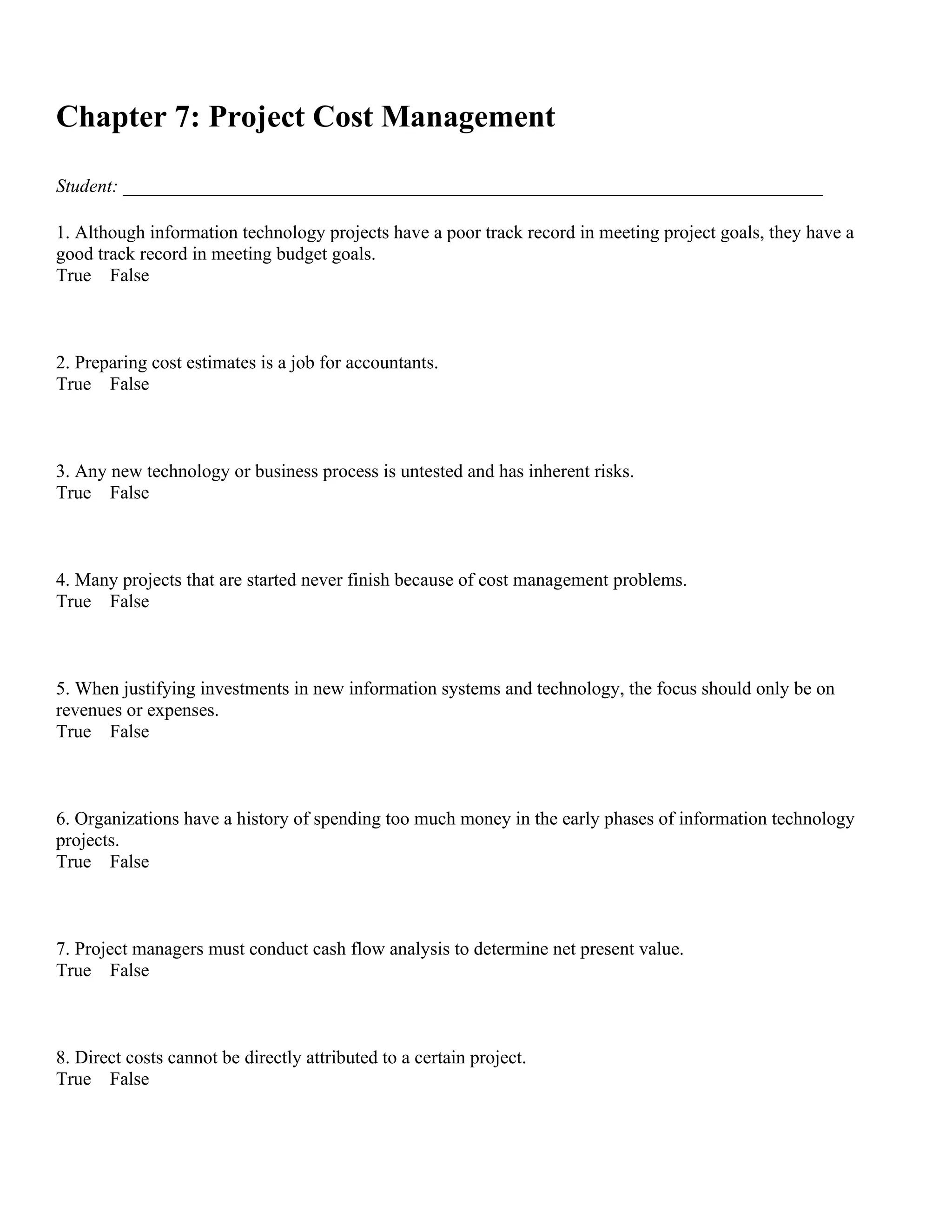
Chapter 7: ProjectCost Management
Student: ___________________________________________________________________________
1. Although information technology projects have a poor track record in meeting project goals, they have a
good track record in meeting budget goals.
True False
2. Preparing cost estimates is a job for accountants.
True False
3. Any new technology or business process is untested and has inherent risks.
True False
4. Many projects that are started never finish because of cost management problems.
True False
5. When justifying investments in new information systems and technology, the focus should only be on
revenues or expenses.
True False
6. Organizations have a history of spending too much money in the early phases of information technology
projects.
True False
7. Project managers must conduct cash flow analysis to determine net present value.
True False
8. Direct costs cannot be directly attributed to a certain project.
True False
6.
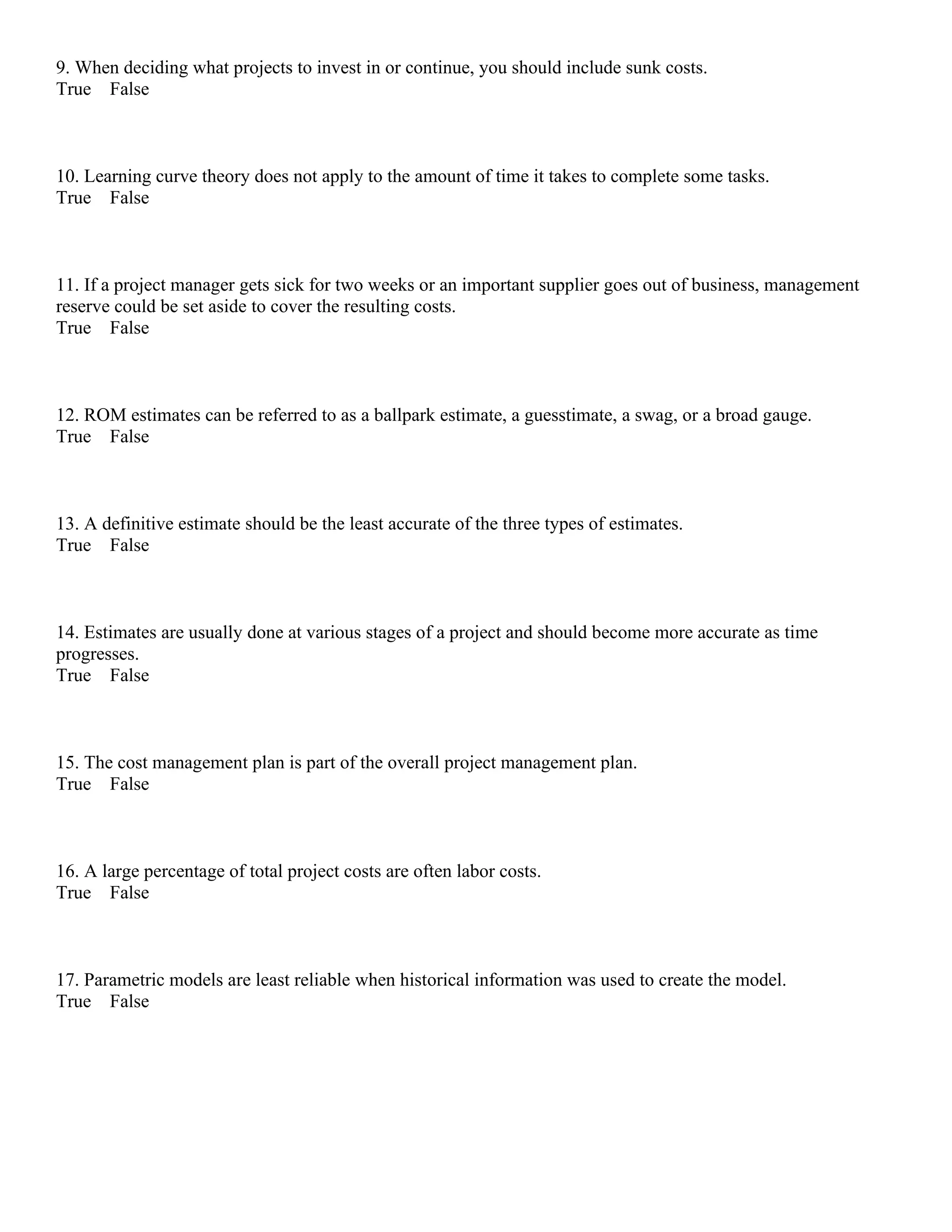
9. When decidingwhat projects to invest in or continue, you should include sunk costs.
True False
10. Learning curve theory does not apply to the amount of time it takes to complete some tasks.
True False
11. If a project manager gets sick for two weeks or an important supplier goes out of business, management
reserve could be set aside to cover the resulting costs.
True False
12. ROM estimates can be referred to as a ballpark estimate, a guesstimate, a swag, or a broad gauge.
True False
13. A definitive estimate should be the least accurate of the three types of estimates.
True False
14. Estimates are usually done at various stages of a project and should become more accurate as time
progresses.
True False
15. The cost management plan is part of the overall project management plan.
True False
16. A large percentage of total project costs are often labor costs.
True False
17. Parametric models are least reliable when historical information was used to create the model.
True False
7.
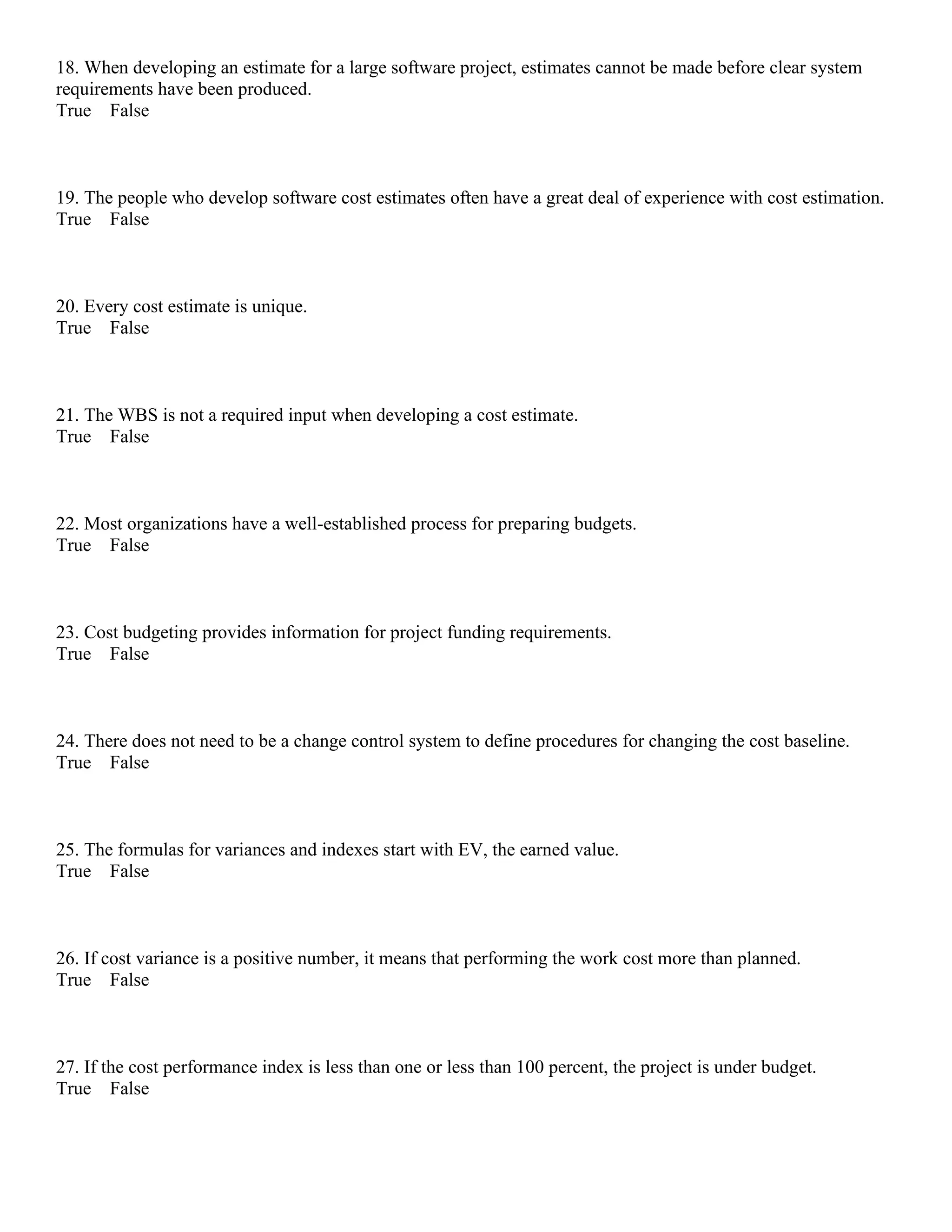
18. When developingan estimate for a large software project, estimates cannot be made before clear system
requirements have been produced.
True False
19. The people who develop software cost estimates often have a great deal of experience with cost estimation.
True False
20. Every cost estimate is unique.
True False
21. The WBS is not a required input when developing a cost estimate.
True False
22. Most organizations have a well-established process for preparing budgets.
True False
23. Cost budgeting provides information for project funding requirements.
True False
24. There does not need to be a change control system to define procedures for changing the cost baseline.
True False
25. The formulas for variances and indexes start with EV, the earned value.
True False
26. If cost variance is a positive number, it means that performing the work cost more than planned.
True False
27. If the cost performance index is less than one or less than 100 percent, the project is under budget.
True False
8.
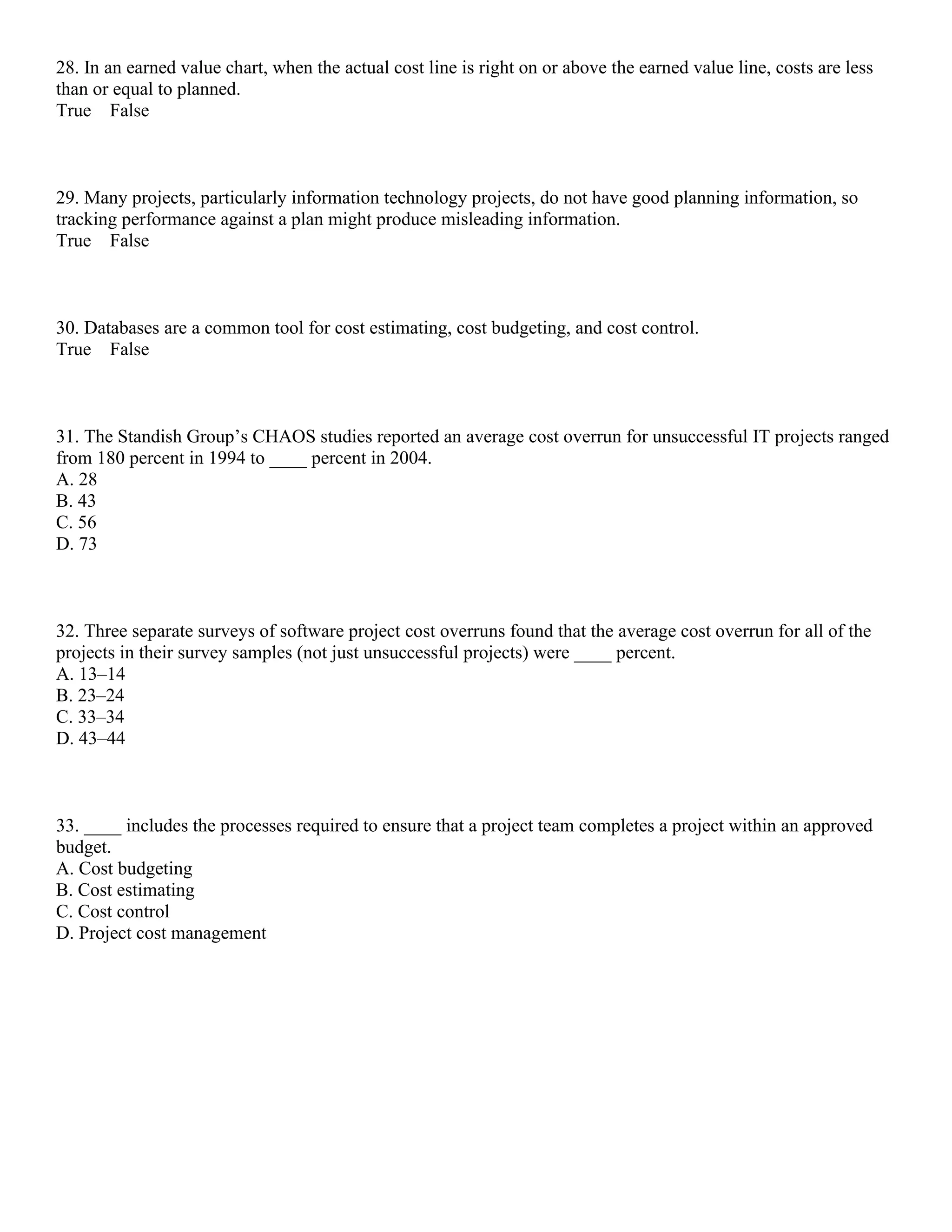
28. In anearned value chart, when the actual cost line is right on or above the earned value line, costs are less
than or equal to planned.
True False
29. Many projects, particularly information technology projects, do not have good planning information, so
tracking performance against a plan might produce misleading information.
True False
30. Databases are a common tool for cost estimating, cost budgeting, and cost control.
True False
31. The Standish Group’s CHAOS studies reported an average cost overrun for unsuccessful IT projects ranged
from 180 percent in 1994 to ____ percent in 2004.
A. 28
B. 43
C. 56
D. 73
32. Three separate surveys of software project cost overruns found that the average cost overrun for all of the
projects in their survey samples (not just unsuccessful projects) were ____ percent.
A. 13–14
B. 23–24
C. 33–34
D. 43–44
33. ____ includes the processes required to ensure that a project team completes a project within an approved
budget.
A. Cost budgeting
B. Cost estimating
C. Cost control
D. Project cost management
9.
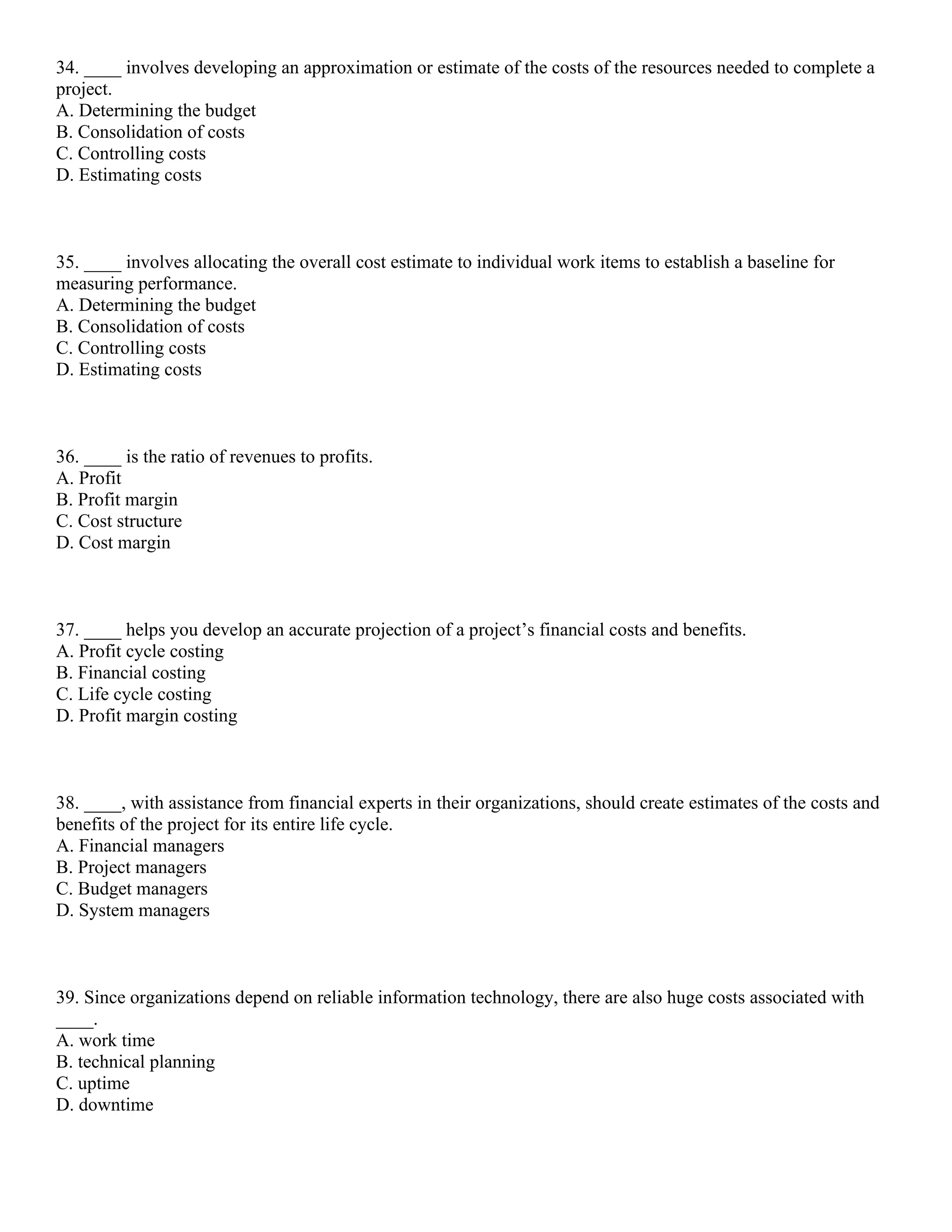
34. ____ involvesdeveloping an approximation or estimate of the costs of the resources needed to complete a
project.
A. Determining the budget
B. Consolidation of costs
C. Controlling costs
D. Estimating costs
35. ____ involves allocating the overall cost estimate to individual work items to establish a baseline for
measuring performance.
A. Determining the budget
B. Consolidation of costs
C. Controlling costs
D. Estimating costs
36. ____ is the ratio of revenues to profits.
A. Profit
B. Profit margin
C. Cost structure
D. Cost margin
37. ____ helps you develop an accurate projection of a project’s financial costs and benefits.
A. Profit cycle costing
B. Financial costing
C. Life cycle costing
D. Profit margin costing
38. ____, with assistance from financial experts in their organizations, should create estimates of the costs and
benefits of the project for its entire life cycle.
A. Financial managers
B. Project managers
C. Budget managers
D. System managers
39. Since organizations depend on reliable information technology, there are also huge costs associated with
____.
A. work time
B. technical planning
C. uptime
D. downtime
10.
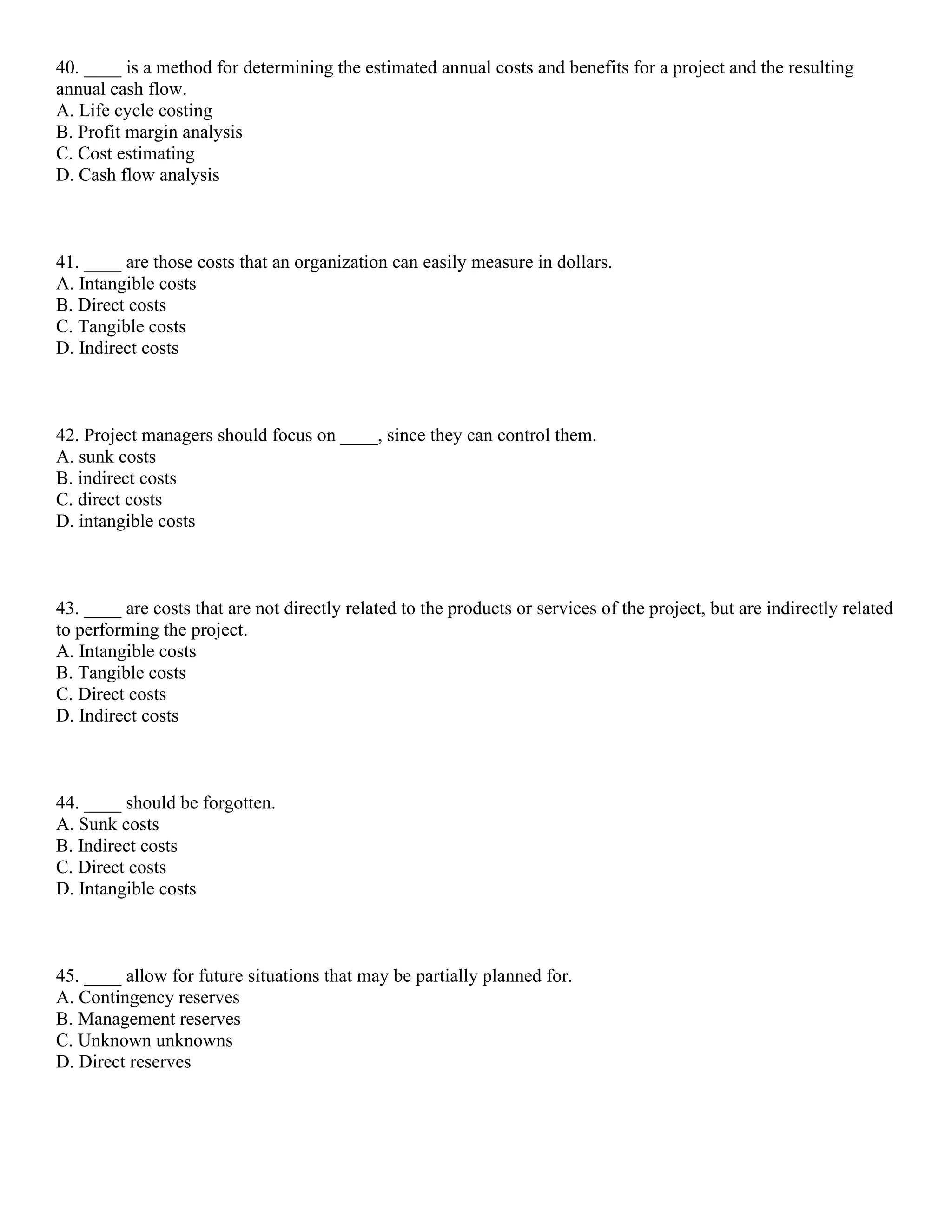
40. ____ isa method for determining the estimated annual costs and benefits for a project and the resulting
annual cash flow.
A. Life cycle costing
B. Profit margin analysis
C. Cost estimating
D. Cash flow analysis
41. ____ are those costs that an organization can easily measure in dollars.
A. Intangible costs
B. Direct costs
C. Tangible costs
D. Indirect costs
42. Project managers should focus on ____, since they can control them.
A. sunk costs
B. indirect costs
C. direct costs
D. intangible costs
43. ____ are costs that are not directly related to the products or services of the project, but are indirectly related
to performing the project.
A. Intangible costs
B. Tangible costs
C. Direct costs
D. Indirect costs
44. ____ should be forgotten.
A. Sunk costs
B. Indirect costs
C. Direct costs
D. Intangible costs
45. ____ allow for future situations that may be partially planned for.
A. Contingency reserves
B. Management reserves
C. Unknown unknowns
D. Direct reserves
11.
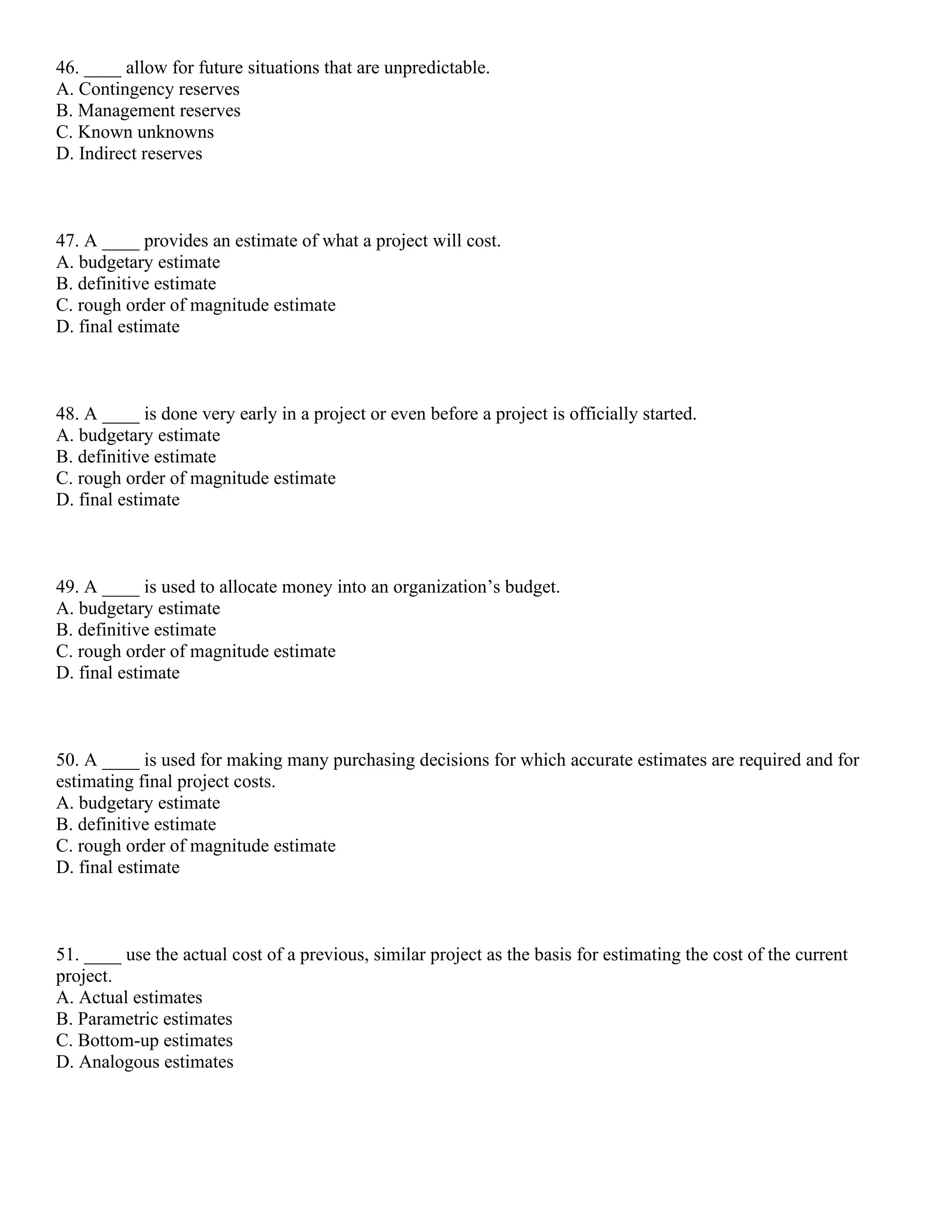
46. ____ allowfor future situations that are unpredictable.
A. Contingency reserves
B. Management reserves
C. Known unknowns
D. Indirect reserves
47. A ____ provides an estimate of what a project will cost.
A. budgetary estimate
B. definitive estimate
C. rough order of magnitude estimate
D. final estimate
48. A ____ is done very early in a project or even before a project is officially started.
A. budgetary estimate
B. definitive estimate
C. rough order of magnitude estimate
D. final estimate
49. A ____ is used to allocate money into an organization’s budget.
A. budgetary estimate
B. definitive estimate
C. rough order of magnitude estimate
D. final estimate
50. A ____ is used for making many purchasing decisions for which accurate estimates are required and for
estimating final project costs.
A. budgetary estimate
B. definitive estimate
C. rough order of magnitude estimate
D. final estimate
51. ____ use the actual cost of a previous, similar project as the basis for estimating the cost of the current
project.
A. Actual estimates
B. Parametric estimates
C. Bottom-up estimates
D. Analogous estimates
12.
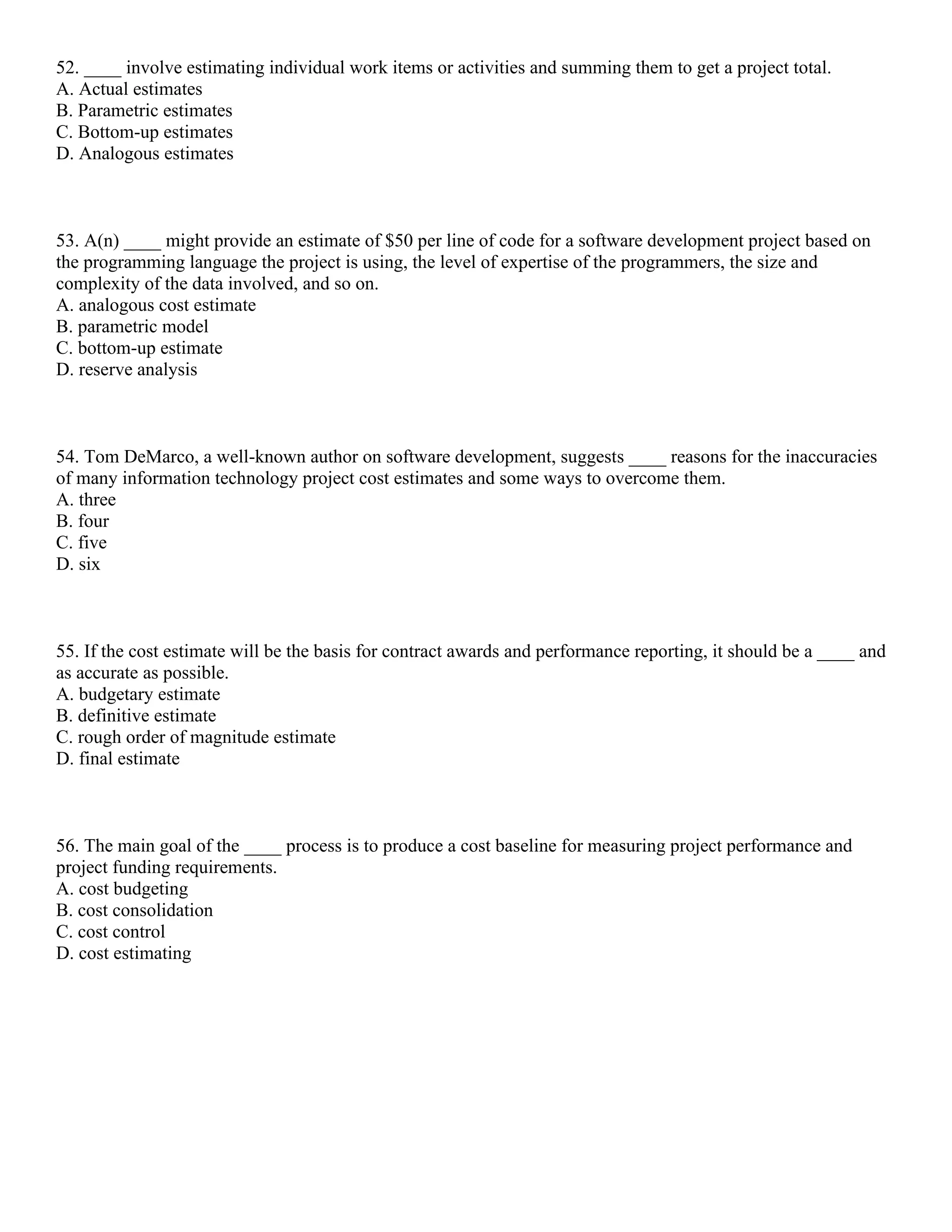
52. ____ involveestimating individual work items or activities and summing them to get a project total.
A. Actual estimates
B. Parametric estimates
C. Bottom-up estimates
D. Analogous estimates
53. A(n) ____ might provide an estimate of $50 per line of code for a software development project based on
the programming language the project is using, the level of expertise of the programmers, the size and
complexity of the data involved, and so on.
A. analogous cost estimate
B. parametric model
C. bottom-up estimate
D. reserve analysis
54. Tom DeMarco, a well-known author on software development, suggests ____ reasons for the inaccuracies
of many information technology project cost estimates and some ways to overcome them.
A. three
B. four
C. five
D. six
55. If the cost estimate will be the basis for contract awards and performance reporting, it should be a ____ and
as accurate as possible.
A. budgetary estimate
B. definitive estimate
C. rough order of magnitude estimate
D. final estimate
56. The main goal of the ____ process is to produce a cost baseline for measuring project performance and
project funding requirements.
A. cost budgeting
B. cost consolidation
C. cost control
D. cost estimating
13.
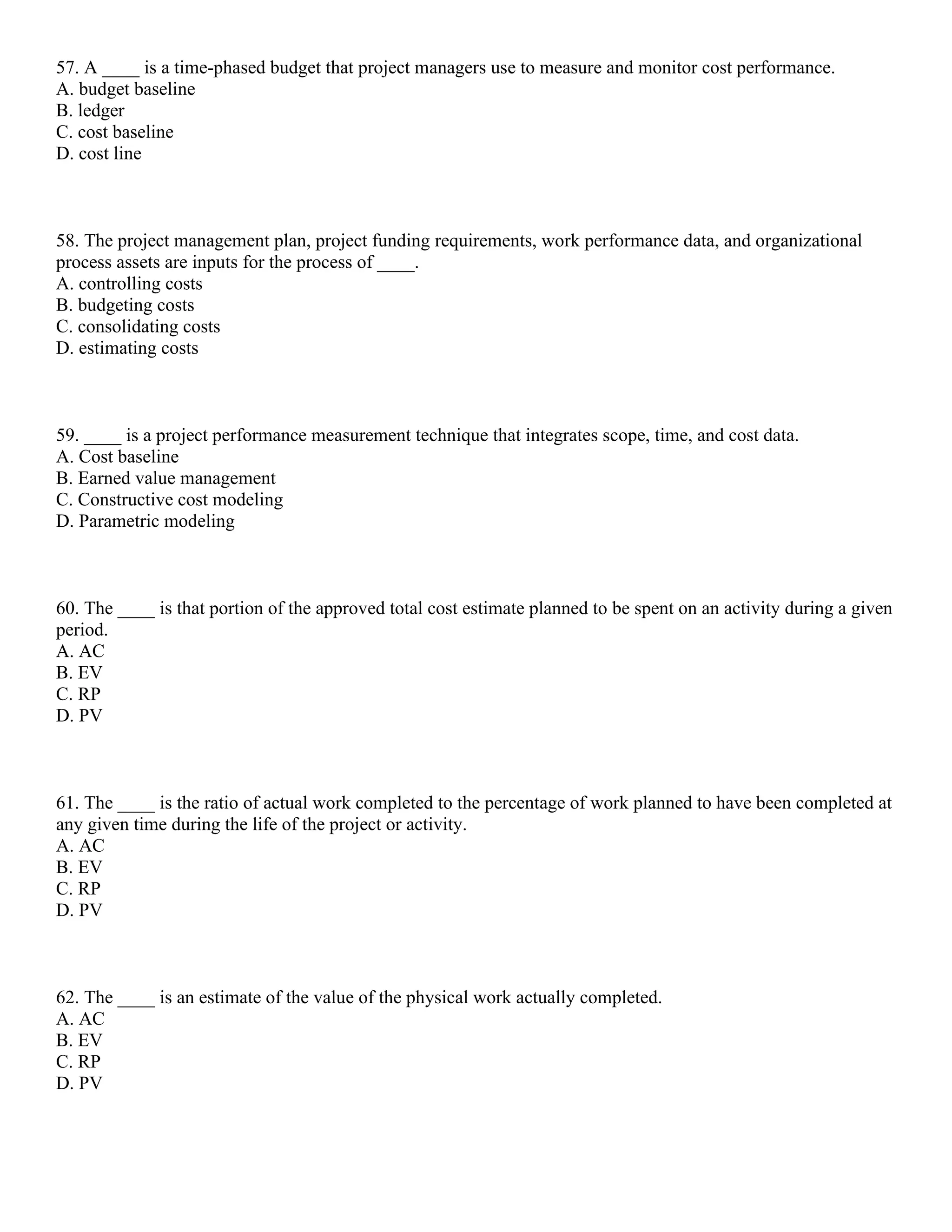
57. A ____is a time-phased budget that project managers use to measure and monitor cost performance.
A. budget baseline
B. ledger
C. cost baseline
D. cost line
58. The project management plan, project funding requirements, work performance data, and organizational
process assets are inputs for the process of ____.
A. controlling costs
B. budgeting costs
C. consolidating costs
D. estimating costs
59. ____ is a project performance measurement technique that integrates scope, time, and cost data.
A. Cost baseline
B. Earned value management
C. Constructive cost modeling
D. Parametric modeling
60. The ____ is that portion of the approved total cost estimate planned to be spent on an activity during a given
period.
A. AC
B. EV
C. RP
D. PV
61. The ____ is the ratio of actual work completed to the percentage of work planned to have been completed at
any given time during the life of the project or activity.
A. AC
B. EV
C. RP
D. PV
62. The ____ is an estimate of the value of the physical work actually completed.
A. AC
B. EV
C. RP
D. PV
14.
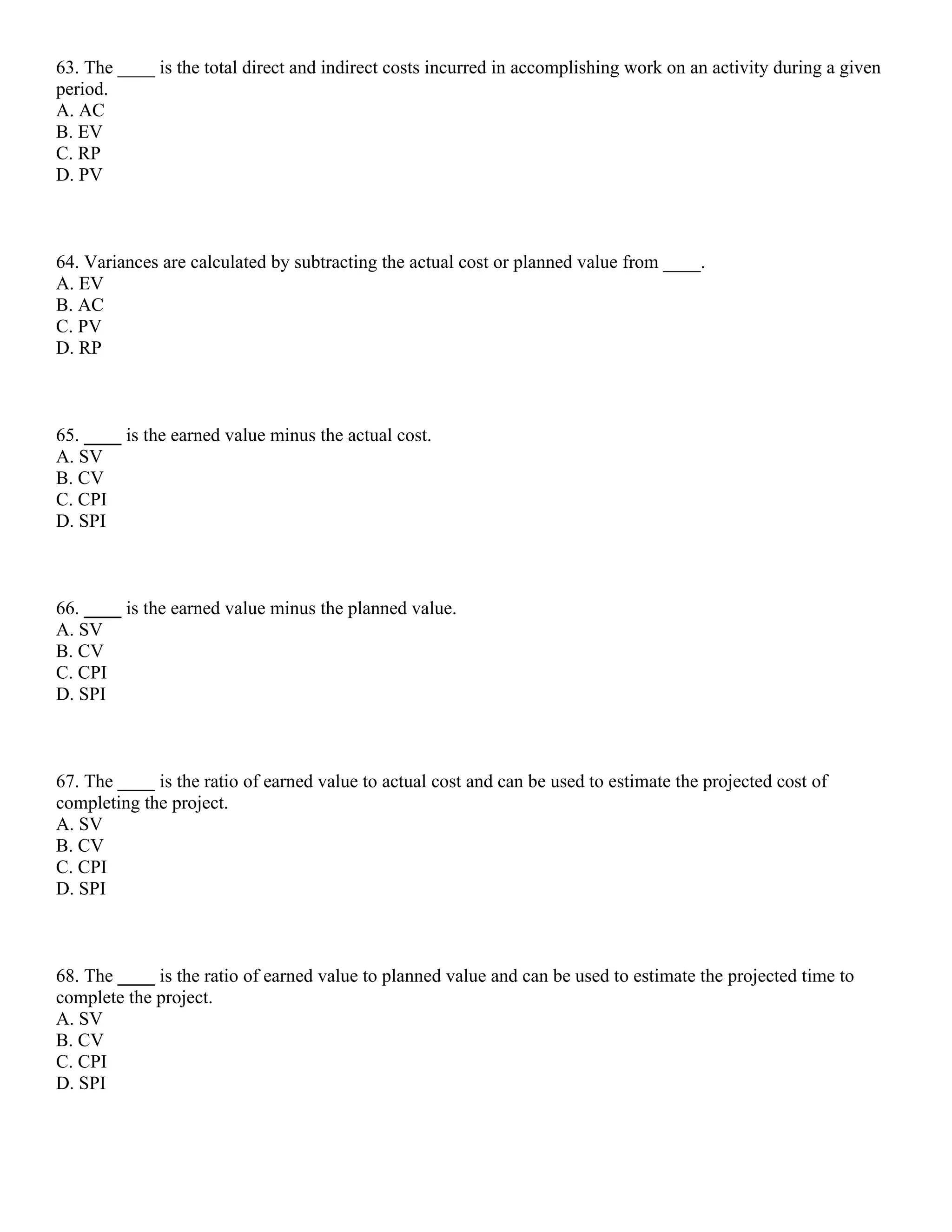
63. The ____is the total direct and indirect costs incurred in accomplishing work on an activity during a given
period.
A. AC
B. EV
C. RP
D. PV
64. Variances are calculated by subtracting the actual cost or planned value from ____.
A. EV
B. AC
C. PV
D. RP
65. ____ is the earned value minus the actual cost.
A. SV
B. CV
C. CPI
D. SPI
66. ____ is the earned value minus the planned value.
A. SV
B. CV
C. CPI
D. SPI
67. The ____ is the ratio of earned value to actual cost and can be used to estimate the projected cost of
completing the project.
A. SV
B. CV
C. CPI
D. SPI
68. The ____ is the ratio of earned value to planned value and can be used to estimate the projected time to
complete the project.
A. SV
B. CV
C. CPI
D. SPI
15.
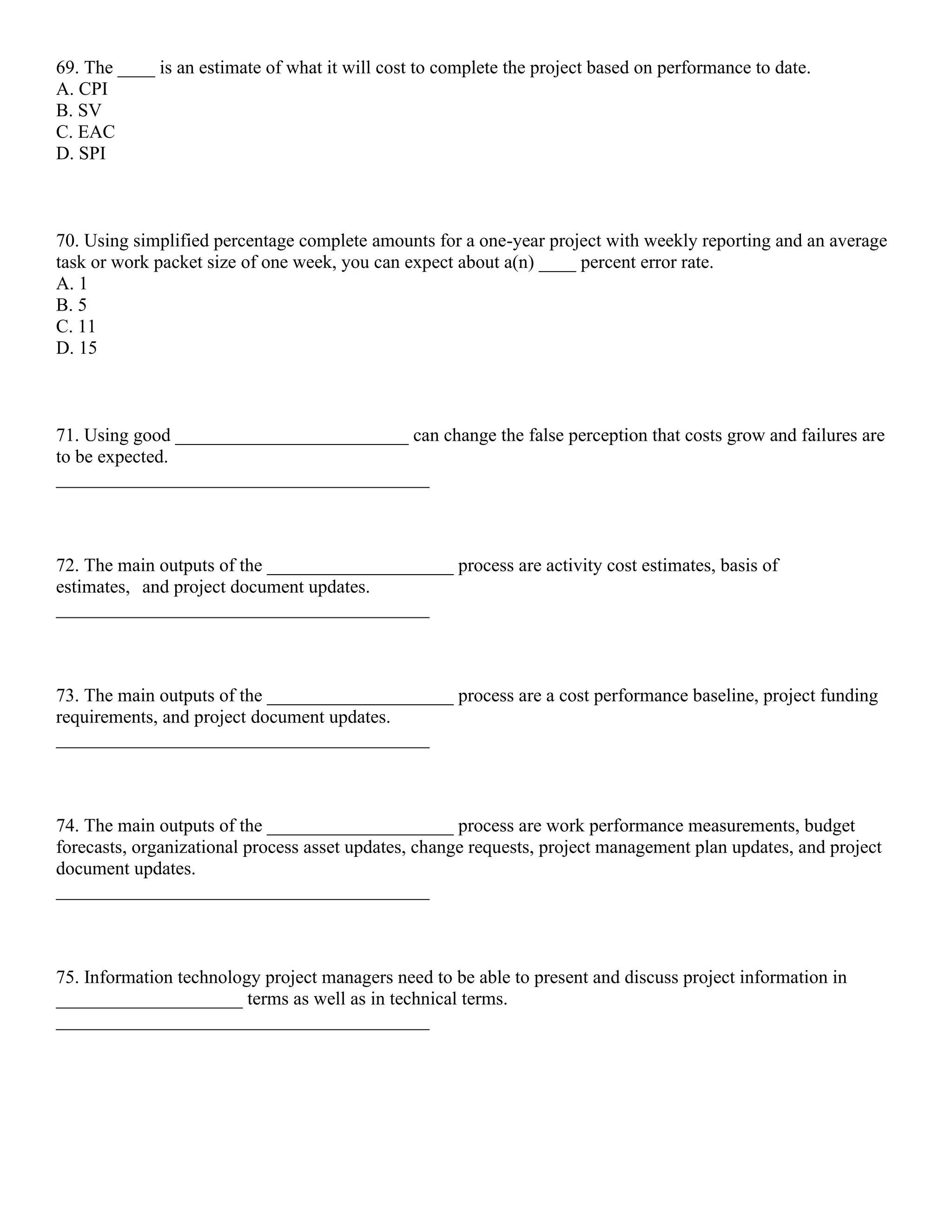
69. The ____is an estimate of what it will cost to complete the project based on performance to date.
A. CPI
B. SV
C. EAC
D. SPI
70. Using simplified percentage complete amounts for a one-year project with weekly reporting and an average
task or work packet size of one week, you can expect about a(n) ____ percent error rate.
A. 1
B. 5
C. 11
D. 15
71. Using good _________________________ can change the false perception that costs grow and failures are
to be expected.
________________________________________
72. The main outputs of the ____________________ process are activity cost estimates, basis of
estimates, and project document updates.
________________________________________
73. The main outputs of the ____________________ process are a cost performance baseline, project funding
requirements, and project document updates.
________________________________________
74. The main outputs of the ____________________ process are work performance measurements, budget
forecasts, organizational process asset updates, change requests, project management plan updates, and project
document updates.
________________________________________
75. Information technology project managers need to be able to present and discuss project information in
____________________ terms as well as in technical terms.
________________________________________
16.
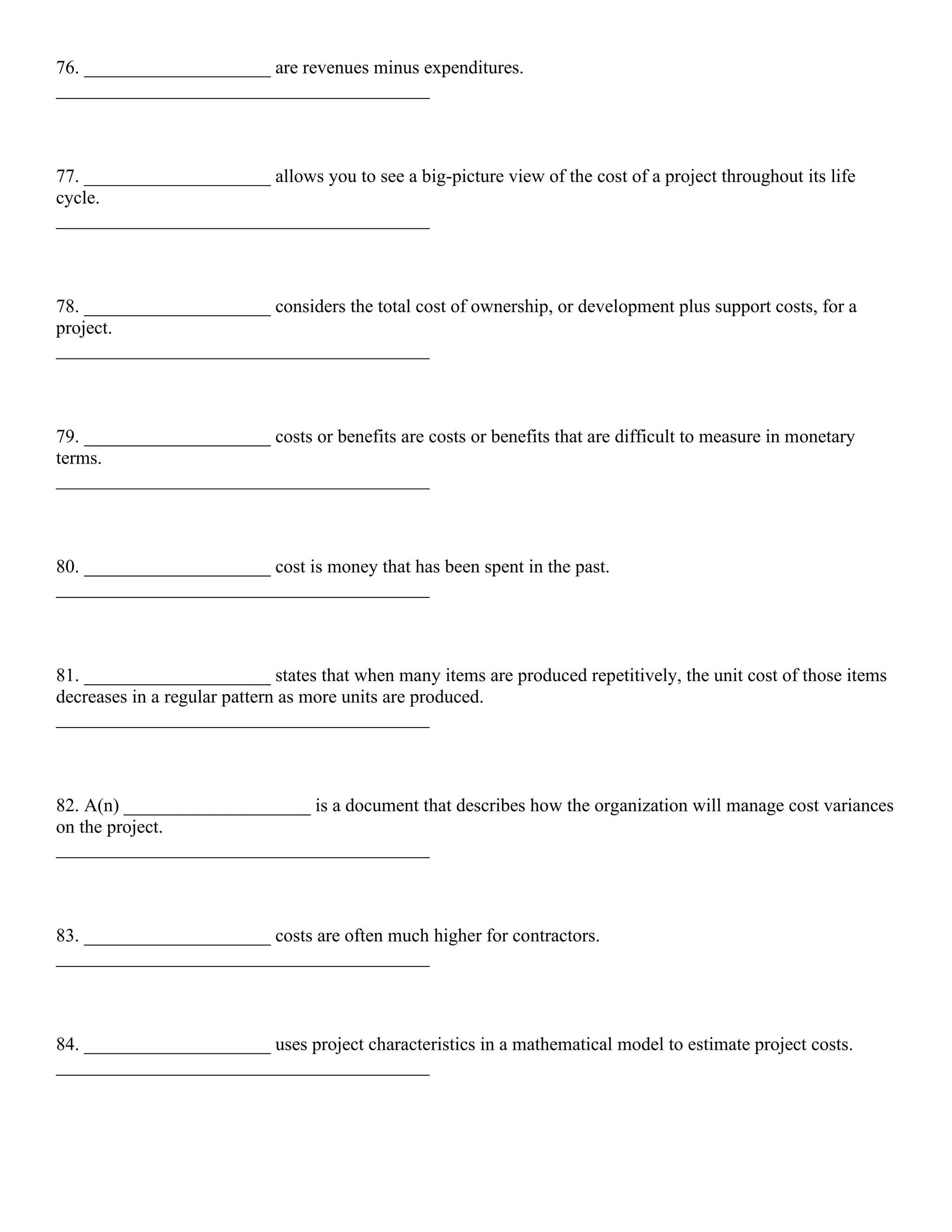
76. ____________________ arerevenues minus expenditures.
________________________________________
77. ____________________ allows you to see a big-picture view of the cost of a project throughout its life
cycle.
________________________________________
78. ____________________ considers the total cost of ownership, or development plus support costs, for a
project.
________________________________________
79. ____________________ costs or benefits are costs or benefits that are difficult to measure in monetary
terms.
________________________________________
80. ____________________ cost is money that has been spent in the past.
________________________________________
81. ____________________ states that when many items are produced repetitively, the unit cost of those items
decreases in a regular pattern as more units are produced.
________________________________________
82. A(n) ____________________ is a document that describes how the organization will manage cost variances
on the project.
________________________________________
83. ____________________ costs are often much higher for contractors.
________________________________________
84. ____________________ uses project characteristics in a mathematical model to estimate project costs.
________________________________________
17.
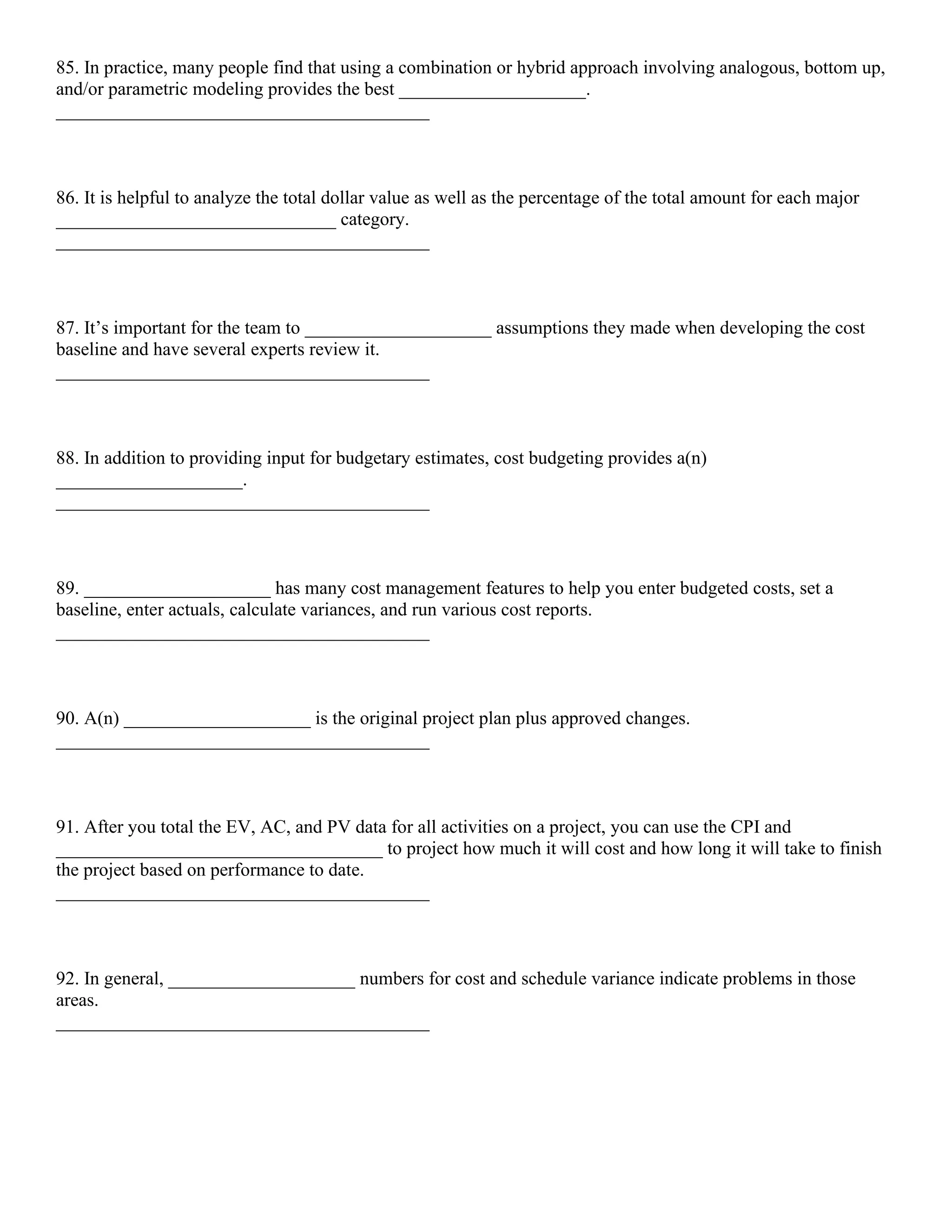
85. In practice,many people find that using a combination or hybrid approach involving analogous, bottom up,
and/or parametric modeling provides the best ____________________.
________________________________________
86. It is helpful to analyze the total dollar value as well as the percentage of the total amount for each major
______________________________ category.
________________________________________
87. It’s important for the team to ____________________ assumptions they made when developing the cost
baseline and have several experts review it.
________________________________________
88. In addition to providing input for budgetary estimates, cost budgeting provides a(n)
____________________.
________________________________________
89. ____________________ has many cost management features to help you enter budgeted costs, set a
baseline, enter actuals, calculate variances, and run various cost reports.
________________________________________
90. A(n) ____________________ is the original project plan plus approved changes.
________________________________________
91. After you total the EV, AC, and PV data for all activities on a project, you can use the CPI and
___________________________________ to project how much it will cost and how long it will take to finish
the project based on performance to date.
________________________________________
92. In general, ____________________ numbers for cost and schedule variance indicate problems in those
areas.
________________________________________
18.
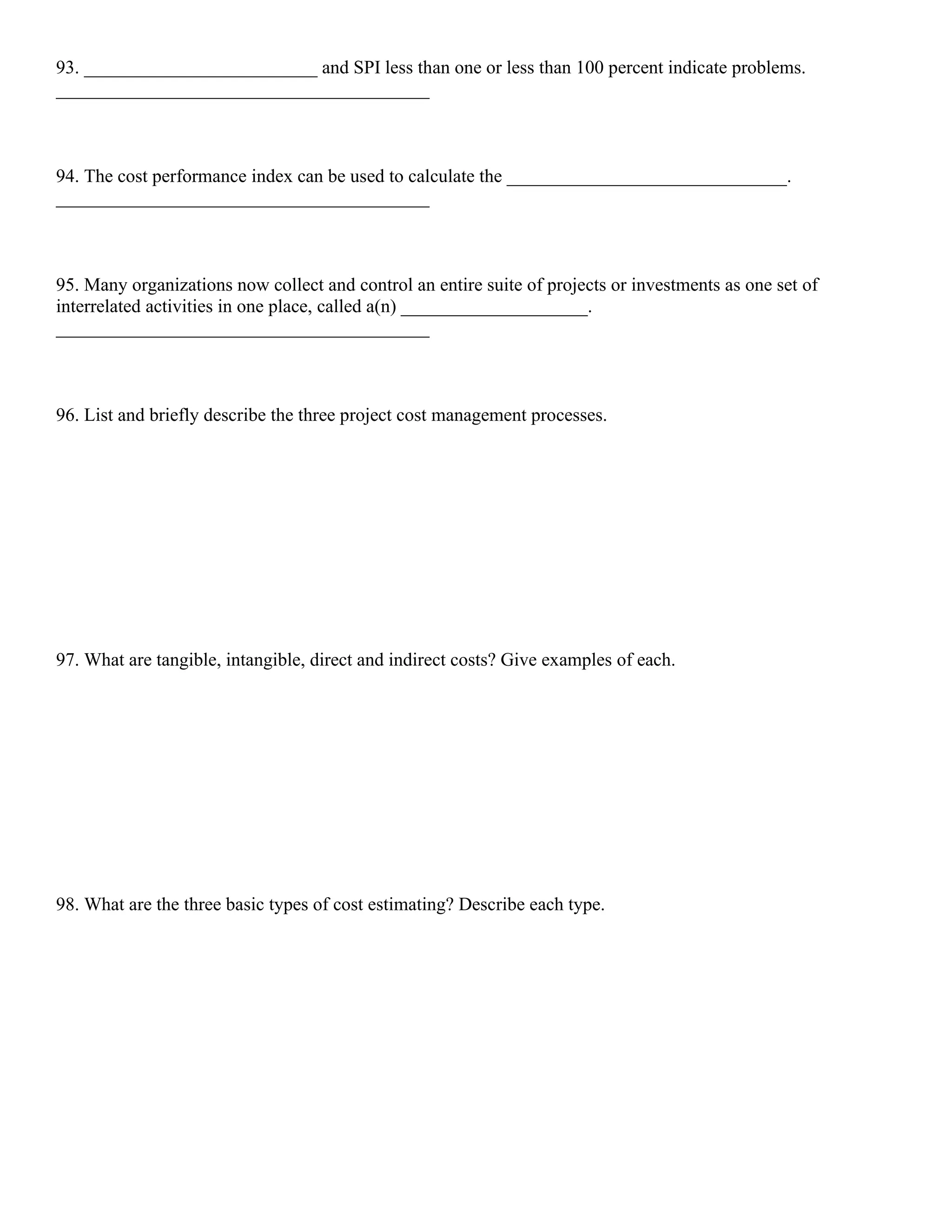
93. _________________________ andSPI less than one or less than 100 percent indicate problems.
________________________________________
94. The cost performance index can be used to calculate the ______________________________.
________________________________________
95. Many organizations now collect and control an entire suite of projects or investments as one set of
interrelated activities in one place, called a(n) ____________________.
________________________________________
96. List and briefly describe the three project cost management processes.
97. What are tangible, intangible, direct and indirect costs? Give examples of each.
98. What are the three basic types of cost estimating? Describe each type.
19.
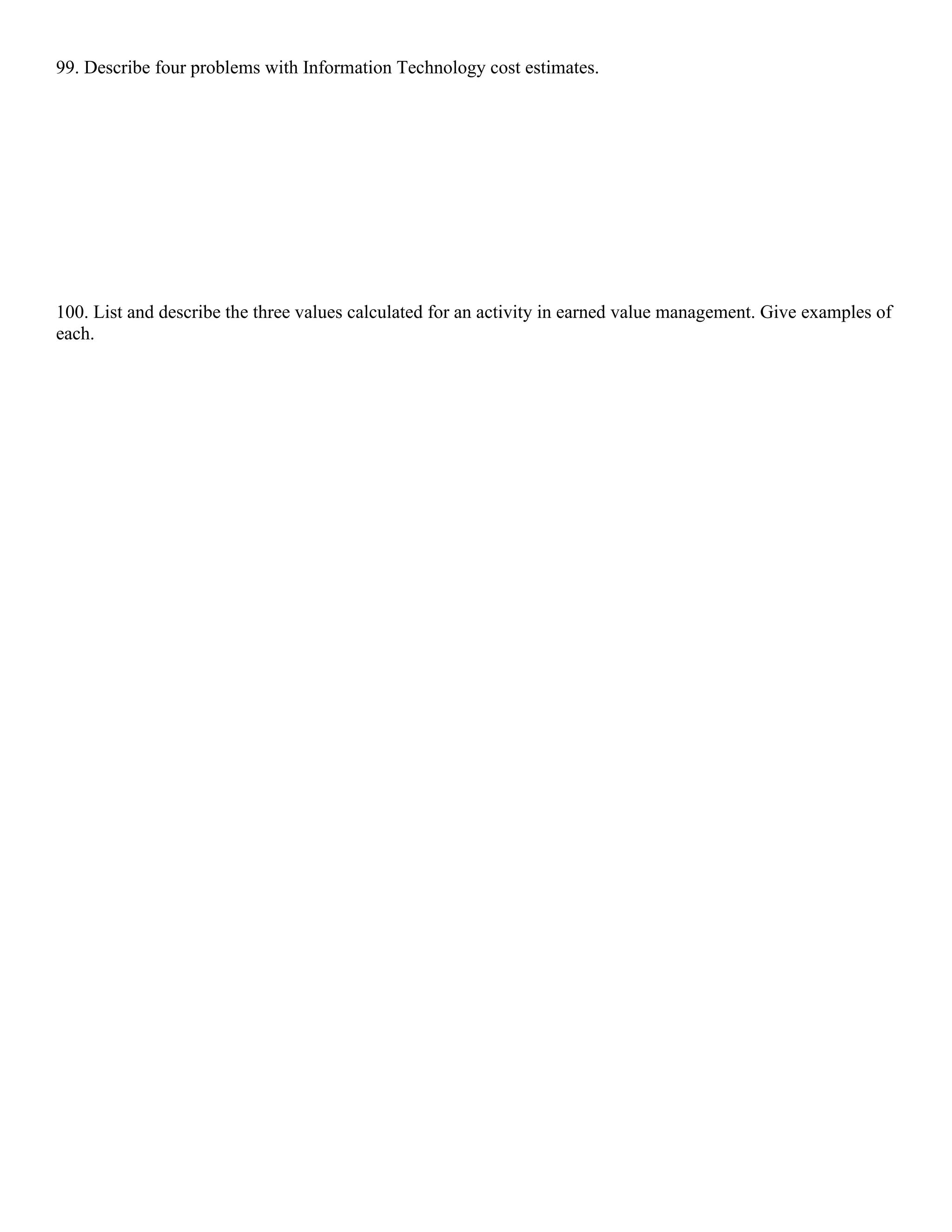
99. Describe fourproblems with Information Technology cost estimates.
100. List and describe the three values calculated for an activity in earned value management. Give examples of
each.
20.
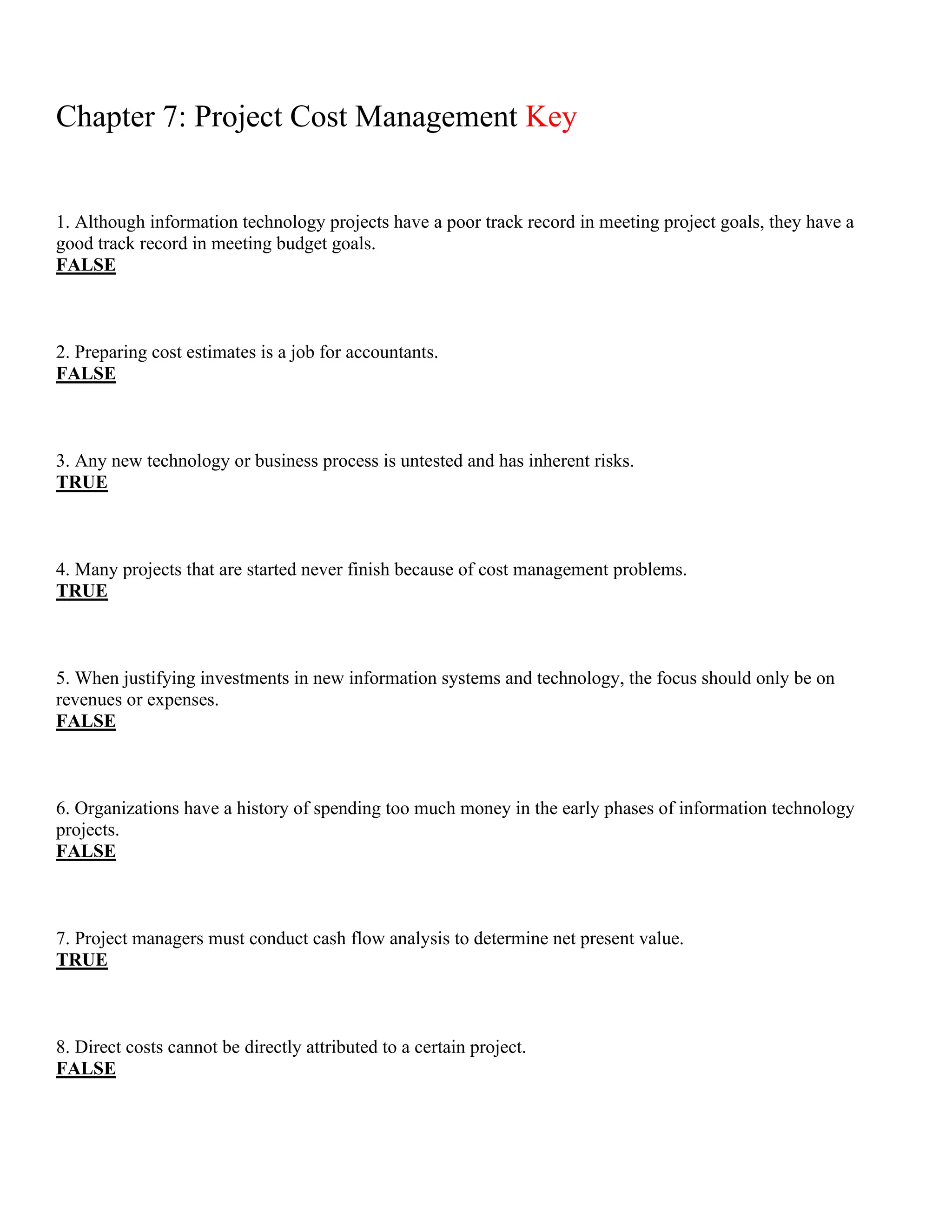
Chapter 7: ProjectCost Management Key
1. Although information technology projects have a poor track record in meeting project goals, they have a
good track record in meeting budget goals.
FALSE
2. Preparing cost estimates is a job for accountants.
FALSE
3. Any new technology or business process is untested and has inherent risks.
TRUE
4. Many projects that are started never finish because of cost management problems.
TRUE
5. When justifying investments in new information systems and technology, the focus should only be on
revenues or expenses.
FALSE
6. Organizations have a history of spending too much money in the early phases of information technology
projects.
FALSE
7. Project managers must conduct cash flow analysis to determine net present value.
TRUE
8. Direct costs cannot be directly attributed to a certain project.
FALSE
21.
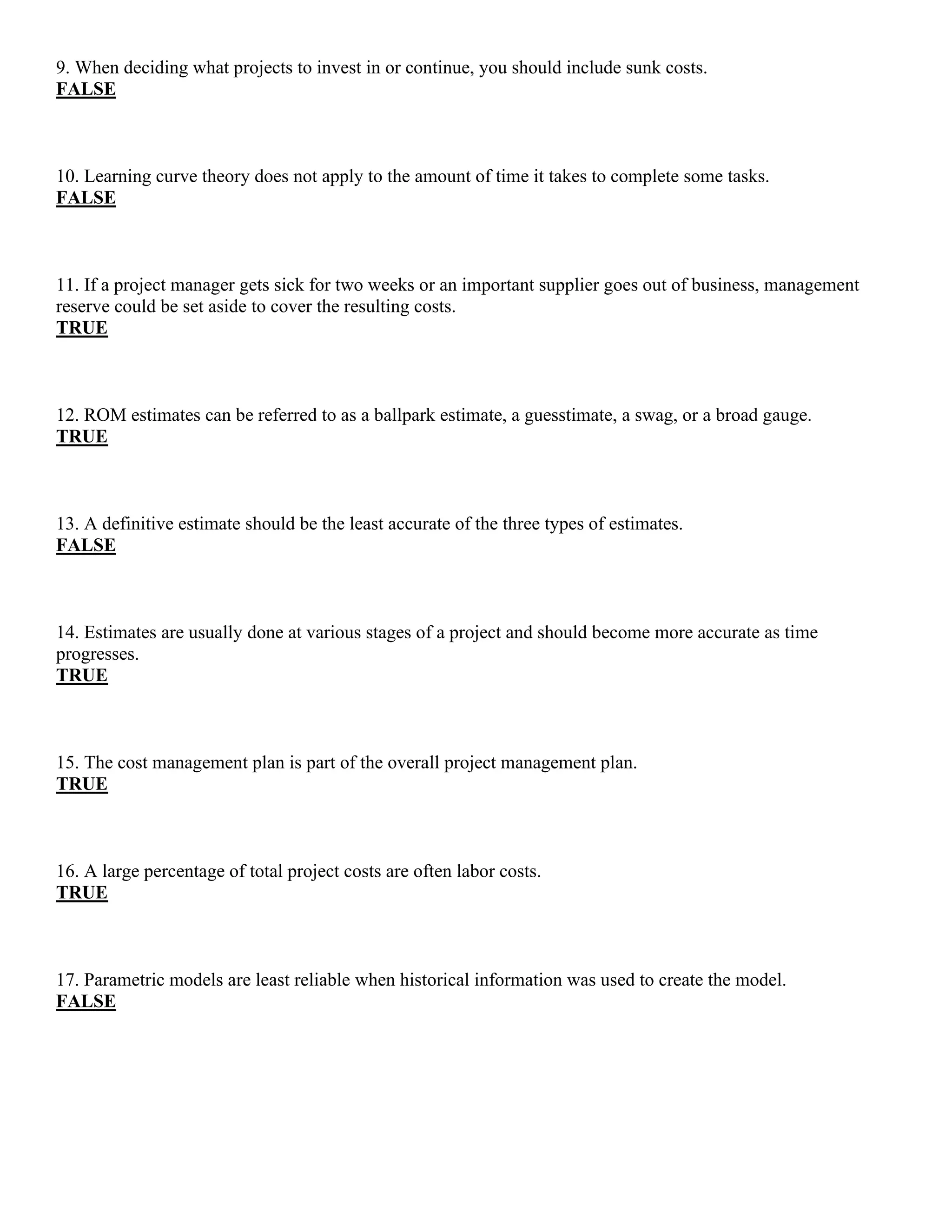
9. When decidingwhat projects to invest in or continue, you should include sunk costs.
FALSE
10. Learning curve theory does not apply to the amount of time it takes to complete some tasks.
FALSE
11. If a project manager gets sick for two weeks or an important supplier goes out of business, management
reserve could be set aside to cover the resulting costs.
TRUE
12. ROM estimates can be referred to as a ballpark estimate, a guesstimate, a swag, or a broad gauge.
TRUE
13. A definitive estimate should be the least accurate of the three types of estimates.
FALSE
14. Estimates are usually done at various stages of a project and should become more accurate as time
progresses.
TRUE
15. The cost management plan is part of the overall project management plan.
TRUE
16. A large percentage of total project costs are often labor costs.
TRUE
17. Parametric models are least reliable when historical information was used to create the model.
FALSE
22.
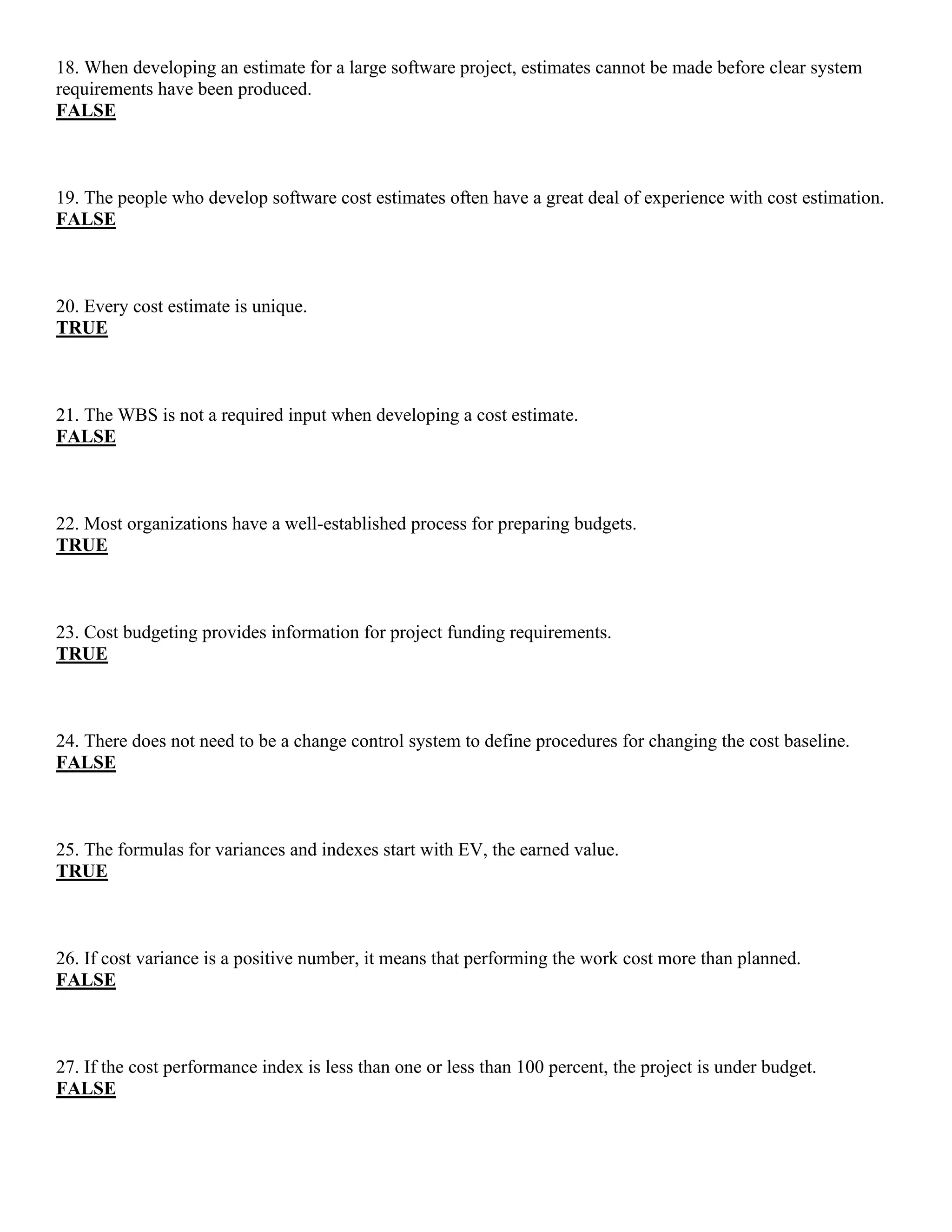
18. When developingan estimate for a large software project, estimates cannot be made before clear system
requirements have been produced.
FALSE
19. The people who develop software cost estimates often have a great deal of experience with cost estimation.
FALSE
20. Every cost estimate is unique.
TRUE
21. The WBS is not a required input when developing a cost estimate.
FALSE
22. Most organizations have a well-established process for preparing budgets.
TRUE
23. Cost budgeting provides information for project funding requirements.
TRUE
24. There does not need to be a change control system to define procedures for changing the cost baseline.
FALSE
25. The formulas for variances and indexes start with EV, the earned value.
TRUE
26. If cost variance is a positive number, it means that performing the work cost more than planned.
FALSE
27. If the cost performance index is less than one or less than 100 percent, the project is under budget.
FALSE
23.
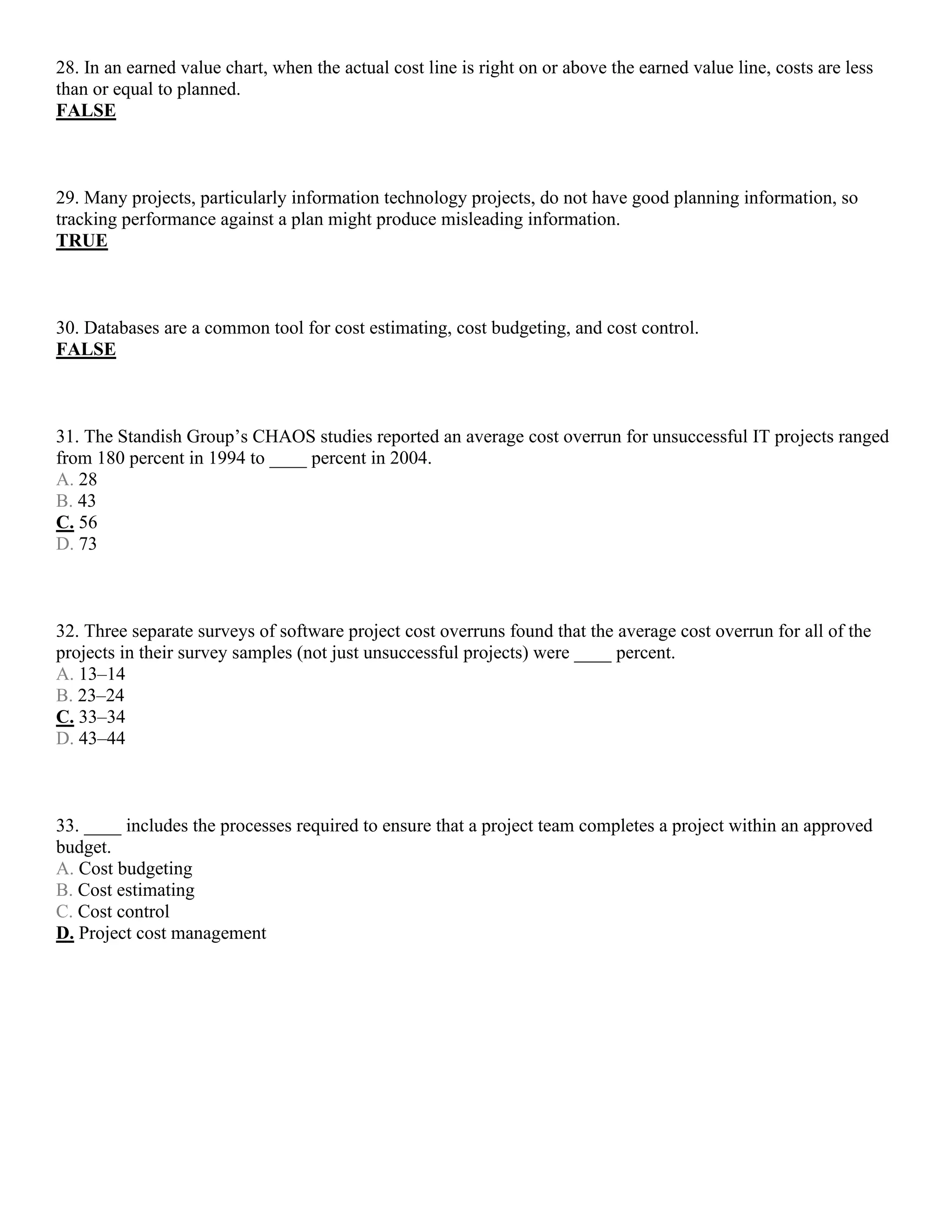
28. In anearned value chart, when the actual cost line is right on or above the earned value line, costs are less
than or equal to planned.
FALSE
29. Many projects, particularly information technology projects, do not have good planning information, so
tracking performance against a plan might produce misleading information.
TRUE
30. Databases are a common tool for cost estimating, cost budgeting, and cost control.
FALSE
31. The Standish Group’s CHAOS studies reported an average cost overrun for unsuccessful IT projects ranged
from 180 percent in 1994 to ____ percent in 2004.
A. 28
B. 43
C. 56
D. 73
32. Three separate surveys of software project cost overruns found that the average cost overrun for all of the
projects in their survey samples (not just unsuccessful projects) were ____ percent.
A. 13–14
B. 23–24
C. 33–34
D. 43–44
33. ____ includes the processes required to ensure that a project team completes a project within an approved
budget.
A. Cost budgeting
B. Cost estimating
C. Cost control
D. Project cost management
24.
34. ____ involvesdeveloping an approximation or estimate of the costs of the resources needed to complete a
project.
A. Determining the budget
B. Consolidation of costs
C. Controlling costs
D. Estimating costs
35. ____ involves allocating the overall cost estimate to individual work items to establish a baseline for
measuring performance.
A. Determining the budget
B. Consolidation of costs
C. Controlling costs
D. Estimating costs
36. ____ is the ratio of revenues to profits.
A. Profit
B. Profit margin
C. Cost structure
D. Cost margin
37. ____ helps you develop an accurate projection of a project’s financial costs and benefits.
A. Profit cycle costing
B. Financial costing
C. Life cycle costing
D. Profit margin costing
38. ____, with assistance from financial experts in their organizations, should create estimates of the costs and
benefits of the project for its entire life cycle.
A. Financial managers
B. Project managers
C. Budget managers
D. System managers
39. Since organizations depend on reliable information technology, there are also huge costs associated with
____.
A. work time
B. technical planning
C. uptime
D. downtime
The Project GutenbergeBook of Blackwood's
Edinburgh Magazine, Volume 64, No. 398,
December 1848
30.
This ebook isfor the use of anyone anywhere in the United
States and most other parts of the world at no cost and with
almost no restrictions whatsoever. You may copy it, give it away
or re-use it under the terms of the Project Gutenberg License
included with this ebook or online at www.gutenberg.org. If you
are not located in the United States, you will have to check the
laws of the country where you are located before using this
eBook.
Title: Blackwood's Edinburgh Magazine, Volume 64, No. 398,
December 1848
Author: Various
Release date: July 1, 2012 [eBook #40026]
Most recently updated: October 23, 2024
Language: English
Credits: Produced by Brendan OConnor, Jonathan Ingram and
the Online
Distributed Proofreading Team at http://www.pgdp.net
(This
file was produced from images generously made
available
by The Internet Library of Early Journals.)
*** START OF THE PROJECT GUTENBERG EBOOK BLACKWOOD'S
EDINBURGH MAGAZINE, VOLUME 64, NO. 398, DECEMBER 1848
***
31.
Transcriber's note:
Spelling andpunctuation are
sometimes erratic. A few obvious
misprints have been corrected, but
in general the original spelling and
typesetting conventions have been
retained. Accents are inconsistent,
and have not been standardised.
This issue contains the index to
Volume 64.
BLACKWOOD'S
EDINBURGH MAGAZINE.
No. CCCXCVIII. DECEMBER, 1848. Vol. LXIV.
CONTENTS.
32.
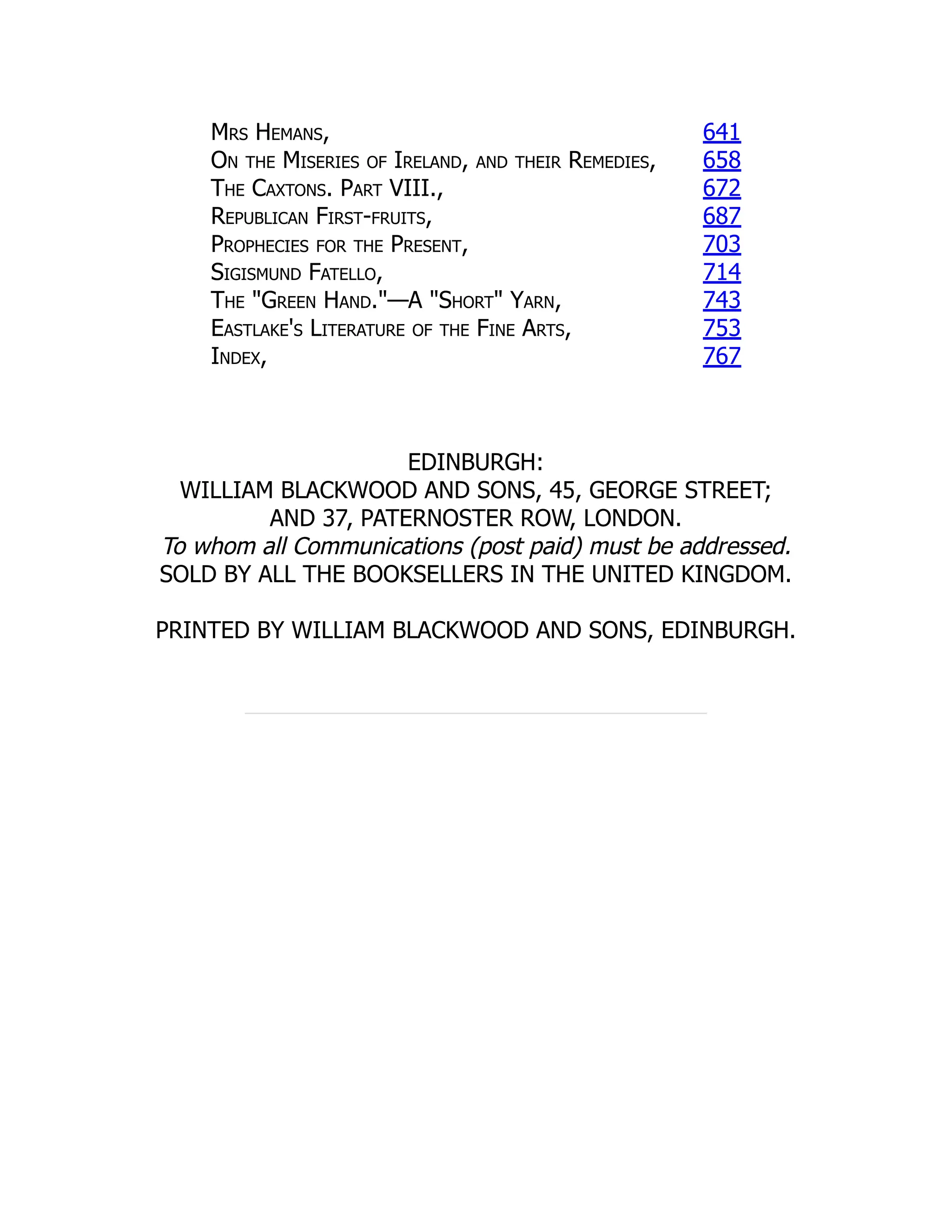
Mrs Hemans, 641
Onthe Miseries of Ireland, and their Remedies, 658
The Caxtons. Part VIII., 672
Republican First-fruits, 687
Prophecies for the Present, 703
Sigismund Fatello, 714
The "Green Hand."—A "Short" Yarn, 743
Eastlake's Literature of the Fine Arts, 753
Index, 767
EDINBURGH:
WILLIAM BLACKWOOD AND SONS, 45, GEORGE STREET;
AND 37, PATERNOSTER ROW, LONDON.
To whom all Communications (post paid) must be addressed.
SOLD BY ALL THE BOOKSELLERS IN THE UNITED KINGDOM.
PRINTED BY WILLIAM BLACKWOOD AND SONS, EDINBURGH.
33.
MRS HEMANS.
Felicia Hemansand the poetesses of England! Such would probably
be the form in which the toast would run, if literary toasts were the
fashion, or such a mode of compliment the one exactly suited to the
case. Not that we would venture positively to assert that Mrs
Hemans stands at the head of our poetesses, the first absolutely in
point of genius,—though there is but one name, that of Joanna
Baillie, which occurs to us, at the moment, as disputing with hers
that pre-eminence,—but because she, in a more complete manner
than any other of our poetesses, represents the mind, the culture,
the feelings, and character, of the English gentlewoman. Her piety,
her resignation, her love of nature and of home,—that cheerfulness
easily moved by little incidents, that sadness into which reflection
almost always settled,—all speak of the cultivated woman bred
under English skies, and in English homes. Her attachment to the
privacy of life, her wise dislike and avoidance of the éclat of literary
renown, and the dull, dry, fever-heat of fashionable circles, tend to
complete her qualifications as a fitting representative of her fair
countrywomen. The cultivation of her mind, in its weakness as well
as elegance, savoured, perhaps, too much of what we are compelled
to call feminine. Alive at all times to beauty in all its forms, to music,
to tender and imaginative thought, she seems to have been almost
equally averse to whatever bore the aspect of an analysis of feeling,
or an approach to a severe investigation of truth. Present her with
the beautiful, but spare her all scientific dissection of it. Let the
flower live as her companion; do not rend it to pieces to show its
conformation. Let but the faith be tender and true to the heart, and
disturb her not with rude inquiries whether it possess any other truth
or not. That too much melancholy (at least for her own happiness)
which is traceable in her poems, arose in part from events in her life,
but in part, also, from this too partial and limited cultivation of the
34.
mind. The feelingswere excited or refined, but the reasoning powers
not enough called forth: no task-work was therefore given to the
active intellect; and a mind that could not be at rest was left to
brood over sentiments, either the sad heritage of all mortality, or the
peculiar offspring of afflictions of her own. We are not imputing, in
this remark, any shadow of blame to her; we make the remark
because we think that, eminent as she was, she still suffered much
from the unwise and arbitrary distinction which is made in the
education of the two sexes.
The difference between the mental qualities of the sexes is owing,
we apprehend, far more to education than to nature. At all events,
there is no such natural difference as warrants the distinction we
make in the mental discipline we provide for them. There are certain
professional studies with which no one thinks of vexing the mind of
any one, man or woman, but those who intend to practise the
professions; but why, in a good English library, there should be one
half of it, and that the better half, which a young woman is not
expected to read—this we never could understand, and never reflect
on with common patience. Why may not a Locke, or a Paley, or a
Dugald Stewart, train the mind of the future mother of a family? or
why may not an intelligent young woman be a companion for her
brother or her husband in his more serious moods of thought, as
well as in his gayer and more trifling? Would the world lose any
thing of social happiness or moral refinement by this intellectual
equality of the two sexes? You vex the memory of a young girl with
dictionaries and vocabularies without end; you tax her memory in
every conceivable manner; and at an after-age you give the
literature of sentiment freely to her pillage; but that which should
step between the two—the culture of the reason—this is entirely
forbidden. If she learns a dozen modern languages, she does not
read a single book in any one of them that would make her think.
Even in her religious library, the same distinction is preserved. Books
of sentimental piety—some of them maudlin enough—are thrust with
kindest anxiety and most liberal profusion upon her: any work of
35.
theology, any workthat discusses and examines, is as carefully
excluded.
We are not contending that there is no difference whatever in the
mental constitution of the two sexes. There may be less tendency to
ratiocination in woman; there is certainly more of feeling, a quicker
and more sensitive nature. One sees this especially in children. Mark
them in their play-hours, in their holiday freedom, when they are left
to themselves to find matter of enjoyment,—how much more
pleasure does the girl evidently derive from any beautiful or living
thing that comes before it than the boy! We have an instance of it
almost as we write. There is a group of children on the beach. The
little girl is in perfect ecstasies, as she looks at the sparkling waves
that come bounding to her feet; she shouts, she leaps, she herself
bounds towards them, then springs back as they approach, half
frightened and half pleased—she knows not how to express her
delight at this great playfellow she has found. Meanwhile the boy,
her brother, does nothing but throw stones at it—of that he seems
never wearied. The beach is a perfect armoury to him, and he pelts
the graceful waves remorselessly. What is their grace to him? So,
too, in an inland scene, a garden or a lawn, we have often noticed
what exquisite pleasure a little girl will feel, as she watches a
sparrow alight near her upon the ground, in search of crumbs or
other food. Her little frame quite thrills as this other little piece of life
comes hopping and pecking about her. She loads it, but with
suppressed voice, with all the endearing epithets her vocabulary
supplies. She is evidently embarrassed that they are so few: she
makes up by their frequent repetition. She absolutely loves the little
creature, with all whose movements she seems to have the keenest
sympathy. Her brother, the boy, he has nothing for it but his unfailing
stone, or he flings his hat at it. Unfailing, fortunately, the stone is
not; for, if his skill as a marksman responded to his destructive zeal,
there is nothing that a stone would kill that would be left alive, or
that a stone would break that would be left whole. A mere blind
animal-activity seems, at that very interesting age, to distinguish the
future lord of the creation.
36.
At an afterperiod of life, when thought has educated the youth into
feeling, the picture is often entirely reversed. Then, unless the man
be bred up a mere pleasure-hunter, seeking what he calls
amusement in town or country, the superior education he has
received makes him the more feeling, the more imaginative, because
the more reflective of the two. That brother who once shocked his
little sister by his stupid and cruel amusements, now looks with
something like contempt at the frivolous tastes and occupations—at
the system of poor artificial enjoyments—to which that sister has
betaken herself. Now, if they are at the sea-side together, it is he
who finds companionship in the waves, who finds thought grow
more expanded, freer and bolder, in the presence of the boundless
ocean. She, too, dotes upon the sea, and sits down beside it—to
read her novel. Now, if they ride or walk through the country
together, it is his eye that sees the bird upon the bough—hers is on
the distant dust some equipage is making.
But matters are mending, and will continue to mend. There are so
many women of richly cultivated minds who have distinguished
themselves in letters or in society, and made it highly feminine to be
intelligent as well as good, and to have elevated as well as amiable
feelings, that by-and-by the whole sex must adopt a new standard of
education. It must, we presume, be by leaders of their own starting
out of their own body, that the rest of the soft and timid flock must
be led.
Yes, we are mending. Very different are our times from those when
Madame de Genlis published her little work, De l'Influence des
Femmes sur la Littérature Française comme Protectrices des Lettres,
et comme Auteurs. She had to contend, with the same acrid energy,
for the privilege of a lady to write, as a Turkish dame of the present
century might be supposed to display, who should contend for the
privilege of walking abroad unveiled, or rather unmuffled. And even
she herself thinks it necessary to give certain rules to young women
who write—as she would to young women who dance—how to
comport themselves with consummate propriety; as not to enter into
37.
controversy, or usebig words—in short, to deal with printer's ink
without soiling the most delicate fingers. As to that argument drawn
from the supposed neglect of domestic duties—which it seems, in
those days just emerging from barbarity, was still heard of—she
dismisses it very briefly. "Comme ces devoirs dans une maison bien
ordonnée, ne peuvent jamais prendre plus d'une heure par jour,
cette objection est absolument nulle." As there is much implied in
that "maison bien ordonnée," and as Madame de Genlis did not write
for simple gentle-folks, it is to be hoped that the one hour per diem
may admit of extension without any forfeiture of literary privileges.
In her time, too, there was thought to be a sort of feud between
authors and authoresses—a thing which in our day, is quite
inconceivable—for she writes, apropos of a charge of plagiarism,
against La Fontaine, in the following indignant strain:—"Quelles que
soient le bonhomie et la candeur d'un auteur, il sait que, par une loi
tacite mais universelle, il est toujours dispensé de convenir qu'il doit
à une femme une idée heureuse. Dans ce cas seulement le plagiat et
le silence sont également légitimes."
We have changed all that: we have had too many instances of
women of talent and of genius to doubt their ability to excel—we
make no exception—in any branch of literature whatever. We give
them, on the other hand, no monopoly of elegance or grace, or
delicacy of touch, as some affect to do. These qualities they are very
likely to display; but they will be superior in them to authors of the
male sex, only just so far as they are superior to those authors in
genius and talent. There is still a practice in many critics to detect
the style feminine from the style masculine. The sooner this is laid
aside the better. There are styles which, speaking metaphorically,
one may say have a feminine grace, or a feminine weakness. Such
an observation has been made, by Sir James Mackintosh, on the
style of Addison. But to pretend to say of a given page of
composition whether a man or a woman has penned it, is absurd.
We often hear it said, that none but a woman could have written the
letters of Madame de Sévigné. If Cowper had been a woman, people
would have said the same thing of his letters. They are unrivalled, at
38.
least in ourown language, for grace and elegance, and wit and
playfulness. No woman, we believe—and the epistolary style is
supposed to belong by especial right to the female pen—has ever
written such charming letters as those to Lady Hesketh, and his old
friend Thomas Hill. As to the letters of Madame de Sévigné, they so
evidently come from a mother to a daughter, that it is impossible to
forget for a moment the sex of the writer. But if the qualities which
have given them literary celebrity are, to be pronounced feminine,
half the literature of France is of the same gender. Still less can we
tolerate the affectation that pretends to discern a certain weakness,
a tremulousness of the hand, when the pen is held by a woman.
There is grace and elegance, but, forsooth, a certain hesitation—a
want of vigour and certainty of touch. Nonsense. Take Our Village,
by Miss Mitford, and the Sketch-Book, by Washington Irving: they
are both of the graceful and elegant order of style; but the lady
writes the English language with far more freedom, ease, and vigour,
than the gentleman. The poetic element is mingled in her diction
with far more taste and judgment. It glitters through her prose as
the sunlight in the green tree—throwing its gold amongst the
foliage, yet leaving it the same green, and simple, and refreshing
object as before.
No—we will grant to woman no monopoly in the lighter elegancies,
and presume nothing against her ability to excel in the graver
qualities of authorship. We have said that Mrs Hemans was
peculiarly the poetess of her countrywomen, but we do not mean to
imply by this that her style is peculiarly feminine—for we do not
pretend to know what a feminine style is; we thus characterised her
because the sentiments she habitually expresses are those which will
almost universally find a response in the minds of her
countrywomen.
It seems an ungracious thing to say, but we do wish that the
biographical notice of Mrs Hemans, appended to the last edition of
her works, had not been written by a sister. So near a relative may
be presumed, indeed, to know more of the person whose life she
39.
undertakes to narratethan any one else; but she may not know
what to tell us. Her very familiarity with the subject is against her:
she cannot place it at a distance from her, and regard it with a
freshness of view; she does not think of recording, she does not
even remember, what to her has none of the interest of novelty. A
sister who should give to any impartial biographer the materials he
required of her, would be found to contribute far more to our
knowledge of the person whose life was written, than by holding the
pen herself. Besides, a sister can have none, and show none, but
sisterly feelings; and though these are very proper and amiable, we
want something more.
The two or three events which we learn from this biographical
notice, and which bear upon the education of the poetess, are soon
recorded, and they are the only class of events we feel particularly
interested in. Felicia Dorothea Browne—such was the maiden name
of Mrs Hemans—was born at Liverpool, 25th September 1793. She is
described as distinguished "almost from her cradle by extreme
beauty and precocious talents." When of the age of seven years, her
father, who had been a merchant of considerable opulence, met with
a reverse of fortune, and the family retired to Wales, "where for the
next nine years they resided at Gwrych, near Abergele, in
Denbighshire, a large old mansion, close to the sea, and shut in by a
picturesque range of mountains,"—a change of residence which was,
at all events, highly propitious for the development of the poetic
character. "In the calm seclusion of this romantic region, with ample
range through the treasures of an extensive library, the young
poetess passed a happy childhood, to which she would often fondly
revert amidst the vicissitudes of her after-life. Here she imbibed that
intense love of nature which ever afterwards 'haunted her like a
passion,' and that warm attachment for the 'green land of Wales'—
its affectionate, true-hearted people; their traditions, their music,
and all their interesting characteristics—which she cherished to the
last hours of her existence." A pleasant picture this—the large old
house near the sea, and amongst mountains, with Welsh harpers
and Welsh traditions, and great store of books, and the little girl
40.
ranging at willthrough all. This, and the picture we have of the
young student conning her Shakspeare, her choicest recreation, "in a
secret haunt of her own—a seat amongst the branches of an old
apple-tree—where she revelled in the treasures of the cherished
volume"—are all we learn of her childhood, and all perhaps that
remained to tell.
Our poetess was very soon in print. Few have commenced their life
of authorship so early. In 1808 some friends, "perhaps more partial
than judicious," published a collection of her poems, written at and
before the age of fourteen, in a quarto volume. "Its appearance" our
fair biographer tells us, "drew down the animadversions of some
self-constituted arbiter of taste." We never heard of any critics being
constituted by royal patent, or any mode of popular election—
certainly not by a committee of authors. Self-constituted! why did
not the lady call him a self-conceited knave, while she was about it?
Just or unjust, there would have been some meaning in the phrase,
at least. We suspect, for our part, that these friends, "more partial
than judicious," who published the rhymes of a young girl of
fourteen in a quarto volume, were themselves strangely constituted
arbiters of taste.
Not long after this first publication of her poems, the next great
event of her life took place—her introduction to Captain Hemans.
"The young poetess was then only fifteen, in the full glow of that
radiant beauty which was destined to fade so early. The mantling
bloom of her cheeks was shaded by a profusion of natural ringlets,
of a rich golden brown; and the ever-varying expression of her
brilliant eyes gave a changeful play to her countenance, which would
have made it impossible for any painter to do justice to it." No
wonder that so fair a being should excite the admiration of a gallant
captain. And the love on both sides was ardent and sincere: it
supported the absence of three years; for Captain Hemans, soon
after their introduction, was called upon to embark with his regiment
for Spain. On his return, in 1812, they were married. Of their
domestic happiness, or unhappiness, nothing is said; but six years
41.
after, in 1818,we are simply told that the Captain went to Rome—
and never returned. The separated pair never met again.
"To dwell on this subject," says her biographer, "would be
unnecessarily painful; yet it must be stated, that nothing like a
permanent separation was contemplated at the time, nor did it ever
amount to more than a tacit conventional arrangement, which
offered no obstacle to the frequent interchange of correspondence,
nor to a constant reference to their father in all things relating to the
disposal of her boys. But years rolled on—seventeen years of
absence, and consequently alienation; and from this time to the
hour of her death, Mrs Hemans and her husband never met again."
We are not in general anxious to pry into the domestic afflictions of
any pair whom wedlock has mismatched. If we feel a little curiosity
to know more than the sister has told us, in this instance, it is
merely from a wish to learn how far the poetic temperament of Mrs
Hemans could be assigned as the real cause of her matrimonial
unhappiness. Did the Captain grow weary of the society of one
whose feelings were pitched in too high a key for him to sympathise
with?—was there too much of poetry mingled with the daily food of
life?
"Men, by St Thomas! cannot live like bees."
Did he yearn for something more homely, as she, on her side,
yearned for something more elevated? Had he been made to feel
that he did not approach the ideal of her imagination, and that the
admiration she once had given was withdrawn? Or should we say of
her, in lines of her own:—
There are hearts
So perilously fashioned, that for them
God's touch alone hath gentleness enough
To waken, and not break, their thrilling strings.
Of this perhaps some future biographer may tell us. There are many
passages in her poetry which show an intense longing for the
42.
sympathy of otherminds; which show that, while her feelings were
of a rare order for their refinement and elevation, she yet sought—
what for such a one it was difficult to obtain—for the kindred
sympathy of others. She could not worship her goddesses alone.
This tendency of mind many of her verses indicate; and there is one
sweet little poem where, if our fancy does not mislead us, she
secretly reproves herself for having exacted too much in this respect
from others: we do not say from any one in particular, for the verses
bear reference to a brother, not a husband. Yet some personal
reminiscence, or regret of this kind, might lead to the strain of
thought so beautifully expressed in the following lines:—
KINDRED HEARTS.
Oh! ask not, hope not thou too much
Of sympathy below;
Few are the hearts whence one same touch
Bids the sweet fountains flow:
Few—and by still conflicting powers,
Forbidden here to meet;
Such ties would make this life of ours
Too fair for aught so fleet.
It may be that thy brother's eye
Sees not as thine, which turns
In such deep reverence to the sky
Where the rich sunset burns:
It may be that the breath of spring,
Born amidst violets lone,
A rapture o'er thy soul can bring—
A dream, to his unknown.
The tune that speaks of other times—
A sorrowful delight!
The melody of distant chimes,
The sound of waves by night;
43.
The wind that,with so many a tone,
Some chord within can thrill—
These may have language all thine own,
To him a mystery still.
Yet scorn thou not, for this, the true
And steadfast love of years;
The kindly, that from childhood grew,
The faithful to thy tears!
If there be one that o'er the dead
Hath in thy grief borne part,
And watched through sickness by thy bed—
Call his a kindred heart!
But for those bonds all perfect made,
Wherein bright spirits blend;
Like sister-flowers of one sweet shade,
With the same breeze that bend;
For that full bliss of thought allied,
Never to mortals given—
Oh! lay thy lonely dreams aside,
Or lift them unto heaven.
We follow no further the events of her biography. We have here all
that reflects a light upon the poems themselves. That Welsh life
among the mountains—the little girl with her Shakspeare in the
apple-tree—that beauty of fifteen, full of poetry and enthusiasm and
love—marriage—disappointment—and the living afterwards, with her
children round her, in a condition worse than widowhood;—here is
all the comment that her biography affords on her sweet and
melancholy verse.
And how vividly the verse reflects the life! How redolent of nature is
her poetry! how true her pictures of mountain, and forest, and river,
and sky! It requires that the reader should have been himself a long
and accurate observer of rural scenes, to follow her imagination, and
feel the truth of her rapid and unpretending descriptions. It is
44.
singular how, withoutthe least apparent effort, all the persons she
brings before us are immediately localised on the green earth—trees
wave around them, flowers spring at their feet, as if this were quite
natural and unavoidable. How sweet a part does the quiet charm of
nature take in the piece called
THE VOICE OF HOME TO THE PRODIGAL.
Oh! when wilt thou return
To thy spirit's early loves?
To the freshness of the morn,
To the stillness of the groves?
The summer birds are calling
The household porch around,
And the merry waters falling
With sweet laughter in their sound.
And a thousand bright-veined flowers,
From their banks of moss and fern,
Breathe of the sunny hours—
But when wilt thou return?
Oh! thou hast wandered long
From thy home without a guide;
And thy native woodland song
In thine altered heart hath died.
Thou hast flung the wealth away,
And the glory of thy spring;
And to thee the leaves' light play
Is a long-forgotten thing.
There is something very touching in the simplicity of these
pleasures, contrasted with what imagination immediately suggests of
the career and the tastes of the prodigal.
45.
One great spectaclein nature alone, seems strangely to have lost its
fascination upon our poetess—she never kindled to the sea. She
seemed to view it as the image only of desolation and of ruin; to
have associated it only with tempests and wreck, and have seen in it
only the harmless waste of troubled waters. More than once she
adopts a scriptural phrase—"And there shall be no more sea," as an
expression of singular joy and congratulation. We question whether
a single reader of her poems has ever felt the force of the
expression as she did. The sea, next to the sky, is the grandest and
most beautiful thing given to the eyes of man. But, by some
perverse association, she never saw it in its natural beauty and
sublimity, but looked at it always as the emblem of ruthless and
destroying power. In The Last Song of Sappho, it is singular how
much more the dread sea, into which Sappho is about to fling
herself, possesses her imagination than the moral tempest within of
that hapless poetess:—
Sound on, thou dark unslumbering sea!
Sound in thy scorn and pride!
I ask not, alien world, from thee
What my own kindred earth has still denied.
. . . . .
Yet glory's light hath touched my name,
The laurel-wreath is mine—
With a lone heart, a weary frame,
O restless deep! I come to make them thine!
Give to that crown, that burning crown,
Place in thy darkest hold!
Bury my anguish, my renown,
With hidden wrecks, lost gems, and wasted gold.
And with what an indignant voice, and with what a series of
harshest epithets, does she call upon the sea to deliver up its human
prey, in the fine spirited poem, called—
46.
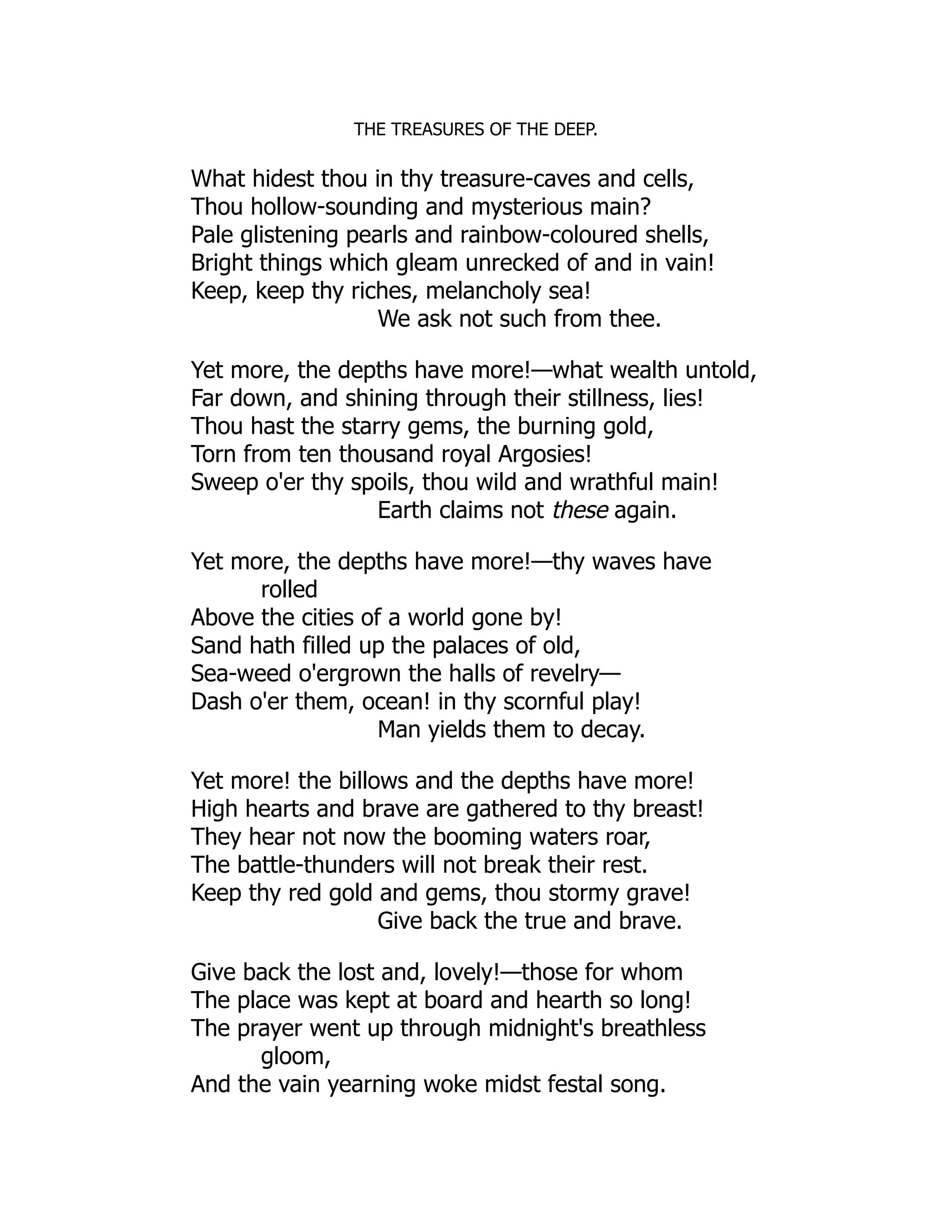
THE TREASURES OFTHE DEEP.
What hidest thou in thy treasure-caves and cells,
Thou hollow-sounding and mysterious main?
Pale glistening pearls and rainbow-coloured shells,
Bright things which gleam unrecked of and in vain!
Keep, keep thy riches, melancholy sea!
We ask not such from thee.
Yet more, the depths have more!—what wealth untold,
Far down, and shining through their stillness, lies!
Thou hast the starry gems, the burning gold,
Torn from ten thousand royal Argosies!
Sweep o'er thy spoils, thou wild and wrathful main!
Earth claims not these again.
Yet more, the depths have more!—thy waves have
rolled
Above the cities of a world gone by!
Sand hath filled up the palaces of old,
Sea-weed o'ergrown the halls of revelry—
Dash o'er them, ocean! in thy scornful play!
Man yields them to decay.
Yet more! the billows and the depths have more!
High hearts and brave are gathered to thy breast!
They hear not now the booming waters roar,
The battle-thunders will not break their rest.
Keep thy red gold and gems, thou stormy grave!
Give back the true and brave.
Give back the lost and, lovely!—those for whom
The place was kept at board and hearth so long!
The prayer went up through midnight's breathless
gloom,
And the vain yearning woke midst festal song.
47.
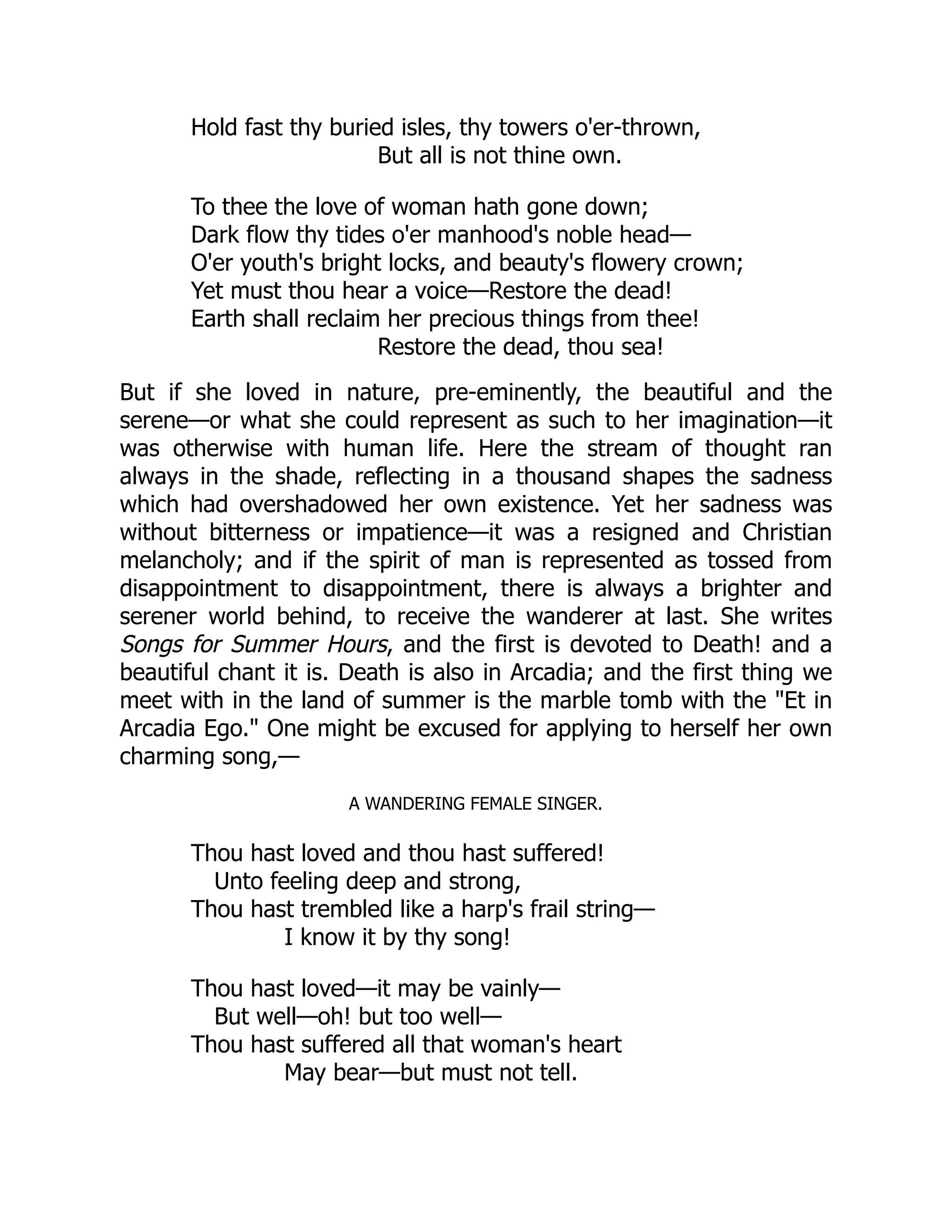
Hold fast thyburied isles, thy towers o'er-thrown,
But all is not thine own.
To thee the love of woman hath gone down;
Dark flow thy tides o'er manhood's noble head—
O'er youth's bright locks, and beauty's flowery crown;
Yet must thou hear a voice—Restore the dead!
Earth shall reclaim her precious things from thee!
Restore the dead, thou sea!
But if she loved in nature, pre-eminently, the beautiful and the
serene—or what she could represent as such to her imagination—it
was otherwise with human life. Here the stream of thought ran
always in the shade, reflecting in a thousand shapes the sadness
which had overshadowed her own existence. Yet her sadness was
without bitterness or impatience—it was a resigned and Christian
melancholy; and if the spirit of man is represented as tossed from
disappointment to disappointment, there is always a brighter and
serener world behind, to receive the wanderer at last. She writes
Songs for Summer Hours, and the first is devoted to Death! and a
beautiful chant it is. Death is also in Arcadia; and the first thing we
meet with in the land of summer is the marble tomb with the "Et in
Arcadia Ego." One might be excused for applying to herself her own
charming song,—
A WANDERING FEMALE SINGER.
Thou hast loved and thou hast suffered!
Unto feeling deep and strong,
Thou hast trembled like a harp's frail string—
I know it by thy song!
Thou hast loved—it may be vainly—
But well—oh! but too well—
Thou hast suffered all that woman's heart
May bear—but must not tell.
48.
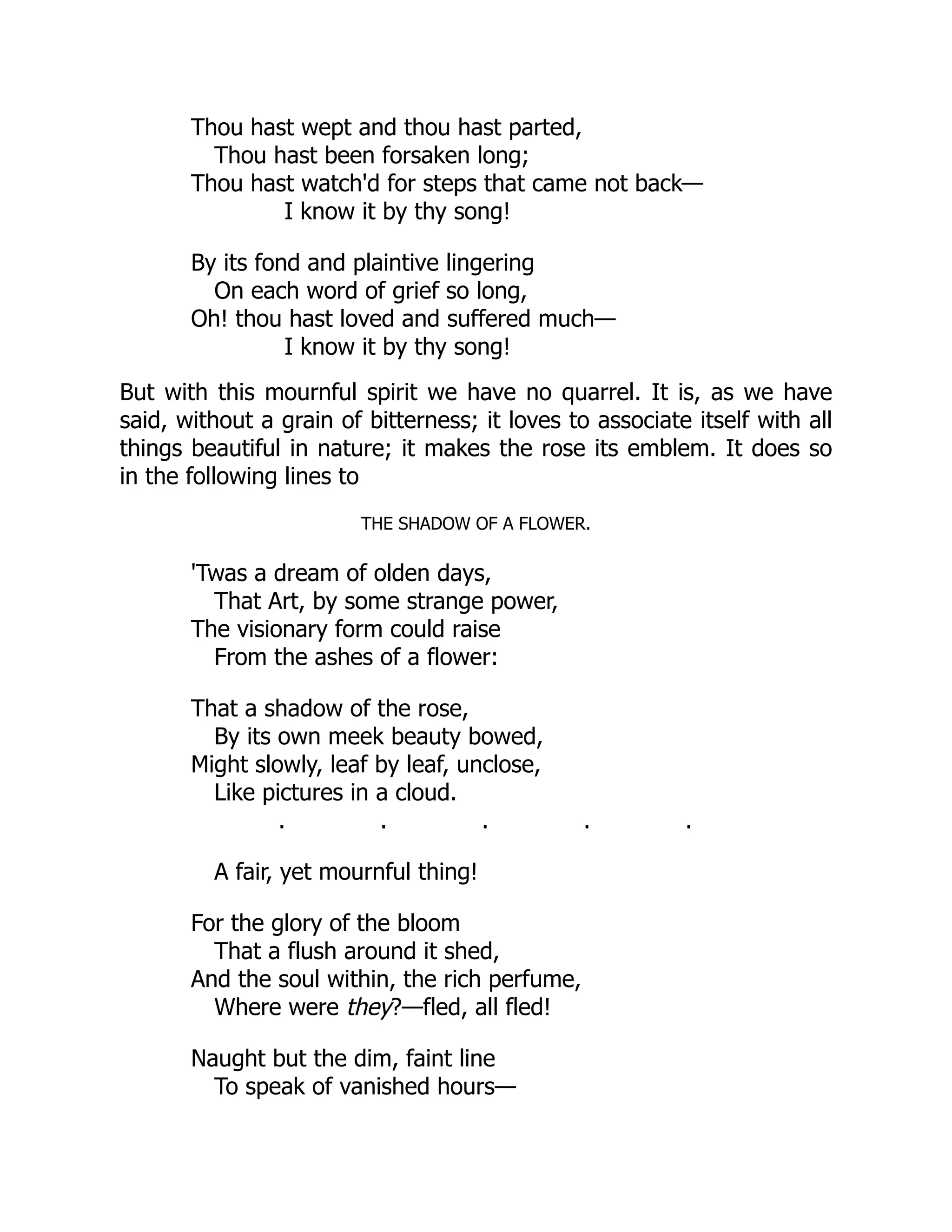
Thou hast weptand thou hast parted,
Thou hast been forsaken long;
Thou hast watch'd for steps that came not back—
I know it by thy song!
By its fond and plaintive lingering
On each word of grief so long,
Oh! thou hast loved and suffered much—
I know it by thy song!
But with this mournful spirit we have no quarrel. It is, as we have
said, without a grain of bitterness; it loves to associate itself with all
things beautiful in nature; it makes the rose its emblem. It does so
in the following lines to
THE SHADOW OF A FLOWER.
'Twas a dream of olden days,
That Art, by some strange power,
The visionary form could raise
From the ashes of a flower:
That a shadow of the rose,
By its own meek beauty bowed,
Might slowly, leaf by leaf, unclose,
Like pictures in a cloud.
. . . . .
A fair, yet mournful thing!
For the glory of the bloom
That a flush around it shed,
And the soul within, the rich perfume,
Where were they?—fled, all fled!
Naught but the dim, faint line
To speak of vanished hours—
49.
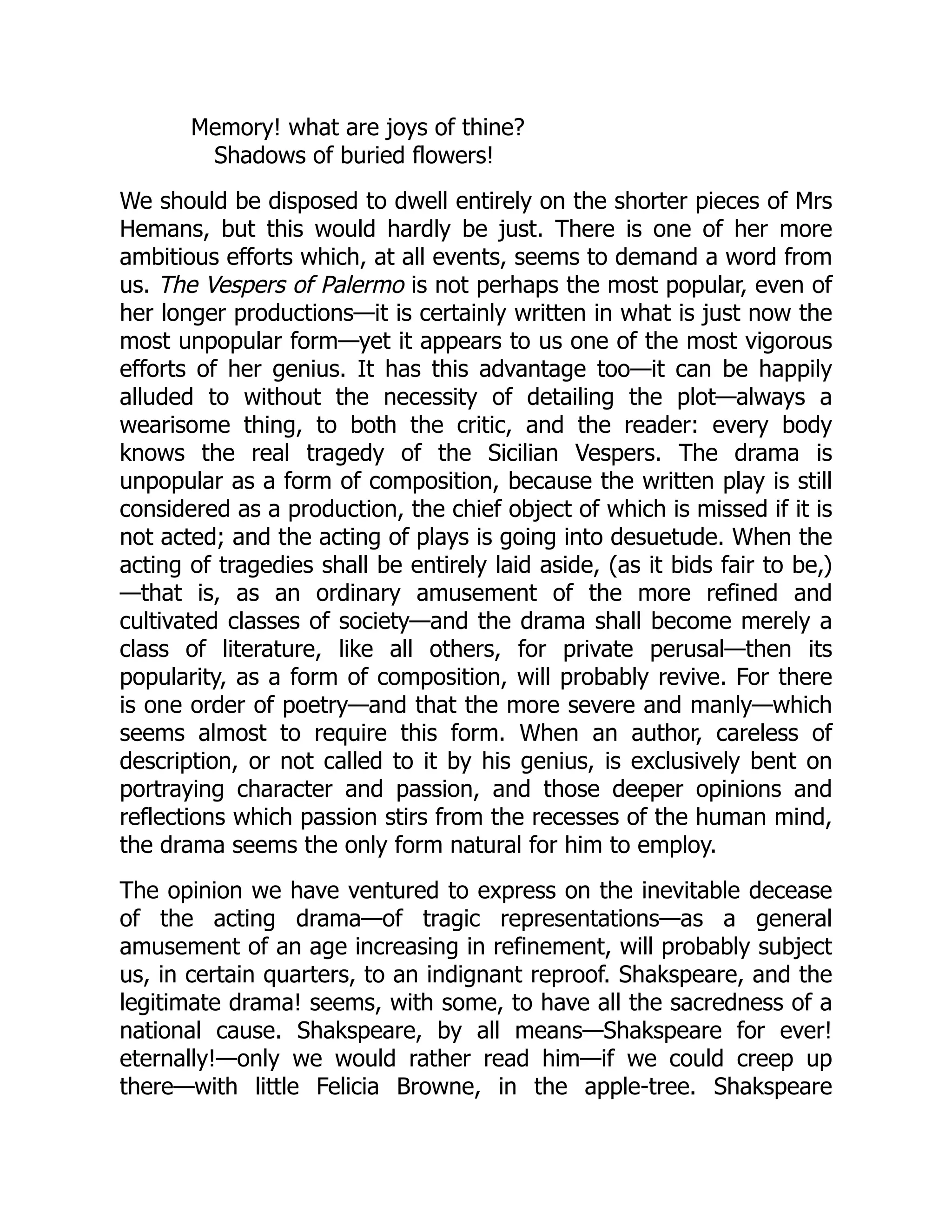
Memory! what arejoys of thine?
Shadows of buried flowers!
We should be disposed to dwell entirely on the shorter pieces of Mrs
Hemans, but this would hardly be just. There is one of her more
ambitious efforts which, at all events, seems to demand a word from
us. The Vespers of Palermo is not perhaps the most popular, even of
her longer productions—it is certainly written in what is just now the
most unpopular form—yet it appears to us one of the most vigorous
efforts of her genius. It has this advantage too—it can be happily
alluded to without the necessity of detailing the plot—always a
wearisome thing, to both the critic, and the reader: every body
knows the real tragedy of the Sicilian Vespers. The drama is
unpopular as a form of composition, because the written play is still
considered as a production, the chief object of which is missed if it is
not acted; and the acting of plays is going into desuetude. When the
acting of tragedies shall be entirely laid aside, (as it bids fair to be,)
—that is, as an ordinary amusement of the more refined and
cultivated classes of society—and the drama shall become merely a
class of literature, like all others, for private perusal—then its
popularity, as a form of composition, will probably revive. For there
is one order of poetry—and that the more severe and manly—which
seems almost to require this form. When an author, careless of
description, or not called to it by his genius, is exclusively bent on
portraying character and passion, and those deeper opinions and
reflections which passion stirs from the recesses of the human mind,
the drama seems the only form natural for him to employ.
The opinion we have ventured to express on the inevitable decease
of the acting drama—of tragic representations—as a general
amusement of an age increasing in refinement, will probably subject
us, in certain quarters, to an indignant reproof. Shakspeare, and the
legitimate drama! seems, with some, to have all the sacredness of a
national cause. Shakspeare, by all means—Shakspeare for ever!
eternally!—only we would rather read him—if we could creep up
there—with little Felicia Browne, in the apple-tree. Shakspeare
50.
supports the stage—sofar as it remains supported—not the stage
Shakspeare. And can he support it long? Consider what sort of
amusement it is which tragic representation affords—for of comedy
we say nothing—consider that it must either thrill us with emotions
of a most violent order, (which the civilised man in general avoids),
or it becomes one of the saddest platitudes in the world. Your
savage can support prolonged ennui, and delights in excitement
approaching to madness; your civilised man can tolerate neither one
nor the other. Now your tragedy deals largely in both. It knows no
medium. Every body has felt that, whether owing to the actor or the
poet, the moment the interest of the piece is no longer at its height,
it becomes intolerable. You are to be either moved beyond all self-
control, which is not very desirable, or you are to sit in lamentable
sufferance. In short, you are to be driven out of your senses, one
way or the other. Depend upon it, it is a species of amusement
which, however associated with great names—though Garrick acted,
and Dr Johnson looked on—is destined, like the bull-fights of Spain,
or the gladiatorial combats of old Rome, to fall before the advancing
spirit of civilisation.
But to Mrs Hemans' Vespers of Palermo. It was not the natural bent
of genius which led her to the selection of the dramatic form; and
when we become thoroughly acquainted with her temperament, and
the feelings she loved to indulge, we are rather surprised that she
performed the task she undertook with so much spirit, and so large
a measure of success, than that she falls short in some parts of her
performance. Nothing can be better conceived, or more admirably
sustained, than the character of Raimond de Procida. The elder
Procida, and the dark revengeful Montalba, are not so successfully
treated. We feel that she has designed these figures with sufficient
propriety, but she has not animated them; she could not draw from
within those fierce emotions which were to infuse life into them. The
effort to sympathise, even in imagination, with such characters, was
a violence to her nature. The noble and virtuous heroism of the
younger Procida was, on the contrary, no other than the overflow of
her own genuine feeling. Few modern dramas present more spirit-
51.
stirring scenes, thanthose in which Raimond takes the leading part.
Two of those we would particularly mention—one when, on joining
the patriot-conspirators, and learning the mode in which they
intended to free their country, he refuses, even for so great an
object, to stain his soul with assassination and murder; and the
other, where, towards the close of the piece, he is imprisoned by the
more successful conspirators—is condemned to die for imputed
treachery to their cause, and hears that the battle for his country, for
which his spirit had so longed, is going forward. We cannot refrain
from making a quotation from both these parts of the drama. We
shall take the liberty of omitting some lines, in order to compress our
extracts.
The conspirators have met, and proclaimed their intended scheme—
Sicilians. Be it so!
If one amongst us stay the avenging steel
For love or pity, be his doom as theirs!
Pledge we our faith to this.
Raim. (rushing forward indignantly.) Our faith to this!
No! I but dreamt I heard it: Can it be?
My countrymen, my father!—Is it thus
That freedom should be won?—Awake!—awake
To loftier thoughts!—Lift up, exultingly,
On the crowned heights, and to the sweeping winds,
Your glorious banner!—Let your trumpet's blast
Make the tombs thrill with echoes! Call aloud,
Proclaim from all your hills, the land shall bear
The stranger's yoke no longer!—What is he
Who carries on his practised lip a smile,
Beneath his vest a dagger, which but waits
Till the heart bounds with joy, to still its beatings?
That which our nature's instinct doth recoil from,
And our blood curdle at—ay, yours and mine—
A murderer! Heard ye?—Shall that name with ours
52.
Welcome to ourwebsite – the perfect destination for book lovers and
knowledge seekers. We believe that every book holds a new world,
offering opportunities for learning, discovery, and personal growth.
That’s why we are dedicated to bringing you a diverse collection of
books, ranging from classic literature and specialized publications to
self-development guides and children's books.
More than just a book-buying platform, we strive to be a bridge
connecting you with timeless cultural and intellectual values. With an
elegant, user-friendly interface and a smart search system, you can
quickly find the books that best suit your interests. Additionally,
our special promotions and home delivery services help you save time
and fully enjoy the joy of reading.
Join us on a journey of knowledge exploration, passion nurturing, and
personal growth every day!
testbankfan.com








![This ebook is for the use of anyone anywhere in the United
States and most other parts of the world at no cost and with
almost no restrictions whatsoever. You may copy it, give it away
or re-use it under the terms of the Project Gutenberg License
included with this ebook or online at www.gutenberg.org. If you
are not located in the United States, you will have to check the
laws of the country where you are located before using this
eBook.
Title: Blackwood's Edinburgh Magazine, Volume 64, No. 398,
December 1848
Author: Various
Release date: July 1, 2012 [eBook #40026]
Most recently updated: October 23, 2024
Language: English
Credits: Produced by Brendan OConnor, Jonathan Ingram and
the Online
Distributed Proofreading Team at http://www.pgdp.net
(This
file was produced from images generously made
available
by The Internet Library of Early Journals.)
*** START OF THE PROJECT GUTENBERG EBOOK BLACKWOOD'S
EDINBURGH MAGAZINE, VOLUME 64, NO. 398, DECEMBER 1848
***](https://image.slidesharecdn.com/9331-250326140004-db696880/75/Information-Technology-Project-Management-Revised-6th-Edition-Schwalbe-Test-Bank-30-2048.jpg)



![nidhi_economics[1].ppt](https://cdn.slidesharecdn.com/ss_thumbnails/nidhieconomics1-231230122929-54b4475f-thumbnail.jpg?width=640&height=640&fit=bounds)


