Public Key Cryptography
Prime Numbers
Euclid’s algorithm
Modular Arithmetic & Discrete Logarithms
Diffie-Hellman Key Exchange Algorithm
RSA algorithm
Symmetric vs Asymmetric
Digital Envelopes
Digital Signatures
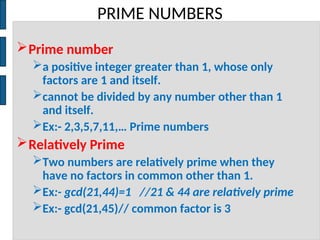
PRIME NUMBERS
Prime number
a positive integer greater than 1, whose only
factors are 1 and itself.
cannot be divided by any number other than 1
and itself.
Ex:- 2,3,5,7,11,… Prime numbers
Relatively Prime
Two numbers are relatively prime when they
have no factors in common other than 1.
Ex:- gcd(21,44)=1 //21 & 44 are relatively prime
Ex:- gcd(21,45)// common factor is 3
Euclid’s Algorithm
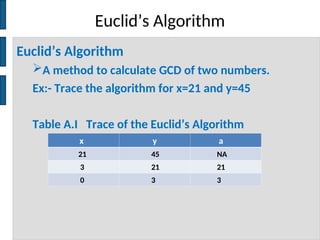
Euclid’s Algorithm
A method to calculate GCD of two numbers.
Ex:- Trace the algorithm for x=21 and y=45
Table A.I Trace of the Euclid’s Algorithm
x y a
21 45 NA
3 21 21
0 3 3
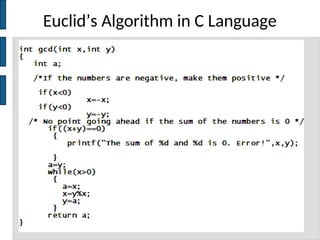
Euclid’s Algorithm in C Language
Modular Arithmetic
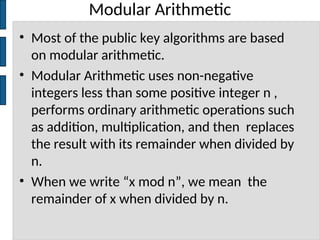
• Most of the public key algorithms are based
on modular arithmetic.
• Modular Arithmetic uses non-negative
integers less than some positive integer n ,
performs ordinary arithmetic operations such
as addition, multiplication, and then replaces
the result with its remainder when divided by
n.
• When we write “x mod n”, we mean the
remainder of x when divided by n.
Modular Arithmetic
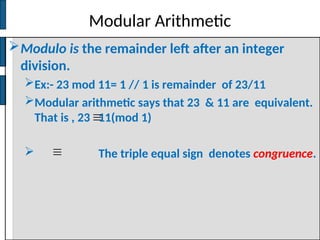
Modulo is the remainder left after an integer
division.
Ex:- 23 mod 11= 1 // 1 is remainder of 23/11
Modular arithmetic says that 23 & 11 are equivalent.
That is , 23 11(mod 1)
 The triple equal sign denotes congruence.
Modular Arithmetic
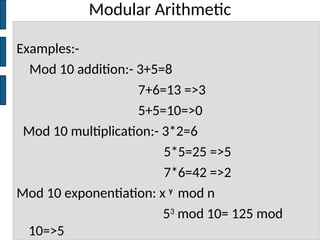
Examples:-
Mod 10 addition:- 3+5=8
7+6=13 =>3
5+5=10=>0
Mod 10 multiplication:- 3*2=6
5*5=25 =>5
7*6=42 =>2
Mod 10 exponentiation: x y
mod n
53
mod 10= 125 mod
10=>5
Diffie-Hellman Key
Exchange/Agreement Algorithm
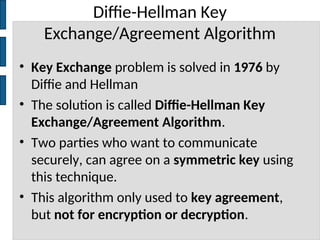
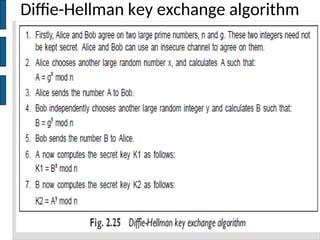
• Key Exchange problem is solved in 1976 by
Diffie and Hellman
• The solution is called Diffie-Hellman Key
Exchange/Agreement Algorithm.
• Two parties who want to communicate
securely, can agree on a symmetric key using
this technique.
• This algorithm only used to key agreement,
but not for encryption or decryption.
Diffie-Hellman key exchange algorithm
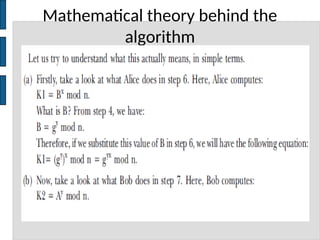
Mathematical theory behind the
algorithm
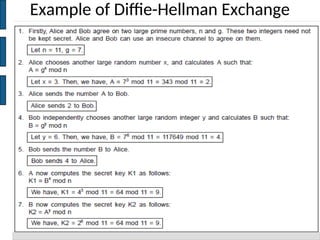
Example of Diffie-Hellman Exchange
Problems with the algorithm
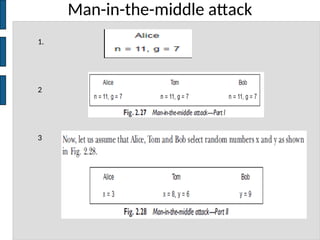
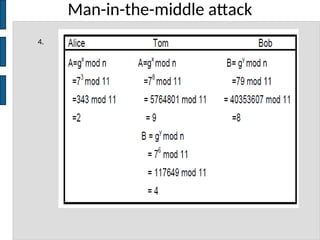
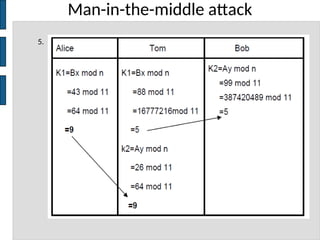
• Diffie-Hellman key exchange algorithm
– Can fall pray to the
– man-in-the-middle attack (or)
woman-in-the-middle-attack, (or)
bucket brigade attack.
Man-in-the-middle attack
1.
2
3
Man-in-the-middle attack
4.
Man-in-the-middle attack
5.

Information security lesson two ppt extra

  • 1.
    Public Key Cryptography PrimeNumbers Euclid’s algorithm Modular Arithmetic & Discrete Logarithms Diffie-Hellman Key Exchange Algorithm RSA algorithm Symmetric vs Asymmetric Digital Envelopes Digital Signatures
  • 2.
    PRIME NUMBERS Prime number apositive integer greater than 1, whose only factors are 1 and itself. cannot be divided by any number other than 1 and itself. Ex:- 2,3,5,7,11,… Prime numbers Relatively Prime Two numbers are relatively prime when they have no factors in common other than 1. Ex:- gcd(21,44)=1 //21 & 44 are relatively prime Ex:- gcd(21,45)// common factor is 3
  • 3.
    Euclid’s Algorithm Euclid’s Algorithm Amethod to calculate GCD of two numbers. Ex:- Trace the algorithm for x=21 and y=45 Table A.I Trace of the Euclid’s Algorithm x y a 21 45 NA 3 21 21 0 3 3
  • 4.
  • 5.
    Modular Arithmetic • Mostof the public key algorithms are based on modular arithmetic. • Modular Arithmetic uses non-negative integers less than some positive integer n , performs ordinary arithmetic operations such as addition, multiplication, and then replaces the result with its remainder when divided by n. • When we write “x mod n”, we mean the remainder of x when divided by n.
  • 6.
    Modular Arithmetic Modulo isthe remainder left after an integer division. Ex:- 23 mod 11= 1 // 1 is remainder of 23/11 Modular arithmetic says that 23 & 11 are equivalent. That is , 23 11(mod 1)  The triple equal sign denotes congruence.
  • 7.
    Modular Arithmetic Examples:- Mod 10addition:- 3+5=8 7+6=13 =>3 5+5=10=>0 Mod 10 multiplication:- 3*2=6 5*5=25 =>5 7*6=42 =>2 Mod 10 exponentiation: x y mod n 53 mod 10= 125 mod 10=>5
  • 8.
    Diffie-Hellman Key Exchange/Agreement Algorithm •Key Exchange problem is solved in 1976 by Diffie and Hellman • The solution is called Diffie-Hellman Key Exchange/Agreement Algorithm. • Two parties who want to communicate securely, can agree on a symmetric key using this technique. • This algorithm only used to key agreement, but not for encryption or decryption.
  • 9.
  • 10.
  • 11.
  • 12.
    Problems with thealgorithm • Diffie-Hellman key exchange algorithm – Can fall pray to the – man-in-the-middle attack (or) woman-in-the-middle-attack, (or) bucket brigade attack.
  • 13.
  • 14.
  • 15.