IPE - techniques and best
practices for your audit
and compliance programs
Working on Internal
Controls, Audit &
Compliance
since 2003.
Lewis@seecuring.com
Seecuring supports organizations through
evaluating and assisting in audit, security and
controls.
Segregation of Duties, Sensitive Access and
Patch Impact Analysis.
Provided as a service from training through to
controls evaluation.
Tailored training for: IPE, Change Management,
Management Responsibilities, Standards and
Policies.
• IPE Overview
• Establishing what is in scope for Financial
Reporting.
• Building a framework for baselining and managing
the IPE process.
• Maintaining the baseline, and evaluating changes
to sources.
• Creating a culture that embeds IPE into Business
Functions.
IPE Overview
Many SOX controls operate around the
review or use of data in most if not all
companies.
Due to guidance released by the Public
Company Accounting Oversight Board
(PCAOB), Sarbanes Oxley (SOX) requires
the validation of the completeness and
accuracy of IPE when using the IPE to
perform controls.
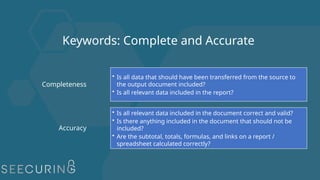
Completeness
• Is all data that should have been transferred from the source to
the output document included?
• Is all relevant data included in the report?
Accuracy
• Is all relevant data included in the document correct and valid?
• Is there anything included in the document that should not be
included?
• Are the subtotal, totals, formulas, and links on a report /
spreadsheet calculated correctly?
Keywords: Complete and Accurate
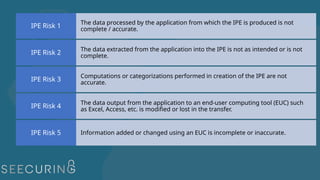
The data processed by the application from which the IPE is produced is not
complete / accurate.
IPE Risk 1
The data extracted from the application into the IPE is not as intended or is not
complete.
IPE Risk 2
Computations or categorizations performed in creation of the IPE are not
accurate.
IPE Risk 3
The data output from the application to an end-user computing tool (EUC) such
as Excel, Access, etc. is modified or lost in the transfer.
IPE Risk 4
Information added or changed using an EUC is incomplete or inaccurate.
IPE Risk 5
Different types of IPE
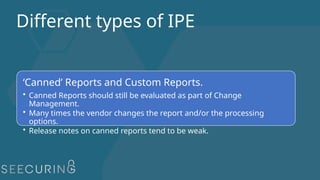
‘Canned’ Reports and Custom Reports.
• Canned Reports should still be evaluated as part of Change
Management.
• Many times the vendor changes the report and/or the processing
options.
• Release notes on canned reports tend to be weak.
Different types of IPE
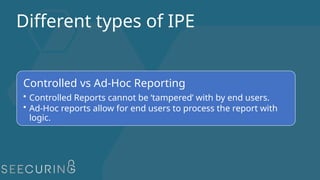
Controlled vs Ad-Hoc Reporting
• Controlled Reports cannot be ‘tampered’ with by end users.
• Ad-Hoc reports allow for end users to process the report with
logic.
Different types of IPE
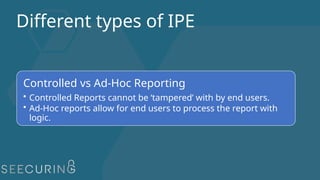
Controlled vs Ad-Hoc Reporting
• Controlled Reports cannot be ‘tampered’ with by end users.
• Ad-Hoc reports allow for end users to process the report with
logic.
Different types of IPE
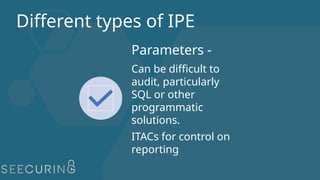
Parameters -
Can be difficult to
audit, particularly
SQL or other
programmatic
solutions.
ITACs for control on
reporting
Different types of IPE
Generation
Any report
should be in a
format that is
not modifiable
or at least can
be audited to
avoid
corruption
IPE Overview
Establishing what is in
scope for Financial
Reporting.
Simple: Anything that provides
for, or supports Financial
Reporting
The challenge:
More and more departments are
implementing applications that don’t
require IT’s involvement.
The challenge:
Shadow IT – 6 in 10 workers admit to
using unsanctioned applications and
services to share data.
The challenge:
Three-quarters of IT leaders say
security is their top concern regarding
SaaS sprawl. Compliance (58%), costs
(57%) and shadow IT (57%) follow as
the main areas of concern, the survey
The challenge:
https://www.ciodive.com/news/app-
sprawl-saas-data-shadow-it-
productiv/606872/
Could IPE have helped
prevent the Enron
scandal?
Enron’s leadership fooled regulators with fake
holdings and off-the-books accounting practices.
Enron used special purpose vehicles (SPVs), or
Could IPE have helped
prevent the Enron
scandal?
SELECT account_ID, account_number, amount FROM
accounts;
“Everyone Has a Plan
Until They Get Punched
in the Mouth.”
Mike Tyson
Mike Tyson didn’t meet a
good baseline.
A good baseline should consider:
Why?
ITGCs and ITACs applicable?
Is the reporting method canned or
custom?
Is it Ad-hoc or Controlled?
Risk ranking of report, with justification &
relevant controls.
A good baseline should consider:
The testing and outcomes with
supporting evidence.
Tracking modifications.
Example framework
IPE & Culture
“Behind every great control
is an even greater set of
habits”
IPE should be embedded into corporate
culture.
• Employees aware of new applications
and services that may be in-scope.
• Responsibilities on Departments.
• Regular/periodic reviews of IPE
processes.
• IPE mapped out for anyone to
Forward thinking – what works for
you?
Reward or Punish? If bonuses are
awarded on good corporate
performance, could IPE be tied to it?
Punish if IPE is not followed?
Need help?
Training to support your IPE and other
processes, tailored to your
organization.
Video and Documentation provided.
Fostering great culture for supporting
IPE.
Q&A
Contact
lewis@seecuring.com

Information Provided by Entity Overview.pptx

  • 1.
    IPE - techniquesand best practices for your audit and compliance programs
  • 2.
    Working on Internal Controls,Audit & Compliance since 2003. Lewis@seecuring.com
  • 3.
    Seecuring supports organizationsthrough evaluating and assisting in audit, security and controls. Segregation of Duties, Sensitive Access and Patch Impact Analysis. Provided as a service from training through to controls evaluation. Tailored training for: IPE, Change Management, Management Responsibilities, Standards and Policies.
  • 4.
    • IPE Overview •Establishing what is in scope for Financial Reporting. • Building a framework for baselining and managing the IPE process. • Maintaining the baseline, and evaluating changes to sources. • Creating a culture that embeds IPE into Business Functions.
  • 5.
  • 6.
    Many SOX controlsoperate around the review or use of data in most if not all companies. Due to guidance released by the Public Company Accounting Oversight Board (PCAOB), Sarbanes Oxley (SOX) requires the validation of the completeness and accuracy of IPE when using the IPE to perform controls.
  • 7.
    Completeness • Is alldata that should have been transferred from the source to the output document included? • Is all relevant data included in the report? Accuracy • Is all relevant data included in the document correct and valid? • Is there anything included in the document that should not be included? • Are the subtotal, totals, formulas, and links on a report / spreadsheet calculated correctly? Keywords: Complete and Accurate
  • 8.
    The data processedby the application from which the IPE is produced is not complete / accurate. IPE Risk 1 The data extracted from the application into the IPE is not as intended or is not complete. IPE Risk 2 Computations or categorizations performed in creation of the IPE are not accurate. IPE Risk 3 The data output from the application to an end-user computing tool (EUC) such as Excel, Access, etc. is modified or lost in the transfer. IPE Risk 4 Information added or changed using an EUC is incomplete or inaccurate. IPE Risk 5
  • 9.
    Different types ofIPE ‘Canned’ Reports and Custom Reports. • Canned Reports should still be evaluated as part of Change Management. • Many times the vendor changes the report and/or the processing options. • Release notes on canned reports tend to be weak.
  • 10.
    Different types ofIPE Controlled vs Ad-Hoc Reporting • Controlled Reports cannot be ‘tampered’ with by end users. • Ad-Hoc reports allow for end users to process the report with logic.
  • 11.
    Different types ofIPE Controlled vs Ad-Hoc Reporting • Controlled Reports cannot be ‘tampered’ with by end users. • Ad-Hoc reports allow for end users to process the report with logic.
  • 12.
    Different types ofIPE Parameters - Can be difficult to audit, particularly SQL or other programmatic solutions. ITACs for control on reporting
  • 13.
    Different types ofIPE Generation Any report should be in a format that is not modifiable or at least can be audited to avoid corruption
  • 14.
  • 15.
    Establishing what isin scope for Financial Reporting.
  • 16.
    Simple: Anything thatprovides for, or supports Financial Reporting
  • 17.
    The challenge: More andmore departments are implementing applications that don’t require IT’s involvement.
  • 18.
    The challenge: Shadow IT– 6 in 10 workers admit to using unsanctioned applications and services to share data.
  • 19.
    The challenge: Three-quarters ofIT leaders say security is their top concern regarding SaaS sprawl. Compliance (58%), costs (57%) and shadow IT (57%) follow as the main areas of concern, the survey
  • 20.
  • 22.
    Could IPE havehelped prevent the Enron scandal? Enron’s leadership fooled regulators with fake holdings and off-the-books accounting practices. Enron used special purpose vehicles (SPVs), or
  • 23.
    Could IPE havehelped prevent the Enron scandal? SELECT account_ID, account_number, amount FROM accounts;
  • 24.
    “Everyone Has aPlan Until They Get Punched in the Mouth.” Mike Tyson
  • 25.
    Mike Tyson didn’tmeet a good baseline.
  • 26.
    A good baselineshould consider: Why? ITGCs and ITACs applicable? Is the reporting method canned or custom? Is it Ad-hoc or Controlled? Risk ranking of report, with justification & relevant controls.
  • 27.
    A good baselineshould consider: The testing and outcomes with supporting evidence. Tracking modifications.
  • 28.
  • 29.
  • 30.
    “Behind every greatcontrol is an even greater set of habits”
  • 31.
    IPE should beembedded into corporate culture. • Employees aware of new applications and services that may be in-scope. • Responsibilities on Departments. • Regular/periodic reviews of IPE processes. • IPE mapped out for anyone to
  • 32.
    Forward thinking –what works for you? Reward or Punish? If bonuses are awarded on good corporate performance, could IPE be tied to it? Punish if IPE is not followed?
  • 33.
    Need help? Training tosupport your IPE and other processes, tailored to your organization. Video and Documentation provided. Fostering great culture for supporting IPE.
  • 34.
  • 35.