Strategy for Information Management
Barry Williams
Principal Consultant
Database Answers Ltd.
July 10th. 2012
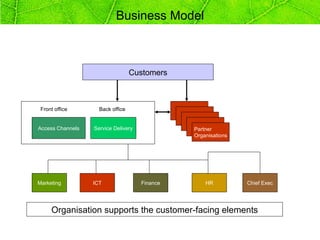
Business Model


                                  Customers


 Front office       Back office


Access Channels   Service Delivery             Partner
                                               Organisations


Marketing         ICT                Finance       HR          Chief Exec


     Organisation supports the customer-facing elements
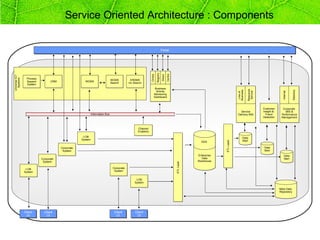
Service Oriented Architecture : Components


                                                                                                                                  Portal


                                                                                                                       Registry


                                                                                                                                           Centre
                                                                                                              Online


                                                                                                                                  Direct
Universal ICT


                  Process
  Systems


                                                                               WCMS           ERDMS
                  Support         CRM                 WCMS
                                                                               Search       inc Search
                  System
                                                                                                                   Business


                                                                                                                                                                                                    Response


                                                                                                                                                                                                                                        Statutory
                                                                                                                                                                                         Business
                                                                                                                    Activity


                                                                                                                                                                                                     Service


                                                                                                                                                                                                                             Internal
                                                                                                                                                                                          Line of
                                                                                                                  Monitoring
                                                                                                                  Dashboard


                                                                                                                                                                                                               Customer      Corporate
                                                                                                                                                                                           Service             Insight &       MIS &
                                                             Information Bus                                                                                                             Delivery MIS            Fraud      Performance
                                                                                                                                                                                                               Detection    Management


                                                                                                   Channel
                                                                                                   Enablers
                                                     LOB                                                                                                                                       Data
                                                    System                                                                                                                                     Mart


                                                                                                                                                                             ETL Layer
                                                                                                                                                                  ODS
                                                                                                                                                                Enterprise
                                                                                                                                                                  Data                                          Data
                                        Corporate
                                                                                                                                                                Warehouse                                       Mart
                                         System
                                                                                                                                                                Enterprise                                                     Data
                            Corporate                                                                                                                             Data                                                         Mart
                             System                                                                                                                             Warehouse


                                                                                                                                                    ETL Layer
                 LOB                                                            Corporate
                System                                                           System


                                                                                                 LOB
                                                                                                System

                                                                                                                                                                                                                           Meta Data
                                                                                                                                                                                                                           Repository


                Client        Client                                             Client          Client
                 UI            UI                                                 UI              UI
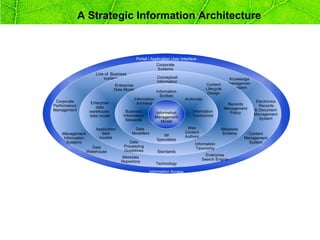
A Strategic Information Architecture


                                             Portal / Application User Interface
                                                         Corporate
                                                         Systems
                       Line of Business
                           systems                       Conceptual                                Knowledge
                                                         Information                               managemen
                                 Enterprise                 Model                     Content
                                 Data Model                                           Lifecycle     t system
                                                        Information                    Design
                                                           Scribes
                                            Information Information      Archivists
 Corporate          Enterprise               Architect     Access                                               Electronics
Performance                                                                                        Records       Records
                       data                                                                       Management
Management          warehouse          Business                              Information                       & Document
                                                       Information                                  Policy     Management
                    data model        Information      Management            Taxonomist
                                       Stewards                                                                   System
                                                          Model
                       Application         Data                           Web                 Metadata
    Management           data             Modellers                      Content              Schema        Content
                                                           IM            Authors
     Information        models                          Specialists                                       Management
       Systems                           Data                                  Information                  System
                     Data             Processing                                Taxonomy
                   Warehouse          Guidelines         Standards
                                                                                     Enterprise
                                     Metadata
                                                                                   Search Engine
                                     Repository
                                                        Technology

                                                    Information Access
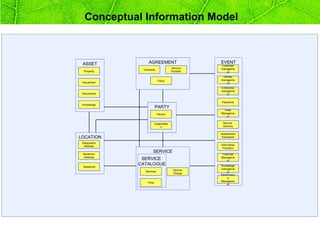
Conceptual Information Model


 ASSET             AGREEMENT                        EVENT
                                                    Customer
                                        Service     manageme
               Contracts
  Property                              Portfolio      nt
                                                     Partner
                            Policy                  manageme
 Equipment                                             nt
                                                    Enterprise
                                                    manageme
 Documents                                              nt

                                                    Payments
 Knowledge
                          PARTY
                                                      Case
                            Person                  Manageme
                                                       nt

                          Organisatio                Service
                              n                      Delivery

                                                    Assessment
LOCATION                                             framework

 Geographic
  Address                                           Information
                                                     Provision

 Electronic
                      SERVICE
                                                     Financial
  Address                                           Manageme
               SERVICE                                  nt
              CATALOGUE                             Knowledge
 Telephone
                                         Service    manageme
                Services                                 nt
                                         Charge
                                                    Performanc
                                                         e
                                                    Manageme
                  Price
                                                         nt
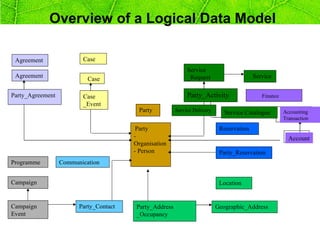
Overview of a Logical Data Model

 Agreement               Case
                                                             Service
 Agreement                                                   _Request                     Service
                           Case

Party_Agreement          Case                                Party_Activity                  Finance
                         _Event
                                         Party          Service Delivery      Service Catalogue        Finance
                                                                                                         Accounting
                                                                                                         Transaction
                                         Party                              Reservation
                                        -                                                                 Account
                                                                                                          Account
                                        Organisation
                                        - Person                            Party_Reservation
Programme         Communication


Campaign                                                                    Location


Campaign                Party_Contact   Party_Address                      Geographic_Address
Event                                   _Occupancy
Information Management Group


The central team comprises:

1 Data Security and Policy Manager
1 Records Manager
1 Data Architect
1 Head of GIS
2 Geographers
1 LLPG Custodian
1 Compliance Administrator (FOI)
3 Business Information Analysts
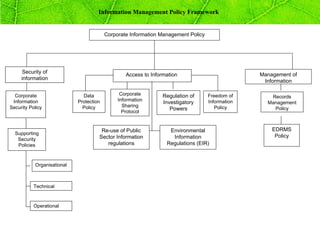
Information Management Policy Framework


                                         Corporate Information Management Policy


     Security of
                                                 Access to Information                           Management of
     information                                                                                  Information

  Corporate                   Data             Corporate        Regulation of      Freedom of       Records
 Information                Protection        Information                          Information
                                                                Investigatory                      Management
Security Policy               Policy            Sharing                               Policy
                                                                   Powers                            Policy
                                                Protocol


                                      Re-use of Public            Environmental                      EDRMS
  Supporting
                                     Sector Information            Information                        Policy
   Security
   Policies                             regulations              Regulations (EIR)


           Organisational


           Technical


           Operational
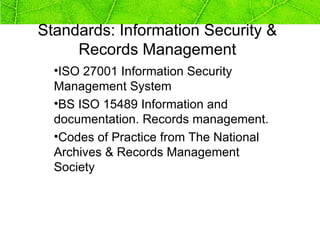
Standards: Information Security &
     Records Management
  •ISO 27001 Information Security
  Management System
  •BS ISO 15489 Information and
  documentation. Records management.
  •Codes of Practice from The National
  Archives & Records Management
  Society
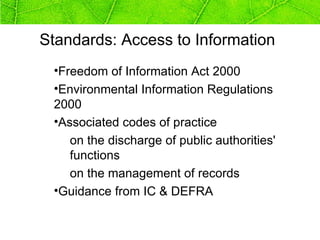
Standards: Access to Information
 •Freedom of Information Act 2000
 •Environmental Information Regulations
 2000
 •Associated codes of practice
    on the discharge of public authorities'
    functions
    on the management of records
 •Guidance from IC & DEFRA
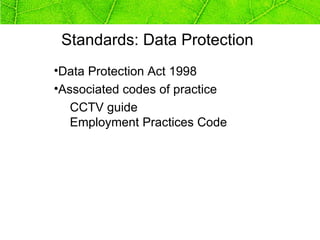
Standards: Data Protection
•Data Protection Act 1998
•Associated codes of practice
  CCTV guide
  Employment Practices Code
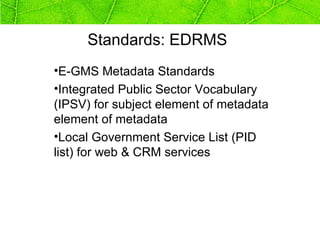
Standards: EDRMS
•E-GMS Metadata Standards
•Integrated Public Sector Vocabulary
(IPSV) for subject element of metadata
element of metadata
•Local Government Service List (PID
list) for web & CRM services
Government Drivers
•Transformational Government IEG
•Performance Targets: CPA
•Shared services
   –ESCR
   –Local Information sharing protocols
CRM/ EDRMS/CMS development
 •Service area business needs
 •Customer focus
 •Expert roles:
   Records Manager
   Business analysts
   Taxonomists
   Data Architect
   IT support
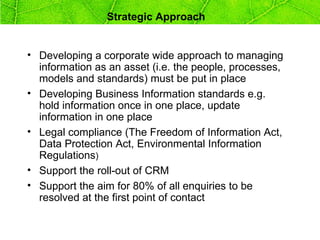
Strategic Approach


• Developing a corporate wide approach to managing
  information as an asset (i.e. the people, processes,
  models and standards) must be put in place
• Developing Business Information standards e.g.
  hold information once in one place, update
  information in one place
• Legal compliance (The Freedom of Information Act,
  Data Protection Act, Environmental Information
  Regulations)
• Support the roll-out of CRM
• Support the aim for 80% of all enquiries to be
  resolved at the first point of contact
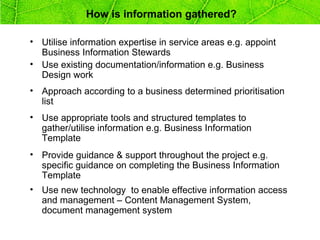
How is information gathered?

• Utilise information expertise in service areas e.g. appoint
  Business Information Stewards
• Use existing documentation/information e.g. Business
  Design work
• Approach according to a business determined prioritisation
  list
• Use appropriate tools and structured templates to
  gather/utilise information e.g. Business Information
  Template
• Provide guidance & support throughout the project e.g.
  specific guidance on completing the Business Information
  Template
• Use new technology to enable effective information access
  and management – Content Management System,
  document management system
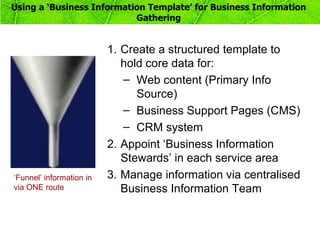
Using a ‘Business Information Template’ for Business Information
                           Gathering


                          1. Create a structured template to
                             hold core data for:
                             – Web content (Primary Info
                                Source)
                             – Business Support Pages (CMS)
                             – CRM system
                          2. Appoint ‘Business Information
                             Stewards’ in each service area
‘Funnel’ information in   3. Manage information via centralised
via ONE route                Business Information Team
Business Information Stewards – the role


• Information Stewardship can be defined as
  “the willingness to take ownership of a
  defined set of business information”

• In order to achieve this, the information
  stewards must have a good comprehension
  of the the day to day business operations

• Understand the information held in the
  service area
BIS Role - Continued


Role/Requirements:
• Must have access to the information sources
  within their service area
• Ensure that the information required is
  provided in a timely fashion delegating to
  information experts where required
• Responsible for collating information on the
  BI template and ensuring information
  gathered is correct and that it can be
  understood by a layman e.g. NO acronyms
  or other terms that require specialist
  knowledge.
What do we do with the information?
The BI Team will consolidate the information supplied to be used/formatted for
   multiple audiences. These include:

•   All business information is placed on organisation’s Web Site

•   Customer Services – The BI Team create Business Support Pages in the
    Content Management System. These pages are used by the Customer
    Services staff to obtain information about the services.

•   Marketing – Ensure forms and published literature is corporately branded

•   BI Team – will consolidate an A-Z literature list (forms, schedules)

•   BI Team – will make recommendations to improve processes, identify and
    agree front-line processes and hand-off points
Conclusions

• A long-term View
• Requires Commitment to the Vision
  – Directors
  – Managers
  – Operational Staff

Information management strategy

  • 1.
    Strategy for InformationManagement Barry Williams Principal Consultant Database Answers Ltd. July 10th. 2012
  • 2.
    Business Model Customers Front office Back office Access Channels Service Delivery Partner Organisations Marketing ICT Finance HR Chief Exec Organisation supports the customer-facing elements
  • 3.
    Service Oriented Architecture: Components Portal Registry Centre Online Direct Universal ICT Process Systems WCMS ERDMS Support CRM WCMS Search inc Search System Business Response Statutory Business Activity Service Internal Line of Monitoring Dashboard Customer Corporate Service Insight & MIS & Information Bus Delivery MIS Fraud Performance Detection Management Channel Enablers LOB Data System Mart ETL Layer ODS Enterprise Data Data Corporate Warehouse Mart System Enterprise Data Corporate Data Mart System Warehouse ETL Layer LOB Corporate System System LOB System Meta Data Repository Client Client Client Client UI UI UI UI
  • 4.
    A Strategic InformationArchitecture Portal / Application User Interface Corporate Systems Line of Business systems Conceptual Knowledge Information managemen Enterprise Model Content Data Model Lifecycle t system Information Design Scribes Information Information Archivists Corporate Enterprise Architect Access Electronics Performance Records Records data Management Management warehouse Business Information & Document Information Policy Management data model Information Management Taxonomist Stewards System Model Application Data Web Metadata Management data Modellers Content Schema Content IM Authors Information models Specialists Management Systems Data Information System Data Processing Taxonomy Warehouse Guidelines Standards Enterprise Metadata Search Engine Repository Technology Information Access
  • 5.
    Conceptual Information Model ASSET AGREEMENT EVENT Customer Service manageme Contracts Property Portfolio nt Partner Policy manageme Equipment nt Enterprise manageme Documents nt Payments Knowledge PARTY Case Person Manageme nt Organisatio Service n Delivery Assessment LOCATION framework Geographic Address Information Provision Electronic SERVICE Financial Address Manageme SERVICE nt CATALOGUE Knowledge Telephone Service manageme Services nt Charge Performanc e Manageme Price nt
  • 6.
    Overview of aLogical Data Model Agreement Case Service Agreement _Request Service Case Party_Agreement Case Party_Activity Finance _Event Party Service Delivery Service Catalogue Finance Accounting Transaction Party Reservation - Account Account Organisation - Person Party_Reservation Programme Communication Campaign Location Campaign Party_Contact Party_Address Geographic_Address Event _Occupancy
  • 7.
    Information Management Group Thecentral team comprises: 1 Data Security and Policy Manager 1 Records Manager 1 Data Architect 1 Head of GIS 2 Geographers 1 LLPG Custodian 1 Compliance Administrator (FOI) 3 Business Information Analysts
  • 8.
    Information Management PolicyFramework Corporate Information Management Policy Security of Access to Information Management of information Information Corporate Data Corporate Regulation of Freedom of Records Information Protection Information Information Investigatory Management Security Policy Policy Sharing Policy Powers Policy Protocol Re-use of Public Environmental EDRMS Supporting Sector Information Information Policy Security Policies regulations Regulations (EIR) Organisational Technical Operational
  • 9.
    Standards: Information Security& Records Management •ISO 27001 Information Security Management System •BS ISO 15489 Information and documentation. Records management. •Codes of Practice from The National Archives & Records Management Society
  • 10.
    Standards: Access toInformation •Freedom of Information Act 2000 •Environmental Information Regulations 2000 •Associated codes of practice on the discharge of public authorities' functions on the management of records •Guidance from IC & DEFRA
  • 11.
    Standards: Data Protection •DataProtection Act 1998 •Associated codes of practice CCTV guide Employment Practices Code
  • 12.
    Standards: EDRMS •E-GMS MetadataStandards •Integrated Public Sector Vocabulary (IPSV) for subject element of metadata element of metadata •Local Government Service List (PID list) for web & CRM services
  • 13.
    Government Drivers •Transformational GovernmentIEG •Performance Targets: CPA •Shared services –ESCR –Local Information sharing protocols
  • 14.
    CRM/ EDRMS/CMS development •Service area business needs •Customer focus •Expert roles: Records Manager Business analysts Taxonomists Data Architect IT support
  • 15.
    Strategic Approach • Developinga corporate wide approach to managing information as an asset (i.e. the people, processes, models and standards) must be put in place • Developing Business Information standards e.g. hold information once in one place, update information in one place • Legal compliance (The Freedom of Information Act, Data Protection Act, Environmental Information Regulations) • Support the roll-out of CRM • Support the aim for 80% of all enquiries to be resolved at the first point of contact
  • 16.
    How is informationgathered? • Utilise information expertise in service areas e.g. appoint Business Information Stewards • Use existing documentation/information e.g. Business Design work • Approach according to a business determined prioritisation list • Use appropriate tools and structured templates to gather/utilise information e.g. Business Information Template • Provide guidance & support throughout the project e.g. specific guidance on completing the Business Information Template • Use new technology to enable effective information access and management – Content Management System, document management system
  • 17.
    Using a ‘BusinessInformation Template’ for Business Information Gathering 1. Create a structured template to hold core data for: – Web content (Primary Info Source) – Business Support Pages (CMS) – CRM system 2. Appoint ‘Business Information Stewards’ in each service area ‘Funnel’ information in 3. Manage information via centralised via ONE route Business Information Team
  • 18.
    Business Information Stewards– the role • Information Stewardship can be defined as “the willingness to take ownership of a defined set of business information” • In order to achieve this, the information stewards must have a good comprehension of the the day to day business operations • Understand the information held in the service area
  • 19.
    BIS Role -Continued Role/Requirements: • Must have access to the information sources within their service area • Ensure that the information required is provided in a timely fashion delegating to information experts where required • Responsible for collating information on the BI template and ensuring information gathered is correct and that it can be understood by a layman e.g. NO acronyms or other terms that require specialist knowledge.
  • 20.
    What do wedo with the information? The BI Team will consolidate the information supplied to be used/formatted for multiple audiences. These include: • All business information is placed on organisation’s Web Site • Customer Services – The BI Team create Business Support Pages in the Content Management System. These pages are used by the Customer Services staff to obtain information about the services. • Marketing – Ensure forms and published literature is corporately branded • BI Team – will consolidate an A-Z literature list (forms, schedules) • BI Team – will make recommendations to improve processes, identify and agree front-line processes and hand-off points
  • 21.
    Conclusions • A long-termView • Requires Commitment to the Vision – Directors – Managers – Operational Staff

Editor's Notes

  • #16 Developing Corporate Wide strategy This cannot be achieved by implementing technology alone, it relies on a cultural change in the organisation to create an “information culture”. Developing Business Information standards e.g. Hold information once in one place Update information in one place ‘ Harmonise’ and rationalise information Apply a common structure to information and supporting systems e.g. PID numbers Ensure document audit trails are maintained Apply ‘rules’ e.g. Freedom of Information, Data Protection, Corporate ‘look and feel’, consistency of layout etc Different audiences able to view content according to their own set of requirements (portal capability) I.e. external vs internal customers Information managed (knowledge extraction) and consolidated via central team Structured templates provided for service areas to complete – Onus on keeping information up-to-date placed with service areas Approval/editing of information managed by Knowledge Team Corporate ‘look and feel’ and publication managed by Web Team As the web becomes an increasingly important touchpoint for customers, enterprises must understand the important role knowledge management can play in web-based interactions. Though telephone calls are still the most popular channel of interaction for customers, accounting for 75% of all interactions, Internet-based interactions (email, web self-service, live web sessions and voice-over-IP) already account for the other 25% and are growing in importance. Most enterprises are likely to end up with multi-channel customer response systems and will have to allow cross-channel escalations. It is ideal for guiding users, via a series of questions, to problem resolution. In fact, it can be used to guide individuals through virtually any set of sequential steps required to perform a specific task.
  • #21 Customer Services - Several generic ‘scripts’ are available on CRM which take the CSA’s through a series of screens to enable them to carry out the three activities as described above. Essentially, this solution extends the currently Live deployment of CRM with its capability to fulfil Quick Queries, Requests for Literature and the emailing of captured details to the back office. The extension comprises the additional configuration of CRM to cover all the council services, as well as the supporting systems such as OpenCMS Knowledge Base. Back office feedback to front office will be via a manual “forced response” (facilitated via email). (Source: Option 2 Integration Toolkit V0.3)