The Information Age,a period marked by the rapid creation,
dissemination, and access to information, has its roots in
Gutenberg's invention of the printing press in the 15th
century. This groundbreaking innovation democratized
knowledge, making books more accessible than ever
before. However, the Information Age, particularly its
modern phase, is characterized by exponentially faster and
cheaper information distribution, fueled by computers and
the internet.
3.
The Information Age( Gutenberg's to social
media)
- Johannes Gutenberg, a German blacksmith and
publisher who introduced “movable typeprinting”
in Europe, established what we called Gutenberg era
which is responsible for shapingthe nature of society
and its underlying institutions.
4.
Gutenberg's Impact:
Gutenberg's printingpress revolutionized the
production and distribution of books. Prior to this,
books were painstakingly copied by hand, making
them expensive and rare. The printing press enabled
mass production, lowering costs and increasing
literacy rates. This marked the beginning of a shift
towards a more informed society.
5.
The Digital Revolution
Theinvention of the computer and the subsequent
development of the internet ushered in a new era of
information access. Computers enabled the storage,
processing, and transmission of information at
unprecedented speeds. The internet connected
people and resources globally, creating a vast network
of information exchange.
6.
Social Media's Role
Socialmedia platforms have further accelerated the
information revolution. They provide instant
communication channels, enabling the rapid spread of
news, ideas, and trends. Social media has
democratized information creation, allowing
individuals to share their perspectives and
experiences with a global audience.
7.
Impact on Society
TheInformation Age has profoundly impacted society
in numerous ways. It has revolutionized
communication, commerce, education, and
healthcare. However, it has also presented challenges
such as information overload, privacy concerns, and
the spread of misinformation.
8.
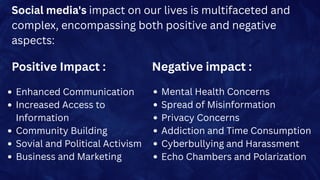
Social media's impacton our lives is multifaceted and
complex, encompassing both positive and negative
aspects:
Negative impact :
Enhanced Communication
Increased Access to
Information
Community Building
Sovial and Political Activism
Business and Marketing
Positive Impact :
Mental Health Concerns
Spread of Misinformation
Privacy Concerns
Addiction and Time Consumption
Cyberbullying and Harassment
Echo Chambers and Polarization
Biodiversity and TheHealthy Society
Biodiversity is the variety of life on Earth, encompassing
everything from genes and individual species to
ecosystems and their functions. A healthy society, on the
other hand, is characterized by well-being, both
individually and collectively, and involves factors like
access to resources, safe environments, and social
cohesion.
11.
Biodiversity is importantfor a healthy society because it's
offers things like clean water and air, food, medicine and
supports economies and ways of making a living around
the worl
Importance
Threats
Loss of biodiversity due to habitat destruction,
pollution, climate change, and overexploitation poses
significant risks to ecosystems and human societies.
12.
- A healthysociety is characterized by individuals and
communities thriving in terms of physical and mental
health, well-being, and social connectedness.
Healthy Society :
Factors contributing to a healthy society:
- Access to safe neighborhoods, affordable housing, job
opportunities, and reduced income inequality.
13.
Importance of biodiversityfor a healthy society:
Biodiversity supports the essential services that
underpin human health, well-being, and economic
stability.
Example :
Healthy ecosystems provide food sources, regulate
diseases, and stabilize the climate, all of which
contribute to human health.
14.
The Interconnection :
-Ahealthy society depends on healthy ecosystems,
and biodiversity is the foundation of these
ecosystems.
Loss of biodiversity can negatively impact
human health and well-being by disrupting
ecosystem services and increasing risks of
diseases.
15.
Protecting and promotingbiodiversity is
crucial for maintaining a healthy society
and ensuring sustainable development.




![Pillars of the Digital Age [v4] #AXASocial](https://cdn.slidesharecdn.com/ss_thumbnails/axadigitalpresentationv4-141209045816-conversion-gate01-thumbnail.jpg?width=640&height=640&fit=bounds)


