www.edureka.co
View Informatica course details at www.edureka.co/informatica
ETL Using Informatica Power Center
For Queries:
Post on Twitter @edurekaIN: #askEdureka
Post on Facebook /edurekaIN
For more details please contact us:
US : 1800 275 9730 (toll free)
INDIA : +91 88808 62004
Email Us : sales@edureka.co
www.edureka.co/informatica
Slide 2 www.edureka.co/informatica
At the end of this session, you will be able to understand:
 The Information Economy
 ETL - an Overview
 Why ETL is still relevant?
 Informatica Overview
 The Informatica Platform
 Why Informatica
 Informatica Partners & Customers
 Informatica Architecture Overview & Components
 Usecase1 - Loading Product Dimension table using Slowly changing dimension (SCD)
 Usecase2 - Populate Sales summary table using Incremental Aggregation
 Job trends
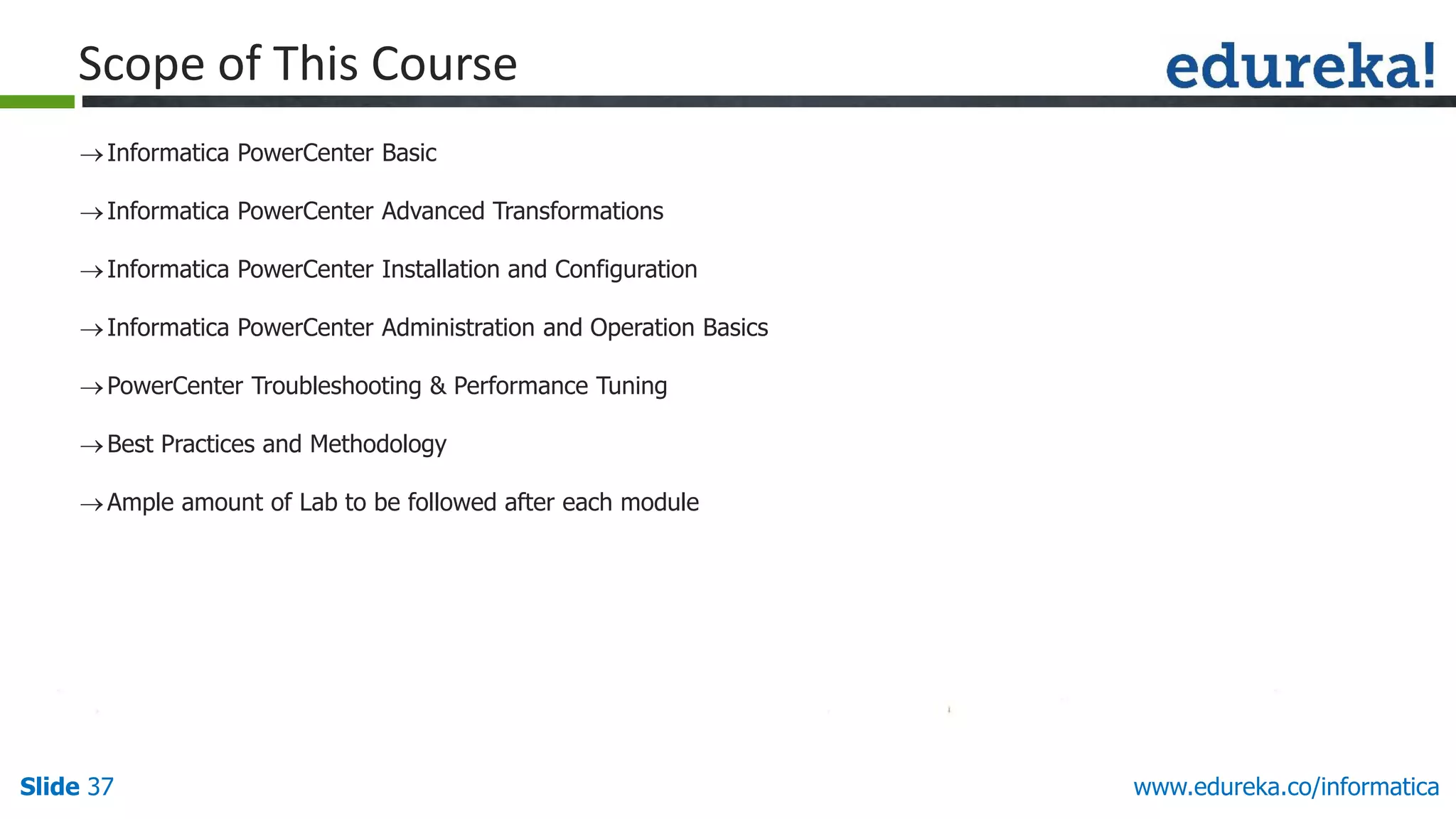
 Scope of this course
Objectives
Slide 3 www.edureka.co/informatica
Mergers
Acquisitions
&
Divestitures
Acquire &
Retain
Customers
Outsource
Non-core
Functions
Improve
Decisions
Modernize
Business
Improve
Efficiency
& Reduce
Costs
Lack of relevant, trustworthy
and timely data
Governance
Risk
Compliance
Increase
Partner
Network
Efficiency
Increase
Business
Agility
ConsolidationGlobalization Growth
Operational
Efficiency
Governance
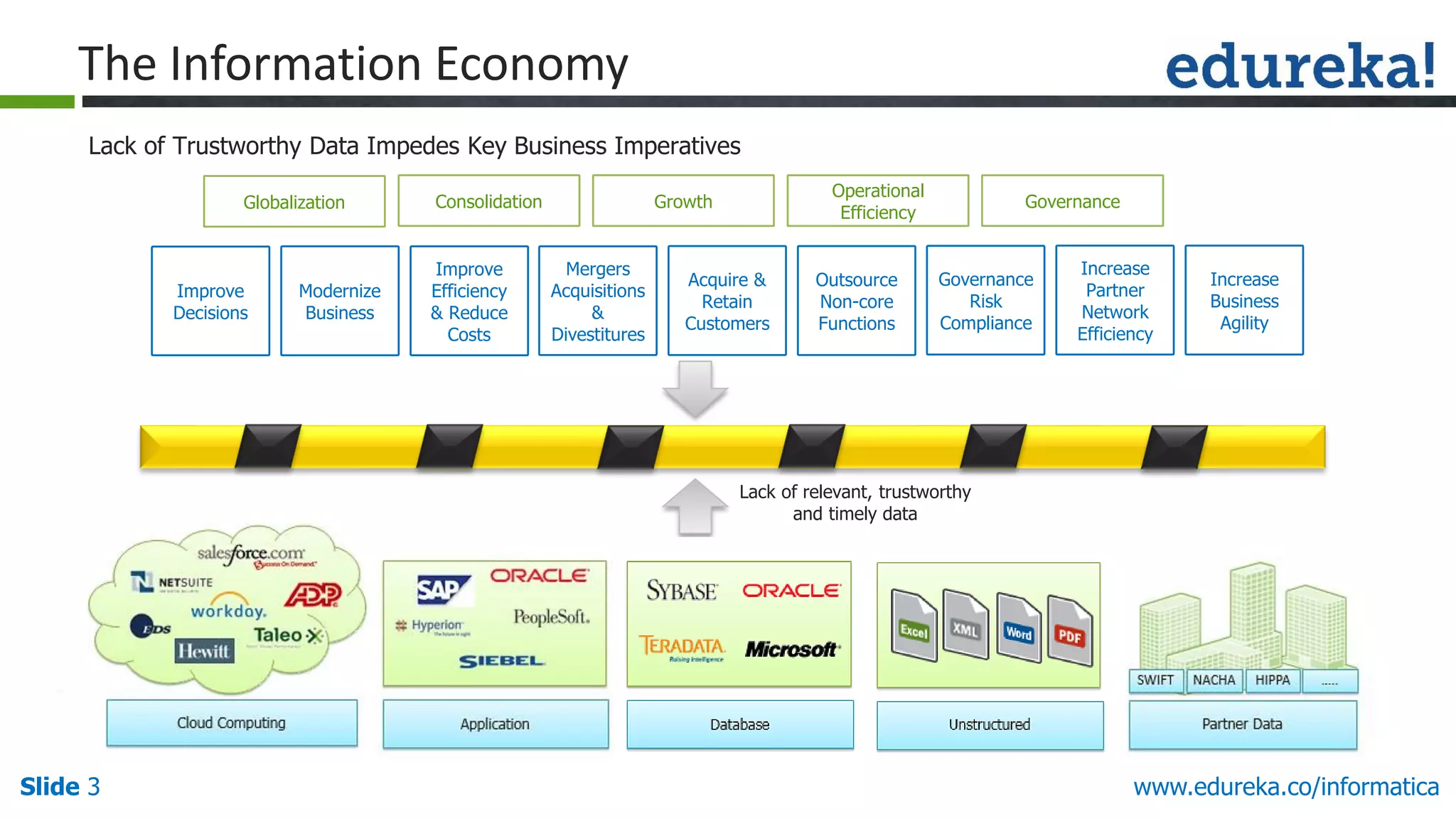
The Information Economy
Lack of Trustworthy Data Impedes Key Business Imperatives
Slide 4 www.edureka.co/informatica
ETL - An Overview
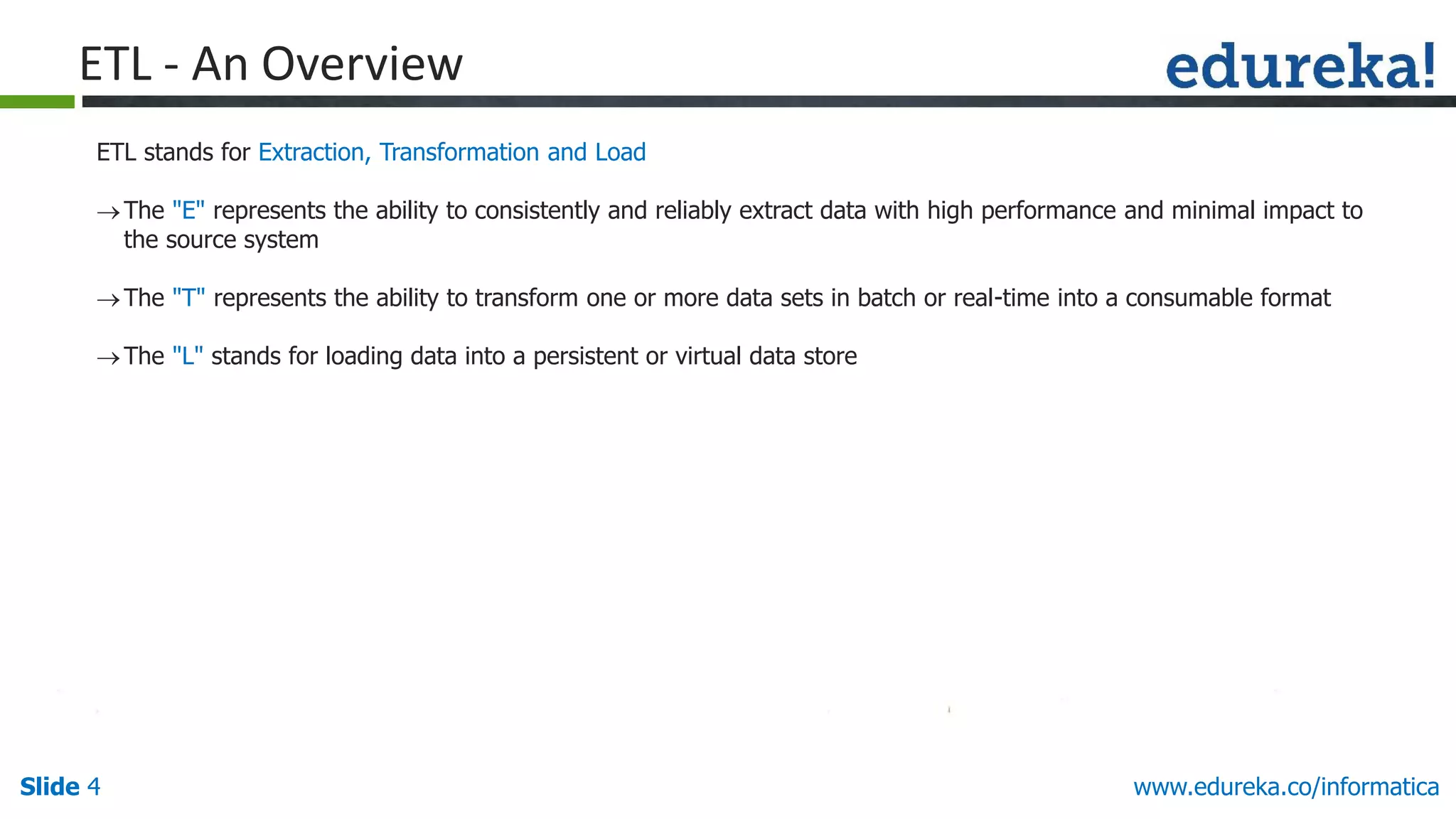
ETL stands for Extraction, Transformation and Load
The "E" represents the ability to consistently and reliably extract data with high performance and minimal impact to
the source system
The "T" represents the ability to transform one or more data sets in batch or real-time into a consumable format
The "L" stands for loading data into a persistent or virtual data store
Slide 5 www.edureka.co/informatica
Why ETL is Still Relevant
Is ETL becoming a History with the advent of Big Data?
Data needs to flow from source applications into analytic data stores in a controlled, reliable, secure manner
Information needs to be standardized, with regards to semantics, format and lexicon, for accurate analysis
Operational results need to be consistent and repeatable
Operational results need to be verifiable and transparent
Slide 6 www.edureka.co/informatica
Facilitates Integration of data from various data sources for building a Data warehouse
Businesses have data in multiple databases with different codification and formats
Transformation is required to convert and to summarize operational data into a consistent, business oriented format
Pre-Computation of any derived information
Summarization is also carried out to pre-compute summaries and aggregates
Makes data available in a query-able format
Why ETL is Still Relevant
Mergers and acquisitions also
create disparities in data
representation and pose more
difficult challenges in ETL.
Slide 7 www.edureka.co/informatica
Informatica – A Product Company
Informatica Corp Provides data integration software and services for various business, industries and government
organizations including telecommunications, health care, financial and insurance services.
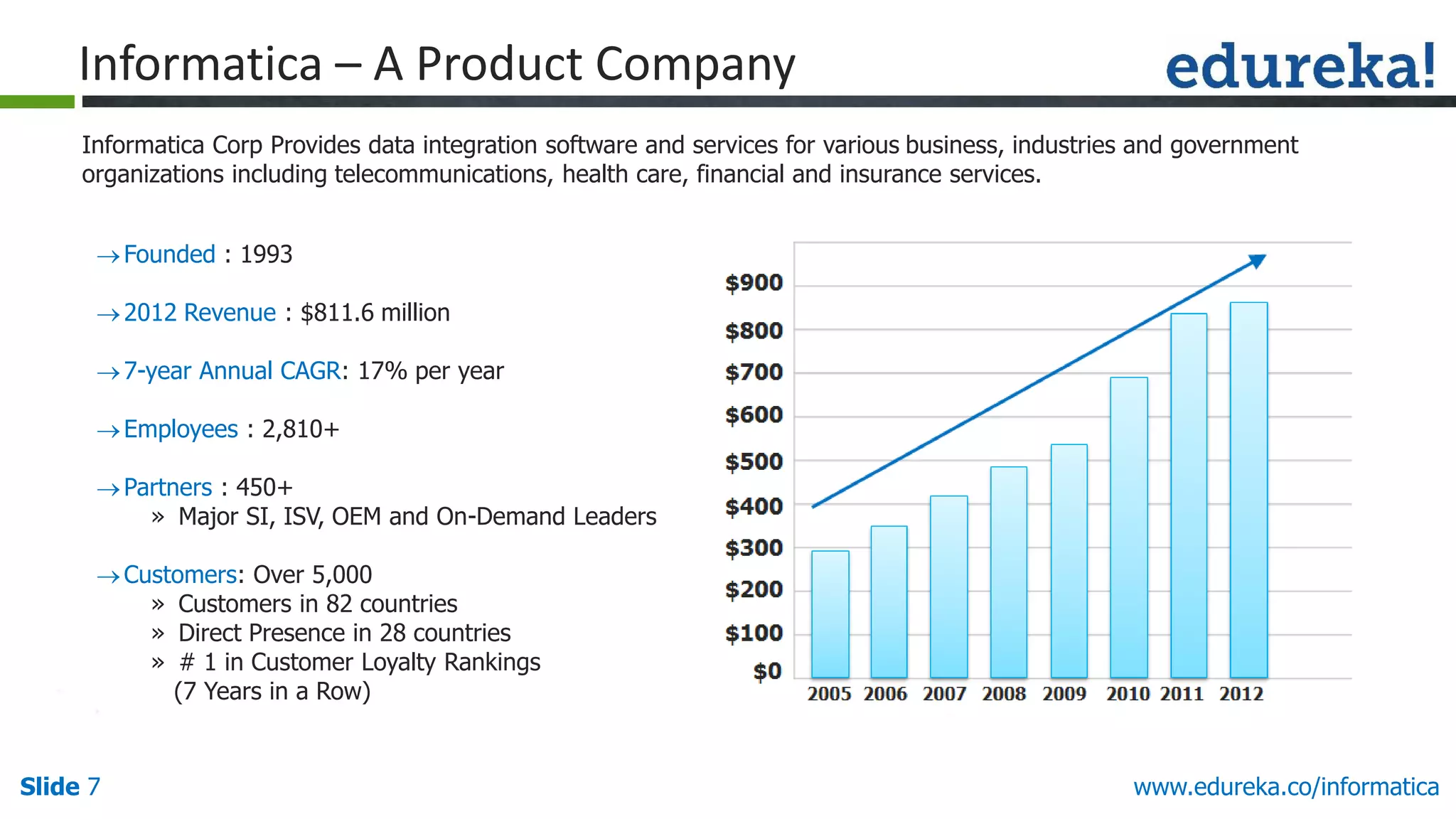
Founded : 1993
2012 Revenue : $811.6 million
7-year Annual CAGR: 17% per year
Employees : 2,810+
Partners : 450+
» Major SI, ISV, OEM and On-Demand Leaders
Customers: Over 5,000
» Customers in 82 countries
» Direct Presence in 28 countries
» # 1 in Customer Loyalty Rankings
(7 Years in a Row)
Slide 8 www.edureka.co/informatica
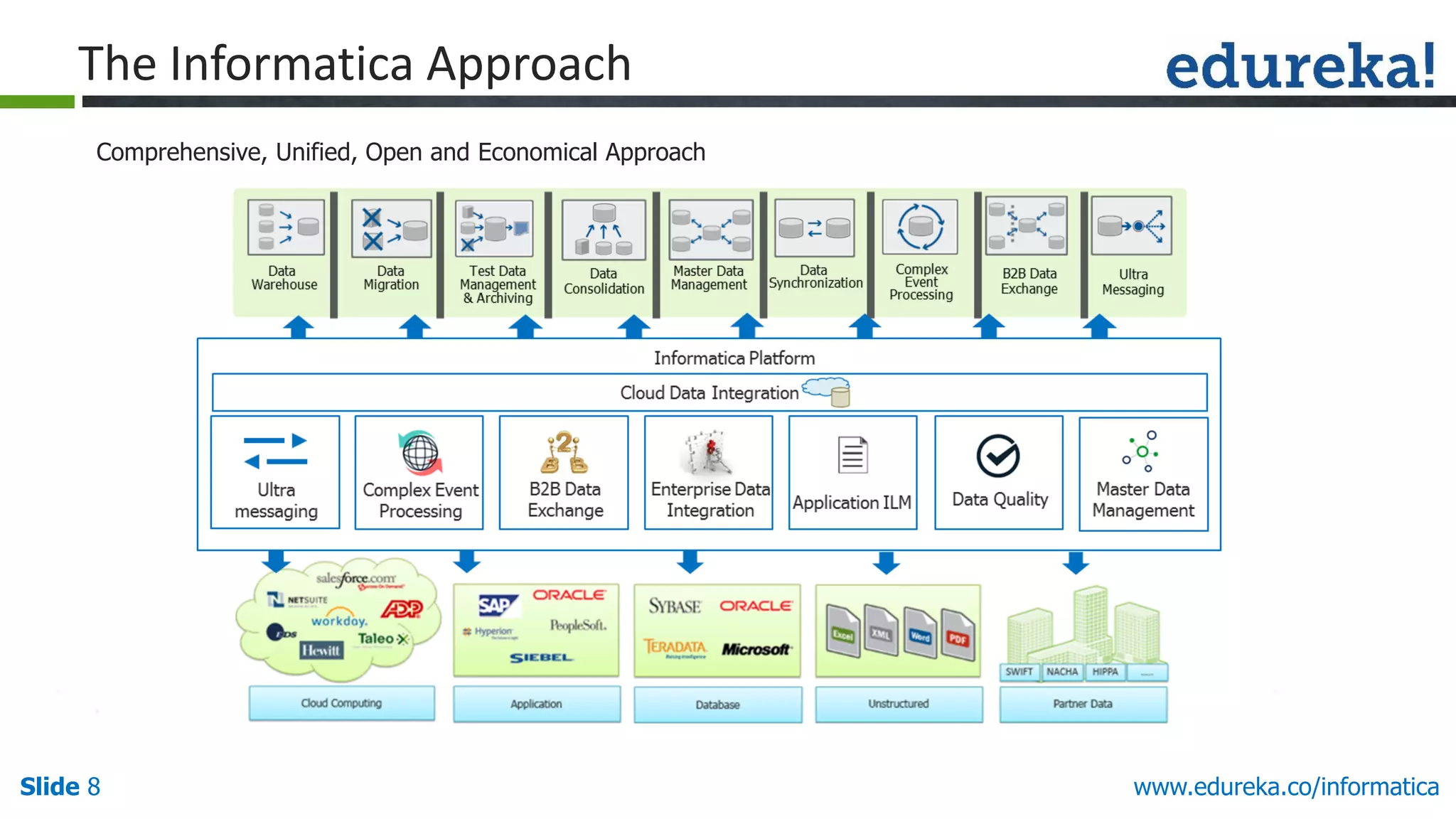
The Informatica Approach
Comprehensive, Unified, Open and Economical Approach
Slide 9 www.edureka.co/informatica
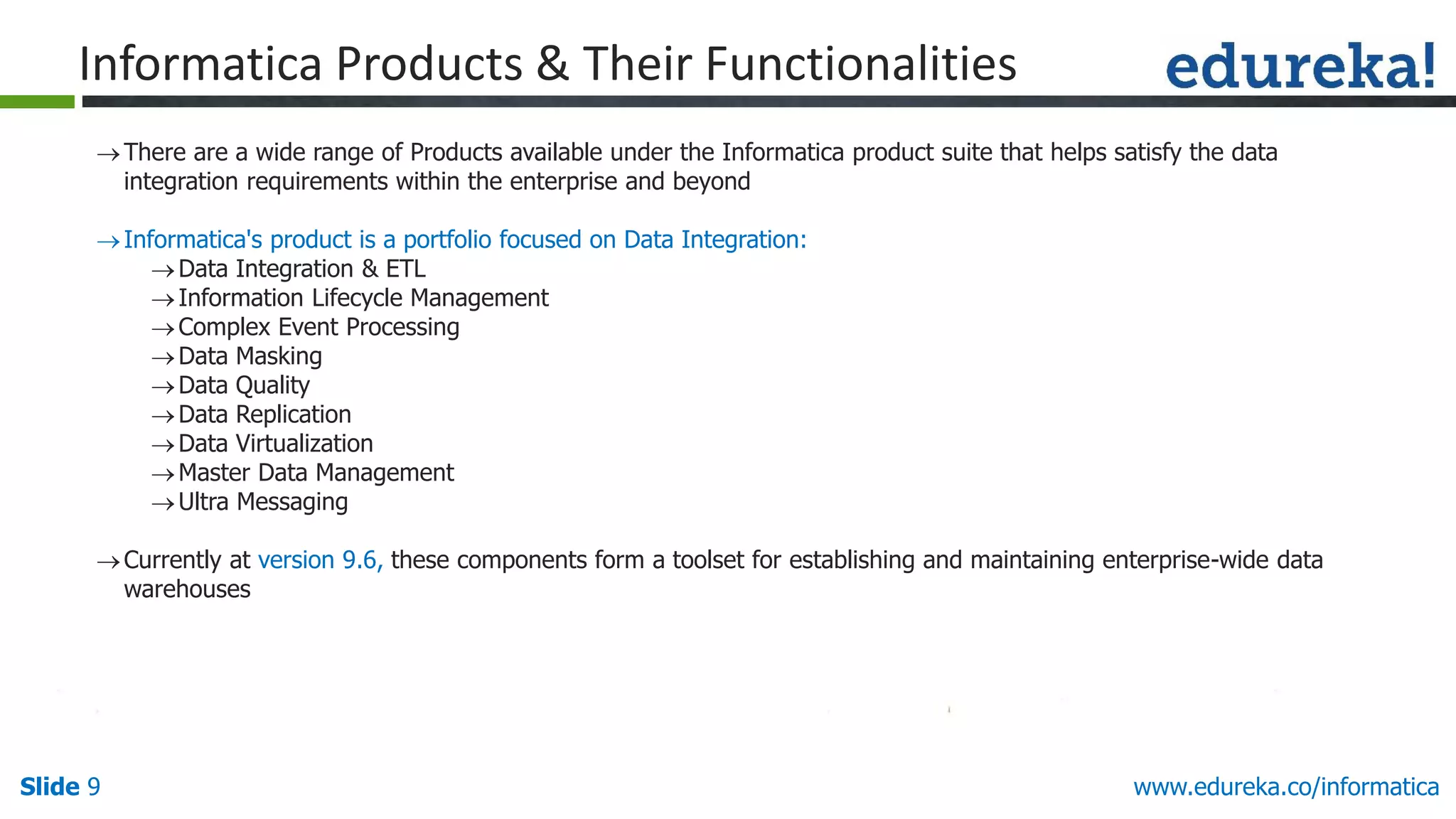
Informatica Products & Their Functionalities
There are a wide range of Products available under the Informatica product suite that helps satisfy the data
integration requirements within the enterprise and beyond
Informatica's product is a portfolio focused on Data Integration:
Data Integration & ETL
Information Lifecycle Management
Complex Event Processing
Data Masking
Data Quality
Data Replication
Data Virtualization
Master Data Management
Ultra Messaging
Currently at version 9.6, these components form a toolset for establishing and maintaining enterprise-wide data
warehouses
Slide 10 www.edureka.co/informatica
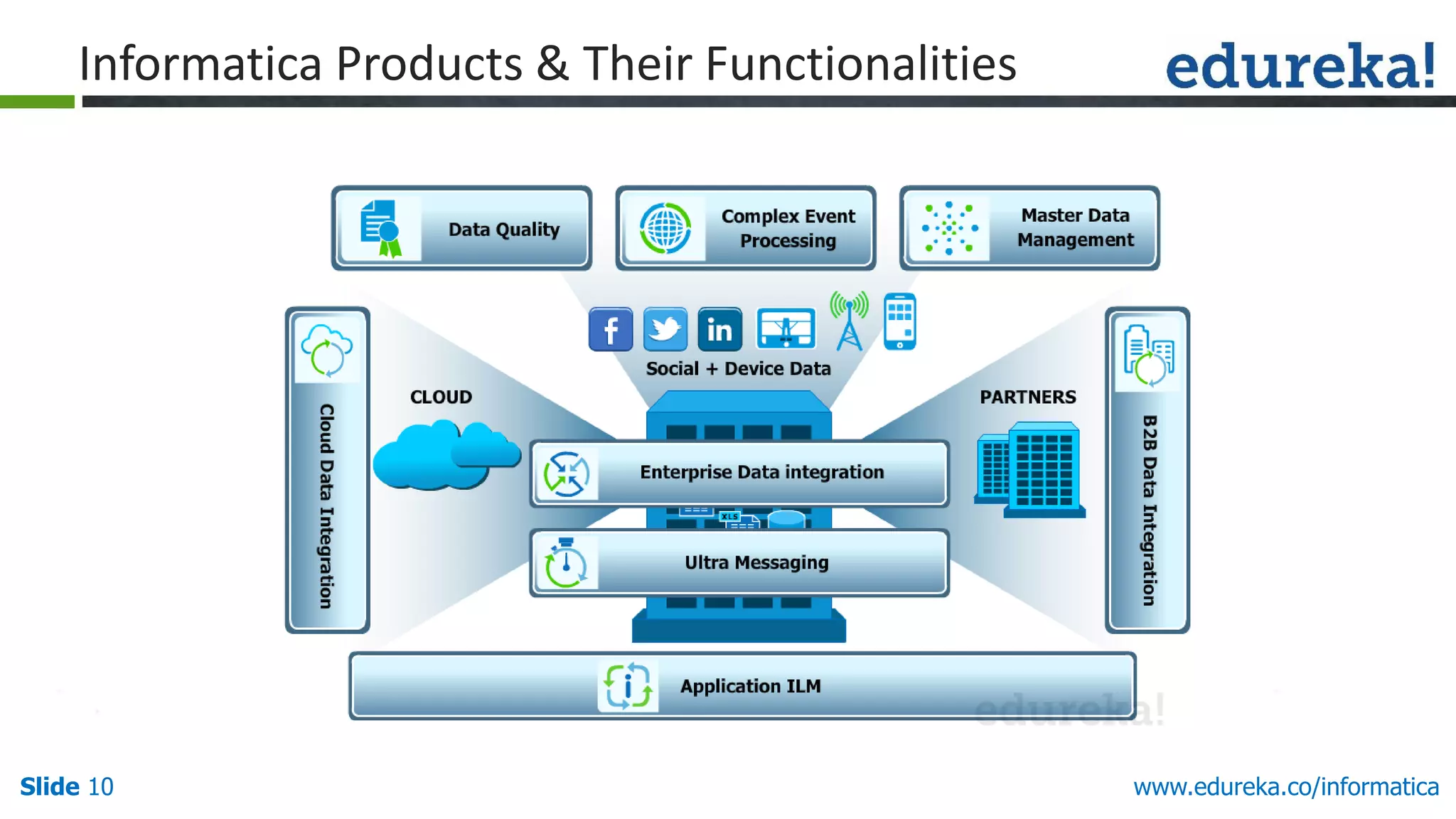
Informatica Products & Their Functionalities
Slide 11 www.edureka.co/informatica
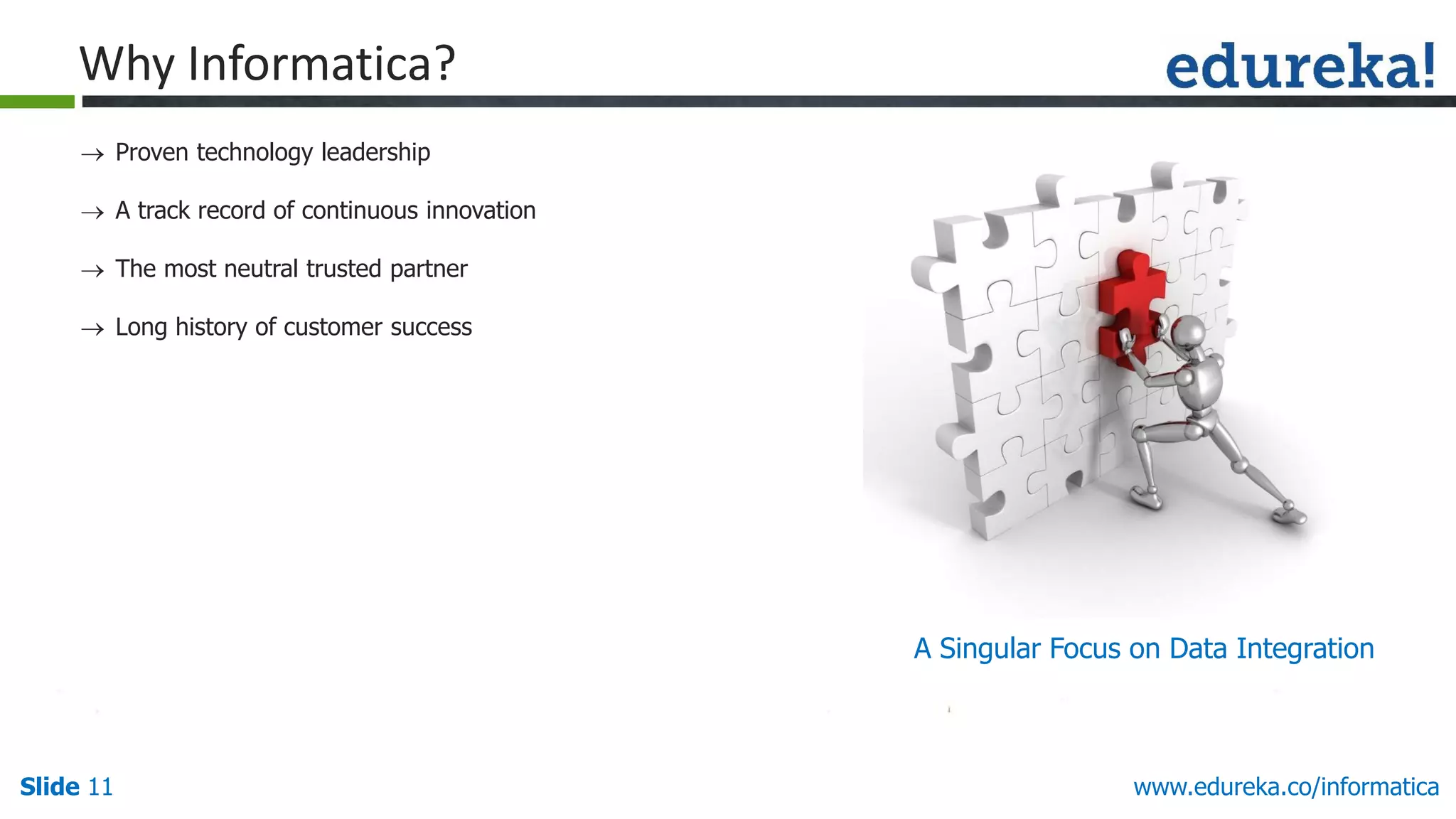
A Singular Focus on Data Integration
Why Informatica?
 Proven technology leadership
 A track record of continuous innovation
 The most neutral trusted partner
 Long history of customer success
Slide 12 www.edureka.co/informatica
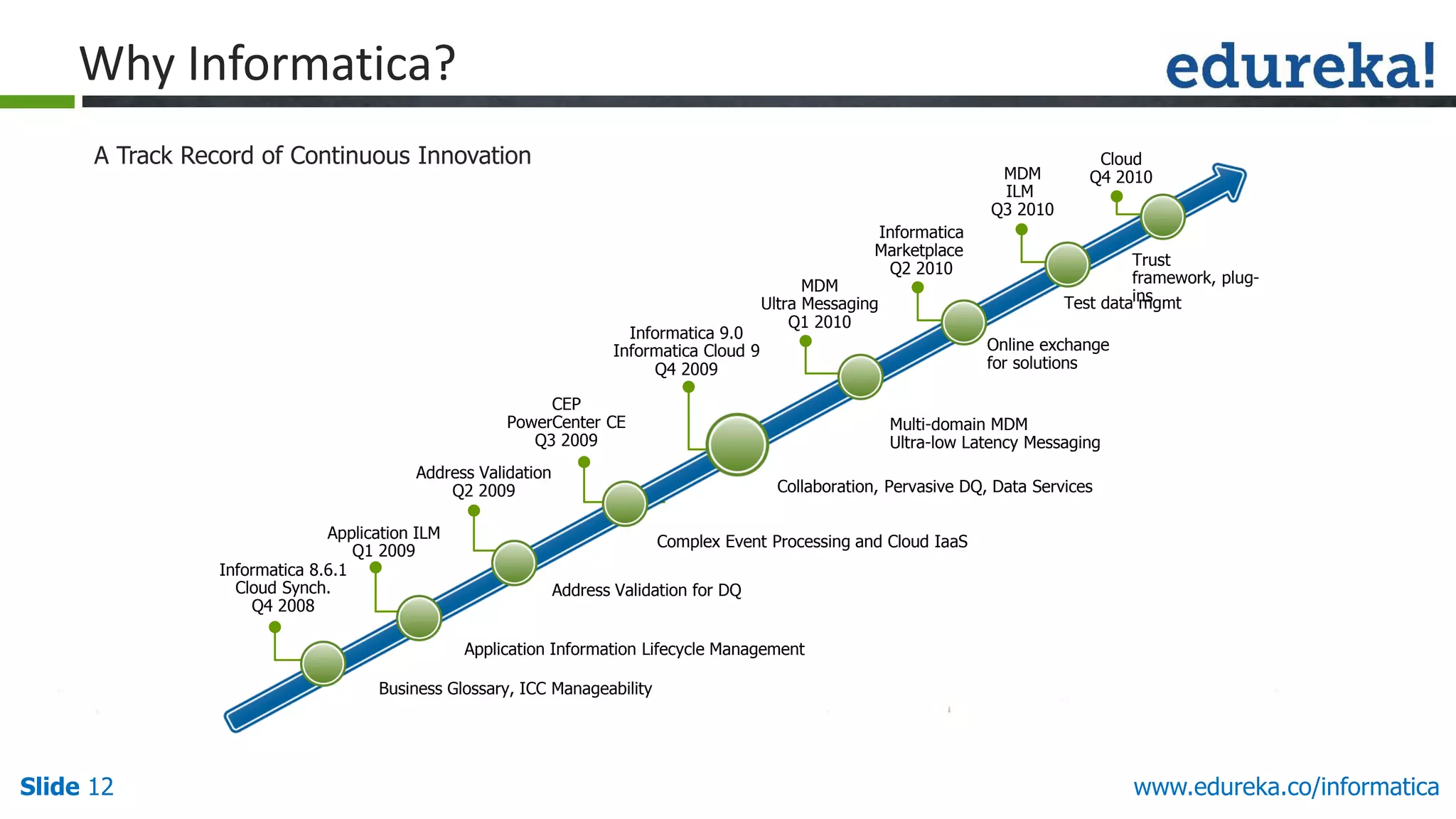
Business Glossary, ICC Manageability
Informatica 8.6.1
Cloud Synch.
Q4 2008
Application ILM
Q1 2009
Application Information Lifecycle Management
CEP
PowerCenter CE
Q3 2009
Informatica 9.0
Informatica Cloud 9
Q4 2009
Collaboration, Pervasive DQ, Data Services
Address Validation
Q2 2009
Address Validation for DQ
Complex Event Processing and Cloud IaaS
MDM
Ultra Messaging
Q1 2010
Multi-domain MDM
Ultra-low Latency Messaging
Informatica
Marketplace
Q2 2010
Online exchange
for solutions
Cloud
Q4 2010
Trust
framework, plug-
ins
MDM
ILM
Q3 2010
Test data mgmt
Why Informatica?
A Track Record of Continuous Innovation
Slide 13 www.edureka.co/informatica
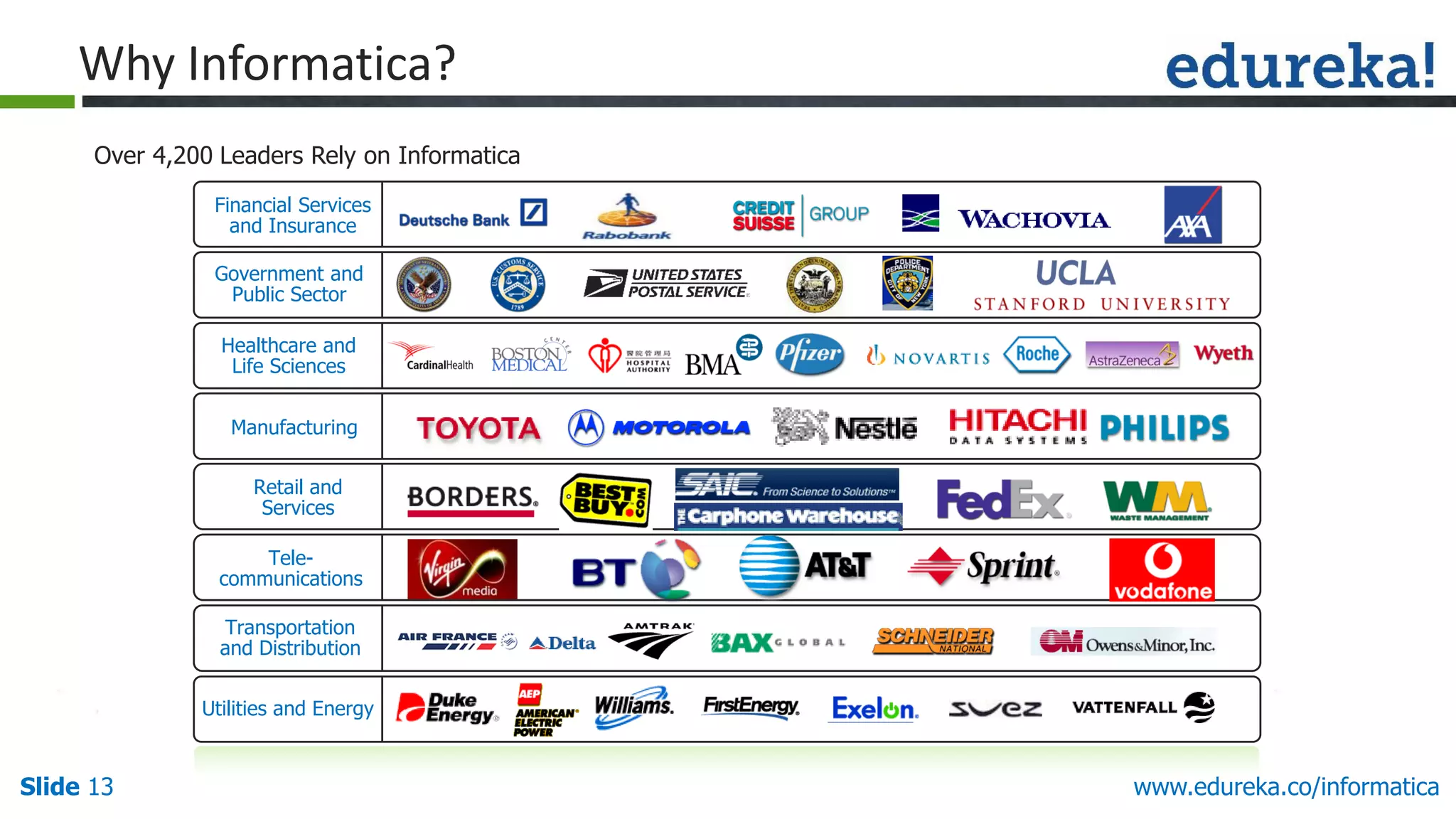
Financial Services
and Insurance
Tele-
communications
Manufacturing
Retail and
Services
Healthcare and
Life Sciences
Utilities and Energy
Government and
Public Sector
Transportation
and Distribution
Over 4,200 Leaders Rely on Informatica
Why Informatica?
Slide 14 www.edureka.co/informatica
PowerCenter:
It is a single, unified enterprise data integration platform that allows companies and government organizations
of all sizes to access, discover and integrate data from virtually any business system, in any format and deliver
that data throughout the enterprise at any speed.
An ETL tool ( Extract, Transform and Load)
The main advantages of PowerCenter over other ETL tools lies in its robustness, for it can be used in both
Windows and Unix based systems.
 PowerCenter can read from a variety of different sources and write to as many targets, while transforming data
in between.
The main advantages of PowerCenter over other ETL tools, and hence a reason for its popularity over other
such tools are as follows:
» It is robust, and can be used in both windows and UNIX based systems
» It is high performing yet very simple for developing, maintaining and administering
Introduction to PowerCenter
Slide 15 www.edureka.co/informatica
The architecture of Informatica PowerCenter (version 9.x onwards) is based on the service Oriented Architecture
(SOA) concept.
A service-oriented architecture (SOA) can be defined as a group of services, which communicate with each other.
The process of communication involves either simple data passing or it could involve two or more services
coordinating same activity.
Informatica 9.X represents a major change in the architecture of the product line.
Aim: Its main aim is to provide improved performance and high availability.
Approach: By reengineering the underlying architecture has been made even more services-based.
PowerCenter Architecture - SOA
Slide 16 www.edureka.co/informatica
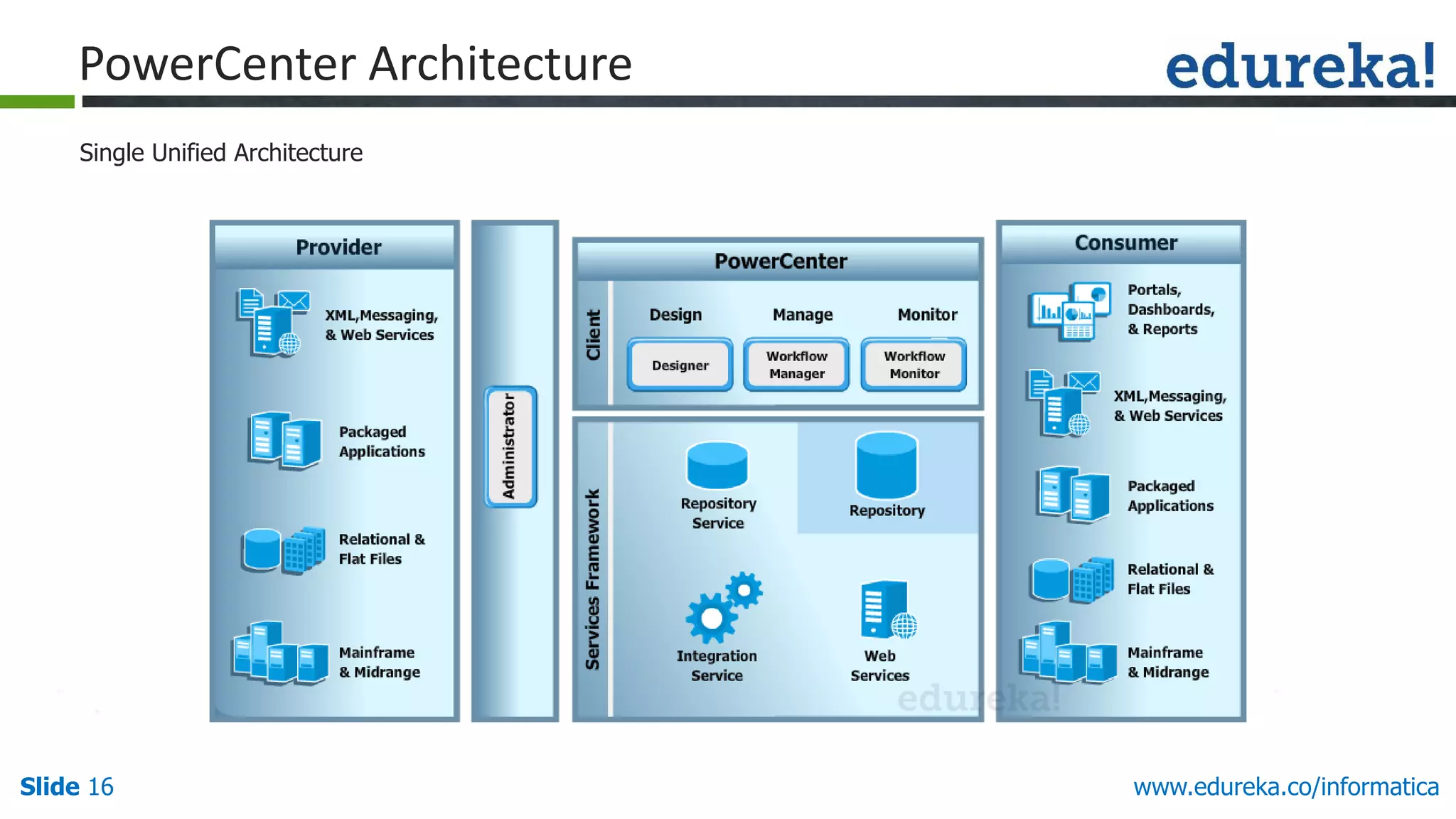
PowerCenter Architecture
Single Unified Architecture
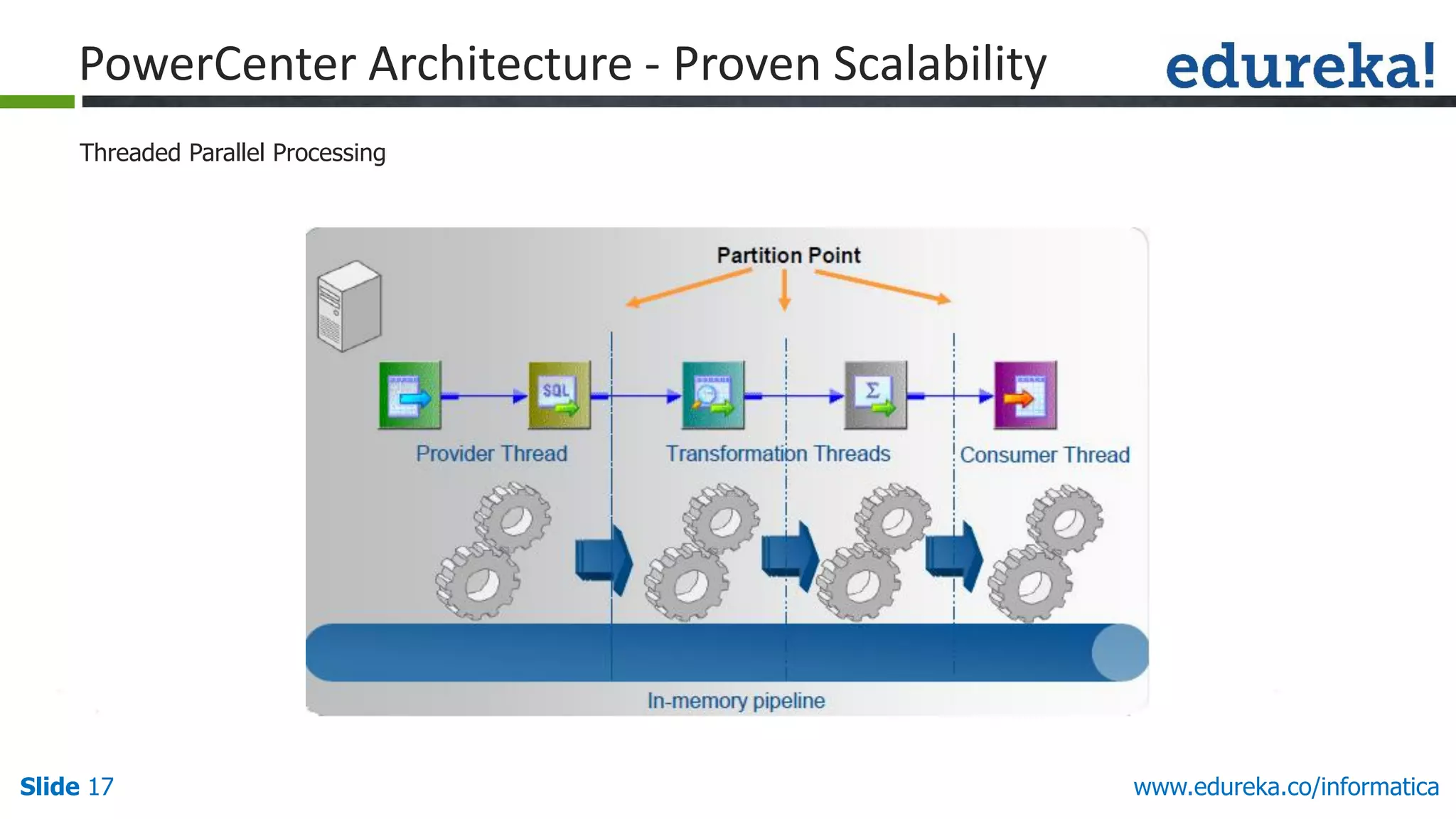
Slide 17 www.edureka.co/informatica
PowerCenter Architecture - Proven Scalability
Threaded Parallel Processing
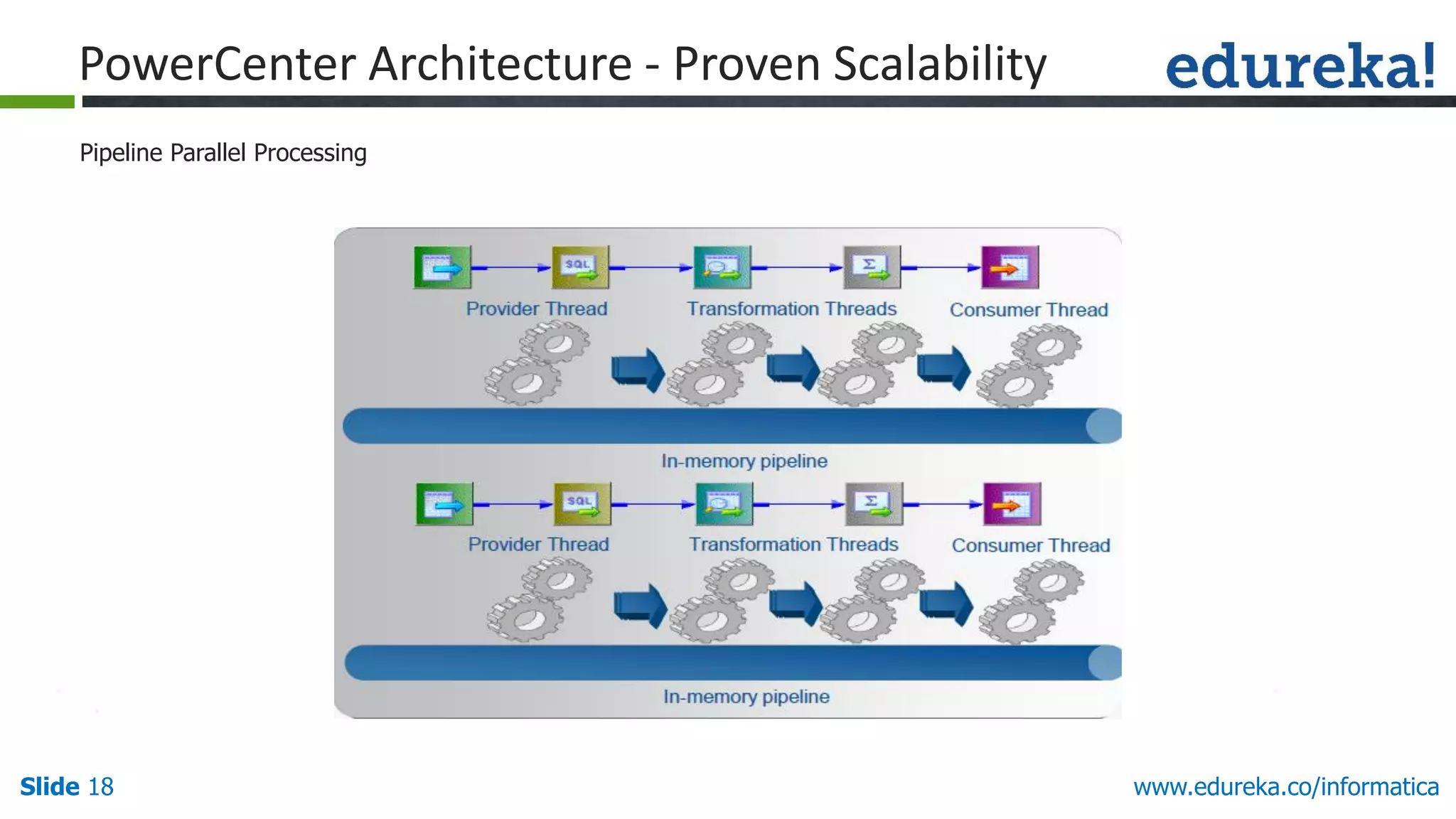
Slide 18 www.edureka.co/informatica
PowerCenter Architecture - Proven Scalability
Pipeline Parallel Processing
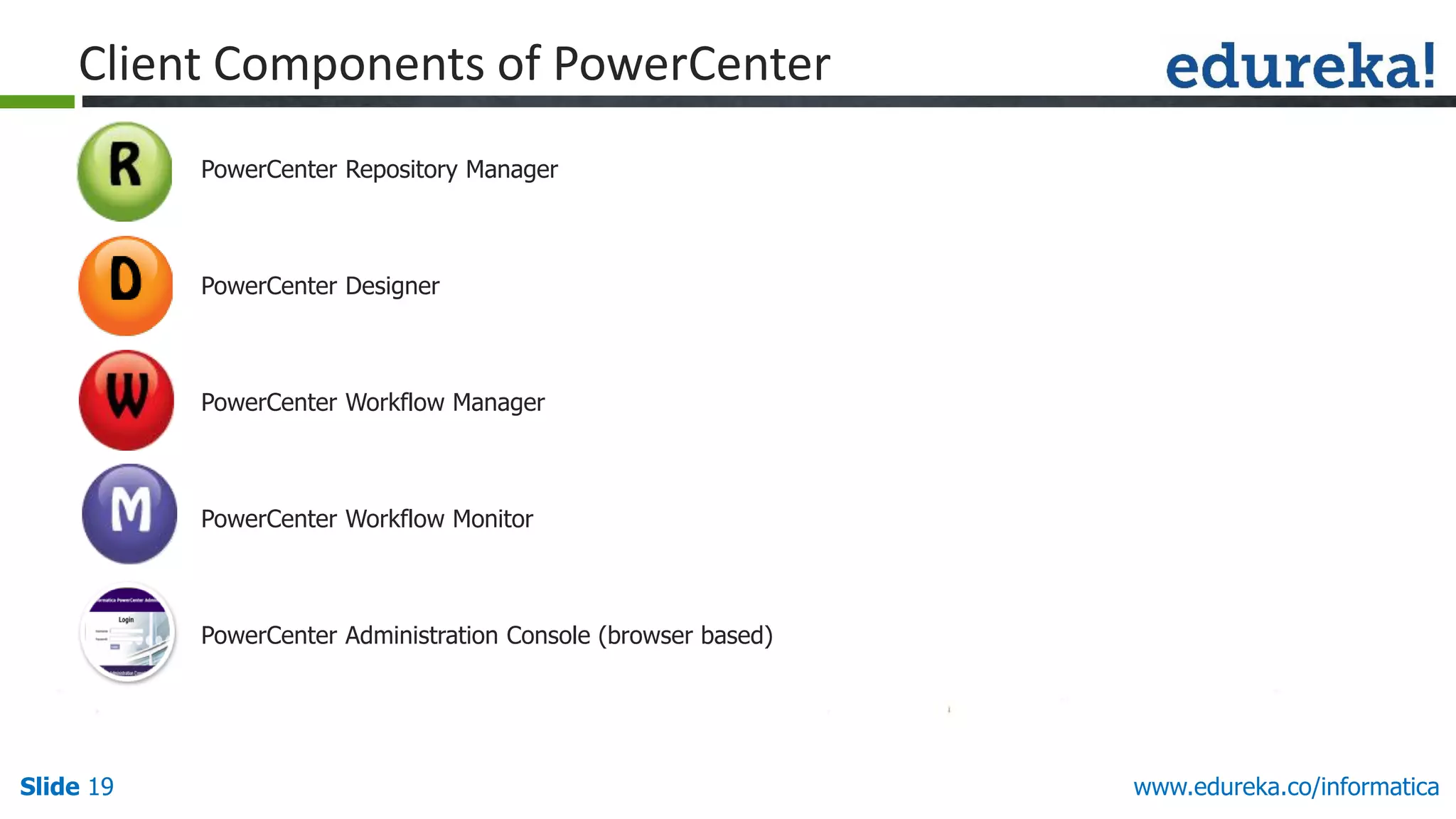
Slide 19 www.edureka.co/informatica
Client Components of PowerCenter
PowerCenter Repository Manager
PowerCenter Designer
PowerCenter Workflow Manager
PowerCenter Workflow Monitor
PowerCenter Administration Console (browser based)
Slide 20 www.edureka.co/informatica
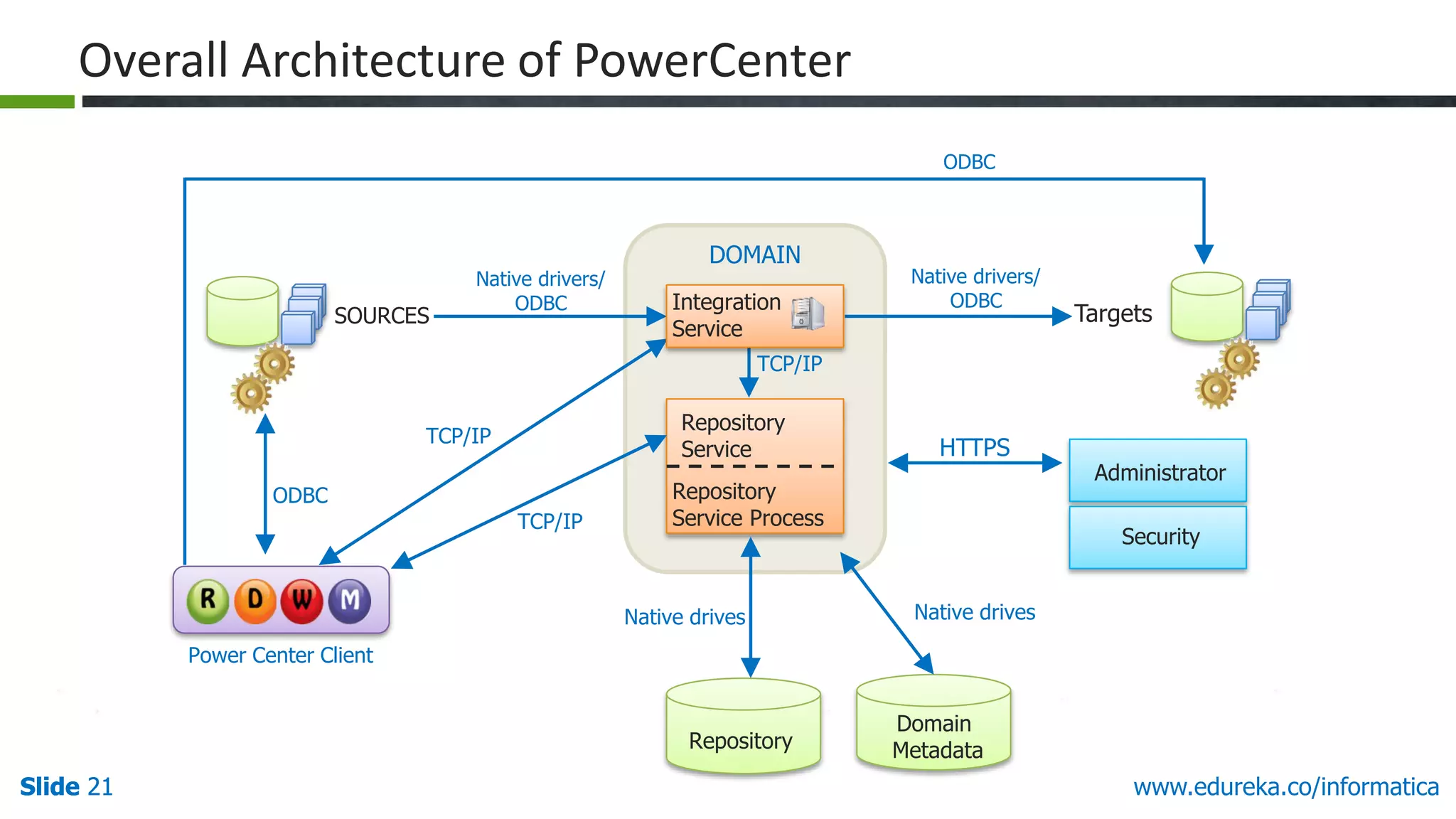
The PowerCenter server components comprises of the following services:
Repository service: The Repository service manages the repository. It retrieves, inserts, and updates metadata into
the repository database tables.
Integration service: The Integration service runs sessions and workflows.
SAP BW service: The SAP BW service looks out for RFC requests from SAP BW and initiates workflows to extract data
from, or load data into the SAP BW.
Web services hub: The Web services hub receives requests from web service clients and exposes PowerCenter
workflows as services.
Server Components of PowerCenter
Slide 21Slide 21Slide 21 www.edureka.co/informatica
ODBC
Targets
Native drivers/
ODBC
Native drivers/
ODBC
HTTPS
SOURCES
Native drives
TCP/IP
TCP/IP
ODBC
Power Center Client
Administrator
Security
Domain
MetadataRepository
Native drives
TCP/IP
DOMAIN
Repository
Service
Repository
Service Process
Overall Architecture of PowerCenter
Integration
Service
Slide 22 www.edureka.co/informatica
The salient features of a Domain are as follows:
» A Domain is a logical collection or set of nodes and services.
» The PowerCenter Domain is the fundamental administrative unit of PowerCenter.
» A Domain can be a single PowerCenter installation, or it can consist of multiple PowerCenter installations.
The salient features of a node are as follows:
» A node is a logical representation of a physical machine. It has physical attributes such as a hostname and a
port number.
» Each node runs a service manager which is responsible for the application and core services.
» A node can be a gateway node or a worker node, but it can belong to only one Domain.
Informatica - Domain & Nodes
Slide 23 www.edureka.co/informatica
A service can be described as follows:
A service is a resource that provides specialized functions. All PowerCenter processes run as services on a node.
PowerCenter has two types of services:
» Application Services represent server based functions including Repository and Integration Services.
» Core Services represent functions that manage and maintain the environment in which PowerCenter operates
and include services like Log Service, Licensing Service, and Domain Service amongst many others.
Informatica- Services
Slide 24 www.edureka.co/informatica
Component-based development is a technique where predefined components or functional units, or both, with
specific functionalities are used to assemble the final product.
PowerCenter follows the component-based development methodologies by allowing to build a data flow from a
source to the target, using different components (called transformations) and linking them to each other as required.
Component Based Development Techniques
Slide 25 www.edureka.co/informatica
The advantages of a component-based development model are as listed below:
As the functional units are already built, the developer need not build them from scratch and can instead use them
directly. Apart from making the entire process easier, this reduces the development time as well.
This approach makes bug-fixing easier as well as aid in various maintenance activities, with only the malfunctioned
components needing to be fixed.
Reusability is also another factor that works in the favor of a component-based development model
Component Based Development Techniques
Slide 26 www.edureka.co/informatica
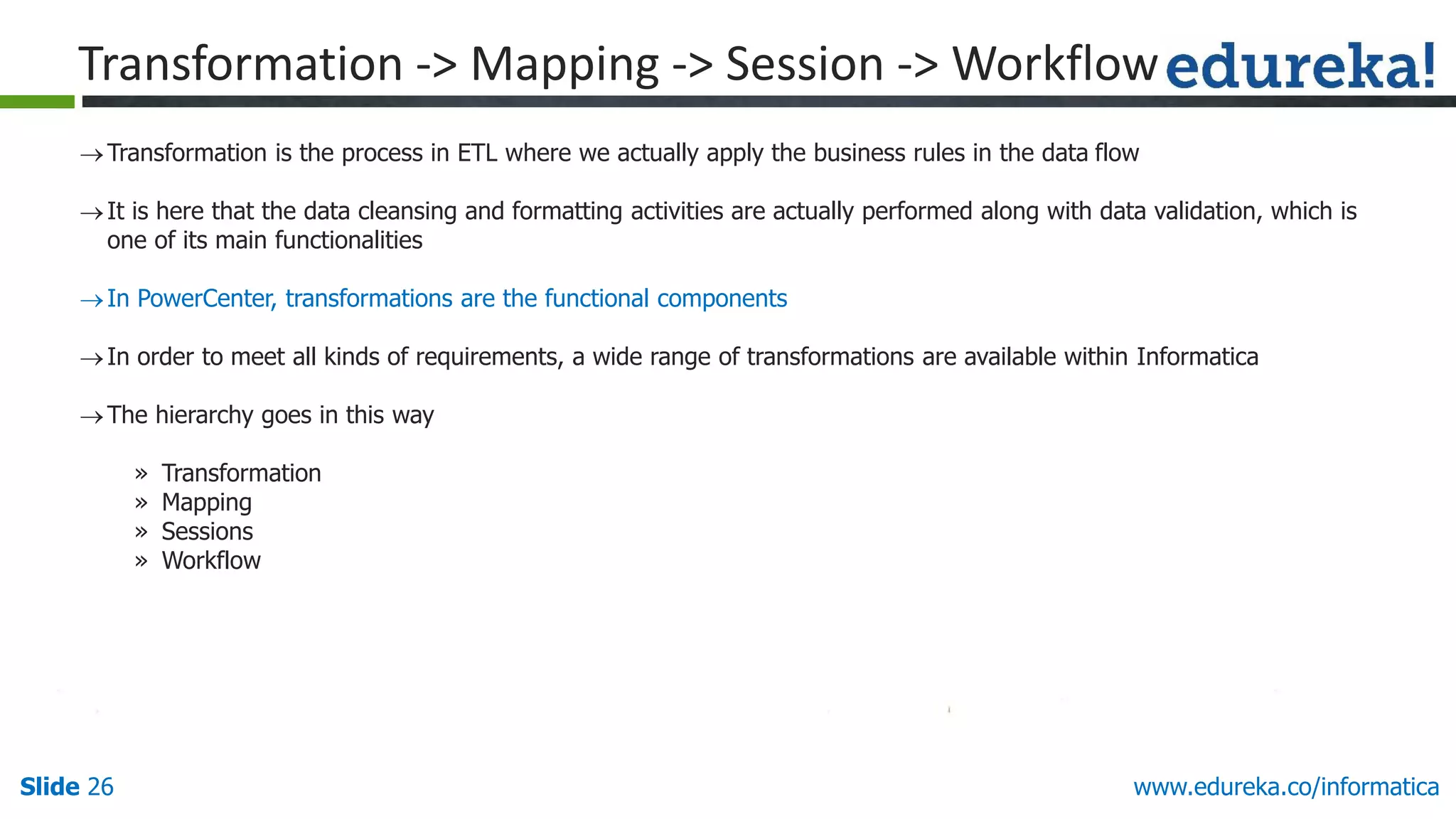
Transformation is the process in ETL where we actually apply the business rules in the data flow
It is here that the data cleansing and formatting activities are actually performed along with data validation, which is
one of its main functionalities
In PowerCenter, transformations are the functional components
In order to meet all kinds of requirements, a wide range of transformations are available within Informatica
The hierarchy goes in this way
» Transformation
» Mapping
» Sessions
» Workflow
Transformation -> Mapping -> Session -> Workflow
Slide 27 www.edureka.co/informatica
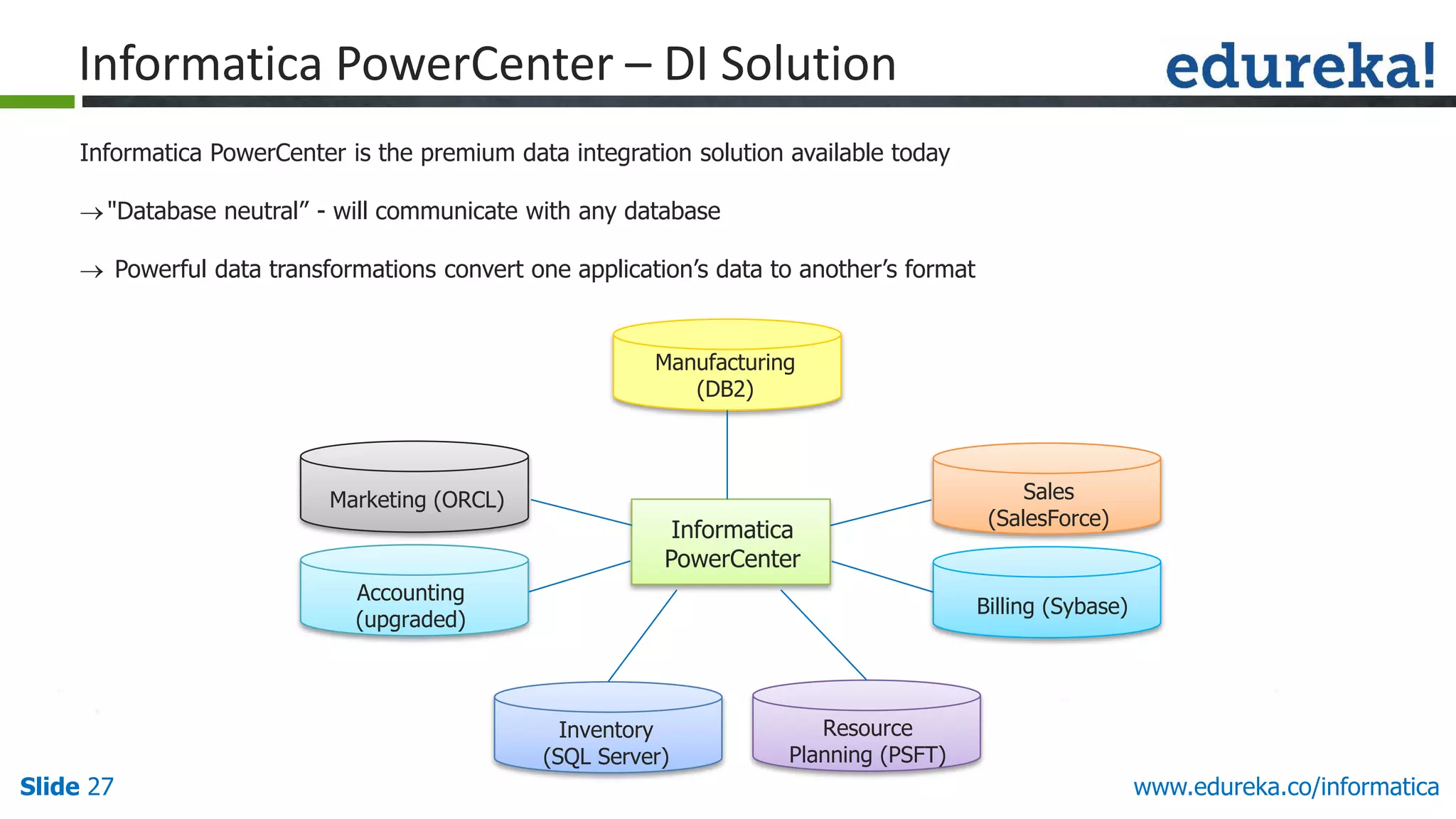
Informatica PowerCenter is the premium data integration solution available today
"Database neutral” - will communicate with any database
 Powerful data transformations convert one application’s data to another’s format
Informatica PowerCenter – DI Solution
Manufacturing
(DB2)
Sales
(SalesForce)
Billing (Sybase)
Resource
Planning (PSFT)
Inventory
(SQL Server)
Marketing (ORCL)
Accounting
(upgraded)
Informatica
PowerCenter
Slide 28 www.edureka.co/informatica
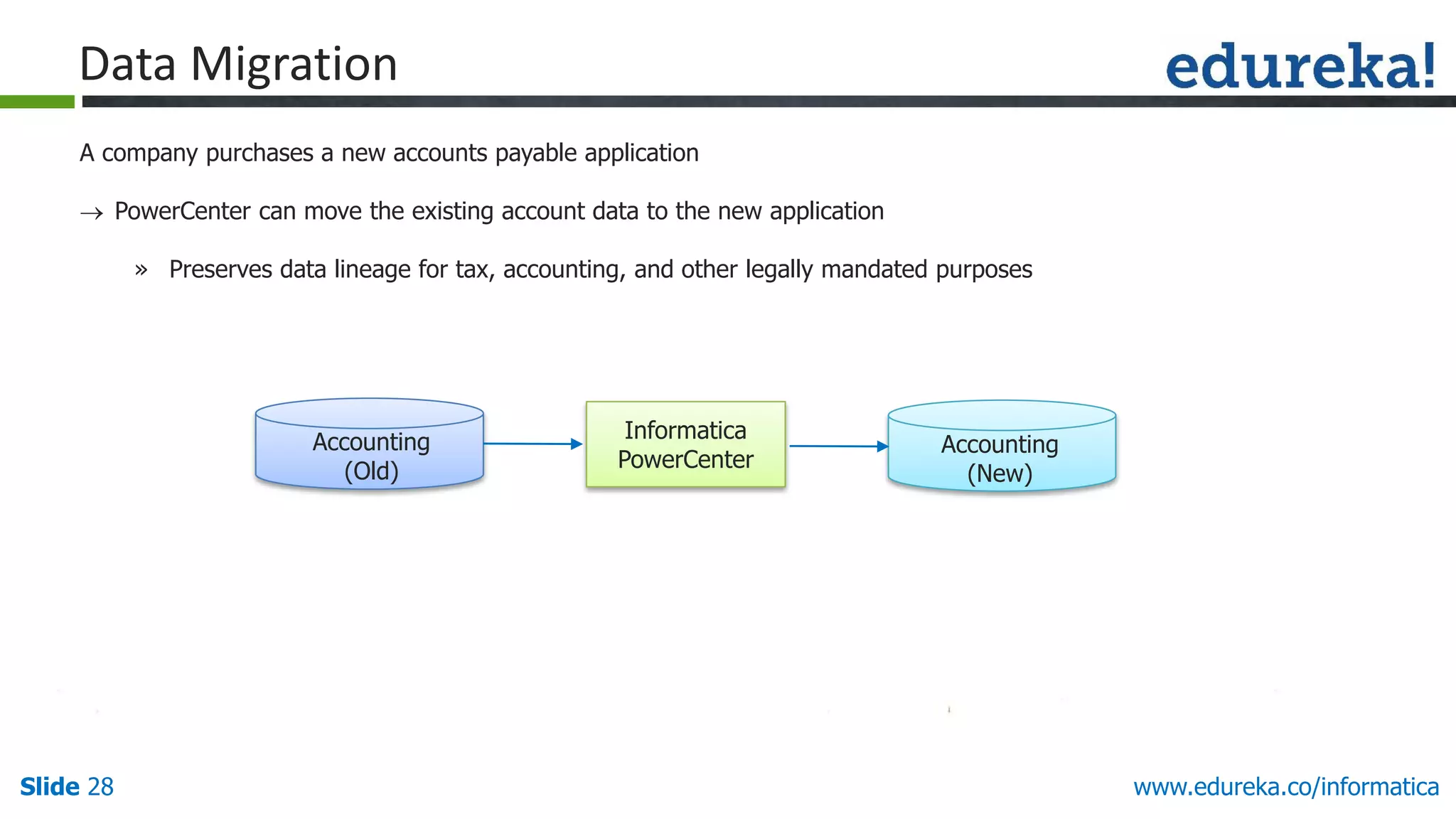
A company purchases a new accounts payable application
 PowerCenter can move the existing account data to the new application
» Preserves data lineage for tax, accounting, and other legally mandated purposes
Data Migration
Informatica
PowerCenter
Accounting
(Old)
Accounting
(New)
Slide 29 www.edureka.co/informatica
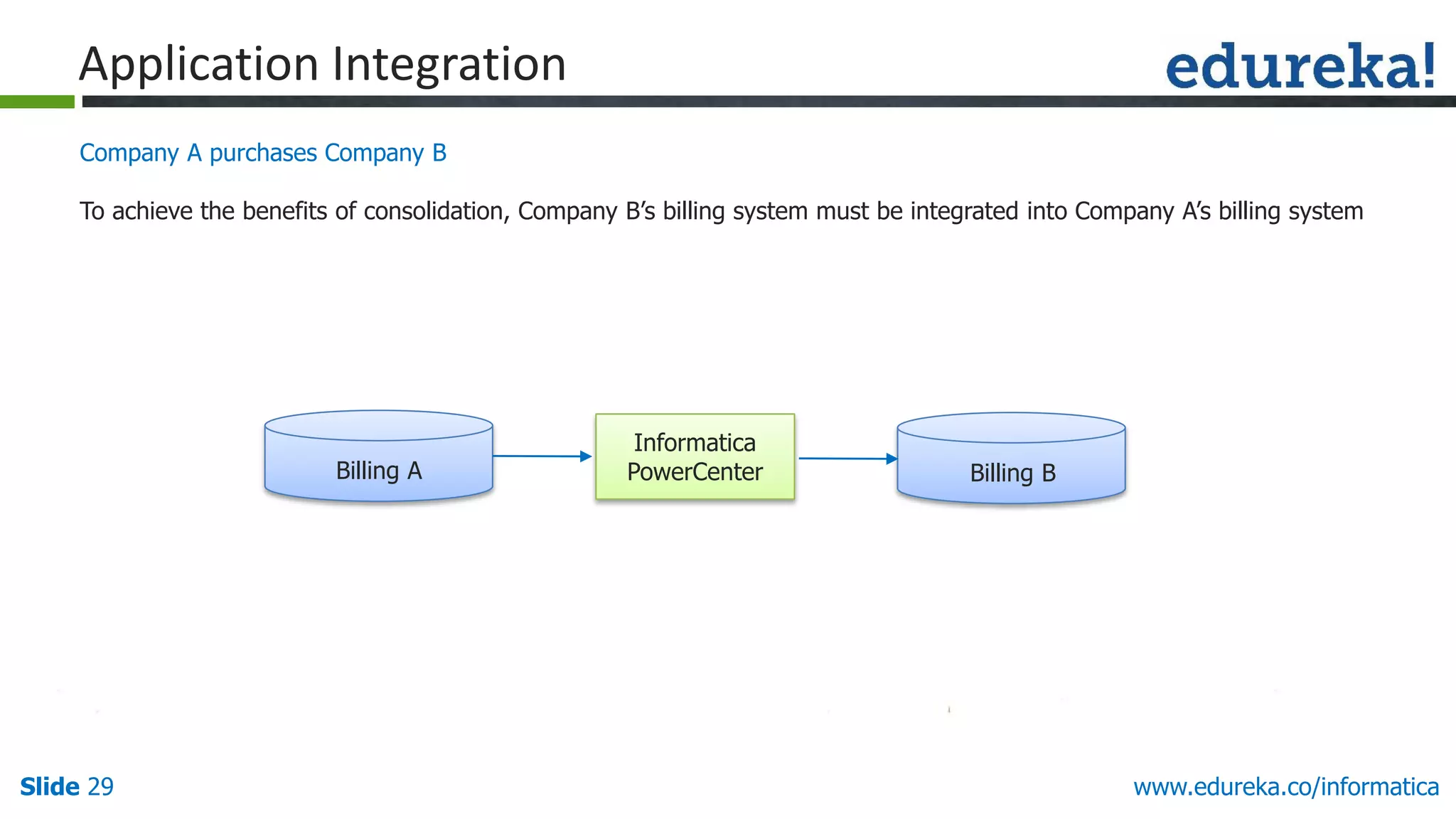
Company A purchases Company B
To achieve the benefits of consolidation, Company B’s billing system must be integrated into Company A’s billing system
Application Integration
Informatica
PowerCenterBilling A Billing B
Slide 30 www.edureka.co/informatica
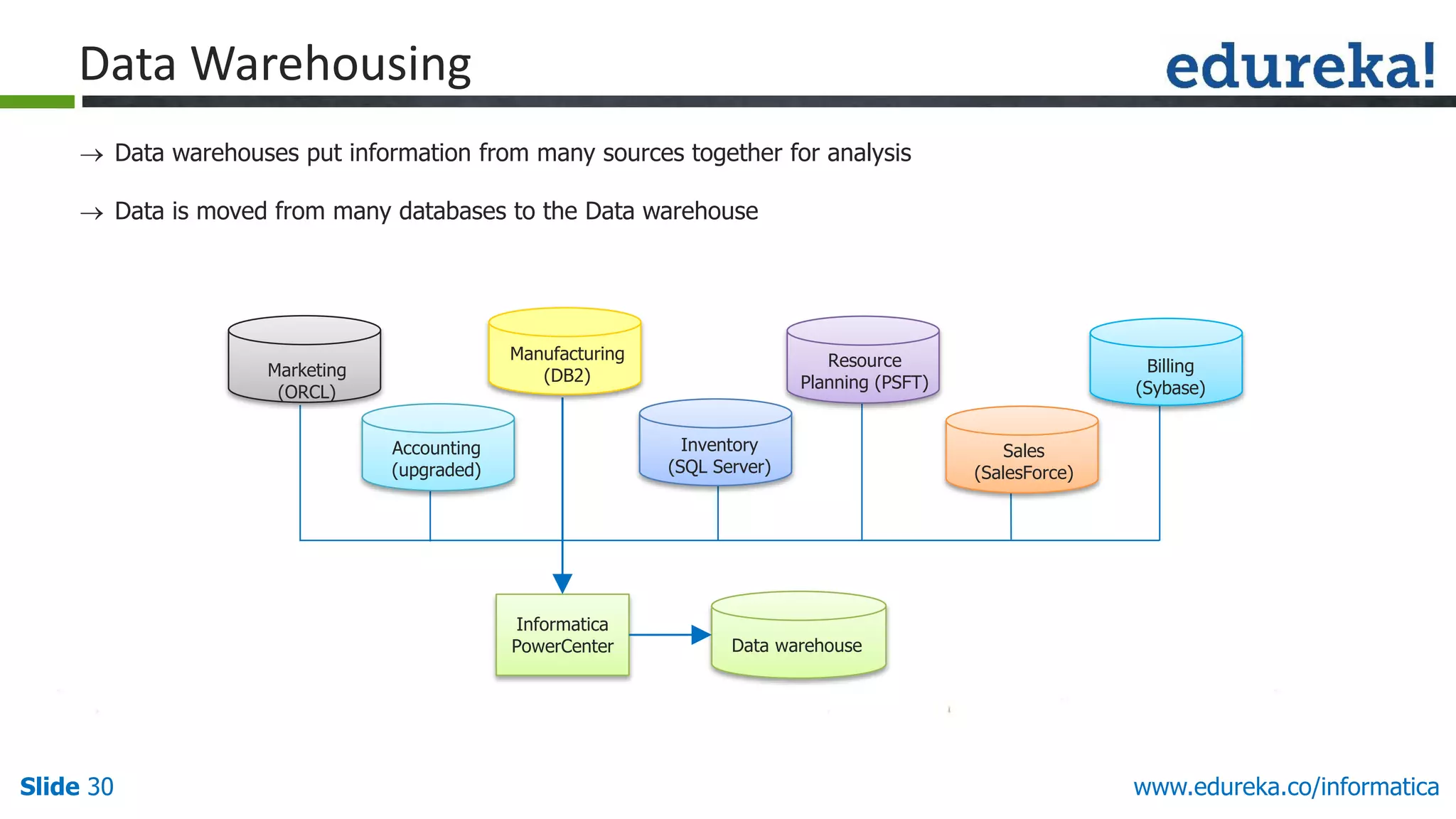
Data Warehousing
 Data warehouses put information from many sources together for analysis
 Data is moved from many databases to the Data warehouse
Inventory
(SQL Server)
Informatica
PowerCenter
Marketing
(ORCL)
Accounting
(upgraded)
Manufacturing
(DB2)
Resource
Planning (PSFT)
Sales
(SalesForce)
Billing
(Sybase)
Data warehouse
Slide 31 www.edureka.co/informatica
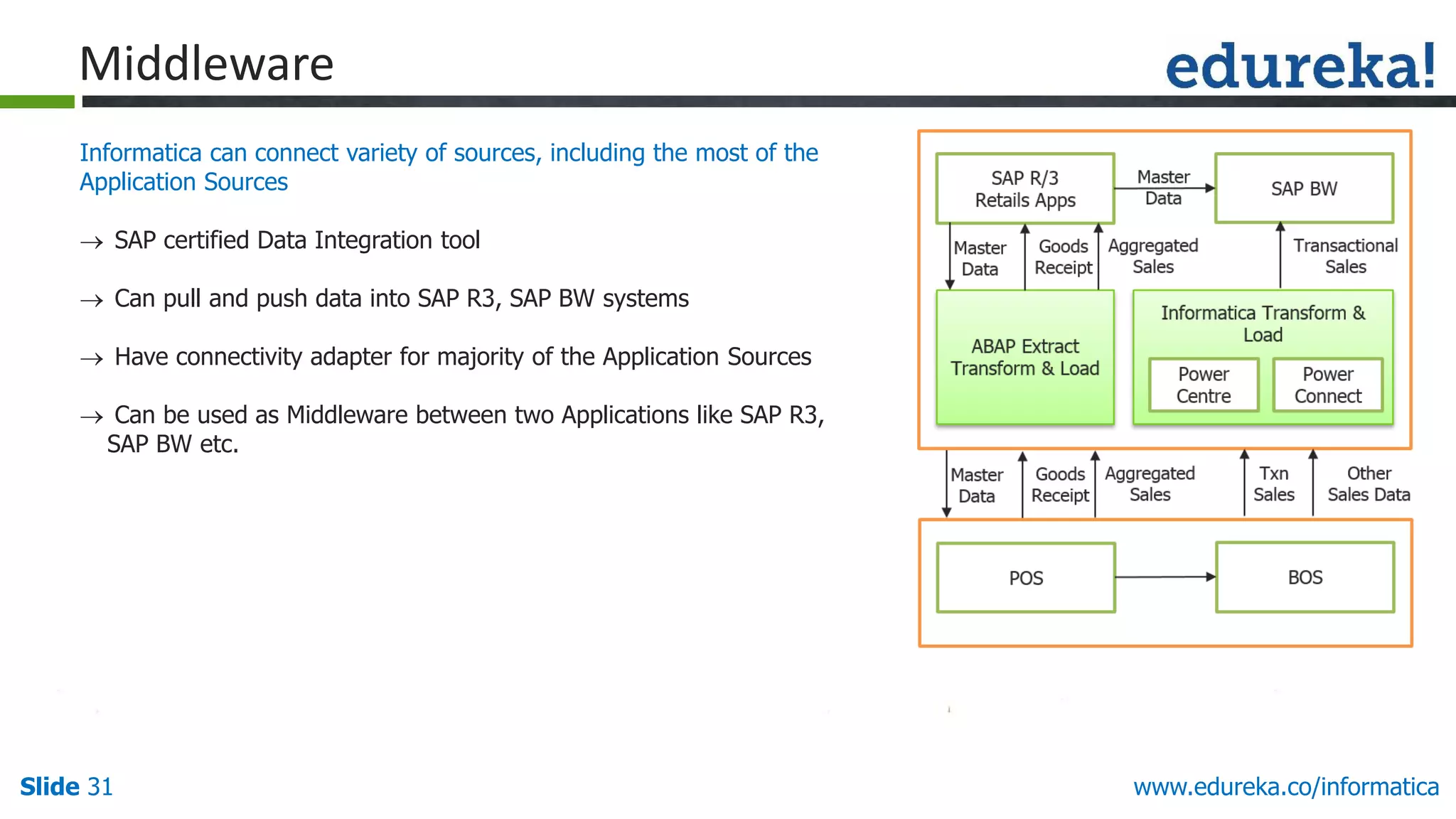
Middleware
Informatica can connect variety of sources, including the most of the
Application Sources
 SAP certified Data Integration tool
 Can pull and push data into SAP R3, SAP BW systems
 Have connectivity adapter for majority of the Application Sources
 Can be used as Middleware between two Applications like SAP R3,
SAP BW etc.
Slide 32 www.edureka.co/informatica
Some Unique Features of Informatica
Single Administration console to Administer all the application services
Unified Users, Groups, Privileges and Roles admin across PC AE Tools
Single Sign on for all the client tool - Once you login to one client tool, others are automatically logged in
In built version control
Grid and High availability
In built scheduling tool
Slide 33 www.edureka.co/informatica
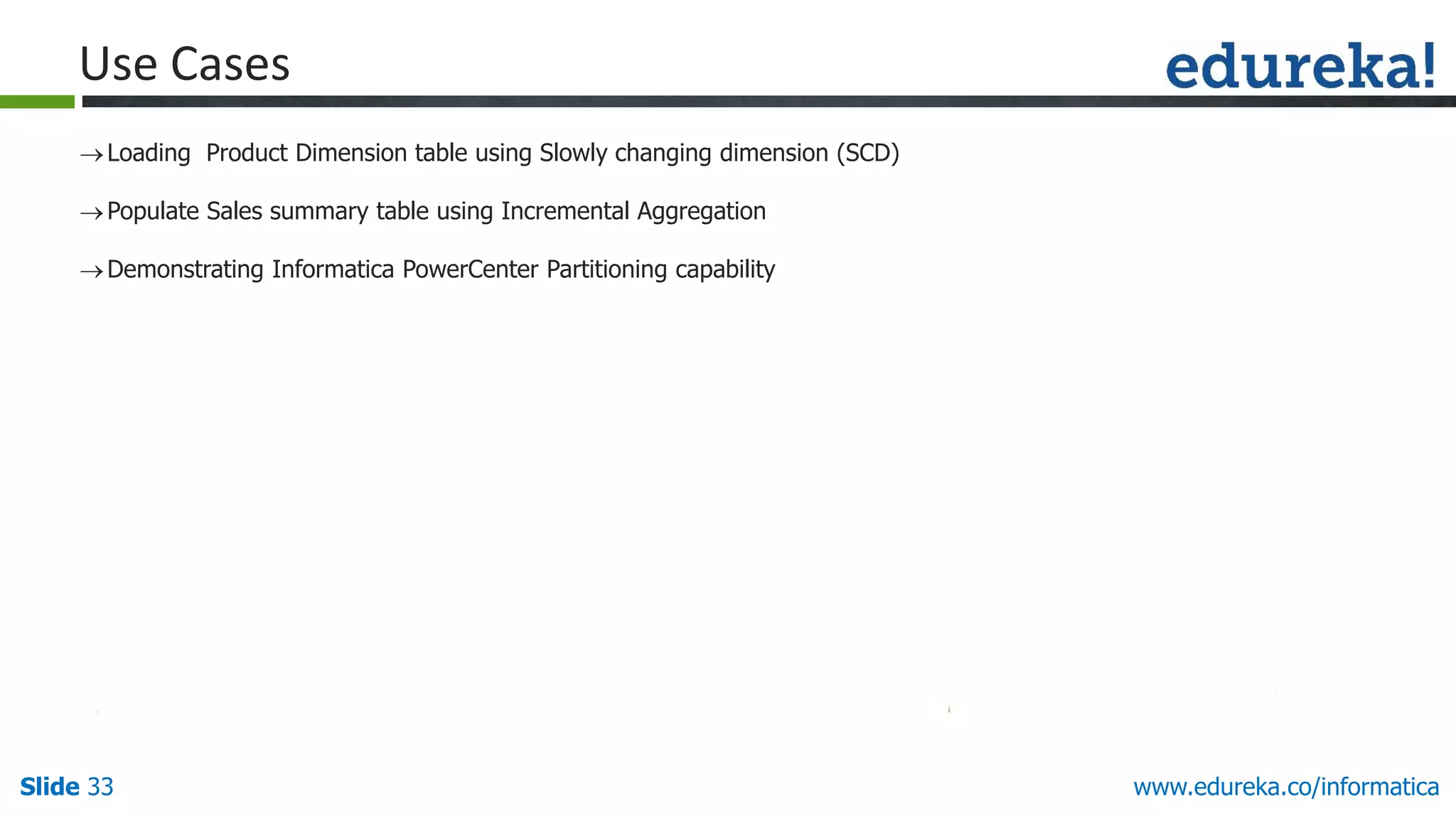
Loading Product Dimension table using Slowly changing dimension (SCD)
Populate Sales summary table using Incremental Aggregation
Demonstrating Informatica PowerCenter Partitioning capability
Use Cases
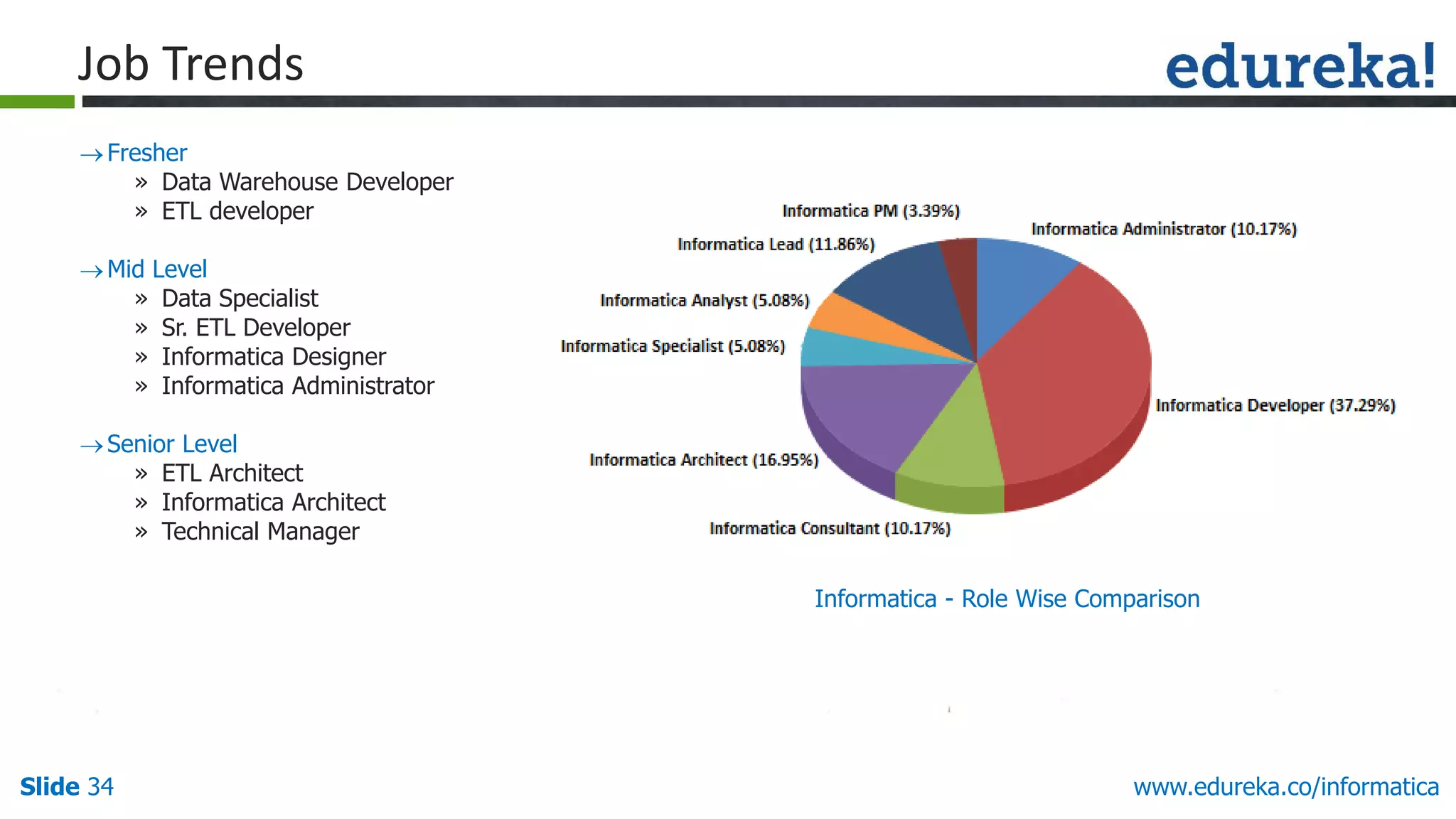
Slide 34 www.edureka.co/informatica
Fresher
» Data Warehouse Developer
» ETL developer
Mid Level
» Data Specialist
» Sr. ETL Developer
» Informatica Designer
» Informatica Administrator
Senior Level
» ETL Architect
» Informatica Architect
» Technical Manager
Job Trends
Informatica - Role Wise Comparison
Slide 35 www.edureka.co/informatica
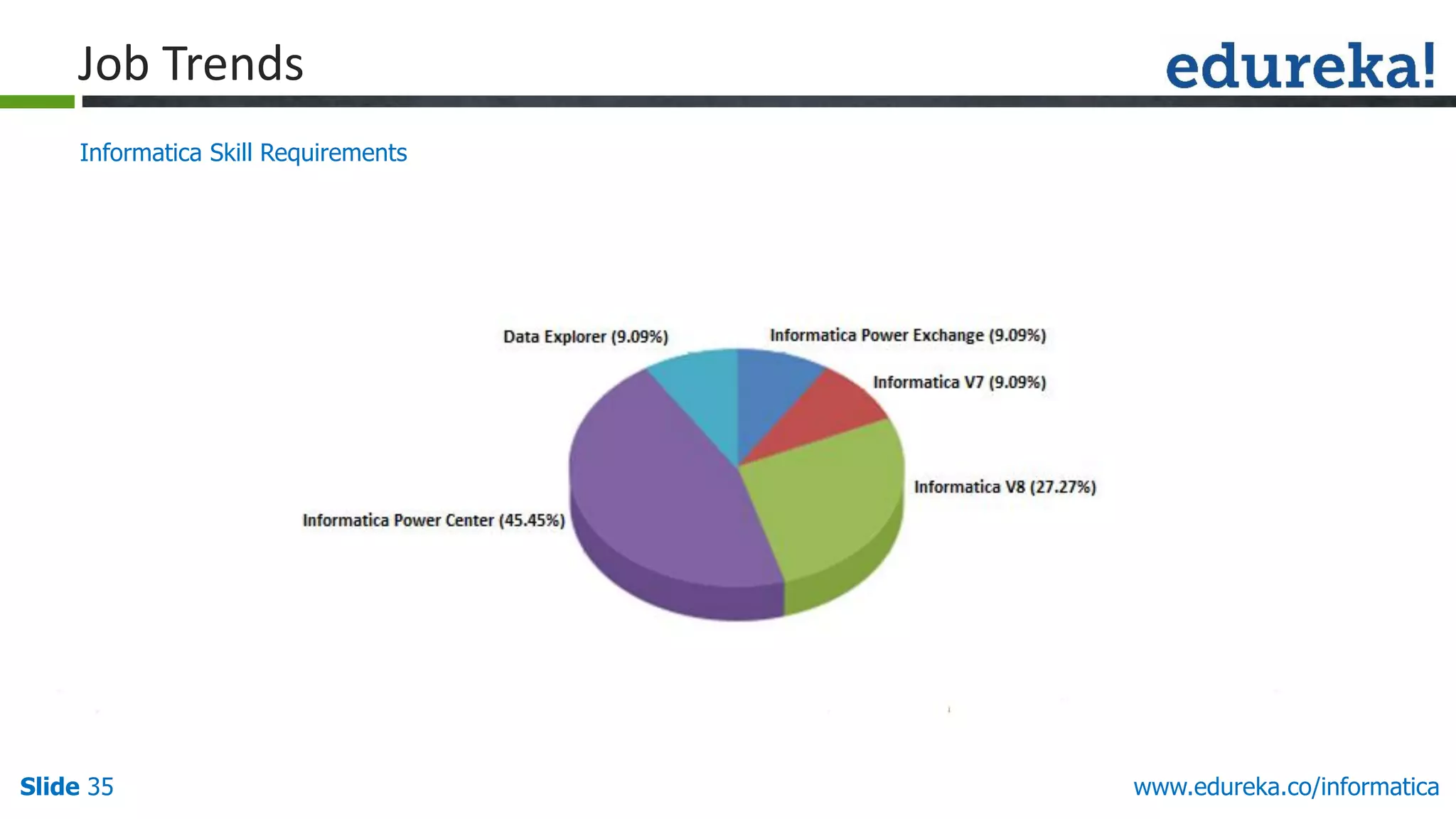
Job Trends
Informatica Skill Requirements
Slide 36 www.edureka.co/informatica
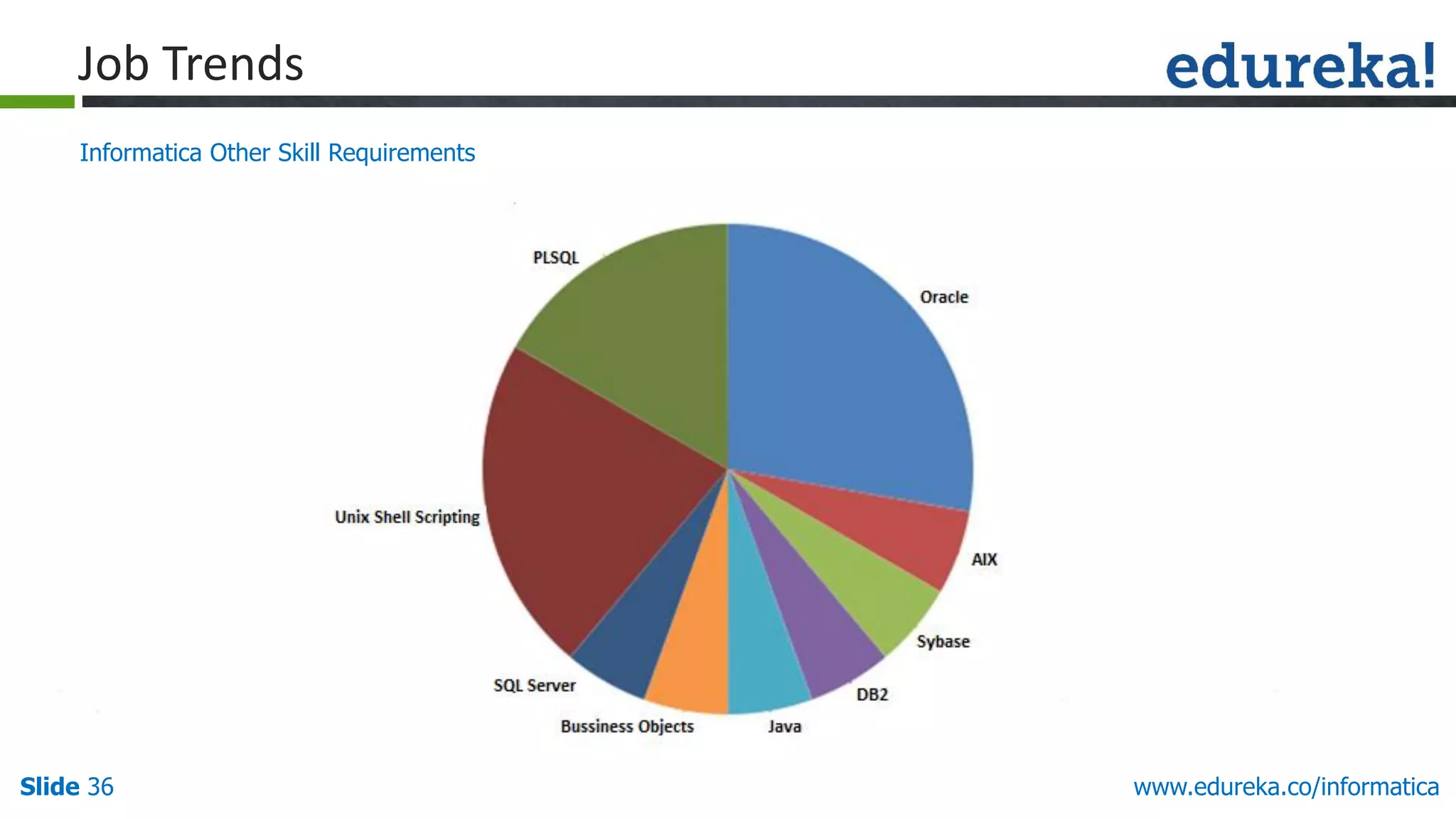
Job Trends
Informatica Other Skill Requirements
Slide 37 www.edureka.co/informatica
Informatica PowerCenter Basic
Informatica PowerCenter Advanced Transformations
Informatica PowerCenter Installation and Configuration
Informatica PowerCenter Administration and Operation Basics
PowerCenter Troubleshooting & Performance Tuning
Best Practices and Methodology
Ample amount of Lab to be followed after each module
Scope of This Course
Slide 38 www.edureka.co/informatica
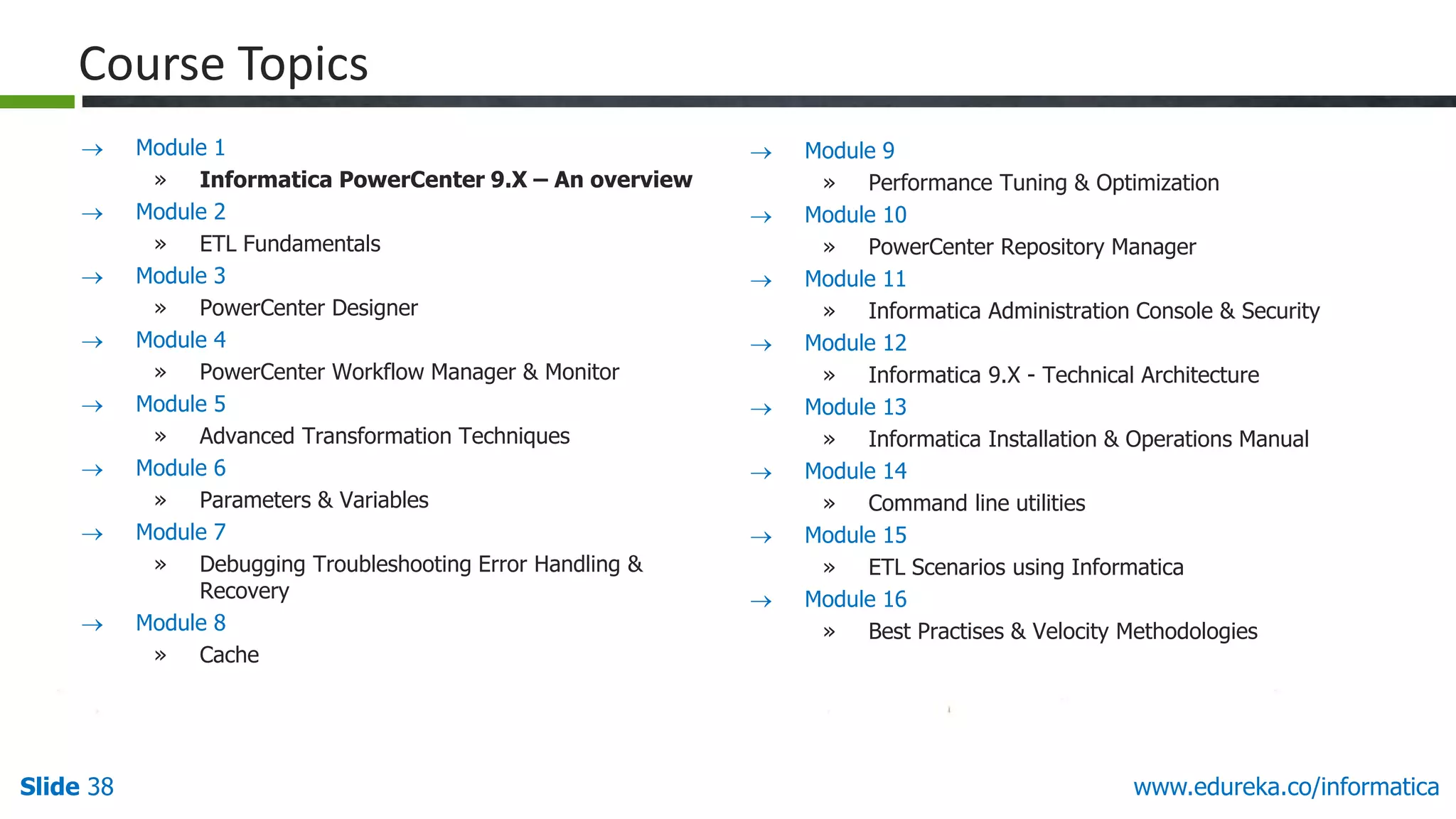
 Module 9
» Performance Tuning & Optimization
 Module 10
» PowerCenter Repository Manager
 Module 11
» Informatica Administration Console & Security
 Module 12
» Informatica 9.X - Technical Architecture
 Module 13
» Informatica Installation & Operations Manual
 Module 14
» Command line utilities
 Module 15
» ETL Scenarios using Informatica
 Module 16
» Best Practises & Velocity Methodologies
 Module 1
» Informatica PowerCenter 9.X – An overview
 Module 2
» ETL Fundamentals
 Module 3
» PowerCenter Designer
 Module 4
» PowerCenter Workflow Manager & Monitor
 Module 5
» Advanced Transformation Techniques
 Module 6
» Parameters & Variables
 Module 7
» Debugging Troubleshooting Error Handling &
Recovery
 Module 8
» Cache
Course Topics
Slide 39
LIVE Online Class
Class Recording in LMS
24/7 Post Class Support
Module Wise Quiz
Project Work
Verifiable Certificate
www.edureka.co/informatica
How it Works
Slide 40

ETL Using Informatica Power Center

  • 1.
    www.edureka.co View Informatica coursedetails at www.edureka.co/informatica ETL Using Informatica Power Center For Queries: Post on Twitter @edurekaIN: #askEdureka Post on Facebook /edurekaIN For more details please contact us: US : 1800 275 9730 (toll free) INDIA : +91 88808 62004 Email Us : sales@edureka.co www.edureka.co/informatica
  • 2.
    Slide 2 www.edureka.co/informatica Atthe end of this session, you will be able to understand:  The Information Economy  ETL - an Overview  Why ETL is still relevant?  Informatica Overview  The Informatica Platform  Why Informatica  Informatica Partners & Customers  Informatica Architecture Overview & Components  Usecase1 - Loading Product Dimension table using Slowly changing dimension (SCD)  Usecase2 - Populate Sales summary table using Incremental Aggregation  Job trends  Scope of this course Objectives
  • 3.
    Slide 3 www.edureka.co/informatica Mergers Acquisitions & Divestitures Acquire& Retain Customers Outsource Non-core Functions Improve Decisions Modernize Business Improve Efficiency & Reduce Costs Lack of relevant, trustworthy and timely data Governance Risk Compliance Increase Partner Network Efficiency Increase Business Agility ConsolidationGlobalization Growth Operational Efficiency Governance The Information Economy Lack of Trustworthy Data Impedes Key Business Imperatives
  • 4.
    Slide 4 www.edureka.co/informatica ETL- An Overview ETL stands for Extraction, Transformation and Load The "E" represents the ability to consistently and reliably extract data with high performance and minimal impact to the source system The "T" represents the ability to transform one or more data sets in batch or real-time into a consumable format The "L" stands for loading data into a persistent or virtual data store
  • 5.
    Slide 5 www.edureka.co/informatica WhyETL is Still Relevant Is ETL becoming a History with the advent of Big Data? Data needs to flow from source applications into analytic data stores in a controlled, reliable, secure manner Information needs to be standardized, with regards to semantics, format and lexicon, for accurate analysis Operational results need to be consistent and repeatable Operational results need to be verifiable and transparent
  • 6.
    Slide 6 www.edureka.co/informatica FacilitatesIntegration of data from various data sources for building a Data warehouse Businesses have data in multiple databases with different codification and formats Transformation is required to convert and to summarize operational data into a consistent, business oriented format Pre-Computation of any derived information Summarization is also carried out to pre-compute summaries and aggregates Makes data available in a query-able format Why ETL is Still Relevant Mergers and acquisitions also create disparities in data representation and pose more difficult challenges in ETL.
  • 7.
    Slide 7 www.edureka.co/informatica Informatica– A Product Company Informatica Corp Provides data integration software and services for various business, industries and government organizations including telecommunications, health care, financial and insurance services. Founded : 1993 2012 Revenue : $811.6 million 7-year Annual CAGR: 17% per year Employees : 2,810+ Partners : 450+ » Major SI, ISV, OEM and On-Demand Leaders Customers: Over 5,000 » Customers in 82 countries » Direct Presence in 28 countries » # 1 in Customer Loyalty Rankings (7 Years in a Row)
  • 8.
    Slide 8 www.edureka.co/informatica TheInformatica Approach Comprehensive, Unified, Open and Economical Approach
  • 9.
    Slide 9 www.edureka.co/informatica InformaticaProducts & Their Functionalities There are a wide range of Products available under the Informatica product suite that helps satisfy the data integration requirements within the enterprise and beyond Informatica's product is a portfolio focused on Data Integration: Data Integration & ETL Information Lifecycle Management Complex Event Processing Data Masking Data Quality Data Replication Data Virtualization Master Data Management Ultra Messaging Currently at version 9.6, these components form a toolset for establishing and maintaining enterprise-wide data warehouses
  • 10.
    Slide 10 www.edureka.co/informatica InformaticaProducts & Their Functionalities
  • 11.
    Slide 11 www.edureka.co/informatica ASingular Focus on Data Integration Why Informatica?  Proven technology leadership  A track record of continuous innovation  The most neutral trusted partner  Long history of customer success
  • 12.
    Slide 12 www.edureka.co/informatica BusinessGlossary, ICC Manageability Informatica 8.6.1 Cloud Synch. Q4 2008 Application ILM Q1 2009 Application Information Lifecycle Management CEP PowerCenter CE Q3 2009 Informatica 9.0 Informatica Cloud 9 Q4 2009 Collaboration, Pervasive DQ, Data Services Address Validation Q2 2009 Address Validation for DQ Complex Event Processing and Cloud IaaS MDM Ultra Messaging Q1 2010 Multi-domain MDM Ultra-low Latency Messaging Informatica Marketplace Q2 2010 Online exchange for solutions Cloud Q4 2010 Trust framework, plug- ins MDM ILM Q3 2010 Test data mgmt Why Informatica? A Track Record of Continuous Innovation
  • 13.
    Slide 13 www.edureka.co/informatica FinancialServices and Insurance Tele- communications Manufacturing Retail and Services Healthcare and Life Sciences Utilities and Energy Government and Public Sector Transportation and Distribution Over 4,200 Leaders Rely on Informatica Why Informatica?
  • 14.
    Slide 14 www.edureka.co/informatica PowerCenter: Itis a single, unified enterprise data integration platform that allows companies and government organizations of all sizes to access, discover and integrate data from virtually any business system, in any format and deliver that data throughout the enterprise at any speed. An ETL tool ( Extract, Transform and Load) The main advantages of PowerCenter over other ETL tools lies in its robustness, for it can be used in both Windows and Unix based systems.  PowerCenter can read from a variety of different sources and write to as many targets, while transforming data in between. The main advantages of PowerCenter over other ETL tools, and hence a reason for its popularity over other such tools are as follows: » It is robust, and can be used in both windows and UNIX based systems » It is high performing yet very simple for developing, maintaining and administering Introduction to PowerCenter
  • 15.
    Slide 15 www.edureka.co/informatica Thearchitecture of Informatica PowerCenter (version 9.x onwards) is based on the service Oriented Architecture (SOA) concept. A service-oriented architecture (SOA) can be defined as a group of services, which communicate with each other. The process of communication involves either simple data passing or it could involve two or more services coordinating same activity. Informatica 9.X represents a major change in the architecture of the product line. Aim: Its main aim is to provide improved performance and high availability. Approach: By reengineering the underlying architecture has been made even more services-based. PowerCenter Architecture - SOA
  • 16.
    Slide 16 www.edureka.co/informatica PowerCenterArchitecture Single Unified Architecture
  • 17.
    Slide 17 www.edureka.co/informatica PowerCenterArchitecture - Proven Scalability Threaded Parallel Processing
  • 18.
    Slide 18 www.edureka.co/informatica PowerCenterArchitecture - Proven Scalability Pipeline Parallel Processing
  • 19.
    Slide 19 www.edureka.co/informatica ClientComponents of PowerCenter PowerCenter Repository Manager PowerCenter Designer PowerCenter Workflow Manager PowerCenter Workflow Monitor PowerCenter Administration Console (browser based)
  • 20.
    Slide 20 www.edureka.co/informatica ThePowerCenter server components comprises of the following services: Repository service: The Repository service manages the repository. It retrieves, inserts, and updates metadata into the repository database tables. Integration service: The Integration service runs sessions and workflows. SAP BW service: The SAP BW service looks out for RFC requests from SAP BW and initiates workflows to extract data from, or load data into the SAP BW. Web services hub: The Web services hub receives requests from web service clients and exposes PowerCenter workflows as services. Server Components of PowerCenter
  • 21.
    Slide 21Slide 21Slide21 www.edureka.co/informatica ODBC Targets Native drivers/ ODBC Native drivers/ ODBC HTTPS SOURCES Native drives TCP/IP TCP/IP ODBC Power Center Client Administrator Security Domain MetadataRepository Native drives TCP/IP DOMAIN Repository Service Repository Service Process Overall Architecture of PowerCenter Integration Service
  • 22.
    Slide 22 www.edureka.co/informatica Thesalient features of a Domain are as follows: » A Domain is a logical collection or set of nodes and services. » The PowerCenter Domain is the fundamental administrative unit of PowerCenter. » A Domain can be a single PowerCenter installation, or it can consist of multiple PowerCenter installations. The salient features of a node are as follows: » A node is a logical representation of a physical machine. It has physical attributes such as a hostname and a port number. » Each node runs a service manager which is responsible for the application and core services. » A node can be a gateway node or a worker node, but it can belong to only one Domain. Informatica - Domain & Nodes
  • 23.
    Slide 23 www.edureka.co/informatica Aservice can be described as follows: A service is a resource that provides specialized functions. All PowerCenter processes run as services on a node. PowerCenter has two types of services: » Application Services represent server based functions including Repository and Integration Services. » Core Services represent functions that manage and maintain the environment in which PowerCenter operates and include services like Log Service, Licensing Service, and Domain Service amongst many others. Informatica- Services
  • 24.
    Slide 24 www.edureka.co/informatica Component-baseddevelopment is a technique where predefined components or functional units, or both, with specific functionalities are used to assemble the final product. PowerCenter follows the component-based development methodologies by allowing to build a data flow from a source to the target, using different components (called transformations) and linking them to each other as required. Component Based Development Techniques
  • 25.
    Slide 25 www.edureka.co/informatica Theadvantages of a component-based development model are as listed below: As the functional units are already built, the developer need not build them from scratch and can instead use them directly. Apart from making the entire process easier, this reduces the development time as well. This approach makes bug-fixing easier as well as aid in various maintenance activities, with only the malfunctioned components needing to be fixed. Reusability is also another factor that works in the favor of a component-based development model Component Based Development Techniques
  • 26.
    Slide 26 www.edureka.co/informatica Transformationis the process in ETL where we actually apply the business rules in the data flow It is here that the data cleansing and formatting activities are actually performed along with data validation, which is one of its main functionalities In PowerCenter, transformations are the functional components In order to meet all kinds of requirements, a wide range of transformations are available within Informatica The hierarchy goes in this way » Transformation » Mapping » Sessions » Workflow Transformation -> Mapping -> Session -> Workflow
  • 27.
    Slide 27 www.edureka.co/informatica InformaticaPowerCenter is the premium data integration solution available today "Database neutral” - will communicate with any database  Powerful data transformations convert one application’s data to another’s format Informatica PowerCenter – DI Solution Manufacturing (DB2) Sales (SalesForce) Billing (Sybase) Resource Planning (PSFT) Inventory (SQL Server) Marketing (ORCL) Accounting (upgraded) Informatica PowerCenter
  • 28.
    Slide 28 www.edureka.co/informatica Acompany purchases a new accounts payable application  PowerCenter can move the existing account data to the new application » Preserves data lineage for tax, accounting, and other legally mandated purposes Data Migration Informatica PowerCenter Accounting (Old) Accounting (New)
  • 29.
    Slide 29 www.edureka.co/informatica CompanyA purchases Company B To achieve the benefits of consolidation, Company B’s billing system must be integrated into Company A’s billing system Application Integration Informatica PowerCenterBilling A Billing B
  • 30.
    Slide 30 www.edureka.co/informatica DataWarehousing  Data warehouses put information from many sources together for analysis  Data is moved from many databases to the Data warehouse Inventory (SQL Server) Informatica PowerCenter Marketing (ORCL) Accounting (upgraded) Manufacturing (DB2) Resource Planning (PSFT) Sales (SalesForce) Billing (Sybase) Data warehouse
  • 31.
    Slide 31 www.edureka.co/informatica Middleware Informaticacan connect variety of sources, including the most of the Application Sources  SAP certified Data Integration tool  Can pull and push data into SAP R3, SAP BW systems  Have connectivity adapter for majority of the Application Sources  Can be used as Middleware between two Applications like SAP R3, SAP BW etc.
  • 32.
    Slide 32 www.edureka.co/informatica SomeUnique Features of Informatica Single Administration console to Administer all the application services Unified Users, Groups, Privileges and Roles admin across PC AE Tools Single Sign on for all the client tool - Once you login to one client tool, others are automatically logged in In built version control Grid and High availability In built scheduling tool
  • 33.
    Slide 33 www.edureka.co/informatica LoadingProduct Dimension table using Slowly changing dimension (SCD) Populate Sales summary table using Incremental Aggregation Demonstrating Informatica PowerCenter Partitioning capability Use Cases
  • 34.
    Slide 34 www.edureka.co/informatica Fresher »Data Warehouse Developer » ETL developer Mid Level » Data Specialist » Sr. ETL Developer » Informatica Designer » Informatica Administrator Senior Level » ETL Architect » Informatica Architect » Technical Manager Job Trends Informatica - Role Wise Comparison
  • 35.
    Slide 35 www.edureka.co/informatica JobTrends Informatica Skill Requirements
  • 36.
    Slide 36 www.edureka.co/informatica JobTrends Informatica Other Skill Requirements
  • 37.
    Slide 37 www.edureka.co/informatica InformaticaPowerCenter Basic Informatica PowerCenter Advanced Transformations Informatica PowerCenter Installation and Configuration Informatica PowerCenter Administration and Operation Basics PowerCenter Troubleshooting & Performance Tuning Best Practices and Methodology Ample amount of Lab to be followed after each module Scope of This Course
  • 38.
    Slide 38 www.edureka.co/informatica Module 9 » Performance Tuning & Optimization  Module 10 » PowerCenter Repository Manager  Module 11 » Informatica Administration Console & Security  Module 12 » Informatica 9.X - Technical Architecture  Module 13 » Informatica Installation & Operations Manual  Module 14 » Command line utilities  Module 15 » ETL Scenarios using Informatica  Module 16 » Best Practises & Velocity Methodologies  Module 1 » Informatica PowerCenter 9.X – An overview  Module 2 » ETL Fundamentals  Module 3 » PowerCenter Designer  Module 4 » PowerCenter Workflow Manager & Monitor  Module 5 » Advanced Transformation Techniques  Module 6 » Parameters & Variables  Module 7 » Debugging Troubleshooting Error Handling & Recovery  Module 8 » Cache Course Topics
  • 39.
    Slide 39 LIVE OnlineClass Class Recording in LMS 24/7 Post Class Support Module Wise Quiz Project Work Verifiable Certificate www.edureka.co/informatica How it Works
  • 40.