InfoCrisis.Social
A socially powered information dashboard to help
communities face disruptive events by optimizing
information and resource flow.
Gonzalo Bacigalupe, EdD, MPH. - PI
Javier Velasco-Martín, PhD. – PM
Sustainable UX Conference
Feb 16th, 2017
Live from Algarrobo, Chile!
Who we are
• CIGIDEN
• Inria Chile
• InfoCrisis.Social
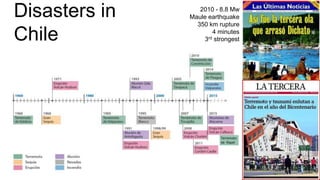
Disasters in
Chile
Terremoto
de Illapel
2010 - 8.8 Mw
Maule earthquake
350 km rupture
4 minutes
3rd strongest
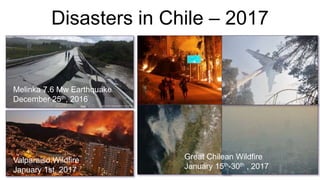
Disasters in Chile – 2017
Melinka 7.6 Mw Earthquake
December 25th, 2016
Valparaiso Wildfire
January 1st, 2017
Great Chilean Wildfire
January 15th-30th , 2017
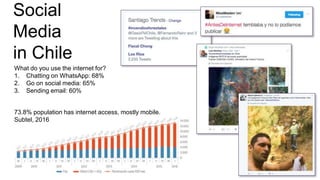
Social
Media
in Chile
73.8% population has internet access, mostly mobile.
Subtel, 2016
What do you use the internet for?
1. Chatting on WhatsApp: 68%
2. Go on social media: 65%
3. Sending email: 60%
Purpose
InfoCrisis.Social will provide citizens,
reporters, and researchers with real-time
tailored information related to natural
disasters and crises.
Initial
Sketch
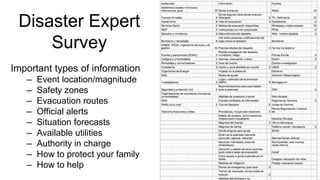
Disaster Expert
Survey
Important types of information
– Event location/magnitude
– Safety zones
– Evacuation routes
– Official alerts
– Situation forecasts
– Available utilities
– Authority in charge
– How to protect your family
– How to help
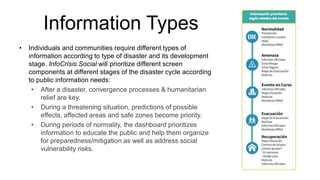
Information Types
• Individuals and communities require different types of
information according to type of disaster and its development
stage. InfoCrisis.Social will prioritize different screen
components at different stages of the disaster cycle according
to public information needs:
• After a disaster, convergence processes & humanitarian
relief are key.
• During a threatening situation, predictions of possible
effects, affected areas and safe zones become priority.
• During periods of normality, the dashboard prioritizes
information to educate the public and help them organize
for preparedness/mitigation as well as address social
vulnerability risks.
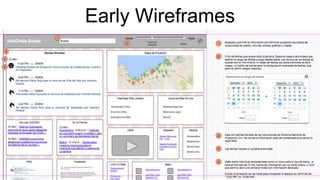
Early Wireframes
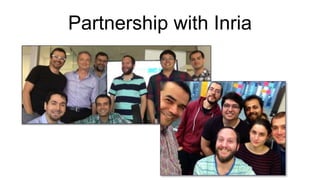
Partnership with Inria
Lots of brainstorming!
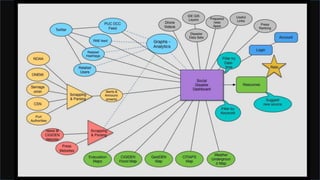
Conceptual Model –
Development
Conceptual Model
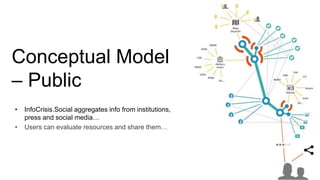
– Public
• InfoCrisis.Social aggregates info from institutions,
press and social media…
• Users can evaluate resources and share them…
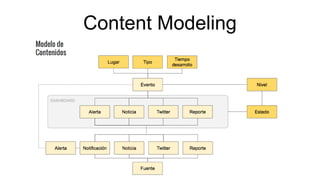
Content Modeling
Content Inventory
• Channels:
• Web
• RSS
• Twitter
• Facebook
• Youtube
• Instagram
• GIS Layers
Sources:
– Official
• Government
• Emergency offices
• Ports & Borders
• Fire Stations
• Police (central)
• Utility + Highway Cos.
– NGOs
• Emergency
• Volunteering
– Media
• National
• Regional
• Citizen
– Digital volunteers
– Public
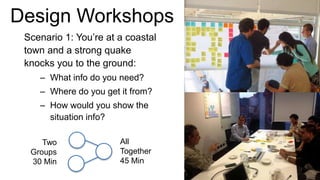
Design Workshops
Scenario 1: You’re at a coastal
town and a strong quake
knocks you to the ground:
– What info do you need?
– Where do you get it from?
– How would you show the
situation info?
Two
Groups
30 Min
All
Together
45 Min
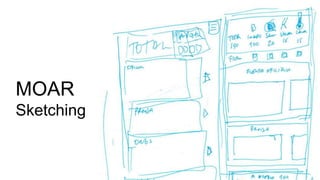
MOAR
Sketching
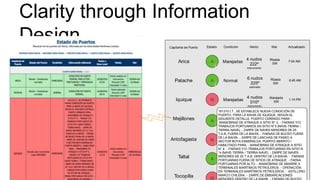
Clarity through Information
Design
Arica Marejadas 7:04 AM
4 nudos
222º
instrumento
A
Capitanía de Puerto Estado Condición Viento Mar Actualizado
RIzada
SW
Patache Normal 6:45 AM
6 nudos
225º
estimado
A RIzada
SW
Iquique Marejadas 1:14 PM
4 nudos
010º
instrumento
M
Marejada
SW
Mejillones
Antofagasta M
Taltal
Tocopilla M
A
A
161310 LT., SE ESTABLECE NUEVA CONDICIÓN DE
PUERTO, PARA LA BAHÍA DE IQUIQUE, SEGÚN EL
SIGUIENTE DETALLE: PUERTO CERRADO PARA: -
MANIOBRAS DE ATRAQUE A SITIO N° 3. - FAENAS Y/O
TRABAJOS PORTUARIOS EN SITIO N°3 (NAVE-TIERRA /
TIERRA-NAVE). - ZARPE DE NAVES MENORES DE 25
T.A.B. FUERA DE LA BAHÍA. - FAENAS DE BUCEO FUERA
DE LA BAHÍA. - ZARPE DE LANCHAS DE PASEO A
SECTOR BOYA ESMERALDA. PUERTO ABIERTO /
HABILITADO PARA: - MANIOBRAS DE ATRAQUE A SITIO
N° 4. - FAENAS Y/O TRABAJOS PORTUARIAS EN SITIO N
°4 (NAVE-TIERRA / TIERRA-NAVE). - ZARPE DE NAVES
MENORES DE 25 T.A.B. DENTRO DE LA BAHÍA. - FAENAS
PORTUARIAS FUERA DE SITIOS DE ATRAQUE. - FAENA
PORTUARIAS POR ALTO. - MANIOBRAS DE AMARRE A
TERMINALES MARÍTIMOS PETROLEROS. - OPERACIÓN
EN TERMINALES MARÍTIMOS PETROLEROS. - ASTILLERO
MARCO CHILENA. - ZARPE DE EMBARCACIONES
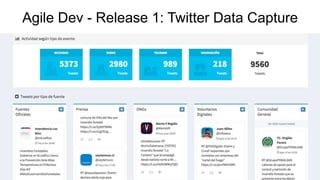
Agile Dev - Release 1: Twitter Data Capture
How is InfoCrisis.Social
sustainable?
A resilient community is less vulnerable to natural
hazards. It will be less damaged in its resources
and infrastructure, requiring fewer resources for its
recovery.
A resilient community knows the role of its natural
environment in presenting and preventing hazards.
How is InfoCrisis.Social
sustainable?
• A centralized repository saves internet traffic.
• Better information delivery, and especially volunteer and donation
coordination will save unnecessary or lost trips: A 2014 fire in
Valparaíso generated tons of thrashed donations due to poor
coordination, there were no means of redistributing them.
• Software components re-used.
• Keeping our code clean!
– HTML5, CSS3, WAI…
Securing resources
• Initial Costs
– Design
– Development
– Management
• Permanent Costs
– Hosting
– Project Management
– Community Management
• Volunteers, recurring
– Digital Volunteers to train the
system, different levels of
engagement
– Trusted group for development
and maintenance feedback
• Volunteers, sporadic
– Mapping
– Account classification
– Design evaluation and
brainstorm?
– Development & Platform
brainstorming?
– Any takers?
Thank You!
http://infocrisis.social - infocrisis.social@cigiden.cl
Gonzalo Bacigalupe, EdD, MPH – gonzalo.bacigalupe@cigiden.cl
Javier Velasco-Martín, PhD - javier.velasco@cigiden.cl
Sustainable UX Conference
Feb 16th, 2017

InfoCrisis.Social - Design Process

  • 1.
    InfoCrisis.Social A socially poweredinformation dashboard to help communities face disruptive events by optimizing information and resource flow. Gonzalo Bacigalupe, EdD, MPH. - PI Javier Velasco-Martín, PhD. – PM Sustainable UX Conference Feb 16th, 2017
  • 2.
  • 3.
    Who we are •CIGIDEN • Inria Chile • InfoCrisis.Social
  • 4.
    Disasters in Chile Terremoto de Illapel 2010- 8.8 Mw Maule earthquake 350 km rupture 4 minutes 3rd strongest
  • 5.
    Disasters in Chile– 2017 Melinka 7.6 Mw Earthquake December 25th, 2016 Valparaiso Wildfire January 1st, 2017 Great Chilean Wildfire January 15th-30th , 2017
  • 6.
    Social Media in Chile 73.8% populationhas internet access, mostly mobile. Subtel, 2016 What do you use the internet for? 1. Chatting on WhatsApp: 68% 2. Go on social media: 65% 3. Sending email: 60%
  • 7.
    Purpose InfoCrisis.Social will providecitizens, reporters, and researchers with real-time tailored information related to natural disasters and crises.
  • 8.
  • 9.
    Disaster Expert Survey Important typesof information – Event location/magnitude – Safety zones – Evacuation routes – Official alerts – Situation forecasts – Available utilities – Authority in charge – How to protect your family – How to help
  • 11.
    Information Types • Individualsand communities require different types of information according to type of disaster and its development stage. InfoCrisis.Social will prioritize different screen components at different stages of the disaster cycle according to public information needs: • After a disaster, convergence processes & humanitarian relief are key. • During a threatening situation, predictions of possible effects, affected areas and safe zones become priority. • During periods of normality, the dashboard prioritizes information to educate the public and help them organize for preparedness/mitigation as well as address social vulnerability risks.
  • 12.
  • 13.
  • 14.
  • 15.
  • 16.
    Conceptual Model – Public •InfoCrisis.Social aggregates info from institutions, press and social media… • Users can evaluate resources and share them…
  • 17.
  • 18.
    Content Inventory • Channels: •Web • RSS • Twitter • Facebook • Youtube • Instagram • GIS Layers Sources: – Official • Government • Emergency offices • Ports & Borders • Fire Stations • Police (central) • Utility + Highway Cos. – NGOs • Emergency • Volunteering – Media • National • Regional • Citizen – Digital volunteers – Public
  • 19.
    Design Workshops Scenario 1:You’re at a coastal town and a strong quake knocks you to the ground: – What info do you need? – Where do you get it from? – How would you show the situation info? Two Groups 30 Min All Together 45 Min
  • 20.
  • 21.
    Clarity through Information Design AricaMarejadas 7:04 AM 4 nudos 222º instrumento A Capitanía de Puerto Estado Condición Viento Mar Actualizado RIzada SW Patache Normal 6:45 AM 6 nudos 225º estimado A RIzada SW Iquique Marejadas 1:14 PM 4 nudos 010º instrumento M Marejada SW Mejillones Antofagasta M Taltal Tocopilla M A A 161310 LT., SE ESTABLECE NUEVA CONDICIÓN DE PUERTO, PARA LA BAHÍA DE IQUIQUE, SEGÚN EL SIGUIENTE DETALLE: PUERTO CERRADO PARA: - MANIOBRAS DE ATRAQUE A SITIO N° 3. - FAENAS Y/O TRABAJOS PORTUARIOS EN SITIO N°3 (NAVE-TIERRA / TIERRA-NAVE). - ZARPE DE NAVES MENORES DE 25 T.A.B. FUERA DE LA BAHÍA. - FAENAS DE BUCEO FUERA DE LA BAHÍA. - ZARPE DE LANCHAS DE PASEO A SECTOR BOYA ESMERALDA. PUERTO ABIERTO / HABILITADO PARA: - MANIOBRAS DE ATRAQUE A SITIO N° 4. - FAENAS Y/O TRABAJOS PORTUARIAS EN SITIO N °4 (NAVE-TIERRA / TIERRA-NAVE). - ZARPE DE NAVES MENORES DE 25 T.A.B. DENTRO DE LA BAHÍA. - FAENAS PORTUARIAS FUERA DE SITIOS DE ATRAQUE. - FAENA PORTUARIAS POR ALTO. - MANIOBRAS DE AMARRE A TERMINALES MARÍTIMOS PETROLEROS. - OPERACIÓN EN TERMINALES MARÍTIMOS PETROLEROS. - ASTILLERO MARCO CHILENA. - ZARPE DE EMBARCACIONES
  • 22.
    Agile Dev -Release 1: Twitter Data Capture
  • 23.
    How is InfoCrisis.Social sustainable? Aresilient community is less vulnerable to natural hazards. It will be less damaged in its resources and infrastructure, requiring fewer resources for its recovery. A resilient community knows the role of its natural environment in presenting and preventing hazards.
  • 24.
    How is InfoCrisis.Social sustainable? •A centralized repository saves internet traffic. • Better information delivery, and especially volunteer and donation coordination will save unnecessary or lost trips: A 2014 fire in Valparaíso generated tons of thrashed donations due to poor coordination, there were no means of redistributing them. • Software components re-used. • Keeping our code clean! – HTML5, CSS3, WAI…
  • 25.
    Securing resources • InitialCosts – Design – Development – Management • Permanent Costs – Hosting – Project Management – Community Management • Volunteers, recurring – Digital Volunteers to train the system, different levels of engagement – Trusted group for development and maintenance feedback • Volunteers, sporadic – Mapping – Account classification – Design evaluation and brainstorm? – Development & Platform brainstorming? – Any takers?
  • 26.
    Thank You! http://infocrisis.social -infocrisis.social@cigiden.cl Gonzalo Bacigalupe, EdD, MPH – gonzalo.bacigalupe@cigiden.cl Javier Velasco-Martín, PhD - javier.velasco@cigiden.cl Sustainable UX Conference Feb 16th, 2017

Editor's Notes

  • #2 Hello everybody! Thanks for our interest in our project.
  • #3 It’s great that we can do this conference online, but I still wish you guys could be here. I’m at a lovely beach town. It has a very quiet cove, a fisherman’s place, yatch club. It’s a quarter past noon here in the peak of summer. It’s full of people and everyone’s having fun with their family. NEXT
  • #4 CIGIDEN is a public-funded research center, gathering four universities, focused on integrated disaster management. Our group focuses on the use of ICTs for disasters. Inria is a French research center focused on math and computer sciences, they have a branch in Chile, also with public funding. In English, our project would be called Social Crisis Info.
  • #5 Chile is a multi-risk country, we have the most seismic territory and many types of risk. Active volcanoes, drought, snow storms, flash floods. 1960 a 9.0 the strongest recorded earthquake in history. In 2010, an 8.8 earthquake hit central-south Chile, the rupture was 350km long, this has been the third strongest earthquake in world records. It was felt as far as Sao Paulo, Brazil. Tsunami waves washed coastal towns following the quake.
  • #6 We’re only in February and our year has already been marked by disasters. On the last week of 2016, a 7.6 MW quake hit southern Chile. No lives were lost, no major structural damage. On new year’s morning, a wildfire entered Valparaíso, burning some 200 houses. Mid January the central-south area of the country was hit by a heat wave, along with extended drought and strong winds, forest fires went out of control, swiping over a million acres, and covering major cities in smoke. Six regions were declared under state of catastrophe, international assistance included the world’s largest tanker planes, the government has declared this the largest catastrophe in our history. Only some unusually strong rain was able to stop the emergency, temperatures decreased and with a sleuth of international help the situation was controlled . The country is now focused on volunteering and donations.
  • #7 At the same time, Chile is characterized by strong ICT penetration and social media participation. As expected, when a disaster hits, people take to social media. It’s such part of our culture we laugh about it.
  • #9 Like many projects, infocrisis.social started its life on a piece of paper
  • #10 One of our first step was to survey our captive experts on important types of information, and sources during a disaster.
  • #12 One of the important takes of this project is the capacity to adjust the relevance of information based on the stage of the disaster. For example if you are in an affected area and there is an evacuation underway, the evacuation maps will be the first thing you see!
  • #13 We started exploring some more refined wireframes of what the interface could look like.
  • #14 And later we established a partnership with Inria Chile. I know, it sucks that we don’t have women on our team at the moment, we’ve had one on other stages and hope to recruit more soon. But sometimes you just can’t have such privilege. This picture is not from our initial meeting but one later on with an awesome guest.
  • #15 Along with Inria, we’ve done lots of brainstorming on how the system should work and how to build it.
  • #16 This is our backend conceptual model.
  • #17 And we also developed a public-oriented conceptual model that was presented as poster in a conference.
  • #20 We’ve recruited different stakeholder groups to conduct Co-Design workshops. Based on scenarios, we ask participants to discuss what type of information they need, and then to design a solution together.
  • #21 Which has led to more sketching.
  • #23 While our dev team has been working on figuring out how to gather data from Twitter, querying for disaster type keywords and grouping according to source type. This is a small but critical component of our system.