InfluxDB & Grafana
@ OC Tanner
by Pedro Salgado
1-slide intro to InfluxDB
• “InfluxDB is a time series, metrics, and analytics database.
• It’s written in Go and has no external dependencies.
• That means once you install it there’s nothing else to manage
(such as Redis, ZooKeeper, Cassandra, HBase, or anything else).
• InfluxDB is targeted at use cases for DevOps, metrics, sensor
data, and real-time analytics.
• It arose from our need for a database like this on more than a few
previous products we’ve built.”
• source: influxdb.com
– Mark Twain
“Get your facts first,
then you can distort them as you please.”
Time-series
• “A time series is a sequence of data points, typically
consisting of successive measurements made over a
time interval.
• Examples of time series are ocean tides, counts of
sunspots, and the daily closing value of the Dow
Jones Industrial Average.
• Time series are very frequently plotted via line charts.”
• source: wikipedia
Data point
• “In statistics, a data point or observation is a set
of one or more measurements on a single
member of a statistical population.“
• source: wikipedia
Measurement
• “Measurement is the assignment of a number to
a characteristic of an object or event, which can
be compared with other objects or events.
• The scope and application of a measurement is
dependent on the context and discipline.
• source: wikipedia
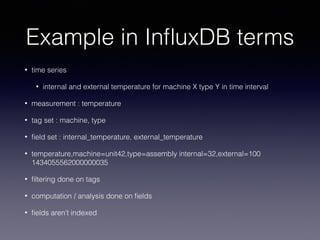
Example in InfluxDB terms
• time series
• internal and external temperature for machine X type Y in time interval
• measurement : temperature
• tag set : machine, type
• field set : internal_temperature, external_temperature
• temperature,machine=unit42,type=assembly internal=32,external=100
1434055562000000035
• filtering done on tags
• computation / analysis done on fields
• fields aren’t indexed
• data written using line protocol
• [key] [point] [timestamp]
• key = <measurement>,<tag set>
• temperature,machine=unit42,type=assembly
• point = <field set>
• internal=32,external=100
• timestamp
• 1434055562000000035
• there can only be one point for a series and timestamp
• you define precision of point (s, ms, μs, ns)
• you define how long data is kept : retention policy (replication, duration)
Other interesting features
• continuous queries
• clustering (alpha)
Grafana
• “An open source, feature rich metrics dashboard
and graph editor for Graphite, InfluxDB &
OpenTSDB”
• source: grafana.org
“A picture is worth a thousand words.”
• https://en.wikipedia.org/wiki/Time_series
• https://en.wikipedia.org/wiki/Data_point
• https://en.wikipedia.org/wiki/Measurement
• https://influxdb.com/docs/v0.9/introduction/
overview.html
• https://influxdb.com/docs/v0.9/concepts/glossary.html
• http://grafana.org/
• https://github.com/steenzout/
– Dr Seuss
“Don't cry because it's over,
smile because it happened.”

InfluxDB & Grafana

  • 1.
    InfluxDB & Grafana @OC Tanner by Pedro Salgado
  • 2.
    1-slide intro toInfluxDB • “InfluxDB is a time series, metrics, and analytics database. • It’s written in Go and has no external dependencies. • That means once you install it there’s nothing else to manage (such as Redis, ZooKeeper, Cassandra, HBase, or anything else). • InfluxDB is targeted at use cases for DevOps, metrics, sensor data, and real-time analytics. • It arose from our need for a database like this on more than a few previous products we’ve built.” • source: influxdb.com
  • 3.
    – Mark Twain “Getyour facts first, then you can distort them as you please.”
  • 4.
    Time-series • “A timeseries is a sequence of data points, typically consisting of successive measurements made over a time interval. • Examples of time series are ocean tides, counts of sunspots, and the daily closing value of the Dow Jones Industrial Average. • Time series are very frequently plotted via line charts.” • source: wikipedia
  • 5.
    Data point • “Instatistics, a data point or observation is a set of one or more measurements on a single member of a statistical population.“ • source: wikipedia
  • 6.
    Measurement • “Measurement isthe assignment of a number to a characteristic of an object or event, which can be compared with other objects or events. • The scope and application of a measurement is dependent on the context and discipline. • source: wikipedia
  • 7.
    Example in InfluxDBterms • time series • internal and external temperature for machine X type Y in time interval • measurement : temperature • tag set : machine, type • field set : internal_temperature, external_temperature • temperature,machine=unit42,type=assembly internal=32,external=100 1434055562000000035 • filtering done on tags • computation / analysis done on fields • fields aren’t indexed
  • 8.
    • data writtenusing line protocol • [key] [point] [timestamp] • key = <measurement>,<tag set> • temperature,machine=unit42,type=assembly • point = <field set> • internal=32,external=100 • timestamp • 1434055562000000035 • there can only be one point for a series and timestamp • you define precision of point (s, ms, μs, ns) • you define how long data is kept : retention policy (replication, duration)
  • 9.
    Other interesting features •continuous queries • clustering (alpha)
  • 10.
    Grafana • “An opensource, feature rich metrics dashboard and graph editor for Graphite, InfluxDB & OpenTSDB” • source: grafana.org
  • 11.
    “A picture isworth a thousand words.”
  • 12.
    • https://en.wikipedia.org/wiki/Time_series • https://en.wikipedia.org/wiki/Data_point •https://en.wikipedia.org/wiki/Measurement • https://influxdb.com/docs/v0.9/introduction/ overview.html • https://influxdb.com/docs/v0.9/concepts/glossary.html • http://grafana.org/ • https://github.com/steenzout/
  • 13.
    – Dr Seuss “Don'tcry because it's over, smile because it happened.”