Inference Principles for Biostatisticians 1st Edition Ian C. Marschner
Inference Principles for Biostatisticians 1st Edition Ian C. Marschner
Inference Principles for Biostatisticians 1st Edition Ian C. Marschner
Inference Principles for Biostatisticians 1st Edition Ian C. Marschner
Inference Principles for Biostatisticians 1st Edition Ian C. Marschner
1.
Inference Principles forBiostatisticians 1st
Edition Ian C. Marschner download pdf
https://ebookultra.com/download/inference-principles-for-
biostatisticians-1st-edition-ian-c-marschner/
Visit ebookultra.com today to download the complete set of
ebook or textbook!
2.
Here are somerecommended products for you. Click the link to
download, or explore more at ebookultra.com
Linear Statistical Inference and Its Application 2nd
edition C. Radhakrishna Rao
https://ebookultra.com/download/linear-statistical-inference-and-its-
application-2nd-edition-c-radhakrishna-rao/
Principles Of Financial Accounting Third Edition Ian
Gillespie
https://ebookultra.com/download/principles-of-financial-accounting-
third-edition-ian-gillespie/
Principles Of Financial Accounting 3rd Edition Ian
Gillespie
https://ebookultra.com/download/principles-of-financial-
accounting-3rd-edition-ian-gillespie/
Using Stata for Principles of Econometrics Fourth Edition
Lee C. Adkins
https://ebookultra.com/download/using-stata-for-principles-of-
econometrics-fourth-edition-lee-c-adkins/
3.
Pathwise Estimation andInference for Diffusion Market
Models 1st Edition Nikolai Dokuchaev
https://ebookultra.com/download/pathwise-estimation-and-inference-for-
diffusion-market-models-1st-edition-nikolai-dokuchaev/
Generic Inference A Unifying Theory for Automated
Reasoning 1st Edition Marc Pouly
https://ebookultra.com/download/generic-inference-a-unifying-theory-
for-automated-reasoning-1st-edition-marc-pouly/
Diabetes Cookbook For Canadians For Dummies 1st Edition
Ian Blumer
https://ebookultra.com/download/diabetes-cookbook-for-canadians-for-
dummies-1st-edition-ian-blumer/
Nonparametric Statistical Inference Fifth Edition
Chakraborti
https://ebookultra.com/download/nonparametric-statistical-inference-
fifth-edition-chakraborti/
Education Reform Revised Edition Library in a Book Ian C.
Friedman
https://ebookultra.com/download/education-reform-revised-edition-
library-in-a-book-ian-c-friedman/
5.
Inference Principles forBiostatisticians 1st Edition Ian C.
Marschner Digital Instant Download
Author(s): Ian C. Marschner
ISBN(s): 9781482222234, 148222223X
Edition: 1
File Details: PDF, 2.39 MB
Year: 2014
Language: english
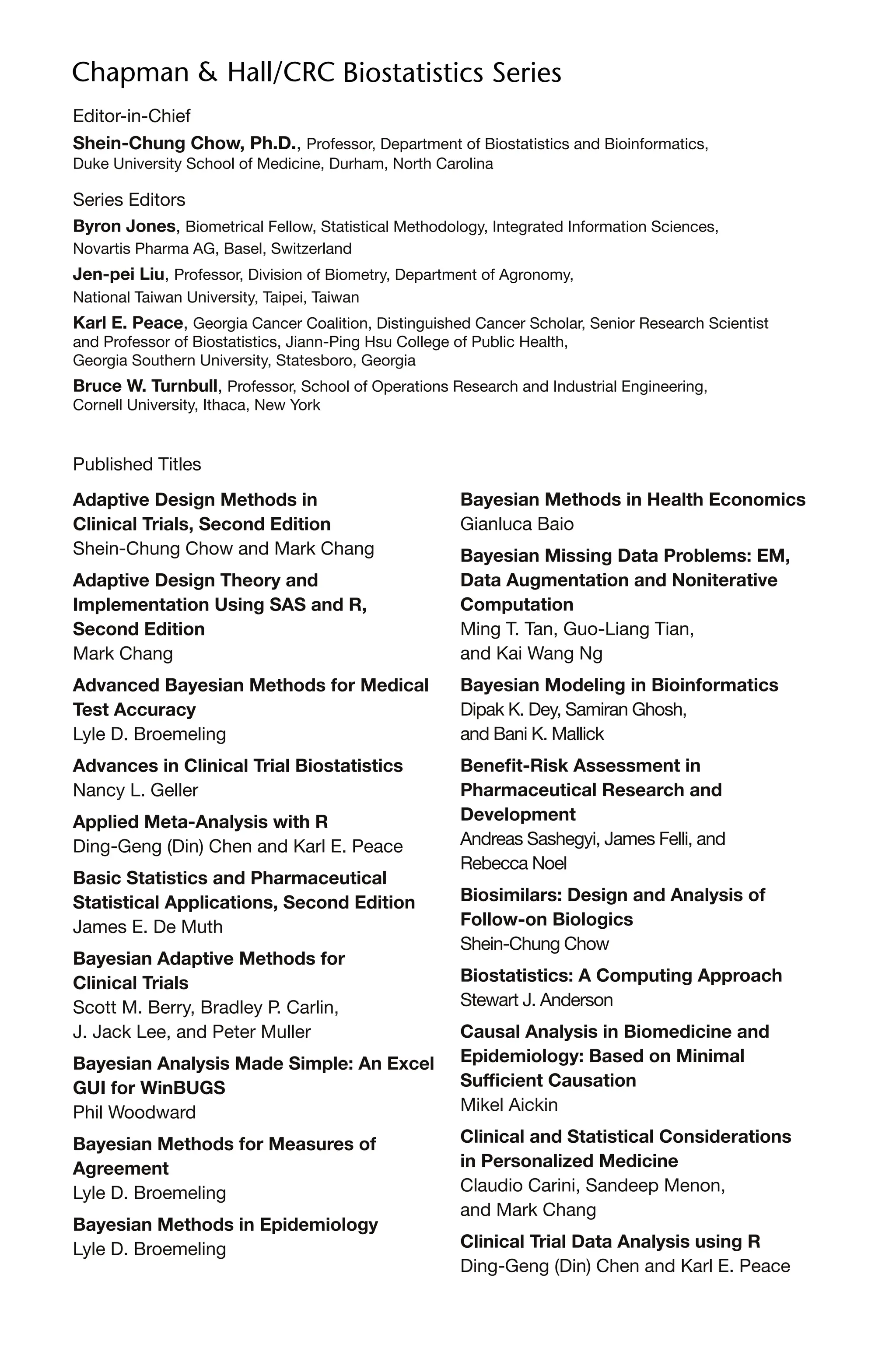
Editor-in-Chief
Shein-Chung Chow, Ph.D.,Professor, Department of Biostatistics and Bioinformatics,
Duke University School of Medicine, Durham, North Carolina
Series Editors
Byron Jones, Biometrical Fellow, Statistical Methodology, Integrated Information Sciences,
Novartis Pharma AG, Basel, Switzerland
Jen-pei Liu, Professor, Division of Biometry, Department of Agronomy,
National Taiwan University, Taipei, Taiwan
Karl E. Peace, Georgia Cancer Coalition, Distinguished Cancer Scholar, Senior Research Scientist
and Professor of Biostatistics, Jiann-Ping Hsu College of Public Health,
Georgia Southern University, Statesboro, Georgia
Bruce W. Turnbull, Professor, School of Operations Research and Industrial Engineering,
Cornell University, Ithaca, New York
Published Titles
Adaptive Design Methods in
Clinical Trials, Second Edition
Shein-Chung Chow and Mark Chang
Adaptive Design Theory and
Implementation Using SAS and R,
Second Edition
Mark Chang
Advanced Bayesian Methods for Medical
Test Accuracy
Lyle D. Broemeling
Advances in Clinical Trial Biostatistics
Nancy L. Geller
Applied Meta-Analysis with R
Ding-Geng (Din) Chen and Karl E. Peace
Basic Statistics and Pharmaceutical
Statistical Applications, Second Edition
James E. De Muth
Bayesian Adaptive Methods for
Clinical Trials
Scott M. Berry, Bradley P. Carlin,
J. Jack Lee, and Peter Muller
Bayesian Analysis Made Simple: An Excel
GUI for WinBUGS
Phil Woodward
Bayesian Methods for Measures of
Agreement
Lyle D. Broemeling
Bayesian Methods in Epidemiology
Lyle D. Broemeling
Bayesian Methods in Health Economics
Gianluca Baio
Bayesian Missing Data Problems: EM,
Data Augmentation and Noniterative
Computation
Ming T. Tan, Guo-Liang Tian,
and Kai Wang Ng
Bayesian Modeling in Bioinformatics
Dipak K. Dey, Samiran Ghosh,
and Bani K. Mallick
Benefit-Risk Assessment in
Pharmaceutical Research and
Development
Andreas Sashegyi, James Felli, and
Rebecca Noel
Biosimilars: Design and Analysis of
Follow-on Biologics
Shein-Chung Chow
Biostatistics: A Computing Approach
Stewart J. Anderson
Causal Analysis in Biomedicine and
Epidemiology: Based on Minimal
Sufficient Causation
Mikel Aickin
Clinical and Statistical Considerations
in Personalized Medicine
Claudio Carini, Sandeep Menon,
and Mark Chang
Clinical Trial Data Analysis using R
Ding-Geng (Din) Chen and Karl E. Peace
9.
Clinical Trial Methodology
KarlE. Peace and Ding-Geng (Din) Chen
Computational Methods in Biomedical
Research
Ravindra Khattree and Dayanand N. Naik
Computational Pharmacokinetics
Anders Källén
Confidence Intervals for Proportions and
Related Measures of Effect Size
Robert G. Newcombe
Controversial Statistical Issues in
Clinical Trials
Shein-Chung Chow
Data and Safety Monitoring Committees
in Clinical Trials
Jay Herson
Design and Analysis of Animal Studies in
Pharmaceutical Development
Shein-Chung Chow and Jen-pei Liu
Design and Analysis of Bioavailability and
Bioequivalence Studies, Third Edition
Shein-Chung Chow and Jen-pei Liu
Design and Analysis of Bridging Studies
Jen-pei Liu, Shein-Chung Chow,
and Chin-Fu Hsiao
Design and Analysis of Clinical Trials with
Time-to-Event Endpoints
Karl E. Peace
Design and Analysis of Non-Inferiority
Trials
Mark D. Rothmann, Brian L. Wiens,
and Ivan S. F. Chan
Difference Equations with Public Health
Applications
Lemuel A. Moyé and Asha Seth Kapadia
DNA Methylation Microarrays:
Experimental Design and Statistical
Analysis
Sun-Chong Wang and Arturas Petronis
DNA Microarrays and Related Genomics
Techniques: Design, Analysis, and
Interpretation of Experiments
David B. Allison, Grier P. Page,
T. Mark Beasley, and Jode W. Edwards
Dose Finding by the Continual
Reassessment Method
Ying Kuen Cheung
Elementary Bayesian Biostatistics
Lemuel A. Moyé
Frailty Models in Survival Analysis
Andreas Wienke
Generalized Linear Models: A Bayesian
Perspective
Dipak K. Dey, Sujit K. Ghosh,
and Bani K. Mallick
Handbook of Regression and Modeling:
Applications for the Clinical and
Pharmaceutical Industries
Daryl S. Paulson
Inference Principles for Biostatisticians
Ian C. Marschner
Interval-Censored Time-to-Event Data:
Methods and Applications
Ding-Geng (Din) Chen, Jianguo Sun,
and Karl E. Peace
Joint Models for Longitudinal and Time-
to-Event Data: With Applications in R
Dimitris Rizopoulos
Measures of Interobserver Agreement
and Reliability, Second Edition
Mohamed M. Shoukri
Medical Biostatistics, Third Edition
A. Indrayan
Meta-Analysis in Medicine and Health
Policy
Dalene Stangl and Donald A. Berry
Mixed Effects Models for the Population
Approach: Models, Tasks, Methods and
Tools
Marc Lavielle
Monte Carlo Simulation for the
Pharmaceutical Industry: Concepts,
Algorithms, and Case Studies
Mark Chang
Multiple Testing Problems in
Pharmaceutical Statistics
Alex Dmitrienko, Ajit C. Tamhane,
and Frank Bretz
10.
Noninferiority Testing inClinical Trials:
Issues and Challenges
Tie-Hua Ng
Optimal Design for Nonlinear Response
Models
Valerii V. Fedorov and Sergei L. Leonov
Patient-Reported Outcomes:
Measurement, Implementation and
Interpretation
Joseph C. Cappelleri, Kelly H. Zou,
Andrew G. Bushmakin, Jose Ma. J. Alvir,
Demissie Alemayehu, and Tara Symonds
Quantitative Evaluation of Safety in Drug
Development: Design, Analysis and
Reporting
Qi Jiang and H. Amy Xia
Randomized Clinical Trials of
Nonpharmacological Treatments
Isabelle Boutron, Philippe Ravaud, and
David Moher
Randomized Phase II Cancer Clinical
Trials
Sin-Ho Jung
Sample Size Calculations for Clustered
and Longitudinal Outcomes in Clinical
Research
Chul Ahn, Moonseong Heo, and
Song Zhang
Sample Size Calculations in Clinical
Research, Second Edition
Shein-Chung Chow, Jun Shao
and Hansheng Wang
Statistical Analysis of Human Growth
and Development
Yin Bun Cheung
Statistical Design and Analysis of
Stability Studies
Shein-Chung Chow
Statistical Evaluation of Diagnostic
Performance: Topics in ROC Analysis
Kelly H. Zou, Aiyi Liu, Andriy Bandos,
Lucila Ohno-Machado, and Howard Rockette
Statistical Methods for Clinical Trials
Mark X. Norleans
Statistical Methods in Drug Combination
Studies
Wei Zhao and Harry Yang
Statistics in Drug Research:
Methodologies and Recent
Developments
Shein-Chung Chow and Jun Shao
Statistics in the Pharmaceutical Industry,
Third Edition
Ralph Buncher and Jia-Yeong Tsay
Survival Analysis in Medicine and
Genetics
Jialiang Li and Shuangge Ma
Theory of Drug Development
Eric B. Holmgren
Translational Medicine: Strategies and
Statistical Methods
Dennis Cosmatos and Shein-Chung Chow
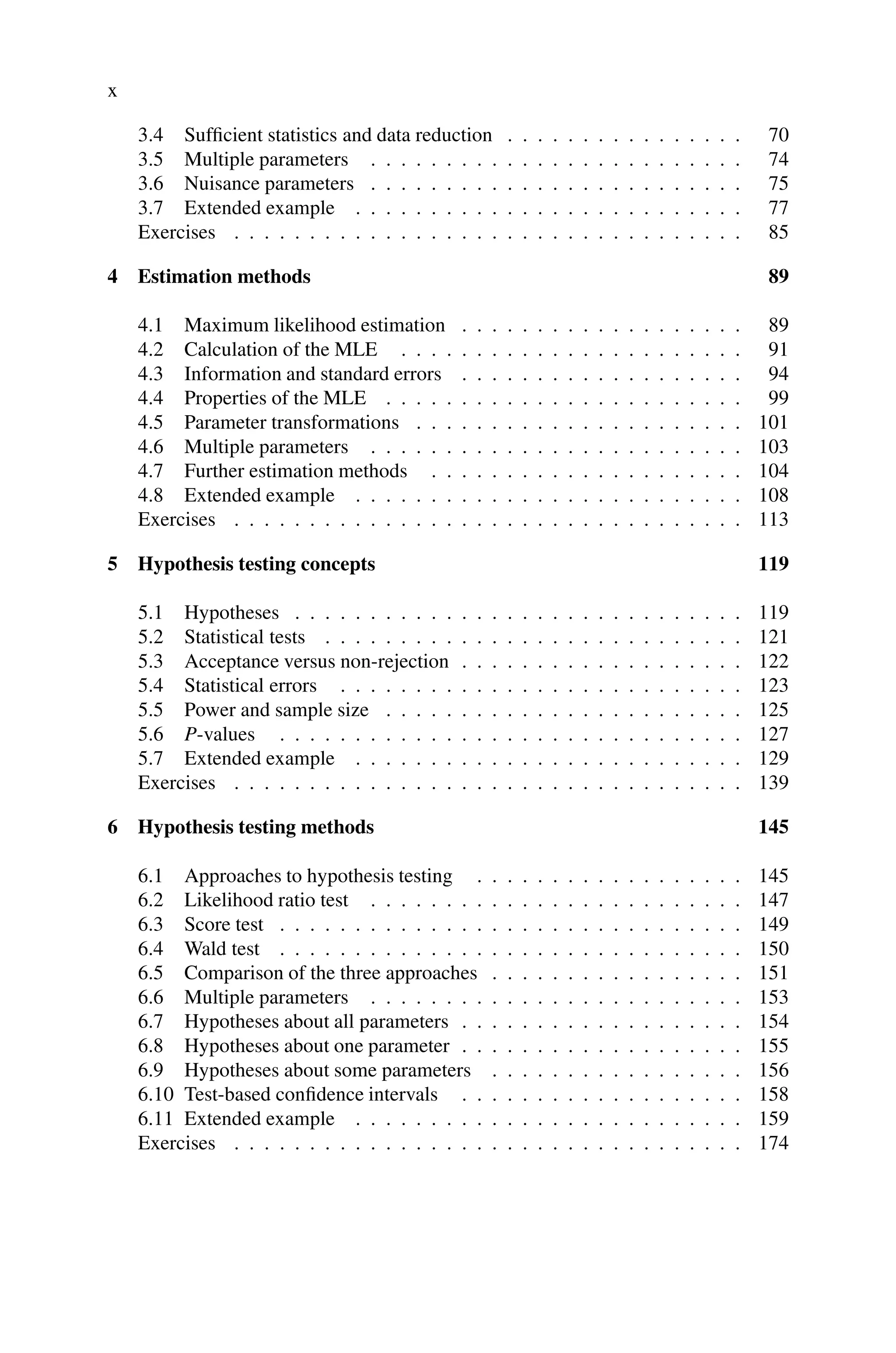
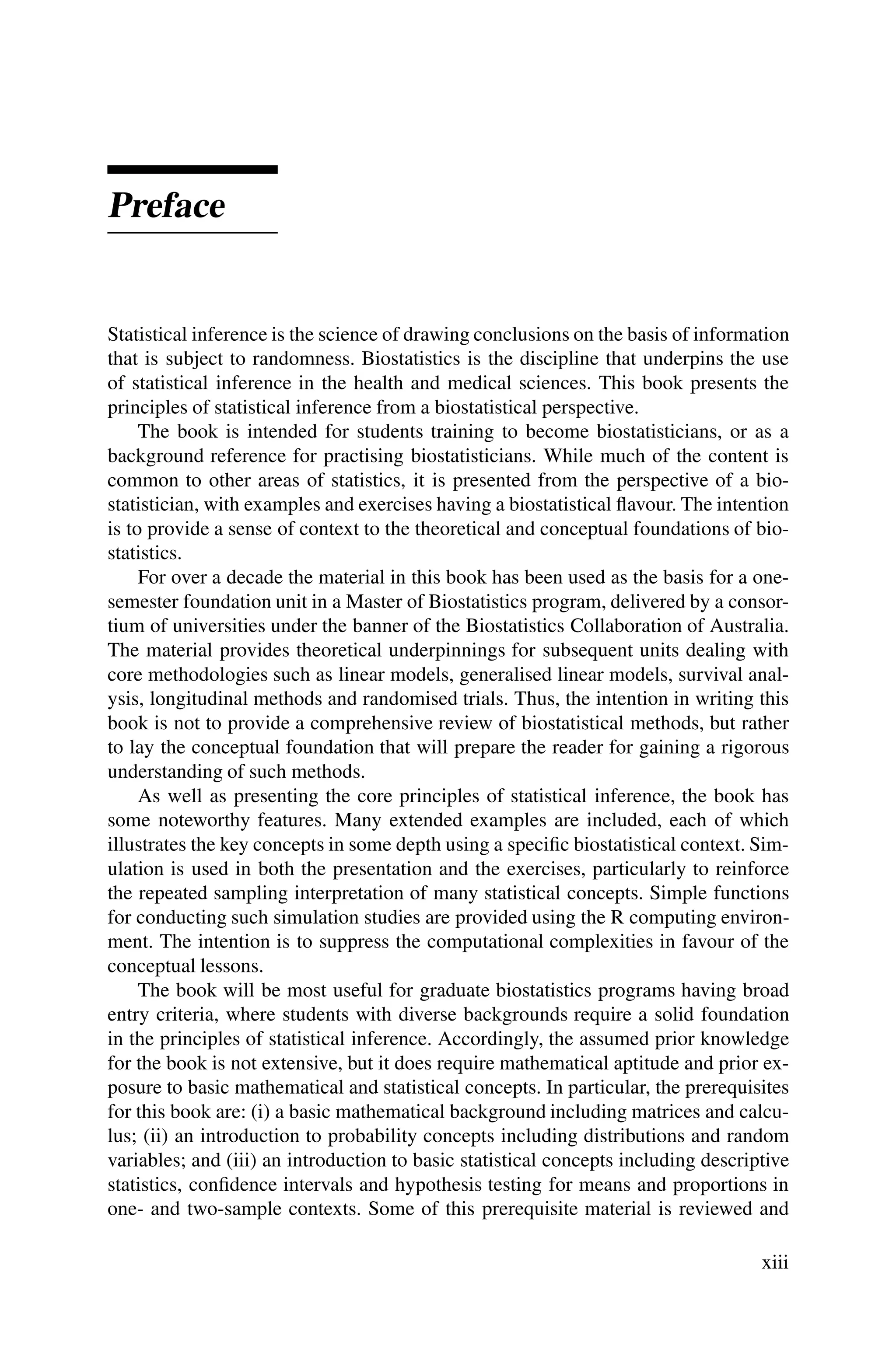
Preface
Statistical inference isthe science of drawing conclusions on the basis of information
that is subject to randomness. Biostatistics is the discipline that underpins the use
of statistical inference in the health and medical sciences. This book presents the
principles of statistical inference from a biostatistical perspective.
The book is intended for students training to become biostatisticians, or as a
background reference for practising biostatisticians. While much of the content is
common to other areas of statistics, it is presented from the perspective of a bio-
statistician, with examples and exercises having a biostatistical flavour. The intention
is to provide a sense of context to the theoretical and conceptual foundations of bio-
statistics.
For over a decade the material in this book has been used as the basis for a one-
semester foundation unit in a Master of Biostatistics program, delivered by a consor-
tium of universities under the banner of the Biostatistics Collaboration of Australia.
The material provides theoretical underpinnings for subsequent units dealing with
core methodologies such as linear models, generalised linear models, survival anal-
ysis, longitudinal methods and randomised trials. Thus, the intention in writing this
book is not to provide a comprehensive review of biostatistical methods, but rather
to lay the conceptual foundation that will prepare the reader for gaining a rigorous
understanding of such methods.
As well as presenting the core principles of statistical inference, the book has
some noteworthy features. Many extended examples are included, each of which
illustrates the key concepts in some depth using a specific biostatistical context. Sim-
ulation is used in both the presentation and the exercises, particularly to reinforce
the repeated sampling interpretation of many statistical concepts. Simple functions
for conducting such simulation studies are provided using the R computing environ-
ment. The intention is to suppress the computational complexities in favour of the
conceptual lessons.
The book will be most useful for graduate biostatistics programs having broad
entry criteria, where students with diverse backgrounds require a solid foundation
in the principles of statistical inference. Accordingly, the assumed prior knowledge
for the book is not extensive, but it does require mathematical aptitude and prior ex-
posure to basic mathematical and statistical concepts. In particular, the prerequisites
for this book are: (i) a basic mathematical background including matrices and calcu-
lus; (ii) an introduction to probability concepts including distributions and random
variables; and (iii) an introduction to basic statistical concepts including descriptive
statistics, confidence intervals and hypothesis testing for means and proportions in
one- and two-sample contexts. Some of this prerequisite material is reviewed and
xiii
20.
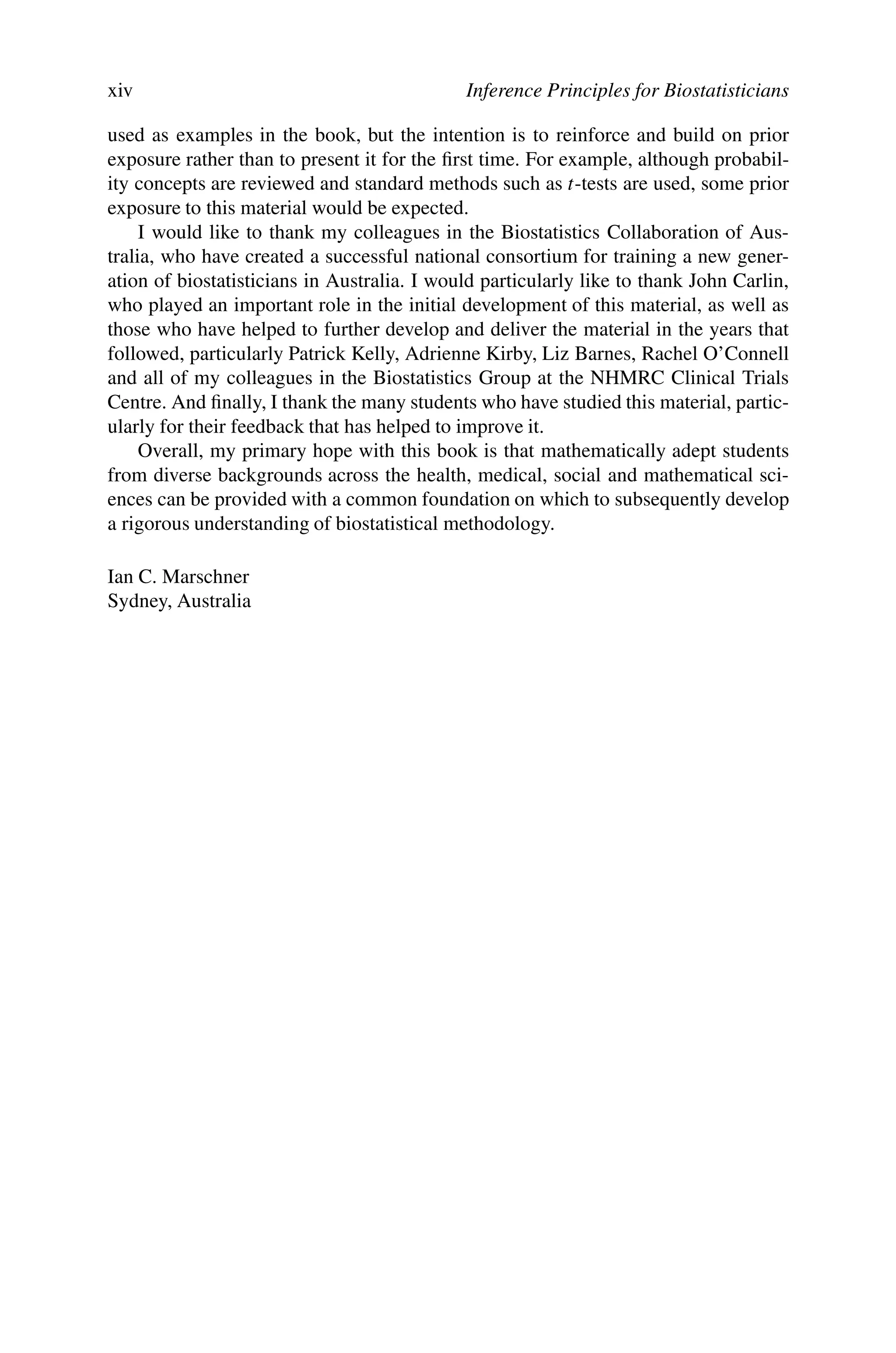
xiv Inference Principlesfor Biostatisticians
used as examples in the book, but the intention is to reinforce and build on prior
exposure rather than to present it for the first time. For example, although probabil-
ity concepts are reviewed and standard methods such as t-tests are used, some prior
exposure to this material would be expected.
I would like to thank my colleagues in the Biostatistics Collaboration of Aus-
tralia, who have created a successful national consortium for training a new gener-
ation of biostatisticians in Australia. I would particularly like to thank John Carlin,
who played an important role in the initial development of this material, as well as
those who have helped to further develop and deliver the material in the years that
followed, particularly Patrick Kelly, Adrienne Kirby, Liz Barnes, Rachel O’Connell
and all of my colleagues in the Biostatistics Group at the NHMRC Clinical Trials
Centre. And finally, I thank the many students who have studied this material, partic-
ularly for their feedback that has helped to improve it.
Overall, my primary hope with this book is that mathematically adept students
from diverse backgrounds across the health, medical, social and mathematical sci-
ences can be provided with a common foundation on which to subsequently develop
a rigorous understanding of biostatistical methodology.
Ian C. Marschner
Sydney, Australia
21.
About the author
IanMarschner is Head of the Department of Statistics and Professor of Statistics at
Macquarie University. He is also Professor of Biostatistics at the University of Syd-
ney, in the National Health and Medical Research Council (NHMRC) Clinical Trials
Centre. He has over 25 years of experience as a biostatistician working on health and
medical research, particularly involving clinical trials and epidemiological studies
of cardiovascular disease, cancer and HIV/AIDS. Formerly he was Director of the
Asia Biometrics Centre with the pharmaceutical company Pfizer and was Associate
Professor of Biostatistics at Harvard University.
xv
1
Probability and randomsamples
This chapter introduces the basic inference principle that information about a pop-
ulation can be obtained using a sample from that population. After discussing the
concepts of population and sample we interpret this principle in the context of bio-
statistics, where the goal is typically to understand and improve the health of a pop-
ulation. The importance of using samples that are representative of the population is
discussed, which requires the notion of random sampling and the concept of proba-
bility. Key probability concepts are then reviewed, including the relative frequency
interpretation that forms the basis of the standard approach to statistical inference.
We review the common ways of obtaining samples in biostatistics, including prospec-
tive, retrospective and cross-sectional samples, and discuss the concepts of sampling
variation and bias. Two of the most important measures of population health, risk
and prevalence, are defined in terms of probability and are used to illustrate random
sampling concepts throughout the chapter.
1.1 Statistical inference
An inference is a conclusion that has been reached on the basis of information or ev-
idence. The term statistical inference refers to a particular type of inferential process,
namely, the mathematical science of drawing conclusions using information that is
subject to randomness. Two central concepts in statistical inference are the concepts
of population and sample. The basic principle of statistical inference is that conclu-
sions about a population of interest can be made using information contained in a
sample from that population.
For now it will be helpful to think of the population as a population in the lit-
eral sense, that is, as a complete collection of people or objects of particular interest.
Likewise, we can think of the sample as a smaller part of the complete population.
In this context, the typical rationale for using a smaller sample to make inferences
about a larger population is that the population may be too large to study in its en-
tirety. Later, we will discuss the fact that the population may not always be a literal
population, and the sample may not literally be a small part of some larger popula-
tion. This will mean that the concepts of population and sample sometimes require
a broader interpretation. However, for now, these literal meanings of the words pop-
1
24.
2 Inference Principlesfor Biostatisticians
ulation and sample provide a helpful intuitive basis by which to introduce the key
concepts of statistical inference.
There are a variety of inferences that could be made about a population using
a sample from that population. For example, we may wish to provide a numeri-
cal estimate of some important quantity associated with the population, such as the
percentage of people that have a particular attribute. Alternatively, we may wish to
assess the plausibility of a particular theory or hypothesis about the population. The
key issue is that we are using the information in our sample as evidence by which to
draw a certain conclusion about the population.
Biostatistics, also sometimes called medical statistics, is the discipline that uses
statistical inference to study medicine and population health. Thus, in biostatistics the
sample usually consists of people drawn from a particular population of interest, and
we use the characteristics and health experiences of the people in our sample to infer
things about the wider population. This may involve obtaining information about
the population, such as measuring the extent of disease or estimating a particular
characteristic of the population, such as the average cholesterol level. Or, it may
involve understanding how best to intervene to improve health, such as by assessing
whether a cholesterol-lowering treatment can improve the health of the population
by reducing the occurrence of heart disease.
The fundamental requirement of statistical inference is that the sample is repre-
sentative of the population. Otherwise, extrapolations from the sample to the pop-
ulation will not be valid. This representativeness is best achieved by choosing the
people in our sample using a chance mechanism, and leads to the notion of a ran-
dom sample. In view of the randomness inherent in our sample, statistical inference
therefore involves describing the characteristics of the population using the concept
of probability. This means that probability is central to an understanding of statistical
inference.
In the remainder of this chapter we will review the main probabilistic concepts
used in this book, and then use them to discuss the concept of a random sample in
greater detail. Our discussion of probability concepts may at times seem to take us
some way away from our central interest of using a random sample to make infer-
ences about a population. However, the probabilistic concepts introduced here will
be necessary in subsequent chapters when we study the precise manner in which a
random sample can be used to make inferences about a population of interest.
1.2 Probability
When we take a sample from a population using a chance mechanism, the result of
our sampling process will involve uncertainty or variability. We will use the term
outcome to refer to a given realisation of this sampling process. Thus, the variability
in our sampling process means that there are various possible outcomes that could
occur when we obtain a sample. The set of all possible outcomes is referred to as
25.
Probability and randomsamples 3
the sample space. Outcomes and sample spaces are the basic elements of interest in
the study of probability, the former referring to one possible sample and the latter
referring to all possible samples.
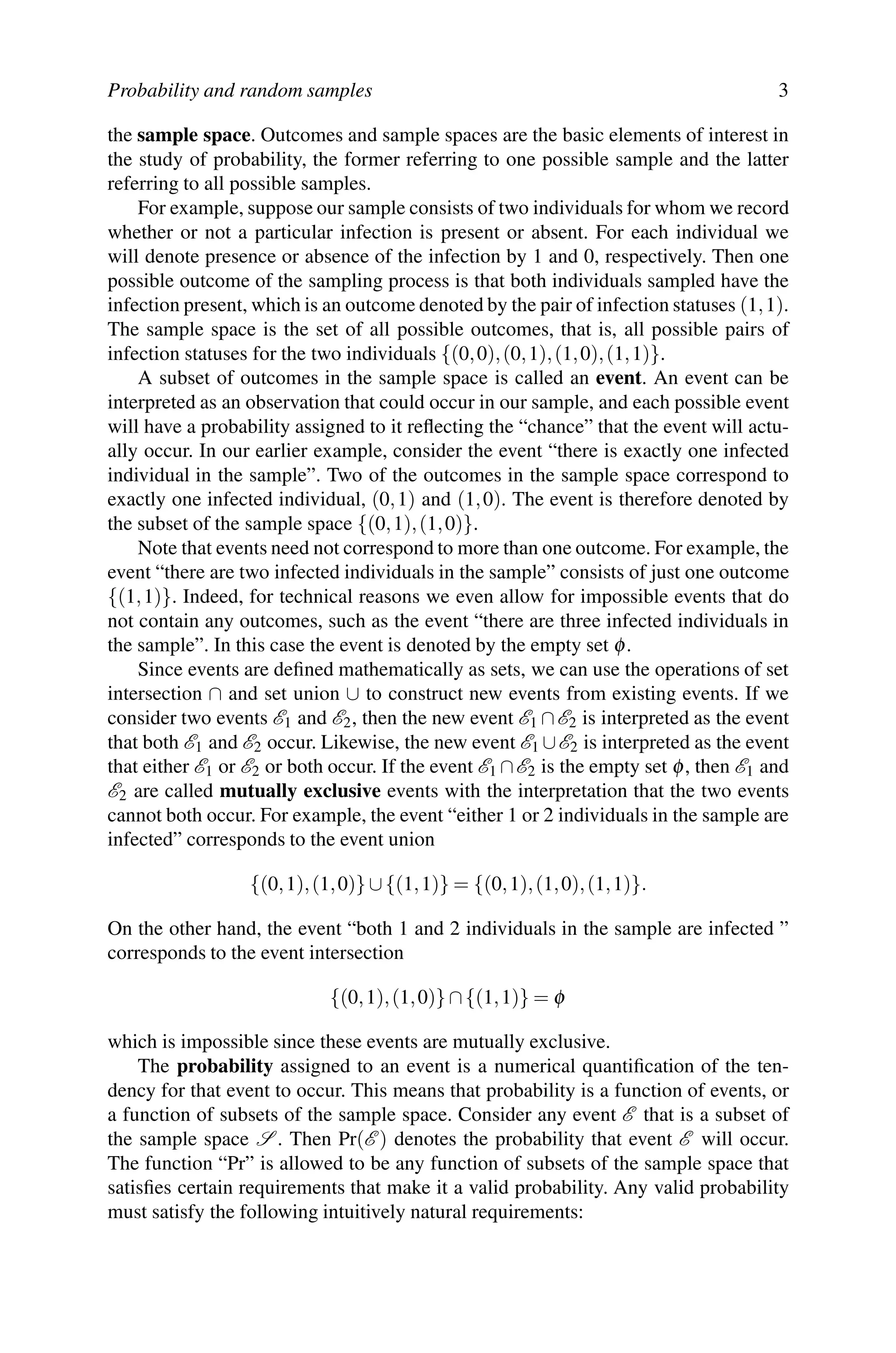
For example, suppose our sample consists of two individuals for whom we record
whether or not a particular infection is present or absent. For each individual we
will denote presence or absence of the infection by 1 and 0, respectively. Then one
possible outcome of the sampling process is that both individuals sampled have the
infection present, which is an outcome denoted by the pair of infection statuses (1,1).
The sample space is the set of all possible outcomes, that is, all possible pairs of
infection statuses for the two individuals {(0,0),(0,1),(1,0),(1,1)}.
A subset of outcomes in the sample space is called an event. An event can be
interpreted as an observation that could occur in our sample, and each possible event
will have a probability assigned to it reflecting the “chance” that the event will actu-
ally occur. In our earlier example, consider the event “there is exactly one infected
individual in the sample”. Two of the outcomes in the sample space correspond to
exactly one infected individual, (0,1) and (1,0). The event is therefore denoted by
the subset of the sample space {(0,1),(1,0)}.
Note that events need not correspond to more than one outcome. For example, the
event “there are two infected individuals in the sample” consists of just one outcome
{(1,1)}. Indeed, for technical reasons we even allow for impossible events that do
not contain any outcomes, such as the event “there are three infected individuals in
the sample”. In this case the event is denoted by the empty set φ.
Since events are defined mathematically as sets, we can use the operations of set
intersection ∩ and set union ∪ to construct new events from existing events. If we
consider two events E1 and E2, then the new event E1 ∩E2 is interpreted as the event
that both E1 and E2 occur. Likewise, the new event E1 ∪E2 is interpreted as the event
that either E1 or E2 or both occur. If the event E1 ∩E2 is the empty set φ, then E1 and
E2 are called mutually exclusive events with the interpretation that the two events
cannot both occur. For example, the event “either 1 or 2 individuals in the sample are
infected” corresponds to the event union
{(0,1),(1,0)} ∪{(1,1)} = {(0,1),(1,0),(1,1)}.
On the other hand, the event “both 1 and 2 individuals in the sample are infected ”
corresponds to the event intersection
{(0,1),(1,0)} ∩{(1,1)} = φ
which is impossible since these events are mutually exclusive.
The probability assigned to an event is a numerical quantification of the ten-
dency for that event to occur. This means that probability is a function of events, or
a function of subsets of the sample space. Consider any event E that is a subset of
the sample space S . Then Pr(E ) denotes the probability that event E will occur.
The function “Pr” is allowed to be any function of subsets of the sample space that
satisfies certain requirements that make it a valid probability. Any valid probability
must satisfy the following intuitively natural requirements:
Father Anselm sawhis opportunity, and pertinently asked, "Since you
have no heir, why not make the holy Church of Christ your heir? By
doing so you would garner up for yourself riches in heaven—an
eternity of inconceivable happiness compared with which in duration
your present suffering is but as the pang of a moment."
Sir Richard sat musing for the space of a quarter of an hour, and
then said, "Holy Father, what you say seems good, fitting, and
worthy of consideration. Give me a week to think it over, and at the
expiration of that period I will commune with you further on the
subject," and Father Anselm took his departure.
At the week's end, when they met again, Sir Richard opened the
subject by saying, "Venerable Father, I have since our last meeting
given deep consideration to your counsels, and have come to the
resolution of doing as you advise me. I have determined on
assuming the monkish habit; spending the remainder of my life in
pious communion with some holy brotherhood; and on resigning my
possessions into the hands of the Church of God."
"It is good," replied Father Anselm. "Have you thought of any
specific house on which to bestow your donation?"
"It occurred to me," continued Sir Richard, "to become a canon of
the Augustinian house recently founded by my feudal Lord, Robert
de Brus, at Guisborough, and to add my lands to its further
endowment."
"Permit me to counsel you otherwise," said the Father,
"Guisborough, as an Augustinian house, is not so strict in its
discipline as other monastic houses, and is already very fairly
endowed. But there is another, of the Benedictine order, where you
would have an opportunity of cultivating a more strictly religious and
less secular frame of mind—I mean Whitby, a holy spot, once
sanctified by the presence of the blessed St. Hilda. It was founded
by King Oswy in 687, was laid in ruins by the sacrilegious Danes in
867, and so remained for another couple of hundred years, when
God moved the heart of Will de Percy to refound it as a Priory.
28.
Within the lastfew years it has again been converted into an Abbey;
but it lacks endowment for the due maintenance of its superior
dignity. Let me advise you, therefore, to cast in your lot with these
Benedictines, and win the approval of God by bestowing your wealth
in his service, where it is much needed."
Sir Richard assented to this suggestion, caused a deed of gift to be
drawn, in which he conveyed his lands to the Abbot and convent of
Whitby, and entered the house as a novice; and in due time, at the
expiration of his novitiate, was admitted as a monk.
Brother Jerome (to use his monastic appellation) soon attracted
notice by the fervour of his piety, his asceticism, and a strict and
sincere observance of the conventual rules; as well as by his humility
and obedience to the ordinances of his superiors. It chanced that
after he had been in the house a few years, the Prior, whose position
was that of sub-Abbot in the house, sickened and died; and, at a
meeting of the chapter to elect his successor, Brother Jerome was
suggested as the most fitting, by his manifest piety and abilities, for
the office; but he resolutely declined taking it upon himself,
preferring, as he said, to be rather a hewer of wood or drawer of
water—the servant of the brotherhood—than to hold any superior
office.
In the course of his meditations he was wont to cast a retrospective
glance on his past life, and to grieve over his career as a soldier and
a shedder of blood; especially did he mourn over the excesses of
barbarous cruelty into which he had been drawn in emulation of the
ferocity of his fellow-soldiers, when marching under the banner of
the Empress, remembering with tears of bitter remorse, the burning
villages, the homeless people, the corpse-strewn fields, and the
widows and orphans they left in their rear. The more he thought of
these past phases of his life, the more intense became his self-
reproaches and the compunction excited by a sense of guilt and sin.
He sought by mortification and maceration of the flesh to make
atonement for these blood-stained deeds, but despite these self-
inflicted punishments, he was not able to find rest for his soul. For
29.
ever, when prostratein prayer, would they rise up before him, and
the enemy of mankind would whisper in his ear, "Thou fool! what is
the good of praying and fasting and weeping? Thy sins are too
heinous for pardon; thou hast given up thy possessions to secure a
heritage in heaven, but thy guilt is so damning that thou wilt
assuredly find its gate shut against thee. Instead of leading a
miserable and wretched life here in the cloister, return to the world
and enjoy life while it lasts, for in either case there is nothing to
hope for in the future."
Jerome took counsel of the Abbot, an old, wise, and experienced
Christian, who at once detected the cloven hoof in the temptation,
and was successful in convincing the tempted one of the fact,
advising him to go on in the course he was pursuing, assuring him
that there was mercy for the vilest of sinners if penitent, which
afforded him great consolation.
Nevertheless the remorse-stricken sinner considered that his
misdeeds had been such that he could scarcely do sufficient in the
way of mortification to obliterate the guilt of the past, and he
determined upon withdrawing himself entirely from communion with
his fellow-creatures, even from the Holy Brotherhood of Whitby, and
devote the remainder of his life to meditation and prayer altogether
apart from the world.
Connected with the Abbey there was, in a solitary place of the forest
which fringed the banks of the Esk, a chapel where the monks were
wont to retire at certain seasons for the purpose of devotion, away
from the bustle and distraction inevitable in a large community; and
in close proximity to this chapel, Jerome built for himself a wooden
hut in which to pass his remaining years as a hermit, secluded from
society, living on wild fruit and roots, quenching his thirst from the
streamlet which trickled past, and spending his days and nights in
prayer, flagellation, and abstinence.
Resident in the neighbourhood of Whitby were two landed
proprietors—Ralph de Perci, Lord of Sneton, and William de Brus,
Lord of Ugglebarnby, who were great lovers of hunting and other
30.
field sports, andnear them lived one Allatson, a gentleman and
freeholder. The three were boon companions, and constantly
meeting in the pursuance of country sports, and at each other's
houses for the purpose of carousing together. One night when they
were thus assembled together they arranged to go boar-hunting on
the following day, which was the 16th of October, 5th Henry II., in
the forest of Eskdale; and soon after dinner they met, attired in their
hunting garbs, with boar-staves in their hands, and accompanied by
a pack of boar-hounds, yelping and barking, and as eager for the
sport as their masters.
A boar was soon started, which plunged into the recesses of the
forest, followed by the hounds in full cry, and by the hunters,
shouting to encourage them. Onward they rushed, through brake
and briar, the huge animal clearing a pathway through the tangled
underwood, which enabled his pursuers to follow without much
impediment. Onward they went in hot speed, the hounds sometimes
overtaking the boar, and tearing him with their fangs, and the
hunters beating him with their staves, maddening him with rage,
and causing him to turn upon his pursuers, and rend the dogs with
his fangs, as he would also the hunters, could he have escaped the
environment of the dogs; and then he would dash onward again,
evidently becoming more and more exhausted from wounds and
bruises and loss of blood, until at length they came in sight of the
chapel and hermitage; from which point we cannot do better than
continue the narrative in the words of Burton, as given in his
"Monasticon Ebor."
"The boar," says he, "being very sore and very hotly pursued, and
dead run, took in at the chapel door and there died, whereof the
hermit shut the hounds out of the chapel and kept himself within at
his meditations, the hounds standing at bay without.
"The gentlemen called to the hermit (Brother Jerome), who opened
the door. They found the boar dead, for which they, in very great
fury (because their hounds were put from their game) did, most
31.
violently and cruelly,run at the hermit with their boar staves,
whereby he died soon after."
Fearful of the consequences of their crime, they fled to Scarborough,
and took sanctuary in the church; but the Abbot of Whitby, who was
a friend of the King, was authorised to take them out, "whereby they
came in danger of the law, and not to be privileged, but likely to
have the severity of the law, which was death."
The hermit, who had been brought to Whitby Abbey, lay at the point
of death when the prisoners were brought thither; and hearing of
their arrival, he besought the Abbot that they might be brought into
his presence; and when they made their appearance said to them, "I
am sure to die of these wounds you gave me." "Aye," quoth the
Abbot, "and they shall surely die for the same." "Not so," continued
the dying man, "for I will freely forgive them my death if they will be
contented to be enjoined this penance for the safeguard of their
souls." "Enjoin what penance you will," replied the culprits, "so that
you save our lives." Then Brother Jerome explained the nature of
the penance:—"You and yours shall hold your lands of the Abbot of
Whitby and his successors in this manner. That upon Ascension Eve,
you, or some of you, shall come to the woods of Strayheads, which
is in Eskdale, the same day at sunrising, and there shall the abbot's
officer blow his horn, to the intent that you may know how to find
him; and he shall deliver unto you, William de Brus, ten stakes,
eleven strutstowers, and eleven yethers, to be cut by you, or some
of you, with a knife of one penny price; and you, Ralph de Perci,
shall take twenty and one of each sort, to be cut in the same
manner; and you, Allatson, shall take nine of each sort to be cut as
aforesaid, and to be taken on your backs and carried to the town of
Whitby, and to be there before nine of the clock the same day before
mentioned. If at the same hour of nine of the clock it be full sea,
your labour or service shall cease; but if it be not full sea, each of
you shall set your stakes at the brim and so yether them, on each
side of your yethers, and so stake on each side with your strowers,
that they may stand three tides, without removing by the force
thereof. Each of you shall make and execute the said service at that
32.
very hour, everyyear, except it shall be full sea at that hour; but
when it shall so fall out, this service shall cease.... You shall faithfully
do this, in remembrance that you did most cruelly slay me; and that
you may the better call to God for mercy, repent unfeignedly for
your sins, and do good works. The officer of Eskdale side shall blow
—'Out on you! out on you! out on you!' for this heinous crime. If
you, or your successors, shall refuse this service, so long as it shall
not be full sea, at the aforesaid hour, you, or yours, shall forfeit your
lands to the Abbot of Whitby, or his successors. This I entreat, and
earnestly beg that you may have lives and goods preserved for this
service; and I request of you to promise, by your parts in Heaven,
that it shall be done by you and your successors as it is aforesaid
requested, and I will confirm it by the faith of an honest man." Then
the hermit said, "My soul longeth for the Lord; and I do freely
forgive these men my death, as Christ forgave the thief upon the
cross," and in the presence of the Abbot and the rest, he said,
moreover, these words, "In manas tuas, domine, commendo
spiritum, meum, avinculis enim mortis redemisti me Domine
veritatis. Amen." So he yielded up the ghost the 8th day of
December, A.D. 1160, upon whose soul God have mercy. Amen.
In 1753, the service was rendered by the last of the Allatsons, the
Lords of Sneton and Ugglebarnby having, it is supposed, bought off
their share of the penance. He held a piece of land, of £10 a year, at
Fylingdales, for which he brought five stakes, eight yethers, and six
strutstowers, and whilst Mr. Cholmley's bailiff, on an antique bugle
horn, blew "out on you," he made a slight edge of them a little way
into the shallow of the river.
Burton, writing in 1757, adds, "This little farm is now out of the
Allatson family, but the present owner performed the service last
Ascension Eve, A.D. 1756."
The horn garth or yether hedge, as the fence was called, was
constructed yearly on the east side of the Esk for the purpose of
keeping cattle from the landing places.
33.
Charlton, in hishistory of Whitby, discredits this tradition, saying that
there were no such persons as those mentioned, and no chapel, only
a hermitage in the forest; that the making of the horn garth is of
much older date than that indicated, and that there is no record in
the annals of the abbey of its ever having been made by way of
penance; concluding that it is altogether a monkish invention.
35.
The Calverley Ghost.
littlenorthward of the road from Bradford to Leeds, four
miles distant from the former and seven from the latter, lies
the village of Calverley, the seat of a knightly family of that
name for some 600 years. They occupied a stately mansion, which
was converted into workmen's tenements early in the present
century, and the chapel transformed into a wheelwright's shop.
Near by is a lane, a weird and lonesome road a couple of centuries
ago, overshadowed as it was by trees, which cast a ghostly gloom
over it after the setting of the sun. It was not much frequented
excepting in broad daylight, and even then only by the bolder and
more stout-hearted of the village rustics, whilst the majority would
as soon have dared to sleep in the charnel-house under the church
as have passed down it by night, or even in the gloaming. Instances
were known of strangers having unwittingly gone through it, all of
whom, however, came forth with trembling limbs and scared faces,
their hair erect on their heads, and the perspiration streaming down
from their foreheads. When questioned as to what they had seen,
the reply was always the same, a cloudlike apparition, thin,
transparent, and unsubstantial, bearing the semblance of a human
figure, with no seeming clothing, but simply a misty, impalpable
shape; the features frenzied with rage and madness, and in the right
hand the appearance of a bloody dagger. The apparition, they
averred, seemed to consolidate into form out of a mist which
environed them soon after entering the lane, and continued to
accompany them, but without sound, sign, or motion, save that of
gliding along, accommodating itself to the pace of the terrified
36.
passenger, which wasusually that of a full run, until the other end of
the lane was reached, when it melted again into a mere shapeless
mass of vapour.
The apparition was that of the disquieted soul of a certain Walter
Calverley, which was denied the calm repose of death, and
condemned to flit about this lane, as a penance for a great and
unnatural crime of which he had been guilty. Various attempts were
made to exorcise the restless spirit, but all were ineffectual until
some very potent spiritual agencies were employed, which were
successful in "laying the ghost," but only for a time, as they operate
only so long as a certain holly tree, planted by the hand of the
delinquent, continues to flourish, when that decays the ghost may
again be looked for.
The Calverleys (originally Scott) were a family of distinction in
Yorkshire from the time of Henry I. to the period of the great Civil
War, intermarrying with some of the best families, and producing a
succession of notable men.
John Scott was steward to Maud, daughter of Malcolm Canmore,
King of Scotland, and niece of Edgar the Atheling, the last scion of
the Saxon race of English Kings; he accompanied her to England on
the occasion of her alliance with King Henry I., and married
Larderina, daughter of Alphonsus Gospatrick, Lord of Calverley and
other Yorkshire manors, who was descended from Gospatrick, Earl of
Northumbria, who so stoutly supported the claims of Edgar the
Atheling to the crown of England in opposition to that of the
usurping conqueror, William the Norman. By this marriage, John
Scott became j.u. Lord of Calverley.
William, his grandson, gave the vicarage of Calverley to the chantry
of the Blessed Virgin, York Cathedral, temp. Henry III.
John, his descendant, in the fourteenth century, assumed the name
of de Calverley in lieu of Scott.
Sir John, Knight, his son, had issue three sons and a daughter,
Isabel, who became Prioress of Esholt.
37.
John, his son,was one of the squires to Anne, Queen of Richard II.
He fought in the French wars, was captured there, and beheaded for
some "horrible crime, the particulars of which are not known," and
dying cæl, was succeeded by his brother, Walter, whose second son,
Sir Walter, was instrumental in the rebuilding of the church of
Calverley, and caused his arms—six owls—to be carved on the
woodwork.
Sir John, Knight, his son, was created a Knight-Banneret, and slain
at Shrewsbury, 1403, fighting under the banner of Henry IV. against
the Percies. Dying s.p., his brother Walter succeeded, whose second
son, Thomas, was ancestor, by his wife, Agnes Scargill, of the
Calverleys of Morley and of county Cumberland.
Sir William, his grandson, was created a Knight-Banneret for valour
in the Scottish wars, by the Earl of Surrey; his grandson, Sir William
Knight, was Sheriff of Yorkshire, and died 1571; Thomas, his second
son, was ancestor of the Calverleys of county Durham. Sir Walter, his
son, had issue three sons, of whom Edmund, the third, was ancestor
of the Calverleys of counties Sussex and Surrey.
William, the eldest son of Sir Walter, whose portrait was exhibited at
York in 1868, married Catherine, daughter of Sir John Thornholm,
Knight, of Haysthorpe, near Bridlington. This lady was a devoted
Catholic, and suffered much persecution for adhering to her faith
and giving refuge to proscribed priests, the estates being
sequestered and some manors sold to pay the fine for recusancy.
They had issue Walter, the subject of this tradition.
Walter Calverley was born in the reign of Elizabeth, and in his youth
witnessed the relentless persecutions which his family, being
adherents of the old faith, had to endure from the ascendant
Protestantism, which held the reins of government. Those of the
reformed religion were wont to style Mary the "Bloody Queen," for
the number of executions and barbarities which, in the name of
religion, stained the annals of her reign; but it was a notable
instance of the pot-and-kettle style of vituperation, as the burning
and hanging and quartering and pressing to death of Jesuits and
38.
seminary priests, andof lay men and women who afforded them
refuge, went on as merrily during the reigns of her two following
successors, as did the roasting of heretics at Smithfield and
elsewhere under Bonner and Gardiner. He was witness, when a boy,
of the barbarous treatment to which his mother was subjected for
worshipping God according to the dictates of her conscience and for
daring to shelter priests of her persuasion.
Walter was a lad of strong passions and vehement spirit, and the
sight of the sufferings endured by the friends and co-religionists of
his family drove him almost to madness. He would stamp his foot,
clench his fist, and vow vengeance upon the perpetrators, and it is
highly probable that he consorted and plotted with Guy Fawkes and
others of the gunpowder conspirators at Scotton, near
Knaresborough, and might have had a hand in the great plot itself,
which culminated and collapsed in the same year that he committed
the crime which cost him his life.
He married Philippa, daughter of the Hon. Henry Brooke, fifth son of
George, fourth Baron Cobham, and sister of John, first Baron of the
second creation, and by her had issue three sons, the third of whom,
Henry, succeeded to the estates, whose son, Sir Walter, was a great
sufferer in person and estate for his loyalty during the Civil War, and
who was father of Sir Walter, who was created a baronet by Queen
Anne in 1711, the title becoming extinct in 1777, on the death,
without surviving issue, of his son, Sir Walter Calverley-Blackett.
For a few years the newly-married couple lived in tolerable harmony
and happiness, such as falls to the lot of most married people. They
looked forward to giving an heir to the family estates who should
perpetuate the name in lineal descent; but the months and years
passed by, and they began to experience the truth that "hope
deferred maketh the heart sick," as no heir made his appearance,
which was an especial disappointment to the Lord of the Calverley
domain, and gave rise to the idea that he had married one who was
barren, and incapable of giving him an heir. Brooding over this
impediment to his hopes, he grew moody and discontented; treated
39.
his wife notonly with neglect, but upbraided her with opprobrious
epithets, treated her with cold and cruel disfavour, and in his
occasional violent outbursts of passion would wish her dead, that he
might marry again to a more fruitful wife. Moreover he gave way to
over-indulgence in deep potations of ale, sack, and "distilled waters,"
which added fire and force to his naturally fierce temperament, and
rendered him almost maniacal in his acts. He was profuse in his
hospitality to his neighbours, frequently giving dinner parties to his
roystering friends, with whom he would sit until late in the night, or
rather until early in the morning carousing over their cups.
Amongst the friends who thus visited him was a certain country
squire of the name of Leventhorpe, a young fellow of handsome
figure and insinuating address, who would drink his bottle with the
veriest toper, and yet would conduct himself in the company of
ladies with the utmost decorum and most fascinating demeanour,
would converse with them on flowers and birds and tapestry work,
and quote with admirable accentuation and feeling passages from
the writings of the popular poets, or recite with pathos and humour
the novelettes of the Italian romancists, which then were the delight
of every lady's boudoir. He was introduced by Calverley to his wife,
and she being naturally of a lively, vivacious disposition, and, like
ladies of the present age, a passionate admirer of works of fiction
and imagination, she took great pleasure in his society, as, indeed,
he did in hers, and he was consequently a constant visitor at
Calverley Hall, whether invited or not, and whether the lady's
husband was at home or not; but always was he gladly welcome,
and in pure innocence and without any idea of impropriety, by the
lady. On his side, too, he went to the house as a man might do to
that of a sister, without any sentiment save that of friendship, or, at
the utmost, a feeling of platonic love. Not so, however, the lady's
husband. He began to feel annoyed and disquieted at witnessing
their growing intimacy, but hitherto saw no reason to doubt the
fidelity of his wife. Some twelve months after the introduction of
Leventhorpe to the Hall, symptoms became evident of the probable
birth of a child, and Calverley at first hailed the prospect with
40.
satisfaction, praying andhoping that it might prove to be the long-
wished-for son and heir. In due course the child was born, and of
the desired sex, and great were the rejoicings and splendid the
banqueting at the christening. The next year a second son made his
appearance, and then dark thoughts and suspicions began to flit
across Calverley's mind. He considered it strange that no child
should have been born during the early years of his marriage, but
that immediately after Leventhorpe's introduction to the house his
wife began to prove fruitful, and had borne two children, with the
prospect of a third. He brooded over these dark thoughts by night
and day until they ripened into positive jealousy and the belief that
the children were Leventhorpe's, and not his own.
Influenced by these sentiments, he drank still more deeply, and was
frequently subjected to delirium tremens and maniacal fits of
passion, which rendered him the terror of all by whom he was
surrounded. He could not openly accuse Leventhorpe of a breach of
the seventh commandment, of which he believed him guilty, as he
had no basis of fact upon which to ground the charge; but he found
means to quarrel with him on some frivolous point, and made use of
such expressions of vituperation as he thought would impel him to
demand satisfaction at the sword's point; but Leventhorpe was a
quiet, peaceable man, who swallowed the affront, attributing it to
the deranged state of his friend's mind, induced by too free
application to the bottle; and he simply abstained from visiting the
house.
"He is a coward as well as a knave," said Calverley to himself. "No
gentleman would listen to such language as I have used and submit
to it patiently like a beaten cur, without resenting it with his sword,
and this circumstance proves his guilt, and the certainty of my
suspicions; but I will be amply revenged on both him and his
paramour and their progeny;" and he drank and drank day after day,
and more and more deeply, until he at length brought himself to a
state fitting him for a madhouse and personal restraint. Many a time
he sought for Leventhorpe, with the hope of provoking him to fight,
41.
but was notable to accomplish his purpose, as circumstances had
called Leventhorpe to London, where he remained some months.
In the meantime the third child was born, and as the mother's
health was delicate, it was sent out to nurse at a farm-house some
two or three miles distant, and it was then that Calverley charged his
wife, to her face, with adultery, adding that he felt positively assured
that the children were Leventhorpe's. She indignantly repelled the
charge, assuring him, with an appeal to the Virgin Mary as to the
truth of what she was saying, that the children were his and nobody
else's; but he would not listen to her denials—called her tears, which
were flowing profusely, the hypocritical tears of a strumpet, and
cursed and swore at her, threatening a dire vengeance on her and
her seducer, and finally left her in a fit of hysterics in the hands of
her women, who had rushed in on hearing her screams. He then
went downstairs to his dining room and sat down to dinner, but
could not eat much, each mouthful as he swallowed it seeming as if
it would choke him. "Take these things away," he exclaimed in a
furious tone to his servants, "and bring me sack, and plenty of it."
The terrified menials saw that he was in one of his maniacal moods,
and knew that it would be aggravated by drinking, but dared not
disobey him. The sack was placed on the table, and he dismissed
the attendants with a curse. Flagon after flagon he poured out and
drank in rapid succession, which soon produced its natural effect.
"Ah, demon!" said he, "have you come again to torment me? Why sit
you there, opposite me, grinning and gesticulating? You are an ugly
devil, sure enough, with your fiery eyes, your pointed horns, and
your barbed tail. You tell me that it were but just to murder my wife,
Leventhorpe, and their brats, and I don't know but what the advice
is good. Aye, twirl your tail as a dog does when he is pleased; you
think you have got another recruit for your nether kingdom, and you
are right. I live here a hell upon earth, and I do not see that I shall
be much the worse off with you below; besides I shall have the
satisfaction of vengeance, and that will repay me amply for any
after-death punishment. Aye, grin on, but leave me now to finish
this bottle in quietness, for I cannot drink with comfort whilst you
42.
are grimacing andjibing at me there." He spoke this in a loud tone
of voice, to which the scared servants were listening at the door,
after which he continued to drain goblet after goblet, giving forth
utterances more and more incoherent, until at length he fell from his
chair with a heavy thump on the floor. Hearing this, the servants
entered, and found him, as they had often found him before, in a
state of senseless intoxication, and carried him up to bed.
Having slept off his debauch, he awoke late the following morning
with a raging thirst, which he endeavoured to assuage by deep
draughts of ale. Breakfast he could eat none, but continued drinking
until his familiar demon again made his appearance, and seemed to
incite him to the fulfilment of his vow of revenge. Leventhorpe was
out of his reach, but the other destined victims were at hand, and
what more fitting time than the present for the execution of his
purpose? He selected a dagger from his store of weapons, and
carefully sharpened it to a fine point; then gave directions to have
his horse saddled and brought to the door of the hall to await his
pleasure. As he had three or four men-servants, who might hinder
him in his intent, he sent them on several errands about the estate,
and when they had departed, leaving only the female domestics in
the house, he went, dagger in hand, into the hall, where he found
his eldest son playing. Seizing him by the hair of his head, he
stabbed him in three or four places, and, taking him in his arms,
carried him bleeding to his mother's apartment. "There," said he,
throwing the body down, "is one of the fruits of your illicit
intercourse, and the others must share the same fate." So saying, he
laid hold of his second son, who was in the room, and stabbed him
to the heart. The mother, shrieking with terror and agony, rushed
forward to save the child, but was too late, and herself received
three or four blows from the dagger, and fell senseless to the floor,
but more from horror and fright than from her wounds, which were
but slight, thanks to a steel stomacher which she wore. Imagining
that he had killed her as well as the children, he mounted his horse
and rode towards the village, where his youngest child was at nurse,
with the intention of killing it also, but on the road he was thrown
43.
from his horse,and before he could re-mount was secured by his
servants, who had gone in pursuit of him.
He was taken before the nearest magistrate—Sir John Bland, of
Kippax—and in the course of his examination stated that he had
meditated the deed for four years, and that he was fully convinced
that the children were not his. He was committed to York Castle and
brought to trial, but refusing to plead, was subjected to peine forte
et dure. He was taken to the press-yard, stripped to his shirt, and
laid on a board with a stone under his back; his arms were stretched
out and secured by cords; another board was placed over his body,
upon which were laid heavy weights one by one, he being asked in
the intervals if he still refused. He bore the agony with firmness and
endurance, even when the great pressure broke his ribs and caused
them to protrude from the sides. As weight after weight was added,
nothing could be extorted from him save groans caused by the
intensity of the pain, which at length ceased and the weights were
removed, revealing a mere mass of crushed bloody flesh and
mangled bones.
The two children died, and the third lived to succeed to the estates.
The mother also recovered, and married for her second husband Sir
Thomas Burton, Knight.
"Two Most Unnatural and Bloodie Murthers, by Master Calverley, a
Yorkshire gentleman, upon his wife and two children, 1605." Edited
by J. Payne Collier, 1863.
"A Yorkshire Tragedy, not so new as lamentable, by Mr. Shakespeare;
acted at the Globe, 1608. London 1619. With a portrait of the brat at
nurse." Attributed to Shakespeare (without proof) by Stevens and
others.
"The Fatal Extravagance. By Joseph Mitchell, 1720." A play based on
the same subject, and performed at the Lincoln's Inn Theatre.
The incident is also introduced by Harrison Ainsworth in his romance
of "Rookwood."
Welcome to ourwebsite – the ideal destination for book lovers and
knowledge seekers. With a mission to inspire endlessly, we offer a
vast collection of books, ranging from classic literary works to
specialized publications, self-development books, and children's
literature. Each book is a new journey of discovery, expanding
knowledge and enriching the soul of the reade
Our website is not just a platform for buying books, but a bridge
connecting readers to the timeless values of culture and wisdom. With
an elegant, user-friendly interface and an intelligent search system,
we are committed to providing a quick and convenient shopping
experience. Additionally, our special promotions and home delivery
services ensure that you save time and fully enjoy the joy of reading.
Let us accompany you on the journey of exploring knowledge and
personal growth!
ebookultra.com