Exposureresponse Modeling Methods And Practical
Implementation 1st Edition Jixian Wang download
https://ebookbell.com/product/exposureresponse-modeling-methods-
and-practical-implementation-1st-edition-jixian-wang-5290202
Explore and download more ebooks at ebookbell.com
Here are some recommended products that we believe you will be
interested in. You can click the link to download.
Exposure And Response Ritual Prevention For Obsessive Compulsive
Disorder Therapist Guide 2nd Ed 2nd Edition Edna B Foa
https://ebookbell.com/product/exposure-and-response-ritual-prevention-
for-obsessive-compulsive-disorder-therapist-guide-2nd-ed-2nd-edition-
edna-b-foa-34020250
Daring To Challenge Ocd Overcome Your Fear Of Treatment And Take
Control Of Your Life Using Exposure And Response Prevention Joan
Davidson
https://ebookbell.com/product/daring-to-challenge-ocd-overcome-your-
fear-of-treatment-and-take-control-of-your-life-using-exposure-and-
response-prevention-joan-davidson-48840430
2020 Emergency Response Planning Guideline Erpg And Worklpace
Environmental Exposure Level Weel Handbook Aiha
https://ebookbell.com/product/2020-emergency-response-planning-
guideline-erpg-and-worklpace-environmental-exposure-level-weel-
handbook-aiha-52389268
Nanomaterials And Nanocomposites Exposures To Plants Response
Interaction Phytotoxicity And Defense Mechanisms Azamal Husen
https://ebookbell.com/product/nanomaterials-and-nanocomposites-
exposures-to-plants-response-interaction-phytotoxicity-and-defense-
mechanisms-azamal-husen-50417026
Corporate Responses To Financial Crime From Exposure To Investigation
1st Edition Petter Gottschalk
https://ebookbell.com/product/corporate-responses-to-financial-crime-
from-exposure-to-investigation-1st-edition-petter-gottschalk-11736392
Exposure Anxiety The Invisible Cage An Exploration Of Selfprotection
Responses In The Autism Spectrum And Beyond 1st Edition Donna Williams
https://ebookbell.com/product/exposure-anxiety-the-invisible-cage-an-
exploration-of-selfprotection-responses-in-the-autism-spectrum-and-
beyond-1st-edition-donna-williams-2208474
From Microbe To Man Biological Responses In Microbes Animals And
Humans Upon Exposure To Artificial Static Magnetic Fields 1st Edition
Jnos F Lszl
https://ebookbell.com/product/from-microbe-to-man-biological-
responses-in-microbes-animals-and-humans-upon-exposure-to-artificial-
static-magnetic-fields-1st-edition-jnos-f-lszl-51573780
Exposure Therapy With Children And Adolescents Michael A Southamgerow
https://ebookbell.com/product/exposure-therapy-with-children-and-
adolescents-michael-a-southamgerow-49661082
Exposure Treatments For Anxiety Disorders A Practitioners Guide To
Concepts Methods And Evidencebased Practice 1st Edition Johan Rosqvist
https://ebookbell.com/product/exposure-treatments-for-anxiety-
disorders-a-practitioners-guide-to-concepts-methods-and-evidencebased-
practice-1st-edition-johan-rosqvist-53069916
Exposure–Response
Modeling
Methods and Practical
Implementation
© 2016 Taylor & Francis Group, LLC
Editor-in-Chief
Shein-Chung Chow, Ph.D., Professor, Department of Biostatistics and Bioinformatics,
Duke University School of Medicine, Durham, North Carolina
Series Editors
Byron Jones, Biometrical Fellow, Statistical Methodology, Integrated Information Sciences,
Novartis Pharma AG, Basel, Switzerland
Jen-pei Liu, Professor, Division of Biometry, Department of Agronomy,
National Taiwan University, Taipei, Taiwan
Karl E. Peace, Georgia Cancer Coalition, Distinguished Cancer Scholar, Senior Research Scientist
and Professor of Biostatistics, Jiann-Ping Hsu College of Public Health,
Georgia Southern University, Statesboro, Georgia
Bruce W. Turnbull, Professor, School of Operations Research and Industrial Engineering,
Cornell University, Ithaca, New York
Published Titles
Adaptive Design Methods in
Clinical Trials, Second Edition
Shein-Chung Chow and Mark Chang
Adaptive Designs for Sequential
Treatment Allocation
Alessandro Baldi Antognini and
Alessandra Giovagnoli
Adaptive Design Theory and
Implementation Using SAS and R,
Second Edition
Mark Chang
Advanced Bayesian Methods for Medical
Test Accuracy
Lyle D. Broemeling
Advances in Clinical Trial Biostatistics
Nancy L. Geller
Applied Meta-Analysis with R
Ding-Geng (Din) Chen and Karl E. Peace
Basic Statistics and Pharmaceutical
Statistical Applications, Second Edition
James E. De Muth
Bayesian Adaptive Methods for
Clinical Trials
Scott M. Berry, Bradley P. Carlin,
J. Jack Lee, and Peter Muller
Bayesian Analysis Made Simple: An Excel
GUI for WinBUGS
Phil Woodward
Bayesian Methods for Measures of
Agreement
Lyle D. Broemeling
Bayesian Methods in Epidemiology
Lyle D. Broemeling
Bayesian Methods in Health Economics
Gianluca Baio
Bayesian Missing Data Problems: EM,
Data Augmentation and Noniterative
Computation
Ming T. Tan, Guo-Liang Tian,
and Kai Wang Ng
Bayesian Modeling in Bioinformatics
Dipak K. Dey, Samiran Ghosh,
and Bani K. Mallick
Benefit-Risk Assessment in
Pharmaceutical Research and
Development
Andreas Sashegyi, James Felli, and
Rebecca Noel
Biosimilars: Design and Analysis of
Follow-on Biologics
Shein-Chung Chow
Biostatistics: A Computing Approach
Stewart J. Anderson
Causal Analysis in Biomedicine and
Epidemiology: Based on Minimal
Sufficient Causation
Mikel Aickin
Clinical and Statistical Considerations
in Personalized Medicine
Claudio Carini, Sandeep Menon,
and Mark Chang
© 2016 Taylor & Francis Group, LLC
Clinical Trial Data Analysis using R
Ding-Geng (Din) Chen and Karl E. Peace
Clinical Trial Methodology
Karl E. Peace and Ding-Geng (Din) Chen
Computational Methods in Biomedical
Research
Ravindra Khattree and Dayanand N. Naik
Computational Pharmacokinetics
Anders Källén
Confidence Intervals for Proportions and
Related Measures of Effect Size
Robert G. Newcombe
Controversial Statistical Issues in
Clinical Trials
Shein-Chung Chow
Data Analysis with Competing Risks and
Intermediate States
Ronald B. Geskus
Data and Safety Monitoring Committees
in Clinical Trials
Jay Herson
Design and Analysis of Animal Studies in
Pharmaceutical Development
Shein-Chung Chow and Jen-pei Liu
Design and Analysis of Bioavailability and
Bioequivalence Studies, Third Edition
Shein-Chung Chow and Jen-pei Liu
Design and Analysis of Bridging Studies
Jen-pei Liu, Shein-Chung Chow,
and Chin-Fu Hsiao
Design and Analysis of Clinical Trials for
Predictive Medicine
Shigeyuki Matsui, Marc Buyse,
and Richard Simon
Design and Analysis of Clinical Trials with
Time-to-Event Endpoints
Karl E. Peace
Design and Analysis of Non-Inferiority
Trials
Mark D. Rothmann, Brian L. Wiens,
and Ivan S. F. Chan
Difference Equations with Public Health
Applications
Lemuel A. Moyé and Asha Seth Kapadia
DNA Methylation Microarrays:
Experimental Design and Statistical
Analysis
Sun-Chong Wang and Arturas Petronis
DNA Microarrays and Related Genomics
Techniques: Design, Analysis, and
Interpretation of Experiments
David B. Allison, Grier P. Page,
T. Mark Beasley, and Jode W. Edwards
Dose Finding by the Continual
Reassessment Method
Ying Kuen Cheung
Elementary Bayesian Biostatistics
Lemuel A. Moyé
Empirical Likelihood Method in Survival
Analysis
Mai Zhou
Exposure–Response Modeling: Methods
and Practical Implementation
Jixian Wang
Frailty Models in Survival Analysis
Andreas Wienke
Generalized Linear Models: A Bayesian
Perspective
Dipak K. Dey, Sujit K. Ghosh,
and Bani K. Mallick
Handbook of Regression and Modeling:
Applications for the Clinical and
Pharmaceutical Industries
Daryl S. Paulson
Inference Principles for Biostatisticians
Ian C. Marschner
Interval-Censored Time-to-Event Data:
Methods and Applications
Ding-Geng (Din) Chen, Jianguo Sun,
and Karl E. Peace
Introductory Adaptive Trial Designs:
A Practical Guide with R
Mark Chang
Joint Models for Longitudinal and Time-
to-Event Data: With Applications in R
Dimitris Rizopoulos
Measures of Interobserver Agreement
and Reliability, Second Edition
Mohamed M. Shoukri
© 2016 Taylor & Francis Group, LLC
Medical Biostatistics, Third Edition
A. Indrayan
Meta-Analysis in Medicine and Health
Policy
Dalene Stangl and Donald A. Berry
Mixed Effects Models for the Population
Approach: Models, Tasks, Methods and
Tools
Marc Lavielle
Modeling to Inform Infectious Disease
Control
Niels G. Becker
Modern Adaptive Randomized Clinical
Trials: Statistical and Practical Aspects
Oleksandr Sverdlov
Monte Carlo Simulation for the
Pharmaceutical Industry: Concepts,
Algorithms, and Case Studies
Mark Chang
Multiple Testing Problems in
Pharmaceutical Statistics
Alex Dmitrienko, Ajit C. Tamhane,
and Frank Bretz
Noninferiority Testing in Clinical Trials:
Issues and Challenges
Tie-Hua Ng
Optimal Design for Nonlinear Response
Models
Valerii V. Fedorov and Sergei L. Leonov
Patient-Reported Outcomes:
Measurement, Implementation and
Interpretation
Joseph C. Cappelleri, Kelly H. Zou,
Andrew G. Bushmakin, Jose Ma. J. Alvir,
Demissie Alemayehu, and Tara Symonds
Quantitative Evaluation of Safety in Drug
Development: Design, Analysis and
Reporting
Qi Jiang and H. Amy Xia
Randomized Clinical Trials of
Nonpharmacological Treatments
Isabelle Boutron, Philippe Ravaud, and
David Moher
Randomized Phase II Cancer Clinical
Trials
Sin-Ho Jung
Sample Size Calculations for Clustered
and Longitudinal Outcomes in Clinical
Research
Chul Ahn, Moonseong Heo, and
Song Zhang
Sample Size Calculations in Clinical
Research, Second Edition
Shein-Chung Chow, Jun Shao
and Hansheng Wang
Statistical Analysis of Human Growth
and Development
Yin Bun Cheung
Statistical Design and Analysis of
Stability Studies
Shein-Chung Chow
Statistical Evaluation of Diagnostic
Performance: Topics in ROC Analysis
Kelly H. Zou, Aiyi Liu, Andriy Bandos,
Lucila Ohno-Machado, and Howard Rockette
Statistical Methods for Clinical Trials
Mark X. Norleans
Statistical Methods for Drug Safety
Robert D. Gibbons and Anup K. Amatya
Statistical Methods in Drug Combination
Studies
Wei Zhao and Harry Yang
Statistics in Drug Research:
Methodologies and Recent
Developments
Shein-Chung Chow and Jun Shao
Statistics in the Pharmaceutical Industry,
Third Edition
Ralph Buncher and Jia-Yeong Tsay
Survival Analysis in Medicine and
Genetics
Jialiang Li and Shuangge Ma
Theory of Drug Development
Eric B. Holmgren
Translational Medicine: Strategies and
Statistical Methods
Dennis Cosmatos and Shein-Chung Chow
© 2016 Taylor & Francis Group, LLC
Jixian Wang
Celgene International
Switzerland
Exposure–Response
Modeling
Methods and Practical
Implementation
© 2016 Taylor & Francis Group, LLC
MATLAB® is a trademark of The MathWorks, Inc. and is used with permission. The MathWorks does
not warrant the accuracy of the text or exercises in this book. This book’s use or discussion of MAT-
LAB® software or related products does not constitute endorsement or sponsorship by The MathWorks
of a particular pedagogical approach or particular use of the MATLAB® software.
CRC Press
Taylor & Francis Group
6000 Broken Sound Parkway NW, Suite 300
Boca Raton, FL 33487-2742
© 2016 by Taylor & Francis Group, LLC
CRC Press is an imprint of Taylor & Francis Group, an Informa business
No claim to original U.S. Government works
Version Date: 20150521
International Standard Book Number-13: 978-1-4665-7321-5 (eBook - PDF)
This book contains information obtained from authentic and highly regarded sources. Reasonable
efforts have been made to publish reliable data and information, but the author and publisher cannot
assume responsibility for the validity of all materials or the consequences of their use. The authors and
publishers have attempted to trace the copyright holders of all material reproduced in this publication
and apologize to copyright holders if permission to publish in this form has not been obtained. If any
copyright material has not been acknowledged please write and let us know so we may rectify in any
future reprint.
Except as permitted under U.S. Copyright Law, no part of this book may be reprinted, reproduced,
transmitted, or utilized in any form by any electronic, mechanical, or other means, now known or
hereafter invented, including photocopying, microfilming, and recording, or in any information stor-
age or retrieval system, without written permission from the publishers.
For permission to photocopy or use material electronically from this work, please access www.copy-
right.com (http://www.copyright.com/) or contact the Copyright Clearance Center, Inc. (CCC), 222
Rosewood Drive, Danvers, MA 01923, 978-750-8400. CCC is a not-for-profit organization that pro-
vides licenses and registration for a variety of users. For organizations that have been granted a photo-
copy license by the CCC, a separate system of payment has been arranged.
Trademark Notice: Product or corporate names may be trademarks or registered trademarks, and are
used only for identification and explanation without intent to infringe.
Visit the Taylor & Francis Web site at
http://www.taylorandfrancis.com
and the CRC Press Web site at
http://www.crcpress.com
© 2016 Taylor & Francis Group, LLC
To my parents,
my wife, and sons
© 2016 Taylor & Francis Group, LLC
Contents
Symbol Description xv
Preface xvii
1 Introduction 1
1.1 Multifaceted exposure–response relationships . . . . . . . . . 1
1.2 Practical scenarios in ER modeling . . . . . . . . . . . . . . 2
1.2.1 Moxifloxacin exposure and QT prolongation . . . . . 2
1.2.2 Theophylline . . . . . . . . . . . . . . . . . . . . . . . 6
1.2.3 Argatroban and activated partial thromboplastin time 6
1.3 Models and modeling in exposure–response analysis . . . . . 9
1.4 Model-based decision-making and drug development . . . . . 12
1.5 Drug regulatory guidance for analysis of exposure–response re-
lationship . . . . . . . . . . . . . . . . . . . . . . . . . . . . . 13
1.6 Examples and modeling software . . . . . . . . . . . . . . . . 14
2 Basic exposure and exposure–response models 17
2.1 Models based on pharmacological mechanisms . . . . . . . . 17
2.1.1 Example of a PKPD model . . . . . . . . . . . . . . . 17
2.1.2 Compartmental models for drug–exposure modeling . 18
2.2 Statistical models . . . . . . . . . . . . . . . . . . . . . . . . 19
2.3 Transformations . . . . . . . . . . . . . . . . . . . . . . . . . 24
2.4 Semiparametric and nonparametric models . . . . . . . . . . 27
2.5 Comments and bibliographic notes . . . . . . . . . . . . . . . 33
3 Dose–exposure and exposure–response models for longitudi-
nal data 35
3.1 Linear mixed models for exposure–response relationships . . 35
3.2 Modeling exposures with linear mixed models . . . . . . . . 41
3.3 Nonlinear mixed ER models . . . . . . . . . . . . . . . . . . 42
3.4 Modeling exposure with a population PK model . . . . . . . 44
3.4.1 The moxifloxacin example . . . . . . . . . . . . . . . 46
3.5 Mixed effect models specified by differential equations . . . . 48
3.6 Generalized linear mixed model and generalized estimating
equation . . . . . . . . . . . . . . . . . . . . . . . . . . . . . 51
3.7 Generalized nonlinear mixed models . . . . . . . . . . . . . 53
3.8 Testing variance components in mixed models . . . . . . . . 54
ix
© 2016 Taylor & Francis Group, LLC
x Contents
3.9 Nonparametric and semiparametric models with random effects 55
3.10 On distributions of random effects . . . . . . . . . . . . . . . 60
3.10.1 Impact of misspecified random effects . . . . . . . . . 60
3.10.2 Working with misspecified models . . . . . . . . . . . 61
3.10.3 Using models with nonnormal or flexible distributions 61
3.11 Bibliographic Notes . . . . . . . . . . . . . . . . . . . . . . . 63
4 Sequential and simultaneous exposure–response modeling 65
4.1 Joint models for exposure and response . . . . . . . . . . . . 65
4.2 Simultaneous modeling of exposure and response models . . 67
4.2.1 Maximizing the joint likelihood function . . . . . . . . 67
4.2.2 Implementation of simultaneous modeling . . . . . . . 68
4.2.3 The argatroban example . . . . . . . . . . . . . . . . 70
4.2.4 Alternatives to the likelihood approach . . . . . . . . 71
4.2.5 Simultaneously fitting simplified joint models . . . . . 74
4.3 Sequential exposure–response modeling . . . . . . . . . . . . 75
4.4 Measurement error models and regression calibration . . . . 77
4.4.1 Measurement error models . . . . . . . . . . . . . . . . 78
4.4.2 Regression calibration . . . . . . . . . . . . . . . . . . 79
4.4.3 Models for longitudinal data . . . . . . . . . . . . . . 81
4.4.4 Sequential modeling for argatroban data . . . . . . . 83
4.4.5 Simulation extrapolation . . . . . . . . . . . . . . . . 86
4.4.6 A compromise between y-part models . . . . . . . . . 87
4.4.7 When measurement error models are useful? . . . . . 88
4.4.8 Biases in parameter estimation by sequential modeling 89
4.5 Instrumental variable methods . . . . . . . . . . . . . . . . . 90
4.6 Modeling multiple exposures and responses . . . . . . . . . 94
4.7 Internal validation data and partially observed and surrogate
exposure measures . . . . . . . . . . . . . . . . . . . . . . . 96
4.7.1 Exposure measured in a subpopulation . . . . . . . . . 96
4.7.2 Exposure measured in a subpopulation but a surrogate
is measured in the whole population . . . . . . . . . . 99
4.7.3 Using a surrogate for Cmax: An example . . . . . . . 100
4.8 Comments and bibliographic notes . . . . . . . . . . . . . . . 103
5 Exposure–risk modeling for time-to-event data 105
5.1 An example . . . . . . . . . . . . . . . . . . . . . . . . . . . 105
5.2 Basic concepts and models for time-to-event data . . . . . . 107
5.2.1 Distributions for time-to-event data . . . . . . . . . . 107
5.2.2 Parametric models . . . . . . . . . . . . . . . . . . . . 108
5.2.3 Cox models . . . . . . . . . . . . . . . . . . . . . . . . 109
5.2.4 Time-varying covariates . . . . . . . . . . . . . . . . . 110
5.2.5 Additive models . . . . . . . . . . . . . . . . . . . . . 112
5.2.6 Accelerated failure time model . . . . . . . . . . . . . 113
5.3 Dynamic exposure model as a time-varying covariate . . . . 114
© 2016 Taylor & Francis Group, LLC
Contents xi
5.3.1 Semiparametric models . . . . . . . . . . . . . . . . . 115
5.3.2 Parametric models . . . . . . . . . . . . . . . . . . . . 118
5.4 Multiple TTE and competing risks . . . . . . . . . . . . . . 120
5.4.1 Multistate models . . . . . . . . . . . . . . . . . . . . 120
5.4.2 Competing risks . . . . . . . . . . . . . . . . . . . . . 122
5.5 Models for recurrent events . . . . . . . . . . . . . . . . . . 124
5.5.1 Recurrent events as a counting process . . . . . . . . 124
5.5.2 Recurrent events in multistate models . . . . . . . . . 125
5.5.3 Rate and marginal models . . . . . . . . . . . . . . . 125
5.6 Frailty: Random effects in TTE models . . . . . . . . . . . . 129
5.7 Joint modeling of exposure and time to event . . . . . . . . 133
5.7.1 Simultaneous modeling . . . . . . . . . . . . . . . . . 134
5.7.2 Sequential modeling and regression calibration . . . . 137
5.8 Interval censored data . . . . . . . . . . . . . . . . . . . . . 140
5.9 Model identification and misspecification . . . . . . . . . . . 143
5.10 Random sample simulation from exposure–risk models . . . 144
5.10.1 Basic simulation approaches for time-to-events . . . . 144
5.10.2 Rejection-acceptance algorithms . . . . . . . . . . . . 147
5.10.3 Generating discrete event times . . . . . . . . . . . . 148
5.10.4 Simulation for recurrent and multiple events . . . . . 149
5.10.5 Simulation for TTE driven by complex dynamic systems 150
5.10.6 Example programs . . . . . . . . . . . . . . . . . . . . 153
5.10.7 Sample size estimation using simulations . . . . . . . 154
5.11 Comments and bibliographic notes . . . . . . . . . . . . . . . 157
6 Modeling dynamic exposure–response relationships 159
6.1 Effect compartment models . . . . . . . . . . . . . . . . . . 160
6.2 Indirect response models . . . . . . . . . . . . . . . . . . . . 162
6.3 Disease process models . . . . . . . . . . . . . . . . . . . . . 163
6.3.1 Empirical models . . . . . . . . . . . . . . . . . . . . . 164
6.3.2 Slow and fast subsystems . . . . . . . . . . . . . . . . 165
6.3.3 Semimechanistic models . . . . . . . . . . . . . . . . . 167
6.3.4 Modeling tumor growth and drug effects . . . . . . . 167
6.4 Fitting dynamic models for longitudinal data . . . . . . . . 168
6.5 Semiparametric and nonparametric approaches . . . . . . . . 169
6.5.1 Effect compartment model with nonparametric expo-
sure estimates . . . . . . . . . . . . . . . . . . . . . . . 169
6.5.2 Nonparametric dynamic models and lagged covariates 170
6.6 Dynamic linear and generalized linear models . . . . . . . . . 172
6.7 Testing hysteresis . . . . . . . . . . . . . . . . . . . . . . . . 179
6.8 Comments and bibliographic notes . . . . . . . . . . . . . . . 182
© 2016 Taylor & Francis Group, LLC
xii Contents
7 Bayesian modeling and model–based decision analysis 183
7.1 Bayesian modeling . . . . . . . . . . . . . . . . . . . . . . . . 183
7.1.1 An introduction to the Bayesian concept . . . . . . . . 183
7.1.2 From prior to posterior distributions . . . . . . . . . 184
7.1.3 Bayesian computing . . . . . . . . . . . . . . . . . . . 191
7.1.3.1 Markov chain Monte Carlo . . . . . . . . . . 191
7.1.3.2 Other computational approaches . . . . . . . 192
7.1.4 Bayesian inference and model-based prediction . . . . 193
7.1.5 Argatroban example by Bayesian analysis . . . . . . . 194
7.2 Bayesian decision analysis . . . . . . . . . . . . . . . . . . . 198
7.2.1 Decision analysis and ER modeling . . . . . . . . . . . 198
7.2.2 Example: Dose selection for argatroban . . . . . . . . 202
7.2.3 Multistate models . . . . . . . . . . . . . . . . . . . . 203
7.3 Decisions under uncertainty and with multiple objectives . . 207
7.3.1 Utility, preference and uncertainty . . . . . . . . . . . 207
7.3.2 Cost-benefit, cost-utility and cost-effectiveness analysis 210
7.4 Evidence synthesis and mixed treatment comparison . . . . 212
7.4.1 Meta analysis . . . . . . . . . . . . . . . . . . . . . . 212
7.4.2 Meta analysis for exposure–response relationship . . . 215
7.4.3 Mixed treatment comparison . . . . . . . . . . . . . . 220
7.5 Comments and bibliographic notes . . . . . . . . . . . . . . . 222
8 Confounding bias and causal inference in exposure–response
modeling 223
8.1 Introduction . . . . . . . . . . . . . . . . . . . . . . . . . . . 223
8.2 Confounding factors and confounding biases . . . . . . . . . 224
8.3 Causal effect and counterfactuals . . . . . . . . . . . . . . . 226
8.4 Classical adjustment methods . . . . . . . . . . . . . . . . . 227
8.4.1 Direct adjustment . . . . . . . . . . . . . . . . . . . . 227
8.4.2 Stratification and matching . . . . . . . . . . . . . . . 229
8.4.3 Propensity scores and inverse probability weighting . 230
8.4.4 Other propensity score–based approaches . . . . . . . 234
8.5 Directional acyclic graphs . . . . . . . . . . . . . . . . . . . 235
8.6 Bias assessment . . . . . . . . . . . . . . . . . . . . . . . . . 237
8.7 Instrumental variable . . . . . . . . . . . . . . . . . . . . . . 241
8.7.1 Instrumental variable estimates . . . . . . . . . . . . 241
8.7.2 Control function method . . . . . . . . . . . . . . . . . 242
8.8 Joint modeling of exposure and response . . . . . . . . . . . 243
8.9 Study designs robust to confounding bias or allowing the use
of instrument variables . . . . . . . . . . . . . . . . . . . . . 245
8.10 Doubly robust estimates . . . . . . . . . . . . . . . . . . . . 248
8.11 Comments and bibliographic notes . . . . . . . . . . . . . . . 249
© 2016 Taylor & Francis Group, LLC
Contents xiii
9 Dose–response relationship, dose determination, and adjust-
ment 251
9.1 Marginal Dose–response relationships . . . . . . . . . . . . . 251
9.2 Dose–response relationship as a combination of dose–exposure
and exposure–response relationships . . . . . . . . . . . . . . 254
9.3 Dose determination: Dose–response or dose–exposure–response
modeling approaches? . . . . . . . . . . . . . . . . . . . . . . 257
9.4 Dose adjustment . . . . . . . . . . . . . . . . . . . . . . . . 262
9.4.1 Dose adjustment mechanisms . . . . . . . . . . . . . . 262
9.4.1.1 Exposure-dependent dose adjustment . . . . 263
9.4.1.2 Response-dependent dose adjustment . . . . 264
9.5 Dose adjustment and causal effect estimation . . . . . . . . 265
9.5.1 Dose adjustment and sequential randomization . . . . 265
9.5.2 Directional acyclic graphs and the decomposition of the
likelihood function . . . . . . . . . . . . . . . . . . . . 266
9.5.3 Exposure–response relationship with dynamic treat-
ment changes . . . . . . . . . . . . . . . . . . . . . . 269
9.5.4 Dose adjustment for causal effect determination: RCC
trials . . . . . . . . . . . . . . . . . . . . . . . . . . . . 271
9.5.5 Treatment switch over and IPW adjustment . . . . . 273
9.6 Sequential decision analysis . . . . . . . . . . . . . . . . . . 275
9.6.1 Decision tree . . . . . . . . . . . . . . . . . . . . . . . 276
9.6.2 Dynamic programming . . . . . . . . . . . . . . . . . 281
9.6.3 Optimal stopping for therapeutic dose monitoring . . 284
9.6.4 Dose adjustment in view of dynamic programming . . 288
9.7 Dose determination: Design issues . . . . . . . . . . . . . . . 288
9.8 Comments and bibliographic notes . . . . . . . . . . . . . . . 290
10 Implementation using software 293
10.1 Two key elements: Model and data . . . . . . . . . . . . . . 293
10.2 Linear mixed and generalized linear mixed models . . . . . 295
10.3 Nonlinear mixed models . . . . . . . . . . . . . . . . . . . . 296
10.4 A very quick guide to NONMEM . . . . . . . . . . . . . . . 300
A Appendix 303
A.1 Basic statistical concepts . . . . . . . . . . . . . . . . . . . . 303
A.2 Fitting a regression model . . . . . . . . . . . . . . . . . . . 304
A.3 Maximum likelihood estimation . . . . . . . . . . . . . . . . 305
A.4 Large sample properties and approximation . . . . . . . . . 307
A.4.1 Large sample properties and convergence . . . . . . . 308
A.4.2 Approximation and delta approach . . . . . . . . . . 308
A.5 Profile likelihood . . . . . . . . . . . . . . . . . . . . . . . . 309
A.6 Generalized estimating equation . . . . . . . . . . . . . . . . 309
A.7 Model misspecification . . . . . . . . . . . . . . . . . . . . . 311
A.8 Bootstrap and Bayesian bootstrap . . . . . . . . . . . . . . 312
© 2016 Taylor & Francis Group, LLC
xiv Contents
Bibliography 315
Index 327
© 2016 Taylor & Francis Group, LLC
Symbol Description
E(y|x) Expectation of y conditional on x.
Ex(f(x)) Expectation of f(x) over x.
Eg
(X) Geometric mean of X : exp(E(log(X))).
R
x f(x)dG(x) Expectation of f(x) over x ∼ G(x), where the distribution
G(x) is specified explicitly.
y ∼ F(.) y follows distribution F(.).
y|x ∼ F(.) y follows distribution F(.) conditional on x.
yn → y yn tends or converges to y (all types).
y ≡ x y defined as x.
y ≈ x y and x are approximately equal.
XT
Transposition of matrix or vector X.
diag(a1, ..., ak) A diagonal matrix with elements a1, ..., ak.
I An identity matrix of a conformable dimension (if not speci-
fied).
Bin(p) Binary distribution with parameter p.
IG(a, b) Inverse gamma distribution with parameters a and b.
D(a1, ..., ak) Dirichlet distribution with parameters a1, ..., ak.
IW(ρ, R) Inverse Wishart distribution with degree of freedom ρ and
variance–covariance matrix R.
χ2
k(h) The χ2
distribution with k degrees of freedom and non-central
parameter h (may be omitted if h = 0).
g−1
(y) The inverse function of g(x).
dy(x)/dx The derivative of y(x) with respect to x.
∂y(x, z)/∂x The partial derivative of y(x, z) with respect to x.
N(µ, σ2
) Normal distribution with mean µ and variance σ2
.
Φ(x) The standard normal distribution function.
φ(x) The standard normal density function.
N(µ, Σ) Multivariate normal distribution with mean µ and variance–
covariance matrix Σ.
U(a, b) The uniform distribution within the range (a, b).
o(a) A higher order term of a.
x ⊥ y|z x and y are independent conditional on z.
x ∝ y x is proportional to y.
IA or I(A) IA = 1 if A is true, and IA = 0 otherwise.
f(x)|x=x0 f(x) evaluated as x0.
xv
© 2016 Taylor & Francis Group, LLC
Preface
Exposure–response (ER) relationships are important in many areas including,
but not limited to, pharmacology, epidemiology and drug safety, drug devel-
opment as a whole, and more recently comparative comparative benefit risk
assessments. Determining the relationships by modeling presents challenges
to applied statisticians and modelers as well as researchers due to the dy-
namic nature of both exposure and response. This book covers a wide range
of topics and new developments starting from traditional pharmacokinetic-
pharmacodynamic (PKPD) modeling, and progressing to using measurement
error models to treat sequential modeling, fitting models with exposure and
response driven by complex dynamics, survival analysis with dynamic ex-
posure history, Bayesian analysis and model-based Bayesian decision analy-
sis, causal inference to eliminate confounding biases, and exposure–response
modeling with response-dependent dose/treatment adjustments, known as dy-
namic treatment regimes, for personalized medicine and treatment adaptation.
The book is application oriented, but also gives a systematic view of the con-
cept and methodology in each topic.
Exposure–response modeling is a very general topic, since both the expo-
sure and the response are general concepts covering different scenarios in a
number of areas of research and applications. In toxicology, the exposure could
be a drug, a chemical or other material or conditions that may be harmful and
response may vary dramatically since a toxicology study could be in vitro (us-
ing cells or tissues) or in vivo (using animals). In pharmacology, the exposure
refers to drug concentration, but in epidemiology it could be the strength of
drug exposure measured by dose and duration of a drug, or harmful conditions
such as environmental pollution. In comparative benefit risk assessments the
exposure has a very general meaning, e.g., it may refer to a treatment strategy
or reimbursement policy and the response could be measures for the health
and social outcomes in a population. Comparing with animal and controlled
clinical trials, these assessment exposures are less controlled and some data
may come from observational studies. Therefore, biases commonly occur and
causal inference is crucial to exposure–response modeling.
The book reflects my experiences on ER modeling in a number of areas
including experimental toxicology, pharmacological modeling and simulation,
clinical trials, epidemiology and drug safety and outcome research, particularly
my experiences using approaches available in different software, some rather
basic but a large number of them newly developed and advanced, to solve
problems of different natures, but with considerable similarity in statistics and
xvii
© 2016 Taylor & Francis Group, LLC
xviii Preface
modeling aspects. Although this is an application-oriented book, I have not
shied away from using a large number of formulae, as they are an important
part of applied statistics. In some situations, the derivations for some formulae
are given to illustrate the concept and how a method is developed. However,
theoretical details, e.g., technical conditions for some asymptotic properties
of parameter estimates, are omitted.
The book emphasizes a number of important aspects: 1) causal inference
in exposure–response modeling, 2) sequential modeling in the view of mea-
surement error models, 3) dose–adjustment and treatment adaptation based
on dynamic exposure–response models, and 4) model-based decision analy-
sis linking exposure–response modeling to decision making. It tries to bridge
gaps between difference research areas to allow borrowing well-developed ap-
proaches from each other. This is an application book, but it does not stop
at using simple models and approaches. It goes much further to recent devel-
opments in a number of areas and describes implementation, methodologies
and interpretation of fitted models and statistical inference based on them.
Although the focus is on recent developments, no intensive knowledge on ER
modeling is needed to read the book and implement the methods. There are
models given in general forms with matrix notations. This may not be nec-
essary when a model is explicitly specified, but is useful to understand the
concept of some advanced approaches particularly when using software with
models specified in general forms such as R and SAS. The contents are ar-
ranged to allow the reader to skip these formulae yet still be able to implement
the approaches.
A large number of practical and numerical examples can be found in this
book. Some illustrate how to solve practical problems with the approaches de-
scribed, while some others are designed to help with understanding concepts
and evaluating the performance of new methods. In particular, several exam-
ples in clinical pharmacology are included. However, to apply approaches to a
real problem, it is crucially important to consult the literature and seek advice
from pharmacologists. A large number of SAS and R codes are included for the
reader to run and to explore in their own scenarios. Applied statisticians and
modelers can find details on how to implement new approaches. Researchers
and research students may find topics for, or applications of, their research.
It may also be used to illustrate how complex methodology and models can
be applied and implemented for very practical situations in relevant courses.
The book benefits from the numerous people who helped me or supported
me one way or another. First I would like to thank Byron Jones, my PhD
supervisor and former colleague for many years, for helping me with the plan-
ning and writing of the book from the very beginning and for his advice and
friendship starting from 20 years ago. During my early career development,
professors Jiqian Fang, Robin Prescott and James Linsey, and Dr Nick Long-
ford gave me enormous help. The book reflects some early work I did with
Byron and James, and my former colleagues professors Tom MacDonald and
Peter Donnan at Medicines Monitoring Unit, University of Dundee, and some
© 2016 Taylor & Francis Group, LLC
Preface xix
more recent research when I was working at Novartis. I would like to thank my
former and current colleagues Wing Cheung, Lily Zhao, Cheng Zheng, Wen-
qing Li, Ai Li, Wei Zhang, Roland Fisch, Amy Racine-Poon, Frank Bretz,
Tony Rossini, Christelle Darstein, Sebastien Lorenzo, Venkat Sethuraman,
Marie-Laure Bravo, Arlene Swern, Bruce Dornseif and especially Kai Grosch
and Emmanuel Bouillaud for their excellent team management and kind help
which made project work we shared enjoyable. I gained much knowledge and
experience in clinical pharmacology from the collaboration with Wing for sev-
eral years. Prof. Nick Holford kindly allowed me to use the Theophylline data,
and Novartis RAD001 and clinical pharmacology teams kindly allowed the
use of moxifloxacin data. My thanks are due to John Kimmel, the executive
editor for the CRC biostatistics series, and Karen Simon, project manager,
for this book for valuable help and advice, and anonymous reviewers for their
very useful comments and suggestions. Finally I would like to thank my wife
Sharon, without her support and understanding the work would be impossible.
© 2016 Taylor & Francis Group, LLC
1
Introduction
1.1 Multifaceted exposure–response relationships
The exposure–response (ER) relationship is a very general concept, since it
may refer to different types of relationships between different types of expo-
sures and their responses. This book is concerned with modeling quantitative
relationships between drug or chemical exposures and their responses, with an
emphasis on modeling ER relationships in the pharmaceutical environment.
However, the approaches described in this book are readily applicable to a
wider range of topics such as environmetric modeling and areas in biostatis-
tics where the source of exposure is not drugs or chemicals.
In many biostatistics-related areas, ER relationships carry important in-
formation about how different types of exposures influence outcomes of inter-
est. For example, the drug exposure in pharmaceutics refers to the situation
where a patient is under the influence of a drug. A quantitative measure of
the exposure is the key information for ER modeling. It may be measured by
drug concentration, dose or even treatment compliance. The exposure could
be well controlled, such as the dose level in a randomized clinical trial, could
only be observed, such as drug concentrations measured during a clinical trial,
or could be partially controlled, e.g., drug concentrations in a randomized con-
centration controlled trial in which patients are randomized into a number of
concentration ranges and the concentration for an individual patient is con-
trolled by dose titration to achieve the target range. Exposures to toxic agents
in toxicology experiments are apparently similar to drug exposures in humans,
but may have different characteristics in in vitro and animal experiments. In
environmetrics exposures could be air or water pollution, radiation, or expo-
sure to risk factors in an industry environment, where often we (as the ana-
lyst of the exposure–response relationship) have no control over the exposure.
Similar situations can be found in epidemiology where the concerned exposure
may be a natural cause or an unnatural cause such as a drug prescription to
a patient.
There are also different types of ER relationships. They can represent sim-
ply an association that the exposure and response apparently occur together
(in this context, the word response is used in a loose sense), or a causal re-
lationship in which the exposure is the true cause of the response. It may be
a steady state relationship between constant exposure and response but may
1
© 2016 Taylor & Francis Group, LLC
2 Exposure-Response Modeling: Methods and Practical Implementation
also represent a dynamic relationship between time-varying exposure and re-
sponse. The relationship may refer to the exposure effect in a population, for
example, how much is the risk of adverse events (AE) increased on average
if a drug is prescribed for an indication. ER relationships may also be indi-
vidual, e.g., as a measure of AE risk change related to a dose adjustment for
individual patients.
1.2 Practical scenarios in ER modeling
We will use a number of real and hypothetical examples to illustrate practical
aspects of ER modeling as well as a practical background for methodological
development. Even with a number of examples, we cannot cover all aspects of
ER modeling in practice. Therefore, it is important to identify the similarity
and difference between approaches and between models applied to seemingly
different practical scenarios so that appropriate approaches can be selected
and adapted. This point will be emphasized from time to time in this book
wherever appropriate. The following are four examples of different types from
the area of pharmaceutics.
1.2.1 Moxifloxacin exposure and QT prolongation
The QT interval in electrocardiography (ECG) is an important measure for
the time from heart depolarization to repolarization. QT interval prolongation
(QT prolongation hereafter) is an often used measure to assess cardiac safety
of new non-cardiovascular drugs. Since the interval depends on the heart rate
(or equivalently the RR interval, i.e., the interval between two consecutive R-
waves in the same ECG), the QT interval should be corrected by the heart rate
to eliminate the impact of the RR difference among people with very different
heart rates. A commonly used corrected QT interval is QT cF = QT/RR1/3
,
known as the Fridericia correction. QT prolongation is believed to suggest
an increasing risk of cardiac arrest and sudden death. A 10 millisecond (ms)
prolongation in QTcF has been used by drug regulators as a threshold to
indicate increased cardiac risk. Another approach called categorical analysis
calculates frequencies of QTc higher than certain thresholds (e.g., 30 ms and
60 ms). A thorough QT(TQT) study, which includes a placebo, a positive
control, and two doses of a test drug, all with baseline QT measurements,
is used to show that a drug has no QT effect and normally does not need
complex ER modeling. However, modeling approaches can be very useful in
situations where the TQT study fails to demonstrate no QT effects at the
current doses.
Moxifloxacin is known to have a stable QT prolongation effect and is safe
to use as a positive control in TQT trials. We use the moxifloxacin data in a
© 2016 Taylor & Francis Group, LLC
Introduction 3
TQT trial as an example to show (i) potential uses of modeling approaches, (ii)
the need for advanced modeling techniques and (iii) some potential problems
leading to further development of models and model fitting techniques. We
will revisit this example in later chapters when a model or a method can be
applied to it. The data consists of ECG and moxifloxacin concentration data
from a cross-over trial in which a total of 61 subjects all received a single dose
of placebo, moxifloxacin or the test drug in each period, and concentration and
ECG measures were taken at a number of time points. The ECG parameters
were corrected by subtracting the baseline value and the (post-baseline – base-
line) difference in the placebo period measured at the same time (known as the
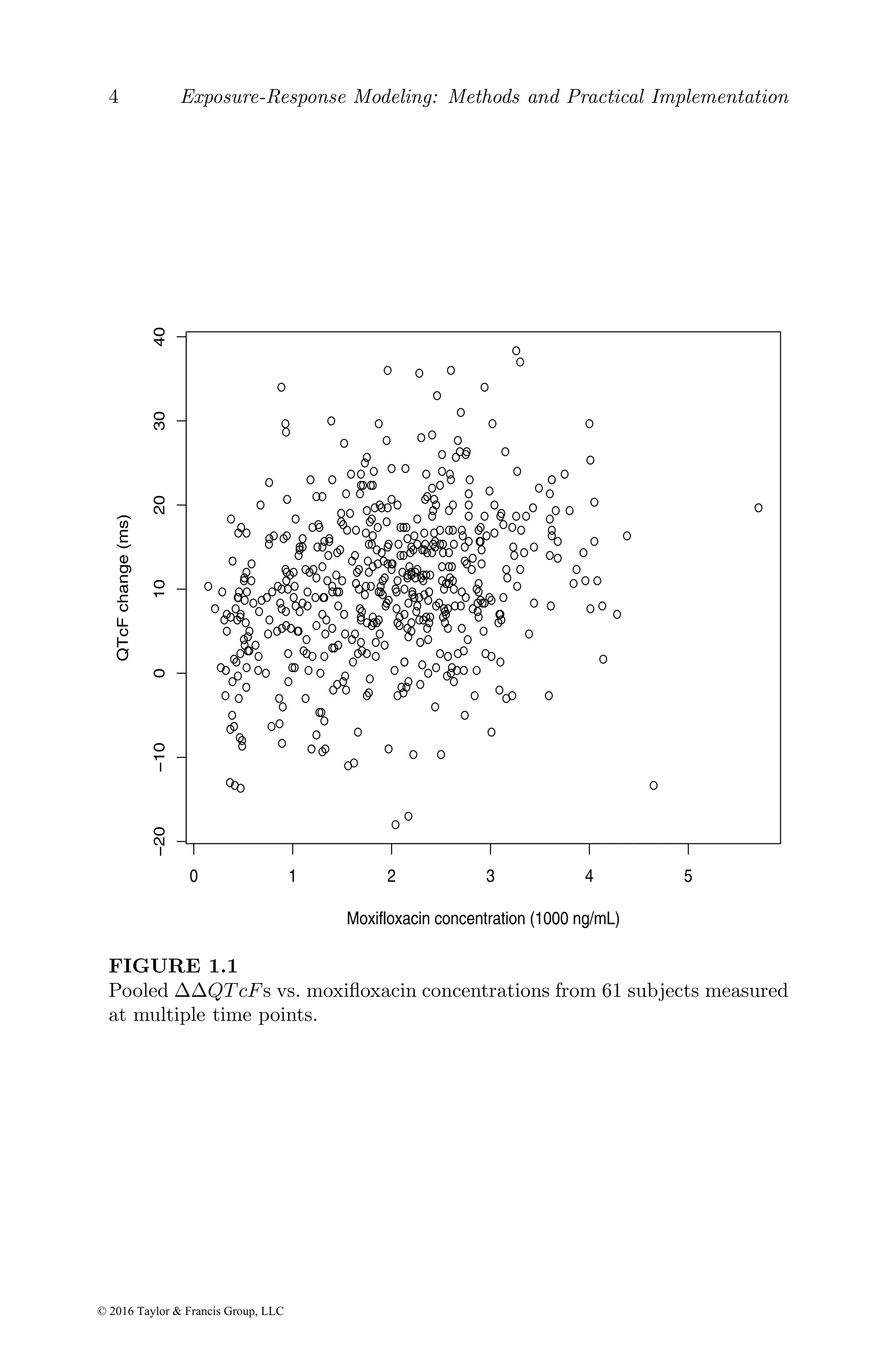
∆∆ parameters). Figure 1.1 plots ∆∆QT cFs vs the corresponding concentra-
tions at all time points. There appears to be a linear trend of increasing QTcF
along with exposure increase. However, since the data contain multiple ECG
measures from individual patients, one cannot simply use a least squares (LS)
method to fit a linear regression model. A correct approach is to use an ap-
propriate repeated measurements model, as described in Chapter 3. One may
be tempted to use a very intuitive approach: first fit the slopes for individual
subjects, then analyze the slopes by taking the mean and standard deviation
(SD) of them. This approach is, in fact, one type of two-stage approach for
fitting a repeated measurement model. Figure 1.2 shows the distribution of
individual LS slope estimates together with estimates based on a linear mixed
model, assuming the slope for each subject follows a normal distribution. One
interesting point is that the individual estimates are highly variable and the
distribution shows heavy tails, particularly at the right hand side. It seems
the mixed model estimates are shrunken toward the center. Details of linear
mixed models can be found in Chapter 3.
Apart from the obvious need to deal with repeated measures, other charac-
teristics in this dataset are also worthwhile exploring. First the concentration–
QT relationship may not be linear. Although the trend in Figure 1.1 seems
linear, it is not sufficient to conclude that using a linear repeated measurement
model is sufficient. The relationship may not be instantaneous since the drug
effect may accumulate and cause a delay (known as hysteresis) of the response
to the exposure.
All the three features are important when using modeling approaches to
help further develop a drug that shows some QT prolongation. For example, if
a tested dose showed unacceptable QT prolongation, it would be useful to find
the maximum dose that has an acceptable QT effect and test if it also delivers
satisfactory efficacy. A valid exposure–response relationship allows calibrat-
ing that dose by taking model fitting uncertainty and inter- and intra-subject
variabilities into account. Another approach to reduce the QT effects may
be to change the drug formulation to reduce the peak concentration, while
keeping a comparable overall exposure. Two key factors to be considered here
are exposure accumulation and correct estimation of the upper percentiles of
subjects with very long prolongation, e.g., defined for the category analysis.
If exposure accumulates over time, the effect of cutting peak concentration on
© 2016 Taylor & Francis Group, LLC
4 Exposure-Response Modeling: Methods and Practical Implementation
0 1 2 3 4 5
−20
−10
0
10
20
30
40
Moxifloxacin concentration (1000 ng/mL)
QTcF
change
(ms)
FIGURE 1.1
Pooled ∆∆QT cFs vs. moxifloxacin concentrations from 61 subjects measured
at multiple time points.
© 2016 Taylor & Francis Group, LLC
Introduction 5
−10 −5 0 5 10
0.0
0.1
0.2
0.3
0.4
βi
Density
Individual estimates
Mixed model estimates
FIGURE 1.2
Individual parameter estimates by linear least squares and linear mixed
model estimates for the slope of ∆∆QT cF and moxifloxacin concentration
(1000ng/mL).
© 2016 Taylor & Francis Group, LLC
6 Exposure-Response Modeling: Methods and Practical Implementation
reducing QT prolongation may be much lower than estimated from a model
assuming an instantaneous exposure effect. Appropriate assessment of the ef-
fect requires developing a dynamic model describing the temporal relationship
between the pharmacokinetics (PK) time profile and the QT time profile. This
type of model and related analytical methods will be described in Chapter 6.
1.2.2 Theophylline
This example comes from a study to find the optimal concentration of theo-
phylline for the management of acute airway obstruction. This is an early
study using a randomized concentration controlled (RCC) design (Holford et
al., 1993a, 1993b). In the study, 174 patients were randomized to a target
concentration of 10 or 20 mg/L (Holford et al., 1993a, 1993b). Theophylline
concentrations from individual patients were controlled with dose adjustment.
From each patient, the concentration and peak expiratory flow rate (PEFR)
were measured multiple times at the same time point. The dataset includes
PEFR and concentration together with patient characteristics. However, the
randomization and dosing data were lost due to a power outage (Halford,
private communication). Therefore, one cannot fit a population PK (popPK)
model to the data, hence some non- and semiparametric approaches were
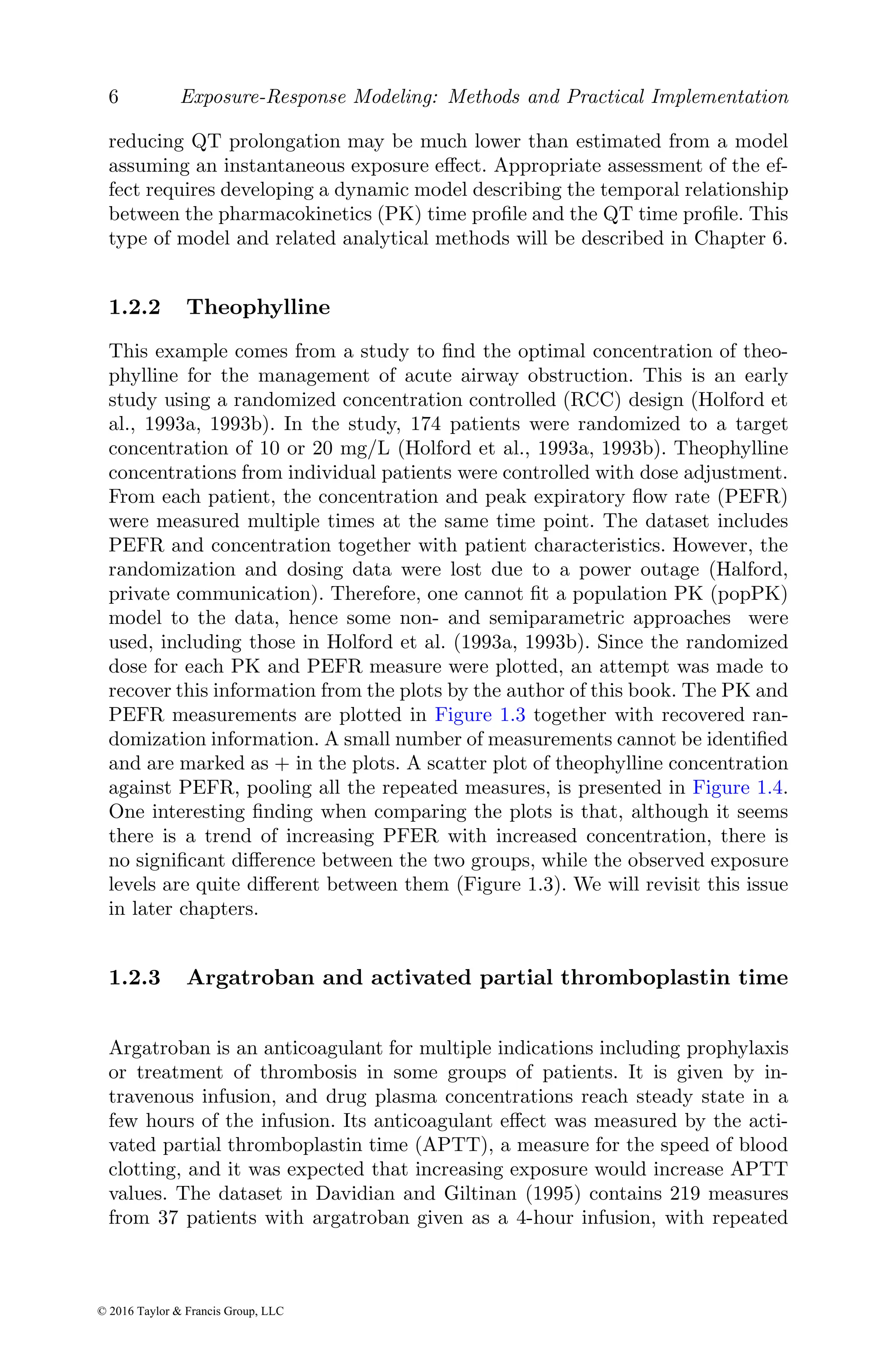
used, including those in Holford et al. (1993a, 1993b). Since the randomized
dose for each PK and PEFR measure were plotted, an attempt was made to
recover this information from the plots by the author of this book. The PK and
PEFR measurements are plotted in Figure 1.3 together with recovered ran-
domization information. A small number of measurements cannot be identified
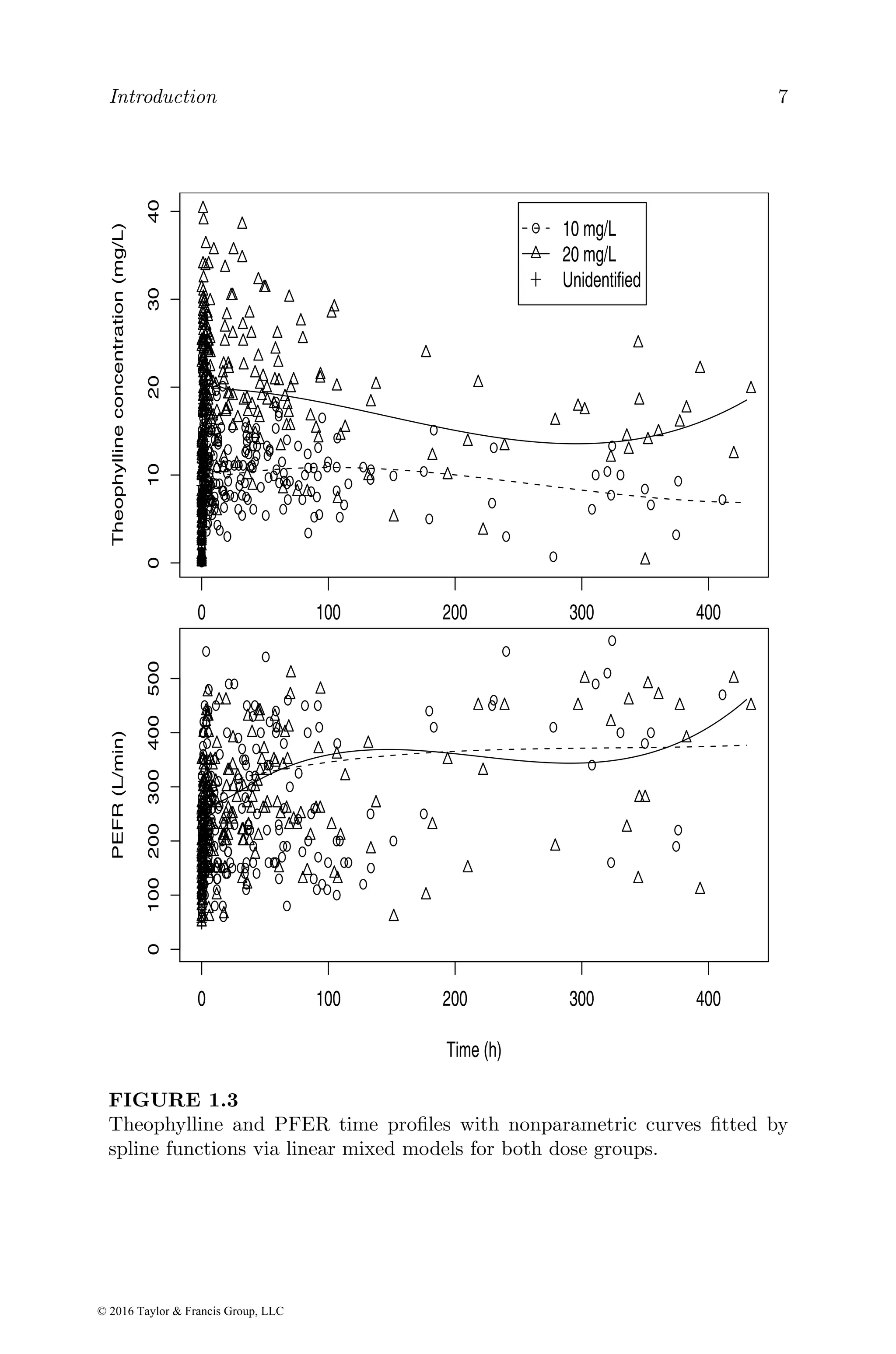
and are marked as + in the plots. A scatter plot of theophylline concentration
against PEFR, pooling all the repeated measures, is presented in Figure 1.4.
One interesting finding when comparing the plots is that, although it seems
there is a trend of increasing PFER with increased concentration, there is
no significant difference between the two groups, while the observed exposure
levels are quite different between them (Figure 1.3). We will revisit this issue
in later chapters.
1.2.3 Argatroban and activated partial thromboplastin time
Argatroban is an anticoagulant for multiple indications including prophylaxis
or treatment of thrombosis in some groups of patients. It is given by in-
travenous infusion, and drug plasma concentrations reach steady state in a
few hours of the infusion. Its anticoagulant effect was measured by the acti-
vated partial thromboplastin time (APTT), a measure for the speed of blood
clotting, and it was expected that increasing exposure would increase APTT
values. The dataset in Davidian and Giltinan (1995) contains 219 measures
from 37 patients with argatroban given as a 4-hour infusion, with repeated
© 2016 Taylor & Francis Group, LLC
Introduction 7
0 100 200 300 400
0
10
20
30
40
Theophylline
concentration
(mg/L)
10 mg/L
20 mg/L
Unidentified
0 100 200 300 400
0
100
200
300
400
500
Time (h)
PEFR
(L/min)
FIGURE 1.3
Theophylline and PFER time profiles with nonparametric curves fitted by
spline functions via linear mixed models for both dose groups.
© 2016 Taylor & Francis Group, LLC
8 Exposure-Response Modeling: Methods and Practical Implementation
0 10 20 30 40
100
200
300
400
500
Theophylline concentration (mg/L)
PEFR
(L/min)
FIGURE 1.4
Theophylline concentrations and PEFR values pooling all the repeated mea-
sures.
© 2016 Taylor & Francis Group, LLC
Introduction 9
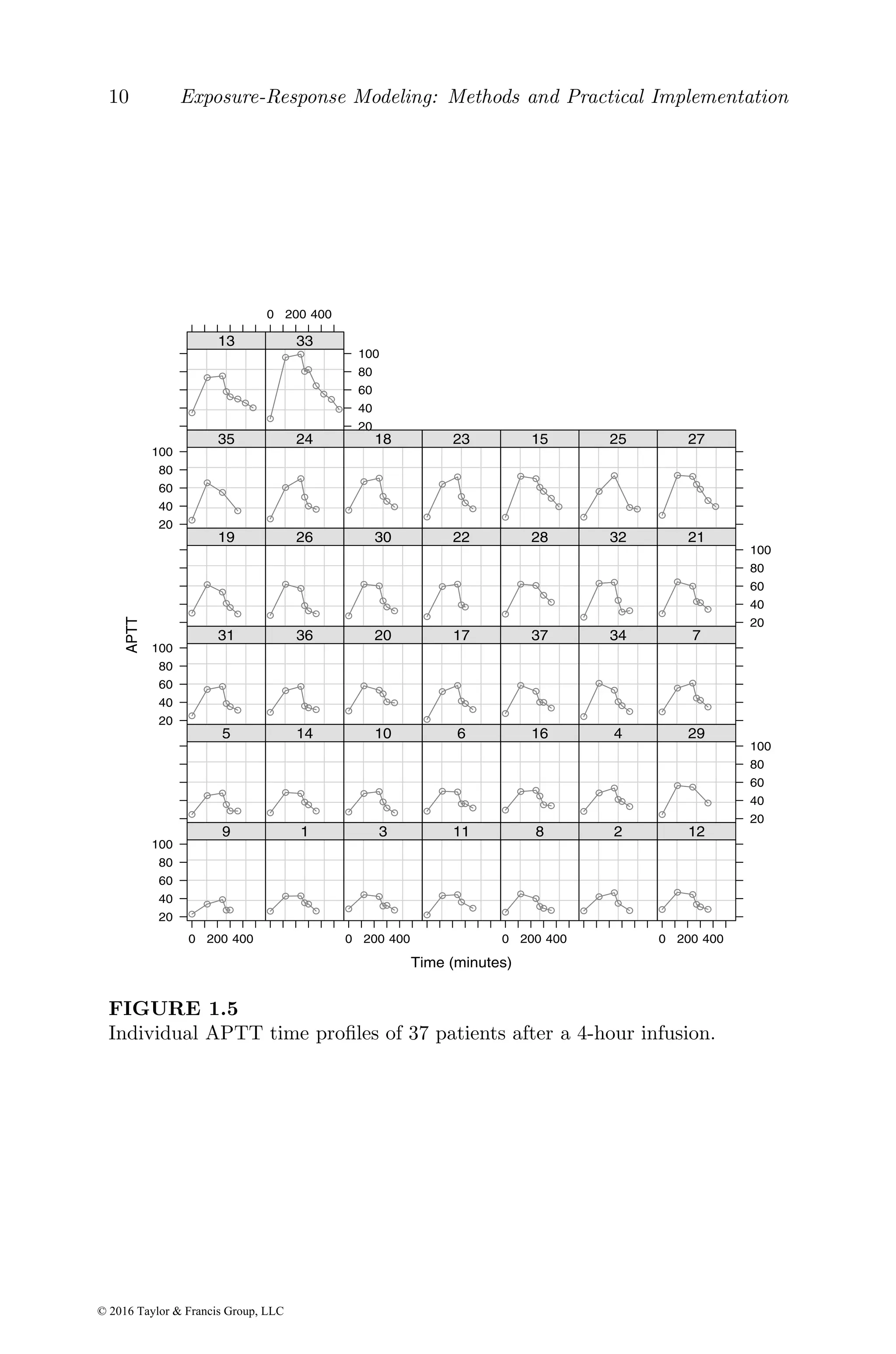
concentration measures taken up to 6 hours after start of the infusion. Figure
1.5 gives individual APTT time profiles for these patients.
The APTT values were not all measured at the same time as the PK
samples were measured. So, to look into the ER relationship, we need to
predict the concentration at the time when each APTT is measured. This can
be done using a nonlinear mixed model to fit the PK data and using the fitted
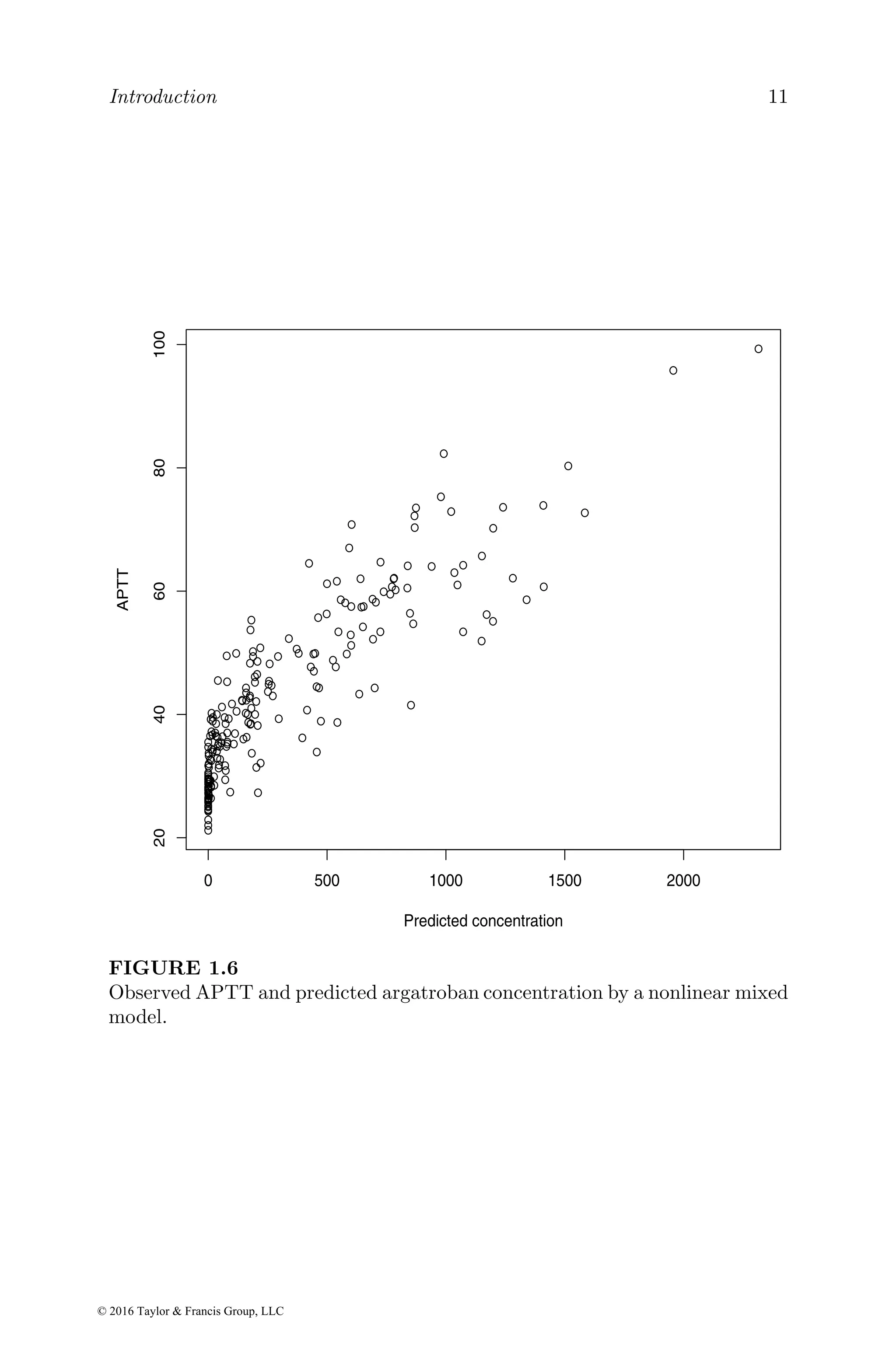
model to predict the APTT at a given time. The APTT values and predicted
argatroban concentrations show a strong linear trend, as shown in Figure 1.6.
However, appropriate modeling approaches dealing with potential repeated
measures, nonlinearity and hysteresis are needed to quantify the relationship
between the exposure and APTT.
1.3 Models and modeling in exposure–response analysis
There are many different types of ER model. However, exposure models de-
scribing the relationship between exposure and factors such as dose also have
an important role in ER modeling. Two types of model are used in ER mod-
eling. Mechanistic models are based on a pharmacological mechanism for the
action of drugs. Pharmacometrics is the main area in which mechanism mod-
els are widely used for ER relationships. PK modeling has a long history in
describing PK characteristics of drugs and the fitting of drug concentration
data (Bonate, 2006). Compartmental models derived from physical models
of drug disposition have been well developed and implemented in software
for PK and pharmacokinetic–pharmacodynamic (PKPD) modeling such as
NONMEM. Relatively recently, mechanistic models for exposure–response re-
lationships have also been developed. Empirical models describe the data in a
quantitative manner, taking potential factors affecting the exposure and ER
relationship into account.
Dose-response and ER models of both types may be written in the follow-
ing abstract form.
Exposure=h(Dose, factors,Parameters)+Error
Response=g(Exposure, factors,Parameters)+Error
where g and h describe the relationships between dose and exposure, and
exposure and response, and both are measured with errors. The tasks of mod-
eling include fitting the two models to estimate the parameters, assessing the
models as well as quantifying the error terms, and variability and uncertainty
in the fitted model and estimated parameters. The models can be used to
determine the exposure level corresponding to the desired response level, and
how to achieve the exposure by adjusting the dose (or in other ways to control
the exposure). The importance of quantifying the variability and uncertainty
may be less obvious than estimating the parameters, but it is an important
© 2016 Taylor & Francis Group, LLC
10 Exposure-Response Modeling: Methods and Practical Implementation
Time (minutes)
APTT
20
40
60
80
100
0 200 400
9 1
0 200 400
3 11
0 200 400
8 2
0 200 400
12
5 14 10 6 16 4
20
40
60
80
100
29
20
40
60
80
100
31 36 20 17 37 34 7
19 26 30 22 28 32
20
40
60
80
100
21
20
40
60
80
100
35 24 18 23 15 25 27
13
0 200 400
20
40
60
80
100
33
FIGURE 1.5
Individual APTT time profiles of 37 patients after a 4-hour infusion.
© 2016 Taylor & Francis Group, LLC
Introduction 11
0 500 1000 1500 2000
20
40
60
80
100
Predicted concentration
APTT
FIGURE 1.6
Observed APTT and predicted argatroban concentration by a nonlinear mixed
model.
© 2016 Taylor & Francis Group, LLC
12 Exposure-Response Modeling: Methods and Practical Implementation
aspect of statistical modeling and provides important information for the as-
sessment of an ER relationship without considering the mechanism behind it.
There are also models that are partly mechanistic and partly empirical.
A mechanistic model has obvious advantages over an empirical model since
it may support empirical evidence with a quantified pharmacological rela-
tionship. It may also indicate further investigation in specific directions. In
contrast, empirical models are more flexible and can often be as good as
mechanistic models for prediction. An empirical model may also be used for
an alternative or a sensitivity analysis to validate or confirm a mechanistic
model-based analysis.
The ER relationship can also be analyzed without using a model. For
example, the responses at a number of dose levels may be used to show a
dose-response relationship, but a model-based approach is more powerful to
quantify the relationship in detail, e.g., between the dose levels. Model inde-
pendent analyses also have their advantages, but they are beyond the scope
of this book.
1.4 Model-based decision-making and drug development
Drug development is a lengthy, complex and expensive process involving mak-
ing hard decisions at many stages under different scenarios. Decision analysis
(DA) has been introduced to several stages in drug development and is playing
an increasing role. Due to the complexity of drug exposure and its outcome,
modeling is a key part of the decision analysis. One typical area where mod-
eling has been playing a key role is to find the right dose to maximize the
drug effects while maintaining an acceptable safety profile . Typically drug
effects (on both safety and efficacy) increase with increasing exposure levels.
The drug developer hopes that there is an exposure range in which efficacy
is satisfactory and toxicity is acceptable and that appropriate doses can be
determined so that the exposure in most patients is in that range. Therefore,
the decision for the right dose involves finding the right balance between safety
and efficacy. ER modeling provides key information for making the decision.
Often a critical question at a certain stage is whether a trial to obtain
further information about safety and efficacy is needed, given the trial is ex-
pensive and takes a long time to run. The information may be to find a more
accurate dose, or to ascertain the efficacy and safety profile of an existing
dose. Decision analysis calculates the value of information (VoI) to assess if
the benefit of running such a study is worth the costs (both money and possible
delay of the development process). Decision analysis offers tools to evaluate
the benefit in order to compare it with the costs. For this ER models are
needed to provide information about efficacy and safety at a given or a range
of doses. On a larger scale than the decision on a single trial, the whole drug
© 2016 Taylor & Francis Group, LLC
Introduction 13
development process involving a large number of trials can be considered as
a complex process and decision makers make multiple decisions step by step,
taking up-to-date information into consideration.
Decision analysis is increasingly used to optimize individual treatment for
personalized medicine . For example, if a drug has highly variable exposure
among patients, therapeutic dose monitoring, which monitors the exposure
periodically and adjusts the dose if necessary, may be needed to ensure indi-
vidual patients are under the right exposure level. Taking the measure has a
considerable cost and inconvenience to the patient. How long do we have to
measure before we stop? In fact, the question should concern when collecting
further information does not justify the costs and inconvenience. Recent de-
velopment of dynamic treatment regimes also brings decision analysis to the
frontline of developing optimal treatment regimes that maximize the benefit
of drugs to individual patients by response dependent treatment adaptation .
Most of these decision making problems require making optimal decisions
sequentially. The decision process itself needs a complex model to evaluate.
The decision tree is a common tool to solve some simple problems. For complex
problems, a dynamic programming approach is needed. For both, ER models
have to be integrated into this decision model.
1.5 Drug regulatory guidance for analysis of exposure–
response relationship
Modeling exposure–response relationships is now playing an increasing role in
drug development, as well as in drug regulation. Modeling approaches are now
frequently used to support the submission of a new drug application (NDA).
The U.S. Food and Drug Administration (FDA) published a guidance on the
analysis of exposure–response relationships (FDA, 2003), in which exposure
may refer to dose or PK concentration. The guidance suggests that determin-
ing the exposure–response relationship can play a role in drug development
to
• support the drug discovery and development processes
• support a determination of safety and efficacy
• support new target populations and adjustment of dosages and dosing
regimens.
The importance of the PKPD relationship, compared with the dose-PD rela-
tionship was recognized: ” ... concentration-response relationships in the same
individual over time are especially informative because they are not potentially
confounded by doses selection/titration phenomena and inter-individual PK
variability.”
© 2016 Taylor & Francis Group, LLC
14 Exposure-Response Modeling: Methods and Practical Implementation
The guidance considered confounding bias in exposure–response analysis
an important issue. It states that if one simply uses the observed drug con-
centration in a PKPD analysis ”...potential confounding of the concentration-
response relationship can occur and an observed concentration-response rela-
tionship may not be credible evidence of an exposure–response relationship”.
The randomized concentration controlled (RCC) design, which uses individ-
ual dose adjustment to achieve exposure levels randomly assigned to patients,
was recommended. Although the RCC design has not been widely used, there
is a trend of increasing RCC trials in the last 10 years.
The guidance also gives some details on specific situations when PK/PD
modeling may provide important information: ”Where effectiveness is imme-
diate and is readily measured repeatedly ..., it is possible to relate clinical
response to blood concentrations over time, which can provide critical infor-
mation for choosing a dose and dosing interval.” The guidance suggests that
the modeling strategy be described clearly and include a statement of the
problem, assumptions used, model selection and validation, and for a PK/PD
analysis for a submission, this information should also be presented in the
exposure–response study report.
Since the guidance was published ten years ago, it does not reflect recent
developments. These include developments in confounding bias and causal
effect estimation, modeling temporal exposure–response relationships and
exposure-safety modeling. The reader can find details of these in later chap-
ters.
Other health authorities have not published guidance specifically for
exposure–response relationships. But using modeling and simulation for drug
registration has been encouraged, particularly in some indications or popula-
tions such as pediatrics (Committee for Medicinal Products for Human Use,
2006). We expect further increases in the application of ER modeling in drug
development and post-marketing monitoring.
1.6 Examples and modeling software
As this is a book about applied statistics, a large number of numerical exam-
ples are included. Some of them are illustrations of real examples such as the
PK-QT and the PK-PEFR trials. We also use some simulation approaches
under practical scenarios to assess the performance of procedures, or simply
to demonstrate some specific properties of them. Using real data is the best
way to demonstrate the implementation of an approach in practice, but a
simulation has the advantage of focusing on the key issues and knowing the
correct answers to specific questions (e.g., which is the best estimate for a pa-
rameter). The selection of numerical examples is a compromise between using
real examples only and, at the other extreme, using simulated data only.
© 2016 Taylor & Francis Group, LLC
Introduction 15
For all simulated data and examples, the codes for simulation and analysis
are available such that the reader can not only reproduce the results, but also
can explore further in the direction in which he or she is interested.
In the last 20 years we have seen a dramatic increase in computing power.
Its impact on modeling is the rapid development of software that can fit
very complex models. Most applied statistics texts now include a substan-
tial amount of content dedicated to using software to solve specific problems
and implementing approaches. This book is not an exception, since modern
exposure–response modeling is heavily dependent on using software. We will
use mainly three type of software: SAS (SAS, 2011), NONMEM (Beal, et al.,
2006) and R (R Development Core Team, 2008) but will not use them to
repeat the same task. The choice of the three is a compromise between soft-
ware used by modelers (NONMEM and R) and statisticians (SAS and R) in
the pharmaceutical industry. Researchers in academic institutes often have a
wide range of software to choose from but these three are among the most
popular ones. In this book implementation of all three may be given if they
are straightforward, and sometimes the most convenient one is recommended.
In particular, NONMEM is not a good platform for complex calculation such
as matrix operations based on a fitted model. Our view is that these types of
calculation should be left for R since NONMEM outputs are easily accessible
in R. One may also question the merits of doing all the modeling in NONMEM
while only taking data to R for extra calculation. We leave this for the reader
to choose since it again depends on individual preference.
Although there is no space for a detailed comparison between the three,
a few words may help to make a selection if the reader has a choice, par-
ticularly between SAS and NONMEM. SAS is a universal software package
that provides a large number of statistical tools. NONMEM was developed
for modeling and simulation using population PK and PKPD models. The
core part is a nonlinear mixed model fitting algorithm, very similar to that of
SAS proc NLMIXED, and the other parts allow easily implementation, e.g.,
of a standard compartmental PK model. Since NONMEM lacks other facili-
ties such as graphic functions, a partner software is needed and the common
selection is R. For those with no access to commercial software (SAS and
NONMEM among the three), R alone is sufficient in most cases.
© 2016 Taylor & Francis Group, LLC
2
Basic exposure and exposure–response
models
This chapter introduces simple models for modeling exposures and exposure–
responses relationship. It serves as the basis of more complex models for lon-
gitudinal or repeated measurement data. Modeling exposure is often an inte-
grated part of ER modeling, hence exposure models are also introduced. Some
modeling tools such as transformation are also introduced here.
2.1 Models based on pharmacological mechanisms
2.1.1 Example of a PKPD model
Some PKPD models are derived from drug pharmacological mechanisms, al-
though often based on some simplifying assumptions. Csajka and Verotta
(2006) give an excellent review of this type of PKPD model. A typical ex-
ample of such a model is derived from the drug receptor occupancy theory.
According to the theory, the drug needs to bind to its receptor to form a drug–
receptor complex to produce its effects. Often there is only a limited number
of receptors. There are two processes occurring simultaneously: free receptors
and drug molecules bind to form the complex and the complex disassociates
back to free receptors and drug molecules. Let Rc(t) be the amount of the
complex and C(t) be the drug concentration at time t. We assume that the
change of Rc(t) follows
dRc(t)
dt
= kon(Rmax − Rc(t))C(t) − koff Rc(t) (2.1)
where kin and koff are, respectively, the rates of forming the complex and
disassociating back to free drug molecules and receptors and Rmax is the to-
tal amount of receptors. This is a dynamic model and Rc(t) is a function of
time. But if C(t) = C is constant, at the steady state (i.e., when association–
disassociation reaches equilibrium so that dRc(t)/dt ≈ 0, t > ts, with a rea-
sonably large ts), we can solve Rc = Rc(ts) easily and get
Rc =
RmaxC
Kd + C
, (2.2)
17
© 2016 Taylor & Francis Group, LLC
18 Exposure-Response Modeling: Methods and Practical Implementation
where Kd = koff /kon. When the response Y is proportional to Rc, this theory
leads to
Y =
EmaxC
Kd + C
, (2.3)
where Emax is the maximum effect when all Rmax receptors have become
Rc, when the drug concentration tends to infinity. Kd is also known as the
concentration that gives the Emax/2 effect and is denoted as EC50 and the
model is known as the Emax model. In the following, we often write this model
as Y = Emax/(Kd/C + 1) to shorten formulas, which should read as (2.3), in
particular, Y = 0 when C = 0. The basic form has a number of variants. The
reader is referred to Csajka and Verotta (2006) or a specialized text for details.
This model is the most commonly used PKPD model. One may also use this
model for the dose–response relationship by replacing C with dose for a drug
with linear PK, i.e., the concentration is proportional to dose: C = KDose.
In this case, EC50 = Kd/K is the dose level that gives the Emax/2 effect.
There is a rich literature on PKPD models and mostly these models are
dynamic and used to describe temporal ER relationships. Some typical models
will be introduced in Chapter 6.
2.1.2 Compartmental models for drug–exposure modeling
Compartmental models are commonly used for drug concentrations, and some-
times for general exposures . A compartmental model describes drug absorp-
tion, disposition and elimination in and out of different body compartments
(although some are hypothetical) (Gibaldi and Perrier, 1982). For example,
the following are differential equations for an open one-compartment model
with first-order absorption.
dA1
dt
= −KaA1
dA2
dt
= KaA1 − KeA2 (2.4)
where A1 and A2 are, respectively, the amount of drug at the absorption
site and in the blood circulation (the central compartment), and Ka and Ke,
respectively, are the rates of absorption and elimination. After a dose D at
time t = 0, A1(t) = DF exp(−Kat), where F is called the bioavailability.
Taking it into the second equation we can solve A2(t):
A2(t) =
DKaF
(Ka − Ke)
(exp(−Ket) − exp(−Kat)), (2.5)
which can be converted to drug concentration in the central compartment
as c(t) = A2(t)/V , where V is the volume of distribution, an important PK
parameter. Ke is often parameterized as Ke = Cl/V in terms of drug clearance
Cl.
© 2016 Taylor & Francis Group, LLC
Basic exposure and exposure–response models 19
If the drug is given by a bolus injection that delivers the drug into the
central compartment instantly, the model is simplified to
c(t) =
DF
V
exp(−Ket). (2.6)
This model may also be considered as an approximation to model (2.5) when
the absorption is very quick. This can be verified by letting Ka → ∞ in model
(2.5). This model may be generalized to allow parameters depending on covari-
ates. For example, V often depends on weight or body surface area. Some PK
parameters such as the area under the curve defined as AUC =
R ∞
0
c(t)dt and
the maximum concentration Cmax = maxt(c(t)) are also important exposure
measures in PKPD modeling. In the last example, we have AUC = DF/(V Ke)
and Cmax = DF/V .
2.2 Statistical models
The models introduced in the last section describe theoretical situations, while
almost always there are random variations in drug exposure and response data.
Statistical models can take random variations in the response, exposure and
model parameters into account, but we will introduce them by steps. Here,
two error terms, representing the variations in the response and the expo-
sure, respectively, are introduced, assuming other variables in the models are
known. Variations in model parameters will be introduced in the next chapter
and measurement errors in the exposure in ER models will be introduced in
Chapter 4. A statistical model may be based on a mechanistic or an empirical
model. An empirical ER model describes the relationship between exposures
and responses but is not derived from the biological or medical mechanism
between them. Drug exposure and its relationship with dose and other factors
may also be modeled by an empirical model. Sometimes a mechanistic model
may take a simple form. For example, taking a log-transformation of model
(2.6) we obtain
log(c(t)) = log(D) − log(V ) − Ket. (2.7)
Therefore, a simple linear empirical model for log-concentration may also have
a mechanistic interpretation. One such model includes log-dose and other fac-
tors such as age and weight as covariates, known as the power model, and is
frequently used as an empirical alternative to the compartmental model. See
the example in the next section
In this book we focus on cardinal (rather than ordinal) exposure measures.
Obviously drug concentration is a cardinal measure, and so is the percentage
of compliance to a treatment. When the drug dose is the exposure of concern,
there are often only a few dose levels available. Indeed, one can consider dose
level as an ordinal categorical variable. But we will treat the dose as a cardinal
© 2016 Taylor & Francis Group, LLC
20 Exposure-Response Modeling: Methods and Practical Implementation
measure, since this way allows, for example, calibration at any dose level based
on a fitted model. Therefore, we only consider ER models with a cardinal
measure for the exposure, although covariates of other types may be included.
The ER model for a particular analysis mainly depends on the type of
response. When the response is a continuous variable, the following regression
models are the main candidates. Let yi be the response, ci be the exposure
(which may not always be drug concentration) and Xi be a set of covariates
of subject i. A simple linear model is
yi = βcci + XT
i β + εi (2.8)
where εi is a random variable with zero mean. Here the key parameter is βc
since it measures how yi changes with ci. To fit the model, the simple least
squares (LS) procedure is often sufficient, based on a key assumption that ci
and εi are independent. This assumption obviously holds when the cis are
randomized dose levels. If ci is observed, this might not be true. This issue
will be left for later chapters.
Often PKPD models are nonlinear; one example is the Emax model (2.3).
In general, a nonlinear model with an additive random error can be written
as
yi = g(ci, Xi, β) + εi. (2.9)
Note that here we classify a model as nonlinear when the relationship between
yi and the model parameters, not that between yi and ci, is nonlinear, since it
is this nonlinearity that has a substantial impact on the statistical and model
fitting aspects. For example, a model yi = β0 + βc log(ci) + εi is considered a
linear model, and statistical inference and model fitting approaches for linear
models can be applied. One special form of model (2.9) is
yi = g(βc, ci) + XT
i β + εi (2.10)
in which the XT
i β part is linear. This model is often referred to as a partial
linear model, and the partial linear structure, specifically the linearity between
yi and β, may be used to facilitate model fitting and statistical inference based
on the model.
Often the variance of εi in (2.9) may not be constant, a situation called
variance heterogeneity. var(εi) may be a function of the mean of yi, e.g.,
var(εi) = σ2
0 + agb
(ci, Xi, β), where σ2
0 is the constant component, and a
and b are parameters determining how var(εi) changes with g(ci, Xi, β). This
occurs when yi is a nonnegative measure such as a biomarker measure and its
variation or measurement error may increase with its mean.
In model (2.9) the error term is additive to g(ci, Xi, β). Sometimes a model
with multiplicative error term
yi = g(ci, Xi, β)εi (2.11)
may be needed. This model is particularly useful when the value range of the
© 2016 Taylor & Francis Group, LLC
Basic exposure and exposure–response models 21
response may be limited to be positive, e.g., the level of a biomarker, drug
concentration, or within a range, e.g., the percentage reduction in tumor size
from the baseline size. In this case, one may assume that log(ε) ∼ N(0, σ2
),
hence yi is always positive as long as g(ci, Xi, β) > 0. In contrast, the additive
model with E(εi) = 0 cannot guarantee this property. The PK model (2.6) is
also a multiplicative model.
Both (2.8) and (2.11) assume that yi is continuous, hence they cannot
describe some types of response measures such as the status of dead or alive
or the number of epileptic events within a day. A class of models known as
generalized linear models (GLM) provides tools to model such types of re-
sponses (McCullagh and Nelder, 1989). A GLM assumes that the distribution
of yi belongs to the exponential family, and the mean of the response E(yi) is
linked to a linear structure with a link function g(.) in the form
g(E(yi)) = XT
i β + βcci (2.12)
or equivalently E(yi) = g−1
(XT
i β + βcci). This model preserves the linear
structure in model (2.8), but allows nonlinearity in the link function. The lin-
ear part XT
i β is known as the linear predictor. GLMs can be used to model
a range of outcome types such as continuous variables with a positive distri-
bution, binary, count and categorical variables, since the exponential family
contains a wide range of distributions. Two commonly used GLMs are the
Poisson and logistic regression models. The former is used for count data,
e.g. yi ∼ Poisson(λi) may be the count of AEs on patient i with the log-link
function
log(λi) = XT
i β + βcci, (2.13)
where the right hand side is the linear predictor and βc is log-risk ratio (log-
RR) for a 1 unit increase in ci. Logistic regression models for binomial out-
comes yi ∼ Binomial(pi, ni) where ni is the denominator are also GLMs. For
example, when yi is a binary variable (e.g., yi = 1 if the patient had an AE
and yi = 0 otherwise), then yi may follow the logistic model
logit(P(yi = 1)) = XT
i β + βcci (2.14)
where logit(P) = log(P/(1 − P)) and and βc is log-odds ratio (log-OR) for
a 1 unit increase in ci. For fitting GLMs using different approaches, see the
appendix for details.
Now we apply the logistic regression model to the QT prolongation data
in the example in Chapter 1. Since the mean PK concentration had the max-
imum at 2 hours, we explore the relationship between the concentration and
probability of QTcF prolongations being more than 20 ms around 2 hours.
Using the 20 ms rather than the 30 ms threshold used by drug regulators
is due to the small number of patients with QTcF > 30 ms in this dataset.
Since QTcF was also measured during the placebo period, we can treat these
measures as taken under 0 concentration. Fitting the logistic model to the
data of both placebo and moxifloxacin periods, we get logOR = 0.468 (SE
© 2016 Taylor & Francis Group, LLC
22 Exposure-Response Modeling: Methods and Practical Implementation
= 0.215) for a 1000 ng/mL concentration increase, which shows a significant
increase of the risk of 20 ms prolongation at the 5% level. However, when fit-
ting the model to the moxifloxacin data only, the log-OR becomes -0.104 (SE
= 0.557), indicating no ER relationship. In fact, this situation is not uncom-
mon in exposure–response modeling when control (i.e., no exposure) data are
available, since fitting the same model with and without control data may lead
to completely different results. The difference often suggests that the dose–
response relationship in the whole exposure range is complex and may need
a more complex model. A simple model is likely to be misspecified at some
exposure ranges. Using such a model may give very misleading predictions at
these ranges.
A number of special situations need careful consideration when using a
GLM model. For example, if yi is the number of asthma attacks of patient i
within a week, one may be attempted to use a Poisson regression model to
model yi since it is a count of events. However, yi may have a higher variance
than E(yi) = λi: the variance of yi if it is Poisson distributed. This situation
is known as over-dispersion, often caused by correlation between the events
on the same patient. One way to accommodate over-dispersion is to assume
that λi is a random variable following a gamma distribution. This leads to a
negative binomial distribution for yi with var(yi) = λi + φλ2
i where φ is an
over-dispersion parameter which can be estimated from the data (Cameron
and Trivedi, 1998).
Over-dispersion may also be found in the distribution of the number of
failures (or responders) yi among ni subjects. In toxicology experiments, often
the responses of animals in the same litter are correlated. Therefore, in litter i
the number of deaths yi may not follow a binomial distribution and var(yi) 6=
nipi(1 − pi), where pi is the probability of an event. The effect leading to
this correlation is known as the litter effect, but the effect can be found in
other areas under similar as well as different situations. A common model
to take positive correlation into account is to assume that pi follows a beta
distribution. The resulting distribution for yi is the beta-binomial distribution
with var(yi) = nipi(1 − pi)(1 + (ni − 1)φ) where φ is the over-dispersion
parameter.
Over-dispersion may not always occur even when pi is a random variable.
For the beta-binomial distribution, when ni = 1, φ has no effect and the
variance is var(yi) = pi(1 − pi). Hence there is no over-dispersion in a binary
response variable. Intuitively, in an animal toxicology experiment, if there is
only one animal in a litter then there is no over-dispersion due to variation
between animals. It is easy to verify that if yi ∼ Bin(pi) and pi ∼ F(p) where
F(p) is any distribution within (0,1), the marginal distribution yi is always
binary.
Although one may use a maximum likelihood estimate (MLE) approach
with an appropriate distribution such as negative- or beta-binomials for fit-
ting over-dispersed data, in practice, an empirical approach is often sufficient
and more convenient. The approach uses a robust estimate, rather than its
© 2016 Taylor & Francis Group, LLC
Basic exposure and exposure–response models 23
parametric form (e.g., var(yi) = nipi(1 − pi) for the binomial distribution)
to estimate var(yi), then uses the estimate to calculate the SEs of β̂ so that
the Wald test-based statistical inference is valid under over-dispersion. In the
SAS proc GENMOD, the option “PSCALE” in the “model” statement asks
to estimate φ by the Pearson χ2
statistic based on the empirical variance es-
timate
Pn
i=1(yi − E(yi))2
/(n − q) where q is the number of parameters in the
model. Another option “DSCALE” uses the deviance to calculate φ. Often the
resulting difference in var(β̂) by using the two options is small. Although φ is
introduced by a mixture of distributions that only allows for over-dispersion,
the robust approach also works for under-dispersion, i.e., when var(yi) < λi
in the count model example. In this case, it is often worthwhile to consider if
under-dispersion is likely before deciding if one of the options should be used.
NONMEM is a likelihood based software, so there is no readily used option to
deal with over-dispersion. One may use either a full likelihood approach with
the likelihood function for the beta-binomial or negative binomial distribution,
or use the so called quasi-likelihood approach. See Chapter 3.
Sometimes extra variations occur at a particular value. The most common
scenario can be found in data with more zero counts than there should be if
a Poisson or even a negative binomial distribution is assumed. This scenario
is known as zero-inflation and has often been seen in biomedical outcomes,
e.g., in the counts of asthma or epilepsy attacks, or adverse events under
drug exposure. To describe this type of data, zero-inflated Poisson (ZIP) has
been introduced as follows. A ZIP distribution is denoted as ZIP(λi, ρi) and
defined as
P(Yi = y) =
(
ρi + (1 − ρi) exp(λi) y = 0
(1 − ρi)
λ
yi
i exp(λi)
yi! y > 0
(2.15)
where ρi is the probability of Yi being always zero. Therefore, we have E(Yi) =
(1 − ρi)λi. As both λi and ρi may depend on exposure and covariates, they
may be fitted in separate models. These models are also known as two-part
models.
In a similar way, one can define a zero-inflated negative binomial (NB)
distribution Yi ∼ ZINB(λi, φ, ρi) and Yi has 1 − ρi chance to follow the NB
distribution and ρi chance being always 0. Zero-inflated models have been
widely used for medical decision-making, in which some outcomes such as the
number of hospital visits are often zero-inflated. An ER model may help to
assess the impact of dosing and dose adjustment on costs due to adverse events
leading to hospitalization.
To link the two distributions to exposure and covariates, one may use a
GLM structure for both λi and ρi:
logit(ρi) = XT
i βa + ciγa
log(λi) = XT
i βb + ciγb (2.16)
where each model may only use a part of the covariates in Xi. The likelihood
function of the ZIP can be written based on its distribution (2.15), and can
© 2016 Taylor & Francis Group, LLC
24 Exposure-Response Modeling: Methods and Practical Implementation
be maximized numerically to obtain estimates for parameters in both parts.
Fitting some standard zero-inflated models is easy with software such as SAS
proc GENMOD. Alternatively, proc NLMIXED can fit a wide range of models
that consists of two parts, with a regression model for each.
A similar issue may arise when the outcome is either zero or a continuous
variable. One example is the duration of hospital stay for a patient popula-
tion. The duration may be modeled by a log-normal or a gamma distribution,
but for those without any hospitalization, the duration is zero. The similar
approach can be applied. But as a positive continuous distribution does not
contain zero value, it has no contribution to the zero count, as we have seen
(1−ρi) exp(λi) in the ZIP distribution (2.15). Hence, the models for the prob-
ability of having zero value and the non-zero values can be fitted separately.
The logistic model can be extended to model ordered categorical response.
Examples may include clinical outcomes such as a three-level category of re-
sponding to treatment, stable disease and disease progression. One may model
such an outcome with a general polynomial distribution Poly(p1, ..., pk), with
pk = P(y = k) being the probability of outcome y in the kth category, and
Pk
j=1 pk = 1. Although each pi may be linked to exposure and covariates,
to exploit the order of categories, one may use a model to represent a trend
between, e.g., exposure and the level of outcome. For example, a higher expo-
sure may increase the odds of being in a better category, which is the basic
assumption of the proportional odds model with
log(P(y > k)/P(y ≤ k)) = βcci + XT
i β (2.17)
where βci s the common log-OR for a 1 unit increase in ci. An alternative is
to use a reference category, e.g., level 1, so that the model assumes
log(P(y = k)/P(y = 1)) = βcci + XT
i β. (2.18)
Both models include the logistic model a special case when the category has
two levels. Fitting such a model is straightforward with current software for
GLMs such as proc GENMOD.
2.3 Transformations
Transformation is a useful approach in modeling. It can be used on exposure
and/or response variables as well as parameters. We will consider the first case
and leave transformation of parameters (also known as re-parameterizations)
to a later part where we treat parameters as random variables. The log-
transformation is the most commonly used transformation and plays a central
role in ER modeling. Often a transformation should be applied to both the
variable and the model for it. This is known as the transform-on-both-sides
© 2016 Taylor & Francis Group, LLC
Basic exposure and exposure–response models 25
approach (TBS, Carroll and Ruppert, 1988). Typically a log TBS is a bridge
between additive and multiplicative models. One reason for using a transfor-
mation from a statistical aspect is to make the distribution of the response
easy to handle with a simple model. The log-transformation is the most com-
mon one to use. The transformation also converts a multiplicative model to
an additive one, and the latter is often much easier to fit. Some transforma-
tions proposed from purely statistical aspects, particularly those depending
on extra-parameters, such as the Box–Cox transformation, are used less fre-
quently than the log-transformation in ER modeling. Here we will mainly
focus on the log-transformation.
Consider the theophylline concentration data. Since there is no dosing
history data, we model the concentration data before any dose adjustment is
made. Let ci be the concentration from patient i at 0.01 h. We fitted a linear
model for log-transformed ci and covariates:
log(ci) = XT
i β + ei, (2.19)
where ei ∼ N(0, σ2
e). Note that this model might be considered as an approx-
imation to model (2.6). The data were fitted by the linear regression function
lm(.) in R. After fitting models with different combinations of covariates in
Xi, we found that only age is related to ci (denoted as THEO in the outputs)
and the fitted model is
lm(formula = log(THEO) ~ log(AGE), data = short[short$TIME ==0.01, ])
Coefficients:
Estimate Std. Error t value Pr(>|t|)
(Intercept) -0.8623 0.9418 -0.916 0.3618
log(AGE) 0.5699 0.2655 2.147 0.0339
The other factors included in the dataset might have been sufficiently adjusted
when planning the initial dose. Transforming back to the original scale, we get
the geometric mean of ci as
exp(XT
i β̂) = exp(−0.862)AGE0.570
(2.20)
which is in the form of the power model. The key feature is that the contri-
butions of the factors are multiplicative to each other. Note that Eg
(yi) =
exp(XT
i β) is the geometric mean of yi and E(yi) = exp(XT
i β)E(exp(ei)) >
exp(XT
i β). Geometric means are commonly used for modeling exposure data,
but may not always be appropriate for PKPD modeling.
Transformations are also used for nonlinear models. The error structure of
the model is a key factor to consider for selecting an appropriate transforma-
tion. We take the Emax model (2.3) as an example to show how to select the
transformation. Suppose that yi is positive (e.g., the tumor size or a positive
valued biomarker) and its relationship with ci has a sigmoid-like shape; then
the following model may be considered:
log(yi) = log(Emax/(1 + EC50/ci)εi)
= log(Emax) − log(1 + EC50/ci) + log(εi) (2.21)
© 2016 Taylor & Francis Group, LLC
26 Exposure-Response Modeling: Methods and Practical Implementation
where log(εi) ∼ N(0, σ2
ε) is an additive error term. This is a direct application
of TBS to the Emax model with a multiplicative error term. The assumption
for multiplicative error is reasonable when all yi > 0. Consider an additive
Emax model
yi = Emax/(1 + EC50/ci) + ε∗
i . (2.22)
Under constraint yi > 0, the error term has to satisfy the condition Emax/(1+
EC50/ci) > ε∗
i , which makes the distribution of ε∗
i depend on E(yi) in an
awkward way. Model (2.21) is a partial linear model since the parameter Emax
has been separated from the nonlinear part.
From model (2.21) we can derive
E(yi) = Emax/(1 + EC50/ci) exp(σ2
ε /2). (2.23)
Note that the relationship between E(yi) and ci is still described by the Emax
model if σ2
ε is constant. Emax and EC50 are still the maximum effect and the
concentration for achieving 50% of the maximum effect. The absolute change
in E(yi) due to ci is, however, dependent on σ2
ε . A constant σ2
ε is an important
condition for the Emax relationship between E(yi) and ci, as the geometric
mean Eg
(yi) = Emax/(1 + EC50/ci) is proportional to E(yi) when σ2
ε is
constant. But the two may be different functions if σ2
ε depends on ci directly
or indirectly.
We note that, with this model, E(yi) = 0 when ci = 0, and E(yi) = Emax
when ci → ∞. E(yi) = 0 may be an unreasonable constraint since often
the baseline of response yi0 (i.e., the outcome when ci = 0) may not be zero.
Therefore, we may want to model the percent change from baseline or the ratio
of the response to the baseline. Multiplicative models are commonly used for
this purpose. For example, let yi be the tumor size or a biomarker measure
and yi0 the baseline value. We are interested in the treatment effect on yi/yi0
or more specifically the reduction of tumor size and/or biomarker measure
from the baseline. In this case we want the geometric mean Eg
(yi) = yi0
when ci = 0. For this situation a variant of model (2.21) is
yi/yi0 = (1 − Emax/(1 + EC50/ci))εi (2.24)
where yi0 is the baseline. This model leads to Eg
(yi|yi0, ci = 0) = yi0, as we
desire. Note that often a constraint Emax ≤ 1 should be applied as the tumor
or biomarker values should be nonnegative. A further extension may allow
fitting yi0 in the model as a covariate:
yi = yα
i0(1 − Emax/(1 + EC50/ci))εi (2.25)
where α is a new parameter representing the impact of yi0 on yi. With a
log-transformation on both sides, the model
log(yi) = α log(yi0) + log(1 − Emax/(1 + EC50/ci)) + log(εi) (2.26)
can be fitted as a partial linear model. A numerical problem may occur when
© 2016 Taylor & Francis Group, LLC
Basic exposure and exposure–response models 27
1−Emax/(1+EC50/ci) is too close to zero. Often a very small positive number
can be added or Emax is bounded lower than 1 to avoid this problem. Emax
can be negative if the exposure effect is to increase yi from yi0.
Finally, it is important to note that dealing with zero exposures (e.g.,
exposure of the control group) is difficult for log-transformation, e.g., log(yi) =
β log(ci) + εi. The ad hoc approach of replacing the zero value with a small
value may work fine. But sensitivity of the model fitting to the imputed value
should be examined. If the purpose is to extrapolate the exposure–response
relationship to a lower exposure range than the observed exposure range, one
should ensure the model fits well in the extrapolation range, as the imputed
value may not affect the overall model fitting, but have a strong impact on
prediction for the lower exposure range.
2.4 Semiparametric and nonparametric models
Often models for a PKPD relationship are empirical in nature (in contrast to
popPK models derived from a pharmacological mechanism). Therefore, the
modeler may be less certain of the correctness of the model and may not be
able to take advantage of using a model with clear pharmacological meaning.
Sometimes parametric models may not fit the data well, hence more flexible
models are useful alternatives. There are many non and semiparametric ap-
proaches described in the literature. We will concentrate on one approach,
spline functions (de Boor, 1978). This approach has a number of advantages
over the other approaches, the most important one being its ease of use with
implementations in R and SAS.
Spline functions have been widely used to approximate a function with
known or unknown analytical form in computational mathematics, and al-
gorithms for calculating them are well developed (de Boor, 1978). Without
going into details, we simply state that spline functions are piecewise poly-
nomial functions connected at a number of points (knots) where the value
and derivatives up to a certain order are continuous, so that the curve they
create is sufficiently smooth. The most commonly used are cubic spline func-
tions consisting of cubic polynomials with continuous values and up to the
second order derivatives continuous. Although some software fits data with
spline functions automatically, sometimes one needs to construct spline func-
tions to fit complex models with software without built-in spline functions.
The approach of using spline functions with a certain smoothness controlled
by the number knots and grade of splines is called regression splines and is a
common approach.
Using regression splines to fit models is straightforward. We use B-splines
as an example to introduce this approach. Suppose we would like to construct
a smoothed ER curve in the exposure range (0, 1). The simplest B-splines are
© 2016 Taylor & Francis Group, LLC
28 Exposure-Response Modeling: Methods and Practical Implementation
those with knots at 0 and 1 only (known as boundary knots). In this case,
the B-splines are terms of Ck
nxn
(1 − x)k
, k = 0, ..., n, with Ck
n the number of
combinations of taking k balls from a total of n. With only boundary knots,
the cubic B-spline has n = 3 + 1 = 4 such terms. Using function bs() in R
library splines, we can construct
> x=(0:10)/10
> cbind(x,bs(x,degree = 3,intercept=T))
x 1 2 3 4
[1,] 0.0 1.000 0.000 0.000 0.000
[2,] 0.1 0.729 0.243 0.027 0.001
[3,] 0.2 0.512 0.384 0.096 0.008
[4,] 0.3 0.343 0.441 0.189 0.027
[5,] 0.4 0.216 0.432 0.288 0.064
[6,] 0.5 0.125 0.375 0.375 0.125
[7,] 0.6 0.064 0.288 0.432 0.216
[8,] 0.7 0.027 0.189 0.441 0.343
[9,] 0.8 0.008 0.096 0.384 0.512
[10,] 0.9 0.001 0.027 0.243 0.729
[11,] 1.0 0.000 0.000 0.000 1.000
gives the function values at different x. With one interior knot at 0.5, there is
one more term
> bs(x,degree = 3,knots=0.5,intercept=T)
1 2 3 4 5
[1,] 1.000 0.000 0.000 0.000 0.000
[2,] 0.512 0.434 0.052 0.002 0.000
[3,] 0.216 0.592 0.176 0.016 0.000
[4,] 0.064 0.558 0.324 0.054 0.000
[5,] 0.008 0.416 0.448 0.128 0.000
[6,] 0.000 0.250 0.500 0.250 0.000
[7,] 0.000 0.128 0.448 0.416 0.008
[8,] 0.000 0.054 0.324 0.558 0.064
[9,] 0.000 0.016 0.176 0.592 0.216
[10,] 0.000 0.002 0.052 0.434 0.512
[11,] 0.000 0.000 0.000 0.000 1.000
attr(,"degree")
[1] 3
attr(,"knots")
[1] 0.5
attr(,"Boundary.knots")
[1] 0 1
However, one of the terms is redundant as it is a linear combination of the
others. This can be seen from that Ck
nxn
(1−x)k
s are the probability of having
k events in n trials when x is the probability, hence
Pn
k=1 Ck
nxn
(1 − x)k
= 1.
Therefore, to fit B-splines to, e.g.,
√
x, one should use the bs() function without
the option intercept= T , which is the default, of not produce the first term:
© 2016 Taylor & Francis Group, LLC
Basic exposure and exposure–response models 29
lm(sqrt(x)~bs(x,degree=3))
Otherwise, the intercept cannot be fitted. The algorithm of constructing B-
splines (de Boor, 1978) is very efficient, but will not be discussed here. The
coefficient Ci
n is not needed from a practical aspect, as for each term, a pa-
rameter will be fitted. Therefore, we may just note each term as Bk(x). There
are other types of spline functions; among them the natural spline functions
are also commonly used.
When using spline functions in an ER regression model, one can simply
include them as covariates:
yi =
K
X
k=1
Bk(ci)ηk + εi (2.27)
where Bk(ci) is evaluated at exposure level ci. Construction of B-spline func-
tions is very efficient with software such as the R-library splines(.). For ex-
ample, using the argatroban data at the 6-hour time point and predicted
exposures, which will be discussed in Chapter 4, we can use function bs()
together with function lm() to fit the spline functions to log(APTT):
fittedModel1=lm(log(resp)~bs(pred,3),data=data240),
in which data240 is the 6-hour dataset, pred and resp are the predicted ex-
posure and log(APTT), respectively, and bs(pred, 3) produces a matrix of
B-spline functions. It produces the model fit
lm(formula = log(resp) ~ bs(pred, 3), data = data240)
Coefficients:
(Intercept) bs(pred, 3)1 bs(pred, 3)2 bs(pred, 3)3
3.7845 0.4710 0.2907 0.8023
One can also generate the B-spline functions outside of the model fitting
function lm(), and then use the matrix as covariates. The following function
call gives exactly the same fit.
Bspline=bs(data240$pred,3)
fittedModel1=lm(log(data240$resp)~Bspline)
Spline functions can be used to construct semiparametric models such as
yi = XT
i β +
K
X
k=1
Bk(ci)ηk + εi (2.28)
where XT
i β is the parametric part. For example, in the argatroban analysis
we may adjust for log-baseline values (”base”) in the model
fittedModel2=lm(log(resp)~log(base)+bs(pred,3),data=data240)
© 2016 Taylor & Francis Group, LLC
30 Exposure-Response Modeling: Methods and Practical Implementation
which gives
lm(formula = log(resp) ~ log(base) + bs(pred, 3), data = data240)
Coefficients:
(Intercept) log(base) bs(pred, 3)1 bs(pred, 3)2 bs(pred, 3)3
1.2619 0.7671 0.3914 0.3924 0.7522
The coefficients for the spline functions are difficult to interpret directly. But
since the B-spline functions are basis functions between the knots, an increas-
ing trend of the coefficient indicates the same trend in the exposure–response
relationship. This can also be seen from the previous B-spline examples in
(0,1).
In a semiparametric model, it could be that the nonparametric or the
parametric part is of the primary interest. For example, to explore the dose-
response relationship in argatroban data, one may fit a model with spline
functions for the time profile using dose as the covariate. Since this analysis
involves repeated measurements and needs a linear mixed model, it will be
postponed until the next chapter.
Semiparametric methods can also be used to extend GLMs by using a
smoothing method on the linear predictor. For example, one can add spline
functions for exposure to a GLM model and obtain
g(E(yi)) = XT
i β +
K
X
k=1
Bk(ci)ηk. (2.29)
This type of model is known as a generalized additive model, as the spline
function part is additive in the linear predictor. We have seen a large difference
between the fitted logistic models with and without placebo data, indicating
that the data present a more complex ER relationship than a linear model can
describe. Fitting a logistic model with natural cubic spline functions using
fit=gam(qtp~ns(conc,3),family=binomial,data=moxi[moxi$time==2,])
where qtq and conc are the moxifloxacin concentration and response, respec-
tively, at 2 hours, gives a bell-shaped curve for the relationship between the
concentration and logOR (Figure 2.1). The results indicate a nonlinear rela-
tionship between moxifloxacin exposure and QT prolongation globally. The
model fitted to all the data was driven by the strong impact of the risk in-
crease from zero to low concentration, while that fitted to the moxifloxacin
data was affected by the right end of the curve and resulted in a negative lo-
gOR. The lower and higher ends of the curve are very uncertain, as there was
no event between concentration ranges of zero and 1870 ng/mL and higher
than 3000 ng/mL. Although there is an initial increase in the risk along with
the exposure increase, the left part of the curve cannot be quantified. There
is no evidence of an ER relationship in the higher concentration range. In
summary, there is not sufficient information to quantify the overall ER rela-
tionship based on the parametric and semiparametric models. We will show
© 2016 Taylor & Francis Group, LLC
Basic exposure and exposure–response models 31
0 1 2 3 4
−4
−3
−2
−1
0
1
2
Concentration (1000ng/mL)
Log−odds
FIGURE 2.1
Nonparametric estimate of the relationship between moxifloxacin concentra-
tion and logOR of >20 ms prolongation in QTcF at 2 hours post dosing using
natural cubic spline functions. The dotted lines are 95% CI.
© 2016 Taylor & Francis Group, LLC
32 Exposure-Response Modeling: Methods and Practical Implementation
other approaches that use more information in the data in later parts of the
book.
Using spline functions in SAS is also easy for some procedures such as proc
GLIMMIX. The EFFECT statement
EFFECT bs = spline(exposure / knotmethod=percentiles(3));
creates B-spline function effects with two knots at the lower and upper bounds
and internal knots at the median of the exposure data. Then in the model
statement the effects bs are included as covariates. This statement can be
used in a number of other SAS procedures.
As a general approach, creating B-spline functions as covariates outside of
a procedure or function for model fitting can be used in almost all software
including R/Splus functions lm (as shown in the previous example), library
lme4, SAS and NONMEM. For NONMEM this is slightly more complex since
it involves appending the original dataset with extra columns and has to be
done outside of the NONMEM run itself. For simple spline functions (e.g.,
the basic cubic spline functions as generated by R function bs(.)) it is also
possible to program them in NONMEM.
The main purpose of using spline functions in an ER model is to predict
the response at different exposure levels. Some procedures have prediction
facilities, and hence the prediction and graphic presentation of the fitted model
are ready after the model is fitted. Some software does not have this function,
e.g., R library lme4. As a general method, prediction based on the coefficients
is always possible. For this one needs to evaluate the spline function at a
given exposure level, which may not be one of the observed exposure levels.
The splines library has a function splineDesign to evaluate the design matrix
for the B-splines defined by knots at a given exposure level. There is also a
short cut using the generic predict function. The following command generates
a matrix of B-spline functions evaluated at exposure levels 200, 500 and 1000
splinePred=predict(bs(data240$pred,3),newx=c(200,500,1000)).
The predicted APTT at these concentration levels and a given baseline
value can be calculated using splinePred and the coefficients in the fitted
model, e.g., fittedModel2. Note that if the exposure range for prediction, as
specified with “newx=”, is outside of the data distribution range, a warning “
some ’x’ values beyond boundary knots may cause ill-conditioned bases” will
occur. It warns the user of the fact that spline functions are developed as a
tool for interpolation rather than extrapolation.
There are a number of parameters to choose in the spline functions. In
general, the higher the order, or the more knots, the more flexible the func-
tions. A recommendation for the number of knots that works well in common
situations is to add one knot for every 4 data points, with an upper bound set
at 35 (Ruppert et al., 2003). The knots can be distributed at equally spaced
percentiles of the exposure data. We will come back to this topic in later
chapters where further applications of spline functions can be found.
© 2016 Taylor & Francis Group, LLC
Random documents with unrelated
content Scribd suggests to you:
Father Valentine nodded, well pleased. “And she is a baptized
Christian,” he added. “I wish you both much happiness.”
“Suppose you keep this awhile for me,” said Marchand, “while I am
changing about. I hardly know yet where I shall settle.”
“Gladly will I oblige you. But why not stay here, my son? St. Louis
needs industry and energy and capable citizens for her upbuilding.”
“I am thinking of it, I confess. I have already met with a warm
welcome from old friends.”
They walked round about the fort. Wawataysee knew curious
legends of Pontiac and had heard of the siege of Detroit. Indeed,
many of the Hurons had participated in it. And here was the end of
so much bravery and energy, misdirected, and of no avail against the
invincible march of the white man.
CHAPTER VII—AT THE KING’S BALL
It was a very gay summer to Renée de Longueville.
Rosalie Pichou protested and grew angry at being superseded.
“She is only an Indian after all,” the girl exclaimed disdainfully. “And
my mother thinks it a shame M’sieu Marchand should have married
her when there were so many nice girls in St. Louis.”
“But she is beautiful and sweet. And, Rosalie, Uncle Gaspard will not
care to have you come if you say ugly things about her.”
“Well, I can stay away. There are plenty of girls to play with. And I
shall soon be a young ma’m’selle and have lovers of my own, then I
shall not care for a little chit like you. You can even send the cat
back if you like.”
The cat had grown big and beautiful and kept the place free from
mice and rats, which was a great object in the storeroom. Uncle
Gaspard said he would not trade it for a handsome silver foxskin,
which everybody knew was worth a great deal of money in France.
Madame Marchand made many friends by her grace and amiability.
She taught Renée some beautiful handiwork, and with the little girl
was always a welcome visitor at Mattawissa’s, though at first they
had as much difficulty understanding each other’s Indian language
as if it had been English. But what a lovely, joyous summer it was,
with its walks and water excursions up and down the river and on
the great pond!
On Saturday she went with Renée to be instructed in the Catechism,
and whichever father was there he seemed impressed with
Wawataysee’s sweet seriousness and gentle ways.
Then autumn came on. The great fields of corn were cut, the grapes
gathered and the wine made. The traders came in again and boats
plied up and down. Uncle Gaspard was very busy, and the men
about said, making money. The women wondered if Renée de
Longueville would get it all, and what old Antoine Freneau had; if so
she would be a great heiress.
There were nuts to gather as well, and merry parties haunted the
woods for them. Oh, what glorious days these were, quite enough to
inspirit any one! Then without much warning a great fleecy wrap of
snow fell over everything, but the sledging and the shouting had as
much merriment in it.
Gaspard Denys did not want Renée to go to midnight mass at
Christmastide.
“Oh, I am so much bigger and stronger now,” she said. “I am not
going to be such a baby as to take cold. Oh, you will see.”
She carried her point, of course. He could seldom refuse her
anything. And the next morning she was bright enough to go to
church again. And how sweet it was to see the children stop on the
porch and with bowed heads exclaim, “Your blessing, ma mère, your
blessing, mon père,” and shake hands with even the poorest, giving
them good wishes.
Then all parties went home to a family breakfast. Even the servants
were called in. Then the children ran about with the étrennes to
each other.
“Uncle Gaspard,” Renée said, “I want to take something to my
grandfather. He brought me that beautiful chain and cross last year,
and I made a cake that Mère Lunde baked, and candied some pears,
thinking of him.”
“Perhaps he is not home. You can never tell.”
“He was yesterday. M. Marchand saw him. Will you go?”
“You had better have Mère Lunde. I am busy. But if I can find time I
will walk down and meet you. And—Renée, do not go in.”
“I will heed,” she answered smilingly.
The road was hardly broken outside the stockade. Once or twice she
slipped and fell into the snow, but it was soft and did not hurt her.
Mère Lunde grumbled a little.
“There is a smoke coming from the chimney,” Renée cried joyfully.
“Let us go around to the kitchen door.”
They knocked two or three times. They could hear a stir within, and
presently the door was opened a mere crack.
“Grandfather,” the child began, “I have come to wish you a good
Christmas. I am sorry you were not at church to hear how the little
babe Jesus was born for our sakes, and how glad all the stars were,
even, so glad that they sang together. And I have brought you some
small gifts, a cake I made for you, alone, yesterday. You made me
such a beautiful gift last year when I was ill.”
“And you’ve come for another! That’s always the way,” he returned
gruffly.
“No, grandfather, I do not want anything, only to give you this
basket with good wishes and tell you that I am well and happy,” she
said in a proud, sweet voice, and set the basket down on the stone
at the doorway. “It would not be quite right for you to give me
anything this year.”
Her gray fur cloak covered her, and her white fur cap over her fair
curls gave her a peculiar daintiness.
“Good-by,” she continued, ”with many good wishes.”
He looked after her in a kind of dazed manner. And she did not want
anything! True, she had enough. Gaspard Denys took good care of
her—he was too old to be bothered with a child.
But she skipped along very happily. The Marchands were coming in
to supper, and in the meanwhile she and Mère Lunde would concoct
dainty messes. She would not go out sledding with the children lest
she should take cold again.
It was all festival time now. It seemed as if people had nothing to do
but to be gay and merry. Fiddling and singing everywhere, and some
of the voices would have been bidden up to a high price in more
modern times.
And on New Year’s day the streets were full of young men who went
from door to door singing a queer song, she thought, when she
came to know it well afterward. Part of it was, “We do not ask for
much, only the eldest daughter of the house. We will give her the
finest of the wine and feast her and keep her feet warm,” which
seemed to prefigure the dance a few days hence. Sometimes the
eldest daughter would come out with a contribution, and these were
all stored away to be kept for the Epiphany ball.
In the evening they sang love songs at the door or window of the
young lady to whom they were partial, and if the fancy was returned
or welcomed the fair one generally made some sign. And then they
said good-night to the master and mistress of the household and
wished them a year’s good luck.
If a pretty girl or even a plain one was out on New Year’s day
unattended, a young fellow caught her, kissed her, and wished her a
happy marriage and a prosperous year. Sometimes, it was
whispered, there had a hint been given beforehand and the right
young fellow found the desired girl.
But the king’s ball was the great thing. In the early afternoon the
dames and demoiselles met and the gifts were arranged for the
evening. Of the fruit and flour a big cake was baked in which were
put four large beans. When all was arranged the girls and the
mothers donned their best finery, some of it half a century old, and
kept only for state occasions. The older people opened the ball with
the minuet de la cour, which was quite grand and formal.
Then the real gayety began. With it all there was a certain charming
respect, a kind of fine breeding the French never lost. Old gentlemen
danced with the young girls, and the young men with matrons.
Children were allowed in also, and had corners to themselves. It was
said of them that the French were born dancing.
There were no classes in this festivity. Even some of the upper kind
of slaves came, and the young Indians ventured in.
Gaspard Denys took the little girl, who was all eagerness. M. and
Madame Garreau brought their guests, the Marchands, for society
had quite taken in the beautiful young Indian, who held her head up
so proudly no one would have dared to offer her a slight.
Among the gayest was Barbe Guion. She had not taken young
Maurice, who had gone off to New Orleans. People were beginning
to say that she was a bit of a coquette. Madame Renaud announced
that Alphonse Maurice was too trifling and not steady enough for a
good husband. In her heart Barbe knew that she had never really
meant to marry him.
At midnight the cake was cut and every young girl had a piece. This
was the great amusement, and everybody thronged about.
“A bean! a bean!” cried Manon Dupont, holding it high above her
head so all could see.
Then another, one of the pretty Aubry girls, whose sister had been
married at Easter.
“And I, too,” announced Barbe Guion, laughing.
They cleared a space for the four queens to stand out on the floor.
What eager glances the young men cast.
Manon Dupont chose her lover, as every one supposed she would,
but there was no fun or surprise in it, though a general assent.
“And how will she feel at the next ball when he has to choose a
queen?” said some one. “She is a jealous little thing.”
Ma’m’selle Aubry glanced around with a coquettish air and selected
the handsomest young fellow in the room.
Who would Barbe Guion choose? She looked dainty enough in a
white woollen gown with scarlet cloth bands; and two or three
masculine hearts beat with a thump, as the eyes fairly besought.
Gaspard Denys was talking with the burly commandant of the fort,
though it must be admitted there was very little to command. She
went over to him and handed him her rose.
He bowed and a slight flush overspread his face, while her eyes
could not conceal her delight.
“You do me a great deal of honor, ma’m’selle, but you might have
bestowed your favor on a younger and more suitable man. I thank
you for the compliment,” and he pinned the rose on his coat.
She smiled with a softened light in her eyes.
“It is the first time I have had a chance to choose a king,” she said in
a caressing sort of voice. “I could not have suited myself better. And
—I am almost eighteen. Elise was married a year before that.”
“You are not single for lack of admirers, ma’m’selle.” She
remembered he used to call her Barbe. “What did you do with
Alphonse, send him away with a broken heart?”
“His was not the kind of heart to break, monsieur. And a girl cannot
deliberately choose bad luck. There is sorrow enough when it comes
unforeseen.”
Then they took their places. Renée had been very eager at first and
watched the two closely. M. Marchand had appealed to her on some
trifle, and now she saw Barbe and Uncle Gaspard take their places in
the dance.
“Did she—choose Uncle Gaspard?” the child exclaimed with a long
respiration that was like a sigh, while a flush overspread her face.
“He is the finest man in the room! I would have chosen him myself if
I had been a maid. And if you had been sixteen wouldn’t you have
taken him, little girl? Well, your day will come,” in a gay tone.
Wawataysee placed her arm over the child’s shoulder. “Let us go
around here, we can see them better. What an odd way to do! And
very pretty, too!”
Renée’s first feeling was that she would not look. Then with a quick
inconsequence she wanted to see every step, every motion, every
glance. Her king! Barbe Guion had chosen him, and the child’s eyes
flashed.
It was a beautiful dance, and the gliding, skimming steps of light
feet answered the measure of the music exquisitely. Other circles
formed. The kings and the queens were not to have it all to
themselves.
The balls were often kept up till almost morning, though the children
and some of the older people went home. Gaspard made his way
through the crowd. Madame Marchand beckoned him, and as he
neared them he saw Renée was clinging to her with a desperate
emotion next to tears.
“Is it not time little ones were in bed?” she asked with her
fascinating smile and in pretty, broken French. “Madame Garreau
wishes to retire. It is beautiful, and every one is so cordial. I have
danced with delight,” and her pleasure shone in her eyes. “But we
will take the child safe to Mère Lunde if it is your will.”
“Oh, thank you. Yes. You will go, Renée? You look tired.” She was
pale and her eyes were heavy.
“And you—you stay here and are Ma’m’selle Barbe’s king,” she said
in a tone of plaintive reproach that went to his heart.
“That is only for to-night. There are other queens beside her.”
“But she is your queen.” The delicate emphasis amused him, it
betrayed the rankling jealousy.
“And you are my queen as well, to-morrow, next week, all the time.
So do not grudge her an hour or two. See, I am going to give you
her rose, my rose, to take home with you.”
She smiled, albeit languidly, and held out her small hand, grasping it
with triumph.
He broke the stem as he drew it out, leaving the pin in his coat.
“Now let me see you wrapped up snug and tight. Mind you don’t get
any cold. Tell Mère Lunde to warm the bed and give you something
hot to drink.”
She nodded and the party went to the dressing room. The two
Indian women chattered in their own language, or rather in a patois
that they had adopted. Wawataysee was very happy, and her soft
eyes shone with satisfaction. Her husband thought her the prettiest
woman in all St. Louis.
Renée gave her orders and Mère Lunde attended to them cheerfully.
“For if you should fall ill again our hearts would be heavy with
sorrow and anxiety.” she said.
Renée had carried the rose under her cloak and it was only a little
wilted. She put it in some water herself, and brought the stand near
the fireplace, for sometimes it would freeze on the outer edges of
the room, though they kept a big log fire all night.
Gaspard went back to Ma’m’selle Barbe.
“Oh, your rose!” she cried. “Where is it?”
He put his hand to his coat as if he had not known it. “The pin is
left,” he said. “What a crowd there is! St. Louis is getting overrun
with people,” laughing gayly. “Give me a rose out of your nosegay,
for it would signify bad luck to go on the floor without it.”
He took one and fastened it in his coat again, and they were soon
merrily dancing. There was no absolute need of changing partners,
and the queens were proud of keeping their admirers all the
evening.
Barbe was delighted and happy, for Gaspard evinced no disposition
to stray off, and danced to her heart’s content, if not his. He had
grown finer looking, certainly, since he had relinquished the
hardships of a trapper’s life. His complexion had lost the weather-
beaten look, his frame had filled out, and strangely enough, he was
a much more ready talker. Renée chattered so much, asked him so
many questions, and made him talk over people and places he had
seen that it had given him a readiness to talk to women. Men could
always find enough to say to each other, or enjoy silence over their
pipes.
She seemed to grow brighter instead of showing fatigue, and her
voice had musical cadences in it very sweet to hear. The touch of
her hand on his arm or his shoulder in the dance did give him a
peculiar sort of thrill. She was a very sweet, pretty girl. He was glad
not to have her wasted on Alphonse Maurice.
But the delicious night came to an end for her. There was a curious
little strife among some of the young men to make a bold dash and
capture a queen. The girls were sometimes willing enough to be
caught. Barbe had skilfully evaded this, he noted.
“Ma’m’selle Guion has the bravest king of them all,” said a neighbor.
“He is a fine fellow. I wonder, Mère Renaud, you do not fan the
flame into a blaze. He is prospering, too. Colonel Chouteau speaks
highly of him and holds out a helping hand. If I had daughters no
one would suit me better.”
Madame Renaud smiled and nodded as if she had a secret
confidence.
Mothers in old St. Louis were very fond and proud of their daughters
and were watchful of good opportunities for them. And those who
had none rather envied them. It was the cordial family affection that
made life in these wilderness places delightful.
Barbe was being wound up in her veil so that her pretty complexion
should suffer no ill at this coldest hour of the twenty-four, after being
heated in the dance. She looked very charming, very tempting. If he
had been a lover he would have kissed her.
“You come so seldom now,” she said in a tone of seductive
complaint. “And we were always such friends when you returned
from your journeys. The children have missed you so much. And Lisa
wonders—”
“I suppose it is being busy every day. At that time you know there
was a holiday between.”
“But there is no business now until spring opens,” in a pleading tone.
“Except for the householder, the shopkeeper. Oh, you have no idea
how ingenious I have become. And the men drop in to talk over
plans and berate the Governor because things are not in better
shape. We would fare badly in an attack.”
“Are we in any danger from the British?”
“One can never tell. Perhaps they may take up Pontiac’s wild dream
of driving us over the mountains into the sea. No,” with a short
laugh, “I am not much afraid. And our Indians are friendly also.”
“Come, Barbe,” counselled Madame Renaud, but she took her
husband’s arm and marched on ahead like an astute general.
Barbe clung closely to her attendant, for in some places it was
slippery.
“Next time you will transfer your attentions,” she said with a touch of
regret. “I wonder who will be your queen for a night?”
“The prettiest girl,” he said gayly.
“Madame Marchand is beautiful.”
“But she is no longer a girl.”
“Oh, no. You see a good deal of her, though?”
“They are over often. We are excellent friends.”
“Renée is quite bewitched with her.”
“Yes, they are very fond of each other.”
And somehow she, Barbe, was no more fond of the child than the
child was of her.
Madame Renaud studied her sister’s face as they were unwinding
their wraps. It was rather pale, not flushed and triumphant as she
hoped.
Gaspared Denys stirred the fire in his shop and threw himself on a
pile of skins and was asleep in five minutes. It had been a long while
since he had danced all night.
They all slept late. There was no need of stirring early in the
morning. They made no idol of industry, as the energetic settlers on
the eastern coast did. Pleasure and happiness were enough for
them. It ran in the French blood.
When Gaspard woke he heard a sound of an eager chattering voice.
He rubbed his limbs and stretched himself, looked down on his red
sash and then saw a withered red rose that he tossed in the fire.
“Ah, little one, you are as blithe as a bee,” was his greeting.
“Oh, Uncle Gaspard, you have on your ball clothes. When did you
come home?” she asked.
“I dropped asleep in them. I am old and stiff this morning. I tumbled
down on a pile of skins and stayed there.”
“You don’t look very old. And—are you a king now?” rather curiously.
“I must be two weeks hence. Then I resign my sceptre, and become
an ordinary person.”
“And Mère Lunde said you had to choose a new queen.” There was a
touch of elation in her voice.
“That is so. And I told Ma’m’selle Guion I should look out for the very
prettiest girl. I shall be thinking all the time.”
“I wish you could take Wawataysee. She is the prettiest of anybody,
and the sweetest.”
“And she has already chosen her king for life.”
“The breakfast will get cold,” warned Mère Lunde.
There were more snows, days when you could hardly stir out and
paths had to be shovelled. The next ball night it stormed, but Renée
did not care to go, because M. and Madame Marchand were staying
all night and they would play games and have parched corn and
cakes and spiced drinks. Wawataysee would sing, too. And though
the songs were odd, she had an exquisite voice, and she could
imitate almost any bird, as well as the wind flying and shrieking
through the trees, and then softening with sounds of spring.
Sometimes they danced together, and it was a sight to behold, the
very impersonation of grace; soft, languid mazes at first and then
warming into flying sprites of the forest. And how Renée’s eyes
shone and her cheeks blossomed, while the little moccasined feet
made no more sound than a mouse creeping about.
There was no especial carnival at St. Louis, perhaps a little more
gayety than usual, and the dances winding up at midnight. Nearly
every one went to church the next morning, listened to the prayers
reverently, had a small bit of ashes dropped on his or her head, went
home and fasted the rest of the day. But Lent was not very strictly
kept, and the maids were preparing for Easter weddings.
“It is strange,” said grandaunt Guion, “that Barbe has no lover. She is
too giddy, too much of a coquette. She will be left behind. And she is
too pretty to turn into an old maid. Guion girls were not apt to hang
on hand.”
CHAPTER VIII—THE SURPRISE
There was, it is true, a side not so simple and wholesome, and this
had been gathering slowly since the advent of the governor. More
drunken men were seen about the levee. There was talk of regular
orgies taking place at the government house, and the more
thoughtful men, like the Chouteaus, the Guerins, the Guions, and
the Lestourniers, had to work hard to get the fortifications in any
shape, and the improvements made were mostly done by private
citizens.
Of course there were many rumors, but old St. Louis rested securely
on her past record. What the people about her were losing or
gaining did not seem to trouble her. Now and then a river pirate was
caught, or there was some one tripped up and punished who had
traded unlawfully.
This had been the case with a French Canadian named Ducharme,
who had been caught violating the treaty law, trading with Indians in
Spanish territory, and giving them liberal supplies of rum in order to
make better bargains with furs. His goods were seized and
confiscated, but he was allowed to go his way, breathing threats of
retaliation.
France had recognized the independence of the colonies, which had
stirred up resentment in the minds of many of the English in
northern Michigan. It was said an English officer at Michilimackinac
had formed a plan of seizing or destroying some of the western
towns and stations where there was likely to be found booty enough
to reward them. Ducharme joined the scheme eagerly and gathered
roving bands of Ojibways. Winnebagoes and Sioux, and by keeping
well to the eastern side of the Mississippi marched down nearly
opposite Gabaret Island, and crossed over to attack the town.
Corpus Christi was a great festival day of the church. Falling late in
May, on the 25th, it was an out-of-doors entertainment. After mass
had been said in the morning, women and children, youths and
maidens, and husbands who could be spared from business, went
out for a whole day’s pleasure with baskets and bags of provisions.
The day was magnificent. The fragrance of spruce and fir, the breath
of the newly grown grasses, the bloom of trees and flowers, was like
the most exhilarating perfume, and stirred all the senses.
Spies had crept down the woods to reconnoitre and assure
themselves their arrival had not been suspected. It seemed indeed
an opportune moment. It was now mid-afternoon. There had been
dancing and merriment, the children had run and played, gathered
wild strawberries and flowers, and some of the more careful ones
had collected their little children and started homeward.
To the westward was Cardinal Spring, owned by a man of that
name, but considered free property. He and another hunter had
been shooting game, and as he stooped for a drink his companion
espied an Indian cautiously creeping through the trees.
“Indians! Indians!” he shouted, and fired.
Cardinal snatched up his gun, but a storm of bullets felled him.
Rivière was captured. A young Frenchman, catching sight of the
body of Indians, gave the alarm.
“Run for your lives! Fly to the fort!” he shouted.
There were men working in the fields, and nearly every one took his
gun, as much for the chance at game as any real fear of Indians.
They covered the retreat a little, and as this was a reconnoitring
party, the main body was at some distance.
“Fly! Fly!” Men who had no weapons caught little ones in their arms
and ran toward the fort. All was wild alarm.
“What is it?” cried Colonel Chouteau, who had been busy with some
papers of importance.
“The Indians! The Indians!” shouted his brother.
“Call out the militia! Where is the Governor?”
“In his own house, drunk as usual,” cried Pierre indignantly, and he
ran to summon the soldiers.
There had been a small body of troops under the command of
Captain Cartabona, a Spaniard sent from Ste. Genevieve at the
urgent request of the chief citizens, but it being a holiday they were
away, some canoeing down the river or fishing, and of the few to be
found most of them were panic stricken. The captain had been
having a carouse with the Governor.
“Then we must be our own leaders. To arms! to arms! every citizen!
It is for your wives and children!” was the inspiriting cry.
“You shall be our leader!” was shouted in one voice almost before
the Colonel had ceased. For Colonel Chouteau was not only admired
for his friendliness and good comradeship, but trusted to the last
degree.
Every man rushed for his gun and ran to the rescue, hardly knowing
what had happened save that the long-feared attack had come upon
them unawares. They poured out of the fort, but the flying women
and children were in the advance with the Indians back of them.
Colonel Chouteau marshalled his little force in a circuitous
movement, and opened a volley that took the Indians by surprise.
They fell back brandishing their arms and shouting to their
companions to come on. Then the Colonel saw that it was no mere
casual attack, but a premeditated onslaught. Already bodies were
lying on the ground struggling in death agonies.
The aim was so good that the assailants halted, then fell back to
wait for their companions. This gave most of the flying and terrified
throng an opportunity to reach the fort. For the wounded nothing
could be done at present.
Now the streets were alive with men who had no time to pick out
their own families, but ran, musket or rifle in hand, to man the fort.
Colonel Chouteau and his brother Pierre were experienced
artillerists, and stationed themselves at the cannon.
The Indians held a brief colloquy with the advancing body. Then it
was seen that an attack was determined upon. They approached the
fort, headed by several white leaders, and opened an irregular fire
on the place.
“Let them approach nearer,” commanded the Colonel. The walls of
the stockade and the roofs of the nearest houses were manned with
the residents of the town. A shower of arrows fell among them.
Surprised at no retaliation, the enemy ventured boldly, headed by
Ducharme.
Then the cannons poured out their volley, which swept down the
foremost. From the roofs muskets and guns and even pistols made a
continuing chorus. Ducharme fell. Two of the white leaders were
wounded also. Then another discharge from the cannons and the
red foes fell back. The plan had been to wait until almost dusk for
the attack, but the incident at the spring had hastened it.
Ducharme had not counted on the strength of the fort, and he knew
the town was but poorly supplied with soldiers, so he had persuaded
the Indians it would fall an easy prey and give them abundant
pillage. But the roar and the execution of the cannon dismayed
them, and many of them fled at once. Others marched slowly,
helping some of the wounded.
General Cartabona came out quite sobered by the fierceness of the
attack.
“Would it not be well to order a pursuit?” he questioned.
“And perhaps fall into a trap!” returned Colonel Chouteau with a
touch of scorn. “No, no; let us bring in the wounded as we can.”
Gaspard Denys had been among the first to rush to the defence of
the town. Marchand had gone out with the party, and Mère Lunde
was to care for Renée. He had not stopped to look or inquire. He
saw Madame Renaud.
“Oh, thank heaven my children are safe! But Barbe! I cannot find
Barbe!” she cried.
“And Renée?” his voice was husky.
“She was with the Marchands. They were going to the woods. Oh,
M’sieu Denys, what a horrible thing! And we felt so safe. The Indians
have been so friendly. But can you trust them?”
He was off to look after the wounded. A number were lying dead on
the field. No, Renée was not among them. They carried the
wounded in gently, the dead reverently. The good priest proffered
his services, and Dr. Montcrevier left his beloved experiments to
come and minister to them. The dead were taken to the church and
the priest’s house.
All was confusion, however. Darkness fell before families were
reunited. Children hid away in corners crying, and were too terrified
to come out even at the summons of friendly voices. Colonel
Chouteau and his brother were comforting, aiding, exhorting, and
manning the fort anew. General Cartabona set guards at the gates
and towers, for no one knew what might happen before morning.
Denys had hurried home as soon as he could be released. “Renée!”
he called. “Mère Lunde!” but no one replied. He searched every nook
and corner. He asked the Pichous. No one had seen them. A great
pang rent his heart. And yet—they might have hidden in the forest.
Ah, God send that they might not be taken prisoners! But Marchand
was with them. He knew the man’s courage well. He would fight to
the death for them.
“I must go out and search,” he said in a desperate tone. “Who will
accompany me?”
A dozen volunteered. They were well armed, and carried a rude
lantern made of tin with a glass in one side only. They saw now that
their fire had done good execution among their red foes. The
trampled ground showed which way the party had gone, and they
were no longer in sight.
“Let us try the woods. They came by the way of the spring,” said
one of the party.
They found the body of Cardinal and that of an old man, both dead.
They plunged into the woods, and, though aware of the danger,
Denys shouted now and then, but no human voice replied. Here,
there, examining some thicket, peering behind a clump of trees,
startling the denizen of the woods, or a shrill-voiced nighthawk, and
then all was silence again.
They left the woods and crossed the strip of prairie. Here lay
something in the grass—a body. Denys turned it over.
“My God!” he exclaimed in a voice of anguish. “It is François
Marchand.”
He dropped on the ground overwhelmed. If he was dead, then the
others were prisoners. There was no use to search farther to-night.
To-morrow a scouting party might go out.
They made a litter of the men’s arms and carried Marchand back to
the fort, to find that he was not dead, though he had a broken leg
and had received a tremendous blow on the head.
A sad morning dawned over St. Louis, where yesterday all had been
joy. True, it might have been much worse. In all about a dozen had
been killed, but the wounded and those who had fallen and been
crushed in the flight counted up many more. And some were
missing. What would be their fate? And oh, what would happen to
Wawataysee if some roving Indian should recognize her! As for
Renée, if he had not wholly understood before, he knew now how
the child had twined herself about his heart, how she had become a
part of his life.
Marchand’s blow was a dangerous one. The Garreaus insisted upon
nursing and caring for him, but Madame Garreau was wild about the
beautiful Wawataysee. She knew the Indian character too well to
think they would show her any mercy, if she was recognized by any
of the tribe. And Renée, what would be her fate?
General Cartabona was most anxious to make amends for past
negligence. The militia was called to a strict account and recruited as
rapidly as possible, and the fortifications made more secure. He took
counsel with Colonel Chouteau, who had the best interests of the
town at heart.
“We must make an appeal for the Governor’s removal,” insisted the
Colonel. “It is not only this cowardly episode, but he is narrow-
minded and avaricious, incompetent in every respect, and drunk
most of the time. He cares nothing for the welfare of the town, he
takes no interest in its advancement. After such men as Piernas and
Cruzat he is most despicable. Any Frenchman born would serve
Spain better.”
“That is true. I will head a petition of ejectment, and make it strong
enough to be heeded.”
The dead were buried, the living cared for. Even the fallen enemies
had been given decent sepulture outside the town. And Gaspard
Denys felt that he must start on his journey of rescue, if indeed that
was possible.
He chose two trusty young fellows, after shutting his house securely,
providing his party with ammunition, and provisions for a part of
their journey, as much as they could carry. He found the Indians had
boats in waiting on the Illinois River, and after proceeding some
distance they had separated in two parties, going in different
directions. Some of the prisoners had been left here, as they did not
care to be bothered with them.
The one party kept on up the river. They learned there were some
women with them, and were mostly Indians. It was not an easy trail
to follow. There had been a quarrel and another separation, a
drunken debauch, part stopping at an Indian village. And here Denys
heard what caused him almost a heart-break.
They had fallen in with some Hurons who had bought two of the
captives. An old woman was set free with two men and sent down
the river. The others were going up north.
“It is as I feared, Jaques,” he said. “They will carry Madame
Marchand to her old home as a great prize. Ah, if François were only
well! But I shall go on for life or death. I will not ask you to share
my perils. Wawataysee came from somewhere up by the straits. She
ran away with Marchand. She was to be married to an old Indian
against her will. And no doubt he will be wild with gratification at
getting her back, and will treat her cruelly. The child is mine and I
must save her from a like fate. But you and Pierre may return. I will
not hold you bound by any promises.”
“I am in for the adventure,” and Pierre laughed, showing his white
teeth. “I am not a coward nor a man to eat one’s words. I am fond
of adventure. I will go on.”
“I, too,” responded Jaques briefly.
“You are good fellows, both of you. I shall pray for your safe return,”
Denys said, much moved by their devotion.
“And we have no sweethearts,” subjoined Pierre with a touch of
mirth. “But if I could find one as beautiful and sweet as Madame
Marchand I should be paid for a journey up to Green Bay.”
“It might be dangerous,” said Denys sadly.
He wondered if it was really Mère Lunde they had set free. It would
be against her will, he was sure, and it would leave the two quite
defenceless. A thousand remembrances haunted him day and night.
He could see Renée’s soft brown eyes in the dusk, he could hear her
sweet voice in the gentle zephyrs, that changed and had no end of
fascinating tones. All her arch, pretty moods came up before him,
her little piquant jealousies, her pretty assumptions of dignity and
power, her dainty, authoritative ways. Oh, he could not give her up,
his little darling.
There was sorrow in more than one household in old St. Louis, but
time softened and healed it. And now the inhabitants congratulated
themselves on their freedom heretofore from raids like these. Towns
had been destroyed, prisoners had been treated to almost every
barbarity. Giving up their lives had not been the worst.
But the summer came on gloriously, and Colonel Chouteau made
many plans for the advancement of the town. He was repairing the
old house where his friend had lived, and improving the grounds,
and everyone felt that in him they had a true friend.
One July day three worn and weary people came in at the northern
gate, and after the guards had looked sharply at them there was a
shout of joy. Pierre Duchesne, whose family had lived on a faint
hope, young Normand Fleurey, and Mère Lunde, looking a decade
older and more wrinkled than ever.
She sat down on a stone and wept while the sounds of joy and
congratulation were all about her.
Who could give her any comfort? She suffered Gaspard Denys’s pain
as well as her own. And though there had been adventures and
hiding from roving Indians, living on barks and roots, she could not
tell them over while her heart was so sore.
She went to the old house, where the three had known so much
content.
“He will come back some day,” she said, “but the child—” and her
voice would break at that.
She heard Marchand had been very ill with a fever, beside the
wounds. He had come near to losing his leg, and was still a little
lame, and very weak and heartbroken. His wife had been torn from
his arms when an Indian had given him the blow on his head with a
club, and there memory had stopped. Though Mère Lunde would
talk to no one else, to him she told the sad story. And he had been
lying helpless all the time Wawataysee had been in such danger!
Yes, he knew what would happen to her now, but presently he
would go up to the strait and never rest until he had killed all who
worked her ill. Oh, if she had fallen into the hands of her old tribe!
That thought was madness. But he understood what the courage of
her despair would be. She would not suffer any degradation, death
would be a boon instead. Ah, if he could have joined Denys! He
knew the cruelty and treachery of those whose hands she had fallen
into. And the child!
But it would be useless to start disabled as he was, although his
anger was fierce enough, and Denys was well on the journey. Yet it
was terrible to wait with awful visions before his eyes. He had seen
both men and women tortured, and the agonies prolonged with
fiendish delight.
Mère Lunde opened the house and cleared up the dust and disorder.
The garden was overgrown with weeds and everything was running
riot. Marchand insisted upon lending a helping hand here. Many an
evening they sat in the doorway wondering, hoping and despairing.
CHAPTER IX—PRISONERS
The wild cry of “The Indians! the Indians!” had roused a small group
from their desultory enjoyment. They were pouring down in what
seemed a countless throng. Marchand had no weapon except his
knife.
“Run,” he cried. “Make for the fort! Keep at the edge of the wood
while we can!”
Wawataysee seized Renée’s hand. The Indian girl was as fleet as a
deer. She could have saved herself, but she would not leave the
child. They had now reached the open. All was screams and
confusion and flying fugitives.
A tall Indian was behind them with a club. Wawataysee gave a wild
shriek and the next instant stumbled over her husband’s prostrate
body. The Indian rushed on.
“Oh!” cried Renée in wild affright, standing still in terror, the flying
crowd like swirling leaves before her eyes.
The sharp crack of a rifle made her spring back. Were both killed
now? But Wawataysee moved, groaned.
“They have shot him now, my beloved!” She raised the bleeding
head and pressed it to her bosom. “Oh, he has been killed, I know.
Why did I not die with him? Oh, Renée—”
Escape now was as impossible as succor. The Indian girl moaned
over her husband, and made a futile attempt to drag him back to the
edge of the wood to hide him. But suddenly she was violently
wrenched away, and an Indian with a hand hold of each began to
run with them toward the river. At last Renée fell and he had to
pause. Meanwhile the firing from the fort had begun with its
execution.
Wawataysee began to plead with her captor, who turned a deaf ear
to her entreaties. Renée was crying in a desperate fashion, from
both fright and fatigue. He raised his club, but the young wife
clasped the child in her arms.
“Kill us both,” she exclaimed, “as you have already killed my
husband.”
“White man?” with a grunt. “Squaw woman. Make some Indian
glad.” Other prisoners were being brought in this direction, and
among them Mère Lunde, who had started to reach the fort and
bear the tidings to Gaspard.
“Oh, my dear child,” she cried. “The good God help us. They are
trying to take the town.” And she almost fell at their feet.
Then they were marched on, the Indian guards behind with clubs
and tomahawks, now and then goaded by a light blow that would
not disable. The cries grew fainter, though they still heard the roar of
the cannon.
And now the sun was slanting westward and the trees cast long
shadows, the sound of the river fell on their ears mingled with the
homeward song of birds. The heat began to wane, the air was dewy
sweet.
It was almost dusk when they reached the boats, and they were
bidden to get in and were conveyed to the opposite shore. Here they
were bound together, two and two, with their hands fastened behind
them. One Indian was detailed to watch them while the others took
the boats back.
Ducharme’s arm hung helplessly by his side, and the English
renegades began to upbraid him, while the Indians, seeing that no
pillage was possible and no gain could be made, drew away sullenly
and began to march toward the rendezvous, leaving some of their
own badly wounded behind. It was midnight before they rejoined
the others. Then, fearing pursuit, they started up the river again,
rousing those who had fallen asleep. All told they had barely thirty
prisoners, and had left as many of their own behind.
Mère Lunde had been allowed near the two girls, and now they
huddled together in the boat. Renée had fallen asleep again.
“You do not know where they will take us?” Mère Lunde inquired.
Wawataysee shook her head. “They will go up the Illinois River,” she
whispered.
“Do you think they will not follow?” in a low, desperate tone. “Master
Denys and—”
“Oh, he is dead,” with a heart-breaking moan. “I held him to my
heart and he made no stir, I kissed his cold lips and there was no
warmth. But for the sweet child I should have begged them to kill
me too, so that my spirit should be with his. If she could be restored
safely, my own life I would hold as nothing.”
“They have started ere this. Do not despair,” and her lips were close
to the Indian girl’s ear.
“Then I shall thank the Great Spirit for the child’s sake.” Heaven
grant they might be rescued.
The stir and lap of the river and the boats had a mysterious sound in
the weird darkness. Then the cry of some wild animal or a bit of
wind sweeping through the trees at the edge, here and there. The
stars shone out overhead. Mère Lunde dropped asleep also. But
Wawataysee sat with wide-open eyes. One moment she said to
herself that he could not be dead, the next his white face and half-
closed, dulled eyes were against her breast. She felt as if she must
shriek and tear her hair, but there was the Indian’s self-control, and
the thought of her companions who might be made to suffer for her.
But she could not go out of life for her own satisfaction merely,
unless it came to the martyrdom worse than death, for the child was
a sacred charge. Gaspard Denys would go to the death, even, for
both of them, and she was grateful for all the kindness and
countenance he had given her at St. Louis.
They turned up a small stream, tributary to the Illinois. At noon they
drew the boats up to what looked like an impenetrable brushwood,
and disembarked, pulling in the boats and canoes. There was a sort
of trodden path through the wild shrubbery, and tangled vines
overhung it. Two of the Indians went ahead, the prisoners were
driven next, and the rest of the party brought up the rear.
“Oh, where are we going?” cried Renée in affright, clutching
Wawataysee’s dress with both hands.
The girl shook her head.
They were stiff from their cramped position in the boats and faint
from hunger. Now and then one received a blow and an admonition
to hurry on. At length they came in sight of a clearing, an Indian
settlement, with wigwams and a space planted with corn. Women
were moving about over their fires, children playing or stretched out
in the sun. Skins were tacked from tree to tree drying, and several
women were busy making garments and leggings, some young girls
cutting fringes. It was a pretty, restful scene to the tired travellers.
An old man rose, it almost seemed from the earth itself. He was thin
and gaunt, hollow-cheeked and wrinkled to the last degree. From his
attire and his head-dress of feathers one could gather that he was
the chief of the small settlement.
“Why all this warlike array and these prisoners?” he asked sharply.
“We are at peace with our white brothers. We have gathered in the
remnant of our tribe, we have few young braves among us, we are
mostly women and children. We have nothing to be despoiled of, we
do no hunting save for ourselves.”
“We want only a little food and rest, good father Neepawa. We will
not molest you and yours. We are going up to the Great Lakes. We
have been led astray by a white chief who promised us much
plunder, but the town was too strong for us. He has gone south to
one of the English forts and taken some of his followers, leaving the
prisoners with us. Give us some food and we will go on.”
Their request was acceded to, but with no special cordiality. The
thing they would most have liked was whiskey, but that was not to
be supplied at this simple Indian village.
“Oh, if we could stay here!” sighed Renée. “Do you know where they
mean to take us?” and her eyes dilated with fear.
“Only that we are going farther north.”
Wawataysee was fain to have some conversation with the Indian
women, but she soon saw that every effort was adroitly frustrated.
Still, they were fed abundantly and some provisions given the party.
They reembarked late in the afternoon and made their way down to
the Illinois River and up farther on their journey, until their
provisions were gone, when they were obliged to land again.
After foraging about awhile they met a party of Indians and traders
quite plentifully supplied with whiskey. This led to quarrels and
disputes. A number of them were tired of having the prisoners to
feed, and had changed their minds about going north. They were
roving Indians who had no strong ties anywhere. Half a dozen
decided to cast in their lot with the traders.
And now those going on picked out the most likely of the prisoners.
Some of the strong young men who would be useful in the capacity
of slaves, one half-breed woman who had astuteness enough to
make herself of account in preparing food and did not resent the
small indignities offered.
As they marched down to the river’s edge these were first put on the
boat. Then Wawataysee and the child. Mère Lunde started to follow,
but was rudely thrust back.
“I must, I must!” she shrieked, struggling with her captor; “I must
stay with the child!”
“Push off!” was the command. Three Indians stepped in and the
boat was propelled out in the stream. Then Wawataysee saw what
had happened and half rose, crying wildly that they should take on
the poor creature begging in her desperation.
“She is ours! We cannot do without her!”
The Indian pushed her down on her seat and uttered a rough threat.
“Oh, what will they do with her?” shrieked Renée.
A blow was the only answer. Renée fell into her companion’s lap
sobbing wildly. Wawataysee tried to soothe and comfort her. But she
felt strangely defenceless. The half-breed she mistrusted. If there
could be some escape! She studied every point. They were no longer
bound, but out here on the river one could do nothing.
So passed another night and day and a second night. No place of
refuge had been found in their brief landings. But they reached
another settlement, not as orderly or inviting as that of Chief
Neepawa. Still, they were glad of a rest. And now their captors
seemed undecided again. Two or three were already tired of the
journey with its hardships.
An Indian woman found a place in her wigwam for the two girls.
They were bound at night and their keeper had strict injunctions
about them.
The Elk Horn, as one of the most authoritative Indians was called,
now assumed the command. He had an idea, that he kept quite to
himself, that he might dispose of his prisoners to some advantage,
to make up in part for the ill-advised raid on St. Louis. There were
many roving Indians about whose tribes had been decimated by
wars and sickness, and who attached themselves to the English or
American cause, whichever offered the most profit, and who liked a
lawless, wandering life and plunder.
The keeper seemed kindly disposed toward the two girls and treated
them well, though she watched them sharply. Wawataysee had been
careful to talk in a patois of broken French and the Sioux that she
had picked up. She understood nearly all that her captors said and
thus held them at a disadvantage, but she could not learn what Elk
Horn’s plans were, if indeed he had any certain ones. She admitted
that she had left a husband in St. Louis, for there were moments
when she could not believe him dead, and that this was the end of
their tender love! And she was young, she had just tasted of the
sweetness of it all.
There were hours of heart-break, when it seemed as if she could not
endure Renée’s prattle, and would fain shake off the soft touch on
her arm, the kisses on her forehead, for the awful, desperate want
of the other kisses, the other clasp. And oh, how strong the longing
was at times to throw herself headlong into the river and let her
spirit of love fly to that other land, that the good God provided for
His children.
Then she would think of Gaspard Denys and his love for the little
maid. He had seen enough of the cruelty of her race to know the
danger. Ah, why had the great All-Father allowed any human beings
to become such fiends? Up in her northern home she had heard
things that turned the blood to ice. And she had been so near the
white settlements.
Yes, she must care for the little one, keep with her, befriend her, try
to restore her to her dear protector.
It was best to claim that Renée was her little sister by adoption. If
they could only get back! Why should they go up north? What was
that more than any other place!
The woman at this would shake her head doubtfully. Yet
Wawataysee could see that she softened, and once she asked how
far it was to St. Louis, and how one could get there.
Wawataysee’s heart beat high with hope. Yet how could two girls
reach there alone? They might meet other Indian bands who would
capture them. There were wild animals. And they might not get a
canoe. They had no money. Still, she would escape if they could and
pray to the good God to keep them safe. Often and often she and
Renée comforted themselves with the sweet, brief prayers they had
learned. And oh, where was poor Mère Lunde!
Several days of rest were vouchsafed to them. Then one day a
company of hunters joined them, among which there were a few
white prisoners as well. One, a young fellow, strolled about with
evident curiosity, and came upon the girls in a leafy covert near the
wig-wam. They were given a little liberty by their keeper on
promising by the Great Manitou they would not attempt to escape.
“It would be of no use,” said the woman. “An alarm would be given,
and you do not know your way anywhere. Then you might be
beaten when you were captured, and confined with thongs. Have
patience. Sometimes all the braves go off to hunt.”
The young man listened to the French with delight. Two of the other
captives were English and they had conversed mostly with signs and
Indian words they had picked up.
Welcome to our website – the perfect destination for book lovers and
knowledge seekers. We believe that every book holds a new world,
offering opportunities for learning, discovery, and personal growth.
That’s why we are dedicated to bringing you a diverse collection of
books, ranging from classic literature and specialized publications to
self-development guides and children's books.
More than just a book-buying platform, we strive to be a bridge
connecting you with timeless cultural and intellectual values. With an
elegant, user-friendly interface and a smart search system, you can
quickly find the books that best suit your interests. Additionally,
our special promotions and home delivery services help you save time
and fully enjoy the joy of reading.
Join us on a journey of knowledge exploration, passion nurturing, and
personal growth every day!
ebookbell.com

Exposureresponse Modeling Methods And Practical Implementation 1st Edition Jixian Wang

  • 1.
    Exposureresponse Modeling MethodsAnd Practical Implementation 1st Edition Jixian Wang download https://ebookbell.com/product/exposureresponse-modeling-methods- and-practical-implementation-1st-edition-jixian-wang-5290202 Explore and download more ebooks at ebookbell.com

  • 2.
    Here are somerecommended products that we believe you will be interested in. You can click the link to download. Exposure And Response Ritual Prevention For Obsessive Compulsive Disorder Therapist Guide 2nd Ed 2nd Edition Edna B Foa https://ebookbell.com/product/exposure-and-response-ritual-prevention- for-obsessive-compulsive-disorder-therapist-guide-2nd-ed-2nd-edition- edna-b-foa-34020250 Daring To Challenge Ocd Overcome Your Fear Of Treatment And Take Control Of Your Life Using Exposure And Response Prevention Joan Davidson https://ebookbell.com/product/daring-to-challenge-ocd-overcome-your- fear-of-treatment-and-take-control-of-your-life-using-exposure-and- response-prevention-joan-davidson-48840430 2020 Emergency Response Planning Guideline Erpg And Worklpace Environmental Exposure Level Weel Handbook Aiha https://ebookbell.com/product/2020-emergency-response-planning- guideline-erpg-and-worklpace-environmental-exposure-level-weel- handbook-aiha-52389268 Nanomaterials And Nanocomposites Exposures To Plants Response Interaction Phytotoxicity And Defense Mechanisms Azamal Husen https://ebookbell.com/product/nanomaterials-and-nanocomposites- exposures-to-plants-response-interaction-phytotoxicity-and-defense- mechanisms-azamal-husen-50417026
  • 3.
    Corporate Responses ToFinancial Crime From Exposure To Investigation 1st Edition Petter Gottschalk https://ebookbell.com/product/corporate-responses-to-financial-crime- from-exposure-to-investigation-1st-edition-petter-gottschalk-11736392 Exposure Anxiety The Invisible Cage An Exploration Of Selfprotection Responses In The Autism Spectrum And Beyond 1st Edition Donna Williams https://ebookbell.com/product/exposure-anxiety-the-invisible-cage-an- exploration-of-selfprotection-responses-in-the-autism-spectrum-and- beyond-1st-edition-donna-williams-2208474 From Microbe To Man Biological Responses In Microbes Animals And Humans Upon Exposure To Artificial Static Magnetic Fields 1st Edition Jnos F Lszl https://ebookbell.com/product/from-microbe-to-man-biological- responses-in-microbes-animals-and-humans-upon-exposure-to-artificial- static-magnetic-fields-1st-edition-jnos-f-lszl-51573780 Exposure Therapy With Children And Adolescents Michael A Southamgerow https://ebookbell.com/product/exposure-therapy-with-children-and- adolescents-michael-a-southamgerow-49661082 Exposure Treatments For Anxiety Disorders A Practitioners Guide To Concepts Methods And Evidencebased Practice 1st Edition Johan Rosqvist https://ebookbell.com/product/exposure-treatments-for-anxiety- disorders-a-practitioners-guide-to-concepts-methods-and-evidencebased- practice-1st-edition-johan-rosqvist-53069916
  • 5.
  • 6.
    Editor-in-Chief Shein-Chung Chow, Ph.D.,Professor, Department of Biostatistics and Bioinformatics, Duke University School of Medicine, Durham, North Carolina Series Editors Byron Jones, Biometrical Fellow, Statistical Methodology, Integrated Information Sciences, Novartis Pharma AG, Basel, Switzerland Jen-pei Liu, Professor, Division of Biometry, Department of Agronomy, National Taiwan University, Taipei, Taiwan Karl E. Peace, Georgia Cancer Coalition, Distinguished Cancer Scholar, Senior Research Scientist and Professor of Biostatistics, Jiann-Ping Hsu College of Public Health, Georgia Southern University, Statesboro, Georgia Bruce W. Turnbull, Professor, School of Operations Research and Industrial Engineering, Cornell University, Ithaca, New York Published Titles Adaptive Design Methods in Clinical Trials, Second Edition Shein-Chung Chow and Mark Chang Adaptive Designs for Sequential Treatment Allocation Alessandro Baldi Antognini and Alessandra Giovagnoli Adaptive Design Theory and Implementation Using SAS and R, Second Edition Mark Chang Advanced Bayesian Methods for Medical Test Accuracy Lyle D. Broemeling Advances in Clinical Trial Biostatistics Nancy L. Geller Applied Meta-Analysis with R Ding-Geng (Din) Chen and Karl E. Peace Basic Statistics and Pharmaceutical Statistical Applications, Second Edition James E. De Muth Bayesian Adaptive Methods for Clinical Trials Scott M. Berry, Bradley P. Carlin, J. Jack Lee, and Peter Muller Bayesian Analysis Made Simple: An Excel GUI for WinBUGS Phil Woodward Bayesian Methods for Measures of Agreement Lyle D. Broemeling Bayesian Methods in Epidemiology Lyle D. Broemeling Bayesian Methods in Health Economics Gianluca Baio Bayesian Missing Data Problems: EM, Data Augmentation and Noniterative Computation Ming T. Tan, Guo-Liang Tian, and Kai Wang Ng Bayesian Modeling in Bioinformatics Dipak K. Dey, Samiran Ghosh, and Bani K. Mallick Benefit-Risk Assessment in Pharmaceutical Research and Development Andreas Sashegyi, James Felli, and Rebecca Noel Biosimilars: Design and Analysis of Follow-on Biologics Shein-Chung Chow Biostatistics: A Computing Approach Stewart J. Anderson Causal Analysis in Biomedicine and Epidemiology: Based on Minimal Sufficient Causation Mikel Aickin Clinical and Statistical Considerations in Personalized Medicine Claudio Carini, Sandeep Menon, and Mark Chang © 2016 Taylor & Francis Group, LLC
  • 7.
    Clinical Trial DataAnalysis using R Ding-Geng (Din) Chen and Karl E. Peace Clinical Trial Methodology Karl E. Peace and Ding-Geng (Din) Chen Computational Methods in Biomedical Research Ravindra Khattree and Dayanand N. Naik Computational Pharmacokinetics Anders Källén Confidence Intervals for Proportions and Related Measures of Effect Size Robert G. Newcombe Controversial Statistical Issues in Clinical Trials Shein-Chung Chow Data Analysis with Competing Risks and Intermediate States Ronald B. Geskus Data and Safety Monitoring Committees in Clinical Trials Jay Herson Design and Analysis of Animal Studies in Pharmaceutical Development Shein-Chung Chow and Jen-pei Liu Design and Analysis of Bioavailability and Bioequivalence Studies, Third Edition Shein-Chung Chow and Jen-pei Liu Design and Analysis of Bridging Studies Jen-pei Liu, Shein-Chung Chow, and Chin-Fu Hsiao Design and Analysis of Clinical Trials for Predictive Medicine Shigeyuki Matsui, Marc Buyse, and Richard Simon Design and Analysis of Clinical Trials with Time-to-Event Endpoints Karl E. Peace Design and Analysis of Non-Inferiority Trials Mark D. Rothmann, Brian L. Wiens, and Ivan S. F. Chan Difference Equations with Public Health Applications Lemuel A. Moyé and Asha Seth Kapadia DNA Methylation Microarrays: Experimental Design and Statistical Analysis Sun-Chong Wang and Arturas Petronis DNA Microarrays and Related Genomics Techniques: Design, Analysis, and Interpretation of Experiments David B. Allison, Grier P. Page, T. Mark Beasley, and Jode W. Edwards Dose Finding by the Continual Reassessment Method Ying Kuen Cheung Elementary Bayesian Biostatistics Lemuel A. Moyé Empirical Likelihood Method in Survival Analysis Mai Zhou Exposure–Response Modeling: Methods and Practical Implementation Jixian Wang Frailty Models in Survival Analysis Andreas Wienke Generalized Linear Models: A Bayesian Perspective Dipak K. Dey, Sujit K. Ghosh, and Bani K. Mallick Handbook of Regression and Modeling: Applications for the Clinical and Pharmaceutical Industries Daryl S. Paulson Inference Principles for Biostatisticians Ian C. Marschner Interval-Censored Time-to-Event Data: Methods and Applications Ding-Geng (Din) Chen, Jianguo Sun, and Karl E. Peace Introductory Adaptive Trial Designs: A Practical Guide with R Mark Chang Joint Models for Longitudinal and Time- to-Event Data: With Applications in R Dimitris Rizopoulos Measures of Interobserver Agreement and Reliability, Second Edition Mohamed M. Shoukri © 2016 Taylor & Francis Group, LLC
  • 8.
    Medical Biostatistics, ThirdEdition A. Indrayan Meta-Analysis in Medicine and Health Policy Dalene Stangl and Donald A. Berry Mixed Effects Models for the Population Approach: Models, Tasks, Methods and Tools Marc Lavielle Modeling to Inform Infectious Disease Control Niels G. Becker Modern Adaptive Randomized Clinical Trials: Statistical and Practical Aspects Oleksandr Sverdlov Monte Carlo Simulation for the Pharmaceutical Industry: Concepts, Algorithms, and Case Studies Mark Chang Multiple Testing Problems in Pharmaceutical Statistics Alex Dmitrienko, Ajit C. Tamhane, and Frank Bretz Noninferiority Testing in Clinical Trials: Issues and Challenges Tie-Hua Ng Optimal Design for Nonlinear Response Models Valerii V. Fedorov and Sergei L. Leonov Patient-Reported Outcomes: Measurement, Implementation and Interpretation Joseph C. Cappelleri, Kelly H. Zou, Andrew G. Bushmakin, Jose Ma. J. Alvir, Demissie Alemayehu, and Tara Symonds Quantitative Evaluation of Safety in Drug Development: Design, Analysis and Reporting Qi Jiang and H. Amy Xia Randomized Clinical Trials of Nonpharmacological Treatments Isabelle Boutron, Philippe Ravaud, and David Moher Randomized Phase II Cancer Clinical Trials Sin-Ho Jung Sample Size Calculations for Clustered and Longitudinal Outcomes in Clinical Research Chul Ahn, Moonseong Heo, and Song Zhang Sample Size Calculations in Clinical Research, Second Edition Shein-Chung Chow, Jun Shao and Hansheng Wang Statistical Analysis of Human Growth and Development Yin Bun Cheung Statistical Design and Analysis of Stability Studies Shein-Chung Chow Statistical Evaluation of Diagnostic Performance: Topics in ROC Analysis Kelly H. Zou, Aiyi Liu, Andriy Bandos, Lucila Ohno-Machado, and Howard Rockette Statistical Methods for Clinical Trials Mark X. Norleans Statistical Methods for Drug Safety Robert D. Gibbons and Anup K. Amatya Statistical Methods in Drug Combination Studies Wei Zhao and Harry Yang Statistics in Drug Research: Methodologies and Recent Developments Shein-Chung Chow and Jun Shao Statistics in the Pharmaceutical Industry, Third Edition Ralph Buncher and Jia-Yeong Tsay Survival Analysis in Medicine and Genetics Jialiang Li and Shuangge Ma Theory of Drug Development Eric B. Holmgren Translational Medicine: Strategies and Statistical Methods Dennis Cosmatos and Shein-Chung Chow © 2016 Taylor & Francis Group, LLC
  • 9.
    Jixian Wang Celgene International Switzerland Exposure–Response Modeling Methodsand Practical Implementation © 2016 Taylor & Francis Group, LLC
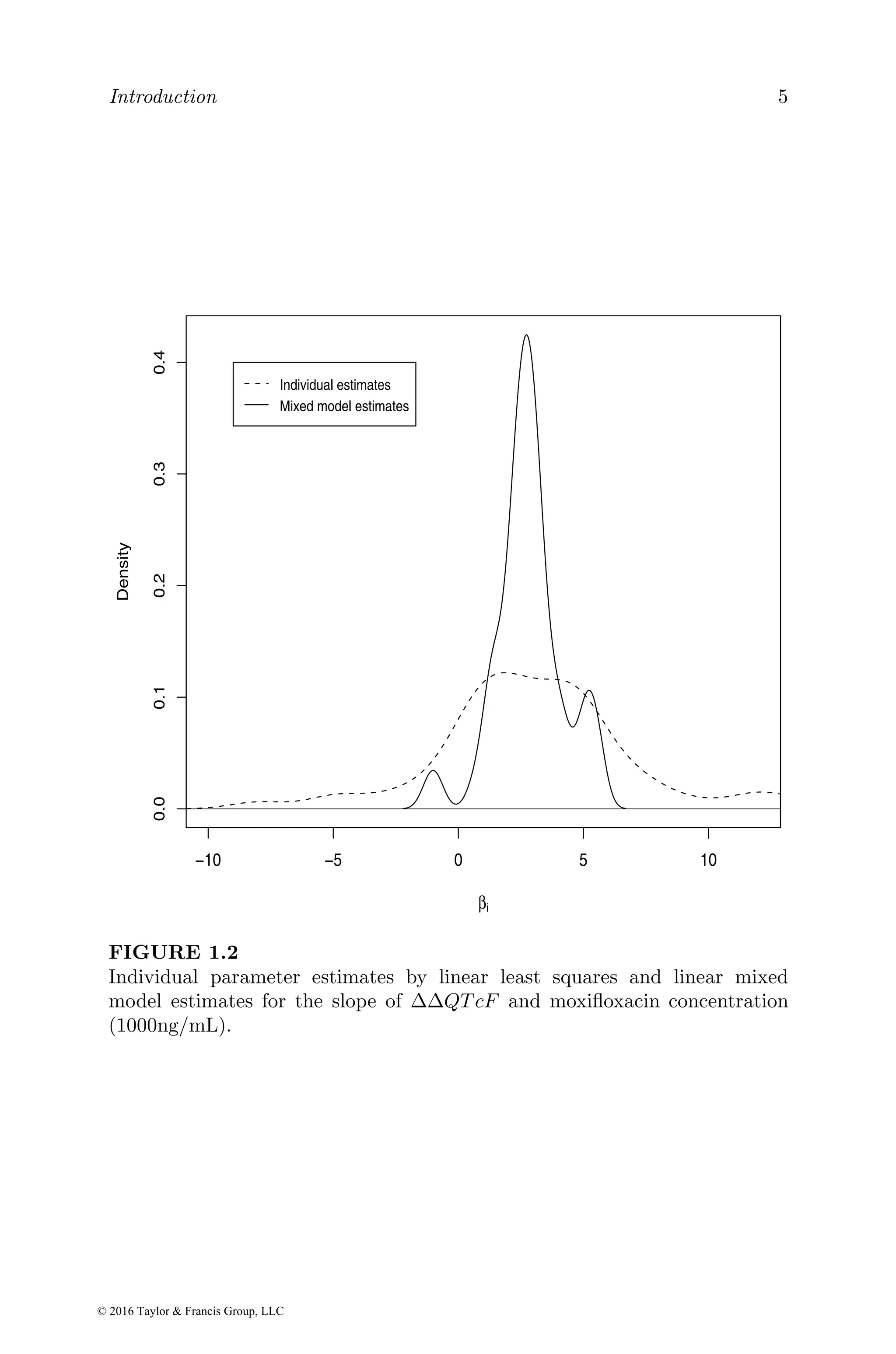
  • 10.
    MATLAB® is atrademark of The MathWorks, Inc. and is used with permission. The MathWorks does not warrant the accuracy of the text or exercises in this book. This book’s use or discussion of MAT- LAB® software or related products does not constitute endorsement or sponsorship by The MathWorks of a particular pedagogical approach or particular use of the MATLAB® software. CRC Press Taylor & Francis Group 6000 Broken Sound Parkway NW, Suite 300 Boca Raton, FL 33487-2742 © 2016 by Taylor & Francis Group, LLC CRC Press is an imprint of Taylor & Francis Group, an Informa business No claim to original U.S. Government works Version Date: 20150521 International Standard Book Number-13: 978-1-4665-7321-5 (eBook - PDF) This book contains information obtained from authentic and highly regarded sources. Reasonable efforts have been made to publish reliable data and information, but the author and publisher cannot assume responsibility for the validity of all materials or the consequences of their use. The authors and publishers have attempted to trace the copyright holders of all material reproduced in this publication and apologize to copyright holders if permission to publish in this form has not been obtained. If any copyright material has not been acknowledged please write and let us know so we may rectify in any future reprint. Except as permitted under U.S. Copyright Law, no part of this book may be reprinted, reproduced, transmitted, or utilized in any form by any electronic, mechanical, or other means, now known or hereafter invented, including photocopying, microfilming, and recording, or in any information stor- age or retrieval system, without written permission from the publishers. For permission to photocopy or use material electronically from this work, please access www.copy- right.com (http://www.copyright.com/) or contact the Copyright Clearance Center, Inc. (CCC), 222 Rosewood Drive, Danvers, MA 01923, 978-750-8400. CCC is a not-for-profit organization that pro- vides licenses and registration for a variety of users. For organizations that have been granted a photo- copy license by the CCC, a separate system of payment has been arranged. Trademark Notice: Product or corporate names may be trademarks or registered trademarks, and are used only for identification and explanation without intent to infringe. Visit the Taylor & Francis Web site at http://www.taylorandfrancis.com and the CRC Press Web site at http://www.crcpress.com © 2016 Taylor & Francis Group, LLC
  • 11.
    To my parents, mywife, and sons © 2016 Taylor & Francis Group, LLC
  • 12.
    © 2016 Taylor& Francis Group, LLC
  • 13.
    Contents Symbol Description xv Prefacexvii 1 Introduction 1 1.1 Multifaceted exposure–response relationships . . . . . . . . . 1 1.2 Practical scenarios in ER modeling . . . . . . . . . . . . . . 2 1.2.1 Moxifloxacin exposure and QT prolongation . . . . . 2 1.2.2 Theophylline . . . . . . . . . . . . . . . . . . . . . . . 6 1.2.3 Argatroban and activated partial thromboplastin time 6 1.3 Models and modeling in exposure–response analysis . . . . . 9 1.4 Model-based decision-making and drug development . . . . . 12 1.5 Drug regulatory guidance for analysis of exposure–response re- lationship . . . . . . . . . . . . . . . . . . . . . . . . . . . . . 13 1.6 Examples and modeling software . . . . . . . . . . . . . . . . 14 2 Basic exposure and exposure–response models 17 2.1 Models based on pharmacological mechanisms . . . . . . . . 17 2.1.1 Example of a PKPD model . . . . . . . . . . . . . . . 17 2.1.2 Compartmental models for drug–exposure modeling . 18 2.2 Statistical models . . . . . . . . . . . . . . . . . . . . . . . . 19 2.3 Transformations . . . . . . . . . . . . . . . . . . . . . . . . . 24 2.4 Semiparametric and nonparametric models . . . . . . . . . . 27 2.5 Comments and bibliographic notes . . . . . . . . . . . . . . . 33 3 Dose–exposure and exposure–response models for longitudi- nal data 35 3.1 Linear mixed models for exposure–response relationships . . 35 3.2 Modeling exposures with linear mixed models . . . . . . . . 41 3.3 Nonlinear mixed ER models . . . . . . . . . . . . . . . . . . 42 3.4 Modeling exposure with a population PK model . . . . . . . 44 3.4.1 The moxifloxacin example . . . . . . . . . . . . . . . 46 3.5 Mixed effect models specified by differential equations . . . . 48 3.6 Generalized linear mixed model and generalized estimating equation . . . . . . . . . . . . . . . . . . . . . . . . . . . . . 51 3.7 Generalized nonlinear mixed models . . . . . . . . . . . . . 53 3.8 Testing variance components in mixed models . . . . . . . . 54 ix © 2016 Taylor & Francis Group, LLC
  • 14.
    x Contents 3.9 Nonparametricand semiparametric models with random effects 55 3.10 On distributions of random effects . . . . . . . . . . . . . . . 60 3.10.1 Impact of misspecified random effects . . . . . . . . . 60 3.10.2 Working with misspecified models . . . . . . . . . . . 61 3.10.3 Using models with nonnormal or flexible distributions 61 3.11 Bibliographic Notes . . . . . . . . . . . . . . . . . . . . . . . 63 4 Sequential and simultaneous exposure–response modeling 65 4.1 Joint models for exposure and response . . . . . . . . . . . . 65 4.2 Simultaneous modeling of exposure and response models . . 67 4.2.1 Maximizing the joint likelihood function . . . . . . . . 67 4.2.2 Implementation of simultaneous modeling . . . . . . . 68 4.2.3 The argatroban example . . . . . . . . . . . . . . . . 70 4.2.4 Alternatives to the likelihood approach . . . . . . . . 71 4.2.5 Simultaneously fitting simplified joint models . . . . . 74 4.3 Sequential exposure–response modeling . . . . . . . . . . . . 75 4.4 Measurement error models and regression calibration . . . . 77 4.4.1 Measurement error models . . . . . . . . . . . . . . . . 78 4.4.2 Regression calibration . . . . . . . . . . . . . . . . . . 79 4.4.3 Models for longitudinal data . . . . . . . . . . . . . . 81 4.4.4 Sequential modeling for argatroban data . . . . . . . 83 4.4.5 Simulation extrapolation . . . . . . . . . . . . . . . . 86 4.4.6 A compromise between y-part models . . . . . . . . . 87 4.4.7 When measurement error models are useful? . . . . . 88 4.4.8 Biases in parameter estimation by sequential modeling 89 4.5 Instrumental variable methods . . . . . . . . . . . . . . . . . 90 4.6 Modeling multiple exposures and responses . . . . . . . . . 94 4.7 Internal validation data and partially observed and surrogate exposure measures . . . . . . . . . . . . . . . . . . . . . . . 96 4.7.1 Exposure measured in a subpopulation . . . . . . . . . 96 4.7.2 Exposure measured in a subpopulation but a surrogate is measured in the whole population . . . . . . . . . . 99 4.7.3 Using a surrogate for Cmax: An example . . . . . . . 100 4.8 Comments and bibliographic notes . . . . . . . . . . . . . . . 103 5 Exposure–risk modeling for time-to-event data 105 5.1 An example . . . . . . . . . . . . . . . . . . . . . . . . . . . 105 5.2 Basic concepts and models for time-to-event data . . . . . . 107 5.2.1 Distributions for time-to-event data . . . . . . . . . . 107 5.2.2 Parametric models . . . . . . . . . . . . . . . . . . . . 108 5.2.3 Cox models . . . . . . . . . . . . . . . . . . . . . . . . 109 5.2.4 Time-varying covariates . . . . . . . . . . . . . . . . . 110 5.2.5 Additive models . . . . . . . . . . . . . . . . . . . . . 112 5.2.6 Accelerated failure time model . . . . . . . . . . . . . 113 5.3 Dynamic exposure model as a time-varying covariate . . . . 114 © 2016 Taylor & Francis Group, LLC
  • 15.
    Contents xi 5.3.1 Semiparametricmodels . . . . . . . . . . . . . . . . . 115 5.3.2 Parametric models . . . . . . . . . . . . . . . . . . . . 118 5.4 Multiple TTE and competing risks . . . . . . . . . . . . . . 120 5.4.1 Multistate models . . . . . . . . . . . . . . . . . . . . 120 5.4.2 Competing risks . . . . . . . . . . . . . . . . . . . . . 122 5.5 Models for recurrent events . . . . . . . . . . . . . . . . . . 124 5.5.1 Recurrent events as a counting process . . . . . . . . 124 5.5.2 Recurrent events in multistate models . . . . . . . . . 125 5.5.3 Rate and marginal models . . . . . . . . . . . . . . . 125 5.6 Frailty: Random effects in TTE models . . . . . . . . . . . . 129 5.7 Joint modeling of exposure and time to event . . . . . . . . 133 5.7.1 Simultaneous modeling . . . . . . . . . . . . . . . . . 134 5.7.2 Sequential modeling and regression calibration . . . . 137 5.8 Interval censored data . . . . . . . . . . . . . . . . . . . . . 140 5.9 Model identification and misspecification . . . . . . . . . . . 143 5.10 Random sample simulation from exposure–risk models . . . 144 5.10.1 Basic simulation approaches for time-to-events . . . . 144 5.10.2 Rejection-acceptance algorithms . . . . . . . . . . . . 147 5.10.3 Generating discrete event times . . . . . . . . . . . . 148 5.10.4 Simulation for recurrent and multiple events . . . . . 149 5.10.5 Simulation for TTE driven by complex dynamic systems 150 5.10.6 Example programs . . . . . . . . . . . . . . . . . . . . 153 5.10.7 Sample size estimation using simulations . . . . . . . 154 5.11 Comments and bibliographic notes . . . . . . . . . . . . . . . 157 6 Modeling dynamic exposure–response relationships 159 6.1 Effect compartment models . . . . . . . . . . . . . . . . . . 160 6.2 Indirect response models . . . . . . . . . . . . . . . . . . . . 162 6.3 Disease process models . . . . . . . . . . . . . . . . . . . . . 163 6.3.1 Empirical models . . . . . . . . . . . . . . . . . . . . . 164 6.3.2 Slow and fast subsystems . . . . . . . . . . . . . . . . 165 6.3.3 Semimechanistic models . . . . . . . . . . . . . . . . . 167 6.3.4 Modeling tumor growth and drug effects . . . . . . . 167 6.4 Fitting dynamic models for longitudinal data . . . . . . . . 168 6.5 Semiparametric and nonparametric approaches . . . . . . . . 169 6.5.1 Effect compartment model with nonparametric expo- sure estimates . . . . . . . . . . . . . . . . . . . . . . . 169 6.5.2 Nonparametric dynamic models and lagged covariates 170 6.6 Dynamic linear and generalized linear models . . . . . . . . . 172 6.7 Testing hysteresis . . . . . . . . . . . . . . . . . . . . . . . . 179 6.8 Comments and bibliographic notes . . . . . . . . . . . . . . . 182 © 2016 Taylor & Francis Group, LLC
  • 16.
    xii Contents 7 Bayesianmodeling and model–based decision analysis 183 7.1 Bayesian modeling . . . . . . . . . . . . . . . . . . . . . . . . 183 7.1.1 An introduction to the Bayesian concept . . . . . . . . 183 7.1.2 From prior to posterior distributions . . . . . . . . . 184 7.1.3 Bayesian computing . . . . . . . . . . . . . . . . . . . 191 7.1.3.1 Markov chain Monte Carlo . . . . . . . . . . 191 7.1.3.2 Other computational approaches . . . . . . . 192 7.1.4 Bayesian inference and model-based prediction . . . . 193 7.1.5 Argatroban example by Bayesian analysis . . . . . . . 194 7.2 Bayesian decision analysis . . . . . . . . . . . . . . . . . . . 198 7.2.1 Decision analysis and ER modeling . . . . . . . . . . . 198 7.2.2 Example: Dose selection for argatroban . . . . . . . . 202 7.2.3 Multistate models . . . . . . . . . . . . . . . . . . . . 203 7.3 Decisions under uncertainty and with multiple objectives . . 207 7.3.1 Utility, preference and uncertainty . . . . . . . . . . . 207 7.3.2 Cost-benefit, cost-utility and cost-effectiveness analysis 210 7.4 Evidence synthesis and mixed treatment comparison . . . . 212 7.4.1 Meta analysis . . . . . . . . . . . . . . . . . . . . . . 212 7.4.2 Meta analysis for exposure–response relationship . . . 215 7.4.3 Mixed treatment comparison . . . . . . . . . . . . . . 220 7.5 Comments and bibliographic notes . . . . . . . . . . . . . . . 222 8 Confounding bias and causal inference in exposure–response modeling 223 8.1 Introduction . . . . . . . . . . . . . . . . . . . . . . . . . . . 223 8.2 Confounding factors and confounding biases . . . . . . . . . 224 8.3 Causal effect and counterfactuals . . . . . . . . . . . . . . . 226 8.4 Classical adjustment methods . . . . . . . . . . . . . . . . . 227 8.4.1 Direct adjustment . . . . . . . . . . . . . . . . . . . . 227 8.4.2 Stratification and matching . . . . . . . . . . . . . . . 229 8.4.3 Propensity scores and inverse probability weighting . 230 8.4.4 Other propensity score–based approaches . . . . . . . 234 8.5 Directional acyclic graphs . . . . . . . . . . . . . . . . . . . 235 8.6 Bias assessment . . . . . . . . . . . . . . . . . . . . . . . . . 237 8.7 Instrumental variable . . . . . . . . . . . . . . . . . . . . . . 241 8.7.1 Instrumental variable estimates . . . . . . . . . . . . 241 8.7.2 Control function method . . . . . . . . . . . . . . . . . 242 8.8 Joint modeling of exposure and response . . . . . . . . . . . 243 8.9 Study designs robust to confounding bias or allowing the use of instrument variables . . . . . . . . . . . . . . . . . . . . . 245 8.10 Doubly robust estimates . . . . . . . . . . . . . . . . . . . . 248 8.11 Comments and bibliographic notes . . . . . . . . . . . . . . . 249 © 2016 Taylor & Francis Group, LLC
  • 17.
    Contents xiii 9 Dose–responserelationship, dose determination, and adjust- ment 251 9.1 Marginal Dose–response relationships . . . . . . . . . . . . . 251 9.2 Dose–response relationship as a combination of dose–exposure and exposure–response relationships . . . . . . . . . . . . . . 254 9.3 Dose determination: Dose–response or dose–exposure–response modeling approaches? . . . . . . . . . . . . . . . . . . . . . . 257 9.4 Dose adjustment . . . . . . . . . . . . . . . . . . . . . . . . 262 9.4.1 Dose adjustment mechanisms . . . . . . . . . . . . . . 262 9.4.1.1 Exposure-dependent dose adjustment . . . . 263 9.4.1.2 Response-dependent dose adjustment . . . . 264 9.5 Dose adjustment and causal effect estimation . . . . . . . . 265 9.5.1 Dose adjustment and sequential randomization . . . . 265 9.5.2 Directional acyclic graphs and the decomposition of the likelihood function . . . . . . . . . . . . . . . . . . . . 266 9.5.3 Exposure–response relationship with dynamic treat- ment changes . . . . . . . . . . . . . . . . . . . . . . 269 9.5.4 Dose adjustment for causal effect determination: RCC trials . . . . . . . . . . . . . . . . . . . . . . . . . . . . 271 9.5.5 Treatment switch over and IPW adjustment . . . . . 273 9.6 Sequential decision analysis . . . . . . . . . . . . . . . . . . 275 9.6.1 Decision tree . . . . . . . . . . . . . . . . . . . . . . . 276 9.6.2 Dynamic programming . . . . . . . . . . . . . . . . . 281 9.6.3 Optimal stopping for therapeutic dose monitoring . . 284 9.6.4 Dose adjustment in view of dynamic programming . . 288 9.7 Dose determination: Design issues . . . . . . . . . . . . . . . 288 9.8 Comments and bibliographic notes . . . . . . . . . . . . . . . 290 10 Implementation using software 293 10.1 Two key elements: Model and data . . . . . . . . . . . . . . 293 10.2 Linear mixed and generalized linear mixed models . . . . . 295 10.3 Nonlinear mixed models . . . . . . . . . . . . . . . . . . . . 296 10.4 A very quick guide to NONMEM . . . . . . . . . . . . . . . 300 A Appendix 303 A.1 Basic statistical concepts . . . . . . . . . . . . . . . . . . . . 303 A.2 Fitting a regression model . . . . . . . . . . . . . . . . . . . 304 A.3 Maximum likelihood estimation . . . . . . . . . . . . . . . . 305 A.4 Large sample properties and approximation . . . . . . . . . 307 A.4.1 Large sample properties and convergence . . . . . . . 308 A.4.2 Approximation and delta approach . . . . . . . . . . 308 A.5 Profile likelihood . . . . . . . . . . . . . . . . . . . . . . . . 309 A.6 Generalized estimating equation . . . . . . . . . . . . . . . . 309 A.7 Model misspecification . . . . . . . . . . . . . . . . . . . . . 311 A.8 Bootstrap and Bayesian bootstrap . . . . . . . . . . . . . . 312 © 2016 Taylor & Francis Group, LLC
  • 18.
    xiv Contents Bibliography 315 Index327 © 2016 Taylor & Francis Group, LLC
  • 19.
    Symbol Description E(y|x) Expectationof y conditional on x. Ex(f(x)) Expectation of f(x) over x. Eg (X) Geometric mean of X : exp(E(log(X))). R x f(x)dG(x) Expectation of f(x) over x ∼ G(x), where the distribution G(x) is specified explicitly. y ∼ F(.) y follows distribution F(.). y|x ∼ F(.) y follows distribution F(.) conditional on x. yn → y yn tends or converges to y (all types). y ≡ x y defined as x. y ≈ x y and x are approximately equal. XT Transposition of matrix or vector X. diag(a1, ..., ak) A diagonal matrix with elements a1, ..., ak. I An identity matrix of a conformable dimension (if not speci- fied). Bin(p) Binary distribution with parameter p. IG(a, b) Inverse gamma distribution with parameters a and b. D(a1, ..., ak) Dirichlet distribution with parameters a1, ..., ak. IW(ρ, R) Inverse Wishart distribution with degree of freedom ρ and variance–covariance matrix R. χ2 k(h) The χ2 distribution with k degrees of freedom and non-central parameter h (may be omitted if h = 0). g−1 (y) The inverse function of g(x). dy(x)/dx The derivative of y(x) with respect to x. ∂y(x, z)/∂x The partial derivative of y(x, z) with respect to x. N(µ, σ2 ) Normal distribution with mean µ and variance σ2 . Φ(x) The standard normal distribution function. φ(x) The standard normal density function. N(µ, Σ) Multivariate normal distribution with mean µ and variance– covariance matrix Σ. U(a, b) The uniform distribution within the range (a, b). o(a) A higher order term of a. x ⊥ y|z x and y are independent conditional on z. x ∝ y x is proportional to y. IA or I(A) IA = 1 if A is true, and IA = 0 otherwise. f(x)|x=x0 f(x) evaluated as x0. xv © 2016 Taylor & Francis Group, LLC
  • 20.
    © 2016 Taylor& Francis Group, LLC
  • 21.
    Preface Exposure–response (ER) relationshipsare important in many areas including, but not limited to, pharmacology, epidemiology and drug safety, drug devel- opment as a whole, and more recently comparative comparative benefit risk assessments. Determining the relationships by modeling presents challenges to applied statisticians and modelers as well as researchers due to the dy- namic nature of both exposure and response. This book covers a wide range of topics and new developments starting from traditional pharmacokinetic- pharmacodynamic (PKPD) modeling, and progressing to using measurement error models to treat sequential modeling, fitting models with exposure and response driven by complex dynamics, survival analysis with dynamic ex- posure history, Bayesian analysis and model-based Bayesian decision analy- sis, causal inference to eliminate confounding biases, and exposure–response modeling with response-dependent dose/treatment adjustments, known as dy- namic treatment regimes, for personalized medicine and treatment adaptation. The book is application oriented, but also gives a systematic view of the con- cept and methodology in each topic. Exposure–response modeling is a very general topic, since both the expo- sure and the response are general concepts covering different scenarios in a number of areas of research and applications. In toxicology, the exposure could be a drug, a chemical or other material or conditions that may be harmful and response may vary dramatically since a toxicology study could be in vitro (us- ing cells or tissues) or in vivo (using animals). In pharmacology, the exposure refers to drug concentration, but in epidemiology it could be the strength of drug exposure measured by dose and duration of a drug, or harmful conditions such as environmental pollution. In comparative benefit risk assessments the exposure has a very general meaning, e.g., it may refer to a treatment strategy or reimbursement policy and the response could be measures for the health and social outcomes in a population. Comparing with animal and controlled clinical trials, these assessment exposures are less controlled and some data may come from observational studies. Therefore, biases commonly occur and causal inference is crucial to exposure–response modeling. The book reflects my experiences on ER modeling in a number of areas including experimental toxicology, pharmacological modeling and simulation, clinical trials, epidemiology and drug safety and outcome research, particularly my experiences using approaches available in different software, some rather basic but a large number of them newly developed and advanced, to solve problems of different natures, but with considerable similarity in statistics and xvii © 2016 Taylor & Francis Group, LLC
  • 22.
    xviii Preface modeling aspects.Although this is an application-oriented book, I have not shied away from using a large number of formulae, as they are an important part of applied statistics. In some situations, the derivations for some formulae are given to illustrate the concept and how a method is developed. However, theoretical details, e.g., technical conditions for some asymptotic properties of parameter estimates, are omitted. The book emphasizes a number of important aspects: 1) causal inference in exposure–response modeling, 2) sequential modeling in the view of mea- surement error models, 3) dose–adjustment and treatment adaptation based on dynamic exposure–response models, and 4) model-based decision analy- sis linking exposure–response modeling to decision making. It tries to bridge gaps between difference research areas to allow borrowing well-developed ap- proaches from each other. This is an application book, but it does not stop at using simple models and approaches. It goes much further to recent devel- opments in a number of areas and describes implementation, methodologies and interpretation of fitted models and statistical inference based on them. Although the focus is on recent developments, no intensive knowledge on ER modeling is needed to read the book and implement the methods. There are models given in general forms with matrix notations. This may not be nec- essary when a model is explicitly specified, but is useful to understand the concept of some advanced approaches particularly when using software with models specified in general forms such as R and SAS. The contents are ar- ranged to allow the reader to skip these formulae yet still be able to implement the approaches. A large number of practical and numerical examples can be found in this book. Some illustrate how to solve practical problems with the approaches de- scribed, while some others are designed to help with understanding concepts and evaluating the performance of new methods. In particular, several exam- ples in clinical pharmacology are included. However, to apply approaches to a real problem, it is crucially important to consult the literature and seek advice from pharmacologists. A large number of SAS and R codes are included for the reader to run and to explore in their own scenarios. Applied statisticians and modelers can find details on how to implement new approaches. Researchers and research students may find topics for, or applications of, their research. It may also be used to illustrate how complex methodology and models can be applied and implemented for very practical situations in relevant courses. The book benefits from the numerous people who helped me or supported me one way or another. First I would like to thank Byron Jones, my PhD supervisor and former colleague for many years, for helping me with the plan- ning and writing of the book from the very beginning and for his advice and friendship starting from 20 years ago. During my early career development, professors Jiqian Fang, Robin Prescott and James Linsey, and Dr Nick Long- ford gave me enormous help. The book reflects some early work I did with Byron and James, and my former colleagues professors Tom MacDonald and Peter Donnan at Medicines Monitoring Unit, University of Dundee, and some © 2016 Taylor & Francis Group, LLC
  • 23.
    Preface xix more recentresearch when I was working at Novartis. I would like to thank my former and current colleagues Wing Cheung, Lily Zhao, Cheng Zheng, Wen- qing Li, Ai Li, Wei Zhang, Roland Fisch, Amy Racine-Poon, Frank Bretz, Tony Rossini, Christelle Darstein, Sebastien Lorenzo, Venkat Sethuraman, Marie-Laure Bravo, Arlene Swern, Bruce Dornseif and especially Kai Grosch and Emmanuel Bouillaud for their excellent team management and kind help which made project work we shared enjoyable. I gained much knowledge and experience in clinical pharmacology from the collaboration with Wing for sev- eral years. Prof. Nick Holford kindly allowed me to use the Theophylline data, and Novartis RAD001 and clinical pharmacology teams kindly allowed the use of moxifloxacin data. My thanks are due to John Kimmel, the executive editor for the CRC biostatistics series, and Karen Simon, project manager, for this book for valuable help and advice, and anonymous reviewers for their very useful comments and suggestions. Finally I would like to thank my wife Sharon, without her support and understanding the work would be impossible. © 2016 Taylor & Francis Group, LLC
  • 24.
    1 Introduction 1.1 Multifaceted exposure–responserelationships The exposure–response (ER) relationship is a very general concept, since it may refer to different types of relationships between different types of expo- sures and their responses. This book is concerned with modeling quantitative relationships between drug or chemical exposures and their responses, with an emphasis on modeling ER relationships in the pharmaceutical environment. However, the approaches described in this book are readily applicable to a wider range of topics such as environmetric modeling and areas in biostatis- tics where the source of exposure is not drugs or chemicals. In many biostatistics-related areas, ER relationships carry important in- formation about how different types of exposures influence outcomes of inter- est. For example, the drug exposure in pharmaceutics refers to the situation where a patient is under the influence of a drug. A quantitative measure of the exposure is the key information for ER modeling. It may be measured by drug concentration, dose or even treatment compliance. The exposure could be well controlled, such as the dose level in a randomized clinical trial, could only be observed, such as drug concentrations measured during a clinical trial, or could be partially controlled, e.g., drug concentrations in a randomized con- centration controlled trial in which patients are randomized into a number of concentration ranges and the concentration for an individual patient is con- trolled by dose titration to achieve the target range. Exposures to toxic agents in toxicology experiments are apparently similar to drug exposures in humans, but may have different characteristics in in vitro and animal experiments. In environmetrics exposures could be air or water pollution, radiation, or expo- sure to risk factors in an industry environment, where often we (as the ana- lyst of the exposure–response relationship) have no control over the exposure. Similar situations can be found in epidemiology where the concerned exposure may be a natural cause or an unnatural cause such as a drug prescription to a patient. There are also different types of ER relationships. They can represent sim- ply an association that the exposure and response apparently occur together (in this context, the word response is used in a loose sense), or a causal re- lationship in which the exposure is the true cause of the response. It may be a steady state relationship between constant exposure and response but may 1 © 2016 Taylor & Francis Group, LLC
  • 25.
    2 Exposure-Response Modeling:Methods and Practical Implementation also represent a dynamic relationship between time-varying exposure and re- sponse. The relationship may refer to the exposure effect in a population, for example, how much is the risk of adverse events (AE) increased on average if a drug is prescribed for an indication. ER relationships may also be indi- vidual, e.g., as a measure of AE risk change related to a dose adjustment for individual patients. 1.2 Practical scenarios in ER modeling We will use a number of real and hypothetical examples to illustrate practical aspects of ER modeling as well as a practical background for methodological development. Even with a number of examples, we cannot cover all aspects of ER modeling in practice. Therefore, it is important to identify the similarity and difference between approaches and between models applied to seemingly different practical scenarios so that appropriate approaches can be selected and adapted. This point will be emphasized from time to time in this book wherever appropriate. The following are four examples of different types from the area of pharmaceutics. 1.2.1 Moxifloxacin exposure and QT prolongation The QT interval in electrocardiography (ECG) is an important measure for the time from heart depolarization to repolarization. QT interval prolongation (QT prolongation hereafter) is an often used measure to assess cardiac safety of new non-cardiovascular drugs. Since the interval depends on the heart rate (or equivalently the RR interval, i.e., the interval between two consecutive R- waves in the same ECG), the QT interval should be corrected by the heart rate to eliminate the impact of the RR difference among people with very different heart rates. A commonly used corrected QT interval is QT cF = QT/RR1/3 , known as the Fridericia correction. QT prolongation is believed to suggest an increasing risk of cardiac arrest and sudden death. A 10 millisecond (ms) prolongation in QTcF has been used by drug regulators as a threshold to indicate increased cardiac risk. Another approach called categorical analysis calculates frequencies of QTc higher than certain thresholds (e.g., 30 ms and 60 ms). A thorough QT(TQT) study, which includes a placebo, a positive control, and two doses of a test drug, all with baseline QT measurements, is used to show that a drug has no QT effect and normally does not need complex ER modeling. However, modeling approaches can be very useful in situations where the TQT study fails to demonstrate no QT effects at the current doses. Moxifloxacin is known to have a stable QT prolongation effect and is safe to use as a positive control in TQT trials. We use the moxifloxacin data in a © 2016 Taylor & Francis Group, LLC
  • 26.
    Introduction 3 TQT trialas an example to show (i) potential uses of modeling approaches, (ii) the need for advanced modeling techniques and (iii) some potential problems leading to further development of models and model fitting techniques. We will revisit this example in later chapters when a model or a method can be applied to it. The data consists of ECG and moxifloxacin concentration data from a cross-over trial in which a total of 61 subjects all received a single dose of placebo, moxifloxacin or the test drug in each period, and concentration and ECG measures were taken at a number of time points. The ECG parameters were corrected by subtracting the baseline value and the (post-baseline – base- line) difference in the placebo period measured at the same time (known as the ∆∆ parameters). Figure 1.1 plots ∆∆QT cFs vs the corresponding concentra- tions at all time points. There appears to be a linear trend of increasing QTcF along with exposure increase. However, since the data contain multiple ECG measures from individual patients, one cannot simply use a least squares (LS) method to fit a linear regression model. A correct approach is to use an ap- propriate repeated measurements model, as described in Chapter 3. One may be tempted to use a very intuitive approach: first fit the slopes for individual subjects, then analyze the slopes by taking the mean and standard deviation (SD) of them. This approach is, in fact, one type of two-stage approach for fitting a repeated measurement model. Figure 1.2 shows the distribution of individual LS slope estimates together with estimates based on a linear mixed model, assuming the slope for each subject follows a normal distribution. One interesting point is that the individual estimates are highly variable and the distribution shows heavy tails, particularly at the right hand side. It seems the mixed model estimates are shrunken toward the center. Details of linear mixed models can be found in Chapter 3. Apart from the obvious need to deal with repeated measures, other charac- teristics in this dataset are also worthwhile exploring. First the concentration– QT relationship may not be linear. Although the trend in Figure 1.1 seems linear, it is not sufficient to conclude that using a linear repeated measurement model is sufficient. The relationship may not be instantaneous since the drug effect may accumulate and cause a delay (known as hysteresis) of the response to the exposure. All the three features are important when using modeling approaches to help further develop a drug that shows some QT prolongation. For example, if a tested dose showed unacceptable QT prolongation, it would be useful to find the maximum dose that has an acceptable QT effect and test if it also delivers satisfactory efficacy. A valid exposure–response relationship allows calibrat- ing that dose by taking model fitting uncertainty and inter- and intra-subject variabilities into account. Another approach to reduce the QT effects may be to change the drug formulation to reduce the peak concentration, while keeping a comparable overall exposure. Two key factors to be considered here are exposure accumulation and correct estimation of the upper percentiles of subjects with very long prolongation, e.g., defined for the category analysis. If exposure accumulates over time, the effect of cutting peak concentration on © 2016 Taylor & Francis Group, LLC
  • 27.
    4 Exposure-Response Modeling:Methods and Practical Implementation 0 1 2 3 4 5 −20 −10 0 10 20 30 40 Moxifloxacin concentration (1000 ng/mL) QTcF change (ms) FIGURE 1.1 Pooled ∆∆QT cFs vs. moxifloxacin concentrations from 61 subjects measured at multiple time points. © 2016 Taylor & Francis Group, LLC
  • 28.
    Introduction 5 −10 −50 5 10 0.0 0.1 0.2 0.3 0.4 βi Density Individual estimates Mixed model estimates FIGURE 1.2 Individual parameter estimates by linear least squares and linear mixed model estimates for the slope of ∆∆QT cF and moxifloxacin concentration (1000ng/mL). © 2016 Taylor & Francis Group, LLC
  • 29.
    6 Exposure-Response Modeling:Methods and Practical Implementation reducing QT prolongation may be much lower than estimated from a model assuming an instantaneous exposure effect. Appropriate assessment of the ef- fect requires developing a dynamic model describing the temporal relationship between the pharmacokinetics (PK) time profile and the QT time profile. This type of model and related analytical methods will be described in Chapter 6. 1.2.2 Theophylline This example comes from a study to find the optimal concentration of theo- phylline for the management of acute airway obstruction. This is an early study using a randomized concentration controlled (RCC) design (Holford et al., 1993a, 1993b). In the study, 174 patients were randomized to a target concentration of 10 or 20 mg/L (Holford et al., 1993a, 1993b). Theophylline concentrations from individual patients were controlled with dose adjustment. From each patient, the concentration and peak expiratory flow rate (PEFR) were measured multiple times at the same time point. The dataset includes PEFR and concentration together with patient characteristics. However, the randomization and dosing data were lost due to a power outage (Halford, private communication). Therefore, one cannot fit a population PK (popPK) model to the data, hence some non- and semiparametric approaches were used, including those in Holford et al. (1993a, 1993b). Since the randomized dose for each PK and PEFR measure were plotted, an attempt was made to recover this information from the plots by the author of this book. The PK and PEFR measurements are plotted in Figure 1.3 together with recovered ran- domization information. A small number of measurements cannot be identified and are marked as + in the plots. A scatter plot of theophylline concentration against PEFR, pooling all the repeated measures, is presented in Figure 1.4. One interesting finding when comparing the plots is that, although it seems there is a trend of increasing PFER with increased concentration, there is no significant difference between the two groups, while the observed exposure levels are quite different between them (Figure 1.3). We will revisit this issue in later chapters. 1.2.3 Argatroban and activated partial thromboplastin time Argatroban is an anticoagulant for multiple indications including prophylaxis or treatment of thrombosis in some groups of patients. It is given by in- travenous infusion, and drug plasma concentrations reach steady state in a few hours of the infusion. Its anticoagulant effect was measured by the acti- vated partial thromboplastin time (APTT), a measure for the speed of blood clotting, and it was expected that increasing exposure would increase APTT values. The dataset in Davidian and Giltinan (1995) contains 219 measures from 37 patients with argatroban given as a 4-hour infusion, with repeated © 2016 Taylor & Francis Group, LLC
  • 30.
    Introduction 7 0 100200 300 400 0 10 20 30 40 Theophylline concentration (mg/L) 10 mg/L 20 mg/L Unidentified 0 100 200 300 400 0 100 200 300 400 500 Time (h) PEFR (L/min) FIGURE 1.3 Theophylline and PFER time profiles with nonparametric curves fitted by spline functions via linear mixed models for both dose groups. © 2016 Taylor & Francis Group, LLC
  • 31.
    8 Exposure-Response Modeling:Methods and Practical Implementation 0 10 20 30 40 100 200 300 400 500 Theophylline concentration (mg/L) PEFR (L/min) FIGURE 1.4 Theophylline concentrations and PEFR values pooling all the repeated mea- sures. © 2016 Taylor & Francis Group, LLC
  • 32.
    Introduction 9 concentration measurestaken up to 6 hours after start of the infusion. Figure 1.5 gives individual APTT time profiles for these patients. The APTT values were not all measured at the same time as the PK samples were measured. So, to look into the ER relationship, we need to predict the concentration at the time when each APTT is measured. This can be done using a nonlinear mixed model to fit the PK data and using the fitted model to predict the APTT at a given time. The APTT values and predicted argatroban concentrations show a strong linear trend, as shown in Figure 1.6. However, appropriate modeling approaches dealing with potential repeated measures, nonlinearity and hysteresis are needed to quantify the relationship between the exposure and APTT. 1.3 Models and modeling in exposure–response analysis There are many different types of ER model. However, exposure models de- scribing the relationship between exposure and factors such as dose also have an important role in ER modeling. Two types of model are used in ER mod- eling. Mechanistic models are based on a pharmacological mechanism for the action of drugs. Pharmacometrics is the main area in which mechanism mod- els are widely used for ER relationships. PK modeling has a long history in describing PK characteristics of drugs and the fitting of drug concentration data (Bonate, 2006). Compartmental models derived from physical models of drug disposition have been well developed and implemented in software for PK and pharmacokinetic–pharmacodynamic (PKPD) modeling such as NONMEM. Relatively recently, mechanistic models for exposure–response re- lationships have also been developed. Empirical models describe the data in a quantitative manner, taking potential factors affecting the exposure and ER relationship into account. Dose-response and ER models of both types may be written in the follow- ing abstract form. Exposure=h(Dose, factors,Parameters)+Error Response=g(Exposure, factors,Parameters)+Error where g and h describe the relationships between dose and exposure, and exposure and response, and both are measured with errors. The tasks of mod- eling include fitting the two models to estimate the parameters, assessing the models as well as quantifying the error terms, and variability and uncertainty in the fitted model and estimated parameters. The models can be used to determine the exposure level corresponding to the desired response level, and how to achieve the exposure by adjusting the dose (or in other ways to control the exposure). The importance of quantifying the variability and uncertainty may be less obvious than estimating the parameters, but it is an important © 2016 Taylor & Francis Group, LLC
  • 33.
    10 Exposure-Response Modeling:Methods and Practical Implementation Time (minutes) APTT 20 40 60 80 100 0 200 400 9 1 0 200 400 3 11 0 200 400 8 2 0 200 400 12 5 14 10 6 16 4 20 40 60 80 100 29 20 40 60 80 100 31 36 20 17 37 34 7 19 26 30 22 28 32 20 40 60 80 100 21 20 40 60 80 100 35 24 18 23 15 25 27 13 0 200 400 20 40 60 80 100 33 FIGURE 1.5 Individual APTT time profiles of 37 patients after a 4-hour infusion. © 2016 Taylor & Francis Group, LLC
  • 34.
    Introduction 11 0 5001000 1500 2000 20 40 60 80 100 Predicted concentration APTT FIGURE 1.6 Observed APTT and predicted argatroban concentration by a nonlinear mixed model. © 2016 Taylor & Francis Group, LLC
  • 35.
    12 Exposure-Response Modeling:Methods and Practical Implementation aspect of statistical modeling and provides important information for the as- sessment of an ER relationship without considering the mechanism behind it. There are also models that are partly mechanistic and partly empirical. A mechanistic model has obvious advantages over an empirical model since it may support empirical evidence with a quantified pharmacological rela- tionship. It may also indicate further investigation in specific directions. In contrast, empirical models are more flexible and can often be as good as mechanistic models for prediction. An empirical model may also be used for an alternative or a sensitivity analysis to validate or confirm a mechanistic model-based analysis. The ER relationship can also be analyzed without using a model. For example, the responses at a number of dose levels may be used to show a dose-response relationship, but a model-based approach is more powerful to quantify the relationship in detail, e.g., between the dose levels. Model inde- pendent analyses also have their advantages, but they are beyond the scope of this book. 1.4 Model-based decision-making and drug development Drug development is a lengthy, complex and expensive process involving mak- ing hard decisions at many stages under different scenarios. Decision analysis (DA) has been introduced to several stages in drug development and is playing an increasing role. Due to the complexity of drug exposure and its outcome, modeling is a key part of the decision analysis. One typical area where mod- eling has been playing a key role is to find the right dose to maximize the drug effects while maintaining an acceptable safety profile . Typically drug effects (on both safety and efficacy) increase with increasing exposure levels. The drug developer hopes that there is an exposure range in which efficacy is satisfactory and toxicity is acceptable and that appropriate doses can be determined so that the exposure in most patients is in that range. Therefore, the decision for the right dose involves finding the right balance between safety and efficacy. ER modeling provides key information for making the decision. Often a critical question at a certain stage is whether a trial to obtain further information about safety and efficacy is needed, given the trial is ex- pensive and takes a long time to run. The information may be to find a more accurate dose, or to ascertain the efficacy and safety profile of an existing dose. Decision analysis calculates the value of information (VoI) to assess if the benefit of running such a study is worth the costs (both money and possible delay of the development process). Decision analysis offers tools to evaluate the benefit in order to compare it with the costs. For this ER models are needed to provide information about efficacy and safety at a given or a range of doses. On a larger scale than the decision on a single trial, the whole drug © 2016 Taylor & Francis Group, LLC
  • 36.
    Introduction 13 development processinvolving a large number of trials can be considered as a complex process and decision makers make multiple decisions step by step, taking up-to-date information into consideration. Decision analysis is increasingly used to optimize individual treatment for personalized medicine . For example, if a drug has highly variable exposure among patients, therapeutic dose monitoring, which monitors the exposure periodically and adjusts the dose if necessary, may be needed to ensure indi- vidual patients are under the right exposure level. Taking the measure has a considerable cost and inconvenience to the patient. How long do we have to measure before we stop? In fact, the question should concern when collecting further information does not justify the costs and inconvenience. Recent de- velopment of dynamic treatment regimes also brings decision analysis to the frontline of developing optimal treatment regimes that maximize the benefit of drugs to individual patients by response dependent treatment adaptation . Most of these decision making problems require making optimal decisions sequentially. The decision process itself needs a complex model to evaluate. The decision tree is a common tool to solve some simple problems. For complex problems, a dynamic programming approach is needed. For both, ER models have to be integrated into this decision model. 1.5 Drug regulatory guidance for analysis of exposure– response relationship Modeling exposure–response relationships is now playing an increasing role in drug development, as well as in drug regulation. Modeling approaches are now frequently used to support the submission of a new drug application (NDA). The U.S. Food and Drug Administration (FDA) published a guidance on the analysis of exposure–response relationships (FDA, 2003), in which exposure may refer to dose or PK concentration. The guidance suggests that determin- ing the exposure–response relationship can play a role in drug development to • support the drug discovery and development processes • support a determination of safety and efficacy • support new target populations and adjustment of dosages and dosing regimens. The importance of the PKPD relationship, compared with the dose-PD rela- tionship was recognized: ” ... concentration-response relationships in the same individual over time are especially informative because they are not potentially confounded by doses selection/titration phenomena and inter-individual PK variability.” © 2016 Taylor & Francis Group, LLC
  • 37.
    14 Exposure-Response Modeling:Methods and Practical Implementation The guidance considered confounding bias in exposure–response analysis an important issue. It states that if one simply uses the observed drug con- centration in a PKPD analysis ”...potential confounding of the concentration- response relationship can occur and an observed concentration-response rela- tionship may not be credible evidence of an exposure–response relationship”. The randomized concentration controlled (RCC) design, which uses individ- ual dose adjustment to achieve exposure levels randomly assigned to patients, was recommended. Although the RCC design has not been widely used, there is a trend of increasing RCC trials in the last 10 years. The guidance also gives some details on specific situations when PK/PD modeling may provide important information: ”Where effectiveness is imme- diate and is readily measured repeatedly ..., it is possible to relate clinical response to blood concentrations over time, which can provide critical infor- mation for choosing a dose and dosing interval.” The guidance suggests that the modeling strategy be described clearly and include a statement of the problem, assumptions used, model selection and validation, and for a PK/PD analysis for a submission, this information should also be presented in the exposure–response study report. Since the guidance was published ten years ago, it does not reflect recent developments. These include developments in confounding bias and causal effect estimation, modeling temporal exposure–response relationships and exposure-safety modeling. The reader can find details of these in later chap- ters. Other health authorities have not published guidance specifically for exposure–response relationships. But using modeling and simulation for drug registration has been encouraged, particularly in some indications or popula- tions such as pediatrics (Committee for Medicinal Products for Human Use, 2006). We expect further increases in the application of ER modeling in drug development and post-marketing monitoring. 1.6 Examples and modeling software As this is a book about applied statistics, a large number of numerical exam- ples are included. Some of them are illustrations of real examples such as the PK-QT and the PK-PEFR trials. We also use some simulation approaches under practical scenarios to assess the performance of procedures, or simply to demonstrate some specific properties of them. Using real data is the best way to demonstrate the implementation of an approach in practice, but a simulation has the advantage of focusing on the key issues and knowing the correct answers to specific questions (e.g., which is the best estimate for a pa- rameter). The selection of numerical examples is a compromise between using real examples only and, at the other extreme, using simulated data only. © 2016 Taylor & Francis Group, LLC
  • 38.
    Introduction 15 For allsimulated data and examples, the codes for simulation and analysis are available such that the reader can not only reproduce the results, but also can explore further in the direction in which he or she is interested. In the last 20 years we have seen a dramatic increase in computing power. Its impact on modeling is the rapid development of software that can fit very complex models. Most applied statistics texts now include a substan- tial amount of content dedicated to using software to solve specific problems and implementing approaches. This book is not an exception, since modern exposure–response modeling is heavily dependent on using software. We will use mainly three type of software: SAS (SAS, 2011), NONMEM (Beal, et al., 2006) and R (R Development Core Team, 2008) but will not use them to repeat the same task. The choice of the three is a compromise between soft- ware used by modelers (NONMEM and R) and statisticians (SAS and R) in the pharmaceutical industry. Researchers in academic institutes often have a wide range of software to choose from but these three are among the most popular ones. In this book implementation of all three may be given if they are straightforward, and sometimes the most convenient one is recommended. In particular, NONMEM is not a good platform for complex calculation such as matrix operations based on a fitted model. Our view is that these types of calculation should be left for R since NONMEM outputs are easily accessible in R. One may also question the merits of doing all the modeling in NONMEM while only taking data to R for extra calculation. We leave this for the reader to choose since it again depends on individual preference. Although there is no space for a detailed comparison between the three, a few words may help to make a selection if the reader has a choice, par- ticularly between SAS and NONMEM. SAS is a universal software package that provides a large number of statistical tools. NONMEM was developed for modeling and simulation using population PK and PKPD models. The core part is a nonlinear mixed model fitting algorithm, very similar to that of SAS proc NLMIXED, and the other parts allow easily implementation, e.g., of a standard compartmental PK model. Since NONMEM lacks other facili- ties such as graphic functions, a partner software is needed and the common selection is R. For those with no access to commercial software (SAS and NONMEM among the three), R alone is sufficient in most cases. © 2016 Taylor & Francis Group, LLC
  • 39.
    2 Basic exposure andexposure–response models This chapter introduces simple models for modeling exposures and exposure– responses relationship. It serves as the basis of more complex models for lon- gitudinal or repeated measurement data. Modeling exposure is often an inte- grated part of ER modeling, hence exposure models are also introduced. Some modeling tools such as transformation are also introduced here. 2.1 Models based on pharmacological mechanisms 2.1.1 Example of a PKPD model Some PKPD models are derived from drug pharmacological mechanisms, al- though often based on some simplifying assumptions. Csajka and Verotta (2006) give an excellent review of this type of PKPD model. A typical ex- ample of such a model is derived from the drug receptor occupancy theory. According to the theory, the drug needs to bind to its receptor to form a drug– receptor complex to produce its effects. Often there is only a limited number of receptors. There are two processes occurring simultaneously: free receptors and drug molecules bind to form the complex and the complex disassociates back to free receptors and drug molecules. Let Rc(t) be the amount of the complex and C(t) be the drug concentration at time t. We assume that the change of Rc(t) follows dRc(t) dt = kon(Rmax − Rc(t))C(t) − koff Rc(t) (2.1) where kin and koff are, respectively, the rates of forming the complex and disassociating back to free drug molecules and receptors and Rmax is the to- tal amount of receptors. This is a dynamic model and Rc(t) is a function of time. But if C(t) = C is constant, at the steady state (i.e., when association– disassociation reaches equilibrium so that dRc(t)/dt ≈ 0, t > ts, with a rea- sonably large ts), we can solve Rc = Rc(ts) easily and get Rc = RmaxC Kd + C , (2.2) 17 © 2016 Taylor & Francis Group, LLC
  • 40.
    18 Exposure-Response Modeling:Methods and Practical Implementation where Kd = koff /kon. When the response Y is proportional to Rc, this theory leads to Y = EmaxC Kd + C , (2.3) where Emax is the maximum effect when all Rmax receptors have become Rc, when the drug concentration tends to infinity. Kd is also known as the concentration that gives the Emax/2 effect and is denoted as EC50 and the model is known as the Emax model. In the following, we often write this model as Y = Emax/(Kd/C + 1) to shorten formulas, which should read as (2.3), in particular, Y = 0 when C = 0. The basic form has a number of variants. The reader is referred to Csajka and Verotta (2006) or a specialized text for details. This model is the most commonly used PKPD model. One may also use this model for the dose–response relationship by replacing C with dose for a drug with linear PK, i.e., the concentration is proportional to dose: C = KDose. In this case, EC50 = Kd/K is the dose level that gives the Emax/2 effect. There is a rich literature on PKPD models and mostly these models are dynamic and used to describe temporal ER relationships. Some typical models will be introduced in Chapter 6. 2.1.2 Compartmental models for drug–exposure modeling Compartmental models are commonly used for drug concentrations, and some- times for general exposures . A compartmental model describes drug absorp- tion, disposition and elimination in and out of different body compartments (although some are hypothetical) (Gibaldi and Perrier, 1982). For example, the following are differential equations for an open one-compartment model with first-order absorption. dA1 dt = −KaA1 dA2 dt = KaA1 − KeA2 (2.4) where A1 and A2 are, respectively, the amount of drug at the absorption site and in the blood circulation (the central compartment), and Ka and Ke, respectively, are the rates of absorption and elimination. After a dose D at time t = 0, A1(t) = DF exp(−Kat), where F is called the bioavailability. Taking it into the second equation we can solve A2(t): A2(t) = DKaF (Ka − Ke) (exp(−Ket) − exp(−Kat)), (2.5) which can be converted to drug concentration in the central compartment as c(t) = A2(t)/V , where V is the volume of distribution, an important PK parameter. Ke is often parameterized as Ke = Cl/V in terms of drug clearance Cl. © 2016 Taylor & Francis Group, LLC
  • 41.
    Basic exposure andexposure–response models 19 If the drug is given by a bolus injection that delivers the drug into the central compartment instantly, the model is simplified to c(t) = DF V exp(−Ket). (2.6) This model may also be considered as an approximation to model (2.5) when the absorption is very quick. This can be verified by letting Ka → ∞ in model (2.5). This model may be generalized to allow parameters depending on covari- ates. For example, V often depends on weight or body surface area. Some PK parameters such as the area under the curve defined as AUC = R ∞ 0 c(t)dt and the maximum concentration Cmax = maxt(c(t)) are also important exposure measures in PKPD modeling. In the last example, we have AUC = DF/(V Ke) and Cmax = DF/V . 2.2 Statistical models The models introduced in the last section describe theoretical situations, while almost always there are random variations in drug exposure and response data. Statistical models can take random variations in the response, exposure and model parameters into account, but we will introduce them by steps. Here, two error terms, representing the variations in the response and the expo- sure, respectively, are introduced, assuming other variables in the models are known. Variations in model parameters will be introduced in the next chapter and measurement errors in the exposure in ER models will be introduced in Chapter 4. A statistical model may be based on a mechanistic or an empirical model. An empirical ER model describes the relationship between exposures and responses but is not derived from the biological or medical mechanism between them. Drug exposure and its relationship with dose and other factors may also be modeled by an empirical model. Sometimes a mechanistic model may take a simple form. For example, taking a log-transformation of model (2.6) we obtain log(c(t)) = log(D) − log(V ) − Ket. (2.7) Therefore, a simple linear empirical model for log-concentration may also have a mechanistic interpretation. One such model includes log-dose and other fac- tors such as age and weight as covariates, known as the power model, and is frequently used as an empirical alternative to the compartmental model. See the example in the next section In this book we focus on cardinal (rather than ordinal) exposure measures. Obviously drug concentration is a cardinal measure, and so is the percentage of compliance to a treatment. When the drug dose is the exposure of concern, there are often only a few dose levels available. Indeed, one can consider dose level as an ordinal categorical variable. But we will treat the dose as a cardinal © 2016 Taylor & Francis Group, LLC
  • 42.
    20 Exposure-Response Modeling:Methods and Practical Implementation measure, since this way allows, for example, calibration at any dose level based on a fitted model. Therefore, we only consider ER models with a cardinal measure for the exposure, although covariates of other types may be included. The ER model for a particular analysis mainly depends on the type of response. When the response is a continuous variable, the following regression models are the main candidates. Let yi be the response, ci be the exposure (which may not always be drug concentration) and Xi be a set of covariates of subject i. A simple linear model is yi = βcci + XT i β + εi (2.8) where εi is a random variable with zero mean. Here the key parameter is βc since it measures how yi changes with ci. To fit the model, the simple least squares (LS) procedure is often sufficient, based on a key assumption that ci and εi are independent. This assumption obviously holds when the cis are randomized dose levels. If ci is observed, this might not be true. This issue will be left for later chapters. Often PKPD models are nonlinear; one example is the Emax model (2.3). In general, a nonlinear model with an additive random error can be written as yi = g(ci, Xi, β) + εi. (2.9) Note that here we classify a model as nonlinear when the relationship between yi and the model parameters, not that between yi and ci, is nonlinear, since it is this nonlinearity that has a substantial impact on the statistical and model fitting aspects. For example, a model yi = β0 + βc log(ci) + εi is considered a linear model, and statistical inference and model fitting approaches for linear models can be applied. One special form of model (2.9) is yi = g(βc, ci) + XT i β + εi (2.10) in which the XT i β part is linear. This model is often referred to as a partial linear model, and the partial linear structure, specifically the linearity between yi and β, may be used to facilitate model fitting and statistical inference based on the model. Often the variance of εi in (2.9) may not be constant, a situation called variance heterogeneity. var(εi) may be a function of the mean of yi, e.g., var(εi) = σ2 0 + agb (ci, Xi, β), where σ2 0 is the constant component, and a and b are parameters determining how var(εi) changes with g(ci, Xi, β). This occurs when yi is a nonnegative measure such as a biomarker measure and its variation or measurement error may increase with its mean. In model (2.9) the error term is additive to g(ci, Xi, β). Sometimes a model with multiplicative error term yi = g(ci, Xi, β)εi (2.11) may be needed. This model is particularly useful when the value range of the © 2016 Taylor & Francis Group, LLC
  • 43.
    Basic exposure andexposure–response models 21 response may be limited to be positive, e.g., the level of a biomarker, drug concentration, or within a range, e.g., the percentage reduction in tumor size from the baseline size. In this case, one may assume that log(ε) ∼ N(0, σ2 ), hence yi is always positive as long as g(ci, Xi, β) > 0. In contrast, the additive model with E(εi) = 0 cannot guarantee this property. The PK model (2.6) is also a multiplicative model. Both (2.8) and (2.11) assume that yi is continuous, hence they cannot describe some types of response measures such as the status of dead or alive or the number of epileptic events within a day. A class of models known as generalized linear models (GLM) provides tools to model such types of re- sponses (McCullagh and Nelder, 1989). A GLM assumes that the distribution of yi belongs to the exponential family, and the mean of the response E(yi) is linked to a linear structure with a link function g(.) in the form g(E(yi)) = XT i β + βcci (2.12) or equivalently E(yi) = g−1 (XT i β + βcci). This model preserves the linear structure in model (2.8), but allows nonlinearity in the link function. The lin- ear part XT i β is known as the linear predictor. GLMs can be used to model a range of outcome types such as continuous variables with a positive distri- bution, binary, count and categorical variables, since the exponential family contains a wide range of distributions. Two commonly used GLMs are the Poisson and logistic regression models. The former is used for count data, e.g. yi ∼ Poisson(λi) may be the count of AEs on patient i with the log-link function log(λi) = XT i β + βcci, (2.13) where the right hand side is the linear predictor and βc is log-risk ratio (log- RR) for a 1 unit increase in ci. Logistic regression models for binomial out- comes yi ∼ Binomial(pi, ni) where ni is the denominator are also GLMs. For example, when yi is a binary variable (e.g., yi = 1 if the patient had an AE and yi = 0 otherwise), then yi may follow the logistic model logit(P(yi = 1)) = XT i β + βcci (2.14) where logit(P) = log(P/(1 − P)) and and βc is log-odds ratio (log-OR) for a 1 unit increase in ci. For fitting GLMs using different approaches, see the appendix for details. Now we apply the logistic regression model to the QT prolongation data in the example in Chapter 1. Since the mean PK concentration had the max- imum at 2 hours, we explore the relationship between the concentration and probability of QTcF prolongations being more than 20 ms around 2 hours. Using the 20 ms rather than the 30 ms threshold used by drug regulators is due to the small number of patients with QTcF > 30 ms in this dataset. Since QTcF was also measured during the placebo period, we can treat these measures as taken under 0 concentration. Fitting the logistic model to the data of both placebo and moxifloxacin periods, we get logOR = 0.468 (SE © 2016 Taylor & Francis Group, LLC
  • 44.
    22 Exposure-Response Modeling:Methods and Practical Implementation = 0.215) for a 1000 ng/mL concentration increase, which shows a significant increase of the risk of 20 ms prolongation at the 5% level. However, when fit- ting the model to the moxifloxacin data only, the log-OR becomes -0.104 (SE = 0.557), indicating no ER relationship. In fact, this situation is not uncom- mon in exposure–response modeling when control (i.e., no exposure) data are available, since fitting the same model with and without control data may lead to completely different results. The difference often suggests that the dose– response relationship in the whole exposure range is complex and may need a more complex model. A simple model is likely to be misspecified at some exposure ranges. Using such a model may give very misleading predictions at these ranges. A number of special situations need careful consideration when using a GLM model. For example, if yi is the number of asthma attacks of patient i within a week, one may be attempted to use a Poisson regression model to model yi since it is a count of events. However, yi may have a higher variance than E(yi) = λi: the variance of yi if it is Poisson distributed. This situation is known as over-dispersion, often caused by correlation between the events on the same patient. One way to accommodate over-dispersion is to assume that λi is a random variable following a gamma distribution. This leads to a negative binomial distribution for yi with var(yi) = λi + φλ2 i where φ is an over-dispersion parameter which can be estimated from the data (Cameron and Trivedi, 1998). Over-dispersion may also be found in the distribution of the number of failures (or responders) yi among ni subjects. In toxicology experiments, often the responses of animals in the same litter are correlated. Therefore, in litter i the number of deaths yi may not follow a binomial distribution and var(yi) 6= nipi(1 − pi), where pi is the probability of an event. The effect leading to this correlation is known as the litter effect, but the effect can be found in other areas under similar as well as different situations. A common model to take positive correlation into account is to assume that pi follows a beta distribution. The resulting distribution for yi is the beta-binomial distribution with var(yi) = nipi(1 − pi)(1 + (ni − 1)φ) where φ is the over-dispersion parameter. Over-dispersion may not always occur even when pi is a random variable. For the beta-binomial distribution, when ni = 1, φ has no effect and the variance is var(yi) = pi(1 − pi). Hence there is no over-dispersion in a binary response variable. Intuitively, in an animal toxicology experiment, if there is only one animal in a litter then there is no over-dispersion due to variation between animals. It is easy to verify that if yi ∼ Bin(pi) and pi ∼ F(p) where F(p) is any distribution within (0,1), the marginal distribution yi is always binary. Although one may use a maximum likelihood estimate (MLE) approach with an appropriate distribution such as negative- or beta-binomials for fit- ting over-dispersed data, in practice, an empirical approach is often sufficient and more convenient. The approach uses a robust estimate, rather than its © 2016 Taylor & Francis Group, LLC
  • 45.
    Basic exposure andexposure–response models 23 parametric form (e.g., var(yi) = nipi(1 − pi) for the binomial distribution) to estimate var(yi), then uses the estimate to calculate the SEs of β̂ so that the Wald test-based statistical inference is valid under over-dispersion. In the SAS proc GENMOD, the option “PSCALE” in the “model” statement asks to estimate φ by the Pearson χ2 statistic based on the empirical variance es- timate Pn i=1(yi − E(yi))2 /(n − q) where q is the number of parameters in the model. Another option “DSCALE” uses the deviance to calculate φ. Often the resulting difference in var(β̂) by using the two options is small. Although φ is introduced by a mixture of distributions that only allows for over-dispersion, the robust approach also works for under-dispersion, i.e., when var(yi) < λi in the count model example. In this case, it is often worthwhile to consider if under-dispersion is likely before deciding if one of the options should be used. NONMEM is a likelihood based software, so there is no readily used option to deal with over-dispersion. One may use either a full likelihood approach with the likelihood function for the beta-binomial or negative binomial distribution, or use the so called quasi-likelihood approach. See Chapter 3. Sometimes extra variations occur at a particular value. The most common scenario can be found in data with more zero counts than there should be if a Poisson or even a negative binomial distribution is assumed. This scenario is known as zero-inflation and has often been seen in biomedical outcomes, e.g., in the counts of asthma or epilepsy attacks, or adverse events under drug exposure. To describe this type of data, zero-inflated Poisson (ZIP) has been introduced as follows. A ZIP distribution is denoted as ZIP(λi, ρi) and defined as P(Yi = y) = ( ρi + (1 − ρi) exp(λi) y = 0 (1 − ρi) λ yi i exp(λi) yi! y > 0 (2.15) where ρi is the probability of Yi being always zero. Therefore, we have E(Yi) = (1 − ρi)λi. As both λi and ρi may depend on exposure and covariates, they may be fitted in separate models. These models are also known as two-part models. In a similar way, one can define a zero-inflated negative binomial (NB) distribution Yi ∼ ZINB(λi, φ, ρi) and Yi has 1 − ρi chance to follow the NB distribution and ρi chance being always 0. Zero-inflated models have been widely used for medical decision-making, in which some outcomes such as the number of hospital visits are often zero-inflated. An ER model may help to assess the impact of dosing and dose adjustment on costs due to adverse events leading to hospitalization. To link the two distributions to exposure and covariates, one may use a GLM structure for both λi and ρi: logit(ρi) = XT i βa + ciγa log(λi) = XT i βb + ciγb (2.16) where each model may only use a part of the covariates in Xi. The likelihood function of the ZIP can be written based on its distribution (2.15), and can © 2016 Taylor & Francis Group, LLC
  • 46.
    24 Exposure-Response Modeling:Methods and Practical Implementation be maximized numerically to obtain estimates for parameters in both parts. Fitting some standard zero-inflated models is easy with software such as SAS proc GENMOD. Alternatively, proc NLMIXED can fit a wide range of models that consists of two parts, with a regression model for each. A similar issue may arise when the outcome is either zero or a continuous variable. One example is the duration of hospital stay for a patient popula- tion. The duration may be modeled by a log-normal or a gamma distribution, but for those without any hospitalization, the duration is zero. The similar approach can be applied. But as a positive continuous distribution does not contain zero value, it has no contribution to the zero count, as we have seen (1−ρi) exp(λi) in the ZIP distribution (2.15). Hence, the models for the prob- ability of having zero value and the non-zero values can be fitted separately. The logistic model can be extended to model ordered categorical response. Examples may include clinical outcomes such as a three-level category of re- sponding to treatment, stable disease and disease progression. One may model such an outcome with a general polynomial distribution Poly(p1, ..., pk), with pk = P(y = k) being the probability of outcome y in the kth category, and Pk j=1 pk = 1. Although each pi may be linked to exposure and covariates, to exploit the order of categories, one may use a model to represent a trend between, e.g., exposure and the level of outcome. For example, a higher expo- sure may increase the odds of being in a better category, which is the basic assumption of the proportional odds model with log(P(y > k)/P(y ≤ k)) = βcci + XT i β (2.17) where βci s the common log-OR for a 1 unit increase in ci. An alternative is to use a reference category, e.g., level 1, so that the model assumes log(P(y = k)/P(y = 1)) = βcci + XT i β. (2.18) Both models include the logistic model a special case when the category has two levels. Fitting such a model is straightforward with current software for GLMs such as proc GENMOD. 2.3 Transformations Transformation is a useful approach in modeling. It can be used on exposure and/or response variables as well as parameters. We will consider the first case and leave transformation of parameters (also known as re-parameterizations) to a later part where we treat parameters as random variables. The log- transformation is the most commonly used transformation and plays a central role in ER modeling. Often a transformation should be applied to both the variable and the model for it. This is known as the transform-on-both-sides © 2016 Taylor & Francis Group, LLC
  • 47.
    Basic exposure andexposure–response models 25 approach (TBS, Carroll and Ruppert, 1988). Typically a log TBS is a bridge between additive and multiplicative models. One reason for using a transfor- mation from a statistical aspect is to make the distribution of the response easy to handle with a simple model. The log-transformation is the most com- mon one to use. The transformation also converts a multiplicative model to an additive one, and the latter is often much easier to fit. Some transforma- tions proposed from purely statistical aspects, particularly those depending on extra-parameters, such as the Box–Cox transformation, are used less fre- quently than the log-transformation in ER modeling. Here we will mainly focus on the log-transformation. Consider the theophylline concentration data. Since there is no dosing history data, we model the concentration data before any dose adjustment is made. Let ci be the concentration from patient i at 0.01 h. We fitted a linear model for log-transformed ci and covariates: log(ci) = XT i β + ei, (2.19) where ei ∼ N(0, σ2 e). Note that this model might be considered as an approx- imation to model (2.6). The data were fitted by the linear regression function lm(.) in R. After fitting models with different combinations of covariates in Xi, we found that only age is related to ci (denoted as THEO in the outputs) and the fitted model is lm(formula = log(THEO) ~ log(AGE), data = short[short$TIME ==0.01, ]) Coefficients: Estimate Std. Error t value Pr(>|t|) (Intercept) -0.8623 0.9418 -0.916 0.3618 log(AGE) 0.5699 0.2655 2.147 0.0339 The other factors included in the dataset might have been sufficiently adjusted when planning the initial dose. Transforming back to the original scale, we get the geometric mean of ci as exp(XT i β̂) = exp(−0.862)AGE0.570 (2.20) which is in the form of the power model. The key feature is that the contri- butions of the factors are multiplicative to each other. Note that Eg (yi) = exp(XT i β) is the geometric mean of yi and E(yi) = exp(XT i β)E(exp(ei)) > exp(XT i β). Geometric means are commonly used for modeling exposure data, but may not always be appropriate for PKPD modeling. Transformations are also used for nonlinear models. The error structure of the model is a key factor to consider for selecting an appropriate transforma- tion. We take the Emax model (2.3) as an example to show how to select the transformation. Suppose that yi is positive (e.g., the tumor size or a positive valued biomarker) and its relationship with ci has a sigmoid-like shape; then the following model may be considered: log(yi) = log(Emax/(1 + EC50/ci)εi) = log(Emax) − log(1 + EC50/ci) + log(εi) (2.21) © 2016 Taylor & Francis Group, LLC
  • 48.
    26 Exposure-Response Modeling:Methods and Practical Implementation where log(εi) ∼ N(0, σ2 ε) is an additive error term. This is a direct application of TBS to the Emax model with a multiplicative error term. The assumption for multiplicative error is reasonable when all yi > 0. Consider an additive Emax model yi = Emax/(1 + EC50/ci) + ε∗ i . (2.22) Under constraint yi > 0, the error term has to satisfy the condition Emax/(1+ EC50/ci) > ε∗ i , which makes the distribution of ε∗ i depend on E(yi) in an awkward way. Model (2.21) is a partial linear model since the parameter Emax has been separated from the nonlinear part. From model (2.21) we can derive E(yi) = Emax/(1 + EC50/ci) exp(σ2 ε /2). (2.23) Note that the relationship between E(yi) and ci is still described by the Emax model if σ2 ε is constant. Emax and EC50 are still the maximum effect and the concentration for achieving 50% of the maximum effect. The absolute change in E(yi) due to ci is, however, dependent on σ2 ε . A constant σ2 ε is an important condition for the Emax relationship between E(yi) and ci, as the geometric mean Eg (yi) = Emax/(1 + EC50/ci) is proportional to E(yi) when σ2 ε is constant. But the two may be different functions if σ2 ε depends on ci directly or indirectly. We note that, with this model, E(yi) = 0 when ci = 0, and E(yi) = Emax when ci → ∞. E(yi) = 0 may be an unreasonable constraint since often the baseline of response yi0 (i.e., the outcome when ci = 0) may not be zero. Therefore, we may want to model the percent change from baseline or the ratio of the response to the baseline. Multiplicative models are commonly used for this purpose. For example, let yi be the tumor size or a biomarker measure and yi0 the baseline value. We are interested in the treatment effect on yi/yi0 or more specifically the reduction of tumor size and/or biomarker measure from the baseline. In this case we want the geometric mean Eg (yi) = yi0 when ci = 0. For this situation a variant of model (2.21) is yi/yi0 = (1 − Emax/(1 + EC50/ci))εi (2.24) where yi0 is the baseline. This model leads to Eg (yi|yi0, ci = 0) = yi0, as we desire. Note that often a constraint Emax ≤ 1 should be applied as the tumor or biomarker values should be nonnegative. A further extension may allow fitting yi0 in the model as a covariate: yi = yα i0(1 − Emax/(1 + EC50/ci))εi (2.25) where α is a new parameter representing the impact of yi0 on yi. With a log-transformation on both sides, the model log(yi) = α log(yi0) + log(1 − Emax/(1 + EC50/ci)) + log(εi) (2.26) can be fitted as a partial linear model. A numerical problem may occur when © 2016 Taylor & Francis Group, LLC
  • 49.
    Basic exposure andexposure–response models 27 1−Emax/(1+EC50/ci) is too close to zero. Often a very small positive number can be added or Emax is bounded lower than 1 to avoid this problem. Emax can be negative if the exposure effect is to increase yi from yi0. Finally, it is important to note that dealing with zero exposures (e.g., exposure of the control group) is difficult for log-transformation, e.g., log(yi) = β log(ci) + εi. The ad hoc approach of replacing the zero value with a small value may work fine. But sensitivity of the model fitting to the imputed value should be examined. If the purpose is to extrapolate the exposure–response relationship to a lower exposure range than the observed exposure range, one should ensure the model fits well in the extrapolation range, as the imputed value may not affect the overall model fitting, but have a strong impact on prediction for the lower exposure range. 2.4 Semiparametric and nonparametric models Often models for a PKPD relationship are empirical in nature (in contrast to popPK models derived from a pharmacological mechanism). Therefore, the modeler may be less certain of the correctness of the model and may not be able to take advantage of using a model with clear pharmacological meaning. Sometimes parametric models may not fit the data well, hence more flexible models are useful alternatives. There are many non and semiparametric ap- proaches described in the literature. We will concentrate on one approach, spline functions (de Boor, 1978). This approach has a number of advantages over the other approaches, the most important one being its ease of use with implementations in R and SAS. Spline functions have been widely used to approximate a function with known or unknown analytical form in computational mathematics, and al- gorithms for calculating them are well developed (de Boor, 1978). Without going into details, we simply state that spline functions are piecewise poly- nomial functions connected at a number of points (knots) where the value and derivatives up to a certain order are continuous, so that the curve they create is sufficiently smooth. The most commonly used are cubic spline func- tions consisting of cubic polynomials with continuous values and up to the second order derivatives continuous. Although some software fits data with spline functions automatically, sometimes one needs to construct spline func- tions to fit complex models with software without built-in spline functions. The approach of using spline functions with a certain smoothness controlled by the number knots and grade of splines is called regression splines and is a common approach. Using regression splines to fit models is straightforward. We use B-splines as an example to introduce this approach. Suppose we would like to construct a smoothed ER curve in the exposure range (0, 1). The simplest B-splines are © 2016 Taylor & Francis Group, LLC
  • 50.
    28 Exposure-Response Modeling:Methods and Practical Implementation those with knots at 0 and 1 only (known as boundary knots). In this case, the B-splines are terms of Ck nxn (1 − x)k , k = 0, ..., n, with Ck n the number of combinations of taking k balls from a total of n. With only boundary knots, the cubic B-spline has n = 3 + 1 = 4 such terms. Using function bs() in R library splines, we can construct > x=(0:10)/10 > cbind(x,bs(x,degree = 3,intercept=T)) x 1 2 3 4 [1,] 0.0 1.000 0.000 0.000 0.000 [2,] 0.1 0.729 0.243 0.027 0.001 [3,] 0.2 0.512 0.384 0.096 0.008 [4,] 0.3 0.343 0.441 0.189 0.027 [5,] 0.4 0.216 0.432 0.288 0.064 [6,] 0.5 0.125 0.375 0.375 0.125 [7,] 0.6 0.064 0.288 0.432 0.216 [8,] 0.7 0.027 0.189 0.441 0.343 [9,] 0.8 0.008 0.096 0.384 0.512 [10,] 0.9 0.001 0.027 0.243 0.729 [11,] 1.0 0.000 0.000 0.000 1.000 gives the function values at different x. With one interior knot at 0.5, there is one more term > bs(x,degree = 3,knots=0.5,intercept=T) 1 2 3 4 5 [1,] 1.000 0.000 0.000 0.000 0.000 [2,] 0.512 0.434 0.052 0.002 0.000 [3,] 0.216 0.592 0.176 0.016 0.000 [4,] 0.064 0.558 0.324 0.054 0.000 [5,] 0.008 0.416 0.448 0.128 0.000 [6,] 0.000 0.250 0.500 0.250 0.000 [7,] 0.000 0.128 0.448 0.416 0.008 [8,] 0.000 0.054 0.324 0.558 0.064 [9,] 0.000 0.016 0.176 0.592 0.216 [10,] 0.000 0.002 0.052 0.434 0.512 [11,] 0.000 0.000 0.000 0.000 1.000 attr(,"degree") [1] 3 attr(,"knots") [1] 0.5 attr(,"Boundary.knots") [1] 0 1 However, one of the terms is redundant as it is a linear combination of the others. This can be seen from that Ck nxn (1−x)k s are the probability of having k events in n trials when x is the probability, hence Pn k=1 Ck nxn (1 − x)k = 1. Therefore, to fit B-splines to, e.g., √ x, one should use the bs() function without the option intercept= T , which is the default, of not produce the first term: © 2016 Taylor & Francis Group, LLC
  • 51.
    Basic exposure andexposure–response models 29 lm(sqrt(x)~bs(x,degree=3)) Otherwise, the intercept cannot be fitted. The algorithm of constructing B- splines (de Boor, 1978) is very efficient, but will not be discussed here. The coefficient Ci n is not needed from a practical aspect, as for each term, a pa- rameter will be fitted. Therefore, we may just note each term as Bk(x). There are other types of spline functions; among them the natural spline functions are also commonly used. When using spline functions in an ER regression model, one can simply include them as covariates: yi = K X k=1 Bk(ci)ηk + εi (2.27) where Bk(ci) is evaluated at exposure level ci. Construction of B-spline func- tions is very efficient with software such as the R-library splines(.). For ex- ample, using the argatroban data at the 6-hour time point and predicted exposures, which will be discussed in Chapter 4, we can use function bs() together with function lm() to fit the spline functions to log(APTT): fittedModel1=lm(log(resp)~bs(pred,3),data=data240), in which data240 is the 6-hour dataset, pred and resp are the predicted ex- posure and log(APTT), respectively, and bs(pred, 3) produces a matrix of B-spline functions. It produces the model fit lm(formula = log(resp) ~ bs(pred, 3), data = data240) Coefficients: (Intercept) bs(pred, 3)1 bs(pred, 3)2 bs(pred, 3)3 3.7845 0.4710 0.2907 0.8023 One can also generate the B-spline functions outside of the model fitting function lm(), and then use the matrix as covariates. The following function call gives exactly the same fit. Bspline=bs(data240$pred,3) fittedModel1=lm(log(data240$resp)~Bspline) Spline functions can be used to construct semiparametric models such as yi = XT i β + K X k=1 Bk(ci)ηk + εi (2.28) where XT i β is the parametric part. For example, in the argatroban analysis we may adjust for log-baseline values (”base”) in the model fittedModel2=lm(log(resp)~log(base)+bs(pred,3),data=data240) © 2016 Taylor & Francis Group, LLC
  • 52.
    30 Exposure-Response Modeling:Methods and Practical Implementation which gives lm(formula = log(resp) ~ log(base) + bs(pred, 3), data = data240) Coefficients: (Intercept) log(base) bs(pred, 3)1 bs(pred, 3)2 bs(pred, 3)3 1.2619 0.7671 0.3914 0.3924 0.7522 The coefficients for the spline functions are difficult to interpret directly. But since the B-spline functions are basis functions between the knots, an increas- ing trend of the coefficient indicates the same trend in the exposure–response relationship. This can also be seen from the previous B-spline examples in (0,1). In a semiparametric model, it could be that the nonparametric or the parametric part is of the primary interest. For example, to explore the dose- response relationship in argatroban data, one may fit a model with spline functions for the time profile using dose as the covariate. Since this analysis involves repeated measurements and needs a linear mixed model, it will be postponed until the next chapter. Semiparametric methods can also be used to extend GLMs by using a smoothing method on the linear predictor. For example, one can add spline functions for exposure to a GLM model and obtain g(E(yi)) = XT i β + K X k=1 Bk(ci)ηk. (2.29) This type of model is known as a generalized additive model, as the spline function part is additive in the linear predictor. We have seen a large difference between the fitted logistic models with and without placebo data, indicating that the data present a more complex ER relationship than a linear model can describe. Fitting a logistic model with natural cubic spline functions using fit=gam(qtp~ns(conc,3),family=binomial,data=moxi[moxi$time==2,]) where qtq and conc are the moxifloxacin concentration and response, respec- tively, at 2 hours, gives a bell-shaped curve for the relationship between the concentration and logOR (Figure 2.1). The results indicate a nonlinear rela- tionship between moxifloxacin exposure and QT prolongation globally. The model fitted to all the data was driven by the strong impact of the risk in- crease from zero to low concentration, while that fitted to the moxifloxacin data was affected by the right end of the curve and resulted in a negative lo- gOR. The lower and higher ends of the curve are very uncertain, as there was no event between concentration ranges of zero and 1870 ng/mL and higher than 3000 ng/mL. Although there is an initial increase in the risk along with the exposure increase, the left part of the curve cannot be quantified. There is no evidence of an ER relationship in the higher concentration range. In summary, there is not sufficient information to quantify the overall ER rela- tionship based on the parametric and semiparametric models. We will show © 2016 Taylor & Francis Group, LLC
  • 53.
    Basic exposure andexposure–response models 31 0 1 2 3 4 −4 −3 −2 −1 0 1 2 Concentration (1000ng/mL) Log−odds FIGURE 2.1 Nonparametric estimate of the relationship between moxifloxacin concentra- tion and logOR of >20 ms prolongation in QTcF at 2 hours post dosing using natural cubic spline functions. The dotted lines are 95% CI. © 2016 Taylor & Francis Group, LLC
  • 54.
    32 Exposure-Response Modeling:Methods and Practical Implementation other approaches that use more information in the data in later parts of the book. Using spline functions in SAS is also easy for some procedures such as proc GLIMMIX. The EFFECT statement EFFECT bs = spline(exposure / knotmethod=percentiles(3)); creates B-spline function effects with two knots at the lower and upper bounds and internal knots at the median of the exposure data. Then in the model statement the effects bs are included as covariates. This statement can be used in a number of other SAS procedures. As a general approach, creating B-spline functions as covariates outside of a procedure or function for model fitting can be used in almost all software including R/Splus functions lm (as shown in the previous example), library lme4, SAS and NONMEM. For NONMEM this is slightly more complex since it involves appending the original dataset with extra columns and has to be done outside of the NONMEM run itself. For simple spline functions (e.g., the basic cubic spline functions as generated by R function bs(.)) it is also possible to program them in NONMEM. The main purpose of using spline functions in an ER model is to predict the response at different exposure levels. Some procedures have prediction facilities, and hence the prediction and graphic presentation of the fitted model are ready after the model is fitted. Some software does not have this function, e.g., R library lme4. As a general method, prediction based on the coefficients is always possible. For this one needs to evaluate the spline function at a given exposure level, which may not be one of the observed exposure levels. The splines library has a function splineDesign to evaluate the design matrix for the B-splines defined by knots at a given exposure level. There is also a short cut using the generic predict function. The following command generates a matrix of B-spline functions evaluated at exposure levels 200, 500 and 1000 splinePred=predict(bs(data240$pred,3),newx=c(200,500,1000)). The predicted APTT at these concentration levels and a given baseline value can be calculated using splinePred and the coefficients in the fitted model, e.g., fittedModel2. Note that if the exposure range for prediction, as specified with “newx=”, is outside of the data distribution range, a warning “ some ’x’ values beyond boundary knots may cause ill-conditioned bases” will occur. It warns the user of the fact that spline functions are developed as a tool for interpolation rather than extrapolation. There are a number of parameters to choose in the spline functions. In general, the higher the order, or the more knots, the more flexible the func- tions. A recommendation for the number of knots that works well in common situations is to add one knot for every 4 data points, with an upper bound set at 35 (Ruppert et al., 2003). The knots can be distributed at equally spaced percentiles of the exposure data. We will come back to this topic in later chapters where further applications of spline functions can be found. © 2016 Taylor & Francis Group, LLC
  • 55.
    Random documents withunrelated content Scribd suggests to you:
  • 56.
    Father Valentine nodded,well pleased. “And she is a baptized Christian,” he added. “I wish you both much happiness.” “Suppose you keep this awhile for me,” said Marchand, “while I am changing about. I hardly know yet where I shall settle.” “Gladly will I oblige you. But why not stay here, my son? St. Louis needs industry and energy and capable citizens for her upbuilding.” “I am thinking of it, I confess. I have already met with a warm welcome from old friends.” They walked round about the fort. Wawataysee knew curious legends of Pontiac and had heard of the siege of Detroit. Indeed, many of the Hurons had participated in it. And here was the end of so much bravery and energy, misdirected, and of no avail against the invincible march of the white man.
  • 57.
    CHAPTER VII—AT THEKING’S BALL It was a very gay summer to Renée de Longueville. Rosalie Pichou protested and grew angry at being superseded. “She is only an Indian after all,” the girl exclaimed disdainfully. “And my mother thinks it a shame M’sieu Marchand should have married her when there were so many nice girls in St. Louis.” “But she is beautiful and sweet. And, Rosalie, Uncle Gaspard will not care to have you come if you say ugly things about her.” “Well, I can stay away. There are plenty of girls to play with. And I shall soon be a young ma’m’selle and have lovers of my own, then I shall not care for a little chit like you. You can even send the cat back if you like.” The cat had grown big and beautiful and kept the place free from mice and rats, which was a great object in the storeroom. Uncle Gaspard said he would not trade it for a handsome silver foxskin, which everybody knew was worth a great deal of money in France. Madame Marchand made many friends by her grace and amiability. She taught Renée some beautiful handiwork, and with the little girl was always a welcome visitor at Mattawissa’s, though at first they had as much difficulty understanding each other’s Indian language as if it had been English. But what a lovely, joyous summer it was, with its walks and water excursions up and down the river and on the great pond! On Saturday she went with Renée to be instructed in the Catechism, and whichever father was there he seemed impressed with
  • 58.
    Wawataysee’s sweet seriousnessand gentle ways. Then autumn came on. The great fields of corn were cut, the grapes gathered and the wine made. The traders came in again and boats plied up and down. Uncle Gaspard was very busy, and the men about said, making money. The women wondered if Renée de Longueville would get it all, and what old Antoine Freneau had; if so she would be a great heiress. There were nuts to gather as well, and merry parties haunted the woods for them. Oh, what glorious days these were, quite enough to inspirit any one! Then without much warning a great fleecy wrap of snow fell over everything, but the sledging and the shouting had as much merriment in it. Gaspard Denys did not want Renée to go to midnight mass at Christmastide. “Oh, I am so much bigger and stronger now,” she said. “I am not going to be such a baby as to take cold. Oh, you will see.” She carried her point, of course. He could seldom refuse her anything. And the next morning she was bright enough to go to church again. And how sweet it was to see the children stop on the porch and with bowed heads exclaim, “Your blessing, ma mère, your blessing, mon père,” and shake hands with even the poorest, giving them good wishes. Then all parties went home to a family breakfast. Even the servants were called in. Then the children ran about with the étrennes to each other. “Uncle Gaspard,” Renée said, “I want to take something to my grandfather. He brought me that beautiful chain and cross last year, and I made a cake that Mère Lunde baked, and candied some pears, thinking of him.”
  • 59.
    “Perhaps he isnot home. You can never tell.” “He was yesterday. M. Marchand saw him. Will you go?” “You had better have Mère Lunde. I am busy. But if I can find time I will walk down and meet you. And—Renée, do not go in.” “I will heed,” she answered smilingly. The road was hardly broken outside the stockade. Once or twice she slipped and fell into the snow, but it was soft and did not hurt her. Mère Lunde grumbled a little. “There is a smoke coming from the chimney,” Renée cried joyfully. “Let us go around to the kitchen door.” They knocked two or three times. They could hear a stir within, and presently the door was opened a mere crack. “Grandfather,” the child began, “I have come to wish you a good Christmas. I am sorry you were not at church to hear how the little babe Jesus was born for our sakes, and how glad all the stars were, even, so glad that they sang together. And I have brought you some small gifts, a cake I made for you, alone, yesterday. You made me such a beautiful gift last year when I was ill.” “And you’ve come for another! That’s always the way,” he returned gruffly. “No, grandfather, I do not want anything, only to give you this basket with good wishes and tell you that I am well and happy,” she said in a proud, sweet voice, and set the basket down on the stone at the doorway. “It would not be quite right for you to give me anything this year.” Her gray fur cloak covered her, and her white fur cap over her fair curls gave her a peculiar daintiness.
  • 60.
    “Good-by,” she continued,”with many good wishes.” He looked after her in a kind of dazed manner. And she did not want anything! True, she had enough. Gaspard Denys took good care of her—he was too old to be bothered with a child. But she skipped along very happily. The Marchands were coming in to supper, and in the meanwhile she and Mère Lunde would concoct dainty messes. She would not go out sledding with the children lest she should take cold again. It was all festival time now. It seemed as if people had nothing to do but to be gay and merry. Fiddling and singing everywhere, and some of the voices would have been bidden up to a high price in more modern times. And on New Year’s day the streets were full of young men who went from door to door singing a queer song, she thought, when she came to know it well afterward. Part of it was, “We do not ask for much, only the eldest daughter of the house. We will give her the finest of the wine and feast her and keep her feet warm,” which seemed to prefigure the dance a few days hence. Sometimes the eldest daughter would come out with a contribution, and these were all stored away to be kept for the Epiphany ball. In the evening they sang love songs at the door or window of the young lady to whom they were partial, and if the fancy was returned or welcomed the fair one generally made some sign. And then they said good-night to the master and mistress of the household and wished them a year’s good luck. If a pretty girl or even a plain one was out on New Year’s day unattended, a young fellow caught her, kissed her, and wished her a happy marriage and a prosperous year. Sometimes, it was whispered, there had a hint been given beforehand and the right young fellow found the desired girl.
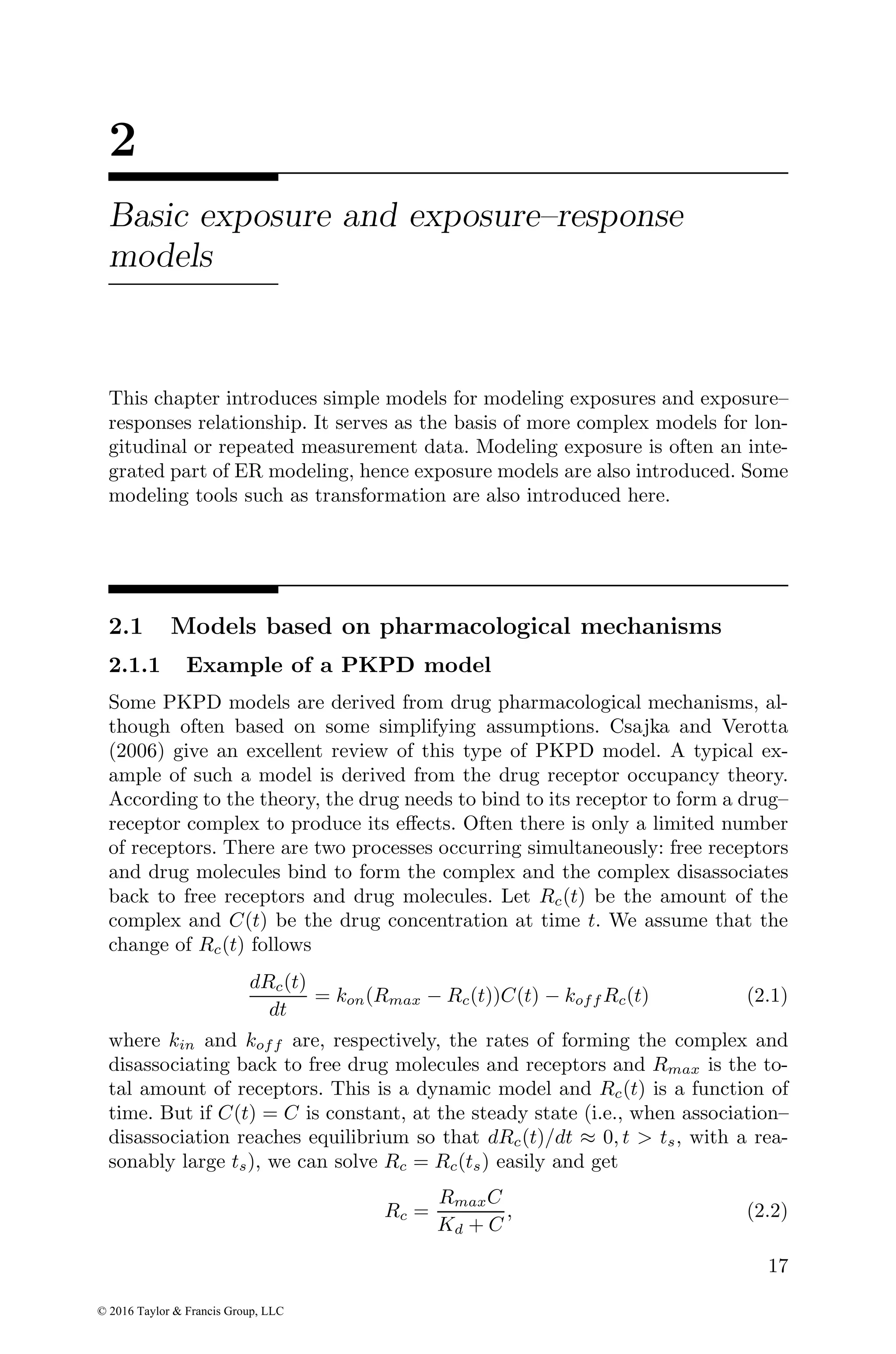
  • 61.
    But the king’sball was the great thing. In the early afternoon the dames and demoiselles met and the gifts were arranged for the evening. Of the fruit and flour a big cake was baked in which were put four large beans. When all was arranged the girls and the mothers donned their best finery, some of it half a century old, and kept only for state occasions. The older people opened the ball with the minuet de la cour, which was quite grand and formal. Then the real gayety began. With it all there was a certain charming respect, a kind of fine breeding the French never lost. Old gentlemen danced with the young girls, and the young men with matrons. Children were allowed in also, and had corners to themselves. It was said of them that the French were born dancing. There were no classes in this festivity. Even some of the upper kind of slaves came, and the young Indians ventured in. Gaspard Denys took the little girl, who was all eagerness. M. and Madame Garreau brought their guests, the Marchands, for society had quite taken in the beautiful young Indian, who held her head up so proudly no one would have dared to offer her a slight. Among the gayest was Barbe Guion. She had not taken young Maurice, who had gone off to New Orleans. People were beginning to say that she was a bit of a coquette. Madame Renaud announced that Alphonse Maurice was too trifling and not steady enough for a good husband. In her heart Barbe knew that she had never really meant to marry him. At midnight the cake was cut and every young girl had a piece. This was the great amusement, and everybody thronged about. “A bean! a bean!” cried Manon Dupont, holding it high above her head so all could see. Then another, one of the pretty Aubry girls, whose sister had been married at Easter.
  • 62.
    “And I, too,”announced Barbe Guion, laughing. They cleared a space for the four queens to stand out on the floor. What eager glances the young men cast. Manon Dupont chose her lover, as every one supposed she would, but there was no fun or surprise in it, though a general assent. “And how will she feel at the next ball when he has to choose a queen?” said some one. “She is a jealous little thing.” Ma’m’selle Aubry glanced around with a coquettish air and selected the handsomest young fellow in the room. Who would Barbe Guion choose? She looked dainty enough in a white woollen gown with scarlet cloth bands; and two or three masculine hearts beat with a thump, as the eyes fairly besought. Gaspard Denys was talking with the burly commandant of the fort, though it must be admitted there was very little to command. She went over to him and handed him her rose. He bowed and a slight flush overspread his face, while her eyes could not conceal her delight. “You do me a great deal of honor, ma’m’selle, but you might have bestowed your favor on a younger and more suitable man. I thank you for the compliment,” and he pinned the rose on his coat. She smiled with a softened light in her eyes. “It is the first time I have had a chance to choose a king,” she said in a caressing sort of voice. “I could not have suited myself better. And —I am almost eighteen. Elise was married a year before that.” “You are not single for lack of admirers, ma’m’selle.” She remembered he used to call her Barbe. “What did you do with
  • 63.
    Alphonse, send himaway with a broken heart?” “His was not the kind of heart to break, monsieur. And a girl cannot deliberately choose bad luck. There is sorrow enough when it comes unforeseen.” Then they took their places. Renée had been very eager at first and watched the two closely. M. Marchand had appealed to her on some trifle, and now she saw Barbe and Uncle Gaspard take their places in the dance. “Did she—choose Uncle Gaspard?” the child exclaimed with a long respiration that was like a sigh, while a flush overspread her face. “He is the finest man in the room! I would have chosen him myself if I had been a maid. And if you had been sixteen wouldn’t you have taken him, little girl? Well, your day will come,” in a gay tone. Wawataysee placed her arm over the child’s shoulder. “Let us go around here, we can see them better. What an odd way to do! And very pretty, too!” Renée’s first feeling was that she would not look. Then with a quick inconsequence she wanted to see every step, every motion, every glance. Her king! Barbe Guion had chosen him, and the child’s eyes flashed. It was a beautiful dance, and the gliding, skimming steps of light feet answered the measure of the music exquisitely. Other circles formed. The kings and the queens were not to have it all to themselves. The balls were often kept up till almost morning, though the children and some of the older people went home. Gaspard made his way through the crowd. Madame Marchand beckoned him, and as he neared them he saw Renée was clinging to her with a desperate emotion next to tears.
  • 64.
    “Is it nottime little ones were in bed?” she asked with her fascinating smile and in pretty, broken French. “Madame Garreau wishes to retire. It is beautiful, and every one is so cordial. I have danced with delight,” and her pleasure shone in her eyes. “But we will take the child safe to Mère Lunde if it is your will.” “Oh, thank you. Yes. You will go, Renée? You look tired.” She was pale and her eyes were heavy. “And you—you stay here and are Ma’m’selle Barbe’s king,” she said in a tone of plaintive reproach that went to his heart. “That is only for to-night. There are other queens beside her.” “But she is your queen.” The delicate emphasis amused him, it betrayed the rankling jealousy. “And you are my queen as well, to-morrow, next week, all the time. So do not grudge her an hour or two. See, I am going to give you her rose, my rose, to take home with you.” She smiled, albeit languidly, and held out her small hand, grasping it with triumph. He broke the stem as he drew it out, leaving the pin in his coat. “Now let me see you wrapped up snug and tight. Mind you don’t get any cold. Tell Mère Lunde to warm the bed and give you something hot to drink.” She nodded and the party went to the dressing room. The two Indian women chattered in their own language, or rather in a patois that they had adopted. Wawataysee was very happy, and her soft eyes shone with satisfaction. Her husband thought her the prettiest woman in all St. Louis. Renée gave her orders and Mère Lunde attended to them cheerfully.
  • 65.
    “For if youshould fall ill again our hearts would be heavy with sorrow and anxiety.” she said. Renée had carried the rose under her cloak and it was only a little wilted. She put it in some water herself, and brought the stand near the fireplace, for sometimes it would freeze on the outer edges of the room, though they kept a big log fire all night. Gaspard went back to Ma’m’selle Barbe. “Oh, your rose!” she cried. “Where is it?” He put his hand to his coat as if he had not known it. “The pin is left,” he said. “What a crowd there is! St. Louis is getting overrun with people,” laughing gayly. “Give me a rose out of your nosegay, for it would signify bad luck to go on the floor without it.” He took one and fastened it in his coat again, and they were soon merrily dancing. There was no absolute need of changing partners, and the queens were proud of keeping their admirers all the evening. Barbe was delighted and happy, for Gaspard evinced no disposition to stray off, and danced to her heart’s content, if not his. He had grown finer looking, certainly, since he had relinquished the hardships of a trapper’s life. His complexion had lost the weather- beaten look, his frame had filled out, and strangely enough, he was a much more ready talker. Renée chattered so much, asked him so many questions, and made him talk over people and places he had seen that it had given him a readiness to talk to women. Men could always find enough to say to each other, or enjoy silence over their pipes. She seemed to grow brighter instead of showing fatigue, and her voice had musical cadences in it very sweet to hear. The touch of her hand on his arm or his shoulder in the dance did give him a
  • 66.
    peculiar sort ofthrill. She was a very sweet, pretty girl. He was glad not to have her wasted on Alphonse Maurice. But the delicious night came to an end for her. There was a curious little strife among some of the young men to make a bold dash and capture a queen. The girls were sometimes willing enough to be caught. Barbe had skilfully evaded this, he noted. “Ma’m’selle Guion has the bravest king of them all,” said a neighbor. “He is a fine fellow. I wonder, Mère Renaud, you do not fan the flame into a blaze. He is prospering, too. Colonel Chouteau speaks highly of him and holds out a helping hand. If I had daughters no one would suit me better.” Madame Renaud smiled and nodded as if she had a secret confidence. Mothers in old St. Louis were very fond and proud of their daughters and were watchful of good opportunities for them. And those who had none rather envied them. It was the cordial family affection that made life in these wilderness places delightful. Barbe was being wound up in her veil so that her pretty complexion should suffer no ill at this coldest hour of the twenty-four, after being heated in the dance. She looked very charming, very tempting. If he had been a lover he would have kissed her. “You come so seldom now,” she said in a tone of seductive complaint. “And we were always such friends when you returned from your journeys. The children have missed you so much. And Lisa wonders—” “I suppose it is being busy every day. At that time you know there was a holiday between.” “But there is no business now until spring opens,” in a pleading tone.
  • 67.
    “Except for thehouseholder, the shopkeeper. Oh, you have no idea how ingenious I have become. And the men drop in to talk over plans and berate the Governor because things are not in better shape. We would fare badly in an attack.” “Are we in any danger from the British?” “One can never tell. Perhaps they may take up Pontiac’s wild dream of driving us over the mountains into the sea. No,” with a short laugh, “I am not much afraid. And our Indians are friendly also.” “Come, Barbe,” counselled Madame Renaud, but she took her husband’s arm and marched on ahead like an astute general. Barbe clung closely to her attendant, for in some places it was slippery. “Next time you will transfer your attentions,” she said with a touch of regret. “I wonder who will be your queen for a night?” “The prettiest girl,” he said gayly. “Madame Marchand is beautiful.” “But she is no longer a girl.” “Oh, no. You see a good deal of her, though?” “They are over often. We are excellent friends.” “Renée is quite bewitched with her.” “Yes, they are very fond of each other.” And somehow she, Barbe, was no more fond of the child than the child was of her.
  • 68.
    Madame Renaud studiedher sister’s face as they were unwinding their wraps. It was rather pale, not flushed and triumphant as she hoped. Gaspared Denys stirred the fire in his shop and threw himself on a pile of skins and was asleep in five minutes. It had been a long while since he had danced all night. They all slept late. There was no need of stirring early in the morning. They made no idol of industry, as the energetic settlers on the eastern coast did. Pleasure and happiness were enough for them. It ran in the French blood. When Gaspard woke he heard a sound of an eager chattering voice. He rubbed his limbs and stretched himself, looked down on his red sash and then saw a withered red rose that he tossed in the fire. “Ah, little one, you are as blithe as a bee,” was his greeting. “Oh, Uncle Gaspard, you have on your ball clothes. When did you come home?” she asked. “I dropped asleep in them. I am old and stiff this morning. I tumbled down on a pile of skins and stayed there.” “You don’t look very old. And—are you a king now?” rather curiously. “I must be two weeks hence. Then I resign my sceptre, and become an ordinary person.” “And Mère Lunde said you had to choose a new queen.” There was a touch of elation in her voice. “That is so. And I told Ma’m’selle Guion I should look out for the very prettiest girl. I shall be thinking all the time.”
  • 69.
    “I wish youcould take Wawataysee. She is the prettiest of anybody, and the sweetest.” “And she has already chosen her king for life.” “The breakfast will get cold,” warned Mère Lunde. There were more snows, days when you could hardly stir out and paths had to be shovelled. The next ball night it stormed, but Renée did not care to go, because M. and Madame Marchand were staying all night and they would play games and have parched corn and cakes and spiced drinks. Wawataysee would sing, too. And though the songs were odd, she had an exquisite voice, and she could imitate almost any bird, as well as the wind flying and shrieking through the trees, and then softening with sounds of spring. Sometimes they danced together, and it was a sight to behold, the very impersonation of grace; soft, languid mazes at first and then warming into flying sprites of the forest. And how Renée’s eyes shone and her cheeks blossomed, while the little moccasined feet made no more sound than a mouse creeping about. There was no especial carnival at St. Louis, perhaps a little more gayety than usual, and the dances winding up at midnight. Nearly every one went to church the next morning, listened to the prayers reverently, had a small bit of ashes dropped on his or her head, went home and fasted the rest of the day. But Lent was not very strictly kept, and the maids were preparing for Easter weddings. “It is strange,” said grandaunt Guion, “that Barbe has no lover. She is too giddy, too much of a coquette. She will be left behind. And she is too pretty to turn into an old maid. Guion girls were not apt to hang on hand.”
  • 70.
    CHAPTER VIII—THE SURPRISE Therewas, it is true, a side not so simple and wholesome, and this had been gathering slowly since the advent of the governor. More drunken men were seen about the levee. There was talk of regular orgies taking place at the government house, and the more thoughtful men, like the Chouteaus, the Guerins, the Guions, and the Lestourniers, had to work hard to get the fortifications in any shape, and the improvements made were mostly done by private citizens. Of course there were many rumors, but old St. Louis rested securely on her past record. What the people about her were losing or gaining did not seem to trouble her. Now and then a river pirate was caught, or there was some one tripped up and punished who had traded unlawfully. This had been the case with a French Canadian named Ducharme, who had been caught violating the treaty law, trading with Indians in Spanish territory, and giving them liberal supplies of rum in order to make better bargains with furs. His goods were seized and confiscated, but he was allowed to go his way, breathing threats of retaliation. France had recognized the independence of the colonies, which had stirred up resentment in the minds of many of the English in northern Michigan. It was said an English officer at Michilimackinac had formed a plan of seizing or destroying some of the western towns and stations where there was likely to be found booty enough to reward them. Ducharme joined the scheme eagerly and gathered roving bands of Ojibways. Winnebagoes and Sioux, and by keeping
  • 71.
    well to theeastern side of the Mississippi marched down nearly opposite Gabaret Island, and crossed over to attack the town. Corpus Christi was a great festival day of the church. Falling late in May, on the 25th, it was an out-of-doors entertainment. After mass had been said in the morning, women and children, youths and maidens, and husbands who could be spared from business, went out for a whole day’s pleasure with baskets and bags of provisions. The day was magnificent. The fragrance of spruce and fir, the breath of the newly grown grasses, the bloom of trees and flowers, was like the most exhilarating perfume, and stirred all the senses. Spies had crept down the woods to reconnoitre and assure themselves their arrival had not been suspected. It seemed indeed an opportune moment. It was now mid-afternoon. There had been dancing and merriment, the children had run and played, gathered wild strawberries and flowers, and some of the more careful ones had collected their little children and started homeward. To the westward was Cardinal Spring, owned by a man of that name, but considered free property. He and another hunter had been shooting game, and as he stooped for a drink his companion espied an Indian cautiously creeping through the trees. “Indians! Indians!” he shouted, and fired. Cardinal snatched up his gun, but a storm of bullets felled him. Rivière was captured. A young Frenchman, catching sight of the body of Indians, gave the alarm. “Run for your lives! Fly to the fort!” he shouted. There were men working in the fields, and nearly every one took his gun, as much for the chance at game as any real fear of Indians. They covered the retreat a little, and as this was a reconnoitring party, the main body was at some distance.
  • 72.
    “Fly! Fly!” Menwho had no weapons caught little ones in their arms and ran toward the fort. All was wild alarm. “What is it?” cried Colonel Chouteau, who had been busy with some papers of importance. “The Indians! The Indians!” shouted his brother. “Call out the militia! Where is the Governor?” “In his own house, drunk as usual,” cried Pierre indignantly, and he ran to summon the soldiers. There had been a small body of troops under the command of Captain Cartabona, a Spaniard sent from Ste. Genevieve at the urgent request of the chief citizens, but it being a holiday they were away, some canoeing down the river or fishing, and of the few to be found most of them were panic stricken. The captain had been having a carouse with the Governor. “Then we must be our own leaders. To arms! to arms! every citizen! It is for your wives and children!” was the inspiriting cry. “You shall be our leader!” was shouted in one voice almost before the Colonel had ceased. For Colonel Chouteau was not only admired for his friendliness and good comradeship, but trusted to the last degree. Every man rushed for his gun and ran to the rescue, hardly knowing what had happened save that the long-feared attack had come upon them unawares. They poured out of the fort, but the flying women and children were in the advance with the Indians back of them. Colonel Chouteau marshalled his little force in a circuitous movement, and opened a volley that took the Indians by surprise. They fell back brandishing their arms and shouting to their companions to come on. Then the Colonel saw that it was no mere
  • 73.
    casual attack, buta premeditated onslaught. Already bodies were lying on the ground struggling in death agonies. The aim was so good that the assailants halted, then fell back to wait for their companions. This gave most of the flying and terrified throng an opportunity to reach the fort. For the wounded nothing could be done at present. Now the streets were alive with men who had no time to pick out their own families, but ran, musket or rifle in hand, to man the fort. Colonel Chouteau and his brother Pierre were experienced artillerists, and stationed themselves at the cannon. The Indians held a brief colloquy with the advancing body. Then it was seen that an attack was determined upon. They approached the fort, headed by several white leaders, and opened an irregular fire on the place. “Let them approach nearer,” commanded the Colonel. The walls of the stockade and the roofs of the nearest houses were manned with the residents of the town. A shower of arrows fell among them. Surprised at no retaliation, the enemy ventured boldly, headed by Ducharme. Then the cannons poured out their volley, which swept down the foremost. From the roofs muskets and guns and even pistols made a continuing chorus. Ducharme fell. Two of the white leaders were wounded also. Then another discharge from the cannons and the red foes fell back. The plan had been to wait until almost dusk for the attack, but the incident at the spring had hastened it. Ducharme had not counted on the strength of the fort, and he knew the town was but poorly supplied with soldiers, so he had persuaded the Indians it would fall an easy prey and give them abundant pillage. But the roar and the execution of the cannon dismayed them, and many of them fled at once. Others marched slowly, helping some of the wounded.
  • 74.
    General Cartabona cameout quite sobered by the fierceness of the attack. “Would it not be well to order a pursuit?” he questioned. “And perhaps fall into a trap!” returned Colonel Chouteau with a touch of scorn. “No, no; let us bring in the wounded as we can.” Gaspard Denys had been among the first to rush to the defence of the town. Marchand had gone out with the party, and Mère Lunde was to care for Renée. He had not stopped to look or inquire. He saw Madame Renaud. “Oh, thank heaven my children are safe! But Barbe! I cannot find Barbe!” she cried. “And Renée?” his voice was husky. “She was with the Marchands. They were going to the woods. Oh, M’sieu Denys, what a horrible thing! And we felt so safe. The Indians have been so friendly. But can you trust them?” He was off to look after the wounded. A number were lying dead on the field. No, Renée was not among them. They carried the wounded in gently, the dead reverently. The good priest proffered his services, and Dr. Montcrevier left his beloved experiments to come and minister to them. The dead were taken to the church and the priest’s house. All was confusion, however. Darkness fell before families were reunited. Children hid away in corners crying, and were too terrified to come out even at the summons of friendly voices. Colonel Chouteau and his brother were comforting, aiding, exhorting, and manning the fort anew. General Cartabona set guards at the gates and towers, for no one knew what might happen before morning.
  • 75.
    Denys had hurriedhome as soon as he could be released. “Renée!” he called. “Mère Lunde!” but no one replied. He searched every nook and corner. He asked the Pichous. No one had seen them. A great pang rent his heart. And yet—they might have hidden in the forest. Ah, God send that they might not be taken prisoners! But Marchand was with them. He knew the man’s courage well. He would fight to the death for them. “I must go out and search,” he said in a desperate tone. “Who will accompany me?” A dozen volunteered. They were well armed, and carried a rude lantern made of tin with a glass in one side only. They saw now that their fire had done good execution among their red foes. The trampled ground showed which way the party had gone, and they were no longer in sight. “Let us try the woods. They came by the way of the spring,” said one of the party. They found the body of Cardinal and that of an old man, both dead. They plunged into the woods, and, though aware of the danger, Denys shouted now and then, but no human voice replied. Here, there, examining some thicket, peering behind a clump of trees, startling the denizen of the woods, or a shrill-voiced nighthawk, and then all was silence again. They left the woods and crossed the strip of prairie. Here lay something in the grass—a body. Denys turned it over. “My God!” he exclaimed in a voice of anguish. “It is François Marchand.” He dropped on the ground overwhelmed. If he was dead, then the others were prisoners. There was no use to search farther to-night. To-morrow a scouting party might go out.
  • 76.
    They made alitter of the men’s arms and carried Marchand back to the fort, to find that he was not dead, though he had a broken leg and had received a tremendous blow on the head. A sad morning dawned over St. Louis, where yesterday all had been joy. True, it might have been much worse. In all about a dozen had been killed, but the wounded and those who had fallen and been crushed in the flight counted up many more. And some were missing. What would be their fate? And oh, what would happen to Wawataysee if some roving Indian should recognize her! As for Renée, if he had not wholly understood before, he knew now how the child had twined herself about his heart, how she had become a part of his life. Marchand’s blow was a dangerous one. The Garreaus insisted upon nursing and caring for him, but Madame Garreau was wild about the beautiful Wawataysee. She knew the Indian character too well to think they would show her any mercy, if she was recognized by any of the tribe. And Renée, what would be her fate? General Cartabona was most anxious to make amends for past negligence. The militia was called to a strict account and recruited as rapidly as possible, and the fortifications made more secure. He took counsel with Colonel Chouteau, who had the best interests of the town at heart. “We must make an appeal for the Governor’s removal,” insisted the Colonel. “It is not only this cowardly episode, but he is narrow- minded and avaricious, incompetent in every respect, and drunk most of the time. He cares nothing for the welfare of the town, he takes no interest in its advancement. After such men as Piernas and Cruzat he is most despicable. Any Frenchman born would serve Spain better.” “That is true. I will head a petition of ejectment, and make it strong enough to be heeded.”
  • 77.
    The dead wereburied, the living cared for. Even the fallen enemies had been given decent sepulture outside the town. And Gaspard Denys felt that he must start on his journey of rescue, if indeed that was possible. He chose two trusty young fellows, after shutting his house securely, providing his party with ammunition, and provisions for a part of their journey, as much as they could carry. He found the Indians had boats in waiting on the Illinois River, and after proceeding some distance they had separated in two parties, going in different directions. Some of the prisoners had been left here, as they did not care to be bothered with them. The one party kept on up the river. They learned there were some women with them, and were mostly Indians. It was not an easy trail to follow. There had been a quarrel and another separation, a drunken debauch, part stopping at an Indian village. And here Denys heard what caused him almost a heart-break. They had fallen in with some Hurons who had bought two of the captives. An old woman was set free with two men and sent down the river. The others were going up north. “It is as I feared, Jaques,” he said. “They will carry Madame Marchand to her old home as a great prize. Ah, if François were only well! But I shall go on for life or death. I will not ask you to share my perils. Wawataysee came from somewhere up by the straits. She ran away with Marchand. She was to be married to an old Indian against her will. And no doubt he will be wild with gratification at getting her back, and will treat her cruelly. The child is mine and I must save her from a like fate. But you and Pierre may return. I will not hold you bound by any promises.” “I am in for the adventure,” and Pierre laughed, showing his white teeth. “I am not a coward nor a man to eat one’s words. I am fond of adventure. I will go on.”
  • 78.
    “I, too,” respondedJaques briefly. “You are good fellows, both of you. I shall pray for your safe return,” Denys said, much moved by their devotion. “And we have no sweethearts,” subjoined Pierre with a touch of mirth. “But if I could find one as beautiful and sweet as Madame Marchand I should be paid for a journey up to Green Bay.” “It might be dangerous,” said Denys sadly. He wondered if it was really Mère Lunde they had set free. It would be against her will, he was sure, and it would leave the two quite defenceless. A thousand remembrances haunted him day and night. He could see Renée’s soft brown eyes in the dusk, he could hear her sweet voice in the gentle zephyrs, that changed and had no end of fascinating tones. All her arch, pretty moods came up before him, her little piquant jealousies, her pretty assumptions of dignity and power, her dainty, authoritative ways. Oh, he could not give her up, his little darling. There was sorrow in more than one household in old St. Louis, but time softened and healed it. And now the inhabitants congratulated themselves on their freedom heretofore from raids like these. Towns had been destroyed, prisoners had been treated to almost every barbarity. Giving up their lives had not been the worst. But the summer came on gloriously, and Colonel Chouteau made many plans for the advancement of the town. He was repairing the old house where his friend had lived, and improving the grounds, and everyone felt that in him they had a true friend. One July day three worn and weary people came in at the northern gate, and after the guards had looked sharply at them there was a shout of joy. Pierre Duchesne, whose family had lived on a faint hope, young Normand Fleurey, and Mère Lunde, looking a decade older and more wrinkled than ever.
  • 79.
    She sat downon a stone and wept while the sounds of joy and congratulation were all about her. Who could give her any comfort? She suffered Gaspard Denys’s pain as well as her own. And though there had been adventures and hiding from roving Indians, living on barks and roots, she could not tell them over while her heart was so sore. She went to the old house, where the three had known so much content. “He will come back some day,” she said, “but the child—” and her voice would break at that. She heard Marchand had been very ill with a fever, beside the wounds. He had come near to losing his leg, and was still a little lame, and very weak and heartbroken. His wife had been torn from his arms when an Indian had given him the blow on his head with a club, and there memory had stopped. Though Mère Lunde would talk to no one else, to him she told the sad story. And he had been lying helpless all the time Wawataysee had been in such danger! Yes, he knew what would happen to her now, but presently he would go up to the strait and never rest until he had killed all who worked her ill. Oh, if she had fallen into the hands of her old tribe! That thought was madness. But he understood what the courage of her despair would be. She would not suffer any degradation, death would be a boon instead. Ah, if he could have joined Denys! He knew the cruelty and treachery of those whose hands she had fallen into. And the child! But it would be useless to start disabled as he was, although his anger was fierce enough, and Denys was well on the journey. Yet it was terrible to wait with awful visions before his eyes. He had seen both men and women tortured, and the agonies prolonged with fiendish delight.
  • 80.
    Mère Lunde openedthe house and cleared up the dust and disorder. The garden was overgrown with weeds and everything was running riot. Marchand insisted upon lending a helping hand here. Many an evening they sat in the doorway wondering, hoping and despairing.
  • 81.
    CHAPTER IX—PRISONERS The wildcry of “The Indians! the Indians!” had roused a small group from their desultory enjoyment. They were pouring down in what seemed a countless throng. Marchand had no weapon except his knife. “Run,” he cried. “Make for the fort! Keep at the edge of the wood while we can!” Wawataysee seized Renée’s hand. The Indian girl was as fleet as a deer. She could have saved herself, but she would not leave the child. They had now reached the open. All was screams and confusion and flying fugitives. A tall Indian was behind them with a club. Wawataysee gave a wild shriek and the next instant stumbled over her husband’s prostrate body. The Indian rushed on. “Oh!” cried Renée in wild affright, standing still in terror, the flying crowd like swirling leaves before her eyes. The sharp crack of a rifle made her spring back. Were both killed now? But Wawataysee moved, groaned. “They have shot him now, my beloved!” She raised the bleeding head and pressed it to her bosom. “Oh, he has been killed, I know. Why did I not die with him? Oh, Renée—” Escape now was as impossible as succor. The Indian girl moaned over her husband, and made a futile attempt to drag him back to the edge of the wood to hide him. But suddenly she was violently wrenched away, and an Indian with a hand hold of each began to
  • 82.
    run with themtoward the river. At last Renée fell and he had to pause. Meanwhile the firing from the fort had begun with its execution. Wawataysee began to plead with her captor, who turned a deaf ear to her entreaties. Renée was crying in a desperate fashion, from both fright and fatigue. He raised his club, but the young wife clasped the child in her arms. “Kill us both,” she exclaimed, “as you have already killed my husband.” “White man?” with a grunt. “Squaw woman. Make some Indian glad.” Other prisoners were being brought in this direction, and among them Mère Lunde, who had started to reach the fort and bear the tidings to Gaspard. “Oh, my dear child,” she cried. “The good God help us. They are trying to take the town.” And she almost fell at their feet. Then they were marched on, the Indian guards behind with clubs and tomahawks, now and then goaded by a light blow that would not disable. The cries grew fainter, though they still heard the roar of the cannon. And now the sun was slanting westward and the trees cast long shadows, the sound of the river fell on their ears mingled with the homeward song of birds. The heat began to wane, the air was dewy sweet. It was almost dusk when they reached the boats, and they were bidden to get in and were conveyed to the opposite shore. Here they were bound together, two and two, with their hands fastened behind them. One Indian was detailed to watch them while the others took the boats back.
  • 83.
    Ducharme’s arm hunghelplessly by his side, and the English renegades began to upbraid him, while the Indians, seeing that no pillage was possible and no gain could be made, drew away sullenly and began to march toward the rendezvous, leaving some of their own badly wounded behind. It was midnight before they rejoined the others. Then, fearing pursuit, they started up the river again, rousing those who had fallen asleep. All told they had barely thirty prisoners, and had left as many of their own behind. Mère Lunde had been allowed near the two girls, and now they huddled together in the boat. Renée had fallen asleep again. “You do not know where they will take us?” Mère Lunde inquired. Wawataysee shook her head. “They will go up the Illinois River,” she whispered. “Do you think they will not follow?” in a low, desperate tone. “Master Denys and—” “Oh, he is dead,” with a heart-breaking moan. “I held him to my heart and he made no stir, I kissed his cold lips and there was no warmth. But for the sweet child I should have begged them to kill me too, so that my spirit should be with his. If she could be restored safely, my own life I would hold as nothing.” “They have started ere this. Do not despair,” and her lips were close to the Indian girl’s ear. “Then I shall thank the Great Spirit for the child’s sake.” Heaven grant they might be rescued. The stir and lap of the river and the boats had a mysterious sound in the weird darkness. Then the cry of some wild animal or a bit of wind sweeping through the trees at the edge, here and there. The stars shone out overhead. Mère Lunde dropped asleep also. But Wawataysee sat with wide-open eyes. One moment she said to
  • 84.
    herself that hecould not be dead, the next his white face and half- closed, dulled eyes were against her breast. She felt as if she must shriek and tear her hair, but there was the Indian’s self-control, and the thought of her companions who might be made to suffer for her. But she could not go out of life for her own satisfaction merely, unless it came to the martyrdom worse than death, for the child was a sacred charge. Gaspard Denys would go to the death, even, for both of them, and she was grateful for all the kindness and countenance he had given her at St. Louis. They turned up a small stream, tributary to the Illinois. At noon they drew the boats up to what looked like an impenetrable brushwood, and disembarked, pulling in the boats and canoes. There was a sort of trodden path through the wild shrubbery, and tangled vines overhung it. Two of the Indians went ahead, the prisoners were driven next, and the rest of the party brought up the rear. “Oh, where are we going?” cried Renée in affright, clutching Wawataysee’s dress with both hands. The girl shook her head. They were stiff from their cramped position in the boats and faint from hunger. Now and then one received a blow and an admonition to hurry on. At length they came in sight of a clearing, an Indian settlement, with wigwams and a space planted with corn. Women were moving about over their fires, children playing or stretched out in the sun. Skins were tacked from tree to tree drying, and several women were busy making garments and leggings, some young girls cutting fringes. It was a pretty, restful scene to the tired travellers. An old man rose, it almost seemed from the earth itself. He was thin and gaunt, hollow-cheeked and wrinkled to the last degree. From his attire and his head-dress of feathers one could gather that he was the chief of the small settlement.
  • 85.
    “Why all thiswarlike array and these prisoners?” he asked sharply. “We are at peace with our white brothers. We have gathered in the remnant of our tribe, we have few young braves among us, we are mostly women and children. We have nothing to be despoiled of, we do no hunting save for ourselves.” “We want only a little food and rest, good father Neepawa. We will not molest you and yours. We are going up to the Great Lakes. We have been led astray by a white chief who promised us much plunder, but the town was too strong for us. He has gone south to one of the English forts and taken some of his followers, leaving the prisoners with us. Give us some food and we will go on.” Their request was acceded to, but with no special cordiality. The thing they would most have liked was whiskey, but that was not to be supplied at this simple Indian village. “Oh, if we could stay here!” sighed Renée. “Do you know where they mean to take us?” and her eyes dilated with fear. “Only that we are going farther north.” Wawataysee was fain to have some conversation with the Indian women, but she soon saw that every effort was adroitly frustrated. Still, they were fed abundantly and some provisions given the party. They reembarked late in the afternoon and made their way down to the Illinois River and up farther on their journey, until their provisions were gone, when they were obliged to land again. After foraging about awhile they met a party of Indians and traders quite plentifully supplied with whiskey. This led to quarrels and disputes. A number of them were tired of having the prisoners to feed, and had changed their minds about going north. They were roving Indians who had no strong ties anywhere. Half a dozen decided to cast in their lot with the traders.
  • 86.
    And now thosegoing on picked out the most likely of the prisoners. Some of the strong young men who would be useful in the capacity of slaves, one half-breed woman who had astuteness enough to make herself of account in preparing food and did not resent the small indignities offered. As they marched down to the river’s edge these were first put on the boat. Then Wawataysee and the child. Mère Lunde started to follow, but was rudely thrust back. “I must, I must!” she shrieked, struggling with her captor; “I must stay with the child!” “Push off!” was the command. Three Indians stepped in and the boat was propelled out in the stream. Then Wawataysee saw what had happened and half rose, crying wildly that they should take on the poor creature begging in her desperation. “She is ours! We cannot do without her!” The Indian pushed her down on her seat and uttered a rough threat. “Oh, what will they do with her?” shrieked Renée. A blow was the only answer. Renée fell into her companion’s lap sobbing wildly. Wawataysee tried to soothe and comfort her. But she felt strangely defenceless. The half-breed she mistrusted. If there could be some escape! She studied every point. They were no longer bound, but out here on the river one could do nothing. So passed another night and day and a second night. No place of refuge had been found in their brief landings. But they reached another settlement, not as orderly or inviting as that of Chief Neepawa. Still, they were glad of a rest. And now their captors seemed undecided again. Two or three were already tired of the journey with its hardships.
  • 87.
    An Indian womanfound a place in her wigwam for the two girls. They were bound at night and their keeper had strict injunctions about them. The Elk Horn, as one of the most authoritative Indians was called, now assumed the command. He had an idea, that he kept quite to himself, that he might dispose of his prisoners to some advantage, to make up in part for the ill-advised raid on St. Louis. There were many roving Indians about whose tribes had been decimated by wars and sickness, and who attached themselves to the English or American cause, whichever offered the most profit, and who liked a lawless, wandering life and plunder. The keeper seemed kindly disposed toward the two girls and treated them well, though she watched them sharply. Wawataysee had been careful to talk in a patois of broken French and the Sioux that she had picked up. She understood nearly all that her captors said and thus held them at a disadvantage, but she could not learn what Elk Horn’s plans were, if indeed he had any certain ones. She admitted that she had left a husband in St. Louis, for there were moments when she could not believe him dead, and that this was the end of their tender love! And she was young, she had just tasted of the sweetness of it all. There were hours of heart-break, when it seemed as if she could not endure Renée’s prattle, and would fain shake off the soft touch on her arm, the kisses on her forehead, for the awful, desperate want of the other kisses, the other clasp. And oh, how strong the longing was at times to throw herself headlong into the river and let her spirit of love fly to that other land, that the good God provided for His children. Then she would think of Gaspard Denys and his love for the little maid. He had seen enough of the cruelty of her race to know the danger. Ah, why had the great All-Father allowed any human beings to become such fiends? Up in her northern home she had heard
  • 88.
    things that turnedthe blood to ice. And she had been so near the white settlements. Yes, she must care for the little one, keep with her, befriend her, try to restore her to her dear protector. It was best to claim that Renée was her little sister by adoption. If they could only get back! Why should they go up north? What was that more than any other place! The woman at this would shake her head doubtfully. Yet Wawataysee could see that she softened, and once she asked how far it was to St. Louis, and how one could get there. Wawataysee’s heart beat high with hope. Yet how could two girls reach there alone? They might meet other Indian bands who would capture them. There were wild animals. And they might not get a canoe. They had no money. Still, she would escape if they could and pray to the good God to keep them safe. Often and often she and Renée comforted themselves with the sweet, brief prayers they had learned. And oh, where was poor Mère Lunde! Several days of rest were vouchsafed to them. Then one day a company of hunters joined them, among which there were a few white prisoners as well. One, a young fellow, strolled about with evident curiosity, and came upon the girls in a leafy covert near the wig-wam. They were given a little liberty by their keeper on promising by the Great Manitou they would not attempt to escape. “It would be of no use,” said the woman. “An alarm would be given, and you do not know your way anywhere. Then you might be beaten when you were captured, and confined with thongs. Have patience. Sometimes all the braves go off to hunt.” The young man listened to the French with delight. Two of the other captives were English and they had conversed mostly with signs and Indian words they had picked up.
  • 89.
    Welcome to ourwebsite – the perfect destination for book lovers and knowledge seekers. We believe that every book holds a new world, offering opportunities for learning, discovery, and personal growth. That’s why we are dedicated to bringing you a diverse collection of books, ranging from classic literature and specialized publications to self-development guides and children's books. More than just a book-buying platform, we strive to be a bridge connecting you with timeless cultural and intellectual values. With an elegant, user-friendly interface and a smart search system, you can quickly find the books that best suit your interests. Additionally, our special promotions and home delivery services help you save time and fully enjoy the joy of reading. Join us on a journey of knowledge exploration, passion nurturing, and personal growth every day! ebookbell.com