Exposure Response Modeling Methods and Practical
Implementation 1st Edition Jixian Wang pdf
download
https://ebookfinal.com/download/exposure-response-modeling-
methods-and-practical-implementation-1st-edition-jixian-wang/
Explore and download more ebooks or textbooks
at ebookfinal.com
We believe these products will be a great fit for you. Click
the link to download now, or visit ebookfinal
to discover even more!
Modeling in food microbiology from predictive microbiology
to exposure assessment 1st Edition Membré
https://ebookfinal.com/download/modeling-in-food-microbiology-from-
predictive-microbiology-to-exposure-assessment-1st-edition-membre/
Fair Value Measurements Practical Guidance and
Implementation 1st Edition Mark L. Zyla
https://ebookfinal.com/download/fair-value-measurements-practical-
guidance-and-implementation-1st-edition-mark-l-zyla/
Behavioral Modeling for Embedded Systems and Technologies
Applications for Design and Implementation 1st Edition
Luã-S Gomes
https://ebookfinal.com/download/behavioral-modeling-for-embedded-
systems-and-technologies-applications-for-design-and-
implementation-1st-edition-luas-gomes/
Modeling and Dimensioning of Structures A Practical
Approach 1st Edition Daniel Gay
https://ebookfinal.com/download/modeling-and-dimensioning-of-
structures-a-practical-approach-1st-edition-daniel-gay/
Practical Spreadsheet Risk Modeling for Management 1st
Edition Dale Lehman
https://ebookfinal.com/download/practical-spreadsheet-risk-modeling-
for-management-1st-edition-dale-lehman/
Marx s Practical Materialism The Horizon of Post
Subjectivity Philosophy 1st Edition Wang Nanshi
https://ebookfinal.com/download/marx-s-practical-materialism-the-
horizon-of-post-subjectivity-philosophy-1st-edition-wang-nanshi/
Practical Methods for Biocatalysis and Biotransformations
1st Edition John Whittall
https://ebookfinal.com/download/practical-methods-for-biocatalysis-
and-biotransformations-1st-edition-john-whittall/
Microencapsulation in the Food Industry A Practical
Implementation Guide 1st Edition Anilkumar G. Gaonkar
https://ebookfinal.com/download/microencapsulation-in-the-food-
industry-a-practical-implementation-guide-1st-edition-anilkumar-g-
gaonkar/
Analysis and Design of Structures A Practical Guide to
Modeling 1st Edition Trevor Jones
https://ebookfinal.com/download/analysis-and-design-of-structures-a-
practical-guide-to-modeling-1st-edition-trevor-jones/
Exposure Response Modeling Methods and Practical
Implementation 1st Edition Jixian Wang Digital Instant

Download
Author(s): Jixian Wang
ISBN(s): 9781466573208, 1466573201
Edition: 1
File Details: PDF, 3.10 MB
Year: 2015
Language: english
Exposure–Response
Modeling
Methods and Practical
Implementation
© 2016 Taylor & Francis Group, LLC
Editor-in-Chief
Shein-Chung Chow, Ph.D., Professor, Department of Biostatistics and Bioinformatics,
Duke University School of Medicine, Durham, North Carolina
Series Editors
Byron Jones, Biometrical Fellow, Statistical Methodology, Integrated Information Sciences,
Novartis Pharma AG, Basel, Switzerland
Jen-pei Liu, Professor, Division of Biometry, Department of Agronomy,
National Taiwan University, Taipei, Taiwan
Karl E. Peace, Georgia Cancer Coalition, Distinguished Cancer Scholar, Senior Research Scientist
and Professor of Biostatistics, Jiann-Ping Hsu College of Public Health,
Georgia Southern University, Statesboro, Georgia
Bruce W. Turnbull, Professor, School of Operations Research and Industrial Engineering,
Cornell University, Ithaca, New York
Published Titles
Adaptive Design Methods in
Clinical Trials, Second Edition
Shein-Chung Chow and Mark Chang
Adaptive Designs for Sequential
Treatment Allocation
Alessandro Baldi Antognini and
Alessandra Giovagnoli
Adaptive Design Theory and
Implementation Using SAS and R,
Second Edition
Mark Chang
Advanced Bayesian Methods for Medical
Test Accuracy
Lyle D. Broemeling
Advances in Clinical Trial Biostatistics
Nancy L. Geller
Applied Meta-Analysis with R
Ding-Geng (Din) Chen and Karl E. Peace
Basic Statistics and Pharmaceutical
Statistical Applications, Second Edition
James E. De Muth
Bayesian Adaptive Methods for
Clinical Trials
Scott M. Berry, Bradley P. Carlin,
J. Jack Lee, and Peter Muller
Bayesian Analysis Made Simple: An Excel
GUI for WinBUGS
Phil Woodward
Bayesian Methods for Measures of
Agreement
Lyle D. Broemeling
Bayesian Methods in Epidemiology
Lyle D. Broemeling
Bayesian Methods in Health Economics
Gianluca Baio
Bayesian Missing Data Problems: EM,
Data Augmentation and Noniterative
Computation
Ming T. Tan, Guo-Liang Tian,
and Kai Wang Ng
Bayesian Modeling in Bioinformatics
Dipak K. Dey, Samiran Ghosh,
and Bani K. Mallick
Benefit-Risk Assessment in
Pharmaceutical Research and
Development
Andreas Sashegyi, James Felli, and
Rebecca Noel
Biosimilars: Design and Analysis of
Follow-on Biologics
Shein-Chung Chow
Biostatistics: A Computing Approach
Stewart J. Anderson
Causal Analysis in Biomedicine and
Epidemiology: Based on Minimal
Sufficient Causation
Mikel Aickin
Clinical and Statistical Considerations
in Personalized Medicine
Claudio Carini, Sandeep Menon,
and Mark Chang
© 2016 Taylor & Francis Group, LLC
Clinical Trial Data Analysis using R
Ding-Geng (Din) Chen and Karl E. Peace
Clinical Trial Methodology
Karl E. Peace and Ding-Geng (Din) Chen
Computational Methods in Biomedical
Research
Ravindra Khattree and Dayanand N. Naik
Computational Pharmacokinetics
Anders Källén
Confidence Intervals for Proportions and
Related Measures of Effect Size
Robert G. Newcombe
Controversial Statistical Issues in
Clinical Trials
Shein-Chung Chow
Data Analysis with Competing Risks and
Intermediate States
Ronald B. Geskus
Data and Safety Monitoring Committees
in Clinical Trials
Jay Herson
Design and Analysis of Animal Studies in
Pharmaceutical Development
Shein-Chung Chow and Jen-pei Liu
Design and Analysis of Bioavailability and
Bioequivalence Studies, Third Edition
Shein-Chung Chow and Jen-pei Liu
Design and Analysis of Bridging Studies
Jen-pei Liu, Shein-Chung Chow,
and Chin-Fu Hsiao
Design and Analysis of Clinical Trials for
Predictive Medicine
Shigeyuki Matsui, Marc Buyse,
and Richard Simon
Design and Analysis of Clinical Trials with
Time-to-Event Endpoints
Karl E. Peace
Design and Analysis of Non-Inferiority
Trials
Mark D. Rothmann, Brian L. Wiens,
and Ivan S. F. Chan
Difference Equations with Public Health
Applications
Lemuel A. Moyé and Asha Seth Kapadia
DNA Methylation Microarrays:
Experimental Design and Statistical
Analysis
Sun-Chong Wang and Arturas Petronis
DNA Microarrays and Related Genomics
Techniques: Design, Analysis, and
Interpretation of Experiments
David B. Allison, Grier P. Page,
T. Mark Beasley, and Jode W. Edwards
Dose Finding by the Continual
Reassessment Method
Ying Kuen Cheung
Elementary Bayesian Biostatistics
Lemuel A. Moyé
Empirical Likelihood Method in Survival
Analysis
Mai Zhou
Exposure–Response Modeling: Methods
and Practical Implementation
Jixian Wang
Frailty Models in Survival Analysis
Andreas Wienke
Generalized Linear Models: A Bayesian
Perspective
Dipak K. Dey, Sujit K. Ghosh,
and Bani K. Mallick
Handbook of Regression and Modeling:
Applications for the Clinical and
Pharmaceutical Industries
Daryl S. Paulson
Inference Principles for Biostatisticians
Ian C. Marschner
Interval-Censored Time-to-Event Data:
Methods and Applications
Ding-Geng (Din) Chen, Jianguo Sun,
and Karl E. Peace
Introductory Adaptive Trial Designs:
A Practical Guide with R
Mark Chang
Joint Models for Longitudinal and Time-
to-Event Data: With Applications in R
Dimitris Rizopoulos
Measures of Interobserver Agreement
and Reliability, Second Edition
Mohamed M. Shoukri
© 2016 Taylor & Francis Group, LLC
Medical Biostatistics, Third Edition
A. Indrayan
Meta-Analysis in Medicine and Health
Policy
Dalene Stangl and Donald A. Berry
Mixed Effects Models for the Population
Approach: Models, Tasks, Methods and
Tools
Marc Lavielle
Modeling to Inform Infectious Disease
Control
Niels G. Becker
Modern Adaptive Randomized Clinical
Trials: Statistical and Practical Aspects
Oleksandr Sverdlov
Monte Carlo Simulation for the
Pharmaceutical Industry: Concepts,
Algorithms, and Case Studies
Mark Chang
Multiple Testing Problems in
Pharmaceutical Statistics
Alex Dmitrienko, Ajit C. Tamhane,
and Frank Bretz
Noninferiority Testing in Clinical Trials:
Issues and Challenges
Tie-Hua Ng
Optimal Design for Nonlinear Response
Models
Valerii V. Fedorov and Sergei L. Leonov
Patient-Reported Outcomes:
Measurement, Implementation and
Interpretation
Joseph C. Cappelleri, Kelly H. Zou,
Andrew G. Bushmakin, Jose Ma. J. Alvir,
Demissie Alemayehu, and Tara Symonds
Quantitative Evaluation of Safety in Drug
Development: Design, Analysis and
Reporting
Qi Jiang and H. Amy Xia
Randomized Clinical Trials of
Nonpharmacological Treatments
Isabelle Boutron, Philippe Ravaud, and
David Moher
Randomized Phase II Cancer Clinical
Trials
Sin-Ho Jung
Sample Size Calculations for Clustered
and Longitudinal Outcomes in Clinical
Research
Chul Ahn, Moonseong Heo, and
Song Zhang
Sample Size Calculations in Clinical
Research, Second Edition
Shein-Chung Chow, Jun Shao
and Hansheng Wang
Statistical Analysis of Human Growth
and Development
Yin Bun Cheung
Statistical Design and Analysis of
Stability Studies
Shein-Chung Chow
Statistical Evaluation of Diagnostic
Performance: Topics in ROC Analysis
Kelly H. Zou, Aiyi Liu, Andriy Bandos,
Lucila Ohno-Machado, and Howard Rockette
Statistical Methods for Clinical Trials
Mark X. Norleans
Statistical Methods for Drug Safety
Robert D. Gibbons and Anup K. Amatya
Statistical Methods in Drug Combination
Studies
Wei Zhao and Harry Yang
Statistics in Drug Research:
Methodologies and Recent
Developments
Shein-Chung Chow and Jun Shao
Statistics in the Pharmaceutical Industry,
Third Edition
Ralph Buncher and Jia-Yeong Tsay
Survival Analysis in Medicine and
Genetics
Jialiang Li and Shuangge Ma
Theory of Drug Development
Eric B. Holmgren
Translational Medicine: Strategies and
Statistical Methods
Dennis Cosmatos and Shein-Chung Chow
© 2016 Taylor & Francis Group, LLC
Jixian Wang
Celgene International
Switzerland
Exposure–Response
Modeling
Methods and Practical
Implementation
© 2016 Taylor & Francis Group, LLC
MATLAB® is a trademark of The MathWorks, Inc. and is used with permission. The MathWorks does
not warrant the accuracy of the text or exercises in this book. This book’s use or discussion of MAT-
LAB® software or related products does not constitute endorsement or sponsorship by The MathWorks
of a particular pedagogical approach or particular use of the MATLAB® software.
CRC Press
Taylor & Francis Group
6000 Broken Sound Parkway NW, Suite 300
Boca Raton, FL 33487-2742
© 2016 by Taylor & Francis Group, LLC
CRC Press is an imprint of Taylor & Francis Group, an Informa business
No claim to original U.S. Government works
Version Date: 20150521
International Standard Book Number-13: 978-1-4665-7321-5 (eBook - PDF)
This book contains information obtained from authentic and highly regarded sources. Reasonable
efforts have been made to publish reliable data and information, but the author and publisher cannot
assume responsibility for the validity of all materials or the consequences of their use. The authors and
publishers have attempted to trace the copyright holders of all material reproduced in this publication
and apologize to copyright holders if permission to publish in this form has not been obtained. If any
copyright material has not been acknowledged please write and let us know so we may rectify in any
future reprint.
Except as permitted under U.S. Copyright Law, no part of this book may be reprinted, reproduced,
transmitted, or utilized in any form by any electronic, mechanical, or other means, now known or
hereafter invented, including photocopying, microfilming, and recording, or in any information stor-
age or retrieval system, without written permission from the publishers.
For permission to photocopy or use material electronically from this work, please access www.copy-
right.com (http://www.copyright.com/) or contact the Copyright Clearance Center, Inc. (CCC), 222
Rosewood Drive, Danvers, MA 01923, 978-750-8400. CCC is a not-for-profit organization that pro-
vides licenses and registration for a variety of users. For organizations that have been granted a photo-
copy license by the CCC, a separate system of payment has been arranged.
Trademark Notice: Product or corporate names may be trademarks or registered trademarks, and are
used only for identification and explanation without intent to infringe.
Visit the Taylor & Francis Web site at
http://www.taylorandfrancis.com
and the CRC Press Web site at
http://www.crcpress.com
© 2016 Taylor & Francis Group, LLC
To my parents,
my wife, and sons
© 2016 Taylor & Francis Group, LLC
Contents
Symbol Description xv
Preface xvii
1 Introduction 1
1.1 Multifaceted exposure–response relationships . . . . . . . . . 1
1.2 Practical scenarios in ER modeling . . . . . . . . . . . . . . 2
1.2.1 Moxifloxacin exposure and QT prolongation . . . . . 2
1.2.2 Theophylline . . . . . . . . . . . . . . . . . . . . . . . 6
1.2.3 Argatroban and activated partial thromboplastin time 6
1.3 Models and modeling in exposure–response analysis . . . . . 9
1.4 Model-based decision-making and drug development . . . . . 12
1.5 Drug regulatory guidance for analysis of exposure–response re-
lationship . . . . . . . . . . . . . . . . . . . . . . . . . . . . . 13
1.6 Examples and modeling software . . . . . . . . . . . . . . . . 14
2 Basic exposure and exposure–response models 17
2.1 Models based on pharmacological mechanisms . . . . . . . . 17
2.1.1 Example of a PKPD model . . . . . . . . . . . . . . . 17
2.1.2 Compartmental models for drug–exposure modeling . 18
2.2 Statistical models . . . . . . . . . . . . . . . . . . . . . . . . 19
2.3 Transformations . . . . . . . . . . . . . . . . . . . . . . . . . 24
2.4 Semiparametric and nonparametric models . . . . . . . . . . 27
2.5 Comments and bibliographic notes . . . . . . . . . . . . . . . 33
3 Dose–exposure and exposure–response models for longitudi-
nal data 35
3.1 Linear mixed models for exposure–response relationships . . 35
3.2 Modeling exposures with linear mixed models . . . . . . . . 41
3.3 Nonlinear mixed ER models . . . . . . . . . . . . . . . . . . 42
3.4 Modeling exposure with a population PK model . . . . . . . 44
3.4.1 The moxifloxacin example . . . . . . . . . . . . . . . 46
3.5 Mixed effect models specified by differential equations . . . . 48
3.6 Generalized linear mixed model and generalized estimating
equation . . . . . . . . . . . . . . . . . . . . . . . . . . . . . 51
3.7 Generalized nonlinear mixed models . . . . . . . . . . . . . 53
3.8 Testing variance components in mixed models . . . . . . . . 54
ix
© 2016 Taylor & Francis Group, LLC
x Contents
3.9 Nonparametric and semiparametric models with random effects 55
3.10 On distributions of random effects . . . . . . . . . . . . . . . 60
3.10.1 Impact of misspecified random effects . . . . . . . . . 60
3.10.2 Working with misspecified models . . . . . . . . . . . 61
3.10.3 Using models with nonnormal or flexible distributions 61
3.11 Bibliographic Notes . . . . . . . . . . . . . . . . . . . . . . . 63
4 Sequential and simultaneous exposure–response modeling 65
4.1 Joint models for exposure and response . . . . . . . . . . . . 65
4.2 Simultaneous modeling of exposure and response models . . 67
4.2.1 Maximizing the joint likelihood function . . . . . . . . 67
4.2.2 Implementation of simultaneous modeling . . . . . . . 68
4.2.3 The argatroban example . . . . . . . . . . . . . . . . 70
4.2.4 Alternatives to the likelihood approach . . . . . . . . 71
4.2.5 Simultaneously fitting simplified joint models . . . . . 74
4.3 Sequential exposure–response modeling . . . . . . . . . . . . 75
4.4 Measurement error models and regression calibration . . . . 77
4.4.1 Measurement error models . . . . . . . . . . . . . . . . 78
4.4.2 Regression calibration . . . . . . . . . . . . . . . . . . 79
4.4.3 Models for longitudinal data . . . . . . . . . . . . . . 81
4.4.4 Sequential modeling for argatroban data . . . . . . . 83
4.4.5 Simulation extrapolation . . . . . . . . . . . . . . . . 86
4.4.6 A compromise between y-part models . . . . . . . . . 87
4.4.7 When measurement error models are useful? . . . . . 88
4.4.8 Biases in parameter estimation by sequential modeling 89
4.5 Instrumental variable methods . . . . . . . . . . . . . . . . . 90
4.6 Modeling multiple exposures and responses . . . . . . . . . 94
4.7 Internal validation data and partially observed and surrogate
exposure measures . . . . . . . . . . . . . . . . . . . . . . . 96
4.7.1 Exposure measured in a subpopulation . . . . . . . . . 96
4.7.2 Exposure measured in a subpopulation but a surrogate
is measured in the whole population . . . . . . . . . . 99
4.7.3 Using a surrogate for Cmax: An example . . . . . . . 100
4.8 Comments and bibliographic notes . . . . . . . . . . . . . . . 103
5 Exposure–risk modeling for time-to-event data 105
5.1 An example . . . . . . . . . . . . . . . . . . . . . . . . . . . 105
5.2 Basic concepts and models for time-to-event data . . . . . . 107
5.2.1 Distributions for time-to-event data . . . . . . . . . . 107
5.2.2 Parametric models . . . . . . . . . . . . . . . . . . . . 108
5.2.3 Cox models . . . . . . . . . . . . . . . . . . . . . . . . 109
5.2.4 Time-varying covariates . . . . . . . . . . . . . . . . . 110
5.2.5 Additive models . . . . . . . . . . . . . . . . . . . . . 112
5.2.6 Accelerated failure time model . . . . . . . . . . . . . 113
5.3 Dynamic exposure model as a time-varying covariate . . . . 114
© 2016 Taylor & Francis Group, LLC
Contents xi
5.3.1 Semiparametric models . . . . . . . . . . . . . . . . . 115
5.3.2 Parametric models . . . . . . . . . . . . . . . . . . . . 118
5.4 Multiple TTE and competing risks . . . . . . . . . . . . . . 120
5.4.1 Multistate models . . . . . . . . . . . . . . . . . . . . 120
5.4.2 Competing risks . . . . . . . . . . . . . . . . . . . . . 122
5.5 Models for recurrent events . . . . . . . . . . . . . . . . . . 124
5.5.1 Recurrent events as a counting process . . . . . . . . 124
5.5.2 Recurrent events in multistate models . . . . . . . . . 125
5.5.3 Rate and marginal models . . . . . . . . . . . . . . . 125
5.6 Frailty: Random effects in TTE models . . . . . . . . . . . . 129
5.7 Joint modeling of exposure and time to event . . . . . . . . 133
5.7.1 Simultaneous modeling . . . . . . . . . . . . . . . . . 134
5.7.2 Sequential modeling and regression calibration . . . . 137
5.8 Interval censored data . . . . . . . . . . . . . . . . . . . . . 140
5.9 Model identification and misspecification . . . . . . . . . . . 143
5.10 Random sample simulation from exposure–risk models . . . 144
5.10.1 Basic simulation approaches for time-to-events . . . . 144
5.10.2 Rejection-acceptance algorithms . . . . . . . . . . . . 147
5.10.3 Generating discrete event times . . . . . . . . . . . . 148
5.10.4 Simulation for recurrent and multiple events . . . . . 149
5.10.5 Simulation for TTE driven by complex dynamic systems 150
5.10.6 Example programs . . . . . . . . . . . . . . . . . . . . 153
5.10.7 Sample size estimation using simulations . . . . . . . 154
5.11 Comments and bibliographic notes . . . . . . . . . . . . . . . 157
6 Modeling dynamic exposure–response relationships 159
6.1 Effect compartment models . . . . . . . . . . . . . . . . . . 160
6.2 Indirect response models . . . . . . . . . . . . . . . . . . . . 162
6.3 Disease process models . . . . . . . . . . . . . . . . . . . . . 163
6.3.1 Empirical models . . . . . . . . . . . . . . . . . . . . . 164
6.3.2 Slow and fast subsystems . . . . . . . . . . . . . . . . 165
6.3.3 Semimechanistic models . . . . . . . . . . . . . . . . . 167
6.3.4 Modeling tumor growth and drug effects . . . . . . . 167
6.4 Fitting dynamic models for longitudinal data . . . . . . . . 168
6.5 Semiparametric and nonparametric approaches . . . . . . . . 169
6.5.1 Effect compartment model with nonparametric expo-
sure estimates . . . . . . . . . . . . . . . . . . . . . . . 169
6.5.2 Nonparametric dynamic models and lagged covariates 170
6.6 Dynamic linear and generalized linear models . . . . . . . . . 172
6.7 Testing hysteresis . . . . . . . . . . . . . . . . . . . . . . . . 179
6.8 Comments and bibliographic notes . . . . . . . . . . . . . . . 182
© 2016 Taylor & Francis Group, LLC
xii Contents
7 Bayesian modeling and model–based decision analysis 183
7.1 Bayesian modeling . . . . . . . . . . . . . . . . . . . . . . . . 183
7.1.1 An introduction to the Bayesian concept . . . . . . . . 183
7.1.2 From prior to posterior distributions . . . . . . . . . 184
7.1.3 Bayesian computing . . . . . . . . . . . . . . . . . . . 191
7.1.3.1 Markov chain Monte Carlo . . . . . . . . . . 191
7.1.3.2 Other computational approaches . . . . . . . 192
7.1.4 Bayesian inference and model-based prediction . . . . 193
7.1.5 Argatroban example by Bayesian analysis . . . . . . . 194
7.2 Bayesian decision analysis . . . . . . . . . . . . . . . . . . . 198
7.2.1 Decision analysis and ER modeling . . . . . . . . . . . 198
7.2.2 Example: Dose selection for argatroban . . . . . . . . 202
7.2.3 Multistate models . . . . . . . . . . . . . . . . . . . . 203
7.3 Decisions under uncertainty and with multiple objectives . . 207
7.3.1 Utility, preference and uncertainty . . . . . . . . . . . 207
7.3.2 Cost-benefit, cost-utility and cost-effectiveness analysis 210
7.4 Evidence synthesis and mixed treatment comparison . . . . 212
7.4.1 Meta analysis . . . . . . . . . . . . . . . . . . . . . . 212
7.4.2 Meta analysis for exposure–response relationship . . . 215
7.4.3 Mixed treatment comparison . . . . . . . . . . . . . . 220
7.5 Comments and bibliographic notes . . . . . . . . . . . . . . . 222
8 Confounding bias and causal inference in exposure–response
modeling 223
8.1 Introduction . . . . . . . . . . . . . . . . . . . . . . . . . . . 223
8.2 Confounding factors and confounding biases . . . . . . . . . 224
8.3 Causal effect and counterfactuals . . . . . . . . . . . . . . . 226
8.4 Classical adjustment methods . . . . . . . . . . . . . . . . . 227
8.4.1 Direct adjustment . . . . . . . . . . . . . . . . . . . . 227
8.4.2 Stratification and matching . . . . . . . . . . . . . . . 229
8.4.3 Propensity scores and inverse probability weighting . 230
8.4.4 Other propensity score–based approaches . . . . . . . 234
8.5 Directional acyclic graphs . . . . . . . . . . . . . . . . . . . 235
8.6 Bias assessment . . . . . . . . . . . . . . . . . . . . . . . . . 237
8.7 Instrumental variable . . . . . . . . . . . . . . . . . . . . . . 241
8.7.1 Instrumental variable estimates . . . . . . . . . . . . 241
8.7.2 Control function method . . . . . . . . . . . . . . . . . 242
8.8 Joint modeling of exposure and response . . . . . . . . . . . 243
8.9 Study designs robust to confounding bias or allowing the use
of instrument variables . . . . . . . . . . . . . . . . . . . . . 245
8.10 Doubly robust estimates . . . . . . . . . . . . . . . . . . . . 248
8.11 Comments and bibliographic notes . . . . . . . . . . . . . . . 249
© 2016 Taylor & Francis Group, LLC
Contents xiii
9 Dose–response relationship, dose determination, and adjust-
ment 251
9.1 Marginal Dose–response relationships . . . . . . . . . . . . . 251
9.2 Dose–response relationship as a combination of dose–exposure
and exposure–response relationships . . . . . . . . . . . . . . 254
9.3 Dose determination: Dose–response or dose–exposure–response
modeling approaches? . . . . . . . . . . . . . . . . . . . . . . 257
9.4 Dose adjustment . . . . . . . . . . . . . . . . . . . . . . . . 262
9.4.1 Dose adjustment mechanisms . . . . . . . . . . . . . . 262
9.4.1.1 Exposure-dependent dose adjustment . . . . 263
9.4.1.2 Response-dependent dose adjustment . . . . 264
9.5 Dose adjustment and causal effect estimation . . . . . . . . 265
9.5.1 Dose adjustment and sequential randomization . . . . 265
9.5.2 Directional acyclic graphs and the decomposition of the
likelihood function . . . . . . . . . . . . . . . . . . . . 266
9.5.3 Exposure–response relationship with dynamic treat-
ment changes . . . . . . . . . . . . . . . . . . . . . . 269
9.5.4 Dose adjustment for causal effect determination: RCC
trials . . . . . . . . . . . . . . . . . . . . . . . . . . . . 271
9.5.5 Treatment switch over and IPW adjustment . . . . . 273
9.6 Sequential decision analysis . . . . . . . . . . . . . . . . . . 275
9.6.1 Decision tree . . . . . . . . . . . . . . . . . . . . . . . 276
9.6.2 Dynamic programming . . . . . . . . . . . . . . . . . 281
9.6.3 Optimal stopping for therapeutic dose monitoring . . 284
9.6.4 Dose adjustment in view of dynamic programming . . 288
9.7 Dose determination: Design issues . . . . . . . . . . . . . . . 288
9.8 Comments and bibliographic notes . . . . . . . . . . . . . . . 290
10 Implementation using software 293
10.1 Two key elements: Model and data . . . . . . . . . . . . . . 293
10.2 Linear mixed and generalized linear mixed models . . . . . 295
10.3 Nonlinear mixed models . . . . . . . . . . . . . . . . . . . . 296
10.4 A very quick guide to NONMEM . . . . . . . . . . . . . . . 300
A Appendix 303
A.1 Basic statistical concepts . . . . . . . . . . . . . . . . . . . . 303
A.2 Fitting a regression model . . . . . . . . . . . . . . . . . . . 304
A.3 Maximum likelihood estimation . . . . . . . . . . . . . . . . 305
A.4 Large sample properties and approximation . . . . . . . . . 307
A.4.1 Large sample properties and convergence . . . . . . . 308
A.4.2 Approximation and delta approach . . . . . . . . . . 308
A.5 Profile likelihood . . . . . . . . . . . . . . . . . . . . . . . . 309
A.6 Generalized estimating equation . . . . . . . . . . . . . . . . 309
A.7 Model misspecification . . . . . . . . . . . . . . . . . . . . . 311
A.8 Bootstrap and Bayesian bootstrap . . . . . . . . . . . . . . 312
© 2016 Taylor & Francis Group, LLC
xiv Contents
Bibliography 315
Index 327
© 2016 Taylor & Francis Group, LLC
Symbol Description
E(y|x) Expectation of y conditional on x.
Ex(f(x)) Expectation of f(x) over x.
Eg
(X) Geometric mean of X : exp(E(log(X))).
R
x f(x)dG(x) Expectation of f(x) over x ∼ G(x), where the distribution
G(x) is specified explicitly.
y ∼ F(.) y follows distribution F(.).
y|x ∼ F(.) y follows distribution F(.) conditional on x.
yn → y yn tends or converges to y (all types).
y ≡ x y defined as x.
y ≈ x y and x are approximately equal.
XT
Transposition of matrix or vector X.
diag(a1, ..., ak) A diagonal matrix with elements a1, ..., ak.
I An identity matrix of a conformable dimension (if not speci-
fied).
Bin(p) Binary distribution with parameter p.
IG(a, b) Inverse gamma distribution with parameters a and b.
D(a1, ..., ak) Dirichlet distribution with parameters a1, ..., ak.
IW(ρ, R) Inverse Wishart distribution with degree of freedom ρ and
variance–covariance matrix R.
χ2
k(h) The χ2
distribution with k degrees of freedom and non-central
parameter h (may be omitted if h = 0).
g−1
(y) The inverse function of g(x).
dy(x)/dx The derivative of y(x) with respect to x.
∂y(x, z)/∂x The partial derivative of y(x, z) with respect to x.
N(µ, σ2
) Normal distribution with mean µ and variance σ2
.
Φ(x) The standard normal distribution function.
φ(x) The standard normal density function.
N(µ, Σ) Multivariate normal distribution with mean µ and variance–
covariance matrix Σ.
U(a, b) The uniform distribution within the range (a, b).
o(a) A higher order term of a.
x ⊥ y|z x and y are independent conditional on z.
x ∝ y x is proportional to y.
IA or I(A) IA = 1 if A is true, and IA = 0 otherwise.
f(x)|x=x0 f(x) evaluated as x0.
xv
© 2016 Taylor & Francis Group, LLC
Preface
Exposure–response (ER) relationships are important in many areas including,
but not limited to, pharmacology, epidemiology and drug safety, drug devel-
opment as a whole, and more recently comparative comparative benefit risk
assessments. Determining the relationships by modeling presents challenges
to applied statisticians and modelers as well as researchers due to the dy-
namic nature of both exposure and response. This book covers a wide range
of topics and new developments starting from traditional pharmacokinetic-
pharmacodynamic (PKPD) modeling, and progressing to using measurement
error models to treat sequential modeling, fitting models with exposure and
response driven by complex dynamics, survival analysis with dynamic ex-
posure history, Bayesian analysis and model-based Bayesian decision analy-
sis, causal inference to eliminate confounding biases, and exposure–response
modeling with response-dependent dose/treatment adjustments, known as dy-
namic treatment regimes, for personalized medicine and treatment adaptation.
The book is application oriented, but also gives a systematic view of the con-
cept and methodology in each topic.
Exposure–response modeling is a very general topic, since both the expo-
sure and the response are general concepts covering different scenarios in a
number of areas of research and applications. In toxicology, the exposure could
be a drug, a chemical or other material or conditions that may be harmful and
response may vary dramatically since a toxicology study could be in vitro (us-
ing cells or tissues) or in vivo (using animals). In pharmacology, the exposure
refers to drug concentration, but in epidemiology it could be the strength of
drug exposure measured by dose and duration of a drug, or harmful conditions
such as environmental pollution. In comparative benefit risk assessments the
exposure has a very general meaning, e.g., it may refer to a treatment strategy
or reimbursement policy and the response could be measures for the health
and social outcomes in a population. Comparing with animal and controlled
clinical trials, these assessment exposures are less controlled and some data
may come from observational studies. Therefore, biases commonly occur and
causal inference is crucial to exposure–response modeling.
The book reflects my experiences on ER modeling in a number of areas
including experimental toxicology, pharmacological modeling and simulation,
clinical trials, epidemiology and drug safety and outcome research, particularly
my experiences using approaches available in different software, some rather
basic but a large number of them newly developed and advanced, to solve
problems of different natures, but with considerable similarity in statistics and
xvii
© 2016 Taylor & Francis Group, LLC
xviii Preface
modeling aspects. Although this is an application-oriented book, I have not
shied away from using a large number of formulae, as they are an important
part of applied statistics. In some situations, the derivations for some formulae
are given to illustrate the concept and how a method is developed. However,
theoretical details, e.g., technical conditions for some asymptotic properties
of parameter estimates, are omitted.
The book emphasizes a number of important aspects: 1) causal inference
in exposure–response modeling, 2) sequential modeling in the view of mea-
surement error models, 3) dose–adjustment and treatment adaptation based
on dynamic exposure–response models, and 4) model-based decision analy-
sis linking exposure–response modeling to decision making. It tries to bridge
gaps between difference research areas to allow borrowing well-developed ap-
proaches from each other. This is an application book, but it does not stop
at using simple models and approaches. It goes much further to recent devel-
opments in a number of areas and describes implementation, methodologies
and interpretation of fitted models and statistical inference based on them.
Although the focus is on recent developments, no intensive knowledge on ER
modeling is needed to read the book and implement the methods. There are
models given in general forms with matrix notations. This may not be nec-
essary when a model is explicitly specified, but is useful to understand the
concept of some advanced approaches particularly when using software with
models specified in general forms such as R and SAS. The contents are ar-
ranged to allow the reader to skip these formulae yet still be able to implement
the approaches.
A large number of practical and numerical examples can be found in this
book. Some illustrate how to solve practical problems with the approaches de-
scribed, while some others are designed to help with understanding concepts
and evaluating the performance of new methods. In particular, several exam-
ples in clinical pharmacology are included. However, to apply approaches to a
real problem, it is crucially important to consult the literature and seek advice
from pharmacologists. A large number of SAS and R codes are included for the
reader to run and to explore in their own scenarios. Applied statisticians and
modelers can find details on how to implement new approaches. Researchers
and research students may find topics for, or applications of, their research.
It may also be used to illustrate how complex methodology and models can
be applied and implemented for very practical situations in relevant courses.
The book benefits from the numerous people who helped me or supported
me one way or another. First I would like to thank Byron Jones, my PhD
supervisor and former colleague for many years, for helping me with the plan-
ning and writing of the book from the very beginning and for his advice and
friendship starting from 20 years ago. During my early career development,
professors Jiqian Fang, Robin Prescott and James Linsey, and Dr Nick Long-
ford gave me enormous help. The book reflects some early work I did with
Byron and James, and my former colleagues professors Tom MacDonald and
Peter Donnan at Medicines Monitoring Unit, University of Dundee, and some
© 2016 Taylor & Francis Group, LLC
Preface xix
more recent research when I was working at Novartis. I would like to thank my
former and current colleagues Wing Cheung, Lily Zhao, Cheng Zheng, Wen-
qing Li, Ai Li, Wei Zhang, Roland Fisch, Amy Racine-Poon, Frank Bretz,
Tony Rossini, Christelle Darstein, Sebastien Lorenzo, Venkat Sethuraman,
Marie-Laure Bravo, Arlene Swern, Bruce Dornseif and especially Kai Grosch
and Emmanuel Bouillaud for their excellent team management and kind help
which made project work we shared enjoyable. I gained much knowledge and
experience in clinical pharmacology from the collaboration with Wing for sev-
eral years. Prof. Nick Holford kindly allowed me to use the Theophylline data,
and Novartis RAD001 and clinical pharmacology teams kindly allowed the
use of moxifloxacin data. My thanks are due to John Kimmel, the executive
editor for the CRC biostatistics series, and Karen Simon, project manager,
for this book for valuable help and advice, and anonymous reviewers for their
very useful comments and suggestions. Finally I would like to thank my wife
Sharon, without her support and understanding the work would be impossible.
© 2016 Taylor & Francis Group, LLC
1
Introduction
1.1 Multifaceted exposure–response relationships
The exposure–response (ER) relationship is a very general concept, since it
may refer to different types of relationships between different types of expo-
sures and their responses. This book is concerned with modeling quantitative
relationships between drug or chemical exposures and their responses, with an
emphasis on modeling ER relationships in the pharmaceutical environment.
However, the approaches described in this book are readily applicable to a
wider range of topics such as environmetric modeling and areas in biostatis-
tics where the source of exposure is not drugs or chemicals.
In many biostatistics-related areas, ER relationships carry important in-
formation about how different types of exposures influence outcomes of inter-
est. For example, the drug exposure in pharmaceutics refers to the situation
where a patient is under the influence of a drug. A quantitative measure of
the exposure is the key information for ER modeling. It may be measured by
drug concentration, dose or even treatment compliance. The exposure could
be well controlled, such as the dose level in a randomized clinical trial, could
only be observed, such as drug concentrations measured during a clinical trial,
or could be partially controlled, e.g., drug concentrations in a randomized con-
centration controlled trial in which patients are randomized into a number of
concentration ranges and the concentration for an individual patient is con-
trolled by dose titration to achieve the target range. Exposures to toxic agents
in toxicology experiments are apparently similar to drug exposures in humans,
but may have different characteristics in in vitro and animal experiments. In
environmetrics exposures could be air or water pollution, radiation, or expo-
sure to risk factors in an industry environment, where often we (as the ana-
lyst of the exposure–response relationship) have no control over the exposure.
Similar situations can be found in epidemiology where the concerned exposure
may be a natural cause or an unnatural cause such as a drug prescription to
a patient.
There are also different types of ER relationships. They can represent sim-
ply an association that the exposure and response apparently occur together
(in this context, the word response is used in a loose sense), or a causal re-
lationship in which the exposure is the true cause of the response. It may be
a steady state relationship between constant exposure and response but may
1
© 2016 Taylor & Francis Group, LLC
Discovering Diverse Content Through
Random Scribd Documents
examinations, blood examinations, blood cultures and urine
examinations are mostly negative in their results, or at least the
findings are not specific. We do not, however, mean to indicate that
these tests are not of the greatest value. The leucopenia is the one
outstanding feature which seems to have separated this infection
from other acute lung infections, excepting miliary tuberculosis. The
differentiation of influenzal pneumonia from an acute tuberculous
process in the lung may be difficult, especially if there is no reliable
history available. However, the fact that pulmonary tuberculosis
usually begins at the apices of the lungs and influenzal pneumonia at
the bases or at the apices of the lower lobes is quite helpful. Of
course, the examination of the sputum for tubercle bacilli will be a
deciding factor.
The differentiation between influenzal pneumonia and diseases of
the pleura is one which practically rarely needs to be made, for there
seem to be very few cases of influenzal infection of the lungs in which
the pleura is not also involved to a greater or lesser extent.
Complications
In considering the complications of influenza one again comes up
squarely against the question: What is influenza and what is the
specific micro-organism responsible for it? If the Pfeiffer bacillus is
the specific cause, what pathology can be attributed to it? It has been
an almost universal observation that the lesions in the lungs and
pleura which characterized the group of cases with lung involvement
rarely yielded a pure culture of the Pfeiffer bacillus, and that
secondly in a large percentage of cases the Pfeiffer bacillus
apparently was absent, and that other micro-organisms, such as the
pneumococcus, streptococcus, micro-organisms commonly found in
the pneumonic processes, were present and predominated. The
question arises, therefore, may not all the influenzas with lung
involvement be complications of influenza? It is our feeling that
Pfeiffer bacillus is present throughout the respiratory tract in all
cases, and while it may of itself produce a lesion like a broncho-
pneumonia or a lobar pneumonia, it chiefly prepares the soil for
other germs which may happen to be present, and which are more
commonly found in the pneumonias. We, therefore, look upon the
lesion commonly found in the lung as being a part of rather than a
complication of influenza, and look upon lesions elsewhere, due to
the influenzal or other micro-organisms, as a definite complication.
There is no doubt that the most frequent complication of
influenza, especially in the present epidemic, is in connection with
the pleural membranes. When one recalls that pneumonia rarely
occurs without there being also a pleuritis, and also when one
recognizes that in an influenzal infection of the lungs the specific
micro-organism, together with any other micro-organism which may
happen to be present, seems to run riot, apparently abandoning its
usual mode of invasion, it can be readily understood why this
complication is so frequent and so varied. The pleurisy was usually of
the fibrinous type, and rarely was accompanied with demonstrable
fluid. Of the 153 soldiers in only 3 was fluid detected in the chest, and
of the 394 civilians only 10 showed fluid. In many more cases fluid
was suspected, but X-ray examinations and free needling of the chest
showed that we had misinterpreted the physical signs.
After our experience in the epidemic of pneumonia in the spring of
1918, when the disease was also so prevalent in the cantonments, we
of course expected to see many cases of empyæma and lung abscess
in the present epidemic. In this we were agreeably disappointed.
Only one case of empyæma and only one case with abscess of the
lung were found up to the time of collecting our data and the
compiling of our statistics. Both of these were among the civilians.
From our experience since the compiling of our statistics, we are
inclined to believe that this low incidence of empyæma may not
altogether represent the real state of affairs, as we have since
received in the hospital several cases of empyæma, as well as of
abscess of the lung, which seemed to have followed an influenzal
infection which had occurred three or four months previously. One
of these cases was a particularly remarkable one, in that the patient
had already been admitted to the hospital twice since his initial
attack of influenza in October for suspected pleurisy with effusion.
We were unable to find any fluid with the needle, though we felt
certain of having demonstrated it a number of times physically and
with the X-ray. About eight weeks after the second admission,
however, pus was found after several needlings in the left chest,
axillary space, apparently along the inter-lobar sulcus. This case was
a good example of many we have seen in which a pneumonia, or
possibly, as we see it now, a pleurisy, or even a localized empyæma,
seemed to confine itself about the sulcus or fissure between the
upper and lower lobes of the lung. Frequently the process began
posteriorly, apparently at the apex of the lower lobe, and traveled
forward and downward across the axillary space until it appeared in
the anterior part of the chest. In most cases we interpreted our signs
as those of a consolidated lung, and scarcely knew whether the
consolidation was in the upper part of the lower lobe or in the lower
part of the upper, or in both. In some cases we suspected a localized
empyæma or an abscess in the sulcus, but in none did we find pus
after exploring with the needle until this recent case occurred. The
passage of the needle in this case, which was done several times
before pus was found, always gave the impression that it was going
through dense fibrous tissue for some distance before the abscess
was finally found. From this experience, and from the extensive and
irregular invasion of the pleura which we have seen demonstrated at
autopsies, there can be no doubt that the clinical history of the
complications of influenza in this epidemic is not a closed chapter.
In six patients there was a purulent inflammation of the pharynx,
larynx and trachea. It was extensive and produced profound general
symptoms, dyspnœa and profuse purulent expectoration. The lungs
were clear, but the patient seemed for a time in danger of death. The
condition was considered a grave complication. There was only one
case of acute sinusitis, one case of antrum disease, and only four
cases of middle ear infection were recognized. This is in marked
contrast to other epidemics which have occurred to our knowledge in
the past fifteen years or more, and which have been spoken of as
influenza or “grippe.” Disease of the tonsils, middle ear disease,
mastoid disease and sinus disease occurred with great frequency in
those sporadic epidemics. This again seems to show that the deep
respiratory tract was more generally and more severely affected in
this epidemic than the upper respiratory tract.
With the exception of the pleura, the serous membranes were
remarkably free from infection. Only one case of acute endocarditis,
three cases of meningitis (all pneumococcic), none of pericarditis,
peritonitis or arthritis were recognized among the 547 cases of
influenza.
The kidneys did not seem to be involved in the infection. Albumen
was present in the urine, as might be expected in febrile conditions,
but no evidence of acute clinical nephritis, such as suppression of
urine, general œdema or uræmia, was recognized. The condition of
the urine in this epidemic will be described more in detail in another
paper of this series.
A peculiar pathological process in the muscles was brought to our
attention by Dr. Klotz, who demonstrated a myositis or hyaline
degeneration of the lower end of the recti abdominalis. This lesion is
carefully described in the pathological section. After our attention
had been called to this lesion we recognized several cases clinically
having the same condition. One was in the right sterno-cleido-
mastoid muscle and another was in the left ilio-psoas muscle. This
last patient while he was convalescing developed a severe pain in the
left hip, extending upward into the lumbar region and downward
into the thigh. His decubitus was like that of one suffering with psoas
abscess. Every test available was made to confirm this diagnosis, but
all the findings were negative. The patient rested in the hospital, in
bed, for some time, gradually improved, and eventually made a
complete recovery.
In several cases we also detected an osteitis, especially of the
bodies of the vertebræ. One was of the cervical vertebræ and the
other of the dorsal. The first died after intense suffering. An autopsy
was not obtained. The other had a plaster cast applied as in Pott’s
disease, and improved sufficiently to leave the hospital in comfort.
One hesitates under the circumstances to attribute these bone
lesions definitely to the same infecting micro-organism which was
responsible for the epidemic of influenza, as it might easily have
happened that a coincident quiescent tuberculous lesion was present
and relighted during the epidemic. However, in one case from the
service of Dr. J. O. Wallace the possibility of the bone lesions being
due to the Pfeiffer bacillus was demonstrated. This was a child of 16
months with an epiphysitis of the upper end of the tibia. The
inflamed area was incised and pus was found. A smear at the time
showed the B. influenzæ, which was grown in pure culture.
A most interesting complication noted in a few of our cases was a
transient glycosuria. The first case brought to our attention was a
middle-aged female, who complained of failure of vision. Upon
making an ophthalmoscopic examination a papillitis of a mild type
was noticed. This led to a careful study of the urine, and sugar was
found in a small amount for a short period of three days, although
the glycosuria readily disappeared by cutting down the carbohydrate
intake, the vision came back to normal more slowly. In fact, it was
almost one month before the symptoms and signs of the retinal
change had entirely disappeared. It is interesting in this connection
to recall similar cases referred to in Allbutt’s System of Medicine, vol.
vi, on influenza, following the epidemic of 1890 in England. Other
transient glycosurias showed no visual changes. We do not consider
these to be true cases of diabetes mellitus. In all a transient
hyperglycæmia was also noted.
Pregnancy
A condition which can scarcely be considered as a complication of
influenza, but which, however, was a large factor in increasing the
mortality among women, was pregnancy. Among the cases included
in this study were five pregnant women, who came to the hospital
and were referred to the medical service. As soon as a complication
relative to the existing pregnancy arose they were referred to the
Obstetrical Department. On account of the great amount of work in
caring for the influenzal patients, and on account of the scarcity of
physicians and nurses, we were unable to follow these cases closely
enough to give any such definite data as we wish. Three miscarried or
went into premature labor. Happily only one of them died. The two
which did not miscarry recovered and left the hospital well.
We very soon recognized in consultation with the obstetricians
that the pregnant woman was in a really dangerous condition if she
contracted influenza. She was likely to have a termination of her
pregnancy in the height of the infection, no matter how recent or
how remote pregnancy had taken place. If pregnancy did not
terminate, the chances of recovery were less than those of the non-
pregnant woman; if it did terminate, the chances for recovery were
still less. To the pregnant woman with pneumonia very little hope of
recovery could be offered. I am indebted to Dr. Paul Titus, of the
Obstetrical Department of the School of Medicine, University of
Pittsburgh, for a report which includes the cases seen by himself and
his assistant, Dr. J. M. Jamison, during this epidemic. Dr. Titus was
kind enough to include in his report certain conclusions which merit
consideration. The report is as follows: “A series of 50 cases, at all
stages of gestation. Interruption of pregnancy occurred in 21, or 42
per cent., of the cases; 29, or 58 per cent., in which pregnancy was
uninterrupted. Mortality of pregnant women developing epidemic
influenza is higher than that of ordinary individuals, even though
their pregnancy is undisturbed, since 14 of the 29 in whom
pregnancy was not interrupted died, an incidence of 48 2
10
per cent. If
a pregnant woman miscarries or falls into labor, the mortality
increases to 80 9
10
per cent. (17 of the 21 in whom pregnancy was
interrupted died). The period of gestation has less influence on the
outcome than the interruption itself. Of 10 at term, 3 lived and 7 died
after delivery.
“Two main features of this condition as a complication of
pregnancy are: First, pregnant women developing epidemic
influenza are liable to an interruption of their pregnancy (42 per
cent. aborted, miscarried or fell into labor); second, the prognosis,
which is already grave on account of the existence of pregnancy,
becomes more grave if interruption of pregnancy occurs.
“The cause of the frequency of interruption of pregnancy is
probably a combination of factors: (1) The theory of Brown-Sequard
that a lowering of the carbon-dioxid content of the blood causes
strong uterine contractions sufficient to induce labor. (2) The
toxæmia causes the death of the fœtus, particularly if not mature,
when it acts as a foreign body and is extruded (10 premature fœtuses
were born dead, while 1 was born alive, although 9 out of 10 at full
term were born alive and survived).
“The cause of the frequency of death following interruption of
pregnancy is also due in all probability to a combination of factors:
(1) Shock incident to labor. (2) Increase from muscular labor of
carbon-dioxid in blood already overloaded by the deficiency of the
diseased respiratory organs. (3) Sudden lowering of intra-abdominal
pressure by the delivery. (4) Lowering of blood pressure by the
hemorrhage of the delivery. (5) Strain of labor on an already
impaired myocardium.”
If one had been told a year ago that an epidemic could occur which
would result in the death of 60 per cent. of all pregnant women
affected, it would have been thought too unlikely to warrant any
consideration. Though the effect upon pregnancy of the acute
infectious diseases forms an important chapter in the pathology of
pregnancy, it seems that the profession, and in this the obstetrician
is no exception, has never realized how pernicious and tragic the
results of an influenzal epidemic can be in a community. From the
experience in previous epidemics we cannot but feel that the
infection in the present epidemic was unusually fatal. Whitridge
Williams (“Text-book of Obstetrics”) speaks of the interruption of
pregnancy as having occurred in 6 out of 7 cases with one observer,
and in 16 out of 21 in another, while a third has found it only twice in
41 cases. However, none of these writers speaks of having had a
death.
Sequelæ
In referring to some of the associated conditions of influenza one
scarcely knows whether to consider them as complications or
sequelæ. The pathological process certainly had its origin from the
influenzal attack, but at times apparently assumed an inactive stage.
The patient is usually free from any specific influenzal symptoms,
but retains for a long time other symptoms referable to various
organs, or he may have been normal for a shorter or a longer period
and then suddenly develop symptoms apparently independent of the
previous infection. It may be well to consider all such conditions
which followed the febrile attack, whether immediately or more
remotely, as sequelæ, and I shall therefore speak of them as such.
The first and probably the most interesting and confusing are the
conditions found in the lungs following influenza. A chronic
bronchitis, an old bronchiectasis, or a previous tuberculous lesion in
whatsoever stage, may present acute symptoms and signs which are
difficult to interpret. The question always arises in the individual
case—is this a process due to the recent influenzal attack, or was it
there before the attack? Is it of streptococcic, pneumococcic, or
tuberculous origin? The history of previous diseases of the lungs may
help to arrive at a diagnosis. The history of the severity of the
influenzal attack is of very little help, because the apparently mildest
attack may be followed by the most profound changes in the lungs,
and the gravest attack with a history of definite lung infection may
leave the lungs without a trace of the previous pathology. The
physical examination is helpful, of course, in determining whether
the lesion is at the apices or at the bases, and from this a reasonably
safe inference may be drawn as to whether it is from a previous
tuberculous lesion or a recent influenzal infection. The
Roentgenologist depends almost entirely upon this localization. If
the linear striæ are only at the apex, it is probably tuberculous; but if
they are only at the base, or also at the base, it is likely to be an
influenzal lung. In fact, the Roentgenologist with his present
information is ready to admit that it is most difficult to speak
definitely of the lungs in these cases. The possibility of confusing the
post-influenzal lung with a tuberculous lesion is not peculiar to this
epidemic. After the epidemic of 1889 and 1890 the same condition
was observed by clinicians. Dr. Roland G. Curtin, of Philadelphia, in
1892 and 1893 conducted a series of clinics at the Philadelphia
Hospital, in which he spoke of the “non-bacillary form of phthisis,”
and showed case after case which he said might be diagnosed as
pulmonary tuberculosis, but because of the recent epidemic and the
absence of the tubercle bacillus he diagnosed them as post-influenzal
lung.
In the present stage of our knowledge, many of these post-
influenzal lungs will not be diagnosed properly until sufficient time is
given for either the lung to clear up or the tubercle bacillus to appear
in the sputum. We would emphasize the importance at the present
time of finding the tubercle bacillus in all suspicious lung lesions
before giving a positive opinion as to the tuberculous nature, even
though the physical signs are very definite.
Another group of sequelæ is that due to thyroid disturbance, or
disturbance of the endocrin system in general. Since the epidemic a
number of patients have been seen who noticed an enlargement of a
previously normal thyroid gland or greater enlargement of a
previously hypertrophied gland. In the same way the symptoms of
hyperthyroidism appeared, new in some or a recrudescence in
others.
In some of these there was a disturbance of carbohydrate
metabolism, as shown by an occasional glycosuria and an increase in
the blood sugar, or by a possible disturbance of the suprarenals, as
brought out by the administration of adrenalin hypodermatically
(Goetsch test). In the application of this test in post-influenzal
patients it appeared that the whole endocrin system was in a state of
imbalance.
It appears to us not at all improbable that the so-called
psychoneuroses of which fatigue, nervousness, irritability and
tachycardia play such an important part might also be explained in
the same way. These constitute a group of sequelæ which were
frequently recognized after previous epidemics, and which are again
coming to the foreground.
We are of the opinion, on account of the apparent absence of any
specific pathology of the gastro-intestinal tract and its appendages
during the attack of influenza, that the sequelæ referred to the
digestive system are largely due to exacerbations of previous
physiological disturbances or pathological processes. The patient
with a previous peptic ulcer has a recurrence of his ulcer. The patient
with an infection of the biliary tract has an acute exacerbation, or
may have an attack of biliary colic. In fact, there seem to have been
many more cases of this kind since the epidemic than before, and
most of the patients date the time of the onset from a period soon
after recovering from influenza.
Very few, if any, patients in our experience have exhibited sequelæ
due to disease of the cardio-vascular or genito-urinary systems. It
may be that these will appear later when the more remote effects of
an acute infection are recorded.
A very commonplace sequel, but of more or less interest, is the
tendency to furunculosis. Our attention was particularly called to the
associated hyperglycæmia. The blood sugar readings varied from 0.2
to 0.41. There was no glycosuria, acetone or diacetic acid. We have
no explanation to offer for this, although one might dilate readily on
many attractive theories. The hyperglycæmia, one may add, was
readily reduced by a lowered carbohydrate intake, which also had a
curative action on the furunculosis.
Finally we would mention the peculiar epidemic which has been
observed apparently over the world, encephalitis lethargica. We do
not for a moment put ourselves on record as regarding this disease as
a post-influenzal affair, but no one will deny that it has a peculiar
time relation to the epidemic; and further, that its distribution is
apparently identical. Its bacteriology seems to be unknown. Its local
pathology in the mid-brain is not peculiar or at variance with
encephalitis produced by known organisms. We have seen five cases;
three of whom had had undoubted influenza, while the other two
were entirely free from even the slightest suggestion of any type of
illness previous to the attack. All of these cases recovered. It has been
stated that following the 1890 epidemic a clinical condition was
observed in Europe which bears a close resemblance to what has
been termed at the present time encephalitis lethargica.
Prognosis and Mortality of Influenza
In giving a prognosis of influenza one has to take into
consideration the peculiar manifestations of the disease, especially
the possible and sudden changes which are liable to take place in the
lungs. The points which lead one to feel that the outlook is grave
occur in about the following order, which is also about the order of
the severity of the symptoms. First, cyanosis. This usually appeared
quite early and was considered a forerunner of definite lung
infection. It may have been a symptom only of the “wet lung,” to
which reference has been made, but it was usually followed with
definitely recognized pathology in the chest, and it immediately
made the outlook unfavorable. Second, continuation of elevated
temperature. If the temperature fell to normal in three or four days,
the outlook was, of course, good; but if it went up again, or if the
temperature did not fall in that time, the chances were that there was
a lung involvement, even though the chest signs were negative or
only those of an acute bronchitis. Strange to say, however, when
definite chest signs were once recognized, the height of the
temperature or the continuation of fever was not so important a
prognostic factor. Third, increase in pulse rate. The pulse, as was
noted before, was unusually slow, even though the patient seemed
desperately ill; when, however, it began to increase in rate the
condition was usually very grave. Fourth, the extent of lung
involvement. This was of very little prognostic value. Both lower
lobes might be solid, and yet if there was no cyanosis and the pulse
and respirations were satisfactory, the outlook was rather good. On
the other hand, there might be the slightest involvement of the lung,
and if the pulse were rapid and cyanosis present the outlook was
grave. Fifth, depression and stupor, or loss of so-called “morale.” If
the patient remained clear in his mind, bright and hopeful, no
difference how extensive the involvement or how grave the
symptoms, the prospect of recovery was better. This is, of course, not
peculiar to influenza, but it seemed particularly striking during the
epidemic. Sixth, a gradually rising rate in respiration, which often
was not more than two per minute per day, if progressive, even in the
absence of other untoward signs, conveyed a serious prognosis.
Our mortality among the civilians in comparison with the soldiers
was exceedingly high. The first cases seen by us were among the
soldier patients sent to the hospital. These were as fine a lot of
healthy young men as one can well imagine. They came to the
hospital comparatively early in the infection. After the first week it
appeared as though our experience would be entirely different from
those in other localities, for we had very few deaths. In another week
our mortality began to rise, but never as high as among the civilians,
as will be seen by the following figures.
Of the 153 soldiers 87 were without lung involvement, and of these
none died; 66 had lung involvement, and of these 16 died. Mortality
among the 153 was 10 per cent. Of the 394 civilians 157 were without
lung involvement, and of these 1 died; 237 had lung involvement, or
some other complication, and of these 93 died. Mortality among the
394 was 23.6 per cent.
It will be seen that the mortality in the civilians was more than
twice as high as in the soldiers. It has already been mentioned that
the soldiers were ordered to the hospital promptly. The civilian
patients, on the other hand, were later in coming to the hospital,
some of them appearing when they had already developed serious
complications. Another factor in determining the mortality were the
ages of the patients. The soldiers ranged from 18 to 34 years, with an
average of 20 years. The civilians ranged from 6 months to 73 years,
with an average of 30 years. Generally speaking, the greater the age
the higher was the mortality.
A third factor which should be considered in determining the
actual mortality is the result of later complications and sequelæ. The
figures as given are those of 547 patients, 110 of whom had died in
the Mercy Hospital and 437 of whom had been discharged therefrom
between September 22 and November 30, 1918, the length of the
quarantine. Those who were discharged had been up and about for a
week or 10 days before leaving the hospital. From our experience
with post-influenzal patients admitted to the Mercy Hospital since
November 30, we are of the opinion that some of the patients
discharged before November 30 as recovered may have later
developed sequelæ which might have proved fatal. No follow-up
system has been pursued as yet which enables us to speak definitely
and statistically of the present condition of those discharged.
This compilation does not readily lend itself to drawing any more
specific conclusions, but we cannot desist from expressing our
opinion that in the clinical study of this recent epidemic we find very
little that may not have been observed by clinicians in previous
epidemics.
THE URINE AND BLOOD IN EPIDEMIC
INFLUENZA
By Peter I. Zeedick, M. D.
Epidemic influenza, unlike other acute infectious processes as
diphtheria and scarlet fever, seemingly attacks the kidney in a rather
mild manner. This statement refers only to the uncomplicated cases, as
other bacterial or toxic agents do play a part in the nephritides occurring
so often with the pneumonias or other complications following
influenza. It is, however, true that in many simple epidemic cases there
is evidence of a transient mild nephritis, or possibly, more correctly
stated, a nephrosis. Some writers observed albuminuria in 80 per cent.
of the cases, while the incidence in other reports varies from 4 to 66 per
cent. It is not always stated with reference to these figures that the
patients clinically were free from the common complication—
pneumonia. The findings of various observers differ greatly, but they all
agree that acute nephritis as a serious sequel is somewhat rare.
In the literature of the past epidemics general acknowledgment has
been accorded to the presence of albumin in the urine during the acute
stage of the disease. Many times this has received no further notice or
comment than “febrile albuminuria.” The association of occasional
hyaline and granular casts has also been mentioned. One is impressed
with the fact that the older observers laid but little emphasis on the
urinary findings. It also seems to be true that nephritis as a clinical entity
is not prone to follow the epidemics. In general, our conclusions from
the last epidemic are about the same.
The data for this paper was obtained from examination of 994
specimens of urine from 750 patients; of this number 517 specimens
were examined at the Magee Hospital, where members of the S. A. T. C.,
all young men, were treated, and 447 specimens from the Mercy
Hospital, where, in addition to the S. A. T. C., we had men, women and
children. On account of the large amount of material and work on hand,
as a rule only one specimen of urine was examined from each patient,
but where complications were suspected repeated daily examinations
were made. We have grouped our results in tables, so that the various
points may be more readily followed.
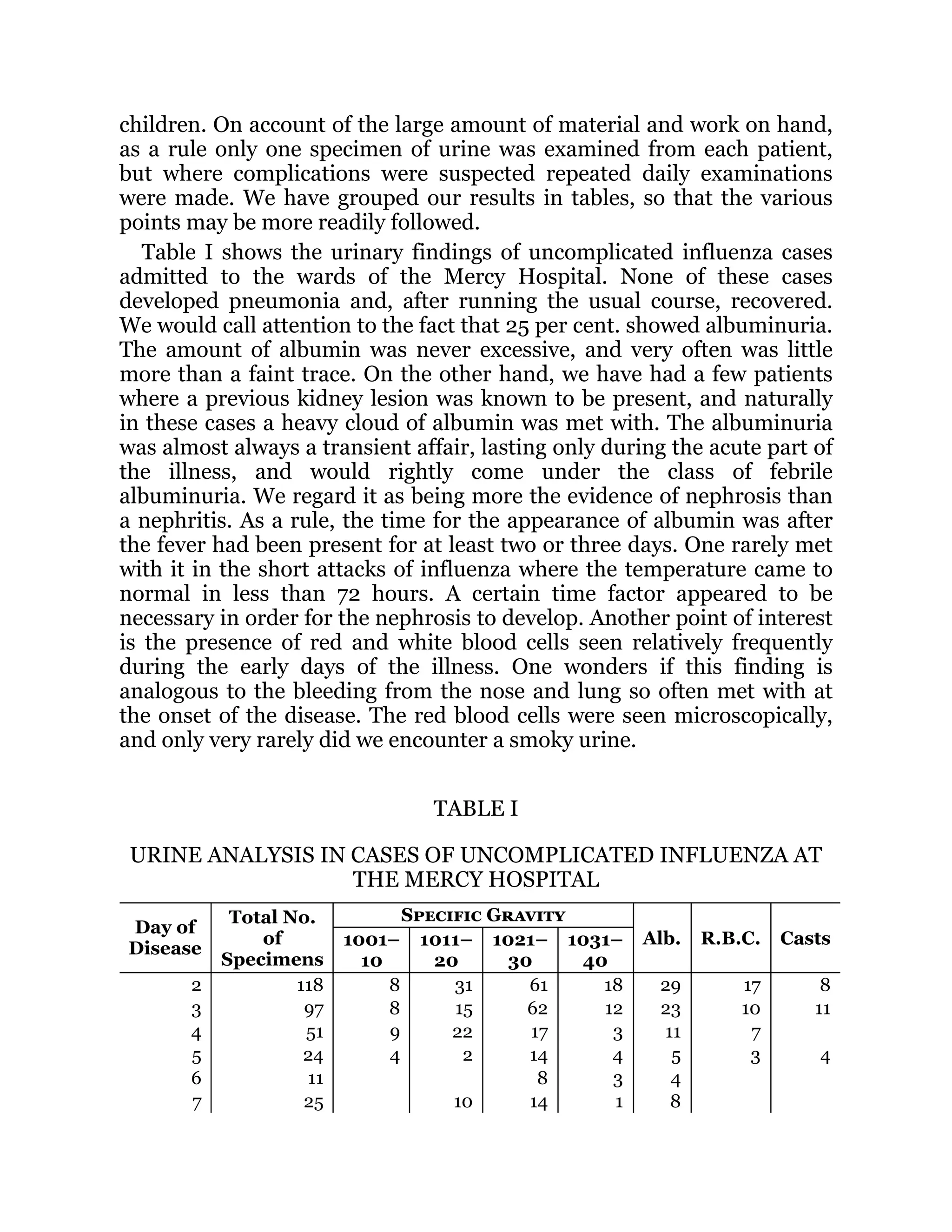
Table I shows the urinary findings of uncomplicated influenza cases
admitted to the wards of the Mercy Hospital. None of these cases
developed pneumonia and, after running the usual course, recovered.
We would call attention to the fact that 25 per cent. showed albuminuria.
The amount of albumin was never excessive, and very often was little
more than a faint trace. On the other hand, we have had a few patients
where a previous kidney lesion was known to be present, and naturally
in these cases a heavy cloud of albumin was met with. The albuminuria
was almost always a transient affair, lasting only during the acute part of
the illness, and would rightly come under the class of febrile
albuminuria. We regard it as being more the evidence of nephrosis than
a nephritis. As a rule, the time for the appearance of albumin was after
the fever had been present for at least two or three days. One rarely met
with it in the short attacks of influenza where the temperature came to
normal in less than 72 hours. A certain time factor appeared to be
necessary in order for the nephrosis to develop. Another point of interest
is the presence of red and white blood cells seen relatively frequently
during the early days of the illness. One wonders if this finding is
analogous to the bleeding from the nose and lung so often met with at
the onset of the disease. The red blood cells were seen microscopically,
and only very rarely did we encounter a smoky urine.
TABLE I
URINE ANALYSIS IN CASES OF UNCOMPLICATED INFLUENZA AT
THE MERCY HOSPITAL
Day of
Disease
Total No.
of
Specimens
Specific Gravity
Alb. R.B.C. Casts
1001–
10
1011–
20
1021–
30
1031–
40
2 118 8 31 61 18 29 17 8
3 97 8 15 62 12 23 10 11
4 51 9 22 17 3 11 7
5 24 4 2 14 4 5 3 4
6 11 8 3 4
7 25 10 14 1 8
8 12 2 8 2 6 3
9 4 2 1 1 2
18 2 1 1
Totals 344 29 95 186 44 88 37 26
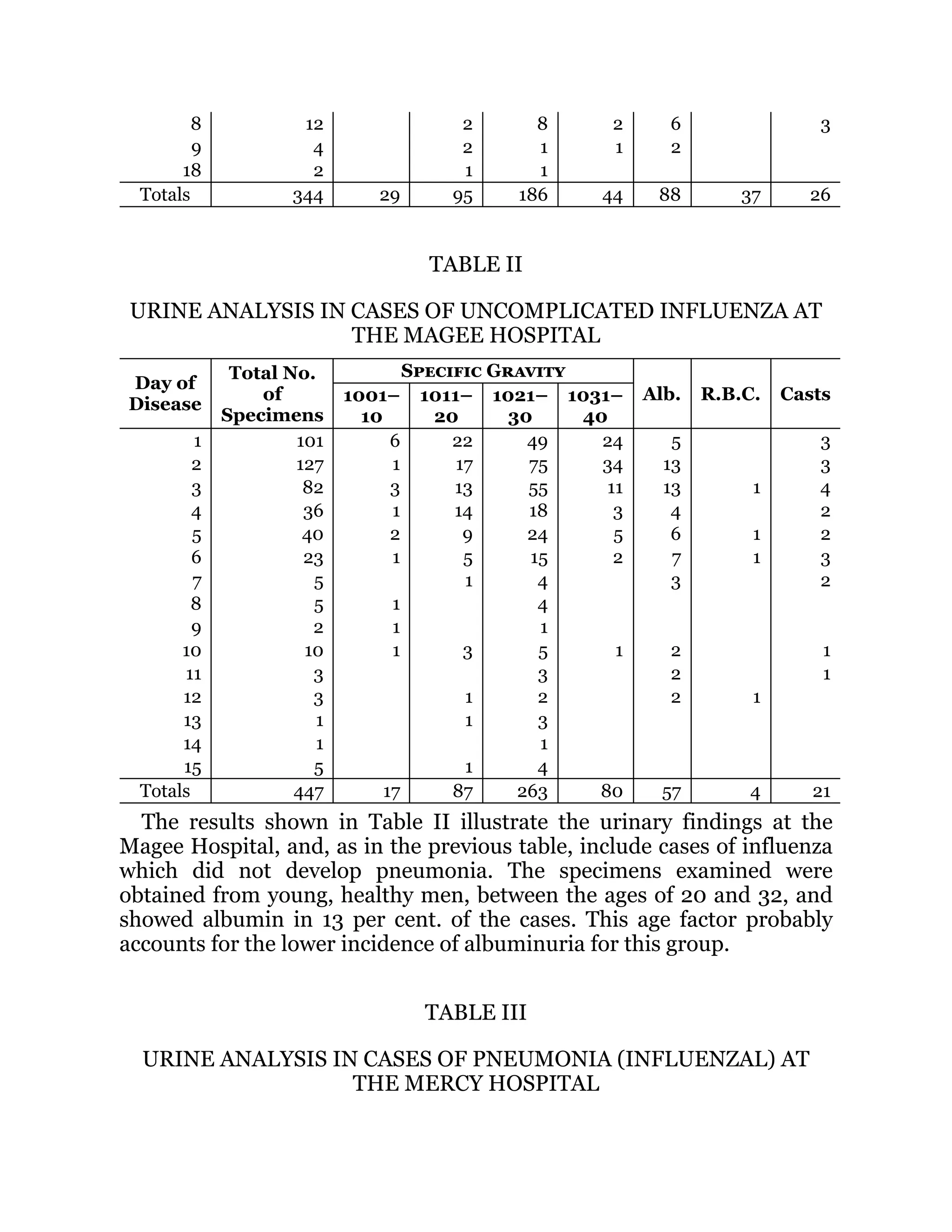
TABLE II
URINE ANALYSIS IN CASES OF UNCOMPLICATED INFLUENZA AT
THE MAGEE HOSPITAL
Day of
Disease
Total No.
of
Specimens
Specific Gravity
Alb. R.B.C. Casts
1001–
10
1011–
20
1021–
30
1031–
40
1 101 6 22 49 24 5 3
2 127 1 17 75 34 13 3
3 82 3 13 55 11 13 1 4
4 36 1 14 18 3 4 2
5 40 2 9 24 5 6 1 2
6 23 1 5 15 2 7 1 3
7 5 1 4 3 2
8 5 1 4
9 2 1 1
10 10 1 3 5 1 2 1
11 3 3 2 1
12 3 1 2 2 1
13 1 1 3
14 1 1
15 5 1 4
Totals 447 17 87 263 80 57 4 21
The results shown in Table II illustrate the urinary findings at the
Magee Hospital, and, as in the previous table, include cases of influenza
which did not develop pneumonia. The specimens examined were
obtained from young, healthy men, between the ages of 20 and 32, and
showed albumin in 13 per cent. of the cases. This age factor probably
accounts for the lower incidence of albuminuria for this group.
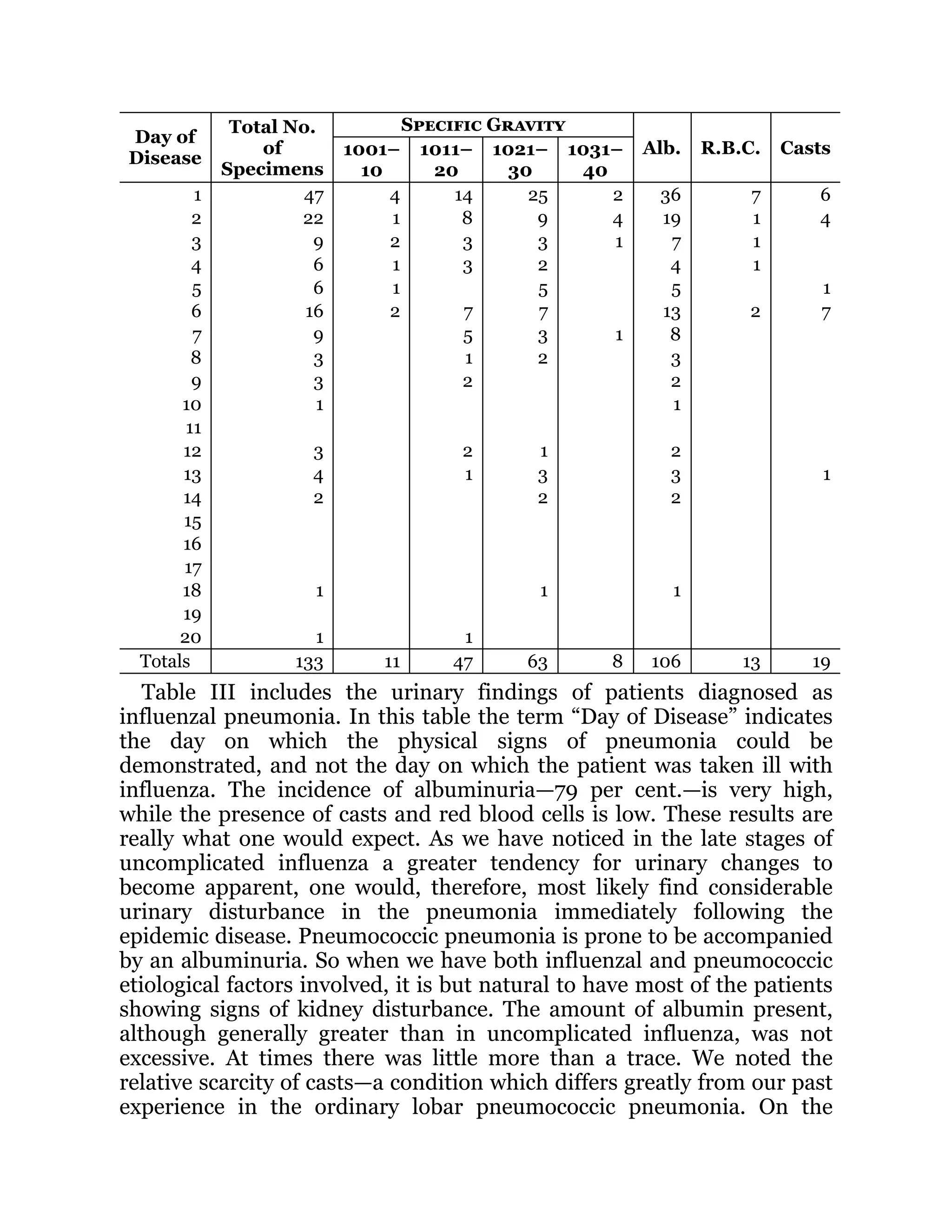
TABLE III
URINE ANALYSIS IN CASES OF PNEUMONIA (INFLUENZAL) AT
THE MERCY HOSPITAL
Day of
Disease
Total No.
of
Specimens
Specific Gravity
Alb. R.B.C. Casts
1001–
10
1011–
20
1021–
30
1031–
40
1 47 4 14 25 2 36 7 6
2 22 1 8 9 4 19 1 4
3 9 2 3 3 1 7 1
4 6 1 3 2 4 1
5 6 1 5 5 1
6 16 2 7 7 13 2 7
7 9 5 3 1 8
8 3 1 2 3
9 3 2 2
10 1 1
11
12 3 2 1 2
13 4 1 3 3 1
14 2 2 2
15
16
17
18 1 1 1
19
20 1 1
Totals 133 11 47 63 8 106 13 19
Table III includes the urinary findings of patients diagnosed as
influenzal pneumonia. In this table the term “Day of Disease” indicates
the day on which the physical signs of pneumonia could be
demonstrated, and not the day on which the patient was taken ill with
influenza. The incidence of albuminuria—79 per cent.—is very high,
while the presence of casts and red blood cells is low. These results are
really what one would expect. As we have noticed in the late stages of
uncomplicated influenza a greater tendency for urinary changes to
become apparent, one would, therefore, most likely find considerable
urinary disturbance in the pneumonia immediately following the
epidemic disease. Pneumococcic pneumonia is prone to be accompanied
by an albuminuria. So when we have both influenzal and pneumococcic
etiological factors involved, it is but natural to have most of the patients
showing signs of kidney disturbance. The amount of albumin present,
although generally greater than in uncomplicated influenza, was not
excessive. At times there was little more than a trace. We noted the
relative scarcity of casts—a condition which differs greatly from our past
experience in the ordinary lobar pneumococcic pneumonia. On the
transient nature of this kidney involvement we have considerable
positive evidence, but there is no question that the time required for the
urine to return to normal is longer after pneumonia than uncomplicated
influenza. We have observed but one or two cases which afterward
returned to us presenting clinical signs of acute nephritis. In fact, in
going over our hospital records of the winter and spring we noted that an
unusually small number of acute nephritics have been admitted. This
would seem to be evidence that, as has been noted in the past, the kidney
is not a vulnerable organ in this epidemic disease.
TABLE IV
URINE ANALYSIS IN CASES OF PNEUMONIA (INFLUENZAL) AT
THE MAGEE HOSPITAL
Day of
Disease
Total No.
of
Specimens
Specific Gravity
Alb. R.B.C. Casts
1001–
10
1011–
20
1021–
30
1031–
40
1 3 2 1 1 1
2 12 1 10 1 8 6
3 4 4 1 1 1
4 9 1 2 4 2 6 6
5 8 4 4 6 5
6 8 5 3 7 2 6
7 4 2 2 3 2
8 10 2 8 5 2 5
9 4 2 2 4 3 4
10 6 1 5 6 3 5
11 1 1 1 1
12 1 1 1
13
14
15 2 2 1 1
Totals 70 1 20 45 4 49 11 40
Table IV includes specimens obtained at the Magee Hospital from
patients diagnosed as pneumonia. The results among these young
students were very similar to those of the previous chart, where all ages
were included. However, casts and red blood cells were more regularly
noted.
From the four tables, we are able to note one or two common facts. In
acute uncomplicated influenza albuminuria occurred 57 times in 447
specimens, or 13 per cent., at the Magee Hospital. Here we dealt entirely
with the young adult. At the Mercy Hospital 88 positive results of
albumin in 344 specimens, or 26 per cent., from patients of all types
were recorded. The common total would be 781 specimens examined,
and 141, or 17 per cent., showing albumin.
With the advent of pneumonia the incidence of albuminuria was
increased. At the Magee Hospital it was seen 49 times in 70
examinations, or 70 per cent.; while at the Mercy Hospital 106 positive
results were found in 133 specimens examined, a percentage of 79. The
combined figures, therefore, would show 155 out of 203, or 76 per cent.
The incidence of albuminuria for the epidemic in all its phases would
be, from our figures, 400 in 994 specimens, or 40 per cent.
Red blood cells were present in 5 per cent. of the influenza cases, and
in 11 per cent. of the pneumonias. This was always a microscopic
observation, save in the case of a slightly smoky urine. Even
microscopically the red cells were not numerous. We noted them at
times quite early in the disease in some of the severe cases which
presented epistaxis and hematemesis. Possibly one might consider the
early presence of red blood cells in the urine as a condition analogous to
those just mentioned, although we never saw anything suggesting free
hemorrhage from the kidney. It is probably better to regard the red cells
as a manifestation of an acute nephrosis of toxic origin.
Casts were found in 35 per cent. of the cases showing albuminuria. We
are inclined to feel that this observation is somewhat low, but at the
same time we have noted that in uncomplicated influenza one frequently
sees albumin without casts. We were also impressed with the fact that
casts were not as prominent a feature in the influenzal pneumonias as
they are in frank lobar pneumonia of essentially pneumococcic origin.
During the course of routine examinations several transient
glycosurias were seen. Their transient character was the outstanding
feature. The quantity of sugar was very moderate—our figures were
never above 1 per cent.—and the daily amount of urine was always
within normal limits. Acetone and diacetic acid were absent. A few
observations on the blood sugar showed a rise (.2 to .25), which readily
came to normal with treatment. Clinically these cases were not classed as
diabetes mellitus, but rather as a nervous complication of influenza,
involving in some way the carbohydrate metabolism, probably through
the central nervous system. One case of special interest, which is
mentioned elsewhere, was the association of glycosuria with almost total
blindness from a very intense optic œdema. Sugar (1 per cent.) was
present on the day of admission, while only a trace was noted on the two
following days, and from then on the urine was free from sugar. How
many days the sugar had been present before admission to the hospital
we cannot say, but we could trace the failure of vision back to almost the
day of its onset, which was three weeks previous to our first examination.
The eye symptoms were the only complaints. The patient had had a
moderately sharp attack of influenza a little over two weeks before the
first sign of failure of vision had appeared. We may add that the vision
returned slowly to normal several weeks after admission. The urine and
blood sugar were normal, on a general diet, over a period of one month
while in the hospital. Unfortunately, we have had no further record of
this patient regarding the urine, but her vision still remains normal.
Cases of this type were observed in England after the 1890 epidemic, and
are referred to in Allbutt’s “System of Medicine,” vol. i, on influenza. Our
other glycosuria cases did not present changes in the fundus of the eye.
The glycosuria and glycæmia were transient, and we feel that they do not
represent diabetes mellitus. Most of the patients of this class had long
since recovered from an attack of influenza, and came to the hospital
usually for treatment of various nervous conditions, which at times
simulated neuritis, or otherwise one saw manifestations of general
nervousness, not unlike hyperthyroidism. In all probability, we were
dealing with a hyperglycæmia associated with a hyperactive thyroid
gland. So, after all, the glycosuria, even though rare, is not bewildering.
Symptoms and signs of toxic goitre in direct relation to the epidemic we
claim to have seen, and one is justified, temporarily at least, in having
the thyroid gland father our transient glycosuria.
In relation to the positive sugar findings, we have had numerous
negative examples of almost equal interest. Furunculosis is a very
common sequel of the epidemic. It is well known that in furunculosis
there is a hyperglycæmia, but no glycosuria and no acetone or diacetic
acid in the urine. All our blood sugar readings were above the normal,
and at times unusually high. They varied from .2 to .41. This last
unusually high amount was in a young physician with recurrent
furunculosis following influenza. There was no glycosuria at any time.
Elimination of carbohydrates not only brought the blood sugar to normal
limits in the course of a week, but also assisted in the cure of the
furunculosis, but in a longer time. In all of this group we saw no
incidence of polyuria or glycosuria.
Hematology
There is very little evidence, as shown in the literature, that special
study on the blood during past influenzal epidemics has been made. A
few references to alterations in the count of cells have been reported for
the last epidemic (1890), but they are, as a rule, very brief statements.
Cabot notes a normal leucocyte count in two-thirds of the cases, and a
moderate increase in the rest. Several observers call attention to the
leucopenia during the height of the disease, with a subsequent rise after
the temperature has fallen to normal. According to Rieder and Herman
(American Journal of Medical Science, 1893, cv. 696), the leucocytes
were not increased in simple influenza, and only very slightly in the
pneumonia following this disease. Herman also noticed a decline in the
leucocytes in pneumonia as a fatal ending ensued. This finding was one
of the few recorded for the 1890 epidemic. Emerson (Emerson Clinic
Diagnosis, 1911, 558) found in influenza almost one-half of the cases
showing more than 10,000 leucocytes, some even reaching 25,000. He
further notes that early in the disease the count may be low, 3,000 to
5,000, but it usually rose sharply, to fall again when the temperature
comes to normal. He lays stress on obtaining a leucocyte curve for each
case in order to get a true picture of what changes occur. The past
epidemic has brought out many observations on this subject. They vary
somewhat, as is to be expected, but a common factor seems to be more
or less basic—namely, a leucopenia or a normal count is the most
significant single blood picture we have of uncomplicated influenza.
Further, a leucocytosis is fairly generally, and we believe correctly,
interpreted as evidence of a secondary bacterial invasion in this
particular epidemic, and usually of the respiratory system. The
leucopenia is as much a part of the clinical picture of influenza as it is of
typhoid fever. Leucocytosis always means secondary invasion by other
organisms.
During the recent epidemic the clinical laboratory department of the
School of Medicine, University of Pittsburgh, has made 747 blood counts
on influenza cases. In most of the cases blood counts were made as a
routine, while repeated counts were done only on selected patients.
The following table indicates the leucocyte count for our series,
comprising the epidemic in all of its phases. There are a few general
points which appear striking that we may refer to at this time, and leave
until later the discussion of the minor details. One-third of the counts,
including, as they do, many cases of pneumonia, showed a leucopenia,
while 70 per cent. of the total number fell under 10,000. This last group
contains more pneumonias and other complications than simple
influenza. But 5 per cent. of the cases counted showed more than
20,000. All of these undoubtedly had pneumonia or some other
complication. Comparing this finding with our experience in the past
before the epidemic with the pneumococcic lobar pneumonia, one sees
at once that, as far as this type of clinical observation is concerned, the
two pneumonias are totally different. The writer remembers but one case
of lobar pneumonia which showed a persistent white count falling below
10,000. Certainly in this community lobar pneumonia and low leucocyte
counts were unusual combinations until the present epidemic. Further,
the evident depression of leucocytosis even where there was an actual
increase is indicated by 95 per cent. of our counts being below 20,000.
This leads us to state that the pneumococcus, although present in
practically all of our pneumonias, produced in only a small percentage of
the bloods we examined its characteristic increase. The toxic factor of
this influenzal epidemic certainly causes a marked change in the white
cells of the blood.
TABLE V
MERCY HOSPITAL MAGEE HOSPITAL
Leucocyte
Count.
Influ.
Influ.
Pn.
Influ.
Compl.
Total %
Influ.
Influ.
Pn.
Influ.
Compl.
% Total %
2000 or less 2 2
38
1
28
3
32
2000–3000 3 3 1 7 13 20
3000–4000 7 12 4 23 34 57
4000–5000 14 13 9 36 41 77
5000–6000 17 16 6 39 42 81
6000–7000 15 13 6 34
40
59
37
93
38
7000–8000 7 8 5 20 36 56
8000–
9000
8 14 8 30 37 67
9000–
10000
15 9 8 32 39 71
Welcome to our website – the ideal destination for book lovers and
knowledge seekers. With a mission to inspire endlessly, we offer a
vast collection of books, ranging from classic literary works to
specialized publications, self-development books, and children's
literature. Each book is a new journey of discovery, expanding
knowledge and enriching the soul of the reade
Our website is not just a platform for buying books, but a bridge
connecting readers to the timeless values of culture and wisdom. With
an elegant, user-friendly interface and an intelligent search system,
we are committed to providing a quick and convenient shopping
experience. Additionally, our special promotions and home delivery
services ensure that you save time and fully enjoy the joy of reading.
Let us accompany you on the journey of exploring knowledge and
personal growth!
ebookfinal.com

Exposure Response Modeling Methods and Practical Implementation 1st Edition Jixian Wang

  • 1.
    Exposure Response ModelingMethods and Practical Implementation 1st Edition Jixian Wang pdf download https://ebookfinal.com/download/exposure-response-modeling- methods-and-practical-implementation-1st-edition-jixian-wang/ Explore and download more ebooks or textbooks at ebookfinal.com

  • 2.
    We believe theseproducts will be a great fit for you. Click the link to download now, or visit ebookfinal to discover even more! Modeling in food microbiology from predictive microbiology to exposure assessment 1st Edition Membré https://ebookfinal.com/download/modeling-in-food-microbiology-from- predictive-microbiology-to-exposure-assessment-1st-edition-membre/ Fair Value Measurements Practical Guidance and Implementation 1st Edition Mark L. Zyla https://ebookfinal.com/download/fair-value-measurements-practical- guidance-and-implementation-1st-edition-mark-l-zyla/ Behavioral Modeling for Embedded Systems and Technologies Applications for Design and Implementation 1st Edition Luã-S Gomes https://ebookfinal.com/download/behavioral-modeling-for-embedded- systems-and-technologies-applications-for-design-and- implementation-1st-edition-luas-gomes/ Modeling and Dimensioning of Structures A Practical Approach 1st Edition Daniel Gay https://ebookfinal.com/download/modeling-and-dimensioning-of- structures-a-practical-approach-1st-edition-daniel-gay/
  • 3.
    Practical Spreadsheet RiskModeling for Management 1st Edition Dale Lehman https://ebookfinal.com/download/practical-spreadsheet-risk-modeling- for-management-1st-edition-dale-lehman/ Marx s Practical Materialism The Horizon of Post Subjectivity Philosophy 1st Edition Wang Nanshi https://ebookfinal.com/download/marx-s-practical-materialism-the- horizon-of-post-subjectivity-philosophy-1st-edition-wang-nanshi/ Practical Methods for Biocatalysis and Biotransformations 1st Edition John Whittall https://ebookfinal.com/download/practical-methods-for-biocatalysis- and-biotransformations-1st-edition-john-whittall/ Microencapsulation in the Food Industry A Practical Implementation Guide 1st Edition Anilkumar G. Gaonkar https://ebookfinal.com/download/microencapsulation-in-the-food- industry-a-practical-implementation-guide-1st-edition-anilkumar-g- gaonkar/ Analysis and Design of Structures A Practical Guide to Modeling 1st Edition Trevor Jones https://ebookfinal.com/download/analysis-and-design-of-structures-a- practical-guide-to-modeling-1st-edition-trevor-jones/
  • 5.
    Exposure Response ModelingMethods and Practical Implementation 1st Edition Jixian Wang Digital Instant Download Author(s): Jixian Wang ISBN(s): 9781466573208, 1466573201 Edition: 1 File Details: PDF, 3.10 MB Year: 2015 Language: english
  • 6.
  • 7.
    Editor-in-Chief Shein-Chung Chow, Ph.D.,Professor, Department of Biostatistics and Bioinformatics, Duke University School of Medicine, Durham, North Carolina Series Editors Byron Jones, Biometrical Fellow, Statistical Methodology, Integrated Information Sciences, Novartis Pharma AG, Basel, Switzerland Jen-pei Liu, Professor, Division of Biometry, Department of Agronomy, National Taiwan University, Taipei, Taiwan Karl E. Peace, Georgia Cancer Coalition, Distinguished Cancer Scholar, Senior Research Scientist and Professor of Biostatistics, Jiann-Ping Hsu College of Public Health, Georgia Southern University, Statesboro, Georgia Bruce W. Turnbull, Professor, School of Operations Research and Industrial Engineering, Cornell University, Ithaca, New York Published Titles Adaptive Design Methods in Clinical Trials, Second Edition Shein-Chung Chow and Mark Chang Adaptive Designs for Sequential Treatment Allocation Alessandro Baldi Antognini and Alessandra Giovagnoli Adaptive Design Theory and Implementation Using SAS and R, Second Edition Mark Chang Advanced Bayesian Methods for Medical Test Accuracy Lyle D. Broemeling Advances in Clinical Trial Biostatistics Nancy L. Geller Applied Meta-Analysis with R Ding-Geng (Din) Chen and Karl E. Peace Basic Statistics and Pharmaceutical Statistical Applications, Second Edition James E. De Muth Bayesian Adaptive Methods for Clinical Trials Scott M. Berry, Bradley P. Carlin, J. Jack Lee, and Peter Muller Bayesian Analysis Made Simple: An Excel GUI for WinBUGS Phil Woodward Bayesian Methods for Measures of Agreement Lyle D. Broemeling Bayesian Methods in Epidemiology Lyle D. Broemeling Bayesian Methods in Health Economics Gianluca Baio Bayesian Missing Data Problems: EM, Data Augmentation and Noniterative Computation Ming T. Tan, Guo-Liang Tian, and Kai Wang Ng Bayesian Modeling in Bioinformatics Dipak K. Dey, Samiran Ghosh, and Bani K. Mallick Benefit-Risk Assessment in Pharmaceutical Research and Development Andreas Sashegyi, James Felli, and Rebecca Noel Biosimilars: Design and Analysis of Follow-on Biologics Shein-Chung Chow Biostatistics: A Computing Approach Stewart J. Anderson Causal Analysis in Biomedicine and Epidemiology: Based on Minimal Sufficient Causation Mikel Aickin Clinical and Statistical Considerations in Personalized Medicine Claudio Carini, Sandeep Menon, and Mark Chang © 2016 Taylor & Francis Group, LLC
  • 8.
    Clinical Trial DataAnalysis using R Ding-Geng (Din) Chen and Karl E. Peace Clinical Trial Methodology Karl E. Peace and Ding-Geng (Din) Chen Computational Methods in Biomedical Research Ravindra Khattree and Dayanand N. Naik Computational Pharmacokinetics Anders Källén Confidence Intervals for Proportions and Related Measures of Effect Size Robert G. Newcombe Controversial Statistical Issues in Clinical Trials Shein-Chung Chow Data Analysis with Competing Risks and Intermediate States Ronald B. Geskus Data and Safety Monitoring Committees in Clinical Trials Jay Herson Design and Analysis of Animal Studies in Pharmaceutical Development Shein-Chung Chow and Jen-pei Liu Design and Analysis of Bioavailability and Bioequivalence Studies, Third Edition Shein-Chung Chow and Jen-pei Liu Design and Analysis of Bridging Studies Jen-pei Liu, Shein-Chung Chow, and Chin-Fu Hsiao Design and Analysis of Clinical Trials for Predictive Medicine Shigeyuki Matsui, Marc Buyse, and Richard Simon Design and Analysis of Clinical Trials with Time-to-Event Endpoints Karl E. Peace Design and Analysis of Non-Inferiority Trials Mark D. Rothmann, Brian L. Wiens, and Ivan S. F. Chan Difference Equations with Public Health Applications Lemuel A. Moyé and Asha Seth Kapadia DNA Methylation Microarrays: Experimental Design and Statistical Analysis Sun-Chong Wang and Arturas Petronis DNA Microarrays and Related Genomics Techniques: Design, Analysis, and Interpretation of Experiments David B. Allison, Grier P. Page, T. Mark Beasley, and Jode W. Edwards Dose Finding by the Continual Reassessment Method Ying Kuen Cheung Elementary Bayesian Biostatistics Lemuel A. Moyé Empirical Likelihood Method in Survival Analysis Mai Zhou Exposure–Response Modeling: Methods and Practical Implementation Jixian Wang Frailty Models in Survival Analysis Andreas Wienke Generalized Linear Models: A Bayesian Perspective Dipak K. Dey, Sujit K. Ghosh, and Bani K. Mallick Handbook of Regression and Modeling: Applications for the Clinical and Pharmaceutical Industries Daryl S. Paulson Inference Principles for Biostatisticians Ian C. Marschner Interval-Censored Time-to-Event Data: Methods and Applications Ding-Geng (Din) Chen, Jianguo Sun, and Karl E. Peace Introductory Adaptive Trial Designs: A Practical Guide with R Mark Chang Joint Models for Longitudinal and Time- to-Event Data: With Applications in R Dimitris Rizopoulos Measures of Interobserver Agreement and Reliability, Second Edition Mohamed M. Shoukri © 2016 Taylor & Francis Group, LLC
  • 9.
    Medical Biostatistics, ThirdEdition A. Indrayan Meta-Analysis in Medicine and Health Policy Dalene Stangl and Donald A. Berry Mixed Effects Models for the Population Approach: Models, Tasks, Methods and Tools Marc Lavielle Modeling to Inform Infectious Disease Control Niels G. Becker Modern Adaptive Randomized Clinical Trials: Statistical and Practical Aspects Oleksandr Sverdlov Monte Carlo Simulation for the Pharmaceutical Industry: Concepts, Algorithms, and Case Studies Mark Chang Multiple Testing Problems in Pharmaceutical Statistics Alex Dmitrienko, Ajit C. Tamhane, and Frank Bretz Noninferiority Testing in Clinical Trials: Issues and Challenges Tie-Hua Ng Optimal Design for Nonlinear Response Models Valerii V. Fedorov and Sergei L. Leonov Patient-Reported Outcomes: Measurement, Implementation and Interpretation Joseph C. Cappelleri, Kelly H. Zou, Andrew G. Bushmakin, Jose Ma. J. Alvir, Demissie Alemayehu, and Tara Symonds Quantitative Evaluation of Safety in Drug Development: Design, Analysis and Reporting Qi Jiang and H. Amy Xia Randomized Clinical Trials of Nonpharmacological Treatments Isabelle Boutron, Philippe Ravaud, and David Moher Randomized Phase II Cancer Clinical Trials Sin-Ho Jung Sample Size Calculations for Clustered and Longitudinal Outcomes in Clinical Research Chul Ahn, Moonseong Heo, and Song Zhang Sample Size Calculations in Clinical Research, Second Edition Shein-Chung Chow, Jun Shao and Hansheng Wang Statistical Analysis of Human Growth and Development Yin Bun Cheung Statistical Design and Analysis of Stability Studies Shein-Chung Chow Statistical Evaluation of Diagnostic Performance: Topics in ROC Analysis Kelly H. Zou, Aiyi Liu, Andriy Bandos, Lucila Ohno-Machado, and Howard Rockette Statistical Methods for Clinical Trials Mark X. Norleans Statistical Methods for Drug Safety Robert D. Gibbons and Anup K. Amatya Statistical Methods in Drug Combination Studies Wei Zhao and Harry Yang Statistics in Drug Research: Methodologies and Recent Developments Shein-Chung Chow and Jun Shao Statistics in the Pharmaceutical Industry, Third Edition Ralph Buncher and Jia-Yeong Tsay Survival Analysis in Medicine and Genetics Jialiang Li and Shuangge Ma Theory of Drug Development Eric B. Holmgren Translational Medicine: Strategies and Statistical Methods Dennis Cosmatos and Shein-Chung Chow © 2016 Taylor & Francis Group, LLC
  • 10.
    Jixian Wang Celgene International Switzerland Exposure–Response Modeling Methodsand Practical Implementation © 2016 Taylor & Francis Group, LLC
  • 11.
    MATLAB® is atrademark of The MathWorks, Inc. and is used with permission. The MathWorks does not warrant the accuracy of the text or exercises in this book. This book’s use or discussion of MAT- LAB® software or related products does not constitute endorsement or sponsorship by The MathWorks of a particular pedagogical approach or particular use of the MATLAB® software. CRC Press Taylor & Francis Group 6000 Broken Sound Parkway NW, Suite 300 Boca Raton, FL 33487-2742 © 2016 by Taylor & Francis Group, LLC CRC Press is an imprint of Taylor & Francis Group, an Informa business No claim to original U.S. Government works Version Date: 20150521 International Standard Book Number-13: 978-1-4665-7321-5 (eBook - PDF) This book contains information obtained from authentic and highly regarded sources. Reasonable efforts have been made to publish reliable data and information, but the author and publisher cannot assume responsibility for the validity of all materials or the consequences of their use. The authors and publishers have attempted to trace the copyright holders of all material reproduced in this publication and apologize to copyright holders if permission to publish in this form has not been obtained. If any copyright material has not been acknowledged please write and let us know so we may rectify in any future reprint. Except as permitted under U.S. Copyright Law, no part of this book may be reprinted, reproduced, transmitted, or utilized in any form by any electronic, mechanical, or other means, now known or hereafter invented, including photocopying, microfilming, and recording, or in any information stor- age or retrieval system, without written permission from the publishers. For permission to photocopy or use material electronically from this work, please access www.copy- right.com (http://www.copyright.com/) or contact the Copyright Clearance Center, Inc. (CCC), 222 Rosewood Drive, Danvers, MA 01923, 978-750-8400. CCC is a not-for-profit organization that pro- vides licenses and registration for a variety of users. For organizations that have been granted a photo- copy license by the CCC, a separate system of payment has been arranged. Trademark Notice: Product or corporate names may be trademarks or registered trademarks, and are used only for identification and explanation without intent to infringe. Visit the Taylor & Francis Web site at http://www.taylorandfrancis.com and the CRC Press Web site at http://www.crcpress.com © 2016 Taylor & Francis Group, LLC
  • 12.
    To my parents, mywife, and sons © 2016 Taylor & Francis Group, LLC
  • 13.
    © 2016 Taylor& Francis Group, LLC
  • 14.
    Contents Symbol Description xv Prefacexvii 1 Introduction 1 1.1 Multifaceted exposure–response relationships . . . . . . . . . 1 1.2 Practical scenarios in ER modeling . . . . . . . . . . . . . . 2 1.2.1 Moxifloxacin exposure and QT prolongation . . . . . 2 1.2.2 Theophylline . . . . . . . . . . . . . . . . . . . . . . . 6 1.2.3 Argatroban and activated partial thromboplastin time 6 1.3 Models and modeling in exposure–response analysis . . . . . 9 1.4 Model-based decision-making and drug development . . . . . 12 1.5 Drug regulatory guidance for analysis of exposure–response re- lationship . . . . . . . . . . . . . . . . . . . . . . . . . . . . . 13 1.6 Examples and modeling software . . . . . . . . . . . . . . . . 14 2 Basic exposure and exposure–response models 17 2.1 Models based on pharmacological mechanisms . . . . . . . . 17 2.1.1 Example of a PKPD model . . . . . . . . . . . . . . . 17 2.1.2 Compartmental models for drug–exposure modeling . 18 2.2 Statistical models . . . . . . . . . . . . . . . . . . . . . . . . 19 2.3 Transformations . . . . . . . . . . . . . . . . . . . . . . . . . 24 2.4 Semiparametric and nonparametric models . . . . . . . . . . 27 2.5 Comments and bibliographic notes . . . . . . . . . . . . . . . 33 3 Dose–exposure and exposure–response models for longitudi- nal data 35 3.1 Linear mixed models for exposure–response relationships . . 35 3.2 Modeling exposures with linear mixed models . . . . . . . . 41 3.3 Nonlinear mixed ER models . . . . . . . . . . . . . . . . . . 42 3.4 Modeling exposure with a population PK model . . . . . . . 44 3.4.1 The moxifloxacin example . . . . . . . . . . . . . . . 46 3.5 Mixed effect models specified by differential equations . . . . 48 3.6 Generalized linear mixed model and generalized estimating equation . . . . . . . . . . . . . . . . . . . . . . . . . . . . . 51 3.7 Generalized nonlinear mixed models . . . . . . . . . . . . . 53 3.8 Testing variance components in mixed models . . . . . . . . 54 ix © 2016 Taylor & Francis Group, LLC
  • 15.
    x Contents 3.9 Nonparametricand semiparametric models with random effects 55 3.10 On distributions of random effects . . . . . . . . . . . . . . . 60 3.10.1 Impact of misspecified random effects . . . . . . . . . 60 3.10.2 Working with misspecified models . . . . . . . . . . . 61 3.10.3 Using models with nonnormal or flexible distributions 61 3.11 Bibliographic Notes . . . . . . . . . . . . . . . . . . . . . . . 63 4 Sequential and simultaneous exposure–response modeling 65 4.1 Joint models for exposure and response . . . . . . . . . . . . 65 4.2 Simultaneous modeling of exposure and response models . . 67 4.2.1 Maximizing the joint likelihood function . . . . . . . . 67 4.2.2 Implementation of simultaneous modeling . . . . . . . 68 4.2.3 The argatroban example . . . . . . . . . . . . . . . . 70 4.2.4 Alternatives to the likelihood approach . . . . . . . . 71 4.2.5 Simultaneously fitting simplified joint models . . . . . 74 4.3 Sequential exposure–response modeling . . . . . . . . . . . . 75 4.4 Measurement error models and regression calibration . . . . 77 4.4.1 Measurement error models . . . . . . . . . . . . . . . . 78 4.4.2 Regression calibration . . . . . . . . . . . . . . . . . . 79 4.4.3 Models for longitudinal data . . . . . . . . . . . . . . 81 4.4.4 Sequential modeling for argatroban data . . . . . . . 83 4.4.5 Simulation extrapolation . . . . . . . . . . . . . . . . 86 4.4.6 A compromise between y-part models . . . . . . . . . 87 4.4.7 When measurement error models are useful? . . . . . 88 4.4.8 Biases in parameter estimation by sequential modeling 89 4.5 Instrumental variable methods . . . . . . . . . . . . . . . . . 90 4.6 Modeling multiple exposures and responses . . . . . . . . . 94 4.7 Internal validation data and partially observed and surrogate exposure measures . . . . . . . . . . . . . . . . . . . . . . . 96 4.7.1 Exposure measured in a subpopulation . . . . . . . . . 96 4.7.2 Exposure measured in a subpopulation but a surrogate is measured in the whole population . . . . . . . . . . 99 4.7.3 Using a surrogate for Cmax: An example . . . . . . . 100 4.8 Comments and bibliographic notes . . . . . . . . . . . . . . . 103 5 Exposure–risk modeling for time-to-event data 105 5.1 An example . . . . . . . . . . . . . . . . . . . . . . . . . . . 105 5.2 Basic concepts and models for time-to-event data . . . . . . 107 5.2.1 Distributions for time-to-event data . . . . . . . . . . 107 5.2.2 Parametric models . . . . . . . . . . . . . . . . . . . . 108 5.2.3 Cox models . . . . . . . . . . . . . . . . . . . . . . . . 109 5.2.4 Time-varying covariates . . . . . . . . . . . . . . . . . 110 5.2.5 Additive models . . . . . . . . . . . . . . . . . . . . . 112 5.2.6 Accelerated failure time model . . . . . . . . . . . . . 113 5.3 Dynamic exposure model as a time-varying covariate . . . . 114 © 2016 Taylor & Francis Group, LLC
  • 16.
    Contents xi 5.3.1 Semiparametricmodels . . . . . . . . . . . . . . . . . 115 5.3.2 Parametric models . . . . . . . . . . . . . . . . . . . . 118 5.4 Multiple TTE and competing risks . . . . . . . . . . . . . . 120 5.4.1 Multistate models . . . . . . . . . . . . . . . . . . . . 120 5.4.2 Competing risks . . . . . . . . . . . . . . . . . . . . . 122 5.5 Models for recurrent events . . . . . . . . . . . . . . . . . . 124 5.5.1 Recurrent events as a counting process . . . . . . . . 124 5.5.2 Recurrent events in multistate models . . . . . . . . . 125 5.5.3 Rate and marginal models . . . . . . . . . . . . . . . 125 5.6 Frailty: Random effects in TTE models . . . . . . . . . . . . 129 5.7 Joint modeling of exposure and time to event . . . . . . . . 133 5.7.1 Simultaneous modeling . . . . . . . . . . . . . . . . . 134 5.7.2 Sequential modeling and regression calibration . . . . 137 5.8 Interval censored data . . . . . . . . . . . . . . . . . . . . . 140 5.9 Model identification and misspecification . . . . . . . . . . . 143 5.10 Random sample simulation from exposure–risk models . . . 144 5.10.1 Basic simulation approaches for time-to-events . . . . 144 5.10.2 Rejection-acceptance algorithms . . . . . . . . . . . . 147 5.10.3 Generating discrete event times . . . . . . . . . . . . 148 5.10.4 Simulation for recurrent and multiple events . . . . . 149 5.10.5 Simulation for TTE driven by complex dynamic systems 150 5.10.6 Example programs . . . . . . . . . . . . . . . . . . . . 153 5.10.7 Sample size estimation using simulations . . . . . . . 154 5.11 Comments and bibliographic notes . . . . . . . . . . . . . . . 157 6 Modeling dynamic exposure–response relationships 159 6.1 Effect compartment models . . . . . . . . . . . . . . . . . . 160 6.2 Indirect response models . . . . . . . . . . . . . . . . . . . . 162 6.3 Disease process models . . . . . . . . . . . . . . . . . . . . . 163 6.3.1 Empirical models . . . . . . . . . . . . . . . . . . . . . 164 6.3.2 Slow and fast subsystems . . . . . . . . . . . . . . . . 165 6.3.3 Semimechanistic models . . . . . . . . . . . . . . . . . 167 6.3.4 Modeling tumor growth and drug effects . . . . . . . 167 6.4 Fitting dynamic models for longitudinal data . . . . . . . . 168 6.5 Semiparametric and nonparametric approaches . . . . . . . . 169 6.5.1 Effect compartment model with nonparametric expo- sure estimates . . . . . . . . . . . . . . . . . . . . . . . 169 6.5.2 Nonparametric dynamic models and lagged covariates 170 6.6 Dynamic linear and generalized linear models . . . . . . . . . 172 6.7 Testing hysteresis . . . . . . . . . . . . . . . . . . . . . . . . 179 6.8 Comments and bibliographic notes . . . . . . . . . . . . . . . 182 © 2016 Taylor & Francis Group, LLC
  • 17.
    xii Contents 7 Bayesianmodeling and model–based decision analysis 183 7.1 Bayesian modeling . . . . . . . . . . . . . . . . . . . . . . . . 183 7.1.1 An introduction to the Bayesian concept . . . . . . . . 183 7.1.2 From prior to posterior distributions . . . . . . . . . 184 7.1.3 Bayesian computing . . . . . . . . . . . . . . . . . . . 191 7.1.3.1 Markov chain Monte Carlo . . . . . . . . . . 191 7.1.3.2 Other computational approaches . . . . . . . 192 7.1.4 Bayesian inference and model-based prediction . . . . 193 7.1.5 Argatroban example by Bayesian analysis . . . . . . . 194 7.2 Bayesian decision analysis . . . . . . . . . . . . . . . . . . . 198 7.2.1 Decision analysis and ER modeling . . . . . . . . . . . 198 7.2.2 Example: Dose selection for argatroban . . . . . . . . 202 7.2.3 Multistate models . . . . . . . . . . . . . . . . . . . . 203 7.3 Decisions under uncertainty and with multiple objectives . . 207 7.3.1 Utility, preference and uncertainty . . . . . . . . . . . 207 7.3.2 Cost-benefit, cost-utility and cost-effectiveness analysis 210 7.4 Evidence synthesis and mixed treatment comparison . . . . 212 7.4.1 Meta analysis . . . . . . . . . . . . . . . . . . . . . . 212 7.4.2 Meta analysis for exposure–response relationship . . . 215 7.4.3 Mixed treatment comparison . . . . . . . . . . . . . . 220 7.5 Comments and bibliographic notes . . . . . . . . . . . . . . . 222 8 Confounding bias and causal inference in exposure–response modeling 223 8.1 Introduction . . . . . . . . . . . . . . . . . . . . . . . . . . . 223 8.2 Confounding factors and confounding biases . . . . . . . . . 224 8.3 Causal effect and counterfactuals . . . . . . . . . . . . . . . 226 8.4 Classical adjustment methods . . . . . . . . . . . . . . . . . 227 8.4.1 Direct adjustment . . . . . . . . . . . . . . . . . . . . 227 8.4.2 Stratification and matching . . . . . . . . . . . . . . . 229 8.4.3 Propensity scores and inverse probability weighting . 230 8.4.4 Other propensity score–based approaches . . . . . . . 234 8.5 Directional acyclic graphs . . . . . . . . . . . . . . . . . . . 235 8.6 Bias assessment . . . . . . . . . . . . . . . . . . . . . . . . . 237 8.7 Instrumental variable . . . . . . . . . . . . . . . . . . . . . . 241 8.7.1 Instrumental variable estimates . . . . . . . . . . . . 241 8.7.2 Control function method . . . . . . . . . . . . . . . . . 242 8.8 Joint modeling of exposure and response . . . . . . . . . . . 243 8.9 Study designs robust to confounding bias or allowing the use of instrument variables . . . . . . . . . . . . . . . . . . . . . 245 8.10 Doubly robust estimates . . . . . . . . . . . . . . . . . . . . 248 8.11 Comments and bibliographic notes . . . . . . . . . . . . . . . 249 © 2016 Taylor & Francis Group, LLC
  • 18.
    Contents xiii 9 Dose–responserelationship, dose determination, and adjust- ment 251 9.1 Marginal Dose–response relationships . . . . . . . . . . . . . 251 9.2 Dose–response relationship as a combination of dose–exposure and exposure–response relationships . . . . . . . . . . . . . . 254 9.3 Dose determination: Dose–response or dose–exposure–response modeling approaches? . . . . . . . . . . . . . . . . . . . . . . 257 9.4 Dose adjustment . . . . . . . . . . . . . . . . . . . . . . . . 262 9.4.1 Dose adjustment mechanisms . . . . . . . . . . . . . . 262 9.4.1.1 Exposure-dependent dose adjustment . . . . 263 9.4.1.2 Response-dependent dose adjustment . . . . 264 9.5 Dose adjustment and causal effect estimation . . . . . . . . 265 9.5.1 Dose adjustment and sequential randomization . . . . 265 9.5.2 Directional acyclic graphs and the decomposition of the likelihood function . . . . . . . . . . . . . . . . . . . . 266 9.5.3 Exposure–response relationship with dynamic treat- ment changes . . . . . . . . . . . . . . . . . . . . . . 269 9.5.4 Dose adjustment for causal effect determination: RCC trials . . . . . . . . . . . . . . . . . . . . . . . . . . . . 271 9.5.5 Treatment switch over and IPW adjustment . . . . . 273 9.6 Sequential decision analysis . . . . . . . . . . . . . . . . . . 275 9.6.1 Decision tree . . . . . . . . . . . . . . . . . . . . . . . 276 9.6.2 Dynamic programming . . . . . . . . . . . . . . . . . 281 9.6.3 Optimal stopping for therapeutic dose monitoring . . 284 9.6.4 Dose adjustment in view of dynamic programming . . 288 9.7 Dose determination: Design issues . . . . . . . . . . . . . . . 288 9.8 Comments and bibliographic notes . . . . . . . . . . . . . . . 290 10 Implementation using software 293 10.1 Two key elements: Model and data . . . . . . . . . . . . . . 293 10.2 Linear mixed and generalized linear mixed models . . . . . 295 10.3 Nonlinear mixed models . . . . . . . . . . . . . . . . . . . . 296 10.4 A very quick guide to NONMEM . . . . . . . . . . . . . . . 300 A Appendix 303 A.1 Basic statistical concepts . . . . . . . . . . . . . . . . . . . . 303 A.2 Fitting a regression model . . . . . . . . . . . . . . . . . . . 304 A.3 Maximum likelihood estimation . . . . . . . . . . . . . . . . 305 A.4 Large sample properties and approximation . . . . . . . . . 307 A.4.1 Large sample properties and convergence . . . . . . . 308 A.4.2 Approximation and delta approach . . . . . . . . . . 308 A.5 Profile likelihood . . . . . . . . . . . . . . . . . . . . . . . . 309 A.6 Generalized estimating equation . . . . . . . . . . . . . . . . 309 A.7 Model misspecification . . . . . . . . . . . . . . . . . . . . . 311 A.8 Bootstrap and Bayesian bootstrap . . . . . . . . . . . . . . 312 © 2016 Taylor & Francis Group, LLC
  • 19.
    xiv Contents Bibliography 315 Index327 © 2016 Taylor & Francis Group, LLC
  • 20.
    Symbol Description E(y|x) Expectationof y conditional on x. Ex(f(x)) Expectation of f(x) over x. Eg (X) Geometric mean of X : exp(E(log(X))). R x f(x)dG(x) Expectation of f(x) over x ∼ G(x), where the distribution G(x) is specified explicitly. y ∼ F(.) y follows distribution F(.). y|x ∼ F(.) y follows distribution F(.) conditional on x. yn → y yn tends or converges to y (all types). y ≡ x y defined as x. y ≈ x y and x are approximately equal. XT Transposition of matrix or vector X. diag(a1, ..., ak) A diagonal matrix with elements a1, ..., ak. I An identity matrix of a conformable dimension (if not speci- fied). Bin(p) Binary distribution with parameter p. IG(a, b) Inverse gamma distribution with parameters a and b. D(a1, ..., ak) Dirichlet distribution with parameters a1, ..., ak. IW(ρ, R) Inverse Wishart distribution with degree of freedom ρ and variance–covariance matrix R. χ2 k(h) The χ2 distribution with k degrees of freedom and non-central parameter h (may be omitted if h = 0). g−1 (y) The inverse function of g(x). dy(x)/dx The derivative of y(x) with respect to x. ∂y(x, z)/∂x The partial derivative of y(x, z) with respect to x. N(µ, σ2 ) Normal distribution with mean µ and variance σ2 . Φ(x) The standard normal distribution function. φ(x) The standard normal density function. N(µ, Σ) Multivariate normal distribution with mean µ and variance– covariance matrix Σ. U(a, b) The uniform distribution within the range (a, b). o(a) A higher order term of a. x ⊥ y|z x and y are independent conditional on z. x ∝ y x is proportional to y. IA or I(A) IA = 1 if A is true, and IA = 0 otherwise. f(x)|x=x0 f(x) evaluated as x0. xv © 2016 Taylor & Francis Group, LLC
  • 21.
    © 2016 Taylor& Francis Group, LLC
  • 22.
    Preface Exposure–response (ER) relationshipsare important in many areas including, but not limited to, pharmacology, epidemiology and drug safety, drug devel- opment as a whole, and more recently comparative comparative benefit risk assessments. Determining the relationships by modeling presents challenges to applied statisticians and modelers as well as researchers due to the dy- namic nature of both exposure and response. This book covers a wide range of topics and new developments starting from traditional pharmacokinetic- pharmacodynamic (PKPD) modeling, and progressing to using measurement error models to treat sequential modeling, fitting models with exposure and response driven by complex dynamics, survival analysis with dynamic ex- posure history, Bayesian analysis and model-based Bayesian decision analy- sis, causal inference to eliminate confounding biases, and exposure–response modeling with response-dependent dose/treatment adjustments, known as dy- namic treatment regimes, for personalized medicine and treatment adaptation. The book is application oriented, but also gives a systematic view of the con- cept and methodology in each topic. Exposure–response modeling is a very general topic, since both the expo- sure and the response are general concepts covering different scenarios in a number of areas of research and applications. In toxicology, the exposure could be a drug, a chemical or other material or conditions that may be harmful and response may vary dramatically since a toxicology study could be in vitro (us- ing cells or tissues) or in vivo (using animals). In pharmacology, the exposure refers to drug concentration, but in epidemiology it could be the strength of drug exposure measured by dose and duration of a drug, or harmful conditions such as environmental pollution. In comparative benefit risk assessments the exposure has a very general meaning, e.g., it may refer to a treatment strategy or reimbursement policy and the response could be measures for the health and social outcomes in a population. Comparing with animal and controlled clinical trials, these assessment exposures are less controlled and some data may come from observational studies. Therefore, biases commonly occur and causal inference is crucial to exposure–response modeling. The book reflects my experiences on ER modeling in a number of areas including experimental toxicology, pharmacological modeling and simulation, clinical trials, epidemiology and drug safety and outcome research, particularly my experiences using approaches available in different software, some rather basic but a large number of them newly developed and advanced, to solve problems of different natures, but with considerable similarity in statistics and xvii © 2016 Taylor & Francis Group, LLC
  • 23.
    xviii Preface modeling aspects.Although this is an application-oriented book, I have not shied away from using a large number of formulae, as they are an important part of applied statistics. In some situations, the derivations for some formulae are given to illustrate the concept and how a method is developed. However, theoretical details, e.g., technical conditions for some asymptotic properties of parameter estimates, are omitted. The book emphasizes a number of important aspects: 1) causal inference in exposure–response modeling, 2) sequential modeling in the view of mea- surement error models, 3) dose–adjustment and treatment adaptation based on dynamic exposure–response models, and 4) model-based decision analy- sis linking exposure–response modeling to decision making. It tries to bridge gaps between difference research areas to allow borrowing well-developed ap- proaches from each other. This is an application book, but it does not stop at using simple models and approaches. It goes much further to recent devel- opments in a number of areas and describes implementation, methodologies and interpretation of fitted models and statistical inference based on them. Although the focus is on recent developments, no intensive knowledge on ER modeling is needed to read the book and implement the methods. There are models given in general forms with matrix notations. This may not be nec- essary when a model is explicitly specified, but is useful to understand the concept of some advanced approaches particularly when using software with models specified in general forms such as R and SAS. The contents are ar- ranged to allow the reader to skip these formulae yet still be able to implement the approaches. A large number of practical and numerical examples can be found in this book. Some illustrate how to solve practical problems with the approaches de- scribed, while some others are designed to help with understanding concepts and evaluating the performance of new methods. In particular, several exam- ples in clinical pharmacology are included. However, to apply approaches to a real problem, it is crucially important to consult the literature and seek advice from pharmacologists. A large number of SAS and R codes are included for the reader to run and to explore in their own scenarios. Applied statisticians and modelers can find details on how to implement new approaches. Researchers and research students may find topics for, or applications of, their research. It may also be used to illustrate how complex methodology and models can be applied and implemented for very practical situations in relevant courses. The book benefits from the numerous people who helped me or supported me one way or another. First I would like to thank Byron Jones, my PhD supervisor and former colleague for many years, for helping me with the plan- ning and writing of the book from the very beginning and for his advice and friendship starting from 20 years ago. During my early career development, professors Jiqian Fang, Robin Prescott and James Linsey, and Dr Nick Long- ford gave me enormous help. The book reflects some early work I did with Byron and James, and my former colleagues professors Tom MacDonald and Peter Donnan at Medicines Monitoring Unit, University of Dundee, and some © 2016 Taylor & Francis Group, LLC
  • 24.
    Preface xix more recentresearch when I was working at Novartis. I would like to thank my former and current colleagues Wing Cheung, Lily Zhao, Cheng Zheng, Wen- qing Li, Ai Li, Wei Zhang, Roland Fisch, Amy Racine-Poon, Frank Bretz, Tony Rossini, Christelle Darstein, Sebastien Lorenzo, Venkat Sethuraman, Marie-Laure Bravo, Arlene Swern, Bruce Dornseif and especially Kai Grosch and Emmanuel Bouillaud for their excellent team management and kind help which made project work we shared enjoyable. I gained much knowledge and experience in clinical pharmacology from the collaboration with Wing for sev- eral years. Prof. Nick Holford kindly allowed me to use the Theophylline data, and Novartis RAD001 and clinical pharmacology teams kindly allowed the use of moxifloxacin data. My thanks are due to John Kimmel, the executive editor for the CRC biostatistics series, and Karen Simon, project manager, for this book for valuable help and advice, and anonymous reviewers for their very useful comments and suggestions. Finally I would like to thank my wife Sharon, without her support and understanding the work would be impossible. © 2016 Taylor & Francis Group, LLC
  • 25.
    1 Introduction 1.1 Multifaceted exposure–responserelationships The exposure–response (ER) relationship is a very general concept, since it may refer to different types of relationships between different types of expo- sures and their responses. This book is concerned with modeling quantitative relationships between drug or chemical exposures and their responses, with an emphasis on modeling ER relationships in the pharmaceutical environment. However, the approaches described in this book are readily applicable to a wider range of topics such as environmetric modeling and areas in biostatis- tics where the source of exposure is not drugs or chemicals. In many biostatistics-related areas, ER relationships carry important in- formation about how different types of exposures influence outcomes of inter- est. For example, the drug exposure in pharmaceutics refers to the situation where a patient is under the influence of a drug. A quantitative measure of the exposure is the key information for ER modeling. It may be measured by drug concentration, dose or even treatment compliance. The exposure could be well controlled, such as the dose level in a randomized clinical trial, could only be observed, such as drug concentrations measured during a clinical trial, or could be partially controlled, e.g., drug concentrations in a randomized con- centration controlled trial in which patients are randomized into a number of concentration ranges and the concentration for an individual patient is con- trolled by dose titration to achieve the target range. Exposures to toxic agents in toxicology experiments are apparently similar to drug exposures in humans, but may have different characteristics in in vitro and animal experiments. In environmetrics exposures could be air or water pollution, radiation, or expo- sure to risk factors in an industry environment, where often we (as the ana- lyst of the exposure–response relationship) have no control over the exposure. Similar situations can be found in epidemiology where the concerned exposure may be a natural cause or an unnatural cause such as a drug prescription to a patient. There are also different types of ER relationships. They can represent sim- ply an association that the exposure and response apparently occur together (in this context, the word response is used in a loose sense), or a causal re- lationship in which the exposure is the true cause of the response. It may be a steady state relationship between constant exposure and response but may 1 © 2016 Taylor & Francis Group, LLC
  • 26.
    Discovering Diverse ContentThrough Random Scribd Documents
  • 27.
    examinations, blood examinations,blood cultures and urine examinations are mostly negative in their results, or at least the findings are not specific. We do not, however, mean to indicate that these tests are not of the greatest value. The leucopenia is the one outstanding feature which seems to have separated this infection from other acute lung infections, excepting miliary tuberculosis. The differentiation of influenzal pneumonia from an acute tuberculous process in the lung may be difficult, especially if there is no reliable history available. However, the fact that pulmonary tuberculosis usually begins at the apices of the lungs and influenzal pneumonia at the bases or at the apices of the lower lobes is quite helpful. Of course, the examination of the sputum for tubercle bacilli will be a deciding factor. The differentiation between influenzal pneumonia and diseases of the pleura is one which practically rarely needs to be made, for there seem to be very few cases of influenzal infection of the lungs in which the pleura is not also involved to a greater or lesser extent.
  • 28.
    Complications In considering thecomplications of influenza one again comes up squarely against the question: What is influenza and what is the specific micro-organism responsible for it? If the Pfeiffer bacillus is the specific cause, what pathology can be attributed to it? It has been an almost universal observation that the lesions in the lungs and pleura which characterized the group of cases with lung involvement rarely yielded a pure culture of the Pfeiffer bacillus, and that secondly in a large percentage of cases the Pfeiffer bacillus apparently was absent, and that other micro-organisms, such as the pneumococcus, streptococcus, micro-organisms commonly found in the pneumonic processes, were present and predominated. The question arises, therefore, may not all the influenzas with lung involvement be complications of influenza? It is our feeling that Pfeiffer bacillus is present throughout the respiratory tract in all cases, and while it may of itself produce a lesion like a broncho- pneumonia or a lobar pneumonia, it chiefly prepares the soil for other germs which may happen to be present, and which are more commonly found in the pneumonias. We, therefore, look upon the lesion commonly found in the lung as being a part of rather than a complication of influenza, and look upon lesions elsewhere, due to the influenzal or other micro-organisms, as a definite complication. There is no doubt that the most frequent complication of influenza, especially in the present epidemic, is in connection with the pleural membranes. When one recalls that pneumonia rarely occurs without there being also a pleuritis, and also when one recognizes that in an influenzal infection of the lungs the specific micro-organism, together with any other micro-organism which may happen to be present, seems to run riot, apparently abandoning its usual mode of invasion, it can be readily understood why this complication is so frequent and so varied. The pleurisy was usually of the fibrinous type, and rarely was accompanied with demonstrable fluid. Of the 153 soldiers in only 3 was fluid detected in the chest, and of the 394 civilians only 10 showed fluid. In many more cases fluid
  • 29.
    was suspected, butX-ray examinations and free needling of the chest showed that we had misinterpreted the physical signs. After our experience in the epidemic of pneumonia in the spring of 1918, when the disease was also so prevalent in the cantonments, we of course expected to see many cases of empyæma and lung abscess in the present epidemic. In this we were agreeably disappointed. Only one case of empyæma and only one case with abscess of the lung were found up to the time of collecting our data and the compiling of our statistics. Both of these were among the civilians. From our experience since the compiling of our statistics, we are inclined to believe that this low incidence of empyæma may not altogether represent the real state of affairs, as we have since received in the hospital several cases of empyæma, as well as of abscess of the lung, which seemed to have followed an influenzal infection which had occurred three or four months previously. One of these cases was a particularly remarkable one, in that the patient had already been admitted to the hospital twice since his initial attack of influenza in October for suspected pleurisy with effusion. We were unable to find any fluid with the needle, though we felt certain of having demonstrated it a number of times physically and with the X-ray. About eight weeks after the second admission, however, pus was found after several needlings in the left chest, axillary space, apparently along the inter-lobar sulcus. This case was a good example of many we have seen in which a pneumonia, or possibly, as we see it now, a pleurisy, or even a localized empyæma, seemed to confine itself about the sulcus or fissure between the upper and lower lobes of the lung. Frequently the process began posteriorly, apparently at the apex of the lower lobe, and traveled forward and downward across the axillary space until it appeared in the anterior part of the chest. In most cases we interpreted our signs as those of a consolidated lung, and scarcely knew whether the consolidation was in the upper part of the lower lobe or in the lower part of the upper, or in both. In some cases we suspected a localized empyæma or an abscess in the sulcus, but in none did we find pus after exploring with the needle until this recent case occurred. The passage of the needle in this case, which was done several times before pus was found, always gave the impression that it was going through dense fibrous tissue for some distance before the abscess was finally found. From this experience, and from the extensive and
  • 30.
    irregular invasion ofthe pleura which we have seen demonstrated at autopsies, there can be no doubt that the clinical history of the complications of influenza in this epidemic is not a closed chapter. In six patients there was a purulent inflammation of the pharynx, larynx and trachea. It was extensive and produced profound general symptoms, dyspnœa and profuse purulent expectoration. The lungs were clear, but the patient seemed for a time in danger of death. The condition was considered a grave complication. There was only one case of acute sinusitis, one case of antrum disease, and only four cases of middle ear infection were recognized. This is in marked contrast to other epidemics which have occurred to our knowledge in the past fifteen years or more, and which have been spoken of as influenza or “grippe.” Disease of the tonsils, middle ear disease, mastoid disease and sinus disease occurred with great frequency in those sporadic epidemics. This again seems to show that the deep respiratory tract was more generally and more severely affected in this epidemic than the upper respiratory tract. With the exception of the pleura, the serous membranes were remarkably free from infection. Only one case of acute endocarditis, three cases of meningitis (all pneumococcic), none of pericarditis, peritonitis or arthritis were recognized among the 547 cases of influenza. The kidneys did not seem to be involved in the infection. Albumen was present in the urine, as might be expected in febrile conditions, but no evidence of acute clinical nephritis, such as suppression of urine, general œdema or uræmia, was recognized. The condition of the urine in this epidemic will be described more in detail in another paper of this series. A peculiar pathological process in the muscles was brought to our attention by Dr. Klotz, who demonstrated a myositis or hyaline degeneration of the lower end of the recti abdominalis. This lesion is carefully described in the pathological section. After our attention had been called to this lesion we recognized several cases clinically having the same condition. One was in the right sterno-cleido- mastoid muscle and another was in the left ilio-psoas muscle. This last patient while he was convalescing developed a severe pain in the left hip, extending upward into the lumbar region and downward into the thigh. His decubitus was like that of one suffering with psoas
  • 31.
    abscess. Every testavailable was made to confirm this diagnosis, but all the findings were negative. The patient rested in the hospital, in bed, for some time, gradually improved, and eventually made a complete recovery. In several cases we also detected an osteitis, especially of the bodies of the vertebræ. One was of the cervical vertebræ and the other of the dorsal. The first died after intense suffering. An autopsy was not obtained. The other had a plaster cast applied as in Pott’s disease, and improved sufficiently to leave the hospital in comfort. One hesitates under the circumstances to attribute these bone lesions definitely to the same infecting micro-organism which was responsible for the epidemic of influenza, as it might easily have happened that a coincident quiescent tuberculous lesion was present and relighted during the epidemic. However, in one case from the service of Dr. J. O. Wallace the possibility of the bone lesions being due to the Pfeiffer bacillus was demonstrated. This was a child of 16 months with an epiphysitis of the upper end of the tibia. The inflamed area was incised and pus was found. A smear at the time showed the B. influenzæ, which was grown in pure culture. A most interesting complication noted in a few of our cases was a transient glycosuria. The first case brought to our attention was a middle-aged female, who complained of failure of vision. Upon making an ophthalmoscopic examination a papillitis of a mild type was noticed. This led to a careful study of the urine, and sugar was found in a small amount for a short period of three days, although the glycosuria readily disappeared by cutting down the carbohydrate intake, the vision came back to normal more slowly. In fact, it was almost one month before the symptoms and signs of the retinal change had entirely disappeared. It is interesting in this connection to recall similar cases referred to in Allbutt’s System of Medicine, vol. vi, on influenza, following the epidemic of 1890 in England. Other transient glycosurias showed no visual changes. We do not consider these to be true cases of diabetes mellitus. In all a transient hyperglycæmia was also noted.
  • 32.
    Pregnancy A condition whichcan scarcely be considered as a complication of influenza, but which, however, was a large factor in increasing the mortality among women, was pregnancy. Among the cases included in this study were five pregnant women, who came to the hospital and were referred to the medical service. As soon as a complication relative to the existing pregnancy arose they were referred to the Obstetrical Department. On account of the great amount of work in caring for the influenzal patients, and on account of the scarcity of physicians and nurses, we were unable to follow these cases closely enough to give any such definite data as we wish. Three miscarried or went into premature labor. Happily only one of them died. The two which did not miscarry recovered and left the hospital well. We very soon recognized in consultation with the obstetricians that the pregnant woman was in a really dangerous condition if she contracted influenza. She was likely to have a termination of her pregnancy in the height of the infection, no matter how recent or how remote pregnancy had taken place. If pregnancy did not terminate, the chances of recovery were less than those of the non- pregnant woman; if it did terminate, the chances for recovery were still less. To the pregnant woman with pneumonia very little hope of recovery could be offered. I am indebted to Dr. Paul Titus, of the Obstetrical Department of the School of Medicine, University of Pittsburgh, for a report which includes the cases seen by himself and his assistant, Dr. J. M. Jamison, during this epidemic. Dr. Titus was kind enough to include in his report certain conclusions which merit consideration. The report is as follows: “A series of 50 cases, at all stages of gestation. Interruption of pregnancy occurred in 21, or 42 per cent., of the cases; 29, or 58 per cent., in which pregnancy was uninterrupted. Mortality of pregnant women developing epidemic influenza is higher than that of ordinary individuals, even though their pregnancy is undisturbed, since 14 of the 29 in whom pregnancy was not interrupted died, an incidence of 48 2 10 per cent. If a pregnant woman miscarries or falls into labor, the mortality
  • 33.
    increases to 809 10 per cent. (17 of the 21 in whom pregnancy was interrupted died). The period of gestation has less influence on the outcome than the interruption itself. Of 10 at term, 3 lived and 7 died after delivery. “Two main features of this condition as a complication of pregnancy are: First, pregnant women developing epidemic influenza are liable to an interruption of their pregnancy (42 per cent. aborted, miscarried or fell into labor); second, the prognosis, which is already grave on account of the existence of pregnancy, becomes more grave if interruption of pregnancy occurs. “The cause of the frequency of interruption of pregnancy is probably a combination of factors: (1) The theory of Brown-Sequard that a lowering of the carbon-dioxid content of the blood causes strong uterine contractions sufficient to induce labor. (2) The toxæmia causes the death of the fœtus, particularly if not mature, when it acts as a foreign body and is extruded (10 premature fœtuses were born dead, while 1 was born alive, although 9 out of 10 at full term were born alive and survived). “The cause of the frequency of death following interruption of pregnancy is also due in all probability to a combination of factors: (1) Shock incident to labor. (2) Increase from muscular labor of carbon-dioxid in blood already overloaded by the deficiency of the diseased respiratory organs. (3) Sudden lowering of intra-abdominal pressure by the delivery. (4) Lowering of blood pressure by the hemorrhage of the delivery. (5) Strain of labor on an already impaired myocardium.” If one had been told a year ago that an epidemic could occur which would result in the death of 60 per cent. of all pregnant women affected, it would have been thought too unlikely to warrant any consideration. Though the effect upon pregnancy of the acute infectious diseases forms an important chapter in the pathology of pregnancy, it seems that the profession, and in this the obstetrician is no exception, has never realized how pernicious and tragic the results of an influenzal epidemic can be in a community. From the experience in previous epidemics we cannot but feel that the infection in the present epidemic was unusually fatal. Whitridge Williams (“Text-book of Obstetrics”) speaks of the interruption of
  • 34.
    pregnancy as havingoccurred in 6 out of 7 cases with one observer, and in 16 out of 21 in another, while a third has found it only twice in 41 cases. However, none of these writers speaks of having had a death.
  • 35.
    Sequelæ In referring tosome of the associated conditions of influenza one scarcely knows whether to consider them as complications or sequelæ. The pathological process certainly had its origin from the influenzal attack, but at times apparently assumed an inactive stage. The patient is usually free from any specific influenzal symptoms, but retains for a long time other symptoms referable to various organs, or he may have been normal for a shorter or a longer period and then suddenly develop symptoms apparently independent of the previous infection. It may be well to consider all such conditions which followed the febrile attack, whether immediately or more remotely, as sequelæ, and I shall therefore speak of them as such. The first and probably the most interesting and confusing are the conditions found in the lungs following influenza. A chronic bronchitis, an old bronchiectasis, or a previous tuberculous lesion in whatsoever stage, may present acute symptoms and signs which are difficult to interpret. The question always arises in the individual case—is this a process due to the recent influenzal attack, or was it there before the attack? Is it of streptococcic, pneumococcic, or tuberculous origin? The history of previous diseases of the lungs may help to arrive at a diagnosis. The history of the severity of the influenzal attack is of very little help, because the apparently mildest attack may be followed by the most profound changes in the lungs, and the gravest attack with a history of definite lung infection may leave the lungs without a trace of the previous pathology. The physical examination is helpful, of course, in determining whether the lesion is at the apices or at the bases, and from this a reasonably safe inference may be drawn as to whether it is from a previous tuberculous lesion or a recent influenzal infection. The Roentgenologist depends almost entirely upon this localization. If the linear striæ are only at the apex, it is probably tuberculous; but if they are only at the base, or also at the base, it is likely to be an influenzal lung. In fact, the Roentgenologist with his present information is ready to admit that it is most difficult to speak definitely of the lungs in these cases. The possibility of confusing the
  • 36.
    post-influenzal lung witha tuberculous lesion is not peculiar to this epidemic. After the epidemic of 1889 and 1890 the same condition was observed by clinicians. Dr. Roland G. Curtin, of Philadelphia, in 1892 and 1893 conducted a series of clinics at the Philadelphia Hospital, in which he spoke of the “non-bacillary form of phthisis,” and showed case after case which he said might be diagnosed as pulmonary tuberculosis, but because of the recent epidemic and the absence of the tubercle bacillus he diagnosed them as post-influenzal lung. In the present stage of our knowledge, many of these post- influenzal lungs will not be diagnosed properly until sufficient time is given for either the lung to clear up or the tubercle bacillus to appear in the sputum. We would emphasize the importance at the present time of finding the tubercle bacillus in all suspicious lung lesions before giving a positive opinion as to the tuberculous nature, even though the physical signs are very definite. Another group of sequelæ is that due to thyroid disturbance, or disturbance of the endocrin system in general. Since the epidemic a number of patients have been seen who noticed an enlargement of a previously normal thyroid gland or greater enlargement of a previously hypertrophied gland. In the same way the symptoms of hyperthyroidism appeared, new in some or a recrudescence in others. In some of these there was a disturbance of carbohydrate metabolism, as shown by an occasional glycosuria and an increase in the blood sugar, or by a possible disturbance of the suprarenals, as brought out by the administration of adrenalin hypodermatically (Goetsch test). In the application of this test in post-influenzal patients it appeared that the whole endocrin system was in a state of imbalance. It appears to us not at all improbable that the so-called psychoneuroses of which fatigue, nervousness, irritability and tachycardia play such an important part might also be explained in the same way. These constitute a group of sequelæ which were frequently recognized after previous epidemics, and which are again coming to the foreground. We are of the opinion, on account of the apparent absence of any specific pathology of the gastro-intestinal tract and its appendages
  • 37.
    during the attackof influenza, that the sequelæ referred to the digestive system are largely due to exacerbations of previous physiological disturbances or pathological processes. The patient with a previous peptic ulcer has a recurrence of his ulcer. The patient with an infection of the biliary tract has an acute exacerbation, or may have an attack of biliary colic. In fact, there seem to have been many more cases of this kind since the epidemic than before, and most of the patients date the time of the onset from a period soon after recovering from influenza. Very few, if any, patients in our experience have exhibited sequelæ due to disease of the cardio-vascular or genito-urinary systems. It may be that these will appear later when the more remote effects of an acute infection are recorded. A very commonplace sequel, but of more or less interest, is the tendency to furunculosis. Our attention was particularly called to the associated hyperglycæmia. The blood sugar readings varied from 0.2 to 0.41. There was no glycosuria, acetone or diacetic acid. We have no explanation to offer for this, although one might dilate readily on many attractive theories. The hyperglycæmia, one may add, was readily reduced by a lowered carbohydrate intake, which also had a curative action on the furunculosis. Finally we would mention the peculiar epidemic which has been observed apparently over the world, encephalitis lethargica. We do not for a moment put ourselves on record as regarding this disease as a post-influenzal affair, but no one will deny that it has a peculiar time relation to the epidemic; and further, that its distribution is apparently identical. Its bacteriology seems to be unknown. Its local pathology in the mid-brain is not peculiar or at variance with encephalitis produced by known organisms. We have seen five cases; three of whom had had undoubted influenza, while the other two were entirely free from even the slightest suggestion of any type of illness previous to the attack. All of these cases recovered. It has been stated that following the 1890 epidemic a clinical condition was observed in Europe which bears a close resemblance to what has been termed at the present time encephalitis lethargica.
  • 38.
    Prognosis and Mortalityof Influenza In giving a prognosis of influenza one has to take into consideration the peculiar manifestations of the disease, especially the possible and sudden changes which are liable to take place in the lungs. The points which lead one to feel that the outlook is grave occur in about the following order, which is also about the order of the severity of the symptoms. First, cyanosis. This usually appeared quite early and was considered a forerunner of definite lung infection. It may have been a symptom only of the “wet lung,” to which reference has been made, but it was usually followed with definitely recognized pathology in the chest, and it immediately made the outlook unfavorable. Second, continuation of elevated temperature. If the temperature fell to normal in three or four days, the outlook was, of course, good; but if it went up again, or if the temperature did not fall in that time, the chances were that there was a lung involvement, even though the chest signs were negative or only those of an acute bronchitis. Strange to say, however, when definite chest signs were once recognized, the height of the temperature or the continuation of fever was not so important a prognostic factor. Third, increase in pulse rate. The pulse, as was noted before, was unusually slow, even though the patient seemed desperately ill; when, however, it began to increase in rate the condition was usually very grave. Fourth, the extent of lung involvement. This was of very little prognostic value. Both lower lobes might be solid, and yet if there was no cyanosis and the pulse and respirations were satisfactory, the outlook was rather good. On the other hand, there might be the slightest involvement of the lung, and if the pulse were rapid and cyanosis present the outlook was grave. Fifth, depression and stupor, or loss of so-called “morale.” If the patient remained clear in his mind, bright and hopeful, no difference how extensive the involvement or how grave the symptoms, the prospect of recovery was better. This is, of course, not peculiar to influenza, but it seemed particularly striking during the epidemic. Sixth, a gradually rising rate in respiration, which often
  • 39.
    was not morethan two per minute per day, if progressive, even in the absence of other untoward signs, conveyed a serious prognosis. Our mortality among the civilians in comparison with the soldiers was exceedingly high. The first cases seen by us were among the soldier patients sent to the hospital. These were as fine a lot of healthy young men as one can well imagine. They came to the hospital comparatively early in the infection. After the first week it appeared as though our experience would be entirely different from those in other localities, for we had very few deaths. In another week our mortality began to rise, but never as high as among the civilians, as will be seen by the following figures. Of the 153 soldiers 87 were without lung involvement, and of these none died; 66 had lung involvement, and of these 16 died. Mortality among the 153 was 10 per cent. Of the 394 civilians 157 were without lung involvement, and of these 1 died; 237 had lung involvement, or some other complication, and of these 93 died. Mortality among the 394 was 23.6 per cent. It will be seen that the mortality in the civilians was more than twice as high as in the soldiers. It has already been mentioned that the soldiers were ordered to the hospital promptly. The civilian patients, on the other hand, were later in coming to the hospital, some of them appearing when they had already developed serious complications. Another factor in determining the mortality were the ages of the patients. The soldiers ranged from 18 to 34 years, with an average of 20 years. The civilians ranged from 6 months to 73 years, with an average of 30 years. Generally speaking, the greater the age the higher was the mortality. A third factor which should be considered in determining the actual mortality is the result of later complications and sequelæ. The figures as given are those of 547 patients, 110 of whom had died in the Mercy Hospital and 437 of whom had been discharged therefrom between September 22 and November 30, 1918, the length of the quarantine. Those who were discharged had been up and about for a week or 10 days before leaving the hospital. From our experience with post-influenzal patients admitted to the Mercy Hospital since November 30, we are of the opinion that some of the patients discharged before November 30 as recovered may have later developed sequelæ which might have proved fatal. No follow-up
  • 40.
    system has beenpursued as yet which enables us to speak definitely and statistically of the present condition of those discharged. This compilation does not readily lend itself to drawing any more specific conclusions, but we cannot desist from expressing our opinion that in the clinical study of this recent epidemic we find very little that may not have been observed by clinicians in previous epidemics.
  • 41.
    THE URINE ANDBLOOD IN EPIDEMIC INFLUENZA By Peter I. Zeedick, M. D. Epidemic influenza, unlike other acute infectious processes as diphtheria and scarlet fever, seemingly attacks the kidney in a rather mild manner. This statement refers only to the uncomplicated cases, as other bacterial or toxic agents do play a part in the nephritides occurring so often with the pneumonias or other complications following influenza. It is, however, true that in many simple epidemic cases there is evidence of a transient mild nephritis, or possibly, more correctly stated, a nephrosis. Some writers observed albuminuria in 80 per cent. of the cases, while the incidence in other reports varies from 4 to 66 per cent. It is not always stated with reference to these figures that the patients clinically were free from the common complication— pneumonia. The findings of various observers differ greatly, but they all agree that acute nephritis as a serious sequel is somewhat rare. In the literature of the past epidemics general acknowledgment has been accorded to the presence of albumin in the urine during the acute stage of the disease. Many times this has received no further notice or comment than “febrile albuminuria.” The association of occasional hyaline and granular casts has also been mentioned. One is impressed with the fact that the older observers laid but little emphasis on the urinary findings. It also seems to be true that nephritis as a clinical entity is not prone to follow the epidemics. In general, our conclusions from the last epidemic are about the same. The data for this paper was obtained from examination of 994 specimens of urine from 750 patients; of this number 517 specimens were examined at the Magee Hospital, where members of the S. A. T. C., all young men, were treated, and 447 specimens from the Mercy Hospital, where, in addition to the S. A. T. C., we had men, women and
  • 42.
    children. On accountof the large amount of material and work on hand, as a rule only one specimen of urine was examined from each patient, but where complications were suspected repeated daily examinations were made. We have grouped our results in tables, so that the various points may be more readily followed. Table I shows the urinary findings of uncomplicated influenza cases admitted to the wards of the Mercy Hospital. None of these cases developed pneumonia and, after running the usual course, recovered. We would call attention to the fact that 25 per cent. showed albuminuria. The amount of albumin was never excessive, and very often was little more than a faint trace. On the other hand, we have had a few patients where a previous kidney lesion was known to be present, and naturally in these cases a heavy cloud of albumin was met with. The albuminuria was almost always a transient affair, lasting only during the acute part of the illness, and would rightly come under the class of febrile albuminuria. We regard it as being more the evidence of nephrosis than a nephritis. As a rule, the time for the appearance of albumin was after the fever had been present for at least two or three days. One rarely met with it in the short attacks of influenza where the temperature came to normal in less than 72 hours. A certain time factor appeared to be necessary in order for the nephrosis to develop. Another point of interest is the presence of red and white blood cells seen relatively frequently during the early days of the illness. One wonders if this finding is analogous to the bleeding from the nose and lung so often met with at the onset of the disease. The red blood cells were seen microscopically, and only very rarely did we encounter a smoky urine. TABLE I URINE ANALYSIS IN CASES OF UNCOMPLICATED INFLUENZA AT THE MERCY HOSPITAL Day of Disease Total No. of Specimens Specific Gravity Alb. R.B.C. Casts 1001– 10 1011– 20 1021– 30 1031– 40 2 118 8 31 61 18 29 17 8 3 97 8 15 62 12 23 10 11 4 51 9 22 17 3 11 7 5 24 4 2 14 4 5 3 4 6 11 8 3 4 7 25 10 14 1 8
  • 43.
    8 12 28 2 6 3 9 4 2 1 1 2 18 2 1 1 Totals 344 29 95 186 44 88 37 26 TABLE II URINE ANALYSIS IN CASES OF UNCOMPLICATED INFLUENZA AT THE MAGEE HOSPITAL Day of Disease Total No. of Specimens Specific Gravity Alb. R.B.C. Casts 1001– 10 1011– 20 1021– 30 1031– 40 1 101 6 22 49 24 5 3 2 127 1 17 75 34 13 3 3 82 3 13 55 11 13 1 4 4 36 1 14 18 3 4 2 5 40 2 9 24 5 6 1 2 6 23 1 5 15 2 7 1 3 7 5 1 4 3 2 8 5 1 4 9 2 1 1 10 10 1 3 5 1 2 1 11 3 3 2 1 12 3 1 2 2 1 13 1 1 3 14 1 1 15 5 1 4 Totals 447 17 87 263 80 57 4 21 The results shown in Table II illustrate the urinary findings at the Magee Hospital, and, as in the previous table, include cases of influenza which did not develop pneumonia. The specimens examined were obtained from young, healthy men, between the ages of 20 and 32, and showed albumin in 13 per cent. of the cases. This age factor probably accounts for the lower incidence of albuminuria for this group. TABLE III URINE ANALYSIS IN CASES OF PNEUMONIA (INFLUENZAL) AT THE MERCY HOSPITAL
  • 44.
    Day of Disease Total No. of Specimens SpecificGravity Alb. R.B.C. Casts 1001– 10 1011– 20 1021– 30 1031– 40 1 47 4 14 25 2 36 7 6 2 22 1 8 9 4 19 1 4 3 9 2 3 3 1 7 1 4 6 1 3 2 4 1 5 6 1 5 5 1 6 16 2 7 7 13 2 7 7 9 5 3 1 8 8 3 1 2 3 9 3 2 2 10 1 1 11 12 3 2 1 2 13 4 1 3 3 1 14 2 2 2 15 16 17 18 1 1 1 19 20 1 1 Totals 133 11 47 63 8 106 13 19 Table III includes the urinary findings of patients diagnosed as influenzal pneumonia. In this table the term “Day of Disease” indicates the day on which the physical signs of pneumonia could be demonstrated, and not the day on which the patient was taken ill with influenza. The incidence of albuminuria—79 per cent.—is very high, while the presence of casts and red blood cells is low. These results are really what one would expect. As we have noticed in the late stages of uncomplicated influenza a greater tendency for urinary changes to become apparent, one would, therefore, most likely find considerable urinary disturbance in the pneumonia immediately following the epidemic disease. Pneumococcic pneumonia is prone to be accompanied by an albuminuria. So when we have both influenzal and pneumococcic etiological factors involved, it is but natural to have most of the patients showing signs of kidney disturbance. The amount of albumin present, although generally greater than in uncomplicated influenza, was not excessive. At times there was little more than a trace. We noted the relative scarcity of casts—a condition which differs greatly from our past experience in the ordinary lobar pneumococcic pneumonia. On the
  • 45.
    transient nature ofthis kidney involvement we have considerable positive evidence, but there is no question that the time required for the urine to return to normal is longer after pneumonia than uncomplicated influenza. We have observed but one or two cases which afterward returned to us presenting clinical signs of acute nephritis. In fact, in going over our hospital records of the winter and spring we noted that an unusually small number of acute nephritics have been admitted. This would seem to be evidence that, as has been noted in the past, the kidney is not a vulnerable organ in this epidemic disease. TABLE IV URINE ANALYSIS IN CASES OF PNEUMONIA (INFLUENZAL) AT THE MAGEE HOSPITAL Day of Disease Total No. of Specimens Specific Gravity Alb. R.B.C. Casts 1001– 10 1011– 20 1021– 30 1031– 40 1 3 2 1 1 1 2 12 1 10 1 8 6 3 4 4 1 1 1 4 9 1 2 4 2 6 6 5 8 4 4 6 5 6 8 5 3 7 2 6 7 4 2 2 3 2 8 10 2 8 5 2 5 9 4 2 2 4 3 4 10 6 1 5 6 3 5 11 1 1 1 1 12 1 1 1 13 14 15 2 2 1 1 Totals 70 1 20 45 4 49 11 40 Table IV includes specimens obtained at the Magee Hospital from patients diagnosed as pneumonia. The results among these young students were very similar to those of the previous chart, where all ages were included. However, casts and red blood cells were more regularly noted. From the four tables, we are able to note one or two common facts. In acute uncomplicated influenza albuminuria occurred 57 times in 447
  • 46.
    specimens, or 13per cent., at the Magee Hospital. Here we dealt entirely with the young adult. At the Mercy Hospital 88 positive results of albumin in 344 specimens, or 26 per cent., from patients of all types were recorded. The common total would be 781 specimens examined, and 141, or 17 per cent., showing albumin. With the advent of pneumonia the incidence of albuminuria was increased. At the Magee Hospital it was seen 49 times in 70 examinations, or 70 per cent.; while at the Mercy Hospital 106 positive results were found in 133 specimens examined, a percentage of 79. The combined figures, therefore, would show 155 out of 203, or 76 per cent. The incidence of albuminuria for the epidemic in all its phases would be, from our figures, 400 in 994 specimens, or 40 per cent. Red blood cells were present in 5 per cent. of the influenza cases, and in 11 per cent. of the pneumonias. This was always a microscopic observation, save in the case of a slightly smoky urine. Even microscopically the red cells were not numerous. We noted them at times quite early in the disease in some of the severe cases which presented epistaxis and hematemesis. Possibly one might consider the early presence of red blood cells in the urine as a condition analogous to those just mentioned, although we never saw anything suggesting free hemorrhage from the kidney. It is probably better to regard the red cells as a manifestation of an acute nephrosis of toxic origin. Casts were found in 35 per cent. of the cases showing albuminuria. We are inclined to feel that this observation is somewhat low, but at the same time we have noted that in uncomplicated influenza one frequently sees albumin without casts. We were also impressed with the fact that casts were not as prominent a feature in the influenzal pneumonias as they are in frank lobar pneumonia of essentially pneumococcic origin. During the course of routine examinations several transient glycosurias were seen. Their transient character was the outstanding feature. The quantity of sugar was very moderate—our figures were never above 1 per cent.—and the daily amount of urine was always within normal limits. Acetone and diacetic acid were absent. A few observations on the blood sugar showed a rise (.2 to .25), which readily came to normal with treatment. Clinically these cases were not classed as diabetes mellitus, but rather as a nervous complication of influenza, involving in some way the carbohydrate metabolism, probably through the central nervous system. One case of special interest, which is mentioned elsewhere, was the association of glycosuria with almost total blindness from a very intense optic œdema. Sugar (1 per cent.) was
  • 47.
    present on theday of admission, while only a trace was noted on the two following days, and from then on the urine was free from sugar. How many days the sugar had been present before admission to the hospital we cannot say, but we could trace the failure of vision back to almost the day of its onset, which was three weeks previous to our first examination. The eye symptoms were the only complaints. The patient had had a moderately sharp attack of influenza a little over two weeks before the first sign of failure of vision had appeared. We may add that the vision returned slowly to normal several weeks after admission. The urine and blood sugar were normal, on a general diet, over a period of one month while in the hospital. Unfortunately, we have had no further record of this patient regarding the urine, but her vision still remains normal. Cases of this type were observed in England after the 1890 epidemic, and are referred to in Allbutt’s “System of Medicine,” vol. i, on influenza. Our other glycosuria cases did not present changes in the fundus of the eye. The glycosuria and glycæmia were transient, and we feel that they do not represent diabetes mellitus. Most of the patients of this class had long since recovered from an attack of influenza, and came to the hospital usually for treatment of various nervous conditions, which at times simulated neuritis, or otherwise one saw manifestations of general nervousness, not unlike hyperthyroidism. In all probability, we were dealing with a hyperglycæmia associated with a hyperactive thyroid gland. So, after all, the glycosuria, even though rare, is not bewildering. Symptoms and signs of toxic goitre in direct relation to the epidemic we claim to have seen, and one is justified, temporarily at least, in having the thyroid gland father our transient glycosuria. In relation to the positive sugar findings, we have had numerous negative examples of almost equal interest. Furunculosis is a very common sequel of the epidemic. It is well known that in furunculosis there is a hyperglycæmia, but no glycosuria and no acetone or diacetic acid in the urine. All our blood sugar readings were above the normal, and at times unusually high. They varied from .2 to .41. This last unusually high amount was in a young physician with recurrent furunculosis following influenza. There was no glycosuria at any time. Elimination of carbohydrates not only brought the blood sugar to normal limits in the course of a week, but also assisted in the cure of the furunculosis, but in a longer time. In all of this group we saw no incidence of polyuria or glycosuria.
  • 48.
    Hematology There is verylittle evidence, as shown in the literature, that special study on the blood during past influenzal epidemics has been made. A few references to alterations in the count of cells have been reported for the last epidemic (1890), but they are, as a rule, very brief statements. Cabot notes a normal leucocyte count in two-thirds of the cases, and a moderate increase in the rest. Several observers call attention to the leucopenia during the height of the disease, with a subsequent rise after the temperature has fallen to normal. According to Rieder and Herman (American Journal of Medical Science, 1893, cv. 696), the leucocytes were not increased in simple influenza, and only very slightly in the pneumonia following this disease. Herman also noticed a decline in the leucocytes in pneumonia as a fatal ending ensued. This finding was one of the few recorded for the 1890 epidemic. Emerson (Emerson Clinic Diagnosis, 1911, 558) found in influenza almost one-half of the cases showing more than 10,000 leucocytes, some even reaching 25,000. He further notes that early in the disease the count may be low, 3,000 to 5,000, but it usually rose sharply, to fall again when the temperature comes to normal. He lays stress on obtaining a leucocyte curve for each case in order to get a true picture of what changes occur. The past epidemic has brought out many observations on this subject. They vary somewhat, as is to be expected, but a common factor seems to be more or less basic—namely, a leucopenia or a normal count is the most significant single blood picture we have of uncomplicated influenza. Further, a leucocytosis is fairly generally, and we believe correctly, interpreted as evidence of a secondary bacterial invasion in this particular epidemic, and usually of the respiratory system. The leucopenia is as much a part of the clinical picture of influenza as it is of typhoid fever. Leucocytosis always means secondary invasion by other organisms. During the recent epidemic the clinical laboratory department of the School of Medicine, University of Pittsburgh, has made 747 blood counts on influenza cases. In most of the cases blood counts were made as a routine, while repeated counts were done only on selected patients. The following table indicates the leucocyte count for our series, comprising the epidemic in all of its phases. There are a few general
  • 49.
    points which appearstriking that we may refer to at this time, and leave until later the discussion of the minor details. One-third of the counts, including, as they do, many cases of pneumonia, showed a leucopenia, while 70 per cent. of the total number fell under 10,000. This last group contains more pneumonias and other complications than simple influenza. But 5 per cent. of the cases counted showed more than 20,000. All of these undoubtedly had pneumonia or some other complication. Comparing this finding with our experience in the past before the epidemic with the pneumococcic lobar pneumonia, one sees at once that, as far as this type of clinical observation is concerned, the two pneumonias are totally different. The writer remembers but one case of lobar pneumonia which showed a persistent white count falling below 10,000. Certainly in this community lobar pneumonia and low leucocyte counts were unusual combinations until the present epidemic. Further, the evident depression of leucocytosis even where there was an actual increase is indicated by 95 per cent. of our counts being below 20,000. This leads us to state that the pneumococcus, although present in practically all of our pneumonias, produced in only a small percentage of the bloods we examined its characteristic increase. The toxic factor of this influenzal epidemic certainly causes a marked change in the white cells of the blood. TABLE V MERCY HOSPITAL MAGEE HOSPITAL Leucocyte Count. Influ. Influ. Pn. Influ. Compl. Total % Influ. Influ. Pn. Influ. Compl. % Total % 2000 or less 2 2 38 1 28 3 32 2000–3000 3 3 1 7 13 20 3000–4000 7 12 4 23 34 57 4000–5000 14 13 9 36 41 77 5000–6000 17 16 6 39 42 81 6000–7000 15 13 6 34 40 59 37 93 38 7000–8000 7 8 5 20 36 56 8000– 9000 8 14 8 30 37 67 9000– 10000 15 9 8 32 39 71
  • 50.
    Welcome to ourwebsite – the ideal destination for book lovers and knowledge seekers. With a mission to inspire endlessly, we offer a vast collection of books, ranging from classic literary works to specialized publications, self-development books, and children's literature. Each book is a new journey of discovery, expanding knowledge and enriching the soul of the reade Our website is not just a platform for buying books, but a bridge connecting readers to the timeless values of culture and wisdom. With an elegant, user-friendly interface and an intelligent search system, we are committed to providing a quick and convenient shopping experience. Additionally, our special promotions and home delivery services ensure that you save time and fully enjoy the joy of reading. Let us accompany you on the journey of exploring knowledge and personal growth! ebookfinal.com