Approved for public release; distribution is unlimited.
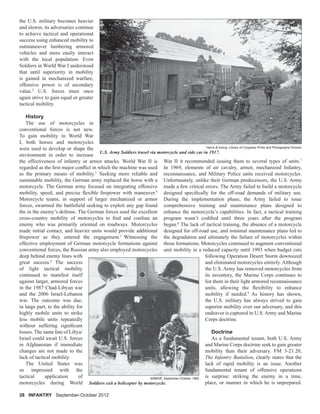
Infantry
 INFANTRY (ISSN: 0019-9532) is an Army professional bulletin prepared for bimonthly publication by the U.S. Army
Infantry School at Fort Benning, Ga.  Although it contains professional information for the Infantryman, the content
does not necessarily reflect the officialArmy position and does not supersede any information presented in other official
Army publications.  Unless otherwise stated, the views herein are those of the authors and not necessarily those of
the Department of Defense or any element of it.  Official distribution is to Infantry and Infantry-related units and to
appropriate staff agencies and service schools.  Direct communication concerning editorial policies and subscription
rates is authorized to Editor, INFANTRY, P.O. Box 52005, Fort Benning, GA 31995-2005.  Telephones: (706) 545-
2350 or 545-6951, DSN 835-2350 or 835-6951; e-mail: usarmy.benning.tradoc.mbx.infantry-magazine@mail.mil 
Bulk rate postage paid at Columbus, Ga., and other mailing offices.  POSTMASTER: Send address changes to
INFANTRY, P.O. Box 52005, Fort Benning, GA 31995-2005.  USPS Publication No. 370630.
SEPTEMBER-OCTOBER 2012 Volume 101, Number 3
PB 7-12-3
COL DAVID B. HAIGHT
Commandant,
U.S. Army Infantry School
RUSSELL A. ENO
Editor
MICHELLE J. ROWAN
Deputy Editor
TIFFANY M. NABORS
Editorial Assistant
This medium is approved for official
dissemination of material designed to keep
individuals within the Army knowledgeable of
current and emerging developments within
their areas of expertise for the purpose of
enhancing their professional development.
By Order of the Secretary of the Army:
RAYMOND T. ODIERNO
General, United States Army
Chief of Staff
Distribution: Special
Official:
JOYCE E. MORROW
Administrative Assistant to the
Secretary of the Army
1220805
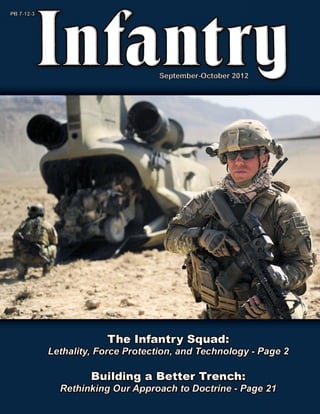
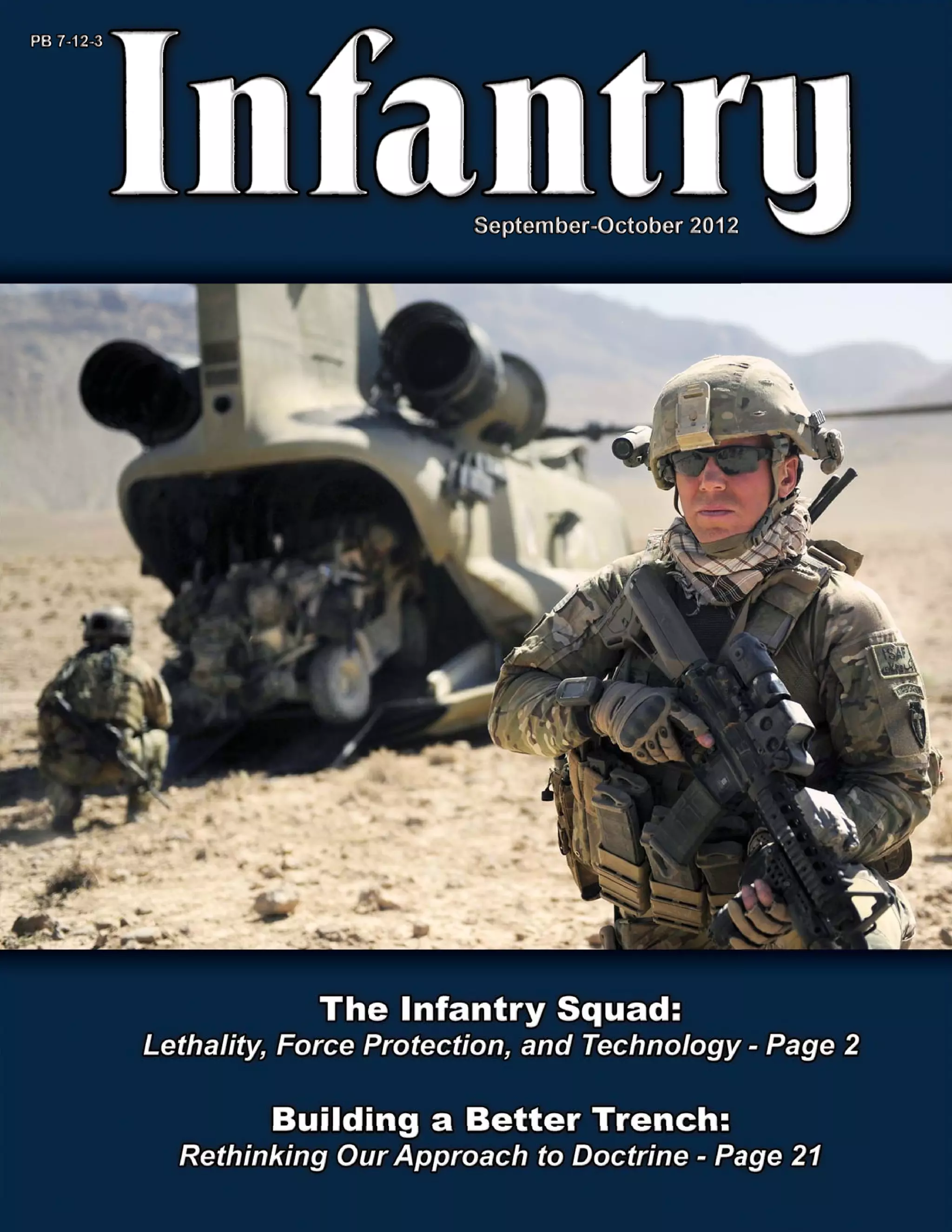
FRONT COVER:
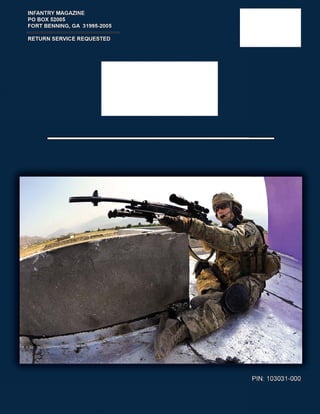
BACK COVER:
A Texas National Guardsman provides security as
Provincial Reconstruction Team Kunar engineers conduct
a quality assurance check at the Narang Girls School on
13 October 2012. The school is nearing completion, and
the PRT engineers assist the local Afghan government by
conducting quality assurance checks on the construction
project. (Photo by TSgt. Christopher Marasky, USAF)
FEATURES
21 BUILDING A BETTER TRENCH: RETHINKING OUR APPROACH TO DOCTRINE
MAJ Stephen J. Tegge
24 MISSED OPPORTUNITIES: CULTURAL AWARENESS IS CRITICAL DURING CRISES
LTC David Oclander
26 MOTORCYCLES IN THE CONVENTIONAL MILITARY: A DOCTRINAL APPROACH TO
ACHIEVING OPERATIONAL SUCCESS
CPT Kyle Stockwell
31 THE ART AND SCIENCE OF CONSTRUCTIVE SIMULATIONS IN THE CLASSROOM
LTC (Retired) George Hodge
DEPARTMENTS
1 COMMANDANT’S NOTE
2 INFANTRY NEWS
5 PROFESSIONAL FORUM
5 BASE EXPEDITIONARY TARGETING AND SURVEILLANCE SYSTEMS: PROVIDING
THE SOLDIER WITH INTEGRATED BASE DEFENSE CAPABILITIES
Dr. Christina Bates
8 FIELD GRADE APPRENTICESHIP: S3 ASSIGNMENT CRITICAL TO
CAREER PROGRESSION
MAJ Mark S. Leslie
11 FACILITATING SUCCESS: EFFECTIVELY PARTNERING WITH THE AFGHAN
UNIFORMED POLICE
1LT Conor Kinkead
14 THE FUTURITY OF WEAPONS AND AMMUNITION: LSAT PROGRAM PROVIDES
LIGHTER WEAPON SYSTEMS WITHOUT DIMINISHING CAPABILITIES
Jerry Barricks
16 BOUNCING BACK AFTER A THUMPING: RESILIENCY AMONG GUERRILLA UNITS
LTC (Retired) Lester W. Grau
19 SELF-AWARENESS: THE KEY TO SUCCESSFUL LEADERSHIP
LTC Milford H. Beagle Jr.
35 TRAINING NOTES
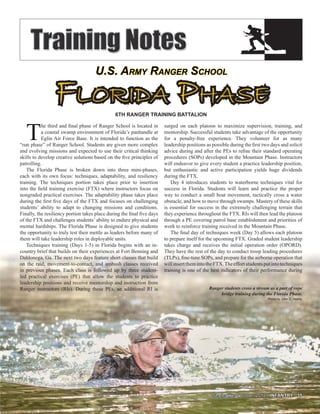
35 U.S. ARMY RANGER SCHOOL — FLORIDA PHASE
6th Ranger Training Battalion
36 PT AND THE 8-STEP TRAINING MODEL: IMPLEMENTING TRAINING
MANAGEMENT EVERY DAY
CPT Darrell E. Fawley III
39 REPETITIVE, REALISTIC TRAINING KEY
SGM Patrick M. Ogden
42 TRAINING LETHALITY THROUGH CAVALRY SQUADRON GUNNERY
LTC Chris Budihas and 1LT Scott Browne
45 EGYPTIAN GENERAL MOHAMED FAWZI — PART III: REFLECTIONS ON MISTAKES
MADE IN PLANNING, TRAINING, EQUIPPING, AND ORGANIZING EGYPTIAN
COMBAT FORMATIONS PRIOR TO THE 1967 SIX-DAY WAR
CDR Youssef Aboul-Enein, U.S. Navy
51 BOOK REVIEWS
A security force squad
leader with Provincial
Reconstruction Team Farah
pulls security at a landing
zone as his team loads a
tactical vehicle into a CH-47
Chinook helicopter in Farah
Province, Afghanistan, on
26 September 2012. (Photo
by SSgt. Jonathan Lovelady,
USAF)
September-October 2012 INFANTRY 1
COL DAVID B. HAIGHT
Commandant’s Note
T
he Army Infantry squad remains the foundation of the
maneuver force. We are adept at fighting a determined,
adaptive enemy across a wide range of missions and
terrain. Today’s rifle squads overmatch the enemy in terms of
lethality, resilience, tenacity, and the ability to seize and retain
the initiative. This Commandant’s Note is the first in a three-part
series on how we improve the squad and the overall force through
enhancements to material, training, and leader development. In this
note specifically, I will discuss some of the cutting edge technology,
lethality, and force protection measures that give us the decisive
edge.
We are currently leveraging our technological potential to meet
the threats posed by a tenacious enemy who draws upon an array
of conventional, terrorist, and criminal options as he challenges us.
He exploits low-tech solutions in an attempt to contest our hi-tech
military. Our response to this takes many forms; we train flexible,
adaptive, critical thinkers by utilizing blended learning and lead the
world in weapons technology. We have undertaken major Infantry
vehicle modernization actions. Bradley Fighting Vehicle upgrades
include the power train and electrical system, the vehicle’s enabled
capabilities, and situational awareness enhancements such as
improved FBCB2 integration and a common intelligence display.
The Stryker Brigade Combat Team (SBCT) has double “V” lower
hull changes for increased integral blast protection and protection for
the driver, and an M1128 Mobile Gun System (MGS) which means
we have three MGS vehicles per MGS platoon and a total of nine
for the SBCT.
Our unmanned aerial system (UAS) technology enables the
commander to enhance the squad’s lethality and save lives by
allowing it to put eyes in the sky around and out in front of it. The
Puma UAS is a lightweight 13-pound hand-launched system with a
9.2 foot wingspan and electro-optical and infrared sensors to spot
enemy units on the move or in ambush positions, or insurgents
emplacing improvised explosive devices, roadblocks, or other
hazards that could impede movement. Today the number of various
UAS employed in theater has grown to more than 4,500. Most of
these can operate above normal small arms range, are small enough
to be virtually undetected by insurgents, and can still provide high-
resolution imagery to give degrees of situational awareness and
targeting capabilities that were unimaginable even a decade ago.
We have enhanced the Infantry squad’s lethality in a number
of other ways. Our defilade target engagement has deprived the
enemy of the advantages of firing from cover. Our extended range
munitions, sensors, and targeting systems mean that the effective
range of our service rifle exceeds that of the AK-47 series of rifles
carried by most of our adversaries by at least 100 meters. Today’s
improved day, night, and thermal optics have materially improved
THE INFANTRY SQUAD
LETHALITY, FORCE PROTECTION, AND TECHNOLOGY
target acquisition and
engagement and enable the
shooter to reliably distinguish
between friend and foe. The
5.56mm M855A1 Enhanced
Performance Round for the
M16 and M4 series rifles
offers higher muzzle velocity
and improved performance
against hard targets at greater
ranges than the earlier
M855 round. We have coupled the rifle’s range overmatch with
marksmanship training that lets the Soldier effectively engage targets
at extended ranges.
Force protection remains a crucial consideration. By improving
today’s body armor, we have been able to reduce the effects
of blunt force trauma, offer better environmental protection,
and provide a fire resistant capability not available with earlier
protection. Other survivability enhancements include the Revision
Military BATLSKIN Modular Head Protection System, a visor and
ballistic lower face and jaw protection system, and an Advanced
Combat Helmet (ACH) with a ballistic pad that attaches to the
rear suspension system of theACH. This protects that area between
the lower edge of the ACH and the collar of the body armor from
fragmentation wounds to the neck and lower head. Helmet-mounted
sensors now gather data on the effects of IED explosions, which
will lead to even more improvements to the helmet and body armor
systems. Gunfire locators relying on acoustic and optical data to
locate the source of a shot are finding even broader application
with deployed forces.
The fielding of a new tactical network, Capability Set 13, began
in October. The network includes such state-of-the-art applications
as theWarfighter Information Network-Tactical; the Rifleman Radio;
the Soldier Radio Waveform; and the Nett Warrior communications
system, a Soldier equipment set with android-based smart phones
linked with Rifleman Radio, linking the unit command net with a
handheld device down to the rifleman. Now the Infantryman will be
able to transmit and receive real-time data in time to facilitate the
concise, timely decisions that spell success in the fast-paced fight.
These are but a few of the technological, lethality, and force
protection initiatives that we are actively pursuing at the Maneuver
Center of Excellence as we strive to ensure that Soldiers can deploy
swiftly, strike hard, and return home safely.The Commandant’s Note
for the next issue of INFANTRY will focus on training development.
We welcome your comments and recommendations and invite you
to join us in this effort.
One force, one fight! Follow me!
2 INFANTRY2 INFANTRY September-October 2012
UAS TECHNOLOGY SAVES LIVES IN COMBAT
KRIS OSBORN
SGT Christopher Harris was
conducting a routine reconnaissance
mission in Kunar Province, Afghanistan,
in 2009 when the Puma unmanned aerial
system (UAS) he was operating showed
nearby, real-time footage of insurgents
planting a roadside bomb along a U.S.
Army convoy route.
“We saw them putting in the IED
(improvised explosive device) planted
in the road. They were holed up in and
coming in and out of a house 20 meters
away from the dirt road we were traveling
on. I watched them for 20 minutes,” Harris
said, recollecting the incident. “These guys
had set an IED two kilometers away from
us, and they were waiting for us to drive
by for what looked like a planned IED-
initiated ambush.”
The electro-optical/infrared (EO/IR)
sensors on the Puma UAS showed live
images of the insurgent activity on Harris’
laptop-like display screen and antenna,
a One System Remote Video Terminal
(OSRVT) able to give him advance
warning of the nearby threat his convoy
was approaching.
The Puma UAS is a 13-pound, portable,
hand-launched unmanned system with a
wingspan of 9.2 feet and EO/IR sensors
able to beam back real-time imagery from
nearby combat-relevant locations.
Due to the UAS technology, Harris was
able to pinpoint the insurgents’ location to
within five meters. Then, after carefully
checking the area to ensure there were no
nearby civilians or additional structures,
Harris called in a 155mm artillery strike,
destroying the house and ensuring safe
passage for his unit’s convoy.
“I was able to observe rounds directly
hitting the target.
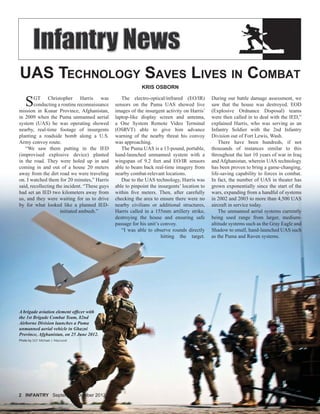
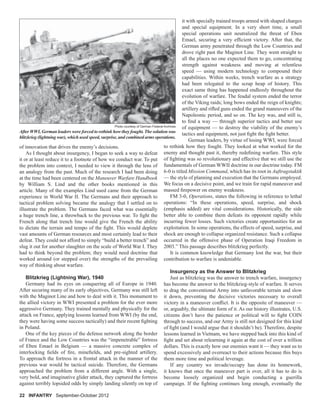
A brigade aviation element officer with
the 1st Brigade Combat Team, 82nd
Airborne Division launches a Puma
unmanned aerial vehicle in Ghazni
Province, Afghanistan, on 25 June 2012.
Photo by SGT Michael J. MacLeod
During our battle damage assessment, we
saw that the house was destroyed. EOD
(Explosive Ordnance Disposal) teams
were then called in to deal with the IED,”
explained Harris, who was serving as an
Infantry Soldier with the 2nd Infantry
Division out of Fort Lewis, Wash.
There have been hundreds, if not
thousands of instances similar to this
throughout the last 10 years of war in Iraq
and Afghanistan, wherein UAS technology
has been proven to bring a game-changing,
life-saving capability to forces in combat.
In fact, the number of UAS in theater has
grown exponentially since the start of the
wars, expanding from a handful of systems
in 2002 and 2003 to more than 4,500 UAS
aircraft in service today.
The unmanned aerial systems currently
being used range from larger, medium-
altitude systems such as the Gray Eagle and
Shadow to small, hand-launched UAS such
as the Puma and Raven systems.
September-October 2012 INFANTRY 3
In each instance, UAS provide commanders and Infantry engaged
in conflict with critical intelligence, surveillance, and reconnaissance
(ISR) assets, providing electronic “eyes” able to spot danger over a
hill or around a corner, thus keeping more Soldiers out of harm’s way.
“I am able to tell my (lieutenant) if we are about to go up a hill...
‘let’s toss a bird up there and see what we’ve got,’ just a quick
recon without sending anybody up. If there is nothing dangerous on
the mountain, we proceed. Using UAS in this way saves time and
energy by not sending Soldiers up there — and you save lives by not
endangering somebody,” Harris explained.
Unmanned aerial systems are a dominant weapons system on
today’s battlefield, said WO Mike Gray, a UAS program manager.
“We go everywhere and provide overwatch. We can put a UAS up
3,000 feet to watch a convoy. We often fly our UAS missions along
routes after route-clearance missions have gone through to make sure
routes remain safe for convoys,” said Gray.
Also, UAS such as the Shadow provided overwatch security
during the Iraqi elections in January 2009, ensuring important
historic activities could not be sabotaged by insurgent attacks, said
SSG Catalina Avalos, an NCO with the Washington National Guard.
“We provided 24-hour overwatch on site to be sure there was
no insurgent activity, no IEDs being planted, and no suspicious
occurrences. In some instances, we have been able to see actual
personnel digging holes for IEDs and laying down the wires,” Avalos
explained.
Avalos added that if the EO cameras do not specifically catch
insurgents in the act of planting an IED, UAS infrared sensors can
detect temperature changes in the ground, thus often determining that
a roadside bomb has recently been planted.
“We are able to see a difference in ground that has been freshly
dug, versus something that has been there a while. So, when you
see that, you then have EOD units go to the site to verify if it is,
in fact, an IED,” Avalos said. “UAS are one of those types of
weapons system that have just revolutionized combat in ways that
are unbelievable. Commanders now know almost everything that
goes on in their battelspace. We fly aircraft longer than enemies can
stay awake.”
UAS also assist with what is called “negative terrain analysis”
wherein operators look to see whether elements of the terrain have
changed, Avalos added.
Avalos said many of her skills using UAS in combat were
sharpened during a six-month training course for UAS operators at
Fort Huachuca, Ariz.
While UAS operators have a slightly different role compared to
UAS maintainers, every student learns every skill during training so
as to ensure students are aware of all the nuances involved in UAS
deployment. UAS training spans the entire gamut of activity, from
systems engineering, UAS sensors, deployment and interference
training, Avalos explained.
“I graduated from UAS training in 2008. I love this career and
would not trade it for the world. I loved coming out of the schoolhouse
and going down range because everything I learned in the school
house could be applied down range. Lives were saved down range,”
said Avalos.
(Kris Osborn writes for the Office of the Assistant Secretary of the
Army for Acquisition, Logistics and Technology.)
The U.S. Army, through its System of Systems
Integration Directorate, announced that the first
fielding of Capability Set 13 has begun new equipment
training with two brigade combat teams (BCTs) of the 10th
Mountain Division at Fort Drum, N.Y., and Fort Polk, La.
Capability Set 13, or CS 13, is the first fully-integrated
package of radios, satellite systems, software applications,
smartphone-like devices and other network components that
provide an integrated connectivity from the static tactical
operations center to the commander on-the-move to the
dismounted Soldier. CS 13 marks the first time the Army is
delivering network systems as an integrated communications
package that spans the entire brigade combat team formation.
New equipment training began in October for the 3rd and
4th Brigade Combat Teams of the 10th Mountain Division,
located at Fort Drum and Fort Polk, respectively. Prior
to deploying with CS 13 assets, both units will undergo
several months of rigorous classroom courses and hands-on
experience with the systems.
“These guys have been to Afghanistan and they know
what this capability is going to have to do in combat,” said
COL Walter E. Piatt, 10th Mountain Division’s deputy
commanding general for support. “So who better to get the
latest equipment than the 10th Mountain Division?”
CS 13 is ideal for missions in austere environments such
as Afghanistan because it provides mobile mission command
to all echelons of the BCT.
As U.S. forces continue to draw down in Afghanistan, they
will turn over many of their forward operating bases and other
infrastructure to the local forces, thus gradually losing fixed
KATIE CAIN
FIELDING OF NEW TACTICAL
NETWORK BEGINS
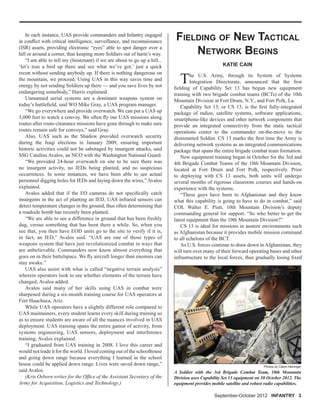
A Soldier with the 3rd Brigade Combat Team, 10th Mountain
Division uses Capability Set 13 equipment on 10 October 2012. The
equipment provides mobile satellite and robust radio capabilities.
Photos by Claire Heininger
4 INFANTRY September-October 2012
INFANTRY NEWS
network infrastructure locations. CS 13 systems provide mobile
satellite and robust radio capability for commanders and Soldiers
to take the network with them in vehicles and while dismounted as
they conduct combat and security assistance missions. This mobile
network greatly reduces the reliance on fixed infrastructure.
“This capability will allow us to remain mobile and will not
tie us to fixed facilities,” said Piatt. “Think about what that does
operationally and tactically. It doesn’t make you predictable.”
“As I look at upcoming missions, our ability and my ability
to communicate with those Soldiers on the ground over extended
distances — that’s really what will give us the edge as we go
forward,” said COL Sam Whitehurst, commander of the 3rd
BCT, 10th Mountain Division, who along with Piatt described
the technology as a significant upgrade from what he used during
previous deployments over the last decade.
CS 13 is anchored by two major upgrades: mission command
on the move, allowing commanders to take the network with
them in their vehicles; and bringing dismounted Soldiers into the
network, empowering ground troops with a new level of real-time
information.
Inside mine-resistant, ambush protected (MRAP) vehicles,
configured with components of CS 13, commanders will be able
to exchange information and execute mission command using
mobile communications technologies, rather than having to rely
on a fixed infrastructure.
“This capability puts the dismounted Soldier into the network,
and that’s something we have not been able to do,” Piatt said.
“Not only will we know where each other are, we’ll be able to
communicate throughout the entire brigade headquarters. We’ll
have constant situational awareness. Then we can turn it on the
enemy.”
Capability Set 13 not only introduces new technologies, but also
a new approach to how the Army equips units with the network.
For the first time, theArmy is delivering network systems not on
an individual basis, but as an integrated communications package
that spans the entire brigade combat team formation, connecting
the static tactical operations center to the commander on-the-
move to the dismounted Soldier. By using the Network Integration
Evaluations, known as NIEs, to establish an integrated network
baseline and to inform training, techniques and procedures, the
Army can rapidly incorporate new technology and adapt it based
on different mission requirements.
“We’re trying to make the systems we provide flexible enough
to give commanders the ability to adjust,” said BG Daniel Hughes,
Army director of System of Systems Integration. “The goal is to
get the latest technology to these guys as fast as we can and make
them as capable as possible.”
Both brigade combat teams will continue to receive CS 13
equipment in incremental phases over the next several months
prior to beginning collective training with the entire capability set.
(Katie Cain writes for the System of Systems Integration
Directorate. Claire Heininger also contributed to the article.)
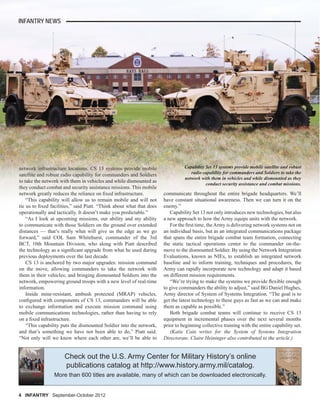
Capability Set 13 systems provide mobile satellite and robust
radio capability for commanders and Soldiers to take the
network with them in vehicles and while dismounted as they
conduct security assistance and combat missions.
Check out the U.S. Army Center for Military History’s online
publications catalog at http://www.history.army.mil/catalog.
More than 600 titles are available, many of which can be downloaded electronically.
PROVIDING THE SOLDIER WITH
INTEGRATED BASE DEFENSE CAPABILITIES
O
n a summer day in a major metropolitan area in the
Middle East, a Soldier scans a small thoroughfare
with his Rapid Deployment Integrated Surveillance
System (RDISS.) The street is fairly busy. From the left-hand
side of the screen, the Soldier sees a little girl stumbling along,
apparently weighed down by the backpack she is carrying. The
little girl proceeds to a small carnival to his right field of view, and
he follows her until she is out of view. Panning back to the same
street, the Soldier now sees a man in a black coat walking the same
path that the little girl walked. The man seems to have something
in his pocket. As a second man approaches him, the man waves
him away. Then, reaching into his pocket, the man walks out of
view. Seconds later, debris flies across the Soldier’s field of view,
emanating from the carnival area. The street is now in chaos as
people flee the area. The man has just detonated the backpack
being carried by the little girl — his own daughter. But this man
would not escape justice. Several months later, he was tried in
an Iraqi court, and the main evidence used against him was the
data from the Soldier’s RDISS. It
was this incriminating data that
would ultimately lead to the man’s
conviction and sentencing.
The BETSS-C Family of
Systems
The RDISS is part of a family
of integrated systems known as the
Base Expeditionary Targeting and
Surveillance Systems - Combined
(BETSS-C). Fielded in Iraq and
Afghanistan since 2008 by the
Project Manager, Night Vision/
Reconnaissance, Surveillance, and
Target Acquisition (PM NV/RSTA),
BETSS-C consistently ranks among
U.S. Central Command’s top-
five priority systems and provides
Soldiers with reconnaissance,
surveillance, and targeting
capabilities. BETSS-C includes
five systems: the Force Protection
Suite (FP Suite) — the Long Range
DR. CHRISTINA BATES
Thermal Imager (LRTI), the Battlefield Anti-Intrusion System (an
unattended ground sensor), and the Man-portable Surveillance and
Target Acquisition Radar (MSTAR); the Rapid Aerostat Initial
Deployment (RAID) tower; the Cerberus Mobile Surveillance
System; the Cerberus Scout (dismounted version of the Cerberus);
and the RDISS.
While each of these systems brings its own RSTA and FP
capabilities, what makes BETSS-C unique and powerful is the
integration of three of the five systems that make up this family of
systems. This integration is achieved by the “heart” of BETSS-C —
the Standard Ground Station (SGS). The SGS (currently deployed
on RAID towers) will provide a common graphical user interface
(GUI) for the RAID, Cerberus, and FP Suite. This addition
will extend the SGS’s integration capability for targeting and
surveillance systems and external sensors to enable multi-sensor
cross-cueing on all BETSS-C systems. The SGS is also capable
of linking to other systems on the Afghan Mission Network and
is interoperable with key mission command networks, including
BASE EXPEDITIONARY TARGETING AND SURVEILLANCE SYSTEMS - COMBINED
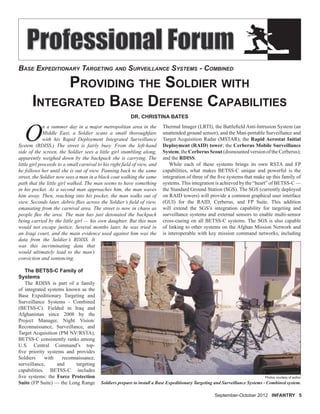
Photos courtesy of author
Soldiers prepare to install a Base Expeditionary Targeting and Surveillance Systems - Combined system.
September-October 2012 INFANTRY 5
6 INFANTRY September-October 2012
PROFESSIONAL FORUM
the Force XXI Battle Command Brigade
and Below (FBCB2), the Advanced
Field Artillery Tactical Data System
(AFATDS), and the Distributed Common
Ground System – Army (DCGS-A).
Originally conceived in response to a
2007 joint operational needs statement,
each of BETSS-C’s systems provides the
most current RSTA and FP technologies.
Fielded since 2005 and integrated into
the BETSS-C in 2008, the RAID tower
is available in two versions: an 80-foot
or 107-foot tower on which a day and
night sensor is mounted. RAID provides
360-degree, high-resolution, day/night
capabilities and includes the same
MSTAR Ground Surveillance Radar (GSR) as the FP Suite. The
RAID tower is ideal for tracking population behavioral patterns
and monitoring named areas of interest (NAIs) and target areas of
interest (TAIs).
Like the RAID tower, the Cerberus Mobile Surveillance System
also provides cooled infrared (IR) and day cameras as well as an
Advanced Radar Surveillance System (ARSS). The Cerberus, with
its lower sensor height and far smaller footprint when compared to
the RAID, is ideal for use in smaller spaces (i.e., spaces that are not
large enough to accommodate a RAID tower). Trailer-mounted,
the Cerberus is unmanned and operated remotely. Additionally,
the system can be sling-loaded to remote locations via rotary
wing aircraft. As with RAID, the Cerberus enables tracking of
population behavioral patterns and monitoring of NAIs and TAIs.
The Cerberus Scout is a dismounted version of the trailer-
mounted Cerberus. The Cerberus Scout includes a cooled IR and
daylight camera, ARSS, laser range finder (LRF), and an IR laser
pointer. It is ideally suited for use at observation posts (OPs). Like
the Cerberus and the RAID, the Cerberus Scout enables tracking of
population behavioral patterns and monitoring of NAIs and TAIs.
The RDISS comprises a suite of fixed, closed-circuit television
(CCTV) cameras; pan, tilt, and zoom (PTZ) cameras; and a mid-
range thermal imager (MRTI). As demonstrated in the carnival
detonation case, the RDISS is also capable of storing video that
may be used for a number of purposes, including forensics.
Working together, the sensors comprising RDISS provide basic
security monitoring and an “over-the-wall” capability, enabling
robust force protection.
Like the RDISS, the FP Suite comprises several sensors that
provide improved situational awareness of perimeter and entry
control points, “over-the-wall” coverage of dead space, and
forensic exploitation via recording capability. With its pan-tilt-
zoom cameras, CCTV cameras, infrared illuminators, GSR, and
unattended ground sensor, the FP Suite provides “close-in” video
surveillance as well as detection of large vehicles at 36 kilometers,
small vehicles at 24 kilometers, and personnel at 12 kilometers.
All of the sensors within the FP Suite are tailored to the needs of a
specific installation and can include up to 20 sensors in total.
Overall, the sub-systems that comprise BETSS-C were
specifically designed to be complementary, thereby achieving
two related objectives: maximizing the strengths of each system,
while simultaneously ensuring coverage of “dead spots” by
employing the complementary sub-systems. When used in this
fashion, BETSS-C provides an effective, 360-degree “surveillance
umbrella.” The RDISS and FP Suite enable “close-in” perimeter
surveillance, and, when working in concert with the RAID and
Cerberus, these sub-systems facilitate robust, holistic FP and
RSTA operations. In light of this, most forward operating bases
(FOBs) and combat outposts (COPs) employ at least two of the
five BETSS-C sub-systems at any given time.
This powerful combination of the BETSS-C systems has led
Soldiers and operators to refer to the system as a “one-stop shop”
that, when employed correctly, “lets nothing get in” to a FOB or
other secured area. In many instances, Soldiers have noted that
BETSS-C has prevented ambushes and complex attacks and,
thus, has often contributed to saving lives in theater. In fact, it has
been noted that enemy activity in the vicinity of a FOB or COP
decreases by approximately 60 percent when BETSS-C systems
are installed and employed properly.
State-of-the-Art BETSS-C Training
No system, no matter how technologically advanced, can be
used to its full potential without being linked to a larger battle
strategy and without being operated by trained, knowledgeable
personnel. Since early in the initial fielding of BETSS-C, PM NV/
RSTA has invested in the development of best-in-class leadership
awareness and understanding training for unit leaders and operator
training for Soldier-operators. Through its Doctrine and Tactics
Training (DTT) team, the BETSS-C program provides on-site
guidance (home station, combat training center, or post-mobilization
location) and training to help corps, division and brigade leaders,
and their battle staffs understand how to effectively incorporate
BETSS-C’s full suite of capabilities into unit planning processes.
Because the DTT focuses on system employment in accordance with
current Army doctrine, a division or corps commander will develop
a comprehensive understanding of the capabilities their brigade
combat teams will gain when employing the BETSS-C system and
will also understand how it fits into their overall strategy.
At the unit level, leaders will have developed an understanding
of BETSS-C’s capabilities and limitations, including how to
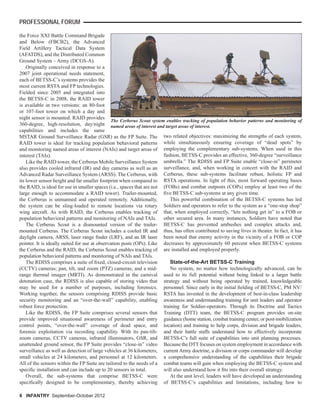
The Cerberus Scout system enables tracking of population behavior patterns and monitoring of
named areas of interest and target areas of interest.
Dr. Christina Bates is a strategy and strategic communications specialist
for the Project Manager, Night Vision/Reconnaissance, Surveillance, and
Target Acquisition (PM NV/RSTA). Bates holds an undergraduate degree
in Communication and Sociology from Boston College, a J.D. and master’s
degree from Boston University, and a Ph.D in Communication from Arizona
State University.
INFANTRY Magazine is always in need of articles
for publication. Topics for articles can include
information on organization, weapons, equipment, and
experiences while deployed to Iraq andAfghanistan. We
can also use relevant historical articles with emphasis
on the lessons we can learn from the past.
If you’re unsure whether a topic is suitable,
please contact us. We can let you know whether
we would be interested in the article and can also
give further guidance.
Our fully developed feature articles are usually
between 2,000 and 3,500 words, but these are not
rigid guidelines. Shorter articles can be used in our
Professional Forum and Training Notes sections. We
prefer clear, correct, concise, and consistent wording
expressed in the active voice. Also, please spell out
INFANTRY NEEDS ARTICLES
all acronyms and abbreviations the first time you use
them.
Sketches, photographs, maps, and line drawings that
support your article are encouraged. When you submit
your article, please include the original electronic file
of all graphics (jpeg, tiff, Powerpoint, etc.). Please also
include the origin of all artwork and, if necessary, written
permission for any copyrighted items to be reprinted.
Authors are responsible for ensuring their articles
receive a proper security review through
their respective organizations before being
submitted.
Articles can be submitted by e-mail to: usarmy.
benning.tradoc.mbx.infantry-magazine@
mail.mil. For more information, call (706) 545-
2350/6951 or DSN 835-2350/6951.
September-October 2012 INFANTRY 7
leverage BETSS-C as a force multiplier, as well as how to
incorporate BETSS-C into planning processes for force protection
and information collection in accordance with FMs 3-37 and 3-55,
respectively. Unit leaders will also develop an understanding of
BETSS-C’s potential for interoperability with other common
battlefield systems as well as the myriad of opportunities for
BETSS-C operator training. At the close of a session with the
BETSS-C DTT, a unit leader will have a clear understanding of
how to leverage BETSS-C to achieve larger, strategic objectives
on the battlefield.
At the operational level, the BETSS-C training team, primarily
located at the BETSS-C training facility in Fayetteville, N.C.,
provides comprehensive schoolhouse and on-site training (via its
mobile training program) to units prior to their deployment and
to field service representatives (FSRs), trainers/installers (T/Is).
For FSRs and T/Is, the BETSS-C training team provides a 15-
week curriculum at its schoolhouse in Fayetteville. This training
includes hands-on work with actual BETSS-C systems to reinforce
learning and skill development. T/Is may also access refresher
training and associated materials via the training team’s online
training that leverages the popular, user-friendly Black Board
application. For contractor-operators, the training team provides
a 15-day training curriculum at its schoolhouses in Fayetteville or
Fort Leonard Wood, Mo. For Soldier-operators, the training team
brings the training to the units via its unique mobile training trailers
(MTTs), which are fully customized and self-contained, retrofitted
semi tractor-trailers fully equipped with system emulators to
enable hands-on training. Like the contractor-operator training,
the Soldier-operator training includes a 15-day curriculum that
combines classroom and hands-on training to reinforce learning
and aid in enduring skill development. Contractor and Soldier-
operators also have access to the training team’s online training tool
where they can access and take full courses, as well as download
refresher materials.
BETSS-C: Looking Ahead
Since its initial fielding in the fall of 2008, the BETSS-C family
of systems has been viewed as an absolutely essential capability for
base defense and has made significant contributions to saving lives
in both Operation New Dawn and Operation Enduring Freedom.
Additionally, in recognition of its systems engineering excellence,
particularly regarding the interoperability of three of its systems,
BETSS-C won the 2009 Department of Defense Top 5 Program
Award. As stated earlier, the system’s SGS will enable intra-
BETSS-C interoperability, which will facilitate a unit’s ability to
share BETSS-C data among numerous systems. Building on these
successes, PM NV/RSTA is currently working to further integrate
BETSS-C, via the SGS capability, with other key RSTA systems
such as the Lightweight Counter-Mortar Radar, the Persistent
Ground Surveillance Systems, the Persistent Threat Detection
System, and the unmanned aerial systems. This integration will
enable the passing of data among disparate systems, thereby
strengthening a unit’s ability to create an effective persistent
surveillance capability. Anticipating the Soldier’s continued
need for integrated, actionable information, BETSS-C’s proof
of concept has set a firm foundation for future interoperability
capability among numerous RSTA systems.
To learn more about PM NV/RSTA and the BETSS-C family of
systems, please visit the NV/RSTA Web site at http://peoiews.apg.
army.mil/nvrsta/index.html
To learn more about the BETSS-C DTT, contact Philip
Thompson at thompson_philip@bah.com. To learn more about
BETSS-C training, contact Steve Beltson at sbeltson@caci.com.
FIELD GRADE APPRENTICESHIP:
S
erving as a battalion or brigade
operations officer — the S3 — is
one of the most developmental
and important assignments a major will
have.
An S3 assignment is critical to
career progression. More importantly,
the experience and insight gained from
serving in that position are critical in
forming the future combat formation
leaders of the Army. I served as a battalion
and brigade S3 in combat in Afghanistan
with the 3rd Brigade Combat Team (BCT),
101st Airborne Division (Air Assault).
To be a field grade officer — and
perform as one — requires the leadership, patience, and tough
but capable tutelage of a battalion or brigade commander.
It also requires a major who is mature enough to accept this
apprenticeship.
There are a few definitions that are relevant to this discussion
that are worthy of reprint, even if they may be tired and overused.
In my opinion, leadership is an often abused word in the Army
vernacular. Many discuss and reference it, but far too few officers
actually exercise it when in a staff position. Many often forget
or overlook the fact that they are in a leadership position and
disregard basic fundamentals of leadership just because the title of
commander is absent from a signature block. Staff officers are still
leaders, and the influence they have on an organization is heavy.
Army Regulation 600-100, Army Leadership, defines leadership
as “the process of influencing people by providing purpose,
direction, and motivation, while operating to accomplish the
mission and improve the organization.”An S3 that does not do this
is failing the commander, the organization, and his subordinates.
The S3 does this in his interaction with the staff on behalf of the
commander in the execution of the commander’s guidance. The
S3 is the whip or the hammer used by the commander for the
staff to develop the training plan, orders, and synchronization
of the guidance given into a coherent, reasonable, feasible, and
executable plan with the resources available.
As a field grade officer working for a battalion or brigade
commander, it is worthy to consider oneself an apprentice of
the trade. Webster’s Dictionary defines an apprentice as: “one
bound by indenture to serve another for a prescribed period with
a view to learning an art or trade.” What better definition could
describe the period of service as an S3? An operations officer
is bound to serve the commander to the best of his ability for
a prescribed period of time and should feel an implied duty
to learn as much as possible from that commander about their
trade as possible. The commander has a way ahead or vision
8 INFANTRY8 INFANTRY September-OctoberSeptember-October 20122012
MAJ MARK S. LESLIE
PROFESSIONAL FORUM
that he wants that organization to
go in based off his experience and
mission at hand. Not only should the
S3 perform, but he should observe,
listen, annotate, and record the many
lessons learned through interaction
with the commander.
I learned a great deal throughout
my time as an S3 and will try to
convey some of those lessons learned
in this article.
Role of the S3
It is important for every new S3 to
realize, completely understand, and
fully embrace the fact that they are not in command. The S3 is
a unique position. In many respects, the S3 is responsible for
everything but in command of nothing. There is one battalion
or brigade commander, and that is not you. There are company
commanders, and that is not you. The S3 exists to fulfill the
vision of what that battalion or brigade should be doing to
either execute or prepare for its wartime mission — period.
Remember the definition of leadership: “while operating to
accomplish the mission and improve the organization?” Well,
here is where it comes into play. The S3 can offer advice,
observations, or ways to improve that vision, but the bottom
line is that it’s the commander’s formation. The S3 is there to
serve him.
Synchronize the Staff
The main role or mission of the S3 is to synchronize the
battalion or brigade’s training or operations by harnessing the
staff to write the orders, produce the products, develop the
training, anticipate the obstacles or friction points, develop
courses of action to deal with the obstacles, find and maintain
the resources to conduct training, and wage war in accordance
with the commander’s guidance. Synchronize the staff with
the commander, and you will synchronize the unit.
Exercise Leadership
In order for the S3 to harness and synchronize the staff
appropriately, the S3 must know the staff — the entire staff,
NCOs included. Everyone on the staff has strengths and
weaknesses. Knowing these strengths and weaknesses helps
the S3 assign tasks for maximum output and efficiency.
Demand excellence from them. It is important for them to
understand that the product or service produced by them —
or not produced by them — directly affects Soldiers on the
battlefield, the professional reputation of the unit, and the
In my opinion, leadership is an often
abused word in the Army vernacular.
Many discuss and reference it, but
far too few officers actually exercise
it when in a staff position. Many
often forget or overlook the fact that
they are in a leadership position
and disregard basic fundamentals
of leadership just because the title
of commander is absent from a
signature block.
S3 ASSIGNMENT CRITICAL TO CAREER PROGRESSION
September-OctoberSeptember-October 20122012 INFANTRY 9INFANTRY 9
accomplishment of a mission. Everything they do is important;
make them feel important — because they are. Earn their
loyalty through your actions. The staff will occasionally fail;
it’s a fact and cannot be avoided. Take responsibility when a
mission or task does not get accomplished to standard. It is
a cardinal sin to shift the blame to a subordinate. You know
who or what is to blame and more than likely, so does your
boss. The difference is that he probably does not care. It’s
not about blame; it’s about the failed mission or substandard
performance on a task. All he cares about is that something
was not performed to standard or not completed, and he has
one guy to point the finger at and get it fixed — most of the
time, that guy is the S3. That is the life of an S3. Go back,
get the project officer or NCO and get it fixed. Provide the
proper guidance however it is best received. Providing proper
guidance is an art and not meant to imply micromanagement.
Some subordinates will require more guidance than others.
Giving direction or guidance to subordinate staff members is
an art and relies heavily on the relationship the S3 has with
his commander. Knowing how he thinks, how he operates,
and how he receives information best is important. Leave
enough flexibility in guidance to give the subordinate the
ability to exercise some creativity and initiative. This is one
of the nuances of good staff work — letting subordinates take
guidance and run with it. Assume that risk — it is worth it.
Cultivate Loyalty
Cultivate loyalty among the staff. The staff members are
Soldiers, and most sincerely want to do the best they can. Very
few Soldiers wake up and inherently want to do mediocre or
bad work. They want to be challenged, do a good job, and be
praised. They also want to be led, and their leader is the S3.
Provide the proper guidance and allow them that flexibility
to perform. They will surprise you with their creative and
ingenious ways to take your basic idea and improve it; nine
times out of 10 they will not disappoint you. Loyalty goes
both ways — show it to them, and you will earn it from them.
Soldiers will go out of their way to serve an inherently good
leader, regardless of faults. Do them justice, protect them, lead
them, and perform for them, and they will do the same for
you.
Every Soldier Has a Sergeant
The sheer volume of tasks required of an S3 on a daily basis
is intimidating. Prioritization of tasks, delegation of authority,
and avoiding micromanagement are key tools to success. As
S3, you will have to gauge your boss and determine what you
are expected to do personally, what can be delegated, what
can be tasked out, and what can be accomplished through
oversight. Early on, prepare to be overwhelmed until you
figure out what tasks belong to whom and what is the vetting
process for product refinement. Your operations sergeant
major (SGM) is a key component to this. His experience and
ability to motivate the staff and get results is key to success.
Develop a good relationship with your SGM. Invest the
time; it will deliver good returns. Determine his strengths and
weaknesses and capitalize on his strengths. He wants the S3 to
succeed. “Every officer has a sergeant” is one of the best Army
maxims; the operations SGM is the S3’s sergeant. Use him —
he is wise counsel, a confidant, and sounding board. If need
be, he is also an enforcer. When a fellow staff member fails to
perform or produce, there is no better “motivator” than for a
SGM to confront and demand he perform. Rare is the officer,
regardless of rank, that will take this sublime hint lightly. When
a SGM stands in an office door and informs a staff officer that
he has failed the team, it is a professional embarrassment and
rarely needs to be repeated with any officer worth their salt. All
of my SGMs were extremely talented and were in the vetting
and approval chain for almost all products developed. They were
for all intents and purposes — field-grade officer quality, equally
talented, and capable.
Delegation
A quick daily huddle doling out tasks, updates, and priorities
is paramount. Nothing is better than actual face-to-face meetings
where subordinates can hear the priorities straight from their
leader. Priorities and efforts often change due to events, and
these meetings allow the S3 to communicate this to the staff
and coordinate and synchronize their work and efforts. E-mail
is not the way to communicate commander’s intent. It may be a
good follow up or reminder, but there is nothing more genuine
than walking by, sitting down in a chair, and giving subordinates
undivided attention to what they are working on for you and your
commander. I often left the meetings smarter and more confident
in their progress, and I hope they gleamed some better insight
into what we wanted from them.
Develop Relationships
As a battalion or brigade S3, it is important to develop rapport
and cultivate relationships with fellow S3s to your left and right
as well as to your higher.As a battalion S3, I talked to the brigade
S3 daily in garrison and in combat. As the brigade S3, I talked
to the J3 nightly as part of my personal daily battle rhythm.
Often, I would talk to the J3 throughout the day on a variety
of issues, but these were usually immediate issues. The nightly
“chat” was really a situation report (SITREP) of what I knew to
be important to our higher headquarters (HQ) and to accurately
portray the state of the “BCT fight.” These nightly discussions
often provided me insight and perspective of our higher HQs and
helped me look ahead, see upcoming priorities, and get clarity
on important issues. They proved immensely important to me
in my time as the BCT S3. These informal updates often led
to compromise and the explanation of “why” by both parties,
which resulted in a better working relationship as well as the
mission accomplishment in a combined joint task force (CJTF),
international joint commission (IJC), and International Security
Assistance Force (ISAF) context.
A technique that cultivates positive relationships with higher
HQ staff is to get into the habit of developing a schedule to push
pertinent information to geographically separated counterparts.
PROFESSIONAL FORUM
10 INFANTRY10 INFANTRY September-October 2012September-October 2012
This gives them situational awareness on your unit, helps them
in their efforts, and allows them to speak about your unit and
what they are doing with direct input from you. They are going
to anyway; you may as well assist them with “ground truth.”
Nightly distribution of story boards and situation reports shared
with the next higher HQ staff may help you when you need
something. They are hungry for information; help them get it.
The S3 “Fight”
As a BCT S3, my fight in Operation Enduring Freedom
was really a lateral and upward fight. I had to synch the
efforts of multiple battalion task forces to meet the BCT
commander’s intent and other organizations operating in our
AO laterally as well as with higher. The synchronization of
limited assets across a very large area of operations was a
daunting task. To do this required a degree of compromise on
operations by all task forces and intense staff synchronization
by the BCT staff.
Know lethal and non-lethal targeting — it is the essence of
your operations. The S3 must synchronize the two efforts to
achieve the desired effect. The S3 must be intimately involved
in the process and synthesize the two. If you are not involved
in both, you cannot synchronize the unit’s fight across the
spectrum of counterinsurgency operations.
S3 battlefield circulation is critical in developing
perspective, but it must be balanced with staff responsibilities
and obligations. Find a project or mission that is a priority but
one the commander just cannot keep on his plate. You will
contribute to the unit fight and develop the situational awareness
required of your job. Don’t be a battlefield tourist! When you go
out, have an agenda and do something with the information and
observations when you return. Make every trip outside the wire
or to the training area fruitful for you and the commander. Go
out with something and come back with something.
Commander battlefield (or training area) circulation is
critical to his ability to fight the unit. It is the job of the S3
to let subordinate commanders know what the old man is
looking for on these visits. The S3 has unique insight on what
hot topics and priorities the commander wants to address and
what his expectations are for the visit. Letting the subordinate
commanders know will assist in developing rapport that is
critical to performing your duties.
Additionally, own rehearsals! As an S3, rehearsals are what
we do. The final full dress rehearsal may seem like a big show,
but the beauty of a rehearsal is the knowledge and confidence
the staff develops in preparation for the rehearsal. Always do
a rehearsal with key staff members prior to presenting to the
boss. Write a script and convey the operation with confidence.
Anticipate friction points and questions and develop solutions
prior to the rehearsal. If you do your war gaming correctly, this
can be a real exercise for the staff to know the plan as well as
the commanders.
VIP visits, while deployed or in training, are a fact of life
and often unavoidable. Work with the deputy commander and
executive officer to find a way to make these visits fit with
the unit rhythm and effort. Find out what the agenda is for the
visitors and tailor the itinerary of the visit to accommodate
them and their expectations. Prepare your units and rehearse
the visit as you would a combat operation. They are coming
anyway, so make it worthwhile. Do your homework, develop
talking points, and determine what you want the visitor to leave
with. It goes without saying that all units want a visitor to leave
with a positive impression — what else? Also consider what
they can do for you? Develop a standard operating procedure
for VIPs, brief them, and ensure they leave with what they came
for — it will be worth the effort.
The job of operations officer is a challenging time in the
career of a professional officer. For majors to really develop
into the future combat formation leaders of our Army, this
time needs to be coupled and balanced with a genuine desire
to develop through the interaction with commanders. We are
their apprentices. It will not always be a pretty affair. You
do not have to like each other; the Army does not function
on friendship. It functions on the chain of command and
the accomplishment of the mission as best as can be done.
Genuine and sincere hard work on the behalf of the S3 for the
commander and unit will, in most cases, develop into mutual
respect and admiration. I was fortunate to work for two very
demanding commanders that drove me hard not only for the
mission but for my own personal development as a potential
future battalion commander. One can’t be thin-skinned as
an S3 — you can’t afford it and neither can the formation.
In most cases, I think it is fair to say that the pressure and
demands for excellence that commanders levy on their S3 and
the results that come when those demands are not met are not
personal. Be a professional — just be a field grade officer —
fix it and move on. We owe them that allegiance and passion
to our profession without the drama of personal feelings. I
came into the job a major and left a field grade — there is a
difference.
MAJ Mark S. Leslie has served in a variety of enlisted, command,
and staff positions in airborne, air assault, Ranger, light, and
mechanized Infantry units. He has served in Operation Just Cause,
Desert Shield/Desert Storm, Operation Iraqi Freedom, and Operation
Enduring Freedom. He is currently serving as a joint planner with the
U.S. European Command, Stuttgart, Germany.
The final full dress rehearsal may seem like a big
show, but the beauty of a rehearsal is the knowledge
and confidence the staff develops in preparation
for the rehearsal. ...Write a script and convey the
operation with confidence. Anticipate friction points
and questions and develop solutions prior to the
rehearsal. If you do your war gaming correctly, this
can be a real exercise for the staff to know the plan as
well as the commanders.
FACILITATING SUCCESS:FACILITATING SUCCESS:
EFFECTIVELY PARTNERING WITH THE AFGHAN UNIFORMED POLICE
At present, combined planning and
patrolling have become commonplace,
along with many independent Afghan
Uniformed Police (AUP) operations. There
are numerous police substations (PSS)
established in and around Kandahar City
in addition to various police checkpoints.
These police structures are meant to control
critical lines of communication along key
roads leading into Kandahar City as well
as deny terrain and villages from the
Taliban. The police have become very
well resourced through their improving
logistical channels. They have taken
ownership of security away from CF and
now take on the bulk of that responsibility
themselves. Traffic control points (TCPs),
1LT CONOR KINKEAD
community policing, and deliberate
operations have become standard for the
AUP in a city decisive to the aspirations
of the Taliban. Where there was once
widespread volatility, today there are
isolated attacks that provide no real tactical
gains. The AUP have increasingly become
a more professionalized and capable force.
Through the limited lens of one platoon
in one part of greater Kandahar City, it can
be difficult to see the widespread progress.
It is particularly difficult to see progress
over the course of each passing day of a
yearlong deployment. However, with a
broader view of the previous nine months,
the gains are apparent. Whether it has been
the increasing standards and discipline of
AUP patrolmen; their leaders lessening
deference when discussing security;
interactions of AUP with village elders; or
the eagerness of AUP commanders to learn
and become more proficient at their job,
all have illustrated a force more capable to
deter Taliban elements while they attempt
to regenerate and reclaim Kandahar City.
The effort to create this current picture of
ANSF capacity has been a combined focus
for units in country today.
There are many different elements
of CF that serve one unified purpose for
peace and stability in Afghanistan. There
are a multitude of units that work to
increase the AUP’s professionalism and
security capacity. Military Police (MP)
units partner with PSS commanders daily
to improve their organizational leadership
from planning operations to sustainment
logistics. Company- and troop-level leaders
interface with various AUP commanders to
build common operating pictures and set
focuses. Security force assistance teams
(SFAT) work with higher AUP leadership
to support broader planning and operations.
Finally, the maneuver platoons serve a vital
role at AUP checkpoints by partnering with
Afghan soldiers to increase security along
routes and in villages. It is from a platoon
checkpoint where the perspective of this
article is formed.
As a traditional maneuver platoon,
preparation for deployment involved
many ranges, live fires, platoon and squad
situational training exercise (STX) lanes,
a rotation through the Joint Readiness
Training Center (Fort Polk, La.), and more
ranges. Leaders were also encouraged
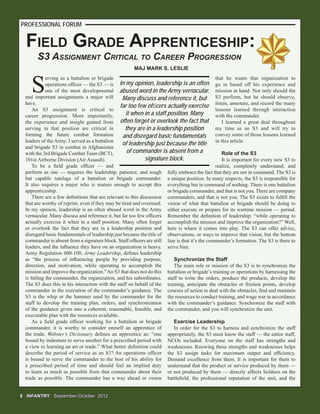
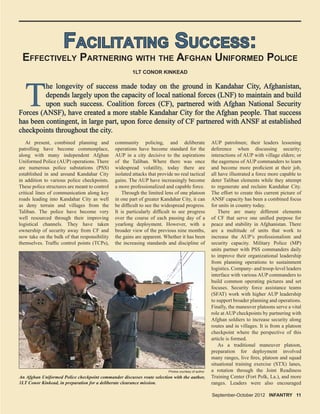
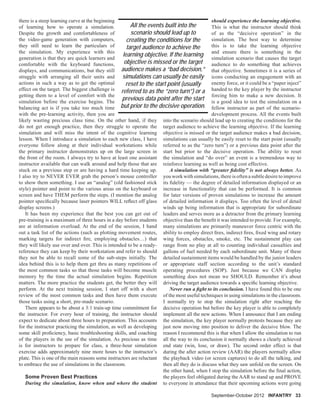
An Afghan Uniformed Police checkpoint commander discusses route selection with the author,
1LT Conor Kinkead, in preparation for a deliberate clearance mission.
Photos courtesy of author
TT
he longevity of success made today on the ground in Kandahar City, Afghanistan,he longevity of success made today on the ground in Kandahar City, Afghanistan,
depends largely upon the capacity of local national forces (LNF) to maintain and builddepends largely upon the capacity of local national forces (LNF) to maintain and build
upon such success. Coalition forces (CF), partnered with Afghan National Securityupon such success. Coalition forces (CF), partnered with Afghan National Security
Forces (ANSF), have created a more stable Kandahar City for the Afghan people. That successForces (ANSF), have created a more stable Kandahar City for the Afghan people. That success
has been contingent, in large part, upon force density of CF partnered with ANSF at establishedhas been contingent, in large part, upon force density of CF partnered with ANSF at established
checkpoints throughout the city.checkpoints throughout the city.
September-October 2012 INFANTRY 11
12 INFANTRY September-October 2012
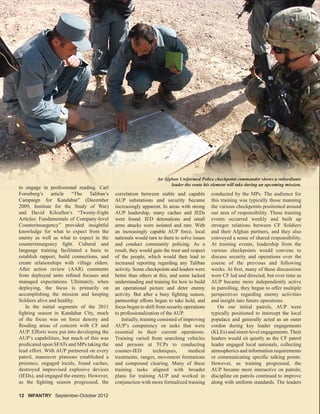
An Afghan Uniformed Police checkpoint commander shows a subordinate
leader the route his element will take during an upcoming mission.
to engage in professional reading. Carl
Forseberg’s article “The Taliban’s
Campaign for Kandahar” (December
2009, Institute for the Study of War)
and David Kilcullen’s “Twenty-Eight
Articles: Fundamentals of Company-level
Counterinsurgency” provided insightful
knowledge for what to expect from the
enemy as well as what to expect in the
counterinsurgency fight. Cultural and
language training facilitated a basis to
establish rapport, build connections, and
create relationships with village elders.
After action review (AAR) comments
from deployed units refined focuses and
managed expectations. Ultimately, when
deploying, the focus is primarily on
accomplishing the mission and keeping
Soldiers alive and healthy.
In the initial segments of the 2011
fighting season in Kandahar City, much
of the focus was on force density and
flooding areas of concern with CF and
AUP. Efforts were put into developing the
AUP’s capabilities, but much of this was
predicated upon SFATs and MPs taking the
lead effort. With AUP partnered on every
patrol, maneuver platoons established a
presence, engaged locals, found caches,
destroyed improvised explosive devices
(IEDs), and engaged the enemy. However,
as the fighting season progressed, the
correlation between stable and capable
AUP substations and security became
increasingly apparent. In areas with strong
AUP leadership, many caches and IEDs
were found. IED detonations and small
arms attacks were isolated and rare. With
an increasingly capable AUP force, local
nationals would turn to them to solve issues
and conduct community policing. As a
result, they would gain the trust and respect
of the people, which would then lead to
increased reporting regarding any Taliban
activity. Some checkpoints and leaders were
better than others at this, and some lacked
understanding and training for how to build
an operational picture and deter enemy
activity. But after a busy fighting season,
partnership efforts began to take hold, and
focus began to shift from security operations
to professionalization of the AUP.
Initially, training consisted of improving
AUP’s competency on tasks that were
essential to their current operations.
Training varied from searching vehicles
and persons at TCPs to conducting
counter-IED techniques, medical
treatments, ranges, movement formations
and compound clearing. Many of these
training tasks aligned with broader
plans for training AUP and worked in
conjunction with more formalized training
leader the route his element will take during an upcoming mission.
to engage in professional reading. Carl
FFors beber ’g’s ar iti lcle “T“Thhe TT lalibiban’’s
Campaign for Kandahar” (December
2009 I tit t f th St d f W )
corr lelatiion bbetween st bablle a dnd cap bablle
AUP substations and security became
i i l t I ith t
AnAnnAnnnAnAn AAAAAAAAAAffffffgfgfgfgfgfghahhhannn UnUnUnUnifififififii ooroormemedddd PPoPoP lililicece chhheheckckpopoinintt cocommmmanandeederr shshshshshshoowwoo ss aaa sususususususubobbobob rdrdininatatatataateeeee
lelleadadderer ttthehehe rrrouououtetete hhhisisis eeelelel memem ntnt wwililll tatakeke ddduring an upccomomininingg mmmission.n
i f i l di C l
conducted by the MPs. The audience for
this training was typically those manning
the various checkpoints positioned around
our area of responsibility. These training
events occurred weekly and built up
stronger relations between CF Soldiers
and their Afghan partners, and they also
conveyed a sense of shared responsibility.
At training events, leadership from the
various checkpoints would convene to
discuss security and operations over the
course of the previous and following
weeks. At first, many of these discussions
were CF led and directed, but over time as
AUP became more independently active
in patrolling, they began to offer multiple
perspectives regarding enemy activities
and insight into future operations.
On our initial patrols, AUP were
typically positioned to intercept the local
populace and generally acted as an outer
cordon during key leader engagements
(KLEs) and street-level engagements. Their
leaders would sit quietly as the CF patrol
leader engaged local nationals, collecting
atmospherics and information requirements
or communicating specific talking points.
However, as training progressed, the
AUP became more interactive on patrols;
discipline on patrols continued to improve
along with uniform standards. The leaders
1LT Conor Kinkead is currently serving
as the scout platoon leader for 2nd Battalion,
8th Infantry Regiment, 2nd Brigade Combat
Team, 4th Infantry Division, which deployed
to Kandahar Province, Afghanistan. He is a
graduate of Stonehill College in Massachusetts
and was commissioned in 2009 through the
Boston University ROTC program.
relationships is critical to ensuring the AUP
are genuinely invested. It is not enough to
simply talk with AUP commanders about
a counterinsurgency fight; Afghan leaders
must believe their CF counterparts and
want to follow through on their guidance.
Relationships of trust, friendship, and
shared experience are essential. Drinking
chai, eating food, and living together are
not enough; simply being there is not
enough. Effective partnered relationships
rely on trust and follow-through. CF
leaders must do what they say they will
do and genuinely look out for the best
interest of their AUP counterparts and
their Soldiers.
Strong relationships, focused priorities,
and consistent support are the reasons
for the AUP’s growing competence in
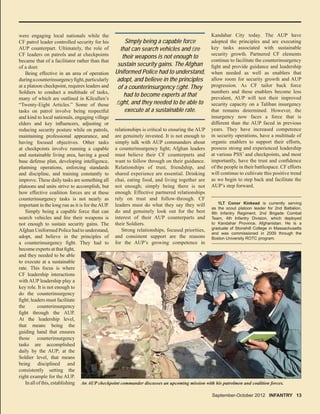
An AUP checkpoint commander discusses an upcoming mission with his patrolmen and coalition forces.
Simply being a capable force
that can search vehicles and fire
their weapons is not enough to
sustain security gains. The Afghan
Uniformed Police had to understand,
adopt, and believe in the principles
of a counterinsurgency fight. They
had to become experts at that
fight, and they needed to be able to
execute at a sustainable rate.
September-October 2012 INFANTRY 13
were engaging local nationals while the
CF patrol leader controlled security for his
AUP counterpart. Ultimately, the role of
CF leaders on patrols and at checkpoints
became that of a facilitator rather than that
of a doer.
Being effective in an area of operation
duringacounterinsurgencyfight,particularly
at a platoon checkpoint, requires leaders and
Soldiers to conduct a multitude of tasks,
many of which are outlined in Kilcullen’s
“Twenty-Eight Articles.” Some of those
tasks on patrol involve being respectful
and kind to local nationals, engaging village
elders and key influencers, adjusting or
reducing security posture while on patrols,
maintaining professional appearance, and
having focused objectives. Other tasks
at checkpoints involve running a capable
and sustainable living area, having a good
base defense plan, developing intelligence,
planning operations, enforcing standards
and discipline, and training constantly to
improve. These daily tasks are something all
platoons and units strive to accomplish, but
how effective coalition forces are at these
counterinsurgency tasks is not nearly as
important in the long run as it is for theAUP.
Simply being a capable force that can
search vehicles and fire their weapons is
not enough to sustain security gains. The
Afghan Uniformed Police had to understand,
adopt, and believe in the principles of
a counterinsurgency fight. They had to
becomeexpertsatthatfight,
and they needed to be able
to execute at a sustainable
rate. This focus is where
CF leadership interactions
with AUP leadership play a
key role. It is not enough to
do the counterinsurgency
fight; leaders must facilitate
the counterinsurgency
fight through the AUP.
At the leadership level,
that means being the
guiding hand that ensures
those counterinsurgency
tasks are accomplished
daily by the AUP; at the
Soldier level, that means
being disciplined and
consistently setting the
right example for the AUP.
Inallofthis,establishing
Kandahar City today. The AUP have
adopted the principles and are executing
key tasks associated with sustainable
security growth. Partnered CF elements
continue to facilitate the counterinsurgency
fight and provide guidance and leadership
when needed as well as enablers that
allow room for security growth and AUP
progression. As CF tailor back force
numbers and these enablers become less
prevalent, AUP will test their improved
security capacity on a Taliban insurgency
that remains determined. However, the
insurgency now faces a force that is
different than the AUP faced in previous
years. They have increased competence
in security operations, have a multitude of
organic enablers to support their efforts,
possess strong and experienced leadership
at various PSS’ and checkpoints, and most
importantly, have the trust and confidence
of the people in their battlespace. CF efforts
will continue to cultivate this positive trend
as we begin to step back and facilitate the
AUP’s step forward.
THE FUTURITY OFTHE FUTURITY OF
WEAPONS ANDWEAPONS AND
AMMUNITIONAMMUNITION
O
ver the course of 237 years, the U.S. Army has made
significant changes to the primary weapons employed
by its warfighters. With each leap forward, the ability
to provide effective fire on our adversaries has increased. We have
progressed from hand-loaded muskets to fully cased ammunition
fired from bolt action rifles, semiautomatic rapid fire weapons to
fully automatic weapons, and now to our current M4 carbine with
all the accessories.
One of the biggest challenges in the past has been how to
reduce the size and weight of a weapon system without sacrificing
capability. Today’s warfighters are faced with an ever-growing
equipment list that is designed to provide them with the latest and
most efficient equipment to complete the mission. The average
Soldier load consists of a rucksack, weapon, ammunition, helmet,
and other gear; the total weight can range from 63 to more than
130 pounds depending on the variables of mission type, duration,
and environment. The weight a Soldier is carrying has a direct
impact on his ability to perform his mission. For example,
Infantry Soldiers carrying a load of 101 pounds for 12.5 miles had
a decrease of 26 percent in marksmanship accuracy (number of
targets hit), a 33 percent increase in distance from the target center,
and an increase in back pain. Consequently, any new weapon
system must take into consideration how the weapon interacts
14 INFANTRY September-October 2012
JERRY BARRICKSJERRY BARRICKS
PROFESSIONAL FORUM
with the warfighter’s load. Lighter weapon weight — with less
Soldier fatigue — provides a corresponding increase in accuracy
during target engagement. Reduced recoil enhances the capability
to engage multiple targets under time constraints. Lighter and
less bulky ammunition multiplies the number of rounds a Soldier
can carry without increasing his load, thus increasing number of
targets he can effectively engage.
The latest leap forward is both a weapon system and a change
in the technology and materials. In 2004, the Lightweight Small
Arms Technologies (LSAT) Army Technologies Objective
(ATO) program started with the purpose of providing Soldiers
with a lighter individual weapon system without diminishing
the current capabilities. The Joint Service Small Arms Program
(JSSAP), which falls under the U.S. Army Armament Research,
Development, and Engineering Center (ARDEC), is tasked with
the main effort for LSAT. The JSSAP is chartered to synchronize
new material requirements that have a joint application and to
maintain an awareness of small arms efforts as well as planned
technology and acquisition efforts.
How to reduce the weight of a weapon system is not as simple
as it may seem. Engineers started from scratch with a “clean
slate” design. Modeling and simulation was critical to the design
of the weapon system. Engineers designed the weapon and chose
materials that would be strong enough to do the job, but they did
LSAT Program Provides Lighter Weapon
Systems Without Diminishing Capabilities
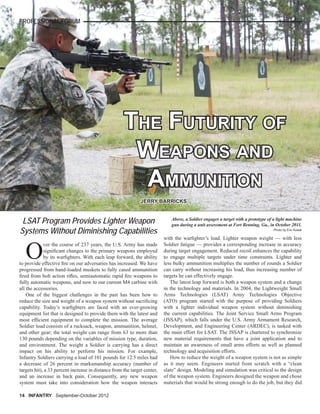
Above, a Soldier engages a target with a prototype of a light machine
gun during a unit assessment at Fort Benning, Ga., in October 2011.
Photo by Eric Kowal
September-October 2012 INFANTRY 15
not over design it, which would have increased the weight. Every
part and subsystem is evaluated for function and weight. The
original housing for the weapon was made of reinforced plastic.
It was then changed to all-aluminum; this change saved weight
and increased durability. According to Kori Phillips, a project
officer with ARDEC, the weapon was designed to be lightweight.
“Every time we could shave an ounce off, we did,” he said. “If
something was going to add weight, we had to decide if it was
worthwhile.”
Although the original intent of the LSAT ATO was to reduce
the weight of the weapons and ammunition, JSSAP added the
goal of reducing maintenance and training requirements with
the intent to make a weapon that was simpler with fewer parts to
disassemble, clean, and replace.
The LSAT Cased Telescoped Light Machine Gun (CT LMG) is
a gas operated, air cooled, belt fed, light machine gun with fixed
headspace and quick change barrel feature. The weapon fires from
the open bolt position and can be used in the automatic rifleman
(AR) or LMG position for
squad configurations.
It is made of the
same general
materials as
the M249
Squad Automatic
Weapon (SAW) —
steel, aluminum, and
plastic, but it’s how
the materials are used
and the design of the parts/system that provide the savings in
weight.
Of course, you can reduce a weapon system to the bare
minimum and still be plagued with a weight question. What
about the ammunition? Here is where the LSAT really lends itself
to a leap forward in technology. The current 5.56mm, 200-round
drum of ammunition for the M249 SAW weighs 6.2 pounds.
The same number of rounds for the LSAT LMG comes in at 3.2
pounds. Using a new way of looking at how the projectile is
packaged, the JSSAP has developed a two-path approach. The
first is caseless ammunition, and the other is cased telescoped
ammunition. Caseless ammunition is still in development with
the projected outcome of a 50-percent weight reduction and a
40-percent decrease in volume. Cased telescoped ammunition
is a mature technology using a lightweight, cylindrical polymer
case as opposed to brass, which provides a 37-percent reduction
in ammunition weight and a 12-percent reduction in volume.
Both types of projectile will significantly reduce the weight
carried by the warfighter.
In September 2011, the Maneuver Center of Excellence
(MCoE) Maneuver Battle Lab (MBL) conducted a comparative
assessment of the CTLMG against the current M249 SAW. Infantry
Soldiers along with Military Police examined the CT LMGs in
a variety of operational scenarios. The scenarios were designed
to provide the warfighter the venue for critical comments and
gain user feedback on the system’s design. The MBL assessment
addressed Soldier load, an identified gap from the squad
capabilities-based assessment. While there are many components
to a Soldier’s load that contribute to overall weight, the weapon
and ammunition are key to mobility. The assessment found that the
CT LMG, with its reduced weight and ammunition, is a potential
solution to fill this gap. In December 2011, the MCoE drafted a
memorandum of support for the LSAT technology, recommending
the Army conduct forward operational assessments (FOAs) to gain
feedback from Soldiers currently deployed. It also recommended
that the Army invest in the evaluation of systems firing different
caliber rounds to determine the weight savings provided by this
new technology.
What is the future for LSAT? From a technical point of view,
the technology is applicable across the full range of small caliber
weapons and ammunition, from carbines to heavy machine guns
and beyond. The reduced weight of the weapons and ammunition,
while providing dismounted Soldiers a critical weight reduction,
could also reduce the load for aviation platforms, small robotic
vehicles, and other platforms to include the ones that provide
logistics support.
From an
operational point
of view, the two
(SAW) gunners
who will carry
a 40-percent
lighter load, will
undoubtedly have
more energy as well
as be more lethal,
more flexible upon contact, more situationally aware, and more
capable of offensive action. A 40-percent weight savings is critical
to the squad’s physical, mental, and operational effectiveness.
“Consider for a second those forces deployed to Afghanistan;
they are conducting daily dismounted patrols and carrying a full
combat load on the backs of the nine-man Infantry squad,” said
COL Robert Choppa, director of the MBL and team chief of the
Measures of Effectiveness Fire Team for the Squad: Foundation
of the Decisive Force initiative. “These patrols are all under brutal
weather, extreme hot or cold, with high winds and seasonal rain.
These combat missions are in complex terrain that requires foot
movement for several miles up unimproved dirt paths — paths
going up over 30 percent inclines where tripping will break an
ankle, where falling will require medical evacuation, and where
every step is dangerous.
“The threat situation requires or demands many of these
operations being conducted at night to afford the squad to get
to positions of advantage,” said Choppa. “Many of these foot
operations are under conditions where the squad can make contact
with the threat force at any time. Under these circumstances, the
40-percent savings in load burden is absolutely decisive! LSAT is a
tremendous boost to the formation effectiveness of the dismounted
Infantry squad.”
Jerry Barricks is the team chief of the Soldier Team, Experimentation
Branch, Maneuver Battle Lab, Maneuver Center of Excellence, Fort
Benning, Ga.
Figure 1 — Cased Telescoped Ammunition
PROFESSIONAL FORUM
BOUNCING BACK AFTER A THUMPING:
“As a nation, we believed that history repeats itself. What
happened in the 19th century to the invading British would also
be the fate of the Soviet invaders. Philosophically, the Soviets
believed that history is unidirectional, progressive and does not
repeat itself. History did repeat itself and we did prevail.”
— General Abdul Rahim Wardak
The Other Side of the Mountain:
Mujahideen Tactics in the Soviet-Afghan War 2
H
o Chi Minh led the movement against the
reestablishment of French colonial rule in Vietnam
after World War II. The French Indochina War was
a fight between different ethnic groups with different ideologies
or faiths. The Soviet-Afghan War was also a fight between
different ethnic groups with different ideologies or faiths. Both
contests demonstrate that guerrilla warfare is a test of will and
commitment.3
Yet, will and commitment are not always enough to
prevent defeat. What compels the guerrilla to fight on after tactical
defeat? Is it a natural and cultural thing? It is ideology or religion?
Is it monetary or political gain? Is it preservation of the family at
the sacrifice of the individual? Why do some guerrilla movements
survive and grow after severe defeats while others quickly fold
after an apparently minor setback? Why are some peoples better at
it than others? The answer may lie in history, with its thousands of
guerrilla movements throughout recorded time.
What is a Guerrilla Force?
After the past decade, this seems a pretty obvious question.
During this decade the United States has been involved in four
guerrilla wars — one in Iraq, one in the Philippines, one in
Columbia, and one in Afghanistan. The Iraqi guerrilla movement
originated with the government-trained, government-armed,
and government-led Fedayeen organization. It spread into a
large-scale resistance backed by neighboring states, outside
organizations (such as al Qaeda), religious groups, ethnic
groups, dismissed soldiers, malcontents, and criminals. The
Philippine insurrection was the continuation of a decades-old
resistance by Islamic peoples. The Columbian insurgency began
as a communist movement which supported itself through the
LTC (RETIRED) LESTER W. GRAU
production and sale of narcotics. It has evolved into a narcotics
syndicate that occasionally justifies its behavior by citing a
communist ideology. The guerrillas in Afghanistan organized
themselves in part based on shattered conventional Taliban and al
Qaeda forces, but more often based on local Pushtun communities
justifying their struggle with the defense of Islam and the
neighborhood. Guerrilla movements can be state-sponsored,
ideologically derived, ethnicity-based, or created from local
xenophobia or political or criminal opportunism.
A guerrilla force is usually not in uniform and blends with the
local populace when not fighting. The guerrilla may be untrained
or well trained, paid or unpaid, locally based or drawn from
different regions or countries, armed with whatever is available
or armed with the latest in weaponry. Some guerrilla forces are
defeated tactically and quit. Others hang on despite repeated
defeats. Factors that are common to resilient guerrilla forces are
base camps/safe houses, redundant logistics, sanctuary, secure
lines of communication, effective leadership, ethnicity, ideology/
religion, geography, patience, recruitment, anonymity, and
collective resolve.
Base Camps/Safe Houses
Base camps are normally areas that provide logistics, immediate
medical care, and a staging area from which to mount ambushes,
attacks, raids, and propaganda efforts. Safe houses are the urban
equivalent. Base camps are usually located on difficult terrain
with limited access routes and often double as forward logistics
points for a larger area. Consequently, they are engineered for a
stiff conventional fight and contain crew-served weapons, field
fortifications, obstacles, and road blocks. Safe houses are not as
robust and depend on the support or forbearance of the neighbors
to survive. The base camp or safe house is usually the core of the
local guerrilla resistance, and destruction of either often results
in greatly reduced guerrilla activity until an alternate base camp
is established. A base camp external to the urban area will often
support several safe houses.
Redundant Logistics
Unless the area of the conflict is small, a guerrilla movement
RESILIENCY AMONG GUERRILLA UNITS
16 INFANTRY September-October 2012
“If we have to fight, we will fight. You will kill 10 of our
men and we will kill one of yours, and in the end it will be
you who will tire of it.”
— Ho Chi Minh
Prison Diary1
September-October 2012 INFANTRY 17
will establish multiple logistics points so
that the loss of one will not fatally cripple the
movement. There may be a network of small
caches, forward supply points, supply points,
supply dumps, and even depots supporting
the movement. The local availability of food
and water will often determine the size of the
facility, supporting transport required and area
of operation. Secure logistics facilities can be
quite large and perform maintenance and repair.
Logistics points are usually co-located with
base camps.
Sanctuary
A guerrilla force needs a safe area into which it can withdraw,
especially if its base camp is overrun. There, the force can treat its
wounded, rest, train, refit, recruit, plan and rebuild. Sanctuary areas
are safe due to terrain (mountains, jungle), geographic location
(across international borders), or location among a supportive
population (Sadr City, the Pushtun tribal areas in Pakistan).
Logistics facilities, medical care, veterinary care, training areas,
and longer-term accommodations are often part of a sanctuary
area. The presence of friendly civilians adds protection from air
and artillery attack.Asanctuary area may contain a judicial facility,
confinement facility, and other trappings of parallel governance.
For the tactical leader, a base camp may be sanctuary, but the larger
movement needs its own sanctuary. Exploratory peace talks may
designate a specific geographic area for negotiations, providing
an area of temporary sanctuary.4
External support for guerrillas is
not essential for resiliency, but permitted/tolerated sanctuary in a
neighboring country is a very desirable thing.
Secure Lines of Communication
All warfare, conventional or guerrilla, is about lines of
communication. The opposing commanders are concerned with
preserving their own lines of advance, retreat and supply and
interdicting those enemy lines.5
Much of guerrilla tactics is “hit and
run.” Run is at least as important as hit, and the successful guerrilla
commander has planned and secured his run line well before he
hits. On an operational scale, maintaining the lines of retreat to
sanctuary is essential for the guerrilla leader (and sometimes the
conventional commander, e.g., French Điện Biên Phủ in 1954 and
the British retreat from Kabul in 1842).
Leadership
A good guerrilla leader is a good military leader. Leadership
is of prime importance and vulnerable. Senior guerrilla leaders
most often reside in sanctuary, leaving the second-tier leaders to
run the base camps and conduct the tactical fight.6
Decapitation of
the senior leadership does not always destroy a guerrilla movement,
but it will certainly slow it down, particularly if the first and second
tiers of guerrilla leadership are consistently eliminated. Charismatic
leaders are the hardest to replace but are not always the best. Guerrilla
staffs are essential for large movements, and their elimination
can prove just as catastrophic to a guerrilla movement as the loss
of a leader. Some guerrilla movements have an overall pyramidal
structure with a single leader (Vietnam), where others have various
competing guerrilla movements with
different leaders (Afghanistan and Iraq).
Decapitation is difficult in either case.
Ethnicity
Many guerrilla movements are based
on ethnic identification and on perceived
ethnicsurvival(theChineseintheMalayan
Insurgency, the Albanians in Kosovo, the
Chechens). The dedicated ethnic guerrilla
fights to preserve an identity, a way of life,
and a heritage. Changing this loyalty or
co-opting its adherents is a very tall order
for psychological operations, land reform,
or constitutional reform — traditional approaches to winning the
population away from supporting the guerrilla.
Ideology/Religion
Marxism-Leninism did not die with the Soviet Union. Maoism
stalks South Asia and the Pacific. Religion matters. Ideology and
religion produce true believers who will gladly blow themselves
and others up in the name of the greater good. Guerrilla movements
based on ideological or religious convictions are hard to suppress.
Like ethnicity, it is a matter of honor, loyalty, and deep-held belief.
Geography
It is tough to be a guerrilla on an open plain. It is much easier in
the mountains, jungle, deep forest, wide river delta, or sympathetic
neighborhood. These are also the areas in which it is hard for
conventional forces to maneuver and where technology is less
effective. However, the geography should not be so challenging
that survival and finding food become the guerillas’ primary task.
Patience
Patience is more than a virtue. The resilient guerrilla needs to
be willing to fight for the long term. Guerrilla warfare does not
have to be protracted, but the resilient guerrilla movement must
be capable of making it so if that is key to survival and success.
Waiting out an opponent is an ancient guerrilla tactic that still
works. The adage “you have the watches, but we have the time” is
appropriate against an external occupation force that has no desire
to remain indefinitely.
Recruitment
Guerrillas die, sicken, get hurt, grow old, or desert and have
to be replaced. Successful guerrilla campaigns require ever-larger
forces. The guerrilla leader must have sufficient charisma, and
the ideological/religious/ethnic appeal or rewards system must be
strong enough to attract a steady stream of recruits for the cause.
Anonymity
A guerrilla force is a secret society with its own rituals, special
signs, and requirements. A well-placed informer can destroy the
entire organization. Anonymity is particularly important during
the initial phase of a guerrilla war. A resilient guerrilla force is
one that vets and controls its membership and can hide in plain
view.7
Patience is more than a virtue.
The resilient guerrilla needs to be
willing to fight for the long term.
Guerrilla warfare does not have
to be protracted, but the resilient
guerrilla movement must be capable
of making it so if that is key to their
survival and success. Waiting out
an opponent is an ancient guerrilla
tactic that still works.
18 INFANTRY September-October 2012
PROFESSIONAL FORUM
LTC (Retired) Lester W. Grau currently serves as the research
coordinator for the Foreign Military Studies Office at Fort Leavenworth,
Kan. He served 26 years as an Infantryman and a Soviet Foreign Area
Officer. He fought in Vietnam and served most of his duty time overseas in
Germany, South Korea, the Soviet Union, and the Netherlands. He is the
author of three books on the Soviet-Afghan War, two books on Afghanistan,
and another on Soviet guerrilla warfare. He has been contributing articles
to INFANTRY Magazine since 1985.
This newsletter contains a collection of previously published articles
that focus on Afghan culture and provides insight into effectively
communicating with Afghans in order to achieve positive results.
More specifically, the articles contained in this newsletter highlight
methods to initiate and improve relationships with Afghans, the
difficulties and challenges leaders and Soldiers experienced in
communicating with Afghans, what worked and did not work, and
how to foster and improve meaningful relationships with Afghans to
achieve the desired outcome. This newsletter can be accessed online
at http://usacac.army.mil/cac2/call/index.asp.
CENTER FOR ARMY LESSONS LEARNED
NEWSLETTER NO. 12-18:
UNDERSTANDING AFGHAN CULTURE
Collective Resolve
Some peoples are more pugnacious and jealous of their turf
than others. They will fight just because an outsider is on their
territory without their permission. This inherent cussedness
explains why some nations accept outside occupation and
domination with barely more than a muffled mutter of protest,
while other peoples quickly organize themselves to drive the
outsider away. Some folks are just naturally warlike while others
would rather see if they can wait it out. This is not to say that
national passive-aggressiveness will not work. Some peoples are
just more disposed to squeezing triggers.
Conclusion
Successful guerrilla campaigns usually follow three phases.
The guerrillas form, train, and bond during the first or incipient
phase. The guerrilla campaign is most vulnerable during this phase,
and concerted opposition can readily destroy the movement. The
second phase is the attack phase, where the guerrilla force begins to
contest turf with its rival. The tactics are hit and run. The guerrilla
campaign is still very vulnerable during this phase, particularly
during retreat to sanctuary. For the counterguerrilla force, the key
to success is the ability to project sufficient power over distance
and conduct a successful pursuit. For the resilient guerrilla, the
key to success is securing lines of retreat to sanctuary. During the
third phase, the guerrilla conducts attacks and retains territory. The
guerrilla force is stronger and its vulnerability is often a function
of overextension or refusal to abandon recently acquired chunks of
territory. During the third phase, the resilient guerrilla force is able
to reconstitute itself rapidly through recruiting, logistics strength,
and leadership.
Guerrilla forces are like snowflakes in that no two are exactly
alike. Resiliency among guerrilla forces is not quantifiable.
However, the above factors keep appearing in the histories of
guerrilla conflicts.8
Not all the factors are always present, but
most of them are. Ultimately the process that seems to work
in bringing resilient guerrillas to heel is to move against the
guerrillas’ families. Forced relocation of families and villages into
camps and government-controlled villages or other programs that
threaten to destroy the core values and identity of a tribe or people
seem to have the best results. These programs win no prizes for
humanitarian principles, and sometimes backfire by forcing the
guerrilla to fight to the bitter end.
Endnotes
1
Ho Chi Minh, Prison Diary (Hanoi: Foreign Languages Publishing
House, 1962).
2
Lester Grau, The Other Side of the Mountain: Mujahideen Tactics
in the Soviet-Afghan War (Quantico: U.S. Government Printing Office,
1998).
3
Some authors distinguish among insurgents (those who fight against
their established government but do not have a legal belligerent status),
partisans (light troops making raids and forays against any enemy, usually
as guerrillas), and guerrillas (those who carry out irregular warfare as a
member of an independent unit). Irregular warfare involves irregulars
(non-soldiers) who do not conform to some or all rules of warfare,
accepted tactics or military professionalism. None of these definitions are
particularly precise, so for the purposes of this article the term “guerrilla”
is used as a blanket designation, on the assumption that the reader will
recognize one when he sees one.
4
Geoff Demarest, Winning Insurgent War: Back to Basics, Second
Edition, (Fort Leavenworth: Foreign Military Studies Office, 2011) 352.
5
T. Miller Maguire, Outlines of Military Geography (London: C. J.
Clay & Sons, 1899) 21-22.
6
Demarest, 238-239.
7
Ibid, 2-3.
8
A good start is the two volume set of Robert B. Asprey, War in the
Shadows: The Guerrilla in History (New York: Doubleday and Company,
Inc., 1975).
SELF-AWARENESS:SELF-AWARENESS:
THE KEY TO SUCCESSFUL LEADERSHIP
I
n his January 2012 Marching Orders titled “America’s Force
of Decisive Action,” Army Chief of Staff GEN Raymond T.
Odierno identified “adapting leader development” as one of
his top priorities for today’s Soldiers. He also stated that he wants
leader development “to meet our future security challenges in an
increasingly uncertain and complex strategic environment.” Self-
awareness establishes the critical foundation for this priority. This
competency provides the single largest contribution to developing
leaders. Leaders who understand the value of self-awareness
can prevent downward spirals of personal and organizational
ineffectiveness. However, the Army needs to develop robust and
effective tools to achieve this competency.
FM 6-22, Army Leadership, states that “self-awareness
has the potential to help all leaders become better adjusted and
more effective.” Additionally, the Army surmises that in order to
operate in the current and future strategic environment, leaders are
required to be adaptive and self-aware. According to FM 6-22, “to
achieve leadership success in increasingly more complex tactical,
operational, and strategic environments, leaders need to expand
professional, domain knowledge and develop a keen sense of self-
awareness.”
FM 6-22 defines self-awareness as “being aware of oneself,
including one’s traits, feelings, and behaviors.” Self-awareness is
not only about the individual leader, but the impact the leader has
on others. However, the Army has been unable to leverage the full
potential of self-awareness for every leader.
Leaders must employ reflection and feedback — two key
enablers of success — to achieve self-awareness.
Rose A. Mueller-Hanson and colleagues posit the
purpose of reflection is to “increase self-awareness
and to help leaders think through their performance in
situations requiring an adaptive response.”1
This ability
to “think through” is a self-critique of one’s strengths
and weaknesses. Gareth Morgan wrote that “authentic
[self-aware] leaders are willing to devote themselves
to their own personal growth and development.”2
Self-
reflection offers leaders a way to evaluate the impact
of their choices or decisions. They must be able to
assess their own abilities, determine their strengths
and weaknesses, and actively learn to overcome their
weaknesses.
Self-reflection can be “as simple as posing questions
about one’s own behavior, knowledge, or feelings,”
according to FM 6-22. However, the manual fails
to outline exactly what this means or how it is to be
applied. The Army’s guidance would be more effective
if self-reflection included asking questions relevant to
personal performance and behavior as it relates to the
LTC MILFORD H. BEAGLE JR.
environment, set of circumstances, and/or others.
Feedback is the second critical factor for developing leaders
who are self-aware. Leaders must use internal and external
assessments. However, the Army’s current use of assessments is
unreliable.
The Army currently utilizes formal counseling statements,
360-degree multi-source assessment and feedback (MSAF),
and periodic informal counseling as a means to gauge a leader’s
effectiveness. The problem with the 360-degree method of review
is that it allows leaders to personally select who provides their
feedback. The participants can be either inside or outside of a
leader’s current organization or a former superior, subordinate, or
peer. This is counterproductive and helps reward poor leadership.
Glowing reviews from “friends” can help promotion potential
so that the mid and top tier of Army leadership reflects “back-
scratching diplomacy” rather than effective assessments.
Dan Goleman and colleagues state that “feedback within an
organization can be distorted in a way wherein leaders receive
primarily filtered and mostly positive information from others on
account of their position.”3
David A. Kenny suggests that “when
people believe that their outcomes are determined by another
person’s impression of them, they should be highly motivated to
discern, monitor, and control that impression.”4
For this process to
work, leaders must display the willingness to cope with impressions
that are both favorable and unfavorable. As an important tool, we
cannot solicit feedback only from those with similar views or
based on biases due to the leader’s position.
The multi-source assessment and feedback (MSAF) 360 is one of the methods the
Army currently uses to assess its leaders.
http://msaf.army.mil/LeadOn.aspx
September-October 2012 INFANTRY 19
According to Susan J. Ashford, leaders
have three challenges in accessing feedback
from others: the information problem (how
to gather information from others within
an organizational reality characterized
by ambiguity, risk, conflicting cues, and
randomness); the ego defense problem
(how to obtain accurate information without
negatively affecting the ego); and the self-
presentation problem (how to obtain accurate
information from others while appearing
autonomous and self-confident).5
Leaders
who admit areas of weakness provide a
model within the organization that makes it
acceptable to not have all the right answers, make mistakes, and
seek assistance.
In addition to refined 360-degree assessments, leaders must
be required to participate in opinion surveys. The design of the
questions should closely reflect those of the 360 survey, but the
opinion surveys must be initiated by the leader’s supervisor.
This approach provides equal leverage in soliciting feedback
on leaders and as a way to validate or invalidate a leader’s
360-degree assessment.
Competent people in positions of leadership create a self-
reality of their own that is quite different from the reality shared
by others.6
Therefore, leaders should provide a predictive
assessment on how they think they will be viewed by others
prior to soliciting a 360-degree assessment. This provides a
comparative assessment of perception versus reality. According
to Scott N. Taylor, “initial studies show that asking MSAF
participants to anticipate how they are seen by others can be a
strong predictor of performance.”7
The Army should also adopt “pre-mortem” feedback as a
useful way of facilitating leader self-awareness. This form of
feedback can complement the standard after action review (AAR)
process used by the Army. Developed by cognitive psychologist
Gary Klein, the goal of “pre-mortem” is to work around some
insensitivities of the AAR by focusing the team on potential
points of failure versus blaming single individuals for past
mistakes. By introducing the artificiality of events being deemed
dismal failures prior to their execution, leaders must face blame
versus avoiding it in order to preserve a self-image. Leaders are
required to reflect on thoughts, decisions, and potential actions as
a result of “pre-mortem.” This reflection can help leaders realize
areas of weakness in a non-threatening set of circumstances.
This approach not only helps the individual but also the teams in
which he or she leads. By using “pre-mortem,” Klein observed
that teams have been able to improve their performance based on
this technique.8
FM 6-22 asserts that a lack of self-awareness may also
obstruct learning and adaptability, which in turn keeps leaders
from creating a positive work climate and a more effective
organization. Toxic leadership is an emerging issue within the
Army. In analyzing two years of Army survey data, John P.
Steele discovered that “the vast majority of U.S. Army leaders
observed a toxic leader in the last year, and over a third indicated
that they had firsthand experience with
three or more toxic leaders, indicating
significant prevalence.”9
The Center
for Army Leadership (CAL) report also
reflects that a high number of participants
(75 percent) agreed that their superior is
a “real jerk,” but there was also a high
correlation to those willing to “emulate
[their] immediate superior.”
Thus, Soldiers do not believe
leaders are held accountable for their
poor leadership and, in fact, continue
advancing in rank. The current methods
of leadership review reinforce this vicious
cycle. This is why it is critical to adopt the recommendations
above and immediately begin transforming how the U.S. Army
helps leaders see themselves.
Notes
1
Rose A. Mueller-Hanson, Susan S. White, David W. Dorsey,
and Elaine D. Pulakos, “Training Adaptable Leaders: Lessons From
Research and Practice,” research report through Personnel Decisions
Research Institutes, Inc. (2005).
2
Gareth Morgan, “Reflective Practice and Self-Awareness,”
Perspectives in Public Health 129 (July 2009), 162.
3
Dan Goleman, Richard E. Boyatzis, and Annie Mckee, Primal
Leadership: Realizing the Power of Emotional Intelligence, (Cambridge,
MA: Harvard Business School Press, 2002). As quoted in Scott N.
Taylor’s article “Redefining Leader Self-Awareness By Integrating The
Second Component of Self-Awareness,” Journal Of Leadership Studies
(Winter 2010).
4
David A. Kenny, Interpersonal Perception: A Social Relations
Analysis (New York: Guilford Press, 2002), 147.
5
Susan J. Ashford, “Self-Assessments in Organizations: A Literature
Review and Integrative Model, Research in Organizational Behavior.”
As quoted in Taylor’s article “Redefining Leader Self-Awareness...”
6
Sydney Finkelstein, Why Smart Executives Fail: And What You Can
Learn From Their Mistakes (New York: Portfolio, 2004), 1-21.
7
Taylor, “Redefining Leader Self-Awareness,” 64.
8
Mueller-Hanson, White, Dorsey and Pulakos, “Training Adaptable
Leaders,” 16.
9
2011 Center for Army Leadership Annual Survey of Army
Leadership (CASAL), Center for Army Leadership (CAL) Technical
Report.
LTC Milford H. Beagle Jr. is a visiting military fellow at the Washington
Institute. He has specialty military qualifications in planning and operations
and has held posts ranging from platoon leader to battalion commander.
LTC Beagle completed his most recent deployment to Afghanistan in June
2011 where he served as part of the NATO training mission. From 2008 to
2010, LTC Beagle commanded the 2nd Battalion, 9th Infantry Regiment
in Korea. He served in the Pentagon on the Joint Staff J-7 as a strategic
plans officer from 2006 to 2008. He completed a deployment to Iraq’s
Anbar Province from 2004 to 2005 while serving as a battalion and brigade
operations officer for the 2nd Brigade Combat Team, 2nd Infantry Division.
He was commissioned as an Infantry officer in 1990 from South Carolina
State University. LTC Beagle earned a master’s degree from the School
of Advanced Military Studies, a master’s degree in adult education from
Kansas State University, and a bachelor’s degree from South Carolina
State University.
Competent people in positions
of leadership create a self-reality
of their own that is quite different
from the reality shared by others.
Therefore, leaders should provide
a predictive assessment on how
they think they will be viewed
by others prior to soliciting a
360-degree assessment.
20 INFANTRY September-October 2012
PROFESSIONAL FORUM
BUILDING A BETTER TRENCHBUILDING A BETTER TRENCH
RETHINKING OUR APPROACH TO DOCTRINE
W
hile serving as an instructor for the Maneuver
Captains Career Course (MCCC) at Fort Benning,
Ga., I studied history and read field manuals and
numerous books on leadership, tactics, and psychology to prepare
for various classes. Given the last decade of warfare and the
doctrinal shifts carried with it, there seemed to be a recurring
theme in military circles on the subject of insurgencies. By virtue
of the fights in which we were engaged and given the history of
post colonial warfare, it seemed that insurgency was always at
the forefront of every conversation. The United States and other
countries continually get involved in them. With minimal study
of history, it becomes apparent that the reason for this is that the
enemies we face are using the only strategy they can possibly
employ to have any chance against us (or any other numerically/
technologically superior enemy). The enemy has analyzed our
most obvious weaknesses and naturally exploited them by drawing
us into insurgencies. It’s a proven tactic that continually works. The
insurgents force us to fight at times and places of their choosing,
thereby allowing them to dictate the tempo. We crave fast-paced
maneuver, so they slow the tempo to their liking, rendering our
greatest strength — tempo — in effect, useless. Wars, in general,
MAJ STEPHEN J. TEGGE
will become unpopular over time, so the insurgent’s ability to slow
the tempo provides the necessary elongation of time for political
discord to grow in the invader’s/occupier’s homeland. This
problem has confounded combatant commanders since the dawn
of organized warfare.
We appear to be trying to continue to become better
counterinsurgents instead of concentrating on a winning strategy.
As I read field manuals, history, Sun Tzu and John Boyd, it became
apparent to me that there may be inconsistencies in our intellectual
and doctrinal approaches to warfare. It seems everybody is
making the presumption that counterinsurgency (COIN) is the
new standard of warfare. Based on that, we have codified our
COIN doctrine in field manuals, and we continue to become better
counterinsurgents. Despite the time, labor, and resource intensity
of this style of fighting, we continue to approach it as the status
quo of warfare. While I agree that we have made leaps and bounds
in our understanding of the nature of COIN and how to conduct
it, the insurgent still dictates the terms of the fight, and insurgency
still remains the single best tactic the enemy has to the fight the
U.S. and deplete its national will and resources. The insurgent’s
small, cheap innovations lead to billion dollar reactions by the U.S.
and its allies. No matter what we do, our doctrine and equipment
procurement always seem to be a reaction to enemy action instead
Soldiers with the 1st Brigade Combat Team,
82nd Airborne Division conduct a patrol in
Ghazni Province, Afghanistan, on 19 May 2012.
Photo by SGT Michael J. MacLeod
September-October 2012September-October 2012 INFANTRY 21INFANTRY 21
of innovation that drives the enemy’s decisions.
As I thought about insurgency, I began to seek a way to defeat
it or at least reduce it to a footnote of how we conduct war. To put
the problem into context, I needed to view it through the lens of
an analogy from the past. Much of the research I had been doing
at the time had been centered on the Maneuver Warfare Handbook
by William S. Lind and the other books mentioned in this
article. Many of the examples Lind used came from the German
experience in World War II. The Germans and their approach to
tactical problem solving became the analogy that I settled on to
illustrate the problem. The Germans faced what was essentially
a huge trench line, a throwback to the previous war. To fight the
French along that trench line would give the French the ability
to dictate the terrain and tempo of the fight. This would deplete
vast amounts of German resources and most certainly lead to their
defeat. They could not afford to simply “build a better trench” and
slug it out for another slaughter on the scale of World War I. They
had to think beyond the problem; they would need doctrine that
worked around (or stepped over) the strengths of the prevailing
way of thinking about warfare.
Blitzkrieg (Lightning War), 1940
Germany had its eyes on conquering all of Europe in 1940.
After securing many of its early objectives, Germany was still left
with the Maginot Line and how to deal with it. This monument to
the allied victory in WWI presented a problem for the ever more
aggressive Germany. They trained mentally and physically for the
attack on France, applying lessons learned from WWI (by the end,
they were having some success tactically) and their recent fighting
in Poland.
One of the key pieces of the defense network along the border
of France and the Low Countries was the “impenetrable” fortress
of Eben Emael in Belgium — a massive concrete complex of
interlocking fields of fire, minefields, and pre-sighted artillery.
To approach the fortress in a frontal attack in the manner of the
previous war would be tactical suicide. Therefore, the Germans
approached the problem from a different angle. With a single,
very bold, and imaginative glider attack, they captured the fortress
against terribly lopsided odds by simply landing silently on top of
it with specially trained troops armed with shaped charges
and special equipment. In a very short time, a small
special operations unit neutralized the threat of Eben
Emael, securing a very efficient victory. After that, the
German army penetrated through the Low Countries and
drove right past the Maginot Line. They went straight to
all the places no one expected them to go, concentrating
strength against weakness and moving at relentless
speed — using modern technology to compound their
capabilities. Within weeks, trench warfare as a strategy
had been relegated to the scrap heap of history. This
exact same thing has happened endlessly throughout the
evolution of warfare. The feudal system ended the terror
of the Viking raids; long bows ended the reign of knights;
artillery and rifled guns ended the grand maneuvers of the
Napoleonic period, and so on. The key was, and still is,
to find a way — through superior tactics and better use
of equipment — to destroy the viability of the enemy’s
tactics and equipment, not just fight the fight better.
German leaders, by virtue of losing WWI, were forced
to rethink how they fought. They looked at what worked for the
enemy and thought past it, thereby redefining warfare. This style
of fighting was so revolutionary and effective that we still use the
fundamentals of German WWII doctrine in our doctrine today. FM
6-0 is titled Mission Command, which has its root in Auftragstaktik
— the style of planning and execution that the Germans employed.
We focus on a decisive point, and we train for rapid maneuver and
massed firepower on enemy weakness.
FM 3-0, Operations, states the following in reference to lethal
operations: “In these operations, speed, surprise, and shock
(emphasis added) are vital considerations. Historically, the side
better able to combine them defeats its opponent rapidly while
incurring fewer losses. Such victories create opportunities for an
exploitation. In some operations, the effects of speed, surprise, and
shock are enough to collapse organized resistance. Such a collapse
occurred in the offensive phase of Operation Iraqi Freedom in
2003.” This passage describes blitzkrieg perfectly.
It is common knowledge that Germany lost the war, but their
contribution to warfare is undeniable.
Insurgency as the Answer to Blitzkrieg
Just as blitzkrieg was the answer to trench warfare, insurgency
has become the answer to the blitzkrieg-style of warfare. It serves
to drag the conventional Army into unfavorable terrain and slow
it down, preventing the decisive victories necessary to overall
victory in a maneuver conflict. It is the opposite of maneuver —
or, arguably, the ultimate form of it. As our history illustrates, U.S.
citizens don’t have the patience or political will to fight COIN
through to success, and our Army is still not designed for this kind
of fight (and I would argue that it shouldn’t be). Therefore, despite
lessons learned in Vietnam, we have stepped back into this kind of
fight and set about relearning it again at the cost of over a trillion
dollars. This is exactly how our enemies want it — they want us to
spend excessively and overreact to their actions because this buys
them more time and political leverage.
If any country we invade/occupy has done its homework,
it knows that once the maneuver part is over, all it has to do is
become loosely organized and begin conducting a guerilla
campaign. If the fighting continues long enough, eventually the
After WWI, German leaders were forced to rethink how they fought. The solution was
blitzkrieg (lightning war), which used speed, surprise, and combined arms operations.
Photo courtesy of German Federal Archives
22 INFANTRY September-October 2012
indigenous populace will (regardless of our
noble intent) tire of Americans roaming
their cities. Eventually, the government and
people of the U.S. will start to squabble over
the nature and purpose of the conflict. It
seems that we have reached a similar type of
tactical impasse as that of the Germans after
World War I. Much as the Germans couldn’t
afford another trench war, we most likely
will not be able to afford another insurgency
in the near future (financially, politically, or culturally) after Iraq
and Afghanistan, whether history deems us successful or not in
those regions. However, this will not prevent future enemies from
attempting to drag us into insurgencies. Therefore, the problem
that continues to nag me is that, as of yet, no one has been able to
find a way to do anything other than counter the insurgency, not
render it useless — making it still the most viable tactic against us.
Flash Foresight meets FM 5-0
In his book Flash Foresight, Daniel Burrus directs the reader to
“take your biggest problem and skip it.” The premise of this is to get
the reader to stop staring directly at the most apparent problem facing
him. If one focuses on an obvious problem, it begins to loom larger
and more complex than it actually needs to be. For instance, had the
Germans decided they were going to fight the French with trench
warfare in World War II, it would have been an insurmountable task,
and they could have never built up the resources, political capital,
and manpower to undertake it successfully. Therefore, they used
the premise that Burrus advocates and skipped over trench warfare
to reshape the future in a manner more conducive to their style of
fighting.
Almost as if pulled from the pages of Burrus’ book, in Chapter 3
of FM 5-0, The Operations Process, we are instructed to reframe a
troublesome problem in a different context in order to “solve the right
problem.” Personally, I am not certain that our approach to COIN is
solving the right problem. If it were, I don’t think insurgency would
still be such an effective tactic. We have certainly learned all the
fundamentals of fighting this type of conflict and codified them well.
We have become well-trained, experienced COIN fighters with solid
doctrine, but I think we would be better served to try to redefine, not
trytopredict,howfuturewarsarefoughtinsteadofjustunderstanding
how the last war was fought. Perhaps our doctrine should not follow
us but instead carry us forward, while incorporating the experiences
of the past, distilling them, and placing them forward in time (in an
entirely new way) from where we currently stand. Doctrine should
not become merely the droppings of our experiences that can be
picked up by future generations; these droppings should instead be
distilled and synthesized into a doctrine that pulls us forward rather
than anchors us to the past. According to COL John Boyd, “…it’s
doctrine on day one, and every day after that it becomes dogma,”
and dogma limits our options and ability to see a problem clearly
enough to adequately solve it.1
It forms the box inside which we
tend to think from that day forward.
In Think and Grow Rich, Napoleon Hill differentiates between
two types of imagination. He refers to them as “synthetic” and
“creative” imagination. Synthetic imagination “…creates nothing.
It merely works with the material of experience, education, and
observation with which it is fed.” On the other hand, creative
imagination is defined as the “… faculty (through which) all basic
MAJ Stephen J. Tegge was commissioned as an Infantry officer
in December 2001 through Officer Candidate School. He deployed to
Afghanistan as a rifle platoon leader and company executive officer with
the 1st Battalion, 501st Infantry Regiment (Airborne) from 2003-2004. He
commanded A Company, 2nd Battalion, 7th Cavalry Regiment in Mosul,
Iraq, in 2007 and served as a small group leader with the Maneuver Captains
Career Course from 2008 to 2010. He currently serves as an acquisition
officer with the Ground Combat Vehicle (GCV) program in Warren, Mich.
or new ideas are handed over to man.”
I would argue that we need an Army that
leverages more creative thinking. This
would drive the synthetic thinking of our
adversaries.
A Gross Violation
This article is somewhat of a violation
of the unwritten code we in the military live
by. We are told from the day we set foot
in this Army that if you’re going to complain, you better provide
a solution or just keep your mouth shut. Sadly, I don’t have that
solution — or even an attempt at one. However, given that there
are no solutions provided, this also prevents factors from limiting
the argument. In 1978, there was a briefing that circulated around
the Pentagon known as the “Spinney Report,” which gave several
critiques of the Pentagon without providing solutions. In his book
Boyd: The Fighter Pilot Who Changed the Art of War, Robert
Coram wrote that this was intentional because Spinney feared that
a list of recommendations would become a list of chores that would
go out to specific agencies. He wrote that Spinney was “tearing the
domain apart and creating the destructive deduction.”2
My critique
here is by no means a Spinney Report, but the point is the same.
If recommendations were provided, the argument would shift to
the validity of the recommendations instead of the validity of the
original problem statement. The lack of recommendations opens
the field to a far broader spectrum of discussion and creativity.
In conclusion, I am merely writing this to get people to think
about the future of warfare and how we might be able to reshape
it and mold it to our strengths. I want people to think about how
we are approaching every aspect of our doctrine, training, military
education, and procurement. Are we solving the right problems?
Are we focusing solely on doing old things better? Or … are we
proactively creating a future that plays to our strengths? We must
let the insurgents of the world continue to “fight the last war”
while we create a new future of warfare. Therefore, consider this
a problem statement, with the request that we think about warfare
differently as we head into a future of budget cuts and potentially
reduced intervention abroad.
Notes
1
Daniel Ford, A Vision So Noble: John Boyd, the OODA Loop,
and America’s War on Terror (Durham, NH: Warbird Books,
2010).
2
“Destructive Deduction” — According to Robert Coram,
John Boyd used this term to describe the act of destroying all the
interrelationships between parts and wholes creating a “sea of
anarchy” and then moving to construct order out of the mess. This
is not just “thinking outside the box,” but destroying the box as
well, because the box itself creates limitations.
September-October 2012 INFANTRY 23
Perhaps our doctrine should not
follow us but instead carry us
forward, while incorporating the
experiences of the past, distilling
them, and placing them forward in
time (in an entirely new way) from
where we currently stand.
MISSED OPPORTUNITIES:
CULTURAL AWARENESS IS CRITICAL DURING CRISES
T
he fallout from the recent events
surrounding the Koran burning and
subsequent murder of 16 villagers
by a U.S. Soldier may have pushed the
mission in Afghanistan to a strategic tipping
point. Given the current conditions, only the
most courageous leadership at every level
will recover the legitimacy of NATO and the
United States that is critical to accomplishing
the mission. I suggest basic lessons in cultural
leadership can propel leaders to take their
critical place during this crisis. The absence of
such will create a void that will lead to missed
opportunities and, ultimately, to mission
failure.
In 2010, I was responsible for the
accidental death of two little girls in a remote
village in southern Afghanistan. The events
occurred in a village that sat in the middle
of a critical valley that the Afghan army and
my Infantry battalion from the 82nd Airborne
Division had just fought very hard to gain
control of. During a night patrol, my company commander fired an
infrared illumination round because there was a report of potential
enemy activity. The canister that released the parachute flare was
blown off course due to unexpected high-altitude crosswinds. The
canister crashed through the roof of a house and landed squarely in
the middle of the bed where the two little girls were sleeping. The
round crushed both girls and slightly wounded their mother.
When I learned of the incident, my Afghan army counterpart
— a former Mujahedeen commander — recommended that we
immediately go to the site and hold a shura (meeting with the
elders) to discuss the situation and seek forgiveness. His point was
this could not be done through an apology or showing up with
reparations money. He suggested that we look the victims in the
face, treat them with honor, and ask for grace because we were
only humans and the situation was only an accident.
When we arrived, I was amazed at the number of Afghan men
who had come to the shura. Most of them wanted a way to make
sense of the incident. There were also a number of senior mullahs
who had come to the shura. The mullahs were an audience we
always had problems engaging. I think they were there because
there was an understanding that they would make an announcement
that they were going to “hand the valley back to the Taliban.” This
would have made sense to the villagers in the audience who were
looking for justice.
In America, our decision making — deliberate and reactive —
emanates from our Judeo-Christian culture. Likewise, the Afghan
culture is driven by the cultural context of Pashtunwali.
24 INFANTRY September-October 2012
LTC DAVID OCLANDER
Pashtunwali is generally defined
by three concepts: honor, revenge (or
justice), and hospitality (or asylum).
When we make decisions regarding
situations in Afghanistan (tactical or
strategic) and leaders do not account for
this context, they are setting the mission
up for failure.
Too often in Afghanistan, we offer
an apology or monetary reparations
and expect the incident to be over and
forgotten. This makes sense in our Judeo-
Christian culture but does not begin to
pass the test to an Afghan. Neither an
apology nor money satisfies an Afghan’s
need for honor or justice. Instead, there
is a clearly defined process to gain
forgiveness. An Afghan is obligated by
Pashtunwali to extend forgiveness and
hospitality if the right steps are taken.
Likewise, an Afghan is obligated to seek
forgiveness if he wrongs another.
When we sat down at the shura and discussed the incident,
the Afghan provincial governor, army commander, and police
commander took the lead. What became apparent was that the
villagers did not have a problem with the Afghan government
representatives; they had a problem with the Americans because
it was our round that killed the girls so I asked to speak at the
negotiations. I sat in front of the senior mullah and asked that the
bloodshed stop with me since I was the responsible American
commander. I offered the mullah a knife I carried and asked him
to take my blood rather than allow the incident to continue the
previous violence in the valley. I promised him the deaths were an
accident, and I told him that I was the only one that should be held
accountable for the accident.
I never feared this offer would be accepted because of the
lessons my Afghan mentors had taught me about Pashtunwali.
The mullah accepted the gesture and told me I could put away
the knife. I later asked for forgiveness and promised to honor the
family. Several weeks later after the exchange of a small food
delivery for the funeral celebration, and with violence still almost
nonexistent in this valley, we met with the father of the family.
At the meeting, we offered an appropriate condolence that was
negotiated by an interlocutor along with a direct apology and
request for forgiveness. The father accepted the apology and
extended his forgiveness.
The lessons that should be learned extend beyond this specific
example. To move forward and achieve the expressed goals in
Afghanistan, NATO (especially American leaders) must better
Too often in Afghanistan, we offer
an apology or monetary reparations
and expect the incident to be over
and forgotten. This makes sense
in our Judeo-Christian culture but
does not begin to pass the test
to an Afghan. Neither an apology
nor money satisfies an Afghan’s
need for honor or justice. Instead,
there is a clearly defined process
to gain forgiveness. An Afghan is
obligated by Pashtunwali to extend
forgiveness and hospitality if the
right steps are taken. Likewise,
an Afghan is obligated to seek
forgiveness if he wrongs another.
September-October 2012 INFANTRY 25
understand the basic culture and customs of the Afghans. Most
important to America is that the lessons of this example can
be reversed when America needs to hold our Afghan partners
accountable for their failures. The fundamental but missed
opportunity of “partnership” was always mutual accountability.
Furthermore, Westerners cannot be afraid to discuss Islam with
Muslims. There are more opportunities for common ground and
common good than divisiveness if we talk about the importance
of sharing values that drive our actions than if we require moral
neutrality. When dialog about religion is restricted, it concedes the
issue (which defines the existence of the common villager and his
relationship with the government) to the Taliban. An intelligent
enemy, the Taliban will exploit this exposed vulnerability. Finally,
the only long-term solution in Afghanistan is education. Only
LTC David Oclander is a former commander of the 1st Battalion, 508th
Parachute Infantry Regiment, 4th Brigade Combat Team, 82nd Airborne
Division, which deployed to Afghanistan and was under Regional Command
- South (Kandahar, Zabul, Uruzgan Provinces). He is currently serving on
the Joint Staff, Joint Operations Division.
when common Afghans can read their own religious doctrine
(that is typically only allowed to be written in Arabic) will they
stop listening to the uninformed minority that expresses extremist
ideology. This will not only end the cycle of violence but also open
the door for long-term opportunity. Taking these steps requires
courageous decisions at every level of leadership. At this decisive
point in the campaign, enlightened leadership embracing these
steps has never been more relevant.
LTC David Oclander briefs GEN David H. Petraeus, commander of the International Security Assistance Force, at a checkpoint on 9 July 2010 in
Kandahar, Afghanistan. At the time, LTC Oclander was serving as commander of the 1st Battalion, 508th Parachute Infantry Regiment.
Photo by SSG Bradley Lail
Visit INFANTRY online! The current issue of INFANTRY as well as an
archive of issues back to 1982 can all be found on our Web site —
https://www.benning.army.mil/magazine (will need Common Access Card).
In addition, there is also information on how to submit an article and a
subject/author index where users can also search articles by keyword.
For more information, please contact INFANTRY staff at (706) 545-2530 or
usarmy.benning.tradoc.mbx.infantry-magazine@mail.mil
MOTORCYCLES IN THE
“Speed is the essence of war. Take advantage of the enemy’s
unpreparedness; travel by unexpected routes and strike him where he
has taken no precautions.”
— Sun Tzu
T
hroughout history, armies that gained superior mobility at
the tactical level proved successful. The ability to forward-
deploy ground forces deep behind the enemy’s front line and
saturate the battlefield has had profound psychological effects on the
enemy. Superior mobility facilitated tactical success on the battlefield
and ultimately laid the foundation for victory at the operational level.
Since the advent of machines, motorcycles have been employed
across the world on battlefields to enhance mobility. However, when
faced with an unconventional threat, the U.S. military strayed away
from light tactical mobility and adopted heavier, slower, and less
maneuverable vehicles; they traded mobility for a defensive capability
and mind-set. These vehicles not only increased the overall risk of
mounted operations but also willingly gave the enemy an advantage of
mobility over U.S. ground forces.
The solution to unconventional warfare is not to build larger
vehicles to withstand blasts but to be quicker and more agile than
the enemy. Conventional units need to have a light tactical mobility
asset that can be quickly employed as a part of a combined arms team.
Motorcycles should return to conventional forces as that asset. Without
being able to match or exceed the adversary’s mobility, conventional
forces are in danger of being predictable and consequently incapable
of significantly affecting the adversary’s decision-making cycle.
Motorcycles applied within the current operating environment (COE)
will allow conventional forces to affect the adversary both at the
tactical and operational levels.
By employing motorcycle formations, conventional units will be
able to meet the adversary’s mobility capabilities. Lacking superior
mobility, the enemy will have to reevaluate how, and with what, they
can initiate contact. Forcing the enemy to reorient and adjust to a
constantlychangingbattlefieldwillbegintocreategaps,bothphysically
and psychologically, which can be exploited. U.S. conventional forces
must incorporate sustainable light mobility that enables them to move
faster and farther than the enemy.1
When working in concert with
heavier armor and aviation assets, motorcycles will be able to provide
a holistic combined arms solution to solve the root of the issue: a lack
of mobility.
Situation
Currently, U.S. conventional forces do not have superior mobility in
theirCOE.Inthelast10yearsofconflict,conventionalforceshavegone
from a six-foot tall, 7,700-pound utility vehicle to almost nine-feet-tall
armored vehicles weighing 32,500-45,000 pounds. The increase in
weight and height not only limits how they can employ mounted assets
but also provides a gap in mobility that the enemy can exploit. As
26 INFANTRY26 INFANTRY September-October 2012September-October 2012
CPT KYLE STOCKWELL
A DOCTRINAL APPROACH TO ACHIEVING OPERATIONAL SUCCESS
CONVENTIONAL MILITARY
September-October 2012September-October 2012 INFANTRY 27INFANTRY 27
Motorcycles used by the Afghan Border Police sit beside a coalition force
vehicle during a mission in Herat Province, Afghanistan, in 2010.
Photo courtesy of author
the U.S. military becomes heavier
and slower, its adversaries continue
to achieve tactical and operational
success using enhanced mobility to
outmaneuver lumbering armored
vehicles and more easily interact
with the local population. Even
Soldiers in World War I understood
that until superiority in mobility
is gained in mechanized warfare,
offensive power is of secondary
value.2
U.S. forces must once
again strive to gain equal or greater
tactical mobility.
History
The use of motorcycles in
conventional forces is not new.
To gain mobility in World War
I, both horses and motorcycles
were used to develop or shape the
environment in order to increase
the effectiveness of infantry or armor attacks. World War II is
regarded as the first major conflict in which the machine was used
as the primary means of mobility.3
Seeking more reliable and
sustainable mobility, the German army replaced the horse with a
motorcycle. The German army focused on integrating offensive
mobility, speed, and precise flexible firepower with maneuver.4
Motorcycle teams, in support of larger mechanized or armor
forces, swarmed the battlefield seeking to exploit any gap found
the in the enemy’s defense. The German forces used the excellent
cross-country mobility of motorcycles to find and confuse an
enemy who was primarily oriented on roadways. Motorcycles
made initial contact, and heavier units would provide additional
firepower as they entered the engagement.5
Witnessing the
effective employment of German motorcycle formations against
conventional forces, the Russian army also employed motorcycles
deep behind enemy lines with
great success.6
The success
of light tactical mobility
continued to manifest itself
against larger, armored forces
in the 1987 Chad-Libyan war
and the 2006 Israel-Lebanon
war. The outcome was due,
in large part, to the ability for
highly mobile units to strike
less mobile units repeatedly
without suffering significant
losses. The same fate of Libya/
Israel could await U.S. forces
in Afghanistan if immediate
changes are not made to the
lack of tactical mobility.
The United States was
so impressed with the
tactical application of
motorcycles during World
War II it recommended issuing them to several types of units.7
In 1969, elements of air cavalry, armor, mechanized Infantry,
reconnaissance, and Military Police units received motorcycles.
Unfortunately, unlike their German predecessors, the U.S. Army
made a few critical errors. The Army failed to build a motorcycle
designed specifically for the off-road demands of military use.
During the implementation phase, the Army failed to issue
comprehensive training and maintenance plans designed to
enhance the motorcycle’s capabilities. In fact, a tactical training
program wasn’t codified until three years after the program
began.8
The lack of tactical training, the absence of a motorcycle
designed for off-road use, and minimal maintenance plans led to
the degradation and ultimately the failure of motorcycles within
those formations. Motorcycles continued to augment conventional
unit mobility in a reduced capacity until 1993 when budget cuts
following Operation Desert Storm downsized
and eliminated motorcycles entirely. Although
the U.S. Army has removed motorcycles from
its inventory, the Marine Corps continues to
list them in their light armored reconnaissance
units, allowing the flexibility to enhance
mobility if needed.9
As history has shown,
the U.S. military has always strived to gain
superior mobility over our adversary, and this
endeavor is captured in U.S. Army and Marine
Corps doctrine.
Doctrine
As a fundamental tenant, both U.S. Army
and Marine Corps doctrine seek to gain greater
mobility than their adversary. FM 3-21.20,
The Infantry Battalion, clearly states that the
lack of rapid mobility is an issue. Another
fundamental tenant of offensive operations
is surprise: striking the enemy in a time,
place, or manner in which he is unprepared.
28 INFANTRY September-October 2012September-October 2012
U.S. Army Soldiers travel via motorcycle and side car in 1917.
Harris & Ewing, Library of Congress Prints and Photographs Division
Soldiers exit a helicopter by motorcycle.
ARMOR, September-October 1982
The motorcycle is the vehicle that is
able to strike in such a manner. The new
Marine Corps/Army counterinsurgency
manual also emphasizes the necessity
for mobility in their doctrine. According
to FM 2-24/Marine Corps WP 3-33.5,
Counterinsurgency, “U.S. forces must
lighten their combat loads and enforce a
habit of speed and mobility. Otherwise,
insurgents consistently outrun and
outmaneuver them.”
The Marine Corps continues to identify
the shortfall of tactical mobility and commits to fixing it for
future conflicts. Illustrating the necessity for light mobility, the
Commandant of the Marine Corps states in his vision for 2025,
“The MAGTF’s (Marine Air Ground Task Force’s) effectiveness
in complex terrain must be qualitatively improved. This requires
enhanced small unit training and situational awareness, and the
reduction of gaps in ground tactical mobility.”
Both services understand the need for their ground forces to
increase situational awareness, connect with the people, and be
able to rapidly gain and maintain contact with the enemy. U.S.
conventional forces cannot do this by increasing the size and
weight of our vehicles; we must instead get lighter. Employing the
motorcycle to gain an edge in tactical mobility is both doctrinally
sound as well as operationally relevant. Simply having the ability
to move faster than your enemy has a deep psychological effect
on him.
Application
Adding equal or superior mobility in any conflict has severe
effects at the tactical and operational levels. There is an inherent
psychological dominance that cavalry holds over Infantry due
to their mobility.10
In World War I, the Russians likened the
September-October 2012September-October 2012 INFANTRY 29
motorcycle strike to that of a cavalry charge
highlighting bold, short thrusts with a skillful
combination of fire and rapid maneuver.11
Motorcycles can be easily implemented
into the conventional force today in several
ways that could save lives and promote
tactical mobility. Motorcycles used for tactical
mobility affect the enemy psychologically
and will promote operational maneuver across
time and space. During Operation Enduring
Freedom IX-X in Regional Command-
West, motorcycles were used to great effect
in two very different types of maneuver. Regardless of how the
motorcycles were employed though, their very presence on the
battlefield struck fear into the enemy and had cascading positive
effects for coalition forces.
Thefirsttypeofmaneuverutilizedthemotorcyclesasascreening
force for the main body. In this capacity they were allowed to move
freely along the periphery (side, front, rear) of the main force.
Much like the motorcycles of World War II, these units operated
as a self-synchronizing network in which formations coordinated
with each other horizontally and navigated through the battlefield
without going through a central command.12
These screening
forces could deploy up to eight kilometers away from the main
body and were able to be inserted via helicopter. This “swarming”
mentality of the motorcyclists and their tactical mobility allowed
them to adjust to a constantly changing battlefield and prevented
the enemy from finding a suitable gap in the security to exploit.
Motorcycles were also used during route reconnaissance/route
clearance for the main body. In this capacity, the motorcycles
had organic security personnel and Explosive Ordnance Disposal
(EOD)-certified personnel with the motorcycle force. The low
signature of the motorcycle allowed it to infiltrate villages and
liaise with citizens to gain real-time intelligence about improvised
explosive device (IED) locations. Civilians were more
apt to give information to a small motorcycle team
rather than a column of armored American vehicles
stopped on the main road. Greater mobility, enhanced
intelligence capabilities, and the overall light weight
of the motorcycle facilitated a more rapid clearing of
IEDs. The continual and repetitive use of motorcycles
resulted in overwhelming tactical successes.The loss of
momentum by the enemy and perceived omnipresence
of the coalition forces at the tactical level eventually
led to key operational victories.
Counterpoint
Those who resist enhancing ground tactical
mobility will highlight several issues as to why it
would not be prudent to implement motorcycles
into conventional units. The first argument is that
motorcycles are not technically sound, a point largely
based on the hasty and shortsighted fielding of the first
motorcycle for Army use. Motorcycles were initially
brought into U.S. military service as an emergency fix
for a lack of mobility. With no time for serious product
development, the Army tried to adapt civilian-model
motorcycles to military use. The civilian machinesSoldiers prepare for motorcycle training.
ARMOR, September-October 1982
The continual and repetitive
use of motorcycles resulted in
overwhelming tactical successes.
The loss of momentum by the
enemy and perceived omnipresence
of the coalition forces at the
tactical level eventually led to key
operational victories.
Afghan police practice motorcycle safety at Patrol
Base Jaker, Afghanistan, on 9 April 2011.
Photo by Sgt. Earnest Barnes, USMC
30 INFANTRY September-October 2012
Notes
1
Chris Yunker, “Mobility Requirements and the 21st Century
MAGTF,” Marine Corps Gazette 81 (December 1997): 25.
2
J.F.C Fuller, Machine Warfare: An Inquiry into the Influence of
Mechanics on the Art of War (Richmond: Garret and Massie, 1943), 89.
3
John M. Brereton, The Horse in War (New York: Arco Publishing,
1976), 145.
4
Jonathan Bailey, “The First World War and the Birth of the Modern
Style of Warfare,” Strategic and Combat Studies Institute, no. 22 (1996):
22.
5
Fuller, Machine Warfare, 38.
6
MG K. Trufanov, “Motorcycles in Combat.” Translated by Command
and General Staff College, (Fort Leavenworth, 1943), 89.
7
Jerry R. Fry, “Use and Testing of the Motorcycle by the U.S. Army:
April 1917 to Feb 1977,” master thesis, Army Command and General
Staff College (1977), 16.
8
Jay L. Hickey, “Tactical Use of Motorcycles for Reconnaissance,”
staff study, United States Army Infantry School (1972), 3.
9
U.S. Marine Corps, Unit TO&E Report: H&S CO 2d LAR BN 2d
MARDIV, Camp Lejeune, N.C. (2009), 71.
10
Robert E. Gaebel, Cavalry Operations in the Ancient Greek World
(Norman: University of Oklahoma, 2002), 57.
11
Trufanov, “Motorcycles in Combat,” 89.
12
Dima Adamsky, The Culture of Military Innovation (Palo Alto, CA:
Stanford University Press, 2010), 106.
13
Robert Sigl, “The Military Motorcycle,” Armor (September-October
1982), 27.
14
Fry, “Use and Testing of the Motorcycle by the U.S. Army,” 49.
15
U.S. Department of the Army, Modern Army Selected Systems
Evaluation and Review: Motorbike Evaluation Interim Report (Fort
Hood, TX: GPO, 1972), 17.
16
U.S. Army Evaluation Center, Safety Release for the Sportster in
Support of Training, 2011. Aberdeen Proving Ground, MD.: GPO, 2011.
17
Jimmy Lewis. “Long Haul Wrap Up: 2007 Christini CRF250X,”
Dirt Rider (March 2010), 107.
CPT Kyle Stockwell is currently serving as the S3 plans officer for
the 3rd Cavalry Regiment at Fort Hood, Texas. He previously served as a
platoon leader and assistant S3 with the 4th Brigade Combat Team, 82nd
Airborne Division, Fort Bragg, N.C. CPT Stockwell received a bachelor’s
degree in history from Truman State University.
simply could not keep pace with the rigors of
military use, so motorcycles were given rear security
tasks.13
Conversely, during World War II the German Army
introduced a motorcycle designed specifically for military use and
saw a nearly 700-percent increase of motorcycle battalions in its
conventional forces.14
The German Army used motorcycles as an
offensiveweapon.AstechnologyincreasedovertimetheU.S.Army
decided to reevaluate motorcycles and in 1972 recommended they
be issued to conventional units.15
Motorcycle technology today is
deemed so reliable that elements of the 82nd Airborne Division are
preparing to employ motorcycles in Afghanistan.16
A second argument is that riding motorcycles is dangerous and
that the common Soldier does not know how to ride. Like any skill
in the military, one is expected to repeat the process successfully
until a fundamental knowledge of the piece of equipment has
been achieved by conducting tough, realistic, standards-based,
performance-orientated training. Even if the common Soldier is
not considered an expert rider, technology today can compensate
for the difference. An American manufacturer, Christini AWD
Motorcycles, has developed two-wheel drive technology that
enhances the abilities of an experienced rider or provides additional
safety for the novice rider.17
Although riding a motorcycle can
be difficult, the U.S. military is able to produce proficient riders
through a tactical operators course rooted in outcome based
training.
Recommendations
Adding motorcycles to the conventional Army would enable
it to regain an equal level of tactical mobility respective to their
adversary. Motorcycles will not only enable U.S. troops to achieve
tactical success but also profound operational success as well.
Using history and current conventional force doctrine as a guide,
U.S. forces must demand a platform capable of delivering them
to the cutting edge of battle as quickly as their adversary. With
advances in technology, comprehensive tactical riding programs
and a history rich in success, it is time the motorcycle returns to
everyday conventional force use.
THE ART AND SCIENCE OF CONSTRUCTIVE
SIMULATIONS IN THE CLASSROOM
H
aving read the article
“A Battle in Every
Classroom” by LTC
Chuck Allen and Dr. James
Sterrett in the January-March
edition of INFANTRY, I could not
pass up the opportunity to tell the
rest of the story about the use of
simulations in the Intermediate
Level Education (ILE) at Fort
Leavenworth, Kan. The article
does a great job of explaining
the utility of low-overhead
simulations in the classroom and
many of the success stories that
are emerging.
As a former Command and
General Staff College (CGSC)
tactics instructor from the
early 1990s, I can attest to the
accuracy of their statements
about the high overhead and
underutilization of the officers
in the early Prairie Warrior exercises. Very few Soldiers in the
training audience got any real training out of the collective effort.
Little did I realize I would return to the scene of the crime years
later and become one of “them” — an instructor responsible
for developing and executing classroom simulation exercises.
Fortunately, this time I was teamed up with some older, wiser, and
more astute instructors that understood experiential learning and
how when properly used, simulations could achieve learning that
paper tactical decision games (TDGs) did not. I soon discovered
there is an art and science to effectively using simulations in the
classroom.
The Science Part
It All Boils Down to Money and Choices. The “science” of
simulations is rather easy to determine but quite often the most
difficult to resource. The science primarily involves the hardware,
software, display screens, room configuration, and any other
support such as communications and technical support personnel.
Hardware normally describes the computers necessary to run
the program while software describes the operating system and
actual simulation program. The display screens can range from the
computer’s normal video monitor to a wide-screen wall mount that
is adequately visible to a larger audience.
Withtheadvanceoftechnologiestoday,manyoftheconstructive
simulations are Windows-based and can run on the average laptop
computer. The big advantage to this is that it normally makes the
room easily configurable to whatever arrangement best achieves
LTC (RETIRED) GEORGE HODGE
the learning objectives. Quite often in these exercises there are
people who must be dislocated from one another (red from blue,
adjacent units, subordinates from their higher headquarters) but
need to be within close range of the exercise control cell. This is
quite often resolved with adjacent room assignments.
The communications necessary to support this often involve
little more than a single or multi-channel headset and a chat room,
both of which are relatively affordable and easy to obtain. Lastly,
some of the simulations do require a technical representative on
site due to the operating system requirements or the possibility
of programming or networking faults. The biggest issue with the
science part is normally the funding for all the components or
room size and configuration, or both. Without all the pieces or an
adequate layout, the event may not have its optimal effect on the
audience.
The bottom line to the science part is making decisions on how
much hardware you need, the type of software, and the layout and
configuration of the classroom, which are all pretty much driven
by fiscal availability.
The Art Part
The “art” of employing constructive simulations is actually
more challenging than most instructors realize. I’ve included
some of my “Golden Rules and Best Practices” to help smooth the
process of employing simulations in the classroom. I have found
that following these tips and techniques increases the likelihood of
having a successful outcome with the audience.
Students replicate a division current operations cell. The simulation is used to drive the scenario. The situational
awareness is transferred to the battle command system for display to the staff sections.
Photos courtesy of author
September-October 2012 INFANTRY 31
32 INFANTRY September-October 2012
Define the target audience and the level of command. This
is the first step. While this may seem like an obvious step, quite
often we let the “cart drive the horse” with simulations. We
often select a simulation we are comfortable with and make it
“fit” the target audience. The target audience is usually defined
as a level of command, such as a division, brigade combat team
(BCT), battalion, etc. The next step is to clearly define the target
audience within the level of command, such as the division current
operations cell or a battalion commander. Keeping that in mind,
we would then select a simulation that will allow us to drive
information appropriate to the target audience. For example, if
the target audience is a battalion commander, he should receive
information consistent with what a battalion staff would provide
him. In this case, we try to keep the commander in his role as
commander and not force him to process all the raw data from the
simulation and turn it into processed information that he would
receive from his S2, S3, S4, etc. If the simulation does not provide
this type of processed information, then the instructor will have to
role-play the necessary staff functions. On the other hand, if the
training audience is a staff section supporting the commander, then
the simulation can be used to drive information for the staff that
then allows them to process the information for the commander.
Call the experts. At the CGSC, we are fortunate to have a
dedicated team to assist the instructional departments with all the
necessary expertise to set up a constructive exercise. The Digital
Leader’s Development Center Simulations Support Team has
the requisite expertise to help instructors with all the hardware,
software, network, communications, and technical support needed.
The best idea is to go talk with the team about the exercise learning
objectives that you are trying to achieve such as synchronizing
the warfighting functions in an offensive combined arms
maneuver scenario or practicing the rapid decision-making and
synchronization process at the BCTlevel in a stability environment.
They will offer suggestions in exercise design and recommend
the most appropriate simulation and configuration. This meeting
should take place several weeks in advance in order to ensure the
simulation has the correct database installed and is “test-fired” to
ensure that it does what you want it to do. We recommend
running the scenario multiple times with different players
ahead of time to see if you get the expected outcomes. This
allows you to make modifications to the scenario in order to
increase the likelihood of achieving the intended outcome.
The simulation support team can often make these changes
very quickly.
Simulations are either “turn-based” or “continuous-
run.” Both have advantages. Turn-based simulations allow
for natural break points (the end of a turn). This serves as
a built-in pause for the instructor to check on learning and
keeps the simulation running at the pace of the group (during
the “crawl-walk” phase of the learning). Continuous-run
simulations are often well suited for the evaluation (“run”)
phase of the learning. Here, the players are forced to continue
through the operations process without a pause unless the
instructor determines a pause is necessary.
Do some expectation management up front. A good way
to start off introducing a simulation is to ask the training
audience to define the training environments, as described
in FM 7-0, Training Units and Developing Leaders for Full
SpectrumOperations.Normallyonlyafractionoftheaudience
will be able to correctly identify and describe the environments of
live-virtual-constructive. Few (if any) people in the audience will
be able to correctly distinguish between the skills exercised in the
virtual versus constructive environments. Many service members
today have seen or played “first-person shooter” games (virtual) and
used that experience as their frame of reference for what to expect
in a constructive simulation — that the “game” should replicate
actions and effects on the battlefield. This quite often produces
a skewed set of expectations that the constructive simulation is
“modeled” to replicate actual weapons systems and their effects.
Let me give a personal example. As someone whose background
is in the Army aviation community and spent my fair share of time
in the various aircraft simulators, I had a difficult time making the
leap from what simulators (virtual) trained (primarily kinesthetic
skills, eg, tactile drills), to what simulations (constructive) trained
(primarily cognitive skills, eg, thinking drills). I expected aviation
units in a constructive simulation to employ aircraft survivability
systems such as flares and chaff whenever they came into a high
air defense threat area. It was easy for me to go back into the “first-
person shooter” mentality and lose sight of the bigger picture of
setting the conditions for the employment of the aviation battalion.
In effect, I found myself fighting the attack helicopter instead of
the attack battalion.
After explaining the different skills that are exercised in each,
I tell the training audience to think of the upcoming constructive
simulation as a type of chess game with military graphic unit
interface. I also find it necessary to remind them that simulations
are less than perfect and will sometimes display information that
falls outside the norms of a battlefield environment. In that case
the instructor needs to be ready to step in and perform a “white
cell workaround” in order to get to the learning objective. Since
there is no one simulation that “fits all,” we have to determine the
target audience then go find the most appropriate simulation. One
trap you might fall into is getting wedded to a particular simulation
because there might be a better one out there.
Make pre-training successful. Expect to have to do some
training with the audience prior to the learning activity. Usually
A student commander (standing, center) briefs his “subordinate” commander
prior to the start of a decision-making exercise in Intermediate Level Education.
A third student (far right) serves as an observer/recorder while a senior tactics
instructor (far left) oversees the exercise.
there is a steep learning curve at the beginning
of learning how to operate a simulation.
Despite the growth and comfortableness of
the video-game generation with computers,
they still need to learn the particulars of
the simulation. My experience with this
generation is that they are quick learners and
comfortable with the keyboard functions,
displays, and communications, but they still
struggle with arranging all their units and
actions in such a way as to get the optimal
effect on the target. The biggest challenge is
getting them to a level of comfort with the
simulation before the exercise begins. The
balancing act is if you take too much time
with the pre-learning activity, then you are
likely wasting precious class time. On the other hand, if they
do not get enough practice, then they struggle to operate the
simulation and will miss the intent of the cognitive learning
lesson. When I introduce a simulation to each new class, I have
everyone follow along at their individual workstations while
the primary instructor demonstrates up on the large screen in
the front of the room. I always try to have at least one assistant
instructor available that can walk around and help those that are
stuck on a previous step or are having a hard time keeping up.
I also try to NEVER EVER grab the person’s mouse controller
to show them something. I use an “analog” (old fashioned stick
style) pointer and point to the various areas on the keyboard or
screen and have THEM perform the steps. (I mention the analog
pointer specifically because laser pointers WILL reflect off glass
display screens.)
It has been my experience that the best you can get out of
pre-training is a maximum of three hours in a day before students
are at information overload. At the end of the session, I hand
out a task list of the actions (such as plotting movement routes,
marking targets for indirect fire, employing obstacles…) that
they will likely use over and over. This is intended to be a ready-
reference they can keep by their workstation and refer to should
they not be able to recall some of the sub-steps initially. The
idea behind this is to help them get thru as many repetitions of
the most common tasks so that those tasks will become muscle
memory by the time the actual simulation begins. Repetition
matters. The more practice the students get, the better they will
perform. At the next training session, I start off with a short
review of the most common tasks and then have them execute
those tasks using a short, pre-made scenario.
There appears to be about a 3:1 train-up time commitment for
the instructor. For every hour of training, the instructor should
expect to dedicate about three hours to preparation. This accounts
for the instructor practicing the simulation, as well as developing
some skill proficiency, basic troubleshooting skills, and coaching
of the players in the use of the simulation. As precious as time
is for instructors to prepare for class, a three-hour simulation
exercise adds approximately nine more hours to the instructor’s
plate. This is one of the main reasons some instructors are reluctant
to embrace the use of simulations in the classroom.
Some Proven Best Practices
During the simulation, know when and where the student
should experience the learning objective.
This is what the instructor should think
of as the “decisive operation” in the
simulation. The best way to determine
this is to take the learning objective
and ensure there is something in the
simulation scenario that causes the target
audience to do something that achieves
that objective. Sometimes it is a series of
icons conducting an engagement with an
enemy force, or it could be a “paper inject”
handed to the key player by the instructor
forcing him to make a new decision. It
is a good idea to test the simulation on a
fellow instructor as part of the scenario-
development process. All the events built
into the scenario should lead up to creating the conditions for the
target audience to achieve the learning objective. If the learning
objective is missed or the target audience makes a bad decision,
simulations can usually be easily reset to the start point (usually
referred to as the “zero turn”) or a previous data point after the
start but prior to the decisive operation. The ability to reset
the simulation and “do over” an event is a tremendous way to
reinforce learning as well as being cost effective.
A simulation with “greater fidelity” is not always better. As
you work with simulations, there is often a subtle desire to improve
its fidelity — the degree of detailed information displayed or an
increase in functionality that can be performed. It is common
for later versions of proven simulations to increase the amount
of detailed information it displays. Too often the level of detail
winds up being information that is appropriate for subordinate
leaders and serves more as a detractor from the primary learning
objective than the benefit it was intended to provide. For example,
many simulations are primarily maneuver force centric with the
ability to employ direct fires, indirect fires, fixed wing and rotary
wing forces, obstacles, smoke, etc. The sustainment play can
range from no play at all to counting individual casualties and
gallons of fuel needed by each subordinate unit. Many of these
detailed sustainment items would be handled by the junior leaders
or appropriate staff section according to the unit’s standard
operating procedures (SOP). Just because we CAN display
something does not mean we SHOULD. Remember it’s about
driving the target audience towards a specific learning objective.
Never run a fight to its conclusion. I have found this to be one
of the most useful techniques in using simulations in the classroom.
I normally try to stop the simulation right after reaching the
decisive operation but before the key player is able to completely
implement all the new actions. When I announce that I am ending
the simulation, the key player normally protests because they are
just now moving into position to deliver the decisive blow. The
reason I recommend this is that when I allow the simulation to run
all the way to its conclusion it normally shows a clearly achieved
end state (win, lose, or draw). The second order effect is that
during the after action review (AAR) the players normally allow
the playback video (or screen captures) to do all the talking, and
then all they do is discuss what they saw unfold on the screen. On
the other hand, when I stop the simulation before the final action,
the players feel obligated during the AAR to stand up and PROVE
to everyone in attendance that their upcoming actions were going
September-October 2012 INFANTRY 33
All the events built into the
scenario should lead up to
creating the conditions for the
target audience to achieve the
learning objective. If the learning
objective is missed or the target
audience makes a “bad decision,”
simulations can usually be easily
reset to the start point (usually
referred to as the “zero turn”) or a
previous data point after the start
but prior to the decisive operation.
to be able to defeat the enemy regardless of
what they were planning. At this point I ask
the key player to identify what decisions
and options his opponent had left. The key
player will dig deep in his cognitive tool box
and go to great lengths to explain how his
upcoming actions were ready to meet any
option his opponent had left. Sometimes the
key player gets his eyes opened when his
opponent challenges him on his remaining
decisions and options and introduces
something he had not considered. Either
way it makes for a very engaging AAR.
Many times after class has been dismissed,
players remain to finish the simulation run
to see if they would be vindicated in their
comments! That speaks to the power of
using a simulation to achieve learning.
When training commanders, have
someone else operate the keyboard. With the
advent of the number of computer systems
in the classroom today, it is very easy to put
everyone behind a screen — because we can!
Quite often the person gets drawn into operating the simulation as
opposed to processing information and executing the operations
process. This is especially delicate when training commanders due
to the need to have information presented to them for situational
awareness in order to make decisions. A useful technique is to have
someone else operate the keyboard. This allows the commander to
spend more time thinking about the arrangement of forces in time,
space, and effect and not having to think through all the necessary
keystrokes. Do not allow commanders to touch the keyboard or
mouse during the simulation. This forces them to practice their
verbal commands as part of their visualizing, describing, and
directing mission command skills.
Get everyone in the hot seat! Lessons and courses that are
focused on decision making or training commanders are ideal
for the use of simulations. They allow players to get a chance
in the hot seat. Everyone loves to win and prove they have the
intelligence and skill necessary to defeat an opponent, even if they
are enemy icons on a display screen. Though the players appreciate
the learning that occurs, it’s all about bragging rights among their
peers when it’s over! Instructors should use this to their advantage
and put as many people in the hot seat as possible. One of the
courses in ILE’s Command and General Staff Officer’s Course
that focuses on applying mission command skills in a hybrid threat
environment runs multiple simulation vignettes in three-person
groups mentored by an experienced instructor. On each vignette,
one officer serves as the commander (the primary target audience),
another as his subordinate units (this officer is also the person that
operates the simulation), and the third serves as an observer/recorder
whose primary task is to observe the mission command skills of the
commander and provide feedback at the AAR. After each vignette,
the commander does a self-evaluation on his performance of the
stated learning objectives (exercising mission command skills), and
then receives feedback from his “subordinate” player, designated
observer/recorder, and then finally the instructor. Each person
rotates to a new position for the next vignette and then repeats the
process, so each person will perform each duty at least once and
then receive a final grade from the instructor on the ability to do
each of the three tasks to standard.
Takeaways
As someone who did NOT come from the FA 57 (Simulations)
background and was initially resistant to training with simulations,
I was fortunate to see simulations used in the classroom by some
astute instructors. Like anything else that is worthwhile, there is
an up-front investment in setting the conditions for success. It did
take me several hours to learn the basic functionality and keystroke
commands of my first simulation, but once you learn one, the next
one gets easier. Once I became comfortable with the simulation, I
easily learned how to adjust the database to be able to modify the
scenario to help drive to the learning objective. Done well, it is a
powerful tool for experiential learning, short of live training or
combat. At the end of the day, all that really matters is:
— Did the target audience learn something that will help them?
— Did the players get to practice (over several iterations) a
skill set that is critical to their job?
When a simulation exercise is crafted wisely, and the conditions
are set BEFORE the exercise starts, then the chance of it producing
a positive outcome increases dramatically.
For more insights, tips, and discussions on how to better use
simulations in the classroom, go to https://www.milsuite.mil/book/
groups/digital-leader-development-center.
LTC (Retired) George Hodge is currently serving as an instructor in
the Department of Army Tactics (DTAC) at the U.S. Army Command and
General Staff College (CGSC), Fort Leavenworth, Kan. He served on active
duty from 1980-2002 as an Armor officer and then as an Army aviator. He
has 19 years of teaching experience in various U.S. Army Training and
Doctrine Command schools with multiple assignments at CGSC, to include
serving as director of the School for Command Preparation. His operational
assignments include serving as an attack helicopter battalion executive
officer with the 101st Airborne Division (Air Assault) during Operation
Desert Shield/Storm, and brigade executive officer for the Aviation Brigade,
1st Infantry Division during Operation Joint Guard in Bosnia in 1997. He
also serves as the simulations integration officer for DTAC.
During the exercise, the commander (sitting on other side of desk) does not see the simulation
unfold and must receive his situation awareness verbally from the subordinate commander.
34 INFANTRY September-October 2012
September-October 2012September-October 2012 INFANTRY 35INFANTRY 35
6TH RANGER TRAINING BATTALION
T
he third and final phase of Ranger School is located in
a coastal swamp environment of Florida’s panhandle at
Eglin Air Force Base. It is intended to function as the
“run phase” of Ranger School. Students are given more complex
and evolving missions and expected to use their critical thinking
skills to develop creative solutions based on the five principles of
patrolling.
The Florida Phase is broken down into three mini-phases,
each with its own focus: techniques, adaptability, and resiliency
training. The techniques portion takes place prior to insertion
into the field training exercise (FTX) where instructors focus on
nongraded practical exercises. The adaptability phase takes place
during the first five days of the FTX and focuses on challenging
students’ ability to adapt to changing missions and conditions.
Finally, the resiliency portion takes place during the final five days
of the FTX and challenges students’ ability to endure physical and
mental hardships. The Florida Phase is designed to give students
the opportunity to truly test their mettle as leaders before many of
them will take leadership roles in deployable units.
Techniques training (Days 1-5) in Florida begins with an in-
country brief that builds on their experiences at Fort Benning and
Dahlonega, Ga. The next two days feature short classes that build
on the raid, movement-to-contact, and ambush classes received
in previous phases. Each class is followed up by three student-
led practical exercises (PE) that allow the students to practice
leadership positions and receive mentorship and instruction from
Ranger instructors (RIs). During these PEs, an additional RI is
surged on each platoon to maximize supervision, training, and
mentorship. Successful students take advantage of the opportunity
for a penalty-free experience. They volunteer for as many
leadership positions as possible during the first two days and solicit
advice during and after the PEs to refine their standard operating
procedures (SOPs) developed in the Mountain Phase. Instructors
will endeavor to give every student a practice leadership position,
but enthusiastic and active participation yields huge dividends
during the FTX.
Day 4 introduces students to waterborne techniques vital for
success in Florida. Students will learn and practice the proper
way to conduct a small boat movement, tactically cross a water
obstacle, and how to move through swamps. Mastery of these skills
is essential for success in the extremely challenging terrain that
they experience throughout the FTX. RIs will then lead the platoon
through a PE covering patrol base establishment and priorities of
work to reinforce training received in the Mountain Phase.
The final day of techniques week (Day 5) allows each platoon
to prepare itself for the upcoming FTX. Graded student leadership
takes charge and receives the initial operation order (OPORD).
They have the rest of the day to conduct troop leading procedures
(TLPs), fine-tune SOPs, and prepare for the airborne operation that
willinsertthemintotheFTX.Theeffortstudentsputintotechniques
training is one of the best indicators of their performance during
U.S. ARMY RANGER SCHOOLU.S. ARMY RANGER SCHOOL
FLORIDA PHASEFLORIDA PHASE
Ranger students cross a stream as a part of rope
bridge training during the Florida Phase.
Photo by John D. Helms
36 INFANTRY36 INFANTRY September-October 2012September-October 2012
the first few days of the FTX. Students have greater success when
they use their time on Day 5 to rehearse, plan, fine-tune SOPs, and
conduct proper pre-combat checks/pre-combat inspections. There
is ample opportunity and time to prepare for the FTX; students
must simply take advantage of this opportunity.
Following an airborne insertion, the FTX’s first five days (Days
6-10) aim to train students’ adaptability. This mainly consists of
dismounted patrols covering five to 12 kilometers, and students
receive roughly one to three hours of sleep each night. The goal
of these patrols is to test the students’ ability to adapt to changing
missions and conditions and to think critically to devise creative
solutions to unexpected problems. Students will receive changes
to their mission from their higher headquarters throughout this
portion of the FTX and will be expected to use any intelligence
they have gathered to drive follow-on time sensitive missions.
Platoons that do not rehearse or prepare adequately on Day 5
typically struggle for the first days of the FTX. Student leaders will
not have the time and space to adapt quickly to a rapidly evolving
mission without well thought out and practiced SOPs. For Ranger
students in leadership positions, success during this phase requires
adaptability and problem solving. Platoons should not expect
that every problem can be solved with dogmatic adherence to the
Ranger Handbook but expect to make decisions using the guiding
framework of the five principles of patrolling. Student leaders must
prepare for the unexpected and make timely and sound decisions
that use common sense. RIs will ensure that the unexpected takes
place during training to familiarize students with a multitude of
combat scenarios.
The final five days of the FTX (Days 11-15) will test Ranger
students’ resiliency. The operations that Ranger students conduct
during this time include multiple complex movements such as
traveling through the swamp and conducting one-rope bridge
stream crossings, air assaults, trucking convoys, and boat
movements along the Yellow River and across the Santa Rosa
Sound to Santa Rosa Island. These movements are inherently
dangerous, but the Ranger cadre employ a robust safety network
to mitigate risk and ensure student safety. These challenging
movements will tax the already exhausted Ranger students
and add further complexity to the operations that the student
leadership must plan for and control.
Eventhoughthefocusofthisportionistotrainresiliency,student
leadership is continually challenged to continue to manage
change in order to accomplish these new and complex
operations while motivating their peers to endure the final
days. Resiliency to overcome conditions of hardship is
a trait expected of all Rangers. What limits the Ranger
student from achieving success during these final Ranger
School days is a lack of clear and concise communication.
Leaders must provide a clear task and purpose. Once this
guidance is issued, Ranger students must spot check to
ensure these tasks are conducted to standard and make
necessary changes. Ranger students are far enough along
in Ranger School that everyone has an understanding of
what needs to be executed. The particular challenge is the
Ranger student’s individual choice between self-discipline
and survival. In other words, students choose either to
do what is right or choose complacency and self-comfort. This
has a tremendous effect on the Ranger student leader’s ability to
successfully complete his mission and ultimately pass his patrol.
This is what makes Ranger School such a valuable developmental
leadership experience; leadership is not just knowing what should
be done but taking that knowledge and executing as one cohesive
unit.
The Florida Phase functions as the capstone exercise of Ranger
School and the final challenge for students before they graduate
the course. The complexity and rigors of the phase offer a final
learning experience for the students prior to many of them taking
on the unfamiliar mantle of leadership. Instruction in Florida is
less directive, and the RIs will take more of a mentoring role while
allowing students to struggle to find their own solutions to difficult
tactical problems. The challenge of leading a group of peers who
have reached common levels of mental and physical exhaustion
due to sleep and caloric restriction, while at the same time thinking
critically to devise creative tactical solutions, is extremely difficult
for many students. These challenges are only manageable because
of the instruction and experiences gained in the two earlier phases.
In the end, these challenges are essential to creating combat-ready
leaders.
Ranger students conduct a boat movement during the final phase of Ranger School.
Photo by John D. Helms
A Ranger student briefs fellow students before a mission.
Photo courtesy of Ranger Training Brigade
TRAINING NOTES
PT AND THE 8-STEP TRAINING MODEL:PT AND THE 8-STEP TRAINING MODEL:
M
any Infantry leaders lament
the loss of the art of training
management over the past
decade and continue to remind us that
we will have to get back to it. Properly
managed training should be a top priority
for units in their train/ready phase.
However, few of our company-level leaders
have been properly trained in the 8-Step
Training Model. Training is one of the most
important things we do, and it has been
said that physical training (PT) is the most
important training we do on a daily basis.
Yet, oftentimes we don’t even use training
management in planning and executing our
PT sessions. Therefore, physical training
is the best way to teach proper training
management to NCOs and junior officers.
Once they understand the process, they
will be able to apply it to a wide range of
training events, improving the quality of
the unit’s training and increasing the results
of all events. This article will outline how
to use the 8-Step Training Model for PT.
Step 1: Plan the Training
Training plans for PT are usually
written on a weekly schedule, and PT
sessions are normally planned four weeks
out. To ensure that training is executed
as planned, I recommend not having the
session planned too far out, or it will likely
not come to fruition. PT should adapt to the
changing needs of the platoon and mission.
When planning training, PT or otherwise, a
few questions must be answered.
What skills are being trained?
Before this question can be answered,
the commander needs to determine what
physical skill sets he wants to go by.
For example, the Army’s PT manual —
Training Circular (TC) 3-22.20, Army
Physical Readiness Training — has
different skills than those identified by
CrossFit. Even within the manual, there are
CPT DARRELL E. FAWLEY III
different ways of training. The commander
may select to go by the “Shoot, Move,
Survive, Adapt, and Battle Drill” criteria
or the “Strength, Mobility, and Endurance”
criteria. Once the commander lays out what
skills he wants to train, his subordinate
leaders must identify which of those skills
will be trained in a particular session. This
is no different than tactical training where
a platoon may train one skill level task one
day and another the next day. However,
multiple skills may be trained in a single
session. For example, a platoon can do a
three-mile run and then execute pull-ups
and dips afterward. Leaders must first
identify what they want to train. Too often
training — especially physical training —
derives first from the method, and later the
objective derives from this. The foundation
for any PT session must be the skills to be
trained.
Who is to be trained? The two things
that must be answered here are what level
(such as team, squad, or platoon) the
training will be conducted at and what
level the focus is on. For example, platoon
road marches are focused on the unit where
ability group runs are on the individual.
IMPLEMENTING TRAINING
MANAGEMENT
EVERY DAY
Answering this question is important to
determine constraints and requirements
(for example, a team can train in the gym
where a platoon cannot without reserving
space).
Who is the primary trainer? Training
is a leader’s task and all training has a
leader. PT is a good opportunity to get
junior leaders or those next-in-line low-
level leader experience such as moving
a formation, stretching, planning, etc.
Therefore, leader development can be
achieved along with PT. I recommend
though having a supervisor when it is not a
leader and having assistant trainers, one per
15 Soldiers, for larger elements.
When will training be executed? This
is fairly simple for most daily PT events.
However, this must be identified especially
for PT outside of prime PT hours. The
length of time is also important.
Where will training be executed?
Location determines what resources are
available and what type of session the
unit can hold. PT in a gym will normally
require change in PT hours or some type
of coordination. PT in the field limits the
equipment available. Planning the location
A Soldier with U.S. Forces-Iraq performs the rower during an assessment of the proposed Army
Physical Readiness Test at Camp Victory, Iraq, on 10 May 2011.
Photo by SGT TJ Moller
September-October 2012 INFANTRY 37
TRAINING NOTES
38 INFANTRY September-October 2012
will help leaders determine what is possible. Also, this allows the
commander to deconflict. For example, if two platoons want to use
the unit’s gym or combatives area, someone has to give. If PT is
planned, this can prevent PT from being altered on the spot.
What resources will be needed? Whether it is equipment,
space, or something else, all of it needs to be planned and
resourced. Combat-oriented PT normally requires equipment such
as logs, tires, etc. Where do these come from and who gets them?
All training requires resourcing, and PT is no different.
Are there any other material requirements? This typically
concerns what the unit already has but must ensure is present.
This could be materials to ensure safety such as ice blankets, road
guard vests, or chem lights, or it could be needed equipment such
as water cans or Improved Outer Tactical Vests. By identifying
these requirements and putting someone in charge, it ensures that
the proper equipment is present for training.
Is the training challenging? This is something that must be
answered relative to the goal. If the goal for the session is to teach
physical readiness training (PRT) warm ups and cool downs,
then physically challenging might not be the criteria. The best
way to look at training to evaluate whether it is challenging is
asking whether it meets the intent of the session. Therefore, it may
challenge Soldiers to learn a new skill, challenge their endurance,
or challenge team work. But, it needs to be worthwhile.
Has a risk assessment been done? As an Army, even in
operations, we mitigate risks that we must accept to achieve our
objectives. PT is no different. Some commanders may desire a
Composite Risk Management Worksheet (CRMW) to be filled out
for all sessions; others do so for only the big or out-of-ordinary
events. However, leaders must at least think through risks and
figure out how to mitigate them.
Step 2: Train the Trainers
Trainers must be knowledgeable in their subject and be able to
conduct PT in front of their group. Otherwise, Soldiers will lose
motivation or the trainer will lose credibility. Leaders must ensure
they validate their subordinates before letting them lead PT.
Has the training outline been reviewed? This must be
determined by the individual commander. However, I suggest the
commander ensure that the first sergeant and platoon leader review
the outline prior to submission to him for review. Figure 1 is an
example training outline. I suggest identifying who is leading PT,
identifying what skills are to be trained, and laying out the timeline
among other things to be part of the outline. The review should
ensure the training is realistic, well planned, and challenging.
Is the trainer skilled in the specific area (and fit)? I sat
through a PT session where one of my NCOs tried to teach my
company PRT only to have him stop every few minutes to consult
another NCO. The trainer was losing his audience. While leaders
do not need to be masters to train others, they should possess
requisite skill in the area they are leading. If a leader cannot do the
exercises he requires of others, he has no credibility and no ability
to train. Further, leaders who are overweight or out of shape should
not lead PT regardless of rank or position. This sets a bad example
and undermines the training.
Does the trainer have and understand the task/conditions/
standards (T/C/S)? If the trainer cannot articulate the T/C/S
for his PT event, it is likely that he does not have a solid plan
or understand his plan. He must be able to brief the T/C/S to his
Soldiers and to senior leaders.
Are there references? Not all PT events will have a reference,
but most will and leaders should review them and be able to
refer their subordinates to the document (such as TC 3-22.20) or
Web site (such as www.crossfit.com) so that they can research
independently to improve.
Does the plan achieve the objective? If it does not, leaders
must get their trainers back on azimuth.
Step 3: Recon the Site
Leaders must ensure the intended training location will suffice.
Is the site suitable for training? This is not just a question of
will it support the objective but also will it create the desired effect?
I once took a PT test on the indoor track at Fort Drum, N.Y. We
were certainly able to run two miles on it (after 16 laps), but we also
Monday — 3 JAN
Day of no scheduled activities
Tuesday — 4 JAN
Focus: Strength
Location: BDE footprint
Uniform: IPFU with boots
Reference: Military Athlete
0630-0640: PRT warm-up
0640-0705: 3-mile run,
moderate pace
0705-0710: Cool down
0710-0720: 5 pull-ups, 10 dips,
15 push-ups
0720-0730: 2 x rope climb, 2 x
ladder climb
0730-0740: Return to company
area
0740-UTC: Cool down
Wednesday —5 JAN
Focus: Power
Location: BDE footprint
Uniform: IPFU
Reference: Military Athlete
0630-0640: RAW movement
prep
0640-0650: 60lb sandbag get
up
0650-0710: 10 rounds mini leg
blaster; 5 ankles to the bar
0710-0720: 80lb sandbag slams
0720-0730: 10lb medball throw
and chase
0730-0745: RAW recovery
Thursday — 6 JAN
Focus: Stamina
Location: BDE footprint (SP/RP)
Uniform: ACUs, FLC, 55lb ruck
Reference: RAW PT guide
0630-0640: RAW movement
prep
0640-0755: 5-mile footmarch
(15 minutes per mile)
0755-UTC: Recovery
Friday — 7 JAN
Focus: Agility, Strength
Location: BDE footprint
Uniform: IPFU
Reference: CrossFit/Mil Athlete
0630-0640: RAW movement
prep
0640-0645: Course set up
0645-0655: 300m shuttle run,
2.5 minutes
0655-0700: Recovery,
movement
0700-0710: 3 rounds 1/4 calf
tabata, HUG drill
0710-0715: Movement to gym
0715-0730: CrossFit Lynne plus
back extensions
0730-0745: Return and recover
Figure 1 — Example Training Outline
had to dodge Soldiers conducting profile PT
and each other, which significantly slowed
everyone down. Had the site truly been
assessed prior to the event, our leadership
may have altered the time or location
of the test to allow for more suitable
conditions.
Is it easily accessible? If
the unit cannot easily get there,
then training must be moved
or arrangements must be made
such as meeting at the location
versus formation or extending
PT hours.
Is it easily accessible to
emergency response? While a
negative answer shouldn’t necessarily
cancel the event, considerations must be
taken to ensure Soldier safety especially for
high-risk PT events.
Step 4: Issue the Plan
Plans must be issued to the troops
ahead of time. First, Soldiers should know
what they are training on. This gives them
predictability and something to look forward
to. Second, this helps Soldiers plan personal
PT sessions. Third, seeing a plan gives
confidence to Soldiers that PT is not being
made up on the fly. Soldiers find confidence
in leaders who plan.
Has the plan been issued? Plans
can be issued through operation orders
or memorandums of instruction for
commanders who want to stress those
systems or simply through passing out the
training outline. Regardless of method,
Soldiers must be briefed on the general plan
for upcoming PT sessions. I recommend
posting the plan in a common area regardless
of method.
Has the uniform/special equipment
required been briefed? Soldiers who
show up without the desired equipment
or without being in the right uniform
will surely not receive the desired effects
of training. Soldiers will default to their
seasonal PT uniform if not briefed so
leaders must ensure they inform their
Soldiers to ensure PT can go as planned.
Step 5: Rehearse the Training
Rehearsals are basic to any plan and an
old adage is that nothing in the Army ever
goes right that isn’t rehearsed. Rehearsals
allow us to find holes in our plans before
our subordinates do. Further, they allow us
to be as prepared as possible. Leaders need
to determine at what level they need to
conduct rehearsals. A PT competition may
require a detailed walk through where a run
may just need a quick talk through.
Identify weak points in the training
plan. With any plan, a rehearsal should
increase understanding of the plan as well
as also iron out the rough spots. Talking
or walking through the plan with someone
other than the planner is the best way to
bring out these weak points in a PT plan.
By identifying these points of friction,
the planner can then mitigate them and
prevent issues from arising during training.
Location, timeline, and equipment will be
the biggest hang-ups for many PT events.
Does the training flow? If there
are great lulls in the plan or too many
movements from station to station, the
workout may lack intensity and lead to a
lack of motivation or disinterest, which
will diminish results.
Is there sufficient time for training?
If nothing else, make sure your timeline
will work. It’s better to alter a plan before
execution than during. Or, if it is important,
request more time.
Are the training aids/materials present
and operational? Make sure that everything
is going to work. Don’t wait until PT to find
out the logs are all splintered or that the tires
have been moved. If equipment is coming
from somewhere else such as the training
support center or another unit, ensure it
has been picked up and is serviceable. We
complete preventive maintenance checks
and services on our equipment before
operations and should do the
same before PT.
Were pre-execution
checks reviewed? Don’t get
in the habit of starting PT
from scratch. Develop a pre-
execution checklist to ensure
everything goes smoothly.
These checklists can include such
questions as: Have the T/C/S been
established? Has the site been
reconned? Has the uniform been
published?
Step 6: Execute the Training
This is it — game time.
Is the training being conducted to
standard? Leaders must spot check their
subordinates to ensure PT is conducted
correctly and in accordance with the plan.
Are all Soldiers accounted for? If
the whole unit isn’t present, leaders must
check to see that Soldiers are accounted for.
Soldiers should either be at PT (standard
or profile) or at sick call unless they are
excused from duty for a legitimate reason.
Is everyone in the right uniform? This
can tell you a lot about your subordinates’
preparation and how much they care.
Does everyone have the right
equipment? See above.
Step 7: Evaluate the Training
Per Army standards, training will be
evaluated at a minimum of twice a year with
the Army Physical Fitness Test (APFT)
but other assessments should occur. As an
Infantry unit, you will likely not accept a
300 score on the APFT as validation that
Soldiers are fit for operations across the
full spectrum. Further, after action reviews
(AARs) should constantly occur.
What method of assessment is being
used? Is it theAPFT?Afive-mile run?A12-
mile foot march? Or is it something more
complicated such as the Ranger-Athlete-
Warrior (RAW) assessment? Whatever it
is, the standard must be determined.
Does the assessment evaluate skills
needed for full spectrum operations?
The APFT doesn’t really hit at this. My
recommendation is to use tests that exist
Plan
Training
Train and
Certify Leaders
The 8-Step
Training
Model
Recon
Site
Issue
Plan
Rehearse
Execute
Conduct
AAR
Retrain
September-October 2012 INFANTRY 39
TRAINING NOTES
40 INFANTRY September-October 2012
such as the RAW assessments, Military Athlete’s Operator
Ugly or one of the Horsemen program’s two PT tests. Or
create your own based on the needs of the mission and
unit.
Were the materials sufficient? Do they need to be
replaced? Are there enough of them? Are they effective?
Was an AAR done? Quick AARs should be done
between trainer and trainees at the end of every session
and can be done during cool down. Leaders may also want
to conduct periodic AARs amongst themselves. The end
of the week is a great opportunity for this.
Are training results recorded? Soldiers should be
encouraged to keep their own PT log. All assessments
must be recorded to compare results and PT schedules
should be archived.
Step 8: Adjust the Training Plan
Though doctrinally this step is “Retrain as Necessary,”
PT is ongoing. Information gained through Step 7 as
well as any changes to the mission should be used to
periodically adjust the plan.
Be prepared for opportunity training. At times, the
opportunity arises to do a second PT event for the day
while in garrison. In the field or at the range, sometimes a
window of time opens up or extra ammunition allows for
a spontaneous stress event. Having a few hip-pocket PT
sessions per leader (even small, 15-minute sessions) for
both field and garrison environments can help.
Review relevant texts. Always search for manuals,
articles, Web sites and books that provide insight into
building a better program. I have never found a program
that I feel is a stand-alone combat fitness program.
However, programs such as CrossFit, CrossFit Endurance,
RAW, the Horseman, and Military Athlete Squad PT all
are good places to gain ideas for preparing your Soldiers
for the physical rigors of FSO.
By using these steps in the planning and execution
of a PT schedule, leaders can ensure a better process for
physically preparing their Soldiers for the diverse needs
of conflict across the full spectrum of war. Further, by
implementing this method for physical training, leaders
can ensure their subordinate leaders understand the 8-Step
Training Model. The knowledge gained in this process will
enhance other training events as NCOs and junior officers
will have a greater understanding of how to properly
manage training. Therefore, applying this training model
to the physical training process can lead to better, more
efficient training and a crop of new leaders versed in how to
properly plan, resource, and execute training.
CPT Darrell E. Fawley III is the commander of Headquarters
and Headquarters Company, 1st Battalion, 23rd Infantry Regiment,
in Zangabad, Afghanistan. He placed 20th in the 2010 David E.
Grange Jr. Best Ranger Competition at Fort Benning, Ga. His
previous assignments include serving as rifle platoon leader,
assault platoon leader, Infantry Basic Officer Leadership Course
instructor, and Stryker rifle company commander.
SFC Leroy Petry shared leadership lessons with senior cadets during a visit to
the U.S. Military Academy at West Point, N.Y., on 14 September 2011.
Photo by Tommy Gilligan
REPETITIVE, REALISTIC
TRAINING KEY
SGM PATRICK M. OGDEN
W
hen Medal of Honor recipient SFC Leroy Petry realized
his hand had just been blown off while he tried to throw
an enemy hand grenade from harm’s way, one thing kept
him executing his mission and directing his men while under extreme
stress. He said it was a natural reaction for him because his training took
over. Likewise, Petry recently advised a class of U.S. Military Academy
cadets to make Soldier training as realistic as possible once they reached
their units.
Fortunately, in the current high-tech Army, training simulators help
those young lieutenants do just that. These high-fidelity simulators are
what have helped our tank, Bradley, and aviation communities become so
lethal. Simply put, simulated training provides a replication of reality that
has never before been experienced in the Army’s training environment.
Simulators such as the Advanced Gunnery Training System and
Bradley Advanced Training System have given U.S. combat Soldiers the
fighting edge. Through the repetitious learning experience the simulators
provide, the ability to work the weapon systems is so ingrained in a
Soldier’s mind that they can perform all their vital roles and put steel on
target as if it’s second nature.
That same level of training is absolutely critical to our dismounted
squads when they engage the enemy with small arms. They need to have
a blink-of-an-eye reaction when they send a round down range without
having to remember to concentrate on the “breathe, aim, squeeze” tenets
of achieving excellence in marksmanship.
Today’s squad or team leader must be able to detect, direct, report, and
engage the enemy simultaneously. Every member of that squad must be
so well trained in marksmanship that when they go through the motions of
firing their weapons in the heat of battle, it’s as natural as blinking. So how
do we ensure that every member of a squad, as well as every Soldier in
the Army, undergoes repetitious small arms marksmanship training to get
them to an optimal level without breaking the commander’s training
budget? The use of training simulators has been proven time and
again to be not only an excellent training tool that has significantly
elevated the marksmanship accuracy of our Soldiers but is also
extremely cost effective while saving lives, time, and equipment
wear and tear.
The Engagement Skills Trainer (EST) 2000 simulates weapon-
training events that lead to individual and crew live-fire weapons
qualifications. It provides initial and sustainment marksmanship
training, static unit collective gunnery and tactical training, and
shoot/don’t shoot training. This training is so realistic that it is
used in the Army’s annual Best Warrior Competition.
Unfortunately, it sits idle too often at our bases around the
world. We need to put our Soldiers in the EST 2000 with their
NCOs and use the range-training scenarios to refine their hand
and eye coordination, and build the muscle memory required
for instinctive reaction when firing their weapons. Units who
consistently include the EST 2000 on their training schedules are
finding it a valuable element in their training tool box.
The commander of 418th Civil Affairs Battalion in Kansas City
recently recognized the value of the simulator when he learned his
unit would not receive range ammunition for its battle assembly.
He turned to the EST 2000 to keep from canceling the unit’s
scheduled M-16 rifle qualifications. Thanks to the simulator, 90
percent of his Soldiers qualified on the M-16 that day.
Through the use of the EST 2000 and the next generation of
small arms training simulators, we can change our Soldiers’
small arms proficiency by removing the psychological barriers
of shooting while correcting the tendency of many Soldiers, new
and experienced, to jerk instead of squeezing the trigger. The EST
2000 can also:
SGM Patrick Ogden is the senior enlisted advisor for the U.S. Army
Program Executive Officer for Simulation, Training and Instrumentation (PEO
STRI). SGM Ogden’s career in the Infantry has included assignments as a
division master gunner, a drill sergeant, a first sergeant, and a regimental
operations sergeant major. He has completed three combat tours.
• Teach off-handed shooting in a safe, sterile environment prior
to taking Soldiers to live fire.
• Work reflexive fire skills until Soldiers become honed in the
close-up, 100-meter fight found in today’s combat arena.
• Teach the skill of scan and shoot with both eyes open in the
close fight.
• Instill confidence in the Soldiers’ abilities to shoot, move, and
communicate.
A key added benefit of training on the EST 2000 that cannot be
replicated during live-fire training is the use of avatars and smart,
interactive targets that will begin the process of preparing our
Soldiers for the mental aspect of engaging the enemy. When an
avatar can groan and blood splatters from the hit, the Soldiers are
being exposed to the realities of combat before they are exposed to
it the first time in a live, direct-fire engagement. This is critical to
enabling them to deal with shock and continue to fight.
The difference in the future of our small arms engagement is
going to hinge upon the Army embracing the training simulators to
gain the trigger-time required to make our Soldiers the best small
arms marksmen on the face of the earth — that’s what will give us
the decisive advantage in the close fight.
When there is an event involving small arms, our Soldiers should
be the first to shoot and kill the enemy with lethal accuracy every
time they squeeze the trigger. Skills gleaned through repetitive,
realistic training in simulators will achieve that goal.
Photo by SGT Justin A. Naylor
Soldiers with the 1st Battalion, 5th Cavalry Regiment conduct training on an Engagement Skills Trainer 2000 in Kuwait on 2 November 2011.
September-October 2012 INFANTRY 41
TRAINING LETHALITY THROUGHTRAINING LETHALITY THROUGH
CAVALRY SQUADRON GUNNERYCAVALRY SQUADRON GUNNERY
C
avalry scouts must be able to competently communicate,
move, and shoot in that order; however, gunnery remains
a critical foundational training event for all Cavalry
— armored, Stryker, and wheeled formations. After completing
its Army Force Generation (ARFORGEN) rest phase following
a deployment to Afghanistan in support of Operation Enduring
Freedom (OEF) 10-11, gunnery was the first major mounted
training event on the 4th Squadron, 2nd Cavalry Regiment’s
training calendar.
As a Stryker reconnaissance squadron with a unique assortment
of troops, developing a gunnery training plan for a variation of units
and vehicle types was a challenge. Despite the planning difficulties
and harsh Bavarian winter weather, the Saber Squadron executed
its first “to-standard” squadron gunnery in more than three years at
the Grafenwoehr Training Area in Germany from 16 February to 4
March 2012. Thanks to a solid pre-gunnery train-up, in-depth staff
planning and a sound concept of support, the gunnery provided a
solid foundation for future advanced training events.
The 4th Squadron currently consists of three reconnaissance
troops; an anti-armor troop with tube-launched, optically-
tracked, wire-guided (TOW) anti-tank guided missile launchers;
an engineer troop; and a headquarters troop with Military Police,
support, and CBRN (chemical, biological, radiological, and
nuclear) reconnaissance platoons. With a wide variety of platforms
that include seven Stryker variants — command vehicle (CV),
nuclear biological chemical reconnaissance vehicle (NBCRV),
reconnaissance vehicle (RV), anti-tank guided missile vehicle
42 INFANTRY September-October 2012
LTC CHRIS BUDIHAS AND 1LT SCOTT BROWNE
TRAINING NOTES
(ATGM), fire support vehicle (FSV), mortar carrier vehicle
(MCV), and engineer squad vehicle (ESV), some with and most
without stabilized remote weapon systems (RWS) — finding the
right gunnery manual was the first challenge.
The Stryker Master Trainer Course uses both Field Manual
(FM) 3-20.21, Heavy Brigade Combat Team (HBCT) Gunnery,
and FM 3-22.3, Stryker Gunnery. After careful consideration,
the Saber Squadron deliberately selected FM 3-20.21 as the
governing document for our gunnery density, as it was best
suited for the vehicle density within the squadron. Additionally,
it met the commander’s guidance for developing a standardized
process to ensure crews met a “gated approach” to qualification,
meaning crews had to successfully pass one gunnery table before
progressing to the next table. With 44 vehicles having unstabilized
weapons systems, Chapter 17’s exclusive focus on unstabilized
gunnery was key, and with some small modifications it was suitable
for almost all of the squadron’s vehicle variants except the ATGM.
For the ATGM, the Stryker Brigade Combat Team Anti-Armor
Company and Platoon Leader’s Handbook (ST 3-22.6, dated June
2009) was utilized. Crew stability was a concern due to the unit’s
location in the ARFORGEN cycle, so troops attempted to build
crews with stability through the October 2011 Combat Training
Center exercise at Hohenfels. We also understood that we would
need to re-execute another gunnery density prior to the evaluated
November squadron-level live fire due to key personnel turnover.
The first step in qualifying crews was individual training, as
specified by the gunnery training program outlined in Chapter
14 of FM 3-20.21. Commonly known as gunnery skills testing,
the purpose of this training is to familiarize and then test the
Soldiers with M Troop, 4th Squadron, 2nd Cavalry
Regiment, move their Stryker vehicle into position
during a blank fire exercise as part of their company
external evaluations on 25 May 2012.
Photos by Gertrud Zach
September-October 2012 INFANTRY 43
trooper’s competence with the
three weapons found throughout
the formation — the MK19 40mm
grenade machine gun, M2 heavy
barrel (HB) .50 caliber machine
gun, and M240B machine gun.
Testing was conducted across
the squadron over a three-day
period in a round-robin style
with squadron-level certified
evaluators/instructors. In
accordance with the squadron
commander’s “gated approach”
training guidance, crews were
required to pass each station prior
to moving to the next phase of
pre-gunnery training.
Using the truck tasks listed in
Chapter 14, each trooper needed
to clear, disassemble, assemble,
and perform functions check; load
and perform immediate action;
and identify a weapon malfunction
and take action on his assigned
weapon system(s). Also included in this testing was Common
Task 1, Recognition of Combat Vehicles (ROC-V). A benefit of
being forward-deployed in Germany with many former Eastern
Bloc nations training at the Grafenwoehr Training Complex is that
Saber troopers inherently operate in a multinational environment,
which requires careful study of foreign vehicles as many of the
NATO partners employ former Soviet/Russian equipment. Lastly,
we conducted extensive remedial training immediately with
certified instructors for any “NO GOs,” and when ready those
troopers were retested.
The next step in our gated approach was digital gunnery. Since
there is no unit conduct-of-fire trainer (UCOFT) for the Stryker,
training was primarily conducted using Virtual Battle Space
2 (VBS2), augmented by the Close Combat Tactical Trainer
(CCTT). This digital training provided crews (drivers, gunners,
and vehicle commanders [VCs]) the opportunity to progress in a
simulated environment on the same range that they would later
actually conduct live-fire gunnery on in Tables III-VI. While the
act of firing a MK19 or M2HB on a computer with a mouse click
is immensely different from depressing the butterflies in real life,
the opportunity to conduct berm drills, fire commands, spot and
adjust indirect fire, and identify targets in simulation immensely
increased crew cohesion and was the first opportunity for many of
the new troopers to see what gunnery would encompass.
Vehicle crew evaluator (VCE) training was conducted
simultaneously to digital gunnery. The squadron master trainer
rigorously trained and certified three teams of two NCOs (E-5
or above) from each troop over a six-day period. These VCEs
were responsible for scoring engagements and conducting crew
after action reviews (AARs) during gunnery. Experiencing the
VCE certification program provided an added personal benefit to
the VCEs, many who are gunners themselves, as it substantially
increased their awareness of the gunnery process and associated
scoring system. Without a solid group of trained and certified
VCEs, conducting a quality gunnery would have been nearly
impossible.
The last task prior to crew gunnery was Table II (crew
proficiency course) for the gunners and VCs. One three-day range
per weapon system was conducted the month prior to Tables III-
VI of gunnery. These M2HB and MK19 ranges were critical for
crew proficiency, as many of the gunners and VCs had not fired
these weapon systems in years or never at all. Shooting from a
tripod allowed Soldiers to become familiar with the weapon
before adding the complexity of firing from stationary and moving
vehicles.
Gunnery skills testing, digital gunnery, and VCE training
prepared the squadron for the live-fire portion of gunnery.
According to the manual, Table IV (long-range machine gunnery)
is required for scouts and reconnaissance elements only, but
limited range availability forced its omission during this density.
The specific firing tables for Tables III, V, and VI were constructed
based on the minimum proficiency level (MPL) on page 17-3 of
the gunnery manual. These engagements were divided among the
day- and night-fire portions, taking into consideration the MPL
application matrix (page 17-9), which suggests what engagements
are suitable for a VC or gunner. Tables V and VI were standardized
into two categories — one was for unstabilized weapons (RV,
FSV, and MP M1114 high mobility multipurpose wheeled vehicle
variants) and the other was for stabilized weapons (CV, ESV, and
CBRN). Due to the increase in the RWS’ accuracy over an MK93
mounted weapon, the stabilized variants fired on a range with
engagements at greater distances and three-fourths scaled targets,
while unstabilized systems engaged at short ranges with full-size
targets.
A Soldier with the 4th Squadron, 2nd Cavalry Regiment scans the terrain using a Ground/Vehicle Laser
Locator Designator during an exercise at the Grafenwoehr Training Area in Germany on 31 May 2012.
44 INFANTRY September-October 2012
TRAINING NOTES
For this gunnery density, 4th Squadron conducted the live fire
on two separate ranges within the Grafenwoehr range complex for
a two-and-a-half-week period. One troop (company) formation
would support each range, while another troop fired. Each troop
had four days to fire and four days in support. The first day of
gunnery was Table III dry fire. The next three days consisted of live
fire with Table III (basic machine gun), V (basic crew practice),
and VI (crew qualification) day and night fires.
Following each run, the crews were given formalAARs by their
VCEs. As per the squadron commander’s directives, squadron
AARs followed the Army’s current publication, The Leader’s
Guide to After-Action Reviews, and 2nd Cavalry Regiment’s AAR
standard operating procedure (SOP). The AARs were facilitated
on a terrain model and augmented by forward looking infrared
(FLIR) video footage and audio recordings from the jump net taken
during the gunnery run. VCEs were deliberately positioned inside
the vehicles during the execution to get the best vantage point to
judge crew proficiency and enhance the substance of the AARs.
The quality of the AARs with troop first sergeant overwatch and
crew participation immensely helped crews substantially improve
as gunnery progressed.
Ammunition allocations followed the allotments set forth in
FM 3-20.21 (50 rounds of .50 caliber or eight rounds of 40mm per
target). Personnel constantly occupied the ranges, which allowed
the squadron to bring all of the ammunition to the ranges on the
first day. As it was always under guard, this decreased logistical
requirements. In addition to qualifying crews, gunnery allowed
every platoon leader (78 percent of them second lieutenants) to
serve as an officer-in-charge (OIC) of a range and NCOs as range
safety officers (RSOs), beach masters, and ammunition NCOs.
This range support experience was especially valuable to leader
development within the squadron, given the rapid turnover of both
officers and NCOs following the previous deployment.
The squadron’s gunnery resulted in 49 of 51 crews qualified
on Table VI, with the anti-armor troop being unable to conduct
an ATGM live fire due to persistent fog. However, the anti-armor
troop was able to conduct a simulated live fire prior to the inclement
weather. This was accomplished using Laser Target Interface
Device System (LTIDS) and Wireless Independent Target System
(WITS). The squadron’s demanding gated approach and high
success rate during gunnery has allowed the unit to progress into
more advanced training, such as platoon- and troop-level live fires
and external field evaluations.
Gunnery provided the squadron staff a foundation on which
to build more advanced training events. It also offered a prime
opportunity to practice resupply operations at both the troop and
squadron level. The squadron’s support platoon gained valuable
experience in running daily logistic packages of Class I and III to
units at two noncontiguous ranges in adverse weather conditions
(a combination of snow, fog and/or freezing rain). Other logistical
issues, such as vehicle repair, were conducted forward on the
range or vehicles were brought back to the base for higher-level
maintenance.
Certain practices worked especially well for the Saber Squadron.
The range complexes were well established and contained open-
bay barracks, dining areas, range towers, and ammunition storage
pads. Troops were not only more comfortable sleeping inside the
barracks during sub-freezing weather conditions, but doing so
reduced fuel consumption and put less operational hours on the
vehicles. While running a troop-sized range internally is possible,
it is more efficient if personnel can focus on either firing gunnery or
supporting it. For a squadron-sized event, running several ranges
is essential to getting all units through in a short amount of time.
This allowed the squadron to conduct complementary, concurrent
training while conducting live-fire operations. Lastly, the squadron
was able to exercise mission command operations through battle
tracking in the tactical operations center (TOC) and by utilizing
the combat trains command post (CTCP) and support platoon for
resupply operations.
While the gunnery was a success, there is always room for
improvement.First,manyofthegunnersdidnotsimplyhaveenough
previous experience firing their weapon system to confidently
engage targets right away. This can be partially mitigated by a
very strong pre-gunnery train up. Digital gunnery using VBS2 is
another possible solution, but RWS-equipped vehicles seemed to
benefit more from this than flex-mounted weapon systems. This
is most likely due to the fact that manipulating a traverse and
elevation device takes hands-on practice. While the RWS has its
advantages, the zeroing process was a point of friction for some
personnel with limited gunner experience. Some range time
and ammunition was wasted by a few crews not following the
prescribed zeroing steps in the technical manual. Additionally,
occasional issues with the jump net hampered communications.
Increased radio training, proper preventive maintenance checks
and services and prompt replacement of damaged cables, as
well as having a communications specialist at the range would
minimize downtime. Overall, many of the problems were quite
minor, but when combined could add up to hours of lost training
time.
Gunnery was a major building block for the 4th Squadron and
the first of many major training events that will require Saber
troopers to effectively shoot, move, and communicate. Proper
pre-gunnery training, like gunnery skills testing and digital
gunnery, are instrumental in preparing crews for the rigors and
stress of actual live-fire gunnery. Planning and resourcing, while
unglamorous, are extremely critical to successful range operations.
The land and ammo and master gunner portions of the squadron
operations section deserve much of the credit for the success
of the squadron’s gunnery density. Like all things in the Army,
even a crew event like gunnery, it was a team effort from start to
finish. Squadron leaders and Soldiers who experienced a gunnery
executed to standard will not easily forget the lessons learned from
this exercise. Saber Recon!
LTC Chris Budihas is the commander of 4th Squadron, 2nd Cavalry
Regiment in Vilseck, Germany. He has more than 24 years of enlisted and
officer experience in all forms of Infantry operations. His education includes
a bachelor’s degree in political science, master’s in business administration,
and a master’s in military arts and science from the School of Advanced
Military Studies.
1LT Scott Browne is the troop executive officer for K Troop, 4th
Squadron, 2nd Cavalry Regiment. He is a 2009 graduate of the U.S. Military
Academy at West Point, N.Y.
A
s tensions with Israel escalated
throughout the latter half of
the 1960s, Egypt attempted
to prepare for war, yet was unsuccessful.
In his memoirs, General Mohamed Fawzi
details the country’s unpreparedness
through its lack of military training, the
chaos of Egypt’s leadership, and Israel’s
ability to formulate precise and successful
military strategy. It becomes evident in
Fawzi’s memoirs that Egypt was doomed
to lose the 1967 war against Israel, and that
all of its internal and external complicated
September-October 2012 INFANTRY 45
CDR YOUSSEF ABOUL-ENEIN, U.S. NAVY
readiness as well as command and control.
War Minister Field Marshal Abdel-Hakim
Amer delegated responsibility for the
training of the armed forces but never
followed up or held anyone accountable
for training the Egyptian military. As army
commander in chief, Fawzi commissioned
a training report detailing the need to create
training requirements for each rank of
soldier up to officer. This training should be
coupled with units and divisional training,
and eventually reach the level of combined
services training. The report was endorsed
by Amer and sent to the Military Training
Department for execution. However,
it was never followed up with or acted
upon. Instead, training commenced each
calendar year at the unit level, culminating
with a massive multi-divisional exercise in
May, but even this was scaled down from
1965 to 1967. Egyptian planners deluded
themselves that the Yemen War (1962-1967)
represented live field training for Egyptian
combat arms. Fawzi argued that the Yemen
War, a guerilla war, was not an adequate
substitute for preparing for a conventional
war with the Israelis. The Yemen War and
a war with Israel were two different tactical,
operational, and strategic environments.
From 1964 to 1967, combat units in
Egypt were exercised mainly in defensive
warfare, and Fawzi compared this to
developing a human Maginot Line. Units
were not properly trained for offensive
warfare. Fawzi told readers that from
1965 to 1966, not one Egyptian tank fired
a shot in a combined armor and infantry
exercise. Only 11 percent of fuel allocated
for training was used in that training year.
Amer had the opportunity to notice this fact
when he visited frontline units deployed in
the Sinai and Suez Canal. He visited the
units three times between 1962 and 1967,
yet he failed to alter anything. Fawzi’s
EGYPTIAN GENERAL MOHAMED FAWZIEGYPTIAN GENERAL MOHAMED FAWZI
PART III: REFLECTIONS ON MISTAKES MADE IN PLANNING,
TRAINING, EQUIPPING, AND ORGANIZING EGYPTIAN COMBAT
FORMATIONS PRIOR TO THE 1967 SIX-DAY WAR
In this third in the series on Egyptian General Mohamed Fawzi, CDR Aboul-
Enein, an adjunct faculty member at the Industrial College of the Armed Forces
(ICAF), continues his in-depth look at the issues leading up to the development
of the Egyptian army and how the poor preparation of the Egyptian armed forces
contributed to their resounding defeat in the 1967 Six-Day War. This has shaped
not only a generation of Israelis but a generation of Arabs; the repercussions of
this conflict still reverberate today. CDR Aboul-Enein offers an Arab perspective
of events, and it is my pleasure to introduce this essay in the series highlighting
Fawzi’s memoirs. These memoirs, summarized in English for the first time, offer
a candid critique of the Egyptian armed forces’ strategic, operational, and tactical
performance prior to the 1967 Six-Day War. CDR Aboul-Enein provides a unique
perspective directly from historic Arabic sources; allowing us to better comprehend
the decision-making processes that led to Egypt’s 1967 defeat. It is important that
America’s military leaders understand a conflict from various perspectives, and this
series provides that opportunity.
At the National Defense University, we strive to provide America’s senior military
and civilian leaders an education grounded in the complexities of a globalized world.
CDR Aboul-Enein’s course on Islam, Islamist political theory, and militant Islamist
ideology contributes to that through the immersion of his students in the nuances
of Islam and its differing ideologies. In addition, using his personal knowledge of
the region, CDR Aboul-Enein has been instrumental in helping students understand
the changes brought about by recent events in the Mideast referred to by some as
the “Arab Spring.” His writings, such as the one you are about to read, continue his
efforts to ensure the most comprehensive education possible for our military and
civilian leadership in this complex and constantly changing region of the world.
I applaud INFANTRY Magazine for providing CDR Aboul-Enein a forum for this
multi-part work and look forward to the debate and discussion it will produce.
— MG Joseph D. Brown IV, U.S. Air Force
Commandant of ICAF, National Defense University, Washington, D.C.
dynamics finally culminated in Israel’s
swift victory.
The Absence of Adequate and
Essential Training for the 1967 War
Fawzi wrote that consistent and hard
training is the measure of competence
of any armed forces. His memoirs show
an appreciation of the way training
helps integrate reserve and active units
through peacetime exercises and military
education. Placing combat units in various
tactical and operational exercises tests
reviews of exercise reports leading to the
1967 Six-Day War note that the reports were
written to please senior leaders and that bad
news was completely hidden. Some reports
contained Arab nationalist and socialist
slogans, as if field commanders were being
evaluated for political loyalty and not for
combat effectiveness.
Another Achilles’ heel of Egyptian
combat arms was illiteracy. Only nine percent of personnel within
the army had high school diplomas — 18 percent in the navy and
21 percent in the air force. Those who joined the armed forces
with a high school education completed high school with a barely
passing grade, the equivalent of a “D” in an American grade
system. Fawzi noted his concern over the qualitative education
of Egyptian soldiers in an age of increasingly complex weapons
systems being provided at the time from the Soviets. One argument
against recruiting educated and technically trained personnel was
that it would be a security risk to the Egyptian regime. The armed
forces before the 1967 war had no motto, mission statement, or
general objectives. Complicating matters were the two million man
national guard, an Egyptian popular army at the time. The entire
force experienced a shortage of medical, technical, and logistical
units. The Egyptian air force (EAF) showed acute shortcomings
in trained pilots. New planes simply went into storage, and Fawzi
mentioned that an entire wing of Sukhoi-7 fighters remained in
their crates. There wasn’t an armed forces inspector general office
before 1967. Fawzi wrote that there was a:
• 40 percent shortage of men;
• 30 percent shortage in small arms;
• 45 percent shortage in tanks;
• 24 percent shortage in artillery; and
• 70 percent shortage in transport capabilities.
Without adequate training or supplies, the Egyptians entered
into the 1967 Six-Day War at an obvious disadvantage to Israel.
Before the start of the war on 5 June 1967, the EAF had 260 planes
and 150 pilots concentrated at 10 airbases, with four of these bases
in the Sinai and three in the Suez Canal Zone. The remaining
fighters and bombers were concentrated along the Nile Delta and
within Egypt proper. Fawzi wrote that 74 Sukhoi bombers and
21 MiG fighters remained in crates or under construction. Most
Egyptian airbases had only one runway, and many of the fighters
and bombers were parked on the runway and had barely been flown
due to the shortage of technicians and maintenance personnel. Air
defense consisted of 27 SAM-1 and SAM-2 and 100 85mm and
37mm anti-air batteries. Only six anti-air guns were allocated to
protecting ground formations, and all SAM missile batteries were
assigned to protect urban centers.
Egyptian naval assets before the Six-Day War consisted of 80
warships (destroyers, frigates, minesweepers, submarines, troop
carriers, and torpedo boats). These were mainly concentrated in
Alexandria, and 50 percent of these naval assets were not ready
to deploy. The Yemen War had absorbed a frigate, troop carrier,
and minesweeper. No maritime reconnaissance capability existed.
Clearly, Egypt was grievously unprepared for war due to the lack
of training and equipment.
Failure of Arms Training
Fawzi wrote that the failure to train
officers and troops on new Soviet equipment
ran deep. Some units had not trained on
weapons of any kind since the 1956 Suez
Crisis. Reserve units, such as the one used
to concentrate forces in the Sinai, had severe
shortages of weapons, equipment, and
radios. Units that did train were only able
to conduct one type of operation. For instance, the 11th Infantry
Division was trained in 1966 to defend El-Arish and could not
conduct any improvised offensive operation or counterattack. Of
120,000 reserve units called up on 15 May, only 80,000 responded
at all. Fawzi highlighted that there wasn’t a rehearsal of forces in
preparing for an Israeli attack. Forces were deployed and moved
haphazardly. For example, the 14th Infantry Division moved
from Cairo to Jebel Libna on 18 May, and when they began to
set up a perimeter, the entire division was moved again, this time
to Sheikh Zuwaid on 27 May, and then finally to al-Husnah on
2 June. They moved four times and 500 kilometers before the
outbreak of the war. The 1st Light Infantry Battalion moved twice
(150 kilometers). The 141st Armored Division was recalled from
Yemen, and with no re-acclimatization, redeployed to Jebel Libna,
reaching this sector on 4 June and entering the combat zone the
first day of the Six-Day War on 5 June.
Chaos of Command
Fawzi’s memoirs offer perhaps the clearest analysis of the chaos
of Amer’s command architecture. On 16 May, Amer appointed
Field Marshal Abdel-Mohsen Murtaji as theater commander of
the Sinai-Israel front. At the time, Murtaji was army chief of staff
and commander in chief for ground forces. Fawzi revealed that
there was no concept of organization for the theater commander
within the Egyptian chain of command until Amer appointed
Murtaji. To make matters worse, between May and 5 June 1967,
Amer replaced 12 field commanders and field chiefs of staff. Amer
compromised with President Gamal Abdel-Nasser on a mass
military demonstration and felt that no actual combat operations
would take place; he therefore went about concentrating as many
combat units as possible into the Sinai. Amer conceptualized
10,000 officers, 130,000 regulars, and 80,000 reserve troops.
The Egyptian military chief hyper-focused on numbers and not
coordination, counterattack, or even static defense.
Superpower Maneuvers
On 26 May, the United States Ambassador to Egypt delivered a
message from President Lyndon Johnson to Nasser, urging Egypt
not to initiate hostilities. The Johnson Administration extended
an invitation to Vice President Zakariyah Moheiddine to come
to Washington, D.C., for talks on the emerging crisis. The Soviet
Ambassador to Egypt requested a 3 a.m. meeting with Nasser to
deliver a message from the Soviet Premier, urging Egypt not to
initiate hostilities. French Premier Charles DeGaulle announced
that French policy of support would be based on who was the
aggressor.
During this time, War Minister Shams Badran was in Moscow to
46 INFANTRY September-October 2012
TRAINING NOTES
Clearly, Egypt was grievously
unprepared for war due to the lack
of training and equipment. ...The
failure to train officers and troops
on new Soviet equipment ran deep.
September-October 2012 INFANTRY 47
present Egypt’s case for closing the Aqaba
Gulf and to illicit political leverage against
Israel. Soviet Defense Minister Marshal
Andrei Grechko (who served as defense
minister from 1967 to 1976) expressed
solidarity with Egypt, and Badran read too
much into such grandiosity and interpreted
this to mean that the Soviets would directly
intervene on the side of Egypt. This shaped
Nasser’s thinking, as Nasser, Badran and
Amer discussed Badran’s Moscow trip
and the meaning of Grechko’s farewell
pledge of solidarity. Nasser had delayed
speeches to parliament, the Arab Lawyer’s
Association, Arab Labor Association, and
the press until he heard from Badran about
his trip to Moscow. Fawzi stressed that
after getting news of Grechko’s pledge,
Nasser hardened his rhetoric, announcing,
“The Soviet Union stands with us in this
battle and will not allow any nation to
interfere.” Badran reassured the cabinet,
the Council of Ministers, adding “if the
American Mediterranean fleet enters the
war on the side of Israel, our TU-16s and
torpedo boats can destroyAmerica’s largest
carriers.”
The tempo of enthusiasm and wishful
thinking compelled Jordan’s King Hussein
to visit Cairo on 31 May. Fawzi wrote that
Nasser was bolstered psychologically by
all the frontline Arab states surrounding
Israel and prepared for hostilities. There
were statements of support from Jordan,
Lebanon, and Syria, with pledges of aid,
troops, equipment, and financial support
from Kuwait, Iraq, and Algeria, which
announced intentions to send forces to
Egypt. Sudan sent a token ground force,
while both Kuwait and Iraq sent small
contingents of air and ground forces to
Jordan. Egyptian leaders focused on
the euphoria of support and not actual
capabilities of forces sent or pledged.
Military War Plans
Fawzi offered one of the most
intimate accounts of Nasser and
Amer’s discussions on Egyptian troop
deployments. As early as 1965, while
awaiting the return of battle-hardened
forces from Yemen to Egypt’s Port
Tawfik, they entertained the idea of
redeploying combat-tested forces
returning to Suez and Sharm al-Sheikh.
Nasser saw the redeployment as political
language that would shake the world, but
it was decided that these forces needed
to have time to reacclimate to Egyptian
society after more than a year or more of
guerilla warfare. In 1966, while Amer was
visiting Pakistan, he sent an encrypted
message to Nasser urging the deployment
of rested units from Yemen into the Sinai.
He added that this should be accompanied
by Nasser threatening the closure of the
Tiran Strait. This encrypted note began a
series of actions that would end with the
1967 debacle.
The leadership in Egypt, pressed by
Nasser, wanted a withdrawal of the United
Nations Emergency Force (UNEF) from
the Sinai. Nasser announced this publicly
after Israeli Prime Minister Levi Ishkol
made threatening remarks against Syria.
In addition, the Syrian Defense Minister
informed Amer of a buildup of 11-13
Israeli divisions along the Syrian border.
The Egyptian armed forces were surprised
by a 14 May 1967 general order for
mobilization at 11 a.m. At noon, orders
were given that began movement of forces
to the Sinai, which were to be completed
within 72 hours. This sent Egyptian staff
planners into chaos, as such a mobilization
was not trained or planned for until the
order was issued on 14 May. Adding to the
chaos of deployment was that the orders
were issued from Amer’s secretariat office
and not the National Defense Council.
Rumors flew as a lack of direction was
forthcoming from Amer. One powerful
rumor among Egypt’s generals was that the
deployment was more of a demonstration
on behalf of Syria and to honor the 1966
Joint Defense Pact. There was widespread
delusion that no combat would occur while
evicting UNEF, and controlling the Aqaba
Gulf would occur short of war.
Fawzi was dispatched to Damascus on
14 May to evaluate the extent of Israeli
deployments on the Syrian border and to
examine Soviet intelligence provided to
the Syrians. Fawzi wrote that there was no
indication of an Israeli troop concentration
when he toured Golan Heights or even
when he evaluated Soviet reconnaissance
photos taken on 12 and 13 May. On 15
May, Fawzi returned to Cairo and reported
his findings to Amer. Before Nasser
issued his order to deploy forces to the
Sinai, Fawzi estimated that only a tenth of
Egypt’s infantry and armor was deployed
in the Sinai, representing one corps and one
armored division.
On 15 May, Amer ordered the
concentration of ground forces to be
completed within 48 hours. Upon arrival
in the Sinai, units were not given follow-
on orders, and so the general staff relied on
Plan Qahir, which was approved in 1966.
However, the problem was that only part
of Egyptian combat units had trained for
this plan. The result was mass formations
concentrated on ill-prepared terrain with no
orders. An initial 3,595 officers and 66,675
troops were thrown into the Sinai without
training, preparation, or orders.
On 16 May 1967, Amer sent a letter, via
Fawzi, to the UNEF commander, Indian
General Riqqi, demanding the withdrawal
of his forces from the Sinai. The next day,
General Riqqi informed Amer that he was
unable to withdraw UNEF unless ordered
by the UN Secretary General U Thant.
Incredibly, on 18 May, the UN Secretary
General ordered the withdrawal of UNEF.
On 18 May, Egypt began a hodgepodge
deployment into the Sinai, and Nasser
convened a meeting with his military
chiefs. Nasser pondered the idea
of blockading the Gulf of Aqaba.
Among the subtle nuances discussed
by Fawzi was the question of whether
Nasser’s gambit to close the gulf was a
nationalist or national objective. Fawzi
argued that Nasser’s strategic thinking
was influenced not by national but by
nationalist goals. This meant that it was
shaped not by the interests of Egypt, but
by those of Egypt and the wider pan-
Arab national movement that Nasser felt
he embodied. Fawzi and the deputy chief
The commander of the United Nations Emergency
Force meets with officers at a border checkpoint before
the evacuation of UNEF from the Sinai.
Photo courtesy of the State of Israel Government Press Office
TRAINING NOTES
48 INFANTRY September-October 2012
of operations briefed Nasser on the feasibility of an Aqaba Gulf
blockade. They concluded that the drawdown of combat forces in
Yemen, which required naval assets to move men and equipment
coupled with protecting the Sinai and Mediterranean coasts, made
a total blockade unfeasible.
What came out of the 18 May general staff meeting with Nasser
was a plan to conduct a mass, combined arms demonstration but
not an outright plan for an offensive against Israel. A battalion
of paratroopers, artillery, border guards, and mechanized armor
was sent into the Sinai. Logistical units were pulled from other
formations and placed around this newly created four-battalion
combined arms force. A 130mm coastal artillery unit, a MiG-19
wing stationed at Ghardaga airbase, warplanes with a naval task
force of two transports, one destroyer, one frigate, and several
Stix missile and mine-laying boats were added to this force.
Fawzi wrote that communication among sea, air, and land combat
units and headquarters was poor. Field commanders’ orders were
countermanded by higher headquarters of ground, air, and naval
assets in Cairo and Alexandria, which complicated matters.
The political decision to close the Aqaba Gulf occurred on
17 May 1967 and was timed to coordinate with the visit of UN
General Secretary U Thant. Nasser publicly asserted that Aqaba
was closed to Israeli shipping and all nations shipping strategic
materials to Israel. Even as Nasser made these assertions, both
he and Amer affirmed the concept of freedom of the seas and
navigation. However, on 22 May, Egyptian naval ships were
ordered to intercept and search cargo bound ships entering the
Tiran Strait. Amer and Nasser had different tactical visions, with
Nasser opting for a military demonstration and Amer wanting a
gradual military escalation. Their debate also focused on control
versus closure of the Tiran Strait. No final operational or tactical
guidance was issued, and as a result the commanding general
of the Sharm el-Sheikh sector asked for rules of engagement to
enforce Nasser’s public order of conducting the blockage of the
Aqaba Gulf. Fawzi highlighted the questions coming from field
commanders in the Sinai:
• Do they engage foreign, Israeli, or both merchant shipping?
• Do they engage foreign shipping for cargo-bound ships to
Israel?
• Are oil tankers bound for Israel permitted?
• If merchant ships are escorted by destroyer escorts, are they to
engage the warships?
• If Israeli merchant ships are reflagged, are they to engage
them?
• Are they to engage leased merchant ships bound for Israel?
These questions and more descended on Amer’s office between
20-23 May. Nasser’s public assertions became a public declaration
to close the Aqaba Gulf on 23 May. That same day, classified
orders from Amer’s office (not the general staff) were given to
intercept all cargo vessels bound for the Israeli port of Eilat. These
vessels were to be given warning shots, and if they did not respond
they were to be sunk. If escorted by warships, they were not to
be intercepted even if they were Israeli flagged. On 2 June, the
United Kingdom, Australia, Israel, and the United States joined to
assert freedom of navigation and declared they would challenge
the blockade. The stage was set for a massive showdown that, to a
minor degree, mirrored the Cuban Missile Crisis, with the United
States threatening to intercept Soviet ships bound for Cuba.
Fawzi wrote of Nasser’s historic visit on 22 May to Bir
Gifgafa and Inchass air bases in Egypt. The latter contained the
largest concentrations of MiG-21 fighters. Nasser was joined by
Amer and Air Marshal Sidqui Mahmoud. The pilots conducted
a scramble drill for the Egyptian leader, after which Nasser
discussed the political situations with his pilots. Oddly, in his
remarks he never mentioned a conflict with Israel. The Egyptian
leader thought he could take Israel, the United States, and the
Soviet Union to the brink and never considered the tipping point
that would lead to an Israeli strike. That week Amer ordered the
7th Infantry Group and 14th Armored Division to Rafah in Gaza.
The 113th Infantry Division in Kuntilla was deployed defensively
with no thought of maneuver. In addition, an improvised force led
by Major General Saadedine al-Shazli that combined special forces,
infantry, and armored brigades was deployed between Rafah and
Sheikh Zuweid in order to harass communication lines for forces
crossing the Sinai from Gaza. Combining these different brigades
and getting them integrated in the field would take practice and
repeated exercises, something the Egyptians did not do until on the
eve of the Six-Day War. In the United States, it would take months
to integrate the staffs of a new amphibious squadron with a Marine
expeditionary unit (MEU) in what is known as pre-deployment
work-ups. Some are conducted in the expeditionary warfare training
group as tabletop exercises, and others are conducted underway.
Figure 1 — Strait of Tiran
Intelligence Reports’ Effect
on Psychology of Egyptian
Leadership
Fawzi discussed 15 intelligence
reports that shaped the thinking
of Egypt’s military and political
leadership. They offered lessons on
how reports were psychologically
and cognitively processed. Only
three will be highlighted;they are:
15 May: An intelligence report
revealed a concentration of Israeli
combat formations along the Syrian
border of between five and seven
divisions. This turned out to be
false, shaped by Syrian and Soviet desires
to pressure the Israelis after the trouncing
Syrian air forces had taken earlier that
month at the hands of the Israelis.
17 May: Civilian morale in Israel was
in a low state; this was a fallacy.
18 May: Overestimation of IDF units
devoted to the Egyptian front. One took the
Syrian deployment of Israeli forces with
six infantry divisions, an armored division,
and one tank battalion. This far exceeded
Israel’s ground order of battle, yet Egyptian
planners wanted to accept that Israeli forces
existed on both the Egyptian and Syrian
borders.
Based on this intelligence, Fawzi
discussed the conferences convened to
discuss these reports. A 15 May conference
began at 8:30 p.m. and focused on
reinforcing Gaza and the southern Sinai
sector of Kunteila. The debates zeroed
in on the limited roads that bisected the
Sinai from west to east. The general
staff discussions began with the chief of
military operations, who discussed the
need for aerial strikes into Israel. Amer
interjected and ordered such discussions
to be suppressed. The general staff was
incensed at limiting Egyptian options,
particularly since Amer signed the aerial
strike portion of an Egyptian offensive
against Israel, called Plan Asad (Lion).
Fawzi also highlighted the 28 May
conference, which convened at 9 p.m.
with a discussion on the defense and
blockade of the Aqaba Gulf. At this
meeting Zakariyah Moheiddine, a member
of the 1952 Revolutionary Free Officers,
was designated chief of civil defense.
Moheiddine was Egyptian vice president,
and scheduled to meet American President
Lyndon Johnson the first week of June.
Amer’s ability to give orders to Egypt’s
vice president demonstrates the power
Amer had within Nasser’s government.
In addition, Amer issued countermanding
orders that the defense of the Sinai would
be phased and gradual, and plans for an
Egyptian counterstrike should the Israelis
attack first were stood down.
On 2 June 1967, a meeting with Nasser
convened. Fawzi considered this to be the
most important meeting. Nasser ended
the discussion declaring that Israel would
strike first between 4-5 June. The general
staff focused on developing a counter-
strike package with Mahmoud estimating
that Egypt could sustain a 20-percent loss
from an Israeli first strike. The Egyptian
air marshal briefed other chiefs of the
possibility in which the Egyptian air
force would be wiped out and advocated
weighing the benefits of an Egyptian first
strike versus world opinion. Nasser chose
to focus on the optimistic 20 percent loss
rate as being an adequate price for going
to war with Israel and by extension with
the United States. On 3 June, Sidqui and
Amer discussed moving fighter planes to
the rear (Egypt proper versus the Sinai)
and the need to disperse air assets. Sidqui
argued that moving fighter planes from the
Sinai to Egypt proper would demoralize
the pilots. They discussed the issue of
the Egyptian air force’s capability of
absorbing a first strike. The discussions
between the two then focused on Amer’s
itinerary on 5 June 1967 to visit combat
units in the Sinai. He was scheduled to
arrive at the Bir Tamada Air Field between
8 and 9 a.m. That morning Israel attacked
Egypt. Amer and his senior aides were on
their way to the Sinai in a military
plane as Israeli jets roared towards
the Mediterranean to loop around
into Egypt and the Sinai, conducting
one of the most decisive aerial attacks
in military history.
Fawzi Reflects on Egyptian
Combat Readiness on the Eve
of the 1967 Arab-Israeli War
According to Fawzi’s detailed
recollections, in the 21 days leading
to 5 June 1967, the Egyptian army
was not in any state of readiness
for war. On 5 June 1967, General
Tawfik Abdel-Nabi, the military attaché
to Pakistan, arrived to take command of a
specialized anti-tank battalion. His new
battalion had no heavy armor, mechanized
armor, or even vehicles necessary for the
unit to conduct its assigned mission. Its
weapons were so paltry that it could not be
called an anti-tank battalion. From Yemen,
the first elements of the 18th Infantry Corps
began to arrive. Field Marshal Murtaji and
General Salah Mohsen, his field commander
in the Sinai, spent the morning focused on
Amer’s itinerary. Sixteen communications
battalions needed for the deployed Egyptian
infantry corps and reserves remained behind
the west bank of the Suez Canal on the
Egyptian side, and therefore had not been
set up to communicate in the field.
Discussion of Indication and
Warning Messages of 5 June 1967
The Egyptian War Ministry in Cairo
received two warnings from military
intelligence in Arish from Lieutenant
Colonel Ibrahim Salama, who dispatched
a message of an Israeli attack at 7 a.m. on
5 June 1967. It reached the general staff
at 9:40 a.m. The second warning message
came from General Abdel-Moneim Riad,
future Egyptian chief of the general staff
in Jordan. At the time he acted as forward
commander and Egyptian representative to
the Jordanian general staff in Amman, part
of the conceptual Unified Arab Command.
This message was a result of the Jordanian
listening post in Ajloun, where it began to
detect Israeli movements at 4 a.m. which
then sent warnings to Egyptian posts in
Arish. The Egyptian intelligence officers
did not forward this message until 7 a.m.
The Israeli attack began at 8 a.m. Frontline
Figure 2 — Flag of Egypt
September-October 2012 INFANTRY 49
ground units in the Sinai did not grasp it was an Israeli attack
until 8:30 a.m., when Israeli jets were bombing and strafing their
positions.
Fawzi estimated that 85 percent of the Egyptian air force was
wiped out in four hours. He engaged in conspiracies popular among
Egyptians of the time trying to make sense of the depth of defeat.
Fawzi explained Israeli military competence and asserted that the
U.S. Navy 6th Fleet provided air cover for Israeli assets, allowing
the bulk of the Israeli air force to attack Egypt. This conspiracy
is slightly better than Nasser’s public declarations after the 1967
War, which asserted that American warplanes attacked Egypt.
Fawzi believed that the Israelis planned and trained for the 1967
airstrike a decade earlier, and that it took that long to perfect. This
comment by Fawzi is likely a case of mirror-imaging Egyptian
abilities onto the Israelis.
The Aerial Attack
Fawzi discussed the Israeli aerial attack as being divided
into two main thrusts; each would contain a combination of
approximately 80 fighter jets and bombers. The first attack group
concentrated on the Sinai, with a focus on radar installations,
Suez Canal air bases, and four Sinai airfields. The second attack
group focused on the rest of Egypt, with a focus on Cairo airfields.
Fawzi’s memoir is filled with tactical criticism and questions that
reveal an Egyptian military mind who has spent years pondering
the 1967 war. Questions include:
* Why didn’t Egyptian commanders immediately enact Plan
Fahd (Leopard) to get a few Egyptian warplanes aloft? Fawzi
discovered that Egyptian warplanes were not armed and fueled,
but he does not explain why. It is likely Fawzi knew that Nasser’s
regime was concerned more with internal coups than with external
threats, and therefore warplanes were not fueled or armed.
* Of the few planes that escaped Cairo airfields during the
attack, Fawzi asked how did the Israelis know of the few landing
at Luxor air base? Luxor did not house any warplanes and was not
in the initial Israeli attack plans, according to Fawzi. How he came
to these conclusions was not discussed, but instead he pointed
to the notion that Israelis had precise intelligence. He made no
allowances for electronic reconnaissance of planes or the prowess
of Israeli pilots to make independent judgments regarding fleeing
Egyptian jet fighters.
* Why were orders not given to disperse the Egyptian air force
to Jeddah, Saudi Arabia, Uzma Airbase in Libya, or Khartoum
Airfield in Sudan? Fawzi described how the single initiative of a
wing commander allowed a wing of Antonov-12 bombers to leave
Cairo airbase for Khartoum and escape the Israeli air assault.
From Fawzi’s perspective, the Israelis further subdivided
their two attacks into two waves; one released bombs and fired
missiles, and the second saturated the airbases with heavy machine
gun fire. He is highly impressed with Israeli anti-runway cluster
bombs, which Egyptian units experienced for the first time. Fawzi
commented that they created craters in the runways, rendering the
them unusable. He lamented that most Egyptian airfields consisted
of one main runway, and to make matters worse there were no real
Egyptian technical units dedicated to repair runways. Fawzi broke
the Israeli air attack down into 45 minutes:
• 20 minutes to target
• 5 minutes to attack
• 20 minutes to return to refuel and reload
From Fawzi’s view, the Israelis were able to reload and refuel
in 7-10 minutes. Egyptians sacrificed dispersal for a concentration
of air assets and an offensive strike policy with no real threat of
effective retaliation.
Fawzi spent a couple of pages commenting on the bombing
and strafing of the U.S. Navy ship USS Liberty (AGTR-5).
Fawzi saw the American naval surveillance ship as electronically
jamming the Egyptian radar and aiding Israeli fighter/bombers
by vectoring them to Egyptian targets. He wrote that the USS
Liberty was key to Israeli air success. However, the Israeli
air force’s misidentification of the USS Liberty resulted in 34
deaths and 171 injuries of U.S. Navy Sailors. While the Israelis
focused on the USS Liberty, Fawzi claimed that this enabled 30
Egyptian fighters to be sent aloft, with 12 being shot down by the
Israelis and the rest withdrawing to the closest haven. Fawzi’s
two-page focus on the USS Liberty is not uncommon among
Egyptians wanting to write a more direct and active role for the
United States in the Six-Day War. Fawzi could not believe that
the Egyptians could be defeated so badly by the Israelis alone
without the direct aid of the United States. Nasser even gave a
speech during the 1967 war claiming American warplanes were
attacking along with Israeli planes.
Conclusion
Fawzi’s memoirs provide a clear analysis of why Egypt was so
gravely unprepared for war against Israel in 1967, allowing Israel
to quickly gain victory. With or without American aid to Israel
during the war, Egypt was unprepared for combat due to a lack
of training, equipment, artillery, and sound leadership. Although
Egyptian military and political leaders attempted to create
detailed war plans and strategies (such as Plan Qahir), the failed
implementation of these plans left Egypt susceptible to Israeli
attack and rapid defeat. Also, the gradual deterioration of the
relationship between Nasser and Amer as Amer gained evermore
power, left a void in Egypt where solid leadership should have
guided the country. Fawzi made it clear that Egypt’s half-hearted
attempts at strategic planning did not stand a chance next to Israel’s
detailed and sound planning of nearly a decade. Most importantly,
Fawzi stressed that it was not one single event that caused Egypt
to lose the 1967 Six-Day War against Israel but several details
over several decades that ultimately left Egypt weak and unable
to defend itself.
CDR Youssef Aboul-Enein is author of Militant Islamist Ideology:
Understanding the Global Threat, published by Naval Institute Press in June
2010. He teaches part time at the Industrial College of the Armed Forces
and has a passion for highlighting Arabic work of military significance to
America’s military readers. CDR Aboul-Enein wishes to thank Dorothy
Corley, who recently graduated with her bachelor’s degree in International
Relations from Boston University, for her edits and discussion that enhanced
this work. Finally, CDR Aboul-Enein wishes to express his appreciation for
the National Defense University Library and the John T. Hughes Library for
providing a quiet place to read and write this series.
50 INFANTRY September-October 2012
TRAINING NOTES
September-October 2012 INFANTRY 51
American Warrior: A Combat
Memoir of Vietnam. By BG (Retired)
John C. “Doc” Bahnsen, Jr., with
Wess Roberts. New York: Citadel
Press, 492 pages, 2007, $16.95.
Reviewed by LTC (Retired) Rick
Baillergeon.
Every war or conflict seems to produce
those larger-than-life figures — Soldiers
who are remembered for their colorful
personalities and their legendary exploits
on the battlefield. They are Soldiers whose
sheer name sparks a myriad of “war stories” by those who served
with them. From the Vietnam War, one man who can clearly be
placed in that category is John “Doc” Bahnsen.
Within American Warrior, Bahnsen vividly details his two tours
in Vietnam (1965-66 and 1968-69). During these tours, he served
in various staff and command positions. These were highlighted
by commanding a gunship platoon as a captain and leading both
an air cavalry troop and a cavalry squadron as a major. He left
Vietnam as one of the most decorated Soldiers of the war. His
record includes the Distinguished Service Cross, five Silver Stars,
three Distinguished Flying Crosses, three Bronze Stars with Valor
device, and two Purple Hearts.
Bahnsen, with valued assistance from New York Times
bestselling author Wess Roberts, has crafted a book truly unique
among the memoir genre. The first thing readers will notice in this
uniqueness is the structure of the volume. To augment Bahnsen’s
recollection of events, the book utilizes discussion of the event
by the Soldiers who were there as well. In organization, each
perspective is separated from one another. I found this technique
highly effective, and it greatly personalizes the memoir.
Writers of memoirs generally have motives in publishing them.
Many times, these motives can fall on the selfish side. For some,
this may be to stroke their own ego or to deflate someone else’s. I
found neither of these within American Warrior. What I did find
was a memoir focused on describing the intensity of battle and the
human dimension of warfare. Bahnsen has clearly done justice to
both of the subjects.
American Warrior is written in complete candor. Throughout
the volume, Bahnsen does not attempt to cover up or sugarcoat any
events or actions he participated in or personal traits he possesses.
If mistakes were made on the battlefield or in his personal life,
Bahnsen admits to them. This honesty is certainly refreshing and
may not place him in a favorable light with some readers.
This candid discussion is also pivotal in making American
Warrior an outstanding book in addressing combat leadership.
Undoubtedly, many questions will surface in the mind of the reader
as he reads the volume in regards to this subject. Did Bahnsen take
unnecessary risks on the battlefield? What leadership traits were
instrumental in Bahnsen’s success in combat? What made a leader
successful in Vietnam? Are those keys to success any different
today? Would ‘Doc’ Bahnsen thrive or even survive in today’s
Army? There is truly much to reflect upon within the pages of
American Warrior.
One of the relationships readers will find most interesting
throughout American Warrior is that of Bahnsen and George
S. Patton IV (son of GEN George S. Patton Jr.). The two had a
long established relationship prior to Vietnam, beginning while
Bahnsen attended West Point. During Bahnsen’s second tour
in Vietnam, Patton (commander of the 11th Armored Cavalry
Regiment [Blackhorse] at the time), selected him to command his
air cavalry troop. Bahnsen provides numerous anecdotes regarding
their relationship during this period. Readers will find that Patton
IV was every bit as flamboyant as his father.
In summary, American Warrior is not your typical Soldiers’
memoir. I found its organization, candor, and purpose distinctive
among the numerous memoirs I have read. It is a book that
readers will find action-packed, fast-paced, and well-written. Just
as importantly, it is a book that will leave an impact and many
moments of reflection for the future.
Honor and Fidelity: The 65th
Infantry in Korea, 1950-1953.
By Gilberto N. Villahermosa.
Washington, D.C.: Center of Military
History, United States Army, 2009,
329 pages, $33 or available online
at http://www.history.army.mil/html/
books/korea/65Inf_Korea/index.
html.
Reviewed by MAJ David Glenn
Williams.
In his book Honor and Fidelity,
Gilberto Villahermosa argues that the 65th Infantry Regiment
entered the Korean War as a cohesive, combat-effective outfit,
but over time the Army’s personnel assignment and rotation
policies degraded the unit’s effectiveness to the point of failure
on the battlefield. Villahermosa claims that by mid-1951, a critical
shortage of experienced NCOs and a large influx of inexperienced
replacements rapidly diminished the organization’s combat
capability. Further complicating matters, the Army’s policy of
segregated units meant that the replacements were mostly Spanish
speakers only rather than bilingual Soldiers. The inability of senior
leaders to correct the root problems within the 65th Infantry led
to disaster in late 1952; however, Villahermosa argues that the
unit redeemed itself by the end of the Korean War, reflecting the
Army’s willingness to address the underlying issues.
The 65th Regiment initially benefitted from several factors that
other units did not. Unlike the undermanned regiments of the 24th
52 INFANTRY September-October 2012
DivisionthrownintotheKoreanWarfromoccupationdutyinJapan,
the 65th arrived in Pusan over assigned strength. The regiment,
based in Puerto Rico, was comprised of mostly bilingual Puerto
Rican enlisted men and NCOs that had World War II experience.
A majority of the officers came from the continental U.S., but
the regiment also enjoyed a sizable minority of ethnic bilingual
Puerto Ricans. The 65th also benefitted from its participation in
a multi-echelon, combat focused Puerto Rican exercise earlier in
1950. Finally, the Army created a personnel replacement center
on Puerto Rico specifically for the 65th prior to its departure that
provided a steady stream of replacements.
The North Koreans blooded the regiment within days of
its arrival in September during the Pusan perimeter breakout,
but between September and November the unit displayed its
advantages on the battlefield by killing or capturing more than
1,500 enemies while suffering less than 40 casualties. Following
the recapture of Seoul, the 65th moved to the operational control
of the U.S. X Corps to participate in the invasion of North Korea.
Villahermosa argues that the regiment overcame several leadership
mistakes at the regimental level, as well as the Chinese Communist
Forces (CCF) assault during the ill-fated U.S. X Corps operations
in North Korea, because of the cohesion the 65th developed
through training and battlefield experience.
Following its evacuation from North Korea and a brief
retraining period in early 1951, the 65th played a key role in Eighth
Army commander GEN Matthew Ridgway’s scheme of maneuver
to recapture Seoul and push the CCF north of the 38th parallel. At
a time when most Eighth Army units suffered from low morale and
a defeatist attitude, the 65th’s battlefield performance impressed
Ridgway enough that he ordered 3rd Division to distribute Puerto
Rican replacements throughout the division. This was a significant
change to theArmy’s ethnic assignment policy. While Ridgway did
not agree with the segregated unit policy, the need for manpower
in Eighth Army also contributed to his decision. By April, Eighth
Army had liberated Seoul again and found itself nearing the 38th
parallel.
April also marked a turning point for the 65th as one-fourth
of its personnel rotated out of theater. This critical loss of combat
experienced, bilingual soldiers, NCOs, and officers had a lasting
negative effect on the unit. At the same time, the nature of the
Korean War changed as maneuver gave way to stalemate. From
this point on, the 65th’s effectiveness declined culminating in its
tragic defeat in October 1952 on a mountain range known as the
Jackson Heights.
The 65th defended the recently gained mountain range as part
of a wider division operation. G Company lost its position to
the CCF, and the combination of confusing orders, the language
barrier, and a breakdown in discipline resulted in the regiment’s
repeated failure at counterattacking.The U.S. IX Corps commander
relieved the 65th of its position and sent more than 100 men to the
stockade for failing to obey orders during the battle. The Jackson
Heights inquiry resulted in several courts-martial and the complete
overhaul of the 65th. Villahermosa argues that the 65th received
an unfair evaluation by the investigator, and that the report drew
unsubstantiated conclusions based on contemporary racial bias.
He points out that the unit was not the only one to suffer from
BOOK REVIEWS
discipline problems in Korea. The regiment also suffered from
the Army’s rotation policy because it never received enough
training time to overcome the language problem and inexperience
within its ranks resulting from such a large number of rotations.
Villahermosa supports his conclusion that the regiment finally
addressed the root causes of its problems and began to turn itself
around during overhaul with several accounts of successful actions
performed by the regiment just prior to the cease-fire signed on 27
July 1953.
Honor and Fidelity is an excellent reassessment of the 65th
Regiment’s battlefield performance during the Korean War. The
greatest strength of this book is its linkage between broader issues,
like racial bias and language barriers, and battlefield effectiveness.
Infantry leaders should read this book for that fact alone, but they
will also find many useful small unit vignettes from a strictly
tactical point of view. The book bogs down in details in several
places and is, at times, unclear whether the author is talking about
the 65th specifically or the division or corps it was attached to,
yet the study remains an easy read that is full of useful lessons to
today’s Infantry leaders.
Omar Bradley: General at War.
By Jim DeFelice. Washington, D.C.:
Regnery Publishing, 2011, 451
pages, $26.95.
Reviewed by BG (Retired) Curtis
H. O’Sullivan
Marshall, Eisenhower, Montgomery,
and Patton all had several major
biographies about all or parts of their
lives, but Omar Bradley has only his two
memoirs — naturally somewhat slanted.
This doesn’t mean he was ignored though.
The 14 pages of sources in Omar Bradley: General at War show
he was mentioned frequently. This work, however, is heralded
as being his first in-depth biography. It is suggested that he was
modest (a few say he had reason to be) and self-effacing so he
was overlooked in favor of more interesting and important leaders.
I’m uncertain how much of a need there is now to remedy this
oversight. Most of the material is already available but use is
made here of some unpublished diaries, notes, and memoirs —
not often utilized. DeFelice does a good job pulling all sources
together in a comprehensive and readable fashion. It’s a recap of
events well covered in other histories but from a fresh perspective.
It’s also a balanced account, generally favorable to Bradley but
critical where required. It gives good coverage to battles but also
covers the reasoning behind critical decisions on varying courses
of action.
Bradley was the commanding general of II Corps for two
short periods of action in Tunisia and Sicily. He then served in
action with First Army for less than two months and commanding
general of 12th Army Group (AG) in the European theater of
operations from August 1944 until May 1945. His performance
was mixed with a successful break out and sweep over northern
September-October 2012 INFANTRY 53
UNIT DISTRIBUTION AND SUBSCRIPTION INFORMATION
Unit distribution: We are currently in the
process of updating our unit distribution list.
Free copies of INFANTRY Magazine are
distributed to Infantry and Infantry-related
units around the U.S. Army and our sister
services including active duty, Reserve and
National Guard units.
We will send three copies to each battalion,
brigade, and division headquarters for the
command group, with three copies going
to each staff section and company/troop/
battery. Units may request up to five copies per
company-size unit.
Infantry Magazine Contact Information
E-mail — usarmy.benning.tradoc.mbx.infantry-magazine@mail.mil
Telephone — (706) 545-2350/6951 or DSN 835-2350/6951
Web site — https://www.benning.army.mil/magazine
(Will need common access card [CAC])
Personal subscriptions: INFANTRY Magazine
is available to subscribers at a cost of $15 for
one year. Subscriptions with foreign (non-APO)
addresses cost $60 for a one-year subscription.
Payments must be in U.S. currency, by
money order or check. Checks and
money orders should be made payable
to INFANTRY Magazine.
To begin a subscription, send your
name and address along with payment
to: Infantry Magazine, P.O. Box 52005, Fort
Benning, GA 31995-2005.
r
nd
n,
e
g
p/
er
Personal
is availab
one year
addresse
Pay
to
na
to: In
Benn
Paratroopers with the 1st Battalion, 501st Infantry Regiment, 4th Brigade
Combat Team (Airborne), 25th Infantry Division, patrol a village in the
Tani district of Afghanistan on 28 May 2012.
Photo by SGT William Begley
France, a disappointing mire in the Hurtgen Forest, the bulge
where command of two armies was taken from him, and the slow
final chapter of bridging the Rhine into the heart of Germany and
V-Day.
He served as administrator of the Department of Veterans
Affairs during a period of massive growth of veterans and
their programs — hospitals, disability claims, the G.I. Bill for
students, home loans, and such. The book gives a page to this
period, which is about right. Other than his prestige and use
of his name, Bradley didn’t contribute much to the solution of
many problems.
As Chief of Staff of the Army from February 1948 until
August 1949, he followed Eisenhower who had done the heavy
lifting in connection with demobilization, reorganization of the
Army, and the struggle over the unification of the armed forces.
He was the first official Chairman of the Joint Chiefs of Staff
where he followed Fleet Admiral William D. Leahy, who had
been chief of staff to the commander in chief from June 1942 until
March 1949. Bradley was faced with several strong secretaries
of defense — MacArthur in the Far East and Eisenhower in
NATO. He made five stars himself in September 1950 — the
last chairman to hold that grade. Some questioned then and since
whether that was deserved.
Too much material was placed in the notes at the end of the
book that would have helped in the continuity and understanding
of the text. Overall, the book is recommended for students of
World War II — even for those, like myself, who have read much
about it. There is new information and a different approach to
some key issues.
Infantry S3 Article SEP-OCT12

Infantry S3 Article SEP-OCT12

  • 2.
    Approved for publicrelease; distribution is unlimited. Infantry  INFANTRY (ISSN: 0019-9532) is an Army professional bulletin prepared for bimonthly publication by the U.S. Army Infantry School at Fort Benning, Ga.  Although it contains professional information for the Infantryman, the content does not necessarily reflect the officialArmy position and does not supersede any information presented in other official Army publications.  Unless otherwise stated, the views herein are those of the authors and not necessarily those of the Department of Defense or any element of it.  Official distribution is to Infantry and Infantry-related units and to appropriate staff agencies and service schools.  Direct communication concerning editorial policies and subscription rates is authorized to Editor, INFANTRY, P.O. Box 52005, Fort Benning, GA 31995-2005.  Telephones: (706) 545- 2350 or 545-6951, DSN 835-2350 or 835-6951; e-mail: usarmy.benning.tradoc.mbx.infantry-magazine@mail.mil  Bulk rate postage paid at Columbus, Ga., and other mailing offices.  POSTMASTER: Send address changes to INFANTRY, P.O. Box 52005, Fort Benning, GA 31995-2005.  USPS Publication No. 370630. SEPTEMBER-OCTOBER 2012 Volume 101, Number 3 PB 7-12-3 COL DAVID B. HAIGHT Commandant, U.S. Army Infantry School RUSSELL A. ENO Editor MICHELLE J. ROWAN Deputy Editor TIFFANY M. NABORS Editorial Assistant This medium is approved for official dissemination of material designed to keep individuals within the Army knowledgeable of current and emerging developments within their areas of expertise for the purpose of enhancing their professional development. By Order of the Secretary of the Army: RAYMOND T. ODIERNO General, United States Army Chief of Staff Distribution: Special Official: JOYCE E. MORROW Administrative Assistant to the Secretary of the Army 1220805 FRONT COVER: BACK COVER: A Texas National Guardsman provides security as Provincial Reconstruction Team Kunar engineers conduct a quality assurance check at the Narang Girls School on 13 October 2012. The school is nearing completion, and the PRT engineers assist the local Afghan government by conducting quality assurance checks on the construction project. (Photo by TSgt. Christopher Marasky, USAF) FEATURES 21 BUILDING A BETTER TRENCH: RETHINKING OUR APPROACH TO DOCTRINE MAJ Stephen J. Tegge 24 MISSED OPPORTUNITIES: CULTURAL AWARENESS IS CRITICAL DURING CRISES LTC David Oclander 26 MOTORCYCLES IN THE CONVENTIONAL MILITARY: A DOCTRINAL APPROACH TO ACHIEVING OPERATIONAL SUCCESS CPT Kyle Stockwell 31 THE ART AND SCIENCE OF CONSTRUCTIVE SIMULATIONS IN THE CLASSROOM LTC (Retired) George Hodge DEPARTMENTS 1 COMMANDANT’S NOTE 2 INFANTRY NEWS 5 PROFESSIONAL FORUM 5 BASE EXPEDITIONARY TARGETING AND SURVEILLANCE SYSTEMS: PROVIDING THE SOLDIER WITH INTEGRATED BASE DEFENSE CAPABILITIES Dr. Christina Bates 8 FIELD GRADE APPRENTICESHIP: S3 ASSIGNMENT CRITICAL TO CAREER PROGRESSION MAJ Mark S. Leslie 11 FACILITATING SUCCESS: EFFECTIVELY PARTNERING WITH THE AFGHAN UNIFORMED POLICE 1LT Conor Kinkead 14 THE FUTURITY OF WEAPONS AND AMMUNITION: LSAT PROGRAM PROVIDES LIGHTER WEAPON SYSTEMS WITHOUT DIMINISHING CAPABILITIES Jerry Barricks 16 BOUNCING BACK AFTER A THUMPING: RESILIENCY AMONG GUERRILLA UNITS LTC (Retired) Lester W. Grau 19 SELF-AWARENESS: THE KEY TO SUCCESSFUL LEADERSHIP LTC Milford H. Beagle Jr. 35 TRAINING NOTES 35 U.S. ARMY RANGER SCHOOL — FLORIDA PHASE 6th Ranger Training Battalion 36 PT AND THE 8-STEP TRAINING MODEL: IMPLEMENTING TRAINING MANAGEMENT EVERY DAY CPT Darrell E. Fawley III 39 REPETITIVE, REALISTIC TRAINING KEY SGM Patrick M. Ogden 42 TRAINING LETHALITY THROUGH CAVALRY SQUADRON GUNNERY LTC Chris Budihas and 1LT Scott Browne 45 EGYPTIAN GENERAL MOHAMED FAWZI — PART III: REFLECTIONS ON MISTAKES MADE IN PLANNING, TRAINING, EQUIPPING, AND ORGANIZING EGYPTIAN COMBAT FORMATIONS PRIOR TO THE 1967 SIX-DAY WAR CDR Youssef Aboul-Enein, U.S. Navy 51 BOOK REVIEWS A security force squad leader with Provincial Reconstruction Team Farah pulls security at a landing zone as his team loads a tactical vehicle into a CH-47 Chinook helicopter in Farah Province, Afghanistan, on 26 September 2012. (Photo by SSgt. Jonathan Lovelady, USAF)
  • 3.
    September-October 2012 INFANTRY1 COL DAVID B. HAIGHT Commandant’s Note T he Army Infantry squad remains the foundation of the maneuver force. We are adept at fighting a determined, adaptive enemy across a wide range of missions and terrain. Today’s rifle squads overmatch the enemy in terms of lethality, resilience, tenacity, and the ability to seize and retain the initiative. This Commandant’s Note is the first in a three-part series on how we improve the squad and the overall force through enhancements to material, training, and leader development. In this note specifically, I will discuss some of the cutting edge technology, lethality, and force protection measures that give us the decisive edge. We are currently leveraging our technological potential to meet the threats posed by a tenacious enemy who draws upon an array of conventional, terrorist, and criminal options as he challenges us. He exploits low-tech solutions in an attempt to contest our hi-tech military. Our response to this takes many forms; we train flexible, adaptive, critical thinkers by utilizing blended learning and lead the world in weapons technology. We have undertaken major Infantry vehicle modernization actions. Bradley Fighting Vehicle upgrades include the power train and electrical system, the vehicle’s enabled capabilities, and situational awareness enhancements such as improved FBCB2 integration and a common intelligence display. The Stryker Brigade Combat Team (SBCT) has double “V” lower hull changes for increased integral blast protection and protection for the driver, and an M1128 Mobile Gun System (MGS) which means we have three MGS vehicles per MGS platoon and a total of nine for the SBCT. Our unmanned aerial system (UAS) technology enables the commander to enhance the squad’s lethality and save lives by allowing it to put eyes in the sky around and out in front of it. The Puma UAS is a lightweight 13-pound hand-launched system with a 9.2 foot wingspan and electro-optical and infrared sensors to spot enemy units on the move or in ambush positions, or insurgents emplacing improvised explosive devices, roadblocks, or other hazards that could impede movement. Today the number of various UAS employed in theater has grown to more than 4,500. Most of these can operate above normal small arms range, are small enough to be virtually undetected by insurgents, and can still provide high- resolution imagery to give degrees of situational awareness and targeting capabilities that were unimaginable even a decade ago. We have enhanced the Infantry squad’s lethality in a number of other ways. Our defilade target engagement has deprived the enemy of the advantages of firing from cover. Our extended range munitions, sensors, and targeting systems mean that the effective range of our service rifle exceeds that of the AK-47 series of rifles carried by most of our adversaries by at least 100 meters. Today’s improved day, night, and thermal optics have materially improved THE INFANTRY SQUAD LETHALITY, FORCE PROTECTION, AND TECHNOLOGY target acquisition and engagement and enable the shooter to reliably distinguish between friend and foe. The 5.56mm M855A1 Enhanced Performance Round for the M16 and M4 series rifles offers higher muzzle velocity and improved performance against hard targets at greater ranges than the earlier M855 round. We have coupled the rifle’s range overmatch with marksmanship training that lets the Soldier effectively engage targets at extended ranges. Force protection remains a crucial consideration. By improving today’s body armor, we have been able to reduce the effects of blunt force trauma, offer better environmental protection, and provide a fire resistant capability not available with earlier protection. Other survivability enhancements include the Revision Military BATLSKIN Modular Head Protection System, a visor and ballistic lower face and jaw protection system, and an Advanced Combat Helmet (ACH) with a ballistic pad that attaches to the rear suspension system of theACH. This protects that area between the lower edge of the ACH and the collar of the body armor from fragmentation wounds to the neck and lower head. Helmet-mounted sensors now gather data on the effects of IED explosions, which will lead to even more improvements to the helmet and body armor systems. Gunfire locators relying on acoustic and optical data to locate the source of a shot are finding even broader application with deployed forces. The fielding of a new tactical network, Capability Set 13, began in October. The network includes such state-of-the-art applications as theWarfighter Information Network-Tactical; the Rifleman Radio; the Soldier Radio Waveform; and the Nett Warrior communications system, a Soldier equipment set with android-based smart phones linked with Rifleman Radio, linking the unit command net with a handheld device down to the rifleman. Now the Infantryman will be able to transmit and receive real-time data in time to facilitate the concise, timely decisions that spell success in the fast-paced fight. These are but a few of the technological, lethality, and force protection initiatives that we are actively pursuing at the Maneuver Center of Excellence as we strive to ensure that Soldiers can deploy swiftly, strike hard, and return home safely.The Commandant’s Note for the next issue of INFANTRY will focus on training development. We welcome your comments and recommendations and invite you to join us in this effort. One force, one fight! Follow me!
  • 4.
    2 INFANTRY2 INFANTRYSeptember-October 2012 UAS TECHNOLOGY SAVES LIVES IN COMBAT KRIS OSBORN SGT Christopher Harris was conducting a routine reconnaissance mission in Kunar Province, Afghanistan, in 2009 when the Puma unmanned aerial system (UAS) he was operating showed nearby, real-time footage of insurgents planting a roadside bomb along a U.S. Army convoy route. “We saw them putting in the IED (improvised explosive device) planted in the road. They were holed up in and coming in and out of a house 20 meters away from the dirt road we were traveling on. I watched them for 20 minutes,” Harris said, recollecting the incident. “These guys had set an IED two kilometers away from us, and they were waiting for us to drive by for what looked like a planned IED- initiated ambush.” The electro-optical/infrared (EO/IR) sensors on the Puma UAS showed live images of the insurgent activity on Harris’ laptop-like display screen and antenna, a One System Remote Video Terminal (OSRVT) able to give him advance warning of the nearby threat his convoy was approaching. The Puma UAS is a 13-pound, portable, hand-launched unmanned system with a wingspan of 9.2 feet and EO/IR sensors able to beam back real-time imagery from nearby combat-relevant locations. Due to the UAS technology, Harris was able to pinpoint the insurgents’ location to within five meters. Then, after carefully checking the area to ensure there were no nearby civilians or additional structures, Harris called in a 155mm artillery strike, destroying the house and ensuring safe passage for his unit’s convoy. “I was able to observe rounds directly hitting the target. A brigade aviation element officer with the 1st Brigade Combat Team, 82nd Airborne Division launches a Puma unmanned aerial vehicle in Ghazni Province, Afghanistan, on 25 June 2012. Photo by SGT Michael J. MacLeod During our battle damage assessment, we saw that the house was destroyed. EOD (Explosive Ordnance Disposal) teams were then called in to deal with the IED,” explained Harris, who was serving as an Infantry Soldier with the 2nd Infantry Division out of Fort Lewis, Wash. There have been hundreds, if not thousands of instances similar to this throughout the last 10 years of war in Iraq and Afghanistan, wherein UAS technology has been proven to bring a game-changing, life-saving capability to forces in combat. In fact, the number of UAS in theater has grown exponentially since the start of the wars, expanding from a handful of systems in 2002 and 2003 to more than 4,500 UAS aircraft in service today. The unmanned aerial systems currently being used range from larger, medium- altitude systems such as the Gray Eagle and Shadow to small, hand-launched UAS such as the Puma and Raven systems.
  • 5.
    September-October 2012 INFANTRY3 In each instance, UAS provide commanders and Infantry engaged in conflict with critical intelligence, surveillance, and reconnaissance (ISR) assets, providing electronic “eyes” able to spot danger over a hill or around a corner, thus keeping more Soldiers out of harm’s way. “I am able to tell my (lieutenant) if we are about to go up a hill... ‘let’s toss a bird up there and see what we’ve got,’ just a quick recon without sending anybody up. If there is nothing dangerous on the mountain, we proceed. Using UAS in this way saves time and energy by not sending Soldiers up there — and you save lives by not endangering somebody,” Harris explained. Unmanned aerial systems are a dominant weapons system on today’s battlefield, said WO Mike Gray, a UAS program manager. “We go everywhere and provide overwatch. We can put a UAS up 3,000 feet to watch a convoy. We often fly our UAS missions along routes after route-clearance missions have gone through to make sure routes remain safe for convoys,” said Gray. Also, UAS such as the Shadow provided overwatch security during the Iraqi elections in January 2009, ensuring important historic activities could not be sabotaged by insurgent attacks, said SSG Catalina Avalos, an NCO with the Washington National Guard. “We provided 24-hour overwatch on site to be sure there was no insurgent activity, no IEDs being planted, and no suspicious occurrences. In some instances, we have been able to see actual personnel digging holes for IEDs and laying down the wires,” Avalos explained. Avalos added that if the EO cameras do not specifically catch insurgents in the act of planting an IED, UAS infrared sensors can detect temperature changes in the ground, thus often determining that a roadside bomb has recently been planted. “We are able to see a difference in ground that has been freshly dug, versus something that has been there a while. So, when you see that, you then have EOD units go to the site to verify if it is, in fact, an IED,” Avalos said. “UAS are one of those types of weapons system that have just revolutionized combat in ways that are unbelievable. Commanders now know almost everything that goes on in their battelspace. We fly aircraft longer than enemies can stay awake.” UAS also assist with what is called “negative terrain analysis” wherein operators look to see whether elements of the terrain have changed, Avalos added. Avalos said many of her skills using UAS in combat were sharpened during a six-month training course for UAS operators at Fort Huachuca, Ariz. While UAS operators have a slightly different role compared to UAS maintainers, every student learns every skill during training so as to ensure students are aware of all the nuances involved in UAS deployment. UAS training spans the entire gamut of activity, from systems engineering, UAS sensors, deployment and interference training, Avalos explained. “I graduated from UAS training in 2008. I love this career and would not trade it for the world. I loved coming out of the schoolhouse and going down range because everything I learned in the school house could be applied down range. Lives were saved down range,” said Avalos. (Kris Osborn writes for the Office of the Assistant Secretary of the Army for Acquisition, Logistics and Technology.) The U.S. Army, through its System of Systems Integration Directorate, announced that the first fielding of Capability Set 13 has begun new equipment training with two brigade combat teams (BCTs) of the 10th Mountain Division at Fort Drum, N.Y., and Fort Polk, La. Capability Set 13, or CS 13, is the first fully-integrated package of radios, satellite systems, software applications, smartphone-like devices and other network components that provide an integrated connectivity from the static tactical operations center to the commander on-the-move to the dismounted Soldier. CS 13 marks the first time the Army is delivering network systems as an integrated communications package that spans the entire brigade combat team formation. New equipment training began in October for the 3rd and 4th Brigade Combat Teams of the 10th Mountain Division, located at Fort Drum and Fort Polk, respectively. Prior to deploying with CS 13 assets, both units will undergo several months of rigorous classroom courses and hands-on experience with the systems. “These guys have been to Afghanistan and they know what this capability is going to have to do in combat,” said COL Walter E. Piatt, 10th Mountain Division’s deputy commanding general for support. “So who better to get the latest equipment than the 10th Mountain Division?” CS 13 is ideal for missions in austere environments such as Afghanistan because it provides mobile mission command to all echelons of the BCT. As U.S. forces continue to draw down in Afghanistan, they will turn over many of their forward operating bases and other infrastructure to the local forces, thus gradually losing fixed KATIE CAIN FIELDING OF NEW TACTICAL NETWORK BEGINS A Soldier with the 3rd Brigade Combat Team, 10th Mountain Division uses Capability Set 13 equipment on 10 October 2012. The equipment provides mobile satellite and robust radio capabilities. Photos by Claire Heininger
  • 6.
    4 INFANTRY September-October2012 INFANTRY NEWS network infrastructure locations. CS 13 systems provide mobile satellite and robust radio capability for commanders and Soldiers to take the network with them in vehicles and while dismounted as they conduct combat and security assistance missions. This mobile network greatly reduces the reliance on fixed infrastructure. “This capability will allow us to remain mobile and will not tie us to fixed facilities,” said Piatt. “Think about what that does operationally and tactically. It doesn’t make you predictable.” “As I look at upcoming missions, our ability and my ability to communicate with those Soldiers on the ground over extended distances — that’s really what will give us the edge as we go forward,” said COL Sam Whitehurst, commander of the 3rd BCT, 10th Mountain Division, who along with Piatt described the technology as a significant upgrade from what he used during previous deployments over the last decade. CS 13 is anchored by two major upgrades: mission command on the move, allowing commanders to take the network with them in their vehicles; and bringing dismounted Soldiers into the network, empowering ground troops with a new level of real-time information. Inside mine-resistant, ambush protected (MRAP) vehicles, configured with components of CS 13, commanders will be able to exchange information and execute mission command using mobile communications technologies, rather than having to rely on a fixed infrastructure. “This capability puts the dismounted Soldier into the network, and that’s something we have not been able to do,” Piatt said. “Not only will we know where each other are, we’ll be able to communicate throughout the entire brigade headquarters. We’ll have constant situational awareness. Then we can turn it on the enemy.” Capability Set 13 not only introduces new technologies, but also a new approach to how the Army equips units with the network. For the first time, theArmy is delivering network systems not on an individual basis, but as an integrated communications package that spans the entire brigade combat team formation, connecting the static tactical operations center to the commander on-the- move to the dismounted Soldier. By using the Network Integration Evaluations, known as NIEs, to establish an integrated network baseline and to inform training, techniques and procedures, the Army can rapidly incorporate new technology and adapt it based on different mission requirements. “We’re trying to make the systems we provide flexible enough to give commanders the ability to adjust,” said BG Daniel Hughes, Army director of System of Systems Integration. “The goal is to get the latest technology to these guys as fast as we can and make them as capable as possible.” Both brigade combat teams will continue to receive CS 13 equipment in incremental phases over the next several months prior to beginning collective training with the entire capability set. (Katie Cain writes for the System of Systems Integration Directorate. Claire Heininger also contributed to the article.) Capability Set 13 systems provide mobile satellite and robust radio capability for commanders and Soldiers to take the network with them in vehicles and while dismounted as they conduct security assistance and combat missions. Check out the U.S. Army Center for Military History’s online publications catalog at http://www.history.army.mil/catalog. More than 600 titles are available, many of which can be downloaded electronically.
  • 7.
    PROVIDING THE SOLDIERWITH INTEGRATED BASE DEFENSE CAPABILITIES O n a summer day in a major metropolitan area in the Middle East, a Soldier scans a small thoroughfare with his Rapid Deployment Integrated Surveillance System (RDISS.) The street is fairly busy. From the left-hand side of the screen, the Soldier sees a little girl stumbling along, apparently weighed down by the backpack she is carrying. The little girl proceeds to a small carnival to his right field of view, and he follows her until she is out of view. Panning back to the same street, the Soldier now sees a man in a black coat walking the same path that the little girl walked. The man seems to have something in his pocket. As a second man approaches him, the man waves him away. Then, reaching into his pocket, the man walks out of view. Seconds later, debris flies across the Soldier’s field of view, emanating from the carnival area. The street is now in chaos as people flee the area. The man has just detonated the backpack being carried by the little girl — his own daughter. But this man would not escape justice. Several months later, he was tried in an Iraqi court, and the main evidence used against him was the data from the Soldier’s RDISS. It was this incriminating data that would ultimately lead to the man’s conviction and sentencing. The BETSS-C Family of Systems The RDISS is part of a family of integrated systems known as the Base Expeditionary Targeting and Surveillance Systems - Combined (BETSS-C). Fielded in Iraq and Afghanistan since 2008 by the Project Manager, Night Vision/ Reconnaissance, Surveillance, and Target Acquisition (PM NV/RSTA), BETSS-C consistently ranks among U.S. Central Command’s top- five priority systems and provides Soldiers with reconnaissance, surveillance, and targeting capabilities. BETSS-C includes five systems: the Force Protection Suite (FP Suite) — the Long Range DR. CHRISTINA BATES Thermal Imager (LRTI), the Battlefield Anti-Intrusion System (an unattended ground sensor), and the Man-portable Surveillance and Target Acquisition Radar (MSTAR); the Rapid Aerostat Initial Deployment (RAID) tower; the Cerberus Mobile Surveillance System; the Cerberus Scout (dismounted version of the Cerberus); and the RDISS. While each of these systems brings its own RSTA and FP capabilities, what makes BETSS-C unique and powerful is the integration of three of the five systems that make up this family of systems. This integration is achieved by the “heart” of BETSS-C — the Standard Ground Station (SGS). The SGS (currently deployed on RAID towers) will provide a common graphical user interface (GUI) for the RAID, Cerberus, and FP Suite. This addition will extend the SGS’s integration capability for targeting and surveillance systems and external sensors to enable multi-sensor cross-cueing on all BETSS-C systems. The SGS is also capable of linking to other systems on the Afghan Mission Network and is interoperable with key mission command networks, including BASE EXPEDITIONARY TARGETING AND SURVEILLANCE SYSTEMS - COMBINED Photos courtesy of author Soldiers prepare to install a Base Expeditionary Targeting and Surveillance Systems - Combined system. September-October 2012 INFANTRY 5
  • 8.
    6 INFANTRY September-October2012 PROFESSIONAL FORUM the Force XXI Battle Command Brigade and Below (FBCB2), the Advanced Field Artillery Tactical Data System (AFATDS), and the Distributed Common Ground System – Army (DCGS-A). Originally conceived in response to a 2007 joint operational needs statement, each of BETSS-C’s systems provides the most current RSTA and FP technologies. Fielded since 2005 and integrated into the BETSS-C in 2008, the RAID tower is available in two versions: an 80-foot or 107-foot tower on which a day and night sensor is mounted. RAID provides 360-degree, high-resolution, day/night capabilities and includes the same MSTAR Ground Surveillance Radar (GSR) as the FP Suite. The RAID tower is ideal for tracking population behavioral patterns and monitoring named areas of interest (NAIs) and target areas of interest (TAIs). Like the RAID tower, the Cerberus Mobile Surveillance System also provides cooled infrared (IR) and day cameras as well as an Advanced Radar Surveillance System (ARSS). The Cerberus, with its lower sensor height and far smaller footprint when compared to the RAID, is ideal for use in smaller spaces (i.e., spaces that are not large enough to accommodate a RAID tower). Trailer-mounted, the Cerberus is unmanned and operated remotely. Additionally, the system can be sling-loaded to remote locations via rotary wing aircraft. As with RAID, the Cerberus enables tracking of population behavioral patterns and monitoring of NAIs and TAIs. The Cerberus Scout is a dismounted version of the trailer- mounted Cerberus. The Cerberus Scout includes a cooled IR and daylight camera, ARSS, laser range finder (LRF), and an IR laser pointer. It is ideally suited for use at observation posts (OPs). Like the Cerberus and the RAID, the Cerberus Scout enables tracking of population behavioral patterns and monitoring of NAIs and TAIs. The RDISS comprises a suite of fixed, closed-circuit television (CCTV) cameras; pan, tilt, and zoom (PTZ) cameras; and a mid- range thermal imager (MRTI). As demonstrated in the carnival detonation case, the RDISS is also capable of storing video that may be used for a number of purposes, including forensics. Working together, the sensors comprising RDISS provide basic security monitoring and an “over-the-wall” capability, enabling robust force protection. Like the RDISS, the FP Suite comprises several sensors that provide improved situational awareness of perimeter and entry control points, “over-the-wall” coverage of dead space, and forensic exploitation via recording capability. With its pan-tilt- zoom cameras, CCTV cameras, infrared illuminators, GSR, and unattended ground sensor, the FP Suite provides “close-in” video surveillance as well as detection of large vehicles at 36 kilometers, small vehicles at 24 kilometers, and personnel at 12 kilometers. All of the sensors within the FP Suite are tailored to the needs of a specific installation and can include up to 20 sensors in total. Overall, the sub-systems that comprise BETSS-C were specifically designed to be complementary, thereby achieving two related objectives: maximizing the strengths of each system, while simultaneously ensuring coverage of “dead spots” by employing the complementary sub-systems. When used in this fashion, BETSS-C provides an effective, 360-degree “surveillance umbrella.” The RDISS and FP Suite enable “close-in” perimeter surveillance, and, when working in concert with the RAID and Cerberus, these sub-systems facilitate robust, holistic FP and RSTA operations. In light of this, most forward operating bases (FOBs) and combat outposts (COPs) employ at least two of the five BETSS-C sub-systems at any given time. This powerful combination of the BETSS-C systems has led Soldiers and operators to refer to the system as a “one-stop shop” that, when employed correctly, “lets nothing get in” to a FOB or other secured area. In many instances, Soldiers have noted that BETSS-C has prevented ambushes and complex attacks and, thus, has often contributed to saving lives in theater. In fact, it has been noted that enemy activity in the vicinity of a FOB or COP decreases by approximately 60 percent when BETSS-C systems are installed and employed properly. State-of-the-Art BETSS-C Training No system, no matter how technologically advanced, can be used to its full potential without being linked to a larger battle strategy and without being operated by trained, knowledgeable personnel. Since early in the initial fielding of BETSS-C, PM NV/ RSTA has invested in the development of best-in-class leadership awareness and understanding training for unit leaders and operator training for Soldier-operators. Through its Doctrine and Tactics Training (DTT) team, the BETSS-C program provides on-site guidance (home station, combat training center, or post-mobilization location) and training to help corps, division and brigade leaders, and their battle staffs understand how to effectively incorporate BETSS-C’s full suite of capabilities into unit planning processes. Because the DTT focuses on system employment in accordance with current Army doctrine, a division or corps commander will develop a comprehensive understanding of the capabilities their brigade combat teams will gain when employing the BETSS-C system and will also understand how it fits into their overall strategy. At the unit level, leaders will have developed an understanding of BETSS-C’s capabilities and limitations, including how to The Cerberus Scout system enables tracking of population behavior patterns and monitoring of named areas of interest and target areas of interest.
  • 9.
    Dr. Christina Batesis a strategy and strategic communications specialist for the Project Manager, Night Vision/Reconnaissance, Surveillance, and Target Acquisition (PM NV/RSTA). Bates holds an undergraduate degree in Communication and Sociology from Boston College, a J.D. and master’s degree from Boston University, and a Ph.D in Communication from Arizona State University. INFANTRY Magazine is always in need of articles for publication. Topics for articles can include information on organization, weapons, equipment, and experiences while deployed to Iraq andAfghanistan. We can also use relevant historical articles with emphasis on the lessons we can learn from the past. If you’re unsure whether a topic is suitable, please contact us. We can let you know whether we would be interested in the article and can also give further guidance. Our fully developed feature articles are usually between 2,000 and 3,500 words, but these are not rigid guidelines. Shorter articles can be used in our Professional Forum and Training Notes sections. We prefer clear, correct, concise, and consistent wording expressed in the active voice. Also, please spell out INFANTRY NEEDS ARTICLES all acronyms and abbreviations the first time you use them. Sketches, photographs, maps, and line drawings that support your article are encouraged. When you submit your article, please include the original electronic file of all graphics (jpeg, tiff, Powerpoint, etc.). Please also include the origin of all artwork and, if necessary, written permission for any copyrighted items to be reprinted. Authors are responsible for ensuring their articles receive a proper security review through their respective organizations before being submitted. Articles can be submitted by e-mail to: usarmy. benning.tradoc.mbx.infantry-magazine@ mail.mil. For more information, call (706) 545- 2350/6951 or DSN 835-2350/6951. September-October 2012 INFANTRY 7 leverage BETSS-C as a force multiplier, as well as how to incorporate BETSS-C into planning processes for force protection and information collection in accordance with FMs 3-37 and 3-55, respectively. Unit leaders will also develop an understanding of BETSS-C’s potential for interoperability with other common battlefield systems as well as the myriad of opportunities for BETSS-C operator training. At the close of a session with the BETSS-C DTT, a unit leader will have a clear understanding of how to leverage BETSS-C to achieve larger, strategic objectives on the battlefield. At the operational level, the BETSS-C training team, primarily located at the BETSS-C training facility in Fayetteville, N.C., provides comprehensive schoolhouse and on-site training (via its mobile training program) to units prior to their deployment and to field service representatives (FSRs), trainers/installers (T/Is). For FSRs and T/Is, the BETSS-C training team provides a 15- week curriculum at its schoolhouse in Fayetteville. This training includes hands-on work with actual BETSS-C systems to reinforce learning and skill development. T/Is may also access refresher training and associated materials via the training team’s online training that leverages the popular, user-friendly Black Board application. For contractor-operators, the training team provides a 15-day training curriculum at its schoolhouses in Fayetteville or Fort Leonard Wood, Mo. For Soldier-operators, the training team brings the training to the units via its unique mobile training trailers (MTTs), which are fully customized and self-contained, retrofitted semi tractor-trailers fully equipped with system emulators to enable hands-on training. Like the contractor-operator training, the Soldier-operator training includes a 15-day curriculum that combines classroom and hands-on training to reinforce learning and aid in enduring skill development. Contractor and Soldier- operators also have access to the training team’s online training tool where they can access and take full courses, as well as download refresher materials. BETSS-C: Looking Ahead Since its initial fielding in the fall of 2008, the BETSS-C family of systems has been viewed as an absolutely essential capability for base defense and has made significant contributions to saving lives in both Operation New Dawn and Operation Enduring Freedom. Additionally, in recognition of its systems engineering excellence, particularly regarding the interoperability of three of its systems, BETSS-C won the 2009 Department of Defense Top 5 Program Award. As stated earlier, the system’s SGS will enable intra- BETSS-C interoperability, which will facilitate a unit’s ability to share BETSS-C data among numerous systems. Building on these successes, PM NV/RSTA is currently working to further integrate BETSS-C, via the SGS capability, with other key RSTA systems such as the Lightweight Counter-Mortar Radar, the Persistent Ground Surveillance Systems, the Persistent Threat Detection System, and the unmanned aerial systems. This integration will enable the passing of data among disparate systems, thereby strengthening a unit’s ability to create an effective persistent surveillance capability. Anticipating the Soldier’s continued need for integrated, actionable information, BETSS-C’s proof of concept has set a firm foundation for future interoperability capability among numerous RSTA systems. To learn more about PM NV/RSTA and the BETSS-C family of systems, please visit the NV/RSTA Web site at http://peoiews.apg. army.mil/nvrsta/index.html To learn more about the BETSS-C DTT, contact Philip Thompson at thompson_philip@bah.com. To learn more about BETSS-C training, contact Steve Beltson at sbeltson@caci.com.
  • 10.
    FIELD GRADE APPRENTICESHIP: S ervingas a battalion or brigade operations officer — the S3 — is one of the most developmental and important assignments a major will have. An S3 assignment is critical to career progression. More importantly, the experience and insight gained from serving in that position are critical in forming the future combat formation leaders of the Army. I served as a battalion and brigade S3 in combat in Afghanistan with the 3rd Brigade Combat Team (BCT), 101st Airborne Division (Air Assault). To be a field grade officer — and perform as one — requires the leadership, patience, and tough but capable tutelage of a battalion or brigade commander. It also requires a major who is mature enough to accept this apprenticeship. There are a few definitions that are relevant to this discussion that are worthy of reprint, even if they may be tired and overused. In my opinion, leadership is an often abused word in the Army vernacular. Many discuss and reference it, but far too few officers actually exercise it when in a staff position. Many often forget or overlook the fact that they are in a leadership position and disregard basic fundamentals of leadership just because the title of commander is absent from a signature block. Staff officers are still leaders, and the influence they have on an organization is heavy. Army Regulation 600-100, Army Leadership, defines leadership as “the process of influencing people by providing purpose, direction, and motivation, while operating to accomplish the mission and improve the organization.”An S3 that does not do this is failing the commander, the organization, and his subordinates. The S3 does this in his interaction with the staff on behalf of the commander in the execution of the commander’s guidance. The S3 is the whip or the hammer used by the commander for the staff to develop the training plan, orders, and synchronization of the guidance given into a coherent, reasonable, feasible, and executable plan with the resources available. As a field grade officer working for a battalion or brigade commander, it is worthy to consider oneself an apprentice of the trade. Webster’s Dictionary defines an apprentice as: “one bound by indenture to serve another for a prescribed period with a view to learning an art or trade.” What better definition could describe the period of service as an S3? An operations officer is bound to serve the commander to the best of his ability for a prescribed period of time and should feel an implied duty to learn as much as possible from that commander about their trade as possible. The commander has a way ahead or vision 8 INFANTRY8 INFANTRY September-OctoberSeptember-October 20122012 MAJ MARK S. LESLIE PROFESSIONAL FORUM that he wants that organization to go in based off his experience and mission at hand. Not only should the S3 perform, but he should observe, listen, annotate, and record the many lessons learned through interaction with the commander. I learned a great deal throughout my time as an S3 and will try to convey some of those lessons learned in this article. Role of the S3 It is important for every new S3 to realize, completely understand, and fully embrace the fact that they are not in command. The S3 is a unique position. In many respects, the S3 is responsible for everything but in command of nothing. There is one battalion or brigade commander, and that is not you. There are company commanders, and that is not you. The S3 exists to fulfill the vision of what that battalion or brigade should be doing to either execute or prepare for its wartime mission — period. Remember the definition of leadership: “while operating to accomplish the mission and improve the organization?” Well, here is where it comes into play. The S3 can offer advice, observations, or ways to improve that vision, but the bottom line is that it’s the commander’s formation. The S3 is there to serve him. Synchronize the Staff The main role or mission of the S3 is to synchronize the battalion or brigade’s training or operations by harnessing the staff to write the orders, produce the products, develop the training, anticipate the obstacles or friction points, develop courses of action to deal with the obstacles, find and maintain the resources to conduct training, and wage war in accordance with the commander’s guidance. Synchronize the staff with the commander, and you will synchronize the unit. Exercise Leadership In order for the S3 to harness and synchronize the staff appropriately, the S3 must know the staff — the entire staff, NCOs included. Everyone on the staff has strengths and weaknesses. Knowing these strengths and weaknesses helps the S3 assign tasks for maximum output and efficiency. Demand excellence from them. It is important for them to understand that the product or service produced by them — or not produced by them — directly affects Soldiers on the battlefield, the professional reputation of the unit, and the In my opinion, leadership is an often abused word in the Army vernacular. Many discuss and reference it, but far too few officers actually exercise it when in a staff position. Many often forget or overlook the fact that they are in a leadership position and disregard basic fundamentals of leadership just because the title of commander is absent from a signature block. S3 ASSIGNMENT CRITICAL TO CAREER PROGRESSION
  • 11.
    September-OctoberSeptember-October 20122012 INFANTRY9INFANTRY 9 accomplishment of a mission. Everything they do is important; make them feel important — because they are. Earn their loyalty through your actions. The staff will occasionally fail; it’s a fact and cannot be avoided. Take responsibility when a mission or task does not get accomplished to standard. It is a cardinal sin to shift the blame to a subordinate. You know who or what is to blame and more than likely, so does your boss. The difference is that he probably does not care. It’s not about blame; it’s about the failed mission or substandard performance on a task. All he cares about is that something was not performed to standard or not completed, and he has one guy to point the finger at and get it fixed — most of the time, that guy is the S3. That is the life of an S3. Go back, get the project officer or NCO and get it fixed. Provide the proper guidance however it is best received. Providing proper guidance is an art and not meant to imply micromanagement. Some subordinates will require more guidance than others. Giving direction or guidance to subordinate staff members is an art and relies heavily on the relationship the S3 has with his commander. Knowing how he thinks, how he operates, and how he receives information best is important. Leave enough flexibility in guidance to give the subordinate the ability to exercise some creativity and initiative. This is one of the nuances of good staff work — letting subordinates take guidance and run with it. Assume that risk — it is worth it. Cultivate Loyalty Cultivate loyalty among the staff. The staff members are Soldiers, and most sincerely want to do the best they can. Very few Soldiers wake up and inherently want to do mediocre or bad work. They want to be challenged, do a good job, and be praised. They also want to be led, and their leader is the S3. Provide the proper guidance and allow them that flexibility to perform. They will surprise you with their creative and ingenious ways to take your basic idea and improve it; nine times out of 10 they will not disappoint you. Loyalty goes both ways — show it to them, and you will earn it from them. Soldiers will go out of their way to serve an inherently good leader, regardless of faults. Do them justice, protect them, lead them, and perform for them, and they will do the same for you. Every Soldier Has a Sergeant The sheer volume of tasks required of an S3 on a daily basis is intimidating. Prioritization of tasks, delegation of authority, and avoiding micromanagement are key tools to success. As S3, you will have to gauge your boss and determine what you are expected to do personally, what can be delegated, what can be tasked out, and what can be accomplished through oversight. Early on, prepare to be overwhelmed until you figure out what tasks belong to whom and what is the vetting process for product refinement. Your operations sergeant major (SGM) is a key component to this. His experience and ability to motivate the staff and get results is key to success. Develop a good relationship with your SGM. Invest the time; it will deliver good returns. Determine his strengths and weaknesses and capitalize on his strengths. He wants the S3 to succeed. “Every officer has a sergeant” is one of the best Army maxims; the operations SGM is the S3’s sergeant. Use him — he is wise counsel, a confidant, and sounding board. If need be, he is also an enforcer. When a fellow staff member fails to perform or produce, there is no better “motivator” than for a SGM to confront and demand he perform. Rare is the officer, regardless of rank, that will take this sublime hint lightly. When a SGM stands in an office door and informs a staff officer that he has failed the team, it is a professional embarrassment and rarely needs to be repeated with any officer worth their salt. All of my SGMs were extremely talented and were in the vetting and approval chain for almost all products developed. They were for all intents and purposes — field-grade officer quality, equally talented, and capable. Delegation A quick daily huddle doling out tasks, updates, and priorities is paramount. Nothing is better than actual face-to-face meetings where subordinates can hear the priorities straight from their leader. Priorities and efforts often change due to events, and these meetings allow the S3 to communicate this to the staff and coordinate and synchronize their work and efforts. E-mail is not the way to communicate commander’s intent. It may be a good follow up or reminder, but there is nothing more genuine than walking by, sitting down in a chair, and giving subordinates undivided attention to what they are working on for you and your commander. I often left the meetings smarter and more confident in their progress, and I hope they gleamed some better insight into what we wanted from them. Develop Relationships As a battalion or brigade S3, it is important to develop rapport and cultivate relationships with fellow S3s to your left and right as well as to your higher.As a battalion S3, I talked to the brigade S3 daily in garrison and in combat. As the brigade S3, I talked to the J3 nightly as part of my personal daily battle rhythm. Often, I would talk to the J3 throughout the day on a variety of issues, but these were usually immediate issues. The nightly “chat” was really a situation report (SITREP) of what I knew to be important to our higher headquarters (HQ) and to accurately portray the state of the “BCT fight.” These nightly discussions often provided me insight and perspective of our higher HQs and helped me look ahead, see upcoming priorities, and get clarity on important issues. They proved immensely important to me in my time as the BCT S3. These informal updates often led to compromise and the explanation of “why” by both parties, which resulted in a better working relationship as well as the mission accomplishment in a combined joint task force (CJTF), international joint commission (IJC), and International Security Assistance Force (ISAF) context. A technique that cultivates positive relationships with higher HQ staff is to get into the habit of developing a schedule to push pertinent information to geographically separated counterparts.
  • 12.
    PROFESSIONAL FORUM 10 INFANTRY10INFANTRY September-October 2012September-October 2012 This gives them situational awareness on your unit, helps them in their efforts, and allows them to speak about your unit and what they are doing with direct input from you. They are going to anyway; you may as well assist them with “ground truth.” Nightly distribution of story boards and situation reports shared with the next higher HQ staff may help you when you need something. They are hungry for information; help them get it. The S3 “Fight” As a BCT S3, my fight in Operation Enduring Freedom was really a lateral and upward fight. I had to synch the efforts of multiple battalion task forces to meet the BCT commander’s intent and other organizations operating in our AO laterally as well as with higher. The synchronization of limited assets across a very large area of operations was a daunting task. To do this required a degree of compromise on operations by all task forces and intense staff synchronization by the BCT staff. Know lethal and non-lethal targeting — it is the essence of your operations. The S3 must synchronize the two efforts to achieve the desired effect. The S3 must be intimately involved in the process and synthesize the two. If you are not involved in both, you cannot synchronize the unit’s fight across the spectrum of counterinsurgency operations. S3 battlefield circulation is critical in developing perspective, but it must be balanced with staff responsibilities and obligations. Find a project or mission that is a priority but one the commander just cannot keep on his plate. You will contribute to the unit fight and develop the situational awareness required of your job. Don’t be a battlefield tourist! When you go out, have an agenda and do something with the information and observations when you return. Make every trip outside the wire or to the training area fruitful for you and the commander. Go out with something and come back with something. Commander battlefield (or training area) circulation is critical to his ability to fight the unit. It is the job of the S3 to let subordinate commanders know what the old man is looking for on these visits. The S3 has unique insight on what hot topics and priorities the commander wants to address and what his expectations are for the visit. Letting the subordinate commanders know will assist in developing rapport that is critical to performing your duties. Additionally, own rehearsals! As an S3, rehearsals are what we do. The final full dress rehearsal may seem like a big show, but the beauty of a rehearsal is the knowledge and confidence the staff develops in preparation for the rehearsal. Always do a rehearsal with key staff members prior to presenting to the boss. Write a script and convey the operation with confidence. Anticipate friction points and questions and develop solutions prior to the rehearsal. If you do your war gaming correctly, this can be a real exercise for the staff to know the plan as well as the commanders. VIP visits, while deployed or in training, are a fact of life and often unavoidable. Work with the deputy commander and executive officer to find a way to make these visits fit with the unit rhythm and effort. Find out what the agenda is for the visitors and tailor the itinerary of the visit to accommodate them and their expectations. Prepare your units and rehearse the visit as you would a combat operation. They are coming anyway, so make it worthwhile. Do your homework, develop talking points, and determine what you want the visitor to leave with. It goes without saying that all units want a visitor to leave with a positive impression — what else? Also consider what they can do for you? Develop a standard operating procedure for VIPs, brief them, and ensure they leave with what they came for — it will be worth the effort. The job of operations officer is a challenging time in the career of a professional officer. For majors to really develop into the future combat formation leaders of our Army, this time needs to be coupled and balanced with a genuine desire to develop through the interaction with commanders. We are their apprentices. It will not always be a pretty affair. You do not have to like each other; the Army does not function on friendship. It functions on the chain of command and the accomplishment of the mission as best as can be done. Genuine and sincere hard work on the behalf of the S3 for the commander and unit will, in most cases, develop into mutual respect and admiration. I was fortunate to work for two very demanding commanders that drove me hard not only for the mission but for my own personal development as a potential future battalion commander. One can’t be thin-skinned as an S3 — you can’t afford it and neither can the formation. In most cases, I think it is fair to say that the pressure and demands for excellence that commanders levy on their S3 and the results that come when those demands are not met are not personal. Be a professional — just be a field grade officer — fix it and move on. We owe them that allegiance and passion to our profession without the drama of personal feelings. I came into the job a major and left a field grade — there is a difference. MAJ Mark S. Leslie has served in a variety of enlisted, command, and staff positions in airborne, air assault, Ranger, light, and mechanized Infantry units. He has served in Operation Just Cause, Desert Shield/Desert Storm, Operation Iraqi Freedom, and Operation Enduring Freedom. He is currently serving as a joint planner with the U.S. European Command, Stuttgart, Germany. The final full dress rehearsal may seem like a big show, but the beauty of a rehearsal is the knowledge and confidence the staff develops in preparation for the rehearsal. ...Write a script and convey the operation with confidence. Anticipate friction points and questions and develop solutions prior to the rehearsal. If you do your war gaming correctly, this can be a real exercise for the staff to know the plan as well as the commanders.
  • 13.
    FACILITATING SUCCESS:FACILITATING SUCCESS: EFFECTIVELYPARTNERING WITH THE AFGHAN UNIFORMED POLICE At present, combined planning and patrolling have become commonplace, along with many independent Afghan Uniformed Police (AUP) operations. There are numerous police substations (PSS) established in and around Kandahar City in addition to various police checkpoints. These police structures are meant to control critical lines of communication along key roads leading into Kandahar City as well as deny terrain and villages from the Taliban. The police have become very well resourced through their improving logistical channels. They have taken ownership of security away from CF and now take on the bulk of that responsibility themselves. Traffic control points (TCPs), 1LT CONOR KINKEAD community policing, and deliberate operations have become standard for the AUP in a city decisive to the aspirations of the Taliban. Where there was once widespread volatility, today there are isolated attacks that provide no real tactical gains. The AUP have increasingly become a more professionalized and capable force. Through the limited lens of one platoon in one part of greater Kandahar City, it can be difficult to see the widespread progress. It is particularly difficult to see progress over the course of each passing day of a yearlong deployment. However, with a broader view of the previous nine months, the gains are apparent. Whether it has been the increasing standards and discipline of AUP patrolmen; their leaders lessening deference when discussing security; interactions of AUP with village elders; or the eagerness of AUP commanders to learn and become more proficient at their job, all have illustrated a force more capable to deter Taliban elements while they attempt to regenerate and reclaim Kandahar City. The effort to create this current picture of ANSF capacity has been a combined focus for units in country today. There are many different elements of CF that serve one unified purpose for peace and stability in Afghanistan. There are a multitude of units that work to increase the AUP’s professionalism and security capacity. Military Police (MP) units partner with PSS commanders daily to improve their organizational leadership from planning operations to sustainment logistics. Company- and troop-level leaders interface with various AUP commanders to build common operating pictures and set focuses. Security force assistance teams (SFAT) work with higher AUP leadership to support broader planning and operations. Finally, the maneuver platoons serve a vital role at AUP checkpoints by partnering with Afghan soldiers to increase security along routes and in villages. It is from a platoon checkpoint where the perspective of this article is formed. As a traditional maneuver platoon, preparation for deployment involved many ranges, live fires, platoon and squad situational training exercise (STX) lanes, a rotation through the Joint Readiness Training Center (Fort Polk, La.), and more ranges. Leaders were also encouraged An Afghan Uniformed Police checkpoint commander discusses route selection with the author, 1LT Conor Kinkead, in preparation for a deliberate clearance mission. Photos courtesy of author TT he longevity of success made today on the ground in Kandahar City, Afghanistan,he longevity of success made today on the ground in Kandahar City, Afghanistan, depends largely upon the capacity of local national forces (LNF) to maintain and builddepends largely upon the capacity of local national forces (LNF) to maintain and build upon such success. Coalition forces (CF), partnered with Afghan National Securityupon such success. Coalition forces (CF), partnered with Afghan National Security Forces (ANSF), have created a more stable Kandahar City for the Afghan people. That successForces (ANSF), have created a more stable Kandahar City for the Afghan people. That success has been contingent, in large part, upon force density of CF partnered with ANSF at establishedhas been contingent, in large part, upon force density of CF partnered with ANSF at established checkpoints throughout the city.checkpoints throughout the city. September-October 2012 INFANTRY 11
  • 14.
    12 INFANTRY September-October2012 An Afghan Uniformed Police checkpoint commander shows a subordinate leader the route his element will take during an upcoming mission. to engage in professional reading. Carl Forseberg’s article “The Taliban’s Campaign for Kandahar” (December 2009, Institute for the Study of War) and David Kilcullen’s “Twenty-Eight Articles: Fundamentals of Company-level Counterinsurgency” provided insightful knowledge for what to expect from the enemy as well as what to expect in the counterinsurgency fight. Cultural and language training facilitated a basis to establish rapport, build connections, and create relationships with village elders. After action review (AAR) comments from deployed units refined focuses and managed expectations. Ultimately, when deploying, the focus is primarily on accomplishing the mission and keeping Soldiers alive and healthy. In the initial segments of the 2011 fighting season in Kandahar City, much of the focus was on force density and flooding areas of concern with CF and AUP. Efforts were put into developing the AUP’s capabilities, but much of this was predicated upon SFATs and MPs taking the lead effort. With AUP partnered on every patrol, maneuver platoons established a presence, engaged locals, found caches, destroyed improvised explosive devices (IEDs), and engaged the enemy. However, as the fighting season progressed, the correlation between stable and capable AUP substations and security became increasingly apparent. In areas with strong AUP leadership, many caches and IEDs were found. IED detonations and small arms attacks were isolated and rare. With an increasingly capable AUP force, local nationals would turn to them to solve issues and conduct community policing. As a result, they would gain the trust and respect of the people, which would then lead to increased reporting regarding any Taliban activity. Some checkpoints and leaders were better than others at this, and some lacked understanding and training for how to build an operational picture and deter enemy activity. But after a busy fighting season, partnership efforts began to take hold, and focus began to shift from security operations to professionalization of the AUP. Initially, training consisted of improving AUP’s competency on tasks that were essential to their current operations. Training varied from searching vehicles and persons at TCPs to conducting counter-IED techniques, medical treatments, ranges, movement formations and compound clearing. Many of these training tasks aligned with broader plans for training AUP and worked in conjunction with more formalized training leader the route his element will take during an upcoming mission. to engage in professional reading. Carl FFors beber ’g’s ar iti lcle “T“Thhe TT lalibiban’’s Campaign for Kandahar” (December 2009 I tit t f th St d f W ) corr lelatiion bbetween st bablle a dnd cap bablle AUP substations and security became i i l t I ith t AnAnnAnnnAnAn AAAAAAAAAAffffffgfgfgfgfgfghahhhannn UnUnUnUnifififififii ooroormemedddd PPoPoP lililicece chhheheckckpopoinintt cocommmmanandeederr shshshshshshoowwoo ss aaa sususususususubobbobob rdrdininatatatataateeeee lelleadadderer ttthehehe rrrouououtetete hhhisisis eeelelel memem ntnt wwililll tatakeke ddduring an upccomomininingg mmmission.n i f i l di C l conducted by the MPs. The audience for this training was typically those manning the various checkpoints positioned around our area of responsibility. These training events occurred weekly and built up stronger relations between CF Soldiers and their Afghan partners, and they also conveyed a sense of shared responsibility. At training events, leadership from the various checkpoints would convene to discuss security and operations over the course of the previous and following weeks. At first, many of these discussions were CF led and directed, but over time as AUP became more independently active in patrolling, they began to offer multiple perspectives regarding enemy activities and insight into future operations. On our initial patrols, AUP were typically positioned to intercept the local populace and generally acted as an outer cordon during key leader engagements (KLEs) and street-level engagements. Their leaders would sit quietly as the CF patrol leader engaged local nationals, collecting atmospherics and information requirements or communicating specific talking points. However, as training progressed, the AUP became more interactive on patrols; discipline on patrols continued to improve along with uniform standards. The leaders
  • 15.
    1LT Conor Kinkeadis currently serving as the scout platoon leader for 2nd Battalion, 8th Infantry Regiment, 2nd Brigade Combat Team, 4th Infantry Division, which deployed to Kandahar Province, Afghanistan. He is a graduate of Stonehill College in Massachusetts and was commissioned in 2009 through the Boston University ROTC program. relationships is critical to ensuring the AUP are genuinely invested. It is not enough to simply talk with AUP commanders about a counterinsurgency fight; Afghan leaders must believe their CF counterparts and want to follow through on their guidance. Relationships of trust, friendship, and shared experience are essential. Drinking chai, eating food, and living together are not enough; simply being there is not enough. Effective partnered relationships rely on trust and follow-through. CF leaders must do what they say they will do and genuinely look out for the best interest of their AUP counterparts and their Soldiers. Strong relationships, focused priorities, and consistent support are the reasons for the AUP’s growing competence in An AUP checkpoint commander discusses an upcoming mission with his patrolmen and coalition forces. Simply being a capable force that can search vehicles and fire their weapons is not enough to sustain security gains. The Afghan Uniformed Police had to understand, adopt, and believe in the principles of a counterinsurgency fight. They had to become experts at that fight, and they needed to be able to execute at a sustainable rate. September-October 2012 INFANTRY 13 were engaging local nationals while the CF patrol leader controlled security for his AUP counterpart. Ultimately, the role of CF leaders on patrols and at checkpoints became that of a facilitator rather than that of a doer. Being effective in an area of operation duringacounterinsurgencyfight,particularly at a platoon checkpoint, requires leaders and Soldiers to conduct a multitude of tasks, many of which are outlined in Kilcullen’s “Twenty-Eight Articles.” Some of those tasks on patrol involve being respectful and kind to local nationals, engaging village elders and key influencers, adjusting or reducing security posture while on patrols, maintaining professional appearance, and having focused objectives. Other tasks at checkpoints involve running a capable and sustainable living area, having a good base defense plan, developing intelligence, planning operations, enforcing standards and discipline, and training constantly to improve. These daily tasks are something all platoons and units strive to accomplish, but how effective coalition forces are at these counterinsurgency tasks is not nearly as important in the long run as it is for theAUP. Simply being a capable force that can search vehicles and fire their weapons is not enough to sustain security gains. The Afghan Uniformed Police had to understand, adopt, and believe in the principles of a counterinsurgency fight. They had to becomeexpertsatthatfight, and they needed to be able to execute at a sustainable rate. This focus is where CF leadership interactions with AUP leadership play a key role. It is not enough to do the counterinsurgency fight; leaders must facilitate the counterinsurgency fight through the AUP. At the leadership level, that means being the guiding hand that ensures those counterinsurgency tasks are accomplished daily by the AUP; at the Soldier level, that means being disciplined and consistently setting the right example for the AUP. Inallofthis,establishing Kandahar City today. The AUP have adopted the principles and are executing key tasks associated with sustainable security growth. Partnered CF elements continue to facilitate the counterinsurgency fight and provide guidance and leadership when needed as well as enablers that allow room for security growth and AUP progression. As CF tailor back force numbers and these enablers become less prevalent, AUP will test their improved security capacity on a Taliban insurgency that remains determined. However, the insurgency now faces a force that is different than the AUP faced in previous years. They have increased competence in security operations, have a multitude of organic enablers to support their efforts, possess strong and experienced leadership at various PSS’ and checkpoints, and most importantly, have the trust and confidence of the people in their battlespace. CF efforts will continue to cultivate this positive trend as we begin to step back and facilitate the AUP’s step forward.
  • 16.
    THE FUTURITY OFTHEFUTURITY OF WEAPONS ANDWEAPONS AND AMMUNITIONAMMUNITION O ver the course of 237 years, the U.S. Army has made significant changes to the primary weapons employed by its warfighters. With each leap forward, the ability to provide effective fire on our adversaries has increased. We have progressed from hand-loaded muskets to fully cased ammunition fired from bolt action rifles, semiautomatic rapid fire weapons to fully automatic weapons, and now to our current M4 carbine with all the accessories. One of the biggest challenges in the past has been how to reduce the size and weight of a weapon system without sacrificing capability. Today’s warfighters are faced with an ever-growing equipment list that is designed to provide them with the latest and most efficient equipment to complete the mission. The average Soldier load consists of a rucksack, weapon, ammunition, helmet, and other gear; the total weight can range from 63 to more than 130 pounds depending on the variables of mission type, duration, and environment. The weight a Soldier is carrying has a direct impact on his ability to perform his mission. For example, Infantry Soldiers carrying a load of 101 pounds for 12.5 miles had a decrease of 26 percent in marksmanship accuracy (number of targets hit), a 33 percent increase in distance from the target center, and an increase in back pain. Consequently, any new weapon system must take into consideration how the weapon interacts 14 INFANTRY September-October 2012 JERRY BARRICKSJERRY BARRICKS PROFESSIONAL FORUM with the warfighter’s load. Lighter weapon weight — with less Soldier fatigue — provides a corresponding increase in accuracy during target engagement. Reduced recoil enhances the capability to engage multiple targets under time constraints. Lighter and less bulky ammunition multiplies the number of rounds a Soldier can carry without increasing his load, thus increasing number of targets he can effectively engage. The latest leap forward is both a weapon system and a change in the technology and materials. In 2004, the Lightweight Small Arms Technologies (LSAT) Army Technologies Objective (ATO) program started with the purpose of providing Soldiers with a lighter individual weapon system without diminishing the current capabilities. The Joint Service Small Arms Program (JSSAP), which falls under the U.S. Army Armament Research, Development, and Engineering Center (ARDEC), is tasked with the main effort for LSAT. The JSSAP is chartered to synchronize new material requirements that have a joint application and to maintain an awareness of small arms efforts as well as planned technology and acquisition efforts. How to reduce the weight of a weapon system is not as simple as it may seem. Engineers started from scratch with a “clean slate” design. Modeling and simulation was critical to the design of the weapon system. Engineers designed the weapon and chose materials that would be strong enough to do the job, but they did LSAT Program Provides Lighter Weapon Systems Without Diminishing Capabilities Above, a Soldier engages a target with a prototype of a light machine gun during a unit assessment at Fort Benning, Ga., in October 2011. Photo by Eric Kowal
  • 17.
    September-October 2012 INFANTRY15 not over design it, which would have increased the weight. Every part and subsystem is evaluated for function and weight. The original housing for the weapon was made of reinforced plastic. It was then changed to all-aluminum; this change saved weight and increased durability. According to Kori Phillips, a project officer with ARDEC, the weapon was designed to be lightweight. “Every time we could shave an ounce off, we did,” he said. “If something was going to add weight, we had to decide if it was worthwhile.” Although the original intent of the LSAT ATO was to reduce the weight of the weapons and ammunition, JSSAP added the goal of reducing maintenance and training requirements with the intent to make a weapon that was simpler with fewer parts to disassemble, clean, and replace. The LSAT Cased Telescoped Light Machine Gun (CT LMG) is a gas operated, air cooled, belt fed, light machine gun with fixed headspace and quick change barrel feature. The weapon fires from the open bolt position and can be used in the automatic rifleman (AR) or LMG position for squad configurations. It is made of the same general materials as the M249 Squad Automatic Weapon (SAW) — steel, aluminum, and plastic, but it’s how the materials are used and the design of the parts/system that provide the savings in weight. Of course, you can reduce a weapon system to the bare minimum and still be plagued with a weight question. What about the ammunition? Here is where the LSAT really lends itself to a leap forward in technology. The current 5.56mm, 200-round drum of ammunition for the M249 SAW weighs 6.2 pounds. The same number of rounds for the LSAT LMG comes in at 3.2 pounds. Using a new way of looking at how the projectile is packaged, the JSSAP has developed a two-path approach. The first is caseless ammunition, and the other is cased telescoped ammunition. Caseless ammunition is still in development with the projected outcome of a 50-percent weight reduction and a 40-percent decrease in volume. Cased telescoped ammunition is a mature technology using a lightweight, cylindrical polymer case as opposed to brass, which provides a 37-percent reduction in ammunition weight and a 12-percent reduction in volume. Both types of projectile will significantly reduce the weight carried by the warfighter. In September 2011, the Maneuver Center of Excellence (MCoE) Maneuver Battle Lab (MBL) conducted a comparative assessment of the CTLMG against the current M249 SAW. Infantry Soldiers along with Military Police examined the CT LMGs in a variety of operational scenarios. The scenarios were designed to provide the warfighter the venue for critical comments and gain user feedback on the system’s design. The MBL assessment addressed Soldier load, an identified gap from the squad capabilities-based assessment. While there are many components to a Soldier’s load that contribute to overall weight, the weapon and ammunition are key to mobility. The assessment found that the CT LMG, with its reduced weight and ammunition, is a potential solution to fill this gap. In December 2011, the MCoE drafted a memorandum of support for the LSAT technology, recommending the Army conduct forward operational assessments (FOAs) to gain feedback from Soldiers currently deployed. It also recommended that the Army invest in the evaluation of systems firing different caliber rounds to determine the weight savings provided by this new technology. What is the future for LSAT? From a technical point of view, the technology is applicable across the full range of small caliber weapons and ammunition, from carbines to heavy machine guns and beyond. The reduced weight of the weapons and ammunition, while providing dismounted Soldiers a critical weight reduction, could also reduce the load for aviation platforms, small robotic vehicles, and other platforms to include the ones that provide logistics support. From an operational point of view, the two (SAW) gunners who will carry a 40-percent lighter load, will undoubtedly have more energy as well as be more lethal, more flexible upon contact, more situationally aware, and more capable of offensive action. A 40-percent weight savings is critical to the squad’s physical, mental, and operational effectiveness. “Consider for a second those forces deployed to Afghanistan; they are conducting daily dismounted patrols and carrying a full combat load on the backs of the nine-man Infantry squad,” said COL Robert Choppa, director of the MBL and team chief of the Measures of Effectiveness Fire Team for the Squad: Foundation of the Decisive Force initiative. “These patrols are all under brutal weather, extreme hot or cold, with high winds and seasonal rain. These combat missions are in complex terrain that requires foot movement for several miles up unimproved dirt paths — paths going up over 30 percent inclines where tripping will break an ankle, where falling will require medical evacuation, and where every step is dangerous. “The threat situation requires or demands many of these operations being conducted at night to afford the squad to get to positions of advantage,” said Choppa. “Many of these foot operations are under conditions where the squad can make contact with the threat force at any time. Under these circumstances, the 40-percent savings in load burden is absolutely decisive! LSAT is a tremendous boost to the formation effectiveness of the dismounted Infantry squad.” Jerry Barricks is the team chief of the Soldier Team, Experimentation Branch, Maneuver Battle Lab, Maneuver Center of Excellence, Fort Benning, Ga. Figure 1 — Cased Telescoped Ammunition
  • 18.
    PROFESSIONAL FORUM BOUNCING BACKAFTER A THUMPING: “As a nation, we believed that history repeats itself. What happened in the 19th century to the invading British would also be the fate of the Soviet invaders. Philosophically, the Soviets believed that history is unidirectional, progressive and does not repeat itself. History did repeat itself and we did prevail.” — General Abdul Rahim Wardak The Other Side of the Mountain: Mujahideen Tactics in the Soviet-Afghan War 2 H o Chi Minh led the movement against the reestablishment of French colonial rule in Vietnam after World War II. The French Indochina War was a fight between different ethnic groups with different ideologies or faiths. The Soviet-Afghan War was also a fight between different ethnic groups with different ideologies or faiths. Both contests demonstrate that guerrilla warfare is a test of will and commitment.3 Yet, will and commitment are not always enough to prevent defeat. What compels the guerrilla to fight on after tactical defeat? Is it a natural and cultural thing? It is ideology or religion? Is it monetary or political gain? Is it preservation of the family at the sacrifice of the individual? Why do some guerrilla movements survive and grow after severe defeats while others quickly fold after an apparently minor setback? Why are some peoples better at it than others? The answer may lie in history, with its thousands of guerrilla movements throughout recorded time. What is a Guerrilla Force? After the past decade, this seems a pretty obvious question. During this decade the United States has been involved in four guerrilla wars — one in Iraq, one in the Philippines, one in Columbia, and one in Afghanistan. The Iraqi guerrilla movement originated with the government-trained, government-armed, and government-led Fedayeen organization. It spread into a large-scale resistance backed by neighboring states, outside organizations (such as al Qaeda), religious groups, ethnic groups, dismissed soldiers, malcontents, and criminals. The Philippine insurrection was the continuation of a decades-old resistance by Islamic peoples. The Columbian insurgency began as a communist movement which supported itself through the LTC (RETIRED) LESTER W. GRAU production and sale of narcotics. It has evolved into a narcotics syndicate that occasionally justifies its behavior by citing a communist ideology. The guerrillas in Afghanistan organized themselves in part based on shattered conventional Taliban and al Qaeda forces, but more often based on local Pushtun communities justifying their struggle with the defense of Islam and the neighborhood. Guerrilla movements can be state-sponsored, ideologically derived, ethnicity-based, or created from local xenophobia or political or criminal opportunism. A guerrilla force is usually not in uniform and blends with the local populace when not fighting. The guerrilla may be untrained or well trained, paid or unpaid, locally based or drawn from different regions or countries, armed with whatever is available or armed with the latest in weaponry. Some guerrilla forces are defeated tactically and quit. Others hang on despite repeated defeats. Factors that are common to resilient guerrilla forces are base camps/safe houses, redundant logistics, sanctuary, secure lines of communication, effective leadership, ethnicity, ideology/ religion, geography, patience, recruitment, anonymity, and collective resolve. Base Camps/Safe Houses Base camps are normally areas that provide logistics, immediate medical care, and a staging area from which to mount ambushes, attacks, raids, and propaganda efforts. Safe houses are the urban equivalent. Base camps are usually located on difficult terrain with limited access routes and often double as forward logistics points for a larger area. Consequently, they are engineered for a stiff conventional fight and contain crew-served weapons, field fortifications, obstacles, and road blocks. Safe houses are not as robust and depend on the support or forbearance of the neighbors to survive. The base camp or safe house is usually the core of the local guerrilla resistance, and destruction of either often results in greatly reduced guerrilla activity until an alternate base camp is established. A base camp external to the urban area will often support several safe houses. Redundant Logistics Unless the area of the conflict is small, a guerrilla movement RESILIENCY AMONG GUERRILLA UNITS 16 INFANTRY September-October 2012 “If we have to fight, we will fight. You will kill 10 of our men and we will kill one of yours, and in the end it will be you who will tire of it.” — Ho Chi Minh Prison Diary1
  • 19.
    September-October 2012 INFANTRY17 will establish multiple logistics points so that the loss of one will not fatally cripple the movement. There may be a network of small caches, forward supply points, supply points, supply dumps, and even depots supporting the movement. The local availability of food and water will often determine the size of the facility, supporting transport required and area of operation. Secure logistics facilities can be quite large and perform maintenance and repair. Logistics points are usually co-located with base camps. Sanctuary A guerrilla force needs a safe area into which it can withdraw, especially if its base camp is overrun. There, the force can treat its wounded, rest, train, refit, recruit, plan and rebuild. Sanctuary areas are safe due to terrain (mountains, jungle), geographic location (across international borders), or location among a supportive population (Sadr City, the Pushtun tribal areas in Pakistan). Logistics facilities, medical care, veterinary care, training areas, and longer-term accommodations are often part of a sanctuary area. The presence of friendly civilians adds protection from air and artillery attack.Asanctuary area may contain a judicial facility, confinement facility, and other trappings of parallel governance. For the tactical leader, a base camp may be sanctuary, but the larger movement needs its own sanctuary. Exploratory peace talks may designate a specific geographic area for negotiations, providing an area of temporary sanctuary.4 External support for guerrillas is not essential for resiliency, but permitted/tolerated sanctuary in a neighboring country is a very desirable thing. Secure Lines of Communication All warfare, conventional or guerrilla, is about lines of communication. The opposing commanders are concerned with preserving their own lines of advance, retreat and supply and interdicting those enemy lines.5 Much of guerrilla tactics is “hit and run.” Run is at least as important as hit, and the successful guerrilla commander has planned and secured his run line well before he hits. On an operational scale, maintaining the lines of retreat to sanctuary is essential for the guerrilla leader (and sometimes the conventional commander, e.g., French Điện Biên Phủ in 1954 and the British retreat from Kabul in 1842). Leadership A good guerrilla leader is a good military leader. Leadership is of prime importance and vulnerable. Senior guerrilla leaders most often reside in sanctuary, leaving the second-tier leaders to run the base camps and conduct the tactical fight.6 Decapitation of the senior leadership does not always destroy a guerrilla movement, but it will certainly slow it down, particularly if the first and second tiers of guerrilla leadership are consistently eliminated. Charismatic leaders are the hardest to replace but are not always the best. Guerrilla staffs are essential for large movements, and their elimination can prove just as catastrophic to a guerrilla movement as the loss of a leader. Some guerrilla movements have an overall pyramidal structure with a single leader (Vietnam), where others have various competing guerrilla movements with different leaders (Afghanistan and Iraq). Decapitation is difficult in either case. Ethnicity Many guerrilla movements are based on ethnic identification and on perceived ethnicsurvival(theChineseintheMalayan Insurgency, the Albanians in Kosovo, the Chechens). The dedicated ethnic guerrilla fights to preserve an identity, a way of life, and a heritage. Changing this loyalty or co-opting its adherents is a very tall order for psychological operations, land reform, or constitutional reform — traditional approaches to winning the population away from supporting the guerrilla. Ideology/Religion Marxism-Leninism did not die with the Soviet Union. Maoism stalks South Asia and the Pacific. Religion matters. Ideology and religion produce true believers who will gladly blow themselves and others up in the name of the greater good. Guerrilla movements based on ideological or religious convictions are hard to suppress. Like ethnicity, it is a matter of honor, loyalty, and deep-held belief. Geography It is tough to be a guerrilla on an open plain. It is much easier in the mountains, jungle, deep forest, wide river delta, or sympathetic neighborhood. These are also the areas in which it is hard for conventional forces to maneuver and where technology is less effective. However, the geography should not be so challenging that survival and finding food become the guerillas’ primary task. Patience Patience is more than a virtue. The resilient guerrilla needs to be willing to fight for the long term. Guerrilla warfare does not have to be protracted, but the resilient guerrilla movement must be capable of making it so if that is key to survival and success. Waiting out an opponent is an ancient guerrilla tactic that still works. The adage “you have the watches, but we have the time” is appropriate against an external occupation force that has no desire to remain indefinitely. Recruitment Guerrillas die, sicken, get hurt, grow old, or desert and have to be replaced. Successful guerrilla campaigns require ever-larger forces. The guerrilla leader must have sufficient charisma, and the ideological/religious/ethnic appeal or rewards system must be strong enough to attract a steady stream of recruits for the cause. Anonymity A guerrilla force is a secret society with its own rituals, special signs, and requirements. A well-placed informer can destroy the entire organization. Anonymity is particularly important during the initial phase of a guerrilla war. A resilient guerrilla force is one that vets and controls its membership and can hide in plain view.7 Patience is more than a virtue. The resilient guerrilla needs to be willing to fight for the long term. Guerrilla warfare does not have to be protracted, but the resilient guerrilla movement must be capable of making it so if that is key to their survival and success. Waiting out an opponent is an ancient guerrilla tactic that still works.
  • 20.
    18 INFANTRY September-October2012 PROFESSIONAL FORUM LTC (Retired) Lester W. Grau currently serves as the research coordinator for the Foreign Military Studies Office at Fort Leavenworth, Kan. He served 26 years as an Infantryman and a Soviet Foreign Area Officer. He fought in Vietnam and served most of his duty time overseas in Germany, South Korea, the Soviet Union, and the Netherlands. He is the author of three books on the Soviet-Afghan War, two books on Afghanistan, and another on Soviet guerrilla warfare. He has been contributing articles to INFANTRY Magazine since 1985. This newsletter contains a collection of previously published articles that focus on Afghan culture and provides insight into effectively communicating with Afghans in order to achieve positive results. More specifically, the articles contained in this newsletter highlight methods to initiate and improve relationships with Afghans, the difficulties and challenges leaders and Soldiers experienced in communicating with Afghans, what worked and did not work, and how to foster and improve meaningful relationships with Afghans to achieve the desired outcome. This newsletter can be accessed online at http://usacac.army.mil/cac2/call/index.asp. CENTER FOR ARMY LESSONS LEARNED NEWSLETTER NO. 12-18: UNDERSTANDING AFGHAN CULTURE Collective Resolve Some peoples are more pugnacious and jealous of their turf than others. They will fight just because an outsider is on their territory without their permission. This inherent cussedness explains why some nations accept outside occupation and domination with barely more than a muffled mutter of protest, while other peoples quickly organize themselves to drive the outsider away. Some folks are just naturally warlike while others would rather see if they can wait it out. This is not to say that national passive-aggressiveness will not work. Some peoples are just more disposed to squeezing triggers. Conclusion Successful guerrilla campaigns usually follow three phases. The guerrillas form, train, and bond during the first or incipient phase. The guerrilla campaign is most vulnerable during this phase, and concerted opposition can readily destroy the movement. The second phase is the attack phase, where the guerrilla force begins to contest turf with its rival. The tactics are hit and run. The guerrilla campaign is still very vulnerable during this phase, particularly during retreat to sanctuary. For the counterguerrilla force, the key to success is the ability to project sufficient power over distance and conduct a successful pursuit. For the resilient guerrilla, the key to success is securing lines of retreat to sanctuary. During the third phase, the guerrilla conducts attacks and retains territory. The guerrilla force is stronger and its vulnerability is often a function of overextension or refusal to abandon recently acquired chunks of territory. During the third phase, the resilient guerrilla force is able to reconstitute itself rapidly through recruiting, logistics strength, and leadership. Guerrilla forces are like snowflakes in that no two are exactly alike. Resiliency among guerrilla forces is not quantifiable. However, the above factors keep appearing in the histories of guerrilla conflicts.8 Not all the factors are always present, but most of them are. Ultimately the process that seems to work in bringing resilient guerrillas to heel is to move against the guerrillas’ families. Forced relocation of families and villages into camps and government-controlled villages or other programs that threaten to destroy the core values and identity of a tribe or people seem to have the best results. These programs win no prizes for humanitarian principles, and sometimes backfire by forcing the guerrilla to fight to the bitter end. Endnotes 1 Ho Chi Minh, Prison Diary (Hanoi: Foreign Languages Publishing House, 1962). 2 Lester Grau, The Other Side of the Mountain: Mujahideen Tactics in the Soviet-Afghan War (Quantico: U.S. Government Printing Office, 1998). 3 Some authors distinguish among insurgents (those who fight against their established government but do not have a legal belligerent status), partisans (light troops making raids and forays against any enemy, usually as guerrillas), and guerrillas (those who carry out irregular warfare as a member of an independent unit). Irregular warfare involves irregulars (non-soldiers) who do not conform to some or all rules of warfare, accepted tactics or military professionalism. None of these definitions are particularly precise, so for the purposes of this article the term “guerrilla” is used as a blanket designation, on the assumption that the reader will recognize one when he sees one. 4 Geoff Demarest, Winning Insurgent War: Back to Basics, Second Edition, (Fort Leavenworth: Foreign Military Studies Office, 2011) 352. 5 T. Miller Maguire, Outlines of Military Geography (London: C. J. Clay & Sons, 1899) 21-22. 6 Demarest, 238-239. 7 Ibid, 2-3. 8 A good start is the two volume set of Robert B. Asprey, War in the Shadows: The Guerrilla in History (New York: Doubleday and Company, Inc., 1975).
  • 21.
    SELF-AWARENESS:SELF-AWARENESS: THE KEY TOSUCCESSFUL LEADERSHIP I n his January 2012 Marching Orders titled “America’s Force of Decisive Action,” Army Chief of Staff GEN Raymond T. Odierno identified “adapting leader development” as one of his top priorities for today’s Soldiers. He also stated that he wants leader development “to meet our future security challenges in an increasingly uncertain and complex strategic environment.” Self- awareness establishes the critical foundation for this priority. This competency provides the single largest contribution to developing leaders. Leaders who understand the value of self-awareness can prevent downward spirals of personal and organizational ineffectiveness. However, the Army needs to develop robust and effective tools to achieve this competency. FM 6-22, Army Leadership, states that “self-awareness has the potential to help all leaders become better adjusted and more effective.” Additionally, the Army surmises that in order to operate in the current and future strategic environment, leaders are required to be adaptive and self-aware. According to FM 6-22, “to achieve leadership success in increasingly more complex tactical, operational, and strategic environments, leaders need to expand professional, domain knowledge and develop a keen sense of self- awareness.” FM 6-22 defines self-awareness as “being aware of oneself, including one’s traits, feelings, and behaviors.” Self-awareness is not only about the individual leader, but the impact the leader has on others. However, the Army has been unable to leverage the full potential of self-awareness for every leader. Leaders must employ reflection and feedback — two key enablers of success — to achieve self-awareness. Rose A. Mueller-Hanson and colleagues posit the purpose of reflection is to “increase self-awareness and to help leaders think through their performance in situations requiring an adaptive response.”1 This ability to “think through” is a self-critique of one’s strengths and weaknesses. Gareth Morgan wrote that “authentic [self-aware] leaders are willing to devote themselves to their own personal growth and development.”2 Self- reflection offers leaders a way to evaluate the impact of their choices or decisions. They must be able to assess their own abilities, determine their strengths and weaknesses, and actively learn to overcome their weaknesses. Self-reflection can be “as simple as posing questions about one’s own behavior, knowledge, or feelings,” according to FM 6-22. However, the manual fails to outline exactly what this means or how it is to be applied. The Army’s guidance would be more effective if self-reflection included asking questions relevant to personal performance and behavior as it relates to the LTC MILFORD H. BEAGLE JR. environment, set of circumstances, and/or others. Feedback is the second critical factor for developing leaders who are self-aware. Leaders must use internal and external assessments. However, the Army’s current use of assessments is unreliable. The Army currently utilizes formal counseling statements, 360-degree multi-source assessment and feedback (MSAF), and periodic informal counseling as a means to gauge a leader’s effectiveness. The problem with the 360-degree method of review is that it allows leaders to personally select who provides their feedback. The participants can be either inside or outside of a leader’s current organization or a former superior, subordinate, or peer. This is counterproductive and helps reward poor leadership. Glowing reviews from “friends” can help promotion potential so that the mid and top tier of Army leadership reflects “back- scratching diplomacy” rather than effective assessments. Dan Goleman and colleagues state that “feedback within an organization can be distorted in a way wherein leaders receive primarily filtered and mostly positive information from others on account of their position.”3 David A. Kenny suggests that “when people believe that their outcomes are determined by another person’s impression of them, they should be highly motivated to discern, monitor, and control that impression.”4 For this process to work, leaders must display the willingness to cope with impressions that are both favorable and unfavorable. As an important tool, we cannot solicit feedback only from those with similar views or based on biases due to the leader’s position. The multi-source assessment and feedback (MSAF) 360 is one of the methods the Army currently uses to assess its leaders. http://msaf.army.mil/LeadOn.aspx September-October 2012 INFANTRY 19
  • 22.
    According to SusanJ. Ashford, leaders have three challenges in accessing feedback from others: the information problem (how to gather information from others within an organizational reality characterized by ambiguity, risk, conflicting cues, and randomness); the ego defense problem (how to obtain accurate information without negatively affecting the ego); and the self- presentation problem (how to obtain accurate information from others while appearing autonomous and self-confident).5 Leaders who admit areas of weakness provide a model within the organization that makes it acceptable to not have all the right answers, make mistakes, and seek assistance. In addition to refined 360-degree assessments, leaders must be required to participate in opinion surveys. The design of the questions should closely reflect those of the 360 survey, but the opinion surveys must be initiated by the leader’s supervisor. This approach provides equal leverage in soliciting feedback on leaders and as a way to validate or invalidate a leader’s 360-degree assessment. Competent people in positions of leadership create a self- reality of their own that is quite different from the reality shared by others.6 Therefore, leaders should provide a predictive assessment on how they think they will be viewed by others prior to soliciting a 360-degree assessment. This provides a comparative assessment of perception versus reality. According to Scott N. Taylor, “initial studies show that asking MSAF participants to anticipate how they are seen by others can be a strong predictor of performance.”7 The Army should also adopt “pre-mortem” feedback as a useful way of facilitating leader self-awareness. This form of feedback can complement the standard after action review (AAR) process used by the Army. Developed by cognitive psychologist Gary Klein, the goal of “pre-mortem” is to work around some insensitivities of the AAR by focusing the team on potential points of failure versus blaming single individuals for past mistakes. By introducing the artificiality of events being deemed dismal failures prior to their execution, leaders must face blame versus avoiding it in order to preserve a self-image. Leaders are required to reflect on thoughts, decisions, and potential actions as a result of “pre-mortem.” This reflection can help leaders realize areas of weakness in a non-threatening set of circumstances. This approach not only helps the individual but also the teams in which he or she leads. By using “pre-mortem,” Klein observed that teams have been able to improve their performance based on this technique.8 FM 6-22 asserts that a lack of self-awareness may also obstruct learning and adaptability, which in turn keeps leaders from creating a positive work climate and a more effective organization. Toxic leadership is an emerging issue within the Army. In analyzing two years of Army survey data, John P. Steele discovered that “the vast majority of U.S. Army leaders observed a toxic leader in the last year, and over a third indicated that they had firsthand experience with three or more toxic leaders, indicating significant prevalence.”9 The Center for Army Leadership (CAL) report also reflects that a high number of participants (75 percent) agreed that their superior is a “real jerk,” but there was also a high correlation to those willing to “emulate [their] immediate superior.” Thus, Soldiers do not believe leaders are held accountable for their poor leadership and, in fact, continue advancing in rank. The current methods of leadership review reinforce this vicious cycle. This is why it is critical to adopt the recommendations above and immediately begin transforming how the U.S. Army helps leaders see themselves. Notes 1 Rose A. Mueller-Hanson, Susan S. White, David W. Dorsey, and Elaine D. Pulakos, “Training Adaptable Leaders: Lessons From Research and Practice,” research report through Personnel Decisions Research Institutes, Inc. (2005). 2 Gareth Morgan, “Reflective Practice and Self-Awareness,” Perspectives in Public Health 129 (July 2009), 162. 3 Dan Goleman, Richard E. Boyatzis, and Annie Mckee, Primal Leadership: Realizing the Power of Emotional Intelligence, (Cambridge, MA: Harvard Business School Press, 2002). As quoted in Scott N. Taylor’s article “Redefining Leader Self-Awareness By Integrating The Second Component of Self-Awareness,” Journal Of Leadership Studies (Winter 2010). 4 David A. Kenny, Interpersonal Perception: A Social Relations Analysis (New York: Guilford Press, 2002), 147. 5 Susan J. Ashford, “Self-Assessments in Organizations: A Literature Review and Integrative Model, Research in Organizational Behavior.” As quoted in Taylor’s article “Redefining Leader Self-Awareness...” 6 Sydney Finkelstein, Why Smart Executives Fail: And What You Can Learn From Their Mistakes (New York: Portfolio, 2004), 1-21. 7 Taylor, “Redefining Leader Self-Awareness,” 64. 8 Mueller-Hanson, White, Dorsey and Pulakos, “Training Adaptable Leaders,” 16. 9 2011 Center for Army Leadership Annual Survey of Army Leadership (CASAL), Center for Army Leadership (CAL) Technical Report. LTC Milford H. Beagle Jr. is a visiting military fellow at the Washington Institute. He has specialty military qualifications in planning and operations and has held posts ranging from platoon leader to battalion commander. LTC Beagle completed his most recent deployment to Afghanistan in June 2011 where he served as part of the NATO training mission. From 2008 to 2010, LTC Beagle commanded the 2nd Battalion, 9th Infantry Regiment in Korea. He served in the Pentagon on the Joint Staff J-7 as a strategic plans officer from 2006 to 2008. He completed a deployment to Iraq’s Anbar Province from 2004 to 2005 while serving as a battalion and brigade operations officer for the 2nd Brigade Combat Team, 2nd Infantry Division. He was commissioned as an Infantry officer in 1990 from South Carolina State University. LTC Beagle earned a master’s degree from the School of Advanced Military Studies, a master’s degree in adult education from Kansas State University, and a bachelor’s degree from South Carolina State University. Competent people in positions of leadership create a self-reality of their own that is quite different from the reality shared by others. Therefore, leaders should provide a predictive assessment on how they think they will be viewed by others prior to soliciting a 360-degree assessment. 20 INFANTRY September-October 2012 PROFESSIONAL FORUM
  • 23.
    BUILDING A BETTERTRENCHBUILDING A BETTER TRENCH RETHINKING OUR APPROACH TO DOCTRINE W hile serving as an instructor for the Maneuver Captains Career Course (MCCC) at Fort Benning, Ga., I studied history and read field manuals and numerous books on leadership, tactics, and psychology to prepare for various classes. Given the last decade of warfare and the doctrinal shifts carried with it, there seemed to be a recurring theme in military circles on the subject of insurgencies. By virtue of the fights in which we were engaged and given the history of post colonial warfare, it seemed that insurgency was always at the forefront of every conversation. The United States and other countries continually get involved in them. With minimal study of history, it becomes apparent that the reason for this is that the enemies we face are using the only strategy they can possibly employ to have any chance against us (or any other numerically/ technologically superior enemy). The enemy has analyzed our most obvious weaknesses and naturally exploited them by drawing us into insurgencies. It’s a proven tactic that continually works. The insurgents force us to fight at times and places of their choosing, thereby allowing them to dictate the tempo. We crave fast-paced maneuver, so they slow the tempo to their liking, rendering our greatest strength — tempo — in effect, useless. Wars, in general, MAJ STEPHEN J. TEGGE will become unpopular over time, so the insurgent’s ability to slow the tempo provides the necessary elongation of time for political discord to grow in the invader’s/occupier’s homeland. This problem has confounded combatant commanders since the dawn of organized warfare. We appear to be trying to continue to become better counterinsurgents instead of concentrating on a winning strategy. As I read field manuals, history, Sun Tzu and John Boyd, it became apparent to me that there may be inconsistencies in our intellectual and doctrinal approaches to warfare. It seems everybody is making the presumption that counterinsurgency (COIN) is the new standard of warfare. Based on that, we have codified our COIN doctrine in field manuals, and we continue to become better counterinsurgents. Despite the time, labor, and resource intensity of this style of fighting, we continue to approach it as the status quo of warfare. While I agree that we have made leaps and bounds in our understanding of the nature of COIN and how to conduct it, the insurgent still dictates the terms of the fight, and insurgency still remains the single best tactic the enemy has to the fight the U.S. and deplete its national will and resources. The insurgent’s small, cheap innovations lead to billion dollar reactions by the U.S. and its allies. No matter what we do, our doctrine and equipment procurement always seem to be a reaction to enemy action instead Soldiers with the 1st Brigade Combat Team, 82nd Airborne Division conduct a patrol in Ghazni Province, Afghanistan, on 19 May 2012. Photo by SGT Michael J. MacLeod September-October 2012September-October 2012 INFANTRY 21INFANTRY 21
  • 24.
    of innovation thatdrives the enemy’s decisions. As I thought about insurgency, I began to seek a way to defeat it or at least reduce it to a footnote of how we conduct war. To put the problem into context, I needed to view it through the lens of an analogy from the past. Much of the research I had been doing at the time had been centered on the Maneuver Warfare Handbook by William S. Lind and the other books mentioned in this article. Many of the examples Lind used came from the German experience in World War II. The Germans and their approach to tactical problem solving became the analogy that I settled on to illustrate the problem. The Germans faced what was essentially a huge trench line, a throwback to the previous war. To fight the French along that trench line would give the French the ability to dictate the terrain and tempo of the fight. This would deplete vast amounts of German resources and most certainly lead to their defeat. They could not afford to simply “build a better trench” and slug it out for another slaughter on the scale of World War I. They had to think beyond the problem; they would need doctrine that worked around (or stepped over) the strengths of the prevailing way of thinking about warfare. Blitzkrieg (Lightning War), 1940 Germany had its eyes on conquering all of Europe in 1940. After securing many of its early objectives, Germany was still left with the Maginot Line and how to deal with it. This monument to the allied victory in WWI presented a problem for the ever more aggressive Germany. They trained mentally and physically for the attack on France, applying lessons learned from WWI (by the end, they were having some success tactically) and their recent fighting in Poland. One of the key pieces of the defense network along the border of France and the Low Countries was the “impenetrable” fortress of Eben Emael in Belgium — a massive concrete complex of interlocking fields of fire, minefields, and pre-sighted artillery. To approach the fortress in a frontal attack in the manner of the previous war would be tactical suicide. Therefore, the Germans approached the problem from a different angle. With a single, very bold, and imaginative glider attack, they captured the fortress against terribly lopsided odds by simply landing silently on top of it with specially trained troops armed with shaped charges and special equipment. In a very short time, a small special operations unit neutralized the threat of Eben Emael, securing a very efficient victory. After that, the German army penetrated through the Low Countries and drove right past the Maginot Line. They went straight to all the places no one expected them to go, concentrating strength against weakness and moving at relentless speed — using modern technology to compound their capabilities. Within weeks, trench warfare as a strategy had been relegated to the scrap heap of history. This exact same thing has happened endlessly throughout the evolution of warfare. The feudal system ended the terror of the Viking raids; long bows ended the reign of knights; artillery and rifled guns ended the grand maneuvers of the Napoleonic period, and so on. The key was, and still is, to find a way — through superior tactics and better use of equipment — to destroy the viability of the enemy’s tactics and equipment, not just fight the fight better. German leaders, by virtue of losing WWI, were forced to rethink how they fought. They looked at what worked for the enemy and thought past it, thereby redefining warfare. This style of fighting was so revolutionary and effective that we still use the fundamentals of German WWII doctrine in our doctrine today. FM 6-0 is titled Mission Command, which has its root in Auftragstaktik — the style of planning and execution that the Germans employed. We focus on a decisive point, and we train for rapid maneuver and massed firepower on enemy weakness. FM 3-0, Operations, states the following in reference to lethal operations: “In these operations, speed, surprise, and shock (emphasis added) are vital considerations. Historically, the side better able to combine them defeats its opponent rapidly while incurring fewer losses. Such victories create opportunities for an exploitation. In some operations, the effects of speed, surprise, and shock are enough to collapse organized resistance. Such a collapse occurred in the offensive phase of Operation Iraqi Freedom in 2003.” This passage describes blitzkrieg perfectly. It is common knowledge that Germany lost the war, but their contribution to warfare is undeniable. Insurgency as the Answer to Blitzkrieg Just as blitzkrieg was the answer to trench warfare, insurgency has become the answer to the blitzkrieg-style of warfare. It serves to drag the conventional Army into unfavorable terrain and slow it down, preventing the decisive victories necessary to overall victory in a maneuver conflict. It is the opposite of maneuver — or, arguably, the ultimate form of it. As our history illustrates, U.S. citizens don’t have the patience or political will to fight COIN through to success, and our Army is still not designed for this kind of fight (and I would argue that it shouldn’t be). Therefore, despite lessons learned in Vietnam, we have stepped back into this kind of fight and set about relearning it again at the cost of over a trillion dollars. This is exactly how our enemies want it — they want us to spend excessively and overreact to their actions because this buys them more time and political leverage. If any country we invade/occupy has done its homework, it knows that once the maneuver part is over, all it has to do is become loosely organized and begin conducting a guerilla campaign. If the fighting continues long enough, eventually the After WWI, German leaders were forced to rethink how they fought. The solution was blitzkrieg (lightning war), which used speed, surprise, and combined arms operations. Photo courtesy of German Federal Archives 22 INFANTRY September-October 2012
  • 25.
    indigenous populace will(regardless of our noble intent) tire of Americans roaming their cities. Eventually, the government and people of the U.S. will start to squabble over the nature and purpose of the conflict. It seems that we have reached a similar type of tactical impasse as that of the Germans after World War I. Much as the Germans couldn’t afford another trench war, we most likely will not be able to afford another insurgency in the near future (financially, politically, or culturally) after Iraq and Afghanistan, whether history deems us successful or not in those regions. However, this will not prevent future enemies from attempting to drag us into insurgencies. Therefore, the problem that continues to nag me is that, as of yet, no one has been able to find a way to do anything other than counter the insurgency, not render it useless — making it still the most viable tactic against us. Flash Foresight meets FM 5-0 In his book Flash Foresight, Daniel Burrus directs the reader to “take your biggest problem and skip it.” The premise of this is to get the reader to stop staring directly at the most apparent problem facing him. If one focuses on an obvious problem, it begins to loom larger and more complex than it actually needs to be. For instance, had the Germans decided they were going to fight the French with trench warfare in World War II, it would have been an insurmountable task, and they could have never built up the resources, political capital, and manpower to undertake it successfully. Therefore, they used the premise that Burrus advocates and skipped over trench warfare to reshape the future in a manner more conducive to their style of fighting. Almost as if pulled from the pages of Burrus’ book, in Chapter 3 of FM 5-0, The Operations Process, we are instructed to reframe a troublesome problem in a different context in order to “solve the right problem.” Personally, I am not certain that our approach to COIN is solving the right problem. If it were, I don’t think insurgency would still be such an effective tactic. We have certainly learned all the fundamentals of fighting this type of conflict and codified them well. We have become well-trained, experienced COIN fighters with solid doctrine, but I think we would be better served to try to redefine, not trytopredict,howfuturewarsarefoughtinsteadofjustunderstanding how the last war was fought. Perhaps our doctrine should not follow us but instead carry us forward, while incorporating the experiences of the past, distilling them, and placing them forward in time (in an entirely new way) from where we currently stand. Doctrine should not become merely the droppings of our experiences that can be picked up by future generations; these droppings should instead be distilled and synthesized into a doctrine that pulls us forward rather than anchors us to the past. According to COL John Boyd, “…it’s doctrine on day one, and every day after that it becomes dogma,” and dogma limits our options and ability to see a problem clearly enough to adequately solve it.1 It forms the box inside which we tend to think from that day forward. In Think and Grow Rich, Napoleon Hill differentiates between two types of imagination. He refers to them as “synthetic” and “creative” imagination. Synthetic imagination “…creates nothing. It merely works with the material of experience, education, and observation with which it is fed.” On the other hand, creative imagination is defined as the “… faculty (through which) all basic MAJ Stephen J. Tegge was commissioned as an Infantry officer in December 2001 through Officer Candidate School. He deployed to Afghanistan as a rifle platoon leader and company executive officer with the 1st Battalion, 501st Infantry Regiment (Airborne) from 2003-2004. He commanded A Company, 2nd Battalion, 7th Cavalry Regiment in Mosul, Iraq, in 2007 and served as a small group leader with the Maneuver Captains Career Course from 2008 to 2010. He currently serves as an acquisition officer with the Ground Combat Vehicle (GCV) program in Warren, Mich. or new ideas are handed over to man.” I would argue that we need an Army that leverages more creative thinking. This would drive the synthetic thinking of our adversaries. A Gross Violation This article is somewhat of a violation of the unwritten code we in the military live by. We are told from the day we set foot in this Army that if you’re going to complain, you better provide a solution or just keep your mouth shut. Sadly, I don’t have that solution — or even an attempt at one. However, given that there are no solutions provided, this also prevents factors from limiting the argument. In 1978, there was a briefing that circulated around the Pentagon known as the “Spinney Report,” which gave several critiques of the Pentagon without providing solutions. In his book Boyd: The Fighter Pilot Who Changed the Art of War, Robert Coram wrote that this was intentional because Spinney feared that a list of recommendations would become a list of chores that would go out to specific agencies. He wrote that Spinney was “tearing the domain apart and creating the destructive deduction.”2 My critique here is by no means a Spinney Report, but the point is the same. If recommendations were provided, the argument would shift to the validity of the recommendations instead of the validity of the original problem statement. The lack of recommendations opens the field to a far broader spectrum of discussion and creativity. In conclusion, I am merely writing this to get people to think about the future of warfare and how we might be able to reshape it and mold it to our strengths. I want people to think about how we are approaching every aspect of our doctrine, training, military education, and procurement. Are we solving the right problems? Are we focusing solely on doing old things better? Or … are we proactively creating a future that plays to our strengths? We must let the insurgents of the world continue to “fight the last war” while we create a new future of warfare. Therefore, consider this a problem statement, with the request that we think about warfare differently as we head into a future of budget cuts and potentially reduced intervention abroad. Notes 1 Daniel Ford, A Vision So Noble: John Boyd, the OODA Loop, and America’s War on Terror (Durham, NH: Warbird Books, 2010). 2 “Destructive Deduction” — According to Robert Coram, John Boyd used this term to describe the act of destroying all the interrelationships between parts and wholes creating a “sea of anarchy” and then moving to construct order out of the mess. This is not just “thinking outside the box,” but destroying the box as well, because the box itself creates limitations. September-October 2012 INFANTRY 23 Perhaps our doctrine should not follow us but instead carry us forward, while incorporating the experiences of the past, distilling them, and placing them forward in time (in an entirely new way) from where we currently stand.
  • 26.
    MISSED OPPORTUNITIES: CULTURAL AWARENESSIS CRITICAL DURING CRISES T he fallout from the recent events surrounding the Koran burning and subsequent murder of 16 villagers by a U.S. Soldier may have pushed the mission in Afghanistan to a strategic tipping point. Given the current conditions, only the most courageous leadership at every level will recover the legitimacy of NATO and the United States that is critical to accomplishing the mission. I suggest basic lessons in cultural leadership can propel leaders to take their critical place during this crisis. The absence of such will create a void that will lead to missed opportunities and, ultimately, to mission failure. In 2010, I was responsible for the accidental death of two little girls in a remote village in southern Afghanistan. The events occurred in a village that sat in the middle of a critical valley that the Afghan army and my Infantry battalion from the 82nd Airborne Division had just fought very hard to gain control of. During a night patrol, my company commander fired an infrared illumination round because there was a report of potential enemy activity. The canister that released the parachute flare was blown off course due to unexpected high-altitude crosswinds. The canister crashed through the roof of a house and landed squarely in the middle of the bed where the two little girls were sleeping. The round crushed both girls and slightly wounded their mother. When I learned of the incident, my Afghan army counterpart — a former Mujahedeen commander — recommended that we immediately go to the site and hold a shura (meeting with the elders) to discuss the situation and seek forgiveness. His point was this could not be done through an apology or showing up with reparations money. He suggested that we look the victims in the face, treat them with honor, and ask for grace because we were only humans and the situation was only an accident. When we arrived, I was amazed at the number of Afghan men who had come to the shura. Most of them wanted a way to make sense of the incident. There were also a number of senior mullahs who had come to the shura. The mullahs were an audience we always had problems engaging. I think they were there because there was an understanding that they would make an announcement that they were going to “hand the valley back to the Taliban.” This would have made sense to the villagers in the audience who were looking for justice. In America, our decision making — deliberate and reactive — emanates from our Judeo-Christian culture. Likewise, the Afghan culture is driven by the cultural context of Pashtunwali. 24 INFANTRY September-October 2012 LTC DAVID OCLANDER Pashtunwali is generally defined by three concepts: honor, revenge (or justice), and hospitality (or asylum). When we make decisions regarding situations in Afghanistan (tactical or strategic) and leaders do not account for this context, they are setting the mission up for failure. Too often in Afghanistan, we offer an apology or monetary reparations and expect the incident to be over and forgotten. This makes sense in our Judeo- Christian culture but does not begin to pass the test to an Afghan. Neither an apology nor money satisfies an Afghan’s need for honor or justice. Instead, there is a clearly defined process to gain forgiveness. An Afghan is obligated by Pashtunwali to extend forgiveness and hospitality if the right steps are taken. Likewise, an Afghan is obligated to seek forgiveness if he wrongs another. When we sat down at the shura and discussed the incident, the Afghan provincial governor, army commander, and police commander took the lead. What became apparent was that the villagers did not have a problem with the Afghan government representatives; they had a problem with the Americans because it was our round that killed the girls so I asked to speak at the negotiations. I sat in front of the senior mullah and asked that the bloodshed stop with me since I was the responsible American commander. I offered the mullah a knife I carried and asked him to take my blood rather than allow the incident to continue the previous violence in the valley. I promised him the deaths were an accident, and I told him that I was the only one that should be held accountable for the accident. I never feared this offer would be accepted because of the lessons my Afghan mentors had taught me about Pashtunwali. The mullah accepted the gesture and told me I could put away the knife. I later asked for forgiveness and promised to honor the family. Several weeks later after the exchange of a small food delivery for the funeral celebration, and with violence still almost nonexistent in this valley, we met with the father of the family. At the meeting, we offered an appropriate condolence that was negotiated by an interlocutor along with a direct apology and request for forgiveness. The father accepted the apology and extended his forgiveness. The lessons that should be learned extend beyond this specific example. To move forward and achieve the expressed goals in Afghanistan, NATO (especially American leaders) must better Too often in Afghanistan, we offer an apology or monetary reparations and expect the incident to be over and forgotten. This makes sense in our Judeo-Christian culture but does not begin to pass the test to an Afghan. Neither an apology nor money satisfies an Afghan’s need for honor or justice. Instead, there is a clearly defined process to gain forgiveness. An Afghan is obligated by Pashtunwali to extend forgiveness and hospitality if the right steps are taken. Likewise, an Afghan is obligated to seek forgiveness if he wrongs another.
  • 27.
    September-October 2012 INFANTRY25 understand the basic culture and customs of the Afghans. Most important to America is that the lessons of this example can be reversed when America needs to hold our Afghan partners accountable for their failures. The fundamental but missed opportunity of “partnership” was always mutual accountability. Furthermore, Westerners cannot be afraid to discuss Islam with Muslims. There are more opportunities for common ground and common good than divisiveness if we talk about the importance of sharing values that drive our actions than if we require moral neutrality. When dialog about religion is restricted, it concedes the issue (which defines the existence of the common villager and his relationship with the government) to the Taliban. An intelligent enemy, the Taliban will exploit this exposed vulnerability. Finally, the only long-term solution in Afghanistan is education. Only LTC David Oclander is a former commander of the 1st Battalion, 508th Parachute Infantry Regiment, 4th Brigade Combat Team, 82nd Airborne Division, which deployed to Afghanistan and was under Regional Command - South (Kandahar, Zabul, Uruzgan Provinces). He is currently serving on the Joint Staff, Joint Operations Division. when common Afghans can read their own religious doctrine (that is typically only allowed to be written in Arabic) will they stop listening to the uninformed minority that expresses extremist ideology. This will not only end the cycle of violence but also open the door for long-term opportunity. Taking these steps requires courageous decisions at every level of leadership. At this decisive point in the campaign, enlightened leadership embracing these steps has never been more relevant. LTC David Oclander briefs GEN David H. Petraeus, commander of the International Security Assistance Force, at a checkpoint on 9 July 2010 in Kandahar, Afghanistan. At the time, LTC Oclander was serving as commander of the 1st Battalion, 508th Parachute Infantry Regiment. Photo by SSG Bradley Lail Visit INFANTRY online! The current issue of INFANTRY as well as an archive of issues back to 1982 can all be found on our Web site — https://www.benning.army.mil/magazine (will need Common Access Card). In addition, there is also information on how to submit an article and a subject/author index where users can also search articles by keyword. For more information, please contact INFANTRY staff at (706) 545-2530 or usarmy.benning.tradoc.mbx.infantry-magazine@mail.mil
  • 28.
    MOTORCYCLES IN THE “Speedis the essence of war. Take advantage of the enemy’s unpreparedness; travel by unexpected routes and strike him where he has taken no precautions.” — Sun Tzu T hroughout history, armies that gained superior mobility at the tactical level proved successful. The ability to forward- deploy ground forces deep behind the enemy’s front line and saturate the battlefield has had profound psychological effects on the enemy. Superior mobility facilitated tactical success on the battlefield and ultimately laid the foundation for victory at the operational level. Since the advent of machines, motorcycles have been employed across the world on battlefields to enhance mobility. However, when faced with an unconventional threat, the U.S. military strayed away from light tactical mobility and adopted heavier, slower, and less maneuverable vehicles; they traded mobility for a defensive capability and mind-set. These vehicles not only increased the overall risk of mounted operations but also willingly gave the enemy an advantage of mobility over U.S. ground forces. The solution to unconventional warfare is not to build larger vehicles to withstand blasts but to be quicker and more agile than the enemy. Conventional units need to have a light tactical mobility asset that can be quickly employed as a part of a combined arms team. Motorcycles should return to conventional forces as that asset. Without being able to match or exceed the adversary’s mobility, conventional forces are in danger of being predictable and consequently incapable of significantly affecting the adversary’s decision-making cycle. Motorcycles applied within the current operating environment (COE) will allow conventional forces to affect the adversary both at the tactical and operational levels. By employing motorcycle formations, conventional units will be able to meet the adversary’s mobility capabilities. Lacking superior mobility, the enemy will have to reevaluate how, and with what, they can initiate contact. Forcing the enemy to reorient and adjust to a constantlychangingbattlefieldwillbegintocreategaps,bothphysically and psychologically, which can be exploited. U.S. conventional forces must incorporate sustainable light mobility that enables them to move faster and farther than the enemy.1 When working in concert with heavier armor and aviation assets, motorcycles will be able to provide a holistic combined arms solution to solve the root of the issue: a lack of mobility. Situation Currently, U.S. conventional forces do not have superior mobility in theirCOE.Inthelast10yearsofconflict,conventionalforceshavegone from a six-foot tall, 7,700-pound utility vehicle to almost nine-feet-tall armored vehicles weighing 32,500-45,000 pounds. The increase in weight and height not only limits how they can employ mounted assets but also provides a gap in mobility that the enemy can exploit. As 26 INFANTRY26 INFANTRY September-October 2012September-October 2012 CPT KYLE STOCKWELL A DOCTRINAL APPROACH TO ACHIEVING OPERATIONAL SUCCESS
  • 29.
    CONVENTIONAL MILITARY September-October 2012September-October2012 INFANTRY 27INFANTRY 27 Motorcycles used by the Afghan Border Police sit beside a coalition force vehicle during a mission in Herat Province, Afghanistan, in 2010. Photo courtesy of author
  • 30.
    the U.S. militarybecomes heavier and slower, its adversaries continue to achieve tactical and operational success using enhanced mobility to outmaneuver lumbering armored vehicles and more easily interact with the local population. Even Soldiers in World War I understood that until superiority in mobility is gained in mechanized warfare, offensive power is of secondary value.2 U.S. forces must once again strive to gain equal or greater tactical mobility. History The use of motorcycles in conventional forces is not new. To gain mobility in World War I, both horses and motorcycles were used to develop or shape the environment in order to increase the effectiveness of infantry or armor attacks. World War II is regarded as the first major conflict in which the machine was used as the primary means of mobility.3 Seeking more reliable and sustainable mobility, the German army replaced the horse with a motorcycle. The German army focused on integrating offensive mobility, speed, and precise flexible firepower with maneuver.4 Motorcycle teams, in support of larger mechanized or armor forces, swarmed the battlefield seeking to exploit any gap found the in the enemy’s defense. The German forces used the excellent cross-country mobility of motorcycles to find and confuse an enemy who was primarily oriented on roadways. Motorcycles made initial contact, and heavier units would provide additional firepower as they entered the engagement.5 Witnessing the effective employment of German motorcycle formations against conventional forces, the Russian army also employed motorcycles deep behind enemy lines with great success.6 The success of light tactical mobility continued to manifest itself against larger, armored forces in the 1987 Chad-Libyan war and the 2006 Israel-Lebanon war. The outcome was due, in large part, to the ability for highly mobile units to strike less mobile units repeatedly without suffering significant losses. The same fate of Libya/ Israel could await U.S. forces in Afghanistan if immediate changes are not made to the lack of tactical mobility. The United States was so impressed with the tactical application of motorcycles during World War II it recommended issuing them to several types of units.7 In 1969, elements of air cavalry, armor, mechanized Infantry, reconnaissance, and Military Police units received motorcycles. Unfortunately, unlike their German predecessors, the U.S. Army made a few critical errors. The Army failed to build a motorcycle designed specifically for the off-road demands of military use. During the implementation phase, the Army failed to issue comprehensive training and maintenance plans designed to enhance the motorcycle’s capabilities. In fact, a tactical training program wasn’t codified until three years after the program began.8 The lack of tactical training, the absence of a motorcycle designed for off-road use, and minimal maintenance plans led to the degradation and ultimately the failure of motorcycles within those formations. Motorcycles continued to augment conventional unit mobility in a reduced capacity until 1993 when budget cuts following Operation Desert Storm downsized and eliminated motorcycles entirely. Although the U.S. Army has removed motorcycles from its inventory, the Marine Corps continues to list them in their light armored reconnaissance units, allowing the flexibility to enhance mobility if needed.9 As history has shown, the U.S. military has always strived to gain superior mobility over our adversary, and this endeavor is captured in U.S. Army and Marine Corps doctrine. Doctrine As a fundamental tenant, both U.S. Army and Marine Corps doctrine seek to gain greater mobility than their adversary. FM 3-21.20, The Infantry Battalion, clearly states that the lack of rapid mobility is an issue. Another fundamental tenant of offensive operations is surprise: striking the enemy in a time, place, or manner in which he is unprepared. 28 INFANTRY September-October 2012September-October 2012 U.S. Army Soldiers travel via motorcycle and side car in 1917. Harris & Ewing, Library of Congress Prints and Photographs Division Soldiers exit a helicopter by motorcycle. ARMOR, September-October 1982
  • 31.
    The motorcycle isthe vehicle that is able to strike in such a manner. The new Marine Corps/Army counterinsurgency manual also emphasizes the necessity for mobility in their doctrine. According to FM 2-24/Marine Corps WP 3-33.5, Counterinsurgency, “U.S. forces must lighten their combat loads and enforce a habit of speed and mobility. Otherwise, insurgents consistently outrun and outmaneuver them.” The Marine Corps continues to identify the shortfall of tactical mobility and commits to fixing it for future conflicts. Illustrating the necessity for light mobility, the Commandant of the Marine Corps states in his vision for 2025, “The MAGTF’s (Marine Air Ground Task Force’s) effectiveness in complex terrain must be qualitatively improved. This requires enhanced small unit training and situational awareness, and the reduction of gaps in ground tactical mobility.” Both services understand the need for their ground forces to increase situational awareness, connect with the people, and be able to rapidly gain and maintain contact with the enemy. U.S. conventional forces cannot do this by increasing the size and weight of our vehicles; we must instead get lighter. Employing the motorcycle to gain an edge in tactical mobility is both doctrinally sound as well as operationally relevant. Simply having the ability to move faster than your enemy has a deep psychological effect on him. Application Adding equal or superior mobility in any conflict has severe effects at the tactical and operational levels. There is an inherent psychological dominance that cavalry holds over Infantry due to their mobility.10 In World War I, the Russians likened the September-October 2012September-October 2012 INFANTRY 29 motorcycle strike to that of a cavalry charge highlighting bold, short thrusts with a skillful combination of fire and rapid maneuver.11 Motorcycles can be easily implemented into the conventional force today in several ways that could save lives and promote tactical mobility. Motorcycles used for tactical mobility affect the enemy psychologically and will promote operational maneuver across time and space. During Operation Enduring Freedom IX-X in Regional Command- West, motorcycles were used to great effect in two very different types of maneuver. Regardless of how the motorcycles were employed though, their very presence on the battlefield struck fear into the enemy and had cascading positive effects for coalition forces. Thefirsttypeofmaneuverutilizedthemotorcyclesasascreening force for the main body. In this capacity they were allowed to move freely along the periphery (side, front, rear) of the main force. Much like the motorcycles of World War II, these units operated as a self-synchronizing network in which formations coordinated with each other horizontally and navigated through the battlefield without going through a central command.12 These screening forces could deploy up to eight kilometers away from the main body and were able to be inserted via helicopter. This “swarming” mentality of the motorcyclists and their tactical mobility allowed them to adjust to a constantly changing battlefield and prevented the enemy from finding a suitable gap in the security to exploit. Motorcycles were also used during route reconnaissance/route clearance for the main body. In this capacity, the motorcycles had organic security personnel and Explosive Ordnance Disposal (EOD)-certified personnel with the motorcycle force. The low signature of the motorcycle allowed it to infiltrate villages and liaise with citizens to gain real-time intelligence about improvised explosive device (IED) locations. Civilians were more apt to give information to a small motorcycle team rather than a column of armored American vehicles stopped on the main road. Greater mobility, enhanced intelligence capabilities, and the overall light weight of the motorcycle facilitated a more rapid clearing of IEDs. The continual and repetitive use of motorcycles resulted in overwhelming tactical successes.The loss of momentum by the enemy and perceived omnipresence of the coalition forces at the tactical level eventually led to key operational victories. Counterpoint Those who resist enhancing ground tactical mobility will highlight several issues as to why it would not be prudent to implement motorcycles into conventional units. The first argument is that motorcycles are not technically sound, a point largely based on the hasty and shortsighted fielding of the first motorcycle for Army use. Motorcycles were initially brought into U.S. military service as an emergency fix for a lack of mobility. With no time for serious product development, the Army tried to adapt civilian-model motorcycles to military use. The civilian machinesSoldiers prepare for motorcycle training. ARMOR, September-October 1982 The continual and repetitive use of motorcycles resulted in overwhelming tactical successes. The loss of momentum by the enemy and perceived omnipresence of the coalition forces at the tactical level eventually led to key operational victories.
  • 32.
    Afghan police practicemotorcycle safety at Patrol Base Jaker, Afghanistan, on 9 April 2011. Photo by Sgt. Earnest Barnes, USMC 30 INFANTRY September-October 2012 Notes 1 Chris Yunker, “Mobility Requirements and the 21st Century MAGTF,” Marine Corps Gazette 81 (December 1997): 25. 2 J.F.C Fuller, Machine Warfare: An Inquiry into the Influence of Mechanics on the Art of War (Richmond: Garret and Massie, 1943), 89. 3 John M. Brereton, The Horse in War (New York: Arco Publishing, 1976), 145. 4 Jonathan Bailey, “The First World War and the Birth of the Modern Style of Warfare,” Strategic and Combat Studies Institute, no. 22 (1996): 22. 5 Fuller, Machine Warfare, 38. 6 MG K. Trufanov, “Motorcycles in Combat.” Translated by Command and General Staff College, (Fort Leavenworth, 1943), 89. 7 Jerry R. Fry, “Use and Testing of the Motorcycle by the U.S. Army: April 1917 to Feb 1977,” master thesis, Army Command and General Staff College (1977), 16. 8 Jay L. Hickey, “Tactical Use of Motorcycles for Reconnaissance,” staff study, United States Army Infantry School (1972), 3. 9 U.S. Marine Corps, Unit TO&E Report: H&S CO 2d LAR BN 2d MARDIV, Camp Lejeune, N.C. (2009), 71. 10 Robert E. Gaebel, Cavalry Operations in the Ancient Greek World (Norman: University of Oklahoma, 2002), 57. 11 Trufanov, “Motorcycles in Combat,” 89. 12 Dima Adamsky, The Culture of Military Innovation (Palo Alto, CA: Stanford University Press, 2010), 106. 13 Robert Sigl, “The Military Motorcycle,” Armor (September-October 1982), 27. 14 Fry, “Use and Testing of the Motorcycle by the U.S. Army,” 49. 15 U.S. Department of the Army, Modern Army Selected Systems Evaluation and Review: Motorbike Evaluation Interim Report (Fort Hood, TX: GPO, 1972), 17. 16 U.S. Army Evaluation Center, Safety Release for the Sportster in Support of Training, 2011. Aberdeen Proving Ground, MD.: GPO, 2011. 17 Jimmy Lewis. “Long Haul Wrap Up: 2007 Christini CRF250X,” Dirt Rider (March 2010), 107. CPT Kyle Stockwell is currently serving as the S3 plans officer for the 3rd Cavalry Regiment at Fort Hood, Texas. He previously served as a platoon leader and assistant S3 with the 4th Brigade Combat Team, 82nd Airborne Division, Fort Bragg, N.C. CPT Stockwell received a bachelor’s degree in history from Truman State University. simply could not keep pace with the rigors of military use, so motorcycles were given rear security tasks.13 Conversely, during World War II the German Army introduced a motorcycle designed specifically for military use and saw a nearly 700-percent increase of motorcycle battalions in its conventional forces.14 The German Army used motorcycles as an offensiveweapon.AstechnologyincreasedovertimetheU.S.Army decided to reevaluate motorcycles and in 1972 recommended they be issued to conventional units.15 Motorcycle technology today is deemed so reliable that elements of the 82nd Airborne Division are preparing to employ motorcycles in Afghanistan.16 A second argument is that riding motorcycles is dangerous and that the common Soldier does not know how to ride. Like any skill in the military, one is expected to repeat the process successfully until a fundamental knowledge of the piece of equipment has been achieved by conducting tough, realistic, standards-based, performance-orientated training. Even if the common Soldier is not considered an expert rider, technology today can compensate for the difference. An American manufacturer, Christini AWD Motorcycles, has developed two-wheel drive technology that enhances the abilities of an experienced rider or provides additional safety for the novice rider.17 Although riding a motorcycle can be difficult, the U.S. military is able to produce proficient riders through a tactical operators course rooted in outcome based training. Recommendations Adding motorcycles to the conventional Army would enable it to regain an equal level of tactical mobility respective to their adversary. Motorcycles will not only enable U.S. troops to achieve tactical success but also profound operational success as well. Using history and current conventional force doctrine as a guide, U.S. forces must demand a platform capable of delivering them to the cutting edge of battle as quickly as their adversary. With advances in technology, comprehensive tactical riding programs and a history rich in success, it is time the motorcycle returns to everyday conventional force use.
  • 33.
    THE ART ANDSCIENCE OF CONSTRUCTIVE SIMULATIONS IN THE CLASSROOM H aving read the article “A Battle in Every Classroom” by LTC Chuck Allen and Dr. James Sterrett in the January-March edition of INFANTRY, I could not pass up the opportunity to tell the rest of the story about the use of simulations in the Intermediate Level Education (ILE) at Fort Leavenworth, Kan. The article does a great job of explaining the utility of low-overhead simulations in the classroom and many of the success stories that are emerging. As a former Command and General Staff College (CGSC) tactics instructor from the early 1990s, I can attest to the accuracy of their statements about the high overhead and underutilization of the officers in the early Prairie Warrior exercises. Very few Soldiers in the training audience got any real training out of the collective effort. Little did I realize I would return to the scene of the crime years later and become one of “them” — an instructor responsible for developing and executing classroom simulation exercises. Fortunately, this time I was teamed up with some older, wiser, and more astute instructors that understood experiential learning and how when properly used, simulations could achieve learning that paper tactical decision games (TDGs) did not. I soon discovered there is an art and science to effectively using simulations in the classroom. The Science Part It All Boils Down to Money and Choices. The “science” of simulations is rather easy to determine but quite often the most difficult to resource. The science primarily involves the hardware, software, display screens, room configuration, and any other support such as communications and technical support personnel. Hardware normally describes the computers necessary to run the program while software describes the operating system and actual simulation program. The display screens can range from the computer’s normal video monitor to a wide-screen wall mount that is adequately visible to a larger audience. Withtheadvanceoftechnologiestoday,manyoftheconstructive simulations are Windows-based and can run on the average laptop computer. The big advantage to this is that it normally makes the room easily configurable to whatever arrangement best achieves LTC (RETIRED) GEORGE HODGE the learning objectives. Quite often in these exercises there are people who must be dislocated from one another (red from blue, adjacent units, subordinates from their higher headquarters) but need to be within close range of the exercise control cell. This is quite often resolved with adjacent room assignments. The communications necessary to support this often involve little more than a single or multi-channel headset and a chat room, both of which are relatively affordable and easy to obtain. Lastly, some of the simulations do require a technical representative on site due to the operating system requirements or the possibility of programming or networking faults. The biggest issue with the science part is normally the funding for all the components or room size and configuration, or both. Without all the pieces or an adequate layout, the event may not have its optimal effect on the audience. The bottom line to the science part is making decisions on how much hardware you need, the type of software, and the layout and configuration of the classroom, which are all pretty much driven by fiscal availability. The Art Part The “art” of employing constructive simulations is actually more challenging than most instructors realize. I’ve included some of my “Golden Rules and Best Practices” to help smooth the process of employing simulations in the classroom. I have found that following these tips and techniques increases the likelihood of having a successful outcome with the audience. Students replicate a division current operations cell. The simulation is used to drive the scenario. The situational awareness is transferred to the battle command system for display to the staff sections. Photos courtesy of author September-October 2012 INFANTRY 31
  • 34.
    32 INFANTRY September-October2012 Define the target audience and the level of command. This is the first step. While this may seem like an obvious step, quite often we let the “cart drive the horse” with simulations. We often select a simulation we are comfortable with and make it “fit” the target audience. The target audience is usually defined as a level of command, such as a division, brigade combat team (BCT), battalion, etc. The next step is to clearly define the target audience within the level of command, such as the division current operations cell or a battalion commander. Keeping that in mind, we would then select a simulation that will allow us to drive information appropriate to the target audience. For example, if the target audience is a battalion commander, he should receive information consistent with what a battalion staff would provide him. In this case, we try to keep the commander in his role as commander and not force him to process all the raw data from the simulation and turn it into processed information that he would receive from his S2, S3, S4, etc. If the simulation does not provide this type of processed information, then the instructor will have to role-play the necessary staff functions. On the other hand, if the training audience is a staff section supporting the commander, then the simulation can be used to drive information for the staff that then allows them to process the information for the commander. Call the experts. At the CGSC, we are fortunate to have a dedicated team to assist the instructional departments with all the necessary expertise to set up a constructive exercise. The Digital Leader’s Development Center Simulations Support Team has the requisite expertise to help instructors with all the hardware, software, network, communications, and technical support needed. The best idea is to go talk with the team about the exercise learning objectives that you are trying to achieve such as synchronizing the warfighting functions in an offensive combined arms maneuver scenario or practicing the rapid decision-making and synchronization process at the BCTlevel in a stability environment. They will offer suggestions in exercise design and recommend the most appropriate simulation and configuration. This meeting should take place several weeks in advance in order to ensure the simulation has the correct database installed and is “test-fired” to ensure that it does what you want it to do. We recommend running the scenario multiple times with different players ahead of time to see if you get the expected outcomes. This allows you to make modifications to the scenario in order to increase the likelihood of achieving the intended outcome. The simulation support team can often make these changes very quickly. Simulations are either “turn-based” or “continuous- run.” Both have advantages. Turn-based simulations allow for natural break points (the end of a turn). This serves as a built-in pause for the instructor to check on learning and keeps the simulation running at the pace of the group (during the “crawl-walk” phase of the learning). Continuous-run simulations are often well suited for the evaluation (“run”) phase of the learning. Here, the players are forced to continue through the operations process without a pause unless the instructor determines a pause is necessary. Do some expectation management up front. A good way to start off introducing a simulation is to ask the training audience to define the training environments, as described in FM 7-0, Training Units and Developing Leaders for Full SpectrumOperations.Normallyonlyafractionoftheaudience will be able to correctly identify and describe the environments of live-virtual-constructive. Few (if any) people in the audience will be able to correctly distinguish between the skills exercised in the virtual versus constructive environments. Many service members today have seen or played “first-person shooter” games (virtual) and used that experience as their frame of reference for what to expect in a constructive simulation — that the “game” should replicate actions and effects on the battlefield. This quite often produces a skewed set of expectations that the constructive simulation is “modeled” to replicate actual weapons systems and their effects. Let me give a personal example. As someone whose background is in the Army aviation community and spent my fair share of time in the various aircraft simulators, I had a difficult time making the leap from what simulators (virtual) trained (primarily kinesthetic skills, eg, tactile drills), to what simulations (constructive) trained (primarily cognitive skills, eg, thinking drills). I expected aviation units in a constructive simulation to employ aircraft survivability systems such as flares and chaff whenever they came into a high air defense threat area. It was easy for me to go back into the “first- person shooter” mentality and lose sight of the bigger picture of setting the conditions for the employment of the aviation battalion. In effect, I found myself fighting the attack helicopter instead of the attack battalion. After explaining the different skills that are exercised in each, I tell the training audience to think of the upcoming constructive simulation as a type of chess game with military graphic unit interface. I also find it necessary to remind them that simulations are less than perfect and will sometimes display information that falls outside the norms of a battlefield environment. In that case the instructor needs to be ready to step in and perform a “white cell workaround” in order to get to the learning objective. Since there is no one simulation that “fits all,” we have to determine the target audience then go find the most appropriate simulation. One trap you might fall into is getting wedded to a particular simulation because there might be a better one out there. Make pre-training successful. Expect to have to do some training with the audience prior to the learning activity. Usually A student commander (standing, center) briefs his “subordinate” commander prior to the start of a decision-making exercise in Intermediate Level Education. A third student (far right) serves as an observer/recorder while a senior tactics instructor (far left) oversees the exercise.
  • 35.
    there is asteep learning curve at the beginning of learning how to operate a simulation. Despite the growth and comfortableness of the video-game generation with computers, they still need to learn the particulars of the simulation. My experience with this generation is that they are quick learners and comfortable with the keyboard functions, displays, and communications, but they still struggle with arranging all their units and actions in such a way as to get the optimal effect on the target. The biggest challenge is getting them to a level of comfort with the simulation before the exercise begins. The balancing act is if you take too much time with the pre-learning activity, then you are likely wasting precious class time. On the other hand, if they do not get enough practice, then they struggle to operate the simulation and will miss the intent of the cognitive learning lesson. When I introduce a simulation to each new class, I have everyone follow along at their individual workstations while the primary instructor demonstrates up on the large screen in the front of the room. I always try to have at least one assistant instructor available that can walk around and help those that are stuck on a previous step or are having a hard time keeping up. I also try to NEVER EVER grab the person’s mouse controller to show them something. I use an “analog” (old fashioned stick style) pointer and point to the various areas on the keyboard or screen and have THEM perform the steps. (I mention the analog pointer specifically because laser pointers WILL reflect off glass display screens.) It has been my experience that the best you can get out of pre-training is a maximum of three hours in a day before students are at information overload. At the end of the session, I hand out a task list of the actions (such as plotting movement routes, marking targets for indirect fire, employing obstacles…) that they will likely use over and over. This is intended to be a ready- reference they can keep by their workstation and refer to should they not be able to recall some of the sub-steps initially. The idea behind this is to help them get thru as many repetitions of the most common tasks so that those tasks will become muscle memory by the time the actual simulation begins. Repetition matters. The more practice the students get, the better they will perform. At the next training session, I start off with a short review of the most common tasks and then have them execute those tasks using a short, pre-made scenario. There appears to be about a 3:1 train-up time commitment for the instructor. For every hour of training, the instructor should expect to dedicate about three hours to preparation. This accounts for the instructor practicing the simulation, as well as developing some skill proficiency, basic troubleshooting skills, and coaching of the players in the use of the simulation. As precious as time is for instructors to prepare for class, a three-hour simulation exercise adds approximately nine more hours to the instructor’s plate. This is one of the main reasons some instructors are reluctant to embrace the use of simulations in the classroom. Some Proven Best Practices During the simulation, know when and where the student should experience the learning objective. This is what the instructor should think of as the “decisive operation” in the simulation. The best way to determine this is to take the learning objective and ensure there is something in the simulation scenario that causes the target audience to do something that achieves that objective. Sometimes it is a series of icons conducting an engagement with an enemy force, or it could be a “paper inject” handed to the key player by the instructor forcing him to make a new decision. It is a good idea to test the simulation on a fellow instructor as part of the scenario- development process. All the events built into the scenario should lead up to creating the conditions for the target audience to achieve the learning objective. If the learning objective is missed or the target audience makes a bad decision, simulations can usually be easily reset to the start point (usually referred to as the “zero turn”) or a previous data point after the start but prior to the decisive operation. The ability to reset the simulation and “do over” an event is a tremendous way to reinforce learning as well as being cost effective. A simulation with “greater fidelity” is not always better. As you work with simulations, there is often a subtle desire to improve its fidelity — the degree of detailed information displayed or an increase in functionality that can be performed. It is common for later versions of proven simulations to increase the amount of detailed information it displays. Too often the level of detail winds up being information that is appropriate for subordinate leaders and serves more as a detractor from the primary learning objective than the benefit it was intended to provide. For example, many simulations are primarily maneuver force centric with the ability to employ direct fires, indirect fires, fixed wing and rotary wing forces, obstacles, smoke, etc. The sustainment play can range from no play at all to counting individual casualties and gallons of fuel needed by each subordinate unit. Many of these detailed sustainment items would be handled by the junior leaders or appropriate staff section according to the unit’s standard operating procedures (SOP). Just because we CAN display something does not mean we SHOULD. Remember it’s about driving the target audience towards a specific learning objective. Never run a fight to its conclusion. I have found this to be one of the most useful techniques in using simulations in the classroom. I normally try to stop the simulation right after reaching the decisive operation but before the key player is able to completely implement all the new actions. When I announce that I am ending the simulation, the key player normally protests because they are just now moving into position to deliver the decisive blow. The reason I recommend this is that when I allow the simulation to run all the way to its conclusion it normally shows a clearly achieved end state (win, lose, or draw). The second order effect is that during the after action review (AAR) the players normally allow the playback video (or screen captures) to do all the talking, and then all they do is discuss what they saw unfold on the screen. On the other hand, when I stop the simulation before the final action, the players feel obligated during the AAR to stand up and PROVE to everyone in attendance that their upcoming actions were going September-October 2012 INFANTRY 33 All the events built into the scenario should lead up to creating the conditions for the target audience to achieve the learning objective. If the learning objective is missed or the target audience makes a “bad decision,” simulations can usually be easily reset to the start point (usually referred to as the “zero turn”) or a previous data point after the start but prior to the decisive operation.
  • 36.
    to be ableto defeat the enemy regardless of what they were planning. At this point I ask the key player to identify what decisions and options his opponent had left. The key player will dig deep in his cognitive tool box and go to great lengths to explain how his upcoming actions were ready to meet any option his opponent had left. Sometimes the key player gets his eyes opened when his opponent challenges him on his remaining decisions and options and introduces something he had not considered. Either way it makes for a very engaging AAR. Many times after class has been dismissed, players remain to finish the simulation run to see if they would be vindicated in their comments! That speaks to the power of using a simulation to achieve learning. When training commanders, have someone else operate the keyboard. With the advent of the number of computer systems in the classroom today, it is very easy to put everyone behind a screen — because we can! Quite often the person gets drawn into operating the simulation as opposed to processing information and executing the operations process. This is especially delicate when training commanders due to the need to have information presented to them for situational awareness in order to make decisions. A useful technique is to have someone else operate the keyboard. This allows the commander to spend more time thinking about the arrangement of forces in time, space, and effect and not having to think through all the necessary keystrokes. Do not allow commanders to touch the keyboard or mouse during the simulation. This forces them to practice their verbal commands as part of their visualizing, describing, and directing mission command skills. Get everyone in the hot seat! Lessons and courses that are focused on decision making or training commanders are ideal for the use of simulations. They allow players to get a chance in the hot seat. Everyone loves to win and prove they have the intelligence and skill necessary to defeat an opponent, even if they are enemy icons on a display screen. Though the players appreciate the learning that occurs, it’s all about bragging rights among their peers when it’s over! Instructors should use this to their advantage and put as many people in the hot seat as possible. One of the courses in ILE’s Command and General Staff Officer’s Course that focuses on applying mission command skills in a hybrid threat environment runs multiple simulation vignettes in three-person groups mentored by an experienced instructor. On each vignette, one officer serves as the commander (the primary target audience), another as his subordinate units (this officer is also the person that operates the simulation), and the third serves as an observer/recorder whose primary task is to observe the mission command skills of the commander and provide feedback at the AAR. After each vignette, the commander does a self-evaluation on his performance of the stated learning objectives (exercising mission command skills), and then receives feedback from his “subordinate” player, designated observer/recorder, and then finally the instructor. Each person rotates to a new position for the next vignette and then repeats the process, so each person will perform each duty at least once and then receive a final grade from the instructor on the ability to do each of the three tasks to standard. Takeaways As someone who did NOT come from the FA 57 (Simulations) background and was initially resistant to training with simulations, I was fortunate to see simulations used in the classroom by some astute instructors. Like anything else that is worthwhile, there is an up-front investment in setting the conditions for success. It did take me several hours to learn the basic functionality and keystroke commands of my first simulation, but once you learn one, the next one gets easier. Once I became comfortable with the simulation, I easily learned how to adjust the database to be able to modify the scenario to help drive to the learning objective. Done well, it is a powerful tool for experiential learning, short of live training or combat. At the end of the day, all that really matters is: — Did the target audience learn something that will help them? — Did the players get to practice (over several iterations) a skill set that is critical to their job? When a simulation exercise is crafted wisely, and the conditions are set BEFORE the exercise starts, then the chance of it producing a positive outcome increases dramatically. For more insights, tips, and discussions on how to better use simulations in the classroom, go to https://www.milsuite.mil/book/ groups/digital-leader-development-center. LTC (Retired) George Hodge is currently serving as an instructor in the Department of Army Tactics (DTAC) at the U.S. Army Command and General Staff College (CGSC), Fort Leavenworth, Kan. He served on active duty from 1980-2002 as an Armor officer and then as an Army aviator. He has 19 years of teaching experience in various U.S. Army Training and Doctrine Command schools with multiple assignments at CGSC, to include serving as director of the School for Command Preparation. His operational assignments include serving as an attack helicopter battalion executive officer with the 101st Airborne Division (Air Assault) during Operation Desert Shield/Storm, and brigade executive officer for the Aviation Brigade, 1st Infantry Division during Operation Joint Guard in Bosnia in 1997. He also serves as the simulations integration officer for DTAC. During the exercise, the commander (sitting on other side of desk) does not see the simulation unfold and must receive his situation awareness verbally from the subordinate commander. 34 INFANTRY September-October 2012
  • 37.
    September-October 2012September-October 2012INFANTRY 35INFANTRY 35 6TH RANGER TRAINING BATTALION T he third and final phase of Ranger School is located in a coastal swamp environment of Florida’s panhandle at Eglin Air Force Base. It is intended to function as the “run phase” of Ranger School. Students are given more complex and evolving missions and expected to use their critical thinking skills to develop creative solutions based on the five principles of patrolling. The Florida Phase is broken down into three mini-phases, each with its own focus: techniques, adaptability, and resiliency training. The techniques portion takes place prior to insertion into the field training exercise (FTX) where instructors focus on nongraded practical exercises. The adaptability phase takes place during the first five days of the FTX and focuses on challenging students’ ability to adapt to changing missions and conditions. Finally, the resiliency portion takes place during the final five days of the FTX and challenges students’ ability to endure physical and mental hardships. The Florida Phase is designed to give students the opportunity to truly test their mettle as leaders before many of them will take leadership roles in deployable units. Techniques training (Days 1-5) in Florida begins with an in- country brief that builds on their experiences at Fort Benning and Dahlonega, Ga. The next two days feature short classes that build on the raid, movement-to-contact, and ambush classes received in previous phases. Each class is followed up by three student- led practical exercises (PE) that allow the students to practice leadership positions and receive mentorship and instruction from Ranger instructors (RIs). During these PEs, an additional RI is surged on each platoon to maximize supervision, training, and mentorship. Successful students take advantage of the opportunity for a penalty-free experience. They volunteer for as many leadership positions as possible during the first two days and solicit advice during and after the PEs to refine their standard operating procedures (SOPs) developed in the Mountain Phase. Instructors will endeavor to give every student a practice leadership position, but enthusiastic and active participation yields huge dividends during the FTX. Day 4 introduces students to waterborne techniques vital for success in Florida. Students will learn and practice the proper way to conduct a small boat movement, tactically cross a water obstacle, and how to move through swamps. Mastery of these skills is essential for success in the extremely challenging terrain that they experience throughout the FTX. RIs will then lead the platoon through a PE covering patrol base establishment and priorities of work to reinforce training received in the Mountain Phase. The final day of techniques week (Day 5) allows each platoon to prepare itself for the upcoming FTX. Graded student leadership takes charge and receives the initial operation order (OPORD). They have the rest of the day to conduct troop leading procedures (TLPs), fine-tune SOPs, and prepare for the airborne operation that willinsertthemintotheFTX.Theeffortstudentsputintotechniques training is one of the best indicators of their performance during U.S. ARMY RANGER SCHOOLU.S. ARMY RANGER SCHOOL FLORIDA PHASEFLORIDA PHASE Ranger students cross a stream as a part of rope bridge training during the Florida Phase. Photo by John D. Helms
  • 38.
    36 INFANTRY36 INFANTRYSeptember-October 2012September-October 2012 the first few days of the FTX. Students have greater success when they use their time on Day 5 to rehearse, plan, fine-tune SOPs, and conduct proper pre-combat checks/pre-combat inspections. There is ample opportunity and time to prepare for the FTX; students must simply take advantage of this opportunity. Following an airborne insertion, the FTX’s first five days (Days 6-10) aim to train students’ adaptability. This mainly consists of dismounted patrols covering five to 12 kilometers, and students receive roughly one to three hours of sleep each night. The goal of these patrols is to test the students’ ability to adapt to changing missions and conditions and to think critically to devise creative solutions to unexpected problems. Students will receive changes to their mission from their higher headquarters throughout this portion of the FTX and will be expected to use any intelligence they have gathered to drive follow-on time sensitive missions. Platoons that do not rehearse or prepare adequately on Day 5 typically struggle for the first days of the FTX. Student leaders will not have the time and space to adapt quickly to a rapidly evolving mission without well thought out and practiced SOPs. For Ranger students in leadership positions, success during this phase requires adaptability and problem solving. Platoons should not expect that every problem can be solved with dogmatic adherence to the Ranger Handbook but expect to make decisions using the guiding framework of the five principles of patrolling. Student leaders must prepare for the unexpected and make timely and sound decisions that use common sense. RIs will ensure that the unexpected takes place during training to familiarize students with a multitude of combat scenarios. The final five days of the FTX (Days 11-15) will test Ranger students’ resiliency. The operations that Ranger students conduct during this time include multiple complex movements such as traveling through the swamp and conducting one-rope bridge stream crossings, air assaults, trucking convoys, and boat movements along the Yellow River and across the Santa Rosa Sound to Santa Rosa Island. These movements are inherently dangerous, but the Ranger cadre employ a robust safety network to mitigate risk and ensure student safety. These challenging movements will tax the already exhausted Ranger students and add further complexity to the operations that the student leadership must plan for and control. Eventhoughthefocusofthisportionistotrainresiliency,student leadership is continually challenged to continue to manage change in order to accomplish these new and complex operations while motivating their peers to endure the final days. Resiliency to overcome conditions of hardship is a trait expected of all Rangers. What limits the Ranger student from achieving success during these final Ranger School days is a lack of clear and concise communication. Leaders must provide a clear task and purpose. Once this guidance is issued, Ranger students must spot check to ensure these tasks are conducted to standard and make necessary changes. Ranger students are far enough along in Ranger School that everyone has an understanding of what needs to be executed. The particular challenge is the Ranger student’s individual choice between self-discipline and survival. In other words, students choose either to do what is right or choose complacency and self-comfort. This has a tremendous effect on the Ranger student leader’s ability to successfully complete his mission and ultimately pass his patrol. This is what makes Ranger School such a valuable developmental leadership experience; leadership is not just knowing what should be done but taking that knowledge and executing as one cohesive unit. The Florida Phase functions as the capstone exercise of Ranger School and the final challenge for students before they graduate the course. The complexity and rigors of the phase offer a final learning experience for the students prior to many of them taking on the unfamiliar mantle of leadership. Instruction in Florida is less directive, and the RIs will take more of a mentoring role while allowing students to struggle to find their own solutions to difficult tactical problems. The challenge of leading a group of peers who have reached common levels of mental and physical exhaustion due to sleep and caloric restriction, while at the same time thinking critically to devise creative tactical solutions, is extremely difficult for many students. These challenges are only manageable because of the instruction and experiences gained in the two earlier phases. In the end, these challenges are essential to creating combat-ready leaders. Ranger students conduct a boat movement during the final phase of Ranger School. Photo by John D. Helms A Ranger student briefs fellow students before a mission. Photo courtesy of Ranger Training Brigade TRAINING NOTES
  • 39.
    PT AND THE8-STEP TRAINING MODEL:PT AND THE 8-STEP TRAINING MODEL: M any Infantry leaders lament the loss of the art of training management over the past decade and continue to remind us that we will have to get back to it. Properly managed training should be a top priority for units in their train/ready phase. However, few of our company-level leaders have been properly trained in the 8-Step Training Model. Training is one of the most important things we do, and it has been said that physical training (PT) is the most important training we do on a daily basis. Yet, oftentimes we don’t even use training management in planning and executing our PT sessions. Therefore, physical training is the best way to teach proper training management to NCOs and junior officers. Once they understand the process, they will be able to apply it to a wide range of training events, improving the quality of the unit’s training and increasing the results of all events. This article will outline how to use the 8-Step Training Model for PT. Step 1: Plan the Training Training plans for PT are usually written on a weekly schedule, and PT sessions are normally planned four weeks out. To ensure that training is executed as planned, I recommend not having the session planned too far out, or it will likely not come to fruition. PT should adapt to the changing needs of the platoon and mission. When planning training, PT or otherwise, a few questions must be answered. What skills are being trained? Before this question can be answered, the commander needs to determine what physical skill sets he wants to go by. For example, the Army’s PT manual — Training Circular (TC) 3-22.20, Army Physical Readiness Training — has different skills than those identified by CrossFit. Even within the manual, there are CPT DARRELL E. FAWLEY III different ways of training. The commander may select to go by the “Shoot, Move, Survive, Adapt, and Battle Drill” criteria or the “Strength, Mobility, and Endurance” criteria. Once the commander lays out what skills he wants to train, his subordinate leaders must identify which of those skills will be trained in a particular session. This is no different than tactical training where a platoon may train one skill level task one day and another the next day. However, multiple skills may be trained in a single session. For example, a platoon can do a three-mile run and then execute pull-ups and dips afterward. Leaders must first identify what they want to train. Too often training — especially physical training — derives first from the method, and later the objective derives from this. The foundation for any PT session must be the skills to be trained. Who is to be trained? The two things that must be answered here are what level (such as team, squad, or platoon) the training will be conducted at and what level the focus is on. For example, platoon road marches are focused on the unit where ability group runs are on the individual. IMPLEMENTING TRAINING MANAGEMENT EVERY DAY Answering this question is important to determine constraints and requirements (for example, a team can train in the gym where a platoon cannot without reserving space). Who is the primary trainer? Training is a leader’s task and all training has a leader. PT is a good opportunity to get junior leaders or those next-in-line low- level leader experience such as moving a formation, stretching, planning, etc. Therefore, leader development can be achieved along with PT. I recommend though having a supervisor when it is not a leader and having assistant trainers, one per 15 Soldiers, for larger elements. When will training be executed? This is fairly simple for most daily PT events. However, this must be identified especially for PT outside of prime PT hours. The length of time is also important. Where will training be executed? Location determines what resources are available and what type of session the unit can hold. PT in a gym will normally require change in PT hours or some type of coordination. PT in the field limits the equipment available. Planning the location A Soldier with U.S. Forces-Iraq performs the rower during an assessment of the proposed Army Physical Readiness Test at Camp Victory, Iraq, on 10 May 2011. Photo by SGT TJ Moller September-October 2012 INFANTRY 37
  • 40.
    TRAINING NOTES 38 INFANTRYSeptember-October 2012 will help leaders determine what is possible. Also, this allows the commander to deconflict. For example, if two platoons want to use the unit’s gym or combatives area, someone has to give. If PT is planned, this can prevent PT from being altered on the spot. What resources will be needed? Whether it is equipment, space, or something else, all of it needs to be planned and resourced. Combat-oriented PT normally requires equipment such as logs, tires, etc. Where do these come from and who gets them? All training requires resourcing, and PT is no different. Are there any other material requirements? This typically concerns what the unit already has but must ensure is present. This could be materials to ensure safety such as ice blankets, road guard vests, or chem lights, or it could be needed equipment such as water cans or Improved Outer Tactical Vests. By identifying these requirements and putting someone in charge, it ensures that the proper equipment is present for training. Is the training challenging? This is something that must be answered relative to the goal. If the goal for the session is to teach physical readiness training (PRT) warm ups and cool downs, then physically challenging might not be the criteria. The best way to look at training to evaluate whether it is challenging is asking whether it meets the intent of the session. Therefore, it may challenge Soldiers to learn a new skill, challenge their endurance, or challenge team work. But, it needs to be worthwhile. Has a risk assessment been done? As an Army, even in operations, we mitigate risks that we must accept to achieve our objectives. PT is no different. Some commanders may desire a Composite Risk Management Worksheet (CRMW) to be filled out for all sessions; others do so for only the big or out-of-ordinary events. However, leaders must at least think through risks and figure out how to mitigate them. Step 2: Train the Trainers Trainers must be knowledgeable in their subject and be able to conduct PT in front of their group. Otherwise, Soldiers will lose motivation or the trainer will lose credibility. Leaders must ensure they validate their subordinates before letting them lead PT. Has the training outline been reviewed? This must be determined by the individual commander. However, I suggest the commander ensure that the first sergeant and platoon leader review the outline prior to submission to him for review. Figure 1 is an example training outline. I suggest identifying who is leading PT, identifying what skills are to be trained, and laying out the timeline among other things to be part of the outline. The review should ensure the training is realistic, well planned, and challenging. Is the trainer skilled in the specific area (and fit)? I sat through a PT session where one of my NCOs tried to teach my company PRT only to have him stop every few minutes to consult another NCO. The trainer was losing his audience. While leaders do not need to be masters to train others, they should possess requisite skill in the area they are leading. If a leader cannot do the exercises he requires of others, he has no credibility and no ability to train. Further, leaders who are overweight or out of shape should not lead PT regardless of rank or position. This sets a bad example and undermines the training. Does the trainer have and understand the task/conditions/ standards (T/C/S)? If the trainer cannot articulate the T/C/S for his PT event, it is likely that he does not have a solid plan or understand his plan. He must be able to brief the T/C/S to his Soldiers and to senior leaders. Are there references? Not all PT events will have a reference, but most will and leaders should review them and be able to refer their subordinates to the document (such as TC 3-22.20) or Web site (such as www.crossfit.com) so that they can research independently to improve. Does the plan achieve the objective? If it does not, leaders must get their trainers back on azimuth. Step 3: Recon the Site Leaders must ensure the intended training location will suffice. Is the site suitable for training? This is not just a question of will it support the objective but also will it create the desired effect? I once took a PT test on the indoor track at Fort Drum, N.Y. We were certainly able to run two miles on it (after 16 laps), but we also Monday — 3 JAN Day of no scheduled activities Tuesday — 4 JAN Focus: Strength Location: BDE footprint Uniform: IPFU with boots Reference: Military Athlete 0630-0640: PRT warm-up 0640-0705: 3-mile run, moderate pace 0705-0710: Cool down 0710-0720: 5 pull-ups, 10 dips, 15 push-ups 0720-0730: 2 x rope climb, 2 x ladder climb 0730-0740: Return to company area 0740-UTC: Cool down Wednesday —5 JAN Focus: Power Location: BDE footprint Uniform: IPFU Reference: Military Athlete 0630-0640: RAW movement prep 0640-0650: 60lb sandbag get up 0650-0710: 10 rounds mini leg blaster; 5 ankles to the bar 0710-0720: 80lb sandbag slams 0720-0730: 10lb medball throw and chase 0730-0745: RAW recovery Thursday — 6 JAN Focus: Stamina Location: BDE footprint (SP/RP) Uniform: ACUs, FLC, 55lb ruck Reference: RAW PT guide 0630-0640: RAW movement prep 0640-0755: 5-mile footmarch (15 minutes per mile) 0755-UTC: Recovery Friday — 7 JAN Focus: Agility, Strength Location: BDE footprint Uniform: IPFU Reference: CrossFit/Mil Athlete 0630-0640: RAW movement prep 0640-0645: Course set up 0645-0655: 300m shuttle run, 2.5 minutes 0655-0700: Recovery, movement 0700-0710: 3 rounds 1/4 calf tabata, HUG drill 0710-0715: Movement to gym 0715-0730: CrossFit Lynne plus back extensions 0730-0745: Return and recover Figure 1 — Example Training Outline
  • 41.
    had to dodgeSoldiers conducting profile PT and each other, which significantly slowed everyone down. Had the site truly been assessed prior to the event, our leadership may have altered the time or location of the test to allow for more suitable conditions. Is it easily accessible? If the unit cannot easily get there, then training must be moved or arrangements must be made such as meeting at the location versus formation or extending PT hours. Is it easily accessible to emergency response? While a negative answer shouldn’t necessarily cancel the event, considerations must be taken to ensure Soldier safety especially for high-risk PT events. Step 4: Issue the Plan Plans must be issued to the troops ahead of time. First, Soldiers should know what they are training on. This gives them predictability and something to look forward to. Second, this helps Soldiers plan personal PT sessions. Third, seeing a plan gives confidence to Soldiers that PT is not being made up on the fly. Soldiers find confidence in leaders who plan. Has the plan been issued? Plans can be issued through operation orders or memorandums of instruction for commanders who want to stress those systems or simply through passing out the training outline. Regardless of method, Soldiers must be briefed on the general plan for upcoming PT sessions. I recommend posting the plan in a common area regardless of method. Has the uniform/special equipment required been briefed? Soldiers who show up without the desired equipment or without being in the right uniform will surely not receive the desired effects of training. Soldiers will default to their seasonal PT uniform if not briefed so leaders must ensure they inform their Soldiers to ensure PT can go as planned. Step 5: Rehearse the Training Rehearsals are basic to any plan and an old adage is that nothing in the Army ever goes right that isn’t rehearsed. Rehearsals allow us to find holes in our plans before our subordinates do. Further, they allow us to be as prepared as possible. Leaders need to determine at what level they need to conduct rehearsals. A PT competition may require a detailed walk through where a run may just need a quick talk through. Identify weak points in the training plan. With any plan, a rehearsal should increase understanding of the plan as well as also iron out the rough spots. Talking or walking through the plan with someone other than the planner is the best way to bring out these weak points in a PT plan. By identifying these points of friction, the planner can then mitigate them and prevent issues from arising during training. Location, timeline, and equipment will be the biggest hang-ups for many PT events. Does the training flow? If there are great lulls in the plan or too many movements from station to station, the workout may lack intensity and lead to a lack of motivation or disinterest, which will diminish results. Is there sufficient time for training? If nothing else, make sure your timeline will work. It’s better to alter a plan before execution than during. Or, if it is important, request more time. Are the training aids/materials present and operational? Make sure that everything is going to work. Don’t wait until PT to find out the logs are all splintered or that the tires have been moved. If equipment is coming from somewhere else such as the training support center or another unit, ensure it has been picked up and is serviceable. We complete preventive maintenance checks and services on our equipment before operations and should do the same before PT. Were pre-execution checks reviewed? Don’t get in the habit of starting PT from scratch. Develop a pre- execution checklist to ensure everything goes smoothly. These checklists can include such questions as: Have the T/C/S been established? Has the site been reconned? Has the uniform been published? Step 6: Execute the Training This is it — game time. Is the training being conducted to standard? Leaders must spot check their subordinates to ensure PT is conducted correctly and in accordance with the plan. Are all Soldiers accounted for? If the whole unit isn’t present, leaders must check to see that Soldiers are accounted for. Soldiers should either be at PT (standard or profile) or at sick call unless they are excused from duty for a legitimate reason. Is everyone in the right uniform? This can tell you a lot about your subordinates’ preparation and how much they care. Does everyone have the right equipment? See above. Step 7: Evaluate the Training Per Army standards, training will be evaluated at a minimum of twice a year with the Army Physical Fitness Test (APFT) but other assessments should occur. As an Infantry unit, you will likely not accept a 300 score on the APFT as validation that Soldiers are fit for operations across the full spectrum. Further, after action reviews (AARs) should constantly occur. What method of assessment is being used? Is it theAPFT?Afive-mile run?A12- mile foot march? Or is it something more complicated such as the Ranger-Athlete- Warrior (RAW) assessment? Whatever it is, the standard must be determined. Does the assessment evaluate skills needed for full spectrum operations? The APFT doesn’t really hit at this. My recommendation is to use tests that exist Plan Training Train and Certify Leaders The 8-Step Training Model Recon Site Issue Plan Rehearse Execute Conduct AAR Retrain September-October 2012 INFANTRY 39
  • 42.
    TRAINING NOTES 40 INFANTRYSeptember-October 2012 such as the RAW assessments, Military Athlete’s Operator Ugly or one of the Horsemen program’s two PT tests. Or create your own based on the needs of the mission and unit. Were the materials sufficient? Do they need to be replaced? Are there enough of them? Are they effective? Was an AAR done? Quick AARs should be done between trainer and trainees at the end of every session and can be done during cool down. Leaders may also want to conduct periodic AARs amongst themselves. The end of the week is a great opportunity for this. Are training results recorded? Soldiers should be encouraged to keep their own PT log. All assessments must be recorded to compare results and PT schedules should be archived. Step 8: Adjust the Training Plan Though doctrinally this step is “Retrain as Necessary,” PT is ongoing. Information gained through Step 7 as well as any changes to the mission should be used to periodically adjust the plan. Be prepared for opportunity training. At times, the opportunity arises to do a second PT event for the day while in garrison. In the field or at the range, sometimes a window of time opens up or extra ammunition allows for a spontaneous stress event. Having a few hip-pocket PT sessions per leader (even small, 15-minute sessions) for both field and garrison environments can help. Review relevant texts. Always search for manuals, articles, Web sites and books that provide insight into building a better program. I have never found a program that I feel is a stand-alone combat fitness program. However, programs such as CrossFit, CrossFit Endurance, RAW, the Horseman, and Military Athlete Squad PT all are good places to gain ideas for preparing your Soldiers for the physical rigors of FSO. By using these steps in the planning and execution of a PT schedule, leaders can ensure a better process for physically preparing their Soldiers for the diverse needs of conflict across the full spectrum of war. Further, by implementing this method for physical training, leaders can ensure their subordinate leaders understand the 8-Step Training Model. The knowledge gained in this process will enhance other training events as NCOs and junior officers will have a greater understanding of how to properly manage training. Therefore, applying this training model to the physical training process can lead to better, more efficient training and a crop of new leaders versed in how to properly plan, resource, and execute training. CPT Darrell E. Fawley III is the commander of Headquarters and Headquarters Company, 1st Battalion, 23rd Infantry Regiment, in Zangabad, Afghanistan. He placed 20th in the 2010 David E. Grange Jr. Best Ranger Competition at Fort Benning, Ga. His previous assignments include serving as rifle platoon leader, assault platoon leader, Infantry Basic Officer Leadership Course instructor, and Stryker rifle company commander. SFC Leroy Petry shared leadership lessons with senior cadets during a visit to the U.S. Military Academy at West Point, N.Y., on 14 September 2011. Photo by Tommy Gilligan REPETITIVE, REALISTIC TRAINING KEY SGM PATRICK M. OGDEN W hen Medal of Honor recipient SFC Leroy Petry realized his hand had just been blown off while he tried to throw an enemy hand grenade from harm’s way, one thing kept him executing his mission and directing his men while under extreme stress. He said it was a natural reaction for him because his training took over. Likewise, Petry recently advised a class of U.S. Military Academy cadets to make Soldier training as realistic as possible once they reached their units. Fortunately, in the current high-tech Army, training simulators help those young lieutenants do just that. These high-fidelity simulators are what have helped our tank, Bradley, and aviation communities become so lethal. Simply put, simulated training provides a replication of reality that has never before been experienced in the Army’s training environment. Simulators such as the Advanced Gunnery Training System and Bradley Advanced Training System have given U.S. combat Soldiers the fighting edge. Through the repetitious learning experience the simulators provide, the ability to work the weapon systems is so ingrained in a Soldier’s mind that they can perform all their vital roles and put steel on target as if it’s second nature. That same level of training is absolutely critical to our dismounted squads when they engage the enemy with small arms. They need to have a blink-of-an-eye reaction when they send a round down range without having to remember to concentrate on the “breathe, aim, squeeze” tenets of achieving excellence in marksmanship. Today’s squad or team leader must be able to detect, direct, report, and engage the enemy simultaneously. Every member of that squad must be so well trained in marksmanship that when they go through the motions of firing their weapons in the heat of battle, it’s as natural as blinking. So how do we ensure that every member of a squad, as well as every Soldier in the Army, undergoes repetitious small arms marksmanship training to get
  • 43.
    them to anoptimal level without breaking the commander’s training budget? The use of training simulators has been proven time and again to be not only an excellent training tool that has significantly elevated the marksmanship accuracy of our Soldiers but is also extremely cost effective while saving lives, time, and equipment wear and tear. The Engagement Skills Trainer (EST) 2000 simulates weapon- training events that lead to individual and crew live-fire weapons qualifications. It provides initial and sustainment marksmanship training, static unit collective gunnery and tactical training, and shoot/don’t shoot training. This training is so realistic that it is used in the Army’s annual Best Warrior Competition. Unfortunately, it sits idle too often at our bases around the world. We need to put our Soldiers in the EST 2000 with their NCOs and use the range-training scenarios to refine their hand and eye coordination, and build the muscle memory required for instinctive reaction when firing their weapons. Units who consistently include the EST 2000 on their training schedules are finding it a valuable element in their training tool box. The commander of 418th Civil Affairs Battalion in Kansas City recently recognized the value of the simulator when he learned his unit would not receive range ammunition for its battle assembly. He turned to the EST 2000 to keep from canceling the unit’s scheduled M-16 rifle qualifications. Thanks to the simulator, 90 percent of his Soldiers qualified on the M-16 that day. Through the use of the EST 2000 and the next generation of small arms training simulators, we can change our Soldiers’ small arms proficiency by removing the psychological barriers of shooting while correcting the tendency of many Soldiers, new and experienced, to jerk instead of squeezing the trigger. The EST 2000 can also: SGM Patrick Ogden is the senior enlisted advisor for the U.S. Army Program Executive Officer for Simulation, Training and Instrumentation (PEO STRI). SGM Ogden’s career in the Infantry has included assignments as a division master gunner, a drill sergeant, a first sergeant, and a regimental operations sergeant major. He has completed three combat tours. • Teach off-handed shooting in a safe, sterile environment prior to taking Soldiers to live fire. • Work reflexive fire skills until Soldiers become honed in the close-up, 100-meter fight found in today’s combat arena. • Teach the skill of scan and shoot with both eyes open in the close fight. • Instill confidence in the Soldiers’ abilities to shoot, move, and communicate. A key added benefit of training on the EST 2000 that cannot be replicated during live-fire training is the use of avatars and smart, interactive targets that will begin the process of preparing our Soldiers for the mental aspect of engaging the enemy. When an avatar can groan and blood splatters from the hit, the Soldiers are being exposed to the realities of combat before they are exposed to it the first time in a live, direct-fire engagement. This is critical to enabling them to deal with shock and continue to fight. The difference in the future of our small arms engagement is going to hinge upon the Army embracing the training simulators to gain the trigger-time required to make our Soldiers the best small arms marksmen on the face of the earth — that’s what will give us the decisive advantage in the close fight. When there is an event involving small arms, our Soldiers should be the first to shoot and kill the enemy with lethal accuracy every time they squeeze the trigger. Skills gleaned through repetitive, realistic training in simulators will achieve that goal. Photo by SGT Justin A. Naylor Soldiers with the 1st Battalion, 5th Cavalry Regiment conduct training on an Engagement Skills Trainer 2000 in Kuwait on 2 November 2011. September-October 2012 INFANTRY 41
  • 44.
    TRAINING LETHALITY THROUGHTRAININGLETHALITY THROUGH CAVALRY SQUADRON GUNNERYCAVALRY SQUADRON GUNNERY C avalry scouts must be able to competently communicate, move, and shoot in that order; however, gunnery remains a critical foundational training event for all Cavalry — armored, Stryker, and wheeled formations. After completing its Army Force Generation (ARFORGEN) rest phase following a deployment to Afghanistan in support of Operation Enduring Freedom (OEF) 10-11, gunnery was the first major mounted training event on the 4th Squadron, 2nd Cavalry Regiment’s training calendar. As a Stryker reconnaissance squadron with a unique assortment of troops, developing a gunnery training plan for a variation of units and vehicle types was a challenge. Despite the planning difficulties and harsh Bavarian winter weather, the Saber Squadron executed its first “to-standard” squadron gunnery in more than three years at the Grafenwoehr Training Area in Germany from 16 February to 4 March 2012. Thanks to a solid pre-gunnery train-up, in-depth staff planning and a sound concept of support, the gunnery provided a solid foundation for future advanced training events. The 4th Squadron currently consists of three reconnaissance troops; an anti-armor troop with tube-launched, optically- tracked, wire-guided (TOW) anti-tank guided missile launchers; an engineer troop; and a headquarters troop with Military Police, support, and CBRN (chemical, biological, radiological, and nuclear) reconnaissance platoons. With a wide variety of platforms that include seven Stryker variants — command vehicle (CV), nuclear biological chemical reconnaissance vehicle (NBCRV), reconnaissance vehicle (RV), anti-tank guided missile vehicle 42 INFANTRY September-October 2012 LTC CHRIS BUDIHAS AND 1LT SCOTT BROWNE TRAINING NOTES (ATGM), fire support vehicle (FSV), mortar carrier vehicle (MCV), and engineer squad vehicle (ESV), some with and most without stabilized remote weapon systems (RWS) — finding the right gunnery manual was the first challenge. The Stryker Master Trainer Course uses both Field Manual (FM) 3-20.21, Heavy Brigade Combat Team (HBCT) Gunnery, and FM 3-22.3, Stryker Gunnery. After careful consideration, the Saber Squadron deliberately selected FM 3-20.21 as the governing document for our gunnery density, as it was best suited for the vehicle density within the squadron. Additionally, it met the commander’s guidance for developing a standardized process to ensure crews met a “gated approach” to qualification, meaning crews had to successfully pass one gunnery table before progressing to the next table. With 44 vehicles having unstabilized weapons systems, Chapter 17’s exclusive focus on unstabilized gunnery was key, and with some small modifications it was suitable for almost all of the squadron’s vehicle variants except the ATGM. For the ATGM, the Stryker Brigade Combat Team Anti-Armor Company and Platoon Leader’s Handbook (ST 3-22.6, dated June 2009) was utilized. Crew stability was a concern due to the unit’s location in the ARFORGEN cycle, so troops attempted to build crews with stability through the October 2011 Combat Training Center exercise at Hohenfels. We also understood that we would need to re-execute another gunnery density prior to the evaluated November squadron-level live fire due to key personnel turnover. The first step in qualifying crews was individual training, as specified by the gunnery training program outlined in Chapter 14 of FM 3-20.21. Commonly known as gunnery skills testing, the purpose of this training is to familiarize and then test the Soldiers with M Troop, 4th Squadron, 2nd Cavalry Regiment, move their Stryker vehicle into position during a blank fire exercise as part of their company external evaluations on 25 May 2012. Photos by Gertrud Zach
  • 45.
    September-October 2012 INFANTRY43 trooper’s competence with the three weapons found throughout the formation — the MK19 40mm grenade machine gun, M2 heavy barrel (HB) .50 caliber machine gun, and M240B machine gun. Testing was conducted across the squadron over a three-day period in a round-robin style with squadron-level certified evaluators/instructors. In accordance with the squadron commander’s “gated approach” training guidance, crews were required to pass each station prior to moving to the next phase of pre-gunnery training. Using the truck tasks listed in Chapter 14, each trooper needed to clear, disassemble, assemble, and perform functions check; load and perform immediate action; and identify a weapon malfunction and take action on his assigned weapon system(s). Also included in this testing was Common Task 1, Recognition of Combat Vehicles (ROC-V). A benefit of being forward-deployed in Germany with many former Eastern Bloc nations training at the Grafenwoehr Training Complex is that Saber troopers inherently operate in a multinational environment, which requires careful study of foreign vehicles as many of the NATO partners employ former Soviet/Russian equipment. Lastly, we conducted extensive remedial training immediately with certified instructors for any “NO GOs,” and when ready those troopers were retested. The next step in our gated approach was digital gunnery. Since there is no unit conduct-of-fire trainer (UCOFT) for the Stryker, training was primarily conducted using Virtual Battle Space 2 (VBS2), augmented by the Close Combat Tactical Trainer (CCTT). This digital training provided crews (drivers, gunners, and vehicle commanders [VCs]) the opportunity to progress in a simulated environment on the same range that they would later actually conduct live-fire gunnery on in Tables III-VI. While the act of firing a MK19 or M2HB on a computer with a mouse click is immensely different from depressing the butterflies in real life, the opportunity to conduct berm drills, fire commands, spot and adjust indirect fire, and identify targets in simulation immensely increased crew cohesion and was the first opportunity for many of the new troopers to see what gunnery would encompass. Vehicle crew evaluator (VCE) training was conducted simultaneously to digital gunnery. The squadron master trainer rigorously trained and certified three teams of two NCOs (E-5 or above) from each troop over a six-day period. These VCEs were responsible for scoring engagements and conducting crew after action reviews (AARs) during gunnery. Experiencing the VCE certification program provided an added personal benefit to the VCEs, many who are gunners themselves, as it substantially increased their awareness of the gunnery process and associated scoring system. Without a solid group of trained and certified VCEs, conducting a quality gunnery would have been nearly impossible. The last task prior to crew gunnery was Table II (crew proficiency course) for the gunners and VCs. One three-day range per weapon system was conducted the month prior to Tables III- VI of gunnery. These M2HB and MK19 ranges were critical for crew proficiency, as many of the gunners and VCs had not fired these weapon systems in years or never at all. Shooting from a tripod allowed Soldiers to become familiar with the weapon before adding the complexity of firing from stationary and moving vehicles. Gunnery skills testing, digital gunnery, and VCE training prepared the squadron for the live-fire portion of gunnery. According to the manual, Table IV (long-range machine gunnery) is required for scouts and reconnaissance elements only, but limited range availability forced its omission during this density. The specific firing tables for Tables III, V, and VI were constructed based on the minimum proficiency level (MPL) on page 17-3 of the gunnery manual. These engagements were divided among the day- and night-fire portions, taking into consideration the MPL application matrix (page 17-9), which suggests what engagements are suitable for a VC or gunner. Tables V and VI were standardized into two categories — one was for unstabilized weapons (RV, FSV, and MP M1114 high mobility multipurpose wheeled vehicle variants) and the other was for stabilized weapons (CV, ESV, and CBRN). Due to the increase in the RWS’ accuracy over an MK93 mounted weapon, the stabilized variants fired on a range with engagements at greater distances and three-fourths scaled targets, while unstabilized systems engaged at short ranges with full-size targets. A Soldier with the 4th Squadron, 2nd Cavalry Regiment scans the terrain using a Ground/Vehicle Laser Locator Designator during an exercise at the Grafenwoehr Training Area in Germany on 31 May 2012.
  • 46.
    44 INFANTRY September-October2012 TRAINING NOTES For this gunnery density, 4th Squadron conducted the live fire on two separate ranges within the Grafenwoehr range complex for a two-and-a-half-week period. One troop (company) formation would support each range, while another troop fired. Each troop had four days to fire and four days in support. The first day of gunnery was Table III dry fire. The next three days consisted of live fire with Table III (basic machine gun), V (basic crew practice), and VI (crew qualification) day and night fires. Following each run, the crews were given formalAARs by their VCEs. As per the squadron commander’s directives, squadron AARs followed the Army’s current publication, The Leader’s Guide to After-Action Reviews, and 2nd Cavalry Regiment’s AAR standard operating procedure (SOP). The AARs were facilitated on a terrain model and augmented by forward looking infrared (FLIR) video footage and audio recordings from the jump net taken during the gunnery run. VCEs were deliberately positioned inside the vehicles during the execution to get the best vantage point to judge crew proficiency and enhance the substance of the AARs. The quality of the AARs with troop first sergeant overwatch and crew participation immensely helped crews substantially improve as gunnery progressed. Ammunition allocations followed the allotments set forth in FM 3-20.21 (50 rounds of .50 caliber or eight rounds of 40mm per target). Personnel constantly occupied the ranges, which allowed the squadron to bring all of the ammunition to the ranges on the first day. As it was always under guard, this decreased logistical requirements. In addition to qualifying crews, gunnery allowed every platoon leader (78 percent of them second lieutenants) to serve as an officer-in-charge (OIC) of a range and NCOs as range safety officers (RSOs), beach masters, and ammunition NCOs. This range support experience was especially valuable to leader development within the squadron, given the rapid turnover of both officers and NCOs following the previous deployment. The squadron’s gunnery resulted in 49 of 51 crews qualified on Table VI, with the anti-armor troop being unable to conduct an ATGM live fire due to persistent fog. However, the anti-armor troop was able to conduct a simulated live fire prior to the inclement weather. This was accomplished using Laser Target Interface Device System (LTIDS) and Wireless Independent Target System (WITS). The squadron’s demanding gated approach and high success rate during gunnery has allowed the unit to progress into more advanced training, such as platoon- and troop-level live fires and external field evaluations. Gunnery provided the squadron staff a foundation on which to build more advanced training events. It also offered a prime opportunity to practice resupply operations at both the troop and squadron level. The squadron’s support platoon gained valuable experience in running daily logistic packages of Class I and III to units at two noncontiguous ranges in adverse weather conditions (a combination of snow, fog and/or freezing rain). Other logistical issues, such as vehicle repair, were conducted forward on the range or vehicles were brought back to the base for higher-level maintenance. Certain practices worked especially well for the Saber Squadron. The range complexes were well established and contained open- bay barracks, dining areas, range towers, and ammunition storage pads. Troops were not only more comfortable sleeping inside the barracks during sub-freezing weather conditions, but doing so reduced fuel consumption and put less operational hours on the vehicles. While running a troop-sized range internally is possible, it is more efficient if personnel can focus on either firing gunnery or supporting it. For a squadron-sized event, running several ranges is essential to getting all units through in a short amount of time. This allowed the squadron to conduct complementary, concurrent training while conducting live-fire operations. Lastly, the squadron was able to exercise mission command operations through battle tracking in the tactical operations center (TOC) and by utilizing the combat trains command post (CTCP) and support platoon for resupply operations. While the gunnery was a success, there is always room for improvement.First,manyofthegunnersdidnotsimplyhaveenough previous experience firing their weapon system to confidently engage targets right away. This can be partially mitigated by a very strong pre-gunnery train up. Digital gunnery using VBS2 is another possible solution, but RWS-equipped vehicles seemed to benefit more from this than flex-mounted weapon systems. This is most likely due to the fact that manipulating a traverse and elevation device takes hands-on practice. While the RWS has its advantages, the zeroing process was a point of friction for some personnel with limited gunner experience. Some range time and ammunition was wasted by a few crews not following the prescribed zeroing steps in the technical manual. Additionally, occasional issues with the jump net hampered communications. Increased radio training, proper preventive maintenance checks and services and prompt replacement of damaged cables, as well as having a communications specialist at the range would minimize downtime. Overall, many of the problems were quite minor, but when combined could add up to hours of lost training time. Gunnery was a major building block for the 4th Squadron and the first of many major training events that will require Saber troopers to effectively shoot, move, and communicate. Proper pre-gunnery training, like gunnery skills testing and digital gunnery, are instrumental in preparing crews for the rigors and stress of actual live-fire gunnery. Planning and resourcing, while unglamorous, are extremely critical to successful range operations. The land and ammo and master gunner portions of the squadron operations section deserve much of the credit for the success of the squadron’s gunnery density. Like all things in the Army, even a crew event like gunnery, it was a team effort from start to finish. Squadron leaders and Soldiers who experienced a gunnery executed to standard will not easily forget the lessons learned from this exercise. Saber Recon! LTC Chris Budihas is the commander of 4th Squadron, 2nd Cavalry Regiment in Vilseck, Germany. He has more than 24 years of enlisted and officer experience in all forms of Infantry operations. His education includes a bachelor’s degree in political science, master’s in business administration, and a master’s in military arts and science from the School of Advanced Military Studies. 1LT Scott Browne is the troop executive officer for K Troop, 4th Squadron, 2nd Cavalry Regiment. He is a 2009 graduate of the U.S. Military Academy at West Point, N.Y.
  • 47.
    A s tensions withIsrael escalated throughout the latter half of the 1960s, Egypt attempted to prepare for war, yet was unsuccessful. In his memoirs, General Mohamed Fawzi details the country’s unpreparedness through its lack of military training, the chaos of Egypt’s leadership, and Israel’s ability to formulate precise and successful military strategy. It becomes evident in Fawzi’s memoirs that Egypt was doomed to lose the 1967 war against Israel, and that all of its internal and external complicated September-October 2012 INFANTRY 45 CDR YOUSSEF ABOUL-ENEIN, U.S. NAVY readiness as well as command and control. War Minister Field Marshal Abdel-Hakim Amer delegated responsibility for the training of the armed forces but never followed up or held anyone accountable for training the Egyptian military. As army commander in chief, Fawzi commissioned a training report detailing the need to create training requirements for each rank of soldier up to officer. This training should be coupled with units and divisional training, and eventually reach the level of combined services training. The report was endorsed by Amer and sent to the Military Training Department for execution. However, it was never followed up with or acted upon. Instead, training commenced each calendar year at the unit level, culminating with a massive multi-divisional exercise in May, but even this was scaled down from 1965 to 1967. Egyptian planners deluded themselves that the Yemen War (1962-1967) represented live field training for Egyptian combat arms. Fawzi argued that the Yemen War, a guerilla war, was not an adequate substitute for preparing for a conventional war with the Israelis. The Yemen War and a war with Israel were two different tactical, operational, and strategic environments. From 1964 to 1967, combat units in Egypt were exercised mainly in defensive warfare, and Fawzi compared this to developing a human Maginot Line. Units were not properly trained for offensive warfare. Fawzi told readers that from 1965 to 1966, not one Egyptian tank fired a shot in a combined armor and infantry exercise. Only 11 percent of fuel allocated for training was used in that training year. Amer had the opportunity to notice this fact when he visited frontline units deployed in the Sinai and Suez Canal. He visited the units three times between 1962 and 1967, yet he failed to alter anything. Fawzi’s EGYPTIAN GENERAL MOHAMED FAWZIEGYPTIAN GENERAL MOHAMED FAWZI PART III: REFLECTIONS ON MISTAKES MADE IN PLANNING, TRAINING, EQUIPPING, AND ORGANIZING EGYPTIAN COMBAT FORMATIONS PRIOR TO THE 1967 SIX-DAY WAR In this third in the series on Egyptian General Mohamed Fawzi, CDR Aboul- Enein, an adjunct faculty member at the Industrial College of the Armed Forces (ICAF), continues his in-depth look at the issues leading up to the development of the Egyptian army and how the poor preparation of the Egyptian armed forces contributed to their resounding defeat in the 1967 Six-Day War. This has shaped not only a generation of Israelis but a generation of Arabs; the repercussions of this conflict still reverberate today. CDR Aboul-Enein offers an Arab perspective of events, and it is my pleasure to introduce this essay in the series highlighting Fawzi’s memoirs. These memoirs, summarized in English for the first time, offer a candid critique of the Egyptian armed forces’ strategic, operational, and tactical performance prior to the 1967 Six-Day War. CDR Aboul-Enein provides a unique perspective directly from historic Arabic sources; allowing us to better comprehend the decision-making processes that led to Egypt’s 1967 defeat. It is important that America’s military leaders understand a conflict from various perspectives, and this series provides that opportunity. At the National Defense University, we strive to provide America’s senior military and civilian leaders an education grounded in the complexities of a globalized world. CDR Aboul-Enein’s course on Islam, Islamist political theory, and militant Islamist ideology contributes to that through the immersion of his students in the nuances of Islam and its differing ideologies. In addition, using his personal knowledge of the region, CDR Aboul-Enein has been instrumental in helping students understand the changes brought about by recent events in the Mideast referred to by some as the “Arab Spring.” His writings, such as the one you are about to read, continue his efforts to ensure the most comprehensive education possible for our military and civilian leadership in this complex and constantly changing region of the world. I applaud INFANTRY Magazine for providing CDR Aboul-Enein a forum for this multi-part work and look forward to the debate and discussion it will produce. — MG Joseph D. Brown IV, U.S. Air Force Commandant of ICAF, National Defense University, Washington, D.C. dynamics finally culminated in Israel’s swift victory. The Absence of Adequate and Essential Training for the 1967 War Fawzi wrote that consistent and hard training is the measure of competence of any armed forces. His memoirs show an appreciation of the way training helps integrate reserve and active units through peacetime exercises and military education. Placing combat units in various tactical and operational exercises tests
  • 48.
    reviews of exercisereports leading to the 1967 Six-Day War note that the reports were written to please senior leaders and that bad news was completely hidden. Some reports contained Arab nationalist and socialist slogans, as if field commanders were being evaluated for political loyalty and not for combat effectiveness. Another Achilles’ heel of Egyptian combat arms was illiteracy. Only nine percent of personnel within the army had high school diplomas — 18 percent in the navy and 21 percent in the air force. Those who joined the armed forces with a high school education completed high school with a barely passing grade, the equivalent of a “D” in an American grade system. Fawzi noted his concern over the qualitative education of Egyptian soldiers in an age of increasingly complex weapons systems being provided at the time from the Soviets. One argument against recruiting educated and technically trained personnel was that it would be a security risk to the Egyptian regime. The armed forces before the 1967 war had no motto, mission statement, or general objectives. Complicating matters were the two million man national guard, an Egyptian popular army at the time. The entire force experienced a shortage of medical, technical, and logistical units. The Egyptian air force (EAF) showed acute shortcomings in trained pilots. New planes simply went into storage, and Fawzi mentioned that an entire wing of Sukhoi-7 fighters remained in their crates. There wasn’t an armed forces inspector general office before 1967. Fawzi wrote that there was a: • 40 percent shortage of men; • 30 percent shortage in small arms; • 45 percent shortage in tanks; • 24 percent shortage in artillery; and • 70 percent shortage in transport capabilities. Without adequate training or supplies, the Egyptians entered into the 1967 Six-Day War at an obvious disadvantage to Israel. Before the start of the war on 5 June 1967, the EAF had 260 planes and 150 pilots concentrated at 10 airbases, with four of these bases in the Sinai and three in the Suez Canal Zone. The remaining fighters and bombers were concentrated along the Nile Delta and within Egypt proper. Fawzi wrote that 74 Sukhoi bombers and 21 MiG fighters remained in crates or under construction. Most Egyptian airbases had only one runway, and many of the fighters and bombers were parked on the runway and had barely been flown due to the shortage of technicians and maintenance personnel. Air defense consisted of 27 SAM-1 and SAM-2 and 100 85mm and 37mm anti-air batteries. Only six anti-air guns were allocated to protecting ground formations, and all SAM missile batteries were assigned to protect urban centers. Egyptian naval assets before the Six-Day War consisted of 80 warships (destroyers, frigates, minesweepers, submarines, troop carriers, and torpedo boats). These were mainly concentrated in Alexandria, and 50 percent of these naval assets were not ready to deploy. The Yemen War had absorbed a frigate, troop carrier, and minesweeper. No maritime reconnaissance capability existed. Clearly, Egypt was grievously unprepared for war due to the lack of training and equipment. Failure of Arms Training Fawzi wrote that the failure to train officers and troops on new Soviet equipment ran deep. Some units had not trained on weapons of any kind since the 1956 Suez Crisis. Reserve units, such as the one used to concentrate forces in the Sinai, had severe shortages of weapons, equipment, and radios. Units that did train were only able to conduct one type of operation. For instance, the 11th Infantry Division was trained in 1966 to defend El-Arish and could not conduct any improvised offensive operation or counterattack. Of 120,000 reserve units called up on 15 May, only 80,000 responded at all. Fawzi highlighted that there wasn’t a rehearsal of forces in preparing for an Israeli attack. Forces were deployed and moved haphazardly. For example, the 14th Infantry Division moved from Cairo to Jebel Libna on 18 May, and when they began to set up a perimeter, the entire division was moved again, this time to Sheikh Zuwaid on 27 May, and then finally to al-Husnah on 2 June. They moved four times and 500 kilometers before the outbreak of the war. The 1st Light Infantry Battalion moved twice (150 kilometers). The 141st Armored Division was recalled from Yemen, and with no re-acclimatization, redeployed to Jebel Libna, reaching this sector on 4 June and entering the combat zone the first day of the Six-Day War on 5 June. Chaos of Command Fawzi’s memoirs offer perhaps the clearest analysis of the chaos of Amer’s command architecture. On 16 May, Amer appointed Field Marshal Abdel-Mohsen Murtaji as theater commander of the Sinai-Israel front. At the time, Murtaji was army chief of staff and commander in chief for ground forces. Fawzi revealed that there was no concept of organization for the theater commander within the Egyptian chain of command until Amer appointed Murtaji. To make matters worse, between May and 5 June 1967, Amer replaced 12 field commanders and field chiefs of staff. Amer compromised with President Gamal Abdel-Nasser on a mass military demonstration and felt that no actual combat operations would take place; he therefore went about concentrating as many combat units as possible into the Sinai. Amer conceptualized 10,000 officers, 130,000 regulars, and 80,000 reserve troops. The Egyptian military chief hyper-focused on numbers and not coordination, counterattack, or even static defense. Superpower Maneuvers On 26 May, the United States Ambassador to Egypt delivered a message from President Lyndon Johnson to Nasser, urging Egypt not to initiate hostilities. The Johnson Administration extended an invitation to Vice President Zakariyah Moheiddine to come to Washington, D.C., for talks on the emerging crisis. The Soviet Ambassador to Egypt requested a 3 a.m. meeting with Nasser to deliver a message from the Soviet Premier, urging Egypt not to initiate hostilities. French Premier Charles DeGaulle announced that French policy of support would be based on who was the aggressor. During this time, War Minister Shams Badran was in Moscow to 46 INFANTRY September-October 2012 TRAINING NOTES Clearly, Egypt was grievously unprepared for war due to the lack of training and equipment. ...The failure to train officers and troops on new Soviet equipment ran deep.
  • 49.
    September-October 2012 INFANTRY47 present Egypt’s case for closing the Aqaba Gulf and to illicit political leverage against Israel. Soviet Defense Minister Marshal Andrei Grechko (who served as defense minister from 1967 to 1976) expressed solidarity with Egypt, and Badran read too much into such grandiosity and interpreted this to mean that the Soviets would directly intervene on the side of Egypt. This shaped Nasser’s thinking, as Nasser, Badran and Amer discussed Badran’s Moscow trip and the meaning of Grechko’s farewell pledge of solidarity. Nasser had delayed speeches to parliament, the Arab Lawyer’s Association, Arab Labor Association, and the press until he heard from Badran about his trip to Moscow. Fawzi stressed that after getting news of Grechko’s pledge, Nasser hardened his rhetoric, announcing, “The Soviet Union stands with us in this battle and will not allow any nation to interfere.” Badran reassured the cabinet, the Council of Ministers, adding “if the American Mediterranean fleet enters the war on the side of Israel, our TU-16s and torpedo boats can destroyAmerica’s largest carriers.” The tempo of enthusiasm and wishful thinking compelled Jordan’s King Hussein to visit Cairo on 31 May. Fawzi wrote that Nasser was bolstered psychologically by all the frontline Arab states surrounding Israel and prepared for hostilities. There were statements of support from Jordan, Lebanon, and Syria, with pledges of aid, troops, equipment, and financial support from Kuwait, Iraq, and Algeria, which announced intentions to send forces to Egypt. Sudan sent a token ground force, while both Kuwait and Iraq sent small contingents of air and ground forces to Jordan. Egyptian leaders focused on the euphoria of support and not actual capabilities of forces sent or pledged. Military War Plans Fawzi offered one of the most intimate accounts of Nasser and Amer’s discussions on Egyptian troop deployments. As early as 1965, while awaiting the return of battle-hardened forces from Yemen to Egypt’s Port Tawfik, they entertained the idea of redeploying combat-tested forces returning to Suez and Sharm al-Sheikh. Nasser saw the redeployment as political language that would shake the world, but it was decided that these forces needed to have time to reacclimate to Egyptian society after more than a year or more of guerilla warfare. In 1966, while Amer was visiting Pakistan, he sent an encrypted message to Nasser urging the deployment of rested units from Yemen into the Sinai. He added that this should be accompanied by Nasser threatening the closure of the Tiran Strait. This encrypted note began a series of actions that would end with the 1967 debacle. The leadership in Egypt, pressed by Nasser, wanted a withdrawal of the United Nations Emergency Force (UNEF) from the Sinai. Nasser announced this publicly after Israeli Prime Minister Levi Ishkol made threatening remarks against Syria. In addition, the Syrian Defense Minister informed Amer of a buildup of 11-13 Israeli divisions along the Syrian border. The Egyptian armed forces were surprised by a 14 May 1967 general order for mobilization at 11 a.m. At noon, orders were given that began movement of forces to the Sinai, which were to be completed within 72 hours. This sent Egyptian staff planners into chaos, as such a mobilization was not trained or planned for until the order was issued on 14 May. Adding to the chaos of deployment was that the orders were issued from Amer’s secretariat office and not the National Defense Council. Rumors flew as a lack of direction was forthcoming from Amer. One powerful rumor among Egypt’s generals was that the deployment was more of a demonstration on behalf of Syria and to honor the 1966 Joint Defense Pact. There was widespread delusion that no combat would occur while evicting UNEF, and controlling the Aqaba Gulf would occur short of war. Fawzi was dispatched to Damascus on 14 May to evaluate the extent of Israeli deployments on the Syrian border and to examine Soviet intelligence provided to the Syrians. Fawzi wrote that there was no indication of an Israeli troop concentration when he toured Golan Heights or even when he evaluated Soviet reconnaissance photos taken on 12 and 13 May. On 15 May, Fawzi returned to Cairo and reported his findings to Amer. Before Nasser issued his order to deploy forces to the Sinai, Fawzi estimated that only a tenth of Egypt’s infantry and armor was deployed in the Sinai, representing one corps and one armored division. On 15 May, Amer ordered the concentration of ground forces to be completed within 48 hours. Upon arrival in the Sinai, units were not given follow- on orders, and so the general staff relied on Plan Qahir, which was approved in 1966. However, the problem was that only part of Egyptian combat units had trained for this plan. The result was mass formations concentrated on ill-prepared terrain with no orders. An initial 3,595 officers and 66,675 troops were thrown into the Sinai without training, preparation, or orders. On 16 May 1967, Amer sent a letter, via Fawzi, to the UNEF commander, Indian General Riqqi, demanding the withdrawal of his forces from the Sinai. The next day, General Riqqi informed Amer that he was unable to withdraw UNEF unless ordered by the UN Secretary General U Thant. Incredibly, on 18 May, the UN Secretary General ordered the withdrawal of UNEF. On 18 May, Egypt began a hodgepodge deployment into the Sinai, and Nasser convened a meeting with his military chiefs. Nasser pondered the idea of blockading the Gulf of Aqaba. Among the subtle nuances discussed by Fawzi was the question of whether Nasser’s gambit to close the gulf was a nationalist or national objective. Fawzi argued that Nasser’s strategic thinking was influenced not by national but by nationalist goals. This meant that it was shaped not by the interests of Egypt, but by those of Egypt and the wider pan- Arab national movement that Nasser felt he embodied. Fawzi and the deputy chief The commander of the United Nations Emergency Force meets with officers at a border checkpoint before the evacuation of UNEF from the Sinai. Photo courtesy of the State of Israel Government Press Office
  • 50.
    TRAINING NOTES 48 INFANTRYSeptember-October 2012 of operations briefed Nasser on the feasibility of an Aqaba Gulf blockade. They concluded that the drawdown of combat forces in Yemen, which required naval assets to move men and equipment coupled with protecting the Sinai and Mediterranean coasts, made a total blockade unfeasible. What came out of the 18 May general staff meeting with Nasser was a plan to conduct a mass, combined arms demonstration but not an outright plan for an offensive against Israel. A battalion of paratroopers, artillery, border guards, and mechanized armor was sent into the Sinai. Logistical units were pulled from other formations and placed around this newly created four-battalion combined arms force. A 130mm coastal artillery unit, a MiG-19 wing stationed at Ghardaga airbase, warplanes with a naval task force of two transports, one destroyer, one frigate, and several Stix missile and mine-laying boats were added to this force. Fawzi wrote that communication among sea, air, and land combat units and headquarters was poor. Field commanders’ orders were countermanded by higher headquarters of ground, air, and naval assets in Cairo and Alexandria, which complicated matters. The political decision to close the Aqaba Gulf occurred on 17 May 1967 and was timed to coordinate with the visit of UN General Secretary U Thant. Nasser publicly asserted that Aqaba was closed to Israeli shipping and all nations shipping strategic materials to Israel. Even as Nasser made these assertions, both he and Amer affirmed the concept of freedom of the seas and navigation. However, on 22 May, Egyptian naval ships were ordered to intercept and search cargo bound ships entering the Tiran Strait. Amer and Nasser had different tactical visions, with Nasser opting for a military demonstration and Amer wanting a gradual military escalation. Their debate also focused on control versus closure of the Tiran Strait. No final operational or tactical guidance was issued, and as a result the commanding general of the Sharm el-Sheikh sector asked for rules of engagement to enforce Nasser’s public order of conducting the blockage of the Aqaba Gulf. Fawzi highlighted the questions coming from field commanders in the Sinai: • Do they engage foreign, Israeli, or both merchant shipping? • Do they engage foreign shipping for cargo-bound ships to Israel? • Are oil tankers bound for Israel permitted? • If merchant ships are escorted by destroyer escorts, are they to engage the warships? • If Israeli merchant ships are reflagged, are they to engage them? • Are they to engage leased merchant ships bound for Israel? These questions and more descended on Amer’s office between 20-23 May. Nasser’s public assertions became a public declaration to close the Aqaba Gulf on 23 May. That same day, classified orders from Amer’s office (not the general staff) were given to intercept all cargo vessels bound for the Israeli port of Eilat. These vessels were to be given warning shots, and if they did not respond they were to be sunk. If escorted by warships, they were not to be intercepted even if they were Israeli flagged. On 2 June, the United Kingdom, Australia, Israel, and the United States joined to assert freedom of navigation and declared they would challenge the blockade. The stage was set for a massive showdown that, to a minor degree, mirrored the Cuban Missile Crisis, with the United States threatening to intercept Soviet ships bound for Cuba. Fawzi wrote of Nasser’s historic visit on 22 May to Bir Gifgafa and Inchass air bases in Egypt. The latter contained the largest concentrations of MiG-21 fighters. Nasser was joined by Amer and Air Marshal Sidqui Mahmoud. The pilots conducted a scramble drill for the Egyptian leader, after which Nasser discussed the political situations with his pilots. Oddly, in his remarks he never mentioned a conflict with Israel. The Egyptian leader thought he could take Israel, the United States, and the Soviet Union to the brink and never considered the tipping point that would lead to an Israeli strike. That week Amer ordered the 7th Infantry Group and 14th Armored Division to Rafah in Gaza. The 113th Infantry Division in Kuntilla was deployed defensively with no thought of maneuver. In addition, an improvised force led by Major General Saadedine al-Shazli that combined special forces, infantry, and armored brigades was deployed between Rafah and Sheikh Zuweid in order to harass communication lines for forces crossing the Sinai from Gaza. Combining these different brigades and getting them integrated in the field would take practice and repeated exercises, something the Egyptians did not do until on the eve of the Six-Day War. In the United States, it would take months to integrate the staffs of a new amphibious squadron with a Marine expeditionary unit (MEU) in what is known as pre-deployment work-ups. Some are conducted in the expeditionary warfare training group as tabletop exercises, and others are conducted underway. Figure 1 — Strait of Tiran
  • 51.
    Intelligence Reports’ Effect onPsychology of Egyptian Leadership Fawzi discussed 15 intelligence reports that shaped the thinking of Egypt’s military and political leadership. They offered lessons on how reports were psychologically and cognitively processed. Only three will be highlighted;they are: 15 May: An intelligence report revealed a concentration of Israeli combat formations along the Syrian border of between five and seven divisions. This turned out to be false, shaped by Syrian and Soviet desires to pressure the Israelis after the trouncing Syrian air forces had taken earlier that month at the hands of the Israelis. 17 May: Civilian morale in Israel was in a low state; this was a fallacy. 18 May: Overestimation of IDF units devoted to the Egyptian front. One took the Syrian deployment of Israeli forces with six infantry divisions, an armored division, and one tank battalion. This far exceeded Israel’s ground order of battle, yet Egyptian planners wanted to accept that Israeli forces existed on both the Egyptian and Syrian borders. Based on this intelligence, Fawzi discussed the conferences convened to discuss these reports. A 15 May conference began at 8:30 p.m. and focused on reinforcing Gaza and the southern Sinai sector of Kunteila. The debates zeroed in on the limited roads that bisected the Sinai from west to east. The general staff discussions began with the chief of military operations, who discussed the need for aerial strikes into Israel. Amer interjected and ordered such discussions to be suppressed. The general staff was incensed at limiting Egyptian options, particularly since Amer signed the aerial strike portion of an Egyptian offensive against Israel, called Plan Asad (Lion). Fawzi also highlighted the 28 May conference, which convened at 9 p.m. with a discussion on the defense and blockade of the Aqaba Gulf. At this meeting Zakariyah Moheiddine, a member of the 1952 Revolutionary Free Officers, was designated chief of civil defense. Moheiddine was Egyptian vice president, and scheduled to meet American President Lyndon Johnson the first week of June. Amer’s ability to give orders to Egypt’s vice president demonstrates the power Amer had within Nasser’s government. In addition, Amer issued countermanding orders that the defense of the Sinai would be phased and gradual, and plans for an Egyptian counterstrike should the Israelis attack first were stood down. On 2 June 1967, a meeting with Nasser convened. Fawzi considered this to be the most important meeting. Nasser ended the discussion declaring that Israel would strike first between 4-5 June. The general staff focused on developing a counter- strike package with Mahmoud estimating that Egypt could sustain a 20-percent loss from an Israeli first strike. The Egyptian air marshal briefed other chiefs of the possibility in which the Egyptian air force would be wiped out and advocated weighing the benefits of an Egyptian first strike versus world opinion. Nasser chose to focus on the optimistic 20 percent loss rate as being an adequate price for going to war with Israel and by extension with the United States. On 3 June, Sidqui and Amer discussed moving fighter planes to the rear (Egypt proper versus the Sinai) and the need to disperse air assets. Sidqui argued that moving fighter planes from the Sinai to Egypt proper would demoralize the pilots. They discussed the issue of the Egyptian air force’s capability of absorbing a first strike. The discussions between the two then focused on Amer’s itinerary on 5 June 1967 to visit combat units in the Sinai. He was scheduled to arrive at the Bir Tamada Air Field between 8 and 9 a.m. That morning Israel attacked Egypt. Amer and his senior aides were on their way to the Sinai in a military plane as Israeli jets roared towards the Mediterranean to loop around into Egypt and the Sinai, conducting one of the most decisive aerial attacks in military history. Fawzi Reflects on Egyptian Combat Readiness on the Eve of the 1967 Arab-Israeli War According to Fawzi’s detailed recollections, in the 21 days leading to 5 June 1967, the Egyptian army was not in any state of readiness for war. On 5 June 1967, General Tawfik Abdel-Nabi, the military attaché to Pakistan, arrived to take command of a specialized anti-tank battalion. His new battalion had no heavy armor, mechanized armor, or even vehicles necessary for the unit to conduct its assigned mission. Its weapons were so paltry that it could not be called an anti-tank battalion. From Yemen, the first elements of the 18th Infantry Corps began to arrive. Field Marshal Murtaji and General Salah Mohsen, his field commander in the Sinai, spent the morning focused on Amer’s itinerary. Sixteen communications battalions needed for the deployed Egyptian infantry corps and reserves remained behind the west bank of the Suez Canal on the Egyptian side, and therefore had not been set up to communicate in the field. Discussion of Indication and Warning Messages of 5 June 1967 The Egyptian War Ministry in Cairo received two warnings from military intelligence in Arish from Lieutenant Colonel Ibrahim Salama, who dispatched a message of an Israeli attack at 7 a.m. on 5 June 1967. It reached the general staff at 9:40 a.m. The second warning message came from General Abdel-Moneim Riad, future Egyptian chief of the general staff in Jordan. At the time he acted as forward commander and Egyptian representative to the Jordanian general staff in Amman, part of the conceptual Unified Arab Command. This message was a result of the Jordanian listening post in Ajloun, where it began to detect Israeli movements at 4 a.m. which then sent warnings to Egyptian posts in Arish. The Egyptian intelligence officers did not forward this message until 7 a.m. The Israeli attack began at 8 a.m. Frontline Figure 2 — Flag of Egypt September-October 2012 INFANTRY 49
  • 52.
    ground units inthe Sinai did not grasp it was an Israeli attack until 8:30 a.m., when Israeli jets were bombing and strafing their positions. Fawzi estimated that 85 percent of the Egyptian air force was wiped out in four hours. He engaged in conspiracies popular among Egyptians of the time trying to make sense of the depth of defeat. Fawzi explained Israeli military competence and asserted that the U.S. Navy 6th Fleet provided air cover for Israeli assets, allowing the bulk of the Israeli air force to attack Egypt. This conspiracy is slightly better than Nasser’s public declarations after the 1967 War, which asserted that American warplanes attacked Egypt. Fawzi believed that the Israelis planned and trained for the 1967 airstrike a decade earlier, and that it took that long to perfect. This comment by Fawzi is likely a case of mirror-imaging Egyptian abilities onto the Israelis. The Aerial Attack Fawzi discussed the Israeli aerial attack as being divided into two main thrusts; each would contain a combination of approximately 80 fighter jets and bombers. The first attack group concentrated on the Sinai, with a focus on radar installations, Suez Canal air bases, and four Sinai airfields. The second attack group focused on the rest of Egypt, with a focus on Cairo airfields. Fawzi’s memoir is filled with tactical criticism and questions that reveal an Egyptian military mind who has spent years pondering the 1967 war. Questions include: * Why didn’t Egyptian commanders immediately enact Plan Fahd (Leopard) to get a few Egyptian warplanes aloft? Fawzi discovered that Egyptian warplanes were not armed and fueled, but he does not explain why. It is likely Fawzi knew that Nasser’s regime was concerned more with internal coups than with external threats, and therefore warplanes were not fueled or armed. * Of the few planes that escaped Cairo airfields during the attack, Fawzi asked how did the Israelis know of the few landing at Luxor air base? Luxor did not house any warplanes and was not in the initial Israeli attack plans, according to Fawzi. How he came to these conclusions was not discussed, but instead he pointed to the notion that Israelis had precise intelligence. He made no allowances for electronic reconnaissance of planes or the prowess of Israeli pilots to make independent judgments regarding fleeing Egyptian jet fighters. * Why were orders not given to disperse the Egyptian air force to Jeddah, Saudi Arabia, Uzma Airbase in Libya, or Khartoum Airfield in Sudan? Fawzi described how the single initiative of a wing commander allowed a wing of Antonov-12 bombers to leave Cairo airbase for Khartoum and escape the Israeli air assault. From Fawzi’s perspective, the Israelis further subdivided their two attacks into two waves; one released bombs and fired missiles, and the second saturated the airbases with heavy machine gun fire. He is highly impressed with Israeli anti-runway cluster bombs, which Egyptian units experienced for the first time. Fawzi commented that they created craters in the runways, rendering the them unusable. He lamented that most Egyptian airfields consisted of one main runway, and to make matters worse there were no real Egyptian technical units dedicated to repair runways. Fawzi broke the Israeli air attack down into 45 minutes: • 20 minutes to target • 5 minutes to attack • 20 minutes to return to refuel and reload From Fawzi’s view, the Israelis were able to reload and refuel in 7-10 minutes. Egyptians sacrificed dispersal for a concentration of air assets and an offensive strike policy with no real threat of effective retaliation. Fawzi spent a couple of pages commenting on the bombing and strafing of the U.S. Navy ship USS Liberty (AGTR-5). Fawzi saw the American naval surveillance ship as electronically jamming the Egyptian radar and aiding Israeli fighter/bombers by vectoring them to Egyptian targets. He wrote that the USS Liberty was key to Israeli air success. However, the Israeli air force’s misidentification of the USS Liberty resulted in 34 deaths and 171 injuries of U.S. Navy Sailors. While the Israelis focused on the USS Liberty, Fawzi claimed that this enabled 30 Egyptian fighters to be sent aloft, with 12 being shot down by the Israelis and the rest withdrawing to the closest haven. Fawzi’s two-page focus on the USS Liberty is not uncommon among Egyptians wanting to write a more direct and active role for the United States in the Six-Day War. Fawzi could not believe that the Egyptians could be defeated so badly by the Israelis alone without the direct aid of the United States. Nasser even gave a speech during the 1967 war claiming American warplanes were attacking along with Israeli planes. Conclusion Fawzi’s memoirs provide a clear analysis of why Egypt was so gravely unprepared for war against Israel in 1967, allowing Israel to quickly gain victory. With or without American aid to Israel during the war, Egypt was unprepared for combat due to a lack of training, equipment, artillery, and sound leadership. Although Egyptian military and political leaders attempted to create detailed war plans and strategies (such as Plan Qahir), the failed implementation of these plans left Egypt susceptible to Israeli attack and rapid defeat. Also, the gradual deterioration of the relationship between Nasser and Amer as Amer gained evermore power, left a void in Egypt where solid leadership should have guided the country. Fawzi made it clear that Egypt’s half-hearted attempts at strategic planning did not stand a chance next to Israel’s detailed and sound planning of nearly a decade. Most importantly, Fawzi stressed that it was not one single event that caused Egypt to lose the 1967 Six-Day War against Israel but several details over several decades that ultimately left Egypt weak and unable to defend itself. CDR Youssef Aboul-Enein is author of Militant Islamist Ideology: Understanding the Global Threat, published by Naval Institute Press in June 2010. He teaches part time at the Industrial College of the Armed Forces and has a passion for highlighting Arabic work of military significance to America’s military readers. CDR Aboul-Enein wishes to thank Dorothy Corley, who recently graduated with her bachelor’s degree in International Relations from Boston University, for her edits and discussion that enhanced this work. Finally, CDR Aboul-Enein wishes to express his appreciation for the National Defense University Library and the John T. Hughes Library for providing a quiet place to read and write this series. 50 INFANTRY September-October 2012 TRAINING NOTES
  • 53.
    September-October 2012 INFANTRY51 American Warrior: A Combat Memoir of Vietnam. By BG (Retired) John C. “Doc” Bahnsen, Jr., with Wess Roberts. New York: Citadel Press, 492 pages, 2007, $16.95. Reviewed by LTC (Retired) Rick Baillergeon. Every war or conflict seems to produce those larger-than-life figures — Soldiers who are remembered for their colorful personalities and their legendary exploits on the battlefield. They are Soldiers whose sheer name sparks a myriad of “war stories” by those who served with them. From the Vietnam War, one man who can clearly be placed in that category is John “Doc” Bahnsen. Within American Warrior, Bahnsen vividly details his two tours in Vietnam (1965-66 and 1968-69). During these tours, he served in various staff and command positions. These were highlighted by commanding a gunship platoon as a captain and leading both an air cavalry troop and a cavalry squadron as a major. He left Vietnam as one of the most decorated Soldiers of the war. His record includes the Distinguished Service Cross, five Silver Stars, three Distinguished Flying Crosses, three Bronze Stars with Valor device, and two Purple Hearts. Bahnsen, with valued assistance from New York Times bestselling author Wess Roberts, has crafted a book truly unique among the memoir genre. The first thing readers will notice in this uniqueness is the structure of the volume. To augment Bahnsen’s recollection of events, the book utilizes discussion of the event by the Soldiers who were there as well. In organization, each perspective is separated from one another. I found this technique highly effective, and it greatly personalizes the memoir. Writers of memoirs generally have motives in publishing them. Many times, these motives can fall on the selfish side. For some, this may be to stroke their own ego or to deflate someone else’s. I found neither of these within American Warrior. What I did find was a memoir focused on describing the intensity of battle and the human dimension of warfare. Bahnsen has clearly done justice to both of the subjects. American Warrior is written in complete candor. Throughout the volume, Bahnsen does not attempt to cover up or sugarcoat any events or actions he participated in or personal traits he possesses. If mistakes were made on the battlefield or in his personal life, Bahnsen admits to them. This honesty is certainly refreshing and may not place him in a favorable light with some readers. This candid discussion is also pivotal in making American Warrior an outstanding book in addressing combat leadership. Undoubtedly, many questions will surface in the mind of the reader as he reads the volume in regards to this subject. Did Bahnsen take unnecessary risks on the battlefield? What leadership traits were instrumental in Bahnsen’s success in combat? What made a leader successful in Vietnam? Are those keys to success any different today? Would ‘Doc’ Bahnsen thrive or even survive in today’s Army? There is truly much to reflect upon within the pages of American Warrior. One of the relationships readers will find most interesting throughout American Warrior is that of Bahnsen and George S. Patton IV (son of GEN George S. Patton Jr.). The two had a long established relationship prior to Vietnam, beginning while Bahnsen attended West Point. During Bahnsen’s second tour in Vietnam, Patton (commander of the 11th Armored Cavalry Regiment [Blackhorse] at the time), selected him to command his air cavalry troop. Bahnsen provides numerous anecdotes regarding their relationship during this period. Readers will find that Patton IV was every bit as flamboyant as his father. In summary, American Warrior is not your typical Soldiers’ memoir. I found its organization, candor, and purpose distinctive among the numerous memoirs I have read. It is a book that readers will find action-packed, fast-paced, and well-written. Just as importantly, it is a book that will leave an impact and many moments of reflection for the future. Honor and Fidelity: The 65th Infantry in Korea, 1950-1953. By Gilberto N. Villahermosa. Washington, D.C.: Center of Military History, United States Army, 2009, 329 pages, $33 or available online at http://www.history.army.mil/html/ books/korea/65Inf_Korea/index. html. Reviewed by MAJ David Glenn Williams. In his book Honor and Fidelity, Gilberto Villahermosa argues that the 65th Infantry Regiment entered the Korean War as a cohesive, combat-effective outfit, but over time the Army’s personnel assignment and rotation policies degraded the unit’s effectiveness to the point of failure on the battlefield. Villahermosa claims that by mid-1951, a critical shortage of experienced NCOs and a large influx of inexperienced replacements rapidly diminished the organization’s combat capability. Further complicating matters, the Army’s policy of segregated units meant that the replacements were mostly Spanish speakers only rather than bilingual Soldiers. The inability of senior leaders to correct the root problems within the 65th Infantry led to disaster in late 1952; however, Villahermosa argues that the unit redeemed itself by the end of the Korean War, reflecting the Army’s willingness to address the underlying issues. The 65th Regiment initially benefitted from several factors that other units did not. Unlike the undermanned regiments of the 24th
  • 54.
    52 INFANTRY September-October2012 DivisionthrownintotheKoreanWarfromoccupationdutyinJapan, the 65th arrived in Pusan over assigned strength. The regiment, based in Puerto Rico, was comprised of mostly bilingual Puerto Rican enlisted men and NCOs that had World War II experience. A majority of the officers came from the continental U.S., but the regiment also enjoyed a sizable minority of ethnic bilingual Puerto Ricans. The 65th also benefitted from its participation in a multi-echelon, combat focused Puerto Rican exercise earlier in 1950. Finally, the Army created a personnel replacement center on Puerto Rico specifically for the 65th prior to its departure that provided a steady stream of replacements. The North Koreans blooded the regiment within days of its arrival in September during the Pusan perimeter breakout, but between September and November the unit displayed its advantages on the battlefield by killing or capturing more than 1,500 enemies while suffering less than 40 casualties. Following the recapture of Seoul, the 65th moved to the operational control of the U.S. X Corps to participate in the invasion of North Korea. Villahermosa argues that the regiment overcame several leadership mistakes at the regimental level, as well as the Chinese Communist Forces (CCF) assault during the ill-fated U.S. X Corps operations in North Korea, because of the cohesion the 65th developed through training and battlefield experience. Following its evacuation from North Korea and a brief retraining period in early 1951, the 65th played a key role in Eighth Army commander GEN Matthew Ridgway’s scheme of maneuver to recapture Seoul and push the CCF north of the 38th parallel. At a time when most Eighth Army units suffered from low morale and a defeatist attitude, the 65th’s battlefield performance impressed Ridgway enough that he ordered 3rd Division to distribute Puerto Rican replacements throughout the division. This was a significant change to theArmy’s ethnic assignment policy. While Ridgway did not agree with the segregated unit policy, the need for manpower in Eighth Army also contributed to his decision. By April, Eighth Army had liberated Seoul again and found itself nearing the 38th parallel. April also marked a turning point for the 65th as one-fourth of its personnel rotated out of theater. This critical loss of combat experienced, bilingual soldiers, NCOs, and officers had a lasting negative effect on the unit. At the same time, the nature of the Korean War changed as maneuver gave way to stalemate. From this point on, the 65th’s effectiveness declined culminating in its tragic defeat in October 1952 on a mountain range known as the Jackson Heights. The 65th defended the recently gained mountain range as part of a wider division operation. G Company lost its position to the CCF, and the combination of confusing orders, the language barrier, and a breakdown in discipline resulted in the regiment’s repeated failure at counterattacking.The U.S. IX Corps commander relieved the 65th of its position and sent more than 100 men to the stockade for failing to obey orders during the battle. The Jackson Heights inquiry resulted in several courts-martial and the complete overhaul of the 65th. Villahermosa argues that the 65th received an unfair evaluation by the investigator, and that the report drew unsubstantiated conclusions based on contemporary racial bias. He points out that the unit was not the only one to suffer from BOOK REVIEWS discipline problems in Korea. The regiment also suffered from the Army’s rotation policy because it never received enough training time to overcome the language problem and inexperience within its ranks resulting from such a large number of rotations. Villahermosa supports his conclusion that the regiment finally addressed the root causes of its problems and began to turn itself around during overhaul with several accounts of successful actions performed by the regiment just prior to the cease-fire signed on 27 July 1953. Honor and Fidelity is an excellent reassessment of the 65th Regiment’s battlefield performance during the Korean War. The greatest strength of this book is its linkage between broader issues, like racial bias and language barriers, and battlefield effectiveness. Infantry leaders should read this book for that fact alone, but they will also find many useful small unit vignettes from a strictly tactical point of view. The book bogs down in details in several places and is, at times, unclear whether the author is talking about the 65th specifically or the division or corps it was attached to, yet the study remains an easy read that is full of useful lessons to today’s Infantry leaders. Omar Bradley: General at War. By Jim DeFelice. Washington, D.C.: Regnery Publishing, 2011, 451 pages, $26.95. Reviewed by BG (Retired) Curtis H. O’Sullivan Marshall, Eisenhower, Montgomery, and Patton all had several major biographies about all or parts of their lives, but Omar Bradley has only his two memoirs — naturally somewhat slanted. This doesn’t mean he was ignored though. The 14 pages of sources in Omar Bradley: General at War show he was mentioned frequently. This work, however, is heralded as being his first in-depth biography. It is suggested that he was modest (a few say he had reason to be) and self-effacing so he was overlooked in favor of more interesting and important leaders. I’m uncertain how much of a need there is now to remedy this oversight. Most of the material is already available but use is made here of some unpublished diaries, notes, and memoirs — not often utilized. DeFelice does a good job pulling all sources together in a comprehensive and readable fashion. It’s a recap of events well covered in other histories but from a fresh perspective. It’s also a balanced account, generally favorable to Bradley but critical where required. It gives good coverage to battles but also covers the reasoning behind critical decisions on varying courses of action. Bradley was the commanding general of II Corps for two short periods of action in Tunisia and Sicily. He then served in action with First Army for less than two months and commanding general of 12th Army Group (AG) in the European theater of operations from August 1944 until May 1945. His performance was mixed with a successful break out and sweep over northern
  • 55.
    September-October 2012 INFANTRY53 UNIT DISTRIBUTION AND SUBSCRIPTION INFORMATION Unit distribution: We are currently in the process of updating our unit distribution list. Free copies of INFANTRY Magazine are distributed to Infantry and Infantry-related units around the U.S. Army and our sister services including active duty, Reserve and National Guard units. We will send three copies to each battalion, brigade, and division headquarters for the command group, with three copies going to each staff section and company/troop/ battery. Units may request up to five copies per company-size unit. Infantry Magazine Contact Information E-mail — usarmy.benning.tradoc.mbx.infantry-magazine@mail.mil Telephone — (706) 545-2350/6951 or DSN 835-2350/6951 Web site — https://www.benning.army.mil/magazine (Will need common access card [CAC]) Personal subscriptions: INFANTRY Magazine is available to subscribers at a cost of $15 for one year. Subscriptions with foreign (non-APO) addresses cost $60 for a one-year subscription. Payments must be in U.S. currency, by money order or check. Checks and money orders should be made payable to INFANTRY Magazine. To begin a subscription, send your name and address along with payment to: Infantry Magazine, P.O. Box 52005, Fort Benning, GA 31995-2005. r nd n, e g p/ er Personal is availab one year addresse Pay to na to: In Benn Paratroopers with the 1st Battalion, 501st Infantry Regiment, 4th Brigade Combat Team (Airborne), 25th Infantry Division, patrol a village in the Tani district of Afghanistan on 28 May 2012. Photo by SGT William Begley France, a disappointing mire in the Hurtgen Forest, the bulge where command of two armies was taken from him, and the slow final chapter of bridging the Rhine into the heart of Germany and V-Day. He served as administrator of the Department of Veterans Affairs during a period of massive growth of veterans and their programs — hospitals, disability claims, the G.I. Bill for students, home loans, and such. The book gives a page to this period, which is about right. Other than his prestige and use of his name, Bradley didn’t contribute much to the solution of many problems. As Chief of Staff of the Army from February 1948 until August 1949, he followed Eisenhower who had done the heavy lifting in connection with demobilization, reorganization of the Army, and the struggle over the unification of the armed forces. He was the first official Chairman of the Joint Chiefs of Staff where he followed Fleet Admiral William D. Leahy, who had been chief of staff to the commander in chief from June 1942 until March 1949. Bradley was faced with several strong secretaries of defense — MacArthur in the Far East and Eisenhower in NATO. He made five stars himself in September 1950 — the last chairman to hold that grade. Some questioned then and since whether that was deserved. Too much material was placed in the notes at the end of the book that would have helped in the continuity and understanding of the text. Overall, the book is recommended for students of World War II — even for those, like myself, who have read much about it. There is new information and a different approach to some key issues.