INDUSTRIAL FLOORING AND
MATERIALS
A.B.T.S. 1, DIV-A
Dhokle Pooja
Gaikwad Akshay
Gaikwad Vrutik
Gunjal Nikita
Handore Sakshi
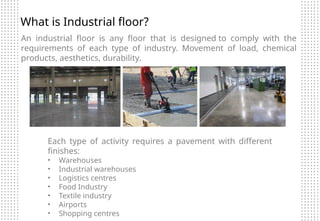
What is Industrial floor?
An industrial floor is any floor that is designed to comply with the
requirements of each type of industry. Movement of load, chemical
products, aesthetics, durability.
Each type of activity requires a pavement with different
finishes:
• Warehouses
• Industrial warehouses
• Logistics centres
• Food Industry
• Textile industry
• Airports
• Shopping centres
Industrial floorings plays a very vital role in productivity, safety &
housekeeping which has gradually with time changed from the
conventional cement flooring, tiles etc., to dust free monolithic
floors. There are varied range of floor coverings systems that are
suitable for different applications and recommend suitable floor
coverings systems to match the applications.
• Vacuum Dewatered Flooring /
Trimix
• PU Flooring
• PE Foam Flooring
• Epoxy Flooring
Types of Industrial floor
Vacuum Dewatered Flooring / Trimix
PU Flooring
PE Foam Flooring
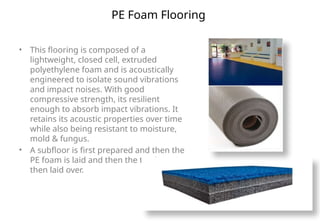
• This flooring is composed of a
lightweight, closed cell, extruded
polyethylene foam and is acoustically
engineered to isolate sound vibrations
and impact noises. With good
compressive strength, its resilient
enough to absorb impact vibrations. It
retains its acoustic properties over time
while also being resistant to moisture,
mold & fungus.
• A subfloor is first prepared and then the
PE foam is laid and then the top layer is
then laid over.
Methods of installation
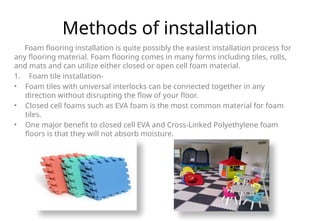
Foam flooring installation is quite possibly the easiest installation process for
any flooring material. Foam flooring comes in many forms including tiles, rolls,
and mats and can utilize either closed or open cell foam material.
1. Foam tile installation-
• Foam tiles with universal interlocks can be connected together in any
direction without disrupting the flow of your floor.
• Closed cell foams such as EVA foam is the most common material for foam
tiles.
• One major benefit to closed cell EVA and Cross-Linked Polyethylene foam
floors is that they will not absorb moisture.
2. Rolled foam installation-
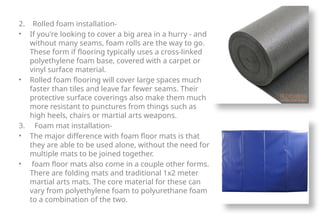
• If you're looking to cover a big area in a hurry - and
without many seams, foam rolls are the way to go.
These form if flooring typically uses a cross-linked
polyethylene foam base, covered with a carpet or
vinyl surface material.
• Rolled foam flooring will cover large spaces much
faster than tiles and leave far fewer seams. Their
protective surface coverings also make them much
more resistant to punctures from things such as
high heels, chairs or martial arts weapons.
3. Foam mat installation-
• The major difference with foam floor mats is that
they are able to be used alone, without the need for
multiple mats to be joined together.
• foam floor mats also come in a couple other forms.
There are folding mats and traditional 1x2 meter
martial arts mats. The core material for these can
vary from polyethylene foam to polyurethane foam
to a combination of the two.
Advantages
• Higher strength
• Higher bear and impact resistance
• Provide a moisture barrier
• Provide cushioned comfort under laminate and floating wood floors
• Eliminates minor subfloor imperfections
• Suitable for use with radiant heat flooring systems
• 100% recyclable, environmentally friendly
• Naturally resistant to mold and mildew
Epoxy Flooring
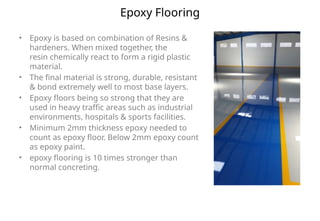
• Epoxy is based on combination of Resins &
hardeners. When mixed together, the
resin chemically react to form a rigid plastic
material.
• The final material is strong, durable, resistant
& bond extremely well to most base layers.
• Epoxy floors being so strong that they are
used in heavy traffic areas such as industrial
environments, hospitals & sports facilities.
• Minimum 2mm thickness epoxy needed to
count as epoxy floor. Below 2mm epoxy count
as epoxy paint.
• epoxy flooring is 10 times stronger than
normal concreting.
Application Procedure
• Surface Preparation : Removal of dust,
paint, plaster & additive residue. Check
the moisture of the floor & it should be
below 5%.
• The application of epoxy floor coating
includes the priming layer phase, the
body coat layer phase, and the top coat
layer phase.
• PRIMIMG LAYER PHASE:
• Cover the floor with thin layer of water,
then spread the primer just like paint
over the entire floor and allow it to settle
for several hours.
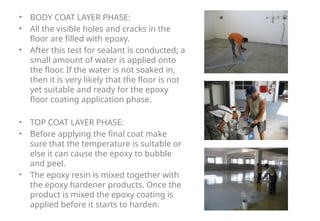
• BODY COAT LAYER PHASE:
• All the visible holes and cracks in the
floor are filled with epoxy.
• After this test for sealant is conducted; a
small amount of water is applied onto
the floor. If the water is not soaked in,
then it is very likely that the floor is not
yet suitable and ready for the epoxy
floor coating application phase.
• TOP COAT LAYER PHASE:
• Before applying the final coat make
sure that the temperature is suitable or
else it can cause the epoxy to bubble
and peel.
• The epoxy resin is mixed together with
the epoxy hardener products. Once the
product is mixed the epoxy coating is
applied before it starts to harden.
Advantages
• Prevents wear & tear on existing
concrete floor surface.
• Creates a shiny high-gloss surface that
can significantly increase the
brightness of interior areas.
• Quick & easy to install, requiring no
layout, cutting additional adhesives or
special tools or equipment.
• Offers a hard durable wearing surface
able to withstand heavy & continuous
traffic & abrasion.
• Creates a seamless surface.
• Durable & easy to clean.
• Provides a chemically resistant surface.
• Requires little or no major maintenance.
• Can be applied in different colors and
patterns to create visible driveways or
identify walkable areas.
Disadvantages
• Wet epoxy has solid
toxic fumes which can
cause side effects.
• It takes several days
for an epoxy
installation to cure
completely.
• epoxy flooring
creates a smooth
surface and can be
slippery especially
when wet.
Manufacturer of Industrial flooring in India
BECOSON
FLOWCRETE
NATROYAL ULTRA

industrial building flooring abts- 1 .pptx

  • 1.
    INDUSTRIAL FLOORING AND MATERIALS A.B.T.S.1, DIV-A Dhokle Pooja Gaikwad Akshay Gaikwad Vrutik Gunjal Nikita Handore Sakshi
  • 2.
    What is Industrialfloor? An industrial floor is any floor that is designed to comply with the requirements of each type of industry. Movement of load, chemical products, aesthetics, durability. Each type of activity requires a pavement with different finishes: • Warehouses • Industrial warehouses • Logistics centres • Food Industry • Textile industry • Airports • Shopping centres
  • 3.
    Industrial floorings playsa very vital role in productivity, safety & housekeeping which has gradually with time changed from the conventional cement flooring, tiles etc., to dust free monolithic floors. There are varied range of floor coverings systems that are suitable for different applications and recommend suitable floor coverings systems to match the applications. • Vacuum Dewatered Flooring / Trimix • PU Flooring • PE Foam Flooring • Epoxy Flooring Types of Industrial floor
  • 4.
  • 6.
  • 8.
    PE Foam Flooring •This flooring is composed of a lightweight, closed cell, extruded polyethylene foam and is acoustically engineered to isolate sound vibrations and impact noises. With good compressive strength, its resilient enough to absorb impact vibrations. It retains its acoustic properties over time while also being resistant to moisture, mold & fungus. • A subfloor is first prepared and then the PE foam is laid and then the top layer is then laid over.
  • 9.
    Methods of installation Foamflooring installation is quite possibly the easiest installation process for any flooring material. Foam flooring comes in many forms including tiles, rolls, and mats and can utilize either closed or open cell foam material. 1. Foam tile installation- • Foam tiles with universal interlocks can be connected together in any direction without disrupting the flow of your floor. • Closed cell foams such as EVA foam is the most common material for foam tiles. • One major benefit to closed cell EVA and Cross-Linked Polyethylene foam floors is that they will not absorb moisture.
  • 10.
    2. Rolled foaminstallation- • If you're looking to cover a big area in a hurry - and without many seams, foam rolls are the way to go. These form if flooring typically uses a cross-linked polyethylene foam base, covered with a carpet or vinyl surface material. • Rolled foam flooring will cover large spaces much faster than tiles and leave far fewer seams. Their protective surface coverings also make them much more resistant to punctures from things such as high heels, chairs or martial arts weapons. 3. Foam mat installation- • The major difference with foam floor mats is that they are able to be used alone, without the need for multiple mats to be joined together. • foam floor mats also come in a couple other forms. There are folding mats and traditional 1x2 meter martial arts mats. The core material for these can vary from polyethylene foam to polyurethane foam to a combination of the two.
  • 11.
    Advantages • Higher strength •Higher bear and impact resistance • Provide a moisture barrier • Provide cushioned comfort under laminate and floating wood floors • Eliminates minor subfloor imperfections • Suitable for use with radiant heat flooring systems • 100% recyclable, environmentally friendly • Naturally resistant to mold and mildew
  • 12.
    Epoxy Flooring • Epoxyis based on combination of Resins & hardeners. When mixed together, the resin chemically react to form a rigid plastic material. • The final material is strong, durable, resistant & bond extremely well to most base layers. • Epoxy floors being so strong that they are used in heavy traffic areas such as industrial environments, hospitals & sports facilities. • Minimum 2mm thickness epoxy needed to count as epoxy floor. Below 2mm epoxy count as epoxy paint. • epoxy flooring is 10 times stronger than normal concreting.
  • 13.
    Application Procedure • SurfacePreparation : Removal of dust, paint, plaster & additive residue. Check the moisture of the floor & it should be below 5%. • The application of epoxy floor coating includes the priming layer phase, the body coat layer phase, and the top coat layer phase. • PRIMIMG LAYER PHASE: • Cover the floor with thin layer of water, then spread the primer just like paint over the entire floor and allow it to settle for several hours.
  • 14.
    • BODY COATLAYER PHASE: • All the visible holes and cracks in the floor are filled with epoxy. • After this test for sealant is conducted; a small amount of water is applied onto the floor. If the water is not soaked in, then it is very likely that the floor is not yet suitable and ready for the epoxy floor coating application phase. • TOP COAT LAYER PHASE: • Before applying the final coat make sure that the temperature is suitable or else it can cause the epoxy to bubble and peel. • The epoxy resin is mixed together with the epoxy hardener products. Once the product is mixed the epoxy coating is applied before it starts to harden.
  • 15.
    Advantages • Prevents wear& tear on existing concrete floor surface. • Creates a shiny high-gloss surface that can significantly increase the brightness of interior areas. • Quick & easy to install, requiring no layout, cutting additional adhesives or special tools or equipment. • Offers a hard durable wearing surface able to withstand heavy & continuous traffic & abrasion. • Creates a seamless surface. • Durable & easy to clean. • Provides a chemically resistant surface. • Requires little or no major maintenance. • Can be applied in different colors and patterns to create visible driveways or identify walkable areas. Disadvantages • Wet epoxy has solid toxic fumes which can cause side effects. • It takes several days for an epoxy installation to cure completely. • epoxy flooring creates a smooth surface and can be slippery especially when wet.
  • 16.
    Manufacturer of Industrialflooring in India BECOSON FLOWCRETE NATROYAL ULTRA