



ACKNOWLEDGEMENT
It would be prudent to commence this report with an expression of gratitude towards all those
who have played an indispensable role in the accomplishment of this project by providing their
valuable guidance. I would like to take this opportunity to acknowledge and thank Cargill India
Pvt. Ltd. for providing me with this highly coveted opportunity to associate my Summer
Internship Project with an organization of worldwide repute.

I extend my most sincere thanks to Mr. Pritish Gupta, Zonal Marketing Manager and Mr. Rajat
Sharma, Area Sales Manager for their help and guidance in various capacities which have been
extremely proficient in getting the best out of me by sharpening my rough edges from time to
time.

I am deeply indebted to my faculty guide whose help, stimulating suggestions and
encouragement helped me in all time of research.

I am also thankful to all my team members for their stimulating support and co-operation.

My special thanks to my parents without whom it would have not been possible and for
everything of what I am today.
Table of Contents


Executive Summary ...................................................................................................................... 3
Over view of FMCG ..................................................................................................................... 4
Swot Analysis of FMCG Sector .................................................................................................. 6
Top Players in FMCG ................................................................................................................. 7
Cargill In India............................................................................................................................ 12
Product and Services offered by Cargill ................................................................................... 21
Edible Oil Consumption ............................................................................................................. 23
Ediblie Oil Players In UP ........................................................................................................... 24
Cargill Brands at a Glance ......................................................................................................... 29
Swot Analysis Of Cargill India Pvt Ltd .................................................................................... 35
Project Objective ........................................................................................................................ 36
Analysis of UP as a whole .......................................................................................................... 39
Analysis of Kanpur Outlets ........................................................................................................ 42
Analysis of Varanasi Outlets ...................................................................................................... 47
Analysis of Allahabad Outlets.................................................................................................... 53
Analysis of Lucknow Outlets ..................................................................................................... 60
Suggestion For Increasing Market share in FFS segment ...................................................... 64
Learnings ..................................................................................................................................... 68
Limitation ................................................................................................................................... 68
Conclusions .................................................................................................................................. 69
Annexures ........................................................................................................................................
References ........................................................................................................................................
Executive Summary
This Study gives you an overview of market potential of edible oil market in
Uttarakhand and U.P. West with emphasis on competitors, areas,types of
oil,consumption of oil in different cities in Uttarakhand and U.P.West by collecting
data from various segments like halwai,bakery,hotels,restaurants,caterers and
namkeenwala.. The study throws light on what is Cargill market share and how can
it improve its market share in Fragmented Food Outlets in respective states.

Founded in 1865, Cargill is one of the largest international providers of food,
agriculture and risk management products. With more than $120 billion turnover
and operations spread across 67 countries, Cargill today employs more than 1,
60,000 people across the world and is trusted across for its commitment of
Cargillishing people

Cargill Refined Oils India imports, refines, sells and markets a wide range of
vegetable oils and fats to wholesale trade, industrial and household consumers
across India. We own and operate Cargill vegetable oil refining facilities – three
are located on east and west coast ports of India, the other is located in western
India. Refined Oils India markets a range of refined sunflower, soy, palm, olein
and ground nut oils, hydrogenated fats and bakery shortenings under Cargill
national brands, Nature Fresh, Gemini, Purita™, and other region-specific brands.

The Project given was to to assess the edible oil potential of Fragmented Food
Service industry in Uttarakhand and U.P.West. The main objective was to map
different Fragmented Food outlets and thus expand distribution network . The
work was done in stages which were

   1. Mapping of the Fragmented Food Service Outlets in Uttarakhand and
      U.P.West.
   2. Profiling of each micro segment of FFS.
   3. Arriving at a volume potential of different types of edible oils.
   4. Refined – Non Refined
                i. Sunflower, Soya, Palm oil, Vanaspati, Desi Ghee.
5. Utility of the project
   6. Devising Sales Strategies and Market Strategies for Fragmented Food
      Service channel in Uttarakhand and U.P.West.
   7. To know the usage pattern of edible oil amongst consumers in various cities
      .
   8. To know the awareness amongst consumers regarding types of Cargill food
      prod


Introduction

Over view of FMCG :

Fast moving consumer goods

It is alternatively called as CPG (Consumer packaged goods) industry primarily
deals with the production, distribution and marketing of consumer packaged goods.
The Fast Moving Consumer Goods (FMCG) are those consumables which are
normally consumed by the consumers at a regular interval. Some of the prime
activities of FMCG industry are selling, marketing, financing, purchasing, etc. The
industry also engaged in operations, supply chain, production and general
management.

Fast Moving Consumer Goods (FMCG), are products that are sold quickly at
relatively low
cost. Though the absolute profit made on FMCG products is relatively small, they
generally
sell in large quantities, so the cumulative profit on such products can be large.

Industry Background

FMCG is one of the most dynamic domains of the business world. A career in this
sector
encompasses a large number of job roles like market research, pricing and product
development, purchasing, advertising and brand awareness. FMCG is a sector
where
graduates can gain excellent rewards if they work hard. FMCG products are those
that move
off the shelves in retail outlets very quickly.
In the Fast Moving Consumer Goods (FMCG) sector, one needs to be fast in
translating the
ideas into new products. There is a requirement to create the products that people
trust, enjoy
and use in their daily lives. Advertising and marketing have a vital role to play in
this.

Sector Outlook

FMCG is the fourth largest sector in the Indian Economy with a total market size
of Rs.
60,000 crores. FMCG sector generates 5% of total factory employment in the
country and is
creating employment for three million people, especially in small towns and rural
India.
Offerings of FMCG

FMCG Sector (In 2010)

The FMCG sector in India is the fourth largest sector in the economy with a total
market size
in excess of US$ 13.1 billion. The volume of money circulated in the economy
against
FMCG products is very high, as the number of products the consumer use is very
high.
The Indian FMCG market has been divided for a long time between the organized
sector and
the unorganized sector. While the latter has been crowded by a large number of
local players,
competing on margins, the former has varied between a two-player-scenario to a
multi-player
one.
Unlike the U.S. market for fast moving consumer goods (FMCG), which is
dominated by a
handful of global players, India's Rs.460 billion FMCG market remains highly
fragmented
with roughly half the market going to unbranded, unpackaged home made
products. This
presents a tremendous opportunity for makers of branded products who can
convert
consumers to branded products.
However, successfully launching and growing market share around a branded
product in
India presents tremendous challenges. Take distribution as an example. India is
home to six
million retail outlets and super markets virtually do not exist. This makes logistics
particularly for new players extremely difficult. Other challenges of similar
magnitude exist
across the FMCG supply chain.

Increased competition in the FMCG industry

The recent rise of private-label goods has led to increased competition within the
FMCG
industry. A focus on bringing high volume products at lower prices to the market
has created
greater demands on all actors. Producers must differentiate their products and
quickly bring
them to market. Since products are consumed shortly after they are produced, it is
imperative
to keep production uptime high at all times. Any stop in production can cause
empty shelves
and lost market share.


       CRITICAL OPERATING RULES IN INDIAN FMCG SECTOR

    Heavy launch costs on new products launch on Advertisements, free
      samples and product promotion.
    Majority of the product classes require very low investment in fixed
      assets.
    Existence of contract manufacturing
    Marketing assumes a significant place in the brand building process.
    Providing good price points is the key to success.
Top Ten Players in FMCG Sector

                 NO.                                Companies
                  1.                          Hindustan Unilever Ltd.
                  2.                     ITC (Indian Tobacco Company)
                  3.                                Nestlé India
                  4.                            GCMMF (AMUL)
                  5.                               Dabur India
                  6.                            Asian Paints (India)
                  7.                              Cadbury India
                  8                            Britannia Industries
                                          Procter & Gamble Hygiene and
                  9.
                                                    Health Care
                 10.                             Marico Industries
Company                               Source: www. naukrihub.com


Scope of the Sector

The Indian FMCG sector with a market size of US$13.1 billion is the fourth largest
sector in the economy. A well-established distribution network, intense
competition between the organized and unorganized segments characterizes the
sector. FMCG Sector is expected to
grow by over 60% by 2010.
That will translate into an annual growth of 10% over a 5-year period. It has been
estimated
that FMCG sector will rise from around Rs 56,500 crores in 2005 to Rs 92,100
crores in
2010.
Market Opportunities

Vast Rural Market----Rural India accounts for more than 700 Million consumers,
or 70 percent of the Indian population and accounts for 50 per cent of the total
FMCG market.
The working rural population is approximately 400 Millions. An average citizen in
rural
India has less then half of the purchasing power as compare to his urban
counterpart. Still
there is an untapped market and most of the FMCG Companies are taking different
steps to
capture rural market share. The market for FMCG products in rural India is
estimated 52 per
cent and is projected to touch 60 per cent within a year. Eg. Hindustan Unilever
Ltd is the
largest player in the industry and has the widest market coverage.

The following factors make India a competitive player in FMCG sector

   1. Availability of raw materials

Because of the diverse agro-climatic conditions in India, there is a large raw
material base
suitable for food processing industries. India is the largest producer of livestock,
milk,
sugarcane, coconut, spices and cashew and is the second largest producer of rice,
wheat and
fruits &vegetables. India also produces caustic soda and soda ash, which are
required for the
production of soaps and detergents. The availability of these raw materials gives
India the
location advantage.
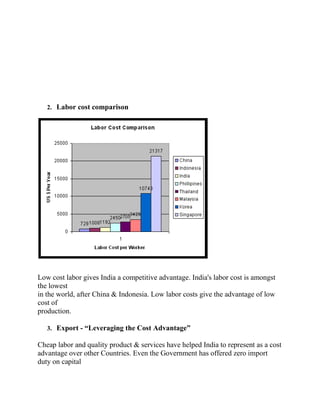
2. Labor cost comparison


Low cost labor gives India a competitive advantage. India's labor cost is amongst
the lowest
in the world, after China & Indonesia. Low labor costs give the advantage of low
cost of
production.

   3. Export - “Leveraging the Cost Advantage”

Cheap labor and quality product & services have helped India to represent as a cost
advantage over other Countries. Even the Government has offered zero import
duty on capital
goods and raw material for 100% export oriented units. Multi National Companies
outsource
its product requirements from its Indian company to have a cost advantage.
India is the largest producer of livestock, milk, sugarcane, coconut, spices and
cashew apart
from being the second largest producer of rice, wheat, fruits & vegetables. It adds a
cost
advantage as well as easily available raw materials.

Introduction To The Company

Cargill in India

Cargill maintains a number of businesses in India, with operations including the
handling and
processing of a wide range of products, including refined oils, grain and oilseeds,
sugar,
cotton and animal feed. In addition, Cargill develops flavour systems and operates
a value
investing business. Our presence in India has been growing since we began a joint
venture operation in 1987 and today it has an access over 1000 towns and 2,50,000
retail outlets. Its head office is located at cyber city phase 3 Guargoan ( Haryana).

Vision

“Our vision is to be the leading player in Indian edible oils market andcreating a
distinctive value for all stakeholders”.

Mission

“We will develop and deliver value added products, which exceed
statutoryrequirements to satisfy our internal and external customers, by creating
a culture of continuous improvement and will establish dominant position in
ours chosen market, by achieving competitive advantage in all functions and
building and retaining a high performing customer-focused team.”

Approach

“Our approach is to be trustworthy, creative and enterprising”.
Measures

“Our measures are engaged employees, satisfied customers, enriched
communities and profitable growth”.


Cargill's Guiding Principles

It is not practical to set out detailed guidelines to govern every situation that might
arise in the conduct of our varied and complex global business. Instead, below are
the
seven basic Guiding Principles that form the framework in which to examine any
problem arising in any country.
Cargill will comply with the laws of all countries to which it is subject.
Cargill will not knowingly assist any third party to violate any law of any country,
by
creating false documents or by any other means.
Cargill will not pay or receive bribes or participate in any other unethical,
fraudulent,
or corrupt practice. Cargill will always honor all business obligations that it
undertakes with absolute integrity. Cargill will keep its business records in a
manner that accurately reflects the true nature of its business transactions. Cargill
managers and supervisors will be responsible that employees, consultants and
contract workers under their supervision are familiar with applicable laws and
company policies and comply with them. Further, they will be responsible for
preventing, detecting, and reporting any violations of law of Cargill policies.
Cargill employees will not become involved in situations that create a conflict of
interest between the company and the employee. Every year, all Cargill employees
sign an agreement to live these principles.

Cargill milestones in India

1987: Cargill Seeds - a joint venture operation - commenced in India.
1994: Cargill starts its fertilizer/crop nutrients operations in India.
1997: Cargill launches its primary sugar and edible oils trading business in India.
1998: Commences grain and oil seeds business in India.
2001: Launches food business under Cargill Foods – launch of brand ―Nature
Fresh‖.
2003: Cargill acquires the Food Flavors business from Duckworth Group UK, and
Duckworth Flavors India becomes part of Cargill India.
      Cargill sets up green field edible oil refineries at Kandla and Paradip.
      Cargill launches one stop agri-shops – Saathi Krishi Samadhaan Kendras.
2004: Cargill diversifies its fertilizer business into a joint venture with IMC global.
Cargill
       India's DAP business renamed as Mosaic India.
2005: Cargill acquires Parakh Foods with brand "Gemini" and sets up a new
Business
      Unit called Cargill Refined Oils India. This is first business unit with
headquarters in
      India.
      Cargill launches Saanjhi Unnati Program in Rajasthan for development of
malt barley
      Miller. In active collaboration with the Government of Rajasthan and SAB
2006: Cargill starts its sugar off shoring business to support the execution activities
of
      Cargill Netherlands.
      Cargill sets up CarVal India Pvt. Ltd.
      Cargill enters into a joint venture in a project for setting up a green field
sugar
      refinery in South India.
      Cargill entered into tolling arrangements with local Soybean crushers in
      Maharashtra, Rajasthan and Madhya Pradesh
      Cargill enters into a joint venture and subsequently owns and leads a shrimp
      feed manufacturing business in Rajahmundry in Andhra Pradesh.
2007: Cargill launches cotton trading business in India.
2008: An independently managed subsidiary of Cargill, Black River Advisor India
Pvt. Ltd.,
      begins operations in India.
2010: Cargill acquires leading Vanaspati brand RATH from Agro Tech Foods Ltd.
2011: Cargill bought Indian Sunflower oil brand Sweekar.
      Celebrity chef Sanjeev Kapoor becomes brand ambassador for Cargill

Financial highlights
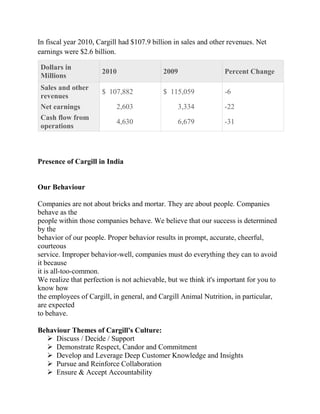
In fiscal year 2010, Cargill had $107.9 billion in sales and other revenues. Net
earnings were $2.6 billion.

 Dollars in
                      2010                  2009                 Percent Change
 Millions
 Sales and other
                      $ 107,882             $ 115,059            -6
 revenues
 Net earnings              2,603                 3,334           -22
 Cash flow from
                           4,630                 6,679           -31
 operations


Presence of Cargill in India


Our Behaviour

Companies are not about bricks and mortar. They are about people. Companies
behave as the
people within those companies behave. We believe that our success is determined
by the
behavior of our people. Proper behavior results in prompt, accurate, cheerful,
courteous
service. Improper behavior-well, companies must do everything they can to avoid
it because
it is all-too-common.
We realize that perfection is not achievable, but we think it's important for you to
know how
the employees of Cargill, in general, and Cargill Animal Nutrition, in particular,
are expected
to behave.

Behaviour Themes of Cargill's Culture:
   Discuss / Decide / Support
   Demonstrate Respect, Candor and Commitment
   Develop and Leverage Deep Customer Knowledge and Insights
   Pursue and Reinforce Collaboration
   Ensure & Accept Accountability
 Challenge / Innovate / Change

Culture
Whether it is a thank you note or a formal award programme, we appreciate how
recognition shows peers, direct reports, and managers how they fit into our mission
and why their contributions are important. Cargill India employees can participate
in a range of formal and informal recognition programmes as well as interact with
colleagues and leaders across our many businesses, nationally and internationally.
The culture and environment at Cargill is one where employees are motivated and
confident enough to try new things out. They have opportunities to explore new
ideas and are supported by the management in implementation. As a result,
company is in forefront of delivering innovative products to the Indian consumers
and implementing innovative and cost effective processes Simplicity,
Accountability and Collaborate are the core values that run across the organization
that bring people together in achieving our business goals and deliver superior
value to all our customers.
We follow a clear, open and transparent communication that ensures eliminating
ambiguity and drive simplicity. We live up to our commitments. We agree on
goals, objectives and strategies. We drive for flawless execution. We don't offer
excuses; we offer solutions and this is the mantra that builds accountability across
the organization.We trust and respects each other. We realize that we are much
more valuable together than we are apart.
Everybody has something of value to contribute, and we collaborate and win as a
team. We provide an environment where one person can make a difference.
Our employees work in an environment where they have freedom to express,
innovate and create breakthrough solutions. Our employees are empowered,
energetic and enthusiastic to make a difference with an underlying and all
encompassing passion in what they do. Our people use good judgment and are
decisive. They act with speed and always ensure flawless execution.


Learning and development opportunities

At Cargill we are committed to attracting, retaining and training high performing
people who embrace the company’s vision and values. The means to achieve this is
by maximizing training and development to ensure that employees have the
competencies required to accomplish their business objectives as well as develop
their career in the company.
Training opportunities include on-the-job learning, participating in company
programs and courses, and attending external programs based on nomination by
managers and/or peers.
Employees also participate in performance management programs to create a road
map for their individual success at Cargill and alignment with organizational goals.

Internal mobility

We seek to offer employees career opportunities within Cargill India and promote
an open environment where employees can acquire new skills and learning. For
employees who meet the criteria and are willing to accept roles with higher
responsibilities, we provide avenues for growth & movement across Cargill
businesses and geographies.

Equal Employment Opportunity (EEO)

Cargill maintains a policy of non-discrimination towards all employees and
applicants for employment. All aspects of employment with Cargill are governed
by merit, competence, suitability and qualifications, and will not in any manner be
influenced by gender, age, race, colour, religion, national origin or disability.

Corporate Responsibility

When William Wallace Cargill founded our company in 1865, he deliberately set
out to ensure that we earned and maintained a reputation for integrity, which he
saw as a key differentiator in those times. Corporate responsibility is part of
everything we do. It is a company-wide commitment to apply our global
knowledge and experience to help meet complex economic, environmental and
social challenges wherever we do business. It is a process of continually improving
our standards, our actions and our processes. Corporate responsibility extends not
only to our own operations but to our wider
communities and is based on four commitments:
We will conduct our business with high levels of integrity, accountability and
responsibility.
We will develop ways of reducing our environmental impact and help conserve
natural resources.
We will treat people with dignity and respect.
 e will invest in and engage with communities where we live and work.
  W
We recognize our continued success depends on the growth and health of our
communities and partners, as well as the vitality and conservation of our natural
resources. We are working with a diverse group of global, national and local
organizations to support responsible economic development, help protect the
environment and improve communities.


Corporate responsibility in India and around the world

We strive to be a good citizen in the areas where we are privileged to conduct
business. In addition to the benefit of secure employment, we find various ways to
support local communities. Our Cargill Cares programs bring together our
employees to serve communities in partnership with external organizations

Products & Services:
Cargill has activities in the following areas in India:
•     Animal Nutrition
•     Coal
•     Cotton
•     Ferrous
•     Flavor Systems
•     Grain & Oilseeds
•     Refined Oils
•     Sugar & Sugar Support Centre
•     Trade & Structured Finance

Refined oil brands

Cargill Refined Oils India

Cargill Refined Oils India imports, refines, sells and markets a wide range of
vegetable oils
and fats to wholesale trade, industrial and household consumers across India. We
own and
operate four vegetable oil refining facilities – three are located on east and west
coast ports of
India, the other is located in western India. Refined Oils India markets a range of
refined
sunflower, soy, palm, olein and ground nut oils, hydrogenated fats and bakery
shortenings
under our national brands, Nature Fresh™, Gemini™, Purita™, and other region-
specific
brands.

Major Refining Capabilities

Our refineries are unique in technology and refining capabilities and adhere to
stringent
specifications for maintenance of product quality, oil stability and food safety. The
qualities
found within our operations are unparalleled in India:

    Best and latest refining technology, which has been tested and improved
       across
       various refinery set-ups within the global Cargill network?
    A team trained by international experts and on international platforms run
       these
       refining capabilities and is fully equipped to produce the best product in the
country.
    Standards of quality have been set keeping the international and Indian
       requirements
        in mind. These standards incorporate the best of both worlds and meet the
highest
       levels of quality.
    Specifications that not just ensure superior quality but also high stability
       without
       addition of preservative chemicals. No oil that does not meet these
specifications is
       ever packed or shipped.
    Hands free treatment with no direct human touch on the product itself due to
       fully
       automated refining technology. This has led to a very clean and hygienic
environment
       and a b      etter and safer product.

Cooking oils in India

An oilseed in India account for around 5.0 % of the Gross National Product (GNP)
and 14%
of the country’s area is under cultivation of crops. Castor, Groundnut, Linseed,
Niger,
Rapeseed, Mustard, Sunflower etc. are some of the major oilseeds grown. India is
one of the
largest producers of oilseeds in the world which accounts for 9.3% of world
oilseeds
production. This sector occupies an important position in the agricultural economy
having
the world’s fourth largest edible oil economy and accounting for the estimated
production of
30.21 million tones of nine cultivated oilseeds during the year 2009-10. India
accounted for
about 6.4% of worlds oil meal export. Yet, about 43% of edible oil available in
India is
imported.
Source- Production of oilseeds: Ministry of Agriculture.


Types of oils commonly used in India

India is fortunate in having wide range of oilseeds crops grown in its different agro
climatic zones. Groundnut, mustard/ rapeseed, sesame, safflower, linseed,
nigerseed/ castor are the major traditionally cultivated oilseeds. Soyabean and
sunflower have also assumed importance in recent years. Coconut is most
important amongst the plantation crops. Efforts are being made to grow oil palm in
Andhra Pradesh, Karnataka, Tamil Nadu, in addition to Kerala and Andaman &
Nicobar Islands. In addition, oilseeds of tree and forest origin, which grow mostly
in tribal inhabited areas, are also a significant source of oils.


Consumption pattern of Edible oils in India

Edible Oils and Fats is a 15mn tonnes industry in India annually (worth Rs.75,000
crore). 90% of the industry is comprised of cooking oil and 10% is vanaspati (fat).
The difference between oil and fat is that oil is liquid at room temperature and fat
is solid. The total industry is growing at 5-10% p.a. but vanaspati segment is
marginally degrowing. In cooking oils, the growth is coming from branded oils
(packaged not loose). This sub-segment is growing at 11-15% p.a.
India is a vast country and inhabitants of several of its regions have developed
specific preference for certain oils largely depending upon the oils available in the
region. People in the South and West prefer groundnut oil while those in the East
and North use mustard/ rapeseed oil. Likewise several pockets in the South have a
preference for coconut and sesame oil. Inhabitants of northern plain are basically
hard fat consumers and therefore, prefer vanaspati, a term used to denote a partially
hydrogenated edible oil mixture.
Vanaspati has an important role in our edible oil economy. Its production is about
1.2 million tones annually. It has around 10% share of the edible oil market. It has
the ability to absorb a heterogeneous variety of oils, which do not generally find
direct marketing opportunities because of consumer’s preference for traditional oils
such as groundnut oil. Mustard oil, sesame oil etc. For example, newer oils like
soyabean, sunflower, ricebran and cottonseed and oils from oilseeds of tree and
forest origin had found their way to the edible pool largely through vanaspati route.
The demand for edible oils in India has shown a steady growth at a CAGR of
4.43% over the period from 2001 to 2011. The growth has been driven by
improvement in per capita consumption, which in turn is attributable to rising
income levels and living standards. However, the current per capita consumption
levels of India (at 13.3 Kg/year for 2009-10) are lower than global averages (24
kg/year).The Indian edible oils market continues to be underpenetrated and given
the positive macro and demographic fundamentals it has a favourable demand
growth outlook over the medium-to-long term.
In terms of volumes, palm oil, soyabean oil and mustard oil are the three largest
consumed edible oils in India, with respective shares of 46%, 16% and 14% in
total oil consumption in 2010. Given the high price consciousness and varied taste
preferences of Indian consumers, ICRA expects these three oils to continue to
account for the bulk of edible oil consumption in the country.


Market share of edible oils in India

                                                               Percentage
Oil
Palm oil                                                       38
Peanut                                                         14
Sunflower                                                      8
Soyabean oil                                                 21
Rapeseed                                                     13
Cotton                                                       6


List of Edible Oil players in India

Fortune                  Adani Wilmar Limited.
NatureFresh,             Cargill India Pvt Ltd, USA
Gemini,Rath,Sweekar
Dalda                    Bunge India Pvt.Ltd.,USA
Saffola, Parachute       Marico Ltd, India
Sundrop                  Agro Tech Foods Ltd(ConAgra Foods)
RR Primo                 RR Oomerbhoy Pvt.Ltd.
Dhara                    Dhara Company Ltd, NDDB Campus, Anand
Panghat                  Mawana Sugars Ltd.
Tilsona                  Recon Oil Industries Private Ltd
Figaro                   Consumer Marketing (India) Pvt. Ltd
Shalimar's     Classic   Shalimar Agro Tech Pvt
Basmati
Palm                     Sarda Agro Oil Ltd.
Gold Active
Ruchi Gold               Ruchi Infrastucture Ltd
Mayur                    Mayur Ltd Kanpur
Bawarchi                 Bawarchi Kanpur
Jhoola, Payal            Jhunjhunwala , Varanasi


In edible oil The Adani-Wilmer owned Fortune brand was India’s number one
edible oil in 2006 according to A C Neilson Retail Audit 2006. Fortune, which is
present as a refined soyabean oil, sunflower oil, groundnut oil and mustard oil is
said to have a market share of 19% in the entire edible oil market.

Marico Industries have a market share of 11 % with brands like Saffola.


      Salient features of Indian Oil Sector
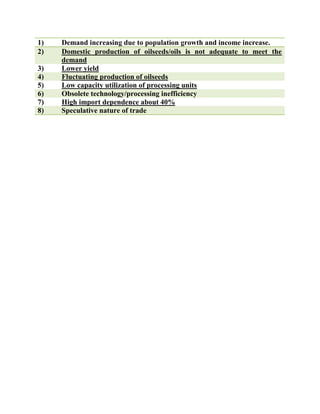
1)   Demand increasing due to population growth and income increase.
2)   Domestic production of oilseeds/oils is not adequate to meet the
     demand
3)   Lower yield
4)   Fluctuating production of oilseeds
5)   Low capacity utilization of processing units
6)   Obsolete technology/processing inefficiency
7)   High import dependence about 40%
8)   Speculative nature of trade
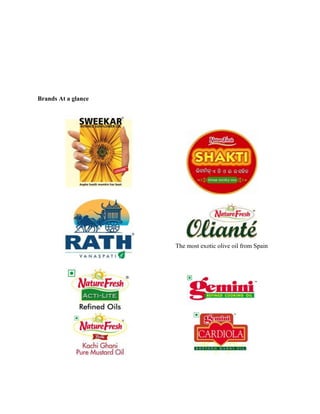
Brands At a glance


                     The most exotic olive oil from Spain
Products

Animal Nutrition

Cargill Animal Nutrition develops and markets a broad range of animal feeds and
customized animal productivity solutions to commercial producers in 28 countries
across North and South America, Europe and Asia. 180 plants worldwide support
the business unit. Animal Nutrition in India serves feed products in these
categories: dairy, beef, swine, poultry and aquaculture.

Cargill Animal Nutrition in India

Cargill Animal Nutrition started in India through a joint venture with a local
shrimp feed company located in Rajahmundry, Andhra Pradesh in February 2006.
This was followed by the successful opening of a dairy feed business in Rajpura,
Punjab in October of the same year. By March 2007, the Rajahmundry business
became a wholly owned subsidiary of Cargill India. Cargill Animal Nutrition -
Rajahmundry is a specialized manufacturing facility for aquaculture feeds. With
the presence of the local brands pre-acquisition, a faster go-to-market strategy was
deployed,helping to create awareness in the Cargill brand and its feed technology
with the shrimp farmers of South India including the states of Andhra Pradesh,
Orissa, West Bengal and Tamil Nadu. Through a series of well-executed road
shows, uptake of the products was rapid. Today, the facility is focusing on its next
feed offering in the south with Aqua Focus™, a line of fish feeds targeted for the
domestic production of Indian carps such as Rohu, Catla and Mrigal. Five month
trials of the product is proving to be a hit with local farmers as feed conversion
rates (FCR) of 1:5kg of traditional feed has dramatically been reduced to below
2kg.
Cargill Animal Nutrition - Rajpura started operations by offering dairy feed. After
several in-depth studies of the local dairy cattle scene conducted by Cargill Animal
Nutrition's dairy technology deployment managers from Italy, Korea and the US,
the feed was launched with much enthusiasm in Ludhiana, Punjab. The success in
this segment was brought about by the observation by farmers of higher milk
output only two weeks from converting their local
feed to Cargill Animal Nutrition.
Another breakthrough was the introduction of the Purina® line of poultry feeds.
Also very notable was the quick acceptance of the product by broiler farmers in
Haryana and Punjab, earning Rajpura the credit of being one of the fastest growing
broiler feed markets within Cargill Animal Nutrition.

Cotton

We launched our independent and dedicated cotton trading business in December
2007. We plan to strengthen our business with our long time suppliers and build
new market channels to source and supply India cotton.
As Cargill Cotton, we are one of the world’s largest and oldest cotton businesses
and very proud of our long relationship with India cotton.

We are proud to be on the ground in India where cotton trade started. We have a
network of value chain participants who help us source and supply the best cotton
into and out of the country. From making Indian Shankar 6, Bunny and MECH
preferred choices by mills around the world; to sourcing Extra Long Staple (ELS)
and African cotton for Indian mills we have a range of customer solutions.
As the world moves forward in liberalizing trade, and India emerges as a dominant
cotton country, Cargill Cotton believes we must make a longterm commitment to
the Indian market. We think our experience in total supply chain support can help
India become a world-class supplier. Our innovations in finance, logistics, risk
management and quality control can
improve profitability for both our cotton suppliers and our textile mill customers.
Cargill Cotton has had roots in India since 1851, when the Ralli Brothers was
incorporated with offices in Calcutta and Bombay. Cargill Cotton came into
existence combining the strengths of the two organizations - Hohenberg (in North,
Central and South America) and Ralli (in Africa and the Indian sub-continent).
Cargill became recognized as one of the most
mature, respected, and experienced cotton merchants in the world of cotton.
In 2002, after over 20 years of operating under both the Hohenberg and Ralli
names, the name of the entire cotton operation was changed to Cargill Cotton. We
are very proud of the success and growth that we have shared with our suppliers
and buyers over the last 150 years. We are equally pleased to be able to look back
at our history and see that the company's tradition has always been one of absolute
integrity. In today's diverse and multi-cultural
world we know that our unparalleled reputation is our most valuable asset.

Ferrous

Cargill participates actively in the import, export and distribution of ferrous
products and raw materials, covering Asia, the Middle East, Europe, North and
South America. We export from a broad spectrum of Indian mills and mines—
buying the full range of products from more than 40 customers from iron ore to
finished steel. Imports cover finished steel as well as semifinished steel for meeting
the requirements of users. We provide our customers with a wide range of value-
added services including port plots and local distribution, logistics and
transportation capabilities, pre-financing, long-term agreements and other logistics
and risk
management tools.

Flavour system

We bring a customized and consumer-tested approach to creating advanced flavors
and flavor systems for beverage, dairy, ice cream, confectionery, bakery, food
service, and pharmaceutical markets. Our India Flavor Systems business has been
operating since 1991. Our business specializes in liquid flavor, emulsions, spray
dried flavors and dry mix powders.
Our flavor systems are designed for a broad range of food and related products:
bakery and biscuits, beverages, confectionery, dairy and liquor.

Grain & Oilseeds

Our Grain & Oilseed business offers unique solutions around risk management,
supply chain, logistics and inventory management to its customers in food in India.
We are amongst the largest suppliers of domestic and import food grains to the
private sector and government of India. For example, we provide identity
preserved food grains to major food companies
and flour millers in the country.
We trade and process of a variety of oil seeds like soybean and rapeseed and are
one of the largest merchant exporters of oil meal out of the country.
The business connects the Indian farmer with markets through a network of Saathi
centers that provide farmers with competitive prices and access to reliable grain
buyers.
Headquartered in Gurgaon, Grain & Oilseeds has operations in more than 10 states
where we manage several facilities that serve markets and customers in those
regions:
· More than 50 grain and oilseed origination and storage locations
· Multiple soybean processing facilities spread across the country
· Four regional merchandising offices
· 12 origination offices

Ocean Transportation

Cargill Ocean Transportation has developed over its 50-year history a deep
expertise in chartering, trading, logistics, operations, and risk management.We
offer our customers a number of ocean freight solutions across all dry market
segments and tankers. Our focus is on safety, high quality, and risk management.
Our aim is to be recognized as the most innovative and customer-oriented partner
in the market.


Sugar and Sugar Support Centre

Based in Gurgaon, Cargill sugar India is involved in the origination, transporting,
storage and exporting of raw sugar. Our team has built up a base of several key
suppliers and customers spread across the key producing states of Uttar Pradesh,
Maharashtra, Tamil Nadu, Karnataka and Andhra Pradesh. In addition, we have
strong relationships with customers in
Srilanka, Pakistan and Bangladesh.
Cargill started its Sugar Support Centre as an experiment to support the execution
and accounting activities of Cargill BV Netherlands in 2005.Today, the group is
highly successful and a very integral part of the sugar business worldwide. Within
this group sugar is procured from all originating and surplus countries like Brazil,
Thailand, Central America, and Europe and sent to other destinations such as
Mediterranean countries, West Africa, and
the Far and Middle East.

Trade & Structured Finance

Cargill Trade & Structured Finance is a financial management arm of Cargill that
supports the group on their trade and structured financial solutions requirement.
The group also extends these services to other small, medium and large corporates
in India, sharing their expertise and providing customised solutions for their
working capital and balance sheet
requirements. The Cargill Trade & Structured Finance group is headquartered in
Minneapolis with a team of financial experts across the globe in developed and
developing economies.
Cargill Trade & Structured Finance started India operations in 1996 and has
successfully created a niche quite comparable to a boutique investment bank
supporting their corporate clients in their working capital management and
supporting their exponential growth in India and abroad. For better service
deliverability and bringing in efficiency in the solutions, Cargill started its Non
Banking Financial Company in 2007 under the name ofCargill Capital
and Financial Services India Pvt Ltd (CCFSIPL).
Cargill's structured finance team designs and structures a broad range of
customised financing solutions and arrangements both in local and foreign
currency. The team supports in several credit enhanced solutions, not limited to the
following:
· Working capital restructuring
· Cross border trade advisory services
· Short-term and Long-term trade-related financing
· Promoter financing
· Real estate financing
· Securitization
· Equipment finance

Cargill vs. Competitors

With growing quality consciousness and plummeting price differences between
packaged and non- packaged edible oils, the packaged edible oil sector will capture
almost 50% of the market share within few years. The packaged edible oil
consumption is only about 20% of the total 12.5 million tonne domestic
consumption.
Due to advancement of packaging technology, the price difference between
packaged and loosely sold oils has significantly come down.

Cargill controls more than 12% of the packaged edible oil market. As a result of
the increase in health consciousness, consumers even in the smaller towns are
gradually shifting to packaged edible oils from loosely sold oils.
The packaged edible oil industry is growing at 10 % annually and half of the
market would be controlled by packaged oil manufactures within few years.
Cargill brands vs. other brands

With the competition increasing after the arrival of retail companies, maintaining
quality while keeping the prices down would be a challenged for all the packaged
oil makers.
M Cargill India sell around 5,00,000 tons of edible oil a year , including soya ,
palm ,
sunflower , groundnut and mustard oils besides hydrogenated fats , to wholesale
trade , process food industry and retail customers. Its share is around 4% of the
million tones of total edible oil sold in the country in a year.
Other brands like Fortune of Adani wilmer Ltd. Having approximately 19% market
share in the entire edible oil market. Marico industries with a market share of 11%
with brands like Saffola are old players with well known brands in the edible oil
industry hence gives tough competition to Cargill refined oils.

Consumer Voice – A monthly magazine of consumer interest

A government funded voluntary organization that works towards consumer
education and
awareness, conducted a laboratory test on seven well-known brands of refined
sunflower oil.
After testing them on all possible parameters like colour, adulteration, rancidity
and fatty
acid profile, Naturefresh Acti-Lite and Gemini, brands from the house of Cargill,
were rated
as the best quality and healthiest refined sunflower oils in the country.For the first
time in India, refined sunflower oil brands have been tested by an independent
government funded organization for their fatty acid profile and other parameters
like colour, rancidity etc. This was done and published in November 2008 to
scientifically assess and pinpoint exactly how healthy each refined oil brand is.
By this research, NatureFresh and Gemini cooking oils have been proved to be the
healthiest
cooking oils in their respective categories.
NatureFresh Acti-Lite sunflower oil is extremely light oil that has high-unsaturated
fat content making it easier to break down. This lightness is powered by “Liteness
Integrated
Technology” (LITE), which is delivered by the technologically advanced state-of
the-art
plant ensuring that best attributes of the oil are preserved for `consumer’s health.
Gemini
refined oil offers freshness as a differentiator. It uses “Freshness Intact
Technology” (FIT)
which helps maintain the freshness of oil from packaging stage of consumption.


SWOT Analysis of Cargill Foods

Strengths:
         The quality of our various products is the biggest strength of the
           company. In terms of quality, every product has maintained its
           standard quality through which it excels in the market.
         Dedicated hard working& highly efficient team is the backbone to the
           company.
         Deeply rooted supply chain. We got effective supply chain to reach
           even small markets & to target even niches.

Weakness:
        Our whole range of products is not available across various stores
        Late execution of promises made under various schemes & benefiting
           programs
        Less awareness of our product quality & our unique selling point
           (USP) of 5 litre fat free in a year concept among masses.
Opportunity:
        Rising oil consumption of people as per gram consumption per person
           rises from 27 to 38 in developing countries like India.
        Majority of our huge population is consuming low quality oil.
        As resultant of rising disposable income people are becoming more
           health & quality conscious

Threats:
       Low priced or local oils are focusing small regional areas or niches
       Competitors are coming up with different categories of oil to capture
        wider segment of market.
OBJECTIVE OF STUDY

Primary Research Project :
To assess the edible oil potential of Fragmented Food Service industry in
Uttarakhand and U.P.West.

Secondary Research Project :
     To study the various competitors in various cities.
     To understand the consumption pattern of types of oils(refined and non
     refined) in different cities of Uttarakhand and U.P.West.


Research Methodology

A research design is the arrangement of condition for collection and analysis of
data in a manner that to, combine relevance to research purpose with economy in
procedure.

Project Objectives:
To Assess the edible oil potential of Fragmented Food Service industry in UP
(Lucknow , Kanpur, Allahabad and Varanasi).

Storming Exercise: -Mapping of the Fragmented Food Service Outlets in UP
(Lucknow , Kanpur, Allahabad and Varanasi).

      Profiling of each micro segment of FFS.
      Arriving at a volume potential of different types of edible oils.
      Refined – Non Refined
      Sunflower, Soya, Palm oil, Vanaspati, Desi Ghee.

Utility of the project

Devising Sales Strategies and Market Strategies for Fragmented Food Service
channel in UP.


Scope & Limitations Of The Study

It is a hard fact that each study suffer from some limitations. So is the case with
this study. One of the limitations of the study is, as the information is collected
from the Fragmented Food Outlets like Halwai, Restaurant, Caterer, Hotel, Bakery,
the monthly Consumption figure given by them is based entirely on their own
judgment. So a few of them might have given the wrong figures related to their
monthly sales. Another limitation was that some of the retailers were busy and
could not give appropriate information. And also very few retailers did not want to
share any information.

Another limitation of the study was the customers who were personally
interviewed did not want to share the actual data asfew of them were giving fake
data

Research Design:-

is conceptual structure within which research is conducted. It constitutes the blue
print of collection, measurement and analysis of data .Research Design is needed
because it facilitates the smooth sailing of various research operations, thereby
making research as efficient as possible yielding maximum information with
minimum time, effort and money. Research Design stands for advance planning of
methods to be used for collecting relevant data and techniques to be used in the
analysis .The design helps researcher to organize his ideas whereby it will be
possible for him to look for flaws and
inadequacies.

Method of data collection: - for collecting data and the accuracy of facts,
complete enumeration was used. for collecting the data our team had went to each
Fragmented Food Outlets in all the four cities .

Data Analysis: - For the data analysis to know the market share of various
Soyabean and Vanaspati brands computer programme called Microsoft Excel was
used, with the help of Microsoft Excel, I came to to know the quantity and
percentage share of each brands . On the basis of the quantity sold per month, I
could collect the market share of each brand.

Sample size: - sample size is 1800 Food Service Outlets.
Sources of primary and secondary data:
The major aim of the project was to analyze the competition in occupying
market shares of various soyabean oil brands. Therefore I had to get
considerable information about the competing brands. For this I had to go
through a lot of secondary data.
A lot of issues of Business Today ,Economic Times were consulted.

The reasons behind selecting direct survey were as follows:-
   Provide large and faster coverage.
   Low cost involved.
   One to one interaction with the customer
   Data easier to compile and categorize.
   Analysis done on the basis of the listed question

Questionnaire

This method of data collection is quite popular particularly in Case of big enquires.
It is
being adapted by private and public organizations and even by Government. In this
method a
questionnaire is given to the person concerned to answer the questions. A
questionnaire
consists of a number of questions printed in a definite order on a form or a set of
forms; the
respondents have to answer the questions on their own. To be successful the
questionnaire
should be comparatively short and simple.
Questions should proceed in logical sequence moving from easy to more difficult
questions.
Personal and intimate questions should be left to the end. Technical terms and
vague
expression capable of different interpretation should be avoided in a questionnaire.
Questions may be dichotomous (Yes or No answer) multiple choices or open
ended .In
making research carefully chosen questions and their forms working and sequence
is
important. By considering all the facts the Questionnaire was designed. This is a
type of
structured questionnaire.

The questionnaire method offers various advantages such as:-
    It is cheaper and faster method of primary data collection.
    Since all the questions are formulated in advance all the required
       information can be
obtained in an orderly and systematic manner
    It offers maximum control over the interviewing process.


  EDIBLE OIL CONSUMPTION IN WESTERN UTTARPRADESH AND
                      UTTRAKHAND


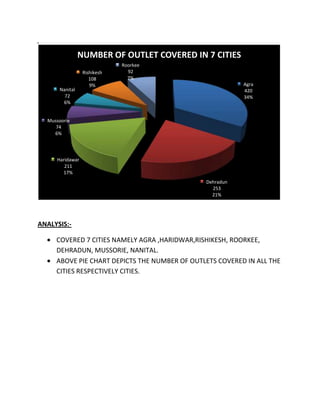
      Total Consumption of Edible oil in 7 cities of UP is 36985 Tins
      Total Number of Outlet covered is 1230
.

                  NUMBER OF OUTLET COVERED IN 7 CITIES
                               Roorkee
                   Rishikesh     92
                      108        7%
                      9%                                    Agra
        Nanital                                             420
          72                                                34%
         6%


    Mussoorie
       74
      6%


       Haridawar
          211
         17%
                                                 Dehradun
                                                   253
                                                   21%


ANALYSIS:-

       COVERED 7 CITIES NAMELY AGRA ,HARIDWAR,RISHIKESH, ROORKEE,
       DEHRADUN, MUSSORIE, NANITAL.
       ABOVE PIE CHART DEPICTS THE NUMBER OF OUTLETS COVERED IN ALL THE
       CITIES RESPECTIVELY CITIES.
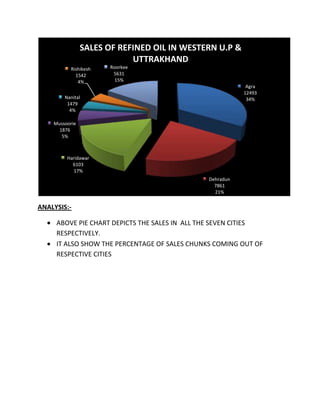
SALES OF REFINED OIL IN WESTERN U.P &
                            UTTRAKHAND
          Rishikesh   Roorkee
            1542       5631
             4%         15%
                                                           Agra
                                                          12493
        Nanital                                            34%
         1479
          4%

    Mussoorie
      1876
       5%


         Haridawar
           6103
           17%
                                               Dehradun
                                                 7861
                                                 21%


ANALYSIS:-

     ABOVE PIE CHART DEPICTS THE SALES IN ALL THE SEVEN CITIES
     RESPECTIVELY.
     IT ALSO SHOW THE PERCENTAGE OF SALES CHUNKS COMING OUT OF
     RESPECTIVE CITIES
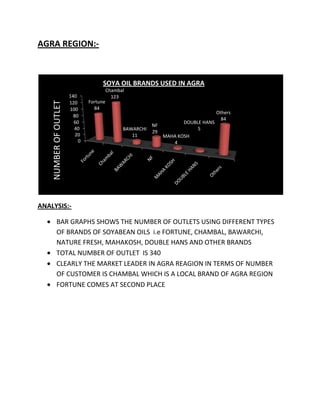
AGRA REGION:-


                                     SOYA OIL BRANDS USED IN AGRA
                                         Chambal
                       140                 123
                               Fortune
    NUMBER OF OUTLET


                       120
                       100       84
                                                                                    Others
                         80
                                                                                      84
                         60                                           DOUBLE HANS
                                                          NF
                         40                    BAWARCHI                    5
                                                          29
                          20                      11           MAHA KOSH
                           0                                      4


ANALYSIS:-

          BAR GRAPHS SHOWS THE NUMBER OF OUTLETS USING DIFFERENT TYPES
          OF BRANDS OF SOYABEAN OILS i.e FORTUNE, CHAMBAL, BAWARCHI,
          NATURE FRESH, MAHAKOSH, DOUBLE HANS AND OTHER BRANDS
          TOTAL NUMBER OF OUTLET IS 340
          CLEARLY THE MARKET LEADER IN AGRA REAGION IN TERMS OF NUMBER
          OF CUSTOMER IS CHAMBAL WHICH IS A LOCAL BRAND OF AGRA REGION
          FORTUNE COMES AT SECOND PLACE
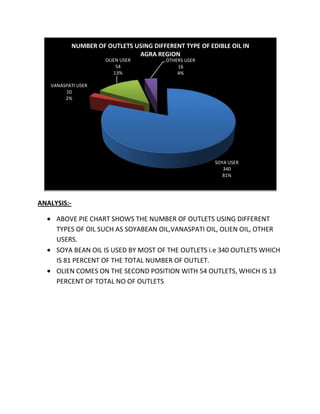
NUMBER OF OUTLETS USING DIFFERENT TYPE OF EDIBLE OIL IN
                                AGRA REGION
                       OLIEN USER         OTHERS USER
                           54                 16
                          13%                 4%

   VANASPATI USER
        10
        2%


                                                         SOYA USER
                                                            340
                                                            81%


ANALYSIS:-

     ABOVE PIE CHART SHOWS THE NUMBER OF OUTLETS USING DIFFERENT
     TYPES OF OIL SUCH AS SOYABEAN OIL,VANASPATI OIL, OLIEN OIL, OTHER
     USERS.
     SOYA BEAN OIL IS USED BY MOST OF THE OUTLETS i.e 340 OUTLETS WHICH
     IS 81 PERCENT OF THE TOTAL NUMBER OF OUTLET.
     OLIEN COMES ON THE SECOND POSITION WITH 54 OUTLETS, WHICH IS 13
     PERCENT OF TOTAL NO OF OUTLETS
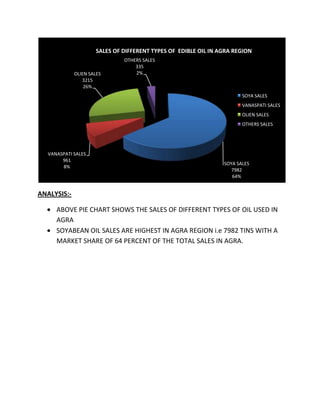
SALES OF DIFFERENT TYPES OF EDIBLE OIL IN AGRA REGION
                              OTHERS SALES
                                  335
             OLIEN SALES          2%
                3215
                 26%
                                                                       SOYA SALES
                                                                       VANASPATI SALES
                                                                       OLIEN SALES
                                                                       OTHERS SALES


   VANASPATI SALES
        961
                                                                SOYA SALES
        8%
                                                                   7982
                                                                   64%


ANALYSIS:-

      ABOVE PIE CHART SHOWS THE SALES OF DIFFERENT TYPES OF OIL USED IN
      AGRA
      SOYABEAN OIL SALES ARE HIGHEST IN AGRA REGION i.e 7982 TINS WITH A
      MARKET SHARE OF 64 PERCENT OF THE TOTAL SALES IN AGRA.
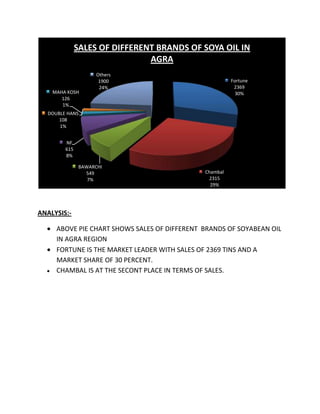
SALES OF DIFFERENT BRANDS OF SOYA OIL IN
                               AGRA
                     Others
                      1900                              Fortune
                      24%                                2369
    MAHA KOSH                                             30%
       126
       1%
  DOUBLE HANS
      108
      1%


        NF
        615
        8%

               BAWARCHI
                 549                          Chambal
                  7%                           2315
                                                29%


ANALYSIS:-

     ABOVE PIE CHART SHOWS SALES OF DIFFERENT BRANDS OF SOYABEAN OIL
     IN AGRA REGION
     FORTUNE IS THE MARKET LEADER WITH SALES OF 2369 TINS AND A
     MARKET SHARE OF 30 PERCENT.
     CHAMBAL IS AT THE SECONT PLACE IN TERMS OF SALES.
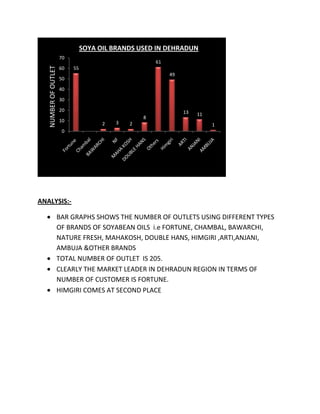
SOYA OIL BRANDS USED IN DEHRADUN
                      70
                                                      61
   NUMBER OF OUTLET

                      60   55
                                                           49
                      50

                      40

                      30

                      20                                        13   11
                                                  8
                      10                  3
                                      2       2                           1
                       0


ANALYSIS:-

                  BAR GRAPHS SHOWS THE NUMBER OF OUTLETS USING DIFFERENT TYPES
                  OF BRANDS OF SOYABEAN OILS i.e FORTUNE, CHAMBAL, BAWARCHI,
                  NATURE FRESH, MAHAKOSH, DOUBLE HANS, HIMGIRI ,ARTI,ANJANI,
                  AMBUJA &OTHER BRANDS
                  TOTAL NUMBER OF OUTLET IS 205.
                  CLEARLY THE MARKET LEADER IN DEHRADUN REGION IN TERMS OF
                  NUMBER OF CUSTOMER IS FORTUNE.
                  HIMGIRI COMES AT SECOND PLACE
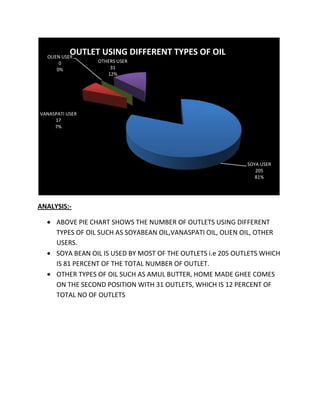
OUTLET USING DIFFERENT TYPES OF OIL
  OLIEN USER
       0          OTHERS USER
      0%              31
                     12%


VANASPATI USER
     17
     7%


                                                              SOYA USER
                                                                 205
                                                                 81%


ANALYSIS:-

      ABOVE PIE CHART SHOWS THE NUMBER OF OUTLETS USING DIFFERENT
      TYPES OF OIL SUCH AS SOYABEAN OIL,VANASPATI OIL, OLIEN OIL, OTHER
      USERS.
      SOYA BEAN OIL IS USED BY MOST OF THE OUTLETS i.e 205 OUTLETS WHICH
      IS 81 PERCENT OF THE TOTAL NUMBER OF OUTLET.
      OTHER TYPES OF OIL SUCH AS AMUL BUTTER, HOME MADE GHEE COMES
      ON THE SECOND POSITION WITH 31 OUTLETS, WHICH IS 12 PERCENT OF
      TOTAL NO OF OUTLETS
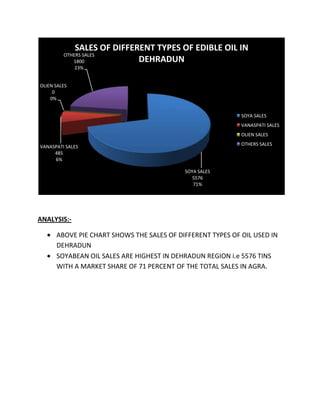
SALES OF DIFFERENT TYPES OF EDIBLE OIL IN
         OTHERS SALES
            1800             DEHRADUN
             23%


OLIEN SALES
     0
    0%


                                                            SOYA SALES
                                                            VANASPATI SALES
                                                            OLIEN SALES

VANASPATI SALES                                             OTHERS SALES
     485
     6%

                                           SOYA SALES
                                              5576
                                              71%


ANALYSIS:-

      ABOVE PIE CHART SHOWS THE SALES OF DIFFERENT TYPES OF OIL USED IN
      DEHRADUN
      SOYABEAN OIL SALES ARE HIGHEST IN DEHRADUN REGION i.e 5576 TINS
      WITH A MARKET SHARE OF 71 PERCENT OF THE TOTAL SALES IN AGRA.
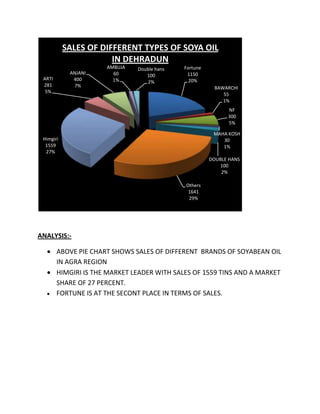
SALES OF DIFFERENT TYPES OF SOYA OIL
                       IN DEHRADUN
                      AMBUJA   Double hans   Fortune
            ANJANI      60        100         1150
 ARTI        400        1%                     20%
                                  2%
 281          7%                                        BAWARCHI
  5%
                                                           55
                                                           1%
                                                             NF
                                                             300
                                                             5%

                                                        MAHA KOSH
 Himgiri                                                   30
  1559                                                     1%
  27%
                                                       DOUBLE HANS
                                                           100
                                                           2%

                                             Others
                                              1641
                                              29%


ANALYSIS:-

        ABOVE PIE CHART SHOWS SALES OF DIFFERENT BRANDS OF SOYABEAN OIL
        IN AGRA REGION
        HIMGIRI IS THE MARKET LEADER WITH SALES OF 1559 TINS AND A MARKET
        SHARE OF 27 PERCENT.
        FORTUNE IS AT THE SECONT PLACE IN TERMS OF SALES.
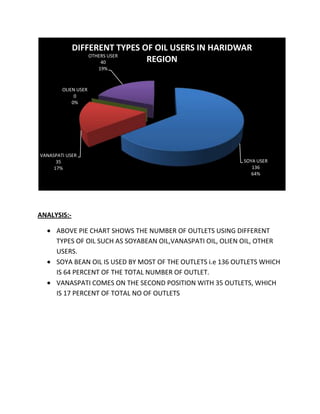
DIFFERENT TYPES OF OIL USERS IN HARIDWAR
                 OTHERS USER
                     40       REGION
                     19%


        OLIEN USER
             0
            0%


VANASPATI USER
      35                                                     SOYA USER
     17%                                                        136
                                                                64%


ANALYSIS:-

      ABOVE PIE CHART SHOWS THE NUMBER OF OUTLETS USING DIFFERENT
      TYPES OF OIL SUCH AS SOYABEAN OIL,VANASPATI OIL, OLIEN OIL, OTHER
      USERS.
      SOYA BEAN OIL IS USED BY MOST OF THE OUTLETS i.e 136 OUTLETS WHICH
      IS 64 PERCENT OF THE TOTAL NUMBER OF OUTLET.
      VANASPATI COMES ON THE SECOND POSITION WITH 35 OUTLETS, WHICH
      IS 17 PERCENT OF TOTAL NO OF OUTLETS
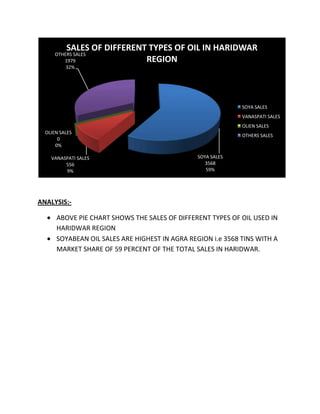
SALES OF DIFFERENT TYPES OF OIL IN HARIDWAR
      OTHERS SALES
         1979               REGION
          32%


                                                             SOYA SALES
                                                             VANASPATI SALES
                                                             OLIEN SALES
  OLIEN SALES
                                                             OTHERS SALES
       0
      0%

    VANASPATI SALES                             SOYA SALES
         556                                       3568
         9%                                        59%


ANALYSIS:-

      ABOVE PIE CHART SHOWS THE SALES OF DIFFERENT TYPES OF OIL USED IN
      HARIDWAR REGION
      SOYABEAN OIL SALES ARE HIGHEST IN AGRA REGION i.e 3568 TINS WITH A
      MARKET SHARE OF 59 PERCENT OF THE TOTAL SALES IN HARIDWAR.
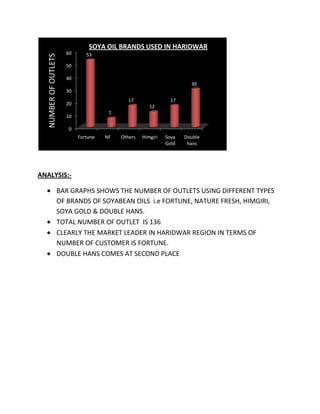
SOYA OIL BRANDS USED IN HARIDWAR
   NUMBER OF OUTLETS   60      53

                       50

                       40
                                                                       30
                       30
                                              17                17
                       20
                                                       12
                                       7
                       10

                        0
                            Fortune   NF   Others   Himgiri   Soya   Double
                                                              Gold    hans


ANALYSIS:-

                   BAR GRAPHS SHOWS THE NUMBER OF OUTLETS USING DIFFERENT TYPES
                   OF BRANDS OF SOYABEAN OILS i.e FORTUNE, NATURE FRESH, HIMGIRI,
                   SOYA GOLD & DOUBLE HANS.
                   TOTAL NUMBER OF OUTLET IS 136
                   CLEARLY THE MARKET LEADER IN HARIDWAR REGION IN TERMS OF
                   NUMBER OF CUSTOMER IS FORTUNE.
                   DOUBLE HANS COMES AT SECOND PLACE
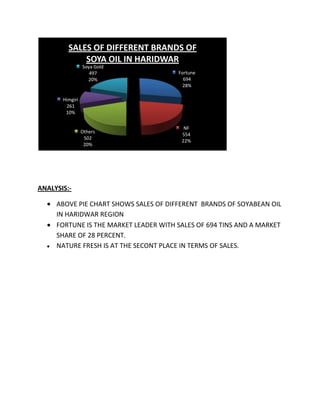
SALES OF DIFFERENT BRANDS OF
             SOYA OIL IN HARIDWAR
                 Soya Gold
                    497                Fortune
                   20%                   694
                                         28%

       Himgiri
        261
        10%


                                         NF
                 Others
                                        554
                  502
                                        22%
                  20%


ANALYSIS:-

     ABOVE PIE CHART SHOWS SALES OF DIFFERENT BRANDS OF SOYABEAN OIL
     IN HARIDWAR REGION
     FORTUNE IS THE MARKET LEADER WITH SALES OF 694 TINS AND A MARKET
     SHARE OF 28 PERCENT.
     NATURE FRESH IS AT THE SECONT PLACE IN TERMS OF SALES.
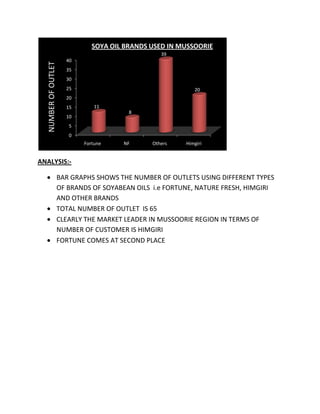
SOYA OIL BRANDS USED IN MUSSOORIE
                                                   39
                        40
   NUMBER OF OUTLET

                        35
                        30
                        25                                   20
                        20
                        15       11
                                          8
                        10
                         5
                         0
                             Fortune    NF      Others    Himgiri


ANALYSIS:-

                      BAR GRAPHS SHOWS THE NUMBER OF OUTLETS USING DIFFERENT TYPES
                      OF BRANDS OF SOYABEAN OILS i.e FORTUNE, NATURE FRESH, HIMGIRI
                      AND OTHER BRANDS
                      TOTAL NUMBER OF OUTLET IS 65
                      CLEARLY THE MARKET LEADER IN MUSSOORIE REGION IN TERMS OF
                      NUMBER OF CUSTOMER IS HIMGIRI
                      FORTUNE COMES AT SECOND PLACE
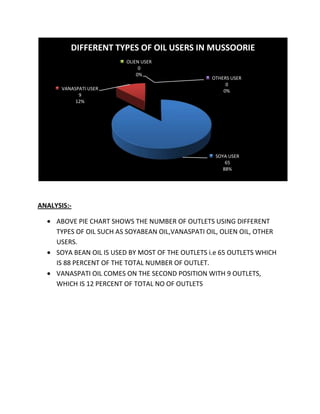
DIFFERENT TYPES OF OIL USERS IN MUSSOORIE
                         OLIEN USER
                              0
                             0%
                                                  OTHERS USER
                                                       0
       VANASPATI USER                                 0%
             9
            12%


                                                   SOYA USER
                                                       65
                                                      88%


ANALYSIS:-

     ABOVE PIE CHART SHOWS THE NUMBER OF OUTLETS USING DIFFERENT
     TYPES OF OIL SUCH AS SOYABEAN OIL,VANASPATI OIL, OLIEN OIL, OTHER
     USERS.
     SOYA BEAN OIL IS USED BY MOST OF THE OUTLETS i.e 65 OUTLETS WHICH
     IS 88 PERCENT OF THE TOTAL NUMBER OF OUTLET.
     VANASPATI OIL COMES ON THE SECOND POSITION WITH 9 OUTLETS,
     WHICH IS 12 PERCENT OF TOTAL NO OF OUTLETS
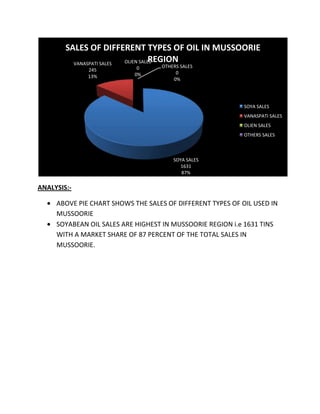
SALES OF DIFFERENT TYPES OF OIL IN MUSSOORIE
          VANASPATI SALES
                                    REGION
                          OLIEN SALES
                            0      OTHERS SALES
              245
                           0%           0
              13%
                                       0%


                                                            SOYA SALES
                                                            VANASPATI SALES
                                                            OLIEN SALES
                                                            OTHERS SALES


                                       SOYA SALES
                                          1631
                                          87%

ANALYSIS:-

     ABOVE PIE CHART SHOWS THE SALES OF DIFFERENT TYPES OF OIL USED IN
     MUSSOORIE
     SOYABEAN OIL SALES ARE HIGHEST IN MUSSOORIE REGION i.e 1631 TINS
     WITH A MARKET SHARE OF 87 PERCENT OF THE TOTAL SALES IN
     MUSSOORIE.
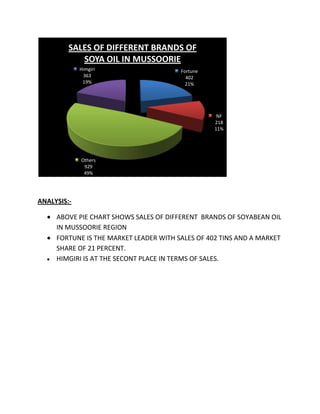
SALES OF DIFFERENT BRANDS OF
            SOYA OIL IN MUSSOORIE
             Himgiri                    Fortune
              363                         402
              19%                         21%


                                                   NF
                                                  218
                                                  11%


             Others
              929
              49%


ANALYSIS:-

     ABOVE PIE CHART SHOWS SALES OF DIFFERENT BRANDS OF SOYABEAN OIL
     IN MUSSOORIE REGION
     FORTUNE IS THE MARKET LEADER WITH SALES OF 402 TINS AND A MARKET
     SHARE OF 21 PERCENT.
     HIMGIRI IS AT THE SECONT PLACE IN TERMS OF SALES.
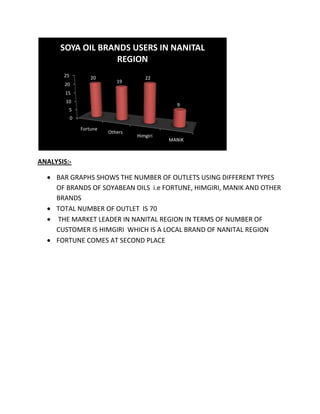
SOYA OIL BRANDS USERS IN NANITAL
                   REGION
       25           20                22
                             19
        20
        15
        10
                                               9
         5
            0

                Fortune
                          Others
                                   Himgiri
                                             MANIK


ANALYSIS:-

     BAR GRAPHS SHOWS THE NUMBER OF OUTLETS USING DIFFERENT TYPES
     OF BRANDS OF SOYABEAN OILS i.e FORTUNE, HIMGIRI, MANIK AND OTHER
     BRANDS
     TOTAL NUMBER OF OUTLET IS 70
     THE MARKET LEADER IN NANITAL REGION IN TERMS OF NUMBER OF
     CUSTOMER IS HIMGIRI WHICH IS A LOCAL BRAND OF NANITAL REGION
     FORTUNE COMES AT SECOND PLACE
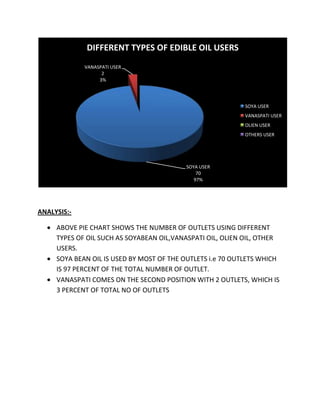
DIFFERENT TYPES OF EDIBLE OIL USERS
             VANASPATI USER
                   2
                  3%


                                                           SOYA USER
                                                           VANASPATI USER
                                                           OLIEN USER
                                                           OTHERS USER


                                          SOYA USER
                                              70
                                             97%


ANALYSIS:-

     ABOVE PIE CHART SHOWS THE NUMBER OF OUTLETS USING DIFFERENT
     TYPES OF OIL SUCH AS SOYABEAN OIL,VANASPATI OIL, OLIEN OIL, OTHER
     USERS.
     SOYA BEAN OIL IS USED BY MOST OF THE OUTLETS i.e 70 OUTLETS WHICH
     IS 97 PERCENT OF THE TOTAL NUMBER OF OUTLET.
     VANASPATI COMES ON THE SECOND POSITION WITH 2 OUTLETS, WHICH IS
     3 PERCENT OF TOTAL NO OF OUTLETS
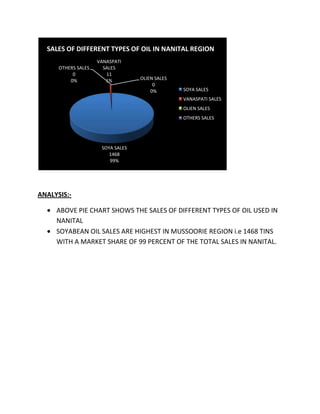
SALES OF DIFFERENT TYPES OF OIL IN NANITAL REGION
                     VANASPATI
      OTHERS SALES     SALES
           0            11
          0%            1%         OLIEN SALES
                                        0
                                       0%        SOYA SALES
                                                 VANASPATI SALES
                                                 OLIEN SALES
                                                 OTHERS SALES


                      SOYA SALES
                         1468
                         99%


ANALYSIS:-

     ABOVE PIE CHART SHOWS THE SALES OF DIFFERENT TYPES OF OIL USED IN
     NANITAL
     SOYABEAN OIL SALES ARE HIGHEST IN MUSSOORIE REGION i.e 1468 TINS
     WITH A MARKET SHARE OF 99 PERCENT OF THE TOTAL SALES IN NANITAL.
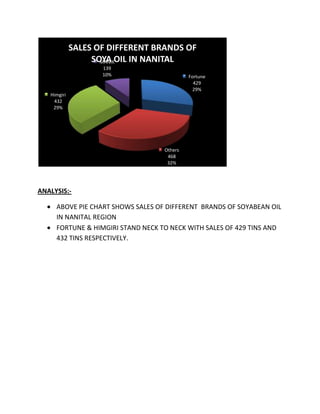
SALES OF DIFFERENT BRANDS OF
                  SOYA OIL IN NANITAL
                    MANIK
                    139
                    10%                     Fortune
                                              429
                                              29%
   Himgiri
    432
    29%


                                   Others
                                    468
                                    32%


ANALYSIS:-

     ABOVE PIE CHART SHOWS SALES OF DIFFERENT BRANDS OF SOYABEAN OIL
     IN NANITAL REGION
     FORTUNE & HIMGIRI STAND NECK TO NECK WITH SALES OF 429 TINS AND
     432 TINS RESPECTIVELY.
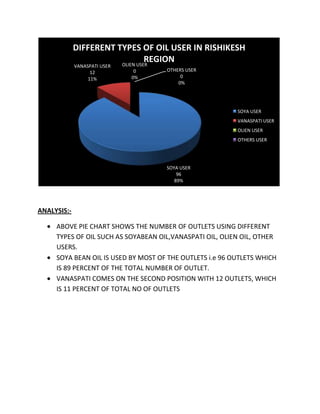
DIFFERENT TYPES OF OIL USER IN RISHIKESH
                                 REGION
                        OLIEN USER
             VANASPATI USER
                   12          0     OTHERS USER
                  11%         0%          0
                                         0%


                                                          SOYA USER
                                                          VANASPATI USER
                                                          OLIEN USER
                                                          OTHERS USER


                                     SOYA USER
                                         96
                                        89%


ANALYSIS:-

     ABOVE PIE CHART SHOWS THE NUMBER OF OUTLETS USING DIFFERENT
     TYPES OF OIL SUCH AS SOYABEAN OIL,VANASPATI OIL, OLIEN OIL, OTHER
     USERS.
     SOYA BEAN OIL IS USED BY MOST OF THE OUTLETS i.e 96 OUTLETS WHICH
     IS 89 PERCENT OF THE TOTAL NUMBER OF OUTLET.
     VANASPATI COMES ON THE SECOND POSITION WITH 12 OUTLETS, WHICH
     IS 11 PERCENT OF TOTAL NO OF OUTLETS
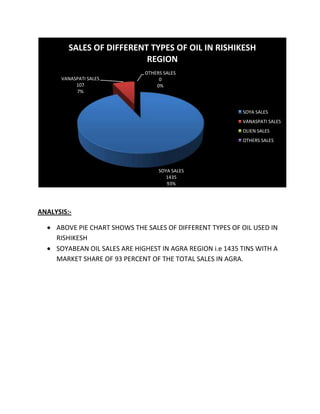
SALES OF DIFFERENT TYPES OF OIL IN RISHIKESH
                           REGION
                               OTHERS SALES
       VANASPATI SALES              0
            107                    0%
            7%


                                                            SOYA SALES
                                                            VANASPATI SALES
                                                            OLIEN SALES
                                                            OTHERS SALES


                                    SOYA SALES
                                       1435
                                       93%


ANALYSIS:-

     ABOVE PIE CHART SHOWS THE SALES OF DIFFERENT TYPES OF OIL USED IN
     RISHIKESH
     SOYABEAN OIL SALES ARE HIGHEST IN AGRA REGION i.e 1435 TINS WITH A
     MARKET SHARE OF 93 PERCENT OF THE TOTAL SALES IN AGRA.
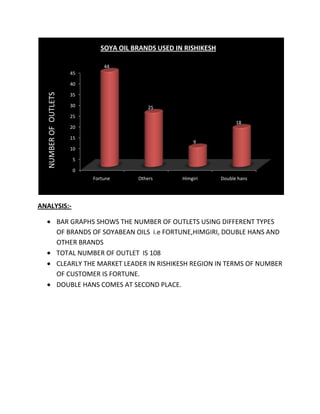
SSOYA OIL BRANDS USED IN RISHIKESH


                                     44
                          45

                          40
   NUMBER OF OUTLETS


                          35

                          30                      25
                          25
                                                                              18
                          20

                          15
                                                               9
                          10

                           5

                           0
                                 Fortune      Others       Himgiri      Double hans


ANALYSIS:-

                       BAR GRAPHS SHOWS THE NUMBER OF OUTLETS USING DIFFERENT TYPES
                       OF BRANDS OF SOYABEAN OILS i.e FORTUNE,HIMGIRI, DOUBLE HANS AND
                       OTHER BRANDS
                       TOTAL NUMBER OF OUTLET IS 108
                       CLEARLY THE MARKET LEADER IN RISHIKESH REGION IN TERMS OF NUMBER
                       OF CUSTOMER IS FORTUNE.
                       DOUBLE HANS COMES AT SECOND PLACE.
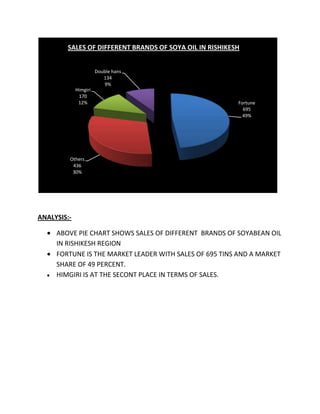
SALES OF DIFFERENT BRANDS OF SOYA OIL IN RISHIKESH


                       Double hans
                          134
                          9%
             Himgiri
              170
              12%                                        Fortune
                                                           695
                                                           49%


         Others
          436
          30%


ANALYSIS:-

     ABOVE PIE CHART SHOWS SALES OF DIFFERENT BRANDS OF SOYABEAN OIL
     IN RISHIKESH REGION
     FORTUNE IS THE MARKET LEADER WITH SALES OF 695 TINS AND A MARKET
     SHARE OF 49 PERCENT.
     HIMGIRI IS AT THE SECONT PLACE IN TERMS OF SALES.
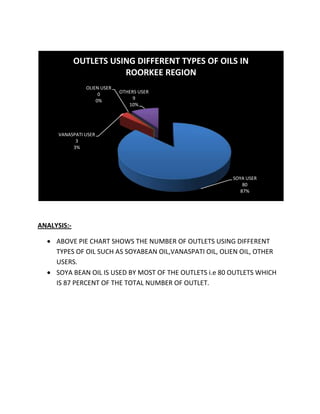
OUTLETS USING DIFFERENT TYPES OF OILS IN
                        ROORKEE REGION
                OLIEN USER
                     0       OTHERS USER
                    0%            9
                                10%


      VANASPATI USER
            3
           3%


                                                         SOYA USER
                                                             80
                                                            87%


ANALYSIS:-

     ABOVE PIE CHART SHOWS THE NUMBER OF OUTLETS USING DIFFERENT
     TYPES OF OIL SUCH AS SOYABEAN OIL,VANASPATI OIL, OLIEN OIL, OTHER
     USERS.
     SOYA BEAN OIL IS USED BY MOST OF THE OUTLETS i.e 80 OUTLETS WHICH
     IS 87 PERCENT OF THE TOTAL NUMBER OF OUTLET.
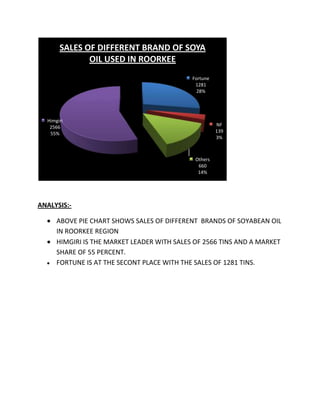
SALES OF DIFFERENT BRAND OF SOYA
              OIL USED IN ROORKEE
                                             Fortune
                                              1281
                                               28%


  Himgiri
   2566                                                NF
   55%                                                 139
                                                       3%


                                              Others
                                               660
                                               14%


ANALYSIS:-

      ABOVE PIE CHART SHOWS SALES OF DIFFERENT BRANDS OF SOYABEAN OIL
      IN ROORKEE REGION
      HIMGIRI IS THE MARKET LEADER WITH SALES OF 2566 TINS AND A MARKET
      SHARE OF 55 PERCENT.
      FORTUNE IS AT THE SECONT PLACE WITH THE SALES OF 1281 TINS.
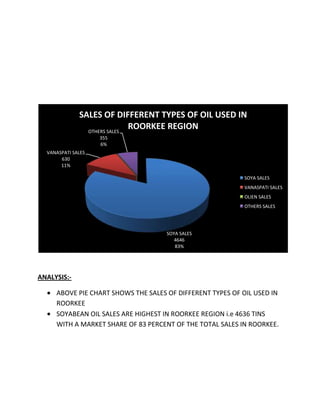
SALES OF DIFFERENT TYPES OF OIL USED IN
                OTHERS SALES
                             ROORKEE REGION
                    355
                    6%
  VANASPATI SALES
       630
       11%

                                                           SOYA SALES
                                                           VANASPATI SALES
                                                           OLIEN SALES
                                                           OTHERS SALES


                                     SOYA SALES
                                        4646
                                        83%


ANALYSIS:-

     ABOVE PIE CHART SHOWS THE SALES OF DIFFERENT TYPES OF OIL USED IN
     ROORKEE
     SOYABEAN OIL SALES ARE HIGHEST IN ROORKEE REGION i.e 4636 TINS
     WITH A MARKET SHARE OF 83 PERCENT OF THE TOTAL SALES IN ROORKEE.
SOYA OIL BRANDS IN ROORKEE
                       30
                                                      28        28
                       25
    NUMBER OF OUTLET


                                    20
                       20

                       15

                        10

                            5                  4

                            0

                                Fortune
                                          NF
                                                   Others
                                                            Himgiri


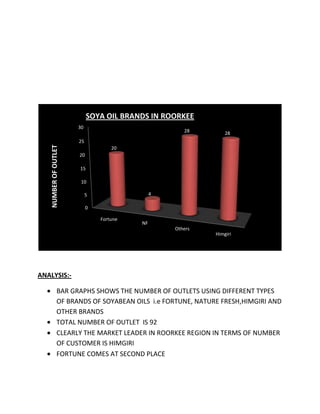
ANALYSIS:-

               BAR GRAPHS SHOWS THE NUMBER OF OUTLETS USING DIFFERENT TYPES
               OF BRANDS OF SOYABEAN OILS i.e FORTUNE, NATURE FRESH,HIMGIRI AND
               OTHER BRANDS
               TOTAL NUMBER OF OUTLET IS 92
               CLEARLY THE MARKET LEADER IN ROORKEE REGION IN TERMS OF NUMBER
               OF CUSTOMER IS HIMGIRI
               FORTUNE COMES AT SECOND PLACE
.Suggestions       For Increasing Market Share in FFS Outlets:

1)There must be regular surprise visit of higher officials to check the ground realities in the
market.

2) There should be separate person in the market whose only job must be merchandising. He
must make sure the product is visible in the outlet and postors and danglers are properly pasted
and attached at a proper place.

3) There should be proper feedback for the retailers AS WELL AS customers whenever any
scheme is introduced for the retailers & customers they should be made aware of it. Sales
representatives should be given guidelines to intimate each and every retailer of his area about
the schemes.

4) Being all the companies are ISO 9001 company, it is not good for the reputation company that
it is getting complaints about the products related to quality. More emphasis should be laid on
the quality to avert such circumstances.

5) Regarding the introduction of new products, the company should go for aggressive marketing.
There is a lot of potential in Soya Refined oil segment, but retailers and Fragmented Food
Service Outlets are not even aware of our product.

6) Whenever any consumer oriented scheme is introduced, the scheme should be directly
targeted to that person who actually uses i.e., Fragmented Food Outlets .

9) Non monetary incentives should be also given to the retailers in each and every city. They
should be given glow sign boards and other sales promotional materials. This will boost up their
spirits.

10) MRP problem during the days of rising prices should be taken care. In this situation if
retailers are getting the products on a price higher than the MRP they can’t sell it more than the
MRP. So this problem should be looked after carefully.

11)The halwai segment is such,that they do not understand the jargons & quality issues,they
would say that their existing oil is efficient enough for them to make their sweets likeable for
customers.but regular contact might initiate an impact so that atleast they can try the same oil
once.

12) First impression created by the company rep is very important,they should provide such
deals that brings an interest in the mind of the shopkeeper and he might listen to the whole
conversation with interest..instead of taking it casually..once he gives the order,he should be
trappped for ever.
13) The problem of irreguler stocks was founded out.it should be improved as much as
possible.it just takes a single second for a brand switch in the case of oil.

14) Its also observed that the shopkeepers are not loyal customers to a particular brand of
oil..they can be easily captured with a good deal only.

15) In the hotel segment,the oil consumption is huge,many hotels use Fortune as they are not
getting nature fresh from Dealers .

16)We can demonstrate that nature fresh is not costlier than other brand bcoz it consume less oil
in frying any stuff and it will give a good texture to the stuff.

17) Commission to distributor and retailer should be high than what competitor is giving so that
they can push more Nature Fresh in the market .

18) Product Bundling: To make people aware about other not so popular oil of Nature Fresh ,
Gemini.
we can do-
     Joint bundling – 2 products offered for one bundled price.
     Leader bundling – a leader product like Soyabean oil is offered for discount if
       purchased with a non leader product.
     The Company should also introduce new affordable products for lower segment group.
Learning
Managerial capabilities as we had to manage the salesman who accompanied us as well
as the shop owners.

Convincing capabilities.

Knowledge of how an FMCG company works at the ground level.

How sales can be enhanced.

Team management skills.

Leadership skills.

Analytical approach towards data analysis regarding sales.

How to cover an untapped market where complete reach was not there previously.

How to carry out the daily operations in rigorous pressure.

How to increase product visibility.
Limitations Of Project
1. Low Print & Media advertisements made us difficult to convince Food Outlets to use/buy
     our product.
2.   General awareness of the product and company was low.
3.    No proper Distribution Channel made company product sell less in market.
4.   Convincing to the Halwai Segment and other low income Food Outlets was a tough task
     as they were very less health conscious.
5.   Excessive dependence on price strategy of competitor market leader in oil segment.
CONCLUSIONS

The edible oil industry is significantly based on the satisfaction of consumer regular taste and
product awareness. These are the products which customer does not change in very short span of
time. People generally using this product rarely experiment on other brand. If a customer is using
nature fresh for a long time they will rarely try for some other oil until and unless there is regular
complain or some other reasonable problem.

So few things regarding oil that should be kept in mind

a) It takes time to reach up to the tongue of the customer.

b) Once reached it takes twice, thrice or more time to change the brand

c) It is important for a company to grab customer’s share of mind by increasing awareness of the
product in the market

Quality wise Nature fresh is very good in the market but its facing tough competition from local
players so we have to focus on second stage that is making people aware of our products
through Advertisements, promotional activity. FMCG being one of the fastest moving industries,
company has to create right kind of brand and product awareness, so that people can have the
product knowledge and choose the product according to their suitability, be competitive in the
prices and the quality standards. The company should present the products in such a manner so
that it can motivate the consumers and generate the thirst in consumer to consummate it.
Company needs to put little more efforts to spread the awareness of the quality of oil products
and to make customers understand how non-quality oil products can harm a human life. The
company can also give some attractive schemes, rebates to the customers from time to time to
get an edge on the competitors. Product availability should also be increased in the market by
increasing the number of distributors and an efficient distribution network

 Market of edible oils in India is captured by various companies and their brand products are
well known across the country. Hence to stand out as a different brand name in the market,
Cargill should adopt a good marketing strategy of brand building through various penetration
levels in the market, increase its product availability and working on the customer relationship
management
Indu

Indu

  • 4.
    ACKNOWLEDGEMENT It would beprudent to commence this report with an expression of gratitude towards all those who have played an indispensable role in the accomplishment of this project by providing their valuable guidance. I would like to take this opportunity to acknowledge and thank Cargill India Pvt. Ltd. for providing me with this highly coveted opportunity to associate my Summer Internship Project with an organization of worldwide repute. I extend my most sincere thanks to Mr. Pritish Gupta, Zonal Marketing Manager and Mr. Rajat Sharma, Area Sales Manager for their help and guidance in various capacities which have been extremely proficient in getting the best out of me by sharpening my rough edges from time to time. I am deeply indebted to my faculty guide whose help, stimulating suggestions and encouragement helped me in all time of research. I am also thankful to all my team members for their stimulating support and co-operation. My special thanks to my parents without whom it would have not been possible and for everything of what I am today.
  • 5.
    Table of Contents ExecutiveSummary ...................................................................................................................... 3 Over view of FMCG ..................................................................................................................... 4 Swot Analysis of FMCG Sector .................................................................................................. 6 Top Players in FMCG ................................................................................................................. 7 Cargill In India............................................................................................................................ 12 Product and Services offered by Cargill ................................................................................... 21 Edible Oil Consumption ............................................................................................................. 23 Ediblie Oil Players In UP ........................................................................................................... 24 Cargill Brands at a Glance ......................................................................................................... 29 Swot Analysis Of Cargill India Pvt Ltd .................................................................................... 35 Project Objective ........................................................................................................................ 36 Analysis of UP as a whole .......................................................................................................... 39 Analysis of Kanpur Outlets ........................................................................................................ 42 Analysis of Varanasi Outlets ...................................................................................................... 47 Analysis of Allahabad Outlets.................................................................................................... 53 Analysis of Lucknow Outlets ..................................................................................................... 60 Suggestion For Increasing Market share in FFS segment ...................................................... 64 Learnings ..................................................................................................................................... 68 Limitation ................................................................................................................................... 68 Conclusions .................................................................................................................................. 69 Annexures ........................................................................................................................................ References ........................................................................................................................................
  • 6.
    Executive Summary This Studygives you an overview of market potential of edible oil market in Uttarakhand and U.P. West with emphasis on competitors, areas,types of oil,consumption of oil in different cities in Uttarakhand and U.P.West by collecting data from various segments like halwai,bakery,hotels,restaurants,caterers and namkeenwala.. The study throws light on what is Cargill market share and how can it improve its market share in Fragmented Food Outlets in respective states. Founded in 1865, Cargill is one of the largest international providers of food, agriculture and risk management products. With more than $120 billion turnover and operations spread across 67 countries, Cargill today employs more than 1, 60,000 people across the world and is trusted across for its commitment of Cargillishing people Cargill Refined Oils India imports, refines, sells and markets a wide range of vegetable oils and fats to wholesale trade, industrial and household consumers across India. We own and operate Cargill vegetable oil refining facilities – three are located on east and west coast ports of India, the other is located in western India. Refined Oils India markets a range of refined sunflower, soy, palm, olein and ground nut oils, hydrogenated fats and bakery shortenings under Cargill national brands, Nature Fresh, Gemini, Purita™, and other region-specific brands. The Project given was to to assess the edible oil potential of Fragmented Food Service industry in Uttarakhand and U.P.West. The main objective was to map different Fragmented Food outlets and thus expand distribution network . The work was done in stages which were 1. Mapping of the Fragmented Food Service Outlets in Uttarakhand and U.P.West. 2. Profiling of each micro segment of FFS. 3. Arriving at a volume potential of different types of edible oils. 4. Refined – Non Refined i. Sunflower, Soya, Palm oil, Vanaspati, Desi Ghee.
  • 7.
    5. Utility ofthe project 6. Devising Sales Strategies and Market Strategies for Fragmented Food Service channel in Uttarakhand and U.P.West. 7. To know the usage pattern of edible oil amongst consumers in various cities . 8. To know the awareness amongst consumers regarding types of Cargill food prod Introduction Over view of FMCG : Fast moving consumer goods It is alternatively called as CPG (Consumer packaged goods) industry primarily deals with the production, distribution and marketing of consumer packaged goods. The Fast Moving Consumer Goods (FMCG) are those consumables which are normally consumed by the consumers at a regular interval. Some of the prime activities of FMCG industry are selling, marketing, financing, purchasing, etc. The industry also engaged in operations, supply chain, production and general management. Fast Moving Consumer Goods (FMCG), are products that are sold quickly at relatively low cost. Though the absolute profit made on FMCG products is relatively small, they generally sell in large quantities, so the cumulative profit on such products can be large. Industry Background FMCG is one of the most dynamic domains of the business world. A career in this sector encompasses a large number of job roles like market research, pricing and product development, purchasing, advertising and brand awareness. FMCG is a sector where graduates can gain excellent rewards if they work hard. FMCG products are those that move
  • 8.
    off the shelvesin retail outlets very quickly. In the Fast Moving Consumer Goods (FMCG) sector, one needs to be fast in translating the ideas into new products. There is a requirement to create the products that people trust, enjoy and use in their daily lives. Advertising and marketing have a vital role to play in this. Sector Outlook FMCG is the fourth largest sector in the Indian Economy with a total market size of Rs. 60,000 crores. FMCG sector generates 5% of total factory employment in the country and is creating employment for three million people, especially in small towns and rural India. Offerings of FMCG FMCG Sector (In 2010) The FMCG sector in India is the fourth largest sector in the economy with a total market size in excess of US$ 13.1 billion. The volume of money circulated in the economy against FMCG products is very high, as the number of products the consumer use is very high. The Indian FMCG market has been divided for a long time between the organized sector and the unorganized sector. While the latter has been crowded by a large number of local players, competing on margins, the former has varied between a two-player-scenario to a multi-player one. Unlike the U.S. market for fast moving consumer goods (FMCG), which is dominated by a handful of global players, India's Rs.460 billion FMCG market remains highly fragmented with roughly half the market going to unbranded, unpackaged home made products. This
  • 9.
    presents a tremendousopportunity for makers of branded products who can convert consumers to branded products. However, successfully launching and growing market share around a branded product in India presents tremendous challenges. Take distribution as an example. India is home to six million retail outlets and super markets virtually do not exist. This makes logistics particularly for new players extremely difficult. Other challenges of similar magnitude exist across the FMCG supply chain. Increased competition in the FMCG industry The recent rise of private-label goods has led to increased competition within the FMCG industry. A focus on bringing high volume products at lower prices to the market has created greater demands on all actors. Producers must differentiate their products and quickly bring them to market. Since products are consumed shortly after they are produced, it is imperative to keep production uptime high at all times. Any stop in production can cause empty shelves and lost market share. CRITICAL OPERATING RULES IN INDIAN FMCG SECTOR  Heavy launch costs on new products launch on Advertisements, free samples and product promotion.  Majority of the product classes require very low investment in fixed assets.  Existence of contract manufacturing  Marketing assumes a significant place in the brand building process.  Providing good price points is the key to success.
  • 10.
    Top Ten Playersin FMCG Sector NO. Companies 1. Hindustan Unilever Ltd. 2. ITC (Indian Tobacco Company) 3. Nestlé India 4. GCMMF (AMUL) 5. Dabur India 6. Asian Paints (India) 7. Cadbury India 8 Britannia Industries Procter & Gamble Hygiene and 9. Health Care 10. Marico Industries Company Source: www. naukrihub.com Scope of the Sector The Indian FMCG sector with a market size of US$13.1 billion is the fourth largest sector in the economy. A well-established distribution network, intense competition between the organized and unorganized segments characterizes the sector. FMCG Sector is expected to grow by over 60% by 2010. That will translate into an annual growth of 10% over a 5-year period. It has been estimated that FMCG sector will rise from around Rs 56,500 crores in 2005 to Rs 92,100 crores in 2010.
  • 11.
    Market Opportunities Vast RuralMarket----Rural India accounts for more than 700 Million consumers, or 70 percent of the Indian population and accounts for 50 per cent of the total FMCG market. The working rural population is approximately 400 Millions. An average citizen in rural India has less then half of the purchasing power as compare to his urban counterpart. Still there is an untapped market and most of the FMCG Companies are taking different steps to capture rural market share. The market for FMCG products in rural India is estimated 52 per cent and is projected to touch 60 per cent within a year. Eg. Hindustan Unilever Ltd is the largest player in the industry and has the widest market coverage. The following factors make India a competitive player in FMCG sector 1. Availability of raw materials Because of the diverse agro-climatic conditions in India, there is a large raw material base suitable for food processing industries. India is the largest producer of livestock, milk, sugarcane, coconut, spices and cashew and is the second largest producer of rice, wheat and fruits &vegetables. India also produces caustic soda and soda ash, which are required for the production of soaps and detergents. The availability of these raw materials gives India the location advantage.
  • 12.
    2. Labor costcomparison Low cost labor gives India a competitive advantage. India's labor cost is amongst the lowest in the world, after China & Indonesia. Low labor costs give the advantage of low cost of production. 3. Export - “Leveraging the Cost Advantage” Cheap labor and quality product & services have helped India to represent as a cost advantage over other Countries. Even the Government has offered zero import duty on capital
  • 13.
    goods and rawmaterial for 100% export oriented units. Multi National Companies outsource its product requirements from its Indian company to have a cost advantage. India is the largest producer of livestock, milk, sugarcane, coconut, spices and cashew apart from being the second largest producer of rice, wheat, fruits & vegetables. It adds a cost advantage as well as easily available raw materials. Introduction To The Company Cargill in India Cargill maintains a number of businesses in India, with operations including the handling and processing of a wide range of products, including refined oils, grain and oilseeds, sugar, cotton and animal feed. In addition, Cargill develops flavour systems and operates a value investing business. Our presence in India has been growing since we began a joint venture operation in 1987 and today it has an access over 1000 towns and 2,50,000 retail outlets. Its head office is located at cyber city phase 3 Guargoan ( Haryana). Vision “Our vision is to be the leading player in Indian edible oils market andcreating a distinctive value for all stakeholders”. Mission “We will develop and deliver value added products, which exceed statutoryrequirements to satisfy our internal and external customers, by creating a culture of continuous improvement and will establish dominant position in ours chosen market, by achieving competitive advantage in all functions and building and retaining a high performing customer-focused team.” Approach “Our approach is to be trustworthy, creative and enterprising”.
  • 14.
    Measures “Our measures areengaged employees, satisfied customers, enriched communities and profitable growth”. Cargill's Guiding Principles It is not practical to set out detailed guidelines to govern every situation that might arise in the conduct of our varied and complex global business. Instead, below are the seven basic Guiding Principles that form the framework in which to examine any problem arising in any country. Cargill will comply with the laws of all countries to which it is subject. Cargill will not knowingly assist any third party to violate any law of any country, by creating false documents or by any other means. Cargill will not pay or receive bribes or participate in any other unethical, fraudulent, or corrupt practice. Cargill will always honor all business obligations that it undertakes with absolute integrity. Cargill will keep its business records in a manner that accurately reflects the true nature of its business transactions. Cargill managers and supervisors will be responsible that employees, consultants and contract workers under their supervision are familiar with applicable laws and company policies and comply with them. Further, they will be responsible for preventing, detecting, and reporting any violations of law of Cargill policies. Cargill employees will not become involved in situations that create a conflict of interest between the company and the employee. Every year, all Cargill employees sign an agreement to live these principles. Cargill milestones in India 1987: Cargill Seeds - a joint venture operation - commenced in India. 1994: Cargill starts its fertilizer/crop nutrients operations in India. 1997: Cargill launches its primary sugar and edible oils trading business in India. 1998: Commences grain and oil seeds business in India. 2001: Launches food business under Cargill Foods – launch of brand ―Nature Fresh‖. 2003: Cargill acquires the Food Flavors business from Duckworth Group UK, and
  • 15.
    Duckworth Flavors Indiabecomes part of Cargill India. Cargill sets up green field edible oil refineries at Kandla and Paradip. Cargill launches one stop agri-shops – Saathi Krishi Samadhaan Kendras. 2004: Cargill diversifies its fertilizer business into a joint venture with IMC global. Cargill India's DAP business renamed as Mosaic India. 2005: Cargill acquires Parakh Foods with brand "Gemini" and sets up a new Business Unit called Cargill Refined Oils India. This is first business unit with headquarters in India. Cargill launches Saanjhi Unnati Program in Rajasthan for development of malt barley Miller. In active collaboration with the Government of Rajasthan and SAB 2006: Cargill starts its sugar off shoring business to support the execution activities of Cargill Netherlands. Cargill sets up CarVal India Pvt. Ltd. Cargill enters into a joint venture in a project for setting up a green field sugar refinery in South India. Cargill entered into tolling arrangements with local Soybean crushers in Maharashtra, Rajasthan and Madhya Pradesh Cargill enters into a joint venture and subsequently owns and leads a shrimp feed manufacturing business in Rajahmundry in Andhra Pradesh. 2007: Cargill launches cotton trading business in India. 2008: An independently managed subsidiary of Cargill, Black River Advisor India Pvt. Ltd., begins operations in India. 2010: Cargill acquires leading Vanaspati brand RATH from Agro Tech Foods Ltd. 2011: Cargill bought Indian Sunflower oil brand Sweekar. Celebrity chef Sanjeev Kapoor becomes brand ambassador for Cargill Financial highlights
  • 16.
    In fiscal year2010, Cargill had $107.9 billion in sales and other revenues. Net earnings were $2.6 billion. Dollars in 2010 2009 Percent Change Millions Sales and other $ 107,882 $ 115,059 -6 revenues Net earnings 2,603 3,334 -22 Cash flow from 4,630 6,679 -31 operations Presence of Cargill in India Our Behaviour Companies are not about bricks and mortar. They are about people. Companies behave as the people within those companies behave. We believe that our success is determined by the behavior of our people. Proper behavior results in prompt, accurate, cheerful, courteous service. Improper behavior-well, companies must do everything they can to avoid it because it is all-too-common. We realize that perfection is not achievable, but we think it's important for you to know how the employees of Cargill, in general, and Cargill Animal Nutrition, in particular, are expected to behave. Behaviour Themes of Cargill's Culture:  Discuss / Decide / Support  Demonstrate Respect, Candor and Commitment  Develop and Leverage Deep Customer Knowledge and Insights  Pursue and Reinforce Collaboration  Ensure & Accept Accountability
  • 17.
     Challenge /Innovate / Change Culture Whether it is a thank you note or a formal award programme, we appreciate how recognition shows peers, direct reports, and managers how they fit into our mission and why their contributions are important. Cargill India employees can participate in a range of formal and informal recognition programmes as well as interact with colleagues and leaders across our many businesses, nationally and internationally. The culture and environment at Cargill is one where employees are motivated and confident enough to try new things out. They have opportunities to explore new ideas and are supported by the management in implementation. As a result, company is in forefront of delivering innovative products to the Indian consumers and implementing innovative and cost effective processes Simplicity, Accountability and Collaborate are the core values that run across the organization that bring people together in achieving our business goals and deliver superior value to all our customers. We follow a clear, open and transparent communication that ensures eliminating ambiguity and drive simplicity. We live up to our commitments. We agree on goals, objectives and strategies. We drive for flawless execution. We don't offer excuses; we offer solutions and this is the mantra that builds accountability across the organization.We trust and respects each other. We realize that we are much more valuable together than we are apart. Everybody has something of value to contribute, and we collaborate and win as a team. We provide an environment where one person can make a difference. Our employees work in an environment where they have freedom to express, innovate and create breakthrough solutions. Our employees are empowered, energetic and enthusiastic to make a difference with an underlying and all encompassing passion in what they do. Our people use good judgment and are decisive. They act with speed and always ensure flawless execution. Learning and development opportunities At Cargill we are committed to attracting, retaining and training high performing people who embrace the company’s vision and values. The means to achieve this is by maximizing training and development to ensure that employees have the competencies required to accomplish their business objectives as well as develop their career in the company.
  • 18.
    Training opportunities includeon-the-job learning, participating in company programs and courses, and attending external programs based on nomination by managers and/or peers. Employees also participate in performance management programs to create a road map for their individual success at Cargill and alignment with organizational goals. Internal mobility We seek to offer employees career opportunities within Cargill India and promote an open environment where employees can acquire new skills and learning. For employees who meet the criteria and are willing to accept roles with higher responsibilities, we provide avenues for growth & movement across Cargill businesses and geographies. Equal Employment Opportunity (EEO) Cargill maintains a policy of non-discrimination towards all employees and applicants for employment. All aspects of employment with Cargill are governed by merit, competence, suitability and qualifications, and will not in any manner be influenced by gender, age, race, colour, religion, national origin or disability. Corporate Responsibility When William Wallace Cargill founded our company in 1865, he deliberately set out to ensure that we earned and maintained a reputation for integrity, which he saw as a key differentiator in those times. Corporate responsibility is part of everything we do. It is a company-wide commitment to apply our global knowledge and experience to help meet complex economic, environmental and social challenges wherever we do business. It is a process of continually improving our standards, our actions and our processes. Corporate responsibility extends not only to our own operations but to our wider communities and is based on four commitments: We will conduct our business with high levels of integrity, accountability and responsibility. We will develop ways of reducing our environmental impact and help conserve natural resources. We will treat people with dignity and respect.  e will invest in and engage with communities where we live and work. W We recognize our continued success depends on the growth and health of our communities and partners, as well as the vitality and conservation of our natural
  • 19.
    resources. We areworking with a diverse group of global, national and local organizations to support responsible economic development, help protect the environment and improve communities. Corporate responsibility in India and around the world We strive to be a good citizen in the areas where we are privileged to conduct business. In addition to the benefit of secure employment, we find various ways to support local communities. Our Cargill Cares programs bring together our employees to serve communities in partnership with external organizations Products & Services: Cargill has activities in the following areas in India: • Animal Nutrition • Coal • Cotton • Ferrous • Flavor Systems • Grain & Oilseeds • Refined Oils • Sugar & Sugar Support Centre • Trade & Structured Finance Refined oil brands Cargill Refined Oils India Cargill Refined Oils India imports, refines, sells and markets a wide range of vegetable oils and fats to wholesale trade, industrial and household consumers across India. We own and operate four vegetable oil refining facilities – three are located on east and west coast ports of India, the other is located in western India. Refined Oils India markets a range of refined sunflower, soy, palm, olein and ground nut oils, hydrogenated fats and bakery shortenings
  • 20.
    under our nationalbrands, Nature Fresh™, Gemini™, Purita™, and other region- specific brands. Major Refining Capabilities Our refineries are unique in technology and refining capabilities and adhere to stringent specifications for maintenance of product quality, oil stability and food safety. The qualities found within our operations are unparalleled in India:  Best and latest refining technology, which has been tested and improved across various refinery set-ups within the global Cargill network?  A team trained by international experts and on international platforms run these refining capabilities and is fully equipped to produce the best product in the country.  Standards of quality have been set keeping the international and Indian requirements in mind. These standards incorporate the best of both worlds and meet the highest levels of quality.  Specifications that not just ensure superior quality but also high stability without addition of preservative chemicals. No oil that does not meet these specifications is ever packed or shipped.  Hands free treatment with no direct human touch on the product itself due to fully automated refining technology. This has led to a very clean and hygienic environment and a b etter and safer product. Cooking oils in India An oilseed in India account for around 5.0 % of the Gross National Product (GNP) and 14%
  • 21.
    of the country’sarea is under cultivation of crops. Castor, Groundnut, Linseed, Niger, Rapeseed, Mustard, Sunflower etc. are some of the major oilseeds grown. India is one of the largest producers of oilseeds in the world which accounts for 9.3% of world oilseeds production. This sector occupies an important position in the agricultural economy having the world’s fourth largest edible oil economy and accounting for the estimated production of 30.21 million tones of nine cultivated oilseeds during the year 2009-10. India accounted for about 6.4% of worlds oil meal export. Yet, about 43% of edible oil available in India is imported. Source- Production of oilseeds: Ministry of Agriculture. Types of oils commonly used in India India is fortunate in having wide range of oilseeds crops grown in its different agro climatic zones. Groundnut, mustard/ rapeseed, sesame, safflower, linseed, nigerseed/ castor are the major traditionally cultivated oilseeds. Soyabean and sunflower have also assumed importance in recent years. Coconut is most important amongst the plantation crops. Efforts are being made to grow oil palm in Andhra Pradesh, Karnataka, Tamil Nadu, in addition to Kerala and Andaman & Nicobar Islands. In addition, oilseeds of tree and forest origin, which grow mostly in tribal inhabited areas, are also a significant source of oils. Consumption pattern of Edible oils in India Edible Oils and Fats is a 15mn tonnes industry in India annually (worth Rs.75,000 crore). 90% of the industry is comprised of cooking oil and 10% is vanaspati (fat). The difference between oil and fat is that oil is liquid at room temperature and fat is solid. The total industry is growing at 5-10% p.a. but vanaspati segment is marginally degrowing. In cooking oils, the growth is coming from branded oils (packaged not loose). This sub-segment is growing at 11-15% p.a.
  • 22.
    India is avast country and inhabitants of several of its regions have developed specific preference for certain oils largely depending upon the oils available in the region. People in the South and West prefer groundnut oil while those in the East and North use mustard/ rapeseed oil. Likewise several pockets in the South have a preference for coconut and sesame oil. Inhabitants of northern plain are basically hard fat consumers and therefore, prefer vanaspati, a term used to denote a partially hydrogenated edible oil mixture. Vanaspati has an important role in our edible oil economy. Its production is about 1.2 million tones annually. It has around 10% share of the edible oil market. It has the ability to absorb a heterogeneous variety of oils, which do not generally find direct marketing opportunities because of consumer’s preference for traditional oils such as groundnut oil. Mustard oil, sesame oil etc. For example, newer oils like soyabean, sunflower, ricebran and cottonseed and oils from oilseeds of tree and forest origin had found their way to the edible pool largely through vanaspati route. The demand for edible oils in India has shown a steady growth at a CAGR of 4.43% over the period from 2001 to 2011. The growth has been driven by improvement in per capita consumption, which in turn is attributable to rising income levels and living standards. However, the current per capita consumption levels of India (at 13.3 Kg/year for 2009-10) are lower than global averages (24 kg/year).The Indian edible oils market continues to be underpenetrated and given the positive macro and demographic fundamentals it has a favourable demand growth outlook over the medium-to-long term. In terms of volumes, palm oil, soyabean oil and mustard oil are the three largest consumed edible oils in India, with respective shares of 46%, 16% and 14% in total oil consumption in 2010. Given the high price consciousness and varied taste preferences of Indian consumers, ICRA expects these three oils to continue to account for the bulk of edible oil consumption in the country. Market share of edible oils in India Percentage Oil Palm oil 38 Peanut 14 Sunflower 8
  • 23.
    Soyabean oil 21 Rapeseed 13 Cotton 6 List of Edible Oil players in India Fortune Adani Wilmar Limited. NatureFresh, Cargill India Pvt Ltd, USA Gemini,Rath,Sweekar Dalda Bunge India Pvt.Ltd.,USA Saffola, Parachute Marico Ltd, India Sundrop Agro Tech Foods Ltd(ConAgra Foods) RR Primo RR Oomerbhoy Pvt.Ltd. Dhara Dhara Company Ltd, NDDB Campus, Anand Panghat Mawana Sugars Ltd. Tilsona Recon Oil Industries Private Ltd Figaro Consumer Marketing (India) Pvt. Ltd Shalimar's Classic Shalimar Agro Tech Pvt Basmati Palm Sarda Agro Oil Ltd. Gold Active Ruchi Gold Ruchi Infrastucture Ltd Mayur Mayur Ltd Kanpur Bawarchi Bawarchi Kanpur Jhoola, Payal Jhunjhunwala , Varanasi In edible oil The Adani-Wilmer owned Fortune brand was India’s number one edible oil in 2006 according to A C Neilson Retail Audit 2006. Fortune, which is present as a refined soyabean oil, sunflower oil, groundnut oil and mustard oil is said to have a market share of 19% in the entire edible oil market. Marico Industries have a market share of 11 % with brands like Saffola. Salient features of Indian Oil Sector
  • 24.
    1) Demand increasing due to population growth and income increase. 2) Domestic production of oilseeds/oils is not adequate to meet the demand 3) Lower yield 4) Fluctuating production of oilseeds 5) Low capacity utilization of processing units 6) Obsolete technology/processing inefficiency 7) High import dependence about 40% 8) Speculative nature of trade
  • 25.
    Brands At aglance The most exotic olive oil from Spain
  • 26.
    Products Animal Nutrition Cargill AnimalNutrition develops and markets a broad range of animal feeds and customized animal productivity solutions to commercial producers in 28 countries across North and South America, Europe and Asia. 180 plants worldwide support the business unit. Animal Nutrition in India serves feed products in these categories: dairy, beef, swine, poultry and aquaculture. Cargill Animal Nutrition in India Cargill Animal Nutrition started in India through a joint venture with a local shrimp feed company located in Rajahmundry, Andhra Pradesh in February 2006. This was followed by the successful opening of a dairy feed business in Rajpura, Punjab in October of the same year. By March 2007, the Rajahmundry business became a wholly owned subsidiary of Cargill India. Cargill Animal Nutrition - Rajahmundry is a specialized manufacturing facility for aquaculture feeds. With the presence of the local brands pre-acquisition, a faster go-to-market strategy was deployed,helping to create awareness in the Cargill brand and its feed technology with the shrimp farmers of South India including the states of Andhra Pradesh, Orissa, West Bengal and Tamil Nadu. Through a series of well-executed road shows, uptake of the products was rapid. Today, the facility is focusing on its next feed offering in the south with Aqua Focus™, a line of fish feeds targeted for the domestic production of Indian carps such as Rohu, Catla and Mrigal. Five month trials of the product is proving to be a hit with local farmers as feed conversion rates (FCR) of 1:5kg of traditional feed has dramatically been reduced to below 2kg. Cargill Animal Nutrition - Rajpura started operations by offering dairy feed. After several in-depth studies of the local dairy cattle scene conducted by Cargill Animal
  • 27.
    Nutrition's dairy technologydeployment managers from Italy, Korea and the US, the feed was launched with much enthusiasm in Ludhiana, Punjab. The success in this segment was brought about by the observation by farmers of higher milk output only two weeks from converting their local feed to Cargill Animal Nutrition. Another breakthrough was the introduction of the Purina® line of poultry feeds. Also very notable was the quick acceptance of the product by broiler farmers in Haryana and Punjab, earning Rajpura the credit of being one of the fastest growing broiler feed markets within Cargill Animal Nutrition. Cotton We launched our independent and dedicated cotton trading business in December 2007. We plan to strengthen our business with our long time suppliers and build new market channels to source and supply India cotton. As Cargill Cotton, we are one of the world’s largest and oldest cotton businesses and very proud of our long relationship with India cotton. We are proud to be on the ground in India where cotton trade started. We have a network of value chain participants who help us source and supply the best cotton into and out of the country. From making Indian Shankar 6, Bunny and MECH preferred choices by mills around the world; to sourcing Extra Long Staple (ELS) and African cotton for Indian mills we have a range of customer solutions. As the world moves forward in liberalizing trade, and India emerges as a dominant cotton country, Cargill Cotton believes we must make a longterm commitment to the Indian market. We think our experience in total supply chain support can help India become a world-class supplier. Our innovations in finance, logistics, risk management and quality control can improve profitability for both our cotton suppliers and our textile mill customers. Cargill Cotton has had roots in India since 1851, when the Ralli Brothers was incorporated with offices in Calcutta and Bombay. Cargill Cotton came into existence combining the strengths of the two organizations - Hohenberg (in North, Central and South America) and Ralli (in Africa and the Indian sub-continent). Cargill became recognized as one of the most mature, respected, and experienced cotton merchants in the world of cotton. In 2002, after over 20 years of operating under both the Hohenberg and Ralli names, the name of the entire cotton operation was changed to Cargill Cotton. We are very proud of the success and growth that we have shared with our suppliers and buyers over the last 150 years. We are equally pleased to be able to look back
  • 28.
    at our historyand see that the company's tradition has always been one of absolute integrity. In today's diverse and multi-cultural world we know that our unparalleled reputation is our most valuable asset. Ferrous Cargill participates actively in the import, export and distribution of ferrous products and raw materials, covering Asia, the Middle East, Europe, North and South America. We export from a broad spectrum of Indian mills and mines— buying the full range of products from more than 40 customers from iron ore to finished steel. Imports cover finished steel as well as semifinished steel for meeting the requirements of users. We provide our customers with a wide range of value- added services including port plots and local distribution, logistics and transportation capabilities, pre-financing, long-term agreements and other logistics and risk management tools. Flavour system We bring a customized and consumer-tested approach to creating advanced flavors and flavor systems for beverage, dairy, ice cream, confectionery, bakery, food service, and pharmaceutical markets. Our India Flavor Systems business has been operating since 1991. Our business specializes in liquid flavor, emulsions, spray dried flavors and dry mix powders. Our flavor systems are designed for a broad range of food and related products: bakery and biscuits, beverages, confectionery, dairy and liquor. Grain & Oilseeds Our Grain & Oilseed business offers unique solutions around risk management, supply chain, logistics and inventory management to its customers in food in India. We are amongst the largest suppliers of domestic and import food grains to the private sector and government of India. For example, we provide identity preserved food grains to major food companies and flour millers in the country. We trade and process of a variety of oil seeds like soybean and rapeseed and are one of the largest merchant exporters of oil meal out of the country. The business connects the Indian farmer with markets through a network of Saathi centers that provide farmers with competitive prices and access to reliable grain buyers.
  • 29.
    Headquartered in Gurgaon,Grain & Oilseeds has operations in more than 10 states where we manage several facilities that serve markets and customers in those regions: · More than 50 grain and oilseed origination and storage locations · Multiple soybean processing facilities spread across the country · Four regional merchandising offices · 12 origination offices Ocean Transportation Cargill Ocean Transportation has developed over its 50-year history a deep expertise in chartering, trading, logistics, operations, and risk management.We offer our customers a number of ocean freight solutions across all dry market segments and tankers. Our focus is on safety, high quality, and risk management. Our aim is to be recognized as the most innovative and customer-oriented partner in the market. Sugar and Sugar Support Centre Based in Gurgaon, Cargill sugar India is involved in the origination, transporting, storage and exporting of raw sugar. Our team has built up a base of several key suppliers and customers spread across the key producing states of Uttar Pradesh, Maharashtra, Tamil Nadu, Karnataka and Andhra Pradesh. In addition, we have strong relationships with customers in Srilanka, Pakistan and Bangladesh. Cargill started its Sugar Support Centre as an experiment to support the execution and accounting activities of Cargill BV Netherlands in 2005.Today, the group is highly successful and a very integral part of the sugar business worldwide. Within this group sugar is procured from all originating and surplus countries like Brazil, Thailand, Central America, and Europe and sent to other destinations such as Mediterranean countries, West Africa, and the Far and Middle East. Trade & Structured Finance Cargill Trade & Structured Finance is a financial management arm of Cargill that supports the group on their trade and structured financial solutions requirement. The group also extends these services to other small, medium and large corporates
  • 30.
    in India, sharingtheir expertise and providing customised solutions for their working capital and balance sheet requirements. The Cargill Trade & Structured Finance group is headquartered in Minneapolis with a team of financial experts across the globe in developed and developing economies. Cargill Trade & Structured Finance started India operations in 1996 and has successfully created a niche quite comparable to a boutique investment bank supporting their corporate clients in their working capital management and supporting their exponential growth in India and abroad. For better service deliverability and bringing in efficiency in the solutions, Cargill started its Non Banking Financial Company in 2007 under the name ofCargill Capital and Financial Services India Pvt Ltd (CCFSIPL). Cargill's structured finance team designs and structures a broad range of customised financing solutions and arrangements both in local and foreign currency. The team supports in several credit enhanced solutions, not limited to the following: · Working capital restructuring · Cross border trade advisory services · Short-term and Long-term trade-related financing · Promoter financing · Real estate financing · Securitization · Equipment finance Cargill vs. Competitors With growing quality consciousness and plummeting price differences between packaged and non- packaged edible oils, the packaged edible oil sector will capture almost 50% of the market share within few years. The packaged edible oil consumption is only about 20% of the total 12.5 million tonne domestic consumption. Due to advancement of packaging technology, the price difference between packaged and loosely sold oils has significantly come down. Cargill controls more than 12% of the packaged edible oil market. As a result of the increase in health consciousness, consumers even in the smaller towns are gradually shifting to packaged edible oils from loosely sold oils. The packaged edible oil industry is growing at 10 % annually and half of the market would be controlled by packaged oil manufactures within few years.
  • 31.
    Cargill brands vs.other brands With the competition increasing after the arrival of retail companies, maintaining quality while keeping the prices down would be a challenged for all the packaged oil makers. M Cargill India sell around 5,00,000 tons of edible oil a year , including soya , palm , sunflower , groundnut and mustard oils besides hydrogenated fats , to wholesale trade , process food industry and retail customers. Its share is around 4% of the million tones of total edible oil sold in the country in a year. Other brands like Fortune of Adani wilmer Ltd. Having approximately 19% market share in the entire edible oil market. Marico industries with a market share of 11% with brands like Saffola are old players with well known brands in the edible oil industry hence gives tough competition to Cargill refined oils. Consumer Voice – A monthly magazine of consumer interest A government funded voluntary organization that works towards consumer education and awareness, conducted a laboratory test on seven well-known brands of refined sunflower oil. After testing them on all possible parameters like colour, adulteration, rancidity and fatty acid profile, Naturefresh Acti-Lite and Gemini, brands from the house of Cargill, were rated as the best quality and healthiest refined sunflower oils in the country.For the first time in India, refined sunflower oil brands have been tested by an independent government funded organization for their fatty acid profile and other parameters like colour, rancidity etc. This was done and published in November 2008 to scientifically assess and pinpoint exactly how healthy each refined oil brand is. By this research, NatureFresh and Gemini cooking oils have been proved to be the healthiest cooking oils in their respective categories. NatureFresh Acti-Lite sunflower oil is extremely light oil that has high-unsaturated fat content making it easier to break down. This lightness is powered by “Liteness Integrated
  • 32.
    Technology” (LITE), whichis delivered by the technologically advanced state-of the-art plant ensuring that best attributes of the oil are preserved for `consumer’s health. Gemini refined oil offers freshness as a differentiator. It uses “Freshness Intact Technology” (FIT) which helps maintain the freshness of oil from packaging stage of consumption. SWOT Analysis of Cargill Foods Strengths:  The quality of our various products is the biggest strength of the company. In terms of quality, every product has maintained its standard quality through which it excels in the market.  Dedicated hard working& highly efficient team is the backbone to the company.  Deeply rooted supply chain. We got effective supply chain to reach even small markets & to target even niches. Weakness:  Our whole range of products is not available across various stores  Late execution of promises made under various schemes & benefiting programs  Less awareness of our product quality & our unique selling point (USP) of 5 litre fat free in a year concept among masses. Opportunity:  Rising oil consumption of people as per gram consumption per person rises from 27 to 38 in developing countries like India.  Majority of our huge population is consuming low quality oil.  As resultant of rising disposable income people are becoming more health & quality conscious Threats:  Low priced or local oils are focusing small regional areas or niches  Competitors are coming up with different categories of oil to capture wider segment of market. OBJECTIVE OF STUDY Primary Research Project :
  • 33.
    To assess theedible oil potential of Fragmented Food Service industry in Uttarakhand and U.P.West. Secondary Research Project : To study the various competitors in various cities. To understand the consumption pattern of types of oils(refined and non refined) in different cities of Uttarakhand and U.P.West. Research Methodology A research design is the arrangement of condition for collection and analysis of data in a manner that to, combine relevance to research purpose with economy in procedure. Project Objectives:
  • 34.
    To Assess theedible oil potential of Fragmented Food Service industry in UP (Lucknow , Kanpur, Allahabad and Varanasi). Storming Exercise: -Mapping of the Fragmented Food Service Outlets in UP (Lucknow , Kanpur, Allahabad and Varanasi). Profiling of each micro segment of FFS. Arriving at a volume potential of different types of edible oils. Refined – Non Refined Sunflower, Soya, Palm oil, Vanaspati, Desi Ghee. Utility of the project Devising Sales Strategies and Market Strategies for Fragmented Food Service channel in UP. Scope & Limitations Of The Study It is a hard fact that each study suffer from some limitations. So is the case with this study. One of the limitations of the study is, as the information is collected from the Fragmented Food Outlets like Halwai, Restaurant, Caterer, Hotel, Bakery, the monthly Consumption figure given by them is based entirely on their own judgment. So a few of them might have given the wrong figures related to their monthly sales. Another limitation was that some of the retailers were busy and could not give appropriate information. And also very few retailers did not want to share any information. Another limitation of the study was the customers who were personally interviewed did not want to share the actual data asfew of them were giving fake data Research Design:- is conceptual structure within which research is conducted. It constitutes the blue print of collection, measurement and analysis of data .Research Design is needed because it facilitates the smooth sailing of various research operations, thereby making research as efficient as possible yielding maximum information with minimum time, effort and money. Research Design stands for advance planning of
  • 35.
    methods to beused for collecting relevant data and techniques to be used in the analysis .The design helps researcher to organize his ideas whereby it will be possible for him to look for flaws and inadequacies. Method of data collection: - for collecting data and the accuracy of facts, complete enumeration was used. for collecting the data our team had went to each Fragmented Food Outlets in all the four cities . Data Analysis: - For the data analysis to know the market share of various Soyabean and Vanaspati brands computer programme called Microsoft Excel was used, with the help of Microsoft Excel, I came to to know the quantity and percentage share of each brands . On the basis of the quantity sold per month, I could collect the market share of each brand. Sample size: - sample size is 1800 Food Service Outlets. Sources of primary and secondary data: The major aim of the project was to analyze the competition in occupying market shares of various soyabean oil brands. Therefore I had to get considerable information about the competing brands. For this I had to go through a lot of secondary data. A lot of issues of Business Today ,Economic Times were consulted. The reasons behind selecting direct survey were as follows:-  Provide large and faster coverage.  Low cost involved.  One to one interaction with the customer  Data easier to compile and categorize.  Analysis done on the basis of the listed question Questionnaire This method of data collection is quite popular particularly in Case of big enquires. It is being adapted by private and public organizations and even by Government. In this method a questionnaire is given to the person concerned to answer the questions. A questionnaire consists of a number of questions printed in a definite order on a form or a set of forms; the
  • 36.
    respondents have toanswer the questions on their own. To be successful the questionnaire should be comparatively short and simple. Questions should proceed in logical sequence moving from easy to more difficult questions. Personal and intimate questions should be left to the end. Technical terms and vague expression capable of different interpretation should be avoided in a questionnaire. Questions may be dichotomous (Yes or No answer) multiple choices or open ended .In making research carefully chosen questions and their forms working and sequence is important. By considering all the facts the Questionnaire was designed. This is a type of structured questionnaire. The questionnaire method offers various advantages such as:-  It is cheaper and faster method of primary data collection.  Since all the questions are formulated in advance all the required information can be obtained in an orderly and systematic manner  It offers maximum control over the interviewing process. EDIBLE OIL CONSUMPTION IN WESTERN UTTARPRADESH AND UTTRAKHAND Total Consumption of Edible oil in 7 cities of UP is 36985 Tins Total Number of Outlet covered is 1230
  • 37.
    . NUMBER OF OUTLET COVERED IN 7 CITIES Roorkee Rishikesh 92 108 7% 9% Agra Nanital 420 72 34% 6% Mussoorie 74 6% Haridawar 211 17% Dehradun 253 21% ANALYSIS:- COVERED 7 CITIES NAMELY AGRA ,HARIDWAR,RISHIKESH, ROORKEE, DEHRADUN, MUSSORIE, NANITAL. ABOVE PIE CHART DEPICTS THE NUMBER OF OUTLETS COVERED IN ALL THE CITIES RESPECTIVELY CITIES.
  • 38.
    SALES OF REFINEDOIL IN WESTERN U.P & UTTRAKHAND Rishikesh Roorkee 1542 5631 4% 15% Agra 12493 Nanital 34% 1479 4% Mussoorie 1876 5% Haridawar 6103 17% Dehradun 7861 21% ANALYSIS:- ABOVE PIE CHART DEPICTS THE SALES IN ALL THE SEVEN CITIES RESPECTIVELY. IT ALSO SHOW THE PERCENTAGE OF SALES CHUNKS COMING OUT OF RESPECTIVE CITIES
  • 39.
    AGRA REGION:- SOYA OIL BRANDS USED IN AGRA Chambal 140 123 Fortune NUMBER OF OUTLET 120 100 84 Others 80 84 60 DOUBLE HANS NF 40 BAWARCHI 5 29 20 11 MAHA KOSH 0 4 ANALYSIS:- BAR GRAPHS SHOWS THE NUMBER OF OUTLETS USING DIFFERENT TYPES OF BRANDS OF SOYABEAN OILS i.e FORTUNE, CHAMBAL, BAWARCHI, NATURE FRESH, MAHAKOSH, DOUBLE HANS AND OTHER BRANDS TOTAL NUMBER OF OUTLET IS 340 CLEARLY THE MARKET LEADER IN AGRA REAGION IN TERMS OF NUMBER OF CUSTOMER IS CHAMBAL WHICH IS A LOCAL BRAND OF AGRA REGION FORTUNE COMES AT SECOND PLACE
  • 40.
    NUMBER OF OUTLETSUSING DIFFERENT TYPE OF EDIBLE OIL IN AGRA REGION OLIEN USER OTHERS USER 54 16 13% 4% VANASPATI USER 10 2% SOYA USER 340 81% ANALYSIS:- ABOVE PIE CHART SHOWS THE NUMBER OF OUTLETS USING DIFFERENT TYPES OF OIL SUCH AS SOYABEAN OIL,VANASPATI OIL, OLIEN OIL, OTHER USERS. SOYA BEAN OIL IS USED BY MOST OF THE OUTLETS i.e 340 OUTLETS WHICH IS 81 PERCENT OF THE TOTAL NUMBER OF OUTLET. OLIEN COMES ON THE SECOND POSITION WITH 54 OUTLETS, WHICH IS 13 PERCENT OF TOTAL NO OF OUTLETS
  • 41.
    SALES OF DIFFERENTTYPES OF EDIBLE OIL IN AGRA REGION OTHERS SALES 335 OLIEN SALES 2% 3215 26% SOYA SALES VANASPATI SALES OLIEN SALES OTHERS SALES VANASPATI SALES 961 SOYA SALES 8% 7982 64% ANALYSIS:- ABOVE PIE CHART SHOWS THE SALES OF DIFFERENT TYPES OF OIL USED IN AGRA SOYABEAN OIL SALES ARE HIGHEST IN AGRA REGION i.e 7982 TINS WITH A MARKET SHARE OF 64 PERCENT OF THE TOTAL SALES IN AGRA.
  • 42.
    SALES OF DIFFERENTBRANDS OF SOYA OIL IN AGRA Others 1900 Fortune 24% 2369 MAHA KOSH 30% 126 1% DOUBLE HANS 108 1% NF 615 8% BAWARCHI 549 Chambal 7% 2315 29% ANALYSIS:- ABOVE PIE CHART SHOWS SALES OF DIFFERENT BRANDS OF SOYABEAN OIL IN AGRA REGION FORTUNE IS THE MARKET LEADER WITH SALES OF 2369 TINS AND A MARKET SHARE OF 30 PERCENT. CHAMBAL IS AT THE SECONT PLACE IN TERMS OF SALES.
  • 43.
    SOYA OIL BRANDSUSED IN DEHRADUN 70 61 NUMBER OF OUTLET 60 55 49 50 40 30 20 13 11 8 10 3 2 2 1 0 ANALYSIS:- BAR GRAPHS SHOWS THE NUMBER OF OUTLETS USING DIFFERENT TYPES OF BRANDS OF SOYABEAN OILS i.e FORTUNE, CHAMBAL, BAWARCHI, NATURE FRESH, MAHAKOSH, DOUBLE HANS, HIMGIRI ,ARTI,ANJANI, AMBUJA &OTHER BRANDS TOTAL NUMBER OF OUTLET IS 205. CLEARLY THE MARKET LEADER IN DEHRADUN REGION IN TERMS OF NUMBER OF CUSTOMER IS FORTUNE. HIMGIRI COMES AT SECOND PLACE
  • 44.
    OUTLET USING DIFFERENTTYPES OF OIL OLIEN USER 0 OTHERS USER 0% 31 12% VANASPATI USER 17 7% SOYA USER 205 81% ANALYSIS:- ABOVE PIE CHART SHOWS THE NUMBER OF OUTLETS USING DIFFERENT TYPES OF OIL SUCH AS SOYABEAN OIL,VANASPATI OIL, OLIEN OIL, OTHER USERS. SOYA BEAN OIL IS USED BY MOST OF THE OUTLETS i.e 205 OUTLETS WHICH IS 81 PERCENT OF THE TOTAL NUMBER OF OUTLET. OTHER TYPES OF OIL SUCH AS AMUL BUTTER, HOME MADE GHEE COMES ON THE SECOND POSITION WITH 31 OUTLETS, WHICH IS 12 PERCENT OF TOTAL NO OF OUTLETS
  • 45.
    SALES OF DIFFERENTTYPES OF EDIBLE OIL IN OTHERS SALES 1800 DEHRADUN 23% OLIEN SALES 0 0% SOYA SALES VANASPATI SALES OLIEN SALES VANASPATI SALES OTHERS SALES 485 6% SOYA SALES 5576 71% ANALYSIS:- ABOVE PIE CHART SHOWS THE SALES OF DIFFERENT TYPES OF OIL USED IN DEHRADUN SOYABEAN OIL SALES ARE HIGHEST IN DEHRADUN REGION i.e 5576 TINS WITH A MARKET SHARE OF 71 PERCENT OF THE TOTAL SALES IN AGRA.
  • 46.
    SALES OF DIFFERENTTYPES OF SOYA OIL IN DEHRADUN AMBUJA Double hans Fortune ANJANI 60 100 1150 ARTI 400 1% 20% 2% 281 7% BAWARCHI 5% 55 1% NF 300 5% MAHA KOSH Himgiri 30 1559 1% 27% DOUBLE HANS 100 2% Others 1641 29% ANALYSIS:- ABOVE PIE CHART SHOWS SALES OF DIFFERENT BRANDS OF SOYABEAN OIL IN AGRA REGION HIMGIRI IS THE MARKET LEADER WITH SALES OF 1559 TINS AND A MARKET SHARE OF 27 PERCENT. FORTUNE IS AT THE SECONT PLACE IN TERMS OF SALES.
  • 47.
    DIFFERENT TYPES OFOIL USERS IN HARIDWAR OTHERS USER 40 REGION 19% OLIEN USER 0 0% VANASPATI USER 35 SOYA USER 17% 136 64% ANALYSIS:- ABOVE PIE CHART SHOWS THE NUMBER OF OUTLETS USING DIFFERENT TYPES OF OIL SUCH AS SOYABEAN OIL,VANASPATI OIL, OLIEN OIL, OTHER USERS. SOYA BEAN OIL IS USED BY MOST OF THE OUTLETS i.e 136 OUTLETS WHICH IS 64 PERCENT OF THE TOTAL NUMBER OF OUTLET. VANASPATI COMES ON THE SECOND POSITION WITH 35 OUTLETS, WHICH IS 17 PERCENT OF TOTAL NO OF OUTLETS
  • 48.
    SALES OF DIFFERENTTYPES OF OIL IN HARIDWAR OTHERS SALES 1979 REGION 32% SOYA SALES VANASPATI SALES OLIEN SALES OLIEN SALES OTHERS SALES 0 0% VANASPATI SALES SOYA SALES 556 3568 9% 59% ANALYSIS:- ABOVE PIE CHART SHOWS THE SALES OF DIFFERENT TYPES OF OIL USED IN HARIDWAR REGION SOYABEAN OIL SALES ARE HIGHEST IN AGRA REGION i.e 3568 TINS WITH A MARKET SHARE OF 59 PERCENT OF THE TOTAL SALES IN HARIDWAR.
  • 49.
    SOYA OIL BRANDSUSED IN HARIDWAR NUMBER OF OUTLETS 60 53 50 40 30 30 17 17 20 12 7 10 0 Fortune NF Others Himgiri Soya Double Gold hans ANALYSIS:- BAR GRAPHS SHOWS THE NUMBER OF OUTLETS USING DIFFERENT TYPES OF BRANDS OF SOYABEAN OILS i.e FORTUNE, NATURE FRESH, HIMGIRI, SOYA GOLD & DOUBLE HANS. TOTAL NUMBER OF OUTLET IS 136 CLEARLY THE MARKET LEADER IN HARIDWAR REGION IN TERMS OF NUMBER OF CUSTOMER IS FORTUNE. DOUBLE HANS COMES AT SECOND PLACE
  • 50.
    SALES OF DIFFERENTBRANDS OF SOYA OIL IN HARIDWAR Soya Gold 497 Fortune 20% 694 28% Himgiri 261 10% NF Others 554 502 22% 20% ANALYSIS:- ABOVE PIE CHART SHOWS SALES OF DIFFERENT BRANDS OF SOYABEAN OIL IN HARIDWAR REGION FORTUNE IS THE MARKET LEADER WITH SALES OF 694 TINS AND A MARKET SHARE OF 28 PERCENT. NATURE FRESH IS AT THE SECONT PLACE IN TERMS OF SALES.
  • 51.
    SOYA OIL BRANDSUSED IN MUSSOORIE 39 40 NUMBER OF OUTLET 35 30 25 20 20 15 11 8 10 5 0 Fortune NF Others Himgiri ANALYSIS:- BAR GRAPHS SHOWS THE NUMBER OF OUTLETS USING DIFFERENT TYPES OF BRANDS OF SOYABEAN OILS i.e FORTUNE, NATURE FRESH, HIMGIRI AND OTHER BRANDS TOTAL NUMBER OF OUTLET IS 65 CLEARLY THE MARKET LEADER IN MUSSOORIE REGION IN TERMS OF NUMBER OF CUSTOMER IS HIMGIRI FORTUNE COMES AT SECOND PLACE
  • 52.
    DIFFERENT TYPES OFOIL USERS IN MUSSOORIE OLIEN USER 0 0% OTHERS USER 0 VANASPATI USER 0% 9 12% SOYA USER 65 88% ANALYSIS:- ABOVE PIE CHART SHOWS THE NUMBER OF OUTLETS USING DIFFERENT TYPES OF OIL SUCH AS SOYABEAN OIL,VANASPATI OIL, OLIEN OIL, OTHER USERS. SOYA BEAN OIL IS USED BY MOST OF THE OUTLETS i.e 65 OUTLETS WHICH IS 88 PERCENT OF THE TOTAL NUMBER OF OUTLET. VANASPATI OIL COMES ON THE SECOND POSITION WITH 9 OUTLETS, WHICH IS 12 PERCENT OF TOTAL NO OF OUTLETS
  • 53.
    SALES OF DIFFERENTTYPES OF OIL IN MUSSOORIE VANASPATI SALES REGION OLIEN SALES 0 OTHERS SALES 245 0% 0 13% 0% SOYA SALES VANASPATI SALES OLIEN SALES OTHERS SALES SOYA SALES 1631 87% ANALYSIS:- ABOVE PIE CHART SHOWS THE SALES OF DIFFERENT TYPES OF OIL USED IN MUSSOORIE SOYABEAN OIL SALES ARE HIGHEST IN MUSSOORIE REGION i.e 1631 TINS WITH A MARKET SHARE OF 87 PERCENT OF THE TOTAL SALES IN MUSSOORIE.
  • 54.
    SALES OF DIFFERENTBRANDS OF SOYA OIL IN MUSSOORIE Himgiri Fortune 363 402 19% 21% NF 218 11% Others 929 49% ANALYSIS:- ABOVE PIE CHART SHOWS SALES OF DIFFERENT BRANDS OF SOYABEAN OIL IN MUSSOORIE REGION FORTUNE IS THE MARKET LEADER WITH SALES OF 402 TINS AND A MARKET SHARE OF 21 PERCENT. HIMGIRI IS AT THE SECONT PLACE IN TERMS OF SALES.
  • 55.
    SOYA OIL BRANDSUSERS IN NANITAL REGION 25 20 22 19 20 15 10 9 5 0 Fortune Others Himgiri MANIK ANALYSIS:- BAR GRAPHS SHOWS THE NUMBER OF OUTLETS USING DIFFERENT TYPES OF BRANDS OF SOYABEAN OILS i.e FORTUNE, HIMGIRI, MANIK AND OTHER BRANDS TOTAL NUMBER OF OUTLET IS 70 THE MARKET LEADER IN NANITAL REGION IN TERMS OF NUMBER OF CUSTOMER IS HIMGIRI WHICH IS A LOCAL BRAND OF NANITAL REGION FORTUNE COMES AT SECOND PLACE
  • 56.
    DIFFERENT TYPES OFEDIBLE OIL USERS VANASPATI USER 2 3% SOYA USER VANASPATI USER OLIEN USER OTHERS USER SOYA USER 70 97% ANALYSIS:- ABOVE PIE CHART SHOWS THE NUMBER OF OUTLETS USING DIFFERENT TYPES OF OIL SUCH AS SOYABEAN OIL,VANASPATI OIL, OLIEN OIL, OTHER USERS. SOYA BEAN OIL IS USED BY MOST OF THE OUTLETS i.e 70 OUTLETS WHICH IS 97 PERCENT OF THE TOTAL NUMBER OF OUTLET. VANASPATI COMES ON THE SECOND POSITION WITH 2 OUTLETS, WHICH IS 3 PERCENT OF TOTAL NO OF OUTLETS
  • 57.
    SALES OF DIFFERENTTYPES OF OIL IN NANITAL REGION VANASPATI OTHERS SALES SALES 0 11 0% 1% OLIEN SALES 0 0% SOYA SALES VANASPATI SALES OLIEN SALES OTHERS SALES SOYA SALES 1468 99% ANALYSIS:- ABOVE PIE CHART SHOWS THE SALES OF DIFFERENT TYPES OF OIL USED IN NANITAL SOYABEAN OIL SALES ARE HIGHEST IN MUSSOORIE REGION i.e 1468 TINS WITH A MARKET SHARE OF 99 PERCENT OF THE TOTAL SALES IN NANITAL.
  • 58.
    SALES OF DIFFERENTBRANDS OF SOYA OIL IN NANITAL MANIK 139 10% Fortune 429 29% Himgiri 432 29% Others 468 32% ANALYSIS:- ABOVE PIE CHART SHOWS SALES OF DIFFERENT BRANDS OF SOYABEAN OIL IN NANITAL REGION FORTUNE & HIMGIRI STAND NECK TO NECK WITH SALES OF 429 TINS AND 432 TINS RESPECTIVELY.
  • 59.
    DIFFERENT TYPES OFOIL USER IN RISHIKESH REGION OLIEN USER VANASPATI USER 12 0 OTHERS USER 11% 0% 0 0% SOYA USER VANASPATI USER OLIEN USER OTHERS USER SOYA USER 96 89% ANALYSIS:- ABOVE PIE CHART SHOWS THE NUMBER OF OUTLETS USING DIFFERENT TYPES OF OIL SUCH AS SOYABEAN OIL,VANASPATI OIL, OLIEN OIL, OTHER USERS. SOYA BEAN OIL IS USED BY MOST OF THE OUTLETS i.e 96 OUTLETS WHICH IS 89 PERCENT OF THE TOTAL NUMBER OF OUTLET. VANASPATI COMES ON THE SECOND POSITION WITH 12 OUTLETS, WHICH IS 11 PERCENT OF TOTAL NO OF OUTLETS
  • 60.
    SALES OF DIFFERENTTYPES OF OIL IN RISHIKESH REGION OTHERS SALES VANASPATI SALES 0 107 0% 7% SOYA SALES VANASPATI SALES OLIEN SALES OTHERS SALES SOYA SALES 1435 93% ANALYSIS:- ABOVE PIE CHART SHOWS THE SALES OF DIFFERENT TYPES OF OIL USED IN RISHIKESH SOYABEAN OIL SALES ARE HIGHEST IN AGRA REGION i.e 1435 TINS WITH A MARKET SHARE OF 93 PERCENT OF THE TOTAL SALES IN AGRA.
  • 61.
    SSOYA OIL BRANDSUSED IN RISHIKESH 44 45 40 NUMBER OF OUTLETS 35 30 25 25 18 20 15 9 10 5 0 Fortune Others Himgiri Double hans ANALYSIS:- BAR GRAPHS SHOWS THE NUMBER OF OUTLETS USING DIFFERENT TYPES OF BRANDS OF SOYABEAN OILS i.e FORTUNE,HIMGIRI, DOUBLE HANS AND OTHER BRANDS TOTAL NUMBER OF OUTLET IS 108 CLEARLY THE MARKET LEADER IN RISHIKESH REGION IN TERMS OF NUMBER OF CUSTOMER IS FORTUNE. DOUBLE HANS COMES AT SECOND PLACE.
  • 62.
    SALES OF DIFFERENTBRANDS OF SOYA OIL IN RISHIKESH Double hans 134 9% Himgiri 170 12% Fortune 695 49% Others 436 30% ANALYSIS:- ABOVE PIE CHART SHOWS SALES OF DIFFERENT BRANDS OF SOYABEAN OIL IN RISHIKESH REGION FORTUNE IS THE MARKET LEADER WITH SALES OF 695 TINS AND A MARKET SHARE OF 49 PERCENT. HIMGIRI IS AT THE SECONT PLACE IN TERMS OF SALES.
  • 63.
    OUTLETS USING DIFFERENTTYPES OF OILS IN ROORKEE REGION OLIEN USER 0 OTHERS USER 0% 9 10% VANASPATI USER 3 3% SOYA USER 80 87% ANALYSIS:- ABOVE PIE CHART SHOWS THE NUMBER OF OUTLETS USING DIFFERENT TYPES OF OIL SUCH AS SOYABEAN OIL,VANASPATI OIL, OLIEN OIL, OTHER USERS. SOYA BEAN OIL IS USED BY MOST OF THE OUTLETS i.e 80 OUTLETS WHICH IS 87 PERCENT OF THE TOTAL NUMBER OF OUTLET.
  • 64.
    SALES OF DIFFERENTBRAND OF SOYA OIL USED IN ROORKEE Fortune 1281 28% Himgiri 2566 NF 55% 139 3% Others 660 14% ANALYSIS:- ABOVE PIE CHART SHOWS SALES OF DIFFERENT BRANDS OF SOYABEAN OIL IN ROORKEE REGION HIMGIRI IS THE MARKET LEADER WITH SALES OF 2566 TINS AND A MARKET SHARE OF 55 PERCENT. FORTUNE IS AT THE SECONT PLACE WITH THE SALES OF 1281 TINS.
  • 65.
    SALES OF DIFFERENTTYPES OF OIL USED IN OTHERS SALES ROORKEE REGION 355 6% VANASPATI SALES 630 11% SOYA SALES VANASPATI SALES OLIEN SALES OTHERS SALES SOYA SALES 4646 83% ANALYSIS:- ABOVE PIE CHART SHOWS THE SALES OF DIFFERENT TYPES OF OIL USED IN ROORKEE SOYABEAN OIL SALES ARE HIGHEST IN ROORKEE REGION i.e 4636 TINS WITH A MARKET SHARE OF 83 PERCENT OF THE TOTAL SALES IN ROORKEE.
  • 66.
    SOYA OIL BRANDSIN ROORKEE 30 28 28 25 NUMBER OF OUTLET 20 20 15 10 5 4 0 Fortune NF Others Himgiri ANALYSIS:- BAR GRAPHS SHOWS THE NUMBER OF OUTLETS USING DIFFERENT TYPES OF BRANDS OF SOYABEAN OILS i.e FORTUNE, NATURE FRESH,HIMGIRI AND OTHER BRANDS TOTAL NUMBER OF OUTLET IS 92 CLEARLY THE MARKET LEADER IN ROORKEE REGION IN TERMS OF NUMBER OF CUSTOMER IS HIMGIRI FORTUNE COMES AT SECOND PLACE
  • 67.
    .Suggestions For Increasing Market Share in FFS Outlets: 1)There must be regular surprise visit of higher officials to check the ground realities in the market. 2) There should be separate person in the market whose only job must be merchandising. He must make sure the product is visible in the outlet and postors and danglers are properly pasted and attached at a proper place. 3) There should be proper feedback for the retailers AS WELL AS customers whenever any scheme is introduced for the retailers & customers they should be made aware of it. Sales representatives should be given guidelines to intimate each and every retailer of his area about the schemes. 4) Being all the companies are ISO 9001 company, it is not good for the reputation company that it is getting complaints about the products related to quality. More emphasis should be laid on the quality to avert such circumstances. 5) Regarding the introduction of new products, the company should go for aggressive marketing. There is a lot of potential in Soya Refined oil segment, but retailers and Fragmented Food Service Outlets are not even aware of our product. 6) Whenever any consumer oriented scheme is introduced, the scheme should be directly targeted to that person who actually uses i.e., Fragmented Food Outlets . 9) Non monetary incentives should be also given to the retailers in each and every city. They should be given glow sign boards and other sales promotional materials. This will boost up their spirits. 10) MRP problem during the days of rising prices should be taken care. In this situation if retailers are getting the products on a price higher than the MRP they can’t sell it more than the MRP. So this problem should be looked after carefully. 11)The halwai segment is such,that they do not understand the jargons & quality issues,they would say that their existing oil is efficient enough for them to make their sweets likeable for customers.but regular contact might initiate an impact so that atleast they can try the same oil once. 12) First impression created by the company rep is very important,they should provide such deals that brings an interest in the mind of the shopkeeper and he might listen to the whole conversation with interest..instead of taking it casually..once he gives the order,he should be trappped for ever.
  • 68.
    13) The problemof irreguler stocks was founded out.it should be improved as much as possible.it just takes a single second for a brand switch in the case of oil. 14) Its also observed that the shopkeepers are not loyal customers to a particular brand of oil..they can be easily captured with a good deal only. 15) In the hotel segment,the oil consumption is huge,many hotels use Fortune as they are not getting nature fresh from Dealers . 16)We can demonstrate that nature fresh is not costlier than other brand bcoz it consume less oil in frying any stuff and it will give a good texture to the stuff. 17) Commission to distributor and retailer should be high than what competitor is giving so that they can push more Nature Fresh in the market . 18) Product Bundling: To make people aware about other not so popular oil of Nature Fresh , Gemini. we can do-  Joint bundling – 2 products offered for one bundled price.  Leader bundling – a leader product like Soyabean oil is offered for discount if purchased with a non leader product.  The Company should also introduce new affordable products for lower segment group.
  • 69.
    Learning Managerial capabilities aswe had to manage the salesman who accompanied us as well as the shop owners. Convincing capabilities. Knowledge of how an FMCG company works at the ground level. How sales can be enhanced. Team management skills. Leadership skills. Analytical approach towards data analysis regarding sales. How to cover an untapped market where complete reach was not there previously. How to carry out the daily operations in rigorous pressure. How to increase product visibility.
  • 70.
    Limitations Of Project 1.Low Print & Media advertisements made us difficult to convince Food Outlets to use/buy our product. 2. General awareness of the product and company was low. 3. No proper Distribution Channel made company product sell less in market. 4. Convincing to the Halwai Segment and other low income Food Outlets was a tough task as they were very less health conscious. 5. Excessive dependence on price strategy of competitor market leader in oil segment.
  • 71.
    CONCLUSIONS The edible oilindustry is significantly based on the satisfaction of consumer regular taste and product awareness. These are the products which customer does not change in very short span of time. People generally using this product rarely experiment on other brand. If a customer is using nature fresh for a long time they will rarely try for some other oil until and unless there is regular complain or some other reasonable problem. So few things regarding oil that should be kept in mind a) It takes time to reach up to the tongue of the customer. b) Once reached it takes twice, thrice or more time to change the brand c) It is important for a company to grab customer’s share of mind by increasing awareness of the product in the market Quality wise Nature fresh is very good in the market but its facing tough competition from local players so we have to focus on second stage that is making people aware of our products through Advertisements, promotional activity. FMCG being one of the fastest moving industries, company has to create right kind of brand and product awareness, so that people can have the product knowledge and choose the product according to their suitability, be competitive in the prices and the quality standards. The company should present the products in such a manner so that it can motivate the consumers and generate the thirst in consumer to consummate it. Company needs to put little more efforts to spread the awareness of the quality of oil products and to make customers understand how non-quality oil products can harm a human life. The company can also give some attractive schemes, rebates to the customers from time to time to get an edge on the competitors. Product availability should also be increased in the market by increasing the number of distributors and an efficient distribution network Market of edible oils in India is captured by various companies and their brand products are well known across the country. Hence to stand out as a different brand name in the market, Cargill should adopt a good marketing strategy of brand building through various penetration levels in the market, increase its product availability and working on the customer relationship management