Ahmed 1
Sheikh Saifullah Ahmed
Student Id-141410
English Discipline
Khulna University
Indigenous Studies -4109
Mother Tongue Based Education System for the Bangladeshi Indigenous Students
10 September, 2017
Introduction:
Education is considered as one of the basic human rights for a human being.
Indigenous education right refers to the system of preserving their rights related to their
education through their respective mother tongues. Constitution of Bangladesh and other
national and international organizations such as the Universal Declaration of Human Right
(UDHR), International Covenant on Civil and Political Rights (ICCPR), International
Covenant on Economic, Social and Cultural Rights (ICESCR), International Convention on
the Elimination of all Forms of Racial Discrimination (ICERD), Convention Elimination of
all forms of Discrimination Against Women (CEDAW), Child Rights Convention (CRC) and
International Labor Organization (ILO) 107 ensure to preserve indigenous education rights
related to their mother tongue, along with their own distinctive cultures, heritages, languages,
customs, rituals, norms and beliefs.
Assignment Objectives and Methods:
However, in this paper (assignment) I have tried to show what the major issues are for
implementing the program of mother tongue based education system in Bangladesh for the
Bangladeshi Indigenous (Ethnic, Tribal, Adivasi, Pahari, Janglee, or Upazati) students and
how the mentioned issues can be solved with some effective measures. I have used the
Constitution (1972) and National Education Policy (2010) of Bangladesh, along with some
influential international conventions (UDHR, ICESCR, ICCPR, CRC, ILO-107, ILO-169) as
my primary data source and the teacher’s lectures and provided materials concerning the
course, along with my own assumptions as the secondary data source.
Ahmed 2
Keywords:
Education, Mother Tongue, Bilingualism, Monolingualism, State Language.
International conventions regarding Indigenous Language and Education:
Article 14 of the UN Convention on the Rights of Indigenous Peoples states
“Indigenous peoples have the right to establish and control their educational systems and
institutions providing education in their own languages, in a manner appropriate to their
cultural methods of teaching and learning.”
“The Indigenous and Tribal Peoples Convention, 1989” of ILO-169 concerning
Indigenous and Tribal Peoples ensures the mother tongue based education system for the
indigenous people of the independent countries as it is stated in its “Part VI – “Education and
the Means of Communication”. The convention states:
In Article 26: measures shall be taken to ensure the opportunity to acquire education
at all levels for the indigenous people and to preserve and promote the development and
practice of the indigenous languages.
In Article 27: governments shall establish their own educational institutions, create
facilities, and shall meet minimum standards forming the competent authority, and providing
appropriate resources for this purpose.
In Article 28: children shall be taught to read and write in their own indigenous
language or in the language most commonly used by the group to which they belong and
adequate measures shall be taken to ensure the opportunity to attain fluency in the national
language or the state’s official language.
In Article 31: the state shall preserve the indigenous cultures and histories by means
of written translations and those who are in most direct contact with the peoples, with the
objective of eliminating prejudices and biases, shall help to ensure that the textbooks and the
other educational materials provide a fair, accurate and informative portrayal of the histories
and cultures of these peoples.
The Condition of Indigenous Mother Tongue Based Education in Other Countries:
Ahmed 3
In China, there are 56 officially recognized ethnic groups having 61 distinct languages
having a bilingual education system, though it is only for two or three years. As soon as they
learn the dominant
language, they are to
be shifted in the dominant language school leaving their own language and community.
In Mexico, it is estimated that the use of indigenous language reduced to 7% in 2000
while it was 14% in 1930.In Taiwan, there are 14 officially recognized ethnic groups
covering 2% of total population. They also leave their own language by adopting the
mainstream language.
The Condition of Indigenous Mother Tongue Based Education in Bangladesh:
However, In Bangladesh, most of the children (students) from the different ethnic
minority groups are deprived of by a biased education system that does not recognize their
language and culture. They are taught in Bengali, an only constitutionally approved “state
language of Bangladesh” as it is stated in the Constitution of Bangladesh at “Article-3”.
Therefore, the indigenous students cannot comprehend the language and also cannot
incorporate with what they are taught. Many of them quickly lose interest in school and leave
their education forever.
Most of the Bangladeshi indigenous communities have their own language. Some
have their alphabet too. However, day-by-day these languages are becoming extinct. A study
conducted by BRAC shows that more than 31.9% ethnic peoples do not think to study in their
mother language. Dr. Muhammad Rafi, the lead researcher of the study titled as “Small
Ethnic Groups of Bangladesh; A Mapping Exercise”, thinks that ignorance of the government
and pressure of another culture have made the situation.
The pressure is so high among the Indigenous people of the plain land that some
mothers dare not teach their children in their mother tongue, rather they think that it will be
better for their security to mix up with the mainstreams’ language and culture.
Therefore, the literacy rates of the indigenous people are falling at an alarming rate in
Bangladesh due to a dominant monolingual language policy. The hegemonic linguistic policy
does not recognize any ethnic language except Bengali, the national language. Neither the
Constitution nor any Bangladeshi law specifically recognizes indigenous people and their
right to education in their mother tongue (Oxfam, 2006, p. 18).
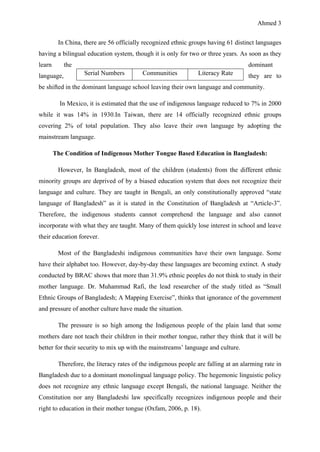
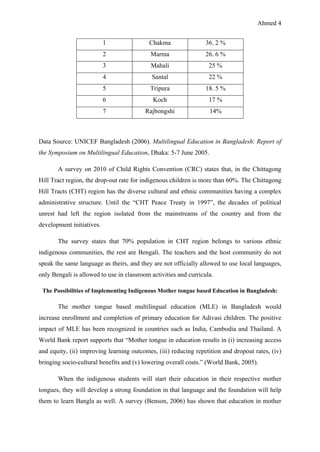
Serial Numbers Communities Literacy Rate
Ahmed 4
Data Source: UNICEF Bangladesh (2006). Multilingual Education in Bangladesh: Report of
the Symposium on Multilingual Education, Dhaka: 5-7 June 2005.
A survey on 2010 of Child Rights Convention (CRC) states that, in the Chittagong
Hill Tract region, the drop-out rate for indigenous children is more than 60%. The Chittagong
Hill Tracts (CHT) region has the diverse cultural and ethnic communities having a complex
administrative structure. Until the “CHT Peace Treaty in 1997”, the decades of political
unrest had left the region isolated from the mainstreams of the country and from the
development initiatives.
The survey states that 70% population in CHT region belongs to various ethnic
indigenous communities, the rest are Bengali. The teachers and the host community do not
speak the same language as theirs, and they are not officially allowed to use local languages,
only Bengali is allowed to use in classroom activities and curricula.
The Possibilities of Implementing Indigenous Mother tongue based Education in Bangladesh:
The mother tongue based multilingual education (MLE) in Bangladesh would
increase enrollment and completion of primary education for Adivasi children. The positive
impact of MLE has been recognized in countries such as India, Cambodia and Thailand. A
World Bank report supports that “Mother tongue in education results in (i) increasing access
and equity, (ii) improving learning outcomes, (iii) reducing repetition and dropout rates, (iv)
bringing socio-cultural benefits and (v) lowering overall costs.” (World Bank, 2005).
When the indigenous students will start their education in their respective mother
tongues, they will develop a strong foundation in that language and the foundation will help
them to learn Bangla as well. A survey (Benson, 2006) has shown that education in mother
1 Chakma 36. 2 %
2 Marma 26. 6 %
3 Mahali 25 %
4 Santal 22 %
5 Tripura 18. 5 %
6 Koch 17 %
7 Rajbongshi 14%
Ahmed 5
tongue increases the enrollment and attendance of Adivasi students. This strong foundation in
the mother language provides a good bridge to learning a second language, Bangla more
effectively (Malone, 2005). A Chakma parent says, “mother tongue based pre-school brought
a lot of changes to my child. He is now very attentive to his lesson.” (Rahman, 2010).
Therefore, the Constitution (Article 15 and 17) of Bangladesh refers to free and
compulsory education and directs the State to adopt effective measures for the purpose of
establishing a uniform, mass-oriented and universal system of education and extending free
and compulsory education to all.
Following the Constitution, The Government of Bangladesh has committed itself to
achieving Education for All (EFA) by 2015 and ensuring the Rights of the Child (UN CRC,
1989). The link between the education in mother tongue and achieving EFA has been made
by the World Bank, UNICEF and UNESCO. Mother Language in Education (MLE) will
enable the Government of Bangladesh to achieve its goals under EFA (Education for All)
project.
On 10 June 2015, a national seminar titled with “Introducing Mother-Tongue Based
Primary Education for Indigenous Children: Present Perspective and Way Forward”
organized by Bangladesh Indigenous Peoples Forum, declared that Education in mother
tongue is a must as it connects a child with his/her culture and literature and aids in forming
his/her intellectual identity. It can help them to achieve higher education. The seminar
discussed that initially the education would be provided in five languages including that of
the Chakma, Marma, Tripura, Sardi and Garo though it is not possible to provide capable and
efficient indigenous teachers to teach the students in their mother tongue. It requested to
Multi-lingual Education (MLE) Forum to create pressure on the government to take steps in
this regard immediately. It also declared that education is one of the basic rights which is
recognized by the Constitution.
Conclusion and Recommendations:
My assignment suggests that the mentioned issues need to be addressed by the state.
Therefore, the students at primary, secondary and tertiary levels need a multilingual/bilingual
linguistic facility. There is the necessity of specific education planning to provide textbooks
in their mother tongues. A strong foundation in the mother language provides a good bridge
to learning a second language effectively. It enables the learners to achieve competence and
Ahmed 6
confidence. The learners of indigenous groups will be able to read and write their mother
tongue and Bengali language fluently. Simultaneously the learners will understand their own
indigenous culture as well as Bengali culture and community.
It will be possible to reduce drop-out problem, If the textbooks on indigenous
languages are provided at least up to secondary levels along with lessening financial and
accommodation problems, the indigenous children will be greatly benefitted. The fund should
be generated to publish the books in their mother tongue.
In 1971 the people of Bangladesh won independence in which the language
movement (1952) has played the role of a catalyst to snatch the freedom of land. Many
Adivasi fought in the war. Since the war of independence, none has questioned Adivasi
Bangladeshis’ right to education in their mother tongue.
Therefore, Adivasi Bangladeshi children cannot enjoy the right to education in their
mother tongue/language. Whereas, Bengali Bangladeshi children attend school in their
mother tongue, Bangla. The vast number of Adivasi children must enter the schools and learn
in a language that they do not know or understand.
Though the initiatives for multilingual primary education for indigenous children are
going forward according to the Education Policy 2010, the progress of this initiative is very
slow. Although it started in 2012, the pre-primary education books in indigenous languages
have not been published yet in 2015 and also the education budget has decreased 1% in 2016
than the previous year budget (Bangladesh Economic Review 2016).
The budget should be increased to secure education for all and to ensure indigenous
peoples’ rights to education through their respective mother tongues.
Ahmed 7
References
Asian Development Bank (2001) “Education in the CHT” TA 3328-BAN, Dhaka. Pdf
Benson, Carol. (2005) Girls, Educational Equity and Mother Tongue-based Teaching.
Bangkok: UNESCO Bangkok. Pdf
BRAC. (2004) “Education and Language Needs of the Indigenous Peoples in Bangladesh”.
Dhaka: Research and Development Collective (RDC). Pdf
BRAC. (2004) “Performance of Mother Tongue and Bangla Users in EIC Schools of BRAC
and Relevant Issues”. Dhaka: Research and Development Collective (RDC). Pdf
Cummins, Jim. Bilingual Children’s Mother Tongue: Why Is It Important to education?
Toronto: University of Toronto. Pdf
International Labour Organisation Convention No 107. 24 January 2007. Doc
Indigenous Children’s Education Forum (ICEF), Miller, Jonathan B, ed. (2006) Many
Languages, One Voice. Dhaka: ICEF Secretariat, CARE Bangladesh. Pdf
Oxfam (2014), Grassroots Voice: The situation of primary education in the Chittagong Hill
Tracts of Bangladesh, Zabarang Kalyan Samity, Khagrachori, February. Pdf
Ministry of Primary and Mass Education (MoPME). (2006) “Primary EducationSituational
Analysis, Strategies and Action Plan for Mainstreaming Tribal Children” Prepared
under the Second Primary Education Development Programme. Dhaka. Pdf
Save the Children UK (2006) Use of Mother Tongue in Education: a policy statement.
Draft. Pdf
“The Chittagong Hill Tracts Peace Accord” (1997) Signed between the Government of
Bangladesh and the Prabatya Chattagram Jana Samhati Samiti. 2 December 1997. Pdf
Ahmed 8
UN Convention on the Rights of the Child, General Assembly resolution 44/25 of20
November 1989, http://www.crin.org/docs/resources/treaties/uncrc.asp, cited18
December 2006. Pdf
UNDP (2006). “Part 1 – Technical Analysis”. Report of the UNDP Mission for
Support to Primary Education in the CHT. Dhaka: UNDP. Pdf
UNICEF Bangladesh (2006). Multilingual Education in Bangladesh. Report of the
Symposium on Multilingual Education, Dhaka: 5-7 June 2005. Pdf

Indigenous Studies

  • 1.
    Ahmed 1 Sheikh SaifullahAhmed Student Id-141410 English Discipline Khulna University Indigenous Studies -4109 Mother Tongue Based Education System for the Bangladeshi Indigenous Students 10 September, 2017 Introduction: Education is considered as one of the basic human rights for a human being. Indigenous education right refers to the system of preserving their rights related to their education through their respective mother tongues. Constitution of Bangladesh and other national and international organizations such as the Universal Declaration of Human Right (UDHR), International Covenant on Civil and Political Rights (ICCPR), International Covenant on Economic, Social and Cultural Rights (ICESCR), International Convention on the Elimination of all Forms of Racial Discrimination (ICERD), Convention Elimination of all forms of Discrimination Against Women (CEDAW), Child Rights Convention (CRC) and International Labor Organization (ILO) 107 ensure to preserve indigenous education rights related to their mother tongue, along with their own distinctive cultures, heritages, languages, customs, rituals, norms and beliefs. Assignment Objectives and Methods: However, in this paper (assignment) I have tried to show what the major issues are for implementing the program of mother tongue based education system in Bangladesh for the Bangladeshi Indigenous (Ethnic, Tribal, Adivasi, Pahari, Janglee, or Upazati) students and how the mentioned issues can be solved with some effective measures. I have used the Constitution (1972) and National Education Policy (2010) of Bangladesh, along with some influential international conventions (UDHR, ICESCR, ICCPR, CRC, ILO-107, ILO-169) as my primary data source and the teacher’s lectures and provided materials concerning the course, along with my own assumptions as the secondary data source.
  • 2.
    Ahmed 2 Keywords: Education, MotherTongue, Bilingualism, Monolingualism, State Language. International conventions regarding Indigenous Language and Education: Article 14 of the UN Convention on the Rights of Indigenous Peoples states “Indigenous peoples have the right to establish and control their educational systems and institutions providing education in their own languages, in a manner appropriate to their cultural methods of teaching and learning.” “The Indigenous and Tribal Peoples Convention, 1989” of ILO-169 concerning Indigenous and Tribal Peoples ensures the mother tongue based education system for the indigenous people of the independent countries as it is stated in its “Part VI – “Education and the Means of Communication”. The convention states: In Article 26: measures shall be taken to ensure the opportunity to acquire education at all levels for the indigenous people and to preserve and promote the development and practice of the indigenous languages. In Article 27: governments shall establish their own educational institutions, create facilities, and shall meet minimum standards forming the competent authority, and providing appropriate resources for this purpose. In Article 28: children shall be taught to read and write in their own indigenous language or in the language most commonly used by the group to which they belong and adequate measures shall be taken to ensure the opportunity to attain fluency in the national language or the state’s official language. In Article 31: the state shall preserve the indigenous cultures and histories by means of written translations and those who are in most direct contact with the peoples, with the objective of eliminating prejudices and biases, shall help to ensure that the textbooks and the other educational materials provide a fair, accurate and informative portrayal of the histories and cultures of these peoples. The Condition of Indigenous Mother Tongue Based Education in Other Countries:
  • 3.
    Ahmed 3 In China,there are 56 officially recognized ethnic groups having 61 distinct languages having a bilingual education system, though it is only for two or three years. As soon as they learn the dominant language, they are to be shifted in the dominant language school leaving their own language and community. In Mexico, it is estimated that the use of indigenous language reduced to 7% in 2000 while it was 14% in 1930.In Taiwan, there are 14 officially recognized ethnic groups covering 2% of total population. They also leave their own language by adopting the mainstream language. The Condition of Indigenous Mother Tongue Based Education in Bangladesh: However, In Bangladesh, most of the children (students) from the different ethnic minority groups are deprived of by a biased education system that does not recognize their language and culture. They are taught in Bengali, an only constitutionally approved “state language of Bangladesh” as it is stated in the Constitution of Bangladesh at “Article-3”. Therefore, the indigenous students cannot comprehend the language and also cannot incorporate with what they are taught. Many of them quickly lose interest in school and leave their education forever. Most of the Bangladeshi indigenous communities have their own language. Some have their alphabet too. However, day-by-day these languages are becoming extinct. A study conducted by BRAC shows that more than 31.9% ethnic peoples do not think to study in their mother language. Dr. Muhammad Rafi, the lead researcher of the study titled as “Small Ethnic Groups of Bangladesh; A Mapping Exercise”, thinks that ignorance of the government and pressure of another culture have made the situation. The pressure is so high among the Indigenous people of the plain land that some mothers dare not teach their children in their mother tongue, rather they think that it will be better for their security to mix up with the mainstreams’ language and culture. Therefore, the literacy rates of the indigenous people are falling at an alarming rate in Bangladesh due to a dominant monolingual language policy. The hegemonic linguistic policy does not recognize any ethnic language except Bengali, the national language. Neither the Constitution nor any Bangladeshi law specifically recognizes indigenous people and their right to education in their mother tongue (Oxfam, 2006, p. 18). Serial Numbers Communities Literacy Rate
  • 4.
    Ahmed 4 Data Source:UNICEF Bangladesh (2006). Multilingual Education in Bangladesh: Report of the Symposium on Multilingual Education, Dhaka: 5-7 June 2005. A survey on 2010 of Child Rights Convention (CRC) states that, in the Chittagong Hill Tract region, the drop-out rate for indigenous children is more than 60%. The Chittagong Hill Tracts (CHT) region has the diverse cultural and ethnic communities having a complex administrative structure. Until the “CHT Peace Treaty in 1997”, the decades of political unrest had left the region isolated from the mainstreams of the country and from the development initiatives. The survey states that 70% population in CHT region belongs to various ethnic indigenous communities, the rest are Bengali. The teachers and the host community do not speak the same language as theirs, and they are not officially allowed to use local languages, only Bengali is allowed to use in classroom activities and curricula. The Possibilities of Implementing Indigenous Mother tongue based Education in Bangladesh: The mother tongue based multilingual education (MLE) in Bangladesh would increase enrollment and completion of primary education for Adivasi children. The positive impact of MLE has been recognized in countries such as India, Cambodia and Thailand. A World Bank report supports that “Mother tongue in education results in (i) increasing access and equity, (ii) improving learning outcomes, (iii) reducing repetition and dropout rates, (iv) bringing socio-cultural benefits and (v) lowering overall costs.” (World Bank, 2005). When the indigenous students will start their education in their respective mother tongues, they will develop a strong foundation in that language and the foundation will help them to learn Bangla as well. A survey (Benson, 2006) has shown that education in mother 1 Chakma 36. 2 % 2 Marma 26. 6 % 3 Mahali 25 % 4 Santal 22 % 5 Tripura 18. 5 % 6 Koch 17 % 7 Rajbongshi 14%
  • 5.
    Ahmed 5 tongue increasesthe enrollment and attendance of Adivasi students. This strong foundation in the mother language provides a good bridge to learning a second language, Bangla more effectively (Malone, 2005). A Chakma parent says, “mother tongue based pre-school brought a lot of changes to my child. He is now very attentive to his lesson.” (Rahman, 2010). Therefore, the Constitution (Article 15 and 17) of Bangladesh refers to free and compulsory education and directs the State to adopt effective measures for the purpose of establishing a uniform, mass-oriented and universal system of education and extending free and compulsory education to all. Following the Constitution, The Government of Bangladesh has committed itself to achieving Education for All (EFA) by 2015 and ensuring the Rights of the Child (UN CRC, 1989). The link between the education in mother tongue and achieving EFA has been made by the World Bank, UNICEF and UNESCO. Mother Language in Education (MLE) will enable the Government of Bangladesh to achieve its goals under EFA (Education for All) project. On 10 June 2015, a national seminar titled with “Introducing Mother-Tongue Based Primary Education for Indigenous Children: Present Perspective and Way Forward” organized by Bangladesh Indigenous Peoples Forum, declared that Education in mother tongue is a must as it connects a child with his/her culture and literature and aids in forming his/her intellectual identity. It can help them to achieve higher education. The seminar discussed that initially the education would be provided in five languages including that of the Chakma, Marma, Tripura, Sardi and Garo though it is not possible to provide capable and efficient indigenous teachers to teach the students in their mother tongue. It requested to Multi-lingual Education (MLE) Forum to create pressure on the government to take steps in this regard immediately. It also declared that education is one of the basic rights which is recognized by the Constitution. Conclusion and Recommendations: My assignment suggests that the mentioned issues need to be addressed by the state. Therefore, the students at primary, secondary and tertiary levels need a multilingual/bilingual linguistic facility. There is the necessity of specific education planning to provide textbooks in their mother tongues. A strong foundation in the mother language provides a good bridge to learning a second language effectively. It enables the learners to achieve competence and
  • 6.
    Ahmed 6 confidence. Thelearners of indigenous groups will be able to read and write their mother tongue and Bengali language fluently. Simultaneously the learners will understand their own indigenous culture as well as Bengali culture and community. It will be possible to reduce drop-out problem, If the textbooks on indigenous languages are provided at least up to secondary levels along with lessening financial and accommodation problems, the indigenous children will be greatly benefitted. The fund should be generated to publish the books in their mother tongue. In 1971 the people of Bangladesh won independence in which the language movement (1952) has played the role of a catalyst to snatch the freedom of land. Many Adivasi fought in the war. Since the war of independence, none has questioned Adivasi Bangladeshis’ right to education in their mother tongue. Therefore, Adivasi Bangladeshi children cannot enjoy the right to education in their mother tongue/language. Whereas, Bengali Bangladeshi children attend school in their mother tongue, Bangla. The vast number of Adivasi children must enter the schools and learn in a language that they do not know or understand. Though the initiatives for multilingual primary education for indigenous children are going forward according to the Education Policy 2010, the progress of this initiative is very slow. Although it started in 2012, the pre-primary education books in indigenous languages have not been published yet in 2015 and also the education budget has decreased 1% in 2016 than the previous year budget (Bangladesh Economic Review 2016). The budget should be increased to secure education for all and to ensure indigenous peoples’ rights to education through their respective mother tongues.
  • 7.
    Ahmed 7 References Asian DevelopmentBank (2001) “Education in the CHT” TA 3328-BAN, Dhaka. Pdf Benson, Carol. (2005) Girls, Educational Equity and Mother Tongue-based Teaching. Bangkok: UNESCO Bangkok. Pdf BRAC. (2004) “Education and Language Needs of the Indigenous Peoples in Bangladesh”. Dhaka: Research and Development Collective (RDC). Pdf BRAC. (2004) “Performance of Mother Tongue and Bangla Users in EIC Schools of BRAC and Relevant Issues”. Dhaka: Research and Development Collective (RDC). Pdf Cummins, Jim. Bilingual Children’s Mother Tongue: Why Is It Important to education? Toronto: University of Toronto. Pdf International Labour Organisation Convention No 107. 24 January 2007. Doc Indigenous Children’s Education Forum (ICEF), Miller, Jonathan B, ed. (2006) Many Languages, One Voice. Dhaka: ICEF Secretariat, CARE Bangladesh. Pdf Oxfam (2014), Grassroots Voice: The situation of primary education in the Chittagong Hill Tracts of Bangladesh, Zabarang Kalyan Samity, Khagrachori, February. Pdf Ministry of Primary and Mass Education (MoPME). (2006) “Primary EducationSituational Analysis, Strategies and Action Plan for Mainstreaming Tribal Children” Prepared under the Second Primary Education Development Programme. Dhaka. Pdf Save the Children UK (2006) Use of Mother Tongue in Education: a policy statement. Draft. Pdf “The Chittagong Hill Tracts Peace Accord” (1997) Signed between the Government of Bangladesh and the Prabatya Chattagram Jana Samhati Samiti. 2 December 1997. Pdf
  • 8.
    Ahmed 8 UN Conventionon the Rights of the Child, General Assembly resolution 44/25 of20 November 1989, http://www.crin.org/docs/resources/treaties/uncrc.asp, cited18 December 2006. Pdf UNDP (2006). “Part 1 – Technical Analysis”. Report of the UNDP Mission for Support to Primary Education in the CHT. Dhaka: UNDP. Pdf UNICEF Bangladesh (2006). Multilingual Education in Bangladesh. Report of the Symposium on Multilingual Education, Dhaka: 5-7 June 2005. Pdf