CONSUMER
BEHAVIOUR
Group 4
Ankit Uttam
Rahul Raju
Saurabh Kumar
Shobhit Deo
Sweta Chouhan
THE INDIAN CONSUMER
CHANGING ATTITUDE OF INDIAN CONSUMERS
 Complex attitude now shifting towards consumerism.
 Constant GDP factor at 8%.
 India constitutes a fifth of the world’s citizen below age 20.
 Galup Organization conducted 2 surveys on more than 2000
gauging
 habits ,
 hopes,
 plans,
in a decade from 1996 to 2006
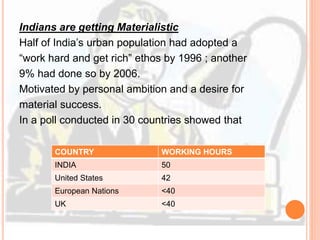
Indians are getting Materialistic
Half of India’s urban population had adopted a
“work hard and get rich” ethos by 1996 ; another
9% had done so by 2006.
Motivated by personal ambition and a desire for
material success.
In a poll conducted in 30 countries showed that
COUNTRY WORKING HOURS
INDIA 50
United States 42
European Nations <40
UK <40
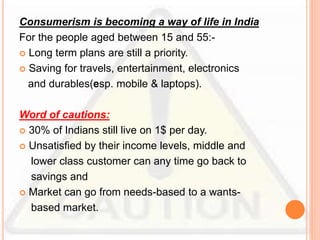
Consumerism is becoming a way of life in India
For the people aged between 15 and 55:-
 Long term plans are still a priority.
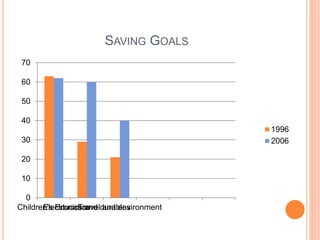
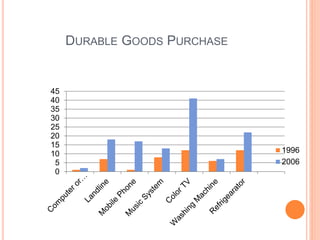
 Saving for travels, entertainment, electronics
and durables(esp. mobile & laptops).
Word of cautions:
 30% of Indians still live on 1$ per day.
 Unsatisfied by their income levels, middle and
lower class customer can any time go back to
savings and
 Market can go from needs-based to a wants-
based market.
SAVING GOALS
0
10
20
30
40
50
60
70
Children's Education
Electronics and durables
Travel and environment
1996
2006
DURABLE GOODS PURCHASE
0
5
10
15
20
25
30
35
40
45
1996
2006
FOREIGN IS PASSÉ; INDIAN IS PARAMOUNT
 “Made in India” is no longer an apology.
 Faith in Indian companies has grown from
34% (1996) to 56%(2006)
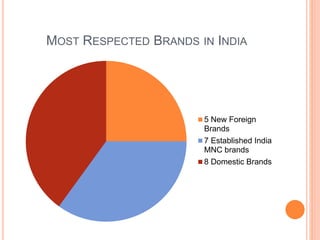
MOST RESPECTED BRANDS IN INDIA
5 New Foreign
Brands
7 Established India
MNC brands
8 Domestic Brands
CONSUMER BEHAVIOUR INFLUENCER
Consumer’s buyer behaviour and the resulting purchase decision are strongly influenced by
the following characteristics. An understanding of the influence of these factors is essential for
marketers in order to develop suitable marketing mixes to appeal to the target customer.
 CULTURAL factors include a consumer’s culture, subculture and social class. These factors are
often inherent in our values and decision processes.
 SOCIAL factors include groups (reference groups, aspirational groups and member groups),
family, roles and status. This explains the outside influences of others on our purchase
decisions either directly or indirectly.
 PERSONAL factors include such variables as age and lifecycle stage, occupation, economic
circumstances, lifestyle (activities, interests, opinions and demographics), personality and self
concept. These may explain why our preferences often change as our `situation' changes.
 PSCHOLOGICAL factors affecting our purchase decision include motivation (Maslow's
hierarchy of needs), perception, learning, beliefs and attitudes.
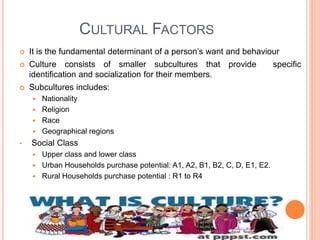
CULTURAL FACTORS
 It is the fundamental determinant of a person’s want and behaviour
 Culture consists of smaller subcultures that provide specific
identification and socialization for their members.
 Subcultures includes:
 Nationality
 Religion
 Race
 Geographical regions
• Social Class
 Upper class and lower class
 Urban Households purchase potential: A1, A2, B1, B2, C, D, E1, E2.
 Rural Households purchase potential : R1 to R4
SOCIAL FACTORS
Reference Groups
 Membership Groups
 Primary
 Secondary
 Aspirational Groups
 Dissociative Groups
 Opinion leader concept: Highly confident
socialy active and Frequent users
Family
 Of Orientation
 Of Procreation
Role and Status
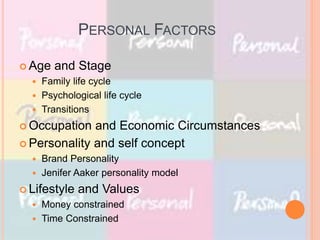
PERSONAL FACTORS
 Age and Stage
 Family life cycle
 Psychological life cycle
 Transitions
 Occupation and Economic Circumstances
 Personality and self concept
 Brand Personality
 Jenifer Aaker personality model
 Lifestyle and Values
 Money constrained
 Time Constrained
JENIFER AAKER MODEL
Sincerity
Excitement
Competence
Sophistication
Ruggedness
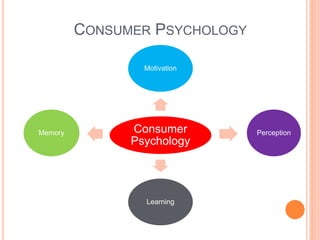
CONSUMER PSYCHOLOGY
Consumer
Psychology
Motivation
Perception
Learning
Memory
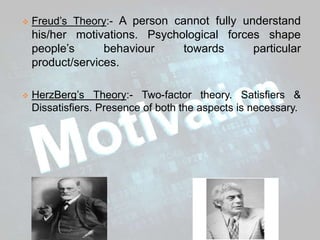
 Freud’s Theory:- A person cannot fully understand
his/her motivations. Psychological forces shape
people’s behaviour towards particular
product/services.
 HerzBerg’s Theory:- Two-factor theory. Satisfiers &
Dissatisfiers. Presence of both the aspects is necessary.
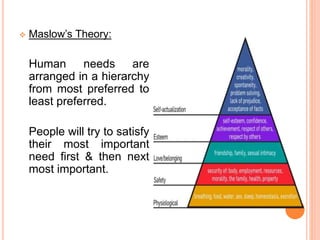
 Maslow’s Theory:
Human needs are
arranged in a hierarchy
from most preferred to
least preferred.
People will try to satisfy
their most important
need first & then next
most important.
Perception is a process of selecting, organizing & interpreting
a piece of information to create a more meaningful picture of
the situation.
 Selective Attention:- People are most likely to notice stimuli
 That relate to a current need.
 They anticipate
 Whose deviations are large in relationship to normal size of the
stimuli.
 Selective Distortion:- People have a tendency to interpret the
information in a way that fits our preconceptions.
 Selective Retention:- Most of us don't remember much of the
information we get from different sources except that information
that supports our attitudes & beliefs.
 Learning induces change in behaviour arising from
experience.
 Drive:- It is a strong stimuli which drives impelling
action.
 Cues:- When, where & how a person responds.
 Discrimination:- Ability to recognize differences
between two stimuli & act accordingly.
 Memory processes:-It is a very constructive process
because we always don’t remember full & complete
information, rather we remember by relating 2 or
more different events with the current event.
 Memory Encoding:- Information is stored in the form of nodes &
they are connected through links. The more easy & less
involving the event, more easily it can be stored & remembered.
 Memory Retrieval:- It is the way information is taken out of
memory for decision making purposes. It mainly depends on
factors such as presence of competitor’s product information in
the memory, exposure to the information, need for certain
events for retrieval of information.
RURAL CONSUMER BEHAVIOUR
 Relaxed lifestyle.
 Brand loyal consumers.
 Low penetration of mass media.
 Collective consumption behavior.
 Cultural values and community norms have strong
influence.
 Places great importance on reference groups.
 Seasonality of consumption based on seasonality of
agricultural production/income.
POST PURCHASE BEHAVIOR
 Post purchase satisfaction:
o Disappointment
o Customer Satisfaction
o Customer delight
 Post purchase actions:
o Private actions
o Public actions
 Post purchase use and disposal:
o Monitor usage and disposal
DECISION HEURISTICS AND BIASES
 Availability heuristic :
Basing predictions on the ease at which an
outcome comes to mind.
 Representativeness heuristic :
Basing predictions on similar outcomes.
 Anchoring and adjustment heuristic :
Initial judgment is based on additional
information.
BDT AND BEHAVIORAL ECONOMICS
 Behavioral decision theory:
o Highlights the critical role of values and beliefs in the
judgments and decision making of marketers and consumers.
o Describes how individual decision makers’ values and beliefs
are incorporated into decisions.
 Behavioral economics explores:
o Why people sometimes make irrational decisions
o Why and how their behavior does not follow the predictions of
economic models.
MENTAL ACCOUNTING
 The way consumers code, categorize and evaluate
financial outcome of choices.
 Key core principles:
o Consumers tend to segregate gains
o Consumers tend to integrate losses
o Consumers tend to integrate smaller losses with larger
gains
o Consumers tend to segregate small gains from large
losses
HOW BIG IS “TALL”
EFFECT OF LABELING AND PACKAGING
IN MARKETING
 Consumers are strongly influenced by the
packaging and labeling of products that they are
considering buying.
 Marketers are well aware of this fact, and go to
great lengths to create packaging that will draw in
consumers and convince them to buy the product.
 This dynamic leads to a riot of competing colors,
shapes and promises in supermarkets and
shopping malls across the land.
 According to Data monitor, a leader in qualitative and
quantitative research for the consumer packaged-goods
industry, over 50 percent of shoppers' purchase
decisions are made at the shelf.
 Since packaging of a product is the first thing that a
consumer sees, it plays a vital role in differentiating a
brand from the competitors.
ATTRACTIVE PACKAGING
 For marketing, the most important part is
the overall look of the product.
 Attractive color and design of
the product can draw customers.
 This is due to the reason that it is usual perception
of people that product appearing beautiful is often
recognized as standard item.
SIZE
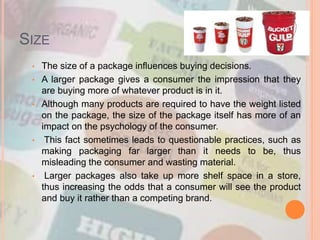
• The size of a package influences buying decisions.
• A larger package gives a consumer the impression that they
are buying more of whatever product is in it.
• Although many products are required to have the weight listed
on the package, the size of the package itself has more of an
impact on the psychology of the consumer.
• This fact sometimes leads to questionable practices, such as
making packaging far larger than it needs to be, thus
misleading the consumer and wasting material.
• Larger packages also take up more shelf space in a store,
thus increasing the odds that a consumer will see the product
and buy it rather than a competing brand.
LABELS
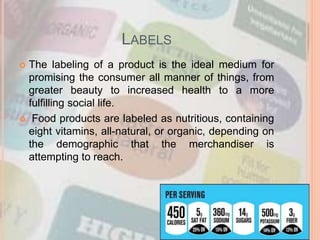
 The labeling of a product is the ideal medium for
promising the consumer all manner of things, from
greater beauty to increased health to a more
fulfilling social life.
 Food products are labeled as nutritious, containing
eight vitamins, all-natural, or organic, depending on
the demographic that the merchandiser is
attempting to reach.
indianconsumerbehaviour-141221075922-conversion-gate01.pdf

indianconsumerbehaviour-141221075922-conversion-gate01.pdf

  • 1.
    CONSUMER BEHAVIOUR Group 4 Ankit Uttam RahulRaju Saurabh Kumar Shobhit Deo Sweta Chouhan
  • 2.
  • 3.
    CHANGING ATTITUDE OFINDIAN CONSUMERS  Complex attitude now shifting towards consumerism.  Constant GDP factor at 8%.  India constitutes a fifth of the world’s citizen below age 20.  Galup Organization conducted 2 surveys on more than 2000 gauging  habits ,  hopes,  plans, in a decade from 1996 to 2006
  • 4.
    Indians are gettingMaterialistic Half of India’s urban population had adopted a “work hard and get rich” ethos by 1996 ; another 9% had done so by 2006. Motivated by personal ambition and a desire for material success. In a poll conducted in 30 countries showed that COUNTRY WORKING HOURS INDIA 50 United States 42 European Nations <40 UK <40
  • 5.
    Consumerism is becominga way of life in India For the people aged between 15 and 55:-  Long term plans are still a priority.  Saving for travels, entertainment, electronics and durables(esp. mobile & laptops). Word of cautions:  30% of Indians still live on 1$ per day.  Unsatisfied by their income levels, middle and lower class customer can any time go back to savings and  Market can go from needs-based to a wants- based market.
  • 6.
    SAVING GOALS 0 10 20 30 40 50 60 70 Children's Education Electronicsand durables Travel and environment 1996 2006
  • 7.
  • 8.
    FOREIGN IS PASSÉ;INDIAN IS PARAMOUNT  “Made in India” is no longer an apology.  Faith in Indian companies has grown from 34% (1996) to 56%(2006)
  • 9.
    MOST RESPECTED BRANDSIN INDIA 5 New Foreign Brands 7 Established India MNC brands 8 Domestic Brands
  • 10.
    CONSUMER BEHAVIOUR INFLUENCER Consumer’sbuyer behaviour and the resulting purchase decision are strongly influenced by the following characteristics. An understanding of the influence of these factors is essential for marketers in order to develop suitable marketing mixes to appeal to the target customer.  CULTURAL factors include a consumer’s culture, subculture and social class. These factors are often inherent in our values and decision processes.  SOCIAL factors include groups (reference groups, aspirational groups and member groups), family, roles and status. This explains the outside influences of others on our purchase decisions either directly or indirectly.  PERSONAL factors include such variables as age and lifecycle stage, occupation, economic circumstances, lifestyle (activities, interests, opinions and demographics), personality and self concept. These may explain why our preferences often change as our `situation' changes.  PSCHOLOGICAL factors affecting our purchase decision include motivation (Maslow's hierarchy of needs), perception, learning, beliefs and attitudes.
  • 11.
    CULTURAL FACTORS  Itis the fundamental determinant of a person’s want and behaviour  Culture consists of smaller subcultures that provide specific identification and socialization for their members.  Subcultures includes:  Nationality  Religion  Race  Geographical regions • Social Class  Upper class and lower class  Urban Households purchase potential: A1, A2, B1, B2, C, D, E1, E2.  Rural Households purchase potential : R1 to R4
  • 12.
    SOCIAL FACTORS Reference Groups Membership Groups  Primary  Secondary  Aspirational Groups  Dissociative Groups  Opinion leader concept: Highly confident socialy active and Frequent users Family  Of Orientation  Of Procreation Role and Status
  • 13.
    PERSONAL FACTORS  Ageand Stage  Family life cycle  Psychological life cycle  Transitions  Occupation and Economic Circumstances  Personality and self concept  Brand Personality  Jenifer Aaker personality model  Lifestyle and Values  Money constrained  Time Constrained
  • 14.
  • 15.
  • 16.
     Freud’s Theory:-A person cannot fully understand his/her motivations. Psychological forces shape people’s behaviour towards particular product/services.  HerzBerg’s Theory:- Two-factor theory. Satisfiers & Dissatisfiers. Presence of both the aspects is necessary.
  • 17.
     Maslow’s Theory: Humanneeds are arranged in a hierarchy from most preferred to least preferred. People will try to satisfy their most important need first & then next most important.
  • 18.
    Perception is aprocess of selecting, organizing & interpreting a piece of information to create a more meaningful picture of the situation.  Selective Attention:- People are most likely to notice stimuli  That relate to a current need.  They anticipate  Whose deviations are large in relationship to normal size of the stimuli.  Selective Distortion:- People have a tendency to interpret the information in a way that fits our preconceptions.  Selective Retention:- Most of us don't remember much of the information we get from different sources except that information that supports our attitudes & beliefs.
  • 19.
     Learning induceschange in behaviour arising from experience.  Drive:- It is a strong stimuli which drives impelling action.  Cues:- When, where & how a person responds.  Discrimination:- Ability to recognize differences between two stimuli & act accordingly.
  • 20.
     Memory processes:-Itis a very constructive process because we always don’t remember full & complete information, rather we remember by relating 2 or more different events with the current event.  Memory Encoding:- Information is stored in the form of nodes & they are connected through links. The more easy & less involving the event, more easily it can be stored & remembered.  Memory Retrieval:- It is the way information is taken out of memory for decision making purposes. It mainly depends on factors such as presence of competitor’s product information in the memory, exposure to the information, need for certain events for retrieval of information.
  • 21.
    RURAL CONSUMER BEHAVIOUR Relaxed lifestyle.  Brand loyal consumers.  Low penetration of mass media.  Collective consumption behavior.  Cultural values and community norms have strong influence.  Places great importance on reference groups.  Seasonality of consumption based on seasonality of agricultural production/income.
  • 22.
    POST PURCHASE BEHAVIOR Post purchase satisfaction: o Disappointment o Customer Satisfaction o Customer delight  Post purchase actions: o Private actions o Public actions  Post purchase use and disposal: o Monitor usage and disposal
  • 23.
    DECISION HEURISTICS ANDBIASES  Availability heuristic : Basing predictions on the ease at which an outcome comes to mind.  Representativeness heuristic : Basing predictions on similar outcomes.  Anchoring and adjustment heuristic : Initial judgment is based on additional information.
  • 24.
    BDT AND BEHAVIORALECONOMICS  Behavioral decision theory: o Highlights the critical role of values and beliefs in the judgments and decision making of marketers and consumers. o Describes how individual decision makers’ values and beliefs are incorporated into decisions.  Behavioral economics explores: o Why people sometimes make irrational decisions o Why and how their behavior does not follow the predictions of economic models.
  • 25.
    MENTAL ACCOUNTING  Theway consumers code, categorize and evaluate financial outcome of choices.  Key core principles: o Consumers tend to segregate gains o Consumers tend to integrate losses o Consumers tend to integrate smaller losses with larger gains o Consumers tend to segregate small gains from large losses
  • 26.
    HOW BIG IS“TALL”
  • 27.
    EFFECT OF LABELINGAND PACKAGING IN MARKETING  Consumers are strongly influenced by the packaging and labeling of products that they are considering buying.  Marketers are well aware of this fact, and go to great lengths to create packaging that will draw in consumers and convince them to buy the product.  This dynamic leads to a riot of competing colors, shapes and promises in supermarkets and shopping malls across the land.
  • 28.
     According toData monitor, a leader in qualitative and quantitative research for the consumer packaged-goods industry, over 50 percent of shoppers' purchase decisions are made at the shelf.  Since packaging of a product is the first thing that a consumer sees, it plays a vital role in differentiating a brand from the competitors.
  • 29.
    ATTRACTIVE PACKAGING  Formarketing, the most important part is the overall look of the product.  Attractive color and design of the product can draw customers.  This is due to the reason that it is usual perception of people that product appearing beautiful is often recognized as standard item.
  • 30.
    SIZE • The sizeof a package influences buying decisions. • A larger package gives a consumer the impression that they are buying more of whatever product is in it. • Although many products are required to have the weight listed on the package, the size of the package itself has more of an impact on the psychology of the consumer. • This fact sometimes leads to questionable practices, such as making packaging far larger than it needs to be, thus misleading the consumer and wasting material. • Larger packages also take up more shelf space in a store, thus increasing the odds that a consumer will see the product and buy it rather than a competing brand.
  • 31.
    LABELS  The labelingof a product is the ideal medium for promising the consumer all manner of things, from greater beauty to increased health to a more fulfilling social life.  Food products are labeled as nutritious, containing eight vitamins, all-natural, or organic, depending on the demographic that the merchandiser is attempting to reach.