

Indian
Literature
Masterpieces
Of
Indian Literature
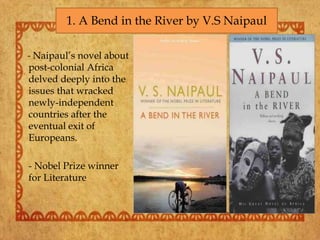
- Naipaul’s novel about
post-colonial Africa
delved deeply into the
issues that wracked
newly-independent
countries after the
eventual exit of
Europeans.
- Nobel Prize winner
for Literature
1. A Bend in the River by V.S Naipaul
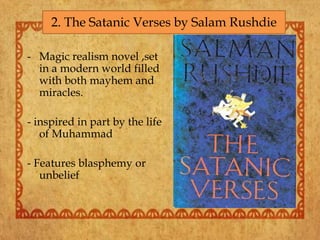
- Magic realism novel ,set
in a modern world filled
with both mayhem and
miracles.
- inspired in part by the life
of Muhammad
- Features blasphemy or
unbelief
2. The Satanic Verses by Salam Rushdie
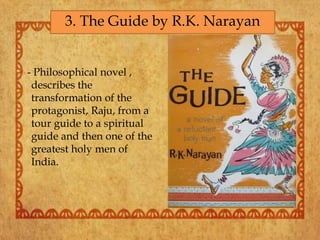
- Philosophical novel ,
describes the
transformation of the
protagonist, Raju, from a
tour guide to a spiritual
guide and then one of the
greatest holy men of
India.
3. The Guide by R.K. Narayan
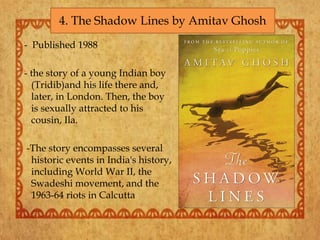
- Published 1988
- the story of a young Indian boy
(Tridib)and his life there and,
later, in London. Then, the boy
is sexually attracted to his
cousin, Ila.
-The story encompasses several
historic events in India's history,
including World War II, the
Swadeshi movement, and the
1963-64 riots in Calcutta
4. The Shadow Lines by Amitav Ghosh
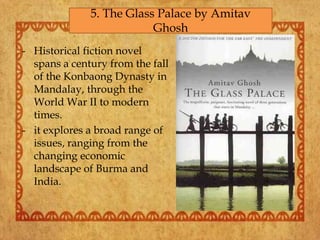
- Historical fiction novel
spans a century from the fall
of the Konbaong Dynasty in
Mandalay, through the
World War II to modern
times.
- it explores a broad range of
issues, ranging from the
changing economic
landscape of Burma and
India.
5. The Glass Palace by Amitav
Ghosh
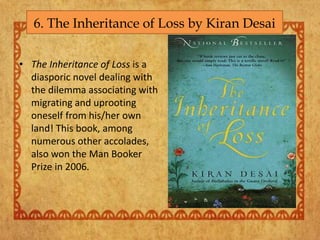
6. The Inheritance of Loss by Kiran Desai
• The Inheritance of Loss is a
diasporic novel dealing with
the dilemma associating with
migrating and uprooting
oneself from his/her own
land! This book, among
numerous other accolades,
also won the Man Booker
Prize in 2006.
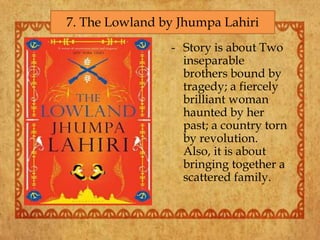
- Story is about Two
inseparable
brothers bound by
tragedy; a fiercely
brilliant woman
haunted by her
past; a country torn
by revolution.
Also, it is about
bringing together a
scattered family.
7. The Lowland by Jhumpa Lahiri
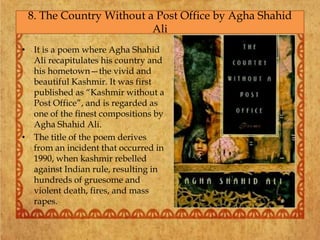
• It is a poem where Agha Shahid
Ali recapitulates his country and
his hometown—the vivid and
beautiful Kashmir. It was first
published as “Kashmir without a
Post Office”, and is regarded as
one of the finest compositions by
Agha Shahid Ali.
• The title of the poem derives
from an incident that occurred in
1990, when kashmir rebelled
against Indian rule, resulting in
hundreds of gruesome and
violent death, fires, and mass
rapes.
8. The Country Without a Post Office by Agha Shahid
Ali
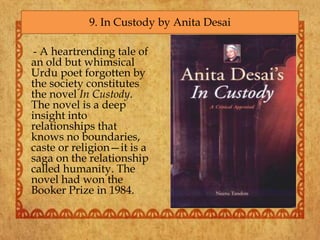
- A heartrending tale of
an old but whimsical
Urdu poet forgotten by
the society constitutes
the novel In Custody.
The novel is a deep
insight into
relationships that
knows no boundaries,
caste or religion—it is a
saga on the relationship
called humanity. The
novel had won the
Booker Prize in 1984.
9. In Custody by Anita Desai
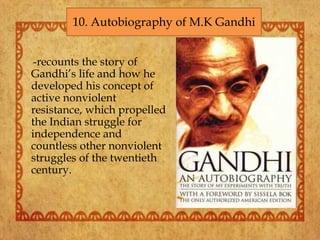
-recounts the story of
Gandhi’s life and how he
developed his concept of
active nonviolent
resistance, which propelled
the Indian struggle for
independence and
countless other nonviolent
struggles of the twentieth
century.
10. Autobiography of M.K Gandhi
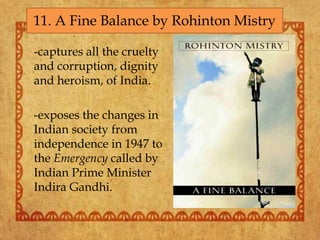
-captures all the cruelty
and corruption, dignity
and heroism, of India.
-exposes the changes in
Indian society from
independence in 1947 to
the Emergency called by
Indian Prime Minister
Indira Gandhi.
11. A Fine Balance by Rohinton Mistry
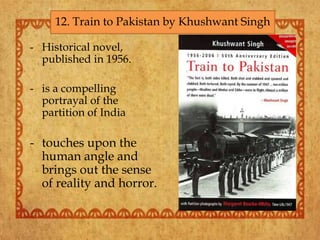
- Historical novel,
published in 1956.
- is a compelling
portrayal of the
partition of India
- touches upon the
human angle and
brings out the sense
of reality and horror.
12. Train to Pakistan by Khushwant Singh
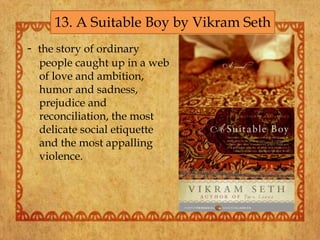
- the story of ordinary
people caught up in a web
of love and ambition,
humor and sadness,
prejudice and
reconciliation, the most
delicate social etiquette
and the most appalling
violence.
13. A Suitable Boy by Vikram Seth
14. The Glassblower’s Breath by Sunetra Gupta
- talks about the journey of
a woman and her
emotional, intellectual and
sexual experiences.
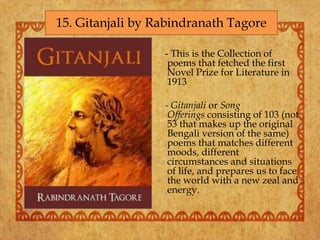
- This is the Collection of
poems that fetched the first
Novel Prize for Literature in
1913
- Gitanjali or Song
Offerings consisting of 103 (not
53 that makes up the original
Bengali version of the same)
poems that matches different
moods, different
circumstances and situations
of life, and prepares us to face
the world with a new zeal and
energy.
15. Gitanjali by Rabindranath Tagore
Indian literature

Indian literature

  • 1.
  • 2.
  • 3.
    - Naipaul’s novelabout post-colonial Africa delved deeply into the issues that wracked newly-independent countries after the eventual exit of Europeans. - Nobel Prize winner for Literature 1. A Bend in the River by V.S Naipaul
  • 4.
    - Magic realismnovel ,set in a modern world filled with both mayhem and miracles. - inspired in part by the life of Muhammad - Features blasphemy or unbelief 2. The Satanic Verses by Salam Rushdie
  • 5.
    - Philosophical novel, describes the transformation of the protagonist, Raju, from a tour guide to a spiritual guide and then one of the greatest holy men of India. 3. The Guide by R.K. Narayan
  • 6.
    - Published 1988 -the story of a young Indian boy (Tridib)and his life there and, later, in London. Then, the boy is sexually attracted to his cousin, Ila. -The story encompasses several historic events in India's history, including World War II, the Swadeshi movement, and the 1963-64 riots in Calcutta 4. The Shadow Lines by Amitav Ghosh
  • 7.
    - Historical fictionnovel spans a century from the fall of the Konbaong Dynasty in Mandalay, through the World War II to modern times. - it explores a broad range of issues, ranging from the changing economic landscape of Burma and India. 5. The Glass Palace by Amitav Ghosh
  • 8.
    6. The Inheritanceof Loss by Kiran Desai • The Inheritance of Loss is a diasporic novel dealing with the dilemma associating with migrating and uprooting oneself from his/her own land! This book, among numerous other accolades, also won the Man Booker Prize in 2006.
  • 9.
    - Story isabout Two inseparable brothers bound by tragedy; a fiercely brilliant woman haunted by her past; a country torn by revolution. Also, it is about bringing together a scattered family. 7. The Lowland by Jhumpa Lahiri
  • 10.
    • It isa poem where Agha Shahid Ali recapitulates his country and his hometown—the vivid and beautiful Kashmir. It was first published as “Kashmir without a Post Office”, and is regarded as one of the finest compositions by Agha Shahid Ali. • The title of the poem derives from an incident that occurred in 1990, when kashmir rebelled against Indian rule, resulting in hundreds of gruesome and violent death, fires, and mass rapes. 8. The Country Without a Post Office by Agha Shahid Ali
  • 11.
    - A heartrendingtale of an old but whimsical Urdu poet forgotten by the society constitutes the novel In Custody. The novel is a deep insight into relationships that knows no boundaries, caste or religion—it is a saga on the relationship called humanity. The novel had won the Booker Prize in 1984. 9. In Custody by Anita Desai
  • 12.
    -recounts the storyof Gandhi’s life and how he developed his concept of active nonviolent resistance, which propelled the Indian struggle for independence and countless other nonviolent struggles of the twentieth century. 10. Autobiography of M.K Gandhi
  • 13.
    -captures all thecruelty and corruption, dignity and heroism, of India. -exposes the changes in Indian society from independence in 1947 to the Emergency called by Indian Prime Minister Indira Gandhi. 11. A Fine Balance by Rohinton Mistry
  • 14.
    - Historical novel, publishedin 1956. - is a compelling portrayal of the partition of India - touches upon the human angle and brings out the sense of reality and horror. 12. Train to Pakistan by Khushwant Singh
  • 15.
    - the storyof ordinary people caught up in a web of love and ambition, humor and sadness, prejudice and reconciliation, the most delicate social etiquette and the most appalling violence. 13. A Suitable Boy by Vikram Seth
  • 16.
    14. The Glassblower’sBreath by Sunetra Gupta - talks about the journey of a woman and her emotional, intellectual and sexual experiences.
  • 17.
    - This isthe Collection of poems that fetched the first Novel Prize for Literature in 1913 - Gitanjali or Song Offerings consisting of 103 (not 53 that makes up the original Bengali version of the same) poems that matches different moods, different circumstances and situations of life, and prepares us to face the world with a new zeal and energy. 15. Gitanjali by Rabindranath Tagore