Study Presentation
Indian Constitution
Presented By:
Soham Jadhav, Prathamesh Sutar, Shreyash Pawashe and Shree
Gurav
Topics
:
State Executive
Chief Minister
State Cabinet
Election Commission
Electorial Process
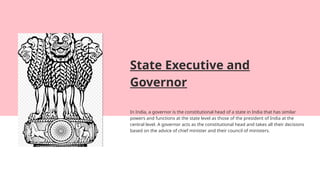
State Executive and
Governor
In India, a governor is the constitutional head of a state in India that has similar
powers and functions at the state level as those of the president of India at the
central level. A governor acts as the constitutional head and takes all their decisions
based on the advice of chief minister and their council of ministers.
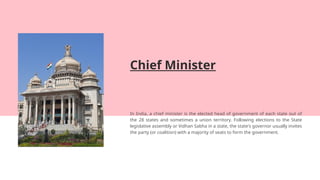
Chief Minister
In India, a chief minister is the elected head of government of each state out of
the 28 states and sometimes a union territory. Following elections to the State
legislative assembly or Vidhan Sabha in a state, the state's governor usually invites
the party (or coalition) with a majority of seats to form the government.
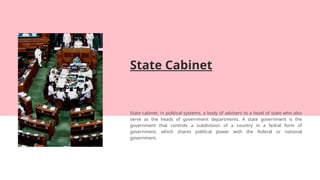
State Cabinet
State cabinet, in political systems, a body of advisers to a head of state who also
serve as the heads of government departments. A state government is the
government that controls a subdivision of a country in a fedral form of
government, which shares political power with the federal or national
government.
Election
Commission
The Election Commission of India (ECI) is a constitutional body established by the
Constitutional of the Republic of India empowered to conduct free and fair
elections in the Republic of India. The Election commission is headed by a Chief
Election Commissioner and consists of two other Election Commissioners.
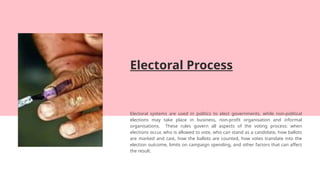
Electoral Process
Electoral systems are used in politics to elect governments, while non-political
elections may take place in business, non-profit organisation and informal
organisations. These rules govern all aspects of the voting process: when
elections occur, who is allowed to vote, who can stand as a candidate, how ballots
are marked and cast, how the ballots are counted, how votes translate into the
election outcome, limits on campaign spending, and other factors that can affect
the result.

Indian Constitution presentation on Directive principles

  • 1.
    Study Presentation Indian Constitution PresentedBy: Soham Jadhav, Prathamesh Sutar, Shreyash Pawashe and Shree Gurav
  • 2.
    Topics : State Executive Chief Minister StateCabinet Election Commission Electorial Process
  • 3.
    State Executive and Governor InIndia, a governor is the constitutional head of a state in India that has similar powers and functions at the state level as those of the president of India at the central level. A governor acts as the constitutional head and takes all their decisions based on the advice of chief minister and their council of ministers.
  • 4.
    Chief Minister In India,a chief minister is the elected head of government of each state out of the 28 states and sometimes a union territory. Following elections to the State legislative assembly or Vidhan Sabha in a state, the state's governor usually invites the party (or coalition) with a majority of seats to form the government.
  • 5.
    State Cabinet State cabinet,in political systems, a body of advisers to a head of state who also serve as the heads of government departments. A state government is the government that controls a subdivision of a country in a fedral form of government, which shares political power with the federal or national government.
  • 6.
    Election Commission The Election Commissionof India (ECI) is a constitutional body established by the Constitutional of the Republic of India empowered to conduct free and fair elections in the Republic of India. The Election commission is headed by a Chief Election Commissioner and consists of two other Election Commissioners.
  • 7.
    Electoral Process Electoral systemsare used in politics to elect governments, while non-political elections may take place in business, non-profit organisation and informal organisations. These rules govern all aspects of the voting process: when elections occur, who is allowed to vote, who can stand as a candidate, how ballots are marked and cast, how the ballots are counted, how votes translate into the election outcome, limits on campaign spending, and other factors that can affect the result.