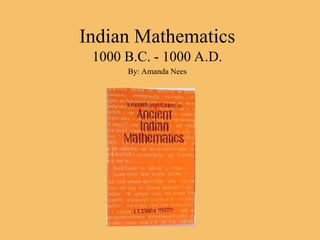
Indian Mathematics
1000 B.C. - 1000 A.D.
By: Amanda Nees
Introduction
• The roots of Indian mathematics are held
within Vedic literature. Vedic literature is
nearly 4000 years old. Indian mathematics
was founded between the years of 1000
B.C.and 1000 A.D. Indian mathematics
include the concept of zero, the techniques
of algebra and algorithum, geometry, and
the decimal system.
Discoveries
• The Concept of Zero
• The Techniques of Algebra and Algorithm
• Geometry
• The Square Root
• The Decimal System
Concept of Zero
• The discovery of zero was said to be an odd
discovery due to the fact that when other
discoveries were made they represented a
tangible object. Zero is unique because it
represents something in which we do not
have.
• Created in 2000B.C.
Zero Continued
• In ancient India zero was represented by a
dot.
• The term for zero was Pujyam.
• Another term for zero was Shunyam which
meant blank.
• Zero now made it possible to note higher
numerals with limited characters
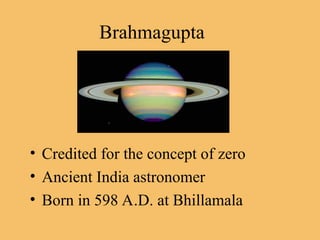
Brahmagupta
• Credited for the concept of zero
• Ancient India astronomer
• Born in 598 A.D. at Bhillamala
Bhaskara
• Born in 1114 A.D. and died in 1185 A.D.
• He was the first to discover:
– that any number divided by zero was infinity
– that the sum of any number and infinity is also
infinity.
Algorithm and Algebra
• Developed by:Aryabhata and Bhaskara
• The technique of calculation
• Today it is used to design software
programs
• They obtained number solutions to linear
equations by the method we still use today.
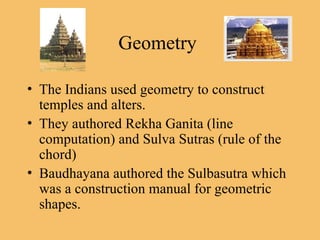
Geometry
• The Indians used geometry to construct
temples and alters.
• They authored Rekha Ganita (line
computation) and Sulva Sutras (rule of the
chord)
• Baudhayana authored the Sulbasutra which
was a construction manual for geometric
shapes.
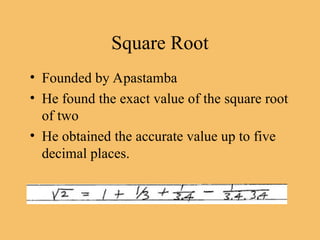
Square Root
• Founded by Apastamba
• He found the exact value of the square root
of two
• He obtained the accurate value up to five
decimal places.
Apastamba
• Born in 600 B.C. and died in 500 B.C.
• He is well known for his Sulbasutra. In the
Sulbasutra he gave the accurate value for
the square root of two.
• Apastamba’s sulbasutra was developed later
than Braushayana. Historians can’t
accurately put dates on Apastamba and his
works. This is why he is so famous.
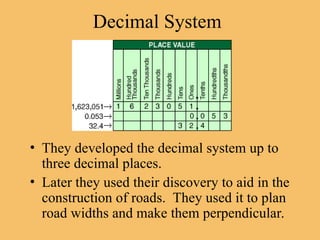
Decimal System
• They developed the decimal system up to
three decimal places.
• Later they used their discovery to aid in the
construction of roads. They used it to plan
road widths and make them perpendicular.
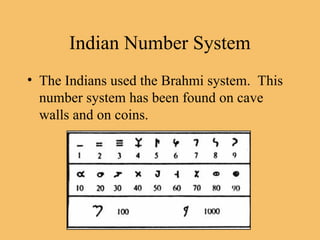
Indian Number System
• The Indians used the Brahmi system. This
number system has been found on cave
walls and on coins.
Timeline
• About 600BC- Apastamba writes the most
interesting Indian Sulbasutra from a
mathematical point of view.
• About 800BC- Baudhayana is the author of
one of the earliest of the Indian Sulbasutras.
• About 2000BC- Harappans adopt a uniform
decimal system of weights and measures.
• About 2000BC they discovered the concept
of zero.
• About 25000BC- Early geometric designs
used
Summary
• The Indians play a key role in the history of
our mathematics we know today. Over
time we have discovered more and more of
the Indian advancements in mathematics.
Continuing to study the Indians may allow
more discoveries to unfold. The Indians
successes will not be forgotten.
Bibliography
• http://o3.indiatimes.com/kaak/archive/2005/
09/26/266712.aspx
• http://hindutva.org/sudheer_birokar/
india_contribution/maths.html
• http://www.ilovemaths.com/ind_mathe.htm
Bibliography Continued
• http://www.groups.dcs.st-and.ac.u/
~history/HistTopics/
Indian_mathematics.html
• http://www.crystalinks.com/
indiamathematics.html
• http://www-gap.dcs.st-and.ac.uk/~history/
Chronology/full.html

indian ancient mathematics and application.ppt

  • 1.
    Indian Mathematics 1000 B.C.- 1000 A.D. By: Amanda Nees
  • 2.
    Introduction • The rootsof Indian mathematics are held within Vedic literature. Vedic literature is nearly 4000 years old. Indian mathematics was founded between the years of 1000 B.C.and 1000 A.D. Indian mathematics include the concept of zero, the techniques of algebra and algorithum, geometry, and the decimal system.
  • 3.
    Discoveries • The Conceptof Zero • The Techniques of Algebra and Algorithm • Geometry • The Square Root • The Decimal System
  • 4.
    Concept of Zero •The discovery of zero was said to be an odd discovery due to the fact that when other discoveries were made they represented a tangible object. Zero is unique because it represents something in which we do not have. • Created in 2000B.C.
  • 5.
    Zero Continued • Inancient India zero was represented by a dot. • The term for zero was Pujyam. • Another term for zero was Shunyam which meant blank. • Zero now made it possible to note higher numerals with limited characters
  • 6.
    Brahmagupta • Credited forthe concept of zero • Ancient India astronomer • Born in 598 A.D. at Bhillamala
  • 7.
    Bhaskara • Born in1114 A.D. and died in 1185 A.D. • He was the first to discover: – that any number divided by zero was infinity – that the sum of any number and infinity is also infinity.
  • 8.
    Algorithm and Algebra •Developed by:Aryabhata and Bhaskara • The technique of calculation • Today it is used to design software programs • They obtained number solutions to linear equations by the method we still use today.
  • 9.
    Geometry • The Indiansused geometry to construct temples and alters. • They authored Rekha Ganita (line computation) and Sulva Sutras (rule of the chord) • Baudhayana authored the Sulbasutra which was a construction manual for geometric shapes.
  • 10.
    Square Root • Foundedby Apastamba • He found the exact value of the square root of two • He obtained the accurate value up to five decimal places.
  • 11.
    Apastamba • Born in600 B.C. and died in 500 B.C. • He is well known for his Sulbasutra. In the Sulbasutra he gave the accurate value for the square root of two. • Apastamba’s sulbasutra was developed later than Braushayana. Historians can’t accurately put dates on Apastamba and his works. This is why he is so famous.
  • 12.
    Decimal System • Theydeveloped the decimal system up to three decimal places. • Later they used their discovery to aid in the construction of roads. They used it to plan road widths and make them perpendicular.
  • 13.
    Indian Number System •The Indians used the Brahmi system. This number system has been found on cave walls and on coins.
  • 14.
    Timeline • About 600BC-Apastamba writes the most interesting Indian Sulbasutra from a mathematical point of view. • About 800BC- Baudhayana is the author of one of the earliest of the Indian Sulbasutras. • About 2000BC- Harappans adopt a uniform decimal system of weights and measures. • About 2000BC they discovered the concept of zero. • About 25000BC- Early geometric designs used
  • 15.
    Summary • The Indiansplay a key role in the history of our mathematics we know today. Over time we have discovered more and more of the Indian advancements in mathematics. Continuing to study the Indians may allow more discoveries to unfold. The Indians successes will not be forgotten.
  • 16.
  • 17.
    Bibliography Continued • http://www.groups.dcs.st-and.ac.u/ ~history/HistTopics/ Indian_mathematics.html •http://www.crystalinks.com/ indiamathematics.html • http://www-gap.dcs.st-and.ac.uk/~history/ Chronology/full.html