India Industrial Automation Market
Report - 2020
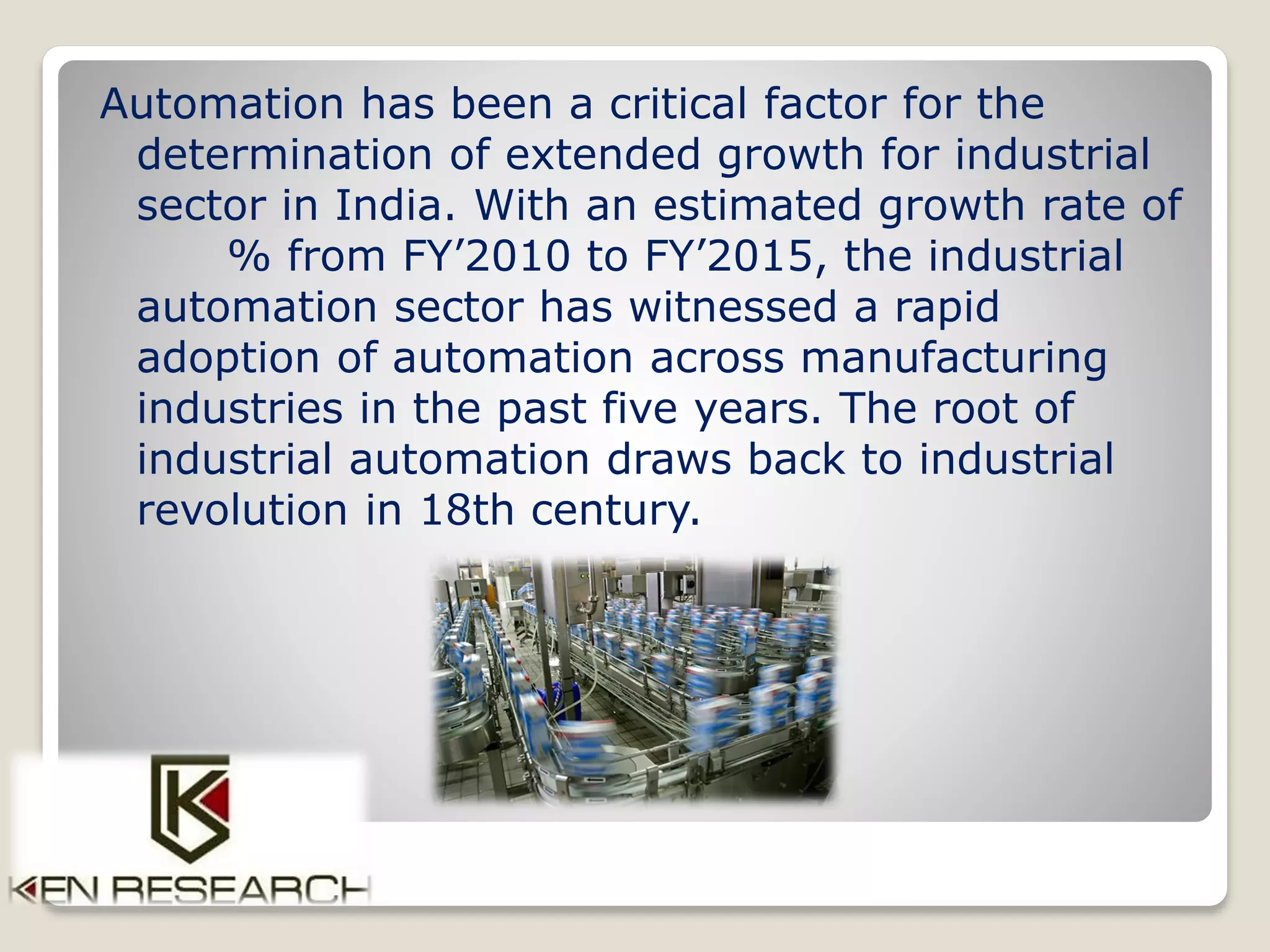
Automation has been a critical factor for the
determination of extended growth for industrial
sector in India. With an estimated growth rate of
% from FY’2010 to FY’2015, the industrial
automation sector has witnessed a rapid
adoption of automation across manufacturing
industries in the past five years. The root of
industrial automation draws back to industrial
revolution in 18th century.
The term automation generally refers to the
system of integration of machines into a self
governing system. Industrial automation can be
defined as technology concerned with performing
a process by the means of programmed
commands coupled with control and monitoring
devices to ensure a proper execution of
instructions so that machines can function
without any human intervention.
Industrial automation assists to build an efficient
and successful company. The process automation
market is largely dominated by control devices.
The factory automation market has been growing
at a faster pace relative to process automation
market since FY’2010. The market has
showcased unprecedented growth due to
increase in demand of industrial robotics and
recent innovations in networks and control
devices.
This has been chiefly determined by the savings
and cost cutting in material costs, energy,
manpower and infrastructure. With the
advancement in modern technologies and the
proliferation of businesses and manufacturing
facilities, industrial automation sector has
become an indispensable part in our daily lives
especially. With the advancement in modern
technologies and the proliferation of businesses
and manufacturing facilities, industrial
automation sector has become an indispensable
part in our daily lives especially.
The industrial automation market was expanding
very rapidly worldwide and it witnessed the
strongest sustained growth in its history since its
inception. The global industrial automation
market grew at a CAGR of ~% during FY’2004-
FY’2007, but the market came to sudden halt in
2008-2009 due to financial crisis and the market
showcased decline of more than ~% in that
period.
System integrators earn the highest percentage of
revenue margins of ~% from the automation
devices manufacturers as the most of the
demand of automation products accrues from
system integrators to them. Original equipment
manufacturers are small automation
manufacturers which source spare parts or other
basic automation equipments from major
automation manufacturing companies such as
ABB, Siemens, Rockwell Automation and others
through system integrators and distributors.
Industrial automation manufactures have tied up
with several system integrators who source
equipments from different companies and install
those at the customer’s end. It has been
estimated that, there are approximately ~
system integrators in the country and almost ~%
of those system integrators work with the top
five industrial automation companies in India
which includes Siemens, Schneider Electric, ABB
ltd and Rockwell Automation. India industrial
automation market can be broadly classified into
two major categories, namely factory automation
market and process automation market
Process automation consists of refining raw
materials of several types into a finished product.
Its operations are primarily focused on the flow
and combination of raw materials into another
product. Process automation normally contains
automation of outdoor plants of industries such
as petroleum products, chemicals,
pharmaceuticals and more. The share of process
automation market was determined to be ~% in
the overall industrial automation market in
FY’2015, with market contribution of INR ~
billion. The share of factory automation market
was found out to be ~% in FY’2015
The factory automation market in India has been
the fastest emerging segment in the industrial
automation market in India. Manufacturers in
India have started to adopt factory automation
practices to cater to the skyrocketing costs of
production. Manufacturing practices has been
majorly a manual procedure in most of the
factories in India. The demand for factory
automation was primarily driven by increase in
demand of finished and quality products coupled
with increase in competition with the advent of
more players and manufacturers in the market.
Manufacturers have been increasingly shifting to
factory automation practices which consist of
automated guided vehicles, industrial robots,
automated crane & conveyor systems since it
decreases the material handling time and
increases the production volume over time.
Factory automation helps to connect the “top
floor to the shop floor” i.e. actual detailed
business requirements and necessities can be
monitored by the top level management in no
time and all the data and information can be
share with the management of the company.
Factory automation provides the shop floor
connectivity with the logistics, assets & supply
chain tracking, operations workflow automation,
shared communications, personnel and
production tracking and other plant data.
Factory automation has been a huge success in the
Indian market due to extensive adoption of new
and improved technologies. The Factory
automation market in India has grown at a CAGR
of ~% from INR 20.5 billion in FY’2010 to INR
~billion in FY’2015.
 Source: https://www.kenresearch.com/manufacturing-and-
construction/industrial-engineering/india-industrial-automation-
market-research-report/4480-97.html
 Contact:
Ken Research
Ankur Gupta, Head Marketing & Communications
Ankur@kenresearch.com
+91-9015378249
Thank you

India industrial automation market report 2020 |India Industrial Automation Market

  • 1.
    India Industrial AutomationMarket Report - 2020
  • 2.
    Automation has beena critical factor for the determination of extended growth for industrial sector in India. With an estimated growth rate of % from FY’2010 to FY’2015, the industrial automation sector has witnessed a rapid adoption of automation across manufacturing industries in the past five years. The root of industrial automation draws back to industrial revolution in 18th century.
  • 3.
    The term automationgenerally refers to the system of integration of machines into a self governing system. Industrial automation can be defined as technology concerned with performing a process by the means of programmed commands coupled with control and monitoring devices to ensure a proper execution of instructions so that machines can function without any human intervention.
  • 4.
    Industrial automation assiststo build an efficient and successful company. The process automation market is largely dominated by control devices. The factory automation market has been growing at a faster pace relative to process automation market since FY’2010. The market has showcased unprecedented growth due to increase in demand of industrial robotics and recent innovations in networks and control devices.
  • 5.
    This has beenchiefly determined by the savings and cost cutting in material costs, energy, manpower and infrastructure. With the advancement in modern technologies and the proliferation of businesses and manufacturing facilities, industrial automation sector has become an indispensable part in our daily lives especially. With the advancement in modern technologies and the proliferation of businesses and manufacturing facilities, industrial automation sector has become an indispensable part in our daily lives especially.
  • 6.
    The industrial automationmarket was expanding very rapidly worldwide and it witnessed the strongest sustained growth in its history since its inception. The global industrial automation market grew at a CAGR of ~% during FY’2004- FY’2007, but the market came to sudden halt in 2008-2009 due to financial crisis and the market showcased decline of more than ~% in that period.
  • 7.
    System integrators earnthe highest percentage of revenue margins of ~% from the automation devices manufacturers as the most of the demand of automation products accrues from system integrators to them. Original equipment manufacturers are small automation manufacturers which source spare parts or other basic automation equipments from major automation manufacturing companies such as ABB, Siemens, Rockwell Automation and others through system integrators and distributors.
  • 8.
    Industrial automation manufactureshave tied up with several system integrators who source equipments from different companies and install those at the customer’s end. It has been estimated that, there are approximately ~ system integrators in the country and almost ~% of those system integrators work with the top five industrial automation companies in India which includes Siemens, Schneider Electric, ABB ltd and Rockwell Automation. India industrial automation market can be broadly classified into two major categories, namely factory automation market and process automation market
  • 9.
    Process automation consistsof refining raw materials of several types into a finished product. Its operations are primarily focused on the flow and combination of raw materials into another product. Process automation normally contains automation of outdoor plants of industries such as petroleum products, chemicals, pharmaceuticals and more. The share of process automation market was determined to be ~% in the overall industrial automation market in FY’2015, with market contribution of INR ~ billion. The share of factory automation market was found out to be ~% in FY’2015
  • 10.
    The factory automationmarket in India has been the fastest emerging segment in the industrial automation market in India. Manufacturers in India have started to adopt factory automation practices to cater to the skyrocketing costs of production. Manufacturing practices has been majorly a manual procedure in most of the factories in India. The demand for factory automation was primarily driven by increase in demand of finished and quality products coupled with increase in competition with the advent of more players and manufacturers in the market.
  • 11.
    Manufacturers have beenincreasingly shifting to factory automation practices which consist of automated guided vehicles, industrial robots, automated crane & conveyor systems since it decreases the material handling time and increases the production volume over time. Factory automation helps to connect the “top floor to the shop floor” i.e. actual detailed business requirements and necessities can be monitored by the top level management in no time and all the data and information can be share with the management of the company.
  • 12.
    Factory automation providesthe shop floor connectivity with the logistics, assets & supply chain tracking, operations workflow automation, shared communications, personnel and production tracking and other plant data. Factory automation has been a huge success in the Indian market due to extensive adoption of new and improved technologies. The Factory automation market in India has grown at a CAGR of ~% from INR 20.5 billion in FY’2010 to INR ~billion in FY’2015.
  • 13.
  • 14.