Student Engagement Presentation
Increasing
Student Engagement
in the Classroom
Definition of Student Engagement:
“The involvement of the minds
of all learners with that which
is to be learned.”
Explicit and Implicit Engagement
EXPLICIT: Expressing
understanding of the task in
a clear and obvious way.
IMPLICIT: The state of
being involved. Understood,
but not specifically expressed
by the learner.
Explicit and Implicit Engagement
What you might hear a teacher say:
Explicit:
“Signal me when you have decided which topic....”
“Jot down a three sentence summary of yesterday’s....”
“In pairs, read one section to each other, then....”
“Create a skit that portrays the elements....”
Explicit and Implicit Engagement
What you might hear a teacher say:
Implicit:
“Be ready to read me your introductory sentence....”
“As you view this brief video, think about....”
“In just a minute, I will ask each of you to share....”
“Think about a time when you....”
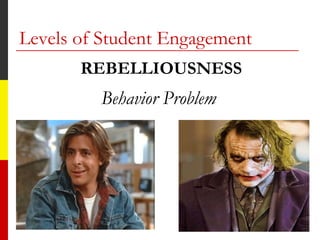
Levels of Student Engagement
REBELLIOUSNESS
Behavior Problem
What does it look like?
The Rebellious Student usually:
 Scores Below Basic
 Scores Far Below Basic
 Scores Advanced
 Rejects the task overtly
 Feels self-conscious about lack of ability
 Thinks he/she is smarter than the teacher
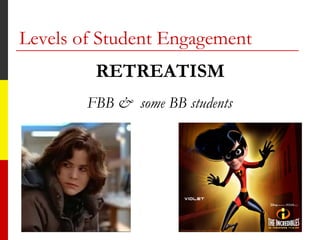
Levels of Student Engagement
RETREATISM
FBB & some BB students
What does it look like?
The Retreatist Student usually:
 Scores Below Basic
 Scores Far Below Basic
 Tries not to be noticed (not a rebel)
 Does minimal classwork or homework
 Is frequently absent or tardy
 Wishes you would leave him/her alone
Levels of Student Engagement
PASSIVE COMPLIANCE:
The majority of our students!
What does it look like?
The Passive Compliant Student usually:
 Scores Below Basic or Basic
 Does enough homework to avoid a missing assignment
card
 Wants to pass your class
 Answers questions when asked
 Avoids volunteering for anything
 Earns C and D grades
Levels of Student Engagement
RITUAL ENGAGEMENTS:
We need to move our students here.
What does it look like?
The Ritual Engager usually:
 Scores Basic or Proficient
 Wants to earn an A or a B in your class
 Wants to get into college
 Volunteers responses to earn points
 Uses “extra-credit” opportunities to make up for
occasional lapses in effort
 Forgets about your class once the period is over beyond
what is due the next day
Levels of Student Engagement
AUTHENTIC ENGAGEMENT:
That kid who stands out in the crowd
What does it look like?
The Authentic Engager usually:
 Scores Proficient or Advanced
 Loves learning for the sake of learning
 Wants to earn an A in your class...and will!
 Wants to get into a competitive college
 Volunteers responses to show understanding
 Uses “extra-credit” opportunities to earn >100%
 Thinks and talks about your class long after the period
has ended out of genuine interest
Why Examine Student Engagement?
Successful learning is more than passive
receipt of processed information.
All learning, except for simple rote
memorization, requires the active
involvement of each learner.
How Do We Do It?
Changing words and phrases, student confidence,
scaffolds, relevant and interesting materials,
explicit and implicit tasks and the like, can move
students to higher or lower states of engagement.
Metacognitive Learning: Help students decode the
learning process by verbalizing your approaches to
solving problems, creating thesis statements,
interpreting written text.
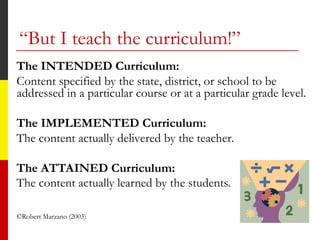
“But I teach the curriculum!”
The INTENDED Curriculum:
Content specified by the state, district, or school to be
addressed in a particular course or at a particular grade level.
The IMPLEMENTED Curriculum:
The content actually delivered by the teacher.
The ATTAINED Curriculum:
The content actually learned by the students.
©Robert Marzano (2003)
How Do We Do It?
Attention Spans:
Most students can only sit and absorb
information for fifteen minutes at a time.
Many students can’t focus for ten minutes!
Ask Yourself:
How do I know that my students
understood today’s lesson?
What evidence do I have that my
students are achieving?
How can I better engage them
tomorrow so that they can begin to
become authentic learners?
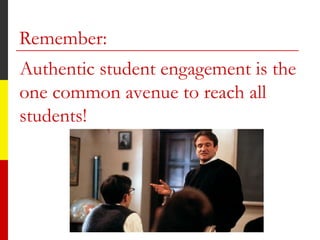
Remember:
Authentic student engagement is the
one common avenue to reach all
students!
Using Backwards Lesson Design
Teachers should think like assessors:
“How will we know if students
achieved the desired results?”
© Wiggins & McTighe (1999)
1. Consider what evidence needs to
be collected to prove that students
have met the goal.
Using Backwards Lesson Design
2. Specify the knowledge and skills
that they will provide to
demonstrate evidence of
understanding.
Using Backwards Lesson Design
3. Design a sequence of lessons,
activities and learning experiences
to help them master the
knowledge/skills.
Using Backwards Lesson Design
4. Specify apt teaching and coaching
strategies, such as direct instruction
and cooperative learning.
Using Backwards Lesson Design
Planning the Lesson
A. Learning Objective
B. Key Content Standard
C. Assessment
D. Concepts &
Academic Language
E. ELD Standard
Teaching the Lesson
1. Introduction
1.1 Anticipatory Set
1.2 Standard
2. Presentation
2.1 Key Content
2.2 Scaffolding
2.3 Check for Understanding
2.4 Differentiated Instruction
3. Practice Options
3.1 Structured
3.2 Guided
3.3 Independent
4. Closure

increasing student engagement in the classroom

  • 1.
  • 2.
    Definition of StudentEngagement: “The involvement of the minds of all learners with that which is to be learned.”
  • 3.
    Explicit and ImplicitEngagement EXPLICIT: Expressing understanding of the task in a clear and obvious way. IMPLICIT: The state of being involved. Understood, but not specifically expressed by the learner.
  • 4.
    Explicit and ImplicitEngagement What you might hear a teacher say: Explicit: “Signal me when you have decided which topic....” “Jot down a three sentence summary of yesterday’s....” “In pairs, read one section to each other, then....” “Create a skit that portrays the elements....”
  • 5.
    Explicit and ImplicitEngagement What you might hear a teacher say: Implicit: “Be ready to read me your introductory sentence....” “As you view this brief video, think about....” “In just a minute, I will ask each of you to share....” “Think about a time when you....”
  • 6.
    Levels of StudentEngagement REBELLIOUSNESS Behavior Problem
  • 7.
    What does itlook like? The Rebellious Student usually:  Scores Below Basic  Scores Far Below Basic  Scores Advanced  Rejects the task overtly  Feels self-conscious about lack of ability  Thinks he/she is smarter than the teacher
  • 8.
    Levels of StudentEngagement RETREATISM FBB & some BB students
  • 9.
    What does itlook like? The Retreatist Student usually:  Scores Below Basic  Scores Far Below Basic  Tries not to be noticed (not a rebel)  Does minimal classwork or homework  Is frequently absent or tardy  Wishes you would leave him/her alone
  • 10.
    Levels of StudentEngagement PASSIVE COMPLIANCE: The majority of our students!
  • 11.
    What does itlook like? The Passive Compliant Student usually:  Scores Below Basic or Basic  Does enough homework to avoid a missing assignment card  Wants to pass your class  Answers questions when asked  Avoids volunteering for anything  Earns C and D grades
  • 12.
    Levels of StudentEngagement RITUAL ENGAGEMENTS: We need to move our students here.
  • 13.
    What does itlook like? The Ritual Engager usually:  Scores Basic or Proficient  Wants to earn an A or a B in your class  Wants to get into college  Volunteers responses to earn points  Uses “extra-credit” opportunities to make up for occasional lapses in effort  Forgets about your class once the period is over beyond what is due the next day
  • 14.
    Levels of StudentEngagement AUTHENTIC ENGAGEMENT: That kid who stands out in the crowd
  • 15.
    What does itlook like? The Authentic Engager usually:  Scores Proficient or Advanced  Loves learning for the sake of learning  Wants to earn an A in your class...and will!  Wants to get into a competitive college  Volunteers responses to show understanding  Uses “extra-credit” opportunities to earn >100%  Thinks and talks about your class long after the period has ended out of genuine interest
  • 16.
    Why Examine StudentEngagement? Successful learning is more than passive receipt of processed information. All learning, except for simple rote memorization, requires the active involvement of each learner.
  • 17.
    How Do WeDo It? Changing words and phrases, student confidence, scaffolds, relevant and interesting materials, explicit and implicit tasks and the like, can move students to higher or lower states of engagement. Metacognitive Learning: Help students decode the learning process by verbalizing your approaches to solving problems, creating thesis statements, interpreting written text.
  • 18.
    “But I teachthe curriculum!” The INTENDED Curriculum: Content specified by the state, district, or school to be addressed in a particular course or at a particular grade level. The IMPLEMENTED Curriculum: The content actually delivered by the teacher. The ATTAINED Curriculum: The content actually learned by the students. ©Robert Marzano (2003)
  • 19.
    How Do WeDo It? Attention Spans: Most students can only sit and absorb information for fifteen minutes at a time. Many students can’t focus for ten minutes!
  • 20.
    Ask Yourself: How doI know that my students understood today’s lesson? What evidence do I have that my students are achieving? How can I better engage them tomorrow so that they can begin to become authentic learners?
  • 21.
    Remember: Authentic student engagementis the one common avenue to reach all students!
  • 22.
    Using Backwards LessonDesign Teachers should think like assessors: “How will we know if students achieved the desired results?” © Wiggins & McTighe (1999)
  • 23.
    1. Consider whatevidence needs to be collected to prove that students have met the goal. Using Backwards Lesson Design
  • 24.
    2. Specify theknowledge and skills that they will provide to demonstrate evidence of understanding. Using Backwards Lesson Design
  • 25.
    3. Design asequence of lessons, activities and learning experiences to help them master the knowledge/skills. Using Backwards Lesson Design
  • 26.
    4. Specify aptteaching and coaching strategies, such as direct instruction and cooperative learning. Using Backwards Lesson Design
  • 27.
    Planning the Lesson A.Learning Objective B. Key Content Standard C. Assessment D. Concepts & Academic Language E. ELD Standard
  • 28.
    Teaching the Lesson 1.Introduction 1.1 Anticipatory Set 1.2 Standard 2. Presentation 2.1 Key Content 2.2 Scaffolding 2.3 Check for Understanding 2.4 Differentiated Instruction 3. Practice Options 3.1 Structured 3.2 Guided 3.3 Independent 4. Closure