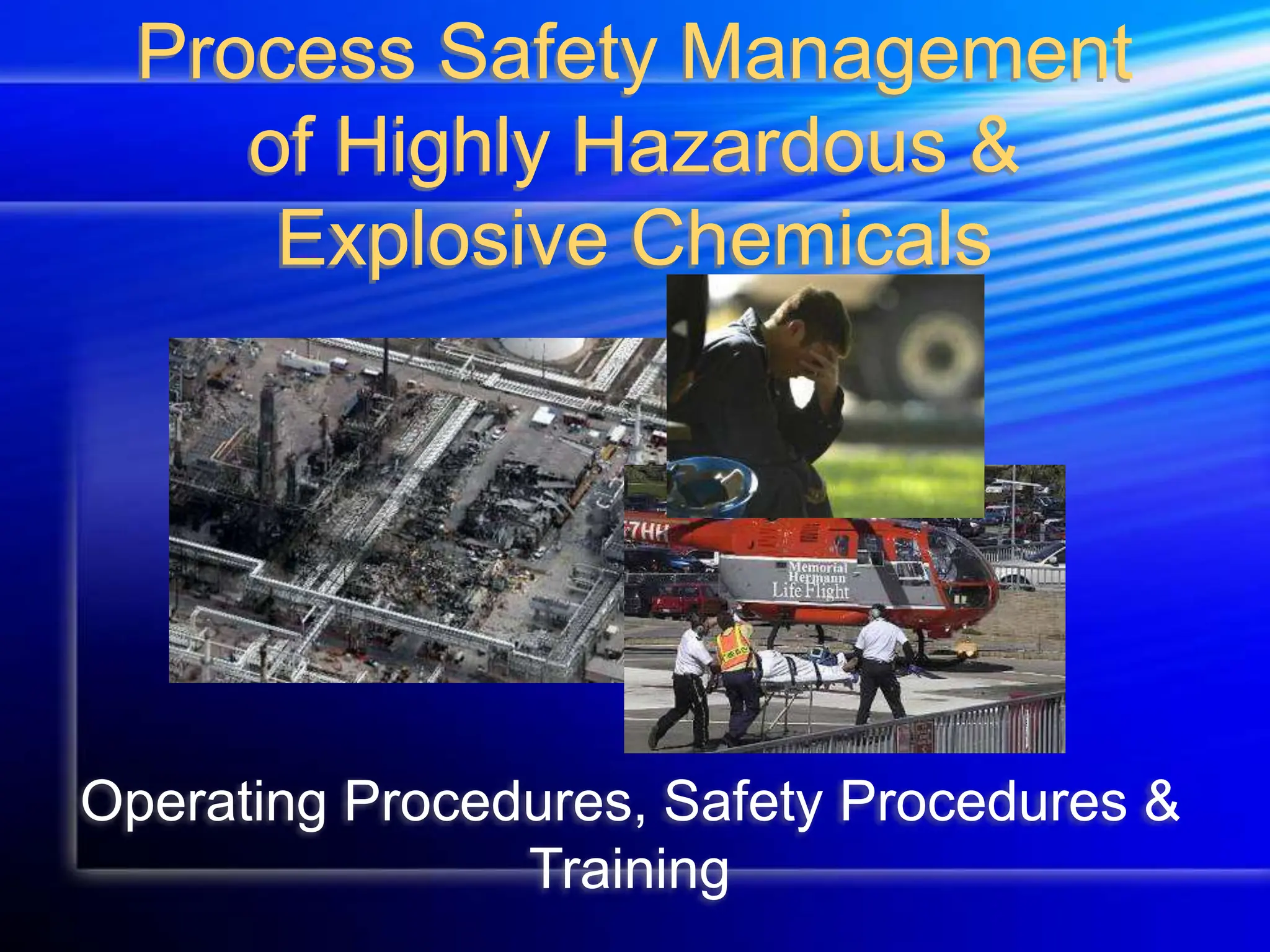
Process Safety Management
of Highly Hazardous &
Explosive Chemicals
Operating Procedures, Safety Procedures &
Training
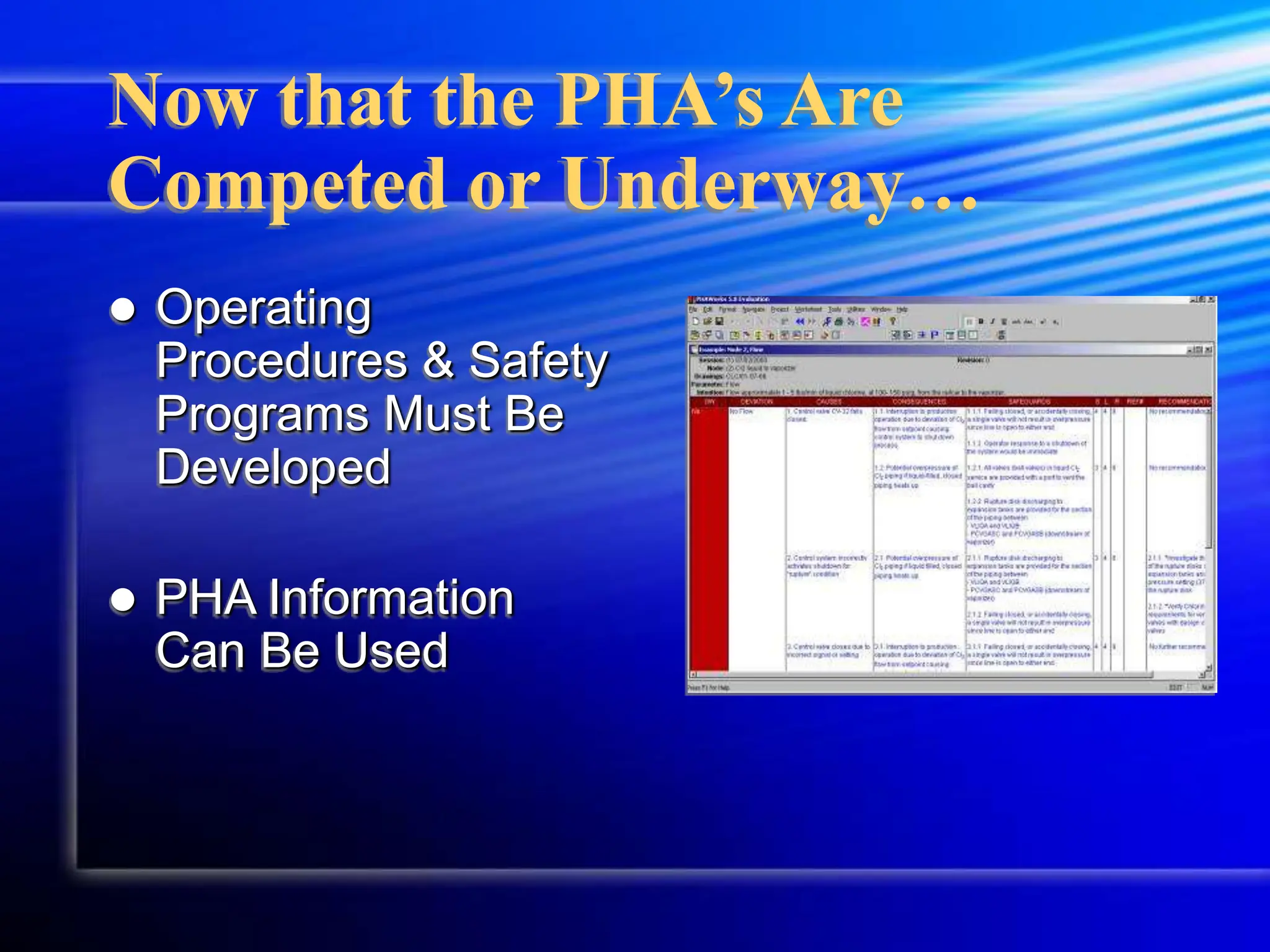
Now that the PHA’s Are
Competed or Underway…
 Operating
Procedures & Safety
Programs Must Be
Developed
 PHA Information
Can Be Used
Operating Procedures
1910.119(f)
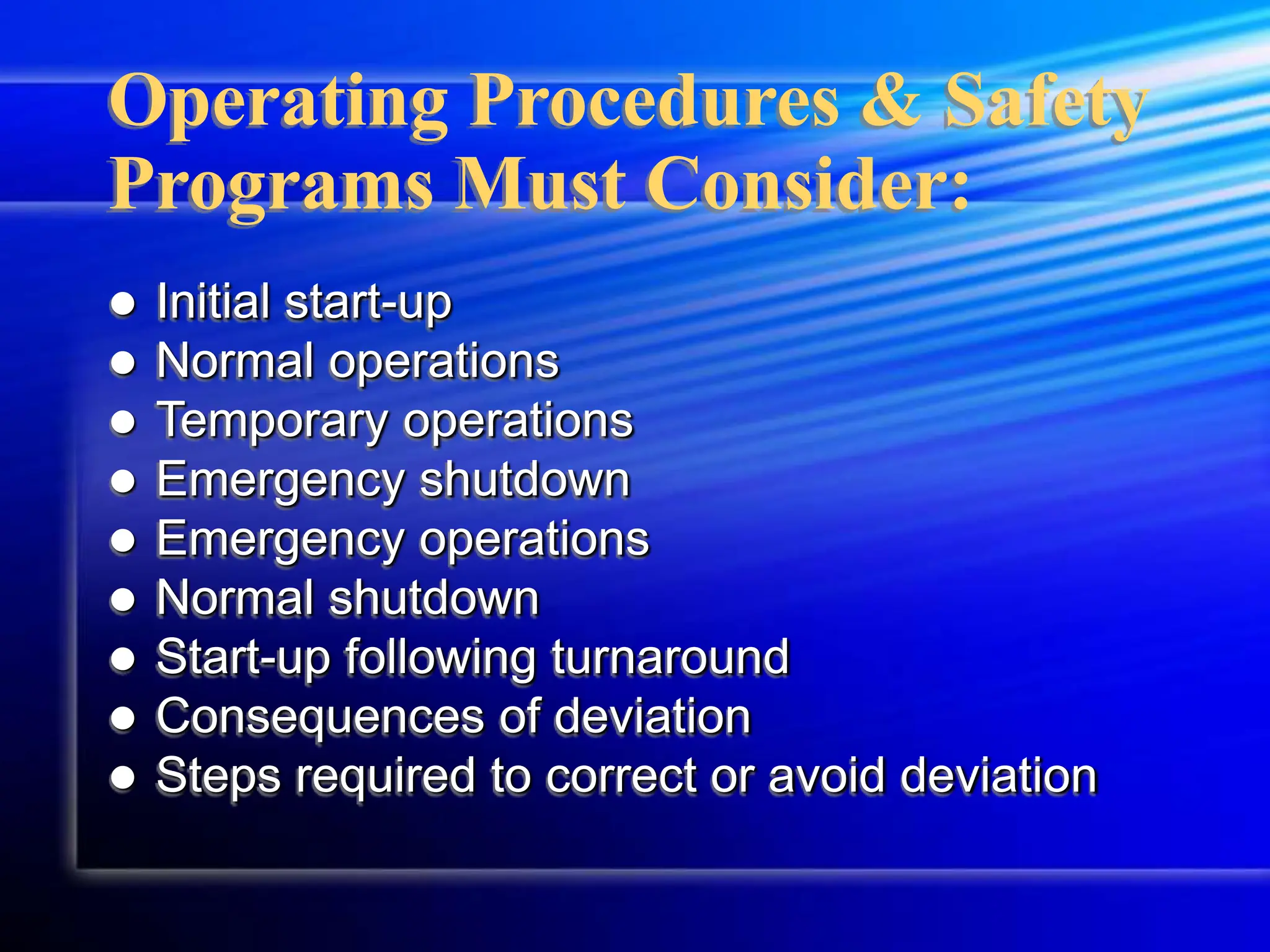
Operating Procedures & Safety
Programs Must Consider:
 Initial start-up
 Normal operations
 Temporary operations
 Emergency shutdown
 Emergency operations
 Normal shutdown
 Start-up following turnaround
 Consequences of deviation
 Steps required to correct or avoid deviation
Operating Procedures or
Standard Operating Procedures
(SOP’s)
 Where Did This Methodology Come From?
 Answer: The Military
 Definition: A standard operating procedure is a set
of instructions having the force of a directive,
covering those features of operations that lend
themselves to a definite or standardized procedure
without loss of effectiveness. Standard Operating
Policies and Procedures can be effective catalysts to
drive performance improvement and improving
organizational results. Every good quality system is
based on its standard operating procedures (SOPs).
*Readily accessible to employees
Operating Procedures
 Develop and implement written operating procedures*
consistent with the process safety information and addresses
at least the following elements:
 Initial start-up, normal and temporary operations
 Normal and emergency shut-down procedures
 Operating limits and consequences of deviation
 Hazards presented by the process
Operating Procedures
 The operating procedures addressing
operating parameters will contain operating
instructions about:
 pressure limits
 temperature ranges
 flow rates…and
 what to do when an upset condition occurs
 what alarms and instruments are pertinent if an
upset condition occurs, and other subjects.
Operating Procedures - Start
Up…We Must
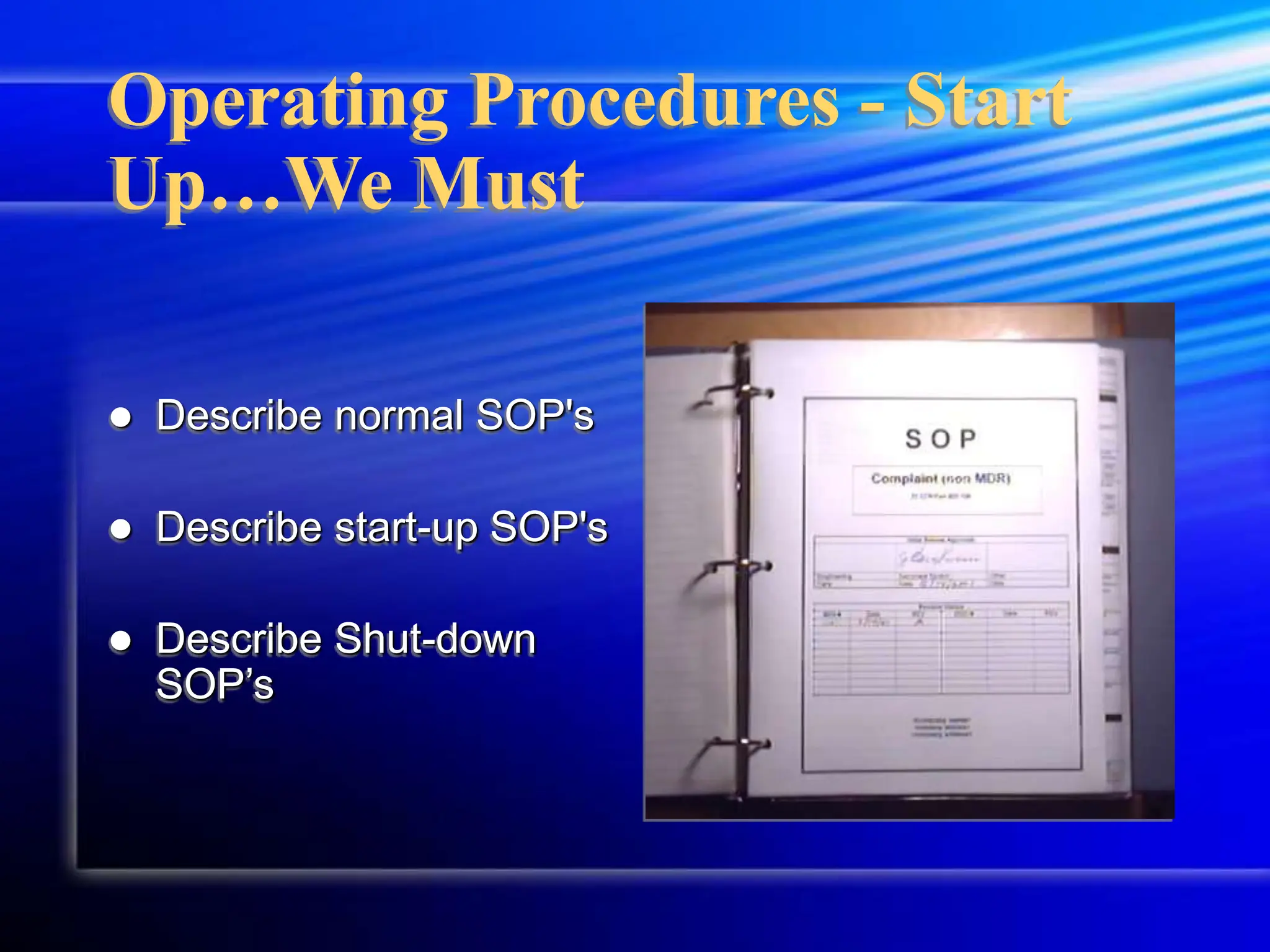
 Describe normal SOP's
 Describe start-up SOP's
 Describe Shut-down
SOP’s
 Include Sections such as:
 Objectives
 Purpose
 Concerns
 Procedures
 Department
 Operator
 Equipment Involved
 Location
 Related Documents
Operating Procedures - Start
Up…We Must
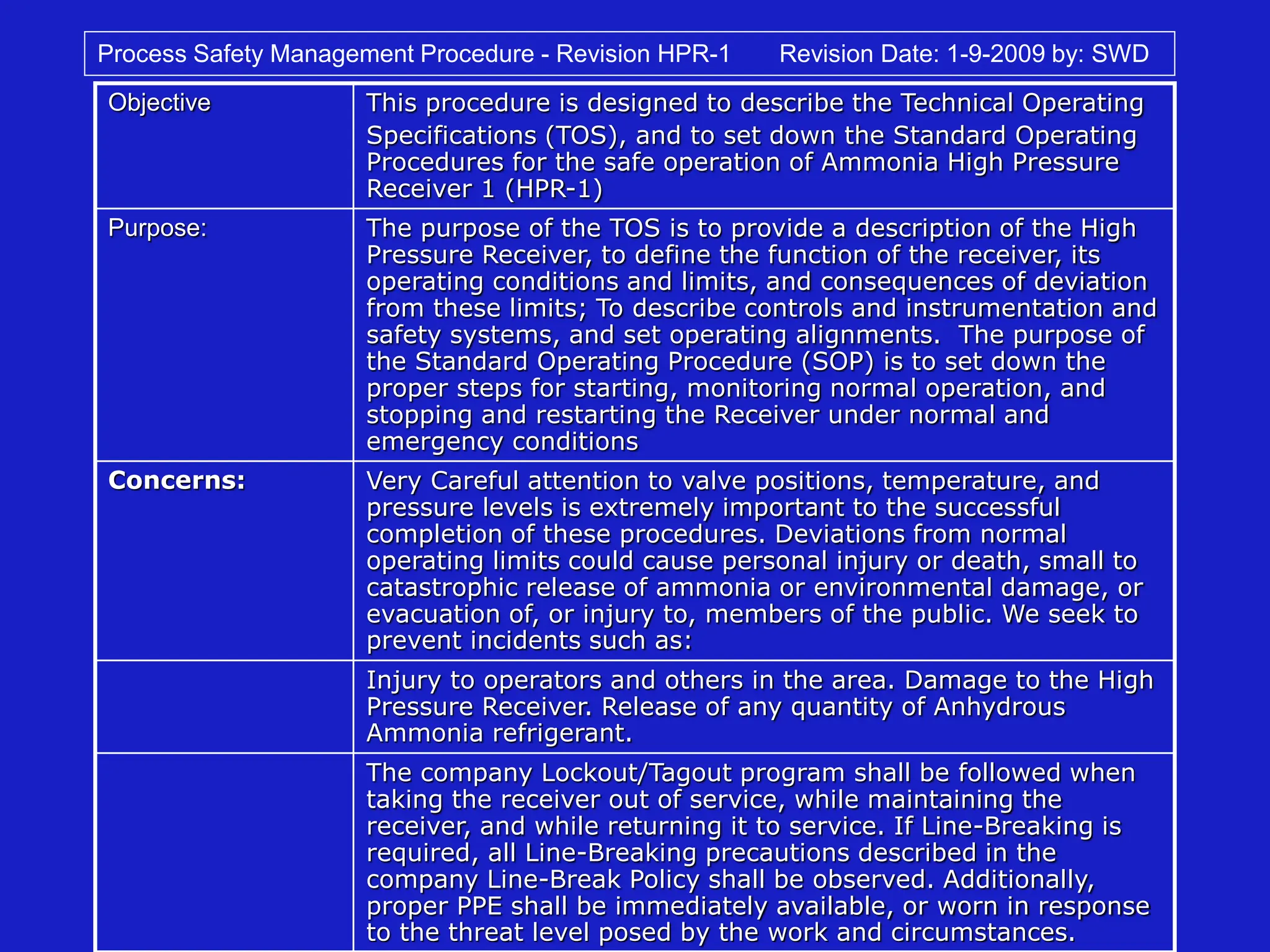
Let’s Look at An Example…
Objective This procedure is designed to describe the Technical Operating
Specifications (TOS), and to set down the Standard Operating
Procedures for the safe operation of Ammonia High Pressure
Receiver 1 (HPR-1)
Purpose: The purpose of the TOS is to provide a description of the High
Pressure Receiver, to define the function of the receiver, its
operating conditions and limits, and consequences of deviation
from these limits; To describe controls and instrumentation and
safety systems, and set operating alignments. The purpose of
the Standard Operating Procedure (SOP) is to set down the
proper steps for starting, monitoring normal operation, and
stopping and restarting the Receiver under normal and
emergency conditions
Concerns: Very Careful attention to valve positions, temperature, and
pressure levels is extremely important to the successful
completion of these procedures. Deviations from normal
operating limits could cause personal injury or death, small to
catastrophic release of ammonia or environmental damage, or
evacuation of, or injury to, members of the public. We seek to
prevent incidents such as:
Injury to operators and others in the area. Damage to the High
Pressure Receiver. Release of any quantity of Anhydrous
Ammonia refrigerant.
The company Lockout/Tagout program shall be followed when
taking the receiver out of service, while maintaining the
receiver, and while returning it to service. If Line-Breaking is
required, all Line-Breaking precautions described in the
company Line-Break Policy shall be observed. Additionally,
proper PPE shall be immediately available, or worn in response
to the threat level posed by the work and circumstances.
Process Safety Management Procedure - Revision HPR-1 Revision Date: 1-9-2009 by: SWD
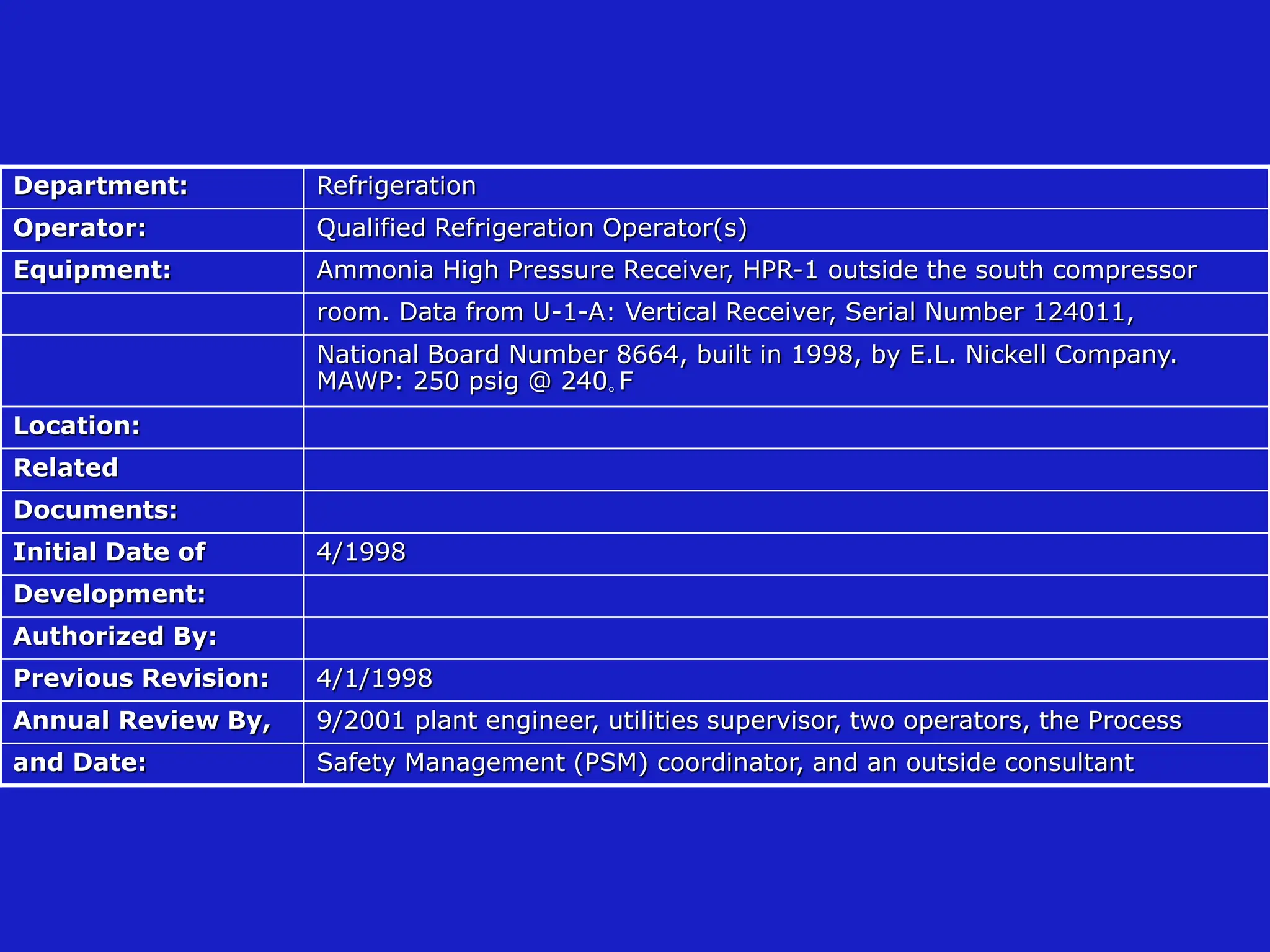
Department: Refrigeration
Operator: Qualified Refrigeration Operator(s)
Equipment: Ammonia High Pressure Receiver, HPR-1 outside the south compressor
room. Data from U-1-A: Vertical Receiver, Serial Number 124011,
National Board Number 8664, built in 1998, by E.L. Nickell Company.
MAWP: 250 psig @ 240。F
Location:
Related
Documents:
Initial Date of 4/1998
Development:
Authorized By:
Previous Revision: 4/1/1998
Annual Review By, 9/2001 plant engineer, utilities supervisor, two operators, the Process
and Date: Safety Management (PSM) coordinator, and an outside consultant
Operating Procedures
 Must be Developed for Each Equipment
Operation in the Covered Process
 Refer to Block Diagrams
 Refer to P&ID
 Must Cover Normal Operating Conditions,
Normal Operating Parameters, i.e..
Pressure/Flow/Current/ etc.
 Must Follow Procedures &
Recommendations in PHA’s
 Must Follow Form
Operating Procedures
 For Shut-down
Procedures…Remember:
 Most operations must be shut down in a
specific order!
 Failure to follow these shut down
procedures could results in a catastrophic
release or system failure
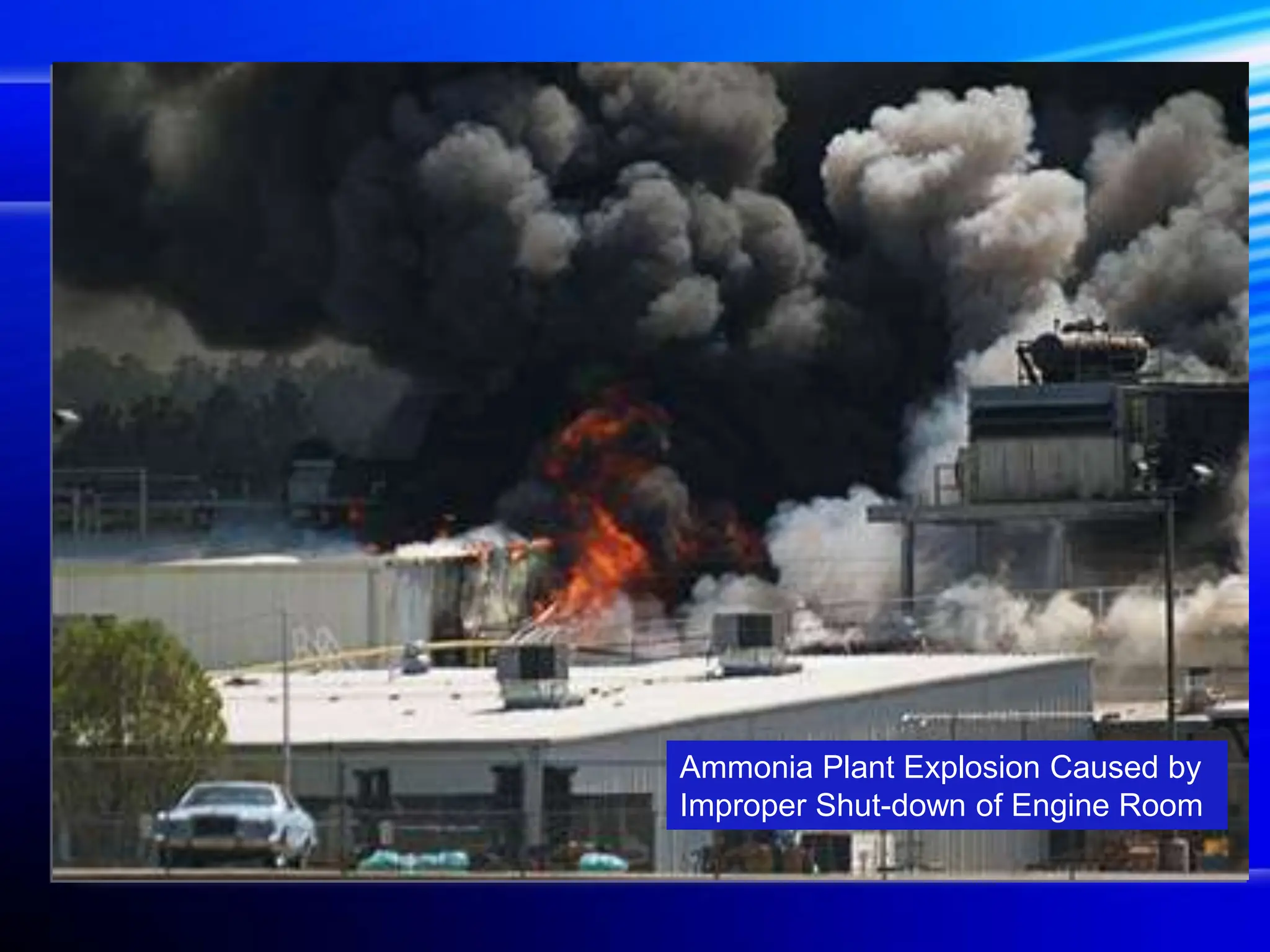
Ammonia Plant Explosion Caused by
Improper Shut-down of Engine Room
Operating Procedures
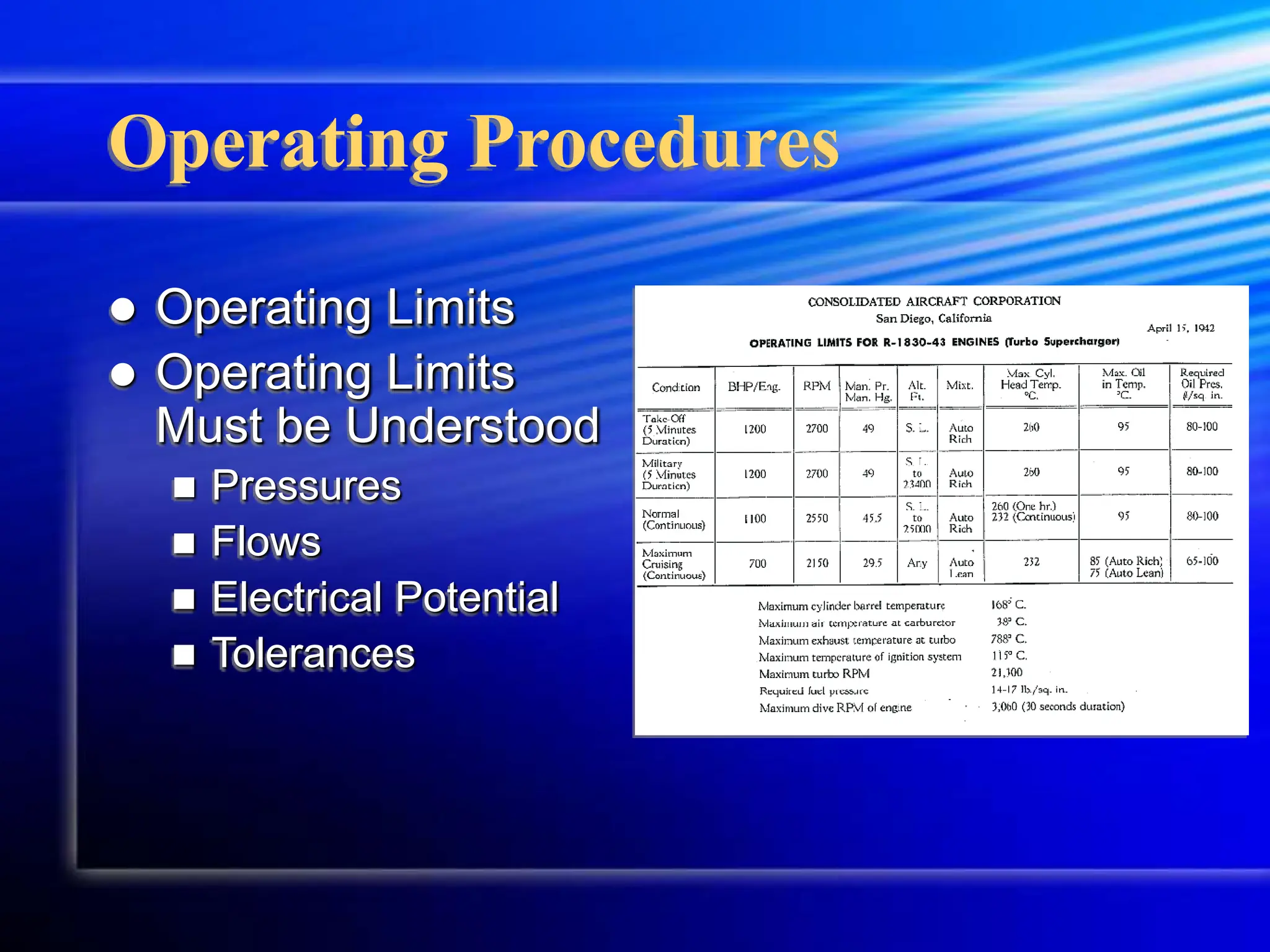
 Operating Limits
 Operating Limits
Must be Understood
 Pressures
 Flows
 Electrical Potential
 Tolerances
Operating Procedures -
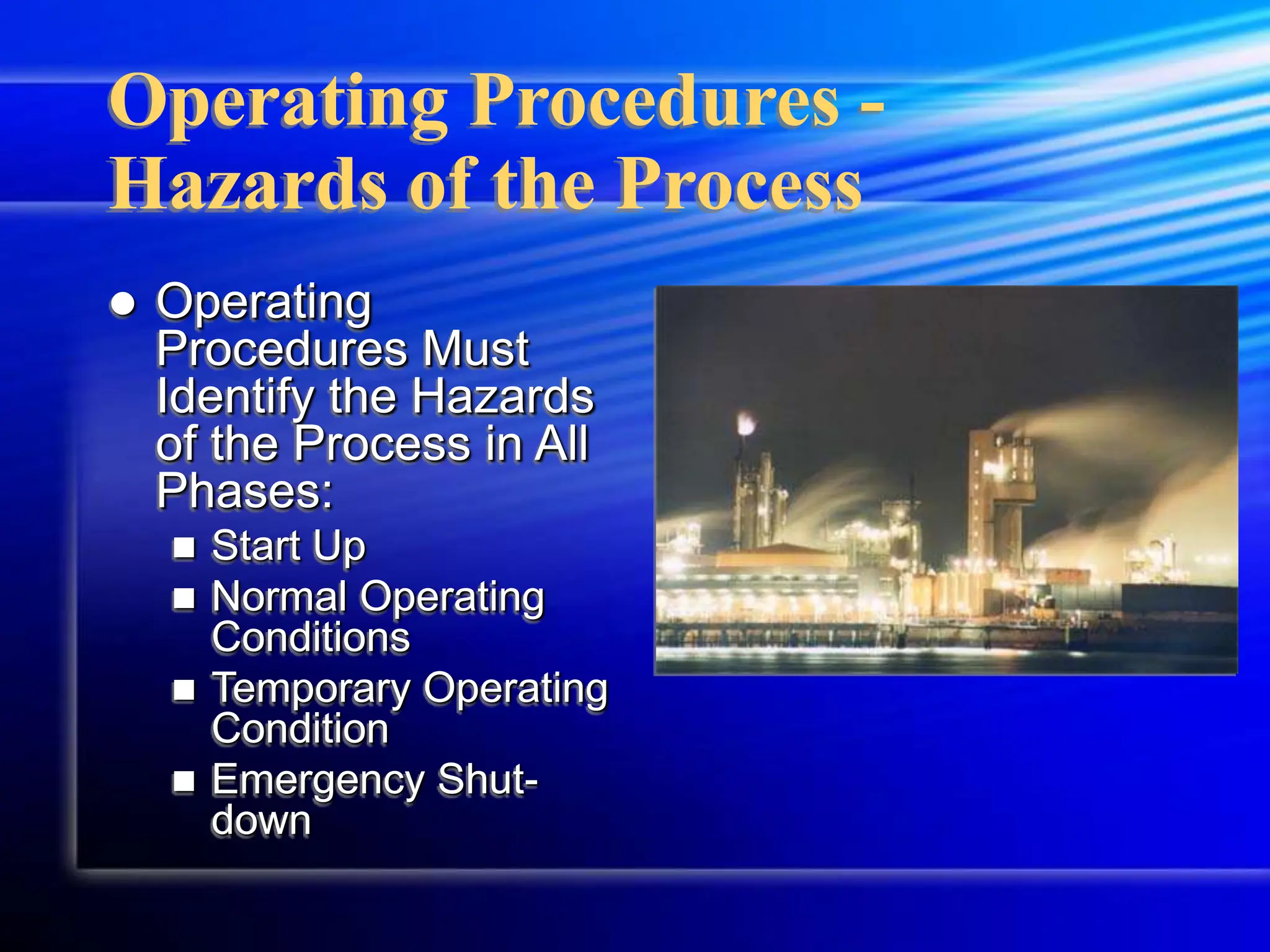
Hazards of the Process
 Operating
Procedures Must
Identify the Hazards
of the Process in All
Phases:
 Start Up
 Normal Operating
Conditions
 Temporary Operating
Condition
 Emergency Shut-
down
Now That We’ve Completed
the Operating Procedures
We Must Develop Safety Work Practices,
Programs & Procedures for Covered
Processes
Safe Work Practices
1910.119(f)(1)
•Develop and implement safe work practices* to provide for
the control of hazards during operations such as:
–Lockout/tagout;
–Confined space entry;
–Line Opening process equipment or piping; and
–Control over entrance into a facility by maintenance,
contractor, laboratory, or other support personnel
Safe Work Practices
*These safe work practices apply to contractor employees as well
Safe Work Practices
 Safe Work Practices, Programs &
Procedures must:
 Be specific to the Covered Process
 Follow Procedures & Recommendations in
the PHA’s
 Follow Procedures in the Operating
Procedures
 Must be Able to be Tracked
 Follow Form
Safe Work Practices
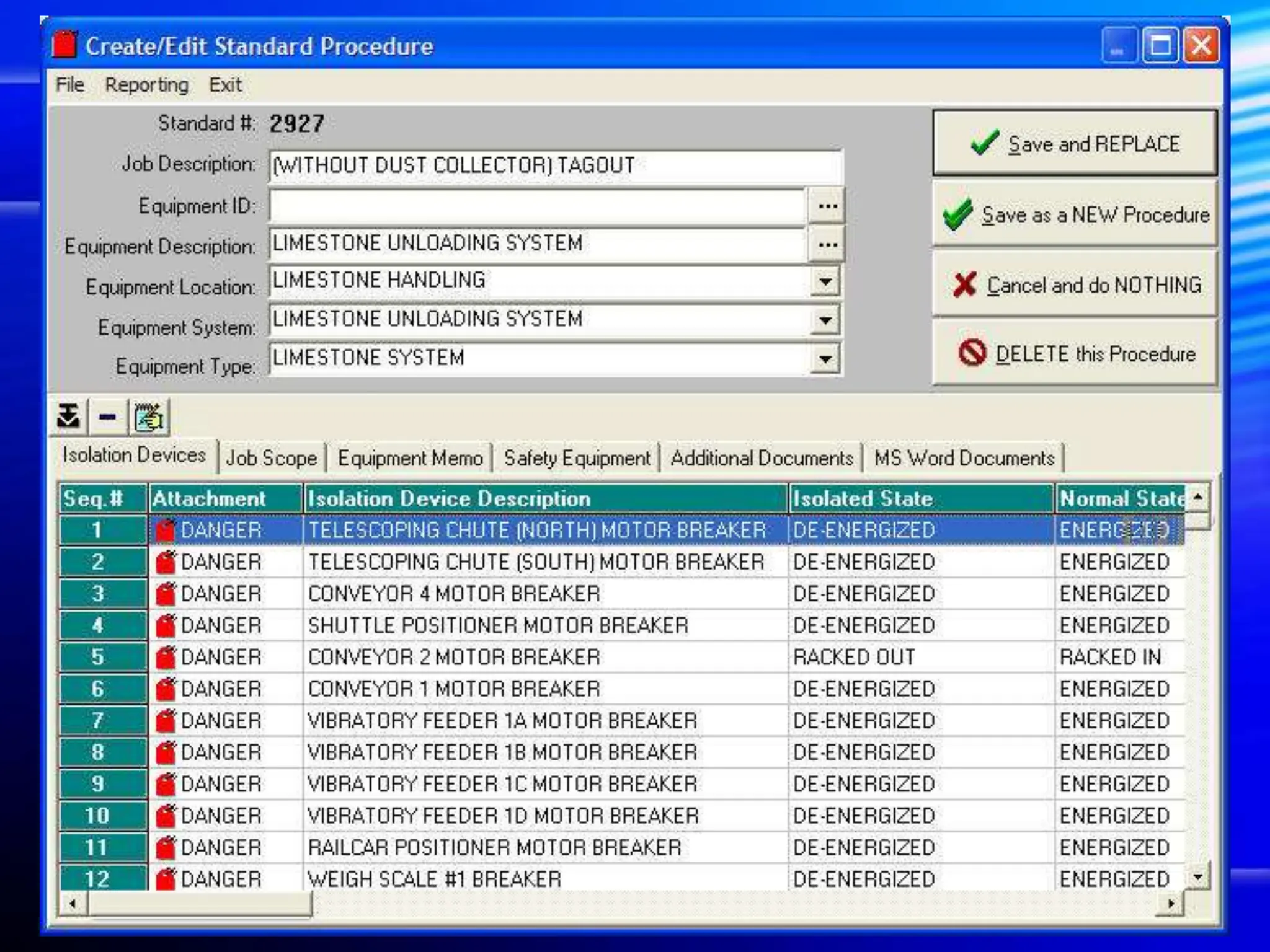
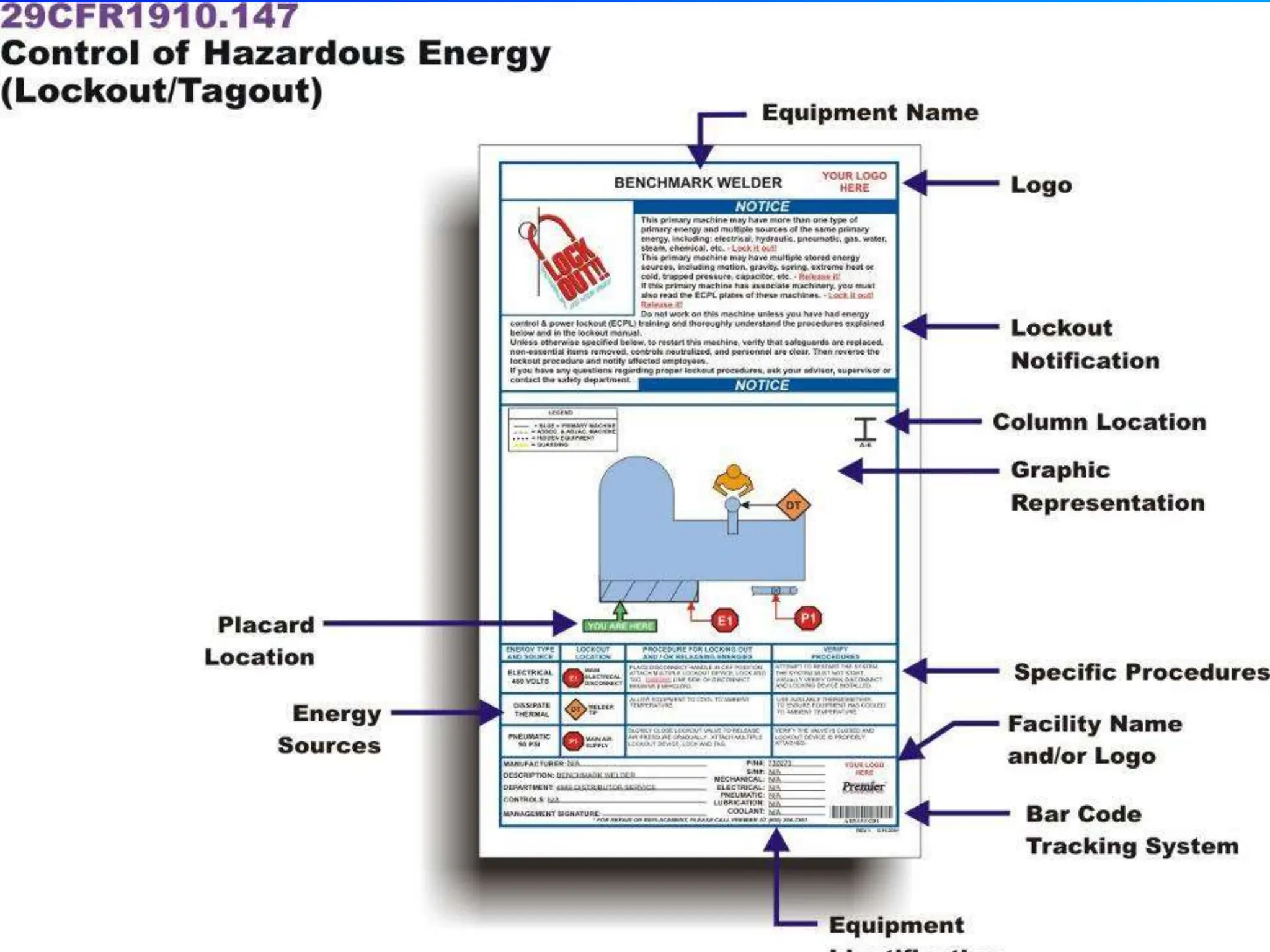
 Lockout Tagout - One of the Most
Important Procedures in PSM
 Must be Written Carefully & Follow all
Procedures (PHA’s, Operating
Procedures)
 Must be Followed to the Letter!
Safe Work Practices
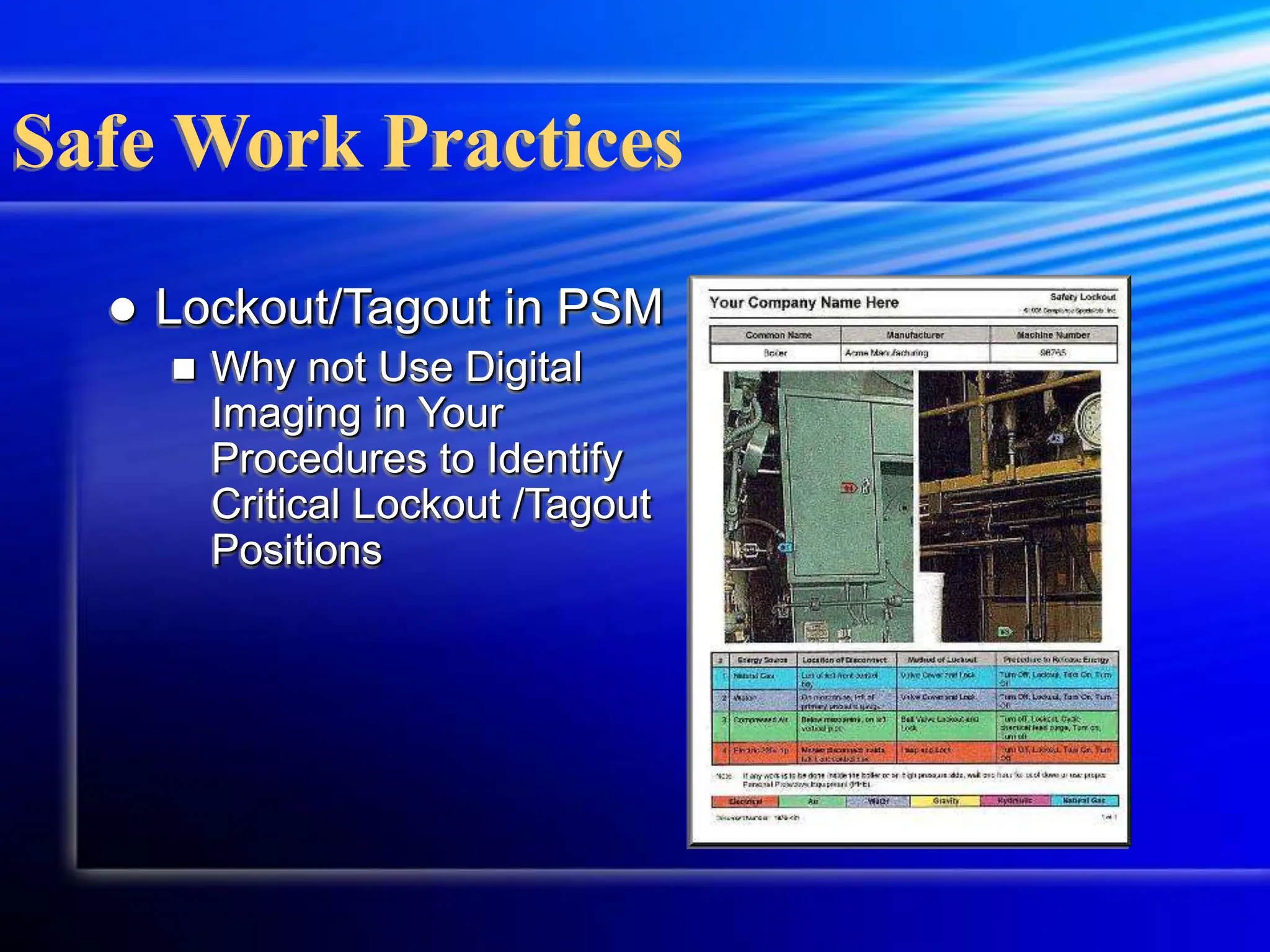
 Lockout/Tagout in PSM
 Why not Use Digital
Imaging in Your
Procedures to Identify
Critical Lockout /Tagout
Positions
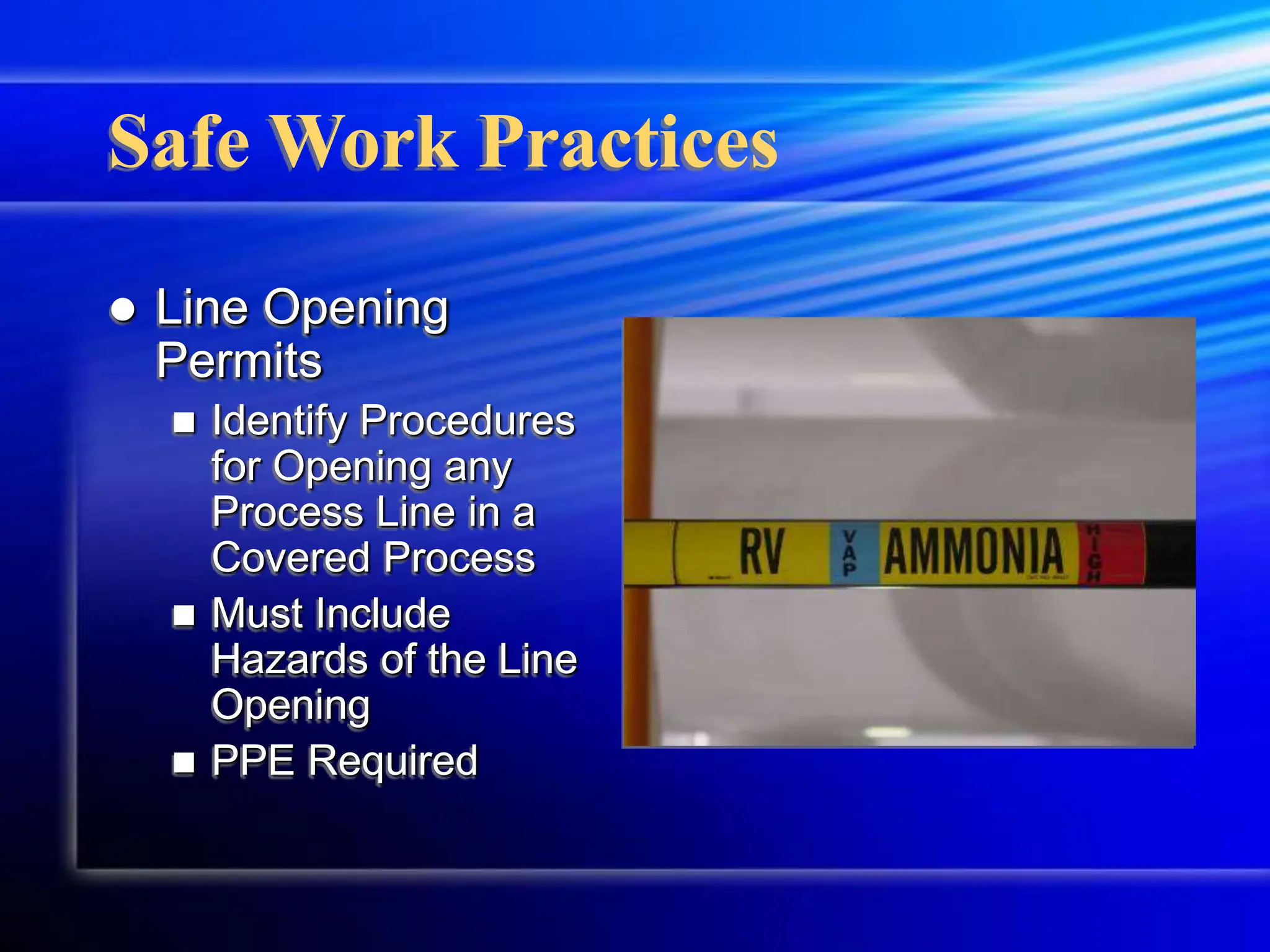
 Line Opening
Permits
 Identify Procedures
for Opening any
Process Line in a
Covered Process
 Must Include
Hazards of the Line
Opening
 PPE Required
Safe Work Practices
Safe Work Practices
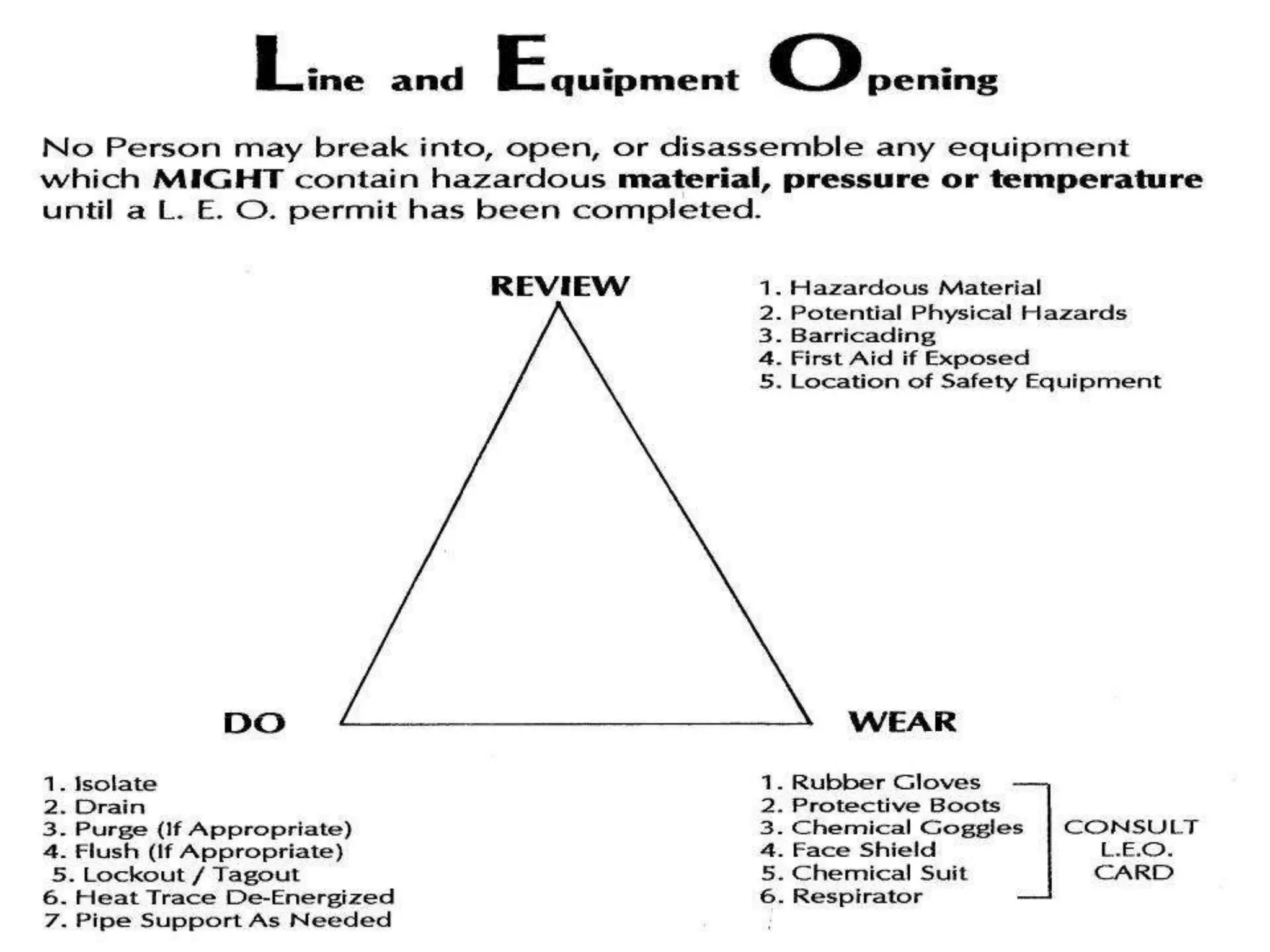
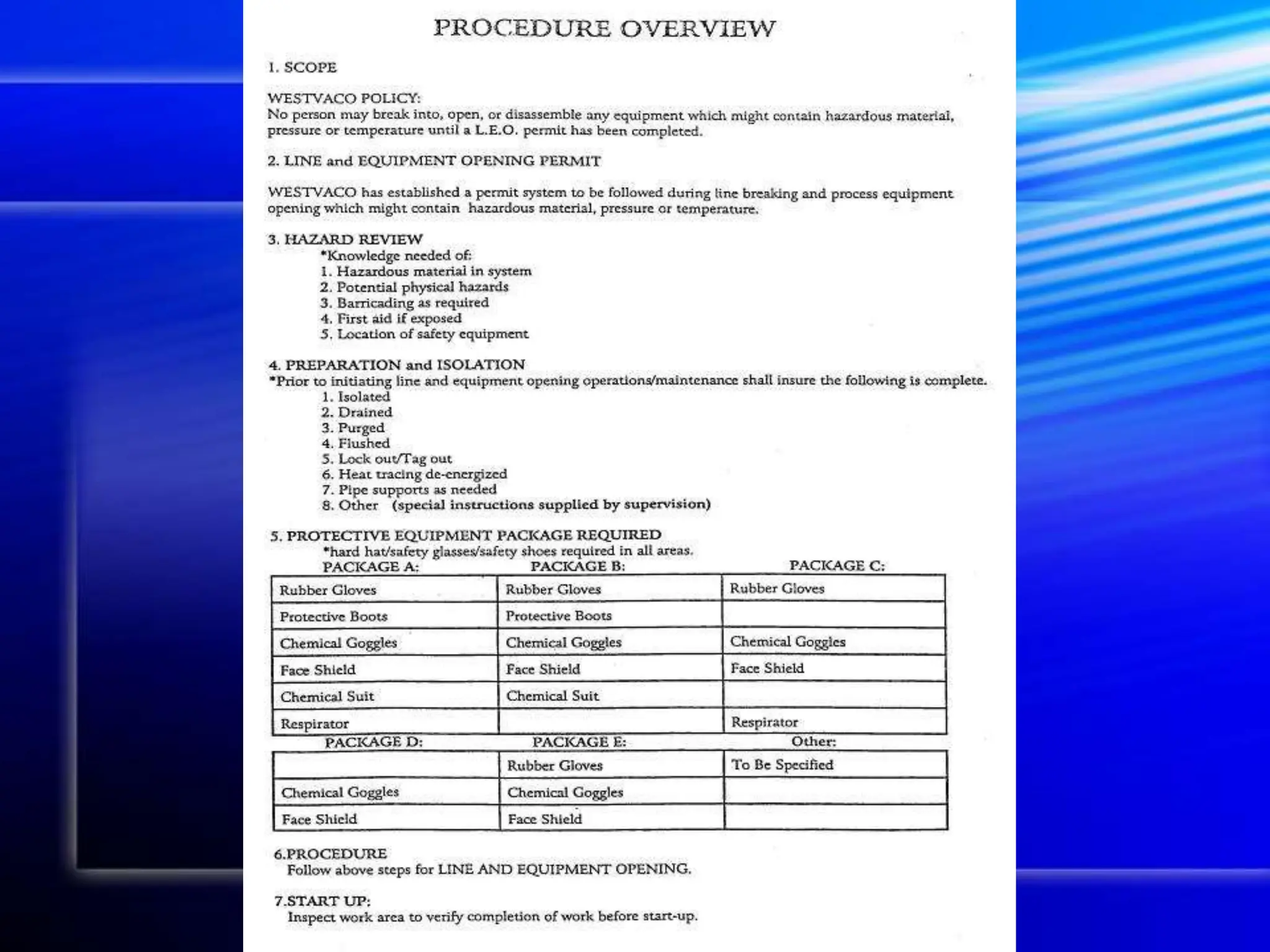
Line & Equipment Opening
 A Hazard Review Must Completed for All
Line/Equipment Hazards Including:
 HAZARDOUS MATERIALS IN SYSTEM
 POTENTIAL PHYSICAL HAZARDS
 BARRICADING AS REQUIRED
 FIRST AID IF EXPOSED
 LOCATION OF SAFETY EQUIPMENT
 PPE REQUIRED FOR LINE OPENING
Safe Work Practices-
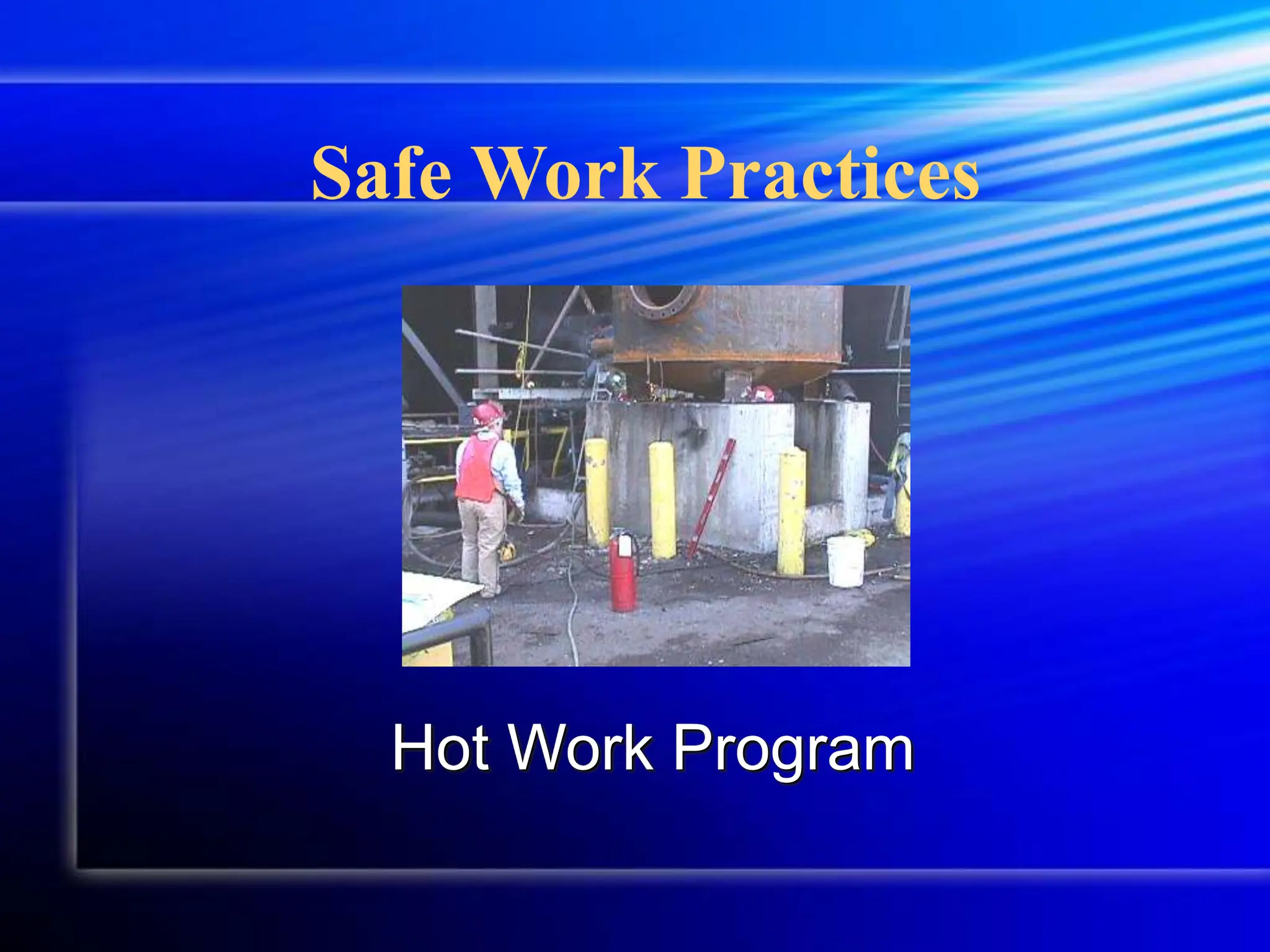
Hot Work
A Program Must be Developed for the Covered Process
That Requires:
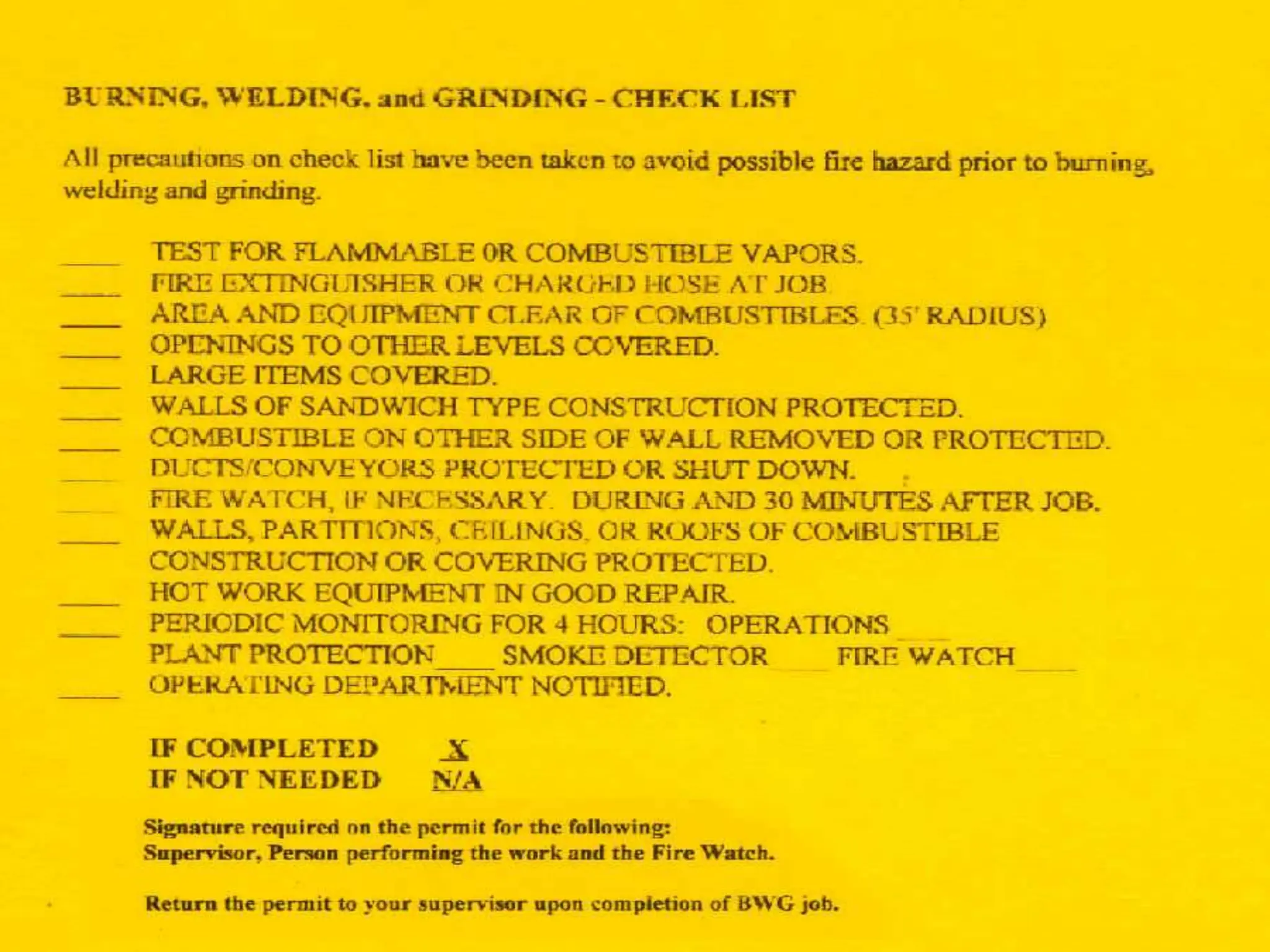
 A Hot Work Permit be Issued for ALL Hot Work
Performed in the Plant by Employees or Contractors
 A Permit must be Posted at the Location of the Hot
Work
 A Fire Watch Is Required
 A Fire Extinguisher or Other Appropriate Fire
Fighting Equipment Must Be Present, Fire Watch
must be Trained in its use
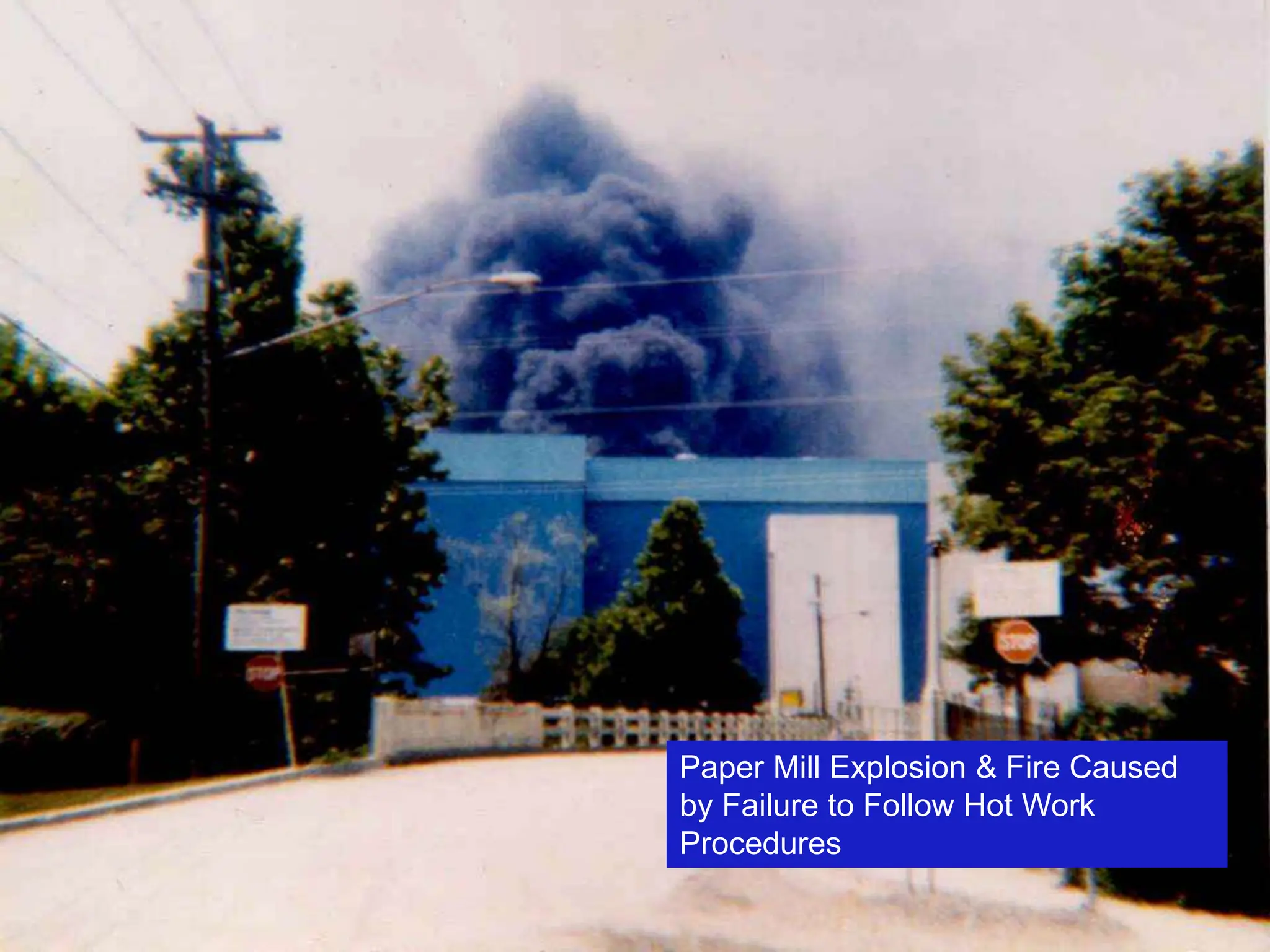
Paper Mill Explosion & Fire Caused
by Failure to Follow Hot Work
Procedures
 Must be Specific for the Covered
Process
 May Require Additional Program other
than Lockout Tagout, Line Opening &
Hot Work…such as Confined Space,
Electrical Safe Work Practices,
Combustible Dust
Safe Work Practices
Now That We’ve Developed
Safe Work Practices
We Have to Train
Training
1910.119(g)
PSM 29CFR1910.119(g)
Requires
(G) Training (Initial, Refresher, and Documentation)
(paragraphs (g)(1), (g)(2), and (g)(3)).
 Paragraph (g)(1) requires employers to train
employees operating dangerous process. Paragraph
(g)(2) requires that the employer provide refresher
training at least every three years. Paragraph (g)(3)
requires the employer to prepare a record that
contains the name of employee, the date of training,
and the means used to verify that the employee
understood the training
PSM Training
 PSM Training Programs Must be Developed
for:
 Affected Employees - Those not Directly Involved
in the Process Operation
 Authorized Employees - Those Directly Involved in
the Process Operation
 Contractors Who May Perform Work on a Covered
Process
 Vendors/Visitors who May Visit the Facility and
May Potentially be Exposed to the Covered
Process
PSM Training
 Training Must Be Performed as Follows:
 Initial training
 Prior to work assignment
 Waved for those already in a process
 Refresher training
 Every three years
 All Training Must be Documented
PSM Training
 Training Subjects Must Include at Least:
 Lockout Tagout
 Hot Work
 Line & Equipment Opening
 Confined Space (if applicable)
 Emergency Response
Examples of Training
PSM training example including the
means used to verify that the
employee understood the training.
Let’s Use Hot Work Procedures
Safe Work Practices
Hot Work Program
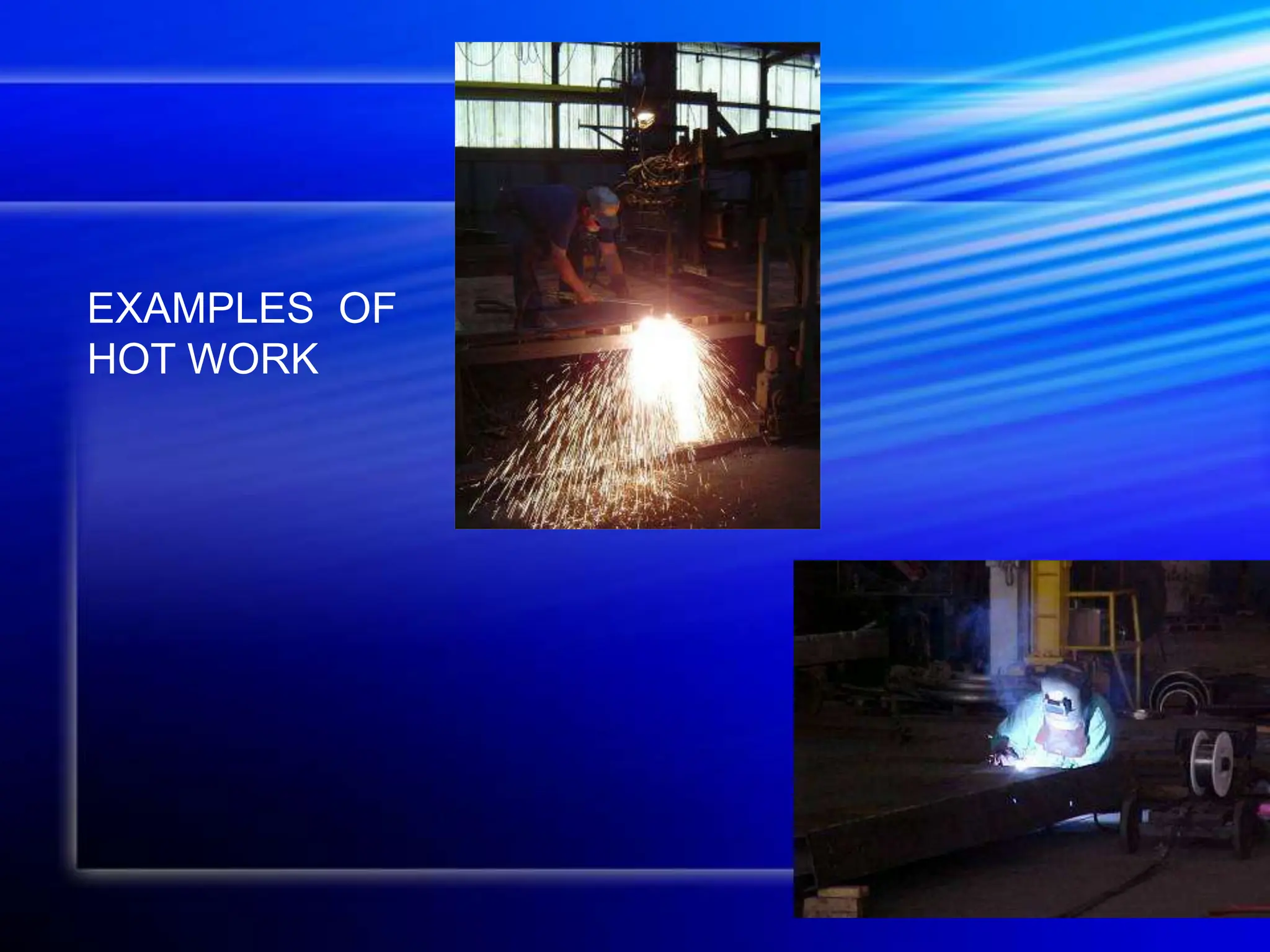
EXAMPLES OF
HOT WORK
Safe Work Practices
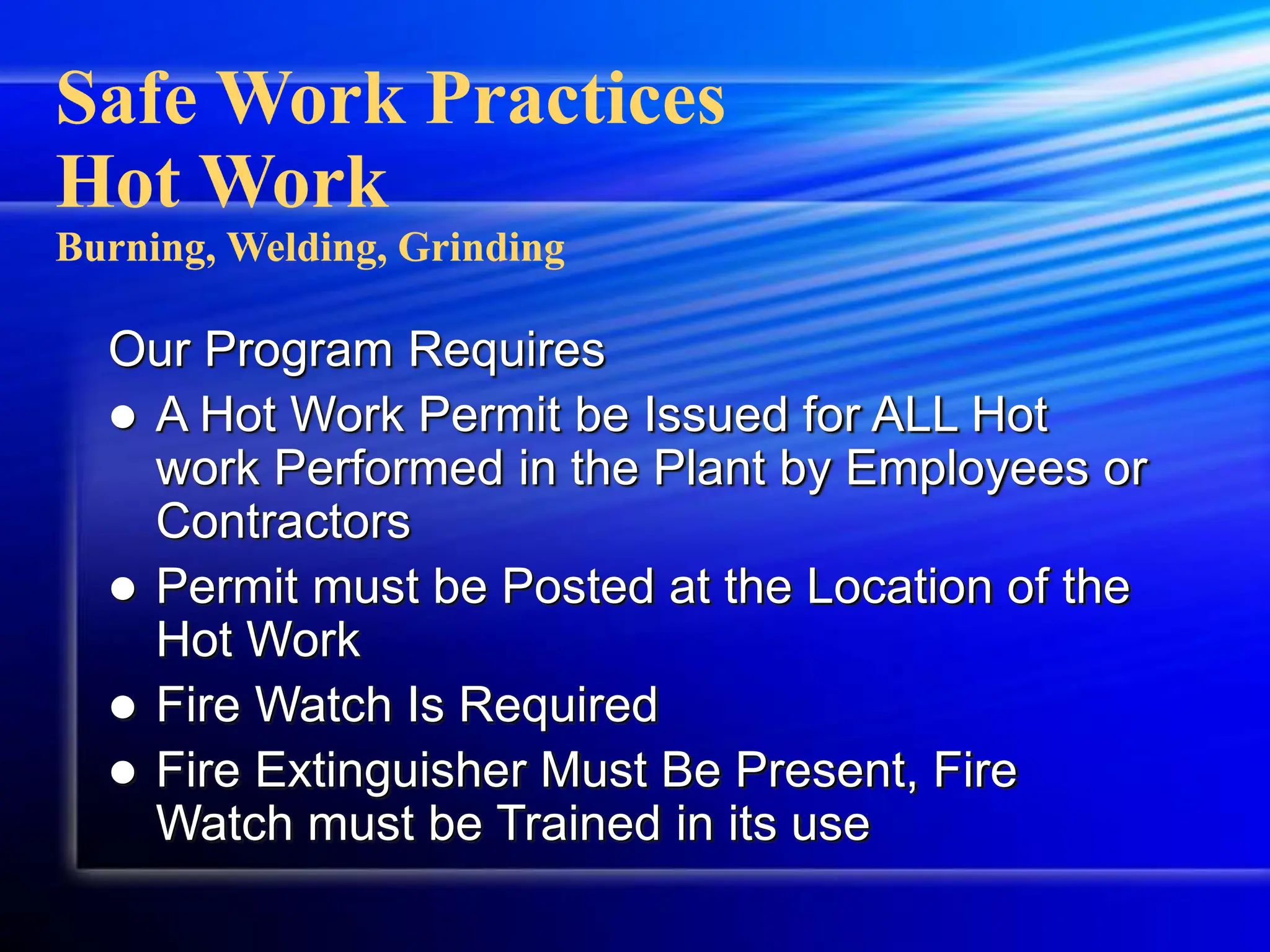
Hot Work
Burning, Welding, Grinding
Our Program Requires
 A Hot Work Permit be Issued for ALL Hot
work Performed in the Plant by Employees or
Contractors
 Permit must be Posted at the Location of the
Hot Work
 Fire Watch Is Required
 Fire Extinguisher Must Be Present, Fire
Watch must be Trained in its use
Safe Work Practices
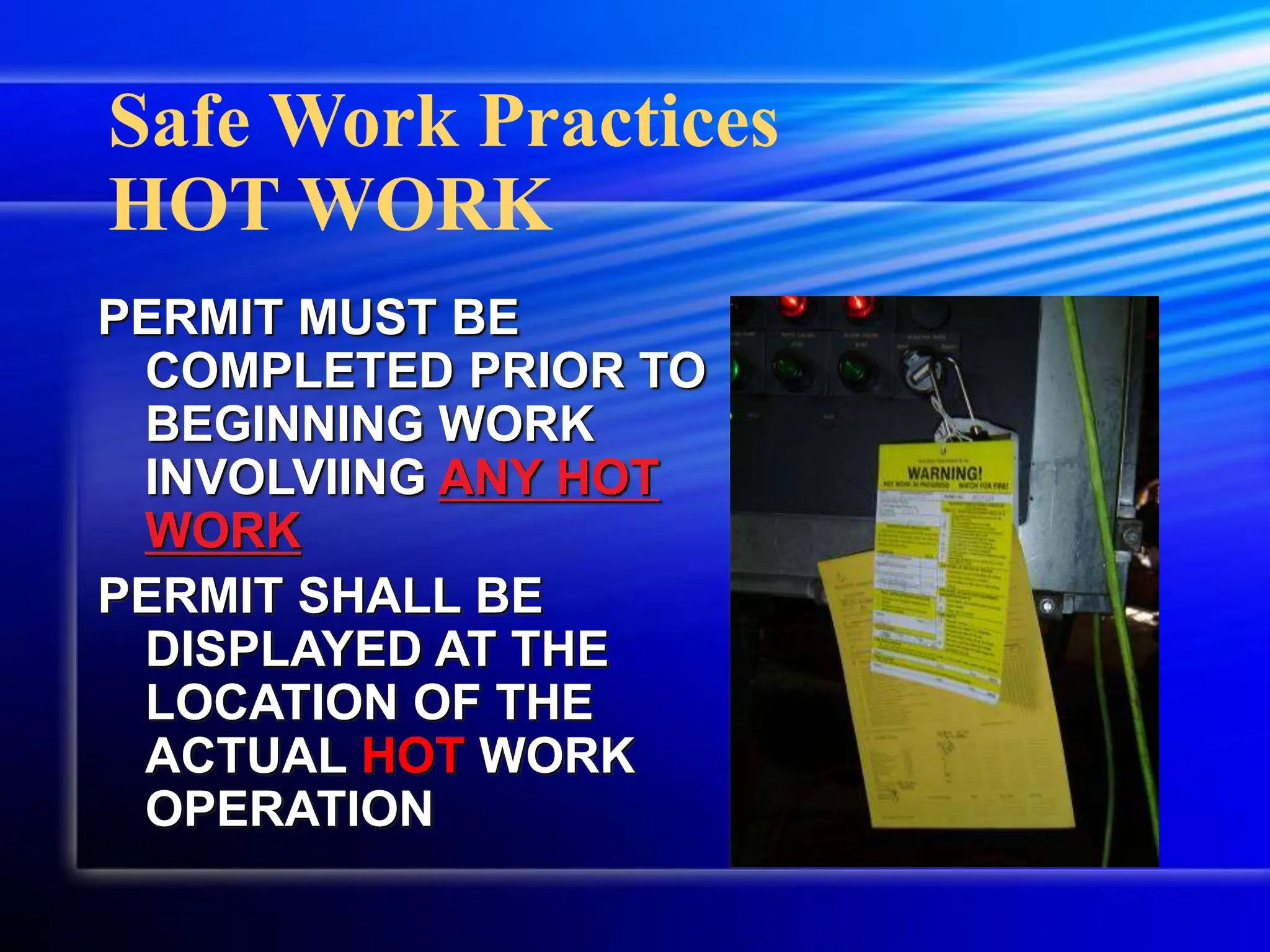
HOT WORK
PERMIT MUST BE
COMPLETED PRIOR TO
BEGINNING WORK
INVOLVIING ANY HOT
WORK
PERMIT SHALL BE
DISPLAYED AT THE
LOCATION OF THE
ACTUAL HOT WORK
OPERATION
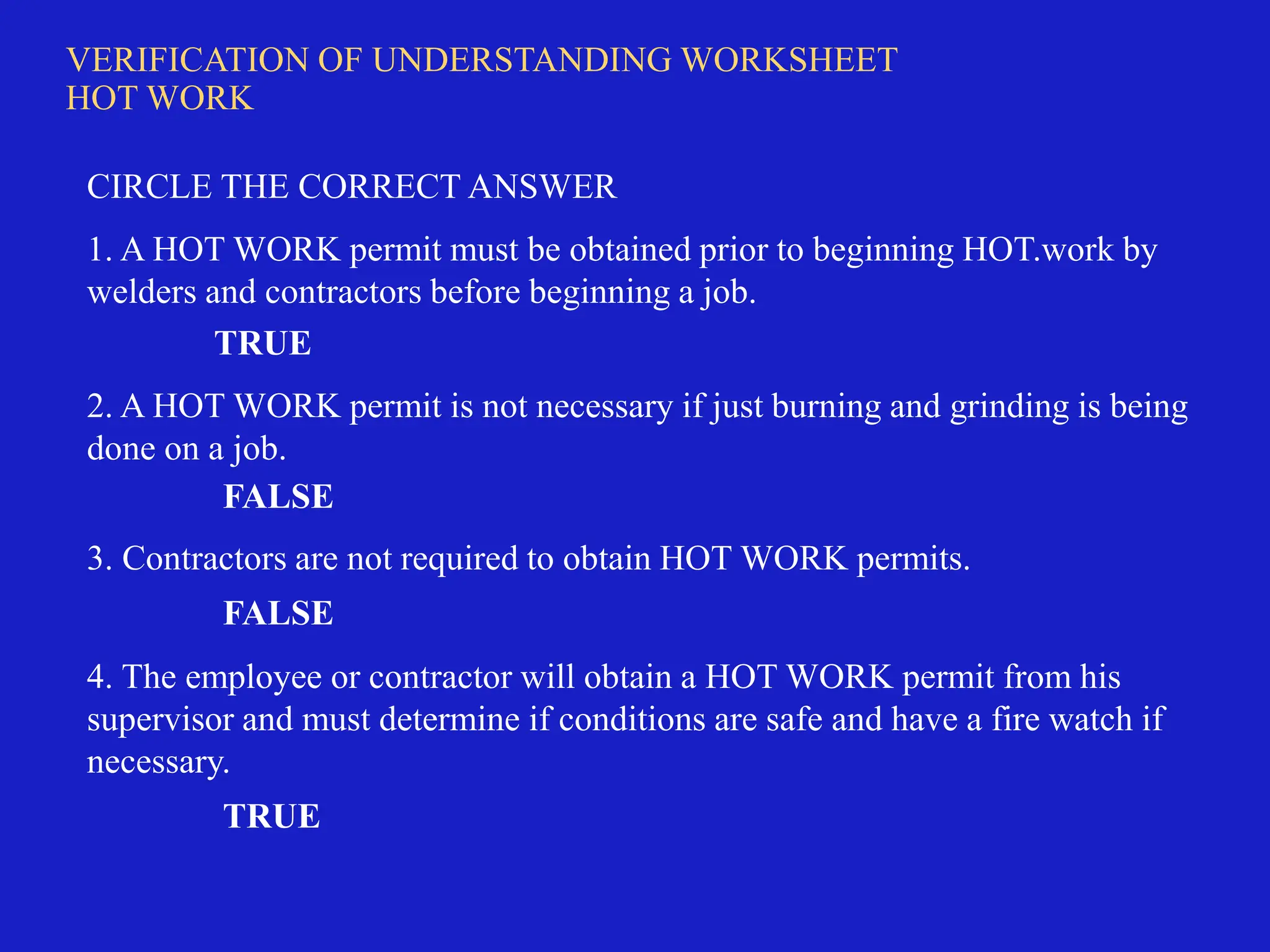
VERIFICATION OF UNDERSTANDING WORKSHEET
HOT WORK
CIRCLE THE CORRECT ANSWER
1. A HOT WORK permit must be obtained prior to beginning HOT.work by
welders and contractors before beginning a job.
TRUE
2. A HOT WORK permit is not necessary if just burning and grinding is being
done on a job.
FALSE
3. Contractors are not required to obtain HOT WORK permits.
FALSE
4. The employee or contractor will obtain a HOT WORK permit from his
supervisor and must determine if conditions are safe and have a fire watch if
necessary.
TRUE
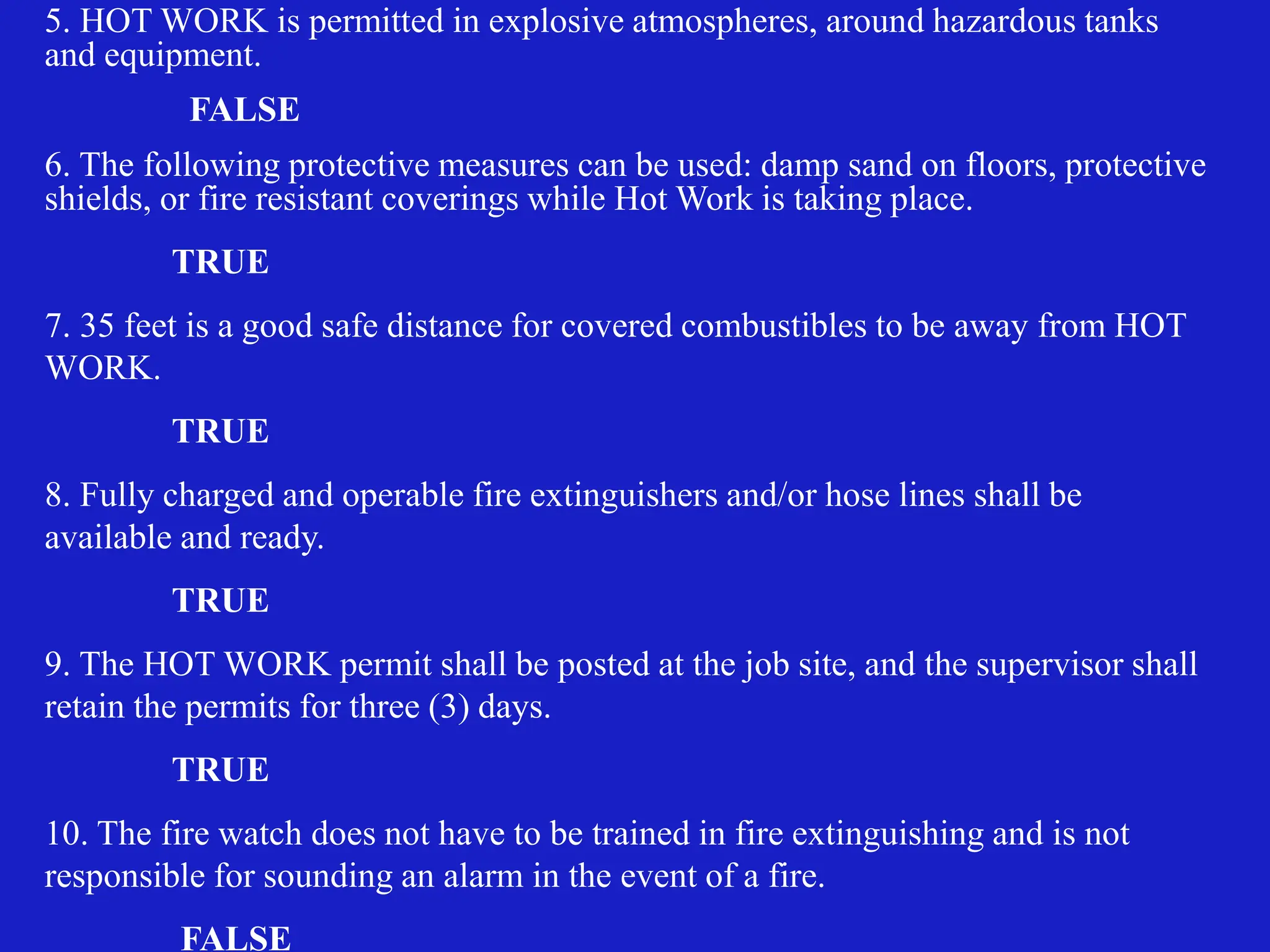
5. HOT WORK is permitted in explosive atmospheres, around hazardous tanks
and equipment.
FALSE
6. The following protective measures can be used: damp sand on floors, protective
shields, or fire resistant coverings while Hot Work is taking place.
TRUE
7. 35 feet is a good safe distance for covered combustibles to be away from HOT
WORK.
TRUE
8. Fully charged and operable fire extinguishers and/or hose lines shall be
available and ready.
TRUE
9. The HOT WORK permit shall be posted at the job site, and the supervisor shall
retain the permits for three (3) days.
TRUE
10. The fire watch does not have to be trained in fire extinguishing and is not
responsible for sounding an alarm in the event of a fire.
FALSE
PSM Operating Procedures
Summary
 You Must Develop and implement written operating
procedures consistent with the process safety
information and addresses at least the following
elements:
 Initial start-up, normal and temporary operations
 Normal and emergency shut-down procedures
 Operating limits and consequences of deviation
 Hazards presented by the process
PSM Safe Work Practices
Summary
 Safe Work Practices, Programs &
Procedures must:
 Be specific to the Covered Process(s)
 Follow Procedures & Recommendations in
the PHA’s
 Follow Procedures in the Operating
Procedures
 Must be Able to be Tracked
 Follow Form
PSM Training
Summary
 PSM Training Programs Must be Developed
for All Necessary Workers and Contractors
 Verification of Understanding is Required
 Training Must Be Performed as Follows:
 Initial training
 Prior to work assignment
 Waved for those already in a process
 Refresher training
 Every three years
 All Training Must be Documented
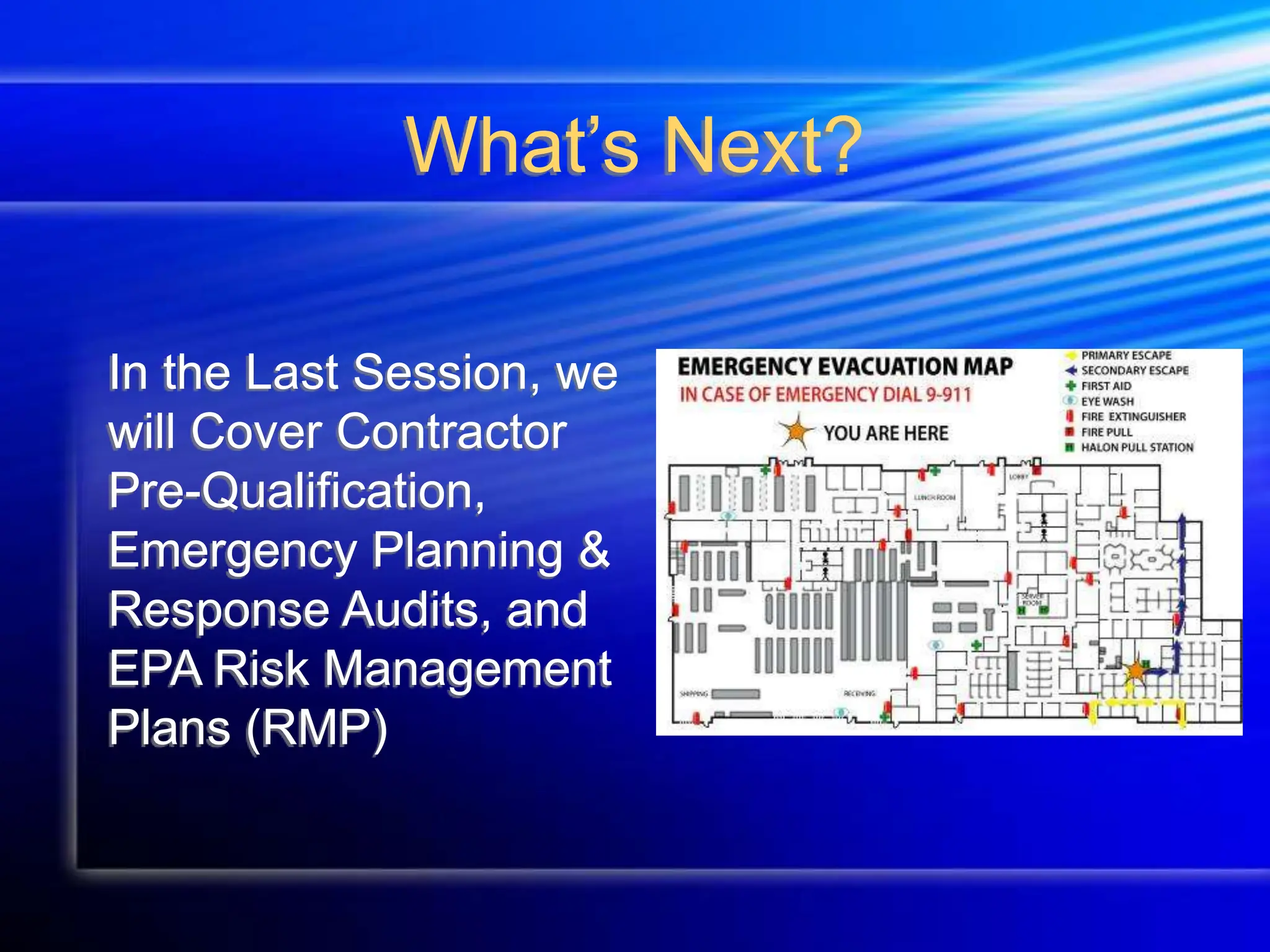
What’s Next?
In the Last Session, we
will Cover Contractor
Pre-Qualification,
Emergency Planning &
Response Audits, and
EPA Risk Management
Plans (RMP)

Process Safety Management of Highly Hazardous & Explosive Chemicals

  • 1.
    Process Safety Management ofHighly Hazardous & Explosive Chemicals Operating Procedures, Safety Procedures & Training
  • 2.
    Now that thePHA’s Are Competed or Underway…  Operating Procedures & Safety Programs Must Be Developed  PHA Information Can Be Used
  • 3.
  • 4.
    Operating Procedures &Safety Programs Must Consider:  Initial start-up  Normal operations  Temporary operations  Emergency shutdown  Emergency operations  Normal shutdown  Start-up following turnaround  Consequences of deviation  Steps required to correct or avoid deviation
  • 5.
    Operating Procedures or StandardOperating Procedures (SOP’s)  Where Did This Methodology Come From?  Answer: The Military  Definition: A standard operating procedure is a set of instructions having the force of a directive, covering those features of operations that lend themselves to a definite or standardized procedure without loss of effectiveness. Standard Operating Policies and Procedures can be effective catalysts to drive performance improvement and improving organizational results. Every good quality system is based on its standard operating procedures (SOPs).
  • 6.
    *Readily accessible toemployees Operating Procedures  Develop and implement written operating procedures* consistent with the process safety information and addresses at least the following elements:  Initial start-up, normal and temporary operations  Normal and emergency shut-down procedures  Operating limits and consequences of deviation  Hazards presented by the process
  • 7.
    Operating Procedures  Theoperating procedures addressing operating parameters will contain operating instructions about:  pressure limits  temperature ranges  flow rates…and  what to do when an upset condition occurs  what alarms and instruments are pertinent if an upset condition occurs, and other subjects.
  • 8.
    Operating Procedures -Start Up…We Must  Describe normal SOP's  Describe start-up SOP's  Describe Shut-down SOP’s
  • 9.
     Include Sectionssuch as:  Objectives  Purpose  Concerns  Procedures  Department  Operator  Equipment Involved  Location  Related Documents Operating Procedures - Start Up…We Must Let’s Look at An Example…
  • 10.
    Objective This procedureis designed to describe the Technical Operating Specifications (TOS), and to set down the Standard Operating Procedures for the safe operation of Ammonia High Pressure Receiver 1 (HPR-1) Purpose: The purpose of the TOS is to provide a description of the High Pressure Receiver, to define the function of the receiver, its operating conditions and limits, and consequences of deviation from these limits; To describe controls and instrumentation and safety systems, and set operating alignments. The purpose of the Standard Operating Procedure (SOP) is to set down the proper steps for starting, monitoring normal operation, and stopping and restarting the Receiver under normal and emergency conditions Concerns: Very Careful attention to valve positions, temperature, and pressure levels is extremely important to the successful completion of these procedures. Deviations from normal operating limits could cause personal injury or death, small to catastrophic release of ammonia or environmental damage, or evacuation of, or injury to, members of the public. We seek to prevent incidents such as: Injury to operators and others in the area. Damage to the High Pressure Receiver. Release of any quantity of Anhydrous Ammonia refrigerant. The company Lockout/Tagout program shall be followed when taking the receiver out of service, while maintaining the receiver, and while returning it to service. If Line-Breaking is required, all Line-Breaking precautions described in the company Line-Break Policy shall be observed. Additionally, proper PPE shall be immediately available, or worn in response to the threat level posed by the work and circumstances. Process Safety Management Procedure - Revision HPR-1 Revision Date: 1-9-2009 by: SWD
  • 11.
    Department: Refrigeration Operator: QualifiedRefrigeration Operator(s) Equipment: Ammonia High Pressure Receiver, HPR-1 outside the south compressor room. Data from U-1-A: Vertical Receiver, Serial Number 124011, National Board Number 8664, built in 1998, by E.L. Nickell Company. MAWP: 250 psig @ 240。F Location: Related Documents: Initial Date of 4/1998 Development: Authorized By: Previous Revision: 4/1/1998 Annual Review By, 9/2001 plant engineer, utilities supervisor, two operators, the Process and Date: Safety Management (PSM) coordinator, and an outside consultant
  • 12.
    Operating Procedures  Mustbe Developed for Each Equipment Operation in the Covered Process  Refer to Block Diagrams  Refer to P&ID  Must Cover Normal Operating Conditions, Normal Operating Parameters, i.e.. Pressure/Flow/Current/ etc.  Must Follow Procedures & Recommendations in PHA’s  Must Follow Form
  • 13.
    Operating Procedures  ForShut-down Procedures…Remember:  Most operations must be shut down in a specific order!  Failure to follow these shut down procedures could results in a catastrophic release or system failure
  • 14.
    Ammonia Plant ExplosionCaused by Improper Shut-down of Engine Room
  • 15.
    Operating Procedures  OperatingLimits  Operating Limits Must be Understood  Pressures  Flows  Electrical Potential  Tolerances
  • 16.
    Operating Procedures - Hazardsof the Process  Operating Procedures Must Identify the Hazards of the Process in All Phases:  Start Up  Normal Operating Conditions  Temporary Operating Condition  Emergency Shut- down
  • 17.
    Now That We’veCompleted the Operating Procedures We Must Develop Safety Work Practices, Programs & Procedures for Covered Processes
  • 18.
  • 19.
    •Develop and implementsafe work practices* to provide for the control of hazards during operations such as: –Lockout/tagout; –Confined space entry; –Line Opening process equipment or piping; and –Control over entrance into a facility by maintenance, contractor, laboratory, or other support personnel Safe Work Practices *These safe work practices apply to contractor employees as well
  • 20.
    Safe Work Practices Safe Work Practices, Programs & Procedures must:  Be specific to the Covered Process  Follow Procedures & Recommendations in the PHA’s  Follow Procedures in the Operating Procedures  Must be Able to be Tracked  Follow Form
  • 22.
    Safe Work Practices Lockout Tagout - One of the Most Important Procedures in PSM  Must be Written Carefully & Follow all Procedures (PHA’s, Operating Procedures)  Must be Followed to the Letter!
  • 24.
    Safe Work Practices Lockout/Tagout in PSM  Why not Use Digital Imaging in Your Procedures to Identify Critical Lockout /Tagout Positions
  • 25.
     Line Opening Permits Identify Procedures for Opening any Process Line in a Covered Process  Must Include Hazards of the Line Opening  PPE Required Safe Work Practices
  • 26.
    Safe Work Practices Line& Equipment Opening  A Hazard Review Must Completed for All Line/Equipment Hazards Including:  HAZARDOUS MATERIALS IN SYSTEM  POTENTIAL PHYSICAL HAZARDS  BARRICADING AS REQUIRED  FIRST AID IF EXPOSED  LOCATION OF SAFETY EQUIPMENT  PPE REQUIRED FOR LINE OPENING
  • 30.
    Safe Work Practices- HotWork A Program Must be Developed for the Covered Process That Requires:  A Hot Work Permit be Issued for ALL Hot Work Performed in the Plant by Employees or Contractors  A Permit must be Posted at the Location of the Hot Work  A Fire Watch Is Required  A Fire Extinguisher or Other Appropriate Fire Fighting Equipment Must Be Present, Fire Watch must be Trained in its use
  • 31.
    Paper Mill Explosion& Fire Caused by Failure to Follow Hot Work Procedures
  • 32.
     Must beSpecific for the Covered Process  May Require Additional Program other than Lockout Tagout, Line Opening & Hot Work…such as Confined Space, Electrical Safe Work Practices, Combustible Dust Safe Work Practices
  • 33.
    Now That We’veDeveloped Safe Work Practices We Have to Train
  • 34.
  • 35.
    PSM 29CFR1910.119(g) Requires (G) Training(Initial, Refresher, and Documentation) (paragraphs (g)(1), (g)(2), and (g)(3)).  Paragraph (g)(1) requires employers to train employees operating dangerous process. Paragraph (g)(2) requires that the employer provide refresher training at least every three years. Paragraph (g)(3) requires the employer to prepare a record that contains the name of employee, the date of training, and the means used to verify that the employee understood the training
  • 36.
    PSM Training  PSMTraining Programs Must be Developed for:  Affected Employees - Those not Directly Involved in the Process Operation  Authorized Employees - Those Directly Involved in the Process Operation  Contractors Who May Perform Work on a Covered Process  Vendors/Visitors who May Visit the Facility and May Potentially be Exposed to the Covered Process
  • 37.
    PSM Training  TrainingMust Be Performed as Follows:  Initial training  Prior to work assignment  Waved for those already in a process  Refresher training  Every three years  All Training Must be Documented
  • 38.
    PSM Training  TrainingSubjects Must Include at Least:  Lockout Tagout  Hot Work  Line & Equipment Opening  Confined Space (if applicable)  Emergency Response
  • 39.
    Examples of Training PSMtraining example including the means used to verify that the employee understood the training.
  • 40.
    Let’s Use HotWork Procedures
  • 41.
  • 42.
  • 43.
    Safe Work Practices HotWork Burning, Welding, Grinding Our Program Requires  A Hot Work Permit be Issued for ALL Hot work Performed in the Plant by Employees or Contractors  Permit must be Posted at the Location of the Hot Work  Fire Watch Is Required  Fire Extinguisher Must Be Present, Fire Watch must be Trained in its use
  • 44.
    Safe Work Practices HOTWORK PERMIT MUST BE COMPLETED PRIOR TO BEGINNING WORK INVOLVIING ANY HOT WORK PERMIT SHALL BE DISPLAYED AT THE LOCATION OF THE ACTUAL HOT WORK OPERATION
  • 46.
    VERIFICATION OF UNDERSTANDINGWORKSHEET HOT WORK CIRCLE THE CORRECT ANSWER 1. A HOT WORK permit must be obtained prior to beginning HOT.work by welders and contractors before beginning a job. TRUE 2. A HOT WORK permit is not necessary if just burning and grinding is being done on a job. FALSE 3. Contractors are not required to obtain HOT WORK permits. FALSE 4. The employee or contractor will obtain a HOT WORK permit from his supervisor and must determine if conditions are safe and have a fire watch if necessary. TRUE
  • 47.
    5. HOT WORKis permitted in explosive atmospheres, around hazardous tanks and equipment. FALSE 6. The following protective measures can be used: damp sand on floors, protective shields, or fire resistant coverings while Hot Work is taking place. TRUE 7. 35 feet is a good safe distance for covered combustibles to be away from HOT WORK. TRUE 8. Fully charged and operable fire extinguishers and/or hose lines shall be available and ready. TRUE 9. The HOT WORK permit shall be posted at the job site, and the supervisor shall retain the permits for three (3) days. TRUE 10. The fire watch does not have to be trained in fire extinguishing and is not responsible for sounding an alarm in the event of a fire. FALSE
  • 48.
    PSM Operating Procedures Summary You Must Develop and implement written operating procedures consistent with the process safety information and addresses at least the following elements:  Initial start-up, normal and temporary operations  Normal and emergency shut-down procedures  Operating limits and consequences of deviation  Hazards presented by the process
  • 49.
    PSM Safe WorkPractices Summary  Safe Work Practices, Programs & Procedures must:  Be specific to the Covered Process(s)  Follow Procedures & Recommendations in the PHA’s  Follow Procedures in the Operating Procedures  Must be Able to be Tracked  Follow Form
  • 50.
    PSM Training Summary  PSMTraining Programs Must be Developed for All Necessary Workers and Contractors  Verification of Understanding is Required  Training Must Be Performed as Follows:  Initial training  Prior to work assignment  Waved for those already in a process  Refresher training  Every three years  All Training Must be Documented
  • 51.
    What’s Next? In theLast Session, we will Cover Contractor Pre-Qualification, Emergency Planning & Response Audits, and EPA Risk Management Plans (RMP)