WELCOME
“
”
Inclusion & Gender
Sensitization
SUSTAINABLE DEVELOPMENT GOALS
Dr.Shobhna Jeet
Associate Professor
School of Legal Studies
KR Mangalam University
OBJECTIVE
 UNDERSTAND GENDER, GENDER RELATIONS
 UNDERSTAND GENDER MAINSTREAMING
 OBSTACLES TO GENDER MAINSTREAMING
(SOCIALLY)
 OBSTACLES IN MAKING AN ORGANISATION
GENDER FRIENDLY
 ESSENTIAL FEATURES TO MAKE ORG. GENDER
FRIENDLY
 SEXUAL HARASSMENT, REF 4/2004
 SUGGESTED REMEDIES
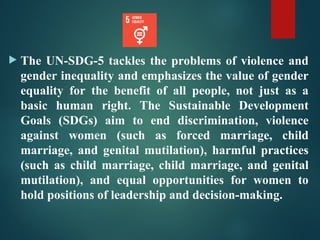
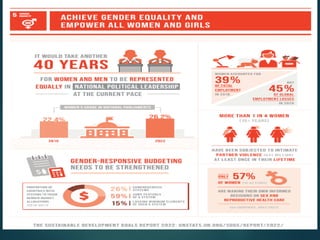
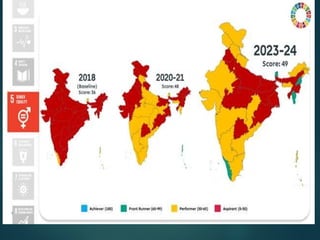
 The UN-SDG-5 tackles the problems of violence and
gender inequality and emphasizes the value of gender
equality for the benefit of all people, not just as a
basic human right. The Sustainable Development
Goals (SDGs) aim to end discrimination, violence
against women (such as forced marriage, child
marriage, and genital mutilation), harmful practices
(such as child marriage, child marriage, and genital
mutilation), and equal opportunities for women to
hold positions of leadership and decision-making.
The dictionary meaning of
gender is – the class in which a
noun or pronoun is placed in
grammatical grouping {in
English, these are masculine,
feminine, neuter}
AIM
The aim of gender sensitization to make
people aware of the power relations
between men and women in society
and to understand the importance of
affording women and men equally
opportunities and treatment.
Mainstreaming of Gender
It is the process of assessing the implication for
women and men of any planned a chain,
including legislation, policies or
programmes, in all areas and all levels. It’s a
strategy for making women’s as well as men’s
concern & experience an integral dimension of
the design, implementation, monitoring &
evaluation of polices so that equality is
generated and inequality is not perpetuated.
The challenges of gender
mainstreaming of women
1. Personal factors
2. Psychological glass ceiling
3. Social factors
4. Structural factors
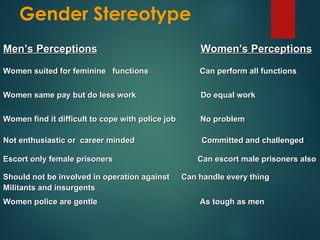
Gender Stereotype
Men’s Perceptions
Men’s Perceptions Women’s Perceptions
Women’s Perceptions
Women suited for feminine functions Can perform all functions
Women same pay but do less work Do equal work
Women find it difficult to cope with police job No problem
Not enthusiastic or career minded Committed and challenged
Escort only female prisoners Can escort male prisoners also
Should not be involved in operation against
Should not be involved in operation against Can handle every thing
Can handle every thing
Militants and insurgents
Women police are gentle As tough as men
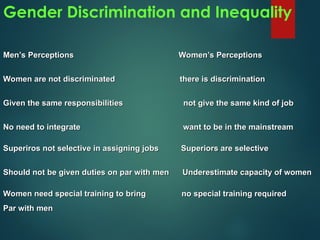
Gender Discrimination and Inequality
Men’s Perceptions Women’s Perceptions
Women are not discriminated there is discrimination
Given the same responsibilities not give the same kind of job
No need to integrate want to be in the mainstream
Superiros not selective in assigning jobs Superiors are selective
Should not be given duties on par with men Underestimate capacity of women
Women need special training to bring no special training required
Par with men
Par with men
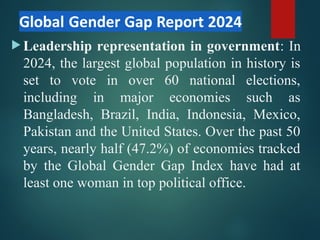
 Leadership representation in government: In
2024, the largest global population in history is
set to vote in over 60 national elections,
including in major economies such as
Bangladesh, Brazil, India, Indonesia, Mexico,
Pakistan and the United States. Over the past 50
years, nearly half (47.2%) of economies tracked
by the Global Gender Gap Index have had at
least one woman in top political office.
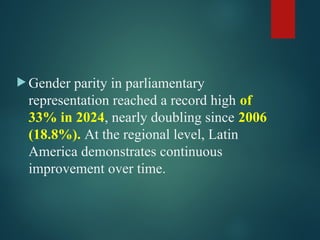
 Gender parity in parliamentary
representation reached a record high of
33% in 2024, nearly doubling since 2006
(18.8%). At the regional level, Latin
America demonstrates continuous
improvement over time.
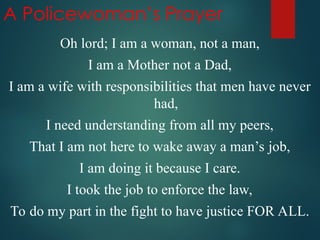
A Policewoman’s Prayer
Oh lord; I am a woman, not a man,
I am a Mother not a Dad,
I am a wife with responsibilities that men have never
had,
I need understanding from all my peers,
That I am not here to wake away a man’s job,
I am doing it because I care.
I took the job to enforce the law,
To do my part in the fight to have justice FOR ALL.
To be professional, to make a career, Great Lord,
Help me when they say I should not be here.
I work the long hours, face all the dangers and do the same
Things that they do in law enforcement maters,
Grant me the respect like the others, for I am one.
Set aside for every other one, Lord,
Being a policewoman is the ost challenging job I have ever
done,
Be with me on my daily run, as you are with us all,
I thank you for the ability to enforce the law.
Obstacles to Making A Gender
Sensitive Organisation
There are certain obstacles that prevent us from making our own
organization more gender sensitive. Some examples are as follows:

There is insufficient awareness (of gender and other
aspects of diversity) among staff in organizations; gender issues are
still widely understood as women’s issues only.
 Power relations between men and women in our own organizations
are unequal in many ways, not just in terms of gender parity in
staffing.
WOMEN AND THE INDIAN
CONSTITUTION
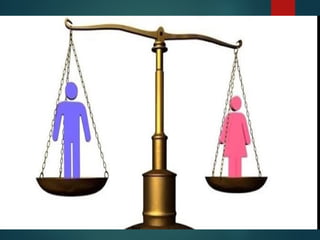
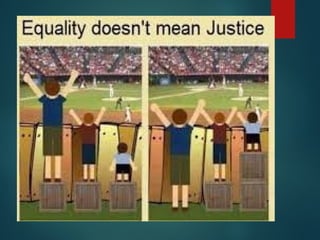
Equality before law Article 14 embodies
the general principles of equality before
law and equal protection of laws.
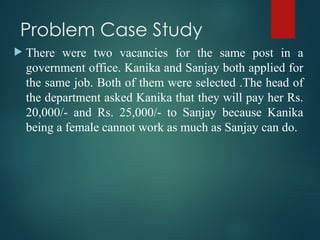
Problem Case Study
 There were two vacancies for the same post in a
government office. Kanika and Sanjay both applied for
the same job. Both of them were selected .The head of
the department asked Kanika that they will pay her Rs.
20,000/- and Rs. 25,000/- to Sanjay because Kanika
being a female cannot work as much as Sanjay can do.
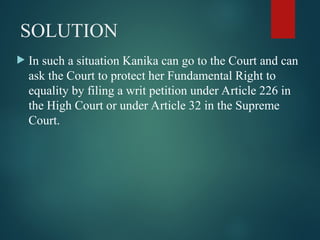
SOLUTION
 In such a situation Kanika can go to the Court and can
ask the Court to protect her Fundamental Right to
equality by filing a writ petition under Article 226 in
the High Court or under Article 32 in the Supreme
Court.
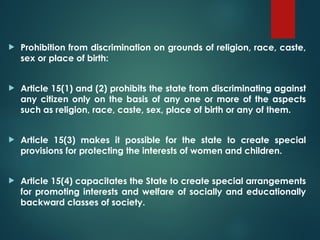
 Prohibition from discrimination on grounds of religion, race, caste,
sex or place of birth:
 Article 15(1) and (2) prohibits the state from discriminating against
any citizen only on the basis of any one or more of the aspects
such as religion, race, caste, sex, place of birth or any of them.
 Article 15(3) makes it possible for the state to create special
provisions for protecting the interests of women and children.
 Article 15(4) capacitates the State to create special arrangements
for promoting interests and welfare of socially and educationally
backward classes of society.
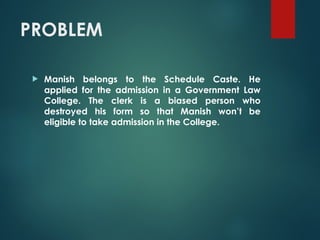
PROBLEM
 Manish belongs to the Schedule Caste. He
applied for the admission in a Government Law
College. The clerk is a biased person who
destroyed his form so that Manish won’t be
eligible to take admission in the College.
SOLUTION
 Manish complained about the act of the
Clerk to National Commission for
Scheduled Castes. The Commission
further filed a case in the Supreme
Court under Article 32 of the
Constitution. The act of the clerk was
held to be illegal, unconstitutional and
violative of Article 15 of the
Constitution.
 Equality of opportunity: Article 16 provides for equality of opportunity for
all citizens in matters relating to employment or appointment to any office
under the State. •
 Article 39 requires the State to direct its policy towards securing for men
and women equally the right to an adequate means of livelihood
 [Article 39(a)]:, and equal pay for equal work for both men and women
 [Article 39(d)] • Article 39A directs the State to promote justice, on the basis
of equal opportunity and to promote free legal aid by suitable legislation or
scheme or in any other way to ensure that opportunities for securing justice
are not denied to any citizen by reason of economic or other disabilities. •
 Article 42 directs the State to make provision for securing justice and
humane conditions of work and for maternity relief.
Fundamental Duty
 Article 51A (e) enjoins upon every citizen the duty
to renounce practices derogatory to the dignity of
women.
 Sheela gave birth to a child on 1st May 2000. Her
employer Mahesh gave her leave with full pay from
19th May, 2000 to 1st August, 2000. If Mahesh had
cut Sheela’s pay for the period that she stayed away
from work, he would have been punished and fined
under the Maternity Benefits Act, 1961.(Special
Legislation under Article 42)
 Women do not have enough male allies in their
organizations – indeed the interviews reveal residual male
fear and resentment of any attempts to change gender
relations.
 However, women themselves may bear some responsibility
for ghettoizing gender in organizations. As gender experts,
we may create resistance by monopolizing gender issues,
disempowering potential allies including men, or mystifying
gender issues with jargon or heavily charged language.
 We need to ‘sell’ the idea of gender in our
organizations (and with counterparts) via
dialogue rather than antagonizing or mystifying.
It is also important to emphasize the
opportunities for change rather than
concentrating only on finding and countering
resistance.
Essential Features to Make an
Organization Gender Sensitive
 Some very general features that would seem essential to making any
organization more gender sensitive and more gender equal are as
follows:
 Gender equality should be a priority not only in the organization’s
mission statement, general objectives, and policies, but also in its
internal regulations (recruitment procedures, terms and conditions
for workers, etc.)
 Adequate resources should be devoted to putting
such policies into practice.
 Accountability to women should be written into
the organization’s policies and carried out in its
practice.
 There should be greater parity in numbers and
distribution of staff, more – importantly, women
on the staff and especially in management must be
committed to gender equality.
 This means not feminine management, but
feminist management, understood as management
(by both sexes) that is committed to women’s
empowerment.
 Since some degree of hierarchy is inevitable in any but
very small organizations, this should be offset by a
style of management that is open to change and
oriented towards training, support, good feedback,
and stimulating colleagues.
 Management-staff relations should be as non-vertical
as possible: open, consultative, listening.
 The organization should offer non-gender-stereotyped
roles and choices for both men and women.
 There should be space for, and encouragement of,
bottom-up initiatives and informal, ‘horizontal’ for
ideas and dialogue.
 There should be scope for different organizational styles
and cultures to coexist and be valued and for men and
women together to explore and utilize difference without
disempowering either side.
 Management should give unequivocal support to gender
teams and staff members with specific responsibility for
gender issues.
 Decision-making access for women should be built into
the organization’s structures, not dependent on informal
agreements or arrangements, so that women’s access to
decision-making does not depend on the personalities
and efforts of individuals.
CONCLUSION
CONCLUSION
On the
On the platform of equality
platform of equality
together
together we can achieve the
we can achieve the
common goals
common goals of organization
of organization
not merely with
not merely with legal changes
legal changes but
but
definitely with
definitely with attitudinal changes.
attitudinal changes.
SOME MYTHS AND
FACTS
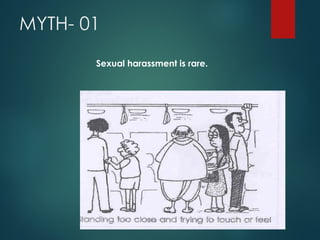
MYTH- 01
Sexual harassment is rare.
FACT - 1
Sexual harassment is
rampant extremely
widespread. It touches the
lives of 40 to 60 percent of
working women, and
similar proportions of
female students in colleges
and universities.
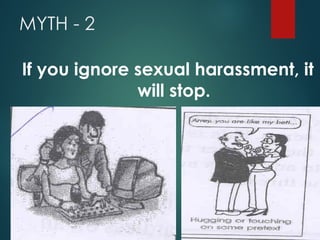
MYTH - 2
If you ignore sexual harassment, it
will stop.
FACT - 2
 It will not. Generally, simply ignoring sexual
harassment will not stop it. Ignoring such
behavior may be taken as a sign of
encouragement or tacit consent. Many
reports, that when they directly tell the
harasser to stop, the harassment often, but
not always ends. Ignoring such conduct may
even be perceived as complicity, condoling
and encouragement of the act.
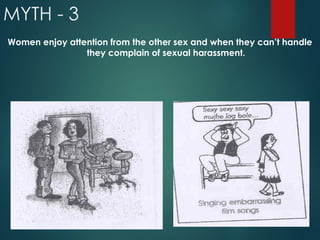
MYTH - 3
Women enjoy attention from the other sex and when they can’t handle
they complain of sexual harassment.
FACT - 3
 Display of “Power” on the part of perpetrator is the
root cause of Sexual harassment. Sexual harassment
is form of harassment-which is unwanted and
unacceptable to the victim. A.P. survey (Women
Police Officers) 86% of Sexual harassment are true.
Infact most cases of Sexual Harassment go
unreported as
a) 48.2 % - embarrassed
b) Fear of being blamed.
MYTH-4
Many women make up and report
stories of sexual harassment to get
back at their employers or others
who have angered them.
FACT-4
Research shows that less than
one percent of the complaints
are false. Women rarely file
complaints even when they are
justified in doing so.
MYTH-5
Only those women object who have
no sense of humour.
FACT-6
Sexual harassment is offensive,
frightening and insulting to
women. It has an adverse effect on
their mental and physical health.
Culture of silence
 Women usually keep quiet out of fear, to protect the
family honor , for children’s sake or she thinks she is
at fault.
 Many women think it is all normal and inevitable.
 It is a woman’s lot and there is seemingly little she can
do to escape her lot.
U.N Declaration
UN declaration, 1993, on elimination of violence against women
defines violence as :
 Any gender based violence that results or is likely to result in
physical, sexual or psychological harm or suffering to women.
 Includes threats of such acts, coercion or arbitrary deprivation
of liberty, whether occurring in public or private.
Reasons for Violence
While forms of violence may vary they have
certain common features.
 Women and girls are judged and
condemned in terms of what society
dictates for their behavior.
 Women are supposed to have less power
in public spaces than men.
 Women and girls are seen as a different
and lower caste.
 Masculinity defined at the women’s
expense.
Sexual Harassment
defined
A form of gender violence which is
now defined is sexual harassment,
 “Before sexual harassment was given
a name women just called it “life”.
 Lyn Farley’s 1978 book, Sexual
Shakedown, introduced the term.
 Further reinforced when in 1979,
Catherine MacKinnon published, The
sexual harassment of the working
women
 Key legislation and broad feminist
theorizing about gender relations and
politics have helped to define and
popularize the concept.
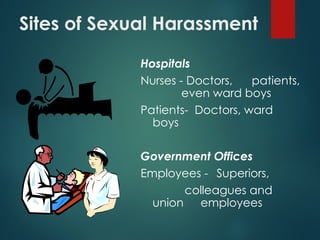
Sites of Sexual Harassment
Hospitals
Nurses - Doctors, patients,
even ward boys
Patients- Doctors, ward
boys
Government Offices
Employees - Superiors,
colleagues and
union employees
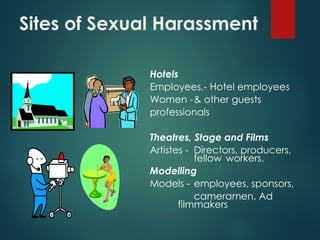
Sites of Sexual Harassment
Hotels
Employees,- Hotel employees
Women -& other guests
professionals
Theatres, Stage and Films
Artistes - Directors, producers,
fellow workers.
Modelling
Models - employees, sponsors,
cameramen, Ad
filmmakers
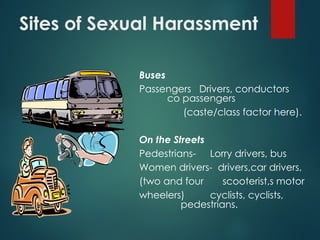
Sites of Sexual Harassment
Buses
Passengers Drivers, conductors
co passengers
(caste/class factor here).
On the Streets
Pedestrians- Lorry drivers, bus
Women drivers- drivers,car drivers,
(two and four scooterist,s motor
wheelers) cyclists, cyclists,
pedestrians.
Sites of Sexual Harassment
District Headquarters
The rule of gangs that have
political
support
Village group - Gangs with
Leaders, position
women
Press & Publishing
All these who go for publication
Writers Editors, Sub Editors,
Journalists Publishers
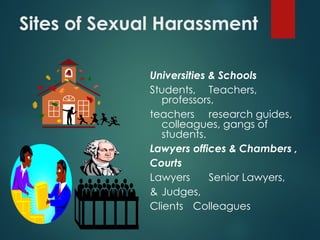
Sites of Sexual Harassment
Universities & Schools
Students, Teachers,
professors,
teachers research guides,
colleagues, gangs of
students.
Lawyers offices & Chambers ,
Courts
Lawyers Senior Lawyers,
& Judges,
Clients Colleagues
Sites of Sexual Harassment
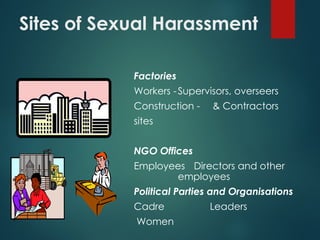
Factories
Workers -Supervisors, overseers
Construction - & Contractors
sites
NGO Offices
Employees Directors and other
employees
Political Parties and Organisations
Cadre Leaders
Women
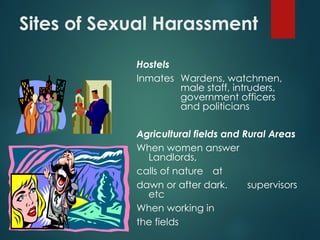
Sites of Sexual Harassment
Hostels
Inmates Wardens, watchmen,
male staff, intruders,
government officers
and politicians
Agricultural fields and Rural Areas
When women answer
Landlords,
calls of nature at
dawn or after dark. supervisors
etc
When working in
the fields
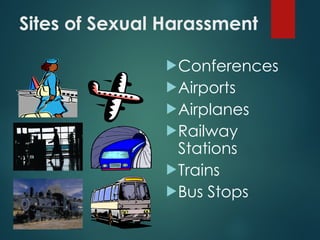
Sites of Sexual Harassment
Conferences
Airports
Airplanes
Railway
Stations
Trains
Bus Stops
International Debates
 Sexual harassment as a criminal offence was
recognized by the courts in USA only in
1980’s.
 In 1980 , The Equal Employment Opportunities
Commission, issued guidelines.
 In countries where sexual harassment is seen
as a general phenomena, the legal remedy
is situated in the frame work of the criminal
laws.
 In other countries where it is seen as a work
place phenomena, Civil and labor law frame
works are applied.
 Internationally it is covered by four types of
laws, Criminal, Civil( anti discrimination),
Labor and Tort Law ( non Contractual
judgments made on grounds of mental
anguish, negligence).
Landmark Judgment in
USA
 In 1986, a landmark Judgment in the USA in
Vinson Vs. Meritor Savings Bank case ruled that
sexual harassment is a violation of an individuals
right to equal employment opportunities and
further defined the employer as liable for sexual
harassment claims.
Not, “Just flirting”
Types of Sexual harassment include:
1. Verbal or physical contact with the
intention of sexual relations.
a. Quid Pro quo i.e. Due to power of the
person in authority, in exchange for favors
such as promotion, perks, better grades.
b. By colleagues.
c. By clients, especially in professions where
women's role is sexually packaged, such as
airhostesses, beer bars etc.
d. By women in authority to undermine the
position of women.
-cont.
Types of Sexual
harassment
 Sexual Objectification of an individual
through sexual relations not intended:
This includes not only work situations
but also harassment in public or social
situations, for example on the roads, in
buses , negative comments.
 Hostile and anti women environment:
Pornography in public places, use of
foul language. This may not be
directed against any particular
woman but the effect is of discomfort.
Reality Check- effects of
sexual harassment
 Loss of Job- a woman may quit or protest and
quit.
 Psychological rape- nervousness, loss of self
esteem and confidence, humiliation, guilt feeling,
that they are the cause.
 Restriction on women’s mobility; late night shifts,
public transport.
 Victim turned into wrong doer; slander on her
morals and character.
Films- myths about sexual
harassment
 She is saying “No” but she means a “yes.
 It is normal male flirting- natural for men. It is an
assertion of power rather than expression of
sexuality.
 Women enjoy sexual harassment or eve teasing- it
is humiliating and degrading.
 Women ask for it- revealing clothes, single or
divorced.
Myth and reality
 It is harmless and women who object
have no sense of humor – women
seen as eves- temptress, belittling
women.
 It is a personal problem between two
individuals- it is a pervasive public
problem needing public solutions.
 Women use sex to get ahead- women
misuse claims of sexual harassment.
 Prostitutes cannot be sexual harassed-
regularly by Police, middlemen and
clients.
A Survey
 A survey was conducted in Delhi, Mumbai,
Chennai and Bangalore by Week between
March 22nd
to 25th
, 2009.
 More than half these women were in the public
sector.
 43% were in the 21-30 age bracket.
 75% were married.
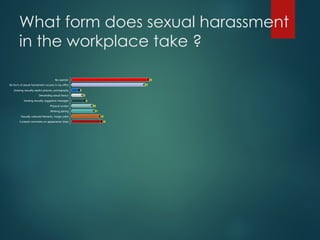
What form does sexual harassment
in the workplace take ?
15
14
11
10
6
5
3
37
39
Constant comments on appearance/ dress
Sexually coloured Remarks, Vulgar jokes
Winking,staring
Physical contact
Sending sexually suggestive messages
Demanding sexual favour
showing sexually explict pictures, pornography
No form of sexual harresment occures in my office
No openion
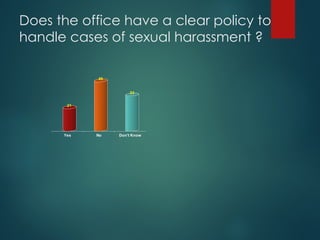
Does the office have a clear policy to
handle cases of sexual harassment ?
21
46
33
Yes No Don’t Know
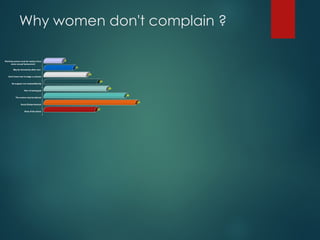
Why women don't complain ?
23
41
36
28
24
19
13
8
None of the above
Social Embarresment
The women may be blamed
Fear of loosing job
No support rom husband/family
Don’t know how to lodge a comaint
May be harrsed by other men
Working women must be ready to face
some sexual harassment
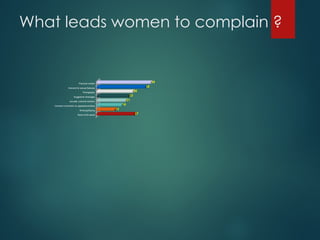
What leads women to complain ?
27
13
18
21
23
26
35
39
None of the above
Winking/Staring
Constant comments on appearance/dress
sexually coloured remarks
Suggestive messages
Pronography
Demand for sexual favoures
Physical contact
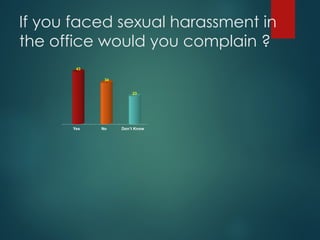
If you faced sexual harassment in
the office would you complain ?
43
34
23
Yes No Don’t Know
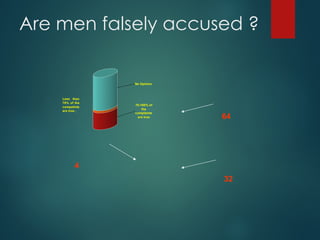
Are men falsely accused ?
70-100% of
the
complaints
are true
Less than
70% of the
compalints
are true ,
No Opinion
64
4
32
Sexual Harassment and
Law- India
 Ammendments to laws on sexual violence in the
last two decades have failed to cover sexual
harassment.
 Section 209, IPC- Obscene acts and songs-
punished by imprisonment of 3 months or fine or
both.
 Section 354, IPC-Assault or criminal force to a
woman with the intent to outrage her modesty-
punishment 2 years or fine or both.
 Section 509, IPC-word, gesture or act intended to
insult the modesty of women- 1year or fine or
both.
 Industrial Disputes Act , Rule 5, Schedule 5, Unfair
labor practices.
 Civil suit under Tort laws.
Landmark Judgments -
India
 N.Radha bai vs. D.Ramchandran: In 1973,
Radhabai, secretary to then State Social
Welfare Minister, protested against his abuse
of girls in welfare institutions. She was
molested and dismissed. In 1975, Supreme
Court passed a judgment in her favor with
back pay and benefits.
 S.C Bhatia Prof in Dept. of Adult and
Continuing Education, Delhi University finally
dismissed in 1992.
 Rupen Deol Bajaj vs. KPS Gill, in 1988 at a
dinner slapped her posterior. In 1998 won
fined 2.5 lakhs in lieu of 3 months rigorous
imprisonment under section 294 and 509.
Meaningful legislation
 Dialogues on meaningful legislation
has been located with in the sexual
assault discourse.
 Draft Bill on sexual assault, 1993, by
National commission for women. It
views sexual harassment as an
offence on the continuum sexual
assault.
 Memorandum on Reform of Laws
relating to Sexual offenses, 1996, by
Feminist Legal Research Centre, New
Delhi, advocated treating sexual
harassment as an offence separate
from sexual assault. More as a
violation to safe working conditions.
Vishaka vs. State of
Rajasthan
 Landmark case that led to the
Supreme Court laying down broad
guidelines in August 1997 to be
followed.
 A public interest litigation filed by
several Women’s organizations.
 Social worker under the Governments
Women’s Development Program in
Bhateri village in Rajasthan faced
Sexual harassment , in trying to
prevent Child marriage.
Definition of sexual harassment-
Supreme Court Judgment
 Physical contact and advances
 Demand or request for sexual favors.
 Sexually colored remarks.
 Display of pornography.
 Any other unwelcome physical, verbal or non-verbal conduct
of sexual nature.
The protected one’s are
Women who
 Draw a regular salary.
 Receive an honorarium.
 Do voluntary work in the government, private
and unorganized sector.
Duty of the employer
 It shall be the duty of the employer or other
responsible persons in the work place or other
institutions to deter the commission of acts of
sexual harassment.
 It is the duty of the employer to provide the
procedures for the resolution, settlement or
prosecution of acts of sexual harassment by
taking all steps required.
Preventive Steps
All employers or persons in charge of the
workplace should take the following steps:
 Prohibition of sexual harassment should be
notified, published and circulated in
appropriate ways.
 The rules/regulations of conduct and
discipline should include for prohibiting sexual
harassment and appropriate penalities.
 In private employers case should be included
in standing orders under Industrial
Employment Acts, 1946.
 Provide appropriate work conditions in
respect to work, leisure, health and hygiene.
Disciplinary Action
 When such conduct amounts to misconduct in
employment as defined by the relevant service
rules, appropriate disciplinary action should be
initiated by the employer in accordance with
those rules.
MECHANISM TO PREVENT
S.O. 4/2004
As per S.O.4/2004 it includesp-
1- Physical contact & advances.
2- A demand or request for sexual favours
3- Sexually coloured remarks
4- Eve-teasing
5- Unsavoury remarks
6-Jokes causing or likely to cause awkardness or
embarrassment
okes causing or likely to cause
kardness or embarrassment
7- Innuendos and taunts
8- Gender based insults or sexists remarks
9- Unwelcome sexual overtone in any manner such
as obnoxious phone calls
10-Touching or brushing against any part of body
11- Displaying pornographic or other offensive
pictures, pamphlets
12- Forcible physical touch or molestation
13- Physical confinement against one’s will and other act likely to
violate one’s privacy
14- Any other unwelcome physical, verbal, or non-verbal
conduct of social nature
DUTY OF H.O.O. /
RESPONSIBLE PERSONS
 UNDERTAKING STEPS FOR DETERENCE
 TO ENSURE DIGNITY OF WOMEN
 ESTT OF GRIEVANCE & REMEDIAL SYSTEM
 ENSURE NOTIFICATION PUBLICATION &
CIRCULATION IN APP WAYS
 TO PROVIDE CONDUCIVE WORK
ENVIRONMENT
 TO PROVIDE SUPPORT IN CASE OF SH BY
AN OUTSIDER
WOMEN COMMISSION
 NATIONAL COMMISSION FOR WOMEN
 STATE COMMISSION FOR WOMEN
 CENTRAL COMPLAINT COMMITTEE
 SECTOR COMPLAINT COMMITTEES
 WOMEN CELL AT POLICE STATION
PROCEDURE FOR
INVESTIGATION
 LODGING OF WRITTEN COMPLAINT
 SUO MOTTO ACTION BY CC
 RULE 14 CCA(CCS)
 RECOMMENDATIONS
 PUNISHMENTS
 APPEAL
ONUS OF SUPERVISORY OFFICERS
 DURING VISIT/INSPECTIONS WILL REITERATE INST IN
MEETING & SAINIK SAMMELANS.
 REVIEW THE COMPLAINTS RECEIVED.
 ENSURE PROPER WORKING ENVIRONMENT FOR
WOMEN & ARE NOT DISCRIMINATED ON ANY
POINT.
SUGGESTIONS
 CHANGE IN RECTT POLICY
 SEXUAL HARASSMENT AWARENESS TRAINING
 SENSING MECHANISMS
 COMMITMENT FROM TOP
 PRACTICES CONSISTENT WITH POLICIES
CONCLUSION
CONCLUSION
On the
On the platform of equality
platform of equality
together
together we can achieve the
we can achieve the
common goals
common goals of organization
of organization
not merely with
not merely with legal changes
legal changes but
but
definitely with
definitely with attitudinal changes.
attitudinal changes.
THANKS
?

Inclusion and Gender Sensitisation with reference to Constitution

  • 1.
  • 2.
    “ ” Inclusion & Gender Sensitization SUSTAINABLEDEVELOPMENT GOALS Dr.Shobhna Jeet Associate Professor School of Legal Studies KR Mangalam University
  • 3.
    OBJECTIVE  UNDERSTAND GENDER,GENDER RELATIONS  UNDERSTAND GENDER MAINSTREAMING  OBSTACLES TO GENDER MAINSTREAMING (SOCIALLY)  OBSTACLES IN MAKING AN ORGANISATION GENDER FRIENDLY  ESSENTIAL FEATURES TO MAKE ORG. GENDER FRIENDLY  SEXUAL HARASSMENT, REF 4/2004  SUGGESTED REMEDIES
  • 4.
     The UN-SDG-5tackles the problems of violence and gender inequality and emphasizes the value of gender equality for the benefit of all people, not just as a basic human right. The Sustainable Development Goals (SDGs) aim to end discrimination, violence against women (such as forced marriage, child marriage, and genital mutilation), harmful practices (such as child marriage, child marriage, and genital mutilation), and equal opportunities for women to hold positions of leadership and decision-making.
  • 5.
    The dictionary meaningof gender is – the class in which a noun or pronoun is placed in grammatical grouping {in English, these are masculine, feminine, neuter}
  • 6.
    AIM The aim ofgender sensitization to make people aware of the power relations between men and women in society and to understand the importance of affording women and men equally opportunities and treatment.
  • 7.
    Mainstreaming of Gender Itis the process of assessing the implication for women and men of any planned a chain, including legislation, policies or programmes, in all areas and all levels. It’s a strategy for making women’s as well as men’s concern & experience an integral dimension of the design, implementation, monitoring & evaluation of polices so that equality is generated and inequality is not perpetuated.
  • 8.
    The challenges ofgender mainstreaming of women 1. Personal factors 2. Psychological glass ceiling 3. Social factors 4. Structural factors
  • 9.
    Gender Stereotype Men’s Perceptions Men’sPerceptions Women’s Perceptions Women’s Perceptions Women suited for feminine functions Can perform all functions Women suited for feminine functions Can perform all functions Women same pay but do less work Do equal work Women same pay but do less work Do equal work Women find it difficult to cope with police job No problem Women find it difficult to cope with police job No problem Not enthusiastic or career minded Committed and challenged Not enthusiastic or career minded Committed and challenged Escort only female prisoners Can escort male prisoners also Escort only female prisoners Can escort male prisoners also Should not be involved in operation against Should not be involved in operation against Can handle every thing Can handle every thing Militants and insurgents Militants and insurgents Women police are gentle As tough as men Women police are gentle As tough as men
  • 10.
    Gender Discrimination andInequality Men’s Perceptions Women’s Perceptions Men’s Perceptions Women’s Perceptions Women are not discriminated there is discrimination Women are not discriminated there is discrimination Given the same responsibilities not give the same kind of job Given the same responsibilities not give the same kind of job No need to integrate want to be in the mainstream No need to integrate want to be in the mainstream Superiros not selective in assigning jobs Superiors are selective Superiros not selective in assigning jobs Superiors are selective Should not be given duties on par with men Underestimate capacity of women Should not be given duties on par with men Underestimate capacity of women Women need special training to bring no special training required Women need special training to bring no special training required Par with men Par with men
  • 11.
     Leadership representationin government: In 2024, the largest global population in history is set to vote in over 60 national elections, including in major economies such as Bangladesh, Brazil, India, Indonesia, Mexico, Pakistan and the United States. Over the past 50 years, nearly half (47.2%) of economies tracked by the Global Gender Gap Index have had at least one woman in top political office.
  • 12.
     Gender parityin parliamentary representation reached a record high of 33% in 2024, nearly doubling since 2006 (18.8%). At the regional level, Latin America demonstrates continuous improvement over time.
  • 13.
    A Policewoman’s Prayer Ohlord; I am a woman, not a man, I am a Mother not a Dad, I am a wife with responsibilities that men have never had, I need understanding from all my peers, That I am not here to wake away a man’s job, I am doing it because I care. I took the job to enforce the law, To do my part in the fight to have justice FOR ALL.
  • 14.
    To be professional,to make a career, Great Lord, Help me when they say I should not be here. I work the long hours, face all the dangers and do the same Things that they do in law enforcement maters, Grant me the respect like the others, for I am one. Set aside for every other one, Lord, Being a policewoman is the ost challenging job I have ever done, Be with me on my daily run, as you are with us all, I thank you for the ability to enforce the law.
  • 15.
    Obstacles to MakingA Gender Sensitive Organisation There are certain obstacles that prevent us from making our own organization more gender sensitive. Some examples are as follows:  There is insufficient awareness (of gender and other aspects of diversity) among staff in organizations; gender issues are still widely understood as women’s issues only.  Power relations between men and women in our own organizations are unequal in many ways, not just in terms of gender parity in staffing.
  • 16.
    WOMEN AND THEINDIAN CONSTITUTION Equality before law Article 14 embodies the general principles of equality before law and equal protection of laws.
  • 19.
    Problem Case Study There were two vacancies for the same post in a government office. Kanika and Sanjay both applied for the same job. Both of them were selected .The head of the department asked Kanika that they will pay her Rs. 20,000/- and Rs. 25,000/- to Sanjay because Kanika being a female cannot work as much as Sanjay can do.
  • 20.
    SOLUTION  In sucha situation Kanika can go to the Court and can ask the Court to protect her Fundamental Right to equality by filing a writ petition under Article 226 in the High Court or under Article 32 in the Supreme Court.
  • 21.
     Prohibition fromdiscrimination on grounds of religion, race, caste, sex or place of birth:  Article 15(1) and (2) prohibits the state from discriminating against any citizen only on the basis of any one or more of the aspects such as religion, race, caste, sex, place of birth or any of them.  Article 15(3) makes it possible for the state to create special provisions for protecting the interests of women and children.  Article 15(4) capacitates the State to create special arrangements for promoting interests and welfare of socially and educationally backward classes of society.
  • 22.
    PROBLEM  Manish belongsto the Schedule Caste. He applied for the admission in a Government Law College. The clerk is a biased person who destroyed his form so that Manish won’t be eligible to take admission in the College.
  • 23.
    SOLUTION  Manish complainedabout the act of the Clerk to National Commission for Scheduled Castes. The Commission further filed a case in the Supreme Court under Article 32 of the Constitution. The act of the clerk was held to be illegal, unconstitutional and violative of Article 15 of the Constitution.
  • 24.
     Equality ofopportunity: Article 16 provides for equality of opportunity for all citizens in matters relating to employment or appointment to any office under the State. •  Article 39 requires the State to direct its policy towards securing for men and women equally the right to an adequate means of livelihood  [Article 39(a)]:, and equal pay for equal work for both men and women  [Article 39(d)] • Article 39A directs the State to promote justice, on the basis of equal opportunity and to promote free legal aid by suitable legislation or scheme or in any other way to ensure that opportunities for securing justice are not denied to any citizen by reason of economic or other disabilities. •  Article 42 directs the State to make provision for securing justice and humane conditions of work and for maternity relief.
  • 25.
    Fundamental Duty  Article51A (e) enjoins upon every citizen the duty to renounce practices derogatory to the dignity of women.
  • 26.
     Sheela gavebirth to a child on 1st May 2000. Her employer Mahesh gave her leave with full pay from 19th May, 2000 to 1st August, 2000. If Mahesh had cut Sheela’s pay for the period that she stayed away from work, he would have been punished and fined under the Maternity Benefits Act, 1961.(Special Legislation under Article 42)
  • 27.
     Women donot have enough male allies in their organizations – indeed the interviews reveal residual male fear and resentment of any attempts to change gender relations.  However, women themselves may bear some responsibility for ghettoizing gender in organizations. As gender experts, we may create resistance by monopolizing gender issues, disempowering potential allies including men, or mystifying gender issues with jargon or heavily charged language.
  • 28.
     We needto ‘sell’ the idea of gender in our organizations (and with counterparts) via dialogue rather than antagonizing or mystifying. It is also important to emphasize the opportunities for change rather than concentrating only on finding and countering resistance.
  • 29.
    Essential Features toMake an Organization Gender Sensitive  Some very general features that would seem essential to making any organization more gender sensitive and more gender equal are as follows:  Gender equality should be a priority not only in the organization’s mission statement, general objectives, and policies, but also in its internal regulations (recruitment procedures, terms and conditions for workers, etc.)
  • 30.
     Adequate resourcesshould be devoted to putting such policies into practice.  Accountability to women should be written into the organization’s policies and carried out in its practice.  There should be greater parity in numbers and distribution of staff, more – importantly, women on the staff and especially in management must be committed to gender equality.  This means not feminine management, but feminist management, understood as management (by both sexes) that is committed to women’s empowerment.
  • 31.
     Since somedegree of hierarchy is inevitable in any but very small organizations, this should be offset by a style of management that is open to change and oriented towards training, support, good feedback, and stimulating colleagues.  Management-staff relations should be as non-vertical as possible: open, consultative, listening.
  • 32.
     The organizationshould offer non-gender-stereotyped roles and choices for both men and women.  There should be space for, and encouragement of, bottom-up initiatives and informal, ‘horizontal’ for ideas and dialogue.
  • 33.
     There shouldbe scope for different organizational styles and cultures to coexist and be valued and for men and women together to explore and utilize difference without disempowering either side.  Management should give unequivocal support to gender teams and staff members with specific responsibility for gender issues.  Decision-making access for women should be built into the organization’s structures, not dependent on informal agreements or arrangements, so that women’s access to decision-making does not depend on the personalities and efforts of individuals.
  • 37.
    CONCLUSION CONCLUSION On the On theplatform of equality platform of equality together together we can achieve the we can achieve the common goals common goals of organization of organization not merely with not merely with legal changes legal changes but but definitely with definitely with attitudinal changes. attitudinal changes.
  • 38.
  • 39.
  • 40.
    FACT - 1 Sexualharassment is rampant extremely widespread. It touches the lives of 40 to 60 percent of working women, and similar proportions of female students in colleges and universities.
  • 41.
    MYTH - 2 Ifyou ignore sexual harassment, it will stop.
  • 42.
    FACT - 2 It will not. Generally, simply ignoring sexual harassment will not stop it. Ignoring such behavior may be taken as a sign of encouragement or tacit consent. Many reports, that when they directly tell the harasser to stop, the harassment often, but not always ends. Ignoring such conduct may even be perceived as complicity, condoling and encouragement of the act.
  • 43.
    MYTH - 3 Womenenjoy attention from the other sex and when they can’t handle they complain of sexual harassment.
  • 44.
    FACT - 3 Display of “Power” on the part of perpetrator is the root cause of Sexual harassment. Sexual harassment is form of harassment-which is unwanted and unacceptable to the victim. A.P. survey (Women Police Officers) 86% of Sexual harassment are true. Infact most cases of Sexual Harassment go unreported as a) 48.2 % - embarrassed b) Fear of being blamed.
  • 45.
    MYTH-4 Many women makeup and report stories of sexual harassment to get back at their employers or others who have angered them.
  • 46.
    FACT-4 Research shows thatless than one percent of the complaints are false. Women rarely file complaints even when they are justified in doing so.
  • 47.
    MYTH-5 Only those womenobject who have no sense of humour.
  • 48.
    FACT-6 Sexual harassment isoffensive, frightening and insulting to women. It has an adverse effect on their mental and physical health.
  • 49.
    Culture of silence Women usually keep quiet out of fear, to protect the family honor , for children’s sake or she thinks she is at fault.  Many women think it is all normal and inevitable.  It is a woman’s lot and there is seemingly little she can do to escape her lot.
  • 50.
    U.N Declaration UN declaration,1993, on elimination of violence against women defines violence as :  Any gender based violence that results or is likely to result in physical, sexual or psychological harm or suffering to women.  Includes threats of such acts, coercion or arbitrary deprivation of liberty, whether occurring in public or private.
  • 51.
    Reasons for Violence Whileforms of violence may vary they have certain common features.  Women and girls are judged and condemned in terms of what society dictates for their behavior.  Women are supposed to have less power in public spaces than men.  Women and girls are seen as a different and lower caste.  Masculinity defined at the women’s expense.
  • 52.
    Sexual Harassment defined A formof gender violence which is now defined is sexual harassment,  “Before sexual harassment was given a name women just called it “life”.  Lyn Farley’s 1978 book, Sexual Shakedown, introduced the term.  Further reinforced when in 1979, Catherine MacKinnon published, The sexual harassment of the working women  Key legislation and broad feminist theorizing about gender relations and politics have helped to define and popularize the concept.
  • 53.
    Sites of SexualHarassment Hospitals Nurses - Doctors, patients, even ward boys Patients- Doctors, ward boys Government Offices Employees - Superiors, colleagues and union employees
  • 54.
    Sites of SexualHarassment Hotels Employees,- Hotel employees Women -& other guests professionals Theatres, Stage and Films Artistes - Directors, producers, fellow workers. Modelling Models - employees, sponsors, cameramen, Ad filmmakers
  • 55.
    Sites of SexualHarassment Buses Passengers Drivers, conductors co passengers (caste/class factor here). On the Streets Pedestrians- Lorry drivers, bus Women drivers- drivers,car drivers, (two and four scooterist,s motor wheelers) cyclists, cyclists, pedestrians.
  • 56.
    Sites of SexualHarassment District Headquarters The rule of gangs that have political support Village group - Gangs with Leaders, position women Press & Publishing All these who go for publication Writers Editors, Sub Editors, Journalists Publishers
  • 57.
    Sites of SexualHarassment Universities & Schools Students, Teachers, professors, teachers research guides, colleagues, gangs of students. Lawyers offices & Chambers , Courts Lawyers Senior Lawyers, & Judges, Clients Colleagues
  • 58.
    Sites of SexualHarassment Factories Workers -Supervisors, overseers Construction - & Contractors sites NGO Offices Employees Directors and other employees Political Parties and Organisations Cadre Leaders Women
  • 59.
    Sites of SexualHarassment Hostels Inmates Wardens, watchmen, male staff, intruders, government officers and politicians Agricultural fields and Rural Areas When women answer Landlords, calls of nature at dawn or after dark. supervisors etc When working in the fields
  • 60.
    Sites of SexualHarassment Conferences Airports Airplanes Railway Stations Trains Bus Stops
  • 61.
    International Debates  Sexualharassment as a criminal offence was recognized by the courts in USA only in 1980’s.  In 1980 , The Equal Employment Opportunities Commission, issued guidelines.  In countries where sexual harassment is seen as a general phenomena, the legal remedy is situated in the frame work of the criminal laws.  In other countries where it is seen as a work place phenomena, Civil and labor law frame works are applied.  Internationally it is covered by four types of laws, Criminal, Civil( anti discrimination), Labor and Tort Law ( non Contractual judgments made on grounds of mental anguish, negligence).
  • 62.
    Landmark Judgment in USA In 1986, a landmark Judgment in the USA in Vinson Vs. Meritor Savings Bank case ruled that sexual harassment is a violation of an individuals right to equal employment opportunities and further defined the employer as liable for sexual harassment claims.
  • 63.
    Not, “Just flirting” Typesof Sexual harassment include: 1. Verbal or physical contact with the intention of sexual relations. a. Quid Pro quo i.e. Due to power of the person in authority, in exchange for favors such as promotion, perks, better grades. b. By colleagues. c. By clients, especially in professions where women's role is sexually packaged, such as airhostesses, beer bars etc. d. By women in authority to undermine the position of women. -cont.
  • 64.
    Types of Sexual harassment Sexual Objectification of an individual through sexual relations not intended: This includes not only work situations but also harassment in public or social situations, for example on the roads, in buses , negative comments.  Hostile and anti women environment: Pornography in public places, use of foul language. This may not be directed against any particular woman but the effect is of discomfort.
  • 65.
    Reality Check- effectsof sexual harassment  Loss of Job- a woman may quit or protest and quit.  Psychological rape- nervousness, loss of self esteem and confidence, humiliation, guilt feeling, that they are the cause.  Restriction on women’s mobility; late night shifts, public transport.  Victim turned into wrong doer; slander on her morals and character.
  • 66.
    Films- myths aboutsexual harassment  She is saying “No” but she means a “yes.  It is normal male flirting- natural for men. It is an assertion of power rather than expression of sexuality.  Women enjoy sexual harassment or eve teasing- it is humiliating and degrading.  Women ask for it- revealing clothes, single or divorced.
  • 67.
    Myth and reality It is harmless and women who object have no sense of humor – women seen as eves- temptress, belittling women.  It is a personal problem between two individuals- it is a pervasive public problem needing public solutions.  Women use sex to get ahead- women misuse claims of sexual harassment.  Prostitutes cannot be sexual harassed- regularly by Police, middlemen and clients.
  • 68.
    A Survey  Asurvey was conducted in Delhi, Mumbai, Chennai and Bangalore by Week between March 22nd to 25th , 2009.  More than half these women were in the public sector.  43% were in the 21-30 age bracket.  75% were married.
  • 69.
    What form doessexual harassment in the workplace take ? 15 14 11 10 6 5 3 37 39 Constant comments on appearance/ dress Sexually coloured Remarks, Vulgar jokes Winking,staring Physical contact Sending sexually suggestive messages Demanding sexual favour showing sexually explict pictures, pornography No form of sexual harresment occures in my office No openion
  • 70.
    Does the officehave a clear policy to handle cases of sexual harassment ? 21 46 33 Yes No Don’t Know
  • 71.
    Why women don'tcomplain ? 23 41 36 28 24 19 13 8 None of the above Social Embarresment The women may be blamed Fear of loosing job No support rom husband/family Don’t know how to lodge a comaint May be harrsed by other men Working women must be ready to face some sexual harassment
  • 72.
    What leads womento complain ? 27 13 18 21 23 26 35 39 None of the above Winking/Staring Constant comments on appearance/dress sexually coloured remarks Suggestive messages Pronography Demand for sexual favoures Physical contact
  • 73.
    If you facedsexual harassment in the office would you complain ? 43 34 23 Yes No Don’t Know
  • 74.
    Are men falselyaccused ? 70-100% of the complaints are true Less than 70% of the compalints are true , No Opinion 64 4 32
  • 75.
    Sexual Harassment and Law-India  Ammendments to laws on sexual violence in the last two decades have failed to cover sexual harassment.  Section 209, IPC- Obscene acts and songs- punished by imprisonment of 3 months or fine or both.  Section 354, IPC-Assault or criminal force to a woman with the intent to outrage her modesty- punishment 2 years or fine or both.  Section 509, IPC-word, gesture or act intended to insult the modesty of women- 1year or fine or both.  Industrial Disputes Act , Rule 5, Schedule 5, Unfair labor practices.  Civil suit under Tort laws.
  • 76.
    Landmark Judgments - India N.Radha bai vs. D.Ramchandran: In 1973, Radhabai, secretary to then State Social Welfare Minister, protested against his abuse of girls in welfare institutions. She was molested and dismissed. In 1975, Supreme Court passed a judgment in her favor with back pay and benefits.  S.C Bhatia Prof in Dept. of Adult and Continuing Education, Delhi University finally dismissed in 1992.  Rupen Deol Bajaj vs. KPS Gill, in 1988 at a dinner slapped her posterior. In 1998 won fined 2.5 lakhs in lieu of 3 months rigorous imprisonment under section 294 and 509.
  • 77.
    Meaningful legislation  Dialogueson meaningful legislation has been located with in the sexual assault discourse.  Draft Bill on sexual assault, 1993, by National commission for women. It views sexual harassment as an offence on the continuum sexual assault.  Memorandum on Reform of Laws relating to Sexual offenses, 1996, by Feminist Legal Research Centre, New Delhi, advocated treating sexual harassment as an offence separate from sexual assault. More as a violation to safe working conditions.
  • 78.
    Vishaka vs. Stateof Rajasthan  Landmark case that led to the Supreme Court laying down broad guidelines in August 1997 to be followed.  A public interest litigation filed by several Women’s organizations.  Social worker under the Governments Women’s Development Program in Bhateri village in Rajasthan faced Sexual harassment , in trying to prevent Child marriage.
  • 79.
    Definition of sexualharassment- Supreme Court Judgment  Physical contact and advances  Demand or request for sexual favors.  Sexually colored remarks.  Display of pornography.  Any other unwelcome physical, verbal or non-verbal conduct of sexual nature.
  • 80.
    The protected one’sare Women who  Draw a regular salary.  Receive an honorarium.  Do voluntary work in the government, private and unorganized sector.
  • 81.
    Duty of theemployer  It shall be the duty of the employer or other responsible persons in the work place or other institutions to deter the commission of acts of sexual harassment.  It is the duty of the employer to provide the procedures for the resolution, settlement or prosecution of acts of sexual harassment by taking all steps required.
  • 82.
    Preventive Steps All employersor persons in charge of the workplace should take the following steps:  Prohibition of sexual harassment should be notified, published and circulated in appropriate ways.  The rules/regulations of conduct and discipline should include for prohibiting sexual harassment and appropriate penalities.  In private employers case should be included in standing orders under Industrial Employment Acts, 1946.  Provide appropriate work conditions in respect to work, leisure, health and hygiene.
  • 83.
    Disciplinary Action  Whensuch conduct amounts to misconduct in employment as defined by the relevant service rules, appropriate disciplinary action should be initiated by the employer in accordance with those rules.
  • 84.
    MECHANISM TO PREVENT S.O.4/2004 As per S.O.4/2004 it includesp- 1- Physical contact & advances. 2- A demand or request for sexual favours 3- Sexually coloured remarks 4- Eve-teasing 5- Unsavoury remarks 6-Jokes causing or likely to cause awkardness or embarrassment
  • 85.
    okes causing orlikely to cause kardness or embarrassment 7- Innuendos and taunts 8- Gender based insults or sexists remarks 9- Unwelcome sexual overtone in any manner such as obnoxious phone calls 10-Touching or brushing against any part of body 11- Displaying pornographic or other offensive pictures, pamphlets
  • 86.
    12- Forcible physicaltouch or molestation 13- Physical confinement against one’s will and other act likely to violate one’s privacy 14- Any other unwelcome physical, verbal, or non-verbal conduct of social nature
  • 87.
    DUTY OF H.O.O./ RESPONSIBLE PERSONS  UNDERTAKING STEPS FOR DETERENCE  TO ENSURE DIGNITY OF WOMEN  ESTT OF GRIEVANCE & REMEDIAL SYSTEM  ENSURE NOTIFICATION PUBLICATION & CIRCULATION IN APP WAYS  TO PROVIDE CONDUCIVE WORK ENVIRONMENT  TO PROVIDE SUPPORT IN CASE OF SH BY AN OUTSIDER
  • 88.
    WOMEN COMMISSION  NATIONALCOMMISSION FOR WOMEN  STATE COMMISSION FOR WOMEN  CENTRAL COMPLAINT COMMITTEE  SECTOR COMPLAINT COMMITTEES  WOMEN CELL AT POLICE STATION
  • 89.
    PROCEDURE FOR INVESTIGATION  LODGINGOF WRITTEN COMPLAINT  SUO MOTTO ACTION BY CC  RULE 14 CCA(CCS)  RECOMMENDATIONS  PUNISHMENTS  APPEAL
  • 90.
    ONUS OF SUPERVISORYOFFICERS  DURING VISIT/INSPECTIONS WILL REITERATE INST IN MEETING & SAINIK SAMMELANS.  REVIEW THE COMPLAINTS RECEIVED.  ENSURE PROPER WORKING ENVIRONMENT FOR WOMEN & ARE NOT DISCRIMINATED ON ANY POINT.
  • 91.
    SUGGESTIONS  CHANGE INRECTT POLICY  SEXUAL HARASSMENT AWARENESS TRAINING  SENSING MECHANISMS  COMMITMENT FROM TOP  PRACTICES CONSISTENT WITH POLICIES
  • 92.
    CONCLUSION CONCLUSION On the On theplatform of equality platform of equality together together we can achieve the we can achieve the common goals common goals of organization of organization not merely with not merely with legal changes legal changes but but definitely with definitely with attitudinal changes. attitudinal changes.
  • 93.
  • 94.