IN-SERVICE
TRAINING FOR
KIDSVI
LLE
SCHOO
L
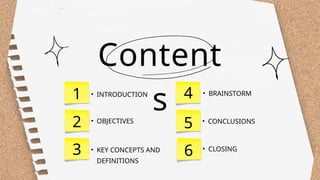
Content
s
1
2
3
4 • BRAINSTORM
• KEY CONCEPTS AND
DEFINITIONS
• OBJECTIVES
• INTRODUCTION
5 • CONCLUSIONS
6 • CLOSING
What is IN-
SERVICE
IN-SET
The process by which teachers
engage in further education or
training to refresh or upgrade their
professional knowledge, skills, and
practices during their employment
—source: UNESCO.
• Acquire new understanding and
instructional skills to develop their
effectiveness in the classroom
• To sensitize teachers towards the
protection of human rights.
• To develop organizational and
managerial skills.
• To improve efficiency, ability,
knowledge, and motivation in your
professional work
OBJECTIVE
S
Key Concept
and
Definitions
• WHAT ARE THE
BENEFITS OF
SEL?
• HOW DO YOU
INCORPORATE
SEL IN THE
CLASSROOM?
Social Emotional
Learning
• Social emotional learning (SEL) is a
methodology that helps students
of all ages to better comprehend
their emotions, to feel those
emotions fully, and demonstrate
empathy for others. These learned
behaviors are then used to help
students make positive,
responsible decisions; create
frameworks to achieve their goals,
and build positive relationships
with others
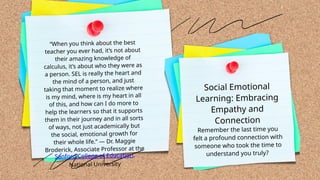
Social Emotional
Learning: Embracing
Empathy and
Connection
Remember the last time you
felt a profound connection with
someone who took the time to
understand you truly?
“When you think about the best
teacher you ever had, it’s not about
their amazing knowledge of
calculus, it’s about who they were as
a person. SEL is really the heart and
the mind of a person, and just
taking that moment to realize where
is my mind, where is my heart in all
of this, and how can I do more to
help the learners so that it supports
them in their journey and in all sorts
of ways, not just academically but
the social, emotional growth for
their whole life.” — Dr. Maggie
Broderick, Associate Professor at the
Sanford College of Education,
National University
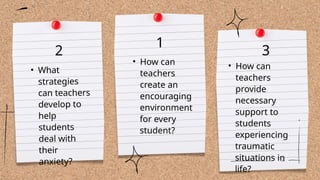
• How can
teachers
create an
encouraging
environment
for every
student?
• How can
teachers
provide
necessary
support to
students
experiencing
traumatic
situations in
life?
2
• What
strategies
can teachers
develop to
help
students
deal with
their
anxiety?
1
3
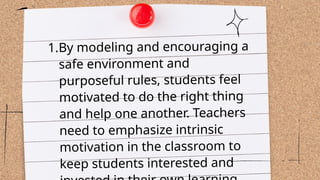
1.By modeling and encouraging a
safe environment and
purposeful rules, students feel
motivated to do the right thing
and help one another. Teachers
need to emphasize intrinsic
motivation in the classroom to
keep students interested and
3. Going above
and beyond to
create a safe
space.
Diversity,
Equity, and
Inclusion
• How can we better
understand and embrace
diversity
• How does bias influence
teaching practices and how
can we address it
• ·What strategies can
promote inclusion in the
classroom
• Equality – means that everyone
is treated the same, is treated
fairly, and has the same
opportunities. Equity is slightly
different from equality in that it
recognizes that each person
has different circumstances.
This means that varying types
or levels of support might be
required, depending on
individual needs, to take full
• Diversity – means recognizing,
respecting, and welcoming
everyone’s different
backgrounds, identities, and
experiences. Promoting
diversity celebrates people’s
differences and uniqueness.
• Inclusion – means that
everyone is encouraged to
retain their uniqueness, they
aren’t singled out for being
different and have a sense of
belonging and being valued.
Classroom
Management
Classroom management is the art of
creating and maintaining a learning
environment that nurtures successful
instruction. It involves making
decisions about structure,
organization, and activities to support
students by managing their
expectations and behaviors.
• How to build
positive
rapport with
students?
Classroom
Management
• How to create
an inclusive and
welcoming
classroom
environment?
Classroom
Management
• How to treat
every student
fairly and
respectfully?
Brainstorm
Session
The best idea! More ideas!
Brilliant idea!
Creative idea!
Awesome idea!
Great idea!
Cool idea!
Thank
s!

in service training for teachers ppppppppppppppppppppppppppppppp

  • 1.
  • 2.
    Content s 1 2 3 4 • BRAINSTORM •KEY CONCEPTS AND DEFINITIONS • OBJECTIVES • INTRODUCTION 5 • CONCLUSIONS 6 • CLOSING
  • 3.
  • 4.
    IN-SET The process bywhich teachers engage in further education or training to refresh or upgrade their professional knowledge, skills, and practices during their employment —source: UNESCO.
  • 5.
    • Acquire newunderstanding and instructional skills to develop their effectiveness in the classroom • To sensitize teachers towards the protection of human rights. • To develop organizational and managerial skills. • To improve efficiency, ability, knowledge, and motivation in your professional work OBJECTIVE S
  • 6.
  • 7.
    • WHAT ARETHE BENEFITS OF SEL? • HOW DO YOU INCORPORATE SEL IN THE CLASSROOM? Social Emotional Learning • Social emotional learning (SEL) is a methodology that helps students of all ages to better comprehend their emotions, to feel those emotions fully, and demonstrate empathy for others. These learned behaviors are then used to help students make positive, responsible decisions; create frameworks to achieve their goals, and build positive relationships with others
  • 8.
    Social Emotional Learning: Embracing Empathyand Connection Remember the last time you felt a profound connection with someone who took the time to understand you truly? “When you think about the best teacher you ever had, it’s not about their amazing knowledge of calculus, it’s about who they were as a person. SEL is really the heart and the mind of a person, and just taking that moment to realize where is my mind, where is my heart in all of this, and how can I do more to help the learners so that it supports them in their journey and in all sorts of ways, not just academically but the social, emotional growth for their whole life.” — Dr. Maggie Broderick, Associate Professor at the Sanford College of Education, National University
  • 9.
    • How can teachers createan encouraging environment for every student? • How can teachers provide necessary support to students experiencing traumatic situations in life? 2 • What strategies can teachers develop to help students deal with their anxiety? 1 3
  • 10.
    1.By modeling andencouraging a safe environment and purposeful rules, students feel motivated to do the right thing and help one another. Teachers need to emphasize intrinsic motivation in the classroom to keep students interested and
  • 12.
    3. Going above andbeyond to create a safe space.
  • 13.
  • 14.
    • How canwe better understand and embrace diversity • How does bias influence teaching practices and how can we address it • ·What strategies can promote inclusion in the classroom
  • 15.
    • Equality –means that everyone is treated the same, is treated fairly, and has the same opportunities. Equity is slightly different from equality in that it recognizes that each person has different circumstances. This means that varying types or levels of support might be required, depending on individual needs, to take full
  • 16.
    • Diversity –means recognizing, respecting, and welcoming everyone’s different backgrounds, identities, and experiences. Promoting diversity celebrates people’s differences and uniqueness.
  • 17.
    • Inclusion –means that everyone is encouraged to retain their uniqueness, they aren’t singled out for being different and have a sense of belonging and being valued.
  • 18.
    Classroom Management Classroom management isthe art of creating and maintaining a learning environment that nurtures successful instruction. It involves making decisions about structure, organization, and activities to support students by managing their expectations and behaviors.
  • 19.
    • How tobuild positive rapport with students? Classroom Management • How to create an inclusive and welcoming classroom environment?
  • 20.
    Classroom Management • How totreat every student fairly and respectfully?
  • 21.
  • 22.
    The best idea!More ideas! Brilliant idea! Creative idea! Awesome idea! Great idea! Cool idea!
  • 24.