
CONFIDENTIAL                                        IM/MEI 2012/IMS504/IMS506/SMI614


                          UNIVERSITI TEKNOLOGI MARA
                                   MID TERM TEST


COURSE                   : DATABASE MANAGEMENT SYSTEM FOR
                           INFORMATION PROFESSIONAL

COURSE CODE              : IMS504/IMS506

EXAMINATION              : MEI 2012

TIME                     : 1 HOURS AND 30 MINUTES


INSTRUCTIONS TO CANDIDATES

1.     This question paper consists of three (3) parts    : PART A (1 Question)
                                                            PART B (3 Questions)
                                                            PART C (1 Questions)

2.     Answer ALL questions from PART A PART B and PART C.


3.     Do not bring any material into the examination room unless permission is given by the
       invigilator.

4.     Please check to make sure that this examination pack consists of :

       i)   The Question Paper


                  DO NOT TURN THIS PAGE UNTIL YOU ARE TOLD TO DO SO
                       This examination paper consists of 4 printed pages


© Hak Cipta Universiti Teknologi MARA                                       CONFIDENTIAL
CONFIDENTIAL                                   2          IS/NOV2012/IMS504/IMS506
PART A

Define the following terms:


   a. Database
      Is a shared, integrated computer structure that stores a collection of end-user
      data or metadata or
      Is a collection of related tables and other structures


   b. Null Value
      - Empty space, no value for the intersection of row and column in relational table.


   c. Weak Entity
      - meets two conditions: Existence-dependent and Primary key partially or totally
      derived from parent entity in relationship


                                                                                (6 marks)
PART B

QUESTION 1

Briefly discuss any two (2) functions of Database Management System (DBMS).

           a.   Data dictionary management
           b.   Data storage management
           c.   Data transformation and presentation
           d.   Security management
           e.   Multiuser access control
           f.   Backup and recovery management
           g.   Data integrity management
           h.   Database access language and application programming interfaces
           i.   Database communication interface
                                                                              (4 marks)


QUESTION 2
Briefly discuss any two (2) factors that are important in a DBMS software selection?
                                                                                           (4 marks)

Answer:

   Although the factors affecting the purchasing decision vary from company to company, some of
   the most common are:
        Cost. Purchase, maintenance, operational, license, installation, training, and conversion
          costs.
        DBMS features and tools. Some database software includes a variety of tools that
          facilitate the application development task. For example, the availability of query by
          example (QBE), screen painters, report generators, application generators, data
          dictionaries, and so on, helps to create a more pleasant work environment for both the
          end user and the application programmer. Database administrator facilities, query
          facilities, ease of use, performance, security, concurrency control, transaction processing,
          and third-party support also influence DBMS software selection.
        Underlying model. Hierarchical, network, relational, object/relational, or object.
© Hak Cipta Universiti Teknologi MARA                                               CONFIDENTIAL
CONFIDENTIAL                                3         IS/NOV2012/IMS504/IMS506
      Portability. Across platforms, systems, and languages.
      DBMS hardware requirements. Processor(s), RAM, disk space, and so on.


QUESTION 3


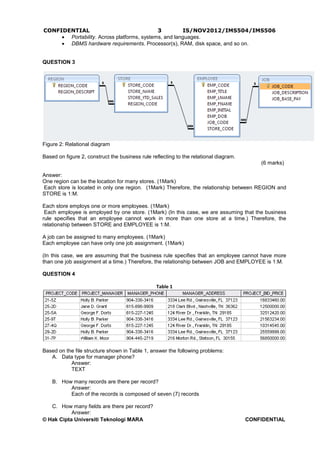
Figure 2: Relational diagram

Based on figure 2, construct the business rule reflecting to the relational diagram.
                                                                                           (6 marks)

Answer:
One region can be the location for many stores. (1Mark)
Each store is located in only one region. (1Mark) Therefore, the relationship between REGION and
STORE is 1:M.

Each store employs one or more employees. (1Mark)
 Each employee is employed by one store. (1Mark) (In this case, we are assuming that the business
rule specifies that an employee cannot work in more than one store at a time.) Therefore, the
relationship between STORE and EMPLOYEE is 1:M.

A job can be assigned to many employees. (1Mark)
Each employee can have only one job assignment. (1Mark)

(In this case, we are assuming that the business rule specifies that an employee cannot have more
than one job assignment at a time.) Therefore, the relationship between JOB and EMPLOYEE is 1:M.

QUESTION 4

                                                 Table 1


Based on the file structure shown in Table 1, answer the following problems:
   A. Data type for manager phone?
           Answer:
           TEXT

    B. How many records are there per record?
          Answer:
          Each of the records is composed of seven (7) records

   C. How many fields are there per record?
           Answer:
© Hak Cipta Universiti Teknologi MARA                                                  CONFIDENTIAL
CONFIDENTIAL                                   4               IS/NOV2012/IMS504/IMS506
       Each of the records is              composed     of      five fields (PROJECT_CODE through
       PROJECT_BID_PRICE.)

    D. Identify one (1) field can be consider as composite attribute
           Answer: either project_manager or manager_phone or manager_address

                                                                                              (4 marks)


QUESTION 5


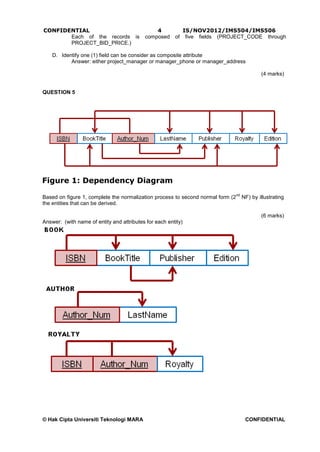
Figure 1: Dependency Diagram
                                                                                 nd
Based on figure 1, complete the normalization process to second normal form (2        NF) by illustrating
the entities that can be derived.

                                                                                              (6 marks)
Answer: (with name of entity and attributes for each entity)


© Hak Cipta Universiti Teknologi MARA                                                  CONFIDENTIAL
CONFIDENTIAL                                5          IS/NOV2012/IMS504/IMS506


PART C

Answer all question.


QUESTION 1
Based on Figure 3 below:


                             Figure 3 Tables structure for Project

a. Draw Entity Relationship Diagram (ERD) that meets the tables structure.
                                                                             (12 marks)


© Hak Cipta Universiti Teknologi MARA                                   CONFIDENTIAL
CONFIDENTIAL                              6         IS/NOV2012/IMS504/IMS506


b. Using template such below, create the data dictionary using template that meets
   overall tables structure.
                                                                        (8 marks)


Table Name        Attribute Name                    Type        PK or FK

EMPLOYEE       Emp_num                  TEXT/INTEGER            PK

               Emp_lname                TEXT

               Emp_fname                TEXT

               Emp_initial              TEXT

               Emp_hiredate             DATE/TIME

               Job_code                 TEXT/INTEGER            FK

ASSIGNMENT     Assign_num                TEXT/INTEGER                PK


               Assign_date              DATE/TIME


               Proj_num                  TEXT/INTEGER                FK


               Emp_num                   TEXT/INTEGER                FK


               Assign_hours             NUMBER/DOUBLE/FLOAT


               Assign_charge_hours      CURRENCY/NUMBER


© Hak Cipta Universiti Teknologi MARA                                 CONFIDENTIAL
CONFIDENTIAL                              7      IS/NOV2012/IMS504/IMS506
           Assign_charge                CURRENCY


    JOB        Job-code                 TEXT/INTEGER           PK


               Job_description          TEXT


               Job_chargehour           CURRENCY/NUMBER


  PROJECT      Proj_num                 TEXT/INTEGER           PK


               Proj_name                TEXT


               Emp_num                  TEXT/INTEGER            FK


© Hak Cipta Universiti Teknologi MARA                            CONFIDENTIAL

IMS504/IMS506

  • 1.
    CONFIDENTIAL IM/MEI 2012/IMS504/IMS506/SMI614 UNIVERSITI TEKNOLOGI MARA MID TERM TEST COURSE : DATABASE MANAGEMENT SYSTEM FOR INFORMATION PROFESSIONAL COURSE CODE : IMS504/IMS506 EXAMINATION : MEI 2012 TIME : 1 HOURS AND 30 MINUTES INSTRUCTIONS TO CANDIDATES 1. This question paper consists of three (3) parts : PART A (1 Question) PART B (3 Questions) PART C (1 Questions) 2. Answer ALL questions from PART A PART B and PART C. 3. Do not bring any material into the examination room unless permission is given by the invigilator. 4. Please check to make sure that this examination pack consists of : i) The Question Paper DO NOT TURN THIS PAGE UNTIL YOU ARE TOLD TO DO SO This examination paper consists of 4 printed pages © Hak Cipta Universiti Teknologi MARA CONFIDENTIAL
  • 2.
    CONFIDENTIAL 2 IS/NOV2012/IMS504/IMS506 PART A Define the following terms: a. Database Is a shared, integrated computer structure that stores a collection of end-user data or metadata or Is a collection of related tables and other structures b. Null Value - Empty space, no value for the intersection of row and column in relational table. c. Weak Entity - meets two conditions: Existence-dependent and Primary key partially or totally derived from parent entity in relationship (6 marks) PART B QUESTION 1 Briefly discuss any two (2) functions of Database Management System (DBMS). a. Data dictionary management b. Data storage management c. Data transformation and presentation d. Security management e. Multiuser access control f. Backup and recovery management g. Data integrity management h. Database access language and application programming interfaces i. Database communication interface (4 marks) QUESTION 2 Briefly discuss any two (2) factors that are important in a DBMS software selection? (4 marks) Answer: Although the factors affecting the purchasing decision vary from company to company, some of the most common are:  Cost. Purchase, maintenance, operational, license, installation, training, and conversion costs.  DBMS features and tools. Some database software includes a variety of tools that facilitate the application development task. For example, the availability of query by example (QBE), screen painters, report generators, application generators, data dictionaries, and so on, helps to create a more pleasant work environment for both the end user and the application programmer. Database administrator facilities, query facilities, ease of use, performance, security, concurrency control, transaction processing, and third-party support also influence DBMS software selection.  Underlying model. Hierarchical, network, relational, object/relational, or object. © Hak Cipta Universiti Teknologi MARA CONFIDENTIAL
  • 3.
    CONFIDENTIAL 3 IS/NOV2012/IMS504/IMS506  Portability. Across platforms, systems, and languages.  DBMS hardware requirements. Processor(s), RAM, disk space, and so on. QUESTION 3 Figure 2: Relational diagram Based on figure 2, construct the business rule reflecting to the relational diagram. (6 marks) Answer: One region can be the location for many stores. (1Mark) Each store is located in only one region. (1Mark) Therefore, the relationship between REGION and STORE is 1:M. Each store employs one or more employees. (1Mark) Each employee is employed by one store. (1Mark) (In this case, we are assuming that the business rule specifies that an employee cannot work in more than one store at a time.) Therefore, the relationship between STORE and EMPLOYEE is 1:M. A job can be assigned to many employees. (1Mark) Each employee can have only one job assignment. (1Mark) (In this case, we are assuming that the business rule specifies that an employee cannot have more than one job assignment at a time.) Therefore, the relationship between JOB and EMPLOYEE is 1:M. QUESTION 4 Table 1 Based on the file structure shown in Table 1, answer the following problems: A. Data type for manager phone? Answer: TEXT B. How many records are there per record? Answer: Each of the records is composed of seven (7) records C. How many fields are there per record? Answer: © Hak Cipta Universiti Teknologi MARA CONFIDENTIAL
  • 4.
    CONFIDENTIAL 4 IS/NOV2012/IMS504/IMS506 Each of the records is composed of five fields (PROJECT_CODE through PROJECT_BID_PRICE.) D. Identify one (1) field can be consider as composite attribute Answer: either project_manager or manager_phone or manager_address (4 marks) QUESTION 5 Figure 1: Dependency Diagram nd Based on figure 1, complete the normalization process to second normal form (2 NF) by illustrating the entities that can be derived. (6 marks) Answer: (with name of entity and attributes for each entity) © Hak Cipta Universiti Teknologi MARA CONFIDENTIAL
  • 5.
    CONFIDENTIAL 5 IS/NOV2012/IMS504/IMS506 PART C Answer all question. QUESTION 1 Based on Figure 3 below: Figure 3 Tables structure for Project a. Draw Entity Relationship Diagram (ERD) that meets the tables structure. (12 marks) © Hak Cipta Universiti Teknologi MARA CONFIDENTIAL
  • 6.
    CONFIDENTIAL 6 IS/NOV2012/IMS504/IMS506 b. Using template such below, create the data dictionary using template that meets overall tables structure. (8 marks) Table Name Attribute Name Type PK or FK EMPLOYEE Emp_num TEXT/INTEGER PK Emp_lname TEXT Emp_fname TEXT Emp_initial TEXT Emp_hiredate DATE/TIME Job_code TEXT/INTEGER FK ASSIGNMENT Assign_num TEXT/INTEGER PK Assign_date DATE/TIME Proj_num TEXT/INTEGER FK Emp_num TEXT/INTEGER FK Assign_hours NUMBER/DOUBLE/FLOAT Assign_charge_hours CURRENCY/NUMBER © Hak Cipta Universiti Teknologi MARA CONFIDENTIAL
  • 7.
    CONFIDENTIAL 7 IS/NOV2012/IMS504/IMS506 Assign_charge CURRENCY JOB Job-code TEXT/INTEGER PK Job_description TEXT Job_chargehour CURRENCY/NUMBER PROJECT Proj_num TEXT/INTEGER PK Proj_name TEXT Emp_num TEXT/INTEGER FK © Hak Cipta Universiti Teknologi MARA CONFIDENTIAL