Improving Self
Esteem
LaVoris Lee
Ice breaker
If you could be any animal, which one would you choose
and why?
Group Agreements/ Ground Rules
● Must attend 75% of group sessions
● Pay attention and participate (if you feel comfortable)
● Use “I’ statements to avoid passing judgement
● Mute yourself when you are not talking. One person talks at a time.
● YOUR PRESENCE IS VALUABLE
● If you are a frequent sharer, try to allow others the opportunity to share as well
Self esteem is just an opinion, not a
fact
● Our ideas of ourselves, the judgements that we make of, and the value we place on,
ourselves as people are opinions, not facts. However, we often take these opinions as
truth or facts and thus, believe in them very strongly. Therein lies the problem! So,
where do these beliefs and opinions of ourselves come from? How did we develop
these beliefs about ourselves?
Opinions Vs Facts
Facts are verifiable statements. They are supported by evidence and can be agreed upon. Opinions
are personal interpretations of facts, which differ from person to person. For example, it is a fact that
the sky is blue, and an opinion that the weather is beautiful.
Our ideas of ourselves, the judgements that me make of ourselves, the values that we place
on ourselves are all opinions not facts. But we believe them very strongly and accept them
as facts. Therein lies the problem
Why do you think some people believe others opinions of them to be facts ?
Development of Low Self Esteem
Our Early life experiences shape the way we look at the world for the rest of our lives. Often
times, individuals with low self-esteem has early life experiences that have shaped their
development of low self-esteem
● Difficulty in Meeting Parents’ Standards
● Not Fitting In at Home or at School
● Difficulty in Meeting Peer Group Standards
● Being on the receiving end of other people’s stress or distress
● Your Family’s Place in Society
● An Absence of Positives
What early experiences did you have that might have contributed to the way you view, and
feel about, yourself?
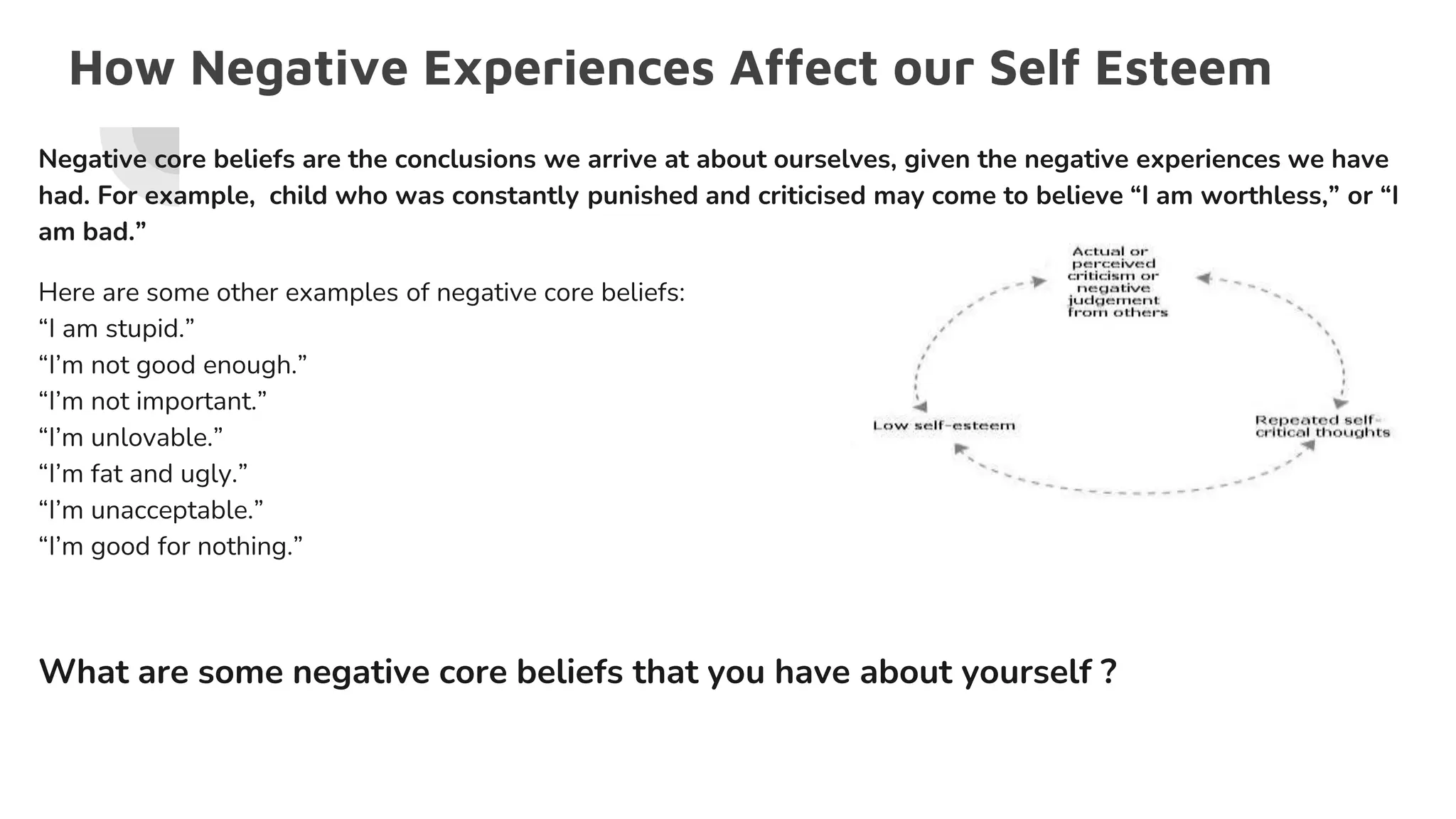
How Negative Experiences Affect our Self Esteem
Negative core beliefs are the conclusions we arrive at about ourselves, given the negative experiences we have
had. For example, child who was constantly punished and criticised may come to believe “I am worthless,” or “I
am bad.”
Here are some other examples of negative core beliefs:
“I am stupid.”
“I’m not good enough.”
“I’m not important.”
“I’m unlovable.”
“I’m fat and ugly.”
“I’m unacceptable.”
“I’m good for nothing.”
What are some negative core beliefs that you have about yourself ?
How low self esteem impacts our behavior
We might develop rules such as:
“I must be the best at everything.”
“I must never make any mistakes.”
“I must never show any emotion in public.”
“I must always do the right thing.”
We might also develop assumptions such as:
“If I ask for something I need, I will be put down.”
“No matter what I do, it will never be good enough.”
“If I can’t control my food intake, I will never be able to control anything in my life.”
Rules and assumptions can also be combined, for example:
“I must do everything I can to gain others’ approval because if I am criticised in any way, it means I am not acceptable.”
“I won’t try anything unless I know that I can do it perfectly, because if I can’t, it means I’m a total failure.”
“I have to always be slim and dress well, or else I will never be accepted.”
What sorts of rules and assumptions for living might you have to help you feel better about yourself?
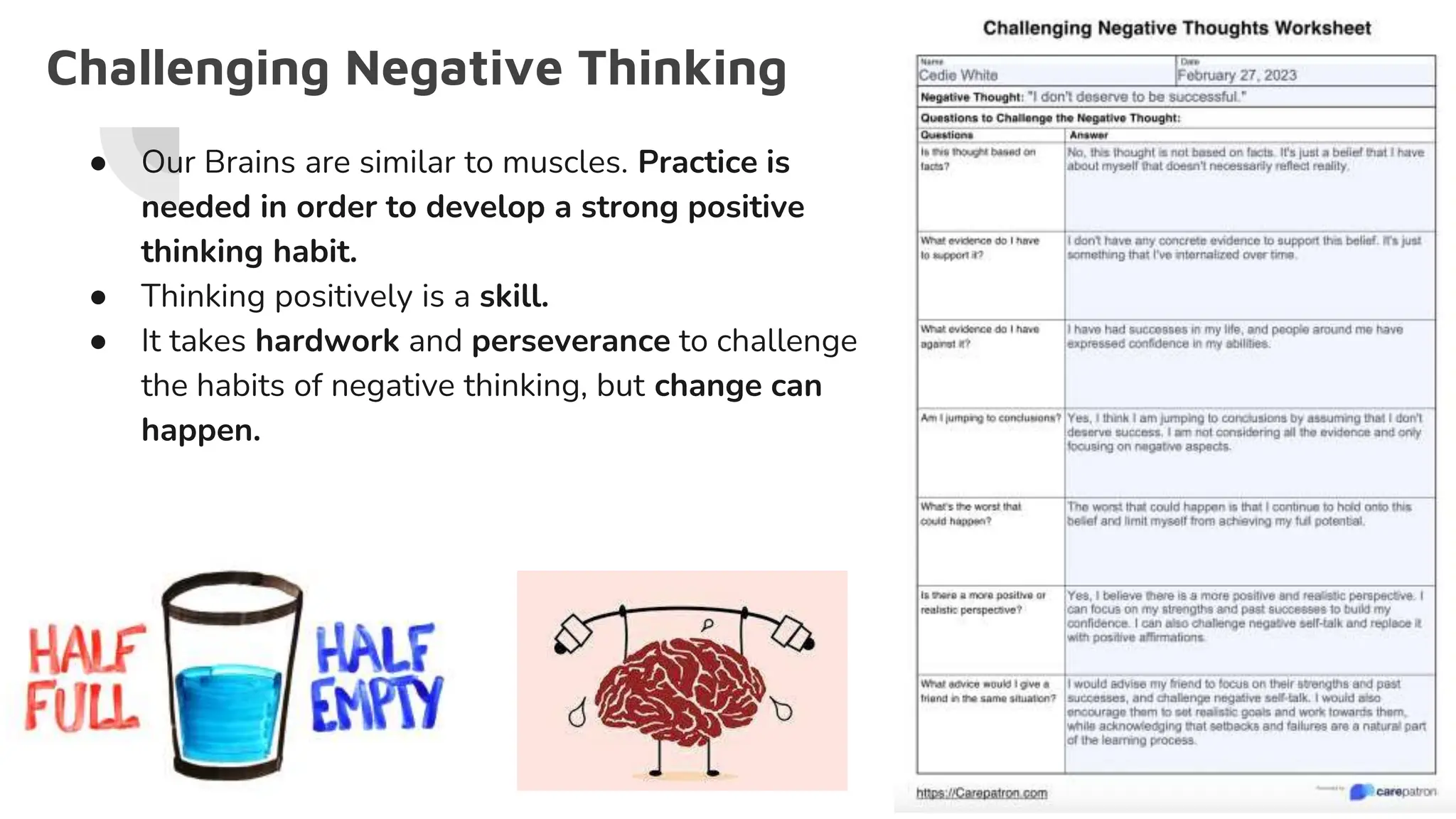
Challenging Negative Thinking
● Our Brains are similar to muscles. Practice is
needed in order to develop a strong positive
thinking habit.
● Thinking positively is a skill.
● It takes hardwork and perseverance to challenge
the habits of negative thinking, but change can
happen.

Improving Self Esteem wk 2 group cycle 2024

  • 1.
  • 2.
    Ice breaker If youcould be any animal, which one would you choose and why?
  • 3.
    Group Agreements/ GroundRules ● Must attend 75% of group sessions ● Pay attention and participate (if you feel comfortable) ● Use “I’ statements to avoid passing judgement ● Mute yourself when you are not talking. One person talks at a time. ● YOUR PRESENCE IS VALUABLE ● If you are a frequent sharer, try to allow others the opportunity to share as well
  • 4.
    Self esteem isjust an opinion, not a fact ● Our ideas of ourselves, the judgements that we make of, and the value we place on, ourselves as people are opinions, not facts. However, we often take these opinions as truth or facts and thus, believe in them very strongly. Therein lies the problem! So, where do these beliefs and opinions of ourselves come from? How did we develop these beliefs about ourselves?
  • 5.
    Opinions Vs Facts Factsare verifiable statements. They are supported by evidence and can be agreed upon. Opinions are personal interpretations of facts, which differ from person to person. For example, it is a fact that the sky is blue, and an opinion that the weather is beautiful. Our ideas of ourselves, the judgements that me make of ourselves, the values that we place on ourselves are all opinions not facts. But we believe them very strongly and accept them as facts. Therein lies the problem Why do you think some people believe others opinions of them to be facts ?
  • 6.
    Development of LowSelf Esteem Our Early life experiences shape the way we look at the world for the rest of our lives. Often times, individuals with low self-esteem has early life experiences that have shaped their development of low self-esteem ● Difficulty in Meeting Parents’ Standards ● Not Fitting In at Home or at School ● Difficulty in Meeting Peer Group Standards ● Being on the receiving end of other people’s stress or distress ● Your Family’s Place in Society ● An Absence of Positives What early experiences did you have that might have contributed to the way you view, and feel about, yourself?
  • 7.
    How Negative ExperiencesAffect our Self Esteem Negative core beliefs are the conclusions we arrive at about ourselves, given the negative experiences we have had. For example, child who was constantly punished and criticised may come to believe “I am worthless,” or “I am bad.” Here are some other examples of negative core beliefs: “I am stupid.” “I’m not good enough.” “I’m not important.” “I’m unlovable.” “I’m fat and ugly.” “I’m unacceptable.” “I’m good for nothing.” What are some negative core beliefs that you have about yourself ?
  • 8.
    How low selfesteem impacts our behavior We might develop rules such as: “I must be the best at everything.” “I must never make any mistakes.” “I must never show any emotion in public.” “I must always do the right thing.” We might also develop assumptions such as: “If I ask for something I need, I will be put down.” “No matter what I do, it will never be good enough.” “If I can’t control my food intake, I will never be able to control anything in my life.” Rules and assumptions can also be combined, for example: “I must do everything I can to gain others’ approval because if I am criticised in any way, it means I am not acceptable.” “I won’t try anything unless I know that I can do it perfectly, because if I can’t, it means I’m a total failure.” “I have to always be slim and dress well, or else I will never be accepted.” What sorts of rules and assumptions for living might you have to help you feel better about yourself?
  • 9.
    Challenging Negative Thinking ●Our Brains are similar to muscles. Practice is needed in order to develop a strong positive thinking habit. ● Thinking positively is a skill. ● It takes hardwork and perseverance to challenge the habits of negative thinking, but change can happen.