









The life science business of Merck KGaA,
Darmstadt, Germany operates as
MilliporeSigma in the U.S. and Canada.
Improving
Downstream
Processing:
Application of
Excipients in DSP
Webinar
Prof. Dr. Christian Frech
November 14th , 2019
The life science business
of Merck KGaA, Darmstadt,
Germany operates as
MilliporeSigma in the U.S.
and Canada
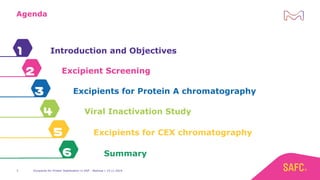
Agenda
Introduction and Objectives
Excipient Screening
Excipients for Protein A chromatography
Viral Inactivation Study4
3
2
1
Excipients for CEX chromatography5
6 Summary
3 Excipients for Protein Stabilization in DSP - Webinar | 14.11.2019
Introduction &
Objective
Excipients for Protein Stabilization in DSP - Webinar | 14.11.2019
Introduction and Objectives
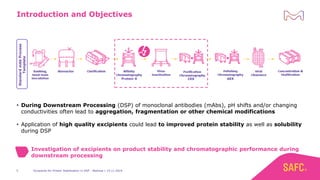
 During Downstream Processing (DSP) of monoclonal antibodies (mAbs), pH shifts and/or changing
conductivities often lead to aggregation, fragmentation or other chemical modifications
 Application of high quality excipients could lead to improved protein stability as well as solubility
during DSP
Investigation of excipients on product stability and chromatographic performance during
downstream processing
pH
5
StandardmAbProcess
Template
CEXProtein A AEX
Excipient
Screening
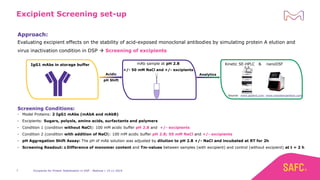
Approach:
Evaluating excipient effects on the stability of acid-exposed monoclonal antibodies by simulating protein A elution and
virus inactivation condition in DSP → Screening of excipients
Screening Conditions:
• Model Proteins: 2 IgG1 mAbs (mAbA and mAbB)
• Excipients: Sugars, polyols, amino acids, surfactants and polymers
• Condition 1 (condition without NaCl): 100 mM acidic buffer pH 2.8 and +/- excipients
• Condition 2 (condition with addition of NaCl): 100 mM acidic buffer pH 2.8; 50 mM NaCl and +/- excipients
• pH Aggregation Shift Assay: The pH of mAb solution was adjusted by dilution to pH 2.8 +/- NaCl and incubated at RT for 2h
• Screening Readout: Δ Difference of monomer content and Tm-values between samples (with excipient) and control (without excipient) at t = 2 h
Excipient Screening set-up
Excipients for Protein Stabilization in DSP - Webinar | 14.11.20197
AnalyticsAcidic
pH Shift
IgG1 mAbs in storage buffer mAb sample at pH 2.8
+/- 50 mM NaCl and +/- excipients
Kinetic SE-HPLC & nanoDSF
Source: www.agilent.com; www.nanotempertech.com
Excipients for Protein Stabilization in DSP - Webinar | 14.11.20198
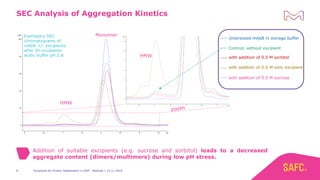
Unstressed mAbB in storage buffer
Control; without excipient
with addition of 0.5 M sorbitol
with addition of 0.5 M ionic excipient
with addition of 0.5 M sucrose
Exemplary SEC
chromatograms of
mAbA +/- excipients
after 2h incubation
acidic buffer pH 2.8
Addition of suitable excipients (e.g. sucrose and sorbitol) leads to a decreased
aggregate content (dimers/multimers) during low pH stress.
SEC Analysis of Aggregation Kinetics
HMW
Monomer
HMW
Excipients for Protein Stabilization in DSP - Webinar | 14.11.20199
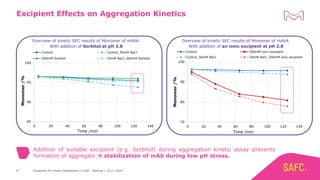
Addition of suitable excipient (e.g. Sorbitol) during aggregation kinetic assay prevents
formation of aggregats → stabilization of mAb during low pH stress.
Excipient Effects on Aggregation Kinetics
85
90
95
100
0 20 40 60 80 100 120 140
Monomer/%
Time /min
Control Control_50mM NaCl
500mM Sorbitol 50mM NaCl_500mM Sorbitol
Overview of kinetic SEC results of Monomer of mAbA
With addition of Sorbitol at pH 2.8
Overview of kinetic SEC results of Monomer of mAbA
With addition of an ionic excipient at pH 2.8
70
80
90
100
0 20 40 60 80 100 120 140
Monomer/%
Time /min
Control 500mM ionic excipient
Control_50mM NaCl 50mM NaCl_500mM ionic excipient
Excipients for Protein Stabilization in DSP - Webinar | 14.11.201910
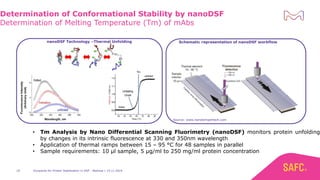
• Tm Analysis by Nano Differential Scanning Fluorimetry (nanoDSF) monitors protein unfolding
by changes in its intrinsic fluorescence at 330 and 350nm wavelength
• Application of thermal ramps between 15 – 95 °C for 48 samples in parallel
• Sample requirements: 10 µl sample, 5 µg/ml to 250 mg/ml protein concentration
Determination of Conformational Stability by nanoDSF
Determination of Melting Temperature (Tm) of mAbs
Schematic representation of nanoDSF workflownanoDSF Technology –Thermal Unfolding
Source: www.nanotempertech.com
Excipients for Protein Stabilization in DSP - Webinar | 14.11.201911
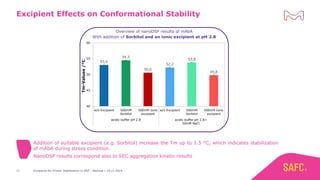
Addition of suitable excipient (e.g. Sorbitol) increase the Tm up to 1.5 °C, which indicates stabilization
of mAbA during stress condition.
NanoDSF results correspond also to SEC aggregation kinetic results
Excipient Effects on Conformational Stability
Overview of nanoDSF results of mAbA
With addition of Sorbitol and an ionic excipient at pH 2.8
53,0
54,5
50,6
52,2
53,8
49,8
40
45
50
55
60
w/o Excipient 500mM
Sorbitol
500mM Ionic
excipient
w/o Excipient 500mM
Sorbitol
500mM Ionic
excipient
acidic buffer pH 2.8 acidic buffer pH 2.8+
50mM NaCl
Tm-Values/°C
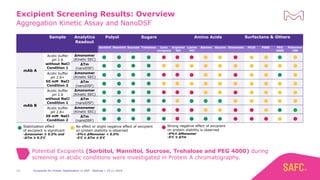
Aggregation Kinetic Assay and NanoDSF
Excipient Screening Results: Overview
Excipients for Protein Stabilization in DSP - Webinar | 14.11.201912
Sample Analytics
Readout
Polyol Sugars Amino Acids Surfactans & Others
Sorbitol Mannitol Sucrose Trehalose Ionic
excipient
Arginine
HCl
Lysine
HCl
Alanine Glycine Glutamate PS20 PS80 PEG
4000
Poloxmer
188
mAb A
Acidic buffer
pH 2.8
without NaCl
Condition 1
Δmonomer
(Kinetic SEC)
ΔTm
(nanoDSF)
Acidic buffer
pH 2.8+
50 mM NaCl
Condition 2
Δmonomer
(Kinetic SEC)
ΔTm
(nanoDSF)
mAb B
Acidic buffer
pH 2.8
without NaCl
Condition 1
Δmonomer
(Kinetic SEC)
ΔTm
(nanoDSF)
Acidic buffer
pH 2.8+
50 mM NaCl
Condition 2
Δmonomer
(Kinetic SEC)
ΔTm
(nanoDSF)
Stabilization effect
of excipient is significant
-Δmonomer ≥ 0.5% and
-ΔTm ≥ 0.5°C
No effect or slight negative effect of excipient
on protein stability is observed
-5%≤ ∆Monomer < 0.5%
-5°C ≤ ∆Tm ≤ 0°C
Strong negative effect of excipient
on protein stability is observed
-5%≤ ∆Monomer
-5°C ≤ ∆Tm
Potential Excipients (Sorbitol, Mannitol, Sucrose, Trehalose and PEG 4000) during
screening in acidic conditions were investigated in Protein A chromatography.
Excipients for
Protein A
Chromatography
Excipients for Protein Stabilization in DSP - Webinar | 14.11.2019
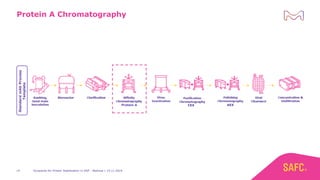
Protein A Chromatography
14
StandardmAbProcess
Template
CEXProtein A AEX
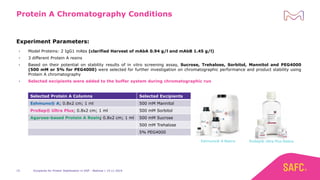
• Model Proteins: 2 IgG1 mAbs (clarified Harvest of mAbA 0.94 g/l and mAbB 1.45 g/l)
• 3 different Protein A resins
• Based on their potential on stability results of in vitro screening assay, Sucrose, Trehalose, Sorbitol, Mannitol and PEG4000
(500 mM or 5% for PEG4000) were selected for further investigation on chromatographic performance and product stability using
Protein A chromatography
• Selected excipients were added to the buffer system during chromatographic run
Protein A Chromatography Conditions
Excipients for Protein Stabilization in DSP - Webinar | 14.11.201915
Selected Protein A Columns Selected Excipients
Eshmuno® A; 0.8x2 cm; 1 ml 500 mM Mannitol
ProSep® Ultra Plus; 0.8x2 cm; 1 ml 500 mM Sorbitol
Agarose-based Protein A Resin; 0.8x2 cm; 1 ml 500 mM Sucrose
500 mM Trehalose
5% PEG4000
Experiment Parameters:
Eshmuno® A Resins ProSep® Ultra Plus Resins
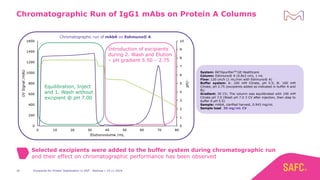
Chromatographic Run of IgG1 mAbs on Protein A Columns
Excipients for Protein Stabilization in DSP - Webinar | 14.11.201916
Selected excipients were added to the buffer system during chromatographic run
and their effect on chromatographic performance has been observed
System: ÄKTApurifierTM GE Healthcare
Column: Eshmuno® A (0.8x2 cm), 1 mL
Flow: 120 cm/h (1 mL/min with Eshmuno® A)
Buffer system: A: 100 mM Citrate, pH 5.5; B: 100 mM
Citrate, pH 2.75 (excipients added as indicated in buffer A and
B);
Gradient: 30 CV; The column was equilibrated with 100 mM
Citrate pH 7.0 (Wash pH 7.0 3 CV after injection, then step to
buffer A pH 5.5)
Sample: mAbA, clarified harvest, 0.943 mg/mL
Sample load: 30 mg/mL CV
Chromatographic run of mAbA on Eshmuno® A
Equilibration, Inject
and 1. Wash without
excipient @ pH 7.00
Introduction of excipients
during 2. Wash and Elution
– pH gradient 5.50 – 2.75
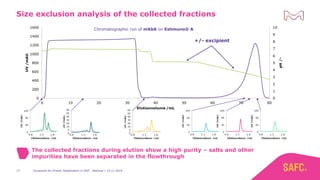
Size exclusion analysis of the collected fractions
Excipients for Protein Stabilization in DSP - Webinar | 14.11.201917
Chromatographic run of mAbA on Eshmuno® A
The collected fractions during elution show a high purity – salts and other
impurities have been separated in the flowthrough
+/- excipient
Excipients for Protein Stabilization in DSP - Webinar | 14.11.201918
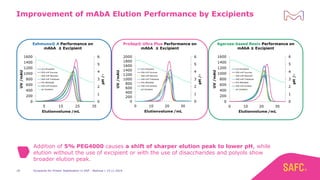
Improvement of mAbA Elution Performance by Excipients
Eshmuno® A Performance on
mAbA ± Excipient
ProSep® Ultra Plus Performance on
mAbA ± Excipient
Agarose-based Resin Performance on
mAbA ± Excipient
Addition of 5% PEG4000 causes a shift of sharper elution peak to lower pH, while
elution without the use of excipient or with the use of disaccharides and polyols show
broader elution peak.
Excipients for Protein Stabilization in DSP - Webinar | 14.11.201919
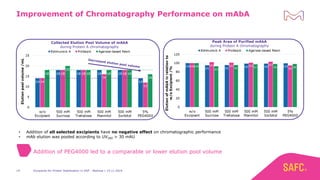
Improvement of Chromatography Performance on mAbA
Addition of PEG4000 led to a comparable or lower elution pool volume
Collected Elution Pool Volume of mAbA
during Protein A chromatography
Peak Area of Purified mAbA
during Protein A chromatography
• Addition of all selected excipients have no negative effect on chromatographic performance
• mAb elution was pooled according to UV280 > 30 mAU
Excipients for Protein Stabilization in DSP - Webinar | 14.11.201920
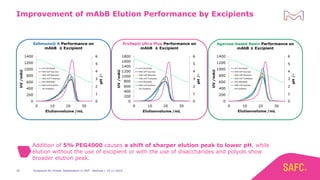
Improvement of mAbB Elution Performance by Excipients
Eshmuno® A Performance on
mAbB ± Excipient
ProSep® Ultra Plus Performance on
mAbB ± Excipient
Agarose-based Resin Performance on
mAbB ± Excipient
Addition of 5% PEG4000 causes a shift of sharper elution peak to lower pH, while
elution without the use of excipient or with the use of disaccharides and polyols show
broader elution peak.
Excipients for Protein Stabilization in DSP - Webinar | 14.11.201921
Improvement of Chromatography Performance on mAbB
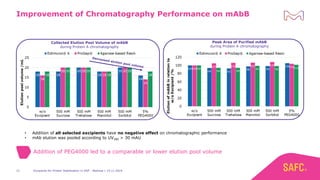
Addition of PEG4000 led to a comparable or lower elution pool volume
Collected Elution Pool Volume of mAbB
during Protein A chromatography
Peak Area of Purified mAbB
during Protein A chromatography
• Addition of all selected excipients have no negative effect on chromatographic performance
• mAb elution was pooled according to UV280 > 30 mAU
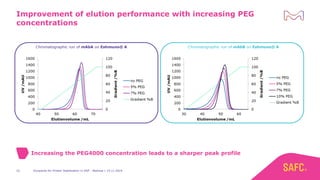
Improvement of elution performance with increasing PEG
concentrations
Excipients for Protein Stabilization in DSP - Webinar | 14.11.201922
Increasing the PEG4000 concentration leads to a sharper peak profile
Chromatographic run of mAbA on Eshmuno® A Chromatographic run of mAbB on Eshmuno® A
23
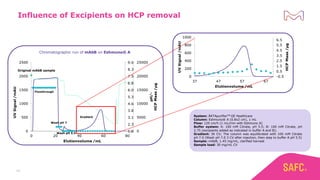
Flowthrough
Wash pH 7
Wash pH 5.5
Gradient
Original mAbB sample
Influence of Excipients on HCP removal
System: ÄKTApurifierTM GE Healthcare
Column: Eshmuno® A (0.8x2 cm), 1 mL
Flow: 120 cm/h (1 mL/min with Eshmuno A)
Buffer system: A: 100 mM Citrate, pH 5.5; B: 100 mM Citrate, pH
2.75 (excipients added as indicated in buffer A and B);
Gradient: 30 CV; The column was equilibrated with 100 mM Citrate
pH 7.0 (Wash pH 7.0 3 CV after injection, then step to buffer A pH 5.5)
Sample: mAbB, 1.45 mg/mL, clarified harvest
Sample load: 30 mg/mL CV
Chromatographic run of mAbB on Eshmuno® A
Excipients for Protein Stabilization in DSP - Webinar | 14.11.201924
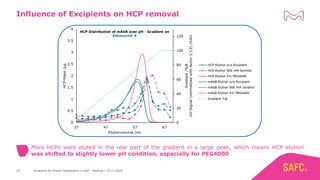
Influence of Excipients on HCP removal
HCP Distribution of mAbB over pH - Gradient on
Eshmuno® A
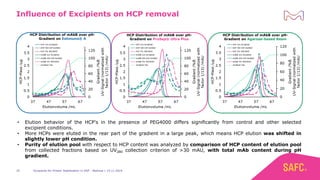
More HCPs were eluted in the rear part of the gradient in a large peak, which means HCP elution
was shifted to slightly lower pH condition, especially for PEG4000
Excipients for Protein Stabilization in DSP - Webinar | 14.11.201925
Influence of Excipients on HCP removal
HCP Distribution of mAbB over pH-
Gradient on Eshmuno® A
HCP Distribution of mAbB over pH-
Gradient on ProSep® Ultra Plus
HCP Distribution of mAbB over pH-
Gradient on Agarose-based Resin
• Elution behavior of the HCP's in the presence of PEG4000 differs significantly from control and other selected
excipient conditions.
• More HCPs were eluted in the rear part of the gradient in a large peak, which means HCP elution was shifted in
slightly lower pH condition.
• Purity of elution pool with respect to HCP content was analyzed by comparison of HCP content of elution pool
from collected fractions based on UV280 collection criterion of >30 mAU, with total mAb content during pH
gradient.
Excipients for Protein Stabilization in DSP - Webinar | 14.11.201926
Improvement of HCP Reduction with 5% PEG4000 on mAbB
HCP Distribution of mAbB over pH-
Gradient on Eshmuno® A
HCP Distribution of mAbB over pH-
Gradient on ProSep® Ultra Plus
HCP Distribution of mAbB over pH-
Gradient on Agarose-based Resin
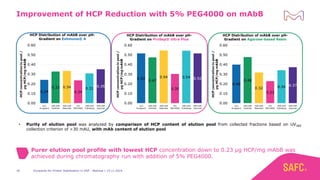
• Purity of elution pool was analyzed by comparison of HCP content of elution pool from collected fractions based on UV280
collection criterion of >30 mAU, with mAb content of elution pool
Purer elution pool profile with lowest HCP concentration down to 0.23 µg HCP/mg mAbB was
achieved during chromatography run with addition of 5% PEG4000.
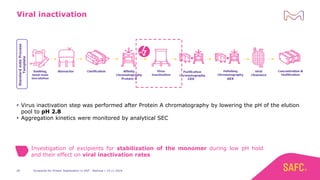
Virus
Inactivation
 Virus inactivation step was performed after Protein A chromatography by lowering the pH of the elution
pool to pH 2.8
 Aggregation kinetics were monitored by analytical SEC
Excipients for Protein Stabilization in DSP - Webinar | 14.11.2019
Viral inactivation
pH
28
StandardmAbProcess
Template
CEXProtein A AEX
Investigation of excipients for stabilization of the monomer during low pH hold
and their effect on viral inactivation rates
Excipients for Protein Stabilization in DSP - Webinar | 14.11.201929
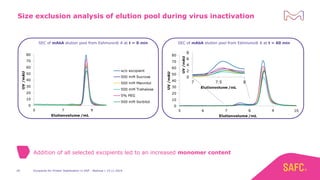
Size exclusion analysis of elution pool during virus inactivation
SEC of mAbA elution pool from Eshmuno® A at t = 0 min SEC of mAbA elution pool from Eshmuno® A at t = 60 min
Addition of all selected excipients led to an increased monomer content
Excipients for Protein Stabilization in DSP - Webinar | 14.11.201930
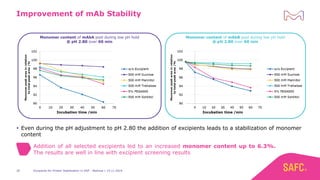
Improvement of mAb Stability
Monomer content of mAbA pool during low pH hold
@ pH 2.80 over 60 min
Monomer content of mAbB pool during low pH hold
@ pH 2.80 over 60 min
 Even during the pH adjustment to pH 2.80 the addition of excipients leads to a stabilization of monomer
content
Addition of all selected excipients led to an increased monomer content up to 6.3%.
The results are well in line with excipient screening results
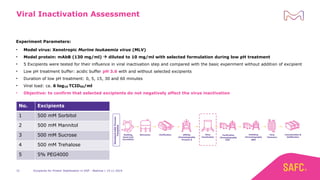
Viral Inactivation Assessment
Experiment Parameters:
• Model virus: Xenotropic Murine leukaemia virus (MLV)
• Model protein: mAbB (130 mg/ml) → diluted to 10 mg/ml with selected formulation during low pH treatment
• 5 Excipients were tested for their influence in viral inactivation step and compared with the basic experiment without addition of excipient
• Low pH treatment buffer: acidic buffer pH 3.6 with and without selected excipients
• Duration of low pH treatment: 0, 5, 15, 30 and 60 minutes
• Viral load: ca. 6 log10 TCID50/ml
• Objective: to confirm that selected excipients do not negatively affect the virus inactivation
31
No. Excipients
1 500 mM Sorbitol
2 500 mM Mannitol
3 500 mM Sucrose
4 500 mM Trehalose
5 5% PEG4000
Excipients for Protein Stabilization in DSP - Webinar | 14.11.2019
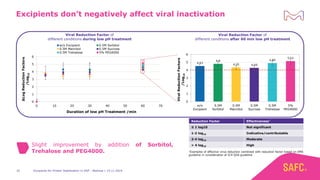
Excipients don’t negatively affect viral inactivation
Excipients for Protein Stabilization in DSP - Webinar | 14.11.2019
0
1
2
3
4
5
6
0 10 20 30 40 50 60 70
ΔLogReductionFactors
/Log10
Duration of low pH Treatment /min
Viral Reduction Factor of
different conditions during low pH treatment
w/o Excipient 0.5M Sorbitol
0.5M Mannitol 0.5M Sucrose
0.5M Trehalose 5% PEG4000
32
*Examples of effective virus reduction combined with reduction factor based on EMA
guideline in consideration of ICH Q5A guideline
Reduction Factor Effectiveness*
≤ 1 log10 Not significant
1-2 log10 Indicative/contributable
2-4 log10 Moderate
> 4 log10 High
4,53
4,8
4,35 4,29
4,89
5,15
0
1
2
3
4
5
6
w/o
Excipient
0.5M
Sorbitol
0.5M
Mannitol
0.5M
Sucrose
0.5M
Trehalose
5%
PEG4000
ViralReductionFactors
/Log10
Viral Reduction Factor of
different conditions after 60 min low pH treatment
Slight improvement by addition of Sorbitol,
Trehalose and PEG4000.
Excipients for
CEX
Chromatography
Excipients for Protein Stabilization in DSP - Webinar | 14.11.2019
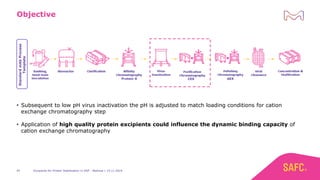
Objective
 Subsequent to low pH virus inactivation the pH is adjusted to match loading conditions for cation
exchange chromatography step
 Application of high quality protein excipients could influence the dynamic binding capacity of
cation exchange chromatography
pH
34
StandardmAbProcess
Template
CEXProtein A AEX
Excipients for Protein Stabilization in DSP - Webinar | 14.11.2019
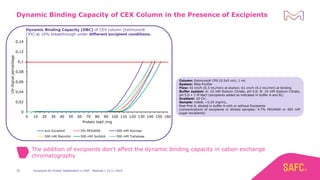
Dynamic Binding Capacity of CEX Column in the Presence of Excipients
35
The addition of excipients don‘t affect the dynamic binding capacity in cation exchange
chromatography
Column: Eshmuno® CPX (0.5x5 cm), 1 mL
System: Äkta Purifier
Flow: 92 cm/h (0.3 mL/min) at elution; 61 cm/h (0.2 mL/min) at binding
Buffer system: A: 10 mM Sodium Citrate, pH 5.0; B: 10 mM Sodium Citrate,
pH 5.0 + 1 M NaCl (excipients added as indicated in buffer A and B);
Gradient: 20 CV;
Sample: mAbB, ~5.25 mg/mL,
Post Prot A, diluted in buffer A with or without Excipients
(concentrations of excipients in diluted samples: 4.7% PEG4000 or 465 mM
sugar excipients)0
0,02
0,04
0,06
0,08
0,1
0,12
0,14
0 10 20 30 40 50 60 70 80 90 100 110 120 130 140 150 160
UV-Signalpercentage
Protein load /mg
w/o Excipient 5% PEG4000 500 mM Sucrose
500 mM Mannitol 500 mM Sorbitol 500 mM Trehalose
Dynamic Binding Capacity (DBC) of CEX column (Eshmuno®
CPX) at 10% breakthrough under different excipient conditions.
Excipients for Protein Stabilization in DSP - Webinar | 14.11.2019
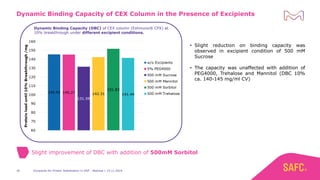
Dynamic Binding Capacity of CEX Column in the Presence of Excipients
36
• Slight reduction on binding capacity was
observed in excipient condition of 500 mM
Sucrose
• The capacity was unaffected with addition of
PEG4000, Trehalose and Mannitol (DBC 10%
ca. 140-145 mg/ml CV)
Slight improvement of DBC with addition of 500mM Sorbitol
Dynamic Binding Capacity (DBC) of CEX column (Eshmuno® CPX) at
10% breakthrough under different excipient conditions.
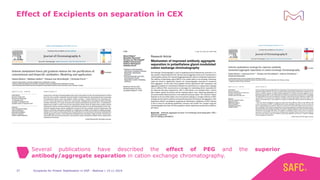
Effect of Excipients on separation in CEX
Excipients for Protein Stabilization in DSP - Webinar | 14.11.201937
Several publications have described the effect of PEG and the superior
antibody/aggregate separation in cation exchange chromatography.
Summary
Excipients for Protein Stabilization in DSP - Webinar | 14.11.201939
Summary
• Excipient screening: selected excipients, 500 mM Mannitol, 500 mM Sorbitol,
500 mM Sucrose, 500 mM Trehalose and 5% PEG4000 were effective to stabilize
mAbs during simulated low pH virus inactivation step.
• Protein A screening:
o Addition of 5% PEG4000 lead to sharper peak
o Furthermore 5% PEG4000 provides a significant benefit not only in the reduction of
pooling volumes but also HCP content of elution pool.
Excipients for Protein Stabilization in DSP - Webinar | 14.11.201940
Summary
• Virus inactivation study:
o Up to 6.3% Monomer increase has been achieved due to addition of excipients
during virus inactivation (60 min incubation at pH 2.8 after Protein A chromatography)
o Addition of selected excipients have no negative effect on viral reduction factor
➢ Slight improvement by addition of Sorbitol, Trehalose and PEG4000
• Cation exchange chromatography:
o Addition of selected excipients have no negative effect on DBC in CEX Column
➢ Slight improvement by addition of Sorbitol
Emprove® excipients can be used to stabilize proteins during low-pH stress
e.g. Protein A chromatography and virus inactivation.
Q&A
christian.frech@stw.de
Prof. Dr. CHRISTIAN FRECH
The vibrant M, Eshmuno, Emprove, ProSep and SAFC are trademarks of Merck KGaA,
Darmstadt, Germany or its affiliates. All other trademarks are the property of their
respective owners. Detailed information on trademarks is available via publicly
accessible resources.
© 2019 Merck KGaA, Darmstadt, Germany and/or its affiliates. All Rights Reserved.
tanja.henzler@emdgroup.com
Dr. Tanja Henzler
Improving Downstream Processing: Application of Excipients in DSP

Improving Downstream Processing: Application of Excipients in DSP

  • 1.
    The life sciencebusiness of Merck KGaA, Darmstadt, Germany operates as MilliporeSigma in the U.S. and Canada. Improving Downstream Processing: Application of Excipients in DSP Webinar Prof. Dr. Christian Frech November 14th , 2019
  • 2.
    The life sciencebusiness of Merck KGaA, Darmstadt, Germany operates as MilliporeSigma in the U.S. and Canada
  • 3.
    Agenda Introduction and Objectives ExcipientScreening Excipients for Protein A chromatography Viral Inactivation Study4 3 2 1 Excipients for CEX chromatography5 6 Summary 3 Excipients for Protein Stabilization in DSP - Webinar | 14.11.2019
  • 4.
  • 5.
    Excipients for ProteinStabilization in DSP - Webinar | 14.11.2019 Introduction and Objectives  During Downstream Processing (DSP) of monoclonal antibodies (mAbs), pH shifts and/or changing conductivities often lead to aggregation, fragmentation or other chemical modifications  Application of high quality excipients could lead to improved protein stability as well as solubility during DSP Investigation of excipients on product stability and chromatographic performance during downstream processing pH 5 StandardmAbProcess Template CEXProtein A AEX
  • 6.
  • 7.
    Approach: Evaluating excipient effectson the stability of acid-exposed monoclonal antibodies by simulating protein A elution and virus inactivation condition in DSP → Screening of excipients Screening Conditions: • Model Proteins: 2 IgG1 mAbs (mAbA and mAbB) • Excipients: Sugars, polyols, amino acids, surfactants and polymers • Condition 1 (condition without NaCl): 100 mM acidic buffer pH 2.8 and +/- excipients • Condition 2 (condition with addition of NaCl): 100 mM acidic buffer pH 2.8; 50 mM NaCl and +/- excipients • pH Aggregation Shift Assay: The pH of mAb solution was adjusted by dilution to pH 2.8 +/- NaCl and incubated at RT for 2h • Screening Readout: Δ Difference of monomer content and Tm-values between samples (with excipient) and control (without excipient) at t = 2 h Excipient Screening set-up Excipients for Protein Stabilization in DSP - Webinar | 14.11.20197 AnalyticsAcidic pH Shift IgG1 mAbs in storage buffer mAb sample at pH 2.8 +/- 50 mM NaCl and +/- excipients Kinetic SE-HPLC & nanoDSF Source: www.agilent.com; www.nanotempertech.com
  • 8.
    Excipients for ProteinStabilization in DSP - Webinar | 14.11.20198 Unstressed mAbB in storage buffer Control; without excipient with addition of 0.5 M sorbitol with addition of 0.5 M ionic excipient with addition of 0.5 M sucrose Exemplary SEC chromatograms of mAbA +/- excipients after 2h incubation acidic buffer pH 2.8 Addition of suitable excipients (e.g. sucrose and sorbitol) leads to a decreased aggregate content (dimers/multimers) during low pH stress. SEC Analysis of Aggregation Kinetics HMW Monomer HMW
  • 9.
    Excipients for ProteinStabilization in DSP - Webinar | 14.11.20199 Addition of suitable excipient (e.g. Sorbitol) during aggregation kinetic assay prevents formation of aggregats → stabilization of mAb during low pH stress. Excipient Effects on Aggregation Kinetics 85 90 95 100 0 20 40 60 80 100 120 140 Monomer/% Time /min Control Control_50mM NaCl 500mM Sorbitol 50mM NaCl_500mM Sorbitol Overview of kinetic SEC results of Monomer of mAbA With addition of Sorbitol at pH 2.8 Overview of kinetic SEC results of Monomer of mAbA With addition of an ionic excipient at pH 2.8 70 80 90 100 0 20 40 60 80 100 120 140 Monomer/% Time /min Control 500mM ionic excipient Control_50mM NaCl 50mM NaCl_500mM ionic excipient
  • 10.
    Excipients for ProteinStabilization in DSP - Webinar | 14.11.201910 • Tm Analysis by Nano Differential Scanning Fluorimetry (nanoDSF) monitors protein unfolding by changes in its intrinsic fluorescence at 330 and 350nm wavelength • Application of thermal ramps between 15 – 95 °C for 48 samples in parallel • Sample requirements: 10 µl sample, 5 µg/ml to 250 mg/ml protein concentration Determination of Conformational Stability by nanoDSF Determination of Melting Temperature (Tm) of mAbs Schematic representation of nanoDSF workflownanoDSF Technology –Thermal Unfolding Source: www.nanotempertech.com
  • 11.
    Excipients for ProteinStabilization in DSP - Webinar | 14.11.201911 Addition of suitable excipient (e.g. Sorbitol) increase the Tm up to 1.5 °C, which indicates stabilization of mAbA during stress condition. NanoDSF results correspond also to SEC aggregation kinetic results Excipient Effects on Conformational Stability Overview of nanoDSF results of mAbA With addition of Sorbitol and an ionic excipient at pH 2.8 53,0 54,5 50,6 52,2 53,8 49,8 40 45 50 55 60 w/o Excipient 500mM Sorbitol 500mM Ionic excipient w/o Excipient 500mM Sorbitol 500mM Ionic excipient acidic buffer pH 2.8 acidic buffer pH 2.8+ 50mM NaCl Tm-Values/°C
  • 12.
    Aggregation Kinetic Assayand NanoDSF Excipient Screening Results: Overview Excipients for Protein Stabilization in DSP - Webinar | 14.11.201912 Sample Analytics Readout Polyol Sugars Amino Acids Surfactans & Others Sorbitol Mannitol Sucrose Trehalose Ionic excipient Arginine HCl Lysine HCl Alanine Glycine Glutamate PS20 PS80 PEG 4000 Poloxmer 188 mAb A Acidic buffer pH 2.8 without NaCl Condition 1 Δmonomer (Kinetic SEC) ΔTm (nanoDSF) Acidic buffer pH 2.8+ 50 mM NaCl Condition 2 Δmonomer (Kinetic SEC) ΔTm (nanoDSF) mAb B Acidic buffer pH 2.8 without NaCl Condition 1 Δmonomer (Kinetic SEC) ΔTm (nanoDSF) Acidic buffer pH 2.8+ 50 mM NaCl Condition 2 Δmonomer (Kinetic SEC) ΔTm (nanoDSF) Stabilization effect of excipient is significant -Δmonomer ≥ 0.5% and -ΔTm ≥ 0.5°C No effect or slight negative effect of excipient on protein stability is observed -5%≤ ∆Monomer < 0.5% -5°C ≤ ∆Tm ≤ 0°C Strong negative effect of excipient on protein stability is observed -5%≤ ∆Monomer -5°C ≤ ∆Tm Potential Excipients (Sorbitol, Mannitol, Sucrose, Trehalose and PEG 4000) during screening in acidic conditions were investigated in Protein A chromatography.
  • 13.
  • 14.
    Excipients for ProteinStabilization in DSP - Webinar | 14.11.2019 Protein A Chromatography 14 StandardmAbProcess Template CEXProtein A AEX
  • 15.
    • Model Proteins:2 IgG1 mAbs (clarified Harvest of mAbA 0.94 g/l and mAbB 1.45 g/l) • 3 different Protein A resins • Based on their potential on stability results of in vitro screening assay, Sucrose, Trehalose, Sorbitol, Mannitol and PEG4000 (500 mM or 5% for PEG4000) were selected for further investigation on chromatographic performance and product stability using Protein A chromatography • Selected excipients were added to the buffer system during chromatographic run Protein A Chromatography Conditions Excipients for Protein Stabilization in DSP - Webinar | 14.11.201915 Selected Protein A Columns Selected Excipients Eshmuno® A; 0.8x2 cm; 1 ml 500 mM Mannitol ProSep® Ultra Plus; 0.8x2 cm; 1 ml 500 mM Sorbitol Agarose-based Protein A Resin; 0.8x2 cm; 1 ml 500 mM Sucrose 500 mM Trehalose 5% PEG4000 Experiment Parameters: Eshmuno® A Resins ProSep® Ultra Plus Resins
  • 16.
    Chromatographic Run ofIgG1 mAbs on Protein A Columns Excipients for Protein Stabilization in DSP - Webinar | 14.11.201916 Selected excipients were added to the buffer system during chromatographic run and their effect on chromatographic performance has been observed System: ÄKTApurifierTM GE Healthcare Column: Eshmuno® A (0.8x2 cm), 1 mL Flow: 120 cm/h (1 mL/min with Eshmuno® A) Buffer system: A: 100 mM Citrate, pH 5.5; B: 100 mM Citrate, pH 2.75 (excipients added as indicated in buffer A and B); Gradient: 30 CV; The column was equilibrated with 100 mM Citrate pH 7.0 (Wash pH 7.0 3 CV after injection, then step to buffer A pH 5.5) Sample: mAbA, clarified harvest, 0.943 mg/mL Sample load: 30 mg/mL CV Chromatographic run of mAbA on Eshmuno® A Equilibration, Inject and 1. Wash without excipient @ pH 7.00 Introduction of excipients during 2. Wash and Elution – pH gradient 5.50 – 2.75
  • 17.
    Size exclusion analysisof the collected fractions Excipients for Protein Stabilization in DSP - Webinar | 14.11.201917 Chromatographic run of mAbA on Eshmuno® A The collected fractions during elution show a high purity – salts and other impurities have been separated in the flowthrough +/- excipient
  • 18.
    Excipients for ProteinStabilization in DSP - Webinar | 14.11.201918 Improvement of mAbA Elution Performance by Excipients Eshmuno® A Performance on mAbA ± Excipient ProSep® Ultra Plus Performance on mAbA ± Excipient Agarose-based Resin Performance on mAbA ± Excipient Addition of 5% PEG4000 causes a shift of sharper elution peak to lower pH, while elution without the use of excipient or with the use of disaccharides and polyols show broader elution peak.
  • 19.
    Excipients for ProteinStabilization in DSP - Webinar | 14.11.201919 Improvement of Chromatography Performance on mAbA Addition of PEG4000 led to a comparable or lower elution pool volume Collected Elution Pool Volume of mAbA during Protein A chromatography Peak Area of Purified mAbA during Protein A chromatography • Addition of all selected excipients have no negative effect on chromatographic performance • mAb elution was pooled according to UV280 > 30 mAU
  • 20.
    Excipients for ProteinStabilization in DSP - Webinar | 14.11.201920 Improvement of mAbB Elution Performance by Excipients Eshmuno® A Performance on mAbB ± Excipient ProSep® Ultra Plus Performance on mAbB ± Excipient Agarose-based Resin Performance on mAbB ± Excipient Addition of 5% PEG4000 causes a shift of sharper elution peak to lower pH, while elution without the use of excipient or with the use of disaccharides and polyols show broader elution peak.
  • 21.
    Excipients for ProteinStabilization in DSP - Webinar | 14.11.201921 Improvement of Chromatography Performance on mAbB Addition of PEG4000 led to a comparable or lower elution pool volume Collected Elution Pool Volume of mAbB during Protein A chromatography Peak Area of Purified mAbB during Protein A chromatography • Addition of all selected excipients have no negative effect on chromatographic performance • mAb elution was pooled according to UV280 > 30 mAU
  • 22.
    Improvement of elutionperformance with increasing PEG concentrations Excipients for Protein Stabilization in DSP - Webinar | 14.11.201922 Increasing the PEG4000 concentration leads to a sharper peak profile Chromatographic run of mAbA on Eshmuno® A Chromatographic run of mAbB on Eshmuno® A
  • 23.
    23 Flowthrough Wash pH 7 WashpH 5.5 Gradient Original mAbB sample Influence of Excipients on HCP removal System: ÄKTApurifierTM GE Healthcare Column: Eshmuno® A (0.8x2 cm), 1 mL Flow: 120 cm/h (1 mL/min with Eshmuno A) Buffer system: A: 100 mM Citrate, pH 5.5; B: 100 mM Citrate, pH 2.75 (excipients added as indicated in buffer A and B); Gradient: 30 CV; The column was equilibrated with 100 mM Citrate pH 7.0 (Wash pH 7.0 3 CV after injection, then step to buffer A pH 5.5) Sample: mAbB, 1.45 mg/mL, clarified harvest Sample load: 30 mg/mL CV Chromatographic run of mAbB on Eshmuno® A
  • 24.
    Excipients for ProteinStabilization in DSP - Webinar | 14.11.201924 Influence of Excipients on HCP removal HCP Distribution of mAbB over pH - Gradient on Eshmuno® A More HCPs were eluted in the rear part of the gradient in a large peak, which means HCP elution was shifted to slightly lower pH condition, especially for PEG4000
  • 25.
    Excipients for ProteinStabilization in DSP - Webinar | 14.11.201925 Influence of Excipients on HCP removal HCP Distribution of mAbB over pH- Gradient on Eshmuno® A HCP Distribution of mAbB over pH- Gradient on ProSep® Ultra Plus HCP Distribution of mAbB over pH- Gradient on Agarose-based Resin • Elution behavior of the HCP's in the presence of PEG4000 differs significantly from control and other selected excipient conditions. • More HCPs were eluted in the rear part of the gradient in a large peak, which means HCP elution was shifted in slightly lower pH condition. • Purity of elution pool with respect to HCP content was analyzed by comparison of HCP content of elution pool from collected fractions based on UV280 collection criterion of >30 mAU, with total mAb content during pH gradient.
  • 26.
    Excipients for ProteinStabilization in DSP - Webinar | 14.11.201926 Improvement of HCP Reduction with 5% PEG4000 on mAbB HCP Distribution of mAbB over pH- Gradient on Eshmuno® A HCP Distribution of mAbB over pH- Gradient on ProSep® Ultra Plus HCP Distribution of mAbB over pH- Gradient on Agarose-based Resin • Purity of elution pool was analyzed by comparison of HCP content of elution pool from collected fractions based on UV280 collection criterion of >30 mAU, with mAb content of elution pool Purer elution pool profile with lowest HCP concentration down to 0.23 µg HCP/mg mAbB was achieved during chromatography run with addition of 5% PEG4000.
  • 27.
  • 28.
     Virus inactivationstep was performed after Protein A chromatography by lowering the pH of the elution pool to pH 2.8  Aggregation kinetics were monitored by analytical SEC Excipients for Protein Stabilization in DSP - Webinar | 14.11.2019 Viral inactivation pH 28 StandardmAbProcess Template CEXProtein A AEX Investigation of excipients for stabilization of the monomer during low pH hold and their effect on viral inactivation rates
  • 29.
    Excipients for ProteinStabilization in DSP - Webinar | 14.11.201929 Size exclusion analysis of elution pool during virus inactivation SEC of mAbA elution pool from Eshmuno® A at t = 0 min SEC of mAbA elution pool from Eshmuno® A at t = 60 min Addition of all selected excipients led to an increased monomer content
  • 30.
    Excipients for ProteinStabilization in DSP - Webinar | 14.11.201930 Improvement of mAb Stability Monomer content of mAbA pool during low pH hold @ pH 2.80 over 60 min Monomer content of mAbB pool during low pH hold @ pH 2.80 over 60 min  Even during the pH adjustment to pH 2.80 the addition of excipients leads to a stabilization of monomer content Addition of all selected excipients led to an increased monomer content up to 6.3%. The results are well in line with excipient screening results
  • 31.
    Viral Inactivation Assessment ExperimentParameters: • Model virus: Xenotropic Murine leukaemia virus (MLV) • Model protein: mAbB (130 mg/ml) → diluted to 10 mg/ml with selected formulation during low pH treatment • 5 Excipients were tested for their influence in viral inactivation step and compared with the basic experiment without addition of excipient • Low pH treatment buffer: acidic buffer pH 3.6 with and without selected excipients • Duration of low pH treatment: 0, 5, 15, 30 and 60 minutes • Viral load: ca. 6 log10 TCID50/ml • Objective: to confirm that selected excipients do not negatively affect the virus inactivation 31 No. Excipients 1 500 mM Sorbitol 2 500 mM Mannitol 3 500 mM Sucrose 4 500 mM Trehalose 5 5% PEG4000 Excipients for Protein Stabilization in DSP - Webinar | 14.11.2019
  • 32.
    Excipients don’t negativelyaffect viral inactivation Excipients for Protein Stabilization in DSP - Webinar | 14.11.2019 0 1 2 3 4 5 6 0 10 20 30 40 50 60 70 ΔLogReductionFactors /Log10 Duration of low pH Treatment /min Viral Reduction Factor of different conditions during low pH treatment w/o Excipient 0.5M Sorbitol 0.5M Mannitol 0.5M Sucrose 0.5M Trehalose 5% PEG4000 32 *Examples of effective virus reduction combined with reduction factor based on EMA guideline in consideration of ICH Q5A guideline Reduction Factor Effectiveness* ≤ 1 log10 Not significant 1-2 log10 Indicative/contributable 2-4 log10 Moderate > 4 log10 High 4,53 4,8 4,35 4,29 4,89 5,15 0 1 2 3 4 5 6 w/o Excipient 0.5M Sorbitol 0.5M Mannitol 0.5M Sucrose 0.5M Trehalose 5% PEG4000 ViralReductionFactors /Log10 Viral Reduction Factor of different conditions after 60 min low pH treatment Slight improvement by addition of Sorbitol, Trehalose and PEG4000.
  • 33.
  • 34.
    Excipients for ProteinStabilization in DSP - Webinar | 14.11.2019 Objective  Subsequent to low pH virus inactivation the pH is adjusted to match loading conditions for cation exchange chromatography step  Application of high quality protein excipients could influence the dynamic binding capacity of cation exchange chromatography pH 34 StandardmAbProcess Template CEXProtein A AEX
  • 35.
    Excipients for ProteinStabilization in DSP - Webinar | 14.11.2019 Dynamic Binding Capacity of CEX Column in the Presence of Excipients 35 The addition of excipients don‘t affect the dynamic binding capacity in cation exchange chromatography Column: Eshmuno® CPX (0.5x5 cm), 1 mL System: Äkta Purifier Flow: 92 cm/h (0.3 mL/min) at elution; 61 cm/h (0.2 mL/min) at binding Buffer system: A: 10 mM Sodium Citrate, pH 5.0; B: 10 mM Sodium Citrate, pH 5.0 + 1 M NaCl (excipients added as indicated in buffer A and B); Gradient: 20 CV; Sample: mAbB, ~5.25 mg/mL, Post Prot A, diluted in buffer A with or without Excipients (concentrations of excipients in diluted samples: 4.7% PEG4000 or 465 mM sugar excipients)0 0,02 0,04 0,06 0,08 0,1 0,12 0,14 0 10 20 30 40 50 60 70 80 90 100 110 120 130 140 150 160 UV-Signalpercentage Protein load /mg w/o Excipient 5% PEG4000 500 mM Sucrose 500 mM Mannitol 500 mM Sorbitol 500 mM Trehalose Dynamic Binding Capacity (DBC) of CEX column (Eshmuno® CPX) at 10% breakthrough under different excipient conditions.
  • 36.
    Excipients for ProteinStabilization in DSP - Webinar | 14.11.2019 Dynamic Binding Capacity of CEX Column in the Presence of Excipients 36 • Slight reduction on binding capacity was observed in excipient condition of 500 mM Sucrose • The capacity was unaffected with addition of PEG4000, Trehalose and Mannitol (DBC 10% ca. 140-145 mg/ml CV) Slight improvement of DBC with addition of 500mM Sorbitol Dynamic Binding Capacity (DBC) of CEX column (Eshmuno® CPX) at 10% breakthrough under different excipient conditions.
  • 37.
    Effect of Excipientson separation in CEX Excipients for Protein Stabilization in DSP - Webinar | 14.11.201937 Several publications have described the effect of PEG and the superior antibody/aggregate separation in cation exchange chromatography.
  • 38.
  • 39.
    Excipients for ProteinStabilization in DSP - Webinar | 14.11.201939 Summary • Excipient screening: selected excipients, 500 mM Mannitol, 500 mM Sorbitol, 500 mM Sucrose, 500 mM Trehalose and 5% PEG4000 were effective to stabilize mAbs during simulated low pH virus inactivation step. • Protein A screening: o Addition of 5% PEG4000 lead to sharper peak o Furthermore 5% PEG4000 provides a significant benefit not only in the reduction of pooling volumes but also HCP content of elution pool.
  • 40.
    Excipients for ProteinStabilization in DSP - Webinar | 14.11.201940 Summary • Virus inactivation study: o Up to 6.3% Monomer increase has been achieved due to addition of excipients during virus inactivation (60 min incubation at pH 2.8 after Protein A chromatography) o Addition of selected excipients have no negative effect on viral reduction factor ➢ Slight improvement by addition of Sorbitol, Trehalose and PEG4000 • Cation exchange chromatography: o Addition of selected excipients have no negative effect on DBC in CEX Column ➢ Slight improvement by addition of Sorbitol Emprove® excipients can be used to stabilize proteins during low-pH stress e.g. Protein A chromatography and virus inactivation.
  • 41.
  • 42.
    christian.frech@stw.de Prof. Dr. CHRISTIANFRECH The vibrant M, Eshmuno, Emprove, ProSep and SAFC are trademarks of Merck KGaA, Darmstadt, Germany or its affiliates. All other trademarks are the property of their respective owners. Detailed information on trademarks is available via publicly accessible resources. © 2019 Merck KGaA, Darmstadt, Germany and/or its affiliates. All Rights Reserved. tanja.henzler@emdgroup.com Dr. Tanja Henzler