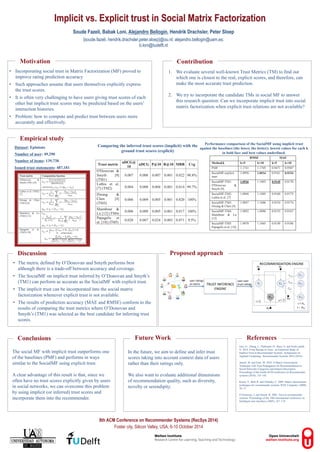
Implicit vs. Explicit trust in Social Matrix Factorization 
Soude Fazeli, Babak Loni, Alejandro Bellogín, Hendrik Drachsler, Peter Sloep 
{soude.fazeli, hendrik.drachsler,peter.sloep}@ou.nl; alejandro.bellogin@uam.es; 
b.loni@tudelft.nl 
Motivation 
• Incorporating social trust in Matrix Factorization (MF) proved to 
improve rating prediction accuracy 
• Such approaches assume that users themselves explicitly express 
the trust scores. 
• It is often very challenging to have users giving trust scores of each 
other but implicit trust scores may be predicted based on the users’ 
interaction histories. 
• Problem: how to compute and predict trust between users more 
accurately and effectively. 
Empirical study 
Dataset: Epinions 
Number of user: 49,290 
Number of items: 139,738 
Issued trust statements: 487,181 
Contribution 
1. We evaluate several well-known Trust Metrics (TM) to find out 
which one is closest to the real, explicit scores, and therefore, can 
make the most accurate trust prediction. 
2. We try to incorporate the candidate TMs in social MF to answer 
this research question: Can we incorporate implicit trust into social 
matrix factorization when explicit trust relations are not available? 
Comparing the inferred trust scores (implicit) with the 
ground trust scores (explicit) 
Discussion 
• The metric defined by O’Donovan and Smyth performs best 
although there is a trade-off between accuracy and coverage. 
• The SocialMF on implicit trust inferred by O’Donovan and Smyth’s 
(TM1) can perform as accurate as the SocialMF with explicit trust. 
• The implicit trust can be incorporated into the social matrix 
factorization whenever explicit trust is not available. 
• The results of prediction accuracy (MAE and RMSE) conform to the 
results of comparing the trust metrics where O’Donovan and 
Smyth’s (TM1) was selected as the best candidate for inferring trust 
scores. 
Conclusions 
The social MF with implicit trust outperforms one 
of the baselines (PMF) and performs in ways 
similar to the SocialMF using explicit trust. 
A clear advantage of this result is that, since we 
often have no trust scores explicitly given by users 
in social networks, we can overcome this problem 
by using implicit (or inferred) trust scores and 
incorporate them into the recommender. 
Future Work 
Performance comparison of the SocialMF using implicit trust 
against the baselines (the lower, the better); lowest values for each k 
in bold face and best values underlined. 
1 Rel @50 @50 
50 
= Σ 
In the future, we aim to define and infer trust 
scores taking into account context data of users 
rather than their ratings only. 
We also want to evaluate additional dimensions 
of recommendation quality, such as diversity, 
novelty or serendipity. 
u 
u U 
P 
U ∈ 
( ) 
( ) 
nDCG@50 1 1 50 
2 1 
IDCG @50 log 1 
1 
rel iu 
− 
u U u i u U i ∈ = 
= 
+ Σ Σ 
References 
Guo, G., Zhang, J., Thalmann, D., Basu, A. and Yorke-smith, 
N. 2014. From Ratings to Trust : an Empirical Study of 
Implicit Trust in Recommender Systems. Symposium on 
Applied Computing - Recommender Systems 2014 (2014). 
Jamali, M. and Ester, M. 2010. A Matrix Factorization 
Technique with Trust Propagation for Recommendation in 
Social Networks Categories and Subject Descriptors. 
Proceedings of the fourth ACM conference on Recommender 
systems (2010), 135–142. 
Koren, Y., Bell, R. and Volinsky, C. 2009. Matrix factorization 
techniques for recommender systems. IEEE Computer. (2009), 
30–37. 
O’Donovan, J. and Smyth, B. 2005. Trust in recommender 
systems. Proceedings of the 10th international conference on 
Intelligent user interfaces (2005), 167–174. 
TRUST%INFERENCE% 
ENGINE% 
user%ra1ngs% 
on%items% 
user8user% 
trust%ra1ngs% 
RECOMMENDATION%ENGINE% 
Proposed approach 
8th ACM Conference on Recommender Systems (RecSys 2014) 
Foster city, Silicon Valley, USA, 6-10 October 2014

Implicit vs Explicit trust in Social Matrix Factorization

  • 1.
    Implicit vs. Explicittrust in Social Matrix Factorization Soude Fazeli, Babak Loni, Alejandro Bellogín, Hendrik Drachsler, Peter Sloep {soude.fazeli, hendrik.drachsler,peter.sloep}@ou.nl; alejandro.bellogin@uam.es; b.loni@tudelft.nl Motivation • Incorporating social trust in Matrix Factorization (MF) proved to improve rating prediction accuracy • Such approaches assume that users themselves explicitly express the trust scores. • It is often very challenging to have users giving trust scores of each other but implicit trust scores may be predicted based on the users’ interaction histories. • Problem: how to compute and predict trust between users more accurately and effectively. Empirical study Dataset: Epinions Number of user: 49,290 Number of items: 139,738 Issued trust statements: 487,181 Contribution 1. We evaluate several well-known Trust Metrics (TM) to find out which one is closest to the real, explicit scores, and therefore, can make the most accurate trust prediction. 2. We try to incorporate the candidate TMs in social MF to answer this research question: Can we incorporate implicit trust into social matrix factorization when explicit trust relations are not available? Comparing the inferred trust scores (implicit) with the ground trust scores (explicit) Discussion • The metric defined by O’Donovan and Smyth performs best although there is a trade-off between accuracy and coverage. • The SocialMF on implicit trust inferred by O’Donovan and Smyth’s (TM1) can perform as accurate as the SocialMF with explicit trust. • The implicit trust can be incorporated into the social matrix factorization whenever explicit trust is not available. • The results of prediction accuracy (MAE and RMSE) conform to the results of comparing the trust metrics where O’Donovan and Smyth’s (TM1) was selected as the best candidate for inferring trust scores. Conclusions The social MF with implicit trust outperforms one of the baselines (PMF) and performs in ways similar to the SocialMF using explicit trust. A clear advantage of this result is that, since we often have no trust scores explicitly given by users in social networks, we can overcome this problem by using implicit (or inferred) trust scores and incorporate them into the recommender. Future Work Performance comparison of the SocialMF using implicit trust against the baselines (the lower, the better); lowest values for each k in bold face and best values underlined. 1 Rel @50 @50 50 = Σ In the future, we aim to define and infer trust scores taking into account context data of users rather than their ratings only. We also want to evaluate additional dimensions of recommendation quality, such as diversity, novelty or serendipity. u u U P U ∈ ( ) ( ) nDCG@50 1 1 50 2 1 IDCG @50 log 1 1 rel iu − u U u i u U i ∈ = = + Σ Σ References Guo, G., Zhang, J., Thalmann, D., Basu, A. and Yorke-smith, N. 2014. From Ratings to Trust : an Empirical Study of Implicit Trust in Recommender Systems. Symposium on Applied Computing - Recommender Systems 2014 (2014). Jamali, M. and Ester, M. 2010. A Matrix Factorization Technique with Trust Propagation for Recommendation in Social Networks Categories and Subject Descriptors. Proceedings of the fourth ACM conference on Recommender systems (2010), 135–142. Koren, Y., Bell, R. and Volinsky, C. 2009. Matrix factorization techniques for recommender systems. IEEE Computer. (2009), 30–37. O’Donovan, J. and Smyth, B. 2005. Trust in recommender systems. Proceedings of the 10th international conference on Intelligent user interfaces (2005), 167–174. TRUST%INFERENCE% ENGINE% user%ra1ngs% on%items% user8user% trust%ra1ngs% RECOMMENDATION%ENGINE% Proposed approach 8th ACM Conference on Recommender Systems (RecSys 2014) Foster city, Silicon Valley, USA, 6-10 October 2014