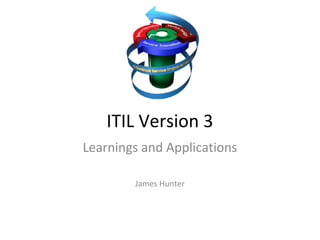
ITIL Version 3
Learnings and Applications
James Hunter
Now focuses on the
end-end lifecycle of all
services
ITIL®
Why v3?
Why v3?
• “Adds”
– Strategic planning
– Security
– Designing services
– Knowledge Management (the new Sci-Fi)
• “Enhances”
– Transition Planning
– Continual (nee Continuous) Improvement
– Integration between “Change” and “Ops”
– Financial Management
• “Tweaks”
– Most of everything else
Interpreting the Lifecycle
• All about “Focii” and “Levels”
• CSI drives implementation
• Everything DOESN’T start with Strategy
• Use it to drive Value
– Re-use
– Strategic planning
– Quality
Focii and Levels
• Focus is WHEN in it’s lifecycle any given change is, or should, be
• Level is WHERE in the organisation the change applies (Strategic,
Service or Tactical)
• E.g.
– Update an SD diagnosis script to improve first-time fix rates
• Tactical improvement that STARTS in the Transition phase (probably)
– Develop a new web-service to support a specific client requirement
• Service Level improvement that STARTS in the Strategic phase
– Overhaul the transition processes
• Strategic Level improvement that STARTS in the Design phase (probably)
– Bring a new Client on-board
• Strategic development that STARTS in the Strategy phase
CSI (No, not that one)
• CSI drives the vast majority of improvement
– CSI improvements
• Update this script to improve first-time fix rates
• Develop a new web-service to support a specific client
requirement
• Enhance the transition processes
• But clearly not all
– Strategic Developments
• Bring a new client on-board (e.g. Kraft)
• Move to ITIL V3 
Strategy
• Keep it lightweight
• Very few things are Strategic AND start in
Strategy!
– Implement ITIL V3
– Develop a new service
• Develop the portfolio first, not the Strategy
(maybe)
(maybe)
Driving Value
• Re-use
– Identify the CURRENT Services Portfolio
– Build CLIENT services from TECHNICAL services where
possible
• Strategic Planning
– Define upcoming CLIENT service needs
– Define TECHNICAL services to construct
– Define demand and feed into capacity plans
• Quality
– Measure all existing processes
– Feed into CSI
– Improve Transition
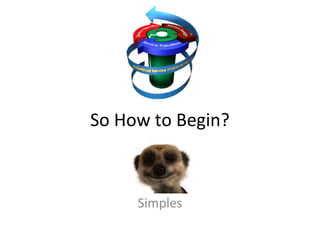
So How to Begin?
Simples
It all begins with CSI
• Strategic Level
– Convene a Strategic CSI board to own Strategic CSI
– Accountable for defining all TECHNICAL services
– Provides governance for Strategic Projects (e.g. implement and
improve tools/processes, develop new, generic TECHNICAL services)
• Service Level
– SDMs own the Service level CSI (per client)
– Accountable for all CLIENT services which they deliver
– Own CLIENT service across the lifecycle
• Tactical
– Bring all current processes under Management
– Make everyone responsible for identification and delivery of Tactical
CSIs
– Transition Manager is accountable for Quality
(PMs may challenge this)
Then Implement Design
• Define scope (actually this is Strategy, but it’s a
neater narrative this way)
• Design all “current” processes in scope
• Reverse-design all existing catalogue services in
scope
• Design Service Level Package Requirements and
Templates
– Base this on current OA checklists etc
• Use SLP templates to reverse-define service
requirements for in-scope current project
deliverables
√
And go on to Strategy
• Do not confuse with Strategic LEVEL
• Confirm scope ()
• Identify the Service Level Packages for each CURRENT
service in scope
• Build Service Level Packages for pipeline services in
scope early in their design process
• Build out the portfolio at a high level (i.e. the
requirements)
• CSI strategic Board can then become Strategic Board,
governing across all projects and identifying Strategic
Offerings
And Back to CSI
Taking it to the next stage
• Strategic
– Identify next baseline to achieve
• Service
– Integrate all changes to live services
• Tactical
– Update any operational procedures
THANKS!
Any Questions?

Implementing itil v3

  • 1.
    ITIL Version 3 Learningsand Applications James Hunter
  • 2.
    Now focuses onthe end-end lifecycle of all services ITIL® Why v3?
  • 3.
    Why v3? • “Adds” –Strategic planning – Security – Designing services – Knowledge Management (the new Sci-Fi) • “Enhances” – Transition Planning – Continual (nee Continuous) Improvement – Integration between “Change” and “Ops” – Financial Management • “Tweaks” – Most of everything else
  • 4.
    Interpreting the Lifecycle •All about “Focii” and “Levels” • CSI drives implementation • Everything DOESN’T start with Strategy • Use it to drive Value – Re-use – Strategic planning – Quality
  • 5.
    Focii and Levels •Focus is WHEN in it’s lifecycle any given change is, or should, be • Level is WHERE in the organisation the change applies (Strategic, Service or Tactical) • E.g. – Update an SD diagnosis script to improve first-time fix rates • Tactical improvement that STARTS in the Transition phase (probably) – Develop a new web-service to support a specific client requirement • Service Level improvement that STARTS in the Strategic phase – Overhaul the transition processes • Strategic Level improvement that STARTS in the Design phase (probably) – Bring a new Client on-board • Strategic development that STARTS in the Strategy phase
  • 6.
    CSI (No, notthat one) • CSI drives the vast majority of improvement – CSI improvements • Update this script to improve first-time fix rates • Develop a new web-service to support a specific client requirement • Enhance the transition processes • But clearly not all – Strategic Developments • Bring a new client on-board (e.g. Kraft) • Move to ITIL V3 
  • 7.
    Strategy • Keep itlightweight • Very few things are Strategic AND start in Strategy! – Implement ITIL V3 – Develop a new service • Develop the portfolio first, not the Strategy (maybe) (maybe)
  • 8.
    Driving Value • Re-use –Identify the CURRENT Services Portfolio – Build CLIENT services from TECHNICAL services where possible • Strategic Planning – Define upcoming CLIENT service needs – Define TECHNICAL services to construct – Define demand and feed into capacity plans • Quality – Measure all existing processes – Feed into CSI – Improve Transition
  • 9.
    So How toBegin? Simples
  • 10.
    It all beginswith CSI • Strategic Level – Convene a Strategic CSI board to own Strategic CSI – Accountable for defining all TECHNICAL services – Provides governance for Strategic Projects (e.g. implement and improve tools/processes, develop new, generic TECHNICAL services) • Service Level – SDMs own the Service level CSI (per client) – Accountable for all CLIENT services which they deliver – Own CLIENT service across the lifecycle • Tactical – Bring all current processes under Management – Make everyone responsible for identification and delivery of Tactical CSIs – Transition Manager is accountable for Quality (PMs may challenge this)
  • 11.
    Then Implement Design •Define scope (actually this is Strategy, but it’s a neater narrative this way) • Design all “current” processes in scope • Reverse-design all existing catalogue services in scope • Design Service Level Package Requirements and Templates – Base this on current OA checklists etc • Use SLP templates to reverse-define service requirements for in-scope current project deliverables √
  • 12.
    And go onto Strategy • Do not confuse with Strategic LEVEL • Confirm scope () • Identify the Service Level Packages for each CURRENT service in scope • Build Service Level Packages for pipeline services in scope early in their design process • Build out the portfolio at a high level (i.e. the requirements) • CSI strategic Board can then become Strategic Board, governing across all projects and identifying Strategic Offerings
  • 13.
    And Back toCSI Taking it to the next stage • Strategic – Identify next baseline to achieve • Service – Integrate all changes to live services • Tactical – Update any operational procedures
  • 14.