Implement
Dijkstra’s algorithm using the graph class you implemented in
HW
#5 and
a priority
queue
you have
implemented
earlier this semester
.
Y
ou
r
program will read the graph from a text file like
what we did in
HW
#
5
. You can use
graph.txt from HW
#5
to test your program. Make the header of
the method as Dijsktra(G, v), where v is the starting vertex.
Further, write a method that prints the
shortest path betw
een any two vertices. Example: s
hortestPath(G,
x
,
y
).
Write a main method t
o test
your program.
Instructions:
1.
Y
ou can use C#
or Java programming languages. No other language is allowed or accepted
HW#5 Question
Q1)
(6
0 points)
Implement a
graph ADT by defining a class “Graph” with the operations
below. You
r
ADT should accept either a directed or undirected graph.
isDirect():
tests if the graph is a digraph
. Returns Boolean value.
adjacent(v,
u): tests whether there is an edge from the vertex v to u. returns Boolean value.
n
eighbors(v): returns the list of all vertices that are a destination of an edge from v.
addVertex(v): adds the vertex v to the graph if it is not already in the
graph, otherwise an error
message to be thrown.
removeVertex(v): removes vertex v from the graph, if it is there.
When a vertex is removed, all
edges associated with that vertex should be deleted as well.
addEdge(v,
u): adds the edge that starts from v and
ends at u.
addEdge(v, u, w):
adds the edge t
hat starts from v and ends at u with weight w.
removeEdge(v,
u): remove the edge that connects v and u.
getWeight
(v,
u): returns the weight of the edge from v to u.
setWeight
(v,
u): sets the weight of the edge
from v to u.
isEmpty(): check whether the graph is empty or not.
isComplete(): checks whether the graph is complete or not.
vertices():returns the list of vertices in the graph (i.e
.
, array, vector,..)
edges(): returns the list of edges in the graph.
d
egree(v): return the degree of vertex v.
size(): returns the number of vertices in the graph.
nEdges(): returns the number of edges in the graph.
c
lear(): Reinitializes the graph to be empty, freeing any heap storage.
vertexExists(v): tests whether a verte
x is in the graph or not. Returns true or false.
p
rint(): displays the list of vertices, edges and their weights if the graph is weighted.
Your ADT should contain at least these constructors:
Graph(), creates a graph with zero vertices.
Graph(n), creates
a graph with n vertices.
Graph(n, digraph), where digraph is a Boolean value if true means
a
directed graph.
Q2) (50 points)
Write a main method that r
ead
s
the graph.txt file that contains the information of
directed weighted
graph.
The file is formatted
as the following:
First line is the number of vertices in the graph.
Second line contains the vertices in the graph.
Each
following line contains the edges and the weights. For example: a b 4, means an ed
ge from a to be with
weight = 4.
After
reading the f
ile and creating
the graph perform the following operations in the same order:
•
removeVertex(h)
•
print if the graph is complete or not (i.e., the graph is complete or the graph is not complete)
•
print number of edges in the graph (i.e., number of edges is xx)
•
print if there is a link from a to f (i.e., there is a link from a to f or there is no link from a to f)
•
print the weight of the edge b
à
h (i.e., the weight of the edge from b to h is xx)
•
print the degree of c (i.e., the degree of c is xx)
•
print number of
vertices in the graph (i.e., the graph contains xx vertices)
•
addVertex(k)
•
add(k,a,5)
•
add (g, k, 2)
•
setWeight(a, c, 7)
•
print the graph on the screen. Use the same format in the graph.txt to display information about
the graph on the screen
HW#5 answer
using System;
using System.Collections.Generic;
using System.Linq;
using System.Text;
using System.Threading.Tasks;
using System.IO;
namespace Bond_HW5
{
public class Vertex
{
public string name;
public double distance;
public List edges;
public Vertex()
{
name = "";
edges = new List();
}
public Vertex(string nm)
{
this.name = nm;
edges = new List();
}
}
public class Edge
{
public Vertex target;
public double weight;
public Edge()
{
target = null;
weight = 0;
}
public Edge(Vertex target, double weight)
{
this.target = target;
this.weight = weight;
}
}
public class Graph
{
Vertex[] graph;
int nVertices;
bool isdirected;
public Graph()
{
nVertices = 0;
graph = new Vertex[nVertices];
isdirected = false;
}
public Graph(int n)
{
isdirected = false;
this.nVertices = n;
graph = new Vertex[nVertices];
}
public Graph(int n, bool digraph)
{
isdirected = digraph;
this.nVertices = n;
graph = new Vertex[nVertices];
}
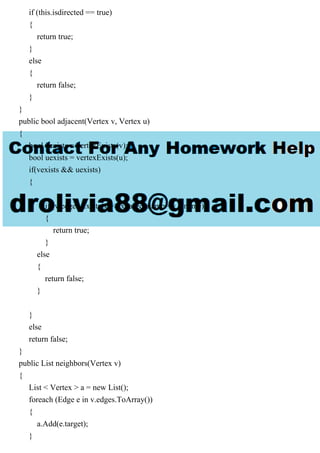
public bool isDirect()
{
if (this.isdirected == true)
{
return true;
}
else
{
return false;
}
}
public bool adjacent(Vertex v, Vertex u)
{
bool vexists = vertexExists(v);
bool uexists = vertexExists(u);
if(vexists && uexists)
{
if (v.edges.Exists(x => x.target.name == u.name))
{
return true;
}
else
{
return false;
}
}
else
return false;
}
public List neighbors(Vertex v)
{
List < Vertex > a = new List();
foreach (Edge e in v.edges.ToArray())
{
a.Add(e.target);
}
return a ;
}
public void addVertex(Vertex v)
{
if(this.vertexExists(v))
{
Console.WriteLine("Error, vertex already exists");
}
else
{
if(graph[0]== null)
{
graph[0] = v;
}
else
{
int i = 1;
while(graph[i]!= null && i < nVertices)
{
i++;
}
if(i>= nVertices)
{
Console.WriteLine("Graph full");
}
else
{
graph[i] = v;
}
}
}
}
public void removeVertex(Vertex v)
{
for (int i = 0; i < nVertices; i++)
{
if (graph[i] != null)
{
if (this.graph[i].name == v.name)
{
graph[i] = null;
}
}
}
}
public void addEdge(Vertex v, Vertex u)
{
bool vexists = vertexExists(v);
bool uexists = vertexExists(u);
if (vexists && uexists)
{
if (isdirected == true)
{
Edge vu = new Edge(u, 0);
v.edges.Add(vu);
}
else
{
Edge vu = new Edge(u, 0);
Edge uv = new Edge(v, 0);
v.edges.Add(vu);
u.edges.Add(uv);
}
}
else if (vexists == true && uexists == false)
{
Console.WriteLine("Error: Vertex 'u' does not exist, please add using the addVertex
Function");
}
else if (vexists == false && uexists == true)
{
Console.WriteLine("Error: Vertex 'v' does not exist, please add using the addVertex
Function");
}
else if (vexists == false && uexists == false)
{
Console.WriteLine("Error: Neither vertex exist, please add using the addVertex
Function");
}
}
public void addEdge(Vertex v, Vertex u, int w)
{
bool vexists = vertexExists(v);
bool uexists = vertexExists(u);
if (vexists && uexists)
{
if (isdirected == true)
{
for (int i = 0; i < nVertices; i++)
{
if (graph[i] != null && graph[i].name == v.name)
{
Edge vu = new Edge(u, w);
graph[i].edges.Add(vu);
}
}
}
else
{
Edge vu = new Edge(u, w);
Edge uv = new Edge(v, w);
v.edges.Add(vu);
u.edges.Add(uv);
}
}
else if (vexists == true && uexists == false)
{
Console.WriteLine("Error: Vertex 'u' does not exist, please add using the addVertex
Function");
}
else if (vexists == false && uexists == true)
{
Console.WriteLine("Error: Vertex 'v' does not exist, please add using the addVertex
Function");
}
else if (vexists == false && uexists == false)
{
Console.WriteLine("Error: Neither vertex exist, please add using the addVertex
Function");
}
}
public double getWeight(Vertex v, Vertex u)
{
Edge temp = new Edge();
for(int i = 0; i x.target.name == u.name);
}
}
return temp.weight;
}
public void setWeight(Vertex v, Vertex u, double w)
{
Edge temp = new Edge();
if (isdirected)
{
for (int i = 0; i < nVertices; i++)
{
if (graph[i] == null || graph[i].name != v.name)
{
continue;
}
else if (graph[i].name == v.name)
{
temp = graph[i].edges.Find(x => x.target.name == u.name);
temp.weight = w;
}
}
}
else
{
for (int i = 0; i < nVertices; i++)
{
if (graph[i] == null || graph[i].name != v.name)
{
continue;
}
else if (graph[i].name == v.name)
{
temp = graph[i].edges.Find(x => x.target.name == u.name);
temp.weight = w;
}
}
for (int j = 0; j < nVertices; j++)
{
if (graph[j] == null || graph[j].name != u.name)
{
continue;
}
else if (graph[j].name == u.name)
{
temp = graph[j].edges.Find(y => y.target.name == u.name);
temp.weight = w;
}
}
}
}
public bool isEmpty()
{
if (nVertices == 0)
return true;
else
return false;
}
public bool isComplete()
{
Edge[] a;
double sum = 0;
double n = graph.Length;
foreach (Vertex x in graph)
{
if (x != null)
{
a = x.edges.ToArray();
sum += a.Length;
}
}
if(sum < ((n*(n-1)/2)))
{
return false;
}
else
return true;
}
public Vertex[] vertices()
{
return graph;
}
public string edges()
{
string elist = "";
Edge[] arr;
foreach (Vertex x in graph)
{
if (x != null)
{
arr = x.edges.ToArray();
for (int i = 0; i < arr.Length; i++)
{
if (arr[i].target != null)
{
elist = elist+x.name + arr[i].target.name + "("+arr[i].weight+")";
elist += "|";
}
}
}
}
return elist;
}
public int degree(Vertex V)
{
if (isdirected)
{
int counter = 0;
for (int i = 0; i < nVertices; i++)
{
if (graph[i] != null && graph[i].name == V.name)
{
foreach (Edge e in graph[i].edges)
{
counter++;
}
}
}
return counter;
}
else
{
int counter = 0;
for (int i = 0; i < nVertices; i++)
{
if (graph[i] != null && graph[i].name == V.name)
{
foreach (Edge e in graph[i].edges)
{
counter++;
}
}
}
return counter;
}
}
public double size()
{
return graph.Length;
}
public double Nedges()
{
Edge[] a;
double sum = 0;
double n = graph.Length;
foreach (Vertex x in graph)
{
if (x != null)
{
a = x.edges.ToArray();
sum += a.Length;
}
}
if (isdirected)
{
return sum;
}
else
{
return sum / 2;
}
}
public void clear()
{
for (int i = 0; i < nVertices; i++)
{
graph[i] = null;
}
}
public bool vertexExists(Vertex v)
{
for(int i =0; i< nVertices; i++)
{
if (graph[i] != null)
{
if (graph[i].name == v.name)
return true;
}
else
{
continue;
}
}
return false;
}
public void print()
{
Console.WriteLine("Vertices: ");
foreach (Vertex v in graph)
{
if (v != null)
{
Console.WriteLine("name: " + v.name);
}
}
Console.WriteLine("Edges: ");
Console.WriteLine(edges());
}
}
class Program
{
static void Main(string[] args)
{
/*
Graph a = new Graph(10, false);
Vertex b = new Vertex();
Vertex c = new Vertex();
c.name = "c";
b.name = "b";
a.addVertex(b);
a.addVertex(c);
a.addEdge(b, c, 10);
a.print();*/
// INput from txt file
StreamReader Reader = new StreamReader("graph.txt");
int numvert;
string[] vertchars;
List edgecreator = new List();
numvert = int.Parse(Reader.ReadLine());
vertchars = new string[numvert];
Graph myGraph = new Graph(numvert, true);
string thechars = Reader.ReadLine();
vertchars = thechars.Split(' ');
foreach(string character in vertchars)
{
Vertex adder = new Vertex(character);
myGraph.addVertex(adder);
}
string edgeReader;
while((edgeReader = Reader.ReadLine())!= null)
{
edgecreator.Add(edgeReader);
}
string[] b = edgecreator.ToArray();
foreach(string sent in b)
{
string[] splitter = sent.Split(' ');
Vertex a = new Vertex(splitter[0]);
Vertex c = new Vertex(splitter[1]);
myGraph.addEdge(a, c, int.Parse(splitter[2]));
}
Vertex tester = new Vertex();
Vertex tester2 = new Vertex();
//print the weight of edge b to h
tester.name = "b";
tester2.name = "h";
double theWeight = myGraph.getWeight(tester, tester2);
Console.WriteLine("The weight from b->h is {0}", theWeight);
//remove vertex h
myGraph.removeVertex(tester2);
//print whether or not the graph is complete
bool comp = myGraph.isComplete();
if(comp)
{
Console.WriteLine("the graph is complete");
}
else
{
Console.WriteLine("the graph is not complete");
}
//print whethether there is a link from a to f
tester = new Vertex("a");
tester2 = new Vertex("f");
comp = myGraph.adjacent(tester, tester2);
if (comp)
{
Console.WriteLine("there is a link from a to f");
}
else
{
Console.WriteLine("there is not a link from a to f");
}
//print the degree of c
Vertex tester3 = new Vertex("c");
Console.WriteLine("the out degree of c is {0}", myGraph.degree(tester3));
//print number of vertices
Console.WriteLine("The number of vertices is {0}", myGraph.vertices().Length);
//add vertex k
tester2 = new Vertex("k");
myGraph.addVertex(tester2);
//add edge k,a,5
myGraph.addEdge(tester2, tester);
//add edge g k 2
Vertex tester4 = new Vertex("g");
myGraph.addEdge(tester4, tester2);
//set weight a,c,7
myGraph.setWeight(tester, tester3, 7);
//print graph
myGraph.print();
}
}
}
Solution
Please Find the

ImplementDijkstra’s algorithm using the graph class you implemente.pdf

  • 1.
    Implement Dijkstra’s algorithm usingthe graph class you implemented in HW #5 and a priority queue you have implemented earlier this semester . Y ou r program will read the graph from a text file like what we did in HW # 5 . You can use graph.txt from HW #5 to test your program. Make the header of the method as Dijsktra(G, v), where v is the starting vertex. Further, write a method that prints the shortest path betw een any two vertices. Example: s hortestPath(G, x , y ). Write a main method t o test your program. Instructions:
  • 2.
    1. Y ou can useC# or Java programming languages. No other language is allowed or accepted HW#5 Question Q1) (6 0 points) Implement a graph ADT by defining a class “Graph” with the operations below. You r ADT should accept either a directed or undirected graph. isDirect(): tests if the graph is a digraph . Returns Boolean value. adjacent(v, u): tests whether there is an edge from the vertex v to u. returns Boolean value. n eighbors(v): returns the list of all vertices that are a destination of an edge from v. addVertex(v): adds the vertex v to the graph if it is not already in the graph, otherwise an error message to be thrown. removeVertex(v): removes vertex v from the graph, if it is there. When a vertex is removed, all edges associated with that vertex should be deleted as well. addEdge(v, u): adds the edge that starts from v and ends at u. addEdge(v, u, w): adds the edge t hat starts from v and ends at u with weight w. removeEdge(v, u): remove the edge that connects v and u. getWeight (v,
  • 3.
    u): returns theweight of the edge from v to u. setWeight (v, u): sets the weight of the edge from v to u. isEmpty(): check whether the graph is empty or not. isComplete(): checks whether the graph is complete or not. vertices():returns the list of vertices in the graph (i.e . , array, vector,..) edges(): returns the list of edges in the graph. d egree(v): return the degree of vertex v. size(): returns the number of vertices in the graph. nEdges(): returns the number of edges in the graph. c lear(): Reinitializes the graph to be empty, freeing any heap storage. vertexExists(v): tests whether a verte x is in the graph or not. Returns true or false. p rint(): displays the list of vertices, edges and their weights if the graph is weighted. Your ADT should contain at least these constructors: Graph(), creates a graph with zero vertices. Graph(n), creates a graph with n vertices. Graph(n, digraph), where digraph is a Boolean value if true means a directed graph. Q2) (50 points) Write a main method that r ead s the graph.txt file that contains the information of directed weighted graph. The file is formatted
  • 4.
    as the following: Firstline is the number of vertices in the graph. Second line contains the vertices in the graph. Each following line contains the edges and the weights. For example: a b 4, means an ed ge from a to be with weight = 4. After reading the f ile and creating the graph perform the following operations in the same order: • removeVertex(h) • print if the graph is complete or not (i.e., the graph is complete or the graph is not complete) • print number of edges in the graph (i.e., number of edges is xx) • print if there is a link from a to f (i.e., there is a link from a to f or there is no link from a to f) • print the weight of the edge b à h (i.e., the weight of the edge from b to h is xx) • print the degree of c (i.e., the degree of c is xx) • print number of vertices in the graph (i.e., the graph contains xx vertices) • addVertex(k) • add(k,a,5) • add (g, k, 2) • setWeight(a, c, 7)
  • 5.
    • print the graphon the screen. Use the same format in the graph.txt to display information about the graph on the screen HW#5 answer using System; using System.Collections.Generic; using System.Linq; using System.Text; using System.Threading.Tasks; using System.IO; namespace Bond_HW5 { public class Vertex { public string name; public double distance; public List edges; public Vertex() { name = ""; edges = new List(); } public Vertex(string nm) { this.name = nm; edges = new List(); } } public class Edge { public Vertex target; public double weight; public Edge() {
  • 6.
    target = null; weight= 0; } public Edge(Vertex target, double weight) { this.target = target; this.weight = weight; } } public class Graph { Vertex[] graph; int nVertices; bool isdirected; public Graph() { nVertices = 0; graph = new Vertex[nVertices]; isdirected = false; } public Graph(int n) { isdirected = false; this.nVertices = n; graph = new Vertex[nVertices]; } public Graph(int n, bool digraph) { isdirected = digraph; this.nVertices = n; graph = new Vertex[nVertices]; } public bool isDirect() {
  • 7.
    if (this.isdirected ==true) { return true; } else { return false; } } public bool adjacent(Vertex v, Vertex u) { bool vexists = vertexExists(v); bool uexists = vertexExists(u); if(vexists && uexists) { if (v.edges.Exists(x => x.target.name == u.name)) { return true; } else { return false; } } else return false; } public List neighbors(Vertex v) { List < Vertex > a = new List(); foreach (Edge e in v.edges.ToArray()) { a.Add(e.target); }
  • 8.
    return a ; } publicvoid addVertex(Vertex v) { if(this.vertexExists(v)) { Console.WriteLine("Error, vertex already exists"); } else { if(graph[0]== null) { graph[0] = v; } else { int i = 1; while(graph[i]!= null && i < nVertices) { i++; } if(i>= nVertices) { Console.WriteLine("Graph full"); } else { graph[i] = v; } } } } public void removeVertex(Vertex v) { for (int i = 0; i < nVertices; i++)
  • 9.
    { if (graph[i] !=null) { if (this.graph[i].name == v.name) { graph[i] = null; } } } } public void addEdge(Vertex v, Vertex u) { bool vexists = vertexExists(v); bool uexists = vertexExists(u); if (vexists && uexists) { if (isdirected == true) { Edge vu = new Edge(u, 0); v.edges.Add(vu); } else { Edge vu = new Edge(u, 0); Edge uv = new Edge(v, 0); v.edges.Add(vu); u.edges.Add(uv); } } else if (vexists == true && uexists == false) { Console.WriteLine("Error: Vertex 'u' does not exist, please add using the addVertex Function"); }
  • 10.
    else if (vexists== false && uexists == true) { Console.WriteLine("Error: Vertex 'v' does not exist, please add using the addVertex Function"); } else if (vexists == false && uexists == false) { Console.WriteLine("Error: Neither vertex exist, please add using the addVertex Function"); } } public void addEdge(Vertex v, Vertex u, int w) { bool vexists = vertexExists(v); bool uexists = vertexExists(u); if (vexists && uexists) { if (isdirected == true) { for (int i = 0; i < nVertices; i++) { if (graph[i] != null && graph[i].name == v.name) { Edge vu = new Edge(u, w); graph[i].edges.Add(vu); } } } else { Edge vu = new Edge(u, w); Edge uv = new Edge(v, w); v.edges.Add(vu); u.edges.Add(uv); }
  • 11.
    } else if (vexists== true && uexists == false) { Console.WriteLine("Error: Vertex 'u' does not exist, please add using the addVertex Function"); } else if (vexists == false && uexists == true) { Console.WriteLine("Error: Vertex 'v' does not exist, please add using the addVertex Function"); } else if (vexists == false && uexists == false) { Console.WriteLine("Error: Neither vertex exist, please add using the addVertex Function"); } } public double getWeight(Vertex v, Vertex u) { Edge temp = new Edge(); for(int i = 0; i x.target.name == u.name); } } return temp.weight; } public void setWeight(Vertex v, Vertex u, double w) { Edge temp = new Edge(); if (isdirected) { for (int i = 0; i < nVertices; i++) { if (graph[i] == null || graph[i].name != v.name) { continue; }
  • 12.
    else if (graph[i].name== v.name) { temp = graph[i].edges.Find(x => x.target.name == u.name); temp.weight = w; } } } else { for (int i = 0; i < nVertices; i++) { if (graph[i] == null || graph[i].name != v.name) { continue; } else if (graph[i].name == v.name) { temp = graph[i].edges.Find(x => x.target.name == u.name); temp.weight = w; } } for (int j = 0; j < nVertices; j++) { if (graph[j] == null || graph[j].name != u.name) { continue; } else if (graph[j].name == u.name) { temp = graph[j].edges.Find(y => y.target.name == u.name); temp.weight = w; } } } } public bool isEmpty()
  • 13.
    { if (nVertices ==0) return true; else return false; } public bool isComplete() { Edge[] a; double sum = 0; double n = graph.Length; foreach (Vertex x in graph) { if (x != null) { a = x.edges.ToArray(); sum += a.Length; } } if(sum < ((n*(n-1)/2))) { return false; } else return true; } public Vertex[] vertices() { return graph; } public string edges() { string elist = ""; Edge[] arr; foreach (Vertex x in graph) {
  • 14.
    if (x !=null) { arr = x.edges.ToArray(); for (int i = 0; i < arr.Length; i++) { if (arr[i].target != null) { elist = elist+x.name + arr[i].target.name + "("+arr[i].weight+")"; elist += "|"; } } } } return elist; } public int degree(Vertex V) { if (isdirected) { int counter = 0; for (int i = 0; i < nVertices; i++) { if (graph[i] != null && graph[i].name == V.name) { foreach (Edge e in graph[i].edges) { counter++; } } } return counter; } else { int counter = 0; for (int i = 0; i < nVertices; i++)
  • 15.
    { if (graph[i] !=null && graph[i].name == V.name) { foreach (Edge e in graph[i].edges) { counter++; } } } return counter; } } public double size() { return graph.Length; } public double Nedges() { Edge[] a; double sum = 0; double n = graph.Length; foreach (Vertex x in graph) { if (x != null) { a = x.edges.ToArray(); sum += a.Length; } } if (isdirected) { return sum; } else { return sum / 2;
  • 16.
    } } public void clear() { for(int i = 0; i < nVertices; i++) { graph[i] = null; } } public bool vertexExists(Vertex v) { for(int i =0; i< nVertices; i++) { if (graph[i] != null) { if (graph[i].name == v.name) return true; } else { continue; } } return false; } public void print() { Console.WriteLine("Vertices: "); foreach (Vertex v in graph) { if (v != null) { Console.WriteLine("name: " + v.name); } } Console.WriteLine("Edges: ");
  • 17.
    Console.WriteLine(edges()); } } class Program { static voidMain(string[] args) { /* Graph a = new Graph(10, false); Vertex b = new Vertex(); Vertex c = new Vertex(); c.name = "c"; b.name = "b"; a.addVertex(b); a.addVertex(c); a.addEdge(b, c, 10); a.print();*/ // INput from txt file StreamReader Reader = new StreamReader("graph.txt"); int numvert; string[] vertchars; List edgecreator = new List(); numvert = int.Parse(Reader.ReadLine()); vertchars = new string[numvert]; Graph myGraph = new Graph(numvert, true); string thechars = Reader.ReadLine(); vertchars = thechars.Split(' '); foreach(string character in vertchars) { Vertex adder = new Vertex(character); myGraph.addVertex(adder); } string edgeReader; while((edgeReader = Reader.ReadLine())!= null) { edgecreator.Add(edgeReader);
  • 18.
    } string[] b =edgecreator.ToArray(); foreach(string sent in b) { string[] splitter = sent.Split(' '); Vertex a = new Vertex(splitter[0]); Vertex c = new Vertex(splitter[1]); myGraph.addEdge(a, c, int.Parse(splitter[2])); } Vertex tester = new Vertex(); Vertex tester2 = new Vertex(); //print the weight of edge b to h tester.name = "b"; tester2.name = "h"; double theWeight = myGraph.getWeight(tester, tester2); Console.WriteLine("The weight from b->h is {0}", theWeight); //remove vertex h myGraph.removeVertex(tester2); //print whether or not the graph is complete bool comp = myGraph.isComplete(); if(comp) { Console.WriteLine("the graph is complete"); } else { Console.WriteLine("the graph is not complete"); } //print whethether there is a link from a to f tester = new Vertex("a"); tester2 = new Vertex("f"); comp = myGraph.adjacent(tester, tester2); if (comp) { Console.WriteLine("there is a link from a to f"); }
  • 19.
    else { Console.WriteLine("there is nota link from a to f"); } //print the degree of c Vertex tester3 = new Vertex("c"); Console.WriteLine("the out degree of c is {0}", myGraph.degree(tester3)); //print number of vertices Console.WriteLine("The number of vertices is {0}", myGraph.vertices().Length); //add vertex k tester2 = new Vertex("k"); myGraph.addVertex(tester2); //add edge k,a,5 myGraph.addEdge(tester2, tester); //add edge g k 2 Vertex tester4 = new Vertex("g"); myGraph.addEdge(tester4, tester2); //set weight a,c,7 myGraph.setWeight(tester, tester3, 7); //print graph myGraph.print(); } } } Solution Please Find the