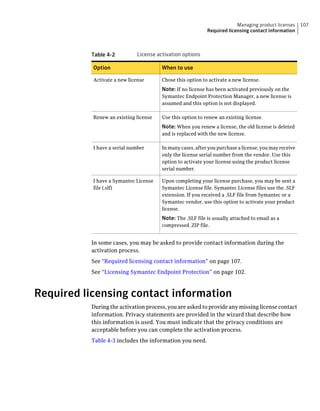
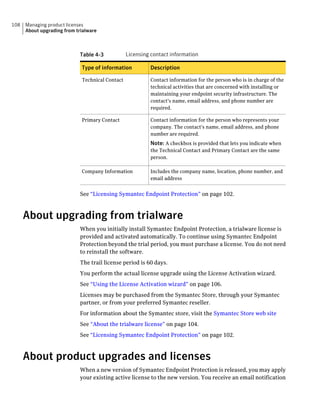
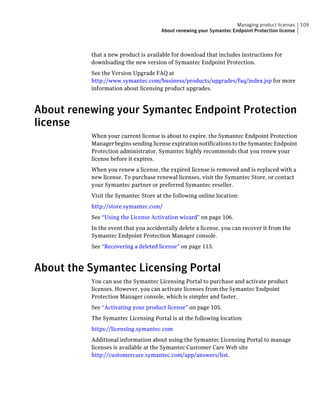
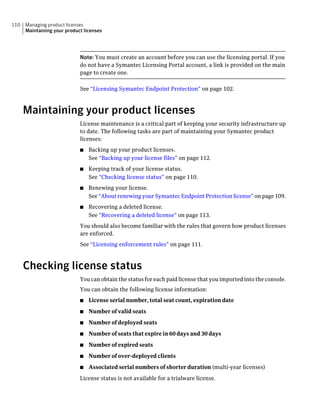
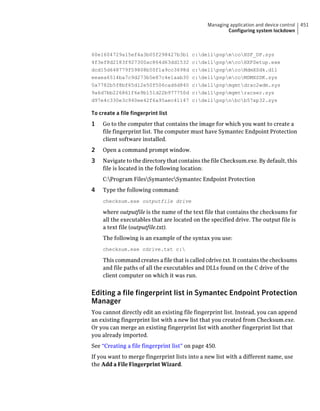
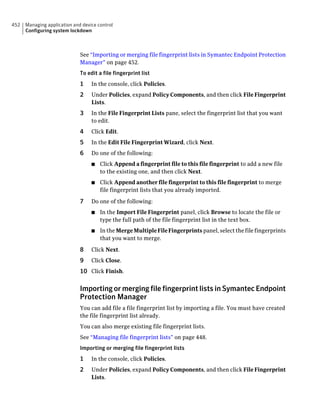
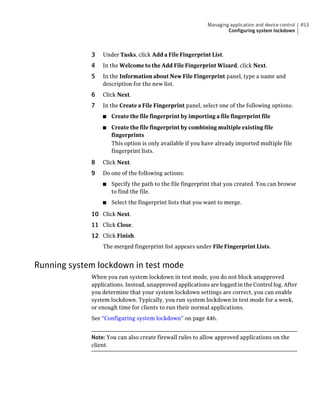
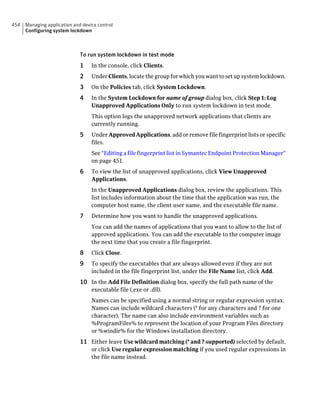
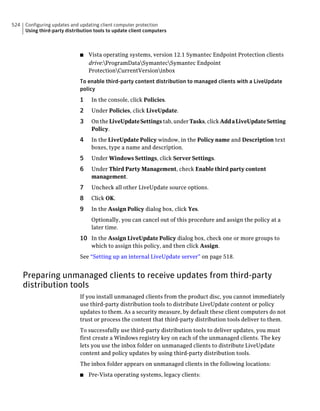
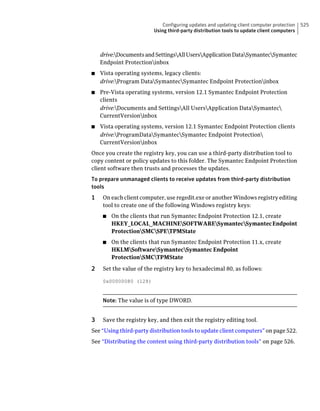
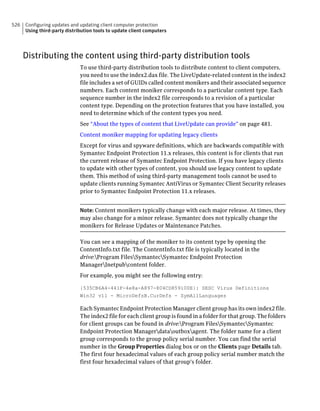
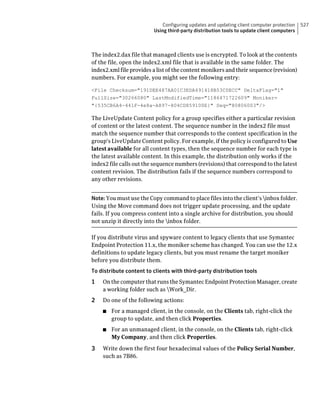
Symantec™ Endpoint
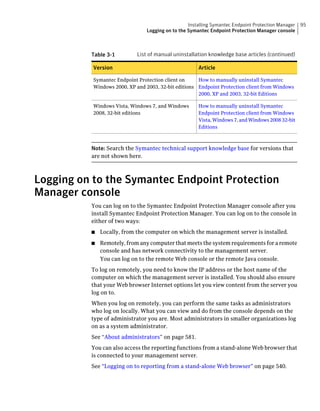
Protection and Symantec
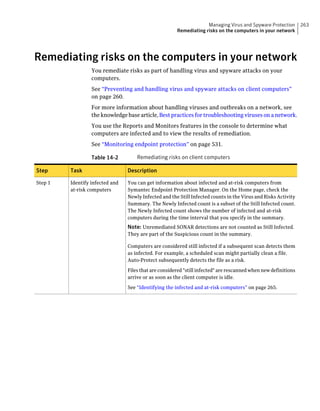
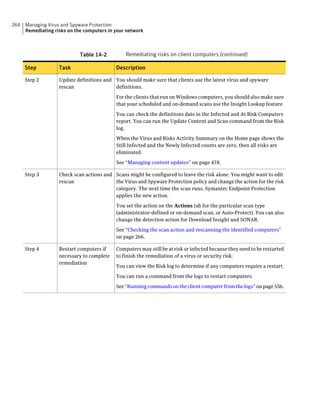
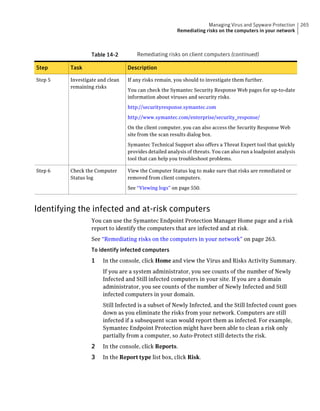
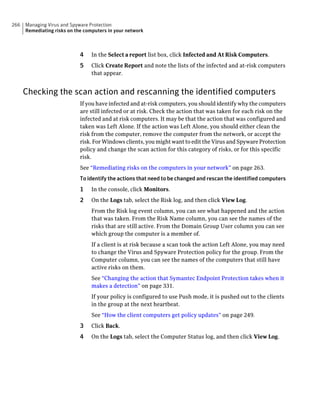
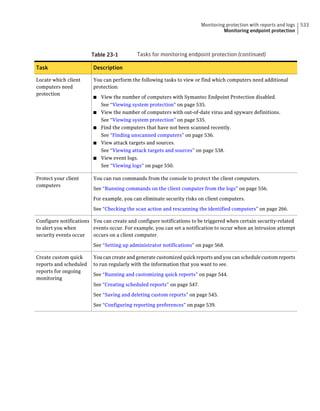
Network Access Control
Implementation Guide
Symantec Endpoint Protection and Symantec Network
Access Control Implementation Guide
          The software described in this book is furnished under a license agreement and may be used
          only in accordance with the terms of the agreement.

          Documentation version 12.01.00.00

          Legal Notice
          Copyright © 2011 Symantec Corporation. All rights reserved.

          Symantec, the Symantec Logo, Bloodhound, Confidence Online, Digital Immune System,
          LiveUpdate, Norton, Sygate, and TruScan are trademarks or registered trademarks of
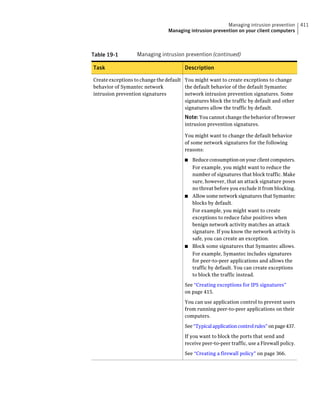
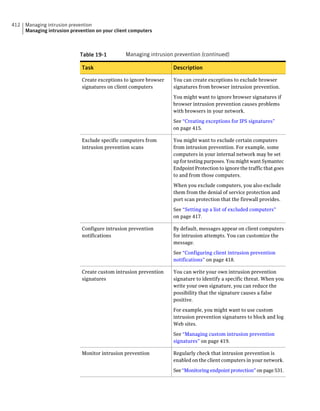
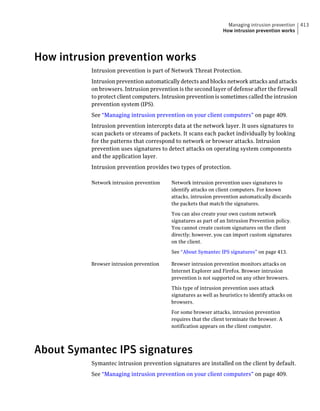
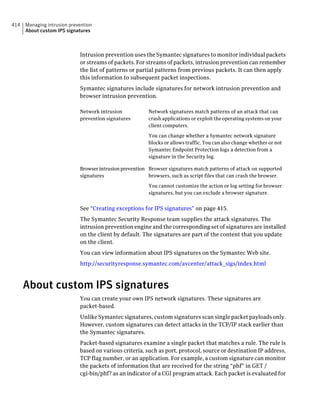
          Symantec Corporation or its affiliates in the U.S. and other countries. Other names may be
          trademarks of their respective owners.

          This Symantec product may contain third party software for which Symantec is required
          to provide attribution to the third party (“Third Party Programs”). Some of the Third Party
          Programs are available under open source or free software licenses. The License Agreement
          accompanying the Software does not alter any rights or obligations you may have under
          those open source or free software licenses. Please see the Third Party Legal Notice Appendix
          to this Documentation or TPIP ReadMe File accompanying this Symantec product for more
          information on the Third Party Programs.

          The product described in this document is distributed under licenses restricting its use,
          copying, distribution, and decompilation/reverse engineering. No part of this document
          may be reproduced in any form by any means without prior written authorization of
          Symantec Corporation and its licensors, if any.

          THE DOCUMENTATION IS PROVIDED "AS IS" AND ALL EXPRESS OR IMPLIED CONDITIONS,
          REPRESENTATIONS AND WARRANTIES, INCLUDING ANY IMPLIED WARRANTY OF
          MERCHANTABILITY, FITNESS FOR A PARTICULAR PURPOSE OR NON-INFRINGEMENT,
          ARE DISCLAIMED, EXCEPT TO THE EXTENT THAT SUCH DISCLAIMERS ARE HELD TO
          BE LEGALLY INVALID. SYMANTEC CORPORATION SHALL NOT BE LIABLE FOR INCIDENTAL
          OR CONSEQUENTIAL DAMAGES IN CONNECTION WITH THE FURNISHING,
          PERFORMANCE, OR USE OF THIS DOCUMENTATION. THE INFORMATION CONTAINED
          IN THIS DOCUMENTATION IS SUBJECT TO CHANGE WITHOUT NOTICE.

          The Licensed Software and Documentation are deemed to be commercial computer software
          as defined in FAR 12.212 and subject to restricted rights as defined in FAR Section 52.227-19
          "Commercial Computer Software - Restricted Rights" and DFARS 227.7202, "Rights in
          Commercial Computer Software or Commercial Computer Software Documentation", as
          applicable, and any successor regulations. Any use, modification, reproduction release,
          performance, display or disclosure of the Licensed Software and Documentation by the U.S.
          Government shall be solely in accordance with the terms of this Agreement.
Symantec Corporation
350 Ellis Street
Mountain View, CA 94043

http://www.symantec.com
Technical Support
                Symantec Technical Support maintains support centers globally. Technical
                Support’s primary role is to respond to specific queries about product features
                and functionality. The Technical Support group also creates content for our online
                Knowledge Base. The Technical Support group works collaboratively with the
                other functional areas within Symantec to answer your questions in a timely
                fashion. For example, the Technical Support group works with Product Engineering
                and Symantec Security Response to provide alerting services and virus definition
                updates.
                Symantec’s support offerings include the following:
                ■   A range of support options that give you the flexibility to select the right
                    amount of service for any size organization
                ■   Telephone and/or Web-based support that provides rapid response and
                    up-to-the-minute information
                ■   Upgrade assurance that delivers software upgrades
                ■   Global support purchased on a regional business hours or 24 hours a day, 7
                    days a week basis
                ■   Premium service offerings that include Account Management Services
                For information about Symantec’s support offerings, you can visit our Web site
                at the following URL:
                www.symantec.com/business/support/
                All support services will be delivered in accordance with your support agreement
                and the then-current enterprise technical support policy.

Contacting Technical Support
                Customers with a current support agreement may access Technical Support
                information at the following URL:
                www.symantec.com/business/support/
                Before contacting Technical Support, make sure you have satisfied the system
                requirements that are listed in your product documentation. Also, you should be
                at the computer on which the problem occurred, in case it is necessary to replicate
                the problem.
                When you contact Technical Support, please have the following information
                available:
                ■   Product release level
■   Hardware information
                   ■   Available memory, disk space, and NIC information
                   ■   Operating system
                   ■   Version and patch level
                   ■   Network topology
                   ■   Router, gateway, and IP address information
                   ■   Problem description:
                       ■   Error messages and log files
                       ■   Troubleshooting that was performed before contacting Symantec
                       ■   Recent software configuration changes and network changes

Licensing and registration
                   If your Symantec product requires registration or a license key, access our technical
                   support Web page at the following URL:
                   www.symantec.com/business/support/

Customer service
                   Customer service information is available at the following URL:
                   www.symantec.com/business/support/
                   Customer Service is available to assist with non-technical questions, such as the
                   following types of issues:
                   ■   Questions regarding product licensing or serialization
                   ■   Product registration updates, such as address or name changes
                   ■   General product information (features, language availability, local dealers)
                   ■   Latest information about product updates and upgrades
                   ■   Information about upgrade assurance and support contracts
                   ■   Information about the Symantec Buying Programs
                   ■   Advice about Symantec's technical support options
                   ■   Nontechnical presales questions
                   ■   Issues that are related to CD-ROMs, DVDs, or manuals
Support agreement resources
               If you want to contact Symantec regarding an existing support agreement, please
               contact the support agreement administration team for your region as follows:

               Asia-Pacific and Japan             customercare_apac@symantec.com

               Europe, Middle-East, and Africa    semea@symantec.com

               North America and Latin America    supportsolutions@symantec.com
Contents


Technical Support ............................................................................................... 4
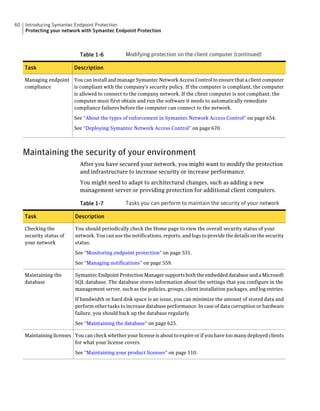
Chapter 1                 Introducing Symantec Endpoint Protection .................. 37
                          About Symantec Endpoint Protection ..............................................             37
                          What's new in version 12.1 ............................................................       38
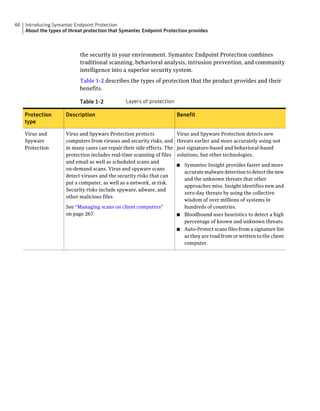
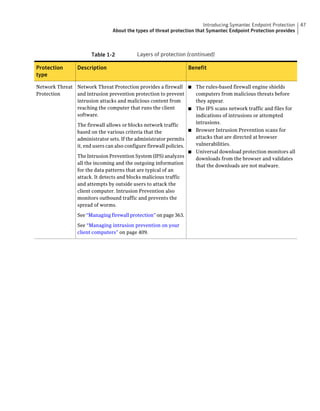
                          About the types of threat protection that Symantec Endpoint
                              Protection provides ................................................................      45
                          Protecting your network with Symantec Endpoint Protection ...............                     50
                              Getting up and running on Symantec Endpoint Protection for
                                   the first time ...................................................................   51
                              Managing protection on client computers ...................................               57
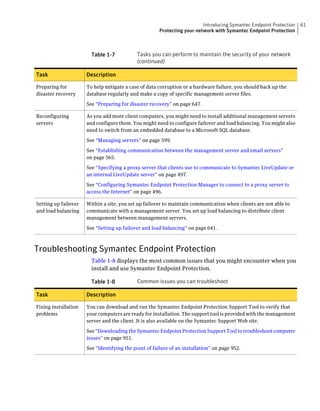
                              Maintaining the security of your environment .............................                60
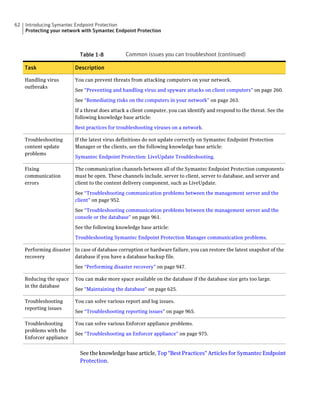
                              Troubleshooting Symantec Endpoint Protection ..........................                   61


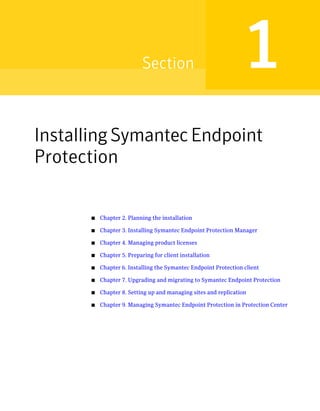
Section 1                 Installing Symantec Endpoint
                             Protection ................................................................... 63
Chapter 2                 Planning the installation ................................................... 65
                          Planning the installation ...............................................................     65
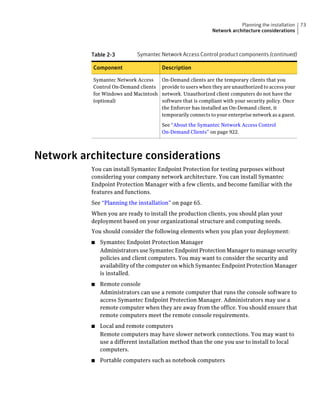
                          Components of Symantec Endpoint Protection ..................................                 68
                          Components of Symantec Network Access Control .............................                   70
                          Network architecture considerations ...............................................           73
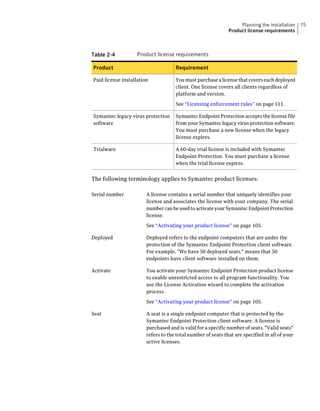
                          Product license requirements .........................................................        74
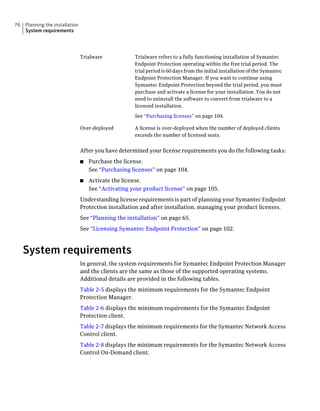
                          System requirements ....................................................................      76
                              Internationalization requirements ............................................            80
                          Supported virtual installations and virtualization products .................                 81
                          About Symantec Endpoint Protection Manager compatibility with
                              other products .......................................................................    82
                          About choosing a database type ......................................................         83
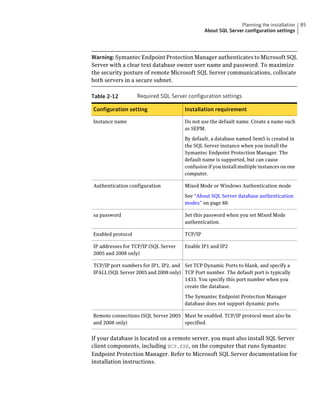
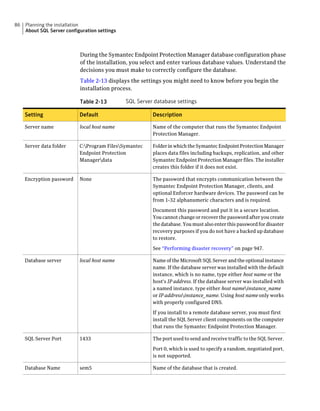
                          About SQL Server configuration settings ..........................................            84
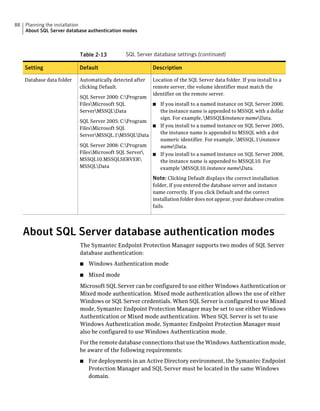
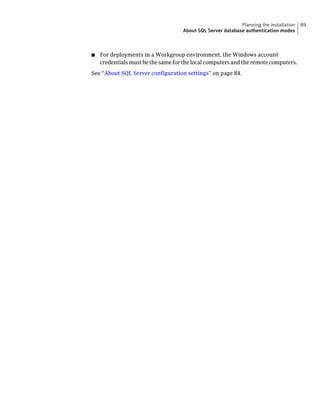
                          About SQL Server database authentication modes ..............................                 88
8   Contents


    Chapter 3   Installing Symantec Endpoint Protection
                   Manager ..........................................................................           91

                Installing the management server and the console .............................                  91
                Configuring the management server during installation ......................                    93
                Accepting the self-signed certificate for Symantec Endpoint Protection
                    Manager ...............................................................................     93
                Uninstalling Symantec Endpoint Protection Manager .........................                     94
                Logging on to the Symantec Endpoint Protection Manager
                    console .................................................................................   95
                Increasing the time period for staying logged on to the console ............                    97
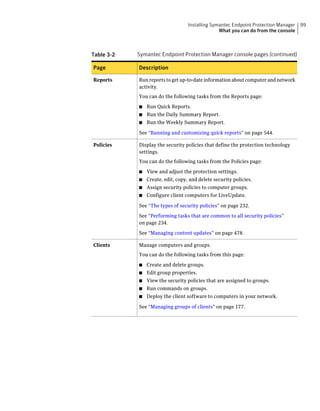
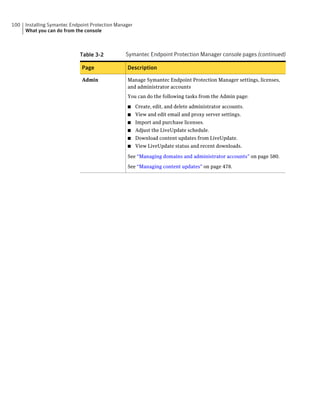
                What you can do from the console ...................................................            98

    Chapter 4   Managing product licenses ............................................. 101
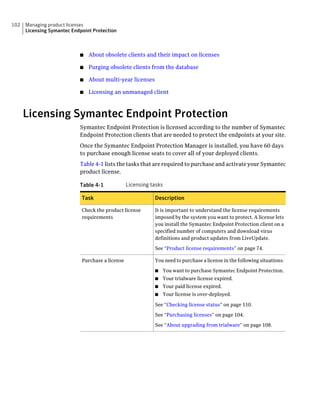
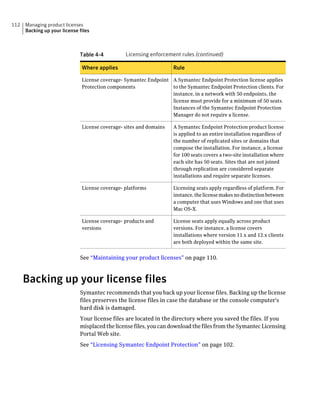
                Licensing Symantec Endpoint Protection ........................................             102
                About the trialware license ...........................................................     104
                Purchasing licenses ....................................................................    104
                Where to buy a Symantec product license .......................................             105
                Activating your product license .....................................................       105
                Using the License Activation wizard ..............................................          106
                Required licensing contact information ..........................................           107
                About upgrading from trialware ....................................................         108
                About product upgrades and licenses .............................................           108
                About renewing your Symantec Endpoint Protection license ..............                     109
                About the Symantec Licensing Portal .............................................           109
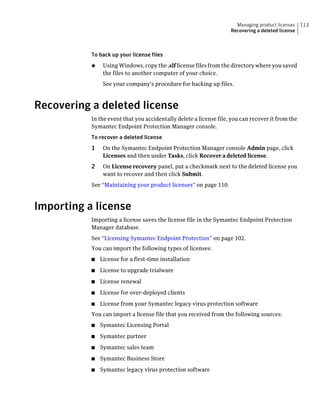
                Maintaining your product licenses .................................................         110
                Checking license status ................................................................    110
                Downloading a license file ............................................................     111
                Licensing enforcement rules .........................................................       111
                Backing up your license files .........................................................     112
                Recovering a deleted license .........................................................      113
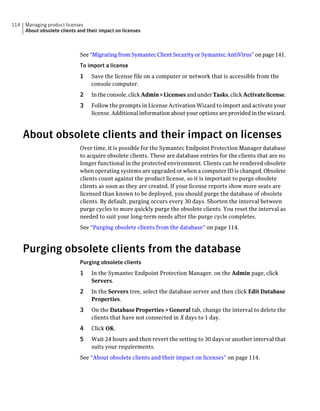
                Importing a license .....................................................................   113
                About obsolete clients and their impact on licenses ..........................              114
                Purging obsolete clients from the database .....................................            114
                About multi-year licenses ............................................................      115
                Licensing an unmanaged client .....................................................         115

    Chapter 5   Preparing for client installation ..................................... 117
                Preparing for client installation ....................................................      117
                About firewalls and communication ports .......................................             119
                Preparing Windows operating systems for remote deployment ...........                       121
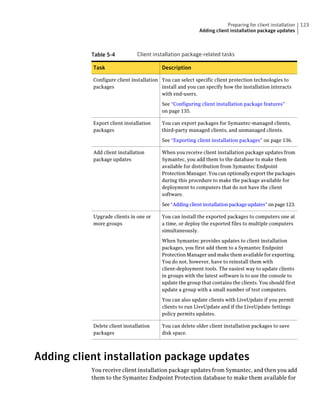
                Managing client installation packages ............................................          122
Contents   9


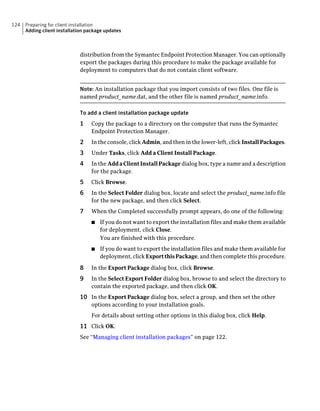
            Adding client installation package updates ...................................... 123

Chapter 6   Installing the Symantec Endpoint Protection
               client ............................................................................... 125
            About client deployment methods .................................................            125
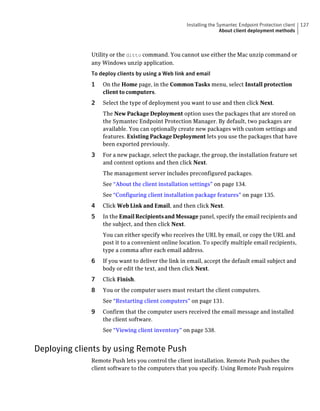
                Deploying clients using a Web link and email ............................                126
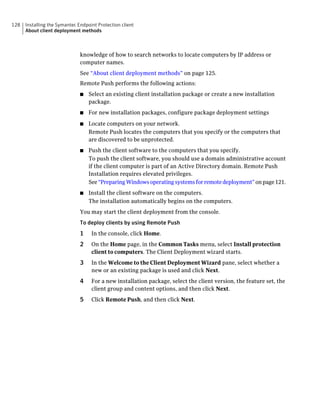
                Deploying clients by using Remote Push ..................................                127
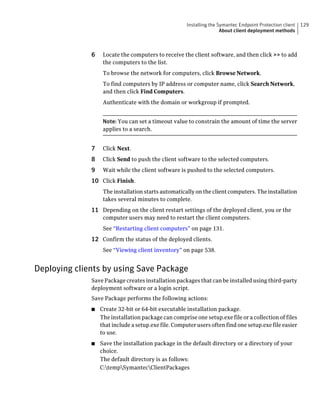
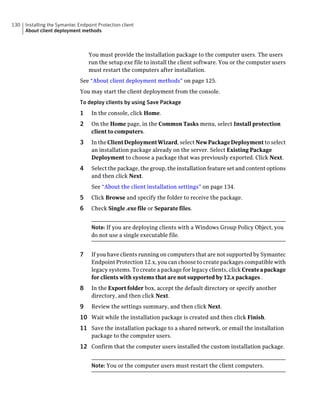
                Deploying clients by using Save Package ...................................              129
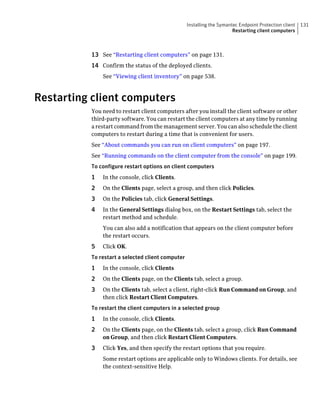
            Restarting client computers .........................................................        131
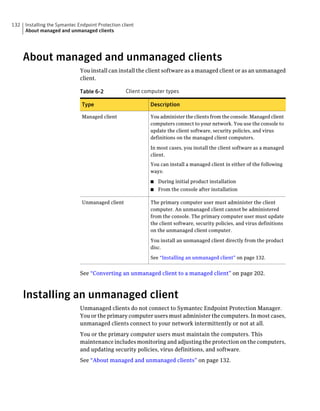
            About managed and unmanaged clients ..........................................               132
            Installing an unmanaged client .....................................................         132
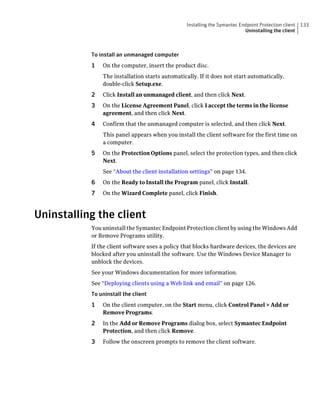
            Uninstalling the client .................................................................    133
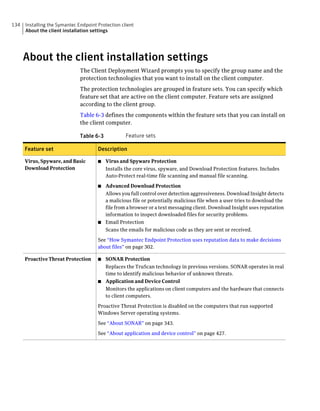
            About the client installation settings ..............................................        134
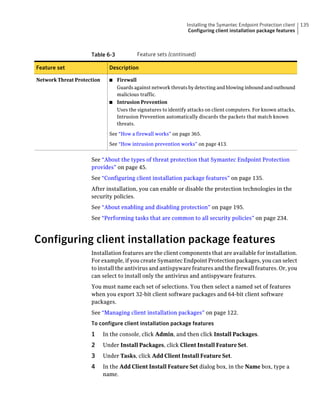
            Configuring client installation package features ...............................             135
            Exporting client installation packages ............................................          136
            About Federal Desktop Core Configuration (FDCC) compliant client
                packages .............................................................................   137

Chapter 7   Upgrading and migrating to Symantec Endpoint
              Protection ...................................................................... 139
            About migrating to Symantec Endpoint Protection ...........................                  140
            Migrating from Symantec Client Security or Symantec
                AntiVirus ............................................................................   141
                About migrating computer groups ...........................................              143
                Migrating group settings and policy settings .............................               143
            Migrating an installation instance that uses multiple embedded
                databases and management servers .........................................               144
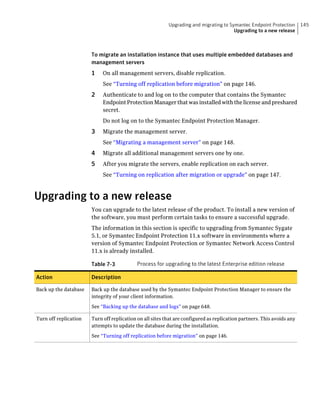
            Upgrading to a new release ..........................................................        145
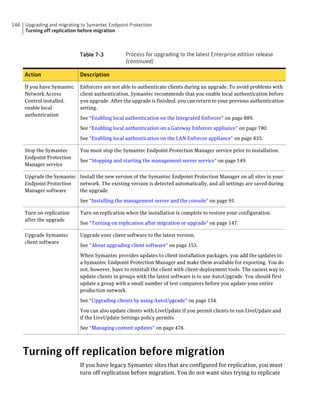
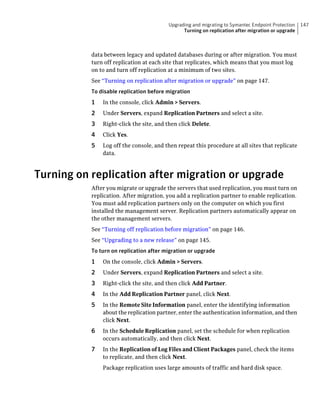
            Turning off replication before migration ........................................            146
            Turning on replication after migration or upgrade ...........................                147
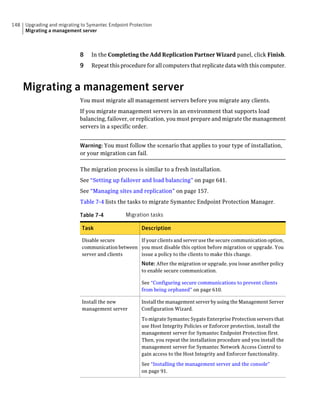
            Migrating a management server ....................................................           148
            Stopping and starting the management server service .......................                  149
            Disabling LiveUpdate in Symantec AntiVirus before migration ...........                      150
            Disabling scheduled scans in Symantec System Center when you
                migrate client computers .......................................................         151
            Turning off the roaming service ....................................................         151
            Uninstalling and deleting reporting servers ....................................             152
            Unlocking server groups in Symantec System Center ........................                   153
            About upgrading client software ...................................................          153
            Upgrading clients by using AutoUpgrade ........................................              154
            Updating client software with a LiveUpdate Settings policy ...............                   155
            Migrating Group Update Providers ................................................            156
10   Contents


     Chapter 8    Setting up and managing sites and replication .......... 157
                  Managing sites and replication .....................................................          157
                  Determining how many sites you need ...........................................               159
                  How replication works .................................................................       161
                  Adding a replication partner .........................................................        163
                  Changing the automatic replication schedule ...................................               164
                  Replicating data on demand .........................................................          165
                  Specifying which data to replicate .................................................          166
                  Deleting remote sites ..................................................................      166

     Chapter 9    Managing Symantec Endpoint Protection in
                    Protection Center ........................................................ 169
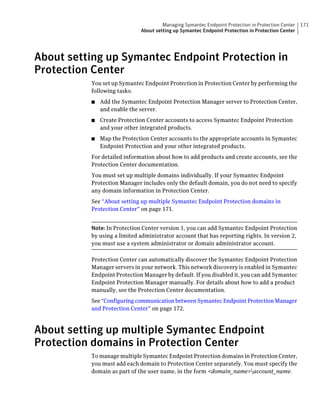
                  About Symantec Endpoint Protection and Protection Center ..............                       169
                  About upgrading to Protection Center version 2 ...............................                170
                  About setting up Symantec Endpoint Protection in Protection
                      Center ................................................................................   171
                  About setting up multiple Symantec Endpoint Protection domains
                      in Protection Center ..............................................................       171
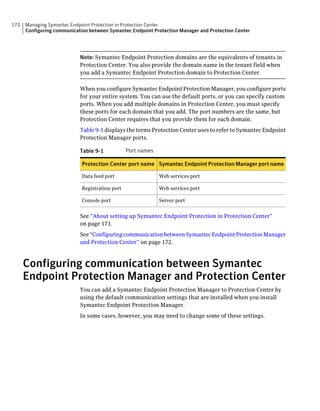
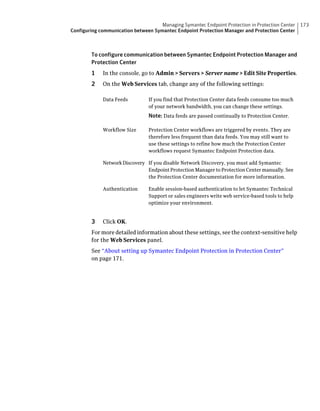
                  Configuring communication between Symantec Endpoint Protection
                      Manager and Protection Center ...............................................             172


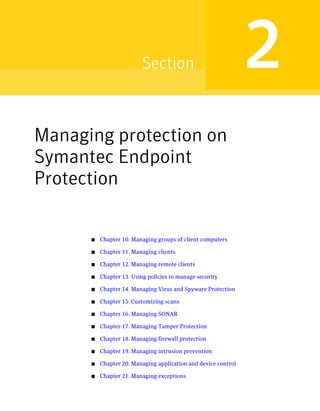
     Section 2    Managing protection on Symantec
                    Endpoint Protection ........................................... 175
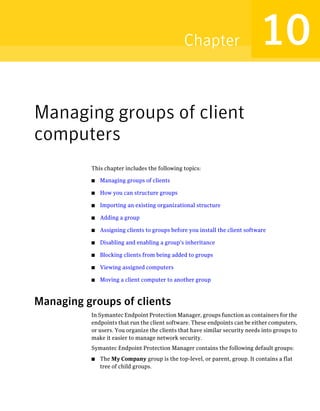
     Chapter 10   Managing groups of client computers .......................... 177
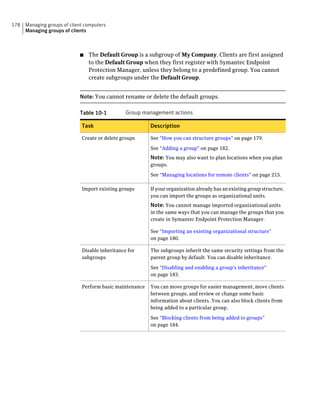
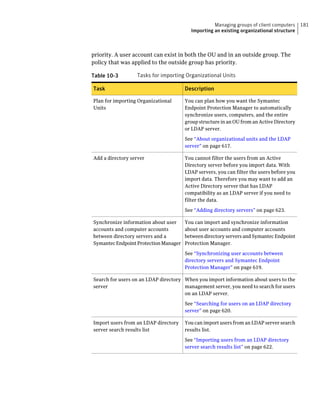
                  Managing groups of clients ..........................................................         177
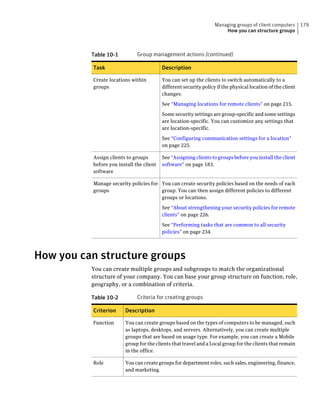
                  How you can structure groups ......................................................           179
                  Importing an existing organizational structure ................................               180
                  Adding a group ..........................................................................     182
                  Assigning clients to groups before you install the client
                      software .............................................................................    183
                  Disabling and enabling a group's inheritance ...................................              183
                  Blocking clients from being added to groups ....................................              184
                  Viewing assigned computers ........................................................           184
                  Moving a client computer to another group .....................................               185

     Chapter 11   Managing clients               ............................................................... 187

                  Managing client computers .......................................................... 188
                  About the client protection status icons .......................................... 189
Contents   11


             Viewing the protection status of clients and client computers .............                  191
             Filtering which clients you can view on the Clients tab ......................               192
             Searching for information about client computers ............................                193
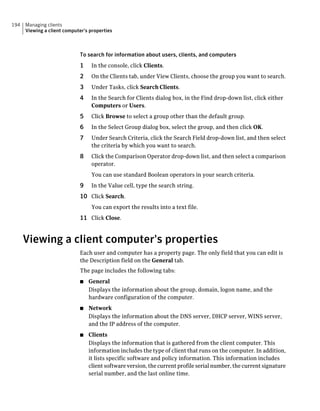
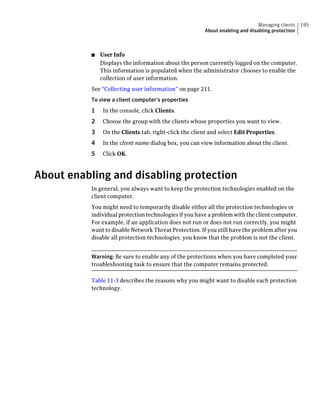
             Viewing a client computer's properties ...........................................           194
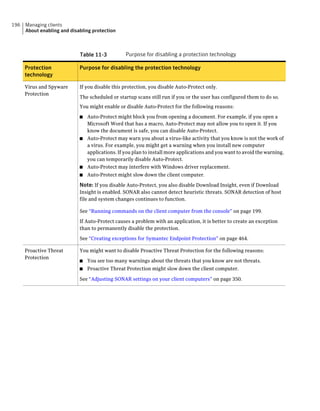
             About enabling and disabling protection .........................................            195
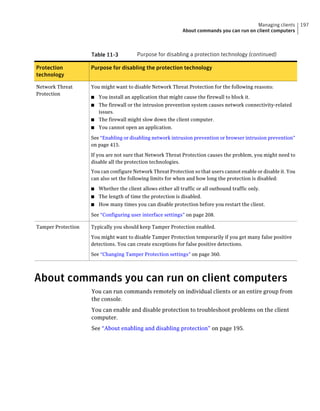
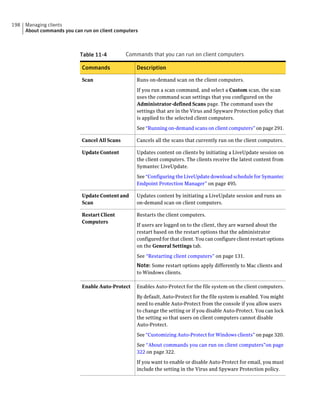
             About commands you can run on client computers ...........................                   197
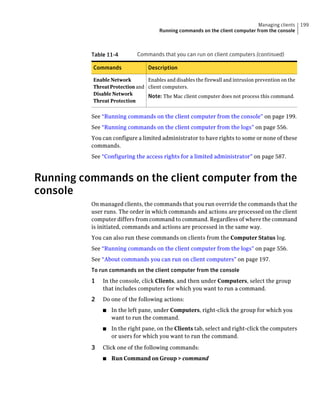
             Running commands on the client computer from the console .............                       199
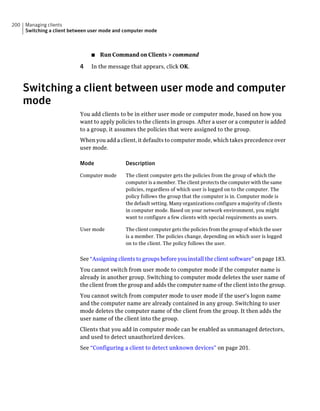
             Switching a client between user mode and computer mode .................                     200
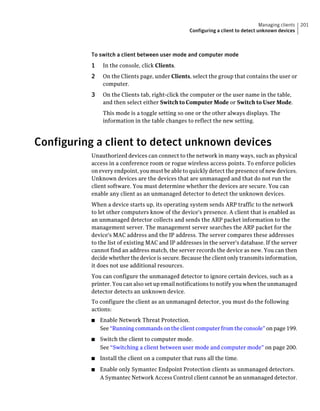
             Configuring a client to detect unknown devices ................................              201
             Converting an unmanaged client to a managed client ........................                  202
             About access to the client interface ................................................        204
             About mixed control ...................................................................      205
             Changing the user control level .....................................................        205
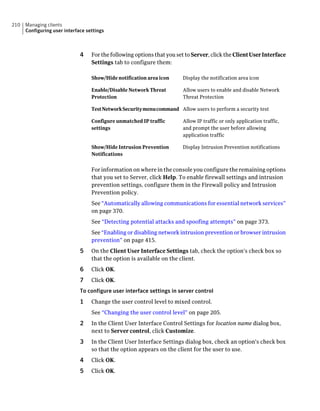
             Configuring user interface settings ................................................         208
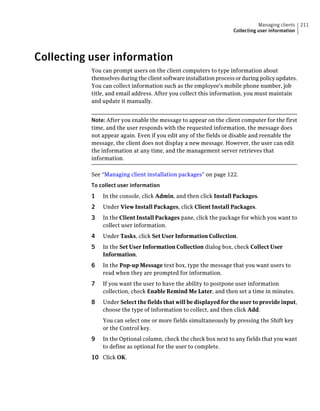
             Collecting user information ..........................................................       211
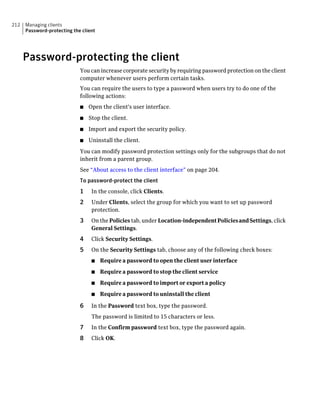
             Password-protecting the client .....................................................         212

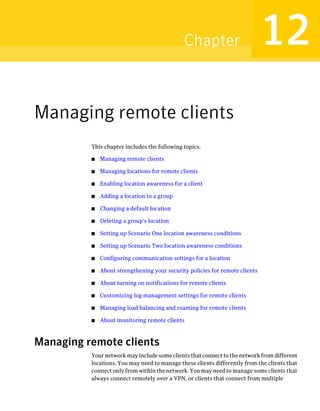
Chapter 12   Managing remote clients ................................................. 213
             Managing remote clients .............................................................        213
             Managing locations for remote clients ............................................           215
             Enabling location awareness for a client .........................................           217
             Adding a location to a group .........................................................       218
             Changing a default location ..........................................................       219
             Deleting a group's location ...........................................................      220
             Setting up Scenario One location awareness conditions .....................                  221
             Setting up Scenario Two location awareness conditions .....................                  223
             Configuring communication settings for a location ...........................                225
             About strengthening your security policies for remote clients ............                   226
                  Best practices for Firewall policy settings .................................           227
                  About best practices for LiveUpdate policy settings ....................                228
             About turning on notifications for remote clients .............................              228
             Customizing log management settings for remote clients ..................                    229
             Managing load balancing and roaming for remote clients ..................                    229
             About monitoring remote clients ...................................................          230

Chapter 13   Using policies to manage security ................................. 231
             The types of security policies ........................................................      232
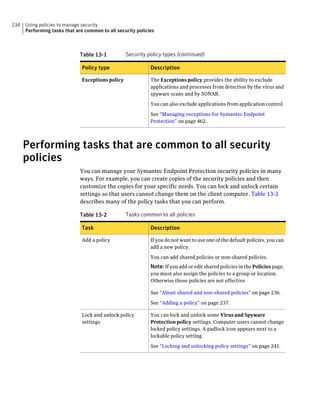
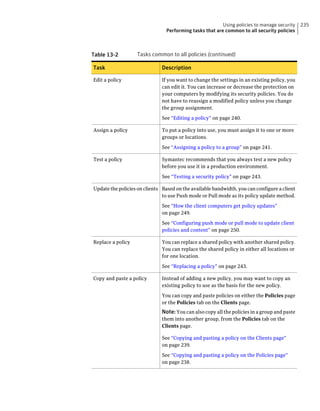
             Performing tasks that are common to all security policies ..................                 234
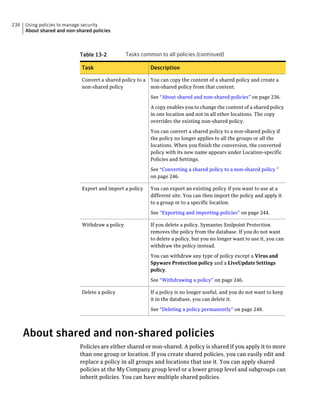
             About shared and non-shared policies ............................................            236
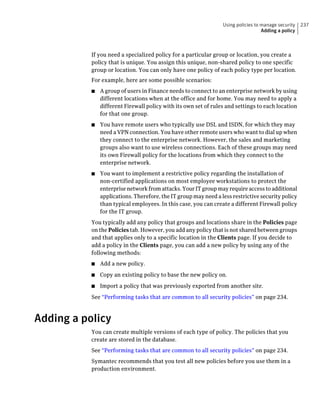
             Adding a policy ..........................................................................   237
             Copying and pasting a policy on the Policies page .............................              238
             Copying and pasting a policy on the Clients page ..............................              239
12   Contents


                  Editing a policy ..........................................................................     240
                  Locking and unlocking policy settings ............................................              241
                  Assigning a policy to a group ........................................................          241
                  Testing a security policy ..............................................................        243
                  Replacing a policy .......................................................................      243
                  Exporting and importing policies ..................................................             244
                  Converting a shared policy to a non-shared policy ...........................                   246
                  Withdrawing a policy ..................................................................         246
                  Deleting a policy permanently ......................................................            248
                  How the client computers get policy updates ...................................                 249
                  Configuring push mode or pull mode to update client policies and
                       content ...............................................................................    250
                  Using the policy serial number to check client-server
                       communication ....................................................................         251
                  Monitoring the applications and services that run on client
                       computers ...........................................................................      252
                  Configuring the management server to collect information about the
                       applications that the client computers run ................................                254
                  Searching for information about the applications that the computers
                       run ....................................................................................   255
                  Saving the results of an application search ......................................              257

     Chapter 14   Managing Virus and Spyware Protection ..................... 259
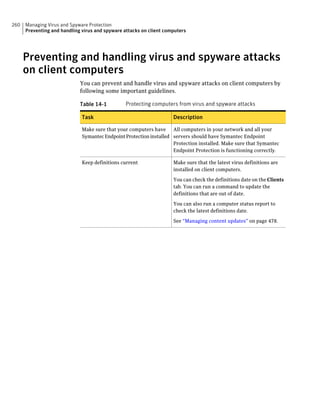
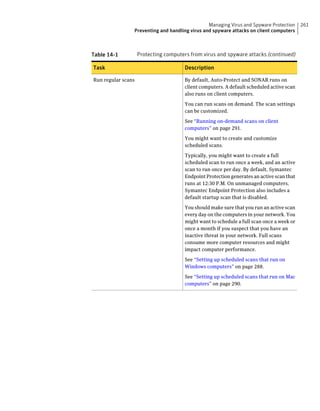
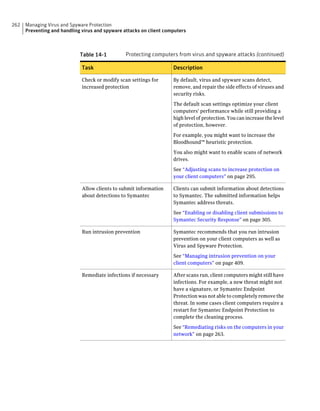
                  Preventing and handling virus and spyware attacks on client
                      computers ...........................................................................       260
                  Remediating risks on the computers in your network ........................                     263
                      Identifying the infected and at-risk computers ...........................                  265
                      Checking the scan action and rescanning the identified
                          computers .....................................................................         266
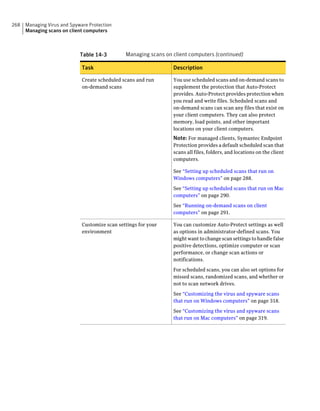
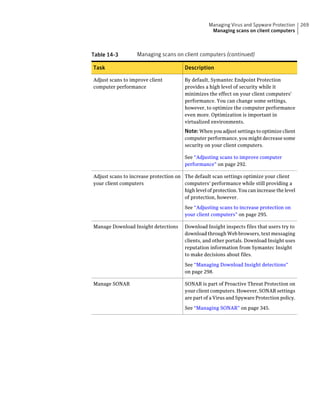
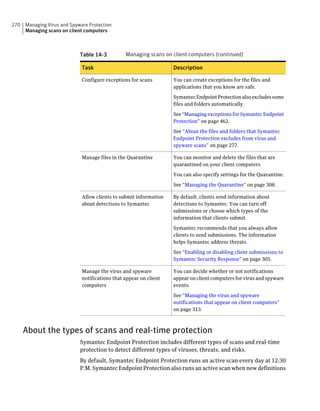
                  Managing scans on client computers ..............................................               267
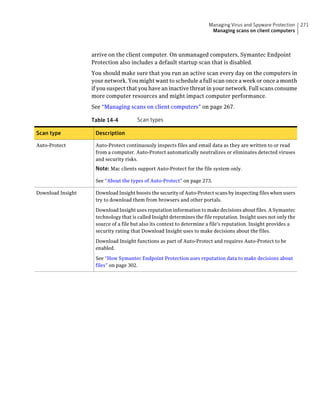
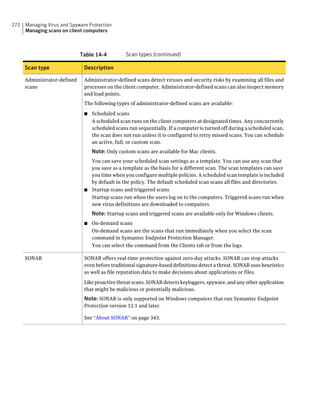
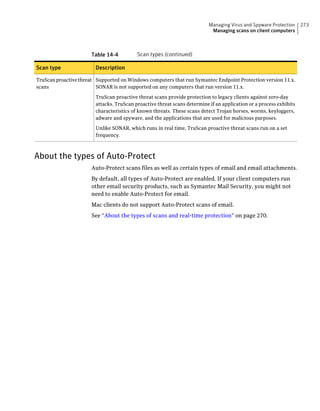
                      About the types of scans and real-time protection ......................                    270
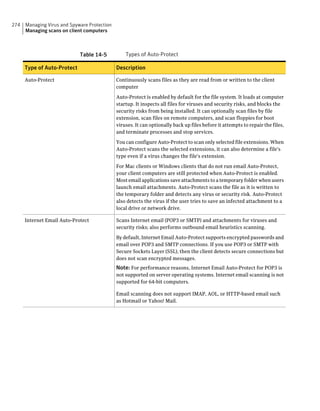
                      About the types of Auto-Protect ..............................................              273
                      About virus and security risks .................................................            275
                      About the files and folders that Symantec Endpoint Protection
                          excludes from virus and spyware scans ..............................                    277
                      About submitting information about detections to Symantec
                          Security Response ..........................................................            282
                      About submissions throttling .................................................              283
                      About the default Virus and Spyware Protection policy scan
                          settings ........................................................................       284
                      How Symantec Endpoint Protection handles detections of viruses
                          and security risks ...........................................................          287
Contents   13


             Setting up scheduled scans that run on Windows computers ..............                        288
             Setting up scheduled scans that run on Mac computers .....................                     290
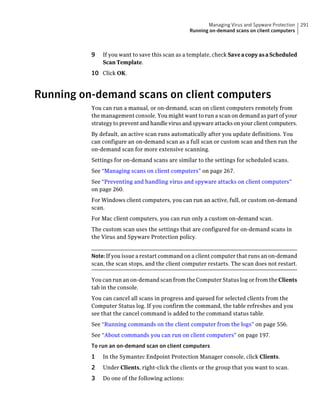
             Running on-demand scans on client computers ...............................                    291
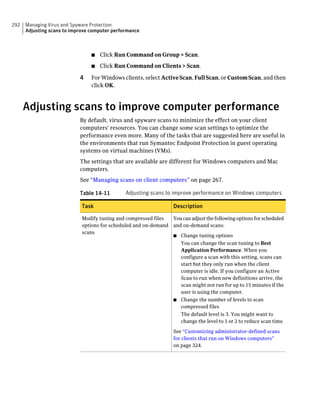
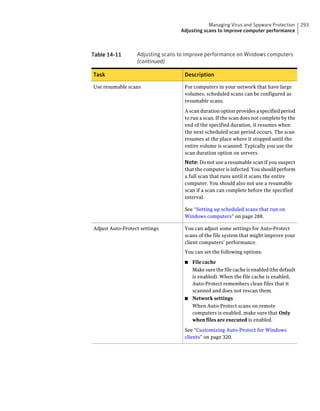
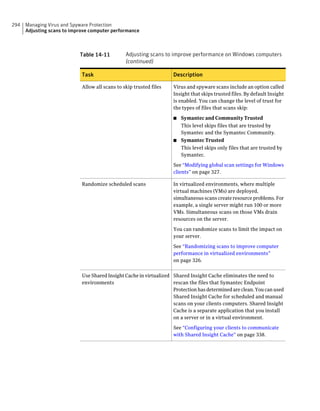
             Adjusting scans to improve computer performance ..........................                     292
             Adjusting scans to increase protection on your client computers .........                      295
             Managing Download Insight detections ..........................................                298
             How Symantec Endpoint Protection uses reputation data to make
                  decisions about files ..............................................................      302
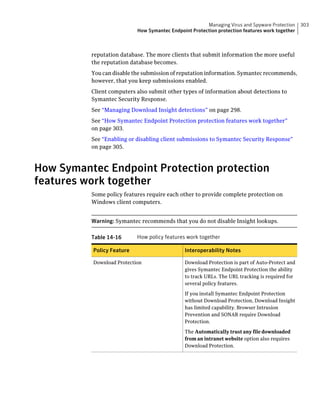
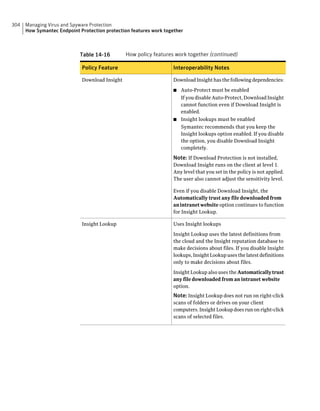
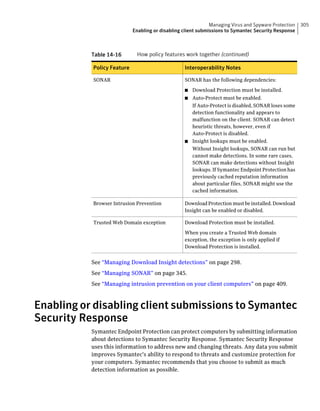
             How Symantec Endpoint Protection protection features work
                  together ..............................................................................   303
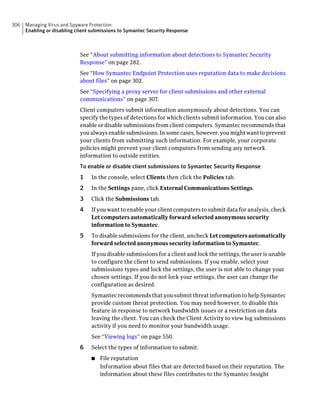
             Enabling or disabling client submissions to Symantec Security
                  Response ............................................................................     305
             Specifying a proxy server for client submissions and other external
                  communications ...................................................................        307
             Managing the Quarantine ............................................................           308
                  Specifying a local Quarantine folder ........................................             310
                  Specify when quarantined files are automatically deleted ............                     311
                  Configuring clients to submit quarantined items to a Central
                      Quarantine Server or Symantec Security Response ...............                       311
                  Configuring how the Quarantine handles the rescanning of files
                      after new definitions arrive ..............................................           312
                  Using the Risk log to delete quarantined files on your client
                      computers .....................................................................       313
             Managing the virus and spyware notifications that appear on client
                  computers ...........................................................................     313

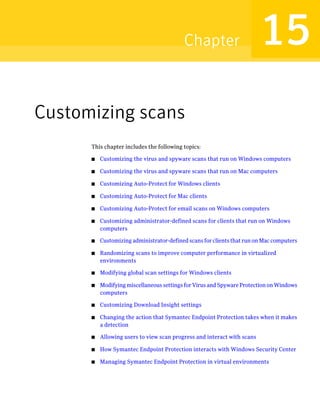
Chapter 15   Customizing scans                 ............................................................ 317

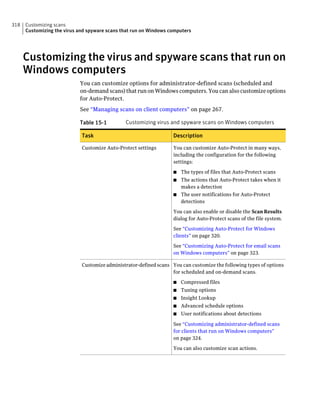
             Customizing the virus and spyware scans that run on Windows
                 computers ...........................................................................      318
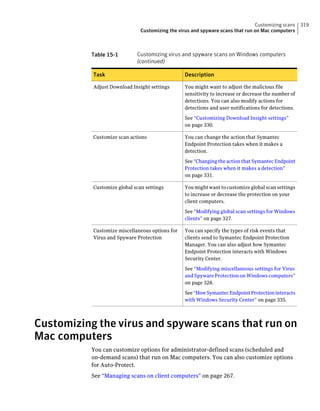
             Customizing the virus and spyware scans that run on Mac
                 computers ...........................................................................      319
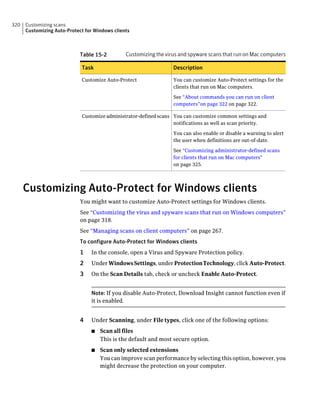
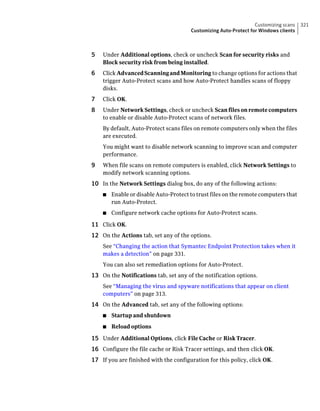
             Customizing Auto-Protect for Windows clients ................................                  320
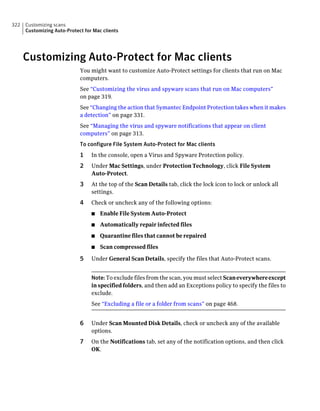
             Customizing Auto-Protect for Mac clients .......................................               322
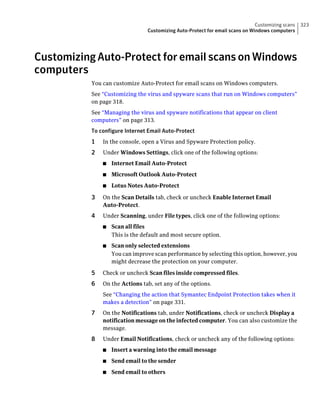
             Customizing Auto-Protect for email scans on Windows
                 computers ...........................................................................      323
             Customizing administrator-defined scans for clients that run on
                 Windows computers .............................................................            324
             Customizing administrator-defined scans for clients that run on Mac
                 computers ...........................................................................      325
             Randomizing scans to improve computer performance in virtualized
                 environments ......................................................................        326
             Modifying global scan settings for Windows clients ..........................                  327
14   Contents


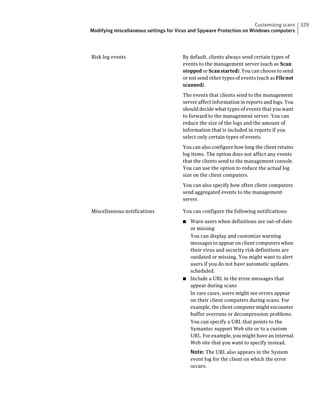
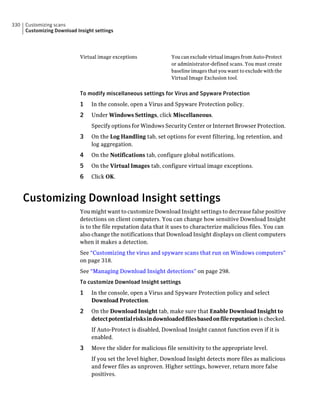
                  Modifying miscellaneous settings for Virus and Spyware Protection
                      on Windows computers .........................................................            328
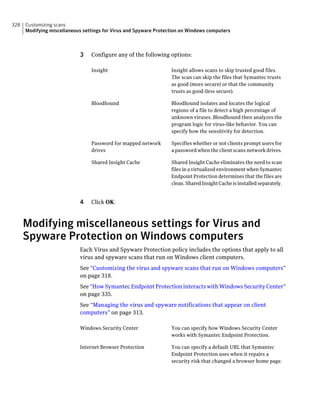
                  Customizing Download Insight settings ..........................................              330
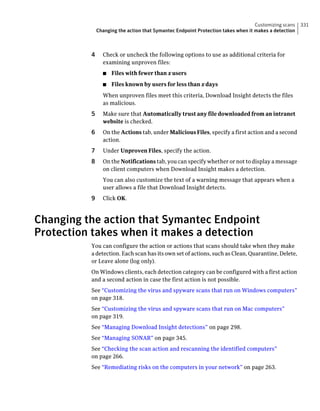
                  Changing the action that Symantec Endpoint Protection takes when
                      it makes a detection ..............................................................       331
                  Allowing users to view scan progress and interact with scans .............                    333
                  How Symantec Endpoint Protection interacts with Windows Security
                      Center ................................................................................   335
                  Managing Symantec Endpoint Protection in virtual
                      environments ......................................................................       337
                      Configuring your clients to communicate with Shared Insight
                          Cache ...........................................................................     338
                      Using the Virtual Image Exception tool on a base image ..............                     340
                      Bypassing the scanning of base image files ................................               341

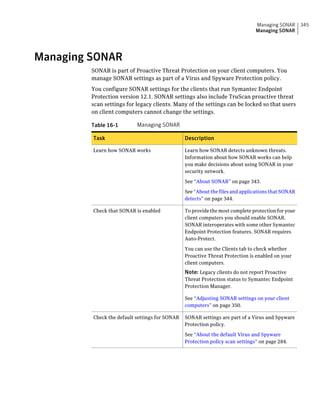
     Chapter 16   Managing SONAR                  .............................................................. 343

                  About SONAR ............................................................................      343
                  About the files and applications that SONAR detects .........................                 344
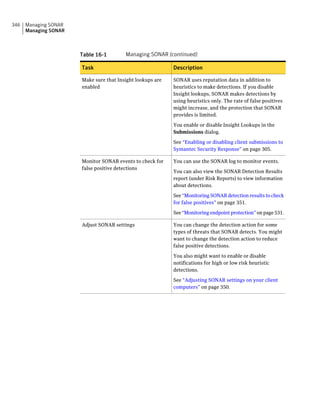
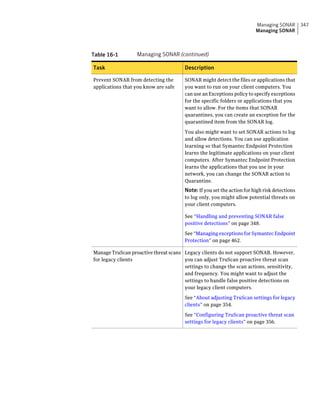
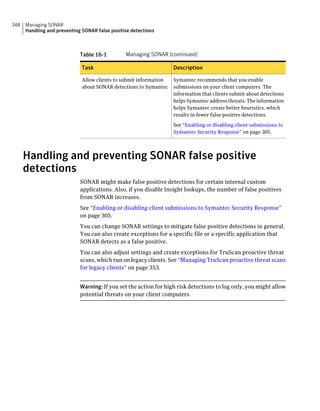
                  Managing SONAR .......................................................................        345
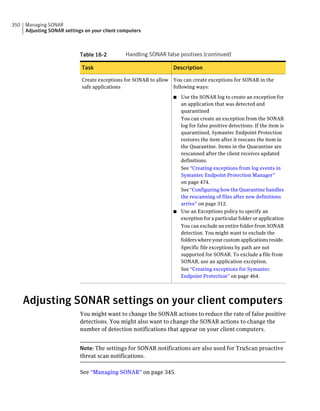
                  Handling and preventing SONAR false positive detections .................                     348
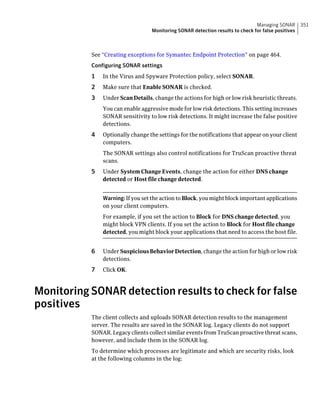
                  Adjusting SONAR settings on your client computers .........................                   350
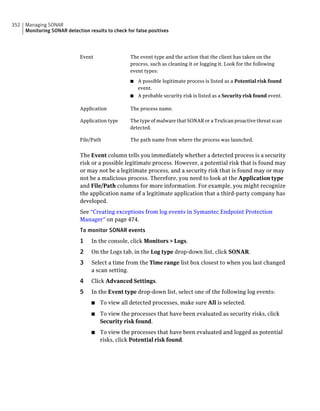
                  Monitoring SONAR detection results to check for false positives .........                     351
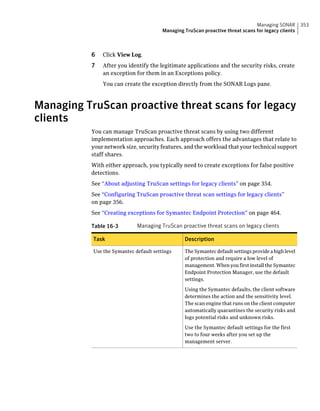
                  Managing TruScan proactive threat scans for legacy clients ...............                    353
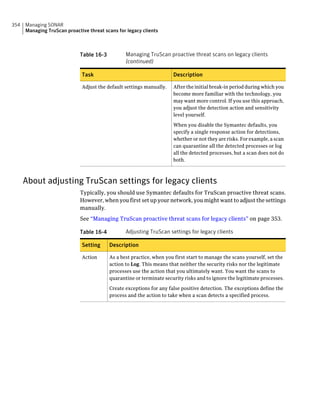
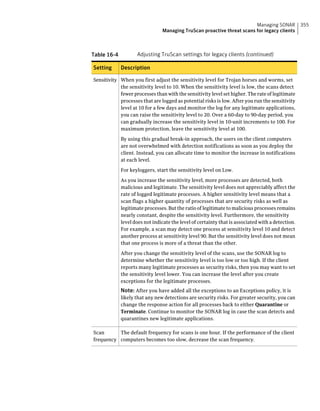
                      About adjusting TruScan settings for legacy clients ....................                  354
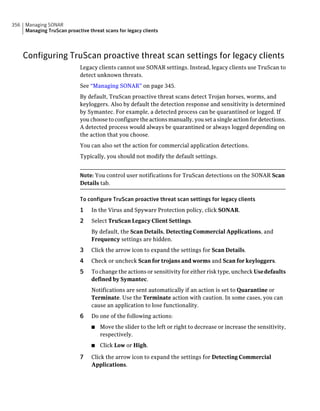
                      Configuring TruScan proactive threat scan settings for legacy
                          clients ..........................................................................    356

     Chapter 17   Managing Tamper Protection ......................................... 359
                  About Tamper Protection ............................................................. 359
                  Changing Tamper Protection settings ............................................ 360

     Chapter 18   Managing firewall protection .......................................... 363
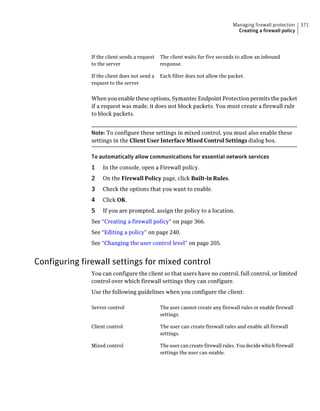
                  Managing firewall protection ........................................................         363
                      How a firewall works .............................................................        365
                      About the Symantec Endpoint Protection firewall ......................                    365
                  Creating a firewall policy .............................................................      366
                      Enabling and disabling a firewall policy ....................................             370
                      Automatically allowing communications for essential network
                          services ........................................................................     370
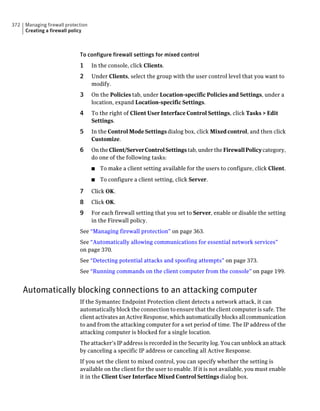
                      Configuring firewall settings for mixed control ..........................                371
Contents   15


                  Automatically blocking connections to an attacking
                      computer ......................................................................    372
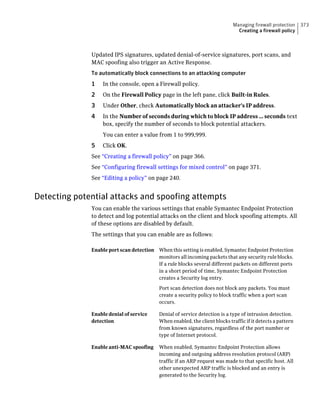
                  Detecting potential attacks and spoofing attempts .....................                373
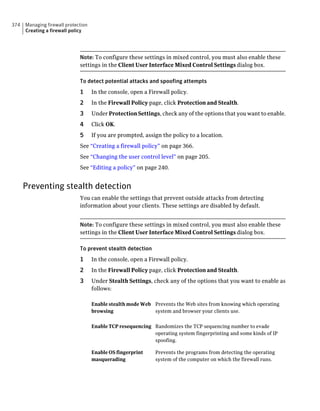
                  Preventing stealth detection ...................................................       374
                  Disabling the Windows firewall ...............................................         375
                  Configuring peer-to-peer authentication ...................................            376
             About firewall rules ....................................................................   378
                  About firewall server rules and client rules ...............................           379
                  About the firewall rule, firewall setting, and intrusion prevention
                      processing order ............................................................      380
                  About inherited firewall rules .................................................       381
                  Changing the order of firewall rules .........................................         383
                  How the firewall uses stateful inspection ..................................           384
                  About firewall rule application triggers ....................................          384
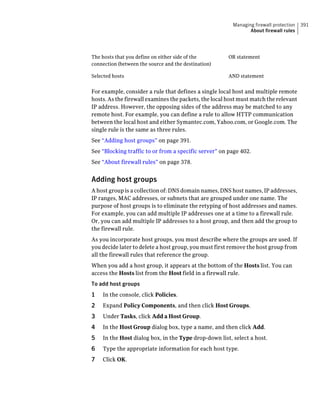
                  About firewall rule host triggers ..............................................       389
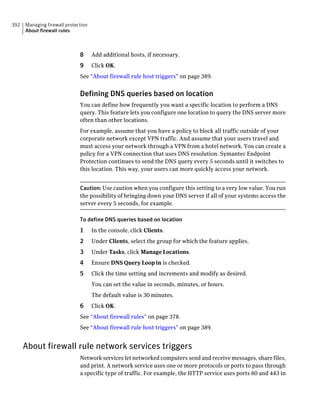
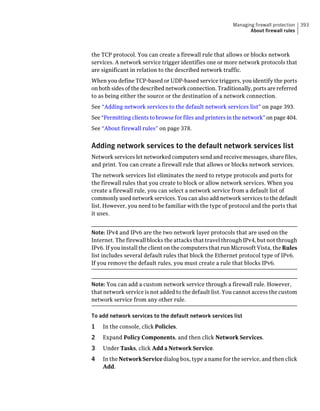
                  About firewall rule network services triggers .............................            392
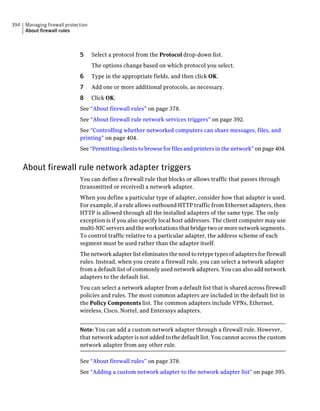
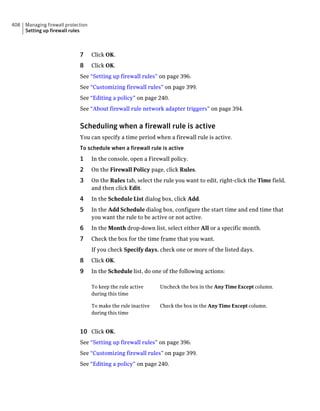
                  About firewall rule network adapter triggers .............................             394
             Setting up firewall rules ..............................................................    396
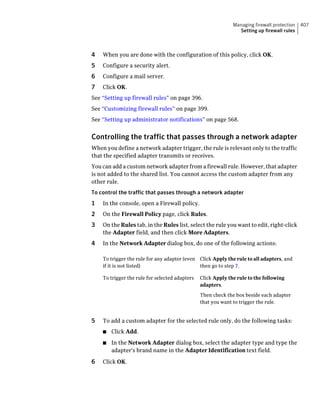
                  Adding a new firewall rule ......................................................      396
                  Importing and exporting firewall rules .....................................           398
                  Copying and pasting firewall rules ...........................................         399
                  Customizing firewall rules .....................................................       399

Chapter 19   Managing intrusion prevention ...................................... 409
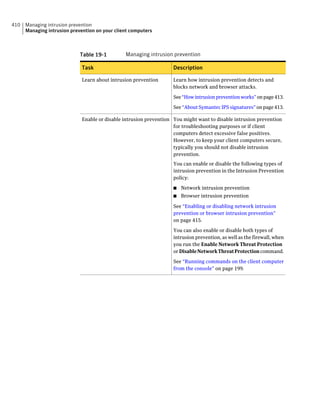
             Managing intrusion prevention on your client computers ..................                   409
             How intrusion prevention works ...................................................          413
             About Symantec IPS signatures .....................................................         413
             About custom IPS signatures ........................................................        414
             Enabling or disabling network intrusion prevention or browser
                  intrusion prevention .............................................................     415
             Creating exceptions for IPS signatures ...........................................          415
             Setting up a list of excluded computers ...........................................         417
             Configuring client intrusion prevention notifications ........................              418
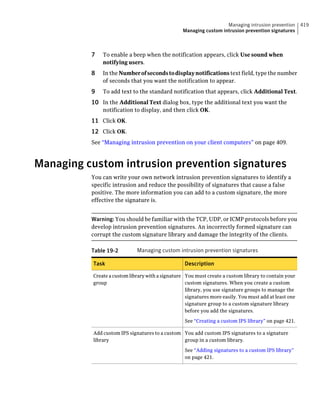
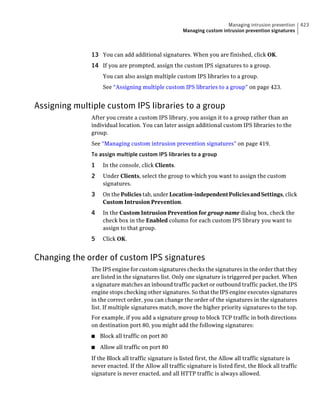
             Managing custom intrusion prevention signatures ...........................                 419
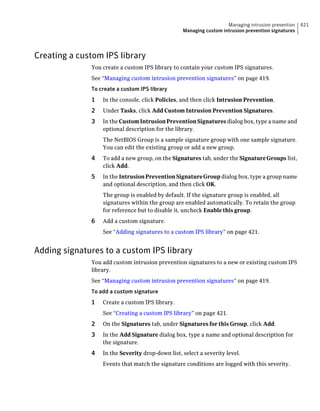
                  Creating a custom IPS library .................................................        421
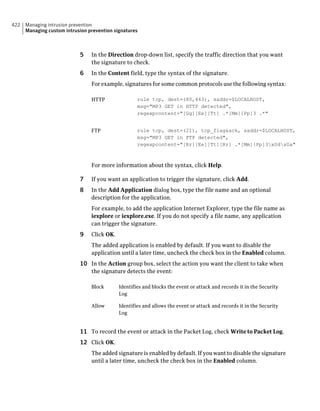
                  Adding signatures to a custom IPS library .................................            421
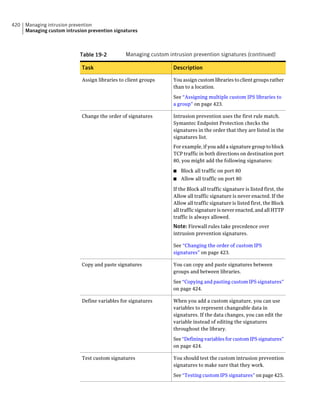
                  Assigning multiple custom IPS libraries to a group .....................               423
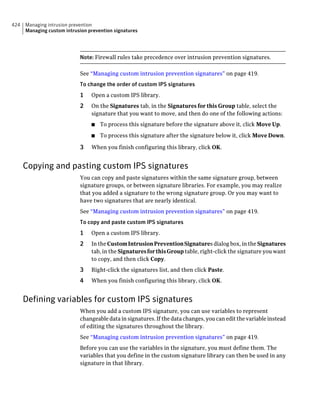
                  Changing the order of custom IPS signatures .............................              423
                  Copying and pasting custom IPS signatures ...............................              424
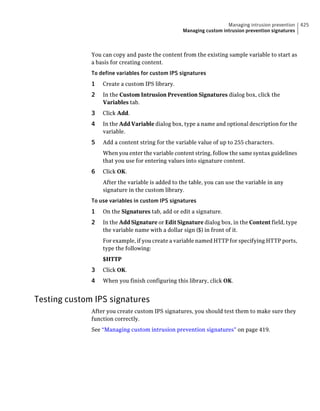
                  Defining variables for custom IPS signatures .............................             424
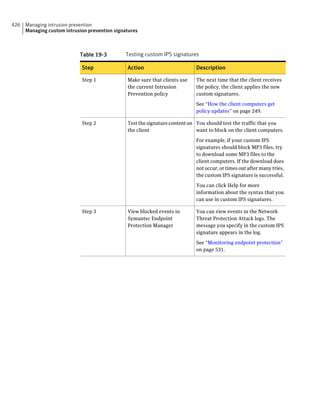
                  Testing custom IPS signatures ................................................         425
16   Contents


     Chapter 20   Managing application and device control .................... 427
                  About application and device control .............................................             427
                  About Application and Device Control policies .................................                429
                  About the structure of an Application and Device Control policy .........                      429
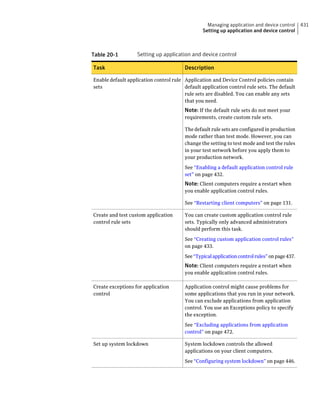
                  Setting up application and device control ........................................             430
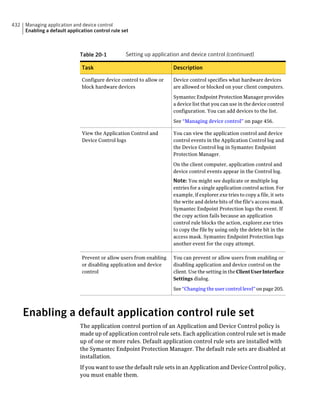
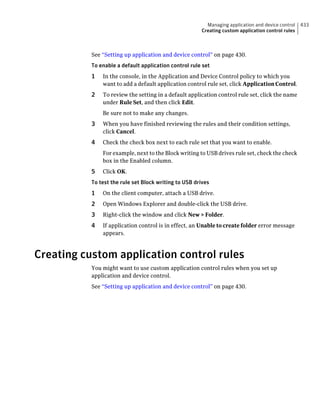
                  Enabling a default application control rule set .................................              432
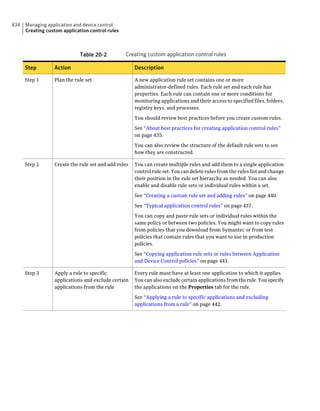
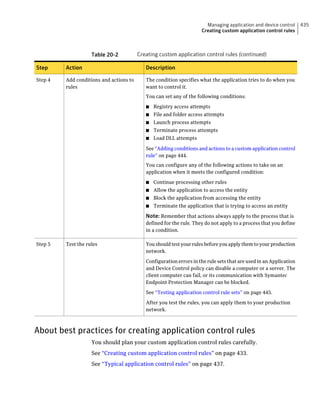
                  Creating custom application control rules .......................................              433
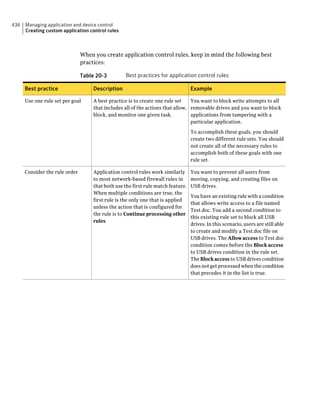
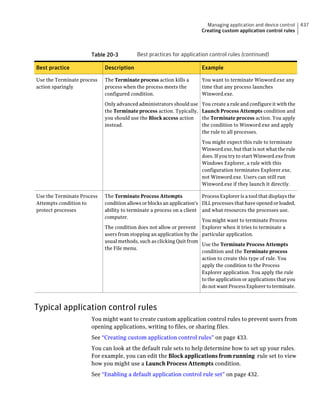
                       About best practices for creating application control rules ...........                   435
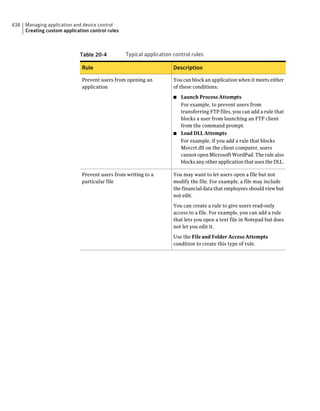
                       Typical application control rules .............................................           437
                       Creating a custom rule set and adding rules ...............................               440
                       Copying application rule sets or rules between Application and
                           Device Control policies ....................................................          441
                       Applying a rule to specific applications and excluding
                           applications from a rule ...................................................          442
                       Adding conditions and actions to a custom application control
                           rule ..............................................................................   444
                       Testing application control rule sets ........................................            445
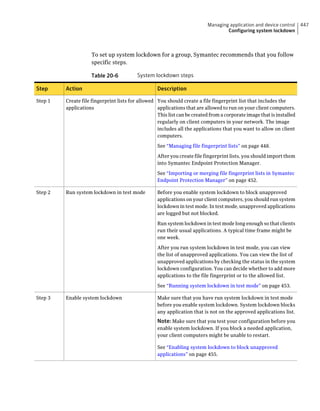
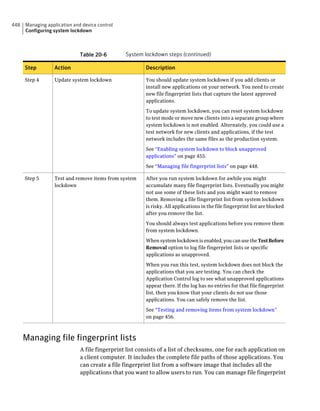
                  Configuring system lockdown .......................................................            446
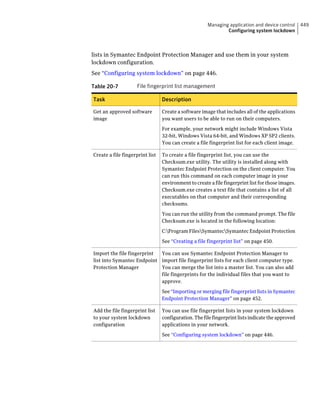
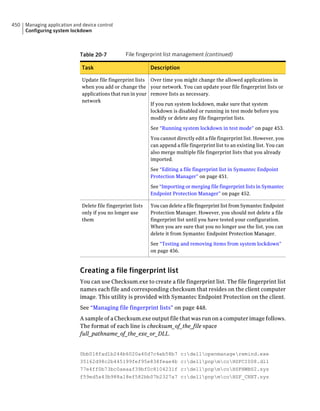
                       Managing file fingerprint lists ................................................          448
                       Running system lockdown in test mode ....................................                 453
                       Enabling system lockdown to block unapproved
                           applications ..................................................................       455
                       Testing and removing items from system lockdown ....................                      456
                  Managing device control ..............................................................         456
                       About the hardware devices list ..............................................            457
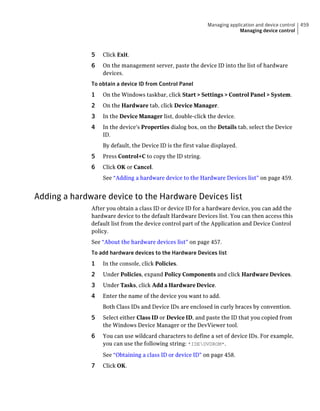
                       Obtaining a class ID or device ID .............................................           458
                       Adding a hardware device to the Hardware Devices list ...............                     459
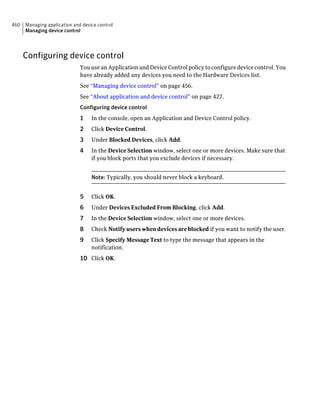
                       Configuring device control .....................................................          460

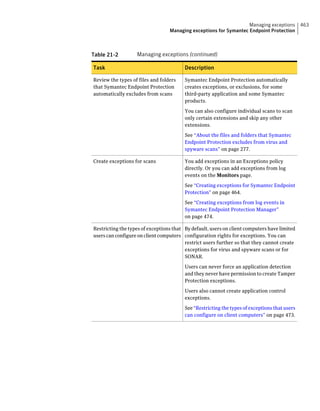
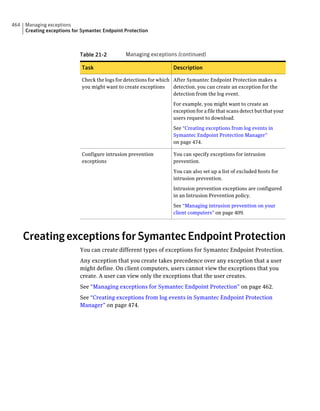
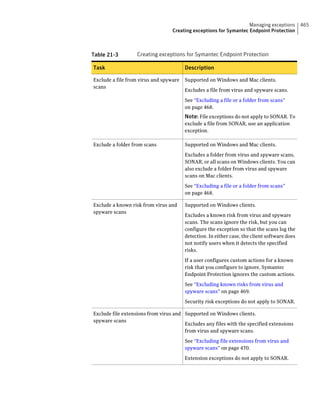
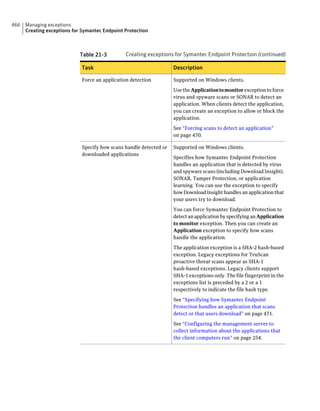
     Chapter 21   Managing exceptions ........................................................ 461
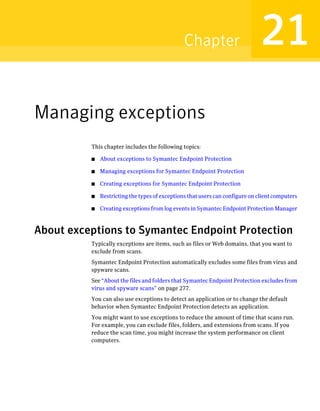
                  About exceptions to Symantec Endpoint Protection ..........................                    461
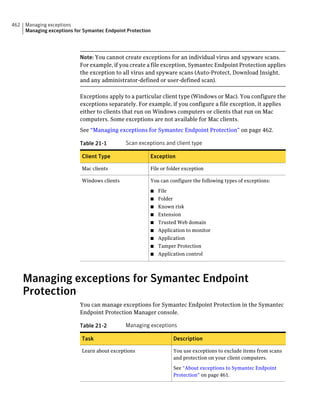
                  Managing exceptions for Symantec Endpoint Protection ...................                       462
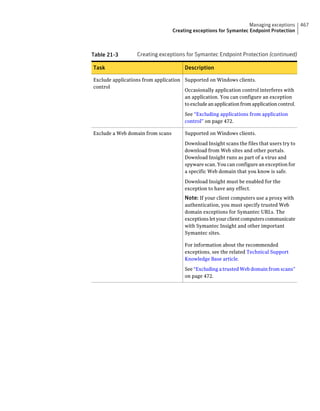
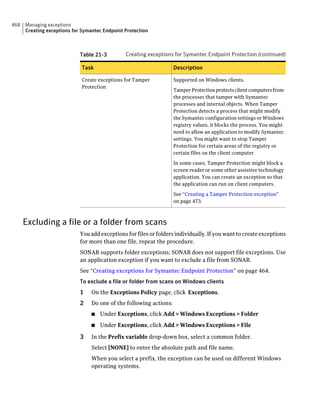
                  Creating exceptions for Symantec Endpoint Protection .....................                     464
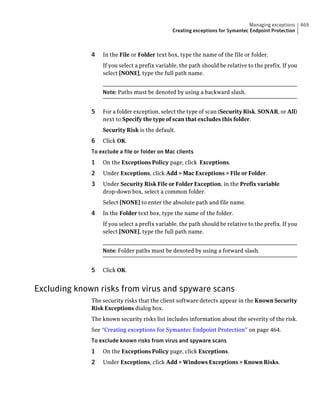
                      Excluding a file or a folder from scans ......................................             468
                      Excluding known risks from virus and spyware scans ..................                      469
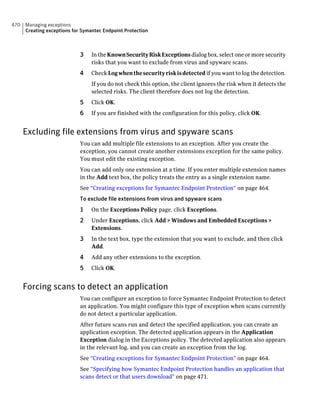
                      Excluding file extensions from virus and spyware scans ..............                      470
                      Forcing scans to detect an application ......................................              470
                      Specifying how Symantec Endpoint Protection handles an
                          application that scans detect or that users download .............                     471
                      Excluding a trusted Web domain from scans ..............................                   472
                      Excluding applications from application control ........................                   472
                      Creating a Tamper Protection exception ...................................                 473
Contents   17


             Restricting the types of exceptions that users can configure on client
                 computers ........................................................................... 473
             Creating exceptions from log events in Symantec Endpoint Protection
                 Manager ............................................................................. 474

Chapter 22   Configuring updates and updating client computer
                protection ...................................................................... 477
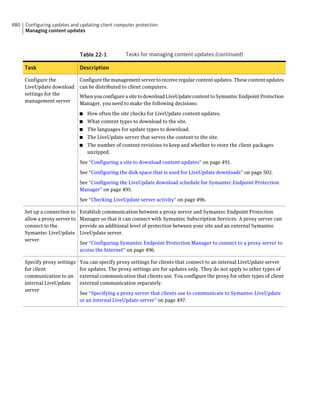
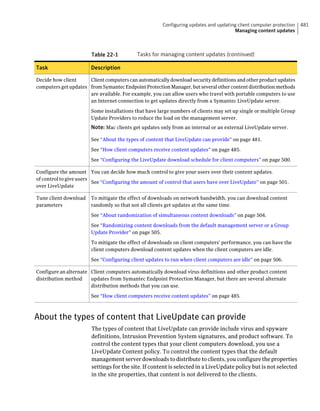
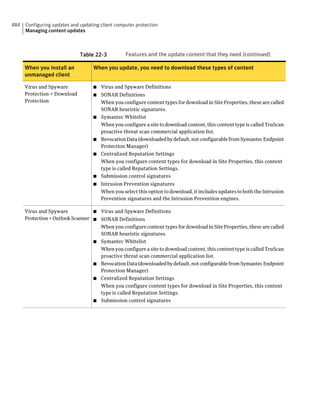
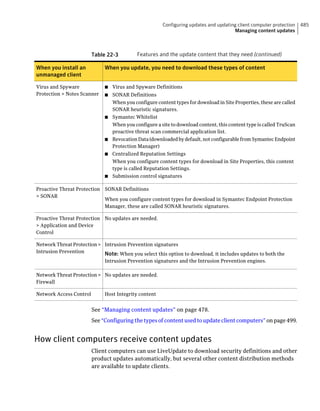
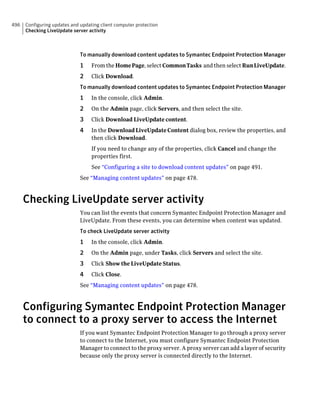
             Managing content updates ...........................................................            478
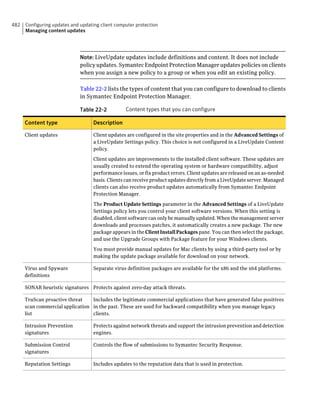
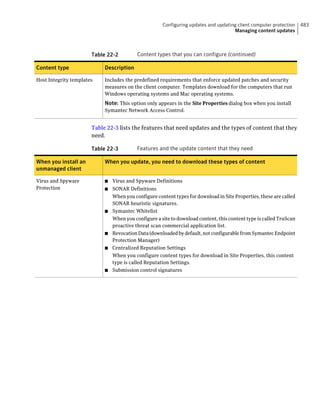
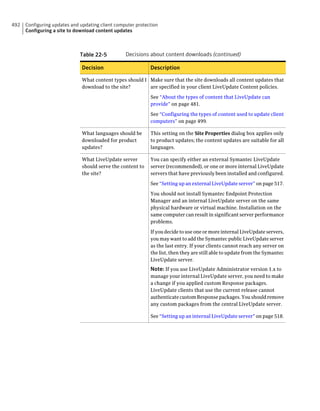
                 About the types of content that LiveUpdate can provide ..............                       481
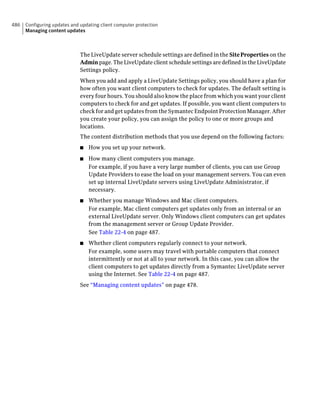
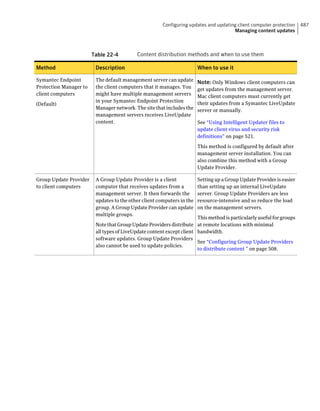
                 How client computers receive content updates ...........................                    485
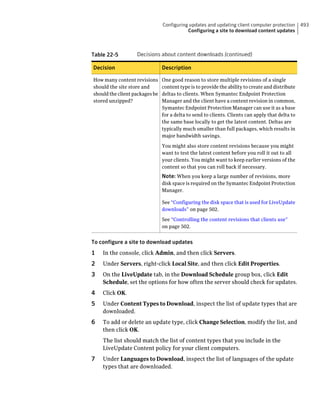
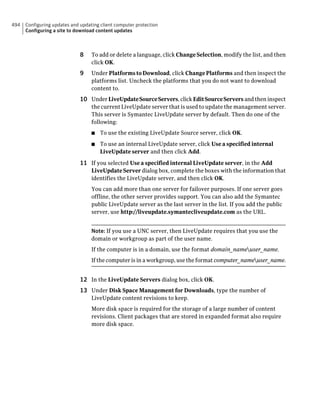
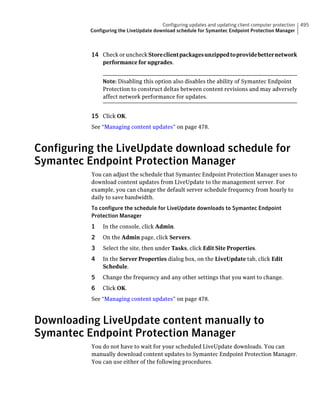
             Configuring a site to download content updates ...............................                  491
             Configuring the LiveUpdate download schedule for Symantec
                 Endpoint Protection Manager .................................................               495
             Downloading LiveUpdate content manually to Symantec Endpoint
                 Protection Manager ..............................................................           495
             Checking LiveUpdate server activity ..............................................              496
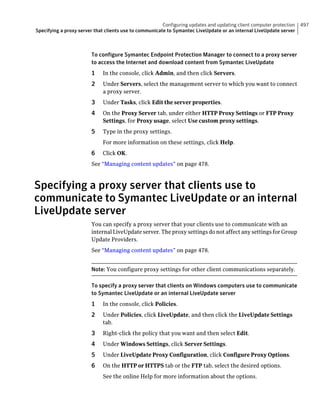
             Configuring Symantec Endpoint Protection Manager to connect to a
                 proxy server to access the Internet ..........................................              496
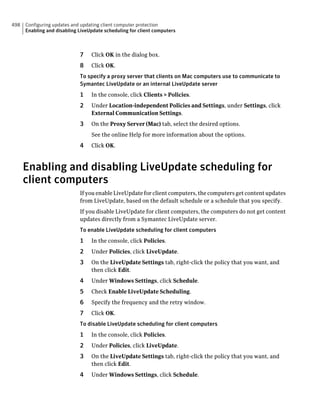
             Specifying a proxy server that clients use to communicate to
                 Symantec LiveUpdate or an internal LiveUpdate server ...............                        497
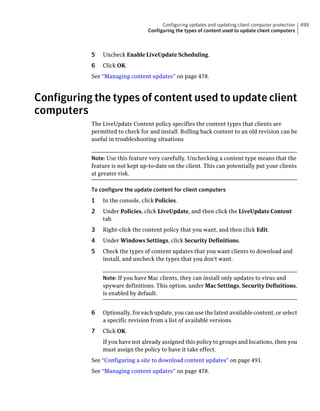
             Enabling and disabling LiveUpdate scheduling for client
                 computers ...........................................................................       498
             Configuring the types of content used to update client
                 computers ...........................................................................       499
             Configuring the LiveUpdate download schedule for client
                 computers ...........................................................................       500
             Configuring the amount of control that users have over
                 LiveUpdate ..........................................................................       501
             Controlling the content revisions that clients use .............................                502
             Configuring the disk space that is used for LiveUpdate
                 downloads ...........................................................................       502
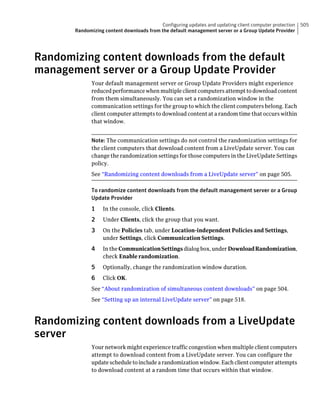
             About randomization of simultaneous content downloads .................                         504
             Randomizing content downloads from the default management server
                 or a Group Update Provider ....................................................             505
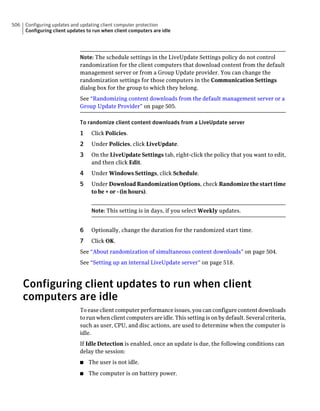
             Randomizing content downloads from a LiveUpdate server ................                         505
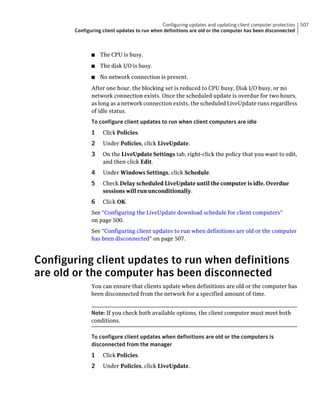
             Configuring client updates to run when client computers are
                 idle ....................................................................................   506
             Configuring client updates to run when definitions are old or the
                 computer has been disconnected .............................................                507
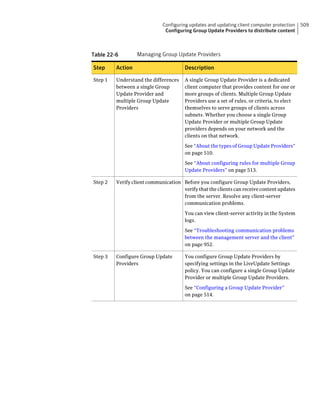
             Configuring Group Update Providers to distribute content ................                       508
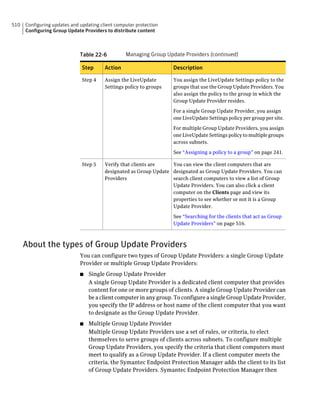
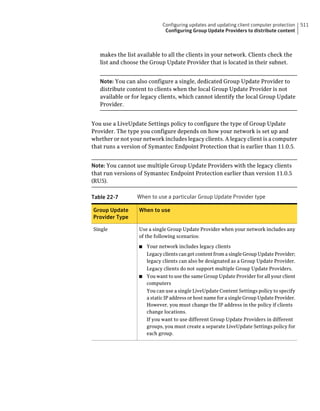
                 About the types of Group Update Providers ...............................                   510
18   Contents


                       About Group Update Providers and legacy software
                            releases ........................................................................    512
                       About configuring rules for multiple Group Update
                            Providers ......................................................................     513
                       Configuring a Group Update Provider ......................................                514
                       Searching for the clients that act as Group Update
                            Providers ......................................................................     516
                  Setting up an external LiveUpdate server ........................................              517
                  Setting up an internal LiveUpdate server ........................................              518
                  Using Intelligent Updater files to update client virus and security
                       risk definitions ....................................................................     521
                  Using third-party distribution tools to update client computers ..........                     522
                       Configuring a LiveUpdate Settings policy to allow third-party
                            content distribution to managed clients ..............................               523
                       Preparing unmanaged clients to receive updates from third-party
                            distribution tools ............................................................      524
                       Distributing the content using third-party distribution
                            tools ............................................................................   526

     Chapter 23   Monitoring protection with reports and logs ............... 531
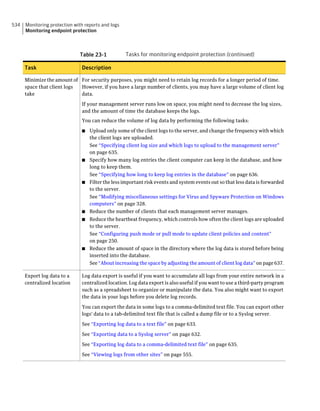
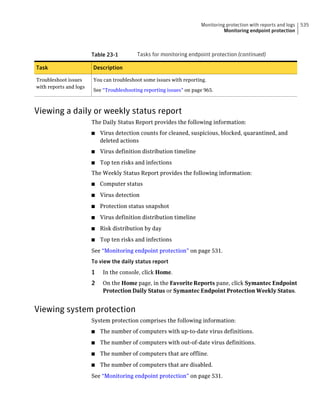
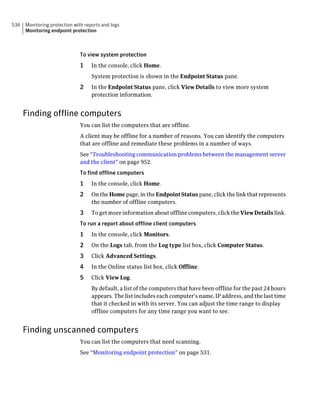
                  Monitoring endpoint protection ....................................................            531
                       Viewing a daily or weekly status report ....................................              535
                       Viewing system protection .....................................................           535
                       Finding offline computers ......................................................          536
                       Finding unscanned computers ................................................              536
                       Viewing risks .......................................................................     537
                       Viewing client inventory ........................................................         538
                       Viewing attack targets and sources ..........................................             538
                  Configuring reporting preferences .................................................            539
                  Logging on to reporting from a stand-alone Web browser ..................                      540
                  About the types of reports ............................................................        541
                  Running and customizing quick reports .........................................                544
                  Saving and deleting custom reports ...............................................             545
                  Creating scheduled reports ...........................................................         547
                  Editing the filter used for a scheduled report ...................................             548
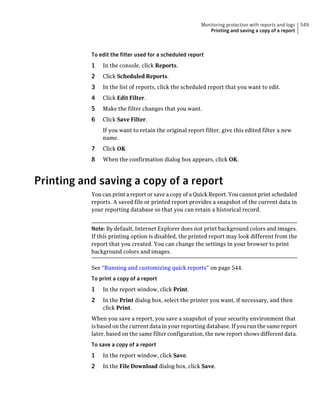
                  Printing and saving a copy of a report ............................................            549
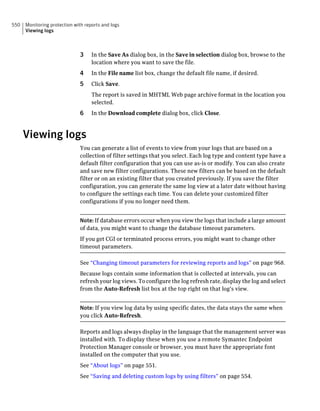
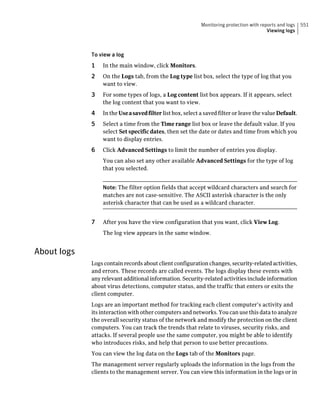
                  Viewing logs ..............................................................................    550
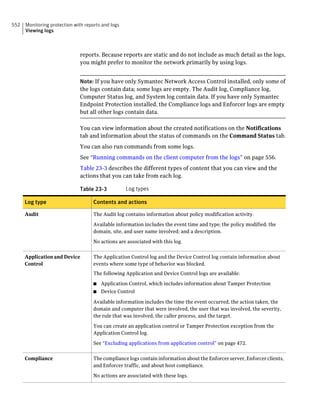
                       About logs ...........................................................................    551
                       Saving and deleting custom logs by using filters .........................                554
                       Viewing logs from other sites .................................................           555
                  Running commands on the client computer from the logs ..................                       556
Contents   19


Chapter 24   Managing notifications                   .................................................... 559

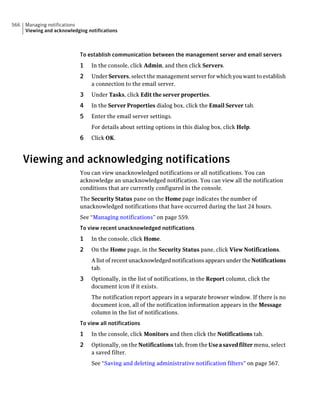
             Managing notifications ................................................................       559
                  How notifications work .........................................................         560
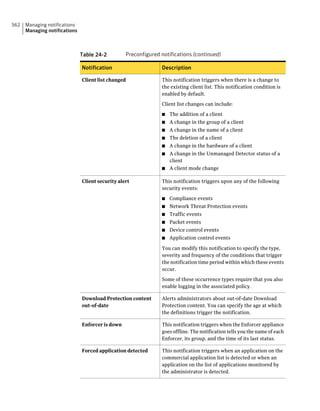
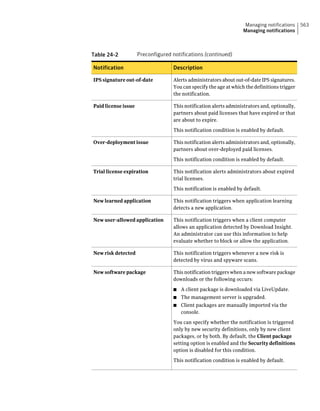
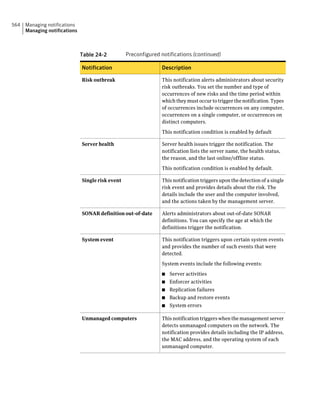
                  About the preconfigured notifications ......................................             561
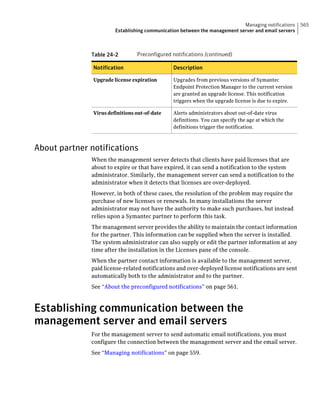
                  About partner notifications ....................................................         565
             Establishing communication between the management server and
                  email servers .......................................................................    565
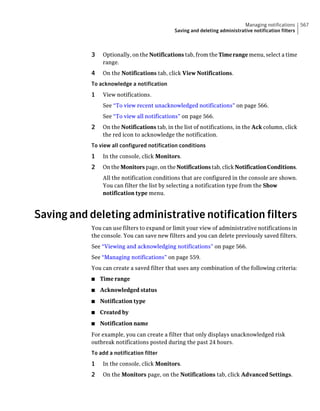
             Viewing and acknowledging notifications .......................................               566
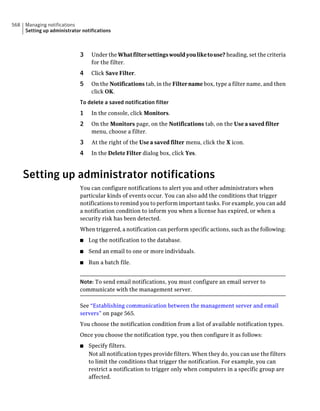
             Saving and deleting administrative notification filters ......................                567
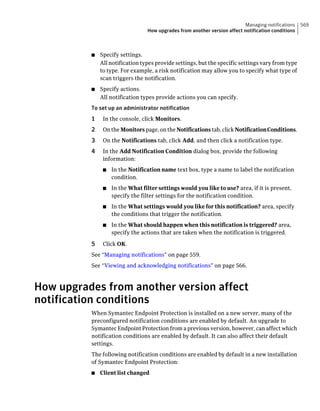
             Setting up administrator notifications ............................................           568
             How upgrades from another version affect notification
                  conditions ...........................................................................   569

Chapter 25   Managing domains ............................................................ 573
             About domains ...........................................................................     573
             Adding a domain ........................................................................      575
                  Adding a domain logon banner ................................................            575
             Setting the current domain ..........................................................         576

Chapter 26   Managing administrator accounts ................................. 579
             Managing domains and administrator accounts ...............................                   580
             About administrators ..................................................................       581
             Adding an administrator account ..................................................            584
             About access rights .....................................................................     585
             Configuring the access rights for a domain administrator ..................                   586
             Configuring the access rights for a limited administrator ...................                 587
             Changing an administrator's type ..................................................           588
             Setting up authentication for administrator accounts .......................                  588
             Configuring the management server to authenticate administrators
                  who use RSA SecurID to log on ................................................           589
             Authenticating administrators who use RSA SecurID to log on to the
                  management server ..............................................................         590
             Specifying SecurID Authentication for a Symantec Endpoint
                  Protection Manager administrator ...........................................             591
             Changing an administrator password .............................................              591
             Allowing administrators to save logon credentials ............................                592
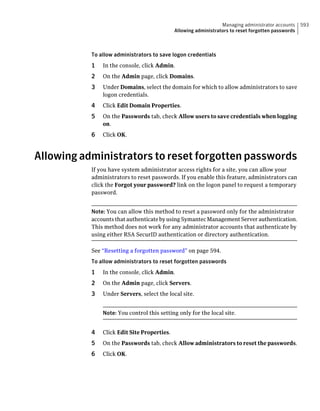
             Allowing administrators to reset forgotten passwords .......................                  593
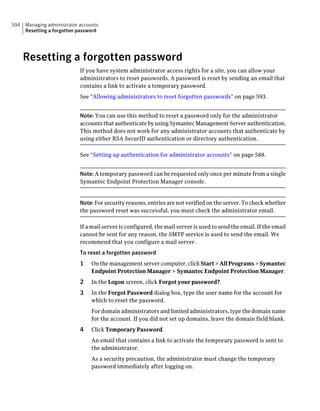
             Resetting a forgotten password .....................................................          594
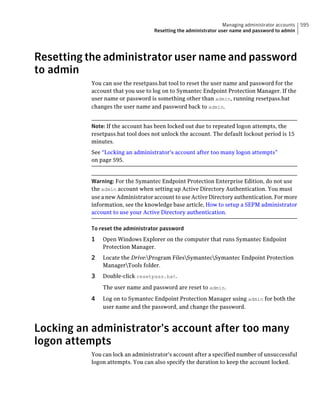
             Resetting the administrator user name and password to admin ...........                       595
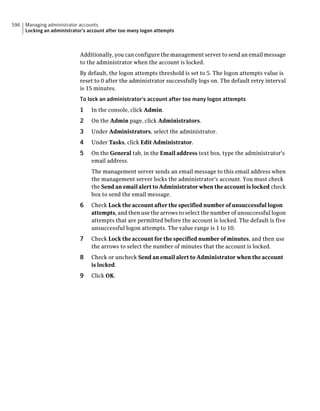
             Locking an administrator's account after too many logon
                  attempts .............................................................................   595
20   Contents


     Section 3    Maintaining your security
                    environment ............................................................ 597
     Chapter 27   Managing servers .............................................................. 599
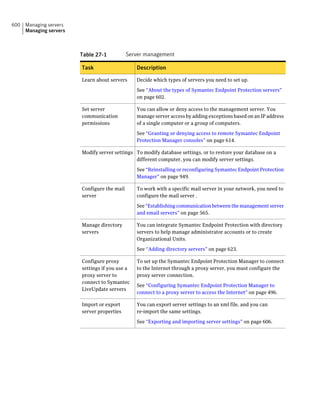
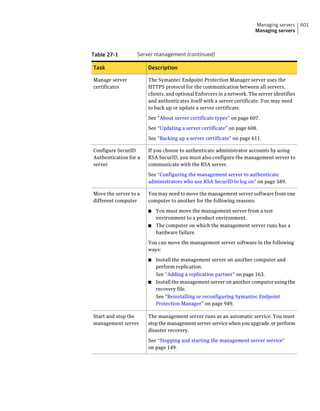
                  Managing servers .......................................................................         599
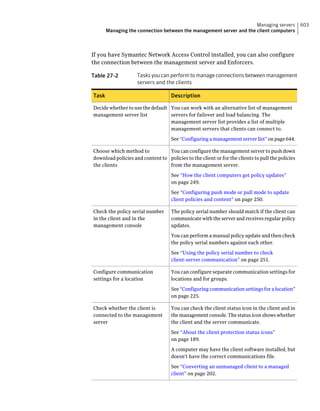
                  About the types of Symantec Endpoint Protection servers ..................                       602
                  Managing the connection between the management server and the
                      client computers ..................................................................          602
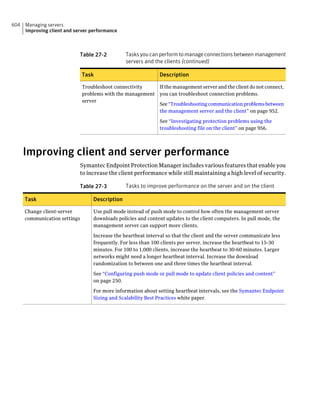
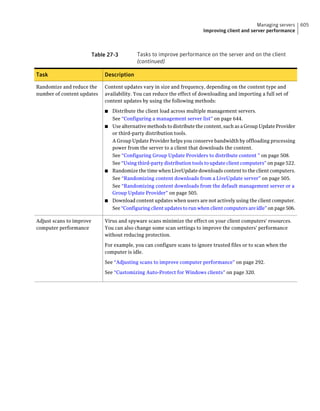
                  Improving client and server performance .......................................                  604
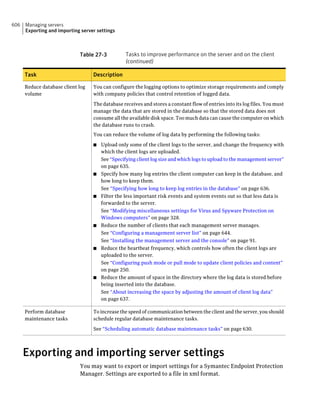
                  Exporting and importing server settings .........................................                606
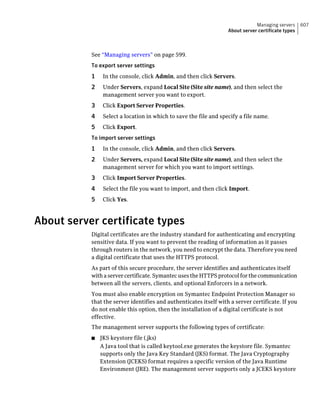
                  About server certificate types .......................................................           607
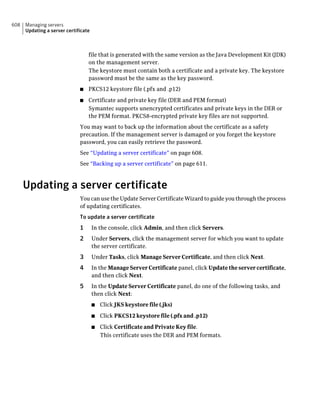
                  Updating a server certificate ........................................................           608
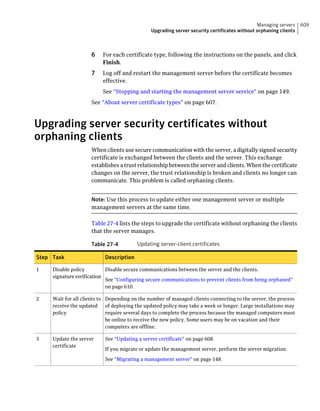
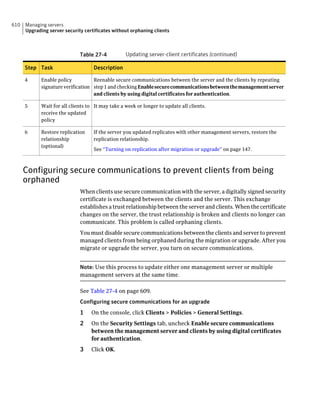
                  Upgrading server security certificates without orphaning
                      clients ................................................................................     609
                      Configuring secure communications to prevent clients from
                           being orphaned ..............................................................           610
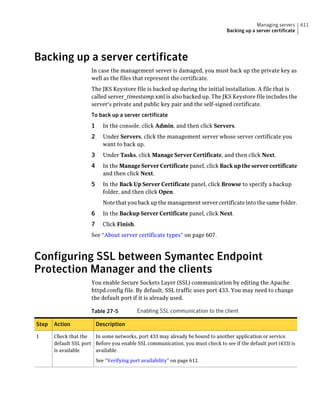
                  Backing up a server certificate ......................................................           611
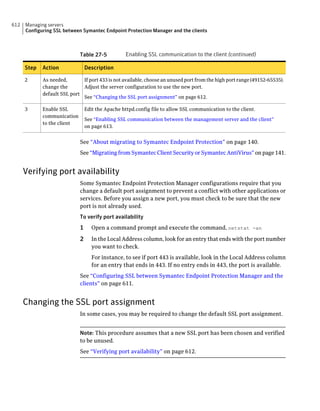
                  Configuring SSL between Symantec Endpoint Protection Manager
                      and the clients .....................................................................        611
                      Verifying port availability ......................................................           612
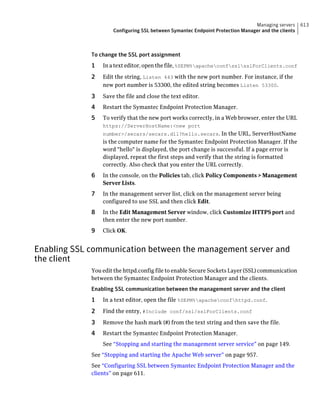
                      Changing the SSL port assignment ..........................................                  612
                      Enabling SSL communication between the management server
                           and the client .................................................................        613
                  Granting or denying access to remote Symantec Endpoint Protection
                      Manager consoles .................................................................           614

     Chapter 28   Managing directory servers ............................................. 617
                  About organizational units and the LDAP server ..............................                    617
                  About synchronizing organizational units ......................................                  618
                  About importing user and computer account information from an
                      LDAP directory server ...........................................................            618
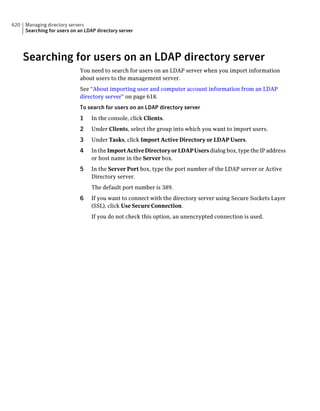
                  Synchronizing user accounts between directory servers and Symantec
                      Endpoint Protection Manager .................................................                619
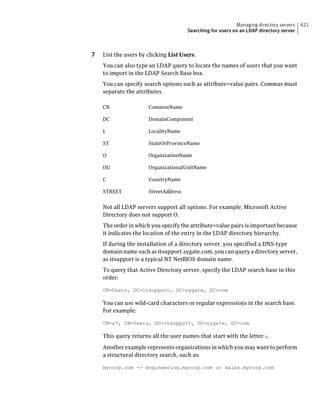
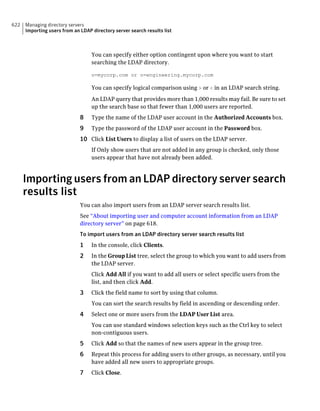
                  Searching for users on an LDAP directory server ..............................                   620
                  Importing users from an LDAP directory server search results
                      list .....................................................................................   622
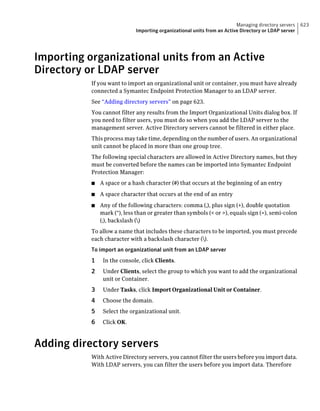
                  Importing organizational units from an Active Directory or LDAP
                      server .................................................................................     623
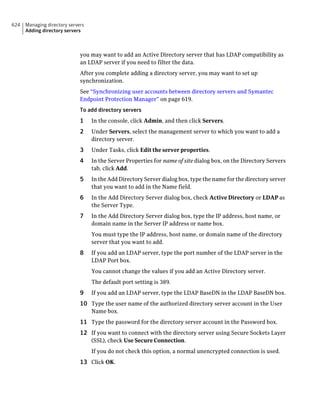
                  Adding directory servers ..............................................................          623
Contents   21


Chapter 29   Managing databases ......................................................... 625
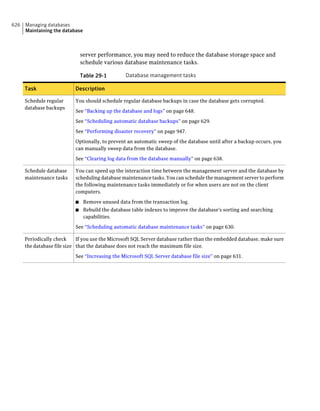
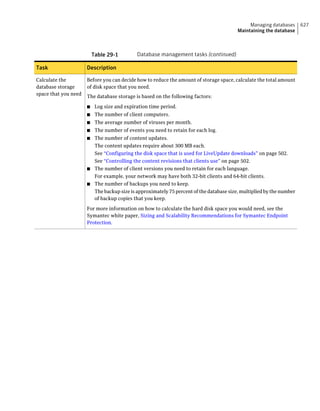
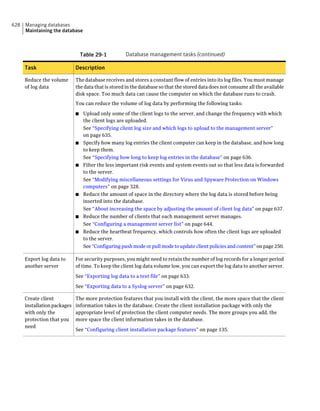
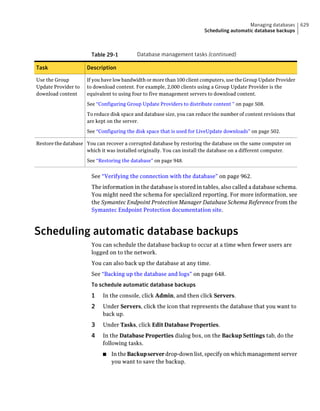
             Maintaining the database .............................................................         625
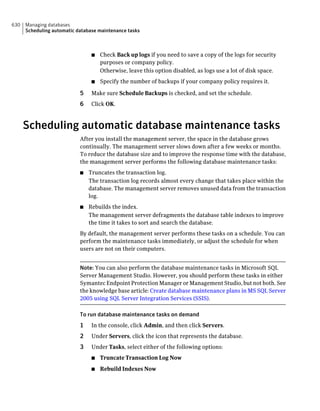
             Scheduling automatic database backups .........................................                629
             Scheduling automatic database maintenance tasks ...........................                    630
                 Increasing the Microsoft SQL Server database file size ................                    631
             Exporting data to a Syslog server ..................................................           632
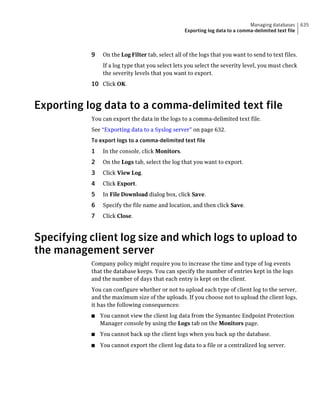
             Exporting log data to a text file .....................................................        633
             Exporting log data to a comma-delimited text file .............................                635
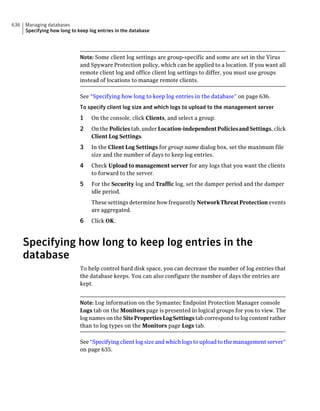
             Specifying client log size and which logs to upload to the management
                 server .................................................................................   635
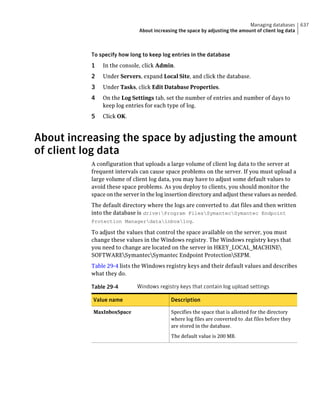
             Specifying how long to keep log entries in the database .....................                  636
             About increasing the space by adjusting the amount of client log
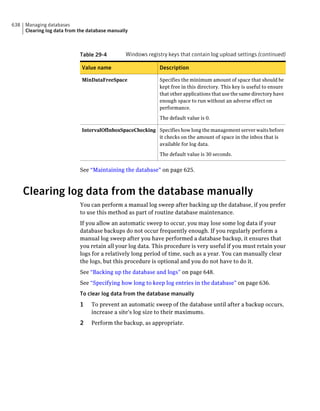
                 data ...................................................................................   637
             Clearing log data from the database manually ..................................                638

Chapter 30   Managing failover and load balancing .......................... 641
             Setting up failover and load balancing ............................................            641
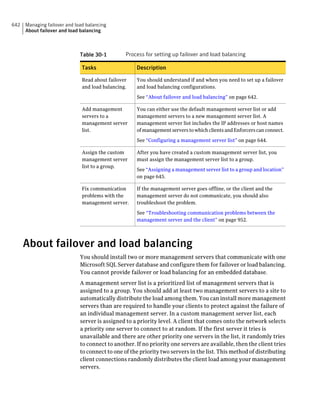
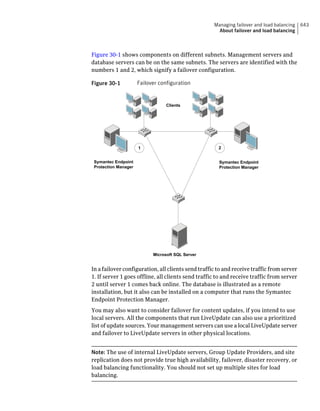
             About failover and load balancing ..................................................           642
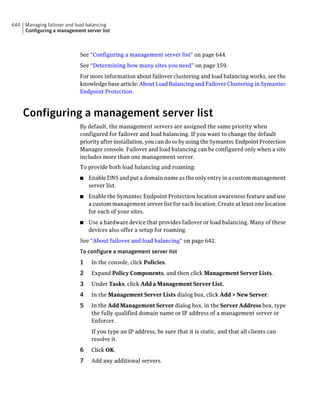
             Configuring a management server list ............................................              644
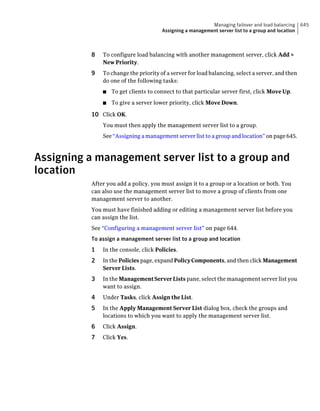
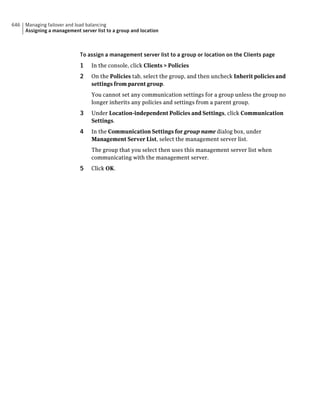
             Assigning a management server list to a group and location ...............                     645

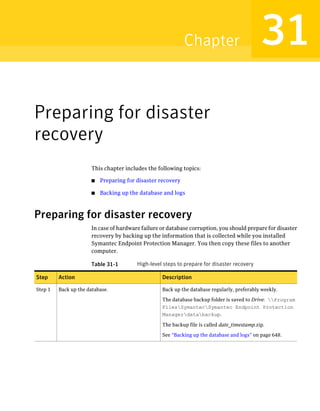
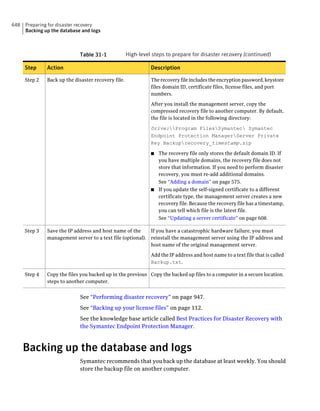
Chapter 31   Preparing for disaster recovery ...................................... 647
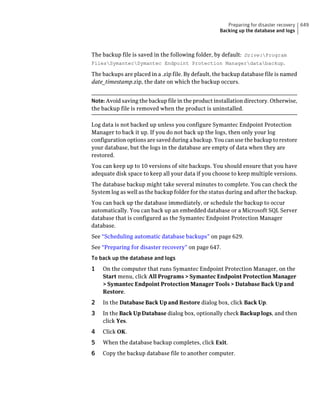
             Preparing for disaster recovery ..................................................... 647
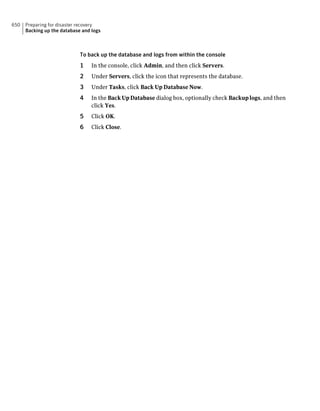
             Backing up the database and logs .................................................. 648


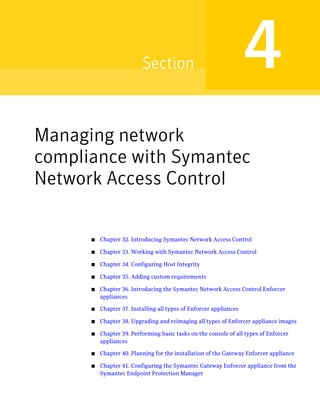
Section 4    Managing network compliance with
               Symantec Network Access Control ........... 651
Chapter 32   Introducing Symantec Network Access Control .......... 653
             About Symantec Network Access Control ........................................                 653
             About the types of enforcement in Symantec Network Access
                Control ...............................................................................     654
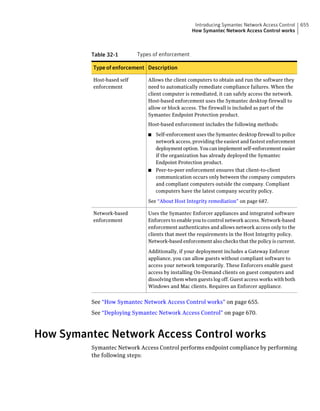
             How Symantec Network Access Control works .................................                    655
             How self enforcement works .........................................................           657
             How the Symantec Network Access Control Enforcer appliances work
                with Host Integrity policies ....................................................           659
                Communication between an Enforcer appliance and a Symantec
                     Endpoint Protection Manager ...........................................                659
                Communication between the Enforcer appliance and
                     clients ..........................................................................     660
22   Contents


                  How the Gateway Enforcer appliance works ....................................               661
                  How the LAN Enforcer appliance works ..........................................             662
                  How an Integrated Enforcer for Microsoft DHCP Servers works ..........                      664
                  How an Integrated Enforcer for Microsoft Network Access Protection
                     works with a Microsoft Network Policy Server (NPS) ...................                   665
                  How the On-Demand Client works .................................................            666

     Chapter 33   Working with Symantec Network Access
                    Control ........................................................................... 667
                  What you can do with Symantec Enforcer appliances ........................                  667
                  What you can do with Symantec Integrated Enforcers .......................                  668
                  What you can do with On-Demand Clients .......................................              669
                  Deploying Symantec Network Access Control ..................................                670

     Chapter 34   Configuring Host Integrity ............................................... 673
                  What you can do with Host Integrity policies ...................................            674
                  About working with Host Integrity policies .....................................            674
                      About the Quarantine policy ...................................................         674
                  Creating and testing a Host Integrity policy .....................................          675
                  About Host Integrity requirements ................................................          678
                  Adding Host Integrity requirements ..............................................           680
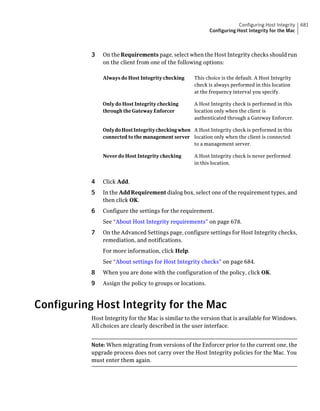
                  Configuring Host Integrity for the Mac ...........................................          681
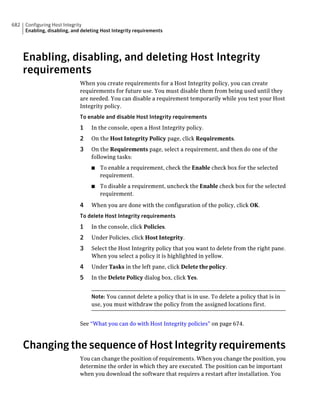
                  Enabling, disabling, and deleting Host Integrity requirements ............                  682
                  Changing the sequence of Host Integrity requirements .....................                  682
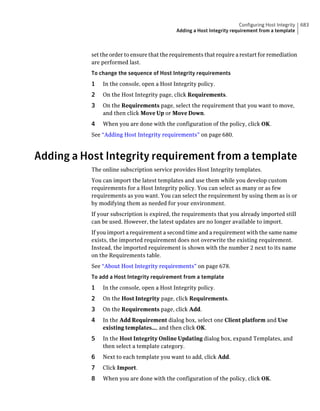
                  Adding a Host Integrity requirement from a template .......................                 683
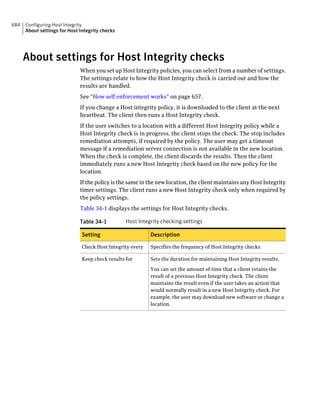
                  About settings for Host Integrity checks .........................................          684
                  Allowing the Host Integrity check to pass if a requirement fails ..........                 685
                  Configuring notifications for Host Integrity checks ..........................              686
                  About Host Integrity remediation ..................................................         687
                      About remediating applications and files for Host Integrity ..........                  687
                      Host Integrity remediation and Enforcer settings .......................                688
                  Specifying the amount of time the client waits to remediate ...............                 688
                  Allowing users to postpone or cancel Host Integrity remediation ........                    689

     Chapter 35   Adding custom requirements ......................................... 691
                  About custom requirements .........................................................         692
                  About conditions ........................................................................   692
                     About antivirus conditions .....................................................         693
                     About antispyware conditions .................................................           693
                     About firewall conditions .......................................................        694
                     About file conditions .............................................................      694
Contents   23


                  About operating system conditions ..........................................            696
                  About registry conditions ......................................................        697
             About functions .........................................................................    698
             About custom requirement logic ...................................................           699
                  About the RETURN statement ................................................             700
                  About the IF, THEN, and ENDIF statement ................................                700
                  About the ELSE statement ......................................................         700
                  About the NOT keyword ........................................................          700
                  About AND, OR keywords ......................................................           701
             Writing a custom requirement script .............................................            701
                  Adding an IF THEN statement ................................................            703
                  Switching between the IF statement and the IF NOT
                      statement .....................................................................     703
                  Adding an ELSE statement .....................................................          703
                  Adding a comment ................................................................       704
                  Copying and pasting IF statements, conditions, functions, and
                      comments .....................................................................      704
                  Deleting a statement, condition, or function ..............................             704
             Displaying a message dialog box ....................................................         705
             Downloading a file ......................................................................    706
             Setting a registry value ................................................................    706
             Incrementing a registry DWORD value ...........................................              707
             Running a program .....................................................................      708
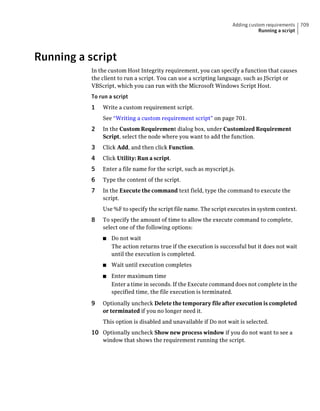
             Running a script .........................................................................   709
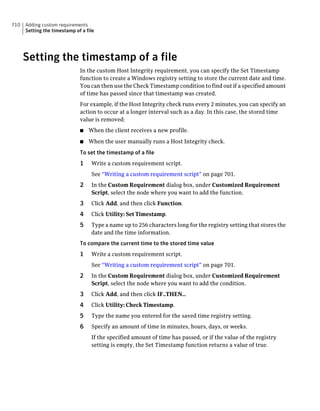
             Setting the timestamp of a file ......................................................       710
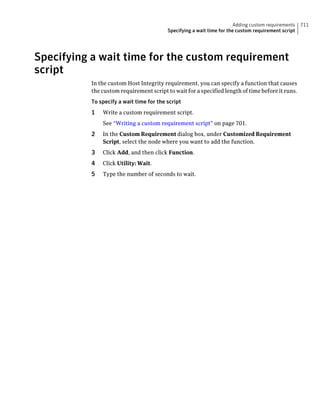
             Specifying a wait time for the custom requirement script ..................                  711

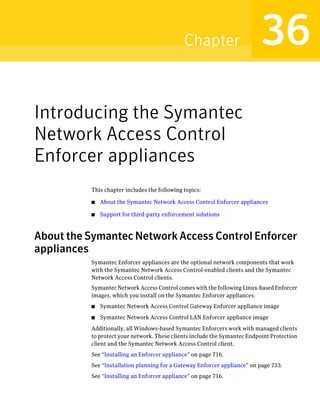
Chapter 36   Introducing the Symantec Network Access Control
                 Enforcer appliances .................................................... 713
             About the Symantec Network Access Control Enforcer
                appliances ........................................................................... 713
             Support for third-party enforcement solutions ................................ 714

Chapter 37   Installing all types of Enforcer appliances ................... 715
             About installing an Enforcer appliance ...........................................           715
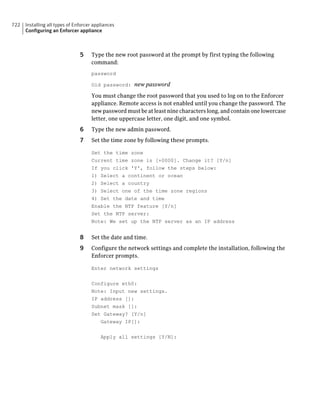
             Installing an Enforcer appliance ....................................................        716
             About the Enforcer appliance indicators and controls .......................                 716
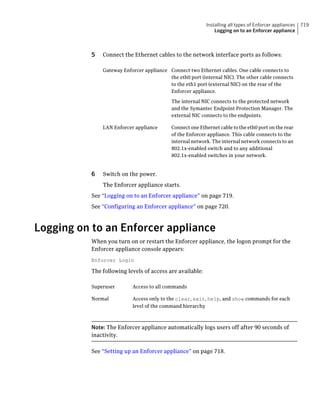
             Setting up an Enforcer appliance ...................................................         718
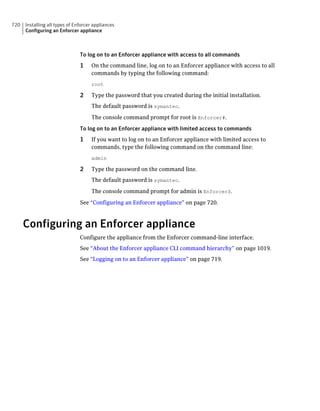
             Logging on to an Enforcer appliance ..............................................           719
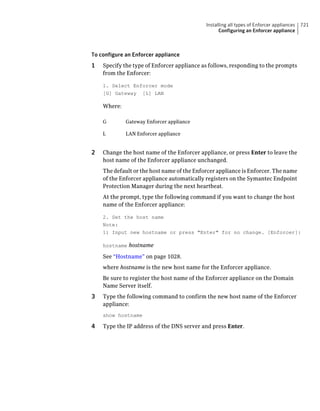
             Configuring an Enforcer appliance ................................................           720
24   Contents


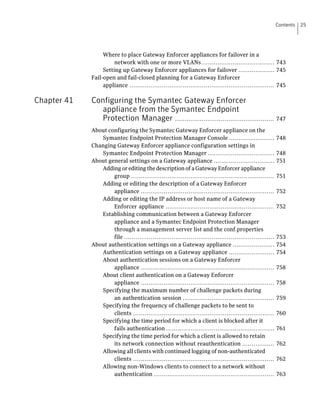
     Chapter 38   Upgrading and reimaging all types of Enforcer
                    appliance images ......................................................... 723
                  About upgrading and reimaging Enforcer appliance images ...............                       723
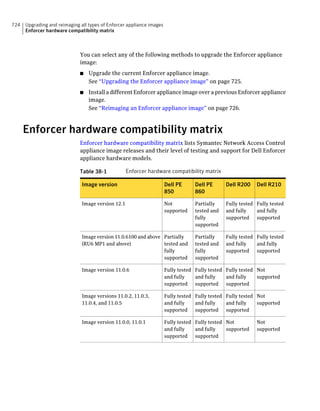
                  Enforcer hardware compatibility matrix .........................................              724
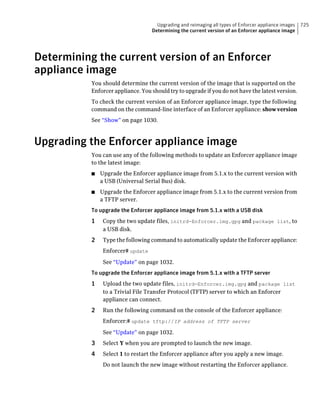
                  Determining the current version of an Enforcer appliance
                      image .................................................................................   725
                  Upgrading the Enforcer appliance image ........................................               725
                  Reimaging an Enforcer appliance image .........................................               726

     Chapter 39   Performing basic tasks on the console of all types
                     of Enforcer appliances ................................................ 727
                  About performing basic tasks on the console of an Enforcer
                      appliance ............................................................................    727
                  Configuring a connection between an Enforcer appliance and a
                      Symantec Endpoint Protection Manager ...................................                  728
                      Configuring SPM ..................................................................        729
                  Checking the communication status of an Enforcer appliance on the
                      Enforcer console ..................................................................       731
                  Remote access to an Enforcer appliance ..........................................             731

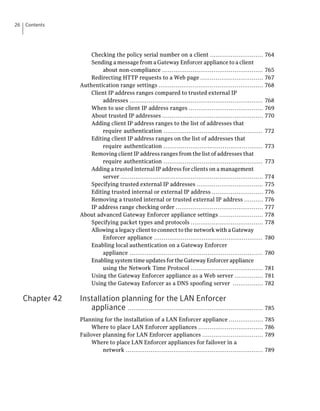
     Chapter 40   Planning for the installation of the Gateway
                     Enforcer appliance ...................................................... 733
                  Installation planning for a Gateway Enforcer appliance .....................                  733
                       Where to place a Gateway Enforcer appliance ............................                 735
                       Guidelines for IP addresses on a Gateway Enforcer
                            appliance ......................................................................    737
                       About two Gateway Enforcer appliances in a series .....................                  737
                       Protection of VPN access through a Gateway Enforcer
                            appliance ......................................................................    738
                       Protection of wireless access points through a Gateway Enforcer
                            appliance ......................................................................    738
                       Protection of servers through a Gateway Enforcer
                            appliance ......................................................................    738
                       Protection of non-Windows servers and clients through a
                            Gateway Enforcer appliance .............................................            739
                       Requirements for allowing non-Windows clients without
                            authentication ...............................................................      740
                  Gateway Enforcer appliance NIC settings ........................................              741
                  Failover planning for Gateway Enforcer appliances ..........................                  742
                       How failover works with Gateway Enforcer appliances in the
                            network ........................................................................    742
Contents   25


                  Where to place Gateway Enforcer appliances for failover in a
                       network with one or more VLANs ...................................... 743
                  Setting up Gateway Enforcer appliances for failover ................... 745
             Fail-open and fail-closed planning for a Gateway Enforcer
                  appliance ............................................................................ 745

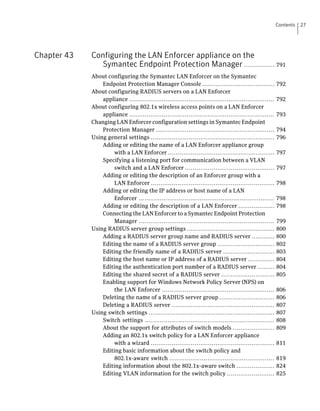
Chapter 41   Configuring the Symantec Gateway Enforcer
               appliance from the Symantec Endpoint
               Protection Manager .................................................... 747
             About configuring the Symantec Gateway Enforcer appliance on the
                Symantec Endpoint Protection Manager Console ........................                       748
             Changing Gateway Enforcer appliance configuration settings in
                Symantec Endpoint Protection Manager ...................................                    748
             About general settings on a Gateway appliance ................................                 751
                Adding or editing the description of a Gateway Enforcer appliance
                     group ...........................................................................      751
                Adding or editing the description of a Gateway Enforcer
                     appliance ......................................................................       752
                Adding or editing the IP address or host name of a Gateway
                     Enforcer appliance .........................................................           752
                Establishing communication between a Gateway Enforcer
                     appliance and a Symantec Endpoint Protection Manager
                     through a management server list and the conf.properties
                     file ...............................................................................   753
             About authentication settings on a Gateway appliance ......................                    754
                Authentication settings on a Gateway appliance ........................                     754
                About authentication sessions on a Gateway Enforcer
                     appliance ......................................................................       758
                About client authentication on a Gateway Enforcer
                     appliance ......................................................................       758
                Specifying the maximum number of challenge packets during
                     an authentication session ................................................             759
                Specifying the frequency of challenge packets to be sent to
                     clients ..........................................................................     760
                Specifying the time period for which a client is blocked after it
                     fails authentication .........................................................         761
                Specifying the time period for which a client is allowed to retain
                     its network connection without reauthentication .................                      762
                Allowing all clients with continued logging of non-authenticated
                     clients ..........................................................................     762
                Allowing non-Windows clients to connect to a network without
                     authentication ...............................................................         763
26   Contents


                      Checking the policy serial number on a client ............................                764
                      Sending a message from a Gateway Enforcer appliance to a client
                           about non-compliance .....................................................           765
                      Redirecting HTTP requests to a Web page .................................                 767
                  Authentication range settings .......................................................         768
                      Client IP address ranges compared to trusted external IP
                           addresses ......................................................................     768
                      When to use client IP address ranges .......................................              769
                      About trusted IP addresses .....................................................          770
                      Adding client IP address ranges to the list of addresses that
                           require authentication ....................................................          772
                      Editing client IP address ranges on the list of addresses that
                           require authentication ....................................................          773
                      Removing client IP address ranges from the list of addresses that
                           require authentication ....................................................          773
                      Adding a trusted internal IP address for clients on a management
                           server ...........................................................................   774
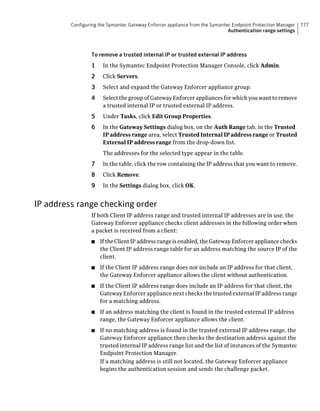
                      Specifying trusted external IP addresses ...................................              775
                      Editing trusted internal or external IP address ...........................               776
                      Removing a trusted internal or trusted external IP address ..........                     776
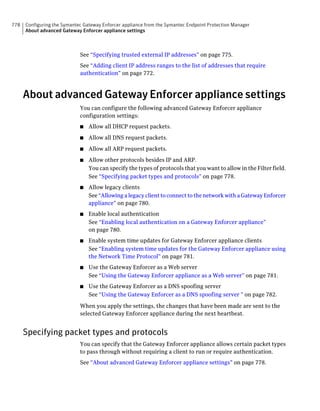
                      IP address range checking order ..............................................            777
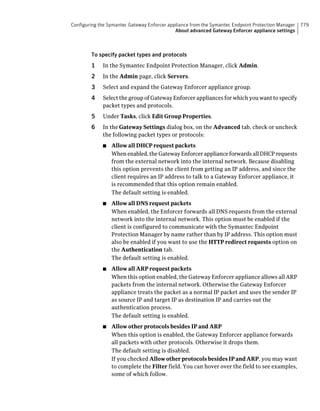
                  About advanced Gateway Enforcer appliance settings .......................                    778
                      Specifying packet types and protocols ......................................              778
                      Allowing a legacy client to connect to the network with a Gateway
                           Enforcer appliance .........................................................         780
                      Enabling local authentication on a Gateway Enforcer
                           appliance ......................................................................     780
                      Enabling system time updates for the Gateway Enforcer appliance
                           using the Network Time Protocol ......................................               781
                      Using the Gateway Enforcer appliance as a Web server ...............                      781
                      Using the Gateway Enforcer as a DNS spoofing server ................                      782

     Chapter 42   Installation planning for the LAN Enforcer
                     appliance ....................................................................... 785
                  Planning for the installation of a LAN Enforcer appliance ..................                  785
                       Where to place LAN Enforcer appliances ..................................                786
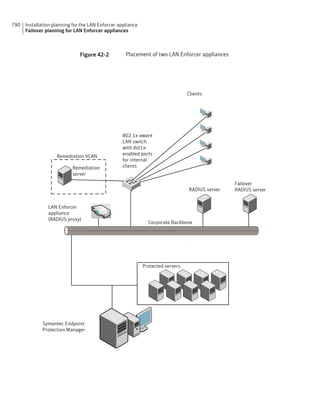
                  Failover planning for LAN Enforcer appliances ................................                789
                       Where to place LAN Enforcer appliances for failover in a
                           network ........................................................................     789
Contents   27


Chapter 43   Configuring the LAN Enforcer appliance on the
               Symantec Endpoint Protection Manager ................ 791
             About configuring the Symantec LAN Enforcer on the Symantec
                 Endpoint Protection Manager Console ......................................               792
             About configuring RADIUS servers on a LAN Enforcer
                 appliance ............................................................................   792
             About configuring 802.1x wireless access points on a LAN Enforcer
                 appliance ............................................................................   793
             Changing LAN Enforcer configuration settings in Symantec Endpoint
                 Protection Manager ..............................................................        794
             Using general settings .................................................................     796
                 Adding or editing the name of a LAN Enforcer appliance group
                      with a LAN Enforcer ........................................................        797
                 Specifying a listening port for communication between a VLAN
                      switch and a LAN Enforcer ...............................................           797
                 Adding or editing the description of an Enforcer group with a
                      LAN Enforcer .................................................................      798
                 Adding or editing the IP address or host name of a LAN
                      Enforcer .......................................................................    798
                 Adding or editing the description of a LAN Enforcer ...................                  798
                 Connecting the LAN Enforcer to a Symantec Endpoint Protection
                      Manager .......................................................................     799
             Using RADIUS server group settings ..............................................            800
                 Adding a RADIUS server group name and RADIUS server ............                         800
                 Editing the name of a RADIUS server group ..............................                 802
                 Editing the friendly name of a RADIUS server ...........................                 803
                 Editing the host name or IP address of a RADIUS server ..............                    804
                 Editing the authentication port number of a RADIUS server .........                      804
                 Editing the shared secret of a RADIUS server ............................                805
                 Enabling support for Windows Network Policy Server (NPS) on
                      the LAN Enforcer ...........................................................        806
                 Deleting the name of a RADIUS server group .............................                 806
                 Deleting a RADIUS server ......................................................          807
             Using switch settings ..................................................................     807
                 Switch settings ....................................................................     808
                 About the support for attributes of switch models ......................                 809
                 Adding an 802.1x switch policy for a LAN Enforcer appliance
                      with a wizard .................................................................     811
                 Editing basic information about the switch policy and
                      802.1x-aware switch .......................................................         819
                 Editing information about the 802.1x-aware switch ....................                   824
                 Editing VLAN information for the switch policy .........................                 825
28   Contents


                      Editing action information for the switch policy .........................                828
                  Using advanced LAN Enforcer appliance settings .............................                  832
                      Allowing a legacy client to connect to the network with a LAN
                           Enforcer appliance .........................................................         833
                      Enabling local authentication on the LAN Enforcer
                           appliance ......................................................................     833
                      Enabling system time updates for the Enforcer appliance using
                           the Network Time Protocol ...............................................            834
                  Configuring MAC addresses and MAC authentication bypass (MAB)
                      on the LAN Enforcer .............................................................         834
                  Using 802.1x authentication .........................................................         835
                      About reauthentication on the client computer ..........................                  838

     Chapter 44   Managing Enforcers on the Symantec Endpoint
                    Protection Manager .................................................... 841
                  About managing Enforcers on the management server console ...........                         842
                  About managing Enforcers from the Servers page ............................                   842
                  About Enforcer groups ................................................................        843
                      How the console determines the Enforcer group name ................                       843
                      About failover Enforcer groups ...............................................            843
                      About changing a group name ................................................              844
                      About creating a new Enforcer group .......................................               844
                  About the Enforcer information that appears on the Enforcer
                      console ...............................................................................   844
                  Displaying information about the Enforcer on the management
                      console ...............................................................................   845
                  Changing an Enforcer’s name and description .................................                 846
                  Deleting an Enforcer or an Enforcer group ......................................              846
                  Exporting and importing Enforcer group settings .............................                 847
                  Pop-up messages for blocked clients ..............................................            848
                      Messages for the computers that are running the client ...............                    848
                      Messages for Windows computers that are not running the client
                           (Gateway Enforcer only) ..................................................           848
                      Setting up the Enforcer messages ............................................             849
                  About client settings and the Enforcer ............................................           850
                  Configuring clients to use a password to stop the client service ...........                  850
                  About Enforcer reports and logs ....................................................          850
                  Configuring Enforcer log settings ..................................................          851
                      Disabling Enforcer logging on the Symantec Endpoint Protection
                           Manager Console ............................................................         853
                      Enabling the sending of Enforcer logs from an Enforcer to the
                           Symantec Endpoint Protection Manager .............................                   853
Contents   29


                  Setting up the size and age of Enforcer logs ............................... 854
                  Filtering the Traffic logs for an Enforcer ................................... 854

Chapter 45   Introducing the Symantec Integrated Enforcers ........ 857
             About the Symantec Network Access Control Integrated Enforcer for
                Microsoft DHCP Servers ........................................................ 857
             About the Symantec Network Access Control Integrated Enforcer for
                Microsoft Network Access Protection ....................................... 858

Chapter 46   Installing the Symantec Network Access Control
                Integrated Enforcer for Microsoft DHCP
                Servers ........................................................................... 859
             Process for installing the Symantec Network Access Control
                 Integrated Enforcer for Microsoft DHCP Servers ........................                   859
             System requirements for an Integrated Enforcer for Microsoft DHCP
                 Servers ...............................................................................   860
             Components for an Integrated Enforcer for Microsoft DHCP
                 servers ...............................................................................   861
             Placement requirements for an Integrated Enforcer for Microsoft
                 DHCP Servers ......................................................................       862
             How to get started with the installation of an Integrated Enforcer for
                 Microsoft DHCP servers ........................................................           864
             Installing an Integrated Enforcer for Microsoft DHCP Servers ............                     865
                 Uninstalling the Symantec Network Access Control Integrated
                      Enforcer for Microsoft DHCP servers .................................                867
                 Upgrading the Integrated Enforcer for Microsoft DHCP
                      Servers .........................................................................    868

Chapter 47   Configuring the Symantec Integrated Enforcers on
               the Enforcer console ................................................... 869
             About configuring Integrated Enforcers on an Enforcer console ..........                      870
             Establishing or changing communication between an Integrated
                  Enforcer for Microsoft DHCP servers and a Symantec Endpoint
                  Protection Manager ..............................................................        872
             Configuring automatic quarantine .................................................            874
             Editing a Symantec Endpoint Protection Manager connection ............                        876
             Configuring Integrated Enforcer communication settings in Symantec
                  Endpoint Protection Manager .................................................            877
             Configuring a trusted vendor list ...................................................         878
             Viewing Enforcer logs on an Enforcer console ..................................               879
30   Contents


                  Stopping and starting communication services between an Integrated
                      Enforcer and a management server .......................................... 880
                  Configuring a secure subnet mask ................................................. 881
                  Creating DHCP scope exceptions ................................................... 882

     Chapter 48   Configuring the Symantec Network Access Control
                    Integrated Enforcer for Microsoft DHCP Server
                    on the Symantec Endpoint Protection
                    Manager ......................................................................... 883
                  About configuring the Symantec Network Access Control Integrated
                      Enforcer for Microsoft DHCP Server on the Symantec Endpoint
                      Protection Manager ..............................................................        884
                  Configuring Symantec Network Access Control Integrated Enforcer
                      basic settings .......................................................................   884
                      Adding or editing the name of an Enforcer group for Symantec
                          Network Access Control Integrated Enforcer .......................                   885
                      Adding or editing the description of an Enforcer group with a
                          Symantec Network Access Control Integrated Enforcer .........                        885
                      Adding or editing the description of a Symantec Network Access
                          Control Integrated Enforcer .............................................            886
                      Connecting the Symantec Network Access Control Integrated
                          Enforcer to a Symantec Endpoint Protection Manager ...........                       886
                  Configuring Symantec Network Access Control Integrated Enforcer
                      advanced settings .................................................................      887
                      Enabling servers, clients, and devices to connect to the network
                          as trusted hosts without authentication ..............................               888
                      Enabling local authentication on the Integrated Enforcer ............                    889
                  Configuring Symantec Network Access Control Integrated Enforcer
                      authentication settings ..........................................................       890
                      About using authentication settings .........................................            890
                      About authentication sessions ................................................           891
                      Specifying the maximum number of challenge packets during
                          an authentication session ................................................           893
                      Specifying the frequency of challenge packets to be sent to
                          clients ..........................................................................   893
                      Allowing all clients with continued logging of non-authenticated
                          clients ..........................................................................   894
                      Allowing non-Windows clients to connect to a network without
                          authentication ...............................................................       895
                      Having the Symantec Network Access Control Integrated
                          Enforcer check the Policy Serial Number on a client ..............                   895
Contents   31


             Configuring logs for the Symantec Network Access Control Integrated
                 Enforcer ............................................................................. 897

Chapter 49   Installing the Symantec Integrated Enforcer for
                Microsoft Network Access Protection ..................... 899
             Before you install the Symantec Integrated Enforcer for Microsoft
                 Network Access Protection .....................................................             899
             Process for installing the Symantec Network Access Control
                 Integrated Enforcer for Microsoft Network Access
                 Protection ...........................................................................      900
             System requirements for an Integrated Enforcer for Microsoft
                 Network Access Protection .....................................................             901
             Components of a Symantec Integrated Enforcer for Microsoft Network
                 Access Protection .................................................................         903
             Installing the Integrated Enforcer for Microsoft Network Access
                 Protection ...........................................................................      904
                 Uninstalling the Integrated Enforcer for Microsoft Network
                      Access Protection ...........................................................          905
                 Stopping and starting the Network Access Protection server
                      manually ......................................................................        906

Chapter 50   Configuring the Symantec Network Access Control
               Integrated Enforcer for Microsoft Network
               Access Protection on an Enforcer console ............. 907
             About configuring a Symantec Integrated Enforcer for Microsoft
                  Network Access Protection on an Enforcer console .....................                     908
             Connecting a Symantec Integrated Enforcer for Microsoft Network
                  Access Protection to a management server on an Enforcer
                  console ...............................................................................    909
             Encrypting communication between a Symantec Integrated Enforcer
                  for Microsoft Network Access Protection and a management
                  server .................................................................................   911
             Setting up an Enforcer group name on the Symantec Integrated
                  Enforcer for Microsoft Network Access Protection console ...........                       912
             Setting up an HTTP communication protocol on the Symantec
                  Integrated Enforcer for Microsoft Network Access Protection
                  console ...............................................................................    913

Chapter 51   Configuring the Symantec Network Access Control
               Integrated Enforcer for Microsoft Network
32   Contents


                       Access Protection on the Symantec Endpoint
                       Protection Manager .................................................... 915
                  About configuring the Symantec Integrated Enforcer for Microsoft
                      Network Access Protection on the Symantec Endpoint Protection
                      Manager .............................................................................       916
                  Enabling NAP enforcement for clients ............................................               917
                  Verifying that the management server manages the client .................                       918
                  Verifying Security Health Validator policies ....................................               918
                  Verifying that clients pass the Host Integrity check ..........................                 919
                  Configuring logs for the Symantec Integrated Enforcer for Network
                      Access Protection .................................................................         919

     Chapter 52   Setting up temporary connections for Symantec
                     Network Access Control On-Demand clients ......... 921
                  About the Symantec Network Access Control On-Demand
                       Clients ................................................................................   922
                  Before you configure Symantec Network Access Control On-Demand
                       clients on the console of a Gateway Enforcer .............................                 922
                  Setting up guest access challenge using the Symantec Network Access
                       Control DHCP Integrated Enforcer ...........................................               924
                  Enabling Symantec Network Access Control On-Demand clients to
                       temporarily connect to a network ............................................              928
                  Disabling Symantec Network Access Control On-Demand
                       clients ................................................................................   930
                  Setting up authentication on the Gateway Enforcer console for
                       Symantec Network Access Control On-Demand clients ................                         930
                       Setting up user authentication with a local database ...................                   931
                       Setting up user authentication with a Microsoft Windows 2003
                            Server Active Directory ...................................................           931
                       Setting up user authentication with a RADIUS server ..................                     932
                       Setting up the On-Demand client on Windows for authentication
                            with the dot1x-tls protocol ...............................................           933
                       Setting up the On-Demand client on Windows for authentication
                            with the dot1x-peap protocol ............................................             934
                       On-Demand authentication commands .....................................                    935
                  Editing the banner on the Welcome page ........................................                 942
Contents   33


Section 5    Troubleshooting Symantec Endpoint
               Protection and Symantec Network
               Access Control ....................................................... 945
Chapter 53   Performing disaster recovery .......................................... 947
             Performing disaster recovery ........................................................ 947
             Restoring the database ................................................................ 948
             Reinstalling or reconfiguring Symantec Endpoint Protection
                 Manager ............................................................................. 949

Chapter 54   Troubleshooting installation and communication
                problems ........................................................................ 951
             Downloading the Symantec Endpoint Protection Support Tool to
                 troubleshoot computer issues .................................................          951
             Identifying the point of failure of an installation ..............................          952
             Troubleshooting communication problems between the management
                 server and the client .............................................................     952
                 Viewing the client connection status on the client ......................               954
                 How to determine whether the client is connected and
                      protected ......................................................................   954
                 Investigating protection problems using the troubleshooting file
                      on the client ..................................................................   956
                 Enabling and viewing the Access log to check whether the client
                      connects to the management server ...................................              956
                 Stopping and starting the Apache Web server ............................                957
                 Using the ping command to test the connectivity to the
                      management server ........................................................         958
                 Using a browser to test the connectivity to the management
                      server on the client computer ...........................................          958
                 Checking the debug log on the client computer ..........................                959
                 Checking the inbox logs on the management server ....................                   959
                 Recovering client communication settings by using the
                      SylinkDrop tool ..............................................................     960
             Troubleshooting communication problems between the management
                 server and the console or the database .....................................            961
                 Verifying the connection with the database ...............................              962
34   Contents


     Chapter 55   Troubleshooting reporting issues .................................. 965
                  Troubleshooting reporting issues ..................................................            965
                  Troubleshooting context-sensitive help for the reporting
                      console ...............................................................................    967
                  Changing reporting fonts to display Asian languages ........................                   968
                  Changing timeout parameters for reviewing reports and logs .............                       968
                  Accessing reporting pages when the use of loopback addresses is
                      disabled ..............................................................................    970
                  About recovering a corrupted client System Log on 64-bit
                      computers ...........................................................................      971

     Chapter 56   Troubleshooting the Enforcer appliance ...................... 973
                  Troubleshooting communication problems between an Enforcer
                      appliance and the Symantec Endpoint Protection Manager ..........                          973
                  Troubleshooting an Enforcer appliance ..........................................               975
                  Frequently asked questions for the Enforcer appliances ....................                    975
                      Which virus protection and antivirus software is managed by
                           Host Integrity? ...............................................................       976
                      Can Host Integrity policies be set at the group level or the global
                           level? ...........................................................................    976
                      Can you create a custom Host Integrity message? .......................                    976
                      What happens if Enforcer appliances cannot communicate with
                           Symantec Endpoint Protection Manager? ............................                    977
                      Is a RADIUS server required when a LAN Enforcer appliance
                           runs in transparent mode? ...............................................             978
                      How does enforcement manage computers without clients? .........                           979
                  Troubleshooting the connection between the Enforcer and the
                      On-Demand Clients ...............................................................          981

     Appendix A   Migration and client deployment reference ................. 985
                  Where to go for information on upgrading and migrating ..................                      985
                  Supported server upgrade paths ....................................................            987
                  Supported client upgrade paths .....................................................           987
                  Migrations that are supported and unsupported for the Mac
                      client .................................................................................   988
                  Deciding which features to install on the client ................................              989
                  Feature mapping between 11.x and 12.1 clients ................................                 989
                  Client protection features by platform ............................................            992
                  Management features by platform .................................................              993
                  Virus and Spyware Protection policy settings available for Windows
                      and Mac ..............................................................................     995
Contents   35


             LiveUpdate policy settings available for Windows and Mac ................ 996
             Increasing Symantec Endpoint Protection Manager disk space before
                 upgrading to version 12.1 ...................................................... 997

Appendix B   Customizing and deploying the client installation
                by using third-party tools .......................................... 999
             Installing client software using third-party tools ............................               1000
             About client installation features and properties ............................                1001
                 About configuring msi command strings .................................                   1002
                 About configuring Setaid.ini .................................................            1002
             Symantec Endpoint Protection client installation properties .............                     1004
             Symantec Endpoint Protection client features ................................                 1004
             Windows Installer parameters ....................................................             1006
             Windows Security Center properties ............................................               1008
             Command-line examples for installing the client ............................                  1009
             About installing and deploying client software with the Symantec
                 Management Agent .............................................................            1009
             Installing clients with Microsoft SMS 2003 ....................................               1010
             Installing clients with Active Directory Group Policy Object .............                    1011
                 Creating the administrative installation image .........................                  1013
                 Creating a GPO software distribution .....................................                1013
                 Creating a Windows Installer 3.1 Startup script ........................                  1015
                 Adding computers to an organizational unit and installation
                      software ......................................................................      1016
                 Copying a Sylink.xml file to the installation files ......................                1017
             Uninstalling client software with Active Directory Group Policy
                 Object ...............................................................................    1018

Appendix C   Enforcer appliance command-line interface .............. 1019
             About the Enforcer appliance CLI command hierarchy ....................                       1019
             CLI command hierarchy .............................................................           1020
             Moving up and down the command hierarchy ................................                     1023
             Enforcer appliance CLI keystroke shortcuts ...................................                1023
             Getting help with CLI commands .................................................              1025
             Top-level commands .................................................................          1026
                 Clear ................................................................................    1026
                 Date .................................................................................    1027
                 Exit ..................................................................................   1027
                 Help .................................................................................    1027
                 Hostname ..........................................................................       1028
                 Password ...........................................................................      1028
                 Ping .................................................................................    1029
36   Contents


                                     Reboot ..............................................................................     1029
                                     Shutdown ..........................................................................       1030
                                     Show ................................................................................     1030
                                     Start .................................................................................   1031
                                     Stop .................................................................................    1031
                                     Traceroute ........................................................................       1031
                                     Update ..............................................................................     1032

     Index   ................................................................................................................. 1033
Chapter                           1
Introducing Symantec
Endpoint Protection
          This chapter includes the following topics:

          ■   About Symantec Endpoint Protection

          ■   What's new in version 12.1

          ■   About the types of threat protection that Symantec Endpoint Protection
              provides

          ■   Protecting your network with Symantec Endpoint Protection


About Symantec Endpoint Protection
          Symantec Endpoint Protection is a client-server solution that protects laptops,
          desktops, Mac computers, and servers in your network against malware. Symantec
          Endpoint Protection combines virus protection with advanced threat protection
          to proactively secure your computers against known and unknown threats.
          Symantec Endpoint Protection protects against malware such as viruses, worms,
          Trojan horses, spyware, and adware. It provides protection against even the most
          sophisticated attacks that evade traditional security measures such as rootkits,
          zero-day attacks, and spyware that mutates. Providing low maintenance and high
          power, Symantec Endpoint Protection communicates over your network to
          automatically safeguard computers against attacks for both physical systems and
          virtual systems.
          This comprehensive solution protects confidential and valuable information by
          combining multiple layers of protection on a single integrated client. Symantec
          Endpoint Protection reduces management overhead, time, and cost by offering a
          single management console and the single client.
38   Introducing Symantec Endpoint Protection
     What's new in version 12.1


                             See “About the types of threat protection that Symantec Endpoint Protection
                             provides” on page 45.


     What's new in version 12.1
                             The current release includes the following improvements that make the product
                             easier and more efficient to use.
                             Table 1-1 displays the new features in version 12.1.

                             Table 1-1           New features in version 12.1

     Feature                Description

     Better security against The most significant improvements include the following policy features to provide better
     malware                 protection on the client computers.

                            ■ The Virus and Spyware Protection policy detects threats more accurately while it reduces
                              false positives and improves scan performance with the following technologies:
                              ■ SONAR replaces the TruScan technology to identify malicious behavior of unknown
                                  threats using heuristics and reputation data. While TruScan runs on a schedule,
                                  SONAR runs at all times.
                                  See “Managing SONAR” on page 345.
                              ■ Auto-Protect provides additional protection with Download Insight, which examines
                                  the files that users try to download through Web browsers, text messaging clients,
                                  and other portals. Download Insight uses reputation information from Symantec
                                  Insight to make decisions about files.
                                  See “Managing Download Insight detections” on page 298.
                                  See “How Symantec Endpoint Protection uses reputation data to make decisions
                                  about files” on page 302.
                              ■ Insight lets scans skip Symantec and community trusted files, which improves scan
                                  performance.
                                  See “Modifying global scan settings for Windows clients” on page 327.
                              ■ Insight Lookup detects the application files that might not typically be detected as
                                  risks and sends information from the files to Symantec for evaluation. If Symantec
                                  determines that the application files are risks, the client computer then handles the
                                  files as risks. Insight Lookup makes malware detection faster and more accurate.
                                  See “Customizing administrator-defined scans for clients that run on Windows
                                  computers” on page 324.
                            ■ The Firewall policy includes firewall rules to block IPv6-based traffic.
                              See “Customizing firewall rules” on page 399.
                            ■ The Intrusion Prevention policy includes browser intrusion prevention, which uses IPS
                              signatures to detect the attacks that are directed at browser vulnerabilities.
                              See “Enabling or disabling network intrusion prevention or browser intrusion prevention”
                              on page 415.
Introducing Symantec Endpoint Protection     39
                                                                                       What's new in version 12.1


                      Table 1-1            New features in version 12.1 (continued)

Feature               Description

Faster and more       Symantec Endpoint Protection Manager helps you manage the client computers more easily
flexible management   with the following new features:

                      ■   Centralized licensing lets you purchase, activate, and manage product licenses from
                          the management console.
                          See “Licensing Symantec Endpoint Protection” on page 102.
                      ■   Symantec Endpoint Protection Manager registers with Protection Center version 2.
                          Protection Center lets you centralize data and integrate management of Symantec
                          security products into a single environment. You can configure some of the settings
                          Protection Center uses to work with Symantec Endpoint Protection Manager.
                          See “About Symantec Endpoint Protection and Protection Center” on page 169.
                      ■   The Symantec Endpoint Protection Manager logon screen enables you to have your
                          forgotten password emailed to you.
                          See “Logging on to the Symantec Endpoint Protection Manager console” on page 95.
                      ■   Symantec Endpoint Protection Manager includes an option to let any of the
                          administrators in a site reset their forgotten password.
                      ■   You can configure when and how Symantec Endpoint Protection Manager restarts the
                          client computer, so that the restart does not interfere with the user's activity.
                          See “Restarting client computers” on page 131.
                      ■   The Monitors page includes a set of preconfigured email notifications that inform you
                          of the most frequently used events. The events include when new client software is
                          available, when a policy changes, license renewal messages, and when the management
                          server locates unprotected computers. The notifications are enabled by default and
                          support the BlackBerry, iPhone, and Android.
                          See “About the preconfigured notifications” on page 561.
                      ■   The Home page displays the high-level reports that you can click, which makes the
                          Home page simpler and easier to read. The Home page also displays a link to notifications
                          about log events that you have not yet read.
                          See “Viewing and acknowledging notifications” on page 566.
                      ■   Improved status reporting automatically resets the Still Infected Status for a client
                          computer once the computer is no longer infected.
                      ■   You can now configure Linux clients to send log events to Symantec Endpoint Protection
                          Manager.
40   Introducing Symantec Endpoint Protection
     What's new in version 12.1


                            Table 1-1            New features in version 12.1 (continued)

     Feature                Description

     Better server and      To increase the speed between the management server and the management console,
     client performance     database, and the client computers:

                            ■ The management server performs automatic database cleanup tasks to improve the
                              server-client responsiveness and scalability.
                              See “Scheduling automatic database maintenance tasks” on page 630.
                              See “Maintaining the database” on page 625.
                            ■ Virus and spyware scans use Insight to let scans skip safe files and focus on files at risk.
                              Scans that use Insight are faster and more accurate, and reduce scan overhead by up to
                              70 percent.
                              See “Modifying global scan settings for Windows clients” on page 327.
                              See “Customizing Auto-Protect for Windows clients” on page 320.
                              See “About commands you can run on client computers”on page 322 on page 322.
                              See “Adjusting scans to improve computer performance” on page 292.
                            ■ LiveUpdate can run when the client computer is idle, has outdated content, or has been
                              disconnected, which uses less memory.
                              See “Configuring client updates to run when client computers are idle” on page 506.
                              See “Configuring client updates to run when definitions are old or the computer has
                              been disconnected” on page 507.

                            See “Improving client and server performance” on page 604.

     Support for virtual    Enhanced to help protect your virtual infrastructure, Symantec Endpoint Protection includes
     environments           the following new features:
                            ■ The Shared Insight Cache Server lets clients share scan results so that identical files
                              only need to be scanned once across all the client computers. Shared Insight Cache can
                              reduce the effect of full scans by up to 80%.
                              See “Configuring your clients to communicate with Shared Insight Cache” on page 338.
                            ■ The Virtual Image Exclusion tool reduces the effect of scanning every single file in a
                              trusted base image. Instead of continually scanning system files for viruses, the Virtual
                              Image Exclusion tool lets you white list files from your baseline image on virtual
                              machines.
                              See “Using the Virtual Image Exception tool on a base image” on page 340.
                            ■ Symantec Endpoint Protection Manager uses hypervisor detection to automatically
                              detect which clients run on a virtual platform. You can create policies for groups of
                              clients on virtual platforms.
                            ■ The Symantec offline image scanner can scan offline VMware .vmdk files to ensure
                              that there are no threats in the image.

                            See “Managing Symantec Endpoint Protection in virtual environments” on page 337.
Introducing Symantec Endpoint Protection     41
                                                                                        What's new in version 12.1


                        Table 1-1            New features in version 12.1 (continued)

Feature                 Description

Support for Mac         In Symantec Enterprise Protection, you can configure the polices for Mac clients based on
clients                 a location as well as a group.

                        See “Managing remote clients” on page 213.

Improved installation You can install the product faster and easier than before with the following new installation
process               features:

                        ■   The Symantec Endpoint Protection Manager installation wizard lets you import a
                            previously saved recovery file that includes client-server connection information. The
                            recovery file enables the management server to reinstall existing backed-up certificates
                            and to automatically restore the communication to the existing clients.
                            See “Installing the management server and the console” on page 91.
                        ■   The management server Web service uses Apache instead of IIS. You do not need to
                            install IIS first, as you did in previous versions.
                        ■   The Client Deployment Wizard quickly locates unprotected computers on which you
                            need to install the client software. The wizard also provides an email deployment link
                            so that users can download the client software by using the Web. The wizard makes
                            client software faster and easier to deploy.
                            See “Deploying clients using a Web link and email” on page 126.
                            See “Viewing the protection status of clients and client computers” on page 191.
                            See “About the client protection status icons” on page 189.
                        ■   You can upgrade to the current version of the product while the legacy clients stay
                            connected and protected.
                        ■   A new quick report for deployment shows which computers have successfully installed
                            the client software.
                            See “Running and customizing quick reports” on page 544.
42   Introducing Symantec Endpoint Protection
     What's new in version 12.1


                            Table 1-1              New features in version 12.1 (continued)

     Feature                Description

     Support for additional Symantec Endpoint Protection Manager now supports the following additional operating
     operating systems      systems:

                            ■   VMware Workstation 7.0 or later
                            ■   VMware ESXi 4.0.x or later
                            ■   VMware ESX 4.0.x or later
                            ■   VMware Server 2.0.1
                            ■   Citrix XenServer 5.1 or later
                            Symantec Endpoint Protection Manager now supports the following Web browsers:

                            ■   Internet Explorer 7.0, 8.0, 9.0
                            ■   Firefox 3.6, 4.0
                            The Symantec AntiVirus for Linux client now supports the following additional operating
                            systems:

                            ■   RedHat Enterprise Linux 6.x
                            ■ SUSE Linux Enterprise Server and Enterprise Desktop 11.x (includes support for OES
                              2)
                            ■ Ubuntu 11.x
                            ■   Fedora 14.x, 15.x
                            ■   Debian 6.x
                                For information about using the Symantec AntiVirus client on Linux, see the Symantec
                                AntiVirus for Linux Client Guide.

                            See “System requirements” on page 76.
Introducing Symantec Endpoint Protection    43
                                                                                    What's new in version 12.1


                     Table 1-1           New features in version 12.1 (continued)

Feature              Description

Better Enforcer      You can manage the Enforcers more easily by configuring the following Enforcer settings
management in        in Symantec Endpoint Protection Manager:
Symantec Endpoint
                     ■ Ability for the clients in an Enforcer group to synchronize their system time constantly
Protection Manager
                       by using the Network Time Protocol server.
                       See “Enabling system time updates for the Enforcer appliance using the Network Time
                       Protocol” on page 834.
                     ■ You can more easily update the list of MAC addresses with the following improvements:
                       ■ For the DHCP Integrated Enforcer, you can import a text file that contains the MAC
                          address exceptions that define trusted hosts.
                       ■ For the LAN Enforcer, you can add, edit, and delete the MAC addresses that the Host
                          Integrity checks ignore by using the following features:
                          MAC Authentication Bypass (MAP) bypasses the Host Integrity check for non-802.1x
                          clients or the devices that do not have the Symantec Network Access Control client
                          installed.
                          Ignore Symantec NAC Client Check bypasses the Host Integrity check for 802.1x
                          supplicants that do not have the Symantec Network Access Control client installed.
                       ■ You can add individual MAC addresses or use wildcards to represent vendor MAC
                          strings. You can also import the MAC addresses from a text file.
                       ■ You can add MAC addresses with or without an associated VLAN, which allows
                          multiple VLANs to be supported.

                         See “Configuring Symantec Network Access Control Integrated Enforcer advanced
                         settings” on page 887.
                         See “Configuring Integrated Enforcer communication settings in Symantec Endpoint
                         Protection Manager” on page 877.
44   Introducing Symantec Endpoint Protection
     What's new in version 12.1


                            Table 1-1           New features in version 12.1 (continued)

     Feature                Description

     New Network Access     Symantec Endpoint Protection Manager includes the following additional functionality for
     Control features in    Symantec Network Access Control:
     Symantec Endpoint
                            ■ Enforcer management server lists can include management servers from replication
     Protection Manager
                              partners. Enforcers can connect to any management server at any site partner or
                              replication partner.
                              See “Configuring a management server list” on page 644.
                              See “Setting up failover and load balancing” on page 641.
                            ■ The Compliance logs for the Symantec Network Access Control client provide additional
                              information about log events and Host Integrity check results. You can now see which
                              requirement caused a Host Integrity check on a client computer to fail.
                              See “Viewing logs” on page 550.
                            ■ LiveUpdate downloads Host Integrity templates to management servers. Therefore,
                              client computers can get the Host Integrity policies that include updated Host Integrity
                              templates.
                              See “Adding a Host Integrity requirement from a template” on page 683.
                            ■ Enforcer groups support limited administrator accounts and administrator accounts
                              as well as system administrator accounts. For a large company with multiple sites and
                              domains, you probably need multiple administrators, some of whom have more access
                              rights than others.
                              See “About administrators” on page 581.
                              See “Adding an administrator account” on page 584.
Introducing Symantec Endpoint Protection     45
                                About the types of threat protection that Symantec Endpoint Protection provides


                      Table 1-1            New features in version 12.1 (continued)

Feature               Description

New Enforcer features Symantec Network Access Control includes the following new features:

                      ■   64-bit support for the Integrated Enforcers.
                          See “System requirements for an Integrated Enforcer for Microsoft DHCP Servers”
                          on page 860.
                          See “System requirements for an Integrated Enforcer for Microsoft Network Access
                          Protection” on page 901.
                      ■   Support for the Network Policy Server (NPS) with the Microsoft Windows Server 2008
                          (Longhorn) implementation of a RADIUS server and proxy. The Enforcer can now
                          authenticate the clients that run Windows Vista or later versions and that use 802.1x
                          authentication.
                      ■   For the DHCP Integrated Enforcer, you can selectively turn on scope-based enforcement
                          for the scopes that you define.
                          See “Creating DHCP scope exceptions” on page 882.
                          See “Configuring automatic quarantine” on page 874.
                      ■   The Gateway Enforcer supports both 802.1q trunking and On-Demand Clients at the
                          same time. You can designate a single VLAN on a multiple trunk VLAN to host
                          On-Demand Clients.
                          See “Setting up the On-Demand client on Windows for authentication with the dot1x-tls
                          protocol” on page 933.
                      ■   Support for the guest enforcement mode, which enables the Gateway Enforcer to act
                          as a download server for On-Demand Clients. The Gateway Enforcer downloads
                          On-Demand Clients to guest computers, enabling the clients to communicate to the
                          Enforcer through the guest computers' Web browsers. In the guest enforcement mode,
                          the Gateway Enforcer does not forward inline traffic.
                          See “About the Symantec Network Access Control On-Demand Clients” on page 922.
                      ■   Support for On-Demand Client "persistence": the capability to be "live" for a designated
                          period.
                          See “Enabling Symantec Network Access Control On-Demand clients to temporarily
                          connect to a network” on page 928.
                      ■   The local database size has been increased to 32 MB to accommodate a larger number
                          of MAC addresses.


About the types of threat protection that Symantec
Endpoint Protection provides
                      Symantec Endpoint Protection uses state-of-the-art protection to integrate multiple
                      types of protection on each computer in your network. It offers advanced defense
                      against all types of attacks for both physical systems and virtual systems. You
                      need combinations of all the protection technologies to fully protect and customize
46   Introducing Symantec Endpoint Protection
     About the types of threat protection that Symantec Endpoint Protection provides


                            the security in your environment. Symantec Endpoint Protection combines
                            traditional scanning, behavioral analysis, intrusion prevention, and community
                            intelligence into a superior security system.
                            Table 1-2 describes the types of protection that the product provides and their
                            benefits.

                            Table 1-2           Layers of protection

     Protection       Description                                        Benefit
     type

     Virus and        Virus and Spyware Protection protects              Virus and Spyware Protection detects new
     Spyware          computers from viruses and security risks, and     threats earlier and more accurately using not
     Protection       in many cases can repair their side effects. The   just signature-based and behavioral-based
                      protection includes real-time scanning of files    solutions, but other technologies.
                      and email as well as scheduled scans and
                                                                         ■ Symantec Insight provides faster and more
                      on-demand scans. Virus and spyware scans
                                                                           accurate malware detection to detect the new
                      detect viruses and the security risks that can
                                                                           and the unknown threats that other
                      put a computer, as well as a network, at risk.
                                                                           approaches miss. Insight identifies new and
                      Security risks include spyware, adware, and
                                                                           zero-day threats by using the collective
                      other malicious files.
                                                                           wisdom of over millions of systems in
                      See “Managing scans on client computers”             hundreds of countries.
                      on page 267.                                       ■ Bloodhound uses heuristics to detect a high
                                                                           percentage of known and unknown threats.
                                                                         ■ Auto-Protect scans files from a signature list
                                                                           as they are read from or written to the client
                                                                           computer.
Introducing Symantec Endpoint Protection   47
                                 About the types of threat protection that Symantec Endpoint Protection provides


                       Table 1-2           Layers of protection (continued)

Protection       Description                                       Benefit
type

Network Threat Network Threat Protection provides a firewall ■ The rules-based firewall engine shields
Protection     and intrusion prevention protection to prevent        computers from malicious threats before
               intrusion attacks and malicious content from          they appear.
               reaching the computer that runs the client          ■ The IPS scans network traffic and files for
               software.                                             indications of intrusions or attempted
                                                                     intrusions.
               The firewall allows or blocks network traffic
               based on the various criteria that the              ■ Browser Intrusion Prevention scans for

               administrator sets. If the administrator permits      attacks that are directed at browser
               it, end users can also configure firewall policies.   vulnerabilities.
                                                                   ■ Universal download protection monitors all
               The Intrusion Prevention System (IPS) analyzes        downloads from the browser and validates
               all the incoming and the outgoing information         that the downloads are not malware.
               for the data patterns that are typical of an
               attack. It detects and blocks malicious traffic
               and attempts by outside users to attack the
               client computer. Intrusion Prevention also
               monitors outbound traffic and prevents the
               spread of worms.

                 See “Managing firewall protection” on page 363.

                 See “Managing intrusion prevention on your
                 client computers” on page 409.
48   Introducing Symantec Endpoint Protection
     About the types of threat protection that Symantec Endpoint Protection provides


                             Table 1-2           Layers of protection (continued)

     Protection        Description                                       Benefit
     type

     Proactive Threat Proactive Threat Protection uses SONAR to          SONAR examines programs as they run, and
     Protection       protect against zero-day attack vulnerabilities    identifies and stops malicious behavior of new
                      in your network. Zero-day attack vulnerabilities   and previously unknown threats. SONAR uses
                      are the new vulnerabilities that are not yet       heuristics as well as reputation data to detect
                      publicly known. Threats that exploit these         emerging and unknown threats.
                      vulnerabilities can evade signature-based
                                                                         Application Control controls what applications
                      detection, such as spyware definitions. Zero-day
                                                                         are allowed to run or access system resources.
                      attacks may be used in targeted attacks and in
                      the propagation of malicious code. SONAR           Device Control manages the peripheral devices
                      provides real-time behavioral protection by        that users can attach to desktop computers.
                      monitoring processes and threats as they
                      execute.

                       Application and Device Control monitors and
                       controls the behavior of applications on client
                       computers and manages the hardware devices
                       that access client computers.

                       See “Managing SONAR” on page 345.

                       See “About application and device control”
                       on page 427.

                       See “Setting up application and device control”
                       on page 430.


                             The management server enforces each protection by using an associated policy
                             that is downloaded to the client.
                             Figure 1-1 shows the categories of threats that each type of protection blocks.
Introducing Symantec Endpoint Protection         49
               About the types of threat protection that Symantec Endpoint Protection provides


Figure 1-1                           An overview of protection layers


                     Internet                                      Company
                                                                   Network
     Back doors       Application          File/process/     Insider threats    Adware
     DoS attacks       vulnerabilities       registry        Keyloggers         Back doors
     Port scans       Back doors             modifications   Retro viruses      Mutating threats
     Stack attacks    OS vulnerabilities                     Spyware            Spyware
     Trojans          Trojans                                Targeted attacks   Trojans
     Worms            Worms                                  Trojans            Worms
                                                             Worms              Viruses
                                                             Zero day threats
                                                             DNS and host
                                                              file changes


     Network
     Threat
     Protection


                                                                                     Firewall
                                                                                     policy


                                                                                     Intrusion
                                                                                     Prevention
                                                                                     policy
Network Interface Card


Proactive Threat Protection

                                                                                     Application and
                                                                                     Device Control
                                                                                     policy

                                                                                   Virus and Spyware
                                                                                   Protection policy
Memory / peripherals                                                               (SONAR)


Virus and Spyware Protection


                                                                                    Virus and Spyware
                                                                                    Protection policy

 File system


                                             Endpoint


See “Components of Symantec Endpoint Protection” on page 68.
50   Introducing Symantec Endpoint Protection
     Protecting your network with Symantec Endpoint Protection


     Protecting your network with Symantec Endpoint
     Protection
                           You protect the computers in your network by installing and managing the
                           Symantec Endpoint Protection Manager and the Symantec Endpoint Protection
                           client.
                           For Symantec Network Access Control, you install Symantec Endpoint Protection
                           Manager and the Symantec Network Access Control client.
                           Table 1-3 outlines the main high-level tasks that you need to do to use Symantec
                           Endpoint Protection.

                           Table 1-3           Steps to set up, configure, and manage Symantec Endpoint
                                               Protection

                            Task                         Description

                            Setting up Symantec          You can install Symantec Endpoint Protection Manager and
                            Endpoint Protection          the Symantec Endpoint Protection client or Symantec
                                                         Network Access Control client and protect your network in
                                                         a few easy steps.

                                                         See “Getting up and running on Symantec Endpoint
                                                         Protection for the first time” on page 51.

                            Managing Symantec            Symantec Endpoint Protection Manager comes with default
                            Endpoint Protection          settings and policies so that your network is protected
                                                         immediately after you install. You can modify these settings
                                                         to suit your network environment.

                                                         See “Managing protection on client computers” on page 57.

                            Maintaining a secure         You might need to perform some ongoing maintenance to
                            network environment          keep your network environment running smoothly at peak
                                                         performance. For example, you must back up the database
                                                         in case you need to perform disaster recovery.

                                                         See “Maintaining the security of your environment”
                                                         on page 60.

                            Troubleshooting Symantec     If you have problems installing or using the product,
                            Endpoint Protection and      Symantec Endpoint Protection Manager includes resources
                            Symantec Network Access      to help fix common issues, such as client-server
                            Control                      communication and virus outbreaks.

                                                         See “Troubleshooting Symantec Endpoint Protection”
                                                         on page 61.


                           See “Components of Symantec Endpoint Protection” on page 68.
Introducing Symantec Endpoint Protection   51
                                                      Protecting your network with Symantec Endpoint Protection


Getting up and running on Symantec Endpoint Protection for the first
time
                         You should assess your security requirements and decide if the default settings
                         provide the balance of performance and security you require. Some performance
                         enhancements can be made immediately after you install Symantec Endpoint
                         Protection Manager.
                         Table 1-4 lists the tasks you should perform to install and protect the computers
                         in your network immediately.

                         Table 1-4           Tasks to install and configure Symantec Endpoint Protection

Action                    Description

Plan your network         Before you install the product, perform the following tasks:
architecture
                          ■ Make sure the computer on which you install the management server has the minimum
                            system requirements.
                            See “System requirements” on page 76.
                          ■ If you install or upgrade to the Microsoft SQL Server database, make sure that you
                            have the user name and password information.
                            See “About SQL Server configuration settings” on page 84.
                          ■ For networks with more than 500 clients, determine the sizing requirements.
                            You need to evaluate several factors to ensure good network and database performance.
                            For example, you should identify how many computers need protection and how often
                            to schedule content updates.
                            For more information to help you plan medium to large-scale installations, see the
                            Symantec white paper, Sizing and Scalability Recommendations for Symantec Endpoint
                            Protection.

Install or migrate the    Whether you install the product for the first time, upgrade from a previous version, or
management server         migrate from another product, you install Symantec Endpoint Protection Manager first.

                          See “Installing the management server and the console” on page 91.

                          See “About migrating to Symantec Endpoint Protection” on page 140.

Increase the time that    The console logs you out after one hour. You can increase this period of time.
the console leaves you
                          See “Increasing the time period for staying logged on to the console” on page 97.
logged on
52   Introducing Symantec Endpoint Protection
     Protecting your network with Symantec Endpoint Protection


                              Table 1-4           Tasks to install and configure Symantec Endpoint Protection
                                                  (continued)

     Action                    Description

     Create groups and         You can add the groups that contain computers based on the level of security or function
     locations                 the computers perform. For example, you should put computers with a higher level of
                               security in one group, or a group of Mac computers in another group.
                               Use the following group structure as a basis:

                               ■   Desktops
                               ■   Laptops
                               ■   Servers

                               See “How you can structure groups” on page 179.

                               See “Adding a group” on page 182.

                               You can migrate existing Active Directory groups when you install Symantec Endpoint
                               Protection Manager. If you are running legacy Symantec protection, you usually upgrade
                               policy and group settings from your older version.

                               See “Importing an existing organizational structure” on page 180.

                               You can apply a different level of security to computers based on whether they are inside
                               or outside the company network. To use this method, you create separate locations and
                               apply different security policies to each location. In general, computers connecting to
                               your network from outside of your firewall need to have stronger security than those that
                               are inside your firewall.

                               You can set up a location that allows the mobile computers that are not in the office to
                               update their definitions automatically from Symantec's servers.
                               See “Adding a location to a group” on page 218.

     Disable inheritance on    By default, groups inherit the security and the policy settings from the default parent
     special groups            group, "My Company." You must disable inheritance before you can change the security
                               and the policy settings for any new groups you create.

                               See “Disabling and enabling a group's inheritance” on page 183.
Introducing Symantec Endpoint Protection      53
                                                      Protecting your network with Symantec Endpoint Protection


                        Table 1-4           Tasks to install and configure Symantec Endpoint Protection
                                            (continued)

Action                   Description

Change communication You can improve network performance by changing the client-server communication
settings to increase settings in each group by modifying the following settings:
performance
                     ■ Use pull mode instead of push mode to control when clients use network resources to
                        download policies and content updates.
                     ■ Increase the heartbeat interval and the randomization interval. For under 100 clients
                        per server, increase the heartbeat to 15-30 minutes. For 100 to 1,000 clients, increase
                        the heartbeat to 30-60 minutes. Larger environments might need a longer heartbeat
                        interval.
                     ■ Increase the download randomization to between one and three times the heartbeat
                        interval.

                         See “Randomizing content downloads from the default management server or a Group
                         Update Provider” on page 505.

                         See “Configuring push mode or pull mode to update client policies and content” on page 250.

                         For more information, see the Symantec Endpoint Protection sizing and scalability white
                         paper.

Modify the Firewall      ■   Increase the security for remote computers by making sure that the following default
policy for the remote        firewall rules for an off-site location stay enabled:
computers group and          ■ Block Local File Sharing to external computers
the servers group            ■   Block Remote Administration
                         ■   Decrease the security for the servers group by making sure that the following firewall
                             rule stays enabled: Allow Local File Sharing to local computers. This firewall rule
                             ensures that only local traffic is allowed.

                         See “Customizing firewall rules” on page 399.

                         See “Managing locations for remote clients” on page 215.

Modify the Virus and     Change the following default scan settings:
Spyware Protection
                         ■ For the servers group, change the scheduled scan time to a time when most users are
policy
                           offline.
                           See “Setting up scheduled scans that run on Windows computers” on page 288.
                         ■ Enable Risk Tracer in Auto-Protect.
                           For more information, see the Symantec Technical Support knowledge base article,
                           What is Risk Tracer?
                           Risk Tracer has the following prerequisites:
                           ■ Risk Tracer requires that Network Threat Protection is enabled.
                               See “Running commands on the client computer from the console” on page 199.
                           ■ Risk Tracer requires that Windows File and Printer Sharing is turned on.
                             See “Customizing Auto-Protect for Windows clients” on page 320.
54   Introducing Symantec Endpoint Protection
     Protecting your network with Symantec Endpoint Protection


                             Table 1-4           Tasks to install and configure Symantec Endpoint Protection
                                                 (continued)

     Action                   Description

     Activate the product     Purchase and activate a license within 60 days of product installation.
     license
                              See “Activating your product license” on page 105.

     Prepare computers for    Before you install the client software, perform the following tasks, if necessary:
     client installation
                              ■ Uninstall third-party virus protection software from your computers.
     (optional)
                                For more information on a tool to uninstall any competitive product automatically,
                                see the knowledge base article, SEPprep competitive product uninstall tool.
                              ■ If you deploy client software remotely, first modify the firewall settings on your client
                                computers to allow communication between the computers and the management
                                server.

                              See “About firewalls and communication ports” on page 119.

                              See “Preparing for client installation” on page 117.

     Install the client       Create a client installation package and deploy it on your client computers.
     software with the Client
                              As a best practice, change the name of the default export package to a name that uniquely
     Deployment Wizard
                              identifies the package in your system.

                              See “Deploying clients using a Web link and email” on page 126.

                              See “Configuring client installation package features” on page 135.

                              See “Exporting client installation packages” on page 136.

                              ■ For the Auto-Protect components, uncheck Lotus Notes if you have Microsoft Outlook.
                                If you have Mail Security, deselect Microsoft Outlook and Lotus Notes. To help block
                                mass e-mailers, you can leave the standard POP/SMTP enabled but still disable
                                Microsoft Outlook and Lotus Notes.
                              ■ Use Computer mode for most environments, not User mode.
                                See “Switching a client between user mode and computer mode” on page 200.
Introducing Symantec Endpoint Protection        55
                                                        Protecting your network with Symantec Endpoint Protection


                           Table 1-4          Tasks to install and configure Symantec Endpoint Protection
                                              (continued)

Action                      Description

Check that the              In the management console, on the Clients > Clients page:
computers are listed in
                            1   Change the view to Client status to make sure that the client computers in each
the groups that you
                                group communicate with the management server.
expected and that the
client communicates             Look at the information in the following columns:
with the management             ■ The Name column displays a green dot for the clients that are connected to the
server                             management server.
                                   See “About the client protection status icons” on page 189.
                                ■ The Last Time Status Changed column displays the time that the client last
                                   communicated with the management server.
                                ■ The Restart Required column displays which client computers you need to restart
                                   to enable protection.
                                   See “Restarting client computers” on page 131.
                                ■ The Policy Serial Number column displays the most current policy serial number.
                                   The policy might not update for one to two heartbeats.
                                   See “Using the policy serial number to check client-server communication”
                                   on page 251.

                            2   Change to the Protection technology view and ensure that the following protections
                                are On:
                                ■ Antivirus status
                                ■   Firewall status

                                See “Viewing the protection status of clients and client computers” on page 191.

                            3   On the client, check that the client is connected to a server, and check that the policy
                                serial number is the most current one.

                                See “Viewing the client connection status on the client” on page 954.

                            See “Troubleshooting communication problems between the management server and the
                            client” on page 952.

Make one client             For each network segment, enable one client computer to detect when a new computer
computer in each            that is not protected is added to the network. These computers are called unmanaged
network segment into a      detectors and the option is Enable as Unmanaged Detector.
detector for unprotected
                            See “Configuring a client to detect unknown devices” on page 201.
endpoints
56   Introducing Symantec Endpoint Protection
     Protecting your network with Symantec Endpoint Protection


                              Table 1-4           Tasks to install and configure Symantec Endpoint Protection
                                                  (continued)

     Action                    Description

     Configure the content     Set the number of content revisions that are stored on the server to reduce bandwidth
     revisions available to    usage for clients.
     clients to reduce
                               ■ Typically, three content updates are delivered per day. You configure the number of
     bandwidth
                                 updates that are retained on the server. You generally want to store only the most
                                 recent content updates. A client that has not connected during the time it takes the
                                 server to accumulate the set number of updates, downloads an entire content package.
                                 An entire package is in excess of 100 MB. An incremental update is between 1MB and
                                 2MB. You configure the number of stored updates to a setting that minimizes how
                                 often a client must download a complete update package.
                               ■ As a rule of thumb, 10 content revisions use approximately 3.5 GB of disk space on the
                                 Symantec Endpoint Protection Manager.

                               For more information about calculating storage and bandwidth needs, see the Symantec
                               Endpoint Protection sizing and scalability white paper.

     Check the LiveUpdate      Make sure that the content updates download to client computers at a time that affects
     schedule and adjust if    users the least.
     necessary
                               See “Configuring the LiveUpdate download schedule for Symantec Endpoint Protection
                               Manager” on page 495.

     Configure Symantec        Alerts and notifications are critical to maintaining a secure environment and can also
     Endpoint Protection       save you time.
     Manager to send email
                               See “Managing notifications” on page 559.
     alerts

     Configure notifications Create a notification for a Single risk event and modify the notification for Risk Outbreak.
     for a single risk
                             For these notifications, do the following:
     outbreak and when a
     new risk is detected    1 Change the Risk severity to Category 1 (Very Low and above) to avoid receiving
                                  emails about tracking cookies.

                               2    Keep the Damper setting at Auto.

                               See “Setting up administrator notifications” on page 568.


                              Table 1-5 displays the tasks to perform after you install and configure the product
                              to assess whether the client computers have the correct level of protection.
Introducing Symantec Endpoint Protection      57
                                                       Protecting your network with Symantec Endpoint Protection


                         Table 1-5           Tasks to perform two weeks after you install

Action                    Description

Exclude applications and You can increase performance so that the client does not scan certain folders and files.
files from being scanned For example, the client scans the mail server every time a scheduled scan runs.

                          You can improve performance by excluding the folders and files that are known to cause
                          problems if they are scanned. For example, Symantec Endpoint Protection should not
                          scan the proprietary Microsoft SQL Server files. To enhance performance and avoid any
                          chance of corruption or files being locked when the Microsoft SQL Server must use them,
                          you should create exceptions to prevent scanning of the folders that contain these database
                          files.

                          For more information, see the knowledge base article, How to exclude MS SQL files and
                          folders using Centralized Exceptions.

                          You can also exclude files by extension for Auto-Protect scans.

                          See “Creating exceptions for Symantec Endpoint Protection” on page 464.

                          See “Customizing Auto-Protect for Windows clients” on page 320.

                          See “About commands you can run on client computers”on page 322 on page 322.

Run a quick report and    Run the quick reports and scheduled reports to see whether the client computers have
scheduled report after    the correct level of security.
the scheduled scan
                          See “About the types of reports” on page 541.

                          See “Running and customizing quick reports” on page 544.

                          See “Creating scheduled reports” on page 547.

Check to ensure that      Review monitors, logs, and the status of client computers to make sure that you have the
scheduled scans have      correct level of protection for each group.
been successful and
                          See “Monitoring endpoint protection” on page 531.
clients operate as
expected


Managing protection on client computers
                         You use a single management console to manage the protection on the client
                         computers. Although the client computers are protected immediately, you might
                         need to modify the protection to suit your needs.
                         Table 1-6 outlines the tasks that you can perform if you need to adjust the default
                         settings.
58   Introducing Symantec Endpoint Protection
     Protecting your network with Symantec Endpoint Protection


                            Table 1-6           Modifying protection on the client computer

     Task                Description

     Organizing and      You apply protection to the client computers based on the group that you place a computer
     managing groups     in. The computers in each group have the same level of security.

                         You can import your company's existing group structure. You can also create new groups.

                         To determine which groups to add, first consider the structure of the network. Or, if you create
                         a new group structure, you base your group structure on function, role, geography, or a
                         combination of criteria. For example, consider the number of computers at the site, or whether
                         the computers are the same type, such as Windows or Mac computers.

                         See “Managing groups of clients” on page 177.

                         See “Managing client computers” on page 188.

                         By adding locations to a group, you can change which policy is assigned to a client computer
                         based on where the computer is located. For example, you might want a different policy that
                         is applied to a client computer in an office, home, or other business.

                         See “Managing locations for remote clients” on page 215.

     Modifying           Symantec Endpoint Protection Manager includes default policies for each type of protection.
     protection          The policies balance the need for protection with performance. Out of the box, the default
                         policies provide appropriate settings for large and small organizations. You may want to
                         adjust settings over time based on your company needs.

                         See “The types of security policies” on page 232.

                         See “About the types of threat protection that Symantec Endpoint Protection provides”
                         on page 45.
                         See “Managing scans on client computers” on page 267.

                         See “Managing firewall protection” on page 363.

                         See “Managing intrusion prevention on your client computers” on page 409.

                         See “Setting up application and device control” on page 430.

     Configuring           Symantec Endpoint Protection provides features that improve performance in virtual
     protection in virtual environments.
     environments
                           See “Managing Symantec Endpoint Protection in virtual environments” on page 337.

     Managing policies   Security policies must be applied to a group before the clients apply the policies to the client
                         computer. You can create policies that all groups share or that apply to only one group.
                         Symantec Endpoint Protection Manager makes it easy to add and modify policies for all the
                         security needs of your company.

                         See “Performing tasks that are common to all security policies” on page 234.
Introducing Symantec Endpoint Protection      59
                                                      Protecting your network with Symantec Endpoint Protection


                        Table 1-6           Modifying protection on the client computer (continued)

Task                 Description

Scheduling and       Client computers need to receive periodic updates to protection content such as virus
managing updates     definitions, intrusion prevention signatures, and product software. You can configure the
                     method, type of content, and schedule that Symantec Endpoint Protection uses to download
                     the content to the client computers.

                     See “Managing content updates” on page 478.

Controlling user     You can configure the client to display different client features and protection features. How
access               you configure these features depends on how much control you want client computer users
                     in each group to have.

                     See “Changing the user control level” on page 205.

                     See “Configuring user interface settings” on page 208.

Managing client      Symantec recommends that you analyze which computers need which type of security. If you
deployment           did not deploy the client installation package at the time that you installed Symantec Endpoint
                     Protection Manager, you can deploy the client software later.

                     You have the option to look for unprotected computers.

                     See “Preparing for client installation” on page 117.

                     See “Deploying clients using a Web link and email” on page 126.

Monitoring and       You use reports and logs to view the security status of the client computers. The reports and
responding to status logs help you to handle virus outbreaks and to increase the security and performance of your
changes              company's network.
                     You can also configure notifications to alert administrators and computer users about potential
                     security problems.

                     See “Monitoring endpoint protection” on page 531.

                     See “Managing notifications” on page 559.

Optimizing        You can configure Symantec Endpoint Protection to improve performance on the management
Symantec Endpoint server and on the client computers.
Protection
                  See “Improving client and server performance” on page 604.

Managing domains     Domains separate administrative duties for a set of groups. You use domains to manage the
and administrators   client computers that are located in different companies or business units.

Managing             You can add administrator accounts so that different administrators have different levels of
administrators       control over managing the groups, policies, commands, and reports in Symantec Endpoint
                     Protection Manager.

                     See “Managing domains and administrator accounts” on page 580.
60   Introducing Symantec Endpoint Protection
     Protecting your network with Symantec Endpoint Protection


                             Table 1-6            Modifying protection on the client computer (continued)

     Task                 Description

     Managing endpoint You can install and manage Symantec Network Access Control to ensure that a client computer
     compliance        is compliant with the company's security policy. If the computer is compliant, the computer
                       is allowed to connect to the company network. If the client computer is not compliant, the
                       computer must first obtain and run the software it needs to automatically remediate
                       compliance failures before the computer can connect to the network.

                          See “About the types of enforcement in Symantec Network Access Control” on page 654.

                          See “Deploying Symantec Network Access Control” on page 670.


     Maintaining the security of your environment
                             After you have secured your network, you might want to modify the protection
                             and infrastructure to increase security or increase performance.
                             You might need to adapt to architectural changes, such as adding a new
                             management server or providing protection for additional client computers.

                             Table 1-7            Tasks you can perform to maintain the security of your network

     Task                  Description

     Checking the          You should periodically check the Home page to view the overall security status of your
     security status of    network. You can use the notifications, reports, and logs to provide the details on the security
     your network          status.

                           See “Monitoring endpoint protection” on page 531.

                           See “Managing notifications” on page 559.

     Maintaining the       Symantec Endpoint Protection Manager supports both the embedded database and a Microsoft
     database              SQL database. The database stores information about the settings that you configure in the
                           management server, such as the policies, groups, client installation packages, and log entries.

                           If bandwidth or hard disk space is an issue, you can minimize the amount of stored data and
                           perform other tasks to increase database performance. In case of data corruption or hardware
                           failure, you should back up the database regularly.

                           See “Maintaining the database” on page 625.

     Maintaining licenses You can check whether your license is about to expire or if you have too many deployed clients
                          for what your license covers.

                           See “Maintaining your product licenses” on page 110.
Introducing Symantec Endpoint Protection   61
                                                       Protecting your network with Symantec Endpoint Protection


                        Table 1-7            Tasks you can perform to maintain the security of your network
                                             (continued)

Task                  Description

Preparing for         To help mitigate a case of data corruption or a hardware failure, you should back up the
disaster recovery     database regularly and make a copy of specific management server files.

                      See “Preparing for disaster recovery” on page 647.

Reconfiguring         As you add more client computers, you might need to install additional management servers
servers               and configure them. You might need to configure failover and load balancing. You might also
                      need to switch from an embedded database to a Microsoft SQL database.

                      See “Managing servers” on page 599.

                      See “Establishing communication between the management server and email servers”
                      on page 565.

                      See “Specifying a proxy server that clients use to communicate to Symantec LiveUpdate or
                      an internal LiveUpdate server” on page 497.

                      See “Configuring Symantec Endpoint Protection Manager to connect to a proxy server to
                      access the Internet” on page 496.

Setting up failover   Within a site, you set up failover to maintain communication when clients are not able to
and load balancing    communicate with a management server. You set up load balancing to distribute client
                      management between management servers.

                      See “Setting up failover and load balancing” on page 641.


Troubleshooting Symantec Endpoint Protection
                        Table 1-8 displays the most common issues that you might encounter when you
                        install and use Symantec Endpoint Protection.

                        Table 1-8            Common issues you can troubleshoot

Task                  Description

Fixing installation   You can download and run the Symantec Endpoint Protection Support Tool to verify that
problems              your computers are ready for installation. The support tool is provided with the management
                      server and the client. It is also available on the Symantec Support Web site.

                      See “Downloading the Symantec Endpoint Protection Support Tool to troubleshoot computer
                      issues” on page 951.

                      See “Identifying the point of failure of an installation” on page 952.
62   Introducing Symantec Endpoint Protection
     Protecting your network with Symantec Endpoint Protection


                             Table 1-8           Common issues you can troubleshoot (continued)

     Task                  Description

     Handling virus        You can prevent threats from attacking computers on your network.
     outbreaks
                           See “Preventing and handling virus and spyware attacks on client computers” on page 260.

                           See “Remediating risks on the computers in your network” on page 263.

                           If a threat does attack a client computer, you can identify and respond to the threat. See the
                           following knowledge base article:

                           Best practices for troubleshooting viruses on a network.

     Troubleshooting       If the latest virus definitions do not update correctly on Symantec Endpoint Protection
     content update        Manager or the clients, see the following knowledge base article:
     problems
                           Symantec Endpoint Protection: LiveUpdate Troubleshooting.

     Fixing                The communication channels between all of the Symantec Endpoint Protection components
     communication         must be open. These channels include, server to client, server to database, and server and
     errors                client to the content delivery component, such as LiveUpdate.

                           See “Troubleshooting communication problems between the management server and the
                           client” on page 952.

                           See “Troubleshooting communication problems between the management server and the
                           console or the database” on page 961.

                           See the following knowledge base article:

                           Troubleshooting Symantec Endpoint Protection Manager communication problems.

     Performing disaster In case of database corruption or hardware failure, you can restore the latest snapshot of the
     recovery            database if you have a database backup file.

                           See “Performing disaster recovery” on page 947.

     Reducing the space    You can make more space available on the database if the database size gets too large.
     in the database
                           See “Maintaining the database” on page 625.

     Troubleshooting       You can solve various report and log issues.
     reporting issues
                           See “Troubleshooting reporting issues” on page 965.

     Troubleshooting       You can solve various Enforcer appliance problems.
     problems with the
                           See “Troubleshooting an Enforcer appliance” on page 975.
     Enforcer appliance


                             See the knowledge base article, Top "Best Practices" Articles for Symantec Endpoint
                             Protection.
Section                               1
Installing Symantec Endpoint
Protection

      ■   Chapter 2. Planning the installation

      ■   Chapter 3. Installing Symantec Endpoint Protection Manager

      ■   Chapter 4. Managing product licenses

      ■   Chapter 5. Preparing for client installation

      ■   Chapter 6. Installing the Symantec Endpoint Protection client

      ■   Chapter 7. Upgrading and migrating to Symantec Endpoint Protection

      ■   Chapter 8. Setting up and managing sites and replication

      ■   Chapter 9. Managing Symantec Endpoint Protection in Protection Center
64
Chapter                            2
Planning the installation
           This chapter includes the following topics:

           ■   Planning the installation

           ■   Components of Symantec Endpoint Protection

           ■   Components of Symantec Network Access Control

           ■   Network architecture considerations

           ■   Product license requirements

           ■   System requirements

           ■   Supported virtual installations and virtualization products

           ■   About Symantec Endpoint Protection Manager compatibility with other
               products

           ■   About choosing a database type

           ■   About SQL Server configuration settings

           ■   About SQL Server database authentication modes


Planning the installation
           Table 2-1 summarizes the high-level steps to install Symantec Endpoint Protection.
66   Planning the installation
     Planning the installation


                              Table 2-1           Installation planning

     Step      Action                     Description

     Step 1    Plan network               Understand the sizing requirements for your network. In addition to identifying
               architecture               the endpoints requiring protection, scheduling updates, and other variables
                                          should be evaluated to ensure good network and database performance.

                                          See “Network architecture considerations” on page 73.

                                          For information to help you plan medium to large-scale installations, see the
                                          Symantec white paper, Sizing and Scalability Recommendations for Symantec
                                          Endpoint Protection.

                                          See “Licensing Symantec Endpoint Protection” on page 102.

     Step 2    Review system              Make sure your computers comply with the minimum system requirements
               requirements               and that you understand the product licensing requirements.

                                          See “System requirements” on page 76.

                                          See “Product license requirements” on page 74.

     Step 3    Prepare computers for      Uninstall other virus protection software from your computers, make sure
               installation               system-level access is available, and open firewalls to allow remote deployment.

                                          See “Preparing for client installation” on page 117.

                                          See “Preparing Windows operating systems for remote deployment” on page 121.

     Step 4    Open ports and allow       Remotely deploying the client requires that certain ports and protocols are
               protocols                  open and allowed between the Symantec Endpoint Protection Manager and the
                                          endpoint computers.
                                          See “About firewalls and communication ports” on page 119.

     Step 5    Identify installation      Identify the user names, passwords, email addresses, and other installation
               settings                   settings. Have the information on hand during the installation.

                                          See “About the client installation settings” on page 134.
Planning the installation   67
                                                                                               Planning the installation


                            Table 2-1           Installation planning (continued)

Step      Action                        Description

Step 6    Install the management Install Symantec Endpoint Protection Manager.
          server
                                 If the network that supports your business is small and located in one
                                 geographic location, you need to install only one Symantec Endpoint Protection
                                 Manager. If your network is geographically dispersed, you may need to install
                                 additional management servers for load balancing and bandwidth distribution
                                 purposes.

                                        If your network is very large, you can install additional sites with additional
                                        databases and configure them to share data with replication. To provide
                                        additional redundancy, you can install additional sites for failover support

                                        See “Setting up failover and load balancing” on page 641.

                                        See “Installing the management server and the console” on page 91.

Step 7    Migrate Symantec legacy If you are running legacy Symantec protection, you usually migrate policy and
          virus protection software group settings from your older version.

                                        See “About migrating to Symantec Endpoint Protection” on page 140.

Step 8    Prepare computers for         Prepare for client installation as follows:
          client installation
                                        ■   Identify the computers on which to install the client software.
                                        ■   Identify the methods to use to deploy the client software to your computers.
                                        ■   Uninstall third-party virus protection software from your computers.
                                        ■ Modify or disable the firewall settings on your endpoint computers to allow
                                          communication between the endpoints and the Symantec Endpoint
                                          Protection Manager.
                                        ■ Set up the console computer groups to match your organizational structure.

                                        See “Preparing for client installation” on page 117.


Step 9    Install clients               Install the Symantec Endpoint Protection client on your endpoint computers.

                                        Symantec recommends that you also install the client on the computer that
                                        hosts Symantec Endpoint Protection Manager.

                                        See “Deploying clients using a Web link and email” on page 126.

Step 10   Post-installation tasks       See “Getting up and running on Symantec Endpoint Protection for the first
                                        time” on page 51.


                            See “About the trialware license” on page 104.
68   Planning the installation
     Components of Symantec Endpoint Protection


     Components of Symantec Endpoint Protection
                           Table 2-2 lists the product's components and describes their functions.

                           Table 2-2         Product components

                           Component                  Description

                           Symantec Endpoint          Symantec Endpoint Protection Manager is a management
                           Protection Manager         server that manages the client computers that connect to
                                                      your company's network.
                                                      Symantec Endpoint Protection Manager includes the
                                                      following software:

                                                      ■ The console software coordinates and manages security
                                                        policies, client computers, reports, and logs. The console
                                                        is the interface to the management server. It can also be
                                                        installed and used remotely on any computer with a
                                                        network connection to the management server.
                                                      ■ The management server software provides secure
                                                        communication to and from the client computers and
                                                        the console.

                           Database                   The database stores security policies and events. The
                                                      database is installed on the computer that hosts Symantec
                                                      Endpoint Protection Manager.

                                                      See “About choosing a database type” on page 83.

                           Symantec Endpoint          The Symantec Endpoint Protection client protects the
                           Protection client          computers with virus and spyware scans, SONAR, Download
                                                      Insight, a firewall, an Intrusion Prevention System, and
                                                      other protection technologies. It runs on the servers,
                                                      desktops, and portable computers that you want to protect.

                                                      The Symantec Endpoint Protection Mac client protects the
                                                      computers with virus and spyware scans.

                                                      For more information, see the Symantec Endpoint Protection
                                                      and Symantec Network Access Control Client Guide.

                                                      See “About Symantec Endpoint Protection” on page 37.
Planning the installation    69
                                          Components of Symantec Endpoint Protection


Table 2-2         Product components (continued)

Component                    Description

Symantec Protection Center Symantec Protection Center is installed when you install
                           Symantec Endpoint Protection Manager. Protection Center
                           lets you integrate management consoles from multiple
                           supported Symantec security products into a single
                           management environment.

                             See “About Symantec Endpoint Protection and Protection
                             Center” on page 169.

LiveUpdate Administrator     The LiveUpdate Administrator downloads definitions,
(optional)                   signatures, and product updates from a Symantec
                             LiveUpdate server and distributes the updates to client
                             computers.

                             For more information, see the Symantec LiveUpdate
                             Administrator User's Guide.

Central Quarantine (optional) The Central Quarantine receives suspicious files and
                              unrepaired infected items from the Symantec Endpoint
                              Protection clients. Central Quarantine forwards a sample
                              to Symantec Security Response, which analyzes the sample.
                              If a threat is new, Symantec Security Response produces
                              security updates.

                             For more information, see the Symantec Central Quarantine
                             Implementation Guide.
70   Planning the installation
     Components of Symantec Network Access Control


                          Figure 2-1         The product components in a network


                            Computers running the
                            Symantec Endpoint
                            Protection client,
                            connecting through a
                            VPN tunnel


                                                                    Internet


                                                                               Firewall


                                           Local Ethernet Network


                            Symantec Endpoint Protection            Computers running the
                            Manager, with the Symantec              Symantec Endpoint Protection
                            Endpoint Protection client              client
                            installed


                          See “Components of Symantec Network Access Control” on page 70.
                          See “About the types of threat protection that Symantec Endpoint Protection
                          provides” on page 45.


     Components of Symantec Network Access Control
                          Table 2-3 lists the product's components and describes their functions.
Planning the installation      71
                                     Components of Symantec Network Access Control


Table 2-3         Symantec Network Access Control product components

Component                   Description

Symantec Endpoint           Symantec Endpoint Protection Manager is a management
Protection Manager          server that manages the client computers that connect to
                            your company's network.
                            Symantec Endpoint Protection Manager includes the
                            following software:

                            ■ The console software coordinates and manages security
                              policies, client computers, reports, and logs. The console
                              is the interface to the management server. It can also be
                              installed and used remotely on any computer with a
                              network connection to the management server.
                            ■ The management server software provides secure
                              communication to and from the client computers and
                              the console.

Database                    The database that stores security policies and events. The
                            database is installed on the computer that hosts Symantec
                            Endpoint Protection Manager.

                            See “About choosing a database type” on page 83.

Symantec Network Access     The Symantec Network Access Control client enforces
Control client              security policy compliance on the client computers by using
                            Host Integrity checks and self-enforcement capabilities.
                            The client reports its Host Integrity compliance status to a
                            Symantec Enforcer.

                            For more information, see the Symantec Endpoint Protection
                            and Symantec Network Access Control Client Guide.

                            See “About Symantec Network Access Control” on page 653.

Symantec Protection Center Symantec Protection Center is installed when you install
                           Symantec Endpoint Protection Manager. Protection Center
                           lets you integrate management consoles from multiple
                           supported Symantec security products into a single
                           management environment.

                            See “About Symantec Endpoint Protection and Protection
                            Center” on page 169.
72   Planning the installation
     Components of Symantec Network Access Control


                          Table 2-3           Symantec Network Access Control product components (continued)

                           Component                    Description

                           LiveUpdate Administrator     The LiveUpdate Administrator downloads definitions,
                           (optional)                   signatures, and product updates from a Symantec
                                                        LiveUpdate server and distributes the updates to client
                                                        computers.

                                                        For more information, see the Symantec LiveUpdate
                                                        Administrator User's Guide.

                           Symantec Enforcer (optional) An Enforcer ensures that the clients that try to connect to
                                                        the network comply with configured security policies. You
                                                        can restrict non-compliant computers to specific network
                                                        segments for remediation and you can completely prohibit
                                                        access to non-compliant computers.
                                                        Symantec Network Access Control includes the following
                                                        types of Enforcers:

                                                        ■ The Gateway Enforcer appliance provides in-line
                                                          enforcement at network choke points.
                                                        ■ The LAN 802.1X Enforcer appliance provides an
                                                          out-of-band standards-based approach for LAN and
                                                          wireless networks.
                                                        ■ The DHCP Integrated Enforcer provides a DHCP-based
                                                          approach for LAN and wireless networks over any
                                                          infrastructure.
                                                        ■ The Microsoft Network Access Protection Integrated
                                                          Enforcer provides a Microsoft NAP-based approach for
                                                          LAN and wireless networks.

                                                        See About the LAN Enforcer appliance installation
                                                        on page 713.

                                                        See “About the Symantec Network Access Control Integrated
                                                        Enforcer for Microsoft DHCP Servers” on page 857.

                                                        See “About the Symantec Network Access Control Integrated
                                                        Enforcer for Microsoft Network Access Protection”
                                                        on page 858.
Planning the installation   73
                                                             Network architecture considerations


          Table 2-3         Symantec Network Access Control product components (continued)

           Component                   Description

           Symantec Network Access     On-Demand clients are the temporary clients that you
           Control On-Demand clients   provide to users when they are unauthorized to access your
           for Windows and Macintosh   network. Unauthorized client computers do not have the
           (optional)                  software that is compliant with your security policy. Once
                                       the Enforcer has installed an On-Demand client, it
                                       temporarily connects to your enterprise network as a guest.

                                       See “About the Symantec Network Access Control
                                       On-Demand Clients” on page 922.


Network architecture considerations
          You can install Symantec Endpoint Protection for testing purposes without
          considering your company network architecture. You can install Symantec
          Endpoint Protection Manager with a few clients, and become familiar with the
          features and functions.
          See “Planning the installation” on page 65.
          When you are ready to install the production clients, you should plan your
          deployment based on your organizational structure and computing needs.
          You should consider the following elements when you plan your deployment:
          ■   Symantec Endpoint Protection Manager
              Administrators use Symantec Endpoint Protection Manager to manage security
              policies and client computers. You may want to consider the security and
              availability of the computer on which Symantec Endpoint Protection Manager
              is installed.
          ■   Remote console
              Administrators can use a remote computer that runs the console software to
              access Symantec Endpoint Protection Manager. Administrators may use a
              remote computer when they are away from the office. You should ensure that
              remote computers meet the remote console requirements.
          ■   Local and remote computers
              Remote computers may have slower network connections. You may want to
              use a different installation method than the one you use to install to local
              computers.
          ■   Portable computers such as notebook computers
74   Planning the installation
     Product license requirements


                               Portable computers may not connect to the network on a regular schedule.
                               You may want to have portable computers get updates from the LiveUpdate
                               server rather than Symantec Endpoint Protection Manager.
                           ■   Computers that are located in secure areas
                               Computers that are located in secure areas may need different security settings
                               from the computers that are not located in secure areas.
                           You identify the computers on which you plan to install the client. Symantec
                           recommends that you install the client software on all unprotected computers,
                           including the computer that runs Symantec Endpoint Protection Manager.
                           You decide how you want to manage the computers. In most cases, you manage
                           the computers from the Symantec Endpoint Protection Manager console. These
                           are called "managed computers". You might want to manually manage the portable
                           computers that connect to the company network intermittently, such as mobile
                           devices like notebook computers. A manually-managed computer is called an
                           "unmanaged computer". Computers that never connect to the company network
                           are by definition, unmanaged computers (because they never connect to the
                           Symantec Endpoint Protection Manager) .
                           You organize the computers with similar security needs into groups. For example,
                           you might organize the computers in the Payroll department into the Payroll
                           group. The group structure that you define most likely matches the structure of
                           your organization.
                           You create the groups by using Symantec Endpoint Protection Manager. Adjust
                           the security policy settings for the groups that require additional restrictions.
                           You assign the computers to the groups. You can assign computers to groups
                           during client installation. You can also assign computers to groups from the
                           console after client installation.


     Product license requirements
                           If you want to use Symantec Endpoint Protection after the trial period expires,
                           you must purchase a product license. Your purchase a license according to the
                           following requirements:
Planning the installation    75
                                                              Product license requirements


Table 2-4           Product license requirements

Product                              Requirement

Paid license installation            You must purchase a license that covers each deployed
                                     client. One license covers all clients regardless of
                                     platform and version.

                                     See “Licensing enforcement rules” on page 111.

Symantec legacy virus protection     Symantec Endpoint Protection accepts the license file
software                             from your Symantec legacy virus protection software.
                                     You must purchase a new license when the legacy
                                     license expires.

Trialware                            A 60-day trial license is included with Symantec
                                     Endpoint Protection. You must purchase a license
                                     when the trial license expires.


The following terminology applies to Symantec product licenses:

Serial number           A license contains a serial number that uniquely identifies your
                        license and associates the license with your company. The serial
                        number can be used to activate your Symantec Endpoint Protection
                        license.

                        See “Activating your product license” on page 105.

Deployed                Deployed refers to the endpoint computers that are under the
                        protection of the Symantec Endpoint Protection client software.
                        For example, "We have 50 deployed seats." means that 50
                        endpoints have client software installed on them.

Activate                You activate your Symantec Endpoint Protection product license
                        to enable unrestricted access to all program functionality. You
                        use the License Activation wizard to complete the activation
                        process.

                        See “Activating your product license” on page 105.

Seat                    A seat is a single endpoint computer that is protected by the
                        Symantec Endpoint Protection client software. A license is
                        purchased and is valid for a specific number of seats. "Valid seats"
                        refers to the total number of seats that are specified in all of your
                        active licenses.
76   Planning the installation
     System requirements


                                 Trialware            Trialware refers to a fully functioning installation of Symantec
                                                      Endpoint Protection operating within the free trial period. The
                                                      trial period is 60 days from the initial installation of the Symantec
                                                      Endpoint Protection Manager. If you want to continue using
                                                      Symantec Endpoint Protection beyond the trial period, you must
                                                      purchase and activate a license for your installation. You do not
                                                      need to uninstall the software to convert from trialware to a
                                                      licensed installation.

                                                      See “Purchasing licenses” on page 104.

                                 Over-deployed        A license is over-deployed when the number of deployed clients
                                                      exceeds the number of licensed seats.


                                 After you have determined your license requirements you do the following tasks:
                                 ■   Purchase the license.
                                     See “Purchasing licenses” on page 104.
                                 ■   Activate the license.
                                     See “Activating your product license” on page 105.
                                 Understanding license requirements is part of planning your Symantec Endpoint
                                 Protection installation and after installation, managing your product licenses.
                                 See “Planning the installation” on page 65.
                                 See “Licensing Symantec Endpoint Protection” on page 102.


     System requirements
                                 In general, the system requirements for Symantec Endpoint Protection Manager
                                 and the clients are the same as those of the supported operating systems.
                                 Additional details are provided in the following tables.
                                 Table 2-5 displays the minimum requirements for the Symantec Endpoint
                                 Protection Manager.
                                 Table 2-6 displays the minimum requirements for the Symantec Endpoint
                                 Protection client.
                                 Table 2-7 displays the minimum requirements for the Symantec Network Access
                                 Control client.
                                 Table 2-8 displays the minimum requirements for the Symantec Network Access
                                 Control On-Demand client.
Planning the installation   77
                                                                    System requirements


Table 2-5          Symantec Endpoint Protection Manager system requirements

Component           Requirements

Processor           ■ 32-bit processor: 1-GHz Intel Pentium III or equivalent minimum
                      (Intel Pentium 4 or equivalent recommended)
                    ■ 64-bit processor: 2-GHz Pentium 4 with x86-64 support or
                      equivalent minimum
                    Note: Intel Itanium IA-64 and PowerPC processors are not supported.

Physical RAM        1 GB of RAM for 32-bit operating systems, 2 GB of RAM for 64-bit
                    operating systems, or higher if required by the operating system

Hard drive          4 GB or more free space

Display             800 x 600

Operating system    ■   Windows 7
                    ■   Windows XP (32-bit, SP3 or later; 64-bit, all SPs)
                    ■   Windows Server 2003 (32-bit, 64-bit, R2, SP1 or later)
                    ■   Windows Server 2008 (32-bit, 64-bit)
                    ■   Windows Small Business Server 2008 (64-bit)
                    ■   Windows Small Business Server 2011 (64-bit)
                    ■   Windows Essential Business Server 2008 (64-bit)

Web browser         ■   Microsoft Internet Explorer 7, 8, or 9
                    ■   Mozilla Firefox 3.6 or 4.0


Note: Clients before version 12.1 can be managed by this version of the Symantec
Endpoint Protection Manager, regardless of the client operating system.

The Symantec Endpoint Protection Manager includes an embedded database. You
may also choose to use one of the following versions of Microsoft SQL Server:
■   SQL Server 2000, SP4 or later
■   SQL Server 2005, SP2 or later
■   SQL Server 2008


Note: If you install the Symantec Endpoint Protection Manager and the SQL
database on the same computer, a minimum of 4 GB of RAM is recommended.
78   Planning the installation
     System requirements


                                 Table 2-6          Symantec Endpoint Protection Windows and Mac client system
                                                    requirements

                                 Component           Requirements

                                 Processor           ■ 32-bit processor for Windows: 1-GHz Intel Pentium III or
                                                       equivalent minimum (Intel Pentium 4 or equivalent
                                                       recommended)
                                                     ■ 32-bit processor for Mac: Intel Core Solo, Intel Core Duo
                                                     ■ 64-bit processor for Windows: 2-GHz Pentium 4 with x86-64
                                                       support or equivalent minimum. Itanium processors are not
                                                       supported.
                                                     ■ 64-bit processor for Mac: Intel Core 2 Duo, Intel Quad-Core Xeon


                                 Physical RAM        512 MB of RAM, or higher if required by the operating system

                                 Hard drive          Hard disk: 700 MB or more free space

                                 Display             800 x 600

                                 Operating system    ■   Windows XP (32-bit, SP2 or later; 64-bit, all SPs)
                                                     ■   Windows XP Embedded
                                                     ■   Windows Vista (32-bit, 64-bit)
                                                     ■   Windows 7 (32-bit, 64-bit)
                                                     ■   Windows Server 2003 (32-bit, 64-bit, R2, SP1 or later)
                                                     ■   Windows Server 2008 (32-bit, 64-bit)
                                                     ■   Windows Small Business Server 2008 (64-bit)
                                                     ■   Windows Small Business Server 2011 (64-bit)
                                                     ■   Windows Essential Business Server 2008 (64-bit)
                                                     ■   Mac OS X 10.5 or 10.6 (32-bit, 64-bit)
                                                     ■   Mac OS X Server 10.5 or 10.6 (32-bit, 64-bit)


                                 For information about the system requirements for the Symantec AntiVirus client
                                 on Linux, see the Symantec AntiVirus for Linux Implementation Guide.

                                 Table 2-7          Symantec Network Access Control client system requirements

                                 Component           Requirement

                                 Processor           ■ 32-bit processor for Windows: 1-GHz Intel Pentium III or
                                                       equivalent minimum (Intel Pentium 4 or equivalent
                                                       recommended)
                                                     ■ 64-bit processor for Windows: 2-GHz Pentium 4 with x86-64
                                                       support or equivalent minimum. Itanium processors are not
                                                       supported.
Planning the installation   79
                                                                    System requirements


Table 2-7          Symantec Network Access Control client system requirements
                   (continued)

Component           Requirement

Operating system    ■   Windows XP (32-bit, XP-2 or later; 64-bit, all SPs)
                    ■   Windows XP Embedded
                    ■   Windows Vista (32-bit, 64-bit)
                    ■   Windows 7 (32-bit, 64-bit)
                    ■   Windows Server 2003 (32-bit, 64-bit, R2, SP1 or later)
                    ■   Windows Server 2008 (32-bit, 64-bit)
                    ■   Windows Small Business Server 2008 (64-bit)
                    ■   Windows Essential Business Server 2008 (64-bit)


Physical RAM        512 MB of RAM, or higher if required by the operating system

Hard disk           32-bit: 300 MB; 64-bit: 400 MB

Display             800 x 600


Table 2-8          Symantec Network Access Control On-Demand client system
                   requirements

Component           Requirement

Processor           ■ Windows: Intel Pentium II 550 MHz (1 GHz for Windows Vista)
                      or faster
                    ■ Mac: Intel, PowerPC G5, or PowerPC G4 867 MHz or faster


Operating system    ■   Windows XP Home or Professional (32-bit, SP2 and SP3)
                    ■   Windows Vista (32-bit, 64-bit)
                    ■   Windows 7 (32-bit, 64-bit)
                    ■   Windows Server 2003 (32-bit, 64-bit, R2, SP1 or later)
                    ■   Windows Server 2008 (32-bit, 64-bit)
                    ■   Windows Small Business Server 2008 (64-bit)
                    ■   Windows Essential Business Server 2008 (64-bit)
                    ■   Mac OS X 10.4, 10.5 or 10.6

Disk space and      ■ Download size: 9MB. Amount of free disc space needed to run the
Physical RAM          client: 100MB.
                    ■ Physical RAM for either Windows or Mac On-Demand client: 512
                      MB
80   Planning the installation
     System requirements


                                 Table 2-8          Symantec Network Access Control On-Demand client system
                                                    requirements (continued)

                                 Component             Requirement

                                 Web browser           ■   For Windows On-Demand Client: Microsoft Internet Explorer 6.0
                                                           or later; Mozilla Firefox 2.0, 3.0, 3.5, 3.6.3
                                                           Note: Clients from version 11.0 RU6 and lower do not support
                                                           Firefox 3.6.3.
                                                       ■   For Mac On-Demand Client: Apple Safari 4.0 and 5.0; Mozilla
                                                           Firefox 2.0, 3.0, 3.5, 3.6.3
                                                           Note: Clients from version 11.0 RU6 and lower do not support
                                                           Firefox 3.6.3.

                                 Other                 ■   Video display: Super VGA (1,024 x 768) or higher
                                                       ■   At least one Ethernet adapter (with TCP/IP installed)


                                 See “Supported virtual installations and virtualization products” on page 81.
                                 See “Internationalization requirements” on page 80.


     Internationalization requirements
                                 Certain restrictions apply when you install Symantec Endpoint Protection Manager
                                 in a non-English or mixed-language environment.

                                 Table 2-9          Internationalization requirements

     Component                   Requirements

     Computer names,             Non-English characters are supported with the following limitations:
     server names, and
                                 ■ Network audit may not work for a host or user that uses a double-byte character set or
     work group names
                                   a high-ASCII character set.
                                 ■ Double-byte character set names or high-ASCII character set names may not appear
                                   properly on the Symantec Endpoint Protection Manager console or on the client user
                                   interface.
                                 ■ A long double-byte or high-ASCII character set host name cannot be longer than what
                                   NetBIOS allows. If the host name is longer than what NetBIOS allows, the Home,
                                   Monitors, and Reports pages do not appear on the Symantec Endpoint Protection
                                   Manager console.
Planning the installation   81
                                                       Supported virtual installations and virtualization products


                       Table 2-9            Internationalization requirements (continued)

Component              Requirements

English characters     English characters are required in the following situations:

                       ■   Deploy a client package to a remote computer.
                       ■   Define the server data folder in the Management Server Configuration Wizard.
                       ■   Define the installation path for Symantec Endpoint Protection Manager.
                       ■   Define the credentials when you deploy the client to a remote computer.
                       ■ Define a group name.
                         You can create a client package for a group name that contains non-English characters.
                         You might not be able to deploy the client package using the Push Deployment Wizard
                         when the group name contains non-English characters.
                       ■ Push non-English characters to the client computers. Some non-English characters that
                         are generated on the server side may not appear properly on the client user interface.
                         For example, a double-byte character set location name does not appear properly on
                         non-double-byte character set named client computers.

User Information       Do not use double-byte or high-ASCII characters when providing feedback in the User
client computer dialog Information client computer dialog box after you install the exported package.
box
                       See “Collecting user information” on page 211.

License Activation     Do not use double-byte characters in the following fields:
wizard
                       ■   First name
                       ■   Last name
                       ■   Company name
                       ■   City
                       ■   State/province

                       See “Using the License Activation wizard” on page 106.


                       See “System requirements” on page 76.


Supported virtual installations and virtualization
products
                       You can use the Symantec Endpoint Protection clients to protect virtual instances
                       of the supported operating systems.
                       Symantec Endpoint Protection Manager can be installed and maintained on virtual
                       instances of the supported operating systems.
                       See “System requirements” on page 76.
                       Table 2-10 lists the supported virtualization products.
82   Planning the installation
     About Symantec Endpoint Protection Manager compatibility with other products


                           Table 2-10          Supported virtualization products

                            Symantec software                      Virtualization product

                            Symantec Endpoint Protection           ■   VMware WS 5.0 (workstation) or later
                            Manager, console, and embedded         ■   VMware GSX 3.2 (enterprise) or later
                            database components                    ■   VMware ESX 2.5 (workstation) or later
                                                                   ■   VMware VMotion
                                                                   ■   Microsoft Virtual Server 2005
                                                                   ■   Windows Server 2008 Hyper-V

                                                                   ■   Novell Xen

                            Symantec Endpoint Protection client    ■   VMware WS 5.0 (workstation) or later
                            software                               ■   VMware GSX 3.2 (enterprise) or later
                                                                   ■   VMware ESX 2.5 (workstation) or later
                                                                   ■   VMware VMotion
                                                                   ■   Microsoft Virtual Server 2005
                                                                   ■   Windows Server 2008 Hyper-V

                                                                   ■   Novell Xen


                           See “Randomizing scans to improve computer performance in virtualized
                           environments” on page 326.
                           For information about the Symantec Endpoint Protection features that enhance
                           performance in virtual environments, see the Symantec Endpoint Protection Shared
                           Insight Cache Implementation Guide and the Symantec Endpoint Protection Virtual
                           Image Exclusion Implementation Guide.


     About Symantec Endpoint Protection Manager
     compatibility with other products
                           Some products may cause conflicts with Symantec Endpoint Protection when
                           they are installed on the same server. You need to configure the Symantec Endpoint
                           Protection Manager installation if one or more of the following products is installed
                           on the same server:
                           ■   Symantec Backup Exec 10, 10D, or 11D
                           ■   Symantec Brightmail
                           ■   Symantec Enterprise Vault
                           ■   Symantec Ghost Solution Suite 2.0
                           ■   Symantec Mail Security for Exchange
Planning the installation   83
                                                               About choosing a database type


          ■   Symantec NetBackup
          ■   Microsoft Outlook Web Access
          ■   Microsoft SharePoint
          ■   Microsoft Windows Update Services
          In most cases, port changes are required to allow these programs to run
          concurrently with Symantec Endpoint Protection.
          For information about the configuration changes, see the Symantec Support
          knowledge base article, Addressing Symantec Endpoint Protection compatibility
          issues.
          See “System requirements” on page 76.


About choosing a database type
          Symantec Endpoint Protection Manager uses a database to store information
          about clients and settings. The database is created as part of the configuration
          process. You must decide which type to use before you install the management
          server. You cannot use the console until you have configured the management
          server to use a database.

          Table 2-11        Types of database that Symantec Endpoint Protection Manager uses

          Database type              Description

          Embedded database          The embedded database is included with Symantec Endpoint
                                     Protection Manager. The embedded database does not
                                     require configuration and is the easiest to install. The
                                     embedded database supports up to 5,000 clients.
84   Planning the installation
     About SQL Server configuration settings


                            Table 2-11         Types of database that Symantec Endpoint Protection Manager uses
                                               (continued)

                             Database type              Description

                             Microsoft SQL Server       If you chose to use this option, you must install Microsoft
                             database                   SQL Server before you install the Symantec Endpoint
                                                        Protection Manager. Additionally, the SQL Server client
                                                        tools must be installed on the same computer where you
                                                        install Symantec Endpoint Protection Manager.

                                                        You should consider purchasing and installing Microsoft
                                                        SQL Server for the following reasons:

                                                        ■ You must support more than 5,000 clients. Each
                                                          management server that uses Microsoft SQL Server can
                                                          support up to 50,000 clients. If your organization has
                                                          more than 50,000 clients, you can install another
                                                          management server.
                                                        ■ You want to support failover and load balancing.
                                                        ■   You want to set up additional management servers as
                                                            Site Partners.
                                                            See “Determining how many sites you need” on page 159.

                                                        If you create a Microsoft SQL Server database, you must first
                                                        install an instance of Microsoft SQL Server and configure it
                                                        for communication with the management server. If you plan
                                                        to set up additional management servers as Site Partners,
                                                        you must use a SQL Server database for the management
                                                        server.

                                                        See “About SQL Server configuration settings” on page 84.


     About SQL Server configuration settings
                            If you install Symantec Endpoint Protection Manager with a Microsoft SQL Server
                            database, there are specific configuration requirements for SQL Server.
                            See “Installing the management server and the console” on page 91.
                            Before you create the database, Symantec recommends that you install a new
                            instance of SQL Server that conforms to Symantec installation and configuration
                            requirements. You can install a database in an existing instance, but the instance
                            must be configured properly or your database installation fails. For example, if
                            you select a case-sensitive SQL collation, your installation fails.
Planning the installation    85
                                               About SQL Server configuration settings


Warning: Symantec Endpoint Protection Manager authenticates to Microsoft SQL
Server with a clear text database owner user name and password. To maximize
the security posture of remote Microsoft SQL Server communications, collocate
both servers in a secure subnet.

Table 2-12         Required SQL Server configuration settings

Configuration setting                 Installation requirement

Instance name                         Do not use the default name. Create a name such
                                      as SEPM.

                                      By default, a database named Sem5 is created in
                                      the SQL Server instance when you install the
                                      Symantec Endpoint Protection Manager. The
                                      default name is supported, but can cause
                                      confusion if you install multiple instances on one
                                      computer.

Authentication configuration          Mixed Mode or Windows Authentication mode

                                      See “About SQL Server database authentication
                                      modes” on page 88.

sa password                           Set this password when you set Mixed Mode
                                      authentication.

Enabled protocol                      TCP/IP

IP addresses for TCP/IP (SQL Server   Enable IP1 and IP2
2005 and 2008 only)

TCP/IP port numbers for IP1, IP2, and Set TCP Dynamic Ports to blank, and specify a
IPALL (SQL Server 2005 and 2008 only) TCP Port number. The default port is typically
                                      1433. You specify this port number when you
                                      create the database.

                                      The Symantec Endpoint Protection Manager
                                      database does not support dynamic ports.

Remote connections (SQL Server 2005 Must be enabled. TCP/IP protocol must also be
and 2008 only)                      specified.


If your database is located on a remote server, you must also install SQL Server
client components, including BCP.EXE, on the computer that runs Symantec
Endpoint Protection Manager. Refer to Microsoft SQL Server documentation for
installation instructions.
86   Planning the installation
     About SQL Server configuration settings


                            During the Symantec Endpoint Protection Manager database configuration phase
                            of the installation, you select and enter various database values. Understand the
                            decisions you must make to correctly configure the database.
                            Table 2-13 displays the settings you might need to know before you begin the
                            installation process.

                            Table 2-13         SQL Server database settings

     Setting                Default                      Description

     Server name            local host name              Name of the computer that runs the Symantec Endpoint
                                                         Protection Manager.

     Server data folder     C:Program FilesSymantec    Folder in which the Symantec Endpoint Protection Manager
                            Endpoint Protection          places data files including backups, replication, and other
                            Managerdata                 Symantec Endpoint Protection Manager files. The installer
                                                         creates this folder if it does not exist.

     Encryption password    None                         The password that encrypts communication between the
                                                         Symantec Endpoint Protection Manager, clients, and
                                                         optional Enforcer hardware devices. The password can be
                                                         from 1-32 alphanumeric characters and is required.

                                                         Document this password and put it in a secure location.
                                                         You cannot change or recover the password after you create
                                                         the database. You must also enter this password for disaster
                                                         recovery purposes if you do not have a backed up database
                                                         to restore.
                                                         See “Performing disaster recovery” on page 947.

     Database server        local host name              Name of the Microsoft SQL Server and the optional instance
                                                         name. If the database server was installed with the default
                                                         instance, which is no name, type either host name or the
                                                         host's IP address. If the database server was installed with
                                                         a named instance, type either host nameinstance_name
                                                         or IP addressinstance_name. Using host name only works
                                                         with properly configured DNS.

                                                         If you install to a remote database server, you must first
                                                         install the SQL Server client components on the computer
                                                         that runs the Symantec Endpoint Protection Manager.

     SQL Server Port        1433                         The port used to send and receive traffic to the SQL Server.

                                                         Port 0, which is used to specify a random, negotiated port,
                                                         is not supported.

     Database Name          sem5                         Name of the database that is created.
Planning the installation     87
                                                                    About SQL Server configuration settings


                    Table 2-13        SQL Server database settings (continued)

Setting             Default                       Description

User                sem5                          Name of the database user account that is created. The
                                                  user account has a standard role with read and write access.
                                                  The name can be a combination of alphanumeric values
                                                  and the special characters ~#%_+=|:./. The special
                                                  characters `!@$^&*()-{}[]<;>,? are not allowed.
                                                  The following names are also not allowed: sysadmin, server
                                                  admin, setupadmin, securityadmin, processadmin,
                                                  dbcreator, diskadmin, bulkadmin.

Password            None                          The password to associate with the database user account.
                                                  The name can be a combination of alphanumeric values
                                                  and the special characters ~#%_+=|:./. The special
                                                  characters !@*(){}[];,? are not allowed.

SQL client folder   SQL Server 2000: C:Program   Location of the local SQL Client Utility directory that
                    FilesMicrosoft SQL           contains bcp.exe.
                    Server80ToolsBinn

                    SQL Server 2005: C:Program
                    FilesMicrosoft SQL
                    Server90ToolsBinn

                    SQL Server 2008: C:Program
                    FilesMicrosoft SQL
                    Server100ToolsBinn

DBA user            None                          Name of the database server administrator account, which
                                                  is typically sa.

DBA password        None                          Name of the password that is associated with the database
                                                  user account.
88   Planning the installation
     About SQL Server database authentication modes


                            Table 2-13         SQL Server database settings (continued)

     Setting                Default                        Description

     Database data folder   Automatically detected after   Location of the SQL Server data folder. If you install to a
                            clicking Default.              remote server, the volume identifier must match the
                                                           identifier on the remote server.
                            SQL Server 2000: C:Program
                            FilesMicrosoft SQL           If you install to a named instance on SQL Server 2000,
                                                           ■
                            ServerMSSQLData             the instance name is appended to MSSQL with a dollar
                                                          sign. For example, MSSQL$instance nameData.
                            SQL Server 2005: C:Program
                                                        ■ If you install to a named instance on SQL Server 2005,
                            FilesMicrosoft SQL
                                                          the instance name is appended to MSSQL with a dot
                            ServerMSSQL.1MSSQLData
                                                          numeric identifier. For example, MSSQL.1instance
                            SQL Server 2008: C:Program   nameData.
                            FilesMicrosoft SQL Server ■ If you install to a named instance on SQL Server 2008,
                            MSSQL10.MSSQLSERVER          the instance name is appended to MSSQL10. For
                            MSSQLData                    example MSSQL10.instance nameData.
                                                           Note: Clicking Default displays the correct installation
                                                           folder, if you entered the database server and instance
                                                           name correctly. If you click Default and the correct
                                                           installation folder does not appear, your database creation
                                                           fails.


     About SQL Server database authentication modes
                            The Symantec Endpoint Protection Manager supports two modes of SQL Server
                            database authentication:
                            ■   Windows Authentication mode
                            ■   Mixed mode
                            Microsoft SQL Server can be configured to use either Windows Authentication or
                            Mixed mode authentication. Mixed mode authentication allows the use of either
                            Windows or SQL Server credentials. When SQL Server is configured to use Mixed
                            mode, Symantec Endpoint Protection Manager may be set to use either Windows
                            Authentication or Mixed mode authentication. When SQL Server is set to use
                            Windows Authentication mode, Symantec Endpoint Protection Manager must
                            also be configured to use Windows Authentication mode.
                            For the remote database connections that use the Windows Authentication mode,
                            be aware of the following requirements:
                            ■   For deployments in an Active Directory environment, the Symantec Endpoint
                                Protection Manager and SQL Server must be located in the same Windows
                                domain.
Planning the installation   89
                                    About SQL Server database authentication modes


■   For deployments in a Workgroup environment, the Windows account
    credentials must be the same for the local computers and the remote computers.
See “About SQL Server configuration settings” on page 84.
90   Planning the installation
     About SQL Server database authentication modes
Chapter                              3
Installing Symantec
Endpoint Protection
Manager
          This chapter includes the following topics:

          ■   Installing the management server and the console

          ■   Configuring the management server during installation

          ■   Accepting the self-signed certificate for Symantec Endpoint Protection Manager

          ■   Uninstalling Symantec Endpoint Protection Manager

          ■   Logging on to the Symantec Endpoint Protection Manager console

          ■   Increasing the time period for staying logged on to the console

          ■   What you can do from the console


Installing the management server and the console
          You perform several tasks to install the server and the console. In the installation
          wizard, a green check mark appears next to each completed task.
          See “System requirements” on page 76.
          See “Preparing for client installation” on page 117.
          See “Getting up and running on Symantec Endpoint Protection for the first time”
          on page 51.
92   Installing Symantec Endpoint Protection Manager
     Installing the management server and the console


                            To install the management server and the console
                            1    Insert and display the product disc.
                                 The installation should start automatically. If it does not start, double-click
                                 Setup.exe.
                                 If you downloaded the product, unzip the folder and extract the entire product
                                 disc image to a physical disc, such as a hard disk. Run Setup.exe from the
                                 physical disc.
                            2    On the Symantec Endpoint Protection dialog box, click Install Symantec
                                 Endpoint Protection.
                            3    Click Install Symantec Endpoint Protection Manager.
                            4    In the Welcome panel, click Next.
                            5    Review the sequence of installation events, and then click Next.
                            6    In the License Agreement panel, click I accept the terms in the license
                                 agreement, and then click Next.
                            7    In the Destination Folder panel, accept the default destination folder or
                                 specify another destination folder, and then click Next.
                            8    Click Install.
                                 The installation process begins with the installation of the Symantec Endpoint
                                 Protection Manager and console.
                            9    Follow the prompts that are provided in the installation wizard.
                            10 After the initial installation completes, you configure the server and database.
                                 The Management Server Configuration Wizard starts automatically.
                                 See “Configuring the management server during installation” on page 93.
                                 See “About choosing a database type” on page 83.
                            11 After the server and the database configuration, you optionally migrate your
                                 Symantec legacy virus protection installation to the new version.
                                 See “Migrating group settings and policy settings” on page 143.
                                 See “About client deployment methods” on page 125.
                                 See “Deploying clients using a Web link and email” on page 126.
Installing Symantec Endpoint Protection Manager   93
                                            Configuring the management server during installation


Configuring the management server during
installation
           The Management Server Configuration Wizard automatically starts after the
           Symantec Endpoint Protection Manager installation.
           See “Installing the management server and the console” on page 91.
           You can also start the Management Configuration Wizard at any time after
           installation from Start > All Programs > Symantec Endpoint Protection Manager
           > Symantec Endpoint Protection Manager Tools.
           To configure the server, you specify the following information:
           ■   The configuration type: Default or Custom. The wizard provides information
               about each type.
           ■   Whether you want to use a recovery file.


               Note: If this is your first installation of Symantec Endpoint Protection Manager,
               there is no recovery file.

               See “Performing disaster recovery” on page 947.
           ■   The password for the default administrator account.
           ■   The email address that receives important notifications and reports.
           ■   The email server name and port number.
           ■   You can optionally add partner information if you have a Symantec Sales
               Partner who manages your Symantec licenses.
           Each configuration type has a separate configuration process. Follow the
           instructions that are provided in the Server Configuration Wizard to complete
           the configuration.
           See “Planning the installation” on page 65.


Accepting the self-signed certificate for Symantec
Endpoint Protection Manager
           When you install Symantec Endpoint Protection Manager, a self-signed certificate
           for the pages that are rendered in a browser is included as part of the installation.
           When you first access these pages from a remote console, you must accept the
           self-signed certificate for the pages to display.
94   Installing Symantec Endpoint Protection Manager
     Uninstalling Symantec Endpoint Protection Manager


                           The certificates are stored separately for each user. Each administrator account
                           must accept the certificate for each remote location from which they connect to
                           the management server.
                           See “Logging on to the Symantec Endpoint Protection Manager console”
                           on page 95.


     Uninstalling Symantec Endpoint Protection Manager
                           Uninstalling Symantec Endpoint Protection Manager uninstalls the server, console,
                           and database. You can optionally uninstall the database backup files.
                           If you plan to reinstall Symantec Endpoint Protection Manager, you should back
                           up the database before you uninstall it.
                           You must turn off replication before you attempt to uninstall a Symantec Endpoint
                           Protection Manager that is set up for replication. After you turn off replication,
                           you can restart the computer from which you want uninstall the Symantec
                           Endpoint Protection Manager, and then you can perform the uninstallation.
                           See “Backing up the database and logs” on page 648.
                           See “Turning off replication before migration” on page 146.
                           See “Turning on replication after migration or upgrade” on page 147.
                           To uninstall Symantec Endpoint Protection Manager
                           1    On the server computer, on the Start menu, click Control Panel > Add or
                                Remove Programs.
                           2    In the Add or Remove Programs dialog box, select Symantec Endpoint
                                Protection Manager, and then click Remove.
                           In some cases, you may have to uninstall Symantec Endpoint Protection Manager
                           or clients manually.
                           For more information, see the Symantec Support knowledge base articles that
                           have instructions to manually uninstall Symantec Endpoint Protection Manager
                           and clients.

                           Table 3-1          List of manual uninstallation knowledge base articles

                            Version                                    Article

                            Symantec Endpoint Protection Manager 11.0 How to manually uninstall Symantec
                                                                      Endpoint Protection Manager 11.0

                            Symantec Endpoint Protection Manager 12.0 How to manually uninstall Symantec
                                                                      Endpoint Protection Manager 12.0
Installing Symantec Endpoint Protection Manager   95
                                Logging on to the Symantec Endpoint Protection Manager console


          Table 3-1         List of manual uninstallation knowledge base articles (continued)

           Version                                    Article

           Symantec Endpoint Protection client on     How to manually uninstall Symantec
           Windows 2000, XP and 2003, 32-bit editions Endpoint Protection client from Windows
                                                      2000, XP and 2003, 32-bit Editions

           Windows Vista, Windows 7, and Windows      How to manually uninstall Symantec
           2008, 32-bit editions                      Endpoint Protection client from Windows
                                                      Vista, Windows 7, and Windows 2008 32-bit
                                                      Editions


          Note: Search the Symantec technical support knowledge base for versions that
          are not shown here.


Logging on to the Symantec Endpoint Protection
Manager console
          You can log on to the Symantec Endpoint Protection Manager console after you
          install Symantec Endpoint Protection Manager. You can log on to the console in
          either of two ways:
          ■   Locally, from the computer on which the management server is installed.
          ■   Remotely, from any computer that meets the system requirements for a remote
              console and has network connectivity to the management server.
              You can log on to the remote Web console or the remote Java console.
          To log on remotely, you need to know the IP address or the host name of the
          computer on which the management server is installed. You should also ensure
          that your Web browser Internet options let you view content from the server you
          log on to.
          When you log on remotely, you can perform the same tasks as administrators
          who log on locally. What you can view and do from the console depends on the
          type of administrator you are. Most administrators in smaller organizations log
          on as a system administrator.
          See “About administrators” on page 581.
          You can also access the reporting functions from a stand-alone Web browser that
          is connected to your management server.
          See “Logging on to reporting from a stand-alone Web browser” on page 540.
96   Installing Symantec Endpoint Protection Manager
     Logging on to the Symantec Endpoint Protection Manager console


                           See “Granting or denying access to remote Symantec Endpoint Protection Manager
                           consoles” on page 614.


                           Note: If you installed the remote Java console with an earlier version of the product,
                           you must reinstall it when you upgrade to a later version.

                           To log on to the console locally
                           1    Go to Start > Programs > Symantec Endpoint Protection Manager >
                                Symantec Endpoint Protection Manager.
                           2    In the Symantec Endpoint Protection Manager logon dialog box, type the user
                                name (admin by default) and the password that were configured during the
                                installation.
                           3    If the console has more than one domain, click Options > and type the domain
                                name.
                           4    Click Log on.
                           To log on to the console remotely
                           1    Open Internet Explorer and type the following address in the address box:
                                http://host name:9090
                                where host name is the host name or IP address of the management server.
                           2    On the Symantec Endpoint Protection Manager console Web Access page,
                                click the desired console type.


                                Note: If you select Symantec Endpoint Protection Manager Console, the
                                computer from which you log on must have the Java 2 Runtime Environment
                                (JRE) installed. If it does not, you are prompted to download and install it.
                                Follow the prompts to install the JRE.
Installing Symantec Endpoint Protection Manager    97
                                   Increasing the time period for staying logged on to the console


           3   If a host name message appears, click Yes.
               This message means that the remote console URL that you specified does not
               match the Symantec Endpoint Protection Manager certificate name. This
               problem occurs if you log on and specify an IP address rather than the
               computer name of the management server.
               If the Web page security certificate warning appears, click Continue to this
               website (not recommended) and add the self-signed certificate to Internet
               Explorer.
               For instructions to add the security certificate to Internet Explorer, see the
               Symantec Technical Support knowledge base article, How to add the
               self-signed certificate for Symantec Protection Center or Symantec Endpoint
               Protection Manager to Internet Explorer.
           4   Follow the prompts to complete the log on process. Depending on the log on
               method, you may need to provide additional information.
               For instance, if your network has multiple domains, you need to provide the
               name of the domain you want to log on to.


               Note: When you log on for the first time after installation, use the account
               name admin


           5   Click Log On.
               You may receive one or more security warning messages as the remote console
               starts up. If you do, click Yes, Run, Start, or their equivalent, and continue
               until the console appears.
               You may need to accept the self-signed certificate that is required by Symantec
               Endpoint Protection Manager.
               See “Accepting the self-signed certificate for Symantec Endpoint Protection
               Manager” on page 93.


Increasing the time period for staying logged on to
the console
           To help password protect the console, the console requires you to reenter your
           user name and password after one hour. You can increase the timeout period so
           that you do not have to constantly log on to the management console.
98   Installing Symantec Endpoint Protection Manager
     What you can do from the console


                            To increase the time period for staying logged on to the console
                            1    In the console, click Admin, and then click Servers.
                            2    Click Local Site or a remote site and click Edit Site Properties.
                            3    On the General tab, click the Console Timeout drop-down list and select
                                 Never.
                            4    Click OK.


     What you can do from the console
                            The Symantec Endpoint Protection Manager console provides a graphical user
                            interface for administrators. You use the console to manage policies and
                            computers, monitor endpoint protection status, and create and manage
                            administrator accounts.
                            The console divides the functions and tasks that you perform by pages.

                            Table 3-2            Symantec Endpoint Protection Manager console pages

                             Page                Description

                             Home                Display the security status of your network.
                                                 You can do the following tasks from the Home page:

                                                 ■     Obtain a count of detected viruses and other security risks.
                                                 ■     Obtain a count of unprotected computers in your network.
                                                 ■ Obtain a count of computers that received virus definition and
                                                   other content updates.
                                                 ■ View license status.
                                                 ■     Adjust console preferences.
                                                 ■     Get information about the latest Internet and security threats.

                                                 See “Configuring reporting preferences” on page 539.

                                                 See “Checking license status” on page 110.

                             Monitors            Monitor event logs that concern Symantec Endpoint Protection
                                                 Manager and your managed computers.
                                                 You can do the following tasks from the Monitors page:

                                                 ■     View risk distribution graphs.
                                                 ■     View event logs.
                                                 ■     View the status of recently issued commands.
                                                 ■     View and create notifications.

                                                 See “Viewing and acknowledging notifications” on page 566.
Installing Symantec Endpoint Protection Manager   99
                                                 What you can do from the console


Table 3-2   Symantec Endpoint Protection Manager console pages (continued)

Page        Description

Reports     Run reports to get up-to-date information about computer and network
            activity.
            You can do the following tasks from the Reports page:

            ■   Run Quick Reports.
            ■   Run the Daily Summary Report.
            ■   Run the Weekly Summary Report.

            See “Running and customizing quick reports” on page 544.

Policies    Display the security policies that define the protection technology
            settings.
            You can do the following tasks from the Policies page:

            ■   View and adjust the protection settings.
            ■   Create, edit, copy, and delete security policies.
            ■   Assign security policies to computer groups.
            ■   Configure client computers for LiveUpdate.

            See “The types of security policies” on page 232.

            See “Performing tasks that are common to all security policies”
            on page 234.

            See “Managing content updates” on page 478.

Clients     Manage computers and groups.
            You can do the following tasks from this page:

            ■   Create and delete groups.
            ■   Edit group properties.
            ■   View the security policies that are assigned to groups.
            ■   Run commands on groups.
            ■   Deploy the client software to computers in your network.

            See “Managing groups of clients” on page 177.
100   Installing Symantec Endpoint Protection Manager
      What you can do from the console


                             Table 3-2            Symantec Endpoint Protection Manager console pages (continued)

                              Page                Description

                              Admin               Manage Symantec Endpoint Protection Manager settings, licenses,
                                                  and administrator accounts
                                                  You can do the following tasks from the Admin page:

                                                  ■     Create, edit, and delete administrator accounts.
                                                  ■     View and edit email and proxy server settings.
                                                  ■     Import and purchase licenses.
                                                  ■     Adjust the LiveUpdate schedule.
                                                  ■     Download content updates from LiveUpdate.
                                                  ■     View LiveUpdate status and recent downloads.

                                                  See “Managing domains and administrator accounts” on page 580.

                                                  See “Managing content updates” on page 478.
Chapter                  4
Managing product licenses
      This chapter includes the following topics:

      ■   Licensing Symantec Endpoint Protection

      ■   About the trialware license

      ■   Purchasing licenses

      ■   Where to buy a Symantec product license

      ■   Activating your product license

      ■   Using the License Activation wizard

      ■   Required licensing contact information

      ■   About upgrading from trialware

      ■   About product upgrades and licenses

      ■   About renewing your Symantec Endpoint Protection license

      ■   About the Symantec Licensing Portal

      ■   Maintaining your product licenses

      ■   Checking license status

      ■   Downloading a license file

      ■   Licensing enforcement rules

      ■   Backing up your license files

      ■   Recovering a deleted license

      ■   Importing a license
102   Managing product licenses
      Licensing Symantec Endpoint Protection


                            ■   About obsolete clients and their impact on licenses

                            ■   Purging obsolete clients from the database

                            ■   About multi-year licenses

                            ■   Licensing an unmanaged client


      Licensing Symantec Endpoint Protection
                            Symantec Endpoint Protection is licensed according to the number of Symantec
                            Endpoint Protection clients that are needed to protect the endpoints at your site.
                            Once the Symantec Endpoint Protection Manager is installed, you have 60 days
                            to purchase enough license seats to cover all of your deployed clients.
                            Table 4-1 lists the tasks that are required to purchase and activate your Symantec
                            product license.

                            Table 4-1             Licensing tasks

                             Task                            Description

                             Check the product license       It is important to understand the license requirements
                             requirements                    imposed by the system you want to protect. A license lets
                                                             you install the Symantec Endpoint Protection client on a
                                                             specified number of computers and download virus
                                                             definitions and product updates from LiveUpdate.

                                                             See “Product license requirements” on page 74.

                             Purchase a license              You need to purchase a license in the following situations:

                                                             ■   You want to purchase Symantec Endpoint Protection.
                                                             ■   Your trialware license expired.
                                                             ■   Your paid license expired.
                                                             ■   Your license is over-deployed.

                                                             See “Checking license status” on page 110.

                                                             See “Purchasing licenses” on page 104.

                                                             See “About upgrading from trialware” on page 108.
Managing product licenses    103
                                                 Licensing Symantec Endpoint Protection


Table 4-1          Licensing tasks (continued)

Task                           Description

Import and activate your       You use the License Activation wizard in the Symantec
license                        Endpoint Protection Manager to import and activate your
                               Symantec product license.
                               License activation requires either:

                               ■   A Symantec license serial number
                               ■   A Symantec License file (.SLF)

                               Note: You receive one or the other of these when you
                               purchase a license.

                               See “Activating your product license” on page 105.

Review the default license     License notifications alert administrators about expired
notifications                  licenses and other license issues.

                               See “About the preconfigured notifications” on page 561.

Check license status           You can obtain the status for each license that you
                               imported into the console.

                               See “Checking license status” on page 110.

                               See “About renewing your Symantec Endpoint Protection
                               license” on page 109.

Back up your license files     Backing up your license files preserves the license files
                               in case the database or the computer's hard disk is
                               damaged.

                               See “Backing up your license files” on page 112.


Depending upon the license vendor, you receive either a product license serial
number or a Symantec License file. License files are either sent to you in email or
downloaded from a secure Web site. The license file uses the file extension .SLF
(Symantec license file ). When the license file is sent by email, it is attached to the
email as a .ZIP file. You must extract the .SLF file from the .ZIP file.
Save the license file to a computer that can be accessed from the Symantec
Endpoint Protection Manager console. Many users save the license on the computer
that hosts the Symantec Endpoint Protection Manager and also save a copy of the
license to a different computer or removable storage media for safekeeping.


Warning: To prevent corruption of the license file, do not open or alter the file
contents in any way. You may however, copy and store the license as desired.
104   Managing product licenses
      About the trialware license


                              Note: In some cases, you may only have a license serial number. This serial number
                              can be used to activate your Symantec product license and to download the product
                              software.


      About the trialware license
                              The trialware license lets you evaluate and test Symantec Endpoint Protection in
                              your environment.
                              The trialware license applies to the following Symantec Endpoint Protection
                              components:
                              ■     Symantec Endpoint Protection Manager
                              ■     Symantec Endpoint Protection client
                              ■     Embedded database for storing security policies and events
                              ■     Access to LiveUpdate content
                              You can download Symantec Endpoint Protection from the following Web site:
                              http://www.symantec.com/business/products/downloads/
                              After the trialware license expires, you must activate a paid license to retain full
                              product functionality. You do not have to uninstall the trial-licensed version to
                              convert your Symantec Endpoint Protection installation to a fully licensed
                              installation.
                              The trialware license expires 60 days after you install the product.
                              See “Planning the installation” on page 65.
                              See “Purchasing licenses” on page 104.


      Purchasing licenses
                              Symantec Endpoint Protection comes with a trialware license that lets you install
                              and evaluate the product in your environment. If you want to use the product
                              beyond the trial period, you must purchase a license.
                              You also need to purchase a license in the following situations:
                              ■     Your current license is expired.
                              ■     Your current license is over-deployed. Over-deployed means that you have
                                    deployed more instances of the client or Symantec Endpoint Protection
                                    Manager than your current license allows for.
Managing product licenses   105
                                                          Where to buy a Symantec product license


           ■   To upgrade to a new version after the version upgrade trial expires. When a
               new version of Symantec Endpoint Protection is released, you are sent an email
               with an upgrade offer that includes a free upgrade trial. If you decide to keep
               the new version beyond the upgrade trial period, you need to purchase an
               upgrade license.
           Use the following links to learn more about purchasing licenses:

           To determine your licensing requirements    See “Product license requirements”
                                                       on page 74.

           To find out where to buy product licenses   See “Purchasing licenses” on page 104.

           To learn more about upgrading from the     See “About upgrading from trialware”
           trialware license that comes with Symantec on page 108.
           Endpoint Protection

           To get help with purchasing licenses or learn http://customercare.symantec.com/
           more about licenses


           See “Licensing Symantec Endpoint Protection” on page 102.


Where to buy a Symantec product license
           You can purchase a Symantec product license from the following sources:
           ■   The Symantec online store:
               http://store.symantec.com/
           ■   Your preferred Symantec reseller:
               To find a reseller, use the Partner locator
               To find out more about Symantec partners, go to
               http://www.symantec.com/partners/index.jsp
           ■   The Symantec sales team:
               Visit the Symantec Ordering Web site for sales contact information.


Activating your product license
           Activating a license saves the license file in the Symantec Endpoint Protection
           Manager database.
           See “Licensing Symantec Endpoint Protection” on page 102.
           You can activate the following types of licenses:
           ■   Paid licenses
106   Managing product licenses
      Using the License Activation wizard


                             ■   License renewal
                             ■   License for over-deployed clients
                             You can activate a license file that you received from the following sources:
                             ■   Symantec Licensing Portal
                             ■   Symantec partner or preferred reseller
                             ■   Symantec sales team
                             ■   Symantec Business Store
                             See “Migrating from Symantec Client Security or Symantec AntiVirus” on page 141.
                             To activate a license
                             1    In the console, click Admin, and then click Licenses.
                             2    Under Tasks, click Activate license.
                             3    Follow the instructions in the License Activation Wizard to complete the
                                  activation process.
                                  See “Using the License Activation wizard” on page 106.


      Using the License Activation wizard
                             The License Activation wizard is used to activate and manage your Symantec
                             Endpoint Protection product licenses.
                             The License Activation wizard is a component of the Symantec Endpoint Protection
                             Manager.
                             You start the wizard from either from the Symantec Endpoint Protection Welcome
                             screen or from the Admin page of the Symantec Endpoint Protection Manager
                             console. On the console, select Licenses and then under Tasks, select Activate
                             license.
                             The wizard contains instructions and additional information to help you complete
                             the activation process.


                             Note: The first time you license Symantec Endpoint Protection, the License
                             Activation wizard begins by asking you to select which form of licensing
                             information you have. Thereafter, when you start the wizard, you are first asked
                             whether you want to activate additional licenses or renew an existing license.

                             The License Activation wizard asks you to choose from the following options:
Managing product licenses     107
                                                            Required licensing contact information


          Table 4-2           License activation options

           Option                       When to use

           Activate a new license       Chose this option to activate a new license.
                                        Note: If no license has been activated previously on the
                                        Symantec Endpoint Protection Manager, a new license is
                                        assumed and this option is not displayed.

           Renew an existing license    Use this option to renew an existing license.
                                        Note: When you renew a license, the old license is deleted
                                        and is replaced with the new license.

           I have a serial number       In many cases, after you purchase a license, you may receive
                                        only the license serial number from the vendor. Use this
                                        option to activate your license using the product license
                                        serial number.

           I have a Symantec License    Upon completing your license purchase, you may be sent a
           file (.slf)                  Symantec License file. Symantec License files use the .SLF
                                        extension. If you received a .SLF file from Symantec or a
                                        Symantec vendor, use this option to activate your product
                                        license.
                                        Note: The .SLF file is usually attached to email as a
                                        compressed .ZIP file.


          In some cases, you may be asked to provide contact information during the
          activation process.
          See “Required licensing contact information” on page 107.
          See “Licensing Symantec Endpoint Protection” on page 102.


Required licensing contact information
          During the activation process, you are asked to provide any missing license contact
          information. Privacy statements are provided in the wizard that describe how
          this information is used. You must indicate that the privacy conditions are
          acceptable before you can complete the activation process.
          Table 4-3 includes the information you need.
108   Managing product licenses
      About upgrading from trialware


                             Table 4-3           Licensing contact information

                             Type of information          Description

                             Technical Contact            Contact information for the person who is in charge of the
                                                          technical activities that are concerned with installing or
                                                          maintaining your endpoint security infrastructure. The
                                                          contact's name, email address, and phone number are
                                                          required.

                             Primary Contact              Contact information for the person who represents your
                                                          company. The contact's name, email address, and phone
                                                          number are required.
                                                          Note: A checkbox is provided that lets you indicate when
                                                          the Technical Contact and Primary Contact are the same
                                                          person.

                             Company Information          Includes the company name, location, phone number, and
                                                          email address


                             See “Licensing Symantec Endpoint Protection” on page 102.


      About upgrading from trialware
                             When you initially install Symantec Endpoint Protection, a trialware license is
                             provided and activated automatically. To continue using Symantec Endpoint
                             Protection beyond the trial period, you must purchase a license. You do not need
                             to reinstall the software.
                             The trail license period is 60 days.
                             You perform the actual license upgrade using the License Activation wizard.
                             See “Using the License Activation wizard” on page 106.
                             Licenses may be purchased from the Symantec Store, through your Symantec
                             partner, or from your preferred Symantec reseller.
                             For information about the Symantec store, visit the Symantec Store web site
                             See “About the trialware license” on page 104.
                             See “Licensing Symantec Endpoint Protection” on page 102.


      About product upgrades and licenses
                             When a new version of Symantec Endpoint Protection is released, you may apply
                             your existing active license to the new version. You receive an email notification
Managing product licenses   109
                                      About renewing your Symantec Endpoint Protection license


          that a new product is available for download that includes instructions for
          downloading the new version of Symantec Endpoint Protection.
          See the Version Upgrade FAQ at
          http://www.symantec.com/business/products/upgrades/faq/index.jsp for more
          information about licensing product upgrades.


About renewing your Symantec Endpoint Protection
license
          When your current license is about to expire, the Symantec Endpoint Protection
          Manager begins sending license expiration notifications to the Symantec Endpoint
          Protection administrator. Symantec highly recommends that you renew your
          license before it expires.
          When you renew a license, the expired license is removed and is replaced with a
          new license. To purchase renewal licenses, visit the Symantec Store, or contact
          your Symantec partner or preferred Symantec reseller.
          Visit the Symantec Store at the following online location:
          http://store.symantec.com/
          See “Using the License Activation wizard” on page 106.
          In the event that you accidentally delete a license, you can recover it from the
          Symantec Endpoint Protection Manager console.
          See “Recovering a deleted license” on page 113.


About the Symantec Licensing Portal
          You can use the Symantec Licensing Portal to purchase and activate product
          licenses. However, you can activate licenses from the Symantec Endpoint
          Protection Manager console, which is simpler and faster.
          See “Activating your product license” on page 105.
          The Symantec Licensing Portal is at the following location:
          https://licensing.symantec.com
          Additional information about using the Symantec Licensing Portal to manage
          licenses is available at the Symantec Customer Care Web site
          http://customercare.symantec.com/app/answers/list.
110   Managing product licenses
      Maintaining your product licenses


                             Note: You must create an account before you can use the licensing portal. If you
                             do not have a Symantec Licensing Portal account, a link is provided on the main
                             page to create one.

                             See “Licensing Symantec Endpoint Protection” on page 102.


      Maintaining your product licenses
                             License maintenance is a critical part of keeping your security infrastructure up
                             to date. The following tasks are part of maintaining your Symantec product
                             licenses:
                             ■   Backing up your product licenses.
                                 See “Backing up your license files” on page 112.
                             ■   Keeping track of your license status.
                                 See “Checking license status” on page 110.
                             ■   Renewing your license.
                                 See “About renewing your Symantec Endpoint Protection license” on page 109.
                             ■   Recovering a deleted license.
                                 See “Recovering a deleted license” on page 113.
                             You should also become familiar with the rules that govern how product licenses
                             are enforced.
                             See “Licensing enforcement rules” on page 111.


      Checking license status
                             You can obtain the status for each paid license that you imported into the console.
                             You can obtain the following license information:
                             ■   License serial number, total seat count, expiration date
                             ■   Number of valid seats
                             ■   Number of deployed seats
                             ■   Number of seats that expire in 60 days and 30 days
                             ■   Number of expired seats
                             ■   Number of over-deployed clients
                             ■   Associated serial numbers of shorter duration (multi-year licenses)
                             License status is not available for a trialware license.
Managing product licenses      111
                                                                        Downloading a license file


           To determine if your installation uses a paid license or a trialware license
           1   In the console, click Admin.
           2   On the Admin page, click Licenses.
           To check license status for paid licenses
           1   In the console, click Home.
           2   On the Home page, click Licensing Details.
           See “Licensing Symantec Endpoint Protection” on page 102.
           See “Importing a license” on page 113.


Downloading a license file
           Versions of Symantec Endpoint Protection before 12.1 required that you manually
           download license files in certain cases. Starting with version 12.1, you do not need
           to manually download a license file. Symantec Endpoint Protection Manager
           creates a copy of the license file and the recovery file. The default path to the
           license file is installation directory/inetpub/licensing.
           See “Licensing Symantec Endpoint Protection” on page 102.
           See “Preparing for disaster recovery” on page 647.


Licensing enforcement rules
           Symantec Endpoint Protection licenses are enforced according to the following
           rules:

           Table 4-4         Licensing enforcement rules

           Where applies                         Rule

           Term of license                       The term of the license is from the time and date
                                                 of activation until midnight of the last day of the
                                                 licensing term. Time and date for license
                                                 expiration is based in the time and date for the
                                                 Symantec Endpoint Protection Manager where
                                                 activation takes place. In the case of multiple
                                                 sites, the date of license expiration is based on
                                                 the westernmost Symantec Endpoint Protection
                                                 Manager database.
112   Managing product licenses
      Backing up your license files


                              Table 4-4          Licensing enforcement rules (continued)

                               Where applies                         Rule

                               License coverage- Symantec Endpoint A Symantec Endpoint Protection license applies
                               Protection components               to the Symantec Endpoint Protection clients. For
                                                                   instance, in a network with 50 endpoints, the
                                                                   license must provide for a minimum of 50 seats.
                                                                   Instances of the Symantec Endpoint Protection
                                                                   Manager do not require a license.

                               License coverage- sites and domains   A Symantec Endpoint Protection product license
                                                                     is applied to an entire installation regardless of
                                                                     the number of replicated sites or domains that
                                                                     compose the installation. For instance, a license
                                                                     for 100 seats covers a two-site installation where
                                                                     each site has 50 seats. Sites that are not joined
                                                                     through replication are considered separate
                                                                     installations and require separate licenses.

                               License coverage- platforms           Licensing seats apply regardless of platform. For
                                                                     instance, the license makes no distinction between
                                                                     a computer that uses Windows and one that uses
                                                                     Mac OS-X.

                               License coverage- products and        License seats apply equally across product
                               versions                              versions. For instance, a license covers
                                                                     installations where version 11.x and 12.x clients
                                                                     are both deployed within the same site.


                              See “Maintaining your product licenses” on page 110.


      Backing up your license files
                              Symantec recommends that you back up your license files. Backing up the license
                              files preserves the license files in case the database or the console computer's
                              hard disk is damaged.
                              Your license files are located in the directory where you saved the files. If you
                              misplaced the license files, you can download the files from the Symantec Licensing
                              Portal Web site.
                              See “Licensing Symantec Endpoint Protection” on page 102.
Managing product licenses    113
                                                                    Recovering a deleted license


           To back up your license files
           ◆    Using Windows, copy the .slf license files from the directory where you saved
                the files to another computer of your choice.
                See your company's procedure for backing up files.


Recovering a deleted license
           In the event that you accidentally delete a license file, you can recover it from the
           Symantec Endpoint Protection Manager console.
           To recover a deleted license
           1    On the Symantec Endpoint Protection Manager console Admin page, click
                Licenses and then under Tasks, click Recover a deleted license.
           2    On License recovery panel, put a checkmark next to the deleted license you
                want to recover and then click Submit.
           See “Maintaining your product licenses” on page 110.


Importing a license
           Importing a license saves the license file in the Symantec Endpoint Protection
           Manager database.
           See “Licensing Symantec Endpoint Protection” on page 102.
           You can import the following types of licenses:
           ■   License for a first-time installation
           ■   License to upgrade trialware
           ■   License renewal
           ■   License for over-deployed clients
           ■   License from your Symantec legacy virus protection software
           You can import a license file that you received from the following sources:
           ■   Symantec Licensing Portal
           ■   Symantec partner
           ■   Symantec sales team
           ■   Symantec Business Store
           ■   Symantec legacy virus protection software
114   Managing product licenses
      About obsolete clients and their impact on licenses


                              See “Migrating from Symantec Client Security or Symantec AntiVirus” on page 141.
                              To import a license
                              1    Save the license file on a computer or network that is accessible from the
                                   console computer.
                              2    In the console, click Admin > Licenses and under Tasks, click Activate license.
                              3    Follow the prompts in License Activation Wizard to import and activate your
                                   license. Additional information about your options are provided in the wizard.


      About obsolete clients and their impact on licenses
                              Over time, it is possible for the Symantec Endpoint Protection Manager database
                              to acquire obsolete clients. These are database entries for the clients that are no
                              longer functional in the protected environment. Clients can be rendered obsolete
                              when operating systems are upgraded or when a computer ID is changed. Obsolete
                              clients count against the product license, so it is important to purge obsolete
                              clients as soon as they are created. If your license reports show more seats are
                              licensed than known to be deployed, you should purge the database of obsolete
                              clients. By default, purging occurs every 30 days. Shorten the interval between
                              purge cycles to more quickly purge the obsolete clients. You reset the interval as
                              needed to suit your long-term needs after the purge cycle completes.
                              See “Purging obsolete clients from the database” on page 114.


      Purging obsolete clients from the database
                              Purging obsolete clients
                              1    In the Symantec Endpoint Protection Manager, on the Admin page, click
                                   Servers.
                              2    In the Servers tree, select the database server and then click Edit Database
                                   Properties.
                              3    On the Database Properties > General tab, change the interval to delete the
                                   clients that have not connected in X days to 1 day.
                              4    Click OK.
                              5    Wait 24 hours and then revert the setting to 30 days or another interval that
                                   suits your requirements.
                              See “About obsolete clients and their impact on licenses” on page 114.
Managing product licenses    115
                                                                        About multi-year licenses


About multi-year licenses
           When you purchase a multi-year license, you receive a set of license files equal
           to the number of years your license is valid. For instance, a three-year license
           consists of three separate license files. When you activate a multi-year license,
           you import all of the license files during the same activation session. The Symantec
           Endpoint Protection Manager merges the separate license files into a single
           activated license that is valid for the purchased duration.
           While not recommended, it is possible to activate fewer than the full complement
           of license files. In this case, the Symantec Endpoint Protection Manager merges
           the files and applies the duration of the license file that expires last. For instance,
           a three-year license that is activated with only the first two files indicates a
           duration of only two years. When the third file is activated at a later date, the full
           duration of the license is reported accurately as three years. In all cases, the
           number of seats remains consistent with the number of seats that you purchased.
           When the Symantec Endpoint Protection Manager merges files, the shortest
           duration files are deleted and the longest duration file is kept for internal
           license-keeping functions. If you think that a license was deleted inappropriately,
           use the Recover Deleted License procedure to recover and reactivate the deleted
           license.
           See “Recovering a deleted license” on page 113.
           You can see the license serial numbers of shorter duration that are associated
           with the active license. On the Admin tab, click Licenses and then right-click the
           activated license and select Details.
           See “Licensing Symantec Endpoint Protection” on page 102.


Licensing an unmanaged client
           To enable the submission of reputation data from an unmanaged client, you must
           install a paid license on the client. Use the following procedure to install a license
           on an unmanaged client.
           To license an unmanaged client
           1   Locate and create a copy of your current Symantec Licensing File (.SLF).
               Use the same file that you used to activate your license on the Symantec
               Endpoint Protection Manager.
           2   On the client computer, place the copied license file into the Symantec
               Endpoint Protection client inbox.
116   Managing product licenses
      Licensing an unmanaged client


                                 ■    On the clients that use a pre-Vista version of Windows, the inbox is located
                                      at: Drive:Documents and SettingsAll UsersApplication
                                      DataSymantecSymantec Endpoint ProtectionCurrentVersioninbox
                                 ■    On the clients that use Vista or a newer version of Windows, the inbox is
                                      located at: Drive:ProgramDataSymantecSymantec Endpoint
                                      ProtectionCurrentVersioninbox
                                 If the license file is invalid, a folder named Invalid is created and the invalid
                                 license is placed into the folder. If the file is valid, it is automatically removed
                                 from the inbox after it is processed.
                            You can also include the .SLF file as part of a third-party deployment package.
                            See “Downloading a license file” on page 111.
                            See “Installing client software using third-party tools” on page 1000.
Chapter                                5
Preparing for client
installation
                       This chapter includes the following topics:

                       ■    Preparing for client installation

                       ■    About firewalls and communication ports

                       ■    Preparing Windows operating systems for remote deployment

                       ■    Managing client installation packages

                       ■    Adding client installation package updates


Preparing for client installation
                       Table 5-1 lists the actions that are usually required to prepare computers for client
                       installation.

                       Table 5-1           Client computer preparation

Action                       Description

Identify client computers    Identify the computers on which you want to install the client software. All the
                             computers must run a supported operating system.
                             See “System requirements” on page 76.

                             See “About managed and unmanaged clients” on page 132.
                             Note: Symantec recommends that you also install the client on the computer that
                             hosts Symantec Endpoint Protection Manager.
118   Preparing for client installation
      Preparing for client installation


                               Table 5-1            Client computer preparation (continued)

      Action                         Description

      Identify computer groups       Identify the computer groups to use during client installation. You can also import
                                     an existing group structure such as an Active Directory structure.

                                     See “Managing groups of clients” on page 177.

                                     See “Importing an existing organizational structure” on page 180.

                                     See “Assigning clients to groups before you install the client software” on page 183.

      Uninstall currently installed ■ Remove third-party virus protection software.
      virus protection software
                                    ■ Uninstall any legacy Symantec virus protection software if you do not plan to
                                      migrate the settings.
                                      See “About migrating to Symantec Endpoint Protection” on page 140.
                                      See the Symantec documentation for your legacy Symantec virus protection
                                      software for information about uninstallation.

      Prepare computers for          Prepare your computers for remote client deployment.
      remote deployment
                                     ■    Modify firewall settings to allow communication between Symantec Endpoint
                                          Protection components.
                                          See “About firewalls and communication ports” on page 119.
                                          See “Preparing Windows operating systems for remote deployment” on page 121.

                                     ■    Set administrative rights to the client computers.
                                          Note: If you do not want to provide users with administrative rights to their
                                          computers, use remote push installation to remotely install the client software.
                                          Remote push installation requires you to have local administrative rights to the
                                          computers.

                                          See “Deploying clients by using Remote Push ” on page 127.

      Deploy client software         You deploy the client software using any of the three available methods.

                                     See “About client deployment methods” on page 125.

      Consider post-installation     You can take additional steps to secure unmanaged computers and optimize the
      options                        performance of your Symantec Endpoint Protection installation.

                                     See “Installing an unmanaged client” on page 132.

                                     See “Getting up and running on Symantec Endpoint Protection for the first time”
                                     on page 51.
Preparing for client installation   119
                                                                   About firewalls and communication ports


About firewalls and communication ports
                     If your Symantec Endpoint Protection Manager and client computers run firewall
                     software, you must open certain ports for communication between the
                     management server and clients. See your firewall software product documentation
                     for instructions to open ports or allow applications to use ports.


                     Warning: The firewall in Symantec Endpoint Protection Manager is disabled by
                     default at initial installation. To ensure firewall protection, leave the Windows
                     firewall enabled on the clients until the software is installed and the client is
                     restarted. The Symantec Endpoint Protection firewall automatically disables the
                     Windows firewall when the computer restarts.

                     Table 5-2           Ports for client and server installation and communication

Function             Component                       Protocol and port

Push deployment      Management server and client    TCP 139 and 445 on management servers and clients

                                                     UDP 137 and 138 on management servers and clients

                                                     TCP ephemeral ports on management servers and clients

Group Update Provider Management server and Group    TCP 2967 on all devices
communication         Update Provider                Note: You can change this default port.
                     Group Update Provider and
                     clients

General              Management server and client    For management servers and clients:
communication
                                                     ■ TCP 8014 for management servers, by default.
                                                       You can change TCP 8014 (HTTP) to TCP 443
                                                       (HTTPS).
                                                     ■ TCP ephemeral port on clients.

                                                     For remote management servers and consoles:

                                                     ■ TCP 8443 for remote management servers and
                                                       console
                                                     ■ TCP ephemeral ports and 9090 on consoles
                                                     ■   TCP 8445 for remote reporting consoles

Replication          Site to site between database   TCP 8443 between database servers
communication        servers
120   Preparing for client installation
      About firewalls and communication ports


                             Table 5-2          Ports for client and server installation and communication
                                                (continued)

      Function               Component                       Protocol and port

      Remote Symantec        Management server and remote TCP 9090 on remote management servers
      Endpoint Protection    management server console
                                                          TCP ephemeral ports on remote consoles
      Manager console
      installation                                           Note: You can change the port.

      External database      Remote Microsoft SQL servers    TCP 1433 on remote Microsoft SQL servers
      communication          and management server
                                                             TCP ephemeral ports on management servers
                                                             Note: Port 1433 is the default port.

      Symantec Network       Management server and Enforcer TCP 1812 on management servers
      Access Control
                                                             TCP ephemeral ports on enforcers
      Enforcer
      communication                                          Note: RADIUS servers also use port 1812, do not install
                                                             the management server on the same server. You cannot
                                                             change the port on the management server.

                                                             Client authentication by the Enforcer on UDP 39,999

      Migration and client   Symantec Endpoint Protection    TCP 139, TCP 445, TCP ephemeral ports, and UDP 137
      deployment             Manager and legacy Symantec     on management servers
                             management server
                                                             TCP 139, TCP 445, TCP ephemeral ports, and UDP 137
                                                             on legacy Symantec management servers

      LiveUpdate             LiveUpdate client and server    TCP ephemeral ports on clients

                                                             TCP 80 on LiveUpdate servers


                             ■   Windows Vista, Windows Server 2008, and Windows 7 contain a firewall that
                                 is enabled by default. If the firewall is enabled, you might not be able to install
                                 or deploy the client software remotely. If you have problems deploying the
                                 client to computers running these operating systems, configure their firewalls
                                 to allow the required traffic.
                             ■   If you have legacy Symantec virus protection software in your environment,
                                 open UDP port 2967.
                             ■   If you decide to use the Windows firewall after deployment, you must configure
                                 it to allow file and printer sharing (port 445).
                             For more information about configuring Windows firewall settings, see the
                             Windows documentation.
                             See “Enabling and disabling a firewall policy” on page 370.
Preparing for client installation   121
                                    Preparing Windows operating systems for remote deployment


          See “Monitoring endpoint protection” on page 531.
          See “Preparing for client installation” on page 117.


Preparing Windows operating systems for remote
deployment
          Table 5-3 lists the associated tasks that you must do on client computer operating
          systems to successfully install the client remotely.

          Table 5-3         Remote deployment actions

          Operating system            Tasks

          Prepare Windows XP           Windows XP computers that are installed in workgroups do
          computers that are installed not accept remote deployment. To permit remote
          in workgroups                deployment, disable Simple File Sharing.
                                      Note: This limitation does not apply to computers that are
                                      part of a Windows domain.

          Prepare Windows Vista,      Windows User Access Control blocks local administrative
          Windows Server 2008, or     accounts from remotely accessing remote administrative
          Windows 7 computers         shares such as C$ and Admin$.

                                      To push the client software to computers, you should use a
                                      domain administrator account if the client computer is part
                                      of an Active Directory domain. Remote deployment also
                                      requires administrator privileges to install.

                                      Perform the following tasks:

                                      ■   Disable the File Sharing Wizard.
                                      ■ Enable network discovery by using the Network and
                                        Sharing Center.
                                      ■ Enable the built-in administrator account and assign a
                                        password to the account.
                                      ■ Verify that the account has administrator privileges.
122   Preparing for client installation
      Managing client installation packages


                             Table 5-3           Remote deployment actions (continued)

                              Operating system              Tasks

                              Prepare Windows Server        The Symantec Endpoint Protection Manager requires access
                              2003 computers for            to the system registry for installation and normal operation.
                              installation using a remote
                                                            To prepare a computer to install Symantec Endpoint
                              desktop connection
                                                            Protection Manager using a remote desktop connection,
                                                            perform the following tasks:

                                                            ■ Configure a server that runs Windows Server 2003 to
                                                              allow remote control.
                                                            ■ Connect to the server from a remote computer by using
                                                              a remote console session, or shadow the console session.


                             See your Windows documentation for more information.
                             See “Preparing for client installation” on page 117.


      Managing client installation packages
                             To manage computers with Symantec Endpoint Protection Manager, you must
                             export at least one client installation package to a management server in the site.
                             After you export the client installation package, you then install the files in the
                             package onto client computers. You can export packages for Symantec-managed
                             clients, third-party managed clients, and unmanaged clients.
                             You can export these packages as a single executable file or as a series of files in
                             a directory. The method that you choose depends on your deployment method
                             and whether you want to upgrade client software in groups. Typically, if you use
                             Active Directory group policy Object, you do not choose to export to a single
                             executable file.
                             Symantec occasionally provides updated packages of installation files. When
                             client software is installed on client computers, you can automatically update the
                             client software on all clients in a group with the auto-upgrade feature. You do not
                             need to redeploy software with installation deployment tools.
Preparing for client installation   123
                                                          Adding client installation package updates


           Table 5-4           Client installation package-related tasks

           Task                          Description

           Configure client installation You can select specific client protection technologies to
           packages                      install and you can specify how the installation interacts
                                         with end-users.

                                         See “Configuring client installation package features”
                                         on page 135.

           Export client installation    You can export packages for Symantec-managed clients,
           packages                      third-party managed clients, and unmanaged clients.

                                         See “Exporting client installation packages” on page 136.

           Add client installation       When you receive client installation package updates from
           package updates               Symantec, you add them to the database to make them
                                         available for distribution from Symantec Endpoint
                                         Protection Manager. You can optionally export the packages
                                         during this procedure to make the package available for
                                         deployment to computers that do not have the client
                                         software.

                                         See “Adding client installation package updates” on page 123.

           Upgrade clients in one or     You can install the exported packages to computers one at
           more groups                   a time, or deploy the exported files to multiple computers
                                         simultaneously.

                                         When Symantec provides updates to client installation
                                         packages, you first add them to a Symantec Endpoint
                                         Protection Manager and make them available for exporting.
                                         You do not, however, have to reinstall them with
                                         client-deployment tools. The easiest way to update clients
                                         in groups with the latest software is to use the console to
                                         update the group that contains the clients. You should first
                                         update a group with a small number of test computers.

                                         You can also update clients with LiveUpdate if you permit
                                         clients to run LiveUpdate and if the LiveUpdate Settings
                                         policy permits updates.

           Delete client installation    You can delete older client installation packages to save
           packages                      disk space.


Adding client installation package updates
           You receive client installation package updates from Symantec, and then you add
           them to the Symantec Endpoint Protection database to make them available for
124   Preparing for client installation
      Adding client installation package updates


                             distribution from the Symantec Endpoint Protection Manager. You can optionally
                             export the packages during this procedure to make the package available for
                             deployment to computers that do not contain client software.


                             Note: An installation package that you import consists of two files. One file is
                             named product_name.dat, and the other file is named product_name.info.

                             To add a client installation package update
                             1    Copy the package to a directory on the computer that runs the Symantec
                                  Endpoint Protection Manager.
                             2    In the console, click Admin, and then in the lower-left, click Install Packages.
                             3    Under Tasks, click Add a Client Install Package.
                             4    In the Add a Client Install Package dialog box, type a name and a description
                                  for the package.
                             5    Click Browse.
                             6    In the Select Folder dialog box, locate and select the product_name.info file
                                  for the new package, and then click Select.
                             7    When the Completed successfully prompt appears, do one of the following:
                                  ■   If you do not want to export the installation files and make them available
                                      for deployment, click Close.
                                      You are finished with this procedure.
                                  ■   If you do want to export the installation files and make them available for
                                      deployment, click Export this Package, and then complete this procedure.

                             8    In the Export Package dialog box, click Browse.
                             9    In the Select Export Folder dialog box, browse to and select the directory to
                                  contain the exported package, and then click OK.
                             10 In the Export Package dialog box, select a group, and then set the other
                                  options according to your installation goals.
                                  For details about setting other options in this dialog box, click Help.
                             11 Click OK.
                             See “Managing client installation packages” on page 122.
Chapter                         6
Installing the Symantec
Endpoint Protection client
          This chapter includes the following topics:

          ■   About client deployment methods

          ■   Restarting client computers

          ■   About managed and unmanaged clients

          ■   Installing an unmanaged client

          ■   Uninstalling the client

          ■   About the client installation settings

          ■   Configuring client installation package features

          ■   Exporting client installation packages

          ■   About Federal Desktop Core Configuration (FDCC) compliant client packages


About client deployment methods
          You deploy the Symantec Endpoint Protection client by using the Client
          Deployment Wizard. You deploy the client software after the Symantec Endpoint
          Protection Manager is installed.
          Before you run the Client Deployment Wizard, you must identify the client
          installation settings.
          See “Preparing for client installation” on page 117.
          Table 6-1 displays the client deployment methods that you can use.
126   Installing the Symantec Endpoint Protection client
      About client deployment methods


                               Table 6-1            Client deployment options

                                Options                      Description

                                Web link and email           Users receive an email message that contains a link to
                                                             download and install the client software. The users must
                                                             have local administrator rights to their computers. Web
                                                             Link and Email notification installation is the recommended
                                                             deployment method.

                                                             See “Deploying clients using a Web link and email”
                                                             on page 126.

                                Remote push                  Remote push installation lets you control the client
                                                             installation. Remote push installation pushes the client
                                                             software to the computers that you specify. The installation
                                                             begins automatically.

                                                             See “Preparing Windows operating systems for remote
                                                             deployment” on page 121.

                                                             See “Deploying clients by using Remote Push ” on page 127.

                                Save package                 Custom installation creates an executable installation
                                                             package that you save to the management server and then
                                                             distribute to the client computers. Users run a setup.exe
                                                             file to install the client software.

                                                             See “Deploying clients by using Save Package” on page 129.


      Deploying clients using a Web link and email
                               The Web link and email method creates a URL for each client installation package.
                               You send the link to users in an email or make it available from a network location.
                               You perform this procedure in two stages:
                               ■   Select and configure the client installation packages. Client installation
                                   packages are created for 32-bit and 64-bit Windows computers. The installation
                                   packages are stored on the computer that runs Symantec Endpoint Protection
                                   Manager.
                               ■   Notify the computer users about the client installation packages. An email
                                   message is sent to the selected computer users. The email message contains
                                   instructions to download and install the client installation packages. Users
                                   follow the instructions to install the client software.
                               The Mac client install package is automatically exported as a .zip file. To expand
                               the package to the Apple install format .mpkg, you must use either the Mac Archive
Installing the Symantec Endpoint Protection client   127
                                                                   About client deployment methods


              Utility or the ditto command. You cannot use either the Mac unzip command or
              any Windows unzip application.
              To deploy clients by using a Web link and email
              1   On the Home page, in the Common Tasks menu, select Install protection
                  client to computers.
              2   Select the type of deployment you want to use and then click Next.
                  The New Package Deployment option uses the packages that are stored on
                  the Symantec Endpoint Protection Manager. By default, two packages are
                  available. You can optionally create new packages with custom settings and
                  features. Existing Package Deployment lets you use the packages that have
                  been exported previously.
              3   For a new package, select the package, the group, the installation feature set
                  and content options and then click Next.
                  The management server includes preconfigured packages.
                  See “About the client installation settings” on page 134.
                  See “Configuring client installation package features” on page 135.
              4   Click Web Link and Email, and then click Next.
              5   In the Email Recipients and Message panel, specify the email recipients and
                  the subject, and then click Next.
                  You can either specify who receives the URL by email, or copy the URL and
                  post it to a convenient online location. To specify multiple email recipients,
                  type a comma after each email address.
              6   If you want to deliver the link in email, accept the default email subject and
                  body or edit the text, and then click Next.
              7   Click Finish.
              8   You or the computer users must restart the client computers.
                  See “Restarting client computers” on page 131.
              9   Confirm that the computer users received the email message and installed
                  the client software.
                  See “Viewing client inventory” on page 538.


Deploying clients by using Remote Push
              Remote Push lets you control the client installation. Remote Push pushes the
              client software to the computers that you specify. Using Remote Push requires
128   Installing the Symantec Endpoint Protection client
      About client deployment methods


                               knowledge of how to search networks to locate computers by IP address or
                               computer names.
                               See “About client deployment methods” on page 125.
                               Remote Push performs the following actions:
                               ■   Select an existing client installation package or create a new installation
                                   package.
                               ■   For new installation packages, configure package deployment settings
                               ■   Locate computers on your network.
                                   Remote Push locates the computers that you specify or the computers that
                                   are discovered to be unprotected.
                               ■   Push the client software to the computers that you specify.
                                   To push the client software, you should use a domain administrative account
                                   if the client computer is part of an Active Directory domain. Remote Push
                                   Installation requires elevated privileges.
                                   See “Preparing Windows operating systems for remote deployment” on page 121.
                               ■   Install the client software on the computers.
                                   The installation automatically begins on the computers.
                               You may start the client deployment from the console.
                               To deploy clients by using Remote Push
                               1    In the console, click Home.
                               2    On the Home page, in the Common Tasks menu, select Install protection
                                    client to computers. The Client Deployment wizard starts.
                               3    In the Welcome to the Client Deployment Wizard pane, select whether a
                                    new or an existing package is used and click Next.
                               4    For a new installation package, select the client version, the feature set, the
                                    client group and content options, and then click Next.
                               5    Click Remote Push, and then click Next.
Installing the Symantec Endpoint Protection client   129
                                                                      About client deployment methods


              6    Locate the computers to receive the client software, and then click >> to add
                   the computers to the list.
                   To browse the network for computers, click Browse Network.
                   To find computers by IP address or computer name, click Search Network,
                   and then click Find Computers.
                   Authenticate with the domain or workgroup if prompted.


                   Note: You can set a timeout value to constrain the amount of time the server
                   applies to a search.


              7    Click Next.
              8    Click Send to push the client software to the selected computers.
              9    Wait while the client software is pushed to the selected computers.
              10 Click Finish.
                   The installation starts automatically on the client computers. The installation
                   takes several minutes to complete.
              11 Depending on the client restart settings of the deployed client, you or the
                   computer users may need to restart the client computers.
                   See “Restarting client computers” on page 131.
              12 Confirm the status of the deployed clients.
                   See “Viewing client inventory” on page 538.


Deploying clients by using Save Package
              Save Package creates installation packages that can be installed using third-party
              deployment software or a login script.
              Save Package performs the following actions:
              ■   Create 32-bit or 64-bit executable installation package.
                  The installation package can comprise one setup.exe file or a collection of files
                  that include a setup.exe file. Computer users often find one setup.exe file easier
                  to use.
              ■   Save the installation package in the default directory or a directory of your
                  choice.
                  The default directory is as follows:
                  C:tempSymantecClientPackages
130   Installing the Symantec Endpoint Protection client
      About client deployment methods


                                   You must provide the installation package to the computer users. The users
                                   run the setup.exe file to install the client software. You or the computer users
                                   must restart the computers after installation.
                               See “About client deployment methods” on page 125.
                               You may start the client deployment from the console.
                               To deploy clients by using Save Package
                               1    In the console, click Home.
                               2    On the Home page, in the Common Tasks menu, select Install protection
                                    client to computers.
                               3    In the Client Deployment Wizard, select New Package Deployment to select
                                    an installation package already on the server. Select Existing Package
                                    Deployment to choose a package that was previously exported. Click Next.
                               4    Select the package, the group, the installation feature set and content options
                                    and then click Next.
                                    See “About the client installation settings” on page 134.
                               5    Click Browse and specify the folder to receive the package.
                               6    Check Single .exe file or Separate files.


                                    Note: If you are deploying clients with a Windows Group Policy Object, you
                                    do not use a single executable file.


                               7    If you have clients running on computers that are not supported by Symantec
                                    Endpoint Protection 12.x, you can choose to create packages compatible with
                                    legacy systems. To create a package for legacy clients, click Create a package
                                    for clients with systems that are not supported by 12.x packages .
                               8    In the Export folder box, accept the default directory or specify another
                                    directory, and then click Next.
                               9    Review the settings summary, and then click Next.
                               10 Wait while the installation package is created and then click Finish.
                               11 Save the installation package to a shared network, or email the installation
                                    package to the computer users.
                               12 Confirm that the computer users installed the custom installation package.

                                    Note: You or the computer users must restart the client computers.
Installing the Symantec Endpoint Protection client   131
                                                                       Restarting client computers


          13 See “Restarting client computers” on page 131.
          14 Confirm the status of the deployed clients.
              See “Viewing client inventory” on page 538.


Restarting client computers
          You need to restart client computers after you install the client software or other
          third-party software. You can restart the client computers at any time by running
          a restart command from the management server. You can also schedule the client
          computers to restart during a time that is convenient for users.
          See “About commands you can run on client computers” on page 197.
          See “Running commands on the client computer from the console” on page 199.
          To configure restart options on client computers
          1   In the console, click Clients.
          2   On the Clients page, select a group, and then click Policies.
          3   On the Policies tab, click General Settings.
          4   In the General Settings dialog box, on the Restart Settings tab, select the
              restart method and schedule.
              You can also add a notification that appears on the client computer before
              the restart occurs.
          5   Click OK.
          To restart a selected client computer
          1   In the console, click Clients
          2   On the Clients page, on the Clients tab, select a group.
          3   On the Clients tab, select a client, right-click Run Command on Group, and
              then click Restart Client Computers.
          To restart the client computers in a selected group
          1   In the console, click Clients.
          2   On the Clients page, on the Clients tab, select a group, click Run Command
              on Group, and then click Restart Client Computers.
          3   Click Yes, and then specify the restart options that you require.
              Some restart options are applicable only to Windows clients. For details, see
              the context-sensitive Help.
132   Installing the Symantec Endpoint Protection client
      About managed and unmanaged clients


      About managed and unmanaged clients
                               You install can install the client software as a managed client or as an unmanaged
                               client.

                               Table 6-2            Client computer types

                                Type                         Description

                                Managed client               You administer the clients from the console. Managed client
                                                             computers connect to your network. You use the console to
                                                             update the client software, security policies, and virus
                                                             definitions on the managed client computers.

                                                             In most cases, you install the client software as a managed
                                                             client.
                                                             You can install a managed client in either of the following
                                                             ways:

                                                             ■   During initial product installation
                                                             ■   From the console after installation

                                Unmanaged client             The primary computer user must administer the client
                                                             computer. An unmanaged client cannot be administered
                                                             from the console. The primary computer user must update
                                                             the client software, security policies, and virus definitions
                                                             on the unmanaged client computer.

                                                             You install an unmanaged client directly from the product
                                                             disc.

                                                             See “Installing an unmanaged client” on page 132.


                               See “Converting an unmanaged client to a managed client” on page 202.


      Installing an unmanaged client
                               Unmanaged clients do not connect to Symantec Endpoint Protection Manager.
                               You or the primary computer users must administer the computers. In most cases,
                               unmanaged clients connect to your network intermittently or not at all.
                               You or the primary computer users must maintain the computers. This
                               maintenance includes monitoring and adjusting the protection on the computers,
                               and updating security policies, virus definitions, and software.
                               See “About managed and unmanaged clients” on page 132.
Installing the Symantec Endpoint Protection client   133
                                                                           Uninstalling the client


           To install an unmanaged computer
           1   On the computer, insert the product disc.
               The installation starts automatically. If it does not start automatically,
               double-click Setup.exe.
           2   Click Install an unmanaged client, and then click Next.
           3   On the License Agreement Panel, click I accept the terms in the license
               agreement, and then click Next.
           4   Confirm that the unmanaged computer is selected, and then click Next.
               This panel appears when you install the client software for the first time on
               a computer.
           5   On the Protection Options panel, select the protection types, and then click
               Next.
               See “About the client installation settings” on page 134.
           6   On the Ready to Install the Program panel, click Install.
           7   On the Wizard Complete panel, click Finish.


Uninstalling the client
           You uninstall the Symantec Endpoint Protection client by using the Windows Add
           or Remove Programs utility.
           If the client software uses a policy that blocks hardware devices, the devices are
           blocked after you uninstall the software. Use the Windows Device Manager to
           unblock the devices.
           See your Windows documentation for more information.
           See “Deploying clients using a Web link and email” on page 126.
           To uninstall the client
           1   On the client computer, on the Start menu, click Control Panel > Add or
               Remove Programs.
           2   In the Add or Remove Programs dialog box, select Symantec Endpoint
               Protection, and then click Remove.
           3   Follow the onscreen prompts to remove the client software.
134   Installing the Symantec Endpoint Protection client
      About the client installation settings


      About the client installation settings
                               The Client Deployment Wizard prompts you to specify the group name and the
                               protection technologies that you want to install on the client computer.
                               The protection technologies are grouped in feature sets. You can specify which
                               feature set that are active on the client computer. Feature sets are assigned
                               according to the client group.
                               Table 6-3 defines the components within the feature sets that you can install on
                               the client computer.

                               Table 6-3            Feature sets

      Feature set                      Description

      Virus, Spyware, and Basic        ■   Virus and Spyware Protection
      Download Protection                  Installs the core virus, spyware, and Download Protection features. Includes
                                           Auto-Protect real-time file scanning and manual file scanning.

                                       ■ Advanced Download Protection
                                         Allows you full control over detection aggressiveness. Download Insight detects
                                         a malicious file or potentially malicious file when a user tries to download the
                                         file from a browser or a text messaging client. Download Insight uses reputation
                                         information to inspect downloaded files for security problems.
                                       ■ Email Protection
                                         Scans the emails for malicious code as they are sent or received.

                                       See “How Symantec Endpoint Protection uses reputation data to make decisions
                                       about files” on page 302.

      Proactive Threat Protection      ■ SONAR Protection
                                         Replaces the TruScan technology in previous versions. SONAR operates in real
                                         time to identify malicious behavior of unknown threats.
                                       ■ Application and Device Control
                                         Monitors the applications on client computers and the hardware that connects
                                         to client computers.

                                       Proactive Threat Protection is disabled on the computers that run supported
                                       Windows Server operating systems.

                                       See “About SONAR” on page 343.

                                       See “About application and device control” on page 427.
Installing the Symantec Endpoint Protection client   135
                                                                Configuring client installation package features


                     Table 6-3            Feature sets (continued)

Feature set                   Description

Network Threat Protection     ■ Firewall
                                Guards against network threats by detecting and blowing inbound and outbound
                                malicious traffic.
                              ■ Intrusion Prevention
                                Uses the signatures to identify attacks on client computers. For known attacks,
                                Intrusion Prevention automatically discards the packets that match known
                                threats.

                              See “How a firewall works” on page 365.

                              See “How intrusion prevention works” on page 413.


                     See “About the types of threat protection that Symantec Endpoint Protection
                     provides” on page 45.
                     See “Configuring client installation package features” on page 135.
                     After installation, you can enable or disable the protection technologies in the
                     security policies.
                     See “About enabling and disabling protection” on page 195.
                     See “Performing tasks that are common to all security policies” on page 234.


Configuring client installation package features
                     Installation features are the client components that are available for installation.
                     For example, if you create Symantec Endpoint Protection packages, you can select
                     to install the antivirus and antispyware features and the firewall features. Or, you
                     can select to install only the antivirus and antispyware features.
                     You must name each set of selections. You then select a named set of features
                     when you export 32-bit client software packages and 64-bit client software
                     packages.
                     See “Managing client installation packages” on page 122.
                     To configure client installation package features
                     1      In the console, click Admin, and then click Install Packages.
                     2      Under Install Packages, click Client Install Feature Set.
                     3      Under Tasks, click Add Client Install Feature Set.
                     4      In the Add Client Install Feature Set dialog box, in the Name box, type a
                            name.
136   Installing the Symantec Endpoint Protection client
      Exporting client installation packages


                               5    In the Description box, type a description of the client installation feature
                                    set.
                                    For details about setting other options in this dialog box, click Help.
                               6    Click OK.


      Exporting client installation packages
                               You might want to export a client install package if you want to use a third-party
                               distribution system.
                               When you export client software packages, you create client installation files for
                               deployment. When you export packages, you must browse to a directory to contain
                               the exported packages. If you specify a directory that does not exist, it is
                               automatically created for you. The export process creates descriptively named
                               subdirectories in this directory and places the installation files in these
                               subdirectories.
                               For example, if you create an installation package for a group named My Group
                               beneath My Company, a directory named My Company_My Group is created.
                               This directory contains the exported installation package.


                               Note: This naming convention does not make a distinction between client
                               installation packages for Symantec Endpoint Protection and Symantec Network
                               Access Control. The exported package name for a single executable is Setup.exe
                               for both Symantec Endpoint Protection and Symantec Network Access Control.
                               Therefore, be sure to create a directory structure that lets you distinguish between
                               Symantec Endpoint Protection and Symantec Network Access Control installation
                               files.

                               You have one important decision to make when you export packages. You must
                               decide whether to create an installation package for managed clients or unmanaged
                               clients. If you create a package for managed clients, you can manage them with
                               the Symantec Endpoint Protection Manager console. If you create a package for
                               unmanaged clients, you cannot manage them from the console.


                               Note: If you export client installation packages from a remote console, the packages
                               are created on the computer from which you run the remote console. Furthermore,
                               if you use multiple domains, you must export the packages for each domain, or
                               they do not appear as available for the domain groups.
Installing the Symantec Endpoint Protection client   137
                      About Federal Desktop Core Configuration (FDCC) compliant client packages


          After you export one or more installation package of files, you deploy the
          installation files on client computers.


          Note: On computers running Microsoft Windows Server 2008 or Microsoft Vista
          (x64), client installation packages should be deployed with the silent or the
          unattended option. Use only the silent option for the installation packages that
          are deployed to computers running Microsoft Vista (x86). When a silent
          deployment is used, the applications that plug into Symantec Endpoint Protection,
          such as Microsoft Outlook and Lotus Notes, must be restarted.

          See “Managing client installation packages” on page 122.
          See “Deploying clients using a Web link and email” on page 126.
          To export client installation packages
          1   In the console, click Admin, and then click Install Packages.
          2   Under Install Packages, click Client Install Package.
          3   In the Client Install Package pane, under Package Name, right-click the
              package to export and then click Export.
          4   In the Export Package: dialog box, beside the Export folder text box, browse
              to and select the directory to contain the exported package, and then click
              OK.


              Note: Directories with double-byte or high-ASCII characters are not supported
              and are blocked.


          5   In the Export Package: dialog box, set the other options according to your
              installation goals.
              For details about setting other options in this dialog box, click Help.
          6   Click OK.


About Federal Desktop Core Configuration (FDCC)
compliant client packages
          You can create client installation packages that can be used in environments that
          comply with the Federal Desktop Core Configuration (FDCC) requirements. The
          Virus and Spyware Protection components have been tested and certified for use
          in FDCC compliant environments. By default, the baseline FDCC package provides
138   Installing the Symantec Endpoint Protection client
      About Federal Desktop Core Configuration (FDCC) compliant client packages


                             Virus and Spyware Protection. You can add additional protection by selecting
                             other non-certified features.
                             See “Configuring client installation package features” on page 135.
                             See “Exporting client installation packages” on page 136.
Chapter                         7
Upgrading and migrating to
Symantec Endpoint
Protection
      This chapter includes the following topics:

      ■   About migrating to Symantec Endpoint Protection

      ■   Migrating from Symantec Client Security or Symantec AntiVirus

      ■   Migrating an installation instance that uses multiple embedded databases and
          management servers

      ■   Upgrading to a new release

      ■   Turning off replication before migration

      ■   Turning on replication after migration or upgrade

      ■   Migrating a management server

      ■   Stopping and starting the management server service

      ■   Disabling LiveUpdate in Symantec AntiVirus before migration

      ■   Disabling scheduled scans in Symantec System Center when you migrate client
          computers

      ■   Turning off the roaming service

      ■   Uninstalling and deleting reporting servers

      ■   Unlocking server groups in Symantec System Center

      ■   About upgrading client software
140   Upgrading and migrating to Symantec Endpoint Protection
      About migrating to Symantec Endpoint Protection


                             ■   Upgrading clients by using AutoUpgrade

                             ■   Updating client software with a LiveUpdate Settings policy

                             ■   Migrating Group Update Providers


      About migrating to Symantec Endpoint Protection
                             Symantec Endpoint Protection detects and migrates Symantec legacy virus
                             protection software.

                             Table 7-1           Supported migrations

                              Product                       Description

                              Symantec legacy virus         You can optionally migrate Symantec legacy virus protection
                              protection software           software.
                                                            Migration detects and migrates installations of the following
                                                            Symantec legacy virus protection software:

                                                            ■   Symantec AntiVirus Corporate Edition 9.x and 10.x.
                                                            ■   Symantec Client Security 2.x and 3.x
                                                            ■ Symantec Endpoint Protection Small Business Edition
                                                              12.0
                                                            ■ Symantec Endpoint Protection 11.x.
                                                            ■   Symantec Sygate Enterprise Protection
                                                            ■   Symantec AntiVirus for Mac

                                                            See “Migrating from Symantec Client Security or Symantec
                                                            AntiVirus” on page 141.

                                                            Also check the following information:

                                                            Migration Web site

                                                            See “Where to go for information on upgrading and
                                                            migrating” on page 985.
                                                            You may skip migration as follows:

                                                            ■ Uninstall the Symantec legacy virus protection software
                                                              from your servers and client computers.
                                                            ■ During Symantec Endpoint Protection Manager
                                                              installation, cancel the migration option.
                                                            ■ After initial product installation, use Symantec Endpoint
                                                              Protection Manager to adjust the group settings and
                                                              policy settings.
                                                            ■ Install the Symantec Endpoint Protection client on the
                                                              unprotected legacy computers.
Upgrading and migrating to Symantec Endpoint Protection   141
                                  Migrating from Symantec Client Security or Symantec AntiVirus


           Table 7-1        Supported migrations (continued)

           Product                    Description

           Symantec Endpoint          Installation detects and upgrades Symantec Endpoint
           Protection                 Protection to a new maintenance release.

                                      See “Upgrading to a new release” on page 145.

           Symantec Endpoint          You can install Symantec Endpoint Protection client on the
           Protection client          computers that currently run Symantec Endpoint Protection
                                      client 11.x (Enterprise Edition).and 12.0 (Small Business
                                      Edition)

                                      See “Preparing for client installation” on page 117.


Migrating from Symantec Client Security or Symantec
AntiVirus
           You can migrate the clients that run Symantec legacy virus protection software.
           During migration, the database in Symantec Endpoint Protection is populated
           with the group data and policy data from the legacy installation. Installation
           packages are created for the legacy clients.


           Note: Management servers migrate the legacy clients.

           See “About migrating to Symantec Endpoint Protection” on page 140.
142   Upgrading and migrating to Symantec Endpoint Protection
      Migrating from Symantec Client Security or Symantec AntiVirus


                             Table 7-2           Migration summary

      Step     Action                  Description

      1        Prepare Symantec        Prepare your legacy installation for migration as follows:
               Client Security or
                                       ■   Disable scheduled scans.
               Symantec AntiVirus
                                           The migration might fail if a scan is running during migration.
               for migration
                                           See “Disabling scheduled scans in Symantec System Center when you migrate
                                           client computers” on page 151.
                                       ■   Disable LiveUpdate.
                                           Conflicts might occur if LiveUpdate runs on the client computers during
                                           migration.
                                           See “Disabling LiveUpdate in Symantec AntiVirus before migration”
                                           on page 150.
                                       ■   Turn off roaming service.
                                           Migration might hang and fail to complete if the roaming service is running
                                           on the client computers.
                                           See “Turning off the roaming service” on page 151.
                                       ■   Unlock server groups.
                                           If you are migrating from Symantec AntiVirus, unpredictable results might
                                           occur if the server groups are locked.
                                           See “Unlocking server groups in Symantec System Center” on page 153.
                                       ■   Turn off Tamper Protection.
                                           Tamper Protection can cause unpredictable results during migration.
                                       ■   Uninstall and delete reporting servers.
                                           Uninstall the reporting servers, and optionally delete the database files.
                                           See “Uninstalling and deleting reporting servers” on page 152.

                                       See your Symantec legacy virus protection software documentation for more
                                       information.

      2        Migrate legacy group    Migrate the legacy group settings and policy settings.
               and policy settings
                                       See “About migrating computer groups” on page 143.

                                       See “Migrating group settings and policy settings” on page 143.

                                       See “Migrating Group Update Providers” on page 156.

      3        Verify migrated data    Verify and optionally adjust the migrated group settings and policy settings.

                                       See “Viewing assigned computers” on page 184.

                                       See “Moving a client computer to another group” on page 185.


      4        Import legacy license   Import your legacy license file into Symantec Endpoint Protection.

                                       See “Importing a license” on page 113.
Upgrading and migrating to Symantec Endpoint Protection   143
                                               Migrating from Symantec Client Security or Symantec AntiVirus


                     Table 7-2           Migration summary (continued)

Step   Action                  Description

5      Deploy the client       Deploy the client to the legacy computers.
       software
                               See “About client deployment methods” on page 125.


                     Note: When you upgrade from Symantec Endpoint Protection Small Business
                     Edition, your upgrade license activates new features on previously installed clients.


About migrating computer groups
                     Migration creates a My Company child group for each legacy group. The My
                     Company child group name is a concatenation of each legacy group and its legacy
                     child groups.
                     For example, suppose the legacy group Clients contains the legacy child groups
                     ClientGroup1 and ClientGroup2. The My Company child group names are Clients,
                     Clients.ClientGroup1, and Clients.ClientGroup2.
                     See “Migrating from Symantec Client Security or Symantec AntiVirus” on page 141.


Migrating group settings and policy settings
                     The following procedure uses the Migration Wizard to migrate the group settings
                     and the policy settings from Symantec AntiVirus Corporate Edition and Symantec
                     Client Security.
                     The Migration Wizard automatically runs during initial product installation. You
                     can also run the Migration Wizard from the Start menu on the computer that
                     hosts Symantec Endpoint Protection Manager.
                     See “Migrating from Symantec Client Security or Symantec AntiVirus” on page 141.
                     To migrate group settings and policy settings
                     1     Start the Migration Wizard if necessary.
                           To start the Migration Wizard from the console computer, on the Start menu,
                           click All Programs > Symantec Endpoint Protection Manager > Symantec
                           Endpoint Protection Manager Tools > Migration Wizard.
                     2     In the Migration Wizard panel, click Next.
                     3     In the Migration Wizard panel, specify the following settings:
144   Upgrading and migrating to Symantec Endpoint Protection
      Migrating an installation instance that uses multiple embedded databases and management servers


                                  Server policy settings   Specify where the server policy settings are configured.
                                                           Select one of the following options:

                                                           ■   Server group
                                                           ■   Each parent server

                                  Client policy settings   Specify where the client policy settings are configured.
                                                           Select one of the following options:

                                                           ■   Server group or client group
                                                           ■   Each parent server


                             4    Click Next.
                             5    In the Migration Wizard panel, select one of the following options:

                                  Auto-detect Servers      This option imports the settings from all the servers. Type
                                                           the IP address of a computer that runs the Symantec System
                                                           Center.

                                  Add Server               This option imports the settings from a single server and the
                                                           clients that it manages. Type the IP address of a computer
                                                           that runs a server.


                             6    Click Next.
                             7    Follow the on-screen prompts to complete the migration.


      Migrating an installation instance that uses multiple
      embedded databases and management servers
                             Migrating an installation instance that uses multiple embedded database and
                             management servers has the following implications:
                             ■   No failover or load balancing is performed because the embedded database
                                 does not support failover or load balanced servers.
                             ■   The management servers are configured for replication only because you
                                 cannot install multiple embedded database servers without installing them as
                                 replicating servers.
                             All sites have a computer on which you first installed the management server.
                             Only one of these management servers was installed with a license and a preshared
                             secret. You must migrate this management server first. You then migrate the
                             other management servers that were installed for replication.
Upgrading and migrating to Symantec Endpoint Protection       145
                                                                                       Upgrading to a new release


                       To migrate an installation instance that uses multiple embedded databases and
                       management servers
                       1    On all management servers, disable replication.
                            See “Turning off replication before migration” on page 146.
                       2    Authenticate to and log on to the computer that contains the Symantec
                            Endpoint Protection Manager that was installed with the license and preshared
                            secret.
                            Do not log on to the Symantec Endpoint Protection Manager.
                       3    Migrate the management server.
                            See “Migrating a management server” on page 148.
                       4    Migrate all additional management servers one by one.
                       5    After you migrate the servers, enable replication on each server.
                            See “Turning on replication after migration or upgrade” on page 147.


Upgrading to a new release
                       You can upgrade to the latest release of the product. To install a new version of
                       the software, you must perform certain tasks to ensure a successful upgrade.
                       The information in this section is specific to upgrading from Symantec Sygate
                       5.1, or Symantec Endpoint Protection 11.x software in environments where a
                       version of Symantec Endpoint Protection or Symantec Network Access Control
                       11.x is already installed.

                       Table 7-3            Process for upgrading to the latest Enterprise edition release

Action                 Description

Back up the database   Back up the database used by the Symantec Endpoint Protection Manager to ensure the
                       integrity of your client information.

                       See “Backing up the database and logs” on page 648.

Turn off replication   Turn off replication on all sites that are configured as replication partners. This avoids any
                       attempts to update the database during the installation.

                       See “Turning off replication before migration” on page 146.
146   Upgrading and migrating to Symantec Endpoint Protection
      Turning off replication before migration


                             Table 7-3           Process for upgrading to the latest Enterprise edition release
                                                 (continued)

      Action                 Description

      If you have Symantec   Enforcers are not able to authenticate clients during an upgrade. To avoid problems with
      Network Access         client authentication, Symantec recommends that you enable local authentication before
      Control installed,     you upgrade. After the upgrade is finished, you can return to your previous authentication
      enable local           setting.
      authentication
                             See “Enabling local authentication on the Integrated Enforcer” on page 889.

                             See “Enabling local authentication on a Gateway Enforcer appliance” on page 780.

                             See “Enabling local authentication on the LAN Enforcer appliance” on page 833.

      Stop the Symantec      You must stop the Symantec Endpoint Protection Manager service prior to installation.
      Endpoint Protection
                             See “Stopping and starting the management server service” on page 149.
      Manager service

      Upgrade the Symantec Install the new version of the Symantec Endpoint Protection Manager on all sites in your
      Endpoint Protection  network. The existing version is detected automatically, and all settings are saved during
      Manager software     the upgrade.

                             See “Installing the management server and the console” on page 91.

      Turn on replication    Turn on replication when the installation is complete to restore your configuration.
      after the upgrade
                             See “Turning on replication after migration or upgrade” on page 147.

      Upgrade Symantec       Upgrade your client software to the latest version.
      client software
                             See “About upgrading client software” on page 153.

                             When Symantec provides updates to client installation packages, you add the updates to
                             a Symantec Endpoint Protection Manager and make them available for exporting. You do
                             not, however, have to reinstall the client with client-deployment tools. The easiest way to
                             update clients in groups with the latest software is to use AutoUpgrade. You should first
                             update a group with a small number of test computers before you update your entire
                             production network.

                             See “Upgrading clients by using AutoUpgrade” on page 154.

                             You can also update clients with LiveUpdate if you permit clients to run LiveUpdate and
                             if the LiveUpdate Settings policy permits

                             See “Managing content updates” on page 478.


      Turning off replication before migration
                             If you have legacy Symantec sites that are configured for replication, you must
                             turn off replication before migration. You do not want sites trying to replicate
Upgrading and migrating to Symantec Endpoint Protection   147
                                               Turning on replication after migration or upgrade


           data between legacy and updated databases during or after migration. You must
           turn off replication at each site that replicates, which means that you must log
           on to and turn off replication at a minimum of two sites.
           See “Turning on replication after migration or upgrade” on page 147.
           To disable replication before migration
           1   In the console, click Admin > Servers.
           2   Under Servers, expand Replication Partners and select a site.
           3   Right-click the site, and then click Delete.
           4   Click Yes.
           5   Log off the console, and then repeat this procedure at all sites that replicate
               data.


Turning on replication after migration or upgrade
           After you migrate or upgrade the servers that used replication, you must turn on
           replication. After migration, you add a replication partner to enable replication.
           You must add replication partners only on the computer on which you first
           installed the management server. Replication partners automatically appear on
           the other management servers.
           See “Turning off replication before migration” on page 146.
           See “Upgrading to a new release” on page 145.
           To turn on replication after migration or upgrade
           1   On the console, click Admin > Servers.
           2   Under Servers, expand Replication Partners and select a site.
           3   Right-click the site, and then click Add Partner.
           4   In the Add Replication Partner panel, click Next.
           5   In the Remote Site Information panel, enter the identifying information
               about the replication partner, enter the authentication information, and then
               click Next.
           6   In the Schedule Replication panel, set the schedule for when replication
               occurs automatically, and then click Next.
           7   In the Replication of Log Files and Client Packages panel, check the items
               to replicate, and then click Next.
               Package replication uses large amounts of traffic and hard disk space.
148   Upgrading and migrating to Symantec Endpoint Protection
      Migrating a management server


                             8    In the Completing the Add Replication Partner Wizard panel, click Finish.
                             9    Repeat this procedure for all computers that replicate data with this computer.


      Migrating a management server
                             You must migrate all management servers before you migrate any clients.
                             If you migrate management servers in an environment that supports load
                             balancing, failover, or replication, you must prepare and migrate the management
                             servers in a specific order.


                             Warning: You must follow the scenario that applies to your type of installation,
                             or your migration can fail.

                             The migration process is similar to a fresh installation.
                             See “Setting up failover and load balancing” on page 641.
                             See “Managing sites and replication” on page 157.
                             Table 7-4 lists the tasks to migrate Symantec Endpoint Protection Manager.

                             Table 7-4           Migration tasks

                              Task                      Description

                              Disable secure        If your clients and server use the secure communication option,
                              communication between you must disable this option before migration or upgrade. You
                              server and clients    issue a policy to the clients to make this change.
                                                        Note: After the migration or upgrade, you issue another policy
                                                        to enable secure communication.

                                                        See “Configuring secure communications to prevent clients
                                                        from being orphaned” on page 610.

                              Install the new           Install the management server by using the Management Server
                              management server         Configuration Wizard.

                                                        To migrate Symantec Sygate Enterprise Protection servers that
                                                        use Host Integrity Policies or Enforcer protection, install the
                                                        management server for Symantec Endpoint Protection first.
                                                        Then, you repeat the installation procedure and you install the
                                                        management server for Symantec Network Access Control to
                                                        gain access to the Host Integrity and Enforcer functionality.

                                                        See “Installing the management server and the console”
                                                        on page 91.
Upgrading and migrating to Symantec Endpoint Protection   149
                                            Stopping and starting the management server service


           Table 7-4         Migration tasks (continued)

           Task                     Description

           Configure the            The Management Server Upgrade wizard starts automatically.
           management server        Follow the instructions in the wizard to configure the new
                                    server.

           Log onto the             When the Symantec Endpoint Protection Manager logon panel
           management server        appears, log on to the console by using your legacy logon
                                    credentials.

           (Optional) Install the   Log off the Symantec Endpoint Protection Manager. Then repeat
           management server for    this process and install Symantec Endpoint Protection Manager
           Symantec Network         for Symantec Network Access Control from the Symantec
           Access Control           Network Access Control product disc.


           Note: You are not required to restart the computer after migration, but you may
           notice performance improvements if you restart the computer and log on.


Stopping and starting the management server service
           Before you upgrade, you must manually stop the Symantec Endpoint Protection
           Manager service on every management server in your site. After you upgrade, the
           service starts automatically.


           Warning: If you do not stop the Symantec Endpoint Protection Manager service
           before you upgrade the server, you risk corrupting your existing Symantec
           Endpoint Protection database.


           Note: If you stop the management server service, clients can no longer connect
           to it. If clients are required to communicate with the management server to connect
           to the network, they are denied access until the management server service is
           restarted.
           For example, a client must communicate with the management server to pass a
           Host Integrity check.

           See “Upgrading to a new release” on page 145.
150   Upgrading and migrating to Symantec Endpoint Protection
      Disabling LiveUpdate in Symantec AntiVirus before migration


                             To stop the Symantec Endpoint Protection Manager service
                             1    Click Start > Settings > Control Panel > Administrative Tools > Services.
                             2    In the Services window, under Name, scroll to and right-click Symantec
                                  Endpoint Protection Manager.
                             3    Click Stop.
                             4    Close the Services window.


                                  Warning: Close the Services window or your upgrade can fail.


                             5    Repeat this procedure for all installations of Symantec Endpoint Protection
                                  Manager.
                             To start the Symantec Endpoint Protection Manager service using the command
                             line
                             ◆    From a command prompt, type:

                                  net start semsrv


                             To stop the Symantec Endpoint Protection Manager service using the command
                             line
                             ◆    From a command prompt, type:

                                  net stop semsrv


      Disabling LiveUpdate in Symantec AntiVirus before
      migration
                             If LiveUpdate runs on client computers during migration, conflicts may occur.
                             Therefore, you must turn off LiveUpdate on client computers during migration.
                             See “Migrating from Symantec Client Security or Symantec AntiVirus” on page 141.
                             To disable LiveUpdate in Symantec AntiVirus
                             1    In the Symantec System Center, right-click a server group.
                             2    Click All Tasks > Symantec AntiVirus > Virus Definition Manager.
                             3    In the Virus Definition Manager dialog box, check Update only the primary
                                  server of this server group, and then click Configure.
Upgrading and migrating to Symantec Endpoint Protection   151
           Disabling scheduled scans in Symantec System Center when you migrate client computers


           4   In the Configure Primary Server Updates dialog box, uncheck Schedule for
               Automatic Updates, and then click OK.
           5   In the Virus Definition Manager dialog box, uncheck the following selections:
               ■   Update virus definitions from parent server
               ■   Schedule client for automatic updates using LiveUpdate
               ■   Enable continuous LiveUpdate

           6   Check Do not allow client to manually launch LiveUpdate, and then click
               OK.
           7   Repeat this procedure for all server groups if you have more than one.


Disabling scheduled scans in Symantec System Center
when you migrate client computers
           If a scan is scheduled to run and is running while the client migration occurs,
           migration may fail. A best practice is to disable scheduled scans during migration
           and then enable after migration.
           See “Migrating from Symantec Client Security or Symantec AntiVirus” on page 141.
           To disable scheduled scans
           1   In the Symantec System Center, do one of the following actions:
               ■   Right-click a management server.
               ■   Right-click a client group.

           2   Click All Tasks > Symantec AntiVirus > Scheduled Scans.
           3   In the Scheduled Scans dialog box, on the Server Scans tab, uncheck all
               scheduled scans.
           4   On the Client Scans tab, uncheck all scheduled scans, and then click OK.
           5   Repeat this procedure for all primary management servers, secondary
               management servers, and all client groups.


Turning off the roaming service
           If the roaming service is running on client computers, the migration might hang
           and fail to complete. If the roaming service is turned on, you must turn it off before
           starting the migration.
152   Upgrading and migrating to Symantec Endpoint Protection
      Uninstalling and deleting reporting servers


                             Note: If your roaming clients run Symantec AntiVirus version 10.x, you must
                             unlock your server groups before you disable the roaming service. This practice
                             helps ensure that roaming clients are properly authenticated with certificates to
                             their parent server.

                             To turn off the roaming service
                             1    In the Symantec System Center, right-click a server group.
                             2    Click All Tasks > Symantec AntiVirus > Client Roaming Options.
                             3    In the Client Roaming Options dialog box, in the Validate parent every minutes
                                  box, type 1.
                             4    In the Search for the nearest parent every minutes box, type 1, and then press
                                  OK.
                             5    Wait a few minutes.
                             6    In the Symantec System Center, right-click a server group.
                             7    Click All Tasks > Symantec AntiVirus > Client Roaming Options.
                             8    In the Client Roaming Options dialog box, uncheck Enable roaming on clients
                                  that have the Symantec AntiVirus Roaming service installed.
                             9    Click OK.
                             See “Migrating from Symantec Client Security or Symantec AntiVirus” on page 141.


      Uninstalling and deleting reporting servers
                             If you installed one or more reporting servers, you must uninstall these reporting
                             servers, and optionally delete the database files. You must also delete reporting
                             servers from the Symantec System Center. Complete reporting server
                             uninstallation information is available in the Symantec System Center Online
                             Help. Legacy settings were stored in the Windows registry. All settings are now
                             stored in a database along with the reporting data.
                             See “Migrating from Symantec Client Security or Symantec AntiVirus” on page 141.
                             To uninstall reporting servers
                             1    Log on to a computer that runs the reporting server.
                             2    Click Start > Settings > Control Panel > Add or Remove Programs.
                             3    In the Add or Remove Programs dialog box, click Symantec Reporting Server,
                                  and then click Remove.
Upgrading and migrating to Symantec Endpoint Protection   153
                                            Unlocking server groups in Symantec System Center


          4   Follow the on-screen prompts until you delete the reporting server.
          5   Repeat this procedure for all reporting servers.
          To delete reporting servers from the Symantec System Center
          1   In the Symantec System Center, right-click and expand Reporting.
          2   Right-click each reporting server, and then click Delete.


Unlocking server groups in Symantec System Center
          If you do not unlock server groups before migration, unpredictable results may
          occur. Also, if the roaming service is enabled for clients, the unlocking the server
          group helps ensure that the clients properly authenticate to a parent server.
          Clients that properly authenticate to a parent server get placed in the database.
          Clients that get placed in the database automatically appear in the correct legacy
          group in the console after installation.
          To unlock a server group
          1   In the Symantec System Center, right-click a locked server group, and then
              click Unlock Server Group.
          2   In the Unlock Server Group dialog box, type the authentication credentials
              if necessary, and then click OK.
          See “Migrating from Symantec Client Security or Symantec AntiVirus” on page 141.


About upgrading client software
          You can use several methods to upgrade Symantec client software. Some methods
          can take up to 30 minutes. Therefore, you may want to upgrade client software
          when most users are not logged on to their computers.

          Table 7-5         Methods to upgrade Symantec Endpoint Protection and Symantec
                            Network Access Control client software

           Upgrade method Description

           AutoUpgrade       Use AutoUpgrade to update clients in one or more groups from the
                             Symantec Endpoint Protection Manager console.

                             See “Upgrading clients by using AutoUpgrade” on page 154.
154   Upgrading and migrating to Symantec Endpoint Protection
      Upgrading clients by using AutoUpgrade


                             Table 7-5           Methods to upgrade Symantec Endpoint Protection and Symantec
                                                 Network Access Control client software (continued)

                              Upgrade method Description

                              LiveUpdate          Configure a LiveUpdate Settings policy for a group that defines a
                              Settings policy     LiveUpdate server and allows clients to run LiveUpdate.

                                                  See “Updating client software with a LiveUpdate Settings policy”
                                                  on page 155.

                              Product disc        Use the installation program on the product disc to install a new
                                                  version of the client.

                              Other methods       Use one of the other supported methods of installing client software.

                                                  See “About client deployment methods” on page 125.


                             If the Symantec Network Access Control client is also installed, you should upgrade
                             both the Symantec Endpoint Protection client and the Symantec Network Access
                             Control client. You can assign both the Symantec Endpoint Protection package
                             and the Symantec Network Access Control package to the same group. In this
                             case, make sure that the Maintain Features option is selected.
                             See “Upgrading to a new release” on page 145.


      Upgrading clients by using AutoUpgrade
                             The AutoUpgrade process lets you automatically upgrade the Symantec Endpoint
                             Protection client software for all the clients that are contained in a group. For
                             example, you can use AutoUpgrade to upgrade clients to a new maintenance
                             release or product version.
                             You must test the AutoUpgrade process before you attempt to upgrade a large
                             number of clients in your production network. If you do not have a test network,
                             you can create a test group within your production network. For this kind of test,
                             you add a few non-critical clients to the test group and then upgrade them by
                             using AutoUpgrade. You confirm that the upgrade completed successfully by
                             verifying the version number of the client software. The version number is
                             displayed in the client's Help >About panel.
                             See “About upgrading client software” on page 153.
                             To upgrade clients by using AutoUpgrade
                             1    In the Symantec Endpoint Protection Manager console, click Admin.
                             2    Click Install Packages.
                             3    Under Tasks, click Upgrade Clients with Package.
Upgrading and migrating to Symantec Endpoint Protection    155
                                       Updating client software with a LiveUpdate Settings policy


           4   In the Upgrade Groups Wizard panel, click Next.
           5   In the Select Client Install Package panel, select the appropriate client
               installation package, and then click Next.
           6   In the Specify Groups panel, select the groups that contain the client
               computers that you want to upgrade, and then click Next.
           7   In the Package Upgrade Settings panel, select Download from the
               management server.
               You can optionally stage and select a package on a Web server.
           8   Click Upgrade Settings.
           9   On the General tab, select Maintain existing client features when updating.
               You can optionally add or remove features when upgrading.
           10 Optionally, on the Notification tab, customize the user notification settings.
               You can customize the message that is displayed on the client computer
               during the upgrade. You can also allow the user to postpone the upgrade by
               an amount you specify.
               For more information about schedule and notification settings, click Help.
           11 Click OK.
           12 In the Upgrade Groups Wizard Complete panel, click Next.
           13 Click Finish.


Updating client software with a LiveUpdate Settings
policy
           You can update Symantec client product software automatically by permitting
           product updates with a LiveUpdate Settings policy. When product updates are
           permitted, patches are installed on clients when a LiveUpdate session runs. The
           session can be scheduled or manually started. When the policy is configured to
           deny product updates, client software can be updated only manually using the
           Symantec Endpoint Protection Manager console.
           When the Symantec Endpoint Protection Manager downloads and processes
           LiveUpdate updates, it creates a content delta for the group you update. The
           content delta automatically appears as a new package. You can then select the
           package and update groups and locations manually with the Upgrade Groups with
           Package feature.
           See “About upgrading client software” on page 153.
           See “Managing content updates” on page 478.
156   Upgrading and migrating to Symantec Endpoint Protection
      Migrating Group Update Providers


                             To update Symantec client software with a LiveUpdate Settings policy
                             1    In the Symantec Endpoint Protection Manager console, click Policies.
                             2    Under Policies, click LiveUpdate.
                             3    In the right pane, on the LiveUpdate Settings tab, click a LiveUpdate policy.
                             4    In the lower-left pane, under Tasks, click Edit the Policy.
                             5    Under LiveUpdate Policy, click Advanced Settings.
                             6    In the Advanced Settings pane, under Product Update Settings, do one of the
                                  following:
                                  ■   To automatically update client software, check Download Symantec
                                      Endpoint Protection product updates using a LiveUpdate server.
                                  ■   To manually update client software with the Upgrade Groups with Package
                                      feature with the Symantec Endpoint Protection Manager console, uncheck
                                      Download Symantec Endpoint Protection product updates using a
                                      LiveUpdate server.

                             7    Click OK, and then apply the policy to a group or a location in a group.
                             See “Performing tasks that are common to all security policies” on page 234.


      Migrating Group Update Providers
                             Use this procedure to migrate clients that are Group Update Providers.
                             See “Migrating from Symantec Client Security or Symantec AntiVirus” on page 141.
                             To migrate Group Update Provider clients
                             1    Upgrade the Symantec Endpoint Protection Manager server to the new version
                                  of the software.
                             2    Upgrade the clients that are Group Update Providers to the new version of
                                  the client software.
                             3    Update the rest of the clients to the new version of the client software.
Chapter                            8
Setting up and managing
sites and replication
           This chapter includes the following topics:

           ■   Managing sites and replication

           ■   Determining how many sites you need

           ■   How replication works

           ■   Adding a replication partner

           ■   Changing the automatic replication schedule

           ■   Replicating data on demand

           ■   Specifying which data to replicate

           ■   Deleting remote sites


Managing sites and replication
           The main unit of organization for Symantec Endpoint Protection management is
           a site. A site consists of one database, one or more management servers, and
           clients. By default, you deploy Symantec Endpoint Protection with a single site.
           Organizations with more than one datacenter or physical location generally use
           multiple sites.
           Table 8-1 displays the steps to follow to set up additional sites and manage
           replication.
158   Setting up and managing sites and replication
      Managing sites and replication


                              Table 8-1               Process for setting up sites

                               Steps    Tasks                     Description

                               Step 1   Determine whether         Determine whether you need to add another site and decide
                                        you need to add           which site design works for your organization.
                                        another site.
                                                                  See “Determining how many sites you need” on page 159.

                               Step 2   Install Symantec     When you install Symantec Endpoint Protection for the
                                        Endpoint Protection first time, by default you have installed the site 1, or the
                                        Manager on the first local site.
                                        site.
                                                             See “Installing the management server and the console”
                                                             on page 91.

                               Step 3   Install Symantec    You can install the management server on the second site
                                        Endpoint Protection by using the Management Server Configuration wizard.
                                        Manager on the
                                                            You can set up data replication during the initial
                                        second site.
                                                            installation or at a later time. When you set up replication
                                                            during the initial installation, you can also set up a
                                                            schedule for the synchronization of the replication
                                                            partners.

                                                                  Initially, you install the first site, then install a second site
                                                                  as a replication partner. A third site can be installed and
                                                                  set up to connect to either of the first two sites. You can
                                                                  add as many sites as needed to the site farm.

                               Step 4   Add the second site       Understand why you need to duplicate the data between
                                        as a partner.             sites. Set up replication partners using the Add Existing
                                                                  Replication Partner wizard.

                                                                  See “How replication works” on page 161.

                                                                  See “Adding a replication partner” on page 163.

                                                                  You must delete replication partners before you migrate
                                                                  or upgrade to the latest version of the management server.
                                                                  Later you can add that replication partner back to make
                                                                  the databases consistent. However, some changes may
                                                                  collide.

                                                                  See “Turning off replication before migration” on page 146.

                                                                  See “Turning on replication after migration or upgrade”
                                                                  on page 147.

                                                                  You can also delete all remote sites completely.

                                                                  See “Deleting remote sites” on page 166.
Setting up and managing sites and replication   159
                                                             Determining how many sites you need


          Table 8-1          Process for setting up sites (continued)

          Steps    Tasks                 Description

          Step 5   Schedule replication By default, replication is scheduled automatically. You can
                   on the first site.   modify the replication schedule, based on the amount of
                                        space that is available. You can also run replication
                                        immediately.

                                         See “Changing the automatic replication schedule”
                                         on page 164.

                                         See “Replicating data on demand” on page 165.

          Step 6   Back up the database After you configure the Symantec Endpoint Protection,
                   on the first site.   you should back up the database, which contains all your
                                        configuration changes.

                                         See “Backing up the database and logs” on page 648.

          Step 7   Configure properties You can configure the following items for the site:
                   for the first site.
                                        ■ The period of time after which the console logs out.
                                         ■   Site name and site description.
                                         ■ Whether or not to delete the clients that have not
                                           connected after a period of time.
                                         ■ Minimize the log sizes to save space.

                                         See “Specifying which data to replicate” on page 166.


Determining how many sites you need
          A majority of small and medium-sized organizations need only a single site to
          centrally manage network security. Since each site has only one database, all data
          is centrally located.
          Even a large organization with a single geographic location and fewer than
          45-50,000 clients typically only needs one site. But for the organizations that are
          too complex to manage centrally, you should use a distributed management
          architecture with multiple sites.
          You should consider multiple sites for any of the following factors:
          ■   A large number of clients.
          ■   The number of geographical locations and the type of communications links
              between them.
          ■   The number of functional divisions or administrative groups.
160   Setting up and managing sites and replication
      Determining how many sites you need


                              ■   The number of datacenters. A best practice is to set up one Symantec Endpoint
                                  Protection site for each datacenter.
                              ■   How frequently you want to update the content.
                              ■   How much client log data you need to retain, how long you need to retain it,
                                  and where it should be stored.
                              ■   A slow WAN link between two physical locations. If you set up a second site
                                  with its own management server, you can minimize the client-server traffic
                                  over that slow link.
                              ■   Any miscellaneous corporate management and IT security management
                                  considerations that are unique.
                              Use the following size guidelines to decide how many sites to install:
                              ■   Install as few sites as possible, up to a maximum of 20 sites.
                              ■   Connect up to 10 management servers to a database.
                              ■   Connect up to 50,000 clients to a management server.
                              After you add a site, you should duplicate site information across multiple sites
                              by replication. Replication is the process of sharing information between databases
                              to ensure that the content is consistent.
                              Table 8-2 displays the multi-site designs you can choose from.

                              Table 8-2               Multi-site designs

                               Site design        Description

                               Distributed        Each site performs replication bi-directionally for groups and policies,
                                                  but not logs and content. To view the site reports, you use the console
                                                  to connect to a management server in the remote site.

                                                  Use this design when you do not need immediate access to remote site
                                                  data.

                               Centralized        All logs are forwarded from the other sites to a central site.
                               logging
                                                  Use this design when you require centralized reporting.

                               High availability Each site has multiple management server installations and database
                                                 clustering. You can configure client computers to automatically switch
                                                 to an alternative management server if the primary management server
                                                 becomes unavailable.

                                                  Use this design to provide redundancy, failover, and disaster recovery.

                                                  See “Setting up failover and load balancing” on page 641.
Setting up and managing sites and replication   161
                                                                           How replication works


          Note: Do not add sites to handle additional clients. Instead, you can install two or
          more management servers and use the management server list.

          See “How replication works” on page 161.


How replication works
          Replication enables data to be duplicated between databases one separate sites
          so that both databases contain the same information. If one database fails, you
          can manage the entire site by using the information on the database from another
          site.
          A partner is a management server on another site with a different database and
          management servers. A site may have as many partners as needed. Each partner,
          or remote site, connects to the main site or local site, which is the site that you
          are logged on to. All sites that are set up as partners are considered to be on the
          same site farm.
          Each site you replicate data with is either a replication partner or a site partner.
          Both replication partners and site partners use multiple servers, but the database
          they use and the way they communicate is different:
          ■   Replication partners can use either an embedded database or a Microsoft SQL
              Server database. The management servers do not share the database. All
              replication partners share a common license key.
          ■   Site partners share a single Microsoft SQL database.
          All sites typically have the same type of database. However, you can set up
          replication between one site that has an embedded database and a second site
          that has a Microsoft SQL Server database. If you use an embedded database, you
          can only connect one Symantec Endpoint Protection Manager. If you use the
          Microsoft SQL Server, you can connect multiple management servers or share
          one database. Only the first management server needs to be set up as a replication
          partner.
          See “Determining how many sites you need” on page 159.
          The changes that you make on any partner are duplicated to all other partners.
          For example, you may want to set up one site at your main office (site 1) and a
          second site (site 2). Site 2 is a partner to site 1. The databases on site 1 and site 2
          are reconciled by using the replication schedule. If a change is made on site 1, it
          automatically appears on site 2 after replication occurs. If a change is made on
          site 2, it automatically appears on site 1 after replication occurs. You can also
          install a third site (site 3) that can replicate data from either site 1 or site 2.
162   Setting up and managing sites and replication
      How replication works


                              Figure 8-1 illustrates how replication of data occurs from the main site to two
                              other sites.

                              Figure 8-1                          How replication works between the main site and two remote sites
                               Site 1                                                 Site 2

                               Symantec Endpoint                                                   Symantec
                               Protection Manager                                                  Endpoint
                                                                                                   Protection
                                                                                                   Manager

                                               MS SQL                                   MS SQL
                                               database                                 database


                                                                        Replication
                                                    Replication


                               Site 3

                               Symantec Endpoint
                               Protection Manager


                                            MS SQL
                                            database


                              Groups and policies are always replicated. You can choose to replicate logs, updated
                              content, and patches.
                              See “Specifying which data to replicate” on page 166.
                              After replication occurs, the database on site 1 and the database on site 2 are the
                              same. Only computer identification information for the servers differs.
                              If administrators change settings on the sites on a site farm, conflicts can occur.
                              Table 8-3 displays the ways that Symantec Endpoint Protection Manager handles
                              the conflicts that the arise.
Setting up and managing sites and replication   163
                                                                                        Adding a replication partner


                         Table 8-3             How the management server resolves conflicts between sites

Conflict type                                  Resolution

Two differences cannot exist together.         The management server retains only the most recently made change.

For example, administrators for site 1 and     For example, the site 2 change is retained.
site 2 both configure an identical Firewall
policy setting. On site 1, the setting is
enabled. On site 2, the setting is disabled.

The same variable is created for both sites.   The management server retains both changes, adding a tilde and the
                                               numeral 1 (~1) after the more recently made variable.
For example, administrators on site 1 and
site 2 both add a group with the same name. For example, with two groups named as Sales, the most recently named
                                            Sales group becomes Sales ~1.

Data can merge without conflict.               The management server merges the changes

For example, the administrator for site 1      For example, the management server displays all seven Firewall
adds two Firewall policies and the             policies on both sites.
administrator for site 2 adds five Firewall
policies.


                         See “Backing up the database and logs” on page 648.


Adding a replication partner
                         If you want to replicate data with another site, you may have already set it up
                         during the initial installation. If you did not set up replication during the initial
                         installation, you can do so later by adding a replication partner.
                         You can add a replication partner that was previously deleted as a partner. If you
                         add a deleted partner, the management server to which you want to connect must
                         have previously been a partner on the same site farm.
                         See “Managing sites and replication” on page 157.
                         To add a replication partner
                         1    In the console, click Admin, and then click Servers.
                         2    Under Servers, select a site.
                         3    Under Tasks, click Add Existing Replication Partner.
                         4    In the Add Specify Existing Replication Partner Wizard, click Next.
164   Setting up and managing sites and replication
      Changing the automatic replication schedule


                              5    In the Remote Site Information panel, type the IP address or host name and
                                   the port number of the management server that you want to make a
                                   replication partner.
                                   The default setting for the remote server port is 8443.
                              6    Type the administrator’s user name and password for the remote management
                                   server, and then click Next.
                              7    In the Schedule Replication panel, specify the schedule for replication
                                   between the two partners by doing one of the following:
                                   ■   Check Autoreplicate.
                                       It causes frequent and automatic replication to occur between two sites.
                                   ■   To set up a custom schedule for replication, check Autoreplicate, and
                                       specify the schedule.

                              8    Click Next.
                              9    In the Replication of Log Files and Client Packages panel, check or uncheck
                                   the options depending on whether or not you want to replicate logs.
                              10 In the Add Replication Partner dialog box, do one of the following:
                                   ■   If the database has been restored on the replication partner site, click Yes.
                                       You must restore the database on each replication partner site before you
                                       continue if you upgrade or restore a database.
                                   ■   Click No if the database has not been restored.
                                       Then restore the database and restart this procedure.

                              11 Click Next.
                              12 Click Finish.
                                   The replication partner is added under Replication Partners on the Admin
                                   page.


      Changing the automatic replication schedule
                              Replication normally occurs according to the schedule that you set up when you
                              added a replication partner during the initial installation. The site with the smaller
                              ID number initiates the scheduled replication. When a replication partner has
                              been established, you can change the replication schedule. When you change the
                              schedule on a replication partner, the schedule on both sides is the same after the
                              next replication.
                              See “Managing sites and replication” on page 157.
Setting up and managing sites and replication   165
                                                                    Replicating data on demand


          To change replication frequencies
          1   In the console, click Admin, and then click Servers.
          2   Under Servers, click Replication Partners.
          3   Under Tasks, click Edit Replication Partner.
          4   In the Edit Replication Partner dialog box, specify the schedule for replication
              between the two partners by doing one of the following:
              ■   Check Autoreplicate.
                  It causes frequent and automatic replication to occur between two sites.
                  This option is the default setting. Therefore you cannot set up a custom
                  schedule for replication.


                  Note: The Autoreplicate option performs the replication process every
                  two hours. Previous versions of the product automatically replicated every
                  five minutes.


              ■   Uncheck Autoreplicate
                  You can now set up a custom schedule for replication.
                  ■   Select the hourly, daily, or weekly Replication Frequency.
                  ■   Select the specific day during which you want replication to occur in
                      the Day of Week list to set up a weekly schedule.

          5   Click OK.


Replicating data on demand
          Replication normally occurs according to the schedule that you set up when you
          added a replication partner during installation. The site with the smaller ID number
          initiates the scheduled replication. You might want replication to occur
          immediately.
          If you use the Microsoft SQL Server database with more than one server, you can
          only initiate replication from the first server at that site.
          See “Managing sites and replication” on page 157.
          Scheduling on-demand replication
          1   In the console, click Admin, and then click Servers.
          2   Under Servers, expand Replication Partners and select the partner whose
              database you want to replicate immediately.
166   Setting up and managing sites and replication
      Specifying which data to replicate


                              3    Under Tasks, click Replicate Now.
                              4    Click Yes.
                              5    Click OK.


      Specifying which data to replicate
                              You can choose to replicate or duplicate client packages, LiveUpdate content, and
                              the logs between the local site and the remote site. The administrator at the remote
                              site can then deploy the client package and LiveUpdate content.
                              If you decide to replicate client packages and LiveUpdate content, you may
                              duplicate a large volume of data. The data in a client package might be as large
                              as 5 GB. Both Symantec Endpoint Protection and Symantec Network Access Control
                              32- bit and 64-bit installation packages may require as much as 500 MB of disk
                              space. If you plan to replicate logs, make sure that you have sufficient disk space
                              for the additional logs on all the replication partner servers.
                              To specify which data to replicate
                              1    In the console, click Admin, and then click Servers.
                              2    Under Servers, click Replication Partners.
                              3    Expand Replication Partners and select the replication partner with which
                                   you want to replicate client packages.
                              4    Under Tasks, click Edit Replication Partner Properties.
                              5    In the Replication Partner Properties dialog box, click Replicate client
                                   packages between local site and partner site.
                              6    Click OK.
                              See “About client deployment methods” on page 125.


      Deleting remote sites
                              When you remove a management server at a remote site, you need to manually
                              delete it from all sites. Uninstalling the software from one management server
                              console does not make the icon disappear from the Servers pane on other consoles.
                              See “Managing sites and replication” on page 157.
                              To delete remote sites
                              1    In the console, click Admin.
                              2    Under Tasks, click Servers.
Setting up and managing sites and replication   167
                                                              Deleting remote sites


3   Expand Remote Sites and select the site that you plan to delete.
4   Under Tasks, click Delete Remote Site.
5   Click Yes.
168   Setting up and managing sites and replication
      Deleting remote sites
Chapter                           9
Managing Symantec
Endpoint Protection in
Protection Center
          This chapter includes the following topics:

          ■   About Symantec Endpoint Protection and Protection Center

          ■   About upgrading to Protection Center version 2

          ■   About setting up Symantec Endpoint Protection in Protection Center

          ■   About setting up multiple Symantec Endpoint Protection domains in Protection
              Center

          ■   Configuring communication between Symantec Endpoint Protection Manager
              and Protection Center


About Symantec Endpoint Protection and Protection
Center
          Protection Center lets you manage Symantec Endpoint Protection together with
          other Symantec products in a single environment. Symantec Endpoint Protection
          is integrated with Protection Center by means of a series of Web services. These
          Web services provide communication between the Symantec Endpoint Protection
          Manager server and the Protection Center server.
          You can perform the following tasks in Protection Center:
          ■   Run the Symantec Endpoint Protection Manager console from Protection
              Center together with other Symantec product consoles.
170   Managing Symantec Endpoint Protection in Protection Center
      About upgrading to Protection Center version 2


                                 The Symantec Endpoint Protection Manager console in Protection Center is
                                 almost identical to the standalone console. The main function options that
                                 appear to the left of the console window in the standalone version, however,
                                 appear at the top in Protection Center.
                             ■   Run the reports that contain data from Symantec Endpoint Protection and
                                 from other products, such as Symantec Messaging Gateway.
                                 The data feed Web services define the Symantec Endpoint Protection data that
                                 is written to the Protection Center database.
                                 For more information, see the Symantec Endpoint Protection Data for Protection
                                 Center Reference Guide, which is available from Symantec Technical Support.
                             ■   Initiate the Protection Center workflows that include Symantec Endpoint
                                 Protection tasks. Protection Center provides the following Symantec Endpoint
                                 Protection workflows:
                                 ■   Quarantine Endpoint Workflow
                                 ■   Move Endpoint Workflow
                                 ■   Update Virus Definitions on Endpoint Workflow
                                 ■   Update Virus Definitions and Scan Endpoint Workflow

                             Other products may provide different tasks, or sets of integration points. For more
                             information about how products can integrate with Protection Center, see the
                             Protection Center documentation.
                             See “About upgrading to Protection Center version 2” on page 170.
                             See “About setting up Symantec Endpoint Protection in Protection Center”
                             on page 171.


      About upgrading to Protection Center version 2
                             To upgrade to Protection Center version 2, you perform a new installation. You
                             then add Symantec Endpoint Protection to Protection Center. The process of
                             adding is similar to adding products in version 1.
                             See “About setting up Symantec Endpoint Protection in Protection Center”
                             on page 171.
                             You set up user accounts in Protection Center to access integrated products
                             differently, however. For more information, see the Protection Center
                             documentation.
Managing Symantec Endpoint Protection in Protection Center   171
                             About setting up Symantec Endpoint Protection in Protection Center


About setting up Symantec Endpoint Protection in
Protection Center
          You set up Symantec Endpoint Protection in Protection Center by performing the
          following tasks:
          ■   Add the Symantec Endpoint Protection Manager server to Protection Center,
              and enable the server.
          ■   Create Protection Center accounts to access Symantec Endpoint Protection
              and your other integrated products.
          ■   Map the Protection Center accounts to the appropriate accounts in Symantec
              Endpoint Protection and your other integrated products.
          For detailed information about how to add products and create accounts, see the
          Protection Center documentation.
          You must set up multiple domains individually. If your Symantec Endpoint
          Protection Manager includes only the default domain, you do not need to specify
          any domain information in Protection Center.
          See “About setting up multiple Symantec Endpoint Protection domains in
          Protection Center” on page 171.


          Note: In Protection Center version 1, you can add Symantec Endpoint Protection
          by using a limited administrator account that has reporting rights. In version 2,
          you must use a system administrator or domain administrator account.

          Protection Center can automatically discover the Symantec Endpoint Protection
          Manager servers in your network. This network discovery is enabled in Symantec
          Endpoint Protection Manager by default. If you disabled it, you can add Symantec
          Endpoint Protection Manager manually. For details about how to add a product
          manually, see the Protection Center documentation.
          See “Configuring communication between Symantec Endpoint Protection Manager
          and Protection Center” on page 172.


About setting up multiple Symantec Endpoint
Protection domains in Protection Center
          To manage multiple Symantec Endpoint Protection domains in Protection Center,
          you must add each domain to Protection Center separately. You must specify the
          domain as part of the user name, in the form <domain_name>account_name.
172   Managing Symantec Endpoint Protection in Protection Center
      Configuring communication between Symantec Endpoint Protection Manager and Protection Center


                            Note: Symantec Endpoint Protection domains are the equivalents of tenants in
                            Protection Center. You also provide the domain name in the tenant field when
                            you add a Symantec Endpoint Protection domain to Protection Center.

                            When you configure Symantec Endpoint Protection Manager, you configure ports
                            for your entire system. You can use the default ports, or you can specify custom
                            ports. When you add multiple domains in Protection Center, you must specify
                            these ports for each domain that you add. The port numbers are the same, but
                            Protection Center requires that you provide them for each domain.
                            Table 9-1 displays the terms Protection Center uses to refer to Symantec Endpoint
                            Protection Manager ports.

                            Table 9-1            Port names

                             Protection Center port name Symantec Endpoint Protection Manager port name

                             Data feed port                   Web services port

                             Registration port                Web services port

                             Console port                     Server port


                            See “About setting up Symantec Endpoint Protection in Protection Center”
                            on page 171.
                            See “Configuring communication between Symantec Endpoint Protection Manager
                            and Protection Center” on page 172.


      Configuring communication between Symantec
      Endpoint Protection Manager and Protection Center
                            You can add a Symantec Endpoint Protection Manager to Protection Center by
                            using the default communication settings that are installed when you install
                            Symantec Endpoint Protection Manager.
                            In some cases, however, you may need to change some of these settings.
Managing Symantec Endpoint Protection in Protection Center     173
Configuring communication between Symantec Endpoint Protection Manager and Protection Center


        To configure communication between Symantec Endpoint Protection Manager and
        Protection Center
        1    In the console, go to Admin > Servers > Server name > Edit Site Properties.
        2    On the Web Services tab, change any of the following settings:

             Data Feeds          If you find that Protection Center data feeds consume too much
                                 of your network bandwidth, you can change these settings.
                                 Note: Data feeds are passed continually to Protection Center.

             Workflow Size       Protection Center workflows are triggered by events. They are
                                 therefore less frequent than data feeds. You may still want to
                                 use these settings to refine how much the Protection Center
                                 workflows request Symantec Endpoint Protection data.

             Network Discovery If you disable Network Discovery, you must add Symantec
                               Endpoint Protection Manager to Protection Center manually. See
                               the Protection Center documentation for more information.

             Authentication      Enable session-based authentication to let Symantec Technical
                                 Support or sales engineers write web service-based tools to help
                                 optimize your environment.


        3    Click OK.
        For more detailed information about these settings, see the context-sensitive help
        for the Web Services panel.
        See “About setting up Symantec Endpoint Protection in Protection Center”
        on page 171.
174   Managing Symantec Endpoint Protection in Protection Center
      Configuring communication between Symantec Endpoint Protection Manager and Protection Center
Section                               2
Managing protection on
Symantec Endpoint
Protection

      ■   Chapter 10. Managing groups of client computers

      ■   Chapter 11. Managing clients

      ■   Chapter 12. Managing remote clients

      ■   Chapter 13. Using policies to manage security

      ■   Chapter 14. Managing Virus and Spyware Protection

      ■   Chapter 15. Customizing scans

      ■   Chapter 16. Managing SONAR

      ■   Chapter 17. Managing Tamper Protection

      ■   Chapter 18. Managing firewall protection

      ■   Chapter 19. Managing intrusion prevention

      ■   Chapter 20. Managing application and device control

      ■   Chapter 21. Managing exceptions
176


      ■   Chapter 22. Configuring updates and updating client computer protection

      ■   Chapter 23. Monitoring protection with reports and logs

      ■   Chapter 24. Managing notifications

      ■   Chapter 25. Managing domains

      ■   Chapter 26. Managing administrator accounts
Chapter                       10
Managing groups of client
computers
          This chapter includes the following topics:

          ■   Managing groups of clients

          ■   How you can structure groups

          ■   Importing an existing organizational structure

          ■   Adding a group

          ■   Assigning clients to groups before you install the client software

          ■   Disabling and enabling a group's inheritance

          ■   Blocking clients from being added to groups

          ■   Viewing assigned computers

          ■   Moving a client computer to another group


Managing groups of clients
          In Symantec Endpoint Protection Manager, groups function as containers for the
          endpoints that run the client software. These endpoints can be either computers,
          or users. You organize the clients that have similar security needs into groups to
          make it easier to manage network security.
          Symantec Endpoint Protection Manager contains the following default groups:
          ■   The My Company group is the top-level, or parent, group. It contains a flat
              tree of child groups.
178   Managing groups of client computers
      Managing groups of clients


                             ■   The Default Group is a subgroup of My Company. Clients are first assigned
                                 to the Default Group when they first register with Symantec Endpoint
                                 Protection Manager, unless they belong to a predefined group. You cannot
                                 create subgroups under the Default Group.


                             Note: You cannot rename or delete the default groups.

                             Table 10-1          Group management actions

                              Task                        Description

                              Create or delete groups     See “How you can structure groups” on page 179.

                                                          See “Adding a group” on page 182.
                                                          Note: You may also want to plan locations when you plan
                                                          groups.

                                                          See “Managing locations for remote clients” on page 215.

                              Import existing groups      If your organization already has an existing group structure,
                                                          you can import the groups as organizational units.
                                                          Note: You cannot manage imported organizational units
                                                          in the same ways that you can manage the groups that you
                                                          create in Symantec Endpoint Protection Manager.

                                                          See “Importing an existing organizational structure”
                                                          on page 180.

                              Disable inheritance for     The subgroups inherit the same security settings from the
                              subgroups                   parent group by default. You can disable inheritance.

                                                          See “Disabling and enabling a group's inheritance”
                                                          on page 183.

                              Perform basic maintenance   You can move groups for easier management, move clients
                                                          between groups, and review or change some basic
                                                          information about clients. You can also block clients from
                                                          being added to a particular group.

                                                          See “Blocking clients from being added to groups”
                                                          on page 184.
Managing groups of client computers       179
                                                                       How you can structure groups


          Table 10-1          Group management actions (continued)

          Task                            Description

          Create locations within         You can set up the clients to switch automatically to a
          groups                          different security policy if the physical location of the client
                                          changes.

                                          See “Managing locations for remote clients” on page 215.

                                          Some security settings are group-specific and some settings
                                          are location-specific. You can customize any settings that
                                          are location-specific.

                                          See “Configuring communication settings for a location”
                                          on page 225.

          Assign clients to groups        See “Assigning clients to groups before you install the client
          before you install the client   software” on page 183.
          software

          Manage security policies for You can create security policies based on the needs of each
          groups                       group. You can then assign different policies to different
                                       groups or locations.

                                          See “About strengthening your security policies for remote
                                          clients” on page 226.

                                          See “Performing tasks that are common to all security
                                          policies” on page 234.


How you can structure groups
          You can create multiple groups and subgroups to match the organizational
          structure of your company. You can base your group structure on function, role,
          geography, or a combination of criteria.

          Table 10-2          Criteria for creating groups

          Criterion     Description

          Function      You can create groups based on the types of computers to be managed, such
                        as laptops, desktops, and servers. Alternatively, you can create multiple
                        groups that are based on usage type. For example, you can create a Mobile
                        group for the clients that travel and a Local group for the clients that remain
                        in the office.

          Role          You can create groups for department roles, such sales, engineering, finance,
                        and marketing.
180   Managing groups of client computers
      Importing an existing organizational structure


                              Table 10-2          Criteria for creating groups (continued)

                               Criterion     Description

                               Geography     You can create groups based on the offices, cities, states, regions, or countries
                                             where the computers are located.

                               Combination You can create groups based on a combination of criteria. For example, you
                                           can use the function and the role.
                                             You can add a parent group by role and add child subgroups by function, as
                                             in the following scenario:

                                             ■   Sales, with subgroups of laptops, desktops, and servers.
                                             ■   Engineering, with subgroups of laptops, desktops, and servers.


                              For example, suppose that a company has telemarketing and accounting
                              departments. These departments have staff in the company's New York, London,
                              and Frankfurt offices. All computers in both departments are assigned to the same
                              group so that they receive virus and security risk definitions updates from the
                              same source. However, IT reports indicate that the telemarketing department is
                              more vulnerable to risks than the accounting department. As a result, the system
                              administrator creates separate telemarketing and accounting groups.
                              Telemarketing clients share configuration settings that strictly limit how users
                              can interact with their antivirus and security risk protection.
                              If you have both Symantec Endpoint Protection clients and Symantec Network
                              Access Control clients installed, keep the Symantec Endpoint Protection clients
                              and Symantec Network Access Control clients in separate groups.
                              See the knowledge base article Best Practices for Creating Group Structure.
                              See “Managing groups of clients” on page 177.


      Importing an existing organizational structure
                              You can import and synchronize information about user accounts and computer
                              accounts from an Active Directory server or an LDAP directory server. You can
                              import group structures, or Organizational Units (OUs). Symantec Endpoint
                              Protection can then automatically synchronize the groups on the Clients tab with
                              those on the directory server.
                              You cannot use the Clients tab to manage these groups after you import them.
                              You cannot add, delete, or move groups within an imported OU.
                              You can assign security policies to the imported OU. You can also copy users from
                              an imported organizational unit to other groups that are listed in the View Clients
                              pane. The policy that was assigned to a group before the group was imported has
Managing groups of client computers     181
                                         Importing an existing organizational structure


priority. A user account can exist in both the OU and in an outside group. The
policy that was applied to the outside group has priority.

Table 10-3        Tasks for importing Organizational Units

Task                                   Description

Plan for importing Organizational      You can plan how you want the Symantec
Units                                  Endpoint Protection Manager to automatically
                                       synchronize users, computers, and the entire
                                       group structure in an OU from an Active Directory
                                       or LDAP server.

                                       See “About organizational units and the LDAP
                                       server” on page 617.

Add a directory server                 You cannot filter the users from an Active
                                       Directory server before you import data. With
                                       LDAP servers, you can filter the users before you
                                       import data. Therefore you may want to add an
                                       Active Directory server that has LDAP
                                       compatibility as an LDAP server if you need to
                                       filter the data.

                                       See “Adding directory servers” on page 623.

Synchronize information about user     You can import and synchronize information
accounts and computer accounts         about user accounts and computer accounts
between directory servers and a        between directory servers and Symantec Endpoint
Symantec Endpoint Protection Manager   Protection Manager.
                                       See “Synchronizing user accounts between
                                       directory servers and Symantec Endpoint
                                       Protection Manager” on page 619.

Search for users on an LDAP directory When you import information about users to the
server                                management server, you need to search for users
                                      on an LDAP server.

                                       See “Searching for users on an LDAP directory
                                       server” on page 620.

Import users from an LDAP directory    You can import users from an LDAP server search
server search results list             results list.

                                       See “Importing users from an LDAP directory
                                       server search results list” on page 622.
182   Managing groups of client computers
      Adding a group


                             Table 10-3         Tasks for importing Organizational Units (continued)

                              Task                                  Description

                              Import organizational units from an   You can import OUs from an Active Directory
                              Active Directory server or an LDAP    server or an LDAP directory server.
                              directory server
                                                                    See “Importing organizational units from an
                                                                    Active Directory or LDAP server” on page 623.

                              Import user account and computer      You can import user account and computer
                              account information from an LDAP      account information from an LDAP server.
                              server
                                                                    See “About importing user and computer account
                                                                    information from an LDAP directory server”
                                                                    on page 618.

                              Synchronize Organizational Units      You can synchronize OUs.

                                                                    See “About synchronizing organizational units”
                                                                    on page 618.


      Adding a group
                             You can add groups after you define the group structure for your organization.
                             Group descriptions may be up to 1024 characters long. Group names may contain
                             any character except the following characters: [” /  * ? < > | :] Group descriptions
                             are not restricted.


                             Note: You cannot add groups to the Default Group.

                             See “How you can structure groups” on page 179.
                             To add a group
                             1    In the console, click Clients.
                             2    Under Clients, select the group to which you want to add a new subgroup.
                             3    On the Clients tab, under Tasks, click Add Group.
                             4    In the Add Group for group name dialog box, type the group name and a
                                  description.
                             5    Click OK.
Managing groups of client computers     183
                                    Assigning clients to groups before you install the client software


Assigning clients to groups before you install the
client software
           You can assign your clients to their groups before you install the client software.
           If you perform this task first, you can assign security policies to the client
           separately from the installation. In this case, the client does not receive the security
           policies from the group that is specified in the client installation package. Instead,
           the client is assigned to the group that you specified before installation.
           You add the client based on a user name or a computer name. You cannot add the
           client to more than one group.
           See “Switching a client between user mode and computer mode” on page 200.


           Note: Make sure that the management server does not block new clients from
           being added to a group.
           See “Blocking clients from being added to groups” on page 184.

           To assign clients to groups before you install the client software
           1   In the console, click Clients.
           2   On the Clients page, under Clients, locate the group to which you want to
               add a client.
           3   On the Clients tab, under Tasks, do one of the following actions:
               ■   For user mode, click Add User Account. Enter the user name. If the user
                   is part of a Windows Domain, type the domain name. If the user is part of
                   a workgroup, click Log on local computer.
               ■   For computer mode, click Add Computer Account. Type the computer
                   name and then type the Windows Domain name or type Workgroup.

           4   Click OK.


Disabling and enabling a group's inheritance
           In the group structure, subgroups initially and automatically inherit the locations,
           policies, and settings from their parent group. By default, inheritance is enabled
           for every group. You can disable inheritance so that you can configure separate
           security settings for a subgroup. If you make changes and later enable inheritance,
           any changes that you made in the subgroup's settings are overwritten.
           See “Managing groups of clients” on page 177.
184   Managing groups of client computers
      Blocking clients from being added to groups


                             To disable or enable a group's inheritance
                             1    In the console, click Clients.
                             2    On the Clients page, under Clients, select the group for which you want to
                                  disable or enable inheritance.
                                  You can select any group except the top-level group, My Company.
                             3    In the group name pane, on the Policies tab, do one of the following tasks:
                                  ■   To disable inheritance, uncheck Inherit policies and settings from parent
                                      group "group name".
                                  ■   To enable inheritance, check Inherit policies and settings from parent
                                      group "group name", and then click Yes when asked to proceed.


      Blocking clients from being added to groups
                             You can set up client installation packages with their group membership already
                             defined. If you define a group in the package, the client automatically is added to
                             the appropriate group. The client is added the first time it makes a connection to
                             the management server.
                             See “Managing client installation packages” on page 122.
                             You can turn on blocking if you do not want clients to be added automatically to
                             a specific group when they connect to the network.
                             The blocking option prevents users from automatically being added to a group.
                             You can block a new client from being added to the group to which they were
                             assigned in the client installation package. In this case, the client gets added to
                             the default group. You can manually move a computer to a blocked group.
                             To block clients from being added to groups
                             1    In the console, click Clients.
                             2    Under Clients, right-click a group, and click Properties.
                             3    On the Details tab, under Tasks, click Edit Group Properties.
                             4    In the Group Properties for group name dialog box, click Block New Clients.
                             5    Click OK.


      Viewing assigned computers
                             You can verify that your computers are assigned to the correct groups.
Managing groups of client computers   185
                                                     Moving a client computer to another group


          To view assigned computers
          1   In the console, click Clients.
          2   On the Clients page, on the Computers tab, click a group.
          See “Managing groups of clients” on page 177.


Moving a client computer to another group
          If your client computers are not in the correct group, you can move them to another
          group.
          To move a client computer to another group
          1   In the console, click Computers.
          2   On the Clients page, on the Computers tab, select a group
          3   On the Clients tab, in the selected group, select the computer, and then
              right-click Move.
              Use the Shift key or the Control key to select multiple computers.
          4   In the Move Clients dialog box, select the new group.
          5   Click OK.
          See “Managing groups of clients” on page 177.
186   Managing groups of client computers
      Moving a client computer to another group
Chapter                       11
Managing clients
      This chapter includes the following topics:

      ■   Managing client computers

      ■   About the client protection status icons

      ■   Viewing the protection status of clients and client computers

      ■   Filtering which clients you can view on the Clients tab

      ■   Searching for information about client computers

      ■   Viewing a client computer's properties

      ■   About enabling and disabling protection

      ■   About commands you can run on client computers

      ■   Running commands on the client computer from the console

      ■   Switching a client between user mode and computer mode

      ■   Configuring a client to detect unknown devices

      ■   Converting an unmanaged client to a managed client

      ■   About access to the client interface

      ■   About mixed control

      ■   Changing the user control level

      ■   Configuring user interface settings

      ■   Collecting user information

      ■   Password-protecting the client
188   Managing clients
      Managing client computers


      Managing client computers
                              Table 11-1 lists the tasks you should perform with the computers after you install
                              the client software. You can perform additional tasks at a later time.

                              Table 11-1          Tasks to manage client computers

      Task                         Description

      Configure the connection     After you install the client software client computers automatically connect to the
      between the client and the   management server at the next heartbeat. You can check the status of the connection,
      server                       and you can troubleshoot any connection issues that may arise.

                                   See “Managing the connection between the management server and the client
                                   computers” on page 602.

      Check that the client         ■ You can configure a client computer to detect that other devices do not have the
      software is installed on your   client software installed. Some of these devices might be unprotected computers.
      endpoints                       You can then install the client software on these computers.
                                      See “Configuring a client to detect unknown devices” on page 201.
                                    ■ You can display the computers in each group that do not have the client software
                                      installed yet.
                                      See “Filtering which clients you can view on the Clients tab” on page 192.
                                    ■ You can add a client to a group and install the client software later.

                                   See “About client deployment methods” on page 125.

      Check that client computers You can check whether the client software is installed and whether the clients provide
      have the right level of     the right level of protection.
      protection
                                  ■ You can view the status of each protection technology on your client computers.
                                     See “Viewing the protection status of clients and client computers” on page 191.
                                     See “About the client protection status icons” on page 189.
                                  ■ You can run reports or view logs to see whether you need to increase protection
                                     or improve performance. For example, the scans may cause false positives. You
                                     can also identify the client computers that need protection.
                                     See “Monitoring endpoint protection” on page 531.
                                  ■ You can modify protection based on specific attributes of the client software or
                                     the client computers.
                                     See “Searching for information about client computers” on page 193.
Managing clients      189
                                                                             About the client protection status icons


                        Table 11-1           Tasks to manage client computers (continued)

Task                          Description

Adjust the protection on      ■ You can increase or decrease each type of protection based on the results in the
client computers                reports and logs.
                                See “The types of security policies” on page 232.
                                See “About the types of threat protection that Symantec Endpoint Protection
                                provides” on page 45.
                              ■ You can temporarily disable protection on the client computers if you need to
                                diagnose a problem or improve performance.
                                See “About enabling and disabling protection” on page 195.
                                See “Running commands on the client computer from the console” on page 199.
                              ■ You can require a password on the client.
                                See “Password-protecting the client” on page 212.

Move endpoints from one       To change a client computer's level of protection, you can move it to a group that
group to another to modify    provides more protection or less protection.
protection (optional)
                              See “Moving a client computer to another group” on page 185.

Let users control computer    You can specify the kind of control that users have over the protection on client
protection (optional)         computers.

                              ■ For Virus and Spyware Protection and Proactive Threat Protection, you can lock
                                or unlock a check box to specify whether users can change individual settings.
                                See “Locking and unlocking policy settings” on page 241.
                              ■ For the Firewall policy and the IPS policy and for some client user interface settings,
                                you can change the user control level more generally.
                                See “Changing the user control level” on page 205.
                              ■ If users need full control of the client, you can install an unmanaged client.
                                See “Converting an unmanaged client to a managed client” on page 202.

Remove the client software If a computer is no longer used and you want to use the license for a different computer,
from computers (optional) you can delete the client from the database after a certain number of days. By deleting
                           a client, you also save space in the database.

                              See “Uninstalling the client” on page 133.


About the client protection status icons
                        You can check whether the client and the server communicate.
190   Managing clients
      About the client protection status icons


                              Table 11-2         Client status icons in the management console

                                      Icon       Description

                                                 This icon indicates the following status:

                                                 ■ The client can communicate with Symantec Endpoint Protection
                                                   Manager.
                                                 ■ The client is in computer mode.


                                                 This icon indicates the following status:

                                                 ■ The client cannot communicate with Symantec Endpoint Protection
                                                   Manager.
                                                 ■ The client is in computer mode.
                                                 ■   The client may have been added from the console, and may not
                                                     have any Symantec client software installed.

                                                 This icon indicates the following status:

                                                 ■ The client can communicate with Symantec Endpoint Protection
                                                   Manager.
                                                 ■ The client is in computer mode.
                                                 ■   The client is an unmanaged detector.

                                                 This icon indicates the following status:

                                                 ■ The client cannot communicate with Symantec Endpoint Protection
                                                   Manager.
                                                 ■ The client is in computer mode.
                                                 ■   The client is an unmanaged detector.

                                                 This icon indicates the following status:

                                                 ■ The client can communicate with Symantec Endpoint Protection
                                                   Manager.
                                                 ■ The client is in user mode.


                                                 This icon indicates the following status:

                                                 ■ The client cannot communicate with Symantec Endpoint Protection
                                                   Manager.
                                                 ■ The client is in user mode.
                                                 ■   The client may have been added from the console, and may not
                                                     have any Symantec client software installed.
Managing clients   191
                                      Viewing the protection status of clients and client computers


           Table 11-2        Client status icons in the management console (continued)

                  Icon        Description

                              This icon indicates the following status:

                              ■ The client can communicate with Symantec Endpoint Protection
                                Manager at another site.
                              ■ The client is in computer mode.


                              This icon indicates the following status:

                              ■ The client can communicate with Symantec Endpoint Protection
                                Manager at another site.
                              ■ The client is in computer mode.
                              ■   The client is an unmanaged detector.

                              This icon indicates the following status:

                              ■ The client can communicate with Symantec Endpoint Protection
                                Manager at another site.
                              ■ The client is in user mode.


           See “Viewing the protection status of clients and client computers” on page 191.


Viewing the protection status of clients and client
computers
           You can view information about the real-time operational and protection status
           of the clients and the computers in your network.
           You can view:
           ■   A list of managed client computers that do not have the client installed.
               You can view the computer name, the domain name, and the name of the user
               who is logged on.
           ■   Which protections are enabled and disabled.
           ■   Which client computers have the latest policies and definitions.
           ■   The group's policy serial number and the client's version number.
           ■   The information about the client computer's network components, such as
               the MAC address of the network card that the computer uses.
           ■   The system information about the client computer, such as the amount of
               available disk space and the operating system version number.
192   Managing clients
      Filtering which clients you can view on the Clients tab


                              After you know the status of a particular client, you can resolve any security issues
                              on the client computers. You can resolve many issues by running commands on
                              groups. For example, you can update content, or enable Auto-Protect.


                              Note: If you manage legacy clients, some newer protection technologies may be
                              listed as not reporting. This behavior is expected. It does not mean that you need
                              to take action on these clients.

                              See “About the client protection status icons” on page 189.
                              See “Running commands on the client computer from the console” on page 199.
                              See “Viewing a client computer's properties” on page 194.
                              See “Filtering which clients you can view on the Clients tab” on page 192.
                              To view the protection status of clients and client computers
                              1     In the console, click Clients.
                              2     On the Clients page, under Clients, locate the group that contains the clients
                                    that you want information about.
                              3     On the Clients tab, click the View drop-down list. Then, select a category.
                                    You can go directly to a particular page by typing the page number in the text
                                    box at the bottom right-hand corner.


      Filtering which clients you can view on the Clients
      tab
                              You can display which clients in a group appear on the Clients tab, based on the
                              operating system or account type. You can display or hide which computers are
                              connected to the management server. You can also configure how many clients
                              appear on each page to make the list easier to manage.


                              Note: You can display which clients in a group appear on the Clients tab, based
                              on the operating system or account type. You can display or hide which computers
                              are connected to the management server. You can also configure how many clients
                              appear on each page to make the list easier to manage. There is now a new Client
                              View Filter setting that is retained by the Management Server and stored with
                              the login name of the individual administrator or limited administrator. If an
                              administrator sets a filter condition, that condition is retained for that
                              administrator. Different administrators will see only the filters that they have
                              set themselves.
Managing clients   193
                                               Searching for information about client computers


          See “Viewing the protection status of clients and client computers” on page 191.
          See “About the client protection status icons” on page 189.
          To display which users and computers you can view on the Clients tab
          1   In the console, click Clients.
          2   In the Clients pane, choose the group you want to search on.
          3   On the Clients tab, under Tasks, click Set display filter.
          4   In the Set Display Filter dialog box, under Platform type, select whether you
              want to display Windows computers, Mac computers, or both
          5   Under Client type, select whether you want to display clients in user mode
              or computer mode.
              See “Switching a client between user mode and computer mode” on page 200.
          6   Check or uncheck New computers or users that do not have the client
              software installed.
          7   To shorten the list, click Results per page and enter the number of results
              to show on each page.
              Valid values range from 1 to 1000.
          8   Click OK.


Searching for information about client computers
          You can search for information about the clients, client computers, and users to
          make informed decisions about the security of your network. For example, you
          can find which computers in the Sales group run the latest operating system. Or,
          you can find out which client computers in the Finance group need the latest
          antivirus definitions installed. You can view the information about each client in
          the group on the Clients page. You can narrow down the search if there are too
          many clients.
          See “Viewing the protection status of clients and client computers” on page 191.
          You can export the data that is contained in the query into a text file.


          Note: To search for most of the information about the users, you must collect user
          information during the client software installation or later. This user information
          is also displayed on the General tab and the User Info tab in the client's Edit
          Properties dialog box.

          See “Collecting user information” on page 211.
194   Managing clients
      Viewing a client computer's properties


                             To search for information about users, clients, and computers
                             1    In the console, click Clients.
                             2    On the Clients tab, under View Clients, choose the group you want to search.
                             3    Under Tasks, click Search Clients.
                             4    In the Search for Clients dialog box, in the Find drop-down list, click either
                                  Computers or Users.
                             5    Click Browse to select a group other than the default group.
                             6    In the Select Group dialog box, select the group, and then click OK.
                             7    Under Search Criteria, click the Search Field drop-down list, and then select
                                  the criteria by which you want to search.
                             8    Click the Comparison Operator drop-down list, and then select a comparison
                                  operator.
                                  You can use standard Boolean operators in your search criteria.
                             9    In the Value cell, type the search string.
                             10 Click Search.
                                  You can export the results into a text file.
                             11 Click Close.


      Viewing a client computer's properties
                             Each user and computer has a property page. The only field that you can edit is
                             the Description field on the General tab.
                             The page includes the following tabs:
                             ■   General
                                 Displays the information about the group, domain, logon name, and the
                                 hardware configuration of the computer.
                             ■   Network
                                 Displays the information about the DNS server, DHCP server, WINS server,
                                 and the IP address of the computer.
                             ■   Clients
                                 Displays the information that is gathered from the client computer. This
                                 information includes the type of client that runs on the computer. In addition,
                                 it lists specific software and policy information. This information includes
                                 client software version, the current profile serial number, the current signature
                                 serial number, and the last online time.
Managing clients   195
                                                        About enabling and disabling protection


          ■   User Info
              Displays the information about the person currently logged on the computer.
              This information is populated when the administrator chooses to enable the
              collection of user information.
          See “Collecting user information” on page 211.
          To view a client computer's properties
          1    In the console, click Clients.
          2    Choose the group with the clients whose properties you want to view.
          3    On the Clients tab, right-click the client and select Edit Properties.
          4    In the client name dialog box, you can view information about the client.
          5    Click OK.


About enabling and disabling protection
          In general, you always want to keep the protection technologies enabled on the
          client computer.
          You might need to temporarily disable either all the protection technologies or
          individual protection technologies if you have a problem with the client computer.
          For example, if an application does not run or does not run correctly, you might
          want to disable Network Threat Protection. If you still have the problem after you
          disable all protection technologies, you know that the problem is not the client.


          Warning: Be sure to enable any of the protections when you have completed your
          troubleshooting task to ensure that the computer remains protected.

          Table 11-3 describes the reasons why you might want to disable each protection
          technology.
196   Managing clients
      About enabling and disabling protection


                             Table 11-3          Purpose for disabling a protection technology

      Protection             Purpose for disabling the protection technology
      technology

      Virus and Spyware      If you disable this protection, you disable Auto-Protect only.
      Protection
                             The scheduled or startup scans still run if you or the user has configured them to do so.
                             You might enable or disable Auto-Protect for the following reasons:

                             ■ Auto-Protect might block you from opening a document. For example, if you open a
                               Microsoft Word that has a macro, Auto-Protect may not allow you to open it. If you
                               know the document is safe, you can disable Auto-Protect.
                             ■ Auto-Protect may warn you about a virus-like activity that you know is not the work of
                               a virus. For example, you might get a warning when you install new computer
                               applications. If you plan to install more applications and you want to avoid the warning,
                               you can temporarily disable Auto-Protect.
                             ■ Auto-Protect may interfere with Windows driver replacement.
                             ■   Auto-Protect might slow down the client computer.

                             Note: If you disable Auto-Protect, you also disable Download Insight, even if Download
                             Insight is enabled. SONAR also cannot detect heuristic threats. SONAR detection of host
                             file and system changes continues to function.

                             See “Running commands on the client computer from the console” on page 199.

                             If Auto-Protect causes a problem with an application, it is better to create an exception
                             than to permanently disable the protection.

                             See “Creating exceptions for Symantec Endpoint Protection” on page 464.

      Proactive Threat       You might want to disable Proactive Threat Protection for the following reasons:
      Protection
                             ■   You see too many warnings about the threats that you know are not threats.
                             ■   Proactive Threat Protection might slow down the client computer.

                             See “Adjusting SONAR settings on your client computers” on page 350.
Managing clients    197
                                                              About commands you can run on client computers


                    Table 11-3           Purpose for disabling a protection technology (continued)

Protection          Purpose for disabling the protection technology
technology

Network Threat      You might want to disable Network Threat Protection for the following reasons:
Protection
                    ■   You install an application that might cause the firewall to block it.
                    ■ The firewall or the intrusion prevention system causes network connectivity-related
                      issues.
                    ■ The firewall might slow down the client computer.
                    ■   You cannot open an application.

                    See “Enabling or disabling network intrusion prevention or browser intrusion prevention”
                    on page 415.

                    If you are not sure that Network Threat Protection causes the problem, you might need to
                    disable all the protection technologies.
                    You can configure Network Threat Protection so that users cannot enable or disable it. You
                    can also set the following limits for when and how long the protection is disabled:

                    ■   Whether the client allows either all traffic or all outbound traffic only.
                    ■   The length of time the protection is disabled.
                    ■   How many times you can disable protection before you restart the client.

                    See “Configuring user interface settings” on page 208.

Tamper Protection   Typically you should keep Tamper Protection enabled.

                    You might want to disable Tamper Protection temporarily if you get many false positive
                    detections. You can create exceptions for false positive detections.
                    See “Changing Tamper Protection settings” on page 360.


About commands you can run on client computers
                    You can run commands remotely on individual clients or an entire group from
                    the console.
                    You can enable and disable protection to troubleshoot problems on the client
                    computer.
                    See “About enabling and disabling protection” on page 195.
198   Managing clients
      About commands you can run on client computers


                            Table 11-4          Commands that you can run on client computers

                             Commands               Description

                             Scan                   Runs on-demand scan on the client computers.

                                                    If you run a scan command, and select a Custom scan, the scan
                                                    uses the command scan settings that you configured on the
                                                    Administrator-defined Scans page. The command uses the
                                                    settings that are in the Virus and Spyware Protection policy that
                                                    is applied to the selected client computers.

                                                    See “Running on-demand scans on client computers” on page 291.

                             Cancel All Scans       Cancels all the scans that currently run on the client computers.

                             Update Content         Updates content on clients by initiating a LiveUpdate session on
                                                    the client computers. The clients receive the latest content from
                                                    Symantec LiveUpdate.

                                                    See “Configuring the LiveUpdate download schedule for Symantec
                                                    Endpoint Protection Manager” on page 495.

                             Update Content and     Updates content by initiating a LiveUpdate session and runs an
                             Scan                   on-demand scan on client computers.

                             Restart Client         Restarts the client computers.
                             Computers
                                                    If users are logged on to the client, they are warned about the
                                                    restart based on the restart options that the administrator
                                                    configured for that client. You can configure client restart options
                                                    on the General Settings tab.

                                                    See “Restarting client computers” on page 131.
                                                    Note: Some restart options apply differently to Mac clients and
                                                    to Windows clients.

                             Enable Auto-Protect    Enables Auto-Protect for the file system on the client computers.

                                                    By default, Auto-Protect for the file system is enabled. You might
                                                    need to enable Auto-Protect from the console if you allow users
                                                    to change the setting or if you disable Auto-Protect. You can lock
                                                    the setting so that users on client computers cannot disable
                                                    Auto-Protect.

                                                    See “Customizing Auto-Protect for Windows clients” on page 320.

                                                    See “About commands you can run on client computers”on page
                                                    322 on page 322.

                                                    If you want to enable or disable Auto-Protect for email, you must
                                                    include the setting in the Virus and Spyware Protection policy.
Managing clients     199
                                      Running commands on the client computer from the console


          Table 11-4        Commands that you can run on client computers (continued)

          Commands               Description

          Enable Network        Enables and disables the firewall and intrusion prevention on the
          Threat Protection and client computers.
          Disable Network       Note: The Mac client computer does not process this command.
          Threat Protection


          See “Running commands on the client computer from the console” on page 199.
          See “Running commands on the client computer from the logs” on page 556.
          You can configure a limited administrator to have rights to some or none of these
          commands.
          See “Configuring the access rights for a limited administrator” on page 587.


Running commands on the client computer from the
console
          On managed clients, the commands that you run override the commands that the
          user runs. The order in which commands and actions are processed on the client
          computer differs from command to command. Regardless of where the command
          is initiated, commands and actions are processed in the same way.
          You can also run these commands on clients from the Computer Status log.
          See “Running commands on the client computer from the logs” on page 556.
          See “About commands you can run on client computers” on page 197.
          To run commands on the client computer from the console
          1   In the console, click Clients, and then under Computers, select the group
              that includes computers for which you want to run a command.
          2   Do one of the following actions:
              ■   In the left pane, under Computers, right-click the group for which you
                  want to run the command.
              ■   In the right pane, on the Clients tab, select and right-click the computers
                  or users for which you want to run the command.

          3   Click one of the following commands:
              ■   Run Command on Group > command
200   Managing clients
      Switching a client between user mode and computer mode


                                 ■   Run Command on Clients > command

                            4    In the message that appears, click OK.


      Switching a client between user mode and computer
      mode
                            You add clients to be in either user mode or computer mode, based on how you
                            want to apply policies to the clients in groups. After a user or a computer is added
                            to a group, it assumes the policies that were assigned to the group.
                            When you add a client, it defaults to computer mode, which takes precedence over
                            user mode.

                            Mode               Description

                            Computer mode      The client computer gets the policies from the group of which the
                                               computer is a member. The client protects the computer with the same
                                               policies, regardless of which user is logged on to the computer. The
                                               policy follows the group that the computer is in. Computer mode is
                                               the default setting. Many organizations configure a majority of clients
                                               in computer mode. Based on your network environment, you might
                                               want to configure a few clients with special requirements as users.

                            User mode          The client computer gets the policies from the group of which the user
                                               is a member. The policies change, depending on which user is logged
                                               on to the client. The policy follows the user.


                            See “Assigning clients to groups before you install the client software” on page 183.
                            You cannot switch from user mode to computer mode if the computer name is
                            already in another group. Switching to computer mode deletes the user name of
                            the client from the group and adds the computer name of the client into the group.
                            You cannot switch from computer mode to user mode if the user's logon name
                            and the computer name are already contained in any group. Switching to user
                            mode deletes the computer name of the client from the group. It then adds the
                            user name of the client into the group.
                            Clients that you add in computer mode can be enabled as unmanaged detectors,
                            and used to detect unauthorized devices.
                            See “Configuring a client to detect unknown devices” on page 201.
Managing clients   201
                                                   Configuring a client to detect unknown devices


           To switch a client between user mode and computer mode
           1    In the console, click Clients.
           2    On the Clients page, under Clients, select the group that contains the user or
                computer.
           3    On the Clients tab, right-click the computer or the user name in the table,
                and then select either Switch to Computer Mode or Switch to User Mode.
                This mode is a toggle setting so one or the other always displays. The
                information in the table changes to reflect the new setting.


Configuring a client to detect unknown devices
           Unauthorized devices can connect to the network in many ways, such as physical
           access in a conference room or rogue wireless access points. To enforce policies
           on every endpoint, you must be able to quickly detect the presence of new devices.
           Unknown devices are the devices that are unmanaged and that do not run the
           client software. You must determine whether the devices are secure. You can
           enable any client as an unmanaged detector to detect the unknown devices.
           When a device starts up, its operating system sends ARP traffic to the network
           to let other computers know of the device's presence. A client that is enabled as
           an unmanaged detector collects and sends the ARP packet information to the
           management server. The management server searches the ARP packet for the
           device's MAC address and the IP address. The server compares these addresses
           to the list of existing MAC and IP addresses in the server's database. If the server
           cannot find an address match, the server records the device as new. You can then
           decide whether the device is secure. Because the client only transmits information,
           it does not use additional resources.
           You can configure the unmanaged detector to ignore certain devices, such as a
           printer. You can also set up email notifications to notify you when the unmanaged
           detector detects an unknown device.
           To configure the client as an unmanaged detector, you must do the following
           actions:
           ■   Enable Network Threat Protection.
               See “Running commands on the client computer from the console” on page 199.
           ■   Switch the client to computer mode.
               See “Switching a client between user mode and computer mode” on page 200.
           ■   Install the client on a computer that runs all the time.
           ■   Enable only Symantec Endpoint Protection clients as unmanaged detectors.
               A Symantec Network Access Control client cannot be an unmanaged detector.
202   Managing clients
      Converting an unmanaged client to a managed client


                             To configure a client to detect unauthorized devices
                             1    In the console, click Clients.
                             2    Under View Clients, select the group that contains the client that you want
                                  to enable as an unmanaged detector.
                             3    On the Clients tab, right-click the client that you want to enable as an
                                  unmanaged detector, and then click Enable as Unmanaged Detector.
                             4    To specify one or more devices to exclude from detection by the unmanaged
                                  detector, click Configure Unmanaged Detector.
                             5    In the Unmanaged Detector Exceptions for client name dialog box, click
                                  Add.
                             6    In the Add Unmanaged Detector Exception dialog box, click one of the
                                  following options:
                                  ■   Exclude detection of an IP address range, and then enter the IP address
                                      range for several devices.
                                  ■   Exclude detection of a MAC address, and then enter the device's MAC
                                      address.

                             7    Click OK.
                             8    Click OK.
                             To display the list of unauthorized devices that the client detects
                             1    In the console, click Home.
                             2    On the Home page, in the Security Status section, click More Details.
                             3    In the Security Status Details dialog box, scroll to the Unknown Device
                                  Failures table.
                             4    Close the dialog box.


      Converting an unmanaged client to a managed client
                             If a user installed a client from the product disc, the client is unmanaged and does
                             not communicate with the management server.
                             You can convert an unmanaged client to a managed client by using either of the
                             following methods:
                             ■   Install the client as a managed computer.
                                 This method converts an unmanaged client to a managed client by reinstalling
                                 the client software.
                                 See “Preparing for client installation” on page 117.
Managing clients   203
                                      Converting an unmanaged client to a managed client


■   Import the server communications settings.
    This method converts an unmanaged client to a managed client by importing
    the server communications settings.
If you import the server communications settings, you follow this process:
■   You export a file that includes all the communication settings for the group
    that you want the client to be in.
    The default file name is group name_sylink.xml.
■   You deploy the file to the client computer.
    You can either save the file to a network location or send it to an individual
    user on the client computer.
■   On the client computer, you or the user imports the file.
    You do not need to restart the client computer.
    The client immediately connects to the management server. The management
    server places the client in the group that is specified in the communication
    file. The client is updated with the group's policies and settings. After the client
    and the management server communicate, the notification area icon with the
    green dot appears in the client computer's taskbar.
Unmanaged clients are not password-protected, so the user does not need a
password on the client. However, if the user tries to import a file onto a managed
client that is password-protected, then the user must enter a password. The
password is the same one that is used to import or export a policy.
See “Password-protecting the client” on page 212.
You may also need to redirect a managed client to another server.
See “Recovering client communication settings by using the SylinkDrop tool”
on page 960.
See “Assigning a management server list to a group and location” on page 645.
To export the communications settings from the server
1    In the console, click Clients.
2    Under View Clients, select the group in which you want the client to appear.
3    Right-click the group, and then click Export Communication Settings.
4    In the Export Communication Settings for group name dialog box, click
     Browse.
5    In the Select Export File dialog box, locate the folder to where you want to
     export the .xml file, and then click OK.
6    In the Export Communication Settings for group name dialog box, select one
     of the following options:
204   Managing clients
      About access to the client interface


                                   ■   To apply the policies from the group from which the computer is a member,
                                       click Computer Mode.
                                   ■   To apply the policies from the group from which the user is a member,
                                       click User Mode.

                              7    Click Export.
                                   If the file name already exists, click OK to overwrite it or Cancel to save the
                                   file with a new file name.
                                   To finish the conversion, you or a user must import the communications
                                   setting on the client computer.
                              To import the server communications settings into the client
                              1    Open Symantec Endpoint Protection on the computer that you want to convert
                                   to a managed client.
                              2    In the upper right, click Help and Support, and then click Troubleshooting.
                              3    In the Troubleshooting dialog box, under Communication Settings, click
                                   Import.
                              4    In the Import Communication Settings dialog box, locate the group
                                   name_sylink.xml file, and then click Open.
                              5    Click Close to close the Troubleshooting dialog box.
                                   After you import the communications file, and the client and the management
                                   server communicate, the notification area icon with appears in the computer's
                                   taskbar. The green dot indicates that the client and the management server
                                   are in communication with each other.


      About access to the client interface
                              You can determine the level of interaction that you want users to have on the
                              Symantec Endpoint Protection client. Choose which features are available for
                              users to configure. For example, you can control the number of notifications that
                              appear and limit users' ability to create firewall rules and virus and spyware scans.
                              You can also give users full access to the user interface.
                              The features that users can customize for the user interface are called managed
                              settings. The user does not have access to all the client features, such as password
                              protection.
                              To determine the level of user interaction, you can customize the user interface
                              in the following ways:
                              ■   For virus and spyware settings, you can lock or unlock the settings.
Managing clients     205
                                                                            About mixed control


           ■   For firewall settings, intrusion prevention settings, and for some client user
               interface settings, you can set the user control level and configure the
               associated settings.
           ■   You can password-protect the client.
               See “Password-protecting the client” on page 212.


About mixed control
           For clients in mixed control, you can determine which managed options you want
           users to configure or not. Managed options include settings in a Firewall policy,
           an Intrusion Prevention policy, and the client user interface settings.
           For each option, you can assign it to server control or you can assign it to client
           control. In client control, only the user can enable or disable the setting. In server
           control, only you can enable or disable the setting. Client control is the default
           user control level. If you assign an option to server control, you then configure
           the setting in the corresponding page or dialog box in the Symantec Endpoint
           Protection Manager console. For example, you can enable the firewall settings in
           the Firewall policy. You can configure the logs in the Client Log Settings dialog
           box on the Policies tab of the Clients page.
           You can configure the following types of settings:
           ■   User interface settings
               See “Enabling or disabling network intrusion prevention or browser intrusion
               prevention” on page 415.
           ■   General Network Threat Protection settings
               See “Configuring firewall settings for mixed control” on page 371.
           ■   Firewall policy settings
               See “About the Symantec Endpoint Protection firewall” on page 365.
           ■   Intrusion Prevention policy settings
               See “Enabling or disabling network intrusion prevention or browser intrusion
               prevention” on page 415.


Changing the user control level
           You can determine whether or not certain protection technology features and
           client user interface settings are available for users to configure on the Symantec
           Endpoint Protection client. To determine which settings are available, you specify
           the user control level. The user control level determines whether the client can
           be completely invisible, display a partial set of features, or display a full user
           interface.
206   Managing clients
      Changing the user control level


                              In Symantec Endpoint Protection releases prior to 12.1, a change from client
                              control to server control causes all settings, regardless of their lock status, to
                              revert to their server control default values the next time policies are distributed
                              to clients. In 12.1, locks are in effect in all control modes. Unlocked settings behave
                              as follows in server control and client control modes:
                              ■   In Server Control, changes can be made to unlocked settings, but they are
                                  overwritten when the next policy is applied.
                              ■   In Client Control, client-modified settings take precedence over server settings.
                                  They are not overwritten when the new policy is applied, unless the setting
                                  has been locked in the new policy.


                              Note: The Symantec Network Access Control client only runs in server control.
                              Users cannot configure any user interface settings.

                              Table 11-5         User control levels

                               User control level      Description

                               Server control          Gives the users the least control over the client. Server control
                                                       locks the managed settings so that users cannot configure them.
                                                       Server control has the following characteristics:

                                                       ■ Users cannot configure or enable firewall rules,
                                                         application-specific settings, firewall settings, intrusion
                                                         prevention settings, or Network Threat Protection and Client
                                                         Management logs. You configure all the firewall rules and
                                                         security settings for the client in Symantec Endpoint
                                                         Protection Manager.
                                                       ■ Users can view logs, the client's traffic history, and the list
                                                         of applications that the client runs.
                                                       ■ You can configure certain user interface settings and firewall
                                                         notifications to appear or not appear on the client. For
                                                         example, you can hide the client user interface.

                                                       The settings that you set to server control either appear dimmed
                                                       or are not visible in the client user interface.

                                                       When you create a new location, the location is automatically
                                                       set to server control.
Managing clients      207
                                                          Changing the user control level


Table 11-5        User control levels (continued)

User control level       Description

Client control           Gives the users the most control over the client. Client control
                         unlocks the managed settings so that users can configure them.
                         Client control has the following characteristics:

                         ■ Users can configure or enable firewall rules,
                           application-specific settings, firewall notifications, firewall
                           settings, intrusion prevention settings, and client user
                           interface settings.
                         ■ The client ignores the firewall rules that you configure for
                           the client.

                         You can give client control to the client computers that
                         employees use in a remote location or a home location.

Mixed control            Gives the user a mixture of control over the client.
                         Mixed control has the following characteristics:

                         ■ Users can configure the firewall rules and
                           application-specific settings.
                         ■ You can configure the firewall rules, which may or may not
                           override the rules that users configure. The position of the
                           server rules in the Rules list of the firewall policy determines
                           whether server rules override client rules.
                         ■ You can specify certain settings to be available or not
                           available on the client for users to enable and configure.
                           These settings include the Network Threat Protection logs,
                           Client Management logs, firewall settings, intrusion
                           prevention settings, and some user interface settings.
                         ■ You can configure Virus and Spyware Protection settings to
                           override the setting on the client, even if the setting is
                           unlocked. For example, if you unlock the Auto-Protect feature
                           and the user disables it, you can enable Auto-Protect.

                         The settings that you set to client control are available to the
                         user. The settings that you set to server control either appear
                         dimmed or are not visible in the client user interface.

                         See “About mixed control” on page 205.


Some managed settings have dependencies. For example, users may have
permission to configure firewall rules, but cannot access the client user interface.
Because users do not have access to the Configure Firewall Rules dialog box, they
cannot create rules.
You can set a different user control level for each location.
208   Managing clients
      Configuring user interface settings


                              Note: Clients that run in client control or mixed control switch to server control
                              when the server applies a Quarantine policy.

                              To change the user control level
                              1    In the console, click Clients.
                              2    Under View Clients, select the group whose location you want to modify.
                              3    Click the Policies tab.
                              4    Under Location-specific Policies and Settings, under the location you want
                                   to modify, expand Location-specific Settings.
                              5    To the right of Client User Interface Control Settings, click Tasks > Edit
                                   Settings.
                              6    In the Client User Interface Control Settings dialog box, do one of the following
                                   options:
                                   ■   Click Server control, and then click Customize.
                                       Configure any of the settings, and then click OK.
                                   ■   Click Client control.
                                   ■   Click Mixed control, and then click Customize.
                                       Configure any of the settings, and then click OK.
                                   ■   For the Symantec Network Access Control client, you can click Display
                                       the client and Display the notification area icon.

                              7    Click OK.
                              See “Configuring user interface settings” on page 208.
                              See “Locking and unlocking policy settings” on page 241.


      Configuring user interface settings
                              You can configure user interface settings on the client if you do either of the
                              following tasks:
                              ■   Set the client's user control level to server control.
                              ■   Set the client's user control level to mixed control and set the parent feature
                                  on the Client/Server Control Settings tab to Server.
                                  For example, you can set the Show/Hide notification area icon option to Client.
                                  The notification area icon appears on the client and the user can choose to
                                  show or hide the icon. If you set the Show/Hide notification area icon option
Managing clients   209
                                                    Configuring user interface settings


    to Server, you can choose whether to display the notification area icon on the
    client.
To configure user interface settings in mixed control
1    Change the user control level to mixed control.
     See “Changing the user control level” on page 205.
2    In the Client User Interface Control Settings for location name dialog box,
     next to Mixed control, click Customize.
3    In the Client User Interface Mixed Control Settings dialog box, on the
     Client/Server Control Settings tab, do one of the following actions:
     ■   Lock an option so that you can configure it only from the server. For the
         option you want to lock, click Server.
         Any Virus and Spyware Protection settings that you set to Server here
         override the settings on the client.
     ■   Unlock an option so that the user can configure it on the client. For the
         option you want, click Client. Client is selected by default for all settings
         except the virus and spyware settings.
210   Managing clients
      Configuring user interface settings


                              4    For the following options that you set to Server, click the Client User Interface
                                   Settings tab to configure them:

                                   Show/Hide notification area icon      Display the notification area icon

                                   Enable/Disable Network Threat         Allow users to enable and disable Network
                                   Protection                            Threat Protection

                                   TestNetworkSecuritymenucommand Allow users to perform a security test

                                   Configure unmatched IP traffic        Allow IP traffic or only application traffic,
                                   settings                              and prompt the user before allowing
                                                                         application traffic

                                   Show/Hide Intrusion Prevention        Display Intrusion Prevention notifications
                                   Notifications


                                   For information on where in the console you configure the remaining options
                                   that you set to Server, click Help. To enable firewall settings and intrusion
                                   prevention settings, configure them in the Firewall policy and Intrusion
                                   Prevention policy.
                                   See “Automatically allowing communications for essential network services”
                                   on page 370.
                                   See “Detecting potential attacks and spoofing attempts” on page 373.
                                   See “Enabling or disabling network intrusion prevention or browser intrusion
                                   prevention” on page 415.
                              5    On the Client User Interface Settings tab, check the option's check box so
                                   that the option is available on the client.
                              6    Click OK.
                              7    Click OK.
                              To configure user interface settings in server control
                              1    Change the user control level to mixed control.
                                   See “Changing the user control level” on page 205.
                              2    In the Client User Interface Control Settings for location name dialog box,
                                   next to Server control, click Customize.
                              3    In the Client User Interface Settings dialog box, check an option's check box
                                   so that the option appears on the client for the user to use.
                              4    Click OK.
                              5    Click OK.
Managing clients   211
                                                                    Collecting user information


Collecting user information
           You can prompt users on the client computers to type information about
           themselves during the client software installation process or during policy updates.
           You can collect information such as the employee's mobile phone number, job
           title, and email address. After you collect this information, you must maintain
           and update it manually.


           Note: After you enable the message to appear on the client computer for the first
           time, and the user responds with the requested information, the message does
           not appear again. Even if you edit any of the fields or disable and reenable the
           message, the client does not display a new message. However, the user can edit
           the information at any time, and the management server retrieves that
           information.

           See “Managing client installation packages” on page 122.
           To collect user information
           1   In the console, click Admin, and then click Install Packages.
           2   Under View Install Packages, click Client Install Packages.
           3   In the Client Install Packages pane, click the package for which you want to
               collect user information.
           4   Under Tasks, click Set User Information Collection.
           5   In the Set User Information Collection dialog box, check Collect User
               Information.
           6   In the Pop-up Message text box, type the message that you want users to
               read when they are prompted for information.
           7   If you want the user to have the ability to postpone user information
               collection, check Enable Remind Me Later, and then set a time in minutes.
           8   Under Select the fields that will be displayed for the user to provide input,
               choose the type of information to collect, and then click Add.
               You can select one or more fields simultaneously by pressing the Shift key
               or the Control key.
           9   In the Optional column, check the check box next to any fields that you want
               to define as optional for the user to complete.
           10 Click OK.
212   Managing clients
      Password-protecting the client


      Password-protecting the client
                             You can increase corporate security by requiring password protection on the client
                             computer whenever users perform certain tasks.
                             You can require the users to type a password when users try to do one of the
                             following actions:
                             ■   Open the client's user interface.
                             ■   Stop the client.
                             ■   Import and export the security policy.
                             ■   Uninstall the client.
                             You can modify password protection settings only for the subgroups that do not
                             inherit from a parent group.
                             See “About access to the client interface” on page 204.
                             To password-protect the client
                             1    In the console, click Clients.
                             2    Under Clients, select the group for which you want to set up password
                                  protection.
                             3    On the Policies tab, under Location-independent Policies and Settings, click
                                  General Settings.
                             4    Click Security Settings.
                             5    On the Security Settings tab, choose any of the following check boxes:
                                  ■    Require a password to open the client user interface
                                  ■    Require a password to stop the client service
                                  ■    Require a password to import or export a policy
                                  ■    Require a password to uninstall the client

                             6    In the Password text box, type the password.
                                  The password is limited to 15 characters or less.
                             7    In the Confirm password text box, type the password again.
                             8    Click OK.
Chapter                         12
Managing remote clients
          This chapter includes the following topics:

          ■   Managing remote clients

          ■   Managing locations for remote clients

          ■   Enabling location awareness for a client

          ■   Adding a location to a group

          ■   Changing a default location

          ■   Deleting a group's location

          ■   Setting up Scenario One location awareness conditions

          ■   Setting up Scenario Two location awareness conditions

          ■   Configuring communication settings for a location

          ■   About strengthening your security policies for remote clients

          ■   About turning on notifications for remote clients

          ■   Customizing log management settings for remote clients

          ■   Managing load balancing and roaming for remote clients

          ■   About monitoring remote clients


Managing remote clients
          Your network may include some clients that connect to the network from different
          locations. You may need to manage these clients differently from the clients that
          connect only from within the network. You may need to manage some clients that
          always connect remotely over a VPN, or clients that connect from multiple
214   Managing remote clients
      Managing remote clients


                            locations because employees travel. You may also need to manage security for
                            some computers that are outside your administrative control. For example, you
                            may allow customers, contractors, vendors, or business partners to have limited
                            access to your network. Some employees may connect to your network using their
                            own personal computers, and you may need to manage these clients differently.
                            In all these cases, you must deal with greater security risk. Connections may be
                            less secure, or the client computers may be less secure, and you may have less
                            control over some clients. To minimize these risks to your overall network security,
                            you should assess the different kinds of remote access that clients have to your
                            network. You can then apply more stringent security policies based on your
                            assessment.
                            To manage the clients that connect to your network differently because of the
                            security risks that they pose, you can work with Symantec Endpoint Protection's
                            location awareness.
                            You apply different policies to clients that pose a greater risk to your network
                            based on their location. A location in Symantec Endpoint Protection is defined as
                            the type of connection that a client computer uses to connect to your network. A
                            location can also include information about whether the connection is located
                            inside or outside your corporate network.
                            You define locations for a group of clients. You then assign different policies to
                            each location. Some security settings can be assigned to the entire group regardless
                            of location. Some settings are different depending on location.

                            Table 12-1             Managing remote clients

                                Task                             Description

                                Set up groups based on           See “Managing groups of clients” on page 177.
                                assessment of security risk

                                Set up locations for groups of   See “Managing locations for remote clients” on page 215.
                                remote clients

                                Configure communication          See “Configuring communication settings for a location”
                                settings for locations           on page 225.

                                Strengthen your security policies See “About strengthening your security policies for
                                                                  remote clients” on page 226.

                                Turn on client notifications     See “About turning on notifications for remote clients”
                                                                 on page 228.

                                Customize client log             See “Customizing log management settings for remote
                                management settings              clients” on page 229.
Managing remote clients    215
                                                           Managing locations for remote clients


           Table 12-1        Managing remote clients (continued)

           Task                            Description

           Manage load balancing and       See “Managing load balancing and roaming for remote
           roaming                         clients” on page 229.

           Monitor remote clients          See “About monitoring remote clients” on page 230.


Managing locations for remote clients
           You add locations after you set up the groups that you need to manage. Each group
           can have different locations if your security strategy requires it. In the Symantec
           Endpoint Protection Manager console, you set up the conditions that trigger
           automatic policy switching based on location. Location awareness automatically
           applies the security policy that you specify to a client, based on the location
           conditions that the client meets.
           Location conditions can be based on a number of different criteria. These criteria
           include IP addresses, type of network connection, whether the client computer
           can connect to the management server, and more. You can allow or block client
           connections based on the criteria that you specify.
           See “Managing remote clients” on page 213.
           A location applies to the group you created it for and to any subgroups that inherit
           from the group. A best practice is to create the locations that any client can use
           at the My Company group level. Then, create locations for a particular group at
           the subgroup level.
           It is simpler to manage your security policies and settings if you create fewer
           groups and locations. The complexity of your network and its security
           requirements, however, may require more groups and locations. The number of
           different security settings, log-related settings, communications settings, and
           policies that you need determines how many groups and locations you create.
           Some of the configuration options that you may want to customize for your remote
           clients are location-independent. These options are either inherited from the
           parent group or set independently. If you create a single group to contain all
           remote clients, then the location-independent settings are the same for the clients
           in the group.
           The following settings are location-independent:
           ■   Custom intrusion prevention signatures
           ■   System Lockdown settings
           ■   Network application monitoring settings
216   Managing remote clients
      Managing locations for remote clients


                             ■   LiveUpdate content policy settings
                             ■   Client log settings
                             ■   Client-server communications settings
                             ■   General security-related settings, including location awareness and Tamper
                                 Protection
                             To customize any of these location-independent settings, such as how client logs
                             are handled, you need to create separate groups.
                             Some settings are specific to locations.
                             See “Configuring communication settings for a location” on page 225.
                             As a best practice, you should not allow users to turn off the following protections:
                             ■   Auto-Protect
                             ■   SONAR
                             ■   For legacy clients, TruScan proactive threat scans
                             ■   Tamper Protection
                             ■   The firewall rules that you have created

                             Table 12-2         Location awareness tasks that you can perform

                              Tasks                    Description

                              Plan locations           You should consider the different types of security policies that
                                                       you need in your environment to determine the locations that
                                                       you should use. You can then determine the criteria to use to
                                                       define each location. It is a best practice to plan groups and
                                                       locations at the same time.

                                                       See “Managing groups of clients” on page 177.

                                                       You may find the following examples helpful:

                                                       See “Setting up Scenario One location awareness conditions”
                                                       on page 221.

                                                       See “Setting up Scenario Two location awareness conditions”
                                                       on page 223.

                              Enable location          To control the policies that are assigned to clients contingent
                              awareness                on the location from which the clients connect, you can enable
                                                       location awareness.

                                                       See “Enabling location awareness for a client” on page 217.
Managing remote clients      217
                                                             Enabling location awareness for a client


           Table 12-2         Location awareness tasks that you can perform (continued)

           Tasks                     Description

           Add locations             You can add locations to groups.

                                     See “Adding a location to a group” on page 218.

           Assign default locations All groups must have a default location. When you install the
                                    console, there is only one location, called Default. When you
                                    create a new group, its default location is always Default. You
                                    can change the default location later after you add other
                                    locations.
                                     The default location is used if one of the following cases occurs:

                                     ■ One of the multiple locations meets location criteria and the
                                       last location does not meet location criteria.
                                     ■ You use location awareness and no locations meet the
                                       criteria.
                                     ■ The location is renamed or changed in the policy. The client
                                       reverts to the default location when it receives the new
                                       policy.

                                     See “Changing a default location” on page 219.

           Configure               You can also configure the communication settings between a
           communications settings management server and the client on a location basis.
           for locations
                                   See “Configuring communication settings for a location”
                                   on page 225.

           Delete locations          You can delete any locations that are obsolete or no longer useful
                                     in your network.

                                     See “Deleting a group's location” on page 220.


           See the knowledge base article Best Practices for Symantec Endpoint Protection
           Location Awareness.


Enabling location awareness for a client
           To make the policies that are assigned to clients contingent on the client's
           connection location, you can enable location awareness for the client.
           See “Managing locations for remote clients” on page 215.
           See “Adding a location to a group” on page 218.
           If you check Remember the last location, then when a client connects to the
           network, it is assigned the policy from the last-used location. If location awareness
218   Managing remote clients
      Adding a location to a group


                              is enabled, then the client automatically switches to the appropriate policy after
                              a few seconds. The policy that is associated with a specific location determines a
                              client's network connection. If location awareness is disabled, the client can
                              manually switch between any of the locations even when it is under server control.
                              If a quarantine location is enabled, the client may switch to the quarantine policy
                              after a few seconds.
                              If you uncheck Remember the last location, then when a client connects to the
                              network, it is assigned the policy from the default location. The client cannot
                              connect to the last-used location. If location awareness is enabled, then the client
                              automatically switches to the appropriate policy after a few seconds. The policy
                              that is associated with a specific location determines a client's network connection.
                              If location awareness is disabled, the user can manually switch between any of
                              the locations even when the client is under server control. If a quarantine location
                              is enabled, the client may switch to the Quarantine Policy after a few seconds.
                              To enable location awareness for a client
                              1      In the console, click Clients.
                              2      On the Clients page, under Clients, select the group for which you want to
                                     implement automatic switching of locations.
                              3      On the Policies tab, uncheck Inherit policies and settings from parent group
                                     "group name".
                              4      Under Location-independent Policies and Settings, click General Settings.
                              5      In the General Settings dialog box, on the General Settings tab, under
                                     Location Settings, check Remember the last location.
                                     By default, this option is enabled. The client is initially assigned to the policy
                                     that is associated with the location from which the client last connected to
                                     the network.
                              6      Check Enable Location Awareness.
                                     By default, location awareness is enabled. The client is automatically assigned
                                     to the policy that is associated with the location from which the user tries to
                                     connect to the network.
                              7      Click OK.


      Adding a location to a group
                              When you add a location to a group, you specify the conditions that trigger the
                              clients in the group to switch to the location. Location awareness is effective only
                              if you also apply appropriate policies and settings to each location.
Managing remote clients    219
                                                                    Changing a default location


           See “Managing groups of clients” on page 177.
           See “About strengthening your security policies for remote clients” on page 226.
           To add a location to a group
           1   In the console, click Clients.
           2   In the Clients page, under Clients, select the group for which you want to
               add one or more locations.
           3   On the Policies tab, uncheck Inherit policies and settings from parent group
               "group name".
               You can add locations only to groups that do not inherit policies from a parent
               group.
               You can also click Add Location to run the Add Location wizard.
           4   In the Client page, under Tasks, click Manage Locations.
           5   In the Manage Locations dialog box, under Locations, click Add.
           6   In the Add Location dialog box, type the name and description of the new
               location, and then click OK.
           7   To the right of the Switch to this location when box, click Add.
           8   In the Type list, select a condition, and then select the appropriate definition
               for the condition.
               A client computer switches to the location if the computer meets the specified
               criteria.
           9   Click OK.
           10 To add more conditions, click Add, and then select either Criteria with AND
               relationship or Criteria with OR relationship.
           11 Repeat steps 8 through 9.
           12 Click OK.


Changing a default location
           When the Symantec Endpoint Protection Manager is initially installed, only one
           location, called Default, exists. At that time, every group’s default location is
           Default. Every group must have a default location. When you create a new group,
           the Symantec Endpoint Protection Manager console automatically makes its
           default location Default.
           See “Managing locations for remote clients” on page 215.
220   Managing remote clients
      Deleting a group's location


                              You can specify another location to be the default location for a group after you
                              add other locations. You may prefer to designate a location like Home or Road as
                              the default location.
                              A group's default location is used if one of the following cases occurs:
                              ■     One of the multiple locations meets location criteria and the last location does
                                    not meet location criteria.
                              ■     You use location awareness and no locations meet the criteria.
                              ■     The location is renamed or changed in the policy. The client reverts to the
                                    default location when it receives the new policy.
                              To change a default location
                              1      In the console, click Clients.
                              2      On the Clients page, under Clients, click the group to which you want to
                                     assign a different default location.
                              3      On the Policies tab, uncheck Inherit policies and settings from parent group
                                     "group name".
                              4      Under Tasks, click Manage Locations.
                              5      In the Manage Locations dialog box, under Locations, select the location
                                     that you want to be the default location.
                              6      Under Description, check Set this location as the default location in case of
                                     conflict.
                                     The Default location is always the default location until you assign another
                                     one to the group.
                              7      Click OK.


      Deleting a group's location
                              You may need to delete a group's location because it no longer applies.
                              See “Managing locations for remote clients” on page 215.
                              To delete a location
                              1      In the console, click Clients.
                              2      On the Clients page, under Clients, select the group that contains the location
                                     you want to delete.
Managing remote clients   221
                                            Setting up Scenario One location awareness conditions


          3    On the Policies tab, uncheck Inherit policies and settings from parent group
               "group name".
               You can delete locations only from the groups that do not inherit policies
               from their parent groups.
          4    On the Clients page, under Tasks, click Manage Locations.
          5    In the Manage Locations dialog box, under Locations, select the location
               that you want to delete, and then click Delete.
               You cannot delete the location that is set as the default location.
          6    In the Delete Condition dialog box, click Yes.


Setting up Scenario One location awareness
conditions
          If you have remote clients, in the simplest case, it is a common practice to use the
          My Company group and three locations. This is Scenario One.
          To manage the security of the clients in this scenario, you can create the following
          locations under the My Company group to use:
          ■   Office clients that log on in the office.
          ■   The remote clients that log on to the corporate network remotely over a VPN.
          ■   The remote clients that log on to the Internet remotely, but not over a VPN.
          Because the remote location with no VPN connection is the least secure, it is a
          best practice to always make this location the default location.


          Note: If you turn off My Company group inheritance and then you add groups,
          the added groups do not inherit the locations that you set up for the My Company
          group.

          The following suggestions represent the best practices for Scenario One.
          To set up the office location for the clients located in the office
          1    On the Clients page, select the group that you want to add a location for.
          2    On the Policies tab, under Tasks, click Add Location.
          3    In the Add Location Wizard, click Next.
          4    Type a name for the location and optionally, add a description of it, and then
               click Next.
222   Managing remote clients
      Setting up Scenario One location awareness conditions


                             5    In the list box, click Client can connect to management server from the list,
                                  and then click Next.
                             6    Click Finish, and then click OK.
                             7    Under Tasks, click Manage Locations, and then select the location you
                                  created.
                             8    Click Add, and then click Criteria with AND relationship.
                             9    In the Specify Location Criteria dialog box, from the Type list, click Network
                                  Connection Type.
                             10 Click If the client computer does not use the network connection type
                                  specified below.
                             11 In the bottom list box, select the name of the VPN client that your organization
                                  uses, and then click OK.
                             12 Click OK to exit the Manage Locations dialog box.
                             To set up the remote location for the clients logging in over a VPN
                             1    On the Clients page, select the group that you want to add a location for.
                             2    On the Policies tab, under Tasks, click Add Location.
                             3    In the Add Location Wizard, click Next.
                             4    Type a name for the location and optionally, add a description of it, and then
                                  click Next.
                             5    In the list box, click Network connection type.
                             6    In the Connection Type list box, select the name of the VPN client that your
                                  organization uses, and then click Next.
                             7    Click Finish.
                             8    Click OK.
                             To set up the remote location for the clients not logging on over a VPN
                             1    On the Clients page, select the group that you want to add a location for.
                             2    On the Policies tab, under Tasks, click Add Location.
                             3    In the Add Location Wizard, click Next.
                             4    Type a name for the location, optionally add a description of it, and then click
                                  Next.
Managing remote clients   223
                                           Setting up Scenario Two location awareness conditions


          5    In the list box, leave No specific condition, and then click Next.
               By using these settings, this location's policies, which should be the strictest
               and most secure, are used as the default location policies.
          6    Click Finish, and then click OK.


Setting up Scenario Two location awareness
conditions
          In Scenario Two, you use the same two remote locations as specified in Scenario
          One and two office locations, for a total of four locations.
          See “Setting up Scenario One location awareness conditions” on page 221.
          You would add the following office locations:
          ■   Clients in the office that log on over an Ethernet connection.
          ■   Clients in the office that log on over a wireless connection.
          It simplifies management to leave all clients under the default server control
          mode. If you want granular control over what your users can and cannot do, an
          experienced administrator can use mixed control. A mixed control setting gives
          the end user some control over security settings, but you can override their
          changes, if necessary. Client control allows users a wider latitude in what they
          can do and so constitutes a greater risk to network security.
          We suggest that you use client control only in the following situations:
          ■   If your users are knowledgeable about computer security.
          ■   If you have a compelling reason to use it.


          Note: You may have some clients that use Ethernet connections in the office while
          other clients in the office use wireless connections. For this reason, you set the
          last condition in the procedure for wireless clients in the office. This condition
          lets you create an Ethernet location Firewall policy rule to block all wireless traffic
          when both kinds of connections are used simultaneously.

          To set up the office location for the clients that are logged on over Ethernet
          1    On the Clients page, select the group that you want to add a location for.
          2    Under Tasks, click Add Location.
          3    In the Add Location Wizard, click Next.
224   Managing remote clients
      Setting up Scenario Two location awareness conditions


                             4    Type a name for the location, optionally add a description of it, and then click
                                  Next.
                             5    In the list box, select Client can connect to management server, and then
                                  click Next.
                             6    Click Finish.
                             7    Click OK.
                             8    Under Tasks, click Manage Locations, and then select the location you
                                  created.
                             9    Beside Switch to this location when, click Add, and then select Criteria with
                                  AND relationship.
                             10 In the Specify Location Criteria dialog box, from the Type list, click Network
                                  Connection Type.
                             11 Click If the client computer does not use the network connection type
                                  specified below.
                             12 In the bottom list box, select the name of the VPN client that your organization
                                  uses, and then click OK.
                             13 Click Add and then click Criteria with AND relationship.
                             14 In the Specify Location Criteria dialog box, from the Type list, click Network
                                  Connection Type.
                             15 Click If the client computer uses the network connection type specified
                                  below.
                             16 In the bottom list box, select Ethernet, and then click OK.
                             17 Click OK to exit the Manage Locations dialog box.
                             To set up the office location for the clients that are logged on over a wireless
                             connection
                             1    On the Clients page, select the group that you want to add a location for.
                             2    Under Tasks, click Add Location.
                             3    In the Add Location Wizard, click Next.
                             4    Type a name for the location, optionally add a description of it, and then click
                                  Next.
                             5    In the list box, click Client can connect to management server, and then click
                                  Next.
                             6    Click Finish.
                             7    Click OK.
Managing remote clients     225
                                               Configuring communication settings for a location


           8   Under Tasks, click Manage Locations, and then select the location that you
               created.
           9   Beside Switch to this location when, click Add, and then click Criteria with
               AND relationship.
           10 In the Specify Location Criteria dialog box, from the Type list, click Network
               Connection Type.
           11 Click If the client computer does not use the network connection type
               specified below.
           12 In the bottom list box, select the name of the VPN client that your organization
               uses, and then click OK.
           13 Click Add, and then click Criteria with AND relationship.
           14 In the Specify Location Criteria dialog box, from the Type list, click Network
               Connection Type.
           15 Click If the client computer does not use the network connection type
               specified below.
           16 In the bottom list box, click Ethernet, and then click OK.
           17 Click Add, and then click Criteria with AND relationship.
           18 In the Specify Location Criteria dialog box, from the Type list, click Network
               Connection Type.
           19 Click If the client computer uses the network connection type specified
               below.
           20 In the bottom list box, click Wireless, and then click OK.
           21 Click OK to exit the Manage Locations dialog box.


Configuring communication settings for a location
           By default, you configure communication settings between the management server
           and the client at the level of the group. However, you can also configure these
           settings for individual locations in a group. For example, you can use a separate
           management server for a location where the client computers connect through
           the VPN. To minimize the number of clients that connect to the management
           server at the same time, you can specify a different heartbeat for each location.
           See “Configuring push mode or pull mode to update client policies and content”
           on page 250.
           See “Managing locations for remote clients” on page 215.
           See “Managing groups of clients” on page 177.
226   Managing remote clients
      About strengthening your security policies for remote clients


                              You can configure the following communication settings for locations:
                              ■   The control mode that the clients run in.
                              ■   The management server list that the clients use.
                              ■   The download mode that the clients run in.
                              ■   Whether to collect a list of all the applications that are executed on clients and
                                  send the list to the management server.
                              ■   The heartbeat interval that clients use for downloads.
                              ■   Whether the management server randomizes content downloads from the
                                  default management server or a Group Update Provider.


                              Note: Only some of these settings can be configured for Mac clients.

                              To configure communication settings for a location
                              1    In the console, click Clients.
                              2    On the Clients page, select a group.
                              3    On the Policies tab, under Location-specific Policies and Settings, under a
                                   location, expand Location-specific Settings.
                              4    To the right of Communications Settings, click Tasks, and then uncheck Use
                                   Group Communications Settings.
                              5    Click Tasks again, and then click Edit Settings.
                              6    In the Communications Settings for location name dialog box, modify the
                                   settings for the specified location only.
                              7    Click OK.


      About strengthening your security policies for remote
      clients
                              When you manage remote users, you essentially take some form of one of the
                              following positions:
                              ■   Leave the default policies in place, so that you do not impede remote users in
                                  the use of their computers.
                              ■   Strengthen your default security policies to provide more protection for your
                                  network, even if it restricts what remote users can do.
Managing remote clients     227
                                            About strengthening your security policies for remote clients


               In most situations, the best practice is to strengthen your security policies for
               remote clients.
               Policies may be created as shared or unshared and assigned either to groups or
               to locations. A shared policy is one that applies to any group and location and can
               be inherited. A non-shared policy is one that only applies to a specific location in
               a group. Typically, it is considered a best practice to create shared policies because
               it makes it easier to change policies in multiple groups and locations. But, when
               you need unique location-specific policies, you need to create them as non-shared
               policies or convert them to non-shared policies.


Best practices for Firewall policy settings
               Table 12-3 describes scenarios and best-practice recommendations.

               Table 12-3          Firewall policy best practices

                Scenario                Recommendation

                Remote location where The following settings are recommended as best practice for the
                users log on without a Firewall policy:
                VPN
                                       ■ Assign the strictest security policies to clients that log on
                                          remotely without using a VPN.
                                       ■ Enable NetBIOS protection.

                                            Note: Do not enable NetBIOS protection for the location where
                                            a remote client is logged on to the corporate network through
                                            a VPN. This rule is appropriate only when remote clients are
                                            connected to the Internet, not to the corporate network.
                                        ■   To increase security, also block all local TCP traffic on the
                                            NetBIOS ports 135, 139, and 445.

                Remote location where The following settings are recommended as best practice for the
                users log on through a Firewall policy:
                VPN
                                       ■ Leave as-is all the rules that block traffic on all adapters. Do
                                          not change those rules.
                                       ■ Leave as-is the rule that allows VPN traffic on all adapters.
                                          Do not change that rule.
                                       ■ For all rules that use the action Allow, change the Adapter
                                          column from All Adapters to the name of the VPN adapter
                                          that you use.
                                       ■ Enable the rule that blocks all other traffic.

                                        Note: You need to make all of these changes if you want to avoid
                                        the possibility of split tunneling through the VPN.
228   Managing remote clients
      About turning on notifications for remote clients


                              Table 12-3          Firewall policy best practices (continued)

                               Scenario                   Recommendation

                               Office locations where     Use your default Firewall policy. For the wireless connection,
                               users log on through       ensure that the rule to allow wireless EAPOL is enabled. 802.1x
                               Ethernet or wireless       uses the Extensible Authentication Protocol over LAN (EAPOL)
                               connections                for connection authentication.


                              See “Creating a firewall policy” on page 366.
                              See “Automatically allowing communications for essential network services”
                              on page 370.


      About best practices for LiveUpdate policy settings
                              If you maintain strict control over Symantec content and product updates for
                              your clients, you should consider changing your LiveUpdate policy for your remote
                              clients.
                              For the remote location where users log in without a VPN, we suggest the following
                              best practices:
                              ■   Change the LiveUpdate policy setting to use the default Symantec LiveUpdate
                                  server. This setting allows the remote clients to update any time they connect
                                  to the Internet.
                              ■   Change the LiveUpdate Scheduling frequency setting to one hour to make it
                                  more likely that clients update their protection when they connect to the
                                  Internet.
                              For all other locations, it is a best practice to use the Symantec Endpoint Protection
                              Manager to distribute product software and content updates. An update package
                              that is distributed through the management console are incremental rather than
                              a complete package. The update packages are smaller than the packages that are
                              downloaded directly from the Symantec LiveUpdate server.


      About turning on notifications for remote clients
                              For your remote clients that are not logged on over VPN, it is a best practice to
                              turn on client notifications for the following situations:
                              ■   Intrusion detections
                                  You can turn on these notifications by using the location-specific server or,
                                  you can select the Mixed control option in the Client User Interface Control
                                  Settings. You can customize the settings on the Client User Interface Settings
                                  tab.
Managing remote clients     229
                                         Customizing log management settings for remote clients


          ■   Virus and security risks
              You can turn on these notifications in the Virus and Spyware Protection policy.
          Turning on notifications helps to ensure that remote users are aware when a
          security problem occurs.


Customizing log management settings for remote
clients
          You may want to customize the log management settings for remote clients.
          Customization can be especially useful if clients are offline for several days.
          The following settings can help reduce bandwidth and the load on your
          management servers:
          ■   Clients do not upload their logs to the management server.
          ■   Clients upload only the client security logs.
          ■   Filter log events to upload only specified events.
              Suggested events to upload include definition updates, or side effect repair
              failures.
          ■   Make the log retention time longer.
              Longer retention times let you review more antivirus and antispyware event
              data.


          Note: Some client log settings are specific to a group. Location-specific log settings
          are part of a Virus and Spyware Protection policy. Depending on the log settings
          that you want to customize, you may need to use groups instead of locations to
          manage your remote clients.

          See “Viewing logs” on page 550.


Managing load balancing and roaming for remote
clients
          If you set up multiple sites, you can balance the load on your servers that can be
          created by roaming remote clients.
          The following procedures can help support load balancing for remote or roaming
          clients:
230   Managing remote clients
      About monitoring remote clients


                             ■   Configure all your DNS servers for the sites in your organization to use the
                                 same domain name. Configure each DNS server to use the IP address of the
                                 closest management server.
                             ■   In Symantec Endpoint Protection Manager, create a custom management
                                 server list for your remote clients. The list should contain only the fully
                                 qualified domain name of your DNS servers. Assign the list to the group that
                                 contains the locations for your remote clients.
                                 See “Configuring a management server list” on page 644.
                             See “Setting up failover and load balancing” on page 641.


      About monitoring remote clients
                             Notifications and logs are essential to maintain a secure environment. In general,
                             you should monitor your remote clients in the same way that you monitor your
                             other clients. You should always check to see that your protections are up to date
                             and that your network is not currently under attack. If your network is under
                             attack, then you want to find out who is behind the attack and how they attacked.
                             Even if you restrict some of the client log data that mobile clients upload, you can
                             check the following displays:
                             ■   On the Home page, see Virus Definitions Distribution and Intrusion Prevention
                                 Signatures to see that content is up to date.
                             ■   On the Home page, see Status Summary to see if any of the protections are
                                 turned off on computers.
                             ■   On the Home page, see Risks Per Hour, Attacks Per Hour, and Infections Per
                                 Hour to see if your network is under attack.
                             ■   If the network is under attack, on the Monitors Summary tab, see the Network
                                 Threat Protection summary, which shows the top targets and source of attacks.
                             You can check the following displays to monitor the security of your environment:
                             The data on the Home page in the following displays represents only the clients
                             that connected in the past 12 hours or 24 hours:
                             ■   Virus Definitions Distribution
                             ■   Intrusion Prevention Signatures
                             ■   Status Summary
                             Your Home page preference settings determine the time period for which Symantec
                             Endpoint Protection Manager displays data. If you have many clients that are
                             frequently offline, your best monitoring option is to go to the logs and reports.
                             In the logs and reports, you can filter the data to include offline clients.
Chapter                    13
Using policies to manage
security
      This chapter includes the following topics:

      ■   The types of security policies

      ■   Performing tasks that are common to all security policies

      ■   About shared and non-shared policies

      ■   Adding a policy

      ■   Copying and pasting a policy on the Policies page

      ■   Copying and pasting a policy on the Clients page

      ■   Editing a policy

      ■   Locking and unlocking policy settings

      ■   Assigning a policy to a group

      ■   Testing a security policy

      ■   Replacing a policy

      ■   Exporting and importing policies

      ■   Converting a shared policy to a non-shared policy

      ■   Withdrawing a policy

      ■   Deleting a policy permanently

      ■   How the client computers get policy updates
232   Using policies to manage security
      The types of security policies


                              ■   Configuring push mode or pull mode to update client policies and content

                              ■   Using the policy serial number to check client-server communication

                              ■   Monitoring the applications and services that run on client computers

                              ■   Configuring the management server to collect information about the
                                  applications that the client computers run

                              ■   Searching for information about the applications that the computers run

                              ■   Saving the results of an application search


      The types of security policies
                              Your security policies define how the protection technologies protect your
                              computers from known and unknown threats.
                              You use several different types of security policies to manage your network
                              security. Most types of policies are automatically created during the installation.
                              You can use the default policies or you can customize policies to suit your specific
                              environment.
                              See “Performing tasks that are common to all security policies” on page 234.

                              Table 13-1        Security policy types

                               Policy type                Description

                               Virus and Spyware          The Virus and Spyware Protection policy provides the
                               Protection policy          following protection:

                                                          ■ Detects, removes, and repairs the side effects of virus
                                                            and security risks by using signatures.
                                                          ■ Detects the threats in the files that users try to download
                                                            by using reputation data from Download Insight.
                                                          ■ Detect the applications that exhibit suspicious behavior
                                                            by using SONAR heuristics and reputation data.
                                                            The Virus and Spyware Protection policy finds behavior
                                                            anomalies through its SONAR technology. For legacy
                                                            clients, it finds behavior anomalies through TruScan
                                                            proactive threat scans.
                                                          Note: Download Insight and SONAR technology are
                                                          available only on Windows clients.

                                                          See “Managing scans on client computers” on page 267.
Using policies to manage security    233
                                                            The types of security policies


Table 13-1          Security policy types (continued)

Policy type                   Description

Firewall policy               The Firewall policy provides the following protection:

                              ■ Blocks the unauthorized users from accessing the
                                computers and networks that connect to the Internet.
                              ■ Detects the attacks by hackers.
                              ■   Eliminates the unwanted sources of network traffic.

                              Note: Firewall policies can be applied only to Windows
                              clients.

                              See “Managing firewall protection” on page 363.

Intrusion Prevention policy The Intrusion Prevention policy automatically detects and
                            blocks network attacks and attacks on browsers.
                              Note: Intrusion Prevention policies can be applied only to
                              Windows clients.

                              See “Managing intrusion prevention on your client
                              computers” on page 409.

LiveUpdate policy             The LiveUpdate Content policy and the LiveUpdate
                              Settings policy contain the settings that determine how
                              and when client computers download content updates from
                              LiveUpdate. You can define the computers that clients
                              contact to check for updates and schedule when and how
                              often client computers check for updates.

                              See “Managing content updates” on page 478.

Application and Device        The Application and Device Control policy protects a
Control                       system's resources from applications and manages the
                              peripheral devices that can attach to computers.

                              See “Setting up application and device control” on page 430.
                              Note: Application and Device Control policies can be applied
                              only to Windows clients.

Host Integrity                The Host Integrity policy provides the ability to define,
                              enforce, and restore the security of client computers to keep
                              enterprise networks and data secure. You use this policy to
                              verify that the clients that access your network run the
                              antivirus software, patches, and other application criteria
                              that you define.

                              See “What you can do with Host Integrity policies”
                              on page 674.
234   Using policies to manage security
      Performing tasks that are common to all security policies


                              Table 13-1           Security policy types (continued)

                               Policy type                   Description

                               Exceptions policy             The Exceptions policy provides the ability to exclude
                                                             applications and processes from detection by the virus and
                                                             spyware scans and by SONAR.

                                                             You can also exclude applications from application control.

                                                             See “Managing exceptions for Symantec Endpoint
                                                             Protection” on page 462.


      Performing tasks that are common to all security
      policies
                              You can manage your Symantec Endpoint Protection security policies in many
                              ways. For example, you can create copies of the security policies and then
                              customize the copies for your specific needs. You can lock and unlock certain
                              settings so that users cannot change them on the client computer. Table 13-2
                              describes many of the policy tasks that you can perform.

                              Table 13-2           Tasks common to all policies

                               Task                          Description

                               Add a policy                  If you do not want to use one of the default policies, you can
                                                             add a new policy.

                                                             You can add shared policies or non-shared policies.
                                                             Note: If you add or edit shared policies in the Policies page,
                                                             you must also assign the policies to a group or location.
                                                             Otherwise those policies are not effective.

                                                             See “About shared and non-shared policies” on page 236.

                                                             See “Adding a policy” on page 237.

                               Lock and unlock policy        You can lock and unlock some Virus and Spyware
                               settings                      Protection policy settings. Computer users cannot change
                                                             locked policy settings. A padlock icon appears next to a
                                                             lockable policy setting.

                                                             See “Locking and unlocking policy settings” on page 241.
Using policies to manage security    235
                                Performing tasks that are common to all security policies


Table 13-2         Tasks common to all policies (continued)

Task                          Description

Edit a policy                 If you want to change the settings in an existing policy, you
                              can edit it. You can increase or decrease the protection on
                              your computers by modifying its security policies. You do
                              not have to reassign a modified policy unless you change
                              the group assignment.

                              See “Editing a policy” on page 240.

Assign a policy               To put a policy into use, you must assign it to one or more
                              groups or locations.

                              See “Assigning a policy to a group” on page 241.

Test a policy                 Symantec recommends that you always test a new policy
                              before you use it in a production environment.

                              See “Testing a security policy” on page 243.

Update the policies on clients Based on the available bandwidth, you can configure a client
                               to use Push mode or Pull mode as its policy update method.

                              See “How the client computers get policy updates”
                              on page 249.

                              See “Configuring push mode or pull mode to update client
                              policies and content” on page 250.

Replace a policy              You can replace a shared policy with another shared policy.
                              You can replace the shared policy in either all locations or
                              for one location.

                              See “Replacing a policy” on page 243.

Copy and paste a policy       Instead of adding a new policy, you may want to copy an
                              existing policy to use as the basis for the new policy.

                              You can copy and paste policies on either the Policies page
                              or the Policies tab on the Clients page.
                              Note: You can also copy all the policies in a group and paste
                              them into another group, from the Policies tab on the
                              Clients page.

                              See “Copying and pasting a policy on the Clients page”
                              on page 239.

                              See “Copying and pasting a policy on the Policies page”
                              on page 238.
236   Using policies to manage security
      About shared and non-shared policies


                             Table 13-2          Tasks common to all policies (continued)

                             Task                          Description

                             Convert a shared policy to a You can copy the content of a shared policy and create a
                             non-shared policy            non-shared policy from that content.

                                                           See “About shared and non-shared policies” on page 236.

                                                           A copy enables you to change the content of a shared policy
                                                           in one location and not in all other locations. The copy
                                                           overrides the existing non-shared policy.

                                                           You can convert a shared policy to a non-shared policy if
                                                           the policy no longer applies to all the groups or all the
                                                           locations. When you finish the conversion, the converted
                                                           policy with its new name appears under Location-specific
                                                           Policies and Settings.

                                                           See “Converting a shared policy to a non-shared policy ”
                                                           on page 246.

                             Export and import a policy    You can export an existing policy if you want to use at a
                                                           different site. You can then import the policy and apply it
                                                           to a group or to a specific location.

                                                           See “Exporting and importing policies” on page 244.

                             Withdraw a policy             If you delete a policy, Symantec Endpoint Protection
                                                           removes the policy from the database. If you do not want
                                                           to delete a policy, but you no longer want to use it, you can
                                                           withdraw the policy instead.
                                                           You can withdraw any type of policy except a Virus and
                                                           Spyware Protection policy and a LiveUpdate Settings
                                                           policy.

                                                           See “Withdrawing a policy” on page 246.

                             Delete a policy               If a policy is no longer useful, and you do not want to keep
                                                           it in the database, you can delete it.

                                                           See “Deleting a policy permanently” on page 248.


      About shared and non-shared policies
                             Policies are either shared or non-shared. A policy is shared if you apply it to more
                             than one group or location. If you create shared policies, you can easily edit and
                             replace a policy in all groups and locations that use it. You can apply shared
                             policies at the My Company group level or a lower group level and subgroups can
                             inherit policies. You can have multiple shared policies.
Using policies to manage security   237
                                                                                   Adding a policy


           If you need a specialized policy for a particular group or location, you create a
           policy that is unique. You assign this unique, non-shared policy to one specific
           group or location. You can only have one policy of each policy type per location.
           For example, here are some possible scenarios:
           ■   A group of users in Finance needs to connect to an enterprise network by using
               different locations when at the office and for home. You may need to apply a
               different Firewall policy with its own set of rules and settings to each location
               for that one group.
           ■   You have remote users who typically use DSL and ISDN, for which they may
               need a VPN connection. You have other remote users who want to dial up when
               they connect to the enterprise network. However, the sales and marketing
               groups also want to use wireless connections. Each of these groups may need
               its own Firewall policy for the locations from which they connect to the
               enterprise network.
           ■   You want to implement a restrictive policy regarding the installation of
               non-certified applications on most employee workstations to protect the
               enterprise network from attacks. Your IT group may require access to additional
               applications. Therefore, the IT group may need a less restrictive security policy
               than typical employees. In this case, you can create a different Firewall policy
               for the IT group.
           You typically add any policy that groups and locations share in the Policies page
           on the Policies tab. However, you add any policy that is not shared between groups
           and that applies only to a specific location in the Clients page. If you decide to
           add a policy in the Clients page, you can add a new policy by using any of the
           following methods:
           ■   Add a new policy.
           ■   Copy an existing policy to base the new policy on.
           ■   Import a policy that was previously exported from another site.
           See “Performing tasks that are common to all security policies” on page 234.


Adding a policy
           You can create multiple versions of each type of policy. The policies that you
           create are stored in the database.
           See “Performing tasks that are common to all security policies” on page 234.
           Symantec recommends that you test all new policies before you use them in a
           production environment.
238   Using policies to manage security
      Copying and pasting a policy on the Policies page


                              See “Testing a security policy” on page 243.
                              To add a new policy
                              1    In the console, click Policies.
                              2    On the Policies page, select a policy type, and then click the link to add a new
                                   policy.
                              3    Modify the policy settings to increase or decrease protection.
                              4    Click OK to save the policy.
                              5    Optionally assign the new policy to a group.
                                   You can assign a new policy to a group during or after policy creation. The
                                   new policy replaces the currently assigned policy of the same protection type.
                                   See “Assigning a policy to a group” on page 241.


      Copying and pasting a policy on the Policies page
                              You can copy and paste a policy on the Policies page. For example, you may want
                              to edit the policy settings slightly to apply to another group.
                              See “Performing tasks that are common to all security policies” on page 234.
                              To copy a policy in the Policies page
                              1    In the console, click Policies.
                              2    On the Policies page, under Policies, click the type of policy that you want
                                   to copy.
                              3    In the policy type Policies pane, click the specific policy that you want to
                                   copy.
                              4    On the Policies page, under Tasks, click Copy the Policy.
                              5    In the Copy Policy dialog box, check Do not show this message again if you
                                   no longer want to be notified about this process. The message states that the
                                   policy has been copied to the clipboard and is ready to be pasted.
                              6    Click OK.
                              To paste a policy in the Policies page
                              1    In the console, click Policies.
                              2    On the Policies page, under Policies, click the type of policy that you want
                                   to paste.
Using policies to manage security   239
                                                   Copying and pasting a policy on the Clients page


           3   In the policy type Policies pane, click the specific policy that you want to
               paste.
           4   On the Policies page, under Tasks, click Paste a Policy.


Copying and pasting a policy on the Clients page
           You can copy and paste a policy instead of having to add a new policy. You can
           copy a shared or a non-shared policy on the Clients page.
           See “Performing tasks that are common to all security policies” on page 234.
           To copy a policy in the Clients page
           1   In the console, click Clients.
           2   On the Clients page, under Clients, select the group for which you want to
               copy a policy.
           3   On the Policies tab, under Location-specific Policies and Settings, scroll to
               find the name of the location from which you want to copy a policy.
           4   Locate the specific policy for the location that you want to copy.
           5   To the right of the policy, click Tasks, and then click Copy.
           6   Click OK.
           To paste a policy on the Clients page
           1   In the console, click Clients.
           2   On the Clients page, under Clients, select the group for which you want to
               paste a policy.
           3   On the Policies tab, uncheck Inherit policies and settings from parent group
               "group name".
               You must disable inheritance for this group. If you do not uncheck inheritance,
               you cannot paste a policy.
           4   Under Location-specific Policies and Settings, scroll to find the name of the
               location whose policy you want to paste.
           5   Locate the specific policy for the location that you want to paste.
           6   To the right of the policy, click Tasks, and then click Paste.
           7   When you are prompted to overwrite the existing policy, click Yes.
240   Using policies to manage security
      Editing a policy


      Editing a policy
                              You can edit shared and non-shared policies on the Policies tab on the Clients
                              page as well as on the Policies page.
                              Locations as well as groups can share the same policy. You must assign a shared
                              policy after you edit it.
                              See “Performing tasks that are common to all security policies” on page 234.
                              To edit a policy in the Policies page
                              1     In the console, click Policies.
                              2     On the Policies page, under Policies, click the policy type.
                              3     In the policy type Policies pane, click the specific policy that you want to edit
                              4     Under Tasks, click Edit the Policy.
                              5     In the policy type Policy Overview pane, edit the name and description of
                                    the policy, if necessary.
                              6     To edit the policy, click any of the policy type Policy pages for the policies.
                              To edit a policy in the Clients page
                              1     In the console, click Clients.
                              2     On the Clients page, under Clients, select the group for which you want to
                                    edit a policy.
                              3     On the Policies tab, uncheck Inherit policies and settings from parent group
                                    "group name".
                                    You must disable inheritance for this group. If you do not uncheck inheritance,
                                    you cannot edit a policy.
                              4     Under Location-specific Policies and Settings, scroll to find the name of the
                                    location whose policy you want to edit.
                              5     Locate the specific policy for the location that you want to edit.
                              6     To the right of the selected policy, click Tasks, and then click Edit Policy.
                              7     Do one of the following tasks:
                                    ■     To edit a non-shared policy, go to step 8.
                                    ■     To edit a shared policy, in the Edit Policy dialog box, click Edit Shared to
                                          edit the policy in all locations.

                              8     You can click a link for the type of policy that you want to edit.
Using policies to manage security   241
                                                           Locking and unlocking policy settings


Locking and unlocking policy settings
           You can lock and unlock some Virus and Spyware Protection policy settings. End
           users cannot change locked settings. A padlock icon appears next to a lockable
           setting.
           See “Performing tasks that are common to all security policies” on page 234.
           To lock or unlock a policy setting
           1   In the console, open a Virus and Spyware Protection policy.
           2   Select one of the following pages:
               ■   Auto-Protect
               ■   Download Protection
               ■   Internet Email Auto-Protect
               ■   Microsoft Outlook Auto-Protect
               ■   Lotus Notes Auto-Protect
               ■   SONAR
               ■   Global Scan Options
               ■   Miscellaneous

           3   Click a padlock icon to lock or unlock the corresponding setting.
           4   Click OK.
           You can also lock and unlock Tamper Protection settings and Submissions settings.
           See “Changing Tamper Protection settings” on page 360.
           See “Enabling or disabling client submissions to Symantec Security Response”
           on page 305.


Assigning a policy to a group
           You assign a policy to a client computer through a group. Every group has exactly
           one policy of each protection type that is assigned to it at all times. If you have
           both Windows clients and Mac clients, you can put them into separate groups or
           you can manage them in the same group. If you put them in the same group and
           apply a policy, each type of client applies the appropriate policy settings. Window
           computers ignore the settings that only apply to Mac computers, and Mac
           computers ignore the settings that only apply to Window computers.
242   Using policies to manage security
      Assigning a policy to a group


                              Unassigned policies are not downloaded to the client computers in groups and
                              locations. If you do not assign the policy when you add the policy, you can assign
                              it to groups and locations later. You can also reassign a policy to a different group
                              or location.
                              Policies are assigned to computer groups as follows:
                              ■   At initial installation, the Symantec default security policies are assigned to
                                  the My Company parent group.
                              ■   The security policies in the My Company parent group are automatically
                                  assigned to each newly created child group.
                              ■   You replace a policy in a group by assigning another policy of the same type.
                                  You can replace a policy that is assigned to the My Company parent group or
                                  to any child group.
                              New groups always inherit from their immediate parent group. If you create a
                              hierarchy of sub-groups, each one inherits from its immediate parent, not from
                              the top-level parent.
                              The user interface in the Assign policy dialog box conveys the following additional
                              information:
                              A folder icon indicates a group.


                              A round icon indicates a location.


                              ■   On a group icon, a check mark in a green circle indicates that this policy is
                                  assigned to all of the locations in the group.
                              ■   On a location icon, a check mark in a green circle indicates that this policy is
                                  assigned to this location.
                              ■   Text that is grayed out means that the group or location inherits its policy
                                  from its parent group.
                              See “Performing tasks that are common to all security policies” on page 234.
                              To assign a policy to a group
                              1     In the console, click Policies.
                              2     On the Policies page, select a policy, and then click Assign the policy.
                              3     In the Assign policy dialog box, select the groups, and then click Assign.
                              4     Click OK to confirm.
Using policies to manage security   243
                                                                         Testing a security policy


Testing a security policy
           Symantec recommends that you test a policy before you use it in a production
           environment.
           See “Performing tasks that are common to all security policies” on page 234.
           To test a policy
           1   Create a group to use for policy testing.
           2   Assign the test policy to the test group.
           3   Identify three or four managed computers to use for policy testing.
               If necessary, install the client software on the computers. Install the
               computers as managed computers.
           4   Move the test computers to the test group.
           5   Exercise the test computers to verify that they operate correctly.


Replacing a policy
           You may want to replace one shared policy with another shared policy. You can
           replace the shared policy in either all locations or for individual locations.
           When you replace a policy for all locations, the management server replaces the
           policy only for the locations that have it. For example, suppose the Sales group
           uses the Sales policy for three of its four locations. If you replace the Sales policy
           with the Marketing policy, only those three locations receive the Marketing policy.
           You may want a group of clients to use the same settings no matter what location
           they are in. In this case, you can replace a non-shared policy with a shared policy.
           You replace a non-shared policy with a shared policy for each location individually.
           See “Performing tasks that are common to all security policies” on page 234.
           To replace a shared policy for all locations
           1   In the console, click Policies.
           2   On the Policies page, under Policies, click the type of policy that you want
               to replace.
           3   In the policy type Policies pane, click the policy.
           4   In the Policies page, under Tasks, click Replace the Policy.
           5   In the Replace policy type Policy dialog box, in the New policy type Policy
               list box, select the shared policy that replaces the old one.
244   Using policies to manage security
      Exporting and importing policies


                              6    Select the groups and locations for which you want to replace the existing
                                   policy.
                              7    Click Replace.
                              8    When you are prompted to confirm the replacement of the policy for the
                                   groups and locations, click Yes.
                              To replace a shared policy or non-shared policy for one location
                              1    In the console, click Clients.
                              2    In the Clients page, under Clients, select the group for which you want to
                                   replace a policy.
                              3    On the Policies tab, uncheck Inherit policies and settings from parent group
                                   "group name".
                                   You must disable inheritance for this group. If you do not uncheck inheritance,
                                   you cannot replace a policy.
                              4    Under Location-specific Policies and Settings, scroll to find the location that
                                   contains the policy.
                              5    Next to the policy that you want to replace, click Tasks, and then click Replace
                                   Policy.
                              6    In the Replace Policy dialog box, in the New policy list box, select the
                                   replacement policy.
                              7    Click OK.


      Exporting and importing policies
                              You can export existing policies to a .dat file. All the settings that are associated
                              with the policy are automatically exported.
                              For example, you may want to export a policy for use at a different site. Once you
                              export a file, you can import it from the other site and apply it to a group or only
                              to a location. You can export a shared or non-shared policy for a specific location
                              in the Clients page.
                              You can import a policy file on the Policies page and apply it to a group or only
                              to a location.
                              See “Performing tasks that are common to all security policies” on page 234.
Using policies to manage security   245
                                                     Exporting and importing policies


To export a policy in the Policies page
1   In the console, click Policies.
2   On the Policies page, under Policies, click the type of policy that you want
    to export.
3   In the policy type Policies pane, click the specific policy that you want to
    export.
4   In the Policies page, under Tasks, click Export the Policy.
5   In the Export Policy dialog box, locate the folder where you want to export
    the policy file to, and then click Export.
To export a shared or non-shared policy in the Clients page
1   In the console, click Clients.
2   On the Clients page, under Clients, select the group for which you want to
    export a policy.
3   On the Policies tab, uncheck Inherit policies and settings from parent group
    "group name".
    You must disable inheritance for this group. If you do not uncheck inheritance,
    you cannot export a policy.
4   Under Location-specific Policies and Settings, scroll to find the name of the
    location whose policy you want to export.
5   Locate the specific policy for the location that you want to export.
6   To the right of the policy, click Tasks, and then click Export Policy.
7   In the Export Policy dialog box, browse to the folder into which you want to
    export the policy.
8   In the Export Policy dialog box, click Export.
To import a policy
1   In the console, click Policies.
2   On the Policies page, under Policies, click the type of policy that you want
    to import.
3   In the policy type Policies pane, click the policy that you want to import.
4   On the Policies page, under Tasks, click Import a policy type Policy.
5   In the Import Policy dialog box, browse to the policy file that you want to
    import, and then click Import.
246   Using policies to manage security
      Converting a shared policy to a non-shared policy


      Converting a shared policy to a non-shared policy
                              You can copy the content of a shared policy and create a non-shared policy from
                              that content. A copy enables you to change the content of a shared policy in one
                              location and not in all other locations. The copy overrides the existing shared
                              policy.
                              When you finish the conversion, the converted policy with its new name appears
                              under Location-specific Policies and Settings.
                              See “Copying and pasting a policy on the Policies page” on page 238.
                              To convert a shared policy to a non-shared policy
                              1    In the console, click Clients.
                              2    In the Clients page, under Clients, select the group for which you want to
                                   convert a policy.
                              3    In the pane that is associated with the group that you selected in the previous
                                   step, click Policies.
                              4    On the Policies tab, uncheck Inherit policies and settings from parent group
                                   group_name.
                                   You must disable inheritance for this group. If you do not uncheck inheritance,
                                   you cannot replace a policy.
                              5    Under Location-specific Policies and Settings, scroll to find the name of the
                                   location and the specific policy for the location that you want to convert.
                              6    Beside the specific policy, click Tasks, and then click Convert to Non-shared
                                   Policy.
                              7    In the Overview dialog box, edit the name and description of the policy.
                              8    Modify the other policy settings as desired.
                              9    Click OK.


      Withdrawing a policy
                              You may want to withdraw a policy from a group or a location under certain
                              circumstances.
                              For example, a specific group may have experienced problems after you introduced
                              a new policy. If you want the policy to remain in the database, you can withdraw
                              the policy instead of deleting it. If you withdraw a policy, it is automatically
                              withdrawn from the groups and locations that you assigned it to. The number of
                              locations that a policy is used for appears on the policy type Policies pane on the
                              Policies page.
Using policies to manage security   247
                                                                 Withdrawing a policy


Note: You must withdraw a policy from all groups and locations before you can
delete it.

See “Performing tasks that are common to all security policies” on page 234.
You can withdraw all policies in the Policies page from a location or group except
for the following policies:
■   Virus and Spyware Protection
■   LiveUpdate Settings
You can only replace them with another Virus and Spyware Protection policy
or LiveUpdate policy.
To withdraw a shared policy in the Policies page
1    In the console, click Policies.
2    On the Policies page, under Policies, click the type of policy that you want
     to withdraw.
3    In the policy type Policies pane, click the specific policy that you want to
     withdraw.
4    On the Policies page, under Tasks, click Withdraw the Policy.
5    In the Withdraw Policy dialog box, check the groups and locations from
     which you want to withdraw the policy.
6    Click Withdraw.
7    When you are prompted to confirm the withdrawal of the policy from the
     groups and locations, click Yes.
To withdraw a shared or non-shared policy in the Clients page
1    In the console, click Clients.
2    On the Clients page, under Clients, select the group for which you want to
     withdraw a policy.
3    On the Policies tab, uncheck Inherit policies and settings from parent group
     "group name".
     You must disable inheritance for this group. If you do not uncheck inheritance,
     you cannot withdraw a policy.
4    Under Location-specific Policies and Settings, scroll to find the name of the
     location for which you want to withdraw a policy.
5    Locate the policy for the location that you want to withdraw.
248   Using policies to manage security
      Deleting a policy permanently


                              6     Click Tasks, and then click Withdraw Policy.
                              7     In the Withdraw Policy dialog box, click Yes.


      Deleting a policy permanently
                              You may need to delete a policy. For example, corporate guidelines may change
                              and require the implementation of different policies. As new corporate groups
                              are added, you may need to delete old groups and their associated policies.
                              See “Performing tasks that are common to all security policies” on page 234.
                              If a policy is assigned to one or more groups, you cannot delete it until you have
                              unassigned it from all groups.
                              If a policy is assigned to one or more groups and locations, you cannot delete it
                              until you have unassigned it from all the groups and locations.
                              You may want to delete a shared policy or a non-shared policy.
                              To delete a policy in the Policies page
                              1     In the console, click Policies.
                              2     In the Policies page, under Policies, select the type of policy that you want
                                    to delete.
                                    The policy may or may not have been assigned to one or more groups and
                                    one or more locations.
                              3     In the policy type Policies pane, click the specific policy that you want to
                                    delete.
                              4     In the Policies page, under Tasks, click Delete the Policy.
                              5     When you are prompted to confirm that you want to delete the policy that
                                    you selected, click Yes.
                              To delete a non-shared policy in the Clients page
                              1     In the console, click Clients.
                              2     In the Clients page, under Clients, select the group for which you want to
                                    delete a policy.
                              3     On the Policies tab, uncheck Inherit policies and settings from parent group
                                    "group name".
                                    You must disable inheritance for this group. If you do not uncheck inheritance,
                                    you cannot delete a policy.
                              4     Under Location-specific Policies and Settings, scroll to find the name of the
                                    location whose policy you want to delete.
Using policies to manage security   249
                                                    How the client computers get policy updates


          5   Locate the specific policy for the location that you want to delete.
          6   To the right of the selected policy, click Tasks, and then click Withdraw
              Policy.
              You cannot delete a Virus and Spyware Protection policy or a LiveUpdate
              Settings policy from a location. You can only replace it with another policy.
          7   Click Yes.


How the client computers get policy updates
          When you configure policies on the management server, you need to have the
          updated policies downloaded to the client computers. In the console, you can
          configure client computers to use either of the following update methods:

          Pull mode         The client computer connects to the management server periodically,
                            depending on the frequency of the heartbeat setting. The client
                            computer checks the status of the management server when the client
                            connects.

          Push mode         The client computer establishes a constant HTTP connection to the
                            management server. Whenever a change occurs in the management
                            server status, it notifies the client computer immediately.


          In either mode, the client computer takes the corresponding action, based on the
          change in the status of the management server. Because it requires a constant
          connection, Push mode requires a large amount of network bandwidth. Client
          computers that are configured to use Pull mode require less bandwidth.
          See “Configuring push mode or pull mode to update client policies and content”
          on page 250.
          The heartbeat protocol defines the frequency at which client computers upload
          data such as log entries and download policies. The first heartbeat occurs
          immediately after the client starts. The next heartbeat occurs at the heartbeat
          frequency that you set.
          The heartbeat frequency is a key factor in the number of clients that each Symantec
          Endpoint Protection Manager can support. If you set a heartbeat frequency to 30
          minutes or less, it limits the total number of clients that Symantec Endpoint
          Protection Manager can support. For deployments of 1,000 clients or more,
          Symantec recommends that you set the heartbeat frequency to the maximum
          length of time possible. Symantec recommends that you use the longest interval
          that still meets your company’s security requirements. For example, if you want
          to update policies and gather logs on a daily basis, then you might set the heartbeat
          frequency to 24 hours. Consult Symantec Professional Services and Symantec
250   Using policies to manage security
      Configuring push mode or pull mode to update client policies and content


                             Enterprise Support to assess the proper configuration, hardware, and network
                             architecture necessary for your network environment.


                             Note: You can also update polices manually on a client computer.

                             See “Using the policy serial number to check client-server communication”
                             on page 251.


      Configuring push mode or pull mode to update client
      policies and content
                             You can specify whether the management server pushes the policy down to the
                             clients or that the clients pull the policy from the management server. The default
                             setting is Push mode. If you select Pull mode, then by default, clients connect to
                             the management server every 5 minutes, but you can change this default heartbeat
                             interval.
                             See “How the client computers get policy updates” on page 249.
                             See “Performing tasks that are common to all security policies” on page 234.
                             You can set the mode for a group or for a location.
                             To configure push mode or pull mode for a group
                             1    In the console, click Clients.
                             2    Under Clients, select the group for which you want to specify whether to
                                  push or pull policies.
                             3    Click the Policies tab.
                             4    Uncheck Inherit policies and setting from the parent group "group name".
                             5    Under Location-independent Policies and Settings pane, under Settings,
                                  click Communications Settings.
                             6    In the Communications Settings for group name dialog box, under Download,
                                  verify that Download policies and content from the management server is
                                  checked.
                             7    Do one of the following tasks:
                                  ■   Click Push mode.
                                  ■   Click Pull mode and under Heartbeat Interval, set the number of minutes
                                      or hours.

                             8    Click OK.
Using policies to manage security   251
                               Using the policy serial number to check client-server communication


           To specify Push mode or Pull mode for a location
           1   In the console, click Clients.
           2   Under Clients, select the group for which you want to specify whether to
               push or pull policies.
           3   Click the Policies tab.
           4   Uncheck Inherit policies and setting from the parent group "group name".
           5   Under Location-specific Policies and Settings, under Location-specific
               Policies for the location you want to modify, expand Location-specific
               Settings.
           6   Under Location-specific Settings, to the right of Communications Settings,
               click Tasks and uncheck Use Group Communications Settings.
           7   To the right of Communications Settings, click Local - Push or (Local - Pull).
           8   Do one of the following tasks:
               ■   Click Push mode.
               ■   Click Pull mode and under Heartbeat Interval, set the number of minutes
                   or hours.

           9   Click OK.


Using the policy serial number to check client-server
communication
           You can manually update the policies and use the policy serial numbers to check
           whether your managed client computers can communicate with your management
           server. If the client does not receive the update, there might be a communication
           problem.
           You first check the policy serial number on the client to see if it matches the serial
           number that appears in the console. If the client communicates with the
           management server and receives regular policy updates, the serial numbers should
           match.
           If the policy serial numbers do not match, you can try to manually update the
           policies on the client computer and check the troubleshooting logs.
           See “Performing tasks that are common to all security policies” on page 234.
252   Using policies to manage security
      Monitoring the applications and services that run on client computers


                             To view the policy serial number in the console
                             1     In the console, click Clients.
                             2     Under Clients, select the relevant group.
                                   The policy serial number and policy date appear in the upper right corner of
                                   the program window.


                                   Note: The policy serial number and the policy date also appear at the bottom
                                   of the details list on the Details tab.


                             To view the policy serial number on the client computer
                             ◆     On the client computer, in the client, click Help > Troubleshooting.
                                   On the Management tab, look at the policy serial number.
                                   The serial number should match the serial number on the console for the
                                   group that the client computer is in.
                             To update policies manually from the client computer
                             1     On the client computer, in the client user interface, click Help >
                                   Troubleshooting
                             2     In the Troubleshooting dialog box, in the left column, click Management.
                             3     On the Management panel, under Policy Profile, click Update.
                             To update policies manually from the console
                             1     In the console, click Clients.
                             2     Under Clients, right-click a group that is configured for Pull mode, and then
                                   click Run Command on Group.
                                   Client computers that are configured for Push mode receive policy updates
                                   immediately, so you do not need to update them manually.
                             3     Click Update Content.
                             4     Check the policy serial numbers on the console and on a client computer to
                                   see if the numbers match.


      Monitoring the applications and services that run on
      client computers
                             The Windows Symantec Endpoint Protection client monitors and collects
                             information about the applications and the services that run on each computer.
Using policies to manage security        253
                    Monitoring the applications and services that run on client computers


You can configure the client to collect the information in a list and send the list
to the management server. The list of applications and their characteristics is
called learned applications.


Note: The Mac client does not monitor the applications and the services that run
on Mac computers.
The Symantec Network Access Control client does not record information about
the applications that Symantec Network Access Control clients run. The learned
applications feature is not available on the console if you install Symantec Network
Access Control only. If you integrate Symantec Network Access Control with
Symantec Endpoint Protection, you can use the learned applications tool with
Host Integrity policies. You must install the Network Threat Protection module
and the Application and Device Control module on the client for this feature to
work.

You can use this information to find out what applications your users run. You
can also use the information when you need information about applications in
the following areas:
■   Firewall policies
■   Application and Device Control policies
■   SONAR technology
    For legacy clients, TruScan proactive threat scans
■   Host Integrity policies
■   Network application monitoring
■   File fingerprint lists
You can perform several tasks to set up and use learned applications.

Table 13-3         Steps to monitor the applications

Steps                        Description

Enable learned               Configure the management server to collect information about
applications                 the applications that the client computers run.
                             See “Configuring the management server to collect information
                             about the applications that the client computers run” on page 254.
254   Using policies to manage security
      Configuring the management server to collect information about the applications that the client computers run


                             Table 13-3          Steps to monitor the applications (continued)

                              Steps                     Description

                              Search for applications   You can use a query tool to search for the list of applications
                                                        that the client computers run. You can search on
                                                        application-based criteria or computer-based criteria. For
                                                        example, you can find out the version of Internet Explorer that
                                                        each client computer uses.

                                                        See “Searching for information about the applications that the
                                                        computers run” on page 255.

                                                        You can save the results of an application search for review.

                                                        See “Saving the results of an application search” on page 257.


                             Note: In some countries, it may not be permissible under local law to use the
                             learned applications tool under certain circumstances, such as to gain application
                             use information from a laptop when the employee logs on to your office network
                             from home using a company laptop. Before your use of this tool, please confirm
                             that use is permitted for your purposes in your jurisdiction. If it is not permitted,
                             please follow instructions for disabling the tool.


      Configuring the management server to collect
      information about the applications that the client
      computers run
                             You can enable learned applications for a group or a location. The clients then
                             keep track of every application that runs and send that data to the management
                             server.


                             Note: The Mac client does not monitor the applications and the services that run
                             on Mac computers.

                             You can set up a notification to be sent to your email address when each client in
                             a group or location runs an application.
                             See “Setting up administrator notifications” on page 568.


                             Note: You can modify this setting only for the subgroups that do not inherit their
                             policies and settings from a parent group.
Using policies to manage security   255
                           Searching for information about the applications that the computers run


           To send the learned applications list to the management server for a group
           1   In the console, click Clients.
           2   Under View Clients, select a group.
           3   On the Policies tab, click Communications Settings.
           4   In the Communications Settings for group name dialog box, make sure Learn
               applications that run on the client computers is checked.
           5   Click OK.
           To send learned applications to the management server for a location
           1   In the console, click Clients.
           2   Under View Clients, select a group.
           3   Under Location-specific Policies and Settings, select the location, and then
               expand Location-specific Settings.
           4   To the right of Communications Settings, click Tasks, and then uncheck Use
               Group Communications Settings.
               Checking this setting enables you to create a location setting rather than a
               group setting.
           5   Click Tasks, and then click Edit Settings.
           6   In the Communications Settings for location name dialog box, check Learn
               applications that run on the client computers.
           7   Click OK.
           See “Monitoring the applications and services that run on client computers”
           on page 252.


Searching for information about the applications that
the computers run
           After the management server receives the list of applications from the clients,
           you can run queries to find out details about the applications. For example, you
           can find all the client computers that use an unauthorized application. You can
           then create a firewall rule to block the application on the client computer. Or you
           may want to upgrade all the client computers to use the most current version of
           Microsoft Word. You can use the Search for Applications task from any type of
           policy.
256   Using policies to manage security
      Searching for information about the applications that the computers run


                             Note: The Mac client does not monitor the applications and the services that run
                             on Mac computers.

                             You can search for an application in the following ways:
                             ■   By application.
                                 You can limit the search to specific applications or application details such as
                                 its name, file fingerprint, path, size, version, or last modified time.
                             ■   By client or client computer.
                                 You can search for the applications that either a specific user runs or a specific
                                 computer runs. For example, you can search on the computer’s IP address.
                             You can also search for application names to add to a firewall rule, directly within
                             the Firewall policy.
                             See “Defining information about applications” on page 385.


                             Note: The information in the Search box is not collected until you enable the
                             feature that keeps track of all the applications that clients run. You can go to the
                             Clients page, Communications Settings dialog box for each group or location to
                             enable this feature.

                             To search for information about the applications that the computers run
                             1    In the console, click Policies.
                             2    On the Policies page, under Tasks, click Search for Applications.
                             3    In the Search for Applications dialog box, to the right of the Search for
                                  applications in field, click Browse.
                             4    In the Select Group or Location dialog box, select a group of clients for which
                                  you want to view the applications, and then click OK.
                                  You can specify only one group at a time.
                             5    Make sure that Search subgroups is checked.
                             6    Do one of the following actions:
                                  ■   To search by user or computer information, click Based on
                                      client/computer information.
                                  ■   To search by application, click Based on applications.
Using policies to manage security   257
                                                        Saving the results of an application search


           7   Click the empty cell under Search Field, and then select the search criterion
               from the list.
               The Search Field cell displays the criteria for the option that you selected.
               For details about these criteria, click Help.
           8   Click the empty cell under Comparison Operator, and then select one of the
               operators.
           9   Click the empty cell under Value, and then select or type a value.
               The Value cell may provide a format or a value from the drop-down list,
               depending on the criterion you selected in the Search Field cell.
           10 To add an additional search criterion, click the second row, and then enter
               information in the Search Field, Comparison Operator, and Value cells.
               If you enter more than one row of search criteria, the query tries to match
               all conditions.
           11 Click Search.
           12 In the Query Results table, do any of the following tasks:
               ■   Click the scroll arrows to view additional rows and columns.
               ■   Click Previous and Next to see additional screens of information.
               ■   Select a row, and then click View Details to see additional information
                   about the application.
               The results are not saved unless you export them to a file.
           13 To remove the query results, click Clear All.
           14 Click Close.
           See “Monitoring the applications and services that run on client computers”
           on page 252.


Saving the results of an application search
           After you run the query, you can save the results in a text or a comma delimited
           file. The query tool exports all the results of the query, rather than a selected row.
           To save the results of an application search
           1   Search for the details about an application or a client computer.
               See “Searching for information about the applications that the computers
               run” on page 255.
           2   In the Search for Applications dialog box, under Query Results, click Export.
258   Using policies to manage security
      Saving the results of an application search


                              3    In the Export Results dialog box, type the number for the page that contains
                                   the application details and client computer details that you want to export.
                              4    Select or type the path name and the file name where you want to export the
                                   file, and then click Export.
                              5    To confirm, click OK.
                              6    If you are finished searching for applications, click Close.
Chapter                       14
Managing Virus and
Spyware Protection
      This chapter includes the following topics:

      ■   Preventing and handling virus and spyware attacks on client computers

      ■   Remediating risks on the computers in your network

      ■   Managing scans on client computers

      ■   Setting up scheduled scans that run on Windows computers

      ■   Setting up scheduled scans that run on Mac computers

      ■   Running on-demand scans on client computers

      ■   Adjusting scans to improve computer performance

      ■   Adjusting scans to increase protection on your client computers

      ■   Managing Download Insight detections

      ■   How Symantec Endpoint Protection uses reputation data to make decisions
          about files

      ■   How Symantec Endpoint Protection protection features work together

      ■   Enabling or disabling client submissions to Symantec Security Response

      ■   Specifying a proxy server for client submissions and other external
          communications

      ■   Managing the Quarantine

      ■   Managing the virus and spyware notifications that appear on client computers
260   Managing Virus and Spyware Protection
      Preventing and handling virus and spyware attacks on client computers


      Preventing and handling virus and spyware attacks
      on client computers
                             You can prevent and handle virus and spyware attacks on client computers by
                             following some important guidelines.

                             Table 14-1          Protecting computers from virus and spyware attacks

                              Task                                   Description

                              Make sure that your computers have All computers in your network and all your
                              Symantec Endpoint Protection installed servers should have Symantec Endpoint
                                                                     Protection installed. Make sure that Symantec
                                                                     Endpoint Protection is functioning correctly.

                              Keep definitions current               Make sure that the latest virus definitions are
                                                                     installed on client computers.

                                                                     You can check the definitions date on the Clients
                                                                     tab. You can run a command to update the
                                                                     definitions that are out of date.

                                                                     You can also run a computer status report to
                                                                     check the latest definitions date.

                                                                     See “Managing content updates” on page 478.
Managing Virus and Spyware Protection     261
                Preventing and handling virus and spyware attacks on client computers


Table 14-1          Protecting computers from virus and spyware attacks (continued)

Task                                  Description

Run regular scans                     By default, Auto-Protect and SONAR runs on
                                      client computers. A default scheduled active scan
                                      also runs on client computers.

                                      You can run scans on demand. The scan settings
                                      can be customized.

                                      See “Running on-demand scans on client
                                      computers” on page 291.

                                      You might want to create and customize
                                      scheduled scans.

                                      Typically, you might want to create a full
                                      scheduled scan to run once a week, and an active
                                      scan to run once per day. By default, Symantec
                                      Endpoint Protection generates an active scan that
                                      runs at 12:30 P.M. On unmanaged computers,
                                      Symantec Endpoint Protection also includes a
                                      default startup scan that is disabled.

                                      You should make sure that you run an active scan
                                      every day on the computers in your network. You
                                      might want to schedule a full scan once a week or
                                      once a month if you suspect that you have an
                                      inactive threat in your network. Full scans
                                      consume more computer resources and might
                                      impact computer performance.

                                      See “Setting up scheduled scans that run on
                                      Windows computers” on page 288.

                                      See “Setting up scheduled scans that run on Mac
                                      computers” on page 290.
262   Managing Virus and Spyware Protection
      Preventing and handling virus and spyware attacks on client computers


                             Table 14-1          Protecting computers from virus and spyware attacks (continued)

                              Task                                   Description

                              Check or modify scan settings for      By default, virus and spyware scans detect,
                              increased protection                   remove, and repair the side effects of viruses and
                                                                     security risks.

                                                                     The default scan settings optimize your client
                                                                     computers' performance while still providing a
                                                                     high level of protection. You can increase the level
                                                                     of protection, however.

                                                                     For example, you might want to increase the
                                                                     Bloodhound™ heuristic protection.

                                                                     You also might want to enable scans of network
                                                                     drives.

                                                                     See “Adjusting scans to increase protection on
                                                                     your client computers” on page 295.

                              Allow clients to submit information    Clients can submit information about detections
                              about detections to Symantec           to Symantec. The submitted information helps
                                                                     Symantec address threats.

                                                                     See “Enabling or disabling client submissions to
                                                                     Symantec Security Response” on page 305.

                              Run intrusion prevention               Symantec recommends that you run intrusion
                                                                     prevention on your client computers as well as
                                                                     Virus and Spyware Protection.
                                                                     See “Managing intrusion prevention on your
                                                                     client computers” on page 409.

                              Remediate infections if necessary      After scans run, client computers might still have
                                                                     infections. For example, a new threat might not
                                                                     have a signature, or Symantec Endpoint
                                                                     Protection was not able to completely remove the
                                                                     threat. In some cases client computers require a
                                                                     restart for Symantec Endpoint Protection to
                                                                     complete the cleaning process.

                                                                     See “Remediating risks on the computers in your
                                                                     network” on page 263.
Managing Virus and Spyware Protection        263
                                                       Remediating risks on the computers in your network


Remediating risks on the computers in your network
                  You remediate risks as part of handling virus and spyware attacks on your
                  computers.
                  See “Preventing and handling virus and spyware attacks on client computers”
                  on page 260.
                  For more information about handling viruses and outbreaks on a network, see
                  the knowledge base article, Best practices for troubleshooting viruses on a network.
                  You use the Reports and Monitors features in the console to determine what
                  computers are infected and to view the results of remediation.
                  See “Monitoring endpoint protection” on page 531.

                  Table 14-2         Remediating risks on client computers

Step     Task                    Description

Step 1   Identify infected and   You can get information about infected and at-risk computers from
         at-risk computers       Symantec Endpoint Protection Manager. On the Home page, check the
                                 Newly Infected and the Still Infected counts in the Virus and Risks Activity
                                 Summary. The Newly Infected count is a subset of the Still Infected count.
                                 The Newly Infected count shows the number of infected and at-risk
                                 computers during the time interval that you specify in the summary.
                                 Note: Unremediated SONAR detections are not counted as Still Infected.
                                 They are part of the Suspicious count in the summary.

                                 Computers are considered still infected if a subsequent scan detects them
                                 as infected. For example, a scheduled scan might partially clean a file.
                                 Auto-Protect subsequently detects the file as a risk.

                                 Files that are considered "still infected" are rescanned when new definitions
                                 arrive or as soon as the client computer is idle.

                                 See “Identifying the infected and at-risk computers” on page 265.
264   Managing Virus and Spyware Protection
      Remediating risks on the computers in your network


                             Table 14-2         Remediating risks on client computers (continued)

      Step          Task                    Description

      Step 2        Update definitions and You should make sure that clients use the latest virus and spyware
                    rescan                 definitions.

                                            For the clients that run on Windows computers, you should also make sure
                                            that your scheduled and on-demand scans use the Insight Lookup feature.

                                            You can check the definitions date in the Infected and At Risk Computers
                                            report. You can run the Update Content and Scan command from the Risk
                                            log.

                                            When the Virus and Risks Activity Summary on the Home page shows the
                                            Still Infected and the Newly Infected counts are zero, then all risks are
                                            eliminated.

                                            See “Managing content updates” on page 478.

      Step 3        Check scan actions and Scans might be configured to leave the risk alone. You might want to edit
                    rescan                 the Virus and Spyware Protection policy and change the action for the risk
                                           category. The next time the scan runs, Symantec Endpoint Protection
                                           applies the new action.

                                            You set the action on the Actions tab for the particular scan type
                                            (administrator-defined or on-demand scan, or Auto-Protect). You can also
                                            change the detection action for Download Insight and SONAR.

                                            See “Checking the scan action and rescanning the identified computers”
                                            on page 266.

      Step 4        Restart computers if    Computers may still be at risk or infected because they need to be restarted
                    necessary to complete   to finish the remediation of a virus or security risk.
                    remediation
                                            You can view the Risk log to determine if any computers require a restart.

                                            You can run a command from the logs to restart computers.

                                            See “Running commands on the client computer from the logs” on page 556.
Managing Virus and Spyware Protection       265
                                                       Remediating risks on the computers in your network


                  Table 14-2         Remediating risks on client computers (continued)

Step     Task                    Description

Step 5   Investigate and clean   If any risks remain, you should to investigate them further.
         remaining risks
                                 You can check the Symantec Security Response Web pages for up-to-date
                                 information about viruses and security risks.

                                 http://securityresponse.symantec.com

                                 http://www.symantec.com/enterprise/security_response/

                                 On the client computer, you can also access the Security Response Web
                                 site from the scan results dialog box.

                                 Symantec Technical Support also offers a Threat Expert tool that quickly
                                 provides detailed analysis of threats. You can also run a loadpoint analysis
                                 tool that can help you troubleshoot problems.

Step 6   Check the Computer      View the Computer Status log to make sure that risks are remediated or
         Status log              removed from client computers.

                                 See “Viewing logs” on page 550.


Identifying the infected and at-risk computers
                  You can use the Symantec Endpoint Protection Manager Home page and a risk
                  report to identify the computers that are infected and at risk.
                  See “Remediating risks on the computers in your network” on page 263.
                  To identify infected computers
                  1   In the console, click Home and view the Virus and Risks Activity Summary.
                      If you are a system administrator, you see counts of the number of Newly
                      Infected and Still infected computers in your site. If you are a domain
                      administrator, you see counts of the number of Newly Infected and Still
                      infected computers in your domain.
                      Still Infected is a subset of Newly Infected, and the Still Infected count goes
                      down as you eliminate the risks from your network. Computers are still
                      infected if a subsequent scan would report them as infected. For example,
                      Symantec Endpoint Protection might have been able to clean a risk only
                      partially from a computer, so Auto-Protect still detects the risk.
                  2   In the console, click Reports.
                  3   In the Report type list box, click Risk.
266   Managing Virus and Spyware Protection
      Remediating risks on the computers in your network


                             4    In the Select a report list box, click Infected and At Risk Computers.
                             5    Click Create Report and note the lists of the infected and at-risk computers
                                  that appear.


      Checking the scan action and rescanning the identified computers
                             If you have infected and at-risk computers, you should identify why the computers
                             are still infected or at risk. Check the action that was taken for each risk on the
                             infected and at risk computers. It may be that the action that was configured and
                             taken was Left Alone. If the action was Left Alone, you should either clean the
                             risk from the computer, remove the computer from the network, or accept the
                             risk. For Windows clients, you might want to edit the Virus and Spyware Protection
                             policy and change the scan action for this category of risks, or for this specific
                             risk.
                             See “Remediating risks on the computers in your network” on page 263.
                             To identify the actions that need to be changed and rescan the identified computers
                             1    In the console, click Monitors.
                             2    On the Logs tab, select the Risk log, and then click View Log.
                                  From the Risk log event column, you can see what happened and the action
                                  that was taken. From the Risk Name column, you can see the names of the
                                  risks that are still active. From the Domain Group User column you can see
                                  which group the computer is a member of.
                                  If a client is at risk because a scan took the action Left Alone, you may need
                                  to change the Virus and Spyware Protection policy for the group. From the
                                  Computer column, you can see the names of the computers that still have
                                  active risks on them.
                                  See “Changing the action that Symantec Endpoint Protection takes when it
                                  makes a detection” on page 331.
                                  If your policy is configured to use Push mode, it is pushed out to the clients
                                  in the group at the next heartbeat.
                                  See “How the client computers get policy updates” on page 249.
                             3    Click Back.
                             4    On the Logs tab, select the Computer Status log, and then click View Log.
Managing Virus and Spyware Protection   267
                                                             Managing scans on client computers


          5   If you changed an action and pushed out a new policy, select the computers
              that need to be rescanned with the new settings.
          6   From the Command list box, select Scan, and then click Start to rescan the
              computers.
              You can monitor the status of the Scan command from the Command Status
              tab.


Managing scans on client computers
          Some scans run by default, but you might want to change settings or set up your
          own scheduled scans. You can also customize scans and change how much
          protection they provide on your client computers.

          Table 14-3        Managing scans on client computers

          Task                                    Description

          Review the types of scans and default   Check your scan settings. You can review the
          settings                                defaults and determine if you want to make
                                                  changes.

                                                  See “About the types of scans and real-time
                                                  protection” on page 270.

                                                  See “About the default Virus and Spyware
                                                  Protection policy scan settings” on page 284.
268   Managing Virus and Spyware Protection
      Managing scans on client computers


                             Table 14-3         Managing scans on client computers (continued)

                              Task                                Description

                              Create scheduled scans and run      You use scheduled scans and on-demand scans to
                              on-demand scans                     supplement the protection that Auto-Protect
                                                                  provides. Auto-Protect provides protection when
                                                                  you read and write files. Scheduled scans and
                                                                  on-demand scans can scan any files that exist on
                                                                  your client computers. They can also protect
                                                                  memory, load points, and other important
                                                                  locations on your client computers.
                                                                  Note: For managed clients, Symantec Endpoint
                                                                  Protection provides a default scheduled scan that
                                                                  scans all files, folders, and locations on the client
                                                                  computers.

                                                                  See “Setting up scheduled scans that run on
                                                                  Windows computers” on page 288.

                                                                  See “Setting up scheduled scans that run on Mac
                                                                  computers” on page 290.

                                                                  See “Running on-demand scans on client
                                                                  computers” on page 291.

                              Customize scan settings for your    You can customize Auto-Protect settings as well
                              environment                         as options in administrator-defined scans. You
                                                                  might want to change scan settings to handle false
                                                                  positive detections, optimize computer or scan
                                                                  performance, or change scan actions or
                                                                  notifications.

                                                                  For scheduled scans, you can also set options for
                                                                  missed scans, randomized scans, and whether or
                                                                  not to scan network drives.

                                                                  See “Customizing the virus and spyware scans
                                                                  that run on Windows computers” on page 318.

                                                                  See “Customizing the virus and spyware scans
                                                                  that run on Mac computers” on page 319.
Managing Virus and Spyware Protection     269
                                                     Managing scans on client computers


Table 14-3         Managing scans on client computers (continued)

Task                                     Description

Adjust scans to improve client           By default, Symantec Endpoint Protection
computer performance                     provides a high level of security while it
                                         minimizes the effect on your client computers'
                                         performance. You can change some settings,
                                         however, to optimize the computer performance
                                         even more. Optimization is important in
                                         virtualized environments.
                                         Note: When you adjust settings to optimize client
                                         computer performance, you might decrease some
                                         security on your client computers.

                                         See “Adjusting scans to improve computer
                                         performance” on page 292.

Adjust scans to increase protection on The default scan settings optimize your client
your client computers                  computers' performance while still providing a
                                       high level of protection. You can increase the level
                                       of protection, however.

                                         See “Adjusting scans to increase protection on
                                         your client computers” on page 295.

Manage Download Insight detections       Download Insight inspects files that users try to
                                         download through Web browsers, text messaging
                                         clients, and other portals. Download Insight uses
                                         reputation information from Symantec Insight
                                         to make decisions about files.

                                         See “Managing Download Insight detections”
                                         on page 298.

Manage SONAR                             SONAR is part of Proactive Threat Protection on
                                         your client computers. However, SONAR settings
                                         are part of a Virus and Spyware Protection policy.

                                         See “Managing SONAR” on page 345.
270   Managing Virus and Spyware Protection
      Managing scans on client computers


                             Table 14-3          Managing scans on client computers (continued)

                              Task                                  Description

                              Configure exceptions for scans        You can create exceptions for the files and
                                                                    applications that you know are safe.

                                                                    Symantec Endpoint Protection also excludes some
                                                                    files and folders automatically.

                                                                    See “Managing exceptions for Symantec Endpoint
                                                                    Protection” on page 462.

                                                                    See “About the files and folders that Symantec
                                                                    Endpoint Protection excludes from virus and
                                                                    spyware scans” on page 277.

                              Manage files in the Quarantine        You can monitor and delete the files that are
                                                                    quarantined on your client computers.

                                                                    You can also specify settings for the Quarantine.

                                                                    See “Managing the Quarantine” on page 308.

                              Allow clients to submit information   By default, clients send information about
                              about detections to Symantec          detections to Symantec. You can turn off
                                                                    submissions or choose which types of the
                                                                    information that clients submit.

                                                                    Symantec recommends that you always allow
                                                                    clients to send submissions. The information
                                                                    helps Symantec address threats.
                                                                    See “Enabling or disabling client submissions to
                                                                    Symantec Security Response” on page 305.

                              Manage the virus and spyware          You can decide whether or not notifications
                              notifications that appear on client   appear on client computers for virus and spyware
                              computers                             events.

                                                                    See “Managing the virus and spyware
                                                                    notifications that appear on client computers”
                                                                    on page 313.


      About the types of scans and real-time protection
                             Symantec Endpoint Protection includes different types of scans and real-time
                             protection to detect different types of viruses, threats, and risks.
                             By default, Symantec Endpoint Protection runs an active scan every day at 12:30
                             P.M. Symantec Endpoint Protection also runs an active scan when new definitions
Managing Virus and Spyware Protection      271
                                                                        Managing scans on client computers


                   arrive on the client computer. On unmanaged computers, Symantec Endpoint
                   Protection also includes a default startup scan that is disabled.
                   You should make sure that you run an active scan every day on the computers in
                   your network. You might want to schedule a full scan once a week or once a month
                   if you suspect that you have an inactive threat in your network. Full scans consume
                   more computer resources and might impact computer performance.
                   See “Managing scans on client computers” on page 267.

                   Table 14-4         Scan types

Scan type           Description

Auto-Protect        Auto-Protect continuously inspects files and email data as they are written to or read
                    from a computer. Auto-Protect automatically neutralizes or eliminates detected viruses
                    and security risks.
                    Note: Mac clients support Auto-Protect for the file system only.

                    See “About the types of Auto-Protect” on page 273.

Download Insight    Download Insight boosts the security of Auto-Protect scans by inspecting files when users
                    try to download them from browsers and other portals.

                    Download Insight uses reputation information to make decisions about files. A Symantec
                    technology that is called Insight determines the file reputation. Insight uses not only the
                    source of a file but also its context to determine a file's reputation. Insight provides a
                    security rating that Download Insight uses to make decisions about the files.

                    Download Insight functions as part of Auto-Protect and requires Auto-Protect to be
                    enabled.

                    See “How Symantec Endpoint Protection uses reputation data to make decisions about
                    files” on page 302.
272   Managing Virus and Spyware Protection
      Managing scans on client computers


                              Table 14-4          Scan types (continued)

      Scan type                Description

      Administrator-defined    Administrator-defined scans detect viruses and security risks by examining all files and
      scans                    processes on the client computer. Administrator-defined scans can also inspect memory
                               and load points.
                               The following types of administrator-defined scans are available:

                               ■   Scheduled scans
                                   A scheduled scan runs on the client computers at designated times. Any concurrently
                                   scheduled scans run sequentially. If a computer is turned off during a scheduled scan,
                                   the scan does not run unless it is configured to retry missed scans. You can schedule
                                   an active, full, or custom scan.
                                   Note: Only custom scans are available for Mac clients.
                                 You can save your scheduled scan settings as a template. You can use any scan that
                                 you save as a template as the basis for a different scan. The scan templates can save
                                 you time when you configure multiple policies. A scheduled scan template is included
                                 by default in the policy. The default scheduled scan scans all files and directories.
                               ■ Startup scans and triggered scans
                                 Startup scans run when the users log on to the computers. Triggered scans run when
                                 new virus definitions are downloaded to computers.
                                   Note: Startup scans and triggered scans are available only for Windows clients.
                               ■   On-demand scans
                                   On-demand scans are the scans that run immediately when you select the scan
                                   command in Symantec Endpoint Protection Manager.
                                   You can select the command from the Clients tab or from the logs.

      SONAR                    SONAR offers real-time protection against zero-day attacks. SONAR can stop attacks
                               even before traditional signature-based definitions detect a threat. SONAR uses heuristics
                               as well as file reputation data to make decisions about applications or files.

                               Like proactive threat scans, SONAR detects keyloggers, spyware, and any other application
                               that might be malicious or potentially malicious.
                               Note: SONAR is only supported on Windows computers that run Symantec Endpoint
                               Protection version 12.1 and later.

                               See “About SONAR” on page 343.
Managing Virus and Spyware Protection     273
                                                                           Managing scans on client computers


                      Table 14-4          Scan types (continued)

Scan type               Description

TruScan proactive threat Supported on Windows computers that run Symantec Endpoint Protection version 11.x.
scans                    SONAR is not supported on any computers that run version 11.x.

                        TruScan proactive threat scans provide protection to legacy clients against zero-day
                        attacks. TruScan proactive threat scans determine if an application or a process exhibits
                        characteristics of known threats. These scans detect Trojan horses, worms, keyloggers,
                        adware and spyware, and the applications that are used for malicious purposes.

                        Unlike SONAR, which runs in real time, TruScan proactive threat scans run on a set
                        frequency.


About the types of Auto-Protect
                      Auto-Protect scans files as well as certain types of email and email attachments.
                      By default, all types of Auto-Protect are enabled. If your client computers run
                      other email security products, such as Symantec Mail Security, you might not
                      need to enable Auto-Protect for email.
                      Mac clients do not support Auto-Protect scans of email.
                      See “About the types of scans and real-time protection” on page 270.
274   Managing Virus and Spyware Protection
      Managing scans on client computers


                             Table 14-5           Types of Auto-Protect

      Type of Auto-Protect                    Description

      Auto-Protect                            Continuously scans files as they are read from or written to the client
                                              computer

                                              Auto-Protect is enabled by default for the file system. It loads at computer
                                              startup. It inspects all files for viruses and security risks, and blocks the
                                              security risks from being installed. It can optionally scan files by file
                                              extension, scan files on remote computers, and scan floppies for boot
                                              viruses. It can optionally back up files before it attempts to repair the files,
                                              and terminate processes and stop services.

                                              You can configure Auto-Protect to scan only selected file extensions. When
                                              Auto-Protect scans the selected extensions, it can also determine a file's
                                              type even if a virus changes the file's extension.

                                              For Mac clients or Windows clients that do not run email Auto-Protect,
                                              your client computers are still protected when Auto-Protect is enabled.
                                              Most email applications save attachments to a temporary folder when users
                                              launch email attachments. Auto-Protect scans the file as it is written to
                                              the temporary folder and detects any virus or security risk. Auto-Protect
                                              also detects the virus if the user tries to save an infected attachment to a
                                              local drive or network drive.

      Internet Email Auto-Protect             Scans Internet email (POP3 or SMTP) and attachments for viruses and
                                              security risks; also performs outbound email heuristics scanning.

                                              By default, Internet Email Auto-Protect supports encrypted passwords and
                                              email over POP3 and SMTP connections. If you use POP3 or SMTP with
                                              Secure Sockets Layer (SSL), then the client detects secure connections but
                                              does not scan encrypted messages.
                                              Note: For performance reasons, Internet Email Auto-Protect for POP3 is
                                              not supported on server operating systems. Internet email scanning is not
                                              supported for 64-bit computers.

                                              Email scanning does not support IMAP, AOL, or HTTP-based email such
                                              as Hotmail or Yahoo! Mail.
Managing Virus and Spyware Protection        275
                                                                            Managing scans on client computers


                       Table 14-5        Types of Auto-Protect (continued)

Type of Auto-Protect                 Description

Microsoft Outlook Auto-Protect       Scans Microsoft Outlook email (MAPI and Internet) and attachments for
                                     viruses and security risks

                                     Supported for Microsoft Outlook 98/2000/2002/2003/2007/2010 (MAPI
                                     and Internet)

                                     If Microsoft Outlook is already installed on the computer when you perform
                                     a client software installation, the client software detects the email
                                     application. The client automatically installs Microsoft Outlook
                                     Auto-Protect.

                                     If you use Microsoft Outlook over MAPI or Microsoft Exchange client and
                                     you have Auto-Protect enabled for email, attachments are scanned when
                                     the user opens the attachment. If a user downloads a large attachment over
                                     a slow connection, mail performance is affected. You may want to disable
                                     this feature for users who regularly receive large attachments.
                                     Note: On a Microsoft Exchange Server, you should not install Microsoft
                                     Outlook Auto-Protect. Instead you should install Symantec Mail Security
                                     for Microsoft Exchange.

Lotus Notes Auto-Protect             Scans Lotus Notes email and attachments for viruses and security risks

                                     Supported for Lotus Notes 4.5x, 4.6, 5.0, and 6.x

                                     If Lotus Notes is already installed on the computer when you perform a
                                     client software installation, the client software detects the email application.
                                     The client automatically installs Lotus Notes Auto-Protect.


About virus and security risks
                       Symantec Endpoint Protection scans for both viruses and for security risks.
                       Security risks include spyware, adware, rootkits, and other files that can put a
                       computer or a network at risk.
                       Viruses and security risks can arrive through email messages or instant messenger
                       programs. Often a user unknowingly downloads a risk by accepting an End User
                       License Agreement from a software program.
                       Many viruses and security risks are installed as "drive-by downloads." These
                       downloads usually occur when users visit malicious or infected Web sites, and
                       the application's downloader installs through a legitimate vulnerability on the
                       computer.
276   Managing Virus and Spyware Protection
      Managing scans on client computers


                             On Windows clients, you can change the action that Symantec Endpoint Protection
                             takes when it detects a virus or a security risk. The security risk categories are
                             dynamic and change over time as Symantec collects information about risks.
                             See “Changing the action that Symantec Endpoint Protection takes when it makes
                             a detection” on page 331.
                             You can view information about specific risks on the Symantec Security Response
                             Web site.

                             Table 14-6        Viruses and security risks

                              Risk                  Description

                              Viruses               Programs or code that attach a copy of themselves to another
                                                    computer program or file when it runs. When the infected
                                                    program runs, the attached virus program activates and attaches
                                                    itself to other programs and files.
                                                    The following types of threats are included in the virus category:

                                                    ■   Malicious Internet bots
                                                        Programs that run automated tasks over the Internet. Bots
                                                        can be used to automate attacks on computers or to collect
                                                        information from Web sites.
                                                    ■   Worms
                                                        Programs that replicate without infecting other programs.
                                                        Some worms spread by copying themselves from disk to disk,
                                                        while others replicate in memory to reduce computer
                                                        performance.
                                                    ■   Trojan horses
                                                        Programs that hide themselves in something benign, such as
                                                        a game or utility.
                                                    ■   Blended threats
                                                        Threats that blend the characteristics of viruses, worms,
                                                        Trojan horses, and code with server and Internet
                                                        vulnerabilities to initiate, transmit, and spread an attack.
                                                        Blended threats use multiple methods and techniques to
                                                        spread rapidly and cause widespread damage.
                                                    ■   Rootkits
                                                        Programs that hide themselves from a computer's operating
                                                        system.

                              Adware                Programs that deliver any advertising content.

                              Dialers               Programs that use a computer, without the user's permission or
                                                    knowledge, to dial out through the Internet to a 900 number or
                                                    FTP site. Typically, these numbers are dialed to accrue charges.
Managing Virus and Spyware Protection     277
                                                                  Managing scans on client computers


               Table 14-6         Viruses and security risks (continued)

               Risk                    Description

               Hacking tools           Programs that hackers use to gain unauthorized access to a user's
                                       computer. For example, one hacking tool is a keystroke logger,
                                       which tracks and records individual keystrokes and sends this
                                       information back to the hacker. The hacker can then perform
                                       port scans or vulnerability scans. Hacking tools may also be used
                                       to create viruses.

               Joke programs           Programs that alter or interrupt the operation of a computer in
                                       a way that is intended to be humorous or frightening. For
                                       example, a joke program might move the recycle bin away from
                                       the mouse when the user tries to delete it.

               Misleading applications Applications that intentionally misrepresent the security status
                                       of a computer. These applications typically masquerade as
                                       security notifications about any fake infections that must be
                                       removed.

               Parental control        Programs that monitor or limit computer usage. The programs
               programs                can run undetected and typically transmit monitoring
                                       information to another computer.

               Remote access           Programs that allow access over the Internet from another
               programs                computer so that they can gain information or attack or alter a
                                       user's computer.

               Security assessment     Programs that are used to gather information for unauthorized
               tool                    access to a computer.

               Spyware                 Stand-alone programs that can secretly monitor system activity
                                       and detect passwords and other confidential information and
                                       relay it back to another computer.

               Trackware               Stand-alone or appended applications that trace a user's path on
                                       the Internet and send information to the controller or hacker's
                                       system.


About the files and folders that Symantec Endpoint Protection excludes
from virus and spyware scans
               When Symantec Endpoint Protection detects the presence of certain third-party
               applications and some Symantec products, it automatically creates exclusions for
               these files and folders. The client excludes these files and folders from all scans.
278   Managing Virus and Spyware Protection
      Managing scans on client computers


                             Note: The client does not exclude the system temporary folders from scans because
                             doing so can create a significant security vulnerability on a computer.

                             To improve scan performance or reduce false positive detections, you can exclude
                             files by adding a file or a folder exception to an Exceptions policy. You can also
                             specify the file extensions or the folders that you want to include in a particular
                             scan.
                             See “Excluding a file or a folder from scans” on page 468.


                             Warning: Files or folders that you exclude from scans are not protected from
                             viruses and security risks.

                             You can view the exclusions that the client automatically creates.
                             Look in the following locations of the Windows registry:
                             ■   On 32-bit computers, see
                                 HKEY_LOCAL_MACHINESoftwareSymantecSymantec Endpoint
                                 ProtectionAVExclusions.
                             ■   On 64-bit computers, see
                                 HKEY_LOCAL_MACHINESoftwareWow6432NodeSymantecSymantec
                                 Endpoint ProtectionAVExclusions.


                             Warning: Do not edit this registry directly.
Managing Virus and Spyware Protection       279
                                                   Managing scans on client computers


Table 14-7        File and folder exclusions

Files                       Description

Microsoft Exchange          The client software automatically creates file and folder
                            scan exclusions for the following Microsoft Exchange Server
                            versions:

                            ■   Exchange 5.5
                            ■   Exchange 6.0
                            ■   Exchange 2000
                            ■   Exchange 2003
                            ■   Exchange 2007
                            ■   Exchange 2007 SP1

                            For Exchange 2007, see your user documentation for
                            information about compatibility with antivirus software.
                            In a few circumstances, you might need to create scan
                            exclusions for some Exchange 2007 folders manually. For
                            example, in a clustered environment, you might need to
                            create some exclusions.

                            The client software checks for changes in the location of
                            the appropriate Microsoft Exchange files and folders at
                            regular intervals. If you install Microsoft Exchange on a
                            computer where the client software is already installed, the
                            exclusions are created when the client checks for changes.
                            The client excludes both files and folders; if a single file is
                            moved from an excluded folder, the file remains excluded.

                            For more information, see the knowledge base article,
                            Preventing Symantec Endpoint Protection from scanning
                            the Microsoft Exchange 2007 directory structure.

Microsoft Forefront         The client automatically creates file and folder exclusions
                            for the following Microsoft Forefront products:

                            ■   Forefront Server Security for Exchange
                            ■   Forefront Server Security for SharePoint
                            ■   Forefront Threat Management Gateway

                            Check the Microsoft Web site for a list of recommended
                            exclusions.

                            Also see the Symantec Technical Support knowledge base
                            article, Configuring Symantec Endpoint Protection
                            exclusions for Microsoft Forefront.
280   Managing Virus and Spyware Protection
      Managing scans on client computers


                             Table 14-7        File and folder exclusions (continued)

                              Files                       Description

                              Active Directory domain     The client automatically creates file and folder exclusions
                              controller                  for the Active Directory domain controller database, logs,
                                                          and working files. The client monitors the applications that
                                                          are installed on the client computer. If the software detects
                                                          Active Directory on the client computer, the software
                                                          automatically creates the exclusions.

                              Certain Symantec products   The client automatically creates appropriate file and folder
                                                          scan exclusions for certain Symantec products when they
                                                          are detected.
                                                          The client creates exclusions for the following Symantec
                                                          products:

                                                          ■ Symantec Mail Security 4.0, 4.5, 4.6, 5.0, and 6.0 for
                                                            Microsoft Exchange
                                                          ■ Symantec AntiVirus/Filtering 3.0 for Microsoft Exchange
                                                          ■   Norton AntiVirus 2.x for Microsoft Exchange
                                                          ■   Symantec Endpoint Protection Manager embedded
                                                              database and logs
Managing Virus and Spyware Protection       281
                                                   Managing scans on client computers


Table 14-7         File and folder exclusions (continued)

Files                        Description

Selected extensions and      For each type of administrator-defined scan or Auto-Protect,
Microsoft folders            you can select files to include by extension. For
                             administrator-defined scans, you can also select files to
                             include by folder. For example, you can specify that a
                             scheduled scan only scans certain extensions and that
                             Auto-Protect scans all extensions.

                             For executable files and Microsoft Office files, Auto-Protect
                             can determine a file's type even if a virus changes the file's
                             extension.

                             By default Symantec Endpoint Protection scans all
                             extensions and folders. Any extensions or folders that you
                             deselect are excluded from that particular scan.

                             Symantec does not recommend that you exclude any
                             extensions from scans. If you decide to exclude files by
                             extension and any Microsoft folders, however, you should
                             consider the amount of protection that your network
                             requires. You should also consider the amount of time and
                             resources that your client computers require to complete
                             the scans.
                             Note: Any file extensions that you exclude from
                             Auto-Protect scans of the file system also excludes the
                             extensions from Download Insight. If you are running
                             Download Insight, you should include extensions for
                             common programs and documents in the list of extensions
                             that you want to scan. You should also make sure that you
                             scan .msi files.

File and folder exceptions   You use an Exceptions policy to create exceptions for the
                             files or the folders that you want Symantec Endpoint
                             Protection to exclude from all virus and spyware scans.
                             Note: By default, users on client computers can also create
                             file and folder exceptions.

                             For example, you might want to create file exclusions for
                             an email application inbox.

                             If the client detects a virus in the Inbox file during an
                             on-demand or scheduled scan, the client quarantines the
                             entire inbox. You can create an exception to exclude the
                             inbox file instead. If the client detects a virus when a user
                             opens an email message, however, the client still
                             quarantines or deletes the message.
282   Managing Virus and Spyware Protection
      Managing scans on client computers


                             Table 14-7        File and folder exclusions (continued)

                              Files                      Description

                              Trusted files              Virus and spyware scans include a feature that is called
                                                         Insight that lets scans skip trusted files. You can choose the
                                                         level of trust for the files that you want to skip, or you can
                                                         disable the option. If you disable the option, you might
                                                         increase scan time.

                                                         Auto-Protect can also skip the files that are accessed by
                                                         trusted processes such as Windows Search.


      About submitting information about detections to Symantec Security
      Response
                             You can configure your client computers to automatically submit information
                             about detections to Symantec Security Response for analysis.
                             Symantec Response and the Global Intelligence Network use this submitted
                             information to quickly formulate responses to new and developing security threats.
                             The data that you submit improves Symantec's ability to respond to threats and
                             customize protection. Symantec recommends that you always allow submissions.
                             See “About the types of threat protection that Symantec Endpoint Protection
                             provides” on page 45.
                             You can choose to submit any of the following types of data:
                             ■   File reputation
                                 Information about the files that are detected based on their reputation. The
                                 information about these files contributes to the Symantec Insight reputation
                                 database to help protect your computers from new and emerging risks.
                             ■   Antivirus detections
                                 Information about virus and spyware scan detections.
                             ■   Antivirus advanced heuristic detections
                                 Information about potential threats that are detected by Bloodhound and other
                                 virus and spyware scan heuristics.
                                 These detections are silent detections that do not appear in the Risk log.
                                 Information about these detections is used for statistical analysis.
                             ■   SONAR detections
                                 Information about threats that SONAR detects, which include high or low risk
                                 detections, system change events, and suspicious behavior from trusted
                                 applications.
                             ■   SONAR heuristics
Managing Virus and Spyware Protection   283
                                                              Managing scans on client computers


                  SONAR heuristic detections are silent detections that do not appear in the
                  Risk log. This information is used for statistical analysis.
              On the client, you can also manually submit a sample to Response from the
              Quarantine or through the Symantec Web site. To submit a file through the
              Symantec Web site, contact Symantec Technical Support.
              See “Enabling or disabling client submissions to Symantec Security Response”
              on page 305.
              See “How Symantec Endpoint Protection uses reputation data to make decisions
              about files” on page 302.
              See “About submissions throttling” on page 283.
              See “About the files and applications that SONAR detects” on page 344.


About submissions throttling
              Clients may or may not submit samples to Symantec depending on the following
              information:
              ■   The date of the Submission Data Control file
              ■   The percentage of the computers that are allowed to send submissions
              Symantec publishes its Submission Control Data (SCD) file and includes it as part
              of a LiveUpdate package. Each Symantec product has its own SCD file.
              The file controls the following settings:
              ■   How many submissions a client can submit in one day
              ■   How long to wait before the client software retries submissions
              ■   How many times to retry failed submissions
              ■   Which IP address of the Symantec Security Response server receives the
                  submission
              If the SCD file becomes out-of-date, then clients stop sending submissions.
              Symantec considers the SCD file out-of-date when a client computer has not
              retrieved LiveUpdate content in 7 days. The client stop sending submissions after
              14 days.
              If clients stop the transmission of the submissions, the client software does not
              collect the submission information and send it later. When clients start to transmit
              submissions again, they only send the information about the events that occur
              after the transmission restart.
              Administrators can also configure the percentage of computers that are allowed
              to submit. Each client computer determines whether or not it should submit
284   Managing Virus and Spyware Protection
      Managing scans on client computers


                             information. The client computer randomly selects a number from 1 to 100. If the
                             number is less than or equal to the percentage that is set in that computer's policy,
                             then the computer submits information. If the number is greater than the
                             configured percentage, the computer does not submit information.


      About the default Virus and Spyware Protection policy scan settings
                             Symantec Endpoint Protection Manager includes three default policies.
                             ■   Virus and Spyware Protection Balanced policy
                             ■   Virus and Spyware Protection High Security policy
                                 The High Security policy is the most stringent of all the preconfigured policies.
                                 You should be aware that it can affect the performance of other applications.
                             ■   Virus and Spyware Protection High Performance policy
                                 The High Performance policy provides better performance than the High
                                 Security policy, but it does not provide the same safeguards. The policy relies
                                 primarily on Auto-Protect to scan files with selected file extensions to detect
                                 threats.
                             The basic Virus and Spyware Protection policy provides a good balance between
                             security and performance.

                             Table 14-8         Virus and Spyware Protection Balanced policy scan settings

                              Setting                Description

                              Auto-Protect for the   Enabled
                              file system
                                                     Download Insight malicious file sensitivity is set to level 5.

                                                     The Download Insight action for unproven files is Ignore.
                                                     Auto-Protect includes the following settings:

                                                     ■   Scans all files for viruses and security risks.
                                                     ■   Blocks the security risks from being installed.
                                                     ■ Cleans the virus-infected files. Backs up the files before it
                                                       repairs them. Quarantines the files that cannot be cleaned.
                                                     ■ Quarantines the files with security risks. Logs the files that
                                                       cannot be quarantined.
                                                     ■ Checks all floppies for boot viruses. Logs the boot viruses.
                                                     ■   Notifies the computer users about viruses and security risks.
Managing Virus and Spyware Protection     285
                                                  Managing scans on client computers


Table 14-8       Virus and Spyware Protection Balanced policy scan settings
                 (continued)

Setting               Description

Auto-Protect for email Enabled
                      Other types of Auto-Protect include the following settings:

                      ■ Scans all files, including the files that are inside compressed
                        files.
                      ■ Cleans the virus-infected files. Quarantines the files that
                        cannot be cleaned.
                      ■ Quarantines the files with security risks. Logs the files that
                        cannot be quarantined.
                      ■ Sends a message to the computer users about detected viruses
                        and security risks.

SONAR                 Enabled for Symantec Endpoint Protection 12.1 clients and later.
                      Legacy clients use TruScan settings. TruScan is enabled when
                      SONAR is enabled.

                      High risk heuristic detections are quarantined

                      Logs any low risk heuristic detections

                      Aggressive mode is disabled

                      Show alert upon detection is enabled

                      System change detection actions are set to Ignore.

                      Suspicious behavior detection blocks high risk threats and ignores
                      low risk threats.
286   Managing Virus and Spyware Protection
      Managing scans on client computers


                             Table 14-8          Virus and Spyware Protection Balanced policy scan settings
                                                 (continued)

                              Setting                 Description

                              Administrator-defined The scheduled scan includes the following default settings:
                              scans
                                                    ■ Performs an active scan every day at 12:30 P.M. The scan is
                                                       randomized.
                                                    ■ Scans all files and folders, including the files that are contained
                                                       in compressed files.
                                                    ■ Scans memory, common infection locations, and known virus
                                                       and security risk locations.
                                                    ■ Cleans the virus-infected files. Backs up the files before it
                                                       repairs them. Quarantines the files that cannot be cleaned.
                                                    ■ Quarantines the files with security risks. Logs the files that
                                                       cannot be quarantined.
                                                    ■ Retries missed scans within three days.
                                                      ■   Insight Lookup is set to level 5.
                                                      The on-demand scan provides the following protection:

                                                      ■ Scans all files and folders, including the files that are contained
                                                        in compressed files.
                                                      ■ Scans memory and common infection locations.
                                                      ■ Cleans the virus-infected files. Backs up the files before it
                                                        repairs them. Quarantines the files that cannot be cleaned.
                                                      ■ Quarantines the files with security risks. Logs the files that
                                                        cannot be quarantined.


                             The default Virus and Spyware High Security policy provides high-level security,
                             and includes many of the settings from the Virus and Spyware Protection policy.
                             The policy provides increased scanning.

                             Table 14-9          Virus and Spyware Protection High Security policy settings

                              Setting                 Description

                              Auto-Protect for the    Same as Virus and Spyware Protection Balanced policy
                              file system and email
                                                      Auto-Protect also inspects the files on the remote computers.

                              SONAR                   Same as Virus and Spyware Protection Balanced policy but with
                                                      the following changes:

                                                      Blocks any system change events.

                              Global settings         Bloodhound is set to Aggressive.
Managing Virus and Spyware Protection    287
                                                                   Managing scans on client computers


              The default Virus and Spyware Protection High Performance policy provides
              high-level performance. The policy includes many of the settings from the Virus
              and Spyware Protection policy. The policy provides reduced security.

              Table 14-10         Virus and Spyware Protection High Performance policy settings

              Setting                 Description

              Auto-Protect for the    Same as Virus and Spyware Protection Balanced policy but with
              file system             the following changes:

                                      ■   Download Insight malicious file sensitivity is set to level 1.

              Internet Email          Disabled
              Auto-Protect

              Microsoft Outlook
              Auto-Protect

              Lotus Notes
              Auto-Protect

              SONAR                   Same as Virus and Spyware Protection policy with the following
                                      changes:

                                      Ignores any system change events.

                                      Ignores any behavioral policy enforcement events.

              Administrator-defined Same as Virus and Spyware Protection policy except the following
              scans                 setting:

                                      ■   Insight Lookup is set to level 1.


How Symantec Endpoint Protection handles detections of viruses and
security risks
              Symantec Endpoint Protection uses default actions to handle the detection of
              viruses and security risks. You can change some of the defaults.

              Viruses                      By default, the Symantec Endpoint Protection client first
                                           tries to clean a file that a virus infects.
                                           If the client software cannot clean the file, it does the
                                           following actions:

                                           ■ Moves the file to the Quarantine on the infected
                                             computer
                                           ■ Denies any access to the file
                                           ■   Logs the event
288   Managing Virus and Spyware Protection
      Setting up scheduled scans that run on Windows computers


                            Security risks               By default, the client moves any files that security risks
                                                         infect to the Quarantine on the infected computer. The client
                                                         also tries to remove or repair the risk's side effects.

                                                         If a security risk cannot be quarantined and repaired, the
                                                         second action is to log the risk.

                                                         By default, the Quarantine contains a record of all actions
                                                         that the client performed. You can return the client
                                                         computer to the state that existed before the client tried the
                                                         removal and repair.

                                                         On Windows client computers, you can disable Auto-Protect
                                                         scanning for security risks. You might want to temporarily
                                                         disable Auto-Protect scanning of security risks if detection
                                                         of a security risk could compromise a computer's stability.
                                                         Other types of scans continue to detect the risk.


                            Detections by SONAR are considered suspicious events. You configure actions for
                            these detections as part of the SONAR configuration.
                            See “Managing SONAR” on page 345.
                            For Windows client computers, you can assign a first and a second action for
                            Symantec Endpoint Protection to take when it finds risks. You can configure
                            different actions for viruses and security risks. You can use different actions for
                            scheduled, on-demand, or Auto-Protect scans.


                            Note: On Windows client computers, the list of the detection types for security
                            risks is dynamic and changes as Symantec discovers new categories. New categories
                            are downloaded to the console or the client computer when new definitions arrive.

                            For Mac client computers, you can specify whether or not Symantec Endpoint
                            Protection repairs the infected files that it finds. You can also specify whether
                            Symantec Endpoint Protection moves the infected files that it cannot repair into
                            the Quarantine. You can configure the settings for all administrator-defined scans
                            or for Auto-Protect scans.
                            See “Managing the Quarantine” on page 308.


      Setting up scheduled scans that run on Windows
      computers
                            You configure scheduled scans as part of a Virus and Spyware Protection policy.
                            The scan settings are different for Windows clients and for Mac clients.
Managing Virus and Spyware Protection   289
                             Setting up scheduled scans that run on Windows computers


You can save your scheduled scan settings as a template. The scan templates can
save you time when you configure multiple policies. You can use any scan that
you save as a template as the basis for a new scan in a different policy. A scheduled
scan template is included by default in the policy. The default scheduled scan
scans all files and folders.
See “Managing scans on client computers” on page 267.
See “Customizing administrator-defined scans for clients that run on Windows
computers” on page 324.
If a computer misses a scheduled scan for some reason, the Symantec Endpoint
Protection client tries to perform the scan for a specific time interval. If the client
cannot start the scan within the time interval, it does not run the scan.
If the user who defined a scan is not logged in, the client software runs the scan
anyway. You can specify that the client does not run the scan if the user is logged
off.
You can click Help for more information about the options that are used in this
procedure.
To set up scheduled scans that run on Windows computers
1   In the console, open a Virus and Spyware Protection policy.
2   Under Windows Settings, click Administrator-defined Scans.
3   On the Scans tab, under Scheduled Scans, click Add.
4   In the Add Scheduled Scan dialog box, click Create a new scheduled scan.
5   Click OK.
6   In the Add Scheduled Scan dialog box, on the Scan Details tab, type a name
    and description for this scheduled scan.
7   Click Active Scan, Full Scan, or Custom Scan.
8   If you selected Custom, under Scanning, you can specify the folders to scan.
9   Under File types, click Scan all files or Scan only selected extensions.
10 Under Enhance the scan by checking, check or uncheck Memory, Common
    infection locations, or Well-known virus and security risk locations.
11 On the Schedule tab, under Scanning schedule, set the frequency and the
    time at which the scan should run.
    The retry setting under Missed Scheduled Scans changes automatically
    according to whether you select Daily, Weekly, or Monthly.
290   Managing Virus and Spyware Protection
      Setting up scheduled scans that run on Mac computers


                             12 Under Missed Scheduled Scans, you can disable the option to run a missed
                                 scan or you can change the retry interval.
                                 You can also specify a maximum scan duration before the scan pauses. You
                                 can also randomize scan start time.
                             13 If you want to save this scan as a template, check Save a copy as a Scheduled
                                 Scan Template.
                             14 Click OK.


      Setting up scheduled scans that run on Mac
      computers
                             You configure scheduled scans as part of a Virus and Spyware Protection policy.
                             The scan settings are different for Windows clients and for Mac clients.
                             See “Managing scans on client computers” on page 267.
                             See “Customizing administrator-defined scans for clients that run on Mac
                             computers” on page 325.
                             You can save your scheduled scan settings as a template. You can use any scan
                             that you save as a template as the basis for a different Virus and Spyware
                             Protection policy. The scan templates can save you time when you configure new
                             policies or scans. A scheduled scan template is included by default in the policy.
                             The default scheduled scan scans all files and directories.
                             To configure a scheduled scan for Mac clients
                             1   In the console, open a Virus and Spyware Protection policy.
                             2   Under Mac Settings, click Administrator-defined Scans.
                             3   On the Scans tab, under Scheduled Scans, click Add.
                             4   In the Add Scheduled Scan dialog box, click Create a new scheduled scan,
                                 and then click OK.
                             5   In the Add Scheduled Scan dialog box, on the Scan Details tab, type a name
                                 and a description for the scan.
                             6   Under Scan drives and folders, specify the items to scan.
                             7   Customize any settings, including scan priority.
                             8   On the Schedule tab, under Scanning schedule, set the frequency and the
                                 time at which the scan should run.
Managing Virus and Spyware Protection   291
                                                 Running on-demand scans on client computers


          9   If you want to save this scan as a template, check Save a copy as a Scheduled
              Scan Template.
          10 Click OK.


Running on-demand scans on client computers
          You can run a manual, or on-demand, scan on client computers remotely from
          the management console. You might want to run a scan on demand as part of your
          strategy to prevent and handle virus and spyware attacks on your client computers.
          By default, an active scan runs automatically after you update definitions. You
          can configure an on-demand scan as a full scan or custom scan and then run the
          on-demand scan for more extensive scanning.
          Settings for on-demand scans are similar to the settings for scheduled scans.
          See “Managing scans on client computers” on page 267.
          See “Preventing and handling virus and spyware attacks on client computers”
          on page 260.
          For Windows client computers, you can run an active, full, or custom on-demand
          scan.
          For Mac client computers, you can run only a custom on-demand scan.
          The custom scan uses the settings that are configured for on-demand scans in
          the Virus and Spyware Protection policy.


          Note: If you issue a restart command on a client computer that runs an on-demand
          scan, the scan stops, and the client computer restarts. The scan does not restart.

          You can run an on-demand scan from the Computer Status log or from the Clients
          tab in the console.
          You can cancel all scans in progress and queued for selected clients from the
          Computer Status log. If you confirm the command, the table refreshes and you
          see that the cancel command is added to the command status table.
          See “Running commands on the client computer from the logs” on page 556.
          See “About commands you can run on client computers” on page 197.
          To run an on-demand scan on client computers
          1   In the Symantec Endpoint Protection Manager console, click Clients.
          2   Under Clients, right-click the clients or the group that you want to scan.
          3   Do one of the following actions:
292   Managing Virus and Spyware Protection
      Adjusting scans to improve computer performance


                                 ■   Click Run Command on Group > Scan.
                                 ■   Click Run Command on Clients > Scan.

                            4    For Windows clients, select Active Scan, Full Scan, or Custom Scan, and then
                                 click OK.


      Adjusting scans to improve computer performance
                            By default, virus and spyware scans to minimize the effect on your client
                            computers' resources. You can change some scan settings to optimize the
                            performance even more. Many of the tasks that are suggested here are useful in
                            the environments that run Symantec Endpoint Protection in guest operating
                            systems on virtual machines (VMs).
                            The settings that are available are different for Windows computers and Mac
                            computers.
                            See “Managing scans on client computers” on page 267.

                            Table 14-11        Adjusting scans to improve performance on Windows computers

                             Task                                  Description

                             Modify tuning and compressed files  You can adjust the following options for scheduled
                             options for scheduled and on-demand and on-demand scans:
                             scans
                                                                 ■ Change tuning options
                                                                    You can change the scan tuning to Best
                                                                    Application Performance. When you
                                                                    configure a scan with this setting, scans can
                                                                    start but they only run when the client
                                                                    computer is idle. If you configure an Active
                                                                    Scan to run when new definitions arrive, the
                                                                    scan might not run for up to 15 minutes if the
                                                                    user is using the computer.
                                                                 ■ Change the number of levels to scan
                                                                    compressed files
                                                                    The default level is 3. You might want to
                                                                    change the level to 1 or 2 to reduce scan time.
                                                                   See “Customizing administrator-defined scans
                                                                   for clients that run on Windows computers”
                                                                   on page 324.
Managing Virus and Spyware Protection       293
                                  Adjusting scans to improve computer performance


Table 14-11       Adjusting scans to improve performance on Windows computers
                  (continued)

Task                                Description

Use resumable scans                 For computers in your network that have large
                                    volumes, scheduled scans can be configured as
                                    resumable scans.

                                    A scan duration option provides a specified period
                                    to run a scan. If the scan does not complete by the
                                    end of the specified duration, it resumes when
                                    the next scheduled scan period occurs. The scan
                                    resumes at the place where it stopped until the
                                    entire volume is scanned. Typically you use the
                                    scan duration option on servers.
                                    Note: Do not use a resumable scan if you suspect
                                    that the computer is infected. You should perform
                                    a full scan that runs until it scans the entire
                                    computer. You should also not use a resumable
                                    scan if a scan can complete before the specified
                                    interval.

                                    See “Setting up scheduled scans that run on
                                    Windows computers” on page 288.

Adjust Auto-Protect settings        You can adjust some settings for Auto-Protect
                                    scans of the file system that might improve your
                                    client computers' performance.
                                    You can set the following options:

                                    ■ File cache
                                      Make sure the file cache is enabled (the default
                                      is enabled). When the file cache is enabled,
                                      Auto-Protect remembers clean files that it
                                      scanned and does not rescan them.
                                    ■ Network settings
                                      When Auto-Protect scans on remote
                                      computers is enabled, make sure that Only
                                      when files are executed is enabled.

                                    See “Customizing Auto-Protect for Windows
                                    clients” on page 320.
294   Managing Virus and Spyware Protection
      Adjusting scans to improve computer performance


                            Table 14-11          Adjusting scans to improve performance on Windows computers
                                                 (continued)

                             Task                                    Description

                             Allow all scans to skip trusted files   Virus and spyware scans include an option called
                                                                     Insight that skips trusted files. By default Insight
                                                                     is enabled. You can change the level of trust for
                                                                     the types of files that scans skip:

                                                                     ■ Symantec and Community Trusted
                                                                       This level skips files that are trusted by
                                                                       Symantec and the Symantec Community.
                                                                     ■ Symantec Trusted
                                                                       This level skips only files that are trusted by
                                                                       Symantec.

                                                                     See “Modifying global scan settings for Windows
                                                                     clients” on page 327.

                             Randomize scheduled scans               In virtualized environments, where multiple
                                                                     virtual machines (VMs) are deployed,
                                                                     simultaneous scans create resource problems. For
                                                                     example, a single server might run 100 or more
                                                                     VMs. Simultaneous scans on those VMs drain
                                                                     resources on the server.

                                                                     You can randomize scans to limit the impact on
                                                                     your server.

                                                                     See “Randomizing scans to improve computer
                                                                     performance in virtualized environments”
                                                                     on page 326.


                             Use Shared Insight Cache in virtualized Shared Insight Cache eliminates the need to
                             environments                            rescan the files that Symantec Endpoint
                                                                     Protection has determined are clean. You can used
                                                                     Shared Insight Cache for scheduled and manual
                                                                     scans on your clients computers. Shared Insight
                                                                     Cache is a separate application that you install
                                                                     on a server or in a virtual environment.

                                                                     See “Configuring your clients to communicate
                                                                     with Shared Insight Cache” on page 338.
Managing Virus and Spyware Protection    295
                                   Adjusting scans to increase protection on your client computers


           Table 14-12        Adjusting scans to improve performance on Mac computers

           Task                                  Description

           Adjust scan priority                  Applies to scheduled scans on clients that run on
                                                 Mac computers.

                                                 Scan priority on Mac computers is equivalent to
                                                 tuning or performance adjustment on Windows
                                                 computers. High priority means that the scan
                                                 runs as fast as possible, but other applications
                                                 may run more slowly during the scan. Low priority
                                                 means that other applications run as fast as
                                                 possible, but the scan may run more slowly.
                                                 Medium priority balances the speed at which
                                                 applications and scans run.

                                                 See “Customizing administrator-defined scans
                                                 for clients that run on Mac computers”
                                                 on page 325.

           Modify compressed files setting       Applies to Auto-Protect and on-demand scans.

                                                 You can enable or disable the option, but you
                                                 cannot specify the level of compressed files to
                                                 scan.

                                                 See “About commands you can run on client
                                                 computers”on page 322 on page 322.


Adjusting scans to increase protection on your client
computers
           Symantec Endpoint Protection provides a high level of security by default. You
           can increase the protection even more. The settings are different for clients that
           run on Windows computers and clients that run on Mac computers.


           Note: If you increase the protection on your client computers, you might impact
           computer performance.
296   Managing Virus and Spyware Protection
      Adjusting scans to increase protection on your client computers


                             Table 14-13           Adjusting scans to increase protection on Windows computers

                              Task                                      Description

                              Lock scan settings                        Some settings are locked by default; you can lock
                                                                        additional settings so that users cannot change
                                                                        the protection on their computers.

                              Modify settings for                       You should check or modify the following options:
                              administrator-defined scans
                                                                        ■ Scan performance
                                                                          Set the scan tuning to Best Scan Performance.
                                                                          The setting, however, might affect your client
                                                                          computer performance. Scans run even if the
                                                                          computer is not idle.
                                                                        ■ Scheduled scan duration
                                                                          By default, scheduled scans run until the
                                                                          specified time interval expires and then
                                                                          resume when the client computer is idle. You
                                                                          can set the scan duration to Scan until
                                                                          finished.
                                                                        ■ Use Insight Lookup
                                                                          Insight Lookup uses the latest definition set
                                                                          from the cloud and information from the
                                                                          Insight reputation database to scan and make
                                                                          decisions about files. You should make sure
                                                                          that Insight Lookup is enabled. Insight Lookup
                                                                          settings are similar to the settings for
                                                                          Download Insight.
                                                                        See “Customizing administrator-defined scans
                                                                        for clients that run on Windows computers”
                                                                        on page 324.

                              Specify stronger scan detection actions Specify Quarantine, Delete, or Terminate actions
                                                                      for detections.
                                                                        Note: Be careful when you use Delete or
                                                                        Terminate for security risk detections. The action
                                                                        might cause some legitimate applications to lose
                                                                        functionality.

                                                                        See “Changing the action that Symantec Endpoint
                                                                        Protection takes when it makes a detection”
                                                                        on page 331.
Managing Virus and Spyware Protection       297
                          Adjusting scans to increase protection on your client computers


Table 14-13          Adjusting scans to increase protection on Windows computers
                     (continued)

Task                                    Description

Increase the level of Bloodhound        Bloodhound locates and isolates the logical
protection                              regions of a file to detect virus-like behavior. You
                                        can change the detection level from Automatic
                                        to Aggressive to increase the protection on your
                                        computers. The Aggressive setting, however, is
                                        likely to produce more false positives.

                                        See “Modifying global scan settings for Windows
                                        clients” on page 327.

Adjust Auto-Protect settings            You can change the following options:

                                        ■ File cache
                                          You can disable the file cache so that
                                          Auto-Protect rescans good files.
                                        ■ Network settings
                                          By default, files on network drives are scanned
                                          only when they are executed. You can disable
                                          this option.

                                        See “Customizing Auto-Protect for Windows
                                        clients” on page 320.


Table 14-14          Adjusting scans to increase protection on Mac computers

Task                                    Description

Lock scan settings                      Some settings are locked by default; you can lock
                                        additional settings so that users cannot change
                                        the protection on their computers.

Specify stronger scan detection actions Specify Quarantine, Delete, or Terminate actions
                                        for detections.
                                        Note: Be careful when you use Delete or
                                        Terminate for security risk detections. The action
                                        might cause some legitimate applications to lose
                                        functionality.

                                        See “Changing the action that Symantec Endpoint
                                        Protection takes when it makes a detection”
                                        on page 331.
298   Managing Virus and Spyware Protection
      Managing Download Insight detections


      Managing Download Insight detections
                              Auto-Protect includes a feature that is called Download Insight, which examines
                              the files that users try to download through Web browsers, text messaging clients,
                              and other portals.
                              Supported portals include Internet Explorer, Firefox, Microsoft Outlook, Outlook
                              Express, Windows Live Messenger, and Yahoo Messenger.
                              Download Insight determines that a downloaded file might be a risk based on
                              evidence about the file's reputation. Download Insight is supported only for the
                              clients that run on Windows computers.


                              Note: If you install Auto-Protect for email on your client computers, Auto-Protect
                              also scans the files that users receive as email attachments.

                              See “Managing scans on client computers” on page 267.

                              Table 14-15         Managing Download Insight detections

      Task                                    Description

      Learn how Download Insight uses         Download Insight uses reputation information exclusively when it makes
      reputation data to make decisions about decisions about downloaded files. It does not use signatures or heuristics
      files                                   to make decisions. If Download Insight allows a file, Auto-Protect or SONAR
                                              scans the file when the user opens or runs the file.

                                              See “How Symantec Endpoint Protection uses reputation data to make
                                              decisions about files” on page 302.
Managing Virus and Spyware Protection      299
                                                                          Managing Download Insight detections


                      Table 14-15         Managing Download Insight detections (continued)

Task                                  Description

View the Download Risk Distribution   You can use the Download Risk Distribution report to view the files that
report to view Download Insight       Download Insight detected on your client computers. You can sort the
detections                            report by URL, Web domain, or application. You can also see whether a
                                      user chose to allow a detected file.
                                      Note: Risk details for a Download Insight detection show only the first
                                      portal application that attempted the download. For example, a user might
                                      use Internet Explorer to try to download a file that Download Insight
                                      detects. If the user then uses Firefox to try to download the file, the risk
                                      details show Internet Explorer as the portal.

                                      The "user-allowed" files that appear in the report might indicate false
                                      positive detections.

                                      You can also specify that you receive email notifications about new
                                      user-allowed downloads.

                                      See “Setting up administrator notifications” on page 568.

                                      Users can allow files by responding to notifications that appear for
                                      detections.

                                      Administrators receive the report as part of a weekly report that Symantec
                                      Endpoint Protection Manager generates and emails. You must have specified
                                      an email address for the administrator during installation or configured
                                      as part of the administrator properties. You can also generate the report
                                      from the Reports tab in the console.

                                      See “Running and customizing quick reports” on page 544.
300   Managing Virus and Spyware Protection
      Managing Download Insight detections


                               Table 14-15          Managing Download Insight detections (continued)

      Task                                      Description

      Create exceptions for specific files or   You can create an exception for an application that your users download.
      Web domains                               You can also create an exception for a specific Web domain that you believe
                                                is trustworthy.

                                                See “Specifying how Symantec Endpoint Protection handles an application
                                                that scans detect or that users download” on page 471.

                                                See “Excluding a trusted Web domain from scans” on page 472.
                                                Note: If your client computers use a proxy with authentication, you must
                                                specify trusted Web domain exceptions for Symantec URLs. The exceptions
                                                let your client computers communicate with Symantec Insight and other
                                                important Symantec sites.

                                                For information about the recommended exceptions, see the related
                                                Technical Support Knowledge Base article.

                                                By default, Download Insight does not examine any files that users download
                                                from a trusted Internet or intranet site. You configure trusted sites and
                                                trusted local intranet sites on the Windows Control Panel > Internet
                                                Options > Security tab. When the Automatically trust any file downloaded
                                                from an intranet site option is enabled, Symantec Endpoint Protection
                                                allows any file that a user downloads from any sites in the lists.
                                                Note: Download Insight recognizes only explicitly configured trusted sites.
                                                Wildcards are allowed, but non-routable IP address ranges are not
                                                supported. For example, Download Insight does not recognize 10.*.*.* as a
                                                trusted site. Download Insight also does not support the sites discovered
                                                by the Internet Options > Security > Automatically detect intranet
                                                network option.

      Make sure that Insight lookups are        Download Insight requires reputation data from Symantec Insight to make
      enabled                                   decisions about files. If you disable Insight lookups, Download Insight runs
                                                but detects only the files with the worst reputations. Insight lookups are
                                                enabled by default.

                                                See “Enabling or disabling client submissions to Symantec Security
                                                Response” on page 305.
Managing Virus and Spyware Protection       301
                                                                           Managing Download Insight detections


                      Table 14-15         Managing Download Insight detections (continued)

Task                                  Description

Customize Download Insight settings   You might want to customize Download Insight settings for the following
                                      reasons:

                                      ■ Increase or decrease the number of Download Insight detections.
                                        You can adjust the malicious file sensitivity slider to increase or decrease
                                        the number of detections. At lower sensitivity levels, Download Insight
                                        detects fewer files as malicious and more files as unproven. Fewer
                                        detections are false positive detections.
                                        At higher sensitivity levels, Download Insight detects more files as
                                        malicious and fewer files as unproven. More detections are false positive
                                        detections.
                                      ■ Change the action for malicious or unproven file detections.
                                        You can change how Download Insight handles malicious or unproven
                                        files. The specified action affects not only the detection but whether or
                                        not users can interact with the detection.
                                        For example, you might change the action for unproven files to Ignore.
                                        Then Download Insight always allows unproven files and does not alert
                                        the user.
                                      ■ Alert users about Download Insight detections.
                                        When notifications are enabled, the malicious file sensitivity setting
                                        affects the number of notifications that users receive. If you increase
                                        the sensitivity, you increase the number of user notifications because
                                        the total number of detections increases.
                                        You can turn off notifications so that users do not have a choice when
                                        Download Insight makes a detection. If you keep notifications enabled,
                                        you can set the action for unproven files to Ignore so that these
                                        detections are always allowed and users are not notified.
                                        Regardless of whether notifications are enabled, when Download Insight
                                        detects an unproven file and the action is Prompt, the user can allow
                                        or block the file. If the user allows the file, the file runs automatically.
                                        When notifications are enabled and Download Insight quarantines a
                                        file, the user can undo the quarantine action and allow the file.
                                          Note: If users allow a quarantined file, the file does not automatically
                                          run. The user can run the file from the temporary Internet folder.
                                          Typically the folder location is drive:Documents and
                                          SettingsusernameLocal SettingsTemporary Internet Files.

                                      See “Customizing Download Insight settings” on page 330.
302   Managing Virus and Spyware Protection
      How Symantec Endpoint Protection uses reputation data to make decisions about files


                             Table 14-15        Managing Download Insight detections (continued)

      Task                                  Description

      Allow clients to submit information   By default, clients send information about reputation detections to
      about reputation detections to        Symantec.
      Symantec
                                            Symantec recommends that you enable submissions for reputation
                                            detections. The information helps Symantec address threats.

                                            See “Enabling or disabling client submissions to Symantec Security
                                            Response” on page 305.


      How Symantec Endpoint Protection uses reputation
      data to make decisions about files
                             Symantec collects information about files from its global community of millions
                             of users and its Global Intelligence Network. The collected information forms a
                             reputation database that Symantec hosts. Symantec products leverage the
                             information to protect client computers from new, targeted, and mutating threats.
                             The data is sometimes referred to as being "in the cloud" since it does not reside
                             on the client computer. The client computer must request or query the reputation
                             database.
                             Symantec uses a technology it calls Insight to determine each file's level of risk
                             or "security rating."
                             Insight determines a file's security rating by examining the following
                             characteristics of the file and its context:
                             ■   The source of the file
                             ■   How new the file is
                             ■   How common the file is in the community
                             ■   Other security metrics, such as how the file might be associated with malware
                             Scanning features in Symantec Endpoint Protection leverage Insight to make
                             decisions about files and applications. Virus and Spyware Protection includes a
                             feature that is called Download Insight. Download Insight relies on reputation
                             information to make detections. If you disable Insight lookups, Download Insight
                             runs but cannot make detections. Other protection features, such as Insight Lookup
                             and SONAR, use reputation information to make detections; however, those
                             features can use other technologies to make detections.
                             By default, a client computer sends information about reputation detections to
                             Symantec Security Response for analysis. The information helps to refine Insight's
Managing Virus and Spyware Protection    303
                           How Symantec Endpoint Protection protection features work together


          reputation database. The more clients that submit information the more useful
          the reputation database becomes.
          You can disable the submission of reputation information. Symantec recommends,
          however, that you keep submissions enabled.
          Client computers also submit other types of information about detections to
          Symantec Security Response.
          See “Managing Download Insight detections” on page 298.
          See “How Symantec Endpoint Protection protection features work together”
          on page 303.
          See “Enabling or disabling client submissions to Symantec Security Response”
          on page 305.


How Symantec Endpoint Protection protection
features work together
          Some policy features require each other to provide complete protection on
          Windows client computers.


          Warning: Symantec recommends that you do not disable Insight lookups.

          Table 14-16      How policy features work together

          Policy Feature                      Interoperability Notes

          Download Protection                 Download Protection is part of Auto-Protect and
                                              gives Symantec Endpoint Protection the ability
                                              to track URLs. The URL tracking is required for
                                              several policy features.

                                              If you install Symantec Endpoint Protection
                                              without Download Protection, Download Insight
                                              has limited capability. Browser Intrusion
                                              Prevention and SONAR require Download
                                              Protection.

                                              The Automatically trust any file downloaded
                                              from an intranet website option also requires
                                              Download Protection.
304   Managing Virus and Spyware Protection
      How Symantec Endpoint Protection protection features work together


                            Table 14-16         How policy features work together (continued)

                             Policy Feature                        Interoperability Notes

                             Download Insight                      Download Insight has the following dependencies:

                                                                   ■ Auto-Protect must be enabled
                                                                     If you disable Auto-Protect, Download Insight
                                                                     cannot function even if Download Insight is
                                                                     enabled.
                                                                   ■ Insight lookups must be enabled
                                                                     Symantec recommends that you keep the
                                                                     Insight lookups option enabled. If you disable
                                                                     the option, you disable Download Insight
                                                                     completely.
                                                                   Note: If Download Protection is not installed,
                                                                   Download Insight runs on the client at level 1.
                                                                   Any level that you set in the policy is not applied.
                                                                   The user also cannot adjust the sensitivity level.

                                                                   Even if you disable Download Insight, the
                                                                   Automatically trust any file downloaded from
                                                                   an intranet website option continues to function
                                                                   for Insight Lookup.

                             Insight Lookup                        Uses Insight lookups

                                                                   Insight Lookup uses the latest definitions from
                                                                   the cloud and the Insight reputation database to
                                                                   make decisions about files. If you disable Insight
                                                                   lookups, Insight Lookup uses the latest definitions
                                                                   only to make decisions about files.

                                                                   Insight Lookup also uses the Automatically trust
                                                                   any file downloaded from an intranet website
                                                                   option.
                                                                   Note: Insight Lookup does not run on right-click
                                                                   scans of folders or drives on your client
                                                                   computers. Insight Lookup does run on right-click
                                                                   scans of selected files.
Managing Virus and Spyware Protection   305
                            Enabling or disabling client submissions to Symantec Security Response


           Table 14-16       How policy features work together (continued)

           Policy Feature                         Interoperability Notes

           SONAR                                  SONAR has the following dependencies:

                                                  ■   Download Protection must be installed.
                                                  ■ Auto-Protect must be enabled.
                                                    If Auto-Protect is disabled, SONAR loses some
                                                    detection functionality and appears to
                                                    malfunction on the client. SONAR can detect
                                                    heuristic threats, however, even if
                                                    Auto-Protect is disabled.
                                                  ■ Insight lookups must be enabled.
                                                    Without Insight lookups, SONAR can run but
                                                    cannot make detections. In some rare cases,
                                                    SONAR can make detections without Insight
                                                    lookups. If Symantec Endpoint Protection has
                                                    previously cached reputation information
                                                    about particular files, SONAR might use the
                                                    cached information.

           Browser Intrusion Prevention           Download Protection must be installed. Download
                                                  Insight can be enabled or disabled.

           Trusted Web Domain exception           Download Protection must be installed.

                                                  When you create a Trusted Web domain
                                                  exception, the exception is only applied if
                                                  Download Protection is installed.


           See “Managing Download Insight detections” on page 298.
           See “Managing SONAR” on page 345.
           See “Managing intrusion prevention on your client computers” on page 409.


Enabling or disabling client submissions to Symantec
Security Response
           Symantec Endpoint Protection can protect computers by submitting information
           about detections to Symantec Security Response. Symantec Security Response
           uses this information to address new and changing threats. Any data you submit
           improves Symantec's ability to respond to threats and customize protection for
           your computers. Symantec recommends that you choose to submit as much
           detection information as possible.
306   Managing Virus and Spyware Protection
      Enabling or disabling client submissions to Symantec Security Response


                             See “About submitting information about detections to Symantec Security
                             Response” on page 282.
                             See “How Symantec Endpoint Protection uses reputation data to make decisions
                             about files” on page 302.
                             See “Specifying a proxy server for client submissions and other external
                             communications” on page 307.
                             Client computers submit information anonymously about detections. You can
                             specify the types of detections for which clients submit information. You can also
                             enable or disable submissions from client computers. Symantec recommends that
                             you always enable submissions. In some cases, however, you might want to prevent
                             your clients from submitting such information. For example, your corporate
                             policies might prevent your client computers from sending any network
                             information to outside entities.
                             To enable or disable client submissions to Symantec Security Response
                             1    In the console, select Clients then click the Policies tab.
                             2    In the Settings pane, click External Communications Settings.
                             3    Click the Submissions tab.
                             4    If you want to enable your client computers to submit data for analysis, check
                                  Let computers automatically forward selected anonymous security
                                  information to Symantec.
                             5    To disable submissions for the client, uncheck Let computers automatically
                                  forward selected anonymous security information to Symantec.
                                  If you disable submissions for a client and lock the settings, the user is unable
                                  to configure the client to send submissions. If you enable, select your
                                  submissions types and lock the settings, the user is not able to change your
                                  chosen settings. If you do not lock your settings, the user can change the
                                  configuration as desired.
                                  Symantec recommends that you submit threat information to help Symantec
                                  provide custom threat protection. You may need however, to disable this
                                  feature in response to network bandwidth issues or a restriction on data
                                  leaving the client. You can check the Client Activity to view log submissions
                                  activity if you need to monitor your bandwidth usage.
                                  See “Viewing logs” on page 550.
                             6    Select the types of information to submit:
                                  ■   File reputation
                                      Information about files that are detected based on their reputation. The
                                      information about these files contributes to the Symantec Insight
Managing Virus and Spyware Protection   307
                   Specifying a proxy server for client submissions and other external communications


                     reputation database to help protect your computers from new and
                     emerging risks.


                     Note: Unmanaged clients require a paid license to enable the submission
                     of file reputation data.
                     See “Licensing an unmanaged client” on page 115.


               ■     Antivirus detections
                     Information about virus and spyware scan detections.
               ■     Antivirus advanced heuristic detections
                     Information about the potential threats that are detected by Bloodhound
                     and other virus and spyware scan heuristics.
                     These detections are the silent detections that do not appear in the Risk
                     log. Information about these detections is used for statistical analysis.
               ■     SONAR detections
                     Information about the threats that SONAR detects, which include high or
                     low risk detections, system change events, and suspicious behavior from
                     trusted applications.
               ■     SONAR heuristics
                     SONAR heuristic detections are silent detections that do not appear in
                     the Risk log. This information is used for statistical analysis.

           7   Check Allow Insight lookups for threat detection to allow Symantec Endpoint
               Protection to use the Symantec Insight reputation database to make decisions
               about threats.
               Insight lookups are enabled by default. You can disable this option if you do
               not want to allow Symantec Endpoint Protection to query the Symantec
               Insight reputation database.
               Download Insight, Insight Lookup, and SONAR use Insight lookups for threat
               detection. Symantec recommends that you allow Insight lookups. Disabling
               lookups disables Download Insight and may impair the functionality of SONAR
               heuristics and Insight Lookup.


Specifying a proxy server for client submissions and
other external communications
           You can configure a proxy server for submissions and other external
           communications that your Windows clients use.
308   Managing Virus and Spyware Protection
      Managing the Quarantine


                             See “Enabling or disabling client submissions to Symantec Security Response”
                             on page 305.


                             Note: If your client computers use a proxy with authentication, you must specify
                             trusted Web domain exceptions for Symantec URLs. The exceptions let your client
                             computers communicate with Symantec Insight and other important Symantec
                             sites.

                             For information about the recommended exceptions, see the related Technical
                             Support Knowledge Base article.
                             See “Creating exceptions for Symantec Endpoint Protection” on page 464.
                             To configure a proxy server for client submissions and other external
                             communications
                             1    In the console, on the Clients page, select the group and then click Policies.
                             2    Under Settings or Location-specificSettings, click ExternalCommunications.
                             3    On the Proxy Server (Windows) tab, under HTTPS Proxy Configuration,
                                  select Use custom proxy settings.
                             4    Enter the information about the proxy server that your clients use. See the
                                  online Help for more information about the options.
                             5    Click OK.


      Managing the Quarantine
                             When virus and spyware scans detect a threat or SONAR detects a threat, Symantec
                             Endpoint Protection places the files in the client computer's local Quarantine.
                             See “Managing scans on client computers” on page 267.

                             Table 14-17         Managing the Quarantine

                              Task                        Description

                              Monitor files in the        You should periodically check the quarantined files to
                              Quarantine                  prevent accumulating large numbers of files. Check the
                                                          quarantined files when a new virus outbreak appears on the
                                                          network.

                                                          Leave files with unknown infections in the Quarantine.
                                                          When the client receives new definitions, it rescans the
                                                          items in the Quarantine and might delete or repair the file.
Managing Virus and Spyware Protection      309
                                                                 Managing the Quarantine


Table 14-17         Managing the Quarantine (continued)

Task                           Description

Delete files in the Quarantine You can delete a quarantined file if a backup exists or if you
                               have a copy of the file from a trustworthy source.

                               You can delete a quarantined file directly on the infected
                               computer or by using the Risk log in the Symantec Endpoint
                               Protection console.

                               See “Using the Risk log to delete quarantined files on your
                               client computers” on page 313.

Configure how Symantec         By default, Symantec Endpoint Protection rescans items in
Endpoint Protection rescans    the Quarantine when new definitions arrive. It automatically
items in the Quarantine        repairs and restores items silently. Typically you should
when new definitions arrive    keep the default setting, but you can change the rescan
                               action based on your needs.

                               See “Configuring how the Quarantine handles the
                               rescanning of files after new definitions arrive” on page 312.

Specify how clients submit     Symantec Endpoint Protection lets users submit infected
information about              or suspicious files and related side effects to Symantec
quarantined items              Security Response for further analysis. When users submit
                               information, Symantec can refine its detection and repair.

                               You can enable signature-based detections in Quarantine
                               to be forwarded from the local Quarantine to a Central
                               Quarantine Server. Reputation detections in the local
                               Quarantine cannot be sent to a Central Quarantine Server.
                               You can configure the client to forward items if you use a
                               Central Quarantine Server in your security network. The
                               Central Quarantine Server can send the information to
                               Symantec Security Response. Information that clients
                               submit helps Symantec determine if a detected threat is
                               real.

                               Files that are submitted to Symantec Security Response
                               become the property of Symantec Corporation. In some
                               cases, files may be shared with the antivirus community. If
                               Symantec shares files, Symantec uses industry-standard
                               encryption and may make data anonymous to help protect
                               the integrity of the content and your privacy.

                               See “Configuring clients to submit quarantined items to a
                               Central Quarantine Server or Symantec Security Response”
                               on page 311.
310   Managing Virus and Spyware Protection
      Managing the Quarantine


                             Table 14-17        Managing the Quarantine (continued)

                              Task                        Description

                              Manage the storage of       By default, the Quarantine stores backup, repaired, and
                              quarantined files           quarantined files in a default folder. It automatically deletes
                                                          files after 30 days.
                                                          You can manage the storage of quarantined items in the
                                                          following ways:

                                                          ■ Specify a local folder to store quarantined files.
                                                            You can use the default folder or a folder that you choose.
                                                            See “Specifying a local Quarantine folder” on page 310.
                                                          ■ Specify when files are automatically deleted.
                                                            The Quarantine automatically deletes files after a
                                                            specified number of days. You can also configure the
                                                            Quarantine to delete files when the folder where the files
                                                            are stored reaches a specified size. You can configure
                                                            the settings individually for repaired files, backup files,
                                                            and quarantined files.
                                                            See “Specify when quarantined files are automatically
                                                            deleted” on page 311.


      Specifying a local Quarantine folder
                             If you do not want to use the default quarantine folder to store quarantined files
                             on client computers, you can specify a different local folder. You can use path
                             expansion by using the percent sign when you type the path. For example, you
                             can type %COMMON_APPDATA%. Relative paths are not allowed.
                             See “Managing the Quarantine” on page 308.
                             To specify a local Quarantine folder
                             1    On the Virus and Spyware Protection Policy page, click Quarantine.
                             2    On the Miscellaneous tab, under Local Quarantine Options, click Specify
                                  the quarantine folder.
                             3    In the text box, type the name of a local folder on the client computers. You
                                  can use path expansion by using the percent sign when typing in the path.
                                  For example, you can type %COMMON_APPDATA%, but relative paths are
                                  not allowed.
                             4    If you are finished with the configuration for this policy, click OK.
Managing Virus and Spyware Protection     311
                                                                              Managing the Quarantine


Specify when quarantined files are automatically deleted
               Symantec Endpoint Protection automatically deletes the files in the Quarantine
               when they exceed a specified age. You can configure the Quarantine to also delete
               files when the folder where they are stored reaches a certain size.
               You can use one of the settings, or you can use both together. If you set both types
               of limits, then all files older than the time you have set are purged first. If the size
               of the folder still exceeds the size limit that you set, then the oldest files are deleted
               one by one. The files are deleted until the folder size falls below the specified limit.
               See “Managing the Quarantine” on page 308.
               To configure automatic clean-up options
               1   In the console, open a Virus and Spyware Protection policy and click
                   Quarantine.
               2   On the Cleanup tab, under Repaired files, check or uncheck Enable automatic
                   deleting of repaired files.
               3   In the Delete after box, type a value or click an arrow to select the time
                   interval in days.
               4   Check Delete oldest files to limit folder size at, and then type in the maximum
                   folder size, in megabytes. The default setting is 50 MB.
               5   Under Backup Files, check or uncheck Enable automatic deleting of backup
                   files.
               6   In the Delete after box, type or click an arrow to select the time interval in
                   days.
               7   Check Delete oldest files to limit folder size at, and then type the maximum
                   folder size, in megabytes. The default is 50 MB.
               8   Under Quarantined Files, check or uncheck Enable automatic deleting of
                   quarantined files that could not be repaired.
               9   In the Delete after box, type a value or click an arrow to select the time
                   interval in days.
               10 Check Delete oldest files to limit folder size at, and then type in the maximum
                   folder size, in megabytes. The default is 50 MB.
               11 If you are finished with the configuration for this policy, click OK.


Configuring clients to submit quarantined items to a Central Quarantine
Server or Symantec Security Response
               Clients can automatically submit quarantine items to a Central Quarantine Server.
312   Managing Virus and Spyware Protection
      Managing the Quarantine


                             You can also allow users on client computers to manually submit quarantine items
                             directly to Symantec Security Response.
                             See “Managing the Quarantine” on page 308.
                             To configure clients to submit quarantined items
                             1    In the console, open a Virus and Spyware Protection policy and click
                                  Quarantine.
                             2    Under Quarantined Items, do one or both of the following actions:
                                  ■   Select Allow client computers to automatically submit quarantined
                                      items to a Quarantine Server.
                                      Type the name of the Quarantine Server.
                                      Type the port number to use, and then select the number of seconds to
                                      retry connecting.
                                  ■   Select Allow client computers to manually submit quarantined items to
                                      Symantec Security Response.

                             3    If you are finished configuring settings for this policy, click OK.


      Configuring how the Quarantine handles the rescanning of files after
      new definitions arrive
                             You can configure the actions that you want to take when new definitions arrive
                             on client computers. By default, the client rescans items in the Quarantine and
                             automatically repairs and restores items silently. Typically, you should always
                             use this setting.
                             If you created an exception for a file or application in the Quarantine, Symantec
                             Endpoint Protection restores the file after new definitions arrive.
                             See “Managing the Quarantine” on page 308.
                             See “Remediating risks on the computers in your network” on page 263.
                             To configure how the Quarantine handles the rescanning of files after new
                             definitions arrive
                             1    In the console, open a Virus and Spyware Protection policy and click
                                  Quarantine.
                             2    On the General tab, under When New Virus Definitions Arrive, click one of
                                  the following options:
                                  ■   Automatically repair and restore files in Quarantine silently
                                  ■   Repair files in Quarantine silently without restoring
                                  ■   Prompt user
Managing Virus and Spyware Protection    313
                          Managing the virus and spyware notifications that appear on client computers


                   ■   Do nothing

               3   If you are finished with the configuration for this policy, click OK.


Using the Risk log to delete quarantined files on your client computers
               You can use the Risk log in the Symantec Endpoint Protection Manager console
               to delete quarantined files on your client computers. You run the Delete from
               Quarantine command from the log for any quarantined file that you want to
               delete.
               See “Managing scans on client computers” on page 267.
               If Symantec Endpoint Protection detects risks in a compressed file, the compressed
               file is quarantined as a whole. However, the Risk log contains a separate entry for
               each file in the compressed file. To successfully delete all risks in a compressed
               file, you must select all the files in the compressed file.
               To use the Risk log to delete files from the Quarantine on your client computers
               1   Click Monitors.
               2   On the Logs tab, from the Log type list box, select the Risk log, and then click
                   View Log.
               3   Do one of the following actions:
                   ■   Select an entry in the log that has a file that has been quarantined.
                   ■   Select all entries for files in the compressed file.
                       You must have all entries in the compressed file in the log view. You can
                       use the Limit option under Advanced Settings to increase the number of
                       entries in the view.

               4   From the Action list box, select Delete from Quarantine.
               5   Click Start.
               6   In the dialog box that appears, click Delete.
               7   In the confirmation dialog box that appears, click OK.


Managing the virus and spyware notifications that
appear on client computers
               You can decide whether or not notifications appear on client computers for virus
               and spyware events. You can customize messages about detections.
               See “Managing scans on client computers” on page 267.
314   Managing Virus and Spyware Protection
      Managing the virus and spyware notifications that appear on client computers


                             Table 14-18          Virus and spyware notifications that appear on client computers

                              User Notification                        Description

                              Customizing a scan detection message For Windows client computers, you can configure
                                                                   a detection message for the following types of
                                                                   scans:

                                                                       ■ All types of Auto-Protect, including Download
                                                                         Insight
                                                                       ■ Scheduled scans and on-demand scans
                                                                         For scheduled scans, you can configure a
                                                                         separate message for each scan.
                                                                       Note: If a process continually downloads the same
                                                                       security risk to a client computer, Auto-Protect
                                                                       automatically stops sending notifications after
                                                                       three detections. Auto-Protect also stops logging
                                                                       the event. In some situations, however,
                                                                       Auto-Protect does not stop sending notifications
                                                                       and logging events. Auto-Protect continues to
                                                                       send notifications and log events when the action
                                                                       for the detection is Leave alone (log only).

                                                                       For Mac client computers, you can configure a
                                                                       detection message that applies to all scheduled
                                                                       scans and a message that applies to on-demand
                                                                       scans.

                                                                       See “Customizing administrator-defined scans
                                                                       for clients that run on Windows computers”
                                                                       on page 324.

                                                                       See “Customizing administrator-defined scans
                                                                       for clients that run on Mac computers”
                                                                       on page 325.

                              Change settings for user notifications   You can change what notifications users receive
                              about Download Insight detections        about Download Insight detections.

                                                                       See “Managing Download Insight detections”
                                                                       on page 298.

                              Change settings for user notifications   You can change what notifications users receive
                              about SONAR detections                   about SONAR detections.

                                                                       See “Managing SONAR” on page 345.
Managing Virus and Spyware Protection      315
           Managing the virus and spyware notifications that appear on client computers


Table 14-18         Virus and spyware notifications that appear on client computers
                    (continued)

User Notification                      Description

Choose whether or not to display the   Applies to Windows client computers only.
Auto-Protect results dialog
                                       Applies to Auto-Protect for the file system only.

                                       See “Customizing administrator-defined scans
                                       for clients that run on Windows computers”
                                       on page 324.

Set up Auto-Protect email notifications Applies to Windows client computers only

                                       when Auto-Protect email scans find a risk,
                                       Auto-Protect can send email notifications to alert
                                       the email sender and any other email address that
                                       you specify. You can also insert a warning into
                                       the email message.

                                       For Internet Email Auto-Protect, you can also
                                       specify that a notification appears about scan
                                       progress when Auto-Protect scans an email.

                                       See “Customizing Auto-Protect for email scans
                                       on Windows computers” on page 323.

Allow users to see scan progress and   Applies to Windows client computers only
start or stop scans
                                       You can configure whether or not the scan
                                       progress dialog box appears. You can configure
                                       whether or not users are allowed to pause or delay
                                       scans.

                                       When you let users view scan progress, a link to
                                       the scan progress dialog appears in the main
                                       pages of the client user interface. A link to
                                       reschedule the next scheduled scan also appears.

                                       See “Allowing users to view scan progress and
                                       interact with scans” on page 333.

Configure warnings, error, and prompts Applies to Windows client computers only.

                                       You can enable or disable several types of alerts
                                       that appear on client computers about Virus and
                                       Spyware Protection events.

                                       See “Modifying miscellaneous settings for Virus
                                       and Spyware Protection on Windows computers”
                                       on page 328.
316   Managing Virus and Spyware Protection
      Managing the virus and spyware notifications that appear on client computers
Chapter                        15
Customizing scans
      This chapter includes the following topics:

      ■   Customizing the virus and spyware scans that run on Windows computers

      ■   Customizing the virus and spyware scans that run on Mac computers

      ■   Customizing Auto-Protect for Windows clients

      ■   Customizing Auto-Protect for Mac clients

      ■   Customizing Auto-Protect for email scans on Windows computers

      ■   Customizing administrator-defined scans for clients that run on Windows
          computers

      ■   Customizing administrator-defined scans for clients that run on Mac computers

      ■   Randomizing scans to improve computer performance in virtualized
          environments

      ■   Modifying global scan settings for Windows clients

      ■   Modifying miscellaneous settings for Virus and Spyware Protection on Windows
          computers

      ■   Customizing Download Insight settings

      ■   Changing the action that Symantec Endpoint Protection takes when it makes
          a detection

      ■   Allowing users to view scan progress and interact with scans

      ■   How Symantec Endpoint Protection interacts with Windows Security Center

      ■   Managing Symantec Endpoint Protection in virtual environments
318   Customizing scans
      Customizing the virus and spyware scans that run on Windows computers


      Customizing the virus and spyware scans that run on
      Windows computers
                            You can customize options for administrator-defined scans (scheduled and
                            on-demand scans) that run on Windows computers. You can also customize options
                            for Auto-Protect.
                            See “Managing scans on client computers” on page 267.

                            Table 15-1         Customizing virus and spyware scans on Windows computers

                             Task                                  Description

                             Customize Auto-Protect settings       You can customize Auto-Protect in many ways,
                                                                   including the configuration for the following
                                                                   settings:

                                                                   ■   The types of files that Auto-Protect scans
                                                                   ■ The actions that Auto-Protect takes when it
                                                                     makes a detection
                                                                   ■ The user notifications for Auto-Protect
                                                                     detections

                                                                   You can also enable or disable the Scan Results
                                                                   dialog for Auto-Protect scans of the file system.

                                                                   See “Customizing Auto-Protect for Windows
                                                                   clients” on page 320.

                                                                   See “Customizing Auto-Protect for email scans
                                                                   on Windows computers” on page 323.

                             Customize administrator-defined scans You can customize the following types of options
                                                                   for scheduled and on-demand scans.

                                                                   ■   Compressed files
                                                                   ■   Tuning options
                                                                   ■   Insight Lookup
                                                                   ■   Advanced schedule options
                                                                   ■   User notifications about detections

                                                                   See “Customizing administrator-defined scans
                                                                   for clients that run on Windows computers”
                                                                   on page 324.

                                                                   You can also customize scan actions.
Customizing scans    319
                               Customizing the virus and spyware scans that run on Mac computers


           Table 15-1        Customizing virus and spyware scans on Windows computers
                             (continued)

           Task                                  Description

           Adjust Download Insight settings      You might want to adjust the malicious file
                                                 sensitivity to increase or decrease the number of
                                                 detections. You can also modify actions for
                                                 detections and user notifications for detections.

                                                 See “Customizing Download Insight settings”
                                                 on page 330.

           Customize scan actions                You can change the action that Symantec
                                                 Endpoint Protection takes when it makes a
                                                 detection.

                                                 See “Changing the action that Symantec Endpoint
                                                 Protection takes when it makes a detection”
                                                 on page 331.

           Customize global scan settings        You might want to customize global scan settings
                                                 to increase or decrease the protection on your
                                                 client computers.

                                                 See “Modifying global scan settings for Windows
                                                 clients” on page 327.

           Customize miscellaneous options for   You can specify the types of risk events that
           Virus and Spyware Protection          clients send to Symantec Endpoint Protection
                                                 Manager. You can also adjust how Symantec
                                                 Endpoint Protection interacts with Windows
                                                 Security Center.

                                                 See “Modifying miscellaneous settings for Virus
                                                 and Spyware Protection on Windows computers”
                                                 on page 328.

                                                 See “How Symantec Endpoint Protection interacts
                                                 with Windows Security Center” on page 335.


Customizing the virus and spyware scans that run on
Mac computers
           You can customize options for administrator-defined scans (scheduled and
           on-demand scans) that run on Mac computers. You can also customize options
           for Auto-Protect.
           See “Managing scans on client computers” on page 267.
320   Customizing scans
      Customizing Auto-Protect for Windows clients


                             Table 15-2         Customizing the virus and spyware scans that run on Mac computers

                             Task                                  Description

                             Customize Auto-Protect                You can customize Auto-Protect settings for the
                                                                   clients that run on Mac computers.

                                                                   See “About commands you can run on client
                                                                   computers”on page 322 on page 322.

                             Customize administrator-defined scans You can customize common settings and
                                                                   notifications as well as scan priority.

                                                                   You can also enable or disable a warning to alert
                                                                   the user when definitions are out-of-date.

                                                                   See “Customizing administrator-defined scans
                                                                   for clients that run on Mac computers”
                                                                   on page 325.


      Customizing Auto-Protect for Windows clients
                             You might want to customize Auto-Protect settings for Windows clients.
                             See “Customizing the virus and spyware scans that run on Windows computers”
                             on page 318.
                             See “Managing scans on client computers” on page 267.
                             To configure Auto-Protect for Windows clients
                             1   In the console, open a Virus and Spyware Protection policy.
                             2   Under Windows Settings, under Protection Technology, click Auto-Protect.
                             3   On the Scan Details tab, check or uncheck Enable Auto-Protect.


                                 Note: If you disable Auto-Protect, Download Insight cannot function even if
                                 it is enabled.


                             4   Under Scanning, under File types, click one of the following options:
                                 ■   Scan all files
                                     This is the default and most secure option.
                                 ■   Scan only selected extensions
                                     You can improve scan performance by selecting this option, however, you
                                     might decrease the protection on your computer.
Customizing scans   321
                                       Customizing Auto-Protect for Windows clients


5   Under Additional options, check or uncheck Scan for security risks and
    Block security risk from being installed.
6   Click Advanced Scanning and Monitoring to change options for actions that
    trigger Auto-Protect scans and how Auto-Protect handles scans of floppy
    disks.
7   Click OK.
8   Under Network Settings, check or uncheck Scan files on remote computers
    to enable or disable Auto-Protect scans of network files.
    By default, Auto-Protect scans files on remote computers only when the files
    are executed.
    You might want to disable network scanning to improve scan and computer
    performance.
9   When file scans on remote computers is enabled, click Network Settings to
    modify network scanning options.
10 In the Network Settings dialog box, do any of the following actions:
    ■   Enable or disable Auto-Protect to trust files on the remote computers that
        run Auto-Protect.
    ■   Configure network cache options for Auto-Protect scans.

11 Click OK.
12 On the Actions tab, set any of the options.
    See “Changing the action that Symantec Endpoint Protection takes when it
    makes a detection” on page 331.
    You can also set remediation options for Auto-Protect.
13 On the Notifications tab, set any of the notification options.
    See “Managing the virus and spyware notifications that appear on client
    computers” on page 313.
14 On the Advanced tab, set any of the following options:
    ■   Startup and shutdown
    ■   Reload options

15 Under Additional Options, click File Cache or Risk Tracer.
16 Configure the file cache or Risk Tracer settings, and then click OK.
17 If you are finished with the configuration for this policy, click OK.
322   Customizing scans
      Customizing Auto-Protect for Mac clients


      Customizing Auto-Protect for Mac clients
                             You might want to customize Auto-Protect settings for clients that run on Mac
                             computers.
                             See “Customizing the virus and spyware scans that run on Mac computers”
                             on page 319.
                             See “Changing the action that Symantec Endpoint Protection takes when it makes
                             a detection” on page 331.
                             See “Managing the virus and spyware notifications that appear on client
                             computers” on page 313.
                             To configure File System Auto-Protect for Mac clients
                             1    In the console, open a Virus and Spyware Protection policy.
                             2    Under Mac Settings, under Protection Technology, click File System
                                  Auto-Protect.
                             3    At the top of the Scan Details tab, click the lock icon to lock or unlock all
                                  settings.
                             4    Check or uncheck any of the following options:
                                  ■   Enable File System Auto-Protect
                                  ■   Automatically repair infected files
                                  ■   Quarantine files that cannot be repaired
                                  ■   Scan compressed files

                             5    Under General Scan Details, specify the files that Auto-Protect scans.


                                  Note: To exclude files from the scan, you must select Scan everywhere except
                                  in specified folders, and then add an Exceptions policy to specify the files to
                                  exclude.
                                  See “Excluding a file or a folder from scans” on page 468.


                             6    Under Scan Mounted Disk Details, check or uncheck any of the available
                                  options.
                             7    On the Notifications tab, set any of the notification options, and then click
                                  OK.
Customizing scans   323
                                 Customizing Auto-Protect for email scans on Windows computers


Customizing Auto-Protect for email scans on Windows
computers
           You can customize Auto-Protect for email scans on Windows computers.
           See “Customizing the virus and spyware scans that run on Windows computers”
           on page 318.
           See “Managing the virus and spyware notifications that appear on client
           computers” on page 313.
           To configure Internet Email Auto-Protect
           1   In the console, open a Virus and Spyware Protection policy.
           2   Under Windows Settings, click one of the following options:
               ■   Internet Email Auto-Protect
               ■   Microsoft Outlook Auto-Protect
               ■   Lotus Notes Auto-Protect

           3   On the Scan Details tab, check or uncheck Enable Internet Email
               Auto-Protect.
           4   Under Scanning, under File types, click one of the following options:
               ■   Scan all files
                   This is the default and most secure option.
               ■   Scan only selected extensions
                   You can improve scan performance by selecting this option, however, you
                   might decrease the protection on your computer.

           5   Check or uncheck Scan files inside compressed files.
           6   On the Actions tab, set any of the options.
               See “Changing the action that Symantec Endpoint Protection takes when it
               makes a detection” on page 331.
           7   On the Notifications tab, under Notifications, check or uncheck Display a
               notification message on the infected computer. You can also customize the
               message.
           8   Under Email Notifications, check or uncheck any of the following options:
               ■   Insert a warning into the email message
               ■   Send email to the sender
               ■   Send email to others
324   Customizing scans
      Customizing administrator-defined scans for clients that run on Windows computers


                                  You can customize the message text and include a warning. For Internet Email
                                  Auto-Protect you must also specify the email server.
                             9    For Internet Email Auto-Protect only, on the Advanced tab, under Encrypted
                                  Connections, enable or disable encrypted POP3 or SMTP connections.
                             10 Under Mass Mailing Worm Heuristics, check or uncheck Outbound worm
                                  heuristics.
                             11 If you are finished with the configuration for this policy, click OK.


      Customizing administrator-defined scans for clients
      that run on Windows computers
                             You might want to customize scheduled or on-demand scans for clients that run
                             on Windows computers. You can set options for scans of compressed files and
                             optimize the scan for computer or scan performance.
                             See “Customizing the virus and spyware scans that run on Windows computers”
                             on page 318.
                             See “Setting up scheduled scans that run on Windows computers” on page 288.
                             To customize an administrator-defined scan for clients that run on Windows
                             computers
                             1    In the console, open a Virus and Spyware Protection policy.
                             2    Under Windows Settings, click Administrator-defined scans.
                             3    Do one of the following actions:
                                  ■   Under Scheduled Scans, select the scheduled scan that you want to
                                      customize, or create a new scheduled scan.
                                  ■   Under Administrator On-demand Scan, click Edit.

                             4    On the Scan Details tab, select Advanced Scanning Options.
                             5    On the Compressed Files tab, you can reduce the number of levels to scan
                                  compressed files. If you reduce the number of levels, you might improve client
                                  computer performance.
                             6    On the Tuning tab, change the tuning level for the best client computer
                                  performance or the best scan performance.
                             7    Click OK.
                             8    On the Insight Lookup tab, change any of the settings to adjust how Insight
                                  Lookup handles reputation detections. The settings are similar to the settings
                                  for Download Insight.
Customizing scans   325
                    Customizing administrator-defined scans for clients that run on Mac computers


           9   For scheduled scans only, on the Schedule tab, set any of the following
               options:
               ■   Scan Duration
                   You can set how long the scan runs before it pauses and waits until the
                   client computer is idle. You can also randomize scan start time.
               ■   Missed Scheduled Scans
                   You can specify a retry interval for missed scans.

           10 On the Actions tab, change any detection actions.
               See “Changing the action that Symantec Endpoint Protection takes when it
               makes a detection” on page 331.
           11 On the Notifications tab, enable or disable a notification that appears on
               client computers when the scan makes a detection.
               See “Managing the virus and spyware notifications that appear on client
               computers” on page 313.
           12 Click OK.


Customizing administrator-defined scans for clients
that run on Mac computers
           You customize scheduled scans and on-demand scans separately. Some of the
           options are different.
           See “Customizing the virus and spyware scans that run on Mac computers”
           on page 319.
           See “Setting up scheduled scans that run on Mac computers” on page 290.
           See “Changing the action that Symantec Endpoint Protection takes when it makes
           a detection” on page 331.
           See “Managing the virus and spyware notifications that appear on client
           computers” on page 313.
           To customize a scheduled scan that runs on Mac computers
           1   In the console, open a Virus and Spyware Protection policy.
           2   Under Mac Settings, select Administrator-Defined Scans.
           3   Under Scheduled Scans, select the scheduled scan that you want to customize,
               or create a new scheduled scan.
           4   On the Scan Details tab, under Scan drives and folders, select the items that
               you want to scan.
326   Customizing scans
      Randomizing scans to improve computer performance in virtualized environments


                            5    Set the scan priority.
                            6    Click OK.
                                 Edit the scan details for any other scan that is included in this policy.
                            7    On the Notifications tab, enable or disable notification messages about scan
                                 detections. The setting applies to all scheduled scans that you include in this
                                 policy.
                            8    On the Common Settings tab, set any of the following options:
                                 ■   Scan Options
                                 ■   Actions
                                 ■   Alerts
                                 These options apply to all scheduled scans that you include in this policy.
                            9    Click OK.
                            To customize on-demand scans that run on Mac computers
                            1    On the Virus and Spyware Protection Policy page, under Mac Settings, select
                                 Administrator-Defined Scans.
                            2    Under Administrator On-demand Scan, click Edit.
                            3    On the Scan Details tab, under Scan Drives and Folders, select the items that
                                 you want to scan.
                                 You can also specify actions for scan detections and enable or disables scans
                                 of compressed files.
                            4    On the Notifications tab, enable or disable notifications for detections. You
                                 can also specify the message that appears.
                            5    Click OK.


      Randomizing scans to improve computer performance
      in virtualized environments
                            You can randomize scheduled scans to improve performance on Windows client
                            computers. Randomization is important in virtualized environments.
                            For example, you might schedule scans to run at 8:00PM. If you select a 4-hour
                            time interval. scans on client computers start at a randomized time between
                            8:00PM and 12:00AM.
                            See “Adjusting scans to improve computer performance” on page 292.
                            See “Setting up scheduled scans that run on Windows computers” on page 288.
Customizing scans   327
                                              Modifying global scan settings for Windows clients


           To randomize scans
           1   In the console, open a Virus and Spyware Protection policy and click
               Administrator-defined Scans.
           2   Create a new scheduled scan or select an existing scheduled scan to edit.
           3   In the Add Scheduled Scan or Edit Scheduled Scan dialog box, click the
               Schedule tab.
           4   Under Scanning Schedule, select how often the scan should run.
           5   Under Scan Duration, check Scan for up to and select the number of hours.
               The number of hours controls the time interval during which scans are
               randomized.
           6   Make sure that you enable Randomize scan start time within this period
               (recommended in VMs)
           7   Click OK.
           8   Make sure that you apply the policy to the group that includes the computers
               that run Virtual Machines.


Modifying global scan settings for Windows clients
           You can customize global settings for scans that run on Windows client computers.
           You might want to modify these options to increase security on your client
           computers.


           Note: If you increase the protection on your client computers by modifying these
           options, you might affect client computer performance.

           See “Managing scans on client computers” on page 267.
           See “Customizing the virus and spyware scans that run on Windows computers”
           on page 318.
           To modify global scan settings for Windows clients
           1   In the console, open a Virus and Spyware Protection policy.
           2   Under Windows Settings, click Global Scan Options.
328   Customizing scans
      Modifying miscellaneous settings for Virus and Spyware Protection on Windows computers


                            3    Configure any of the following options:

                                 Insight                           Insight allows scans to skip trusted good files.
                                                                   The scan can skip the files that Symantec trusts
                                                                   as good (more secure) or that the community
                                                                   trusts as good (less secure).

                                 Bloodhound                        Bloodhound isolates and locates the logical
                                                                   regions of a file to detect a high percentage of
                                                                   unknown viruses. Bloodhound then analyzes the
                                                                   program logic for virus-like behavior. You can
                                                                   specify how the sensitivity for detection.

                                 Password for mapped network       Specifies whether or not clients prompt users for
                                 drives                            a password when the client scans network drives.

                                 Shared Insight Cache              Shared Insight Cache eliminates the need to scan
                                                                   files in a virtualized environment when Symantec
                                                                   Endpoint Protection determines that the files are
                                                                   clean. Shared Insight Cache is installed separately.


                            4    Click OK.


      Modifying miscellaneous settings for Virus and
      Spyware Protection on Windows computers
                            Each Virus and Spyware Protection policy includes the options that apply to all
                            virus and spyware scans that run on Windows client computers.
                            See “Customizing the virus and spyware scans that run on Windows computers”
                            on page 318.
                            See “How Symantec Endpoint Protection interacts with Windows Security Center”
                            on page 335.
                            See “Managing the virus and spyware notifications that appear on client
                            computers” on page 313.

                            Windows Security Center                You can specify how Windows Security Center
                                                                   works with Symantec Endpoint Protection.

                            Internet Browser Protection            You can specify a default URL that Symantec
                                                                   Endpoint Protection uses when it repairs a
                                                                   security risk that changed a browser home page.
Customizing scans     329
Modifying miscellaneous settings for Virus and Spyware Protection on Windows computers


Risk log events                        By default, clients always send certain types of
                                       events to the management server (such as Scan
                                       stopped or Scan started). You can choose to send
                                       or not send other types of events (such as File not
                                       scanned).

                                       The events that clients send to the management
                                       server affect information in reports and logs. You
                                       should decide what types of events that you want
                                       to forward to the management server. You can
                                       reduce the size of the logs and the amount of
                                       information that is included in reports if you
                                       select only certain types of events.

                                       You can also configure how long the client retains
                                       log items. The option does not affect any events
                                       that the clients send to the management console.
                                       You can use the option to reduce the actual log
                                       size on the client computers.

                                       You can also specify how often client computers
                                       send aggregated events to the management
                                       server.

Miscellaneous notifications            You can configure the following notifications:

                                       ■ Warn users when definitions are out-of-date
                                         or missing
                                         You can display and customize warning
                                         messages to appear on client computers when
                                         their virus and security risk definitions are
                                         outdated or missing. You might want to alert
                                         users if you do not have automatic updates
                                         scheduled.
                                       ■ Include a URL in the error messages that
                                         appear during scans
                                         In rare cases, users might see errors appear
                                         on their client computers during scans. For
                                         example, the client computer might encounter
                                         buffer overruns or decompression problems.
                                         You can specify a URL that points to the
                                         Symantec support Web site or to a custom
                                         URL. For example, you might have an internal
                                         Web site that you want to specify instead.
                                           Note: The URL also appears in the System
                                           event log for the client on which the error
                                           occurs.
330   Customizing scans
      Customizing Download Insight settings


                            Virtual image exceptions             You can exclude virtual images from Auto-Protect
                                                                 or administrator-defined scans. You must create
                                                                 baseline images that you want to exclude with the
                                                                 Virtual Image Exclusion tool.


                            To modify miscellaneous settings for Virus and Spyware Protection
                            1    In the console, open a Virus and Spyware Protection policy.
                            2    Under Windows Settings, click Miscellaneous.
                                 Specify options for Windows Security Center or Internet Browser Protection.
                            3    On the Log Handling tab, set options for event filtering, log retention, and
                                 log aggregation.
                            4    On the Notifications tab, configure global notifications.
                            5    On the Virtual Images tab, configure virtual image exceptions.
                            6    Click OK.


      Customizing Download Insight settings
                            You might want to customize Download Insight settings to decrease false positive
                            detections on client computers. You can change how sensitive Download Insight
                            is to the file reputation data that it uses to characterize malicious files. You can
                            also change the notifications that Download Insight displays on client computers
                            when it makes a detection.
                            See “Customizing the virus and spyware scans that run on Windows computers”
                            on page 318.
                            See “Managing Download Insight detections” on page 298.
                            To customize Download Insight settings
                            1    In the console, open a Virus and Spyware Protection policy and select
                                 Download Protection.
                            2    On the Download Insight tab, make sure that Enable Download Insight to
                                 detect potential risks in downloaded files based on file reputation is checked.
                                 If Auto-Protect is disabled, Download Insight cannot function even if it is
                                 enabled.
                            3    Move the slider for malicious file sensitivity to the appropriate level.
                                 If you set the level higher, Download Insight detects more files as malicious
                                 and fewer files as unproven. Higher settings, however, return more false
                                 positives.
Customizing scans   331
              Changing the action that Symantec Endpoint Protection takes when it makes a detection


          4     Check or uncheck the following options to use as additional criteria for
                examining unproven files:
                ■   Files with fewer than x users
                ■   Files known by users for less than x days
                When unproven files meet this criteria, Download Insight detects the files
                as malicious.
          5     Make sure that Automatically trust any file downloaded from an intranet
                website is checked.
          6     On the Actions tab, under Malicious Files, specify a first action and a second
                action.
          7     Under Unproven Files, specify the action.
          8     On the Notifications tab, you can specify whether or not to display a message
                on client computers when Download Insight makes a detection.
                You can also customize the text of a warning message that appears when a
                user allows a file that Download Insight detects.
          9     Click OK.


Changing the action that Symantec Endpoint
Protection takes when it makes a detection
          You can configure the action or actions that scans should take when they make
          a detection. Each scan has its own set of actions, such as Clean, Quarantine, Delete,
          or Leave alone (log only).
          On Windows clients, each detection category can be configured with a first action
          and a second action in case the first action is not possible.
          See “Customizing the virus and spyware scans that run on Windows computers”
          on page 318.
          See “Customizing the virus and spyware scans that run on Mac computers”
          on page 319.
          See “Managing Download Insight detections” on page 298.
          See “Managing SONAR” on page 345.
          See “Checking the scan action and rescanning the identified computers”
          on page 266.
          See “Remediating risks on the computers in your network” on page 263.
332   Customizing scans
      Changing the action that Symantec Endpoint Protection takes when it makes a detection


                             By default, Symantec Endpoint Protection tries to clean a file that a virus infected.
                             If Symantec Endpoint Protection cannot clean a file, it performs the following
                             actions:
                             ■   Moves the file to the Quarantine on the infected computer and denies any
                                 access to the file.
                             ■   Logs the event.
                             By default, Symantec Endpoint Protection moves any files that security risks
                             infect into the Quarantine.
                             If you set the action to log only, by default if users create or save infected files,
                             Symantec Endpoint Protection deletes them.
                             On Windows computers, you can also configure remediation actions for
                             administrator scans, on-demand scans, and Auto-Protect scans of the file system.
                             You can lock actions so that users cannot change the action on the client computers
                             that use this policy.


                             Warning: For security risks, use the Delete action with caution. In some cases,
                             deleting security risks causes applications to lose functionality. If you configure
                             the client to delete the files that security risks affect, it cannot restore the files.
                             To back up the files that security risks affect, use the Quarantine action instead.

                             To specify the action that Symantec Endpoint Protection takes when it makes a
                             detection on Windows computers
                             1    In the console, open a Virus and Spyware Protection policy, and then select
                                  the scan (any Auto-Protect scan, administrator scan, or on-demand scan).
                             2    On the Actions tab, under Detection, select a type of malware or security
                                  risk.
                                  By default, each subcategory is automatically configured to use the actions
                                  that are set for the entire category.


                                  Note: The categories change dynamically over time as Symantec gets new
                                  information about risks.


                             3    To configure actions for a subcategory only, do one of the following actions:
                                  ■   Check Override actions configured for Malware, and then set the actions
                                      for that subcategory only.
Customizing scans    333
                                     Allowing users to view scan progress and interact with scans


                   Note: There might be a single subcategory under a category, depending
                   on how Symantec currently classifies risks. For example, under Malware,
                   there might be a single subcategory called Viruses.


               ■   Check Override actions configured for Security Risks, and then set the
                   actions for that subcategory only.

           4   Under Actions for, select the first and second actions that the client software
               takes when it detects that category of virus or security risk.
               For security risks, use the Delete action with caution. In some cases, deleting
               security risks causes applications to lose functionality.
           5   Repeat these steps for each category for which you want to set actions (viruses
               and security risks).
           6   When you finish configuring this policy, click OK.
           To specify the action that Symantec Endpoint Protection takes when it makes a
           detection on Mac computers
           1   In the Virus and Spyware Protection policy, under Mac Settings, select
               Administrator-Defined Scans.
           2   Do one of the following actions:
               ■   For scheduled scans, select the Common Settings tab.
               ■   For on-demand scans, on the Scans tab, under Administrator On-demand
                   Scan, click Edit.

           3   Under Actions, check either of the following options:
               ■   Automatically repair infected files
               ■   Quarantine files that cannot be repaired

           4   For on-demand scans, click OK.
           5   When you finish configuring this policy, click OK.


Allowing users to view scan progress and interact
with scans
           You can configure whether or not the scan progress dialog box appears on client
           computers. If you allow the dialog box to appear on client computers, users are
           always allowed to pause or delay an administrator-defined scan.
334   Customizing scans
      Allowing users to view scan progress and interact with scans


                              When you allow users to view scan progress, a link appears in the main pages of
                              the client UI to display scan progress for the currently running scan. A link to
                              reschedule the next scheduled scan also appears.
                              When you allow users to view scan progress, the following options appear in the
                              main pages of the client UI:
                              ■   When a scan runs, the message link scan in progress appears.
                                  The user can click the link to display the scan progress.
                              ■   A link to reschedule the next scheduled scan also appears.
                              See “Managing scans on client computers” on page 267.
                              You can allow users to stop a scan entirely. You can also configure options for
                              how users pause or delay scans.
                              You can allow the user to perform the following scan actions:

                              Pause               When a user pauses a scan, the Scan Results dialog box remains open
                                                  and waits for the user to either continue or abort the scan. If the
                                                  computer is turned off, the paused scan does not continue.

                              Snooze              When a user snoozes a scheduled scan, the user has the option of
                                                  snoozing the scan for one hour or three hours. The number of snoozes
                                                  is configurable. When a scan snoozes, the Scan Results dialog box
                                                  closes; it reappears when the snooze period ends and the scan resumes.

                              Stop                When a user stops a scan, the scan usually stops immediately. If a
                                                  user stops a scan while the client software scans a compressed file,
                                                  the scan does not stop immediately. In this case, the scan stops as
                                                  soon as the compressed file has been scanned. A stopped scan does
                                                  not restart.


                              A paused scan automatically restarts after a specified time interval elapses.
                              You can click Help for more information about the options that are used in this
                              procedure.
                              To configure scan progress options for administrator-defined scans
                              1      In the console, open a Virus and Spyware Protection policy and click
                                     Administrator-defined Scans.
                              2      On the Advanced tab, under Scan Progress Options, click Show scan progress
                                     or Show scan progress if risk detected.
                              3      To automatically close the scan progress indicator after the scan completes,
                                     check Close the scan progress window when done.
                              4      Check Allow user to stop scan.
Customizing scans     335
                       How Symantec Endpoint Protection interacts with Windows Security Center


          5   Click Pause Options.
          6   In the Scan Pause Options dialog box, do any of the following actions:
              ■   To limit the time that a user may pause a scan, check Limit the time the
                  scan may be paused, and then type a number of minutes. The range is 3
                  to 180.
              ■   To limit the number of times a user may delay (or snooze) a scan, in the
                  Maximum number of snooze opportunities box, type a number between
                  1 and 8.
              ■   By default, a user can delay a scan for 1 hour. To change this limit to 3
                  hours, check Allow users to snooze the scan for 3 hours.

          7   Click OK.


How Symantec Endpoint Protection interacts with
Windows Security Center
          Windows Security Center provides alerts on your client computers if any security
          software is out of date or if security settings should be strengthened. It is included
          with Windows XP Service Pack 2, Windows Vista, and Windows 7. You can use a
          Virus and Spyware Protection policy to configure Windows Security Center settings
          on your client computers that run Windows XP Service Pack 2.
          See “Customizing administrator-defined scans for clients that run on Windows
          computers” on page 324.


          Note: You cannot use a Virus and Spyware Protection policy to configure Windows
          Security Center on your client computers that run Windows Vista or Windows 7.
336   Customizing scans
      How Symantec Endpoint Protection interacts with Windows Security Center


                            Table 15-3          Options to configure how Windows Security Center works with the
                                                client

      Option                Description                                    When to use

      Disable Windows       Lets you permanently or temporarily disable Disable Windows Security Center
      Security Center       Windows Security Center on your client          permanently if you do not want your client
                            computers                                       users to receive the security alerts that it
                                                                            provides. Client users can still receive
                            Available options:
                                                                            Symantec Endpoint Protection alerts.
                            ■ Never. Windows Security Center is always
                                                                            Enable Windows Security Center
                               enabled on the client computer.
                                                                            permanently if you want your client users to
                            ■ Once. Windows Security Center is
                                                                            receive the security alerts that it provides.
                               disabled only once. If a user enables it, it
                                                                            You can set Windows Security Center to
                               is not disabled again.
                                                                            display Symantec Endpoint Protection alerts.
                            ■ Always. Windows Security Center is
                               permanently disabled on the client
                               computer. If a user enables it, it is
                               immediately disabled.
                            ■ Restore. Windows Security Center is
                               enabled if the Virus and Spyware
                               Protection Policy previously disabled it.

      Display antivirus   Lets you set antivirus alerts from the           Enable this setting if you want your users to
      alertswithinWindows Symantec Endpoint Protection client to           receive Symantec Endpoint Protection alerts
      Security Center     appear in the Windows notification area.         with other security alerts in the Windows
                                                                           notification area of their computers.

      Display a Windows     Lets you set the number of days after which    Set this option if you want Windows Security
      Security Center       Windows Security Center considers              Center to notify your client users about
      message when          definitions to be outdated. By default,        outdated definitions more frequently than
      definitions are       Windows Security Center sends this message     the default time (30 days).
      outdated              after 30 days.                                 Note: On client computers, Symantec
                                                                           Endpoint Protection checks every 15 minutes
                                                                           to compare the out-of-date time, the date of
                                                                           the definitions, and the current date.
                                                                           Typically, no out-of-date status is reported
                                                                           to Windows Security Center because
                                                                           definitions are usually updated
                                                                           automatically. If you update definitions
                                                                           manually you might have to wait up to 15
                                                                           minutes to view an accurate status in
                                                                           Windows Security Center.
Customizing scans     337
                                 Managing Symantec Endpoint Protection in virtual environments


Managing Symantec Endpoint Protection in virtual
environments
          Symantec Endpoint Protection Manager and clients operate with the same
          functionality in virtual environments as they do in physical environments.
          Symantec Endpoint Protection provides the features that improve performance
          in virtual environments. Deploying the management server and clients in virtual
          infrastructures is identical to physical deployments.
          Table 15-4 lists the virtualization features of Symantec Endpoint Protection.

          Table 15-4        Features that support virtualization

           Feature          Description

           System           The Symantec Endpoint Protection Manager and clients are supported
           requirements     on the same operating systems in virtual environments as in physical
                            environments.

                            See “System requirements” on page 76.

           Virtualization   Symantec Endpoint Protection implementations are supported on
           products         several hypervisors and virtual platforms.

                            See “Supported virtual installations and virtualization products”
                            on page 81.
338   Customizing scans
      Managing Symantec Endpoint Protection in virtual environments


                            Table 15-4          Features that support virtualization (continued)

                             Feature            Description

                             Scan performance ■ Randomize scan times.
                                                You can randomize scans to reduce processor loads and hypervisor
                                                resources.
                                                See “Randomizing scans to improve computer performance in
                                                virtualized environments” on page 326.
                                              ■ Prevent known-clean files from being rescanned.
                                                The Shared Insight cache keeps track of which files in the
                                                virtualized environment are known to be clean. Scan times are
                                                reduced by eliminating the need to rescan known-clean files.
                                                ■ Prescan base image files to reduce client scan times.
                                                  The Symantec Endpoint Protection virtual exception tool lets you
                                                  safely remove base image files from the scanning process, which
                                                  saves time and eases processor loads.
                                                  See “Using the Virtual Image Exception tool on a base image”
                                                  on page 340.
                                                ■ Randomizing LiveUpdate downloads.
                                                  See “Randomizing content downloads from the default
                                                  management server or a Group Update Provider” on page 505.
                                                  See “Randomizing content downloads from a LiveUpdate server”
                                                  on page 505.
                                                ■ Use pull mode for policy and content updates from the management
                                                  server.
                                                  See “Configuring push mode or pull mode to update client policies
                                                  and content” on page 250.


      Configuring your clients to communicate with Shared Insight Cache
                            The Symantec Endpoint Protection Shared Insight Cache eliminates the need to
                            scan files in a virtualized environment that Symantec Endpoint Protection has
                            determined are clean. Shared Insight Cache is a separate service that you install
                            on a dedicated server or in a virtualized environment. After you install and
                            configure Shared Insight Cache, you must configure your clients to communicate
                            with Shared Insight Cache.


                            Note: Only the clients that perform scheduled scans and manual scans can use
                            Shared Insight Cache.

                            When a file is scanned and determined to be clean, the client submits information
                            about the file to Shared Insight Cache. Shared Insight Cache adds this information
                            to its cache. When a client subsequently attempts to access the same file, the
Customizing scans     339
                        Managing Symantec Endpoint Protection in virtual environments


client can query Shared Insight Cache to determine if the file is clean. If the file
is clean, then Shared Insight Cache notifies the client that file is clean. The client
can bypass virus scanning on that particular file. If the file is not clean, the client
scans the file for viruses and submits those results to Shared Insight Cache.
By default, Shared Insight cache is setup with no authentication and no SSL. As
such, the default setting for the password is null. In other words, the password is
blank. If you set Shared Insight Cache to Basic authentication with SSL or Basic
Authentication with no SSL, you must specify a username’s password that can
access Shared Insight Cache.
You can also change a user-defined authentication password if needed. But if you
do, you must specify that authentication user name and password in Symantec
Endpoint Protection Manager so clients can communicate with Shared Insight
Cache.
For more information about Shared Insight Cache, see the Symantec Endpoint
Protection Shared Insight Cache User Guide.
To configure your clients to communicate with Shared Insight Cache
1   In the console, open a Virus and Spyware Protection policy and click Global
    Scan Options.
2   On the Global Scan Options page, under Shared Insight Cache, check Enable
    Shared Insight Cache.
3   Check Require SSL if you enabled SSL when you set up the Shared Insight
    Cache server.
    If you enable SSL, the client must be set up to communicate with Shared
    Insight Cache. To do so, you must add the Shared Insight Cache server
    certificate to the trusted certificates authorities store for the local computer.
    Otherwise, the client/Shared Insight Cache server communication fails.
    For more information about how to add a server certificate, see your Active
    Directory documentation.
4   In the Hostname box, type the host name of Shared Insight Cache.
5   In the Port box, type the port number of Shared Insight Cache.
6   Optionally, if you configured authentication for Shared Insight Cache, in the
    Username box, type the user name.
7   Optionally, if you configured authentication for Shared Insight Cache, click
    Change Password to change the default password (null) to the password that
    you created for authentication.
8   In the New password box, type the new password.
    Leave this field empty if you do not want to use a password.
340   Customizing scans
      Managing Symantec Endpoint Protection in virtual environments


                            9    In the Confirm password box, type your password again.
                            10 Click OK.


      Using the Virtual Image Exception tool on a base image
                            To increase performance and security in your virtual desktop infrastructure (VDI)
                            environment, you can leverage base images to build virtual machines. The
                            Symantec Virtual Image Exception tool lets your clients bypass scanning base
                            image files for threats, which reduces the resource load on disk I/O. It also
                            improves CPU scanning process performance in your VDI environment.


                            Note: Symantec Endpoint Protection supports the Virtual Image Exception tool
                            for managed clients and unmanaged clients.

                            Table 15-5 describes the process for using the Virtual Image Exception tool on a
                            base image.

                            Table 15-5            Process to use the Virtual Image Exception tool

                             Step        Action

                             Step 1      On the base image, perform a full scan all of the files to ensure that the files
                                         are clean.

                                         If the Symantec Endpoint Protection client quarantines infected files, you
                                         must repair or delete the quarantined files to remove them from quarantine.

                                         See “Setting up scheduled scans that run on Windows computers” on page 288.

                                         See “Specify when quarantined files are automatically deleted” on page 311.

                             Step 2      Ensure that the client's quarantine is empty.

                                         See “Using the Risk log to delete quarantined files on your client computers”
                                         on page 313.

                             Step 3      Run the Virtual Image Exception tool from the command line to mark the base
                                         image files.


                             Step 4      Enable the feature in Symantec Endpoint Protection Manager so that your
                                         clients know to look for and bypass the marked files when a scan runs.

                                         See “Bypassing the scanning of base image files” on page 341.

                             Step 5      Remove the Virtual Image Exception tool from the base image.


                            The Virtual Image Exception tool supports fixed, local drives. It works with the
                            files that conform to the New Technology File System (NTFS) standard.
Customizing scans      341
                                       Managing Symantec Endpoint Protection in virtual environments


Bypassing the scanning of base image files
              You can leverage base images to build virtual machines for your virtual desktop
              infrastructure (VDI) environment. The Symantec Virtual Image Exception tool
              lets scans ignore base image files, which reduces the resource load on disk I/O. It
              also improves CPU scanning process performance in your VDI environment.
              Before you enable this feature in Symantec Endpoint Protection Manager, first
              run the Virtual Image Exception tool on the base image files. The Virtual Image
              Exception tool marks the base image file by adding an attribute. If the file changes,
              this attribute is removed. This tool is found in the /tools/VirtualImageException
              folder on the Symantec Endpoint Protection product disc.
              For more information about how to use this tool, see the Symantec Endpoint
              Protection Virtual Image Exception User Guide, which is located in the same folder.
              This feature is disabled by default. Enable the feature so that when your client
              scans a file, it looks for this attribute. If the base image file contains the attribute,
              the client does not scan the file.
              You can specify to bypass scanning unchanged base image files for Auto-Protect
              scanning or administrator-defined scans (such as manual scans or scheduled
              scans).
              To bypass the scanning of base image files
              1   On the console, open a Virus and Spyware Protection policy, and under
                  Advanced Options, click Miscellaneous.
              2   On the Virtual Images tab, check the options that you want to enable.
              3   Click OK.
              See “Using the Virtual Image Exception tool on a base image” on page 340.
342   Customizing scans
      Managing Symantec Endpoint Protection in virtual environments
Chapter                        16
Managing SONAR
         This chapter includes the following topics:

         ■   About SONAR

         ■   About the files and applications that SONAR detects

         ■   Managing SONAR

         ■   Handling and preventing SONAR false positive detections

         ■   Adjusting SONAR settings on your client computers

         ■   Monitoring SONAR detection results to check for false positives

         ■   Managing TruScan proactive threat scans for legacy clients


About SONAR
         SONAR is a real-time protection that detects potentially malicious applications
         when they run on your computers. SONAR provides "zero-day" protection because
         it detects threats before traditional virus and spyware detection definitions have
         been created to address the threats.
         SONAR uses heuristics as well as reputation data to detect emerging and unknown
         threats. SONAR provides an additional level of protection on your client computers
         and complement your existing Virus and Spyware Protection, intrusion prevention,
         and firewall protection.
         Legacy clients do not support SONAR; however, legacy clients use TruScan
         proactive threat scans to provide protection against zero-day threats. TruScan
         proactive threat scans run periodically rather than in real time.
344   Managing SONAR
      About the files and applications that SONAR detects


                             Note: Auto-Protect also uses a type of heuristic that is called Bloodhound to detect
                             suspicious behavior in files.

                             See “Managing SONAR” on page 345.
                             See “About the files and applications that SONAR detects” on page 344.


      About the files and applications that SONAR detects
                             SONAR uses a heuristics system that leverages Symantec's online intelligence
                             network with proactive local monitoring on your client computers to detect
                             emerging threats. SONAR also detects changes or behavior on your client
                             computers that you should monitor.
                             SONAR does not make detections on application type, but on how a process
                             behaves. SONAR acts on an application only if that application behaves maliciously,
                             regardless of its type. For example, if a Trojan horse or keylogger does not act
                             maliciously, SONAR does not detect it.
                             SONAR detects the following items:

                             Heuristic threats                       SONAR uses heuristics to determine if an
                                                                     unknown file behaves suspiciously and might be
                                                                     a high risk or low risk. It also uses reputation data
                                                                     to determine whether the threat is a high risk or
                                                                     low risk.

                             System changes                          SONAR detects applications or the files that try
                                                                     to modify DNS settings or a host file on a client
                                                                     computer.

                             Trusted applications that exhibit bad   Some good trusted files might be associated with
                             behavior                                suspicious behavior. SONAR detects these files
                                                                     as suspicious behavior events. For example, a
                                                                     well-known document sharing application might
                                                                     create executable files.


                             If you disable Auto-Protect, you limit SONAR's ability to make detections of high
                             and low risk files. If you disable Insight lookups (reputation queries), you also
                             limit the SONAR's detection capability.
                             See “Managing SONAR” on page 345.
Managing SONAR      345
                                                                               Managing SONAR


Managing SONAR
         SONAR is part of Proactive Threat Protection on your client computers. You
         manage SONAR settings as part of a Virus and Spyware Protection policy.
         You configure SONAR settings for the clients that run Symantec Endpoint
         Protection version 12.1. SONAR settings also include TruScan proactive threat
         scan settings for legacy clients. Many of the settings can be locked so that users
         on client computers cannot change the settings.

         Table 16-1        Managing SONAR

         Task                                   Description

         Learn how SONAR works                  Learn how SONAR detects unknown threats.
                                                Information about how SONAR works can help
                                                you make decisions about using SONAR in your
                                                security network.

                                                See “About SONAR” on page 343.

                                                See “About the files and applications that SONAR
                                                detects” on page 344.

         Check that SONAR is enabled            To provide the most complete protection for your
                                                client computers you should enable SONAR.
                                                SONAR interoperates with some other Symantec
                                                Endpoint Protection features. SONAR requires
                                                Auto-Protect.
                                                You can use the Clients tab to check whether
                                                Proactive Threat Protection is enabled on your
                                                client computers.
                                                Note: Legacy clients do not report Proactive
                                                Threat Protection status to Symantec Endpoint
                                                Protection Manager.

                                                See “Adjusting SONAR settings on your client
                                                computers” on page 350.

         Check the default settings for SONAR   SONAR settings are part of a Virus and Spyware
                                                Protection policy.

                                                See “About the default Virus and Spyware
                                                Protection policy scan settings” on page 284.
346   Managing SONAR
      Managing SONAR


                       Table 16-1        Managing SONAR (continued)

                       Task                                 Description

                       Make sure that Insight lookups are   SONAR uses reputation data in addition to
                       enabled                              heuristics to make detections. If you disable
                                                            Insight lookups, SONAR makes detections by
                                                            using heuristics only. The rate of false positives
                                                            might increase, and the protection that SONAR
                                                            provides is limited.

                                                            You enable or disable Insight Lookups in the
                                                            Submissions dialog.

                                                            See “Enabling or disabling client submissions to
                                                            Symantec Security Response” on page 305.

                       Monitor SONAR events to check for    You can use the SONAR log to monitor events.
                       false positive detections
                                                            You can also view the SONAR Detection Results
                                                            report (under Risk Reports) to view information
                                                            about detections.

                                                            See “Monitoring SONAR detection results to check
                                                            for false positives” on page 351.

                                                            See “Monitoring endpoint protection” on page 531.

                       Adjust SONAR settings                You can change the detection action for some
                                                            types of threats that SONAR detects. You might
                                                            want to change the detection action to reduce
                                                            false positive detections.
                                                            You also might want to enable or disable
                                                            notifications for high or low risk heuristic
                                                            detections.

                                                            See “Adjusting SONAR settings on your client
                                                            computers” on page 350.
Managing SONAR        347
                                                                        Managing SONAR


Table 16-1        Managing SONAR (continued)

Task                                   Description

Prevent SONAR from detecting the       SONAR might detect the files or applications that
applications that you know are safe    you want to run on your client computers. You
                                       can use an Exceptions policy to specify exceptions
                                       for the specific folders or applications that you
                                       want to allow. For the items that SONAR
                                       quarantines, you can create an exception for the
                                       quarantined item from the SONAR log.

                                       You also might want to set SONAR actions to log
                                       and allow detections. You can use application
                                       learning so that Symantec Endpoint Protection
                                       learns the legitimate applications on your client
                                       computers. After Symantec Endpoint Protection
                                       learns the applications that you use in your
                                       network, you can change the SONAR action to
                                       Quarantine.
                                       Note: If you set the action for high risk detections
                                       to log only, you might allow potential threats on
                                       your client computers.

                                       See “Handling and preventing SONAR false
                                       positive detections” on page 348.

                                       See “Managing exceptions for Symantec Endpoint
                                       Protection” on page 462.

Manage TruScan proactive threat scans Legacy clients do not support SONAR. However,
for legacy clients                    you can adjust TruScan proactive threat scan
                                      settings to change the scan actions, sensitivity,
                                      and frequency. You might want to adjust the
                                      settings to handle false positive detections on
                                      your legacy client computers.

                                       See “About adjusting TruScan settings for legacy
                                       clients” on page 354.

                                       See “Configuring TruScan proactive threat scan
                                       settings for legacy clients” on page 356.
348   Managing SONAR
      Handling and preventing SONAR false positive detections


                             Table 16-1         Managing SONAR (continued)

                              Task                                  Description

                              Allow clients to submit information   Symantec recommends that you enable
                              about SONAR detections to Symantec    submissions on your client computers. The
                                                                    information that clients submit about detections
                                                                    helps Symantec address threats. The information
                                                                    helps Symantec create better heuristics, which
                                                                    results in fewer false positive detections.

                                                                    See “Enabling or disabling client submissions to
                                                                    Symantec Security Response” on page 305.


      Handling and preventing SONAR false positive
      detections
                             SONAR might make false positive detections for certain internal custom
                             applications. Also, if you disable Insight lookups, the number of false positives
                             from SONAR increases.
                             See “Enabling or disabling client submissions to Symantec Security Response”
                             on page 305.
                             You can change SONAR settings to mitigate false positive detections in general.
                             You can also create exceptions for a specific file or a specific application that
                             SONAR detects as a false positive.
                             You can also adjust settings and create exceptions for TruScan proactive threat
                             scans, which run on legacy clients. See “Managing TruScan proactive threat scans
                             for legacy clients” on page 353.


                             Warning: If you set the action for high risk detections to log only, you might allow
                             potential threats on your client computers.
Managing SONAR          349
                                Handling and preventing SONAR false positive detections


Table 16-2         Handling SONAR false positives

Task                                     Description

Log SONAR high risk heuristic           You might want to set detection action for high
detections and use application learning risk heuristic detections to Log for a short period
                                        of time. Let application learning run for the same
                                        period of time. Symantec Endpoint Protection
                                        learns the legitimate processes that you run in
                                        your network. Some true detections might not be
                                        quarantined, however.

                                         See “Configuring the management server to
                                         collect information about the applications that
                                         the client computers run” on page 254.

                                         After the period of time, you should set the
                                         detection action back to Quarantine.
                                         Note: If you use aggressive mode for low risk
                                         heuristic detections, you increase the likelihood
                                         of false positive detections. Aggressive mode is
                                         disabled by default.

                                         See “Adjusting SONAR settings on your client
                                         computers” on page 350.
350   Managing SONAR
      Adjusting SONAR settings on your client computers


                             Table 16-2         Handling SONAR false positives (continued)

                             Task                                 Description

                             Create exceptions for SONAR to allow You can create exceptions for SONAR in the
                             safe applications                    following ways:

                                                                  ■ Use the SONAR log to create an exception for
                                                                    an application that was detected and
                                                                    quarantined
                                                                    You can create an exception from the SONAR
                                                                    log for false positive detections. If the item is
                                                                    quarantined, Symantec Endpoint Protection
                                                                    restores the item after it rescans the item in
                                                                    the Quarantine. Items in the Quarantine are
                                                                    rescanned after the client receives updated
                                                                    definitions.
                                                                    See “Creating exceptions from log events in
                                                                    Symantec Endpoint Protection Manager”
                                                                    on page 474.
                                                                    See “Configuring how the Quarantine handles
                                                                    the rescanning of files after new definitions
                                                                    arrive” on page 312.
                                                                  ■ Use an Exceptions policy to specify an
                                                                    exception for a particular folder or application
                                                                    You can exclude an entire folder from SONAR
                                                                    detection. You might want to exclude the
                                                                    folders where your custom applications reside.
                                                                    Specific file exceptions by path are not
                                                                    supported for SONAR. To exclude a file from
                                                                    SONAR, use an application exception.
                                                                    See “Creating exceptions for Symantec
                                                                    Endpoint Protection” on page 464.


      Adjusting SONAR settings on your client computers
                             You might want to change the SONAR actions to reduce the rate of false positive
                             detections. You might also want to change the SONAR actions to change the
                             number of detection notifications that appear on your client computers.


                             Note: The settings for SONAR notifications are also used for TruScan proactive
                             threat scan notifications.

                             See “Managing SONAR” on page 345.
Managing SONAR       351
                                  Monitoring SONAR detection results to check for false positives


           See “Creating exceptions for Symantec Endpoint Protection” on page 464.
           Configuring SONAR settings
           1   In the Virus and Spyware Protection policy, select SONAR.
           2   Make sure that Enable SONAR is checked.
           3   Under Scan Details, change the actions for high or low risk heuristic threats.
               You can enable aggressive mode for low risk detections. This setting increases
               SONAR sensitivity to low risk detections. It might increase the false positive
               detections.
           4   Optionally change the settings for the notifications that appear on your client
               computers.
               The SONAR settings also control notifications for TruScan proactive threat
               scans.
           5   Under System Change Events, change the action for either DNS change
               detected or Host file change detected.


               Warning: If you set the action to Block, you might block important applications
               on your client computers.
               For example, if you set the action to Block for DNS change detected, you
               might block VPN clients. If you set the action to Block for Host file change
               detected, you might block your applications that need to access the host file.


           6   Under Suspicious Behavior Detection, change the action for high or low risk
               detections.
           7   Click OK.


Monitoring SONAR detection results to check for false
positives
           The client collects and uploads SONAR detection results to the management
           server. The results are saved in the SONAR log. Legacy clients do not support
           SONAR. Legacy clients collect similar events from TruScan proactive threat scans,
           however, and include them in the SONAR log.
           To determine which processes are legitimate and which are security risks, look
           at the following columns in the log:
352   Managing SONAR
      Monitoring SONAR detection results to check for false positives


                              Event                 The event type and the action that the client has taken on the
                                                    process, such as cleaning it or logging it. Look for the following
                                                    event types:

                                                    ■ A possible legitimate process is listed as a Potential risk found
                                                      event.
                                                    ■ A probable security risk is listed as a Security risk found event.


                              Application           The process name.

                              Application type      The type of malware that SONAR or a TruScan proactive threat scan
                                                    detected.

                              File/Path             The path name from where the process was launched.


                              The Event column tells you immediately whether a detected process is a security
                              risk or a possible legitimate process. However, a potential risk that is found may
                              or may not be a legitimate process, and a security risk that is found may or may
                              not be a malicious process. Therefore, you need to look at the Application type
                              and File/Path columns for more information. For example, you might recognize
                              the application name of a legitimate application that a third-party company has
                              developed.
                              See “Creating exceptions from log events in Symantec Endpoint Protection
                              Manager” on page 474.
                              To monitor SONAR events
                              1    In the console, click Monitors > Logs.
                              2    On the Logs tab, in the Log type drop-down list, click SONAR.
                              3    Select a time from the Time range list box closest to when you last changed
                                   a scan setting.
                              4    Click Advanced Settings.
                              5    In the Event type drop-down list, select one of the following log events:
                                   ■   To view all detected processes, make sure All is selected.
                                   ■   To view the processes that have been evaluated as security risks, click
                                       Security risk found.
                                   ■   To view the processes that have been evaluated and logged as potential
                                       risks, click Potential risk found.
Managing SONAR        353
                                        Managing TruScan proactive threat scans for legacy clients


          6    Click View Log.
          7    After you identify the legitimate applications and the security risks, create
               an exception for them in an Exceptions policy.
               You can create the exception directly from the SONAR Logs pane.


Managing TruScan proactive threat scans for legacy
clients
          You can manage TruScan proactive threat scans by using two different
          implementation approaches. Each approach offers the advantages that relate to
          your network size, security features, and the workload that your technical support
          staff shares.
          With either approach, you typically need to create exceptions for false positive
          detections.
          See “About adjusting TruScan settings for legacy clients” on page 354.
          See “Configuring TruScan proactive threat scan settings for legacy clients”
          on page 356.
          See “Creating exceptions for Symantec Endpoint Protection” on page 464.

          Table 16-3         Managing TruScan proactive threat scans on legacy clients

           Task                                  Description

           Use the Symantec default settings     The Symantec default settings provide a high level
                                                 of protection and require a low level of
                                                 management. When you first install the Symantec
                                                 Endpoint Protection Manager, use the default
                                                 settings.

                                                 Using the Symantec defaults, the client software
                                                 determines the action and the sensitivity level.
                                                 The scan engine that runs on the client computer
                                                 automatically quarantines the security risks and
                                                 logs potential risks and unknown risks.

                                                 Use the Symantec default settings for the first
                                                 two to four weeks after you set up the
                                                 management server.
354   Managing SONAR
      Managing TruScan proactive threat scans for legacy clients


                             Table 16-3          Managing TruScan proactive threat scans on legacy clients
                                                 (continued)

                              Task                                    Description

                              Adjust the default settings manually.   After the initial break-in period during which you
                                                                      become more familiar with the technology, you
                                                                      may want more control. If you use this approach,
                                                                      you adjust the detection action and sensitivity
                                                                      level yourself.

                                                                      When you disable the Symantec defaults, you
                                                                      specify a single response action for detections,
                                                                      whether or not they are risks. For example, a scan
                                                                      can quarantine all the detected processes or log
                                                                      all the detected processes, but a scan does not do
                                                                      both.


      About adjusting TruScan settings for legacy clients
                             Typically, you should use Symantec defaults for TruScan proactive threat scans.
                             However, when you first set up your network, you might want to adjust the settings
                             manually.
                             See “Managing TruScan proactive threat scans for legacy clients” on page 353.

                             Table 16-4          Adjusting TruScan settings for legacy clients

                              Setting     Description

                              Action      As a best practice, when you first start to manage the scans yourself, set the
                                          action to Log. This means that neither the security risks nor the legitimate
                                          processes use the action that you ultimately want. You want the scans to
                                          quarantine or terminate security risks and to ignore the legitimate processes.

                                          Create exceptions for any false positive detection. The exceptions define the
                                          process and the action to take when a scan detects a specified process.
Managing SONAR             355
                                Managing TruScan proactive threat scans for legacy clients


Table 16-4          Adjusting TruScan settings for legacy clients (continued)

Setting      Description

Sensitivity When you first adjust the sensitivity level for Trojan horses and worms, set
            the sensitivity level to 10. When the sensitivity level is low, the scans detect
            fewer processes than with the sensitivity level set higher. The rate of legitimate
            processes that are logged as potential risks is low. After you run the sensitivity
            level at 10 for a few days and monitor the log for any legitimate applications,
            you can raise the sensitivity level to 20. Over a 60-day to 90-day period, you
            can gradually increase the sensitivity level in 10-unit increments to 100. For
            maximum protection, leave the sensitivity level at 100.

             By using this gradual break-in approach, the users on the client computers
             are not overwhelmed with detection notifications as soon as you deploy the
             client. Instead, you can allocate time to monitor the increase in notifications
             at each level.

             For keyloggers, start the sensitivity level on Low.

             As you increase the sensitivity level, more processes are detected, both
             malicious and legitimate. The sensitivity level does not appreciably affect the
             rate of logged legitimate processes. A higher sensitivity level means that a
             scan flags a higher quantity of processes that are security risks as well as
             legitimate processes. But the ratio of legitimate to malicious processes remains
             nearly constant, despite the sensitivity level. Furthermore, the sensitivity
             level does not indicate the level of certainty that is associated with a detection.
             For example, a scan may detect one process at sensitivity level 10 and detect
             another process at sensitivity level 90. But the sensitivity level does not mean
             that one process is more of a threat than the other.

             After you change the sensitivity level of the scans, use the SONAR log to
             determine whether the sensitivity level is too low or too high. If the client
             reports many legitimate processes as security risks, then you may want to set
             the sensitivity level lower. You can increase the level after you create
             exceptions for the legitimate processes.
             Note: After you have added all the exceptions to an Exceptions policy, it is
             likely that any new detections are security risks. For greater security, you can
             change the response action for all processes back to either Quarantine or
             Terminate. Continue to monitor the SONAR log in case the scan detects and
             quarantines new legitimate applications.

Scan      The default frequency for scans is one hour. If the performance of the client
frequency computers becomes too slow, decrease the scan frequency.
356   Managing SONAR
      Managing TruScan proactive threat scans for legacy clients


      Configuring TruScan proactive threat scan settings for legacy clients
                             Legacy clients cannot use SONAR settings. Instead, legacy clients use TruScan to
                             detect unknown threats.
                             See “Managing SONAR” on page 345.
                             By default, TruScan proactive threat scans detect Trojan horses, worms, and
                             keyloggers. Also by default the detection response and sensitivity is determined
                             by Symantec. For example, a detected process can be quarantined or logged. If
                             you choose to configure the actions manually, you set a single action for detections.
                             A detected process would always be quarantined or always logged depending on
                             the action that you choose.
                             You can also set the action for commercial application detections.
                             Typically, you should not modify the default settings.


                             Note: You control user notifications for TruScan detections on the SONAR Scan
                             Details tab.

                             To configure TruScan proactive threat scan settings for legacy clients
                             1    In the Virus and Spyware Protection policy, click SONAR.
                             2    Select TruScan Legacy Client Settings.
                                  By default, the Scan Details, Detecting Commercial Applications, and
                                  Frequency settings are hidden.
                             3    Click the arrow icon to expand the settings for Scan Details.
                             4    Check or uncheck Scan for trojans and worms and Scan for keyloggers.
                             5    To change the actions or sensitivity for either risk type, uncheck Use defaults
                                  defined by Symantec.
                                  Notifications are sent automatically if an action is set to Quarantine or
                                  Terminate. Use the Terminate action with caution. In some cases, you can
                                  cause an application to lose functionality.
                             6    Do one of the following actions:
                                  ■   Move the slider to the left or right to decrease or increase the sensitivity,
                                      respectively.
                                  ■   Click Low or High.

                             7    Click the arrow icon to expand the settings for Detecting Commercial
                                  Applications.
Managing SONAR       357
                           Managing TruScan proactive threat scans for legacy clients


8   Set the action for commercial keyloggers or commercial remote control
    programs.
9   Click the arrow to expand the settings for Scan Frequency.
10 Set one of the following options:
    ■   At the default scanning frequency
        The scan engine software determines the scan frequency. This option is
        the default setting.
    ■   At a custom scanning frequency
        If you enable this option, you can specify that the client scans new
        processes immediately when it detects them. You can also configure the
        scan frequency time.

11 Click OK.
358   Managing SONAR
      Managing TruScan proactive threat scans for legacy clients
Chapter                        17
Managing Tamper
Protection
          This chapter includes the following topics:

          ■   About Tamper Protection

          ■   Changing Tamper Protection settings


About Tamper Protection
          Tamper Protection provides real-time protection for Symantec applications that
          run on servers and clients. It prevents non-Symantec processes such as worms,
          Trojan horses, viruses, and security risks, from affecting Symantec resources.
          You can configure the software to block or log attempts to modify Symantec
          resources.


          Note: Tamper Protection runs on Windows clients only. It does not run on Mac
          clients.

          If you use third-party security risk scanners that detect and defend against
          unwanted adware and spyware, these scanners typically affect Symantec resources.
          If you have Tamper Protection enabled when you run such a scanner, Tamper
          Protection generates a large number of notifications and log entries. A best practice
          for Tamper Protection is to always leave it enabled. Use log filtering if the number
          of the events that Tamper Protection generates is too large.
          You can turn off Tamper Protection notifications on client computers. You can
          also create exceptions for the applications that Tamper Protection detects.
          See “Creating a Tamper Protection exception” on page 473.
360   Managing Tamper Protection
      Changing Tamper Protection settings


                            When a client is installed as a managed client, Tamper Protection has the following
                            default values:
                            ■   Tamper Protection is enabled.
                            ■   The action that Tamper Protection takes when it detects a tamper attempt is
                                to log the event only.
                            ■   Tamper Protection does not notify the user when it detects a tamper attempt.


                            Note: When notifications are enabled for tampering attempts, notifications about
                            Windows resources are sent to affected computers as well as notifications about
                            Symantec resources.

                            See “Changing Tamper Protection settings” on page 360.
                            When a client is installed as an unmanaged client, Tamper Protection has the
                            following default values:
                            ■   Tamper Protection is enabled.
                            ■   The action that Tamper Protection takes when it detects a tamper attempt is
                                to block the attempt and log the event.
                            ■   Tamper Protection notifies the user when it detects a tamper attempt.


      Changing Tamper Protection settings
                            You can enable and disable Tamper Protection and configure the action that it
                            takes when it detects a tampering attempt. You can also configure it to notify
                            users when it detects a tampering attempt.
                            Tamper Protection settings are configured globally for a selected group.
                            A best practice when you initially use Symantec Endpoint Protection is to use the
                            action Log the event only while you monitor the logs once a week. When you are
                            comfortable that you see no false positives, then set Tamper Protection to Block
                            it and log the event.
                            See “About Tamper Protection” on page 359.
                            You can configure a message to appear on clients when Symantec Endpoint
                            Protection detects a tamper attempt. By default, notification messages appear
                            when the software detects a tamper attempt.
                            The message that you create can contain a mix of text and variables. The variables
                            are populated with the values that identify characteristics of the attack. If you
                            use a variable, you must type it exactly as it appears.
Managing Tamper Protection    361
                                              Changing Tamper Protection settings


To change Tamper Protection settings
1   In the console, click Clients.
2   On the Policies tab, under Settings, click General Settings.
3   On the Tamper Protection tab, check or uncheck Protect Symantec security
    software from being tampered with or shut down.
4   In the list box under Actions to take if an application attempts to tamper
    with or shut down Symantec security software, select one of the following
    options:
    ■   Block it and log the event
    ■   Log the event only

5   Check or uncheck Displayanotificationmessagewhentamperingisdetected.
6   Click the lock icon next to options that you do not want users to change.
7   Click OK.
362   Managing Tamper Protection
      Changing Tamper Protection settings
Chapter                          18
Managing firewall
protection
          This chapter includes the following topics:

          ■   Managing firewall protection

          ■   Creating a firewall policy

          ■   About firewall rules

          ■   Setting up firewall rules


Managing firewall protection
          The firewall allows the incoming network traffic and outgoing network traffic
          that you specify in firewall policy. The Symantec Endpoint Protection firewall
          policy contains rules and protection settings, most of which you can enable or
          disable and configure.
          Table 18-1 describes ways in which you can manage your firewall protection. All
          of these tasks are optional.

          Table 18-1        Manage firewall protection

           Task            Description

           Read about      Before you configure your firewall protection, you should familiarize
           firewall        yourself with the firewall.
           protection
                           See “How a firewall works” on page 365.

                           See “About the Symantec Endpoint Protection firewall” on page 365.
364   Managing firewall protection
      Managing firewall protection


                             Table 18-1          Manage firewall protection (continued)

                              Task              Description

                              Create a firewall Symantec Endpoint Protection installs with a default firewall policy.
                              policy            You can modify the default policy or create new ones.

                                                You must create a policy first before you configure firewall rules and
                                                firewall protection settings for that policy.

                                                See “Creating a firewall policy” on page 366.

                                                See “Enabling and disabling a firewall policy” on page 370.

                              Create and        Firewall rules are the policy components that control how the firewall
                              customize         protects client computers from malicious attacks.
                              firewall rules
                                                The default firewall policy contains default firewall rules. And when you
                                                create a new policy, Symantec Endpoint Protection provides default
                                                firewall rules. However, you can modify the default rules or create new
                                                ones.

                                                See “About firewall rules” on page 378.

                                                See “Setting up firewall rules” on page 396.

                              Enable firewall   After the firewall has completed certain operations, control is passed to
                              protection        a number of components. Each component is designed to perform a
                              settings          different type of packet analysis.

                                                See “Automatically allowing communications for essential network
                                                services” on page 370.
                                                See “Automatically blocking connections to an attacking computer”
                                                on page 372.

                                                See “Detecting potential attacks and spoofing attempts” on page 373.

                                                See “Preventing stealth detection” on page 374.

                                                See “Disabling the Windows firewall” on page 375.

                                                See “Configuring peer-to-peer authentication” on page 376.

                              Monitor firewall Regularly monitor the firewall protection status on your computers.
                              protection
                                               See “Monitoring endpoint protection” on page 531.


                             See “Running commands on the client computer from the console” on page 199.
                             See “Configuring firewall settings for mixed control” on page 371.
                             See the knowledge base article Network Threat Protection Firewall Overview and
                             Best Practices White Paper.
Managing firewall protection   365
                                                                     Managing firewall protection


How a firewall works
              A firewall does all of the following tasks:
              ■   Prevents any unauthorized users from accessing the computers and networks
                  in your organization that connect to the Internet
              ■   Monitors the communication between your computers and other computers
                  on the Internet
              ■   Creates a shield that allows or blocks attempts to access the information on
                  your computers
              ■   Warns you of connection attempts from other computers
              ■   Warns you of connection attempts by the applications on your computer that
                  connect to other computers
              The firewall reviews the packets of data that travel across the Internet. A packet
              is a discrete chunk of data that is part of the information flow between two
              computers. Packets are reassembled at their destination to appear as an unbroken
              data stream.
              Packets contain information about the following:
              ■   Sending computers
              ■   Intended recipients
              ■   How the packet data is processed
              ■   Ports that receive the packets
              Ports are the channels that divide the stream of data that comes from the Internet.
              Applications that run on a computer listen to the ports. The applications accept
              the data that is sent to the ports.
              Network attacks exploit weaknesses in vulnerable applications. Attackers use
              these weaknesses to send the packets that contain malicious programming code
              to ports. When vulnerable applications listen to the ports, the malicious code lets
              the attackers gain access to the computer.
              See “About the Symantec Endpoint Protection firewall” on page 365.
              See “Managing firewall protection” on page 363.


About the Symantec Endpoint Protection firewall
              The Symantec Endpoint Protection firewall uses firewall policies and rules to
              allow or block network traffic. The Symantec Endpoint Protection includes a
              default Firewall policy with default firewall rules and firewall settings for the
              office environment. The office environment is normally under the protection of
366   Managing firewall protection
      Creating a firewall policy


                              corporate firewalls, boundary packet filters, or antivirus servers. Therefore, it is
                              normally more secure than most home environments, where limited boundary
                              protection is available.
                              Firewall rules control how the client protects the client computer from malicious
                              inbound traffic and malicious outbound traffic. The firewall automatically checks
                              all the inbound and the outbound packets against these rules. The firewall then
                              allows or blocks the packets based on the information that is specified in rules.
                              When a computer tries to connect to another computer, the firewall compares
                              the type of connection with its list of firewall rules. The firewall also uses stateful
                              inspection of all network traffic.
                              When you install the console for the first time, it adds a default Firewall policy
                              to each group automatically.
                              Every time you add a new location, the console copies a Firewall policy to the
                              default location automatically.
                              You determine the level of interaction that you want users to have with the client
                              by permitting or blocking their ability to configure firewall rules and firewall
                              settings. Users can interact with the client only when it notifies them of new
                              network connections and possible problems. Or they can have full access to the
                              user interface.
                              You can enable or disable the firewall protection as needed.
                              You can install the client with default firewall settings. In most cases you do not
                              have to change the settings. However, if you have a detailed understanding of
                              networks, you can make many changes in the client firewall to fine-tune the client
                              computer's protection.
                              See “Managing firewall protection” on page 363.
                              See “How a firewall works” on page 365.
                              See “How the firewall uses stateful inspection” on page 384.
                              See “The types of security policies” on page 232.


      Creating a firewall policy
                              The Symantec Endpoint Protection includes a default Firewall policy with default
                              firewall rules and default firewall settings for the office environment. The office
                              environment is normally under the protection of corporate firewalls, boundary
                              packet filters, or antivirus servers. Therefore, it is normally more secure than
                              most home environments, where limited boundary protection is available.
                              When you install the console for the first time, it adds a default Firewall policy
                              to each group automatically.
Managing firewall protection   367
                                                                Creating a firewall policy


Every time you add a new location, the console copies a Firewall policy to the
default location automatically. If the default protection is not appropriate, you
can customize the Firewall policy for each location, such as for a home site or
customer site. If you do not want the default Firewall policy, you can edit it or
replace it with another shared policy.
When you enable firewall protection, the policy allows all inbound IP-based
network traffic and all outbound IP-based network traffic, with the following
exceptions:
■   The default firewall protection blocks inbound and outbound IPv6 traffic with
    all remote systems.


    Note: IPv6 is a network layer protocol that is used on the Internet. If you install
    the client on the computers that run Microsoft Vista, the Rules list includes
    several default rules that block the Ethernet protocol type of IPv6. If you
    remove the default rules, you must create a rule that blocks IPv6.


■   The default firewall protection restricts the inbound connections for a few
    protocols that are often used in attacks (for example, Windows file sharing).
    Internal network connections are allowed and external networks are blocked.
Table 18-2 describes the tasks that you can perform to configure a new firewall
policy. You must add a firewall policy first, but thereafter, the remaining tasks
are optional and you can complete them in any order.

Table 18-2         How to create a firewall policy

Task                      Description

Add a firewall policy     When you create a new policy, you give it a name and a
                          description. You also specify the groups to which the policy is
                          applied.

                          A firewall policy is automatically enabled when you create it.
                          But you can disable if you need to.

                          See “Enabling and disabling a firewall policy” on page 370.
368   Managing firewall protection
      Creating a firewall policy


                              Table 18-2          How to create a firewall policy (continued)

                               Task                     Description

                               Create firewall rules    Firewall rules are the policy components that control how the
                                                        firewall protects client computers from malicious incoming
                                                        traffic and applications. The firewall automatically checks all
                                                        incoming packets and outgoing packets against these rules. It
                                                        allows or blocks the packets based on the information that is
                                                        specified in rules. You can modify the default rules, create new
                                                        rules, or disable the default rules.

                                                        When you create a new Firewall policy, Symantec Endpoint
                                                        Protection provides default firewall rules.

                                                        The default firewall rules are enabled by default.

                                                        See “Setting up firewall rules” on page 396.

                               Enable and customize     You can send users a notification that an application that they
                               notifications to users   want to access is blocked.
                               that access to an
                                                        These settings are disabled by default.
                               application is blocked
                                                        See “Notifying the users that access to an application is blocked”
                                                        on page 388.

                               Enable automatic         You can enable the options that automatically permit
                               firewall rules           communication between certain network services. These options
                                                        eliminate the need to create the rules that explicitly allow those
                                                        services. You can also enable traffic settings to detect and block
                                                        the traffic that communicates through NetBIOS and token rings.
                                                        Only the traffic protocols are enabled by default.

                                                        See “Automatically allowing communications for essential
                                                        network services” on page 370.

                                                        If the Symantec Endpoint Protection client detects a network
                                                        attack, it can automatically block the connection to ensure that
                                                        the client computer is safe. The client activates an Active
                                                        Response, which automatically blocks all communication to and
                                                        from the attacking computer for a set period of time. The IP
                                                        address of the attacking computer is blocked for a single location.

                                                        This option is disabled by default.

                                                        See “Automatically blocking connections to an attacking
                                                        computer” on page 372.
Managing firewall protection   369
                                                                 Creating a firewall policy


Table 18-2         How to create a firewall policy (continued)

Task                     Description

Configure protection and You can enable settings to detect and log potential attacks on
stealth settings         the client and block spoofing attempts.

                         See “Detecting potential attacks and spoofing attempts”
                         on page 373.

                         You can enable the settings that prevent outside attacks from
                         detecting information about your clients.

                         See “Preventing stealth detection” on page 374.

                         All of the protection options and stealth options are disabled by
                         default.

Integrate the Symantec   You can specify the conditions in which Symantec Endpoint
Endpoint Protection      Protection disables the Windows firewall. When Symantec
firewall with the        Endpoint Protection is uninstalled, Symantec Endpoint
Windows firewall         Protection restores the Windows firewall setting to the state it
                         was in before Symantec Endpoint Protection was installed.

                         The default setting is to disable the Windows firewall once only
                         and to disable the Windows firewall disabled message.

                         See “Disabling the Windows firewall” on page 375.

Configure peer-to-peer   You can use peer-to-peer authentication to allow a remote client
authentication           computer (peer) to connect to another client computer
                         (authenticator) within the same corporate network. The
                         authenticator temporarily blocks inbound TCP and UDP traffic
                         from the remote computer until the remote computer passes
                         the Host Integrity check.
                         Note: You can only view and enable this option if you install
                         and license Symantec Network Access Control.

                         This option is disabled by default.

                         See “Configuring peer-to-peer authentication” on page 376.


See “Managing firewall protection” on page 363.
See “Best practices for Firewall policy settings” on page 227.
See “Editing a policy” on page 240.
370   Managing firewall protection
      Creating a firewall policy


      Enabling and disabling a firewall policy
                              Firewall policies are automatically enabled when you create them. You can disable
                              a firewall policy as needed, and then enable it again. You must enable a firewall
                              policy for it to be active.
                              You might want to disable the firewall for any of the following reasons:
                              ■      You install an application that might cause the firewall to block it.
                              ■      A firewall rule or firewall setting blocks an application due to an administrator's
                                     mistake.
                              ■      The firewall causes network connectivity-related issues.
                              ■      The firewall might slow down the client computer.
                              You should enable at least the default firewall protection to keep your computers
                              protected during remote client installation.
                              See “About enabling and disabling protection” on page 195.
                              To enable or disable a firewall policy
                              1       In the console, click Policies.
                              2       On the Policies page, select the Firewall policy, and then right-click Edit.
                              3       In the policy, on the Overview page, check Enable this policy to enable the
                                      policy; uncheck it to disable it.
                              4       Click OK.
                              See “Creating a firewall policy” on page 366.
                              See “Managing firewall protection” on page 363.


      Automatically allowing communications for essential network services
                              You can enable the options that automatically permit communication between
                              certain network services so you do not have to define the rules that explicitly
                              allow those services. You can also enable traffic settings to detect and block the
                              traffic that communicates through NetBIOS and token rings.
                              You can allow outbound requests and inbound replies for the network connections
                              that are configured to use DHCP, DNS, and WINS traffic.
                              The filters allow DHCP, DNS, or WINS clients to receive an IP address from a
                              server. It also protects the clients against attacks from the network with the
                              following conditions:
Managing firewall protection   371
                                                                                  Creating a firewall policy


               If the client sends a request   The client waits for five seconds to allow an inbound
               to the server                   response.

               If the client does not send a   Each filter does not allow the packet.
               request to the server


               When you enable these options, Symantec Endpoint Protection permits the packet
               if a request was made; it does not block packets. You must create a firewall rule
               to block packets.


               Note: To configure these settings in mixed control, you must also enable these
               settings in the Client User Interface Mixed Control Settings dialog box.

               To automatically allow communications for essential network services
               1    In the console, open a Firewall policy.
               2    On the Firewall Policy page, click Built-in Rules.
               3    Check the options that you want to enable.
               4    Click OK.
               5    If you are prompted, assign the policy to a location.
               See “Creating a firewall policy” on page 366.
               See “Editing a policy” on page 240.
               See “Changing the user control level” on page 205.


Configuring firewall settings for mixed control
               You can configure the client so that users have no control, full control, or limited
               control over which firewall settings they can configure.
               Use the following guidelines when you configure the client:

               Server control                  The user cannot create any firewall rules or enable firewall
                                               settings.

               Client control                  The user can create firewall rules and enable all firewall
                                               settings.

               Mixed control                   The user can create firewall rules. You decide which firewall
                                               settings the user can enable.
372   Managing firewall protection
      Creating a firewall policy


                              To configure firewall settings for mixed control
                              1      In the console, click Clients.
                              2      Under Clients, select the group with the user control level that you want to
                                     modify.
                              3      On the Policies tab, under Location-specific Policies and Settings, under a
                                     location, expand Location-specific Settings.
                              4      To the right of Client User Interface Control Settings, click Tasks > Edit
                                     Settings.
                              5      In the Control Mode Settings dialog box, click Mixed control, and then click
                                     Customize.
                              6      On the Client/Server Control Settings tab, under the Firewall Policy category,
                                     do one of the following tasks:
                                     ■   To make a client setting available for the users to configure, click Client.
                                     ■   To configure a client setting, click Server.

                              7      Click OK.
                              8      Click OK.
                              9      For each firewall setting that you set to Server, enable or disable the setting
                                     in the Firewall policy.
                              See “Managing firewall protection” on page 363.
                              See “Automatically allowing communications for essential network services”
                              on page 370.
                              See “Detecting potential attacks and spoofing attempts” on page 373.
                              See “Running commands on the client computer from the console” on page 199.


      Automatically blocking connections to an attacking computer
                              If the Symantec Endpoint Protection client detects a network attack, it can
                              automatically block the connection to ensure that the client computer is safe. The
                              client activates an Active Response, which automatically blocks all communication
                              to and from the attacking computer for a set period of time. The IP address of the
                              attacking computer is blocked for a single location.
                              The attacker’s IP address is recorded in the Security log. You can unblock an attack
                              by canceling a specific IP address or canceling all Active Response.
                              If you set the client to mixed control, you can specify whether the setting is
                              available on the client for the user to enable. If it is not available, you must enable
                              it in the Client User Interface Mixed Control Settings dialog box.
Managing firewall protection    373
                                                                               Creating a firewall policy


              Updated IPS signatures, updated denial-of-service signatures, port scans, and
              MAC spoofing also trigger an Active Response.
              To automatically block connections to an attacking computer
              1   In the console, open a Firewall policy.
              2   On the Firewall Policy page in the left pane, click Built-in Rules.
              3   Under Other, check Automatically block an attacker's IP address.
              4   In the Number of seconds during which to block IP address ... seconds text
                  box, specify the number of seconds to block potential attackers.
                  You can enter a value from 1 to 999,999.
              5   Click OK.
              See “Creating a firewall policy” on page 366.
              See “Configuring firewall settings for mixed control” on page 371.
              See “Editing a policy” on page 240.


Detecting potential attacks and spoofing attempts
              You can enable the various settings that enable Symantec Endpoint Protection
              to detect and log potential attacks on the client and block spoofing attempts. All
              of these options are disabled by default.
              The settings that you can enable are as follows:

              Enable port scan detection When this setting is enabled, Symantec Endpoint Protection
                                         monitors all incoming packets that any security rule blocks.
                                         If a rule blocks several different packets on different ports
                                         in a short period of time, Symantec Endpoint Protection
                                         creates a Security log entry.

                                           Port scan detection does not block any packets. You must
                                           create a security policy to block traffic when a port scan
                                           occurs.

              Enable denial of service     Denial of service detection is a type of intrusion detection.
              detection                    When enabled, the client blocks traffic if it detects a pattern
                                           from known signatures, regardless of the port number or
                                           type of Internet protocol.

              Enable anti-MAC spoofing     When enabled, Symantec Endpoint Protection allows
                                           incoming and outgoing address resolution protocol (ARP)
                                           traffic if an ARP request was made to that specific host. All
                                           other unexpected ARP traffic is blocked and an entry is
                                           generated to the Security log.
374   Managing firewall protection
      Creating a firewall policy


                              Note: To configure these settings in mixed control, you must also enable these
                              settings in the Client User Interface Mixed Control Settings dialog box.

                              To detect potential attacks and spoofing attempts
                              1      In the console, open a Firewall policy.
                              2      In the Firewall Policy page, click Protection and Stealth.
                              3      Under Protection Settings, check any of the options that you want to enable.
                              4      Click OK.
                              5      If you are prompted, assign the policy to a location.
                              See “Creating a firewall policy” on page 366.
                              See “Changing the user control level” on page 205.
                              See “Editing a policy” on page 240.


      Preventing stealth detection
                              You can enable the settings that prevent outside attacks from detecting
                              information about your clients. These settings are disabled by default.


                              Note: To configure these settings in mixed control, you must also enable these
                              settings in the Client User Interface Mixed Control Settings dialog box.

                              To prevent stealth detection
                              1      In the console, open a Firewall policy.
                              2      In the Firewall Policy page, click Protection and Stealth.
                              3      Under Stealth Settings, check any of the options that you want to enable as
                                     follows:

                                     Enable stealth mode Web Prevents the Web sites from knowing which operating
                                     browsing                system and browser your clients use.


                                     Enable TCP resequencing Randomizes the TCP sequencing number to evade
                                                             operating system fingerprinting and some kinds of IP
                                                             spoofing.

                                     Enable OS fingerprint     Prevents the programs from detecting the operating
                                     masquerading              system of the computer on which the firewall runs.
Managing firewall protection   375
                                                                           Creating a firewall policy


              4    Click OK.
              5    If you are prompted, assign the policy to a location.
              See “Creating a firewall policy” on page 366.
              See “Changing the user control level” on page 205.
              See “Editing a policy” on page 240.


Disabling the Windows firewall
              You can specify the conditions in which Symantec Endpoint Protection disables
              the Windows firewall. When Symantec Endpoint Protection is uninstalled,
              Symantec Endpoint Protection restores the Windows firewall setting to the state
              it was in before Symantec Endpoint Protection was installed.


              Note: Symantec Endpoint Protection does not modify any existing Windows
              firewall policy rules or exclusions.

              The actions that Symantec Endpoint Protection can take are as follows:

              No Action                   Does not change the current Windows firewall setting.

              Disable Once Only           Disables the Windows firewall at startup the first time
                                          Symantec Endpoint Protection detects that Windows firewall
                                          is enabled. On subsequent start ups, Symantec Endpoint
                                          Protection does not disable Windows firewall.

                                          This setting is the default.

              Disable Always              Disables the Windows firewall at every startup and
                                          re-enables the Windows firewall if the Symantec Client
                                          Firewall is uninstalled.

              Restore if Disabled         Enables the Windows firewall at startup.


              Typically, a Windows user receives a notification when their computer restarts
              if the Windows firewall is disabled. Symantec Endpoint Protection disables this
              notification by default so that it does not alarm your users when the Windows
              firewall is disabled. But you can enable the notification, if desired.
              To disable the Windows firewall
              1    In the console, click Policies.
              2    Under Policies, click Firewall.
              3    Do one of the following tasks:
376   Managing firewall protection
      Creating a firewall policy


                                      ■   Create a new firewall policy.
                                      ■   In the Firewall Policies list, double-click on the firewall policy that you
                                          want to modify.

                              4       Under Firewall Policy, click Windows Integration.
                              5       In the Disable Windows Firewall drop-down list, specify when you want the
                                      Windows firewall disabled.
                                      The default setting is Disable Once Only.
                              6       In the Windows Firewall Disabled Message drop-down list, specify whether
                                      you want to disable the Windows message on startup to indicate that the
                                      firewall is disabled.
                                      The default setting is Disable, which means the user does not receive a
                                      message upon a computer startup that the Windows firewall is disabled.
                              7       Click OK.
                              See “Creating a firewall policy” on page 366.
                              See “The types of security policies” on page 232.


      Configuring peer-to-peer authentication
                              You can use peer-to-peer authentication to allow a remote client computer (peer)
                              to connect to another client computer (authenticator) within the same corporate
                              network. The authenticator temporarily blocks inbound TCP and UDP traffic from
                              the remote computer until the remote computer passes the Host Integrity check.


                              Note: You must have Symantec Network Access Control is installed and licensed
                              to view this option.

                              The Host Integrity check verifies the following characteristics of the remote
                              computer:
                              ■      The remote computer has both Symantec Endpoint Protection and Symantec
                                     Network Access Control installed.
                              ■      The remote computer meets the Host Integrity policy requirements.
                              If the remote computer passes the Host Integrity check, the authenticator allows
                              the remote computer to connect to it.
                              If the remote computer fails the Host Integrity check, the authenticator continues
                              to block the remote computer. You can specify how long the remote computer is
                              blocked before it can try to connect to the authenticator again. You can also specify
                              certain remote computers to always be allowed, even if they will not pass the Host
Managing firewall protection   377
                                                            Creating a firewall policy


Integrity check. If you do not enable a Host Integrity policy for the remote
computer, the remote computer passes the Host Integrity check.
Peer-to-peer authentication information appears in the Compliance Enforcer
Client log and in the Network Threat Protection Traffic log.


Note: Peer-to-peer authentication works in server control and mixed control, but
not in client control.


Warning: Do not enable peer-to-peer authentication for the clients that are installed
on the same computer as the management server. Otherwise, the management
server cannot download policies to the remote computer if the remote computer
fails the Host Integrity check.

To configure peer-to-peer authentication
1   In the console, open a Firewall policy.
2   In the Firewall Policy page, click Peer-to-Peer Authentication Settings.
3   On the Peer-to-PeerAuthenticationSettings pane, check Enablepeer-to-peer
    authentication.
4   Configure each of the values that is listed on the page.
    For more information about these options, click Help.
5   To allow remote computers to connect to the client computer without being
    authenticated, check Exclude hosts from authentication, and then click
    Excluded Hosts.
    The client computer allows traffic to the computers that are listed in the Host
    list.
6   In the Excluded Hosts dialog box, click Add to add the remote computers
    that do not have to be authenticated.
7   In the Host dialog box, define the host by IP address, IP range, or the subnet,
    and then click OK.
8   In the Excluded Hosts dialog box, click OK.
9   When you are done with the configuration of this policy, click OK.
10 If you are prompted, assign the policy to a location.
See “Creating a firewall policy” on page 366.
See “Editing a policy” on page 240.
378   Managing firewall protection
      About firewall rules


      About firewall rules
                              Firewall rules are the policy components that control how the firewall protects
                              computers from malicious incoming traffic and applications. The firewall checks
                              all incoming packets and outgoing packets against the rules that you enable. It
                              allows or blocks the packets based on the conditions that you specify in the firewall
                              rule.
                              You can enable and disable firewall rules. The firewall does not inspect disabled
                              rules.
                              Symantec Endpoint Protection installs with a default firewall policy that contains
                              default rules. When you create a new firewall policy, Symantec Endpoint Protection
                              provides default firewall rules. You can modify any of the default rules or create
                              new firewall rules.
                              You must have at least one rule in a policy. But you can have as many rules as you
                              need. You can enable or disable rules as needed. For example, you might want to
                              disable a rule to perform troubleshooting and enable it when you are done.
                              Table 18-3 describes what you need to know about firewall rules.

                              Table 18-3            About firewall rules

                               Subject              Description

                               The difference       You should be familiar with the relationship between the client's user
                               between server       control level and the user's interaction with the firewall rules.
                               rules and client
                                                    See “About firewall server rules and client rules” on page 379.
                               rules

                               The order in         Understand how to order rules to ensure that the most restrictive rules
                               which Symantec       are evaluated first and the most general rules are evaluated last.
                               Endpoint
                                                    See “About the firewall rule, firewall setting, and intrusion prevention
                               Protection
                                                    processing order” on page 380.
                               processes firewall
                               rules

                               What inherited       You should be familiar with the implications of inheriting rules from
                               rules are            a parent group and how inherited rules are processed.

                                                    See “About inherited firewall rules” on page 381.

                               What stateful        Symantec Endpoint Protection uses stateful inspection, which
                               inspection is        eliminates the need for you to create additional rules. You can learn
                                                    what stateful inspection is and how it protects your network from
                                                    threats.

                                                    See “How the firewall uses stateful inspection” on page 384.
Managing firewall protection     379
                                                                                       About firewall rules


               Table 18-3         About firewall rules (continued)

                Subject              Description

                About firewall       Learn how firewall triggers can help protect your clients and servers.
                rule triggers
                                     When you understand about these triggers and how you can best use
                                     them, you can customize your firewall rules accordingly.

                                     See “About firewall rule application triggers” on page 384.

                                     See “About firewall rule host triggers” on page 389.

                                     See “About firewall rule network services triggers” on page 392.

                                     See “About firewall rule network adapter triggers” on page 394.


               See “Managing firewall protection” on page 363.
               See “Setting up firewall rules” on page 396.


About firewall server rules and client rules
               Rules are categorized as either server rules or client rules. Server rules are the
               rules that you create in Symantec Endpoint Protection Manager and that are
               downloaded to the Symantec Endpoint Protection client. Client rules are the rules
               that the user creates on the client.
               Table 18-4 describes the relationship between the client's user control level and
               the user's interaction with the firewall rules.

               Table 18-4         User control level and rule status

                User control level         User interaction

                Server control             The client receives server rules but the user cannot view them.
                                           The user cannot create client rules.

                Mixed control              The client receives server rules. The user can create client rules,
                                           which are merged with server rules and client security settings.
                Client control             The client does not receive server rules. The user can create
                                           client rules. You cannot view client rules.


               Table 18-5 lists the order that the firewall processes server rules, client rules, and
               client settings.
380   Managing firewall protection
      About firewall rules


                              Table 18-5         Server rules and client rules processing priority

                               Priority                Rule type or setting

                               First                   Server rules with high priority levels (rules above the blue line
                                                       in the Rules list)

                               Second                  Client rules

                               Third                   Server rules with lower priority levels (rules under the blue line
                                                       in the Rules list)

                                                       On the client, server rules under the blue line are processed
                                                       after client rules.

                               Fourth                  Client security settings

                               Fifth                   Client application-specific settings


                              On the client, users can modify a client rule or security setting, but users cannot
                              modify a server rule.


                              Warning: If the client is in mixed control, users can create a client rule that allows
                              all traffic. This rule overrides all server rules under the blue line.

                              See “About firewall rules” on page 378.
                              See “Changing the order of firewall rules” on page 383.
                              See “Changing the user control level” on page 205.


      About the firewall rule, firewall setting, and intrusion prevention
      processing order
                              Firewall rules are ordered sequentially, from highest to lowest priority, or from
                              the top to bottom in the rules list. If the first rule does not specify how to handle
                              a packet, the firewall inspects the second rule. This process continues until the
                              firewall finds a match. After the firewall finds a match, the firewall takes the
                              action that the rule specifies. Subsequent lower priority rules are not inspected.
                              For example, if a rule that blocks all traffic is listed first, followed by a rule that
                              allows all traffic, the client blocks all traffic.
                              You can order rules according to exclusivity. The most restrictive rules are
                              evaluated first, and the most general rules are evaluated last. For example, you
                              should place the rules that block traffic near the top of the rules list. The rules
                              that are lower in the list might allow the traffic.
Managing firewall protection   381
                                                                                   About firewall rules


               The Rules list contains a blue dividing line. The dividing line sets the priority of
               rules in the following situations:
               ■   When a subgroup inherits rules from a parent group.
               ■   When the client is set to mixed control. The firewall processes both server
                   rules and client rules.
               Table 18-6 shows the order in which the firewall processes the rules, firewall
               settings, and intrusion prevention settings.

               Table 18-6        Processing order

               Priority         Setting

               First            Custom IPS signatures

               Second           Intrusion Prevention settings, traffic settings, and stealth settings

               Third            Built-in rules

               Fourth           Firewall rules

               Fifth            Port scan checks

               Sixth            IPS signatures that are downloaded through LiveUpdate


               See “Changing the order of firewall rules” on page 383.
               See “About firewall rules” on page 378.
               See “How a firewall works” on page 365.
               See “How intrusion prevention works” on page 413.


About inherited firewall rules
               A subgroup's policy can inherit only the firewall rules that are enabled in the
               parent group. When you have inherited the rules, you can disable them, but you
               cannot modify them. As the new rules are added to the parent group's policy, the
               new rules are automatically added to the inheriting policy.
               When the inherited rules appear in the Rules list, they are shaded in purple. Above
               the blue line, the inherited rules are added above the rules that you created. Below
               the blue line, the inherited rules are added below the rules that you created.
               A Firewall policy also inherits default rules, so the subgroup's Firewall policy may
               have two sets of default rules. You may want to delete one set of default rules.
               If you want to remove the inherited rules, you uninherit them rather than delete
               them. You have to remove all the inherited rules rather than the selected rules.
382   Managing firewall protection
      About firewall rules


                              The firewall processes inherited firewall rules in the Rules list as follows:

                              Above the blue dividing line The rules that the policy inherits take precedence over the
                                                           rules that you create.

                              Below the blue dividing line          The rules that you create take precedence over the rules
                                                                    that the policy inherits.


                              Figure 18-1 shows how the Rules list orders rules when a subgroup inherits rules
                              from a parent group. In this example, the Sales group is the parent group. The
                              Europe Sales group inherits from the Sales group.

                              Figure 18-1             An example of how firewall rules inherit from each other

                                     Sales                         Europe Sales                Europe Sales
                                     group                         group                       group
                                             Europe Sales inherits
                                             firewall rules from Sales                          Rule 1          Takes precedence


                                       Rule 1                            Rule 3
                                                                                                Rule 3


                                      Blue line                      Blue line                 Blue line


                                                                                                Rule 4          Takes precedence
                                       Rule 2                       Rule 4

                                                                                                Rule 2


                              See “About firewall rules” on page 378.
                              See “Adding inherited firewall rules from a parent group” on page 382.


                              Adding inherited firewall rules from a parent group
                              You can add firewall rules to a firewall policy by inheriting rules from a parent
                              group. To inherit the rules from a parent group, the subgroup's policy must be a
                              non-shared policy.


                              Note: If the group inherits all of its policies from a parent group, this option is
                              unavailable.
Managing firewall protection   383
                                                                               About firewall rules


               To add inherited firewall rules from a parent group
               1   In the console, open a Firewall policy.
               2   On the Firewall Policy page, click Rules.
               3   On the Rules tab, check Inherit Firewall Rules from Parent Group.
                   To remove the inherited rules, uncheck Inherit Firewall Rules from Parent
                   Group.
               4   Click OK.
               See “Editing a policy” on page 240.
               See “About inherited firewall rules” on page 381.
               See “About firewall rules” on page 378.


Changing the order of firewall rules
               The firewall processes the list of firewall rules from the top down. You can
               determine how the firewall processes firewall rules by changing their order.
               When you change the order, it affects the order for the currently selected location
               only.


               Note: For better protection, place the most restrictive rules first and the least
               restrictive rules last.

               To change the order of firewall rules
               1   In the console, open a Firewall policy.
               2   In the Firewall Policy page, click Rules, and then select the rule that you
                   want to move.
               3   Do one of the following tasks:
                   ■   To process this rule before the previous rule, click Move Up.
                   ■   To process this rule after the rule below it, click Move Down.

               4   Click OK.
               See “About the firewall rule, firewall setting, and intrusion prevention processing
               order” on page 380.
               See “Editing a policy” on page 240.
               See “About firewall rules” on page 378.
384   Managing firewall protection
      About firewall rules


      How the firewall uses stateful inspection
                              Firewall protection uses stateful inspection to track current connections. Stateful
                              inspection tracks source and destination IP addresses, ports, applications, and
                              other connection information. Before the client inspects the firewall rules, it
                              makes the traffic flow decisions that are based on the connection information.
                              For example, if a firewall rule allows a computer to connect to a Web server, the
                              firewall logs the connection information. When the server replies, the firewall
                              discovers that a response from the Web server to the computer is expected. It
                              permits the Web server traffic to flow to the initiating computer without inspecting
                              the rule base. A rule must permit the initial outbound traffic before the firewall
                              logs the connection.
                              Stateful inspection eliminates the need to create new rules. For the traffic that is
                              initiated in one direction, you do not have to create the rules that permit the traffic
                              in both directions. The client traffic that is initiated in one direction includes
                              Telnet (port 23), HTTP (port 80), and HTTPS (port 443). The client computers
                              initiate this outbound traffic; you create a rule that permits the outbound traffic
                              for these protocols. Stateful inspection automatically permits the return traffic
                              that responds to the outbound traffic. Because the firewall is stateful in nature,
                              you only need to create the rules that initiate a connection, not the characteristics
                              of a particular packet. All packets that belong to an allowed connection are
                              implicitly allowed as being an integral part of that same connection.
                              Stateful inspection supports all rules that direct TCP traffic.
                              Stateful inspection does not support the rules that filter ICMP traffic. For ICMP
                              traffic, you must create the rules that permit the traffic in both directions. For
                              example, for the clients to use the ping command and receive replies, you must
                              create a rule that permits ICMP traffic in both directions.
                              See “How a firewall works” on page 365.
                              See “About firewall rules” on page 378.


      About firewall rule application triggers
                              When the application is the only trigger you define in a rule that allows traffic,
                              the firewall allows the application to perform any network operation. The
                              application is the significant value, not the network operations that the application
                              performs. For example, suppose you allow Internet Explorer and you define no
                              other triggers. Users can access the remote sites that use HTTP, HTTPS, FTP,
                              Gopher, and any other protocol that the Web browser supports. You can define
                              additional triggers to describe the particular network protocols and hosts with
                              which communication is allowed.
Managing firewall protection   385
                                                                 About firewall rules


Application-based rules may be difficult to troubleshoot because an application
may use multiple protocols. For example, if the firewall processes a rule that
allows Internet Explorer before a rule that blocks FTP, the user can still
communicate with FTP. The user can enter an FTP-based URL in the browser,
such as ftp://ftp.symantec.com.
For example, suppose you allow Internet Explorer and define no other triggers.
Computer users can access the remote sites that use HTTP, HTTPS, FTP, Gopher,
and any other protocol that the Web browser supports. You can define additional
triggers to describe the network protocols and hosts with which communication
is allowed.
You should not use application rules to control traffic at the network level. For
example, a rule that blocks or limits the use of Internet Explorer would have no
effect should the user use a different Web browser. The traffic that the other Web
browser generates would be compared against all other rules except the Internet
Explorer rule. Application-based rules are more effective when the rules are
configured to block the applications that send and receive traffic.
See “Defining information about applications” on page 385.
See “Notifying the users that access to an application is blocked” on page 388.
See “About firewall rules” on page 378.
See “Blocking networked applications that might be under attack” on page 386.


Defining information about applications
You can define information about the applications that clients run and include
this information in a firewall rule.
You can define applications in the following ways:
■   Type the information manually.
    See “To define information about applications manually” on page 385.
■   Search for the application in the learned applications list.
    Applications in the learned applications list are the applications that client
    computers in your network run.
    See “To search for applications from the learned applications list” on page 386.
To define information about applications manually
1    In the console, open a Firewall policy.
2    On the Firewall Policies page, click Rules.
3    On the Rules tab, in the Rules list, right-click the Application field, and then
     click Edit.
386   Managing firewall protection
      About firewall rules


                              4      In the Application List dialog box, click Add.
                              5      In the Add Application dialog box, enter one or more of the following fields:
                                     ■   Path and file name
                                     ■   Description
                                     ■   Size, in bytes
                                     ■   Date that the application was last changed
                                     ■   File fingerprint

                              6      Click OK.
                              7      Click OK.
                              To search for applications from the learned applications list
                              1      On the Firewall Policies page, click Rules.
                              2      On the Rules tab, select a rule, right-click the Application field, and then
                                     click Edit.
                              3      In the Application List dialog box, click Add From.
                              4      In the Search for Applications dialog box, search for an application.
                              5      Under the Query Results table, to add the application to the Applications
                                     list, select the application, click Add, and then click OK.
                              6      Click Close.
                              7      Click OK.
                              See “About firewall rules” on page 378.
                              See “Editing a policy” on page 240.
                              See “About firewall rule application triggers” on page 384.


                              Blocking networked applications that might be under attack
                              Network application monitoring tracks an application's behavior in the security
                              log. If an application's content is modified too frequently, it is likely that a Trojan
                              horse attacked the application and the client computer is not safe. If an
                              application's content is modified on an infrequent basis, it is likely that a patch
                              was installed and the client computer is safe. You can use this information to
                              create a firewall rule that allows or blocks an application.
                              You can configure the client to detect and monitor any application that runs on
                              the client computer and that is networked. Network applications send and receive
                              traffic. The client detects whether an application's content changes.
Managing firewall protection   387
                                                                   About firewall rules


If you suspect that a Trojan horse has attacked an application, you can use network
application monitoring to configure the client to block the application. You can
also configure the client to ask users whether to allow or block the application.
An application's content changes for the following reasons:
■   A Trojan horse attacked the application.
■   The application was updated with a new version or an update.
You can add applications to a list so that the client does not monitor them. You
may want to exclude the applications that you think are safe from a Trojan horse
attack, but that have frequent and automatic patch updates.
You may want to disable network application monitoring if you are confident that
the client computers receive adequate protection from antivirus and antispyware
protection. You may also want to minimize the number of notifications that ask
users to allow or block a network application.
To block networked applications that might be under attack
1    In the console, click Clients.
2    Under Clients, select a group, and then click Policies.
3    On the Policies tab, under Location-independent Policies and Settings, click
     Network Application Monitoring.
4    In the Network Application Monitoring for group name dialog box, click
     Enable Network Application Monitoring.
5    In the When an application change is detected drop-down list, select the
     action that the firewall takes on the application that runs on the client as
     follows:

     Ask                         Asks the user to allow or block the application.

     Block the traffic           Blocks the application from running.

     Allow and Log               Allows the application to run and records the
                                 information in the security log.

                                 The firewall takes this action on the applications that
                                 have been modified only.


6    If you selected Ask, click Additional Text.
7    In the Additional Text dialog box, type the text that you want to appear under
     the standard message, and then click OK.
388   Managing firewall protection
      About firewall rules


                              8      To exclude an application from being monitored, under Unmonitored
                                     Application List, do one of the following tasks:

                                     To define an application      Click Add, fill out one or more fields, and then click
                                     manually                      OK.

                                     To define an application from Click Add From.
                                     a learned applications list
                                                                   The learned applications list monitors both networked
                                                                   and non-networked applications. You must select
                                                                   networked applications only from the learned
                                                                   applications list. After you have added applications to
                                                                   the Unmonitored Applications List, you can enable,
                                                                   disable, edit, or delete them.


                              9      Check the box beside the application to enable it; uncheck it to disable it.
                              10 Click OK.
                              See “About firewall rules” on page 378.
                              See “Notifying the users that access to an application is blocked” on page 388.
                              See “About firewall rule application triggers” on page 384.
                              See “Searching for information about the applications that the computers run”
                              on page 255.
                              See “Configuring the management server to collect information about the
                              applications that the client computers run” on page 254.


                              Notifying the users that access to an application is blocked
                              You can send users a notification that an application that they want to access is
                              blocked. This notification appears on the users' computers.


                              Note: Enabling too many notifications can not only overwhelm your users, but
                              can also alarm them. Use caution when enabling notifications.

                              To notify the users that access to an application is blocked
                              1      In the console, open a Firewall policy.
                              2      On the Firewall Policies page, click Rules.
Managing firewall protection   389
                                                                                     About firewall rules


               3   On the Notifications tab, check the following options that you want to apply:

                   Display notification on the   A notification appears when the client blocks an
                   computer when the client      application.
                   blocks an application

                   Add additional text to        Click Set Additional Text and customize the
                   notification                  notification.

                                                 Customizing the notification text is optional.


               4   Click OK.
               See “Managing firewall protection” on page 363.
               See “Enabling and disabling a firewall policy” on page 370.
               See “About firewall rules” on page 378.
               See “About firewall rule application triggers” on page 384.
               See “Blocking networked applications that might be under attack” on page 386.


About firewall rule host triggers
               You specify the host on both sides of the described network connection when you
               define host triggers.
               Traditionally, the way to express the relationship between hosts is referred to as
               being either the source or destination of a network connection.
               You can define the host relationship in either one of the following ways:

               Source and destination   The source host and destination host is dependent on the
                                        direction of traffic. In one case the local client computer might
                                        be the source, whereas in another case the remote computer
                                        might be the source.

                                        The source and the destination relationship are more commonly
                                        used in network-based firewalls.

               Local and remote         The local host is always the local client computer, and the remote
                                        host is always a remote computer that is positioned elsewhere
                                        on the network. This expression of the host relationship is
                                        independent of the direction of traffic.

                                        The local and the remote relationship is more commonly used
                                        in host-based firewalls, and is a simpler way to look at traffic.


               You can define multiple source hosts and multiple destination hosts.
390   Managing firewall protection
      About firewall rules


                              Figure 18-2 illustrates the source relationship and destination relationship with
                              respect to the direction of traffic.

                              Figure 18-2           The relationship between source and destination hosts


                                                Source                 Destination

                                        `                      HTTP
                                                                                  Symantec.com
                               SEP client


                                                Destination                    Source

                                            `                   RDP
                                                                                               `

                                SEP client
                                                                                     Other client


                              Figure 18-3 illustrates the local host and remote host relationship with respect
                              to the direction of traffic.

                              Figure 18-3           The relationship between local and remote hosts


                                                Local                      Remote

                                        `                      HTTP
                                                                                  Symantec.com
                               SEP client


                                                Local                        Remote

                                        `                      RDP
                                                                                               `

                               SEP client
                                                                                     Other client


                              Relationships are evaluated by the following types of statements:
Managing firewall protection   391
                                                                About firewall rules


The hosts that you define on either side of the        OR statement
connection (between the source and the destination)

Selected hosts                                         AND statement


For example, consider a rule that defines a single local host and multiple remote
hosts. As the firewall examines the packets, the local host must match the relevant
IP address. However, the opposing sides of the address may be matched to any
remote host. For example, you can define a rule to allow HTTP communication
between the local host and either Symantec.com, Yahoo.com, or Google.com. The
single rule is the same as three rules.
See “Adding host groups” on page 391.
See “Blocking traffic to or from a specific server” on page 402.
See “About firewall rules” on page 378.


Adding host groups
A host group is a collection of: DNS domain names, DNS host names, IP addresses,
IP ranges, MAC addresses, or subnets that are grouped under one name. The
purpose of host groups is to eliminate the retyping of host addresses and names.
For example, you can add multiple IP addresses one at a time to a firewall rule.
Or, you can add multiple IP addresses to a host group, and then add the group to
the firewall rule.
As you incorporate host groups, you must describe where the groups are used. If
you decide later to delete a host group, you must first remove the host group from
all the firewall rules that reference the group.
When you add a host group, it appears at the bottom of the Hosts list. You can
access the Hosts list from the Host field in a firewall rule.
To add host groups
1   In the console, click Policies.
2   Expand Policy Components, and then click Host Groups.
3   Under Tasks, click Add a Host Group.
4   In the Host Group dialog box, type a name, and then click Add.
5   In the Host dialog box, in the Type drop-down list, select a host.
6   Type the appropriate information for each host type.
7   Click OK.
392   Managing firewall protection
      About firewall rules


                              8      Add additional hosts, if necessary.
                              9      Click OK.
                              See “About firewall rule host triggers” on page 389.


                              Defining DNS queries based on location
                              You can define how frequently you want a specific location to perform a DNS
                              query. This feature lets you configure one location to query the DNS server more
                              often than other locations.
                              For example, assume that you have a policy to block all traffic outside of your
                              corporate network except VPN traffic. And assume that your users travel and
                              must access your network through a VPN from a hotel network. You can create a
                              policy for a VPN connection that uses DNS resolution. Symantec Endpoint
                              Protection continues to send the DNS query every 5 seconds until it switches to
                              this location. This way, your users can more quickly access your network.


                              Caution: Use caution when you configure this setting to a very low value. You run
                              the possibility of bringing down your DNS server if all of your systems access the
                              server every 5 seconds, for example.

                              To define DNS queries based on location
                              1      In the console, click Clients.
                              2      Under Clients, select the group for which the feature applies.
                              3      Under Tasks, click Manage Locations.
                              4      Ensure DNS Query Loop in is checked.
                              5      Click the time setting and increments and modify as desired.
                                     You can set the value in seconds, minutes, or hours.
                                     The default value is 30 minutes.
                              6      Click OK.
                              See “About firewall rules” on page 378.
                              See “About firewall rule host triggers” on page 389.


      About firewall rule network services triggers
                              Network services let networked computers send and receive messages, share files,
                              and print. A network service uses one or more protocols or ports to pass through
                              a specific type of traffic. For example, the HTTP service uses ports 80 and 443 in
Managing firewall protection   393
                                                                 About firewall rules


the TCP protocol. You can create a firewall rule that allows or blocks network
services. A network service trigger identifies one or more network protocols that
are significant in relation to the described network traffic.
When you define TCP-based or UDP-based service triggers, you identify the ports
on both sides of the described network connection. Traditionally, ports are referred
to as being either the source or the destination of a network connection.
See “Adding network services to the default network services list” on page 393.
See “Permitting clients to browse for files and printers in the network” on page 404.
See “About firewall rules” on page 378.


Adding network services to the default network services list
Network services let networked computers send and receive messages, share files,
and print. You can create a firewall rule that allows or blocks network services.
The network services list eliminates the need to retype protocols and ports for
the firewall rules that you create to block or allow network services. When you
create a firewall rule, you can select a network service from a default list of
commonly used network services. You can also add network services to the default
list. However, you need to be familiar with the type of protocol and the ports that
it uses.


Note: IPv4 and IPv6 are the two network layer protocols that are used on the
Internet. The firewall blocks the attacks that travel through IPv4, but not through
IPv6. If you install the client on the computers that run Microsoft Vista, the Rules
list includes several default rules that block the Ethernet protocol type of IPv6.
If you remove the default rules, you must create a rule that blocks IPv6.


Note: You can add a custom network service through a firewall rule. However,
that network service is not added to the default list. You cannot access the custom
network service from any other rule.

To add network services to the default network services list
1   In the console, click Policies.
2   Expand Policy Components, and then click Network Services.
3   Under Tasks, click Add a Network Service.
4   In the Network Service dialog box, type a name for the service, and then click
    Add.
394   Managing firewall protection
      About firewall rules


                              5      Select a protocol from the Protocol drop-down list.
                                     The options change based on which protocol you select.
                              6      Type in the appropriate fields, and then click OK.
                              7      Add one or more additional protocols, as necessary.
                              8      Click OK.
                              See “About firewall rules” on page 378.
                              See “About firewall rule network services triggers” on page 392.
                              See “Controlling whether networked computers can share messages, files, and
                              printing” on page 404.
                              See “Permitting clients to browse for files and printers in the network” on page 404.


      About firewall rule network adapter triggers
                              You can define a firewall rule that blocks or allows traffic that passes through
                              (transmitted or received) a network adapter.
                              When you define a particular type of adapter, consider how that adapter is used.
                              For example, if a rule allows outbound HTTP traffic from Ethernet adapters, then
                              HTTP is allowed through all the installed adapters of the same type. The only
                              exception is if you also specify local host addresses. The client computer may use
                              multi-NIC servers and the workstations that bridge two or more network segments.
                              To control traffic relative to a particular adapter, the address scheme of each
                              segment must be used rather than the adapter itself.
                              The network adapter list eliminates the need to retype types of adapters for firewall
                              rules. Instead, when you create a firewall rule, you can
Implementation guide sep12.1

Implementation guide sep12.1

  • 1.
    Symantec™ Endpoint Protection andSymantec Network Access Control Implementation Guide
  • 2.
    Symantec Endpoint Protectionand Symantec Network Access Control Implementation Guide The software described in this book is furnished under a license agreement and may be used only in accordance with the terms of the agreement. Documentation version 12.01.00.00 Legal Notice Copyright © 2011 Symantec Corporation. All rights reserved. Symantec, the Symantec Logo, Bloodhound, Confidence Online, Digital Immune System, LiveUpdate, Norton, Sygate, and TruScan are trademarks or registered trademarks of Symantec Corporation or its affiliates in the U.S. and other countries. Other names may be trademarks of their respective owners. This Symantec product may contain third party software for which Symantec is required to provide attribution to the third party (“Third Party Programs”). Some of the Third Party Programs are available under open source or free software licenses. The License Agreement accompanying the Software does not alter any rights or obligations you may have under those open source or free software licenses. Please see the Third Party Legal Notice Appendix to this Documentation or TPIP ReadMe File accompanying this Symantec product for more information on the Third Party Programs. The product described in this document is distributed under licenses restricting its use, copying, distribution, and decompilation/reverse engineering. No part of this document may be reproduced in any form by any means without prior written authorization of Symantec Corporation and its licensors, if any. THE DOCUMENTATION IS PROVIDED "AS IS" AND ALL EXPRESS OR IMPLIED CONDITIONS, REPRESENTATIONS AND WARRANTIES, INCLUDING ANY IMPLIED WARRANTY OF MERCHANTABILITY, FITNESS FOR A PARTICULAR PURPOSE OR NON-INFRINGEMENT, ARE DISCLAIMED, EXCEPT TO THE EXTENT THAT SUCH DISCLAIMERS ARE HELD TO BE LEGALLY INVALID. SYMANTEC CORPORATION SHALL NOT BE LIABLE FOR INCIDENTAL OR CONSEQUENTIAL DAMAGES IN CONNECTION WITH THE FURNISHING, PERFORMANCE, OR USE OF THIS DOCUMENTATION. THE INFORMATION CONTAINED IN THIS DOCUMENTATION IS SUBJECT TO CHANGE WITHOUT NOTICE. The Licensed Software and Documentation are deemed to be commercial computer software as defined in FAR 12.212 and subject to restricted rights as defined in FAR Section 52.227-19 "Commercial Computer Software - Restricted Rights" and DFARS 227.7202, "Rights in Commercial Computer Software or Commercial Computer Software Documentation", as applicable, and any successor regulations. Any use, modification, reproduction release, performance, display or disclosure of the Licensed Software and Documentation by the U.S. Government shall be solely in accordance with the terms of this Agreement.
  • 3.
    Symantec Corporation 350 EllisStreet Mountain View, CA 94043 http://www.symantec.com
  • 4.
    Technical Support Symantec Technical Support maintains support centers globally. Technical Support’s primary role is to respond to specific queries about product features and functionality. The Technical Support group also creates content for our online Knowledge Base. The Technical Support group works collaboratively with the other functional areas within Symantec to answer your questions in a timely fashion. For example, the Technical Support group works with Product Engineering and Symantec Security Response to provide alerting services and virus definition updates. Symantec’s support offerings include the following: ■ A range of support options that give you the flexibility to select the right amount of service for any size organization ■ Telephone and/or Web-based support that provides rapid response and up-to-the-minute information ■ Upgrade assurance that delivers software upgrades ■ Global support purchased on a regional business hours or 24 hours a day, 7 days a week basis ■ Premium service offerings that include Account Management Services For information about Symantec’s support offerings, you can visit our Web site at the following URL: www.symantec.com/business/support/ All support services will be delivered in accordance with your support agreement and the then-current enterprise technical support policy. Contacting Technical Support Customers with a current support agreement may access Technical Support information at the following URL: www.symantec.com/business/support/ Before contacting Technical Support, make sure you have satisfied the system requirements that are listed in your product documentation. Also, you should be at the computer on which the problem occurred, in case it is necessary to replicate the problem. When you contact Technical Support, please have the following information available: ■ Product release level
  • 5.
    Hardware information ■ Available memory, disk space, and NIC information ■ Operating system ■ Version and patch level ■ Network topology ■ Router, gateway, and IP address information ■ Problem description: ■ Error messages and log files ■ Troubleshooting that was performed before contacting Symantec ■ Recent software configuration changes and network changes Licensing and registration If your Symantec product requires registration or a license key, access our technical support Web page at the following URL: www.symantec.com/business/support/ Customer service Customer service information is available at the following URL: www.symantec.com/business/support/ Customer Service is available to assist with non-technical questions, such as the following types of issues: ■ Questions regarding product licensing or serialization ■ Product registration updates, such as address or name changes ■ General product information (features, language availability, local dealers) ■ Latest information about product updates and upgrades ■ Information about upgrade assurance and support contracts ■ Information about the Symantec Buying Programs ■ Advice about Symantec's technical support options ■ Nontechnical presales questions ■ Issues that are related to CD-ROMs, DVDs, or manuals
  • 6.
    Support agreement resources If you want to contact Symantec regarding an existing support agreement, please contact the support agreement administration team for your region as follows: Asia-Pacific and Japan customercare_apac@symantec.com Europe, Middle-East, and Africa semea@symantec.com North America and Latin America supportsolutions@symantec.com
  • 7.
    Contents Technical Support ...............................................................................................4 Chapter 1 Introducing Symantec Endpoint Protection .................. 37 About Symantec Endpoint Protection .............................................. 37 What's new in version 12.1 ............................................................ 38 About the types of threat protection that Symantec Endpoint Protection provides ................................................................ 45 Protecting your network with Symantec Endpoint Protection ............... 50 Getting up and running on Symantec Endpoint Protection for the first time ................................................................... 51 Managing protection on client computers ................................... 57 Maintaining the security of your environment ............................. 60 Troubleshooting Symantec Endpoint Protection .......................... 61 Section 1 Installing Symantec Endpoint Protection ................................................................... 63 Chapter 2 Planning the installation ................................................... 65 Planning the installation ............................................................... 65 Components of Symantec Endpoint Protection .................................. 68 Components of Symantec Network Access Control ............................. 70 Network architecture considerations ............................................... 73 Product license requirements ......................................................... 74 System requirements .................................................................... 76 Internationalization requirements ............................................ 80 Supported virtual installations and virtualization products ................. 81 About Symantec Endpoint Protection Manager compatibility with other products ....................................................................... 82 About choosing a database type ...................................................... 83 About SQL Server configuration settings .......................................... 84 About SQL Server database authentication modes .............................. 88
  • 8.
    8 Contents Chapter 3 Installing Symantec Endpoint Protection Manager .......................................................................... 91 Installing the management server and the console ............................. 91 Configuring the management server during installation ...................... 93 Accepting the self-signed certificate for Symantec Endpoint Protection Manager ............................................................................... 93 Uninstalling Symantec Endpoint Protection Manager ......................... 94 Logging on to the Symantec Endpoint Protection Manager console ................................................................................. 95 Increasing the time period for staying logged on to the console ............ 97 What you can do from the console ................................................... 98 Chapter 4 Managing product licenses ............................................. 101 Licensing Symantec Endpoint Protection ........................................ 102 About the trialware license ........................................................... 104 Purchasing licenses .................................................................... 104 Where to buy a Symantec product license ....................................... 105 Activating your product license ..................................................... 105 Using the License Activation wizard .............................................. 106 Required licensing contact information .......................................... 107 About upgrading from trialware .................................................... 108 About product upgrades and licenses ............................................. 108 About renewing your Symantec Endpoint Protection license .............. 109 About the Symantec Licensing Portal ............................................. 109 Maintaining your product licenses ................................................. 110 Checking license status ................................................................ 110 Downloading a license file ............................................................ 111 Licensing enforcement rules ......................................................... 111 Backing up your license files ......................................................... 112 Recovering a deleted license ......................................................... 113 Importing a license ..................................................................... 113 About obsolete clients and their impact on licenses .......................... 114 Purging obsolete clients from the database ..................................... 114 About multi-year licenses ............................................................ 115 Licensing an unmanaged client ..................................................... 115 Chapter 5 Preparing for client installation ..................................... 117 Preparing for client installation .................................................... 117 About firewalls and communication ports ....................................... 119 Preparing Windows operating systems for remote deployment ........... 121 Managing client installation packages ............................................ 122
  • 9.
    Contents 9 Adding client installation package updates ...................................... 123 Chapter 6 Installing the Symantec Endpoint Protection client ............................................................................... 125 About client deployment methods ................................................. 125 Deploying clients using a Web link and email ............................ 126 Deploying clients by using Remote Push .................................. 127 Deploying clients by using Save Package ................................... 129 Restarting client computers ......................................................... 131 About managed and unmanaged clients .......................................... 132 Installing an unmanaged client ..................................................... 132 Uninstalling the client ................................................................. 133 About the client installation settings .............................................. 134 Configuring client installation package features ............................... 135 Exporting client installation packages ............................................ 136 About Federal Desktop Core Configuration (FDCC) compliant client packages ............................................................................. 137 Chapter 7 Upgrading and migrating to Symantec Endpoint Protection ...................................................................... 139 About migrating to Symantec Endpoint Protection ........................... 140 Migrating from Symantec Client Security or Symantec AntiVirus ............................................................................ 141 About migrating computer groups ........................................... 143 Migrating group settings and policy settings ............................. 143 Migrating an installation instance that uses multiple embedded databases and management servers ......................................... 144 Upgrading to a new release .......................................................... 145 Turning off replication before migration ........................................ 146 Turning on replication after migration or upgrade ........................... 147 Migrating a management server .................................................... 148 Stopping and starting the management server service ....................... 149 Disabling LiveUpdate in Symantec AntiVirus before migration ........... 150 Disabling scheduled scans in Symantec System Center when you migrate client computers ....................................................... 151 Turning off the roaming service .................................................... 151 Uninstalling and deleting reporting servers .................................... 152 Unlocking server groups in Symantec System Center ........................ 153 About upgrading client software ................................................... 153 Upgrading clients by using AutoUpgrade ........................................ 154 Updating client software with a LiveUpdate Settings policy ............... 155 Migrating Group Update Providers ................................................ 156
  • 10.
    10 Contents Chapter 8 Setting up and managing sites and replication .......... 157 Managing sites and replication ..................................................... 157 Determining how many sites you need ........................................... 159 How replication works ................................................................. 161 Adding a replication partner ......................................................... 163 Changing the automatic replication schedule ................................... 164 Replicating data on demand ......................................................... 165 Specifying which data to replicate ................................................. 166 Deleting remote sites .................................................................. 166 Chapter 9 Managing Symantec Endpoint Protection in Protection Center ........................................................ 169 About Symantec Endpoint Protection and Protection Center .............. 169 About upgrading to Protection Center version 2 ............................... 170 About setting up Symantec Endpoint Protection in Protection Center ................................................................................ 171 About setting up multiple Symantec Endpoint Protection domains in Protection Center .............................................................. 171 Configuring communication between Symantec Endpoint Protection Manager and Protection Center ............................................... 172 Section 2 Managing protection on Symantec Endpoint Protection ........................................... 175 Chapter 10 Managing groups of client computers .......................... 177 Managing groups of clients .......................................................... 177 How you can structure groups ...................................................... 179 Importing an existing organizational structure ................................ 180 Adding a group .......................................................................... 182 Assigning clients to groups before you install the client software ............................................................................. 183 Disabling and enabling a group's inheritance ................................... 183 Blocking clients from being added to groups .................................... 184 Viewing assigned computers ........................................................ 184 Moving a client computer to another group ..................................... 185 Chapter 11 Managing clients ............................................................... 187 Managing client computers .......................................................... 188 About the client protection status icons .......................................... 189
  • 11.
    Contents 11 Viewing the protection status of clients and client computers ............. 191 Filtering which clients you can view on the Clients tab ...................... 192 Searching for information about client computers ............................ 193 Viewing a client computer's properties ........................................... 194 About enabling and disabling protection ......................................... 195 About commands you can run on client computers ........................... 197 Running commands on the client computer from the console ............. 199 Switching a client between user mode and computer mode ................. 200 Configuring a client to detect unknown devices ................................ 201 Converting an unmanaged client to a managed client ........................ 202 About access to the client interface ................................................ 204 About mixed control ................................................................... 205 Changing the user control level ..................................................... 205 Configuring user interface settings ................................................ 208 Collecting user information .......................................................... 211 Password-protecting the client ..................................................... 212 Chapter 12 Managing remote clients ................................................. 213 Managing remote clients ............................................................. 213 Managing locations for remote clients ............................................ 215 Enabling location awareness for a client ......................................... 217 Adding a location to a group ......................................................... 218 Changing a default location .......................................................... 219 Deleting a group's location ........................................................... 220 Setting up Scenario One location awareness conditions ..................... 221 Setting up Scenario Two location awareness conditions ..................... 223 Configuring communication settings for a location ........................... 225 About strengthening your security policies for remote clients ............ 226 Best practices for Firewall policy settings ................................. 227 About best practices for LiveUpdate policy settings .................... 228 About turning on notifications for remote clients ............................. 228 Customizing log management settings for remote clients .................. 229 Managing load balancing and roaming for remote clients .................. 229 About monitoring remote clients ................................................... 230 Chapter 13 Using policies to manage security ................................. 231 The types of security policies ........................................................ 232 Performing tasks that are common to all security policies .................. 234 About shared and non-shared policies ............................................ 236 Adding a policy .......................................................................... 237 Copying and pasting a policy on the Policies page ............................. 238 Copying and pasting a policy on the Clients page .............................. 239
  • 12.
    12 Contents Editing a policy .......................................................................... 240 Locking and unlocking policy settings ............................................ 241 Assigning a policy to a group ........................................................ 241 Testing a security policy .............................................................. 243 Replacing a policy ....................................................................... 243 Exporting and importing policies .................................................. 244 Converting a shared policy to a non-shared policy ........................... 246 Withdrawing a policy .................................................................. 246 Deleting a policy permanently ...................................................... 248 How the client computers get policy updates ................................... 249 Configuring push mode or pull mode to update client policies and content ............................................................................... 250 Using the policy serial number to check client-server communication .................................................................... 251 Monitoring the applications and services that run on client computers ........................................................................... 252 Configuring the management server to collect information about the applications that the client computers run ................................ 254 Searching for information about the applications that the computers run .................................................................................... 255 Saving the results of an application search ...................................... 257 Chapter 14 Managing Virus and Spyware Protection ..................... 259 Preventing and handling virus and spyware attacks on client computers ........................................................................... 260 Remediating risks on the computers in your network ........................ 263 Identifying the infected and at-risk computers ........................... 265 Checking the scan action and rescanning the identified computers ..................................................................... 266 Managing scans on client computers .............................................. 267 About the types of scans and real-time protection ...................... 270 About the types of Auto-Protect .............................................. 273 About virus and security risks ................................................. 275 About the files and folders that Symantec Endpoint Protection excludes from virus and spyware scans .............................. 277 About submitting information about detections to Symantec Security Response .......................................................... 282 About submissions throttling ................................................. 283 About the default Virus and Spyware Protection policy scan settings ........................................................................ 284 How Symantec Endpoint Protection handles detections of viruses and security risks ........................................................... 287
  • 13.
    Contents 13 Setting up scheduled scans that run on Windows computers .............. 288 Setting up scheduled scans that run on Mac computers ..................... 290 Running on-demand scans on client computers ............................... 291 Adjusting scans to improve computer performance .......................... 292 Adjusting scans to increase protection on your client computers ......... 295 Managing Download Insight detections .......................................... 298 How Symantec Endpoint Protection uses reputation data to make decisions about files .............................................................. 302 How Symantec Endpoint Protection protection features work together .............................................................................. 303 Enabling or disabling client submissions to Symantec Security Response ............................................................................ 305 Specifying a proxy server for client submissions and other external communications ................................................................... 307 Managing the Quarantine ............................................................ 308 Specifying a local Quarantine folder ........................................ 310 Specify when quarantined files are automatically deleted ............ 311 Configuring clients to submit quarantined items to a Central Quarantine Server or Symantec Security Response ............... 311 Configuring how the Quarantine handles the rescanning of files after new definitions arrive .............................................. 312 Using the Risk log to delete quarantined files on your client computers ..................................................................... 313 Managing the virus and spyware notifications that appear on client computers ........................................................................... 313 Chapter 15 Customizing scans ............................................................ 317 Customizing the virus and spyware scans that run on Windows computers ........................................................................... 318 Customizing the virus and spyware scans that run on Mac computers ........................................................................... 319 Customizing Auto-Protect for Windows clients ................................ 320 Customizing Auto-Protect for Mac clients ....................................... 322 Customizing Auto-Protect for email scans on Windows computers ........................................................................... 323 Customizing administrator-defined scans for clients that run on Windows computers ............................................................. 324 Customizing administrator-defined scans for clients that run on Mac computers ........................................................................... 325 Randomizing scans to improve computer performance in virtualized environments ...................................................................... 326 Modifying global scan settings for Windows clients .......................... 327
  • 14.
    14 Contents Modifying miscellaneous settings for Virus and Spyware Protection on Windows computers ......................................................... 328 Customizing Download Insight settings .......................................... 330 Changing the action that Symantec Endpoint Protection takes when it makes a detection .............................................................. 331 Allowing users to view scan progress and interact with scans ............. 333 How Symantec Endpoint Protection interacts with Windows Security Center ................................................................................ 335 Managing Symantec Endpoint Protection in virtual environments ...................................................................... 337 Configuring your clients to communicate with Shared Insight Cache ........................................................................... 338 Using the Virtual Image Exception tool on a base image .............. 340 Bypassing the scanning of base image files ................................ 341 Chapter 16 Managing SONAR .............................................................. 343 About SONAR ............................................................................ 343 About the files and applications that SONAR detects ......................... 344 Managing SONAR ....................................................................... 345 Handling and preventing SONAR false positive detections ................. 348 Adjusting SONAR settings on your client computers ......................... 350 Monitoring SONAR detection results to check for false positives ......... 351 Managing TruScan proactive threat scans for legacy clients ............... 353 About adjusting TruScan settings for legacy clients .................... 354 Configuring TruScan proactive threat scan settings for legacy clients .......................................................................... 356 Chapter 17 Managing Tamper Protection ......................................... 359 About Tamper Protection ............................................................. 359 Changing Tamper Protection settings ............................................ 360 Chapter 18 Managing firewall protection .......................................... 363 Managing firewall protection ........................................................ 363 How a firewall works ............................................................. 365 About the Symantec Endpoint Protection firewall ...................... 365 Creating a firewall policy ............................................................. 366 Enabling and disabling a firewall policy .................................... 370 Automatically allowing communications for essential network services ........................................................................ 370 Configuring firewall settings for mixed control .......................... 371
  • 15.
    Contents 15 Automatically blocking connections to an attacking computer ...................................................................... 372 Detecting potential attacks and spoofing attempts ..................... 373 Preventing stealth detection ................................................... 374 Disabling the Windows firewall ............................................... 375 Configuring peer-to-peer authentication ................................... 376 About firewall rules .................................................................... 378 About firewall server rules and client rules ............................... 379 About the firewall rule, firewall setting, and intrusion prevention processing order ............................................................ 380 About inherited firewall rules ................................................. 381 Changing the order of firewall rules ......................................... 383 How the firewall uses stateful inspection .................................. 384 About firewall rule application triggers .................................... 384 About firewall rule host triggers .............................................. 389 About firewall rule network services triggers ............................. 392 About firewall rule network adapter triggers ............................. 394 Setting up firewall rules .............................................................. 396 Adding a new firewall rule ...................................................... 396 Importing and exporting firewall rules ..................................... 398 Copying and pasting firewall rules ........................................... 399 Customizing firewall rules ..................................................... 399 Chapter 19 Managing intrusion prevention ...................................... 409 Managing intrusion prevention on your client computers .................. 409 How intrusion prevention works ................................................... 413 About Symantec IPS signatures ..................................................... 413 About custom IPS signatures ........................................................ 414 Enabling or disabling network intrusion prevention or browser intrusion prevention ............................................................. 415 Creating exceptions for IPS signatures ........................................... 415 Setting up a list of excluded computers ........................................... 417 Configuring client intrusion prevention notifications ........................ 418 Managing custom intrusion prevention signatures ........................... 419 Creating a custom IPS library ................................................. 421 Adding signatures to a custom IPS library ................................. 421 Assigning multiple custom IPS libraries to a group ..................... 423 Changing the order of custom IPS signatures ............................. 423 Copying and pasting custom IPS signatures ............................... 424 Defining variables for custom IPS signatures ............................. 424 Testing custom IPS signatures ................................................ 425
  • 16.
    16 Contents Chapter 20 Managing application and device control .................... 427 About application and device control ............................................. 427 About Application and Device Control policies ................................. 429 About the structure of an Application and Device Control policy ......... 429 Setting up application and device control ........................................ 430 Enabling a default application control rule set ................................. 432 Creating custom application control rules ....................................... 433 About best practices for creating application control rules ........... 435 Typical application control rules ............................................. 437 Creating a custom rule set and adding rules ............................... 440 Copying application rule sets or rules between Application and Device Control policies .................................................... 441 Applying a rule to specific applications and excluding applications from a rule ................................................... 442 Adding conditions and actions to a custom application control rule .............................................................................. 444 Testing application control rule sets ........................................ 445 Configuring system lockdown ....................................................... 446 Managing file fingerprint lists ................................................ 448 Running system lockdown in test mode .................................... 453 Enabling system lockdown to block unapproved applications .................................................................. 455 Testing and removing items from system lockdown .................... 456 Managing device control .............................................................. 456 About the hardware devices list .............................................. 457 Obtaining a class ID or device ID ............................................. 458 Adding a hardware device to the Hardware Devices list ............... 459 Configuring device control ..................................................... 460 Chapter 21 Managing exceptions ........................................................ 461 About exceptions to Symantec Endpoint Protection .......................... 461 Managing exceptions for Symantec Endpoint Protection ................... 462 Creating exceptions for Symantec Endpoint Protection ..................... 464 Excluding a file or a folder from scans ...................................... 468 Excluding known risks from virus and spyware scans .................. 469 Excluding file extensions from virus and spyware scans .............. 470 Forcing scans to detect an application ...................................... 470 Specifying how Symantec Endpoint Protection handles an application that scans detect or that users download ............. 471 Excluding a trusted Web domain from scans .............................. 472 Excluding applications from application control ........................ 472 Creating a Tamper Protection exception ................................... 473
  • 17.
    Contents 17 Restricting the types of exceptions that users can configure on client computers ........................................................................... 473 Creating exceptions from log events in Symantec Endpoint Protection Manager ............................................................................. 474 Chapter 22 Configuring updates and updating client computer protection ...................................................................... 477 Managing content updates ........................................................... 478 About the types of content that LiveUpdate can provide .............. 481 How client computers receive content updates ........................... 485 Configuring a site to download content updates ............................... 491 Configuring the LiveUpdate download schedule for Symantec Endpoint Protection Manager ................................................. 495 Downloading LiveUpdate content manually to Symantec Endpoint Protection Manager .............................................................. 495 Checking LiveUpdate server activity .............................................. 496 Configuring Symantec Endpoint Protection Manager to connect to a proxy server to access the Internet .......................................... 496 Specifying a proxy server that clients use to communicate to Symantec LiveUpdate or an internal LiveUpdate server ............... 497 Enabling and disabling LiveUpdate scheduling for client computers ........................................................................... 498 Configuring the types of content used to update client computers ........................................................................... 499 Configuring the LiveUpdate download schedule for client computers ........................................................................... 500 Configuring the amount of control that users have over LiveUpdate .......................................................................... 501 Controlling the content revisions that clients use ............................. 502 Configuring the disk space that is used for LiveUpdate downloads ........................................................................... 502 About randomization of simultaneous content downloads ................. 504 Randomizing content downloads from the default management server or a Group Update Provider .................................................... 505 Randomizing content downloads from a LiveUpdate server ................ 505 Configuring client updates to run when client computers are idle .................................................................................... 506 Configuring client updates to run when definitions are old or the computer has been disconnected ............................................. 507 Configuring Group Update Providers to distribute content ................ 508 About the types of Group Update Providers ............................... 510
  • 18.
    18 Contents About Group Update Providers and legacy software releases ........................................................................ 512 About configuring rules for multiple Group Update Providers ...................................................................... 513 Configuring a Group Update Provider ...................................... 514 Searching for the clients that act as Group Update Providers ...................................................................... 516 Setting up an external LiveUpdate server ........................................ 517 Setting up an internal LiveUpdate server ........................................ 518 Using Intelligent Updater files to update client virus and security risk definitions .................................................................... 521 Using third-party distribution tools to update client computers .......... 522 Configuring a LiveUpdate Settings policy to allow third-party content distribution to managed clients .............................. 523 Preparing unmanaged clients to receive updates from third-party distribution tools ............................................................ 524 Distributing the content using third-party distribution tools ............................................................................ 526 Chapter 23 Monitoring protection with reports and logs ............... 531 Monitoring endpoint protection .................................................... 531 Viewing a daily or weekly status report .................................... 535 Viewing system protection ..................................................... 535 Finding offline computers ...................................................... 536 Finding unscanned computers ................................................ 536 Viewing risks ....................................................................... 537 Viewing client inventory ........................................................ 538 Viewing attack targets and sources .......................................... 538 Configuring reporting preferences ................................................. 539 Logging on to reporting from a stand-alone Web browser .................. 540 About the types of reports ............................................................ 541 Running and customizing quick reports ......................................... 544 Saving and deleting custom reports ............................................... 545 Creating scheduled reports ........................................................... 547 Editing the filter used for a scheduled report ................................... 548 Printing and saving a copy of a report ............................................ 549 Viewing logs .............................................................................. 550 About logs ........................................................................... 551 Saving and deleting custom logs by using filters ......................... 554 Viewing logs from other sites ................................................. 555 Running commands on the client computer from the logs .................. 556
  • 19.
    Contents 19 Chapter 24 Managing notifications .................................................... 559 Managing notifications ................................................................ 559 How notifications work ......................................................... 560 About the preconfigured notifications ...................................... 561 About partner notifications .................................................... 565 Establishing communication between the management server and email servers ....................................................................... 565 Viewing and acknowledging notifications ....................................... 566 Saving and deleting administrative notification filters ...................... 567 Setting up administrator notifications ............................................ 568 How upgrades from another version affect notification conditions ........................................................................... 569 Chapter 25 Managing domains ............................................................ 573 About domains ........................................................................... 573 Adding a domain ........................................................................ 575 Adding a domain logon banner ................................................ 575 Setting the current domain .......................................................... 576 Chapter 26 Managing administrator accounts ................................. 579 Managing domains and administrator accounts ............................... 580 About administrators .................................................................. 581 Adding an administrator account .................................................. 584 About access rights ..................................................................... 585 Configuring the access rights for a domain administrator .................. 586 Configuring the access rights for a limited administrator ................... 587 Changing an administrator's type .................................................. 588 Setting up authentication for administrator accounts ....................... 588 Configuring the management server to authenticate administrators who use RSA SecurID to log on ................................................ 589 Authenticating administrators who use RSA SecurID to log on to the management server .............................................................. 590 Specifying SecurID Authentication for a Symantec Endpoint Protection Manager administrator ........................................... 591 Changing an administrator password ............................................. 591 Allowing administrators to save logon credentials ............................ 592 Allowing administrators to reset forgotten passwords ....................... 593 Resetting a forgotten password ..................................................... 594 Resetting the administrator user name and password to admin ........... 595 Locking an administrator's account after too many logon attempts ............................................................................. 595
  • 20.
    20 Contents Section 3 Maintaining your security environment ............................................................ 597 Chapter 27 Managing servers .............................................................. 599 Managing servers ....................................................................... 599 About the types of Symantec Endpoint Protection servers .................. 602 Managing the connection between the management server and the client computers .................................................................. 602 Improving client and server performance ....................................... 604 Exporting and importing server settings ......................................... 606 About server certificate types ....................................................... 607 Updating a server certificate ........................................................ 608 Upgrading server security certificates without orphaning clients ................................................................................ 609 Configuring secure communications to prevent clients from being orphaned .............................................................. 610 Backing up a server certificate ...................................................... 611 Configuring SSL between Symantec Endpoint Protection Manager and the clients ..................................................................... 611 Verifying port availability ...................................................... 612 Changing the SSL port assignment .......................................... 612 Enabling SSL communication between the management server and the client ................................................................. 613 Granting or denying access to remote Symantec Endpoint Protection Manager consoles ................................................................. 614 Chapter 28 Managing directory servers ............................................. 617 About organizational units and the LDAP server .............................. 617 About synchronizing organizational units ...................................... 618 About importing user and computer account information from an LDAP directory server ........................................................... 618 Synchronizing user accounts between directory servers and Symantec Endpoint Protection Manager ................................................. 619 Searching for users on an LDAP directory server .............................. 620 Importing users from an LDAP directory server search results list ..................................................................................... 622 Importing organizational units from an Active Directory or LDAP server ................................................................................. 623 Adding directory servers .............................................................. 623
  • 21.
    Contents 21 Chapter 29 Managing databases ......................................................... 625 Maintaining the database ............................................................. 625 Scheduling automatic database backups ......................................... 629 Scheduling automatic database maintenance tasks ........................... 630 Increasing the Microsoft SQL Server database file size ................ 631 Exporting data to a Syslog server .................................................. 632 Exporting log data to a text file ..................................................... 633 Exporting log data to a comma-delimited text file ............................. 635 Specifying client log size and which logs to upload to the management server ................................................................................. 635 Specifying how long to keep log entries in the database ..................... 636 About increasing the space by adjusting the amount of client log data ................................................................................... 637 Clearing log data from the database manually .................................. 638 Chapter 30 Managing failover and load balancing .......................... 641 Setting up failover and load balancing ............................................ 641 About failover and load balancing .................................................. 642 Configuring a management server list ............................................ 644 Assigning a management server list to a group and location ............... 645 Chapter 31 Preparing for disaster recovery ...................................... 647 Preparing for disaster recovery ..................................................... 647 Backing up the database and logs .................................................. 648 Section 4 Managing network compliance with Symantec Network Access Control ........... 651 Chapter 32 Introducing Symantec Network Access Control .......... 653 About Symantec Network Access Control ........................................ 653 About the types of enforcement in Symantec Network Access Control ............................................................................... 654 How Symantec Network Access Control works ................................. 655 How self enforcement works ......................................................... 657 How the Symantec Network Access Control Enforcer appliances work with Host Integrity policies .................................................... 659 Communication between an Enforcer appliance and a Symantec Endpoint Protection Manager ........................................... 659 Communication between the Enforcer appliance and clients .......................................................................... 660
  • 22.
    22 Contents How the Gateway Enforcer appliance works .................................... 661 How the LAN Enforcer appliance works .......................................... 662 How an Integrated Enforcer for Microsoft DHCP Servers works .......... 664 How an Integrated Enforcer for Microsoft Network Access Protection works with a Microsoft Network Policy Server (NPS) ................... 665 How the On-Demand Client works ................................................. 666 Chapter 33 Working with Symantec Network Access Control ........................................................................... 667 What you can do with Symantec Enforcer appliances ........................ 667 What you can do with Symantec Integrated Enforcers ....................... 668 What you can do with On-Demand Clients ....................................... 669 Deploying Symantec Network Access Control .................................. 670 Chapter 34 Configuring Host Integrity ............................................... 673 What you can do with Host Integrity policies ................................... 674 About working with Host Integrity policies ..................................... 674 About the Quarantine policy ................................................... 674 Creating and testing a Host Integrity policy ..................................... 675 About Host Integrity requirements ................................................ 678 Adding Host Integrity requirements .............................................. 680 Configuring Host Integrity for the Mac ........................................... 681 Enabling, disabling, and deleting Host Integrity requirements ............ 682 Changing the sequence of Host Integrity requirements ..................... 682 Adding a Host Integrity requirement from a template ....................... 683 About settings for Host Integrity checks ......................................... 684 Allowing the Host Integrity check to pass if a requirement fails .......... 685 Configuring notifications for Host Integrity checks .......................... 686 About Host Integrity remediation .................................................. 687 About remediating applications and files for Host Integrity .......... 687 Host Integrity remediation and Enforcer settings ....................... 688 Specifying the amount of time the client waits to remediate ............... 688 Allowing users to postpone or cancel Host Integrity remediation ........ 689 Chapter 35 Adding custom requirements ......................................... 691 About custom requirements ......................................................... 692 About conditions ........................................................................ 692 About antivirus conditions ..................................................... 693 About antispyware conditions ................................................. 693 About firewall conditions ....................................................... 694 About file conditions ............................................................. 694
  • 23.
    Contents 23 About operating system conditions .......................................... 696 About registry conditions ...................................................... 697 About functions ......................................................................... 698 About custom requirement logic ................................................... 699 About the RETURN statement ................................................ 700 About the IF, THEN, and ENDIF statement ................................ 700 About the ELSE statement ...................................................... 700 About the NOT keyword ........................................................ 700 About AND, OR keywords ...................................................... 701 Writing a custom requirement script ............................................. 701 Adding an IF THEN statement ................................................ 703 Switching between the IF statement and the IF NOT statement ..................................................................... 703 Adding an ELSE statement ..................................................... 703 Adding a comment ................................................................ 704 Copying and pasting IF statements, conditions, functions, and comments ..................................................................... 704 Deleting a statement, condition, or function .............................. 704 Displaying a message dialog box .................................................... 705 Downloading a file ...................................................................... 706 Setting a registry value ................................................................ 706 Incrementing a registry DWORD value ........................................... 707 Running a program ..................................................................... 708 Running a script ......................................................................... 709 Setting the timestamp of a file ...................................................... 710 Specifying a wait time for the custom requirement script .................. 711 Chapter 36 Introducing the Symantec Network Access Control Enforcer appliances .................................................... 713 About the Symantec Network Access Control Enforcer appliances ........................................................................... 713 Support for third-party enforcement solutions ................................ 714 Chapter 37 Installing all types of Enforcer appliances ................... 715 About installing an Enforcer appliance ........................................... 715 Installing an Enforcer appliance .................................................... 716 About the Enforcer appliance indicators and controls ....................... 716 Setting up an Enforcer appliance ................................................... 718 Logging on to an Enforcer appliance .............................................. 719 Configuring an Enforcer appliance ................................................ 720
  • 24.
    24 Contents Chapter 38 Upgrading and reimaging all types of Enforcer appliance images ......................................................... 723 About upgrading and reimaging Enforcer appliance images ............... 723 Enforcer hardware compatibility matrix ......................................... 724 Determining the current version of an Enforcer appliance image ................................................................................. 725 Upgrading the Enforcer appliance image ........................................ 725 Reimaging an Enforcer appliance image ......................................... 726 Chapter 39 Performing basic tasks on the console of all types of Enforcer appliances ................................................ 727 About performing basic tasks on the console of an Enforcer appliance ............................................................................ 727 Configuring a connection between an Enforcer appliance and a Symantec Endpoint Protection Manager ................................... 728 Configuring SPM .................................................................. 729 Checking the communication status of an Enforcer appliance on the Enforcer console .................................................................. 731 Remote access to an Enforcer appliance .......................................... 731 Chapter 40 Planning for the installation of the Gateway Enforcer appliance ...................................................... 733 Installation planning for a Gateway Enforcer appliance ..................... 733 Where to place a Gateway Enforcer appliance ............................ 735 Guidelines for IP addresses on a Gateway Enforcer appliance ...................................................................... 737 About two Gateway Enforcer appliances in a series ..................... 737 Protection of VPN access through a Gateway Enforcer appliance ...................................................................... 738 Protection of wireless access points through a Gateway Enforcer appliance ...................................................................... 738 Protection of servers through a Gateway Enforcer appliance ...................................................................... 738 Protection of non-Windows servers and clients through a Gateway Enforcer appliance ............................................. 739 Requirements for allowing non-Windows clients without authentication ............................................................... 740 Gateway Enforcer appliance NIC settings ........................................ 741 Failover planning for Gateway Enforcer appliances .......................... 742 How failover works with Gateway Enforcer appliances in the network ........................................................................ 742
  • 25.
    Contents 25 Where to place Gateway Enforcer appliances for failover in a network with one or more VLANs ...................................... 743 Setting up Gateway Enforcer appliances for failover ................... 745 Fail-open and fail-closed planning for a Gateway Enforcer appliance ............................................................................ 745 Chapter 41 Configuring the Symantec Gateway Enforcer appliance from the Symantec Endpoint Protection Manager .................................................... 747 About configuring the Symantec Gateway Enforcer appliance on the Symantec Endpoint Protection Manager Console ........................ 748 Changing Gateway Enforcer appliance configuration settings in Symantec Endpoint Protection Manager ................................... 748 About general settings on a Gateway appliance ................................ 751 Adding or editing the description of a Gateway Enforcer appliance group ........................................................................... 751 Adding or editing the description of a Gateway Enforcer appliance ...................................................................... 752 Adding or editing the IP address or host name of a Gateway Enforcer appliance ......................................................... 752 Establishing communication between a Gateway Enforcer appliance and a Symantec Endpoint Protection Manager through a management server list and the conf.properties file ............................................................................... 753 About authentication settings on a Gateway appliance ...................... 754 Authentication settings on a Gateway appliance ........................ 754 About authentication sessions on a Gateway Enforcer appliance ...................................................................... 758 About client authentication on a Gateway Enforcer appliance ...................................................................... 758 Specifying the maximum number of challenge packets during an authentication session ................................................ 759 Specifying the frequency of challenge packets to be sent to clients .......................................................................... 760 Specifying the time period for which a client is blocked after it fails authentication ......................................................... 761 Specifying the time period for which a client is allowed to retain its network connection without reauthentication ................. 762 Allowing all clients with continued logging of non-authenticated clients .......................................................................... 762 Allowing non-Windows clients to connect to a network without authentication ............................................................... 763
  • 26.
    26 Contents Checking the policy serial number on a client ............................ 764 Sending a message from a Gateway Enforcer appliance to a client about non-compliance ..................................................... 765 Redirecting HTTP requests to a Web page ................................. 767 Authentication range settings ....................................................... 768 Client IP address ranges compared to trusted external IP addresses ...................................................................... 768 When to use client IP address ranges ....................................... 769 About trusted IP addresses ..................................................... 770 Adding client IP address ranges to the list of addresses that require authentication .................................................... 772 Editing client IP address ranges on the list of addresses that require authentication .................................................... 773 Removing client IP address ranges from the list of addresses that require authentication .................................................... 773 Adding a trusted internal IP address for clients on a management server ........................................................................... 774 Specifying trusted external IP addresses ................................... 775 Editing trusted internal or external IP address ........................... 776 Removing a trusted internal or trusted external IP address .......... 776 IP address range checking order .............................................. 777 About advanced Gateway Enforcer appliance settings ....................... 778 Specifying packet types and protocols ...................................... 778 Allowing a legacy client to connect to the network with a Gateway Enforcer appliance ......................................................... 780 Enabling local authentication on a Gateway Enforcer appliance ...................................................................... 780 Enabling system time updates for the Gateway Enforcer appliance using the Network Time Protocol ...................................... 781 Using the Gateway Enforcer appliance as a Web server ............... 781 Using the Gateway Enforcer as a DNS spoofing server ................ 782 Chapter 42 Installation planning for the LAN Enforcer appliance ....................................................................... 785 Planning for the installation of a LAN Enforcer appliance .................. 785 Where to place LAN Enforcer appliances .................................. 786 Failover planning for LAN Enforcer appliances ................................ 789 Where to place LAN Enforcer appliances for failover in a network ........................................................................ 789
  • 27.
    Contents 27 Chapter 43 Configuring the LAN Enforcer appliance on the Symantec Endpoint Protection Manager ................ 791 About configuring the Symantec LAN Enforcer on the Symantec Endpoint Protection Manager Console ...................................... 792 About configuring RADIUS servers on a LAN Enforcer appliance ............................................................................ 792 About configuring 802.1x wireless access points on a LAN Enforcer appliance ............................................................................ 793 Changing LAN Enforcer configuration settings in Symantec Endpoint Protection Manager .............................................................. 794 Using general settings ................................................................. 796 Adding or editing the name of a LAN Enforcer appliance group with a LAN Enforcer ........................................................ 797 Specifying a listening port for communication between a VLAN switch and a LAN Enforcer ............................................... 797 Adding or editing the description of an Enforcer group with a LAN Enforcer ................................................................. 798 Adding or editing the IP address or host name of a LAN Enforcer ....................................................................... 798 Adding or editing the description of a LAN Enforcer ................... 798 Connecting the LAN Enforcer to a Symantec Endpoint Protection Manager ....................................................................... 799 Using RADIUS server group settings .............................................. 800 Adding a RADIUS server group name and RADIUS server ............ 800 Editing the name of a RADIUS server group .............................. 802 Editing the friendly name of a RADIUS server ........................... 803 Editing the host name or IP address of a RADIUS server .............. 804 Editing the authentication port number of a RADIUS server ......... 804 Editing the shared secret of a RADIUS server ............................ 805 Enabling support for Windows Network Policy Server (NPS) on the LAN Enforcer ........................................................... 806 Deleting the name of a RADIUS server group ............................. 806 Deleting a RADIUS server ...................................................... 807 Using switch settings .................................................................. 807 Switch settings .................................................................... 808 About the support for attributes of switch models ...................... 809 Adding an 802.1x switch policy for a LAN Enforcer appliance with a wizard ................................................................. 811 Editing basic information about the switch policy and 802.1x-aware switch ....................................................... 819 Editing information about the 802.1x-aware switch .................... 824 Editing VLAN information for the switch policy ......................... 825
  • 28.
    28 Contents Editing action information for the switch policy ......................... 828 Using advanced LAN Enforcer appliance settings ............................. 832 Allowing a legacy client to connect to the network with a LAN Enforcer appliance ......................................................... 833 Enabling local authentication on the LAN Enforcer appliance ...................................................................... 833 Enabling system time updates for the Enforcer appliance using the Network Time Protocol ............................................... 834 Configuring MAC addresses and MAC authentication bypass (MAB) on the LAN Enforcer ............................................................. 834 Using 802.1x authentication ......................................................... 835 About reauthentication on the client computer .......................... 838 Chapter 44 Managing Enforcers on the Symantec Endpoint Protection Manager .................................................... 841 About managing Enforcers on the management server console ........... 842 About managing Enforcers from the Servers page ............................ 842 About Enforcer groups ................................................................ 843 How the console determines the Enforcer group name ................ 843 About failover Enforcer groups ............................................... 843 About changing a group name ................................................ 844 About creating a new Enforcer group ....................................... 844 About the Enforcer information that appears on the Enforcer console ............................................................................... 844 Displaying information about the Enforcer on the management console ............................................................................... 845 Changing an Enforcer’s name and description ................................. 846 Deleting an Enforcer or an Enforcer group ...................................... 846 Exporting and importing Enforcer group settings ............................. 847 Pop-up messages for blocked clients .............................................. 848 Messages for the computers that are running the client ............... 848 Messages for Windows computers that are not running the client (Gateway Enforcer only) .................................................. 848 Setting up the Enforcer messages ............................................ 849 About client settings and the Enforcer ............................................ 850 Configuring clients to use a password to stop the client service ........... 850 About Enforcer reports and logs .................................................... 850 Configuring Enforcer log settings .................................................. 851 Disabling Enforcer logging on the Symantec Endpoint Protection Manager Console ............................................................ 853 Enabling the sending of Enforcer logs from an Enforcer to the Symantec Endpoint Protection Manager ............................. 853
  • 29.
    Contents 29 Setting up the size and age of Enforcer logs ............................... 854 Filtering the Traffic logs for an Enforcer ................................... 854 Chapter 45 Introducing the Symantec Integrated Enforcers ........ 857 About the Symantec Network Access Control Integrated Enforcer for Microsoft DHCP Servers ........................................................ 857 About the Symantec Network Access Control Integrated Enforcer for Microsoft Network Access Protection ....................................... 858 Chapter 46 Installing the Symantec Network Access Control Integrated Enforcer for Microsoft DHCP Servers ........................................................................... 859 Process for installing the Symantec Network Access Control Integrated Enforcer for Microsoft DHCP Servers ........................ 859 System requirements for an Integrated Enforcer for Microsoft DHCP Servers ............................................................................... 860 Components for an Integrated Enforcer for Microsoft DHCP servers ............................................................................... 861 Placement requirements for an Integrated Enforcer for Microsoft DHCP Servers ...................................................................... 862 How to get started with the installation of an Integrated Enforcer for Microsoft DHCP servers ........................................................ 864 Installing an Integrated Enforcer for Microsoft DHCP Servers ............ 865 Uninstalling the Symantec Network Access Control Integrated Enforcer for Microsoft DHCP servers ................................. 867 Upgrading the Integrated Enforcer for Microsoft DHCP Servers ......................................................................... 868 Chapter 47 Configuring the Symantec Integrated Enforcers on the Enforcer console ................................................... 869 About configuring Integrated Enforcers on an Enforcer console .......... 870 Establishing or changing communication between an Integrated Enforcer for Microsoft DHCP servers and a Symantec Endpoint Protection Manager .............................................................. 872 Configuring automatic quarantine ................................................. 874 Editing a Symantec Endpoint Protection Manager connection ............ 876 Configuring Integrated Enforcer communication settings in Symantec Endpoint Protection Manager ................................................. 877 Configuring a trusted vendor list ................................................... 878 Viewing Enforcer logs on an Enforcer console .................................. 879
  • 30.
    30 Contents Stopping and starting communication services between an Integrated Enforcer and a management server .......................................... 880 Configuring a secure subnet mask ................................................. 881 Creating DHCP scope exceptions ................................................... 882 Chapter 48 Configuring the Symantec Network Access Control Integrated Enforcer for Microsoft DHCP Server on the Symantec Endpoint Protection Manager ......................................................................... 883 About configuring the Symantec Network Access Control Integrated Enforcer for Microsoft DHCP Server on the Symantec Endpoint Protection Manager .............................................................. 884 Configuring Symantec Network Access Control Integrated Enforcer basic settings ....................................................................... 884 Adding or editing the name of an Enforcer group for Symantec Network Access Control Integrated Enforcer ....................... 885 Adding or editing the description of an Enforcer group with a Symantec Network Access Control Integrated Enforcer ......... 885 Adding or editing the description of a Symantec Network Access Control Integrated Enforcer ............................................. 886 Connecting the Symantec Network Access Control Integrated Enforcer to a Symantec Endpoint Protection Manager ........... 886 Configuring Symantec Network Access Control Integrated Enforcer advanced settings ................................................................. 887 Enabling servers, clients, and devices to connect to the network as trusted hosts without authentication .............................. 888 Enabling local authentication on the Integrated Enforcer ............ 889 Configuring Symantec Network Access Control Integrated Enforcer authentication settings .......................................................... 890 About using authentication settings ......................................... 890 About authentication sessions ................................................ 891 Specifying the maximum number of challenge packets during an authentication session ................................................ 893 Specifying the frequency of challenge packets to be sent to clients .......................................................................... 893 Allowing all clients with continued logging of non-authenticated clients .......................................................................... 894 Allowing non-Windows clients to connect to a network without authentication ............................................................... 895 Having the Symantec Network Access Control Integrated Enforcer check the Policy Serial Number on a client .............. 895
  • 31.
    Contents 31 Configuring logs for the Symantec Network Access Control Integrated Enforcer ............................................................................. 897 Chapter 49 Installing the Symantec Integrated Enforcer for Microsoft Network Access Protection ..................... 899 Before you install the Symantec Integrated Enforcer for Microsoft Network Access Protection ..................................................... 899 Process for installing the Symantec Network Access Control Integrated Enforcer for Microsoft Network Access Protection ........................................................................... 900 System requirements for an Integrated Enforcer for Microsoft Network Access Protection ..................................................... 901 Components of a Symantec Integrated Enforcer for Microsoft Network Access Protection ................................................................. 903 Installing the Integrated Enforcer for Microsoft Network Access Protection ........................................................................... 904 Uninstalling the Integrated Enforcer for Microsoft Network Access Protection ........................................................... 905 Stopping and starting the Network Access Protection server manually ...................................................................... 906 Chapter 50 Configuring the Symantec Network Access Control Integrated Enforcer for Microsoft Network Access Protection on an Enforcer console ............. 907 About configuring a Symantec Integrated Enforcer for Microsoft Network Access Protection on an Enforcer console ..................... 908 Connecting a Symantec Integrated Enforcer for Microsoft Network Access Protection to a management server on an Enforcer console ............................................................................... 909 Encrypting communication between a Symantec Integrated Enforcer for Microsoft Network Access Protection and a management server ................................................................................. 911 Setting up an Enforcer group name on the Symantec Integrated Enforcer for Microsoft Network Access Protection console ........... 912 Setting up an HTTP communication protocol on the Symantec Integrated Enforcer for Microsoft Network Access Protection console ............................................................................... 913 Chapter 51 Configuring the Symantec Network Access Control Integrated Enforcer for Microsoft Network
  • 32.
    32 Contents Access Protection on the Symantec Endpoint Protection Manager .................................................... 915 About configuring the Symantec Integrated Enforcer for Microsoft Network Access Protection on the Symantec Endpoint Protection Manager ............................................................................. 916 Enabling NAP enforcement for clients ............................................ 917 Verifying that the management server manages the client ................. 918 Verifying Security Health Validator policies .................................... 918 Verifying that clients pass the Host Integrity check .......................... 919 Configuring logs for the Symantec Integrated Enforcer for Network Access Protection ................................................................. 919 Chapter 52 Setting up temporary connections for Symantec Network Access Control On-Demand clients ......... 921 About the Symantec Network Access Control On-Demand Clients ................................................................................ 922 Before you configure Symantec Network Access Control On-Demand clients on the console of a Gateway Enforcer ............................. 922 Setting up guest access challenge using the Symantec Network Access Control DHCP Integrated Enforcer ........................................... 924 Enabling Symantec Network Access Control On-Demand clients to temporarily connect to a network ............................................ 928 Disabling Symantec Network Access Control On-Demand clients ................................................................................ 930 Setting up authentication on the Gateway Enforcer console for Symantec Network Access Control On-Demand clients ................ 930 Setting up user authentication with a local database ................... 931 Setting up user authentication with a Microsoft Windows 2003 Server Active Directory ................................................... 931 Setting up user authentication with a RADIUS server .................. 932 Setting up the On-Demand client on Windows for authentication with the dot1x-tls protocol ............................................... 933 Setting up the On-Demand client on Windows for authentication with the dot1x-peap protocol ............................................ 934 On-Demand authentication commands ..................................... 935 Editing the banner on the Welcome page ........................................ 942
  • 33.
    Contents 33 Section 5 Troubleshooting Symantec Endpoint Protection and Symantec Network Access Control ....................................................... 945 Chapter 53 Performing disaster recovery .......................................... 947 Performing disaster recovery ........................................................ 947 Restoring the database ................................................................ 948 Reinstalling or reconfiguring Symantec Endpoint Protection Manager ............................................................................. 949 Chapter 54 Troubleshooting installation and communication problems ........................................................................ 951 Downloading the Symantec Endpoint Protection Support Tool to troubleshoot computer issues ................................................. 951 Identifying the point of failure of an installation .............................. 952 Troubleshooting communication problems between the management server and the client ............................................................. 952 Viewing the client connection status on the client ...................... 954 How to determine whether the client is connected and protected ...................................................................... 954 Investigating protection problems using the troubleshooting file on the client .................................................................. 956 Enabling and viewing the Access log to check whether the client connects to the management server ................................... 956 Stopping and starting the Apache Web server ............................ 957 Using the ping command to test the connectivity to the management server ........................................................ 958 Using a browser to test the connectivity to the management server on the client computer ........................................... 958 Checking the debug log on the client computer .......................... 959 Checking the inbox logs on the management server .................... 959 Recovering client communication settings by using the SylinkDrop tool .............................................................. 960 Troubleshooting communication problems between the management server and the console or the database ..................................... 961 Verifying the connection with the database ............................... 962
  • 34.
    34 Contents Chapter 55 Troubleshooting reporting issues .................................. 965 Troubleshooting reporting issues .................................................. 965 Troubleshooting context-sensitive help for the reporting console ............................................................................... 967 Changing reporting fonts to display Asian languages ........................ 968 Changing timeout parameters for reviewing reports and logs ............. 968 Accessing reporting pages when the use of loopback addresses is disabled .............................................................................. 970 About recovering a corrupted client System Log on 64-bit computers ........................................................................... 971 Chapter 56 Troubleshooting the Enforcer appliance ...................... 973 Troubleshooting communication problems between an Enforcer appliance and the Symantec Endpoint Protection Manager .......... 973 Troubleshooting an Enforcer appliance .......................................... 975 Frequently asked questions for the Enforcer appliances .................... 975 Which virus protection and antivirus software is managed by Host Integrity? ............................................................... 976 Can Host Integrity policies be set at the group level or the global level? ........................................................................... 976 Can you create a custom Host Integrity message? ....................... 976 What happens if Enforcer appliances cannot communicate with Symantec Endpoint Protection Manager? ............................ 977 Is a RADIUS server required when a LAN Enforcer appliance runs in transparent mode? ............................................... 978 How does enforcement manage computers without clients? ......... 979 Troubleshooting the connection between the Enforcer and the On-Demand Clients ............................................................... 981 Appendix A Migration and client deployment reference ................. 985 Where to go for information on upgrading and migrating .................. 985 Supported server upgrade paths .................................................... 987 Supported client upgrade paths ..................................................... 987 Migrations that are supported and unsupported for the Mac client ................................................................................. 988 Deciding which features to install on the client ................................ 989 Feature mapping between 11.x and 12.1 clients ................................ 989 Client protection features by platform ............................................ 992 Management features by platform ................................................. 993 Virus and Spyware Protection policy settings available for Windows and Mac .............................................................................. 995
  • 35.
    Contents 35 LiveUpdate policy settings available for Windows and Mac ................ 996 Increasing Symantec Endpoint Protection Manager disk space before upgrading to version 12.1 ...................................................... 997 Appendix B Customizing and deploying the client installation by using third-party tools .......................................... 999 Installing client software using third-party tools ............................ 1000 About client installation features and properties ............................ 1001 About configuring msi command strings ................................. 1002 About configuring Setaid.ini ................................................. 1002 Symantec Endpoint Protection client installation properties ............. 1004 Symantec Endpoint Protection client features ................................ 1004 Windows Installer parameters .................................................... 1006 Windows Security Center properties ............................................ 1008 Command-line examples for installing the client ............................ 1009 About installing and deploying client software with the Symantec Management Agent ............................................................. 1009 Installing clients with Microsoft SMS 2003 .................................... 1010 Installing clients with Active Directory Group Policy Object ............. 1011 Creating the administrative installation image ......................... 1013 Creating a GPO software distribution ..................................... 1013 Creating a Windows Installer 3.1 Startup script ........................ 1015 Adding computers to an organizational unit and installation software ...................................................................... 1016 Copying a Sylink.xml file to the installation files ...................... 1017 Uninstalling client software with Active Directory Group Policy Object ............................................................................... 1018 Appendix C Enforcer appliance command-line interface .............. 1019 About the Enforcer appliance CLI command hierarchy .................... 1019 CLI command hierarchy ............................................................. 1020 Moving up and down the command hierarchy ................................ 1023 Enforcer appliance CLI keystroke shortcuts ................................... 1023 Getting help with CLI commands ................................................. 1025 Top-level commands ................................................................. 1026 Clear ................................................................................ 1026 Date ................................................................................. 1027 Exit .................................................................................. 1027 Help ................................................................................. 1027 Hostname .......................................................................... 1028 Password ........................................................................... 1028 Ping ................................................................................. 1029
  • 36.
    36 Contents Reboot .............................................................................. 1029 Shutdown .......................................................................... 1030 Show ................................................................................ 1030 Start ................................................................................. 1031 Stop ................................................................................. 1031 Traceroute ........................................................................ 1031 Update .............................................................................. 1032 Index ................................................................................................................. 1033
  • 37.
    Chapter 1 Introducing Symantec Endpoint Protection This chapter includes the following topics: ■ About Symantec Endpoint Protection ■ What's new in version 12.1 ■ About the types of threat protection that Symantec Endpoint Protection provides ■ Protecting your network with Symantec Endpoint Protection About Symantec Endpoint Protection Symantec Endpoint Protection is a client-server solution that protects laptops, desktops, Mac computers, and servers in your network against malware. Symantec Endpoint Protection combines virus protection with advanced threat protection to proactively secure your computers against known and unknown threats. Symantec Endpoint Protection protects against malware such as viruses, worms, Trojan horses, spyware, and adware. It provides protection against even the most sophisticated attacks that evade traditional security measures such as rootkits, zero-day attacks, and spyware that mutates. Providing low maintenance and high power, Symantec Endpoint Protection communicates over your network to automatically safeguard computers against attacks for both physical systems and virtual systems. This comprehensive solution protects confidential and valuable information by combining multiple layers of protection on a single integrated client. Symantec Endpoint Protection reduces management overhead, time, and cost by offering a single management console and the single client.
  • 38.
    38 Introducing Symantec Endpoint Protection What's new in version 12.1 See “About the types of threat protection that Symantec Endpoint Protection provides” on page 45. What's new in version 12.1 The current release includes the following improvements that make the product easier and more efficient to use. Table 1-1 displays the new features in version 12.1. Table 1-1 New features in version 12.1 Feature Description Better security against The most significant improvements include the following policy features to provide better malware protection on the client computers. ■ The Virus and Spyware Protection policy detects threats more accurately while it reduces false positives and improves scan performance with the following technologies: ■ SONAR replaces the TruScan technology to identify malicious behavior of unknown threats using heuristics and reputation data. While TruScan runs on a schedule, SONAR runs at all times. See “Managing SONAR” on page 345. ■ Auto-Protect provides additional protection with Download Insight, which examines the files that users try to download through Web browsers, text messaging clients, and other portals. Download Insight uses reputation information from Symantec Insight to make decisions about files. See “Managing Download Insight detections” on page 298. See “How Symantec Endpoint Protection uses reputation data to make decisions about files” on page 302. ■ Insight lets scans skip Symantec and community trusted files, which improves scan performance. See “Modifying global scan settings for Windows clients” on page 327. ■ Insight Lookup detects the application files that might not typically be detected as risks and sends information from the files to Symantec for evaluation. If Symantec determines that the application files are risks, the client computer then handles the files as risks. Insight Lookup makes malware detection faster and more accurate. See “Customizing administrator-defined scans for clients that run on Windows computers” on page 324. ■ The Firewall policy includes firewall rules to block IPv6-based traffic. See “Customizing firewall rules” on page 399. ■ The Intrusion Prevention policy includes browser intrusion prevention, which uses IPS signatures to detect the attacks that are directed at browser vulnerabilities. See “Enabling or disabling network intrusion prevention or browser intrusion prevention” on page 415.
  • 39.
    Introducing Symantec EndpointProtection 39 What's new in version 12.1 Table 1-1 New features in version 12.1 (continued) Feature Description Faster and more Symantec Endpoint Protection Manager helps you manage the client computers more easily flexible management with the following new features: ■ Centralized licensing lets you purchase, activate, and manage product licenses from the management console. See “Licensing Symantec Endpoint Protection” on page 102. ■ Symantec Endpoint Protection Manager registers with Protection Center version 2. Protection Center lets you centralize data and integrate management of Symantec security products into a single environment. You can configure some of the settings Protection Center uses to work with Symantec Endpoint Protection Manager. See “About Symantec Endpoint Protection and Protection Center” on page 169. ■ The Symantec Endpoint Protection Manager logon screen enables you to have your forgotten password emailed to you. See “Logging on to the Symantec Endpoint Protection Manager console” on page 95. ■ Symantec Endpoint Protection Manager includes an option to let any of the administrators in a site reset their forgotten password. ■ You can configure when and how Symantec Endpoint Protection Manager restarts the client computer, so that the restart does not interfere with the user's activity. See “Restarting client computers” on page 131. ■ The Monitors page includes a set of preconfigured email notifications that inform you of the most frequently used events. The events include when new client software is available, when a policy changes, license renewal messages, and when the management server locates unprotected computers. The notifications are enabled by default and support the BlackBerry, iPhone, and Android. See “About the preconfigured notifications” on page 561. ■ The Home page displays the high-level reports that you can click, which makes the Home page simpler and easier to read. The Home page also displays a link to notifications about log events that you have not yet read. See “Viewing and acknowledging notifications” on page 566. ■ Improved status reporting automatically resets the Still Infected Status for a client computer once the computer is no longer infected. ■ You can now configure Linux clients to send log events to Symantec Endpoint Protection Manager.
  • 40.
    40 Introducing Symantec Endpoint Protection What's new in version 12.1 Table 1-1 New features in version 12.1 (continued) Feature Description Better server and To increase the speed between the management server and the management console, client performance database, and the client computers: ■ The management server performs automatic database cleanup tasks to improve the server-client responsiveness and scalability. See “Scheduling automatic database maintenance tasks” on page 630. See “Maintaining the database” on page 625. ■ Virus and spyware scans use Insight to let scans skip safe files and focus on files at risk. Scans that use Insight are faster and more accurate, and reduce scan overhead by up to 70 percent. See “Modifying global scan settings for Windows clients” on page 327. See “Customizing Auto-Protect for Windows clients” on page 320. See “About commands you can run on client computers”on page 322 on page 322. See “Adjusting scans to improve computer performance” on page 292. ■ LiveUpdate can run when the client computer is idle, has outdated content, or has been disconnected, which uses less memory. See “Configuring client updates to run when client computers are idle” on page 506. See “Configuring client updates to run when definitions are old or the computer has been disconnected” on page 507. See “Improving client and server performance” on page 604. Support for virtual Enhanced to help protect your virtual infrastructure, Symantec Endpoint Protection includes environments the following new features: ■ The Shared Insight Cache Server lets clients share scan results so that identical files only need to be scanned once across all the client computers. Shared Insight Cache can reduce the effect of full scans by up to 80%. See “Configuring your clients to communicate with Shared Insight Cache” on page 338. ■ The Virtual Image Exclusion tool reduces the effect of scanning every single file in a trusted base image. Instead of continually scanning system files for viruses, the Virtual Image Exclusion tool lets you white list files from your baseline image on virtual machines. See “Using the Virtual Image Exception tool on a base image” on page 340. ■ Symantec Endpoint Protection Manager uses hypervisor detection to automatically detect which clients run on a virtual platform. You can create policies for groups of clients on virtual platforms. ■ The Symantec offline image scanner can scan offline VMware .vmdk files to ensure that there are no threats in the image. See “Managing Symantec Endpoint Protection in virtual environments” on page 337.
  • 41.
    Introducing Symantec EndpointProtection 41 What's new in version 12.1 Table 1-1 New features in version 12.1 (continued) Feature Description Support for Mac In Symantec Enterprise Protection, you can configure the polices for Mac clients based on clients a location as well as a group. See “Managing remote clients” on page 213. Improved installation You can install the product faster and easier than before with the following new installation process features: ■ The Symantec Endpoint Protection Manager installation wizard lets you import a previously saved recovery file that includes client-server connection information. The recovery file enables the management server to reinstall existing backed-up certificates and to automatically restore the communication to the existing clients. See “Installing the management server and the console” on page 91. ■ The management server Web service uses Apache instead of IIS. You do not need to install IIS first, as you did in previous versions. ■ The Client Deployment Wizard quickly locates unprotected computers on which you need to install the client software. The wizard also provides an email deployment link so that users can download the client software by using the Web. The wizard makes client software faster and easier to deploy. See “Deploying clients using a Web link and email” on page 126. See “Viewing the protection status of clients and client computers” on page 191. See “About the client protection status icons” on page 189. ■ You can upgrade to the current version of the product while the legacy clients stay connected and protected. ■ A new quick report for deployment shows which computers have successfully installed the client software. See “Running and customizing quick reports” on page 544.
  • 42.
    42 Introducing Symantec Endpoint Protection What's new in version 12.1 Table 1-1 New features in version 12.1 (continued) Feature Description Support for additional Symantec Endpoint Protection Manager now supports the following additional operating operating systems systems: ■ VMware Workstation 7.0 or later ■ VMware ESXi 4.0.x or later ■ VMware ESX 4.0.x or later ■ VMware Server 2.0.1 ■ Citrix XenServer 5.1 or later Symantec Endpoint Protection Manager now supports the following Web browsers: ■ Internet Explorer 7.0, 8.0, 9.0 ■ Firefox 3.6, 4.0 The Symantec AntiVirus for Linux client now supports the following additional operating systems: ■ RedHat Enterprise Linux 6.x ■ SUSE Linux Enterprise Server and Enterprise Desktop 11.x (includes support for OES 2) ■ Ubuntu 11.x ■ Fedora 14.x, 15.x ■ Debian 6.x For information about using the Symantec AntiVirus client on Linux, see the Symantec AntiVirus for Linux Client Guide. See “System requirements” on page 76.
  • 43.
    Introducing Symantec EndpointProtection 43 What's new in version 12.1 Table 1-1 New features in version 12.1 (continued) Feature Description Better Enforcer You can manage the Enforcers more easily by configuring the following Enforcer settings management in in Symantec Endpoint Protection Manager: Symantec Endpoint ■ Ability for the clients in an Enforcer group to synchronize their system time constantly Protection Manager by using the Network Time Protocol server. See “Enabling system time updates for the Enforcer appliance using the Network Time Protocol” on page 834. ■ You can more easily update the list of MAC addresses with the following improvements: ■ For the DHCP Integrated Enforcer, you can import a text file that contains the MAC address exceptions that define trusted hosts. ■ For the LAN Enforcer, you can add, edit, and delete the MAC addresses that the Host Integrity checks ignore by using the following features: MAC Authentication Bypass (MAP) bypasses the Host Integrity check for non-802.1x clients or the devices that do not have the Symantec Network Access Control client installed. Ignore Symantec NAC Client Check bypasses the Host Integrity check for 802.1x supplicants that do not have the Symantec Network Access Control client installed. ■ You can add individual MAC addresses or use wildcards to represent vendor MAC strings. You can also import the MAC addresses from a text file. ■ You can add MAC addresses with or without an associated VLAN, which allows multiple VLANs to be supported. See “Configuring Symantec Network Access Control Integrated Enforcer advanced settings” on page 887. See “Configuring Integrated Enforcer communication settings in Symantec Endpoint Protection Manager” on page 877.
  • 44.
    44 Introducing Symantec Endpoint Protection What's new in version 12.1 Table 1-1 New features in version 12.1 (continued) Feature Description New Network Access Symantec Endpoint Protection Manager includes the following additional functionality for Control features in Symantec Network Access Control: Symantec Endpoint ■ Enforcer management server lists can include management servers from replication Protection Manager partners. Enforcers can connect to any management server at any site partner or replication partner. See “Configuring a management server list” on page 644. See “Setting up failover and load balancing” on page 641. ■ The Compliance logs for the Symantec Network Access Control client provide additional information about log events and Host Integrity check results. You can now see which requirement caused a Host Integrity check on a client computer to fail. See “Viewing logs” on page 550. ■ LiveUpdate downloads Host Integrity templates to management servers. Therefore, client computers can get the Host Integrity policies that include updated Host Integrity templates. See “Adding a Host Integrity requirement from a template” on page 683. ■ Enforcer groups support limited administrator accounts and administrator accounts as well as system administrator accounts. For a large company with multiple sites and domains, you probably need multiple administrators, some of whom have more access rights than others. See “About administrators” on page 581. See “Adding an administrator account” on page 584.
  • 45.
    Introducing Symantec EndpointProtection 45 About the types of threat protection that Symantec Endpoint Protection provides Table 1-1 New features in version 12.1 (continued) Feature Description New Enforcer features Symantec Network Access Control includes the following new features: ■ 64-bit support for the Integrated Enforcers. See “System requirements for an Integrated Enforcer for Microsoft DHCP Servers” on page 860. See “System requirements for an Integrated Enforcer for Microsoft Network Access Protection” on page 901. ■ Support for the Network Policy Server (NPS) with the Microsoft Windows Server 2008 (Longhorn) implementation of a RADIUS server and proxy. The Enforcer can now authenticate the clients that run Windows Vista or later versions and that use 802.1x authentication. ■ For the DHCP Integrated Enforcer, you can selectively turn on scope-based enforcement for the scopes that you define. See “Creating DHCP scope exceptions” on page 882. See “Configuring automatic quarantine” on page 874. ■ The Gateway Enforcer supports both 802.1q trunking and On-Demand Clients at the same time. You can designate a single VLAN on a multiple trunk VLAN to host On-Demand Clients. See “Setting up the On-Demand client on Windows for authentication with the dot1x-tls protocol” on page 933. ■ Support for the guest enforcement mode, which enables the Gateway Enforcer to act as a download server for On-Demand Clients. The Gateway Enforcer downloads On-Demand Clients to guest computers, enabling the clients to communicate to the Enforcer through the guest computers' Web browsers. In the guest enforcement mode, the Gateway Enforcer does not forward inline traffic. See “About the Symantec Network Access Control On-Demand Clients” on page 922. ■ Support for On-Demand Client "persistence": the capability to be "live" for a designated period. See “Enabling Symantec Network Access Control On-Demand clients to temporarily connect to a network” on page 928. ■ The local database size has been increased to 32 MB to accommodate a larger number of MAC addresses. About the types of threat protection that Symantec Endpoint Protection provides Symantec Endpoint Protection uses state-of-the-art protection to integrate multiple types of protection on each computer in your network. It offers advanced defense against all types of attacks for both physical systems and virtual systems. You need combinations of all the protection technologies to fully protect and customize
  • 46.
    46 Introducing Symantec Endpoint Protection About the types of threat protection that Symantec Endpoint Protection provides the security in your environment. Symantec Endpoint Protection combines traditional scanning, behavioral analysis, intrusion prevention, and community intelligence into a superior security system. Table 1-2 describes the types of protection that the product provides and their benefits. Table 1-2 Layers of protection Protection Description Benefit type Virus and Virus and Spyware Protection protects Virus and Spyware Protection detects new Spyware computers from viruses and security risks, and threats earlier and more accurately using not Protection in many cases can repair their side effects. The just signature-based and behavioral-based protection includes real-time scanning of files solutions, but other technologies. and email as well as scheduled scans and ■ Symantec Insight provides faster and more on-demand scans. Virus and spyware scans accurate malware detection to detect the new detect viruses and the security risks that can and the unknown threats that other put a computer, as well as a network, at risk. approaches miss. Insight identifies new and Security risks include spyware, adware, and zero-day threats by using the collective other malicious files. wisdom of over millions of systems in See “Managing scans on client computers” hundreds of countries. on page 267. ■ Bloodhound uses heuristics to detect a high percentage of known and unknown threats. ■ Auto-Protect scans files from a signature list as they are read from or written to the client computer.
  • 47.
    Introducing Symantec EndpointProtection 47 About the types of threat protection that Symantec Endpoint Protection provides Table 1-2 Layers of protection (continued) Protection Description Benefit type Network Threat Network Threat Protection provides a firewall ■ The rules-based firewall engine shields Protection and intrusion prevention protection to prevent computers from malicious threats before intrusion attacks and malicious content from they appear. reaching the computer that runs the client ■ The IPS scans network traffic and files for software. indications of intrusions or attempted intrusions. The firewall allows or blocks network traffic based on the various criteria that the ■ Browser Intrusion Prevention scans for administrator sets. If the administrator permits attacks that are directed at browser it, end users can also configure firewall policies. vulnerabilities. ■ Universal download protection monitors all The Intrusion Prevention System (IPS) analyzes downloads from the browser and validates all the incoming and the outgoing information that the downloads are not malware. for the data patterns that are typical of an attack. It detects and blocks malicious traffic and attempts by outside users to attack the client computer. Intrusion Prevention also monitors outbound traffic and prevents the spread of worms. See “Managing firewall protection” on page 363. See “Managing intrusion prevention on your client computers” on page 409.
  • 48.
    48 Introducing Symantec Endpoint Protection About the types of threat protection that Symantec Endpoint Protection provides Table 1-2 Layers of protection (continued) Protection Description Benefit type Proactive Threat Proactive Threat Protection uses SONAR to SONAR examines programs as they run, and Protection protect against zero-day attack vulnerabilities identifies and stops malicious behavior of new in your network. Zero-day attack vulnerabilities and previously unknown threats. SONAR uses are the new vulnerabilities that are not yet heuristics as well as reputation data to detect publicly known. Threats that exploit these emerging and unknown threats. vulnerabilities can evade signature-based Application Control controls what applications detection, such as spyware definitions. Zero-day are allowed to run or access system resources. attacks may be used in targeted attacks and in the propagation of malicious code. SONAR Device Control manages the peripheral devices provides real-time behavioral protection by that users can attach to desktop computers. monitoring processes and threats as they execute. Application and Device Control monitors and controls the behavior of applications on client computers and manages the hardware devices that access client computers. See “Managing SONAR” on page 345. See “About application and device control” on page 427. See “Setting up application and device control” on page 430. The management server enforces each protection by using an associated policy that is downloaded to the client. Figure 1-1 shows the categories of threats that each type of protection blocks.
  • 49.
    Introducing Symantec EndpointProtection 49 About the types of threat protection that Symantec Endpoint Protection provides Figure 1-1 An overview of protection layers Internet Company Network Back doors Application File/process/ Insider threats Adware DoS attacks vulnerabilities registry Keyloggers Back doors Port scans Back doors modifications Retro viruses Mutating threats Stack attacks OS vulnerabilities Spyware Spyware Trojans Trojans Targeted attacks Trojans Worms Worms Trojans Worms Worms Viruses Zero day threats DNS and host file changes Network Threat Protection Firewall policy Intrusion Prevention policy Network Interface Card Proactive Threat Protection Application and Device Control policy Virus and Spyware Protection policy Memory / peripherals (SONAR) Virus and Spyware Protection Virus and Spyware Protection policy File system Endpoint See “Components of Symantec Endpoint Protection” on page 68.
  • 50.
    50 Introducing Symantec Endpoint Protection Protecting your network with Symantec Endpoint Protection Protecting your network with Symantec Endpoint Protection You protect the computers in your network by installing and managing the Symantec Endpoint Protection Manager and the Symantec Endpoint Protection client. For Symantec Network Access Control, you install Symantec Endpoint Protection Manager and the Symantec Network Access Control client. Table 1-3 outlines the main high-level tasks that you need to do to use Symantec Endpoint Protection. Table 1-3 Steps to set up, configure, and manage Symantec Endpoint Protection Task Description Setting up Symantec You can install Symantec Endpoint Protection Manager and Endpoint Protection the Symantec Endpoint Protection client or Symantec Network Access Control client and protect your network in a few easy steps. See “Getting up and running on Symantec Endpoint Protection for the first time” on page 51. Managing Symantec Symantec Endpoint Protection Manager comes with default Endpoint Protection settings and policies so that your network is protected immediately after you install. You can modify these settings to suit your network environment. See “Managing protection on client computers” on page 57. Maintaining a secure You might need to perform some ongoing maintenance to network environment keep your network environment running smoothly at peak performance. For example, you must back up the database in case you need to perform disaster recovery. See “Maintaining the security of your environment” on page 60. Troubleshooting Symantec If you have problems installing or using the product, Endpoint Protection and Symantec Endpoint Protection Manager includes resources Symantec Network Access to help fix common issues, such as client-server Control communication and virus outbreaks. See “Troubleshooting Symantec Endpoint Protection” on page 61. See “Components of Symantec Endpoint Protection” on page 68.
  • 51.
    Introducing Symantec EndpointProtection 51 Protecting your network with Symantec Endpoint Protection Getting up and running on Symantec Endpoint Protection for the first time You should assess your security requirements and decide if the default settings provide the balance of performance and security you require. Some performance enhancements can be made immediately after you install Symantec Endpoint Protection Manager. Table 1-4 lists the tasks you should perform to install and protect the computers in your network immediately. Table 1-4 Tasks to install and configure Symantec Endpoint Protection Action Description Plan your network Before you install the product, perform the following tasks: architecture ■ Make sure the computer on which you install the management server has the minimum system requirements. See “System requirements” on page 76. ■ If you install or upgrade to the Microsoft SQL Server database, make sure that you have the user name and password information. See “About SQL Server configuration settings” on page 84. ■ For networks with more than 500 clients, determine the sizing requirements. You need to evaluate several factors to ensure good network and database performance. For example, you should identify how many computers need protection and how often to schedule content updates. For more information to help you plan medium to large-scale installations, see the Symantec white paper, Sizing and Scalability Recommendations for Symantec Endpoint Protection. Install or migrate the Whether you install the product for the first time, upgrade from a previous version, or management server migrate from another product, you install Symantec Endpoint Protection Manager first. See “Installing the management server and the console” on page 91. See “About migrating to Symantec Endpoint Protection” on page 140. Increase the time that The console logs you out after one hour. You can increase this period of time. the console leaves you See “Increasing the time period for staying logged on to the console” on page 97. logged on
  • 52.
    52 Introducing Symantec Endpoint Protection Protecting your network with Symantec Endpoint Protection Table 1-4 Tasks to install and configure Symantec Endpoint Protection (continued) Action Description Create groups and You can add the groups that contain computers based on the level of security or function locations the computers perform. For example, you should put computers with a higher level of security in one group, or a group of Mac computers in another group. Use the following group structure as a basis: ■ Desktops ■ Laptops ■ Servers See “How you can structure groups” on page 179. See “Adding a group” on page 182. You can migrate existing Active Directory groups when you install Symantec Endpoint Protection Manager. If you are running legacy Symantec protection, you usually upgrade policy and group settings from your older version. See “Importing an existing organizational structure” on page 180. You can apply a different level of security to computers based on whether they are inside or outside the company network. To use this method, you create separate locations and apply different security policies to each location. In general, computers connecting to your network from outside of your firewall need to have stronger security than those that are inside your firewall. You can set up a location that allows the mobile computers that are not in the office to update their definitions automatically from Symantec's servers. See “Adding a location to a group” on page 218. Disable inheritance on By default, groups inherit the security and the policy settings from the default parent special groups group, "My Company." You must disable inheritance before you can change the security and the policy settings for any new groups you create. See “Disabling and enabling a group's inheritance” on page 183.
  • 53.
    Introducing Symantec EndpointProtection 53 Protecting your network with Symantec Endpoint Protection Table 1-4 Tasks to install and configure Symantec Endpoint Protection (continued) Action Description Change communication You can improve network performance by changing the client-server communication settings to increase settings in each group by modifying the following settings: performance ■ Use pull mode instead of push mode to control when clients use network resources to download policies and content updates. ■ Increase the heartbeat interval and the randomization interval. For under 100 clients per server, increase the heartbeat to 15-30 minutes. For 100 to 1,000 clients, increase the heartbeat to 30-60 minutes. Larger environments might need a longer heartbeat interval. ■ Increase the download randomization to between one and three times the heartbeat interval. See “Randomizing content downloads from the default management server or a Group Update Provider” on page 505. See “Configuring push mode or pull mode to update client policies and content” on page 250. For more information, see the Symantec Endpoint Protection sizing and scalability white paper. Modify the Firewall ■ Increase the security for remote computers by making sure that the following default policy for the remote firewall rules for an off-site location stay enabled: computers group and ■ Block Local File Sharing to external computers the servers group ■ Block Remote Administration ■ Decrease the security for the servers group by making sure that the following firewall rule stays enabled: Allow Local File Sharing to local computers. This firewall rule ensures that only local traffic is allowed. See “Customizing firewall rules” on page 399. See “Managing locations for remote clients” on page 215. Modify the Virus and Change the following default scan settings: Spyware Protection ■ For the servers group, change the scheduled scan time to a time when most users are policy offline. See “Setting up scheduled scans that run on Windows computers” on page 288. ■ Enable Risk Tracer in Auto-Protect. For more information, see the Symantec Technical Support knowledge base article, What is Risk Tracer? Risk Tracer has the following prerequisites: ■ Risk Tracer requires that Network Threat Protection is enabled. See “Running commands on the client computer from the console” on page 199. ■ Risk Tracer requires that Windows File and Printer Sharing is turned on. See “Customizing Auto-Protect for Windows clients” on page 320.
  • 54.
    54 Introducing Symantec Endpoint Protection Protecting your network with Symantec Endpoint Protection Table 1-4 Tasks to install and configure Symantec Endpoint Protection (continued) Action Description Activate the product Purchase and activate a license within 60 days of product installation. license See “Activating your product license” on page 105. Prepare computers for Before you install the client software, perform the following tasks, if necessary: client installation ■ Uninstall third-party virus protection software from your computers. (optional) For more information on a tool to uninstall any competitive product automatically, see the knowledge base article, SEPprep competitive product uninstall tool. ■ If you deploy client software remotely, first modify the firewall settings on your client computers to allow communication between the computers and the management server. See “About firewalls and communication ports” on page 119. See “Preparing for client installation” on page 117. Install the client Create a client installation package and deploy it on your client computers. software with the Client As a best practice, change the name of the default export package to a name that uniquely Deployment Wizard identifies the package in your system. See “Deploying clients using a Web link and email” on page 126. See “Configuring client installation package features” on page 135. See “Exporting client installation packages” on page 136. ■ For the Auto-Protect components, uncheck Lotus Notes if you have Microsoft Outlook. If you have Mail Security, deselect Microsoft Outlook and Lotus Notes. To help block mass e-mailers, you can leave the standard POP/SMTP enabled but still disable Microsoft Outlook and Lotus Notes. ■ Use Computer mode for most environments, not User mode. See “Switching a client between user mode and computer mode” on page 200.
  • 55.
    Introducing Symantec EndpointProtection 55 Protecting your network with Symantec Endpoint Protection Table 1-4 Tasks to install and configure Symantec Endpoint Protection (continued) Action Description Check that the In the management console, on the Clients > Clients page: computers are listed in 1 Change the view to Client status to make sure that the client computers in each the groups that you group communicate with the management server. expected and that the client communicates Look at the information in the following columns: with the management ■ The Name column displays a green dot for the clients that are connected to the server management server. See “About the client protection status icons” on page 189. ■ The Last Time Status Changed column displays the time that the client last communicated with the management server. ■ The Restart Required column displays which client computers you need to restart to enable protection. See “Restarting client computers” on page 131. ■ The Policy Serial Number column displays the most current policy serial number. The policy might not update for one to two heartbeats. See “Using the policy serial number to check client-server communication” on page 251. 2 Change to the Protection technology view and ensure that the following protections are On: ■ Antivirus status ■ Firewall status See “Viewing the protection status of clients and client computers” on page 191. 3 On the client, check that the client is connected to a server, and check that the policy serial number is the most current one. See “Viewing the client connection status on the client” on page 954. See “Troubleshooting communication problems between the management server and the client” on page 952. Make one client For each network segment, enable one client computer to detect when a new computer computer in each that is not protected is added to the network. These computers are called unmanaged network segment into a detectors and the option is Enable as Unmanaged Detector. detector for unprotected See “Configuring a client to detect unknown devices” on page 201. endpoints
  • 56.
    56 Introducing Symantec Endpoint Protection Protecting your network with Symantec Endpoint Protection Table 1-4 Tasks to install and configure Symantec Endpoint Protection (continued) Action Description Configure the content Set the number of content revisions that are stored on the server to reduce bandwidth revisions available to usage for clients. clients to reduce ■ Typically, three content updates are delivered per day. You configure the number of bandwidth updates that are retained on the server. You generally want to store only the most recent content updates. A client that has not connected during the time it takes the server to accumulate the set number of updates, downloads an entire content package. An entire package is in excess of 100 MB. An incremental update is between 1MB and 2MB. You configure the number of stored updates to a setting that minimizes how often a client must download a complete update package. ■ As a rule of thumb, 10 content revisions use approximately 3.5 GB of disk space on the Symantec Endpoint Protection Manager. For more information about calculating storage and bandwidth needs, see the Symantec Endpoint Protection sizing and scalability white paper. Check the LiveUpdate Make sure that the content updates download to client computers at a time that affects schedule and adjust if users the least. necessary See “Configuring the LiveUpdate download schedule for Symantec Endpoint Protection Manager” on page 495. Configure Symantec Alerts and notifications are critical to maintaining a secure environment and can also Endpoint Protection save you time. Manager to send email See “Managing notifications” on page 559. alerts Configure notifications Create a notification for a Single risk event and modify the notification for Risk Outbreak. for a single risk For these notifications, do the following: outbreak and when a new risk is detected 1 Change the Risk severity to Category 1 (Very Low and above) to avoid receiving emails about tracking cookies. 2 Keep the Damper setting at Auto. See “Setting up administrator notifications” on page 568. Table 1-5 displays the tasks to perform after you install and configure the product to assess whether the client computers have the correct level of protection.
  • 57.
    Introducing Symantec EndpointProtection 57 Protecting your network with Symantec Endpoint Protection Table 1-5 Tasks to perform two weeks after you install Action Description Exclude applications and You can increase performance so that the client does not scan certain folders and files. files from being scanned For example, the client scans the mail server every time a scheduled scan runs. You can improve performance by excluding the folders and files that are known to cause problems if they are scanned. For example, Symantec Endpoint Protection should not scan the proprietary Microsoft SQL Server files. To enhance performance and avoid any chance of corruption or files being locked when the Microsoft SQL Server must use them, you should create exceptions to prevent scanning of the folders that contain these database files. For more information, see the knowledge base article, How to exclude MS SQL files and folders using Centralized Exceptions. You can also exclude files by extension for Auto-Protect scans. See “Creating exceptions for Symantec Endpoint Protection” on page 464. See “Customizing Auto-Protect for Windows clients” on page 320. See “About commands you can run on client computers”on page 322 on page 322. Run a quick report and Run the quick reports and scheduled reports to see whether the client computers have scheduled report after the correct level of security. the scheduled scan See “About the types of reports” on page 541. See “Running and customizing quick reports” on page 544. See “Creating scheduled reports” on page 547. Check to ensure that Review monitors, logs, and the status of client computers to make sure that you have the scheduled scans have correct level of protection for each group. been successful and See “Monitoring endpoint protection” on page 531. clients operate as expected Managing protection on client computers You use a single management console to manage the protection on the client computers. Although the client computers are protected immediately, you might need to modify the protection to suit your needs. Table 1-6 outlines the tasks that you can perform if you need to adjust the default settings.
  • 58.
    58 Introducing Symantec Endpoint Protection Protecting your network with Symantec Endpoint Protection Table 1-6 Modifying protection on the client computer Task Description Organizing and You apply protection to the client computers based on the group that you place a computer managing groups in. The computers in each group have the same level of security. You can import your company's existing group structure. You can also create new groups. To determine which groups to add, first consider the structure of the network. Or, if you create a new group structure, you base your group structure on function, role, geography, or a combination of criteria. For example, consider the number of computers at the site, or whether the computers are the same type, such as Windows or Mac computers. See “Managing groups of clients” on page 177. See “Managing client computers” on page 188. By adding locations to a group, you can change which policy is assigned to a client computer based on where the computer is located. For example, you might want a different policy that is applied to a client computer in an office, home, or other business. See “Managing locations for remote clients” on page 215. Modifying Symantec Endpoint Protection Manager includes default policies for each type of protection. protection The policies balance the need for protection with performance. Out of the box, the default policies provide appropriate settings for large and small organizations. You may want to adjust settings over time based on your company needs. See “The types of security policies” on page 232. See “About the types of threat protection that Symantec Endpoint Protection provides” on page 45. See “Managing scans on client computers” on page 267. See “Managing firewall protection” on page 363. See “Managing intrusion prevention on your client computers” on page 409. See “Setting up application and device control” on page 430. Configuring Symantec Endpoint Protection provides features that improve performance in virtual protection in virtual environments. environments See “Managing Symantec Endpoint Protection in virtual environments” on page 337. Managing policies Security policies must be applied to a group before the clients apply the policies to the client computer. You can create policies that all groups share or that apply to only one group. Symantec Endpoint Protection Manager makes it easy to add and modify policies for all the security needs of your company. See “Performing tasks that are common to all security policies” on page 234.
  • 59.
    Introducing Symantec EndpointProtection 59 Protecting your network with Symantec Endpoint Protection Table 1-6 Modifying protection on the client computer (continued) Task Description Scheduling and Client computers need to receive periodic updates to protection content such as virus managing updates definitions, intrusion prevention signatures, and product software. You can configure the method, type of content, and schedule that Symantec Endpoint Protection uses to download the content to the client computers. See “Managing content updates” on page 478. Controlling user You can configure the client to display different client features and protection features. How access you configure these features depends on how much control you want client computer users in each group to have. See “Changing the user control level” on page 205. See “Configuring user interface settings” on page 208. Managing client Symantec recommends that you analyze which computers need which type of security. If you deployment did not deploy the client installation package at the time that you installed Symantec Endpoint Protection Manager, you can deploy the client software later. You have the option to look for unprotected computers. See “Preparing for client installation” on page 117. See “Deploying clients using a Web link and email” on page 126. Monitoring and You use reports and logs to view the security status of the client computers. The reports and responding to status logs help you to handle virus outbreaks and to increase the security and performance of your changes company's network. You can also configure notifications to alert administrators and computer users about potential security problems. See “Monitoring endpoint protection” on page 531. See “Managing notifications” on page 559. Optimizing You can configure Symantec Endpoint Protection to improve performance on the management Symantec Endpoint server and on the client computers. Protection See “Improving client and server performance” on page 604. Managing domains Domains separate administrative duties for a set of groups. You use domains to manage the and administrators client computers that are located in different companies or business units. Managing You can add administrator accounts so that different administrators have different levels of administrators control over managing the groups, policies, commands, and reports in Symantec Endpoint Protection Manager. See “Managing domains and administrator accounts” on page 580.
  • 60.
    60 Introducing Symantec Endpoint Protection Protecting your network with Symantec Endpoint Protection Table 1-6 Modifying protection on the client computer (continued) Task Description Managing endpoint You can install and manage Symantec Network Access Control to ensure that a client computer compliance is compliant with the company's security policy. If the computer is compliant, the computer is allowed to connect to the company network. If the client computer is not compliant, the computer must first obtain and run the software it needs to automatically remediate compliance failures before the computer can connect to the network. See “About the types of enforcement in Symantec Network Access Control” on page 654. See “Deploying Symantec Network Access Control” on page 670. Maintaining the security of your environment After you have secured your network, you might want to modify the protection and infrastructure to increase security or increase performance. You might need to adapt to architectural changes, such as adding a new management server or providing protection for additional client computers. Table 1-7 Tasks you can perform to maintain the security of your network Task Description Checking the You should periodically check the Home page to view the overall security status of your security status of network. You can use the notifications, reports, and logs to provide the details on the security your network status. See “Monitoring endpoint protection” on page 531. See “Managing notifications” on page 559. Maintaining the Symantec Endpoint Protection Manager supports both the embedded database and a Microsoft database SQL database. The database stores information about the settings that you configure in the management server, such as the policies, groups, client installation packages, and log entries. If bandwidth or hard disk space is an issue, you can minimize the amount of stored data and perform other tasks to increase database performance. In case of data corruption or hardware failure, you should back up the database regularly. See “Maintaining the database” on page 625. Maintaining licenses You can check whether your license is about to expire or if you have too many deployed clients for what your license covers. See “Maintaining your product licenses” on page 110.
  • 61.
    Introducing Symantec EndpointProtection 61 Protecting your network with Symantec Endpoint Protection Table 1-7 Tasks you can perform to maintain the security of your network (continued) Task Description Preparing for To help mitigate a case of data corruption or a hardware failure, you should back up the disaster recovery database regularly and make a copy of specific management server files. See “Preparing for disaster recovery” on page 647. Reconfiguring As you add more client computers, you might need to install additional management servers servers and configure them. You might need to configure failover and load balancing. You might also need to switch from an embedded database to a Microsoft SQL database. See “Managing servers” on page 599. See “Establishing communication between the management server and email servers” on page 565. See “Specifying a proxy server that clients use to communicate to Symantec LiveUpdate or an internal LiveUpdate server” on page 497. See “Configuring Symantec Endpoint Protection Manager to connect to a proxy server to access the Internet” on page 496. Setting up failover Within a site, you set up failover to maintain communication when clients are not able to and load balancing communicate with a management server. You set up load balancing to distribute client management between management servers. See “Setting up failover and load balancing” on page 641. Troubleshooting Symantec Endpoint Protection Table 1-8 displays the most common issues that you might encounter when you install and use Symantec Endpoint Protection. Table 1-8 Common issues you can troubleshoot Task Description Fixing installation You can download and run the Symantec Endpoint Protection Support Tool to verify that problems your computers are ready for installation. The support tool is provided with the management server and the client. It is also available on the Symantec Support Web site. See “Downloading the Symantec Endpoint Protection Support Tool to troubleshoot computer issues” on page 951. See “Identifying the point of failure of an installation” on page 952.
  • 62.
    62 Introducing Symantec Endpoint Protection Protecting your network with Symantec Endpoint Protection Table 1-8 Common issues you can troubleshoot (continued) Task Description Handling virus You can prevent threats from attacking computers on your network. outbreaks See “Preventing and handling virus and spyware attacks on client computers” on page 260. See “Remediating risks on the computers in your network” on page 263. If a threat does attack a client computer, you can identify and respond to the threat. See the following knowledge base article: Best practices for troubleshooting viruses on a network. Troubleshooting If the latest virus definitions do not update correctly on Symantec Endpoint Protection content update Manager or the clients, see the following knowledge base article: problems Symantec Endpoint Protection: LiveUpdate Troubleshooting. Fixing The communication channels between all of the Symantec Endpoint Protection components communication must be open. These channels include, server to client, server to database, and server and errors client to the content delivery component, such as LiveUpdate. See “Troubleshooting communication problems between the management server and the client” on page 952. See “Troubleshooting communication problems between the management server and the console or the database” on page 961. See the following knowledge base article: Troubleshooting Symantec Endpoint Protection Manager communication problems. Performing disaster In case of database corruption or hardware failure, you can restore the latest snapshot of the recovery database if you have a database backup file. See “Performing disaster recovery” on page 947. Reducing the space You can make more space available on the database if the database size gets too large. in the database See “Maintaining the database” on page 625. Troubleshooting You can solve various report and log issues. reporting issues See “Troubleshooting reporting issues” on page 965. Troubleshooting You can solve various Enforcer appliance problems. problems with the See “Troubleshooting an Enforcer appliance” on page 975. Enforcer appliance See the knowledge base article, Top "Best Practices" Articles for Symantec Endpoint Protection.
  • 63.
    Section 1 Installing Symantec Endpoint Protection ■ Chapter 2. Planning the installation ■ Chapter 3. Installing Symantec Endpoint Protection Manager ■ Chapter 4. Managing product licenses ■ Chapter 5. Preparing for client installation ■ Chapter 6. Installing the Symantec Endpoint Protection client ■ Chapter 7. Upgrading and migrating to Symantec Endpoint Protection ■ Chapter 8. Setting up and managing sites and replication ■ Chapter 9. Managing Symantec Endpoint Protection in Protection Center
  • 64.
  • 65.
    Chapter 2 Planning the installation This chapter includes the following topics: ■ Planning the installation ■ Components of Symantec Endpoint Protection ■ Components of Symantec Network Access Control ■ Network architecture considerations ■ Product license requirements ■ System requirements ■ Supported virtual installations and virtualization products ■ About Symantec Endpoint Protection Manager compatibility with other products ■ About choosing a database type ■ About SQL Server configuration settings ■ About SQL Server database authentication modes Planning the installation Table 2-1 summarizes the high-level steps to install Symantec Endpoint Protection.
  • 66.
    66 Planning the installation Planning the installation Table 2-1 Installation planning Step Action Description Step 1 Plan network Understand the sizing requirements for your network. In addition to identifying architecture the endpoints requiring protection, scheduling updates, and other variables should be evaluated to ensure good network and database performance. See “Network architecture considerations” on page 73. For information to help you plan medium to large-scale installations, see the Symantec white paper, Sizing and Scalability Recommendations for Symantec Endpoint Protection. See “Licensing Symantec Endpoint Protection” on page 102. Step 2 Review system Make sure your computers comply with the minimum system requirements requirements and that you understand the product licensing requirements. See “System requirements” on page 76. See “Product license requirements” on page 74. Step 3 Prepare computers for Uninstall other virus protection software from your computers, make sure installation system-level access is available, and open firewalls to allow remote deployment. See “Preparing for client installation” on page 117. See “Preparing Windows operating systems for remote deployment” on page 121. Step 4 Open ports and allow Remotely deploying the client requires that certain ports and protocols are protocols open and allowed between the Symantec Endpoint Protection Manager and the endpoint computers. See “About firewalls and communication ports” on page 119. Step 5 Identify installation Identify the user names, passwords, email addresses, and other installation settings settings. Have the information on hand during the installation. See “About the client installation settings” on page 134.
  • 67.
    Planning the installation 67 Planning the installation Table 2-1 Installation planning (continued) Step Action Description Step 6 Install the management Install Symantec Endpoint Protection Manager. server If the network that supports your business is small and located in one geographic location, you need to install only one Symantec Endpoint Protection Manager. If your network is geographically dispersed, you may need to install additional management servers for load balancing and bandwidth distribution purposes. If your network is very large, you can install additional sites with additional databases and configure them to share data with replication. To provide additional redundancy, you can install additional sites for failover support See “Setting up failover and load balancing” on page 641. See “Installing the management server and the console” on page 91. Step 7 Migrate Symantec legacy If you are running legacy Symantec protection, you usually migrate policy and virus protection software group settings from your older version. See “About migrating to Symantec Endpoint Protection” on page 140. Step 8 Prepare computers for Prepare for client installation as follows: client installation ■ Identify the computers on which to install the client software. ■ Identify the methods to use to deploy the client software to your computers. ■ Uninstall third-party virus protection software from your computers. ■ Modify or disable the firewall settings on your endpoint computers to allow communication between the endpoints and the Symantec Endpoint Protection Manager. ■ Set up the console computer groups to match your organizational structure. See “Preparing for client installation” on page 117. Step 9 Install clients Install the Symantec Endpoint Protection client on your endpoint computers. Symantec recommends that you also install the client on the computer that hosts Symantec Endpoint Protection Manager. See “Deploying clients using a Web link and email” on page 126. Step 10 Post-installation tasks See “Getting up and running on Symantec Endpoint Protection for the first time” on page 51. See “About the trialware license” on page 104.
  • 68.
    68 Planning the installation Components of Symantec Endpoint Protection Components of Symantec Endpoint Protection Table 2-2 lists the product's components and describes their functions. Table 2-2 Product components Component Description Symantec Endpoint Symantec Endpoint Protection Manager is a management Protection Manager server that manages the client computers that connect to your company's network. Symantec Endpoint Protection Manager includes the following software: ■ The console software coordinates and manages security policies, client computers, reports, and logs. The console is the interface to the management server. It can also be installed and used remotely on any computer with a network connection to the management server. ■ The management server software provides secure communication to and from the client computers and the console. Database The database stores security policies and events. The database is installed on the computer that hosts Symantec Endpoint Protection Manager. See “About choosing a database type” on page 83. Symantec Endpoint The Symantec Endpoint Protection client protects the Protection client computers with virus and spyware scans, SONAR, Download Insight, a firewall, an Intrusion Prevention System, and other protection technologies. It runs on the servers, desktops, and portable computers that you want to protect. The Symantec Endpoint Protection Mac client protects the computers with virus and spyware scans. For more information, see the Symantec Endpoint Protection and Symantec Network Access Control Client Guide. See “About Symantec Endpoint Protection” on page 37.
  • 69.
    Planning the installation 69 Components of Symantec Endpoint Protection Table 2-2 Product components (continued) Component Description Symantec Protection Center Symantec Protection Center is installed when you install Symantec Endpoint Protection Manager. Protection Center lets you integrate management consoles from multiple supported Symantec security products into a single management environment. See “About Symantec Endpoint Protection and Protection Center” on page 169. LiveUpdate Administrator The LiveUpdate Administrator downloads definitions, (optional) signatures, and product updates from a Symantec LiveUpdate server and distributes the updates to client computers. For more information, see the Symantec LiveUpdate Administrator User's Guide. Central Quarantine (optional) The Central Quarantine receives suspicious files and unrepaired infected items from the Symantec Endpoint Protection clients. Central Quarantine forwards a sample to Symantec Security Response, which analyzes the sample. If a threat is new, Symantec Security Response produces security updates. For more information, see the Symantec Central Quarantine Implementation Guide.
  • 70.
    70 Planning the installation Components of Symantec Network Access Control Figure 2-1 The product components in a network Computers running the Symantec Endpoint Protection client, connecting through a VPN tunnel Internet Firewall Local Ethernet Network Symantec Endpoint Protection Computers running the Manager, with the Symantec Symantec Endpoint Protection Endpoint Protection client client installed See “Components of Symantec Network Access Control” on page 70. See “About the types of threat protection that Symantec Endpoint Protection provides” on page 45. Components of Symantec Network Access Control Table 2-3 lists the product's components and describes their functions.
  • 71.
    Planning the installation 71 Components of Symantec Network Access Control Table 2-3 Symantec Network Access Control product components Component Description Symantec Endpoint Symantec Endpoint Protection Manager is a management Protection Manager server that manages the client computers that connect to your company's network. Symantec Endpoint Protection Manager includes the following software: ■ The console software coordinates and manages security policies, client computers, reports, and logs. The console is the interface to the management server. It can also be installed and used remotely on any computer with a network connection to the management server. ■ The management server software provides secure communication to and from the client computers and the console. Database The database that stores security policies and events. The database is installed on the computer that hosts Symantec Endpoint Protection Manager. See “About choosing a database type” on page 83. Symantec Network Access The Symantec Network Access Control client enforces Control client security policy compliance on the client computers by using Host Integrity checks and self-enforcement capabilities. The client reports its Host Integrity compliance status to a Symantec Enforcer. For more information, see the Symantec Endpoint Protection and Symantec Network Access Control Client Guide. See “About Symantec Network Access Control” on page 653. Symantec Protection Center Symantec Protection Center is installed when you install Symantec Endpoint Protection Manager. Protection Center lets you integrate management consoles from multiple supported Symantec security products into a single management environment. See “About Symantec Endpoint Protection and Protection Center” on page 169.
  • 72.
    72 Planning the installation Components of Symantec Network Access Control Table 2-3 Symantec Network Access Control product components (continued) Component Description LiveUpdate Administrator The LiveUpdate Administrator downloads definitions, (optional) signatures, and product updates from a Symantec LiveUpdate server and distributes the updates to client computers. For more information, see the Symantec LiveUpdate Administrator User's Guide. Symantec Enforcer (optional) An Enforcer ensures that the clients that try to connect to the network comply with configured security policies. You can restrict non-compliant computers to specific network segments for remediation and you can completely prohibit access to non-compliant computers. Symantec Network Access Control includes the following types of Enforcers: ■ The Gateway Enforcer appliance provides in-line enforcement at network choke points. ■ The LAN 802.1X Enforcer appliance provides an out-of-band standards-based approach for LAN and wireless networks. ■ The DHCP Integrated Enforcer provides a DHCP-based approach for LAN and wireless networks over any infrastructure. ■ The Microsoft Network Access Protection Integrated Enforcer provides a Microsoft NAP-based approach for LAN and wireless networks. See About the LAN Enforcer appliance installation on page 713. See “About the Symantec Network Access Control Integrated Enforcer for Microsoft DHCP Servers” on page 857. See “About the Symantec Network Access Control Integrated Enforcer for Microsoft Network Access Protection” on page 858.
  • 73.
    Planning the installation 73 Network architecture considerations Table 2-3 Symantec Network Access Control product components (continued) Component Description Symantec Network Access On-Demand clients are the temporary clients that you Control On-Demand clients provide to users when they are unauthorized to access your for Windows and Macintosh network. Unauthorized client computers do not have the (optional) software that is compliant with your security policy. Once the Enforcer has installed an On-Demand client, it temporarily connects to your enterprise network as a guest. See “About the Symantec Network Access Control On-Demand Clients” on page 922. Network architecture considerations You can install Symantec Endpoint Protection for testing purposes without considering your company network architecture. You can install Symantec Endpoint Protection Manager with a few clients, and become familiar with the features and functions. See “Planning the installation” on page 65. When you are ready to install the production clients, you should plan your deployment based on your organizational structure and computing needs. You should consider the following elements when you plan your deployment: ■ Symantec Endpoint Protection Manager Administrators use Symantec Endpoint Protection Manager to manage security policies and client computers. You may want to consider the security and availability of the computer on which Symantec Endpoint Protection Manager is installed. ■ Remote console Administrators can use a remote computer that runs the console software to access Symantec Endpoint Protection Manager. Administrators may use a remote computer when they are away from the office. You should ensure that remote computers meet the remote console requirements. ■ Local and remote computers Remote computers may have slower network connections. You may want to use a different installation method than the one you use to install to local computers. ■ Portable computers such as notebook computers
  • 74.
    74 Planning the installation Product license requirements Portable computers may not connect to the network on a regular schedule. You may want to have portable computers get updates from the LiveUpdate server rather than Symantec Endpoint Protection Manager. ■ Computers that are located in secure areas Computers that are located in secure areas may need different security settings from the computers that are not located in secure areas. You identify the computers on which you plan to install the client. Symantec recommends that you install the client software on all unprotected computers, including the computer that runs Symantec Endpoint Protection Manager. You decide how you want to manage the computers. In most cases, you manage the computers from the Symantec Endpoint Protection Manager console. These are called "managed computers". You might want to manually manage the portable computers that connect to the company network intermittently, such as mobile devices like notebook computers. A manually-managed computer is called an "unmanaged computer". Computers that never connect to the company network are by definition, unmanaged computers (because they never connect to the Symantec Endpoint Protection Manager) . You organize the computers with similar security needs into groups. For example, you might organize the computers in the Payroll department into the Payroll group. The group structure that you define most likely matches the structure of your organization. You create the groups by using Symantec Endpoint Protection Manager. Adjust the security policy settings for the groups that require additional restrictions. You assign the computers to the groups. You can assign computers to groups during client installation. You can also assign computers to groups from the console after client installation. Product license requirements If you want to use Symantec Endpoint Protection after the trial period expires, you must purchase a product license. Your purchase a license according to the following requirements:
  • 75.
    Planning the installation 75 Product license requirements Table 2-4 Product license requirements Product Requirement Paid license installation You must purchase a license that covers each deployed client. One license covers all clients regardless of platform and version. See “Licensing enforcement rules” on page 111. Symantec legacy virus protection Symantec Endpoint Protection accepts the license file software from your Symantec legacy virus protection software. You must purchase a new license when the legacy license expires. Trialware A 60-day trial license is included with Symantec Endpoint Protection. You must purchase a license when the trial license expires. The following terminology applies to Symantec product licenses: Serial number A license contains a serial number that uniquely identifies your license and associates the license with your company. The serial number can be used to activate your Symantec Endpoint Protection license. See “Activating your product license” on page 105. Deployed Deployed refers to the endpoint computers that are under the protection of the Symantec Endpoint Protection client software. For example, "We have 50 deployed seats." means that 50 endpoints have client software installed on them. Activate You activate your Symantec Endpoint Protection product license to enable unrestricted access to all program functionality. You use the License Activation wizard to complete the activation process. See “Activating your product license” on page 105. Seat A seat is a single endpoint computer that is protected by the Symantec Endpoint Protection client software. A license is purchased and is valid for a specific number of seats. "Valid seats" refers to the total number of seats that are specified in all of your active licenses.
  • 76.
    76 Planning the installation System requirements Trialware Trialware refers to a fully functioning installation of Symantec Endpoint Protection operating within the free trial period. The trial period is 60 days from the initial installation of the Symantec Endpoint Protection Manager. If you want to continue using Symantec Endpoint Protection beyond the trial period, you must purchase and activate a license for your installation. You do not need to uninstall the software to convert from trialware to a licensed installation. See “Purchasing licenses” on page 104. Over-deployed A license is over-deployed when the number of deployed clients exceeds the number of licensed seats. After you have determined your license requirements you do the following tasks: ■ Purchase the license. See “Purchasing licenses” on page 104. ■ Activate the license. See “Activating your product license” on page 105. Understanding license requirements is part of planning your Symantec Endpoint Protection installation and after installation, managing your product licenses. See “Planning the installation” on page 65. See “Licensing Symantec Endpoint Protection” on page 102. System requirements In general, the system requirements for Symantec Endpoint Protection Manager and the clients are the same as those of the supported operating systems. Additional details are provided in the following tables. Table 2-5 displays the minimum requirements for the Symantec Endpoint Protection Manager. Table 2-6 displays the minimum requirements for the Symantec Endpoint Protection client. Table 2-7 displays the minimum requirements for the Symantec Network Access Control client. Table 2-8 displays the minimum requirements for the Symantec Network Access Control On-Demand client.
  • 77.
    Planning the installation 77 System requirements Table 2-5 Symantec Endpoint Protection Manager system requirements Component Requirements Processor ■ 32-bit processor: 1-GHz Intel Pentium III or equivalent minimum (Intel Pentium 4 or equivalent recommended) ■ 64-bit processor: 2-GHz Pentium 4 with x86-64 support or equivalent minimum Note: Intel Itanium IA-64 and PowerPC processors are not supported. Physical RAM 1 GB of RAM for 32-bit operating systems, 2 GB of RAM for 64-bit operating systems, or higher if required by the operating system Hard drive 4 GB or more free space Display 800 x 600 Operating system ■ Windows 7 ■ Windows XP (32-bit, SP3 or later; 64-bit, all SPs) ■ Windows Server 2003 (32-bit, 64-bit, R2, SP1 or later) ■ Windows Server 2008 (32-bit, 64-bit) ■ Windows Small Business Server 2008 (64-bit) ■ Windows Small Business Server 2011 (64-bit) ■ Windows Essential Business Server 2008 (64-bit) Web browser ■ Microsoft Internet Explorer 7, 8, or 9 ■ Mozilla Firefox 3.6 or 4.0 Note: Clients before version 12.1 can be managed by this version of the Symantec Endpoint Protection Manager, regardless of the client operating system. The Symantec Endpoint Protection Manager includes an embedded database. You may also choose to use one of the following versions of Microsoft SQL Server: ■ SQL Server 2000, SP4 or later ■ SQL Server 2005, SP2 or later ■ SQL Server 2008 Note: If you install the Symantec Endpoint Protection Manager and the SQL database on the same computer, a minimum of 4 GB of RAM is recommended.
  • 78.
    78 Planning the installation System requirements Table 2-6 Symantec Endpoint Protection Windows and Mac client system requirements Component Requirements Processor ■ 32-bit processor for Windows: 1-GHz Intel Pentium III or equivalent minimum (Intel Pentium 4 or equivalent recommended) ■ 32-bit processor for Mac: Intel Core Solo, Intel Core Duo ■ 64-bit processor for Windows: 2-GHz Pentium 4 with x86-64 support or equivalent minimum. Itanium processors are not supported. ■ 64-bit processor for Mac: Intel Core 2 Duo, Intel Quad-Core Xeon Physical RAM 512 MB of RAM, or higher if required by the operating system Hard drive Hard disk: 700 MB or more free space Display 800 x 600 Operating system ■ Windows XP (32-bit, SP2 or later; 64-bit, all SPs) ■ Windows XP Embedded ■ Windows Vista (32-bit, 64-bit) ■ Windows 7 (32-bit, 64-bit) ■ Windows Server 2003 (32-bit, 64-bit, R2, SP1 or later) ■ Windows Server 2008 (32-bit, 64-bit) ■ Windows Small Business Server 2008 (64-bit) ■ Windows Small Business Server 2011 (64-bit) ■ Windows Essential Business Server 2008 (64-bit) ■ Mac OS X 10.5 or 10.6 (32-bit, 64-bit) ■ Mac OS X Server 10.5 or 10.6 (32-bit, 64-bit) For information about the system requirements for the Symantec AntiVirus client on Linux, see the Symantec AntiVirus for Linux Implementation Guide. Table 2-7 Symantec Network Access Control client system requirements Component Requirement Processor ■ 32-bit processor for Windows: 1-GHz Intel Pentium III or equivalent minimum (Intel Pentium 4 or equivalent recommended) ■ 64-bit processor for Windows: 2-GHz Pentium 4 with x86-64 support or equivalent minimum. Itanium processors are not supported.
  • 79.
    Planning the installation 79 System requirements Table 2-7 Symantec Network Access Control client system requirements (continued) Component Requirement Operating system ■ Windows XP (32-bit, XP-2 or later; 64-bit, all SPs) ■ Windows XP Embedded ■ Windows Vista (32-bit, 64-bit) ■ Windows 7 (32-bit, 64-bit) ■ Windows Server 2003 (32-bit, 64-bit, R2, SP1 or later) ■ Windows Server 2008 (32-bit, 64-bit) ■ Windows Small Business Server 2008 (64-bit) ■ Windows Essential Business Server 2008 (64-bit) Physical RAM 512 MB of RAM, or higher if required by the operating system Hard disk 32-bit: 300 MB; 64-bit: 400 MB Display 800 x 600 Table 2-8 Symantec Network Access Control On-Demand client system requirements Component Requirement Processor ■ Windows: Intel Pentium II 550 MHz (1 GHz for Windows Vista) or faster ■ Mac: Intel, PowerPC G5, or PowerPC G4 867 MHz or faster Operating system ■ Windows XP Home or Professional (32-bit, SP2 and SP3) ■ Windows Vista (32-bit, 64-bit) ■ Windows 7 (32-bit, 64-bit) ■ Windows Server 2003 (32-bit, 64-bit, R2, SP1 or later) ■ Windows Server 2008 (32-bit, 64-bit) ■ Windows Small Business Server 2008 (64-bit) ■ Windows Essential Business Server 2008 (64-bit) ■ Mac OS X 10.4, 10.5 or 10.6 Disk space and ■ Download size: 9MB. Amount of free disc space needed to run the Physical RAM client: 100MB. ■ Physical RAM for either Windows or Mac On-Demand client: 512 MB
  • 80.
    80 Planning the installation System requirements Table 2-8 Symantec Network Access Control On-Demand client system requirements (continued) Component Requirement Web browser ■ For Windows On-Demand Client: Microsoft Internet Explorer 6.0 or later; Mozilla Firefox 2.0, 3.0, 3.5, 3.6.3 Note: Clients from version 11.0 RU6 and lower do not support Firefox 3.6.3. ■ For Mac On-Demand Client: Apple Safari 4.0 and 5.0; Mozilla Firefox 2.0, 3.0, 3.5, 3.6.3 Note: Clients from version 11.0 RU6 and lower do not support Firefox 3.6.3. Other ■ Video display: Super VGA (1,024 x 768) or higher ■ At least one Ethernet adapter (with TCP/IP installed) See “Supported virtual installations and virtualization products” on page 81. See “Internationalization requirements” on page 80. Internationalization requirements Certain restrictions apply when you install Symantec Endpoint Protection Manager in a non-English or mixed-language environment. Table 2-9 Internationalization requirements Component Requirements Computer names, Non-English characters are supported with the following limitations: server names, and ■ Network audit may not work for a host or user that uses a double-byte character set or work group names a high-ASCII character set. ■ Double-byte character set names or high-ASCII character set names may not appear properly on the Symantec Endpoint Protection Manager console or on the client user interface. ■ A long double-byte or high-ASCII character set host name cannot be longer than what NetBIOS allows. If the host name is longer than what NetBIOS allows, the Home, Monitors, and Reports pages do not appear on the Symantec Endpoint Protection Manager console.
  • 81.
    Planning the installation 81 Supported virtual installations and virtualization products Table 2-9 Internationalization requirements (continued) Component Requirements English characters English characters are required in the following situations: ■ Deploy a client package to a remote computer. ■ Define the server data folder in the Management Server Configuration Wizard. ■ Define the installation path for Symantec Endpoint Protection Manager. ■ Define the credentials when you deploy the client to a remote computer. ■ Define a group name. You can create a client package for a group name that contains non-English characters. You might not be able to deploy the client package using the Push Deployment Wizard when the group name contains non-English characters. ■ Push non-English characters to the client computers. Some non-English characters that are generated on the server side may not appear properly on the client user interface. For example, a double-byte character set location name does not appear properly on non-double-byte character set named client computers. User Information Do not use double-byte or high-ASCII characters when providing feedback in the User client computer dialog Information client computer dialog box after you install the exported package. box See “Collecting user information” on page 211. License Activation Do not use double-byte characters in the following fields: wizard ■ First name ■ Last name ■ Company name ■ City ■ State/province See “Using the License Activation wizard” on page 106. See “System requirements” on page 76. Supported virtual installations and virtualization products You can use the Symantec Endpoint Protection clients to protect virtual instances of the supported operating systems. Symantec Endpoint Protection Manager can be installed and maintained on virtual instances of the supported operating systems. See “System requirements” on page 76. Table 2-10 lists the supported virtualization products.
  • 82.
    82 Planning the installation About Symantec Endpoint Protection Manager compatibility with other products Table 2-10 Supported virtualization products Symantec software Virtualization product Symantec Endpoint Protection ■ VMware WS 5.0 (workstation) or later Manager, console, and embedded ■ VMware GSX 3.2 (enterprise) or later database components ■ VMware ESX 2.5 (workstation) or later ■ VMware VMotion ■ Microsoft Virtual Server 2005 ■ Windows Server 2008 Hyper-V ■ Novell Xen Symantec Endpoint Protection client ■ VMware WS 5.0 (workstation) or later software ■ VMware GSX 3.2 (enterprise) or later ■ VMware ESX 2.5 (workstation) or later ■ VMware VMotion ■ Microsoft Virtual Server 2005 ■ Windows Server 2008 Hyper-V ■ Novell Xen See “Randomizing scans to improve computer performance in virtualized environments” on page 326. For information about the Symantec Endpoint Protection features that enhance performance in virtual environments, see the Symantec Endpoint Protection Shared Insight Cache Implementation Guide and the Symantec Endpoint Protection Virtual Image Exclusion Implementation Guide. About Symantec Endpoint Protection Manager compatibility with other products Some products may cause conflicts with Symantec Endpoint Protection when they are installed on the same server. You need to configure the Symantec Endpoint Protection Manager installation if one or more of the following products is installed on the same server: ■ Symantec Backup Exec 10, 10D, or 11D ■ Symantec Brightmail ■ Symantec Enterprise Vault ■ Symantec Ghost Solution Suite 2.0 ■ Symantec Mail Security for Exchange
  • 83.
    Planning the installation 83 About choosing a database type ■ Symantec NetBackup ■ Microsoft Outlook Web Access ■ Microsoft SharePoint ■ Microsoft Windows Update Services In most cases, port changes are required to allow these programs to run concurrently with Symantec Endpoint Protection. For information about the configuration changes, see the Symantec Support knowledge base article, Addressing Symantec Endpoint Protection compatibility issues. See “System requirements” on page 76. About choosing a database type Symantec Endpoint Protection Manager uses a database to store information about clients and settings. The database is created as part of the configuration process. You must decide which type to use before you install the management server. You cannot use the console until you have configured the management server to use a database. Table 2-11 Types of database that Symantec Endpoint Protection Manager uses Database type Description Embedded database The embedded database is included with Symantec Endpoint Protection Manager. The embedded database does not require configuration and is the easiest to install. The embedded database supports up to 5,000 clients.
  • 84.
    84 Planning the installation About SQL Server configuration settings Table 2-11 Types of database that Symantec Endpoint Protection Manager uses (continued) Database type Description Microsoft SQL Server If you chose to use this option, you must install Microsoft database SQL Server before you install the Symantec Endpoint Protection Manager. Additionally, the SQL Server client tools must be installed on the same computer where you install Symantec Endpoint Protection Manager. You should consider purchasing and installing Microsoft SQL Server for the following reasons: ■ You must support more than 5,000 clients. Each management server that uses Microsoft SQL Server can support up to 50,000 clients. If your organization has more than 50,000 clients, you can install another management server. ■ You want to support failover and load balancing. ■ You want to set up additional management servers as Site Partners. See “Determining how many sites you need” on page 159. If you create a Microsoft SQL Server database, you must first install an instance of Microsoft SQL Server and configure it for communication with the management server. If you plan to set up additional management servers as Site Partners, you must use a SQL Server database for the management server. See “About SQL Server configuration settings” on page 84. About SQL Server configuration settings If you install Symantec Endpoint Protection Manager with a Microsoft SQL Server database, there are specific configuration requirements for SQL Server. See “Installing the management server and the console” on page 91. Before you create the database, Symantec recommends that you install a new instance of SQL Server that conforms to Symantec installation and configuration requirements. You can install a database in an existing instance, but the instance must be configured properly or your database installation fails. For example, if you select a case-sensitive SQL collation, your installation fails.
  • 85.
    Planning the installation 85 About SQL Server configuration settings Warning: Symantec Endpoint Protection Manager authenticates to Microsoft SQL Server with a clear text database owner user name and password. To maximize the security posture of remote Microsoft SQL Server communications, collocate both servers in a secure subnet. Table 2-12 Required SQL Server configuration settings Configuration setting Installation requirement Instance name Do not use the default name. Create a name such as SEPM. By default, a database named Sem5 is created in the SQL Server instance when you install the Symantec Endpoint Protection Manager. The default name is supported, but can cause confusion if you install multiple instances on one computer. Authentication configuration Mixed Mode or Windows Authentication mode See “About SQL Server database authentication modes” on page 88. sa password Set this password when you set Mixed Mode authentication. Enabled protocol TCP/IP IP addresses for TCP/IP (SQL Server Enable IP1 and IP2 2005 and 2008 only) TCP/IP port numbers for IP1, IP2, and Set TCP Dynamic Ports to blank, and specify a IPALL (SQL Server 2005 and 2008 only) TCP Port number. The default port is typically 1433. You specify this port number when you create the database. The Symantec Endpoint Protection Manager database does not support dynamic ports. Remote connections (SQL Server 2005 Must be enabled. TCP/IP protocol must also be and 2008 only) specified. If your database is located on a remote server, you must also install SQL Server client components, including BCP.EXE, on the computer that runs Symantec Endpoint Protection Manager. Refer to Microsoft SQL Server documentation for installation instructions.
  • 86.
    86 Planning the installation About SQL Server configuration settings During the Symantec Endpoint Protection Manager database configuration phase of the installation, you select and enter various database values. Understand the decisions you must make to correctly configure the database. Table 2-13 displays the settings you might need to know before you begin the installation process. Table 2-13 SQL Server database settings Setting Default Description Server name local host name Name of the computer that runs the Symantec Endpoint Protection Manager. Server data folder C:Program FilesSymantec Folder in which the Symantec Endpoint Protection Manager Endpoint Protection places data files including backups, replication, and other Managerdata Symantec Endpoint Protection Manager files. The installer creates this folder if it does not exist. Encryption password None The password that encrypts communication between the Symantec Endpoint Protection Manager, clients, and optional Enforcer hardware devices. The password can be from 1-32 alphanumeric characters and is required. Document this password and put it in a secure location. You cannot change or recover the password after you create the database. You must also enter this password for disaster recovery purposes if you do not have a backed up database to restore. See “Performing disaster recovery” on page 947. Database server local host name Name of the Microsoft SQL Server and the optional instance name. If the database server was installed with the default instance, which is no name, type either host name or the host's IP address. If the database server was installed with a named instance, type either host nameinstance_name or IP addressinstance_name. Using host name only works with properly configured DNS. If you install to a remote database server, you must first install the SQL Server client components on the computer that runs the Symantec Endpoint Protection Manager. SQL Server Port 1433 The port used to send and receive traffic to the SQL Server. Port 0, which is used to specify a random, negotiated port, is not supported. Database Name sem5 Name of the database that is created.
  • 87.
    Planning the installation 87 About SQL Server configuration settings Table 2-13 SQL Server database settings (continued) Setting Default Description User sem5 Name of the database user account that is created. The user account has a standard role with read and write access. The name can be a combination of alphanumeric values and the special characters ~#%_+=|:./. The special characters `!@$^&*()-{}[]<;>,? are not allowed. The following names are also not allowed: sysadmin, server admin, setupadmin, securityadmin, processadmin, dbcreator, diskadmin, bulkadmin. Password None The password to associate with the database user account. The name can be a combination of alphanumeric values and the special characters ~#%_+=|:./. The special characters !@*(){}[];,? are not allowed. SQL client folder SQL Server 2000: C:Program Location of the local SQL Client Utility directory that FilesMicrosoft SQL contains bcp.exe. Server80ToolsBinn SQL Server 2005: C:Program FilesMicrosoft SQL Server90ToolsBinn SQL Server 2008: C:Program FilesMicrosoft SQL Server100ToolsBinn DBA user None Name of the database server administrator account, which is typically sa. DBA password None Name of the password that is associated with the database user account.
  • 88.
    88 Planning the installation About SQL Server database authentication modes Table 2-13 SQL Server database settings (continued) Setting Default Description Database data folder Automatically detected after Location of the SQL Server data folder. If you install to a clicking Default. remote server, the volume identifier must match the identifier on the remote server. SQL Server 2000: C:Program FilesMicrosoft SQL If you install to a named instance on SQL Server 2000, ■ ServerMSSQLData the instance name is appended to MSSQL with a dollar sign. For example, MSSQL$instance nameData. SQL Server 2005: C:Program ■ If you install to a named instance on SQL Server 2005, FilesMicrosoft SQL the instance name is appended to MSSQL with a dot ServerMSSQL.1MSSQLData numeric identifier. For example, MSSQL.1instance SQL Server 2008: C:Program nameData. FilesMicrosoft SQL Server ■ If you install to a named instance on SQL Server 2008, MSSQL10.MSSQLSERVER the instance name is appended to MSSQL10. For MSSQLData example MSSQL10.instance nameData. Note: Clicking Default displays the correct installation folder, if you entered the database server and instance name correctly. If you click Default and the correct installation folder does not appear, your database creation fails. About SQL Server database authentication modes The Symantec Endpoint Protection Manager supports two modes of SQL Server database authentication: ■ Windows Authentication mode ■ Mixed mode Microsoft SQL Server can be configured to use either Windows Authentication or Mixed mode authentication. Mixed mode authentication allows the use of either Windows or SQL Server credentials. When SQL Server is configured to use Mixed mode, Symantec Endpoint Protection Manager may be set to use either Windows Authentication or Mixed mode authentication. When SQL Server is set to use Windows Authentication mode, Symantec Endpoint Protection Manager must also be configured to use Windows Authentication mode. For the remote database connections that use the Windows Authentication mode, be aware of the following requirements: ■ For deployments in an Active Directory environment, the Symantec Endpoint Protection Manager and SQL Server must be located in the same Windows domain.
  • 89.
    Planning the installation 89 About SQL Server database authentication modes ■ For deployments in a Workgroup environment, the Windows account credentials must be the same for the local computers and the remote computers. See “About SQL Server configuration settings” on page 84.
  • 90.
    90 Planning the installation About SQL Server database authentication modes
  • 91.
    Chapter 3 Installing Symantec Endpoint Protection Manager This chapter includes the following topics: ■ Installing the management server and the console ■ Configuring the management server during installation ■ Accepting the self-signed certificate for Symantec Endpoint Protection Manager ■ Uninstalling Symantec Endpoint Protection Manager ■ Logging on to the Symantec Endpoint Protection Manager console ■ Increasing the time period for staying logged on to the console ■ What you can do from the console Installing the management server and the console You perform several tasks to install the server and the console. In the installation wizard, a green check mark appears next to each completed task. See “System requirements” on page 76. See “Preparing for client installation” on page 117. See “Getting up and running on Symantec Endpoint Protection for the first time” on page 51.
  • 92.
    92 Installing Symantec Endpoint Protection Manager Installing the management server and the console To install the management server and the console 1 Insert and display the product disc. The installation should start automatically. If it does not start, double-click Setup.exe. If you downloaded the product, unzip the folder and extract the entire product disc image to a physical disc, such as a hard disk. Run Setup.exe from the physical disc. 2 On the Symantec Endpoint Protection dialog box, click Install Symantec Endpoint Protection. 3 Click Install Symantec Endpoint Protection Manager. 4 In the Welcome panel, click Next. 5 Review the sequence of installation events, and then click Next. 6 In the License Agreement panel, click I accept the terms in the license agreement, and then click Next. 7 In the Destination Folder panel, accept the default destination folder or specify another destination folder, and then click Next. 8 Click Install. The installation process begins with the installation of the Symantec Endpoint Protection Manager and console. 9 Follow the prompts that are provided in the installation wizard. 10 After the initial installation completes, you configure the server and database. The Management Server Configuration Wizard starts automatically. See “Configuring the management server during installation” on page 93. See “About choosing a database type” on page 83. 11 After the server and the database configuration, you optionally migrate your Symantec legacy virus protection installation to the new version. See “Migrating group settings and policy settings” on page 143. See “About client deployment methods” on page 125. See “Deploying clients using a Web link and email” on page 126.
  • 93.
    Installing Symantec EndpointProtection Manager 93 Configuring the management server during installation Configuring the management server during installation The Management Server Configuration Wizard automatically starts after the Symantec Endpoint Protection Manager installation. See “Installing the management server and the console” on page 91. You can also start the Management Configuration Wizard at any time after installation from Start > All Programs > Symantec Endpoint Protection Manager > Symantec Endpoint Protection Manager Tools. To configure the server, you specify the following information: ■ The configuration type: Default or Custom. The wizard provides information about each type. ■ Whether you want to use a recovery file. Note: If this is your first installation of Symantec Endpoint Protection Manager, there is no recovery file. See “Performing disaster recovery” on page 947. ■ The password for the default administrator account. ■ The email address that receives important notifications and reports. ■ The email server name and port number. ■ You can optionally add partner information if you have a Symantec Sales Partner who manages your Symantec licenses. Each configuration type has a separate configuration process. Follow the instructions that are provided in the Server Configuration Wizard to complete the configuration. See “Planning the installation” on page 65. Accepting the self-signed certificate for Symantec Endpoint Protection Manager When you install Symantec Endpoint Protection Manager, a self-signed certificate for the pages that are rendered in a browser is included as part of the installation. When you first access these pages from a remote console, you must accept the self-signed certificate for the pages to display.
  • 94.
    94 Installing Symantec Endpoint Protection Manager Uninstalling Symantec Endpoint Protection Manager The certificates are stored separately for each user. Each administrator account must accept the certificate for each remote location from which they connect to the management server. See “Logging on to the Symantec Endpoint Protection Manager console” on page 95. Uninstalling Symantec Endpoint Protection Manager Uninstalling Symantec Endpoint Protection Manager uninstalls the server, console, and database. You can optionally uninstall the database backup files. If you plan to reinstall Symantec Endpoint Protection Manager, you should back up the database before you uninstall it. You must turn off replication before you attempt to uninstall a Symantec Endpoint Protection Manager that is set up for replication. After you turn off replication, you can restart the computer from which you want uninstall the Symantec Endpoint Protection Manager, and then you can perform the uninstallation. See “Backing up the database and logs” on page 648. See “Turning off replication before migration” on page 146. See “Turning on replication after migration or upgrade” on page 147. To uninstall Symantec Endpoint Protection Manager 1 On the server computer, on the Start menu, click Control Panel > Add or Remove Programs. 2 In the Add or Remove Programs dialog box, select Symantec Endpoint Protection Manager, and then click Remove. In some cases, you may have to uninstall Symantec Endpoint Protection Manager or clients manually. For more information, see the Symantec Support knowledge base articles that have instructions to manually uninstall Symantec Endpoint Protection Manager and clients. Table 3-1 List of manual uninstallation knowledge base articles Version Article Symantec Endpoint Protection Manager 11.0 How to manually uninstall Symantec Endpoint Protection Manager 11.0 Symantec Endpoint Protection Manager 12.0 How to manually uninstall Symantec Endpoint Protection Manager 12.0
  • 95.
    Installing Symantec EndpointProtection Manager 95 Logging on to the Symantec Endpoint Protection Manager console Table 3-1 List of manual uninstallation knowledge base articles (continued) Version Article Symantec Endpoint Protection client on How to manually uninstall Symantec Windows 2000, XP and 2003, 32-bit editions Endpoint Protection client from Windows 2000, XP and 2003, 32-bit Editions Windows Vista, Windows 7, and Windows How to manually uninstall Symantec 2008, 32-bit editions Endpoint Protection client from Windows Vista, Windows 7, and Windows 2008 32-bit Editions Note: Search the Symantec technical support knowledge base for versions that are not shown here. Logging on to the Symantec Endpoint Protection Manager console You can log on to the Symantec Endpoint Protection Manager console after you install Symantec Endpoint Protection Manager. You can log on to the console in either of two ways: ■ Locally, from the computer on which the management server is installed. ■ Remotely, from any computer that meets the system requirements for a remote console and has network connectivity to the management server. You can log on to the remote Web console or the remote Java console. To log on remotely, you need to know the IP address or the host name of the computer on which the management server is installed. You should also ensure that your Web browser Internet options let you view content from the server you log on to. When you log on remotely, you can perform the same tasks as administrators who log on locally. What you can view and do from the console depends on the type of administrator you are. Most administrators in smaller organizations log on as a system administrator. See “About administrators” on page 581. You can also access the reporting functions from a stand-alone Web browser that is connected to your management server. See “Logging on to reporting from a stand-alone Web browser” on page 540.
  • 96.
    96 Installing Symantec Endpoint Protection Manager Logging on to the Symantec Endpoint Protection Manager console See “Granting or denying access to remote Symantec Endpoint Protection Manager consoles” on page 614. Note: If you installed the remote Java console with an earlier version of the product, you must reinstall it when you upgrade to a later version. To log on to the console locally 1 Go to Start > Programs > Symantec Endpoint Protection Manager > Symantec Endpoint Protection Manager. 2 In the Symantec Endpoint Protection Manager logon dialog box, type the user name (admin by default) and the password that were configured during the installation. 3 If the console has more than one domain, click Options > and type the domain name. 4 Click Log on. To log on to the console remotely 1 Open Internet Explorer and type the following address in the address box: http://host name:9090 where host name is the host name or IP address of the management server. 2 On the Symantec Endpoint Protection Manager console Web Access page, click the desired console type. Note: If you select Symantec Endpoint Protection Manager Console, the computer from which you log on must have the Java 2 Runtime Environment (JRE) installed. If it does not, you are prompted to download and install it. Follow the prompts to install the JRE.
  • 97.
    Installing Symantec EndpointProtection Manager 97 Increasing the time period for staying logged on to the console 3 If a host name message appears, click Yes. This message means that the remote console URL that you specified does not match the Symantec Endpoint Protection Manager certificate name. This problem occurs if you log on and specify an IP address rather than the computer name of the management server. If the Web page security certificate warning appears, click Continue to this website (not recommended) and add the self-signed certificate to Internet Explorer. For instructions to add the security certificate to Internet Explorer, see the Symantec Technical Support knowledge base article, How to add the self-signed certificate for Symantec Protection Center or Symantec Endpoint Protection Manager to Internet Explorer. 4 Follow the prompts to complete the log on process. Depending on the log on method, you may need to provide additional information. For instance, if your network has multiple domains, you need to provide the name of the domain you want to log on to. Note: When you log on for the first time after installation, use the account name admin 5 Click Log On. You may receive one or more security warning messages as the remote console starts up. If you do, click Yes, Run, Start, or their equivalent, and continue until the console appears. You may need to accept the self-signed certificate that is required by Symantec Endpoint Protection Manager. See “Accepting the self-signed certificate for Symantec Endpoint Protection Manager” on page 93. Increasing the time period for staying logged on to the console To help password protect the console, the console requires you to reenter your user name and password after one hour. You can increase the timeout period so that you do not have to constantly log on to the management console.
  • 98.
    98 Installing Symantec Endpoint Protection Manager What you can do from the console To increase the time period for staying logged on to the console 1 In the console, click Admin, and then click Servers. 2 Click Local Site or a remote site and click Edit Site Properties. 3 On the General tab, click the Console Timeout drop-down list and select Never. 4 Click OK. What you can do from the console The Symantec Endpoint Protection Manager console provides a graphical user interface for administrators. You use the console to manage policies and computers, monitor endpoint protection status, and create and manage administrator accounts. The console divides the functions and tasks that you perform by pages. Table 3-2 Symantec Endpoint Protection Manager console pages Page Description Home Display the security status of your network. You can do the following tasks from the Home page: ■ Obtain a count of detected viruses and other security risks. ■ Obtain a count of unprotected computers in your network. ■ Obtain a count of computers that received virus definition and other content updates. ■ View license status. ■ Adjust console preferences. ■ Get information about the latest Internet and security threats. See “Configuring reporting preferences” on page 539. See “Checking license status” on page 110. Monitors Monitor event logs that concern Symantec Endpoint Protection Manager and your managed computers. You can do the following tasks from the Monitors page: ■ View risk distribution graphs. ■ View event logs. ■ View the status of recently issued commands. ■ View and create notifications. See “Viewing and acknowledging notifications” on page 566.
  • 99.
    Installing Symantec EndpointProtection Manager 99 What you can do from the console Table 3-2 Symantec Endpoint Protection Manager console pages (continued) Page Description Reports Run reports to get up-to-date information about computer and network activity. You can do the following tasks from the Reports page: ■ Run Quick Reports. ■ Run the Daily Summary Report. ■ Run the Weekly Summary Report. See “Running and customizing quick reports” on page 544. Policies Display the security policies that define the protection technology settings. You can do the following tasks from the Policies page: ■ View and adjust the protection settings. ■ Create, edit, copy, and delete security policies. ■ Assign security policies to computer groups. ■ Configure client computers for LiveUpdate. See “The types of security policies” on page 232. See “Performing tasks that are common to all security policies” on page 234. See “Managing content updates” on page 478. Clients Manage computers and groups. You can do the following tasks from this page: ■ Create and delete groups. ■ Edit group properties. ■ View the security policies that are assigned to groups. ■ Run commands on groups. ■ Deploy the client software to computers in your network. See “Managing groups of clients” on page 177.
  • 100.
    100 Installing Symantec Endpoint Protection Manager What you can do from the console Table 3-2 Symantec Endpoint Protection Manager console pages (continued) Page Description Admin Manage Symantec Endpoint Protection Manager settings, licenses, and administrator accounts You can do the following tasks from the Admin page: ■ Create, edit, and delete administrator accounts. ■ View and edit email and proxy server settings. ■ Import and purchase licenses. ■ Adjust the LiveUpdate schedule. ■ Download content updates from LiveUpdate. ■ View LiveUpdate status and recent downloads. See “Managing domains and administrator accounts” on page 580. See “Managing content updates” on page 478.
  • 101.
    Chapter 4 Managing product licenses This chapter includes the following topics: ■ Licensing Symantec Endpoint Protection ■ About the trialware license ■ Purchasing licenses ■ Where to buy a Symantec product license ■ Activating your product license ■ Using the License Activation wizard ■ Required licensing contact information ■ About upgrading from trialware ■ About product upgrades and licenses ■ About renewing your Symantec Endpoint Protection license ■ About the Symantec Licensing Portal ■ Maintaining your product licenses ■ Checking license status ■ Downloading a license file ■ Licensing enforcement rules ■ Backing up your license files ■ Recovering a deleted license ■ Importing a license
  • 102.
    102 Managing product licenses Licensing Symantec Endpoint Protection ■ About obsolete clients and their impact on licenses ■ Purging obsolete clients from the database ■ About multi-year licenses ■ Licensing an unmanaged client Licensing Symantec Endpoint Protection Symantec Endpoint Protection is licensed according to the number of Symantec Endpoint Protection clients that are needed to protect the endpoints at your site. Once the Symantec Endpoint Protection Manager is installed, you have 60 days to purchase enough license seats to cover all of your deployed clients. Table 4-1 lists the tasks that are required to purchase and activate your Symantec product license. Table 4-1 Licensing tasks Task Description Check the product license It is important to understand the license requirements requirements imposed by the system you want to protect. A license lets you install the Symantec Endpoint Protection client on a specified number of computers and download virus definitions and product updates from LiveUpdate. See “Product license requirements” on page 74. Purchase a license You need to purchase a license in the following situations: ■ You want to purchase Symantec Endpoint Protection. ■ Your trialware license expired. ■ Your paid license expired. ■ Your license is over-deployed. See “Checking license status” on page 110. See “Purchasing licenses” on page 104. See “About upgrading from trialware” on page 108.
  • 103.
    Managing product licenses 103 Licensing Symantec Endpoint Protection Table 4-1 Licensing tasks (continued) Task Description Import and activate your You use the License Activation wizard in the Symantec license Endpoint Protection Manager to import and activate your Symantec product license. License activation requires either: ■ A Symantec license serial number ■ A Symantec License file (.SLF) Note: You receive one or the other of these when you purchase a license. See “Activating your product license” on page 105. Review the default license License notifications alert administrators about expired notifications licenses and other license issues. See “About the preconfigured notifications” on page 561. Check license status You can obtain the status for each license that you imported into the console. See “Checking license status” on page 110. See “About renewing your Symantec Endpoint Protection license” on page 109. Back up your license files Backing up your license files preserves the license files in case the database or the computer's hard disk is damaged. See “Backing up your license files” on page 112. Depending upon the license vendor, you receive either a product license serial number or a Symantec License file. License files are either sent to you in email or downloaded from a secure Web site. The license file uses the file extension .SLF (Symantec license file ). When the license file is sent by email, it is attached to the email as a .ZIP file. You must extract the .SLF file from the .ZIP file. Save the license file to a computer that can be accessed from the Symantec Endpoint Protection Manager console. Many users save the license on the computer that hosts the Symantec Endpoint Protection Manager and also save a copy of the license to a different computer or removable storage media for safekeeping. Warning: To prevent corruption of the license file, do not open or alter the file contents in any way. You may however, copy and store the license as desired.
  • 104.
    104 Managing product licenses About the trialware license Note: In some cases, you may only have a license serial number. This serial number can be used to activate your Symantec product license and to download the product software. About the trialware license The trialware license lets you evaluate and test Symantec Endpoint Protection in your environment. The trialware license applies to the following Symantec Endpoint Protection components: ■ Symantec Endpoint Protection Manager ■ Symantec Endpoint Protection client ■ Embedded database for storing security policies and events ■ Access to LiveUpdate content You can download Symantec Endpoint Protection from the following Web site: http://www.symantec.com/business/products/downloads/ After the trialware license expires, you must activate a paid license to retain full product functionality. You do not have to uninstall the trial-licensed version to convert your Symantec Endpoint Protection installation to a fully licensed installation. The trialware license expires 60 days after you install the product. See “Planning the installation” on page 65. See “Purchasing licenses” on page 104. Purchasing licenses Symantec Endpoint Protection comes with a trialware license that lets you install and evaluate the product in your environment. If you want to use the product beyond the trial period, you must purchase a license. You also need to purchase a license in the following situations: ■ Your current license is expired. ■ Your current license is over-deployed. Over-deployed means that you have deployed more instances of the client or Symantec Endpoint Protection Manager than your current license allows for.
  • 105.
    Managing product licenses 105 Where to buy a Symantec product license ■ To upgrade to a new version after the version upgrade trial expires. When a new version of Symantec Endpoint Protection is released, you are sent an email with an upgrade offer that includes a free upgrade trial. If you decide to keep the new version beyond the upgrade trial period, you need to purchase an upgrade license. Use the following links to learn more about purchasing licenses: To determine your licensing requirements See “Product license requirements” on page 74. To find out where to buy product licenses See “Purchasing licenses” on page 104. To learn more about upgrading from the See “About upgrading from trialware” trialware license that comes with Symantec on page 108. Endpoint Protection To get help with purchasing licenses or learn http://customercare.symantec.com/ more about licenses See “Licensing Symantec Endpoint Protection” on page 102. Where to buy a Symantec product license You can purchase a Symantec product license from the following sources: ■ The Symantec online store: http://store.symantec.com/ ■ Your preferred Symantec reseller: To find a reseller, use the Partner locator To find out more about Symantec partners, go to http://www.symantec.com/partners/index.jsp ■ The Symantec sales team: Visit the Symantec Ordering Web site for sales contact information. Activating your product license Activating a license saves the license file in the Symantec Endpoint Protection Manager database. See “Licensing Symantec Endpoint Protection” on page 102. You can activate the following types of licenses: ■ Paid licenses
  • 106.
    106 Managing product licenses Using the License Activation wizard ■ License renewal ■ License for over-deployed clients You can activate a license file that you received from the following sources: ■ Symantec Licensing Portal ■ Symantec partner or preferred reseller ■ Symantec sales team ■ Symantec Business Store See “Migrating from Symantec Client Security or Symantec AntiVirus” on page 141. To activate a license 1 In the console, click Admin, and then click Licenses. 2 Under Tasks, click Activate license. 3 Follow the instructions in the License Activation Wizard to complete the activation process. See “Using the License Activation wizard” on page 106. Using the License Activation wizard The License Activation wizard is used to activate and manage your Symantec Endpoint Protection product licenses. The License Activation wizard is a component of the Symantec Endpoint Protection Manager. You start the wizard from either from the Symantec Endpoint Protection Welcome screen or from the Admin page of the Symantec Endpoint Protection Manager console. On the console, select Licenses and then under Tasks, select Activate license. The wizard contains instructions and additional information to help you complete the activation process. Note: The first time you license Symantec Endpoint Protection, the License Activation wizard begins by asking you to select which form of licensing information you have. Thereafter, when you start the wizard, you are first asked whether you want to activate additional licenses or renew an existing license. The License Activation wizard asks you to choose from the following options:
  • 107.
    Managing product licenses 107 Required licensing contact information Table 4-2 License activation options Option When to use Activate a new license Chose this option to activate a new license. Note: If no license has been activated previously on the Symantec Endpoint Protection Manager, a new license is assumed and this option is not displayed. Renew an existing license Use this option to renew an existing license. Note: When you renew a license, the old license is deleted and is replaced with the new license. I have a serial number In many cases, after you purchase a license, you may receive only the license serial number from the vendor. Use this option to activate your license using the product license serial number. I have a Symantec License Upon completing your license purchase, you may be sent a file (.slf) Symantec License file. Symantec License files use the .SLF extension. If you received a .SLF file from Symantec or a Symantec vendor, use this option to activate your product license. Note: The .SLF file is usually attached to email as a compressed .ZIP file. In some cases, you may be asked to provide contact information during the activation process. See “Required licensing contact information” on page 107. See “Licensing Symantec Endpoint Protection” on page 102. Required licensing contact information During the activation process, you are asked to provide any missing license contact information. Privacy statements are provided in the wizard that describe how this information is used. You must indicate that the privacy conditions are acceptable before you can complete the activation process. Table 4-3 includes the information you need.
  • 108.
    108 Managing product licenses About upgrading from trialware Table 4-3 Licensing contact information Type of information Description Technical Contact Contact information for the person who is in charge of the technical activities that are concerned with installing or maintaining your endpoint security infrastructure. The contact's name, email address, and phone number are required. Primary Contact Contact information for the person who represents your company. The contact's name, email address, and phone number are required. Note: A checkbox is provided that lets you indicate when the Technical Contact and Primary Contact are the same person. Company Information Includes the company name, location, phone number, and email address See “Licensing Symantec Endpoint Protection” on page 102. About upgrading from trialware When you initially install Symantec Endpoint Protection, a trialware license is provided and activated automatically. To continue using Symantec Endpoint Protection beyond the trial period, you must purchase a license. You do not need to reinstall the software. The trail license period is 60 days. You perform the actual license upgrade using the License Activation wizard. See “Using the License Activation wizard” on page 106. Licenses may be purchased from the Symantec Store, through your Symantec partner, or from your preferred Symantec reseller. For information about the Symantec store, visit the Symantec Store web site See “About the trialware license” on page 104. See “Licensing Symantec Endpoint Protection” on page 102. About product upgrades and licenses When a new version of Symantec Endpoint Protection is released, you may apply your existing active license to the new version. You receive an email notification
  • 109.
    Managing product licenses 109 About renewing your Symantec Endpoint Protection license that a new product is available for download that includes instructions for downloading the new version of Symantec Endpoint Protection. See the Version Upgrade FAQ at http://www.symantec.com/business/products/upgrades/faq/index.jsp for more information about licensing product upgrades. About renewing your Symantec Endpoint Protection license When your current license is about to expire, the Symantec Endpoint Protection Manager begins sending license expiration notifications to the Symantec Endpoint Protection administrator. Symantec highly recommends that you renew your license before it expires. When you renew a license, the expired license is removed and is replaced with a new license. To purchase renewal licenses, visit the Symantec Store, or contact your Symantec partner or preferred Symantec reseller. Visit the Symantec Store at the following online location: http://store.symantec.com/ See “Using the License Activation wizard” on page 106. In the event that you accidentally delete a license, you can recover it from the Symantec Endpoint Protection Manager console. See “Recovering a deleted license” on page 113. About the Symantec Licensing Portal You can use the Symantec Licensing Portal to purchase and activate product licenses. However, you can activate licenses from the Symantec Endpoint Protection Manager console, which is simpler and faster. See “Activating your product license” on page 105. The Symantec Licensing Portal is at the following location: https://licensing.symantec.com Additional information about using the Symantec Licensing Portal to manage licenses is available at the Symantec Customer Care Web site http://customercare.symantec.com/app/answers/list.
  • 110.
    110 Managing product licenses Maintaining your product licenses Note: You must create an account before you can use the licensing portal. If you do not have a Symantec Licensing Portal account, a link is provided on the main page to create one. See “Licensing Symantec Endpoint Protection” on page 102. Maintaining your product licenses License maintenance is a critical part of keeping your security infrastructure up to date. The following tasks are part of maintaining your Symantec product licenses: ■ Backing up your product licenses. See “Backing up your license files” on page 112. ■ Keeping track of your license status. See “Checking license status” on page 110. ■ Renewing your license. See “About renewing your Symantec Endpoint Protection license” on page 109. ■ Recovering a deleted license. See “Recovering a deleted license” on page 113. You should also become familiar with the rules that govern how product licenses are enforced. See “Licensing enforcement rules” on page 111. Checking license status You can obtain the status for each paid license that you imported into the console. You can obtain the following license information: ■ License serial number, total seat count, expiration date ■ Number of valid seats ■ Number of deployed seats ■ Number of seats that expire in 60 days and 30 days ■ Number of expired seats ■ Number of over-deployed clients ■ Associated serial numbers of shorter duration (multi-year licenses) License status is not available for a trialware license.
  • 111.
    Managing product licenses 111 Downloading a license file To determine if your installation uses a paid license or a trialware license 1 In the console, click Admin. 2 On the Admin page, click Licenses. To check license status for paid licenses 1 In the console, click Home. 2 On the Home page, click Licensing Details. See “Licensing Symantec Endpoint Protection” on page 102. See “Importing a license” on page 113. Downloading a license file Versions of Symantec Endpoint Protection before 12.1 required that you manually download license files in certain cases. Starting with version 12.1, you do not need to manually download a license file. Symantec Endpoint Protection Manager creates a copy of the license file and the recovery file. The default path to the license file is installation directory/inetpub/licensing. See “Licensing Symantec Endpoint Protection” on page 102. See “Preparing for disaster recovery” on page 647. Licensing enforcement rules Symantec Endpoint Protection licenses are enforced according to the following rules: Table 4-4 Licensing enforcement rules Where applies Rule Term of license The term of the license is from the time and date of activation until midnight of the last day of the licensing term. Time and date for license expiration is based in the time and date for the Symantec Endpoint Protection Manager where activation takes place. In the case of multiple sites, the date of license expiration is based on the westernmost Symantec Endpoint Protection Manager database.
  • 112.
    112 Managing product licenses Backing up your license files Table 4-4 Licensing enforcement rules (continued) Where applies Rule License coverage- Symantec Endpoint A Symantec Endpoint Protection license applies Protection components to the Symantec Endpoint Protection clients. For instance, in a network with 50 endpoints, the license must provide for a minimum of 50 seats. Instances of the Symantec Endpoint Protection Manager do not require a license. License coverage- sites and domains A Symantec Endpoint Protection product license is applied to an entire installation regardless of the number of replicated sites or domains that compose the installation. For instance, a license for 100 seats covers a two-site installation where each site has 50 seats. Sites that are not joined through replication are considered separate installations and require separate licenses. License coverage- platforms Licensing seats apply regardless of platform. For instance, the license makes no distinction between a computer that uses Windows and one that uses Mac OS-X. License coverage- products and License seats apply equally across product versions versions. For instance, a license covers installations where version 11.x and 12.x clients are both deployed within the same site. See “Maintaining your product licenses” on page 110. Backing up your license files Symantec recommends that you back up your license files. Backing up the license files preserves the license files in case the database or the console computer's hard disk is damaged. Your license files are located in the directory where you saved the files. If you misplaced the license files, you can download the files from the Symantec Licensing Portal Web site. See “Licensing Symantec Endpoint Protection” on page 102.
  • 113.
    Managing product licenses 113 Recovering a deleted license To back up your license files ◆ Using Windows, copy the .slf license files from the directory where you saved the files to another computer of your choice. See your company's procedure for backing up files. Recovering a deleted license In the event that you accidentally delete a license file, you can recover it from the Symantec Endpoint Protection Manager console. To recover a deleted license 1 On the Symantec Endpoint Protection Manager console Admin page, click Licenses and then under Tasks, click Recover a deleted license. 2 On License recovery panel, put a checkmark next to the deleted license you want to recover and then click Submit. See “Maintaining your product licenses” on page 110. Importing a license Importing a license saves the license file in the Symantec Endpoint Protection Manager database. See “Licensing Symantec Endpoint Protection” on page 102. You can import the following types of licenses: ■ License for a first-time installation ■ License to upgrade trialware ■ License renewal ■ License for over-deployed clients ■ License from your Symantec legacy virus protection software You can import a license file that you received from the following sources: ■ Symantec Licensing Portal ■ Symantec partner ■ Symantec sales team ■ Symantec Business Store ■ Symantec legacy virus protection software
  • 114.
    114 Managing product licenses About obsolete clients and their impact on licenses See “Migrating from Symantec Client Security or Symantec AntiVirus” on page 141. To import a license 1 Save the license file on a computer or network that is accessible from the console computer. 2 In the console, click Admin > Licenses and under Tasks, click Activate license. 3 Follow the prompts in License Activation Wizard to import and activate your license. Additional information about your options are provided in the wizard. About obsolete clients and their impact on licenses Over time, it is possible for the Symantec Endpoint Protection Manager database to acquire obsolete clients. These are database entries for the clients that are no longer functional in the protected environment. Clients can be rendered obsolete when operating systems are upgraded or when a computer ID is changed. Obsolete clients count against the product license, so it is important to purge obsolete clients as soon as they are created. If your license reports show more seats are licensed than known to be deployed, you should purge the database of obsolete clients. By default, purging occurs every 30 days. Shorten the interval between purge cycles to more quickly purge the obsolete clients. You reset the interval as needed to suit your long-term needs after the purge cycle completes. See “Purging obsolete clients from the database” on page 114. Purging obsolete clients from the database Purging obsolete clients 1 In the Symantec Endpoint Protection Manager, on the Admin page, click Servers. 2 In the Servers tree, select the database server and then click Edit Database Properties. 3 On the Database Properties > General tab, change the interval to delete the clients that have not connected in X days to 1 day. 4 Click OK. 5 Wait 24 hours and then revert the setting to 30 days or another interval that suits your requirements. See “About obsolete clients and their impact on licenses” on page 114.
  • 115.
    Managing product licenses 115 About multi-year licenses About multi-year licenses When you purchase a multi-year license, you receive a set of license files equal to the number of years your license is valid. For instance, a three-year license consists of three separate license files. When you activate a multi-year license, you import all of the license files during the same activation session. The Symantec Endpoint Protection Manager merges the separate license files into a single activated license that is valid for the purchased duration. While not recommended, it is possible to activate fewer than the full complement of license files. In this case, the Symantec Endpoint Protection Manager merges the files and applies the duration of the license file that expires last. For instance, a three-year license that is activated with only the first two files indicates a duration of only two years. When the third file is activated at a later date, the full duration of the license is reported accurately as three years. In all cases, the number of seats remains consistent with the number of seats that you purchased. When the Symantec Endpoint Protection Manager merges files, the shortest duration files are deleted and the longest duration file is kept for internal license-keeping functions. If you think that a license was deleted inappropriately, use the Recover Deleted License procedure to recover and reactivate the deleted license. See “Recovering a deleted license” on page 113. You can see the license serial numbers of shorter duration that are associated with the active license. On the Admin tab, click Licenses and then right-click the activated license and select Details. See “Licensing Symantec Endpoint Protection” on page 102. Licensing an unmanaged client To enable the submission of reputation data from an unmanaged client, you must install a paid license on the client. Use the following procedure to install a license on an unmanaged client. To license an unmanaged client 1 Locate and create a copy of your current Symantec Licensing File (.SLF). Use the same file that you used to activate your license on the Symantec Endpoint Protection Manager. 2 On the client computer, place the copied license file into the Symantec Endpoint Protection client inbox.
  • 116.
    116 Managing product licenses Licensing an unmanaged client ■ On the clients that use a pre-Vista version of Windows, the inbox is located at: Drive:Documents and SettingsAll UsersApplication DataSymantecSymantec Endpoint ProtectionCurrentVersioninbox ■ On the clients that use Vista or a newer version of Windows, the inbox is located at: Drive:ProgramDataSymantecSymantec Endpoint ProtectionCurrentVersioninbox If the license file is invalid, a folder named Invalid is created and the invalid license is placed into the folder. If the file is valid, it is automatically removed from the inbox after it is processed. You can also include the .SLF file as part of a third-party deployment package. See “Downloading a license file” on page 111. See “Installing client software using third-party tools” on page 1000.
  • 117.
    Chapter 5 Preparing for client installation This chapter includes the following topics: ■ Preparing for client installation ■ About firewalls and communication ports ■ Preparing Windows operating systems for remote deployment ■ Managing client installation packages ■ Adding client installation package updates Preparing for client installation Table 5-1 lists the actions that are usually required to prepare computers for client installation. Table 5-1 Client computer preparation Action Description Identify client computers Identify the computers on which you want to install the client software. All the computers must run a supported operating system. See “System requirements” on page 76. See “About managed and unmanaged clients” on page 132. Note: Symantec recommends that you also install the client on the computer that hosts Symantec Endpoint Protection Manager.
  • 118.
    118 Preparing for client installation Preparing for client installation Table 5-1 Client computer preparation (continued) Action Description Identify computer groups Identify the computer groups to use during client installation. You can also import an existing group structure such as an Active Directory structure. See “Managing groups of clients” on page 177. See “Importing an existing organizational structure” on page 180. See “Assigning clients to groups before you install the client software” on page 183. Uninstall currently installed ■ Remove third-party virus protection software. virus protection software ■ Uninstall any legacy Symantec virus protection software if you do not plan to migrate the settings. See “About migrating to Symantec Endpoint Protection” on page 140. See the Symantec documentation for your legacy Symantec virus protection software for information about uninstallation. Prepare computers for Prepare your computers for remote client deployment. remote deployment ■ Modify firewall settings to allow communication between Symantec Endpoint Protection components. See “About firewalls and communication ports” on page 119. See “Preparing Windows operating systems for remote deployment” on page 121. ■ Set administrative rights to the client computers. Note: If you do not want to provide users with administrative rights to their computers, use remote push installation to remotely install the client software. Remote push installation requires you to have local administrative rights to the computers. See “Deploying clients by using Remote Push ” on page 127. Deploy client software You deploy the client software using any of the three available methods. See “About client deployment methods” on page 125. Consider post-installation You can take additional steps to secure unmanaged computers and optimize the options performance of your Symantec Endpoint Protection installation. See “Installing an unmanaged client” on page 132. See “Getting up and running on Symantec Endpoint Protection for the first time” on page 51.
  • 119.
    Preparing for clientinstallation 119 About firewalls and communication ports About firewalls and communication ports If your Symantec Endpoint Protection Manager and client computers run firewall software, you must open certain ports for communication between the management server and clients. See your firewall software product documentation for instructions to open ports or allow applications to use ports. Warning: The firewall in Symantec Endpoint Protection Manager is disabled by default at initial installation. To ensure firewall protection, leave the Windows firewall enabled on the clients until the software is installed and the client is restarted. The Symantec Endpoint Protection firewall automatically disables the Windows firewall when the computer restarts. Table 5-2 Ports for client and server installation and communication Function Component Protocol and port Push deployment Management server and client TCP 139 and 445 on management servers and clients UDP 137 and 138 on management servers and clients TCP ephemeral ports on management servers and clients Group Update Provider Management server and Group TCP 2967 on all devices communication Update Provider Note: You can change this default port. Group Update Provider and clients General Management server and client For management servers and clients: communication ■ TCP 8014 for management servers, by default. You can change TCP 8014 (HTTP) to TCP 443 (HTTPS). ■ TCP ephemeral port on clients. For remote management servers and consoles: ■ TCP 8443 for remote management servers and console ■ TCP ephemeral ports and 9090 on consoles ■ TCP 8445 for remote reporting consoles Replication Site to site between database TCP 8443 between database servers communication servers
  • 120.
    120 Preparing for client installation About firewalls and communication ports Table 5-2 Ports for client and server installation and communication (continued) Function Component Protocol and port Remote Symantec Management server and remote TCP 9090 on remote management servers Endpoint Protection management server console TCP ephemeral ports on remote consoles Manager console installation Note: You can change the port. External database Remote Microsoft SQL servers TCP 1433 on remote Microsoft SQL servers communication and management server TCP ephemeral ports on management servers Note: Port 1433 is the default port. Symantec Network Management server and Enforcer TCP 1812 on management servers Access Control TCP ephemeral ports on enforcers Enforcer communication Note: RADIUS servers also use port 1812, do not install the management server on the same server. You cannot change the port on the management server. Client authentication by the Enforcer on UDP 39,999 Migration and client Symantec Endpoint Protection TCP 139, TCP 445, TCP ephemeral ports, and UDP 137 deployment Manager and legacy Symantec on management servers management server TCP 139, TCP 445, TCP ephemeral ports, and UDP 137 on legacy Symantec management servers LiveUpdate LiveUpdate client and server TCP ephemeral ports on clients TCP 80 on LiveUpdate servers ■ Windows Vista, Windows Server 2008, and Windows 7 contain a firewall that is enabled by default. If the firewall is enabled, you might not be able to install or deploy the client software remotely. If you have problems deploying the client to computers running these operating systems, configure their firewalls to allow the required traffic. ■ If you have legacy Symantec virus protection software in your environment, open UDP port 2967. ■ If you decide to use the Windows firewall after deployment, you must configure it to allow file and printer sharing (port 445). For more information about configuring Windows firewall settings, see the Windows documentation. See “Enabling and disabling a firewall policy” on page 370.
  • 121.
    Preparing for clientinstallation 121 Preparing Windows operating systems for remote deployment See “Monitoring endpoint protection” on page 531. See “Preparing for client installation” on page 117. Preparing Windows operating systems for remote deployment Table 5-3 lists the associated tasks that you must do on client computer operating systems to successfully install the client remotely. Table 5-3 Remote deployment actions Operating system Tasks Prepare Windows XP Windows XP computers that are installed in workgroups do computers that are installed not accept remote deployment. To permit remote in workgroups deployment, disable Simple File Sharing. Note: This limitation does not apply to computers that are part of a Windows domain. Prepare Windows Vista, Windows User Access Control blocks local administrative Windows Server 2008, or accounts from remotely accessing remote administrative Windows 7 computers shares such as C$ and Admin$. To push the client software to computers, you should use a domain administrator account if the client computer is part of an Active Directory domain. Remote deployment also requires administrator privileges to install. Perform the following tasks: ■ Disable the File Sharing Wizard. ■ Enable network discovery by using the Network and Sharing Center. ■ Enable the built-in administrator account and assign a password to the account. ■ Verify that the account has administrator privileges.
  • 122.
    122 Preparing for client installation Managing client installation packages Table 5-3 Remote deployment actions (continued) Operating system Tasks Prepare Windows Server The Symantec Endpoint Protection Manager requires access 2003 computers for to the system registry for installation and normal operation. installation using a remote To prepare a computer to install Symantec Endpoint desktop connection Protection Manager using a remote desktop connection, perform the following tasks: ■ Configure a server that runs Windows Server 2003 to allow remote control. ■ Connect to the server from a remote computer by using a remote console session, or shadow the console session. See your Windows documentation for more information. See “Preparing for client installation” on page 117. Managing client installation packages To manage computers with Symantec Endpoint Protection Manager, you must export at least one client installation package to a management server in the site. After you export the client installation package, you then install the files in the package onto client computers. You can export packages for Symantec-managed clients, third-party managed clients, and unmanaged clients. You can export these packages as a single executable file or as a series of files in a directory. The method that you choose depends on your deployment method and whether you want to upgrade client software in groups. Typically, if you use Active Directory group policy Object, you do not choose to export to a single executable file. Symantec occasionally provides updated packages of installation files. When client software is installed on client computers, you can automatically update the client software on all clients in a group with the auto-upgrade feature. You do not need to redeploy software with installation deployment tools.
  • 123.
    Preparing for clientinstallation 123 Adding client installation package updates Table 5-4 Client installation package-related tasks Task Description Configure client installation You can select specific client protection technologies to packages install and you can specify how the installation interacts with end-users. See “Configuring client installation package features” on page 135. Export client installation You can export packages for Symantec-managed clients, packages third-party managed clients, and unmanaged clients. See “Exporting client installation packages” on page 136. Add client installation When you receive client installation package updates from package updates Symantec, you add them to the database to make them available for distribution from Symantec Endpoint Protection Manager. You can optionally export the packages during this procedure to make the package available for deployment to computers that do not have the client software. See “Adding client installation package updates” on page 123. Upgrade clients in one or You can install the exported packages to computers one at more groups a time, or deploy the exported files to multiple computers simultaneously. When Symantec provides updates to client installation packages, you first add them to a Symantec Endpoint Protection Manager and make them available for exporting. You do not, however, have to reinstall them with client-deployment tools. The easiest way to update clients in groups with the latest software is to use the console to update the group that contains the clients. You should first update a group with a small number of test computers. You can also update clients with LiveUpdate if you permit clients to run LiveUpdate and if the LiveUpdate Settings policy permits updates. Delete client installation You can delete older client installation packages to save packages disk space. Adding client installation package updates You receive client installation package updates from Symantec, and then you add them to the Symantec Endpoint Protection database to make them available for
  • 124.
    124 Preparing for client installation Adding client installation package updates distribution from the Symantec Endpoint Protection Manager. You can optionally export the packages during this procedure to make the package available for deployment to computers that do not contain client software. Note: An installation package that you import consists of two files. One file is named product_name.dat, and the other file is named product_name.info. To add a client installation package update 1 Copy the package to a directory on the computer that runs the Symantec Endpoint Protection Manager. 2 In the console, click Admin, and then in the lower-left, click Install Packages. 3 Under Tasks, click Add a Client Install Package. 4 In the Add a Client Install Package dialog box, type a name and a description for the package. 5 Click Browse. 6 In the Select Folder dialog box, locate and select the product_name.info file for the new package, and then click Select. 7 When the Completed successfully prompt appears, do one of the following: ■ If you do not want to export the installation files and make them available for deployment, click Close. You are finished with this procedure. ■ If you do want to export the installation files and make them available for deployment, click Export this Package, and then complete this procedure. 8 In the Export Package dialog box, click Browse. 9 In the Select Export Folder dialog box, browse to and select the directory to contain the exported package, and then click OK. 10 In the Export Package dialog box, select a group, and then set the other options according to your installation goals. For details about setting other options in this dialog box, click Help. 11 Click OK. See “Managing client installation packages” on page 122.
  • 125.
    Chapter 6 Installing the Symantec Endpoint Protection client This chapter includes the following topics: ■ About client deployment methods ■ Restarting client computers ■ About managed and unmanaged clients ■ Installing an unmanaged client ■ Uninstalling the client ■ About the client installation settings ■ Configuring client installation package features ■ Exporting client installation packages ■ About Federal Desktop Core Configuration (FDCC) compliant client packages About client deployment methods You deploy the Symantec Endpoint Protection client by using the Client Deployment Wizard. You deploy the client software after the Symantec Endpoint Protection Manager is installed. Before you run the Client Deployment Wizard, you must identify the client installation settings. See “Preparing for client installation” on page 117. Table 6-1 displays the client deployment methods that you can use.
  • 126.
    126 Installing the Symantec Endpoint Protection client About client deployment methods Table 6-1 Client deployment options Options Description Web link and email Users receive an email message that contains a link to download and install the client software. The users must have local administrator rights to their computers. Web Link and Email notification installation is the recommended deployment method. See “Deploying clients using a Web link and email” on page 126. Remote push Remote push installation lets you control the client installation. Remote push installation pushes the client software to the computers that you specify. The installation begins automatically. See “Preparing Windows operating systems for remote deployment” on page 121. See “Deploying clients by using Remote Push ” on page 127. Save package Custom installation creates an executable installation package that you save to the management server and then distribute to the client computers. Users run a setup.exe file to install the client software. See “Deploying clients by using Save Package” on page 129. Deploying clients using a Web link and email The Web link and email method creates a URL for each client installation package. You send the link to users in an email or make it available from a network location. You perform this procedure in two stages: ■ Select and configure the client installation packages. Client installation packages are created for 32-bit and 64-bit Windows computers. The installation packages are stored on the computer that runs Symantec Endpoint Protection Manager. ■ Notify the computer users about the client installation packages. An email message is sent to the selected computer users. The email message contains instructions to download and install the client installation packages. Users follow the instructions to install the client software. The Mac client install package is automatically exported as a .zip file. To expand the package to the Apple install format .mpkg, you must use either the Mac Archive
  • 127.
    Installing the SymantecEndpoint Protection client 127 About client deployment methods Utility or the ditto command. You cannot use either the Mac unzip command or any Windows unzip application. To deploy clients by using a Web link and email 1 On the Home page, in the Common Tasks menu, select Install protection client to computers. 2 Select the type of deployment you want to use and then click Next. The New Package Deployment option uses the packages that are stored on the Symantec Endpoint Protection Manager. By default, two packages are available. You can optionally create new packages with custom settings and features. Existing Package Deployment lets you use the packages that have been exported previously. 3 For a new package, select the package, the group, the installation feature set and content options and then click Next. The management server includes preconfigured packages. See “About the client installation settings” on page 134. See “Configuring client installation package features” on page 135. 4 Click Web Link and Email, and then click Next. 5 In the Email Recipients and Message panel, specify the email recipients and the subject, and then click Next. You can either specify who receives the URL by email, or copy the URL and post it to a convenient online location. To specify multiple email recipients, type a comma after each email address. 6 If you want to deliver the link in email, accept the default email subject and body or edit the text, and then click Next. 7 Click Finish. 8 You or the computer users must restart the client computers. See “Restarting client computers” on page 131. 9 Confirm that the computer users received the email message and installed the client software. See “Viewing client inventory” on page 538. Deploying clients by using Remote Push Remote Push lets you control the client installation. Remote Push pushes the client software to the computers that you specify. Using Remote Push requires
  • 128.
    128 Installing the Symantec Endpoint Protection client About client deployment methods knowledge of how to search networks to locate computers by IP address or computer names. See “About client deployment methods” on page 125. Remote Push performs the following actions: ■ Select an existing client installation package or create a new installation package. ■ For new installation packages, configure package deployment settings ■ Locate computers on your network. Remote Push locates the computers that you specify or the computers that are discovered to be unprotected. ■ Push the client software to the computers that you specify. To push the client software, you should use a domain administrative account if the client computer is part of an Active Directory domain. Remote Push Installation requires elevated privileges. See “Preparing Windows operating systems for remote deployment” on page 121. ■ Install the client software on the computers. The installation automatically begins on the computers. You may start the client deployment from the console. To deploy clients by using Remote Push 1 In the console, click Home. 2 On the Home page, in the Common Tasks menu, select Install protection client to computers. The Client Deployment wizard starts. 3 In the Welcome to the Client Deployment Wizard pane, select whether a new or an existing package is used and click Next. 4 For a new installation package, select the client version, the feature set, the client group and content options, and then click Next. 5 Click Remote Push, and then click Next.
  • 129.
    Installing the SymantecEndpoint Protection client 129 About client deployment methods 6 Locate the computers to receive the client software, and then click >> to add the computers to the list. To browse the network for computers, click Browse Network. To find computers by IP address or computer name, click Search Network, and then click Find Computers. Authenticate with the domain or workgroup if prompted. Note: You can set a timeout value to constrain the amount of time the server applies to a search. 7 Click Next. 8 Click Send to push the client software to the selected computers. 9 Wait while the client software is pushed to the selected computers. 10 Click Finish. The installation starts automatically on the client computers. The installation takes several minutes to complete. 11 Depending on the client restart settings of the deployed client, you or the computer users may need to restart the client computers. See “Restarting client computers” on page 131. 12 Confirm the status of the deployed clients. See “Viewing client inventory” on page 538. Deploying clients by using Save Package Save Package creates installation packages that can be installed using third-party deployment software or a login script. Save Package performs the following actions: ■ Create 32-bit or 64-bit executable installation package. The installation package can comprise one setup.exe file or a collection of files that include a setup.exe file. Computer users often find one setup.exe file easier to use. ■ Save the installation package in the default directory or a directory of your choice. The default directory is as follows: C:tempSymantecClientPackages
  • 130.
    130 Installing the Symantec Endpoint Protection client About client deployment methods You must provide the installation package to the computer users. The users run the setup.exe file to install the client software. You or the computer users must restart the computers after installation. See “About client deployment methods” on page 125. You may start the client deployment from the console. To deploy clients by using Save Package 1 In the console, click Home. 2 On the Home page, in the Common Tasks menu, select Install protection client to computers. 3 In the Client Deployment Wizard, select New Package Deployment to select an installation package already on the server. Select Existing Package Deployment to choose a package that was previously exported. Click Next. 4 Select the package, the group, the installation feature set and content options and then click Next. See “About the client installation settings” on page 134. 5 Click Browse and specify the folder to receive the package. 6 Check Single .exe file or Separate files. Note: If you are deploying clients with a Windows Group Policy Object, you do not use a single executable file. 7 If you have clients running on computers that are not supported by Symantec Endpoint Protection 12.x, you can choose to create packages compatible with legacy systems. To create a package for legacy clients, click Create a package for clients with systems that are not supported by 12.x packages . 8 In the Export folder box, accept the default directory or specify another directory, and then click Next. 9 Review the settings summary, and then click Next. 10 Wait while the installation package is created and then click Finish. 11 Save the installation package to a shared network, or email the installation package to the computer users. 12 Confirm that the computer users installed the custom installation package. Note: You or the computer users must restart the client computers.
  • 131.
    Installing the SymantecEndpoint Protection client 131 Restarting client computers 13 See “Restarting client computers” on page 131. 14 Confirm the status of the deployed clients. See “Viewing client inventory” on page 538. Restarting client computers You need to restart client computers after you install the client software or other third-party software. You can restart the client computers at any time by running a restart command from the management server. You can also schedule the client computers to restart during a time that is convenient for users. See “About commands you can run on client computers” on page 197. See “Running commands on the client computer from the console” on page 199. To configure restart options on client computers 1 In the console, click Clients. 2 On the Clients page, select a group, and then click Policies. 3 On the Policies tab, click General Settings. 4 In the General Settings dialog box, on the Restart Settings tab, select the restart method and schedule. You can also add a notification that appears on the client computer before the restart occurs. 5 Click OK. To restart a selected client computer 1 In the console, click Clients 2 On the Clients page, on the Clients tab, select a group. 3 On the Clients tab, select a client, right-click Run Command on Group, and then click Restart Client Computers. To restart the client computers in a selected group 1 In the console, click Clients. 2 On the Clients page, on the Clients tab, select a group, click Run Command on Group, and then click Restart Client Computers. 3 Click Yes, and then specify the restart options that you require. Some restart options are applicable only to Windows clients. For details, see the context-sensitive Help.
  • 132.
    132 Installing the Symantec Endpoint Protection client About managed and unmanaged clients About managed and unmanaged clients You install can install the client software as a managed client or as an unmanaged client. Table 6-2 Client computer types Type Description Managed client You administer the clients from the console. Managed client computers connect to your network. You use the console to update the client software, security policies, and virus definitions on the managed client computers. In most cases, you install the client software as a managed client. You can install a managed client in either of the following ways: ■ During initial product installation ■ From the console after installation Unmanaged client The primary computer user must administer the client computer. An unmanaged client cannot be administered from the console. The primary computer user must update the client software, security policies, and virus definitions on the unmanaged client computer. You install an unmanaged client directly from the product disc. See “Installing an unmanaged client” on page 132. See “Converting an unmanaged client to a managed client” on page 202. Installing an unmanaged client Unmanaged clients do not connect to Symantec Endpoint Protection Manager. You or the primary computer users must administer the computers. In most cases, unmanaged clients connect to your network intermittently or not at all. You or the primary computer users must maintain the computers. This maintenance includes monitoring and adjusting the protection on the computers, and updating security policies, virus definitions, and software. See “About managed and unmanaged clients” on page 132.
  • 133.
    Installing the SymantecEndpoint Protection client 133 Uninstalling the client To install an unmanaged computer 1 On the computer, insert the product disc. The installation starts automatically. If it does not start automatically, double-click Setup.exe. 2 Click Install an unmanaged client, and then click Next. 3 On the License Agreement Panel, click I accept the terms in the license agreement, and then click Next. 4 Confirm that the unmanaged computer is selected, and then click Next. This panel appears when you install the client software for the first time on a computer. 5 On the Protection Options panel, select the protection types, and then click Next. See “About the client installation settings” on page 134. 6 On the Ready to Install the Program panel, click Install. 7 On the Wizard Complete panel, click Finish. Uninstalling the client You uninstall the Symantec Endpoint Protection client by using the Windows Add or Remove Programs utility. If the client software uses a policy that blocks hardware devices, the devices are blocked after you uninstall the software. Use the Windows Device Manager to unblock the devices. See your Windows documentation for more information. See “Deploying clients using a Web link and email” on page 126. To uninstall the client 1 On the client computer, on the Start menu, click Control Panel > Add or Remove Programs. 2 In the Add or Remove Programs dialog box, select Symantec Endpoint Protection, and then click Remove. 3 Follow the onscreen prompts to remove the client software.
  • 134.
    134 Installing the Symantec Endpoint Protection client About the client installation settings About the client installation settings The Client Deployment Wizard prompts you to specify the group name and the protection technologies that you want to install on the client computer. The protection technologies are grouped in feature sets. You can specify which feature set that are active on the client computer. Feature sets are assigned according to the client group. Table 6-3 defines the components within the feature sets that you can install on the client computer. Table 6-3 Feature sets Feature set Description Virus, Spyware, and Basic ■ Virus and Spyware Protection Download Protection Installs the core virus, spyware, and Download Protection features. Includes Auto-Protect real-time file scanning and manual file scanning. ■ Advanced Download Protection Allows you full control over detection aggressiveness. Download Insight detects a malicious file or potentially malicious file when a user tries to download the file from a browser or a text messaging client. Download Insight uses reputation information to inspect downloaded files for security problems. ■ Email Protection Scans the emails for malicious code as they are sent or received. See “How Symantec Endpoint Protection uses reputation data to make decisions about files” on page 302. Proactive Threat Protection ■ SONAR Protection Replaces the TruScan technology in previous versions. SONAR operates in real time to identify malicious behavior of unknown threats. ■ Application and Device Control Monitors the applications on client computers and the hardware that connects to client computers. Proactive Threat Protection is disabled on the computers that run supported Windows Server operating systems. See “About SONAR” on page 343. See “About application and device control” on page 427.
  • 135.
    Installing the SymantecEndpoint Protection client 135 Configuring client installation package features Table 6-3 Feature sets (continued) Feature set Description Network Threat Protection ■ Firewall Guards against network threats by detecting and blowing inbound and outbound malicious traffic. ■ Intrusion Prevention Uses the signatures to identify attacks on client computers. For known attacks, Intrusion Prevention automatically discards the packets that match known threats. See “How a firewall works” on page 365. See “How intrusion prevention works” on page 413. See “About the types of threat protection that Symantec Endpoint Protection provides” on page 45. See “Configuring client installation package features” on page 135. After installation, you can enable or disable the protection technologies in the security policies. See “About enabling and disabling protection” on page 195. See “Performing tasks that are common to all security policies” on page 234. Configuring client installation package features Installation features are the client components that are available for installation. For example, if you create Symantec Endpoint Protection packages, you can select to install the antivirus and antispyware features and the firewall features. Or, you can select to install only the antivirus and antispyware features. You must name each set of selections. You then select a named set of features when you export 32-bit client software packages and 64-bit client software packages. See “Managing client installation packages” on page 122. To configure client installation package features 1 In the console, click Admin, and then click Install Packages. 2 Under Install Packages, click Client Install Feature Set. 3 Under Tasks, click Add Client Install Feature Set. 4 In the Add Client Install Feature Set dialog box, in the Name box, type a name.
  • 136.
    136 Installing the Symantec Endpoint Protection client Exporting client installation packages 5 In the Description box, type a description of the client installation feature set. For details about setting other options in this dialog box, click Help. 6 Click OK. Exporting client installation packages You might want to export a client install package if you want to use a third-party distribution system. When you export client software packages, you create client installation files for deployment. When you export packages, you must browse to a directory to contain the exported packages. If you specify a directory that does not exist, it is automatically created for you. The export process creates descriptively named subdirectories in this directory and places the installation files in these subdirectories. For example, if you create an installation package for a group named My Group beneath My Company, a directory named My Company_My Group is created. This directory contains the exported installation package. Note: This naming convention does not make a distinction between client installation packages for Symantec Endpoint Protection and Symantec Network Access Control. The exported package name for a single executable is Setup.exe for both Symantec Endpoint Protection and Symantec Network Access Control. Therefore, be sure to create a directory structure that lets you distinguish between Symantec Endpoint Protection and Symantec Network Access Control installation files. You have one important decision to make when you export packages. You must decide whether to create an installation package for managed clients or unmanaged clients. If you create a package for managed clients, you can manage them with the Symantec Endpoint Protection Manager console. If you create a package for unmanaged clients, you cannot manage them from the console. Note: If you export client installation packages from a remote console, the packages are created on the computer from which you run the remote console. Furthermore, if you use multiple domains, you must export the packages for each domain, or they do not appear as available for the domain groups.
  • 137.
    Installing the SymantecEndpoint Protection client 137 About Federal Desktop Core Configuration (FDCC) compliant client packages After you export one or more installation package of files, you deploy the installation files on client computers. Note: On computers running Microsoft Windows Server 2008 or Microsoft Vista (x64), client installation packages should be deployed with the silent or the unattended option. Use only the silent option for the installation packages that are deployed to computers running Microsoft Vista (x86). When a silent deployment is used, the applications that plug into Symantec Endpoint Protection, such as Microsoft Outlook and Lotus Notes, must be restarted. See “Managing client installation packages” on page 122. See “Deploying clients using a Web link and email” on page 126. To export client installation packages 1 In the console, click Admin, and then click Install Packages. 2 Under Install Packages, click Client Install Package. 3 In the Client Install Package pane, under Package Name, right-click the package to export and then click Export. 4 In the Export Package: dialog box, beside the Export folder text box, browse to and select the directory to contain the exported package, and then click OK. Note: Directories with double-byte or high-ASCII characters are not supported and are blocked. 5 In the Export Package: dialog box, set the other options according to your installation goals. For details about setting other options in this dialog box, click Help. 6 Click OK. About Federal Desktop Core Configuration (FDCC) compliant client packages You can create client installation packages that can be used in environments that comply with the Federal Desktop Core Configuration (FDCC) requirements. The Virus and Spyware Protection components have been tested and certified for use in FDCC compliant environments. By default, the baseline FDCC package provides
  • 138.
    138 Installing the Symantec Endpoint Protection client About Federal Desktop Core Configuration (FDCC) compliant client packages Virus and Spyware Protection. You can add additional protection by selecting other non-certified features. See “Configuring client installation package features” on page 135. See “Exporting client installation packages” on page 136.
  • 139.
    Chapter 7 Upgrading and migrating to Symantec Endpoint Protection This chapter includes the following topics: ■ About migrating to Symantec Endpoint Protection ■ Migrating from Symantec Client Security or Symantec AntiVirus ■ Migrating an installation instance that uses multiple embedded databases and management servers ■ Upgrading to a new release ■ Turning off replication before migration ■ Turning on replication after migration or upgrade ■ Migrating a management server ■ Stopping and starting the management server service ■ Disabling LiveUpdate in Symantec AntiVirus before migration ■ Disabling scheduled scans in Symantec System Center when you migrate client computers ■ Turning off the roaming service ■ Uninstalling and deleting reporting servers ■ Unlocking server groups in Symantec System Center ■ About upgrading client software
  • 140.
    140 Upgrading and migrating to Symantec Endpoint Protection About migrating to Symantec Endpoint Protection ■ Upgrading clients by using AutoUpgrade ■ Updating client software with a LiveUpdate Settings policy ■ Migrating Group Update Providers About migrating to Symantec Endpoint Protection Symantec Endpoint Protection detects and migrates Symantec legacy virus protection software. Table 7-1 Supported migrations Product Description Symantec legacy virus You can optionally migrate Symantec legacy virus protection protection software software. Migration detects and migrates installations of the following Symantec legacy virus protection software: ■ Symantec AntiVirus Corporate Edition 9.x and 10.x. ■ Symantec Client Security 2.x and 3.x ■ Symantec Endpoint Protection Small Business Edition 12.0 ■ Symantec Endpoint Protection 11.x. ■ Symantec Sygate Enterprise Protection ■ Symantec AntiVirus for Mac See “Migrating from Symantec Client Security or Symantec AntiVirus” on page 141. Also check the following information: Migration Web site See “Where to go for information on upgrading and migrating” on page 985. You may skip migration as follows: ■ Uninstall the Symantec legacy virus protection software from your servers and client computers. ■ During Symantec Endpoint Protection Manager installation, cancel the migration option. ■ After initial product installation, use Symantec Endpoint Protection Manager to adjust the group settings and policy settings. ■ Install the Symantec Endpoint Protection client on the unprotected legacy computers.
  • 141.
    Upgrading and migratingto Symantec Endpoint Protection 141 Migrating from Symantec Client Security or Symantec AntiVirus Table 7-1 Supported migrations (continued) Product Description Symantec Endpoint Installation detects and upgrades Symantec Endpoint Protection Protection to a new maintenance release. See “Upgrading to a new release” on page 145. Symantec Endpoint You can install Symantec Endpoint Protection client on the Protection client computers that currently run Symantec Endpoint Protection client 11.x (Enterprise Edition).and 12.0 (Small Business Edition) See “Preparing for client installation” on page 117. Migrating from Symantec Client Security or Symantec AntiVirus You can migrate the clients that run Symantec legacy virus protection software. During migration, the database in Symantec Endpoint Protection is populated with the group data and policy data from the legacy installation. Installation packages are created for the legacy clients. Note: Management servers migrate the legacy clients. See “About migrating to Symantec Endpoint Protection” on page 140.
  • 142.
    142 Upgrading and migrating to Symantec Endpoint Protection Migrating from Symantec Client Security or Symantec AntiVirus Table 7-2 Migration summary Step Action Description 1 Prepare Symantec Prepare your legacy installation for migration as follows: Client Security or ■ Disable scheduled scans. Symantec AntiVirus The migration might fail if a scan is running during migration. for migration See “Disabling scheduled scans in Symantec System Center when you migrate client computers” on page 151. ■ Disable LiveUpdate. Conflicts might occur if LiveUpdate runs on the client computers during migration. See “Disabling LiveUpdate in Symantec AntiVirus before migration” on page 150. ■ Turn off roaming service. Migration might hang and fail to complete if the roaming service is running on the client computers. See “Turning off the roaming service” on page 151. ■ Unlock server groups. If you are migrating from Symantec AntiVirus, unpredictable results might occur if the server groups are locked. See “Unlocking server groups in Symantec System Center” on page 153. ■ Turn off Tamper Protection. Tamper Protection can cause unpredictable results during migration. ■ Uninstall and delete reporting servers. Uninstall the reporting servers, and optionally delete the database files. See “Uninstalling and deleting reporting servers” on page 152. See your Symantec legacy virus protection software documentation for more information. 2 Migrate legacy group Migrate the legacy group settings and policy settings. and policy settings See “About migrating computer groups” on page 143. See “Migrating group settings and policy settings” on page 143. See “Migrating Group Update Providers” on page 156. 3 Verify migrated data Verify and optionally adjust the migrated group settings and policy settings. See “Viewing assigned computers” on page 184. See “Moving a client computer to another group” on page 185. 4 Import legacy license Import your legacy license file into Symantec Endpoint Protection. See “Importing a license” on page 113.
  • 143.
    Upgrading and migratingto Symantec Endpoint Protection 143 Migrating from Symantec Client Security or Symantec AntiVirus Table 7-2 Migration summary (continued) Step Action Description 5 Deploy the client Deploy the client to the legacy computers. software See “About client deployment methods” on page 125. Note: When you upgrade from Symantec Endpoint Protection Small Business Edition, your upgrade license activates new features on previously installed clients. About migrating computer groups Migration creates a My Company child group for each legacy group. The My Company child group name is a concatenation of each legacy group and its legacy child groups. For example, suppose the legacy group Clients contains the legacy child groups ClientGroup1 and ClientGroup2. The My Company child group names are Clients, Clients.ClientGroup1, and Clients.ClientGroup2. See “Migrating from Symantec Client Security or Symantec AntiVirus” on page 141. Migrating group settings and policy settings The following procedure uses the Migration Wizard to migrate the group settings and the policy settings from Symantec AntiVirus Corporate Edition and Symantec Client Security. The Migration Wizard automatically runs during initial product installation. You can also run the Migration Wizard from the Start menu on the computer that hosts Symantec Endpoint Protection Manager. See “Migrating from Symantec Client Security or Symantec AntiVirus” on page 141. To migrate group settings and policy settings 1 Start the Migration Wizard if necessary. To start the Migration Wizard from the console computer, on the Start menu, click All Programs > Symantec Endpoint Protection Manager > Symantec Endpoint Protection Manager Tools > Migration Wizard. 2 In the Migration Wizard panel, click Next. 3 In the Migration Wizard panel, specify the following settings:
  • 144.
    144 Upgrading and migrating to Symantec Endpoint Protection Migrating an installation instance that uses multiple embedded databases and management servers Server policy settings Specify where the server policy settings are configured. Select one of the following options: ■ Server group ■ Each parent server Client policy settings Specify where the client policy settings are configured. Select one of the following options: ■ Server group or client group ■ Each parent server 4 Click Next. 5 In the Migration Wizard panel, select one of the following options: Auto-detect Servers This option imports the settings from all the servers. Type the IP address of a computer that runs the Symantec System Center. Add Server This option imports the settings from a single server and the clients that it manages. Type the IP address of a computer that runs a server. 6 Click Next. 7 Follow the on-screen prompts to complete the migration. Migrating an installation instance that uses multiple embedded databases and management servers Migrating an installation instance that uses multiple embedded database and management servers has the following implications: ■ No failover or load balancing is performed because the embedded database does not support failover or load balanced servers. ■ The management servers are configured for replication only because you cannot install multiple embedded database servers without installing them as replicating servers. All sites have a computer on which you first installed the management server. Only one of these management servers was installed with a license and a preshared secret. You must migrate this management server first. You then migrate the other management servers that were installed for replication.
  • 145.
    Upgrading and migratingto Symantec Endpoint Protection 145 Upgrading to a new release To migrate an installation instance that uses multiple embedded databases and management servers 1 On all management servers, disable replication. See “Turning off replication before migration” on page 146. 2 Authenticate to and log on to the computer that contains the Symantec Endpoint Protection Manager that was installed with the license and preshared secret. Do not log on to the Symantec Endpoint Protection Manager. 3 Migrate the management server. See “Migrating a management server” on page 148. 4 Migrate all additional management servers one by one. 5 After you migrate the servers, enable replication on each server. See “Turning on replication after migration or upgrade” on page 147. Upgrading to a new release You can upgrade to the latest release of the product. To install a new version of the software, you must perform certain tasks to ensure a successful upgrade. The information in this section is specific to upgrading from Symantec Sygate 5.1, or Symantec Endpoint Protection 11.x software in environments where a version of Symantec Endpoint Protection or Symantec Network Access Control 11.x is already installed. Table 7-3 Process for upgrading to the latest Enterprise edition release Action Description Back up the database Back up the database used by the Symantec Endpoint Protection Manager to ensure the integrity of your client information. See “Backing up the database and logs” on page 648. Turn off replication Turn off replication on all sites that are configured as replication partners. This avoids any attempts to update the database during the installation. See “Turning off replication before migration” on page 146.
  • 146.
    146 Upgrading and migrating to Symantec Endpoint Protection Turning off replication before migration Table 7-3 Process for upgrading to the latest Enterprise edition release (continued) Action Description If you have Symantec Enforcers are not able to authenticate clients during an upgrade. To avoid problems with Network Access client authentication, Symantec recommends that you enable local authentication before Control installed, you upgrade. After the upgrade is finished, you can return to your previous authentication enable local setting. authentication See “Enabling local authentication on the Integrated Enforcer” on page 889. See “Enabling local authentication on a Gateway Enforcer appliance” on page 780. See “Enabling local authentication on the LAN Enforcer appliance” on page 833. Stop the Symantec You must stop the Symantec Endpoint Protection Manager service prior to installation. Endpoint Protection See “Stopping and starting the management server service” on page 149. Manager service Upgrade the Symantec Install the new version of the Symantec Endpoint Protection Manager on all sites in your Endpoint Protection network. The existing version is detected automatically, and all settings are saved during Manager software the upgrade. See “Installing the management server and the console” on page 91. Turn on replication Turn on replication when the installation is complete to restore your configuration. after the upgrade See “Turning on replication after migration or upgrade” on page 147. Upgrade Symantec Upgrade your client software to the latest version. client software See “About upgrading client software” on page 153. When Symantec provides updates to client installation packages, you add the updates to a Symantec Endpoint Protection Manager and make them available for exporting. You do not, however, have to reinstall the client with client-deployment tools. The easiest way to update clients in groups with the latest software is to use AutoUpgrade. You should first update a group with a small number of test computers before you update your entire production network. See “Upgrading clients by using AutoUpgrade” on page 154. You can also update clients with LiveUpdate if you permit clients to run LiveUpdate and if the LiveUpdate Settings policy permits See “Managing content updates” on page 478. Turning off replication before migration If you have legacy Symantec sites that are configured for replication, you must turn off replication before migration. You do not want sites trying to replicate
  • 147.
    Upgrading and migratingto Symantec Endpoint Protection 147 Turning on replication after migration or upgrade data between legacy and updated databases during or after migration. You must turn off replication at each site that replicates, which means that you must log on to and turn off replication at a minimum of two sites. See “Turning on replication after migration or upgrade” on page 147. To disable replication before migration 1 In the console, click Admin > Servers. 2 Under Servers, expand Replication Partners and select a site. 3 Right-click the site, and then click Delete. 4 Click Yes. 5 Log off the console, and then repeat this procedure at all sites that replicate data. Turning on replication after migration or upgrade After you migrate or upgrade the servers that used replication, you must turn on replication. After migration, you add a replication partner to enable replication. You must add replication partners only on the computer on which you first installed the management server. Replication partners automatically appear on the other management servers. See “Turning off replication before migration” on page 146. See “Upgrading to a new release” on page 145. To turn on replication after migration or upgrade 1 On the console, click Admin > Servers. 2 Under Servers, expand Replication Partners and select a site. 3 Right-click the site, and then click Add Partner. 4 In the Add Replication Partner panel, click Next. 5 In the Remote Site Information panel, enter the identifying information about the replication partner, enter the authentication information, and then click Next. 6 In the Schedule Replication panel, set the schedule for when replication occurs automatically, and then click Next. 7 In the Replication of Log Files and Client Packages panel, check the items to replicate, and then click Next. Package replication uses large amounts of traffic and hard disk space.
  • 148.
    148 Upgrading and migrating to Symantec Endpoint Protection Migrating a management server 8 In the Completing the Add Replication Partner Wizard panel, click Finish. 9 Repeat this procedure for all computers that replicate data with this computer. Migrating a management server You must migrate all management servers before you migrate any clients. If you migrate management servers in an environment that supports load balancing, failover, or replication, you must prepare and migrate the management servers in a specific order. Warning: You must follow the scenario that applies to your type of installation, or your migration can fail. The migration process is similar to a fresh installation. See “Setting up failover and load balancing” on page 641. See “Managing sites and replication” on page 157. Table 7-4 lists the tasks to migrate Symantec Endpoint Protection Manager. Table 7-4 Migration tasks Task Description Disable secure If your clients and server use the secure communication option, communication between you must disable this option before migration or upgrade. You server and clients issue a policy to the clients to make this change. Note: After the migration or upgrade, you issue another policy to enable secure communication. See “Configuring secure communications to prevent clients from being orphaned” on page 610. Install the new Install the management server by using the Management Server management server Configuration Wizard. To migrate Symantec Sygate Enterprise Protection servers that use Host Integrity Policies or Enforcer protection, install the management server for Symantec Endpoint Protection first. Then, you repeat the installation procedure and you install the management server for Symantec Network Access Control to gain access to the Host Integrity and Enforcer functionality. See “Installing the management server and the console” on page 91.
  • 149.
    Upgrading and migratingto Symantec Endpoint Protection 149 Stopping and starting the management server service Table 7-4 Migration tasks (continued) Task Description Configure the The Management Server Upgrade wizard starts automatically. management server Follow the instructions in the wizard to configure the new server. Log onto the When the Symantec Endpoint Protection Manager logon panel management server appears, log on to the console by using your legacy logon credentials. (Optional) Install the Log off the Symantec Endpoint Protection Manager. Then repeat management server for this process and install Symantec Endpoint Protection Manager Symantec Network for Symantec Network Access Control from the Symantec Access Control Network Access Control product disc. Note: You are not required to restart the computer after migration, but you may notice performance improvements if you restart the computer and log on. Stopping and starting the management server service Before you upgrade, you must manually stop the Symantec Endpoint Protection Manager service on every management server in your site. After you upgrade, the service starts automatically. Warning: If you do not stop the Symantec Endpoint Protection Manager service before you upgrade the server, you risk corrupting your existing Symantec Endpoint Protection database. Note: If you stop the management server service, clients can no longer connect to it. If clients are required to communicate with the management server to connect to the network, they are denied access until the management server service is restarted. For example, a client must communicate with the management server to pass a Host Integrity check. See “Upgrading to a new release” on page 145.
  • 150.
    150 Upgrading and migrating to Symantec Endpoint Protection Disabling LiveUpdate in Symantec AntiVirus before migration To stop the Symantec Endpoint Protection Manager service 1 Click Start > Settings > Control Panel > Administrative Tools > Services. 2 In the Services window, under Name, scroll to and right-click Symantec Endpoint Protection Manager. 3 Click Stop. 4 Close the Services window. Warning: Close the Services window or your upgrade can fail. 5 Repeat this procedure for all installations of Symantec Endpoint Protection Manager. To start the Symantec Endpoint Protection Manager service using the command line ◆ From a command prompt, type: net start semsrv To stop the Symantec Endpoint Protection Manager service using the command line ◆ From a command prompt, type: net stop semsrv Disabling LiveUpdate in Symantec AntiVirus before migration If LiveUpdate runs on client computers during migration, conflicts may occur. Therefore, you must turn off LiveUpdate on client computers during migration. See “Migrating from Symantec Client Security or Symantec AntiVirus” on page 141. To disable LiveUpdate in Symantec AntiVirus 1 In the Symantec System Center, right-click a server group. 2 Click All Tasks > Symantec AntiVirus > Virus Definition Manager. 3 In the Virus Definition Manager dialog box, check Update only the primary server of this server group, and then click Configure.
  • 151.
    Upgrading and migratingto Symantec Endpoint Protection 151 Disabling scheduled scans in Symantec System Center when you migrate client computers 4 In the Configure Primary Server Updates dialog box, uncheck Schedule for Automatic Updates, and then click OK. 5 In the Virus Definition Manager dialog box, uncheck the following selections: ■ Update virus definitions from parent server ■ Schedule client for automatic updates using LiveUpdate ■ Enable continuous LiveUpdate 6 Check Do not allow client to manually launch LiveUpdate, and then click OK. 7 Repeat this procedure for all server groups if you have more than one. Disabling scheduled scans in Symantec System Center when you migrate client computers If a scan is scheduled to run and is running while the client migration occurs, migration may fail. A best practice is to disable scheduled scans during migration and then enable after migration. See “Migrating from Symantec Client Security or Symantec AntiVirus” on page 141. To disable scheduled scans 1 In the Symantec System Center, do one of the following actions: ■ Right-click a management server. ■ Right-click a client group. 2 Click All Tasks > Symantec AntiVirus > Scheduled Scans. 3 In the Scheduled Scans dialog box, on the Server Scans tab, uncheck all scheduled scans. 4 On the Client Scans tab, uncheck all scheduled scans, and then click OK. 5 Repeat this procedure for all primary management servers, secondary management servers, and all client groups. Turning off the roaming service If the roaming service is running on client computers, the migration might hang and fail to complete. If the roaming service is turned on, you must turn it off before starting the migration.
  • 152.
    152 Upgrading and migrating to Symantec Endpoint Protection Uninstalling and deleting reporting servers Note: If your roaming clients run Symantec AntiVirus version 10.x, you must unlock your server groups before you disable the roaming service. This practice helps ensure that roaming clients are properly authenticated with certificates to their parent server. To turn off the roaming service 1 In the Symantec System Center, right-click a server group. 2 Click All Tasks > Symantec AntiVirus > Client Roaming Options. 3 In the Client Roaming Options dialog box, in the Validate parent every minutes box, type 1. 4 In the Search for the nearest parent every minutes box, type 1, and then press OK. 5 Wait a few minutes. 6 In the Symantec System Center, right-click a server group. 7 Click All Tasks > Symantec AntiVirus > Client Roaming Options. 8 In the Client Roaming Options dialog box, uncheck Enable roaming on clients that have the Symantec AntiVirus Roaming service installed. 9 Click OK. See “Migrating from Symantec Client Security or Symantec AntiVirus” on page 141. Uninstalling and deleting reporting servers If you installed one or more reporting servers, you must uninstall these reporting servers, and optionally delete the database files. You must also delete reporting servers from the Symantec System Center. Complete reporting server uninstallation information is available in the Symantec System Center Online Help. Legacy settings were stored in the Windows registry. All settings are now stored in a database along with the reporting data. See “Migrating from Symantec Client Security or Symantec AntiVirus” on page 141. To uninstall reporting servers 1 Log on to a computer that runs the reporting server. 2 Click Start > Settings > Control Panel > Add or Remove Programs. 3 In the Add or Remove Programs dialog box, click Symantec Reporting Server, and then click Remove.
  • 153.
    Upgrading and migratingto Symantec Endpoint Protection 153 Unlocking server groups in Symantec System Center 4 Follow the on-screen prompts until you delete the reporting server. 5 Repeat this procedure for all reporting servers. To delete reporting servers from the Symantec System Center 1 In the Symantec System Center, right-click and expand Reporting. 2 Right-click each reporting server, and then click Delete. Unlocking server groups in Symantec System Center If you do not unlock server groups before migration, unpredictable results may occur. Also, if the roaming service is enabled for clients, the unlocking the server group helps ensure that the clients properly authenticate to a parent server. Clients that properly authenticate to a parent server get placed in the database. Clients that get placed in the database automatically appear in the correct legacy group in the console after installation. To unlock a server group 1 In the Symantec System Center, right-click a locked server group, and then click Unlock Server Group. 2 In the Unlock Server Group dialog box, type the authentication credentials if necessary, and then click OK. See “Migrating from Symantec Client Security or Symantec AntiVirus” on page 141. About upgrading client software You can use several methods to upgrade Symantec client software. Some methods can take up to 30 minutes. Therefore, you may want to upgrade client software when most users are not logged on to their computers. Table 7-5 Methods to upgrade Symantec Endpoint Protection and Symantec Network Access Control client software Upgrade method Description AutoUpgrade Use AutoUpgrade to update clients in one or more groups from the Symantec Endpoint Protection Manager console. See “Upgrading clients by using AutoUpgrade” on page 154.
  • 154.
    154 Upgrading and migrating to Symantec Endpoint Protection Upgrading clients by using AutoUpgrade Table 7-5 Methods to upgrade Symantec Endpoint Protection and Symantec Network Access Control client software (continued) Upgrade method Description LiveUpdate Configure a LiveUpdate Settings policy for a group that defines a Settings policy LiveUpdate server and allows clients to run LiveUpdate. See “Updating client software with a LiveUpdate Settings policy” on page 155. Product disc Use the installation program on the product disc to install a new version of the client. Other methods Use one of the other supported methods of installing client software. See “About client deployment methods” on page 125. If the Symantec Network Access Control client is also installed, you should upgrade both the Symantec Endpoint Protection client and the Symantec Network Access Control client. You can assign both the Symantec Endpoint Protection package and the Symantec Network Access Control package to the same group. In this case, make sure that the Maintain Features option is selected. See “Upgrading to a new release” on page 145. Upgrading clients by using AutoUpgrade The AutoUpgrade process lets you automatically upgrade the Symantec Endpoint Protection client software for all the clients that are contained in a group. For example, you can use AutoUpgrade to upgrade clients to a new maintenance release or product version. You must test the AutoUpgrade process before you attempt to upgrade a large number of clients in your production network. If you do not have a test network, you can create a test group within your production network. For this kind of test, you add a few non-critical clients to the test group and then upgrade them by using AutoUpgrade. You confirm that the upgrade completed successfully by verifying the version number of the client software. The version number is displayed in the client's Help >About panel. See “About upgrading client software” on page 153. To upgrade clients by using AutoUpgrade 1 In the Symantec Endpoint Protection Manager console, click Admin. 2 Click Install Packages. 3 Under Tasks, click Upgrade Clients with Package.
  • 155.
    Upgrading and migratingto Symantec Endpoint Protection 155 Updating client software with a LiveUpdate Settings policy 4 In the Upgrade Groups Wizard panel, click Next. 5 In the Select Client Install Package panel, select the appropriate client installation package, and then click Next. 6 In the Specify Groups panel, select the groups that contain the client computers that you want to upgrade, and then click Next. 7 In the Package Upgrade Settings panel, select Download from the management server. You can optionally stage and select a package on a Web server. 8 Click Upgrade Settings. 9 On the General tab, select Maintain existing client features when updating. You can optionally add or remove features when upgrading. 10 Optionally, on the Notification tab, customize the user notification settings. You can customize the message that is displayed on the client computer during the upgrade. You can also allow the user to postpone the upgrade by an amount you specify. For more information about schedule and notification settings, click Help. 11 Click OK. 12 In the Upgrade Groups Wizard Complete panel, click Next. 13 Click Finish. Updating client software with a LiveUpdate Settings policy You can update Symantec client product software automatically by permitting product updates with a LiveUpdate Settings policy. When product updates are permitted, patches are installed on clients when a LiveUpdate session runs. The session can be scheduled or manually started. When the policy is configured to deny product updates, client software can be updated only manually using the Symantec Endpoint Protection Manager console. When the Symantec Endpoint Protection Manager downloads and processes LiveUpdate updates, it creates a content delta for the group you update. The content delta automatically appears as a new package. You can then select the package and update groups and locations manually with the Upgrade Groups with Package feature. See “About upgrading client software” on page 153. See “Managing content updates” on page 478.
  • 156.
    156 Upgrading and migrating to Symantec Endpoint Protection Migrating Group Update Providers To update Symantec client software with a LiveUpdate Settings policy 1 In the Symantec Endpoint Protection Manager console, click Policies. 2 Under Policies, click LiveUpdate. 3 In the right pane, on the LiveUpdate Settings tab, click a LiveUpdate policy. 4 In the lower-left pane, under Tasks, click Edit the Policy. 5 Under LiveUpdate Policy, click Advanced Settings. 6 In the Advanced Settings pane, under Product Update Settings, do one of the following: ■ To automatically update client software, check Download Symantec Endpoint Protection product updates using a LiveUpdate server. ■ To manually update client software with the Upgrade Groups with Package feature with the Symantec Endpoint Protection Manager console, uncheck Download Symantec Endpoint Protection product updates using a LiveUpdate server. 7 Click OK, and then apply the policy to a group or a location in a group. See “Performing tasks that are common to all security policies” on page 234. Migrating Group Update Providers Use this procedure to migrate clients that are Group Update Providers. See “Migrating from Symantec Client Security or Symantec AntiVirus” on page 141. To migrate Group Update Provider clients 1 Upgrade the Symantec Endpoint Protection Manager server to the new version of the software. 2 Upgrade the clients that are Group Update Providers to the new version of the client software. 3 Update the rest of the clients to the new version of the client software.
  • 157.
    Chapter 8 Setting up and managing sites and replication This chapter includes the following topics: ■ Managing sites and replication ■ Determining how many sites you need ■ How replication works ■ Adding a replication partner ■ Changing the automatic replication schedule ■ Replicating data on demand ■ Specifying which data to replicate ■ Deleting remote sites Managing sites and replication The main unit of organization for Symantec Endpoint Protection management is a site. A site consists of one database, one or more management servers, and clients. By default, you deploy Symantec Endpoint Protection with a single site. Organizations with more than one datacenter or physical location generally use multiple sites. Table 8-1 displays the steps to follow to set up additional sites and manage replication.
  • 158.
    158 Setting up and managing sites and replication Managing sites and replication Table 8-1 Process for setting up sites Steps Tasks Description Step 1 Determine whether Determine whether you need to add another site and decide you need to add which site design works for your organization. another site. See “Determining how many sites you need” on page 159. Step 2 Install Symantec When you install Symantec Endpoint Protection for the Endpoint Protection first time, by default you have installed the site 1, or the Manager on the first local site. site. See “Installing the management server and the console” on page 91. Step 3 Install Symantec You can install the management server on the second site Endpoint Protection by using the Management Server Configuration wizard. Manager on the You can set up data replication during the initial second site. installation or at a later time. When you set up replication during the initial installation, you can also set up a schedule for the synchronization of the replication partners. Initially, you install the first site, then install a second site as a replication partner. A third site can be installed and set up to connect to either of the first two sites. You can add as many sites as needed to the site farm. Step 4 Add the second site Understand why you need to duplicate the data between as a partner. sites. Set up replication partners using the Add Existing Replication Partner wizard. See “How replication works” on page 161. See “Adding a replication partner” on page 163. You must delete replication partners before you migrate or upgrade to the latest version of the management server. Later you can add that replication partner back to make the databases consistent. However, some changes may collide. See “Turning off replication before migration” on page 146. See “Turning on replication after migration or upgrade” on page 147. You can also delete all remote sites completely. See “Deleting remote sites” on page 166.
  • 159.
    Setting up andmanaging sites and replication 159 Determining how many sites you need Table 8-1 Process for setting up sites (continued) Steps Tasks Description Step 5 Schedule replication By default, replication is scheduled automatically. You can on the first site. modify the replication schedule, based on the amount of space that is available. You can also run replication immediately. See “Changing the automatic replication schedule” on page 164. See “Replicating data on demand” on page 165. Step 6 Back up the database After you configure the Symantec Endpoint Protection, on the first site. you should back up the database, which contains all your configuration changes. See “Backing up the database and logs” on page 648. Step 7 Configure properties You can configure the following items for the site: for the first site. ■ The period of time after which the console logs out. ■ Site name and site description. ■ Whether or not to delete the clients that have not connected after a period of time. ■ Minimize the log sizes to save space. See “Specifying which data to replicate” on page 166. Determining how many sites you need A majority of small and medium-sized organizations need only a single site to centrally manage network security. Since each site has only one database, all data is centrally located. Even a large organization with a single geographic location and fewer than 45-50,000 clients typically only needs one site. But for the organizations that are too complex to manage centrally, you should use a distributed management architecture with multiple sites. You should consider multiple sites for any of the following factors: ■ A large number of clients. ■ The number of geographical locations and the type of communications links between them. ■ The number of functional divisions or administrative groups.
  • 160.
    160 Setting up and managing sites and replication Determining how many sites you need ■ The number of datacenters. A best practice is to set up one Symantec Endpoint Protection site for each datacenter. ■ How frequently you want to update the content. ■ How much client log data you need to retain, how long you need to retain it, and where it should be stored. ■ A slow WAN link between two physical locations. If you set up a second site with its own management server, you can minimize the client-server traffic over that slow link. ■ Any miscellaneous corporate management and IT security management considerations that are unique. Use the following size guidelines to decide how many sites to install: ■ Install as few sites as possible, up to a maximum of 20 sites. ■ Connect up to 10 management servers to a database. ■ Connect up to 50,000 clients to a management server. After you add a site, you should duplicate site information across multiple sites by replication. Replication is the process of sharing information between databases to ensure that the content is consistent. Table 8-2 displays the multi-site designs you can choose from. Table 8-2 Multi-site designs Site design Description Distributed Each site performs replication bi-directionally for groups and policies, but not logs and content. To view the site reports, you use the console to connect to a management server in the remote site. Use this design when you do not need immediate access to remote site data. Centralized All logs are forwarded from the other sites to a central site. logging Use this design when you require centralized reporting. High availability Each site has multiple management server installations and database clustering. You can configure client computers to automatically switch to an alternative management server if the primary management server becomes unavailable. Use this design to provide redundancy, failover, and disaster recovery. See “Setting up failover and load balancing” on page 641.
  • 161.
    Setting up andmanaging sites and replication 161 How replication works Note: Do not add sites to handle additional clients. Instead, you can install two or more management servers and use the management server list. See “How replication works” on page 161. How replication works Replication enables data to be duplicated between databases one separate sites so that both databases contain the same information. If one database fails, you can manage the entire site by using the information on the database from another site. A partner is a management server on another site with a different database and management servers. A site may have as many partners as needed. Each partner, or remote site, connects to the main site or local site, which is the site that you are logged on to. All sites that are set up as partners are considered to be on the same site farm. Each site you replicate data with is either a replication partner or a site partner. Both replication partners and site partners use multiple servers, but the database they use and the way they communicate is different: ■ Replication partners can use either an embedded database or a Microsoft SQL Server database. The management servers do not share the database. All replication partners share a common license key. ■ Site partners share a single Microsoft SQL database. All sites typically have the same type of database. However, you can set up replication between one site that has an embedded database and a second site that has a Microsoft SQL Server database. If you use an embedded database, you can only connect one Symantec Endpoint Protection Manager. If you use the Microsoft SQL Server, you can connect multiple management servers or share one database. Only the first management server needs to be set up as a replication partner. See “Determining how many sites you need” on page 159. The changes that you make on any partner are duplicated to all other partners. For example, you may want to set up one site at your main office (site 1) and a second site (site 2). Site 2 is a partner to site 1. The databases on site 1 and site 2 are reconciled by using the replication schedule. If a change is made on site 1, it automatically appears on site 2 after replication occurs. If a change is made on site 2, it automatically appears on site 1 after replication occurs. You can also install a third site (site 3) that can replicate data from either site 1 or site 2.
  • 162.
    162 Setting up and managing sites and replication How replication works Figure 8-1 illustrates how replication of data occurs from the main site to two other sites. Figure 8-1 How replication works between the main site and two remote sites Site 1 Site 2 Symantec Endpoint Symantec Protection Manager Endpoint Protection Manager MS SQL MS SQL database database Replication Replication Site 3 Symantec Endpoint Protection Manager MS SQL database Groups and policies are always replicated. You can choose to replicate logs, updated content, and patches. See “Specifying which data to replicate” on page 166. After replication occurs, the database on site 1 and the database on site 2 are the same. Only computer identification information for the servers differs. If administrators change settings on the sites on a site farm, conflicts can occur. Table 8-3 displays the ways that Symantec Endpoint Protection Manager handles the conflicts that the arise.
  • 163.
    Setting up andmanaging sites and replication 163 Adding a replication partner Table 8-3 How the management server resolves conflicts between sites Conflict type Resolution Two differences cannot exist together. The management server retains only the most recently made change. For example, administrators for site 1 and For example, the site 2 change is retained. site 2 both configure an identical Firewall policy setting. On site 1, the setting is enabled. On site 2, the setting is disabled. The same variable is created for both sites. The management server retains both changes, adding a tilde and the numeral 1 (~1) after the more recently made variable. For example, administrators on site 1 and site 2 both add a group with the same name. For example, with two groups named as Sales, the most recently named Sales group becomes Sales ~1. Data can merge without conflict. The management server merges the changes For example, the administrator for site 1 For example, the management server displays all seven Firewall adds two Firewall policies and the policies on both sites. administrator for site 2 adds five Firewall policies. See “Backing up the database and logs” on page 648. Adding a replication partner If you want to replicate data with another site, you may have already set it up during the initial installation. If you did not set up replication during the initial installation, you can do so later by adding a replication partner. You can add a replication partner that was previously deleted as a partner. If you add a deleted partner, the management server to which you want to connect must have previously been a partner on the same site farm. See “Managing sites and replication” on page 157. To add a replication partner 1 In the console, click Admin, and then click Servers. 2 Under Servers, select a site. 3 Under Tasks, click Add Existing Replication Partner. 4 In the Add Specify Existing Replication Partner Wizard, click Next.
  • 164.
    164 Setting up and managing sites and replication Changing the automatic replication schedule 5 In the Remote Site Information panel, type the IP address or host name and the port number of the management server that you want to make a replication partner. The default setting for the remote server port is 8443. 6 Type the administrator’s user name and password for the remote management server, and then click Next. 7 In the Schedule Replication panel, specify the schedule for replication between the two partners by doing one of the following: ■ Check Autoreplicate. It causes frequent and automatic replication to occur between two sites. ■ To set up a custom schedule for replication, check Autoreplicate, and specify the schedule. 8 Click Next. 9 In the Replication of Log Files and Client Packages panel, check or uncheck the options depending on whether or not you want to replicate logs. 10 In the Add Replication Partner dialog box, do one of the following: ■ If the database has been restored on the replication partner site, click Yes. You must restore the database on each replication partner site before you continue if you upgrade or restore a database. ■ Click No if the database has not been restored. Then restore the database and restart this procedure. 11 Click Next. 12 Click Finish. The replication partner is added under Replication Partners on the Admin page. Changing the automatic replication schedule Replication normally occurs according to the schedule that you set up when you added a replication partner during the initial installation. The site with the smaller ID number initiates the scheduled replication. When a replication partner has been established, you can change the replication schedule. When you change the schedule on a replication partner, the schedule on both sides is the same after the next replication. See “Managing sites and replication” on page 157.
  • 165.
    Setting up andmanaging sites and replication 165 Replicating data on demand To change replication frequencies 1 In the console, click Admin, and then click Servers. 2 Under Servers, click Replication Partners. 3 Under Tasks, click Edit Replication Partner. 4 In the Edit Replication Partner dialog box, specify the schedule for replication between the two partners by doing one of the following: ■ Check Autoreplicate. It causes frequent and automatic replication to occur between two sites. This option is the default setting. Therefore you cannot set up a custom schedule for replication. Note: The Autoreplicate option performs the replication process every two hours. Previous versions of the product automatically replicated every five minutes. ■ Uncheck Autoreplicate You can now set up a custom schedule for replication. ■ Select the hourly, daily, or weekly Replication Frequency. ■ Select the specific day during which you want replication to occur in the Day of Week list to set up a weekly schedule. 5 Click OK. Replicating data on demand Replication normally occurs according to the schedule that you set up when you added a replication partner during installation. The site with the smaller ID number initiates the scheduled replication. You might want replication to occur immediately. If you use the Microsoft SQL Server database with more than one server, you can only initiate replication from the first server at that site. See “Managing sites and replication” on page 157. Scheduling on-demand replication 1 In the console, click Admin, and then click Servers. 2 Under Servers, expand Replication Partners and select the partner whose database you want to replicate immediately.
  • 166.
    166 Setting up and managing sites and replication Specifying which data to replicate 3 Under Tasks, click Replicate Now. 4 Click Yes. 5 Click OK. Specifying which data to replicate You can choose to replicate or duplicate client packages, LiveUpdate content, and the logs between the local site and the remote site. The administrator at the remote site can then deploy the client package and LiveUpdate content. If you decide to replicate client packages and LiveUpdate content, you may duplicate a large volume of data. The data in a client package might be as large as 5 GB. Both Symantec Endpoint Protection and Symantec Network Access Control 32- bit and 64-bit installation packages may require as much as 500 MB of disk space. If you plan to replicate logs, make sure that you have sufficient disk space for the additional logs on all the replication partner servers. To specify which data to replicate 1 In the console, click Admin, and then click Servers. 2 Under Servers, click Replication Partners. 3 Expand Replication Partners and select the replication partner with which you want to replicate client packages. 4 Under Tasks, click Edit Replication Partner Properties. 5 In the Replication Partner Properties dialog box, click Replicate client packages between local site and partner site. 6 Click OK. See “About client deployment methods” on page 125. Deleting remote sites When you remove a management server at a remote site, you need to manually delete it from all sites. Uninstalling the software from one management server console does not make the icon disappear from the Servers pane on other consoles. See “Managing sites and replication” on page 157. To delete remote sites 1 In the console, click Admin. 2 Under Tasks, click Servers.
  • 167.
    Setting up andmanaging sites and replication 167 Deleting remote sites 3 Expand Remote Sites and select the site that you plan to delete. 4 Under Tasks, click Delete Remote Site. 5 Click Yes.
  • 168.
    168 Setting up and managing sites and replication Deleting remote sites
  • 169.
    Chapter 9 Managing Symantec Endpoint Protection in Protection Center This chapter includes the following topics: ■ About Symantec Endpoint Protection and Protection Center ■ About upgrading to Protection Center version 2 ■ About setting up Symantec Endpoint Protection in Protection Center ■ About setting up multiple Symantec Endpoint Protection domains in Protection Center ■ Configuring communication between Symantec Endpoint Protection Manager and Protection Center About Symantec Endpoint Protection and Protection Center Protection Center lets you manage Symantec Endpoint Protection together with other Symantec products in a single environment. Symantec Endpoint Protection is integrated with Protection Center by means of a series of Web services. These Web services provide communication between the Symantec Endpoint Protection Manager server and the Protection Center server. You can perform the following tasks in Protection Center: ■ Run the Symantec Endpoint Protection Manager console from Protection Center together with other Symantec product consoles.
  • 170.
    170 Managing Symantec Endpoint Protection in Protection Center About upgrading to Protection Center version 2 The Symantec Endpoint Protection Manager console in Protection Center is almost identical to the standalone console. The main function options that appear to the left of the console window in the standalone version, however, appear at the top in Protection Center. ■ Run the reports that contain data from Symantec Endpoint Protection and from other products, such as Symantec Messaging Gateway. The data feed Web services define the Symantec Endpoint Protection data that is written to the Protection Center database. For more information, see the Symantec Endpoint Protection Data for Protection Center Reference Guide, which is available from Symantec Technical Support. ■ Initiate the Protection Center workflows that include Symantec Endpoint Protection tasks. Protection Center provides the following Symantec Endpoint Protection workflows: ■ Quarantine Endpoint Workflow ■ Move Endpoint Workflow ■ Update Virus Definitions on Endpoint Workflow ■ Update Virus Definitions and Scan Endpoint Workflow Other products may provide different tasks, or sets of integration points. For more information about how products can integrate with Protection Center, see the Protection Center documentation. See “About upgrading to Protection Center version 2” on page 170. See “About setting up Symantec Endpoint Protection in Protection Center” on page 171. About upgrading to Protection Center version 2 To upgrade to Protection Center version 2, you perform a new installation. You then add Symantec Endpoint Protection to Protection Center. The process of adding is similar to adding products in version 1. See “About setting up Symantec Endpoint Protection in Protection Center” on page 171. You set up user accounts in Protection Center to access integrated products differently, however. For more information, see the Protection Center documentation.
  • 171.
    Managing Symantec EndpointProtection in Protection Center 171 About setting up Symantec Endpoint Protection in Protection Center About setting up Symantec Endpoint Protection in Protection Center You set up Symantec Endpoint Protection in Protection Center by performing the following tasks: ■ Add the Symantec Endpoint Protection Manager server to Protection Center, and enable the server. ■ Create Protection Center accounts to access Symantec Endpoint Protection and your other integrated products. ■ Map the Protection Center accounts to the appropriate accounts in Symantec Endpoint Protection and your other integrated products. For detailed information about how to add products and create accounts, see the Protection Center documentation. You must set up multiple domains individually. If your Symantec Endpoint Protection Manager includes only the default domain, you do not need to specify any domain information in Protection Center. See “About setting up multiple Symantec Endpoint Protection domains in Protection Center” on page 171. Note: In Protection Center version 1, you can add Symantec Endpoint Protection by using a limited administrator account that has reporting rights. In version 2, you must use a system administrator or domain administrator account. Protection Center can automatically discover the Symantec Endpoint Protection Manager servers in your network. This network discovery is enabled in Symantec Endpoint Protection Manager by default. If you disabled it, you can add Symantec Endpoint Protection Manager manually. For details about how to add a product manually, see the Protection Center documentation. See “Configuring communication between Symantec Endpoint Protection Manager and Protection Center” on page 172. About setting up multiple Symantec Endpoint Protection domains in Protection Center To manage multiple Symantec Endpoint Protection domains in Protection Center, you must add each domain to Protection Center separately. You must specify the domain as part of the user name, in the form <domain_name>account_name.
  • 172.
    172 Managing Symantec Endpoint Protection in Protection Center Configuring communication between Symantec Endpoint Protection Manager and Protection Center Note: Symantec Endpoint Protection domains are the equivalents of tenants in Protection Center. You also provide the domain name in the tenant field when you add a Symantec Endpoint Protection domain to Protection Center. When you configure Symantec Endpoint Protection Manager, you configure ports for your entire system. You can use the default ports, or you can specify custom ports. When you add multiple domains in Protection Center, you must specify these ports for each domain that you add. The port numbers are the same, but Protection Center requires that you provide them for each domain. Table 9-1 displays the terms Protection Center uses to refer to Symantec Endpoint Protection Manager ports. Table 9-1 Port names Protection Center port name Symantec Endpoint Protection Manager port name Data feed port Web services port Registration port Web services port Console port Server port See “About setting up Symantec Endpoint Protection in Protection Center” on page 171. See “Configuring communication between Symantec Endpoint Protection Manager and Protection Center” on page 172. Configuring communication between Symantec Endpoint Protection Manager and Protection Center You can add a Symantec Endpoint Protection Manager to Protection Center by using the default communication settings that are installed when you install Symantec Endpoint Protection Manager. In some cases, however, you may need to change some of these settings.
  • 173.
    Managing Symantec EndpointProtection in Protection Center 173 Configuring communication between Symantec Endpoint Protection Manager and Protection Center To configure communication between Symantec Endpoint Protection Manager and Protection Center 1 In the console, go to Admin > Servers > Server name > Edit Site Properties. 2 On the Web Services tab, change any of the following settings: Data Feeds If you find that Protection Center data feeds consume too much of your network bandwidth, you can change these settings. Note: Data feeds are passed continually to Protection Center. Workflow Size Protection Center workflows are triggered by events. They are therefore less frequent than data feeds. You may still want to use these settings to refine how much the Protection Center workflows request Symantec Endpoint Protection data. Network Discovery If you disable Network Discovery, you must add Symantec Endpoint Protection Manager to Protection Center manually. See the Protection Center documentation for more information. Authentication Enable session-based authentication to let Symantec Technical Support or sales engineers write web service-based tools to help optimize your environment. 3 Click OK. For more detailed information about these settings, see the context-sensitive help for the Web Services panel. See “About setting up Symantec Endpoint Protection in Protection Center” on page 171.
  • 174.
    174 Managing Symantec Endpoint Protection in Protection Center Configuring communication between Symantec Endpoint Protection Manager and Protection Center
  • 175.
    Section 2 Managing protection on Symantec Endpoint Protection ■ Chapter 10. Managing groups of client computers ■ Chapter 11. Managing clients ■ Chapter 12. Managing remote clients ■ Chapter 13. Using policies to manage security ■ Chapter 14. Managing Virus and Spyware Protection ■ Chapter 15. Customizing scans ■ Chapter 16. Managing SONAR ■ Chapter 17. Managing Tamper Protection ■ Chapter 18. Managing firewall protection ■ Chapter 19. Managing intrusion prevention ■ Chapter 20. Managing application and device control ■ Chapter 21. Managing exceptions
  • 176.
    176 ■ Chapter 22. Configuring updates and updating client computer protection ■ Chapter 23. Monitoring protection with reports and logs ■ Chapter 24. Managing notifications ■ Chapter 25. Managing domains ■ Chapter 26. Managing administrator accounts
  • 177.
    Chapter 10 Managing groups of client computers This chapter includes the following topics: ■ Managing groups of clients ■ How you can structure groups ■ Importing an existing organizational structure ■ Adding a group ■ Assigning clients to groups before you install the client software ■ Disabling and enabling a group's inheritance ■ Blocking clients from being added to groups ■ Viewing assigned computers ■ Moving a client computer to another group Managing groups of clients In Symantec Endpoint Protection Manager, groups function as containers for the endpoints that run the client software. These endpoints can be either computers, or users. You organize the clients that have similar security needs into groups to make it easier to manage network security. Symantec Endpoint Protection Manager contains the following default groups: ■ The My Company group is the top-level, or parent, group. It contains a flat tree of child groups.
  • 178.
    178 Managing groups of client computers Managing groups of clients ■ The Default Group is a subgroup of My Company. Clients are first assigned to the Default Group when they first register with Symantec Endpoint Protection Manager, unless they belong to a predefined group. You cannot create subgroups under the Default Group. Note: You cannot rename or delete the default groups. Table 10-1 Group management actions Task Description Create or delete groups See “How you can structure groups” on page 179. See “Adding a group” on page 182. Note: You may also want to plan locations when you plan groups. See “Managing locations for remote clients” on page 215. Import existing groups If your organization already has an existing group structure, you can import the groups as organizational units. Note: You cannot manage imported organizational units in the same ways that you can manage the groups that you create in Symantec Endpoint Protection Manager. See “Importing an existing organizational structure” on page 180. Disable inheritance for The subgroups inherit the same security settings from the subgroups parent group by default. You can disable inheritance. See “Disabling and enabling a group's inheritance” on page 183. Perform basic maintenance You can move groups for easier management, move clients between groups, and review or change some basic information about clients. You can also block clients from being added to a particular group. See “Blocking clients from being added to groups” on page 184.
  • 179.
    Managing groups ofclient computers 179 How you can structure groups Table 10-1 Group management actions (continued) Task Description Create locations within You can set up the clients to switch automatically to a groups different security policy if the physical location of the client changes. See “Managing locations for remote clients” on page 215. Some security settings are group-specific and some settings are location-specific. You can customize any settings that are location-specific. See “Configuring communication settings for a location” on page 225. Assign clients to groups See “Assigning clients to groups before you install the client before you install the client software” on page 183. software Manage security policies for You can create security policies based on the needs of each groups group. You can then assign different policies to different groups or locations. See “About strengthening your security policies for remote clients” on page 226. See “Performing tasks that are common to all security policies” on page 234. How you can structure groups You can create multiple groups and subgroups to match the organizational structure of your company. You can base your group structure on function, role, geography, or a combination of criteria. Table 10-2 Criteria for creating groups Criterion Description Function You can create groups based on the types of computers to be managed, such as laptops, desktops, and servers. Alternatively, you can create multiple groups that are based on usage type. For example, you can create a Mobile group for the clients that travel and a Local group for the clients that remain in the office. Role You can create groups for department roles, such sales, engineering, finance, and marketing.
  • 180.
    180 Managing groups of client computers Importing an existing organizational structure Table 10-2 Criteria for creating groups (continued) Criterion Description Geography You can create groups based on the offices, cities, states, regions, or countries where the computers are located. Combination You can create groups based on a combination of criteria. For example, you can use the function and the role. You can add a parent group by role and add child subgroups by function, as in the following scenario: ■ Sales, with subgroups of laptops, desktops, and servers. ■ Engineering, with subgroups of laptops, desktops, and servers. For example, suppose that a company has telemarketing and accounting departments. These departments have staff in the company's New York, London, and Frankfurt offices. All computers in both departments are assigned to the same group so that they receive virus and security risk definitions updates from the same source. However, IT reports indicate that the telemarketing department is more vulnerable to risks than the accounting department. As a result, the system administrator creates separate telemarketing and accounting groups. Telemarketing clients share configuration settings that strictly limit how users can interact with their antivirus and security risk protection. If you have both Symantec Endpoint Protection clients and Symantec Network Access Control clients installed, keep the Symantec Endpoint Protection clients and Symantec Network Access Control clients in separate groups. See the knowledge base article Best Practices for Creating Group Structure. See “Managing groups of clients” on page 177. Importing an existing organizational structure You can import and synchronize information about user accounts and computer accounts from an Active Directory server or an LDAP directory server. You can import group structures, or Organizational Units (OUs). Symantec Endpoint Protection can then automatically synchronize the groups on the Clients tab with those on the directory server. You cannot use the Clients tab to manage these groups after you import them. You cannot add, delete, or move groups within an imported OU. You can assign security policies to the imported OU. You can also copy users from an imported organizational unit to other groups that are listed in the View Clients pane. The policy that was assigned to a group before the group was imported has
  • 181.
    Managing groups ofclient computers 181 Importing an existing organizational structure priority. A user account can exist in both the OU and in an outside group. The policy that was applied to the outside group has priority. Table 10-3 Tasks for importing Organizational Units Task Description Plan for importing Organizational You can plan how you want the Symantec Units Endpoint Protection Manager to automatically synchronize users, computers, and the entire group structure in an OU from an Active Directory or LDAP server. See “About organizational units and the LDAP server” on page 617. Add a directory server You cannot filter the users from an Active Directory server before you import data. With LDAP servers, you can filter the users before you import data. Therefore you may want to add an Active Directory server that has LDAP compatibility as an LDAP server if you need to filter the data. See “Adding directory servers” on page 623. Synchronize information about user You can import and synchronize information accounts and computer accounts about user accounts and computer accounts between directory servers and a between directory servers and Symantec Endpoint Symantec Endpoint Protection Manager Protection Manager. See “Synchronizing user accounts between directory servers and Symantec Endpoint Protection Manager” on page 619. Search for users on an LDAP directory When you import information about users to the server management server, you need to search for users on an LDAP server. See “Searching for users on an LDAP directory server” on page 620. Import users from an LDAP directory You can import users from an LDAP server search server search results list results list. See “Importing users from an LDAP directory server search results list” on page 622.
  • 182.
    182 Managing groups of client computers Adding a group Table 10-3 Tasks for importing Organizational Units (continued) Task Description Import organizational units from an You can import OUs from an Active Directory Active Directory server or an LDAP server or an LDAP directory server. directory server See “Importing organizational units from an Active Directory or LDAP server” on page 623. Import user account and computer You can import user account and computer account information from an LDAP account information from an LDAP server. server See “About importing user and computer account information from an LDAP directory server” on page 618. Synchronize Organizational Units You can synchronize OUs. See “About synchronizing organizational units” on page 618. Adding a group You can add groups after you define the group structure for your organization. Group descriptions may be up to 1024 characters long. Group names may contain any character except the following characters: [” / * ? < > | :] Group descriptions are not restricted. Note: You cannot add groups to the Default Group. See “How you can structure groups” on page 179. To add a group 1 In the console, click Clients. 2 Under Clients, select the group to which you want to add a new subgroup. 3 On the Clients tab, under Tasks, click Add Group. 4 In the Add Group for group name dialog box, type the group name and a description. 5 Click OK.
  • 183.
    Managing groups ofclient computers 183 Assigning clients to groups before you install the client software Assigning clients to groups before you install the client software You can assign your clients to their groups before you install the client software. If you perform this task first, you can assign security policies to the client separately from the installation. In this case, the client does not receive the security policies from the group that is specified in the client installation package. Instead, the client is assigned to the group that you specified before installation. You add the client based on a user name or a computer name. You cannot add the client to more than one group. See “Switching a client between user mode and computer mode” on page 200. Note: Make sure that the management server does not block new clients from being added to a group. See “Blocking clients from being added to groups” on page 184. To assign clients to groups before you install the client software 1 In the console, click Clients. 2 On the Clients page, under Clients, locate the group to which you want to add a client. 3 On the Clients tab, under Tasks, do one of the following actions: ■ For user mode, click Add User Account. Enter the user name. If the user is part of a Windows Domain, type the domain name. If the user is part of a workgroup, click Log on local computer. ■ For computer mode, click Add Computer Account. Type the computer name and then type the Windows Domain name or type Workgroup. 4 Click OK. Disabling and enabling a group's inheritance In the group structure, subgroups initially and automatically inherit the locations, policies, and settings from their parent group. By default, inheritance is enabled for every group. You can disable inheritance so that you can configure separate security settings for a subgroup. If you make changes and later enable inheritance, any changes that you made in the subgroup's settings are overwritten. See “Managing groups of clients” on page 177.
  • 184.
    184 Managing groups of client computers Blocking clients from being added to groups To disable or enable a group's inheritance 1 In the console, click Clients. 2 On the Clients page, under Clients, select the group for which you want to disable or enable inheritance. You can select any group except the top-level group, My Company. 3 In the group name pane, on the Policies tab, do one of the following tasks: ■ To disable inheritance, uncheck Inherit policies and settings from parent group "group name". ■ To enable inheritance, check Inherit policies and settings from parent group "group name", and then click Yes when asked to proceed. Blocking clients from being added to groups You can set up client installation packages with their group membership already defined. If you define a group in the package, the client automatically is added to the appropriate group. The client is added the first time it makes a connection to the management server. See “Managing client installation packages” on page 122. You can turn on blocking if you do not want clients to be added automatically to a specific group when they connect to the network. The blocking option prevents users from automatically being added to a group. You can block a new client from being added to the group to which they were assigned in the client installation package. In this case, the client gets added to the default group. You can manually move a computer to a blocked group. To block clients from being added to groups 1 In the console, click Clients. 2 Under Clients, right-click a group, and click Properties. 3 On the Details tab, under Tasks, click Edit Group Properties. 4 In the Group Properties for group name dialog box, click Block New Clients. 5 Click OK. Viewing assigned computers You can verify that your computers are assigned to the correct groups.
  • 185.
    Managing groups ofclient computers 185 Moving a client computer to another group To view assigned computers 1 In the console, click Clients. 2 On the Clients page, on the Computers tab, click a group. See “Managing groups of clients” on page 177. Moving a client computer to another group If your client computers are not in the correct group, you can move them to another group. To move a client computer to another group 1 In the console, click Computers. 2 On the Clients page, on the Computers tab, select a group 3 On the Clients tab, in the selected group, select the computer, and then right-click Move. Use the Shift key or the Control key to select multiple computers. 4 In the Move Clients dialog box, select the new group. 5 Click OK. See “Managing groups of clients” on page 177.
  • 186.
    186 Managing groups of client computers Moving a client computer to another group
  • 187.
    Chapter 11 Managing clients This chapter includes the following topics: ■ Managing client computers ■ About the client protection status icons ■ Viewing the protection status of clients and client computers ■ Filtering which clients you can view on the Clients tab ■ Searching for information about client computers ■ Viewing a client computer's properties ■ About enabling and disabling protection ■ About commands you can run on client computers ■ Running commands on the client computer from the console ■ Switching a client between user mode and computer mode ■ Configuring a client to detect unknown devices ■ Converting an unmanaged client to a managed client ■ About access to the client interface ■ About mixed control ■ Changing the user control level ■ Configuring user interface settings ■ Collecting user information ■ Password-protecting the client
  • 188.
    188 Managing clients Managing client computers Managing client computers Table 11-1 lists the tasks you should perform with the computers after you install the client software. You can perform additional tasks at a later time. Table 11-1 Tasks to manage client computers Task Description Configure the connection After you install the client software client computers automatically connect to the between the client and the management server at the next heartbeat. You can check the status of the connection, server and you can troubleshoot any connection issues that may arise. See “Managing the connection between the management server and the client computers” on page 602. Check that the client ■ You can configure a client computer to detect that other devices do not have the software is installed on your client software installed. Some of these devices might be unprotected computers. endpoints You can then install the client software on these computers. See “Configuring a client to detect unknown devices” on page 201. ■ You can display the computers in each group that do not have the client software installed yet. See “Filtering which clients you can view on the Clients tab” on page 192. ■ You can add a client to a group and install the client software later. See “About client deployment methods” on page 125. Check that client computers You can check whether the client software is installed and whether the clients provide have the right level of the right level of protection. protection ■ You can view the status of each protection technology on your client computers. See “Viewing the protection status of clients and client computers” on page 191. See “About the client protection status icons” on page 189. ■ You can run reports or view logs to see whether you need to increase protection or improve performance. For example, the scans may cause false positives. You can also identify the client computers that need protection. See “Monitoring endpoint protection” on page 531. ■ You can modify protection based on specific attributes of the client software or the client computers. See “Searching for information about client computers” on page 193.
  • 189.
    Managing clients 189 About the client protection status icons Table 11-1 Tasks to manage client computers (continued) Task Description Adjust the protection on ■ You can increase or decrease each type of protection based on the results in the client computers reports and logs. See “The types of security policies” on page 232. See “About the types of threat protection that Symantec Endpoint Protection provides” on page 45. ■ You can temporarily disable protection on the client computers if you need to diagnose a problem or improve performance. See “About enabling and disabling protection” on page 195. See “Running commands on the client computer from the console” on page 199. ■ You can require a password on the client. See “Password-protecting the client” on page 212. Move endpoints from one To change a client computer's level of protection, you can move it to a group that group to another to modify provides more protection or less protection. protection (optional) See “Moving a client computer to another group” on page 185. Let users control computer You can specify the kind of control that users have over the protection on client protection (optional) computers. ■ For Virus and Spyware Protection and Proactive Threat Protection, you can lock or unlock a check box to specify whether users can change individual settings. See “Locking and unlocking policy settings” on page 241. ■ For the Firewall policy and the IPS policy and for some client user interface settings, you can change the user control level more generally. See “Changing the user control level” on page 205. ■ If users need full control of the client, you can install an unmanaged client. See “Converting an unmanaged client to a managed client” on page 202. Remove the client software If a computer is no longer used and you want to use the license for a different computer, from computers (optional) you can delete the client from the database after a certain number of days. By deleting a client, you also save space in the database. See “Uninstalling the client” on page 133. About the client protection status icons You can check whether the client and the server communicate.
  • 190.
    190 Managing clients About the client protection status icons Table 11-2 Client status icons in the management console Icon Description This icon indicates the following status: ■ The client can communicate with Symantec Endpoint Protection Manager. ■ The client is in computer mode. This icon indicates the following status: ■ The client cannot communicate with Symantec Endpoint Protection Manager. ■ The client is in computer mode. ■ The client may have been added from the console, and may not have any Symantec client software installed. This icon indicates the following status: ■ The client can communicate with Symantec Endpoint Protection Manager. ■ The client is in computer mode. ■ The client is an unmanaged detector. This icon indicates the following status: ■ The client cannot communicate with Symantec Endpoint Protection Manager. ■ The client is in computer mode. ■ The client is an unmanaged detector. This icon indicates the following status: ■ The client can communicate with Symantec Endpoint Protection Manager. ■ The client is in user mode. This icon indicates the following status: ■ The client cannot communicate with Symantec Endpoint Protection Manager. ■ The client is in user mode. ■ The client may have been added from the console, and may not have any Symantec client software installed.
  • 191.
    Managing clients 191 Viewing the protection status of clients and client computers Table 11-2 Client status icons in the management console (continued) Icon Description This icon indicates the following status: ■ The client can communicate with Symantec Endpoint Protection Manager at another site. ■ The client is in computer mode. This icon indicates the following status: ■ The client can communicate with Symantec Endpoint Protection Manager at another site. ■ The client is in computer mode. ■ The client is an unmanaged detector. This icon indicates the following status: ■ The client can communicate with Symantec Endpoint Protection Manager at another site. ■ The client is in user mode. See “Viewing the protection status of clients and client computers” on page 191. Viewing the protection status of clients and client computers You can view information about the real-time operational and protection status of the clients and the computers in your network. You can view: ■ A list of managed client computers that do not have the client installed. You can view the computer name, the domain name, and the name of the user who is logged on. ■ Which protections are enabled and disabled. ■ Which client computers have the latest policies and definitions. ■ The group's policy serial number and the client's version number. ■ The information about the client computer's network components, such as the MAC address of the network card that the computer uses. ■ The system information about the client computer, such as the amount of available disk space and the operating system version number.
  • 192.
    192 Managing clients Filtering which clients you can view on the Clients tab After you know the status of a particular client, you can resolve any security issues on the client computers. You can resolve many issues by running commands on groups. For example, you can update content, or enable Auto-Protect. Note: If you manage legacy clients, some newer protection technologies may be listed as not reporting. This behavior is expected. It does not mean that you need to take action on these clients. See “About the client protection status icons” on page 189. See “Running commands on the client computer from the console” on page 199. See “Viewing a client computer's properties” on page 194. See “Filtering which clients you can view on the Clients tab” on page 192. To view the protection status of clients and client computers 1 In the console, click Clients. 2 On the Clients page, under Clients, locate the group that contains the clients that you want information about. 3 On the Clients tab, click the View drop-down list. Then, select a category. You can go directly to a particular page by typing the page number in the text box at the bottom right-hand corner. Filtering which clients you can view on the Clients tab You can display which clients in a group appear on the Clients tab, based on the operating system or account type. You can display or hide which computers are connected to the management server. You can also configure how many clients appear on each page to make the list easier to manage. Note: You can display which clients in a group appear on the Clients tab, based on the operating system or account type. You can display or hide which computers are connected to the management server. You can also configure how many clients appear on each page to make the list easier to manage. There is now a new Client View Filter setting that is retained by the Management Server and stored with the login name of the individual administrator or limited administrator. If an administrator sets a filter condition, that condition is retained for that administrator. Different administrators will see only the filters that they have set themselves.
  • 193.
    Managing clients 193 Searching for information about client computers See “Viewing the protection status of clients and client computers” on page 191. See “About the client protection status icons” on page 189. To display which users and computers you can view on the Clients tab 1 In the console, click Clients. 2 In the Clients pane, choose the group you want to search on. 3 On the Clients tab, under Tasks, click Set display filter. 4 In the Set Display Filter dialog box, under Platform type, select whether you want to display Windows computers, Mac computers, or both 5 Under Client type, select whether you want to display clients in user mode or computer mode. See “Switching a client between user mode and computer mode” on page 200. 6 Check or uncheck New computers or users that do not have the client software installed. 7 To shorten the list, click Results per page and enter the number of results to show on each page. Valid values range from 1 to 1000. 8 Click OK. Searching for information about client computers You can search for information about the clients, client computers, and users to make informed decisions about the security of your network. For example, you can find which computers in the Sales group run the latest operating system. Or, you can find out which client computers in the Finance group need the latest antivirus definitions installed. You can view the information about each client in the group on the Clients page. You can narrow down the search if there are too many clients. See “Viewing the protection status of clients and client computers” on page 191. You can export the data that is contained in the query into a text file. Note: To search for most of the information about the users, you must collect user information during the client software installation or later. This user information is also displayed on the General tab and the User Info tab in the client's Edit Properties dialog box. See “Collecting user information” on page 211.
  • 194.
    194 Managing clients Viewing a client computer's properties To search for information about users, clients, and computers 1 In the console, click Clients. 2 On the Clients tab, under View Clients, choose the group you want to search. 3 Under Tasks, click Search Clients. 4 In the Search for Clients dialog box, in the Find drop-down list, click either Computers or Users. 5 Click Browse to select a group other than the default group. 6 In the Select Group dialog box, select the group, and then click OK. 7 Under Search Criteria, click the Search Field drop-down list, and then select the criteria by which you want to search. 8 Click the Comparison Operator drop-down list, and then select a comparison operator. You can use standard Boolean operators in your search criteria. 9 In the Value cell, type the search string. 10 Click Search. You can export the results into a text file. 11 Click Close. Viewing a client computer's properties Each user and computer has a property page. The only field that you can edit is the Description field on the General tab. The page includes the following tabs: ■ General Displays the information about the group, domain, logon name, and the hardware configuration of the computer. ■ Network Displays the information about the DNS server, DHCP server, WINS server, and the IP address of the computer. ■ Clients Displays the information that is gathered from the client computer. This information includes the type of client that runs on the computer. In addition, it lists specific software and policy information. This information includes client software version, the current profile serial number, the current signature serial number, and the last online time.
  • 195.
    Managing clients 195 About enabling and disabling protection ■ User Info Displays the information about the person currently logged on the computer. This information is populated when the administrator chooses to enable the collection of user information. See “Collecting user information” on page 211. To view a client computer's properties 1 In the console, click Clients. 2 Choose the group with the clients whose properties you want to view. 3 On the Clients tab, right-click the client and select Edit Properties. 4 In the client name dialog box, you can view information about the client. 5 Click OK. About enabling and disabling protection In general, you always want to keep the protection technologies enabled on the client computer. You might need to temporarily disable either all the protection technologies or individual protection technologies if you have a problem with the client computer. For example, if an application does not run or does not run correctly, you might want to disable Network Threat Protection. If you still have the problem after you disable all protection technologies, you know that the problem is not the client. Warning: Be sure to enable any of the protections when you have completed your troubleshooting task to ensure that the computer remains protected. Table 11-3 describes the reasons why you might want to disable each protection technology.
  • 196.
    196 Managing clients About enabling and disabling protection Table 11-3 Purpose for disabling a protection technology Protection Purpose for disabling the protection technology technology Virus and Spyware If you disable this protection, you disable Auto-Protect only. Protection The scheduled or startup scans still run if you or the user has configured them to do so. You might enable or disable Auto-Protect for the following reasons: ■ Auto-Protect might block you from opening a document. For example, if you open a Microsoft Word that has a macro, Auto-Protect may not allow you to open it. If you know the document is safe, you can disable Auto-Protect. ■ Auto-Protect may warn you about a virus-like activity that you know is not the work of a virus. For example, you might get a warning when you install new computer applications. If you plan to install more applications and you want to avoid the warning, you can temporarily disable Auto-Protect. ■ Auto-Protect may interfere with Windows driver replacement. ■ Auto-Protect might slow down the client computer. Note: If you disable Auto-Protect, you also disable Download Insight, even if Download Insight is enabled. SONAR also cannot detect heuristic threats. SONAR detection of host file and system changes continues to function. See “Running commands on the client computer from the console” on page 199. If Auto-Protect causes a problem with an application, it is better to create an exception than to permanently disable the protection. See “Creating exceptions for Symantec Endpoint Protection” on page 464. Proactive Threat You might want to disable Proactive Threat Protection for the following reasons: Protection ■ You see too many warnings about the threats that you know are not threats. ■ Proactive Threat Protection might slow down the client computer. See “Adjusting SONAR settings on your client computers” on page 350.
  • 197.
    Managing clients 197 About commands you can run on client computers Table 11-3 Purpose for disabling a protection technology (continued) Protection Purpose for disabling the protection technology technology Network Threat You might want to disable Network Threat Protection for the following reasons: Protection ■ You install an application that might cause the firewall to block it. ■ The firewall or the intrusion prevention system causes network connectivity-related issues. ■ The firewall might slow down the client computer. ■ You cannot open an application. See “Enabling or disabling network intrusion prevention or browser intrusion prevention” on page 415. If you are not sure that Network Threat Protection causes the problem, you might need to disable all the protection technologies. You can configure Network Threat Protection so that users cannot enable or disable it. You can also set the following limits for when and how long the protection is disabled: ■ Whether the client allows either all traffic or all outbound traffic only. ■ The length of time the protection is disabled. ■ How many times you can disable protection before you restart the client. See “Configuring user interface settings” on page 208. Tamper Protection Typically you should keep Tamper Protection enabled. You might want to disable Tamper Protection temporarily if you get many false positive detections. You can create exceptions for false positive detections. See “Changing Tamper Protection settings” on page 360. About commands you can run on client computers You can run commands remotely on individual clients or an entire group from the console. You can enable and disable protection to troubleshoot problems on the client computer. See “About enabling and disabling protection” on page 195.
  • 198.
    198 Managing clients About commands you can run on client computers Table 11-4 Commands that you can run on client computers Commands Description Scan Runs on-demand scan on the client computers. If you run a scan command, and select a Custom scan, the scan uses the command scan settings that you configured on the Administrator-defined Scans page. The command uses the settings that are in the Virus and Spyware Protection policy that is applied to the selected client computers. See “Running on-demand scans on client computers” on page 291. Cancel All Scans Cancels all the scans that currently run on the client computers. Update Content Updates content on clients by initiating a LiveUpdate session on the client computers. The clients receive the latest content from Symantec LiveUpdate. See “Configuring the LiveUpdate download schedule for Symantec Endpoint Protection Manager” on page 495. Update Content and Updates content by initiating a LiveUpdate session and runs an Scan on-demand scan on client computers. Restart Client Restarts the client computers. Computers If users are logged on to the client, they are warned about the restart based on the restart options that the administrator configured for that client. You can configure client restart options on the General Settings tab. See “Restarting client computers” on page 131. Note: Some restart options apply differently to Mac clients and to Windows clients. Enable Auto-Protect Enables Auto-Protect for the file system on the client computers. By default, Auto-Protect for the file system is enabled. You might need to enable Auto-Protect from the console if you allow users to change the setting or if you disable Auto-Protect. You can lock the setting so that users on client computers cannot disable Auto-Protect. See “Customizing Auto-Protect for Windows clients” on page 320. See “About commands you can run on client computers”on page 322 on page 322. If you want to enable or disable Auto-Protect for email, you must include the setting in the Virus and Spyware Protection policy.
  • 199.
    Managing clients 199 Running commands on the client computer from the console Table 11-4 Commands that you can run on client computers (continued) Commands Description Enable Network Enables and disables the firewall and intrusion prevention on the Threat Protection and client computers. Disable Network Note: The Mac client computer does not process this command. Threat Protection See “Running commands on the client computer from the console” on page 199. See “Running commands on the client computer from the logs” on page 556. You can configure a limited administrator to have rights to some or none of these commands. See “Configuring the access rights for a limited administrator” on page 587. Running commands on the client computer from the console On managed clients, the commands that you run override the commands that the user runs. The order in which commands and actions are processed on the client computer differs from command to command. Regardless of where the command is initiated, commands and actions are processed in the same way. You can also run these commands on clients from the Computer Status log. See “Running commands on the client computer from the logs” on page 556. See “About commands you can run on client computers” on page 197. To run commands on the client computer from the console 1 In the console, click Clients, and then under Computers, select the group that includes computers for which you want to run a command. 2 Do one of the following actions: ■ In the left pane, under Computers, right-click the group for which you want to run the command. ■ In the right pane, on the Clients tab, select and right-click the computers or users for which you want to run the command. 3 Click one of the following commands: ■ Run Command on Group > command
  • 200.
    200 Managing clients Switching a client between user mode and computer mode ■ Run Command on Clients > command 4 In the message that appears, click OK. Switching a client between user mode and computer mode You add clients to be in either user mode or computer mode, based on how you want to apply policies to the clients in groups. After a user or a computer is added to a group, it assumes the policies that were assigned to the group. When you add a client, it defaults to computer mode, which takes precedence over user mode. Mode Description Computer mode The client computer gets the policies from the group of which the computer is a member. The client protects the computer with the same policies, regardless of which user is logged on to the computer. The policy follows the group that the computer is in. Computer mode is the default setting. Many organizations configure a majority of clients in computer mode. Based on your network environment, you might want to configure a few clients with special requirements as users. User mode The client computer gets the policies from the group of which the user is a member. The policies change, depending on which user is logged on to the client. The policy follows the user. See “Assigning clients to groups before you install the client software” on page 183. You cannot switch from user mode to computer mode if the computer name is already in another group. Switching to computer mode deletes the user name of the client from the group and adds the computer name of the client into the group. You cannot switch from computer mode to user mode if the user's logon name and the computer name are already contained in any group. Switching to user mode deletes the computer name of the client from the group. It then adds the user name of the client into the group. Clients that you add in computer mode can be enabled as unmanaged detectors, and used to detect unauthorized devices. See “Configuring a client to detect unknown devices” on page 201.
  • 201.
    Managing clients 201 Configuring a client to detect unknown devices To switch a client between user mode and computer mode 1 In the console, click Clients. 2 On the Clients page, under Clients, select the group that contains the user or computer. 3 On the Clients tab, right-click the computer or the user name in the table, and then select either Switch to Computer Mode or Switch to User Mode. This mode is a toggle setting so one or the other always displays. The information in the table changes to reflect the new setting. Configuring a client to detect unknown devices Unauthorized devices can connect to the network in many ways, such as physical access in a conference room or rogue wireless access points. To enforce policies on every endpoint, you must be able to quickly detect the presence of new devices. Unknown devices are the devices that are unmanaged and that do not run the client software. You must determine whether the devices are secure. You can enable any client as an unmanaged detector to detect the unknown devices. When a device starts up, its operating system sends ARP traffic to the network to let other computers know of the device's presence. A client that is enabled as an unmanaged detector collects and sends the ARP packet information to the management server. The management server searches the ARP packet for the device's MAC address and the IP address. The server compares these addresses to the list of existing MAC and IP addresses in the server's database. If the server cannot find an address match, the server records the device as new. You can then decide whether the device is secure. Because the client only transmits information, it does not use additional resources. You can configure the unmanaged detector to ignore certain devices, such as a printer. You can also set up email notifications to notify you when the unmanaged detector detects an unknown device. To configure the client as an unmanaged detector, you must do the following actions: ■ Enable Network Threat Protection. See “Running commands on the client computer from the console” on page 199. ■ Switch the client to computer mode. See “Switching a client between user mode and computer mode” on page 200. ■ Install the client on a computer that runs all the time. ■ Enable only Symantec Endpoint Protection clients as unmanaged detectors. A Symantec Network Access Control client cannot be an unmanaged detector.
  • 202.
    202 Managing clients Converting an unmanaged client to a managed client To configure a client to detect unauthorized devices 1 In the console, click Clients. 2 Under View Clients, select the group that contains the client that you want to enable as an unmanaged detector. 3 On the Clients tab, right-click the client that you want to enable as an unmanaged detector, and then click Enable as Unmanaged Detector. 4 To specify one or more devices to exclude from detection by the unmanaged detector, click Configure Unmanaged Detector. 5 In the Unmanaged Detector Exceptions for client name dialog box, click Add. 6 In the Add Unmanaged Detector Exception dialog box, click one of the following options: ■ Exclude detection of an IP address range, and then enter the IP address range for several devices. ■ Exclude detection of a MAC address, and then enter the device's MAC address. 7 Click OK. 8 Click OK. To display the list of unauthorized devices that the client detects 1 In the console, click Home. 2 On the Home page, in the Security Status section, click More Details. 3 In the Security Status Details dialog box, scroll to the Unknown Device Failures table. 4 Close the dialog box. Converting an unmanaged client to a managed client If a user installed a client from the product disc, the client is unmanaged and does not communicate with the management server. You can convert an unmanaged client to a managed client by using either of the following methods: ■ Install the client as a managed computer. This method converts an unmanaged client to a managed client by reinstalling the client software. See “Preparing for client installation” on page 117.
  • 203.
    Managing clients 203 Converting an unmanaged client to a managed client ■ Import the server communications settings. This method converts an unmanaged client to a managed client by importing the server communications settings. If you import the server communications settings, you follow this process: ■ You export a file that includes all the communication settings for the group that you want the client to be in. The default file name is group name_sylink.xml. ■ You deploy the file to the client computer. You can either save the file to a network location or send it to an individual user on the client computer. ■ On the client computer, you or the user imports the file. You do not need to restart the client computer. The client immediately connects to the management server. The management server places the client in the group that is specified in the communication file. The client is updated with the group's policies and settings. After the client and the management server communicate, the notification area icon with the green dot appears in the client computer's taskbar. Unmanaged clients are not password-protected, so the user does not need a password on the client. However, if the user tries to import a file onto a managed client that is password-protected, then the user must enter a password. The password is the same one that is used to import or export a policy. See “Password-protecting the client” on page 212. You may also need to redirect a managed client to another server. See “Recovering client communication settings by using the SylinkDrop tool” on page 960. See “Assigning a management server list to a group and location” on page 645. To export the communications settings from the server 1 In the console, click Clients. 2 Under View Clients, select the group in which you want the client to appear. 3 Right-click the group, and then click Export Communication Settings. 4 In the Export Communication Settings for group name dialog box, click Browse. 5 In the Select Export File dialog box, locate the folder to where you want to export the .xml file, and then click OK. 6 In the Export Communication Settings for group name dialog box, select one of the following options:
  • 204.
    204 Managing clients About access to the client interface ■ To apply the policies from the group from which the computer is a member, click Computer Mode. ■ To apply the policies from the group from which the user is a member, click User Mode. 7 Click Export. If the file name already exists, click OK to overwrite it or Cancel to save the file with a new file name. To finish the conversion, you or a user must import the communications setting on the client computer. To import the server communications settings into the client 1 Open Symantec Endpoint Protection on the computer that you want to convert to a managed client. 2 In the upper right, click Help and Support, and then click Troubleshooting. 3 In the Troubleshooting dialog box, under Communication Settings, click Import. 4 In the Import Communication Settings dialog box, locate the group name_sylink.xml file, and then click Open. 5 Click Close to close the Troubleshooting dialog box. After you import the communications file, and the client and the management server communicate, the notification area icon with appears in the computer's taskbar. The green dot indicates that the client and the management server are in communication with each other. About access to the client interface You can determine the level of interaction that you want users to have on the Symantec Endpoint Protection client. Choose which features are available for users to configure. For example, you can control the number of notifications that appear and limit users' ability to create firewall rules and virus and spyware scans. You can also give users full access to the user interface. The features that users can customize for the user interface are called managed settings. The user does not have access to all the client features, such as password protection. To determine the level of user interaction, you can customize the user interface in the following ways: ■ For virus and spyware settings, you can lock or unlock the settings.
  • 205.
    Managing clients 205 About mixed control ■ For firewall settings, intrusion prevention settings, and for some client user interface settings, you can set the user control level and configure the associated settings. ■ You can password-protect the client. See “Password-protecting the client” on page 212. About mixed control For clients in mixed control, you can determine which managed options you want users to configure or not. Managed options include settings in a Firewall policy, an Intrusion Prevention policy, and the client user interface settings. For each option, you can assign it to server control or you can assign it to client control. In client control, only the user can enable or disable the setting. In server control, only you can enable or disable the setting. Client control is the default user control level. If you assign an option to server control, you then configure the setting in the corresponding page or dialog box in the Symantec Endpoint Protection Manager console. For example, you can enable the firewall settings in the Firewall policy. You can configure the logs in the Client Log Settings dialog box on the Policies tab of the Clients page. You can configure the following types of settings: ■ User interface settings See “Enabling or disabling network intrusion prevention or browser intrusion prevention” on page 415. ■ General Network Threat Protection settings See “Configuring firewall settings for mixed control” on page 371. ■ Firewall policy settings See “About the Symantec Endpoint Protection firewall” on page 365. ■ Intrusion Prevention policy settings See “Enabling or disabling network intrusion prevention or browser intrusion prevention” on page 415. Changing the user control level You can determine whether or not certain protection technology features and client user interface settings are available for users to configure on the Symantec Endpoint Protection client. To determine which settings are available, you specify the user control level. The user control level determines whether the client can be completely invisible, display a partial set of features, or display a full user interface.
  • 206.
    206 Managing clients Changing the user control level In Symantec Endpoint Protection releases prior to 12.1, a change from client control to server control causes all settings, regardless of their lock status, to revert to their server control default values the next time policies are distributed to clients. In 12.1, locks are in effect in all control modes. Unlocked settings behave as follows in server control and client control modes: ■ In Server Control, changes can be made to unlocked settings, but they are overwritten when the next policy is applied. ■ In Client Control, client-modified settings take precedence over server settings. They are not overwritten when the new policy is applied, unless the setting has been locked in the new policy. Note: The Symantec Network Access Control client only runs in server control. Users cannot configure any user interface settings. Table 11-5 User control levels User control level Description Server control Gives the users the least control over the client. Server control locks the managed settings so that users cannot configure them. Server control has the following characteristics: ■ Users cannot configure or enable firewall rules, application-specific settings, firewall settings, intrusion prevention settings, or Network Threat Protection and Client Management logs. You configure all the firewall rules and security settings for the client in Symantec Endpoint Protection Manager. ■ Users can view logs, the client's traffic history, and the list of applications that the client runs. ■ You can configure certain user interface settings and firewall notifications to appear or not appear on the client. For example, you can hide the client user interface. The settings that you set to server control either appear dimmed or are not visible in the client user interface. When you create a new location, the location is automatically set to server control.
  • 207.
    Managing clients 207 Changing the user control level Table 11-5 User control levels (continued) User control level Description Client control Gives the users the most control over the client. Client control unlocks the managed settings so that users can configure them. Client control has the following characteristics: ■ Users can configure or enable firewall rules, application-specific settings, firewall notifications, firewall settings, intrusion prevention settings, and client user interface settings. ■ The client ignores the firewall rules that you configure for the client. You can give client control to the client computers that employees use in a remote location or a home location. Mixed control Gives the user a mixture of control over the client. Mixed control has the following characteristics: ■ Users can configure the firewall rules and application-specific settings. ■ You can configure the firewall rules, which may or may not override the rules that users configure. The position of the server rules in the Rules list of the firewall policy determines whether server rules override client rules. ■ You can specify certain settings to be available or not available on the client for users to enable and configure. These settings include the Network Threat Protection logs, Client Management logs, firewall settings, intrusion prevention settings, and some user interface settings. ■ You can configure Virus and Spyware Protection settings to override the setting on the client, even if the setting is unlocked. For example, if you unlock the Auto-Protect feature and the user disables it, you can enable Auto-Protect. The settings that you set to client control are available to the user. The settings that you set to server control either appear dimmed or are not visible in the client user interface. See “About mixed control” on page 205. Some managed settings have dependencies. For example, users may have permission to configure firewall rules, but cannot access the client user interface. Because users do not have access to the Configure Firewall Rules dialog box, they cannot create rules. You can set a different user control level for each location.
  • 208.
    208 Managing clients Configuring user interface settings Note: Clients that run in client control or mixed control switch to server control when the server applies a Quarantine policy. To change the user control level 1 In the console, click Clients. 2 Under View Clients, select the group whose location you want to modify. 3 Click the Policies tab. 4 Under Location-specific Policies and Settings, under the location you want to modify, expand Location-specific Settings. 5 To the right of Client User Interface Control Settings, click Tasks > Edit Settings. 6 In the Client User Interface Control Settings dialog box, do one of the following options: ■ Click Server control, and then click Customize. Configure any of the settings, and then click OK. ■ Click Client control. ■ Click Mixed control, and then click Customize. Configure any of the settings, and then click OK. ■ For the Symantec Network Access Control client, you can click Display the client and Display the notification area icon. 7 Click OK. See “Configuring user interface settings” on page 208. See “Locking and unlocking policy settings” on page 241. Configuring user interface settings You can configure user interface settings on the client if you do either of the following tasks: ■ Set the client's user control level to server control. ■ Set the client's user control level to mixed control and set the parent feature on the Client/Server Control Settings tab to Server. For example, you can set the Show/Hide notification area icon option to Client. The notification area icon appears on the client and the user can choose to show or hide the icon. If you set the Show/Hide notification area icon option
  • 209.
    Managing clients 209 Configuring user interface settings to Server, you can choose whether to display the notification area icon on the client. To configure user interface settings in mixed control 1 Change the user control level to mixed control. See “Changing the user control level” on page 205. 2 In the Client User Interface Control Settings for location name dialog box, next to Mixed control, click Customize. 3 In the Client User Interface Mixed Control Settings dialog box, on the Client/Server Control Settings tab, do one of the following actions: ■ Lock an option so that you can configure it only from the server. For the option you want to lock, click Server. Any Virus and Spyware Protection settings that you set to Server here override the settings on the client. ■ Unlock an option so that the user can configure it on the client. For the option you want, click Client. Client is selected by default for all settings except the virus and spyware settings.
  • 210.
    210 Managing clients Configuring user interface settings 4 For the following options that you set to Server, click the Client User Interface Settings tab to configure them: Show/Hide notification area icon Display the notification area icon Enable/Disable Network Threat Allow users to enable and disable Network Protection Threat Protection TestNetworkSecuritymenucommand Allow users to perform a security test Configure unmatched IP traffic Allow IP traffic or only application traffic, settings and prompt the user before allowing application traffic Show/Hide Intrusion Prevention Display Intrusion Prevention notifications Notifications For information on where in the console you configure the remaining options that you set to Server, click Help. To enable firewall settings and intrusion prevention settings, configure them in the Firewall policy and Intrusion Prevention policy. See “Automatically allowing communications for essential network services” on page 370. See “Detecting potential attacks and spoofing attempts” on page 373. See “Enabling or disabling network intrusion prevention or browser intrusion prevention” on page 415. 5 On the Client User Interface Settings tab, check the option's check box so that the option is available on the client. 6 Click OK. 7 Click OK. To configure user interface settings in server control 1 Change the user control level to mixed control. See “Changing the user control level” on page 205. 2 In the Client User Interface Control Settings for location name dialog box, next to Server control, click Customize. 3 In the Client User Interface Settings dialog box, check an option's check box so that the option appears on the client for the user to use. 4 Click OK. 5 Click OK.
  • 211.
    Managing clients 211 Collecting user information Collecting user information You can prompt users on the client computers to type information about themselves during the client software installation process or during policy updates. You can collect information such as the employee's mobile phone number, job title, and email address. After you collect this information, you must maintain and update it manually. Note: After you enable the message to appear on the client computer for the first time, and the user responds with the requested information, the message does not appear again. Even if you edit any of the fields or disable and reenable the message, the client does not display a new message. However, the user can edit the information at any time, and the management server retrieves that information. See “Managing client installation packages” on page 122. To collect user information 1 In the console, click Admin, and then click Install Packages. 2 Under View Install Packages, click Client Install Packages. 3 In the Client Install Packages pane, click the package for which you want to collect user information. 4 Under Tasks, click Set User Information Collection. 5 In the Set User Information Collection dialog box, check Collect User Information. 6 In the Pop-up Message text box, type the message that you want users to read when they are prompted for information. 7 If you want the user to have the ability to postpone user information collection, check Enable Remind Me Later, and then set a time in minutes. 8 Under Select the fields that will be displayed for the user to provide input, choose the type of information to collect, and then click Add. You can select one or more fields simultaneously by pressing the Shift key or the Control key. 9 In the Optional column, check the check box next to any fields that you want to define as optional for the user to complete. 10 Click OK.
  • 212.
    212 Managing clients Password-protecting the client Password-protecting the client You can increase corporate security by requiring password protection on the client computer whenever users perform certain tasks. You can require the users to type a password when users try to do one of the following actions: ■ Open the client's user interface. ■ Stop the client. ■ Import and export the security policy. ■ Uninstall the client. You can modify password protection settings only for the subgroups that do not inherit from a parent group. See “About access to the client interface” on page 204. To password-protect the client 1 In the console, click Clients. 2 Under Clients, select the group for which you want to set up password protection. 3 On the Policies tab, under Location-independent Policies and Settings, click General Settings. 4 Click Security Settings. 5 On the Security Settings tab, choose any of the following check boxes: ■ Require a password to open the client user interface ■ Require a password to stop the client service ■ Require a password to import or export a policy ■ Require a password to uninstall the client 6 In the Password text box, type the password. The password is limited to 15 characters or less. 7 In the Confirm password text box, type the password again. 8 Click OK.
  • 213.
    Chapter 12 Managing remote clients This chapter includes the following topics: ■ Managing remote clients ■ Managing locations for remote clients ■ Enabling location awareness for a client ■ Adding a location to a group ■ Changing a default location ■ Deleting a group's location ■ Setting up Scenario One location awareness conditions ■ Setting up Scenario Two location awareness conditions ■ Configuring communication settings for a location ■ About strengthening your security policies for remote clients ■ About turning on notifications for remote clients ■ Customizing log management settings for remote clients ■ Managing load balancing and roaming for remote clients ■ About monitoring remote clients Managing remote clients Your network may include some clients that connect to the network from different locations. You may need to manage these clients differently from the clients that connect only from within the network. You may need to manage some clients that always connect remotely over a VPN, or clients that connect from multiple
  • 214.
    214 Managing remote clients Managing remote clients locations because employees travel. You may also need to manage security for some computers that are outside your administrative control. For example, you may allow customers, contractors, vendors, or business partners to have limited access to your network. Some employees may connect to your network using their own personal computers, and you may need to manage these clients differently. In all these cases, you must deal with greater security risk. Connections may be less secure, or the client computers may be less secure, and you may have less control over some clients. To minimize these risks to your overall network security, you should assess the different kinds of remote access that clients have to your network. You can then apply more stringent security policies based on your assessment. To manage the clients that connect to your network differently because of the security risks that they pose, you can work with Symantec Endpoint Protection's location awareness. You apply different policies to clients that pose a greater risk to your network based on their location. A location in Symantec Endpoint Protection is defined as the type of connection that a client computer uses to connect to your network. A location can also include information about whether the connection is located inside or outside your corporate network. You define locations for a group of clients. You then assign different policies to each location. Some security settings can be assigned to the entire group regardless of location. Some settings are different depending on location. Table 12-1 Managing remote clients Task Description Set up groups based on See “Managing groups of clients” on page 177. assessment of security risk Set up locations for groups of See “Managing locations for remote clients” on page 215. remote clients Configure communication See “Configuring communication settings for a location” settings for locations on page 225. Strengthen your security policies See “About strengthening your security policies for remote clients” on page 226. Turn on client notifications See “About turning on notifications for remote clients” on page 228. Customize client log See “Customizing log management settings for remote management settings clients” on page 229.
  • 215.
    Managing remote clients 215 Managing locations for remote clients Table 12-1 Managing remote clients (continued) Task Description Manage load balancing and See “Managing load balancing and roaming for remote roaming clients” on page 229. Monitor remote clients See “About monitoring remote clients” on page 230. Managing locations for remote clients You add locations after you set up the groups that you need to manage. Each group can have different locations if your security strategy requires it. In the Symantec Endpoint Protection Manager console, you set up the conditions that trigger automatic policy switching based on location. Location awareness automatically applies the security policy that you specify to a client, based on the location conditions that the client meets. Location conditions can be based on a number of different criteria. These criteria include IP addresses, type of network connection, whether the client computer can connect to the management server, and more. You can allow or block client connections based on the criteria that you specify. See “Managing remote clients” on page 213. A location applies to the group you created it for and to any subgroups that inherit from the group. A best practice is to create the locations that any client can use at the My Company group level. Then, create locations for a particular group at the subgroup level. It is simpler to manage your security policies and settings if you create fewer groups and locations. The complexity of your network and its security requirements, however, may require more groups and locations. The number of different security settings, log-related settings, communications settings, and policies that you need determines how many groups and locations you create. Some of the configuration options that you may want to customize for your remote clients are location-independent. These options are either inherited from the parent group or set independently. If you create a single group to contain all remote clients, then the location-independent settings are the same for the clients in the group. The following settings are location-independent: ■ Custom intrusion prevention signatures ■ System Lockdown settings ■ Network application monitoring settings
  • 216.
    216 Managing remote clients Managing locations for remote clients ■ LiveUpdate content policy settings ■ Client log settings ■ Client-server communications settings ■ General security-related settings, including location awareness and Tamper Protection To customize any of these location-independent settings, such as how client logs are handled, you need to create separate groups. Some settings are specific to locations. See “Configuring communication settings for a location” on page 225. As a best practice, you should not allow users to turn off the following protections: ■ Auto-Protect ■ SONAR ■ For legacy clients, TruScan proactive threat scans ■ Tamper Protection ■ The firewall rules that you have created Table 12-2 Location awareness tasks that you can perform Tasks Description Plan locations You should consider the different types of security policies that you need in your environment to determine the locations that you should use. You can then determine the criteria to use to define each location. It is a best practice to plan groups and locations at the same time. See “Managing groups of clients” on page 177. You may find the following examples helpful: See “Setting up Scenario One location awareness conditions” on page 221. See “Setting up Scenario Two location awareness conditions” on page 223. Enable location To control the policies that are assigned to clients contingent awareness on the location from which the clients connect, you can enable location awareness. See “Enabling location awareness for a client” on page 217.
  • 217.
    Managing remote clients 217 Enabling location awareness for a client Table 12-2 Location awareness tasks that you can perform (continued) Tasks Description Add locations You can add locations to groups. See “Adding a location to a group” on page 218. Assign default locations All groups must have a default location. When you install the console, there is only one location, called Default. When you create a new group, its default location is always Default. You can change the default location later after you add other locations. The default location is used if one of the following cases occurs: ■ One of the multiple locations meets location criteria and the last location does not meet location criteria. ■ You use location awareness and no locations meet the criteria. ■ The location is renamed or changed in the policy. The client reverts to the default location when it receives the new policy. See “Changing a default location” on page 219. Configure You can also configure the communication settings between a communications settings management server and the client on a location basis. for locations See “Configuring communication settings for a location” on page 225. Delete locations You can delete any locations that are obsolete or no longer useful in your network. See “Deleting a group's location” on page 220. See the knowledge base article Best Practices for Symantec Endpoint Protection Location Awareness. Enabling location awareness for a client To make the policies that are assigned to clients contingent on the client's connection location, you can enable location awareness for the client. See “Managing locations for remote clients” on page 215. See “Adding a location to a group” on page 218. If you check Remember the last location, then when a client connects to the network, it is assigned the policy from the last-used location. If location awareness
  • 218.
    218 Managing remote clients Adding a location to a group is enabled, then the client automatically switches to the appropriate policy after a few seconds. The policy that is associated with a specific location determines a client's network connection. If location awareness is disabled, the client can manually switch between any of the locations even when it is under server control. If a quarantine location is enabled, the client may switch to the quarantine policy after a few seconds. If you uncheck Remember the last location, then when a client connects to the network, it is assigned the policy from the default location. The client cannot connect to the last-used location. If location awareness is enabled, then the client automatically switches to the appropriate policy after a few seconds. The policy that is associated with a specific location determines a client's network connection. If location awareness is disabled, the user can manually switch between any of the locations even when the client is under server control. If a quarantine location is enabled, the client may switch to the Quarantine Policy after a few seconds. To enable location awareness for a client 1 In the console, click Clients. 2 On the Clients page, under Clients, select the group for which you want to implement automatic switching of locations. 3 On the Policies tab, uncheck Inherit policies and settings from parent group "group name". 4 Under Location-independent Policies and Settings, click General Settings. 5 In the General Settings dialog box, on the General Settings tab, under Location Settings, check Remember the last location. By default, this option is enabled. The client is initially assigned to the policy that is associated with the location from which the client last connected to the network. 6 Check Enable Location Awareness. By default, location awareness is enabled. The client is automatically assigned to the policy that is associated with the location from which the user tries to connect to the network. 7 Click OK. Adding a location to a group When you add a location to a group, you specify the conditions that trigger the clients in the group to switch to the location. Location awareness is effective only if you also apply appropriate policies and settings to each location.
  • 219.
    Managing remote clients 219 Changing a default location See “Managing groups of clients” on page 177. See “About strengthening your security policies for remote clients” on page 226. To add a location to a group 1 In the console, click Clients. 2 In the Clients page, under Clients, select the group for which you want to add one or more locations. 3 On the Policies tab, uncheck Inherit policies and settings from parent group "group name". You can add locations only to groups that do not inherit policies from a parent group. You can also click Add Location to run the Add Location wizard. 4 In the Client page, under Tasks, click Manage Locations. 5 In the Manage Locations dialog box, under Locations, click Add. 6 In the Add Location dialog box, type the name and description of the new location, and then click OK. 7 To the right of the Switch to this location when box, click Add. 8 In the Type list, select a condition, and then select the appropriate definition for the condition. A client computer switches to the location if the computer meets the specified criteria. 9 Click OK. 10 To add more conditions, click Add, and then select either Criteria with AND relationship or Criteria with OR relationship. 11 Repeat steps 8 through 9. 12 Click OK. Changing a default location When the Symantec Endpoint Protection Manager is initially installed, only one location, called Default, exists. At that time, every group’s default location is Default. Every group must have a default location. When you create a new group, the Symantec Endpoint Protection Manager console automatically makes its default location Default. See “Managing locations for remote clients” on page 215.
  • 220.
    220 Managing remote clients Deleting a group's location You can specify another location to be the default location for a group after you add other locations. You may prefer to designate a location like Home or Road as the default location. A group's default location is used if one of the following cases occurs: ■ One of the multiple locations meets location criteria and the last location does not meet location criteria. ■ You use location awareness and no locations meet the criteria. ■ The location is renamed or changed in the policy. The client reverts to the default location when it receives the new policy. To change a default location 1 In the console, click Clients. 2 On the Clients page, under Clients, click the group to which you want to assign a different default location. 3 On the Policies tab, uncheck Inherit policies and settings from parent group "group name". 4 Under Tasks, click Manage Locations. 5 In the Manage Locations dialog box, under Locations, select the location that you want to be the default location. 6 Under Description, check Set this location as the default location in case of conflict. The Default location is always the default location until you assign another one to the group. 7 Click OK. Deleting a group's location You may need to delete a group's location because it no longer applies. See “Managing locations for remote clients” on page 215. To delete a location 1 In the console, click Clients. 2 On the Clients page, under Clients, select the group that contains the location you want to delete.
  • 221.
    Managing remote clients 221 Setting up Scenario One location awareness conditions 3 On the Policies tab, uncheck Inherit policies and settings from parent group "group name". You can delete locations only from the groups that do not inherit policies from their parent groups. 4 On the Clients page, under Tasks, click Manage Locations. 5 In the Manage Locations dialog box, under Locations, select the location that you want to delete, and then click Delete. You cannot delete the location that is set as the default location. 6 In the Delete Condition dialog box, click Yes. Setting up Scenario One location awareness conditions If you have remote clients, in the simplest case, it is a common practice to use the My Company group and three locations. This is Scenario One. To manage the security of the clients in this scenario, you can create the following locations under the My Company group to use: ■ Office clients that log on in the office. ■ The remote clients that log on to the corporate network remotely over a VPN. ■ The remote clients that log on to the Internet remotely, but not over a VPN. Because the remote location with no VPN connection is the least secure, it is a best practice to always make this location the default location. Note: If you turn off My Company group inheritance and then you add groups, the added groups do not inherit the locations that you set up for the My Company group. The following suggestions represent the best practices for Scenario One. To set up the office location for the clients located in the office 1 On the Clients page, select the group that you want to add a location for. 2 On the Policies tab, under Tasks, click Add Location. 3 In the Add Location Wizard, click Next. 4 Type a name for the location and optionally, add a description of it, and then click Next.
  • 222.
    222 Managing remote clients Setting up Scenario One location awareness conditions 5 In the list box, click Client can connect to management server from the list, and then click Next. 6 Click Finish, and then click OK. 7 Under Tasks, click Manage Locations, and then select the location you created. 8 Click Add, and then click Criteria with AND relationship. 9 In the Specify Location Criteria dialog box, from the Type list, click Network Connection Type. 10 Click If the client computer does not use the network connection type specified below. 11 In the bottom list box, select the name of the VPN client that your organization uses, and then click OK. 12 Click OK to exit the Manage Locations dialog box. To set up the remote location for the clients logging in over a VPN 1 On the Clients page, select the group that you want to add a location for. 2 On the Policies tab, under Tasks, click Add Location. 3 In the Add Location Wizard, click Next. 4 Type a name for the location and optionally, add a description of it, and then click Next. 5 In the list box, click Network connection type. 6 In the Connection Type list box, select the name of the VPN client that your organization uses, and then click Next. 7 Click Finish. 8 Click OK. To set up the remote location for the clients not logging on over a VPN 1 On the Clients page, select the group that you want to add a location for. 2 On the Policies tab, under Tasks, click Add Location. 3 In the Add Location Wizard, click Next. 4 Type a name for the location, optionally add a description of it, and then click Next.
  • 223.
    Managing remote clients 223 Setting up Scenario Two location awareness conditions 5 In the list box, leave No specific condition, and then click Next. By using these settings, this location's policies, which should be the strictest and most secure, are used as the default location policies. 6 Click Finish, and then click OK. Setting up Scenario Two location awareness conditions In Scenario Two, you use the same two remote locations as specified in Scenario One and two office locations, for a total of four locations. See “Setting up Scenario One location awareness conditions” on page 221. You would add the following office locations: ■ Clients in the office that log on over an Ethernet connection. ■ Clients in the office that log on over a wireless connection. It simplifies management to leave all clients under the default server control mode. If you want granular control over what your users can and cannot do, an experienced administrator can use mixed control. A mixed control setting gives the end user some control over security settings, but you can override their changes, if necessary. Client control allows users a wider latitude in what they can do and so constitutes a greater risk to network security. We suggest that you use client control only in the following situations: ■ If your users are knowledgeable about computer security. ■ If you have a compelling reason to use it. Note: You may have some clients that use Ethernet connections in the office while other clients in the office use wireless connections. For this reason, you set the last condition in the procedure for wireless clients in the office. This condition lets you create an Ethernet location Firewall policy rule to block all wireless traffic when both kinds of connections are used simultaneously. To set up the office location for the clients that are logged on over Ethernet 1 On the Clients page, select the group that you want to add a location for. 2 Under Tasks, click Add Location. 3 In the Add Location Wizard, click Next.
  • 224.
    224 Managing remote clients Setting up Scenario Two location awareness conditions 4 Type a name for the location, optionally add a description of it, and then click Next. 5 In the list box, select Client can connect to management server, and then click Next. 6 Click Finish. 7 Click OK. 8 Under Tasks, click Manage Locations, and then select the location you created. 9 Beside Switch to this location when, click Add, and then select Criteria with AND relationship. 10 In the Specify Location Criteria dialog box, from the Type list, click Network Connection Type. 11 Click If the client computer does not use the network connection type specified below. 12 In the bottom list box, select the name of the VPN client that your organization uses, and then click OK. 13 Click Add and then click Criteria with AND relationship. 14 In the Specify Location Criteria dialog box, from the Type list, click Network Connection Type. 15 Click If the client computer uses the network connection type specified below. 16 In the bottom list box, select Ethernet, and then click OK. 17 Click OK to exit the Manage Locations dialog box. To set up the office location for the clients that are logged on over a wireless connection 1 On the Clients page, select the group that you want to add a location for. 2 Under Tasks, click Add Location. 3 In the Add Location Wizard, click Next. 4 Type a name for the location, optionally add a description of it, and then click Next. 5 In the list box, click Client can connect to management server, and then click Next. 6 Click Finish. 7 Click OK.
  • 225.
    Managing remote clients 225 Configuring communication settings for a location 8 Under Tasks, click Manage Locations, and then select the location that you created. 9 Beside Switch to this location when, click Add, and then click Criteria with AND relationship. 10 In the Specify Location Criteria dialog box, from the Type list, click Network Connection Type. 11 Click If the client computer does not use the network connection type specified below. 12 In the bottom list box, select the name of the VPN client that your organization uses, and then click OK. 13 Click Add, and then click Criteria with AND relationship. 14 In the Specify Location Criteria dialog box, from the Type list, click Network Connection Type. 15 Click If the client computer does not use the network connection type specified below. 16 In the bottom list box, click Ethernet, and then click OK. 17 Click Add, and then click Criteria with AND relationship. 18 In the Specify Location Criteria dialog box, from the Type list, click Network Connection Type. 19 Click If the client computer uses the network connection type specified below. 20 In the bottom list box, click Wireless, and then click OK. 21 Click OK to exit the Manage Locations dialog box. Configuring communication settings for a location By default, you configure communication settings between the management server and the client at the level of the group. However, you can also configure these settings for individual locations in a group. For example, you can use a separate management server for a location where the client computers connect through the VPN. To minimize the number of clients that connect to the management server at the same time, you can specify a different heartbeat for each location. See “Configuring push mode or pull mode to update client policies and content” on page 250. See “Managing locations for remote clients” on page 215. See “Managing groups of clients” on page 177.
  • 226.
    226 Managing remote clients About strengthening your security policies for remote clients You can configure the following communication settings for locations: ■ The control mode that the clients run in. ■ The management server list that the clients use. ■ The download mode that the clients run in. ■ Whether to collect a list of all the applications that are executed on clients and send the list to the management server. ■ The heartbeat interval that clients use for downloads. ■ Whether the management server randomizes content downloads from the default management server or a Group Update Provider. Note: Only some of these settings can be configured for Mac clients. To configure communication settings for a location 1 In the console, click Clients. 2 On the Clients page, select a group. 3 On the Policies tab, under Location-specific Policies and Settings, under a location, expand Location-specific Settings. 4 To the right of Communications Settings, click Tasks, and then uncheck Use Group Communications Settings. 5 Click Tasks again, and then click Edit Settings. 6 In the Communications Settings for location name dialog box, modify the settings for the specified location only. 7 Click OK. About strengthening your security policies for remote clients When you manage remote users, you essentially take some form of one of the following positions: ■ Leave the default policies in place, so that you do not impede remote users in the use of their computers. ■ Strengthen your default security policies to provide more protection for your network, even if it restricts what remote users can do.
  • 227.
    Managing remote clients 227 About strengthening your security policies for remote clients In most situations, the best practice is to strengthen your security policies for remote clients. Policies may be created as shared or unshared and assigned either to groups or to locations. A shared policy is one that applies to any group and location and can be inherited. A non-shared policy is one that only applies to a specific location in a group. Typically, it is considered a best practice to create shared policies because it makes it easier to change policies in multiple groups and locations. But, when you need unique location-specific policies, you need to create them as non-shared policies or convert them to non-shared policies. Best practices for Firewall policy settings Table 12-3 describes scenarios and best-practice recommendations. Table 12-3 Firewall policy best practices Scenario Recommendation Remote location where The following settings are recommended as best practice for the users log on without a Firewall policy: VPN ■ Assign the strictest security policies to clients that log on remotely without using a VPN. ■ Enable NetBIOS protection. Note: Do not enable NetBIOS protection for the location where a remote client is logged on to the corporate network through a VPN. This rule is appropriate only when remote clients are connected to the Internet, not to the corporate network. ■ To increase security, also block all local TCP traffic on the NetBIOS ports 135, 139, and 445. Remote location where The following settings are recommended as best practice for the users log on through a Firewall policy: VPN ■ Leave as-is all the rules that block traffic on all adapters. Do not change those rules. ■ Leave as-is the rule that allows VPN traffic on all adapters. Do not change that rule. ■ For all rules that use the action Allow, change the Adapter column from All Adapters to the name of the VPN adapter that you use. ■ Enable the rule that blocks all other traffic. Note: You need to make all of these changes if you want to avoid the possibility of split tunneling through the VPN.
  • 228.
    228 Managing remote clients About turning on notifications for remote clients Table 12-3 Firewall policy best practices (continued) Scenario Recommendation Office locations where Use your default Firewall policy. For the wireless connection, users log on through ensure that the rule to allow wireless EAPOL is enabled. 802.1x Ethernet or wireless uses the Extensible Authentication Protocol over LAN (EAPOL) connections for connection authentication. See “Creating a firewall policy” on page 366. See “Automatically allowing communications for essential network services” on page 370. About best practices for LiveUpdate policy settings If you maintain strict control over Symantec content and product updates for your clients, you should consider changing your LiveUpdate policy for your remote clients. For the remote location where users log in without a VPN, we suggest the following best practices: ■ Change the LiveUpdate policy setting to use the default Symantec LiveUpdate server. This setting allows the remote clients to update any time they connect to the Internet. ■ Change the LiveUpdate Scheduling frequency setting to one hour to make it more likely that clients update their protection when they connect to the Internet. For all other locations, it is a best practice to use the Symantec Endpoint Protection Manager to distribute product software and content updates. An update package that is distributed through the management console are incremental rather than a complete package. The update packages are smaller than the packages that are downloaded directly from the Symantec LiveUpdate server. About turning on notifications for remote clients For your remote clients that are not logged on over VPN, it is a best practice to turn on client notifications for the following situations: ■ Intrusion detections You can turn on these notifications by using the location-specific server or, you can select the Mixed control option in the Client User Interface Control Settings. You can customize the settings on the Client User Interface Settings tab.
  • 229.
    Managing remote clients 229 Customizing log management settings for remote clients ■ Virus and security risks You can turn on these notifications in the Virus and Spyware Protection policy. Turning on notifications helps to ensure that remote users are aware when a security problem occurs. Customizing log management settings for remote clients You may want to customize the log management settings for remote clients. Customization can be especially useful if clients are offline for several days. The following settings can help reduce bandwidth and the load on your management servers: ■ Clients do not upload their logs to the management server. ■ Clients upload only the client security logs. ■ Filter log events to upload only specified events. Suggested events to upload include definition updates, or side effect repair failures. ■ Make the log retention time longer. Longer retention times let you review more antivirus and antispyware event data. Note: Some client log settings are specific to a group. Location-specific log settings are part of a Virus and Spyware Protection policy. Depending on the log settings that you want to customize, you may need to use groups instead of locations to manage your remote clients. See “Viewing logs” on page 550. Managing load balancing and roaming for remote clients If you set up multiple sites, you can balance the load on your servers that can be created by roaming remote clients. The following procedures can help support load balancing for remote or roaming clients:
  • 230.
    230 Managing remote clients About monitoring remote clients ■ Configure all your DNS servers for the sites in your organization to use the same domain name. Configure each DNS server to use the IP address of the closest management server. ■ In Symantec Endpoint Protection Manager, create a custom management server list for your remote clients. The list should contain only the fully qualified domain name of your DNS servers. Assign the list to the group that contains the locations for your remote clients. See “Configuring a management server list” on page 644. See “Setting up failover and load balancing” on page 641. About monitoring remote clients Notifications and logs are essential to maintain a secure environment. In general, you should monitor your remote clients in the same way that you monitor your other clients. You should always check to see that your protections are up to date and that your network is not currently under attack. If your network is under attack, then you want to find out who is behind the attack and how they attacked. Even if you restrict some of the client log data that mobile clients upload, you can check the following displays: ■ On the Home page, see Virus Definitions Distribution and Intrusion Prevention Signatures to see that content is up to date. ■ On the Home page, see Status Summary to see if any of the protections are turned off on computers. ■ On the Home page, see Risks Per Hour, Attacks Per Hour, and Infections Per Hour to see if your network is under attack. ■ If the network is under attack, on the Monitors Summary tab, see the Network Threat Protection summary, which shows the top targets and source of attacks. You can check the following displays to monitor the security of your environment: The data on the Home page in the following displays represents only the clients that connected in the past 12 hours or 24 hours: ■ Virus Definitions Distribution ■ Intrusion Prevention Signatures ■ Status Summary Your Home page preference settings determine the time period for which Symantec Endpoint Protection Manager displays data. If you have many clients that are frequently offline, your best monitoring option is to go to the logs and reports. In the logs and reports, you can filter the data to include offline clients.
  • 231.
    Chapter 13 Using policies to manage security This chapter includes the following topics: ■ The types of security policies ■ Performing tasks that are common to all security policies ■ About shared and non-shared policies ■ Adding a policy ■ Copying and pasting a policy on the Policies page ■ Copying and pasting a policy on the Clients page ■ Editing a policy ■ Locking and unlocking policy settings ■ Assigning a policy to a group ■ Testing a security policy ■ Replacing a policy ■ Exporting and importing policies ■ Converting a shared policy to a non-shared policy ■ Withdrawing a policy ■ Deleting a policy permanently ■ How the client computers get policy updates
  • 232.
    232 Using policies to manage security The types of security policies ■ Configuring push mode or pull mode to update client policies and content ■ Using the policy serial number to check client-server communication ■ Monitoring the applications and services that run on client computers ■ Configuring the management server to collect information about the applications that the client computers run ■ Searching for information about the applications that the computers run ■ Saving the results of an application search The types of security policies Your security policies define how the protection technologies protect your computers from known and unknown threats. You use several different types of security policies to manage your network security. Most types of policies are automatically created during the installation. You can use the default policies or you can customize policies to suit your specific environment. See “Performing tasks that are common to all security policies” on page 234. Table 13-1 Security policy types Policy type Description Virus and Spyware The Virus and Spyware Protection policy provides the Protection policy following protection: ■ Detects, removes, and repairs the side effects of virus and security risks by using signatures. ■ Detects the threats in the files that users try to download by using reputation data from Download Insight. ■ Detect the applications that exhibit suspicious behavior by using SONAR heuristics and reputation data. The Virus and Spyware Protection policy finds behavior anomalies through its SONAR technology. For legacy clients, it finds behavior anomalies through TruScan proactive threat scans. Note: Download Insight and SONAR technology are available only on Windows clients. See “Managing scans on client computers” on page 267.
  • 233.
    Using policies tomanage security 233 The types of security policies Table 13-1 Security policy types (continued) Policy type Description Firewall policy The Firewall policy provides the following protection: ■ Blocks the unauthorized users from accessing the computers and networks that connect to the Internet. ■ Detects the attacks by hackers. ■ Eliminates the unwanted sources of network traffic. Note: Firewall policies can be applied only to Windows clients. See “Managing firewall protection” on page 363. Intrusion Prevention policy The Intrusion Prevention policy automatically detects and blocks network attacks and attacks on browsers. Note: Intrusion Prevention policies can be applied only to Windows clients. See “Managing intrusion prevention on your client computers” on page 409. LiveUpdate policy The LiveUpdate Content policy and the LiveUpdate Settings policy contain the settings that determine how and when client computers download content updates from LiveUpdate. You can define the computers that clients contact to check for updates and schedule when and how often client computers check for updates. See “Managing content updates” on page 478. Application and Device The Application and Device Control policy protects a Control system's resources from applications and manages the peripheral devices that can attach to computers. See “Setting up application and device control” on page 430. Note: Application and Device Control policies can be applied only to Windows clients. Host Integrity The Host Integrity policy provides the ability to define, enforce, and restore the security of client computers to keep enterprise networks and data secure. You use this policy to verify that the clients that access your network run the antivirus software, patches, and other application criteria that you define. See “What you can do with Host Integrity policies” on page 674.
  • 234.
    234 Using policies to manage security Performing tasks that are common to all security policies Table 13-1 Security policy types (continued) Policy type Description Exceptions policy The Exceptions policy provides the ability to exclude applications and processes from detection by the virus and spyware scans and by SONAR. You can also exclude applications from application control. See “Managing exceptions for Symantec Endpoint Protection” on page 462. Performing tasks that are common to all security policies You can manage your Symantec Endpoint Protection security policies in many ways. For example, you can create copies of the security policies and then customize the copies for your specific needs. You can lock and unlock certain settings so that users cannot change them on the client computer. Table 13-2 describes many of the policy tasks that you can perform. Table 13-2 Tasks common to all policies Task Description Add a policy If you do not want to use one of the default policies, you can add a new policy. You can add shared policies or non-shared policies. Note: If you add or edit shared policies in the Policies page, you must also assign the policies to a group or location. Otherwise those policies are not effective. See “About shared and non-shared policies” on page 236. See “Adding a policy” on page 237. Lock and unlock policy You can lock and unlock some Virus and Spyware settings Protection policy settings. Computer users cannot change locked policy settings. A padlock icon appears next to a lockable policy setting. See “Locking and unlocking policy settings” on page 241.
  • 235.
    Using policies tomanage security 235 Performing tasks that are common to all security policies Table 13-2 Tasks common to all policies (continued) Task Description Edit a policy If you want to change the settings in an existing policy, you can edit it. You can increase or decrease the protection on your computers by modifying its security policies. You do not have to reassign a modified policy unless you change the group assignment. See “Editing a policy” on page 240. Assign a policy To put a policy into use, you must assign it to one or more groups or locations. See “Assigning a policy to a group” on page 241. Test a policy Symantec recommends that you always test a new policy before you use it in a production environment. See “Testing a security policy” on page 243. Update the policies on clients Based on the available bandwidth, you can configure a client to use Push mode or Pull mode as its policy update method. See “How the client computers get policy updates” on page 249. See “Configuring push mode or pull mode to update client policies and content” on page 250. Replace a policy You can replace a shared policy with another shared policy. You can replace the shared policy in either all locations or for one location. See “Replacing a policy” on page 243. Copy and paste a policy Instead of adding a new policy, you may want to copy an existing policy to use as the basis for the new policy. You can copy and paste policies on either the Policies page or the Policies tab on the Clients page. Note: You can also copy all the policies in a group and paste them into another group, from the Policies tab on the Clients page. See “Copying and pasting a policy on the Clients page” on page 239. See “Copying and pasting a policy on the Policies page” on page 238.
  • 236.
    236 Using policies to manage security About shared and non-shared policies Table 13-2 Tasks common to all policies (continued) Task Description Convert a shared policy to a You can copy the content of a shared policy and create a non-shared policy non-shared policy from that content. See “About shared and non-shared policies” on page 236. A copy enables you to change the content of a shared policy in one location and not in all other locations. The copy overrides the existing non-shared policy. You can convert a shared policy to a non-shared policy if the policy no longer applies to all the groups or all the locations. When you finish the conversion, the converted policy with its new name appears under Location-specific Policies and Settings. See “Converting a shared policy to a non-shared policy ” on page 246. Export and import a policy You can export an existing policy if you want to use at a different site. You can then import the policy and apply it to a group or to a specific location. See “Exporting and importing policies” on page 244. Withdraw a policy If you delete a policy, Symantec Endpoint Protection removes the policy from the database. If you do not want to delete a policy, but you no longer want to use it, you can withdraw the policy instead. You can withdraw any type of policy except a Virus and Spyware Protection policy and a LiveUpdate Settings policy. See “Withdrawing a policy” on page 246. Delete a policy If a policy is no longer useful, and you do not want to keep it in the database, you can delete it. See “Deleting a policy permanently” on page 248. About shared and non-shared policies Policies are either shared or non-shared. A policy is shared if you apply it to more than one group or location. If you create shared policies, you can easily edit and replace a policy in all groups and locations that use it. You can apply shared policies at the My Company group level or a lower group level and subgroups can inherit policies. You can have multiple shared policies.
  • 237.
    Using policies tomanage security 237 Adding a policy If you need a specialized policy for a particular group or location, you create a policy that is unique. You assign this unique, non-shared policy to one specific group or location. You can only have one policy of each policy type per location. For example, here are some possible scenarios: ■ A group of users in Finance needs to connect to an enterprise network by using different locations when at the office and for home. You may need to apply a different Firewall policy with its own set of rules and settings to each location for that one group. ■ You have remote users who typically use DSL and ISDN, for which they may need a VPN connection. You have other remote users who want to dial up when they connect to the enterprise network. However, the sales and marketing groups also want to use wireless connections. Each of these groups may need its own Firewall policy for the locations from which they connect to the enterprise network. ■ You want to implement a restrictive policy regarding the installation of non-certified applications on most employee workstations to protect the enterprise network from attacks. Your IT group may require access to additional applications. Therefore, the IT group may need a less restrictive security policy than typical employees. In this case, you can create a different Firewall policy for the IT group. You typically add any policy that groups and locations share in the Policies page on the Policies tab. However, you add any policy that is not shared between groups and that applies only to a specific location in the Clients page. If you decide to add a policy in the Clients page, you can add a new policy by using any of the following methods: ■ Add a new policy. ■ Copy an existing policy to base the new policy on. ■ Import a policy that was previously exported from another site. See “Performing tasks that are common to all security policies” on page 234. Adding a policy You can create multiple versions of each type of policy. The policies that you create are stored in the database. See “Performing tasks that are common to all security policies” on page 234. Symantec recommends that you test all new policies before you use them in a production environment.
  • 238.
    238 Using policies to manage security Copying and pasting a policy on the Policies page See “Testing a security policy” on page 243. To add a new policy 1 In the console, click Policies. 2 On the Policies page, select a policy type, and then click the link to add a new policy. 3 Modify the policy settings to increase or decrease protection. 4 Click OK to save the policy. 5 Optionally assign the new policy to a group. You can assign a new policy to a group during or after policy creation. The new policy replaces the currently assigned policy of the same protection type. See “Assigning a policy to a group” on page 241. Copying and pasting a policy on the Policies page You can copy and paste a policy on the Policies page. For example, you may want to edit the policy settings slightly to apply to another group. See “Performing tasks that are common to all security policies” on page 234. To copy a policy in the Policies page 1 In the console, click Policies. 2 On the Policies page, under Policies, click the type of policy that you want to copy. 3 In the policy type Policies pane, click the specific policy that you want to copy. 4 On the Policies page, under Tasks, click Copy the Policy. 5 In the Copy Policy dialog box, check Do not show this message again if you no longer want to be notified about this process. The message states that the policy has been copied to the clipboard and is ready to be pasted. 6 Click OK. To paste a policy in the Policies page 1 In the console, click Policies. 2 On the Policies page, under Policies, click the type of policy that you want to paste.
  • 239.
    Using policies tomanage security 239 Copying and pasting a policy on the Clients page 3 In the policy type Policies pane, click the specific policy that you want to paste. 4 On the Policies page, under Tasks, click Paste a Policy. Copying and pasting a policy on the Clients page You can copy and paste a policy instead of having to add a new policy. You can copy a shared or a non-shared policy on the Clients page. See “Performing tasks that are common to all security policies” on page 234. To copy a policy in the Clients page 1 In the console, click Clients. 2 On the Clients page, under Clients, select the group for which you want to copy a policy. 3 On the Policies tab, under Location-specific Policies and Settings, scroll to find the name of the location from which you want to copy a policy. 4 Locate the specific policy for the location that you want to copy. 5 To the right of the policy, click Tasks, and then click Copy. 6 Click OK. To paste a policy on the Clients page 1 In the console, click Clients. 2 On the Clients page, under Clients, select the group for which you want to paste a policy. 3 On the Policies tab, uncheck Inherit policies and settings from parent group "group name". You must disable inheritance for this group. If you do not uncheck inheritance, you cannot paste a policy. 4 Under Location-specific Policies and Settings, scroll to find the name of the location whose policy you want to paste. 5 Locate the specific policy for the location that you want to paste. 6 To the right of the policy, click Tasks, and then click Paste. 7 When you are prompted to overwrite the existing policy, click Yes.
  • 240.
    240 Using policies to manage security Editing a policy Editing a policy You can edit shared and non-shared policies on the Policies tab on the Clients page as well as on the Policies page. Locations as well as groups can share the same policy. You must assign a shared policy after you edit it. See “Performing tasks that are common to all security policies” on page 234. To edit a policy in the Policies page 1 In the console, click Policies. 2 On the Policies page, under Policies, click the policy type. 3 In the policy type Policies pane, click the specific policy that you want to edit 4 Under Tasks, click Edit the Policy. 5 In the policy type Policy Overview pane, edit the name and description of the policy, if necessary. 6 To edit the policy, click any of the policy type Policy pages for the policies. To edit a policy in the Clients page 1 In the console, click Clients. 2 On the Clients page, under Clients, select the group for which you want to edit a policy. 3 On the Policies tab, uncheck Inherit policies and settings from parent group "group name". You must disable inheritance for this group. If you do not uncheck inheritance, you cannot edit a policy. 4 Under Location-specific Policies and Settings, scroll to find the name of the location whose policy you want to edit. 5 Locate the specific policy for the location that you want to edit. 6 To the right of the selected policy, click Tasks, and then click Edit Policy. 7 Do one of the following tasks: ■ To edit a non-shared policy, go to step 8. ■ To edit a shared policy, in the Edit Policy dialog box, click Edit Shared to edit the policy in all locations. 8 You can click a link for the type of policy that you want to edit.
  • 241.
    Using policies tomanage security 241 Locking and unlocking policy settings Locking and unlocking policy settings You can lock and unlock some Virus and Spyware Protection policy settings. End users cannot change locked settings. A padlock icon appears next to a lockable setting. See “Performing tasks that are common to all security policies” on page 234. To lock or unlock a policy setting 1 In the console, open a Virus and Spyware Protection policy. 2 Select one of the following pages: ■ Auto-Protect ■ Download Protection ■ Internet Email Auto-Protect ■ Microsoft Outlook Auto-Protect ■ Lotus Notes Auto-Protect ■ SONAR ■ Global Scan Options ■ Miscellaneous 3 Click a padlock icon to lock or unlock the corresponding setting. 4 Click OK. You can also lock and unlock Tamper Protection settings and Submissions settings. See “Changing Tamper Protection settings” on page 360. See “Enabling or disabling client submissions to Symantec Security Response” on page 305. Assigning a policy to a group You assign a policy to a client computer through a group. Every group has exactly one policy of each protection type that is assigned to it at all times. If you have both Windows clients and Mac clients, you can put them into separate groups or you can manage them in the same group. If you put them in the same group and apply a policy, each type of client applies the appropriate policy settings. Window computers ignore the settings that only apply to Mac computers, and Mac computers ignore the settings that only apply to Window computers.
  • 242.
    242 Using policies to manage security Assigning a policy to a group Unassigned policies are not downloaded to the client computers in groups and locations. If you do not assign the policy when you add the policy, you can assign it to groups and locations later. You can also reassign a policy to a different group or location. Policies are assigned to computer groups as follows: ■ At initial installation, the Symantec default security policies are assigned to the My Company parent group. ■ The security policies in the My Company parent group are automatically assigned to each newly created child group. ■ You replace a policy in a group by assigning another policy of the same type. You can replace a policy that is assigned to the My Company parent group or to any child group. New groups always inherit from their immediate parent group. If you create a hierarchy of sub-groups, each one inherits from its immediate parent, not from the top-level parent. The user interface in the Assign policy dialog box conveys the following additional information: A folder icon indicates a group. A round icon indicates a location. ■ On a group icon, a check mark in a green circle indicates that this policy is assigned to all of the locations in the group. ■ On a location icon, a check mark in a green circle indicates that this policy is assigned to this location. ■ Text that is grayed out means that the group or location inherits its policy from its parent group. See “Performing tasks that are common to all security policies” on page 234. To assign a policy to a group 1 In the console, click Policies. 2 On the Policies page, select a policy, and then click Assign the policy. 3 In the Assign policy dialog box, select the groups, and then click Assign. 4 Click OK to confirm.
  • 243.
    Using policies tomanage security 243 Testing a security policy Testing a security policy Symantec recommends that you test a policy before you use it in a production environment. See “Performing tasks that are common to all security policies” on page 234. To test a policy 1 Create a group to use for policy testing. 2 Assign the test policy to the test group. 3 Identify three or four managed computers to use for policy testing. If necessary, install the client software on the computers. Install the computers as managed computers. 4 Move the test computers to the test group. 5 Exercise the test computers to verify that they operate correctly. Replacing a policy You may want to replace one shared policy with another shared policy. You can replace the shared policy in either all locations or for individual locations. When you replace a policy for all locations, the management server replaces the policy only for the locations that have it. For example, suppose the Sales group uses the Sales policy for three of its four locations. If you replace the Sales policy with the Marketing policy, only those three locations receive the Marketing policy. You may want a group of clients to use the same settings no matter what location they are in. In this case, you can replace a non-shared policy with a shared policy. You replace a non-shared policy with a shared policy for each location individually. See “Performing tasks that are common to all security policies” on page 234. To replace a shared policy for all locations 1 In the console, click Policies. 2 On the Policies page, under Policies, click the type of policy that you want to replace. 3 In the policy type Policies pane, click the policy. 4 In the Policies page, under Tasks, click Replace the Policy. 5 In the Replace policy type Policy dialog box, in the New policy type Policy list box, select the shared policy that replaces the old one.
  • 244.
    244 Using policies to manage security Exporting and importing policies 6 Select the groups and locations for which you want to replace the existing policy. 7 Click Replace. 8 When you are prompted to confirm the replacement of the policy for the groups and locations, click Yes. To replace a shared policy or non-shared policy for one location 1 In the console, click Clients. 2 In the Clients page, under Clients, select the group for which you want to replace a policy. 3 On the Policies tab, uncheck Inherit policies and settings from parent group "group name". You must disable inheritance for this group. If you do not uncheck inheritance, you cannot replace a policy. 4 Under Location-specific Policies and Settings, scroll to find the location that contains the policy. 5 Next to the policy that you want to replace, click Tasks, and then click Replace Policy. 6 In the Replace Policy dialog box, in the New policy list box, select the replacement policy. 7 Click OK. Exporting and importing policies You can export existing policies to a .dat file. All the settings that are associated with the policy are automatically exported. For example, you may want to export a policy for use at a different site. Once you export a file, you can import it from the other site and apply it to a group or only to a location. You can export a shared or non-shared policy for a specific location in the Clients page. You can import a policy file on the Policies page and apply it to a group or only to a location. See “Performing tasks that are common to all security policies” on page 234.
  • 245.
    Using policies tomanage security 245 Exporting and importing policies To export a policy in the Policies page 1 In the console, click Policies. 2 On the Policies page, under Policies, click the type of policy that you want to export. 3 In the policy type Policies pane, click the specific policy that you want to export. 4 In the Policies page, under Tasks, click Export the Policy. 5 In the Export Policy dialog box, locate the folder where you want to export the policy file to, and then click Export. To export a shared or non-shared policy in the Clients page 1 In the console, click Clients. 2 On the Clients page, under Clients, select the group for which you want to export a policy. 3 On the Policies tab, uncheck Inherit policies and settings from parent group "group name". You must disable inheritance for this group. If you do not uncheck inheritance, you cannot export a policy. 4 Under Location-specific Policies and Settings, scroll to find the name of the location whose policy you want to export. 5 Locate the specific policy for the location that you want to export. 6 To the right of the policy, click Tasks, and then click Export Policy. 7 In the Export Policy dialog box, browse to the folder into which you want to export the policy. 8 In the Export Policy dialog box, click Export. To import a policy 1 In the console, click Policies. 2 On the Policies page, under Policies, click the type of policy that you want to import. 3 In the policy type Policies pane, click the policy that you want to import. 4 On the Policies page, under Tasks, click Import a policy type Policy. 5 In the Import Policy dialog box, browse to the policy file that you want to import, and then click Import.
  • 246.
    246 Using policies to manage security Converting a shared policy to a non-shared policy Converting a shared policy to a non-shared policy You can copy the content of a shared policy and create a non-shared policy from that content. A copy enables you to change the content of a shared policy in one location and not in all other locations. The copy overrides the existing shared policy. When you finish the conversion, the converted policy with its new name appears under Location-specific Policies and Settings. See “Copying and pasting a policy on the Policies page” on page 238. To convert a shared policy to a non-shared policy 1 In the console, click Clients. 2 In the Clients page, under Clients, select the group for which you want to convert a policy. 3 In the pane that is associated with the group that you selected in the previous step, click Policies. 4 On the Policies tab, uncheck Inherit policies and settings from parent group group_name. You must disable inheritance for this group. If you do not uncheck inheritance, you cannot replace a policy. 5 Under Location-specific Policies and Settings, scroll to find the name of the location and the specific policy for the location that you want to convert. 6 Beside the specific policy, click Tasks, and then click Convert to Non-shared Policy. 7 In the Overview dialog box, edit the name and description of the policy. 8 Modify the other policy settings as desired. 9 Click OK. Withdrawing a policy You may want to withdraw a policy from a group or a location under certain circumstances. For example, a specific group may have experienced problems after you introduced a new policy. If you want the policy to remain in the database, you can withdraw the policy instead of deleting it. If you withdraw a policy, it is automatically withdrawn from the groups and locations that you assigned it to. The number of locations that a policy is used for appears on the policy type Policies pane on the Policies page.
  • 247.
    Using policies tomanage security 247 Withdrawing a policy Note: You must withdraw a policy from all groups and locations before you can delete it. See “Performing tasks that are common to all security policies” on page 234. You can withdraw all policies in the Policies page from a location or group except for the following policies: ■ Virus and Spyware Protection ■ LiveUpdate Settings You can only replace them with another Virus and Spyware Protection policy or LiveUpdate policy. To withdraw a shared policy in the Policies page 1 In the console, click Policies. 2 On the Policies page, under Policies, click the type of policy that you want to withdraw. 3 In the policy type Policies pane, click the specific policy that you want to withdraw. 4 On the Policies page, under Tasks, click Withdraw the Policy. 5 In the Withdraw Policy dialog box, check the groups and locations from which you want to withdraw the policy. 6 Click Withdraw. 7 When you are prompted to confirm the withdrawal of the policy from the groups and locations, click Yes. To withdraw a shared or non-shared policy in the Clients page 1 In the console, click Clients. 2 On the Clients page, under Clients, select the group for which you want to withdraw a policy. 3 On the Policies tab, uncheck Inherit policies and settings from parent group "group name". You must disable inheritance for this group. If you do not uncheck inheritance, you cannot withdraw a policy. 4 Under Location-specific Policies and Settings, scroll to find the name of the location for which you want to withdraw a policy. 5 Locate the policy for the location that you want to withdraw.
  • 248.
    248 Using policies to manage security Deleting a policy permanently 6 Click Tasks, and then click Withdraw Policy. 7 In the Withdraw Policy dialog box, click Yes. Deleting a policy permanently You may need to delete a policy. For example, corporate guidelines may change and require the implementation of different policies. As new corporate groups are added, you may need to delete old groups and their associated policies. See “Performing tasks that are common to all security policies” on page 234. If a policy is assigned to one or more groups, you cannot delete it until you have unassigned it from all groups. If a policy is assigned to one or more groups and locations, you cannot delete it until you have unassigned it from all the groups and locations. You may want to delete a shared policy or a non-shared policy. To delete a policy in the Policies page 1 In the console, click Policies. 2 In the Policies page, under Policies, select the type of policy that you want to delete. The policy may or may not have been assigned to one or more groups and one or more locations. 3 In the policy type Policies pane, click the specific policy that you want to delete. 4 In the Policies page, under Tasks, click Delete the Policy. 5 When you are prompted to confirm that you want to delete the policy that you selected, click Yes. To delete a non-shared policy in the Clients page 1 In the console, click Clients. 2 In the Clients page, under Clients, select the group for which you want to delete a policy. 3 On the Policies tab, uncheck Inherit policies and settings from parent group "group name". You must disable inheritance for this group. If you do not uncheck inheritance, you cannot delete a policy. 4 Under Location-specific Policies and Settings, scroll to find the name of the location whose policy you want to delete.
  • 249.
    Using policies tomanage security 249 How the client computers get policy updates 5 Locate the specific policy for the location that you want to delete. 6 To the right of the selected policy, click Tasks, and then click Withdraw Policy. You cannot delete a Virus and Spyware Protection policy or a LiveUpdate Settings policy from a location. You can only replace it with another policy. 7 Click Yes. How the client computers get policy updates When you configure policies on the management server, you need to have the updated policies downloaded to the client computers. In the console, you can configure client computers to use either of the following update methods: Pull mode The client computer connects to the management server periodically, depending on the frequency of the heartbeat setting. The client computer checks the status of the management server when the client connects. Push mode The client computer establishes a constant HTTP connection to the management server. Whenever a change occurs in the management server status, it notifies the client computer immediately. In either mode, the client computer takes the corresponding action, based on the change in the status of the management server. Because it requires a constant connection, Push mode requires a large amount of network bandwidth. Client computers that are configured to use Pull mode require less bandwidth. See “Configuring push mode or pull mode to update client policies and content” on page 250. The heartbeat protocol defines the frequency at which client computers upload data such as log entries and download policies. The first heartbeat occurs immediately after the client starts. The next heartbeat occurs at the heartbeat frequency that you set. The heartbeat frequency is a key factor in the number of clients that each Symantec Endpoint Protection Manager can support. If you set a heartbeat frequency to 30 minutes or less, it limits the total number of clients that Symantec Endpoint Protection Manager can support. For deployments of 1,000 clients or more, Symantec recommends that you set the heartbeat frequency to the maximum length of time possible. Symantec recommends that you use the longest interval that still meets your company’s security requirements. For example, if you want to update policies and gather logs on a daily basis, then you might set the heartbeat frequency to 24 hours. Consult Symantec Professional Services and Symantec
  • 250.
    250 Using policies to manage security Configuring push mode or pull mode to update client policies and content Enterprise Support to assess the proper configuration, hardware, and network architecture necessary for your network environment. Note: You can also update polices manually on a client computer. See “Using the policy serial number to check client-server communication” on page 251. Configuring push mode or pull mode to update client policies and content You can specify whether the management server pushes the policy down to the clients or that the clients pull the policy from the management server. The default setting is Push mode. If you select Pull mode, then by default, clients connect to the management server every 5 minutes, but you can change this default heartbeat interval. See “How the client computers get policy updates” on page 249. See “Performing tasks that are common to all security policies” on page 234. You can set the mode for a group or for a location. To configure push mode or pull mode for a group 1 In the console, click Clients. 2 Under Clients, select the group for which you want to specify whether to push or pull policies. 3 Click the Policies tab. 4 Uncheck Inherit policies and setting from the parent group "group name". 5 Under Location-independent Policies and Settings pane, under Settings, click Communications Settings. 6 In the Communications Settings for group name dialog box, under Download, verify that Download policies and content from the management server is checked. 7 Do one of the following tasks: ■ Click Push mode. ■ Click Pull mode and under Heartbeat Interval, set the number of minutes or hours. 8 Click OK.
  • 251.
    Using policies tomanage security 251 Using the policy serial number to check client-server communication To specify Push mode or Pull mode for a location 1 In the console, click Clients. 2 Under Clients, select the group for which you want to specify whether to push or pull policies. 3 Click the Policies tab. 4 Uncheck Inherit policies and setting from the parent group "group name". 5 Under Location-specific Policies and Settings, under Location-specific Policies for the location you want to modify, expand Location-specific Settings. 6 Under Location-specific Settings, to the right of Communications Settings, click Tasks and uncheck Use Group Communications Settings. 7 To the right of Communications Settings, click Local - Push or (Local - Pull). 8 Do one of the following tasks: ■ Click Push mode. ■ Click Pull mode and under Heartbeat Interval, set the number of minutes or hours. 9 Click OK. Using the policy serial number to check client-server communication You can manually update the policies and use the policy serial numbers to check whether your managed client computers can communicate with your management server. If the client does not receive the update, there might be a communication problem. You first check the policy serial number on the client to see if it matches the serial number that appears in the console. If the client communicates with the management server and receives regular policy updates, the serial numbers should match. If the policy serial numbers do not match, you can try to manually update the policies on the client computer and check the troubleshooting logs. See “Performing tasks that are common to all security policies” on page 234.
  • 252.
    252 Using policies to manage security Monitoring the applications and services that run on client computers To view the policy serial number in the console 1 In the console, click Clients. 2 Under Clients, select the relevant group. The policy serial number and policy date appear in the upper right corner of the program window. Note: The policy serial number and the policy date also appear at the bottom of the details list on the Details tab. To view the policy serial number on the client computer ◆ On the client computer, in the client, click Help > Troubleshooting. On the Management tab, look at the policy serial number. The serial number should match the serial number on the console for the group that the client computer is in. To update policies manually from the client computer 1 On the client computer, in the client user interface, click Help > Troubleshooting 2 In the Troubleshooting dialog box, in the left column, click Management. 3 On the Management panel, under Policy Profile, click Update. To update policies manually from the console 1 In the console, click Clients. 2 Under Clients, right-click a group that is configured for Pull mode, and then click Run Command on Group. Client computers that are configured for Push mode receive policy updates immediately, so you do not need to update them manually. 3 Click Update Content. 4 Check the policy serial numbers on the console and on a client computer to see if the numbers match. Monitoring the applications and services that run on client computers The Windows Symantec Endpoint Protection client monitors and collects information about the applications and the services that run on each computer.
  • 253.
    Using policies tomanage security 253 Monitoring the applications and services that run on client computers You can configure the client to collect the information in a list and send the list to the management server. The list of applications and their characteristics is called learned applications. Note: The Mac client does not monitor the applications and the services that run on Mac computers. The Symantec Network Access Control client does not record information about the applications that Symantec Network Access Control clients run. The learned applications feature is not available on the console if you install Symantec Network Access Control only. If you integrate Symantec Network Access Control with Symantec Endpoint Protection, you can use the learned applications tool with Host Integrity policies. You must install the Network Threat Protection module and the Application and Device Control module on the client for this feature to work. You can use this information to find out what applications your users run. You can also use the information when you need information about applications in the following areas: ■ Firewall policies ■ Application and Device Control policies ■ SONAR technology For legacy clients, TruScan proactive threat scans ■ Host Integrity policies ■ Network application monitoring ■ File fingerprint lists You can perform several tasks to set up and use learned applications. Table 13-3 Steps to monitor the applications Steps Description Enable learned Configure the management server to collect information about applications the applications that the client computers run. See “Configuring the management server to collect information about the applications that the client computers run” on page 254.
  • 254.
    254 Using policies to manage security Configuring the management server to collect information about the applications that the client computers run Table 13-3 Steps to monitor the applications (continued) Steps Description Search for applications You can use a query tool to search for the list of applications that the client computers run. You can search on application-based criteria or computer-based criteria. For example, you can find out the version of Internet Explorer that each client computer uses. See “Searching for information about the applications that the computers run” on page 255. You can save the results of an application search for review. See “Saving the results of an application search” on page 257. Note: In some countries, it may not be permissible under local law to use the learned applications tool under certain circumstances, such as to gain application use information from a laptop when the employee logs on to your office network from home using a company laptop. Before your use of this tool, please confirm that use is permitted for your purposes in your jurisdiction. If it is not permitted, please follow instructions for disabling the tool. Configuring the management server to collect information about the applications that the client computers run You can enable learned applications for a group or a location. The clients then keep track of every application that runs and send that data to the management server. Note: The Mac client does not monitor the applications and the services that run on Mac computers. You can set up a notification to be sent to your email address when each client in a group or location runs an application. See “Setting up administrator notifications” on page 568. Note: You can modify this setting only for the subgroups that do not inherit their policies and settings from a parent group.
  • 255.
    Using policies tomanage security 255 Searching for information about the applications that the computers run To send the learned applications list to the management server for a group 1 In the console, click Clients. 2 Under View Clients, select a group. 3 On the Policies tab, click Communications Settings. 4 In the Communications Settings for group name dialog box, make sure Learn applications that run on the client computers is checked. 5 Click OK. To send learned applications to the management server for a location 1 In the console, click Clients. 2 Under View Clients, select a group. 3 Under Location-specific Policies and Settings, select the location, and then expand Location-specific Settings. 4 To the right of Communications Settings, click Tasks, and then uncheck Use Group Communications Settings. Checking this setting enables you to create a location setting rather than a group setting. 5 Click Tasks, and then click Edit Settings. 6 In the Communications Settings for location name dialog box, check Learn applications that run on the client computers. 7 Click OK. See “Monitoring the applications and services that run on client computers” on page 252. Searching for information about the applications that the computers run After the management server receives the list of applications from the clients, you can run queries to find out details about the applications. For example, you can find all the client computers that use an unauthorized application. You can then create a firewall rule to block the application on the client computer. Or you may want to upgrade all the client computers to use the most current version of Microsoft Word. You can use the Search for Applications task from any type of policy.
  • 256.
    256 Using policies to manage security Searching for information about the applications that the computers run Note: The Mac client does not monitor the applications and the services that run on Mac computers. You can search for an application in the following ways: ■ By application. You can limit the search to specific applications or application details such as its name, file fingerprint, path, size, version, or last modified time. ■ By client or client computer. You can search for the applications that either a specific user runs or a specific computer runs. For example, you can search on the computer’s IP address. You can also search for application names to add to a firewall rule, directly within the Firewall policy. See “Defining information about applications” on page 385. Note: The information in the Search box is not collected until you enable the feature that keeps track of all the applications that clients run. You can go to the Clients page, Communications Settings dialog box for each group or location to enable this feature. To search for information about the applications that the computers run 1 In the console, click Policies. 2 On the Policies page, under Tasks, click Search for Applications. 3 In the Search for Applications dialog box, to the right of the Search for applications in field, click Browse. 4 In the Select Group or Location dialog box, select a group of clients for which you want to view the applications, and then click OK. You can specify only one group at a time. 5 Make sure that Search subgroups is checked. 6 Do one of the following actions: ■ To search by user or computer information, click Based on client/computer information. ■ To search by application, click Based on applications.
  • 257.
    Using policies tomanage security 257 Saving the results of an application search 7 Click the empty cell under Search Field, and then select the search criterion from the list. The Search Field cell displays the criteria for the option that you selected. For details about these criteria, click Help. 8 Click the empty cell under Comparison Operator, and then select one of the operators. 9 Click the empty cell under Value, and then select or type a value. The Value cell may provide a format or a value from the drop-down list, depending on the criterion you selected in the Search Field cell. 10 To add an additional search criterion, click the second row, and then enter information in the Search Field, Comparison Operator, and Value cells. If you enter more than one row of search criteria, the query tries to match all conditions. 11 Click Search. 12 In the Query Results table, do any of the following tasks: ■ Click the scroll arrows to view additional rows and columns. ■ Click Previous and Next to see additional screens of information. ■ Select a row, and then click View Details to see additional information about the application. The results are not saved unless you export them to a file. 13 To remove the query results, click Clear All. 14 Click Close. See “Monitoring the applications and services that run on client computers” on page 252. Saving the results of an application search After you run the query, you can save the results in a text or a comma delimited file. The query tool exports all the results of the query, rather than a selected row. To save the results of an application search 1 Search for the details about an application or a client computer. See “Searching for information about the applications that the computers run” on page 255. 2 In the Search for Applications dialog box, under Query Results, click Export.
  • 258.
    258 Using policies to manage security Saving the results of an application search 3 In the Export Results dialog box, type the number for the page that contains the application details and client computer details that you want to export. 4 Select or type the path name and the file name where you want to export the file, and then click Export. 5 To confirm, click OK. 6 If you are finished searching for applications, click Close.
  • 259.
    Chapter 14 Managing Virus and Spyware Protection This chapter includes the following topics: ■ Preventing and handling virus and spyware attacks on client computers ■ Remediating risks on the computers in your network ■ Managing scans on client computers ■ Setting up scheduled scans that run on Windows computers ■ Setting up scheduled scans that run on Mac computers ■ Running on-demand scans on client computers ■ Adjusting scans to improve computer performance ■ Adjusting scans to increase protection on your client computers ■ Managing Download Insight detections ■ How Symantec Endpoint Protection uses reputation data to make decisions about files ■ How Symantec Endpoint Protection protection features work together ■ Enabling or disabling client submissions to Symantec Security Response ■ Specifying a proxy server for client submissions and other external communications ■ Managing the Quarantine ■ Managing the virus and spyware notifications that appear on client computers
  • 260.
    260 Managing Virus and Spyware Protection Preventing and handling virus and spyware attacks on client computers Preventing and handling virus and spyware attacks on client computers You can prevent and handle virus and spyware attacks on client computers by following some important guidelines. Table 14-1 Protecting computers from virus and spyware attacks Task Description Make sure that your computers have All computers in your network and all your Symantec Endpoint Protection installed servers should have Symantec Endpoint Protection installed. Make sure that Symantec Endpoint Protection is functioning correctly. Keep definitions current Make sure that the latest virus definitions are installed on client computers. You can check the definitions date on the Clients tab. You can run a command to update the definitions that are out of date. You can also run a computer status report to check the latest definitions date. See “Managing content updates” on page 478.
  • 261.
    Managing Virus andSpyware Protection 261 Preventing and handling virus and spyware attacks on client computers Table 14-1 Protecting computers from virus and spyware attacks (continued) Task Description Run regular scans By default, Auto-Protect and SONAR runs on client computers. A default scheduled active scan also runs on client computers. You can run scans on demand. The scan settings can be customized. See “Running on-demand scans on client computers” on page 291. You might want to create and customize scheduled scans. Typically, you might want to create a full scheduled scan to run once a week, and an active scan to run once per day. By default, Symantec Endpoint Protection generates an active scan that runs at 12:30 P.M. On unmanaged computers, Symantec Endpoint Protection also includes a default startup scan that is disabled. You should make sure that you run an active scan every day on the computers in your network. You might want to schedule a full scan once a week or once a month if you suspect that you have an inactive threat in your network. Full scans consume more computer resources and might impact computer performance. See “Setting up scheduled scans that run on Windows computers” on page 288. See “Setting up scheduled scans that run on Mac computers” on page 290.
  • 262.
    262 Managing Virus and Spyware Protection Preventing and handling virus and spyware attacks on client computers Table 14-1 Protecting computers from virus and spyware attacks (continued) Task Description Check or modify scan settings for By default, virus and spyware scans detect, increased protection remove, and repair the side effects of viruses and security risks. The default scan settings optimize your client computers' performance while still providing a high level of protection. You can increase the level of protection, however. For example, you might want to increase the Bloodhound™ heuristic protection. You also might want to enable scans of network drives. See “Adjusting scans to increase protection on your client computers” on page 295. Allow clients to submit information Clients can submit information about detections about detections to Symantec to Symantec. The submitted information helps Symantec address threats. See “Enabling or disabling client submissions to Symantec Security Response” on page 305. Run intrusion prevention Symantec recommends that you run intrusion prevention on your client computers as well as Virus and Spyware Protection. See “Managing intrusion prevention on your client computers” on page 409. Remediate infections if necessary After scans run, client computers might still have infections. For example, a new threat might not have a signature, or Symantec Endpoint Protection was not able to completely remove the threat. In some cases client computers require a restart for Symantec Endpoint Protection to complete the cleaning process. See “Remediating risks on the computers in your network” on page 263.
  • 263.
    Managing Virus andSpyware Protection 263 Remediating risks on the computers in your network Remediating risks on the computers in your network You remediate risks as part of handling virus and spyware attacks on your computers. See “Preventing and handling virus and spyware attacks on client computers” on page 260. For more information about handling viruses and outbreaks on a network, see the knowledge base article, Best practices for troubleshooting viruses on a network. You use the Reports and Monitors features in the console to determine what computers are infected and to view the results of remediation. See “Monitoring endpoint protection” on page 531. Table 14-2 Remediating risks on client computers Step Task Description Step 1 Identify infected and You can get information about infected and at-risk computers from at-risk computers Symantec Endpoint Protection Manager. On the Home page, check the Newly Infected and the Still Infected counts in the Virus and Risks Activity Summary. The Newly Infected count is a subset of the Still Infected count. The Newly Infected count shows the number of infected and at-risk computers during the time interval that you specify in the summary. Note: Unremediated SONAR detections are not counted as Still Infected. They are part of the Suspicious count in the summary. Computers are considered still infected if a subsequent scan detects them as infected. For example, a scheduled scan might partially clean a file. Auto-Protect subsequently detects the file as a risk. Files that are considered "still infected" are rescanned when new definitions arrive or as soon as the client computer is idle. See “Identifying the infected and at-risk computers” on page 265.
  • 264.
    264 Managing Virus and Spyware Protection Remediating risks on the computers in your network Table 14-2 Remediating risks on client computers (continued) Step Task Description Step 2 Update definitions and You should make sure that clients use the latest virus and spyware rescan definitions. For the clients that run on Windows computers, you should also make sure that your scheduled and on-demand scans use the Insight Lookup feature. You can check the definitions date in the Infected and At Risk Computers report. You can run the Update Content and Scan command from the Risk log. When the Virus and Risks Activity Summary on the Home page shows the Still Infected and the Newly Infected counts are zero, then all risks are eliminated. See “Managing content updates” on page 478. Step 3 Check scan actions and Scans might be configured to leave the risk alone. You might want to edit rescan the Virus and Spyware Protection policy and change the action for the risk category. The next time the scan runs, Symantec Endpoint Protection applies the new action. You set the action on the Actions tab for the particular scan type (administrator-defined or on-demand scan, or Auto-Protect). You can also change the detection action for Download Insight and SONAR. See “Checking the scan action and rescanning the identified computers” on page 266. Step 4 Restart computers if Computers may still be at risk or infected because they need to be restarted necessary to complete to finish the remediation of a virus or security risk. remediation You can view the Risk log to determine if any computers require a restart. You can run a command from the logs to restart computers. See “Running commands on the client computer from the logs” on page 556.
  • 265.
    Managing Virus andSpyware Protection 265 Remediating risks on the computers in your network Table 14-2 Remediating risks on client computers (continued) Step Task Description Step 5 Investigate and clean If any risks remain, you should to investigate them further. remaining risks You can check the Symantec Security Response Web pages for up-to-date information about viruses and security risks. http://securityresponse.symantec.com http://www.symantec.com/enterprise/security_response/ On the client computer, you can also access the Security Response Web site from the scan results dialog box. Symantec Technical Support also offers a Threat Expert tool that quickly provides detailed analysis of threats. You can also run a loadpoint analysis tool that can help you troubleshoot problems. Step 6 Check the Computer View the Computer Status log to make sure that risks are remediated or Status log removed from client computers. See “Viewing logs” on page 550. Identifying the infected and at-risk computers You can use the Symantec Endpoint Protection Manager Home page and a risk report to identify the computers that are infected and at risk. See “Remediating risks on the computers in your network” on page 263. To identify infected computers 1 In the console, click Home and view the Virus and Risks Activity Summary. If you are a system administrator, you see counts of the number of Newly Infected and Still infected computers in your site. If you are a domain administrator, you see counts of the number of Newly Infected and Still infected computers in your domain. Still Infected is a subset of Newly Infected, and the Still Infected count goes down as you eliminate the risks from your network. Computers are still infected if a subsequent scan would report them as infected. For example, Symantec Endpoint Protection might have been able to clean a risk only partially from a computer, so Auto-Protect still detects the risk. 2 In the console, click Reports. 3 In the Report type list box, click Risk.
  • 266.
    266 Managing Virus and Spyware Protection Remediating risks on the computers in your network 4 In the Select a report list box, click Infected and At Risk Computers. 5 Click Create Report and note the lists of the infected and at-risk computers that appear. Checking the scan action and rescanning the identified computers If you have infected and at-risk computers, you should identify why the computers are still infected or at risk. Check the action that was taken for each risk on the infected and at risk computers. It may be that the action that was configured and taken was Left Alone. If the action was Left Alone, you should either clean the risk from the computer, remove the computer from the network, or accept the risk. For Windows clients, you might want to edit the Virus and Spyware Protection policy and change the scan action for this category of risks, or for this specific risk. See “Remediating risks on the computers in your network” on page 263. To identify the actions that need to be changed and rescan the identified computers 1 In the console, click Monitors. 2 On the Logs tab, select the Risk log, and then click View Log. From the Risk log event column, you can see what happened and the action that was taken. From the Risk Name column, you can see the names of the risks that are still active. From the Domain Group User column you can see which group the computer is a member of. If a client is at risk because a scan took the action Left Alone, you may need to change the Virus and Spyware Protection policy for the group. From the Computer column, you can see the names of the computers that still have active risks on them. See “Changing the action that Symantec Endpoint Protection takes when it makes a detection” on page 331. If your policy is configured to use Push mode, it is pushed out to the clients in the group at the next heartbeat. See “How the client computers get policy updates” on page 249. 3 Click Back. 4 On the Logs tab, select the Computer Status log, and then click View Log.
  • 267.
    Managing Virus andSpyware Protection 267 Managing scans on client computers 5 If you changed an action and pushed out a new policy, select the computers that need to be rescanned with the new settings. 6 From the Command list box, select Scan, and then click Start to rescan the computers. You can monitor the status of the Scan command from the Command Status tab. Managing scans on client computers Some scans run by default, but you might want to change settings or set up your own scheduled scans. You can also customize scans and change how much protection they provide on your client computers. Table 14-3 Managing scans on client computers Task Description Review the types of scans and default Check your scan settings. You can review the settings defaults and determine if you want to make changes. See “About the types of scans and real-time protection” on page 270. See “About the default Virus and Spyware Protection policy scan settings” on page 284.
  • 268.
    268 Managing Virus and Spyware Protection Managing scans on client computers Table 14-3 Managing scans on client computers (continued) Task Description Create scheduled scans and run You use scheduled scans and on-demand scans to on-demand scans supplement the protection that Auto-Protect provides. Auto-Protect provides protection when you read and write files. Scheduled scans and on-demand scans can scan any files that exist on your client computers. They can also protect memory, load points, and other important locations on your client computers. Note: For managed clients, Symantec Endpoint Protection provides a default scheduled scan that scans all files, folders, and locations on the client computers. See “Setting up scheduled scans that run on Windows computers” on page 288. See “Setting up scheduled scans that run on Mac computers” on page 290. See “Running on-demand scans on client computers” on page 291. Customize scan settings for your You can customize Auto-Protect settings as well environment as options in administrator-defined scans. You might want to change scan settings to handle false positive detections, optimize computer or scan performance, or change scan actions or notifications. For scheduled scans, you can also set options for missed scans, randomized scans, and whether or not to scan network drives. See “Customizing the virus and spyware scans that run on Windows computers” on page 318. See “Customizing the virus and spyware scans that run on Mac computers” on page 319.
  • 269.
    Managing Virus andSpyware Protection 269 Managing scans on client computers Table 14-3 Managing scans on client computers (continued) Task Description Adjust scans to improve client By default, Symantec Endpoint Protection computer performance provides a high level of security while it minimizes the effect on your client computers' performance. You can change some settings, however, to optimize the computer performance even more. Optimization is important in virtualized environments. Note: When you adjust settings to optimize client computer performance, you might decrease some security on your client computers. See “Adjusting scans to improve computer performance” on page 292. Adjust scans to increase protection on The default scan settings optimize your client your client computers computers' performance while still providing a high level of protection. You can increase the level of protection, however. See “Adjusting scans to increase protection on your client computers” on page 295. Manage Download Insight detections Download Insight inspects files that users try to download through Web browsers, text messaging clients, and other portals. Download Insight uses reputation information from Symantec Insight to make decisions about files. See “Managing Download Insight detections” on page 298. Manage SONAR SONAR is part of Proactive Threat Protection on your client computers. However, SONAR settings are part of a Virus and Spyware Protection policy. See “Managing SONAR” on page 345.
  • 270.
    270 Managing Virus and Spyware Protection Managing scans on client computers Table 14-3 Managing scans on client computers (continued) Task Description Configure exceptions for scans You can create exceptions for the files and applications that you know are safe. Symantec Endpoint Protection also excludes some files and folders automatically. See “Managing exceptions for Symantec Endpoint Protection” on page 462. See “About the files and folders that Symantec Endpoint Protection excludes from virus and spyware scans” on page 277. Manage files in the Quarantine You can monitor and delete the files that are quarantined on your client computers. You can also specify settings for the Quarantine. See “Managing the Quarantine” on page 308. Allow clients to submit information By default, clients send information about about detections to Symantec detections to Symantec. You can turn off submissions or choose which types of the information that clients submit. Symantec recommends that you always allow clients to send submissions. The information helps Symantec address threats. See “Enabling or disabling client submissions to Symantec Security Response” on page 305. Manage the virus and spyware You can decide whether or not notifications notifications that appear on client appear on client computers for virus and spyware computers events. See “Managing the virus and spyware notifications that appear on client computers” on page 313. About the types of scans and real-time protection Symantec Endpoint Protection includes different types of scans and real-time protection to detect different types of viruses, threats, and risks. By default, Symantec Endpoint Protection runs an active scan every day at 12:30 P.M. Symantec Endpoint Protection also runs an active scan when new definitions
  • 271.
    Managing Virus andSpyware Protection 271 Managing scans on client computers arrive on the client computer. On unmanaged computers, Symantec Endpoint Protection also includes a default startup scan that is disabled. You should make sure that you run an active scan every day on the computers in your network. You might want to schedule a full scan once a week or once a month if you suspect that you have an inactive threat in your network. Full scans consume more computer resources and might impact computer performance. See “Managing scans on client computers” on page 267. Table 14-4 Scan types Scan type Description Auto-Protect Auto-Protect continuously inspects files and email data as they are written to or read from a computer. Auto-Protect automatically neutralizes or eliminates detected viruses and security risks. Note: Mac clients support Auto-Protect for the file system only. See “About the types of Auto-Protect” on page 273. Download Insight Download Insight boosts the security of Auto-Protect scans by inspecting files when users try to download them from browsers and other portals. Download Insight uses reputation information to make decisions about files. A Symantec technology that is called Insight determines the file reputation. Insight uses not only the source of a file but also its context to determine a file's reputation. Insight provides a security rating that Download Insight uses to make decisions about the files. Download Insight functions as part of Auto-Protect and requires Auto-Protect to be enabled. See “How Symantec Endpoint Protection uses reputation data to make decisions about files” on page 302.
  • 272.
    272 Managing Virus and Spyware Protection Managing scans on client computers Table 14-4 Scan types (continued) Scan type Description Administrator-defined Administrator-defined scans detect viruses and security risks by examining all files and scans processes on the client computer. Administrator-defined scans can also inspect memory and load points. The following types of administrator-defined scans are available: ■ Scheduled scans A scheduled scan runs on the client computers at designated times. Any concurrently scheduled scans run sequentially. If a computer is turned off during a scheduled scan, the scan does not run unless it is configured to retry missed scans. You can schedule an active, full, or custom scan. Note: Only custom scans are available for Mac clients. You can save your scheduled scan settings as a template. You can use any scan that you save as a template as the basis for a different scan. The scan templates can save you time when you configure multiple policies. A scheduled scan template is included by default in the policy. The default scheduled scan scans all files and directories. ■ Startup scans and triggered scans Startup scans run when the users log on to the computers. Triggered scans run when new virus definitions are downloaded to computers. Note: Startup scans and triggered scans are available only for Windows clients. ■ On-demand scans On-demand scans are the scans that run immediately when you select the scan command in Symantec Endpoint Protection Manager. You can select the command from the Clients tab or from the logs. SONAR SONAR offers real-time protection against zero-day attacks. SONAR can stop attacks even before traditional signature-based definitions detect a threat. SONAR uses heuristics as well as file reputation data to make decisions about applications or files. Like proactive threat scans, SONAR detects keyloggers, spyware, and any other application that might be malicious or potentially malicious. Note: SONAR is only supported on Windows computers that run Symantec Endpoint Protection version 12.1 and later. See “About SONAR” on page 343.
  • 273.
    Managing Virus andSpyware Protection 273 Managing scans on client computers Table 14-4 Scan types (continued) Scan type Description TruScan proactive threat Supported on Windows computers that run Symantec Endpoint Protection version 11.x. scans SONAR is not supported on any computers that run version 11.x. TruScan proactive threat scans provide protection to legacy clients against zero-day attacks. TruScan proactive threat scans determine if an application or a process exhibits characteristics of known threats. These scans detect Trojan horses, worms, keyloggers, adware and spyware, and the applications that are used for malicious purposes. Unlike SONAR, which runs in real time, TruScan proactive threat scans run on a set frequency. About the types of Auto-Protect Auto-Protect scans files as well as certain types of email and email attachments. By default, all types of Auto-Protect are enabled. If your client computers run other email security products, such as Symantec Mail Security, you might not need to enable Auto-Protect for email. Mac clients do not support Auto-Protect scans of email. See “About the types of scans and real-time protection” on page 270.
  • 274.
    274 Managing Virus and Spyware Protection Managing scans on client computers Table 14-5 Types of Auto-Protect Type of Auto-Protect Description Auto-Protect Continuously scans files as they are read from or written to the client computer Auto-Protect is enabled by default for the file system. It loads at computer startup. It inspects all files for viruses and security risks, and blocks the security risks from being installed. It can optionally scan files by file extension, scan files on remote computers, and scan floppies for boot viruses. It can optionally back up files before it attempts to repair the files, and terminate processes and stop services. You can configure Auto-Protect to scan only selected file extensions. When Auto-Protect scans the selected extensions, it can also determine a file's type even if a virus changes the file's extension. For Mac clients or Windows clients that do not run email Auto-Protect, your client computers are still protected when Auto-Protect is enabled. Most email applications save attachments to a temporary folder when users launch email attachments. Auto-Protect scans the file as it is written to the temporary folder and detects any virus or security risk. Auto-Protect also detects the virus if the user tries to save an infected attachment to a local drive or network drive. Internet Email Auto-Protect Scans Internet email (POP3 or SMTP) and attachments for viruses and security risks; also performs outbound email heuristics scanning. By default, Internet Email Auto-Protect supports encrypted passwords and email over POP3 and SMTP connections. If you use POP3 or SMTP with Secure Sockets Layer (SSL), then the client detects secure connections but does not scan encrypted messages. Note: For performance reasons, Internet Email Auto-Protect for POP3 is not supported on server operating systems. Internet email scanning is not supported for 64-bit computers. Email scanning does not support IMAP, AOL, or HTTP-based email such as Hotmail or Yahoo! Mail.
  • 275.
    Managing Virus andSpyware Protection 275 Managing scans on client computers Table 14-5 Types of Auto-Protect (continued) Type of Auto-Protect Description Microsoft Outlook Auto-Protect Scans Microsoft Outlook email (MAPI and Internet) and attachments for viruses and security risks Supported for Microsoft Outlook 98/2000/2002/2003/2007/2010 (MAPI and Internet) If Microsoft Outlook is already installed on the computer when you perform a client software installation, the client software detects the email application. The client automatically installs Microsoft Outlook Auto-Protect. If you use Microsoft Outlook over MAPI or Microsoft Exchange client and you have Auto-Protect enabled for email, attachments are scanned when the user opens the attachment. If a user downloads a large attachment over a slow connection, mail performance is affected. You may want to disable this feature for users who regularly receive large attachments. Note: On a Microsoft Exchange Server, you should not install Microsoft Outlook Auto-Protect. Instead you should install Symantec Mail Security for Microsoft Exchange. Lotus Notes Auto-Protect Scans Lotus Notes email and attachments for viruses and security risks Supported for Lotus Notes 4.5x, 4.6, 5.0, and 6.x If Lotus Notes is already installed on the computer when you perform a client software installation, the client software detects the email application. The client automatically installs Lotus Notes Auto-Protect. About virus and security risks Symantec Endpoint Protection scans for both viruses and for security risks. Security risks include spyware, adware, rootkits, and other files that can put a computer or a network at risk. Viruses and security risks can arrive through email messages or instant messenger programs. Often a user unknowingly downloads a risk by accepting an End User License Agreement from a software program. Many viruses and security risks are installed as "drive-by downloads." These downloads usually occur when users visit malicious or infected Web sites, and the application's downloader installs through a legitimate vulnerability on the computer.
  • 276.
    276 Managing Virus and Spyware Protection Managing scans on client computers On Windows clients, you can change the action that Symantec Endpoint Protection takes when it detects a virus or a security risk. The security risk categories are dynamic and change over time as Symantec collects information about risks. See “Changing the action that Symantec Endpoint Protection takes when it makes a detection” on page 331. You can view information about specific risks on the Symantec Security Response Web site. Table 14-6 Viruses and security risks Risk Description Viruses Programs or code that attach a copy of themselves to another computer program or file when it runs. When the infected program runs, the attached virus program activates and attaches itself to other programs and files. The following types of threats are included in the virus category: ■ Malicious Internet bots Programs that run automated tasks over the Internet. Bots can be used to automate attacks on computers or to collect information from Web sites. ■ Worms Programs that replicate without infecting other programs. Some worms spread by copying themselves from disk to disk, while others replicate in memory to reduce computer performance. ■ Trojan horses Programs that hide themselves in something benign, such as a game or utility. ■ Blended threats Threats that blend the characteristics of viruses, worms, Trojan horses, and code with server and Internet vulnerabilities to initiate, transmit, and spread an attack. Blended threats use multiple methods and techniques to spread rapidly and cause widespread damage. ■ Rootkits Programs that hide themselves from a computer's operating system. Adware Programs that deliver any advertising content. Dialers Programs that use a computer, without the user's permission or knowledge, to dial out through the Internet to a 900 number or FTP site. Typically, these numbers are dialed to accrue charges.
  • 277.
    Managing Virus andSpyware Protection 277 Managing scans on client computers Table 14-6 Viruses and security risks (continued) Risk Description Hacking tools Programs that hackers use to gain unauthorized access to a user's computer. For example, one hacking tool is a keystroke logger, which tracks and records individual keystrokes and sends this information back to the hacker. The hacker can then perform port scans or vulnerability scans. Hacking tools may also be used to create viruses. Joke programs Programs that alter or interrupt the operation of a computer in a way that is intended to be humorous or frightening. For example, a joke program might move the recycle bin away from the mouse when the user tries to delete it. Misleading applications Applications that intentionally misrepresent the security status of a computer. These applications typically masquerade as security notifications about any fake infections that must be removed. Parental control Programs that monitor or limit computer usage. The programs programs can run undetected and typically transmit monitoring information to another computer. Remote access Programs that allow access over the Internet from another programs computer so that they can gain information or attack or alter a user's computer. Security assessment Programs that are used to gather information for unauthorized tool access to a computer. Spyware Stand-alone programs that can secretly monitor system activity and detect passwords and other confidential information and relay it back to another computer. Trackware Stand-alone or appended applications that trace a user's path on the Internet and send information to the controller or hacker's system. About the files and folders that Symantec Endpoint Protection excludes from virus and spyware scans When Symantec Endpoint Protection detects the presence of certain third-party applications and some Symantec products, it automatically creates exclusions for these files and folders. The client excludes these files and folders from all scans.
  • 278.
    278 Managing Virus and Spyware Protection Managing scans on client computers Note: The client does not exclude the system temporary folders from scans because doing so can create a significant security vulnerability on a computer. To improve scan performance or reduce false positive detections, you can exclude files by adding a file or a folder exception to an Exceptions policy. You can also specify the file extensions or the folders that you want to include in a particular scan. See “Excluding a file or a folder from scans” on page 468. Warning: Files or folders that you exclude from scans are not protected from viruses and security risks. You can view the exclusions that the client automatically creates. Look in the following locations of the Windows registry: ■ On 32-bit computers, see HKEY_LOCAL_MACHINESoftwareSymantecSymantec Endpoint ProtectionAVExclusions. ■ On 64-bit computers, see HKEY_LOCAL_MACHINESoftwareWow6432NodeSymantecSymantec Endpoint ProtectionAVExclusions. Warning: Do not edit this registry directly.
  • 279.
    Managing Virus andSpyware Protection 279 Managing scans on client computers Table 14-7 File and folder exclusions Files Description Microsoft Exchange The client software automatically creates file and folder scan exclusions for the following Microsoft Exchange Server versions: ■ Exchange 5.5 ■ Exchange 6.0 ■ Exchange 2000 ■ Exchange 2003 ■ Exchange 2007 ■ Exchange 2007 SP1 For Exchange 2007, see your user documentation for information about compatibility with antivirus software. In a few circumstances, you might need to create scan exclusions for some Exchange 2007 folders manually. For example, in a clustered environment, you might need to create some exclusions. The client software checks for changes in the location of the appropriate Microsoft Exchange files and folders at regular intervals. If you install Microsoft Exchange on a computer where the client software is already installed, the exclusions are created when the client checks for changes. The client excludes both files and folders; if a single file is moved from an excluded folder, the file remains excluded. For more information, see the knowledge base article, Preventing Symantec Endpoint Protection from scanning the Microsoft Exchange 2007 directory structure. Microsoft Forefront The client automatically creates file and folder exclusions for the following Microsoft Forefront products: ■ Forefront Server Security for Exchange ■ Forefront Server Security for SharePoint ■ Forefront Threat Management Gateway Check the Microsoft Web site for a list of recommended exclusions. Also see the Symantec Technical Support knowledge base article, Configuring Symantec Endpoint Protection exclusions for Microsoft Forefront.
  • 280.
    280 Managing Virus and Spyware Protection Managing scans on client computers Table 14-7 File and folder exclusions (continued) Files Description Active Directory domain The client automatically creates file and folder exclusions controller for the Active Directory domain controller database, logs, and working files. The client monitors the applications that are installed on the client computer. If the software detects Active Directory on the client computer, the software automatically creates the exclusions. Certain Symantec products The client automatically creates appropriate file and folder scan exclusions for certain Symantec products when they are detected. The client creates exclusions for the following Symantec products: ■ Symantec Mail Security 4.0, 4.5, 4.6, 5.0, and 6.0 for Microsoft Exchange ■ Symantec AntiVirus/Filtering 3.0 for Microsoft Exchange ■ Norton AntiVirus 2.x for Microsoft Exchange ■ Symantec Endpoint Protection Manager embedded database and logs
  • 281.
    Managing Virus andSpyware Protection 281 Managing scans on client computers Table 14-7 File and folder exclusions (continued) Files Description Selected extensions and For each type of administrator-defined scan or Auto-Protect, Microsoft folders you can select files to include by extension. For administrator-defined scans, you can also select files to include by folder. For example, you can specify that a scheduled scan only scans certain extensions and that Auto-Protect scans all extensions. For executable files and Microsoft Office files, Auto-Protect can determine a file's type even if a virus changes the file's extension. By default Symantec Endpoint Protection scans all extensions and folders. Any extensions or folders that you deselect are excluded from that particular scan. Symantec does not recommend that you exclude any extensions from scans. If you decide to exclude files by extension and any Microsoft folders, however, you should consider the amount of protection that your network requires. You should also consider the amount of time and resources that your client computers require to complete the scans. Note: Any file extensions that you exclude from Auto-Protect scans of the file system also excludes the extensions from Download Insight. If you are running Download Insight, you should include extensions for common programs and documents in the list of extensions that you want to scan. You should also make sure that you scan .msi files. File and folder exceptions You use an Exceptions policy to create exceptions for the files or the folders that you want Symantec Endpoint Protection to exclude from all virus and spyware scans. Note: By default, users on client computers can also create file and folder exceptions. For example, you might want to create file exclusions for an email application inbox. If the client detects a virus in the Inbox file during an on-demand or scheduled scan, the client quarantines the entire inbox. You can create an exception to exclude the inbox file instead. If the client detects a virus when a user opens an email message, however, the client still quarantines or deletes the message.
  • 282.
    282 Managing Virus and Spyware Protection Managing scans on client computers Table 14-7 File and folder exclusions (continued) Files Description Trusted files Virus and spyware scans include a feature that is called Insight that lets scans skip trusted files. You can choose the level of trust for the files that you want to skip, or you can disable the option. If you disable the option, you might increase scan time. Auto-Protect can also skip the files that are accessed by trusted processes such as Windows Search. About submitting information about detections to Symantec Security Response You can configure your client computers to automatically submit information about detections to Symantec Security Response for analysis. Symantec Response and the Global Intelligence Network use this submitted information to quickly formulate responses to new and developing security threats. The data that you submit improves Symantec's ability to respond to threats and customize protection. Symantec recommends that you always allow submissions. See “About the types of threat protection that Symantec Endpoint Protection provides” on page 45. You can choose to submit any of the following types of data: ■ File reputation Information about the files that are detected based on their reputation. The information about these files contributes to the Symantec Insight reputation database to help protect your computers from new and emerging risks. ■ Antivirus detections Information about virus and spyware scan detections. ■ Antivirus advanced heuristic detections Information about potential threats that are detected by Bloodhound and other virus and spyware scan heuristics. These detections are silent detections that do not appear in the Risk log. Information about these detections is used for statistical analysis. ■ SONAR detections Information about threats that SONAR detects, which include high or low risk detections, system change events, and suspicious behavior from trusted applications. ■ SONAR heuristics
  • 283.
    Managing Virus andSpyware Protection 283 Managing scans on client computers SONAR heuristic detections are silent detections that do not appear in the Risk log. This information is used for statistical analysis. On the client, you can also manually submit a sample to Response from the Quarantine or through the Symantec Web site. To submit a file through the Symantec Web site, contact Symantec Technical Support. See “Enabling or disabling client submissions to Symantec Security Response” on page 305. See “How Symantec Endpoint Protection uses reputation data to make decisions about files” on page 302. See “About submissions throttling” on page 283. See “About the files and applications that SONAR detects” on page 344. About submissions throttling Clients may or may not submit samples to Symantec depending on the following information: ■ The date of the Submission Data Control file ■ The percentage of the computers that are allowed to send submissions Symantec publishes its Submission Control Data (SCD) file and includes it as part of a LiveUpdate package. Each Symantec product has its own SCD file. The file controls the following settings: ■ How many submissions a client can submit in one day ■ How long to wait before the client software retries submissions ■ How many times to retry failed submissions ■ Which IP address of the Symantec Security Response server receives the submission If the SCD file becomes out-of-date, then clients stop sending submissions. Symantec considers the SCD file out-of-date when a client computer has not retrieved LiveUpdate content in 7 days. The client stop sending submissions after 14 days. If clients stop the transmission of the submissions, the client software does not collect the submission information and send it later. When clients start to transmit submissions again, they only send the information about the events that occur after the transmission restart. Administrators can also configure the percentage of computers that are allowed to submit. Each client computer determines whether or not it should submit
  • 284.
    284 Managing Virus and Spyware Protection Managing scans on client computers information. The client computer randomly selects a number from 1 to 100. If the number is less than or equal to the percentage that is set in that computer's policy, then the computer submits information. If the number is greater than the configured percentage, the computer does not submit information. About the default Virus and Spyware Protection policy scan settings Symantec Endpoint Protection Manager includes three default policies. ■ Virus and Spyware Protection Balanced policy ■ Virus and Spyware Protection High Security policy The High Security policy is the most stringent of all the preconfigured policies. You should be aware that it can affect the performance of other applications. ■ Virus and Spyware Protection High Performance policy The High Performance policy provides better performance than the High Security policy, but it does not provide the same safeguards. The policy relies primarily on Auto-Protect to scan files with selected file extensions to detect threats. The basic Virus and Spyware Protection policy provides a good balance between security and performance. Table 14-8 Virus and Spyware Protection Balanced policy scan settings Setting Description Auto-Protect for the Enabled file system Download Insight malicious file sensitivity is set to level 5. The Download Insight action for unproven files is Ignore. Auto-Protect includes the following settings: ■ Scans all files for viruses and security risks. ■ Blocks the security risks from being installed. ■ Cleans the virus-infected files. Backs up the files before it repairs them. Quarantines the files that cannot be cleaned. ■ Quarantines the files with security risks. Logs the files that cannot be quarantined. ■ Checks all floppies for boot viruses. Logs the boot viruses. ■ Notifies the computer users about viruses and security risks.
  • 285.
    Managing Virus andSpyware Protection 285 Managing scans on client computers Table 14-8 Virus and Spyware Protection Balanced policy scan settings (continued) Setting Description Auto-Protect for email Enabled Other types of Auto-Protect include the following settings: ■ Scans all files, including the files that are inside compressed files. ■ Cleans the virus-infected files. Quarantines the files that cannot be cleaned. ■ Quarantines the files with security risks. Logs the files that cannot be quarantined. ■ Sends a message to the computer users about detected viruses and security risks. SONAR Enabled for Symantec Endpoint Protection 12.1 clients and later. Legacy clients use TruScan settings. TruScan is enabled when SONAR is enabled. High risk heuristic detections are quarantined Logs any low risk heuristic detections Aggressive mode is disabled Show alert upon detection is enabled System change detection actions are set to Ignore. Suspicious behavior detection blocks high risk threats and ignores low risk threats.
  • 286.
    286 Managing Virus and Spyware Protection Managing scans on client computers Table 14-8 Virus and Spyware Protection Balanced policy scan settings (continued) Setting Description Administrator-defined The scheduled scan includes the following default settings: scans ■ Performs an active scan every day at 12:30 P.M. The scan is randomized. ■ Scans all files and folders, including the files that are contained in compressed files. ■ Scans memory, common infection locations, and known virus and security risk locations. ■ Cleans the virus-infected files. Backs up the files before it repairs them. Quarantines the files that cannot be cleaned. ■ Quarantines the files with security risks. Logs the files that cannot be quarantined. ■ Retries missed scans within three days. ■ Insight Lookup is set to level 5. The on-demand scan provides the following protection: ■ Scans all files and folders, including the files that are contained in compressed files. ■ Scans memory and common infection locations. ■ Cleans the virus-infected files. Backs up the files before it repairs them. Quarantines the files that cannot be cleaned. ■ Quarantines the files with security risks. Logs the files that cannot be quarantined. The default Virus and Spyware High Security policy provides high-level security, and includes many of the settings from the Virus and Spyware Protection policy. The policy provides increased scanning. Table 14-9 Virus and Spyware Protection High Security policy settings Setting Description Auto-Protect for the Same as Virus and Spyware Protection Balanced policy file system and email Auto-Protect also inspects the files on the remote computers. SONAR Same as Virus and Spyware Protection Balanced policy but with the following changes: Blocks any system change events. Global settings Bloodhound is set to Aggressive.
  • 287.
    Managing Virus andSpyware Protection 287 Managing scans on client computers The default Virus and Spyware Protection High Performance policy provides high-level performance. The policy includes many of the settings from the Virus and Spyware Protection policy. The policy provides reduced security. Table 14-10 Virus and Spyware Protection High Performance policy settings Setting Description Auto-Protect for the Same as Virus and Spyware Protection Balanced policy but with file system the following changes: ■ Download Insight malicious file sensitivity is set to level 1. Internet Email Disabled Auto-Protect Microsoft Outlook Auto-Protect Lotus Notes Auto-Protect SONAR Same as Virus and Spyware Protection policy with the following changes: Ignores any system change events. Ignores any behavioral policy enforcement events. Administrator-defined Same as Virus and Spyware Protection policy except the following scans setting: ■ Insight Lookup is set to level 1. How Symantec Endpoint Protection handles detections of viruses and security risks Symantec Endpoint Protection uses default actions to handle the detection of viruses and security risks. You can change some of the defaults. Viruses By default, the Symantec Endpoint Protection client first tries to clean a file that a virus infects. If the client software cannot clean the file, it does the following actions: ■ Moves the file to the Quarantine on the infected computer ■ Denies any access to the file ■ Logs the event
  • 288.
    288 Managing Virus and Spyware Protection Setting up scheduled scans that run on Windows computers Security risks By default, the client moves any files that security risks infect to the Quarantine on the infected computer. The client also tries to remove or repair the risk's side effects. If a security risk cannot be quarantined and repaired, the second action is to log the risk. By default, the Quarantine contains a record of all actions that the client performed. You can return the client computer to the state that existed before the client tried the removal and repair. On Windows client computers, you can disable Auto-Protect scanning for security risks. You might want to temporarily disable Auto-Protect scanning of security risks if detection of a security risk could compromise a computer's stability. Other types of scans continue to detect the risk. Detections by SONAR are considered suspicious events. You configure actions for these detections as part of the SONAR configuration. See “Managing SONAR” on page 345. For Windows client computers, you can assign a first and a second action for Symantec Endpoint Protection to take when it finds risks. You can configure different actions for viruses and security risks. You can use different actions for scheduled, on-demand, or Auto-Protect scans. Note: On Windows client computers, the list of the detection types for security risks is dynamic and changes as Symantec discovers new categories. New categories are downloaded to the console or the client computer when new definitions arrive. For Mac client computers, you can specify whether or not Symantec Endpoint Protection repairs the infected files that it finds. You can also specify whether Symantec Endpoint Protection moves the infected files that it cannot repair into the Quarantine. You can configure the settings for all administrator-defined scans or for Auto-Protect scans. See “Managing the Quarantine” on page 308. Setting up scheduled scans that run on Windows computers You configure scheduled scans as part of a Virus and Spyware Protection policy. The scan settings are different for Windows clients and for Mac clients.
  • 289.
    Managing Virus andSpyware Protection 289 Setting up scheduled scans that run on Windows computers You can save your scheduled scan settings as a template. The scan templates can save you time when you configure multiple policies. You can use any scan that you save as a template as the basis for a new scan in a different policy. A scheduled scan template is included by default in the policy. The default scheduled scan scans all files and folders. See “Managing scans on client computers” on page 267. See “Customizing administrator-defined scans for clients that run on Windows computers” on page 324. If a computer misses a scheduled scan for some reason, the Symantec Endpoint Protection client tries to perform the scan for a specific time interval. If the client cannot start the scan within the time interval, it does not run the scan. If the user who defined a scan is not logged in, the client software runs the scan anyway. You can specify that the client does not run the scan if the user is logged off. You can click Help for more information about the options that are used in this procedure. To set up scheduled scans that run on Windows computers 1 In the console, open a Virus and Spyware Protection policy. 2 Under Windows Settings, click Administrator-defined Scans. 3 On the Scans tab, under Scheduled Scans, click Add. 4 In the Add Scheduled Scan dialog box, click Create a new scheduled scan. 5 Click OK. 6 In the Add Scheduled Scan dialog box, on the Scan Details tab, type a name and description for this scheduled scan. 7 Click Active Scan, Full Scan, or Custom Scan. 8 If you selected Custom, under Scanning, you can specify the folders to scan. 9 Under File types, click Scan all files or Scan only selected extensions. 10 Under Enhance the scan by checking, check or uncheck Memory, Common infection locations, or Well-known virus and security risk locations. 11 On the Schedule tab, under Scanning schedule, set the frequency and the time at which the scan should run. The retry setting under Missed Scheduled Scans changes automatically according to whether you select Daily, Weekly, or Monthly.
  • 290.
    290 Managing Virus and Spyware Protection Setting up scheduled scans that run on Mac computers 12 Under Missed Scheduled Scans, you can disable the option to run a missed scan or you can change the retry interval. You can also specify a maximum scan duration before the scan pauses. You can also randomize scan start time. 13 If you want to save this scan as a template, check Save a copy as a Scheduled Scan Template. 14 Click OK. Setting up scheduled scans that run on Mac computers You configure scheduled scans as part of a Virus and Spyware Protection policy. The scan settings are different for Windows clients and for Mac clients. See “Managing scans on client computers” on page 267. See “Customizing administrator-defined scans for clients that run on Mac computers” on page 325. You can save your scheduled scan settings as a template. You can use any scan that you save as a template as the basis for a different Virus and Spyware Protection policy. The scan templates can save you time when you configure new policies or scans. A scheduled scan template is included by default in the policy. The default scheduled scan scans all files and directories. To configure a scheduled scan for Mac clients 1 In the console, open a Virus and Spyware Protection policy. 2 Under Mac Settings, click Administrator-defined Scans. 3 On the Scans tab, under Scheduled Scans, click Add. 4 In the Add Scheduled Scan dialog box, click Create a new scheduled scan, and then click OK. 5 In the Add Scheduled Scan dialog box, on the Scan Details tab, type a name and a description for the scan. 6 Under Scan drives and folders, specify the items to scan. 7 Customize any settings, including scan priority. 8 On the Schedule tab, under Scanning schedule, set the frequency and the time at which the scan should run.
  • 291.
    Managing Virus andSpyware Protection 291 Running on-demand scans on client computers 9 If you want to save this scan as a template, check Save a copy as a Scheduled Scan Template. 10 Click OK. Running on-demand scans on client computers You can run a manual, or on-demand, scan on client computers remotely from the management console. You might want to run a scan on demand as part of your strategy to prevent and handle virus and spyware attacks on your client computers. By default, an active scan runs automatically after you update definitions. You can configure an on-demand scan as a full scan or custom scan and then run the on-demand scan for more extensive scanning. Settings for on-demand scans are similar to the settings for scheduled scans. See “Managing scans on client computers” on page 267. See “Preventing and handling virus and spyware attacks on client computers” on page 260. For Windows client computers, you can run an active, full, or custom on-demand scan. For Mac client computers, you can run only a custom on-demand scan. The custom scan uses the settings that are configured for on-demand scans in the Virus and Spyware Protection policy. Note: If you issue a restart command on a client computer that runs an on-demand scan, the scan stops, and the client computer restarts. The scan does not restart. You can run an on-demand scan from the Computer Status log or from the Clients tab in the console. You can cancel all scans in progress and queued for selected clients from the Computer Status log. If you confirm the command, the table refreshes and you see that the cancel command is added to the command status table. See “Running commands on the client computer from the logs” on page 556. See “About commands you can run on client computers” on page 197. To run an on-demand scan on client computers 1 In the Symantec Endpoint Protection Manager console, click Clients. 2 Under Clients, right-click the clients or the group that you want to scan. 3 Do one of the following actions:
  • 292.
    292 Managing Virus and Spyware Protection Adjusting scans to improve computer performance ■ Click Run Command on Group > Scan. ■ Click Run Command on Clients > Scan. 4 For Windows clients, select Active Scan, Full Scan, or Custom Scan, and then click OK. Adjusting scans to improve computer performance By default, virus and spyware scans to minimize the effect on your client computers' resources. You can change some scan settings to optimize the performance even more. Many of the tasks that are suggested here are useful in the environments that run Symantec Endpoint Protection in guest operating systems on virtual machines (VMs). The settings that are available are different for Windows computers and Mac computers. See “Managing scans on client computers” on page 267. Table 14-11 Adjusting scans to improve performance on Windows computers Task Description Modify tuning and compressed files You can adjust the following options for scheduled options for scheduled and on-demand and on-demand scans: scans ■ Change tuning options You can change the scan tuning to Best Application Performance. When you configure a scan with this setting, scans can start but they only run when the client computer is idle. If you configure an Active Scan to run when new definitions arrive, the scan might not run for up to 15 minutes if the user is using the computer. ■ Change the number of levels to scan compressed files The default level is 3. You might want to change the level to 1 or 2 to reduce scan time. See “Customizing administrator-defined scans for clients that run on Windows computers” on page 324.
  • 293.
    Managing Virus andSpyware Protection 293 Adjusting scans to improve computer performance Table 14-11 Adjusting scans to improve performance on Windows computers (continued) Task Description Use resumable scans For computers in your network that have large volumes, scheduled scans can be configured as resumable scans. A scan duration option provides a specified period to run a scan. If the scan does not complete by the end of the specified duration, it resumes when the next scheduled scan period occurs. The scan resumes at the place where it stopped until the entire volume is scanned. Typically you use the scan duration option on servers. Note: Do not use a resumable scan if you suspect that the computer is infected. You should perform a full scan that runs until it scans the entire computer. You should also not use a resumable scan if a scan can complete before the specified interval. See “Setting up scheduled scans that run on Windows computers” on page 288. Adjust Auto-Protect settings You can adjust some settings for Auto-Protect scans of the file system that might improve your client computers' performance. You can set the following options: ■ File cache Make sure the file cache is enabled (the default is enabled). When the file cache is enabled, Auto-Protect remembers clean files that it scanned and does not rescan them. ■ Network settings When Auto-Protect scans on remote computers is enabled, make sure that Only when files are executed is enabled. See “Customizing Auto-Protect for Windows clients” on page 320.
  • 294.
    294 Managing Virus and Spyware Protection Adjusting scans to improve computer performance Table 14-11 Adjusting scans to improve performance on Windows computers (continued) Task Description Allow all scans to skip trusted files Virus and spyware scans include an option called Insight that skips trusted files. By default Insight is enabled. You can change the level of trust for the types of files that scans skip: ■ Symantec and Community Trusted This level skips files that are trusted by Symantec and the Symantec Community. ■ Symantec Trusted This level skips only files that are trusted by Symantec. See “Modifying global scan settings for Windows clients” on page 327. Randomize scheduled scans In virtualized environments, where multiple virtual machines (VMs) are deployed, simultaneous scans create resource problems. For example, a single server might run 100 or more VMs. Simultaneous scans on those VMs drain resources on the server. You can randomize scans to limit the impact on your server. See “Randomizing scans to improve computer performance in virtualized environments” on page 326. Use Shared Insight Cache in virtualized Shared Insight Cache eliminates the need to environments rescan the files that Symantec Endpoint Protection has determined are clean. You can used Shared Insight Cache for scheduled and manual scans on your clients computers. Shared Insight Cache is a separate application that you install on a server or in a virtual environment. See “Configuring your clients to communicate with Shared Insight Cache” on page 338.
  • 295.
    Managing Virus andSpyware Protection 295 Adjusting scans to increase protection on your client computers Table 14-12 Adjusting scans to improve performance on Mac computers Task Description Adjust scan priority Applies to scheduled scans on clients that run on Mac computers. Scan priority on Mac computers is equivalent to tuning or performance adjustment on Windows computers. High priority means that the scan runs as fast as possible, but other applications may run more slowly during the scan. Low priority means that other applications run as fast as possible, but the scan may run more slowly. Medium priority balances the speed at which applications and scans run. See “Customizing administrator-defined scans for clients that run on Mac computers” on page 325. Modify compressed files setting Applies to Auto-Protect and on-demand scans. You can enable or disable the option, but you cannot specify the level of compressed files to scan. See “About commands you can run on client computers”on page 322 on page 322. Adjusting scans to increase protection on your client computers Symantec Endpoint Protection provides a high level of security by default. You can increase the protection even more. The settings are different for clients that run on Windows computers and clients that run on Mac computers. Note: If you increase the protection on your client computers, you might impact computer performance.
  • 296.
    296 Managing Virus and Spyware Protection Adjusting scans to increase protection on your client computers Table 14-13 Adjusting scans to increase protection on Windows computers Task Description Lock scan settings Some settings are locked by default; you can lock additional settings so that users cannot change the protection on their computers. Modify settings for You should check or modify the following options: administrator-defined scans ■ Scan performance Set the scan tuning to Best Scan Performance. The setting, however, might affect your client computer performance. Scans run even if the computer is not idle. ■ Scheduled scan duration By default, scheduled scans run until the specified time interval expires and then resume when the client computer is idle. You can set the scan duration to Scan until finished. ■ Use Insight Lookup Insight Lookup uses the latest definition set from the cloud and information from the Insight reputation database to scan and make decisions about files. You should make sure that Insight Lookup is enabled. Insight Lookup settings are similar to the settings for Download Insight. See “Customizing administrator-defined scans for clients that run on Windows computers” on page 324. Specify stronger scan detection actions Specify Quarantine, Delete, or Terminate actions for detections. Note: Be careful when you use Delete or Terminate for security risk detections. The action might cause some legitimate applications to lose functionality. See “Changing the action that Symantec Endpoint Protection takes when it makes a detection” on page 331.
  • 297.
    Managing Virus andSpyware Protection 297 Adjusting scans to increase protection on your client computers Table 14-13 Adjusting scans to increase protection on Windows computers (continued) Task Description Increase the level of Bloodhound Bloodhound locates and isolates the logical protection regions of a file to detect virus-like behavior. You can change the detection level from Automatic to Aggressive to increase the protection on your computers. The Aggressive setting, however, is likely to produce more false positives. See “Modifying global scan settings for Windows clients” on page 327. Adjust Auto-Protect settings You can change the following options: ■ File cache You can disable the file cache so that Auto-Protect rescans good files. ■ Network settings By default, files on network drives are scanned only when they are executed. You can disable this option. See “Customizing Auto-Protect for Windows clients” on page 320. Table 14-14 Adjusting scans to increase protection on Mac computers Task Description Lock scan settings Some settings are locked by default; you can lock additional settings so that users cannot change the protection on their computers. Specify stronger scan detection actions Specify Quarantine, Delete, or Terminate actions for detections. Note: Be careful when you use Delete or Terminate for security risk detections. The action might cause some legitimate applications to lose functionality. See “Changing the action that Symantec Endpoint Protection takes when it makes a detection” on page 331.
  • 298.
    298 Managing Virus and Spyware Protection Managing Download Insight detections Managing Download Insight detections Auto-Protect includes a feature that is called Download Insight, which examines the files that users try to download through Web browsers, text messaging clients, and other portals. Supported portals include Internet Explorer, Firefox, Microsoft Outlook, Outlook Express, Windows Live Messenger, and Yahoo Messenger. Download Insight determines that a downloaded file might be a risk based on evidence about the file's reputation. Download Insight is supported only for the clients that run on Windows computers. Note: If you install Auto-Protect for email on your client computers, Auto-Protect also scans the files that users receive as email attachments. See “Managing scans on client computers” on page 267. Table 14-15 Managing Download Insight detections Task Description Learn how Download Insight uses Download Insight uses reputation information exclusively when it makes reputation data to make decisions about decisions about downloaded files. It does not use signatures or heuristics files to make decisions. If Download Insight allows a file, Auto-Protect or SONAR scans the file when the user opens or runs the file. See “How Symantec Endpoint Protection uses reputation data to make decisions about files” on page 302.
  • 299.
    Managing Virus andSpyware Protection 299 Managing Download Insight detections Table 14-15 Managing Download Insight detections (continued) Task Description View the Download Risk Distribution You can use the Download Risk Distribution report to view the files that report to view Download Insight Download Insight detected on your client computers. You can sort the detections report by URL, Web domain, or application. You can also see whether a user chose to allow a detected file. Note: Risk details for a Download Insight detection show only the first portal application that attempted the download. For example, a user might use Internet Explorer to try to download a file that Download Insight detects. If the user then uses Firefox to try to download the file, the risk details show Internet Explorer as the portal. The "user-allowed" files that appear in the report might indicate false positive detections. You can also specify that you receive email notifications about new user-allowed downloads. See “Setting up administrator notifications” on page 568. Users can allow files by responding to notifications that appear for detections. Administrators receive the report as part of a weekly report that Symantec Endpoint Protection Manager generates and emails. You must have specified an email address for the administrator during installation or configured as part of the administrator properties. You can also generate the report from the Reports tab in the console. See “Running and customizing quick reports” on page 544.
  • 300.
    300 Managing Virus and Spyware Protection Managing Download Insight detections Table 14-15 Managing Download Insight detections (continued) Task Description Create exceptions for specific files or You can create an exception for an application that your users download. Web domains You can also create an exception for a specific Web domain that you believe is trustworthy. See “Specifying how Symantec Endpoint Protection handles an application that scans detect or that users download” on page 471. See “Excluding a trusted Web domain from scans” on page 472. Note: If your client computers use a proxy with authentication, you must specify trusted Web domain exceptions for Symantec URLs. The exceptions let your client computers communicate with Symantec Insight and other important Symantec sites. For information about the recommended exceptions, see the related Technical Support Knowledge Base article. By default, Download Insight does not examine any files that users download from a trusted Internet or intranet site. You configure trusted sites and trusted local intranet sites on the Windows Control Panel > Internet Options > Security tab. When the Automatically trust any file downloaded from an intranet site option is enabled, Symantec Endpoint Protection allows any file that a user downloads from any sites in the lists. Note: Download Insight recognizes only explicitly configured trusted sites. Wildcards are allowed, but non-routable IP address ranges are not supported. For example, Download Insight does not recognize 10.*.*.* as a trusted site. Download Insight also does not support the sites discovered by the Internet Options > Security > Automatically detect intranet network option. Make sure that Insight lookups are Download Insight requires reputation data from Symantec Insight to make enabled decisions about files. If you disable Insight lookups, Download Insight runs but detects only the files with the worst reputations. Insight lookups are enabled by default. See “Enabling or disabling client submissions to Symantec Security Response” on page 305.
  • 301.
    Managing Virus andSpyware Protection 301 Managing Download Insight detections Table 14-15 Managing Download Insight detections (continued) Task Description Customize Download Insight settings You might want to customize Download Insight settings for the following reasons: ■ Increase or decrease the number of Download Insight detections. You can adjust the malicious file sensitivity slider to increase or decrease the number of detections. At lower sensitivity levels, Download Insight detects fewer files as malicious and more files as unproven. Fewer detections are false positive detections. At higher sensitivity levels, Download Insight detects more files as malicious and fewer files as unproven. More detections are false positive detections. ■ Change the action for malicious or unproven file detections. You can change how Download Insight handles malicious or unproven files. The specified action affects not only the detection but whether or not users can interact with the detection. For example, you might change the action for unproven files to Ignore. Then Download Insight always allows unproven files and does not alert the user. ■ Alert users about Download Insight detections. When notifications are enabled, the malicious file sensitivity setting affects the number of notifications that users receive. If you increase the sensitivity, you increase the number of user notifications because the total number of detections increases. You can turn off notifications so that users do not have a choice when Download Insight makes a detection. If you keep notifications enabled, you can set the action for unproven files to Ignore so that these detections are always allowed and users are not notified. Regardless of whether notifications are enabled, when Download Insight detects an unproven file and the action is Prompt, the user can allow or block the file. If the user allows the file, the file runs automatically. When notifications are enabled and Download Insight quarantines a file, the user can undo the quarantine action and allow the file. Note: If users allow a quarantined file, the file does not automatically run. The user can run the file from the temporary Internet folder. Typically the folder location is drive:Documents and SettingsusernameLocal SettingsTemporary Internet Files. See “Customizing Download Insight settings” on page 330.
  • 302.
    302 Managing Virus and Spyware Protection How Symantec Endpoint Protection uses reputation data to make decisions about files Table 14-15 Managing Download Insight detections (continued) Task Description Allow clients to submit information By default, clients send information about reputation detections to about reputation detections to Symantec. Symantec Symantec recommends that you enable submissions for reputation detections. The information helps Symantec address threats. See “Enabling or disabling client submissions to Symantec Security Response” on page 305. How Symantec Endpoint Protection uses reputation data to make decisions about files Symantec collects information about files from its global community of millions of users and its Global Intelligence Network. The collected information forms a reputation database that Symantec hosts. Symantec products leverage the information to protect client computers from new, targeted, and mutating threats. The data is sometimes referred to as being "in the cloud" since it does not reside on the client computer. The client computer must request or query the reputation database. Symantec uses a technology it calls Insight to determine each file's level of risk or "security rating." Insight determines a file's security rating by examining the following characteristics of the file and its context: ■ The source of the file ■ How new the file is ■ How common the file is in the community ■ Other security metrics, such as how the file might be associated with malware Scanning features in Symantec Endpoint Protection leverage Insight to make decisions about files and applications. Virus and Spyware Protection includes a feature that is called Download Insight. Download Insight relies on reputation information to make detections. If you disable Insight lookups, Download Insight runs but cannot make detections. Other protection features, such as Insight Lookup and SONAR, use reputation information to make detections; however, those features can use other technologies to make detections. By default, a client computer sends information about reputation detections to Symantec Security Response for analysis. The information helps to refine Insight's
  • 303.
    Managing Virus andSpyware Protection 303 How Symantec Endpoint Protection protection features work together reputation database. The more clients that submit information the more useful the reputation database becomes. You can disable the submission of reputation information. Symantec recommends, however, that you keep submissions enabled. Client computers also submit other types of information about detections to Symantec Security Response. See “Managing Download Insight detections” on page 298. See “How Symantec Endpoint Protection protection features work together” on page 303. See “Enabling or disabling client submissions to Symantec Security Response” on page 305. How Symantec Endpoint Protection protection features work together Some policy features require each other to provide complete protection on Windows client computers. Warning: Symantec recommends that you do not disable Insight lookups. Table 14-16 How policy features work together Policy Feature Interoperability Notes Download Protection Download Protection is part of Auto-Protect and gives Symantec Endpoint Protection the ability to track URLs. The URL tracking is required for several policy features. If you install Symantec Endpoint Protection without Download Protection, Download Insight has limited capability. Browser Intrusion Prevention and SONAR require Download Protection. The Automatically trust any file downloaded from an intranet website option also requires Download Protection.
  • 304.
    304 Managing Virus and Spyware Protection How Symantec Endpoint Protection protection features work together Table 14-16 How policy features work together (continued) Policy Feature Interoperability Notes Download Insight Download Insight has the following dependencies: ■ Auto-Protect must be enabled If you disable Auto-Protect, Download Insight cannot function even if Download Insight is enabled. ■ Insight lookups must be enabled Symantec recommends that you keep the Insight lookups option enabled. If you disable the option, you disable Download Insight completely. Note: If Download Protection is not installed, Download Insight runs on the client at level 1. Any level that you set in the policy is not applied. The user also cannot adjust the sensitivity level. Even if you disable Download Insight, the Automatically trust any file downloaded from an intranet website option continues to function for Insight Lookup. Insight Lookup Uses Insight lookups Insight Lookup uses the latest definitions from the cloud and the Insight reputation database to make decisions about files. If you disable Insight lookups, Insight Lookup uses the latest definitions only to make decisions about files. Insight Lookup also uses the Automatically trust any file downloaded from an intranet website option. Note: Insight Lookup does not run on right-click scans of folders or drives on your client computers. Insight Lookup does run on right-click scans of selected files.
  • 305.
    Managing Virus andSpyware Protection 305 Enabling or disabling client submissions to Symantec Security Response Table 14-16 How policy features work together (continued) Policy Feature Interoperability Notes SONAR SONAR has the following dependencies: ■ Download Protection must be installed. ■ Auto-Protect must be enabled. If Auto-Protect is disabled, SONAR loses some detection functionality and appears to malfunction on the client. SONAR can detect heuristic threats, however, even if Auto-Protect is disabled. ■ Insight lookups must be enabled. Without Insight lookups, SONAR can run but cannot make detections. In some rare cases, SONAR can make detections without Insight lookups. If Symantec Endpoint Protection has previously cached reputation information about particular files, SONAR might use the cached information. Browser Intrusion Prevention Download Protection must be installed. Download Insight can be enabled or disabled. Trusted Web Domain exception Download Protection must be installed. When you create a Trusted Web domain exception, the exception is only applied if Download Protection is installed. See “Managing Download Insight detections” on page 298. See “Managing SONAR” on page 345. See “Managing intrusion prevention on your client computers” on page 409. Enabling or disabling client submissions to Symantec Security Response Symantec Endpoint Protection can protect computers by submitting information about detections to Symantec Security Response. Symantec Security Response uses this information to address new and changing threats. Any data you submit improves Symantec's ability to respond to threats and customize protection for your computers. Symantec recommends that you choose to submit as much detection information as possible.
  • 306.
    306 Managing Virus and Spyware Protection Enabling or disabling client submissions to Symantec Security Response See “About submitting information about detections to Symantec Security Response” on page 282. See “How Symantec Endpoint Protection uses reputation data to make decisions about files” on page 302. See “Specifying a proxy server for client submissions and other external communications” on page 307. Client computers submit information anonymously about detections. You can specify the types of detections for which clients submit information. You can also enable or disable submissions from client computers. Symantec recommends that you always enable submissions. In some cases, however, you might want to prevent your clients from submitting such information. For example, your corporate policies might prevent your client computers from sending any network information to outside entities. To enable or disable client submissions to Symantec Security Response 1 In the console, select Clients then click the Policies tab. 2 In the Settings pane, click External Communications Settings. 3 Click the Submissions tab. 4 If you want to enable your client computers to submit data for analysis, check Let computers automatically forward selected anonymous security information to Symantec. 5 To disable submissions for the client, uncheck Let computers automatically forward selected anonymous security information to Symantec. If you disable submissions for a client and lock the settings, the user is unable to configure the client to send submissions. If you enable, select your submissions types and lock the settings, the user is not able to change your chosen settings. If you do not lock your settings, the user can change the configuration as desired. Symantec recommends that you submit threat information to help Symantec provide custom threat protection. You may need however, to disable this feature in response to network bandwidth issues or a restriction on data leaving the client. You can check the Client Activity to view log submissions activity if you need to monitor your bandwidth usage. See “Viewing logs” on page 550. 6 Select the types of information to submit: ■ File reputation Information about files that are detected based on their reputation. The information about these files contributes to the Symantec Insight
  • 307.
    Managing Virus andSpyware Protection 307 Specifying a proxy server for client submissions and other external communications reputation database to help protect your computers from new and emerging risks. Note: Unmanaged clients require a paid license to enable the submission of file reputation data. See “Licensing an unmanaged client” on page 115. ■ Antivirus detections Information about virus and spyware scan detections. ■ Antivirus advanced heuristic detections Information about the potential threats that are detected by Bloodhound and other virus and spyware scan heuristics. These detections are the silent detections that do not appear in the Risk log. Information about these detections is used for statistical analysis. ■ SONAR detections Information about the threats that SONAR detects, which include high or low risk detections, system change events, and suspicious behavior from trusted applications. ■ SONAR heuristics SONAR heuristic detections are silent detections that do not appear in the Risk log. This information is used for statistical analysis. 7 Check Allow Insight lookups for threat detection to allow Symantec Endpoint Protection to use the Symantec Insight reputation database to make decisions about threats. Insight lookups are enabled by default. You can disable this option if you do not want to allow Symantec Endpoint Protection to query the Symantec Insight reputation database. Download Insight, Insight Lookup, and SONAR use Insight lookups for threat detection. Symantec recommends that you allow Insight lookups. Disabling lookups disables Download Insight and may impair the functionality of SONAR heuristics and Insight Lookup. Specifying a proxy server for client submissions and other external communications You can configure a proxy server for submissions and other external communications that your Windows clients use.
  • 308.
    308 Managing Virus and Spyware Protection Managing the Quarantine See “Enabling or disabling client submissions to Symantec Security Response” on page 305. Note: If your client computers use a proxy with authentication, you must specify trusted Web domain exceptions for Symantec URLs. The exceptions let your client computers communicate with Symantec Insight and other important Symantec sites. For information about the recommended exceptions, see the related Technical Support Knowledge Base article. See “Creating exceptions for Symantec Endpoint Protection” on page 464. To configure a proxy server for client submissions and other external communications 1 In the console, on the Clients page, select the group and then click Policies. 2 Under Settings or Location-specificSettings, click ExternalCommunications. 3 On the Proxy Server (Windows) tab, under HTTPS Proxy Configuration, select Use custom proxy settings. 4 Enter the information about the proxy server that your clients use. See the online Help for more information about the options. 5 Click OK. Managing the Quarantine When virus and spyware scans detect a threat or SONAR detects a threat, Symantec Endpoint Protection places the files in the client computer's local Quarantine. See “Managing scans on client computers” on page 267. Table 14-17 Managing the Quarantine Task Description Monitor files in the You should periodically check the quarantined files to Quarantine prevent accumulating large numbers of files. Check the quarantined files when a new virus outbreak appears on the network. Leave files with unknown infections in the Quarantine. When the client receives new definitions, it rescans the items in the Quarantine and might delete or repair the file.
  • 309.
    Managing Virus andSpyware Protection 309 Managing the Quarantine Table 14-17 Managing the Quarantine (continued) Task Description Delete files in the Quarantine You can delete a quarantined file if a backup exists or if you have a copy of the file from a trustworthy source. You can delete a quarantined file directly on the infected computer or by using the Risk log in the Symantec Endpoint Protection console. See “Using the Risk log to delete quarantined files on your client computers” on page 313. Configure how Symantec By default, Symantec Endpoint Protection rescans items in Endpoint Protection rescans the Quarantine when new definitions arrive. It automatically items in the Quarantine repairs and restores items silently. Typically you should when new definitions arrive keep the default setting, but you can change the rescan action based on your needs. See “Configuring how the Quarantine handles the rescanning of files after new definitions arrive” on page 312. Specify how clients submit Symantec Endpoint Protection lets users submit infected information about or suspicious files and related side effects to Symantec quarantined items Security Response for further analysis. When users submit information, Symantec can refine its detection and repair. You can enable signature-based detections in Quarantine to be forwarded from the local Quarantine to a Central Quarantine Server. Reputation detections in the local Quarantine cannot be sent to a Central Quarantine Server. You can configure the client to forward items if you use a Central Quarantine Server in your security network. The Central Quarantine Server can send the information to Symantec Security Response. Information that clients submit helps Symantec determine if a detected threat is real. Files that are submitted to Symantec Security Response become the property of Symantec Corporation. In some cases, files may be shared with the antivirus community. If Symantec shares files, Symantec uses industry-standard encryption and may make data anonymous to help protect the integrity of the content and your privacy. See “Configuring clients to submit quarantined items to a Central Quarantine Server or Symantec Security Response” on page 311.
  • 310.
    310 Managing Virus and Spyware Protection Managing the Quarantine Table 14-17 Managing the Quarantine (continued) Task Description Manage the storage of By default, the Quarantine stores backup, repaired, and quarantined files quarantined files in a default folder. It automatically deletes files after 30 days. You can manage the storage of quarantined items in the following ways: ■ Specify a local folder to store quarantined files. You can use the default folder or a folder that you choose. See “Specifying a local Quarantine folder” on page 310. ■ Specify when files are automatically deleted. The Quarantine automatically deletes files after a specified number of days. You can also configure the Quarantine to delete files when the folder where the files are stored reaches a specified size. You can configure the settings individually for repaired files, backup files, and quarantined files. See “Specify when quarantined files are automatically deleted” on page 311. Specifying a local Quarantine folder If you do not want to use the default quarantine folder to store quarantined files on client computers, you can specify a different local folder. You can use path expansion by using the percent sign when you type the path. For example, you can type %COMMON_APPDATA%. Relative paths are not allowed. See “Managing the Quarantine” on page 308. To specify a local Quarantine folder 1 On the Virus and Spyware Protection Policy page, click Quarantine. 2 On the Miscellaneous tab, under Local Quarantine Options, click Specify the quarantine folder. 3 In the text box, type the name of a local folder on the client computers. You can use path expansion by using the percent sign when typing in the path. For example, you can type %COMMON_APPDATA%, but relative paths are not allowed. 4 If you are finished with the configuration for this policy, click OK.
  • 311.
    Managing Virus andSpyware Protection 311 Managing the Quarantine Specify when quarantined files are automatically deleted Symantec Endpoint Protection automatically deletes the files in the Quarantine when they exceed a specified age. You can configure the Quarantine to also delete files when the folder where they are stored reaches a certain size. You can use one of the settings, or you can use both together. If you set both types of limits, then all files older than the time you have set are purged first. If the size of the folder still exceeds the size limit that you set, then the oldest files are deleted one by one. The files are deleted until the folder size falls below the specified limit. See “Managing the Quarantine” on page 308. To configure automatic clean-up options 1 In the console, open a Virus and Spyware Protection policy and click Quarantine. 2 On the Cleanup tab, under Repaired files, check or uncheck Enable automatic deleting of repaired files. 3 In the Delete after box, type a value or click an arrow to select the time interval in days. 4 Check Delete oldest files to limit folder size at, and then type in the maximum folder size, in megabytes. The default setting is 50 MB. 5 Under Backup Files, check or uncheck Enable automatic deleting of backup files. 6 In the Delete after box, type or click an arrow to select the time interval in days. 7 Check Delete oldest files to limit folder size at, and then type the maximum folder size, in megabytes. The default is 50 MB. 8 Under Quarantined Files, check or uncheck Enable automatic deleting of quarantined files that could not be repaired. 9 In the Delete after box, type a value or click an arrow to select the time interval in days. 10 Check Delete oldest files to limit folder size at, and then type in the maximum folder size, in megabytes. The default is 50 MB. 11 If you are finished with the configuration for this policy, click OK. Configuring clients to submit quarantined items to a Central Quarantine Server or Symantec Security Response Clients can automatically submit quarantine items to a Central Quarantine Server.
  • 312.
    312 Managing Virus and Spyware Protection Managing the Quarantine You can also allow users on client computers to manually submit quarantine items directly to Symantec Security Response. See “Managing the Quarantine” on page 308. To configure clients to submit quarantined items 1 In the console, open a Virus and Spyware Protection policy and click Quarantine. 2 Under Quarantined Items, do one or both of the following actions: ■ Select Allow client computers to automatically submit quarantined items to a Quarantine Server. Type the name of the Quarantine Server. Type the port number to use, and then select the number of seconds to retry connecting. ■ Select Allow client computers to manually submit quarantined items to Symantec Security Response. 3 If you are finished configuring settings for this policy, click OK. Configuring how the Quarantine handles the rescanning of files after new definitions arrive You can configure the actions that you want to take when new definitions arrive on client computers. By default, the client rescans items in the Quarantine and automatically repairs and restores items silently. Typically, you should always use this setting. If you created an exception for a file or application in the Quarantine, Symantec Endpoint Protection restores the file after new definitions arrive. See “Managing the Quarantine” on page 308. See “Remediating risks on the computers in your network” on page 263. To configure how the Quarantine handles the rescanning of files after new definitions arrive 1 In the console, open a Virus and Spyware Protection policy and click Quarantine. 2 On the General tab, under When New Virus Definitions Arrive, click one of the following options: ■ Automatically repair and restore files in Quarantine silently ■ Repair files in Quarantine silently without restoring ■ Prompt user
  • 313.
    Managing Virus andSpyware Protection 313 Managing the virus and spyware notifications that appear on client computers ■ Do nothing 3 If you are finished with the configuration for this policy, click OK. Using the Risk log to delete quarantined files on your client computers You can use the Risk log in the Symantec Endpoint Protection Manager console to delete quarantined files on your client computers. You run the Delete from Quarantine command from the log for any quarantined file that you want to delete. See “Managing scans on client computers” on page 267. If Symantec Endpoint Protection detects risks in a compressed file, the compressed file is quarantined as a whole. However, the Risk log contains a separate entry for each file in the compressed file. To successfully delete all risks in a compressed file, you must select all the files in the compressed file. To use the Risk log to delete files from the Quarantine on your client computers 1 Click Monitors. 2 On the Logs tab, from the Log type list box, select the Risk log, and then click View Log. 3 Do one of the following actions: ■ Select an entry in the log that has a file that has been quarantined. ■ Select all entries for files in the compressed file. You must have all entries in the compressed file in the log view. You can use the Limit option under Advanced Settings to increase the number of entries in the view. 4 From the Action list box, select Delete from Quarantine. 5 Click Start. 6 In the dialog box that appears, click Delete. 7 In the confirmation dialog box that appears, click OK. Managing the virus and spyware notifications that appear on client computers You can decide whether or not notifications appear on client computers for virus and spyware events. You can customize messages about detections. See “Managing scans on client computers” on page 267.
  • 314.
    314 Managing Virus and Spyware Protection Managing the virus and spyware notifications that appear on client computers Table 14-18 Virus and spyware notifications that appear on client computers User Notification Description Customizing a scan detection message For Windows client computers, you can configure a detection message for the following types of scans: ■ All types of Auto-Protect, including Download Insight ■ Scheduled scans and on-demand scans For scheduled scans, you can configure a separate message for each scan. Note: If a process continually downloads the same security risk to a client computer, Auto-Protect automatically stops sending notifications after three detections. Auto-Protect also stops logging the event. In some situations, however, Auto-Protect does not stop sending notifications and logging events. Auto-Protect continues to send notifications and log events when the action for the detection is Leave alone (log only). For Mac client computers, you can configure a detection message that applies to all scheduled scans and a message that applies to on-demand scans. See “Customizing administrator-defined scans for clients that run on Windows computers” on page 324. See “Customizing administrator-defined scans for clients that run on Mac computers” on page 325. Change settings for user notifications You can change what notifications users receive about Download Insight detections about Download Insight detections. See “Managing Download Insight detections” on page 298. Change settings for user notifications You can change what notifications users receive about SONAR detections about SONAR detections. See “Managing SONAR” on page 345.
  • 315.
    Managing Virus andSpyware Protection 315 Managing the virus and spyware notifications that appear on client computers Table 14-18 Virus and spyware notifications that appear on client computers (continued) User Notification Description Choose whether or not to display the Applies to Windows client computers only. Auto-Protect results dialog Applies to Auto-Protect for the file system only. See “Customizing administrator-defined scans for clients that run on Windows computers” on page 324. Set up Auto-Protect email notifications Applies to Windows client computers only when Auto-Protect email scans find a risk, Auto-Protect can send email notifications to alert the email sender and any other email address that you specify. You can also insert a warning into the email message. For Internet Email Auto-Protect, you can also specify that a notification appears about scan progress when Auto-Protect scans an email. See “Customizing Auto-Protect for email scans on Windows computers” on page 323. Allow users to see scan progress and Applies to Windows client computers only start or stop scans You can configure whether or not the scan progress dialog box appears. You can configure whether or not users are allowed to pause or delay scans. When you let users view scan progress, a link to the scan progress dialog appears in the main pages of the client user interface. A link to reschedule the next scheduled scan also appears. See “Allowing users to view scan progress and interact with scans” on page 333. Configure warnings, error, and prompts Applies to Windows client computers only. You can enable or disable several types of alerts that appear on client computers about Virus and Spyware Protection events. See “Modifying miscellaneous settings for Virus and Spyware Protection on Windows computers” on page 328.
  • 316.
    316 Managing Virus and Spyware Protection Managing the virus and spyware notifications that appear on client computers
  • 317.
    Chapter 15 Customizing scans This chapter includes the following topics: ■ Customizing the virus and spyware scans that run on Windows computers ■ Customizing the virus and spyware scans that run on Mac computers ■ Customizing Auto-Protect for Windows clients ■ Customizing Auto-Protect for Mac clients ■ Customizing Auto-Protect for email scans on Windows computers ■ Customizing administrator-defined scans for clients that run on Windows computers ■ Customizing administrator-defined scans for clients that run on Mac computers ■ Randomizing scans to improve computer performance in virtualized environments ■ Modifying global scan settings for Windows clients ■ Modifying miscellaneous settings for Virus and Spyware Protection on Windows computers ■ Customizing Download Insight settings ■ Changing the action that Symantec Endpoint Protection takes when it makes a detection ■ Allowing users to view scan progress and interact with scans ■ How Symantec Endpoint Protection interacts with Windows Security Center ■ Managing Symantec Endpoint Protection in virtual environments
  • 318.
    318 Customizing scans Customizing the virus and spyware scans that run on Windows computers Customizing the virus and spyware scans that run on Windows computers You can customize options for administrator-defined scans (scheduled and on-demand scans) that run on Windows computers. You can also customize options for Auto-Protect. See “Managing scans on client computers” on page 267. Table 15-1 Customizing virus and spyware scans on Windows computers Task Description Customize Auto-Protect settings You can customize Auto-Protect in many ways, including the configuration for the following settings: ■ The types of files that Auto-Protect scans ■ The actions that Auto-Protect takes when it makes a detection ■ The user notifications for Auto-Protect detections You can also enable or disable the Scan Results dialog for Auto-Protect scans of the file system. See “Customizing Auto-Protect for Windows clients” on page 320. See “Customizing Auto-Protect for email scans on Windows computers” on page 323. Customize administrator-defined scans You can customize the following types of options for scheduled and on-demand scans. ■ Compressed files ■ Tuning options ■ Insight Lookup ■ Advanced schedule options ■ User notifications about detections See “Customizing administrator-defined scans for clients that run on Windows computers” on page 324. You can also customize scan actions.
  • 319.
    Customizing scans 319 Customizing the virus and spyware scans that run on Mac computers Table 15-1 Customizing virus and spyware scans on Windows computers (continued) Task Description Adjust Download Insight settings You might want to adjust the malicious file sensitivity to increase or decrease the number of detections. You can also modify actions for detections and user notifications for detections. See “Customizing Download Insight settings” on page 330. Customize scan actions You can change the action that Symantec Endpoint Protection takes when it makes a detection. See “Changing the action that Symantec Endpoint Protection takes when it makes a detection” on page 331. Customize global scan settings You might want to customize global scan settings to increase or decrease the protection on your client computers. See “Modifying global scan settings for Windows clients” on page 327. Customize miscellaneous options for You can specify the types of risk events that Virus and Spyware Protection clients send to Symantec Endpoint Protection Manager. You can also adjust how Symantec Endpoint Protection interacts with Windows Security Center. See “Modifying miscellaneous settings for Virus and Spyware Protection on Windows computers” on page 328. See “How Symantec Endpoint Protection interacts with Windows Security Center” on page 335. Customizing the virus and spyware scans that run on Mac computers You can customize options for administrator-defined scans (scheduled and on-demand scans) that run on Mac computers. You can also customize options for Auto-Protect. See “Managing scans on client computers” on page 267.
  • 320.
    320 Customizing scans Customizing Auto-Protect for Windows clients Table 15-2 Customizing the virus and spyware scans that run on Mac computers Task Description Customize Auto-Protect You can customize Auto-Protect settings for the clients that run on Mac computers. See “About commands you can run on client computers”on page 322 on page 322. Customize administrator-defined scans You can customize common settings and notifications as well as scan priority. You can also enable or disable a warning to alert the user when definitions are out-of-date. See “Customizing administrator-defined scans for clients that run on Mac computers” on page 325. Customizing Auto-Protect for Windows clients You might want to customize Auto-Protect settings for Windows clients. See “Customizing the virus and spyware scans that run on Windows computers” on page 318. See “Managing scans on client computers” on page 267. To configure Auto-Protect for Windows clients 1 In the console, open a Virus and Spyware Protection policy. 2 Under Windows Settings, under Protection Technology, click Auto-Protect. 3 On the Scan Details tab, check or uncheck Enable Auto-Protect. Note: If you disable Auto-Protect, Download Insight cannot function even if it is enabled. 4 Under Scanning, under File types, click one of the following options: ■ Scan all files This is the default and most secure option. ■ Scan only selected extensions You can improve scan performance by selecting this option, however, you might decrease the protection on your computer.
  • 321.
    Customizing scans 321 Customizing Auto-Protect for Windows clients 5 Under Additional options, check or uncheck Scan for security risks and Block security risk from being installed. 6 Click Advanced Scanning and Monitoring to change options for actions that trigger Auto-Protect scans and how Auto-Protect handles scans of floppy disks. 7 Click OK. 8 Under Network Settings, check or uncheck Scan files on remote computers to enable or disable Auto-Protect scans of network files. By default, Auto-Protect scans files on remote computers only when the files are executed. You might want to disable network scanning to improve scan and computer performance. 9 When file scans on remote computers is enabled, click Network Settings to modify network scanning options. 10 In the Network Settings dialog box, do any of the following actions: ■ Enable or disable Auto-Protect to trust files on the remote computers that run Auto-Protect. ■ Configure network cache options for Auto-Protect scans. 11 Click OK. 12 On the Actions tab, set any of the options. See “Changing the action that Symantec Endpoint Protection takes when it makes a detection” on page 331. You can also set remediation options for Auto-Protect. 13 On the Notifications tab, set any of the notification options. See “Managing the virus and spyware notifications that appear on client computers” on page 313. 14 On the Advanced tab, set any of the following options: ■ Startup and shutdown ■ Reload options 15 Under Additional Options, click File Cache or Risk Tracer. 16 Configure the file cache or Risk Tracer settings, and then click OK. 17 If you are finished with the configuration for this policy, click OK.
  • 322.
    322 Customizing scans Customizing Auto-Protect for Mac clients Customizing Auto-Protect for Mac clients You might want to customize Auto-Protect settings for clients that run on Mac computers. See “Customizing the virus and spyware scans that run on Mac computers” on page 319. See “Changing the action that Symantec Endpoint Protection takes when it makes a detection” on page 331. See “Managing the virus and spyware notifications that appear on client computers” on page 313. To configure File System Auto-Protect for Mac clients 1 In the console, open a Virus and Spyware Protection policy. 2 Under Mac Settings, under Protection Technology, click File System Auto-Protect. 3 At the top of the Scan Details tab, click the lock icon to lock or unlock all settings. 4 Check or uncheck any of the following options: ■ Enable File System Auto-Protect ■ Automatically repair infected files ■ Quarantine files that cannot be repaired ■ Scan compressed files 5 Under General Scan Details, specify the files that Auto-Protect scans. Note: To exclude files from the scan, you must select Scan everywhere except in specified folders, and then add an Exceptions policy to specify the files to exclude. See “Excluding a file or a folder from scans” on page 468. 6 Under Scan Mounted Disk Details, check or uncheck any of the available options. 7 On the Notifications tab, set any of the notification options, and then click OK.
  • 323.
    Customizing scans 323 Customizing Auto-Protect for email scans on Windows computers Customizing Auto-Protect for email scans on Windows computers You can customize Auto-Protect for email scans on Windows computers. See “Customizing the virus and spyware scans that run on Windows computers” on page 318. See “Managing the virus and spyware notifications that appear on client computers” on page 313. To configure Internet Email Auto-Protect 1 In the console, open a Virus and Spyware Protection policy. 2 Under Windows Settings, click one of the following options: ■ Internet Email Auto-Protect ■ Microsoft Outlook Auto-Protect ■ Lotus Notes Auto-Protect 3 On the Scan Details tab, check or uncheck Enable Internet Email Auto-Protect. 4 Under Scanning, under File types, click one of the following options: ■ Scan all files This is the default and most secure option. ■ Scan only selected extensions You can improve scan performance by selecting this option, however, you might decrease the protection on your computer. 5 Check or uncheck Scan files inside compressed files. 6 On the Actions tab, set any of the options. See “Changing the action that Symantec Endpoint Protection takes when it makes a detection” on page 331. 7 On the Notifications tab, under Notifications, check or uncheck Display a notification message on the infected computer. You can also customize the message. 8 Under Email Notifications, check or uncheck any of the following options: ■ Insert a warning into the email message ■ Send email to the sender ■ Send email to others
  • 324.
    324 Customizing scans Customizing administrator-defined scans for clients that run on Windows computers You can customize the message text and include a warning. For Internet Email Auto-Protect you must also specify the email server. 9 For Internet Email Auto-Protect only, on the Advanced tab, under Encrypted Connections, enable or disable encrypted POP3 or SMTP connections. 10 Under Mass Mailing Worm Heuristics, check or uncheck Outbound worm heuristics. 11 If you are finished with the configuration for this policy, click OK. Customizing administrator-defined scans for clients that run on Windows computers You might want to customize scheduled or on-demand scans for clients that run on Windows computers. You can set options for scans of compressed files and optimize the scan for computer or scan performance. See “Customizing the virus and spyware scans that run on Windows computers” on page 318. See “Setting up scheduled scans that run on Windows computers” on page 288. To customize an administrator-defined scan for clients that run on Windows computers 1 In the console, open a Virus and Spyware Protection policy. 2 Under Windows Settings, click Administrator-defined scans. 3 Do one of the following actions: ■ Under Scheduled Scans, select the scheduled scan that you want to customize, or create a new scheduled scan. ■ Under Administrator On-demand Scan, click Edit. 4 On the Scan Details tab, select Advanced Scanning Options. 5 On the Compressed Files tab, you can reduce the number of levels to scan compressed files. If you reduce the number of levels, you might improve client computer performance. 6 On the Tuning tab, change the tuning level for the best client computer performance or the best scan performance. 7 Click OK. 8 On the Insight Lookup tab, change any of the settings to adjust how Insight Lookup handles reputation detections. The settings are similar to the settings for Download Insight.
  • 325.
    Customizing scans 325 Customizing administrator-defined scans for clients that run on Mac computers 9 For scheduled scans only, on the Schedule tab, set any of the following options: ■ Scan Duration You can set how long the scan runs before it pauses and waits until the client computer is idle. You can also randomize scan start time. ■ Missed Scheduled Scans You can specify a retry interval for missed scans. 10 On the Actions tab, change any detection actions. See “Changing the action that Symantec Endpoint Protection takes when it makes a detection” on page 331. 11 On the Notifications tab, enable or disable a notification that appears on client computers when the scan makes a detection. See “Managing the virus and spyware notifications that appear on client computers” on page 313. 12 Click OK. Customizing administrator-defined scans for clients that run on Mac computers You customize scheduled scans and on-demand scans separately. Some of the options are different. See “Customizing the virus and spyware scans that run on Mac computers” on page 319. See “Setting up scheduled scans that run on Mac computers” on page 290. See “Changing the action that Symantec Endpoint Protection takes when it makes a detection” on page 331. See “Managing the virus and spyware notifications that appear on client computers” on page 313. To customize a scheduled scan that runs on Mac computers 1 In the console, open a Virus and Spyware Protection policy. 2 Under Mac Settings, select Administrator-Defined Scans. 3 Under Scheduled Scans, select the scheduled scan that you want to customize, or create a new scheduled scan. 4 On the Scan Details tab, under Scan drives and folders, select the items that you want to scan.
  • 326.
    326 Customizing scans Randomizing scans to improve computer performance in virtualized environments 5 Set the scan priority. 6 Click OK. Edit the scan details for any other scan that is included in this policy. 7 On the Notifications tab, enable or disable notification messages about scan detections. The setting applies to all scheduled scans that you include in this policy. 8 On the Common Settings tab, set any of the following options: ■ Scan Options ■ Actions ■ Alerts These options apply to all scheduled scans that you include in this policy. 9 Click OK. To customize on-demand scans that run on Mac computers 1 On the Virus and Spyware Protection Policy page, under Mac Settings, select Administrator-Defined Scans. 2 Under Administrator On-demand Scan, click Edit. 3 On the Scan Details tab, under Scan Drives and Folders, select the items that you want to scan. You can also specify actions for scan detections and enable or disables scans of compressed files. 4 On the Notifications tab, enable or disable notifications for detections. You can also specify the message that appears. 5 Click OK. Randomizing scans to improve computer performance in virtualized environments You can randomize scheduled scans to improve performance on Windows client computers. Randomization is important in virtualized environments. For example, you might schedule scans to run at 8:00PM. If you select a 4-hour time interval. scans on client computers start at a randomized time between 8:00PM and 12:00AM. See “Adjusting scans to improve computer performance” on page 292. See “Setting up scheduled scans that run on Windows computers” on page 288.
  • 327.
    Customizing scans 327 Modifying global scan settings for Windows clients To randomize scans 1 In the console, open a Virus and Spyware Protection policy and click Administrator-defined Scans. 2 Create a new scheduled scan or select an existing scheduled scan to edit. 3 In the Add Scheduled Scan or Edit Scheduled Scan dialog box, click the Schedule tab. 4 Under Scanning Schedule, select how often the scan should run. 5 Under Scan Duration, check Scan for up to and select the number of hours. The number of hours controls the time interval during which scans are randomized. 6 Make sure that you enable Randomize scan start time within this period (recommended in VMs) 7 Click OK. 8 Make sure that you apply the policy to the group that includes the computers that run Virtual Machines. Modifying global scan settings for Windows clients You can customize global settings for scans that run on Windows client computers. You might want to modify these options to increase security on your client computers. Note: If you increase the protection on your client computers by modifying these options, you might affect client computer performance. See “Managing scans on client computers” on page 267. See “Customizing the virus and spyware scans that run on Windows computers” on page 318. To modify global scan settings for Windows clients 1 In the console, open a Virus and Spyware Protection policy. 2 Under Windows Settings, click Global Scan Options.
  • 328.
    328 Customizing scans Modifying miscellaneous settings for Virus and Spyware Protection on Windows computers 3 Configure any of the following options: Insight Insight allows scans to skip trusted good files. The scan can skip the files that Symantec trusts as good (more secure) or that the community trusts as good (less secure). Bloodhound Bloodhound isolates and locates the logical regions of a file to detect a high percentage of unknown viruses. Bloodhound then analyzes the program logic for virus-like behavior. You can specify how the sensitivity for detection. Password for mapped network Specifies whether or not clients prompt users for drives a password when the client scans network drives. Shared Insight Cache Shared Insight Cache eliminates the need to scan files in a virtualized environment when Symantec Endpoint Protection determines that the files are clean. Shared Insight Cache is installed separately. 4 Click OK. Modifying miscellaneous settings for Virus and Spyware Protection on Windows computers Each Virus and Spyware Protection policy includes the options that apply to all virus and spyware scans that run on Windows client computers. See “Customizing the virus and spyware scans that run on Windows computers” on page 318. See “How Symantec Endpoint Protection interacts with Windows Security Center” on page 335. See “Managing the virus and spyware notifications that appear on client computers” on page 313. Windows Security Center You can specify how Windows Security Center works with Symantec Endpoint Protection. Internet Browser Protection You can specify a default URL that Symantec Endpoint Protection uses when it repairs a security risk that changed a browser home page.
  • 329.
    Customizing scans 329 Modifying miscellaneous settings for Virus and Spyware Protection on Windows computers Risk log events By default, clients always send certain types of events to the management server (such as Scan stopped or Scan started). You can choose to send or not send other types of events (such as File not scanned). The events that clients send to the management server affect information in reports and logs. You should decide what types of events that you want to forward to the management server. You can reduce the size of the logs and the amount of information that is included in reports if you select only certain types of events. You can also configure how long the client retains log items. The option does not affect any events that the clients send to the management console. You can use the option to reduce the actual log size on the client computers. You can also specify how often client computers send aggregated events to the management server. Miscellaneous notifications You can configure the following notifications: ■ Warn users when definitions are out-of-date or missing You can display and customize warning messages to appear on client computers when their virus and security risk definitions are outdated or missing. You might want to alert users if you do not have automatic updates scheduled. ■ Include a URL in the error messages that appear during scans In rare cases, users might see errors appear on their client computers during scans. For example, the client computer might encounter buffer overruns or decompression problems. You can specify a URL that points to the Symantec support Web site or to a custom URL. For example, you might have an internal Web site that you want to specify instead. Note: The URL also appears in the System event log for the client on which the error occurs.
  • 330.
    330 Customizing scans Customizing Download Insight settings Virtual image exceptions You can exclude virtual images from Auto-Protect or administrator-defined scans. You must create baseline images that you want to exclude with the Virtual Image Exclusion tool. To modify miscellaneous settings for Virus and Spyware Protection 1 In the console, open a Virus and Spyware Protection policy. 2 Under Windows Settings, click Miscellaneous. Specify options for Windows Security Center or Internet Browser Protection. 3 On the Log Handling tab, set options for event filtering, log retention, and log aggregation. 4 On the Notifications tab, configure global notifications. 5 On the Virtual Images tab, configure virtual image exceptions. 6 Click OK. Customizing Download Insight settings You might want to customize Download Insight settings to decrease false positive detections on client computers. You can change how sensitive Download Insight is to the file reputation data that it uses to characterize malicious files. You can also change the notifications that Download Insight displays on client computers when it makes a detection. See “Customizing the virus and spyware scans that run on Windows computers” on page 318. See “Managing Download Insight detections” on page 298. To customize Download Insight settings 1 In the console, open a Virus and Spyware Protection policy and select Download Protection. 2 On the Download Insight tab, make sure that Enable Download Insight to detect potential risks in downloaded files based on file reputation is checked. If Auto-Protect is disabled, Download Insight cannot function even if it is enabled. 3 Move the slider for malicious file sensitivity to the appropriate level. If you set the level higher, Download Insight detects more files as malicious and fewer files as unproven. Higher settings, however, return more false positives.
  • 331.
    Customizing scans 331 Changing the action that Symantec Endpoint Protection takes when it makes a detection 4 Check or uncheck the following options to use as additional criteria for examining unproven files: ■ Files with fewer than x users ■ Files known by users for less than x days When unproven files meet this criteria, Download Insight detects the files as malicious. 5 Make sure that Automatically trust any file downloaded from an intranet website is checked. 6 On the Actions tab, under Malicious Files, specify a first action and a second action. 7 Under Unproven Files, specify the action. 8 On the Notifications tab, you can specify whether or not to display a message on client computers when Download Insight makes a detection. You can also customize the text of a warning message that appears when a user allows a file that Download Insight detects. 9 Click OK. Changing the action that Symantec Endpoint Protection takes when it makes a detection You can configure the action or actions that scans should take when they make a detection. Each scan has its own set of actions, such as Clean, Quarantine, Delete, or Leave alone (log only). On Windows clients, each detection category can be configured with a first action and a second action in case the first action is not possible. See “Customizing the virus and spyware scans that run on Windows computers” on page 318. See “Customizing the virus and spyware scans that run on Mac computers” on page 319. See “Managing Download Insight detections” on page 298. See “Managing SONAR” on page 345. See “Checking the scan action and rescanning the identified computers” on page 266. See “Remediating risks on the computers in your network” on page 263.
  • 332.
    332 Customizing scans Changing the action that Symantec Endpoint Protection takes when it makes a detection By default, Symantec Endpoint Protection tries to clean a file that a virus infected. If Symantec Endpoint Protection cannot clean a file, it performs the following actions: ■ Moves the file to the Quarantine on the infected computer and denies any access to the file. ■ Logs the event. By default, Symantec Endpoint Protection moves any files that security risks infect into the Quarantine. If you set the action to log only, by default if users create or save infected files, Symantec Endpoint Protection deletes them. On Windows computers, you can also configure remediation actions for administrator scans, on-demand scans, and Auto-Protect scans of the file system. You can lock actions so that users cannot change the action on the client computers that use this policy. Warning: For security risks, use the Delete action with caution. In some cases, deleting security risks causes applications to lose functionality. If you configure the client to delete the files that security risks affect, it cannot restore the files. To back up the files that security risks affect, use the Quarantine action instead. To specify the action that Symantec Endpoint Protection takes when it makes a detection on Windows computers 1 In the console, open a Virus and Spyware Protection policy, and then select the scan (any Auto-Protect scan, administrator scan, or on-demand scan). 2 On the Actions tab, under Detection, select a type of malware or security risk. By default, each subcategory is automatically configured to use the actions that are set for the entire category. Note: The categories change dynamically over time as Symantec gets new information about risks. 3 To configure actions for a subcategory only, do one of the following actions: ■ Check Override actions configured for Malware, and then set the actions for that subcategory only.
  • 333.
    Customizing scans 333 Allowing users to view scan progress and interact with scans Note: There might be a single subcategory under a category, depending on how Symantec currently classifies risks. For example, under Malware, there might be a single subcategory called Viruses. ■ Check Override actions configured for Security Risks, and then set the actions for that subcategory only. 4 Under Actions for, select the first and second actions that the client software takes when it detects that category of virus or security risk. For security risks, use the Delete action with caution. In some cases, deleting security risks causes applications to lose functionality. 5 Repeat these steps for each category for which you want to set actions (viruses and security risks). 6 When you finish configuring this policy, click OK. To specify the action that Symantec Endpoint Protection takes when it makes a detection on Mac computers 1 In the Virus and Spyware Protection policy, under Mac Settings, select Administrator-Defined Scans. 2 Do one of the following actions: ■ For scheduled scans, select the Common Settings tab. ■ For on-demand scans, on the Scans tab, under Administrator On-demand Scan, click Edit. 3 Under Actions, check either of the following options: ■ Automatically repair infected files ■ Quarantine files that cannot be repaired 4 For on-demand scans, click OK. 5 When you finish configuring this policy, click OK. Allowing users to view scan progress and interact with scans You can configure whether or not the scan progress dialog box appears on client computers. If you allow the dialog box to appear on client computers, users are always allowed to pause or delay an administrator-defined scan.
  • 334.
    334 Customizing scans Allowing users to view scan progress and interact with scans When you allow users to view scan progress, a link appears in the main pages of the client UI to display scan progress for the currently running scan. A link to reschedule the next scheduled scan also appears. When you allow users to view scan progress, the following options appear in the main pages of the client UI: ■ When a scan runs, the message link scan in progress appears. The user can click the link to display the scan progress. ■ A link to reschedule the next scheduled scan also appears. See “Managing scans on client computers” on page 267. You can allow users to stop a scan entirely. You can also configure options for how users pause or delay scans. You can allow the user to perform the following scan actions: Pause When a user pauses a scan, the Scan Results dialog box remains open and waits for the user to either continue or abort the scan. If the computer is turned off, the paused scan does not continue. Snooze When a user snoozes a scheduled scan, the user has the option of snoozing the scan for one hour or three hours. The number of snoozes is configurable. When a scan snoozes, the Scan Results dialog box closes; it reappears when the snooze period ends and the scan resumes. Stop When a user stops a scan, the scan usually stops immediately. If a user stops a scan while the client software scans a compressed file, the scan does not stop immediately. In this case, the scan stops as soon as the compressed file has been scanned. A stopped scan does not restart. A paused scan automatically restarts after a specified time interval elapses. You can click Help for more information about the options that are used in this procedure. To configure scan progress options for administrator-defined scans 1 In the console, open a Virus and Spyware Protection policy and click Administrator-defined Scans. 2 On the Advanced tab, under Scan Progress Options, click Show scan progress or Show scan progress if risk detected. 3 To automatically close the scan progress indicator after the scan completes, check Close the scan progress window when done. 4 Check Allow user to stop scan.
  • 335.
    Customizing scans 335 How Symantec Endpoint Protection interacts with Windows Security Center 5 Click Pause Options. 6 In the Scan Pause Options dialog box, do any of the following actions: ■ To limit the time that a user may pause a scan, check Limit the time the scan may be paused, and then type a number of minutes. The range is 3 to 180. ■ To limit the number of times a user may delay (or snooze) a scan, in the Maximum number of snooze opportunities box, type a number between 1 and 8. ■ By default, a user can delay a scan for 1 hour. To change this limit to 3 hours, check Allow users to snooze the scan for 3 hours. 7 Click OK. How Symantec Endpoint Protection interacts with Windows Security Center Windows Security Center provides alerts on your client computers if any security software is out of date or if security settings should be strengthened. It is included with Windows XP Service Pack 2, Windows Vista, and Windows 7. You can use a Virus and Spyware Protection policy to configure Windows Security Center settings on your client computers that run Windows XP Service Pack 2. See “Customizing administrator-defined scans for clients that run on Windows computers” on page 324. Note: You cannot use a Virus and Spyware Protection policy to configure Windows Security Center on your client computers that run Windows Vista or Windows 7.
  • 336.
    336 Customizing scans How Symantec Endpoint Protection interacts with Windows Security Center Table 15-3 Options to configure how Windows Security Center works with the client Option Description When to use Disable Windows Lets you permanently or temporarily disable Disable Windows Security Center Security Center Windows Security Center on your client permanently if you do not want your client computers users to receive the security alerts that it provides. Client users can still receive Available options: Symantec Endpoint Protection alerts. ■ Never. Windows Security Center is always Enable Windows Security Center enabled on the client computer. permanently if you want your client users to ■ Once. Windows Security Center is receive the security alerts that it provides. disabled only once. If a user enables it, it You can set Windows Security Center to is not disabled again. display Symantec Endpoint Protection alerts. ■ Always. Windows Security Center is permanently disabled on the client computer. If a user enables it, it is immediately disabled. ■ Restore. Windows Security Center is enabled if the Virus and Spyware Protection Policy previously disabled it. Display antivirus Lets you set antivirus alerts from the Enable this setting if you want your users to alertswithinWindows Symantec Endpoint Protection client to receive Symantec Endpoint Protection alerts Security Center appear in the Windows notification area. with other security alerts in the Windows notification area of their computers. Display a Windows Lets you set the number of days after which Set this option if you want Windows Security Security Center Windows Security Center considers Center to notify your client users about message when definitions to be outdated. By default, outdated definitions more frequently than definitions are Windows Security Center sends this message the default time (30 days). outdated after 30 days. Note: On client computers, Symantec Endpoint Protection checks every 15 minutes to compare the out-of-date time, the date of the definitions, and the current date. Typically, no out-of-date status is reported to Windows Security Center because definitions are usually updated automatically. If you update definitions manually you might have to wait up to 15 minutes to view an accurate status in Windows Security Center.
  • 337.
    Customizing scans 337 Managing Symantec Endpoint Protection in virtual environments Managing Symantec Endpoint Protection in virtual environments Symantec Endpoint Protection Manager and clients operate with the same functionality in virtual environments as they do in physical environments. Symantec Endpoint Protection provides the features that improve performance in virtual environments. Deploying the management server and clients in virtual infrastructures is identical to physical deployments. Table 15-4 lists the virtualization features of Symantec Endpoint Protection. Table 15-4 Features that support virtualization Feature Description System The Symantec Endpoint Protection Manager and clients are supported requirements on the same operating systems in virtual environments as in physical environments. See “System requirements” on page 76. Virtualization Symantec Endpoint Protection implementations are supported on products several hypervisors and virtual platforms. See “Supported virtual installations and virtualization products” on page 81.
  • 338.
    338 Customizing scans Managing Symantec Endpoint Protection in virtual environments Table 15-4 Features that support virtualization (continued) Feature Description Scan performance ■ Randomize scan times. You can randomize scans to reduce processor loads and hypervisor resources. See “Randomizing scans to improve computer performance in virtualized environments” on page 326. ■ Prevent known-clean files from being rescanned. The Shared Insight cache keeps track of which files in the virtualized environment are known to be clean. Scan times are reduced by eliminating the need to rescan known-clean files. ■ Prescan base image files to reduce client scan times. The Symantec Endpoint Protection virtual exception tool lets you safely remove base image files from the scanning process, which saves time and eases processor loads. See “Using the Virtual Image Exception tool on a base image” on page 340. ■ Randomizing LiveUpdate downloads. See “Randomizing content downloads from the default management server or a Group Update Provider” on page 505. See “Randomizing content downloads from a LiveUpdate server” on page 505. ■ Use pull mode for policy and content updates from the management server. See “Configuring push mode or pull mode to update client policies and content” on page 250. Configuring your clients to communicate with Shared Insight Cache The Symantec Endpoint Protection Shared Insight Cache eliminates the need to scan files in a virtualized environment that Symantec Endpoint Protection has determined are clean. Shared Insight Cache is a separate service that you install on a dedicated server or in a virtualized environment. After you install and configure Shared Insight Cache, you must configure your clients to communicate with Shared Insight Cache. Note: Only the clients that perform scheduled scans and manual scans can use Shared Insight Cache. When a file is scanned and determined to be clean, the client submits information about the file to Shared Insight Cache. Shared Insight Cache adds this information to its cache. When a client subsequently attempts to access the same file, the
  • 339.
    Customizing scans 339 Managing Symantec Endpoint Protection in virtual environments client can query Shared Insight Cache to determine if the file is clean. If the file is clean, then Shared Insight Cache notifies the client that file is clean. The client can bypass virus scanning on that particular file. If the file is not clean, the client scans the file for viruses and submits those results to Shared Insight Cache. By default, Shared Insight cache is setup with no authentication and no SSL. As such, the default setting for the password is null. In other words, the password is blank. If you set Shared Insight Cache to Basic authentication with SSL or Basic Authentication with no SSL, you must specify a username’s password that can access Shared Insight Cache. You can also change a user-defined authentication password if needed. But if you do, you must specify that authentication user name and password in Symantec Endpoint Protection Manager so clients can communicate with Shared Insight Cache. For more information about Shared Insight Cache, see the Symantec Endpoint Protection Shared Insight Cache User Guide. To configure your clients to communicate with Shared Insight Cache 1 In the console, open a Virus and Spyware Protection policy and click Global Scan Options. 2 On the Global Scan Options page, under Shared Insight Cache, check Enable Shared Insight Cache. 3 Check Require SSL if you enabled SSL when you set up the Shared Insight Cache server. If you enable SSL, the client must be set up to communicate with Shared Insight Cache. To do so, you must add the Shared Insight Cache server certificate to the trusted certificates authorities store for the local computer. Otherwise, the client/Shared Insight Cache server communication fails. For more information about how to add a server certificate, see your Active Directory documentation. 4 In the Hostname box, type the host name of Shared Insight Cache. 5 In the Port box, type the port number of Shared Insight Cache. 6 Optionally, if you configured authentication for Shared Insight Cache, in the Username box, type the user name. 7 Optionally, if you configured authentication for Shared Insight Cache, click Change Password to change the default password (null) to the password that you created for authentication. 8 In the New password box, type the new password. Leave this field empty if you do not want to use a password.
  • 340.
    340 Customizing scans Managing Symantec Endpoint Protection in virtual environments 9 In the Confirm password box, type your password again. 10 Click OK. Using the Virtual Image Exception tool on a base image To increase performance and security in your virtual desktop infrastructure (VDI) environment, you can leverage base images to build virtual machines. The Symantec Virtual Image Exception tool lets your clients bypass scanning base image files for threats, which reduces the resource load on disk I/O. It also improves CPU scanning process performance in your VDI environment. Note: Symantec Endpoint Protection supports the Virtual Image Exception tool for managed clients and unmanaged clients. Table 15-5 describes the process for using the Virtual Image Exception tool on a base image. Table 15-5 Process to use the Virtual Image Exception tool Step Action Step 1 On the base image, perform a full scan all of the files to ensure that the files are clean. If the Symantec Endpoint Protection client quarantines infected files, you must repair or delete the quarantined files to remove them from quarantine. See “Setting up scheduled scans that run on Windows computers” on page 288. See “Specify when quarantined files are automatically deleted” on page 311. Step 2 Ensure that the client's quarantine is empty. See “Using the Risk log to delete quarantined files on your client computers” on page 313. Step 3 Run the Virtual Image Exception tool from the command line to mark the base image files. Step 4 Enable the feature in Symantec Endpoint Protection Manager so that your clients know to look for and bypass the marked files when a scan runs. See “Bypassing the scanning of base image files” on page 341. Step 5 Remove the Virtual Image Exception tool from the base image. The Virtual Image Exception tool supports fixed, local drives. It works with the files that conform to the New Technology File System (NTFS) standard.
  • 341.
    Customizing scans 341 Managing Symantec Endpoint Protection in virtual environments Bypassing the scanning of base image files You can leverage base images to build virtual machines for your virtual desktop infrastructure (VDI) environment. The Symantec Virtual Image Exception tool lets scans ignore base image files, which reduces the resource load on disk I/O. It also improves CPU scanning process performance in your VDI environment. Before you enable this feature in Symantec Endpoint Protection Manager, first run the Virtual Image Exception tool on the base image files. The Virtual Image Exception tool marks the base image file by adding an attribute. If the file changes, this attribute is removed. This tool is found in the /tools/VirtualImageException folder on the Symantec Endpoint Protection product disc. For more information about how to use this tool, see the Symantec Endpoint Protection Virtual Image Exception User Guide, which is located in the same folder. This feature is disabled by default. Enable the feature so that when your client scans a file, it looks for this attribute. If the base image file contains the attribute, the client does not scan the file. You can specify to bypass scanning unchanged base image files for Auto-Protect scanning or administrator-defined scans (such as manual scans or scheduled scans). To bypass the scanning of base image files 1 On the console, open a Virus and Spyware Protection policy, and under Advanced Options, click Miscellaneous. 2 On the Virtual Images tab, check the options that you want to enable. 3 Click OK. See “Using the Virtual Image Exception tool on a base image” on page 340.
  • 342.
    342 Customizing scans Managing Symantec Endpoint Protection in virtual environments
  • 343.
    Chapter 16 Managing SONAR This chapter includes the following topics: ■ About SONAR ■ About the files and applications that SONAR detects ■ Managing SONAR ■ Handling and preventing SONAR false positive detections ■ Adjusting SONAR settings on your client computers ■ Monitoring SONAR detection results to check for false positives ■ Managing TruScan proactive threat scans for legacy clients About SONAR SONAR is a real-time protection that detects potentially malicious applications when they run on your computers. SONAR provides "zero-day" protection because it detects threats before traditional virus and spyware detection definitions have been created to address the threats. SONAR uses heuristics as well as reputation data to detect emerging and unknown threats. SONAR provides an additional level of protection on your client computers and complement your existing Virus and Spyware Protection, intrusion prevention, and firewall protection. Legacy clients do not support SONAR; however, legacy clients use TruScan proactive threat scans to provide protection against zero-day threats. TruScan proactive threat scans run periodically rather than in real time.
  • 344.
    344 Managing SONAR About the files and applications that SONAR detects Note: Auto-Protect also uses a type of heuristic that is called Bloodhound to detect suspicious behavior in files. See “Managing SONAR” on page 345. See “About the files and applications that SONAR detects” on page 344. About the files and applications that SONAR detects SONAR uses a heuristics system that leverages Symantec's online intelligence network with proactive local monitoring on your client computers to detect emerging threats. SONAR also detects changes or behavior on your client computers that you should monitor. SONAR does not make detections on application type, but on how a process behaves. SONAR acts on an application only if that application behaves maliciously, regardless of its type. For example, if a Trojan horse or keylogger does not act maliciously, SONAR does not detect it. SONAR detects the following items: Heuristic threats SONAR uses heuristics to determine if an unknown file behaves suspiciously and might be a high risk or low risk. It also uses reputation data to determine whether the threat is a high risk or low risk. System changes SONAR detects applications or the files that try to modify DNS settings or a host file on a client computer. Trusted applications that exhibit bad Some good trusted files might be associated with behavior suspicious behavior. SONAR detects these files as suspicious behavior events. For example, a well-known document sharing application might create executable files. If you disable Auto-Protect, you limit SONAR's ability to make detections of high and low risk files. If you disable Insight lookups (reputation queries), you also limit the SONAR's detection capability. See “Managing SONAR” on page 345.
  • 345.
    Managing SONAR 345 Managing SONAR Managing SONAR SONAR is part of Proactive Threat Protection on your client computers. You manage SONAR settings as part of a Virus and Spyware Protection policy. You configure SONAR settings for the clients that run Symantec Endpoint Protection version 12.1. SONAR settings also include TruScan proactive threat scan settings for legacy clients. Many of the settings can be locked so that users on client computers cannot change the settings. Table 16-1 Managing SONAR Task Description Learn how SONAR works Learn how SONAR detects unknown threats. Information about how SONAR works can help you make decisions about using SONAR in your security network. See “About SONAR” on page 343. See “About the files and applications that SONAR detects” on page 344. Check that SONAR is enabled To provide the most complete protection for your client computers you should enable SONAR. SONAR interoperates with some other Symantec Endpoint Protection features. SONAR requires Auto-Protect. You can use the Clients tab to check whether Proactive Threat Protection is enabled on your client computers. Note: Legacy clients do not report Proactive Threat Protection status to Symantec Endpoint Protection Manager. See “Adjusting SONAR settings on your client computers” on page 350. Check the default settings for SONAR SONAR settings are part of a Virus and Spyware Protection policy. See “About the default Virus and Spyware Protection policy scan settings” on page 284.
  • 346.
    346 Managing SONAR Managing SONAR Table 16-1 Managing SONAR (continued) Task Description Make sure that Insight lookups are SONAR uses reputation data in addition to enabled heuristics to make detections. If you disable Insight lookups, SONAR makes detections by using heuristics only. The rate of false positives might increase, and the protection that SONAR provides is limited. You enable or disable Insight Lookups in the Submissions dialog. See “Enabling or disabling client submissions to Symantec Security Response” on page 305. Monitor SONAR events to check for You can use the SONAR log to monitor events. false positive detections You can also view the SONAR Detection Results report (under Risk Reports) to view information about detections. See “Monitoring SONAR detection results to check for false positives” on page 351. See “Monitoring endpoint protection” on page 531. Adjust SONAR settings You can change the detection action for some types of threats that SONAR detects. You might want to change the detection action to reduce false positive detections. You also might want to enable or disable notifications for high or low risk heuristic detections. See “Adjusting SONAR settings on your client computers” on page 350.
  • 347.
    Managing SONAR 347 Managing SONAR Table 16-1 Managing SONAR (continued) Task Description Prevent SONAR from detecting the SONAR might detect the files or applications that applications that you know are safe you want to run on your client computers. You can use an Exceptions policy to specify exceptions for the specific folders or applications that you want to allow. For the items that SONAR quarantines, you can create an exception for the quarantined item from the SONAR log. You also might want to set SONAR actions to log and allow detections. You can use application learning so that Symantec Endpoint Protection learns the legitimate applications on your client computers. After Symantec Endpoint Protection learns the applications that you use in your network, you can change the SONAR action to Quarantine. Note: If you set the action for high risk detections to log only, you might allow potential threats on your client computers. See “Handling and preventing SONAR false positive detections” on page 348. See “Managing exceptions for Symantec Endpoint Protection” on page 462. Manage TruScan proactive threat scans Legacy clients do not support SONAR. However, for legacy clients you can adjust TruScan proactive threat scan settings to change the scan actions, sensitivity, and frequency. You might want to adjust the settings to handle false positive detections on your legacy client computers. See “About adjusting TruScan settings for legacy clients” on page 354. See “Configuring TruScan proactive threat scan settings for legacy clients” on page 356.
  • 348.
    348 Managing SONAR Handling and preventing SONAR false positive detections Table 16-1 Managing SONAR (continued) Task Description Allow clients to submit information Symantec recommends that you enable about SONAR detections to Symantec submissions on your client computers. The information that clients submit about detections helps Symantec address threats. The information helps Symantec create better heuristics, which results in fewer false positive detections. See “Enabling or disabling client submissions to Symantec Security Response” on page 305. Handling and preventing SONAR false positive detections SONAR might make false positive detections for certain internal custom applications. Also, if you disable Insight lookups, the number of false positives from SONAR increases. See “Enabling or disabling client submissions to Symantec Security Response” on page 305. You can change SONAR settings to mitigate false positive detections in general. You can also create exceptions for a specific file or a specific application that SONAR detects as a false positive. You can also adjust settings and create exceptions for TruScan proactive threat scans, which run on legacy clients. See “Managing TruScan proactive threat scans for legacy clients” on page 353. Warning: If you set the action for high risk detections to log only, you might allow potential threats on your client computers.
  • 349.
    Managing SONAR 349 Handling and preventing SONAR false positive detections Table 16-2 Handling SONAR false positives Task Description Log SONAR high risk heuristic You might want to set detection action for high detections and use application learning risk heuristic detections to Log for a short period of time. Let application learning run for the same period of time. Symantec Endpoint Protection learns the legitimate processes that you run in your network. Some true detections might not be quarantined, however. See “Configuring the management server to collect information about the applications that the client computers run” on page 254. After the period of time, you should set the detection action back to Quarantine. Note: If you use aggressive mode for low risk heuristic detections, you increase the likelihood of false positive detections. Aggressive mode is disabled by default. See “Adjusting SONAR settings on your client computers” on page 350.
  • 350.
    350 Managing SONAR Adjusting SONAR settings on your client computers Table 16-2 Handling SONAR false positives (continued) Task Description Create exceptions for SONAR to allow You can create exceptions for SONAR in the safe applications following ways: ■ Use the SONAR log to create an exception for an application that was detected and quarantined You can create an exception from the SONAR log for false positive detections. If the item is quarantined, Symantec Endpoint Protection restores the item after it rescans the item in the Quarantine. Items in the Quarantine are rescanned after the client receives updated definitions. See “Creating exceptions from log events in Symantec Endpoint Protection Manager” on page 474. See “Configuring how the Quarantine handles the rescanning of files after new definitions arrive” on page 312. ■ Use an Exceptions policy to specify an exception for a particular folder or application You can exclude an entire folder from SONAR detection. You might want to exclude the folders where your custom applications reside. Specific file exceptions by path are not supported for SONAR. To exclude a file from SONAR, use an application exception. See “Creating exceptions for Symantec Endpoint Protection” on page 464. Adjusting SONAR settings on your client computers You might want to change the SONAR actions to reduce the rate of false positive detections. You might also want to change the SONAR actions to change the number of detection notifications that appear on your client computers. Note: The settings for SONAR notifications are also used for TruScan proactive threat scan notifications. See “Managing SONAR” on page 345.
  • 351.
    Managing SONAR 351 Monitoring SONAR detection results to check for false positives See “Creating exceptions for Symantec Endpoint Protection” on page 464. Configuring SONAR settings 1 In the Virus and Spyware Protection policy, select SONAR. 2 Make sure that Enable SONAR is checked. 3 Under Scan Details, change the actions for high or low risk heuristic threats. You can enable aggressive mode for low risk detections. This setting increases SONAR sensitivity to low risk detections. It might increase the false positive detections. 4 Optionally change the settings for the notifications that appear on your client computers. The SONAR settings also control notifications for TruScan proactive threat scans. 5 Under System Change Events, change the action for either DNS change detected or Host file change detected. Warning: If you set the action to Block, you might block important applications on your client computers. For example, if you set the action to Block for DNS change detected, you might block VPN clients. If you set the action to Block for Host file change detected, you might block your applications that need to access the host file. 6 Under Suspicious Behavior Detection, change the action for high or low risk detections. 7 Click OK. Monitoring SONAR detection results to check for false positives The client collects and uploads SONAR detection results to the management server. The results are saved in the SONAR log. Legacy clients do not support SONAR. Legacy clients collect similar events from TruScan proactive threat scans, however, and include them in the SONAR log. To determine which processes are legitimate and which are security risks, look at the following columns in the log:
  • 352.
    352 Managing SONAR Monitoring SONAR detection results to check for false positives Event The event type and the action that the client has taken on the process, such as cleaning it or logging it. Look for the following event types: ■ A possible legitimate process is listed as a Potential risk found event. ■ A probable security risk is listed as a Security risk found event. Application The process name. Application type The type of malware that SONAR or a TruScan proactive threat scan detected. File/Path The path name from where the process was launched. The Event column tells you immediately whether a detected process is a security risk or a possible legitimate process. However, a potential risk that is found may or may not be a legitimate process, and a security risk that is found may or may not be a malicious process. Therefore, you need to look at the Application type and File/Path columns for more information. For example, you might recognize the application name of a legitimate application that a third-party company has developed. See “Creating exceptions from log events in Symantec Endpoint Protection Manager” on page 474. To monitor SONAR events 1 In the console, click Monitors > Logs. 2 On the Logs tab, in the Log type drop-down list, click SONAR. 3 Select a time from the Time range list box closest to when you last changed a scan setting. 4 Click Advanced Settings. 5 In the Event type drop-down list, select one of the following log events: ■ To view all detected processes, make sure All is selected. ■ To view the processes that have been evaluated as security risks, click Security risk found. ■ To view the processes that have been evaluated and logged as potential risks, click Potential risk found.
  • 353.
    Managing SONAR 353 Managing TruScan proactive threat scans for legacy clients 6 Click View Log. 7 After you identify the legitimate applications and the security risks, create an exception for them in an Exceptions policy. You can create the exception directly from the SONAR Logs pane. Managing TruScan proactive threat scans for legacy clients You can manage TruScan proactive threat scans by using two different implementation approaches. Each approach offers the advantages that relate to your network size, security features, and the workload that your technical support staff shares. With either approach, you typically need to create exceptions for false positive detections. See “About adjusting TruScan settings for legacy clients” on page 354. See “Configuring TruScan proactive threat scan settings for legacy clients” on page 356. See “Creating exceptions for Symantec Endpoint Protection” on page 464. Table 16-3 Managing TruScan proactive threat scans on legacy clients Task Description Use the Symantec default settings The Symantec default settings provide a high level of protection and require a low level of management. When you first install the Symantec Endpoint Protection Manager, use the default settings. Using the Symantec defaults, the client software determines the action and the sensitivity level. The scan engine that runs on the client computer automatically quarantines the security risks and logs potential risks and unknown risks. Use the Symantec default settings for the first two to four weeks after you set up the management server.
  • 354.
    354 Managing SONAR Managing TruScan proactive threat scans for legacy clients Table 16-3 Managing TruScan proactive threat scans on legacy clients (continued) Task Description Adjust the default settings manually. After the initial break-in period during which you become more familiar with the technology, you may want more control. If you use this approach, you adjust the detection action and sensitivity level yourself. When you disable the Symantec defaults, you specify a single response action for detections, whether or not they are risks. For example, a scan can quarantine all the detected processes or log all the detected processes, but a scan does not do both. About adjusting TruScan settings for legacy clients Typically, you should use Symantec defaults for TruScan proactive threat scans. However, when you first set up your network, you might want to adjust the settings manually. See “Managing TruScan proactive threat scans for legacy clients” on page 353. Table 16-4 Adjusting TruScan settings for legacy clients Setting Description Action As a best practice, when you first start to manage the scans yourself, set the action to Log. This means that neither the security risks nor the legitimate processes use the action that you ultimately want. You want the scans to quarantine or terminate security risks and to ignore the legitimate processes. Create exceptions for any false positive detection. The exceptions define the process and the action to take when a scan detects a specified process.
  • 355.
    Managing SONAR 355 Managing TruScan proactive threat scans for legacy clients Table 16-4 Adjusting TruScan settings for legacy clients (continued) Setting Description Sensitivity When you first adjust the sensitivity level for Trojan horses and worms, set the sensitivity level to 10. When the sensitivity level is low, the scans detect fewer processes than with the sensitivity level set higher. The rate of legitimate processes that are logged as potential risks is low. After you run the sensitivity level at 10 for a few days and monitor the log for any legitimate applications, you can raise the sensitivity level to 20. Over a 60-day to 90-day period, you can gradually increase the sensitivity level in 10-unit increments to 100. For maximum protection, leave the sensitivity level at 100. By using this gradual break-in approach, the users on the client computers are not overwhelmed with detection notifications as soon as you deploy the client. Instead, you can allocate time to monitor the increase in notifications at each level. For keyloggers, start the sensitivity level on Low. As you increase the sensitivity level, more processes are detected, both malicious and legitimate. The sensitivity level does not appreciably affect the rate of logged legitimate processes. A higher sensitivity level means that a scan flags a higher quantity of processes that are security risks as well as legitimate processes. But the ratio of legitimate to malicious processes remains nearly constant, despite the sensitivity level. Furthermore, the sensitivity level does not indicate the level of certainty that is associated with a detection. For example, a scan may detect one process at sensitivity level 10 and detect another process at sensitivity level 90. But the sensitivity level does not mean that one process is more of a threat than the other. After you change the sensitivity level of the scans, use the SONAR log to determine whether the sensitivity level is too low or too high. If the client reports many legitimate processes as security risks, then you may want to set the sensitivity level lower. You can increase the level after you create exceptions for the legitimate processes. Note: After you have added all the exceptions to an Exceptions policy, it is likely that any new detections are security risks. For greater security, you can change the response action for all processes back to either Quarantine or Terminate. Continue to monitor the SONAR log in case the scan detects and quarantines new legitimate applications. Scan The default frequency for scans is one hour. If the performance of the client frequency computers becomes too slow, decrease the scan frequency.
  • 356.
    356 Managing SONAR Managing TruScan proactive threat scans for legacy clients Configuring TruScan proactive threat scan settings for legacy clients Legacy clients cannot use SONAR settings. Instead, legacy clients use TruScan to detect unknown threats. See “Managing SONAR” on page 345. By default, TruScan proactive threat scans detect Trojan horses, worms, and keyloggers. Also by default the detection response and sensitivity is determined by Symantec. For example, a detected process can be quarantined or logged. If you choose to configure the actions manually, you set a single action for detections. A detected process would always be quarantined or always logged depending on the action that you choose. You can also set the action for commercial application detections. Typically, you should not modify the default settings. Note: You control user notifications for TruScan detections on the SONAR Scan Details tab. To configure TruScan proactive threat scan settings for legacy clients 1 In the Virus and Spyware Protection policy, click SONAR. 2 Select TruScan Legacy Client Settings. By default, the Scan Details, Detecting Commercial Applications, and Frequency settings are hidden. 3 Click the arrow icon to expand the settings for Scan Details. 4 Check or uncheck Scan for trojans and worms and Scan for keyloggers. 5 To change the actions or sensitivity for either risk type, uncheck Use defaults defined by Symantec. Notifications are sent automatically if an action is set to Quarantine or Terminate. Use the Terminate action with caution. In some cases, you can cause an application to lose functionality. 6 Do one of the following actions: ■ Move the slider to the left or right to decrease or increase the sensitivity, respectively. ■ Click Low or High. 7 Click the arrow icon to expand the settings for Detecting Commercial Applications.
  • 357.
    Managing SONAR 357 Managing TruScan proactive threat scans for legacy clients 8 Set the action for commercial keyloggers or commercial remote control programs. 9 Click the arrow to expand the settings for Scan Frequency. 10 Set one of the following options: ■ At the default scanning frequency The scan engine software determines the scan frequency. This option is the default setting. ■ At a custom scanning frequency If you enable this option, you can specify that the client scans new processes immediately when it detects them. You can also configure the scan frequency time. 11 Click OK.
  • 358.
    358 Managing SONAR Managing TruScan proactive threat scans for legacy clients
  • 359.
    Chapter 17 Managing Tamper Protection This chapter includes the following topics: ■ About Tamper Protection ■ Changing Tamper Protection settings About Tamper Protection Tamper Protection provides real-time protection for Symantec applications that run on servers and clients. It prevents non-Symantec processes such as worms, Trojan horses, viruses, and security risks, from affecting Symantec resources. You can configure the software to block or log attempts to modify Symantec resources. Note: Tamper Protection runs on Windows clients only. It does not run on Mac clients. If you use third-party security risk scanners that detect and defend against unwanted adware and spyware, these scanners typically affect Symantec resources. If you have Tamper Protection enabled when you run such a scanner, Tamper Protection generates a large number of notifications and log entries. A best practice for Tamper Protection is to always leave it enabled. Use log filtering if the number of the events that Tamper Protection generates is too large. You can turn off Tamper Protection notifications on client computers. You can also create exceptions for the applications that Tamper Protection detects. See “Creating a Tamper Protection exception” on page 473.
  • 360.
    360 Managing Tamper Protection Changing Tamper Protection settings When a client is installed as a managed client, Tamper Protection has the following default values: ■ Tamper Protection is enabled. ■ The action that Tamper Protection takes when it detects a tamper attempt is to log the event only. ■ Tamper Protection does not notify the user when it detects a tamper attempt. Note: When notifications are enabled for tampering attempts, notifications about Windows resources are sent to affected computers as well as notifications about Symantec resources. See “Changing Tamper Protection settings” on page 360. When a client is installed as an unmanaged client, Tamper Protection has the following default values: ■ Tamper Protection is enabled. ■ The action that Tamper Protection takes when it detects a tamper attempt is to block the attempt and log the event. ■ Tamper Protection notifies the user when it detects a tamper attempt. Changing Tamper Protection settings You can enable and disable Tamper Protection and configure the action that it takes when it detects a tampering attempt. You can also configure it to notify users when it detects a tampering attempt. Tamper Protection settings are configured globally for a selected group. A best practice when you initially use Symantec Endpoint Protection is to use the action Log the event only while you monitor the logs once a week. When you are comfortable that you see no false positives, then set Tamper Protection to Block it and log the event. See “About Tamper Protection” on page 359. You can configure a message to appear on clients when Symantec Endpoint Protection detects a tamper attempt. By default, notification messages appear when the software detects a tamper attempt. The message that you create can contain a mix of text and variables. The variables are populated with the values that identify characteristics of the attack. If you use a variable, you must type it exactly as it appears.
  • 361.
    Managing Tamper Protection 361 Changing Tamper Protection settings To change Tamper Protection settings 1 In the console, click Clients. 2 On the Policies tab, under Settings, click General Settings. 3 On the Tamper Protection tab, check or uncheck Protect Symantec security software from being tampered with or shut down. 4 In the list box under Actions to take if an application attempts to tamper with or shut down Symantec security software, select one of the following options: ■ Block it and log the event ■ Log the event only 5 Check or uncheck Displayanotificationmessagewhentamperingisdetected. 6 Click the lock icon next to options that you do not want users to change. 7 Click OK.
  • 362.
    362 Managing Tamper Protection Changing Tamper Protection settings
  • 363.
    Chapter 18 Managing firewall protection This chapter includes the following topics: ■ Managing firewall protection ■ Creating a firewall policy ■ About firewall rules ■ Setting up firewall rules Managing firewall protection The firewall allows the incoming network traffic and outgoing network traffic that you specify in firewall policy. The Symantec Endpoint Protection firewall policy contains rules and protection settings, most of which you can enable or disable and configure. Table 18-1 describes ways in which you can manage your firewall protection. All of these tasks are optional. Table 18-1 Manage firewall protection Task Description Read about Before you configure your firewall protection, you should familiarize firewall yourself with the firewall. protection See “How a firewall works” on page 365. See “About the Symantec Endpoint Protection firewall” on page 365.
  • 364.
    364 Managing firewall protection Managing firewall protection Table 18-1 Manage firewall protection (continued) Task Description Create a firewall Symantec Endpoint Protection installs with a default firewall policy. policy You can modify the default policy or create new ones. You must create a policy first before you configure firewall rules and firewall protection settings for that policy. See “Creating a firewall policy” on page 366. See “Enabling and disabling a firewall policy” on page 370. Create and Firewall rules are the policy components that control how the firewall customize protects client computers from malicious attacks. firewall rules The default firewall policy contains default firewall rules. And when you create a new policy, Symantec Endpoint Protection provides default firewall rules. However, you can modify the default rules or create new ones. See “About firewall rules” on page 378. See “Setting up firewall rules” on page 396. Enable firewall After the firewall has completed certain operations, control is passed to protection a number of components. Each component is designed to perform a settings different type of packet analysis. See “Automatically allowing communications for essential network services” on page 370. See “Automatically blocking connections to an attacking computer” on page 372. See “Detecting potential attacks and spoofing attempts” on page 373. See “Preventing stealth detection” on page 374. See “Disabling the Windows firewall” on page 375. See “Configuring peer-to-peer authentication” on page 376. Monitor firewall Regularly monitor the firewall protection status on your computers. protection See “Monitoring endpoint protection” on page 531. See “Running commands on the client computer from the console” on page 199. See “Configuring firewall settings for mixed control” on page 371. See the knowledge base article Network Threat Protection Firewall Overview and Best Practices White Paper.
  • 365.
    Managing firewall protection 365 Managing firewall protection How a firewall works A firewall does all of the following tasks: ■ Prevents any unauthorized users from accessing the computers and networks in your organization that connect to the Internet ■ Monitors the communication between your computers and other computers on the Internet ■ Creates a shield that allows or blocks attempts to access the information on your computers ■ Warns you of connection attempts from other computers ■ Warns you of connection attempts by the applications on your computer that connect to other computers The firewall reviews the packets of data that travel across the Internet. A packet is a discrete chunk of data that is part of the information flow between two computers. Packets are reassembled at their destination to appear as an unbroken data stream. Packets contain information about the following: ■ Sending computers ■ Intended recipients ■ How the packet data is processed ■ Ports that receive the packets Ports are the channels that divide the stream of data that comes from the Internet. Applications that run on a computer listen to the ports. The applications accept the data that is sent to the ports. Network attacks exploit weaknesses in vulnerable applications. Attackers use these weaknesses to send the packets that contain malicious programming code to ports. When vulnerable applications listen to the ports, the malicious code lets the attackers gain access to the computer. See “About the Symantec Endpoint Protection firewall” on page 365. See “Managing firewall protection” on page 363. About the Symantec Endpoint Protection firewall The Symantec Endpoint Protection firewall uses firewall policies and rules to allow or block network traffic. The Symantec Endpoint Protection includes a default Firewall policy with default firewall rules and firewall settings for the office environment. The office environment is normally under the protection of
  • 366.
    366 Managing firewall protection Creating a firewall policy corporate firewalls, boundary packet filters, or antivirus servers. Therefore, it is normally more secure than most home environments, where limited boundary protection is available. Firewall rules control how the client protects the client computer from malicious inbound traffic and malicious outbound traffic. The firewall automatically checks all the inbound and the outbound packets against these rules. The firewall then allows or blocks the packets based on the information that is specified in rules. When a computer tries to connect to another computer, the firewall compares the type of connection with its list of firewall rules. The firewall also uses stateful inspection of all network traffic. When you install the console for the first time, it adds a default Firewall policy to each group automatically. Every time you add a new location, the console copies a Firewall policy to the default location automatically. You determine the level of interaction that you want users to have with the client by permitting or blocking their ability to configure firewall rules and firewall settings. Users can interact with the client only when it notifies them of new network connections and possible problems. Or they can have full access to the user interface. You can enable or disable the firewall protection as needed. You can install the client with default firewall settings. In most cases you do not have to change the settings. However, if you have a detailed understanding of networks, you can make many changes in the client firewall to fine-tune the client computer's protection. See “Managing firewall protection” on page 363. See “How a firewall works” on page 365. See “How the firewall uses stateful inspection” on page 384. See “The types of security policies” on page 232. Creating a firewall policy The Symantec Endpoint Protection includes a default Firewall policy with default firewall rules and default firewall settings for the office environment. The office environment is normally under the protection of corporate firewalls, boundary packet filters, or antivirus servers. Therefore, it is normally more secure than most home environments, where limited boundary protection is available. When you install the console for the first time, it adds a default Firewall policy to each group automatically.
  • 367.
    Managing firewall protection 367 Creating a firewall policy Every time you add a new location, the console copies a Firewall policy to the default location automatically. If the default protection is not appropriate, you can customize the Firewall policy for each location, such as for a home site or customer site. If you do not want the default Firewall policy, you can edit it or replace it with another shared policy. When you enable firewall protection, the policy allows all inbound IP-based network traffic and all outbound IP-based network traffic, with the following exceptions: ■ The default firewall protection blocks inbound and outbound IPv6 traffic with all remote systems. Note: IPv6 is a network layer protocol that is used on the Internet. If you install the client on the computers that run Microsoft Vista, the Rules list includes several default rules that block the Ethernet protocol type of IPv6. If you remove the default rules, you must create a rule that blocks IPv6. ■ The default firewall protection restricts the inbound connections for a few protocols that are often used in attacks (for example, Windows file sharing). Internal network connections are allowed and external networks are blocked. Table 18-2 describes the tasks that you can perform to configure a new firewall policy. You must add a firewall policy first, but thereafter, the remaining tasks are optional and you can complete them in any order. Table 18-2 How to create a firewall policy Task Description Add a firewall policy When you create a new policy, you give it a name and a description. You also specify the groups to which the policy is applied. A firewall policy is automatically enabled when you create it. But you can disable if you need to. See “Enabling and disabling a firewall policy” on page 370.
  • 368.
    368 Managing firewall protection Creating a firewall policy Table 18-2 How to create a firewall policy (continued) Task Description Create firewall rules Firewall rules are the policy components that control how the firewall protects client computers from malicious incoming traffic and applications. The firewall automatically checks all incoming packets and outgoing packets against these rules. It allows or blocks the packets based on the information that is specified in rules. You can modify the default rules, create new rules, or disable the default rules. When you create a new Firewall policy, Symantec Endpoint Protection provides default firewall rules. The default firewall rules are enabled by default. See “Setting up firewall rules” on page 396. Enable and customize You can send users a notification that an application that they notifications to users want to access is blocked. that access to an These settings are disabled by default. application is blocked See “Notifying the users that access to an application is blocked” on page 388. Enable automatic You can enable the options that automatically permit firewall rules communication between certain network services. These options eliminate the need to create the rules that explicitly allow those services. You can also enable traffic settings to detect and block the traffic that communicates through NetBIOS and token rings. Only the traffic protocols are enabled by default. See “Automatically allowing communications for essential network services” on page 370. If the Symantec Endpoint Protection client detects a network attack, it can automatically block the connection to ensure that the client computer is safe. The client activates an Active Response, which automatically blocks all communication to and from the attacking computer for a set period of time. The IP address of the attacking computer is blocked for a single location. This option is disabled by default. See “Automatically blocking connections to an attacking computer” on page 372.
  • 369.
    Managing firewall protection 369 Creating a firewall policy Table 18-2 How to create a firewall policy (continued) Task Description Configure protection and You can enable settings to detect and log potential attacks on stealth settings the client and block spoofing attempts. See “Detecting potential attacks and spoofing attempts” on page 373. You can enable the settings that prevent outside attacks from detecting information about your clients. See “Preventing stealth detection” on page 374. All of the protection options and stealth options are disabled by default. Integrate the Symantec You can specify the conditions in which Symantec Endpoint Endpoint Protection Protection disables the Windows firewall. When Symantec firewall with the Endpoint Protection is uninstalled, Symantec Endpoint Windows firewall Protection restores the Windows firewall setting to the state it was in before Symantec Endpoint Protection was installed. The default setting is to disable the Windows firewall once only and to disable the Windows firewall disabled message. See “Disabling the Windows firewall” on page 375. Configure peer-to-peer You can use peer-to-peer authentication to allow a remote client authentication computer (peer) to connect to another client computer (authenticator) within the same corporate network. The authenticator temporarily blocks inbound TCP and UDP traffic from the remote computer until the remote computer passes the Host Integrity check. Note: You can only view and enable this option if you install and license Symantec Network Access Control. This option is disabled by default. See “Configuring peer-to-peer authentication” on page 376. See “Managing firewall protection” on page 363. See “Best practices for Firewall policy settings” on page 227. See “Editing a policy” on page 240.
  • 370.
    370 Managing firewall protection Creating a firewall policy Enabling and disabling a firewall policy Firewall policies are automatically enabled when you create them. You can disable a firewall policy as needed, and then enable it again. You must enable a firewall policy for it to be active. You might want to disable the firewall for any of the following reasons: ■ You install an application that might cause the firewall to block it. ■ A firewall rule or firewall setting blocks an application due to an administrator's mistake. ■ The firewall causes network connectivity-related issues. ■ The firewall might slow down the client computer. You should enable at least the default firewall protection to keep your computers protected during remote client installation. See “About enabling and disabling protection” on page 195. To enable or disable a firewall policy 1 In the console, click Policies. 2 On the Policies page, select the Firewall policy, and then right-click Edit. 3 In the policy, on the Overview page, check Enable this policy to enable the policy; uncheck it to disable it. 4 Click OK. See “Creating a firewall policy” on page 366. See “Managing firewall protection” on page 363. Automatically allowing communications for essential network services You can enable the options that automatically permit communication between certain network services so you do not have to define the rules that explicitly allow those services. You can also enable traffic settings to detect and block the traffic that communicates through NetBIOS and token rings. You can allow outbound requests and inbound replies for the network connections that are configured to use DHCP, DNS, and WINS traffic. The filters allow DHCP, DNS, or WINS clients to receive an IP address from a server. It also protects the clients against attacks from the network with the following conditions:
  • 371.
    Managing firewall protection 371 Creating a firewall policy If the client sends a request The client waits for five seconds to allow an inbound to the server response. If the client does not send a Each filter does not allow the packet. request to the server When you enable these options, Symantec Endpoint Protection permits the packet if a request was made; it does not block packets. You must create a firewall rule to block packets. Note: To configure these settings in mixed control, you must also enable these settings in the Client User Interface Mixed Control Settings dialog box. To automatically allow communications for essential network services 1 In the console, open a Firewall policy. 2 On the Firewall Policy page, click Built-in Rules. 3 Check the options that you want to enable. 4 Click OK. 5 If you are prompted, assign the policy to a location. See “Creating a firewall policy” on page 366. See “Editing a policy” on page 240. See “Changing the user control level” on page 205. Configuring firewall settings for mixed control You can configure the client so that users have no control, full control, or limited control over which firewall settings they can configure. Use the following guidelines when you configure the client: Server control The user cannot create any firewall rules or enable firewall settings. Client control The user can create firewall rules and enable all firewall settings. Mixed control The user can create firewall rules. You decide which firewall settings the user can enable.
  • 372.
    372 Managing firewall protection Creating a firewall policy To configure firewall settings for mixed control 1 In the console, click Clients. 2 Under Clients, select the group with the user control level that you want to modify. 3 On the Policies tab, under Location-specific Policies and Settings, under a location, expand Location-specific Settings. 4 To the right of Client User Interface Control Settings, click Tasks > Edit Settings. 5 In the Control Mode Settings dialog box, click Mixed control, and then click Customize. 6 On the Client/Server Control Settings tab, under the Firewall Policy category, do one of the following tasks: ■ To make a client setting available for the users to configure, click Client. ■ To configure a client setting, click Server. 7 Click OK. 8 Click OK. 9 For each firewall setting that you set to Server, enable or disable the setting in the Firewall policy. See “Managing firewall protection” on page 363. See “Automatically allowing communications for essential network services” on page 370. See “Detecting potential attacks and spoofing attempts” on page 373. See “Running commands on the client computer from the console” on page 199. Automatically blocking connections to an attacking computer If the Symantec Endpoint Protection client detects a network attack, it can automatically block the connection to ensure that the client computer is safe. The client activates an Active Response, which automatically blocks all communication to and from the attacking computer for a set period of time. The IP address of the attacking computer is blocked for a single location. The attacker’s IP address is recorded in the Security log. You can unblock an attack by canceling a specific IP address or canceling all Active Response. If you set the client to mixed control, you can specify whether the setting is available on the client for the user to enable. If it is not available, you must enable it in the Client User Interface Mixed Control Settings dialog box.
  • 373.
    Managing firewall protection 373 Creating a firewall policy Updated IPS signatures, updated denial-of-service signatures, port scans, and MAC spoofing also trigger an Active Response. To automatically block connections to an attacking computer 1 In the console, open a Firewall policy. 2 On the Firewall Policy page in the left pane, click Built-in Rules. 3 Under Other, check Automatically block an attacker's IP address. 4 In the Number of seconds during which to block IP address ... seconds text box, specify the number of seconds to block potential attackers. You can enter a value from 1 to 999,999. 5 Click OK. See “Creating a firewall policy” on page 366. See “Configuring firewall settings for mixed control” on page 371. See “Editing a policy” on page 240. Detecting potential attacks and spoofing attempts You can enable the various settings that enable Symantec Endpoint Protection to detect and log potential attacks on the client and block spoofing attempts. All of these options are disabled by default. The settings that you can enable are as follows: Enable port scan detection When this setting is enabled, Symantec Endpoint Protection monitors all incoming packets that any security rule blocks. If a rule blocks several different packets on different ports in a short period of time, Symantec Endpoint Protection creates a Security log entry. Port scan detection does not block any packets. You must create a security policy to block traffic when a port scan occurs. Enable denial of service Denial of service detection is a type of intrusion detection. detection When enabled, the client blocks traffic if it detects a pattern from known signatures, regardless of the port number or type of Internet protocol. Enable anti-MAC spoofing When enabled, Symantec Endpoint Protection allows incoming and outgoing address resolution protocol (ARP) traffic if an ARP request was made to that specific host. All other unexpected ARP traffic is blocked and an entry is generated to the Security log.
  • 374.
    374 Managing firewall protection Creating a firewall policy Note: To configure these settings in mixed control, you must also enable these settings in the Client User Interface Mixed Control Settings dialog box. To detect potential attacks and spoofing attempts 1 In the console, open a Firewall policy. 2 In the Firewall Policy page, click Protection and Stealth. 3 Under Protection Settings, check any of the options that you want to enable. 4 Click OK. 5 If you are prompted, assign the policy to a location. See “Creating a firewall policy” on page 366. See “Changing the user control level” on page 205. See “Editing a policy” on page 240. Preventing stealth detection You can enable the settings that prevent outside attacks from detecting information about your clients. These settings are disabled by default. Note: To configure these settings in mixed control, you must also enable these settings in the Client User Interface Mixed Control Settings dialog box. To prevent stealth detection 1 In the console, open a Firewall policy. 2 In the Firewall Policy page, click Protection and Stealth. 3 Under Stealth Settings, check any of the options that you want to enable as follows: Enable stealth mode Web Prevents the Web sites from knowing which operating browsing system and browser your clients use. Enable TCP resequencing Randomizes the TCP sequencing number to evade operating system fingerprinting and some kinds of IP spoofing. Enable OS fingerprint Prevents the programs from detecting the operating masquerading system of the computer on which the firewall runs.
  • 375.
    Managing firewall protection 375 Creating a firewall policy 4 Click OK. 5 If you are prompted, assign the policy to a location. See “Creating a firewall policy” on page 366. See “Changing the user control level” on page 205. See “Editing a policy” on page 240. Disabling the Windows firewall You can specify the conditions in which Symantec Endpoint Protection disables the Windows firewall. When Symantec Endpoint Protection is uninstalled, Symantec Endpoint Protection restores the Windows firewall setting to the state it was in before Symantec Endpoint Protection was installed. Note: Symantec Endpoint Protection does not modify any existing Windows firewall policy rules or exclusions. The actions that Symantec Endpoint Protection can take are as follows: No Action Does not change the current Windows firewall setting. Disable Once Only Disables the Windows firewall at startup the first time Symantec Endpoint Protection detects that Windows firewall is enabled. On subsequent start ups, Symantec Endpoint Protection does not disable Windows firewall. This setting is the default. Disable Always Disables the Windows firewall at every startup and re-enables the Windows firewall if the Symantec Client Firewall is uninstalled. Restore if Disabled Enables the Windows firewall at startup. Typically, a Windows user receives a notification when their computer restarts if the Windows firewall is disabled. Symantec Endpoint Protection disables this notification by default so that it does not alarm your users when the Windows firewall is disabled. But you can enable the notification, if desired. To disable the Windows firewall 1 In the console, click Policies. 2 Under Policies, click Firewall. 3 Do one of the following tasks:
  • 376.
    376 Managing firewall protection Creating a firewall policy ■ Create a new firewall policy. ■ In the Firewall Policies list, double-click on the firewall policy that you want to modify. 4 Under Firewall Policy, click Windows Integration. 5 In the Disable Windows Firewall drop-down list, specify when you want the Windows firewall disabled. The default setting is Disable Once Only. 6 In the Windows Firewall Disabled Message drop-down list, specify whether you want to disable the Windows message on startup to indicate that the firewall is disabled. The default setting is Disable, which means the user does not receive a message upon a computer startup that the Windows firewall is disabled. 7 Click OK. See “Creating a firewall policy” on page 366. See “The types of security policies” on page 232. Configuring peer-to-peer authentication You can use peer-to-peer authentication to allow a remote client computer (peer) to connect to another client computer (authenticator) within the same corporate network. The authenticator temporarily blocks inbound TCP and UDP traffic from the remote computer until the remote computer passes the Host Integrity check. Note: You must have Symantec Network Access Control is installed and licensed to view this option. The Host Integrity check verifies the following characteristics of the remote computer: ■ The remote computer has both Symantec Endpoint Protection and Symantec Network Access Control installed. ■ The remote computer meets the Host Integrity policy requirements. If the remote computer passes the Host Integrity check, the authenticator allows the remote computer to connect to it. If the remote computer fails the Host Integrity check, the authenticator continues to block the remote computer. You can specify how long the remote computer is blocked before it can try to connect to the authenticator again. You can also specify certain remote computers to always be allowed, even if they will not pass the Host
  • 377.
    Managing firewall protection 377 Creating a firewall policy Integrity check. If you do not enable a Host Integrity policy for the remote computer, the remote computer passes the Host Integrity check. Peer-to-peer authentication information appears in the Compliance Enforcer Client log and in the Network Threat Protection Traffic log. Note: Peer-to-peer authentication works in server control and mixed control, but not in client control. Warning: Do not enable peer-to-peer authentication for the clients that are installed on the same computer as the management server. Otherwise, the management server cannot download policies to the remote computer if the remote computer fails the Host Integrity check. To configure peer-to-peer authentication 1 In the console, open a Firewall policy. 2 In the Firewall Policy page, click Peer-to-Peer Authentication Settings. 3 On the Peer-to-PeerAuthenticationSettings pane, check Enablepeer-to-peer authentication. 4 Configure each of the values that is listed on the page. For more information about these options, click Help. 5 To allow remote computers to connect to the client computer without being authenticated, check Exclude hosts from authentication, and then click Excluded Hosts. The client computer allows traffic to the computers that are listed in the Host list. 6 In the Excluded Hosts dialog box, click Add to add the remote computers that do not have to be authenticated. 7 In the Host dialog box, define the host by IP address, IP range, or the subnet, and then click OK. 8 In the Excluded Hosts dialog box, click OK. 9 When you are done with the configuration of this policy, click OK. 10 If you are prompted, assign the policy to a location. See “Creating a firewall policy” on page 366. See “Editing a policy” on page 240.
  • 378.
    378 Managing firewall protection About firewall rules About firewall rules Firewall rules are the policy components that control how the firewall protects computers from malicious incoming traffic and applications. The firewall checks all incoming packets and outgoing packets against the rules that you enable. It allows or blocks the packets based on the conditions that you specify in the firewall rule. You can enable and disable firewall rules. The firewall does not inspect disabled rules. Symantec Endpoint Protection installs with a default firewall policy that contains default rules. When you create a new firewall policy, Symantec Endpoint Protection provides default firewall rules. You can modify any of the default rules or create new firewall rules. You must have at least one rule in a policy. But you can have as many rules as you need. You can enable or disable rules as needed. For example, you might want to disable a rule to perform troubleshooting and enable it when you are done. Table 18-3 describes what you need to know about firewall rules. Table 18-3 About firewall rules Subject Description The difference You should be familiar with the relationship between the client's user between server control level and the user's interaction with the firewall rules. rules and client See “About firewall server rules and client rules” on page 379. rules The order in Understand how to order rules to ensure that the most restrictive rules which Symantec are evaluated first and the most general rules are evaluated last. Endpoint See “About the firewall rule, firewall setting, and intrusion prevention Protection processing order” on page 380. processes firewall rules What inherited You should be familiar with the implications of inheriting rules from rules are a parent group and how inherited rules are processed. See “About inherited firewall rules” on page 381. What stateful Symantec Endpoint Protection uses stateful inspection, which inspection is eliminates the need for you to create additional rules. You can learn what stateful inspection is and how it protects your network from threats. See “How the firewall uses stateful inspection” on page 384.
  • 379.
    Managing firewall protection 379 About firewall rules Table 18-3 About firewall rules (continued) Subject Description About firewall Learn how firewall triggers can help protect your clients and servers. rule triggers When you understand about these triggers and how you can best use them, you can customize your firewall rules accordingly. See “About firewall rule application triggers” on page 384. See “About firewall rule host triggers” on page 389. See “About firewall rule network services triggers” on page 392. See “About firewall rule network adapter triggers” on page 394. See “Managing firewall protection” on page 363. See “Setting up firewall rules” on page 396. About firewall server rules and client rules Rules are categorized as either server rules or client rules. Server rules are the rules that you create in Symantec Endpoint Protection Manager and that are downloaded to the Symantec Endpoint Protection client. Client rules are the rules that the user creates on the client. Table 18-4 describes the relationship between the client's user control level and the user's interaction with the firewall rules. Table 18-4 User control level and rule status User control level User interaction Server control The client receives server rules but the user cannot view them. The user cannot create client rules. Mixed control The client receives server rules. The user can create client rules, which are merged with server rules and client security settings. Client control The client does not receive server rules. The user can create client rules. You cannot view client rules. Table 18-5 lists the order that the firewall processes server rules, client rules, and client settings.
  • 380.
    380 Managing firewall protection About firewall rules Table 18-5 Server rules and client rules processing priority Priority Rule type or setting First Server rules with high priority levels (rules above the blue line in the Rules list) Second Client rules Third Server rules with lower priority levels (rules under the blue line in the Rules list) On the client, server rules under the blue line are processed after client rules. Fourth Client security settings Fifth Client application-specific settings On the client, users can modify a client rule or security setting, but users cannot modify a server rule. Warning: If the client is in mixed control, users can create a client rule that allows all traffic. This rule overrides all server rules under the blue line. See “About firewall rules” on page 378. See “Changing the order of firewall rules” on page 383. See “Changing the user control level” on page 205. About the firewall rule, firewall setting, and intrusion prevention processing order Firewall rules are ordered sequentially, from highest to lowest priority, or from the top to bottom in the rules list. If the first rule does not specify how to handle a packet, the firewall inspects the second rule. This process continues until the firewall finds a match. After the firewall finds a match, the firewall takes the action that the rule specifies. Subsequent lower priority rules are not inspected. For example, if a rule that blocks all traffic is listed first, followed by a rule that allows all traffic, the client blocks all traffic. You can order rules according to exclusivity. The most restrictive rules are evaluated first, and the most general rules are evaluated last. For example, you should place the rules that block traffic near the top of the rules list. The rules that are lower in the list might allow the traffic.
  • 381.
    Managing firewall protection 381 About firewall rules The Rules list contains a blue dividing line. The dividing line sets the priority of rules in the following situations: ■ When a subgroup inherits rules from a parent group. ■ When the client is set to mixed control. The firewall processes both server rules and client rules. Table 18-6 shows the order in which the firewall processes the rules, firewall settings, and intrusion prevention settings. Table 18-6 Processing order Priority Setting First Custom IPS signatures Second Intrusion Prevention settings, traffic settings, and stealth settings Third Built-in rules Fourth Firewall rules Fifth Port scan checks Sixth IPS signatures that are downloaded through LiveUpdate See “Changing the order of firewall rules” on page 383. See “About firewall rules” on page 378. See “How a firewall works” on page 365. See “How intrusion prevention works” on page 413. About inherited firewall rules A subgroup's policy can inherit only the firewall rules that are enabled in the parent group. When you have inherited the rules, you can disable them, but you cannot modify them. As the new rules are added to the parent group's policy, the new rules are automatically added to the inheriting policy. When the inherited rules appear in the Rules list, they are shaded in purple. Above the blue line, the inherited rules are added above the rules that you created. Below the blue line, the inherited rules are added below the rules that you created. A Firewall policy also inherits default rules, so the subgroup's Firewall policy may have two sets of default rules. You may want to delete one set of default rules. If you want to remove the inherited rules, you uninherit them rather than delete them. You have to remove all the inherited rules rather than the selected rules.
  • 382.
    382 Managing firewall protection About firewall rules The firewall processes inherited firewall rules in the Rules list as follows: Above the blue dividing line The rules that the policy inherits take precedence over the rules that you create. Below the blue dividing line The rules that you create take precedence over the rules that the policy inherits. Figure 18-1 shows how the Rules list orders rules when a subgroup inherits rules from a parent group. In this example, the Sales group is the parent group. The Europe Sales group inherits from the Sales group. Figure 18-1 An example of how firewall rules inherit from each other Sales Europe Sales Europe Sales group group group Europe Sales inherits firewall rules from Sales Rule 1 Takes precedence Rule 1 Rule 3 Rule 3 Blue line Blue line Blue line Rule 4 Takes precedence Rule 2 Rule 4 Rule 2 See “About firewall rules” on page 378. See “Adding inherited firewall rules from a parent group” on page 382. Adding inherited firewall rules from a parent group You can add firewall rules to a firewall policy by inheriting rules from a parent group. To inherit the rules from a parent group, the subgroup's policy must be a non-shared policy. Note: If the group inherits all of its policies from a parent group, this option is unavailable.
  • 383.
    Managing firewall protection 383 About firewall rules To add inherited firewall rules from a parent group 1 In the console, open a Firewall policy. 2 On the Firewall Policy page, click Rules. 3 On the Rules tab, check Inherit Firewall Rules from Parent Group. To remove the inherited rules, uncheck Inherit Firewall Rules from Parent Group. 4 Click OK. See “Editing a policy” on page 240. See “About inherited firewall rules” on page 381. See “About firewall rules” on page 378. Changing the order of firewall rules The firewall processes the list of firewall rules from the top down. You can determine how the firewall processes firewall rules by changing their order. When you change the order, it affects the order for the currently selected location only. Note: For better protection, place the most restrictive rules first and the least restrictive rules last. To change the order of firewall rules 1 In the console, open a Firewall policy. 2 In the Firewall Policy page, click Rules, and then select the rule that you want to move. 3 Do one of the following tasks: ■ To process this rule before the previous rule, click Move Up. ■ To process this rule after the rule below it, click Move Down. 4 Click OK. See “About the firewall rule, firewall setting, and intrusion prevention processing order” on page 380. See “Editing a policy” on page 240. See “About firewall rules” on page 378.
  • 384.
    384 Managing firewall protection About firewall rules How the firewall uses stateful inspection Firewall protection uses stateful inspection to track current connections. Stateful inspection tracks source and destination IP addresses, ports, applications, and other connection information. Before the client inspects the firewall rules, it makes the traffic flow decisions that are based on the connection information. For example, if a firewall rule allows a computer to connect to a Web server, the firewall logs the connection information. When the server replies, the firewall discovers that a response from the Web server to the computer is expected. It permits the Web server traffic to flow to the initiating computer without inspecting the rule base. A rule must permit the initial outbound traffic before the firewall logs the connection. Stateful inspection eliminates the need to create new rules. For the traffic that is initiated in one direction, you do not have to create the rules that permit the traffic in both directions. The client traffic that is initiated in one direction includes Telnet (port 23), HTTP (port 80), and HTTPS (port 443). The client computers initiate this outbound traffic; you create a rule that permits the outbound traffic for these protocols. Stateful inspection automatically permits the return traffic that responds to the outbound traffic. Because the firewall is stateful in nature, you only need to create the rules that initiate a connection, not the characteristics of a particular packet. All packets that belong to an allowed connection are implicitly allowed as being an integral part of that same connection. Stateful inspection supports all rules that direct TCP traffic. Stateful inspection does not support the rules that filter ICMP traffic. For ICMP traffic, you must create the rules that permit the traffic in both directions. For example, for the clients to use the ping command and receive replies, you must create a rule that permits ICMP traffic in both directions. See “How a firewall works” on page 365. See “About firewall rules” on page 378. About firewall rule application triggers When the application is the only trigger you define in a rule that allows traffic, the firewall allows the application to perform any network operation. The application is the significant value, not the network operations that the application performs. For example, suppose you allow Internet Explorer and you define no other triggers. Users can access the remote sites that use HTTP, HTTPS, FTP, Gopher, and any other protocol that the Web browser supports. You can define additional triggers to describe the particular network protocols and hosts with which communication is allowed.
  • 385.
    Managing firewall protection 385 About firewall rules Application-based rules may be difficult to troubleshoot because an application may use multiple protocols. For example, if the firewall processes a rule that allows Internet Explorer before a rule that blocks FTP, the user can still communicate with FTP. The user can enter an FTP-based URL in the browser, such as ftp://ftp.symantec.com. For example, suppose you allow Internet Explorer and define no other triggers. Computer users can access the remote sites that use HTTP, HTTPS, FTP, Gopher, and any other protocol that the Web browser supports. You can define additional triggers to describe the network protocols and hosts with which communication is allowed. You should not use application rules to control traffic at the network level. For example, a rule that blocks or limits the use of Internet Explorer would have no effect should the user use a different Web browser. The traffic that the other Web browser generates would be compared against all other rules except the Internet Explorer rule. Application-based rules are more effective when the rules are configured to block the applications that send and receive traffic. See “Defining information about applications” on page 385. See “Notifying the users that access to an application is blocked” on page 388. See “About firewall rules” on page 378. See “Blocking networked applications that might be under attack” on page 386. Defining information about applications You can define information about the applications that clients run and include this information in a firewall rule. You can define applications in the following ways: ■ Type the information manually. See “To define information about applications manually” on page 385. ■ Search for the application in the learned applications list. Applications in the learned applications list are the applications that client computers in your network run. See “To search for applications from the learned applications list” on page 386. To define information about applications manually 1 In the console, open a Firewall policy. 2 On the Firewall Policies page, click Rules. 3 On the Rules tab, in the Rules list, right-click the Application field, and then click Edit.
  • 386.
    386 Managing firewall protection About firewall rules 4 In the Application List dialog box, click Add. 5 In the Add Application dialog box, enter one or more of the following fields: ■ Path and file name ■ Description ■ Size, in bytes ■ Date that the application was last changed ■ File fingerprint 6 Click OK. 7 Click OK. To search for applications from the learned applications list 1 On the Firewall Policies page, click Rules. 2 On the Rules tab, select a rule, right-click the Application field, and then click Edit. 3 In the Application List dialog box, click Add From. 4 In the Search for Applications dialog box, search for an application. 5 Under the Query Results table, to add the application to the Applications list, select the application, click Add, and then click OK. 6 Click Close. 7 Click OK. See “About firewall rules” on page 378. See “Editing a policy” on page 240. See “About firewall rule application triggers” on page 384. Blocking networked applications that might be under attack Network application monitoring tracks an application's behavior in the security log. If an application's content is modified too frequently, it is likely that a Trojan horse attacked the application and the client computer is not safe. If an application's content is modified on an infrequent basis, it is likely that a patch was installed and the client computer is safe. You can use this information to create a firewall rule that allows or blocks an application. You can configure the client to detect and monitor any application that runs on the client computer and that is networked. Network applications send and receive traffic. The client detects whether an application's content changes.
  • 387.
    Managing firewall protection 387 About firewall rules If you suspect that a Trojan horse has attacked an application, you can use network application monitoring to configure the client to block the application. You can also configure the client to ask users whether to allow or block the application. An application's content changes for the following reasons: ■ A Trojan horse attacked the application. ■ The application was updated with a new version or an update. You can add applications to a list so that the client does not monitor them. You may want to exclude the applications that you think are safe from a Trojan horse attack, but that have frequent and automatic patch updates. You may want to disable network application monitoring if you are confident that the client computers receive adequate protection from antivirus and antispyware protection. You may also want to minimize the number of notifications that ask users to allow or block a network application. To block networked applications that might be under attack 1 In the console, click Clients. 2 Under Clients, select a group, and then click Policies. 3 On the Policies tab, under Location-independent Policies and Settings, click Network Application Monitoring. 4 In the Network Application Monitoring for group name dialog box, click Enable Network Application Monitoring. 5 In the When an application change is detected drop-down list, select the action that the firewall takes on the application that runs on the client as follows: Ask Asks the user to allow or block the application. Block the traffic Blocks the application from running. Allow and Log Allows the application to run and records the information in the security log. The firewall takes this action on the applications that have been modified only. 6 If you selected Ask, click Additional Text. 7 In the Additional Text dialog box, type the text that you want to appear under the standard message, and then click OK.
  • 388.
    388 Managing firewall protection About firewall rules 8 To exclude an application from being monitored, under Unmonitored Application List, do one of the following tasks: To define an application Click Add, fill out one or more fields, and then click manually OK. To define an application from Click Add From. a learned applications list The learned applications list monitors both networked and non-networked applications. You must select networked applications only from the learned applications list. After you have added applications to the Unmonitored Applications List, you can enable, disable, edit, or delete them. 9 Check the box beside the application to enable it; uncheck it to disable it. 10 Click OK. See “About firewall rules” on page 378. See “Notifying the users that access to an application is blocked” on page 388. See “About firewall rule application triggers” on page 384. See “Searching for information about the applications that the computers run” on page 255. See “Configuring the management server to collect information about the applications that the client computers run” on page 254. Notifying the users that access to an application is blocked You can send users a notification that an application that they want to access is blocked. This notification appears on the users' computers. Note: Enabling too many notifications can not only overwhelm your users, but can also alarm them. Use caution when enabling notifications. To notify the users that access to an application is blocked 1 In the console, open a Firewall policy. 2 On the Firewall Policies page, click Rules.
  • 389.
    Managing firewall protection 389 About firewall rules 3 On the Notifications tab, check the following options that you want to apply: Display notification on the A notification appears when the client blocks an computer when the client application. blocks an application Add additional text to Click Set Additional Text and customize the notification notification. Customizing the notification text is optional. 4 Click OK. See “Managing firewall protection” on page 363. See “Enabling and disabling a firewall policy” on page 370. See “About firewall rules” on page 378. See “About firewall rule application triggers” on page 384. See “Blocking networked applications that might be under attack” on page 386. About firewall rule host triggers You specify the host on both sides of the described network connection when you define host triggers. Traditionally, the way to express the relationship between hosts is referred to as being either the source or destination of a network connection. You can define the host relationship in either one of the following ways: Source and destination The source host and destination host is dependent on the direction of traffic. In one case the local client computer might be the source, whereas in another case the remote computer might be the source. The source and the destination relationship are more commonly used in network-based firewalls. Local and remote The local host is always the local client computer, and the remote host is always a remote computer that is positioned elsewhere on the network. This expression of the host relationship is independent of the direction of traffic. The local and the remote relationship is more commonly used in host-based firewalls, and is a simpler way to look at traffic. You can define multiple source hosts and multiple destination hosts.
  • 390.
    390 Managing firewall protection About firewall rules Figure 18-2 illustrates the source relationship and destination relationship with respect to the direction of traffic. Figure 18-2 The relationship between source and destination hosts Source Destination ` HTTP Symantec.com SEP client Destination Source ` RDP ` SEP client Other client Figure 18-3 illustrates the local host and remote host relationship with respect to the direction of traffic. Figure 18-3 The relationship between local and remote hosts Local Remote ` HTTP Symantec.com SEP client Local Remote ` RDP ` SEP client Other client Relationships are evaluated by the following types of statements:
  • 391.
    Managing firewall protection 391 About firewall rules The hosts that you define on either side of the OR statement connection (between the source and the destination) Selected hosts AND statement For example, consider a rule that defines a single local host and multiple remote hosts. As the firewall examines the packets, the local host must match the relevant IP address. However, the opposing sides of the address may be matched to any remote host. For example, you can define a rule to allow HTTP communication between the local host and either Symantec.com, Yahoo.com, or Google.com. The single rule is the same as three rules. See “Adding host groups” on page 391. See “Blocking traffic to or from a specific server” on page 402. See “About firewall rules” on page 378. Adding host groups A host group is a collection of: DNS domain names, DNS host names, IP addresses, IP ranges, MAC addresses, or subnets that are grouped under one name. The purpose of host groups is to eliminate the retyping of host addresses and names. For example, you can add multiple IP addresses one at a time to a firewall rule. Or, you can add multiple IP addresses to a host group, and then add the group to the firewall rule. As you incorporate host groups, you must describe where the groups are used. If you decide later to delete a host group, you must first remove the host group from all the firewall rules that reference the group. When you add a host group, it appears at the bottom of the Hosts list. You can access the Hosts list from the Host field in a firewall rule. To add host groups 1 In the console, click Policies. 2 Expand Policy Components, and then click Host Groups. 3 Under Tasks, click Add a Host Group. 4 In the Host Group dialog box, type a name, and then click Add. 5 In the Host dialog box, in the Type drop-down list, select a host. 6 Type the appropriate information for each host type. 7 Click OK.
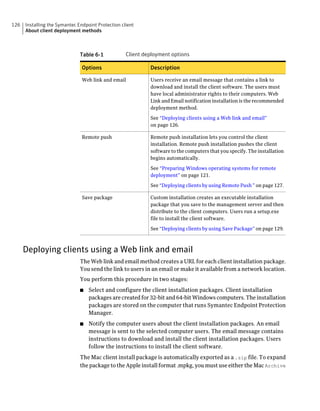
  • 392.
    392 Managing firewall protection About firewall rules 8 Add additional hosts, if necessary. 9 Click OK. See “About firewall rule host triggers” on page 389. Defining DNS queries based on location You can define how frequently you want a specific location to perform a DNS query. This feature lets you configure one location to query the DNS server more often than other locations. For example, assume that you have a policy to block all traffic outside of your corporate network except VPN traffic. And assume that your users travel and must access your network through a VPN from a hotel network. You can create a policy for a VPN connection that uses DNS resolution. Symantec Endpoint Protection continues to send the DNS query every 5 seconds until it switches to this location. This way, your users can more quickly access your network. Caution: Use caution when you configure this setting to a very low value. You run the possibility of bringing down your DNS server if all of your systems access the server every 5 seconds, for example. To define DNS queries based on location 1 In the console, click Clients. 2 Under Clients, select the group for which the feature applies. 3 Under Tasks, click Manage Locations. 4 Ensure DNS Query Loop in is checked. 5 Click the time setting and increments and modify as desired. You can set the value in seconds, minutes, or hours. The default value is 30 minutes. 6 Click OK. See “About firewall rules” on page 378. See “About firewall rule host triggers” on page 389. About firewall rule network services triggers Network services let networked computers send and receive messages, share files, and print. A network service uses one or more protocols or ports to pass through a specific type of traffic. For example, the HTTP service uses ports 80 and 443 in
  • 393.
    Managing firewall protection 393 About firewall rules the TCP protocol. You can create a firewall rule that allows or blocks network services. A network service trigger identifies one or more network protocols that are significant in relation to the described network traffic. When you define TCP-based or UDP-based service triggers, you identify the ports on both sides of the described network connection. Traditionally, ports are referred to as being either the source or the destination of a network connection. See “Adding network services to the default network services list” on page 393. See “Permitting clients to browse for files and printers in the network” on page 404. See “About firewall rules” on page 378. Adding network services to the default network services list Network services let networked computers send and receive messages, share files, and print. You can create a firewall rule that allows or blocks network services. The network services list eliminates the need to retype protocols and ports for the firewall rules that you create to block or allow network services. When you create a firewall rule, you can select a network service from a default list of commonly used network services. You can also add network services to the default list. However, you need to be familiar with the type of protocol and the ports that it uses. Note: IPv4 and IPv6 are the two network layer protocols that are used on the Internet. The firewall blocks the attacks that travel through IPv4, but not through IPv6. If you install the client on the computers that run Microsoft Vista, the Rules list includes several default rules that block the Ethernet protocol type of IPv6. If you remove the default rules, you must create a rule that blocks IPv6. Note: You can add a custom network service through a firewall rule. However, that network service is not added to the default list. You cannot access the custom network service from any other rule. To add network services to the default network services list 1 In the console, click Policies. 2 Expand Policy Components, and then click Network Services. 3 Under Tasks, click Add a Network Service. 4 In the Network Service dialog box, type a name for the service, and then click Add.
  • 394.
    394 Managing firewall protection About firewall rules 5 Select a protocol from the Protocol drop-down list. The options change based on which protocol you select. 6 Type in the appropriate fields, and then click OK. 7 Add one or more additional protocols, as necessary. 8 Click OK. See “About firewall rules” on page 378. See “About firewall rule network services triggers” on page 392. See “Controlling whether networked computers can share messages, files, and printing” on page 404. See “Permitting clients to browse for files and printers in the network” on page 404. About firewall rule network adapter triggers You can define a firewall rule that blocks or allows traffic that passes through (transmitted or received) a network adapter. When you define a particular type of adapter, consider how that adapter is used. For example, if a rule allows outbound HTTP traffic from Ethernet adapters, then HTTP is allowed through all the installed adapters of the same type. The only exception is if you also specify local host addresses. The client computer may use multi-NIC servers and the workstations that bridge two or more network segments. To control traffic relative to a particular adapter, the address scheme of each segment must be used rather than the adapter itself. The network adapter list eliminates the need to retype types of adapters for firewall rules. Instead, when you create a firewall rule, you can