1
MEASURING NANOTECHNOLOGY
MICRO
MATERIALS
NanoTest impact module
for…
• Impact testing
• Contact fatigue testing
• Erosive wear testing
• Fracture toughness
• Adhesion testing
• Dynamic hardness
The only commercial nano-impact tester available
Impact
2
MEASURING NANOTECHNOLOGY
MICRO
MATERIALS
Quasi-static tests are very useful
Nanoindentation – mechanical
properties (hardness, modulus,
creep)
Nanoscratch – tribological properties
(abrasive and sliding wear)
Importance of Nano-impact testing
Bringing nanomechanical
measurements into the real-world
Dynamic nanomechanical tests (nano-impact
and contact fatigue) have been developed by
Micro Materials to address this problem
The need for dynamic testing
Materials often fail by fatigue not
overload…
so optimisation based on
nanoindentation/scratch can be
insufficient for applications where
materials are exposed in service
and/or in processing to fatigue wear
or erosive wear (impact wear)
The solution…
3
MEASURING NANOTECHNOLOGY
MICRO
MATERIALS
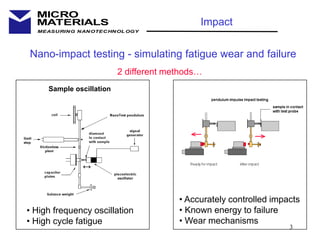
Nano-impact testing - simulating fatigue wear and failure
Impact
Sample oscillation
2 different methods…
• High frequency oscillation
• High cycle fatigue
• Accurately controlled impacts
• Known energy to failure
• Wear mechanisms
4
MEASURING NANOTECHNOLOGY
MICRO
MATERIALS
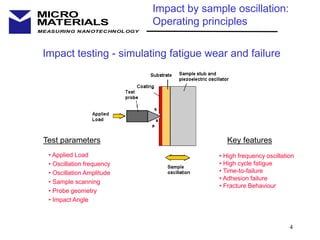
Impact testing - simulating fatigue wear and failure
Impact by sample oscillation:
Operating principles
• Applied Load
• Oscillation frequency
• Oscillation Amplitude
• Sample scanning
• Probe geometry
• Impact Angle
Test parameters
• High frequency oscillation
• High cycle fatigue
• Time-to-failure
• Adhesion failure
• Fracture Behaviour
Key features
5
MEASURING NANOTECHNOLOGY
MICRO
MATERIALS
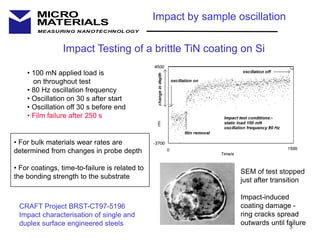
Impact Testing of a brittle TiN coating on Si
• For bulk materials wear rates are
determined from changes in probe depth
• For coatings, time-to-failure is related to
the bonding strength to the substrate
• 100 mN applied load is
on throughout test
• 80 Hz oscillation frequency
• Oscillation on 30 s after start
• Oscillation off 30 s before end
• Film failure after 250 s
Impact by sample oscillation
SEM of test stopped
just after transition
Impact-induced
coating damage -
ring cracks spread
outwards until failure
CRAFT Project BRST-CT97-5196
Impact characterisation of single and
duplex surface engineered steels
6
MEASURING NANOTECHNOLOGY
MICRO
MATERIALS
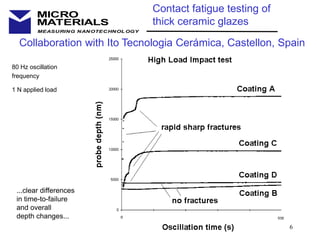
Contact fatigue testing of
thick ceramic glazes
80 Hz oscillation
frequency
1 N applied load
...clear differences
in time-to-failure
and overall
depth changes...
Collaboration with Ito Tecnologia Cerámica, Castellon, Spain
7
MEASURING NANOTECHNOLOGY
MICRO
MATERIALS
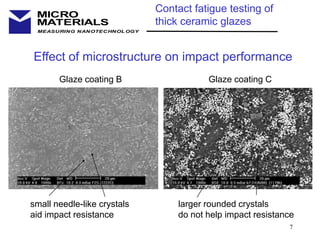
Glaze coating B Glaze coating C
Effect of microstructure on impact performance
small needle-like crystals
aid impact resistance
larger rounded crystals
do not help impact resistance
Contact fatigue testing of
thick ceramic glazes
8
MEASURING NANOTECHNOLOGY
MICRO
MATERIALS
Contact fatigue of ceramic coatings:
comparison to other testing techniques
• Hardness and Young’s modulus did not vary
• Scratch testing frustrated by high surface roughness
• Correlation with fracture toughness data…
• Impact resistant samples had high fracture toughness
• Time-to-failure
• Change in Probe Depth
…measures of resistance to brittle fracture
“Micro-impact testing: a new technique for investigating fracture toughness” BD Beake (MML), Maria
Jesus Ibanez Garcia (ITC Spain) and JF Smith (MML), Thin Solid Films 398-399 (2001) 438-443.
9
MEASURING NANOTECHNOLOGY
MICRO
MATERIALS
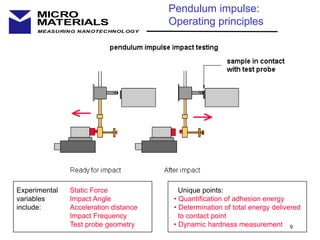
Unique points:
• Quantification of adhesion energy
• Determination of total energy delivered
to contact point
• Dynamic hardness measurement
Static Force
Impact Angle
Acceleration distance
Impact Frequency
Test probe geometry
Experimental
variables
include:
Pendulum impulse:
Operating principles
10
MEASURING NANOTECHNOLOGY
MICRO
MATERIALS
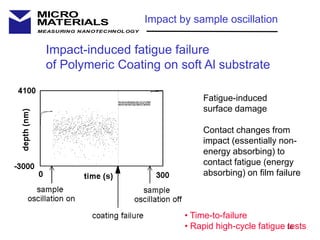
Impact-induced fatigue failure
of Polymeric Coating on soft Al substrate
Fatigue-induced
surface damage
Contact changes from
impact (essentially non-
energy absorbing) to
contact fatigue (energy
absorbing) on film failure
• Time-to-failure
• Rapid high-cycle fatigue tests
Impact by sample oscillation
11
MEASURING NANOTECHNOLOGY
MICRO
MATERIALS
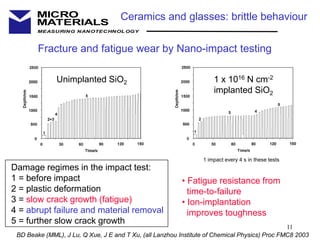
Unimplanted SiO2 1 x 10¹⁶ N cm-2
implanted SiO2
Damage regimes in the impact test:
1 = before impact
2 = plastic deformation
3 = slow crack growth (fatigue)
4 = abrupt failure and material removal
5 = further slow crack growth
Fracture and fatigue wear by Nano-impact testing
Ceramics and glasses: brittle behaviour
• Fatigue resistance from
time-to-failure
• Ion-implantation
improves toughness
BD Beake (MML), J Lu, Q Xue, J E and T Xu, (all Lanzhou Institute of Chemical Physics) Proc FMC8 2003
1 impact every 4 s in these tests
12
MEASURING NANOTECHNOLOGY
MICRO
MATERIALS
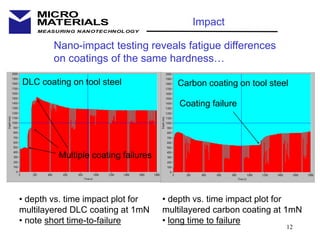
Carbon coating on tool steel
• depth vs. time impact plot for
multilayered carbon coating at 1mN
• long time to failure
Coating failure
Multiple coating failures
DLC coating on tool steel
• depth vs. time impact plot for
multilayered DLC coating at 1mN
• note short time-to-failure
Nano-impact testing reveals fatigue differences
on coatings of the same hardness…
Impact
13
MEASURING NANOTECHNOLOGY
MICRO
MATERIALS
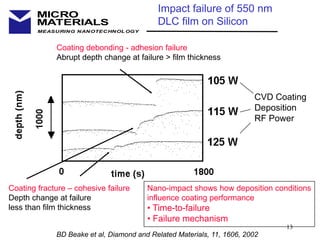
Impact failure of 550 nm
DLC film on Silicon
Nano-impact shows how deposition conditions
influence coating performance
• Time-to-failure
• Failure mechanism
Coating debonding - adhesion failure
Abrupt depth change at failure > film thickness
Coating fracture – cohesive failure
Depth change at failure
less than film thickness
CVD Coating
Deposition
RF Power
BD Beake et al, Diamond and Related Materials, 11, 1606, 2002
14
MEASURING NANOTECHNOLOGY
MICRO
MATERIALS
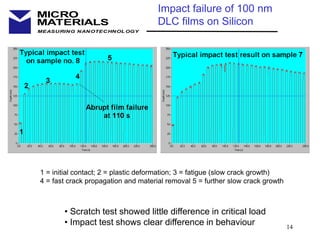
Impact failure of 100 nm
DLC films on Silicon
• Scratch test showed little difference in critical load
• Impact test shows clear difference in behaviour
1 = initial contact; 2 = plastic deformation; 3 = fatigue (slow crack growth)
4 = fast crack propagation and material removal 5 = further slow crack growth
15
MEASURING NANOTECHNOLOGY
MICRO
MATERIALS
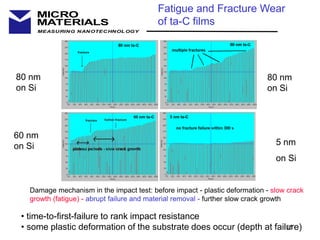
Damage mechanism in the impact test: before impact - plastic deformation - slow crack
growth (fatigue) - abrupt failure and material removal - further slow crack growth
Fatigue and Fracture Wear
of ta-C films
80 nm
on Si
60 nm
on Si
• time-to-first-failure to rank impact resistance
• some plastic deformation of the substrate does occur (depth at failure)
5 nm
on Si
80 nm
on Si
16
MEASURING NANOTECHNOLOGY
MICRO
MATERIALS
Fatigue and Fracture Wear
of ta-C films
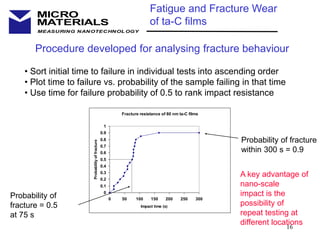
Procedure developed for analysing fracture behaviour
• Sort initial time to failure in individual tests into ascending order
• Plot time to failure vs. probability of the sample failing in that time
• Use time for failure probability of 0.5 to rank impact resistance
Fracture resistance of 80 nm ta-C films
0
0.1
0.2
0.3
0.4
0.5
0.6
0.7
0.8
0.9
1
0 50 100 150 200 250 300
Impact time (s)
Probability
of
fracture
Probability of fracture
within 300 s = 0.9
Probability of
fracture = 0.5
at 75 s
A key advantage of
nano-scale
impact is the
possibility of
repeat testing at
different locations
17
MEASURING NANOTECHNOLOGY
MICRO
MATERIALS Nano-impact mapping of biomaterials
50
200
350
500
650
800
950
50
200
Impact depth
(nm)
position (microns)
position
(microns)
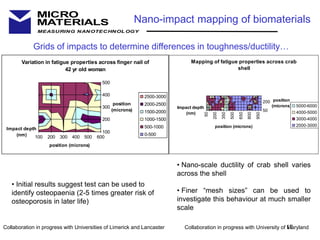
Mapping of fatigue properties across crab
shell
5000-6000
4000-5000
3000-4000
2000-3000
• Nano-scale ductility of crab shell varies
across the shell
• Finer “mesh sizes” can be used to
investigate this behaviour at much smaller
scale
• Initial results suggest test can be used to
identify osteopaenia (2-5 times greater risk of
osteoporosis in later life)
Grids of impacts to determine differences in toughness/ductility…
Collaboration in progress with Universities of Limerick and Lancaster Collaboration in progress with University of Maryland
100 200 300 400 500 600
100
200
300
400
500
Impact depth
(nm)
position (microns)
position
(microns)
Variation in fatigue properties across finger nail of
42 yr old woman
2500-3000
2000-2500
1500-2000
1000-1500
500-1000
0-500

Impact Module training module for Automotive Industries

  • 1.
    1 MEASURING NANOTECHNOLOGY MICRO MATERIALS NanoTest impactmodule for… • Impact testing • Contact fatigue testing • Erosive wear testing • Fracture toughness • Adhesion testing • Dynamic hardness The only commercial nano-impact tester available Impact
  • 2.
    2 MEASURING NANOTECHNOLOGY MICRO MATERIALS Quasi-static testsare very useful Nanoindentation – mechanical properties (hardness, modulus, creep) Nanoscratch – tribological properties (abrasive and sliding wear) Importance of Nano-impact testing Bringing nanomechanical measurements into the real-world Dynamic nanomechanical tests (nano-impact and contact fatigue) have been developed by Micro Materials to address this problem The need for dynamic testing Materials often fail by fatigue not overload… so optimisation based on nanoindentation/scratch can be insufficient for applications where materials are exposed in service and/or in processing to fatigue wear or erosive wear (impact wear) The solution…
  • 3.
    3 MEASURING NANOTECHNOLOGY MICRO MATERIALS Nano-impact testing- simulating fatigue wear and failure Impact Sample oscillation 2 different methods… • High frequency oscillation • High cycle fatigue • Accurately controlled impacts • Known energy to failure • Wear mechanisms
  • 4.
    4 MEASURING NANOTECHNOLOGY MICRO MATERIALS Impact testing- simulating fatigue wear and failure Impact by sample oscillation: Operating principles • Applied Load • Oscillation frequency • Oscillation Amplitude • Sample scanning • Probe geometry • Impact Angle Test parameters • High frequency oscillation • High cycle fatigue • Time-to-failure • Adhesion failure • Fracture Behaviour Key features
  • 5.
    5 MEASURING NANOTECHNOLOGY MICRO MATERIALS Impact Testingof a brittle TiN coating on Si • For bulk materials wear rates are determined from changes in probe depth • For coatings, time-to-failure is related to the bonding strength to the substrate • 100 mN applied load is on throughout test • 80 Hz oscillation frequency • Oscillation on 30 s after start • Oscillation off 30 s before end • Film failure after 250 s Impact by sample oscillation SEM of test stopped just after transition Impact-induced coating damage - ring cracks spread outwards until failure CRAFT Project BRST-CT97-5196 Impact characterisation of single and duplex surface engineered steels
  • 6.
    6 MEASURING NANOTECHNOLOGY MICRO MATERIALS Contact fatiguetesting of thick ceramic glazes 80 Hz oscillation frequency 1 N applied load ...clear differences in time-to-failure and overall depth changes... Collaboration with Ito Tecnologia Cerámica, Castellon, Spain
  • 7.
    7 MEASURING NANOTECHNOLOGY MICRO MATERIALS Glaze coatingB Glaze coating C Effect of microstructure on impact performance small needle-like crystals aid impact resistance larger rounded crystals do not help impact resistance Contact fatigue testing of thick ceramic glazes
  • 8.
    8 MEASURING NANOTECHNOLOGY MICRO MATERIALS Contact fatigueof ceramic coatings: comparison to other testing techniques • Hardness and Young’s modulus did not vary • Scratch testing frustrated by high surface roughness • Correlation with fracture toughness data… • Impact resistant samples had high fracture toughness • Time-to-failure • Change in Probe Depth …measures of resistance to brittle fracture “Micro-impact testing: a new technique for investigating fracture toughness” BD Beake (MML), Maria Jesus Ibanez Garcia (ITC Spain) and JF Smith (MML), Thin Solid Films 398-399 (2001) 438-443.
  • 9.
    9 MEASURING NANOTECHNOLOGY MICRO MATERIALS Unique points: •Quantification of adhesion energy • Determination of total energy delivered to contact point • Dynamic hardness measurement Static Force Impact Angle Acceleration distance Impact Frequency Test probe geometry Experimental variables include: Pendulum impulse: Operating principles
  • 10.
    10 MEASURING NANOTECHNOLOGY MICRO MATERIALS Impact-induced fatiguefailure of Polymeric Coating on soft Al substrate Fatigue-induced surface damage Contact changes from impact (essentially non- energy absorbing) to contact fatigue (energy absorbing) on film failure • Time-to-failure • Rapid high-cycle fatigue tests Impact by sample oscillation
  • 11.
    11 MEASURING NANOTECHNOLOGY MICRO MATERIALS Unimplanted SiO21 x 1016 N cm-2 implanted SiO2 Damage regimes in the impact test: 1 = before impact 2 = plastic deformation 3 = slow crack growth (fatigue) 4 = abrupt failure and material removal 5 = further slow crack growth Fracture and fatigue wear by Nano-impact testing Ceramics and glasses: brittle behaviour • Fatigue resistance from time-to-failure • Ion-implantation improves toughness BD Beake (MML), J Lu, Q Xue, J E and T Xu, (all Lanzhou Institute of Chemical Physics) Proc FMC8 2003 1 impact every 4 s in these tests
  • 12.
    12 MEASURING NANOTECHNOLOGY MICRO MATERIALS Carbon coatingon tool steel • depth vs. time impact plot for multilayered carbon coating at 1mN • long time to failure Coating failure Multiple coating failures DLC coating on tool steel • depth vs. time impact plot for multilayered DLC coating at 1mN • note short time-to-failure Nano-impact testing reveals fatigue differences on coatings of the same hardness… Impact
  • 13.
    13 MEASURING NANOTECHNOLOGY MICRO MATERIALS Impact failureof 550 nm DLC film on Silicon Nano-impact shows how deposition conditions influence coating performance • Time-to-failure • Failure mechanism Coating debonding - adhesion failure Abrupt depth change at failure > film thickness Coating fracture – cohesive failure Depth change at failure less than film thickness CVD Coating Deposition RF Power BD Beake et al, Diamond and Related Materials, 11, 1606, 2002
  • 14.
    14 MEASURING NANOTECHNOLOGY MICRO MATERIALS Impact failureof 100 nm DLC films on Silicon • Scratch test showed little difference in critical load • Impact test shows clear difference in behaviour 1 = initial contact; 2 = plastic deformation; 3 = fatigue (slow crack growth) 4 = fast crack propagation and material removal 5 = further slow crack growth
  • 15.
    15 MEASURING NANOTECHNOLOGY MICRO MATERIALS Damage mechanismin the impact test: before impact - plastic deformation - slow crack growth (fatigue) - abrupt failure and material removal - further slow crack growth Fatigue and Fracture Wear of ta-C films 80 nm on Si 60 nm on Si • time-to-first-failure to rank impact resistance • some plastic deformation of the substrate does occur (depth at failure) 5 nm on Si 80 nm on Si
  • 16.
    16 MEASURING NANOTECHNOLOGY MICRO MATERIALS Fatigue andFracture Wear of ta-C films Procedure developed for analysing fracture behaviour • Sort initial time to failure in individual tests into ascending order • Plot time to failure vs. probability of the sample failing in that time • Use time for failure probability of 0.5 to rank impact resistance Fracture resistance of 80 nm ta-C films 0 0.1 0.2 0.3 0.4 0.5 0.6 0.7 0.8 0.9 1 0 50 100 150 200 250 300 Impact time (s) Probability of fracture Probability of fracture within 300 s = 0.9 Probability of fracture = 0.5 at 75 s A key advantage of nano-scale impact is the possibility of repeat testing at different locations
  • 17.
    17 MEASURING NANOTECHNOLOGY MICRO MATERIALS Nano-impactmapping of biomaterials 50 200 350 500 650 800 950 50 200 Impact depth (nm) position (microns) position (microns) Mapping of fatigue properties across crab shell 5000-6000 4000-5000 3000-4000 2000-3000 • Nano-scale ductility of crab shell varies across the shell • Finer “mesh sizes” can be used to investigate this behaviour at much smaller scale • Initial results suggest test can be used to identify osteopaenia (2-5 times greater risk of osteoporosis in later life) Grids of impacts to determine differences in toughness/ductility… Collaboration in progress with Universities of Limerick and Lancaster Collaboration in progress with University of Maryland 100 200 300 400 500 600 100 200 300 400 500 Impact depth (nm) position (microns) position (microns) Variation in fatigue properties across finger nail of 42 yr old woman 2500-3000 2000-2500 1500-2000 1000-1500 500-1000 0-500