Download to read offline

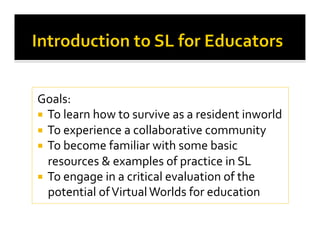
![ Graduate
level
distance
course
Pre‐course
orientation
requirement
11
Students
[PhD,
Faculty,
Administrators],
1
Instructor,
&
2
SL
Mentors
1
hour
x
15
weeks
Meet/Direct
Instruction/Review
in
SL
@
Skydeck
Participate
in
tour,
presentation,
or
other
activity
Critical
Wiki
reflection
of
inworld
experience
Assignments
http://introto2ndlifeforeducators.pbworks.com/Weekly‐Course‐Assignments](https://image.slidesharecdn.com/azboudreau-elearn09-immersivevwsintrosl-160227033000/85/Immersive-Virtual-Worlds-in-Educational-Practice-Introducing-Educators-to-Second-Life-6-320.jpg)

![ …I
let
students
know
I
would
be
there
watching
and
ready
to
assist
with
any
questions.
Before
we
left
the
Skydeck
we
went
over
how
‘basics
like’
to
send
a
private
Instant
Message
[IM]
and
how
to
ask
for
a
teleport
if
they
got
stuck
somewhere.
I
went
with
them
and
after
making
sure
they
all
made
it
to
the
welcome
area
and
were
clicking
to
get
notecards,
I
sent
them
on
their
own
to
explore
and
hovered
above
the
build.
Using
camera
controls
I
was
able
to
keep
track
fairly
well
(felt
a
bit
like
a
mother
hen
trying
to
keep
track
of
her
chicks).
If
they
ran
into
problems
I
could
quickly
be
there
to
help.
This
worked
very
well
and
some
students
did
Instant
Message
me
for
help,
or
even
to
share
their
excitement
about
what
they
were
experiencing.](https://image.slidesharecdn.com/azboudreau-elearn09-immersivevwsintrosl-160227033000/85/Immersive-Virtual-Worlds-in-Educational-Practice-Introducing-Educators-to-Second-Life-11-320.jpg)

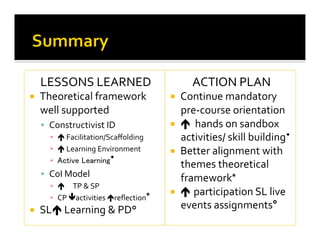

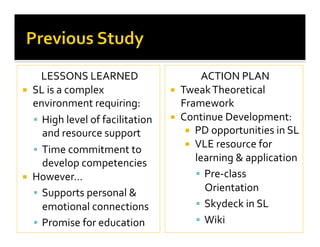
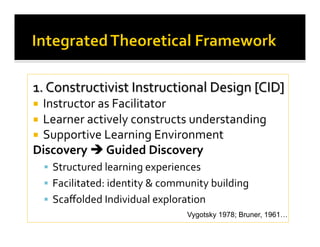
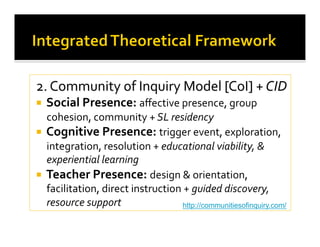
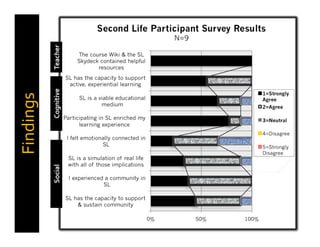
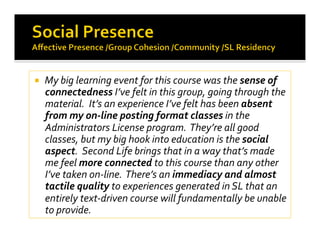
This document discusses lessons learned from a graduate level distance course that utilized Second Life (SL). It found that the theoretical frameworks of constructivism and the Community of Inquiry model were well supported by SL activities. Participants felt more connected in SL and that it facilitated social and emotional connections better than online only courses. Going forward, the action plan is to continue orienting students in SL and providing hands on activities, better align assignments with frameworks, and incorporate more live SL events.


