Technologies and scientific foundations in
           the field of creativity


             Objective 8.1 of WP2013

            Ghent, 7-8 November 2012

Albert GAUTHIER (DG Connect, Unit G2: CREATIVITY)
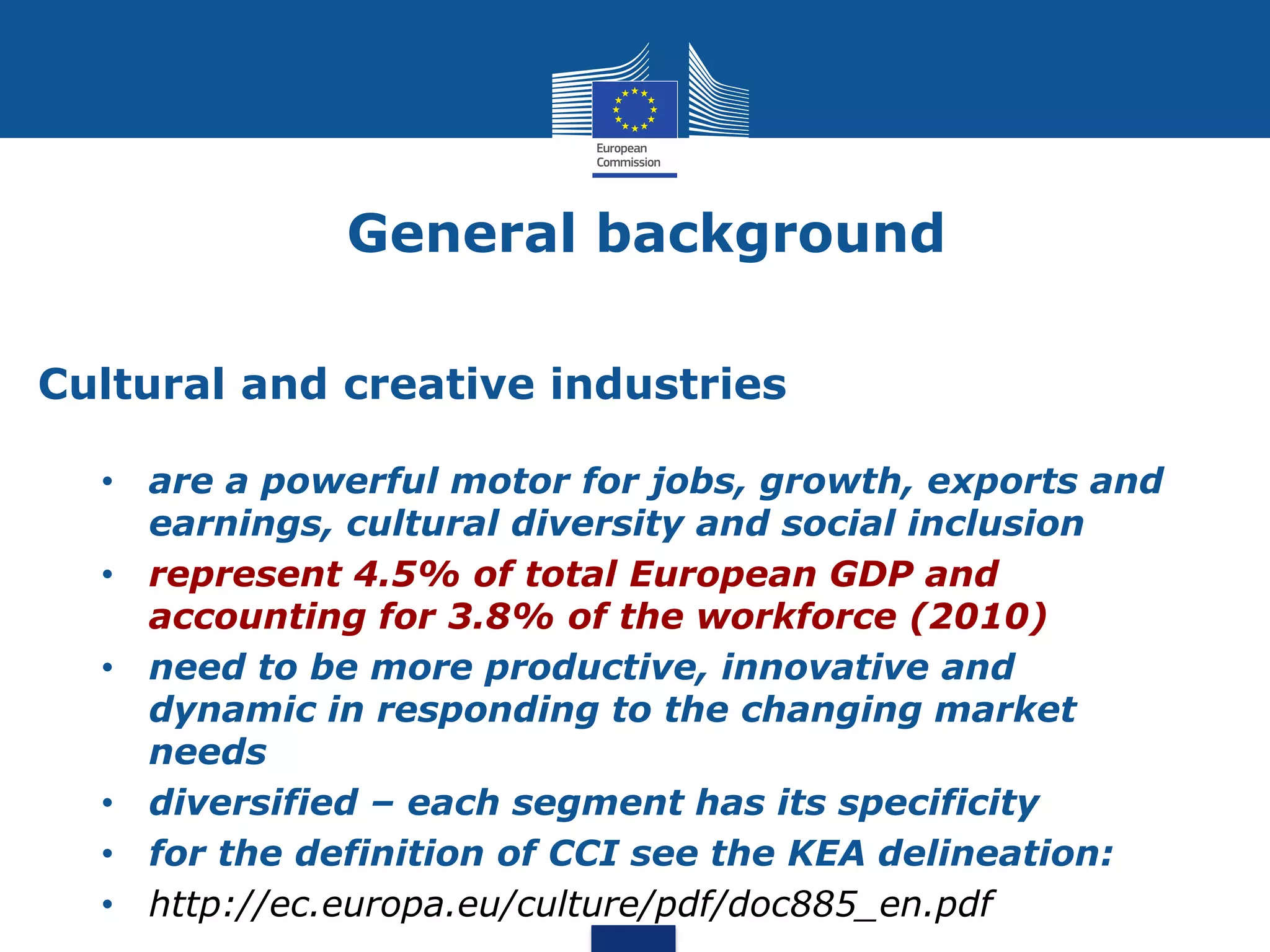
General background

Cultural and creative industries

  • are a powerful motor for jobs, growth, exports and
    earnings, cultural diversity and social inclusion
  • represent 4.5% of total European GDP and
    accounting for 3.8% of the workforce (2010)
  • need to be more productive, innovative and
    dynamic in responding to the changing market
    needs
  • diversified – each segment has its specificity
  • for the definition of CCI see the KEA delineation:
  • http://ec.europa.eu/culture/pdf/doc885_en.pdf
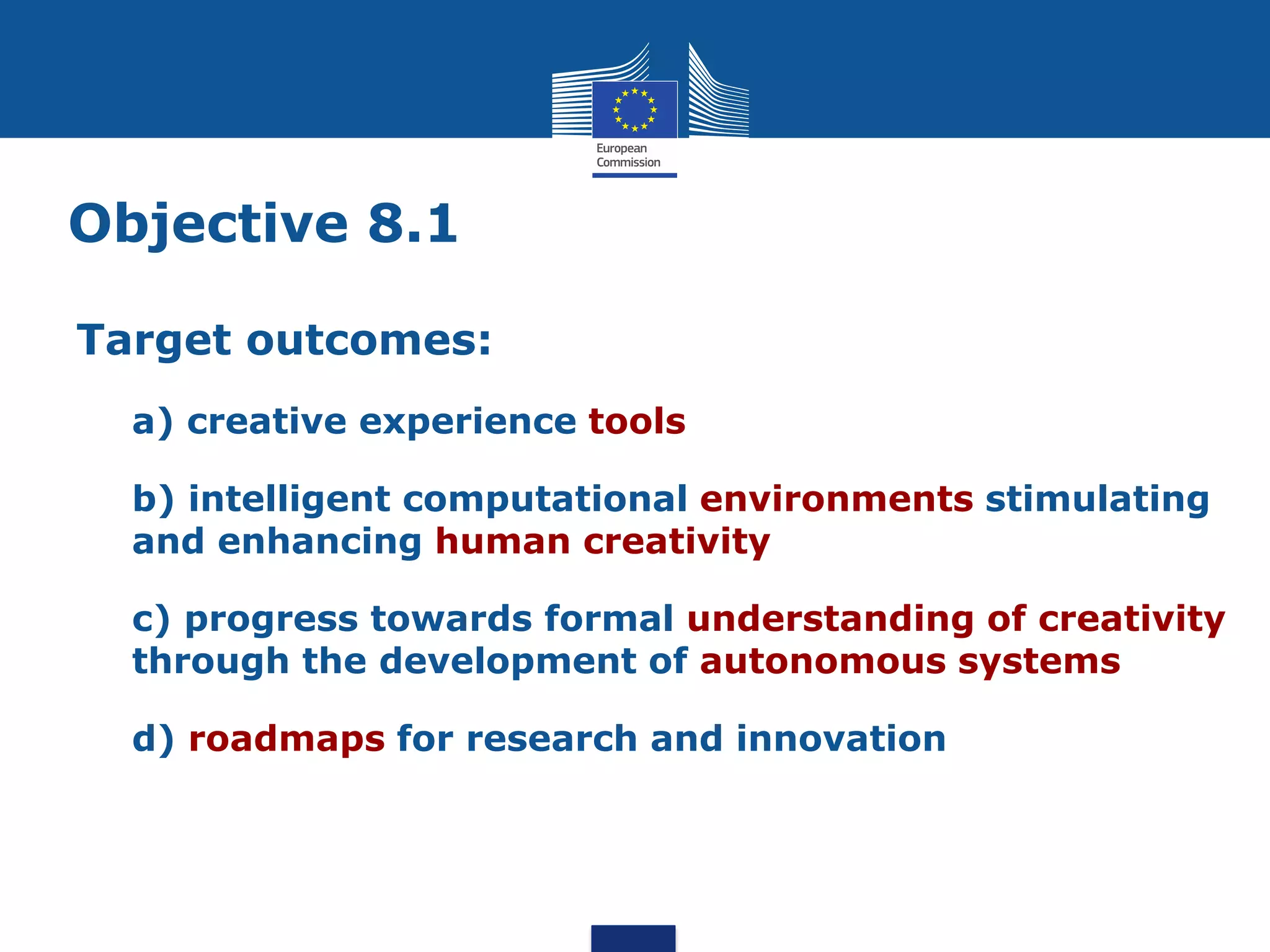
Objective 8.1

Target outcomes:
  a) creative experience tools

  b) intelligent computational environments stimulating
  and enhancing human creativity

  c) progress towards formal understanding of creativity
  through the development of autonomous systems

  d) roadmaps for research and innovation
Target outcome 8.1.a)


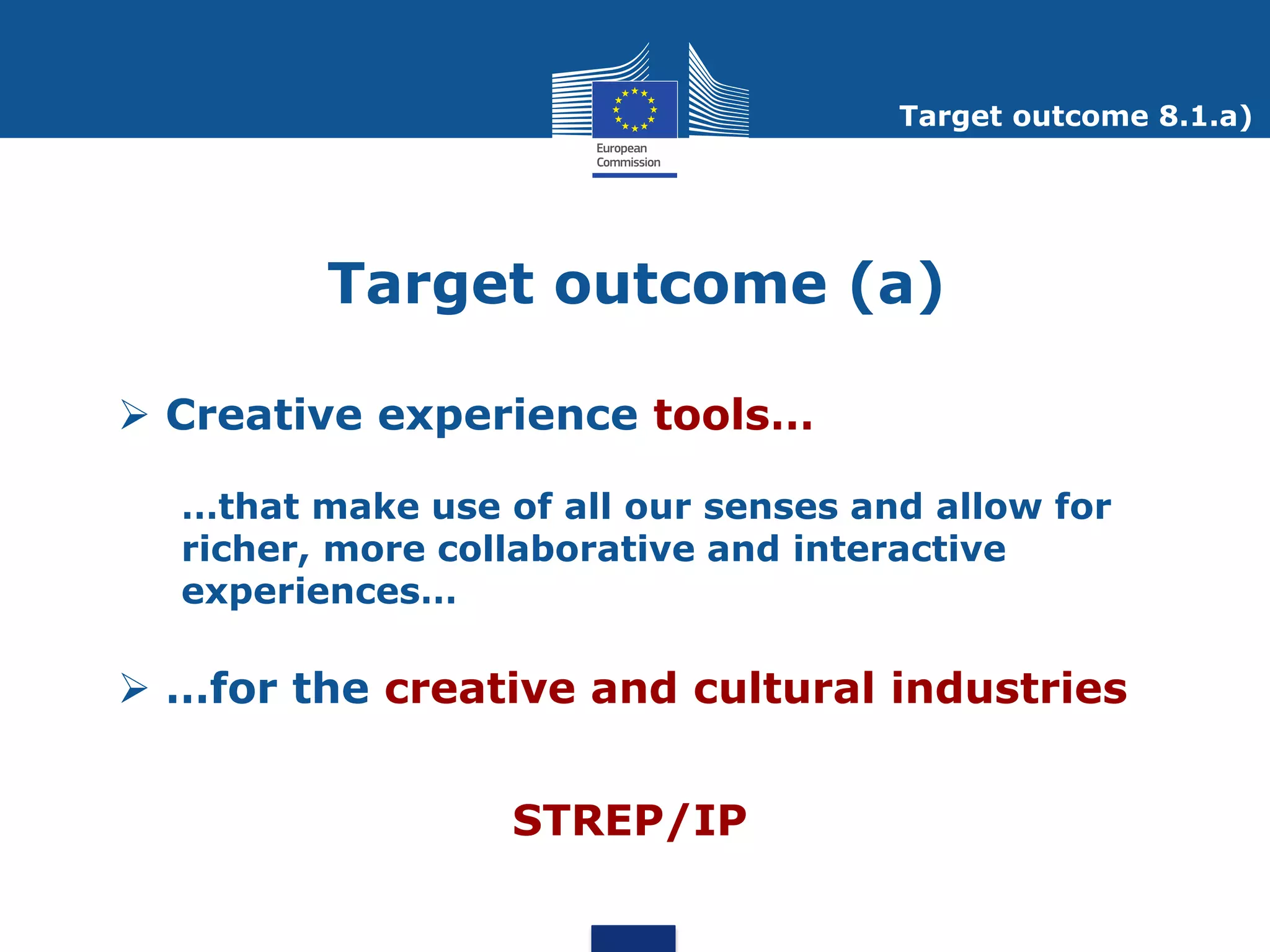
         Target outcome (a)

 Creative experience tools…

  …that make use of all our senses and allow for
  richer, more collaborative and interactive
  experiences…

 …for the creative and cultural industries


                  STREP/IP
Target outcome 8.1.a)


Interactive experience

 Technologies that could be used:

   •   real time simulation, visualisation
   •   augmented reality
   •   3D animation
   •   visual computing
   •   games engines
   •   immersive experiences
   •   …
Target outcome 8.1.a)


Creative experience tools
for the creative industry
The tools created should be

  • cost effective, with special attention to users
    like SMEs and individual creators

  • intuitive

  • be demonstrated in real environments for the
    creative and cultural industries
Target outcome 8.1.a)


Expected impact for a)
Research activities will contribute to


• Improved efficiency of creative processes by two fold
  at least as regards time and resource investment,
  and quality of output
• Equipping different industries with more effective
  creative tools
• Expanding the potential of technology in the human
  creative processes
Target outcome 8.1.a)


Cultural and Creative Industries

  Which kinds of industries?


    •   advertising,           •   fashion
    •   publishing             •   films, music
    •   architecture,          •   video games
    •   arts, crafts,          •   TV, radio
    •   design                 •   …
Target outcome 8.1.b)


         Target outcome b)


• Intelligent computational environments
  stimulating and enhancing human
  creativity


                 STREP
Target outcome 8.1.b)


Important points for b)

•   Multi-disciplinary research: it is possible to start from
    different paradigms, but ensure expertise on creativity in the
    consortium

•   Address domain-specific skills in work-related contexts

•   Operational definition of creativity needs to be provided;
    specify how the insights will feed back into the system

•   Measuring human creative performance means that metrics
    are needed
Target outcome 8.1.b)


Expected impact for b)


• Better understanding of the potential of
  technology in human creative processes
  leading to enhanced domain-specific human
  creative performance
Target outcome 8.1.c)


Target outcome c)


• Progress towards formal understanding
  of creativity

• Autonomous creative systems

                STREP
Target outcome 8.1.c)


Deeper understanding of creativity
• There is no consolidated and consistent 'Science of
  Creativity' (various disciplines study it from different
  angles)

• Computational Creativity offers great potential for
  studying and better understanding creativity

• Producing autonomously creative systems is an
  ambitious research challenge

• The difficulty of measuring and evaluating creativity
  raises additional methodological challenges
Target outcome 8.1.c)


The objective addresses the need to
- Achieve a better understanding of creativity and the way
  it can be technologically achieved


Research should be multi-disciplinary and may involve such
disciplines as:

      - AI                      - Cognitive science
      - Sociology               - Arts (including
      - Psychology                performing arts)
      - Neuroscience            - Robotics
Target outcome 8.1.c)


Important points for c)

- Rising above the level of pastiche (mimicry); human-
  level creativity;

- Technological development in itself is not sufficient;
  the proposals need to demonstrate that there will be
  a possibility to learn something of human creativity
Target outcome 8.1.c)


Expected impact for c)

- Deeper scientific understanding of creativity


- Fostering the synergy between understanding and
 enhancing human creativity


- New technologies for autonomous creative systems
Target outcome 8.1.d)


          Target outcome d)


• roadmaps for future research and innovation


                    CSA
Target outcome 8.1.d)


Roadmaps


• proposals should target cross- and inter-cluster
  support activities

• boosting creative competitiveness in sectors such as
  advertising, architecture, arts, crafts, design, fashion,
  films, music, publishing, video games, TV and radio
Target outcome 8.1.d)


Important points for d)
• More exchange and interaction in CI-s (for CI-s) and
  between research and industry

• Identifying trends, developments and needs as
  guidance for informed policy-making (for the
  Commission)

• Medium-term and longer-term perspectives (upcoming
  Horizon 2020)
Target outcome 8.1.d)


Expected impact for d)


• Better coordination of European and
  national efforts, closer dialogue between
  research and industry, better understanding
  of user requirements, more innovation and
  technology uptake
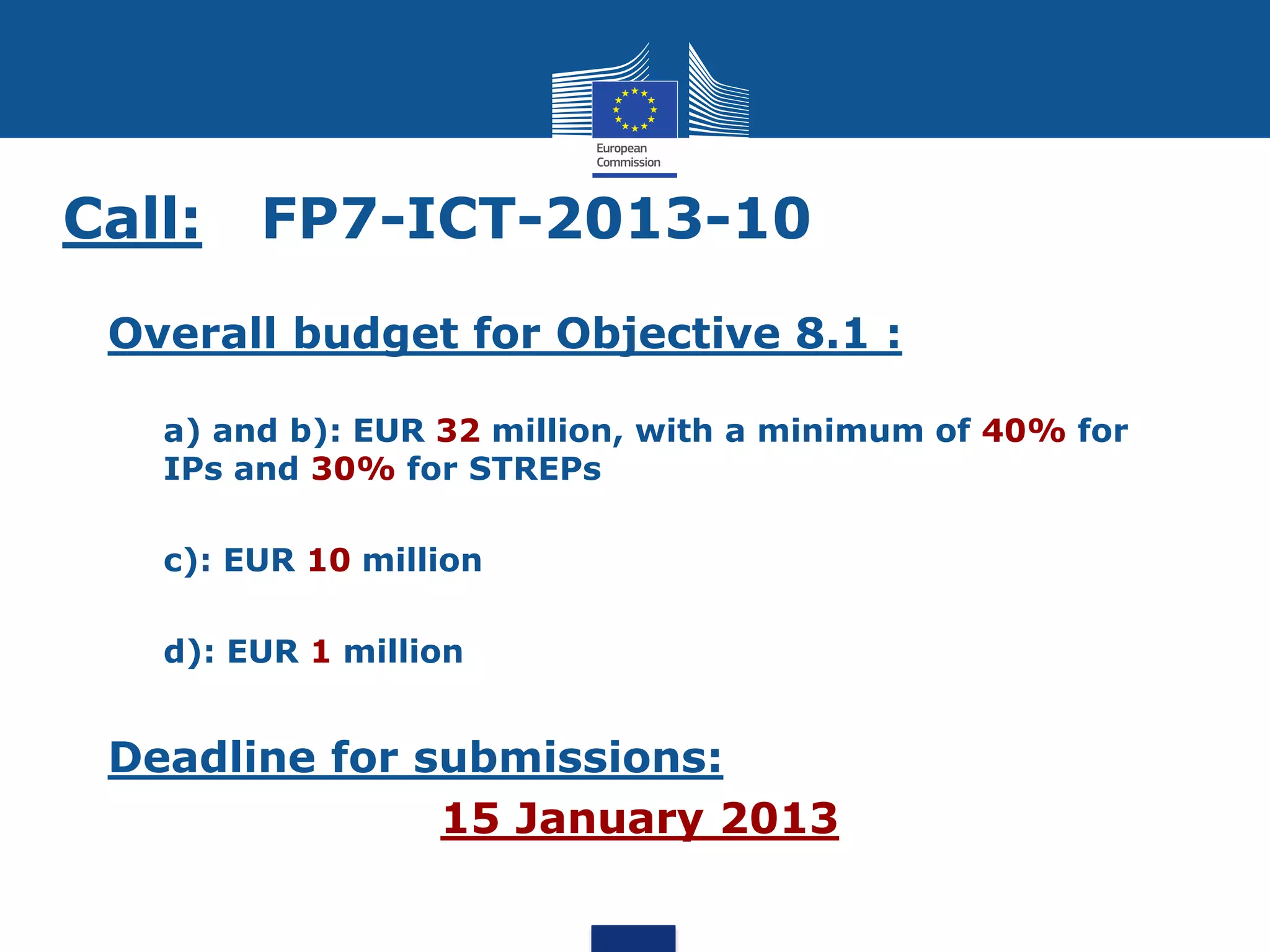
Call:   FP7-ICT-2013-10
 Overall budget for Objective 8.1 :

   a) and b): EUR 32 million, with a minimum of 40% for
   IPs and 30% for STREPs

   c): EUR 10 million

   d): EUR 1 million


 Deadline for submissions:
               15 January 2013
Tips for proposers
If you want to fail, then…

•   Ignore the text of the work programme
•   Ignore on-going work (not only in EU projects)
•   Window-dress the partnership
•   Describe your solution and end product in great detail – but omit
    to state which problem your project will address and where the
    research challenges are
•   Produce a proposal that tries to do everything and loses
    credibility. Often less is more.
•   Ignore the evaluation criteria when drafting your proposal (T&S
    excellence, implementation and impact)
When preparing the proposal…
•   Describe the specific state of the art with referenced evidence, as well
    as the technical baseline, and expected advancements against which
    progress can be measured

•   Check the timelines and anticipated outputs of on-going research in
    defining your starting point and the advances you will make – don’t
    replicate existing work

•   Adopt a scientifically sound approach to involving users in the
    research, including to the assessment and validation necessary to build
    the evidence of impact
When preparing the proposal…
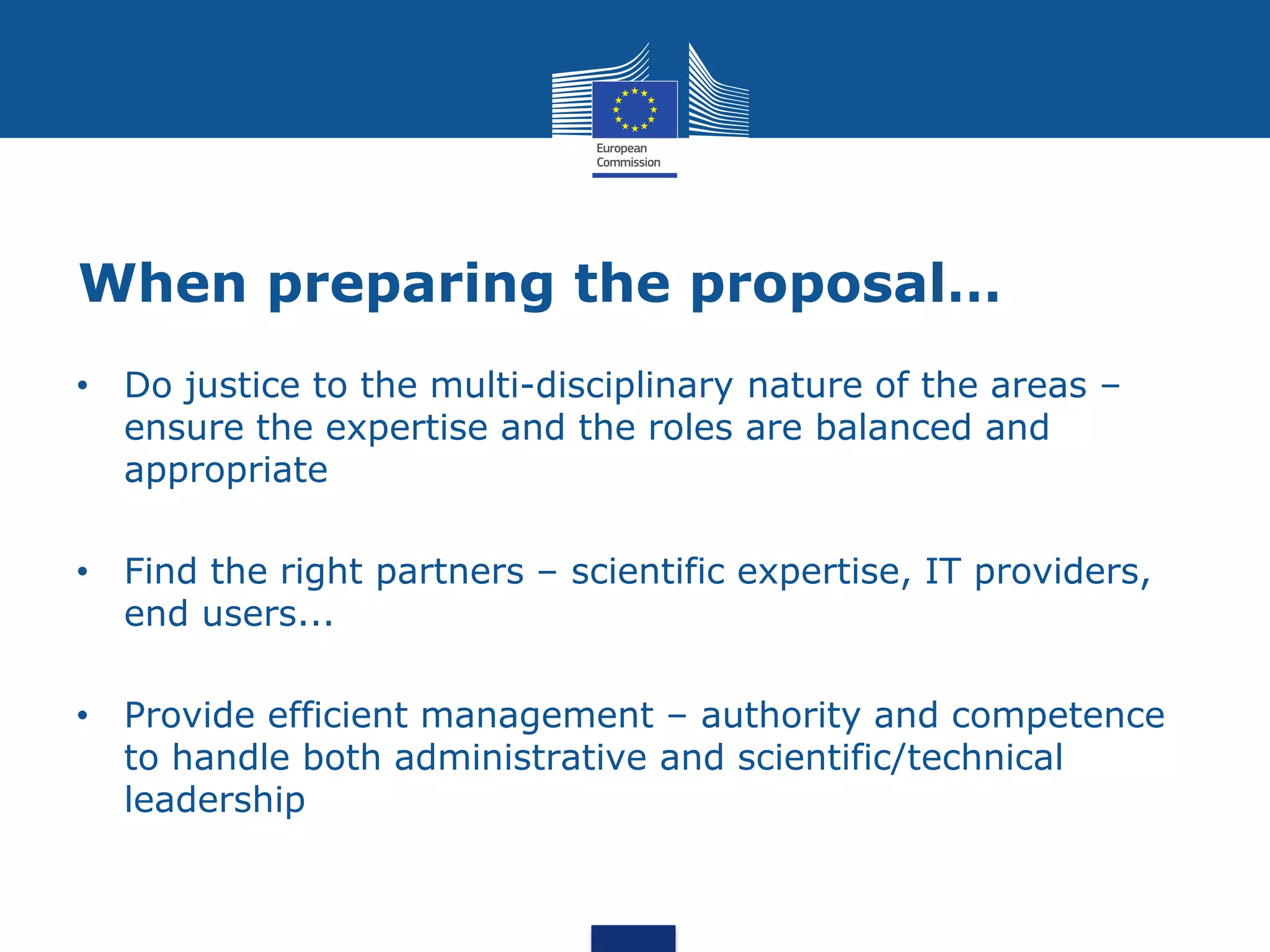
• Do justice to the multi-disciplinary nature of the areas –
  ensure the expertise and the roles are balanced and
  appropriate

• Find the right partners – scientific expertise, IT providers,
  end users...

• Provide efficient management – authority and competence
  to handle both administrative and scientific/technical
  leadership
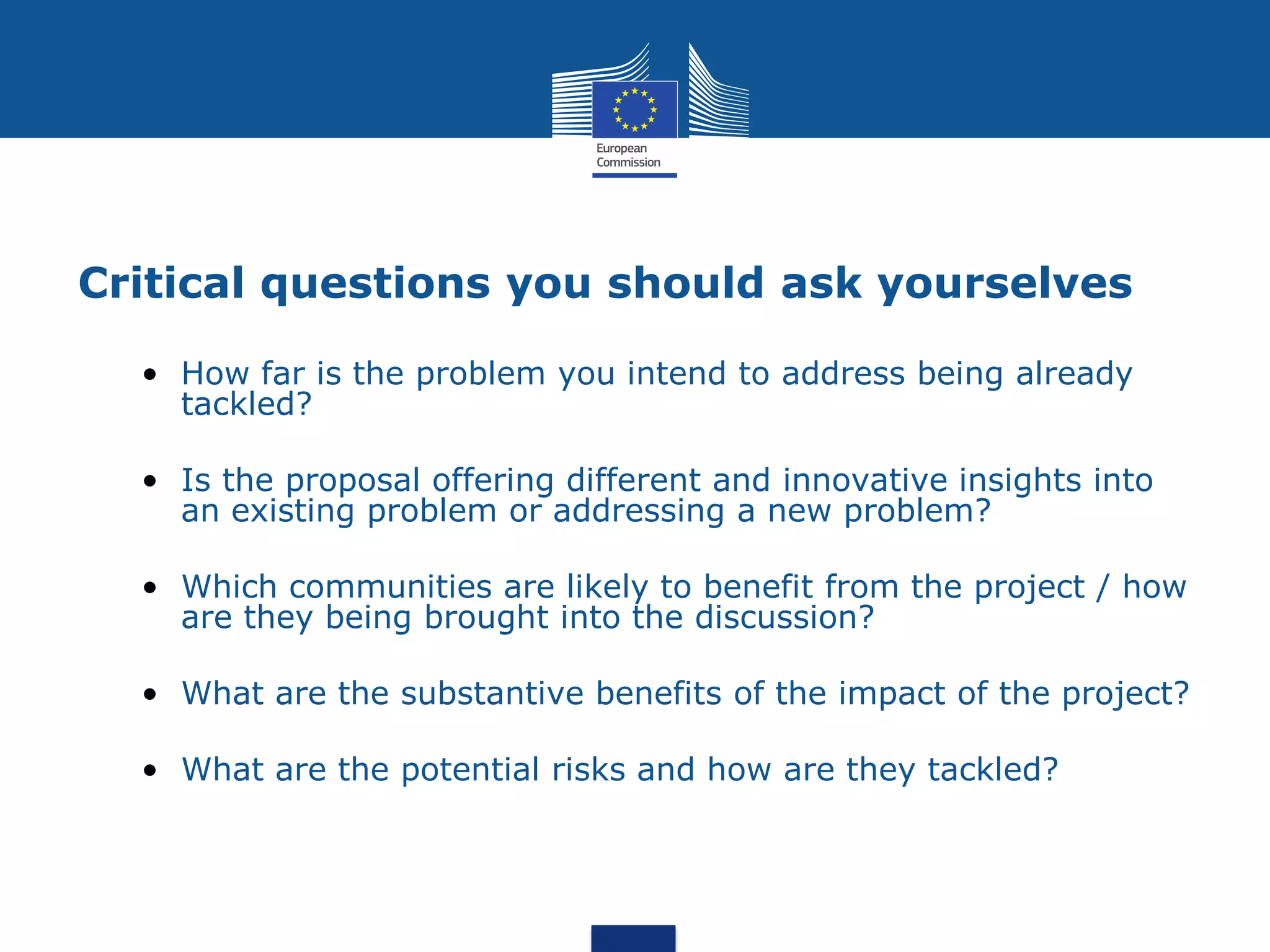
Critical questions you should ask yourselves

  • How far is the problem you intend to address being already
    tackled?

  • Is the proposal offering different and innovative insights into
    an existing problem or addressing a new problem?

  • Which communities are likely to benefit from the project / how
    are they being brought into the discussion?

  • What are the substantive benefits of the impact of the project?

  • What are the potential risks and how are they tackled?
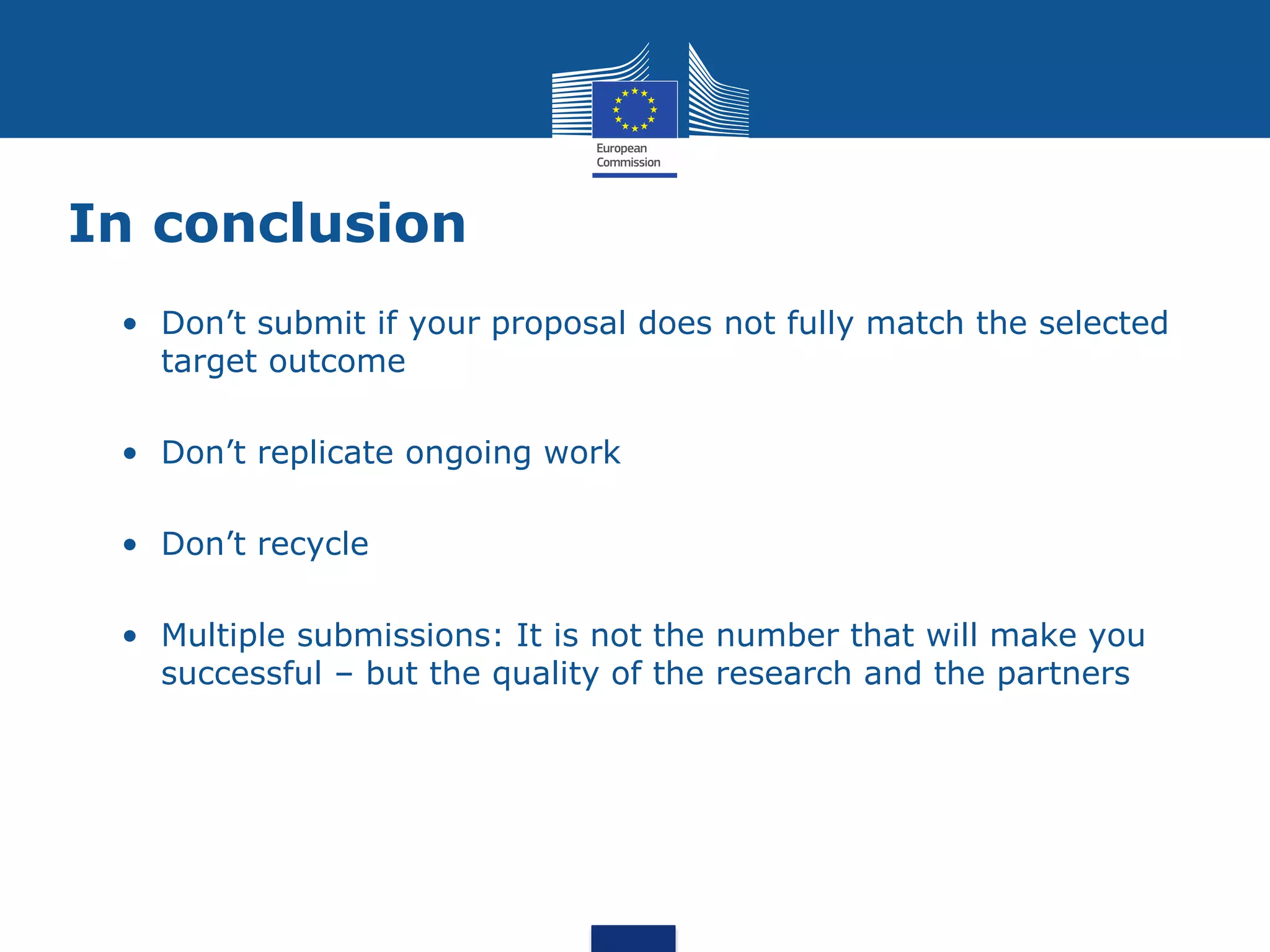
In conclusion
 • Don’t submit if your proposal does not fully match the selected
   target outcome

 • Don’t replicate ongoing work

 • Don’t recycle

 • Multiple submissions: It is not the number that will make you
   successful – but the quality of the research and the partners
Further Information - Contacts

• Contacts:
   • target outcomes (a) (b) (c) (d):
   albert.gauthier@ec.europa.eu(G2 – Creativity)

   • target outcome (c):
   walter.van-de-velde@ec.europa.eu (C2 - FET)


• More information:
  http://cordis.europa.eu/fp7/ict/creativity/creativity-calls_en.html
Now it is your turn…

           Thank you for
          your attention!

       Questions are welcome

iMinds The Conference 2012: Albert Gauthier

  • 1.
    Technologies and scientificfoundations in the field of creativity Objective 8.1 of WP2013 Ghent, 7-8 November 2012 Albert GAUTHIER (DG Connect, Unit G2: CREATIVITY)
  • 2.
    General background Cultural andcreative industries • are a powerful motor for jobs, growth, exports and earnings, cultural diversity and social inclusion • represent 4.5% of total European GDP and accounting for 3.8% of the workforce (2010) • need to be more productive, innovative and dynamic in responding to the changing market needs • diversified – each segment has its specificity • for the definition of CCI see the KEA delineation: • http://ec.europa.eu/culture/pdf/doc885_en.pdf
  • 3.
    Objective 8.1 Target outcomes: a) creative experience tools b) intelligent computational environments stimulating and enhancing human creativity c) progress towards formal understanding of creativity through the development of autonomous systems d) roadmaps for research and innovation
  • 4.
    Target outcome 8.1.a) Target outcome (a)  Creative experience tools… …that make use of all our senses and allow for richer, more collaborative and interactive experiences…  …for the creative and cultural industries STREP/IP
  • 5.
    Target outcome 8.1.a) Interactiveexperience Technologies that could be used: • real time simulation, visualisation • augmented reality • 3D animation • visual computing • games engines • immersive experiences • …
  • 6.
    Target outcome 8.1.a) Creativeexperience tools for the creative industry The tools created should be • cost effective, with special attention to users like SMEs and individual creators • intuitive • be demonstrated in real environments for the creative and cultural industries
  • 7.
    Target outcome 8.1.a) Expectedimpact for a) Research activities will contribute to • Improved efficiency of creative processes by two fold at least as regards time and resource investment, and quality of output • Equipping different industries with more effective creative tools • Expanding the potential of technology in the human creative processes
  • 8.
    Target outcome 8.1.a) Culturaland Creative Industries Which kinds of industries? • advertising, • fashion • publishing • films, music • architecture, • video games • arts, crafts, • TV, radio • design • …
  • 9.
    Target outcome 8.1.b) Target outcome b) • Intelligent computational environments stimulating and enhancing human creativity STREP
  • 10.
    Target outcome 8.1.b) Importantpoints for b) • Multi-disciplinary research: it is possible to start from different paradigms, but ensure expertise on creativity in the consortium • Address domain-specific skills in work-related contexts • Operational definition of creativity needs to be provided; specify how the insights will feed back into the system • Measuring human creative performance means that metrics are needed
  • 11.
    Target outcome 8.1.b) Expectedimpact for b) • Better understanding of the potential of technology in human creative processes leading to enhanced domain-specific human creative performance
  • 12.
    Target outcome 8.1.c) Targetoutcome c) • Progress towards formal understanding of creativity • Autonomous creative systems STREP
  • 13.
    Target outcome 8.1.c) Deeperunderstanding of creativity • There is no consolidated and consistent 'Science of Creativity' (various disciplines study it from different angles) • Computational Creativity offers great potential for studying and better understanding creativity • Producing autonomously creative systems is an ambitious research challenge • The difficulty of measuring and evaluating creativity raises additional methodological challenges
  • 14.
    Target outcome 8.1.c) Theobjective addresses the need to - Achieve a better understanding of creativity and the way it can be technologically achieved Research should be multi-disciplinary and may involve such disciplines as: - AI - Cognitive science - Sociology - Arts (including - Psychology performing arts) - Neuroscience - Robotics
  • 15.
    Target outcome 8.1.c) Importantpoints for c) - Rising above the level of pastiche (mimicry); human- level creativity; - Technological development in itself is not sufficient; the proposals need to demonstrate that there will be a possibility to learn something of human creativity
  • 16.
    Target outcome 8.1.c) Expectedimpact for c) - Deeper scientific understanding of creativity - Fostering the synergy between understanding and enhancing human creativity - New technologies for autonomous creative systems
  • 17.
    Target outcome 8.1.d) Target outcome d) • roadmaps for future research and innovation CSA
  • 18.
    Target outcome 8.1.d) Roadmaps •proposals should target cross- and inter-cluster support activities • boosting creative competitiveness in sectors such as advertising, architecture, arts, crafts, design, fashion, films, music, publishing, video games, TV and radio
  • 19.
    Target outcome 8.1.d) Importantpoints for d) • More exchange and interaction in CI-s (for CI-s) and between research and industry • Identifying trends, developments and needs as guidance for informed policy-making (for the Commission) • Medium-term and longer-term perspectives (upcoming Horizon 2020)
  • 20.
    Target outcome 8.1.d) Expectedimpact for d) • Better coordination of European and national efforts, closer dialogue between research and industry, better understanding of user requirements, more innovation and technology uptake
  • 21.
    Call: FP7-ICT-2013-10 Overall budget for Objective 8.1 : a) and b): EUR 32 million, with a minimum of 40% for IPs and 30% for STREPs c): EUR 10 million d): EUR 1 million Deadline for submissions: 15 January 2013
  • 22.
  • 23.
    If you wantto fail, then… • Ignore the text of the work programme • Ignore on-going work (not only in EU projects) • Window-dress the partnership • Describe your solution and end product in great detail – but omit to state which problem your project will address and where the research challenges are • Produce a proposal that tries to do everything and loses credibility. Often less is more. • Ignore the evaluation criteria when drafting your proposal (T&S excellence, implementation and impact)
  • 24.
    When preparing theproposal… • Describe the specific state of the art with referenced evidence, as well as the technical baseline, and expected advancements against which progress can be measured • Check the timelines and anticipated outputs of on-going research in defining your starting point and the advances you will make – don’t replicate existing work • Adopt a scientifically sound approach to involving users in the research, including to the assessment and validation necessary to build the evidence of impact
  • 25.
    When preparing theproposal… • Do justice to the multi-disciplinary nature of the areas – ensure the expertise and the roles are balanced and appropriate • Find the right partners – scientific expertise, IT providers, end users... • Provide efficient management – authority and competence to handle both administrative and scientific/technical leadership
  • 26.
    Critical questions youshould ask yourselves • How far is the problem you intend to address being already tackled? • Is the proposal offering different and innovative insights into an existing problem or addressing a new problem? • Which communities are likely to benefit from the project / how are they being brought into the discussion? • What are the substantive benefits of the impact of the project? • What are the potential risks and how are they tackled?
  • 27.
    In conclusion •Don’t submit if your proposal does not fully match the selected target outcome • Don’t replicate ongoing work • Don’t recycle • Multiple submissions: It is not the number that will make you successful – but the quality of the research and the partners
  • 28.
    Further Information -Contacts • Contacts: • target outcomes (a) (b) (c) (d): albert.gauthier@ec.europa.eu(G2 – Creativity) • target outcome (c): walter.van-de-velde@ec.europa.eu (C2 - FET) • More information: http://cordis.europa.eu/fp7/ict/creativity/creativity-calls_en.html
  • 29.
    Now it isyour turn… Thank you for your attention! Questions are welcome