This booklet contains 44 printed pages.
ß‚ ¬ÈÁSÃ∑§Ê ◊¥ ◊ÈÁŒ˝Ã ¬Îc∆ 44 „Ò¥–
Do not open this Test Booklet until you are asked to do so.
ß‚ ¬⁄ˡÊÊ ¬ÈÁSÃ∑§Ê ∑§Ê Ã’ Ã∑§ Ÿ πÊ‹¥ ¡’ Ã∑§ ∑§„Ê Ÿ ¡Ê∞–
Read carefully the Instructions on the Back Cover of this Test Booklet.
ß‚ ¬⁄ˡÊÊ ¬ÈÁSÃ∑§Ê ∑§ Á¬¿‹ •Êfl⁄áÊ ¬⁄ ÁŒ∞ ª∞ ÁŸŒ¸‡ÊÊ¥ ∑§Ê äÿÊŸ ‚ ¬…∏¥–
Name of the Candidate (in Capital letters ) :
•èÿÕ˸ ∑§Ê ŸÊ◊ (’«∏ •ˇÊ⁄Ê¥ ◊¥) —
Roll Number : in figures
•ŸÈ∑˝§◊Ê¥∑§ — •¥∑§Ê¥ ◊¥
: in words
— ‡ÊéŒÊ¥ ◊¥
Examination Centre Number :
¬⁄ˡÊÊ ∑§ãŒ˝ Ÿê’⁄U —
Name of Examination Centre (in Capital letters) :
¬⁄UˡÊÊ ∑§ãŒ˝ ∑§Ê ŸÊ◊ (’«∏ •ˇÊ⁄UÊ¥ ◊¥ ) —
Candidate’s Signature : 1. Invigilator’s Signature :
•èÿÕ˸ ∑§ „SÃÊˇÊ⁄ — ÁŸ⁄ˡÊ∑§ ∑§ „SÃÊˇÊ⁄ —
2. Invigilator’s Signature :
ÁŸ⁄ˡÊ∑§ ∑§ „SÃÊˇÊ⁄ —
Important Instructions :
1. Immediately fill in the particulars on this page of the Test
Booklet with only Black Ball Point Pen provided in the
examination hall.
2. The Answer Sheet is kept inside this Test Booklet. When you
are directed to open the Test Booklet, take out the Answer
Sheet and fill in the particulars carefully.
3. The test is of 3 hours duration.
4. The Test Booklet consists of 90 questions. The maximum
marks are 360.
5. There are three parts in the question paper A, B, C
consisting of Physics, Chemistry and Mathematics having
30 questions in each part of equal weightage. Each question
is allotted 4 (four) marks for correct response.
6. Candidates will be awarded marks as stated above in instruction
No. 5 for correct response of each question. ¼ (one-fourth) marks of
the total marks allotted to the question (i.e. 1 mark) will be deducted
for indicating incorrect response of each question. No deduction
from the total score will be made if no response is indicated for an
item in the answer sheet.
7. There is only one correct response for each question. Filling
up more than one response in any question will be treated as
wrong response and marks for wrong response will be
deducted accordingly as per instruction 6 above.
8. For writing particulars/marking responses on Side-1 and
Side–2 of the Answer Sheet use only Black Ball Point Pen
provided in the examination hall.
9. No candidate is allowed to carry any textual material, printed
or written, bits of papers, pager, mobile phone, any electronic
device, etc. except the Admit Card inside the examination
room/hall.
10. Rough work is to be done on the space provided for this
purpose in the Test Booklet only. This space is given at the
bottom of each page and in four pages ( Page 40-43) at the
end of the booklet.
11. On completion of the test, the candidate must hand over the
Answer Sheet to the Invigilator on duty in the Room/Hall.
However, the candidates are allowed to take away this Test
Booklet with them.
12. The CODE for this Booklet is A. Make sure that the CODE
printed on Side–2 of the Answer Sheet and also tally the
serial number of the Test Booklet and Answer Sheet are the
same as that on this booklet. In case of discrepancy, the
candidate should immediately report the matter to the
Invigilator for replacement of both the Test Booklet and the
Answer Sheet.
13. Do not fold or make any stray mark on the Answer Sheet.
◊„ûfl¬Íáʸ ÁŸŒ¸‡Ê —
1. ¬⁄UˡÊÊ ¬ÈÁSÃ∑§Ê ∑§ ß‚ ¬Îc∆U ¬⁄U •Êfl‡ÿ∑§ Áflfl⁄UáÊ ¬⁄UˡÊÊ ∑§ˇÊ ◊¥ ©¬‹éœ
∑§⁄UÊÿ ª∞ ∑§fl‹ ∑§Ê‹ ’ÊÚ‹ åflÊߥ≈U ¬Ÿ ‚ Ãà∑§Ê‹ ÷⁄¥–
2. ©ûÊ⁄U ¬òÊ ß‚ ¬⁄UˡÊÊ ¬ÈÁSÃ∑§Ê ∑§ •ãŒ⁄U ⁄UπÊ „Ò– ¡’ •ʬ∑§Ê ¬⁄UˡÊÊ ¬ÈÁSÃ∑§Ê
πÊ‹Ÿ ∑§Ê ∑§„Ê ¡Ê∞, ÃÊ ©ûÊ⁄U ¬òÊ ÁŸ∑§Ê‹ ∑§⁄U ‚ÊflœÊŸË¬Ífl¸∑§ Áflfl⁄UáÊ ÷⁄¥U–
3. ¬⁄UˡÊÊ ∑§Ë •flÁœ 3 ÉÊ¥≈U „Ò–
4. ß‚ ¬⁄UˡÊÊ ¬ÈÁSÃ∑§Ê ◊¥ 90 ¬˝‡Ÿ „Ò¥– •Áœ∑§Ã◊ •¥∑§ 360 „Ò¥–
5. ß‚ ¬⁄UˡÊÊ ¬ÈÁSÃ∑§Ê ◊¥ ÃËŸ ÷ʪ A, B, C „Ò¥, Á¡‚∑§ ¬˝àÿ∑§ ÷ʪ ◊¥
÷ÊÒÁÃ∑§ ÁflôÊÊŸ, ⁄U‚ÊÿŸ ÁflôÊÊŸ ∞fl¥ ªÁáÊà ∑§ 30 ¬˝‡Ÿ „Ò¥ •ÊÒ⁄U ‚÷Ë
¬˝‡ŸÊ¥ ∑§ •¥∑§ ‚◊ÊŸ „Ò¥– ¬˝àÿ∑§ ¬˝‡Ÿ ∑§ ‚„Ë ©ûÊ⁄U ∑§ Á‹∞ 4 (øÊ⁄U)
•¥∑§ ÁŸœÊ¸Á⁄Uà Á∑§ÿ ªÿ „Ò¥–
6. •èÿÁÕ¸ÿÊ¥ ∑§Ê ¬˝àÿ∑§ ‚„Ë ©ûÊ⁄U ∑§ Á‹∞ ©¬⁄UÊÄà ÁŸŒ¸‡ÊŸ ‚¥ÅÿÊ 5 ∑§
ÁŸŒ¸‡ÊÊŸÈ‚Ê⁄U •¥∑§ ÁŒÿ ¡Êÿ¥ª– ¬˝àÿ∑§ ¬˝‡Ÿ ∑§ ª‹Ã ©ûÊ⁄U ∑§ Á‹ÿ ©‚
¬˝‡Ÿ ∑§ Á‹∞ ÁŸœÊ¸Á⁄Uà ∑ȧ‹ •¥∑§Ê¥ ◊¥ ‚ ¼ (∞∑§-øÊÒÕÊ߸) ÷ʪ
(•ÕʸØ 1 •¥∑§) ∑§Ê≈U Á‹ÿÊ ¡ÊÿªÊ– ÿÁŒ ©ûÊ⁄U ¬òÊ ◊¥ Á∑§‚Ë ¬˝‡Ÿ ∑§Ê
©ûÊ⁄U Ÿ„Ë¥ ÁŒÿÊ ªÿÊ „Ê ÃÊ ∑ȧ‹ ¬˝Ê#Ê¥∑§ ‚ ∑§Ê߸ ∑§≈UÊÒÃË Ÿ„Ë¥ ∑§Ë ¡ÊÿªË–
7. ¬˝àÿ∑§ ¬˝‡Ÿ ∑§Ê ∑§fl‹ ∞∑§ „Ë ‚„Ë ©ûÊ⁄U „Ò– ∞∑§ ‚ •Áœ∑§ ©ûÊ⁄U ŒŸ ¬⁄U
©‚ ª‹Ã ©ûÊ⁄U ◊ÊŸÊ ¡ÊÿªÊ •ÊÒ⁄U ©¬⁄UÊÄà ÁŸŒ¸‡Ê 6 ∑§ •ŸÈ‚Ê⁄U •¥∑§ ∑§Ê≈U
Á‹ÿ ¡Êÿ¥ª–
8. ©ûÊ⁄U ¬òÊ ∑§ ¬Îc∆U-1 ∞fl¥ ¬Îc∆U-2 ¬⁄U flÊ¥Á¿Uà Áflfl⁄UáÊ ∞fl¥ ©ûÊ⁄U •¥Á∑§Ã
∑§⁄UŸ „ÃÈ ¬⁄UˡÊÊ ∑§ˇÊ ◊¥ ©¬‹éœ ∑§⁄UÊÿ ª∞ ∑§fl‹ ∑§Ê‹ ’ÊÚ‹ åflÊߥ≈UU
¬Ÿ ∑§Ê „Ë ¬˝ÿÊª ∑§⁄¥U–
9. •èÿÕ˸ mÊ⁄UÊ ¬⁄UˡÊÊ ∑§ˇÊ/„ÊÚ‹ ◊¥ ¬˝fl‡Ê ∑§Ê«¸U ∑§ •‹ÊflÊ Á∑§‚Ë ÷Ë ¬˝∑§Ê⁄U
∑§Ë ¬Ê∆˜Uÿ ‚Ê◊ª˝Ë, ◊ÈÁŒ˝Ã ÿÊ „SÃÁ‹ÁπÃ, ∑§Êª¡ ∑§Ë ¬Áø¸ÿʰ, ¬¡⁄U, ◊Ê’Êß‹
»§ÊŸ ÿÊ Á∑§‚Ë ÷Ë ¬˝∑§Ê⁄U ∑§ ß‹Ä≈˛UÊÚÁŸ∑§ ©¬∑§⁄UáÊÊ¥ ÿÊ Á∑§‚Ë •ãÿ ¬˝∑§Ê⁄U ∑§Ë
‚Ê◊ª˝Ë ∑§Ê ‹ ¡ÊŸ ÿÊ ©¬ÿÊª ∑§⁄UŸ ∑§Ë •ŸÈ◊Áà Ÿ„Ë¥ „Ò–
10. ⁄U»§ ∑§Êÿ¸ ¬⁄UˡÊÊ ¬ÈÁSÃ∑§Ê ◊¥ ∑§fl‹ ÁŸœÊ¸Á⁄Uà ¡ª„ ¬⁄U „Ë ∑§ËÁ¡∞– ÿ„
¡ª„ ¬˝àÿ∑§ ¬Îc∆U ¬⁄U ŸËø ∑§Ë •Ê⁄U •ÊÒ⁄U ¬ÈÁSÃ∑§Ê ∑§ •¥Ã ◊¥ øÊ⁄U ¬Îc∆UÊ¥
(¬Îc∆U 40-43) ¬⁄U ŒË ªß¸ „Ò–
11. ¬⁄UˡÊÊ ‚◊Êåà „ÊŸ ¬⁄U, •èÿÕ˸ ∑§ˇÊ/„ÊÚ‹ ¿UÊ«∏Ÿ ‚ ¬Ífl¸ ©ûÊ⁄U ¬òÊ ∑§ˇÊ
ÁŸ⁄UˡÊ∑§ ∑§Ê •fl‡ÿ ‚ÊÒ¥¬ Œ¥– •èÿÕ˸ •¬Ÿ ‚ÊÕ ß‚ ¬⁄UˡÊÊ ¬ÈÁSÃ∑§Ê
∑§Ê ‹ ¡Ê ‚∑§Ã „Ò¥–
12. ß‚ ¬ÈÁSÃ∑§Ê ∑§Ê ‚¥∑§Ã A „Ò– ÿ„ ‚ÈÁŸÁ‡øÃ ∑§⁄U ‹¥ Á∑§ ß‚ ¬ÈÁSÃ∑§Ê ∑§Ê
‚¥∑§Ã, ©ûÊ⁄U ¬òÊ ∑§ ¬Îc∆U-2 ¬⁄U ¿U¬ ‚¥∑§Ã ‚ Á◊‹ÃÊ „Ò •ÊÒ⁄U ÿ„ ÷Ë
‚ÈÁŸÁ‡øÃ ∑§⁄U ‹¥ Á∑§ ¬⁄UˡÊÊ ¬ÈÁSÃ∑§Ê •ÊÒ⁄U ©ûÊ⁄U ¬òÊ ∑§Ë ∑˝§◊ ‚¥ÅÿÊ
Á◊‹ÃË „Ò– •ª⁄U ÿ„ Á÷ÛÊ „Ê ÃÊ •èÿÕ˸ ŒÍ‚⁄UË ¬⁄UˡÊÊ ¬ÈÁSÃ∑§Ê •ÊÒ⁄U
©ûÊ⁄U ¬òÊ ‹Ÿ ∑§ Á‹∞ ÁŸ⁄UˡÊ∑§ ∑§Ê ÃÈ⁄Uãà •flªÃ ∑§⁄UÊ∞°–
13. ©ûÊ⁄U ¬òÊ ∑§Ê Ÿ ◊Ê«∏¥ ∞fl¥ Ÿ „Ë ©‚ ¬⁄U •ãÿ ÁŸ‡ÊÊŸ ‹ªÊ∞°–
PAPER - 1 : PHYSICS, CHEMISTRY & MATHEMATICS
¬˝‡Ÿ¬ÈÁSÃ∑§Ê - 1 : ÷ÊÒÁÃ∑§ ÁflôÊÊŸ, ⁄U‚ÊÿŸ ÁflôÊÊŸ ÃÕÊ ªÁáÊÃ
RBS No. :
Test Booklet Code
¬⁄ˡÊÊ ¬ÈÁSÃ∑§Ê ‚¥∑§Ã
A
A/Page 2 SPACE FOR ROUGH WORK / ⁄U»§ ∑§Êÿ¸ ∑§ Á‹∞ ¡ª„
PART A — PHYSICS
ALL THE GRAPHS/DIAGRAMS GIVEN ARE
SCHEMATIC AND NOT DRAWN TO SCALE.
1. A man grows into a giant such that his
linear dimensions increase by a factor
of 9. Assuming that his density remains
same, the stress in the leg will change by a
factor of :
(1) 9
(2)
1
9
(3) 81
(4)
1
81
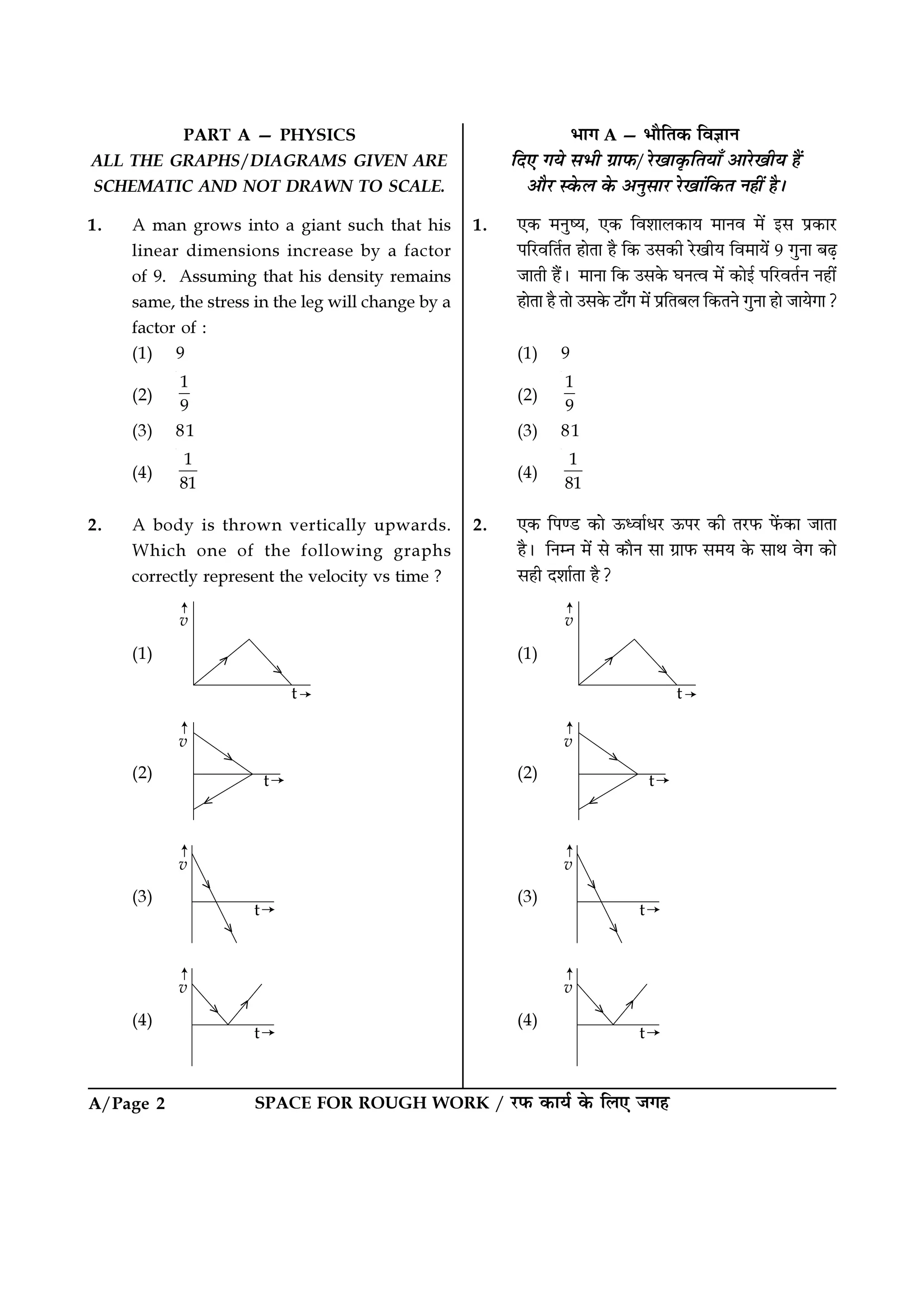
2. A body is thrown vertically upwards.
Which one of the following graphs
correctly represent the velocity vs time ?
(1)
(2)
(3)
(4)
÷ʪ A — ÷ÊÒÁÃ∑§ ÁflôÊÊŸ
ÁŒ∞ ªÿ ‚÷Ë ª˝Ê»§/⁄UπÊ∑ΧÁÃÿʰ •Ê⁄UπËÿ „Ò¥
•ÊÒ⁄U S∑§‹ ∑§ •ŸÈ‚Ê⁄U ⁄UπÊ¥Á∑§Ã Ÿ„Ë¥ „Ò–
1. ∞∑§ ◊ŸÈcÿ, ∞∑§ Áfl‡ÊÊ‹∑§Êÿ ◊ÊŸfl ◊¥ ß‚ ¬˝∑§Ê⁄U
¬Á⁄UflÁøà „ÊÃÊ „Ò Á∑§ ©‚∑§Ë ⁄UπËÿ Áfl◊Êÿ¥ 9 ªÈŸÊ ’…∏
¡ÊÃË „Ò¥– ◊ÊŸÊ Á∑§ ©‚∑§ ÉÊŸàfl ◊¥ ∑§Ê߸ ¬Á⁄UfløŸ Ÿ„Ë¥
„ÊÃÊ „Ò ÃÊ ©‚∑§ ≈Uʰª ◊¥ ¬˝ÁÃ’‹ Á∑§ÃŸ ªÈŸÊ „Ê ¡ÊÿªÊ?
(1) 9
(2)
1
9
(3) 81
(4)
1
81
2. ∞∑§ Á¬á«U ∑§Ê ™§äflʸœ⁄U ™§¬⁄U ∑§Ë Ã⁄U»§ »¥§∑§Ê ¡ÊÃÊ
„Ò– ÁŸêŸ ◊¥ ‚ ∑§ÊÒŸ ‚Ê ª˝Ê»§ ‚◊ÿ ∑§ ‚ÊÕ flª ∑§Ê
‚„Ë Œ‡ÊʸÃÊ „Ò?
(1)
(2)
(3)
(4)
SPACE FOR ROUGH WORK / ⁄U»§ ∑§Êÿ¸ ∑§ Á‹∞ ¡ª„A/Page 3
3. m=10−2 kg Œ˝√ÿ◊ÊŸ ∑§Ê ∞∑§ Á¬á«U ∞∑§ ◊Êäÿ◊
◊¥ ¡Ê ⁄U„Ê „Ò •ÊÒ⁄U ∞∑§ ÉÊ·¸áÊ ’‹ F=−kv2 ∑§Ê
•ŸÈ÷fl ∑§⁄UÃÊ „Ò– Á¬á«U ∑§Ê ¬˝Ê⁄UÁê÷∑§ flª
v0=10 ms−1 „Ò– ÿÁŒ 10 s ∑§ ’ÊŒ ©‚∑§Ë ™§¡Ê¸
1
8
mv0
2 „Ò ÃÊ k ∑§Ê ◊ÊŸ „ÊªÊ —
(1) 10−3 kg m−1
(2) 10−3 kg s−1
(3) 10−4 kg m−1
(4) 10−1 kg m−1 s−1
4. 1 kg Œ˝√ÿ◊ÊŸ ∑§Ê ∞∑§ ∑§áÊ, ∞∑§ ‚◊ÿ ¬⁄U ÁŸ÷¸⁄U
(time dependent) ’‹ F=6t ∑§Ê •ŸÈ÷fl ∑§⁄UÃÊ
„Ò– ÿÁŒ ∑§áÊ Áfl⁄UÊ◊ÊflSÕÊ ‚ ø‹ÃÊ „Ò ÃÊ ¬„‹ 1 s ◊¥
’‹ mÊ⁄UÊ Á∑§ÿÊ ªÿÊ ∑§Êÿ¸ „ÊªÊ —
(1) 4.5 J
(2) 22 J
(3) 9 J
(4) 18 J
3. A body of mass m=10−2 kg is moving in
a medium and experiences a frictional
force F=−kv2. Its initial speed is
v0=10 ms−1. If, after 10 s, its energy is
1
8
mv0
2, the value of k will be :
(1) 10−3 kg m−1
(2) 10−3 kg s−1
(3) 10−4 kg m−1
(4) 10−1 kg m−1 s−1
4. A time dependent force F=6t acts on a
particle of mass 1 kg. If the particle starts
from rest, the work done by the force
during the first 1 sec. will be :
(1) 4.5 J
(2) 22 J
(3) 9 J
(4) 18 J
A/Page 4 SPACE FOR ROUGH WORK / ⁄U»§ ∑§Êÿ¸ ∑§ Á‹∞ ¡ª„
5. ∞∑§ ÁòÊíÿÊ R ÃÕÊ ‹ê’Ê߸ l ∑§ ∞∑§ ‚◊ÊŸ ’‹Ÿ ∑§Ê
©‚∑§ •Á÷‹ê’ Ám÷Ê¡∑§ ∑§ ‚ʬˇÊ ¡«∏àfl •ÊÉÊÍáʸ
I „Ò– ¡«∏àfl •ÊÉÊÍáʸ ∑§ ÁŸêŸÃ◊ ◊ÊŸ ∑§ Á‹ÿ •ŸÈ¬ÊÃ
l/R ÄÿÊ „ÊªÊ ?
(1)
3
2
(2)
3
2
(3) 1
(4)
3
2
6. ∞∑§ Œ˝√ÿ◊ÊŸ M ∞fl¥ ‹ê’Ê߸ l ∑§Ë ¬Ã‹Ë ∞fl¥ ∞∑§
‚◊ÊŸ ¿U«∏ ∑§Ê ∞∑§ Á‚⁄UÊ œÈ⁄Uʪ˝Sà „Ò Á¡‚‚ Á∑§ fl„
∞∑§ ™§äflʸœ⁄U ‚◊Ë ◊¥ ÉÊÍ◊ ‚∑§ÃË „Ò (ÁøòÊ ŒÁπÿ)–
œÈ⁄UË ∑§Ê ÉÊ·¸áÊ Ÿªáÿ „Ò– ¿U«∏ ∑§ ŒÍ‚⁄U Á‚⁄U ∑§Ê œÈ⁄UË
∑§ ™§¬⁄U ™§äflʸœ⁄U ⁄Uπ∑§⁄U ¿UÊ«∏ ÁŒÿÊ ¡ÊÃÊ „Ò– ¡’
¿U«∏ ™§äfl¸ ‚ θ ∑§ÊáÊ ’ŸÊÃË „Ò ÃÊ ©‚∑§Ê ∑§ÊáÊËÿ
àfl⁄UáÊ „ÊªÊ —
(1)
3g
sin
2l
θ
(2)
2g
sin
3l
θ
(3)
3g
cos
2l
θ
(4)
2g
cos
3l
θ
5. The moment of inertia of a uniform
cylinder of length l and radius R about its
perpendicular bisector is I. What is the
ratio l/R such that the moment of inertia
is minimum ?
(1)
3
2
(2)
3
2
(3) 1
(4)
3
2
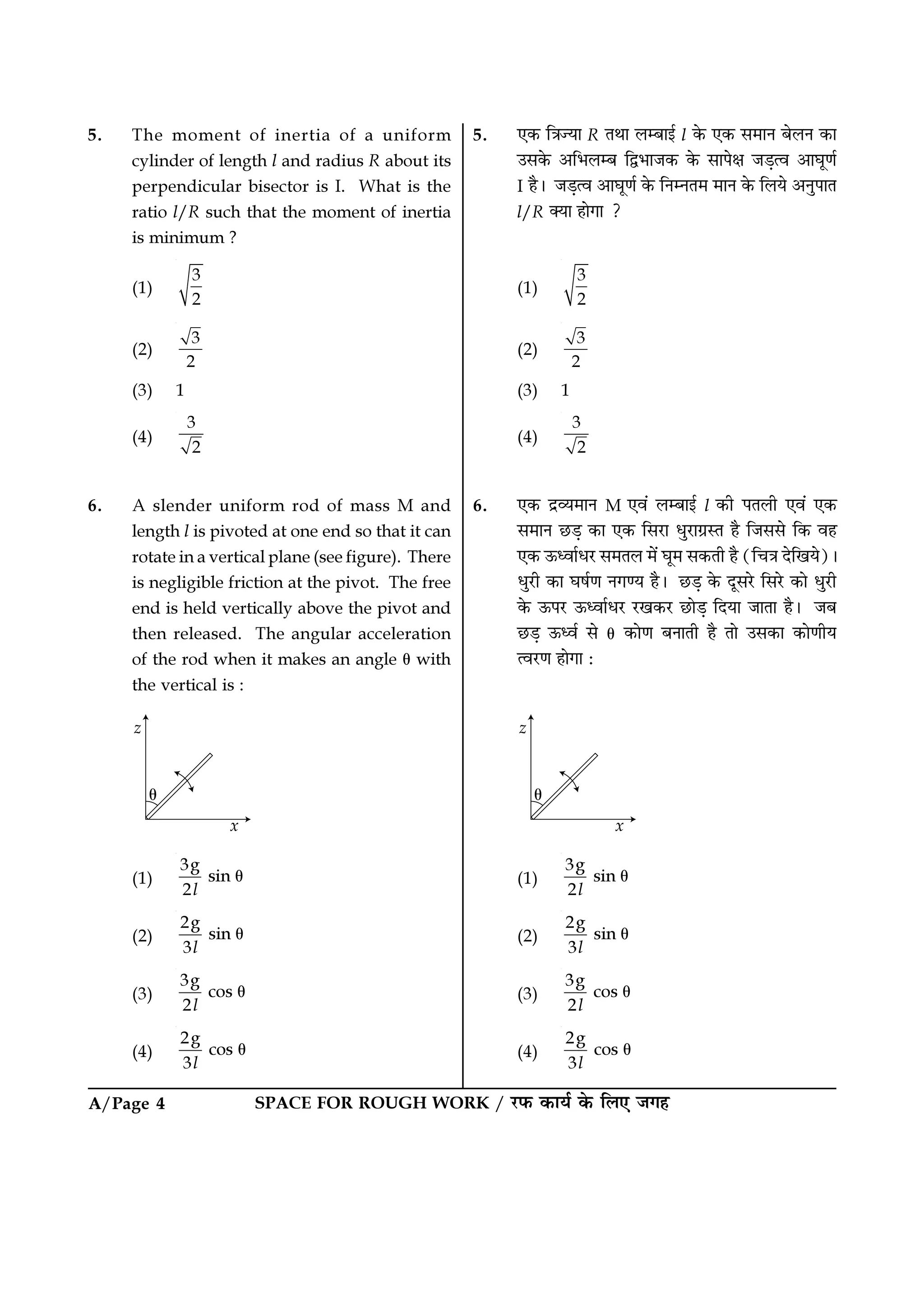
6. A slender uniform rod of mass M and
length l is pivoted at one end so that it can
rotate in a vertical plane (see figure). There
is negligible friction at the pivot. The free
end is held vertically above the pivot and
then released. The angular acceleration
of the rod when it makes an angle θ with
the vertical is :
(1)
3g
sin
2l
θ
(2)
2g
sin
3l
θ
(3)
3g
cos
2l
θ
(4)
2g
cos
3l
θ
SPACE FOR ROUGH WORK / ⁄U»§ ∑§Êÿ¸ ∑§ Á‹∞ ¡ª„A/Page 5
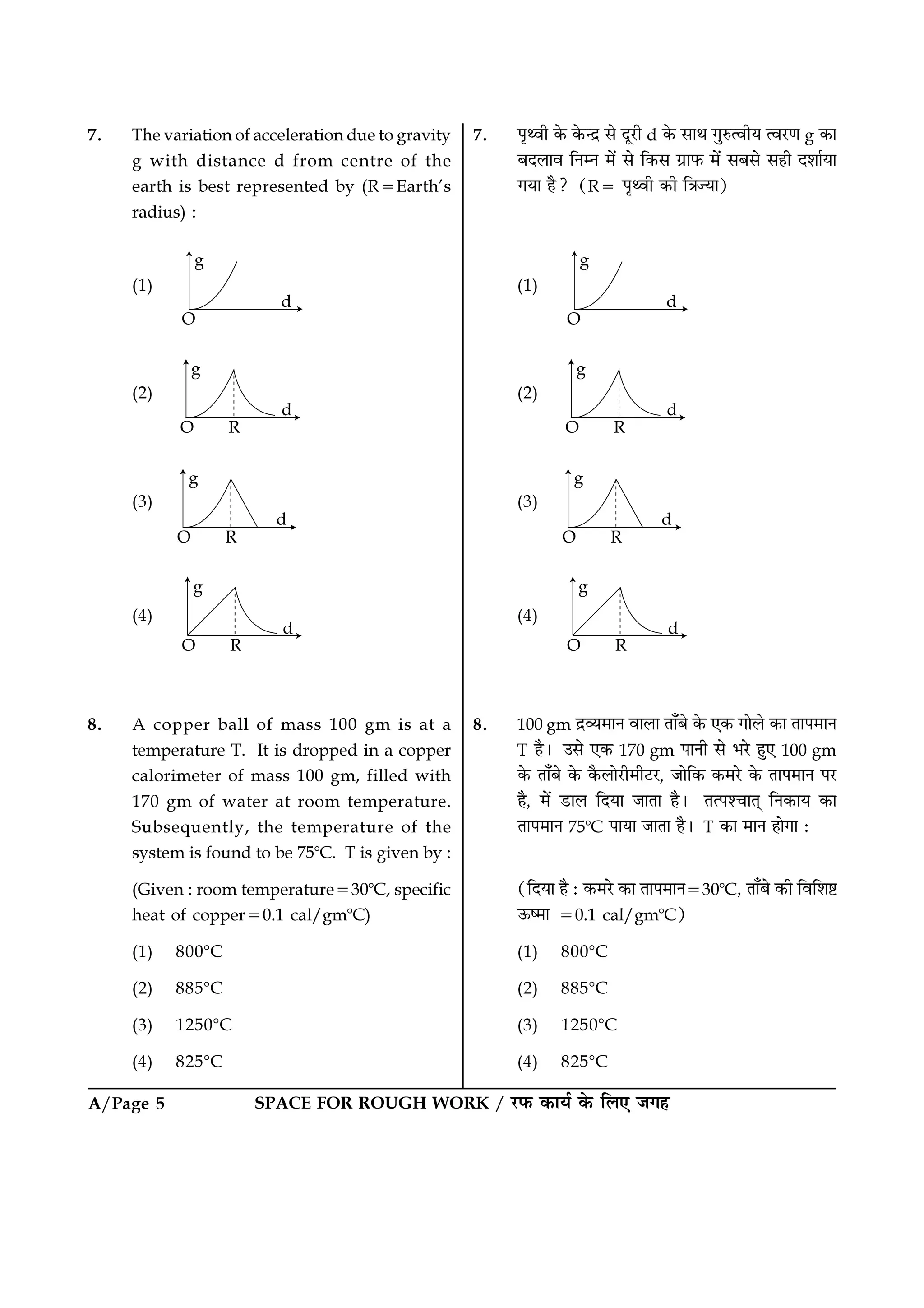
7. ¬ÎâflË ∑§ ∑§ãŒ˝ ‚ ŒÍ⁄UË d ∑§ ‚ÊÕ ªÈL§àflËÿ àfl⁄UáÊ g ∑§Ê
’Œ‹Êfl ÁŸêŸ ◊¥ ‚ Á∑§‚ ª˝Ê»§ ◊¥ ‚’‚ ‚„Ë Œ‡ÊʸÿÊ
ªÿÊ „Ò? (R= ¬ÎâflË ∑§Ë ÁòÊíÿÊ)
(1)
(2)
(3)
(4)
8. 100 gm Œ˝√ÿ◊ÊŸ flÊ‹Ê Ãʰ’ ∑§ ∞∑§ ªÊ‹ ∑§Ê Ãʬ◊ÊŸ
T „Ò– ©‚ ∞∑§ 170 gm ¬ÊŸË ‚ ÷⁄U „È∞ 100 gm
∑§ Ãʰ’ ∑§ ∑Ò§‹Ê⁄UË◊Ë≈U⁄U, ¡ÊÁ∑§ ∑§◊⁄U ∑§ Ãʬ◊ÊŸ ¬⁄U
„Ò, ◊¥ «UÊ‹ ÁŒÿÊ ¡ÊÃÊ „Ò– ÃଇøÊØ ÁŸ∑§Êÿ ∑§Ê
Ãʬ◊ÊŸ 75ᑻC ¬ÊÿÊ ¡ÊÃÊ „Ò– T ∑§Ê ◊ÊŸ „ÊªÊ —
(ÁŒÿÊ „Ò — ∑§◊⁄U ∑§Ê Ãʬ◊ÊŸ=30ᑻC, Ãʰ’ ∑§Ë ÁflÁ‡ÊC
™§c◊Ê =0.1 cal/gmᑻC)
(1) 800ᑻC
(2) 885ᑻC
(3) 1250ᑻC
(4) 825ᑻC
7. The variation of acceleration due to gravity
g with distance d from centre of the
earth is best represented by (R=Earth’s
radius) :
(1)
(2)
(3)
(4)
8. A copper ball of mass 100 gm is at a
temperature T. It is dropped in a copper
calorimeter of mass 100 gm, filled with
170 gm of water at room temperature.
Subsequently, the temperature of the
system is found to be 75ᑻC. T is given by :
(Given : room temperature=30ᑻC, specific
heat of copper=0.1 cal/gmᑻC)
(1) 800ᑻC
(2) 885ᑻC
(3) 1250ᑻC
(4) 825ᑻC
A/Page 6 SPACE FOR ROUGH WORK / ⁄U»§ ∑§Êÿ¸ ∑§ Á‹∞ ¡ª„
9. 0ᑻC ¬⁄U ⁄Uπ „È∞ ∞∑§ ÉÊŸ ¬⁄U ∞∑§ Œ’Êfl P ‹ªÊÿÊ
¡ÊÃÊ „Ò Á¡‚‚ fl„ ‚÷Ë Ã⁄U»§ ‚ ’⁄UÊ’⁄U ‚¥¬ËÁ«UÃ
„ÊÃÊ „Ò– ÉÊŸ ∑§ ¬ŒÊÕ¸ ∑§Ê •Êÿß ¬˝àÿÊSÕÃÊ ªÈáÊÊ¥∑§
K ∞fl¥ ⁄UπËÿ ¬˝‚Ê⁄U ªÈáÊÊ¥∑§ α „Ò– ÿÁŒ ÉÊŸ ∑§Ê ª◊¸
∑§⁄U∑§ ◊Í‹ •Ê∑§Ê⁄U ◊¥ ‹ÊŸÊ „Ò ÃÊ ©‚∑§ Ãʬ◊ÊŸ ∑§Ê
Á∑§ÃŸÊ ’…∏ÊŸÊ ¬«∏ªÊ?
(1)
P
3 Kα
(2)
P
Kα
(3)
3
PK
α
(4) 3PKα
10. ÁSÕ⁄U ŒÊ’ ÃÕÊ ÁSÕ⁄U •Êÿß ¬⁄U ÁflÁ‡Êc≈U ™§c◊Êÿ¥
∑˝§◊‡Ê— Cp ÃÕÊ Cv „Ò¥– ¬ÊÿÊ ¡ÊÃÊ „Ò Á∑§
„Êß«˛UÊ¡Ÿ ∑§ Á‹ÿ, Cp−Cv=a
ŸÊß≈˛UÊ¡Ÿ ∑§ Á‹ÿ, Cp−Cv=b
a •ÊÒ⁄U b ∑§ ’Ëø ∑§Ê ‚„Ë ‚ê’㜠„ÊªÊ —
(1) a=
1
14
b
(2) a=b
(3) a=14 b
(4) a=28 b
9. An external pressure P is applied on a cube
at 0ᑻC so that it is equally compressed from
all sides. K is the bulk modulus of the
material of the cube and α is its coefficient
of linear expansion. Suppose we want to
bring the cube to its original size by
heating. The temperature should be raised
by :
(1)
P
3 Kα
(2)
P
Kα
(3)
3
PK
α
(4) 3PKα
10. Cp and Cv are specific heats at constant
pressure and constant volume respectively.
It is observed that
Cp−Cv=a for hydrogen gas
Cp−Cv=b for nitrogen gas
The correct relation between a and b is :
(1) a=
1
14
b
(2) a=b
(3) a=14 b
(4) a=28 b
SPACE FOR ROUGH WORK / ⁄U»§ ∑§Êÿ¸ ∑§ Á‹∞ ¡ª„A/Page 7
11. ‚Íÿ¸ ∑§Ë Á∑§⁄UáÊÊ¥ ‚ ∞∑§ πÈ‹ „È∞ 30 m3 •Êÿß
flÊ‹ ∑§◊⁄U ∑§Ê Ãʬ◊ÊŸ 17ᑻC ‚ ’…∏∑§⁄U 27ᑻC „Ê
¡ÊÃÊ „Ò– ∑§◊⁄U ∑§ •ãŒ⁄U flÊÿÈ◊¥«U‹Ëÿ ŒÊ’
1×10⁵ Pa „Ë ⁄U„ÃÊ „Ò– ÿÁŒ ∑§◊⁄U ∑§ •ãŒ⁄U •áÊÈ•Ê¥
∑§Ë ‚¥ÅÿÊ ª◊¸ „ÊŸ ‚ ¬„‹ ∞fl¥ ’ÊŒ ◊¥ ∑˝§◊‡Ê— ni fl
nf „Ò¥ ÃÊ nf−ni ∑§Ê ◊ÊŸ „ÊªÊ —
(1) −1.61×10²³
(2) 1.38×10²³
(3) 2.5×1025
(4) −2.5×1025
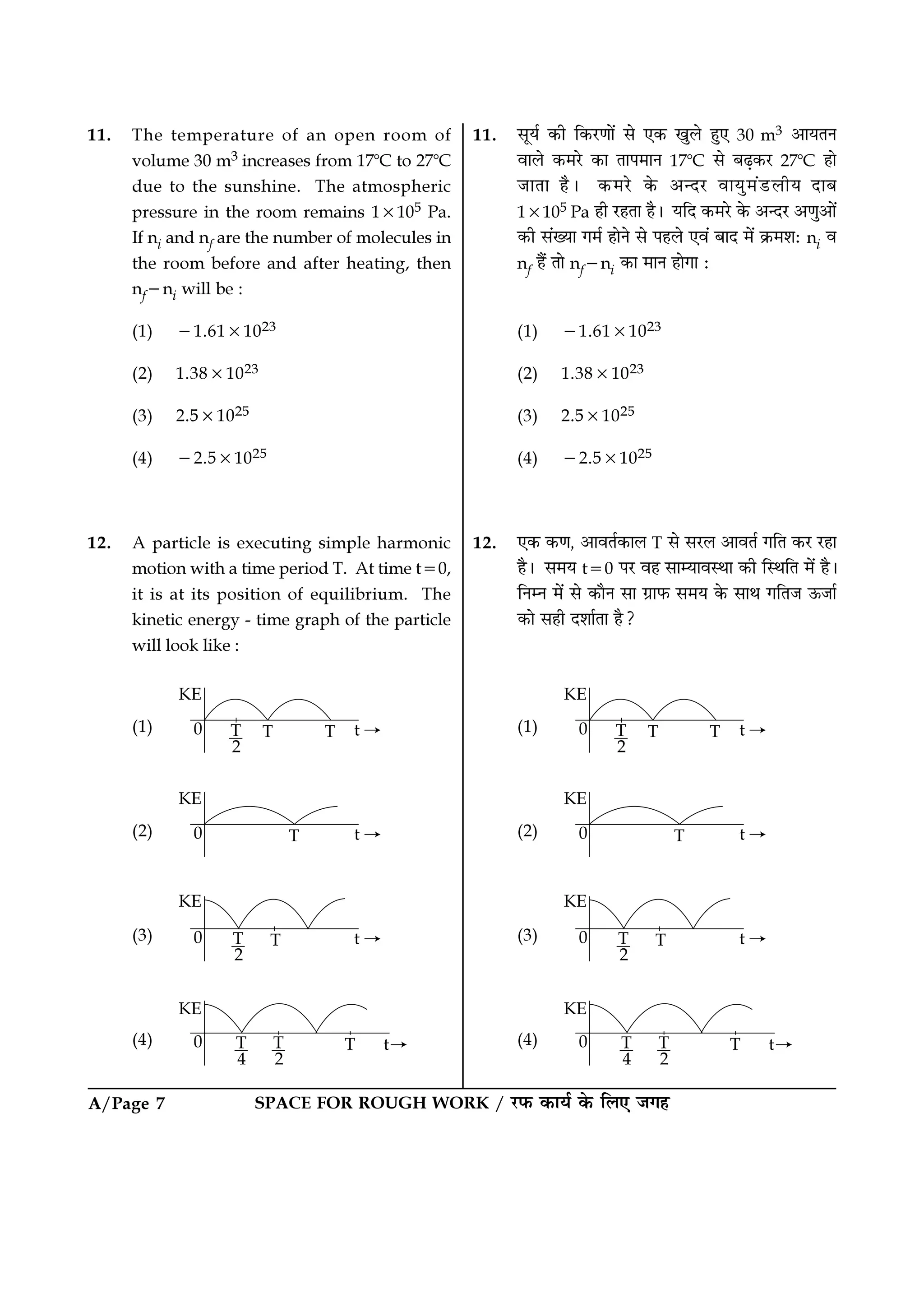
12. ∞∑§ ∑§áÊ, •Êflø∑§Ê‹ T ‚ ‚⁄U‹ •Êflø ªÁà ∑§⁄U ⁄U„Ê
„Ò– ‚◊ÿ t=0 ¬⁄U fl„ ‚ÊêÿÊflSÕÊ ∑§Ë ÁSÕÁà ◊¥ „Ò–
ÁŸêŸ ◊¥ ‚ ∑§ÊÒŸ ‚Ê ª˝Ê»§ ‚◊ÿ ∑§ ‚ÊÕ ªÁá ™§¡Ê¸
∑§Ê ‚„Ë Œ‡ÊʸÃÊ „Ò?
(1)
(2)
(3)
(4)
11. The temperature of an open room of
volume 30 m3 increases from 17ᑻC to 27ᑻC
due to the sunshine. The atmospheric
pressure in the room remains 1×10⁵ Pa.
If ni and nf are the number of molecules in
the room before and after heating, then
nf−ni will be :
(1) −1.61×10²³
(2) 1.38×10²³
(3) 2.5×1025
(4) −2.5×1025
12. A particle is executing simple harmonic
motion with a time period T. At time t=0,
it is at its position of equilibrium. The
kinetic energy - time graph of the particle
will look like :
(1)
(2)
(3)
(4)
A/Page 8 SPACE FOR ROUGH WORK / ⁄U»§ ∑§Êÿ¸ ∑§ Á‹∞ ¡ª„
13. ∞∑§ ¬˝ˇÊ∑§ ¬˝∑§Ê‡Ê ªÁà ∑§Ë •ÊœË ªÁà ‚ 10 GHz
•ÊflÎÁûÊ ∑§ ∞∑§ ÁSÕ⁄U ‚͡◊ Ã⁄¥Uª (microwave)
dÊà ∑§Ë Ã⁄U»§ ¡Ê ⁄U„Ê „Ò– ¬˝ˇÊ∑§ mÊ⁄UÊ ◊Ê¬Ë ªÿË ‚͡◊
Ã⁄¥Uª ∑§Ë •ÊflÎÁûÊ ∑§Ê ◊ÊŸ „ÊªÊ —
(¬˝∑§Ê‡Ê ∑§Ë øÊ‹=3×10⁸ ms−1)
(1) 10.1 GHz
(2) 12.1 GHz
(3) 17.3 GHz
(4) 15.3 GHz
14. ∞∑§ ÁfllÈà Ámœ˝Èfl ∑§Ê ÁSÕ⁄U Ámœ˝Èfl •ÊÉÊÍáʸ p
→
„Ò ¡Ê
Á∑§ x-•ˇÊ ‚ θ ∑§ÊáÊ ’ŸÊÃÊ „Ò– ÁfllÈà ˇÊòÊ
→ ∧
1E E i=
◊¥ ⁄UπŸ ¬⁄U ÿ„ ’‹ •ÊÉÊÍáʸ
→ ∧
1T k=τ ∑§Ê •ŸÈ÷fl
∑§⁄UÃÊ „Ò– ÁfllÈà ˇÊòÊ
→ ∧
2 1E 3 E j= ◊¥ ⁄UπŸ ¬⁄U
ÿ„ ’‹ •ÊÉÊÍáʸ
→ →
2 1T T=− ∑§Ê •ŸÈ÷fl ∑§⁄UÃÊ „Ò–
∑§ÊáÊ θ ∑§Ê ◊ÊŸ „ÊªÊ —
(1) 30ᑻ
(2) 45ᑻ
(3) 60ᑻ
(4) 90ᑻ
13. An observer is moving with half the speed
of light towards a stationary microwave
source emitting waves at frequency
10 GHz. What is the frequency of the
microwave measured by the observer ?
(speed of light=3×10⁸ ms−1)
(1) 10.1 GHz
(2) 12.1 GHz
(3) 17.3 GHz
(4) 15.3 GHz
14. An electric dipole has a fixed dipole
moment p
→
, which makes angle θ with
respect to x-axis. When subjected to an
electric field
→ ∧
1E E i= , it experiences a
torque
→ ∧
1T k=τ . When subjected to
another electric field
→ ∧
2 1E 3 E j= it
experiences a torque
→ →
2 1T T=− . The angle
θ is :
(1) 30ᑻ
(2) 45ᑻ
(3) 60ᑻ
(4) 90ᑻ
SPACE FOR ROUGH WORK / ⁄U»§ ∑§Êÿ¸ ∑§ Á‹∞ ¡ª„A/Page 9
15. ∞∑§ ÁfllÈà ¬Á⁄U¬Õ ◊¥ ∞∑§ 2 µF œÊÁ⁄UÃÊ ∑§ ‚¥œÊÁ⁄UòÊ
∑§Ê 1.0 kV Áfl÷flÊãÃ⁄U ∑§ Á’ãŒÈ•Ê¥ ∑§ ’Ëø ‹ªÊŸÊ
„Ò– 1 µF œÊÁ⁄UÃÊ ∑§ ’„Èà ‚Ê⁄U ‚¥œÊÁ⁄UòÊ ¡Ê Á∑§
300 V Áfl÷flÊãÃ⁄U Ã∑§ fl„Ÿ ∑§⁄U ‚∑§Ã „Ò¥, ©¬‹éœ
„Ò¥–
©¬⁄UÊÄà ¬Á⁄U¬Õ ∑§Ê ¬˝Ê# ∑§⁄UŸ ∑§ Á‹ÿ ãÿÍŸÃ◊ Á∑§ÃŸ
‚¥œÊÁ⁄UòÊÊ¥ ∑§Ë •Êfl‡ÿ∑§ÃÊ „ÊªË?
(1) 2
(2) 16
(3) 24
(4) 32
16. ÁŒÿ ªÿ ¬Á⁄U¬Õ ◊¥ ¡’ œÊ⁄UÊ ÁSÕ⁄UÊflSÕÊ ◊¥ ¬„Ȱø ¡ÊÃË
„Ò ÃÊ œÊÁ⁄UÃÊ C ∑§ ‚¥œÊÁ⁄UòÊ ¬⁄U •Êfl‡Ê ∑§Ê ◊ÊŸ „ÊªÊ —
(1) CE
(2)
( )
1
2
r
CE
r r+
(3) 2
2
r
CE
(r r )+
(4) 1
1
r
CE
(r r)+
15. A capacitance of 2 µF is required in an
electrical circuit across a potential
difference of 1.0 kV. A large number of
1 µF capacitors are available which can
withstand a potential difference of not
more than 300 V.
The minimum number of capacitors
required to achieve this is :
(1) 2
(2) 16
(3) 24
(4) 32
16. In the given circuit diagram when the
current reaches steady state in the circuit,
the charge on the capacitor of capacitance
C will be :
(1) CE
(2)
( )
1
2
r
CE
r r+
(3) 2
2
r
CE
(r r )+
(4) 1
1
r
CE
(r r)+
A/Page 10 SPACE FOR ROUGH WORK / ⁄U»§ ∑§Êÿ¸ ∑§ Á‹∞ ¡ª„
17.
™§¬⁄U ÁŒÿ ªÿ ¬Á⁄U¬Õ ◊¥ ¬˝àÿ∑§ ¬˝ÁÃ⁄UÊœ ◊¥ œÊ⁄UÊ ∑§Ê
◊ÊŸ „ÊªÊ —
(1) 1 A
(2) 0.25 A
(3) 0.5 A
(4) 0 A
18. ∞∑§ øÈê’∑§Ëÿ •ÊÉÊÍáʸ 6.7×10⁻² Am2 ∞fl¥ ¡«∏àfl
•ÊÉÊÍáʸ 7.5×10⁻⁶ kg m2 flÊ‹Ë øÈê’∑§Ëÿ ‚ÈßZ,
∞∑§ 0.01 T ÃËfl˝ÃÊ ∑§ øÈê’∑§Ëÿ ˇÊòÊ ◊¥ ‚⁄U‹ •Êflø
ŒÊ‹Ÿ ∑§⁄U ⁄U„Ë „Ò– 10 ¬Í⁄U ŒÊ‹Ÿ ∑§Ê ‚◊ÿ „ÊªÊ —
(1) 6.65 s
(2) 8.89 s
(3) 6.98 s
(4) 8.76 s
17.
In the above circuit the current in each
resistance is :
(1) 1 A
(2) 0.25 A
(3) 0.5 A
(4) 0 A
18. A magnetic needle of magnetic moment
6.7×10⁻² Am2 and moment of inertia
7.5×10⁻⁶ kg m2 is performing simple
harmonic oscillations in a magnetic field
of 0.01 T. Time taken for 10 complete
oscillations is :
(1) 6.65 s
(2) 8.89 s
(3) 6.98 s
(4) 8.76 s
SPACE FOR ROUGH WORK / ⁄U»§ ∑§Êÿ¸ ∑§ Á‹∞ ¡ª„A/Page 11
19. 15 Ω ∑§ ∑ȧá«U‹Ë ¬˝ÁÃ⁄UÊœ ∑§ ªÒÀflŸÊ◊Ë≈U⁄U ‚ ¡’
5 mA ∑§Ë œÊ⁄UÊ ¬˝flÊÁ„à ∑§Ë ¡ÊÃË „Ò ÃÊ fl„ ¬Íáʸ
S∑§‹ ÁflˇÊ¬ Œ‡ÊʸÃÊ „Ò– ß‚ 0−10 V ¬⁄UÊ‚ ∑§
Áfl÷fl◊Ê¬Ë ◊¥ ’Œ‹Ÿ ∑§ Á‹ÿ Á∑§‚ ◊ÊŸ ∑§ ¬˝ÁÃ⁄UÊœ
∑§Ê ªÒÀflŸÊ◊Ë≈U⁄U ∑§ ‚ÊÕ üÊáÊË ∑˝§◊ ◊¥ ‹ªÊŸÊ „ÊªÊ?
(1) 1.985×10³ Ω
(2) 2.045×10³ Ω
(3) 2.535×10³ Ω
(4) 4.005×10³ Ω
20. øÈê’∑§Ëÿ ç‹Ä‚ ∑§ ’Œ‹Ÿ ‚ 100 Ω ¬˝ÁÃ⁄UÊœ ∑§Ë
∑ȧá«U‹Ë ◊¥ ¬˝Á⁄Uà œÊ⁄UÊ ∑§Ê ÁøòÊ ◊¥ Œ‡ÊʸÿÊ ªÿÊ „Ò–
∑ȧá«U‹Ë ‚ ªÈ¡⁄UŸ flÊ‹ ç‹Ä‚ ◊¥ ’Œ‹Êfl ∑§Ê ¬Á⁄U◊ÊáÊ
„ÊªÊ —
(1) 200 Wb
(2) 225 Wb
(3) 250 Wb
(4) 275 Wb
19. When a current of 5 mA is passed through
a galvanometer having a coil of resistance
15 Ω, it shows full scale deflection. The
value of the resistance to be put in series
with the galvanometer to convert it into a
voltmeter of range 0−10 V is :
(1) 1.985×10³ Ω
(2) 2.045×10³ Ω
(3) 2.535×10³ Ω
(4) 4.005×10³ Ω
20. In a coil of resistance 100 Ω, a current is
induced by changing the magnetic flux
through it as shown in the figure. The
magnitude of change in flux through the
coil is :
(1) 200 Wb
(2) 225 Wb
(3) 250 Wb
(4) 275 Wb
A/Page 12 SPACE FOR ROUGH WORK / ⁄U»§ ∑§Êÿ¸ ∑§ Á‹∞ ¡ª„
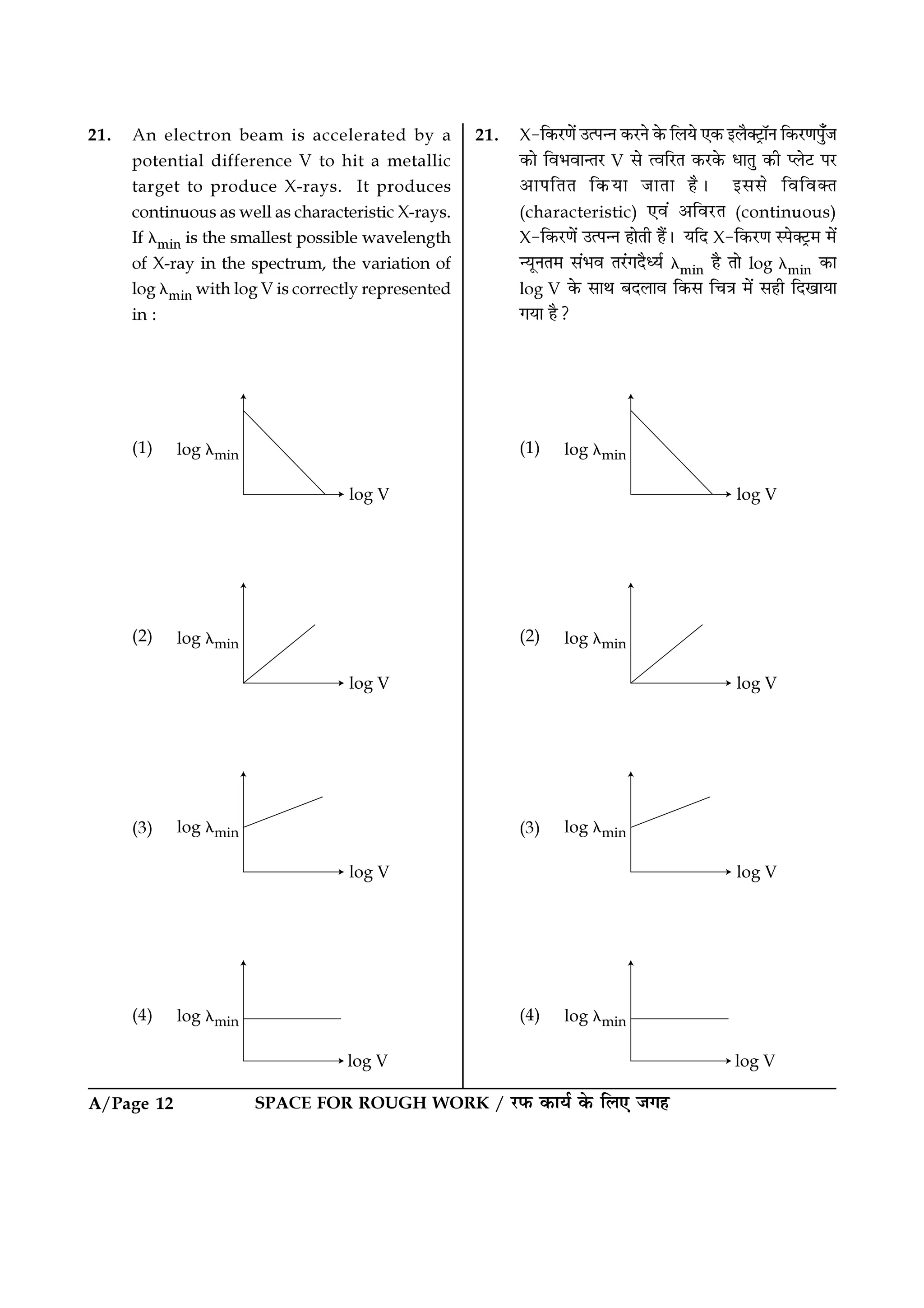
21. X-Á∑§⁄UáÊ¥ ©à¬ãŸ ∑§⁄UŸ ∑§ Á‹ÿ ∞∑§ ß‹ÒÄ≈˛UÊÚŸ Á∑§⁄UáʬȰ¡
∑§Ê Áfl÷flÊãÃ⁄U V ‚ àflÁ⁄Uà ∑§⁄U∑§ œÊÃÈ ∑§Ë å‹≈U ¬⁄U
•ʬÁÃà Á∑§ÿÊ ¡ÊÃÊ „Ò– ß‚‚ ÁflÁflÄÃ
(characteristic) ∞fl¥ •Áfl⁄Uà (continuous)
X-Á∑§⁄UáÊ¥ ©à¬ãŸ „ÊÃË „Ò¥– ÿÁŒ X-Á∑§⁄UáÊ S¬Ä≈˛U◊ ◊¥
ãÿÍŸÃ◊ ‚¥÷fl Ã⁄¥UªŒÒäÿ¸ λmin „Ò ÃÊ log λmin ∑§Ê
log V ∑§ ‚ÊÕ ’Œ‹Êfl Á∑§‚ ÁøòÊ ◊¥ ‚„Ë ÁŒπÊÿÊ
ªÿÊ „Ò?
(1)
(2)
(3)
(4)
21. An electron beam is accelerated by a
potential difference V to hit a metallic
target to produce X-rays. It produces
continuous as well as characteristic X-rays.
If λmin is the smallest possible wavelength
of X-ray in the spectrum, the variation of
log λmin with log V is correctly represented
in :
(1)
(2)
(3)
(4)
SPACE FOR ROUGH WORK / ⁄U»§ ∑§Êÿ¸ ∑§ Á‹∞ ¡ª„A/Page 13
22. ∞∑§ 25 cm ¬Á⁄U◊ÊáÊ ∑§Ë »§Ê∑§‚ ŒÍ⁄UË ∑§ •¬‚Ê⁄UË
‹ã‚ ∑§Ê ∞∑§ 20 cm ¬Á⁄◊ÊáÊ ∑§Ë »§Ê∑§‚ ŒÍ⁄UË ∑§
•Á÷‚Ê⁄UË ‹ã‚ ‚ 15 cm ∑§Ë ŒÍ⁄UË ¬⁄U ⁄UπÊ ¡ÊÃÊ „Ò–
∞∑§ ‚◊Ê¥Ã⁄U ¬˝∑§Ê‡Ê ¬È¥¡ •¬‚Ê⁄UË ‹¥‚ ¬⁄U •ʬÁÃÃ
„ÊÃÊ „Ò– ¬Á⁄UáÊÊ◊Ë ¬˝ÁÃÁ’ê’ „ÊªÊ —
(1) flÊSÃÁfl∑§ •ÊÒ⁄U •Á÷‚Ê⁄UË ‹¥‚ ‚ 40 cm ŒÍ⁄UË
¬⁄U
(2) •Ê÷Ê‚Ë •ÊÒ⁄U •Á÷‚Ê⁄UË ‹¥‚ ‚ 40 cm ŒÍ⁄UË
¬⁄U
(3) flÊSÃÁfl∑§ •ÊÒ⁄U •¬‚Ê⁄UË ‹ã‚ ‚ 40 cm ŒÍ⁄UË
¬⁄U
(4) flÊSÃÁfl∑§ •ÊÒ⁄U •Á÷‚Ê⁄UË ‹ã‚ ‚ 6 cm ŒÍ⁄UË
¬⁄U
23. ÿ¥ª ∑§ ∞∑§ ÁmÁ¤Ê⁄UË ¬˝ÿÊª ◊¥, Á¤ÊÁ⁄UÿÊ¥ ∑§ ’Ëø ∑§Ë ŒÍ⁄UË
0.5 mm ∞fl¥ ¬Œ¸ ∑§Ë Á¤Ê⁄UË ‚ ŒÍ⁄UË 150 cm „Ò– ∞∑§
¬˝∑§Ê‡Ê ¬È¥¡, Á¡‚◊¥ 650 nm •ÊÒ⁄U 520 nm ∑§Ë ŒÊ
Ã⁄¥UªŒÒäÿ¸ „Ò¥, ∑§Ê ¬Œ¸ ¬⁄U √ÿÃË∑§⁄UáÊ Á»˝§ã¡ ’ŸÊŸ ◊¥
©¬ÿÊª ∑§⁄UÃ „Ò¥– ©÷ÿÁŸc∆U ∑§ãŒ˝Ëÿ ©ÁìÊc∆U ‚ fl„
Á’ãŒÈ, ¡„ʰ ŒÊŸÊ¥ Ã⁄¥UªŒÒäÿÊZ ∑§Ë ŒË# Á»˝§ã¡¥ ‚ê¬ÊÃË
„ÊÃË „Ò, ∑§Ë ãÿÍŸÃ◊ ŒÍ⁄UË „ÊªË —
(1) 1.56 mm
(2) 7.8 mm
(3) 9.75 mm
(4) 15.6 mm
22. A diverging lens with magnitude of focal
length 25 cm is placed at a distance of
15 cm from a converging lens of magnitude
of focal length 20 cm. A beam of parallel
light falls on the diverging lens. The final
image formed is :
(1) real and at a distance of 40 cm from
convergent lens.
(2) virtual and at a distance of 40 cm
from convergent lens.
(3) real and at a distance of 40 cm from
the divergent lens.
(4) real and at a distance of 6 cm from
the convergent lens.
23. In a Young’s double slit experiment, slits
are separated by 0.5 mm, and the screen
is placed 150 cm away. A beam of light
consisting of two wavelengths, 650 nm
and 520 nm, is used to obtain interference
fringes on the screen. The least distance
from the common central maximum to the
point where the bright fringes due to both
the wavelengths coincide is :
(1) 1.56 mm
(2) 7.8 mm
(3) 9.75 mm
(4) 15.6 mm
A/Page 14 SPACE FOR ROUGH WORK / ⁄U»§ ∑§Êÿ¸ ∑§ Á‹∞ ¡ª„
24. Œ˝√ÿ◊ÊŸ m ∞fl¥ •Ê⁄UÁê÷∑§ flª v ∑§ ∞∑§ ∑§áÊ-A
∑§Ë ≈UÄ∑§⁄U Œ˝√ÿ◊ÊŸ m
2
∑§ ÁSÕ⁄U ∑§áÊ-B ‚ „ÊÃË „Ò–
ÿ„ ≈UÄ∑§⁄U ‚ê◊Èπ ∞fl¥ ¬˝àÿÊSÕ „Ò– ≈UÄ∑§⁄U ∑§ ’ÊŒ
Á«U-’˝ÊÚÇ‹Ë Ã⁄¥UªŒÒäÿÊZ λA ∞fl¥ λB ∑§Ê •ŸÈ¬Êà „ÊªÊ —
(1)
A
B
1
3
λ
=
λ
(2)
A
B
2
λ
=
λ
(3)
A
B
2
3
λ
=
λ
(4)
A
B
1
2
λ
=
λ
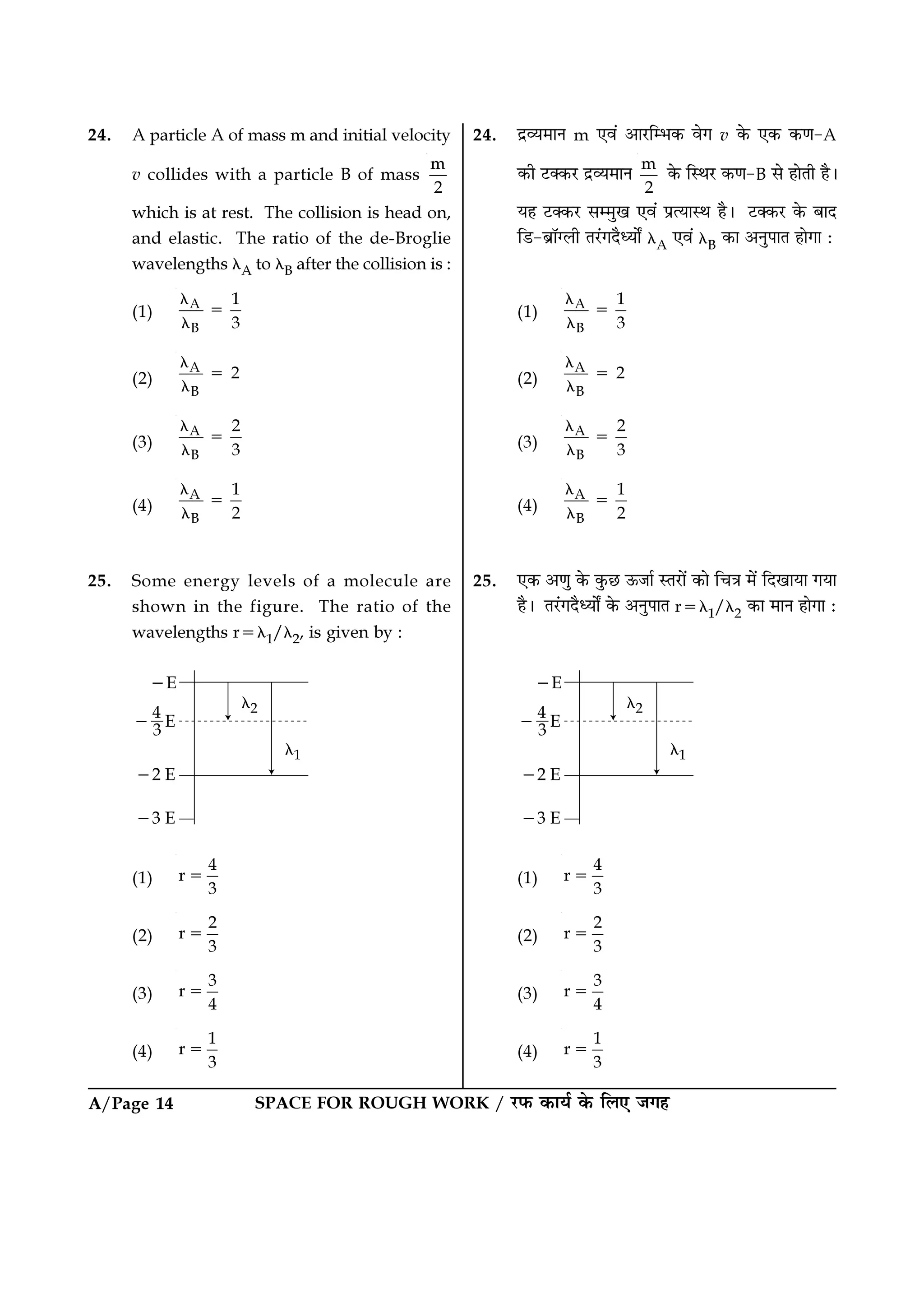
25. ∞∑§ •áÊÈ ∑§ ∑ȧ¿U ™§¡Ê¸ SÃ⁄UÊ¥ ∑§Ê ÁøòÊ ◊¥ ÁŒπÊÿÊ ªÿÊ
„Ò– Ã⁄¥UªŒÒäÿÊZ ∑§ •ŸÈ¬Êà r=λ1/λ2 ∑§Ê ◊ÊŸ „ÊªÊ —
(1)
4
r
3
=
(2)
2
r
3
=
(3)
3
r
4
=
(4)
1
r
3
=
24. A particle A of mass m and initial velocity
v collides with a particle B of mass
m
2
which is at rest. The collision is head on,
and elastic. The ratio of the de-Broglie
wavelengths λA to λB after the collision is :
(1)
A
B
1
3
λ
=
λ
(2)
A
B
2
λ
=
λ
(3)
A
B
2
3
λ
=
λ
(4)
A
B
1
2
λ
=
λ
25. Some energy levels of a molecule are
shown in the figure. The ratio of the
wavelengths r=λ1/λ2, is given by :
(1)
4
r
3
=
(2)
2
r
3
=
(3)
3
r
4
=
(4)
1
r
3
=
SPACE FOR ROUGH WORK / ⁄U»§ ∑§Êÿ¸ ∑§ Á‹∞ ¡ª„A/Page 15
26. ∞∑§ ⁄UÁ«UÿÊ∞ÁÄ≈Ufl ŸÊÁ÷∑§-A Á¡‚∑§Ë •h¸-•ÊÿÈ T
„Ò, ∑§Ê ˇÊÿ ∞∑§ ŸÊÁ÷∑§-B ◊¥ „ÊÃÊ „Ò– ‚◊ÿ t=0
¬⁄U ∑§Ê߸ ÷Ë ŸÊÁ÷∑§-B Ÿ„Ë¥ „Ò– ∞∑§ ‚◊ÿ t ¬⁄U
ŸÊÁ÷∑§Ê¥ B ÃÕÊ A ∑§Ë ‚¥ÅÿÊ ∑§Ê •ŸÈ¬Êà 0.3 „Ò ÃÊ t
∑§Ê ◊ÊŸ „ÊªÊ —
(1)
log 2T
t
2 log 1.3
=
(2)
log 1.3
t T
log 2
=
(3) t=T log (1.3)
(4)
T
t
log (1.3)
=
27. n-p-n ≈˛UʰÁ$¡S≈U⁄U ‚ ’ŸÊÿ „È∞ ∞∑§ ©÷ÿÁŸc∆U ©à‚¡¸∑§
¬˝flœ¸∑§ ¬Á⁄U¬Õ ◊¥ ÁŸflÁ‡Êà ÃÕÊ ÁŸª¸Ã Áfl÷flÊ¥ ∑§
’Ëø ∑§‹Ê¥Ã⁄U ∑§Ê ◊ÊŸ „ÊªÊ —
(1) 45ᑻ
(2) 90ᑻ
(3) 135ᑻ
(4) 180ᑻ
28. •ÊÿÊ◊ ◊ÊÚ«ÈU‹Ÿ ◊¥ íÿÊfl∑˝§Ëÿ flÊ„∑§ •ÊflÎÁûÊ ∑§Ê ωc
‚ ÃÕÊ Á‚ÇŸ‹ •ÊflÎÁûÊ ∑§Ê ωm ‚ Œ‡ÊʸÃ „Ò¥– Á‚ÇŸ‹
∑§Ë ’Òá«U øÊÒ«∏Ê߸ (∆ωm) ∑§Ê ß‚ Ã⁄U„ øÈŸÃ „Ò¥ Á∑§
∆ωm<<ωc. ÁŸêŸ ◊¥ ‚ ∑§ÊÒŸ‚Ë •ÊflÎÁûÊ ◊Ê«ÈUÁ‹Ã
Ã⁄¥Uª ◊¥ Ÿ„Ë¥ „ÊªË?
(1) ωm
(2) ωc
(3) ωm+ωc
(4) ωc−ωm
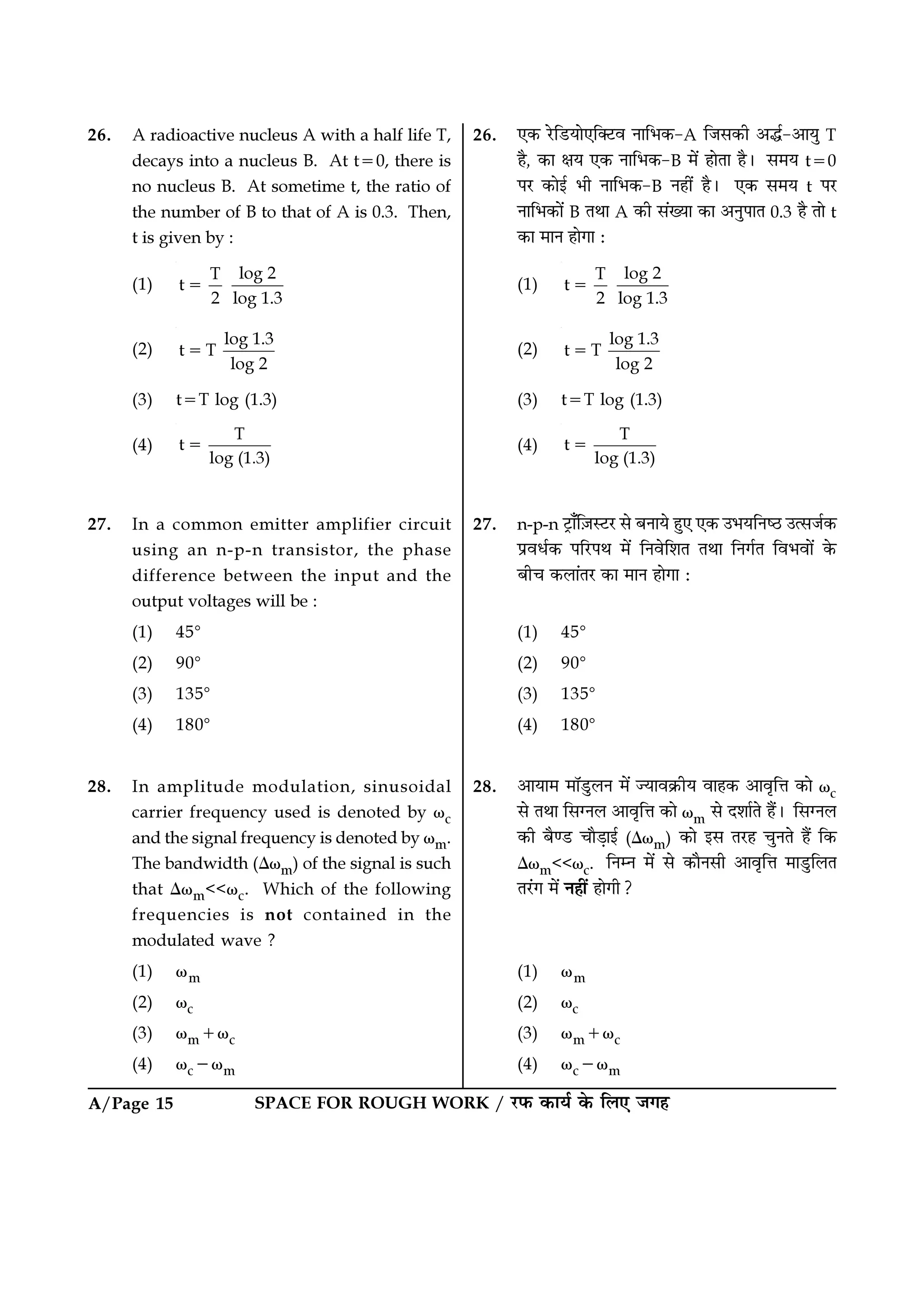
26. A radioactive nucleus A with a half life T,
decays into a nucleus B. At t=0, there is
no nucleus B. At sometime t, the ratio of
the number of B to that of A is 0.3. Then,
t is given by :
(1)
log 2T
t
2 log 1.3
=
(2)
log 1.3
t T
log 2
=
(3) t=T log (1.3)
(4)
T
t
log (1.3)
=
27. In a common emitter amplifier circuit
using an n-p-n transistor, the phase
difference between the input and the
output voltages will be :
(1) 45ᑻ
(2) 90ᑻ
(3) 135ᑻ
(4) 180ᑻ
28. In amplitude modulation, sinusoidal
carrier frequency used is denoted by ωc
and the signal frequency is denoted by ωm.
The bandwidth (∆ωm) of the signal is such
that ∆ωm<<ωc. Which of the following
frequencies is not contained in the
modulated wave ?
(1) ωm
(2) ωc
(3) ωm+ωc
(4) ωc−ωm
A/Page 16 SPACE FOR ROUGH WORK / ⁄U»§ ∑§Êÿ¸ ∑§ Á‹∞ ¡ª„
29. ÁŸêŸÁ‹Áπà ◊¥ ‚ ∑§ÊÒŸ ‚Ê ∑§ÕŸ ª‹Ã „Ò?
(1) √„Ë≈US≈UÊŸ ‚ÃÈ ∑§Ë ‚Ȫ˝„ËÃÊ ‚’‚ •Áœ∑§ Ã’
„ÊÃË „Ò ¡’ øÊ⁄UÊ¥ ¬˝ÁÃ⁄UÊœÊ¥ ∑§Ê ¬Á⁄U◊ÊáÊ ÃÈÀÿ
„ÊÃÊ „Ò–
(2) ∞∑§ ‚¥ÃÈÁ‹Ã √„Ë≈US≈UÊŸ ‚ÃÈ ◊¥, ‚‹ ∞fl¥
ªÒÀflŸÊ◊Ë≈U⁄U ∑§Ê •ʬ‚ ◊¥ ’Œ‹Ÿ ¬⁄U ‡ÊÍãÿ
ÁflˇÊ¬ Á’ãŒÈ ¬˝÷ÊÁflà „ÊÃÊ „Ò–
(3) ∞∑§ œÊ⁄UÊ ÁŸÿ¥òÊ∑§ ∑§Ê Áfl÷fl Áfl÷Ê¡∑§ ∑§Ë
Ã⁄U„ ©¬ÿÊª ∑§⁄U ‚∑§Ã „Ò¥–
(4) Á∑§⁄UøÊÚ»§ ∑§Ê ÁmÃËÿ ÁŸÿ◊ ™§¡Ê¸ ∑§ ‚¥⁄UˇÊáÊ
∑§Ê Œ‡ÊʸÃÊ „Ò–
30. ÁŸêŸ ¬˝ˇÊáÊÊ¥ ∑§Ê ∑§Á‡Ê∑§Ê ÁflÁœ ‚ ¬ÊŸË ∑§Ê ¬Îc∆U ßÊfl
T ŸÊ¬Ÿ ∑§ Á‹ÿ Á∑§ÿÊ ¡ÊÃÊ „Ò–
∑§Á‡Ê∑§Ê ∑§Ê √ÿÊ‚, D=1.25×10⁻² m
¬ÊŸË ∑§Ê ø…∏Êfl, h=1.45×10⁻² m
g=9.80 m/s2 ÃÕÊ ‚⁄U‹Ë∑Χà ‚ê’ãœ
3rhg
T 10 N/m
2
= × , ∑§Ê ©¬ÿÊª ∑§⁄UÃ „È∞
¬Îc∆U ßÊfl ◊¥ ‚ê÷ÊÁflà òÊÈÁ≈U ∑§Ê ÁŸ∑§≈UÃ◊ ◊ÊŸ „ÊªÊ —
(1) 0.15%
(2) 1.5%
(3) 2.4%
(4) 10%
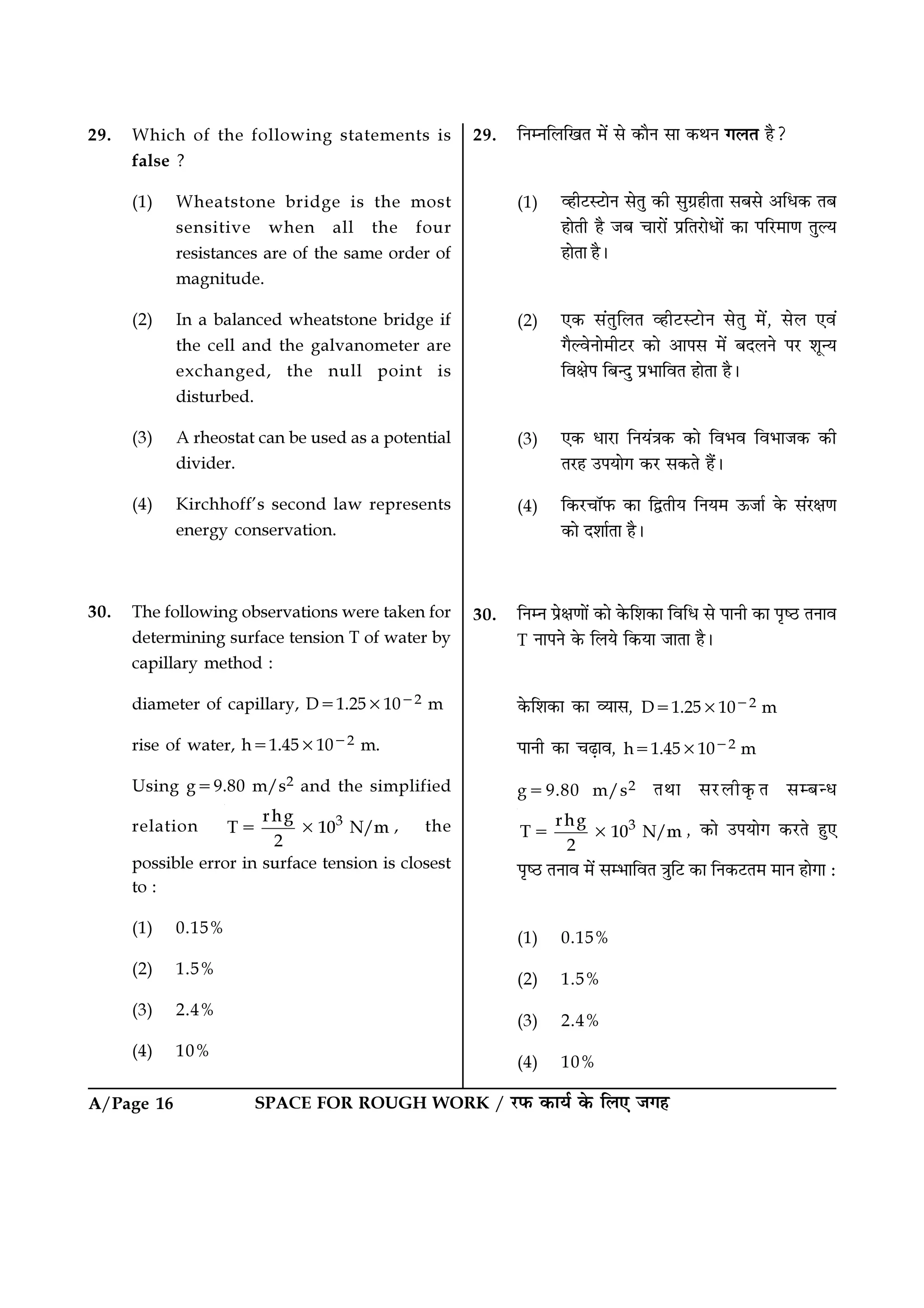
29. Which of the following statements is
false ?
(1) Wheatstone bridge is the most
sensitive when all the four
resistances are of the same order of
magnitude.
(2) In a balanced wheatstone bridge if
the cell and the galvanometer are
exchanged, the null point is
disturbed.
(3) A rheostat can be used as a potential
divider.
(4) Kirchhoff’s second law represents
energy conservation.
30. The following observations were taken for
determining surface tension T of water by
capillary method :
diameter of capillary, D=1.25×10⁻² m
rise of water, h=1.45×10⁻² m.
Using g=9.80 m/s2 and the simplified
relation 3rhg
T 10 N/m
2
= × , the
possible error in surface tension is closest
to :
(1) 0.15%
(2) 1.5%
(3) 2.4%
(4) 10%
SPACE FOR ROUGH WORK / ⁄U»§ ∑§Êÿ¸ ∑§ Á‹∞ ¡ª„A/Page 17
÷ʪ B — ⁄U‚ÊÿŸ ÁflôÊÊŸ
31. ÁŒÿÊ ªÿÊ „Ò,
C(graphite)+O2(g) → CO2(g) ;
∆rHᑻ=−393.5 kJ mol−1
H2(g)+ 1
2
O2(g) → H2O(l) ;
∆rHᑻ=−285.8 kJ mol−1
CO2(g)+2H2O(l) → CH4(g)+2O2(g) ;
∆rHᑻ=+890.3 kJ mol−1
™§¬⁄U ÁŒÿ ªÿ ™§c◊⁄UÊ‚ÊÿÁŸ∑§ ‚◊Ë∑§⁄UáÊÊ¥ ∑§ •ÊœÊ⁄U
¬⁄U 298 K ¬⁄U •Á÷Á∑˝§ÿÊ
C(graphite)+2H2(g) → CH4(g)
∑§ ∆rHᑻ ∑§Ê ◊ÊŸ „ÊªÊ —
(1) −74.8 kJ mol−1
(2) −144.0 kJ mol−1
(3) +74.8 kJ mol−1
(4) +144.0 kJ mol−1
32. ∞∑§ ∑§Ê’Ê¸Ÿ≈U (M2CO3) ∑§ 1 ª˝Ê◊ ∑§Ê HCl ∑§
•ÊÁœÄÿ ◊¥ •Á÷Á∑˝§Ã Á∑§ÿÊ ¡ÊÃÊ „Ò •ÊÒ⁄U ©‚‚
0.01186 ◊Ê‹ CO2 ¬ÒŒÊ „ÊÃË „Ò– M2CO3 ∑§Ê
◊Ê‹⁄U Œ˝√ÿ◊ÊŸ g mol−1 ◊¥ „Ò —
(1) 118.6
(2) 11.86
(3) 1186
(4) 84.3
33. ∆U Á¡‚∑§ ’⁄UÊ’⁄U „Ò, fl„ „Ò —
(1) L§hÊc◊ ∑§Êÿ¸
(2) ‚◊ÃÊ¬Ë ∑§Êÿ¸
(3) ‚◊-•ÊÿÃÁŸ∑§ ∑§Êÿ¸
(4) ‚◊ŒÊ’Ë ∑§Êÿ¸
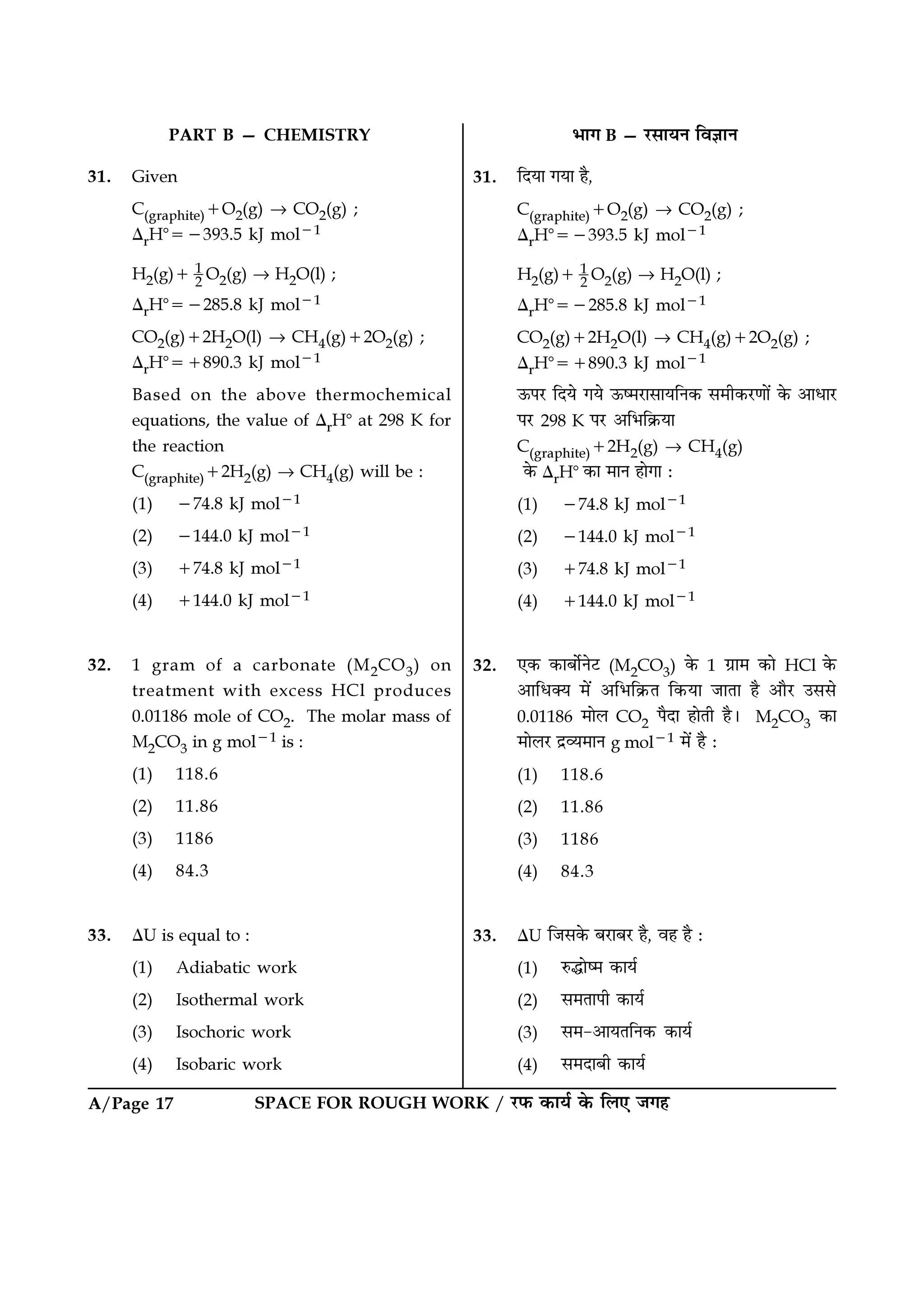
PART B — CHEMISTRY
31. Given
C(graphite)+O2(g) → CO2(g) ;
∆rHᑻ=−393.5 kJ mol−1
H2(g)+ 1
2 O2(g) → H2O(l) ;
∆rHᑻ=−285.8 kJ mol−1
CO2(g)+2H2O(l) → CH4(g)+2O2(g) ;
∆rHᑻ=+890.3 kJ mol−1
Based on the above thermochemical
equations, the value of ∆rHᑻ at 298 K for
the reaction
C(graphite)+2H2(g) → CH4(g) will be :
(1) −74.8 kJ mol−1
(2) −144.0 kJ mol−1
(3) +74.8 kJ mol−1
(4) +144.0 kJ mol−1
32. 1 gram of a carbonate (M2CO3) on
treatment with excess HCl produces
0.01186 mole of CO2. The molar mass of
M2CO3 in g mol−1 is :
(1) 118.6
(2) 11.86
(3) 1186
(4) 84.3
33. ∆U is equal to :
(1) Adiabatic work
(2) Isothermal work
(3) Isochoric work
(4) Isobaric work
A/Page 18 SPACE FOR ROUGH WORK / ⁄U»§ ∑§Êÿ¸ ∑§ Á‹∞ ¡ª„
34. Á≈Uã«U‹ ¬˝÷Êfl Ã÷Ë ÁŒπÊÿË ¬«∏ªÊ ¡’ ÁŸêŸ ‡ÊÃ¸
‚¥ÃÈc≈U „ÊÃË „Ò¥ —
(a) ¬Á⁄UˇÊÁ¬Ã ∑§áÊÊ¥ ∑§Ê √ÿÊ‚, ¬˝ÿÈÄà ¬˝∑§Ê‡Ê ∑§
Ã⁄¥UªŒÒÉÿ¸ ∑§Ë ÃÈ‹ŸÊ ◊¥ ’„Èà ¿UÊ≈UÊ „Ê–
(b) ¬Á⁄UˇÊÁ¬Ã ∑§áÊÊ¥ ∑§Ê √ÿÊ‚, ¬˝ÿÈÄà ¬˝∑§Ê‡Ê ∑§
Ã⁄¥UªŒÒÉÿ¸ ∑§Ë ÃÈ‹ŸÊ ◊¥ ’„Èà ¿UÊ≈UÊ Ÿ„Ë¥ „Ê–
(c) ¬Á⁄UˇÊÁ¬Ã ¬˝ÊflSÕÊ ÃÕÊ ¬Á⁄UˇÊ¬áÊ ◊Êäÿ◊ ∑§
•¬fløŸÊ¥∑§ ¬Á⁄U◊ÊáÊ ‹ª÷ª ∞∑§ ¡Ò‚ „Ê¥–
(d) ¬Á⁄UˇÊÁ¬Ã ¬˝ÊflSÕÊ ÃÕÊ ¬Á⁄UˇÊ¬áÊ ◊Êäÿ◊ ∑§
•¬fløŸÊ¥∑§ ¬Á⁄U◊ÊáÊ ’„Èà Á÷㟠„Ê¥–
(1) (a) ÃÕÊ (c)
(2) (b) ÃÕÊ (c)
(3) (a) ÃÕÊ (d)
(4) (b) ÃÕÊ (d)
35. ∞∑§ œÊÃÈ »§‹∑§ ∑§ÁãŒ˝Ã ÉÊŸ ‚¥⁄UøŸÊ ◊¥ Á∑˝§S≈UÁ‹Ã
„ÊÃË „Ò– ÿÁŒ ß‚∑§ ∞∑§∑§ ‚‹ ∑§Ë ∑§Ê⁄U ‹ê’Ê߸ ‘a’
„Ò, ÃÊ œÊÁàfl∑§ Á∑˝§S≈U‹ ◊¥ ŒÊ ¬⁄U◊ÊáÊÈ•Ê¥ ∑§ ’Ëø
‚ÁÛÊ∑§≈UÃ◊ ŒÍ⁄UË „ÊªË —
(1) 2 a
(2)
a
2
(3) 2a
(4) 2 2 a
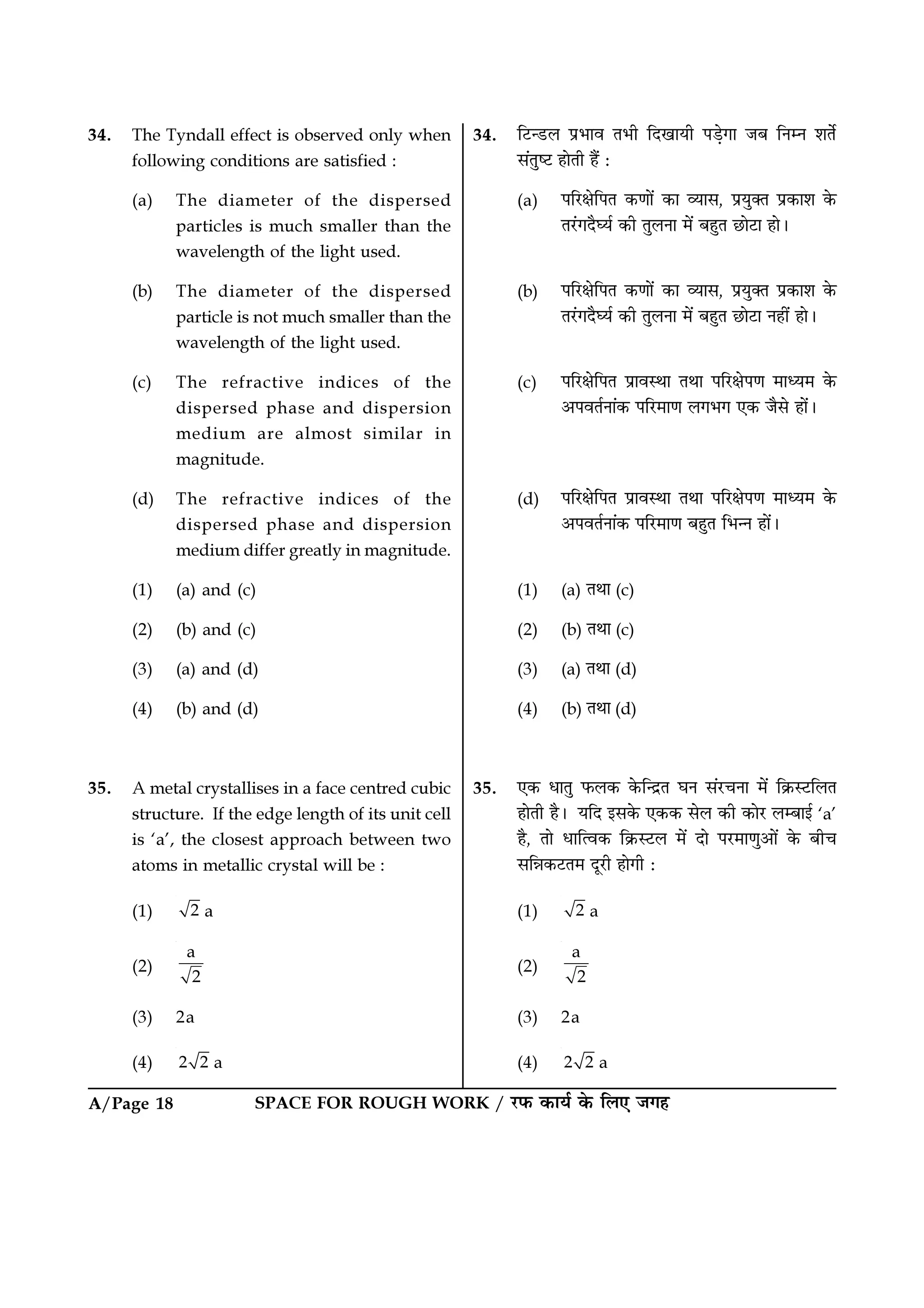
34. The Tyndall effect is observed only when
following conditions are satisfied :
(a) The diameter of the dispersed
particles is much smaller than the
wavelength of the light used.
(b) The diameter of the dispersed
particle is not much smaller than the
wavelength of the light used.
(c) The refractive indices of the
dispersed phase and dispersion
medium are almost similar in
magnitude.
(d) The refractive indices of the
dispersed phase and dispersion
medium differ greatly in magnitude.
(1) (a) and (c)
(2) (b) and (c)
(3) (a) and (d)
(4) (b) and (d)
35. A metal crystallises in a face centred cubic
structure. If the edge length of its unit cell
is ‘a’, the closest approach between two
atoms in metallic crystal will be :
(1) 2 a
(2)
a
2
(3) 2a
(4) 2 2 a
SPACE FOR ROUGH WORK / ⁄U»§ ∑§Êÿ¸ ∑§ Á‹∞ ¡ª„A/Page 19
36. ÁŒÿÊ ªÿÊ „Ò,
3
2Cl /Cl Cr /Cr
E 1.36 V, E 0.74 V− +
ᑻᑻ = =−
2 3 2
2 7 4Cr O /Cr MnO /Mn
E 1.33 V, E 1.51 V− + − +
ᑻ ᑻ= = .
ÁŸêŸ ◊¥ ‚ ¬˝’‹Ã◊ •¬øÊÿ∑§ „Ò —
(1) Cr3+
(2) Cl−
(3) Cr
(4) Mn2+
37. ¡’ ∞Á‚Á≈U∑§ ∞Á‚«U ∑§Ê 0.2 g ’¥¡ËŸ ∑§ 20 g ◊¥
Á◊‹ÊÿÊ ¡ÊÃÊ „Ò ÃÊ ’¥¡ËŸ ∑§Ê Á„◊Ê¥∑§ 0.45ᑻC ‚ ∑§◊
„Ê ¡ÊÃÊ „Ò– ÿÁŒ ∞Á‚Á≈U∑§ ∞Á‚«U ’¥¡ËŸ ◊¥ ‚¥ªÈÁáÊÃ
„Ê∑§⁄U «UÊß◊⁄U (ÁmÃÿ) ’ŸÊÃÊ „Ò ÃÊ ∞Á‚Á≈U∑§ ∞Á‚«U
∑§Ê ¬˝ÁÇÊÃÃÊ ‚¥ªÈáÊŸ „ÊªÊ —
(’¥¡ËŸ ∑§ Á‹∞ Kf =5.12 K kg mol−1)
(1) 74.6%
(2) 94.6%
(3) 64.6%
(4) 80.4%
38. „Êß«˛UÊ¡Ÿ ¬⁄U◊ÊáÊÈ ∑§ ÁmÃËÿ ’Ê⁄U ∑§ˇÊÊ ∑§Ê •h¸√ÿÊ‚
„ÊªÊ —
(å‹Ò¥∑§ ÁSÕ⁄UÊ¥∑§ h=6.6262×10⁻³⁴ Js;
ß‹Ä≈˛UÊÚŸ ∑§Ê Œ˝√ÿ◊ÊŸ=9.1091×10⁻³¹ kg;
ß‹Ä≈˛UÊÚŸ ¬⁄U •Êfl‡Ê e=1.60210×10⁻¹⁹ C;
ÁŸflʸà ∑§Ê ¬⁄UÊflÒlÈÃÊ¥∑§
ȏ0=8.854185×10⁻¹² kg−1m−3A2)
(1) 0.529 Å
(2) 2.12 Å
(3) 1.65 Å
(4) 4.76 Å
36. Given
3
2Cl /Cl Cr /Cr
E 1.36 V, E 0.74 V− +
ᑻᑻ = =−
2 3 2
2 7 4Cr O /Cr MnO /Mn
E 1.33 V, E 1.51 V− + − +
ᑻ ᑻ= = .
Among the following, the strongest
reducing agent is :
(1) Cr3+
(2) Cl−
(3) Cr
(4) Mn2+
37. The freezing point of benzene decreases
by 0.45ᑻC when 0.2 g of acetic acid is
added to 20 g of benzene. If acetic acid
associates to form a dimer in benzene,
percentage association of acetic acid in
benzene will be :
(Kf for benzene=5.12 K kg mol−1)
(1) 74.6%
(2) 94.6%
(3) 64.6%
(4) 80.4%
38. The radius of the second Bohr orbit for
hydrogen atom is :
(Planck’s Const. h=6.6262×10⁻³⁴ Js;
mass of electron=9.1091×10⁻³¹ kg;
charge of electron e=1.60210×10⁻¹⁹ C;
permittivity of vacuum
ȏ0=8.854185×10⁻¹² kg−1m−3A2)
(1) 0.529 Å
(2) 2.12 Å
(3) 1.65 Å
(4) 4.76 Å
A/Page 20 SPACE FOR ROUGH WORK / ⁄U»§ ∑§Êÿ¸ ∑§ Á‹∞ ¡ª„
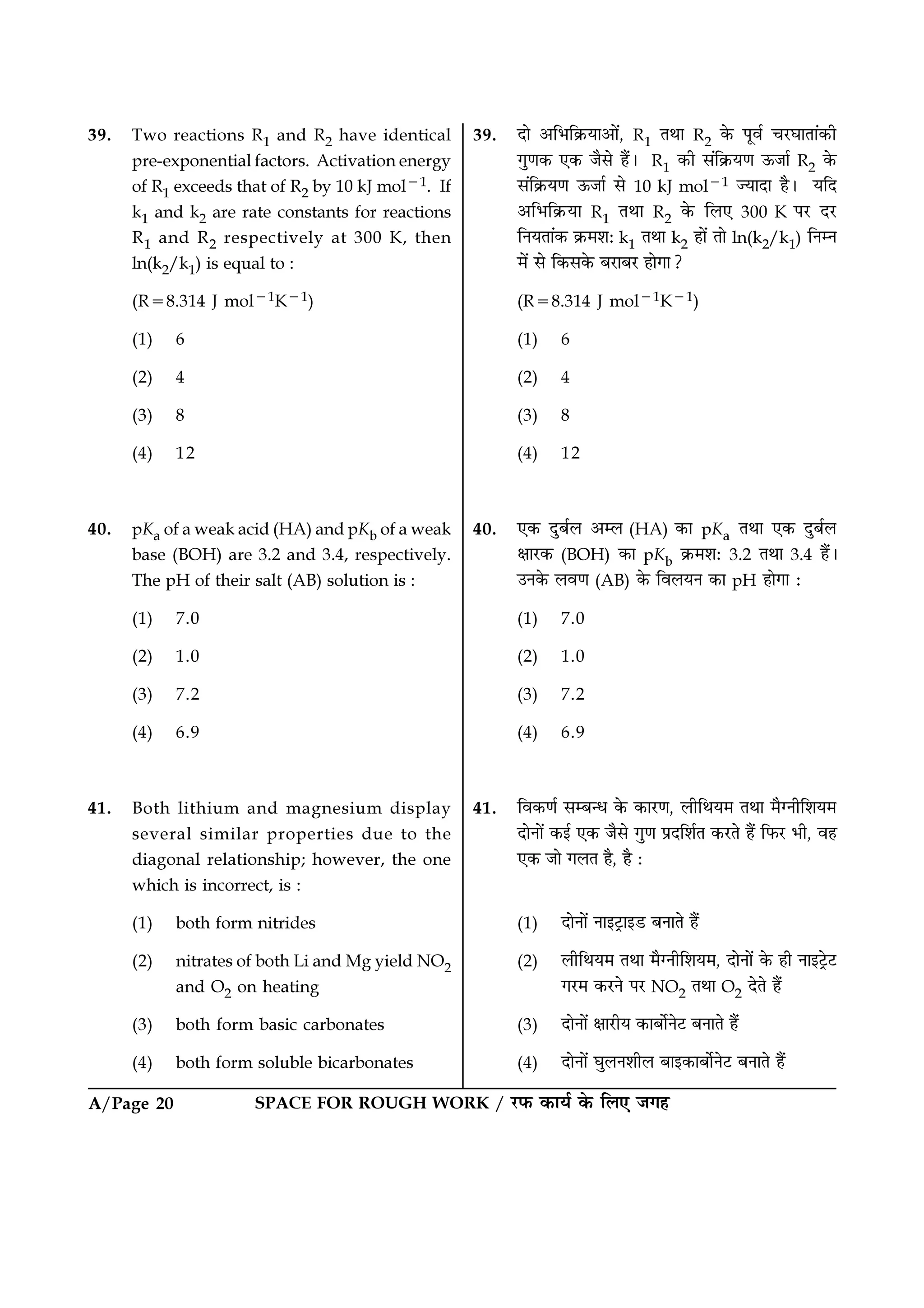
39. ŒÊ •Á÷Á∑˝§ÿÊ•Ê¥, R1 ÃÕÊ R2 ∑§ ¬Ífl¸ ø⁄UÉÊÊÃÊ¥∑§Ë
ªÈáÊ∑§ ∞∑§ ¡Ò‚ „Ò¥– R1 ∑§Ë ‚¥Á∑˝§ÿáÊ ™§¡Ê¸ R2 ∑§
‚¥Á∑˝§ÿáÊ ™§¡Ê¸ ‚ 10 kJ mol−1 íÿÊŒÊ „Ò– ÿÁŒ
•Á÷Á∑˝§ÿÊ R1 ÃÕÊ R2 ∑§ Á‹∞ 300 K ¬⁄U Œ⁄U
ÁŸÿÃÊ¥∑§ ∑˝§◊‡Ê— k1 ÃÕÊ k2 „Ê¥ ÃÊ ln(k2/k1) ÁŸêŸ
◊¥ ‚ Á∑§‚∑§ ’⁄UÊ’⁄U „ÊªÊ?
(R=8.314 J mol−1K−1)
(1) 6
(2) 4
(3) 8
(4) 12
40. ∞∑§ ŒÈ’¸‹ •ê‹ (HA) ∑§Ê pKa ÃÕÊ ∞∑§ ŒÈ’¸‹
ˇÊÊ⁄U∑§ (BOH) ∑§Ê pKb ∑˝§◊‡Ê— 3.2 ÃÕÊ 3.4 „Ò¥–
©Ÿ∑§ ‹fláÊ (AB) ∑§ Áfl‹ÿŸ ∑§Ê pH „ÊªÊ —
(1) 7.0
(2) 1.0
(3) 7.2
(4) 6.9
41. Áfl∑§áʸ ‚ê’㜠∑§ ∑§Ê⁄UáÊ, ‹ËÁÕÿ◊ ÃÕÊ ◊ÒÇŸËÁ‡Êÿ◊
ŒÊŸÊ¥ ∑§ß¸ ∞∑§ ¡Ò‚ ªÈáÊ ¬˝ŒÁ‡Ê¸Ã ∑§⁄UÃ „Ò¥ Á»§⁄U ÷Ë, fl„
∞∑§ ¡Ê ª‹Ã „Ò, „Ò —
(1) ŒÊŸÊ¥ ŸÊß≈˛UÊß«U ’ŸÊÃ „Ò¥
(2) ‹ËÁÕÿ◊ ÃÕÊ ◊ÒÇŸËÁ‡Êÿ◊, ŒÊŸÊ¥ ∑§ „Ë ŸÊß≈˛U≈U
ª⁄U◊ ∑§⁄UŸ ¬⁄U NO2 ÃÕÊ O2 ŒÃ „Ò¥
(3) ŒÊŸÊ¥ ˇÊÊ⁄UËÿ ∑§Ê’Ê¸Ÿ≈U ’ŸÊÃ „Ò¥
(4) ŒÊŸÊ¥ ÉÊÈ‹Ÿ‡ÊË‹ ’Êß∑§Ê’Ê¸Ÿ≈U ’ŸÊÃ „Ò¥
39. Two reactions R1 and R2 have identical
pre-exponential factors. Activation energy
of R1 exceeds that of R2 by 10 kJ mol−1. If
k1 and k2 are rate constants for reactions
R1 and R2 respectively at 300 K, then
ln(k2/k1) is equal to :
(R=8.314 J mol−1K−1)
(1) 6
(2) 4
(3) 8
(4) 12
40. pKa of a weak acid (HA) and pKb of a weak
base (BOH) are 3.2 and 3.4, respectively.
The pH of their salt (AB) solution is :
(1) 7.0
(2) 1.0
(3) 7.2
(4) 6.9
41. Both lithium and magnesium display
several similar properties due to the
diagonal relationship; however, the one
which is incorrect, is :
(1) both form nitrides
(2) nitrates of both Li and Mg yield NO2
and O2 on heating
(3) both form basic carbonates
(4) both form soluble bicarbonates
SPACE FOR ROUGH WORK / ⁄U»§ ∑§Êÿ¸ ∑§ Á‹∞ ¡ª„A/Page 21
42. ÁŸêŸ ◊¥ ‚ ∑§ÊÒŸ ‚Ë S¬Ë‡ÊË$¡ •ŸÈøÈê’∑§Ëÿ Ÿ„Ë¥ „Ò?
(1) O2
(2) B2
(3) NO
(4) CO
43. ÁŸêŸ ◊¥ ‚ ∑§ÊÒŸ ‚Ë •Á÷Á∑˝§ÿÊ •¬øÿÊ¬øÿ
(Á⁄U«UÊÚÄ‚) •Á÷Á∑˝§ÿÊ ∑§Ê ©ŒÊ„⁄UáÊ „Ò?
(1) XeF6 + H2O → XeOF4 + 2HF
(2) XeF6 + 2H2O → XeO2F2 + 4HF
(3) XeF4 + O2F2 → XeF6 + O2
(4) XeF2 + PF5 → [XeF]+ PF6
−
44. ∞∑§ ¡‹ ¬˝ÁÃŒ‡Ê¸ ◊¥ ¬Ë.¬Ë.∞◊. (ppm) SÃ⁄U ∑§Ë
ÁŸêŸ ´§áÊÊÿŸÊ¥ ∑§Ë ‚ÊãŒ˝ÃÊ „Ò–
2
4 3F 10 ; SO 100 ; NO 50− − −
= = =
fl„/fl ´§áÊÊÿŸ ¡Ê ¡‹ ¬˝ÁÃŒ‡Ê¸ ∑§Ê ¬ËŸ ∑§ Á‹∞
•ŸÈ¬ÿÈÄà ’ŸÊÃÊ „Ò/’ŸÊÃ „Ò¥, „Ò/„Ò¥ —
(1) ◊ÊòÊ F−
(2) ◊ÊòÊ 2
4SO −
(3) ◊ÊòÊ 3NO−
(4) 2
4SO − ÃÕÊ 3NO− ŒÊŸÊ¥
45. fl„ ª˝È¬ Á¡‚◊¥ ‚◊ß‹Ä≈˛UÊÚŸË S¬Ë‡ÊË¡ „Ò¥, „Ò —
(1) O2−, F−, Na, Mg2+
(2) O−, F−, Na+, Mg2+
(3) O2−, F−, Na+, Mg2+
(4) O−, F−, Na, Mg+
42. Which of the following species is not
paramagnetic ?
(1) O2
(2) B2
(3) NO
(4) CO
43. Which of the following reactions is an
example of a redox reaction ?
(1) XeF6 + H2O → XeOF4 + 2HF
(2) XeF6 + 2H2O → XeO2F2 + 4HF
(3) XeF4 + O2F2 → XeF6 + O2
(4) XeF2 + PF5 → [XeF]+ PF6
−
44. A water sample has ppm level
concentration of following anions
2
4 3F 10 ; SO 100 ; NO 50− − −
= = =
The anion/anions that make/makes the
water sample unsuitable for drinking is/
are :
(1) only F−
(2) only 2
4SO −
(3) only 3NO−
(4) both 2
4SO − and 3NO−
45. The group having isoelectronic species is :
(1) O2−, F−, Na, Mg2+
(2) O−, F−, Na+, Mg2+
(3) O2−, F−, Na+, Mg2+
(4) O−, F−, Na, Mg+
A/Page 22 SPACE FOR ROUGH WORK / ⁄U»§ ∑§Êÿ¸ ∑§ Á‹∞ ¡ª„
46. ¡’ Ä‹Ê⁄UËŸ ªÒ‚ ∆¥U«U ∞fl¥ ÃŸÈ ¡‹Ëÿ NaOH ∑§ ‚ÊÕ
•Á÷Á∑˝§ÿÊ ∑§⁄UÃË „Ò ÃÊ ¬˝Êåà „ÊŸ flÊ‹ ©à¬ÊŒ „Ê¥ª —
(1) Cl− ÃÕÊ ClO−
(2) Cl− ÃÕÊ 2ClO−
(3) ClO− ÃÕÊ 3ClO−
(4) 2ClO−
ÃÕÊ 3ClO−
47. ÁŸêŸ •Á÷Á∑˝§ÿÊ•Ê¥ ◊¥, ZnO ∑˝§◊‡Ê— ∑§Êÿ¸ ∑§⁄UªÊ —
(a) ZnO+Na2O → Na2ZnO2
(b) ZnO+CO2 → ZnCO3
(1) •ê‹ ÃÕÊ •ê‹
(2) •ê‹ ÃÕÊ ˇÊÊ⁄U∑§
(3) ˇÊÊ⁄U∑§ ÃÕÊ •ê‹
(4) ˇÊÊ⁄U∑§ ÃÕÊ ˇÊÊ⁄U∑§
48. ∞∑§ ∑§Ê’¸ÁŸ∑§ •ê‹ ∑§Ê ‚ÊÁ«Uÿ◊ ÀÊfláÊ ‘X’ ‚ÊãŒ˝
H2SO4 ∑§ ‚ÊÕ ’ÈŒ’Ȍʄ≈U ŒÃÊ „Ò– ‘X’ •ê‹Ëÿ
¡‹Ëÿ CaCl2 ∑§ ‚ÊÕ •Á÷Á∑˝§ÿÊ ∑§⁄UÃÊ „Ò •ÊÒ⁄U
‚»§Œ •flˇÊ¬ ŒÃÊ „Ò ¡Ê KMnO4 ∑§ •ê‹Ëÿ
Áfl‹ÿŸ ∑§Ê ⁄¥Uª„ËŸ ’ŸÊ ŒÃÊ „Ò– ‘X’ „Ò —
(1) CH3COONa
(2) Na2C2O4
(3) C6H5COONa
(4) HCOONa
46. The products obtained when chlorine gas
reacts with cold and dilute aqueous NaOH
are :
(1) Cl− and ClO−
(2) Cl− and 2ClO−
(3) ClO− and 3ClO−
(4) 2ClO−
and 3ClO−
47. In the following reactions, ZnO is
respectively acting as a/an :
(a) ZnO+Na2O → Na2ZnO2
(b) ZnO+CO2 → ZnCO3
(1) acid and acid
(2) acid and base
(3) base and acid
(4) base and base
48. Sodium salt of an organic acid ‘X’ produces
effervescence with conc. H2SO4. ‘X’ reacts
with the acidified aqueous CaCl2 solution
to give a white precipitate which
decolourises acidic solution of KMnO4.
‘X’ is :
(1) CH3COONa
(2) Na2C2O4
(3) C6H5COONa
(4) HCOONa
SPACE FOR ROUGH WORK / ⁄U»§ ∑§Êÿ¸ ∑§ Á‹∞ ¡ª„A/Page 23
49. ∞∑§ SflSÕ ◊ŸÈcÿ ∑§ ‡Ê⁄UË⁄U ◊¥ ◊ÊòÊÊ ∑§Ë ŒÎÁc≈U ‚
’„ÈÃÊÿà ‚ Á◊‹Ÿ flÊ‹ Ãàfl „Ò¥ —•ÊÚĂˡŸ (61.4%);
∑§Ê’¸Ÿ (22.9%), „Êß«˛UÊ¡Ÿ (10.0%); ÃÕÊ
ŸÊß≈˛UÊ¡Ÿ (2.6%)– 75 kg fl¡Ÿ flÊ‹ ∞∑§ √ÿÁÄÃ
∑§ ‡Ê⁄UË⁄U ‚ ‚÷Ë 1H ¬⁄U◊ÊáÊÈ•Ê¥ ∑§Ê 2H ¬⁄U◊ÊáÊÈ•Ê¥ ‚
’Œ‹ ÁŒÿÊ ¡Êÿ ÃÊ ©‚∑§ ÷Ê⁄U ◊¥ ¡Ê flÎÁh „ÊªË, fl„
„Ò —
(1) 7.5 kg
(2) 10 kg
(3) 15 kg
(4) 37.5 kg
50. CoCl3.6H2O ∑§ 0.1 M Áfl‹ÿŸ ∑§ 100 mL ∑§Ê
AgNO3 ∑§ •ÊÁœÄÿ ◊¥ •Á÷∑Χà ∑§⁄UŸ ¬⁄U
1.2×10²² •ÊÿŸ •flˇÊÁ¬Ã „ÊÃ „Ò¥– ‚¥∑ȧ‹ „Ò —
(1) [Co(H2O)6]Cl3
(2) [Co(H2O)5Cl]Cl2.H2O
(3) [Co(H2O)4Cl2]Cl.2H2O
(4) [Co(H2O)3Cl3].3H2O
49. The most abundant elements by mass in
the body of a healthy human adult are :
Oxygen (61.4%); Carbon (22.9%),
Hydrogen (10.0%); and Nitrogen (2.6%).
The weight which a 75 kg person would
gain if all 1H atoms are replaced by 2H
atoms is :
(1) 7.5 kg
(2) 10 kg
(3) 15 kg
(4) 37.5 kg
50. On treatment of 100 mL of 0.1 M solution
of CoCl3.6H2O with excess AgNO3;
1.2×10²² ions are precipitated. The
complex is :
(1) [Co(H2O)6]Cl3
(2) [Co(H2O)5Cl]Cl2.H2O
(3) [Co(H2O)4Cl2]Cl.2H2O
(4) [Co(H2O)3Cl3].3H2O
A/Page 24 SPACE FOR ROUGH WORK / ⁄U»§ ∑§Êÿ¸ ∑§ Á‹∞ ¡ª„
51. ◊ÊŸÊŸÊß≈˛U‡ÊŸ •Á÷Á∑˝§ÿÊ ◊¥ ÁŸêŸ ◊¥ ‚ ∑§ÊÒŸ ‚Ê ÿÊÒÁª∑§
◊≈UÊ ©à¬ÊŒ ∑§Ë ◊„àfl¬Íáʸ ◊ÊòÊÊ ©à¬ãŸ ∑§⁄UªÊ?
(1)
(2)
(3)
(4)
52. ÁŸêŸ ◊¥ ‚ ∑§ÊÒŸ, tert-BuONa ∑§ ‚ÊÕ •Á÷∑ΧÃ
∑§⁄UŸ ÃÕÊ ’˝Ê◊ËŸ ¡‹ ∑§ Á◊‹ÊŸ ¬⁄U, ’˝Ê◊ËŸ ∑§ ⁄¥Uª
∑§Ê ⁄¥Uª„ËŸ ∑§⁄UŸ ◊¥ •‚◊Õ¸ „ÊÃÊ „Ò?
(1)
(2)
(3)
(4)
51. Which of the following compounds will
form significant amount of meta product
during mono-nitration reaction ?
(1)
(2)
(3)
(4)
52. Which of the following, upon treatment
with tert-BuONa followed by addition of
bromine water, fails to decolourize the
colour of bromine ?
(1)
(2)
(3)
(4)
SPACE FOR ROUGH WORK / ⁄U»§ ∑§Êÿ¸ ∑§ Á‹∞ ¡ª„A/Page 25
53. ÁŸêŸ ’„È‹∑§Ê¥ ◊¥ ‚ ∑§ÊÒŸ ‚ ’„È‹∑§ ◊¥ ¡‹ •¬ÉÊ≈UŸ
•Á÷Á∑˝§ÿÊ ‚ÁãŸÁ„à „Ò?
(1) ŸÊß‹ÊÚŸ 6, 6
(2) ≈U⁄Uˋ˟
(3) ŸÊß‹ÊÚŸ 6
(4) ’∑§‹Êß≈U
54. ÁŸêŸ ◊¥ ‚ ∑§ÊÒŸ ‚Ê •áÊÈ •ŸÈŸÊÁŒ∑§ M§¬ ‚ ãÿÍŸÃ◊
ÁSÕ⁄U „Ò?
(1)
(2)
(3)
(4)
55. SN1 •Á÷Á∑˝§ÿÊ ∑§ Á‹∞ ÁŸêŸ „Ò‹Êß«UÊ¥ ∑§Ë
•Á÷Á∑˝§ÿÊà◊∑§ÃÊ ∑§Ê ’…∏ÃÊ ∑˝§◊ „Ò —
CH3CH2CH2Cl
(I) (II)
p−H3CO−C6H4−CH2Cl
(III)
(1) (I) < (III) < (II)
(2) (II) < (III) < (I)
(3) (III) < (II) < (I)
(4) (II) < (I) < (III)
53. The formation of which of the following
polymers involves hydrolysis reaction ?
(1) Nylon 6, 6
(2) Terylene
(3) Nylon 6
(4) Bakelite
54. Which of the following molecules is least
resonance stabilized ?
(1)
(2)
(3)
(4)
55. The increasing order of the reactivity of
the following halides for the SN1 reaction
is :
CH3CH2CH2Cl
(I) (II)
p−H3CO−C6H4−CH2Cl
(III)
(1) (I) < (III) < (II)
(2) (II) < (III) < (I)
(3) (III) < (II) < (I)
(4) (II) < (I) < (III)
A/Page 26 SPACE FOR ROUGH WORK / ⁄U»§ ∑§Êÿ¸ ∑§ Á‹∞ ¡ª„
56. ÁŸêŸ •Á÷Á∑˝§ÿÊ ◊¥ ¬˝Êåà „ÊŸ flÊ‹Ê ◊ÈÅÿ ©à¬ÊŒ „Ò —
(1) (+)C6H5CH(OtBu)CH2C6H5
(2) (−)C6H5CH(OtBu)CH2C6H5
(3) (±)C6H5CH(OtBu)CH2C6H5
(4) C6H5CH=CHC6H5
57. ∞∑§ ¡‹Ëÿ KOH Áfl‹ÿŸ ◊¥ ÁŸêŸ ◊¥ ‚ ∑§ÊÒŸ ‚Ê
ÿÊÒÁª∑§ ∞∑§ •¬øÊÿ∑§ ‡Ê∑¸§⁄UÊ ∑§ M§¬ ◊¥ √ÿfl„Ê⁄U
∑§⁄UªÊ?
(1)
(2)
(3)
(4)
56. The major product obtained in the
following reaction is :
(1) (+)C6H5CH(OtBu)CH2C6H5
(2) (−)C6H5CH(OtBu)CH2C6H5
(3) (±)C6H5CH(OtBu)CH2C6H5
(4) C6H5CH=CHC6H5
57. Which of the following compounds will
behave as a reducing sugar in an aqueous
KOH solution ?
(1)
(2)
(3)
(4)
SPACE FOR ROUGH WORK / ⁄U»§ ∑§Êÿ¸ ∑§ Á‹∞ ¡ª„A/Page 27
58. ¬⁄UÊÄ‚Êß«U ∑§Ë ©¬ÁSÕÁà ◊¥, 3-◊ÁÕ‹-¬ã≈U-2-߸Ÿ,
HBr ∑§ ‚ÊÕ •Á÷Á∑˝§ÿÊ ∑§⁄UŸ ¬⁄U ∞∑§ ‚¥∑§‹Ÿ ©à¬ÊŒ
’ŸÊÃÊ „Ò– ©à¬ÊŒ ∑§ Á‹∞ ‚ê÷fl ÁòÊÁfl◊ ‚◊Ê√ÊÿÁflÿÊ¥
∑§Ë ‚¥ÅÿÊ „ÊªË —
(1) ŒÊ
(2) øÊ⁄U
(3) ¿U—
(4) ‡ÊÍãÿ
59. ÁŸêŸ M§¬ÊãÃ⁄UáÊ ∑§ Á‹∞ •Á÷∑§◊¸∑§Ê¥ ∑§Ê ‚„Ë ∑˝§◊
„ÊªÊ —
(1) 3 3 2
3
CH MgBr, [Ag(NH ) ] OH ,
H /CH OH
+ −
+
(2) 3 2 3
3
[Ag(NH ) ] OH , CH MgBr,
H /CH OH
+ −
+
(3) 3 2 3
3
[Ag(NH ) ] OH , H /CH OH,
CH MgBr
+ − +
(4) 3 3
3 2
CH MgBr, H /CH OH,
[Ag(NH ) ] OH
+
+ −
58. 3-Methyl-pent-2-ene on reaction with HBr
in presence of peroxide forms an addition
product. The number of possible
stereoisomers for the product is :
(1) Two
(2) Four
(3) Six
(4) Zero
59. The correct sequence of reagents for the
following conversion will be :
(1) 3 3 2
3
CH MgBr, [Ag(NH ) ] OH ,
H /CH OH
+ −
+
(2) 3 2 3
3
[Ag(NH ) ] OH , CH MgBr,
H /CH OH
+ −
+
(3) 3 2 3
3
[Ag(NH ) ] OH , H /CH OH,
CH MgBr
+ − +
(4) 3 3
3 2
CH MgBr, H /CH OH,
[Ag(NH ) ] OH
+
+ −
A/Page 28 SPACE FOR ROUGH WORK / ⁄U»§ ∑§Êÿ¸ ∑§ Á‹∞ ¡ª„
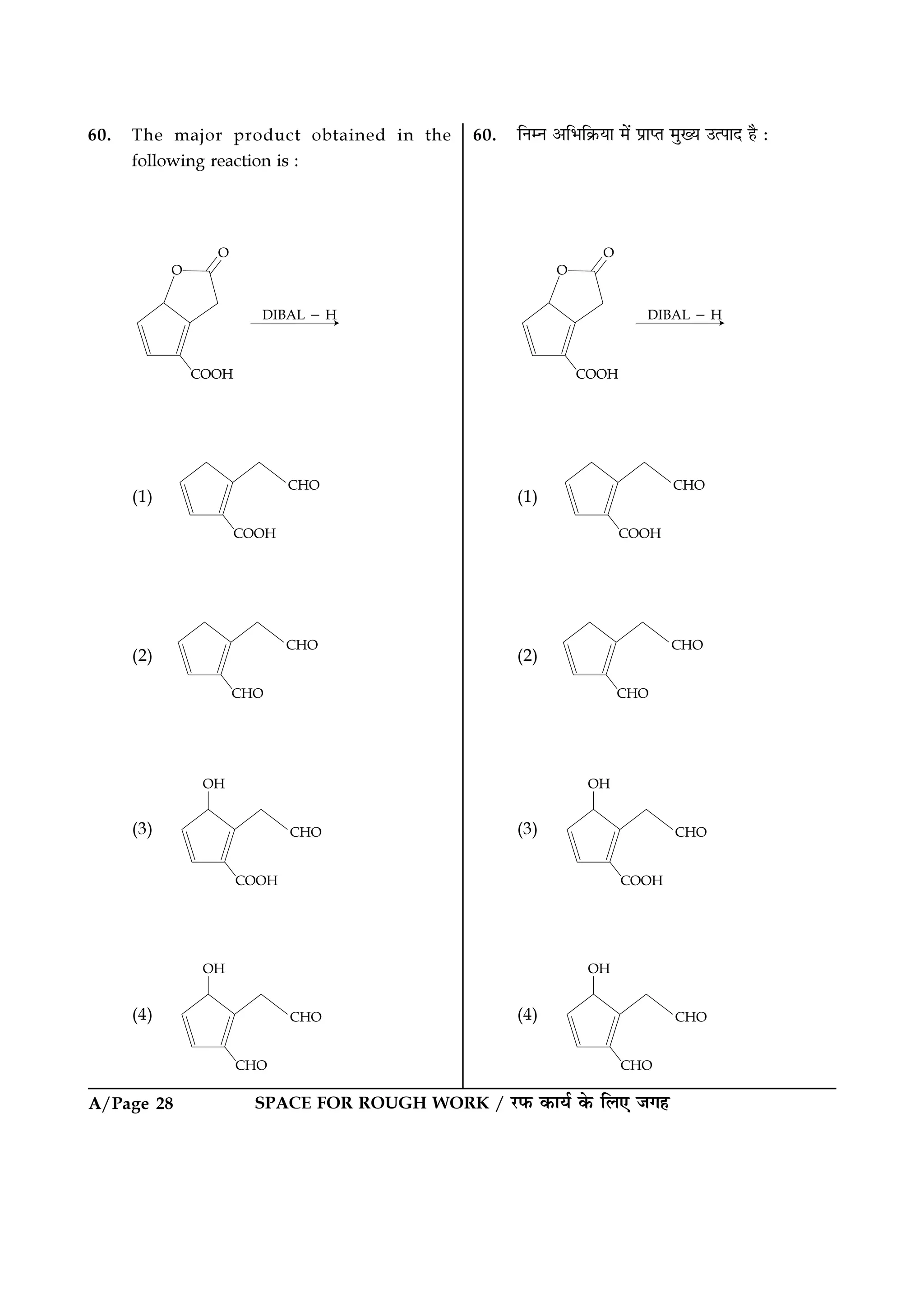
60. ÁŸêŸ •Á÷Á∑˝§ÿÊ ◊¥ ¬˝Êåà ◊ÈÅÿ ©à¬ÊŒ „Ò —
(1)
(2)
(3)
(4)
60. The major product obtained in the
following reaction is :
(1)
(2)
(3)
(4)
SPACE FOR ROUGH WORK / ⁄U»§ ∑§Êÿ¸ ∑§ Á‹∞ ¡ª„A/Page 29
÷ʪ C — ªÁáÊÃ
61. »§‹Ÿ 1 1
: ,
2 2
f  →   
R − , ¡Ê
2
( )
1
x
f x
x
=
+
mÊ⁄UÊ ¬Á⁄U÷ÊÁ·Ã „Ò —
(1) ∞∑Ò§∑§Ë „Ò ¬⁄UãÃÈ •Êë¿UÊŒË Ÿ„Ë¥ „Ò–
(2) •Êë¿UÊŒË „Ò ¬⁄UãÃÈ ∞∑Ò§∑§Ë Ÿ„Ë¥ „Ò–
(3) Ÿ ÃÊ •Êë¿UÊŒË •ÊÒ⁄U Ÿ „Ë ∞∑Ò§∑§Ë „Ò–
(4) √ÿÈà∑˝§◊áÊËÿ „Ò–
62. ÿÁŒ Á∑§‚Ë œŸ¬ÍáÊÊZ∑§ n ∑§ Á‹∞, ÁmÉÊÊÃË ‚◊Ë∑§⁄UáÊ
x(x+1)+(x+1)(x+2)+....
+( n 1)x + − (x+n)=10n
∑§ ŒÊ ∑˝§Á◊∑§ ¬ÍáÊÊZ∑§Ëÿ „‹ „Ò, ÃÊ n ’⁄UÊ’⁄U „Ò —
(1) 9
(2) 10
(3) 11
(4) 12
63. ◊ÊŸÊ ω ∞∑§ ‚Áê◊üÊ ‚¥ÅÿÊ ∞‚Ë „Ò Á∑§ 2ω+1=z
¡„ʰ 3z = − „Ò– ÿÁŒ
2 2
2 7
1 1 1
1 1 3k
1
−ω − ω =
ω ω
„Ò
ÃÊ k ’⁄UÊ’⁄U „Ò —
(1) z
(2) −1
(3) 1
(4) −z
PART C — MATHEMATICS
61. The function
1 1
: ,
2 2
f  →   
R − defined
as
2
( )
1
x
f x
x
=
+
, is :
(1) injective but not surjective.
(2) surjective but not injective.
(3) neither injective nor surjective.
(4) invertible.
62. If, for a positive integer n, the quadratic
equation,
x(x+1)+(x+1)(x+2)+....
+( n 1)x + − (x+n)=10n
has two consecutive integral solutions,
then n is equal to :
(1) 9
(2) 10
(3) 11
(4) 12
63. Let ω be a complex number such that
2ω+1=z where 3z = − . If
2 2
2 7
1 1 1
1 1 3k,
1
−ω − ω =
ω ω
then k is equal to :
(1) z
(2) −1
(3) 1
(4) −z
A/Page 30 SPACE FOR ROUGH WORK / ⁄U»§ ∑§Êÿ¸ ∑§ Á‹∞ ¡ª„
64. ÿÁŒ
2 3
A
4 1
 
 
 
−
=
−
„Ò, ÃÊ adj (3A2+12A)
’⁄UÊ’⁄U „Ò —
(1)
51 63
84 72
 
 
 
(2)
51 84
63 72
 
 
 
(3)
72 63
84 51
 
 
 
−
−
(4)
72 84
63 51
 
 
 
−
−
65. ÿÁŒ S, ‘b’ ∑§Ë ©Ÿ ÁflÁ÷ÛÊ ◊ÊŸÊ¥ ∑§Ê ‚◊ÈìÊÿ „Ò Á¡Ÿ∑§
Á‹∞ ÁŸêŸ ⁄ÒUÁπ∑§ ‚◊Ë∑§⁄UáÊ ÁŸ∑§Êÿ
x+y+z=1
x+ay+z=1
ax+by+z=0
∑§Ê ∑§Ê߸ „‹ Ÿ„Ë¥ „Ò, ÃÊ S —
(1) ∞∑§ •¬Á⁄UÁ◊à ‚◊ÈìÊÿ „Ò
(2) ∞∑§ ¬Á⁄UÁ◊à ‚◊ÈìÊÿ „Ò Á¡‚◊¥ ŒÊ ÿÊ •Áœ∑§
•flÿfl „Ò¥
(3) ∞∑§ „Ë •flÿfl flÊ‹Ê ‚◊ÈìÊÿ „Ò
(4) ∞∑§ Á⁄UÄà ‚◊ÈìÊÿ „Ò
64. If
2 3
A
4 1
 
 
 
−
=
−
, then adj (3A2+12A) is
equal to :
(1)
51 63
84 72
 
 
 
(2)
51 84
63 72
 
 
 
(3)
72 63
84 51
 
 
 
−
−
(4)
72 84
63 51
 
 
 
−
−
65. If S is the set of distinct values of ‘b’ for
which the following system of linear
equations
x+y+z=1
x+ay+z=1
ax+by+z=0
has no solution, then S is :
(1) an infinite set
(2) a finite set containing two or more
elements
(3) a singleton
(4) an empty set
SPACE FOR ROUGH WORK / ⁄U»§ ∑§Êÿ¸ ∑§ Á‹∞ ¡ª„A/Page 31
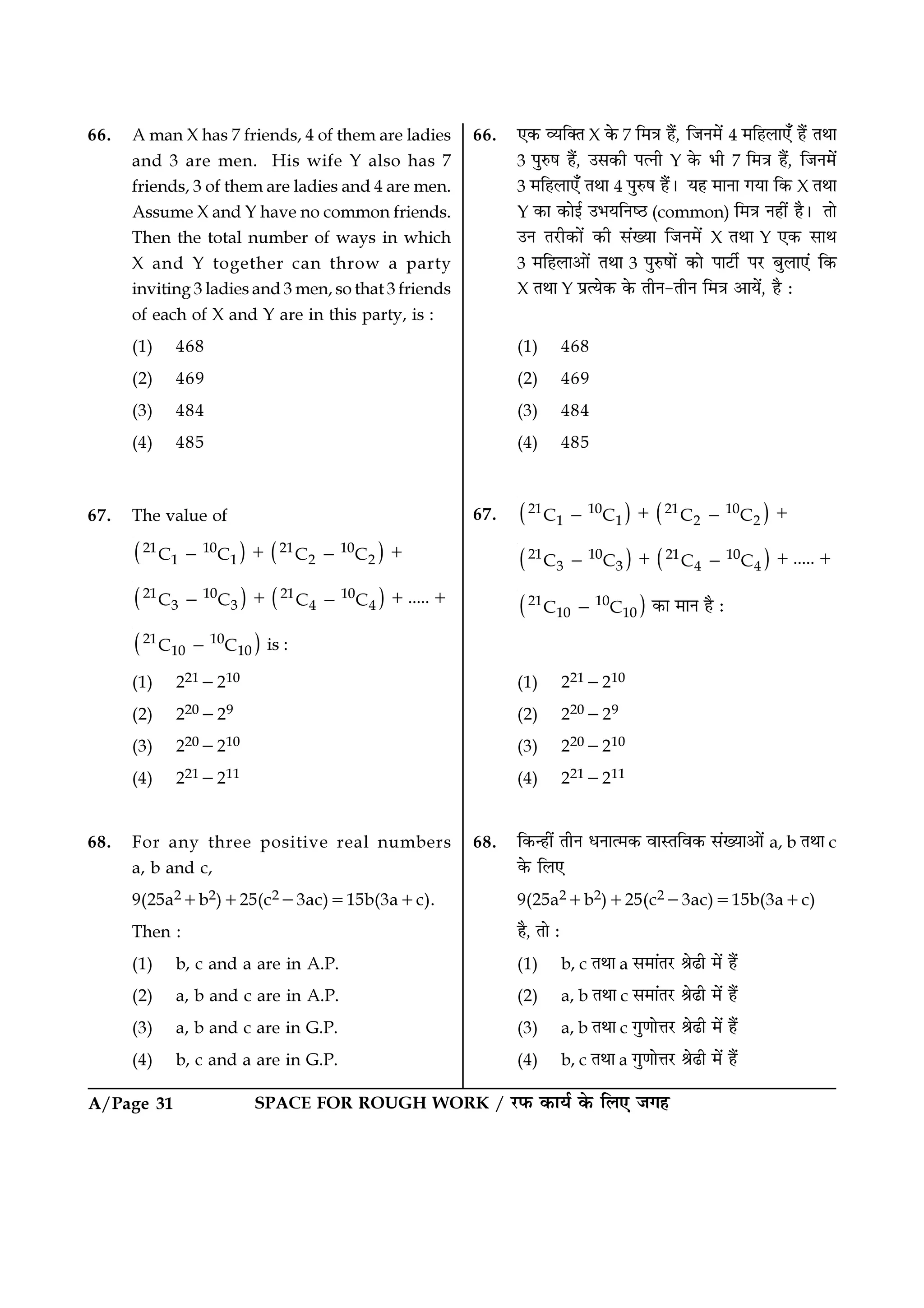
66. ∞∑§ √ÿÁÄà X ∑§ 7 Á◊òÊ „Ò¥, Á¡Ÿ◊¥ 4 ◊Á„‹Ê∞° „Ò¥ ÃÕÊ
3 ¬ÈL§· „Ò¥, ©‚∑§Ë ¬àŸË Y ∑§ ÷Ë 7 Á◊òÊ „Ò¥, Á¡Ÿ◊¥
3 ◊Á„‹Ê∞° ÃÕÊ 4 ¬ÈL§· „Ò¥– ÿ„ ◊ÊŸÊ ªÿÊ Á∑§ X ÃÕÊ
Y ∑§Ê ∑§Ê߸ ©÷ÿÁŸc∆U (common) Á◊òÊ Ÿ„Ë¥ „Ò– ÃÊ
©Ÿ Ã⁄UË∑§Ê¥ ∑§Ë ‚¥ÅÿÊ Á¡Ÿ◊¥ X ÃÕÊ Y ∞∑§ ‚ÊÕ
3 ◊Á„‹Ê•Ê¥ ÃÕÊ 3 ¬ÈL§·Ê¥ ∑§Ê ¬Ê≈U˸ ¬⁄U ’È‹Ê∞¥ Á∑§
X ÃÕÊ Y ¬˝àÿ∑§ ∑§ ÃËŸ-ÃËŸ Á◊òÊ •Êÿ¥, „Ò —
(1) 468
(2) 469
(3) 484
(4) 485
67. ( ) ( )21 10 21 10
1 1 2 2C C C C+ +− −
( ) ( )21 10 21 10
3 3 4 4 .....C C C C+ + +− −
( )21 10
10 10C C− ∑§Ê ◊ÊŸ „Ò —
(1) 221−210
(2) 220−29
(3) 220−210
(4) 221−211
68. Á∑§ã„Ë¥ ÃËŸ œŸÊà◊∑§ flÊSÃÁfl∑§ ‚¥ÅÿÊ•Ê¥ a, b ÃÕÊ c
∑§ Á‹∞
9(25a2+b2)+25(c2−3ac)=15b(3a+c)
„Ò, ÃÊ —
(1) b, c ÃÕÊ a ‚◊Ê¥Ã⁄U üÊ…Ë ◊¥ „Ò¥
(2) a, b ÃÕÊ c ‚◊Ê¥Ã⁄U üÊ…Ë ◊¥ „Ò¥
(3) a, b ÃÕÊ c ªÈáÊÊûÊ⁄U üÊ…Ë ◊¥ „Ò¥
(4) b, c ÃÕÊ a ªÈáÊÊûÊ⁄U üÊ…Ë ◊¥ „Ò¥
66. A man X has 7 friends, 4 of them are ladies
and 3 are men. His wife Y also has 7
friends, 3 of them are ladies and 4 are men.
Assume X and Y have no common friends.
Then the total number of ways in which
X and Y together can throw a party
inviting 3 ladies and 3 men, so that 3 friends
of each of X and Y are in this party, is :
(1) 468
(2) 469
(3) 484
(4) 485
67. The value of
( ) ( )21 10 21 10
1 1 2 2C C C C+ +− −
( ) ( )21 10 21 10
3 3 4 4 .....C C C C+ + +− −
( )21 10
10 10C C− is :
(1) 221−210
(2) 220−29
(3) 220−210
(4) 221−211
68. For any three positive real numbers
a, b and c,
9(25a2+b2)+25(c2−3ac)=15b(3a+c).
Then :
(1) b, c and a are in A.P.
(2) a, b and c are in A.P.
(3) a, b and c are in G.P.
(4) b, c and a are in G.P.
A/Page 32 SPACE FOR ROUGH WORK / ⁄U»§ ∑§Êÿ¸ ∑§ Á‹∞ ¡ª„
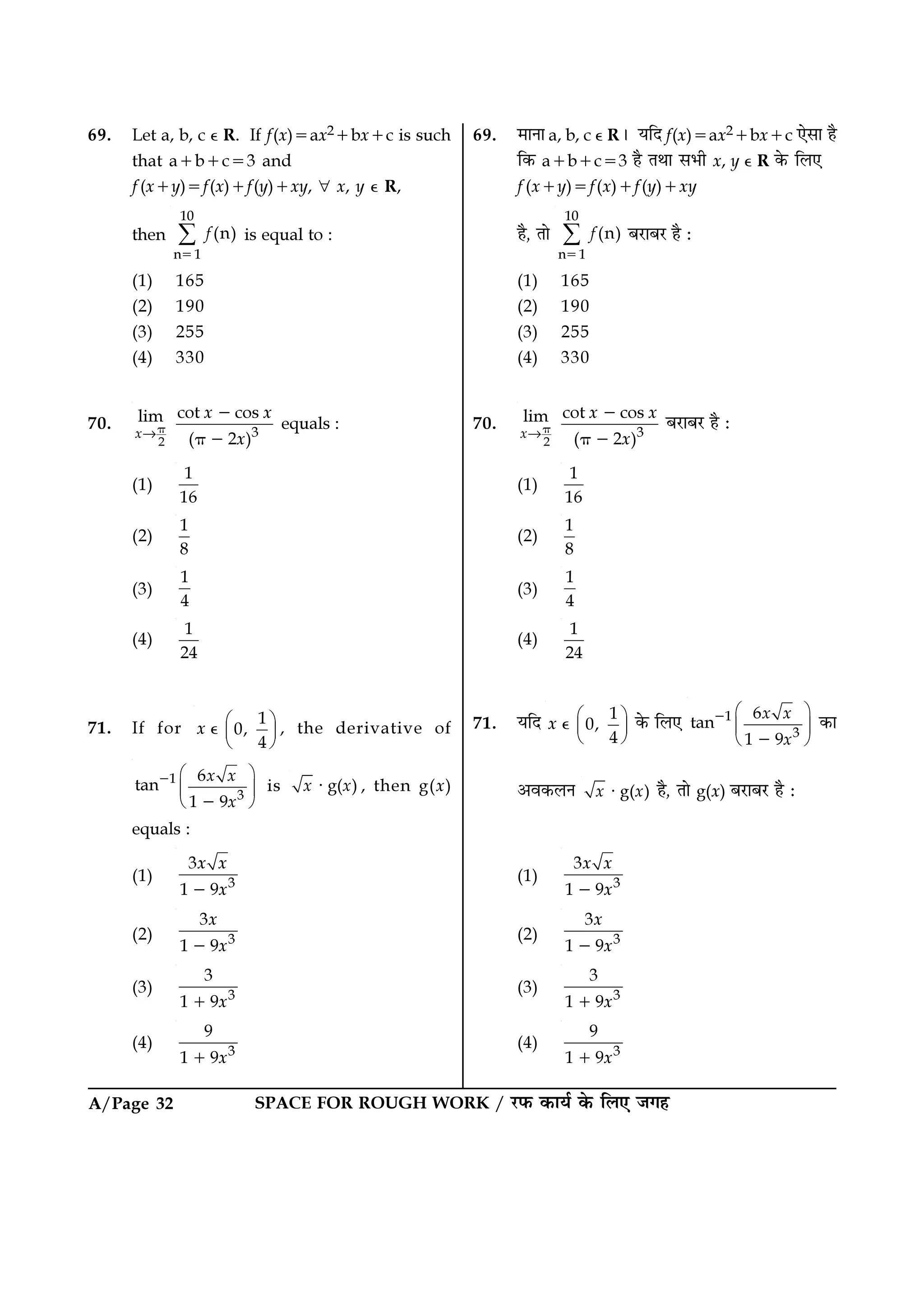
69. ◊ÊŸÊ a, b, c ȏ R– ÿÁŒ f(x)=ax2+bx+c ∞‚Ê „Ò
Á∑§ a+b+c=3 „Ò ÃÕÊ ‚÷Ë x, y ȏ R ∑§ Á‹∞
f (x+y)=f(x)+f (y)+xy
„Ò, ÃÊ
10
n 1
(n)f∑
=
’⁄UÊ’⁄U „Ò —
(1) 165
(2) 190
(3) 255
(4) 330
70.
→
2
3
cot coslim
( 2 )x
x x
x
π
−
π −
’⁄UÊ’⁄U „Ò —
(1)
1
16
(2)
1
8
(3)
1
4
(4)
1
24
71. ÿÁŒ 1
0,
4
x  
 
 
ȏ ∑§ Á‹∞ 1
3
6
tan
1 9
x x
x
 
 
 
−
−
∑§Ê
•fl∑§‹Ÿ g( )x x⋅ „Ò, ÃÊ g(x) ’⁄UÊ’⁄U „Ò —
(1) 3
3
1 9
x x
x−
(2) 3
3
1 9
x
x−
(3) 3
3
1 9x+
(4) 3
9
1 9x+
69. Let a, b, c ȏ R. If f(x)=ax2+bx+c is such
that a+b+c=3 and
f (x+y)=f(x)+f(y)+xy, ∀ x, y ȏ R,
then
10
n 1
(n)f∑
=
is equal to :
(1) 165
(2) 190
(3) 255
(4) 330
70.
→
2
3
cot coslim
( 2 )x
x x
x
π
−
π −
equals :
(1)
1
16
(2)
1
8
(3)
1
4
(4)
1
24
71. If for
1
0,
4
x  
 
 
ȏ , the derivative of
1
3
6
tan
1 9
x x
x
 
 
 
−
−
is g( )x x⋅ , then g(x)
equals :
(1) 3
3
1 9
x x
x−
(2) 3
3
1 9
x
x−
(3) 3
3
1 9x+
(4) 3
9
1 9x+
SPACE FOR ROUGH WORK / ⁄U»§ ∑§Êÿ¸ ∑§ Á‹∞ ¡ª„A/Page 33
72. fl∑˝§ y(x−2)(x−3)=x+6 ∑§ ©‚ Á’¥ŒÈ ¬⁄U, ¡„ʰ
fl∑˝§ y-•ˇÊ ∑§Ê ∑§Ê≈UÃË „Ò, πË¥øÊ ªÿÊ •Á÷‹¥’ ÁŸêŸ
◊¥ ‚ Á∑§‚ Á’¥ŒÈ ‚ „Ê∑§⁄U ¡ÊÃÊ „Ò?
(1)
1 1
,
2 2
 
 
 
(2)
1 1
,
2 3
 
 
 
−
(3)
1 1
,
2 3
 
 
 
(4)
1 1
,
2 2
 
 
 
− −
73. ∞∑§ »Í§‹Ê¥ ∑§Ë ÄÿÊ⁄UË, ¡Ê ∞∑§ flÎûÊ ∑§ ÁòÊíÿ π¥«U ∑§
M§¬ ◊¥ „Ò, ∑§Ë ÉÊ⁄UÊ’¥ŒË ∑§⁄UŸ ∑§ Á‹∞ ’Ë‚ ◊Ë≈U⁄U ÃÊ⁄U
©¬‹éœ „Ò– ÃÊ »Í§‹Ê¥ ∑§Ë ÄÿÊ⁄UË ∑§Ê •Áœ∑§Ã◊ ˇÊòÊ»§‹
(flª¸ ◊Ë. ◊¥), „Ò —
(1) 10
(2) 25
(3) 30
(4) 12.5
74. ◊ÊŸÊ n
nI tan d , (n > 1)x x∫= „Ò– ÿÁŒ
I4+I6=a tan5 x+bx5+C „Ò, ¡„ʰ C ∞∑§
‚◊Ê∑§‹Ÿ •ø⁄U „Ò, ÃÊ ∑˝§Á◊à ÿÈÇ◊ (a, b) ’⁄UÊ’⁄U „Ò —
(1)
1
, 0
5
 
 
 
(2)
1
, 1
5
 
 
 
−
(3)
1
, 0
5
 
 
 
−
(4)
1
, 1
5
 
 
 
−
72. The normal to the curve
y(x−2)(x−3)=x+6 at the point where
the curve intersects the y-axis passes
through the point :
(1)
1 1
,
2 2
 
 
 
(2)
1 1
,
2 3
 
 
 
−
(3)
1 1
,
2 3
 
 
 
(4)
1 1
,
2 2
 
 
 
− −
73. Twenty meters of wire is available for
fencing off a flower-bed in the form of a
circular sector. Then the maximum area
(in sq. m) of the flower-bed, is :
(1) 10
(2) 25
(3) 30
(4) 12.5
74. Let n
nI tan d , (n > 1)x x∫= . If
I4+I6=a tan5 x+bx5+C, where C is a
constant of integration, then the ordered
pair (a, b) is equal to :
(1)
1
, 0
5
 
 
 
(2)
1
, 1
5
 
 
 
−
(3)
1
, 0
5
 
 
 
−
(4)
1
, 1
5
 
 
 
−
A/Page 34 SPACE FOR ROUGH WORK / ⁄U»§ ∑§Êÿ¸ ∑§ Á‹∞ ¡ª„
75. ‚◊Ê∑§‹ ∫
3
4
4
d
1 cos
x
x
π
π
+
’⁄UÊ’⁄U „Ò —
(1) 2
(2) 4
(3) −1
(4) −2
76. ˇÊòÊ {(x, y) : xኑ0, x+y≤3, x2≤4y ÃÕÊ
y≤1+ x } ∑§Ê ˇÊòÊ»§‹ (flª¸ ß∑§ÊßÿÊ¥) ◊¥ „Ò —
(1)
3
2
(2)
7
3
(3)
5
2
(4)
59
12
77. ÿÁŒ d
(2 sin ) ( 1)cos 0
d
y
x y x
x
+ + + = ÃÕÊ
y(0)=1 „Ò, ÃÊ
2
y 
 
 
π
’⁄UÊ’⁄U „Ò —
(1)
2
3
−
(2)
1
3
−
(3)
4
3
(4)
1
3
75. The integral
∫
3
4
4
d
1 cos
x
x
π
π
+
is equal to :
(1) 2
(2) 4
(3) −1
(4) −2
76. The area (in sq. units) of the region
{(x, y) : xኑ0, x+y≤3, x2≤4y and
y≤1+ x } is :
(1)
3
2
(2)
7
3
(3)
5
2
(4)
59
12
77. If
d
(2 sin ) ( 1)cos 0
d
y
x y x
x
+ + + = and
y(0)=1, then
2
y 
 
 
π
is equal to :
(1)
2
3
−
(2)
1
3
−
(3)
4
3
(4)
1
3
SPACE FOR ROUGH WORK / ⁄U»§ ∑§Êÿ¸ ∑§ Á‹∞ ¡ª„A/Page 35
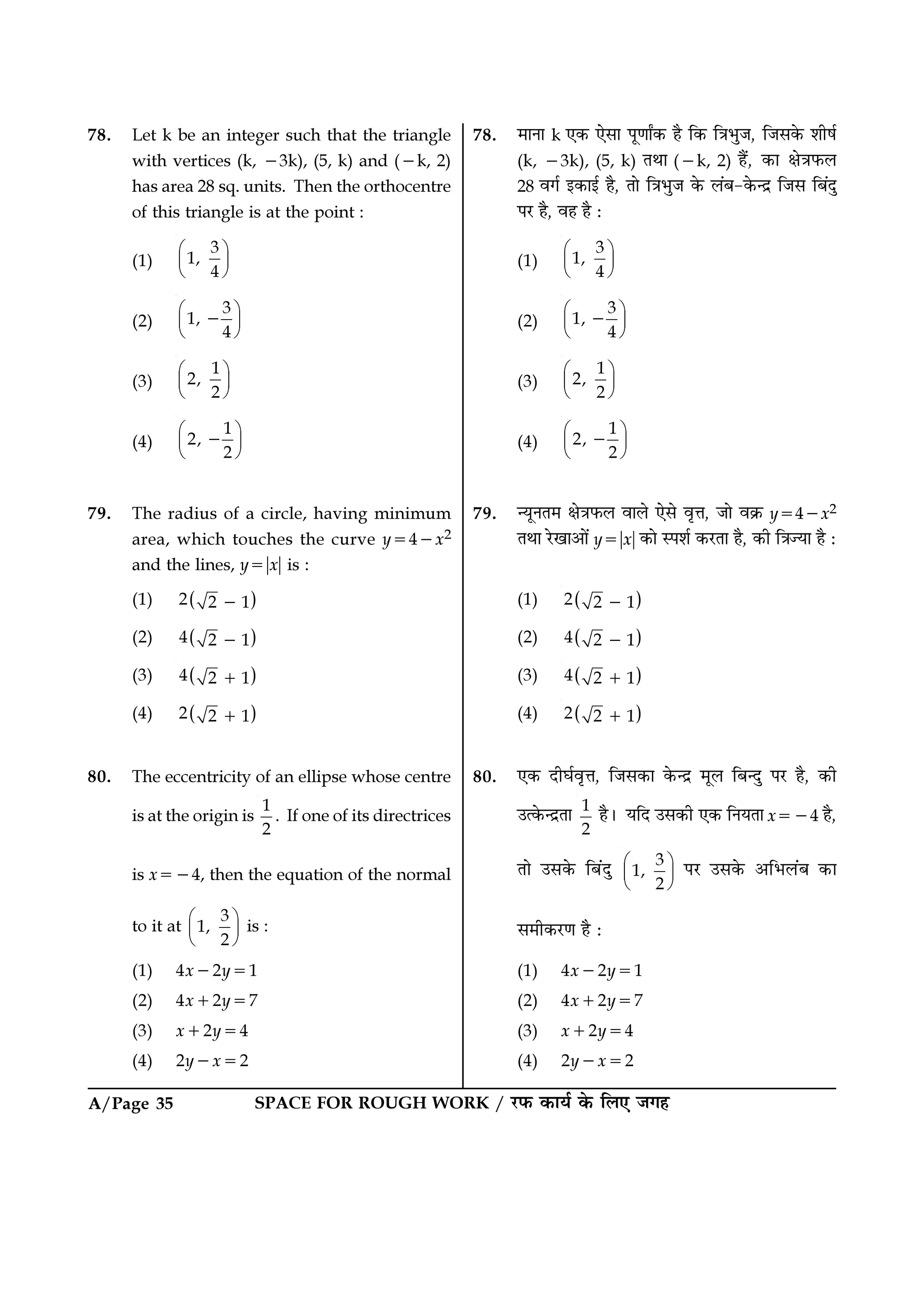
78. ◊ÊŸÊ k ∞∑§ ∞‚Ê ¬ÍáÊÊZ∑§ „Ò Á∑§ ÁòÊ÷È¡, Á¡‚∑§ ‡ÊË·¸
(k, −3k), (5, k) ÃÕÊ (−k, 2) „Ò¥, ∑§Ê ˇÊòÊ»§‹
28 flª¸ ß∑§Ê߸ „Ò, ÃÊ ÁòÊ÷È¡ ∑§ ‹¥’-∑§ãŒ˝ Á¡‚ Á’¥ŒÈ
¬⁄U „Ò, fl„ „Ò —
(1)
3
1,
4
 
 
 
(2)
3
1,
4
 
 
 
−
(3)
1
2,
2
 
 
 
(4)
1
2,
2
 
 
 
−
79. ãÿÍŸÃ◊ ˇÊòÊ»§‹ flÊ‹ ∞‚ flÎûÊ, ¡Ê fl∑˝§ y=4−x2
ÃÕÊ ⁄UπÊ•Ê¥ y=ᎂxᎂ ∑§Ê S¬‡Ê¸ ∑§⁄UÃÊ „Ò, ∑§Ë ÁòÊíÿÊ „Ò —
(1) ( )2 2 1−
(2) ( )4 2 1−
(3) ( )4 2 1+
(4) ( )2 2 1+
80. ∞∑§ ŒËÉʸflÎûÊ, Á¡‚∑§Ê ∑§ãŒ˝ ◊Í‹ Á’ãŒÈ ¬⁄U „Ò, ∑§Ë
©à∑§ãŒ˝ÃÊ 1
2
„Ò– ÿÁŒ ©‚∑§Ë ∞∑§ ÁŸÿÃÊ x=−4 „Ò,
ÃÊ ©‚∑§ Á’¥ŒÈ 3
1,
2
 
 
 
¬⁄U ©‚∑§ •Á÷‹¥’ ∑§Ê
‚◊Ë∑§⁄UáÊ „Ò —
(1) 4x−2y=1
(2) 4x+2y=7
(3) x+2y=4
(4) 2y−x=2
78. Let k be an integer such that the triangle
with vertices (k, −3k), (5, k) and (−k, 2)
has area 28 sq. units. Then the orthocentre
of this triangle is at the point :
(1)
3
1,
4
 
 
 
(2)
3
1,
4
 
 
 
−
(3)
1
2,
2
 
 
 
(4)
1
2,
2
 
 
 
−
79. The radius of a circle, having minimum
area, which touches the curve y=4−x2
and the lines, y=ᎂxᎂ is :
(1) ( )2 2 1−
(2) ( )4 2 1−
(3) ( )4 2 1+
(4) ( )2 2 1+
80. The eccentricity of an ellipse whose centre
is at the origin is
1
2
. If one of its directrices
is x=−4, then the equation of the normal
to it at
3
1,
2
 
 
 
is :
(1) 4x−2y=1
(2) 4x+2y=7
(3) x+2y=4
(4) 2y−x=2
A/Page 36 SPACE FOR ROUGH WORK / ⁄U»§ ∑§Êÿ¸ ∑§ Á‹∞ ¡ª„
81. ∞∑§ •Áì⁄Ufl‹ÿ Á’¥ŒÈ ( )P 2, 3 ‚ „Ê∑§⁄U ¡ÊÃÊ
„Ò, ÃÕÊ ©‚∑§Ë ŸÊÁ÷ÿʰ (±2, 0) ¬⁄U „Ò¥, ÃÊ •Áì⁄Ufl‹ÿ
∑§ Á’¥ŒÈ P ¬⁄U πË¥øË ªß¸ S¬‡Ê¸⁄UπÊ Á¡‚ Á’¥ŒÈ ‚ „Ê∑§⁄U
¡ÊÃË „Ò, fl„ „Ò —
(1) ( )2 2, 3 3
(2) ( )3, 2
(3) ( )2, 3− −
(4) ( )3 2, 2 3
82. ∞∑§ ‚◊Ë ¡Ê Á’¥ŒÈ (1, −1, −1) ‚ „Ê∑§⁄U ¡ÊÃÊ „Ò
ÃÕÊ Á¡‚∑§Ê •Á÷‹¥’ ŒÊŸÊ¥ ⁄UπÊ•Ê¥
21 4
1 2 3
yx z+− −
= =
−
ÃÕÊ
12 7
2 1 1
yx z+− +
= =
− −
¬⁄U ‹¥’ „Ò, ∑§Ë Á’¥ŒÈ
(1, 3, −7) ‚ ŒÍ⁄UË „Ò —
(1)
10
83
(2)
5
83
(3)
10
74
(4)
20
74
83. ÿÁŒ Á’¥ŒÈ P(1, −2, 3) ∑§Ê ‚◊Ë
2x+3y−4z+22=0 ◊¥ fl„ ¬˝ÁÃÁ’¥’ ¡Ê ⁄UπÊ
1 4 5
yx z
= = ∑§ ‚◊Ê¥Ã⁄U „Ò, Q „Ò, ÃÊ PQ ’⁄UÊ’⁄U
„Ò —
(1) 2 42
(2) 42
(3) 6 5
(4) 3 5
81. A hyperbola passes through the point
( )P 2, 3 and has foci at (±2, 0). Then
the tangent to this hyperbola at P also
passes through the point :
(1) ( )2 2, 3 3
(2) ( )3, 2
(3) ( )2, 3− −
(4) ( )3 2, 2 3
82. The distance of the point (1, 3, −7) from
the plane passing through the point
(1, −1, −1), having normal perpendicular
to both the lines
21 4
1 2 3
yx z+− −
= =
−
and
12 7
,
2 1 1
yx z+− +
= =
− −
is :
(1)
10
83
(2)
5
83
(3)
10
74
(4)
20
74
83. If the image of the point P(1, −2, 3) in the
plane, 2x+3y−4z+22=0 measured
parallel to the line,
1 4 5
yx z
= = is Q, then
PQ is equal to :
(1) 2 42
(2) 42
(3) 6 5
(4) 3 5
SPACE FOR ROUGH WORK / ⁄U»§ ∑§Êÿ¸ ∑§ Á‹∞ ¡ª„A/Page 37
84. ◊ÊŸÊ a 2 2i j k
→ ∧ ∧ ∧
= + − ÃÕÊ b i j
→ ∧ ∧
= + „Ò–
◊ÊŸÊ c
→
∞∑§ ∞‚Ê ‚ÁŒ‡Ê „Ò Á∑§ c a 3
→ →
− = ,
( )a b c 3
→→ →
× × = ÃÕÊ c
→
•ÊÒ⁄U a b
→→
× ∑§
’Ëø ∑§Ê ∑§ÊáÊ 30ᑻ „Ò, ÃÊ a c
→ →
⋅ ’⁄UÊ’⁄U „Ò —
(1) 2
(2) 5
(3)
1
8
(4)
25
8
85. ∞∑§ ’Ä‚ ◊¥ 15 „⁄UË ÃÕÊ 10 ¬Ë‹Ë ª¥Œ¥ „Ò¥– ÿÁŒ
∞∑§-∞∑§ ∑§⁄U∑§ ÿÊŒÎë¿UÿÊ, ¬˝ÁÃSÕʬŸÊ ‚Á„Ã,
10 ª¥Œ¥ ÁŸ∑§Ê‹Ë ¡Ê∞°, ÃÊ „⁄UË ª¥ŒÊ¥ ∑§Ë ‚¥ÅÿÊ ∑§Ê
¬˝‚⁄UáÊ „Ò —
(1) 6
(2) 4
(3)
6
25
(4)
12
5
84. Let a 2 2i j k
→ ∧ ∧ ∧
= + − and b i j
→ ∧ ∧
= + .
Let c
→
be a vector such that c a 3
→ →
− = ,
( )a b c 3
→→ →
× × = and the angle between
c
→
and a b
→→
× be 30ᑻ. Then a c
→ →
⋅ is
equal to :
(1) 2
(2) 5
(3)
1
8
(4)
25
8
85. A box contains 15 green and 10 yellow
balls. If 10 balls are randomly drawn,
one-by-one, with replacement, then the
variance of the number of green balls
drawn is :
(1) 6
(2) 4
(3)
6
25
(4)
12
5
A/Page 38 SPACE FOR ROUGH WORK / ⁄U»§ ∑§Êÿ¸ ∑§ Á‹∞ ¡ª„
86. For three events A, B and C,
P(Exactly one of A or B occurs)
=P(Exactly one of B or C occurs)
=P(Exactly one of C or A occurs)=
1
4
and
P(All the three events occur
simultaneously)=
1
16
.
Then the probability that at least one of
the events occurs, is :
(1)
7
16
(2)
7
64
(3)
3
16
(4)
7
32
87. If two different numbers are taken from
the set {0, 1, 2, 3, ......, 10}; then the
probability that their sum as well as
absolute difference are both multiple of 4,
is :
(1)
12
55
(2)
14
45
(3)
7
55
(4)
6
55
86. ÃËŸ ÉÊ≈UŸÊ•Ê¥ A, B ÃÕÊ C ∑§ Á‹∞
P(A •ÕflÊ B ◊¥ ‚ ∑§fl‹ ∞∑§ ÉÊÁ≈Uà „ÊÃË „Ò)
=P(B •ÕflÊ C ◊¥ ‚ ∑§fl‹ ∞∑§ ÉÊÁ≈Uà „ÊÃË „Ò)
=P(C•ÕflÊA◊¥ ‚ ∑§fl‹ ∞∑§ ÉÊÁ≈Uà „ÊÃË „Ò)=
1
4
ÃÕÊ
P(‚÷Ë ÃËŸ ÉÊ≈UŸÊ∞° ∞∑§ ‚ÊÕ ÉÊÁ≈Uà „ÊÃË
„Ò¥)=
1
16
„Ò,
ÃÊ ¬˝ÊÁÿ∑§ÃÊ Á∑§ ∑§◊ ‚ ∑§◊ ∞∑§ ÉÊ≈UŸÊ ÉÊÁ≈Uà „Ê, „Ò —
(1)
7
16
(2)
7
64
(3)
3
16
(4)
7
32
87. ÿÁŒ ‚◊ÈìÊÿ {0, 1, 2, 3, ......, 10} ◊¥ ‚ ŒÊ ÁflÁ÷ÛÊ
‚¥ÅÿÊ∞° ÁŸ∑§Ê‹Ë ªßZ, ÃÊ ©Ÿ∑§ ÿÊª»§‹ ÃÕÊ ©Ÿ∑§
•¥Ã⁄U ∑§ ÁŸ⁄U¬ˇÊ ◊ÊŸ, ŒÊŸÊ¥ ∑§ øÊ⁄U ∑§ ªÈáÊ∑§ „ÊŸ ∑§Ë
¬˝ÊÁÿ∑§ÃÊ „Ò —
(1)
12
55
(2)
14
45
(3)
7
55
(4)
6
55
SPACE FOR ROUGH WORK / ⁄U»§ ∑§Êÿ¸ ∑§ Á‹∞ ¡ª„A/Page 39
88. If 5(tan2 x−cos2 x)=2cos 2x+9, then the
value of cos 4x is :
(1)
1
3
(2)
2
9
(3)
7
9
−
(4)
3
5
−
89. Let a vertical tower AB have its end A on
the level ground. Let C be the mid-point
of AB and P be a point on the ground such
that AP=2AB. If ∠BPC=β, then tan β is
equal to :
(1)
1
4
(2)
2
9
(3)
4
9
(4)
6
7
90. The following statement
(p→q)→[(~p→q)→q] is :
(1) equivalent to ~p→q
(2) equivalent to p→~q
(3) a fallacy
(4) a tautology
- o 0 o -
88. ÿÁŒ 5(tan2 x−cos2 x)=2cos 2x+9, ÃÊ
cos 4x ∑§Ê ◊ÊŸ „Ò —
(1)
1
3
(2)
2
9
(3)
7
9
−
(4)
3
5
−
89. ◊ÊŸÊ ∞∑§ ™§äflʸœ⁄U ◊ËŸÊ⁄U AB ∞‚Ë „Ò Á∑§ ©‚∑§Ê
Á‚⁄UÊ A ÷ÍÁ◊ ¬⁄U „Ò– ◊ÊŸÊ AB ∑§Ê ◊äÿ Á’¥ŒÈ C „Ò
ÃÕÊ ÷ÍÁ◊ ¬⁄U ÁSÕà Á’¥ŒÈ P ∞‚Ê „Ò Á∑§ AP=2AB
ÿÁŒ ∠BPC=β „Ò, ÃÊ tan β ’⁄UÊ’⁄U „Ò —
(1)
1
4
(2)
2
9
(3)
4
9
(4)
6
7
90. ÁŸêŸ ∑§ÕŸ
(p→q)→[(~p→q)→q] —
(1) ~p→q ∑§ ‚◊ÃÈÀÿ „Ò
(2) p→~q ∑§ ‚◊ÃÈÀÿ „Ò
(3) ∞∑§ „àflÊ÷Ê‚ (fallacy) „Ò
(4) ∞∑§ ¬ÈŸL§ÁÄà (tautology) „Ò
- o 0 o -
SPACE FOR ROUGH WORK / ⁄U»§ ∑§Êÿ¸ ∑§ Á‹∞ ¡ª„
A/Page 40 SPACE FOR ROUGH WORK / ⁄U»§ ∑§Êÿ¸ ∑§ Á‹∞ ¡ª„
SPACE FOR ROUGH WORK / ⁄»§ ∑§Êÿ¸ ∑§ Á‹∞ ¡ª„
SPACE FOR ROUGH WORK / ⁄U»§ ∑§Êÿ¸ ∑§ Á‹∞ ¡ª„A/Page 41
SPACE FOR ROUGH WORK / ⁄»§ ∑§Êÿ¸ ∑§ Á‹∞ ¡ª„
A/Page 42 SPACE FOR ROUGH WORK / ⁄U»§ ∑§Êÿ¸ ∑§ Á‹∞ ¡ª„
SPACE FOR ROUGH WORK / ⁄»§ ∑§Êÿ¸ ∑§ Á‹∞ ¡ª„
SPACE FOR ROUGH WORK / ⁄U»§ ∑§Êÿ¸ ∑§ Á‹∞ ¡ª„A/Page 43
SPACE FOR ROUGH WORK / ⁄»§ ∑§Êÿ¸ ∑§ Á‹∞ ¡ª„
Read the following instructions carefully :
1. The candidates should fill in the required particulars
on the Test Booklet and Answer Sheet (Side–1) with
Black Ball Point Pen.
2. For writing/marking particulars on Side–2 of the
Answer Sheet, use Black Ball Point Pen only.
3. The candidates should not write their Roll Numbers
anywhere else (except in the specified space) on the
Test Booklet/Answer Sheet.
4. Out of the four options given for each question, only
one option is the correct answer.
5. For each incorrect response, ¼ (one–fourth) marks of
the total marks allotted to the question (i.e. 1 mark)
will be deducted from the total score. No deduction
from the total score, however, will be made if no
response is indicated for an item in the Answer Sheet.
6. Handle the Test Booklet and Answer Sheet with care,
as under no circumstances (except for discrepancy in
Test Booklet Code and Answer Sheet Code), another set
will be provided.
7. The candidates are not allowed to do any rough work
or writing work on the Answer Sheet. All calculations/
writing work are to be done in the space provided for
this purpose in the Test Booklet itself, marked ‘Space
for Rough Work’. This space is given at the bottom of
each page and in four pages (Page 40-43) at the end of
the booklet.
8. On completion of the test, the candidates must hand
over the Answer Sheet to the Invigilator on duty in the
Room/Hall. However, the candidates are allowed to
take away this Test Booklet with them.
9. Each candidate must show on demand his/her Admit
Card to the Invigilator.
10. No candidate, without special permission of the
Superintendent or Invigilator, should leave his/her
seat.
11. The candidates should not leave the Examination Hall
without handing over their Answer Sheet to the
Invigilator on duty and sign the Attendance Sheet
again. Cases where a candidate has not signed the
Attendance Sheet second time will be deemed not to
have handed over the Answer Sheet and dealt with as
an unfair means case. The candidates are also required
to put their left hand THUMB impression in the space
provided in the Attendance Sheet.
12. Use of Electronic/Manual Calculator and any
Electronic device like mobile phone, pager etc. is
prohibited.
13. The candidates are governed by all Rules and
Regulations of the Examination body with regard to
their conduct in the Examination Hall. All cases of
unfair means will be dealt with as per Rules and
Regulations of the Examination body.
14. No part of the Test Booklet and Answer Sheet shall be
detached under any circumstances.
15. Candidates are not allowed to carry any textual
material, printed or written, bits of papers, pager,
mobile phone, electronic device or any other material
except the Admit Card inside the examination
room/hall.
ÁŸêŸÁ‹Áπà ÁŸŒ¸‡Ê äÿÊŸ ‚ ¬…∏¥ —
1. •èÿÁÕ¸ÿÊ¥ ∑§Ê ¬⁄UˡÊÊ ¬ÈÁSÃ∑§Ê •ÊÒ⁄U ©ûÊ⁄U ¬òÊ (¬ÎD -1) ¬⁄U flÊ¥Á¿UÃ
Áflfl⁄UáÊ ∑§Ê‹ ’ÊÚ‹ åflÊߥ≈U ¬Ÿ ‚ „Ë ÷⁄UŸÊ „Ò–
2. ©ûÊ⁄U ¬òÊ ∑§ ¬ÎD-2 ¬⁄U Áflfl⁄UáÊ Á‹πŸ/•¥Á∑§Ã ∑§⁄UŸ ∑§ Á‹∞ ∑§fl‹
∑§Ê‹ ’ÊÚ‹ åflÊߥ≈U ¬Ÿ ∑§Ê ¬˝ÿÊª ∑§⁄¥U–
3. ¬⁄UˡÊÊ ¬ÈÁSÃ∑§Ê/©ûÊ⁄U ¬òÊ ¬⁄U ÁŸœÊ¸Á⁄Uà SÕÊŸ ∑§ •‹ÊflÊ •èÿÕ˸
•¬ŸÊ •ŸÈ∑˝§◊Ê¥∑§ •ãÿ ∑§„Ë¥ Ÿ„Ë¥ Á‹π¥–
4. ¬˝àÿ∑§ ¬˝‡Ÿ ∑§ Á‹ÿ ÁŒÿ ªÿ øÊ⁄U Áfl∑§À¬Ê¥ ◊¥ ‚ ∑§fl‹ ∞∑§ Áfl∑§À¬
‚„Ë „Ò–
5. ¬˝àÿ∑§ ª‹Ã ©ûÊ⁄U ∑§ Á‹∞ ©‚ ¬˝‡Ÿ ∑§ Á‹∞ ÁŸœÊ¸Á⁄Uà ∑ȧ‹ •¥∑§Ê¥
◊¥ ‚ ¼ (∞∑§-øÊÒÕÊ߸) ÷ʪ (•ÕʸØ 1 •¥∑§) ∑ȧ‹ ÿÊª ◊¥ ‚
∑§Ê≈U Á‹∞ ¡Ê∞°ª– ÿÁŒ ©ûÊ⁄U ¬òÊ ◊¥ Á∑§‚Ë ¬˝‡Ÿ ∑§Ê ∑§Ê߸ ©ûÊ⁄U Ÿ„Ë¥
ÁŒÿÊ ªÿÊ „Ò, ÃÊ ∑ȧ‹ ÿÊª ◊¥ ‚ ∑§Ê߸ •¥∑§ Ÿ„Ë¥ ∑§Ê≈U ¡Ê∞°ª–
6. ¬⁄UˡÊÊ ¬ÈÁSÃ∑§Ê ∞fl¥ ©ûÊ⁄U ¬òÊ ∑§Ê äÿÊŸ¬Ífl¸∑§ ¬˝ÿÊª ∑§⁄¥U ÄÿÊ¥Á∑§
Á∑§‚Ë ÷Ë ¬Á⁄UÁSÕÁà ◊¥ (∑§fl‹ ¬⁄UˡÊÊ ¬ÈÁSÃ∑§Ê ∞fl¥ ©ûÊ⁄U ¬òÊ ∑§
‚¥∑§Ã ◊¥ Á÷ÛÊÃÊ ∑§Ë ÁSÕÁà ∑§Ê ¿UÊ«∏∑§⁄U), ŒÍ‚⁄UË ¬⁄UˡÊÊ ¬ÈÁSÃ∑§Ê
©¬‹éœ Ÿ„Ë¥ ∑§⁄UÊÿË ¡Ê∞ªË–
7. ©ûÊ⁄U ¬òÊ ¬⁄U ∑§Ê߸ ÷Ë ⁄U»§ ∑§Êÿ¸ ÿÊ Á‹πÊ߸ ∑§Ê ∑§Ê◊ ∑§⁄UŸ ∑§Ë
•ŸÈ◊Áà Ÿ„Ë¥ „Ò– ‚÷Ë ªáÊŸÊ ∞fl¥ Á‹πÊ߸ ∑§Ê ∑§Ê◊, ¬⁄UˡÊÊ ¬ÈÁSÃ∑§Ê
◊¥ ÁŸœÊ¸Á⁄Uà ¡ª„ ¡Ê Á∑§ “⁄U»§ ∑§Êÿ¸ ∑§ Á‹∞ ¡ª„” mÊ⁄UÊ ŸÊ◊Ê¥Á∑§Ã
„Ò, ¬⁄U „Ë Á∑§ÿÊ ¡Ê∞ªÊ– ÿ„ ¡ª„ ¬˝àÿ∑§ ¬ÎD ¬⁄U ŸËø ∑§Ë •Ê⁄U •ÊÒ⁄U
¬ÈÁSÃ∑§Ê ∑§ •¥Ã ◊¥ øÊ⁄U ¬Îc∆UÊ¥ (¬Îc∆U ‚¥ÅÿÊ 40-43) ¬⁄U ŒË ªß¸ „Ò–
8. ¬⁄ˡÊÊ ‚ê¬ÛÊ „ÊŸ ¬⁄U, •èÿÕ˸ ∑§ˇÊ/„ÊÚ‹ ¿UÊ«∏Ÿ ‚ ¬Ífl¸ ©ûÊ⁄U ¬òÊ
∑§ˇÊ ÁŸ⁄UˡÊ∑§ ∑§Ê •fl‡ÿ ‚ÊÒ¥¬ Œ¥– •èÿÕ˸ •¬Ÿ ‚ÊÕ ß‚ ¬⁄UˡÊÊ
¬ÈÁSÃ∑§Ê ∑§Ê ‹ ¡Ê ‚∑§Ã „Ò¥–
9. ◊Ê¥ª ¡ÊŸ ¬⁄U ¬˝àÿ∑§ •èÿÕ˸ ÁŸ⁄UˡÊ∑§ ∑§Ê •¬ŸÊ ¬˝fl‡Ê ∑§Ê«¸ •fl‡ÿ
ÁŒπÊ∞°–
10. •œËˇÊ∑§ ÿÊ ÁŸ⁄UˡÊ∑§ ∑§Ë Áfl‡Ê· •ŸÈ◊Áà ∑§ Á’ŸÊ ∑§Ê߸ •èÿÕ˸
•¬ŸÊ SÕÊŸ Ÿ ¿UÊ«∏¥–
11. ∑§Êÿ¸⁄Uà ÁŸ⁄UˡÊ∑§ ∑§Ê •¬ŸÊ ©ûÊ⁄U ¬òÊ ÁŒ∞ Á’ŸÊ ∞fl¥ ©¬ÁSÕÁà ¬òÊ
¬⁄U ŒÈ’Ê⁄UÊ „SÃÊˇÊ⁄U Á∑§∞ Á’ŸÊ ∑§Ê߸ •èÿÕ˸ ¬⁄UˡÊÊ „ÊÚ‹ Ÿ„Ë¥ ¿UÊ«∏¥ª–
ÿÁŒ Á∑§‚Ë •èÿÕ˸ Ÿ ŒÍ‚⁄UË ’Ê⁄U ©¬ÁSÕÁà ¬òÊ ¬⁄U „SÃÊˇÊ⁄U Ÿ„Ë¥
Á∑§∞ ÃÊ ÿ„ ◊ÊŸÊ ¡Ê∞ªÊ Á∑§ ©‚Ÿ ©ûÊ⁄U ¬òÊ Ÿ„Ë¥ ‹ÊÒ≈UÊÿÊ „Ò Á¡‚
•ŸÈÁøÃ ‚ÊœŸ ¬˝ÿÊª üÊáÊË ◊¥ ◊ÊŸÊ ¡Ê∞ªÊ– •èÿÕ˸ •¬Ÿ ’Êÿ¥
„ÊÕ ∑§ •¥ªÍ∆U ∑§Ê ÁŸ‡ÊÊŸ ©¬ÁSÕÁà ¬òÊ ◊¥ ÁŒ∞ ª∞ SÕÊŸ ¬⁄U
•fl‡ÿ ‹ªÊ∞°–
12. ß‹Ä≈˛UÊÚÁŸ∑§/„SÃøÊÁ‹Ã ¬Á⁄U∑§‹∑§ ∞fl¥ ◊Ê’Êß‹ »§ÊŸ, ¬¡⁄U ßàÿÊÁŒ
¡Ò‚ Á∑§‚Ë ß‹Ä≈˛UÊÚÁŸ∑§ ©¬∑§⁄UáÊ ∑§Ê ¬˝ÿÊª flÁ¡¸Ã „Ò–
13. ¬⁄UˡÊÊ „ÊÚ‹ ◊¥ •Êø⁄UáÊ ∑§ Á‹∞ •èÿÕ˸ ¬⁄UˡÊÊ ÁŸ∑§Êÿ ∑§ ‚÷Ë
ÁŸÿ◊Ê¥ ∞fl¥U ÁflÁŸÿ◊Ê¥ mÊ⁄UÊ ÁŸÿÁ◊à „Ê¥ª– •ŸÈÁøÃ ‚ÊœŸ ¬˝ÿÊª ∑§
‚÷Ë ◊Ê◊‹Ê¥ ∑§Ê »Ò§‚‹Ê ¬⁄UˡÊÊ ÁŸ∑§Êÿ ∑§ ÁŸÿ◊Ê¥ ∞fl¥ ÁflÁŸÿ◊Ê¥ ∑§
•ŸÈ‚Ê⁄U „ÊªÊ–
14. Á∑§‚Ë ÷Ë ÁSÕÁà ◊¥ ¬⁄UˡÊÊ ¬ÈÁSÃ∑§Ê ÃÕÊ ©ûÊ⁄U ¬òÊ ∑§Ê ∑§Ê߸ ÷Ë ÷ʪ
•‹ª Ÿ„Ë¥ Á∑§ÿÊ ¡Ê∞ªÊ–
15. •èÿÕ˸ mÊ⁄UÊ ¬⁄UˡÊÊ ∑§ˇÊ/„ÊÚ‹ ◊¥ ¬˝fl‡Ê ∑§Ê«¸U ∑§ •‹ÊflÊ Á∑§‚Ë
÷Ë ¬˝∑§Ê⁄U ∑§Ë ¬Ê∆˜Uÿ ‚Ê◊ª˝Ë, ◊ÈÁŒ˝Ã ÿÊ „SÃÁ‹ÁπÃ, ∑§Êª¡
∑§Ë ¬Áø¸ÿʰ, ¬¡⁄U, ◊Ê’Êß‹ »§ÊŸ ÿÊ Á∑§‚Ë ÷Ë ¬˝∑§Ê⁄U ∑§
ß‹Ä≈˛UÊÚÁŸ∑§ ©¬∑§⁄UáÊÊ¥ ÿÊ Á∑§‚Ë •ãÿ ¬˝∑§Ê⁄U ∑§Ë ‚Ê◊ª˝Ë ∑§Ê
‹ ¡ÊŸ ÿÊ ©¬ÿÊª ∑§⁄UŸ ∑§Ë •ŸÈ◊Áà Ÿ„Ë¥ „Ò–
A/Page 44

IIT-JEE Mains 2017 Offline Previous Question Paper Set A

  • 1.
    This booklet contains44 printed pages. ß‚ ¬ÈÁSÃ∑§Ê ◊¥ ◊ÈÁŒ˝Ã ¬Îc∆ 44 „Ò¥– Do not open this Test Booklet until you are asked to do so. ß‚ ¬⁄ˡÊÊ ¬ÈÁSÃ∑§Ê ∑§Ê Ã’ Ã∑§ Ÿ πÊ‹¥ ¡’ Ã∑§ ∑§„Ê Ÿ ¡Ê∞– Read carefully the Instructions on the Back Cover of this Test Booklet. ß‚ ¬⁄ˡÊÊ ¬ÈÁSÃ∑§Ê ∑§ Á¬¿‹ •Êfl⁄áÊ ¬⁄ ÁŒ∞ ª∞ ÁŸŒ¸‡ÊÊ¥ ∑§Ê äÿÊŸ ‚ ¬…∏¥– Name of the Candidate (in Capital letters ) : •èÿÕ˸ ∑§Ê ŸÊ◊ (’«∏ •ˇÊ⁄Ê¥ ◊¥) — Roll Number : in figures •ŸÈ∑˝§◊Ê¥∑§ — •¥∑§Ê¥ ◊¥ : in words — ‡ÊéŒÊ¥ ◊¥ Examination Centre Number : ¬⁄ˡÊÊ ∑§ãŒ˝ Ÿê’⁄U — Name of Examination Centre (in Capital letters) : ¬⁄UˡÊÊ ∑§ãŒ˝ ∑§Ê ŸÊ◊ (’«∏ •ˇÊ⁄UÊ¥ ◊¥ ) — Candidate’s Signature : 1. Invigilator’s Signature : •èÿÕ˸ ∑§ „SÃÊˇÊ⁄ — ÁŸ⁄ˡÊ∑§ ∑§ „SÃÊˇÊ⁄ — 2. Invigilator’s Signature : ÁŸ⁄ˡÊ∑§ ∑§ „SÃÊˇÊ⁄ — Important Instructions : 1. Immediately fill in the particulars on this page of the Test Booklet with only Black Ball Point Pen provided in the examination hall. 2. The Answer Sheet is kept inside this Test Booklet. When you are directed to open the Test Booklet, take out the Answer Sheet and fill in the particulars carefully. 3. The test is of 3 hours duration. 4. The Test Booklet consists of 90 questions. The maximum marks are 360. 5. There are three parts in the question paper A, B, C consisting of Physics, Chemistry and Mathematics having 30 questions in each part of equal weightage. Each question is allotted 4 (four) marks for correct response. 6. Candidates will be awarded marks as stated above in instruction No. 5 for correct response of each question. ¼ (one-fourth) marks of the total marks allotted to the question (i.e. 1 mark) will be deducted for indicating incorrect response of each question. No deduction from the total score will be made if no response is indicated for an item in the answer sheet. 7. There is only one correct response for each question. Filling up more than one response in any question will be treated as wrong response and marks for wrong response will be deducted accordingly as per instruction 6 above. 8. For writing particulars/marking responses on Side-1 and Side–2 of the Answer Sheet use only Black Ball Point Pen provided in the examination hall. 9. No candidate is allowed to carry any textual material, printed or written, bits of papers, pager, mobile phone, any electronic device, etc. except the Admit Card inside the examination room/hall. 10. Rough work is to be done on the space provided for this purpose in the Test Booklet only. This space is given at the bottom of each page and in four pages ( Page 40-43) at the end of the booklet. 11. On completion of the test, the candidate must hand over the Answer Sheet to the Invigilator on duty in the Room/Hall. However, the candidates are allowed to take away this Test Booklet with them. 12. The CODE for this Booklet is A. Make sure that the CODE printed on Side–2 of the Answer Sheet and also tally the serial number of the Test Booklet and Answer Sheet are the same as that on this booklet. In case of discrepancy, the candidate should immediately report the matter to the Invigilator for replacement of both the Test Booklet and the Answer Sheet. 13. Do not fold or make any stray mark on the Answer Sheet. ◊„ûfl¬Íáʸ ÁŸŒ¸‡Ê — 1. ¬⁄UˡÊÊ ¬ÈÁSÃ∑§Ê ∑§ ß‚ ¬Îc∆U ¬⁄U •Êfl‡ÿ∑§ Áflfl⁄UáÊ ¬⁄UˡÊÊ ∑§ˇÊ ◊¥ ©¬‹éœ ∑§⁄UÊÿ ª∞ ∑§fl‹ ∑§Ê‹ ’ÊÚ‹ åflÊߥ≈U ¬Ÿ ‚ Ãà∑§Ê‹ ÷⁄¥– 2. ©ûÊ⁄U ¬òÊ ß‚ ¬⁄UˡÊÊ ¬ÈÁSÃ∑§Ê ∑§ •ãŒ⁄U ⁄UπÊ „Ò– ¡’ •ʬ∑§Ê ¬⁄UˡÊÊ ¬ÈÁSÃ∑§Ê πÊ‹Ÿ ∑§Ê ∑§„Ê ¡Ê∞, ÃÊ ©ûÊ⁄U ¬òÊ ÁŸ∑§Ê‹ ∑§⁄U ‚ÊflœÊŸË¬Ífl¸∑§ Áflfl⁄UáÊ ÷⁄¥U– 3. ¬⁄UˡÊÊ ∑§Ë •flÁœ 3 ÉÊ¥≈U „Ò– 4. ß‚ ¬⁄UˡÊÊ ¬ÈÁSÃ∑§Ê ◊¥ 90 ¬˝‡Ÿ „Ò¥– •Áœ∑§Ã◊ •¥∑§ 360 „Ò¥– 5. ß‚ ¬⁄UˡÊÊ ¬ÈÁSÃ∑§Ê ◊¥ ÃËŸ ÷ʪ A, B, C „Ò¥, Á¡‚∑§ ¬˝àÿ∑§ ÷ʪ ◊¥ ÷ÊÒÁÃ∑§ ÁflôÊÊŸ, ⁄U‚ÊÿŸ ÁflôÊÊŸ ∞fl¥ ªÁáÊà ∑§ 30 ¬˝‡Ÿ „Ò¥ •ÊÒ⁄U ‚÷Ë ¬˝‡ŸÊ¥ ∑§ •¥∑§ ‚◊ÊŸ „Ò¥– ¬˝àÿ∑§ ¬˝‡Ÿ ∑§ ‚„Ë ©ûÊ⁄U ∑§ Á‹∞ 4 (øÊ⁄U) •¥∑§ ÁŸœÊ¸Á⁄Uà Á∑§ÿ ªÿ „Ò¥– 6. •èÿÁÕ¸ÿÊ¥ ∑§Ê ¬˝àÿ∑§ ‚„Ë ©ûÊ⁄U ∑§ Á‹∞ ©¬⁄UÊÄà ÁŸŒ¸‡ÊŸ ‚¥ÅÿÊ 5 ∑§ ÁŸŒ¸‡ÊÊŸÈ‚Ê⁄U •¥∑§ ÁŒÿ ¡Êÿ¥ª– ¬˝àÿ∑§ ¬˝‡Ÿ ∑§ ª‹Ã ©ûÊ⁄U ∑§ Á‹ÿ ©‚ ¬˝‡Ÿ ∑§ Á‹∞ ÁŸœÊ¸Á⁄Uà ∑ȧ‹ •¥∑§Ê¥ ◊¥ ‚ ¼ (∞∑§-øÊÒÕÊ߸) ÷ʪ (•ÕʸØ 1 •¥∑§) ∑§Ê≈U Á‹ÿÊ ¡ÊÿªÊ– ÿÁŒ ©ûÊ⁄U ¬òÊ ◊¥ Á∑§‚Ë ¬˝‡Ÿ ∑§Ê ©ûÊ⁄U Ÿ„Ë¥ ÁŒÿÊ ªÿÊ „Ê ÃÊ ∑ȧ‹ ¬˝Ê#Ê¥∑§ ‚ ∑§Ê߸ ∑§≈UÊÒÃË Ÿ„Ë¥ ∑§Ë ¡ÊÿªË– 7. ¬˝àÿ∑§ ¬˝‡Ÿ ∑§Ê ∑§fl‹ ∞∑§ „Ë ‚„Ë ©ûÊ⁄U „Ò– ∞∑§ ‚ •Áœ∑§ ©ûÊ⁄U ŒŸ ¬⁄U ©‚ ª‹Ã ©ûÊ⁄U ◊ÊŸÊ ¡ÊÿªÊ •ÊÒ⁄U ©¬⁄UÊÄà ÁŸŒ¸‡Ê 6 ∑§ •ŸÈ‚Ê⁄U •¥∑§ ∑§Ê≈U Á‹ÿ ¡Êÿ¥ª– 8. ©ûÊ⁄U ¬òÊ ∑§ ¬Îc∆U-1 ∞fl¥ ¬Îc∆U-2 ¬⁄U flÊ¥Á¿Uà Áflfl⁄UáÊ ∞fl¥ ©ûÊ⁄U •¥Á∑§Ã ∑§⁄UŸ „ÃÈ ¬⁄UˡÊÊ ∑§ˇÊ ◊¥ ©¬‹éœ ∑§⁄UÊÿ ª∞ ∑§fl‹ ∑§Ê‹ ’ÊÚ‹ åflÊߥ≈UU ¬Ÿ ∑§Ê „Ë ¬˝ÿÊª ∑§⁄¥U– 9. •èÿÕ˸ mÊ⁄UÊ ¬⁄UˡÊÊ ∑§ˇÊ/„ÊÚ‹ ◊¥ ¬˝fl‡Ê ∑§Ê«¸U ∑§ •‹ÊflÊ Á∑§‚Ë ÷Ë ¬˝∑§Ê⁄U ∑§Ë ¬Ê∆˜Uÿ ‚Ê◊ª˝Ë, ◊ÈÁŒ˝Ã ÿÊ „SÃÁ‹ÁπÃ, ∑§Êª¡ ∑§Ë ¬Áø¸ÿʰ, ¬¡⁄U, ◊Ê’Êß‹ »§ÊŸ ÿÊ Á∑§‚Ë ÷Ë ¬˝∑§Ê⁄U ∑§ ß‹Ä≈˛UÊÚÁŸ∑§ ©¬∑§⁄UáÊÊ¥ ÿÊ Á∑§‚Ë •ãÿ ¬˝∑§Ê⁄U ∑§Ë ‚Ê◊ª˝Ë ∑§Ê ‹ ¡ÊŸ ÿÊ ©¬ÿÊª ∑§⁄UŸ ∑§Ë •ŸÈ◊Áà Ÿ„Ë¥ „Ò– 10. ⁄U»§ ∑§Êÿ¸ ¬⁄UˡÊÊ ¬ÈÁSÃ∑§Ê ◊¥ ∑§fl‹ ÁŸœÊ¸Á⁄Uà ¡ª„ ¬⁄U „Ë ∑§ËÁ¡∞– ÿ„ ¡ª„ ¬˝àÿ∑§ ¬Îc∆U ¬⁄U ŸËø ∑§Ë •Ê⁄U •ÊÒ⁄U ¬ÈÁSÃ∑§Ê ∑§ •¥Ã ◊¥ øÊ⁄U ¬Îc∆UÊ¥ (¬Îc∆U 40-43) ¬⁄U ŒË ªß¸ „Ò– 11. ¬⁄UˡÊÊ ‚◊Êåà „ÊŸ ¬⁄U, •èÿÕ˸ ∑§ˇÊ/„ÊÚ‹ ¿UÊ«∏Ÿ ‚ ¬Ífl¸ ©ûÊ⁄U ¬òÊ ∑§ˇÊ ÁŸ⁄UˡÊ∑§ ∑§Ê •fl‡ÿ ‚ÊÒ¥¬ Œ¥– •èÿÕ˸ •¬Ÿ ‚ÊÕ ß‚ ¬⁄UˡÊÊ ¬ÈÁSÃ∑§Ê ∑§Ê ‹ ¡Ê ‚∑§Ã „Ò¥– 12. ß‚ ¬ÈÁSÃ∑§Ê ∑§Ê ‚¥∑§Ã A „Ò– ÿ„ ‚ÈÁŸÁ‡øÃ ∑§⁄U ‹¥ Á∑§ ß‚ ¬ÈÁSÃ∑§Ê ∑§Ê ‚¥∑§Ã, ©ûÊ⁄U ¬òÊ ∑§ ¬Îc∆U-2 ¬⁄U ¿U¬ ‚¥∑§Ã ‚ Á◊‹ÃÊ „Ò •ÊÒ⁄U ÿ„ ÷Ë ‚ÈÁŸÁ‡øÃ ∑§⁄U ‹¥ Á∑§ ¬⁄UˡÊÊ ¬ÈÁSÃ∑§Ê •ÊÒ⁄U ©ûÊ⁄U ¬òÊ ∑§Ë ∑˝§◊ ‚¥ÅÿÊ Á◊‹ÃË „Ò– •ª⁄U ÿ„ Á÷ÛÊ „Ê ÃÊ •èÿÕ˸ ŒÍ‚⁄UË ¬⁄UˡÊÊ ¬ÈÁSÃ∑§Ê •ÊÒ⁄U ©ûÊ⁄U ¬òÊ ‹Ÿ ∑§ Á‹∞ ÁŸ⁄UˡÊ∑§ ∑§Ê ÃÈ⁄Uãà •flªÃ ∑§⁄UÊ∞°– 13. ©ûÊ⁄U ¬òÊ ∑§Ê Ÿ ◊Ê«∏¥ ∞fl¥ Ÿ „Ë ©‚ ¬⁄U •ãÿ ÁŸ‡ÊÊŸ ‹ªÊ∞°– PAPER - 1 : PHYSICS, CHEMISTRY & MATHEMATICS ¬˝‡Ÿ¬ÈÁSÃ∑§Ê - 1 : ÷ÊÒÁÃ∑§ ÁflôÊÊŸ, ⁄U‚ÊÿŸ ÁflôÊÊŸ ÃÕÊ ªÁáÊà RBS No. : Test Booklet Code ¬⁄ˡÊÊ ¬ÈÁSÃ∑§Ê ‚¥∑§Ã A
  • 2.
    A/Page 2 SPACEFOR ROUGH WORK / ⁄U»§ ∑§Êÿ¸ ∑§ Á‹∞ ¡ª„ PART A — PHYSICS ALL THE GRAPHS/DIAGRAMS GIVEN ARE SCHEMATIC AND NOT DRAWN TO SCALE. 1. A man grows into a giant such that his linear dimensions increase by a factor of 9. Assuming that his density remains same, the stress in the leg will change by a factor of : (1) 9 (2) 1 9 (3) 81 (4) 1 81 2. A body is thrown vertically upwards. Which one of the following graphs correctly represent the velocity vs time ? (1) (2) (3) (4) ÷ʪ A — ÷ÊÒÁÃ∑§ ÁflôÊÊŸ ÁŒ∞ ªÿ ‚÷Ë ª˝Ê»§/⁄UπÊ∑ΧÁÃÿʰ •Ê⁄UπËÿ „Ò¥ •ÊÒ⁄U S∑§‹ ∑§ •ŸÈ‚Ê⁄U ⁄UπÊ¥Á∑§Ã Ÿ„Ë¥ „Ò– 1. ∞∑§ ◊ŸÈcÿ, ∞∑§ Áfl‡ÊÊ‹∑§Êÿ ◊ÊŸfl ◊¥ ß‚ ¬˝∑§Ê⁄U ¬Á⁄UflÁøà „ÊÃÊ „Ò Á∑§ ©‚∑§Ë ⁄UπËÿ Áfl◊Êÿ¥ 9 ªÈŸÊ ’…∏ ¡ÊÃË „Ò¥– ◊ÊŸÊ Á∑§ ©‚∑§ ÉÊŸàfl ◊¥ ∑§Ê߸ ¬Á⁄UfløŸ Ÿ„Ë¥ „ÊÃÊ „Ò ÃÊ ©‚∑§ ≈Uʰª ◊¥ ¬˝ÁÃ’‹ Á∑§ÃŸ ªÈŸÊ „Ê ¡ÊÿªÊ? (1) 9 (2) 1 9 (3) 81 (4) 1 81 2. ∞∑§ Á¬á«U ∑§Ê ™§äflʸœ⁄U ™§¬⁄U ∑§Ë Ã⁄U»§ »¥§∑§Ê ¡ÊÃÊ „Ò– ÁŸêŸ ◊¥ ‚ ∑§ÊÒŸ ‚Ê ª˝Ê»§ ‚◊ÿ ∑§ ‚ÊÕ flª ∑§Ê ‚„Ë Œ‡ÊʸÃÊ „Ò? (1) (2) (3) (4)
  • 3.
    SPACE FOR ROUGHWORK / ⁄U»§ ∑§Êÿ¸ ∑§ Á‹∞ ¡ª„A/Page 3 3. m=10−2 kg Œ˝√ÿ◊ÊŸ ∑§Ê ∞∑§ Á¬á«U ∞∑§ ◊Êäÿ◊ ◊¥ ¡Ê ⁄U„Ê „Ò •ÊÒ⁄U ∞∑§ ÉÊ·¸áÊ ’‹ F=−kv2 ∑§Ê •ŸÈ÷fl ∑§⁄UÃÊ „Ò– Á¬á«U ∑§Ê ¬˝Ê⁄UÁê÷∑§ flª v0=10 ms−1 „Ò– ÿÁŒ 10 s ∑§ ’ÊŒ ©‚∑§Ë ™§¡Ê¸ 1 8 mv0 2 „Ò ÃÊ k ∑§Ê ◊ÊŸ „ÊªÊ — (1) 10−3 kg m−1 (2) 10−3 kg s−1 (3) 10−4 kg m−1 (4) 10−1 kg m−1 s−1 4. 1 kg Œ˝√ÿ◊ÊŸ ∑§Ê ∞∑§ ∑§áÊ, ∞∑§ ‚◊ÿ ¬⁄U ÁŸ÷¸⁄U (time dependent) ’‹ F=6t ∑§Ê •ŸÈ÷fl ∑§⁄UÃÊ „Ò– ÿÁŒ ∑§áÊ Áfl⁄UÊ◊ÊflSÕÊ ‚ ø‹ÃÊ „Ò ÃÊ ¬„‹ 1 s ◊¥ ’‹ mÊ⁄UÊ Á∑§ÿÊ ªÿÊ ∑§Êÿ¸ „ÊªÊ — (1) 4.5 J (2) 22 J (3) 9 J (4) 18 J 3. A body of mass m=10−2 kg is moving in a medium and experiences a frictional force F=−kv2. Its initial speed is v0=10 ms−1. If, after 10 s, its energy is 1 8 mv0 2, the value of k will be : (1) 10−3 kg m−1 (2) 10−3 kg s−1 (3) 10−4 kg m−1 (4) 10−1 kg m−1 s−1 4. A time dependent force F=6t acts on a particle of mass 1 kg. If the particle starts from rest, the work done by the force during the first 1 sec. will be : (1) 4.5 J (2) 22 J (3) 9 J (4) 18 J
  • 4.
    A/Page 4 SPACEFOR ROUGH WORK / ⁄U»§ ∑§Êÿ¸ ∑§ Á‹∞ ¡ª„ 5. ∞∑§ ÁòÊíÿÊ R ÃÕÊ ‹ê’Ê߸ l ∑§ ∞∑§ ‚◊ÊŸ ’‹Ÿ ∑§Ê ©‚∑§ •Á÷‹ê’ Ám÷Ê¡∑§ ∑§ ‚ʬˇÊ ¡«∏àfl •ÊÉÊÍáʸ I „Ò– ¡«∏àfl •ÊÉÊÍáʸ ∑§ ÁŸêŸÃ◊ ◊ÊŸ ∑§ Á‹ÿ •ŸÈ¬Êà l/R ÄÿÊ „ÊªÊ ? (1) 3 2 (2) 3 2 (3) 1 (4) 3 2 6. ∞∑§ Œ˝√ÿ◊ÊŸ M ∞fl¥ ‹ê’Ê߸ l ∑§Ë ¬Ã‹Ë ∞fl¥ ∞∑§ ‚◊ÊŸ ¿U«∏ ∑§Ê ∞∑§ Á‚⁄UÊ œÈ⁄Uʪ˝Sà „Ò Á¡‚‚ Á∑§ fl„ ∞∑§ ™§äflʸœ⁄U ‚◊Ë ◊¥ ÉÊÍ◊ ‚∑§ÃË „Ò (ÁøòÊ ŒÁπÿ)– œÈ⁄UË ∑§Ê ÉÊ·¸áÊ Ÿªáÿ „Ò– ¿U«∏ ∑§ ŒÍ‚⁄U Á‚⁄U ∑§Ê œÈ⁄UË ∑§ ™§¬⁄U ™§äflʸœ⁄U ⁄Uπ∑§⁄U ¿UÊ«∏ ÁŒÿÊ ¡ÊÃÊ „Ò– ¡’ ¿U«∏ ™§äfl¸ ‚ θ ∑§ÊáÊ ’ŸÊÃË „Ò ÃÊ ©‚∑§Ê ∑§ÊáÊËÿ àfl⁄UáÊ „ÊªÊ — (1) 3g sin 2l θ (2) 2g sin 3l θ (3) 3g cos 2l θ (4) 2g cos 3l θ 5. The moment of inertia of a uniform cylinder of length l and radius R about its perpendicular bisector is I. What is the ratio l/R such that the moment of inertia is minimum ? (1) 3 2 (2) 3 2 (3) 1 (4) 3 2 6. A slender uniform rod of mass M and length l is pivoted at one end so that it can rotate in a vertical plane (see figure). There is negligible friction at the pivot. The free end is held vertically above the pivot and then released. The angular acceleration of the rod when it makes an angle θ with the vertical is : (1) 3g sin 2l θ (2) 2g sin 3l θ (3) 3g cos 2l θ (4) 2g cos 3l θ
  • 5.
    SPACE FOR ROUGHWORK / ⁄U»§ ∑§Êÿ¸ ∑§ Á‹∞ ¡ª„A/Page 5 7. ¬ÎâflË ∑§ ∑§ãŒ˝ ‚ ŒÍ⁄UË d ∑§ ‚ÊÕ ªÈL§àflËÿ àfl⁄UáÊ g ∑§Ê ’Œ‹Êfl ÁŸêŸ ◊¥ ‚ Á∑§‚ ª˝Ê»§ ◊¥ ‚’‚ ‚„Ë Œ‡ÊʸÿÊ ªÿÊ „Ò? (R= ¬ÎâflË ∑§Ë ÁòÊíÿÊ) (1) (2) (3) (4) 8. 100 gm Œ˝√ÿ◊ÊŸ flÊ‹Ê Ãʰ’ ∑§ ∞∑§ ªÊ‹ ∑§Ê Ãʬ◊ÊŸ T „Ò– ©‚ ∞∑§ 170 gm ¬ÊŸË ‚ ÷⁄U „È∞ 100 gm ∑§ Ãʰ’ ∑§ ∑Ò§‹Ê⁄UË◊Ë≈U⁄U, ¡ÊÁ∑§ ∑§◊⁄U ∑§ Ãʬ◊ÊŸ ¬⁄U „Ò, ◊¥ «UÊ‹ ÁŒÿÊ ¡ÊÃÊ „Ò– ÃଇøÊØ ÁŸ∑§Êÿ ∑§Ê Ãʬ◊ÊŸ 75ᑻC ¬ÊÿÊ ¡ÊÃÊ „Ò– T ∑§Ê ◊ÊŸ „ÊªÊ — (ÁŒÿÊ „Ò — ∑§◊⁄U ∑§Ê Ãʬ◊ÊŸ=30ᑻC, Ãʰ’ ∑§Ë ÁflÁ‡ÊC ™§c◊Ê =0.1 cal/gmᑻC) (1) 800ᑻC (2) 885ᑻC (3) 1250ᑻC (4) 825ᑻC 7. The variation of acceleration due to gravity g with distance d from centre of the earth is best represented by (R=Earth’s radius) : (1) (2) (3) (4) 8. A copper ball of mass 100 gm is at a temperature T. It is dropped in a copper calorimeter of mass 100 gm, filled with 170 gm of water at room temperature. Subsequently, the temperature of the system is found to be 75ᑻC. T is given by : (Given : room temperature=30ᑻC, specific heat of copper=0.1 cal/gmᑻC) (1) 800ᑻC (2) 885ᑻC (3) 1250ᑻC (4) 825ᑻC
  • 6.
    A/Page 6 SPACEFOR ROUGH WORK / ⁄U»§ ∑§Êÿ¸ ∑§ Á‹∞ ¡ª„ 9. 0ᑻC ¬⁄U ⁄Uπ „È∞ ∞∑§ ÉÊŸ ¬⁄U ∞∑§ Œ’Êfl P ‹ªÊÿÊ ¡ÊÃÊ „Ò Á¡‚‚ fl„ ‚÷Ë Ã⁄U»§ ‚ ’⁄UÊ’⁄U ‚¥¬ËÁ«Uà „ÊÃÊ „Ò– ÉÊŸ ∑§ ¬ŒÊÕ¸ ∑§Ê •Êÿß ¬˝àÿÊSÕÃÊ ªÈáÊÊ¥∑§ K ∞fl¥ ⁄UπËÿ ¬˝‚Ê⁄U ªÈáÊÊ¥∑§ α „Ò– ÿÁŒ ÉÊŸ ∑§Ê ª◊¸ ∑§⁄U∑§ ◊Í‹ •Ê∑§Ê⁄U ◊¥ ‹ÊŸÊ „Ò ÃÊ ©‚∑§ Ãʬ◊ÊŸ ∑§Ê Á∑§ÃŸÊ ’…∏ÊŸÊ ¬«∏ªÊ? (1) P 3 Kα (2) P Kα (3) 3 PK α (4) 3PKα 10. ÁSÕ⁄U ŒÊ’ ÃÕÊ ÁSÕ⁄U •Êÿß ¬⁄U ÁflÁ‡Êc≈U ™§c◊Êÿ¥ ∑˝§◊‡Ê— Cp ÃÕÊ Cv „Ò¥– ¬ÊÿÊ ¡ÊÃÊ „Ò Á∑§ „Êß«˛UÊ¡Ÿ ∑§ Á‹ÿ, Cp−Cv=a ŸÊß≈˛UÊ¡Ÿ ∑§ Á‹ÿ, Cp−Cv=b a •ÊÒ⁄U b ∑§ ’Ëø ∑§Ê ‚„Ë ‚ê’㜠„ÊªÊ — (1) a= 1 14 b (2) a=b (3) a=14 b (4) a=28 b 9. An external pressure P is applied on a cube at 0ᑻC so that it is equally compressed from all sides. K is the bulk modulus of the material of the cube and α is its coefficient of linear expansion. Suppose we want to bring the cube to its original size by heating. The temperature should be raised by : (1) P 3 Kα (2) P Kα (3) 3 PK α (4) 3PKα 10. Cp and Cv are specific heats at constant pressure and constant volume respectively. It is observed that Cp−Cv=a for hydrogen gas Cp−Cv=b for nitrogen gas The correct relation between a and b is : (1) a= 1 14 b (2) a=b (3) a=14 b (4) a=28 b
  • 7.
    SPACE FOR ROUGHWORK / ⁄U»§ ∑§Êÿ¸ ∑§ Á‹∞ ¡ª„A/Page 7 11. ‚Íÿ¸ ∑§Ë Á∑§⁄UáÊÊ¥ ‚ ∞∑§ πÈ‹ „È∞ 30 m3 •Êÿß flÊ‹ ∑§◊⁄U ∑§Ê Ãʬ◊ÊŸ 17ᑻC ‚ ’…∏∑§⁄U 27ᑻC „Ê ¡ÊÃÊ „Ò– ∑§◊⁄U ∑§ •ãŒ⁄U flÊÿÈ◊¥«U‹Ëÿ ŒÊ’ 1×10⁵ Pa „Ë ⁄U„ÃÊ „Ò– ÿÁŒ ∑§◊⁄U ∑§ •ãŒ⁄U •áÊÈ•Ê¥ ∑§Ë ‚¥ÅÿÊ ª◊¸ „ÊŸ ‚ ¬„‹ ∞fl¥ ’ÊŒ ◊¥ ∑˝§◊‡Ê— ni fl nf „Ò¥ ÃÊ nf−ni ∑§Ê ◊ÊŸ „ÊªÊ — (1) −1.61×10²³ (2) 1.38×10²³ (3) 2.5×1025 (4) −2.5×1025 12. ∞∑§ ∑§áÊ, •Êflø∑§Ê‹ T ‚ ‚⁄U‹ •Êflø ªÁà ∑§⁄U ⁄U„Ê „Ò– ‚◊ÿ t=0 ¬⁄U fl„ ‚ÊêÿÊflSÕÊ ∑§Ë ÁSÕÁà ◊¥ „Ò– ÁŸêŸ ◊¥ ‚ ∑§ÊÒŸ ‚Ê ª˝Ê»§ ‚◊ÿ ∑§ ‚ÊÕ ªÁá ™§¡Ê¸ ∑§Ê ‚„Ë Œ‡ÊʸÃÊ „Ò? (1) (2) (3) (4) 11. The temperature of an open room of volume 30 m3 increases from 17ᑻC to 27ᑻC due to the sunshine. The atmospheric pressure in the room remains 1×10⁵ Pa. If ni and nf are the number of molecules in the room before and after heating, then nf−ni will be : (1) −1.61×10²³ (2) 1.38×10²³ (3) 2.5×1025 (4) −2.5×1025 12. A particle is executing simple harmonic motion with a time period T. At time t=0, it is at its position of equilibrium. The kinetic energy - time graph of the particle will look like : (1) (2) (3) (4)
  • 8.
    A/Page 8 SPACEFOR ROUGH WORK / ⁄U»§ ∑§Êÿ¸ ∑§ Á‹∞ ¡ª„ 13. ∞∑§ ¬˝ˇÊ∑§ ¬˝∑§Ê‡Ê ªÁà ∑§Ë •ÊœË ªÁà ‚ 10 GHz •ÊflÎÁûÊ ∑§ ∞∑§ ÁSÕ⁄U ‚͡◊ Ã⁄¥Uª (microwave) dÊà ∑§Ë Ã⁄U»§ ¡Ê ⁄U„Ê „Ò– ¬˝ˇÊ∑§ mÊ⁄UÊ ◊Ê¬Ë ªÿË ‚͡◊ Ã⁄¥Uª ∑§Ë •ÊflÎÁûÊ ∑§Ê ◊ÊŸ „ÊªÊ — (¬˝∑§Ê‡Ê ∑§Ë øÊ‹=3×10⁸ ms−1) (1) 10.1 GHz (2) 12.1 GHz (3) 17.3 GHz (4) 15.3 GHz 14. ∞∑§ ÁfllÈà Ámœ˝Èfl ∑§Ê ÁSÕ⁄U Ámœ˝Èfl •ÊÉÊÍáʸ p → „Ò ¡Ê Á∑§ x-•ˇÊ ‚ θ ∑§ÊáÊ ’ŸÊÃÊ „Ò– ÁfllÈà ˇÊòÊ → ∧ 1E E i= ◊¥ ⁄UπŸ ¬⁄U ÿ„ ’‹ •ÊÉÊÍáʸ → ∧ 1T k=τ ∑§Ê •ŸÈ÷fl ∑§⁄UÃÊ „Ò– ÁfllÈà ˇÊòÊ → ∧ 2 1E 3 E j= ◊¥ ⁄UπŸ ¬⁄U ÿ„ ’‹ •ÊÉÊÍáʸ → → 2 1T T=− ∑§Ê •ŸÈ÷fl ∑§⁄UÃÊ „Ò– ∑§ÊáÊ θ ∑§Ê ◊ÊŸ „ÊªÊ — (1) 30ᑻ (2) 45ᑻ (3) 60ᑻ (4) 90ᑻ 13. An observer is moving with half the speed of light towards a stationary microwave source emitting waves at frequency 10 GHz. What is the frequency of the microwave measured by the observer ? (speed of light=3×10⁸ ms−1) (1) 10.1 GHz (2) 12.1 GHz (3) 17.3 GHz (4) 15.3 GHz 14. An electric dipole has a fixed dipole moment p → , which makes angle θ with respect to x-axis. When subjected to an electric field → ∧ 1E E i= , it experiences a torque → ∧ 1T k=τ . When subjected to another electric field → ∧ 2 1E 3 E j= it experiences a torque → → 2 1T T=− . The angle θ is : (1) 30ᑻ (2) 45ᑻ (3) 60ᑻ (4) 90ᑻ
  • 9.
    SPACE FOR ROUGHWORK / ⁄U»§ ∑§Êÿ¸ ∑§ Á‹∞ ¡ª„A/Page 9 15. ∞∑§ ÁfllÈà ¬Á⁄U¬Õ ◊¥ ∞∑§ 2 µF œÊÁ⁄UÃÊ ∑§ ‚¥œÊÁ⁄UòÊ ∑§Ê 1.0 kV Áfl÷flÊãÃ⁄U ∑§ Á’ãŒÈ•Ê¥ ∑§ ’Ëø ‹ªÊŸÊ „Ò– 1 µF œÊÁ⁄UÃÊ ∑§ ’„Èà ‚Ê⁄U ‚¥œÊÁ⁄UòÊ ¡Ê Á∑§ 300 V Áfl÷flÊãÃ⁄U Ã∑§ fl„Ÿ ∑§⁄U ‚∑§Ã „Ò¥, ©¬‹éœ „Ò¥– ©¬⁄UÊÄà ¬Á⁄U¬Õ ∑§Ê ¬˝Ê# ∑§⁄UŸ ∑§ Á‹ÿ ãÿÍŸÃ◊ Á∑§ÃŸ ‚¥œÊÁ⁄UòÊÊ¥ ∑§Ë •Êfl‡ÿ∑§ÃÊ „ÊªË? (1) 2 (2) 16 (3) 24 (4) 32 16. ÁŒÿ ªÿ ¬Á⁄U¬Õ ◊¥ ¡’ œÊ⁄UÊ ÁSÕ⁄UÊflSÕÊ ◊¥ ¬„Ȱø ¡ÊÃË „Ò ÃÊ œÊÁ⁄UÃÊ C ∑§ ‚¥œÊÁ⁄UòÊ ¬⁄U •Êfl‡Ê ∑§Ê ◊ÊŸ „ÊªÊ — (1) CE (2) ( ) 1 2 r CE r r+ (3) 2 2 r CE (r r )+ (4) 1 1 r CE (r r)+ 15. A capacitance of 2 µF is required in an electrical circuit across a potential difference of 1.0 kV. A large number of 1 µF capacitors are available which can withstand a potential difference of not more than 300 V. The minimum number of capacitors required to achieve this is : (1) 2 (2) 16 (3) 24 (4) 32 16. In the given circuit diagram when the current reaches steady state in the circuit, the charge on the capacitor of capacitance C will be : (1) CE (2) ( ) 1 2 r CE r r+ (3) 2 2 r CE (r r )+ (4) 1 1 r CE (r r)+
  • 10.
    A/Page 10 SPACEFOR ROUGH WORK / ⁄U»§ ∑§Êÿ¸ ∑§ Á‹∞ ¡ª„ 17. ™§¬⁄U ÁŒÿ ªÿ ¬Á⁄U¬Õ ◊¥ ¬˝àÿ∑§ ¬˝ÁÃ⁄UÊœ ◊¥ œÊ⁄UÊ ∑§Ê ◊ÊŸ „ÊªÊ — (1) 1 A (2) 0.25 A (3) 0.5 A (4) 0 A 18. ∞∑§ øÈê’∑§Ëÿ •ÊÉÊÍáʸ 6.7×10⁻² Am2 ∞fl¥ ¡«∏àfl •ÊÉÊÍáʸ 7.5×10⁻⁶ kg m2 flÊ‹Ë øÈê’∑§Ëÿ ‚ÈßZ, ∞∑§ 0.01 T ÃËfl˝ÃÊ ∑§ øÈê’∑§Ëÿ ˇÊòÊ ◊¥ ‚⁄U‹ •Êflø ŒÊ‹Ÿ ∑§⁄U ⁄U„Ë „Ò– 10 ¬Í⁄U ŒÊ‹Ÿ ∑§Ê ‚◊ÿ „ÊªÊ — (1) 6.65 s (2) 8.89 s (3) 6.98 s (4) 8.76 s 17. In the above circuit the current in each resistance is : (1) 1 A (2) 0.25 A (3) 0.5 A (4) 0 A 18. A magnetic needle of magnetic moment 6.7×10⁻² Am2 and moment of inertia 7.5×10⁻⁶ kg m2 is performing simple harmonic oscillations in a magnetic field of 0.01 T. Time taken for 10 complete oscillations is : (1) 6.65 s (2) 8.89 s (3) 6.98 s (4) 8.76 s
  • 11.
    SPACE FOR ROUGHWORK / ⁄U»§ ∑§Êÿ¸ ∑§ Á‹∞ ¡ª„A/Page 11 19. 15 Ω ∑§ ∑ȧá«U‹Ë ¬˝ÁÃ⁄UÊœ ∑§ ªÒÀflŸÊ◊Ë≈U⁄U ‚ ¡’ 5 mA ∑§Ë œÊ⁄UÊ ¬˝flÊÁ„à ∑§Ë ¡ÊÃË „Ò ÃÊ fl„ ¬Íáʸ S∑§‹ ÁflˇÊ¬ Œ‡ÊʸÃÊ „Ò– ß‚ 0−10 V ¬⁄UÊ‚ ∑§ Áfl÷fl◊Ê¬Ë ◊¥ ’Œ‹Ÿ ∑§ Á‹ÿ Á∑§‚ ◊ÊŸ ∑§ ¬˝ÁÃ⁄UÊœ ∑§Ê ªÒÀflŸÊ◊Ë≈U⁄U ∑§ ‚ÊÕ üÊáÊË ∑˝§◊ ◊¥ ‹ªÊŸÊ „ÊªÊ? (1) 1.985×10³ Ω (2) 2.045×10³ Ω (3) 2.535×10³ Ω (4) 4.005×10³ Ω 20. øÈê’∑§Ëÿ ç‹Ä‚ ∑§ ’Œ‹Ÿ ‚ 100 Ω ¬˝ÁÃ⁄UÊœ ∑§Ë ∑ȧá«U‹Ë ◊¥ ¬˝Á⁄Uà œÊ⁄UÊ ∑§Ê ÁøòÊ ◊¥ Œ‡ÊʸÿÊ ªÿÊ „Ò– ∑ȧá«U‹Ë ‚ ªÈ¡⁄UŸ flÊ‹ ç‹Ä‚ ◊¥ ’Œ‹Êfl ∑§Ê ¬Á⁄U◊ÊáÊ „ÊªÊ — (1) 200 Wb (2) 225 Wb (3) 250 Wb (4) 275 Wb 19. When a current of 5 mA is passed through a galvanometer having a coil of resistance 15 Ω, it shows full scale deflection. The value of the resistance to be put in series with the galvanometer to convert it into a voltmeter of range 0−10 V is : (1) 1.985×10³ Ω (2) 2.045×10³ Ω (3) 2.535×10³ Ω (4) 4.005×10³ Ω 20. In a coil of resistance 100 Ω, a current is induced by changing the magnetic flux through it as shown in the figure. The magnitude of change in flux through the coil is : (1) 200 Wb (2) 225 Wb (3) 250 Wb (4) 275 Wb
  • 12.
    A/Page 12 SPACEFOR ROUGH WORK / ⁄U»§ ∑§Êÿ¸ ∑§ Á‹∞ ¡ª„ 21. X-Á∑§⁄UáÊ¥ ©à¬ãŸ ∑§⁄UŸ ∑§ Á‹ÿ ∞∑§ ß‹ÒÄ≈˛UÊÚŸ Á∑§⁄UáʬȰ¡ ∑§Ê Áfl÷flÊãÃ⁄U V ‚ àflÁ⁄Uà ∑§⁄U∑§ œÊÃÈ ∑§Ë å‹≈U ¬⁄U •ʬÁÃà Á∑§ÿÊ ¡ÊÃÊ „Ò– ß‚‚ ÁflÁflÄà (characteristic) ∞fl¥ •Áfl⁄Uà (continuous) X-Á∑§⁄UáÊ¥ ©à¬ãŸ „ÊÃË „Ò¥– ÿÁŒ X-Á∑§⁄UáÊ S¬Ä≈˛U◊ ◊¥ ãÿÍŸÃ◊ ‚¥÷fl Ã⁄¥UªŒÒäÿ¸ λmin „Ò ÃÊ log λmin ∑§Ê log V ∑§ ‚ÊÕ ’Œ‹Êfl Á∑§‚ ÁøòÊ ◊¥ ‚„Ë ÁŒπÊÿÊ ªÿÊ „Ò? (1) (2) (3) (4) 21. An electron beam is accelerated by a potential difference V to hit a metallic target to produce X-rays. It produces continuous as well as characteristic X-rays. If λmin is the smallest possible wavelength of X-ray in the spectrum, the variation of log λmin with log V is correctly represented in : (1) (2) (3) (4)
  • 13.
    SPACE FOR ROUGHWORK / ⁄U»§ ∑§Êÿ¸ ∑§ Á‹∞ ¡ª„A/Page 13 22. ∞∑§ 25 cm ¬Á⁄U◊ÊáÊ ∑§Ë »§Ê∑§‚ ŒÍ⁄UË ∑§ •¬‚Ê⁄UË ‹ã‚ ∑§Ê ∞∑§ 20 cm ¬Á⁄◊ÊáÊ ∑§Ë »§Ê∑§‚ ŒÍ⁄UË ∑§ •Á÷‚Ê⁄UË ‹ã‚ ‚ 15 cm ∑§Ë ŒÍ⁄UË ¬⁄U ⁄UπÊ ¡ÊÃÊ „Ò– ∞∑§ ‚◊Ê¥Ã⁄U ¬˝∑§Ê‡Ê ¬È¥¡ •¬‚Ê⁄UË ‹¥‚ ¬⁄U •ʬÁÃà „ÊÃÊ „Ò– ¬Á⁄UáÊÊ◊Ë ¬˝ÁÃÁ’ê’ „ÊªÊ — (1) flÊSÃÁfl∑§ •ÊÒ⁄U •Á÷‚Ê⁄UË ‹¥‚ ‚ 40 cm ŒÍ⁄UË ¬⁄U (2) •Ê÷Ê‚Ë •ÊÒ⁄U •Á÷‚Ê⁄UË ‹¥‚ ‚ 40 cm ŒÍ⁄UË ¬⁄U (3) flÊSÃÁfl∑§ •ÊÒ⁄U •¬‚Ê⁄UË ‹ã‚ ‚ 40 cm ŒÍ⁄UË ¬⁄U (4) flÊSÃÁfl∑§ •ÊÒ⁄U •Á÷‚Ê⁄UË ‹ã‚ ‚ 6 cm ŒÍ⁄UË ¬⁄U 23. ÿ¥ª ∑§ ∞∑§ ÁmÁ¤Ê⁄UË ¬˝ÿÊª ◊¥, Á¤ÊÁ⁄UÿÊ¥ ∑§ ’Ëø ∑§Ë ŒÍ⁄UË 0.5 mm ∞fl¥ ¬Œ¸ ∑§Ë Á¤Ê⁄UË ‚ ŒÍ⁄UË 150 cm „Ò– ∞∑§ ¬˝∑§Ê‡Ê ¬È¥¡, Á¡‚◊¥ 650 nm •ÊÒ⁄U 520 nm ∑§Ë ŒÊ Ã⁄¥UªŒÒäÿ¸ „Ò¥, ∑§Ê ¬Œ¸ ¬⁄U √ÿÃË∑§⁄UáÊ Á»˝§ã¡ ’ŸÊŸ ◊¥ ©¬ÿÊª ∑§⁄UÃ „Ò¥– ©÷ÿÁŸc∆U ∑§ãŒ˝Ëÿ ©ÁìÊc∆U ‚ fl„ Á’ãŒÈ, ¡„ʰ ŒÊŸÊ¥ Ã⁄¥UªŒÒäÿÊZ ∑§Ë ŒË# Á»˝§ã¡¥ ‚ê¬ÊÃË „ÊÃË „Ò, ∑§Ë ãÿÍŸÃ◊ ŒÍ⁄UË „ÊªË — (1) 1.56 mm (2) 7.8 mm (3) 9.75 mm (4) 15.6 mm 22. A diverging lens with magnitude of focal length 25 cm is placed at a distance of 15 cm from a converging lens of magnitude of focal length 20 cm. A beam of parallel light falls on the diverging lens. The final image formed is : (1) real and at a distance of 40 cm from convergent lens. (2) virtual and at a distance of 40 cm from convergent lens. (3) real and at a distance of 40 cm from the divergent lens. (4) real and at a distance of 6 cm from the convergent lens. 23. In a Young’s double slit experiment, slits are separated by 0.5 mm, and the screen is placed 150 cm away. A beam of light consisting of two wavelengths, 650 nm and 520 nm, is used to obtain interference fringes on the screen. The least distance from the common central maximum to the point where the bright fringes due to both the wavelengths coincide is : (1) 1.56 mm (2) 7.8 mm (3) 9.75 mm (4) 15.6 mm
  • 14.
    A/Page 14 SPACEFOR ROUGH WORK / ⁄U»§ ∑§Êÿ¸ ∑§ Á‹∞ ¡ª„ 24. Œ˝√ÿ◊ÊŸ m ∞fl¥ •Ê⁄UÁê÷∑§ flª v ∑§ ∞∑§ ∑§áÊ-A ∑§Ë ≈UÄ∑§⁄U Œ˝√ÿ◊ÊŸ m 2 ∑§ ÁSÕ⁄U ∑§áÊ-B ‚ „ÊÃË „Ò– ÿ„ ≈UÄ∑§⁄U ‚ê◊Èπ ∞fl¥ ¬˝àÿÊSÕ „Ò– ≈UÄ∑§⁄U ∑§ ’ÊŒ Á«U-’˝ÊÚÇ‹Ë Ã⁄¥UªŒÒäÿÊZ λA ∞fl¥ λB ∑§Ê •ŸÈ¬Êà „ÊªÊ — (1) A B 1 3 λ = λ (2) A B 2 λ = λ (3) A B 2 3 λ = λ (4) A B 1 2 λ = λ 25. ∞∑§ •áÊÈ ∑§ ∑ȧ¿U ™§¡Ê¸ SÃ⁄UÊ¥ ∑§Ê ÁøòÊ ◊¥ ÁŒπÊÿÊ ªÿÊ „Ò– Ã⁄¥UªŒÒäÿÊZ ∑§ •ŸÈ¬Êà r=λ1/λ2 ∑§Ê ◊ÊŸ „ÊªÊ — (1) 4 r 3 = (2) 2 r 3 = (3) 3 r 4 = (4) 1 r 3 = 24. A particle A of mass m and initial velocity v collides with a particle B of mass m 2 which is at rest. The collision is head on, and elastic. The ratio of the de-Broglie wavelengths λA to λB after the collision is : (1) A B 1 3 λ = λ (2) A B 2 λ = λ (3) A B 2 3 λ = λ (4) A B 1 2 λ = λ 25. Some energy levels of a molecule are shown in the figure. The ratio of the wavelengths r=λ1/λ2, is given by : (1) 4 r 3 = (2) 2 r 3 = (3) 3 r 4 = (4) 1 r 3 =
  • 15.
    SPACE FOR ROUGHWORK / ⁄U»§ ∑§Êÿ¸ ∑§ Á‹∞ ¡ª„A/Page 15 26. ∞∑§ ⁄UÁ«UÿÊ∞ÁÄ≈Ufl ŸÊÁ÷∑§-A Á¡‚∑§Ë •h¸-•ÊÿÈ T „Ò, ∑§Ê ˇÊÿ ∞∑§ ŸÊÁ÷∑§-B ◊¥ „ÊÃÊ „Ò– ‚◊ÿ t=0 ¬⁄U ∑§Ê߸ ÷Ë ŸÊÁ÷∑§-B Ÿ„Ë¥ „Ò– ∞∑§ ‚◊ÿ t ¬⁄U ŸÊÁ÷∑§Ê¥ B ÃÕÊ A ∑§Ë ‚¥ÅÿÊ ∑§Ê •ŸÈ¬Êà 0.3 „Ò ÃÊ t ∑§Ê ◊ÊŸ „ÊªÊ — (1) log 2T t 2 log 1.3 = (2) log 1.3 t T log 2 = (3) t=T log (1.3) (4) T t log (1.3) = 27. n-p-n ≈˛UʰÁ$¡S≈U⁄U ‚ ’ŸÊÿ „È∞ ∞∑§ ©÷ÿÁŸc∆U ©à‚¡¸∑§ ¬˝flœ¸∑§ ¬Á⁄U¬Õ ◊¥ ÁŸflÁ‡Êà ÃÕÊ ÁŸª¸Ã Áfl÷flÊ¥ ∑§ ’Ëø ∑§‹Ê¥Ã⁄U ∑§Ê ◊ÊŸ „ÊªÊ — (1) 45ᑻ (2) 90ᑻ (3) 135ᑻ (4) 180ᑻ 28. •ÊÿÊ◊ ◊ÊÚ«ÈU‹Ÿ ◊¥ íÿÊfl∑˝§Ëÿ flÊ„∑§ •ÊflÎÁûÊ ∑§Ê ωc ‚ ÃÕÊ Á‚ÇŸ‹ •ÊflÎÁûÊ ∑§Ê ωm ‚ Œ‡ÊʸÃ „Ò¥– Á‚ÇŸ‹ ∑§Ë ’Òá«U øÊÒ«∏Ê߸ (∆ωm) ∑§Ê ß‚ Ã⁄U„ øÈŸÃ „Ò¥ Á∑§ ∆ωm<<ωc. ÁŸêŸ ◊¥ ‚ ∑§ÊÒŸ‚Ë •ÊflÎÁûÊ ◊Ê«ÈUÁ‹Ã Ã⁄¥Uª ◊¥ Ÿ„Ë¥ „ÊªË? (1) ωm (2) ωc (3) ωm+ωc (4) ωc−ωm 26. A radioactive nucleus A with a half life T, decays into a nucleus B. At t=0, there is no nucleus B. At sometime t, the ratio of the number of B to that of A is 0.3. Then, t is given by : (1) log 2T t 2 log 1.3 = (2) log 1.3 t T log 2 = (3) t=T log (1.3) (4) T t log (1.3) = 27. In a common emitter amplifier circuit using an n-p-n transistor, the phase difference between the input and the output voltages will be : (1) 45ᑻ (2) 90ᑻ (3) 135ᑻ (4) 180ᑻ 28. In amplitude modulation, sinusoidal carrier frequency used is denoted by ωc and the signal frequency is denoted by ωm. The bandwidth (∆ωm) of the signal is such that ∆ωm<<ωc. Which of the following frequencies is not contained in the modulated wave ? (1) ωm (2) ωc (3) ωm+ωc (4) ωc−ωm
  • 16.
    A/Page 16 SPACEFOR ROUGH WORK / ⁄U»§ ∑§Êÿ¸ ∑§ Á‹∞ ¡ª„ 29. ÁŸêŸÁ‹Áπà ◊¥ ‚ ∑§ÊÒŸ ‚Ê ∑§ÕŸ ª‹Ã „Ò? (1) √„Ë≈US≈UÊŸ ‚ÃÈ ∑§Ë ‚Ȫ˝„ËÃÊ ‚’‚ •Áœ∑§ Ã’ „ÊÃË „Ò ¡’ øÊ⁄UÊ¥ ¬˝ÁÃ⁄UÊœÊ¥ ∑§Ê ¬Á⁄U◊ÊáÊ ÃÈÀÿ „ÊÃÊ „Ò– (2) ∞∑§ ‚¥ÃÈÁ‹Ã √„Ë≈US≈UÊŸ ‚ÃÈ ◊¥, ‚‹ ∞fl¥ ªÒÀflŸÊ◊Ë≈U⁄U ∑§Ê •ʬ‚ ◊¥ ’Œ‹Ÿ ¬⁄U ‡ÊÍãÿ ÁflˇÊ¬ Á’ãŒÈ ¬˝÷ÊÁflà „ÊÃÊ „Ò– (3) ∞∑§ œÊ⁄UÊ ÁŸÿ¥òÊ∑§ ∑§Ê Áfl÷fl Áfl÷Ê¡∑§ ∑§Ë Ã⁄U„ ©¬ÿÊª ∑§⁄U ‚∑§Ã „Ò¥– (4) Á∑§⁄UøÊÚ»§ ∑§Ê ÁmÃËÿ ÁŸÿ◊ ™§¡Ê¸ ∑§ ‚¥⁄UˇÊáÊ ∑§Ê Œ‡ÊʸÃÊ „Ò– 30. ÁŸêŸ ¬˝ˇÊáÊÊ¥ ∑§Ê ∑§Á‡Ê∑§Ê ÁflÁœ ‚ ¬ÊŸË ∑§Ê ¬Îc∆U ßÊfl T ŸÊ¬Ÿ ∑§ Á‹ÿ Á∑§ÿÊ ¡ÊÃÊ „Ò– ∑§Á‡Ê∑§Ê ∑§Ê √ÿÊ‚, D=1.25×10⁻² m ¬ÊŸË ∑§Ê ø…∏Êfl, h=1.45×10⁻² m g=9.80 m/s2 ÃÕÊ ‚⁄U‹Ë∑Χà ‚ê’㜠3rhg T 10 N/m 2 = × , ∑§Ê ©¬ÿÊª ∑§⁄UÃ „È∞ ¬Îc∆U ßÊfl ◊¥ ‚ê÷ÊÁflà òÊÈÁ≈U ∑§Ê ÁŸ∑§≈UÃ◊ ◊ÊŸ „ÊªÊ — (1) 0.15% (2) 1.5% (3) 2.4% (4) 10% 29. Which of the following statements is false ? (1) Wheatstone bridge is the most sensitive when all the four resistances are of the same order of magnitude. (2) In a balanced wheatstone bridge if the cell and the galvanometer are exchanged, the null point is disturbed. (3) A rheostat can be used as a potential divider. (4) Kirchhoff’s second law represents energy conservation. 30. The following observations were taken for determining surface tension T of water by capillary method : diameter of capillary, D=1.25×10⁻² m rise of water, h=1.45×10⁻² m. Using g=9.80 m/s2 and the simplified relation 3rhg T 10 N/m 2 = × , the possible error in surface tension is closest to : (1) 0.15% (2) 1.5% (3) 2.4% (4) 10%
  • 17.
    SPACE FOR ROUGHWORK / ⁄U»§ ∑§Êÿ¸ ∑§ Á‹∞ ¡ª„A/Page 17 ÷ʪ B — ⁄U‚ÊÿŸ ÁflôÊÊŸ 31. ÁŒÿÊ ªÿÊ „Ò, C(graphite)+O2(g) → CO2(g) ; ∆rHᑻ=−393.5 kJ mol−1 H2(g)+ 1 2 O2(g) → H2O(l) ; ∆rHᑻ=−285.8 kJ mol−1 CO2(g)+2H2O(l) → CH4(g)+2O2(g) ; ∆rHᑻ=+890.3 kJ mol−1 ™§¬⁄U ÁŒÿ ªÿ ™§c◊⁄UÊ‚ÊÿÁŸ∑§ ‚◊Ë∑§⁄UáÊÊ¥ ∑§ •ÊœÊ⁄U ¬⁄U 298 K ¬⁄U •Á÷Á∑˝§ÿÊ C(graphite)+2H2(g) → CH4(g) ∑§ ∆rHᑻ ∑§Ê ◊ÊŸ „ÊªÊ — (1) −74.8 kJ mol−1 (2) −144.0 kJ mol−1 (3) +74.8 kJ mol−1 (4) +144.0 kJ mol−1 32. ∞∑§ ∑§Ê’Ê¸Ÿ≈U (M2CO3) ∑§ 1 ª˝Ê◊ ∑§Ê HCl ∑§ •ÊÁœÄÿ ◊¥ •Á÷Á∑˝§Ã Á∑§ÿÊ ¡ÊÃÊ „Ò •ÊÒ⁄U ©‚‚ 0.01186 ◊Ê‹ CO2 ¬ÒŒÊ „ÊÃË „Ò– M2CO3 ∑§Ê ◊Ê‹⁄U Œ˝√ÿ◊ÊŸ g mol−1 ◊¥ „Ò — (1) 118.6 (2) 11.86 (3) 1186 (4) 84.3 33. ∆U Á¡‚∑§ ’⁄UÊ’⁄U „Ò, fl„ „Ò — (1) L§hÊc◊ ∑§Êÿ¸ (2) ‚◊ÃÊ¬Ë ∑§Êÿ¸ (3) ‚◊-•ÊÿÃÁŸ∑§ ∑§Êÿ¸ (4) ‚◊ŒÊ’Ë ∑§Êÿ¸ PART B — CHEMISTRY 31. Given C(graphite)+O2(g) → CO2(g) ; ∆rHᑻ=−393.5 kJ mol−1 H2(g)+ 1 2 O2(g) → H2O(l) ; ∆rHᑻ=−285.8 kJ mol−1 CO2(g)+2H2O(l) → CH4(g)+2O2(g) ; ∆rHᑻ=+890.3 kJ mol−1 Based on the above thermochemical equations, the value of ∆rHᑻ at 298 K for the reaction C(graphite)+2H2(g) → CH4(g) will be : (1) −74.8 kJ mol−1 (2) −144.0 kJ mol−1 (3) +74.8 kJ mol−1 (4) +144.0 kJ mol−1 32. 1 gram of a carbonate (M2CO3) on treatment with excess HCl produces 0.01186 mole of CO2. The molar mass of M2CO3 in g mol−1 is : (1) 118.6 (2) 11.86 (3) 1186 (4) 84.3 33. ∆U is equal to : (1) Adiabatic work (2) Isothermal work (3) Isochoric work (4) Isobaric work
  • 18.
    A/Page 18 SPACEFOR ROUGH WORK / ⁄U»§ ∑§Êÿ¸ ∑§ Á‹∞ ¡ª„ 34. Á≈Uã«U‹ ¬˝÷Êfl Ã÷Ë ÁŒπÊÿË ¬«∏ªÊ ¡’ ÁŸêŸ ‡ÊÃ¸ ‚¥ÃÈc≈U „ÊÃË „Ò¥ — (a) ¬Á⁄UˇÊÁ¬Ã ∑§áÊÊ¥ ∑§Ê √ÿÊ‚, ¬˝ÿÈÄà ¬˝∑§Ê‡Ê ∑§ Ã⁄¥UªŒÒÉÿ¸ ∑§Ë ÃÈ‹ŸÊ ◊¥ ’„Èà ¿UÊ≈UÊ „Ê– (b) ¬Á⁄UˇÊÁ¬Ã ∑§áÊÊ¥ ∑§Ê √ÿÊ‚, ¬˝ÿÈÄà ¬˝∑§Ê‡Ê ∑§ Ã⁄¥UªŒÒÉÿ¸ ∑§Ë ÃÈ‹ŸÊ ◊¥ ’„Èà ¿UÊ≈UÊ Ÿ„Ë¥ „Ê– (c) ¬Á⁄UˇÊÁ¬Ã ¬˝ÊflSÕÊ ÃÕÊ ¬Á⁄UˇÊ¬áÊ ◊Êäÿ◊ ∑§ •¬fløŸÊ¥∑§ ¬Á⁄U◊ÊáÊ ‹ª÷ª ∞∑§ ¡Ò‚ „Ê¥– (d) ¬Á⁄UˇÊÁ¬Ã ¬˝ÊflSÕÊ ÃÕÊ ¬Á⁄UˇÊ¬áÊ ◊Êäÿ◊ ∑§ •¬fløŸÊ¥∑§ ¬Á⁄U◊ÊáÊ ’„Èà Á÷㟠„Ê¥– (1) (a) ÃÕÊ (c) (2) (b) ÃÕÊ (c) (3) (a) ÃÕÊ (d) (4) (b) ÃÕÊ (d) 35. ∞∑§ œÊÃÈ »§‹∑§ ∑§ÁãŒ˝Ã ÉÊŸ ‚¥⁄UøŸÊ ◊¥ Á∑˝§S≈UÁ‹Ã „ÊÃË „Ò– ÿÁŒ ß‚∑§ ∞∑§∑§ ‚‹ ∑§Ë ∑§Ê⁄U ‹ê’Ê߸ ‘a’ „Ò, ÃÊ œÊÁàfl∑§ Á∑˝§S≈U‹ ◊¥ ŒÊ ¬⁄U◊ÊáÊÈ•Ê¥ ∑§ ’Ëø ‚ÁÛÊ∑§≈UÃ◊ ŒÍ⁄UË „ÊªË — (1) 2 a (2) a 2 (3) 2a (4) 2 2 a 34. The Tyndall effect is observed only when following conditions are satisfied : (a) The diameter of the dispersed particles is much smaller than the wavelength of the light used. (b) The diameter of the dispersed particle is not much smaller than the wavelength of the light used. (c) The refractive indices of the dispersed phase and dispersion medium are almost similar in magnitude. (d) The refractive indices of the dispersed phase and dispersion medium differ greatly in magnitude. (1) (a) and (c) (2) (b) and (c) (3) (a) and (d) (4) (b) and (d) 35. A metal crystallises in a face centred cubic structure. If the edge length of its unit cell is ‘a’, the closest approach between two atoms in metallic crystal will be : (1) 2 a (2) a 2 (3) 2a (4) 2 2 a
  • 19.
    SPACE FOR ROUGHWORK / ⁄U»§ ∑§Êÿ¸ ∑§ Á‹∞ ¡ª„A/Page 19 36. ÁŒÿÊ ªÿÊ „Ò, 3 2Cl /Cl Cr /Cr E 1.36 V, E 0.74 V− + ᑻᑻ = =− 2 3 2 2 7 4Cr O /Cr MnO /Mn E 1.33 V, E 1.51 V− + − + ᑻ ᑻ= = . ÁŸêŸ ◊¥ ‚ ¬˝’‹Ã◊ •¬øÊÿ∑§ „Ò — (1) Cr3+ (2) Cl− (3) Cr (4) Mn2+ 37. ¡’ ∞Á‚Á≈U∑§ ∞Á‚«U ∑§Ê 0.2 g ’¥¡ËŸ ∑§ 20 g ◊¥ Á◊‹ÊÿÊ ¡ÊÃÊ „Ò ÃÊ ’¥¡ËŸ ∑§Ê Á„◊Ê¥∑§ 0.45ᑻC ‚ ∑§◊ „Ê ¡ÊÃÊ „Ò– ÿÁŒ ∞Á‚Á≈U∑§ ∞Á‚«U ’¥¡ËŸ ◊¥ ‚¥ªÈÁáÊà „Ê∑§⁄U «UÊß◊⁄U (ÁmÃÿ) ’ŸÊÃÊ „Ò ÃÊ ∞Á‚Á≈U∑§ ∞Á‚«U ∑§Ê ¬˝ÁÇÊÃÃÊ ‚¥ªÈáÊŸ „ÊªÊ — (’¥¡ËŸ ∑§ Á‹∞ Kf =5.12 K kg mol−1) (1) 74.6% (2) 94.6% (3) 64.6% (4) 80.4% 38. „Êß«˛UÊ¡Ÿ ¬⁄U◊ÊáÊÈ ∑§ ÁmÃËÿ ’Ê⁄U ∑§ˇÊÊ ∑§Ê •h¸√ÿÊ‚ „ÊªÊ — (å‹Ò¥∑§ ÁSÕ⁄UÊ¥∑§ h=6.6262×10⁻³⁴ Js; ß‹Ä≈˛UÊÚŸ ∑§Ê Œ˝√ÿ◊ÊŸ=9.1091×10⁻³¹ kg; ß‹Ä≈˛UÊÚŸ ¬⁄U •Êfl‡Ê e=1.60210×10⁻¹⁹ C; ÁŸflʸà ∑§Ê ¬⁄UÊflÒlÈÃÊ¥∑§ ȏ0=8.854185×10⁻¹² kg−1m−3A2) (1) 0.529 Å (2) 2.12 Å (3) 1.65 Å (4) 4.76 Å 36. Given 3 2Cl /Cl Cr /Cr E 1.36 V, E 0.74 V− + ᑻᑻ = =− 2 3 2 2 7 4Cr O /Cr MnO /Mn E 1.33 V, E 1.51 V− + − + ᑻ ᑻ= = . Among the following, the strongest reducing agent is : (1) Cr3+ (2) Cl− (3) Cr (4) Mn2+ 37. The freezing point of benzene decreases by 0.45ᑻC when 0.2 g of acetic acid is added to 20 g of benzene. If acetic acid associates to form a dimer in benzene, percentage association of acetic acid in benzene will be : (Kf for benzene=5.12 K kg mol−1) (1) 74.6% (2) 94.6% (3) 64.6% (4) 80.4% 38. The radius of the second Bohr orbit for hydrogen atom is : (Planck’s Const. h=6.6262×10⁻³⁴ Js; mass of electron=9.1091×10⁻³¹ kg; charge of electron e=1.60210×10⁻¹⁹ C; permittivity of vacuum ȏ0=8.854185×10⁻¹² kg−1m−3A2) (1) 0.529 Å (2) 2.12 Å (3) 1.65 Å (4) 4.76 Å
  • 20.
    A/Page 20 SPACEFOR ROUGH WORK / ⁄U»§ ∑§Êÿ¸ ∑§ Á‹∞ ¡ª„ 39. ŒÊ •Á÷Á∑˝§ÿÊ•Ê¥, R1 ÃÕÊ R2 ∑§ ¬Ífl¸ ø⁄UÉÊÊÃÊ¥∑§Ë ªÈáÊ∑§ ∞∑§ ¡Ò‚ „Ò¥– R1 ∑§Ë ‚¥Á∑˝§ÿáÊ ™§¡Ê¸ R2 ∑§ ‚¥Á∑˝§ÿáÊ ™§¡Ê¸ ‚ 10 kJ mol−1 íÿÊŒÊ „Ò– ÿÁŒ •Á÷Á∑˝§ÿÊ R1 ÃÕÊ R2 ∑§ Á‹∞ 300 K ¬⁄U Œ⁄U ÁŸÿÃÊ¥∑§ ∑˝§◊‡Ê— k1 ÃÕÊ k2 „Ê¥ ÃÊ ln(k2/k1) ÁŸêŸ ◊¥ ‚ Á∑§‚∑§ ’⁄UÊ’⁄U „ÊªÊ? (R=8.314 J mol−1K−1) (1) 6 (2) 4 (3) 8 (4) 12 40. ∞∑§ ŒÈ’¸‹ •ê‹ (HA) ∑§Ê pKa ÃÕÊ ∞∑§ ŒÈ’¸‹ ˇÊÊ⁄U∑§ (BOH) ∑§Ê pKb ∑˝§◊‡Ê— 3.2 ÃÕÊ 3.4 „Ò¥– ©Ÿ∑§ ‹fláÊ (AB) ∑§ Áfl‹ÿŸ ∑§Ê pH „ÊªÊ — (1) 7.0 (2) 1.0 (3) 7.2 (4) 6.9 41. Áfl∑§áʸ ‚ê’㜠∑§ ∑§Ê⁄UáÊ, ‹ËÁÕÿ◊ ÃÕÊ ◊ÒÇŸËÁ‡Êÿ◊ ŒÊŸÊ¥ ∑§ß¸ ∞∑§ ¡Ò‚ ªÈáÊ ¬˝ŒÁ‡Ê¸Ã ∑§⁄UÃ „Ò¥ Á»§⁄U ÷Ë, fl„ ∞∑§ ¡Ê ª‹Ã „Ò, „Ò — (1) ŒÊŸÊ¥ ŸÊß≈˛UÊß«U ’ŸÊÃ „Ò¥ (2) ‹ËÁÕÿ◊ ÃÕÊ ◊ÒÇŸËÁ‡Êÿ◊, ŒÊŸÊ¥ ∑§ „Ë ŸÊß≈˛U≈U ª⁄U◊ ∑§⁄UŸ ¬⁄U NO2 ÃÕÊ O2 ŒÃ „Ò¥ (3) ŒÊŸÊ¥ ˇÊÊ⁄UËÿ ∑§Ê’Ê¸Ÿ≈U ’ŸÊÃ „Ò¥ (4) ŒÊŸÊ¥ ÉÊÈ‹Ÿ‡ÊË‹ ’Êß∑§Ê’Ê¸Ÿ≈U ’ŸÊÃ „Ò¥ 39. Two reactions R1 and R2 have identical pre-exponential factors. Activation energy of R1 exceeds that of R2 by 10 kJ mol−1. If k1 and k2 are rate constants for reactions R1 and R2 respectively at 300 K, then ln(k2/k1) is equal to : (R=8.314 J mol−1K−1) (1) 6 (2) 4 (3) 8 (4) 12 40. pKa of a weak acid (HA) and pKb of a weak base (BOH) are 3.2 and 3.4, respectively. The pH of their salt (AB) solution is : (1) 7.0 (2) 1.0 (3) 7.2 (4) 6.9 41. Both lithium and magnesium display several similar properties due to the diagonal relationship; however, the one which is incorrect, is : (1) both form nitrides (2) nitrates of both Li and Mg yield NO2 and O2 on heating (3) both form basic carbonates (4) both form soluble bicarbonates
  • 21.
    SPACE FOR ROUGHWORK / ⁄U»§ ∑§Êÿ¸ ∑§ Á‹∞ ¡ª„A/Page 21 42. ÁŸêŸ ◊¥ ‚ ∑§ÊÒŸ ‚Ë S¬Ë‡ÊË$¡ •ŸÈøÈê’∑§Ëÿ Ÿ„Ë¥ „Ò? (1) O2 (2) B2 (3) NO (4) CO 43. ÁŸêŸ ◊¥ ‚ ∑§ÊÒŸ ‚Ë •Á÷Á∑˝§ÿÊ •¬øÿÊ¬øÿ (Á⁄U«UÊÚÄ‚) •Á÷Á∑˝§ÿÊ ∑§Ê ©ŒÊ„⁄UáÊ „Ò? (1) XeF6 + H2O → XeOF4 + 2HF (2) XeF6 + 2H2O → XeO2F2 + 4HF (3) XeF4 + O2F2 → XeF6 + O2 (4) XeF2 + PF5 → [XeF]+ PF6 − 44. ∞∑§ ¡‹ ¬˝ÁÃŒ‡Ê¸ ◊¥ ¬Ë.¬Ë.∞◊. (ppm) SÃ⁄U ∑§Ë ÁŸêŸ ´§áÊÊÿŸÊ¥ ∑§Ë ‚ÊãŒ˝ÃÊ „Ò– 2 4 3F 10 ; SO 100 ; NO 50− − − = = = fl„/fl ´§áÊÊÿŸ ¡Ê ¡‹ ¬˝ÁÃŒ‡Ê¸ ∑§Ê ¬ËŸ ∑§ Á‹∞ •ŸÈ¬ÿÈÄà ’ŸÊÃÊ „Ò/’ŸÊÃ „Ò¥, „Ò/„Ò¥ — (1) ◊ÊòÊ F− (2) ◊ÊòÊ 2 4SO − (3) ◊ÊòÊ 3NO− (4) 2 4SO − ÃÕÊ 3NO− ŒÊŸÊ¥ 45. fl„ ª˝È¬ Á¡‚◊¥ ‚◊ß‹Ä≈˛UÊÚŸË S¬Ë‡ÊË¡ „Ò¥, „Ò — (1) O2−, F−, Na, Mg2+ (2) O−, F−, Na+, Mg2+ (3) O2−, F−, Na+, Mg2+ (4) O−, F−, Na, Mg+ 42. Which of the following species is not paramagnetic ? (1) O2 (2) B2 (3) NO (4) CO 43. Which of the following reactions is an example of a redox reaction ? (1) XeF6 + H2O → XeOF4 + 2HF (2) XeF6 + 2H2O → XeO2F2 + 4HF (3) XeF4 + O2F2 → XeF6 + O2 (4) XeF2 + PF5 → [XeF]+ PF6 − 44. A water sample has ppm level concentration of following anions 2 4 3F 10 ; SO 100 ; NO 50− − − = = = The anion/anions that make/makes the water sample unsuitable for drinking is/ are : (1) only F− (2) only 2 4SO − (3) only 3NO− (4) both 2 4SO − and 3NO− 45. The group having isoelectronic species is : (1) O2−, F−, Na, Mg2+ (2) O−, F−, Na+, Mg2+ (3) O2−, F−, Na+, Mg2+ (4) O−, F−, Na, Mg+
  • 22.
    A/Page 22 SPACEFOR ROUGH WORK / ⁄U»§ ∑§Êÿ¸ ∑§ Á‹∞ ¡ª„ 46. ¡’ Ä‹Ê⁄UËŸ ªÒ‚ ∆¥U«U ∞fl¥ ÃŸÈ ¡‹Ëÿ NaOH ∑§ ‚ÊÕ •Á÷Á∑˝§ÿÊ ∑§⁄UÃË „Ò ÃÊ ¬˝Êåà „ÊŸ flÊ‹ ©à¬ÊŒ „Ê¥ª — (1) Cl− ÃÕÊ ClO− (2) Cl− ÃÕÊ 2ClO− (3) ClO− ÃÕÊ 3ClO− (4) 2ClO− ÃÕÊ 3ClO− 47. ÁŸêŸ •Á÷Á∑˝§ÿÊ•Ê¥ ◊¥, ZnO ∑˝§◊‡Ê— ∑§Êÿ¸ ∑§⁄UªÊ — (a) ZnO+Na2O → Na2ZnO2 (b) ZnO+CO2 → ZnCO3 (1) •ê‹ ÃÕÊ •ê‹ (2) •ê‹ ÃÕÊ ˇÊÊ⁄U∑§ (3) ˇÊÊ⁄U∑§ ÃÕÊ •ê‹ (4) ˇÊÊ⁄U∑§ ÃÕÊ ˇÊÊ⁄U∑§ 48. ∞∑§ ∑§Ê’¸ÁŸ∑§ •ê‹ ∑§Ê ‚ÊÁ«Uÿ◊ ÀÊfláÊ ‘X’ ‚ÊãŒ˝ H2SO4 ∑§ ‚ÊÕ ’ÈŒ’Ȍʄ≈U ŒÃÊ „Ò– ‘X’ •ê‹Ëÿ ¡‹Ëÿ CaCl2 ∑§ ‚ÊÕ •Á÷Á∑˝§ÿÊ ∑§⁄UÃÊ „Ò •ÊÒ⁄U ‚»§Œ •flˇÊ¬ ŒÃÊ „Ò ¡Ê KMnO4 ∑§ •ê‹Ëÿ Áfl‹ÿŸ ∑§Ê ⁄¥Uª„ËŸ ’ŸÊ ŒÃÊ „Ò– ‘X’ „Ò — (1) CH3COONa (2) Na2C2O4 (3) C6H5COONa (4) HCOONa 46. The products obtained when chlorine gas reacts with cold and dilute aqueous NaOH are : (1) Cl− and ClO− (2) Cl− and 2ClO− (3) ClO− and 3ClO− (4) 2ClO− and 3ClO− 47. In the following reactions, ZnO is respectively acting as a/an : (a) ZnO+Na2O → Na2ZnO2 (b) ZnO+CO2 → ZnCO3 (1) acid and acid (2) acid and base (3) base and acid (4) base and base 48. Sodium salt of an organic acid ‘X’ produces effervescence with conc. H2SO4. ‘X’ reacts with the acidified aqueous CaCl2 solution to give a white precipitate which decolourises acidic solution of KMnO4. ‘X’ is : (1) CH3COONa (2) Na2C2O4 (3) C6H5COONa (4) HCOONa
  • 23.
    SPACE FOR ROUGHWORK / ⁄U»§ ∑§Êÿ¸ ∑§ Á‹∞ ¡ª„A/Page 23 49. ∞∑§ SflSÕ ◊ŸÈcÿ ∑§ ‡Ê⁄UË⁄U ◊¥ ◊ÊòÊÊ ∑§Ë ŒÎÁc≈U ‚ ’„ÈÃÊÿà ‚ Á◊‹Ÿ flÊ‹ Ãàfl „Ò¥ —•ÊÚĂˡŸ (61.4%); ∑§Ê’¸Ÿ (22.9%), „Êß«˛UÊ¡Ÿ (10.0%); ÃÕÊ ŸÊß≈˛UÊ¡Ÿ (2.6%)– 75 kg fl¡Ÿ flÊ‹ ∞∑§ √ÿÁÄà ∑§ ‡Ê⁄UË⁄U ‚ ‚÷Ë 1H ¬⁄U◊ÊáÊÈ•Ê¥ ∑§Ê 2H ¬⁄U◊ÊáÊÈ•Ê¥ ‚ ’Œ‹ ÁŒÿÊ ¡Êÿ ÃÊ ©‚∑§ ÷Ê⁄U ◊¥ ¡Ê flÎÁh „ÊªË, fl„ „Ò — (1) 7.5 kg (2) 10 kg (3) 15 kg (4) 37.5 kg 50. CoCl3.6H2O ∑§ 0.1 M Áfl‹ÿŸ ∑§ 100 mL ∑§Ê AgNO3 ∑§ •ÊÁœÄÿ ◊¥ •Á÷∑Χà ∑§⁄UŸ ¬⁄U 1.2×10²² •ÊÿŸ •flˇÊÁ¬Ã „ÊÃ „Ò¥– ‚¥∑ȧ‹ „Ò — (1) [Co(H2O)6]Cl3 (2) [Co(H2O)5Cl]Cl2.H2O (3) [Co(H2O)4Cl2]Cl.2H2O (4) [Co(H2O)3Cl3].3H2O 49. The most abundant elements by mass in the body of a healthy human adult are : Oxygen (61.4%); Carbon (22.9%), Hydrogen (10.0%); and Nitrogen (2.6%). The weight which a 75 kg person would gain if all 1H atoms are replaced by 2H atoms is : (1) 7.5 kg (2) 10 kg (3) 15 kg (4) 37.5 kg 50. On treatment of 100 mL of 0.1 M solution of CoCl3.6H2O with excess AgNO3; 1.2×10²² ions are precipitated. The complex is : (1) [Co(H2O)6]Cl3 (2) [Co(H2O)5Cl]Cl2.H2O (3) [Co(H2O)4Cl2]Cl.2H2O (4) [Co(H2O)3Cl3].3H2O
  • 24.
    A/Page 24 SPACEFOR ROUGH WORK / ⁄U»§ ∑§Êÿ¸ ∑§ Á‹∞ ¡ª„ 51. ◊ÊŸÊŸÊß≈˛U‡ÊŸ •Á÷Á∑˝§ÿÊ ◊¥ ÁŸêŸ ◊¥ ‚ ∑§ÊÒŸ ‚Ê ÿÊÒÁª∑§ ◊≈UÊ ©à¬ÊŒ ∑§Ë ◊„àfl¬Íáʸ ◊ÊòÊÊ ©à¬ãŸ ∑§⁄UªÊ? (1) (2) (3) (4) 52. ÁŸêŸ ◊¥ ‚ ∑§ÊÒŸ, tert-BuONa ∑§ ‚ÊÕ •Á÷∑Χà ∑§⁄UŸ ÃÕÊ ’˝Ê◊ËŸ ¡‹ ∑§ Á◊‹ÊŸ ¬⁄U, ’˝Ê◊ËŸ ∑§ ⁄¥Uª ∑§Ê ⁄¥Uª„ËŸ ∑§⁄UŸ ◊¥ •‚◊Õ¸ „ÊÃÊ „Ò? (1) (2) (3) (4) 51. Which of the following compounds will form significant amount of meta product during mono-nitration reaction ? (1) (2) (3) (4) 52. Which of the following, upon treatment with tert-BuONa followed by addition of bromine water, fails to decolourize the colour of bromine ? (1) (2) (3) (4)
  • 25.
    SPACE FOR ROUGHWORK / ⁄U»§ ∑§Êÿ¸ ∑§ Á‹∞ ¡ª„A/Page 25 53. ÁŸêŸ ’„È‹∑§Ê¥ ◊¥ ‚ ∑§ÊÒŸ ‚ ’„È‹∑§ ◊¥ ¡‹ •¬ÉÊ≈UŸ •Á÷Á∑˝§ÿÊ ‚ÁãŸÁ„à „Ò? (1) ŸÊß‹ÊÚŸ 6, 6 (2) ≈U⁄Uˋ˟ (3) ŸÊß‹ÊÚŸ 6 (4) ’∑§‹Êß≈U 54. ÁŸêŸ ◊¥ ‚ ∑§ÊÒŸ ‚Ê •áÊÈ •ŸÈŸÊÁŒ∑§ M§¬ ‚ ãÿÍŸÃ◊ ÁSÕ⁄U „Ò? (1) (2) (3) (4) 55. SN1 •Á÷Á∑˝§ÿÊ ∑§ Á‹∞ ÁŸêŸ „Ò‹Êß«UÊ¥ ∑§Ë •Á÷Á∑˝§ÿÊà◊∑§ÃÊ ∑§Ê ’…∏ÃÊ ∑˝§◊ „Ò — CH3CH2CH2Cl (I) (II) p−H3CO−C6H4−CH2Cl (III) (1) (I) < (III) < (II) (2) (II) < (III) < (I) (3) (III) < (II) < (I) (4) (II) < (I) < (III) 53. The formation of which of the following polymers involves hydrolysis reaction ? (1) Nylon 6, 6 (2) Terylene (3) Nylon 6 (4) Bakelite 54. Which of the following molecules is least resonance stabilized ? (1) (2) (3) (4) 55. The increasing order of the reactivity of the following halides for the SN1 reaction is : CH3CH2CH2Cl (I) (II) p−H3CO−C6H4−CH2Cl (III) (1) (I) < (III) < (II) (2) (II) < (III) < (I) (3) (III) < (II) < (I) (4) (II) < (I) < (III)
  • 26.
    A/Page 26 SPACEFOR ROUGH WORK / ⁄U»§ ∑§Êÿ¸ ∑§ Á‹∞ ¡ª„ 56. ÁŸêŸ •Á÷Á∑˝§ÿÊ ◊¥ ¬˝Êåà „ÊŸ flÊ‹Ê ◊ÈÅÿ ©à¬ÊŒ „Ò — (1) (+)C6H5CH(OtBu)CH2C6H5 (2) (−)C6H5CH(OtBu)CH2C6H5 (3) (±)C6H5CH(OtBu)CH2C6H5 (4) C6H5CH=CHC6H5 57. ∞∑§ ¡‹Ëÿ KOH Áfl‹ÿŸ ◊¥ ÁŸêŸ ◊¥ ‚ ∑§ÊÒŸ ‚Ê ÿÊÒÁª∑§ ∞∑§ •¬øÊÿ∑§ ‡Ê∑¸§⁄UÊ ∑§ M§¬ ◊¥ √ÿfl„Ê⁄U ∑§⁄UªÊ? (1) (2) (3) (4) 56. The major product obtained in the following reaction is : (1) (+)C6H5CH(OtBu)CH2C6H5 (2) (−)C6H5CH(OtBu)CH2C6H5 (3) (±)C6H5CH(OtBu)CH2C6H5 (4) C6H5CH=CHC6H5 57. Which of the following compounds will behave as a reducing sugar in an aqueous KOH solution ? (1) (2) (3) (4)
  • 27.
    SPACE FOR ROUGHWORK / ⁄U»§ ∑§Êÿ¸ ∑§ Á‹∞ ¡ª„A/Page 27 58. ¬⁄UÊÄ‚Êß«U ∑§Ë ©¬ÁSÕÁà ◊¥, 3-◊ÁÕ‹-¬ã≈U-2-߸Ÿ, HBr ∑§ ‚ÊÕ •Á÷Á∑˝§ÿÊ ∑§⁄UŸ ¬⁄U ∞∑§ ‚¥∑§‹Ÿ ©à¬ÊŒ ’ŸÊÃÊ „Ò– ©à¬ÊŒ ∑§ Á‹∞ ‚ê÷fl ÁòÊÁfl◊ ‚◊Ê√ÊÿÁflÿÊ¥ ∑§Ë ‚¥ÅÿÊ „ÊªË — (1) ŒÊ (2) øÊ⁄U (3) ¿U— (4) ‡ÊÍãÿ 59. ÁŸêŸ M§¬ÊãÃ⁄UáÊ ∑§ Á‹∞ •Á÷∑§◊¸∑§Ê¥ ∑§Ê ‚„Ë ∑˝§◊ „ÊªÊ — (1) 3 3 2 3 CH MgBr, [Ag(NH ) ] OH , H /CH OH + − + (2) 3 2 3 3 [Ag(NH ) ] OH , CH MgBr, H /CH OH + − + (3) 3 2 3 3 [Ag(NH ) ] OH , H /CH OH, CH MgBr + − + (4) 3 3 3 2 CH MgBr, H /CH OH, [Ag(NH ) ] OH + + − 58. 3-Methyl-pent-2-ene on reaction with HBr in presence of peroxide forms an addition product. The number of possible stereoisomers for the product is : (1) Two (2) Four (3) Six (4) Zero 59. The correct sequence of reagents for the following conversion will be : (1) 3 3 2 3 CH MgBr, [Ag(NH ) ] OH , H /CH OH + − + (2) 3 2 3 3 [Ag(NH ) ] OH , CH MgBr, H /CH OH + − + (3) 3 2 3 3 [Ag(NH ) ] OH , H /CH OH, CH MgBr + − + (4) 3 3 3 2 CH MgBr, H /CH OH, [Ag(NH ) ] OH + + −
  • 28.
    A/Page 28 SPACEFOR ROUGH WORK / ⁄U»§ ∑§Êÿ¸ ∑§ Á‹∞ ¡ª„ 60. ÁŸêŸ •Á÷Á∑˝§ÿÊ ◊¥ ¬˝Êåà ◊ÈÅÿ ©à¬ÊŒ „Ò — (1) (2) (3) (4) 60. The major product obtained in the following reaction is : (1) (2) (3) (4)
  • 29.
    SPACE FOR ROUGHWORK / ⁄U»§ ∑§Êÿ¸ ∑§ Á‹∞ ¡ª„A/Page 29 ÷ʪ C — ªÁáÊà 61. »§‹Ÿ 1 1 : , 2 2 f  →    R − , ¡Ê 2 ( ) 1 x f x x = + mÊ⁄UÊ ¬Á⁄U÷ÊÁ·Ã „Ò — (1) ∞∑Ò§∑§Ë „Ò ¬⁄UãÃÈ •Êë¿UÊŒË Ÿ„Ë¥ „Ò– (2) •Êë¿UÊŒË „Ò ¬⁄UãÃÈ ∞∑Ò§∑§Ë Ÿ„Ë¥ „Ò– (3) Ÿ ÃÊ •Êë¿UÊŒË •ÊÒ⁄U Ÿ „Ë ∞∑Ò§∑§Ë „Ò– (4) √ÿÈà∑˝§◊áÊËÿ „Ò– 62. ÿÁŒ Á∑§‚Ë œŸ¬ÍáÊÊZ∑§ n ∑§ Á‹∞, ÁmÉÊÊÃË ‚◊Ë∑§⁄UáÊ x(x+1)+(x+1)(x+2)+.... +( n 1)x + − (x+n)=10n ∑§ ŒÊ ∑˝§Á◊∑§ ¬ÍáÊÊZ∑§Ëÿ „‹ „Ò, ÃÊ n ’⁄UÊ’⁄U „Ò — (1) 9 (2) 10 (3) 11 (4) 12 63. ◊ÊŸÊ ω ∞∑§ ‚Áê◊üÊ ‚¥ÅÿÊ ∞‚Ë „Ò Á∑§ 2ω+1=z ¡„ʰ 3z = − „Ò– ÿÁŒ 2 2 2 7 1 1 1 1 1 3k 1 −ω − ω = ω ω „Ò ÃÊ k ’⁄UÊ’⁄U „Ò — (1) z (2) −1 (3) 1 (4) −z PART C — MATHEMATICS 61. The function 1 1 : , 2 2 f  →    R − defined as 2 ( ) 1 x f x x = + , is : (1) injective but not surjective. (2) surjective but not injective. (3) neither injective nor surjective. (4) invertible. 62. If, for a positive integer n, the quadratic equation, x(x+1)+(x+1)(x+2)+.... +( n 1)x + − (x+n)=10n has two consecutive integral solutions, then n is equal to : (1) 9 (2) 10 (3) 11 (4) 12 63. Let ω be a complex number such that 2ω+1=z where 3z = − . If 2 2 2 7 1 1 1 1 1 3k, 1 −ω − ω = ω ω then k is equal to : (1) z (2) −1 (3) 1 (4) −z
  • 30.
    A/Page 30 SPACEFOR ROUGH WORK / ⁄U»§ ∑§Êÿ¸ ∑§ Á‹∞ ¡ª„ 64. ÿÁŒ 2 3 A 4 1       − = − „Ò, ÃÊ adj (3A2+12A) ’⁄UÊ’⁄U „Ò — (1) 51 63 84 72       (2) 51 84 63 72       (3) 72 63 84 51       − − (4) 72 84 63 51       − − 65. ÿÁŒ S, ‘b’ ∑§Ë ©Ÿ ÁflÁ÷ÛÊ ◊ÊŸÊ¥ ∑§Ê ‚◊ÈìÊÿ „Ò Á¡Ÿ∑§ Á‹∞ ÁŸêŸ ⁄ÒUÁπ∑§ ‚◊Ë∑§⁄UáÊ ÁŸ∑§Êÿ x+y+z=1 x+ay+z=1 ax+by+z=0 ∑§Ê ∑§Ê߸ „‹ Ÿ„Ë¥ „Ò, ÃÊ S — (1) ∞∑§ •¬Á⁄UÁ◊à ‚◊ÈìÊÿ „Ò (2) ∞∑§ ¬Á⁄UÁ◊à ‚◊ÈìÊÿ „Ò Á¡‚◊¥ ŒÊ ÿÊ •Áœ∑§ •flÿfl „Ò¥ (3) ∞∑§ „Ë •flÿfl flÊ‹Ê ‚◊ÈìÊÿ „Ò (4) ∞∑§ Á⁄UÄà ‚◊ÈìÊÿ „Ò 64. If 2 3 A 4 1       − = − , then adj (3A2+12A) is equal to : (1) 51 63 84 72       (2) 51 84 63 72       (3) 72 63 84 51       − − (4) 72 84 63 51       − − 65. If S is the set of distinct values of ‘b’ for which the following system of linear equations x+y+z=1 x+ay+z=1 ax+by+z=0 has no solution, then S is : (1) an infinite set (2) a finite set containing two or more elements (3) a singleton (4) an empty set
  • 31.
    SPACE FOR ROUGHWORK / ⁄U»§ ∑§Êÿ¸ ∑§ Á‹∞ ¡ª„A/Page 31 66. ∞∑§ √ÿÁÄà X ∑§ 7 Á◊òÊ „Ò¥, Á¡Ÿ◊¥ 4 ◊Á„‹Ê∞° „Ò¥ ÃÕÊ 3 ¬ÈL§· „Ò¥, ©‚∑§Ë ¬àŸË Y ∑§ ÷Ë 7 Á◊òÊ „Ò¥, Á¡Ÿ◊¥ 3 ◊Á„‹Ê∞° ÃÕÊ 4 ¬ÈL§· „Ò¥– ÿ„ ◊ÊŸÊ ªÿÊ Á∑§ X ÃÕÊ Y ∑§Ê ∑§Ê߸ ©÷ÿÁŸc∆U (common) Á◊òÊ Ÿ„Ë¥ „Ò– ÃÊ ©Ÿ Ã⁄UË∑§Ê¥ ∑§Ë ‚¥ÅÿÊ Á¡Ÿ◊¥ X ÃÕÊ Y ∞∑§ ‚ÊÕ 3 ◊Á„‹Ê•Ê¥ ÃÕÊ 3 ¬ÈL§·Ê¥ ∑§Ê ¬Ê≈U˸ ¬⁄U ’È‹Ê∞¥ Á∑§ X ÃÕÊ Y ¬˝àÿ∑§ ∑§ ÃËŸ-ÃËŸ Á◊òÊ •Êÿ¥, „Ò — (1) 468 (2) 469 (3) 484 (4) 485 67. ( ) ( )21 10 21 10 1 1 2 2C C C C+ +− − ( ) ( )21 10 21 10 3 3 4 4 .....C C C C+ + +− − ( )21 10 10 10C C− ∑§Ê ◊ÊŸ „Ò — (1) 221−210 (2) 220−29 (3) 220−210 (4) 221−211 68. Á∑§ã„Ë¥ ÃËŸ œŸÊà◊∑§ flÊSÃÁfl∑§ ‚¥ÅÿÊ•Ê¥ a, b ÃÕÊ c ∑§ Á‹∞ 9(25a2+b2)+25(c2−3ac)=15b(3a+c) „Ò, ÃÊ — (1) b, c ÃÕÊ a ‚◊Ê¥Ã⁄U üÊ…Ë ◊¥ „Ò¥ (2) a, b ÃÕÊ c ‚◊Ê¥Ã⁄U üÊ…Ë ◊¥ „Ò¥ (3) a, b ÃÕÊ c ªÈáÊÊûÊ⁄U üÊ…Ë ◊¥ „Ò¥ (4) b, c ÃÕÊ a ªÈáÊÊûÊ⁄U üÊ…Ë ◊¥ „Ò¥ 66. A man X has 7 friends, 4 of them are ladies and 3 are men. His wife Y also has 7 friends, 3 of them are ladies and 4 are men. Assume X and Y have no common friends. Then the total number of ways in which X and Y together can throw a party inviting 3 ladies and 3 men, so that 3 friends of each of X and Y are in this party, is : (1) 468 (2) 469 (3) 484 (4) 485 67. The value of ( ) ( )21 10 21 10 1 1 2 2C C C C+ +− − ( ) ( )21 10 21 10 3 3 4 4 .....C C C C+ + +− − ( )21 10 10 10C C− is : (1) 221−210 (2) 220−29 (3) 220−210 (4) 221−211 68. For any three positive real numbers a, b and c, 9(25a2+b2)+25(c2−3ac)=15b(3a+c). Then : (1) b, c and a are in A.P. (2) a, b and c are in A.P. (3) a, b and c are in G.P. (4) b, c and a are in G.P.
  • 32.
    A/Page 32 SPACEFOR ROUGH WORK / ⁄U»§ ∑§Êÿ¸ ∑§ Á‹∞ ¡ª„ 69. ◊ÊŸÊ a, b, c ȏ R– ÿÁŒ f(x)=ax2+bx+c ∞‚Ê „Ò Á∑§ a+b+c=3 „Ò ÃÕÊ ‚÷Ë x, y ȏ R ∑§ Á‹∞ f (x+y)=f(x)+f (y)+xy „Ò, ÃÊ 10 n 1 (n)f∑ = ’⁄UÊ’⁄U „Ò — (1) 165 (2) 190 (3) 255 (4) 330 70. → 2 3 cot coslim ( 2 )x x x x π − π − ’⁄UÊ’⁄U „Ò — (1) 1 16 (2) 1 8 (3) 1 4 (4) 1 24 71. ÿÁŒ 1 0, 4 x       ȏ ∑§ Á‹∞ 1 3 6 tan 1 9 x x x       − − ∑§Ê •fl∑§‹Ÿ g( )x x⋅ „Ò, ÃÊ g(x) ’⁄UÊ’⁄U „Ò — (1) 3 3 1 9 x x x− (2) 3 3 1 9 x x− (3) 3 3 1 9x+ (4) 3 9 1 9x+ 69. Let a, b, c ȏ R. If f(x)=ax2+bx+c is such that a+b+c=3 and f (x+y)=f(x)+f(y)+xy, ∀ x, y ȏ R, then 10 n 1 (n)f∑ = is equal to : (1) 165 (2) 190 (3) 255 (4) 330 70. → 2 3 cot coslim ( 2 )x x x x π − π − equals : (1) 1 16 (2) 1 8 (3) 1 4 (4) 1 24 71. If for 1 0, 4 x       ȏ , the derivative of 1 3 6 tan 1 9 x x x       − − is g( )x x⋅ , then g(x) equals : (1) 3 3 1 9 x x x− (2) 3 3 1 9 x x− (3) 3 3 1 9x+ (4) 3 9 1 9x+
  • 33.
    SPACE FOR ROUGHWORK / ⁄U»§ ∑§Êÿ¸ ∑§ Á‹∞ ¡ª„A/Page 33 72. fl∑˝§ y(x−2)(x−3)=x+6 ∑§ ©‚ Á’¥ŒÈ ¬⁄U, ¡„ʰ fl∑˝§ y-•ˇÊ ∑§Ê ∑§Ê≈UÃË „Ò, πË¥øÊ ªÿÊ •Á÷‹¥’ ÁŸêŸ ◊¥ ‚ Á∑§‚ Á’¥ŒÈ ‚ „Ê∑§⁄U ¡ÊÃÊ „Ò? (1) 1 1 , 2 2       (2) 1 1 , 2 3       − (3) 1 1 , 2 3       (4) 1 1 , 2 2       − − 73. ∞∑§ »Í§‹Ê¥ ∑§Ë ÄÿÊ⁄UË, ¡Ê ∞∑§ flÎûÊ ∑§ ÁòÊíÿ π¥«U ∑§ M§¬ ◊¥ „Ò, ∑§Ë ÉÊ⁄UÊ’¥ŒË ∑§⁄UŸ ∑§ Á‹∞ ’Ë‚ ◊Ë≈U⁄U ÃÊ⁄U ©¬‹éœ „Ò– ÃÊ »Í§‹Ê¥ ∑§Ë ÄÿÊ⁄UË ∑§Ê •Áœ∑§Ã◊ ˇÊòÊ»§‹ (flª¸ ◊Ë. ◊¥), „Ò — (1) 10 (2) 25 (3) 30 (4) 12.5 74. ◊ÊŸÊ n nI tan d , (n > 1)x x∫= „Ò– ÿÁŒ I4+I6=a tan5 x+bx5+C „Ò, ¡„ʰ C ∞∑§ ‚◊Ê∑§‹Ÿ •ø⁄U „Ò, ÃÊ ∑˝§Á◊à ÿÈÇ◊ (a, b) ’⁄UÊ’⁄U „Ò — (1) 1 , 0 5       (2) 1 , 1 5       − (3) 1 , 0 5       − (4) 1 , 1 5       − 72. The normal to the curve y(x−2)(x−3)=x+6 at the point where the curve intersects the y-axis passes through the point : (1) 1 1 , 2 2       (2) 1 1 , 2 3       − (3) 1 1 , 2 3       (4) 1 1 , 2 2       − − 73. Twenty meters of wire is available for fencing off a flower-bed in the form of a circular sector. Then the maximum area (in sq. m) of the flower-bed, is : (1) 10 (2) 25 (3) 30 (4) 12.5 74. Let n nI tan d , (n > 1)x x∫= . If I4+I6=a tan5 x+bx5+C, where C is a constant of integration, then the ordered pair (a, b) is equal to : (1) 1 , 0 5       (2) 1 , 1 5       − (3) 1 , 0 5       − (4) 1 , 1 5       −
  • 34.
    A/Page 34 SPACEFOR ROUGH WORK / ⁄U»§ ∑§Êÿ¸ ∑§ Á‹∞ ¡ª„ 75. ‚◊Ê∑§‹ ∫ 3 4 4 d 1 cos x x π π + ’⁄UÊ’⁄U „Ò — (1) 2 (2) 4 (3) −1 (4) −2 76. ˇÊòÊ {(x, y) : xኑ0, x+y≤3, x2≤4y ÃÕÊ y≤1+ x } ∑§Ê ˇÊòÊ»§‹ (flª¸ ß∑§ÊßÿÊ¥) ◊¥ „Ò — (1) 3 2 (2) 7 3 (3) 5 2 (4) 59 12 77. ÿÁŒ d (2 sin ) ( 1)cos 0 d y x y x x + + + = ÃÕÊ y(0)=1 „Ò, ÃÊ 2 y      π ’⁄UÊ’⁄U „Ò — (1) 2 3 − (2) 1 3 − (3) 4 3 (4) 1 3 75. The integral ∫ 3 4 4 d 1 cos x x π π + is equal to : (1) 2 (2) 4 (3) −1 (4) −2 76. The area (in sq. units) of the region {(x, y) : xኑ0, x+y≤3, x2≤4y and y≤1+ x } is : (1) 3 2 (2) 7 3 (3) 5 2 (4) 59 12 77. If d (2 sin ) ( 1)cos 0 d y x y x x + + + = and y(0)=1, then 2 y      π is equal to : (1) 2 3 − (2) 1 3 − (3) 4 3 (4) 1 3
  • 35.
    SPACE FOR ROUGHWORK / ⁄U»§ ∑§Êÿ¸ ∑§ Á‹∞ ¡ª„A/Page 35 78. ◊ÊŸÊ k ∞∑§ ∞‚Ê ¬ÍáÊÊZ∑§ „Ò Á∑§ ÁòÊ÷È¡, Á¡‚∑§ ‡ÊË·¸ (k, −3k), (5, k) ÃÕÊ (−k, 2) „Ò¥, ∑§Ê ˇÊòÊ»§‹ 28 flª¸ ß∑§Ê߸ „Ò, ÃÊ ÁòÊ÷È¡ ∑§ ‹¥’-∑§ãŒ˝ Á¡‚ Á’¥ŒÈ ¬⁄U „Ò, fl„ „Ò — (1) 3 1, 4       (2) 3 1, 4       − (3) 1 2, 2       (4) 1 2, 2       − 79. ãÿÍŸÃ◊ ˇÊòÊ»§‹ flÊ‹ ∞‚ flÎûÊ, ¡Ê fl∑˝§ y=4−x2 ÃÕÊ ⁄UπÊ•Ê¥ y=ᎂxᎂ ∑§Ê S¬‡Ê¸ ∑§⁄UÃÊ „Ò, ∑§Ë ÁòÊíÿÊ „Ò — (1) ( )2 2 1− (2) ( )4 2 1− (3) ( )4 2 1+ (4) ( )2 2 1+ 80. ∞∑§ ŒËÉʸflÎûÊ, Á¡‚∑§Ê ∑§ãŒ˝ ◊Í‹ Á’ãŒÈ ¬⁄U „Ò, ∑§Ë ©à∑§ãŒ˝ÃÊ 1 2 „Ò– ÿÁŒ ©‚∑§Ë ∞∑§ ÁŸÿÃÊ x=−4 „Ò, ÃÊ ©‚∑§ Á’¥ŒÈ 3 1, 2       ¬⁄U ©‚∑§ •Á÷‹¥’ ∑§Ê ‚◊Ë∑§⁄UáÊ „Ò — (1) 4x−2y=1 (2) 4x+2y=7 (3) x+2y=4 (4) 2y−x=2 78. Let k be an integer such that the triangle with vertices (k, −3k), (5, k) and (−k, 2) has area 28 sq. units. Then the orthocentre of this triangle is at the point : (1) 3 1, 4       (2) 3 1, 4       − (3) 1 2, 2       (4) 1 2, 2       − 79. The radius of a circle, having minimum area, which touches the curve y=4−x2 and the lines, y=ᎂxᎂ is : (1) ( )2 2 1− (2) ( )4 2 1− (3) ( )4 2 1+ (4) ( )2 2 1+ 80. The eccentricity of an ellipse whose centre is at the origin is 1 2 . If one of its directrices is x=−4, then the equation of the normal to it at 3 1, 2       is : (1) 4x−2y=1 (2) 4x+2y=7 (3) x+2y=4 (4) 2y−x=2
  • 36.
    A/Page 36 SPACEFOR ROUGH WORK / ⁄U»§ ∑§Êÿ¸ ∑§ Á‹∞ ¡ª„ 81. ∞∑§ •Áì⁄Ufl‹ÿ Á’¥ŒÈ ( )P 2, 3 ‚ „Ê∑§⁄U ¡ÊÃÊ „Ò, ÃÕÊ ©‚∑§Ë ŸÊÁ÷ÿʰ (±2, 0) ¬⁄U „Ò¥, ÃÊ •Áì⁄Ufl‹ÿ ∑§ Á’¥ŒÈ P ¬⁄U πË¥øË ªß¸ S¬‡Ê¸⁄UπÊ Á¡‚ Á’¥ŒÈ ‚ „Ê∑§⁄U ¡ÊÃË „Ò, fl„ „Ò — (1) ( )2 2, 3 3 (2) ( )3, 2 (3) ( )2, 3− − (4) ( )3 2, 2 3 82. ∞∑§ ‚◊Ë ¡Ê Á’¥ŒÈ (1, −1, −1) ‚ „Ê∑§⁄U ¡ÊÃÊ „Ò ÃÕÊ Á¡‚∑§Ê •Á÷‹¥’ ŒÊŸÊ¥ ⁄UπÊ•Ê¥ 21 4 1 2 3 yx z+− − = = − ÃÕÊ 12 7 2 1 1 yx z+− + = = − − ¬⁄U ‹¥’ „Ò, ∑§Ë Á’¥ŒÈ (1, 3, −7) ‚ ŒÍ⁄UË „Ò — (1) 10 83 (2) 5 83 (3) 10 74 (4) 20 74 83. ÿÁŒ Á’¥ŒÈ P(1, −2, 3) ∑§Ê ‚◊Ë 2x+3y−4z+22=0 ◊¥ fl„ ¬˝ÁÃÁ’¥’ ¡Ê ⁄UπÊ 1 4 5 yx z = = ∑§ ‚◊Ê¥Ã⁄U „Ò, Q „Ò, ÃÊ PQ ’⁄UÊ’⁄U „Ò — (1) 2 42 (2) 42 (3) 6 5 (4) 3 5 81. A hyperbola passes through the point ( )P 2, 3 and has foci at (±2, 0). Then the tangent to this hyperbola at P also passes through the point : (1) ( )2 2, 3 3 (2) ( )3, 2 (3) ( )2, 3− − (4) ( )3 2, 2 3 82. The distance of the point (1, 3, −7) from the plane passing through the point (1, −1, −1), having normal perpendicular to both the lines 21 4 1 2 3 yx z+− − = = − and 12 7 , 2 1 1 yx z+− + = = − − is : (1) 10 83 (2) 5 83 (3) 10 74 (4) 20 74 83. If the image of the point P(1, −2, 3) in the plane, 2x+3y−4z+22=0 measured parallel to the line, 1 4 5 yx z = = is Q, then PQ is equal to : (1) 2 42 (2) 42 (3) 6 5 (4) 3 5
  • 37.
    SPACE FOR ROUGHWORK / ⁄U»§ ∑§Êÿ¸ ∑§ Á‹∞ ¡ª„A/Page 37 84. ◊ÊŸÊ a 2 2i j k → ∧ ∧ ∧ = + − ÃÕÊ b i j → ∧ ∧ = + „Ò– ◊ÊŸÊ c → ∞∑§ ∞‚Ê ‚ÁŒ‡Ê „Ò Á∑§ c a 3 → → − = , ( )a b c 3 →→ → × × = ÃÕÊ c → •ÊÒ⁄U a b →→ × ∑§ ’Ëø ∑§Ê ∑§ÊáÊ 30ᑻ „Ò, ÃÊ a c → → ⋅ ’⁄UÊ’⁄U „Ò — (1) 2 (2) 5 (3) 1 8 (4) 25 8 85. ∞∑§ ’Ä‚ ◊¥ 15 „⁄UË ÃÕÊ 10 ¬Ë‹Ë ª¥Œ¥ „Ò¥– ÿÁŒ ∞∑§-∞∑§ ∑§⁄U∑§ ÿÊŒÎë¿UÿÊ, ¬˝ÁÃSÕʬŸÊ ‚Á„Ã, 10 ª¥Œ¥ ÁŸ∑§Ê‹Ë ¡Ê∞°, ÃÊ „⁄UË ª¥ŒÊ¥ ∑§Ë ‚¥ÅÿÊ ∑§Ê ¬˝‚⁄UáÊ „Ò — (1) 6 (2) 4 (3) 6 25 (4) 12 5 84. Let a 2 2i j k → ∧ ∧ ∧ = + − and b i j → ∧ ∧ = + . Let c → be a vector such that c a 3 → → − = , ( )a b c 3 →→ → × × = and the angle between c → and a b →→ × be 30ᑻ. Then a c → → ⋅ is equal to : (1) 2 (2) 5 (3) 1 8 (4) 25 8 85. A box contains 15 green and 10 yellow balls. If 10 balls are randomly drawn, one-by-one, with replacement, then the variance of the number of green balls drawn is : (1) 6 (2) 4 (3) 6 25 (4) 12 5
  • 38.
    A/Page 38 SPACEFOR ROUGH WORK / ⁄U»§ ∑§Êÿ¸ ∑§ Á‹∞ ¡ª„ 86. For three events A, B and C, P(Exactly one of A or B occurs) =P(Exactly one of B or C occurs) =P(Exactly one of C or A occurs)= 1 4 and P(All the three events occur simultaneously)= 1 16 . Then the probability that at least one of the events occurs, is : (1) 7 16 (2) 7 64 (3) 3 16 (4) 7 32 87. If two different numbers are taken from the set {0, 1, 2, 3, ......, 10}; then the probability that their sum as well as absolute difference are both multiple of 4, is : (1) 12 55 (2) 14 45 (3) 7 55 (4) 6 55 86. ÃËŸ ÉÊ≈UŸÊ•Ê¥ A, B ÃÕÊ C ∑§ Á‹∞ P(A •ÕflÊ B ◊¥ ‚ ∑§fl‹ ∞∑§ ÉÊÁ≈Uà „ÊÃË „Ò) =P(B •ÕflÊ C ◊¥ ‚ ∑§fl‹ ∞∑§ ÉÊÁ≈Uà „ÊÃË „Ò) =P(C•ÕflÊA◊¥ ‚ ∑§fl‹ ∞∑§ ÉÊÁ≈Uà „ÊÃË „Ò)= 1 4 ÃÕÊ P(‚÷Ë ÃËŸ ÉÊ≈UŸÊ∞° ∞∑§ ‚ÊÕ ÉÊÁ≈Uà „ÊÃË „Ò¥)= 1 16 „Ò, ÃÊ ¬˝ÊÁÿ∑§ÃÊ Á∑§ ∑§◊ ‚ ∑§◊ ∞∑§ ÉÊ≈UŸÊ ÉÊÁ≈Uà „Ê, „Ò — (1) 7 16 (2) 7 64 (3) 3 16 (4) 7 32 87. ÿÁŒ ‚◊ÈìÊÿ {0, 1, 2, 3, ......, 10} ◊¥ ‚ ŒÊ ÁflÁ÷ÛÊ ‚¥ÅÿÊ∞° ÁŸ∑§Ê‹Ë ªßZ, ÃÊ ©Ÿ∑§ ÿÊª»§‹ ÃÕÊ ©Ÿ∑§ •¥Ã⁄U ∑§ ÁŸ⁄U¬ˇÊ ◊ÊŸ, ŒÊŸÊ¥ ∑§ øÊ⁄U ∑§ ªÈáÊ∑§ „ÊŸ ∑§Ë ¬˝ÊÁÿ∑§ÃÊ „Ò — (1) 12 55 (2) 14 45 (3) 7 55 (4) 6 55
  • 39.
    SPACE FOR ROUGHWORK / ⁄U»§ ∑§Êÿ¸ ∑§ Á‹∞ ¡ª„A/Page 39 88. If 5(tan2 x−cos2 x)=2cos 2x+9, then the value of cos 4x is : (1) 1 3 (2) 2 9 (3) 7 9 − (4) 3 5 − 89. Let a vertical tower AB have its end A on the level ground. Let C be the mid-point of AB and P be a point on the ground such that AP=2AB. If ∠BPC=β, then tan β is equal to : (1) 1 4 (2) 2 9 (3) 4 9 (4) 6 7 90. The following statement (p→q)→[(~p→q)→q] is : (1) equivalent to ~p→q (2) equivalent to p→~q (3) a fallacy (4) a tautology - o 0 o - 88. ÿÁŒ 5(tan2 x−cos2 x)=2cos 2x+9, ÃÊ cos 4x ∑§Ê ◊ÊŸ „Ò — (1) 1 3 (2) 2 9 (3) 7 9 − (4) 3 5 − 89. ◊ÊŸÊ ∞∑§ ™§äflʸœ⁄U ◊ËŸÊ⁄U AB ∞‚Ë „Ò Á∑§ ©‚∑§Ê Á‚⁄UÊ A ÷ÍÁ◊ ¬⁄U „Ò– ◊ÊŸÊ AB ∑§Ê ◊äÿ Á’¥ŒÈ C „Ò ÃÕÊ ÷ÍÁ◊ ¬⁄U ÁSÕà Á’¥ŒÈ P ∞‚Ê „Ò Á∑§ AP=2AB ÿÁŒ ∠BPC=β „Ò, ÃÊ tan β ’⁄UÊ’⁄U „Ò — (1) 1 4 (2) 2 9 (3) 4 9 (4) 6 7 90. ÁŸêŸ ∑§ÕŸ (p→q)→[(~p→q)→q] — (1) ~p→q ∑§ ‚◊ÃÈÀÿ „Ò (2) p→~q ∑§ ‚◊ÃÈÀÿ „Ò (3) ∞∑§ „àflÊ÷Ê‚ (fallacy) „Ò (4) ∞∑§ ¬ÈŸL§ÁÄà (tautology) „Ò - o 0 o - SPACE FOR ROUGH WORK / ⁄U»§ ∑§Êÿ¸ ∑§ Á‹∞ ¡ª„
  • 40.
    A/Page 40 SPACEFOR ROUGH WORK / ⁄U»§ ∑§Êÿ¸ ∑§ Á‹∞ ¡ª„ SPACE FOR ROUGH WORK / ⁄»§ ∑§Êÿ¸ ∑§ Á‹∞ ¡ª„
  • 41.
    SPACE FOR ROUGHWORK / ⁄U»§ ∑§Êÿ¸ ∑§ Á‹∞ ¡ª„A/Page 41 SPACE FOR ROUGH WORK / ⁄»§ ∑§Êÿ¸ ∑§ Á‹∞ ¡ª„
  • 42.
    A/Page 42 SPACEFOR ROUGH WORK / ⁄U»§ ∑§Êÿ¸ ∑§ Á‹∞ ¡ª„ SPACE FOR ROUGH WORK / ⁄»§ ∑§Êÿ¸ ∑§ Á‹∞ ¡ª„
  • 43.
    SPACE FOR ROUGHWORK / ⁄U»§ ∑§Êÿ¸ ∑§ Á‹∞ ¡ª„A/Page 43 SPACE FOR ROUGH WORK / ⁄»§ ∑§Êÿ¸ ∑§ Á‹∞ ¡ª„
  • 44.
    Read the followinginstructions carefully : 1. The candidates should fill in the required particulars on the Test Booklet and Answer Sheet (Side–1) with Black Ball Point Pen. 2. For writing/marking particulars on Side–2 of the Answer Sheet, use Black Ball Point Pen only. 3. The candidates should not write their Roll Numbers anywhere else (except in the specified space) on the Test Booklet/Answer Sheet. 4. Out of the four options given for each question, only one option is the correct answer. 5. For each incorrect response, ¼ (one–fourth) marks of the total marks allotted to the question (i.e. 1 mark) will be deducted from the total score. No deduction from the total score, however, will be made if no response is indicated for an item in the Answer Sheet. 6. Handle the Test Booklet and Answer Sheet with care, as under no circumstances (except for discrepancy in Test Booklet Code and Answer Sheet Code), another set will be provided. 7. The candidates are not allowed to do any rough work or writing work on the Answer Sheet. All calculations/ writing work are to be done in the space provided for this purpose in the Test Booklet itself, marked ‘Space for Rough Work’. This space is given at the bottom of each page and in four pages (Page 40-43) at the end of the booklet. 8. On completion of the test, the candidates must hand over the Answer Sheet to the Invigilator on duty in the Room/Hall. However, the candidates are allowed to take away this Test Booklet with them. 9. Each candidate must show on demand his/her Admit Card to the Invigilator. 10. No candidate, without special permission of the Superintendent or Invigilator, should leave his/her seat. 11. The candidates should not leave the Examination Hall without handing over their Answer Sheet to the Invigilator on duty and sign the Attendance Sheet again. Cases where a candidate has not signed the Attendance Sheet second time will be deemed not to have handed over the Answer Sheet and dealt with as an unfair means case. The candidates are also required to put their left hand THUMB impression in the space provided in the Attendance Sheet. 12. Use of Electronic/Manual Calculator and any Electronic device like mobile phone, pager etc. is prohibited. 13. The candidates are governed by all Rules and Regulations of the Examination body with regard to their conduct in the Examination Hall. All cases of unfair means will be dealt with as per Rules and Regulations of the Examination body. 14. No part of the Test Booklet and Answer Sheet shall be detached under any circumstances. 15. Candidates are not allowed to carry any textual material, printed or written, bits of papers, pager, mobile phone, electronic device or any other material except the Admit Card inside the examination room/hall. ÁŸêŸÁ‹Áπà ÁŸŒ¸‡Ê äÿÊŸ ‚ ¬…∏¥ — 1. •èÿÁÕ¸ÿÊ¥ ∑§Ê ¬⁄UˡÊÊ ¬ÈÁSÃ∑§Ê •ÊÒ⁄U ©ûÊ⁄U ¬òÊ (¬ÎD -1) ¬⁄U flÊ¥Á¿Uà Áflfl⁄UáÊ ∑§Ê‹ ’ÊÚ‹ åflÊߥ≈U ¬Ÿ ‚ „Ë ÷⁄UŸÊ „Ò– 2. ©ûÊ⁄U ¬òÊ ∑§ ¬ÎD-2 ¬⁄U Áflfl⁄UáÊ Á‹πŸ/•¥Á∑§Ã ∑§⁄UŸ ∑§ Á‹∞ ∑§fl‹ ∑§Ê‹ ’ÊÚ‹ åflÊߥ≈U ¬Ÿ ∑§Ê ¬˝ÿÊª ∑§⁄¥U– 3. ¬⁄UˡÊÊ ¬ÈÁSÃ∑§Ê/©ûÊ⁄U ¬òÊ ¬⁄U ÁŸœÊ¸Á⁄Uà SÕÊŸ ∑§ •‹ÊflÊ •èÿÕ˸ •¬ŸÊ •ŸÈ∑˝§◊Ê¥∑§ •ãÿ ∑§„Ë¥ Ÿ„Ë¥ Á‹π¥– 4. ¬˝àÿ∑§ ¬˝‡Ÿ ∑§ Á‹ÿ ÁŒÿ ªÿ øÊ⁄U Áfl∑§À¬Ê¥ ◊¥ ‚ ∑§fl‹ ∞∑§ Áfl∑§À¬ ‚„Ë „Ò– 5. ¬˝àÿ∑§ ª‹Ã ©ûÊ⁄U ∑§ Á‹∞ ©‚ ¬˝‡Ÿ ∑§ Á‹∞ ÁŸœÊ¸Á⁄Uà ∑ȧ‹ •¥∑§Ê¥ ◊¥ ‚ ¼ (∞∑§-øÊÒÕÊ߸) ÷ʪ (•ÕʸØ 1 •¥∑§) ∑ȧ‹ ÿÊª ◊¥ ‚ ∑§Ê≈U Á‹∞ ¡Ê∞°ª– ÿÁŒ ©ûÊ⁄U ¬òÊ ◊¥ Á∑§‚Ë ¬˝‡Ÿ ∑§Ê ∑§Ê߸ ©ûÊ⁄U Ÿ„Ë¥ ÁŒÿÊ ªÿÊ „Ò, ÃÊ ∑ȧ‹ ÿÊª ◊¥ ‚ ∑§Ê߸ •¥∑§ Ÿ„Ë¥ ∑§Ê≈U ¡Ê∞°ª– 6. ¬⁄UˡÊÊ ¬ÈÁSÃ∑§Ê ∞fl¥ ©ûÊ⁄U ¬òÊ ∑§Ê äÿÊŸ¬Ífl¸∑§ ¬˝ÿÊª ∑§⁄¥U ÄÿÊ¥Á∑§ Á∑§‚Ë ÷Ë ¬Á⁄UÁSÕÁà ◊¥ (∑§fl‹ ¬⁄UˡÊÊ ¬ÈÁSÃ∑§Ê ∞fl¥ ©ûÊ⁄U ¬òÊ ∑§ ‚¥∑§Ã ◊¥ Á÷ÛÊÃÊ ∑§Ë ÁSÕÁà ∑§Ê ¿UÊ«∏∑§⁄U), ŒÍ‚⁄UË ¬⁄UˡÊÊ ¬ÈÁSÃ∑§Ê ©¬‹éœ Ÿ„Ë¥ ∑§⁄UÊÿË ¡Ê∞ªË– 7. ©ûÊ⁄U ¬òÊ ¬⁄U ∑§Ê߸ ÷Ë ⁄U»§ ∑§Êÿ¸ ÿÊ Á‹πÊ߸ ∑§Ê ∑§Ê◊ ∑§⁄UŸ ∑§Ë •ŸÈ◊Áà Ÿ„Ë¥ „Ò– ‚÷Ë ªáÊŸÊ ∞fl¥ Á‹πÊ߸ ∑§Ê ∑§Ê◊, ¬⁄UˡÊÊ ¬ÈÁSÃ∑§Ê ◊¥ ÁŸœÊ¸Á⁄Uà ¡ª„ ¡Ê Á∑§ “⁄U»§ ∑§Êÿ¸ ∑§ Á‹∞ ¡ª„” mÊ⁄UÊ ŸÊ◊Ê¥Á∑§Ã „Ò, ¬⁄U „Ë Á∑§ÿÊ ¡Ê∞ªÊ– ÿ„ ¡ª„ ¬˝àÿ∑§ ¬ÎD ¬⁄U ŸËø ∑§Ë •Ê⁄U •ÊÒ⁄U ¬ÈÁSÃ∑§Ê ∑§ •¥Ã ◊¥ øÊ⁄U ¬Îc∆UÊ¥ (¬Îc∆U ‚¥ÅÿÊ 40-43) ¬⁄U ŒË ªß¸ „Ò– 8. ¬⁄ˡÊÊ ‚ê¬ÛÊ „ÊŸ ¬⁄U, •èÿÕ˸ ∑§ˇÊ/„ÊÚ‹ ¿UÊ«∏Ÿ ‚ ¬Ífl¸ ©ûÊ⁄U ¬òÊ ∑§ˇÊ ÁŸ⁄UˡÊ∑§ ∑§Ê •fl‡ÿ ‚ÊÒ¥¬ Œ¥– •èÿÕ˸ •¬Ÿ ‚ÊÕ ß‚ ¬⁄UˡÊÊ ¬ÈÁSÃ∑§Ê ∑§Ê ‹ ¡Ê ‚∑§Ã „Ò¥– 9. ◊Ê¥ª ¡ÊŸ ¬⁄U ¬˝àÿ∑§ •èÿÕ˸ ÁŸ⁄UˡÊ∑§ ∑§Ê •¬ŸÊ ¬˝fl‡Ê ∑§Ê«¸ •fl‡ÿ ÁŒπÊ∞°– 10. •œËˇÊ∑§ ÿÊ ÁŸ⁄UˡÊ∑§ ∑§Ë Áfl‡Ê· •ŸÈ◊Áà ∑§ Á’ŸÊ ∑§Ê߸ •èÿÕ˸ •¬ŸÊ SÕÊŸ Ÿ ¿UÊ«∏¥– 11. ∑§Êÿ¸⁄Uà ÁŸ⁄UˡÊ∑§ ∑§Ê •¬ŸÊ ©ûÊ⁄U ¬òÊ ÁŒ∞ Á’ŸÊ ∞fl¥ ©¬ÁSÕÁà ¬òÊ ¬⁄U ŒÈ’Ê⁄UÊ „SÃÊˇÊ⁄U Á∑§∞ Á’ŸÊ ∑§Ê߸ •èÿÕ˸ ¬⁄UˡÊÊ „ÊÚ‹ Ÿ„Ë¥ ¿UÊ«∏¥ª– ÿÁŒ Á∑§‚Ë •èÿÕ˸ Ÿ ŒÍ‚⁄UË ’Ê⁄U ©¬ÁSÕÁà ¬òÊ ¬⁄U „SÃÊˇÊ⁄U Ÿ„Ë¥ Á∑§∞ ÃÊ ÿ„ ◊ÊŸÊ ¡Ê∞ªÊ Á∑§ ©‚Ÿ ©ûÊ⁄U ¬òÊ Ÿ„Ë¥ ‹ÊÒ≈UÊÿÊ „Ò Á¡‚ •ŸÈÁøÃ ‚ÊœŸ ¬˝ÿÊª üÊáÊË ◊¥ ◊ÊŸÊ ¡Ê∞ªÊ– •èÿÕ˸ •¬Ÿ ’Êÿ¥ „ÊÕ ∑§ •¥ªÍ∆U ∑§Ê ÁŸ‡ÊÊŸ ©¬ÁSÕÁà ¬òÊ ◊¥ ÁŒ∞ ª∞ SÕÊŸ ¬⁄U •fl‡ÿ ‹ªÊ∞°– 12. ß‹Ä≈˛UÊÚÁŸ∑§/„SÃøÊÁ‹Ã ¬Á⁄U∑§‹∑§ ∞fl¥ ◊Ê’Êß‹ »§ÊŸ, ¬¡⁄U ßàÿÊÁŒ ¡Ò‚ Á∑§‚Ë ß‹Ä≈˛UÊÚÁŸ∑§ ©¬∑§⁄UáÊ ∑§Ê ¬˝ÿÊª flÁ¡¸Ã „Ò– 13. ¬⁄UˡÊÊ „ÊÚ‹ ◊¥ •Êø⁄UáÊ ∑§ Á‹∞ •èÿÕ˸ ¬⁄UˡÊÊ ÁŸ∑§Êÿ ∑§ ‚÷Ë ÁŸÿ◊Ê¥ ∞fl¥U ÁflÁŸÿ◊Ê¥ mÊ⁄UÊ ÁŸÿÁ◊à „Ê¥ª– •ŸÈÁøÃ ‚ÊœŸ ¬˝ÿÊª ∑§ ‚÷Ë ◊Ê◊‹Ê¥ ∑§Ê »Ò§‚‹Ê ¬⁄UˡÊÊ ÁŸ∑§Êÿ ∑§ ÁŸÿ◊Ê¥ ∞fl¥ ÁflÁŸÿ◊Ê¥ ∑§ •ŸÈ‚Ê⁄U „ÊªÊ– 14. Á∑§‚Ë ÷Ë ÁSÕÁà ◊¥ ¬⁄UˡÊÊ ¬ÈÁSÃ∑§Ê ÃÕÊ ©ûÊ⁄U ¬òÊ ∑§Ê ∑§Ê߸ ÷Ë ÷ʪ •‹ª Ÿ„Ë¥ Á∑§ÿÊ ¡Ê∞ªÊ– 15. •èÿÕ˸ mÊ⁄UÊ ¬⁄UˡÊÊ ∑§ˇÊ/„ÊÚ‹ ◊¥ ¬˝fl‡Ê ∑§Ê«¸U ∑§ •‹ÊflÊ Á∑§‚Ë ÷Ë ¬˝∑§Ê⁄U ∑§Ë ¬Ê∆˜Uÿ ‚Ê◊ª˝Ë, ◊ÈÁŒ˝Ã ÿÊ „SÃÁ‹ÁπÃ, ∑§Êª¡ ∑§Ë ¬Áø¸ÿʰ, ¬¡⁄U, ◊Ê’Êß‹ »§ÊŸ ÿÊ Á∑§‚Ë ÷Ë ¬˝∑§Ê⁄U ∑§ ß‹Ä≈˛UÊÚÁŸ∑§ ©¬∑§⁄UáÊÊ¥ ÿÊ Á∑§‚Ë •ãÿ ¬˝∑§Ê⁄U ∑§Ë ‚Ê◊ª˝Ë ∑§Ê ‹ ¡ÊŸ ÿÊ ©¬ÿÊª ∑§⁄UŸ ∑§Ë •ŸÈ◊Áà Ÿ„Ë¥ „Ò– A/Page 44