IIED, London
Workshop on Business Externalities
11th March 2014
Pavan Sukhdev
Founder & CEO, GIST Advisory
UNEP Goodwill Ambassador
Author “Corporation 2020”
Managing Externalties: the role of
Stakeholder Reporting
An Ecosystem Service….
Source: NOAA
 http://www.vets.ucar.edu/vg/T341/index.shtml
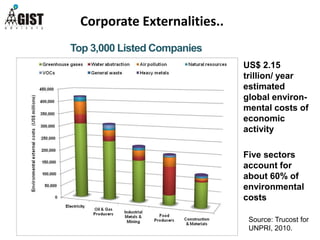
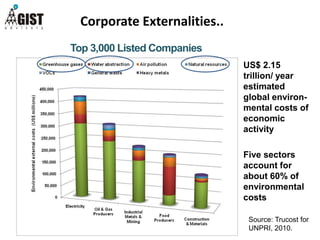
US$ 2.15
trillion/ year
estimated
global environ-
mental costs of
economic
activity
Five sectors
account for
about 60% of
environmental
costs
Source: Trucost for
UNPRI, 2010.
Top 3,000 Listed Companies
Corporate Externalities..
US$ 2.15
trillion/ year
estimated
global environ-
mental costs of
economic
activity
Five sectors
account for
about 60% of
environmental
costs
Source: Trucost for
UNPRI, 2010.
Top 3,000 Listed Companies
Corporate Externalities..
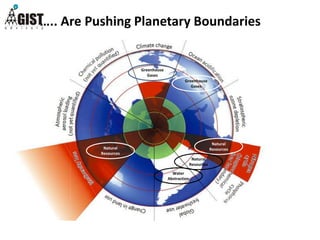
Water
Abstraction
Greenhouse
Gases
Greenhouse
Gases
Natural
Resources
Natural
Resources
Natural
Resources
….. Are Pushing Planetary Boundaries
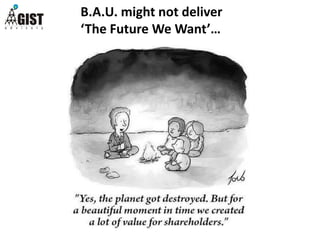
B.A.U. might not deliver
‘The Future We Want’…
We cannot Manage
what we do not Measure!
Hence Stakeholder Reporting:
Measuring, Reporting, & Managing
Corporate Externalities...
Three Solution Models Visible...
 Buy Side Advisory
 Single Leader
 Sector Leadership
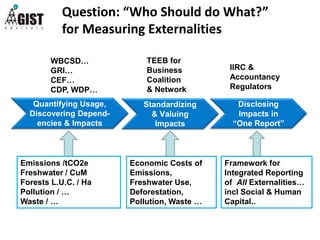
Question: “Who Should do What?”
for Measuring Externalities
Quantifying Usage,
Discovering Depend-
encies & Impacts
Standardizing
& Valuing
Impacts
Disclosing
Impacts in
“One Report”
Emissions /tCO2e
Freshwater / CuM
Forests L.U.C. / Ha
Pollution / …
Waste / …
Economic Costs of
Emissions,
Freshwater Use,
Deforestation,
Pollution, Waste …
Framework for
Integrated Reporting
of All Externalities…
incl Social & Human
Capital..
WBCSD…
GRI…
CEF…
CDP, WDP…
TEEB for
Business
Coalition
& Network
IIRC &
Accountancy
Regulators
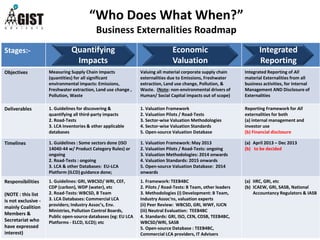
“Who Does What When?”
Business Externalities Roadmap
Stages:-
Objectives Measuring Supply Chain Impacts
(quantities) for all significant
environmental impacts: Emissions,
Freshwater extraction, Land use change ,
Pollution, Waste
Valuing all material corporate supply chain
externalities due to Emissions, Freshwater
extraction, Land use change, Pollution, &
Waste. (Note: non-environmental drivers of
Human/ Social Capital impacts out of scope)
Integrated Reporting of All
material Externalities from all
business activities, for Internal
Management AND Disclosure of
Externalities
Deliverables 1. Guidelines for discovering &
quantifying all third-party impacts
2. Road-Tests
3. LCA Inventories & other applicable
databases
1. Valuation Framework
2. Valuation Pilots / Road-Tests
3. Sector-wise Valuation Methodologies
4. Sector-wise Valuation Standards
5. Open-source Valuation Database
Reporting Framework for All
externalities for both
(a) internal management and
investor use
(b) Financial disclosure
Timelines 1. Guidelines : Some sectors done (ISO
14040-44 w/ Product Category Rules) or
ongoing
2. Road-Tests : ongoing
3. LCA & other Databases: EU-LCA
Platform (ILCD) guidance done;
1. Valuation Framework: May 2013
2. Valuation Pilots / Road-Tests: ongoing
3. Valuation Methodologies: 2014 onwards
4. Valuation Standards: 2015 onwards
5. Open-source Valuation Database: 2014
onwards
(a) April 2013 – Dec 2013
(b) to be decided
Responsibilities
(NOTE : this list
is not exclusive -
mainly Coalition
Members &
Secretariat who
have expressed
interest)
1. Guidelines: GRI, WBCSD/ WRI, CEF,
CDP (carbon), WDP (water), etc
2. Road-Tests: WBCSD, B Team
3. LCA Databases: Commercial LCA
providers; Industry Assoc’s, Env.
Ministries, Pollution Control Boards,
Public open-source databases (eg: EU LCA
Platforms - ELCD, ILCD); etc
1. Framework: TEEB4BC
2. Pilots / Road-Tests: B Team, other leaders
3. Methodologies (i) Development: B Team,
Industry Assoc'ns, valuation experts
(ii) Peer Review: WBCSD, GRI, WWF, IUCN
(iii) Neutral Evaluation: TEEB4BC
4. Standards: GRI, ISO, CEN, CDSB, TEEB4BC,
WBCSD/WRI, SASB
5. Open-source Database : TEEB4BC,
Commercial LCA providers, IT Advisers
(a) IIRC, GRI, etc
(b) ICAEW, GRI, SASB, National
Accountancy Regulators & IASB
Quantifying
Impacts
Economic
Valuation
Integrated
Reporting
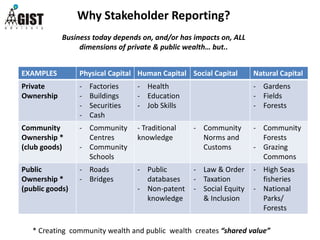
Why Stakeholder Reporting?
Business today depends on, and/or has impacts on, ALL
dimensions of private & public wealth… but..
EXAMPLES Physical Capital Human Capital Social Capital Natural Capital
Private
Ownership
- Factories
- Buildings
- Securities
- Cash
- Health
- Education
- Job Skills
- Gardens
- Fields
- Forests
Community
Ownership *
(club goods)
- Community
Centres
- Community
Schools
- Traditional
knowledge
- Community
Norms and
Customs
- Community
Forests
- Grazing
Commons
Public
Ownership *
(public goods)
- Roads
- Bridges
- Public
databases
- Non-patent
knowledge
- Law & Order
- Taxation
- Social Equity
& Inclusion
- High Seas
fisheries
- National
Parks/
Forests
* Creating community wealth and public wealth creates “shared value”
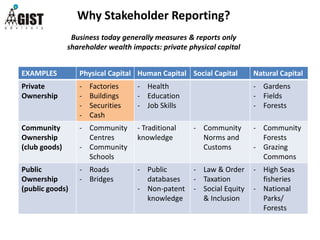
Why Stakeholder Reporting?
Business today generally measures & reports only
shareholder wealth impacts: private physical capital
EXAMPLES Physical Capital Human Capital Social Capital Natural Capital
Private
Ownership
- Factories
- Buildings
- Securities
- Cash
- Health
- Education
- Job Skills
- Gardens
- Fields
- Forests
Community
Ownership
(club goods)
- Community
Centres
- Community
Schools
- Traditional
knowledge
- Community
Norms and
Customs
- Community
Forests
- Grazing
Commons
Public
Ownership
(public goods)
- Roads
- Bridges
- Public
databases
- Non-patent
knowledge
- Law & Order
- Taxation
- Social Equity
& Inclusion
- High Seas
fisheries
- National
Parks/
Forests
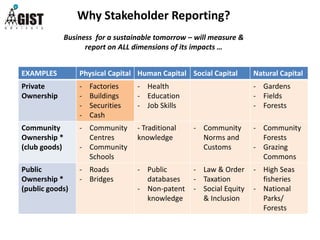
Why Stakeholder Reporting?
Business for a sustainable tomorrow – will measure &
report on ALL dimensions of its impacts …
EXAMPLES Physical Capital Human Capital Social Capital Natural Capital
Private
Ownership
- Factories
- Buildings
- Securities
- Cash
- Health
- Education
- Job Skills
- Gardens
- Fields
- Forests
Community
Ownership *
(club goods)
- Community
Centres
- Community
Schools
- Traditional
knowledge
- Community
Norms and
Customs
- Community
Forests
- Grazing
Commons
Public
Ownership *
(public goods)
- Roads
- Bridges
- Public
databases
- Non-patent
knowledge
- Law & Order
- Taxation
- Social Equity
& Inclusion
- High Seas
fisheries
- National
Parks/
Forests
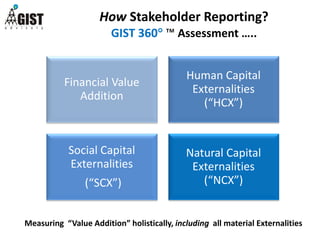
How Stakeholder Reporting?
GIST 360 ™ Assessment …..
Financial Value
Addition
Human Capital
Externalities
(“HCX”)
Social Capital
Externalities
(“SCX”)
Natural Capital
Externalities
(“NCX”)
Measuring “Value Addition” holistically, including all material Externalities
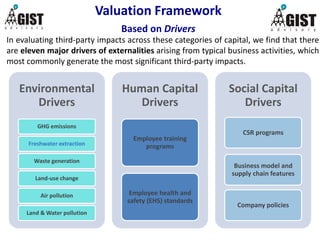
In evaluating third-party impacts across these categories of capital, we find that there
are eleven major drivers of externalities arising from typical business activities, which
most commonly generate the most significant third-party impacts.
Valuation Framework
Based on Drivers
Environmental
Drivers
GHG emissions
Freshwater extraction
Waste generation
Land-use change
Air pollution
Land & Water pollution
Human Capital
Drivers
Employee training
programs
Employee health and
safety (EHS) standards
Social Capital
Drivers
CSR programs
Business model and
supply chain features
Company policies
Example:
How can Environmental Impacts (NCX) be
valued for Cement Industry?
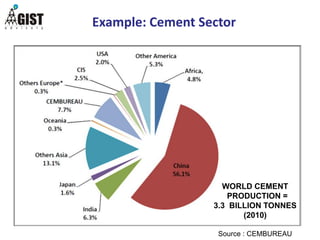
WORLD CEMENT
PRODUCTION =
3.3 BILLION TONNES
(2010)
Source : CEMBUREAU
Example: Cement Sector
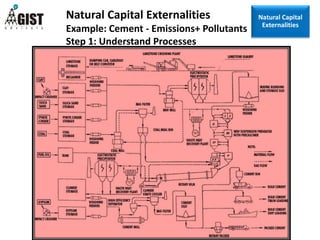
Natural Capital Externalities
Example: Cement - Emissions+ Pollutants
Step 1: Understand Processes
Natural Capital
Externalities
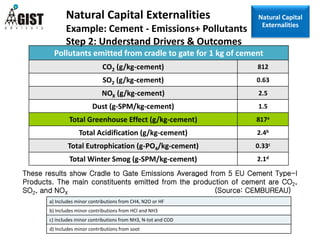
Pollutants emitted from cradle to gate for 1 kg of cement
CO2 (g/kg-cement) 812
SO2 (g/kg-cement) 0.63
NOX (g/kg-cement) 2.5
Dust (g-SPM/kg-cement) 1.5
Total Greenhouse Effect (g/kg-cement) 817a
Total Acidification (g/kg-cement) 2.4b
Total Eutrophication (g-PO4/kg-cement) 0.33c
Total Winter Smog (g-SPM/kg-cement) 2.1d
These results show Cradle to Gate Emissions Averaged from 5 EU Cement Type-I
Products. The main constituents emitted from the production of cement are CO2,
SO2, and NOX (Source: CEMBUREAU)
a) Includes minor contributions from CH4, N2O or HF
b) Includes minor contributions from HCl and NH3
c) Includes minor contributions from NH3, N-tot and COD
d) Includes minor contributions from soot
Natural Capital Externalities
Example: Cement - Emissions+ Pollutants
Step 2: Understand Drivers & Outcomes
Natural Capital
Externalities
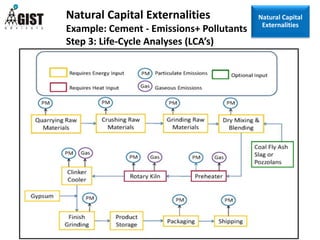
Natural Capital Externalities
Example: Cement - Emissions+ Pollutants
Step 3: Life-Cycle Analyses (LCA’s)
Natural Capital
Externalities
June 2013
Natural Capital Externalities (NCX)
21
Natural Capital
Externalities
22
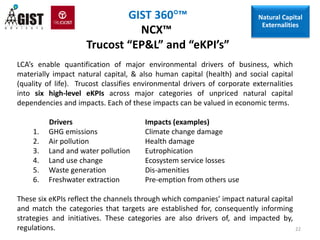
LCA’s enable quantification of major environmental drivers of business, which
materially impact natural capital, & also human capital (health) and social capital
(quality of life). Trucost classifies environmental drivers of corporate externalities
into six high-level eKPIs across major categories of unpriced natural capital
dependencies and impacts. Each of these impacts can be valued in economic terms.
Drivers Impacts (examples)
1. GHG emissions Climate change damage
2. Air pollution Health damage
3. Land and water pollution Eutrophication
4. Land use change Ecosystem service losses
5. Waste generation Dis-amenities
6. Freshwater extraction Pre-emption from others use
These six eKPIs reflect the channels through which companies’ impact natural capital
and match the categories that targets are established for, consequently informing
strategies and initiatives. These categories are also drivers of, and impacted by,
regulations.
GIST 360™
NCX™
Trucost “EP&L” and “eKPI’s”
Natural Capital
Externalities
Natural Capital
Externalities
23
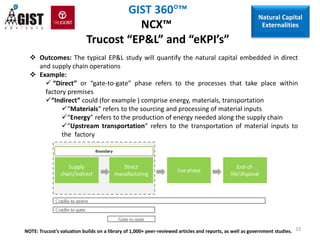
 Outcomes: The typical EP&L study will quantify the natural capital embedded in direct
and supply chain operations
 Example:
 “Direct” or “gate-to-gate” phase refers to the processes that take place within
factory premises
“Indirect” could (for example ) comprise energy, materials, transportation
“Materials” refers to the sourcing and processing of material inputs
“Energy” refers to the production of energy needed along the supply chain
“Upstream transportation” refers to the transportation of material inputs to
the factory
NOTE: Trucost’s valuation builds on a library of 1,000+ peer-reviewed articles and reports, as well as government studies.
Natural Capital
Externalities
GIST 360™
NCX™
Trucost “EP&L” and “eKPI’s”
Natural Capital
Externalities
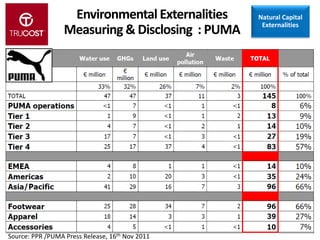
Environmental Externalities
Measuring & Disclosing : PUMA
Source: PPR /PUMA Press Release, 16th Nov 2011
Natural Capital
Externalities
Can Externalities also be Positive?
YES: Positive Externalities can result from
Corporations business models & policies...
Example 1: Infosys, +ve HCX
Wxample 2: Natura, +ve SCX
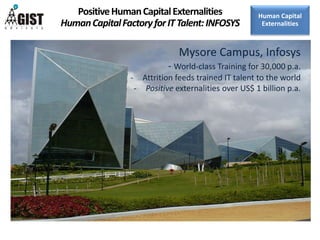
Mysore Campus, Infosys
- World-class Training for 30,000 p.a.
- Attrition feeds trained IT talent to the world
- Positive externalities over US$ 1 billion p.a.
PositiveHumanCapitalExternalities
HumanCapitalFactoryforITTalent:INFOSYS
Human Capital
Externalities
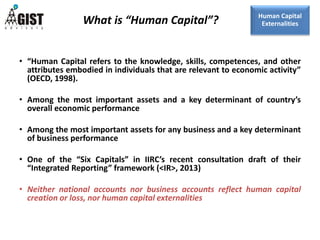
• “Human Capital refers to the knowledge, skills, competences, and other
attributes embodied in individuals that are relevant to economic activity”
(OECD, 1998).
• Among the most important assets and a key determinant of country’s
overall economic performance
• Among the most important assets for any business and a key determinant
of business performance
• One of the “Six Capitals” in IIRC’s recent consultation draft of their
“Integrated Reporting” framework (<IR>, 2013)
• Neither national accounts nor business accounts reflect human capital
creation or loss, nor human capital externalities
What is “Human Capital”? Human Capital
Externalities
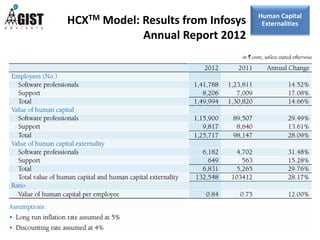
HCXTM Model: Results from Infosys
Annual Report 2012
Human Capital
Externalities
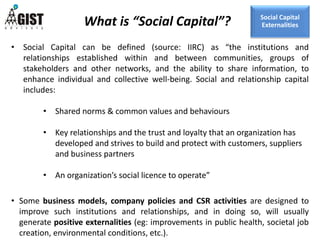
• Social Capital can be defined (source: IIRC) as “the institutions and
relationships established within and between communities, groups of
stakeholders and other networks, and the ability to share information, to
enhance individual and collective well-being. Social and relationship capital
includes:
• Shared norms & common values and behaviours
• Key relationships and the trust and loyalty that an organization has
developed and strives to build and protect with customers, suppliers
and business partners
• An organization’s social licence to operate”
• Some business models, company policies and CSR activities are designed to
improve such institutions and relationships, and in doing so, will usually
generate positive externalities (eg: improvements in public health, societal job
creation, environmental conditions, etc.).
What is “Social Capital”? Social Capital
Externalities
Source: http://www.managementexchange.com/story/innovation-in-well-being
http://totallybeautyaddict.fr/mon-jolieapero-chez-natura-brasil/
PositiveSocialCapitalExternalities
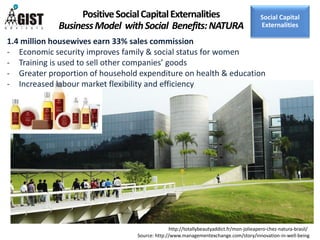
BusinessModel withSocial Benefits:NATURA
1.4 million housewives earn 33% sales commission
- Economic security improves family & social status for women
- Training is used to sell other companies’ goods
- Greater proportion of household expenditure on health & education
- Increased labour market flexibility and efficiency
Social Capital
Externalities
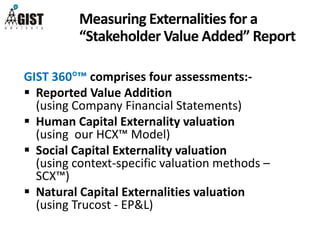
GIST 360™ comprises four assessments:-
 Reported Value Addition
(using Company Financial Statements)
 Human Capital Externality valuation
(using our HCX™ Model)
 Social Capital Externality valuation
(using context-specific valuation methods –
SCX™)
 Natural Capital Externalities valuation
(using Trucost - EP&L)
Measuring Externalities for a
“Stakeholder Value Added” Report
www.corp2020.com
http://www.youtube.com/watch?v=J
qk0ad5LKlI
A Non-Economist Explains ‘Corporation 2020’….
Thank You !
www.gistadvisory.com
www.corp2020.com
Pavan Sukhdev,
Founder & CEO, GIST Advisory
pavan@gistadvisory.com

Managing externalities: the role of stakeholder reporting - a presentation to IIED by Pavan Sukhdev

  • 1.
    IIED, London Workshop onBusiness Externalities 11th March 2014 Pavan Sukhdev Founder & CEO, GIST Advisory UNEP Goodwill Ambassador Author “Corporation 2020” Managing Externalties: the role of Stakeholder Reporting
  • 2.
    An Ecosystem Service…. Source:NOAA  http://www.vets.ucar.edu/vg/T341/index.shtml
  • 3.
    US$ 2.15 trillion/ year estimated globalenviron- mental costs of economic activity Five sectors account for about 60% of environmental costs Source: Trucost for UNPRI, 2010. Top 3,000 Listed Companies Corporate Externalities..
  • 4.
    US$ 2.15 trillion/ year estimated globalenviron- mental costs of economic activity Five sectors account for about 60% of environmental costs Source: Trucost for UNPRI, 2010. Top 3,000 Listed Companies Corporate Externalities..
  • 5.
  • 6.
    B.A.U. might notdeliver ‘The Future We Want’…
  • 7.
    We cannot Manage whatwe do not Measure! Hence Stakeholder Reporting: Measuring, Reporting, & Managing Corporate Externalities...
  • 8.
    Three Solution ModelsVisible...  Buy Side Advisory  Single Leader  Sector Leadership
  • 9.
    Question: “Who Shoulddo What?” for Measuring Externalities Quantifying Usage, Discovering Depend- encies & Impacts Standardizing & Valuing Impacts Disclosing Impacts in “One Report” Emissions /tCO2e Freshwater / CuM Forests L.U.C. / Ha Pollution / … Waste / … Economic Costs of Emissions, Freshwater Use, Deforestation, Pollution, Waste … Framework for Integrated Reporting of All Externalities… incl Social & Human Capital.. WBCSD… GRI… CEF… CDP, WDP… TEEB for Business Coalition & Network IIRC & Accountancy Regulators
  • 10.
    “Who Does WhatWhen?” Business Externalities Roadmap Stages:- Objectives Measuring Supply Chain Impacts (quantities) for all significant environmental impacts: Emissions, Freshwater extraction, Land use change , Pollution, Waste Valuing all material corporate supply chain externalities due to Emissions, Freshwater extraction, Land use change, Pollution, & Waste. (Note: non-environmental drivers of Human/ Social Capital impacts out of scope) Integrated Reporting of All material Externalities from all business activities, for Internal Management AND Disclosure of Externalities Deliverables 1. Guidelines for discovering & quantifying all third-party impacts 2. Road-Tests 3. LCA Inventories & other applicable databases 1. Valuation Framework 2. Valuation Pilots / Road-Tests 3. Sector-wise Valuation Methodologies 4. Sector-wise Valuation Standards 5. Open-source Valuation Database Reporting Framework for All externalities for both (a) internal management and investor use (b) Financial disclosure Timelines 1. Guidelines : Some sectors done (ISO 14040-44 w/ Product Category Rules) or ongoing 2. Road-Tests : ongoing 3. LCA & other Databases: EU-LCA Platform (ILCD) guidance done; 1. Valuation Framework: May 2013 2. Valuation Pilots / Road-Tests: ongoing 3. Valuation Methodologies: 2014 onwards 4. Valuation Standards: 2015 onwards 5. Open-source Valuation Database: 2014 onwards (a) April 2013 – Dec 2013 (b) to be decided Responsibilities (NOTE : this list is not exclusive - mainly Coalition Members & Secretariat who have expressed interest) 1. Guidelines: GRI, WBCSD/ WRI, CEF, CDP (carbon), WDP (water), etc 2. Road-Tests: WBCSD, B Team 3. LCA Databases: Commercial LCA providers; Industry Assoc’s, Env. Ministries, Pollution Control Boards, Public open-source databases (eg: EU LCA Platforms - ELCD, ILCD); etc 1. Framework: TEEB4BC 2. Pilots / Road-Tests: B Team, other leaders 3. Methodologies (i) Development: B Team, Industry Assoc'ns, valuation experts (ii) Peer Review: WBCSD, GRI, WWF, IUCN (iii) Neutral Evaluation: TEEB4BC 4. Standards: GRI, ISO, CEN, CDSB, TEEB4BC, WBCSD/WRI, SASB 5. Open-source Database : TEEB4BC, Commercial LCA providers, IT Advisers (a) IIRC, GRI, etc (b) ICAEW, GRI, SASB, National Accountancy Regulators & IASB Quantifying Impacts Economic Valuation Integrated Reporting
  • 11.
    Why Stakeholder Reporting? Businesstoday depends on, and/or has impacts on, ALL dimensions of private & public wealth… but.. EXAMPLES Physical Capital Human Capital Social Capital Natural Capital Private Ownership - Factories - Buildings - Securities - Cash - Health - Education - Job Skills - Gardens - Fields - Forests Community Ownership * (club goods) - Community Centres - Community Schools - Traditional knowledge - Community Norms and Customs - Community Forests - Grazing Commons Public Ownership * (public goods) - Roads - Bridges - Public databases - Non-patent knowledge - Law & Order - Taxation - Social Equity & Inclusion - High Seas fisheries - National Parks/ Forests * Creating community wealth and public wealth creates “shared value”
  • 12.
    Why Stakeholder Reporting? Businesstoday generally measures & reports only shareholder wealth impacts: private physical capital EXAMPLES Physical Capital Human Capital Social Capital Natural Capital Private Ownership - Factories - Buildings - Securities - Cash - Health - Education - Job Skills - Gardens - Fields - Forests Community Ownership (club goods) - Community Centres - Community Schools - Traditional knowledge - Community Norms and Customs - Community Forests - Grazing Commons Public Ownership (public goods) - Roads - Bridges - Public databases - Non-patent knowledge - Law & Order - Taxation - Social Equity & Inclusion - High Seas fisheries - National Parks/ Forests
  • 13.
    Why Stakeholder Reporting? Businessfor a sustainable tomorrow – will measure & report on ALL dimensions of its impacts … EXAMPLES Physical Capital Human Capital Social Capital Natural Capital Private Ownership - Factories - Buildings - Securities - Cash - Health - Education - Job Skills - Gardens - Fields - Forests Community Ownership * (club goods) - Community Centres - Community Schools - Traditional knowledge - Community Norms and Customs - Community Forests - Grazing Commons Public Ownership * (public goods) - Roads - Bridges - Public databases - Non-patent knowledge - Law & Order - Taxation - Social Equity & Inclusion - High Seas fisheries - National Parks/ Forests
  • 14.
    How Stakeholder Reporting? GIST360 ™ Assessment ….. Financial Value Addition Human Capital Externalities (“HCX”) Social Capital Externalities (“SCX”) Natural Capital Externalities (“NCX”) Measuring “Value Addition” holistically, including all material Externalities
  • 15.
    In evaluating third-partyimpacts across these categories of capital, we find that there are eleven major drivers of externalities arising from typical business activities, which most commonly generate the most significant third-party impacts. Valuation Framework Based on Drivers Environmental Drivers GHG emissions Freshwater extraction Waste generation Land-use change Air pollution Land & Water pollution Human Capital Drivers Employee training programs Employee health and safety (EHS) standards Social Capital Drivers CSR programs Business model and supply chain features Company policies
  • 16.
    Example: How can EnvironmentalImpacts (NCX) be valued for Cement Industry?
  • 17.
    WORLD CEMENT PRODUCTION = 3.3BILLION TONNES (2010) Source : CEMBUREAU Example: Cement Sector
  • 18.
    Natural Capital Externalities Example:Cement - Emissions+ Pollutants Step 1: Understand Processes Natural Capital Externalities
  • 19.
    Pollutants emitted fromcradle to gate for 1 kg of cement CO2 (g/kg-cement) 812 SO2 (g/kg-cement) 0.63 NOX (g/kg-cement) 2.5 Dust (g-SPM/kg-cement) 1.5 Total Greenhouse Effect (g/kg-cement) 817a Total Acidification (g/kg-cement) 2.4b Total Eutrophication (g-PO4/kg-cement) 0.33c Total Winter Smog (g-SPM/kg-cement) 2.1d These results show Cradle to Gate Emissions Averaged from 5 EU Cement Type-I Products. The main constituents emitted from the production of cement are CO2, SO2, and NOX (Source: CEMBUREAU) a) Includes minor contributions from CH4, N2O or HF b) Includes minor contributions from HCl and NH3 c) Includes minor contributions from NH3, N-tot and COD d) Includes minor contributions from soot Natural Capital Externalities Example: Cement - Emissions+ Pollutants Step 2: Understand Drivers & Outcomes Natural Capital Externalities
  • 20.
    Natural Capital Externalities Example:Cement - Emissions+ Pollutants Step 3: Life-Cycle Analyses (LCA’s) Natural Capital Externalities
  • 21.
    June 2013 Natural CapitalExternalities (NCX) 21 Natural Capital Externalities
  • 22.
    22 LCA’s enable quantificationof major environmental drivers of business, which materially impact natural capital, & also human capital (health) and social capital (quality of life). Trucost classifies environmental drivers of corporate externalities into six high-level eKPIs across major categories of unpriced natural capital dependencies and impacts. Each of these impacts can be valued in economic terms. Drivers Impacts (examples) 1. GHG emissions Climate change damage 2. Air pollution Health damage 3. Land and water pollution Eutrophication 4. Land use change Ecosystem service losses 5. Waste generation Dis-amenities 6. Freshwater extraction Pre-emption from others use These six eKPIs reflect the channels through which companies’ impact natural capital and match the categories that targets are established for, consequently informing strategies and initiatives. These categories are also drivers of, and impacted by, regulations. GIST 360™ NCX™ Trucost “EP&L” and “eKPI’s” Natural Capital Externalities Natural Capital Externalities
  • 23.
    23  Outcomes: Thetypical EP&L study will quantify the natural capital embedded in direct and supply chain operations  Example:  “Direct” or “gate-to-gate” phase refers to the processes that take place within factory premises “Indirect” could (for example ) comprise energy, materials, transportation “Materials” refers to the sourcing and processing of material inputs “Energy” refers to the production of energy needed along the supply chain “Upstream transportation” refers to the transportation of material inputs to the factory NOTE: Trucost’s valuation builds on a library of 1,000+ peer-reviewed articles and reports, as well as government studies. Natural Capital Externalities GIST 360™ NCX™ Trucost “EP&L” and “eKPI’s” Natural Capital Externalities
  • 24.
    Environmental Externalities Measuring &Disclosing : PUMA Source: PPR /PUMA Press Release, 16th Nov 2011 Natural Capital Externalities
  • 25.
  • 26.
    YES: Positive Externalitiescan result from Corporations business models & policies... Example 1: Infosys, +ve HCX Wxample 2: Natura, +ve SCX
  • 27.
    Mysore Campus, Infosys -World-class Training for 30,000 p.a. - Attrition feeds trained IT talent to the world - Positive externalities over US$ 1 billion p.a. PositiveHumanCapitalExternalities HumanCapitalFactoryforITTalent:INFOSYS Human Capital Externalities
  • 28.
    • “Human Capitalrefers to the knowledge, skills, competences, and other attributes embodied in individuals that are relevant to economic activity” (OECD, 1998). • Among the most important assets and a key determinant of country’s overall economic performance • Among the most important assets for any business and a key determinant of business performance • One of the “Six Capitals” in IIRC’s recent consultation draft of their “Integrated Reporting” framework (<IR>, 2013) • Neither national accounts nor business accounts reflect human capital creation or loss, nor human capital externalities What is “Human Capital”? Human Capital Externalities
  • 29.
    HCXTM Model: Resultsfrom Infosys Annual Report 2012 Human Capital Externalities
  • 30.
    • Social Capitalcan be defined (source: IIRC) as “the institutions and relationships established within and between communities, groups of stakeholders and other networks, and the ability to share information, to enhance individual and collective well-being. Social and relationship capital includes: • Shared norms & common values and behaviours • Key relationships and the trust and loyalty that an organization has developed and strives to build and protect with customers, suppliers and business partners • An organization’s social licence to operate” • Some business models, company policies and CSR activities are designed to improve such institutions and relationships, and in doing so, will usually generate positive externalities (eg: improvements in public health, societal job creation, environmental conditions, etc.). What is “Social Capital”? Social Capital Externalities
  • 31.
    Source: http://www.managementexchange.com/story/innovation-in-well-being http://totallybeautyaddict.fr/mon-jolieapero-chez-natura-brasil/ PositiveSocialCapitalExternalities BusinessModel withSocialBenefits:NATURA 1.4 million housewives earn 33% sales commission - Economic security improves family & social status for women - Training is used to sell other companies’ goods - Greater proportion of household expenditure on health & education - Increased labour market flexibility and efficiency Social Capital Externalities
  • 32.
    GIST 360™ comprisesfour assessments:-  Reported Value Addition (using Company Financial Statements)  Human Capital Externality valuation (using our HCX™ Model)  Social Capital Externality valuation (using context-specific valuation methods – SCX™)  Natural Capital Externalities valuation (using Trucost - EP&L) Measuring Externalities for a “Stakeholder Value Added” Report
  • 33.
  • 34.
  • 35.
    Thank You ! www.gistadvisory.com www.corp2020.com PavanSukhdev, Founder & CEO, GIST Advisory pavan@gistadvisory.com