VIRTUAL
INSTRUMENTATION
VIRTUAL INSTRUMENTATION
• Virtual instrumentation in an inter disciplinary field that merges
sensing, hardware and software technologies in order to create
flexible and sophisticated instruments for control and monitoring
applications
• Virtual Instrumentation is the use of customizable software and
modular measurement hardware to create user defined
measurement systems called virtual instruments.
• Virtual instrument provides all the software and hardware needed
to accomplish the measurement or control task
ARCHITECTURE OF VIRTUAL INSTRUMENT
• A virtual instrument is composed of
1. SENSOR MODULE,
2. SENSOR INTERFACE,
3. SYSTEMS INTERFACE,
4. PROCESSING MODULE,
5. DATABASE INTERFACE,
6. USER INTERFACE.
• The sensor module detects physical signal and transforms it into
electrical form, conditions the signal, and transforms it into a digital
form for further manipulation. Through a sensor interface, the sensor
module communicates with a computer.
• Once the data are in a digital form on a computer, they can be
processed, mixed, compared, and otherwise manipulated, or stored in
a database. Then, the data may be displayed, or converted back to
analog form for further process control.
• Biomedical virtual instruments are often integrated with some other
medical information systems such as hospital information systems.
• In this way the configuration settings and the data measured may be
stored and associated with patient record
• SENSOR MODULE
The sensor module performs signal conditioning and transforms it into a digital form
for further manipulation. Once the data are in a digital form on a computer, they
can be displayed, processed, mixed, compared, stored in a database, or converted
back to analog form for further process control. The database can also store
configuration settings and signal records.
• PROCESSING MODULE
Integration of the general purpose microprocessors/microcontrollers allowed
flexible implementation of sophisticated processing functions. As the functionality of
a virtual instrument depends very little on dedicated hardware, which principally
does not perform any complex processing, functionality and appearance of the
virtual instrument may be completely changed utilizing different processing functions
ANALYTIC PROCESSING
• Analytic functions define clear functional relations among input parameters. Some of
the common analyses used in virtual instrumentation include spectral analysis,
filtering, windowing, transforms, peak detection, or curve fitting
DATABASE INTERFACE
• Computerized instrumentation allows measured data to be stored for off-line
processing, or to keep record
• Computer’s user interfaces are much easier shaped
Biomedical Applications of
Virtual Instrumentation
GRAPHICAL PROGRAMMING CONCEPT
• Labview, short for laboratory virtual instrument engineering
workbench, is a programming environment in which you create
programs using a graphical notation (connecting functional nodes
via wires through which data flows)
• However, labview is much more than a programming language. It
is an interactive program development and execution system
designed for people, like scientists and engineers, who need to
program as part of their jobs.
DATAFLOW AND THE GRAPHICAL PROGRAMMING LANGUAGE
• The labview program development environment is different from standard C or java
development systems in one important respect: while other programming systems use text-
based languages to create lines of code, labview uses a graphical programming language,
often called "G," to create programs in a pictorial form called a block diagram.
• Graphical programming eliminates a lot of the syntactical details associated with text-based
languages, such as where to put your semicolons and curly braces
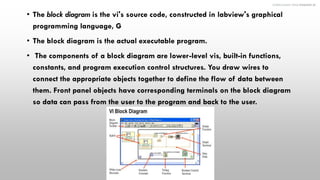
• The block diagram is the vi's source code, constructed in labview's graphical
programming language, G
• The block diagram is the actual executable program.
• The components of a block diagram are lower-level vis, built-in functions,
constants, and program execution control structures. You draw wires to
connect the appropriate objects together to define the flow of data between
them. Front panel objects have corresponding terminals on the block diagram
so data can pass from the user to the program and back to the user.
• In order to use a VI as a subroutine in the block diagram of another VI, it must
have an icon with a connector
• A VI that is used within another VI is called a subvi and is analogous to a
subroutine. The icon is a vi's pictorial representation and is used as an object
in the block diagram of another VI. A VI’s connector is the mechanism used to
wire data into the VI from other block diagrams when the VI is used as a
subVI. Much like parameters of a subroutine, the connector defines the inputs
and outputs of the VI.

iia 3.pdf

  • 1.
  • 2.
    VIRTUAL INSTRUMENTATION • Virtualinstrumentation in an inter disciplinary field that merges sensing, hardware and software technologies in order to create flexible and sophisticated instruments for control and monitoring applications • Virtual Instrumentation is the use of customizable software and modular measurement hardware to create user defined measurement systems called virtual instruments. • Virtual instrument provides all the software and hardware needed to accomplish the measurement or control task
  • 7.
  • 8.
    • A virtualinstrument is composed of 1. SENSOR MODULE, 2. SENSOR INTERFACE, 3. SYSTEMS INTERFACE, 4. PROCESSING MODULE, 5. DATABASE INTERFACE, 6. USER INTERFACE.
  • 9.
    • The sensormodule detects physical signal and transforms it into electrical form, conditions the signal, and transforms it into a digital form for further manipulation. Through a sensor interface, the sensor module communicates with a computer. • Once the data are in a digital form on a computer, they can be processed, mixed, compared, and otherwise manipulated, or stored in a database. Then, the data may be displayed, or converted back to analog form for further process control. • Biomedical virtual instruments are often integrated with some other medical information systems such as hospital information systems. • In this way the configuration settings and the data measured may be stored and associated with patient record
  • 10.
    • SENSOR MODULE Thesensor module performs signal conditioning and transforms it into a digital form for further manipulation. Once the data are in a digital form on a computer, they can be displayed, processed, mixed, compared, stored in a database, or converted back to analog form for further process control. The database can also store configuration settings and signal records. • PROCESSING MODULE Integration of the general purpose microprocessors/microcontrollers allowed flexible implementation of sophisticated processing functions. As the functionality of a virtual instrument depends very little on dedicated hardware, which principally does not perform any complex processing, functionality and appearance of the virtual instrument may be completely changed utilizing different processing functions
  • 11.
    ANALYTIC PROCESSING • Analyticfunctions define clear functional relations among input parameters. Some of the common analyses used in virtual instrumentation include spectral analysis, filtering, windowing, transforms, peak detection, or curve fitting DATABASE INTERFACE • Computerized instrumentation allows measured data to be stored for off-line processing, or to keep record • Computer’s user interfaces are much easier shaped
  • 12.
  • 16.
    GRAPHICAL PROGRAMMING CONCEPT •Labview, short for laboratory virtual instrument engineering workbench, is a programming environment in which you create programs using a graphical notation (connecting functional nodes via wires through which data flows) • However, labview is much more than a programming language. It is an interactive program development and execution system designed for people, like scientists and engineers, who need to program as part of their jobs.
  • 17.
    DATAFLOW AND THEGRAPHICAL PROGRAMMING LANGUAGE • The labview program development environment is different from standard C or java development systems in one important respect: while other programming systems use text- based languages to create lines of code, labview uses a graphical programming language, often called "G," to create programs in a pictorial form called a block diagram. • Graphical programming eliminates a lot of the syntactical details associated with text-based languages, such as where to put your semicolons and curly braces
  • 18.
    • The blockdiagram is the vi's source code, constructed in labview's graphical programming language, G • The block diagram is the actual executable program. • The components of a block diagram are lower-level vis, built-in functions, constants, and program execution control structures. You draw wires to connect the appropriate objects together to define the flow of data between them. Front panel objects have corresponding terminals on the block diagram so data can pass from the user to the program and back to the user.
  • 19.
    • In orderto use a VI as a subroutine in the block diagram of another VI, it must have an icon with a connector • A VI that is used within another VI is called a subvi and is analogous to a subroutine. The icon is a vi's pictorial representation and is used as an object in the block diagram of another VI. A VI’s connector is the mechanism used to wire data into the VI from other block diagrams when the VI is used as a subVI. Much like parameters of a subroutine, the connector defines the inputs and outputs of the VI.