Content Security Policy
https://nl.linkedin.com/in/hugogroeneveld
Hugo Groeneveld
https://nl.linkedin.com/in/hugogroeneveldPublic Profile
https://nl.linkedin.com/in/hugogroeneveld
Content Security Policy (CSP) is a computer security standard introduced to prevent cross-site
scripting (XSS), clickjacking and other code injection attacks resulting from execution of malicious
content in the trusted web page context.[1] It is a Candidate Recommendation of the W3C working group
on Web Application Security,[2] widely supported by the modern web browsers.[3] CSP provides a
standard method for website owners to declare approved origins of content that browsers should be
allowed to load on that website — covered types are JavaScript, CSS, HTML frames, web
workers, fonts, images, embeddable objects such as Java applets, ActiveX, audio and video files, and
other HTML5 features.
Header: Content-Security-Policy
base-uri restricts the URLs that can appear in a page’s <base> element.
child-src lists the URLs for workers and embedded frame contents. For example: child-src https://youtube.com would
enable embedding videos from YouTube but not from other origins. Use this in place of the deprecated frame-src
directive.
connect-src limits the origins to which you can connect (via XHR, WebSockets, and EventSource).
font-src specifies the origins that can serve web fonts. Google’s Web Fonts could be enabled via font-src
https://themes.googleusercontent.com
Header: Content-Security-Policy
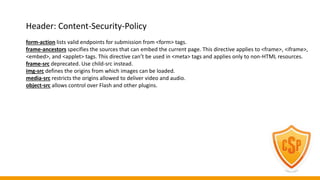
form-action lists valid endpoints for submission from <form> tags.
frame-ancestors specifies the sources that can embed the current page. This directive applies to <frame>, <iframe>,
<embed>, and <applet> tags. This directive can’t be used in <meta> tags and applies only to non-HTML resources.
frame-src deprecated. Use child-src instead.
img-src defines the origins from which images can be loaded.
media-src restricts the origins allowed to deliver video and audio.
object-src allows control over Flash and other plugins.
Header: Content-Security-Policy
plugin-types limits the kinds of plugins a page may invoke.
report-uri specifies a URL where a browser will send reports when a content security policy is violated. This directive
can’t be used in <meta> tags.
style-src is script-src’s counterpart for stylesheets.
upgrade-insecure-requests Instructs user agents to rewrite URL schemes, changing HTTP to HTTPS. This directive is
for web sites with large numbers of old URLs that need to be rewritten.
Header: Content-Security-Policy
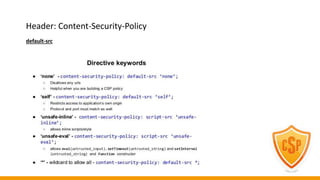
default-src
Header: Content-Security-Policy
default-src
Header: Content-Security-Policy
default-src
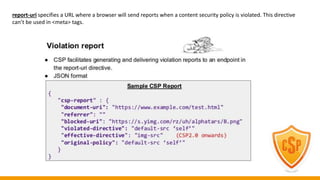
report-uri specifies a URL where a browser will send reports when a content security policy is violated. This directive
can’t be used in <meta> tags.
report-uri specifies a URL where a browser will send reports when a content security policy is violated. This directive
can’t be used in <meta> tags.
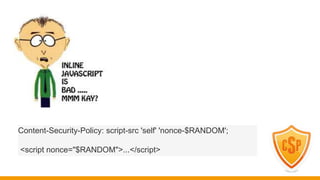
Content-Security-Policy: script-src 'self' 'nonce-$RANDOM';
<script nonce="$RANDOM">...</script>
Content-Security-Policy: script-src 'self' 'nonce-$RANDOM';
<script nonce="$RANDOM">...</script>
Ignite content security policy

Ignite content security policy

  • 2.
    Content Security Policy https://nl.linkedin.com/in/hugogroeneveld HugoGroeneveld https://nl.linkedin.com/in/hugogroeneveldPublic Profile https://nl.linkedin.com/in/hugogroeneveldPublic Profile https://nl.linkedin.com/in/hugogroeneveld
  • 8.
    Content Security Policy(CSP) is a computer security standard introduced to prevent cross-site scripting (XSS), clickjacking and other code injection attacks resulting from execution of malicious content in the trusted web page context.[1] It is a Candidate Recommendation of the W3C working group on Web Application Security,[2] widely supported by the modern web browsers.[3] CSP provides a standard method for website owners to declare approved origins of content that browsers should be allowed to load on that website — covered types are JavaScript, CSS, HTML frames, web workers, fonts, images, embeddable objects such as Java applets, ActiveX, audio and video files, and other HTML5 features.
  • 9.
    Header: Content-Security-Policy base-uri restrictsthe URLs that can appear in a page’s <base> element. child-src lists the URLs for workers and embedded frame contents. For example: child-src https://youtube.com would enable embedding videos from YouTube but not from other origins. Use this in place of the deprecated frame-src directive. connect-src limits the origins to which you can connect (via XHR, WebSockets, and EventSource). font-src specifies the origins that can serve web fonts. Google’s Web Fonts could be enabled via font-src https://themes.googleusercontent.com
  • 10.
    Header: Content-Security-Policy form-action listsvalid endpoints for submission from <form> tags. frame-ancestors specifies the sources that can embed the current page. This directive applies to <frame>, <iframe>, <embed>, and <applet> tags. This directive can’t be used in <meta> tags and applies only to non-HTML resources. frame-src deprecated. Use child-src instead. img-src defines the origins from which images can be loaded. media-src restricts the origins allowed to deliver video and audio. object-src allows control over Flash and other plugins.
  • 11.
    Header: Content-Security-Policy plugin-types limitsthe kinds of plugins a page may invoke. report-uri specifies a URL where a browser will send reports when a content security policy is violated. This directive can’t be used in <meta> tags. style-src is script-src’s counterpart for stylesheets. upgrade-insecure-requests Instructs user agents to rewrite URL schemes, changing HTTP to HTTPS. This directive is for web sites with large numbers of old URLs that need to be rewritten.
  • 12.
  • 13.
  • 14.
  • 15.
    report-uri specifies aURL where a browser will send reports when a content security policy is violated. This directive can’t be used in <meta> tags.
  • 16.
    report-uri specifies aURL where a browser will send reports when a content security policy is violated. This directive can’t be used in <meta> tags.
  • 18.
    Content-Security-Policy: script-src 'self''nonce-$RANDOM'; <script nonce="$RANDOM">...</script>
  • 19.
    Content-Security-Policy: script-src 'self''nonce-$RANDOM'; <script nonce="$RANDOM">...</script>