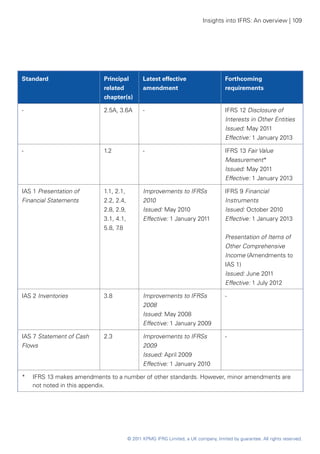
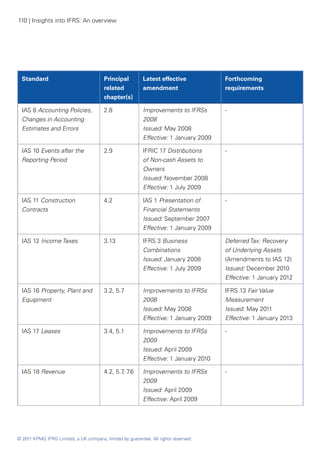
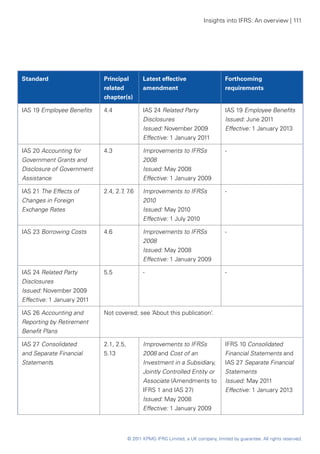
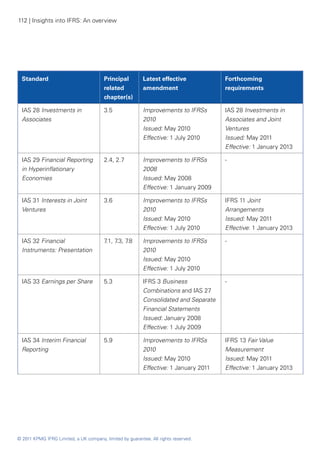
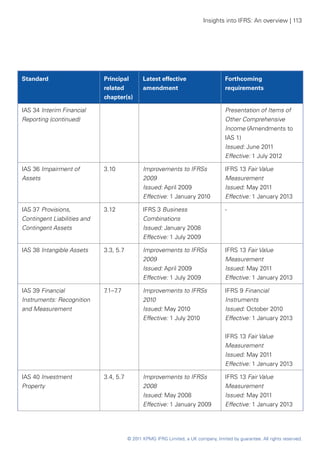
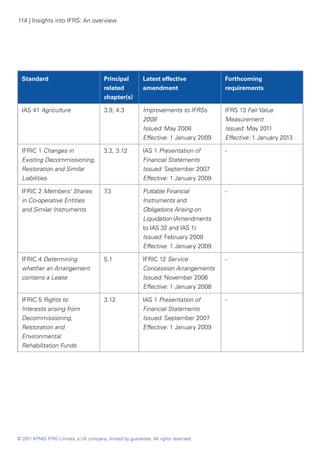
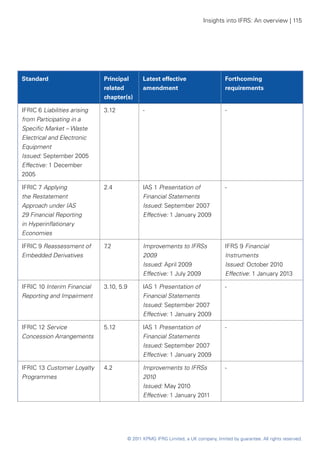
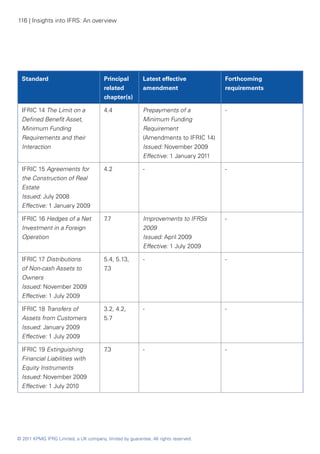
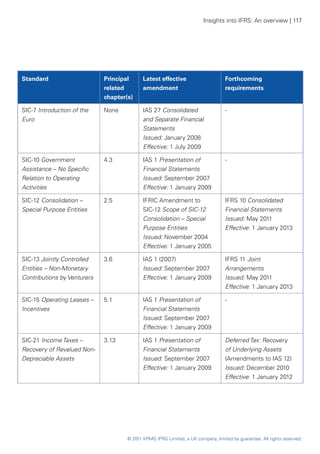
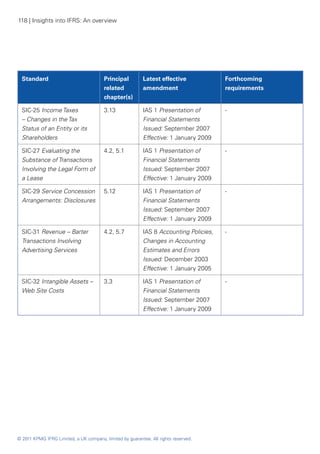
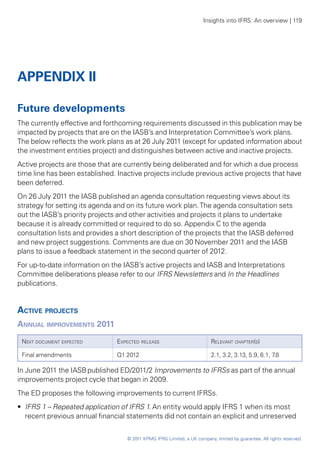
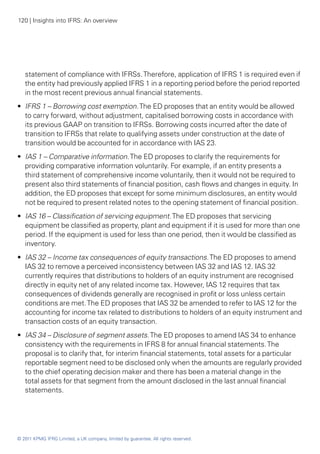
An Overview
          September 2011


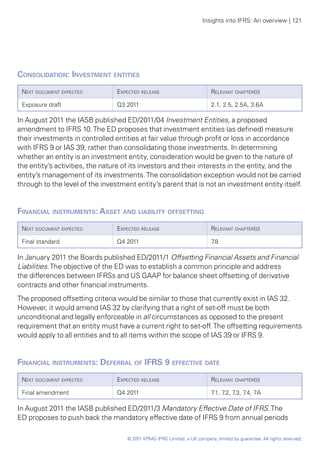
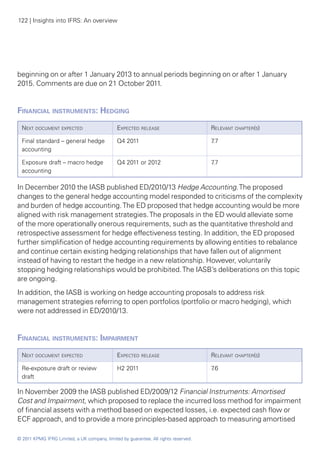
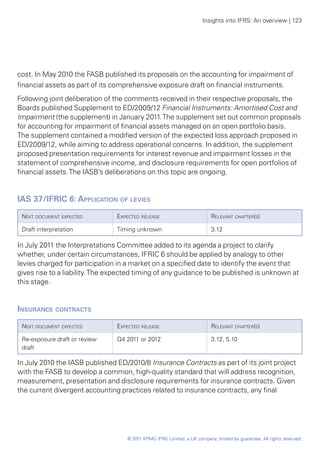
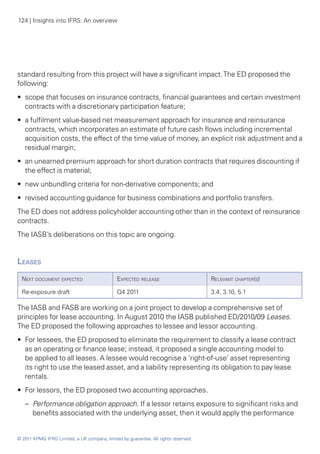
                           September 2011
Insights into IFRS: An overview | 1


INSIGHTS INTO IFRS:
AN OVERVIEW
Insights into IFRS: An overview brings together all of the
individual overview sections from our publication Insights
into IFRS, KPMG’s practical guide to International Financial
Reporting Standards, 8th Edition 2011/12.
The overview of the requirements of IFRSs and the
interpretative positions described in Insights into IFRS
reflect the work of both current and former members of
the KPMG International Standards Group and were made
possible by the invaluable input of many people working
in KPMG member firms worldwide. This overview should
be read in conjunction with Insights into IFRS in order to
understand more fully the requirements of IFRSs.


    © 2011 KPMG IFRG Limited, a UK company, limited by guarantee. All rights reserved.
2 | Insights into IFRS: An overview


CONTENTS
1. 	 Background	                                                                     4
      1.1 	 Introduction	                                                            4
      1.2	 The Conceptual Framework	                                                 5

2. 	 General issues	                                                                 9
      2.1 	 Form and components of financial statements	                              9
      2.2	 Changes in equity	                                                        11
      2.3	 Statement of cash flows	                                                  12
      2.4 	 Basis of accounting	                                                     13
      2.5	 Consolidation	                                                            14
      2.5A	 Consolidation: IFRS 10	                                                  16
      2.6	 Business combinations 	                                                   18
      2.7 	 Foreign currency translation	                                            21
      2.8	 Accounting policies, errors and estimates	                                23
      2.9	 Events after the reporting period	                                        24

3. 	 Specific statement of financial position items	                                 25
      3.1 	  General	                                                                25
      3.2 	  Property, plant and equipment	                                          26
      3.3 	  Intangible assets and goodwill	                                         28
      3.4 	  Investment property	                                                    30
      3.5 	  Investments in associates and the equity method	                        32
      3.6	   Investments in joint ventures and proportionate
             consolidation	                                                          35
      3.6A	 Investments in joint arrangements	                                       37
      3.7 	 [Not used]
      3.8 	 Inventories	                                                             38
      3.9	 Biological assets	                                                        39
      3.10 	 Impairment of non-financial assets	                                     40
      3.11 	 [Not used]
      3.12	 Provisions, contingent assets and liabilities	                           43
      3.13	 Income taxes	                                                            45

4.	   Specific statement of comprehensive income items	                              47
      4.1	 General	                                                                  47
      4.2	 Revenue	                                                                  49
      4.3 	 Government grants	                                                       51

© 2011 KPMG IFRG Limited, a UK company, limited by guarantee. All rights reserved.
Insights into IFRS: An overview | 3


      4.4 	 Employee benefits	                                               52
      4.5 	 Share-based payments	                                            61
      4.6 	 Borrowing costs	                                                 63

5.	   Special topics	                                                        64
      5.1	   Leases	                                                         64
      5.2	   Operating segments	                                             66
      5.3	   Earnings per share	                                             67
      5.4	   Non-current assets held for sale and discontinued
             operations	                                                     69
      5.5	 Related party disclosures	                                        71
      5.6 	 [Not used]
      5.7 	 Non-monetary transactions	                                       72
      5.8 	 Accompanying financial and other information	                    73
      5.9	 Interim financial reporting	                                      74
      5.10	 Insurance contracts	                                             76
      5.11 	 Extractive activities 	                                         78
      5.12	 Service concession arrangements	                                 79
      5.13	 Common control transactions and Newco formations	                81

6. 	 First-time adoption of IFRSs	                                           83
      6.1 	 First-time adoption of IFRSs	                                    83

7.	   Financial instruments	                                                 87
      7.1	 Scope and definitions	                                            87
      7.2	 Derivatives and embedded derivatives	                             88
      7.3	 Equity and financial liabilities	                                 89
      7 	
       .4  Classification of financial assets and financial
           liabilities	                                                     91
      7 	 Recognition and derecognition	
       .5                                                                   92
      7 	 Measurement and gains and losses	
       .6                                                                   94
      7.7	 Hedge accounting	                                                99
      7.8	 Presentation and disclosure	                                    100
      7A	 Financial instruments: IFRS 9	                                   103

Appendix I: Currently effective requirements and
forthcoming requirements	                                                   106

Appendix II: Future developments	                                           119

About this publication	                                                    133

                                            © 2011 KPMG IFRG Limited, a UK company, limited by guarantee. All rights reserved.
4 | Insights into IFRS: An overview


1. 	 BACKGROUND

1.1 	 Introduction
	           (IFRS Foundation Constitution, Preface to IFRSs, IAS 1)

Overview of currently effective requirements
•• ‘IFRSs’ is the term used to indicate the whole body of IASB authoritative literature.
•• IFRSs are designed for use by profit-oriented entities.
•• Any entity claiming compliance with IFRSs complies with all standards and
   interpretations, including disclosure requirements, and makes an explicit and
   unreserved statement of compliance with IFRSs.
•• The bold- and plain-type paragraphs of IFRSs have equal authority.
•• The overriding requirement of IFRSs is for the financial statements to give a fair
   presentation (or true and fair view).


© 2011 KPMG IFRG Limited, a UK company, limited by guarantee. All rights reserved.
Insights into IFRS: An overview | 5


1.2	 The Conceptual Framework
	       (IASB Conceptual Framework)

Overview of currently effective requirements
•• The IASB uses its Conceptual Framework when developing new or revised IFRSs or
   amending existing IFRSs.
•• The Conceptual Framework is a point of reference for preparers of financial statements
   in the absence of specific guidance in IFRSs.
•• Transactions with owners in their capacity as owners are recognised directly in equity.
•• IFRSs require financial statements to be prepared on a modified historical cost basis
   with a growing emphasis on fair value.
•• Fair value is the amount for which an asset could be exchanged, or a liability settled,
   between knowledgeable, willing parties in an arm’s length transaction.


Forthcoming requirements
Fair value measurement
IFRS 13 provides a single source of guidance on how fair value is measured. This guidance
is applied when fair value is required or permitted by other IFRSs; IFRS 13 does not
establish requirements for when fair value is required or permitted.
IFRS 13 provides a framework for determining fair value, i.e. it clarifies the factors to be
considered in estimating fair value. While it includes descriptions of certain valuation
approaches and techniques, it does not establish valuation standards on how valuations
should be performed.

Definition

Under IFRS 13, fair value is the price that would be received to sell an asset or paid
to transfer a liability in an orderly transaction between market participants at the
measurement date, i.e. an exit price. The transfer notion, referred to in the valuation of a
liability, is different from the settlement notion that is included in the current definition of
fair value in IAS 39.


                                     © 2011 KPMG IFRG Limited, a UK company, limited by guarantee. All rights reserved.
6 | Insights into IFRS: An overview


General requirements
The fair value of a non-financial asset is based on its highest and best use from the
perspective of market participants, which may be on a stand-alone basis or based on its
use in combination with complementary assets or liabilities.
IFRS 13 generally does not specify the unit of account for measurement. This is
established instead under the specific IFRS that requires or permits the fair value
measurement or disclosure. For example, the unit of account in IAS 39 or IFRS 9 generally
is an individual financial instrument whereas the unit of account in IAS 36 often is a group
of assets or a group of assets and liabilities comprising a cash-generating unit.
IFRS 13 discusses three valuation approaches: the market, income and cost approaches.
Several valuation techniques are available under each approach. An entity uses a valuation
technique to measure fair value that is appropriate in the circumstances, maximising the
use of relevant observable inputs and minimising the use of unobservable inputs. The best
evidence of fair value is a quoted price in an active market for an identical asset or liability.
For liabilities, when a quoted price for the transfer of an identical or similar liability is not
available and the liability is held by another entity as an asset, the liability is valued from
the perspective of a market participant that holds the asset. Failing that, other valuation
techniques are used to value the liability from the perspective of a market participant that
owes the liability. A similar approach is also used when valuing an entity’s own equity
instruments.
Inputs used in measuring fair value reflect the characteristics of the asset or liability that a
market participant would take into account and are not based on the entity’s specific use
or plans. Such asset- or liability-specific characteristics include the condition and location
of an asset or restrictions on an asset’s sale or use that are a characteristic of the asset
rather than of the entity’s holding.

Fair value hierarchy

Inputs to valuation techniques used to measure fair value are prioritised in what is referred
to as ‘the fair value hierarchy’. The concept of a fair value hierarchy was already included
in IFRS 7 and the definitions of the three levels have not changed from those currently in
IFRS 7 .
•• Level 1. Fair values measured using quoted prices (unadjusted) in active markets for
   identical assets or liabilities.


© 2011 KPMG IFRG Limited, a UK company, limited by guarantee. All rights reserved.
Insights into IFRS: An overview | 7


•• Level 2. Fair values measured using inputs other than quoted prices included within
   Level 1 that are observable for the asset or liability, either directly (i.e. as prices) or
   indirectly (i.e. derived from prices).
•• Level 3. Fair values measured using inputs for the asset or liability that are not based on
   observable market data (i.e. unobservable inputs).
Fair value measurements determined using valuation techniques are classified in their
entirety based on the lowest level input that is significant to the measurement. Assessing
significance requires judgement, considering factors specific to the asset or liability.
When multiple unobservable inputs are used, in our view the unobservable inputs should
be considered in total for the purposes of determining their significance.

Principal or most advantageous market

An entity values assets, liabilities and its own equity instruments assuming a transaction
in the principal market for the asset or liability, i.e. the market with the highest volume and
level of activity. In the absence of a principal market, it is assumed that the transaction
would occur in the most advantageous market. This is the market that would maximise
the amount that would be received to sell an asset or minimise the amount that would
be paid to transfer a liability, taking into account transport and transaction costs. In
either case, the entity must have access to the market on the measurement date. In
the absence of evidence to the contrary, the market in which the entity would normally
sell the asset or transfer the liability is assumed to be the principal market or most
advantageous market.

Transaction costs

Transaction costs are not a component of a fair value measurement although they are
considered in determining the most advantageous market.

Premium or discount

Although a premium or a discount may be an appropriate input to a valuation technique, it
should not be applied if it is inconsistent with the relevant unit of account. For example, a
control premium is not applied if the unit of account is an individual share even if the entity
has a large holding. Blockage factors reflect size as a characteristic of an entity’s holding
rather than of the asset and therefore cannot be applied.


                                      © 2011 KPMG IFRG Limited, a UK company, limited by guarantee. All rights reserved.
8 | Insights into IFRS: An overview


Non-performance risk
Non-performance risk, including own credit risk, is considered in measuring the fair value
of a liability, but separate inputs to reflect restrictions on the transfer of a liability or an
entity’s own equity instruments are not applied.


© 2011 KPMG IFRG Limited, a UK company, limited by guarantee. All rights reserved.
Insights into IFRS: An overview | 9


2. 	 GENERAL ISSUES

2.1 	 Form and components of financial statements
	       (IAS 1, IAS 27)


Overview of currently effective requirements
•• The following are presented: a statement of financial position; a statement of
   comprehensive income; a statement of changes in equity; a statement of cash flows;
   and notes including accounting policies.
•• In addition, a statement of financial position as at the beginning of the earliest
   comparative period is presented when an entity restates comparative information
   following a change in accounting policy, correction of an error or reclassification of items
   in the financial statements.
•• Comparative information is required for the preceding period only, but additional periods
   and information may be presented.
•• An entity with one or more subsidiaries presents consolidated financial statements
   unless specific criteria are met.
•• An entity without subsidiaries but with an associate or jointly controlled entity prepares
   individual financial statements unless specific criteria are met.
•• In its individual financial statements, generally an entity accounts for an investment in
   an associate using the equity method, and an investment in a jointly controlled entity
   using the equity method or proportionate consolidation.
•• An entity is permitted, but not required, to present separate financial statements in
   addition to consolidated or individual financial statements.


Forthcoming requirements
Presentation of other comprehensive income
Presentation of Other Comprehensive Income – Amendments to IAS 1 amends IAS 1 to:
•• require an entity to present separately the items of other comprehensive income that
   would be reclassified to profit or loss in the future if certain conditions are met from

                                    © 2011 KPMG IFRG Limited, a UK company, limited by guarantee. All rights reserved.
10 | Insights into IFRS: An overview


   those that would never be reclassified to profit or loss. Consequently an entity that
   presents items of other comprehensive income before related tax effects would also
   have to allocate the aggregated tax amount between these sections; and
•• change the title of the statement of comprehensive income to the statement of profit
   or loss and other comprehensive income. However, an entity is still allowed to use
   other titles.


© 2011 KPMG IFRG Limited, a UK company, limited by guarantee. All rights reserved.
Insights into IFRS: An overview | 11


2.2	 Changes in equity
	       (IAS 1)


Overview of currently effective requirements
•• An entity presents a statement of changes in equity as part of a complete set of
   financial statements.
•• All owner-related changes in equity are presented in the statement of changes in equity,
   separately from non-owner changes in equity.


                                   © 2011 KPMG IFRG Limited, a UK company, limited by guarantee. All rights reserved.
12 | Insights into IFRS: An overview


2.3	 Statement of cash flows
	           (IAS 7)


Overview of currently effective requirements
•• The statement of cash flows presents cash flows during the period classified by
   operating, investing and financing activities.
•• Net cash flows from all three categories are totalled to show the change in cash and
   cash equivalents during the period, which then is used to reconcile opening and closing
   cash and cash equivalents.
•• Cash and cash equivalents includes certain short-term investments and, in some cases,
   bank overdrafts.
•• Cash flows from operating activities may be presented using either the direct method
   or the indirect method.
•• Foreign currency cash flows are translated at the exchange rates at the dates of the
   cash flows (or using averages when appropriate).
•• Generally all financing and investing cash flows are reported gross. Cash flows are
   offset only in limited circumstances.


© 2011 KPMG IFRG Limited, a UK company, limited by guarantee. All rights reserved.
Insights into IFRS: An overview | 13


2.4 	 Basis of accounting
	       (IAS 1, IAS 21, IAS 29, IFRIC 7)


Overview of currently effective requirements
•• Financial statements are prepared on a modified historical cost basis with a growing
   emphasis on fair value.
•• When an entity’s functional currency is hyperinflationary, its financial statements should
   be adjusted to state all items in the measuring unit current at the reporting date.


Forthcoming requirements
Fair value measurement
IFRS 13 replaces most of the fair value measurement guidance currently included in
individual IFRSs; the general valuation principles in IFRS 13 are applied instead. It provides
a single definition of fair value and fair value application guidance, and establishes a
comprehensive disclosure framework for fair value measurements. See 1.2 for further
details.

Revised consolidation requirements
Under IFRS 10, the concept of a special purpose entity (SPE) no longer exists and the
consolidation conclusion is no longer based solely on a risks and rewards analysis for such
entities. The consolidation conclusion for entities currently SPEs in the scope of SIC-12
may need to be reconsidered under IFRS 10. See 2.5A for further details.


                                    © 2011 KPMG IFRG Limited, a UK company, limited by guarantee. All rights reserved.
14 | Insights into IFRS: An overview


2.5	 Consolidation
	           (IAS 27, SIC‑12)


Overview of currently effective requirements
•• Consolidation is based on control, which is the power to govern, either directly or
   indirectly, the financial and operating policies of an entity so as to obtain benefits from
   its activities.
•• The ability to control is considered separately from the exercise of that control.
•• The assessment of control may be based on either a power-to-govern or a de facto
   control model.
•• Potential voting rights that are currently exercisable are considered in assessing control.
•• A special purpose entity (SPE) is an entity created to accomplish a narrow and well-
   defined objective. SPEs are consolidated based on control. The determination of control
   includes an analysis of the risks and benefits associated with an SPE.
•• All subsidiaries are consolidated, including subsidiaries of venture capital organisations
   and unit trusts, and those acquired exclusively with a view to subsequent disposal.
•• A parent and its subsidiaries generally use the same reporting date when consolidated
   financial statements are prepared. If this is impracticable, then the difference between
   the reporting date of a parent and its subsidiary cannot be more than three months.
   Adjustments are made for the effects of significant transactions and events between
   the two dates.
•• Uniform accounting policies are used throughout the group.
•• The acquirer in a business combination can elect, on a transaction-by-transaction
   basis, to measure ‘ordinary’ non-controlling interests (NCI) at fair value or at their
   proportionate interest in the recognised amount of the identifiable net assets of the
   acquiree at the acquisition date. Ordinary NCI are present ownership interests that
   entitle their holders to a proportionate share of the entity’s net assets in liquidation.
   Other NCI generally are measured at fair value.
•• An entity recognises a liability for the present value of the (estimated) exercise price of
   put options held by NCI, but there is no detailed guidance on the accounting for such
   put options.


© 2011 KPMG IFRG Limited, a UK company, limited by guarantee. All rights reserved.
Insights into IFRS: An overview | 15


•• Losses in a subsidiary may create a deficit balance in NCI.
•• NCI in the statement of financial position are classified as equity but are presented
   separately from the parent shareholders’ equity.
•• Profit or loss and comprehensive income for the period are allocated to NCI and owners
   of the parent.
•• Intra-group transactions are eliminated in full.
•• On the loss of control of a subsidiary, the assets and liabilities of the subsidiary and
   the carrying amount of the NCI are derecognised. The consideration received and any
   retained interest, measured at fair value, are recognised. Amounts recognised in other
   comprehensive income are reclassified as required by other IFRSs. Any resulting gain or
   loss is recognised in profit or loss.
•• Changes in the parent’s ownership interest in a subsidiary without a loss of control are
   accounted for as equity transactions and no gain or loss is recognised in profit or loss.


Forthcoming requirements
Revised consolidation requirements
See 2.5A for an overview of the revised consolidation requirements under IFRS 10.


                                     © 2011 KPMG IFRG Limited, a UK company, limited by guarantee. All rights reserved.
16 | Insights into IFRS: An overview


2.5A	Consolidation: IFRS 10
	           (IFRS 10)


Overview of forthcoming requirements
•• Control involves power, exposure to variability in returns and a linkage between the two
   and is assessed on a continuous basis.
•• The investor considers the purpose and design of the investee so as to identify its
   relevant activities, how decisions about such activities are made, who has the current
   ability to direct those activities and who receives returns therefrom.
•• Control is usually assessed over a legal entity, but also can be assessed over only
   specified assets and liabilities of an entity, referred to as a silo, when certain conditions
   are met.
•• There is a ‘gating’ question in the model, which is to determine whether voting rights
   or rights other than voting rights are relevant when assessing whether the investor has
   power over the relevant activities of the investee.
•• Only substantive rights held by the investor and others are considered.
•• If voting rights are relevant when assessing power, then substantive potential voting
   rights are taken into account and the investor assesses whether it holds voting rights
   sufficient to unilaterally direct the relevant activities of the investee, which can include
   de facto power.
•• If voting rights are not relevant when assessing power, then the investor considers
   the purpose and design of the investee as well as evidence that the investor has the
   practical ability to direct the relevant activities unilaterally, indications that the investor
   has a special relationship with the investee, and whether the investor has a large
   exposure to variability in returns.
•• Returns are defined broadly and include distributions of economic benefits and changes
   in the value of the investment, as well as fees, remuneration, tax benefits, economies
   of scale, cost savings and other synergies.
•• An investor that has decision-making power over an investee and exposure to variability
   in returns determines whether it acts as a principal or as an agent to determine whether
   there is a linkage between power and returns. When the decision maker is an agent, the
   link between power and returns is absent and the decision maker’s delegated power is
   treated as if it were held by its principal(s).

© 2011 KPMG IFRG Limited, a UK company, limited by guarantee. All rights reserved.
Insights into IFRS: An overview | 17


•• To determine whether it is an agent, the decision maker considers substantive removal
   and other rights held by a single or multiple parties, whether its remuneration is on
   arm’s length terms, its other economic interests and the overall relationship between
   itself and other parties.
•• An entity takes into account the rights of parties acting on its behalf when assessing
   whether it controls an investee.


                                   © 2011 KPMG IFRG Limited, a UK company, limited by guarantee. All rights reserved.
18 | Insights into IFRS: An overview


2.6	 Business combinations
	           (IFRS 3)


Overview of currently effective requirements
•• All business combinations are accounted for using the acquisition method, with limited
   exceptions.
•• A business combination is a transaction or other event in which an acquirer obtains
   control of one or more businesses.
•• A business is an integrated set of activities and assets that is capable of being
   conducted and managed to provide a return to investors (or other owners, members or
   participants) by way of dividends, lower costs or other economic benefits.
•• The acquirer in a business combination is the combining entity that obtains control of
   the other combining business or businesses.
•• In some cases the legal acquiree is identified as the acquirer for accounting purposes (a
   reverse acquisition).
•• The acquisition date is the date on which the acquirer obtains control of the acquiree.
•• Consideration transferred by the acquirer, which generally is measured at fair value at
   the acquisition date, may include assets transferred, liabilities incurred by the acquirer
   to the previous owners of the acquiree and equity interests issued by the acquirer.
•• Contingent consideration transferred is recognised initially at fair value. Contingent
   consideration classified as a liability generally is remeasured to fair value each period
   until settlement, with changes recognised in profit or loss. Contingent consideration
   classified as equity is not remeasured.
•• Any items that are not part of the business combination transaction are accounted for
   outside the acquisition accounting. Examples include:
    –	 the settlement of a pre-existing relationship between the acquirer and the acquiree;
    –	 remuneration to employees who are former owners of the acquiree; and
    –	 acquisition-related costs.


© 2011 KPMG IFRG Limited, a UK company, limited by guarantee. All rights reserved.
Insights into IFRS: An overview | 19


•• The identifiable assets acquired and the liabilities assumed as part of a business
   combination are recognised separately from goodwill at the acquisition date if they
   meet the definition of assets and liabilities and are exchanged as part of the business
   combination.
•• The identifiable assets acquired and liabilities assumed as part of a business
   combination are measured at the acquisition date at their fair values.
•• There are limited exceptions to the recognition and/or measurement principles in
   respect of contingent liabilities, deferred tax assets and liabilities, indemnification
   assets, employee benefits, re-acquired rights, share-based payment awards and assets
   held for sale.
•• Goodwill or a gain on a bargain purchase is measured as a residual and is recognised
   as an asset. A gain on a bargain purchase is recognised in profit or loss after re-assessing the
   values used in the acquisition accounting.
•• Adjustments to the acquisition accounting during the ‘measurement period’ reflect
   additional information about facts and circumstances that existed at the acquisition
   date. The measurement period ends when the acquirer obtains all information that is
   necessary to complete the acquisition accounting, or learns that more information is
   not available, and cannot exceed one year from the acquisition date.
•• The acquirer in a business combination can elect, on a transaction-by-transaction
   basis, to measure ‘ordinary’ non-controlling interests (NCI) at fair value or at their
   proportionate interest in the recognised amount of the identifiable net assets of the
   acquiree at the acquisition date. Ordinary NCI are present ownership interests that
   entitle their holders to a proportionate share of the entity’s net assets in liquidation.
   Other NCI generally are measured at fair value.
•• When a business combination is achieved in stages (step acquisition), the acquirer’s
   previously held non-controlling equity interest in the acquiree is remeasured to fair
   value at the acquisition date, with any resulting gain or loss recognised in profit or loss.
•• In general, items recognised in the acquisition accounting are measured and accounted
   for in accordance with the relevant IFRS subsequent to the business combination.
   However, as an exception, IFRS 3 includes some specific guidance for certain items,
   e.g. in respect of contingent liabilities and indemnification assets.


                                       © 2011 KPMG IFRG Limited, a UK company, limited by guarantee. All rights reserved.
20 | Insights into IFRS: An overview


Forthcoming requirements
Revised consolidation requirements
IFRS 10 supersedes IAS 27 in determining whether one entity controls another, and
introduces a number of changes from the control model in IAS 27 See 2.5A for further
                                                               .
details.
Fair value measurement
IFRS 13 sets out general principles to be applied when measuring fair value; previously
there was no general guidance in respect of determining the fair value of the identifiable
assets acquired and the liabilities assumed as part of a business combination. See 1.2 for
further details.


© 2011 KPMG IFRG Limited, a UK company, limited by guarantee. All rights reserved.
Insights into IFRS: An overview | 21


2.7 	 Foreign currency translation
	       (IAS 21, IAS 29)


Overview of currently effective requirements
•• An entity measures its assets, liabilities, income and expenses in its functional
   currency, which is the currency of the primary economic environment in which it
   operates.
•• All transactions that are not denominated in an entity’s functional currency are foreign
   currency transactions; exchange differences arising on translation generally are
   recognised in profit or loss.
•• The financial statements of foreign operations are translated for the purpose of
   consolidation as follows: assets and liabilities are translated at the closing rate; income
   and expenses are translated at actual rates or appropriate averages; and equity
   components (excluding the current year movements, which are translated at actual
   rates) are translated at historical rates.
•• Exchange differences arising on the translation of the financial statements of a foreign
   operation are recognised in other comprehensive income and accumulated in a
   separate component of equity. The amount attributable to any non-controlling interests
   (NCI) is allocated to and recognised as part of NCI.
•• If the functional currency of a foreign operation is the currency of a hyperinflationary
   economy, then current purchasing power adjustments are made to its financial
   statements prior to translation and the financial statements are translated into a
   different presentation currency at the closing rate at the end of the current period.
   However, if the presentation currency is not the currency of a hyperinflationary
   economy, then comparative amounts are not restated.
•• When an entity disposes of an interest in a foreign operation, which includes losing
   control over a foreign subsidiary, the cumulative exchange differences recognised in
   other comprehensive income and accumulated in a separate component of equity
   are reclassified to profit or loss. A partial disposal of a foreign subsidiary may lead
   to a proportionate reclassification to NCI, while other partial disposals result in a
   proportionate reclassification to profit or loss.
•• An entity may present its financial statements in a currency other than its functional
   currency (presentation currency).


                                    © 2011 KPMG IFRG Limited, a UK company, limited by guarantee. All rights reserved.
22 | Insights into IFRS: An overview


•• When financial statements are translated into a presentation currency other than the
   entity’s functional currency, the entity uses the same method as for translating the
   financial statements of a foreign operation.
•• An entity may present supplementary financial information in a currency other than its
   presentation currency if certain disclosures are made.


© 2011 KPMG IFRG Limited, a UK company, limited by guarantee. All rights reserved.
Insights into IFRS: An overview | 23


2.8	 Accounting policies, errors and estimates
	       (IAS 1, IAS 8)


Overview of currently effective requirements
•• Accounting policies are the specific principles, bases, conventions, rules and practices
   that an entity applies in preparing and presenting financial statements.
•• A hierarchy of alternative sources is specified when IFRSs do not cover a particular
   issue.
•• Unless otherwise permitted specifically by an IFRS, the accounting policies adopted by
   an entity are applied consistently to all similar items.
•• An accounting policy is changed in response to a new or revised IFRS, or on a voluntary
   basis if the new policy is more appropriate.
•• Generally, accounting policy changes and corrections of prior period errors are made by
   adjusting opening equity and restating comparatives unless this is impracticable.
•• Changes in accounting estimates are accounted for prospectively.
•• When it is difficult to determine whether a change is a change in accounting policy or a
   change in estimate, it is treated as a change in estimate.
•• Comparatives are restated unless impracticable if the classification or presentation of
   items in the financial statements is changed.
•• A statement of financial position as at the beginning of the earliest comparative period
   is presented when an entity restates comparative information following a change in
   accounting policy, correction of an error, or reclassification of items in the financial
   statements.


                                   © 2011 KPMG IFRG Limited, a UK company, limited by guarantee. All rights reserved.
24 | Insights into IFRS: An overview


2.9	 Events after the reporting period
	           (IAS 1, IAS 10)


Overview of currently effective requirements
•• The financial statements are adjusted to reflect events that occur after the end of the
   reporting period, but before the financial statements are authorised for issue, if those
   events provide evidence of conditions that existed at the end of the reporting period.
•• Financial statements are not adjusted for events that are indicative of conditions that
   arose after the end of the reporting period, except when the going concern assumption
   no longer is appropriate.
•• Dividends declared after the end of the reporting period are not recognised as a liability
   in the financial statements.
•• Liabilities generally are classified as current or non-current based on circumstances at
   the end of the reporting period.


© 2011 KPMG IFRG Limited, a UK company, limited by guarantee. All rights reserved.
Insights into IFRS: An overview | 25


3. 	 SPECIFIC STATEMENT OF FINANCIAL
     POSITION ITEMS

3.1 	 General
	       (IAS 1)


Overview of currently effective requirements
•• Generally an entity presents its statement of financial position classified between
   current and non-current assets and liabilities. An unclassified statement of financial
   position based on the order of liquidity is acceptable only when it provides reliable and
   more relevant information.
•• While IFRSs require certain items to be presented in the statement of financial position,
   there is no prescribed format.
•• A liability that is payable on demand because certain conditions are breached is
   classified as current even if the lender has agreed, after the end of the reporting period
   but before the financial statements are authorised for issue, not to demand repayment.
•• Assets and liabilities that are part of working capital are classified as current even if they
   are due to be settled more than 12 months after the end of the reporting period.


                                     © 2011 KPMG IFRG Limited, a UK company, limited by guarantee. All rights reserved.
26 | Insights into IFRS: An overview


3.2 	 Property, plant and equipment
	           (IAS 16, IFRIC 1, IFRIC 18)


Overview of currently effective requirements
•• Property, plant and equipment is recognised initially at cost.
•• Cost includes all expenditure directly attributable to bringing the asset to the location
   and working condition for its intended use.
•• Cost includes the estimated cost of dismantling and removing the asset and restoring
   the site.
•• Changes to an existing decommissioning or restoration obligation generally are added
   to or deducted from the cost of the related asset and depreciated prospectively over
   the remaining useful life of the asset.
•• Property, plant and equipment is depreciated over its useful life.
•• An item of property, plant and equipment is depreciated even if it is idle, but not if it is
   held for sale.
•• Estimates of useful life and residual value, and the method of depreciation, are
   reviewed at least at each annual reporting date. Any changes are accounted for
   prospectively as a change in estimate.
•• When an item of property, plant and equipment comprises individual components
   for which different depreciation methods or rates are appropriate, each component is
   depreciated separately.
•• Subsequent expenditure is capitalised only when it is probable that it will give rise to
   future economic benefits.
•• Property, plant and equipment may be revalued to fair value if fair value can be
   measured reliably. All items in the same class are revalued at the same time and the
   revaluations are kept up to date.
•• Compensation for the loss or impairment of property, plant and equipment is
   recognised in profit or loss when receivable.
•• The gain or loss on disposal is the difference between the net proceeds received and
   the carrying amount of the asset.


© 2011 KPMG IFRG Limited, a UK company, limited by guarantee. All rights reserved.
Insights into IFRS: An overview | 27


Forthcoming requirements
Fair value measurement
IFRS 13 replaces most of the fair value measurement guidance currently included in
individual IFRSs; the general valuation principles in IFRS 13 are applied instead. It provides
a single definition of fair value and fair value application guidance, and establishes a
comprehensive disclosure framework for fair value measurements. See 1.2 for further
details.
IFRS 13 also amends IAS 16 as regards its disclosure requirements for assets carried at
revalued amounts, with new additional requirements being included within IFRS 13 for
such assets. See 1.2 for further details.


                                    © 2011 KPMG IFRG Limited, a UK company, limited by guarantee. All rights reserved.
28 | Insights into IFRS: An overview


3.3 	 Intangible assets and goodwill
	           (IFRS 3, IAS 38, SIC-32)


Overview of currently effective requirements
•• An intangible asset is an identifiable non-monetary asset without physical substance.
•• An intangible asset is identifiable if it is separable or arises from contractual or legal
   rights.
•• Intangible assets generally are recognised initially at cost.
•• The initial measurement of an intangible asset depends on whether it has been
   acquired separately, as part of a business combination, or was generated internally.
•• Goodwill is recognised only in a business combination and is measured as a residual.
•• Acquired goodwill and other intangible assets with indefinite useful lives are not
   amortised, but instead are subject to impairment testing at least annually.
•• Intangible assets with finite useful lives are amortised over their expected useful lives.
•• Subsequent expenditure on an intangible asset is capitalised only if the definition of an
   intangible asset and the recognition criteria are met.
•• Intangible assets may be revalued to fair value only if there is an active market.
•• Internal research expenditure is expensed as incurred. Internal development
   expenditure is capitalised if specific criteria are met. These capitalisation criteria are
   applied to all internally developed intangible assets.
•• Advertising and promotional expenditure is expensed as incurred.
•• Expenditure on relocation or a re-organisation is expensed as incurred.
•• The following are not capitalised as intangible assets: internally generated goodwill,
   costs to develop customer lists, start-up costs and training costs.


© 2011 KPMG IFRG Limited, a UK company, limited by guarantee. All rights reserved.
Insights into IFRS: An overview | 29


Forthcoming requirements
Fair value measurement
IFRS 13 replaces most of the fair value measurement guidance currently included in
individual IFRSs; the general valuation principles in IFRS 13 are applied instead. It provides
a single definition of fair value and fair value application guidance, and establishes a
comprehensive disclosure framework for fair value measurements.
In particular, IFRS 13 deletes the definition of an active market in IAS 38; the definition in
IFRS 13 is applied instead. An active market is a market in which transactions for the asset
or liability take place with sufficient frequency and volume for pricing information to be
provided on an ongoing basis. See 1.2 for further details.


                                    © 2011 KPMG IFRG Limited, a UK company, limited by guarantee. All rights reserved.
30 | Insights into IFRS: An overview


3.4 	 Investment property
	           (IAS 17, IAS 40)


Overview of currently effective requirements
•• Investment property is property held to earn rentals or for capital appreciation, or both.
•• Property held by a lessee under an operating lease may be classified as investment
   property if the rest of the definition of investment property is met and the lessee
   measures all its investment property at fair value.
•• A portion of a dual-use property is classified as investment property only if the portion
   could be sold or leased out under a finance lease. Otherwise the entire property is
   classified as property, plant and equipment, unless the portion of the property used for
   own use is insignificant.
•• When a lessor provides ancillary services, the property is classified as investment
   property if such services are a relatively insignificant component of the arrangement as
   a whole.
•• Investment property is recognised initially at cost.
•• Subsequent to initial recognition, all investment property is measured using either
   the fair value model (subject to limited exceptions) or the cost model. When the fair
   value model is chosen, changes in fair value are recognised in profit or loss.
•• Disclosure of the fair value of all investment property is required, regardless of the
   measurement model used.
•• Subsequent expenditure is capitalised only when it is probable that it will give rise to
   future economic benefits.
•• Transfers to or from investment property can be made only when there has been a
   change in the use of the property.
•• The intention to sell an investment property without redevelopment does not justify
   reclassification from investment property into inventory; the property continues to be
   classified as investment property until the time of disposal unless it is classified as held
   for sale.


© 2011 KPMG IFRG Limited, a UK company, limited by guarantee. All rights reserved.
Insights into IFRS: An overview | 31


Forthcoming requirements
Fair value measurement
IFRS 13 replaces most of the fair value measurement guidance currently included in
individual IFRSs; the general valuation principles in IFRS 13 are applied instead. It provides
a single definition of fair value and fair value application guidance, and establishes a
comprehensive disclosure framework for fair value measurements.
In particular, IFRS 13 deletes the guidance in paragraph 51 of IAS 40. As a result, an entity
may include future cash flows arising from planned improvements to the extent that they
reflect the assumptions of market participants.
See 1.2 for further details.


                                    © 2011 KPMG IFRG Limited, a UK company, limited by guarantee. All rights reserved.
32 | Insights into IFRS: An overview


3.5 	 Investments in associates and the equity method
	           (IAS 28)


Overview of currently effective requirements
•• The definition of an associate is based on significant influence, which is the power to
   participate in the financial and operating policies of an entity.
•• There is a rebuttable presumption of significant influence if an entity holds 20 to
   50 percent of the voting rights of another entity.
•• Potential voting rights that are currently exercisable are considered in assessing
   significant influence.
•• Generally, associates are accounted for using the equity method in the consolidated
   financial statements.
•• Venture capital organisations, mutual funds, unit trusts and similar entities may elect to
   account for investments in associates as financial assets.
•• Equity accounting is not applied to an investee that is acquired with a view to its
   subsequent disposal if the criteria are met for classification as held for sale.
•• In applying the equity method, an associate’s accounting policies should be consistent
   with those of the investor.
•• The reporting date of an associate may not differ from the investor’s by more than three
   months, and should be consistent from period to period. Adjustments are made for the
   effects of significant events and transactions between the two dates.
•• When an equity-accounted investee incurs losses, the carrying amount of the investor’s
   interest is reduced but not to below zero. Further losses are recognised by the investor
   only to the extent that the investor has an obligation to fund losses or has made
   payments on behalf of the investee.
•• Unrealised profits and losses on transactions with associates are eliminated to the
   extent of the investor’s interest in the investee.


© 2011 KPMG IFRG Limited, a UK company, limited by guarantee. All rights reserved.
Insights into IFRS: An overview | 33


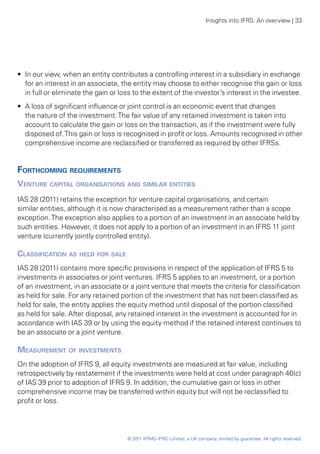
•• In our view, when an entity contributes a controlling interest in a subsidiary in exchange
   for an interest in an associate, the entity may choose to either recognise the gain or loss
   in full or eliminate the gain or loss to the extent of the investor’s interest in the investee.
•• A loss of significant influence or joint control is an economic event that changes
   the nature of the investment. The fair value of any retained investment is taken into
   account to calculate the gain or loss on the transaction, as if the investment were fully
   disposed of. This gain or loss is recognised in profit or loss. Amounts recognised in other
   comprehensive income are reclassified or transferred as required by other IFRSs.


Forthcoming requirements
Venture capital organisations and similar entities
IAS 28 (2011) retains the exception for venture capital organisations, and certain
similar entities, although it is now characterised as a measurement rather than a scope
exception. The exception also applies to a portion of an investment in an associate held by
such entities. However, it does not apply to a portion of an investment in an IFRS 11 joint
venture (currently jointly controlled entity).

Classification as held for sale
IAS 28 (2011) contains more specific provisions in respect of the application of IFRS 5 to
investments in associates or joint ventures. IFRS 5 applies to an investment, or a portion
of an investment, in an associate or a joint venture that meets the criteria for classification
as held for sale. For any retained portion of the investment that has not been classified as
held for sale, the entity applies the equity method until disposal of the portion classified
as held for sale. After disposal, any retained interest in the investment is accounted for in
accordance with IAS 39 or by using the equity method if the retained interest continues to
be an associate or a joint venture.

Measurement of investments
On the adoption of IFRS 9, all equity investments are measured at fair value, including
retrospectively by restatement if the investments were held at cost under paragraph 46(c)
of IAS 39 prior to adoption of IFRS 9. In addition, the cumulative gain or loss in other
comprehensive income may be transferred within equity but will not be reclassified to
profit or loss.


                                     © 2011 KPMG IFRG Limited, a UK company, limited by guarantee. All rights reserved.
34 | Insights into IFRS: An overview


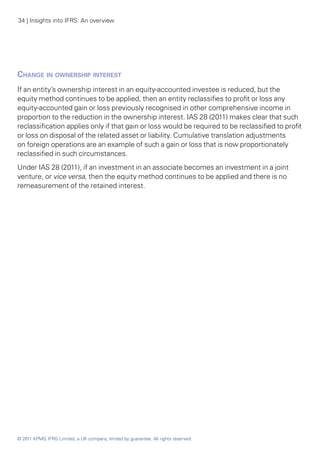
Change in ownership interest
If an entity’s ownership interest in an equity-accounted investee is reduced, but the
equity method continues to be applied, then an entity reclassifies to profit or loss any
equity-accounted gain or loss previously recognised in other comprehensive income in
proportion to the reduction in the ownership interest. IAS 28 (2011) makes clear that such
reclassification applies only if that gain or loss would be required to be reclassified to profit
or loss on disposal of the related asset or liability. Cumulative translation adjustments
on foreign operations are an example of such a gain or loss that is now proportionately
reclassified in such circumstances.
Under IAS 28 (2011), if an investment in an associate becomes an investment in a joint
venture, or vice versa, then the equity method continues to be applied and there is no
remeasurement of the retained interest.


© 2011 KPMG IFRG Limited, a UK company, limited by guarantee. All rights reserved.
Insights into IFRS: An overview | 35


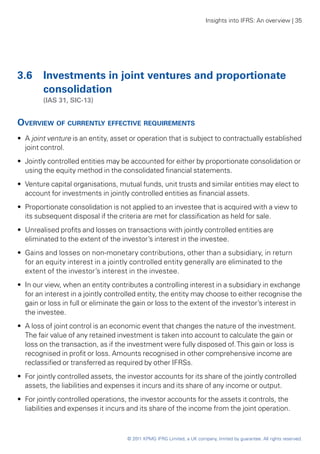
3.6	 Investments in joint ventures and proportionate
     consolidation
	       (IAS 31, SIC-13)


Overview of currently effective requirements
•• A joint venture is an entity, asset or operation that is subject to contractually established
   joint control.
•• Jointly controlled entities may be accounted for either by proportionate consolidation or
   using the equity method in the consolidated financial statements.
•• Venture capital organisations, mutual funds, unit trusts and similar entities may elect to
   account for investments in jointly controlled entities as financial assets.
•• Proportionate consolidation is not applied to an investee that is acquired with a view to
   its subsequent disposal if the criteria are met for classification as held for sale.
•• Unrealised profits and losses on transactions with jointly controlled entities are
   eliminated to the extent of the investor’s interest in the investee.
•• Gains and losses on non-monetary contributions, other than a subsidiary, in return
   for an equity interest in a jointly controlled entity generally are eliminated to the
   extent of the investor’s interest in the investee.
•• In our view, when an entity contributes a controlling interest in a subsidiary in exchange
   for an interest in a jointly controlled entity, the entity may choose to either recognise the
   gain or loss in full or eliminate the gain or loss to the extent of the investor’s interest in
   the investee.
•• A loss of joint control is an economic event that changes the nature of the investment.
   The fair value of any retained investment is taken into account to calculate the gain or
   loss on the transaction, as if the investment were fully disposed of. This gain or loss is
   recognised in profit or loss. Amounts recognised in other comprehensive income are
   reclassified or transferred as required by other IFRSs.
•• For jointly controlled assets, the investor accounts for its share of the jointly controlled
   assets, the liabilities and expenses it incurs and its share of any income or output.
•• For jointly controlled operations, the investor accounts for the assets it controls, the
   liabilities and expenses it incurs and its share of the income from the joint operation.


                                     © 2011 KPMG IFRG Limited, a UK company, limited by guarantee. All rights reserved.
36 | Insights into IFRS: An overview


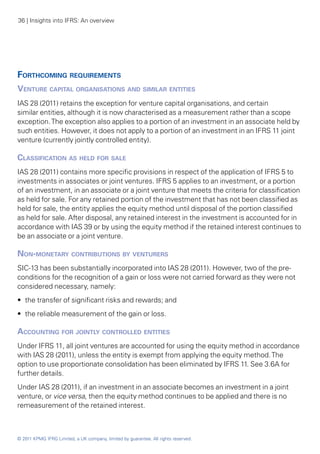
Forthcoming requirements
Venture capital organisations and similar entities
IAS 28 (2011) retains the exception for venture capital organisations, and certain
similar entities, although it is now characterised as a measurement rather than a scope
exception. The exception also applies to a portion of an investment in an associate held by
such entities. However, it does not apply to a portion of an investment in an IFRS 11 joint
venture (currently jointly controlled entity).

Classification as held for sale
IAS 28 (2011) contains more specific provisions in respect of the application of IFRS 5 to
investments in associates or joint ventures. IFRS 5 applies to an investment, or a portion
of an investment, in an associate or a joint venture that meets the criteria for classification
as held for sale. For any retained portion of the investment that has not been classified as
held for sale, the entity applies the equity method until disposal of the portion classified
as held for sale. After disposal, any retained interest in the investment is accounted for in
accordance with IAS 39 or by using the equity method if the retained interest continues to
be an associate or a joint venture.

Non-monetary contributions by venturers
SIC-13 has been substantially incorporated into IAS 28 (2011). However, two of the pre-
conditions for the recognition of a gain or loss were not carried forward as they were not
considered necessary, namely:
•• the transfer of significant risks and rewards; and
•• the reliable measurement of the gain or loss.

Accounting for jointly controlled entities
Under IFRS 11, all joint ventures are accounted for using the equity method in accordance
with IAS 28 (2011), unless the entity is exempt from applying the equity method. The
option to use proportionate consolidation has been eliminated by IFRS 11. See 3.6A for
further details.
Under IAS 28 (2011), if an investment in an associate becomes an investment in a joint
venture, or vice versa, then the equity method continues to be applied and there is no
remeasurement of the retained interest.


© 2011 KPMG IFRG Limited, a UK company, limited by guarantee. All rights reserved.
Insights into IFRS: An overview | 37


3.6A	Investments in joint arrangements
	        (IFRS 11)


Overview of forthcoming requirements
•• A joint arrangement is an arrangement over which two or more parties have joint
   control. There are two types of joint arrangements: a joint operation and a joint venture.
•• In a joint operation, the parties to the arrangement have rights to the assets and
   obligations for the liabilities related to the arrangement.
•• In a joint venture, the parties to the arrangement have rights to the net assets of the
   arrangement.
•• A joint arrangement not structured through a separate vehicle is a joint operation.
•• A joint arrangement structured through a separate vehicle may be either a joint
   operation or a joint venture, depending on the legal form of the vehicle, contractual
   arrangement and other facts and circumstances of the arrangement.
•• Generally, a joint venturer accounts for its interest in a joint venture using the equity
   method in accordance with IAS 28 (2011).
•• A joint operator recognises, in relation to its involvement in a joint operation, its assets,
   liabilities and transactions, including its share in those arising jointly, and accounts for
   them in accordance with the relevant IFRSs.
•• All parties to a joint arrangement are within the scope of IFRS 11, even if they do not
   have joint control.
•• A party to a joint operation, who does not have joint control, recognises its assets,
   liabilities and transactions, including its share in those arising jointly if it has rights to the
   assets and obligations for the liabilities of the joint operation.
•• A party to a joint venture, who does not have joint control, accounts for its interest in
   accordance with IAS 39, or IAS 28 (2011) if significant influence exists.


                                       © 2011 KPMG IFRG Limited, a UK company, limited by guarantee. All rights reserved.
38 | Insights into IFRS: An overview


3.8 	 Inventories
	           (IAS 2)


Overview of currently effective requirements
•• Generally, inventories are measured at the lower of cost and net realisable value.
•• Cost includes all direct expenditure to get inventory ready for sale, including attributable
   overheads.
•• The cost of inventory generally is determined using the first-in, first-out (FIFO) or
   weighted average method. The use of the last-in, first-out (LIFO) method is prohibited.
•• Other cost formulas, such as the standard cost or retail method, may be used when the
   results approximate actual cost.
•• The cost of inventory is recognised as an expense when the inventory is sold.
•• Inventory is written down to net realisable value when net realisable value is less
   than cost.
•• If the net realisable value of an item that has been written down subsequently
   increases, then the write-down is reversed.


Forthcoming requirements
Fair value measurement
IFRS 13 deletes the fair value measurement guidance currently included in paragraph 7
of IAS 2; the general valuation principles in IFRS 13 are applied instead. It provides
a single definition of fair value and fair value application guidance, and establishes
a comprehensive disclosure framework for fair value measurements. See 1.2 for
further details.


© 2011 KPMG IFRG Limited, a UK company, limited by guarantee. All rights reserved.
Insights into IFRS: An overview | 39


3.9	 Biological assets
	       (IAS 41)


Overview of currently effective requirements
•• Biological assets are measured at fair value less costs to sell unless it is not possible to
   measure fair value reliably, in which case they are measured at cost.
•• All gains and losses from changes in fair value less costs to sell are recognised in profit
   or loss.
•• Agricultural produce harvested from a biological asset is measured at fair value less
   costs to sell at the point of harvest.


Forthcoming requirements
Fair value measurement
IFRS 13 replaces most of the fair value measurement guidance currently included in
individual IFRSs; the general valuation principles in IFRS 13 are applied instead. It provides
a single definition of fair value and fair value application guidance, and establishes
a comprehensive disclosure framework for fair value measurements. See 1.2 for
further details.


                                     © 2011 KPMG IFRG Limited, a UK company, limited by guarantee. All rights reserved.
40 | Insights into IFRS: An overview


3.10 	Impairment of non-financial assets
	           (IAS 36, IFRIC 10)


Overview of currently effective requirements
•• IAS 36 covers the impairment of a variety of non-financial assets, including property,
   plant and equipment; intangible assets and goodwill; investment property; biological
   assets carried at cost less accumulated depreciation; and investments in subsidiaries,
   joint ventures and associates.
•• Impairment testing is required when there is an indication of impairment.
•• Annual impairment testing is required for goodwill and intangible assets that either are
   not yet available for use or have an indefinite useful life. This impairment test may be
   performed at any time during the year provided that it is performed at the same time
   each year.
•• Goodwill is allocated to cash-generating units (CGUs) or groups of CGUs that are
   expected to benefit from the synergies of the business combination from which it
   arose. The allocation is based on the level at which goodwill is monitored internally,
   restricted by the size of the entity’s operating segments.
•• Whenever possible an impairment test is performed for an individual asset. Otherwise,
   assets are tested for impairment in CGUs. Goodwill always is tested for impairment at
   the level of a CGU or a group of CGUs.
•• A CGU is the smallest group of assets that generates cash inflows from continuing use
   that are largely independent of the cash inflows of other assets or groups thereof.
•• The carrying amount of goodwill is grossed up for impairment testing if the goodwill
   arose in a transaction in which non-controlling interests were measured initially based
   on their proportionate share of identifiable net assets.
•• An impairment loss is recognised if an asset’s or CGU’s carrying amount exceeds the
   greater of its fair value less costs to sell and value in use, which is based on the net
   present value of future cash flows.
•• Estimates of future cash flows used in the value in use calculation are specific to the
   entity and need not be the same as those of market participants.
•• The discount rate used in the value in use calculation reflects the market’s assessment
   of the risks specific to the asset or CGU, as well as the time value of money.


© 2011 KPMG IFRG Limited, a UK company, limited by guarantee. All rights reserved.
Insights into IFRS: An overview | 41


•• An impairment loss for a CGU is allocated first to any goodwill and then pro rata to other
   assets in the CGU that are within the scope of IAS 36.
•• An impairment loss generally is recognised in profit or loss. However, an impairment
   loss on a revalued asset is recognised in other comprehensive income, and presented
   in the revaluation reserve within equity, to the extent that it reverses a previous
   revaluation surplus related to the same asset. Any excess is recognised in profit or loss.
•• Reversals of impairment are recognised, other than for impairments of goodwill.
•• A reversal of an impairment loss generally is recognised in profit or loss. However, a
   reversal of an impairment loss on a revalued asset is recognised in profit or loss only to
   the extent that it reverses a previous impairment loss recognised in profit or loss related
   to the same asset. Any excess is recognised in other comprehensive income and
   presented in the revaluation reserve.


Forthcoming requirements
Fair value measurement
IFRS 13 replaces most of the fair value measurement guidance currently included in
individual IFRSs; the general valuation principles in IFRS 13 are applied instead. It provides
a single definition of fair value and fair value application guidance, and establishes
a comprehensive disclosure framework for fair value measurements. See 1.2 for
further details.
Regarding the use of depreciated replacement cost to determine fair value less costs of
disposal, this method is not ruled out by IFRS 13 assuming that market participants would
value the asset or CGU in this manner.
At this early stage it is not clear whether the fair value less costs of disposal of a
listed subsidiary that constitutes a CGU could be valued taking into account a control
premium. On the one hand, the unit of account in accordance with IAS 36 is the CGU (the
subsidiary) as a whole, which implies that a control premium may be appropriate. But on
the other hand, IFRS 13 states that when a Level 1 input (i.e. fair values measured using
quoted prices (unadjusted) in active markets for identical assets or liabilities) is available
for an asset or liability, it is used without adjustment except in specific circumstances that
do not apply in this case.


                                    © 2011 KPMG IFRG Limited, a UK company, limited by guarantee. All rights reserved.
42 | Insights into IFRS: An overview


Fair value less costs of disposal of an associate
In determining the fair value less costs of disposal of an associate, IFRS 13 allows a
premium to be added to fair value measurements in certain circumstances. However,
there is uncertainty as to whether this is possible when the shares of an equity-accounted
investee are publicly traded.

Investments in joint ventures
Under IFRS 11, joint ventures (currently jointly controlled entities) are accounted for using
the equity method and the option of using proportionate consolidation is eliminated. On
transition, the guidance on impairment testing for associates applies to investments in
joint ventures. See 3.6A for further details.


© 2011 KPMG IFRG Limited, a UK company, limited by guarantee. All rights reserved.
Insights into IFRS: An overview | 43


3.12	 Provisions, contingent assets and liabilities
	       (IAS 37, IFRIC 1, IFRIC 5, IFRIC 6)


Overview of currently effective requirements
•• A provision is recognised for a legal or constructive obligation arising from a past event,
   if there is a probable outflow of resources and the amount can be estimated reliably.
   Probable in this context means more likely than not.
•• A constructive obligation arises when an entity’s actions create valid expectations of
   third parties that it will accept and discharge certain responsibilities.
•• A provision is measured at the ‘best estimate’ of the expenditure to be incurred.
•• If there is a large population, then the obligation generally is measured at its
   expected value.
•• Provisions are discounted if the effect of discounting is material.
•• A reimbursement right is recognised as a separate asset when recovery is virtually
   certain, capped at the amount of the related provision.
•• A provision is not recognised for future operating losses.
•• A provision for restructuring costs is not recognised until there is a formal plan and
   details of the restructuring have been communicated to those affected by the plan.
•• Provisions are not recognised for repairs or maintenance of own assets or for self-
   insurance prior to an obligation being incurred.
•• A provision is recognised for a contract that is onerous, i.e. one in which the
   unavoidable costs of meeting the obligations under the contract exceed the benefits to
   be derived.
•• Contingent liabilities are present obligations with uncertainties about either the
   probability of outflows of resources or the amount of the outflows, and possible
   obligations whose existence is uncertain.
•• Contingent liabilities are not recognised except for contingent liabilities that represent
   present obligations in a business combination.


                                     © 2011 KPMG IFRG Limited, a UK company, limited by guarantee. All rights reserved.
44 | Insights into IFRS: An overview


•• Details of contingent liabilities are disclosed in the notes to the financial statements
   unless the probability of an outflow is remote.
•• Contingent assets are possible assets whose existence is uncertain.
•• Contingent assets are not recognised in the statement of financial position. If an inflow
   of economic benefits is probable, then details are disclosed in the notes.


© 2011 KPMG IFRG Limited, a UK company, limited by guarantee. All rights reserved.
Insights into IFRS: An overview | 45


3.13	 Income taxes
	        (IAS 12, SIC-21, SIC-25)


Overview of currently effective requirements
•• Income taxes are taxes based on taxable profits and taxes that are payable by a
   subsidiary, associate or joint venture on distribution to investors.
•• The total income tax expense/(income) recognised in a period is the sum of current tax
   plus the change in deferred tax assets and liabilities during the period, excluding tax
   recognised outside profit or loss (i.e. either in other comprehensive income or directly in
   equity) or arising from a business combination.
•• Current tax represents the amount of income taxes payable (recoverable) in respect of
   the taxable profit (loss) for a period.
•• Deferred tax is recognised for the estimated future tax effects of temporary differences,
   unused tax losses carried forward and unused tax credits carried forward.
•• A temporary difference is the difference between the tax base of an asset or liability and
   its carrying amount in the financial statements.
•• A deferred tax liability is not recognised if it arises from the initial recognition of goodwill.
•• A deferred tax liability (asset) is not recognised if it arises from the initial recognition of
   an asset or liability in a transaction that is not a business combination, and at the time of
   the transaction affects neither accounting profit nor taxable profit.
•• Deferred tax is not recognised in respect of investments in subsidiaries, associates and
   joint ventures if certain conditions are met.
•• A deferred tax asset is recognised to the extent that it is probable that it will be realised.
•• Income tax is measured based on rates that are enacted or substantively enacted at the
   reporting date.
•• Deferred tax is measured based on the expected manner of settlement (liability) or
   recovery (asset).
•• Deferred tax is measured on an undiscounted basis.
•• Deferred tax is classified as non-current in a classified statement of financial position.


                                      © 2011 KPMG IFRG Limited, a UK company, limited by guarantee. All rights reserved.
46 | Insights into IFRS: An overview


•• Income tax related to items recognised outside profit or loss is itself recognised outside
   profit or loss.


Forthcoming requirements
Tax base of investment property
Deferred Tax: Recovery of Underlying Assets – Amendments to IAS 12 introduces a
rebuttable presumption that the carrying amount of investment property measured at
fair value will be recovered through sale. Therefore, deferred taxes arising from such
investment property are measured based on the tax consequences resulting from
recovering the carrying amount of the investment property entirely through sale.
The presumption is rebutted if the investment property is depreciable and held in a
business model whose objective is to consume substantially all of the economic benefits
of the investment property through use.


© 2011 KPMG IFRG Limited, a UK company, limited by guarantee. All rights reserved.
Insights into IFRS: An overview | 47


4.	     SPECIFIC STATEMENT OF COMPREHENSIVE
        INCOME ITEMS

4.1	 General
	       (IAS 1)


Overview of currently effective requirements
•• A statement of comprehensive income is presented as either a single statement or an
   income statement (displaying components of profit or loss) with a separate statement
   of comprehensive income (beginning with profit or loss and displaying components
   of other comprehensive income).
•• While IFRSs require certain items to be presented in the statement of comprehensive
   income, there is no prescribed format.
•• An analysis of expenses is required, either by nature or by function, in the statement of
   comprehensive income or in the notes.
•• Material items of income or expense are presented separately either in the notes or, when
   necessary, in the statement of comprehensive income.
•• The presentation or disclosure of items of income and expense characterised as
   ‘extraordinary items’ is prohibited.
•• Items of income and expense are not offset unless required or permitted by another
   IFRS, or when the amounts relate to similar transactions or events that are not material.
•• In our view, components of profit or loss should not be presented net of tax unless
   required specifically.
•• Reclassification adjustments from other comprehensive income to profit or loss are
   disclosed in the statement of comprehensive income or in the notes to the financial
   statements.
•• Amounts of income tax related to each component of other comprehensive income are
   disclosed in the statement of comprehensive income or in the notes.


                                    © 2011 KPMG IFRG Limited, a UK company, limited by guarantee. All rights reserved.
48 | Insights into IFRS: An overview


Forthcoming requirements
Presentation of other comprehensive income
Presentation of Other Comprehensive Income – Amendments to IAS 1 amends IAS 1 to:
•• require an entity to present separately the items of other comprehensive income that
   would be reclassified to profit or loss in the future if certain conditions are met from
   those that would never be reclassified to profit or loss. Consequently an entity that
   presents items of other comprehensive income before related tax effects would also
   have to allocate the aggregated tax amount between these sections; and
•• change the title of the statement of comprehensive income to the statement of profit
   or loss and other comprehensive income. However, an entity is still allowed to use
   other titles.
In addition, IFRS 9 impacts whether certain items can be presented in other
comprehensive income and whether items presented in other comprehensive income
can be reclassified to profit or loss.

Separate presentation on face of statement of comprehensive income
Under IFRS 9, the following items are separately disclosed on the face of the statement of
comprehensive income:
•• gains and losses arising from the derecognition of financial assets measured at
   amortised cost; and
•• any gain or loss arising as a result of a difference between a financial asset’s previous
   carrying amount and its fair value at the reclassification date (as defined in IFRS 9) if the
   financial asset is reclassified so that it is measured at fair value.


© 2011 KPMG IFRG Limited, a UK company, limited by guarantee. All rights reserved.
Insights into IFRS: An overview | 49


4.2	 Revenue
	       (Conceptual Framework, IAS 11, IAS 18, IFRIC 13, IFRIC 15, IFRIC 18, SIC-27,
        SIC‑31)


Overview of currently effective requirements
•• Revenue is recognised only if it is probable that future economic benefits will flow to
   the entity and these benefits can be measured reliably.
•• Revenue includes the gross inflows of economic benefits received by an entity for its
   own account. In an agency relationship, amounts collected on behalf of the principal are
   not recognised as revenue by the agent.
•• When an arrangement includes more than one component, it may be necessary to
   account for the revenue attributable to each component separately.
•• Revenue from the sale of goods is recognised when the entity has transferred the
   significant risks and rewards of ownership to the buyer and it no longer retains control
   or has managerial involvement in the goods.
•• Revenue from service contracts is recognised in the period during which the service is
   rendered, generally using the percentage of completion method.
•• Construction contracts are accounted for using the percentage of completion method.
   The completed contract method is not permitted.
•• Revenue recognition does not require cash consideration. However, when goods or
   services exchanged are similar in nature and value, the transaction does not generate
   revenue.


Forthcoming requirements
Fair value measurement
IFRS 13 replaces most of the fair value measurement guidance currently included in
individual IFRSs; the general valuation principles in IFRS 13 are applied instead. It provides
a single definition of fair value and fair value application guidance, and establishes a
comprehensive disclosure framework for fair value measurements.


                                    © 2011 KPMG IFRG Limited, a UK company, limited by guarantee. All rights reserved.
50 | Insights into IFRS: An overview


IFRS 13 also amends IFRIC 13 to specify that non-performance risk also is taken into
account when measuring the value of the award credits.
See 1.2 for further details.


© 2011 KPMG IFRG Limited, a UK company, limited by guarantee. All rights reserved.
Insights into IFRS: An overview | 51


4.3 	 Government grants
	       (IAS 20, IAS 41, SIC-10)


Overview of currently effective requirements
•• Government grants that relate to the acquisition of an asset, other than a biological
   asset measured at fair value less costs to sell, may be recognised either as a reduction
   in the cost of the asset or as deferred income, and are amortised as the related asset is
   depreciated or amortised.
•• Unconditional government grants related to biological assets measured at fair value
   less costs to sell are recognised in profit or loss when they become receivable;
   conditional grants for such assets are recognised in profit or loss when the required
   conditions are met.
•• Other government grants are recognised in profit or loss when the entity recognises as
   expenses the related costs that the grants are intended to compensate.
•• When a government grant is in the form of a non-monetary asset, both the asset and
   grant are recognised at either the fair value of the non-monetary asset or the nominal
   amount paid.


Forthcoming requirements
Fair value measurement
IFRS 13 replaces most of the fair value measurement guidance currently included in
individual IFRSs; the general valuation principles in IFRS 13 are applied instead. It provides
a single definition of fair value and fair value application guidance, and establishes
a comprehensive disclosure framework for fair value measurements. See 1.2 for
further details.


                                    © 2011 KPMG IFRG Limited, a UK company, limited by guarantee. All rights reserved.
52 | Insights into IFRS: An overview


4.4 	 Employee benefits
	           (IAS 19, IFRIC 14)


Overview of currently effective requirements
•• IFRSs specify accounting requirements for all types of employee benefits, and not
   just pensions. IAS 19 deals with all employee benefits, except those to which IFRS 2
   applies.
•• Post-employment benefits are employee benefits that are payable after the completion
   of employment (before or during retirement).
•• Short-term employee benefits are employee benefits that are due to be settled within
   one year after the end of the period in which the services have been rendered.
•• Other long-term employee benefits are employee benefits that are not due to be settled
   within one year after the end of the period in which the services have been rendered.
•• Liabilities for employee benefits are recognised on the basis of a legal or constructive
   obligation.
•• Liabilities and expenses for employee benefits generally are recognised in the period in
   which the services are rendered.
•• Costs of providing employee benefits generally are expensed unless other IFRSs permit
   or require capitalisation, e.g. IAS 2 or IAS 16.
•• A defined contribution plan is a post-employment benefit plan under which the
   employer pays fixed contributions into a separate entity and has no further obligations.
   All other post-employment plans are defined benefit plans.
•• Contributions to a defined contribution plan are expensed as the obligation to make the
   payments is incurred.
•• A liability is recognised for an employer’s obligation under a defined benefit plan. The
   liability and expense are measured actuarially using the projected unit credit method.
•• Assets that meet the definition of plan assets, including qualifying insurance policies,
   and the related liabilities are presented on a net basis in the statement of financial
   position.


© 2011 KPMG IFRG Limited, a UK company, limited by guarantee. All rights reserved.
Insights into IFRS: An overview | 53


•• Actuarial gains and losses of defined benefit plans may be recognised in profit or
   loss, or immediately in other comprehensive income. Amounts recognised in other
   comprehensive income are not reclassified to profit or loss.
•• If actuarial gains and losses of a defined benefit plan are recognised in profit or loss,
   then as a minimum gains and losses that exceed a ‘corridor’ are required to be
   recognised over the average remaining working lives of employees in the plan. Faster
   recognition (including immediate recognition) in profit or loss is permitted.
•• Liabilities and expenses for vested past service costs under a defined benefit plan are
   recognised immediately.
•• Liabilities and expenses for unvested past service costs under a defined benefit plan
   are recognised over the vesting period.
•• If a defined benefit plan has assets in excess of the obligation, then the amount of
   any net asset recognised is limited to available economic benefits from the plan in the
   form of refunds from the plan or reductions in future contributions to the plan, and
   unrecognised actuarial losses and past service costs.
•• Minimum funding requirements give rise to a liability if a surplus arising from the
   additional contributions paid to fund an existing shortfall with respect to services
   already received is not fully available as a refund or reduction in future contributions.
•• If insufficient information is available for a multi-employer defined benefit plan to be
   accounted for as a defined benefit plan, then it is treated as a defined contribution plan
   and additional disclosures are required.
•• If an entity applies defined contribution plan accounting to a multi-employer defined
   benefit plan and there is an agreement that determines how a surplus in the plan would
   be distributed or a deficit in the plan funded, then an asset or liability that arises from the
   contractual agreement is recognised.
•• If there is a contractual agreement or stated policy for allocating a group’s net defined
   benefit cost, then participating group entities recognise the cost allocated to them. If
   there is no agreement or policy in place, then the net defined benefit cost is recognised
   by the entity that is the legal sponsor.
•• The expense for long-term employee benefits is accrued over the service period.
•• Redundancy costs are not recognised until the redundancy has been communicated to
   the group of affected employees.


                                      © 2011 KPMG IFRG Limited, a UK company, limited by guarantee. All rights reserved.
54 | Insights into IFRS: An overview


Forthcoming requirements
Revised employee benefits requirements
IAS 19 (2011) changes the definition of both short-term and other long-term employee
benefits so that it is clear that the distinction between the two depends on when the entity
expects the benefit to be settled. Under the amended definitions:
•• short-term employee benefits are those employee benefits (other than termination
   benefits) that are expected to be settled wholly before 12 months after the end of the
   annual reporting period in which the employees render the related service; and
•• other long-term employee benefits are defined by default as being all employee benefits
   other than short-term benefits, post-employment benefits and termination benefits.
IAS 19 (2011) also provides new guidance about the need or otherwise to reclassify
between short-term and other long-term benefits. Reclassification of a short-term
employee benefit as long-term need not occur if the entity’s expectations of the timing
of settlement change temporarily. However, the benefit will have to be reclassified if the
entity’s expectations of the timing of settlement change other than temporarily.
In addition, IAS 19 (2011) includes a requirement to consider the classification of a benefit
if its characteristics change, giving the example of a change from a non-accumulating to an
accumulating benefit. In this case, the entity will need to consider whether the benefit still
meets the definition of a short-term employee benefit.

Multi-employer plans
IAS 19 (2011) sets out the accounting to be applied when participation in a multi-employer
plan ceases. The new requirement is that an entity should apply IAS 37 when determining
when to recognise and how to measure a liability that arises from the wind-up of a multi-
employer defined benefit plan, or the entity’s withdrawal from a multi-employer defined
benefit plan.

Expected return on plan assets

IAS 19 (2011) changes the manner in which interest cost is calculated. The expected return
on plan assets will no longer be calculated and recognised as interest income.


© 2011 KPMG IFRG Limited, a UK company, limited by guarantee. All rights reserved.
Insights into IFRS: An overview | 55


Taxes payable by the plan
IAS 19 (2011) distinguishes between taxes payable by the plan on contributions related to
service before the reporting date or on benefits resulting from that service and all other
taxes payable by the plan. An actuarial assumption is made about the first type of taxes,
which are taken into account in measuring current service cost and the defined benefit
obligation. All other taxes payable by the plan are included in the return on plan assets.

Plan administration costs

Under IAS 19 (2011) the costs of managing plan assets reduce the return on plan assets.
No specific requirements regarding the accounting for other administration costs are
provided. However, the Basis for Conclusions notes that the IASB decided that an entity
should recognise administration costs when the administration services are provided.
Therefore, the currently permitted inclusion of such costs within the measurement of the
defined benefit obligation will cease to be allowed under IAS 19 (2011). Instead they will be
treated as an expense within profit or loss.

Risk-sharing features and contributions from employees or third parties

Under IAS 19 (2011) the measurement of the defined benefit obligation takes into
consideration risk-sharing features and contributions from employees or third parties that
are not reimbursement rights.
IAS 19 (2011) distinguishes between discretionary contributions and contributions that are
set out in the formal terms of the plan, and provides guidance on accounting for both.
•• Discretionary contributions by employees or third parties reduce service costs on
   payment of the contributions to the plan, i.e. the increase in plan assets is recognised
   as a reduction of service costs.
•• Contributions that are set out in the formal terms of the plan either:
  –	 reduce service costs, if they are linked to service, by being attributed to periods of
     service as a negative benefit (i.e. the net benefit is attributed to periods of service); or
  –	 reduce remeasurements of the net defined liability (asset), if the contributions are
     required to reduce a deficit arising from losses on plan assets or actuarial losses.
Under IAS 19 (2011), actuarial assumptions include the best estimate of the effect of
performance targets or other criteria. For example, the terms of a plan may state that it
will pay reduced benefits or require additional contributions from employees if the plan


                                     © 2011 KPMG IFRG Limited, a UK company, limited by guarantee. All rights reserved.
56 | Insights into IFRS: An overview


assets are insufficient. These kinds of criteria are reflected in the measurement of the
defined benefit obligation, regardless of whether the changes in benefits resulting from
the criteria either being or not being met are automatic or are subject to a decision by the
entity, by the employee or by a third party such as the trustee or administrators of the plan.

Optionality included in the plan

Under IAS 19 (2011) actuarial assumptions include an assumption about the proportion
of plan members who will select each form of settlement option available under the plan
terms. Therefore, when the employees are able to choose the form of the benefit (e.g.
lump sum payment vs annual pension), the entity would make an actuarial assumption
about what proportion would make each choice. As a result, an actuarial gain or loss will
arise if the choice of settlement taken by the employee is not the one that the entity has
assumed will be taken.

Other actuarial assumptions

IAS 19 (2011) includes some limited changes to other actuarial assumptions, which are not
expected to change current practice significantly, as follows:
•• an entity includes current estimates of expected changes in mortality assumptions;
•• various factors are set out that should be taken into account in estimating future
   salary increases, such as inflation, promotion and supply and demand in the
   employment market; and
•• any limits to the contributions that an entity is required to make are included in the
   calculation of the ultimate cost of the benefit, over the shorter of the expected life of the
   entity and the expected life of the plan.

Defined benefit plans – Recognition

Under IAS 19 (2011) the net defined benefit liability (asset) is recognised in the statement
of financial position. This is:
(a)	 the present value of the defined benefit obligation; less
(b)	 the fair value of any plan assets (together, the deficit or surplus in a defined benefit
     plan); adjusted for
(c)	 any effect of limiting a net defined benefit asset to the asset ceiling.


© 2011 KPMG IFRG Limited, a UK company, limited by guarantee. All rights reserved.
Insights into IFRS: An overview | 57


All changes in the value of the defined benefit obligation, in the value of plan assets and in
the effect of the asset ceiling, are recognised immediately. Therefore IAS 19 (2011):
•• eliminates the corridor method, by requiring immediate recognition of actuarial gains
   and losses; and
•• requires immediate recognition of all past service costs, including unvested amounts,
   at the earlier of:
  –	 when the related restructuring costs are recognised – if a plan amendment arises as
     part of a restructuring;
  –	 when the related termination benefits are recognised – if a plan amendment is linked
     to termination benefits; and
  –	 when the plan amendment occurs.

Defined benefit plans – Presentation

Under IAS 19 (2011) the cost of defined benefit plans includes the following components:
•• service cost – recognised in profit or loss;
•• net interest on net defined benefit liability (asset) – recognised in profit or loss; and
•• remeasurements of the defined benefit liability (asset) – recognised in other
   comprehensive income.

Net interest on the net defined benefit liability (asset)

Under IAS 19 (2011) net interest on the net defined benefit liability (asset) is the change during
the period in the net defined benefit liability (asset) that arises from the passage of time.
Specifically, under the amended standard, the net interest income or expense on the net
defined benefit liability (asset) is determined by applying the discount rate used to measure
the defined benefit obligation at the start of the annual period to the net defined benefit liability
(asset) at the start of the annual period, taking into account any changes in the net defined
benefit liability (asset) during the period as a result of contribution and benefit payments.
The net interest on the net defined benefit liability (asset) can be disaggregated into:
•• interest cost on the defined benefit obligation;
•• interest income on plan assets; and
•• interest on the effect of the asset ceiling.


                                       © 2011 KPMG IFRG Limited, a UK company, limited by guarantee. All rights reserved.
58 | Insights into IFRS: An overview


As the approach taken by IAS 19 (2011) is to calculate and recognise the net interest on the
net defined benefit liability (asset) in profit or loss, the net interest income or expense will
be presented in one line item, as opposed to the currently available policy of including the
gross amounts of interest cost and expected return on plan assets with interest and other
financial income respectively.

Remeasurements

Under IAS 19 (2011) remeasurements of a net defined benefit liability (asset) are
recognised in other comprehensive income and comprise:
•• actuarial gains and losses on the defined benefit obligation;
•• the return on plan assets, excluding amounts included in the net interest on the net
   defined benefit liability (asset); and
•• any change in the effect of the asset ceiling, excluding amounts included in the net
   interest on the net defined benefit liability (asset).
Remeasurements are recognised immediately in other comprehensive income and are
not reclassified subsequently to profit or loss. IAS 19 (2011) permits, but does not require,
a transfer within equity of the cumulative amounts recognised in other comprehensive
income.

Curtailments

IAS 19 (2011) explains that a curtailment occurs when a significant reduction in the number
of employees covered by the plan takes place. A curtailment may arise from an isolated
event, such as the closing of a plant, discontinuance of an operation or termination or
suspension of a plan.
Under IAS 19 (2011) a curtailment gives rise to past service cost and as such it is
recognised at the earlier of:
•• when the related restructuring costs are recognised – if a curtailment arises as part of a
   restructuring;
•• when the related termination benefits are recognised – if a curtailment is linked to
   termination benefits; and
•• when the curtailment occurs.


© 2011 KPMG IFRG Limited, a UK company, limited by guarantee. All rights reserved.
Insights into IFRS: An overview | 59


Settlements
IAS 19 (2011) changes the definition of settlements in order to distinguish between
settlements and remeasurements. A settlement is a transaction that eliminates all further
legal or constructive obligations for part or all of the benefits provided under a defined
benefit plan, other than a payment of benefits to, or on behalf of, employees that are
set out in the terms of the plan and included in the actuarial assumptions. The actuarial
assumptions include an assumption about the proportion of plan members who will select
each form of settlement option available under the plan terms.
Payment of benefits to, or on behalf of, employees, that eliminates all further legal or
constructive obligations for part or all of the benefits provided under a defined benefit plan,
but when those payments are being made in a way that is allowed for in the terms of the
plan and in respect of which an actuarial assumption has been made, potentially results in
a remeasurement being recognised.

Gain or loss on curtailments and settlements

As a direct result of the immediate recognition requirement, the gain or loss on any
curtailment and settlement calculation is simplified by no longer including any related
unrecognised actuarial gains and losses or unrecognised past service costs in the
computation.

Scope of termination benefits

IAS 19 (2011) provides two indicators that an employee benefit is provided in exchange for
services, rather than for termination of services provided:
•• whether the benefit is conditional on future service being provided, including whether
   the benefit increases if further service is provided; and
•• whether the benefit is provided in accordance with the terms of an employee benefit
   plan.

Recognition of termination benefits

Under IAS 19 (2011) an entity recognises a liability and an expense for termination benefits
at the earlier of:
•• when it recognises costs for a restructuring within the scope of IAS 37 that includes the
   payment of termination benefits; and


                                    © 2011 KPMG IFRG Limited, a UK company, limited by guarantee. All rights reserved.
60 | Insights into IFRS: An overview


•• when it can no longer withdraw the offer of those benefits.
The factor determining both of these is the entity’s inability to withdraw the offer of the
termination benefits.

Measurement of termination benefits

Under IAS 19 (2011) termination benefits are measured at initial recognition, and
subsequent changes are measured and presented, in accordance with the nature of the
employee benefit provided.
•• If the termination benefits are provided as an enhancement to a post-employment
   benefit, then an entity applies the requirements for post-employment benefits.
•• If the termination benefits are expected to be settled wholly before 12 months after the
   end of the annual reporting period in which the termination benefit is recognised, then
   an entity applies the requirements for short-term employee benefits.
•• If the termination benefits are not expected to be settled wholly before 12 months after
   the end of the annual reporting period, then an entity applies the requirements for other
   long-term employee benefits.

Fair value measurement
For assets measured at fair value that have a bid and ask price, IFRS 13 requires the use
of the price within the bid-ask spread that is the most representative of fair value in the
circumstances. Under IFRS 13, the use of bid prices for long positions and ask prices
for short positions is permitted but not required. The use of mid-market prices or other
pricing conventions is not prohibited if the same conventions generally are used by market
participants as a practical expedient for fair value measurements within a bid-ask spread.
See 1.2 for further details.

Change in definition of control
IFRS 10 changes the definition of control and introduces a number of changes from the
control model in IAS 27 See 2.5A for further details.
                       .


© 2011 KPMG IFRG Limited, a UK company, limited by guarantee. All rights reserved.
Insights into IFRS: An overview | 61


4.5 	 Share-based payments
	       (IFRS 2)


Overview of currently effective requirements
•• Goods or services received in a share-based payment transaction are measured at fair
   value.
•• Goods are recognised when they are obtained and services are recognised over the
   period during which they are received.
•• Equity-settled transactions with employees generally are measured based on the grant-
   date fair value of the equity instruments granted.
•• Equity-settled transactions with non-employees generally are measured based on the
   fair value of the goods or services received.
•• For equity-settled transactions an entity recognises a cost and a corresponding increase
   in equity. The cost is recognised as an expense unless it qualifies for recognition as an
   asset.
•• Market conditions for equity-settled transactions are reflected in the initial
   measurement of fair value. There is no ‘true up’ (adjustment) if the expected and actual
   outcomes differ because of the market conditions.
•• Like market conditions, non-vesting conditions are reflected in the initial measurement
   of fair value and there is no subsequent true up for differences between the expected
   and the actual outcome.
•• Initial estimates of the number of equity-settled instruments that are expected to vest
   are adjusted to current estimates and ultimately to the actual number of equity-settled
   instruments that vest unless differences are due to market conditions.
•• Choosing not to meet a non-vesting condition within the control of the entity or the
   counterparty is treated as a cancellation.
•• For cash-settled transactions an entity recognises a cost and a corresponding liability.
   The cost is recognised as an expense unless it qualifies for recognition as an asset.
•• The liability is remeasured, until settlement date, for subsequent changes in the fair
   value of the liability. The remeasurements are recognised in profit or loss.


                                    © 2011 KPMG IFRG Limited, a UK company, limited by guarantee. All rights reserved.
62 | Insights into IFRS: An overview


•• Modification of a share-based payment results in the recognition of any incremental
   fair value but not any reduction in fair value. Replacements are accounted for as
   modifications.
•• Cancellation of a share-based payment results in acceleration of vesting.
•• Classification of grants in which the entity has the choice of equity or cash settlement
   depends on whether or not the entity has the ability and intent to settle in shares.
•• Grants in which the counterparty has the choice of equity or cash settlement are
   accounted for as compound instruments. Therefore the entity accounts for a liability
   component and an equity component separately.
•• A share-based payment transaction in which the receiving entity, the reference entity
   and the settling entity are in the same group from the perspective of the ultimate parent
   is a group share-based payment transaction and is accounted for as such by both the
   receiving and the settling entities.
•• A share-based payment that is settled by a shareholder external to the group also
   is in the scope of IFRS 2 from the perspective of the receiving entity, as long as the
   reference entity is in the same group as the receiving entity.
•• A receiving entity without any obligation to settle the transaction classifies a share-
   based payment transaction as equity settled.
•• A settling entity classifies a share-based payment transaction as equity settled if it is
   obliged to settle in its own equity instruments and as cash settled otherwise.


Forthcoming requirements
Revised consolidation requirements
The consolidation conclusion in respect of employee benefit trusts may need to be
reconsidered under IFRS 10. See 2.5A for further details.


© 2011 KPMG IFRG Limited, a UK company, limited by guarantee. All rights reserved.
Insights into IFRS: An overview | 63


4.6 	 Borrowing costs
	       (IAS 23)


Overview of currently effective requirements
•• Borrowing costs that are directly attributable to the acquisition, construction or
   production of a qualifying asset generally form part of the cost of that asset. Other
   borrowing costs are recognised as an expense.
•• A qualifying asset is one that necessarily takes a substantial period of time to be
   made ready for its intended use or sale. In our view, investments in associates, jointly
   controlled entities and subsidiaries are not qualifying assets.
•• Borrowing costs may include interest calculated using the effective interest method,
   certain finance charges and certain foreign exchange differences. Borrowing costs are
   reduced by interest income from the temporary investment of borrowings.


                                    © 2011 KPMG IFRG Limited, a UK company, limited by guarantee. All rights reserved.
64 | Insights into IFRS: An overview


5.	         SPECIAL TOPICS

5.1	 Leases
	           (IAS 17, IFRIC 4, SIC‑15, SIC‑27)


Overview of currently effective requirements
•• An arrangement that at its inception can be fulfilled only through the use of a specific
   asset or assets, and that conveys a right to use that asset or assets, is a lease or
   contains a lease.
•• A lease is classified as either a finance lease or an operating lease.
•• Lease classification depends on whether substantially all of the risks and rewards
   incidental to ownership of the leased asset have been transferred from the lessor to the
   lessee.
•• Lease classification is made at inception of the lease and is not revised unless the lease
   agreement is modified.
•• Under a finance lease, the lessor recognises a finance lease receivable and the lessee
   recognises the leased asset and a liability for future lease payments.
•• Under an operating lease, both parties treat the lease as an executory contract. The lessor
   and the lessee recognise the lease payments as income/expense over the lease term.
   The lessor recognises the leased asset in its statement of financial position, while the
   lessee does not.
•• A lessee may classify a property interest held under an operating lease as an
   investment property. If this is done, then the lessee accounts for that lease as if it were
   a finance lease and it measures investment property using the fair value model.
•• Lessors and lessees recognise incentives granted to a lessee under an operating lease
   as a reduction in lease rental income/expense over the lease term.
•• A lease of land and a building is treated as two separate leases, a lease of the land and a
   lease of the building; the two leases may be classified differently.
•• In determining whether the lease of land is an operating lease or a finance lease, an
   important consideration is that land normally has an indefinite economic life.


© 2011 KPMG IFRG Limited, a UK company, limited by guarantee. All rights reserved.
Insights into IFRS: An overview | 65


•• Immediate gain recognition from the sale and leaseback of an asset depends on
   whether the leaseback is classified as an operating or finance lease and, if the
   leaseback is an operating lease, whether the sale takes place at fair value.
•• A series of linked transactions in the legal form of a lease is accounted for based on the
   substance of the arrangement; the substance may be that the series of transactions is
   not a lease.
•• Special requirements for revenue recognition apply to manufacturer or dealer lessors
   granting finance leases.


                                    © 2011 KPMG IFRG Limited, a UK company, limited by guarantee. All rights reserved.
66 | Insights into IFRS: An overview


5.2	 Operating segments
	           (IFRS 8)


Overview of currently effective requirements
•• Segment disclosures are required for entities whose debt or equity instruments
   are traded in a public market or that file, or are in the process of filing, their financial
   statements with a securities commission or other regulatory organisation for the
   purpose of issuing any class of instruments in a public market.
•• Segment disclosures are provided about the components of the entity that
   management monitors in making decisions about operating matters, i.e. they follow a
   ‘management approach’.
•• Such components (operating segments) are identified on the basis of internal reports
   that the entity’s chief operating decision maker (CODM) reviews regularly in allocating
   resources to segments and in assessing their performance.
•• The aggregation of operating segments is permitted only when the segments have
   ‘similar’ economics and meet a number of other specified criteria.
•• Reportable segments are identified based on quantitative thresholds of revenue, profit
   or loss, or assets.
•• The amounts disclosed for each reportable segment are the measures reported to
   the CODM, which are not necessarily based on the same accounting policies as the
   amounts recognised in the financial statements.
•• Because disclosures of segment profit or loss, segment assets and segment liabilities
   as reported to the CODM are required, rather than as they would be reported under
   IFRSs, disclosure of how these amounts are measured for each reportable segment
   also is required.
•• Reconciliations between total amounts for all reportable segments and financial
   statements amounts are disclosed with a description of all material reconciling items.
•• General and entity-wide disclosures include information about products and services,
   geographical areas (including country of domicile and individual foreign countries, if
   material), major customers and factors used to identify an entity’s reportable segments.
   Such disclosures are required even if an entity has only one segment.
•• Comparative information normally is restated for changes in reportable segments.


© 2011 KPMG IFRG Limited, a UK company, limited by guarantee. All rights reserved.
Insights into IFRS: An overview | 67


5.3	 Earnings per share
	       (IAS 33)


Overview of currently effective requirements
•• Basic and diluted earnings per share (EPS) is presented by entities whose ordinary
   shares or potential ordinary shares are traded in a public market or that file, or are in
   the process of filing, their financial statements for the purpose of issuing any class of
   ordinary shares in a public market.
•• Basic and diluted EPS for both continuing and total operations are presented in the
   statement of comprehensive income, with equal prominence, for each class of ordinary
   shares that has a differing right to share in the profit or loss for the period.
•• Separate EPS data is disclosed for discontinued operations, either in the statement of
   comprehensive income or in the notes to the financial statements.
•• Basic EPS is calculated by dividing the earnings attributable to holders of ordinary equity
   of the parent by the weighted average number of ordinary shares outstanding during
   the period.
•• To calculate diluted EPS, profit or loss attributable to ordinary equity holders, and the
   weighted average number of shares outstanding, are adjusted for the effects of all
   dilutive potential ordinary shares.
•• Potential ordinary shares are considered dilutive only when they decrease EPS or
   increase loss per share from continuing operations. In determining if potential ordinary
   shares are dilutive, each issue or series of potential ordinary shares is considered
   separately rather than in aggregate.
•• Contingently issuable ordinary shares are included in basic EPS from the date on which
   all necessary conditions are satisfied and, when they are not yet satisfied, in diluted EPS
   based on the number of shares that would be issuable if the end of the reporting period
   were the end of the contingency period.
•• When a contract may be settled in either cash or shares at the entity’s option, the
   presumption is that it will be settled in ordinary shares and the resulting potential
   ordinary shares are used to calculate diluted EPS.
•• When a contract may be settled in either cash or shares at the holder’s option, the more
   dilutive of cash and share settlement is used to calculate diluted EPS.


                                     © 2011 KPMG IFRG Limited, a UK company, limited by guarantee. All rights reserved.
68 | Insights into IFRS: An overview


•• For diluted EPS, diluted potential ordinary shares are determined independently for
   each period presented.
•• When the number of ordinary shares outstanding changes, without a corresponding
   change in resources, the weighted average number of ordinary shares outstanding
   during all periods presented is adjusted retrospectively for both basic and diluted EPS.
•• Adjusted basic and diluted EPS based on alternative earnings measures may be
   disclosed and explained in the notes to the financial statements.


© 2011 KPMG IFRG Limited, a UK company, limited by guarantee. All rights reserved.
Insights into IFRS: An overview | 69


5.4	 Non-current assets held for sale and discontinued
     operations
	       (IFRS 5, IFRIC 17)


Overview of currently effective requirements
•• Non-current assets and some groups of assets and liabilities (known as disposal
   groups) are classified as held for sale when their carrying amounts will be recovered
   principally through sale.
•• Non-current assets and disposal groups held for sale generally are measured at the
   lower of the carrying amount and fair value less costs to sell, and are presented
   separately on the face of the statement of financial position.
•• Assets classified as held for sale are not amortised or depreciated.
•• The comparative statement of financial position is not re-presented when a non-current
   asset or disposal group is classified as held for sale.
•• The classification, presentation and measurement requirements that apply to items
   that are classified as held for sale also are applicable to a non-current asset or disposal
   group that is classified as held for distribution.
•• A discontinued operation is a component of an entity that either has been disposed of
   or is classified as held for sale.
•• Discontinued operations are limited to those operations that are a separate major line of
   business or geographical area, and subsidiaries acquired exclusively with a view to resale.
•• Discontinued operations are presented separately on the face of the statement of
   comprehensive income, and related cash flow information is disclosed.
•• The comparative statement of comprehensive income and cash flow information is re-
   presented for discontinued operations.


Forthcoming requirements
Associates and joint ventures
Under IAS 28 (2011) an investment, or a portion of an investment, in an associate or a joint
venture is classified as held for sale when the relevant criteria are met. For any retained


                                     © 2011 KPMG IFRG Limited, a UK company, limited by guarantee. All rights reserved.
70 | Insights into IFRS: An overview


portion of the investment that has not been classified as held for sale, the entity applies
the equity method until disposal of the portion classified as held for sale. After disposal,
any retained interest in the investment is accounted for in accordance with IFRS 9/IAS 39
or by using the equity method if the retained interest continues to be an associate or a
joint venture.
The financial statements for the periods since classification as held for sale are amended
if the disposal group or non-current asset that ceases to be classified as held for sale is
a subsidiary, joint operation, joint venture, associate, or a portion of an interest in a joint
venture or an associate.


© 2011 KPMG IFRG Limited, a UK company, limited by guarantee. All rights reserved.
Insights into IFRS: An overview | 71


5.5	 Related party disclosures
	       (IAS 24)


Overview of currently effective requirements
•• Related party relationships are those involving control (direct or indirect), joint control or
   significant influence.
•• Key management personnel and their close family members are parties related to an
   entity.
•• There are no special recognition or measurement requirements for related party
   transactions.
•• The disclosure of related party relationships between a parent and its subsidiaries is
   required, even if there have been no transactions between them.
•• No disclosure is required in the consolidated financial statements of intra-group
   transactions eliminated in preparing those statements.
•• Comprehensive disclosures of related party transactions are required for each category
   of related party relationship.
•• Key management personnel compensation is disclosed in total and is analysed by
   component.
•• In certain instances, government-related entities are allowed to provide less detailed
   disclosures on related party transactions.


                                     © 2011 KPMG IFRG Limited, a UK company, limited by guarantee. All rights reserved.
72 | Insights into IFRS: An overview


5.7 	 Non-monetary transactions
	           (IAS 16, IAS 18, IAS 38, IAS 40, IFRIC 18, SIC‑31)


Overview of currently effective requirements
•• Generally, exchanges of assets are measured at fair value and result in the recognition
   of gains or losses rather than revenue.
•• Exchanged assets are recognised based on historical cost if the exchange lacks
   commercial substance or the fair value cannot be measured reliably.
•• Revenue is recognised for barter transactions unless the transaction is incidental to the
   entity’s main revenue-generating activities or the items exchanged are similar in nature
   and value.
•• Property, plant and equipment contributed from customers that are used to provide
   access to a supply of goods or services is recognised as an asset if it meets the
   definition of an asset and the recognition criteria for property, plant and equipment.
•• Other donated assets may be accounted for in a manner similar to government grants
   unless the transfer is, in substance, an equity contribution.


Forthcoming requirements
Fair value measurement
IFRS 13 replaces most of the fair value measurement guidance currently included in
individual IFRSs; the general valuation principles in IFRS 13 are applied instead. It provides
a single definition of fair value and fair value application guidance, and establishes
a comprehensive disclosure framework for fair value measurements. See 1.2 for
further details.


© 2011 KPMG IFRG Limited, a UK company, limited by guarantee. All rights reserved.
Insights into IFRS: An overview | 73


5.8 	 Accompanying financial and other information
	       (IAS 1, IFRS Practice Statement Management Commentary)


Overview of currently effective requirements
•• Supplementary financial and operational information may be presented, but is not
   required.
•• An entity considers its particular legal or securities listing requirements in assessing
   what information is disclosed in addition to that required by IFRSs.
•• IFRS Practice Statement Management Commentary provides a broad, non-binding
   framework for the presentation of management commentary that relates to financial
   statements that have been prepared in accordance with IFRSs.


                                    © 2011 KPMG IFRG Limited, a UK company, limited by guarantee. All rights reserved.
74 | Insights into IFRS: An overview


5.9	 Interim financial reporting
	           (IAS 34, IFRIC 10)


Overview of currently effective requirements
•• Interim financial statements contain either a complete or a condensed set of financial
   statements for a period shorter than a financial year.
•• The following, as a minimum, are presented in condensed interim financial statements:
   condensed statement of financial position; condensed statement of comprehensive
   income, presented as either a condensed single statement or a condensed separate
   income statement and a condensed statement of comprehensive income; condensed
   statement of cash flows; condensed statement of changes in equity; and selected
   explanatory notes.
•• Items, other than income tax, generally are recognised and measured as if the interim
   period were a discrete period.
•• Income tax expense for an interim period is based on an estimated average annual
   effective income tax rate.
•• Generally, the accounting policies applied in the interim financial statements are those that
   will be applied in the next annual financial statements.


Forthcoming requirements
Fair value measurement
IFRS 13 adds further items that are disclosed as explanatory notes to the condensed
interim financial statements, unless disclosed elsewhere in the interim report.
For financial instruments, the following additional disclosures are required by class of
financial instrument:
•• the fair value measurement at the end of the reporting period;
•• the level of the hierarchy in which the measurement is categorised;
•• any transfers between Level 1 and Level 2, as well as the policy for timing of
   recognising transfers between levels of the fair value hierarchy;
•• a description of the valuation technique for Level 2 and Level 3 measurements;


© 2011 KPMG IFRG Limited, a UK company, limited by guarantee. All rights reserved.
Insights into IFRS: An overview | 75


•• if a change in valuation technique has been made, the reasons for the change;
•• quantitative information about significant unobservable inputs for Level 3
   measurements;
•• a reconciliation of Level 3 balances from opening to closing balances;
•• a description of valuation processes for Level 3 measurements;
•• a quantitative sensitivity analysis for recurring Level 3 measurements;
•• whether the election was taken to measure offsetting positions on a net basis;
•• the existence of an inseparable third-party credit enhancement issued with a liability
   measured at fair value and whether it is reflected in the fair value measurement;
•• day one gain or loss information as required by IFRS 7; and
•• information about instruments for which fair value cannot be measured reliably.


                                   © 2011 KPMG IFRG Limited, a UK company, limited by guarantee. All rights reserved.
76 | Insights into IFRS: An overview


5.10	 Insurance contracts
	           (IFRS 4)


Overview of currently effective requirements
•• Generally, entities that issue insurance contracts are required to continue their existing
   accounting policies with respect to insurance contracts except when IFRS 4 requires or
   permits changes in accounting policies.
•• An insurance contract is a contract that transfers significant insurance risk. Insurance
   risk is significant if an insured event could cause an insurer to pay significant additional
   benefits in any scenario, excluding those that lack commercial substance.
•• A financial instrument that does not meet the definition of an insurance contract
   (including investments held to back insurance liabilities) is accounted for under the
   general recognition and measurement requirements for financial instruments.
•• Financial instruments that include discretionary participation features may be
   accounted for as insurance contracts, although these are subject to the general financial
   instrument disclosure requirements.
•• In some cases a deposit element should be ‘unbundled’ (separated) from an insurance
   contract and accounted for as a financial instrument.
•• Some derivatives embedded in insurance contracts should be separated from their host
   insurance contract and accounted for as if they were stand-alone derivatives.
•• Changes in existing accounting policies for insurance contracts are permitted only if the
   new policy, or a combination of new policies, results in information that is more relevant
   or reliable, or both, without reducing either relevance or reliability.
•• The recognition of catastrophe and equalisation provisions is prohibited for contracts
   not in existence at the reporting date.
•• A liability adequacy test is required to ensure that the measurement of an entity’s
   insurance liabilities considers all contractual cash flows, using current estimates.
•• The application of ‘shadow accounting’ for insurance liabilities is permitted for
   consistency with the treatment of unrealised gains or losses on assets.
•• An expanded presentation of the fair value of insurance contracts acquired in a business
   combination or portfolio transfer is permitted.


© 2011 KPMG IFRG Limited, a UK company, limited by guarantee. All rights reserved.
Insights into IFRS: An overview | 77


•• Significant disclosures are required of the terms, conditions and risks related to
   insurance contracts, consistent in principle with those required for financial assets and
   liabilities.


Forthcoming requirements
Gains and losses in other comprehensive income
In applying IFRS 9, an entity may elect to present gains and losses on some investments
in equity instruments measured at fair value in other comprehensive income. The gains
and losses on these investments are not reclassified from equity to profit or loss on
disposal of the investment. In our view, paragraph 30 of IFRS 4 allows the use of shadow
accounting through other comprehensive income for the remeasurement of liabilities to
reflect gains and losses that are not recognised in profit or loss on disposal of the related
assets. The relevant criterion in paragraph 30 of IFRS 4 is that unrealised gains or losses
on the investment are recognised in other comprehensive income. The standard does
not specify where realised gains or losses should be recognised. In our view, if shadow
accounting is applied, then remeasurement of the liabilities reflecting gains and losses on
these assets should be recognised in other comprehensive income as unrealised gains
and losses are recognised on the investment and should not be reclassified to profit or
loss on derecognition of the investment. See 7A for further details on the forthcoming
requirements with respect to accounting for financial instruments.


                                    © 2011 KPMG IFRG Limited, a UK company, limited by guarantee. All rights reserved.
78 | Insights into IFRS: An overview


5.11 	Extractive activities
	           (IFRS 6)


Overview of currently effective requirements
•• Entities identify and account for pre-exploration expenditure, exploration and evaluation
   (E&E) expenditure and development expenditure separately.
•• Each type of E&E cost can be expensed as incurred or capitalised, in accordance with
   the entity’s selected accounting policy.
•• Capitalised E&E costs are segregated and classified as either tangible or intangible
   assets, according to their nature.
•• The test for recoverability of E&E assets can combine several cash-generating units, as
   long as the combination is not larger than an operating segment.
•• There is no specific guidance on the recognition or measurement of pre-exploration
   expenditure or development expenditure. Pre-E&E expenditure generally is
   expensed as incurred.	


Forthcoming requirements
Fair value measurement
IFRS 13 replaces most of the fair value measurement guidance currently included in
individual IFRSs; the general valuation principles in IFRS 13 are applied instead. It provides
a single definition of fair value and fair value application guidance, and establishes a
comprehensive disclosure framework for fair value measurements. See 1.2 for further
details.


© 2011 KPMG IFRG Limited, a UK company, limited by guarantee. All rights reserved.
Insights into IFRS: An overview | 79


5.12	 Service concession arrangements
	       (IFRIC 12, SIC‑29)


Overview of currently effective requirements
•• IFRIC 12 provides guidance on the accounting by private sector entities (operators) for
   public-to-private service concession arrangements.
•• IFRIC 12 applies only to those service concession arrangements in which the public
   sector (the grantor) controls or regulates the services provided with the infrastructure
   and their prices, and controls any significant residual interest in the infrastructure.
•• In these circumstances the operator does not recognise the infrastructure as its
   property, plant and equipment if the infrastructure is existing infrastructure of the
   grantor, or if the infrastructure is constructed or purchased by the operator as part of the
   service concession arrangement. Depending on the conditions of the arrangement, the
   operator recognises either a financial asset or an intangible asset, or both, at fair value
   as compensation for any construction or upgrade services that it provides.
•• If the grantor provides other items to the operator that the operator may retain or sell
   at its option, then the operator recognises those items as its assets together with a
   liability for unfulfilled obligations.
•• The operator recognises and measures revenue for providing construction or upgrade
   services in accordance with IAS 11 and revenue for other services in accordance with
   IAS 18.
•• The operator recognises consideration receivable from the grantor for construction or
   upgrade services, including upgrades of existing infrastructure, as a financial asset and/
   or an intangible asset.
•• The operator recognises a financial asset to the extent that it has an unconditional
   right to receive cash (or another financial asset) irrespective of the usage of the
   infrastructure.
•• The operator recognises an intangible asset to the extent that it has a right to charge for
   usage of the infrastructure.
•• Any financial asset recognised is accounted for in accordance with the relevant financial
   instruments standards, and any intangible asset in accordance with IAS 38. There are no
   exemptions from these standards for operators.


                                    © 2011 KPMG IFRG Limited, a UK company, limited by guarantee. All rights reserved.
80 | Insights into IFRS: An overview


•• The operator recognises and measures obligations to maintain or restore infrastructure,
   except for any construction or upgrade element, in accordance with IAS 37.
•• The operator generally capitalises attributable borrowing costs incurred during
   construction or upgrade periods to the extent it has a right to receive an intangible
   asset. Otherwise the operator expenses borrowing costs as incurred.


© 2011 KPMG IFRG Limited, a UK company, limited by guarantee. All rights reserved.
Insights into IFRS: An overview | 81


5.13	 Common control transactions and Newco
      formations

Overview of currently effective requirements
•• In our view, the acquirer in a common control transaction has a choice of applying
   either book value accounting or acquisition accounting in its consolidated financial
   statements.
•• In our view, the transferor in a common control transaction that is a demerger has
   a choice of applying either book value accounting or fair value accounting in its
   consolidated financial statements. In other disposals, in our view judgement is required
   in determining the appropriate consideration transferred in calculating the gain or loss
   on disposal.
•• In our view, generally an entity has a choice of accounting for a common control
   transaction using book value accounting, fair value accounting or exchange amount
   accounting in its separate financial statements when investments in subsidiaries are
   accounted for at cost.
•• Common control transactions are accounted for using the same accounting policy to
   the extent that the substance of the transactions is similar.
•• If a new parent is established within a group and certain criteria are met, then the cost
   of the acquired subsidiaries in the separate financial statements of the new parent is
   determined by reference to its share of total equity of the subsidiaries acquired.
•• Newco formations generally fall into two categories: formations to effect a business
   combination involving a third party; and formations to effect a restructuring among
   entities under common control.
•• In a Newco formation to effect a business combination involving a third party, generally
   acquisition accounting applies.
•• In a Newco formation to effect a restructuring among entities under common control, in
   our view often it will be appropriate to account for the transaction using book values.


                                    © 2011 KPMG IFRG Limited, a UK company, limited by guarantee. All rights reserved.
82 | Insights into IFRS: An overview


Forthcoming requirements
Revised consolidation requirements
IFRS 10 changes the definition of control and introduces a number of changes from the
control model in IAS 27. Therefore, the new standard will change the assessment of
whether a business combination involves entities under common control. See 2.5A for
further details.


© 2011 KPMG IFRG Limited, a UK company, limited by guarantee. All rights reserved.
Insights into IFRS: An overview | 83


6. 	 FIRST-TIME ADOPTION OF IFRSs

6.1 	 First-time adoption of IFRSs
	       (IFRS 1)


Overview of currently effective requirements
•• IFRSs include a specific standard that sets out all transitional requirements and
   exemptions available on the first-time adoption of IFRSs.
•• An opening statement of financial position is prepared at the date of transition, which is
   the starting point for accounting in accordance with IFRSs.
•• The date of transition is the beginning of the earliest comparative period presented on
   the basis of IFRSs.
•• Accounting policies are chosen from IFRSs in effect at the first annual reporting date.
•• Generally those accounting policies are applied retrospectively in preparing the opening
   statement of financial position and in all periods presented in the first IFRS financial
   statements.
•• A number of exemptions are available from the general requirement for retrospective
   application of IFRS accounting policies.
•• Retrospective application of changes in accounting policy is prohibited in some cases,
   generally when doing so would require hindsight.
•• At least one year of comparative financial statements are presented on the basis of
   IFRSs, including the opening statement of financial position.
•• Detailed disclosures on the first-time adoption of IFRSs include reconciliations of equity
   and profit or loss from previous GAAP to IFRSs.
•• The transitional requirements and exemptions on first-time adoption of IFRSs are applicable
   to both annual and interim financial statements.


                                    © 2011 KPMG IFRG Limited, a UK company, limited by guarantee. All rights reserved.
84 | Insights into IFRS: An overview


Forthcoming requirements
Fair value measurement
IFRS 13 replaces most of the fair value measurement guidance currently included in
individual IFRSs; the general valuation principles in IFRS 13 are applied instead. It provides
a single definition of fair value and fair value application guidance, and establishes a
comprehensive disclosure framework for fair value measurements. See 1.2 for further
details.

IFRS 9 mandatory exceptions and optional exemptions
IFRS 9 includes consequential amendments to IFRS 1, which include mandatory
exceptions and optional exemptions from retrospective application of IFRS 9.

Classification of financial assets

The assessment of whether a financial asset meets the criteria for amortised cost
classification is made on the basis of facts and circumstances that exist at the date
of transition.

Embedded derivatives

Under IFRS 9 embedded derivatives with host contracts that are financial assets within
the scope of IFRS 9 are not separated; instead, the hybrid financial instrument is assessed
as a whole for classification under IFRS 9. The accounting requirements for derivative
features with host contracts that are not financial assets (e.g. financial liabilities) or host
contracts that are financial assets not within the scope of IFRS 9 (e.g. rights under leases)
have been carried forward without substantive amendment from IAS 39.
An embedded derivative is separated from the host contract and accounted for as a
derivative on the basis of the conditions that existed at the later of:
•• the date the first-time adopter first became a party to the contract; and
•• the date a re-assessment is required by paragraph B4.3.11 of IFRS 9.

Comparative information

If a first-time adopter adopts IFRSs for an annual period beginning before 1 January 2012
and chooses to apply IFRS 9, then comparative information in the first IFRS financial
statements does not have to be restated in accordance with IFRS 9. This exemption also


© 2011 KPMG IFRG Limited, a UK company, limited by guarantee. All rights reserved.
Insights into IFRS: An overview | 85


includes IFRS 7 disclosures related to assets in the scope of IAS 39 for adoption of IFRS 9
(2009) and to all items within the scope of IAS 39 for adoption of IFRS 9 (2010). If this
option is taken:
•• with respect to the application of IFRS 9, the date of transition is the beginning of the
   first IFRS reporting period;
•• previous GAAP is applied in comparative periods (rather than IFRS 9 or IAS 39);
•• the fact that the exemption is applied, as well as the basis of preparation of the
   comparative information, is disclosed; and
•• the differences arising on adoption of IFRS 9 are treated as a change in accounting
   policy; all adjustments resulting from applying IFRS 9 are recognised in the statement
   of financial position at the beginning of the first IFRS reporting period and certain
   disclosures required by IAS 8 are given.

Optional exemptions for joint arrangements
IFRS 11 introduces an optional exemption that allows first-time adopters to apply the
transition requirements in IFRS 11 when accounting for joint arrangements. If this
exemption is applied, then the investment should be tested for impairment in accordance
with IAS 36 as at the beginning of the earliest period presented, regardless of whether
there is an indication of impairment.

Optional exemptions for disclosures about transfers of financial assets
Disclosures – Transfers of Financial Assets – Amendments to IFRS 7 introduces a
short-term optional exemption for first-time adopters to use the same transitional
requirements as those available to existing preparers of IFRS financial statements when
the amendments are first applied. Therefore, a first-time adopter need not provide the
disclosures required by Disclosures – Transfers of Financial Assets – Amendments to
IFRS 7 for any period presented that begins before the date of initial application of the
amendments.

Employee benefits optional exemptions
IAS 19 (2011) removes the optional exemption that allows a first-time adopter to
recognise all actuarial gains and losses at the date of transition, and introduces a short-
term optional exemption for first-time adopters to apply the transitional requirements in
paragraph 173(b) of IAS 19 (2011).


                                    © 2011 KPMG IFRG Limited, a UK company, limited by guarantee. All rights reserved.
86 | Insights into IFRS: An overview


In financial statements for periods beginning before 1 January 2014, a first-time adopter
need not present comparative information for the disclosures required by paragraph 145
of IAS 19 (2011) about the sensitivity of the defined benefit obligation.

Removal of references to 1 January 2004
Severe Hyperinflation and Removal of Fixed Dates for First-time Adopters Amendments
to IFRS 1 replaces the specific reference to 1 January 2004 with ‘the date of transition
to IFRSs’.

Severe hyperinflation
Severe Hyperinflation and Removal of Fixed Dates for First-time Adopters Amendment
to IFRS 1 adds an optional exemption that a first-time adopter can apply at the date of
transition after being subject to severe hyperinflation. This exemption allows a first-time
adopter to measure assets and liabilities held before the functional currency normalisation
date at fair value and use that fair value as the deemed cost of those assets and liabilities
in the opening IFRS statement of financial position.
The functional currency normalisation date is the date when the entity’s functional
currency no longer has either, or both, of the characteristics of a currency that is subject
to severe hyperinflation, or when there is a change in the entity’s functional currency to a
currency that is not subject to severe hyperinflation.


© 2011 KPMG IFRG Limited, a UK company, limited by guarantee. All rights reserved.
Insights into IFRS: An overview | 87


7.	     FINANCIAL INSTRUMENTS

7.1	 Scope and definitions
	       (IAS 32, IAS 39, IFRS 7)


Overview of currently effective requirements
•• A financial instrument is any contract that gives rise to both a financial asset of one
   entity and a financial liability or equity instrument of another entity.
•• Financial instruments include a broad range of financial assets and liabilities. They
   include both primary financial instruments (such as cash, receivables, debt and shares
   in another entity) and derivative financial instruments (e.g. options, forwards, futures,
   interest rate swaps and currency swaps).
•• The standards on financial instruments apply to all financial instruments, except for
   those specifically excluded from the scope of IAS 32, IAS 39 or IFRS 7 .


Forthcoming requirements
Revised requirements for financial instruments
See 7A for an overview of the revised requirements for accounting for financial
instruments under IFRS 9.


                                     © 2011 KPMG IFRG Limited, a UK company, limited by guarantee. All rights reserved.
88 | Insights into IFRS: An overview


7.2	 Derivatives and embedded derivatives
	           (IAS 39, IFRIC 9)


Overview of currently effective requirements
•• A derivative is a financial instrument or other contract within the scope of IAS 39, the
   value of which changes in response to some underlying variable, that has an initial net
   investment smaller than would be required for other instruments that have a similar
   response to the variable, and that will be settled at a future date.
•• An embedded derivative is a component of a hybrid contract that affects the cash flows
   of the hybrid contract in a manner similar to a stand-alone derivative instrument.
•• A hybrid instrument also includes a non-derivative host contract that may be a financial
   or a non-financial contract.
•• An embedded derivative is not accounted for separately from the host contract when
   it is closely related to the host contract or when the entire contract is measured at fair
   value through profit or loss. In other cases, an embedded derivative is accounted for
   separately as a derivative.


Forthcoming requirements
Revised requirements for financial instruments
See 7A for an overview of the revised requirements for accounting for financial
instruments under IFRS 9.


© 2011 KPMG IFRG Limited, a UK company, limited by guarantee. All rights reserved.
Insights into IFRS: An overview | 89


7.3	 Equity and financial liabilities
	        (IAS 32, IAS 39, IFRIC 2, IFRIC 17, IFRIC 19)


Overview of currently effective requirements
•• An instrument, or its components, is classified on initial recognition as a financial
   liability, a financial asset or an equity instrument in accordance with the substance of
   the contractual arrangement and the definitions of a financial liability, a financial asset
   and an equity instrument.
•• A financial instrument is a financial liability if the issuer can be obliged to settle it in cash
   or by delivering another financial asset.
•• A financial instrument also is a financial liability if it will or may be settled in a variable
   number of the entity’s own equity instruments.
•• An obligation for an entity to acquire its own equity instruments gives rise to a financial
   liability.
•• As an exception to the general principle, certain puttable instruments and instruments,
   or components of instruments, that impose on the entity an obligation to deliver to
   another party a pro rata share of the net assets of the entity only on liquidation are
   classified as equity instruments if certain conditions are met.
•• The contractual terms of preference shares and similar instruments are evaluated
   to determine whether they have the characteristics of a financial liability. Such
   characteristics will lead to the classification of these instruments, or a component of
   them, as financial liabilities.
•• The components of compound financial instruments, which have both liability and equity
   characteristics, are accounted for separately.
•• A non-derivative contract that will be settled by an entity delivering its own equity
   instruments is an equity instrument if, and only if, it is settleable by delivering a fixed
   number of its own equity instruments. A derivative contract that will be settled by
   the entity delivering a fixed number of its own equity instruments for a fixed amount
   of cash is an equity instrument. If such a derivative contains settlement options, it is
   an equity instrument only if all settlement alternatives lead to equity classification.
•• Incremental costs that are directly attributable to issuing or buying back own equity
   instruments are recognised directly in equity.


                                       © 2011 KPMG IFRG Limited, a UK company, limited by guarantee. All rights reserved.
90 | Insights into IFRS: An overview


•• Treasury shares are presented as a deduction from equity.
•• Gains and losses on transactions in an entity’s own equity instruments are reported
   directly in equity.
•• Dividends and other distributions to the holders of equity instruments, in their capacity as
   owners, are recognised directly in equity.
•• Non-controlling interests are classified within equity, but separately from equity
   attributable to shareholders of the parent.


Forthcoming requirements
Revised requirements for financial instruments
See 7A for an overview of the revised requirements for accounting for financial
instruments under IFRS 9.


© 2011 KPMG IFRG Limited, a UK company, limited by guarantee. All rights reserved.
Insights into IFRS: An overview | 91


7.4 	 Classification of financial assets and financial
      liabilities
	        (IAS 39)


Overview of currently effective requirements
•• Financial assets are classified into one of four categories: at fair value through profit
   or loss; loans and receivables; held to maturity; or available for sale. Financial liabilities
   are categorised as either at fair value through profit or loss or other liabilities. The
   categorisation determines whether and where any remeasurement to fair value is
   recognised.
•• Financial assets and financial liabilities classified at fair value through profit or loss are
   further subcategorised as held for trading (which includes derivatives) or designated as
   fair value through profit or loss on initial recognition.
•• Items may not be reclassified into the fair value through profit or loss category after
   initial recognition.
•• An entity may reclassify a non-derivative financial asset out of the held-for-trading
   category in certain circumstances if it is no longer held for the purpose of being sold or
   repurchased in the near term.
•• An entity also may reclassify a non-derivative financial asset from the available-for-sale
   category to loans and receivables if certain conditions are met.
•• Other reclassifications of non-derivative financial assets may be permitted or required if
   certain criteria are met.
•• Reclassifications or sales of held-to-maturity assets may require other held-to-maturity
   assets to be reclassified as available-for-sale.


Forthcoming requirements
Revised requirements for financial instruments
See 7A for an overview of the revised requirements for accounting for financial
instruments under IFRS 9.


                                      © 2011 KPMG IFRG Limited, a UK company, limited by guarantee. All rights reserved.
92 | Insights into IFRS: An overview


7.5 	 Recognition and derecognition
	           (IAS 39)


Overview of currently effective requirements
•• Financial assets and financial liabilities, including derivative instruments, are recognised
   in the statement of financial position at trade date. However, ‘regular way’ purchases
   and sales of financial assets are recognised either at trade date or at settlement date.
•• A financial asset is derecognised only when the contractual rights to the cash flows from
   the financial asset expire or when the financial asset is transferred and the transfer meets
   certain specified conditions.
•• A financial asset is considered to have been transferred if an entity transfers the
   contractual rights to receive the cash flows from the financial asset or enters into a
   qualifying ‘pass-through’ arrangement. If a transfer meets the conditions, then an entity
   evaluates whether or not it has retained the risks and rewards of ownership of the
   transferred financial asset.
•• An entity derecognises a transferred financial asset: if it has transferred substantially
   all of the risks and rewards of ownership; or if it has not retained substantially all of the
   risks and rewards of ownership and it has not retained control of the financial asset.
•• An entity continues to recognise a financial asset to the extent of its continuing
   involvement if it has neither retained nor transferred substantially all of the risks and
   rewards of ownership, and it has retained control of the financial asset.
•• A financial liability is derecognised when it is extinguished or when its terms are
   modified substantially.


Forthcoming requirements
Revised requirements for financial instruments
See 7A for an overview of the revised requirements for accounting for financial
instruments under IFRS 9.


© 2011 KPMG IFRG Limited, a UK company, limited by guarantee. All rights reserved.
Insights into IFRS: An overview | 93


Revised consolidation requirements
IFRS 10 establishes a revised principle of control as the basis for determining whether
entities are consolidated. In addition, the concept of an SPE no longer exists. See 2.5A for
further details.


                                   © 2011 KPMG IFRG Limited, a UK company, limited by guarantee. All rights reserved.
94 | Insights into IFRS: An overview


7.6 	 Measurement and gains and losses
	           (IAS 18, IAS 21, IAS 39)


Overview of currently effective requirements
•• All financial instruments are measured initially at fair value plus directly attributable
   transaction costs, except when the instrument is classified as at fair value through profit
   or loss, in which case it is measured initially at fair value.
•• Financial assets are measured subsequently at fair value except for loans and
   receivables and held-to-maturity investments, which are measured at amortised cost,
   and unlisted equity instruments, which are measured at cost in the rare circumstances
   that fair value cannot be measured reliably.
•• Changes in the fair value of available-for-sale financial assets are recognised in other
   comprehensive income, except for foreign exchange gains and losses on available-
   for-sale monetary items and impairment losses on all available-for-sale financial
   assets, which are recognised in profit or loss. On derecognition any gains or losses
   accumulated in other comprehensive income are reclassified to profit or loss.
•• Financial liabilities, other than those held for trading or designated as at fair value
   through profit or loss, are measured at amortised cost subsequent to initial recognition.
•• All derivatives (including separated embedded derivatives) are measured at fair value.
   Fair value gains and losses on derivatives are recognised immediately in profit or loss
   unless they qualify as hedging instruments in a cash flow hedge or in a net investment
   hedge.
•• Interest income and interest expense are calculated using the effective interest
   method, based on estimated cash flows that consider all contractual terms of the
   financial instrument at the date on which the instrument is recognised initially or at the
   date of any modification.
•• When there is objective evidence that a financial asset measured at amortised cost, or
   at fair value with changes recognised in other comprehensive income, may be impaired,
   the amount of any impairment loss is recognised in profit or loss.


© 2011 KPMG IFRG Limited, a UK company, limited by guarantee. All rights reserved.
Insights into IFRS: An overview | 95


Forthcoming requirements
Revised requirements for financial instruments
See 7A for an overview of the revised requirements for accounting for financial
instruments under IFRS 9.

Fair value measurement
IFRS 13 replaces most of the fair value measurement guidance currently included in
individual IFRSs; the general valuation principles in IFRS 13 are applied instead. It provides
a single definition of fair value and fair value application guidance, and establishes a
comprehensive disclosure framework for fair value measurements.
The following paragraphs address the application of the revised fair value measurement
requirements to financial instruments. See 1.2 for a summary of the general requirements
and 7 for the application of the revised fair value disclosure requirements to financial
     .8
instruments.

Inputs based on bid and ask prices

If financial instruments have a bid and ask price, then an entity uses the price within
the bid-ask spread that is the most representative of fair value in the circumstances.
The bid-ask spread includes transaction costs and may include other components. The
price in the principal or most advantageous market is not adjusted for transaction costs.
Therefore, an entity should make an assessment of what the bid-ask spread represents
when determining the price that is most representative of fair value within the bid-ask
spread. However, the use of bid prices for long positions and ask prices for short positions
is permitted but not required.
Also, the standard does not prohibit using mid-market prices or other pricing conventions
generally used by market participants as a practical expedient for fair value measurements
within a bid-ask spread.

Fair value hierarchy

See 1.2 for a description of the fair value hierarchy.
Generally, an entity does not adjust Level 1 prices. However, in the following limited
circumstances an adjustment may be appropriate.
•• As a practical expedient, an entity may measure the fair value of certain assets and
   liabilities using an alternative method that does not rely exclusively on quoted prices

                                     © 2011 KPMG IFRG Limited, a UK company, limited by guarantee. All rights reserved.
96 | Insights into IFRS: An overview


   such as matrix pricing. This practical expedient is appropriate only when the following
   criteria are met:
   –	 the entity holds a large number of similar assets or liabilities that are measured at fair
      value; and
   –	 a quoted price in an active market is available but not readily accessible for each of
      these assets or liabilities individually.
•• If a quoted price in an active market does not represent fair value at the measurement
   date, then an entity should choose an accounting policy, to be applied consistently, for
   identifying such circumstances that may affect fair value. This may be the case when a
   significant event takes place after the close of a market but before the measurement
   date, such as the announcement of a business combination.
•• An entity may measure the fair value of a liability or its own equity instruments
   using the quoted price of an identical instrument traded as an asset and there may
   be specific differences between the item being measured and the asset. This may
   happen, for example, when the identical instrument traded as an asset includes a credit
   enhancement that is excluded from the liability’s unit of account.

Liabilities and an entity’s own equity instruments

IFRS 13 contains specific requirements for the application of the fair value measurement
framework to liabilities, including financial liabilities, and an entity’s own equity
instruments. Although the fair value measurement of financial liabilities and an entity’s
own equity instruments is based on a transfer notion, in many cases there is no
observable market to provide pricing information about transfers by the issuer. Therefore,
the fair value of most financial liabilities and own equity instruments is measured from the
perspective of a market participant that holds the identical instrument as an asset.
In this case, an entity adjusts quoted prices for features that are present in the asset but
not in the liability or the own equity instrument, or vice versa.

Financial assets and financial liabilities with offsetting positions in market risks or
credit risk

An entity that holds a group of financial assets and financial liabilities is exposed to
market risks (i.e. interest rate risk, currency risk or other price risk) and to the credit risk
of each of the counterparties. IFRS 13 introduces an optional exception that allows an
entity, if certain conditions are met, to measure the fair value with regard to a specific
risk exposure on the basis of a group of financial assets and financial liabilities instead of

© 2011 KPMG IFRG Limited, a UK company, limited by guarantee. All rights reserved.
Insights into IFRS: An overview | 97


on the basis of each individual financial instrument, which generally is the unit of account
under IAS 39 and IFRS 9.
If the entity is permitted to use the exception, then it should choose an accounting policy,
to be applied consistently, for a particular portfolio. However, an entity is not required to
maintain a static portfolio.
An entity that measures fair value on the basis of its net exposure to a particular market
risk (or risks):
•• applies the price within the bid-ask spread that is most representative of fair value; and
•• ensures that the nature and duration of the risk(s) to which the exception is applied are
   substantially the same.
Any basis risk is reflected in the fair value of the net position.
A fair value measurement on the basis of the entity’s net exposure to a particular
counterparty:
•• includes the effect of the entity’s net exposure to the credit risk of that counterparty
   or the counterparty’s net exposure to the credit risk of the entity if market participants
   would take into account any existing arrangements that mitigate credit risk exposure in
   the event of default (e.g. master netting agreements or collateral); and
•• reflects market participants’ expectations about the likelihood that such an arrangement
   would be legally enforceable in the event of default.
The exception does not pertain to financial statement presentation. Therefore, if an entity
applies the exception, then the basis of measurement of a group of financial instruments
might differ from the basis of presentation. When the presentation of a group of financial
instruments in the statement of financial position is gross, but fair value is measured on a
net exposure basis, then the bid-ask or credit adjustments are allocated to the individual
assets and liabilities on a reasonable and consistent basis.

Gains or losses on initial recognition

IFRS 13 introduces consequential amendments to IAS 39 and IFRS 9 through which
the initial measurement of a financial instrument is based on fair value as defined in
IFRS 13. Generally, the transaction price is the best evidence of the fair value of a financial
instrument on initial recognition. However, if an entity determines that this is not the case
and the fair value is evidenced by a quoted price in an active market for an identical asset
or liability, i.e. a Level 1 input, or based on a valuation technique that uses only observable


                                      © 2011 KPMG IFRG Limited, a UK company, limited by guarantee. All rights reserved.
98 | Insights into IFRS: An overview


market data, then the entity immediately recognises a gain or loss for the difference
between the fair value on initial recognition and the transaction price.
If an entity determines that the fair value on initial recognition differs from the transaction
price and this fair value is not evidenced by observable market data only, then the carrying
amount of the financial instrument on initial recognition is adjusted to defer the difference
between the fair value measurement and the transaction price. This deferred difference is
subsequently recognised as a gain or loss only to the extent that it arises from a change in
a factor (including time) that market participants would take into account when pricing the
asset or liability.

Significant decrease in the volume or level of activity

The fair value of an item may be affected when there has been a significant decrease
in the volume or level of activity for that item compared with its normal market activity.
Judgement is required in determining whether, based on the evidence available, there has
been such a significant decrease. The entity should assess the significance and relevance
of all facts and circumstances.
If an entity concludes that the volume or level of activity has significantly decreased,
then further analysis of the transactions or quoted prices is required. A decrease in the
volume or level of activity on its own might not indicate that a transaction or a quoted
price is not representative of fair value or that a transaction in that market is not orderly. It
is not appropriate to conclude that all transactions in a market in which there has been a
decrease in the volume or level of activity are not orderly. However, if an entity determines
that a transaction or quoted price does not represent fair value, then an adjustment to that
price is necessary if it is used as a basis for determining fair value.
It might be appropriate for an entity to change the valuation technique used or to use
multiple valuation techniques to measure the fair value of an item if the volume or level of
activity has significantly decreased.
If the evidence indicates that a transaction was not orderly, then the entity places little
if any weight on the transaction price when measuring fair value. However, if evidence
indicates that the transaction was orderly, then the entity considers the transaction price
in estimating the fair value of the asset or liability. The weight placed on such a transaction
price depends on the circumstances, such as the volume and timing of the transaction
and the comparability of the transaction to the asset or liability being measured. If an
entity does not have sufficient information to conclude whether a transaction was orderly,
then it should take the transaction price into account but place less weight on it compared
with transactions that are known to be orderly.

© 2011 KPMG IFRG Limited, a UK company, limited by guarantee. All rights reserved.
Insights into IFRS: An overview | 99


7.7	 Hedge accounting
	       (IAS 39, IFRIC 16)


Overview of currently effective requirements
•• Hedge accounting allows an entity to measure assets, liabilities and firm commitments
   selectively on a basis different from that otherwise stipulated in IFRSs or to defer the
   recognition in profit or loss of gains or losses on derivatives.
•• Hedge accounting is voluntary; however, it is permitted only when strict documentation
   and effectiveness requirements are met.
•• There are three hedge accounting models: fair value hedges of fair value exposures,
   cash flow hedges of cash flow exposures and net investment hedges of currency
   exposure on a net investment in a foreign operation.
•• Qualifying hedged items can be recognised assets, liabilities, unrecognised firm
   commitments, highly probable forecast transactions or net investments in foreign
   operations.
•• In general, only derivative instruments entered into with an external party qualify as
   hedging instruments. However, for hedges of foreign exchange risk only, non-derivative
   financial instruments may qualify as hedging instruments.
•• The hedged risk should be one that could affect profit or loss.
•• Effectiveness testing is conducted on both a prospective and a retrospective basis. In
   order for a hedge to be effective, changes in the fair value or cash flows of the hedged
   item attributable to the hedged risk should be offset by changes in the fair value or cash
   flows of the hedging instrument within a range of 80–125 percent.
•• Hedge accounting is discontinued prospectively if the hedged transaction no longer is
   highly probable; the hedging instrument expires, is sold, terminated or exercised; the
   hedged item is sold, settled or otherwise disposed of; or the hedge is no longer highly
   effective.


                                    © 2011 KPMG IFRG Limited, a UK company, limited by guarantee. All rights reserved.
100 | Insights into IFRS: An overview


7.8	 Presentation and disclosure
	           (IFRS 7, IAS 1, IAS 32)


Overview of currently effective requirements
•• A financial asset and a financial liability are offset only when there are a legally
   enforceable right to offset and an intention to settle net or to settle both amounts
   simultaneously.
•• Disclosure is required in respect of:
    –	 the significance of financial instruments for the entity’s financial position and
       performance; and
    –	 the nature and extent of risks arising from financial instruments and how the entity
       manages those risks.
•• For disclosure of the significance of financial instruments, the overriding principle is to
   disclose sufficient information to enable users of financial statements to evaluate the
   significance of financial instruments for an entity’s financial position and performance.
   Specific details required include disclosure of fair values and assumptions behind
   the calculations, information on items designated at fair value through profit or
   loss and on reclassification of financial assets between categories, and details of
   accounting policies.
•• Risk disclosures require both qualitative and quantitative information.
•• Qualitative disclosures describe management’s objectives, policies and processes for
   managing risks arising from financial instruments.
•• Quantitative data about the exposure to risks arising from financial instruments should
   be based on information provided internally to key management. However, certain
   disclosures about the entity’s exposures to credit risk, liquidity risk and market risk
   arising from financial instruments are required, irrespective of whether this information
   is provided to management.


© 2011 KPMG IFRG Limited, a UK company, limited by guarantee. All rights reserved.
Insights into IFRS: An overview | 101


Forthcoming requirements
Presentation in the statement of comprehensive income
IFRS 9 (2009) and IFRS 9 (2010) introduce consequential amendments to IAS 1 that require
two additional line items to be separately presented in the statement of comprehensive
income:
•• gains or losses arising from the derecognition of financial assets measured at
   amortised cost; and
•• gains or losses arising from remeasurement to fair value of financial assets due to
   reclassification.

Fair value disclosures
The objective of the fair value disclosures under IFRS 13 is to provide information that
enables users of financial statements to assess:
•• the methods and inputs used to develop fair value measurements; and
•• the effect of these measurements on profit or loss or other comprehensive income for
   fair value measurements using significant unobservable inputs (Level 3).
In order to meet the fair value disclosure objective, an entity makes the required
disclosures for each class of financial assets and financial liabilities. Class is determined
based on the nature, characteristics and risks of the financial asset or financial liability and
the level into which it is categorised within the fair value hierarchy.
Disclosure requirements differ depending on the level in the fair value hierarchy and on
whether the fair value measurement is recurring or non-recurring. An entity discloses:
•• the amounts of any transfers between Level 1 and Level 2, the reasons for those
   transfers and the entity’s accounting policy for determining the timing of transfers
   between levels;
•• the accounting policy that it has elected in relation to:
  –	 the timing of transfers between levels in the hierarchy, e.g. the beginning of the
     reporting period; and
  –	 the decision on whether to apply the exception in relation to measuring a group of
     financial assets and financial liabilities with offsetting risk positions; and


                                     © 2011 KPMG IFRG Limited, a UK company, limited by guarantee. All rights reserved.
102 | Insights into IFRS: An overview


•• the existence of an inseparable third-party credit enhancement issued with a liability
   measured at fair value and whether that credit enhancement is reflected in the fair value
   measurement of the liability.
Additional disclosures are required when an entity uses a fair value measurement at initial
recognition that is different from the transaction price and that is not based wholly on data
from observable markets such that the difference is not immediately recognised in profit
or loss. An entity discloses in these circumstances:
•• the entity’s accounting policy for recognising that difference in profit or loss;
•• the amount of the difference yet to be recognised in profit or loss and a reconciliation of
   changes in this balance during the period; and
•• why the entity concluded that the transaction price was not the best evidence of fair
   value and a description of the evidence that supports that fair value.

IFRS 9 transitional disclosures
IFRS 9 (2009) and IFRS 9 (2010) introduce consequential amendments to IFRS 7 The     .
amendments reflect the changes in the categories of financial assets and require
specific disclosures about equity investments designated as at fair value through other
comprehensive income, financial liabilities designated as at fair value through profit or
loss, reclassified financial assets and the impact of first application of IFRS 9 (2009) and/or
IFRS 9 (2010).
When an entity first applies IFRS 9 (2009) and/or IFRS 9 (2010), it will provide quantitative
and qualitative information. The quantitative information includes, for each class of
financial assets:
•• the original category and carrying amount under IAS 39;
•• the new category and carrying amount under IFRS 9 (2009) and/or IFRS 9 (2010); and
•• the amount of any financial assets previously designated as at fair value through profit
   or loss, but for which the designation has been revoked, distinguishing between
   mandatory and elective dedesignations.
The qualitative information provided enables users to understand:
•• how the entity applied the classification requirements in IFRS 9 (2009) and/or IFRS 9
   (2010) to those financial assets whose classification has changed; and
•• the reasons for any designation or dedesignation of financial instruments as measured
   at fair value through profit or loss.

© 2011 KPMG IFRG Limited, a UK company, limited by guarantee. All rights reserved.
Insights into IFRS: An overview | 103


7A	 Financial instruments: IFRS 9
	        (IFRS 9)


Overview of forthcoming requirements
•• IFRS 9 will supersede IAS 39. IFRS 9 currently does not deal with impairment of
   financial assets and hedge accounting.
•• IFRS 9 as issued in 2009 (IFRS 9 (2009)) applies only to financial assets within the
   scope of IAS 39. IFRS 9 issued in October 2010 (IFRS 9 (2010)) expands on IFRS 9
   (2009) by adding guidance from IAS 39; it has a significant impact on the accounting for
   most financial liabilities designated under the fair value option.
•• IFRS 9 is effective for annual periods beginning on or after 1 January 2013; early
   application is permitted.
•• There are two primary measurement categories for financial assets: amortised cost and
   fair value. The IAS 39 categories of held to maturity, loans and receivables and available
   for sale are eliminated and so are the existing tainting provisions for disposals before
   maturity of certain financial assets.
•• A financial asset is measured at amortised cost if both of the following conditions are
   met:
    –	 the asset is held within a business model whose objective is to hold assets in
       order to collect contractual cash flows; and
    –	 the contractual terms of the financial asset give rise, on specified dates, to cash
       flows that are solely payments of principal and interest.
•• All other financial assets are measured at fair value.
•• There is specific guidance on classifying non-recourse financial assets and contractually
   linked instruments that create concentrations of credit risk (e.g. securitisation
   tranches). Financial assets acquired at a discount that may include incurred credit
   losses are not precluded automatically from being classified at amortised cost.
•• Entities have an option to classify financial assets that meet the amortised cost criteria
   as at fair value through profit or loss if doing so eliminates or significantly reduces an
   accounting mismatch.
•• Embedded derivatives with host contracts that are financial assets within the scope of
   IFRS 9 are not separated; instead the hybrid financial instrument is assessed as a whole
   for classification under IFRS 9. Hybrid instruments with host contracts that are not

                                    © 2011 KPMG IFRG Limited, a UK company, limited by guarantee. All rights reserved.
104 | Insights into IFRS: An overview


   financial assets within the scope of IFRS 9 (e.g. financial liabilities and non-financial host
   contracts) are assessed to determine whether the embedded derivative(s) are required
   to be separated from the host contract.
•• If a financial asset is measured at fair value, then all changes in fair value are recognised
   in profit or loss. However, for investments in equity instruments that are not held for
   trading, an entity has the irrevocable option, on an instrument-by-instrument basis, to
   recognise gains and losses in other comprehensive income with no reclassification of
   gains and losses into profit or loss and no impairments recognised in profit or loss. If an
   equity investment is so designated, then dividend income generally is recognised in profit
   or loss.
•• There is no exemption that allows unquoted equity investments and related derivatives
   to be measured at cost. However, guidance is provided on the limited circumstances in
   which the cost of such an instrument may be an appropriate approximation of fair value.
•• The classification requirements for financial liabilities in IFRS 9 are similar to those in
   IAS 39.
•• Entities have an irrevocable option to classify financial liabilities that meet the amortised
   cost criteria as at fair value through profit or loss similar to the fair value option in IAS 39.
   However, generally a split presentation of changes in the fair value of financial liabilities
   designated as at fair value through profit or loss is required. The portion of the fair value
   changes that is attributable to changes in the financial liability’s credit risk is recognised
   directly in other comprehensive income. The remainder is recognised in profit or loss. The
   amount presented in other comprehensive income is never reclassified to profit or loss.
•• There are two exceptions from this split presentation. If the accounting treatment
   of the effects of changes in the financial liability’s credit risk creates or enlarges an
   accounting mismatch in profit or loss, then all fair value changes are recognised in profit
   or loss. Furthermore, all gains and losses on loan commitments and financial guarantee
   contracts that are designated as at fair value through profit or loss are recognised in
   profit or loss.
•• The classification of a financial asset or a financial liability is determined on initial
   recognition. Reclassifications of financial assets are made only on a change in an
   entity’s business model that is significant to its operations. These are expected to be
   very infrequent. No other reclassifications are permitted.


© 2011 KPMG IFRG Limited, a UK company, limited by guarantee. All rights reserved.
Insights into IFRS: An overview | 105


Forthcoming requirements
Fair value measurement
IFRS 13 replaces most of the fair value measurement guidance currently included in
individual IFRSs; the general valuation principles in IFRS 13 are applied instead. It provides
a single definition of fair value and fair value application guidance, and establishes a
comprehensive disclosure framework for fair value measurements. See 1.2 for a summary
of the general requirements, 7 for the application of the revised fair value measurement
                                  .6
requirements to financial instruments and 7 for the application of the revised fair value
                                                .8
disclosure requirements to financial instruments.


                                    © 2011 KPMG IFRG Limited, a UK company, limited by guarantee. All rights reserved.
106 | Insights into IFRS: An overview


APPENDIX I

Currently effective requirements and forthcoming
requirements
Below is a list of standards and interpretations, including the latest amendments to the
standards and interpretations, in issue at 1 August 2011 that are effective for annual
reporting periods beginning on 1 January 2011. The list notes the principal related
chapter(s) within which the requirements are discussed. It also notes forthcoming
requirements in issue at 1 August 2011 that are effective for annual reporting periods
beginning after 1 January 2011.


  Standard                              Principal         Latest effective            Forthcoming
                                        related           amendment                   requirements
                                        chapter(s)

  IFRS 1 First-time Adoption            6.1               Improvements to IFRSs       IFRS 9 Financial
  of International Financial                              2010                        Instruments
  Reporting Standards                                     Issued: May 2010            Issued: October 2010
                                                          Effective: 1 January 2011   Effective: 1 January 2013


                                                                                      Severe Hyperinflation and
                                                                                      Removal of Fixed Dates
                                                                                      for First-time Adopters
                                                                                      (Amendments to IFRS 1)
                                                                                      Issued: December 2010
                                                                                      Effective: 1 July 2011


                                                                                      IFRS 11 Joint
                                                                                      Arrangements
                                                                                      Issued: May 2011
                                                                                      Effective: 1 January 2013


                                                                                      IAS 19 Employee Benefits
                                                                                      Issued: June 2011
                                                                                      Effective: 1 January 2013


© 2011 KPMG IFRG Limited, a UK company, limited by guarantee. All rights reserved.
Insights into IFRS: An overview | 107


Standard                     Principal          Latest effective                      Forthcoming
                             related            amendment                             requirements
                             chapter(s)

IFRS 2 Share-based           4.5                Group Cash-settled                    -
Payments                                        Share-based Payment
                                                Transactions (Amendments
                                                to IFRS 2)
                                                Issued: June 2009
                                                Effective: 1 January 2010

IFRS 3 Business              2.6, 3.3,          Improvements to IFRSs                 -
Combinations                 5.13               2010
                                                Issued: May 2010
                                                Effective: 1 July 2010

IFRS 4 Insurance Contracts   5.10               Improving Disclosures                 IFRS 9 Financial
                                                about Financial                       Instruments
                                                Instruments (Amendments               Issued: October 2010
                                                to IFRS 7)                            Effective: 1 January 2013
                                                Issued: March 2009
                                                Effective: 1 January 2009

IFRS 5 Non-current           5.4                Improvements to IFRSs                 -
Assets Held for Sale and                        2009
Discontinued Operations                         Issued: April 2009
                                                Effective: 1 January 2010

IFRS 6 Exploration for       5.11               Improvements to IFRSs                 -
and Evaluation of Mineral                       2009
Resources                                       Issued: April 2009
                                                Effective: 1 January 2010


                                         © 2011 KPMG IFRG Limited, a UK company, limited by guarantee. All rights reserved.
108 | Insights into IFRS: An overview


  Standard                              Principal         Latest effective            Forthcoming
                                        related           amendment                   requirements
                                        chapter(s)

  IFRS 7 Financial                      7 7
                                         .1, .8           Improvements to IFRSs       Disclosures – Transfers
  Instruments: Disclosures                                2010                        of Financial Assets
                                                          Issued: May 2010            (Amendments to IFRS 7)
                                                          Effective: 1 January 2011   Issued: October 2010
                                                                                      Effective: 1 July 2011


                                                                                      IFRS 9 Financial
                                                                                      Instruments
                                                                                      Issued: October 2010
                                                                                      Effective: 1 January 2013


                                                                                      IFRS 13 Fair Value
                                                                                      Measurement
                                                                                      Issued: May 2011
                                                                                      Effective: 1 January 2013

  IFRS 8 Operating                      5.2               IAS 24 Related Party        -
  Segments                                                Disclosures
                                                          Issued: November 2009
                                                          Effective: 1 January 2011

  -                                     7A                -                           IFRS 9 Financial
                                                                                      Instruments
                                                                                      Issued: October 2010
                                                                                      Effective: 1 January 2013

  -                                     2.5A              -                           IFRS 10 Consolidated
                                                                                      Financial Statements
                                                                                      Issued: May 2011
                                                                                      Effective: 1 January 2013

  -                                     3.6A              -                           IFRS 11 Joint
                                                                                      Arrangements
                                                                                      Issued: May 2011
                                                                                      Effective: 1 January 2013


© 2011 KPMG IFRG Limited, a UK company, limited by guarantee. All rights reserved.
Insights into IFRS: An overview | 109


Standard                   Principal          Latest effective                      Forthcoming
                           related            amendment                             requirements
                           chapter(s)

-                          2.5A, 3.6A         -                                     IFRS 12 Disclosure of
                                                                                    Interests in Other Entities
                                                                                    Issued: May 2011
                                                                                    Effective: 1 January 2013

-                          1.2                -                                     IFRS 13 Fair Value
                                                                                    Measurement*
                                                                                    Issued: May 2011
                                                                                    Effective: 1 January 2013

IAS 1 Presentation of      1.1, 2.1,          Improvements to IFRSs                 IFRS 9 Financial
Financial Statements       2.2, 2.4,          2010                                  Instruments
                           2.8, 2.9,          Issued: May 2010                      Issued: October 2010
                           3.1, 4.1,          Effective: 1 January 2011             Effective: 1 January 2013
                           5.8, 7.8
                                                                                    Presentation of Items of
                                                                                    Other Comprehensive
                                                                                    Income (Amendments to
                                                                                    IAS 1)
                                                                                    Issued: June 2011
                                                                                    Effective: 1 July 2012

IAS 2 Inventories          3.8                Improvements to IFRSs                 -
                                              2008
                                              Issued: May 2008
                                              Effective: 1 January 2009

IAS 7 Statement of Cash    2.3                Improvements to IFRSs                 -
Flows                                         2009
                                              Issued: April 2009
                                              Effective: 1 January 2010

*	 IFRS 13 makes amendments to a number of other standards. However, minor amendments are
   not noted in this appendix.


                                       © 2011 KPMG IFRG Limited, a UK company, limited by guarantee. All rights reserved.
110 | Insights into IFRS: An overview


  Standard                              Principal         Latest effective            Forthcoming
                                        related           amendment                   requirements
                                        chapter(s)

  IAS 8 Accounting Policies,            2.8               Improvements to IFRSs       -
  Changes in Accounting                                   2008
  Estimates and Errors                                    Issued: May 2008
                                                          Effective: 1 January 2009

  IAS 10 Events after the               2.9               IFRIC 17 Distributions      -
  Reporting Period                                        of Non-cash Assets to
                                                          Owners
                                                          Issued: November 2008
                                                          Effective: 1 July 2009

  IAS 11 Construction                   4.2               IAS 1 Presentation of       -
  Contracts                                               Financial Statements
                                                          Issued: September 2007
                                                          Effective: 1 January 2009

  IAS 12 Income Taxes                   3.13              IFRS 3 Business             Deferred Tax: Recovery
                                                          Combinations                of Underlying Assets
                                                          Issued: January 2008        (Amendments to IAS 12)
                                                          Effective: 1 July 2009      Issued: December 2010
                                                                                      Effective: 1 January 2012

  IAS 16 Property, Plant and            3.2, 5.7          Improvements to IFRSs       IFRS 13 Fair Value
  Equipment                                               2008                        Measurement
                                                          Issued: May 2008            Issued: May 2011
                                                          Effective: 1 January 2009   Effective: 1 January 2013

  IAS 17 Leases                         3.4, 5.1          Improvements to IFRSs       -
                                                          2009
                                                          Issued: April 2009
                                                          Effective: 1 January 2010

  IAS 18 Revenue                        4.2, 5.7 7
                                                , .6      Improvements to IFRSs       -
                                                          2009
                                                          Issued: April 2009
                                                          Effective: April 2009


© 2011 KPMG IFRG Limited, a UK company, limited by guarantee. All rights reserved.
Insights into IFRS: An overview | 111


Standard                    Principal          Latest effective                      Forthcoming
                            related            amendment                             requirements
                            chapter(s)

IAS 19 Employee Benefits    4.4                IAS 24 Related Party                  IAS 19 Employee Benefits
                                               Disclosures                           Issued: June 2011
                                               Issued: November 2009                 Effective: 1 January 2013
                                               Effective: 1 January 2011

IAS 20 Accounting for       4.3                Improvements to IFRSs                 -
Government Grants and                          2008
Disclosure of Government                       Issued: May 2008
Assistance                                     Effective: 1 January 2009

IAS 21 The Effects of       2.4, 2.7 7
                                    , .6       Improvements to IFRSs                 -
Changes in Foreign                             2010
Exchange Rates                                 Issued: May 2010
                                               Effective: 1 July 2010

IAS 23 Borrowing Costs      4.6                Improvements to IFRSs                 -
                                               2008
                                               Issued: May 2008
                                               Effective: 1 January 2009

IAS 24 Related Party        5.5                -                                     -
Disclosures
Issued: November 2009
Effective: 1 January 2011

IAS 26 Accounting and       Not covered; see ‘About this publication’.
Reporting by Retirement
Benefit Plans

IAS 27 Consolidated         2.1, 2.5,          Improvements to IFRSs                 IFRS 10 Consolidated
and Separate Financial      5.13               2008 and Cost of an                   Financial Statements and
Statements                                     Investment in a Subsidiary,           IAS 27 Separate Financial
                                               Jointly Controlled Entity or          Statements
                                               Associate (Amendments to              Issued: May 2011
                                               IFRS 1 and IAS 27)                    Effective: 1 January 2013
                                               Issued: May 2008
                                               Effective: 1 January 2009


                                        © 2011 KPMG IFRG Limited, a UK company, limited by guarantee. All rights reserved.
112 | Insights into IFRS: An overview


  Standard                              Principal         Latest effective            Forthcoming
                                        related           amendment                   requirements
                                        chapter(s)

  IAS 28 Investments in                 3.5               Improvements to IFRSs       IAS 28 Investments in
  Associates                                              2010                        Associates and Joint
                                                          Issued: May 2010            Ventures
                                                          Effective: 1 July 2010      Issued: May 2011
                                                                                      Effective: 1 January 2013

  IAS 29 Financial Reporting            2.4, 2.7          Improvements to IFRSs       -
  in Hyperinflationary                                    2008
  Economies                                               Issued: May 2008
                                                          Effective: 1 January 2009

  IAS 31 Interests in Joint             3.6               Improvements to IFRSs       IFRS 11 Joint
  Ventures                                                2010                        Arrangements
                                                          Issued: May 2010            Issued: May 2011
                                                          Effective: 1 July 2010      Effective: 1 January 2013

  IAS 32 Financial                      7 7 7
                                         .1, .3, .8       Improvements to IFRSs       -
  Instruments: Presentation                               2010
                                                          Issued: May 2010
                                                          Effective: 1 July 2010

  IAS 33 Earnings per Share             5.3               IFRS 3 Business             -
                                                          Combinations and IAS 27
                                                          Consolidated and Separate
                                                          Financial Statements
                                                          Issued: January 2008
                                                          Effective: 1 July 2009

  IAS 34 Interim Financial              5.9               Improvements to IFRSs       IFRS 13 Fair Value
  Reporting                                               2010                        Measurement
                                                          Issued: May 2010            Issued: May 2011
                                                          Effective: 1 January 2011   Effective: 1 January 2013


© 2011 KPMG IFRG Limited, a UK company, limited by guarantee. All rights reserved.
Insights into IFRS: An overview | 113


Standard                     Principal         Latest effective                      Forthcoming
                             related           amendment                             requirements
                             chapter(s)

IAS 34 Interim Financial                                                             Presentation of Items of
Reporting (continued)                                                                Other Comprehensive
                                                                                     Income (Amendments to
                                                                                     IAS 1)
                                                                                     Issued: June 2011
                                                                                     Effective: 1 July 2012

IAS 36 Impairment of         3.10              Improvements to IFRSs                 IFRS 13 Fair Value
Assets                                         2009                                  Measurement
                                               Issued: April 2009                    Issued: May 2011
                                               Effective: 1 January 2010             Effective: 1 January 2013

IAS 37 Provisions,           3.12              IFRS 3 Business                       -
Contingent Liabilities and                     Combinations
Contingent Assets                              Issued: January 2008
                                               Effective: 1 July 2009

IAS 38 Intangible Assets     3.3, 5.7          Improvements to IFRSs                 IFRS 13 Fair Value
                                               2009                                  Measurement
                                               Issued: April 2009                    Issued: May 2011
                                               Effective: 1 July 2009                Effective: 1 January 2013

IAS 39 Financial             7 .7
                              .1–7             Improvements to IFRSs                 IFRS 9 Financial
Instruments: Recognition                       2010                                  Instruments
and Measurement                                Issued: May 2010                      Issued: October 2010
                                               Effective: 1 July 2010                Effective: 1 January 2013


                                                                                     IFRS 13 Fair Value
                                                                                     Measurement
                                                                                     Issued: May 2011
                                                                                     Effective: 1 January 2013

IAS 40 Investment            3.4, 5.7          Improvements to IFRSs                 IFRS 13 Fair Value
Property                                       2008                                  Measurement
                                               Issued: May 2008                      Issued: May 2011
                                               Effective: 1 January 2009             Effective: 1 January 2013


                                        © 2011 KPMG IFRG Limited, a UK company, limited by guarantee. All rights reserved.
114 | Insights into IFRS: An overview


  Standard                              Principal         Latest effective            Forthcoming
                                        related           amendment                   requirements
                                        chapter(s)

  IAS 41 Agriculture                    3.9, 4.3          Improvements to IFRSs       IFRS 13 Fair Value
                                                          2008                        Measurement
                                                          Issued: May 2008            Issued: May 2011
                                                          Effective: 1 January 2009   Effective: 1 January 2013

  IFRIC 1 Changes in                    3.2, 3.12         IAS 1 Presentation of       -
  Existing Decommissioning,                               Financial Statements
  Restoration and Similar                                 Issued: September 2007
  Liabilities                                             Effective: 1 January 2009

  IFRIC 2 Members’ Shares               7.3               Puttable Financial          -
  in Co-operative Entities                                Instruments and
  and Similar Instruments                                 Obligations Arising on
                                                          Liquidation (Amendments
                                                          to IAS 32 and IAS 1)
                                                          Issued: February 2008
                                                          Effective: 1 January 2009

  IFRIC 4 Determining                   5.1               IFRIC 12 Service            -
  whether an Arrangement                                  Concession Arrangements
  contains a Lease                                        Issued: November 2006
                                                          Effective: 1 January 2008

  IFRIC 5 Rights to                     3.12              IAS 1 Presentation of       -
  Interests arising from                                  Financial Statements
  Decommissioning,                                        Issued: September 2007
  Restoration and                                         Effective: 1 January 2009
  Environmental
  Rehabilitation Funds


© 2011 KPMG IFRG Limited, a UK company, limited by guarantee. All rights reserved.
Insights into IFRS: An overview | 115


Standard                      Principal          Latest effective                      Forthcoming
                              related            amendment                             requirements
                              chapter(s)

IFRIC 6 Liabilities arising   3.12               -                                     -
from Participating in a
Specific Market – Waste
Electrical and Electronic
Equipment
Issued: September 2005
Effective: 1 December
2005

IFRIC 7 Applying              2.4                IAS 1 Presentation of                 -
the Restatement                                  Financial Statements
Approach under IAS                               Issued: September 2007
29 Financial Reporting                           Effective: 1 January 2009
in Hyperinflationary
Economies

IFRIC 9 Reassessment of       7.2                Improvements to IFRSs                 IFRS 9 Financial
Embedded Derivatives                             2009                                  Instruments
                                                 Issued: April 2009                    Issued: October 2010
                                                 Effective: 1 July 2009                Effective: 1 January 2013

IFRIC 10 Interim Financial    3.10, 5.9          IAS 1 Presentation of                 -
Reporting and Impairment                         Financial Statements
                                                 Issued: September 2007
                                                 Effective: 1 January 2009

IFRIC 12 Service              5.12               IAS 1 Presentation of                 -
Concession Arrangements                          Financial Statements
                                                 Issued: September 2007
                                                 Effective: 1 January 2009

IFRIC 13 Customer Loyalty     4.2                Improvements to IFRSs                 -
Programmes                                       2010
                                                 Issued: May 2010
                                                 Effective: 1 January 2011


                                          © 2011 KPMG IFRG Limited, a UK company, limited by guarantee. All rights reserved.
116 | Insights into IFRS: An overview


  Standard                              Principal         Latest effective            Forthcoming
                                        related           amendment                   requirements
                                        chapter(s)

  IFRIC 14 The Limit on a               4.4               Prepayments of a            -
  Defined Benefit Asset,                                  Minimum Funding
  Minimum Funding                                         Requirement
  Requirements and their                                  (Amendments to IFRIC 14)
  Interaction                                             Issued: November 2009
                                                          Effective: 1 January 2011

  IFRIC 15 Agreements for               4.2               -                           -
  the Construction of Real
  Estate
  Issued: July 2008
  Effective: 1 January 2009

  IFRIC 16 Hedges of a Net              7.7               Improvements to IFRSs       -
  Investment in a Foreign                                 2009
  Operation                                               Issued: April 2009
                                                          Effective: 1 July 2009

  IFRIC 17 Distributions                5.4, 5.13,        -                           -
  of Non-cash Assets to                 7.3
  Owners
  Issued: November 2009
  Effective: 1 July 2009

  IFRIC 18 Transfers of                 3.2, 4.2,         -                           -
  Assets from Customers                 5.7
  Issued: January 2009
  Effective: 1 July 2009

  IFRIC 19 Extinguishing                7.3               -                           -
  Financial Liabilities with
  Equity Instruments
  Issued: November 2009
  Effective: 1 July 2010


© 2011 KPMG IFRG Limited, a UK company, limited by guarantee. All rights reserved.
Insights into IFRS: An overview | 117


Standard                     Principal      Latest effective                      Forthcoming
                             related        amendment                             requirements
                             chapter(s)

SIC‑7 Introduction of the    None           IAS 27 Consolidated                   -
Euro                                        and Separate Financial
                                            Statements
                                            Issued: January 2008
                                            Effective: 1 July 2009

SIC‑10 Government            4.3            IAS 1 Presentation of                 -
Assistance – No Specific                    Financial Statements
Relation to Operating                       Issued: September 2007
Activities                                  Effective: 1 January 2009

SIC‑12 Consolidation –       2.5            IFRIC Amendment to                    IFRS 10 Consolidated
Special Purpose Entities                    SIC‑12 Scope of SIC‑12                Financial Statements
                                            Consolidation – Special               Issued: May 2011
                                            Purpose Entities                      Effective: 1 January 2013
                                            Issued: November 2004
                                            Effective: 1 January 2005

SIC‑13 Jointly Controlled    3.6            IAS 1 (2007)                          IFRS 11 Joint
Entities – Non-Monetary                     Issued: September 2007                Arrangements
Contributions by Venturers                  Effective: 1 January 2009             Issued: May 2011
                                                                                  Effective: 1 January 2013

SIC‑15 Operating Leases –    5.1            IAS 1 Presentation of                 -
Incentives                                  Financial Statements
                                            Issued: September 2007
                                            Effective: 1 January 2009

SIC‑21 Income Taxes –        3.13           IAS 1 Presentation of                 Deferred Tax: Recovery
Recovery of Revalued Non-                   Financial Statements                  of Underlying Assets
Depreciable Assets                          Issued: September 2007                (Amendments to IAS 12)
                                            Effective: 1 January 2009             Issued: December 2010
                                                                                  Effective: 1 January 2012


                                     © 2011 KPMG IFRG Limited, a UK company, limited by guarantee. All rights reserved.
118 | Insights into IFRS: An overview


  Standard                              Principal         Latest effective             Forthcoming
                                        related           amendment                    requirements
                                        chapter(s)

  SIC‑25 Income Taxes                   3.13              IAS 1 Presentation of        -
  – Changes in the Tax                                    Financial Statements
  Status of an Entity or its                              Issued: September 2007
  Shareholders                                            Effective: 1 January 2009

  SIC‑27 Evaluating the                 4.2, 5.1          IAS 1 Presentation of        -
  Substance of Transactions                               Financial Statements
  Involving the Legal Form of                             Issued: September 2007
  a Lease                                                 Effective: 1 January 2009

  SIC‑29 Service Concession             5.12              IAS 1 Presentation of        -
  Arrangements: Disclosures                               Financial Statements
                                                          Issued: September 2007
                                                          Effective: 1 January 2009

  SIC‑31 Revenue – Barter               4.2, 5.7          IAS 8 Accounting Policies,   -
  Transactions Involving                                  Changes in Accounting
  Advertising Services                                    Estimates and Errors
                                                          Issued: December 2003
                                                          Effective: 1 January 2005

  SIC‑32 Intangible Assets –            3.3               IAS 1 Presentation of        -
  Web Site Costs                                          Financial Statements
                                                          Issued: September 2007
                                                          Effective: 1 January 2009


© 2011 KPMG IFRG Limited, a UK company, limited by guarantee. All rights reserved.
Insights into IFRS: An overview | 119


APPENDIX II

Future developments
The currently effective and forthcoming requirements discussed in this publication may be
impacted by projects that are on the IASB’s and Interpretation Committee’s work plans.
The below reflects the work plans as at 26 July 2011 (except for updated information about
the investment entities project) and distinguishes between active and inactive projects.
Active projects are those that are currently being deliberated and for which a due process
time line has been established. Inactive projects include previous active projects that have
been deferred.
On 26 July 2011 the IASB published an agenda consultation requesting views about its
strategy for setting its agenda and on its future work plan. The agenda consultation sets
out the IASB’s priority projects and other activities and projects it plans to undertake
because it is already committed or required to do so. Appendix C to the agenda
consultation lists and provides a short description of the projects that the IASB deferred
and new project suggestions. Comments are due on 30 November 2011 and the IASB
plans to issue a feedback statement in the second quarter of 2012.
For up-to-date information on the IASB’s active projects and IASB and Interpretations
Committee deliberations please refer to our IFRS Newsletters and In the Headlines
publications.


Active projects
Annual improvements 2011
 Next document expected         Expected release                          Relevant chapter(s)

 Final amendments               Q1 2012                                   2.1, 3.2, 3.13, 5.9, 6.1, 7.8

In June 2011 the IASB published ED/2011/2 Improvements to IFRSs as part of the annual
improvements project cycle that began in 2009.
The ED proposes the following improvements to current IFRSs.
•• IFRS 1 – Repeated application of IFRS 1. An entity would apply IFRS 1 when its most
   recent previous annual financial statements did not contain an explicit and unreserved


                                   © 2011 KPMG IFRG Limited, a UK company, limited by guarantee. All rights reserved.
120 | Insights into IFRS: An overview


   statement of compliance with IFRSs. Therefore, application of IFRS 1 is required even if
   the entity had previously applied IFRS 1 in a reporting period before the period reported
   in the most recent previous annual financial statements.
•• IFRS 1 – Borrowing cost exemption. The ED proposes that an entity would be allowed
   to carry forward, without adjustment, capitalised borrowing costs in accordance with
   its previous GAAP on transition to IFRSs. Borrowing costs incurred after the date of
   transition to IFRSs that relate to qualifying assets under construction at the date of
   transition would be accounted for in accordance with IAS 23.
•• IAS 1 – Comparative information. The ED proposes to clarify the requirements for
   providing comparative information voluntarily. For example, if an entity presents a
   third statement of comprehensive income voluntarily, then it would not be required to
   present also third statements of financial position, cash flows and changes in equity. In
   addition, the ED proposes that except for some minimum disclosures, an entity would
   not be required to present related notes to the opening statement of financial position.
•• IAS 16 – Classification of servicing equipment. The ED proposes that servicing
   equipment be classified as property, plant and equipment if it is used for more than one
   period. If the equipment is used for less than one period, then it would be classified as
   inventory.
•• IAS 32 – Income tax consequences of equity transactions. The ED proposes to amend
   IAS 32 to remove a perceived inconsistency between IAS 32 and IAS 12. IAS 32
   currently requires that distributions to holders of an equity instrument are recognised
   directly in equity net of any related income tax. However, IAS 12 requires that tax
   consequences of dividends generally are recognised in profit or loss unless certain
   conditions are met. The ED proposes that IAS 32 be amended to refer to IAS 12 for the
   accounting for income tax related to distributions to holders of an equity instrument and
   transaction costs of an equity transaction.
•• IAS 34 – Disclosure of segment assets. The ED proposes to amend IAS 34 to enhance
   consistency with the requirements in IFRS 8 for annual financial statements. The
   proposal is to clarify that, for interim financial statements, total assets for a particular
   reportable segment need to be disclosed only when the amounts are regularly provided
   to the chief operating decision maker and there has been a material change in the
   total assets for that segment from the amount disclosed in the last annual financial
   statements.


© 2011 KPMG IFRG Limited, a UK company, limited by guarantee. All rights reserved.
Insights into IFRS: An overview | 121


Consolidation: Investment entities
 Next document expected          Expected release                          Relevant chapter(s)

 Exposure draft                  Q3 2011                                   2.1, 2.5, 2.5A, 3.6A

In August 2011 the IASB published ED/2011/04 Investment Entities, a proposed
amendment to IFRS 10. The ED proposes that investment entities (as defined) measure
their investments in controlled entities at fair value through profit or loss in accordance
with IFRS 9 or IAS 39, rather than consolidating those investments. In determining
whether an entity is an investment entity, consideration would be given to the nature of
the entity’s activities, the nature of its investors and their interests in the entity, and the
entity’s management of its investments. The consolidation exception would not be carried
through to the level of the investment entity’s parent that is not an investment entity itself.


Financial instruments: Asset and liability offsetting
 Next document expected          Expected release                          Relevant chapter(s)

 Final standard                  Q4 2011                                   7.8

In January 2011 the Boards published ED/2011/1 Offsetting Financial Assets and Financial
Liabilities. The objective of the ED was to establish a common principle and address
the differences between IFRSs and US GAAP for balance sheet offsetting of derivative
contracts and other financial instruments.
The proposed offsetting criteria would be similar to those that currently exist in IAS 32.
However, it would amend IAS 32 by clarifying that a right of set-off must be both
unconditional and legally enforceable in all circumstances as opposed to the present
requirement that an entity must have a current right to set-off. The offsetting requirements
would apply to all entities and to all items within the scope of IAS 39 or IFRS 9.


Financial instruments: Deferral of IFRS 9 effective date
 Next document expected          Expected release                          Relevant chapter(s)

 Final amendment                 Q4 2011                                   7 7 7 7 7A
                                                                            .1, .2, .3, .4,

In August 2011 the IASB published ED/2011/3 Mandatory Effective Date of IFRS. The
ED proposes to push back the mandatory effective date of IFRS 9 from annual periods

                                    © 2011 KPMG IFRG Limited, a UK company, limited by guarantee. All rights reserved.
122 | Insights into IFRS: An overview


beginning on or after 1 January 2013 to annual periods beginning on or after 1 January
2015. Comments are due on 21 October 2011.


Financial instruments: Hedging
  Next document expected                      Expected release                       Relevant chapter(s)

  Final standard – general hedge              Q4 2011                                7.7
  accounting

  Exposure draft – macro hedge                Q4 2011 or 2012                        7.7
  accounting

In December 2010 the IASB published ED/2010/13 Hedge Accounting. The proposed
changes to the general hedge accounting model responded to criticisms of the complexity
and burden of hedge accounting. The ED proposed that hedge accounting would be more
aligned with risk management strategies. The proposals in the ED would alleviate some
of the more operationally onerous requirements, such as the quantitative threshold and
retrospective assessment for hedge effectiveness testing. In addition, the ED proposed
further simplification of hedge accounting requirements by allowing entities to rebalance
and continue certain existing hedging relationships that have fallen out of alignment
instead of having to restart the hedge in a new relationship. However, voluntarily
stopping hedging relationships would be prohibited. The IASB’s deliberations on this topic
are ongoing.
In addition, the IASB is working on hedge accounting proposals to address risk
management strategies referring to open portfolios (portfolio or macro hedging), which
were not addressed in ED/2010/13.


Financial instruments: Impairment
  Next document expected                      Expected release                       Relevant chapter(s)

  Re-exposure draft or review                 H2 2011                                7.6
  draft

In November 2009 the IASB published ED/2009/12 Financial Instruments: Amortised
Cost and Impairment, which proposed to replace the incurred loss method for impairment
of financial assets with a method based on expected losses, i.e. expected cash flow or
ECF approach, and to provide a more principles-based approach to measuring amortised

© 2011 KPMG IFRG Limited, a UK company, limited by guarantee. All rights reserved.
Insights into IFRS: An overview | 123


cost. In May 2010 the FASB published its proposals on the accounting for impairment of
financial assets as part of its comprehensive exposure draft on financial instruments.
Following joint deliberation of the comments received in their respective proposals, the
Boards published Supplement to ED/2009/12 Financial Instruments: Amortised Cost and
Impairment (the supplement) in January 2011. The supplement set out common proposals
for accounting for impairment of financial assets managed on an open portfolio basis.
The supplement contained a modified version of the expected loss approach proposed in
ED/2009/12, while aiming to address operational concerns. In addition, the supplement
proposed presentation requirements for interest revenue and impairment losses in the
statement of comprehensive income, and disclosure requirements for open portfolios of
financial assets. The IASB’s deliberations on this topic are ongoing.


IAS 37/IFRIC 6: Application of levies	
 Next document expected         Expected release                          Relevant chapter(s)

 Draft interpretation           Timing unknown                            3.12

In July 2011 the Interpretations Committee added to its agenda a project to clarify
whether, under certain circumstances, IFRIC 6 should be applied by analogy to other
levies charged for participation in a market on a specified date to identify the event that
gives rise to a liability. The expected timing of any guidance to be published is unknown at
this stage.


Insurance contracts 	
 Next document expected         Expected release                          Relevant chapter(s)

 Re-exposure draft or review    Q4 2011 or 2012                           3.12, 5.10
 draft

In July 2010 the IASB published ED/2010/8 Insurance Contracts as part of its joint project
with the FASB to develop a common, high-quality standard that will address recognition,
measurement, presentation and disclosure requirements for insurance contracts. Given
the current divergent accounting practices related to insurance contracts, any final


                                   © 2011 KPMG IFRG Limited, a UK company, limited by guarantee. All rights reserved.
124 | Insights into IFRS: An overview


standard resulting from this project will have a significant impact. The ED proposed the
following:
•• scope that focuses on insurance contracts, financial guarantees and certain investment
   contracts with a discretionary participation feature;
•• a fulfilment value-based net measurement approach for insurance and reinsurance
   contracts, which incorporates an estimate of future cash flows including incremental
   acquisition costs, the effect of the time value of money, an explicit risk adjustment and a
   residual margin;
•• an unearned premium approach for short duration contracts that requires discounting if
   the effect is material;
•• new unbundling criteria for non-derivative components; and
•• revised accounting guidance for business combinations and portfolio transfers.
The ED does not address policyholder accounting other than in the context of reinsurance
contracts.
The IASB’s deliberations on this topic are ongoing.


Leases	
  Next document expected                      Expected release                       Relevant chapter(s)

  Re-exposure draft                           Q4 2011                                3.4, 3.10, 5.1

The IASB and FASB are working on a joint project to develop a comprehensive set of
principles for lease accounting. In August 2010 the IASB published ED/2010/09 Leases.
The ED proposed the following approaches to lessee and lessor accounting.
•• For lessees, the ED proposed to eliminate the requirement to classify a lease contract
   as an operating or finance lease; instead, it proposed a single accounting model to
   be applied to all leases. A lessee would recognise a ‘right-of-use’ asset representing
   its right to use the leased asset, and a liability representing its obligation to pay lease
   rentals.
•• For lessors, the ED proposed two accounting approaches.
   –	 Performance obligation approach. If a lessor retains exposure to significant risks and
      benefits associated with the underlying asset, then it would apply the performance


© 2011 KPMG IFRG Limited, a UK company, limited by guarantee. All rights reserved.
Insights into IFRS: An overview | 125


    obligation approach to the lease; otherwise it would apply the derecognition approach
    to the lease. Under the performance obligation approach the lessor would continue
    to recognise its interest in the underlying asset and at commencement of the lease
    would recognise a new asset (the lease asset) representing its right to receive
    lease payments from the lessee over the lease term and would recognise a liability
    representing its obligation to deliver use of the underlying asset to the lessee.
  –	 Derecognition approach. Under the derecognition approach the lessor would
     recognise an asset representing its right to receive lease payments from the lessee;
     would derecognise a portion of the underlying asset representing the lessee’s rights;
     and would reclassify the remaining portion as a residual asset representing its right to
     the underlying asset at the end of the lease term.
However, a lessor would apply IAS 40 and not the new standard to leases of investment
property measured at fair value.
The Boards redeliberated the proposals contained in the ED during the first half of 2011.
For lessees, the Boards tentatively decided to proceed with the ‘right-of-use’ model
proposed in the ED, revising the proposals regarding lease term, purchase options and
contingent rents. For lessors, the Boards’ discussions focused on a revised version of the
derecognition approach.
The Boards concluded that the decisions taken to date were sufficiently different from
those published in the original ED to warrant re-exposure of the revised proposals.


Revenue recognition	
 Next document expected         Expected release                           Relevant chapter(s)

 Re-exposure draft              Q3 2011                                    3.12, 4.2, 5.7

The IASB and the FASB are working on a joint project to develop a comprehensive
set of principles for revenue recognition. In June 2010 the IASB published ED/2010/6
Revenue from Contracts with Customers, which would replace IAS 11, IAS 18 and a
number of interpretations, including IFRIC 18 and SIC-31. The ED proposed a single
revenue recognition model in which an entity would recognise revenue as it satisfies
a performance obligation by transferring control of promised goods or services to a
customer. The model was proposed to be applied to all contracts with customers except
leases, financial instruments, insurance contracts and non-monetary exchanges between


                                   © 2011 KPMG IFRG Limited, a UK company, limited by guarantee. All rights reserved.
126 | Insights into IFRS: An overview


entities in the same line of business to facilitate sales to customers other than the parties
to the exchange.
The Boards redeliberated the proposals contained in the ED during the first half of 2011
and agreed tentatively to revise a number of aspects of the proposals, including the
criteria for identifying separate performance obligations, the guidance on transfer of
control, and the measurement of the transaction price, particularly for arrangements
including uncertain consideration.
The Boards concluded that, although there was no formal due process requirement to re-
expose the proposals, it was appropriate to go beyond established due process given the
importance of this topic to all entities.


Stripping costs in the production phase of a surface mine
  Next document expected                      Expected release                       Relevant chapter(s)

  Final interpretation                        H2 2011                                5.11

In August 2010 the Interpretations Committee published DI/2010/1 Stripping Costs in
the Production Phase of a Surface Mine. The DI proposed component accounting for
production stripping costs incurred as part of a stripping campaign. Therefore, production
stripping costs that meet certain criteria would be capitalised as a component of the
larger asset to which they relate. Subsequent to initial recognition, the component would
be recognised at cost less depreciation. The depreciation rate would be based on the
expected useful life of the specific section of ore body that becomes directly accessible as
a result of the stripping activities.


Put options written over non-controlling interests
  Next document expected                      Expected release                       Relevant chapter(s)

  Exposure draft of amendment                 Timing unknown                         2.5
  to IAS 32


The Interpretations Committee has recommended that the IASB consider making an
amendment to the scope of IAS 32 for put options written over non-controlling interests
(NCI puts) in the consolidated financial statements of the controlling shareholder. The


© 2011 KPMG IFRG Limited, a UK company, limited by guarantee. All rights reserved.
Insights into IFRS: An overview | 127


scope exclusion would change the measurement basis of NCI puts to that used for other
derivative contracts instead of recognising the financial liability at the present value of the
option exercise price. In addition, the scope exclusion would apply only to NCI puts that
are not embedded in another contract and that contain an obligation for an entity in the
consolidated group to settle the contract by delivering cash or another financial asset in
exchange for the interest in the subsidiary.


Contingent pricing of property, plant and equipment and intangible assets
 Next document expected           Expected release                           Relevant chapter(s)

 Draft interpretation/amendment   Timing unknown                             3.2, 3.3

In January 2011 the Interpretations Committee added to its agenda a project to establish
guidance on how to account for contingent prices agreed for the purchase of property,
plant and equipment and intangible assets. The core issues discussed at subsequent
meetings of the Interpretations Committee centred around the measurement of the
purchase cost of an asset and how to account for the remeasurement of the contingent
liability in these cases, specifically whether the remeasurement should be recognised in
profit or loss, or included as an adjustment to the cost of the asset. The Interpretations
Committee decided to defer further work on this project until the IASB concludes
its discussions on the accounting for the liability for variable payments as part of the
leases project.


Inactive projects
In November 2010 the IASB amended its work plan and deferred work on certain projects
that were active at the time. It also put on hold other research projects. The future of these
inactive projects (except for the Conceptual Framework project) will be considered by the
IASB during its agenda consultation process.


Common control business combinations
 Relevant chapter(s)              5.13

This project would examine the definition of common control and the methods of
accounting for business combinations among entities under common control. It was


                                     © 2011 KPMG IFRG Limited, a UK company, limited by guarantee. All rights reserved.
128 | Insights into IFRS: An overview


intended to provide guidance in respect of the consolidated and separate financial
statements of the acquiring entity.


Conceptual Framework
  Relevant chapter(s)                          1.1, 1.2

In April 2004 the IASB and the FASB agreed to add to their agendas a joint project for the
development of a common Conceptual Framework.
The Boards have identified the following phases of this project:
A. 	Objectives and qualitative characteristics
B. 	Elements and recognition
C. 	Measurement
D. 	Reporting entity
E. 	Presentation and disclosure
F 	 Purpose and status
 .
G. 	Application to not-for-profit entities
H. 	Remaining issues, if any.
Phase A was completed in September 2010 with the publication of Chapter 1 The
objective of general purpose financial reporting and Chapter 3 Qualitative characteristics
of useful financial information of the Conceptual Framework. Phases E to H have not
started yet.
The Boards have started deliberating issues in phases B and C of the project but have not
published any due process documents.
In March 2010, as a result of phase D, the IASB published ED/2010/2 Conceptual
Framework for Financial Reporting: The Reporting Entity. The objective of the ED was
to develop a reporting entity concept consistent with the objective of general purpose
financial reporting for inclusion in the common Conceptual Framework.
The IASB indicated in its agenda consultation that it would continue work on this project.


© 2011 KPMG IFRG Limited, a UK company, limited by guarantee. All rights reserved.
Insights into IFRS: An overview | 129


Earnings per share	
 Relevant chapter(s)             5.3

In August 2008 the IASB published ED Simplifying Earnings Per Share – Proposed
Amendments to IAS 33. The ED proposed to simplify the denominator for the EPS
calculation. In addition, the IASB proposed the use of a fair value model to replace the
treasury share method in certain circumstances and to require the two-class method for
computing basic earnings per share for mandatorily convertible instruments with stated
participation rights.


Emissions trading schemes
 Relevant chapter(s)             3.3, 3.8, 3.12, 4.3

In December 2007 the IASB activated a joint project with the FASB to address the
underlying accounting for emissions trading schemes. This project was expected to
interact with the project to revise IAS 20 with regard to emissions trading schemes
granted by the government (see below).


Extractive activities	
 Relevant chapter(s)             5.11

In April 2010 the IASB published DP Extractive Activities, which was based on the work of
a group of national standard-setters. The DP focused on upstream activities for minerals,
oil and natural gas, addressing the following principal topics:
•• definitions of reserves and resources for financial reporting
•• asset recognition criteria for exploration assets
•• unit of account selection for asset recognition
•• asset measurement of exploration assets
•• impairment testing requirements for exploration assets
•• disclosure requirements
•• ‘publish what you pay’ disclosure proposals.


                                       © 2011 KPMG IFRG Limited, a UK company, limited by guarantee. All rights reserved.
130 | Insights into IFRS: An overview


Financial instruments with the characteristics of equity
  Relevant chapter(s)                          7.3

In February 2008 the IASB published DP Financial Instruments with Characteristics of
Equity. The objective of the IASB and FASB’s joint project on the distinction between
liabilities and equity was to have more relevant, understandable and comparable
requirements for determining the classification of financial instruments that have the
characteristics of liabilities, equity or both.


Financial statement presentation – Discontinued operations	
  Relevant chapter(s)                          5.4

In October 2008 the IASB published ED Discontinued Operations – Proposed
Amendments to IFRS 5 concerning the definition of a discontinued operation. In
considering the responses to the ED, the IASB and FASB decided to adopt a common
definition of a discontinued operation based on the current definition in IFRS 5, and
decided to re-expose their proposals, including related disclosures, for public comment.
The timing of the re-exposure has not been confirmed yet.


Financial statement presentation – Replacement of IAS 1 and IAS 7 (Phase B)
  Relevant chapter(s)                          2.1, 2.2, 2.3, 3.1, 3.13, 4.1, 5.4,
                                               5.9

The overall objective of the comprehensive financial statement presentation project was
to establish a global standard that would prescribe the basis for presentation of financial
statements of an entity that are consistent over time and that promote comparability
between entities. The financial statement presentation project was conducted in
three phases.
•• Phase A was completed in September 2007 with the release of a revised IAS 1 Financial
   Statement Presentation.
•• Phase B addresses the more fundamental issues related to financial statement
   presentation.
•• Phase C has not been initiated, but would address issues related to interim financial
   reporting.
© 2011 KPMG IFRG Limited, a UK company, limited by guarantee. All rights reserved.
Insights into IFRS: An overview | 131


In July 2010 the IASB posted a staff draft of a proposed ED reflecting tentative decisions
made to date in respect of phase B to obtain further stakeholder feedback.


Government grants 	
 Relevant chapter(s)            4.3

This project would amend IAS 20 in order to resolve inconsistencies between the
standard’s recognition requirements and the Conceptual Framework.


Income taxes	
 Relevant chapter(s)            3.13

In March 2009 the IASB published ED/2009/2 Income Tax, in which it proposed to replace
IAS 12 with a new IFRS. In light of responses to the ED, the IASB narrowed the scope
of the project to focus on resolving problems in practice under IAS 12, without changing
the fundamental approach under IAS 12 and preferably without increasing divergence
with US GAAP The first amendment to IAS 12 as a result of this project was published in
               .
December 2010.


Intangible assets 	
 Relevant chapter(s)            3.3

A group of national standard-setters developed a proposal for a possible future IASB
project on intangible assets. No decisions have yet been made as to whether this work
will develop into an active project of the IASB.


Liabilities: Amendments to IAS 37
 Relevant chapter(s)            3.12, 4.5, 5.11

In June 2005 the IASB published ED Proposed Amendments to IAS 37 Provisions,
Contingent Liabilities and Contingent Assets and IAS 19 Employee Benefits (the 2005 ED).


                                      © 2011 KPMG IFRG Limited, a UK company, limited by guarantee. All rights reserved.
132 | Insights into IFRS: An overview


The proposed amendments would result in significant changes from current practice in
accounting for provisions, contingent liabilities and contingent assets.
In January 2010 the IASB published ED/2010/1 Measurement of Liabilities in IAS 37 (the
2010 ED), which is a limited re-exposure of the 2005 ED focused on the following.
•• A high-level measurement objective for liabilities (that would mandate the use of
   expected value to measure single obligations) and certain aspects of application of that
   measurement objective.
•• The measurement of obligations involving services, e.g. decommissioning. The
   2010 ED proposed that service-related obligations would be measured by reference to
   the price that a contractor would charge to undertake the service, i.e. including a profit
   margin. This would be irrespective of the entity’s intentions with regard to settling the
   obligation, i.e. irrespective of whether the entity intends that the work will be carried
   out by an in-house team or by external contractors.
A staff draft of the proposed IFRS was released in 2010.


Rate-regulated activities
  Relevant chapter(s)                          5.12

In July 2009 the IASB published ED/2009/8 Rate-regulated Activities, which proposed
definitions of regulatory assets and regulatory liabilities. It also proposed that regulatory
assets and regulatory liabilities would be measured at the present value of expected
future cash flows, both on initial recognition and for subsequent remeasurement.
The IASB concluded that it would not resolve the matters quickly, but identified a number
of possible ways to take the project forward.


© 2011 KPMG IFRG Limited, a UK company, limited by guarantee. All rights reserved.
Insights into IFRS: An overview | 133


ABOUT THIS PUBLICATION
The purpose of this publication is to provide a quick overview of the key requirements of
IFRSs for easy reference. This edition is based on IFRSs in issue at 1 August 2011 that are
applicable for entities with annual reporting periods beginning on 1 January 2011. When
a significant change will occur as a result of a standard or interpretation that is in issue at
1 August 2011, but which is not required to be adopted by an entity with an annual period
ending 31 December 2011, the impact of these is discussed briefly under the heading
‘forthcoming requirements’. In addition, chapters 2.5A Consolidation: IFRS 10, 3.6A
Investments in joint arrangements and 7A Financial instruments: IFRS 9 are included as
forthcoming requirements in their entirety.
A list of the standards and interpretations that currently are effective, including the latest
effective amendments to those standards and interpretations, is included in Appendix I.
Appendix II provides an overview of possible future developments in respect of the
currently effective standards.
This publication does not consider the requirements of IAS 26 Accounting and Reporting
by Retirement Benefit Plans and the IFRS for Small and Medium-sized Entities.
For ease of reference, the overview is organised by topic, following the typical
presentation of items in financial statements. Separate sections deal with general issues
such as business combinations, with specific statement of financial position and
statement of comprehensive income items, with special topics such as leases, and
with issues relevant to entities making the transition to IFRSs. Financial instruments
guidance is grouped into one section.


Other ways KPMG member firm professionals can help
This publication has been produced by the KPMG International Standards Group. We have
a range of publications that can assist you further, including:
•• Insights into IFRS, KPMG’s practical guide to International Financial Reporting
   Standards.
•• IFRS compared to US GAAP.
•• Illustrative financial statements for annual and interim periods, and for selected
   industries.
•• IFRS Handbooks, which include extensive interpretative guidance and illustrative
   examples to elaborate or clarify the practical application of a standard.


                                     © 2011 KPMG IFRG Limited, a UK company, limited by guarantee. All rights reserved.
134 | Insights into IFRS: An overview


•• New on the Horizon publications, which discuss consultation papers.
•• Newsletters, which highlight recent accounting developments.
•• IFRS Practice Issue publications, which discuss specific requirements of
   pronouncements.
•• First Impressions publications, which discuss new pronouncements.
•• Disclosure checklist.
IFRS-related technical information is available at kpmg.com/ifrs.
For access to an extensive range of accounting, auditing and financial reporting
guidance and literature, visit KPMG’s Accounting Research Online. This web-based
subscription service can be a valuable tool for anyone who wants to stay informed
in today’s dynamic environment. For a free 15-day trial, go to aro.kpmg.com and
register today.


© 2011 KPMG IFRG Limited, a UK company, limited by guarantee. All rights reserved.
kpmg.com/ifrs


© 2011 KPMG IFRG Limited, a UK company, limited by guarantee. All rights reserved.

Publication name: Insights into IFRS: An overview

Publication number: 314686

Publication date: September 2011

KPMG International Standards Group is part of KPMG IFRG Limited.

KPMG International Cooperative (“KPMG International”) is a Swiss entity that serves as a coordinating entity for a
network of independent firms operating under the KPMG name. KPMG International provides no audit or other client
services. Such services are provided solely by member firms of KPMG International (including sublicensees and
subsidiaries) in their respective geographic areas. KPMG International and its member firms are legally distinct and
separate entities. They are not and nothing contained herein shall be construed to place these entities in the relationship of
parents, subsidiaries, agents, partners, or joint venturers. No member firm has any authority (actual, apparent, implied or
otherwise) to obligate or bind KPMG International or any other member firm, nor does KPMG International have any such
authority to obligate or bind KPMG International or any other member firm, nor does KPMG International have any such
authority to obligate or bind any member firm, in any manner whatsoever.

The information contained herein is of a general nature and is not intended to address the circumstances of any particular
individual or entity. Although we endeavour to provide accurate and timely information, there can be no guarantee that
such information is accurate as of the date it is received or that it will continue to be accurate in the future. No one should
act upon such information without appropriate professional advice after a thorough examination of the particular situation.

The KPMG name, logo and “cutting through complexity” are registered trademarks or trademarks of KPMG International.

Ifrs An Overview 2011

  • 1.
    An Overview September 2011 September 2011
  • 2.
    Insights into IFRS:An overview | 1 INSIGHTS INTO IFRS: AN OVERVIEW Insights into IFRS: An overview brings together all of the individual overview sections from our publication Insights into IFRS, KPMG’s practical guide to International Financial Reporting Standards, 8th Edition 2011/12. The overview of the requirements of IFRSs and the interpretative positions described in Insights into IFRS reflect the work of both current and former members of the KPMG International Standards Group and were made possible by the invaluable input of many people working in KPMG member firms worldwide. This overview should be read in conjunction with Insights into IFRS in order to understand more fully the requirements of IFRSs. © 2011 KPMG IFRG Limited, a UK company, limited by guarantee. All rights reserved.
  • 3.
    2 | Insightsinto IFRS: An overview CONTENTS 1. Background 4 1.1 Introduction 4 1.2 The Conceptual Framework 5 2. General issues 9 2.1 Form and components of financial statements 9 2.2 Changes in equity 11 2.3 Statement of cash flows 12 2.4 Basis of accounting 13 2.5 Consolidation 14 2.5A Consolidation: IFRS 10 16 2.6 Business combinations 18 2.7 Foreign currency translation 21 2.8 Accounting policies, errors and estimates 23 2.9 Events after the reporting period 24 3. Specific statement of financial position items 25 3.1 General 25 3.2 Property, plant and equipment 26 3.3 Intangible assets and goodwill 28 3.4 Investment property 30 3.5 Investments in associates and the equity method 32 3.6 Investments in joint ventures and proportionate consolidation 35 3.6A Investments in joint arrangements 37 3.7 [Not used] 3.8 Inventories 38 3.9 Biological assets 39 3.10 Impairment of non-financial assets 40 3.11 [Not used] 3.12 Provisions, contingent assets and liabilities 43 3.13 Income taxes 45 4. Specific statement of comprehensive income items 47 4.1 General 47 4.2 Revenue 49 4.3 Government grants 51 © 2011 KPMG IFRG Limited, a UK company, limited by guarantee. All rights reserved.
  • 4.
    Insights into IFRS:An overview | 3 4.4 Employee benefits 52 4.5 Share-based payments 61 4.6 Borrowing costs 63 5. Special topics 64 5.1 Leases 64 5.2 Operating segments 66 5.3 Earnings per share 67 5.4 Non-current assets held for sale and discontinued operations 69 5.5 Related party disclosures 71 5.6 [Not used] 5.7 Non-monetary transactions 72 5.8 Accompanying financial and other information 73 5.9 Interim financial reporting 74 5.10 Insurance contracts 76 5.11 Extractive activities 78 5.12 Service concession arrangements 79 5.13 Common control transactions and Newco formations 81 6. First-time adoption of IFRSs 83 6.1 First-time adoption of IFRSs 83 7. Financial instruments 87 7.1 Scope and definitions 87 7.2 Derivatives and embedded derivatives 88 7.3 Equity and financial liabilities 89 7 .4 Classification of financial assets and financial liabilities 91 7 Recognition and derecognition .5 92 7 Measurement and gains and losses .6 94 7.7 Hedge accounting 99 7.8 Presentation and disclosure 100 7A Financial instruments: IFRS 9 103 Appendix I: Currently effective requirements and forthcoming requirements 106 Appendix II: Future developments 119 About this publication 133 © 2011 KPMG IFRG Limited, a UK company, limited by guarantee. All rights reserved.
  • 5.
    4 | Insightsinto IFRS: An overview 1. BACKGROUND 1.1 Introduction (IFRS Foundation Constitution, Preface to IFRSs, IAS 1) Overview of currently effective requirements •• ‘IFRSs’ is the term used to indicate the whole body of IASB authoritative literature. •• IFRSs are designed for use by profit-oriented entities. •• Any entity claiming compliance with IFRSs complies with all standards and interpretations, including disclosure requirements, and makes an explicit and unreserved statement of compliance with IFRSs. •• The bold- and plain-type paragraphs of IFRSs have equal authority. •• The overriding requirement of IFRSs is for the financial statements to give a fair presentation (or true and fair view). © 2011 KPMG IFRG Limited, a UK company, limited by guarantee. All rights reserved.
  • 6.
    Insights into IFRS:An overview | 5 1.2 The Conceptual Framework (IASB Conceptual Framework) Overview of currently effective requirements •• The IASB uses its Conceptual Framework when developing new or revised IFRSs or amending existing IFRSs. •• The Conceptual Framework is a point of reference for preparers of financial statements in the absence of specific guidance in IFRSs. •• Transactions with owners in their capacity as owners are recognised directly in equity. •• IFRSs require financial statements to be prepared on a modified historical cost basis with a growing emphasis on fair value. •• Fair value is the amount for which an asset could be exchanged, or a liability settled, between knowledgeable, willing parties in an arm’s length transaction. Forthcoming requirements Fair value measurement IFRS 13 provides a single source of guidance on how fair value is measured. This guidance is applied when fair value is required or permitted by other IFRSs; IFRS 13 does not establish requirements for when fair value is required or permitted. IFRS 13 provides a framework for determining fair value, i.e. it clarifies the factors to be considered in estimating fair value. While it includes descriptions of certain valuation approaches and techniques, it does not establish valuation standards on how valuations should be performed. Definition Under IFRS 13, fair value is the price that would be received to sell an asset or paid to transfer a liability in an orderly transaction between market participants at the measurement date, i.e. an exit price. The transfer notion, referred to in the valuation of a liability, is different from the settlement notion that is included in the current definition of fair value in IAS 39. © 2011 KPMG IFRG Limited, a UK company, limited by guarantee. All rights reserved.
  • 7.
    6 | Insightsinto IFRS: An overview General requirements The fair value of a non-financial asset is based on its highest and best use from the perspective of market participants, which may be on a stand-alone basis or based on its use in combination with complementary assets or liabilities. IFRS 13 generally does not specify the unit of account for measurement. This is established instead under the specific IFRS that requires or permits the fair value measurement or disclosure. For example, the unit of account in IAS 39 or IFRS 9 generally is an individual financial instrument whereas the unit of account in IAS 36 often is a group of assets or a group of assets and liabilities comprising a cash-generating unit. IFRS 13 discusses three valuation approaches: the market, income and cost approaches. Several valuation techniques are available under each approach. An entity uses a valuation technique to measure fair value that is appropriate in the circumstances, maximising the use of relevant observable inputs and minimising the use of unobservable inputs. The best evidence of fair value is a quoted price in an active market for an identical asset or liability. For liabilities, when a quoted price for the transfer of an identical or similar liability is not available and the liability is held by another entity as an asset, the liability is valued from the perspective of a market participant that holds the asset. Failing that, other valuation techniques are used to value the liability from the perspective of a market participant that owes the liability. A similar approach is also used when valuing an entity’s own equity instruments. Inputs used in measuring fair value reflect the characteristics of the asset or liability that a market participant would take into account and are not based on the entity’s specific use or plans. Such asset- or liability-specific characteristics include the condition and location of an asset or restrictions on an asset’s sale or use that are a characteristic of the asset rather than of the entity’s holding. Fair value hierarchy Inputs to valuation techniques used to measure fair value are prioritised in what is referred to as ‘the fair value hierarchy’. The concept of a fair value hierarchy was already included in IFRS 7 and the definitions of the three levels have not changed from those currently in IFRS 7 . •• Level 1. Fair values measured using quoted prices (unadjusted) in active markets for identical assets or liabilities. © 2011 KPMG IFRG Limited, a UK company, limited by guarantee. All rights reserved.
  • 8.
    Insights into IFRS:An overview | 7 •• Level 2. Fair values measured using inputs other than quoted prices included within Level 1 that are observable for the asset or liability, either directly (i.e. as prices) or indirectly (i.e. derived from prices). •• Level 3. Fair values measured using inputs for the asset or liability that are not based on observable market data (i.e. unobservable inputs). Fair value measurements determined using valuation techniques are classified in their entirety based on the lowest level input that is significant to the measurement. Assessing significance requires judgement, considering factors specific to the asset or liability. When multiple unobservable inputs are used, in our view the unobservable inputs should be considered in total for the purposes of determining their significance. Principal or most advantageous market An entity values assets, liabilities and its own equity instruments assuming a transaction in the principal market for the asset or liability, i.e. the market with the highest volume and level of activity. In the absence of a principal market, it is assumed that the transaction would occur in the most advantageous market. This is the market that would maximise the amount that would be received to sell an asset or minimise the amount that would be paid to transfer a liability, taking into account transport and transaction costs. In either case, the entity must have access to the market on the measurement date. In the absence of evidence to the contrary, the market in which the entity would normally sell the asset or transfer the liability is assumed to be the principal market or most advantageous market. Transaction costs Transaction costs are not a component of a fair value measurement although they are considered in determining the most advantageous market. Premium or discount Although a premium or a discount may be an appropriate input to a valuation technique, it should not be applied if it is inconsistent with the relevant unit of account. For example, a control premium is not applied if the unit of account is an individual share even if the entity has a large holding. Blockage factors reflect size as a characteristic of an entity’s holding rather than of the asset and therefore cannot be applied. © 2011 KPMG IFRG Limited, a UK company, limited by guarantee. All rights reserved.
  • 9.
    8 | Insightsinto IFRS: An overview Non-performance risk Non-performance risk, including own credit risk, is considered in measuring the fair value of a liability, but separate inputs to reflect restrictions on the transfer of a liability or an entity’s own equity instruments are not applied. © 2011 KPMG IFRG Limited, a UK company, limited by guarantee. All rights reserved.
  • 10.
    Insights into IFRS:An overview | 9 2. GENERAL ISSUES 2.1 Form and components of financial statements (IAS 1, IAS 27) Overview of currently effective requirements •• The following are presented: a statement of financial position; a statement of comprehensive income; a statement of changes in equity; a statement of cash flows; and notes including accounting policies. •• In addition, a statement of financial position as at the beginning of the earliest comparative period is presented when an entity restates comparative information following a change in accounting policy, correction of an error or reclassification of items in the financial statements. •• Comparative information is required for the preceding period only, but additional periods and information may be presented. •• An entity with one or more subsidiaries presents consolidated financial statements unless specific criteria are met. •• An entity without subsidiaries but with an associate or jointly controlled entity prepares individual financial statements unless specific criteria are met. •• In its individual financial statements, generally an entity accounts for an investment in an associate using the equity method, and an investment in a jointly controlled entity using the equity method or proportionate consolidation. •• An entity is permitted, but not required, to present separate financial statements in addition to consolidated or individual financial statements. Forthcoming requirements Presentation of other comprehensive income Presentation of Other Comprehensive Income – Amendments to IAS 1 amends IAS 1 to: •• require an entity to present separately the items of other comprehensive income that would be reclassified to profit or loss in the future if certain conditions are met from © 2011 KPMG IFRG Limited, a UK company, limited by guarantee. All rights reserved.
  • 11.
    10 | Insightsinto IFRS: An overview those that would never be reclassified to profit or loss. Consequently an entity that presents items of other comprehensive income before related tax effects would also have to allocate the aggregated tax amount between these sections; and •• change the title of the statement of comprehensive income to the statement of profit or loss and other comprehensive income. However, an entity is still allowed to use other titles. © 2011 KPMG IFRG Limited, a UK company, limited by guarantee. All rights reserved.
  • 12.
    Insights into IFRS:An overview | 11 2.2 Changes in equity (IAS 1) Overview of currently effective requirements •• An entity presents a statement of changes in equity as part of a complete set of financial statements. •• All owner-related changes in equity are presented in the statement of changes in equity, separately from non-owner changes in equity. © 2011 KPMG IFRG Limited, a UK company, limited by guarantee. All rights reserved.
  • 13.
    12 | Insightsinto IFRS: An overview 2.3 Statement of cash flows (IAS 7) Overview of currently effective requirements •• The statement of cash flows presents cash flows during the period classified by operating, investing and financing activities. •• Net cash flows from all three categories are totalled to show the change in cash and cash equivalents during the period, which then is used to reconcile opening and closing cash and cash equivalents. •• Cash and cash equivalents includes certain short-term investments and, in some cases, bank overdrafts. •• Cash flows from operating activities may be presented using either the direct method or the indirect method. •• Foreign currency cash flows are translated at the exchange rates at the dates of the cash flows (or using averages when appropriate). •• Generally all financing and investing cash flows are reported gross. Cash flows are offset only in limited circumstances. © 2011 KPMG IFRG Limited, a UK company, limited by guarantee. All rights reserved.
  • 14.
    Insights into IFRS:An overview | 13 2.4 Basis of accounting (IAS 1, IAS 21, IAS 29, IFRIC 7) Overview of currently effective requirements •• Financial statements are prepared on a modified historical cost basis with a growing emphasis on fair value. •• When an entity’s functional currency is hyperinflationary, its financial statements should be adjusted to state all items in the measuring unit current at the reporting date. Forthcoming requirements Fair value measurement IFRS 13 replaces most of the fair value measurement guidance currently included in individual IFRSs; the general valuation principles in IFRS 13 are applied instead. It provides a single definition of fair value and fair value application guidance, and establishes a comprehensive disclosure framework for fair value measurements. See 1.2 for further details. Revised consolidation requirements Under IFRS 10, the concept of a special purpose entity (SPE) no longer exists and the consolidation conclusion is no longer based solely on a risks and rewards analysis for such entities. The consolidation conclusion for entities currently SPEs in the scope of SIC-12 may need to be reconsidered under IFRS 10. See 2.5A for further details. © 2011 KPMG IFRG Limited, a UK company, limited by guarantee. All rights reserved.
  • 15.
    14 | Insightsinto IFRS: An overview 2.5 Consolidation (IAS 27, SIC‑12) Overview of currently effective requirements •• Consolidation is based on control, which is the power to govern, either directly or indirectly, the financial and operating policies of an entity so as to obtain benefits from its activities. •• The ability to control is considered separately from the exercise of that control. •• The assessment of control may be based on either a power-to-govern or a de facto control model. •• Potential voting rights that are currently exercisable are considered in assessing control. •• A special purpose entity (SPE) is an entity created to accomplish a narrow and well- defined objective. SPEs are consolidated based on control. The determination of control includes an analysis of the risks and benefits associated with an SPE. •• All subsidiaries are consolidated, including subsidiaries of venture capital organisations and unit trusts, and those acquired exclusively with a view to subsequent disposal. •• A parent and its subsidiaries generally use the same reporting date when consolidated financial statements are prepared. If this is impracticable, then the difference between the reporting date of a parent and its subsidiary cannot be more than three months. Adjustments are made for the effects of significant transactions and events between the two dates. •• Uniform accounting policies are used throughout the group. •• The acquirer in a business combination can elect, on a transaction-by-transaction basis, to measure ‘ordinary’ non-controlling interests (NCI) at fair value or at their proportionate interest in the recognised amount of the identifiable net assets of the acquiree at the acquisition date. Ordinary NCI are present ownership interests that entitle their holders to a proportionate share of the entity’s net assets in liquidation. Other NCI generally are measured at fair value. •• An entity recognises a liability for the present value of the (estimated) exercise price of put options held by NCI, but there is no detailed guidance on the accounting for such put options. © 2011 KPMG IFRG Limited, a UK company, limited by guarantee. All rights reserved.
  • 16.
    Insights into IFRS:An overview | 15 •• Losses in a subsidiary may create a deficit balance in NCI. •• NCI in the statement of financial position are classified as equity but are presented separately from the parent shareholders’ equity. •• Profit or loss and comprehensive income for the period are allocated to NCI and owners of the parent. •• Intra-group transactions are eliminated in full. •• On the loss of control of a subsidiary, the assets and liabilities of the subsidiary and the carrying amount of the NCI are derecognised. The consideration received and any retained interest, measured at fair value, are recognised. Amounts recognised in other comprehensive income are reclassified as required by other IFRSs. Any resulting gain or loss is recognised in profit or loss. •• Changes in the parent’s ownership interest in a subsidiary without a loss of control are accounted for as equity transactions and no gain or loss is recognised in profit or loss. Forthcoming requirements Revised consolidation requirements See 2.5A for an overview of the revised consolidation requirements under IFRS 10. © 2011 KPMG IFRG Limited, a UK company, limited by guarantee. All rights reserved.
  • 17.
    16 | Insightsinto IFRS: An overview 2.5A Consolidation: IFRS 10 (IFRS 10) Overview of forthcoming requirements •• Control involves power, exposure to variability in returns and a linkage between the two and is assessed on a continuous basis. •• The investor considers the purpose and design of the investee so as to identify its relevant activities, how decisions about such activities are made, who has the current ability to direct those activities and who receives returns therefrom. •• Control is usually assessed over a legal entity, but also can be assessed over only specified assets and liabilities of an entity, referred to as a silo, when certain conditions are met. •• There is a ‘gating’ question in the model, which is to determine whether voting rights or rights other than voting rights are relevant when assessing whether the investor has power over the relevant activities of the investee. •• Only substantive rights held by the investor and others are considered. •• If voting rights are relevant when assessing power, then substantive potential voting rights are taken into account and the investor assesses whether it holds voting rights sufficient to unilaterally direct the relevant activities of the investee, which can include de facto power. •• If voting rights are not relevant when assessing power, then the investor considers the purpose and design of the investee as well as evidence that the investor has the practical ability to direct the relevant activities unilaterally, indications that the investor has a special relationship with the investee, and whether the investor has a large exposure to variability in returns. •• Returns are defined broadly and include distributions of economic benefits and changes in the value of the investment, as well as fees, remuneration, tax benefits, economies of scale, cost savings and other synergies. •• An investor that has decision-making power over an investee and exposure to variability in returns determines whether it acts as a principal or as an agent to determine whether there is a linkage between power and returns. When the decision maker is an agent, the link between power and returns is absent and the decision maker’s delegated power is treated as if it were held by its principal(s). © 2011 KPMG IFRG Limited, a UK company, limited by guarantee. All rights reserved.
  • 18.
    Insights into IFRS:An overview | 17 •• To determine whether it is an agent, the decision maker considers substantive removal and other rights held by a single or multiple parties, whether its remuneration is on arm’s length terms, its other economic interests and the overall relationship between itself and other parties. •• An entity takes into account the rights of parties acting on its behalf when assessing whether it controls an investee. © 2011 KPMG IFRG Limited, a UK company, limited by guarantee. All rights reserved.
  • 19.
    18 | Insightsinto IFRS: An overview 2.6 Business combinations (IFRS 3) Overview of currently effective requirements •• All business combinations are accounted for using the acquisition method, with limited exceptions. •• A business combination is a transaction or other event in which an acquirer obtains control of one or more businesses. •• A business is an integrated set of activities and assets that is capable of being conducted and managed to provide a return to investors (or other owners, members or participants) by way of dividends, lower costs or other economic benefits. •• The acquirer in a business combination is the combining entity that obtains control of the other combining business or businesses. •• In some cases the legal acquiree is identified as the acquirer for accounting purposes (a reverse acquisition). •• The acquisition date is the date on which the acquirer obtains control of the acquiree. •• Consideration transferred by the acquirer, which generally is measured at fair value at the acquisition date, may include assets transferred, liabilities incurred by the acquirer to the previous owners of the acquiree and equity interests issued by the acquirer. •• Contingent consideration transferred is recognised initially at fair value. Contingent consideration classified as a liability generally is remeasured to fair value each period until settlement, with changes recognised in profit or loss. Contingent consideration classified as equity is not remeasured. •• Any items that are not part of the business combination transaction are accounted for outside the acquisition accounting. Examples include: – the settlement of a pre-existing relationship between the acquirer and the acquiree; – remuneration to employees who are former owners of the acquiree; and – acquisition-related costs. © 2011 KPMG IFRG Limited, a UK company, limited by guarantee. All rights reserved.
  • 20.
    Insights into IFRS:An overview | 19 •• The identifiable assets acquired and the liabilities assumed as part of a business combination are recognised separately from goodwill at the acquisition date if they meet the definition of assets and liabilities and are exchanged as part of the business combination. •• The identifiable assets acquired and liabilities assumed as part of a business combination are measured at the acquisition date at their fair values. •• There are limited exceptions to the recognition and/or measurement principles in respect of contingent liabilities, deferred tax assets and liabilities, indemnification assets, employee benefits, re-acquired rights, share-based payment awards and assets held for sale. •• Goodwill or a gain on a bargain purchase is measured as a residual and is recognised as an asset. A gain on a bargain purchase is recognised in profit or loss after re-assessing the values used in the acquisition accounting. •• Adjustments to the acquisition accounting during the ‘measurement period’ reflect additional information about facts and circumstances that existed at the acquisition date. The measurement period ends when the acquirer obtains all information that is necessary to complete the acquisition accounting, or learns that more information is not available, and cannot exceed one year from the acquisition date. •• The acquirer in a business combination can elect, on a transaction-by-transaction basis, to measure ‘ordinary’ non-controlling interests (NCI) at fair value or at their proportionate interest in the recognised amount of the identifiable net assets of the acquiree at the acquisition date. Ordinary NCI are present ownership interests that entitle their holders to a proportionate share of the entity’s net assets in liquidation. Other NCI generally are measured at fair value. •• When a business combination is achieved in stages (step acquisition), the acquirer’s previously held non-controlling equity interest in the acquiree is remeasured to fair value at the acquisition date, with any resulting gain or loss recognised in profit or loss. •• In general, items recognised in the acquisition accounting are measured and accounted for in accordance with the relevant IFRS subsequent to the business combination. However, as an exception, IFRS 3 includes some specific guidance for certain items, e.g. in respect of contingent liabilities and indemnification assets. © 2011 KPMG IFRG Limited, a UK company, limited by guarantee. All rights reserved.
  • 21.
    20 | Insightsinto IFRS: An overview Forthcoming requirements Revised consolidation requirements IFRS 10 supersedes IAS 27 in determining whether one entity controls another, and introduces a number of changes from the control model in IAS 27 See 2.5A for further . details. Fair value measurement IFRS 13 sets out general principles to be applied when measuring fair value; previously there was no general guidance in respect of determining the fair value of the identifiable assets acquired and the liabilities assumed as part of a business combination. See 1.2 for further details. © 2011 KPMG IFRG Limited, a UK company, limited by guarantee. All rights reserved.
  • 22.
    Insights into IFRS:An overview | 21 2.7 Foreign currency translation (IAS 21, IAS 29) Overview of currently effective requirements •• An entity measures its assets, liabilities, income and expenses in its functional currency, which is the currency of the primary economic environment in which it operates. •• All transactions that are not denominated in an entity’s functional currency are foreign currency transactions; exchange differences arising on translation generally are recognised in profit or loss. •• The financial statements of foreign operations are translated for the purpose of consolidation as follows: assets and liabilities are translated at the closing rate; income and expenses are translated at actual rates or appropriate averages; and equity components (excluding the current year movements, which are translated at actual rates) are translated at historical rates. •• Exchange differences arising on the translation of the financial statements of a foreign operation are recognised in other comprehensive income and accumulated in a separate component of equity. The amount attributable to any non-controlling interests (NCI) is allocated to and recognised as part of NCI. •• If the functional currency of a foreign operation is the currency of a hyperinflationary economy, then current purchasing power adjustments are made to its financial statements prior to translation and the financial statements are translated into a different presentation currency at the closing rate at the end of the current period. However, if the presentation currency is not the currency of a hyperinflationary economy, then comparative amounts are not restated. •• When an entity disposes of an interest in a foreign operation, which includes losing control over a foreign subsidiary, the cumulative exchange differences recognised in other comprehensive income and accumulated in a separate component of equity are reclassified to profit or loss. A partial disposal of a foreign subsidiary may lead to a proportionate reclassification to NCI, while other partial disposals result in a proportionate reclassification to profit or loss. •• An entity may present its financial statements in a currency other than its functional currency (presentation currency). © 2011 KPMG IFRG Limited, a UK company, limited by guarantee. All rights reserved.
  • 23.
    22 | Insightsinto IFRS: An overview •• When financial statements are translated into a presentation currency other than the entity’s functional currency, the entity uses the same method as for translating the financial statements of a foreign operation. •• An entity may present supplementary financial information in a currency other than its presentation currency if certain disclosures are made. © 2011 KPMG IFRG Limited, a UK company, limited by guarantee. All rights reserved.
  • 24.
    Insights into IFRS:An overview | 23 2.8 Accounting policies, errors and estimates (IAS 1, IAS 8) Overview of currently effective requirements •• Accounting policies are the specific principles, bases, conventions, rules and practices that an entity applies in preparing and presenting financial statements. •• A hierarchy of alternative sources is specified when IFRSs do not cover a particular issue. •• Unless otherwise permitted specifically by an IFRS, the accounting policies adopted by an entity are applied consistently to all similar items. •• An accounting policy is changed in response to a new or revised IFRS, or on a voluntary basis if the new policy is more appropriate. •• Generally, accounting policy changes and corrections of prior period errors are made by adjusting opening equity and restating comparatives unless this is impracticable. •• Changes in accounting estimates are accounted for prospectively. •• When it is difficult to determine whether a change is a change in accounting policy or a change in estimate, it is treated as a change in estimate. •• Comparatives are restated unless impracticable if the classification or presentation of items in the financial statements is changed. •• A statement of financial position as at the beginning of the earliest comparative period is presented when an entity restates comparative information following a change in accounting policy, correction of an error, or reclassification of items in the financial statements. © 2011 KPMG IFRG Limited, a UK company, limited by guarantee. All rights reserved.
  • 25.
    24 | Insightsinto IFRS: An overview 2.9 Events after the reporting period (IAS 1, IAS 10) Overview of currently effective requirements •• The financial statements are adjusted to reflect events that occur after the end of the reporting period, but before the financial statements are authorised for issue, if those events provide evidence of conditions that existed at the end of the reporting period. •• Financial statements are not adjusted for events that are indicative of conditions that arose after the end of the reporting period, except when the going concern assumption no longer is appropriate. •• Dividends declared after the end of the reporting period are not recognised as a liability in the financial statements. •• Liabilities generally are classified as current or non-current based on circumstances at the end of the reporting period. © 2011 KPMG IFRG Limited, a UK company, limited by guarantee. All rights reserved.
  • 26.
    Insights into IFRS:An overview | 25 3. SPECIFIC STATEMENT OF FINANCIAL POSITION ITEMS 3.1 General (IAS 1) Overview of currently effective requirements •• Generally an entity presents its statement of financial position classified between current and non-current assets and liabilities. An unclassified statement of financial position based on the order of liquidity is acceptable only when it provides reliable and more relevant information. •• While IFRSs require certain items to be presented in the statement of financial position, there is no prescribed format. •• A liability that is payable on demand because certain conditions are breached is classified as current even if the lender has agreed, after the end of the reporting period but before the financial statements are authorised for issue, not to demand repayment. •• Assets and liabilities that are part of working capital are classified as current even if they are due to be settled more than 12 months after the end of the reporting period. © 2011 KPMG IFRG Limited, a UK company, limited by guarantee. All rights reserved.
  • 27.
    26 | Insightsinto IFRS: An overview 3.2 Property, plant and equipment (IAS 16, IFRIC 1, IFRIC 18) Overview of currently effective requirements •• Property, plant and equipment is recognised initially at cost. •• Cost includes all expenditure directly attributable to bringing the asset to the location and working condition for its intended use. •• Cost includes the estimated cost of dismantling and removing the asset and restoring the site. •• Changes to an existing decommissioning or restoration obligation generally are added to or deducted from the cost of the related asset and depreciated prospectively over the remaining useful life of the asset. •• Property, plant and equipment is depreciated over its useful life. •• An item of property, plant and equipment is depreciated even if it is idle, but not if it is held for sale. •• Estimates of useful life and residual value, and the method of depreciation, are reviewed at least at each annual reporting date. Any changes are accounted for prospectively as a change in estimate. •• When an item of property, plant and equipment comprises individual components for which different depreciation methods or rates are appropriate, each component is depreciated separately. •• Subsequent expenditure is capitalised only when it is probable that it will give rise to future economic benefits. •• Property, plant and equipment may be revalued to fair value if fair value can be measured reliably. All items in the same class are revalued at the same time and the revaluations are kept up to date. •• Compensation for the loss or impairment of property, plant and equipment is recognised in profit or loss when receivable. •• The gain or loss on disposal is the difference between the net proceeds received and the carrying amount of the asset. © 2011 KPMG IFRG Limited, a UK company, limited by guarantee. All rights reserved.
  • 28.
    Insights into IFRS:An overview | 27 Forthcoming requirements Fair value measurement IFRS 13 replaces most of the fair value measurement guidance currently included in individual IFRSs; the general valuation principles in IFRS 13 are applied instead. It provides a single definition of fair value and fair value application guidance, and establishes a comprehensive disclosure framework for fair value measurements. See 1.2 for further details. IFRS 13 also amends IAS 16 as regards its disclosure requirements for assets carried at revalued amounts, with new additional requirements being included within IFRS 13 for such assets. See 1.2 for further details. © 2011 KPMG IFRG Limited, a UK company, limited by guarantee. All rights reserved.
  • 29.
    28 | Insightsinto IFRS: An overview 3.3 Intangible assets and goodwill (IFRS 3, IAS 38, SIC-32) Overview of currently effective requirements •• An intangible asset is an identifiable non-monetary asset without physical substance. •• An intangible asset is identifiable if it is separable or arises from contractual or legal rights. •• Intangible assets generally are recognised initially at cost. •• The initial measurement of an intangible asset depends on whether it has been acquired separately, as part of a business combination, or was generated internally. •• Goodwill is recognised only in a business combination and is measured as a residual. •• Acquired goodwill and other intangible assets with indefinite useful lives are not amortised, but instead are subject to impairment testing at least annually. •• Intangible assets with finite useful lives are amortised over their expected useful lives. •• Subsequent expenditure on an intangible asset is capitalised only if the definition of an intangible asset and the recognition criteria are met. •• Intangible assets may be revalued to fair value only if there is an active market. •• Internal research expenditure is expensed as incurred. Internal development expenditure is capitalised if specific criteria are met. These capitalisation criteria are applied to all internally developed intangible assets. •• Advertising and promotional expenditure is expensed as incurred. •• Expenditure on relocation or a re-organisation is expensed as incurred. •• The following are not capitalised as intangible assets: internally generated goodwill, costs to develop customer lists, start-up costs and training costs. © 2011 KPMG IFRG Limited, a UK company, limited by guarantee. All rights reserved.
  • 30.
    Insights into IFRS:An overview | 29 Forthcoming requirements Fair value measurement IFRS 13 replaces most of the fair value measurement guidance currently included in individual IFRSs; the general valuation principles in IFRS 13 are applied instead. It provides a single definition of fair value and fair value application guidance, and establishes a comprehensive disclosure framework for fair value measurements. In particular, IFRS 13 deletes the definition of an active market in IAS 38; the definition in IFRS 13 is applied instead. An active market is a market in which transactions for the asset or liability take place with sufficient frequency and volume for pricing information to be provided on an ongoing basis. See 1.2 for further details. © 2011 KPMG IFRG Limited, a UK company, limited by guarantee. All rights reserved.
  • 31.
    30 | Insightsinto IFRS: An overview 3.4 Investment property (IAS 17, IAS 40) Overview of currently effective requirements •• Investment property is property held to earn rentals or for capital appreciation, or both. •• Property held by a lessee under an operating lease may be classified as investment property if the rest of the definition of investment property is met and the lessee measures all its investment property at fair value. •• A portion of a dual-use property is classified as investment property only if the portion could be sold or leased out under a finance lease. Otherwise the entire property is classified as property, plant and equipment, unless the portion of the property used for own use is insignificant. •• When a lessor provides ancillary services, the property is classified as investment property if such services are a relatively insignificant component of the arrangement as a whole. •• Investment property is recognised initially at cost. •• Subsequent to initial recognition, all investment property is measured using either the fair value model (subject to limited exceptions) or the cost model. When the fair value model is chosen, changes in fair value are recognised in profit or loss. •• Disclosure of the fair value of all investment property is required, regardless of the measurement model used. •• Subsequent expenditure is capitalised only when it is probable that it will give rise to future economic benefits. •• Transfers to or from investment property can be made only when there has been a change in the use of the property. •• The intention to sell an investment property without redevelopment does not justify reclassification from investment property into inventory; the property continues to be classified as investment property until the time of disposal unless it is classified as held for sale. © 2011 KPMG IFRG Limited, a UK company, limited by guarantee. All rights reserved.
  • 32.
    Insights into IFRS:An overview | 31 Forthcoming requirements Fair value measurement IFRS 13 replaces most of the fair value measurement guidance currently included in individual IFRSs; the general valuation principles in IFRS 13 are applied instead. It provides a single definition of fair value and fair value application guidance, and establishes a comprehensive disclosure framework for fair value measurements. In particular, IFRS 13 deletes the guidance in paragraph 51 of IAS 40. As a result, an entity may include future cash flows arising from planned improvements to the extent that they reflect the assumptions of market participants. See 1.2 for further details. © 2011 KPMG IFRG Limited, a UK company, limited by guarantee. All rights reserved.
  • 33.
    32 | Insightsinto IFRS: An overview 3.5 Investments in associates and the equity method (IAS 28) Overview of currently effective requirements •• The definition of an associate is based on significant influence, which is the power to participate in the financial and operating policies of an entity. •• There is a rebuttable presumption of significant influence if an entity holds 20 to 50 percent of the voting rights of another entity. •• Potential voting rights that are currently exercisable are considered in assessing significant influence. •• Generally, associates are accounted for using the equity method in the consolidated financial statements. •• Venture capital organisations, mutual funds, unit trusts and similar entities may elect to account for investments in associates as financial assets. •• Equity accounting is not applied to an investee that is acquired with a view to its subsequent disposal if the criteria are met for classification as held for sale. •• In applying the equity method, an associate’s accounting policies should be consistent with those of the investor. •• The reporting date of an associate may not differ from the investor’s by more than three months, and should be consistent from period to period. Adjustments are made for the effects of significant events and transactions between the two dates. •• When an equity-accounted investee incurs losses, the carrying amount of the investor’s interest is reduced but not to below zero. Further losses are recognised by the investor only to the extent that the investor has an obligation to fund losses or has made payments on behalf of the investee. •• Unrealised profits and losses on transactions with associates are eliminated to the extent of the investor’s interest in the investee. © 2011 KPMG IFRG Limited, a UK company, limited by guarantee. All rights reserved.
  • 34.
    Insights into IFRS:An overview | 33 •• In our view, when an entity contributes a controlling interest in a subsidiary in exchange for an interest in an associate, the entity may choose to either recognise the gain or loss in full or eliminate the gain or loss to the extent of the investor’s interest in the investee. •• A loss of significant influence or joint control is an economic event that changes the nature of the investment. The fair value of any retained investment is taken into account to calculate the gain or loss on the transaction, as if the investment were fully disposed of. This gain or loss is recognised in profit or loss. Amounts recognised in other comprehensive income are reclassified or transferred as required by other IFRSs. Forthcoming requirements Venture capital organisations and similar entities IAS 28 (2011) retains the exception for venture capital organisations, and certain similar entities, although it is now characterised as a measurement rather than a scope exception. The exception also applies to a portion of an investment in an associate held by such entities. However, it does not apply to a portion of an investment in an IFRS 11 joint venture (currently jointly controlled entity). Classification as held for sale IAS 28 (2011) contains more specific provisions in respect of the application of IFRS 5 to investments in associates or joint ventures. IFRS 5 applies to an investment, or a portion of an investment, in an associate or a joint venture that meets the criteria for classification as held for sale. For any retained portion of the investment that has not been classified as held for sale, the entity applies the equity method until disposal of the portion classified as held for sale. After disposal, any retained interest in the investment is accounted for in accordance with IAS 39 or by using the equity method if the retained interest continues to be an associate or a joint venture. Measurement of investments On the adoption of IFRS 9, all equity investments are measured at fair value, including retrospectively by restatement if the investments were held at cost under paragraph 46(c) of IAS 39 prior to adoption of IFRS 9. In addition, the cumulative gain or loss in other comprehensive income may be transferred within equity but will not be reclassified to profit or loss. © 2011 KPMG IFRG Limited, a UK company, limited by guarantee. All rights reserved.
  • 35.
    34 | Insightsinto IFRS: An overview Change in ownership interest If an entity’s ownership interest in an equity-accounted investee is reduced, but the equity method continues to be applied, then an entity reclassifies to profit or loss any equity-accounted gain or loss previously recognised in other comprehensive income in proportion to the reduction in the ownership interest. IAS 28 (2011) makes clear that such reclassification applies only if that gain or loss would be required to be reclassified to profit or loss on disposal of the related asset or liability. Cumulative translation adjustments on foreign operations are an example of such a gain or loss that is now proportionately reclassified in such circumstances. Under IAS 28 (2011), if an investment in an associate becomes an investment in a joint venture, or vice versa, then the equity method continues to be applied and there is no remeasurement of the retained interest. © 2011 KPMG IFRG Limited, a UK company, limited by guarantee. All rights reserved.
  • 36.
    Insights into IFRS:An overview | 35 3.6 Investments in joint ventures and proportionate consolidation (IAS 31, SIC-13) Overview of currently effective requirements •• A joint venture is an entity, asset or operation that is subject to contractually established joint control. •• Jointly controlled entities may be accounted for either by proportionate consolidation or using the equity method in the consolidated financial statements. •• Venture capital organisations, mutual funds, unit trusts and similar entities may elect to account for investments in jointly controlled entities as financial assets. •• Proportionate consolidation is not applied to an investee that is acquired with a view to its subsequent disposal if the criteria are met for classification as held for sale. •• Unrealised profits and losses on transactions with jointly controlled entities are eliminated to the extent of the investor’s interest in the investee. •• Gains and losses on non-monetary contributions, other than a subsidiary, in return for an equity interest in a jointly controlled entity generally are eliminated to the extent of the investor’s interest in the investee. •• In our view, when an entity contributes a controlling interest in a subsidiary in exchange for an interest in a jointly controlled entity, the entity may choose to either recognise the gain or loss in full or eliminate the gain or loss to the extent of the investor’s interest in the investee. •• A loss of joint control is an economic event that changes the nature of the investment. The fair value of any retained investment is taken into account to calculate the gain or loss on the transaction, as if the investment were fully disposed of. This gain or loss is recognised in profit or loss. Amounts recognised in other comprehensive income are reclassified or transferred as required by other IFRSs. •• For jointly controlled assets, the investor accounts for its share of the jointly controlled assets, the liabilities and expenses it incurs and its share of any income or output. •• For jointly controlled operations, the investor accounts for the assets it controls, the liabilities and expenses it incurs and its share of the income from the joint operation. © 2011 KPMG IFRG Limited, a UK company, limited by guarantee. All rights reserved.
  • 37.
    36 | Insightsinto IFRS: An overview Forthcoming requirements Venture capital organisations and similar entities IAS 28 (2011) retains the exception for venture capital organisations, and certain similar entities, although it is now characterised as a measurement rather than a scope exception. The exception also applies to a portion of an investment in an associate held by such entities. However, it does not apply to a portion of an investment in an IFRS 11 joint venture (currently jointly controlled entity). Classification as held for sale IAS 28 (2011) contains more specific provisions in respect of the application of IFRS 5 to investments in associates or joint ventures. IFRS 5 applies to an investment, or a portion of an investment, in an associate or a joint venture that meets the criteria for classification as held for sale. For any retained portion of the investment that has not been classified as held for sale, the entity applies the equity method until disposal of the portion classified as held for sale. After disposal, any retained interest in the investment is accounted for in accordance with IAS 39 or by using the equity method if the retained interest continues to be an associate or a joint venture. Non-monetary contributions by venturers SIC-13 has been substantially incorporated into IAS 28 (2011). However, two of the pre- conditions for the recognition of a gain or loss were not carried forward as they were not considered necessary, namely: •• the transfer of significant risks and rewards; and •• the reliable measurement of the gain or loss. Accounting for jointly controlled entities Under IFRS 11, all joint ventures are accounted for using the equity method in accordance with IAS 28 (2011), unless the entity is exempt from applying the equity method. The option to use proportionate consolidation has been eliminated by IFRS 11. See 3.6A for further details. Under IAS 28 (2011), if an investment in an associate becomes an investment in a joint venture, or vice versa, then the equity method continues to be applied and there is no remeasurement of the retained interest. © 2011 KPMG IFRG Limited, a UK company, limited by guarantee. All rights reserved.
  • 38.
    Insights into IFRS:An overview | 37 3.6A Investments in joint arrangements (IFRS 11) Overview of forthcoming requirements •• A joint arrangement is an arrangement over which two or more parties have joint control. There are two types of joint arrangements: a joint operation and a joint venture. •• In a joint operation, the parties to the arrangement have rights to the assets and obligations for the liabilities related to the arrangement. •• In a joint venture, the parties to the arrangement have rights to the net assets of the arrangement. •• A joint arrangement not structured through a separate vehicle is a joint operation. •• A joint arrangement structured through a separate vehicle may be either a joint operation or a joint venture, depending on the legal form of the vehicle, contractual arrangement and other facts and circumstances of the arrangement. •• Generally, a joint venturer accounts for its interest in a joint venture using the equity method in accordance with IAS 28 (2011). •• A joint operator recognises, in relation to its involvement in a joint operation, its assets, liabilities and transactions, including its share in those arising jointly, and accounts for them in accordance with the relevant IFRSs. •• All parties to a joint arrangement are within the scope of IFRS 11, even if they do not have joint control. •• A party to a joint operation, who does not have joint control, recognises its assets, liabilities and transactions, including its share in those arising jointly if it has rights to the assets and obligations for the liabilities of the joint operation. •• A party to a joint venture, who does not have joint control, accounts for its interest in accordance with IAS 39, or IAS 28 (2011) if significant influence exists. © 2011 KPMG IFRG Limited, a UK company, limited by guarantee. All rights reserved.
  • 39.
    38 | Insightsinto IFRS: An overview 3.8 Inventories (IAS 2) Overview of currently effective requirements •• Generally, inventories are measured at the lower of cost and net realisable value. •• Cost includes all direct expenditure to get inventory ready for sale, including attributable overheads. •• The cost of inventory generally is determined using the first-in, first-out (FIFO) or weighted average method. The use of the last-in, first-out (LIFO) method is prohibited. •• Other cost formulas, such as the standard cost or retail method, may be used when the results approximate actual cost. •• The cost of inventory is recognised as an expense when the inventory is sold. •• Inventory is written down to net realisable value when net realisable value is less than cost. •• If the net realisable value of an item that has been written down subsequently increases, then the write-down is reversed. Forthcoming requirements Fair value measurement IFRS 13 deletes the fair value measurement guidance currently included in paragraph 7 of IAS 2; the general valuation principles in IFRS 13 are applied instead. It provides a single definition of fair value and fair value application guidance, and establishes a comprehensive disclosure framework for fair value measurements. See 1.2 for further details. © 2011 KPMG IFRG Limited, a UK company, limited by guarantee. All rights reserved.
  • 40.
    Insights into IFRS:An overview | 39 3.9 Biological assets (IAS 41) Overview of currently effective requirements •• Biological assets are measured at fair value less costs to sell unless it is not possible to measure fair value reliably, in which case they are measured at cost. •• All gains and losses from changes in fair value less costs to sell are recognised in profit or loss. •• Agricultural produce harvested from a biological asset is measured at fair value less costs to sell at the point of harvest. Forthcoming requirements Fair value measurement IFRS 13 replaces most of the fair value measurement guidance currently included in individual IFRSs; the general valuation principles in IFRS 13 are applied instead. It provides a single definition of fair value and fair value application guidance, and establishes a comprehensive disclosure framework for fair value measurements. See 1.2 for further details. © 2011 KPMG IFRG Limited, a UK company, limited by guarantee. All rights reserved.
  • 41.
    40 | Insightsinto IFRS: An overview 3.10 Impairment of non-financial assets (IAS 36, IFRIC 10) Overview of currently effective requirements •• IAS 36 covers the impairment of a variety of non-financial assets, including property, plant and equipment; intangible assets and goodwill; investment property; biological assets carried at cost less accumulated depreciation; and investments in subsidiaries, joint ventures and associates. •• Impairment testing is required when there is an indication of impairment. •• Annual impairment testing is required for goodwill and intangible assets that either are not yet available for use or have an indefinite useful life. This impairment test may be performed at any time during the year provided that it is performed at the same time each year. •• Goodwill is allocated to cash-generating units (CGUs) or groups of CGUs that are expected to benefit from the synergies of the business combination from which it arose. The allocation is based on the level at which goodwill is monitored internally, restricted by the size of the entity’s operating segments. •• Whenever possible an impairment test is performed for an individual asset. Otherwise, assets are tested for impairment in CGUs. Goodwill always is tested for impairment at the level of a CGU or a group of CGUs. •• A CGU is the smallest group of assets that generates cash inflows from continuing use that are largely independent of the cash inflows of other assets or groups thereof. •• The carrying amount of goodwill is grossed up for impairment testing if the goodwill arose in a transaction in which non-controlling interests were measured initially based on their proportionate share of identifiable net assets. •• An impairment loss is recognised if an asset’s or CGU’s carrying amount exceeds the greater of its fair value less costs to sell and value in use, which is based on the net present value of future cash flows. •• Estimates of future cash flows used in the value in use calculation are specific to the entity and need not be the same as those of market participants. •• The discount rate used in the value in use calculation reflects the market’s assessment of the risks specific to the asset or CGU, as well as the time value of money. © 2011 KPMG IFRG Limited, a UK company, limited by guarantee. All rights reserved.
  • 42.
    Insights into IFRS:An overview | 41 •• An impairment loss for a CGU is allocated first to any goodwill and then pro rata to other assets in the CGU that are within the scope of IAS 36. •• An impairment loss generally is recognised in profit or loss. However, an impairment loss on a revalued asset is recognised in other comprehensive income, and presented in the revaluation reserve within equity, to the extent that it reverses a previous revaluation surplus related to the same asset. Any excess is recognised in profit or loss. •• Reversals of impairment are recognised, other than for impairments of goodwill. •• A reversal of an impairment loss generally is recognised in profit or loss. However, a reversal of an impairment loss on a revalued asset is recognised in profit or loss only to the extent that it reverses a previous impairment loss recognised in profit or loss related to the same asset. Any excess is recognised in other comprehensive income and presented in the revaluation reserve. Forthcoming requirements Fair value measurement IFRS 13 replaces most of the fair value measurement guidance currently included in individual IFRSs; the general valuation principles in IFRS 13 are applied instead. It provides a single definition of fair value and fair value application guidance, and establishes a comprehensive disclosure framework for fair value measurements. See 1.2 for further details. Regarding the use of depreciated replacement cost to determine fair value less costs of disposal, this method is not ruled out by IFRS 13 assuming that market participants would value the asset or CGU in this manner. At this early stage it is not clear whether the fair value less costs of disposal of a listed subsidiary that constitutes a CGU could be valued taking into account a control premium. On the one hand, the unit of account in accordance with IAS 36 is the CGU (the subsidiary) as a whole, which implies that a control premium may be appropriate. But on the other hand, IFRS 13 states that when a Level 1 input (i.e. fair values measured using quoted prices (unadjusted) in active markets for identical assets or liabilities) is available for an asset or liability, it is used without adjustment except in specific circumstances that do not apply in this case. © 2011 KPMG IFRG Limited, a UK company, limited by guarantee. All rights reserved.
  • 43.
    42 | Insightsinto IFRS: An overview Fair value less costs of disposal of an associate In determining the fair value less costs of disposal of an associate, IFRS 13 allows a premium to be added to fair value measurements in certain circumstances. However, there is uncertainty as to whether this is possible when the shares of an equity-accounted investee are publicly traded. Investments in joint ventures Under IFRS 11, joint ventures (currently jointly controlled entities) are accounted for using the equity method and the option of using proportionate consolidation is eliminated. On transition, the guidance on impairment testing for associates applies to investments in joint ventures. See 3.6A for further details. © 2011 KPMG IFRG Limited, a UK company, limited by guarantee. All rights reserved.
  • 44.
    Insights into IFRS:An overview | 43 3.12 Provisions, contingent assets and liabilities (IAS 37, IFRIC 1, IFRIC 5, IFRIC 6) Overview of currently effective requirements •• A provision is recognised for a legal or constructive obligation arising from a past event, if there is a probable outflow of resources and the amount can be estimated reliably. Probable in this context means more likely than not. •• A constructive obligation arises when an entity’s actions create valid expectations of third parties that it will accept and discharge certain responsibilities. •• A provision is measured at the ‘best estimate’ of the expenditure to be incurred. •• If there is a large population, then the obligation generally is measured at its expected value. •• Provisions are discounted if the effect of discounting is material. •• A reimbursement right is recognised as a separate asset when recovery is virtually certain, capped at the amount of the related provision. •• A provision is not recognised for future operating losses. •• A provision for restructuring costs is not recognised until there is a formal plan and details of the restructuring have been communicated to those affected by the plan. •• Provisions are not recognised for repairs or maintenance of own assets or for self- insurance prior to an obligation being incurred. •• A provision is recognised for a contract that is onerous, i.e. one in which the unavoidable costs of meeting the obligations under the contract exceed the benefits to be derived. •• Contingent liabilities are present obligations with uncertainties about either the probability of outflows of resources or the amount of the outflows, and possible obligations whose existence is uncertain. •• Contingent liabilities are not recognised except for contingent liabilities that represent present obligations in a business combination. © 2011 KPMG IFRG Limited, a UK company, limited by guarantee. All rights reserved.
  • 45.
    44 | Insightsinto IFRS: An overview •• Details of contingent liabilities are disclosed in the notes to the financial statements unless the probability of an outflow is remote. •• Contingent assets are possible assets whose existence is uncertain. •• Contingent assets are not recognised in the statement of financial position. If an inflow of economic benefits is probable, then details are disclosed in the notes. © 2011 KPMG IFRG Limited, a UK company, limited by guarantee. All rights reserved.
  • 46.
    Insights into IFRS:An overview | 45 3.13 Income taxes (IAS 12, SIC-21, SIC-25) Overview of currently effective requirements •• Income taxes are taxes based on taxable profits and taxes that are payable by a subsidiary, associate or joint venture on distribution to investors. •• The total income tax expense/(income) recognised in a period is the sum of current tax plus the change in deferred tax assets and liabilities during the period, excluding tax recognised outside profit or loss (i.e. either in other comprehensive income or directly in equity) or arising from a business combination. •• Current tax represents the amount of income taxes payable (recoverable) in respect of the taxable profit (loss) for a period. •• Deferred tax is recognised for the estimated future tax effects of temporary differences, unused tax losses carried forward and unused tax credits carried forward. •• A temporary difference is the difference between the tax base of an asset or liability and its carrying amount in the financial statements. •• A deferred tax liability is not recognised if it arises from the initial recognition of goodwill. •• A deferred tax liability (asset) is not recognised if it arises from the initial recognition of an asset or liability in a transaction that is not a business combination, and at the time of the transaction affects neither accounting profit nor taxable profit. •• Deferred tax is not recognised in respect of investments in subsidiaries, associates and joint ventures if certain conditions are met. •• A deferred tax asset is recognised to the extent that it is probable that it will be realised. •• Income tax is measured based on rates that are enacted or substantively enacted at the reporting date. •• Deferred tax is measured based on the expected manner of settlement (liability) or recovery (asset). •• Deferred tax is measured on an undiscounted basis. •• Deferred tax is classified as non-current in a classified statement of financial position. © 2011 KPMG IFRG Limited, a UK company, limited by guarantee. All rights reserved.
  • 47.
    46 | Insightsinto IFRS: An overview •• Income tax related to items recognised outside profit or loss is itself recognised outside profit or loss. Forthcoming requirements Tax base of investment property Deferred Tax: Recovery of Underlying Assets – Amendments to IAS 12 introduces a rebuttable presumption that the carrying amount of investment property measured at fair value will be recovered through sale. Therefore, deferred taxes arising from such investment property are measured based on the tax consequences resulting from recovering the carrying amount of the investment property entirely through sale. The presumption is rebutted if the investment property is depreciable and held in a business model whose objective is to consume substantially all of the economic benefits of the investment property through use. © 2011 KPMG IFRG Limited, a UK company, limited by guarantee. All rights reserved.
  • 48.
    Insights into IFRS:An overview | 47 4. SPECIFIC STATEMENT OF COMPREHENSIVE INCOME ITEMS 4.1 General (IAS 1) Overview of currently effective requirements •• A statement of comprehensive income is presented as either a single statement or an income statement (displaying components of profit or loss) with a separate statement of comprehensive income (beginning with profit or loss and displaying components of other comprehensive income). •• While IFRSs require certain items to be presented in the statement of comprehensive income, there is no prescribed format. •• An analysis of expenses is required, either by nature or by function, in the statement of comprehensive income or in the notes. •• Material items of income or expense are presented separately either in the notes or, when necessary, in the statement of comprehensive income. •• The presentation or disclosure of items of income and expense characterised as ‘extraordinary items’ is prohibited. •• Items of income and expense are not offset unless required or permitted by another IFRS, or when the amounts relate to similar transactions or events that are not material. •• In our view, components of profit or loss should not be presented net of tax unless required specifically. •• Reclassification adjustments from other comprehensive income to profit or loss are disclosed in the statement of comprehensive income or in the notes to the financial statements. •• Amounts of income tax related to each component of other comprehensive income are disclosed in the statement of comprehensive income or in the notes. © 2011 KPMG IFRG Limited, a UK company, limited by guarantee. All rights reserved.
  • 49.
    48 | Insightsinto IFRS: An overview Forthcoming requirements Presentation of other comprehensive income Presentation of Other Comprehensive Income – Amendments to IAS 1 amends IAS 1 to: •• require an entity to present separately the items of other comprehensive income that would be reclassified to profit or loss in the future if certain conditions are met from those that would never be reclassified to profit or loss. Consequently an entity that presents items of other comprehensive income before related tax effects would also have to allocate the aggregated tax amount between these sections; and •• change the title of the statement of comprehensive income to the statement of profit or loss and other comprehensive income. However, an entity is still allowed to use other titles. In addition, IFRS 9 impacts whether certain items can be presented in other comprehensive income and whether items presented in other comprehensive income can be reclassified to profit or loss. Separate presentation on face of statement of comprehensive income Under IFRS 9, the following items are separately disclosed on the face of the statement of comprehensive income: •• gains and losses arising from the derecognition of financial assets measured at amortised cost; and •• any gain or loss arising as a result of a difference between a financial asset’s previous carrying amount and its fair value at the reclassification date (as defined in IFRS 9) if the financial asset is reclassified so that it is measured at fair value. © 2011 KPMG IFRG Limited, a UK company, limited by guarantee. All rights reserved.
  • 50.
    Insights into IFRS:An overview | 49 4.2 Revenue (Conceptual Framework, IAS 11, IAS 18, IFRIC 13, IFRIC 15, IFRIC 18, SIC-27, SIC‑31) Overview of currently effective requirements •• Revenue is recognised only if it is probable that future economic benefits will flow to the entity and these benefits can be measured reliably. •• Revenue includes the gross inflows of economic benefits received by an entity for its own account. In an agency relationship, amounts collected on behalf of the principal are not recognised as revenue by the agent. •• When an arrangement includes more than one component, it may be necessary to account for the revenue attributable to each component separately. •• Revenue from the sale of goods is recognised when the entity has transferred the significant risks and rewards of ownership to the buyer and it no longer retains control or has managerial involvement in the goods. •• Revenue from service contracts is recognised in the period during which the service is rendered, generally using the percentage of completion method. •• Construction contracts are accounted for using the percentage of completion method. The completed contract method is not permitted. •• Revenue recognition does not require cash consideration. However, when goods or services exchanged are similar in nature and value, the transaction does not generate revenue. Forthcoming requirements Fair value measurement IFRS 13 replaces most of the fair value measurement guidance currently included in individual IFRSs; the general valuation principles in IFRS 13 are applied instead. It provides a single definition of fair value and fair value application guidance, and establishes a comprehensive disclosure framework for fair value measurements. © 2011 KPMG IFRG Limited, a UK company, limited by guarantee. All rights reserved.
  • 51.
    50 | Insightsinto IFRS: An overview IFRS 13 also amends IFRIC 13 to specify that non-performance risk also is taken into account when measuring the value of the award credits. See 1.2 for further details. © 2011 KPMG IFRG Limited, a UK company, limited by guarantee. All rights reserved.
  • 52.
    Insights into IFRS:An overview | 51 4.3 Government grants (IAS 20, IAS 41, SIC-10) Overview of currently effective requirements •• Government grants that relate to the acquisition of an asset, other than a biological asset measured at fair value less costs to sell, may be recognised either as a reduction in the cost of the asset or as deferred income, and are amortised as the related asset is depreciated or amortised. •• Unconditional government grants related to biological assets measured at fair value less costs to sell are recognised in profit or loss when they become receivable; conditional grants for such assets are recognised in profit or loss when the required conditions are met. •• Other government grants are recognised in profit or loss when the entity recognises as expenses the related costs that the grants are intended to compensate. •• When a government grant is in the form of a non-monetary asset, both the asset and grant are recognised at either the fair value of the non-monetary asset or the nominal amount paid. Forthcoming requirements Fair value measurement IFRS 13 replaces most of the fair value measurement guidance currently included in individual IFRSs; the general valuation principles in IFRS 13 are applied instead. It provides a single definition of fair value and fair value application guidance, and establishes a comprehensive disclosure framework for fair value measurements. See 1.2 for further details. © 2011 KPMG IFRG Limited, a UK company, limited by guarantee. All rights reserved.
  • 53.
    52 | Insightsinto IFRS: An overview 4.4 Employee benefits (IAS 19, IFRIC 14) Overview of currently effective requirements •• IFRSs specify accounting requirements for all types of employee benefits, and not just pensions. IAS 19 deals with all employee benefits, except those to which IFRS 2 applies. •• Post-employment benefits are employee benefits that are payable after the completion of employment (before or during retirement). •• Short-term employee benefits are employee benefits that are due to be settled within one year after the end of the period in which the services have been rendered. •• Other long-term employee benefits are employee benefits that are not due to be settled within one year after the end of the period in which the services have been rendered. •• Liabilities for employee benefits are recognised on the basis of a legal or constructive obligation. •• Liabilities and expenses for employee benefits generally are recognised in the period in which the services are rendered. •• Costs of providing employee benefits generally are expensed unless other IFRSs permit or require capitalisation, e.g. IAS 2 or IAS 16. •• A defined contribution plan is a post-employment benefit plan under which the employer pays fixed contributions into a separate entity and has no further obligations. All other post-employment plans are defined benefit plans. •• Contributions to a defined contribution plan are expensed as the obligation to make the payments is incurred. •• A liability is recognised for an employer’s obligation under a defined benefit plan. The liability and expense are measured actuarially using the projected unit credit method. •• Assets that meet the definition of plan assets, including qualifying insurance policies, and the related liabilities are presented on a net basis in the statement of financial position. © 2011 KPMG IFRG Limited, a UK company, limited by guarantee. All rights reserved.
  • 54.
    Insights into IFRS:An overview | 53 •• Actuarial gains and losses of defined benefit plans may be recognised in profit or loss, or immediately in other comprehensive income. Amounts recognised in other comprehensive income are not reclassified to profit or loss. •• If actuarial gains and losses of a defined benefit plan are recognised in profit or loss, then as a minimum gains and losses that exceed a ‘corridor’ are required to be recognised over the average remaining working lives of employees in the plan. Faster recognition (including immediate recognition) in profit or loss is permitted. •• Liabilities and expenses for vested past service costs under a defined benefit plan are recognised immediately. •• Liabilities and expenses for unvested past service costs under a defined benefit plan are recognised over the vesting period. •• If a defined benefit plan has assets in excess of the obligation, then the amount of any net asset recognised is limited to available economic benefits from the plan in the form of refunds from the plan or reductions in future contributions to the plan, and unrecognised actuarial losses and past service costs. •• Minimum funding requirements give rise to a liability if a surplus arising from the additional contributions paid to fund an existing shortfall with respect to services already received is not fully available as a refund or reduction in future contributions. •• If insufficient information is available for a multi-employer defined benefit plan to be accounted for as a defined benefit plan, then it is treated as a defined contribution plan and additional disclosures are required. •• If an entity applies defined contribution plan accounting to a multi-employer defined benefit plan and there is an agreement that determines how a surplus in the plan would be distributed or a deficit in the plan funded, then an asset or liability that arises from the contractual agreement is recognised. •• If there is a contractual agreement or stated policy for allocating a group’s net defined benefit cost, then participating group entities recognise the cost allocated to them. If there is no agreement or policy in place, then the net defined benefit cost is recognised by the entity that is the legal sponsor. •• The expense for long-term employee benefits is accrued over the service period. •• Redundancy costs are not recognised until the redundancy has been communicated to the group of affected employees. © 2011 KPMG IFRG Limited, a UK company, limited by guarantee. All rights reserved.
  • 55.
    54 | Insightsinto IFRS: An overview Forthcoming requirements Revised employee benefits requirements IAS 19 (2011) changes the definition of both short-term and other long-term employee benefits so that it is clear that the distinction between the two depends on when the entity expects the benefit to be settled. Under the amended definitions: •• short-term employee benefits are those employee benefits (other than termination benefits) that are expected to be settled wholly before 12 months after the end of the annual reporting period in which the employees render the related service; and •• other long-term employee benefits are defined by default as being all employee benefits other than short-term benefits, post-employment benefits and termination benefits. IAS 19 (2011) also provides new guidance about the need or otherwise to reclassify between short-term and other long-term benefits. Reclassification of a short-term employee benefit as long-term need not occur if the entity’s expectations of the timing of settlement change temporarily. However, the benefit will have to be reclassified if the entity’s expectations of the timing of settlement change other than temporarily. In addition, IAS 19 (2011) includes a requirement to consider the classification of a benefit if its characteristics change, giving the example of a change from a non-accumulating to an accumulating benefit. In this case, the entity will need to consider whether the benefit still meets the definition of a short-term employee benefit. Multi-employer plans IAS 19 (2011) sets out the accounting to be applied when participation in a multi-employer plan ceases. The new requirement is that an entity should apply IAS 37 when determining when to recognise and how to measure a liability that arises from the wind-up of a multi- employer defined benefit plan, or the entity’s withdrawal from a multi-employer defined benefit plan. Expected return on plan assets IAS 19 (2011) changes the manner in which interest cost is calculated. The expected return on plan assets will no longer be calculated and recognised as interest income. © 2011 KPMG IFRG Limited, a UK company, limited by guarantee. All rights reserved.
  • 56.
    Insights into IFRS:An overview | 55 Taxes payable by the plan IAS 19 (2011) distinguishes between taxes payable by the plan on contributions related to service before the reporting date or on benefits resulting from that service and all other taxes payable by the plan. An actuarial assumption is made about the first type of taxes, which are taken into account in measuring current service cost and the defined benefit obligation. All other taxes payable by the plan are included in the return on plan assets. Plan administration costs Under IAS 19 (2011) the costs of managing plan assets reduce the return on plan assets. No specific requirements regarding the accounting for other administration costs are provided. However, the Basis for Conclusions notes that the IASB decided that an entity should recognise administration costs when the administration services are provided. Therefore, the currently permitted inclusion of such costs within the measurement of the defined benefit obligation will cease to be allowed under IAS 19 (2011). Instead they will be treated as an expense within profit or loss. Risk-sharing features and contributions from employees or third parties Under IAS 19 (2011) the measurement of the defined benefit obligation takes into consideration risk-sharing features and contributions from employees or third parties that are not reimbursement rights. IAS 19 (2011) distinguishes between discretionary contributions and contributions that are set out in the formal terms of the plan, and provides guidance on accounting for both. •• Discretionary contributions by employees or third parties reduce service costs on payment of the contributions to the plan, i.e. the increase in plan assets is recognised as a reduction of service costs. •• Contributions that are set out in the formal terms of the plan either: – reduce service costs, if they are linked to service, by being attributed to periods of service as a negative benefit (i.e. the net benefit is attributed to periods of service); or – reduce remeasurements of the net defined liability (asset), if the contributions are required to reduce a deficit arising from losses on plan assets or actuarial losses. Under IAS 19 (2011), actuarial assumptions include the best estimate of the effect of performance targets or other criteria. For example, the terms of a plan may state that it will pay reduced benefits or require additional contributions from employees if the plan © 2011 KPMG IFRG Limited, a UK company, limited by guarantee. All rights reserved.
  • 57.
    56 | Insightsinto IFRS: An overview assets are insufficient. These kinds of criteria are reflected in the measurement of the defined benefit obligation, regardless of whether the changes in benefits resulting from the criteria either being or not being met are automatic or are subject to a decision by the entity, by the employee or by a third party such as the trustee or administrators of the plan. Optionality included in the plan Under IAS 19 (2011) actuarial assumptions include an assumption about the proportion of plan members who will select each form of settlement option available under the plan terms. Therefore, when the employees are able to choose the form of the benefit (e.g. lump sum payment vs annual pension), the entity would make an actuarial assumption about what proportion would make each choice. As a result, an actuarial gain or loss will arise if the choice of settlement taken by the employee is not the one that the entity has assumed will be taken. Other actuarial assumptions IAS 19 (2011) includes some limited changes to other actuarial assumptions, which are not expected to change current practice significantly, as follows: •• an entity includes current estimates of expected changes in mortality assumptions; •• various factors are set out that should be taken into account in estimating future salary increases, such as inflation, promotion and supply and demand in the employment market; and •• any limits to the contributions that an entity is required to make are included in the calculation of the ultimate cost of the benefit, over the shorter of the expected life of the entity and the expected life of the plan. Defined benefit plans – Recognition Under IAS 19 (2011) the net defined benefit liability (asset) is recognised in the statement of financial position. This is: (a) the present value of the defined benefit obligation; less (b) the fair value of any plan assets (together, the deficit or surplus in a defined benefit plan); adjusted for (c) any effect of limiting a net defined benefit asset to the asset ceiling. © 2011 KPMG IFRG Limited, a UK company, limited by guarantee. All rights reserved.
  • 58.
    Insights into IFRS:An overview | 57 All changes in the value of the defined benefit obligation, in the value of plan assets and in the effect of the asset ceiling, are recognised immediately. Therefore IAS 19 (2011): •• eliminates the corridor method, by requiring immediate recognition of actuarial gains and losses; and •• requires immediate recognition of all past service costs, including unvested amounts, at the earlier of: – when the related restructuring costs are recognised – if a plan amendment arises as part of a restructuring; – when the related termination benefits are recognised – if a plan amendment is linked to termination benefits; and – when the plan amendment occurs. Defined benefit plans – Presentation Under IAS 19 (2011) the cost of defined benefit plans includes the following components: •• service cost – recognised in profit or loss; •• net interest on net defined benefit liability (asset) – recognised in profit or loss; and •• remeasurements of the defined benefit liability (asset) – recognised in other comprehensive income. Net interest on the net defined benefit liability (asset) Under IAS 19 (2011) net interest on the net defined benefit liability (asset) is the change during the period in the net defined benefit liability (asset) that arises from the passage of time. Specifically, under the amended standard, the net interest income or expense on the net defined benefit liability (asset) is determined by applying the discount rate used to measure the defined benefit obligation at the start of the annual period to the net defined benefit liability (asset) at the start of the annual period, taking into account any changes in the net defined benefit liability (asset) during the period as a result of contribution and benefit payments. The net interest on the net defined benefit liability (asset) can be disaggregated into: •• interest cost on the defined benefit obligation; •• interest income on plan assets; and •• interest on the effect of the asset ceiling. © 2011 KPMG IFRG Limited, a UK company, limited by guarantee. All rights reserved.
  • 59.
    58 | Insightsinto IFRS: An overview As the approach taken by IAS 19 (2011) is to calculate and recognise the net interest on the net defined benefit liability (asset) in profit or loss, the net interest income or expense will be presented in one line item, as opposed to the currently available policy of including the gross amounts of interest cost and expected return on plan assets with interest and other financial income respectively. Remeasurements Under IAS 19 (2011) remeasurements of a net defined benefit liability (asset) are recognised in other comprehensive income and comprise: •• actuarial gains and losses on the defined benefit obligation; •• the return on plan assets, excluding amounts included in the net interest on the net defined benefit liability (asset); and •• any change in the effect of the asset ceiling, excluding amounts included in the net interest on the net defined benefit liability (asset). Remeasurements are recognised immediately in other comprehensive income and are not reclassified subsequently to profit or loss. IAS 19 (2011) permits, but does not require, a transfer within equity of the cumulative amounts recognised in other comprehensive income. Curtailments IAS 19 (2011) explains that a curtailment occurs when a significant reduction in the number of employees covered by the plan takes place. A curtailment may arise from an isolated event, such as the closing of a plant, discontinuance of an operation or termination or suspension of a plan. Under IAS 19 (2011) a curtailment gives rise to past service cost and as such it is recognised at the earlier of: •• when the related restructuring costs are recognised – if a curtailment arises as part of a restructuring; •• when the related termination benefits are recognised – if a curtailment is linked to termination benefits; and •• when the curtailment occurs. © 2011 KPMG IFRG Limited, a UK company, limited by guarantee. All rights reserved.
  • 60.
    Insights into IFRS:An overview | 59 Settlements IAS 19 (2011) changes the definition of settlements in order to distinguish between settlements and remeasurements. A settlement is a transaction that eliminates all further legal or constructive obligations for part or all of the benefits provided under a defined benefit plan, other than a payment of benefits to, or on behalf of, employees that are set out in the terms of the plan and included in the actuarial assumptions. The actuarial assumptions include an assumption about the proportion of plan members who will select each form of settlement option available under the plan terms. Payment of benefits to, or on behalf of, employees, that eliminates all further legal or constructive obligations for part or all of the benefits provided under a defined benefit plan, but when those payments are being made in a way that is allowed for in the terms of the plan and in respect of which an actuarial assumption has been made, potentially results in a remeasurement being recognised. Gain or loss on curtailments and settlements As a direct result of the immediate recognition requirement, the gain or loss on any curtailment and settlement calculation is simplified by no longer including any related unrecognised actuarial gains and losses or unrecognised past service costs in the computation. Scope of termination benefits IAS 19 (2011) provides two indicators that an employee benefit is provided in exchange for services, rather than for termination of services provided: •• whether the benefit is conditional on future service being provided, including whether the benefit increases if further service is provided; and •• whether the benefit is provided in accordance with the terms of an employee benefit plan. Recognition of termination benefits Under IAS 19 (2011) an entity recognises a liability and an expense for termination benefits at the earlier of: •• when it recognises costs for a restructuring within the scope of IAS 37 that includes the payment of termination benefits; and © 2011 KPMG IFRG Limited, a UK company, limited by guarantee. All rights reserved.
  • 61.
    60 | Insightsinto IFRS: An overview •• when it can no longer withdraw the offer of those benefits. The factor determining both of these is the entity’s inability to withdraw the offer of the termination benefits. Measurement of termination benefits Under IAS 19 (2011) termination benefits are measured at initial recognition, and subsequent changes are measured and presented, in accordance with the nature of the employee benefit provided. •• If the termination benefits are provided as an enhancement to a post-employment benefit, then an entity applies the requirements for post-employment benefits. •• If the termination benefits are expected to be settled wholly before 12 months after the end of the annual reporting period in which the termination benefit is recognised, then an entity applies the requirements for short-term employee benefits. •• If the termination benefits are not expected to be settled wholly before 12 months after the end of the annual reporting period, then an entity applies the requirements for other long-term employee benefits. Fair value measurement For assets measured at fair value that have a bid and ask price, IFRS 13 requires the use of the price within the bid-ask spread that is the most representative of fair value in the circumstances. Under IFRS 13, the use of bid prices for long positions and ask prices for short positions is permitted but not required. The use of mid-market prices or other pricing conventions is not prohibited if the same conventions generally are used by market participants as a practical expedient for fair value measurements within a bid-ask spread. See 1.2 for further details. Change in definition of control IFRS 10 changes the definition of control and introduces a number of changes from the control model in IAS 27 See 2.5A for further details. . © 2011 KPMG IFRG Limited, a UK company, limited by guarantee. All rights reserved.
  • 62.
    Insights into IFRS:An overview | 61 4.5 Share-based payments (IFRS 2) Overview of currently effective requirements •• Goods or services received in a share-based payment transaction are measured at fair value. •• Goods are recognised when they are obtained and services are recognised over the period during which they are received. •• Equity-settled transactions with employees generally are measured based on the grant- date fair value of the equity instruments granted. •• Equity-settled transactions with non-employees generally are measured based on the fair value of the goods or services received. •• For equity-settled transactions an entity recognises a cost and a corresponding increase in equity. The cost is recognised as an expense unless it qualifies for recognition as an asset. •• Market conditions for equity-settled transactions are reflected in the initial measurement of fair value. There is no ‘true up’ (adjustment) if the expected and actual outcomes differ because of the market conditions. •• Like market conditions, non-vesting conditions are reflected in the initial measurement of fair value and there is no subsequent true up for differences between the expected and the actual outcome. •• Initial estimates of the number of equity-settled instruments that are expected to vest are adjusted to current estimates and ultimately to the actual number of equity-settled instruments that vest unless differences are due to market conditions. •• Choosing not to meet a non-vesting condition within the control of the entity or the counterparty is treated as a cancellation. •• For cash-settled transactions an entity recognises a cost and a corresponding liability. The cost is recognised as an expense unless it qualifies for recognition as an asset. •• The liability is remeasured, until settlement date, for subsequent changes in the fair value of the liability. The remeasurements are recognised in profit or loss. © 2011 KPMG IFRG Limited, a UK company, limited by guarantee. All rights reserved.
  • 63.
    62 | Insightsinto IFRS: An overview •• Modification of a share-based payment results in the recognition of any incremental fair value but not any reduction in fair value. Replacements are accounted for as modifications. •• Cancellation of a share-based payment results in acceleration of vesting. •• Classification of grants in which the entity has the choice of equity or cash settlement depends on whether or not the entity has the ability and intent to settle in shares. •• Grants in which the counterparty has the choice of equity or cash settlement are accounted for as compound instruments. Therefore the entity accounts for a liability component and an equity component separately. •• A share-based payment transaction in which the receiving entity, the reference entity and the settling entity are in the same group from the perspective of the ultimate parent is a group share-based payment transaction and is accounted for as such by both the receiving and the settling entities. •• A share-based payment that is settled by a shareholder external to the group also is in the scope of IFRS 2 from the perspective of the receiving entity, as long as the reference entity is in the same group as the receiving entity. •• A receiving entity without any obligation to settle the transaction classifies a share- based payment transaction as equity settled. •• A settling entity classifies a share-based payment transaction as equity settled if it is obliged to settle in its own equity instruments and as cash settled otherwise. Forthcoming requirements Revised consolidation requirements The consolidation conclusion in respect of employee benefit trusts may need to be reconsidered under IFRS 10. See 2.5A for further details. © 2011 KPMG IFRG Limited, a UK company, limited by guarantee. All rights reserved.
  • 64.
    Insights into IFRS:An overview | 63 4.6 Borrowing costs (IAS 23) Overview of currently effective requirements •• Borrowing costs that are directly attributable to the acquisition, construction or production of a qualifying asset generally form part of the cost of that asset. Other borrowing costs are recognised as an expense. •• A qualifying asset is one that necessarily takes a substantial period of time to be made ready for its intended use or sale. In our view, investments in associates, jointly controlled entities and subsidiaries are not qualifying assets. •• Borrowing costs may include interest calculated using the effective interest method, certain finance charges and certain foreign exchange differences. Borrowing costs are reduced by interest income from the temporary investment of borrowings. © 2011 KPMG IFRG Limited, a UK company, limited by guarantee. All rights reserved.
  • 65.
    64 | Insightsinto IFRS: An overview 5. SPECIAL TOPICS 5.1 Leases (IAS 17, IFRIC 4, SIC‑15, SIC‑27) Overview of currently effective requirements •• An arrangement that at its inception can be fulfilled only through the use of a specific asset or assets, and that conveys a right to use that asset or assets, is a lease or contains a lease. •• A lease is classified as either a finance lease or an operating lease. •• Lease classification depends on whether substantially all of the risks and rewards incidental to ownership of the leased asset have been transferred from the lessor to the lessee. •• Lease classification is made at inception of the lease and is not revised unless the lease agreement is modified. •• Under a finance lease, the lessor recognises a finance lease receivable and the lessee recognises the leased asset and a liability for future lease payments. •• Under an operating lease, both parties treat the lease as an executory contract. The lessor and the lessee recognise the lease payments as income/expense over the lease term. The lessor recognises the leased asset in its statement of financial position, while the lessee does not. •• A lessee may classify a property interest held under an operating lease as an investment property. If this is done, then the lessee accounts for that lease as if it were a finance lease and it measures investment property using the fair value model. •• Lessors and lessees recognise incentives granted to a lessee under an operating lease as a reduction in lease rental income/expense over the lease term. •• A lease of land and a building is treated as two separate leases, a lease of the land and a lease of the building; the two leases may be classified differently. •• In determining whether the lease of land is an operating lease or a finance lease, an important consideration is that land normally has an indefinite economic life. © 2011 KPMG IFRG Limited, a UK company, limited by guarantee. All rights reserved.
  • 66.
    Insights into IFRS:An overview | 65 •• Immediate gain recognition from the sale and leaseback of an asset depends on whether the leaseback is classified as an operating or finance lease and, if the leaseback is an operating lease, whether the sale takes place at fair value. •• A series of linked transactions in the legal form of a lease is accounted for based on the substance of the arrangement; the substance may be that the series of transactions is not a lease. •• Special requirements for revenue recognition apply to manufacturer or dealer lessors granting finance leases. © 2011 KPMG IFRG Limited, a UK company, limited by guarantee. All rights reserved.
  • 67.
    66 | Insightsinto IFRS: An overview 5.2 Operating segments (IFRS 8) Overview of currently effective requirements •• Segment disclosures are required for entities whose debt or equity instruments are traded in a public market or that file, or are in the process of filing, their financial statements with a securities commission or other regulatory organisation for the purpose of issuing any class of instruments in a public market. •• Segment disclosures are provided about the components of the entity that management monitors in making decisions about operating matters, i.e. they follow a ‘management approach’. •• Such components (operating segments) are identified on the basis of internal reports that the entity’s chief operating decision maker (CODM) reviews regularly in allocating resources to segments and in assessing their performance. •• The aggregation of operating segments is permitted only when the segments have ‘similar’ economics and meet a number of other specified criteria. •• Reportable segments are identified based on quantitative thresholds of revenue, profit or loss, or assets. •• The amounts disclosed for each reportable segment are the measures reported to the CODM, which are not necessarily based on the same accounting policies as the amounts recognised in the financial statements. •• Because disclosures of segment profit or loss, segment assets and segment liabilities as reported to the CODM are required, rather than as they would be reported under IFRSs, disclosure of how these amounts are measured for each reportable segment also is required. •• Reconciliations between total amounts for all reportable segments and financial statements amounts are disclosed with a description of all material reconciling items. •• General and entity-wide disclosures include information about products and services, geographical areas (including country of domicile and individual foreign countries, if material), major customers and factors used to identify an entity’s reportable segments. Such disclosures are required even if an entity has only one segment. •• Comparative information normally is restated for changes in reportable segments. © 2011 KPMG IFRG Limited, a UK company, limited by guarantee. All rights reserved.
  • 68.
    Insights into IFRS:An overview | 67 5.3 Earnings per share (IAS 33) Overview of currently effective requirements •• Basic and diluted earnings per share (EPS) is presented by entities whose ordinary shares or potential ordinary shares are traded in a public market or that file, or are in the process of filing, their financial statements for the purpose of issuing any class of ordinary shares in a public market. •• Basic and diluted EPS for both continuing and total operations are presented in the statement of comprehensive income, with equal prominence, for each class of ordinary shares that has a differing right to share in the profit or loss for the period. •• Separate EPS data is disclosed for discontinued operations, either in the statement of comprehensive income or in the notes to the financial statements. •• Basic EPS is calculated by dividing the earnings attributable to holders of ordinary equity of the parent by the weighted average number of ordinary shares outstanding during the period. •• To calculate diluted EPS, profit or loss attributable to ordinary equity holders, and the weighted average number of shares outstanding, are adjusted for the effects of all dilutive potential ordinary shares. •• Potential ordinary shares are considered dilutive only when they decrease EPS or increase loss per share from continuing operations. In determining if potential ordinary shares are dilutive, each issue or series of potential ordinary shares is considered separately rather than in aggregate. •• Contingently issuable ordinary shares are included in basic EPS from the date on which all necessary conditions are satisfied and, when they are not yet satisfied, in diluted EPS based on the number of shares that would be issuable if the end of the reporting period were the end of the contingency period. •• When a contract may be settled in either cash or shares at the entity’s option, the presumption is that it will be settled in ordinary shares and the resulting potential ordinary shares are used to calculate diluted EPS. •• When a contract may be settled in either cash or shares at the holder’s option, the more dilutive of cash and share settlement is used to calculate diluted EPS. © 2011 KPMG IFRG Limited, a UK company, limited by guarantee. All rights reserved.
  • 69.
    68 | Insightsinto IFRS: An overview •• For diluted EPS, diluted potential ordinary shares are determined independently for each period presented. •• When the number of ordinary shares outstanding changes, without a corresponding change in resources, the weighted average number of ordinary shares outstanding during all periods presented is adjusted retrospectively for both basic and diluted EPS. •• Adjusted basic and diluted EPS based on alternative earnings measures may be disclosed and explained in the notes to the financial statements. © 2011 KPMG IFRG Limited, a UK company, limited by guarantee. All rights reserved.
  • 70.
    Insights into IFRS:An overview | 69 5.4 Non-current assets held for sale and discontinued operations (IFRS 5, IFRIC 17) Overview of currently effective requirements •• Non-current assets and some groups of assets and liabilities (known as disposal groups) are classified as held for sale when their carrying amounts will be recovered principally through sale. •• Non-current assets and disposal groups held for sale generally are measured at the lower of the carrying amount and fair value less costs to sell, and are presented separately on the face of the statement of financial position. •• Assets classified as held for sale are not amortised or depreciated. •• The comparative statement of financial position is not re-presented when a non-current asset or disposal group is classified as held for sale. •• The classification, presentation and measurement requirements that apply to items that are classified as held for sale also are applicable to a non-current asset or disposal group that is classified as held for distribution. •• A discontinued operation is a component of an entity that either has been disposed of or is classified as held for sale. •• Discontinued operations are limited to those operations that are a separate major line of business or geographical area, and subsidiaries acquired exclusively with a view to resale. •• Discontinued operations are presented separately on the face of the statement of comprehensive income, and related cash flow information is disclosed. •• The comparative statement of comprehensive income and cash flow information is re- presented for discontinued operations. Forthcoming requirements Associates and joint ventures Under IAS 28 (2011) an investment, or a portion of an investment, in an associate or a joint venture is classified as held for sale when the relevant criteria are met. For any retained © 2011 KPMG IFRG Limited, a UK company, limited by guarantee. All rights reserved.
  • 71.
    70 | Insightsinto IFRS: An overview portion of the investment that has not been classified as held for sale, the entity applies the equity method until disposal of the portion classified as held for sale. After disposal, any retained interest in the investment is accounted for in accordance with IFRS 9/IAS 39 or by using the equity method if the retained interest continues to be an associate or a joint venture. The financial statements for the periods since classification as held for sale are amended if the disposal group or non-current asset that ceases to be classified as held for sale is a subsidiary, joint operation, joint venture, associate, or a portion of an interest in a joint venture or an associate. © 2011 KPMG IFRG Limited, a UK company, limited by guarantee. All rights reserved.
  • 72.
    Insights into IFRS:An overview | 71 5.5 Related party disclosures (IAS 24) Overview of currently effective requirements •• Related party relationships are those involving control (direct or indirect), joint control or significant influence. •• Key management personnel and their close family members are parties related to an entity. •• There are no special recognition or measurement requirements for related party transactions. •• The disclosure of related party relationships between a parent and its subsidiaries is required, even if there have been no transactions between them. •• No disclosure is required in the consolidated financial statements of intra-group transactions eliminated in preparing those statements. •• Comprehensive disclosures of related party transactions are required for each category of related party relationship. •• Key management personnel compensation is disclosed in total and is analysed by component. •• In certain instances, government-related entities are allowed to provide less detailed disclosures on related party transactions. © 2011 KPMG IFRG Limited, a UK company, limited by guarantee. All rights reserved.
  • 73.
    72 | Insightsinto IFRS: An overview 5.7 Non-monetary transactions (IAS 16, IAS 18, IAS 38, IAS 40, IFRIC 18, SIC‑31) Overview of currently effective requirements •• Generally, exchanges of assets are measured at fair value and result in the recognition of gains or losses rather than revenue. •• Exchanged assets are recognised based on historical cost if the exchange lacks commercial substance or the fair value cannot be measured reliably. •• Revenue is recognised for barter transactions unless the transaction is incidental to the entity’s main revenue-generating activities or the items exchanged are similar in nature and value. •• Property, plant and equipment contributed from customers that are used to provide access to a supply of goods or services is recognised as an asset if it meets the definition of an asset and the recognition criteria for property, plant and equipment. •• Other donated assets may be accounted for in a manner similar to government grants unless the transfer is, in substance, an equity contribution. Forthcoming requirements Fair value measurement IFRS 13 replaces most of the fair value measurement guidance currently included in individual IFRSs; the general valuation principles in IFRS 13 are applied instead. It provides a single definition of fair value and fair value application guidance, and establishes a comprehensive disclosure framework for fair value measurements. See 1.2 for further details. © 2011 KPMG IFRG Limited, a UK company, limited by guarantee. All rights reserved.
  • 74.
    Insights into IFRS:An overview | 73 5.8 Accompanying financial and other information (IAS 1, IFRS Practice Statement Management Commentary) Overview of currently effective requirements •• Supplementary financial and operational information may be presented, but is not required. •• An entity considers its particular legal or securities listing requirements in assessing what information is disclosed in addition to that required by IFRSs. •• IFRS Practice Statement Management Commentary provides a broad, non-binding framework for the presentation of management commentary that relates to financial statements that have been prepared in accordance with IFRSs. © 2011 KPMG IFRG Limited, a UK company, limited by guarantee. All rights reserved.
  • 75.
    74 | Insightsinto IFRS: An overview 5.9 Interim financial reporting (IAS 34, IFRIC 10) Overview of currently effective requirements •• Interim financial statements contain either a complete or a condensed set of financial statements for a period shorter than a financial year. •• The following, as a minimum, are presented in condensed interim financial statements: condensed statement of financial position; condensed statement of comprehensive income, presented as either a condensed single statement or a condensed separate income statement and a condensed statement of comprehensive income; condensed statement of cash flows; condensed statement of changes in equity; and selected explanatory notes. •• Items, other than income tax, generally are recognised and measured as if the interim period were a discrete period. •• Income tax expense for an interim period is based on an estimated average annual effective income tax rate. •• Generally, the accounting policies applied in the interim financial statements are those that will be applied in the next annual financial statements. Forthcoming requirements Fair value measurement IFRS 13 adds further items that are disclosed as explanatory notes to the condensed interim financial statements, unless disclosed elsewhere in the interim report. For financial instruments, the following additional disclosures are required by class of financial instrument: •• the fair value measurement at the end of the reporting period; •• the level of the hierarchy in which the measurement is categorised; •• any transfers between Level 1 and Level 2, as well as the policy for timing of recognising transfers between levels of the fair value hierarchy; •• a description of the valuation technique for Level 2 and Level 3 measurements; © 2011 KPMG IFRG Limited, a UK company, limited by guarantee. All rights reserved.
  • 76.
    Insights into IFRS:An overview | 75 •• if a change in valuation technique has been made, the reasons for the change; •• quantitative information about significant unobservable inputs for Level 3 measurements; •• a reconciliation of Level 3 balances from opening to closing balances; •• a description of valuation processes for Level 3 measurements; •• a quantitative sensitivity analysis for recurring Level 3 measurements; •• whether the election was taken to measure offsetting positions on a net basis; •• the existence of an inseparable third-party credit enhancement issued with a liability measured at fair value and whether it is reflected in the fair value measurement; •• day one gain or loss information as required by IFRS 7; and •• information about instruments for which fair value cannot be measured reliably. © 2011 KPMG IFRG Limited, a UK company, limited by guarantee. All rights reserved.
  • 77.
    76 | Insightsinto IFRS: An overview 5.10 Insurance contracts (IFRS 4) Overview of currently effective requirements •• Generally, entities that issue insurance contracts are required to continue their existing accounting policies with respect to insurance contracts except when IFRS 4 requires or permits changes in accounting policies. •• An insurance contract is a contract that transfers significant insurance risk. Insurance risk is significant if an insured event could cause an insurer to pay significant additional benefits in any scenario, excluding those that lack commercial substance. •• A financial instrument that does not meet the definition of an insurance contract (including investments held to back insurance liabilities) is accounted for under the general recognition and measurement requirements for financial instruments. •• Financial instruments that include discretionary participation features may be accounted for as insurance contracts, although these are subject to the general financial instrument disclosure requirements. •• In some cases a deposit element should be ‘unbundled’ (separated) from an insurance contract and accounted for as a financial instrument. •• Some derivatives embedded in insurance contracts should be separated from their host insurance contract and accounted for as if they were stand-alone derivatives. •• Changes in existing accounting policies for insurance contracts are permitted only if the new policy, or a combination of new policies, results in information that is more relevant or reliable, or both, without reducing either relevance or reliability. •• The recognition of catastrophe and equalisation provisions is prohibited for contracts not in existence at the reporting date. •• A liability adequacy test is required to ensure that the measurement of an entity’s insurance liabilities considers all contractual cash flows, using current estimates. •• The application of ‘shadow accounting’ for insurance liabilities is permitted for consistency with the treatment of unrealised gains or losses on assets. •• An expanded presentation of the fair value of insurance contracts acquired in a business combination or portfolio transfer is permitted. © 2011 KPMG IFRG Limited, a UK company, limited by guarantee. All rights reserved.
  • 78.
    Insights into IFRS:An overview | 77 •• Significant disclosures are required of the terms, conditions and risks related to insurance contracts, consistent in principle with those required for financial assets and liabilities. Forthcoming requirements Gains and losses in other comprehensive income In applying IFRS 9, an entity may elect to present gains and losses on some investments in equity instruments measured at fair value in other comprehensive income. The gains and losses on these investments are not reclassified from equity to profit or loss on disposal of the investment. In our view, paragraph 30 of IFRS 4 allows the use of shadow accounting through other comprehensive income for the remeasurement of liabilities to reflect gains and losses that are not recognised in profit or loss on disposal of the related assets. The relevant criterion in paragraph 30 of IFRS 4 is that unrealised gains or losses on the investment are recognised in other comprehensive income. The standard does not specify where realised gains or losses should be recognised. In our view, if shadow accounting is applied, then remeasurement of the liabilities reflecting gains and losses on these assets should be recognised in other comprehensive income as unrealised gains and losses are recognised on the investment and should not be reclassified to profit or loss on derecognition of the investment. See 7A for further details on the forthcoming requirements with respect to accounting for financial instruments. © 2011 KPMG IFRG Limited, a UK company, limited by guarantee. All rights reserved.
  • 79.
    78 | Insightsinto IFRS: An overview 5.11 Extractive activities (IFRS 6) Overview of currently effective requirements •• Entities identify and account for pre-exploration expenditure, exploration and evaluation (E&E) expenditure and development expenditure separately. •• Each type of E&E cost can be expensed as incurred or capitalised, in accordance with the entity’s selected accounting policy. •• Capitalised E&E costs are segregated and classified as either tangible or intangible assets, according to their nature. •• The test for recoverability of E&E assets can combine several cash-generating units, as long as the combination is not larger than an operating segment. •• There is no specific guidance on the recognition or measurement of pre-exploration expenditure or development expenditure. Pre-E&E expenditure generally is expensed as incurred. Forthcoming requirements Fair value measurement IFRS 13 replaces most of the fair value measurement guidance currently included in individual IFRSs; the general valuation principles in IFRS 13 are applied instead. It provides a single definition of fair value and fair value application guidance, and establishes a comprehensive disclosure framework for fair value measurements. See 1.2 for further details. © 2011 KPMG IFRG Limited, a UK company, limited by guarantee. All rights reserved.
  • 80.
    Insights into IFRS:An overview | 79 5.12 Service concession arrangements (IFRIC 12, SIC‑29) Overview of currently effective requirements •• IFRIC 12 provides guidance on the accounting by private sector entities (operators) for public-to-private service concession arrangements. •• IFRIC 12 applies only to those service concession arrangements in which the public sector (the grantor) controls or regulates the services provided with the infrastructure and their prices, and controls any significant residual interest in the infrastructure. •• In these circumstances the operator does not recognise the infrastructure as its property, plant and equipment if the infrastructure is existing infrastructure of the grantor, or if the infrastructure is constructed or purchased by the operator as part of the service concession arrangement. Depending on the conditions of the arrangement, the operator recognises either a financial asset or an intangible asset, or both, at fair value as compensation for any construction or upgrade services that it provides. •• If the grantor provides other items to the operator that the operator may retain or sell at its option, then the operator recognises those items as its assets together with a liability for unfulfilled obligations. •• The operator recognises and measures revenue for providing construction or upgrade services in accordance with IAS 11 and revenue for other services in accordance with IAS 18. •• The operator recognises consideration receivable from the grantor for construction or upgrade services, including upgrades of existing infrastructure, as a financial asset and/ or an intangible asset. •• The operator recognises a financial asset to the extent that it has an unconditional right to receive cash (or another financial asset) irrespective of the usage of the infrastructure. •• The operator recognises an intangible asset to the extent that it has a right to charge for usage of the infrastructure. •• Any financial asset recognised is accounted for in accordance with the relevant financial instruments standards, and any intangible asset in accordance with IAS 38. There are no exemptions from these standards for operators. © 2011 KPMG IFRG Limited, a UK company, limited by guarantee. All rights reserved.
  • 81.
    80 | Insightsinto IFRS: An overview •• The operator recognises and measures obligations to maintain or restore infrastructure, except for any construction or upgrade element, in accordance with IAS 37. •• The operator generally capitalises attributable borrowing costs incurred during construction or upgrade periods to the extent it has a right to receive an intangible asset. Otherwise the operator expenses borrowing costs as incurred. © 2011 KPMG IFRG Limited, a UK company, limited by guarantee. All rights reserved.
  • 82.
    Insights into IFRS:An overview | 81 5.13 Common control transactions and Newco formations Overview of currently effective requirements •• In our view, the acquirer in a common control transaction has a choice of applying either book value accounting or acquisition accounting in its consolidated financial statements. •• In our view, the transferor in a common control transaction that is a demerger has a choice of applying either book value accounting or fair value accounting in its consolidated financial statements. In other disposals, in our view judgement is required in determining the appropriate consideration transferred in calculating the gain or loss on disposal. •• In our view, generally an entity has a choice of accounting for a common control transaction using book value accounting, fair value accounting or exchange amount accounting in its separate financial statements when investments in subsidiaries are accounted for at cost. •• Common control transactions are accounted for using the same accounting policy to the extent that the substance of the transactions is similar. •• If a new parent is established within a group and certain criteria are met, then the cost of the acquired subsidiaries in the separate financial statements of the new parent is determined by reference to its share of total equity of the subsidiaries acquired. •• Newco formations generally fall into two categories: formations to effect a business combination involving a third party; and formations to effect a restructuring among entities under common control. •• In a Newco formation to effect a business combination involving a third party, generally acquisition accounting applies. •• In a Newco formation to effect a restructuring among entities under common control, in our view often it will be appropriate to account for the transaction using book values. © 2011 KPMG IFRG Limited, a UK company, limited by guarantee. All rights reserved.
  • 83.
    82 | Insightsinto IFRS: An overview Forthcoming requirements Revised consolidation requirements IFRS 10 changes the definition of control and introduces a number of changes from the control model in IAS 27. Therefore, the new standard will change the assessment of whether a business combination involves entities under common control. See 2.5A for further details. © 2011 KPMG IFRG Limited, a UK company, limited by guarantee. All rights reserved.
  • 84.
    Insights into IFRS:An overview | 83 6. FIRST-TIME ADOPTION OF IFRSs 6.1 First-time adoption of IFRSs (IFRS 1) Overview of currently effective requirements •• IFRSs include a specific standard that sets out all transitional requirements and exemptions available on the first-time adoption of IFRSs. •• An opening statement of financial position is prepared at the date of transition, which is the starting point for accounting in accordance with IFRSs. •• The date of transition is the beginning of the earliest comparative period presented on the basis of IFRSs. •• Accounting policies are chosen from IFRSs in effect at the first annual reporting date. •• Generally those accounting policies are applied retrospectively in preparing the opening statement of financial position and in all periods presented in the first IFRS financial statements. •• A number of exemptions are available from the general requirement for retrospective application of IFRS accounting policies. •• Retrospective application of changes in accounting policy is prohibited in some cases, generally when doing so would require hindsight. •• At least one year of comparative financial statements are presented on the basis of IFRSs, including the opening statement of financial position. •• Detailed disclosures on the first-time adoption of IFRSs include reconciliations of equity and profit or loss from previous GAAP to IFRSs. •• The transitional requirements and exemptions on first-time adoption of IFRSs are applicable to both annual and interim financial statements. © 2011 KPMG IFRG Limited, a UK company, limited by guarantee. All rights reserved.
  • 85.
    84 | Insightsinto IFRS: An overview Forthcoming requirements Fair value measurement IFRS 13 replaces most of the fair value measurement guidance currently included in individual IFRSs; the general valuation principles in IFRS 13 are applied instead. It provides a single definition of fair value and fair value application guidance, and establishes a comprehensive disclosure framework for fair value measurements. See 1.2 for further details. IFRS 9 mandatory exceptions and optional exemptions IFRS 9 includes consequential amendments to IFRS 1, which include mandatory exceptions and optional exemptions from retrospective application of IFRS 9. Classification of financial assets The assessment of whether a financial asset meets the criteria for amortised cost classification is made on the basis of facts and circumstances that exist at the date of transition. Embedded derivatives Under IFRS 9 embedded derivatives with host contracts that are financial assets within the scope of IFRS 9 are not separated; instead, the hybrid financial instrument is assessed as a whole for classification under IFRS 9. The accounting requirements for derivative features with host contracts that are not financial assets (e.g. financial liabilities) or host contracts that are financial assets not within the scope of IFRS 9 (e.g. rights under leases) have been carried forward without substantive amendment from IAS 39. An embedded derivative is separated from the host contract and accounted for as a derivative on the basis of the conditions that existed at the later of: •• the date the first-time adopter first became a party to the contract; and •• the date a re-assessment is required by paragraph B4.3.11 of IFRS 9. Comparative information If a first-time adopter adopts IFRSs for an annual period beginning before 1 January 2012 and chooses to apply IFRS 9, then comparative information in the first IFRS financial statements does not have to be restated in accordance with IFRS 9. This exemption also © 2011 KPMG IFRG Limited, a UK company, limited by guarantee. All rights reserved.
  • 86.
    Insights into IFRS:An overview | 85 includes IFRS 7 disclosures related to assets in the scope of IAS 39 for adoption of IFRS 9 (2009) and to all items within the scope of IAS 39 for adoption of IFRS 9 (2010). If this option is taken: •• with respect to the application of IFRS 9, the date of transition is the beginning of the first IFRS reporting period; •• previous GAAP is applied in comparative periods (rather than IFRS 9 or IAS 39); •• the fact that the exemption is applied, as well as the basis of preparation of the comparative information, is disclosed; and •• the differences arising on adoption of IFRS 9 are treated as a change in accounting policy; all adjustments resulting from applying IFRS 9 are recognised in the statement of financial position at the beginning of the first IFRS reporting period and certain disclosures required by IAS 8 are given. Optional exemptions for joint arrangements IFRS 11 introduces an optional exemption that allows first-time adopters to apply the transition requirements in IFRS 11 when accounting for joint arrangements. If this exemption is applied, then the investment should be tested for impairment in accordance with IAS 36 as at the beginning of the earliest period presented, regardless of whether there is an indication of impairment. Optional exemptions for disclosures about transfers of financial assets Disclosures – Transfers of Financial Assets – Amendments to IFRS 7 introduces a short-term optional exemption for first-time adopters to use the same transitional requirements as those available to existing preparers of IFRS financial statements when the amendments are first applied. Therefore, a first-time adopter need not provide the disclosures required by Disclosures – Transfers of Financial Assets – Amendments to IFRS 7 for any period presented that begins before the date of initial application of the amendments. Employee benefits optional exemptions IAS 19 (2011) removes the optional exemption that allows a first-time adopter to recognise all actuarial gains and losses at the date of transition, and introduces a short- term optional exemption for first-time adopters to apply the transitional requirements in paragraph 173(b) of IAS 19 (2011). © 2011 KPMG IFRG Limited, a UK company, limited by guarantee. All rights reserved.
  • 87.
    86 | Insightsinto IFRS: An overview In financial statements for periods beginning before 1 January 2014, a first-time adopter need not present comparative information for the disclosures required by paragraph 145 of IAS 19 (2011) about the sensitivity of the defined benefit obligation. Removal of references to 1 January 2004 Severe Hyperinflation and Removal of Fixed Dates for First-time Adopters Amendments to IFRS 1 replaces the specific reference to 1 January 2004 with ‘the date of transition to IFRSs’. Severe hyperinflation Severe Hyperinflation and Removal of Fixed Dates for First-time Adopters Amendment to IFRS 1 adds an optional exemption that a first-time adopter can apply at the date of transition after being subject to severe hyperinflation. This exemption allows a first-time adopter to measure assets and liabilities held before the functional currency normalisation date at fair value and use that fair value as the deemed cost of those assets and liabilities in the opening IFRS statement of financial position. The functional currency normalisation date is the date when the entity’s functional currency no longer has either, or both, of the characteristics of a currency that is subject to severe hyperinflation, or when there is a change in the entity’s functional currency to a currency that is not subject to severe hyperinflation. © 2011 KPMG IFRG Limited, a UK company, limited by guarantee. All rights reserved.
  • 88.
    Insights into IFRS:An overview | 87 7. FINANCIAL INSTRUMENTS 7.1 Scope and definitions (IAS 32, IAS 39, IFRS 7) Overview of currently effective requirements •• A financial instrument is any contract that gives rise to both a financial asset of one entity and a financial liability or equity instrument of another entity. •• Financial instruments include a broad range of financial assets and liabilities. They include both primary financial instruments (such as cash, receivables, debt and shares in another entity) and derivative financial instruments (e.g. options, forwards, futures, interest rate swaps and currency swaps). •• The standards on financial instruments apply to all financial instruments, except for those specifically excluded from the scope of IAS 32, IAS 39 or IFRS 7 . Forthcoming requirements Revised requirements for financial instruments See 7A for an overview of the revised requirements for accounting for financial instruments under IFRS 9. © 2011 KPMG IFRG Limited, a UK company, limited by guarantee. All rights reserved.
  • 89.
    88 | Insightsinto IFRS: An overview 7.2 Derivatives and embedded derivatives (IAS 39, IFRIC 9) Overview of currently effective requirements •• A derivative is a financial instrument or other contract within the scope of IAS 39, the value of which changes in response to some underlying variable, that has an initial net investment smaller than would be required for other instruments that have a similar response to the variable, and that will be settled at a future date. •• An embedded derivative is a component of a hybrid contract that affects the cash flows of the hybrid contract in a manner similar to a stand-alone derivative instrument. •• A hybrid instrument also includes a non-derivative host contract that may be a financial or a non-financial contract. •• An embedded derivative is not accounted for separately from the host contract when it is closely related to the host contract or when the entire contract is measured at fair value through profit or loss. In other cases, an embedded derivative is accounted for separately as a derivative. Forthcoming requirements Revised requirements for financial instruments See 7A for an overview of the revised requirements for accounting for financial instruments under IFRS 9. © 2011 KPMG IFRG Limited, a UK company, limited by guarantee. All rights reserved.
  • 90.
    Insights into IFRS:An overview | 89 7.3 Equity and financial liabilities (IAS 32, IAS 39, IFRIC 2, IFRIC 17, IFRIC 19) Overview of currently effective requirements •• An instrument, or its components, is classified on initial recognition as a financial liability, a financial asset or an equity instrument in accordance with the substance of the contractual arrangement and the definitions of a financial liability, a financial asset and an equity instrument. •• A financial instrument is a financial liability if the issuer can be obliged to settle it in cash or by delivering another financial asset. •• A financial instrument also is a financial liability if it will or may be settled in a variable number of the entity’s own equity instruments. •• An obligation for an entity to acquire its own equity instruments gives rise to a financial liability. •• As an exception to the general principle, certain puttable instruments and instruments, or components of instruments, that impose on the entity an obligation to deliver to another party a pro rata share of the net assets of the entity only on liquidation are classified as equity instruments if certain conditions are met. •• The contractual terms of preference shares and similar instruments are evaluated to determine whether they have the characteristics of a financial liability. Such characteristics will lead to the classification of these instruments, or a component of them, as financial liabilities. •• The components of compound financial instruments, which have both liability and equity characteristics, are accounted for separately. •• A non-derivative contract that will be settled by an entity delivering its own equity instruments is an equity instrument if, and only if, it is settleable by delivering a fixed number of its own equity instruments. A derivative contract that will be settled by the entity delivering a fixed number of its own equity instruments for a fixed amount of cash is an equity instrument. If such a derivative contains settlement options, it is an equity instrument only if all settlement alternatives lead to equity classification. •• Incremental costs that are directly attributable to issuing or buying back own equity instruments are recognised directly in equity. © 2011 KPMG IFRG Limited, a UK company, limited by guarantee. All rights reserved.
  • 91.
    90 | Insightsinto IFRS: An overview •• Treasury shares are presented as a deduction from equity. •• Gains and losses on transactions in an entity’s own equity instruments are reported directly in equity. •• Dividends and other distributions to the holders of equity instruments, in their capacity as owners, are recognised directly in equity. •• Non-controlling interests are classified within equity, but separately from equity attributable to shareholders of the parent. Forthcoming requirements Revised requirements for financial instruments See 7A for an overview of the revised requirements for accounting for financial instruments under IFRS 9. © 2011 KPMG IFRG Limited, a UK company, limited by guarantee. All rights reserved.
  • 92.
    Insights into IFRS:An overview | 91 7.4 Classification of financial assets and financial liabilities (IAS 39) Overview of currently effective requirements •• Financial assets are classified into one of four categories: at fair value through profit or loss; loans and receivables; held to maturity; or available for sale. Financial liabilities are categorised as either at fair value through profit or loss or other liabilities. The categorisation determines whether and where any remeasurement to fair value is recognised. •• Financial assets and financial liabilities classified at fair value through profit or loss are further subcategorised as held for trading (which includes derivatives) or designated as fair value through profit or loss on initial recognition. •• Items may not be reclassified into the fair value through profit or loss category after initial recognition. •• An entity may reclassify a non-derivative financial asset out of the held-for-trading category in certain circumstances if it is no longer held for the purpose of being sold or repurchased in the near term. •• An entity also may reclassify a non-derivative financial asset from the available-for-sale category to loans and receivables if certain conditions are met. •• Other reclassifications of non-derivative financial assets may be permitted or required if certain criteria are met. •• Reclassifications or sales of held-to-maturity assets may require other held-to-maturity assets to be reclassified as available-for-sale. Forthcoming requirements Revised requirements for financial instruments See 7A for an overview of the revised requirements for accounting for financial instruments under IFRS 9. © 2011 KPMG IFRG Limited, a UK company, limited by guarantee. All rights reserved.
  • 93.
    92 | Insightsinto IFRS: An overview 7.5 Recognition and derecognition (IAS 39) Overview of currently effective requirements •• Financial assets and financial liabilities, including derivative instruments, are recognised in the statement of financial position at trade date. However, ‘regular way’ purchases and sales of financial assets are recognised either at trade date or at settlement date. •• A financial asset is derecognised only when the contractual rights to the cash flows from the financial asset expire or when the financial asset is transferred and the transfer meets certain specified conditions. •• A financial asset is considered to have been transferred if an entity transfers the contractual rights to receive the cash flows from the financial asset or enters into a qualifying ‘pass-through’ arrangement. If a transfer meets the conditions, then an entity evaluates whether or not it has retained the risks and rewards of ownership of the transferred financial asset. •• An entity derecognises a transferred financial asset: if it has transferred substantially all of the risks and rewards of ownership; or if it has not retained substantially all of the risks and rewards of ownership and it has not retained control of the financial asset. •• An entity continues to recognise a financial asset to the extent of its continuing involvement if it has neither retained nor transferred substantially all of the risks and rewards of ownership, and it has retained control of the financial asset. •• A financial liability is derecognised when it is extinguished or when its terms are modified substantially. Forthcoming requirements Revised requirements for financial instruments See 7A for an overview of the revised requirements for accounting for financial instruments under IFRS 9. © 2011 KPMG IFRG Limited, a UK company, limited by guarantee. All rights reserved.
  • 94.
    Insights into IFRS:An overview | 93 Revised consolidation requirements IFRS 10 establishes a revised principle of control as the basis for determining whether entities are consolidated. In addition, the concept of an SPE no longer exists. See 2.5A for further details. © 2011 KPMG IFRG Limited, a UK company, limited by guarantee. All rights reserved.
  • 95.
    94 | Insightsinto IFRS: An overview 7.6 Measurement and gains and losses (IAS 18, IAS 21, IAS 39) Overview of currently effective requirements •• All financial instruments are measured initially at fair value plus directly attributable transaction costs, except when the instrument is classified as at fair value through profit or loss, in which case it is measured initially at fair value. •• Financial assets are measured subsequently at fair value except for loans and receivables and held-to-maturity investments, which are measured at amortised cost, and unlisted equity instruments, which are measured at cost in the rare circumstances that fair value cannot be measured reliably. •• Changes in the fair value of available-for-sale financial assets are recognised in other comprehensive income, except for foreign exchange gains and losses on available- for-sale monetary items and impairment losses on all available-for-sale financial assets, which are recognised in profit or loss. On derecognition any gains or losses accumulated in other comprehensive income are reclassified to profit or loss. •• Financial liabilities, other than those held for trading or designated as at fair value through profit or loss, are measured at amortised cost subsequent to initial recognition. •• All derivatives (including separated embedded derivatives) are measured at fair value. Fair value gains and losses on derivatives are recognised immediately in profit or loss unless they qualify as hedging instruments in a cash flow hedge or in a net investment hedge. •• Interest income and interest expense are calculated using the effective interest method, based on estimated cash flows that consider all contractual terms of the financial instrument at the date on which the instrument is recognised initially or at the date of any modification. •• When there is objective evidence that a financial asset measured at amortised cost, or at fair value with changes recognised in other comprehensive income, may be impaired, the amount of any impairment loss is recognised in profit or loss. © 2011 KPMG IFRG Limited, a UK company, limited by guarantee. All rights reserved.
  • 96.
    Insights into IFRS:An overview | 95 Forthcoming requirements Revised requirements for financial instruments See 7A for an overview of the revised requirements for accounting for financial instruments under IFRS 9. Fair value measurement IFRS 13 replaces most of the fair value measurement guidance currently included in individual IFRSs; the general valuation principles in IFRS 13 are applied instead. It provides a single definition of fair value and fair value application guidance, and establishes a comprehensive disclosure framework for fair value measurements. The following paragraphs address the application of the revised fair value measurement requirements to financial instruments. See 1.2 for a summary of the general requirements and 7 for the application of the revised fair value disclosure requirements to financial .8 instruments. Inputs based on bid and ask prices If financial instruments have a bid and ask price, then an entity uses the price within the bid-ask spread that is the most representative of fair value in the circumstances. The bid-ask spread includes transaction costs and may include other components. The price in the principal or most advantageous market is not adjusted for transaction costs. Therefore, an entity should make an assessment of what the bid-ask spread represents when determining the price that is most representative of fair value within the bid-ask spread. However, the use of bid prices for long positions and ask prices for short positions is permitted but not required. Also, the standard does not prohibit using mid-market prices or other pricing conventions generally used by market participants as a practical expedient for fair value measurements within a bid-ask spread. Fair value hierarchy See 1.2 for a description of the fair value hierarchy. Generally, an entity does not adjust Level 1 prices. However, in the following limited circumstances an adjustment may be appropriate. •• As a practical expedient, an entity may measure the fair value of certain assets and liabilities using an alternative method that does not rely exclusively on quoted prices © 2011 KPMG IFRG Limited, a UK company, limited by guarantee. All rights reserved.
  • 97.
    96 | Insightsinto IFRS: An overview such as matrix pricing. This practical expedient is appropriate only when the following criteria are met: – the entity holds a large number of similar assets or liabilities that are measured at fair value; and – a quoted price in an active market is available but not readily accessible for each of these assets or liabilities individually. •• If a quoted price in an active market does not represent fair value at the measurement date, then an entity should choose an accounting policy, to be applied consistently, for identifying such circumstances that may affect fair value. This may be the case when a significant event takes place after the close of a market but before the measurement date, such as the announcement of a business combination. •• An entity may measure the fair value of a liability or its own equity instruments using the quoted price of an identical instrument traded as an asset and there may be specific differences between the item being measured and the asset. This may happen, for example, when the identical instrument traded as an asset includes a credit enhancement that is excluded from the liability’s unit of account. Liabilities and an entity’s own equity instruments IFRS 13 contains specific requirements for the application of the fair value measurement framework to liabilities, including financial liabilities, and an entity’s own equity instruments. Although the fair value measurement of financial liabilities and an entity’s own equity instruments is based on a transfer notion, in many cases there is no observable market to provide pricing information about transfers by the issuer. Therefore, the fair value of most financial liabilities and own equity instruments is measured from the perspective of a market participant that holds the identical instrument as an asset. In this case, an entity adjusts quoted prices for features that are present in the asset but not in the liability or the own equity instrument, or vice versa. Financial assets and financial liabilities with offsetting positions in market risks or credit risk An entity that holds a group of financial assets and financial liabilities is exposed to market risks (i.e. interest rate risk, currency risk or other price risk) and to the credit risk of each of the counterparties. IFRS 13 introduces an optional exception that allows an entity, if certain conditions are met, to measure the fair value with regard to a specific risk exposure on the basis of a group of financial assets and financial liabilities instead of © 2011 KPMG IFRG Limited, a UK company, limited by guarantee. All rights reserved.
  • 98.
    Insights into IFRS:An overview | 97 on the basis of each individual financial instrument, which generally is the unit of account under IAS 39 and IFRS 9. If the entity is permitted to use the exception, then it should choose an accounting policy, to be applied consistently, for a particular portfolio. However, an entity is not required to maintain a static portfolio. An entity that measures fair value on the basis of its net exposure to a particular market risk (or risks): •• applies the price within the bid-ask spread that is most representative of fair value; and •• ensures that the nature and duration of the risk(s) to which the exception is applied are substantially the same. Any basis risk is reflected in the fair value of the net position. A fair value measurement on the basis of the entity’s net exposure to a particular counterparty: •• includes the effect of the entity’s net exposure to the credit risk of that counterparty or the counterparty’s net exposure to the credit risk of the entity if market participants would take into account any existing arrangements that mitigate credit risk exposure in the event of default (e.g. master netting agreements or collateral); and •• reflects market participants’ expectations about the likelihood that such an arrangement would be legally enforceable in the event of default. The exception does not pertain to financial statement presentation. Therefore, if an entity applies the exception, then the basis of measurement of a group of financial instruments might differ from the basis of presentation. When the presentation of a group of financial instruments in the statement of financial position is gross, but fair value is measured on a net exposure basis, then the bid-ask or credit adjustments are allocated to the individual assets and liabilities on a reasonable and consistent basis. Gains or losses on initial recognition IFRS 13 introduces consequential amendments to IAS 39 and IFRS 9 through which the initial measurement of a financial instrument is based on fair value as defined in IFRS 13. Generally, the transaction price is the best evidence of the fair value of a financial instrument on initial recognition. However, if an entity determines that this is not the case and the fair value is evidenced by a quoted price in an active market for an identical asset or liability, i.e. a Level 1 input, or based on a valuation technique that uses only observable © 2011 KPMG IFRG Limited, a UK company, limited by guarantee. All rights reserved.
  • 99.
    98 | Insightsinto IFRS: An overview market data, then the entity immediately recognises a gain or loss for the difference between the fair value on initial recognition and the transaction price. If an entity determines that the fair value on initial recognition differs from the transaction price and this fair value is not evidenced by observable market data only, then the carrying amount of the financial instrument on initial recognition is adjusted to defer the difference between the fair value measurement and the transaction price. This deferred difference is subsequently recognised as a gain or loss only to the extent that it arises from a change in a factor (including time) that market participants would take into account when pricing the asset or liability. Significant decrease in the volume or level of activity The fair value of an item may be affected when there has been a significant decrease in the volume or level of activity for that item compared with its normal market activity. Judgement is required in determining whether, based on the evidence available, there has been such a significant decrease. The entity should assess the significance and relevance of all facts and circumstances. If an entity concludes that the volume or level of activity has significantly decreased, then further analysis of the transactions or quoted prices is required. A decrease in the volume or level of activity on its own might not indicate that a transaction or a quoted price is not representative of fair value or that a transaction in that market is not orderly. It is not appropriate to conclude that all transactions in a market in which there has been a decrease in the volume or level of activity are not orderly. However, if an entity determines that a transaction or quoted price does not represent fair value, then an adjustment to that price is necessary if it is used as a basis for determining fair value. It might be appropriate for an entity to change the valuation technique used or to use multiple valuation techniques to measure the fair value of an item if the volume or level of activity has significantly decreased. If the evidence indicates that a transaction was not orderly, then the entity places little if any weight on the transaction price when measuring fair value. However, if evidence indicates that the transaction was orderly, then the entity considers the transaction price in estimating the fair value of the asset or liability. The weight placed on such a transaction price depends on the circumstances, such as the volume and timing of the transaction and the comparability of the transaction to the asset or liability being measured. If an entity does not have sufficient information to conclude whether a transaction was orderly, then it should take the transaction price into account but place less weight on it compared with transactions that are known to be orderly. © 2011 KPMG IFRG Limited, a UK company, limited by guarantee. All rights reserved.
  • 100.
    Insights into IFRS:An overview | 99 7.7 Hedge accounting (IAS 39, IFRIC 16) Overview of currently effective requirements •• Hedge accounting allows an entity to measure assets, liabilities and firm commitments selectively on a basis different from that otherwise stipulated in IFRSs or to defer the recognition in profit or loss of gains or losses on derivatives. •• Hedge accounting is voluntary; however, it is permitted only when strict documentation and effectiveness requirements are met. •• There are three hedge accounting models: fair value hedges of fair value exposures, cash flow hedges of cash flow exposures and net investment hedges of currency exposure on a net investment in a foreign operation. •• Qualifying hedged items can be recognised assets, liabilities, unrecognised firm commitments, highly probable forecast transactions or net investments in foreign operations. •• In general, only derivative instruments entered into with an external party qualify as hedging instruments. However, for hedges of foreign exchange risk only, non-derivative financial instruments may qualify as hedging instruments. •• The hedged risk should be one that could affect profit or loss. •• Effectiveness testing is conducted on both a prospective and a retrospective basis. In order for a hedge to be effective, changes in the fair value or cash flows of the hedged item attributable to the hedged risk should be offset by changes in the fair value or cash flows of the hedging instrument within a range of 80–125 percent. •• Hedge accounting is discontinued prospectively if the hedged transaction no longer is highly probable; the hedging instrument expires, is sold, terminated or exercised; the hedged item is sold, settled or otherwise disposed of; or the hedge is no longer highly effective. © 2011 KPMG IFRG Limited, a UK company, limited by guarantee. All rights reserved.
  • 101.
    100 | Insightsinto IFRS: An overview 7.8 Presentation and disclosure (IFRS 7, IAS 1, IAS 32) Overview of currently effective requirements •• A financial asset and a financial liability are offset only when there are a legally enforceable right to offset and an intention to settle net or to settle both amounts simultaneously. •• Disclosure is required in respect of: – the significance of financial instruments for the entity’s financial position and performance; and – the nature and extent of risks arising from financial instruments and how the entity manages those risks. •• For disclosure of the significance of financial instruments, the overriding principle is to disclose sufficient information to enable users of financial statements to evaluate the significance of financial instruments for an entity’s financial position and performance. Specific details required include disclosure of fair values and assumptions behind the calculations, information on items designated at fair value through profit or loss and on reclassification of financial assets between categories, and details of accounting policies. •• Risk disclosures require both qualitative and quantitative information. •• Qualitative disclosures describe management’s objectives, policies and processes for managing risks arising from financial instruments. •• Quantitative data about the exposure to risks arising from financial instruments should be based on information provided internally to key management. However, certain disclosures about the entity’s exposures to credit risk, liquidity risk and market risk arising from financial instruments are required, irrespective of whether this information is provided to management. © 2011 KPMG IFRG Limited, a UK company, limited by guarantee. All rights reserved.
  • 102.
    Insights into IFRS:An overview | 101 Forthcoming requirements Presentation in the statement of comprehensive income IFRS 9 (2009) and IFRS 9 (2010) introduce consequential amendments to IAS 1 that require two additional line items to be separately presented in the statement of comprehensive income: •• gains or losses arising from the derecognition of financial assets measured at amortised cost; and •• gains or losses arising from remeasurement to fair value of financial assets due to reclassification. Fair value disclosures The objective of the fair value disclosures under IFRS 13 is to provide information that enables users of financial statements to assess: •• the methods and inputs used to develop fair value measurements; and •• the effect of these measurements on profit or loss or other comprehensive income for fair value measurements using significant unobservable inputs (Level 3). In order to meet the fair value disclosure objective, an entity makes the required disclosures for each class of financial assets and financial liabilities. Class is determined based on the nature, characteristics and risks of the financial asset or financial liability and the level into which it is categorised within the fair value hierarchy. Disclosure requirements differ depending on the level in the fair value hierarchy and on whether the fair value measurement is recurring or non-recurring. An entity discloses: •• the amounts of any transfers between Level 1 and Level 2, the reasons for those transfers and the entity’s accounting policy for determining the timing of transfers between levels; •• the accounting policy that it has elected in relation to: – the timing of transfers between levels in the hierarchy, e.g. the beginning of the reporting period; and – the decision on whether to apply the exception in relation to measuring a group of financial assets and financial liabilities with offsetting risk positions; and © 2011 KPMG IFRG Limited, a UK company, limited by guarantee. All rights reserved.
  • 103.
    102 | Insightsinto IFRS: An overview •• the existence of an inseparable third-party credit enhancement issued with a liability measured at fair value and whether that credit enhancement is reflected in the fair value measurement of the liability. Additional disclosures are required when an entity uses a fair value measurement at initial recognition that is different from the transaction price and that is not based wholly on data from observable markets such that the difference is not immediately recognised in profit or loss. An entity discloses in these circumstances: •• the entity’s accounting policy for recognising that difference in profit or loss; •• the amount of the difference yet to be recognised in profit or loss and a reconciliation of changes in this balance during the period; and •• why the entity concluded that the transaction price was not the best evidence of fair value and a description of the evidence that supports that fair value. IFRS 9 transitional disclosures IFRS 9 (2009) and IFRS 9 (2010) introduce consequential amendments to IFRS 7 The . amendments reflect the changes in the categories of financial assets and require specific disclosures about equity investments designated as at fair value through other comprehensive income, financial liabilities designated as at fair value through profit or loss, reclassified financial assets and the impact of first application of IFRS 9 (2009) and/or IFRS 9 (2010). When an entity first applies IFRS 9 (2009) and/or IFRS 9 (2010), it will provide quantitative and qualitative information. The quantitative information includes, for each class of financial assets: •• the original category and carrying amount under IAS 39; •• the new category and carrying amount under IFRS 9 (2009) and/or IFRS 9 (2010); and •• the amount of any financial assets previously designated as at fair value through profit or loss, but for which the designation has been revoked, distinguishing between mandatory and elective dedesignations. The qualitative information provided enables users to understand: •• how the entity applied the classification requirements in IFRS 9 (2009) and/or IFRS 9 (2010) to those financial assets whose classification has changed; and •• the reasons for any designation or dedesignation of financial instruments as measured at fair value through profit or loss. © 2011 KPMG IFRG Limited, a UK company, limited by guarantee. All rights reserved.
  • 104.
    Insights into IFRS:An overview | 103 7A Financial instruments: IFRS 9 (IFRS 9) Overview of forthcoming requirements •• IFRS 9 will supersede IAS 39. IFRS 9 currently does not deal with impairment of financial assets and hedge accounting. •• IFRS 9 as issued in 2009 (IFRS 9 (2009)) applies only to financial assets within the scope of IAS 39. IFRS 9 issued in October 2010 (IFRS 9 (2010)) expands on IFRS 9 (2009) by adding guidance from IAS 39; it has a significant impact on the accounting for most financial liabilities designated under the fair value option. •• IFRS 9 is effective for annual periods beginning on or after 1 January 2013; early application is permitted. •• There are two primary measurement categories for financial assets: amortised cost and fair value. The IAS 39 categories of held to maturity, loans and receivables and available for sale are eliminated and so are the existing tainting provisions for disposals before maturity of certain financial assets. •• A financial asset is measured at amortised cost if both of the following conditions are met: – the asset is held within a business model whose objective is to hold assets in order to collect contractual cash flows; and – the contractual terms of the financial asset give rise, on specified dates, to cash flows that are solely payments of principal and interest. •• All other financial assets are measured at fair value. •• There is specific guidance on classifying non-recourse financial assets and contractually linked instruments that create concentrations of credit risk (e.g. securitisation tranches). Financial assets acquired at a discount that may include incurred credit losses are not precluded automatically from being classified at amortised cost. •• Entities have an option to classify financial assets that meet the amortised cost criteria as at fair value through profit or loss if doing so eliminates or significantly reduces an accounting mismatch. •• Embedded derivatives with host contracts that are financial assets within the scope of IFRS 9 are not separated; instead the hybrid financial instrument is assessed as a whole for classification under IFRS 9. Hybrid instruments with host contracts that are not © 2011 KPMG IFRG Limited, a UK company, limited by guarantee. All rights reserved.
  • 105.
    104 | Insightsinto IFRS: An overview financial assets within the scope of IFRS 9 (e.g. financial liabilities and non-financial host contracts) are assessed to determine whether the embedded derivative(s) are required to be separated from the host contract. •• If a financial asset is measured at fair value, then all changes in fair value are recognised in profit or loss. However, for investments in equity instruments that are not held for trading, an entity has the irrevocable option, on an instrument-by-instrument basis, to recognise gains and losses in other comprehensive income with no reclassification of gains and losses into profit or loss and no impairments recognised in profit or loss. If an equity investment is so designated, then dividend income generally is recognised in profit or loss. •• There is no exemption that allows unquoted equity investments and related derivatives to be measured at cost. However, guidance is provided on the limited circumstances in which the cost of such an instrument may be an appropriate approximation of fair value. •• The classification requirements for financial liabilities in IFRS 9 are similar to those in IAS 39. •• Entities have an irrevocable option to classify financial liabilities that meet the amortised cost criteria as at fair value through profit or loss similar to the fair value option in IAS 39. However, generally a split presentation of changes in the fair value of financial liabilities designated as at fair value through profit or loss is required. The portion of the fair value changes that is attributable to changes in the financial liability’s credit risk is recognised directly in other comprehensive income. The remainder is recognised in profit or loss. The amount presented in other comprehensive income is never reclassified to profit or loss. •• There are two exceptions from this split presentation. If the accounting treatment of the effects of changes in the financial liability’s credit risk creates or enlarges an accounting mismatch in profit or loss, then all fair value changes are recognised in profit or loss. Furthermore, all gains and losses on loan commitments and financial guarantee contracts that are designated as at fair value through profit or loss are recognised in profit or loss. •• The classification of a financial asset or a financial liability is determined on initial recognition. Reclassifications of financial assets are made only on a change in an entity’s business model that is significant to its operations. These are expected to be very infrequent. No other reclassifications are permitted. © 2011 KPMG IFRG Limited, a UK company, limited by guarantee. All rights reserved.
  • 106.
    Insights into IFRS:An overview | 105 Forthcoming requirements Fair value measurement IFRS 13 replaces most of the fair value measurement guidance currently included in individual IFRSs; the general valuation principles in IFRS 13 are applied instead. It provides a single definition of fair value and fair value application guidance, and establishes a comprehensive disclosure framework for fair value measurements. See 1.2 for a summary of the general requirements, 7 for the application of the revised fair value measurement .6 requirements to financial instruments and 7 for the application of the revised fair value .8 disclosure requirements to financial instruments. © 2011 KPMG IFRG Limited, a UK company, limited by guarantee. All rights reserved.
  • 107.
    106 | Insightsinto IFRS: An overview APPENDIX I Currently effective requirements and forthcoming requirements Below is a list of standards and interpretations, including the latest amendments to the standards and interpretations, in issue at 1 August 2011 that are effective for annual reporting periods beginning on 1 January 2011. The list notes the principal related chapter(s) within which the requirements are discussed. It also notes forthcoming requirements in issue at 1 August 2011 that are effective for annual reporting periods beginning after 1 January 2011. Standard Principal Latest effective Forthcoming related amendment requirements chapter(s) IFRS 1 First-time Adoption 6.1 Improvements to IFRSs IFRS 9 Financial of International Financial 2010 Instruments Reporting Standards Issued: May 2010 Issued: October 2010 Effective: 1 January 2011 Effective: 1 January 2013 Severe Hyperinflation and Removal of Fixed Dates for First-time Adopters (Amendments to IFRS 1) Issued: December 2010 Effective: 1 July 2011 IFRS 11 Joint Arrangements Issued: May 2011 Effective: 1 January 2013 IAS 19 Employee Benefits Issued: June 2011 Effective: 1 January 2013 © 2011 KPMG IFRG Limited, a UK company, limited by guarantee. All rights reserved.
  • 108.
    Insights into IFRS:An overview | 107 Standard Principal Latest effective Forthcoming related amendment requirements chapter(s) IFRS 2 Share-based 4.5 Group Cash-settled - Payments Share-based Payment Transactions (Amendments to IFRS 2) Issued: June 2009 Effective: 1 January 2010 IFRS 3 Business 2.6, 3.3, Improvements to IFRSs - Combinations 5.13 2010 Issued: May 2010 Effective: 1 July 2010 IFRS 4 Insurance Contracts 5.10 Improving Disclosures IFRS 9 Financial about Financial Instruments Instruments (Amendments Issued: October 2010 to IFRS 7) Effective: 1 January 2013 Issued: March 2009 Effective: 1 January 2009 IFRS 5 Non-current 5.4 Improvements to IFRSs - Assets Held for Sale and 2009 Discontinued Operations Issued: April 2009 Effective: 1 January 2010 IFRS 6 Exploration for 5.11 Improvements to IFRSs - and Evaluation of Mineral 2009 Resources Issued: April 2009 Effective: 1 January 2010 © 2011 KPMG IFRG Limited, a UK company, limited by guarantee. All rights reserved.
  • 109.
    108 | Insightsinto IFRS: An overview Standard Principal Latest effective Forthcoming related amendment requirements chapter(s) IFRS 7 Financial 7 7 .1, .8 Improvements to IFRSs Disclosures – Transfers Instruments: Disclosures 2010 of Financial Assets Issued: May 2010 (Amendments to IFRS 7) Effective: 1 January 2011 Issued: October 2010 Effective: 1 July 2011 IFRS 9 Financial Instruments Issued: October 2010 Effective: 1 January 2013 IFRS 13 Fair Value Measurement Issued: May 2011 Effective: 1 January 2013 IFRS 8 Operating 5.2 IAS 24 Related Party - Segments Disclosures Issued: November 2009 Effective: 1 January 2011 - 7A - IFRS 9 Financial Instruments Issued: October 2010 Effective: 1 January 2013 - 2.5A - IFRS 10 Consolidated Financial Statements Issued: May 2011 Effective: 1 January 2013 - 3.6A - IFRS 11 Joint Arrangements Issued: May 2011 Effective: 1 January 2013 © 2011 KPMG IFRG Limited, a UK company, limited by guarantee. All rights reserved.
  • 110.
    Insights into IFRS:An overview | 109 Standard Principal Latest effective Forthcoming related amendment requirements chapter(s) - 2.5A, 3.6A - IFRS 12 Disclosure of Interests in Other Entities Issued: May 2011 Effective: 1 January 2013 - 1.2 - IFRS 13 Fair Value Measurement* Issued: May 2011 Effective: 1 January 2013 IAS 1 Presentation of 1.1, 2.1, Improvements to IFRSs IFRS 9 Financial Financial Statements 2.2, 2.4, 2010 Instruments 2.8, 2.9, Issued: May 2010 Issued: October 2010 3.1, 4.1, Effective: 1 January 2011 Effective: 1 January 2013 5.8, 7.8 Presentation of Items of Other Comprehensive Income (Amendments to IAS 1) Issued: June 2011 Effective: 1 July 2012 IAS 2 Inventories 3.8 Improvements to IFRSs - 2008 Issued: May 2008 Effective: 1 January 2009 IAS 7 Statement of Cash 2.3 Improvements to IFRSs - Flows 2009 Issued: April 2009 Effective: 1 January 2010 * IFRS 13 makes amendments to a number of other standards. However, minor amendments are not noted in this appendix. © 2011 KPMG IFRG Limited, a UK company, limited by guarantee. All rights reserved.
  • 111.
    110 | Insightsinto IFRS: An overview Standard Principal Latest effective Forthcoming related amendment requirements chapter(s) IAS 8 Accounting Policies, 2.8 Improvements to IFRSs - Changes in Accounting 2008 Estimates and Errors Issued: May 2008 Effective: 1 January 2009 IAS 10 Events after the 2.9 IFRIC 17 Distributions - Reporting Period of Non-cash Assets to Owners Issued: November 2008 Effective: 1 July 2009 IAS 11 Construction 4.2 IAS 1 Presentation of - Contracts Financial Statements Issued: September 2007 Effective: 1 January 2009 IAS 12 Income Taxes 3.13 IFRS 3 Business Deferred Tax: Recovery Combinations of Underlying Assets Issued: January 2008 (Amendments to IAS 12) Effective: 1 July 2009 Issued: December 2010 Effective: 1 January 2012 IAS 16 Property, Plant and 3.2, 5.7 Improvements to IFRSs IFRS 13 Fair Value Equipment 2008 Measurement Issued: May 2008 Issued: May 2011 Effective: 1 January 2009 Effective: 1 January 2013 IAS 17 Leases 3.4, 5.1 Improvements to IFRSs - 2009 Issued: April 2009 Effective: 1 January 2010 IAS 18 Revenue 4.2, 5.7 7 , .6 Improvements to IFRSs - 2009 Issued: April 2009 Effective: April 2009 © 2011 KPMG IFRG Limited, a UK company, limited by guarantee. All rights reserved.
  • 112.
    Insights into IFRS:An overview | 111 Standard Principal Latest effective Forthcoming related amendment requirements chapter(s) IAS 19 Employee Benefits 4.4 IAS 24 Related Party IAS 19 Employee Benefits Disclosures Issued: June 2011 Issued: November 2009 Effective: 1 January 2013 Effective: 1 January 2011 IAS 20 Accounting for 4.3 Improvements to IFRSs - Government Grants and 2008 Disclosure of Government Issued: May 2008 Assistance Effective: 1 January 2009 IAS 21 The Effects of 2.4, 2.7 7 , .6 Improvements to IFRSs - Changes in Foreign 2010 Exchange Rates Issued: May 2010 Effective: 1 July 2010 IAS 23 Borrowing Costs 4.6 Improvements to IFRSs - 2008 Issued: May 2008 Effective: 1 January 2009 IAS 24 Related Party 5.5 - - Disclosures Issued: November 2009 Effective: 1 January 2011 IAS 26 Accounting and Not covered; see ‘About this publication’. Reporting by Retirement Benefit Plans IAS 27 Consolidated 2.1, 2.5, Improvements to IFRSs IFRS 10 Consolidated and Separate Financial 5.13 2008 and Cost of an Financial Statements and Statements Investment in a Subsidiary, IAS 27 Separate Financial Jointly Controlled Entity or Statements Associate (Amendments to Issued: May 2011 IFRS 1 and IAS 27) Effective: 1 January 2013 Issued: May 2008 Effective: 1 January 2009 © 2011 KPMG IFRG Limited, a UK company, limited by guarantee. All rights reserved.
  • 113.
    112 | Insightsinto IFRS: An overview Standard Principal Latest effective Forthcoming related amendment requirements chapter(s) IAS 28 Investments in 3.5 Improvements to IFRSs IAS 28 Investments in Associates 2010 Associates and Joint Issued: May 2010 Ventures Effective: 1 July 2010 Issued: May 2011 Effective: 1 January 2013 IAS 29 Financial Reporting 2.4, 2.7 Improvements to IFRSs - in Hyperinflationary 2008 Economies Issued: May 2008 Effective: 1 January 2009 IAS 31 Interests in Joint 3.6 Improvements to IFRSs IFRS 11 Joint Ventures 2010 Arrangements Issued: May 2010 Issued: May 2011 Effective: 1 July 2010 Effective: 1 January 2013 IAS 32 Financial 7 7 7 .1, .3, .8 Improvements to IFRSs - Instruments: Presentation 2010 Issued: May 2010 Effective: 1 July 2010 IAS 33 Earnings per Share 5.3 IFRS 3 Business - Combinations and IAS 27 Consolidated and Separate Financial Statements Issued: January 2008 Effective: 1 July 2009 IAS 34 Interim Financial 5.9 Improvements to IFRSs IFRS 13 Fair Value Reporting 2010 Measurement Issued: May 2010 Issued: May 2011 Effective: 1 January 2011 Effective: 1 January 2013 © 2011 KPMG IFRG Limited, a UK company, limited by guarantee. All rights reserved.
  • 114.
    Insights into IFRS:An overview | 113 Standard Principal Latest effective Forthcoming related amendment requirements chapter(s) IAS 34 Interim Financial Presentation of Items of Reporting (continued) Other Comprehensive Income (Amendments to IAS 1) Issued: June 2011 Effective: 1 July 2012 IAS 36 Impairment of 3.10 Improvements to IFRSs IFRS 13 Fair Value Assets 2009 Measurement Issued: April 2009 Issued: May 2011 Effective: 1 January 2010 Effective: 1 January 2013 IAS 37 Provisions, 3.12 IFRS 3 Business - Contingent Liabilities and Combinations Contingent Assets Issued: January 2008 Effective: 1 July 2009 IAS 38 Intangible Assets 3.3, 5.7 Improvements to IFRSs IFRS 13 Fair Value 2009 Measurement Issued: April 2009 Issued: May 2011 Effective: 1 July 2009 Effective: 1 January 2013 IAS 39 Financial 7 .7 .1–7 Improvements to IFRSs IFRS 9 Financial Instruments: Recognition 2010 Instruments and Measurement Issued: May 2010 Issued: October 2010 Effective: 1 July 2010 Effective: 1 January 2013 IFRS 13 Fair Value Measurement Issued: May 2011 Effective: 1 January 2013 IAS 40 Investment 3.4, 5.7 Improvements to IFRSs IFRS 13 Fair Value Property 2008 Measurement Issued: May 2008 Issued: May 2011 Effective: 1 January 2009 Effective: 1 January 2013 © 2011 KPMG IFRG Limited, a UK company, limited by guarantee. All rights reserved.
  • 115.
    114 | Insightsinto IFRS: An overview Standard Principal Latest effective Forthcoming related amendment requirements chapter(s) IAS 41 Agriculture 3.9, 4.3 Improvements to IFRSs IFRS 13 Fair Value 2008 Measurement Issued: May 2008 Issued: May 2011 Effective: 1 January 2009 Effective: 1 January 2013 IFRIC 1 Changes in 3.2, 3.12 IAS 1 Presentation of - Existing Decommissioning, Financial Statements Restoration and Similar Issued: September 2007 Liabilities Effective: 1 January 2009 IFRIC 2 Members’ Shares 7.3 Puttable Financial - in Co-operative Entities Instruments and and Similar Instruments Obligations Arising on Liquidation (Amendments to IAS 32 and IAS 1) Issued: February 2008 Effective: 1 January 2009 IFRIC 4 Determining 5.1 IFRIC 12 Service - whether an Arrangement Concession Arrangements contains a Lease Issued: November 2006 Effective: 1 January 2008 IFRIC 5 Rights to 3.12 IAS 1 Presentation of - Interests arising from Financial Statements Decommissioning, Issued: September 2007 Restoration and Effective: 1 January 2009 Environmental Rehabilitation Funds © 2011 KPMG IFRG Limited, a UK company, limited by guarantee. All rights reserved.
  • 116.
    Insights into IFRS:An overview | 115 Standard Principal Latest effective Forthcoming related amendment requirements chapter(s) IFRIC 6 Liabilities arising 3.12 - - from Participating in a Specific Market – Waste Electrical and Electronic Equipment Issued: September 2005 Effective: 1 December 2005 IFRIC 7 Applying 2.4 IAS 1 Presentation of - the Restatement Financial Statements Approach under IAS Issued: September 2007 29 Financial Reporting Effective: 1 January 2009 in Hyperinflationary Economies IFRIC 9 Reassessment of 7.2 Improvements to IFRSs IFRS 9 Financial Embedded Derivatives 2009 Instruments Issued: April 2009 Issued: October 2010 Effective: 1 July 2009 Effective: 1 January 2013 IFRIC 10 Interim Financial 3.10, 5.9 IAS 1 Presentation of - Reporting and Impairment Financial Statements Issued: September 2007 Effective: 1 January 2009 IFRIC 12 Service 5.12 IAS 1 Presentation of - Concession Arrangements Financial Statements Issued: September 2007 Effective: 1 January 2009 IFRIC 13 Customer Loyalty 4.2 Improvements to IFRSs - Programmes 2010 Issued: May 2010 Effective: 1 January 2011 © 2011 KPMG IFRG Limited, a UK company, limited by guarantee. All rights reserved.
  • 117.
    116 | Insightsinto IFRS: An overview Standard Principal Latest effective Forthcoming related amendment requirements chapter(s) IFRIC 14 The Limit on a 4.4 Prepayments of a - Defined Benefit Asset, Minimum Funding Minimum Funding Requirement Requirements and their (Amendments to IFRIC 14) Interaction Issued: November 2009 Effective: 1 January 2011 IFRIC 15 Agreements for 4.2 - - the Construction of Real Estate Issued: July 2008 Effective: 1 January 2009 IFRIC 16 Hedges of a Net 7.7 Improvements to IFRSs - Investment in a Foreign 2009 Operation Issued: April 2009 Effective: 1 July 2009 IFRIC 17 Distributions 5.4, 5.13, - - of Non-cash Assets to 7.3 Owners Issued: November 2009 Effective: 1 July 2009 IFRIC 18 Transfers of 3.2, 4.2, - - Assets from Customers 5.7 Issued: January 2009 Effective: 1 July 2009 IFRIC 19 Extinguishing 7.3 - - Financial Liabilities with Equity Instruments Issued: November 2009 Effective: 1 July 2010 © 2011 KPMG IFRG Limited, a UK company, limited by guarantee. All rights reserved.
  • 118.
    Insights into IFRS:An overview | 117 Standard Principal Latest effective Forthcoming related amendment requirements chapter(s) SIC‑7 Introduction of the None IAS 27 Consolidated - Euro and Separate Financial Statements Issued: January 2008 Effective: 1 July 2009 SIC‑10 Government 4.3 IAS 1 Presentation of - Assistance – No Specific Financial Statements Relation to Operating Issued: September 2007 Activities Effective: 1 January 2009 SIC‑12 Consolidation – 2.5 IFRIC Amendment to IFRS 10 Consolidated Special Purpose Entities SIC‑12 Scope of SIC‑12 Financial Statements Consolidation – Special Issued: May 2011 Purpose Entities Effective: 1 January 2013 Issued: November 2004 Effective: 1 January 2005 SIC‑13 Jointly Controlled 3.6 IAS 1 (2007) IFRS 11 Joint Entities – Non-Monetary Issued: September 2007 Arrangements Contributions by Venturers Effective: 1 January 2009 Issued: May 2011 Effective: 1 January 2013 SIC‑15 Operating Leases – 5.1 IAS 1 Presentation of - Incentives Financial Statements Issued: September 2007 Effective: 1 January 2009 SIC‑21 Income Taxes – 3.13 IAS 1 Presentation of Deferred Tax: Recovery Recovery of Revalued Non- Financial Statements of Underlying Assets Depreciable Assets Issued: September 2007 (Amendments to IAS 12) Effective: 1 January 2009 Issued: December 2010 Effective: 1 January 2012 © 2011 KPMG IFRG Limited, a UK company, limited by guarantee. All rights reserved.
  • 119.
    118 | Insightsinto IFRS: An overview Standard Principal Latest effective Forthcoming related amendment requirements chapter(s) SIC‑25 Income Taxes 3.13 IAS 1 Presentation of - – Changes in the Tax Financial Statements Status of an Entity or its Issued: September 2007 Shareholders Effective: 1 January 2009 SIC‑27 Evaluating the 4.2, 5.1 IAS 1 Presentation of - Substance of Transactions Financial Statements Involving the Legal Form of Issued: September 2007 a Lease Effective: 1 January 2009 SIC‑29 Service Concession 5.12 IAS 1 Presentation of - Arrangements: Disclosures Financial Statements Issued: September 2007 Effective: 1 January 2009 SIC‑31 Revenue – Barter 4.2, 5.7 IAS 8 Accounting Policies, - Transactions Involving Changes in Accounting Advertising Services Estimates and Errors Issued: December 2003 Effective: 1 January 2005 SIC‑32 Intangible Assets – 3.3 IAS 1 Presentation of - Web Site Costs Financial Statements Issued: September 2007 Effective: 1 January 2009 © 2011 KPMG IFRG Limited, a UK company, limited by guarantee. All rights reserved.
  • 120.
    Insights into IFRS:An overview | 119 APPENDIX II Future developments The currently effective and forthcoming requirements discussed in this publication may be impacted by projects that are on the IASB’s and Interpretation Committee’s work plans. The below reflects the work plans as at 26 July 2011 (except for updated information about the investment entities project) and distinguishes between active and inactive projects. Active projects are those that are currently being deliberated and for which a due process time line has been established. Inactive projects include previous active projects that have been deferred. On 26 July 2011 the IASB published an agenda consultation requesting views about its strategy for setting its agenda and on its future work plan. The agenda consultation sets out the IASB’s priority projects and other activities and projects it plans to undertake because it is already committed or required to do so. Appendix C to the agenda consultation lists and provides a short description of the projects that the IASB deferred and new project suggestions. Comments are due on 30 November 2011 and the IASB plans to issue a feedback statement in the second quarter of 2012. For up-to-date information on the IASB’s active projects and IASB and Interpretations Committee deliberations please refer to our IFRS Newsletters and In the Headlines publications. Active projects Annual improvements 2011 Next document expected Expected release Relevant chapter(s) Final amendments Q1 2012 2.1, 3.2, 3.13, 5.9, 6.1, 7.8 In June 2011 the IASB published ED/2011/2 Improvements to IFRSs as part of the annual improvements project cycle that began in 2009. The ED proposes the following improvements to current IFRSs. •• IFRS 1 – Repeated application of IFRS 1. An entity would apply IFRS 1 when its most recent previous annual financial statements did not contain an explicit and unreserved © 2011 KPMG IFRG Limited, a UK company, limited by guarantee. All rights reserved.
  • 121.
    120 | Insightsinto IFRS: An overview statement of compliance with IFRSs. Therefore, application of IFRS 1 is required even if the entity had previously applied IFRS 1 in a reporting period before the period reported in the most recent previous annual financial statements. •• IFRS 1 – Borrowing cost exemption. The ED proposes that an entity would be allowed to carry forward, without adjustment, capitalised borrowing costs in accordance with its previous GAAP on transition to IFRSs. Borrowing costs incurred after the date of transition to IFRSs that relate to qualifying assets under construction at the date of transition would be accounted for in accordance with IAS 23. •• IAS 1 – Comparative information. The ED proposes to clarify the requirements for providing comparative information voluntarily. For example, if an entity presents a third statement of comprehensive income voluntarily, then it would not be required to present also third statements of financial position, cash flows and changes in equity. In addition, the ED proposes that except for some minimum disclosures, an entity would not be required to present related notes to the opening statement of financial position. •• IAS 16 – Classification of servicing equipment. The ED proposes that servicing equipment be classified as property, plant and equipment if it is used for more than one period. If the equipment is used for less than one period, then it would be classified as inventory. •• IAS 32 – Income tax consequences of equity transactions. The ED proposes to amend IAS 32 to remove a perceived inconsistency between IAS 32 and IAS 12. IAS 32 currently requires that distributions to holders of an equity instrument are recognised directly in equity net of any related income tax. However, IAS 12 requires that tax consequences of dividends generally are recognised in profit or loss unless certain conditions are met. The ED proposes that IAS 32 be amended to refer to IAS 12 for the accounting for income tax related to distributions to holders of an equity instrument and transaction costs of an equity transaction. •• IAS 34 – Disclosure of segment assets. The ED proposes to amend IAS 34 to enhance consistency with the requirements in IFRS 8 for annual financial statements. The proposal is to clarify that, for interim financial statements, total assets for a particular reportable segment need to be disclosed only when the amounts are regularly provided to the chief operating decision maker and there has been a material change in the total assets for that segment from the amount disclosed in the last annual financial statements. © 2011 KPMG IFRG Limited, a UK company, limited by guarantee. All rights reserved.
  • 122.
    Insights into IFRS:An overview | 121 Consolidation: Investment entities Next document expected Expected release Relevant chapter(s) Exposure draft Q3 2011 2.1, 2.5, 2.5A, 3.6A In August 2011 the IASB published ED/2011/04 Investment Entities, a proposed amendment to IFRS 10. The ED proposes that investment entities (as defined) measure their investments in controlled entities at fair value through profit or loss in accordance with IFRS 9 or IAS 39, rather than consolidating those investments. In determining whether an entity is an investment entity, consideration would be given to the nature of the entity’s activities, the nature of its investors and their interests in the entity, and the entity’s management of its investments. The consolidation exception would not be carried through to the level of the investment entity’s parent that is not an investment entity itself. Financial instruments: Asset and liability offsetting Next document expected Expected release Relevant chapter(s) Final standard Q4 2011 7.8 In January 2011 the Boards published ED/2011/1 Offsetting Financial Assets and Financial Liabilities. The objective of the ED was to establish a common principle and address the differences between IFRSs and US GAAP for balance sheet offsetting of derivative contracts and other financial instruments. The proposed offsetting criteria would be similar to those that currently exist in IAS 32. However, it would amend IAS 32 by clarifying that a right of set-off must be both unconditional and legally enforceable in all circumstances as opposed to the present requirement that an entity must have a current right to set-off. The offsetting requirements would apply to all entities and to all items within the scope of IAS 39 or IFRS 9. Financial instruments: Deferral of IFRS 9 effective date Next document expected Expected release Relevant chapter(s) Final amendment Q4 2011 7 7 7 7 7A .1, .2, .3, .4, In August 2011 the IASB published ED/2011/3 Mandatory Effective Date of IFRS. The ED proposes to push back the mandatory effective date of IFRS 9 from annual periods © 2011 KPMG IFRG Limited, a UK company, limited by guarantee. All rights reserved.
  • 123.
    122 | Insightsinto IFRS: An overview beginning on or after 1 January 2013 to annual periods beginning on or after 1 January 2015. Comments are due on 21 October 2011. Financial instruments: Hedging Next document expected Expected release Relevant chapter(s) Final standard – general hedge Q4 2011 7.7 accounting Exposure draft – macro hedge Q4 2011 or 2012 7.7 accounting In December 2010 the IASB published ED/2010/13 Hedge Accounting. The proposed changes to the general hedge accounting model responded to criticisms of the complexity and burden of hedge accounting. The ED proposed that hedge accounting would be more aligned with risk management strategies. The proposals in the ED would alleviate some of the more operationally onerous requirements, such as the quantitative threshold and retrospective assessment for hedge effectiveness testing. In addition, the ED proposed further simplification of hedge accounting requirements by allowing entities to rebalance and continue certain existing hedging relationships that have fallen out of alignment instead of having to restart the hedge in a new relationship. However, voluntarily stopping hedging relationships would be prohibited. The IASB’s deliberations on this topic are ongoing. In addition, the IASB is working on hedge accounting proposals to address risk management strategies referring to open portfolios (portfolio or macro hedging), which were not addressed in ED/2010/13. Financial instruments: Impairment Next document expected Expected release Relevant chapter(s) Re-exposure draft or review H2 2011 7.6 draft In November 2009 the IASB published ED/2009/12 Financial Instruments: Amortised Cost and Impairment, which proposed to replace the incurred loss method for impairment of financial assets with a method based on expected losses, i.e. expected cash flow or ECF approach, and to provide a more principles-based approach to measuring amortised © 2011 KPMG IFRG Limited, a UK company, limited by guarantee. All rights reserved.
  • 124.
    Insights into IFRS:An overview | 123 cost. In May 2010 the FASB published its proposals on the accounting for impairment of financial assets as part of its comprehensive exposure draft on financial instruments. Following joint deliberation of the comments received in their respective proposals, the Boards published Supplement to ED/2009/12 Financial Instruments: Amortised Cost and Impairment (the supplement) in January 2011. The supplement set out common proposals for accounting for impairment of financial assets managed on an open portfolio basis. The supplement contained a modified version of the expected loss approach proposed in ED/2009/12, while aiming to address operational concerns. In addition, the supplement proposed presentation requirements for interest revenue and impairment losses in the statement of comprehensive income, and disclosure requirements for open portfolios of financial assets. The IASB’s deliberations on this topic are ongoing. IAS 37/IFRIC 6: Application of levies Next document expected Expected release Relevant chapter(s) Draft interpretation Timing unknown 3.12 In July 2011 the Interpretations Committee added to its agenda a project to clarify whether, under certain circumstances, IFRIC 6 should be applied by analogy to other levies charged for participation in a market on a specified date to identify the event that gives rise to a liability. The expected timing of any guidance to be published is unknown at this stage. Insurance contracts Next document expected Expected release Relevant chapter(s) Re-exposure draft or review Q4 2011 or 2012 3.12, 5.10 draft In July 2010 the IASB published ED/2010/8 Insurance Contracts as part of its joint project with the FASB to develop a common, high-quality standard that will address recognition, measurement, presentation and disclosure requirements for insurance contracts. Given the current divergent accounting practices related to insurance contracts, any final © 2011 KPMG IFRG Limited, a UK company, limited by guarantee. All rights reserved.
  • 125.
    124 | Insightsinto IFRS: An overview standard resulting from this project will have a significant impact. The ED proposed the following: •• scope that focuses on insurance contracts, financial guarantees and certain investment contracts with a discretionary participation feature; •• a fulfilment value-based net measurement approach for insurance and reinsurance contracts, which incorporates an estimate of future cash flows including incremental acquisition costs, the effect of the time value of money, an explicit risk adjustment and a residual margin; •• an unearned premium approach for short duration contracts that requires discounting if the effect is material; •• new unbundling criteria for non-derivative components; and •• revised accounting guidance for business combinations and portfolio transfers. The ED does not address policyholder accounting other than in the context of reinsurance contracts. The IASB’s deliberations on this topic are ongoing. Leases Next document expected Expected release Relevant chapter(s) Re-exposure draft Q4 2011 3.4, 3.10, 5.1 The IASB and FASB are working on a joint project to develop a comprehensive set of principles for lease accounting. In August 2010 the IASB published ED/2010/09 Leases. The ED proposed the following approaches to lessee and lessor accounting. •• For lessees, the ED proposed to eliminate the requirement to classify a lease contract as an operating or finance lease; instead, it proposed a single accounting model to be applied to all leases. A lessee would recognise a ‘right-of-use’ asset representing its right to use the leased asset, and a liability representing its obligation to pay lease rentals. •• For lessors, the ED proposed two accounting approaches. – Performance obligation approach. If a lessor retains exposure to significant risks and benefits associated with the underlying asset, then it would apply the performance © 2011 KPMG IFRG Limited, a UK company, limited by guarantee. All rights reserved.
  • 126.
    Insights into IFRS:An overview | 125 obligation approach to the lease; otherwise it would apply the derecognition approach to the lease. Under the performance obligation approach the lessor would continue to recognise its interest in the underlying asset and at commencement of the lease would recognise a new asset (the lease asset) representing its right to receive lease payments from the lessee over the lease term and would recognise a liability representing its obligation to deliver use of the underlying asset to the lessee. – Derecognition approach. Under the derecognition approach the lessor would recognise an asset representing its right to receive lease payments from the lessee; would derecognise a portion of the underlying asset representing the lessee’s rights; and would reclassify the remaining portion as a residual asset representing its right to the underlying asset at the end of the lease term. However, a lessor would apply IAS 40 and not the new standard to leases of investment property measured at fair value. The Boards redeliberated the proposals contained in the ED during the first half of 2011. For lessees, the Boards tentatively decided to proceed with the ‘right-of-use’ model proposed in the ED, revising the proposals regarding lease term, purchase options and contingent rents. For lessors, the Boards’ discussions focused on a revised version of the derecognition approach. The Boards concluded that the decisions taken to date were sufficiently different from those published in the original ED to warrant re-exposure of the revised proposals. Revenue recognition Next document expected Expected release Relevant chapter(s) Re-exposure draft Q3 2011 3.12, 4.2, 5.7 The IASB and the FASB are working on a joint project to develop a comprehensive set of principles for revenue recognition. In June 2010 the IASB published ED/2010/6 Revenue from Contracts with Customers, which would replace IAS 11, IAS 18 and a number of interpretations, including IFRIC 18 and SIC-31. The ED proposed a single revenue recognition model in which an entity would recognise revenue as it satisfies a performance obligation by transferring control of promised goods or services to a customer. The model was proposed to be applied to all contracts with customers except leases, financial instruments, insurance contracts and non-monetary exchanges between © 2011 KPMG IFRG Limited, a UK company, limited by guarantee. All rights reserved.
  • 127.
    126 | Insightsinto IFRS: An overview entities in the same line of business to facilitate sales to customers other than the parties to the exchange. The Boards redeliberated the proposals contained in the ED during the first half of 2011 and agreed tentatively to revise a number of aspects of the proposals, including the criteria for identifying separate performance obligations, the guidance on transfer of control, and the measurement of the transaction price, particularly for arrangements including uncertain consideration. The Boards concluded that, although there was no formal due process requirement to re- expose the proposals, it was appropriate to go beyond established due process given the importance of this topic to all entities. Stripping costs in the production phase of a surface mine Next document expected Expected release Relevant chapter(s) Final interpretation H2 2011 5.11 In August 2010 the Interpretations Committee published DI/2010/1 Stripping Costs in the Production Phase of a Surface Mine. The DI proposed component accounting for production stripping costs incurred as part of a stripping campaign. Therefore, production stripping costs that meet certain criteria would be capitalised as a component of the larger asset to which they relate. Subsequent to initial recognition, the component would be recognised at cost less depreciation. The depreciation rate would be based on the expected useful life of the specific section of ore body that becomes directly accessible as a result of the stripping activities. Put options written over non-controlling interests Next document expected Expected release Relevant chapter(s) Exposure draft of amendment Timing unknown 2.5 to IAS 32 The Interpretations Committee has recommended that the IASB consider making an amendment to the scope of IAS 32 for put options written over non-controlling interests (NCI puts) in the consolidated financial statements of the controlling shareholder. The © 2011 KPMG IFRG Limited, a UK company, limited by guarantee. All rights reserved.
  • 128.
    Insights into IFRS:An overview | 127 scope exclusion would change the measurement basis of NCI puts to that used for other derivative contracts instead of recognising the financial liability at the present value of the option exercise price. In addition, the scope exclusion would apply only to NCI puts that are not embedded in another contract and that contain an obligation for an entity in the consolidated group to settle the contract by delivering cash or another financial asset in exchange for the interest in the subsidiary. Contingent pricing of property, plant and equipment and intangible assets Next document expected Expected release Relevant chapter(s) Draft interpretation/amendment Timing unknown 3.2, 3.3 In January 2011 the Interpretations Committee added to its agenda a project to establish guidance on how to account for contingent prices agreed for the purchase of property, plant and equipment and intangible assets. The core issues discussed at subsequent meetings of the Interpretations Committee centred around the measurement of the purchase cost of an asset and how to account for the remeasurement of the contingent liability in these cases, specifically whether the remeasurement should be recognised in profit or loss, or included as an adjustment to the cost of the asset. The Interpretations Committee decided to defer further work on this project until the IASB concludes its discussions on the accounting for the liability for variable payments as part of the leases project. Inactive projects In November 2010 the IASB amended its work plan and deferred work on certain projects that were active at the time. It also put on hold other research projects. The future of these inactive projects (except for the Conceptual Framework project) will be considered by the IASB during its agenda consultation process. Common control business combinations Relevant chapter(s) 5.13 This project would examine the definition of common control and the methods of accounting for business combinations among entities under common control. It was © 2011 KPMG IFRG Limited, a UK company, limited by guarantee. All rights reserved.
  • 129.
    128 | Insightsinto IFRS: An overview intended to provide guidance in respect of the consolidated and separate financial statements of the acquiring entity. Conceptual Framework Relevant chapter(s) 1.1, 1.2 In April 2004 the IASB and the FASB agreed to add to their agendas a joint project for the development of a common Conceptual Framework. The Boards have identified the following phases of this project: A. Objectives and qualitative characteristics B. Elements and recognition C. Measurement D. Reporting entity E. Presentation and disclosure F Purpose and status . G. Application to not-for-profit entities H. Remaining issues, if any. Phase A was completed in September 2010 with the publication of Chapter 1 The objective of general purpose financial reporting and Chapter 3 Qualitative characteristics of useful financial information of the Conceptual Framework. Phases E to H have not started yet. The Boards have started deliberating issues in phases B and C of the project but have not published any due process documents. In March 2010, as a result of phase D, the IASB published ED/2010/2 Conceptual Framework for Financial Reporting: The Reporting Entity. The objective of the ED was to develop a reporting entity concept consistent with the objective of general purpose financial reporting for inclusion in the common Conceptual Framework. The IASB indicated in its agenda consultation that it would continue work on this project. © 2011 KPMG IFRG Limited, a UK company, limited by guarantee. All rights reserved.
  • 130.
    Insights into IFRS:An overview | 129 Earnings per share Relevant chapter(s) 5.3 In August 2008 the IASB published ED Simplifying Earnings Per Share – Proposed Amendments to IAS 33. The ED proposed to simplify the denominator for the EPS calculation. In addition, the IASB proposed the use of a fair value model to replace the treasury share method in certain circumstances and to require the two-class method for computing basic earnings per share for mandatorily convertible instruments with stated participation rights. Emissions trading schemes Relevant chapter(s) 3.3, 3.8, 3.12, 4.3 In December 2007 the IASB activated a joint project with the FASB to address the underlying accounting for emissions trading schemes. This project was expected to interact with the project to revise IAS 20 with regard to emissions trading schemes granted by the government (see below). Extractive activities Relevant chapter(s) 5.11 In April 2010 the IASB published DP Extractive Activities, which was based on the work of a group of national standard-setters. The DP focused on upstream activities for minerals, oil and natural gas, addressing the following principal topics: •• definitions of reserves and resources for financial reporting •• asset recognition criteria for exploration assets •• unit of account selection for asset recognition •• asset measurement of exploration assets •• impairment testing requirements for exploration assets •• disclosure requirements •• ‘publish what you pay’ disclosure proposals. © 2011 KPMG IFRG Limited, a UK company, limited by guarantee. All rights reserved.
  • 131.
    130 | Insightsinto IFRS: An overview Financial instruments with the characteristics of equity Relevant chapter(s) 7.3 In February 2008 the IASB published DP Financial Instruments with Characteristics of Equity. The objective of the IASB and FASB’s joint project on the distinction between liabilities and equity was to have more relevant, understandable and comparable requirements for determining the classification of financial instruments that have the characteristics of liabilities, equity or both. Financial statement presentation – Discontinued operations Relevant chapter(s) 5.4 In October 2008 the IASB published ED Discontinued Operations – Proposed Amendments to IFRS 5 concerning the definition of a discontinued operation. In considering the responses to the ED, the IASB and FASB decided to adopt a common definition of a discontinued operation based on the current definition in IFRS 5, and decided to re-expose their proposals, including related disclosures, for public comment. The timing of the re-exposure has not been confirmed yet. Financial statement presentation – Replacement of IAS 1 and IAS 7 (Phase B) Relevant chapter(s) 2.1, 2.2, 2.3, 3.1, 3.13, 4.1, 5.4, 5.9 The overall objective of the comprehensive financial statement presentation project was to establish a global standard that would prescribe the basis for presentation of financial statements of an entity that are consistent over time and that promote comparability between entities. The financial statement presentation project was conducted in three phases. •• Phase A was completed in September 2007 with the release of a revised IAS 1 Financial Statement Presentation. •• Phase B addresses the more fundamental issues related to financial statement presentation. •• Phase C has not been initiated, but would address issues related to interim financial reporting. © 2011 KPMG IFRG Limited, a UK company, limited by guarantee. All rights reserved.
  • 132.
    Insights into IFRS:An overview | 131 In July 2010 the IASB posted a staff draft of a proposed ED reflecting tentative decisions made to date in respect of phase B to obtain further stakeholder feedback. Government grants Relevant chapter(s) 4.3 This project would amend IAS 20 in order to resolve inconsistencies between the standard’s recognition requirements and the Conceptual Framework. Income taxes Relevant chapter(s) 3.13 In March 2009 the IASB published ED/2009/2 Income Tax, in which it proposed to replace IAS 12 with a new IFRS. In light of responses to the ED, the IASB narrowed the scope of the project to focus on resolving problems in practice under IAS 12, without changing the fundamental approach under IAS 12 and preferably without increasing divergence with US GAAP The first amendment to IAS 12 as a result of this project was published in . December 2010. Intangible assets Relevant chapter(s) 3.3 A group of national standard-setters developed a proposal for a possible future IASB project on intangible assets. No decisions have yet been made as to whether this work will develop into an active project of the IASB. Liabilities: Amendments to IAS 37 Relevant chapter(s) 3.12, 4.5, 5.11 In June 2005 the IASB published ED Proposed Amendments to IAS 37 Provisions, Contingent Liabilities and Contingent Assets and IAS 19 Employee Benefits (the 2005 ED). © 2011 KPMG IFRG Limited, a UK company, limited by guarantee. All rights reserved.
  • 133.
    132 | Insightsinto IFRS: An overview The proposed amendments would result in significant changes from current practice in accounting for provisions, contingent liabilities and contingent assets. In January 2010 the IASB published ED/2010/1 Measurement of Liabilities in IAS 37 (the 2010 ED), which is a limited re-exposure of the 2005 ED focused on the following. •• A high-level measurement objective for liabilities (that would mandate the use of expected value to measure single obligations) and certain aspects of application of that measurement objective. •• The measurement of obligations involving services, e.g. decommissioning. The 2010 ED proposed that service-related obligations would be measured by reference to the price that a contractor would charge to undertake the service, i.e. including a profit margin. This would be irrespective of the entity’s intentions with regard to settling the obligation, i.e. irrespective of whether the entity intends that the work will be carried out by an in-house team or by external contractors. A staff draft of the proposed IFRS was released in 2010. Rate-regulated activities Relevant chapter(s) 5.12 In July 2009 the IASB published ED/2009/8 Rate-regulated Activities, which proposed definitions of regulatory assets and regulatory liabilities. It also proposed that regulatory assets and regulatory liabilities would be measured at the present value of expected future cash flows, both on initial recognition and for subsequent remeasurement. The IASB concluded that it would not resolve the matters quickly, but identified a number of possible ways to take the project forward. © 2011 KPMG IFRG Limited, a UK company, limited by guarantee. All rights reserved.
  • 134.
    Insights into IFRS:An overview | 133 ABOUT THIS PUBLICATION The purpose of this publication is to provide a quick overview of the key requirements of IFRSs for easy reference. This edition is based on IFRSs in issue at 1 August 2011 that are applicable for entities with annual reporting periods beginning on 1 January 2011. When a significant change will occur as a result of a standard or interpretation that is in issue at 1 August 2011, but which is not required to be adopted by an entity with an annual period ending 31 December 2011, the impact of these is discussed briefly under the heading ‘forthcoming requirements’. In addition, chapters 2.5A Consolidation: IFRS 10, 3.6A Investments in joint arrangements and 7A Financial instruments: IFRS 9 are included as forthcoming requirements in their entirety. A list of the standards and interpretations that currently are effective, including the latest effective amendments to those standards and interpretations, is included in Appendix I. Appendix II provides an overview of possible future developments in respect of the currently effective standards. This publication does not consider the requirements of IAS 26 Accounting and Reporting by Retirement Benefit Plans and the IFRS for Small and Medium-sized Entities. For ease of reference, the overview is organised by topic, following the typical presentation of items in financial statements. Separate sections deal with general issues such as business combinations, with specific statement of financial position and statement of comprehensive income items, with special topics such as leases, and with issues relevant to entities making the transition to IFRSs. Financial instruments guidance is grouped into one section. Other ways KPMG member firm professionals can help This publication has been produced by the KPMG International Standards Group. We have a range of publications that can assist you further, including: •• Insights into IFRS, KPMG’s practical guide to International Financial Reporting Standards. •• IFRS compared to US GAAP. •• Illustrative financial statements for annual and interim periods, and for selected industries. •• IFRS Handbooks, which include extensive interpretative guidance and illustrative examples to elaborate or clarify the practical application of a standard. © 2011 KPMG IFRG Limited, a UK company, limited by guarantee. All rights reserved.
  • 135.
    134 | Insightsinto IFRS: An overview •• New on the Horizon publications, which discuss consultation papers. •• Newsletters, which highlight recent accounting developments. •• IFRS Practice Issue publications, which discuss specific requirements of pronouncements. •• First Impressions publications, which discuss new pronouncements. •• Disclosure checklist. IFRS-related technical information is available at kpmg.com/ifrs. For access to an extensive range of accounting, auditing and financial reporting guidance and literature, visit KPMG’s Accounting Research Online. This web-based subscription service can be a valuable tool for anyone who wants to stay informed in today’s dynamic environment. For a free 15-day trial, go to aro.kpmg.com and register today. © 2011 KPMG IFRG Limited, a UK company, limited by guarantee. All rights reserved.
  • 137.
    kpmg.com/ifrs © 2011 KPMGIFRG Limited, a UK company, limited by guarantee. All rights reserved. Publication name: Insights into IFRS: An overview Publication number: 314686 Publication date: September 2011 KPMG International Standards Group is part of KPMG IFRG Limited. KPMG International Cooperative (“KPMG International”) is a Swiss entity that serves as a coordinating entity for a network of independent firms operating under the KPMG name. KPMG International provides no audit or other client services. Such services are provided solely by member firms of KPMG International (including sublicensees and subsidiaries) in their respective geographic areas. KPMG International and its member firms are legally distinct and separate entities. They are not and nothing contained herein shall be construed to place these entities in the relationship of parents, subsidiaries, agents, partners, or joint venturers. No member firm has any authority (actual, apparent, implied or otherwise) to obligate or bind KPMG International or any other member firm, nor does KPMG International have any such authority to obligate or bind KPMG International or any other member firm, nor does KPMG International have any such authority to obligate or bind any member firm, in any manner whatsoever. The information contained herein is of a general nature and is not intended to address the circumstances of any particular individual or entity. Although we endeavour to provide accurate and timely information, there can be no guarantee that such information is accurate as of the date it is received or that it will continue to be accurate in the future. No one should act upon such information without appropriate professional advice after a thorough examination of the particular situation. The KPMG name, logo and “cutting through complexity” are registered trademarks or trademarks of KPMG International.