BioFach • Vivaness 2011 | eve | page 70
marketing
poor, and for cooling the planet.” Ethiopia
and Egypt are two countries already adop-
ting strategic elements advocated by the
organic movement. In both countries, land
has been regenerated with organic agricul-
ture and people-centred approaches that
have resulted in thousands of people gai-
ning confidence in their ability to feed their
families. The Ethiopian government has
since put organic practices at the heart of
their national agriculture development
policies and in Egypt agricultural pesticide
use has been dramatically reduced after
consultation with local organic farmers.
Arbenz says, “To support small farmers
worldwide, we need the right policies at
international, national and local levels, we
need corporate social responsibility, and
The biggest challenges facing the industry from the viewpoint of IFOAM
n the face of this reality, industrial agri-
culture is aggressively positioning itself
as the only solution to feeding a growing
human population. Unfortunately, it is not
concerned with feeding the world, but
maximizing profits by producing commodi-
ties for whichever global market pays the
most; this is the reason why 1 billion peo-
ple are nonetheless hungry or starving –
although we now have enough food to
feed an extra 1.5 billion people.
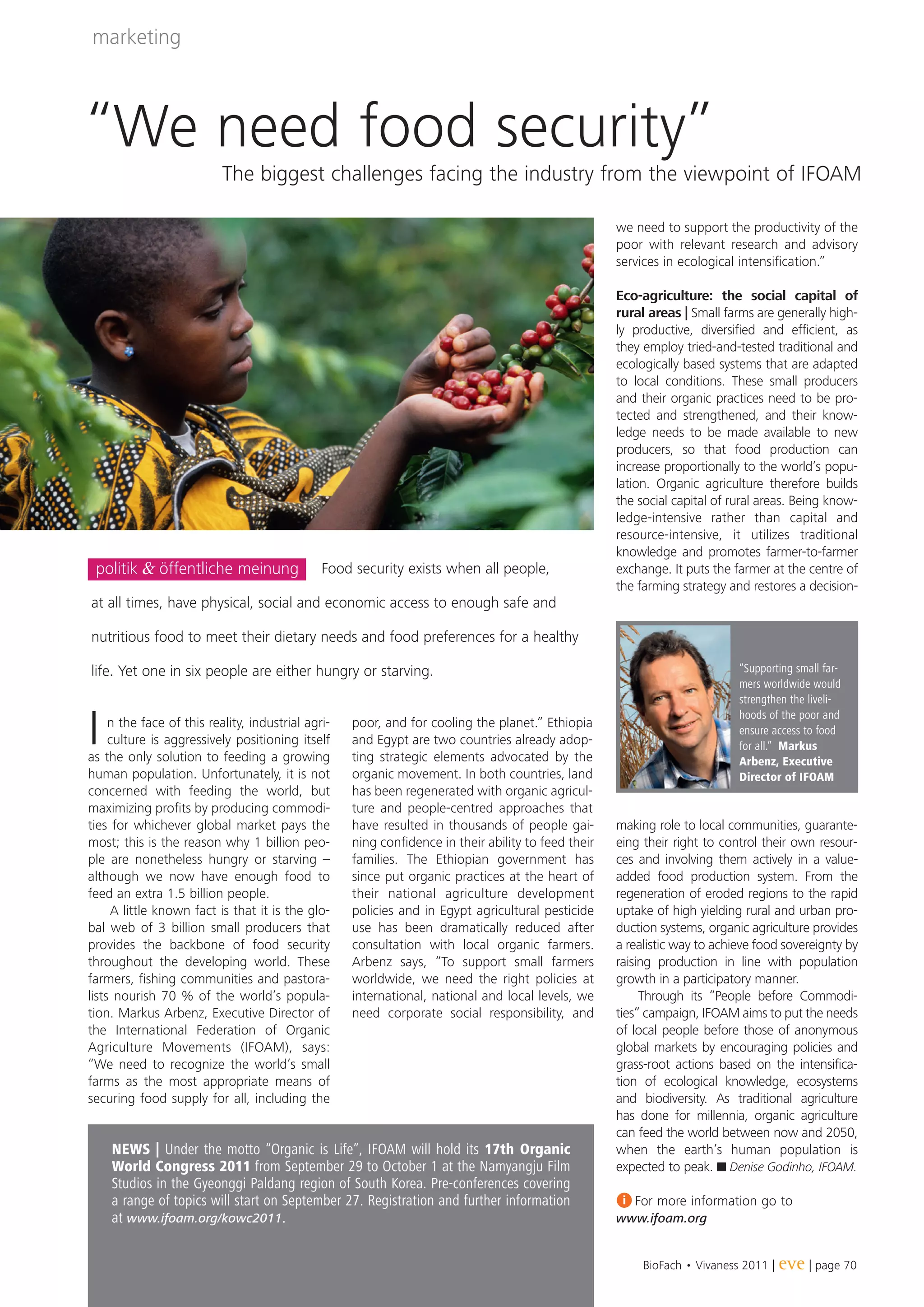
A little known fact is that it is the glo-
bal web of 3 billion small producers that
provides the backbone of food security
throughout the developing world. These
farmers, fishing communities and pastora-
lists nourish 70 % of the world’s popula-
tion. Markus Arbenz, Executive Director of
the International Federation of Organic
Agriculture Movements (IFOAM), says:
“We need to recognize the world’s small
farms as the most appropriate means of
securing food supply for all, including the
NEWS | Under the motto “Organic is Life”, IFOAM will hold its 17th Organic
World Congress 2011 from September 29 to October 1 at the Namyangju Film
Studios in the Gyeonggi Paldang region of South Korea. Pre-conferences covering
a range of topics will start on September 27. Registration and further information
at www.ifoam.org/kowc2011.
“We need food security”
Food security exists when all people,
at all times, have physical, social and economic access to enough safe and
nutritious food to meet their dietary needs and food preferences for a healthy
life. Yet one in six people are either hungry or starving.
we need to support the productivity of the
poor with relevant research and advisory
services in ecological intensification.”
Eco-agriculture: the social capital of
rural areas | Small farms are generally high-
ly productive, diversified and efficient, as
they employ tried-and-tested traditional and
ecologically based systems that are adapted
to local conditions. These small producers
and their organic practices need to be pro-
tected and strengthened, and their know-
ledge needs to be made available to new
producers, so that food production can
increase proportionally to the world’s popu-
lation. Organic agriculture therefore builds
the social capital of rural areas. Being know-
ledge-intensive rather than capital and
resource-intensive, it utilizes traditional
knowledge and promotes farmer-to-farmer
exchange. It puts the farmer at the centre of
the farming strategy and restores a decision-
making role to local communities, guarante-
eing their right to control their own resour-
ces and involving them actively in a value-
added food production system. From the
regeneration of eroded regions to the rapid
uptake of high yielding rural and urban pro-
duction systems, organic agriculture provides
a realistic way to achieve food sovereignty by
raising production in line with population
growth in a participatory manner.
Through its “People before Commodi-
ties” campaign, IFOAM aims to put the needs
of local people before those of anonymous
global markets by encouraging policies and
grass-root actions based on the intensifica-
tion of ecological knowledge, ecosystems
and biodiversity. As traditional agriculture
has done for millennia, organic agriculture
can feed the world between now and 2050,
when the earth’s human population is
expected to peak. ■ Denise Godinho, IFOAM.
For more information go to X
www.ifoam.org
I
“Supporting small far-
mers worldwide would
strengthen the liveli-
hoods of the poor and
ensure access to food
for all.” Markus
Arbenz, Executive
Director of IFOAM
politik & öffentliche meinung
i

IFOAM_engl

  • 1.
    BioFach • Vivaness2011 | eve | page 70 marketing poor, and for cooling the planet.” Ethiopia and Egypt are two countries already adop- ting strategic elements advocated by the organic movement. In both countries, land has been regenerated with organic agricul- ture and people-centred approaches that have resulted in thousands of people gai- ning confidence in their ability to feed their families. The Ethiopian government has since put organic practices at the heart of their national agriculture development policies and in Egypt agricultural pesticide use has been dramatically reduced after consultation with local organic farmers. Arbenz says, “To support small farmers worldwide, we need the right policies at international, national and local levels, we need corporate social responsibility, and The biggest challenges facing the industry from the viewpoint of IFOAM n the face of this reality, industrial agri- culture is aggressively positioning itself as the only solution to feeding a growing human population. Unfortunately, it is not concerned with feeding the world, but maximizing profits by producing commodi- ties for whichever global market pays the most; this is the reason why 1 billion peo- ple are nonetheless hungry or starving – although we now have enough food to feed an extra 1.5 billion people. A little known fact is that it is the glo- bal web of 3 billion small producers that provides the backbone of food security throughout the developing world. These farmers, fishing communities and pastora- lists nourish 70 % of the world’s popula- tion. Markus Arbenz, Executive Director of the International Federation of Organic Agriculture Movements (IFOAM), says: “We need to recognize the world’s small farms as the most appropriate means of securing food supply for all, including the NEWS | Under the motto “Organic is Life”, IFOAM will hold its 17th Organic World Congress 2011 from September 29 to October 1 at the Namyangju Film Studios in the Gyeonggi Paldang region of South Korea. Pre-conferences covering a range of topics will start on September 27. Registration and further information at www.ifoam.org/kowc2011. “We need food security” Food security exists when all people, at all times, have physical, social and economic access to enough safe and nutritious food to meet their dietary needs and food preferences for a healthy life. Yet one in six people are either hungry or starving. we need to support the productivity of the poor with relevant research and advisory services in ecological intensification.” Eco-agriculture: the social capital of rural areas | Small farms are generally high- ly productive, diversified and efficient, as they employ tried-and-tested traditional and ecologically based systems that are adapted to local conditions. These small producers and their organic practices need to be pro- tected and strengthened, and their know- ledge needs to be made available to new producers, so that food production can increase proportionally to the world’s popu- lation. Organic agriculture therefore builds the social capital of rural areas. Being know- ledge-intensive rather than capital and resource-intensive, it utilizes traditional knowledge and promotes farmer-to-farmer exchange. It puts the farmer at the centre of the farming strategy and restores a decision- making role to local communities, guarante- eing their right to control their own resour- ces and involving them actively in a value- added food production system. From the regeneration of eroded regions to the rapid uptake of high yielding rural and urban pro- duction systems, organic agriculture provides a realistic way to achieve food sovereignty by raising production in line with population growth in a participatory manner. Through its “People before Commodi- ties” campaign, IFOAM aims to put the needs of local people before those of anonymous global markets by encouraging policies and grass-root actions based on the intensifica- tion of ecological knowledge, ecosystems and biodiversity. As traditional agriculture has done for millennia, organic agriculture can feed the world between now and 2050, when the earth’s human population is expected to peak. ■ Denise Godinho, IFOAM. For more information go to X www.ifoam.org I “Supporting small far- mers worldwide would strengthen the liveli- hoods of the poor and ensure access to food for all.” Markus Arbenz, Executive Director of IFOAM politik & öffentliche meinung i