IFMSA Reform
MIGUEL CABRAL
RC Europe 2012-2013
Index
1. Introduction
2. What is the IFMSA Reform?
3. What has been done about IFMSA Reform?
4. My view of an holistic IFMSA Reform Process
5. How to make it happen
Introduction
Why this presentation?
- Lack of understanding
- More awareness
- More inclusion
- Main proposer of the building blocks proposal
- Experience
- Since 2008; 2 terms as Official, 12 TOMs, 7 GAs, 3 RM, 4
Plenary Teams, very active in several fronts
Disclaimer
- This presentation should be seen as my personal opinion, might
contain mistakes and is open to discussion.
-This is not an IFMSA official view
What is the IFMSA
Reform?
What is Reform?
- wikitionary :
“Amendment of what is defective, vicious, corrupt, or depraved;
reformation; as, reform of elections; reform of government."
- What It is not  a Revolution:
“A sudden, vast change in a situation, a discipline, or the way of
thinking and behaving.”
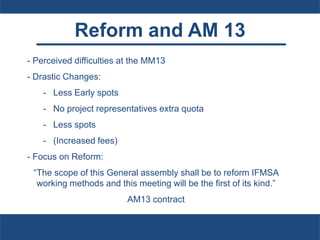
Reform and AM 13
- Perceived difficulties at the MM13
- Drastic Changes:
- Less Early spots
- No project representatives extra quota
- Less spots
- (Increased fees)
- Focus on Reform:
“The scope of this General assembly shall be to reform IFMSA
working methods and this meeting will be the first of its kind.”
AM13 contract
Where did it come from?
- TOM 4 2012
- Think Tank pre GA at the AM12
- Multiple TF and SWG
- TOM2 2012/2013  idea of a Think Tank TOM
- Think Tank TOM presented as a Reform Process at the MM13
Was this the first time?
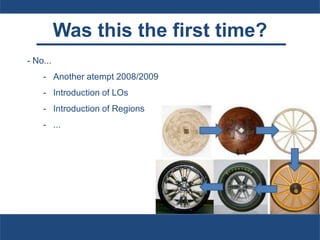
- No...
- Another atempt 2008/2009
- Introduction of LOs
- Introduction of Regions
- ...
What has been done
about IFMSA Reform?
Since MM 13
- TO discussions
- NMO Reform folder
- EuRegMe 2013
- TOM 4
- Reform Assistant
- Several calls for input
- ...
- Pre GA on Reform
- ...
My view of an holistic
IFMSA Reform Process
What you might have seen
- TOM4’s livestream
- TOM4’s Reform Plan
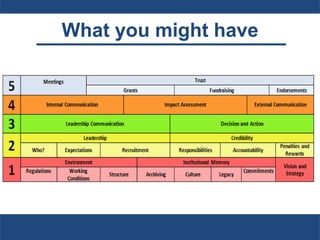
What you might have
What you should know
- This proposal tries to address all the IFMSA
- It is based on the concept of needed levels or steps:
- Can’t discuss Fundraising without discussing Projects/
actions, Impact assessment, etc
- Can’t discuss TO restructure without discussing Vision and
Planing
- Levels/steps and blocks are not rigid
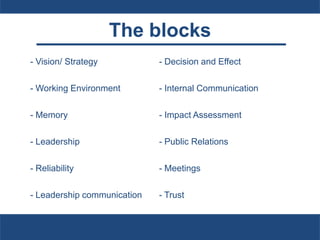
The blocks
- Vision/ Strategy
- Working Environment
- Memory
- Leadership
- Reliability
- Leadership communication
- Decision and Effect
- Internal Communication
- Impact Assessment
- Public Relations
- Meetings
- Trust
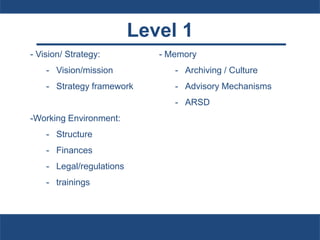
Level 1
- Vision/ Strategy:
- Vision/mission
- Strategy framework
-Working Environment:
- Structure
- Finances
- Legal/regulations
- trainings
- Memory
- Archiving / Culture
- Advisory Mechanisms
- ARSD
Vision / Strategy
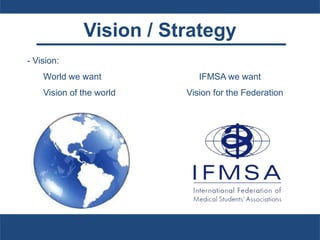
Vision / Strategy
- Vision:
World we want IFMSA we want
Vision of the world Vision for the Federation
Vision / Strategy
- Vision:
- World we want – Vision of the world
- What we want from IFMSA – Vision for the Federation
- Union / Projects / Both
- Medical Students / Health Organization / Both
Vision / Strategy
- Vision:
- World we want – Vision of the world
- What we want from IFMSA – Vision for the Federation
- Union / Projects / Both
- Medical Students / Health Organization / Both
- Mission;
- What we want IFMSA to do on a regular basis, as a principle
Vision / Strategy
- Strategy/ Planning: Set the layout for the Federation
- Long term: 10 years cycle milestones (2020)
- Medium term:
- 3 cycles of 3 year Strategic Plan (3+3+3+1)
- 1 year for reform discussion,
- Yearly Working plan based on the Medium Term Plan
- Task list of the Federation
Goals should be Measurable, Timebounded and linked to a
Responsible Official.
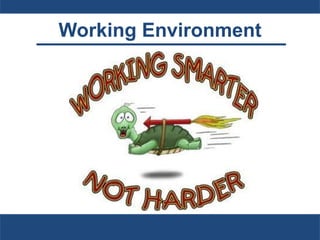
Working Environment
Working Environment
- Structure:
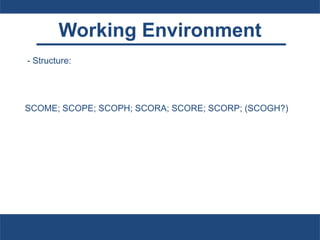
SCOME; SCOPE; SCOPH; SCORA; SCORE; SCORP; (SCOGH?)
Working Environment
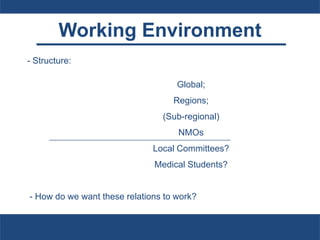
- Structure:
Global;
Regions;
(Sub-regional)
NMOs
Local Committees?
Medical Students?
- How do we want these relations to work?
Working Environment
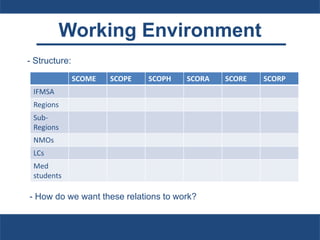
- Structure:
- How do we want these relations to work?
SCOME SCOPE SCOPH SCORA SCORE SCORP
IFMSA
Regions
Sub-
Regions
NMOs
LCs
Med
students
Working Environment
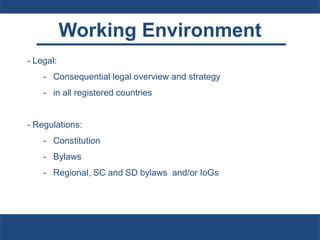
- Legal:
- Consequential legal overview and strategy
- in all registered countries
- Regulations:
- Constitution
- Bylaws
- Regional, SC and SD bylaws and/or IoGs
Working Environment
- Finances:
- Honesty for grants and for our selves (the real budget not
a partial one)
- True financial partnership in activities
- Ethical Guidelines
- Receive
- Invest
- Clear, transparent and fair Financial Management
- Accountant, Report, TAF, Memberships, reinbursement
- Staff
Working Environment
- Capacity Building (a.k.a Trainings):
- IoGs
- Great Resources
- Quality Assurance in IFMSA NFE programs
- Tracking and evaluation systems
- Specialisation and topics of reference
- Partnerships
Memory
Memory
- Archiving / Culture:
- Stablish a system (why, how, what)
- Naming/coding
- Off and On-line
- Offices
- Compilation of materials (also from NMOs)
- Friendly Materials about IFMSA (videos, pictures, etc)
- Friendly Materials about the IFMSa history
- Open access to the info of all IFMSA committments and
relevant documents (legal or not) by all IFMSA members
Memory
- Advisory Mechanisms:
- Immediate past-officials
- Supervising Council
- Pool of experts
- Pool of NMOs’ reference people
- Alumni
Memory
- Alumni Relations Suport Division:
- Defining Alumni
- Defining their levels of participation in IFMSA
- Defining their accountability
- Defining a strategy of connection/relationship
- Explore stable ways of having their help (expertise,
institutional and financial)
- Connection with WMA and Junior Doctors
Level 2
-Leadership - Credibility
Leadership
Leadership
- Leaders of the organisation:
- NMOs
- EB
- TO
- International teams
- Other positions
- List of Expectations
- Recruitment process
- Structure of the leadership teams
Reliability
Reliability
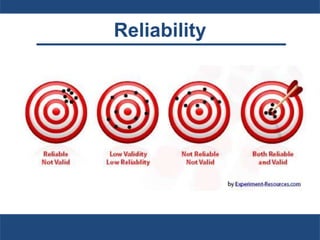
- Responsability
- Key Result Areas (KRAs), job/task descriptions
- Accountability
- Monitoring and reporting
- Rewards and penalties
- How to best assure that the work gets done
- Redifining the status of the honorary life member
Level 3
- Leadership communication
- Decision and Effect
Leadership Communiation
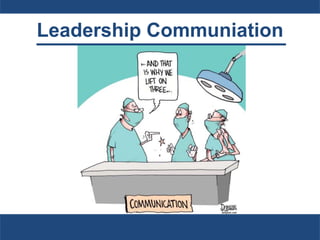
- Refering to all leaders and leaders’ groups
- Defining a strategy for leadership communication
- Who is responsible and for what
- Who has to know of what
- Communication Platforms
Decision and Effect
Decision and Effect
-Decision making process:
- Who has to be heard/involved
- Conditions – times, amount of
information/discussion/participation
- Who can decide what:
- responsible
- timeline
- Conditions, measurements of success, consequences
- follow up (when, how, by whom)
- Binding decisions and consequences for all
Decision and Effect
- Projects Support Division:
- Propper discussion
- What are we talking about?
- Are they IFMSA’s or not?
- Benefits we can bring
- Networks of projects
- IFMSA taking the lead
- LONG TERM PLAN and commitments
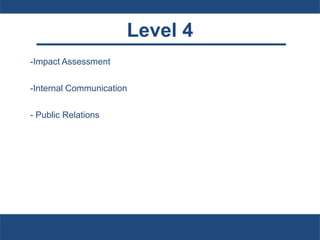
Level 4
-Impact Assessment
-Internal Communication
- Public Relations
Impact Assessment
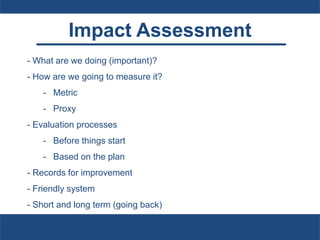
Impact Assessment
- What are we doing (important)?
- How are we going to measure it?
- Metric
- Proxy
- Evaluation processes
- Before things start
- Based on the plan
- Records for improvement
- Friendly system
- Short and long term (going back)
Communication
Communication
- The devide between the public and the organisation
- Communication Strategy:
- Who
- What
- Means
- Social Media Strategy
- Platform and needed embassies
Communication
- New Technologies Support Division:
- Enhanced Media – creativity and awesomeness
- Pool of volunteers
- Friendly Materials
- On the edge of inovation
Public Relations
Public Relations
- Publications Support Division:
- Enhanced Media – creativity and awesomeness
- Pool of volunteers
- Friendly Materials
- On the edge of inovation
- Making sure IFMSA looks good and sells
- Information hub
- Press Releases
- Policy Statements
Level 5
- Meetings
- Trust
Meetings
Meetings
- What are the purpose and priorities of IFMSA?
- Why do we need to meet?
- What do we need to meet?
- What meetings shall we have
- Who should participate
- Under what conditions
- Aknowledging the realities we have
- Looking at real numbers - data exploration
Trust
Trust
- Support:
- Advocacy
- Partner organisations
- Board of Recomendation
- Celebrity endorsements
Trust
- Grants:
- Explore and compile opportunities
- Inclusive process
- Adapt where possible with NMOs
Trust
- Fundraising:
- Guidelines
- Financial efficiency
- Corporate fundraising
- CSR
- Foundations
- Alumni
How to make it
happen
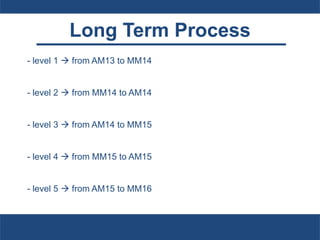
Long Term Process
- level 1  from AM13 to MM14
- level 2  from MM14 to AM14
- level 3  from AM14 to MM15
- level 4  from MM15 to AM15
- level 5  from AM15 to MM16
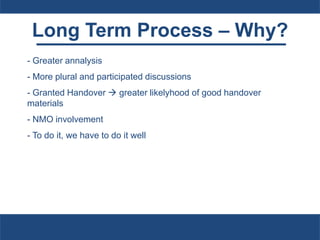
Long Term Process – Why?
- Greater annalysis
- More plural and participated discussions
- Granted Handover  greater likelyhood of good handover
materials
- NMO involvement
- To do it, we have to do it well
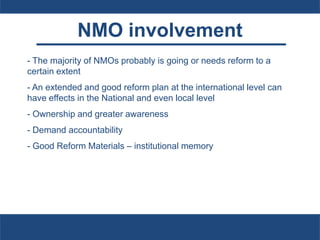
NMO involvement
- The majority of NMOs probably is going or needs reform to a
certain extent
- An extended and good reform plan at the international level can
have effects in the National and even local level
- Ownership and greater awareness
- Demand accountability
- Good Reform Materials – institutional memory
NMO involvement
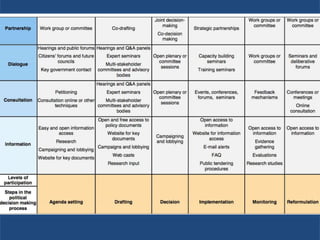
- Code of Good practice of the INGO Conference from the CoE
NMO involvement
- Code of Good practice of the INGO Conference from the CoE
AM13 and the reform
- Main goal: Plan for the Reform Process adopted
- Balanced between colection of input and annalysis, discussions
and meaningful decisions
Reform Plan
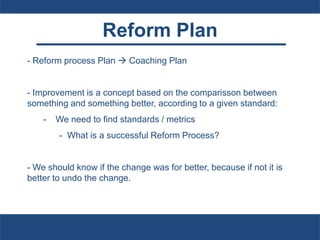
- Reform process Plan  Coaching Plan
Reform Plan
- Reform process Plan  Coaching Plan
- Improvement is a concept based on the comparisson between
something and something better, according to a given standard:
- We need to find standards / metrics
- What is a successful Reform Process?
- We should know if the change was for better, because if not it is
better to undo the change.
AM13 and the reform
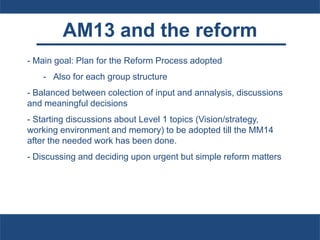
- Main goal: Plan for the Reform Process adopted
- Also for each group structure
- Balanced between colection of input and annalysis, discussions
and meaningful decisions
- Starting discussions about Level 1 topics (Vision/strategy,
working environment and memory) to be adopted till the MM14
after the needed work has been done.
- Discussing and deciding upon urgent but simple reform matters
miguelcabralpinho@gmail.com
facebook.com/miguel.cabral
twitter.com/miguel__cabral
slideshare.net/miguel_cabral

IFMSA reform - one more perspective

  • 1.
  • 2.
    Index 1. Introduction 2. Whatis the IFMSA Reform? 3. What has been done about IFMSA Reform? 4. My view of an holistic IFMSA Reform Process 5. How to make it happen
  • 3.
  • 4.
    Why this presentation? -Lack of understanding - More awareness - More inclusion - Main proposer of the building blocks proposal - Experience - Since 2008; 2 terms as Official, 12 TOMs, 7 GAs, 3 RM, 4 Plenary Teams, very active in several fronts
  • 5.
    Disclaimer - This presentationshould be seen as my personal opinion, might contain mistakes and is open to discussion. -This is not an IFMSA official view
  • 6.
    What is theIFMSA Reform?
  • 7.
    What is Reform? -wikitionary : “Amendment of what is defective, vicious, corrupt, or depraved; reformation; as, reform of elections; reform of government." - What It is not  a Revolution: “A sudden, vast change in a situation, a discipline, or the way of thinking and behaving.”
  • 8.
    Reform and AM13 - Perceived difficulties at the MM13 - Drastic Changes: - Less Early spots - No project representatives extra quota - Less spots - (Increased fees) - Focus on Reform: “The scope of this General assembly shall be to reform IFMSA working methods and this meeting will be the first of its kind.” AM13 contract
  • 9.
    Where did itcome from? - TOM 4 2012 - Think Tank pre GA at the AM12 - Multiple TF and SWG - TOM2 2012/2013  idea of a Think Tank TOM - Think Tank TOM presented as a Reform Process at the MM13
  • 10.
    Was this thefirst time? - No... - Another atempt 2008/2009 - Introduction of LOs - Introduction of Regions - ...
  • 11.
    What has beendone about IFMSA Reform?
  • 12.
    Since MM 13 -TO discussions - NMO Reform folder - EuRegMe 2013 - TOM 4 - Reform Assistant - Several calls for input - ... - Pre GA on Reform - ...
  • 13.
    My view ofan holistic IFMSA Reform Process
  • 14.
    What you mighthave seen - TOM4’s livestream - TOM4’s Reform Plan
  • 15.
  • 16.
    What you shouldknow - This proposal tries to address all the IFMSA - It is based on the concept of needed levels or steps: - Can’t discuss Fundraising without discussing Projects/ actions, Impact assessment, etc - Can’t discuss TO restructure without discussing Vision and Planing - Levels/steps and blocks are not rigid
  • 17.
    The blocks - Vision/Strategy - Working Environment - Memory - Leadership - Reliability - Leadership communication - Decision and Effect - Internal Communication - Impact Assessment - Public Relations - Meetings - Trust
  • 18.
    Level 1 - Vision/Strategy: - Vision/mission - Strategy framework -Working Environment: - Structure - Finances - Legal/regulations - trainings - Memory - Archiving / Culture - Advisory Mechanisms - ARSD
  • 19.
  • 20.
    Vision / Strategy -Vision: World we want IFMSA we want Vision of the world Vision for the Federation
  • 21.
    Vision / Strategy -Vision: - World we want – Vision of the world - What we want from IFMSA – Vision for the Federation - Union / Projects / Both - Medical Students / Health Organization / Both
  • 22.
    Vision / Strategy -Vision: - World we want – Vision of the world - What we want from IFMSA – Vision for the Federation - Union / Projects / Both - Medical Students / Health Organization / Both - Mission; - What we want IFMSA to do on a regular basis, as a principle
  • 23.
    Vision / Strategy -Strategy/ Planning: Set the layout for the Federation - Long term: 10 years cycle milestones (2020) - Medium term: - 3 cycles of 3 year Strategic Plan (3+3+3+1) - 1 year for reform discussion, - Yearly Working plan based on the Medium Term Plan - Task list of the Federation Goals should be Measurable, Timebounded and linked to a Responsible Official.
  • 24.
  • 25.
    Working Environment - Structure: SCOME;SCOPE; SCOPH; SCORA; SCORE; SCORP; (SCOGH?)
  • 26.
    Working Environment - Structure: Global; Regions; (Sub-regional) NMOs LocalCommittees? Medical Students? - How do we want these relations to work?
  • 27.
    Working Environment - Structure: -How do we want these relations to work? SCOME SCOPE SCOPH SCORA SCORE SCORP IFMSA Regions Sub- Regions NMOs LCs Med students
  • 28.
    Working Environment - Legal: -Consequential legal overview and strategy - in all registered countries - Regulations: - Constitution - Bylaws - Regional, SC and SD bylaws and/or IoGs
  • 29.
    Working Environment - Finances: -Honesty for grants and for our selves (the real budget not a partial one) - True financial partnership in activities - Ethical Guidelines - Receive - Invest - Clear, transparent and fair Financial Management - Accountant, Report, TAF, Memberships, reinbursement - Staff
  • 30.
    Working Environment - CapacityBuilding (a.k.a Trainings): - IoGs - Great Resources - Quality Assurance in IFMSA NFE programs - Tracking and evaluation systems - Specialisation and topics of reference - Partnerships
  • 31.
  • 32.
    Memory - Archiving /Culture: - Stablish a system (why, how, what) - Naming/coding - Off and On-line - Offices - Compilation of materials (also from NMOs) - Friendly Materials about IFMSA (videos, pictures, etc) - Friendly Materials about the IFMSa history - Open access to the info of all IFMSA committments and relevant documents (legal or not) by all IFMSA members
  • 33.
    Memory - Advisory Mechanisms: -Immediate past-officials - Supervising Council - Pool of experts - Pool of NMOs’ reference people - Alumni
  • 34.
    Memory - Alumni RelationsSuport Division: - Defining Alumni - Defining their levels of participation in IFMSA - Defining their accountability - Defining a strategy of connection/relationship - Explore stable ways of having their help (expertise, institutional and financial) - Connection with WMA and Junior Doctors
  • 35.
  • 36.
  • 37.
    Leadership - Leaders ofthe organisation: - NMOs - EB - TO - International teams - Other positions - List of Expectations - Recruitment process - Structure of the leadership teams
  • 38.
  • 39.
    Reliability - Responsability - KeyResult Areas (KRAs), job/task descriptions - Accountability - Monitoring and reporting - Rewards and penalties - How to best assure that the work gets done - Redifining the status of the honorary life member
  • 40.
    Level 3 - Leadershipcommunication - Decision and Effect
  • 41.
  • 42.
    Leadership Communiation - Referingto all leaders and leaders’ groups - Defining a strategy for leadership communication - Who is responsible and for what - Who has to know of what - Communication Platforms
  • 43.
  • 44.
    Decision and Effect -Decisionmaking process: - Who has to be heard/involved - Conditions – times, amount of information/discussion/participation - Who can decide what: - responsible - timeline - Conditions, measurements of success, consequences - follow up (when, how, by whom) - Binding decisions and consequences for all
  • 45.
    Decision and Effect -Projects Support Division: - Propper discussion - What are we talking about? - Are they IFMSA’s or not? - Benefits we can bring - Networks of projects - IFMSA taking the lead - LONG TERM PLAN and commitments
  • 46.
    Level 4 -Impact Assessment -InternalCommunication - Public Relations
  • 47.
  • 48.
    Impact Assessment - Whatare we doing (important)? - How are we going to measure it? - Metric - Proxy - Evaluation processes - Before things start - Based on the plan - Records for improvement - Friendly system - Short and long term (going back)
  • 49.
  • 50.
    Communication - The devidebetween the public and the organisation - Communication Strategy: - Who - What - Means - Social Media Strategy - Platform and needed embassies
  • 51.
    Communication - New TechnologiesSupport Division: - Enhanced Media – creativity and awesomeness - Pool of volunteers - Friendly Materials - On the edge of inovation
  • 52.
  • 53.
    Public Relations - PublicationsSupport Division: - Enhanced Media – creativity and awesomeness - Pool of volunteers - Friendly Materials - On the edge of inovation - Making sure IFMSA looks good and sells - Information hub - Press Releases - Policy Statements
  • 54.
  • 55.
  • 56.
    Meetings - What arethe purpose and priorities of IFMSA? - Why do we need to meet? - What do we need to meet? - What meetings shall we have - Who should participate - Under what conditions - Aknowledging the realities we have - Looking at real numbers - data exploration
  • 57.
  • 58.
    Trust - Support: - Advocacy -Partner organisations - Board of Recomendation - Celebrity endorsements
  • 59.
    Trust - Grants: - Exploreand compile opportunities - Inclusive process - Adapt where possible with NMOs
  • 60.
    Trust - Fundraising: - Guidelines -Financial efficiency - Corporate fundraising - CSR - Foundations - Alumni
  • 61.
    How to makeit happen
  • 62.
    Long Term Process -level 1  from AM13 to MM14 - level 2  from MM14 to AM14 - level 3  from AM14 to MM15 - level 4  from MM15 to AM15 - level 5  from AM15 to MM16
  • 63.
    Long Term Process– Why? - Greater annalysis - More plural and participated discussions - Granted Handover  greater likelyhood of good handover materials - NMO involvement - To do it, we have to do it well
  • 64.
    NMO involvement - Themajority of NMOs probably is going or needs reform to a certain extent - An extended and good reform plan at the international level can have effects in the National and even local level - Ownership and greater awareness - Demand accountability - Good Reform Materials – institutional memory
  • 65.
    NMO involvement - Codeof Good practice of the INGO Conference from the CoE
  • 66.
    NMO involvement - Codeof Good practice of the INGO Conference from the CoE
  • 67.
    AM13 and thereform - Main goal: Plan for the Reform Process adopted - Balanced between colection of input and annalysis, discussions and meaningful decisions
  • 68.
    Reform Plan - Reformprocess Plan  Coaching Plan
  • 69.
    Reform Plan - Reformprocess Plan  Coaching Plan - Improvement is a concept based on the comparisson between something and something better, according to a given standard: - We need to find standards / metrics - What is a successful Reform Process? - We should know if the change was for better, because if not it is better to undo the change.
  • 70.
    AM13 and thereform - Main goal: Plan for the Reform Process adopted - Also for each group structure - Balanced between colection of input and annalysis, discussions and meaningful decisions - Starting discussions about Level 1 topics (Vision/strategy, working environment and memory) to be adopted till the MM14 after the needed work has been done. - Discussing and deciding upon urgent but simple reform matters
  • 71.