IFAC Global SMP Survey 2014
Highlights
Subodh Agrawal
Past President, The Institute of Chartered Accountants of India
Member, IFAC SMP Committee
IFAC Global SMP Survey 2014 – About I
• 5,083 respondents from
135 countries
• Available in 21 languages –
inc. Korean, Chinese,
Japanese
• Report published
www.ifac.org/smp
• 2015 Survey launches in
October
IFAC Global SMP Survey 2014 – About II
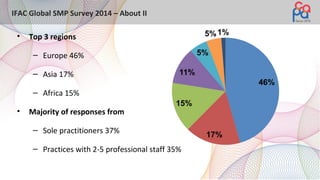
• Top 3 regions
– Europe 46%
– Asia 17%
– Africa 15%
• Majority of responses from
– Sole practitioners 37%
– Practices with 2-5 professional staff 35%
Global SMP Survey Highlights - I
• Top 3 challenges SMPs in Asia (high/v high):
– Rising Costs (58%)
– Pressure to lower fees (56%)
– Attracting new clients (55%)
• Next 5 Years in Asia:
– Regulatory environment (52%)
– Competition (58%)
Global SMP Survey Highlights - II
• Two technologies expected to have the greatest impact over next 5
years in Asia:
– Business intelligence and data analysis software and tools (42%)
– CRM and document management and software tools (37%)
Global SMP Survey Highlights - III
• Practice Fee Revenue in Asia:
– Majority SMP revenues for Asia in 2014 increased
moderately (42%) or stayed the same (33%)
– Larger the practice – more likely to report increase
– Majority SMPs in Asia believe revenues in 2015 in all
areas expected to grow – most advisory
– Tax planning (71%), business development (38%),
corporate advisory (58%) most common in 2014
Global SMP Survey Highlights - IV
• Membership in Network, Association, or Alliance:
– 32% of SMPs belong to a network, association, or alliance
– Asia most likely region
– 31% are considering joining one
– 37% are not members
– Larger SMP more likely
Global SMP Survey Highlights - V
• Top SME Challenges (high/v high) in Asia:
– Rising costs (66%)
– Competition (58%)
– Economic uncertainty (49%)
• Access to Finance in Asia:
– 67% reported that at least 1% of SME clients seeking finance
had difficulty
– However, for 49% less than 25% of total clients experienced
difficulty
– 32% High or Very High Challenge
Global SMP Survey Highlights - VI
• Financial Crimes in Asia:
– 55% reported that at least one client experienced financial
crimes
– But most less than 5% of SMPs total clients experienced
– Most common
– Asset misappropriation/ theft (39%)
– Bribery (38%)
– Financial statement/ accounting fraud (36%)
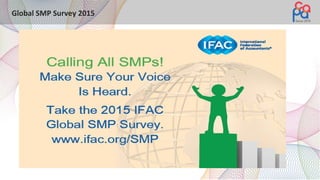
Global SMP Survey 2015

IFAC Global SMP Survey 2014 Highlights

  • 1.
    IFAC Global SMPSurvey 2014 Highlights Subodh Agrawal Past President, The Institute of Chartered Accountants of India Member, IFAC SMP Committee
  • 2.
    IFAC Global SMPSurvey 2014 – About I • 5,083 respondents from 135 countries • Available in 21 languages – inc. Korean, Chinese, Japanese • Report published www.ifac.org/smp • 2015 Survey launches in October
  • 3.
    IFAC Global SMPSurvey 2014 – About II • Top 3 regions – Europe 46% – Asia 17% – Africa 15% • Majority of responses from – Sole practitioners 37% – Practices with 2-5 professional staff 35%
  • 4.
    Global SMP SurveyHighlights - I • Top 3 challenges SMPs in Asia (high/v high): – Rising Costs (58%) – Pressure to lower fees (56%) – Attracting new clients (55%) • Next 5 Years in Asia: – Regulatory environment (52%) – Competition (58%)
  • 5.
    Global SMP SurveyHighlights - II • Two technologies expected to have the greatest impact over next 5 years in Asia: – Business intelligence and data analysis software and tools (42%) – CRM and document management and software tools (37%)
  • 6.
    Global SMP SurveyHighlights - III • Practice Fee Revenue in Asia: – Majority SMP revenues for Asia in 2014 increased moderately (42%) or stayed the same (33%) – Larger the practice – more likely to report increase – Majority SMPs in Asia believe revenues in 2015 in all areas expected to grow – most advisory – Tax planning (71%), business development (38%), corporate advisory (58%) most common in 2014
  • 7.
    Global SMP SurveyHighlights - IV • Membership in Network, Association, or Alliance: – 32% of SMPs belong to a network, association, or alliance – Asia most likely region – 31% are considering joining one – 37% are not members – Larger SMP more likely
  • 8.
    Global SMP SurveyHighlights - V • Top SME Challenges (high/v high) in Asia: – Rising costs (66%) – Competition (58%) – Economic uncertainty (49%) • Access to Finance in Asia: – 67% reported that at least 1% of SME clients seeking finance had difficulty – However, for 49% less than 25% of total clients experienced difficulty – 32% High or Very High Challenge
  • 9.
    Global SMP SurveyHighlights - VI • Financial Crimes in Asia: – 55% reported that at least one client experienced financial crimes – But most less than 5% of SMPs total clients experienced – Most common – Asset misappropriation/ theft (39%) – Bribery (38%) – Financial statement/ accounting fraud (36%)
  • 10.

Editor's Notes

  • #3 The IFAC Global SMP Survey was open in 21 languages from November 3 to December 29 2014 and received a record number of respondents – 5,083. This year’s exercise will commence in October – please look out for it. Of the 135 countries represented, there were 27 countries with 50 or more responses. In contrast, the 2013 edition of the survey collected 3,709 responses with 15 countries contributing 50 or more responses. Objectives are twofold: help inform strategic priorities on SMP / SME for IFAC and its member organizations (we share country data on request) and raise visibility of SMPs and their SME clients.
  • #4 As summarized in the graph the largest groups of respondents are from Europe (46%), but Asia was also well represented receiving 17% of the responses. We received significant numbers from China (232), India (306), Malaysia (59) and Japan (52), Korea (33). The majority of responses in 2014 were from sole practitioners (37%) and practitioners in practices with 2-5 professional staff (35%), thus the survey results are skewed toward the smallest  SMPs. These practice sizes were also the two highest in the 2013 survey. The survey results are also skewed toward male respondents. Males account for 73% of all responses. Overall, over 70% of respondents were sole practitioners or from practices with 5 or fewer partners and staff.
  • #5 SMP Challenges The 2014 edition of the survey queried participants on the extent to which their SMPs are facing 12 specific challenges. The Percentages relate to respondents stating high and very high challenges. In Asia the top challenges are rising costs (58%), pressure to lower fees (56%) and attracting new clients (55%). Both pressure to lower fees (50%) and attracting new clients (58%) were the same globally, but keeping up with new regulations and standards was second highest (57%) globally, compared to only 46% for Asia. Next 5 Years Respondents were asked to rate the extent to which eight different factors will affect the respondent’s practice over the next 5 years. The regulatory environment (52%) and competition (58%), in particular, stand out as more than half of respondents rated that these factors will have either a high or very high impact over the next 5 years. This is the same as globally – regulatory environment (61%) and competition (57%). [The next two highest rated factors in Asia were technology developments (44%) and the capability to adapt to new client needs (43%).]
  • #6 Technologies Respondents were asked to rate the extent to which six different technologies will affect the way their practices will operate over the next 5 years. The majority of respondents predicted that each technology option presented would have at least a moderate impact on their practice over the next 5 years. The two technologies expected to have the greatest impact were business intelligence/data analysis software and client relationship management/document management software this was the same as global. In Asia and globally Cloud computing (33%) and mobile devices (35%) are the next two technologies expected to have an impact on SMPs. [Global Cloud computing (42%) and mobile devices (41%)]
  • #7 Revenue In Asia the majority of SMP revenues increased moderately (42%) or stayed the same (33%) in 2014. Predictions in Asia and Europe generally more cautious. Globally, 31% of respondents reported that 2014 practice fee revenues stayed the same from the prior year and 37% reported a moderate increase. Larger the practice – more likely to report favorable change in practice fee revenues in 2014. When asked to look ahead to 2015, respondents in Asia were optimistic that practice fee revenues in different service areas would increase over 2014. The most in advisory (50% increase moderate or substantial), Audit 48%, Accounting 47%, Tax 47%. Tax planning (71%), business development (38%) corporate advisory (58%) most common advisory services in Asia – same pattern as global.
  • #8 In Asia, 32% of respondents reported that their SMP belongs to network, association or alliance, 31% are considering joining one. Globally, only 27% of respondents reported that their SMP belongs to a network (10%), as association (11%), or an alliance (6%). 24% are considering joining one. The results indicate that the larger the SMP, the more likely it was to belong to a network, association, or alliance. SMPs with 21 or more partners and staff were most likely to belong to a group (69%). In contrast, sole practitioners were the least likely to belong to a group (14%), and also expressed little interest in joining one (22%).
  • #9 SME Challenges In addition to their own challenges, respondents were asked about the challenges facing their small- and medium-sized entity (SME) clients. Six challenges presented – Attracting and retaining staff, Competition, Compliance with regulation, Difficulties accessing finance, Economic uncertainty, Rising costs. In Asia the top SME challenges were rising costs (66%), competition (58%) and economic uncertainty (49%). This was the same pattern globally. Of the six challenges presented, at least 77% of respondents rated each one as a moderate challenge or greater. [Globally The top two challenges facing SME clients were rising costs (67%) and economic uncertainty (66%), as approximately two-thirds of respondents rated these as either a high or very high challenge. Competition (60%) and difficulties accessing finance (51%) also received at least a majority at the high or very high challenge level. Moreover, less than half of SMPs reported that compliance with regulation (46%) and attracting and retaining staff (34%) were a high or very high challenge for their SME clients.] These results are highly relevant to SMPs as they tell us what the challenges that clients are facing and need help addressing. Access to Finance In Asia 67% of SMPs reported at least one of their clients seeking finance had difficulty, however for many (49%) it was less than 25% of their clients. The extent of difficulty experienced in accessing new finance was relatively equally distributed, but it appears that in the Middle East (84%), Africa (76%), and Europe (76%), SMEs are facing the most difficulty accessing finance. In contrast, SMEs in Central and South America (54%) were reported to face the least difficulty accessing finance.
  • #10 Financial Crimes In Asia 55% reported that at least one client experienced some type of financial crime in 2014. Therefore 45% SMPs not aware of any SMEs having crime. Globally it was 54%/46%. However, the volume of crimes overall was low as most often less than 5% of SMPs’ total clientele experienced a financial crime. The most common crimes were asset misappropriation/ theft (39%), bribery (38%) and financial statement/ accounting fraud (36%). This was similar to the global picture where the two most common were asset misappropriation/theft (36%) and financial statement/accounting fraud (30%). The types of crime varied by region in that theft was most common in Africa (58%) and Australasia/Oceania (55%), and financial statement/accounting fraud was most prevalent in the Middle East (58%). The results also reveal differences by practice size with sole practitioners reporting the lowest likelihood of SME clients experiencing these crimes (29% and 21%, respectively), and the largest practices reporting the highest likelihoods (49% and 40%, respectively).