Everyday Decisions
and Logic
Ourdaily lives are a complex tapestry of
choices, from selecting a university to
planning a weekend. Each decision,
whether conscious or instinctive, involves
evaluating conditions and determining a
subsequent action. This inherent process
of conditional reasoning forms the
bedrock of computational logic.
Counting outfit choices: girl and boy select shorts.
4.
The Need for
Programmatic
Decisions
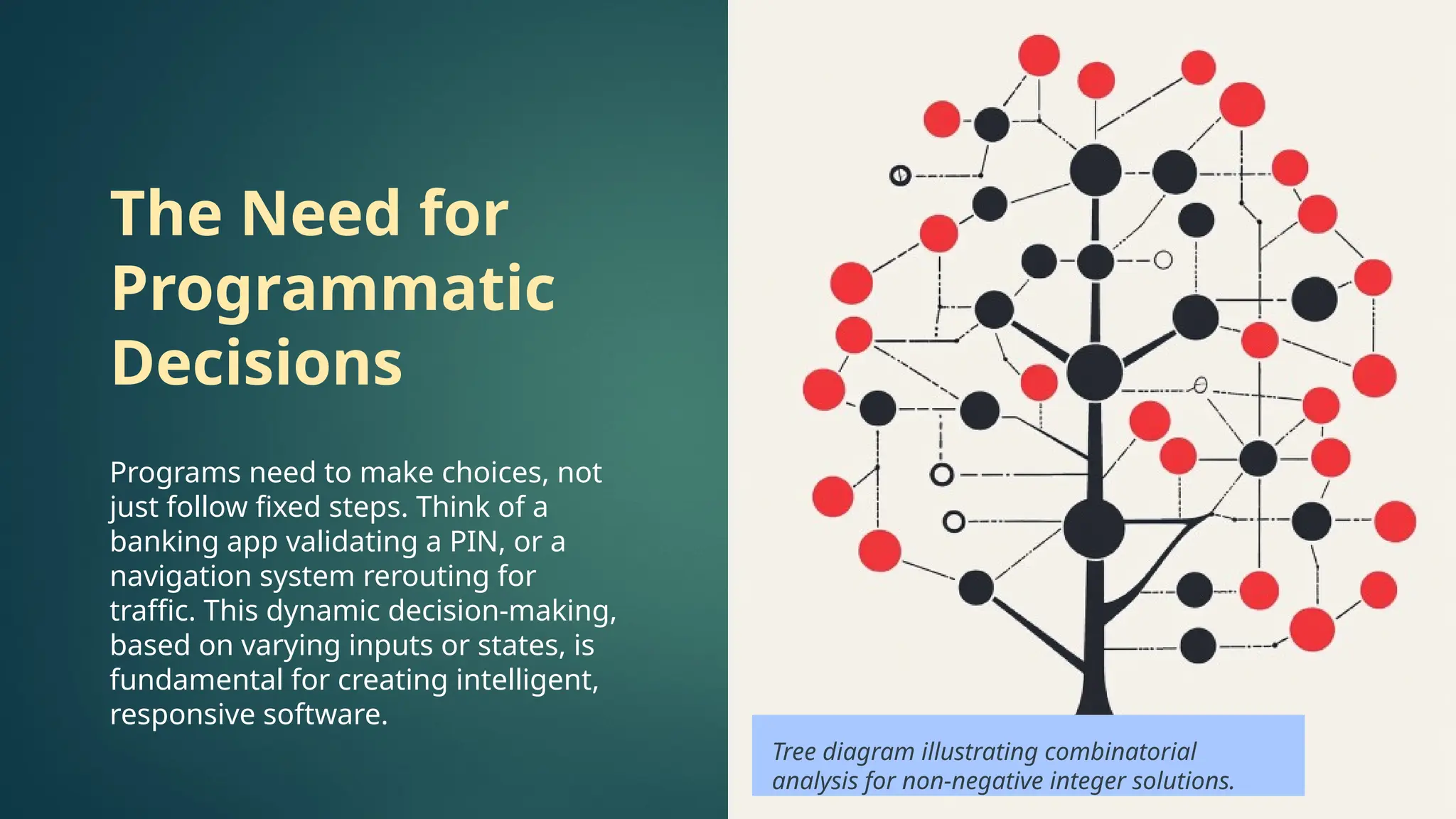
Programsneed to make choices, not
just follow fixed steps. Think of a
banking app validating a PIN, or a
navigation system rerouting for
traffic. This dynamic decision-making,
based on varying inputs or states, is
fundamental for creating intelligent,
responsive software.
Tree diagram illustrating combinatorial
analysis for non-negative integer solutions.
5.
Pathways of decision:choosing your direction with
conditional logic.
Core Purpose:
Control Flow
• Programs execute instructions
sequentially by default.
• Control flow dictates this precise
execution order.
• Conditionals (e.g., `if` statements) alter
the path.
• Enables dynamic responses: ATM PIN,
game decisions.
6.
Branching Execution Paths
Conditionalstatements, such as `if-else` constructs, fundamentally alter
a program's sequential execution by introducing decision points.
Depending on whether a specified condition evaluates to true or false,
the program follows a distinct code block, creating multiple potential
pathways. For example, a login system uses `if password_correct:` to
either grant access or display an error message, demonstrating these
divergent outcomes.
7.
Responding to
Dynamic Input
Ifconditionals are crucial for dynamic
software, allowing programs to
intelligently process diverse inputs. For
example, a navigation app uses 'if'
statements to recalculate routes based on
real-time traffic data. This adaptability
ensures responsive and interactive user
experiences.
Navigating urban geography with technology and
conditional logic.
8.
Automation through
Conditional Logic
Adaptabilityvia
Conditional Logic
Conditional logic, particularly `if`
statements, is fundamental to creating
automated processes that execute tasks
without human intervention. For example,
an automated inventory system uses `if`
statements to reorder stock "if" the
quantity falls below a set threshold. This
enables efficient, hands-free operation in
critical systems, from manufacturing
assembly lines to financial trading
algorithms.
Conversely, `if` statements also empower
software to adapt dynamically to diverse
and often unforeseen scenarios,
enhancing system resilience and user
experience. Consider a self-driving car's
software: it uses `if` statements to adjust
speed "if" a pedestrian is detected or
change lanes "if" an obstacle appears.
This adaptability is crucial for developing
intelligent systems that can respond
appropriately to real-world complexities.
9.
Fundamental 'if' Structure
•Keyword `if`: Initiates conditional execution.
• Boolean Condition: Evaluates to `True` or `False` (e.g., `grade >= 90`).
• Colon (`:`): Marks the end of the condition.
• Indented Code Block: Executes only if condition is `True`.
10.
The Core ofConditional
Logic
Evaluating Boolean
Expressions
Every 'if' statement's condition must
resolve to a definitive Boolean value:
either `True` or `False`. This strict binary
outcome is fundamental for
unambiguous program execution,
eliminating any uncertainty about
whether a code block should run. For
example, a system checking user
credentials requires an absolute `True` for
access or `False` for denial, not an
ambiguous state.
Consider the expression `temperature >
25`. If `temperature` is 28, this evaluates
to `True`, triggering a specific action like
turning on a fan. Conversely, if
`temperature` is 20, the expression yields
`False`, and the fan remains off. Another
example, `is_logged_in == True`, directly
controls access to protected sections of
an application.
11.
Operator Description Example(Python)
== Checks if two values are strictly
equal.
5 == 5 (True), 'apple' == 'orange'
(False)
!= Checks if two values are not equal. 10 != 7 (True), 'cat' != 'cat' (False)
< Checks if the left value is less than
the right.
8 < 12 (True), 20 < 15 (False)
> Checks if the left value is greater
than the right.
15 > 9 (True), 3 > 7 (False)
<= Checks if the left value is less than or
equal to the right.
6 <= 6 (True), 4 <= 1 (False)
>= Checks if the left value is greater
than or equal to the right.
10 >= 10 (True), 5 >= 12 (False)
The 'if-else'
Construct
The 'if-else'construct provides an
essential alternative execution path when
an initial 'if' condition is false. This
ensures that one of two distinct code
blocks will always execute, preventing
ambiguity in program flow. For instance, if
a student's score is 70 or above, the
program prints 'Pass'; otherwise, it prints
'Fail'.
Flowchart of mathematics: Abstract and Concrete branches.
14.
Multiple Choices with'elif'
The `elif` (else if) keyword extends conditional logic, allowing for
sequential evaluation of multiple conditions. It executes its block only if
the preceding `if` or `elif` conditions are false but its own condition is
true. For instance, determining a student's letter grade involves
checking `if score >= 90` for an 'A', then `elif score >= 80` for a 'B', and so
on.
15.
Comprehensive 'if-elif-else' Flow
•Sequential evaluation: Conditions checked top-down; `if` first.
• Exclusive execution: Only ONE block runs; no duplicates.
• 'elif' for alternatives: Handles multiple distinct conditions efficiently.
• 'else' as fallback: Catches all unaddressed scenarios, ensuring
completion.
16.
Nesting Conditional
Statements
Nesting conditionalstatements involves placing one 'if' or 'else' block
entirely within another, creating hierarchical decision-making pathways.
This structure enables highly granular control over program execution,
allowing for multiple layers of criteria to be evaluated sequentially. For
example, determining if a student passed a course, and then, only if
they passed, assigning a specific letter grade based on their score,
utilizes nested logic.
17.
Venn diagram illustratingset relationships: A, B, and C.
Logical Operators:
AND, OR, NOT
• **AND**: Both `condition1` and
`condition2` must be true. (e.g., `age >
18 AND hasID`)
• **OR**: At least one condition
(`condition1` or `condition2`) must be
true. (e.g., `grade >= 90 OR extraCredit`)
• **NOT**: Reverses a condition's truth
value. (e.g., `NOT (isLoggedIn)`)
• Crucial for creating sophisticated,
multi-criteria `if` statements.
18.
Combining
Conditions with
'AND'
The `AND`logical operator requires all
specified conditions to evaluate as true
for the entire conditional statement to be
true. For instance, a secure login system
uses `if username_correct AND
password_correct:` to grant access. If
either condition is false, the code block is
bypassed, ensuring robust authentication.
Conjunctions: 'and', 'but', 'or' connect ideas in English.
19.
Alternative
Conditions with
'OR'
The logical'OR' operator facilitates
conditional execution when flexibility
in criteria is required. A code block
governed by 'OR' will execute if at
least one of its constituent conditions
evaluates to true. For instance, `if
(score > 90 or project_submitted ==
True):` would grant a bonus if either
condition is met, not necessarily
both.
Understanding if clauses: conditional
statements and their outcomes.
20.
Flipping the switch:a choice with consequences, like 'if not'.
Inverting
Conditions with
'NOT'
• The `NOT` operator negates a Boolean
expression.
• Reverses truth value: True becomes
False, False becomes True.
• Evaluates the absence or falsity of a
condition.
• Example: `if not
student_submitted_assignment:`
21.
Simple Decision: User
Authentication
Inprogramming, a simple `if` statement evaluates a single condition to
control program flow. For instance, a user authentication system checks
if `enteredPassword == storedPassword`. If this condition is true, access
is granted; otherwise, it is denied, demonstrating a fundamental
decision point.
22.
Binary Outcomes in
Logic
PracticalApplication:
Grade Evaluation
Binary outcomes represent situations with
exactly two mutually exclusive results,
such as true/false or yes/no. The 'if-else'
conditional structure is inherently
designed to handle these scenarios by
executing one block of code if a condition
is met, and another if it is not. This
fundamental logical construct ensures
clear decision-making paths in
programming, mirroring real-world
dichotomies.
Consider a student's final score; if it is
70% or above, the student passes the
course, otherwise they fail. An 'if-else'
statement efficiently models this,
evaluating `if score >= 70:` to assign 'Pass,'
and `else:` to assign 'Fail.' This direct
application simplifies automated grading
systems, providing immediate,
unambiguous results for academic
performance.
23.
Multi-Level Decisions:
Temperature Warnings
•Sequential evaluation of temperature conditions.
• Establishes distinct thresholds (e.g., <0°C, 0-25°C).
• Generates specific warnings: "Cold," "Mild," or "Hot."
• Ensures only one condition's block executes efficiently.
24.
Complex
Eligibility:
Discount Rules
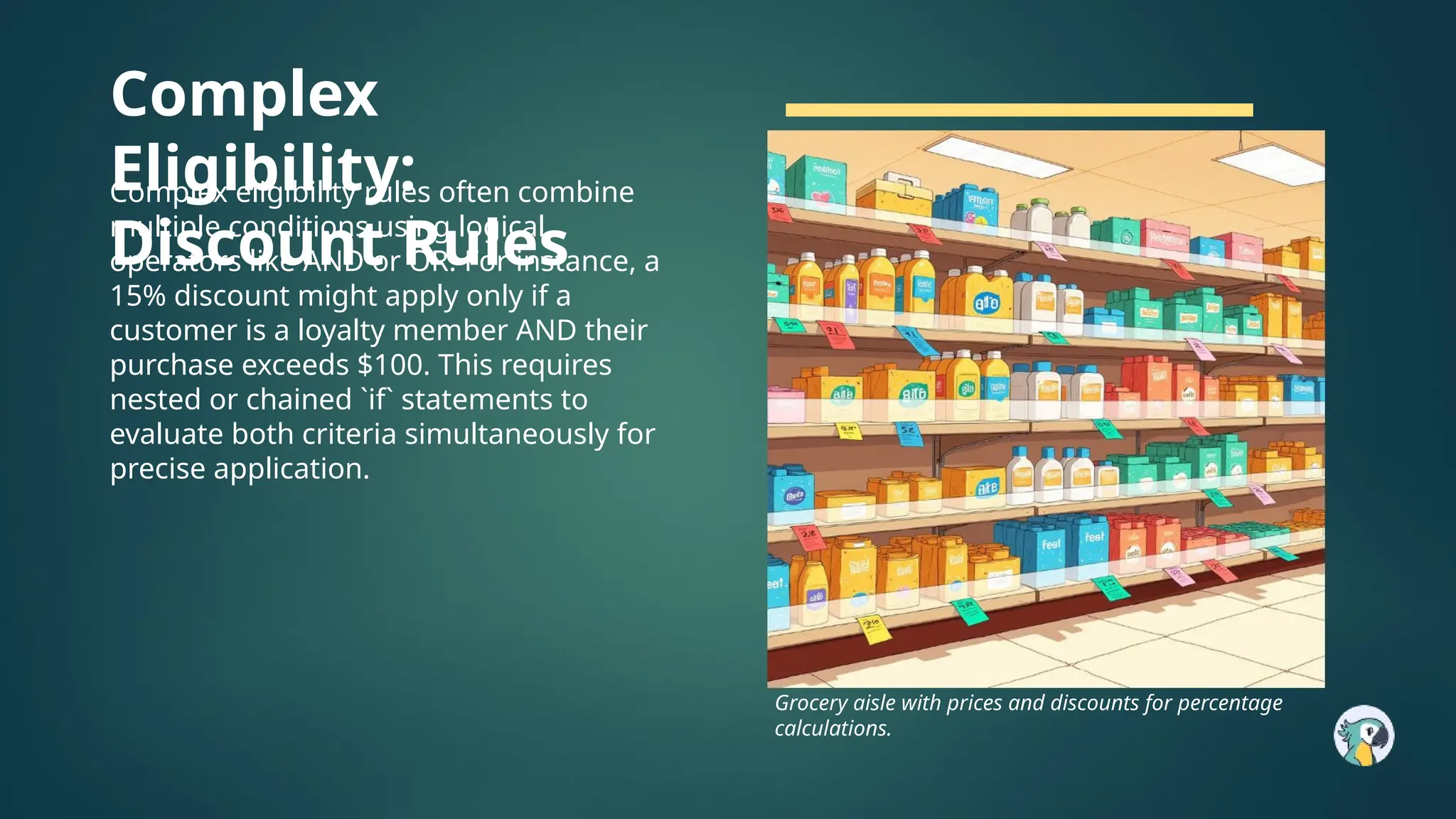
Complex eligibilityrules often combine
multiple conditions using logical
operators like AND or OR. For instance, a
15% discount might apply only if a
customer is a loyalty member AND their
purchase exceeds $100. This requires
nested or chained `if` statements to
evaluate both criteria simultaneously for
precise application.
Grocery aisle with prices and discounts for percentage
calculations.
25.
Nested Logic:
Game State
Management
Nested`if` statements are crucial for
managing complex game states, allowing
for nuanced character interactions. For
instance, a character might only use a
'healing potion' (`if has_potion`) if they are
also 'injured' (`if health < 50`). This
intricate decision-making process
enhances gameplay realism and player
engagement.
Role-playing game setup with character sheet and dice.
26.
Conditionals: Driving Real-World
Systems
Considersystems like traffic lights, financial algorithms, or medical
diagnostics. How would these function without conditional logic, and
what are the societal implications?
27.
Mastering
Programmatic
Control
If-conditional statements arethe bedrock
of algorithmic decision-making, enabling
programs to dynamically respond to
varying inputs and conditions. They
empower developers to craft intelligent
systems, from AI navigation in
autonomous vehicles to personalized user
experiences in web applications.
Mastering 'if' logic is crucial for building
robust, adaptable, and sophisticated
software solutions.
Visualizing combinatorial analysis complexity with
branching patterns.
28.
Conclusion
• Conditional statementsare critical for
dynamic, responsive software.
• They enable programs to make decisions
based on varying inputs.
• Understanding `if`, `elif`, `else`, and logical
operators is essential.
• Nesting and combining conditions allow for
complex, intelligent systems.
• Mastering 'if' logic is fundamental for robust
software development.