CHAPTER
Protocols and IEEE
Standards
Chapter Objectives
• Discuss different media level protocols
including their functioning
• The major protocols chosen for
discussion are as follows:
– CSMA/CD, token passing and polling
• Discuss the IEEE standards that apply
to LANs based on different protocols
Chapter Modules
• LAN Protocol: Carrier Sense Multiple
Access/Collision Detection
(CSMA/CD)
• LAN Protocol: Token Passing
• LAN Protocol: Polling
• IEEE Standards
END OF CHAPTER
INTRODUCTION
MODULE
IEEE and Lower Layer LAN
Protocols
IEEE Background
• Institution of Electrical and Electronic
Engineering (IEEE)
• A professional non-profit organization
• Project group 802 under IEEE
– Entrusted with the task of setting standards
relating to physical and logical links of nodes in a
network
• Standard mostly applies to the Physical and
Data Link layers
• Example
– IEEE 802.3 standard for the Ethernet bus network
The ISO-OSI Model Recalled
• Models the end-to-end communication
process
• It is a seven-layer model
• Proposed by International Standard
Organization (ISO)
• The model is known as Open Systems
Interconnect (OSI)
• IEEE sets the standards at the lower levels of
the ISO-OSI model
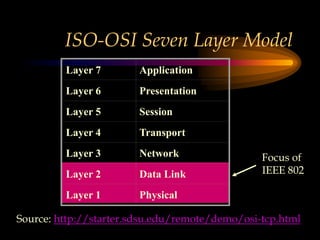
ISO-OSI Seven Layer Model
Layer 7 Application
Layer 6 Presentation
Layer 5 Session
Layer 4 Transport
Layer 3 Network
Layer 2 Data Link
Layer 1 Physical
Source: http://starter.sdsu.edu/remote/demo/osi-tcp.html
Focus of
IEEE 802
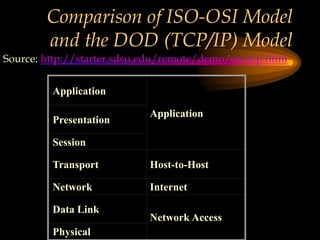
Comparison of ISO-OSI Model
and the DOD (TCP/IP) Model
Application
Application
Presentation
Session
Transport Host-to-Host
Network Internet
Data Link
Network Access
Physical
Source: http://starter.sdsu.edu/remote/demo/osi-tcp.html
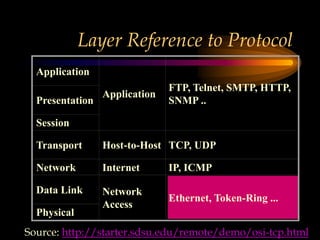
Layer Reference to Protocol
Application
Application
FTP, Telnet, SMTP, HTTP,
SNMP ..
Presentation
Session
Transport Host-to-Host TCP, UDP
Network Internet IP, ICMP
Data Link Network
Access
Ethernet, Token-Ring ...
Physical
Source: http://starter.sdsu.edu/remote/demo/osi-tcp.html
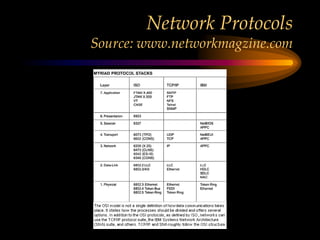
Network Protocols
Source: www.networkmagzine.com
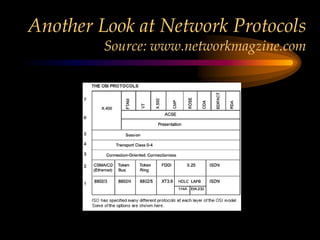
Another Look at Network Protocols
Source: www.networkmagzine.com
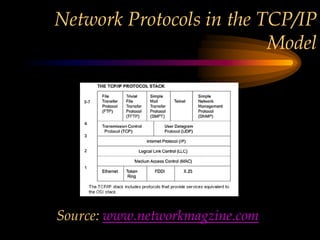
Network Protocols in the TCP/IP
Model
Source: www.networkmagzine.com
IEEE 802 Focus
• OSI Reference
– Data Link layer
– Physical layer
• Areas of applications
– Network cards and cables
– WAN connectivity etc.
• Different subgroups under 802 that
focus on different activities of the LAN
IEEE 802 Subgroups and their
Responsibilities
• 802.1
– Internetworking
• 802.2
– Logical Link Control (LLC)
• 802.3
– CSMA/CD
• 802.4
– Token Bus LAN
Continued
IEEE 802 Subgroups and their
Responsibilities (Cont.)
• 802.5
– Token Ring LAN
• 802.6
– Metropolitan Area Network
• 802.7
– Broadband Technical Advisory Group
• 802.8
– Fiber-Optic Technical Advisory Group
Continued
IEEE 802 Subgroups and their
Responsibilities (Cont.)
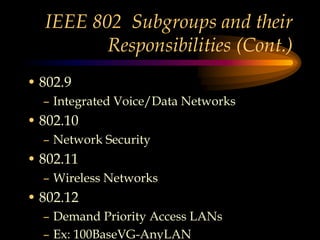
• 802.9
– Integrated Voice/Data Networks
• 802.10
– Network Security
• 802.11
– Wireless Networks
• 802.12
– Demand Priority Access LANs
– Ex: 100BaseVG-AnyLAN
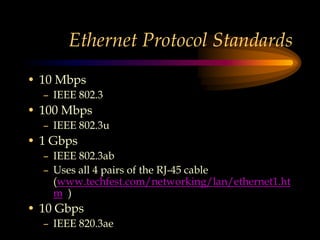
Ethernet Protocol Standards
• 10 Mbps
– IEEE 802.3
• 100 Mbps
– IEEE 802.3u
• 1 Gbps
– IEEE 802.3ab
– Uses all 4 pairs of the RJ-45 cable
(www.techfest.com/networking/lan/ethernet1.ht
m )
• 10 Gbps
– IEEE 820.3ae
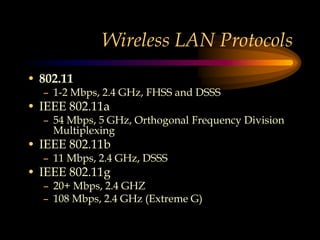
Wireless LAN Protocols
• 802.11
– 1-2 Mbps, 2.4 GHz, FHSS and DSSS
• IEEE 802.11a
– 54 Mbps, 5 GHz, Orthogonal Frequency Division
Multiplexing
• IEEE 802.11b
– 11 Mbps, 2.4 GHz, DSSS
• IEEE 802.11g
– 20+ Mbps, 2.4 GHZ
– 108 Mbps, 2.4 GHz (Extreme G)
Newer Wireless Protocol
• IEEE 802.11n
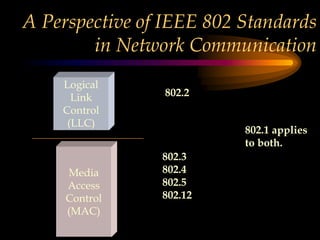
A Perspective of IEEE 802 Standards
in Network Communication
Logical
Link
Control
(LLC)
Media
Access
Control
(MAC)
802.2
802.3
802.4
802.5
802.12
802.1 applies
to both.
END OF MODULE
MODULE
LAN Lower Layer Protocol:
IEEE 802.3 Carrier Sense Multiple
Access/ Collision Detection
(CSMA/CD)
An Overview of CSMA/CD
• CSMA/CD has two components as
mentioned
• First is the Carrier Sense Multiple
Access (CSMA) component
• Second is the Collision Detection (CD)
component
CSMA Component of
CSMA/CD
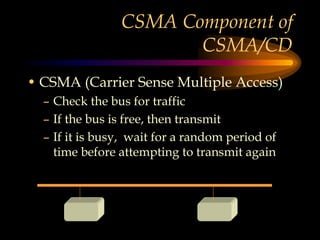
• CSMA (Carrier Sense Multiple Access)
– Check the bus for traffic
– If the bus is free, then transmit
– If it is busy, wait for a random period of
time before attempting to transmit again
CD Component of CSMA/CD
• Two stations may check the data bus
simultaneously
• Both may find the line free and engage in the
transmission of data
• Both transmission will collide
• CD component will detect this collision
– Inform the workstations of the collision
• Each station will wait for a random period of
time before attempting to transmit again
CSMA/CD Usage
• Used extensively in bus LANs
CSMA/CD Standards
• Highly standardized protocol
• Different protocol standards for
different speeds of communication
• 10 Mbps Ethernet standard
– IEEE 802.3
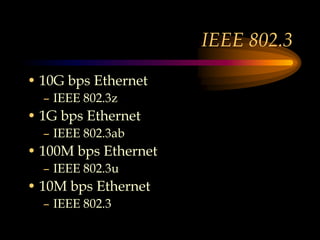
IEEE 802.3
• 10G bps Ethernet
– IEEE 802.3z
• 1G bps Ethernet
– IEEE 802.3ab
• 100M bps Ethernet
– IEEE 802.3u
• 10M bps Ethernet
– IEEE 802.3
END OF MODULE
MODULE
LAN Lower Layer Protocol:
IEEE 802.4 Token Bus Protocol
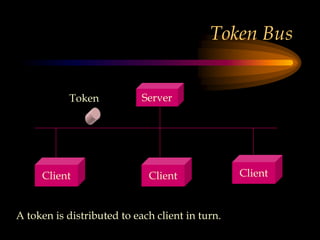
Token Bus
Server
Client Client Client
Token
A token is distributed to each client in turn.
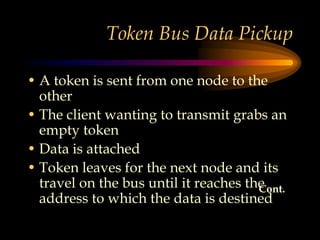
Token Bus Data Pickup
• A token is sent from one node to the
other
• The client wanting to transmit grabs an
empty token
• Data is attached
• Token leaves for the next node and its
travel on the bus until it reaches the
address to which the data is destined
Cont.
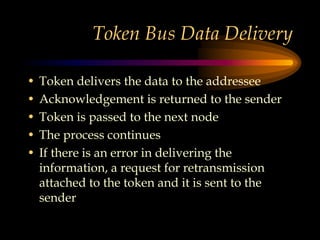
Token Bus Data Delivery
• Token delivers the data to the addressee
• Acknowledgement is returned to the sender
• Token is passed to the next node
• The process continues
• If there is an error in delivering the
information, a request for retransmission
attached to the token and it is sent to the
sender
Token Bus Standard and
Applications
• IEEE 802.4
• It can be used in both broadband and
baseband transmission
END OF MODULE
MODULE
LAN Lower Layer Protocol:
IEEE 802.5 Token Passing Protocol
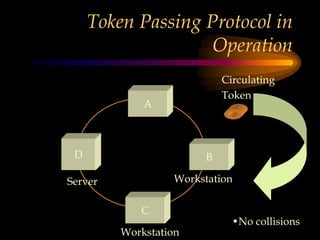
Token Passing Protocol in
Operation
D
A
B
C
Circulating
Token
Server Workstation
Workstation
•No collisions
Comparison with CSMA/CD
• Absence of collision
• Offers a systematic method of
transmitting information
• In theory, it is superior to CSMA/CD
• More sophisticated to implement
• Protocols used in the newer and most
popular networks are, however, based
on CSMA/CD
The Token
• Token
– Data packet that could carry data
– Circulates around the ring
– Offers an opportunity for each workstation
and server to transmit data
The Transmitting Workstation
• Waits for a free token in order to be able to
attach the data to be transmitted to the token
• On finding a free token, attach the following:
– Sender’s address
– Receiver’s address
– Data block to be transmitted
– Error checking details
– etc.
At the Receiving End
• Data is received and checked for errors
• Outcomes at the receiving end
– Data received without errors
– Date received with errors
Error-free Delivery of Data
• An acknowledgment is attached to the
token
• Acknowledgment is passed to the
sender
• Token is set free for other nodes to
transmit information
• At this time, the next workstation on
the ring will receive an opportunity
Correcting Errors in Delivery
• A request for retransmission is attached
to the token
• Token carries the message for
retransmission to the sender
• The data is thus retransmitted
Token Regeneration
• The token is regenerated at regular
intervals to sustain the timing of
circulation of the token
Usage of Token Passing
• Used extensively in ring LANs
– Especially in the IBM token-ring LAN
• A version of this protocol is also used
on certain types of bus LANs
– Token-bus networks
• Used in large fiber-optics backbones
– Used for the construction of very large
networks
Usage in Practice
• Used in backbones
• Uses in a number of IBM shops
• Overall, the usage of Ethernet surpasses
the usage of Token-Ring networks that
are based on the Token-Passing
protocol
Token Passing Standards
• IEEE 802.5
– For the token-ring LANs
• IEEE 802.4
– For the token-bus LANs
• A FDDI protocol is used on large fiber-
optic ring backbones
END OF MODULE
MODULE
WAN Protocol: Token Passing on
FDDI
ANSI X3T9.5 Protocol
• This wide are network protocol is
standardized by ANSI
• Works similar to Token Passing
Protocol
• Used in FDDI and CDDI backbone
networks
• Usually implemented in dual-ring
format for fault tolerance
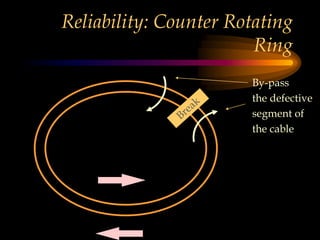
Reliability: Counter Rotating
Ring
By-pass
the defective
segment of
the cable
END OF MODULE
MODULE
LAN Lower Layer Protocol:
Polling
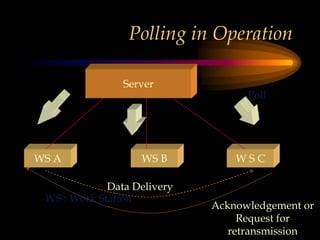
Polling in Operation
Server
WS A WS B W S C
WS : Work Station
Poll
Data Delivery
Acknowledgement or
Request for
retransmission
Polling and Delivery of Data
• Server polls each workstation
• A workstation responds by sending a
data packet
• Data packet is delivered to the address
found in the packet
At the Receiving End
• If there are no errors :
– Acknowledgment is returned to the sender
– The server then continues with the polling
process
• If there are errors:
– A request for retransmission is conveyed to
the sender
– The entire transmission process is then
repeated
The Usage of the Polling Protocol
• Mainly used in multi-user micro-
computer
– Based on the physical and logical star
topologies
• Example
– A multi-user microcomputer running the
Unix operating systems
Difficulties in Implementing
Polling in LANs
• It is difficult to implement the polling
protocols in large networks with
multiple segments
• Multiple servers in different segments
may have problems in polling all the
workstations
Polling Implementations
• True multi-user systems such as a Unix
based multi-user system
END OF MODULE
END OF MODULE
END OF CHAPTER

IEEE and Lower Level LAN Protocols.ppt

  • 1.
  • 2.
    Chapter Objectives • Discussdifferent media level protocols including their functioning • The major protocols chosen for discussion are as follows: – CSMA/CD, token passing and polling • Discuss the IEEE standards that apply to LANs based on different protocols
  • 3.
    Chapter Modules • LANProtocol: Carrier Sense Multiple Access/Collision Detection (CSMA/CD) • LAN Protocol: Token Passing • LAN Protocol: Polling • IEEE Standards
  • 4.
  • 5.
    MODULE IEEE and LowerLayer LAN Protocols
  • 6.
    IEEE Background • Institutionof Electrical and Electronic Engineering (IEEE) • A professional non-profit organization • Project group 802 under IEEE – Entrusted with the task of setting standards relating to physical and logical links of nodes in a network • Standard mostly applies to the Physical and Data Link layers • Example – IEEE 802.3 standard for the Ethernet bus network
  • 7.
    The ISO-OSI ModelRecalled • Models the end-to-end communication process • It is a seven-layer model • Proposed by International Standard Organization (ISO) • The model is known as Open Systems Interconnect (OSI) • IEEE sets the standards at the lower levels of the ISO-OSI model
  • 8.
    ISO-OSI Seven LayerModel Layer 7 Application Layer 6 Presentation Layer 5 Session Layer 4 Transport Layer 3 Network Layer 2 Data Link Layer 1 Physical Source: http://starter.sdsu.edu/remote/demo/osi-tcp.html Focus of IEEE 802
  • 9.
    Comparison of ISO-OSIModel and the DOD (TCP/IP) Model Application Application Presentation Session Transport Host-to-Host Network Internet Data Link Network Access Physical Source: http://starter.sdsu.edu/remote/demo/osi-tcp.html
  • 10.
    Layer Reference toProtocol Application Application FTP, Telnet, SMTP, HTTP, SNMP .. Presentation Session Transport Host-to-Host TCP, UDP Network Internet IP, ICMP Data Link Network Access Ethernet, Token-Ring ... Physical Source: http://starter.sdsu.edu/remote/demo/osi-tcp.html
  • 11.
  • 12.
    Another Look atNetwork Protocols Source: www.networkmagzine.com
  • 13.
    Network Protocols inthe TCP/IP Model Source: www.networkmagzine.com
  • 14.
    IEEE 802 Focus •OSI Reference – Data Link layer – Physical layer • Areas of applications – Network cards and cables – WAN connectivity etc. • Different subgroups under 802 that focus on different activities of the LAN
  • 15.
    IEEE 802 Subgroupsand their Responsibilities • 802.1 – Internetworking • 802.2 – Logical Link Control (LLC) • 802.3 – CSMA/CD • 802.4 – Token Bus LAN Continued
  • 16.
    IEEE 802 Subgroupsand their Responsibilities (Cont.) • 802.5 – Token Ring LAN • 802.6 – Metropolitan Area Network • 802.7 – Broadband Technical Advisory Group • 802.8 – Fiber-Optic Technical Advisory Group Continued
  • 17.
    IEEE 802 Subgroupsand their Responsibilities (Cont.) • 802.9 – Integrated Voice/Data Networks • 802.10 – Network Security • 802.11 – Wireless Networks • 802.12 – Demand Priority Access LANs – Ex: 100BaseVG-AnyLAN
  • 18.
    Ethernet Protocol Standards •10 Mbps – IEEE 802.3 • 100 Mbps – IEEE 802.3u • 1 Gbps – IEEE 802.3ab – Uses all 4 pairs of the RJ-45 cable (www.techfest.com/networking/lan/ethernet1.ht m ) • 10 Gbps – IEEE 820.3ae
  • 19.
    Wireless LAN Protocols •802.11 – 1-2 Mbps, 2.4 GHz, FHSS and DSSS • IEEE 802.11a – 54 Mbps, 5 GHz, Orthogonal Frequency Division Multiplexing • IEEE 802.11b – 11 Mbps, 2.4 GHz, DSSS • IEEE 802.11g – 20+ Mbps, 2.4 GHZ – 108 Mbps, 2.4 GHz (Extreme G)
  • 20.
  • 21.
    A Perspective ofIEEE 802 Standards in Network Communication Logical Link Control (LLC) Media Access Control (MAC) 802.2 802.3 802.4 802.5 802.12 802.1 applies to both.
  • 22.
  • 23.
    MODULE LAN Lower LayerProtocol: IEEE 802.3 Carrier Sense Multiple Access/ Collision Detection (CSMA/CD)
  • 24.
    An Overview ofCSMA/CD • CSMA/CD has two components as mentioned • First is the Carrier Sense Multiple Access (CSMA) component • Second is the Collision Detection (CD) component
  • 25.
    CSMA Component of CSMA/CD •CSMA (Carrier Sense Multiple Access) – Check the bus for traffic – If the bus is free, then transmit – If it is busy, wait for a random period of time before attempting to transmit again
  • 26.
    CD Component ofCSMA/CD • Two stations may check the data bus simultaneously • Both may find the line free and engage in the transmission of data • Both transmission will collide • CD component will detect this collision – Inform the workstations of the collision • Each station will wait for a random period of time before attempting to transmit again
  • 27.
    CSMA/CD Usage • Usedextensively in bus LANs
  • 28.
    CSMA/CD Standards • Highlystandardized protocol • Different protocol standards for different speeds of communication • 10 Mbps Ethernet standard – IEEE 802.3
  • 29.
    IEEE 802.3 • 10Gbps Ethernet – IEEE 802.3z • 1G bps Ethernet – IEEE 802.3ab • 100M bps Ethernet – IEEE 802.3u • 10M bps Ethernet – IEEE 802.3
  • 30.
  • 31.
    MODULE LAN Lower LayerProtocol: IEEE 802.4 Token Bus Protocol
  • 32.
    Token Bus Server Client ClientClient Token A token is distributed to each client in turn.
  • 33.
    Token Bus DataPickup • A token is sent from one node to the other • The client wanting to transmit grabs an empty token • Data is attached • Token leaves for the next node and its travel on the bus until it reaches the address to which the data is destined Cont.
  • 34.
    Token Bus DataDelivery • Token delivers the data to the addressee • Acknowledgement is returned to the sender • Token is passed to the next node • The process continues • If there is an error in delivering the information, a request for retransmission attached to the token and it is sent to the sender
  • 35.
    Token Bus Standardand Applications • IEEE 802.4 • It can be used in both broadband and baseband transmission
  • 36.
  • 37.
    MODULE LAN Lower LayerProtocol: IEEE 802.5 Token Passing Protocol
  • 38.
    Token Passing Protocolin Operation D A B C Circulating Token Server Workstation Workstation •No collisions
  • 39.
    Comparison with CSMA/CD •Absence of collision • Offers a systematic method of transmitting information • In theory, it is superior to CSMA/CD • More sophisticated to implement • Protocols used in the newer and most popular networks are, however, based on CSMA/CD
  • 40.
    The Token • Token –Data packet that could carry data – Circulates around the ring – Offers an opportunity for each workstation and server to transmit data
  • 41.
    The Transmitting Workstation •Waits for a free token in order to be able to attach the data to be transmitted to the token • On finding a free token, attach the following: – Sender’s address – Receiver’s address – Data block to be transmitted – Error checking details – etc.
  • 42.
    At the ReceivingEnd • Data is received and checked for errors • Outcomes at the receiving end – Data received without errors – Date received with errors
  • 43.
    Error-free Delivery ofData • An acknowledgment is attached to the token • Acknowledgment is passed to the sender • Token is set free for other nodes to transmit information • At this time, the next workstation on the ring will receive an opportunity
  • 44.
    Correcting Errors inDelivery • A request for retransmission is attached to the token • Token carries the message for retransmission to the sender • The data is thus retransmitted
  • 45.
    Token Regeneration • Thetoken is regenerated at regular intervals to sustain the timing of circulation of the token
  • 46.
    Usage of TokenPassing • Used extensively in ring LANs – Especially in the IBM token-ring LAN • A version of this protocol is also used on certain types of bus LANs – Token-bus networks • Used in large fiber-optics backbones – Used for the construction of very large networks
  • 47.
    Usage in Practice •Used in backbones • Uses in a number of IBM shops • Overall, the usage of Ethernet surpasses the usage of Token-Ring networks that are based on the Token-Passing protocol
  • 48.
    Token Passing Standards •IEEE 802.5 – For the token-ring LANs • IEEE 802.4 – For the token-bus LANs • A FDDI protocol is used on large fiber- optic ring backbones
  • 49.
  • 50.
  • 51.
    ANSI X3T9.5 Protocol •This wide are network protocol is standardized by ANSI • Works similar to Token Passing Protocol • Used in FDDI and CDDI backbone networks • Usually implemented in dual-ring format for fault tolerance
  • 52.
    Reliability: Counter Rotating Ring By-pass thedefective segment of the cable
  • 53.
  • 54.
    MODULE LAN Lower LayerProtocol: Polling
  • 55.
    Polling in Operation Server WSA WS B W S C WS : Work Station Poll Data Delivery Acknowledgement or Request for retransmission
  • 56.
    Polling and Deliveryof Data • Server polls each workstation • A workstation responds by sending a data packet • Data packet is delivered to the address found in the packet
  • 57.
    At the ReceivingEnd • If there are no errors : – Acknowledgment is returned to the sender – The server then continues with the polling process • If there are errors: – A request for retransmission is conveyed to the sender – The entire transmission process is then repeated
  • 58.
    The Usage ofthe Polling Protocol • Mainly used in multi-user micro- computer – Based on the physical and logical star topologies • Example – A multi-user microcomputer running the Unix operating systems
  • 59.
    Difficulties in Implementing Pollingin LANs • It is difficult to implement the polling protocols in large networks with multiple segments • Multiple servers in different segments may have problems in polling all the workstations
  • 60.
    Polling Implementations • Truemulti-user systems such as a Unix based multi-user system
  • 61.
  • 62.

Editor's Notes