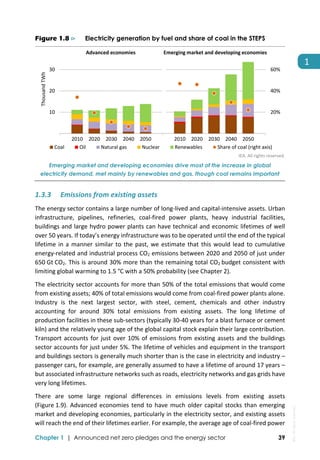
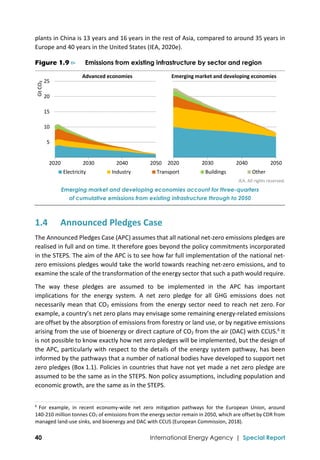
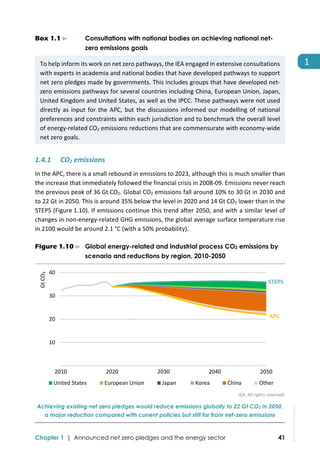
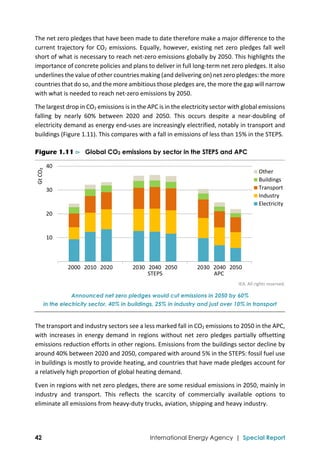
Net Zero
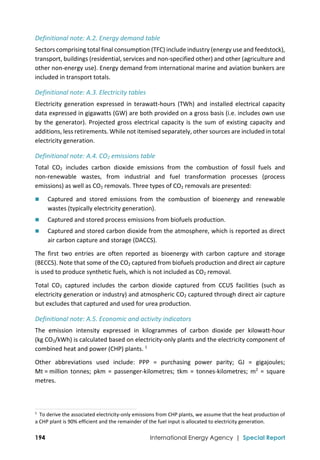
by 2050
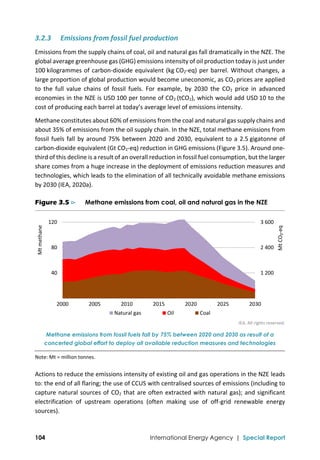
A Roadmap for the
Global Energy
Sector
Net Zero
by 2050
A Roadmap for the
Global Energy Sector
Net Zero by 2050 Interactive
iea.li/nzeroadmap
Net Zero by 2050 Data
iea.li/nzedata
The IEA examines the
full spectrum
of energy issues
including oil, gas and
coal supply and
demand, renewable
energy technologies,
electricity markets,
energy efficiency,
access to energy,
demand side
management and
much more. Through
its work, the IEA
advocates policies
that will enhance the
reliability, affordability
and sustainability of
energy in its
30 member
countries,
8 association
countries and
beyond.
Please note that this
publication is subject to
specific restrictions that limit
its use and distribution. The
terms and conditions are
available online at
www.iea.org/t&c/
This publication and any
map included herein are
without prejudice to the
status of or sovereignty over
any territory, to the
delimitation of international
frontiers and boundaries and
to the name of any territory,
city or area.
Source: IEA. All rights
reserved.
International Energy Agency
Website: www.iea.org
IEA member
countries:
Australia
Austria
Belgium
Canada
Czech Republic
Denmark
Estonia
Finland
France
Germany
Greece
Hungary
Ireland
Italy
Japan
Korea
Luxembourg
Mexico
Netherlands
New Zealand
Norway
Poland
Portugal
Slovak Republic
Spain
Sweden
Switzerland
Turkey
United Kingdom
United States
The European
Commission also
participates in the
work of the IEA
IEA association
countries:
Brazil
China
India
Indonesia
Morocco
Singapore
South Africa
Thailand
INTERNATIONAL ENERGY
AGENCY
 
Foreword 3
Foreword 
We are approaching a decisive moment for international efforts to tackle the climate crisis – 
a great challenge of our times. The number of countries that have pledged to reach net‐zero 
emissions by mid‐century or soon after continues to grow, but so do global greenhouse gas 
emissions. This gap between rhetoric and action needs to close if we are to have a fighting 
chance of reaching net zero by 2050 and limiting the rise in global temperatures to 1.5 °C.  
Doing so requires nothing short of a total transformation of the energy systems that underpin 
our economies. We are in a critical year at the start of a critical decade for these efforts. The 
26th Conference of the Parties (COP26) of the United Nations Framework Convention on 
Climate Change in November is the focal point for strengthening global ambitions and action 
on climate by building on the foundations of the 2015 Paris Agreement. The International 
Energy  Agency  (IEA)  has  been  working  hard  to  support  the  UK  government’s  COP26 
Presidency to help make it the success the world needs. I was delighted to co‐host the IEA‐
COP26 Net Zero Summit with COP26 President Alok Sharma in March, where top energy and 
climate leaders from more than 40 countries highlighted the global momentum behind clean 
energy transitions. 
The discussions at that event fed into this special report, notably through the Seven Key 
Principles for Implementing Net Zero that the IEA presented at the Summit, which have been 
backed by 22 of our member governments to date. This report maps out how the global 
energy sector can reach net zero by 2050. I believe the report – Net Zero by 2050: A roadmap 
for the global energy system – is one of the most important and challenging undertakings in 
the IEA’s history. The Roadmap is the culmination of the IEA’s pioneering work on energy 
data modelling, combining for the first time the complex models of our two flagship series, 
the World Energy Outlook and Energy Technology Perspectives. It will guide the IEA’s work 
and will be an integral part of both those series going forward. 
Despite the current gap between rhetoric and reality on emissions, our Roadmap shows that 
there are still pathways to reach net zero by 2050. The one on which we focus is – in our 
analysis – the most technically feasible, cost‐effective and socially acceptable. Even so, that 
pathway  remains  narrow  and  extremely  challenging,  requiring  all  stakeholders  – 
governments, businesses, investors and citizens – to take action this year and every year 
after so that the goal does not slip out of reach. 
This  report  sets  out  clear  milestones  –  more  than  400  in  total,  spanning  all  sectors  and 
technologies – for what needs to happen, and when, to transform the global economy from 
one dominated by fossil fuels into one powered predominantly by renewable energy like 
solar and wind. Our pathway requires vast amounts of investment, innovation, skilful policy 
design and implementation, technology deployment, infrastructure building, international 
co‐operation and efforts across many other areas. 
Since the IEA’s founding in 1974, one of its core missions has been to promote secure and 
affordable energy supplies to foster economic growth. This has remained a key concern of 
our Roadmap, drawing on special analysis carried out with the International Monetary Fund 
and the International Institute for Applied Systems Analysis. It shows that the enormous 
IEA.
All
rights
reserved.
 
4 International Energy Agency | Special Report
challenge of transforming our energy systems is also a huge opportunity for our economies, 
with the potential to create millions of new jobs and boost economic growth.  
Another guiding principle of the Roadmap is that clean energy transitions must be fair and 
inclusive, leaving nobody behind. We have to ensure that developing economies receive the 
financing and technological know‐how they need to continue building their energy systems 
to meet the needs of their expanding populations and economies in a sustainable way. It is 
a moral imperative to bring electricity to the hundreds of millions of people who currently 
are deprived of access to it, the majority in of them in Africa.  
The transition to net zero is for and about people. It is paramount to remain aware that not 
every worker in the fossil fuel industry can ease into a clean energy job, so governments  
need to promote training and devote resources to facilitating new opportunities. Citizens 
must be active participants in the entire process, making them feel part of the transition and 
not  simply  subject  to  it.  These  themes  are  among  those  being  explored  by  the  Global 
Commission on People‐Centred Clean Energy Transitions, which I convened at the start of 
2021  to  examine  how  to  enable  citizens  to  benefit  from  the  opportunities  and  navigate  
the  disruptions  of  the  shift  to  a  clean  energy  economy.  Headed  by  Prime  Minister 
Mette Frederiksen  of  Denmark  and  composed  of  government  leaders,  ministers  and 
prominent thinkers, the Global Commission will make public its key recommendations ahead 
of COP26 in November. 
The pathway laid out in our Roadmap is global in scope, but each country will need to design 
its own strategy, taking into account its specific circumstances. There is no one‐size‐fits‐all 
approach  to  clean  energy  transitions.  Plans  need  to  reflect  countries’  differing  stages  of 
economic  development:  in  our  pathway,  advanced  economies  reach  net  zero  before 
developing economies do. As the world’s leading energy authority, the IEA stands ready to 
provide  governments  with  support  and  advice  as  they  design  and  implement  their  own 
roadmaps, and to encourage the international co‐operation across sectors that is so essential 
to reaching net zero by 2050. 
This landmark report would not have been possible without the extraordinary dedication of 
the IEA colleagues who have worked so tirelessly and rigorously on it. I would like to thank 
the  entire  team  under  the  outstanding  leadership  of  my  colleagues  Laura Cozzi  and 
Timur Gül. 
The  world  has  a  huge  challenge  ahead  of  it  to  move  net  zero  by  2050  from  a  narrow 
possibility  to  a  practical  reality.  Global  carbon  dioxide  emissions  are  already  rebounding 
sharply as economies recover from last year’s pandemic‐induced shock. It is past time for 
governments to act, and act decisively to accelerate the clean energy transformation.  
As this report shows, we at the IEA are fully committed to leading those efforts. 
Dr Fatih Birol 
Executive Director 
International Energy Agency 
 
Acknowledgements 5
Acknowledgements 
This study, a cross‐agency effort, was prepared by the World Energy Outlook team and the 
Energy Technology Perspectives team. The study was designed and directed by Laura Cozzi, 
Chief Energy Modeller and Head of Division for Energy Demand Outlook, and Timur Gül, 
Head of Division for Energy Technology Policy. 
The  lead  authors  and  co‐ordinators  were:  Stéphanie Bouckaert,  Araceli Fernandez Pales, 
Christophe McGlade,  Uwe Remme  and  Brent Wanner.  Laszlo Varro,  Chief  Economist, 
Davide D’Ambrosio and Thomas Spencer were also part of the core team.  
The  other  main  authors  were:  Thibaut Abergel  (buildings),  Yasmine Arsalane  (economic 
outlook, electricity), Praveen Bains (biofuels), Jose Miguel Bermudez Menendez (hydrogen), 
Elizabeth Connelly  (transport),  Daniel Crow  (behaviour),  Amrita Dasgupta  (innovation), 
Chiara Delmastro  (buildings),  Timothy Goodson  (buildings,  bioenergy),  Alexandre Gouy 
(industry),  Paul Hugues  (industry),  Lilly Lee  (transport),  Peter Levi  (industry),  
Hana Mandova  (industry),  Ariane Millot  (buildings),  Paweł Olejarnik  (fossil  fuel  supply), 
Leonardo Paoli  (innovation,  transport),  Faidon Papadimoulis  (data  management), 
Sebastian Papapanagiotou  (electricity  networks),  Francesco Pavan  (hydrogen), 
Apostolos Petropoulos  (transport),  Ryszard Pośpiech  (data  management),  Leonie Staas 
(behaviour, industry), Jacopo Tattini (transport), Jacob Teter (transport), Gianluca Tonolo 
(energy access), Tiffany Vass (industry) and Daniel Wetzel (jobs). 
Other  contributors  were:  Lucila  Arboleya  Sarazola,  Simon  Bennett,  Cyril  Cassisa,  Arthur 
Contejean,  Musa  Erdogan,  Enrique  Gutierrez  Tavarez,  Taku  Hasegawa,  Shai  Hassid,  Zoe 
Hungerford,  Tae‐Yoon  Kim,  Vanessa  Koh,  Luca  Lo  Re,  Christopher  Lowans,  Raimund 
Malischek, Mariachiara Polisena and Per Anders Widell. 
Caroline Abettan, Teresa Coon, Marina Dos Santos, Marie Fournier‐S’niehotta, Reka Koczka 
and Diana Louis provided essential support. 
Edmund Hosker carried editorial responsibility and Debra Justus was the copy‐editor.  
The  International  Monetary  Fund  (IMF),  in  particular  Benjamin Hunt,  Florence Jaumotte, 
Jared Thomas Bebee  and  Susanna Mursula,  partnered  with  the  IEA  to  provide  the 
macroeconomic analysis. The International Institute for Applied Systems Analysis (IIASA), in 
particular Peter Rafaj, Gregor Kiesewetter, Wolfgang Schöpp, Chris Heyes, Zbigniew Klimont, 
Pallav Purohit, Laura Warnecke, Binh Nguyen, Nicklas Forsell, Stefan Frank, Petr Havlik and 
Mykola Gusti,  partnered  with  the  IEA  to  provide  analysis  and  related  indicators  on  air 
pollution and greenhouse gas emissions from land use. 
Valuable  comments  and  feedback  were  provided  by  other  senior  management  and 
numerous  other  colleagues  within  the  International  Energy  Agency.  In  particular 
Keisuke Sadamori,  Mechthild Wörsdörfer,  Amos Bromhead,  Dan Dorner,  Nick Johnstone, 
Pascal Laffont,  Toril Bosoni,  Peter Fraser,  Paolo Frankl,  Tim Gould,  Tom Howes, 
Brian Motherway,  Aad  van  Bohemen,  César  Alejandro  Hernández,  Samantha  McCulloch, 
Sara Moarif,  Heymi Bahar,  Adam Baylin‐Stern,  Niels Berghout,  Sara Budinis, 
Jean‐Baptiste Dubreuil, Carlos Fernández Alvarez, Ilkka Hannula , Jeremy Moorhouse and 
Stefan Lorenczik. 
IEA.
All
rights
reserved.
 
6 International Energy Agency | Special Report
Valuable input to the analysis was provided by: Trevor Morgan (independent consultant) and 
David Wilkinson (independent consultant).  
Thanks go to the IEA Communications and Digital Office (CDO), particularly to Jad Mouawad, 
Head of CDO, and to Astrid Dumond, Jon Custer, Tanya Dyhin, Merve Erdil, Grace Gordon, 
Christopher Gully, Jethro Mullen, Julie Puech, Rob Stone, Gregory Viscusi, Therese Walsh and 
Wonjik Yang for their help in producing and promoting the report and website materials.  
Finally, thanks to Ivo Letra of the IEA Information Systems Unit for his essential support in 
the production process, and to the IEA’s Office of Legal Counsel, Office of Management and 
Administration, and Energy Data Centre for the assistance each provided throughout the 
preparation of this report.   
Peer reviewers 
Many senior government officials and international experts provided input and reviewed 
preliminary drafts of the report. Their comments and suggestions were of great value. They 
include: 
Aimee Aguilar Jaber  Organisation for Economic Co‐operation and Development (OECD) 
Keigo Akimoto  Research Institute of Innovative Technology for the Earth, Japan 
Doug Arent  National Renewable Energy Laboratory (NREL), United States 
Daniel Balog  Permanent Delegation of Hungary to the OECD 
Georg Bäuml  Volkswagen 
Harmeet Bawa  Hitachi ABB Power Grids 
Pete Betts  Grantham Research Institute on Climate Change and the 
Environment, United Kingdom 
Sama Bilbao y Leon  World Nuclear Association 
Diane Cameron  Nuclear Energy Agency 
Rebecca Collyer  European Climate Foundation 
Russell Conklin  US Department of Energy 
François Dassa  EDF 
Jelte de Jong  Ministry of Economic Affairs and Climate Policy, The Netherlands 
Carl de Maré  ArcelorMittal 
Guillaume De Smedt  Air Liquide 
Agustin Delgado  Iberdrola 
Johanna Fiksdahl  Permanent Delegation of Norway to the OECD 
Alan Finkel  Special Advisor to the Australian Government on Low Emissions 
Technology 
Niklas Forsell  International Institute for Applied Systems Analysis (IIASA) 
James Foster  UK Department for Business, Energy and Industrial Strategy 
Hiroyuki Fukui  Toyota 
Rosanna Fusco  Eni 
Li Gao  Ministry of Ecology and Environment of the People’s Republic of 
China 
 
Acknowledgements 7
François Gautier  Permanent Delegation of France to the OECD 
Oliver Geden  German Institute for International and Security Affairs 
Dolf Gielen  International Renewable Energy Agency (IRENA) 
Francesca Gostinelli  Enel 
Jae H. Jung  Ministry of Foreign Affairs, Republic of Korea 
Michael Hackethal  Ministry for Economic Affairs and Industry, Germany   
Peter Wood  Shell 
Selwin Hart  United Nations  
David Hawkings  Natural Resources Defense Council 
Jacob Herbers  US Department of Energy 
Takashi Hongo  Mitsui & Co. Global Strategic Studies Institute, Japan 
Christina Hood  Compass Climate, New Zealand 
Michael Kelly  World LPG Association 
Sir David King  Cambridge University 
Ken Koyama  The Institute of Energy Economics, Japan 
Fabien Kreuzer  DG Energy, European Commission 
Joyce Lee  Global Wind Energy Council (GWEC) 
Chen Linhao  Ministry of Science and Technology of the People’s Republic of 
China 
Todd Litman  Victoria Transport Policy Institute, Canada 
Claude Lorea  Global Cement and Concrete Association 
Ritu Mathur  The Energy and Resources Institute (TERI) 
Vincent Minier  Schneider Electric 
Steve Nadel  American Council for an Energy‐Efficient Economy 
Stefan Nowak  Technology Collaboration Programme on Photovoltaic Power 
Systems (PVPS TCP) 
Brian Ó Gallachóir  MaREI, SFI Research Centre for Energy, Climate and Marine, 
University College Cork 
Henri Paillère  International Atomic Energy Agency (IAEA) 
Yongduk Pak  Korea Energy Economics Institute (KEEI) 
Alessandra Pastorelli  Permanent Delegation of Italy to the OECD 
Jonathan Pershing  US State Department 
Glen Peters  Centre for International Climate and Environmental Research 
(CICERO) 
Stephanie Pfeifer  Institutional Investors Group on Climate Change (IIGCC) 
Cédric Philibert  Independent consultant 
Lynn Price  Lawrence Berkeley National Laboratory, United States 
Andrew Purvis  World Steel 
Julia Reinaud  Breakthrough Energy 
Yamina Saheb  OpenEXP 
Ignacio Santelices  Sustainable Energy Agency, Chile  
Andreas Schäfer  University College London 
Vivian Scott  The University of Edinburgh 
8 International Energy Agency | Special Report
Simon Sharpe  Cabinet Office, United Kingdom 
Adnan Shihab Eldin  Formerly Kuwait Foundation for the Advancement of Sciences 
Toshiyuki Shirai  Ministry of Economy, Trade and Industry, Japan 
Adam Sieminski  KAPSARC 
Stephan Singer  Climate Action Network 
Varun Sivaram  US State Department 
Jim Skea  Imperial College London 
Jeff Stehm  Task Force on Climate‐Related Financial Disclosures 
Jonathan Stern  Oxford Institute for Energy Studies 
Wim Thomas  Independent consultant 
David Turk  US Department of Energy 
Fritjof Unander  Research Council of Norway 
Rob van der Meer  The European Cement Association (CEMBUREAU) 
Noé van Hulst  International Partnership for Hydrogen and Fuel Cells in the 
Economy 
Tom van Ierland  DG for Climate Action, European Commission 
David Victor  University of California, San Diego 
Amanda Wilson  Natural Resources Canada 
Harald Winkler  University of Cape Town 
Markus Wolf  Electric Power Research Institute (EPRI), United States 
Markus Wråke  Swedish Energy Research Centre 
William Zimmern  BP 
The individuals and organisations that contributed to this study are not responsible for any 
opinions or judgments it contains. All errors and omissions are solely the responsibility of the 
IEA. 
This  document  and  any  map  included  herein  are  without  prejudice  to  the  status  of  or 
sovereignty over any territory, to the delimitation of international frontiers and boundaries 
and to the name of any territory, city or area. 
Comments and questions are welcome and should be addressed to: 
Laura Cozzi and Timur Gül 
Directorate of Sustainability, Technology and Outlooks 
International Energy Agency 
9, rue de la Fédération 
75739 Paris Cedex 15 
France 
E‐mail: IEANZE2050@iea.org 
Web: www.iea.org 
 
Table of Contents 9
Table of Contents 
 
Foreword........................................................................................................................... 3 
Acknowledgements ........................................................................................................... 5 
Executive summary ......................................................................................................... 13 
Announced net zero pledges and the energy sector  29 
1.1  Introduction 
................................................................................................... 30 
1.2  Emissions reduction targets and net zero pledges ........................................ 31 
1.2.1  Nationally Determined Contributions ............................................... 31 
1.2.2  Net‐zero emissions pledges ............................................................... 32 
1.3  Outlook for emissions and energy in the STEPS ............................................ 36 
1.3.1  CO2 emissions .................................................................................... 36 
1.3.2  Total energy supply, total final consumption and  electricity 
generation ......................................................................................... 37 
1.3.3  Emissions from existing assets .......................................................... 39 
1.4  Announced Pledges Case 
............................................................................... 40 
1.4.1  CO2 emissions .................................................................................... 41 
1.4.2  Total energy supply ........................................................................... 43 
1.4.3  Total final consumption ..................................................................... 44 
1.4.4  Electricity generation 
......................................................................... 45 
A global pathway to net‐zero CO₂ emissions in 2050  47 
2.1  Introduction 
................................................................................................... 48 
2.2  Scenario design 
.............................................................................................. 48 
2.2.1  Population and GDP 
........................................................................... 50 
2.2.2  Energy and CO2 prices 
........................................................................ 51 
2.3  CO2 emissions ................................................................................................ 53 
2.4  Total energy supply and total final consumption .......................................... 56 
2.4.1  Total energy supply ........................................................................... 56 
2.4.2  Total final consumption ..................................................................... 60 
2.5  Key pillars of decarbonisation ....................................................................... 64 
2.5.1  Energy efficiency 
................................................................................ 65 
2.5.2  Behavioural change ........................................................................... 67 
2.5.3  Electrification ..................................................................................... 70 
1 
2 
IEA.
All
rights
reserved.
 
10 International Energy Agency | Special Report
2.5.4  Renewables ....................................................................................... 73 
2.5.5  Hydrogen and hydrogen‐based fuels 
................................................. 75 
2.5.6  Bioenergy ........................................................................................... 77 
2.5.7  Carbon capture, utilisation and storage ............................................ 79 
2.6  Investment .................................................................................................... 81 
2.7  Key uncertainties ........................................................................................... 83 
2.7.1  Behavioural change ........................................................................... 84 
2.7.2  Bioenergy and land‐use change 
......................................................... 90 
2.7.3  CCUS applied to emissions from fossil fuels ...................................... 94 
Sectoral pathways to net‐zero emissions by 2050  99 
3.1  Introduction 
................................................................................................. 100 
3.2  Fossil fuel supply ......................................................................................... 100 
3.2.1  Energy trends in the Net‐Zero Emissions Scenario .......................... 100 
3.2.2  Investment in oil and gas ................................................................. 103 
3.2.3  Emissions from fossil fuel production 
.............................................. 104 
3.3  Low‐emissions fuel supply ........................................................................... 105 
3.3.1  Energy trends in the Net‐Zero Emissions Scenario .......................... 105 
3.3.2  Biofuels ............................................................................................ 106 
3.3.3  Hydrogen and hydrogen‐based fuels 
............................................... 108 
3.3.4  Key milestones and decision points 
................................................. 111 
3.4  Electricity sector .......................................................................................... 113 
3.4.1  Energy and emissions trends in the Net‐Zero Emissions Scenario .. 113 
3.4.2  Key milestones and decision points 
................................................. 117 
3.5  Industry ....................................................................................................... 121 
3.5.1  Energy and emission trends in the Net‐Zero Emissions Scenario .... 121 
3.5.2  Key milestones and decision points 
................................................. 129 
3.6  Transport ..................................................................................................... 131 
3.6.1  Energy and emission trends in the Net‐Zero Emissions Scenario .... 131 
3.6.2  Key milestones and decision points 
................................................. 138 
3.7  Buildings ...................................................................................................... 141 
3.7.1  Energy and emission trends in the Net‐Zero Emissions Scenario .... 141 
3.7.2  Key milestones and decision points 
................................................. 147 
3 
 
Table of Contents 11
Wider implications of achieving net‐zero emissions  151 
4.1  Introduction 
................................................................................................. 152 
4.2  Economy ...................................................................................................... 153 
4.2.1  Investment and financing ................................................................ 153 
4.2.2  Economic activity ............................................................................. 155 
4.2.3  Employment .................................................................................... 157 
4.3  Energy industry 
............................................................................................ 160 
4.3.1  Oil and gas ....................................................................................... 160 
4.3.2  Coal .................................................................................................. 162 
4.3.3  Electricity ......................................................................................... 163 
4.3.4  Energy‐consuming industries .......................................................... 165 
4.4  Citizens ........................................................................................................ 167 
4.4.1  Energy‐related Sustainable Development Goals ............................. 167 
4.4.2  Affordability ..................................................................................... 170 
4.4.3  Behavioural changes ........................................................................ 173 
4.5  Governments ............................................................................................... 175 
4.5.1  Energy security ................................................................................ 175 
4.5.2  Infrastructure 
................................................................................... 180 
4.5.3  Tax revenues from retail energy sales ............................................. 183 
4.5.4  Innovation 
........................................................................................ 184 
4.5.5  International co‐operation .............................................................. 187 
 
Annexes  191 
Annex A. Tables for scenario projections ....................................................................... 193 
Annex B. Technology costs ............................................................................................ 201 
Annex C. Definitions ...................................................................................................... 203 
Annex D. References ..................................................................................................... 217 
4 
IEA.
All
rights
reserved.
 
Summary for policy makers 13
Summary for policy makers 
The energy sector is the source of around three‐quarters of greenhouse gas emissions 
today  and  holds  the  key  to  averting  the  worst  effects  of  climate  change,  perhaps  the 
greatest challenge humankind has faced. Reducing global carbon dioxide (CO2) emissions to 
net zero by 2050 is consistent with efforts to limit the long‐term increase in average global 
temperatures to 1.5 °C. This calls for nothing less than a complete transformation of how we 
produce, transport and consume energy. The growing political consensus on reaching net 
zero is cause for considerable optimism about the progress the world can make, but the 
changes required to reach net‐zero emissions globally by 2050 are poorly understood. A huge 
amount of work is needed to turn today’s impressive ambitions into reality, especially given 
the range of different situations among countries and their differing capacities to make the 
necessary changes. This special IEA report sets out a pathway for achieving this goal, resulting 
in a clean and resilient energy system that would bring major benefits for human prosperity 
and well‐being. 
The  global  pathway  to  net‐zero  emissions  by  2050  detailed  in  this  report  requires  all 
governments to significantly strengthen and then successfully implement their energy and 
climate  policies.  Commitments  made  to  date  fall  far  short  of  what  is  required  by  that 
pathway. The number  of countries that have pledged to achieve net‐zero emissions has 
grown rapidly over the last year and now covers around 70% of global emissions of CO2. This 
is a huge step forward. However, most pledges are not yet underpinned by near‐term policies 
and measures. Moreover, even if successfully fulfilled, the pledges to date would still leave 
around 22 billion tonnes of CO2 emissions worldwide in 2050. The continuation of that trend 
would be consistent with a temperature rise in 2100 of around 2.1 °C. Global emissions fell 
in 2020 because of the Covid‐19 crisis but are already rebounding strongly as economies 
recover. Further delay in acting to reverse that trend will put net zero by 2050 out of reach. 
In this Summary for Policy Makers, we outline the essential conditions for the global energy 
sector to reach net‐zero CO2 emissions by 2050. The pathway described in depth in this 
report achieves this objective with no offsets from outside the energy sector, and with low 
reliance on negative emissions technologies. It is designed to maximise technical feasibility, 
cost‐effectiveness and social acceptance while ensuring continued economic growth and 
secure energy supplies. We highlight the priority actions that are needed today to ensure the 
opportunity of net zero by 2050 – narrow but still achievable – is not lost. The report provides 
a  global  view,  but  countries  do  not  start  in  the  same  place  or  finish  at  the  same  time: 
advanced  economies  have  to  reach  net  zero  before  emerging  markets  and  developing 
economies, and assist others in getting there. We also recognise that the route mapped out 
here is a path, not necessarily the path, and so we examine some key uncertainties, notably 
concerning the roles played by bioenergy, carbon capture and behavioural changes. Getting 
to net zero will involve countless decisions by people across the world, but our primary aim 
is to inform the decisions made by policy makers, who have the greatest scope to move the 
world closer to its climate goals. 
 
IEA.
All
rights
reserved.
 
14 International Energy Agency | Special Report
Net zero by 2050 hinges on an unprecedented clean technology push to 2030 
The path to net‐zero emissions is narrow: staying on it requires immediate and massive 
deployment  of  all  available  clean  and  efficient  energy  technologies.  In  the  net‐zero 
emissions pathway presented in this report, the world economy in 2030 is some 40% larger 
than today but uses 7% less energy. A major worldwide push to increase energy efficiency is 
an  essential  part  of  these  efforts,  resulting  in  the  annual  rate  of  energy  intensity 
improvements averaging 4% to 2030 – about three‐times the average rate achieved over the 
last two decades. Emissions reductions from the energy sector are not limited to CO2: in our 
pathway, methane emissions from fossil fuel supply fall by 75% over the next ten years as a 
result  of  a  global,  concerted  effort  to  deploy  all  available  abatement  measures  and 
technologies. 
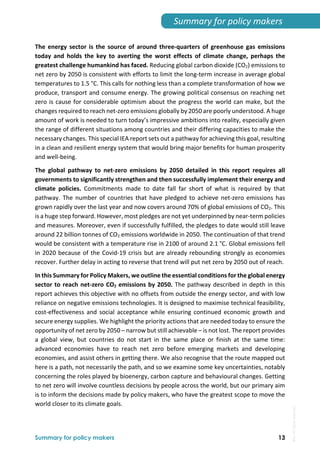
Ever‐cheaper renewable energy technologies give electricity the edge in the race to zero. 
Our pathway calls for scaling up solar and wind rapidly this decade, reaching annual additions 
of 630 gigawatts (GW) of solar photovoltaics (PV) and 390 GW of wind by 2030, four‐times 
the record levels set in 2020. For solar PV, this is equivalent to installing the world’s current 
largest solar park roughly every day. Hydropower and nuclear, the two largest sources of 
low‐carbon  electricity  today,  provide  an  essential  foundation  for  transitions.  As  the 
electricity sector becomes cleaner, electrification emerges as a crucial economy‐wide tool 
for reducing emissions. Electric vehicles (EVs) go from around 5% of global car sales to more 
than 60% by 2030. 
Make the 2020s the decade of massive clean energy expansion
All the technologies needed to achieve the necessary deep cuts in global emissions by 
2030 already exist, and the policies that can drive their deployment are already proven. 
As  the  world  continues  to  grapple  with  the  impacts  of  the  Covid‐19  pandemic,  it  is 
essential  that  the  resulting  wave  of  investment  and  spending  to  support  economic 
recovery is aligned with the net zero pathway. Policies should be strengthened to speed 
the deployment of clean and efficient energy technologies. Mandates and standards are 
vital  to  drive  consumer  spending  and  industry  investment  into  the  most  efficient 
technologies. Targets and competitive auctions can enable wind and solar to accelerate 
the electricity sector transition. Fossil fuel subsidy phase‐outs, carbon pricing and other 
market reforms can ensure appropriate price signals. Policies should limit or provide 
disincentives for the use of certain fuels and technologies, such as unabated coal‐fired 
power  stations,  gas  boilers  and  conventional  internal  combustion  engine  vehicles. 
Governments  must  lead  the  planning  and  incentivising  of  the  massive  infrastructure 
investment, including in smart transmission and distribution grids. 
P R I O R I T Y   A C T I O N
 
Summary for policy makers 15
Key clean technologies ramp up by 2030 in the net zero pathway
Note: MJ = megajoules; GDP = gross domestic product in purchasing power parity. 
Net zero by 2050 requires huge leaps in clean energy innovation 
Reaching net zero by 2050 requires further rapid deployment of available technologies as 
well as widespread use of technologies that are not on the market yet. Major innovation 
efforts must occur over this decade in order to bring these new technologies to market in 
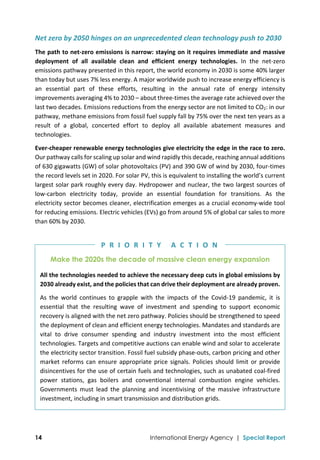
time. Most of the global reductions in CO2 emissions through 2030 in our pathway come from 
technologies  readily  available  today.  But  in  2050,  almost  half  the  reductions  come  from 
technologies that are currently at the demonstration or prototype phase. In heavy industry 
and long‐distance transport, the share of emissions reductions from technologies that are 
still under development today is even higher. 
The biggest innovation opportunities concern advanced batteries, hydrogen electrolysers, 
and  direct  air  capture  and  storage.  Together,  these  three  technology  areas  make  vital 
contributions  the  reductions  in  CO2  emissions  between  2030  and  2050  in  our  pathway. 
Innovation over the next ten years – not only through research and development (R&D) and 
demonstration but also through deployment – needs to be accompanied by the large‐scale 
construction of the infrastructure the technologies will need. This includes new pipelines to 
transport captured CO2 emissions and systems to move hydrogen around and between ports 
and industrial zones. 
 
 10
 20
 30
 40
 50
 60
2020 2030
x 18
 200
 400
 600
 800
1 000
1 200
2020 2030
x 4
Solar PV
Wind
Capacity additions
(GW)
Electric car sales
(millions)
Energy intensity of GDP
(MJ per USD ppp)
 1
 2
 3
 4
 5
2020 2030
4% per 
year
IEA.
All
rights
reserved.
 
16 International Energy Agency | Special Report
Prepare for the next phase of the transition by boosting innovation
Clean  energy  innovation  must  accelerate  rapidly,  with  governments  putting  R&D, 
demonstration and deployment at the core of energy and climate policy. 
Government R&D spending needs to be increased and reprioritised. Critical areas such as 
electrification, hydrogen, bioenergy and carbon capture, utilisation and storage (CCUS) 
today  receive  only  around  one‐third  of  the  level  of  public  R&D  funding  of  the  more 
established  low‐carbon  electricity  generation  and  energy  efficiency  technologies. 
Support is also needed to accelerate the roll‐out of demonstration projects, to leverage 
private investment in R&D, and to boost overall deployment levels to help reduce costs. 
Around USD 90 billion of public money needs to be mobilised globally as soon as possible 
to complete a portfolio of demonstration projects before 2030. Currently, only roughly 
USD 25 billion is budgeted for that period. Developing and deploying these technologies 
would  create  major  new  industries,  as  well  as  commercial  and  employment 
opportunities. 
Annual CO2 emissions savings in the net zero pathway, relative to 2020
  
20% 40% 60% 80% 100%
2030
2050
Behaviour changes Technologies in the market Technologies under development
P R I O R I T Y   A C T I O N
 
Summary for policy makers 17
The transition to net zero is for and about people 
A transition of the scale and speed described by the net zero pathway cannot be achieved 
without sustained support and participation from citizens. The changes will affect multiple 
aspects of people’s lives – from transport, heating and cooking to urban planning and jobs. 
We estimate that around 55% of the cumulative emissions reductions in the pathway are 
linked  to  consumer  choices  such  as  purchasing  an  EV,  retrofitting  a  house  with  energy‐
efficient  technologies  or  installing  a  heat  pump.  Behavioural  changes,  particularly  in 
advanced economies – such as replacing car trips with walking, cycling or public transport, 
or  foregoing  a  long‐haul  flight  –  also  provide  around  4%  of  the  cumulative  emissions 
reductions. 
Providing electricity to around 785 million people that have no access and clean cooking 
solutions to 2.6 billion people that lack those options is an integral part of our pathway. 
Emissions reductions have to go hand‐in‐hand with efforts to ensure energy access for all by 
2030. This costs around USD 40 billion a year, equal to around 1% of average annual energy 
sector investment, while also bringing major co‐benefits from reduced indoor air pollution. 
Some of the changes brought by the clean energy transformation may be challenging to 
implement, so decisions must be transparent, just and cost‐effective. Governments need 
to ensure that clean energy transitions are people‐centred and inclusive. Household energy 
expenditure as a share of disposable income – including purchases of efficient appliances 
and fuel bills – rises modestly in emerging market and developing economies in our net zero 
pathway as more people gain access to energy and demand for modern energy services 
increases  rapidly.  Ensuring  the  affordability  of  energy  for  households  demands  close 
attention: policy tools that can direct support to the poorest include tax credits, loans and 
targeted subsidies. 
Clean energy jobs will grow strongly but must be spread widely
Energy  transitions  have  to  take  account  of  the  social  and  economic  impacts  on 
individuals and communities, and treat people as active participants. 
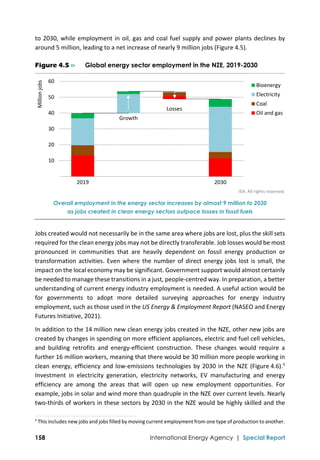
The transition to net zero brings substantial new opportunities for employment, with 
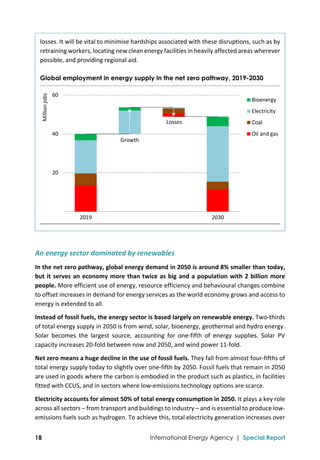
14 million jobs created by 2030 in our pathway thanks to new activities and investment 
in clean energy. Spending on more efficient appliances, electric and fuel cell vehicles, and 
building retrofits and energy‐efficient construction would require a further 16 million 
workers. But these opportunities are often in different locations, skill sets and sectors 
than the jobs that will be lost as fossil fuels decline. In our pathway, around 5 million jobs 
are lost. Most of those jobs are located close to fossil fuel resources, and many are well 
paid, meaning structural changes can cause shocks for communities with impacts that 
persist  over  time.  This  requires  careful  policy  attention  to  address  the  employment 
P R I O R I T Y   A C T I O N
IEA.
All
rights
reserved.
 
18 International Energy Agency | Special Report
losses. It will be vital to minimise hardships associated with these disruptions, such as by 
retraining workers, locating new clean energy facilities in heavily affected areas wherever 
possible, and providing regional aid. 
Global employment in energy supply in the net zero pathway, 2019-2030
  
An energy sector dominated by renewables 
In the net zero pathway, global energy demand in 2050 is around 8% smaller than today, 
but it serves an economy more than twice as big and a population with 2 billion more 
people. More efficient use of energy, resource efficiency and behavioural changes combine 
to offset increases in demand for energy services as the world economy grows and access to 
energy is extended to all. 
Instead of fossil fuels, the energy sector is based largely on renewable energy. Two‐thirds 
of total energy supply in 2050 is from wind, solar, bioenergy, geothermal and hydro energy. 
Solar  becomes  the  largest  source,  accounting  for  one‐fifth  of  energy  supplies.  Solar  PV 
capacity increases 20‐fold between now and 2050, and wind power 11‐fold. 
Net zero means a huge decline in the use of fossil fuels. They fall from almost four‐fifths of 
total energy supply today to slightly over one‐fifth by 2050. Fossil fuels that remain in 2050 
are used in goods where the carbon is embodied in the product such as plastics, in facilities 
fitted with CCUS, and in sectors where low‐emissions technology options are scarce. 
Electricity accounts for almost 50% of total energy consumption in 2050. It plays a key role 
across all sectors – from transport and buildings to industry – and is essential to produce low‐
emissions fuels such as hydrogen. To achieve this, total electricity generation increases over 
 20
 40
 60
2019 2030
Million jobs
Bioenergy
Electricity
Coal
Oil and gas
Losses
Growth
 
Summary for policy makers 19
two‐and‐a‐half‐times between today and 2050. At the same time, no additional new final 
investment decisions should be taken for new unabated coal plants, the least efficient coal 
plants  are  phased  out  by  2030,  and  the  remaining  coal  plants  still  in  use  by  2040  are 
retrofitted. By 2050, almost 90% of electricity generation comes from renewable sources, 
with wind and solar PV together accounting for nearly 70%. Most of the remainder comes 
from nuclear. 
Emissions from industry, transport and buildings take longer to reduce. Cutting industry 
emissions by 95% by 2050 involves major efforts to build new infrastructure. After rapid 
innovation progress through R&D, demonstration and initial deployment between now and 
2030 to bring new clean technologies to market, the world then has to put them into action. 
Every month from 2030 onwards, ten heavy industrial plants are equipped with CCUS, three 
new hydrogen‐based industrial plants are built, and 2 GW of electrolyser capacity are added 
at industrial sites. Policies that end sales of new internal combustion engine cars by 2035 and 
boost electrification underpin the massive reduction in transport emissions. In 2050, cars on 
the road worldwide run on electricity or fuel cells. Low‐emissions fuels are essential where 
energy needs cannot easily or economically be met by electricity. For example, aviation relies 
largely on biofuels and synthetic fuels, and ammonia is vital for shipping. In buildings, bans 
on new fossil fuel boilers need to start being introduced globally in 2025, driving up sales of 
electric heat pumps. Most old buildings and all new ones comply with zero‐carbon‐ready 
building energy codes.1
 
Set near-term milestones to get on track for long-term targets
Governments need to provide credible step‐by‐step plans to reach their net zero goals, 
building confidence among investors, industry, citizens and other countries. 
Governments must put in place long‐term policy frameworks to allow all branches of 
government  and  stakeholders  to  plan  for  change  and  facilitate  an  orderly  transition. 
Long‐term national low‐emissions strategies, called for by the Paris Agreement, can set 
out a vision for national transitions, as this report has done on a global level. These long‐
term objectives need to be linked to measurable short‐term targets and policies. Our 
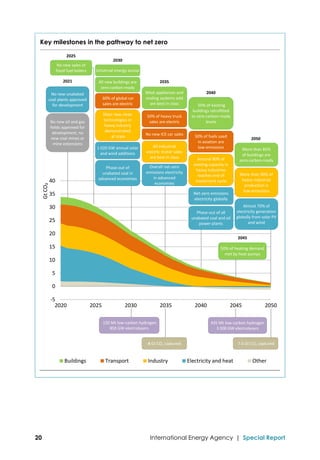
pathway details more than 400 sectoral and technology milestones to guide the global 
journey to net zero by 2050. 
                                                                                                                                
1
 A zero‐carbon‐ready building is highly energy efficient and either uses renewable energy directly or uses an 
energy supply that will be fully decarbonised by 2050, such as electricity or district heat. 
P R I O R I T Y   A C T I O N
IEA.
All
rights
reserved.
20 International Energy Agency | Special Report
Key milestones in the pathway to net zero
‐5
0
5
10
15
20
25
30
35
40
2020 2025 2030 2035 2040 2045 2050
Gt CO₂
Buildings Transport Industry Electricity and heat Other
2045
150 Mt low‐carbon hydrogen
850 GW electrolysers
435 Mt low‐carbon hydrogen
3 000 GW electrolysers
4 Gt CO2 captured
Phase‐out of 
unabated coal in 
advanced economies
2030
Universal energy access
60% of global car 
sales are electric
1 020 GW annual solar 
and wind additions
All new buildings are 
zero‐carbon‐ready
Most new clean 
technologies in 
heavy industry 
demonstrated
at scale
All industrial 
electric motor sales 
are best in class
No new ICE car sales
2035
Overall net‐zero 
emissions electricity 
in advanced 
economies
Most appliances and 
cooling systems sold 
are best in class
50% of heavy truck 
sales are electric
7.6 Gt CO2 captured
No new unabated 
coal plants approved 
for development
2021
2025
No new sales of 
fossil fuel boilers
2040
More than 90% of 
heavy industrial 
production is 
low‐emissions
2050
Almost 70% of 
electricity generation 
globally from solar PV 
and wind
More than 85% 
of buildings are 
zero‐carbon‐ready
50% of heating demand 
met by heat pumps
Phase‐out of all 
unabated coal and oil 
power plants
Net‐zero emissions 
electricity globally
50% of fuels used 
in aviation are 
low‐emissions
Around 90% of 
existing capacity in 
heavy industries 
reaches end of 
investment cycle
50% of existing 
buildings retrofitted 
to zero‐carbon‐ready 
levels
No new oil and gas 
fields approved for 
development; no 
new coal mines or 
mine extensions
 
Summary for policy makers 21
There is no need for investment in new fossil fuel supply in our net zero 
pathway 
Beyond  projects  already  committed  as  of  2021,  there  are  no  new  oil  and  gas  fields 
approved for development in our pathway, and no new coal mines or mine extensions are 
required. The unwavering policy focus on climate change in the net zero pathway results in 
a  sharp  decline  in  fossil  fuel  demand,  meaning  that  the  focus  for  oil  and  gas  producers 
switches  entirely  to  output  –  and  emissions  reductions  –  from  the  operation  of  existing 
assets. Unabated coal demand declines by 90% to just 1% of total energy use in 2050. Gas 
demand declines by 55% to 1 750 billion cubic metres and oil declines by 75% to 24 million 
barrels per day (mb/d), from around 90 mb/d in 2020. 
Clean electricity generation, network infrastructure and end‐use sectors are key areas for 
increased investment. Enabling infrastructure and technologies are vital for transforming 
the energy system. Annual investment in transmission and distribution grids expands from 
USD 260 billion today to USD 820 billion in 2030. The number of public charging points for 
EVs rises from around 1 million today to 40 million in 2030, requiring annual investment of 
almost USD 90 billion in 2030. Annual battery production for EVs leaps from 160 gigawatt‐
hours (GWh) today to 6 600 GWh in 2030 – the equivalent of adding almost 20 gigafactories2
 
each year for the next ten years. And the required roll‐out of hydrogen and CCUS after 2030 
means  laying  the  groundwork  now:  annual  investment  in  CO2  pipelines  and  hydrogen‐
enabling infrastructure increases from USD 1 billion today to around USD 40 billion in 2030. 
Drive a historic surge in clean energy investment
Policies need to be designed to send market signals that unlock new business models 
and mobilise private spending, especially in emerging economies. 
Accelerated delivery of international public finance will be critical to energy transitions, 
especially in developing economies, but ultimately the private sector will need to finance 
most  of  the  extra  investment  required.  Mobilising  the  capital  for  large‐scale 
infrastructure  calls  for  closer  co‐operation  between  developers,  investors,  public 
financial institutions and governments. Reducing risks for investors will be essential to 
ensure successful and affordable clean energy transitions. Many emerging market and 
developing economies, which rely mainly on public funding for new energy projects and 
industrial facilities, will need to reform their policy and regulatory frameworks to attract 
more private finance. International flows of long‐term capital to these economies will be 
needed  to  support  the  development  of  both  existing  and  emerging  clean  energy 
technologies. 
                                                                                                                                
2
 Battery gigafactory capacity assumption = 35 gigawatt‐hours per year. 
P R I O R I T Y   A C T I O N
IEA.
All
rights
reserved.
 
22 International Energy Agency | Special Report
Clean energy investment in the net zero pathway
  
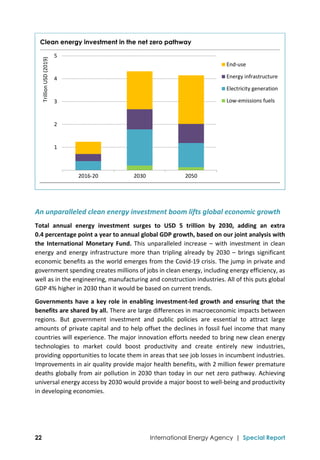
An unparalleled clean energy investment boom lifts global economic growth 
Total  annual  energy  investment  surges  to  USD  5  trillion  by  2030,  adding  an  extra 
0.4 percentage point a year to annual global GDP growth, based on our joint analysis with 
the International Monetary Fund. This unparalleled increase – with investment in clean 
energy and energy infrastructure more than tripling already by 2030 – brings significant 
economic benefits as the world emerges from the Covid‐19 crisis. The jump in private and 
government spending creates millions of jobs in clean energy, including energy efficiency, as 
well as in the engineering, manufacturing and construction industries. All of this puts global 
GDP 4% higher in 2030 than it would be based on current trends. 
Governments have a key role in enabling investment‐led growth and ensuring that the 
benefits are shared by all. There are large differences in macroeconomic impacts between 
regions.  But  government  investment  and  public  policies  are  essential  to  attract  large 
amounts of private capital and to help offset the declines in fossil fuel income that many 
countries will experience. The major innovation efforts needed to bring new clean energy 
technologies  to  market  could  boost  productivity  and  create  entirely  new  industries, 
providing opportunities to locate them in areas that see job losses in incumbent industries. 
Improvements in air quality provide major health benefits, with 2 million fewer premature 
deaths globally from air pollution in 2030 than today in our net zero pathway. Achieving 
universal energy access by 2030 would provide a major boost to well‐being and productivity 
in developing economies. 
 1
 2
 3
 4
 5
2016‐20 2030 2050
Trillion USD (2019)
End‐use
Energy infrastructure
Electricity generation
Low‐emissions fuels
 
Summary for policy makers 23
New energy security concerns emerge, and old ones remain 
The contraction of oil and natural gas production will have far‐reaching implications for all 
the countries and companies that produce these fuels. No new oil and natural gas fields are 
needed in our pathway, and oil and natural gas supplies become increasingly concentrated 
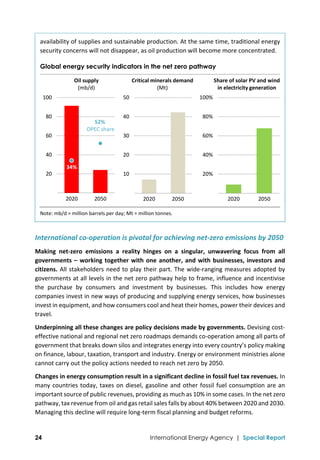
in a small number of low‐cost producers. For oil, the OPEC share of a much‐reduced global 
oil supply increases from around 37% in recent years to 52% in 2050, a level higher than at 
any point in the history of oil markets. Yet annual per capita income from oil and natural gas 
in producer economies falls by about 75%, from USD 1 800 in recent years to USD 450 by the 
2030s, which could have knock‐on societal effects. Structural reforms and new sources of 
revenue are needed, even though these are unlikely to compensate fully for the drop in oil 
and gas income. While traditional supply activities decline, the expertise of the oil and natural 
gas industry fits well with technologies such as hydrogen, CCUS and offshore wind that are 
needed to tackle emissions in sectors where reductions are likely to be most challenging. 
The energy transition requires substantial quantities of critical minerals, and their supply 
emerges as a significant growth area. The total market size of critical minerals like copper, 
cobalt, manganese and various rare earth metals grows almost sevenfold between 2020 and 
2030 in the net zero pathway. Revenues from those minerals are larger than revenues from 
coal well before 2030. This creates substantial new opportunities for mining companies. It 
also creates new energy security concerns, including price volatility and additional costs for 
transitions, if supply cannot keep up with burgeoning demand. 
The  rapid  electrification  of  all  sectors  makes  electricity  even  more  central  to  energy 
security around the world than it is today. Electricity system flexibility – needed to balance 
wind and solar with evolving demand patterns – quadruples by 2050 even as retirements of 
fossil fuel capacity reduce conventional sources of flexibility. The transition calls for major 
increases in all sources of flexibility: batteries, demand response and low‐carbon flexible 
power plants, supported by smarter and more digital electricity networks. The resilience of 
electricity systems to cyberattacks and other emerging threats needs to be enhanced. 
Address emerging energy security risks now
Ensuring  uninterrupted  and  reliable  supplies  of  energy  and  critical  energy‐related 
commodities at affordable prices will only rise in importance on the way to net zero. 
The focus of energy security will evolve as reliance on renewable electricity grows and 
the  role  of  oil  and  gas  diminishes.  Potential  vulnerabilities  from  the  increasing 
importance  of  electricity  include  the  variability  of  supply  and  cybersecurity  risks. 
Governments need to create markets for investment in batteries, digital solutions and 
electricity  grids  that  reward  flexibility  and  enable  adequate  and  reliable  supplies  of 
electricity. The growing dependence on critical minerals required for key clean energy 
technologies  calls  for  new  international  mechanisms  to  ensure  both  the  timely 
P R I O R I T Y   A C T I O N
IEA.
All
rights
reserved.
 
24 International Energy Agency | Special Report
availability of supplies and sustainable production. At the same time, traditional energy 
security concerns will not disappear, as oil production will become more concentrated. 
Global energy security indicators in the net zero pathway
Note: mb/d = million barrels per day; Mt = million tonnes. 
International co‐operation is pivotal for achieving net‐zero emissions by 2050 
Making  net‐zero  emissions  a  reality  hinges  on  a  singular,  unwavering  focus  from  all 
governments – working together with one another, and with businesses, investors and 
citizens. All stakeholders need to play their part. The wide‐ranging measures adopted by 
governments at all levels in the net zero pathway help to frame, influence and incentivise 
the  purchase  by  consumers  and  investment  by  businesses.  This  includes  how  energy 
companies invest in new ways of producing and supplying energy services, how businesses 
invest in equipment, and how consumers cool and heat their homes, power their devices and 
travel. 
Underpinning all these changes are policy decisions made by governments. Devising cost‐
effective national and regional net zero roadmaps demands co‐operation among all parts of 
government that breaks down silos and integrates energy into every country’s policy making 
on finance, labour, taxation, transport and industry. Energy or environment ministries alone 
cannot carry out the policy actions needed to reach net zero by 2050. 
Changes in energy consumption result in a significant decline in fossil fuel tax revenues. In 
many countries today, taxes on diesel, gasoline and other fossil fuel consumption are an 
important source of public revenues, providing as much as 10% in some cases. In the net zero 
pathway, tax revenue from oil and gas retail sales falls by about 40% between 2020 and 2030. 
Managing this decline will require long‐term fiscal planning and budget reforms. 
 10
 20
 30
 40
 50
2020 2050
20%
40%
60%
80%
100%
2020 2050
 20
 40
 60
 80
 100
2020 2050
Oil supply
(mb/d)
Share of solar PV and wind 
in electricity generation
Critical minerals demand
(Mt)
52% 
OPEC share
34% 
Summary for policy makers 25
The  net  zero  pathway  relies  on  unprecedented  international  co‐operation  among 
governments, especially on innovation and investment. The IEA stands ready to support 
governments in preparing national and regional net zero roadmaps, to provide guidance and 
assistance in implementing them, and to promote international co‐operation to accelerate 
the energy transition worldwide. 
Take international co-operation to new heights
This is not simply a matter of all governments seeking to bring their national emissions 
to net zero – it means tackling global challenges through co‐ordinated actions. 
Governments  must  work  together  in  an  effective  and  mutually  beneficial  manner  to 
implement  coherent  measures  that  cross  borders.  This  includes  carefully  managing 
domestic job creation and local commercial advantages with the collective global need 
for  clean  energy  technology  deployment.  Accelerating  innovation,  developing 
international standards and co‐ordinating to scale up clean technologies needs to be 
done in a way that links national markets. Co‐operation must recognise differences in the 
stages of development of different countries and the varying situations of different parts 
of society. For many rich countries, achieving net‐zero emissions will be more difficult 
and  costly  without  international  co‐operation.  For  many  developing  countries,  the 
pathway to net zero without international assistance is not clear. Technical and financial 
support is needed to ensure deployment of key technologies and infrastructure. Without 
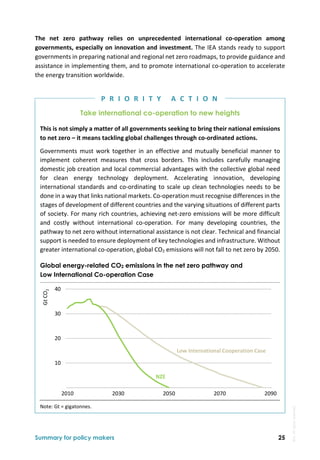
greater international co‐operation, global CO2 emissions will not fall to net zero by 2050. 
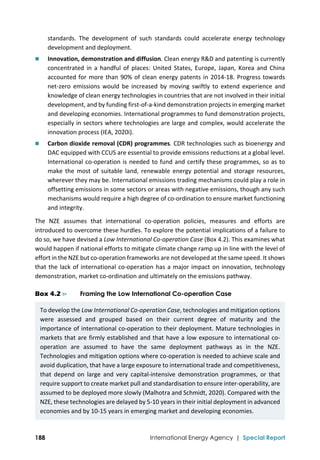
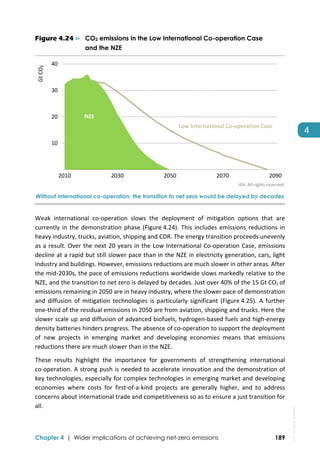
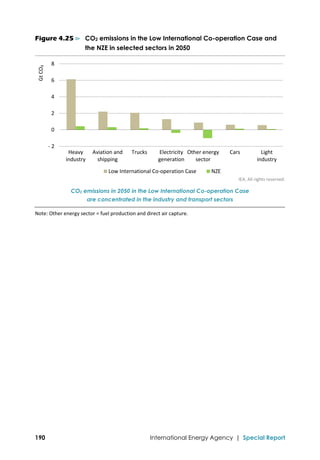
Global energy-related CO2 emissions in the net zero pathway and
Low International Co-operation Case
Note: Gt = gigatonnes. 
 10
 20
 30
 40
2010 2030 2050 2070 2090
Gt CO
2
NZE
Low International Cooperation Case
P R I O R I T Y   A C T I O N
IEA.
All
rights
reserved.
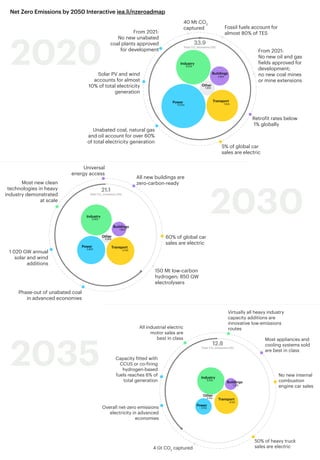
Net Zero Emissions by 2050 Interactive iea.li/nzeroadmap
2035
2020
2030
Industry
Other
Power Transport
Unabated coal, natural gas
and oil account for over 60%
of total electricity generation
Solar PV and wind
accounts for almost
10% of total electricity
generation
Retrofit rates below
1% globally
Fossil fuels account for
almost 80% of TES
40 Mt CO2
captured
5% of global car
sales are electric
33.9
Total CO2
emissions (Gt)
Buildings
2.9Gt
8.5Gt
1.9Gt
13.5Gt 7.2Gt
From 2021:
No new oil and gas
fields approved for
development;
no new coal mines
or mine extensions
From 2021:
No new unabated
coal plants approved
for development
Most new clean
technologies in heavy
industry demonstrated
at scale
60% of global car
sales are electric
150 Mt low-carbon
hydrogen; 850 GW
electrolysers
All new buildings are
zero-carbon-ready
Universal
energy access
1 020 GW annual
solar and wind
additions
Phase-out of unabated coal
in advanced economies
Industry
Other
Power Transport
Buildings
1.8Gt
6.9Gt
0.9Gt
5.8Gt 5.7Gt
21.1
Total CO2
emissions (Gt)
All industrial electric
motor sales are
best in class
Virtually all heavy industry
capacity additions are
innovative low-emissions
routes
No new internal
combustion
engine car sales
50% of heavy truck
sales are electric
4 Gt CO2
captured
Overall net-zero emissions
electricity in advanced
economies
Most appliances and
cooling systems sold
are best in class
Capacity fitted with
CCUS or co-firing
hydrogen-based
fuels reaches 6% of
total generation
Industry
Other
Power
Transport
Buildings
1.2Gt
5.2Gt
0.1Gt
2.1Gt
4.1Gt
12.8
Total CO2
emissions (Gt)
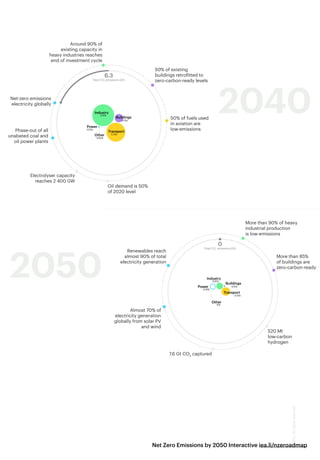
2040
2050
Net Zero Emissions by 2050 Interactive iea.li/nzeroadmap
50% of existing
buildings retrofitted to
zero-carbon-ready levels
Around 90% of
existing capacity in
heavy industries reaches
end of investment cycle
50% of fuels used
in aviation are
low-emissions
Oil demand is 50%
of 2020 level
Net-zero emissions
electricity globally
Phase-out of all
unabated coal and
oil power plants
Electrolyser capacity
reaches 2 400 GW
Industry
Other
Power
Transport
Buildings
0.7Gt
3.5Gt
-0.5Gt
-0.1Gt
2.7Gt
6.3
Total CO2
emissions (Gt)
33.9
Total CO2
emissions (Gt)
More than 90% of heavy
industrial production
is low-emissions
More than 85%
of buildings are
zero-carbon-ready
7.6 Gt CO2
captured
Renewables reach
almost 90% of total
electricity generation
Almost 70% of
electricity generation
globally from solar PV
and wind
520 Mt
low-carbon
hydrogen
Industry
Other
Power
Transport
Buildings
0.1Gt
0.5Gt
-1Gt
-0.4Gt
0.7Gt
0
Total CO2
emissions (Gt)
IEA.
All
rights
reserved.
 
Chapter 1 | Announced net zero pledges and the energy sector 29
Chapter 1 
Announced net zero pledges and the energy sector
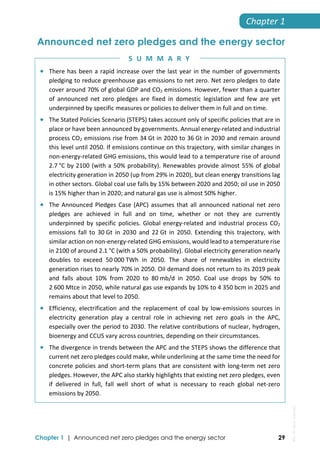
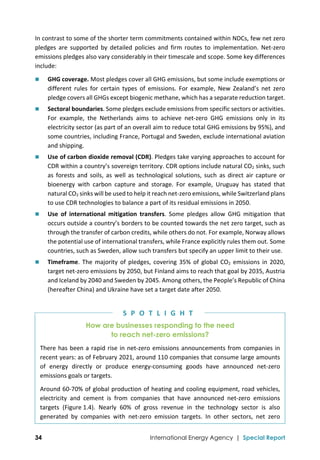
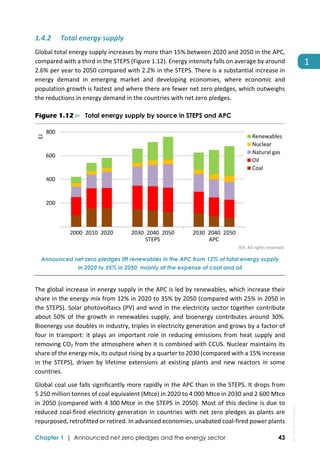
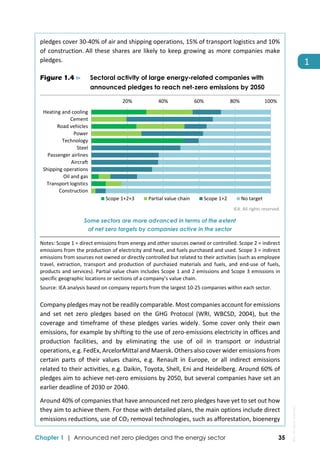
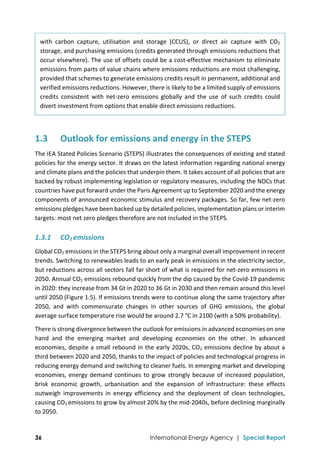
 There has been a rapid increase over the last year in the number of governments 
pledging to reduce greenhouse gas emissions to net zero. Net zero pledges to date 
cover around 70% of global GDP and CO2 emissions. However, fewer than a quarter 
of  announced  net  zero  pledges  are  fixed  in  domestic  legislation  and  few  are  yet 
underpinned by specific measures or policies to deliver them in full and on time.  
 The Stated Policies Scenario (STEPS) takes account only of specific policies that are in 
place or have been announced by governments. Annual energy‐related and industrial 
process CO2 emissions rise from 34 Gt in 2020 to 36 Gt in 2030 and remain around 
this level until 2050. If emissions continue on this trajectory, with similar changes in 
non‐energy‐related GHG emissions, this would lead to a temperature rise of around 
2.7 °C by 2100 (with a 50% probability). Renewables provide almost 55% of global 
electricity generation in 2050 (up from 29% in 2020), but clean energy transitions lag 
in other sectors. Global coal use falls by 15% between 2020 and 2050; oil use in 2050 
is 15% higher than in 2020; and natural gas use is almost 50% higher.   
 The Announced Pledges Case (APC) assumes that all announced national net zero 
pledges  are  achieved  in  full  and  on  time,  whether  or  not  they  are  currently 
underpinned by specific policies. Global energy‐related and industrial process CO2 
emissions  fall  to  30 Gt  in  2030  and  22 Gt  in  2050.  Extending  this  trajectory,  with 
similar action on non‐energy‐related GHG emissions, would lead to a temperature rise 
in 2100 of around 2.1 °C (with a 50% probability). Global electricity generation nearly 
doubles  to  exceed  50 000 TWh  in  2050.  The  share  of  renewables  in  electricity 
generation rises to nearly 70% in 2050. Oil demand does not return to its 2019 peak 
and  falls  about  10%  from  2020  to  80 mb/d  in  2050.  Coal  use  drops  by  50%  to 
2 600 Mtce in 2050, while natural gas use expands by 10% to 4 350 bcm in 2025 and 
remains about that level to 2050. 
 Efficiency, electrification and the replacement of coal by low‐emissions sources in 
electricity  generation  play  a  central  role  in  achieving  net  zero  goals  in  the  APC, 
especially over the period to 2030. The relative contributions of nuclear, hydrogen, 
bioenergy and CCUS vary across countries, depending on their circumstances.  
 The divergence in trends between the APC and the STEPS shows the difference that 
current net zero pledges could make, while underlining at the same time the need for 
concrete policies and short‐term plans that are consistent with long‐term net zero 
pledges. However, the APC also starkly highlights that existing net zero pledges, even 
if  delivered  in  full,  fall  well  short  of  what  is  necessary  to  reach  global  net‐zero 
emissions by 2050. 
S U M M A R Y
IEA.
All
rights
reserved.
 
30 International Energy Agency | Special Report
1.1 Introduction 
November 2021 will see the most important UN Framework Convention on Climate Change 
(UNFCCC) Conference of the Parties (COP 26) since the Paris Agreement was signed in 2015. 
As COP 26 approaches, an increasing number of countries have announced long‐term goals 
to  achieve  net‐zero  greenhouse  gas  (GHG)  emissions  over  the  coming  decades.  On 
31 March 2021, the International Energy Agency (IEA) hosted a Net Zero Summit to take 
stock of the growing list of commitments from countries and companies to reach the goals 
of the Paris Agreement, and to focus on the actions necessary to start turning those net zero 
goals into reality. 
Achieving those goals will be demanding. The Covid‐19 pandemic delivered a major shock to 
the world economy, resulting in an unprecedented 5.8% decline in CO2 emissions in 2020. 
However, our monthly data show that global energy‐related CO2 emissions started to climb 
again in December 2020, and we estimate that they will rebound to around 33 gigatonnes of 
carbon dioxide (Gt CO2) in 2021, only 1.2% below the level in 2019 (IEA, 2021). Sustainable 
economic recovery packages offered a unique opportunity to make 2019 the definitive peak 
in global emissions, but the evidence so far points to a rebound in emissions in parallel with 
renewed economic growth, at least in the near term (IEA, 2020a). 
Recent  IEA  analyses  examined  the  technologies  and  policies  needed  for  countries  and 
regions  to  achieve  net‐zero  emissions  energy  systems.  The  World  Energy  Outlook  2020 
examined what would be needed over the period to 2030 to put the world on a path towards 
net‐zero  emissions  by  2050  in  the  context  of  the  pandemic‐related  economic  recovery 
(IEA, 2020b). The Faster Innovation Case in Energy Technology Perspectives 2020 explored 
whether net‐zero emissions could be achieved globally by 2050 through accelerated energy 
technology development and deployment alone: it showed that, relative to baseline trends, 
almost half of the emissions savings needed in 2050 to reach net‐zero emissions rely on 
technologies that are not yet commercially available (IEA, 2020c).  
This special report, prepared at the request of the UK President of the COP 26, incorporates 
the insights and lessons learned from both reports to create a comprehensive and detailed 
pathway,  or  roadmap,  to  achieve  net‐zero  energy‐related  and  industrial  process  CO2 
emissions globally by 2050. It assesses the costs of achieving this goal, the likely impacts on 
employment and the economy, and the wider implications for the world. It also highlights 
the key milestones for  technologies, infrastructure, investment and policy  that are needed 
along the road to 2050.  
This report is set out in four chapters: 
 Chapter 1 explores the outlook for global CO2  emissions and energy supply and use 
based on existing policies and pledges. It sets out projections of global energy use and 
emissions based on the Stated Policies Scenario (STEPS), which includes only the firm 
policies that are in place or have been announced by countries, including Nationally 
 
Chapter 1 | Announced net zero pledges and the energy sector 31
1 
Determined  Contributions.  It  also  examines  the  Announced  Pledges  Case  (APC),  a 
variant of the STEPS that assumes that all of the net zero targets announced by countries 
around the world to date are met in full. 
 Chapter 2 presents the Net‐Zero Emissions by 2050 Scenario (NZE), which describes 
how energy demand and the energy mix will need to evolve if the world is to achieve 
net‐zero emissions by 2050. It also assesses the corresponding investment needs and 
explores key uncertainties surrounding technology and consumer behaviour. 
 Chapter 3 examines the implications of the NZE for various sectors, covering fossil fuel 
supply,  the  supply  of  low‐emissions  fuels  (such  as  hydrogen,  ammonia,  biofuels, 
synthetic fuels and biomethane) and the electricity, transport, industry and buildings 
sectors. It highlights the key changes required to achieve net‐zero emissions in the NZE 
and the major milestones that are needed along the way. 
 Chapter 4 explores the implications of the NZE for the economy, the energy industry, 
citizens and governments. 
1.2 Emissions reduction targets and net zero pledges 
1.2.1 Nationally Determined Contributions 
Under  the  Paris  Agreement,  Parties 1
are  required  to  submit  Nationally  Determined 
Contributions (NDCs) to the UNFCCC and to implement policies with the aim of achieving 
their stated objectives. The process is dynamic; it requires Parties to update their NDCs every 
five years in a progressive manner to reflect the highest possible ambition. The first round of 
NDCs,  submitted  by  191 countries,  covers  more  than  90%  of  global  energy‐related  and 
industrial  process  CO2  emissions. 2
 The  first  NDCs  included  some  targets  that  were 
unconditional  and  others  that  were  conditional  on  international  support  for  finance, 
technology and other means of implementation. 
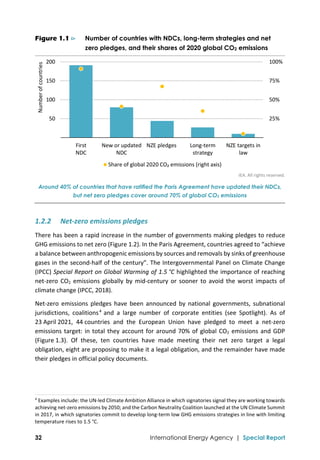
As of 23 April 2021, 80 countries have submitted new or updated NDCs to the UNFCCC, 
covering just over 40% of global CO2 emissions (Figure 1.1).3
 Many of the updated NDCs 
include  more  stringent  targets  than  in  the  initial  round  of  NDCs,  or  targets  for  a  larger 
number of sectors or for a broader coverage of GHGs. In addition, 27 countries and the 
European Union have communicated long‐term low GHG emissions development strategies 
to the UNFCCC, as requested by the Paris Agreement. Some of these strategies incorporate 
a net zero pledge. 
                                                                                                                                
1
 Parties refers to the 197 members of the UNFCCC which includes all United Nations member states, United 
Nations General Assembly Observer State of Palestine, UN non‐member states Niue and the Cook Islands and 
the European Union. 
2
 Unless otherwise stated, CO2 emissions in this report refer to energy‐related and industrial process CO2 
emissions.  
3
 Several countries have indicated that they intend to submit new or updated NDCs later in 2021 or in 2022. 
IEA.
All
rights
reserved.
 
32 International Energy Agency | Special Report
Figure 1.1 ⊳ Number of countries with NDCs, long-term strategies and net
zero pledges, and their shares of 2020 global CO2 emissions
IEA. All rights reserved.
Around 40% of countries that have ratified the Paris Agreement have updated their NDCs,
but net zero pledges cover around 70% of global CO2 emissions
1.2.2 Net‐zero emissions pledges 
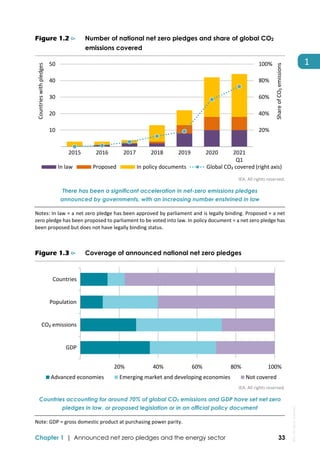
There has been a rapid increase in the number of governments making pledges to reduce 
GHG emissions to net zero (Figure 1.2). In the Paris Agreement, countries agreed to “achieve 
a balance between anthropogenic emissions by sources and removals by sinks of greenhouse 
gases in the second‐half of the century”. The Intergovernmental Panel on Climate Change 
(IPCC) Special Report on Global Warming of 1.5 °C highlighted the importance of reaching 
net‐zero  CO2 emissions globally by mid‐century or sooner  to avoid the worst impacts of 
climate change (IPCC, 2018). 
Net‐zero  emissions  pledges  have  been  announced  by  national  governments,  subnational 
jurisdictions,  coalitions4
 and  a  large  number  of  corporate  entities  (see  Spotlight).  As  of 
23 April 2021,  44 countries  and  the  European  Union  have  pledged  to  meet  a  net‐zero 
emissions target: in total they account for around 70% of global CO2 emissions and GDP 
(Figure 1.3).  Of  these,  ten  countries  have  made  meeting  their  net  zero  target  a  legal 
obligation, eight are proposing to make it a legal obligation, and the remainder have made 
their pledges in official policy documents.  
                                                                                                                                
4
 Examples include: the UN‐led Climate Ambition Alliance in which signatories signal they are working towards 
achieving net‐zero emissions by 2050; and the Carbon Neutrality Coalition launched at the UN Climate Summit 
in 2017, in which signatories commit to develop long‐term low GHG emissions strategies in line with limiting 
temperature rises to 1.5 °C.  
25%
50%
75%
100%
 50
 100
 150
 200
First
NDC
New or updated
NDC
NZE pledges Long‐term
strategy
NZE targets in
law
Number of countries
Share of global 2020 CO₂ emissions (right axis)
 
Chapter 1 | Announced net zero pledges and the energy sector 33
1 
Figure 1.2 ⊳ Number of national net zero pledges and share of global CO2
emissions covered
 
IEA. All rights reserved.
There has been a significant acceleration in net-zero emissions pledges
announced by governments, with an increasing number enshrined in law
Notes: In law = a net zero pledge has been approved by parliament and is legally binding. Proposed = a net 
zero pledge has been proposed to parliament to be voted into law. In policy document = a net zero pledge has 
been proposed but does not have legally binding status.  
Figure 1.3 ⊳ Coverage of announced national net zero pledges
IEA. All rights reserved.
Countries accounting for around 70% of global CO2 emissions and GDP have set net zero
pledges in law, or proposed legislation or in an official policy document
Note: GDP = gross domestic product at purchasing power parity. 
20%
40%
60%
80%
100%
 10
 20
 30
 40
 50
2015 2016 2017 2018 2019 2020 2021
Q1
Share of CO₂ emissions
Countries with pledges
In law Proposed In policy documents Global CO₂ covered (right axis)
20% 40% 60% 80% 100%
GDP
CO₂ emissions
Population
Countries
Advanced economies Emerging market and developing economies Not covered
IEA.
All
rights
reserved.
 
34 International Energy Agency | Special Report
In contrast to some of the shorter term commitments contained within NDCs, few net zero 
pledges  are  supported  by  detailed  policies  and  firm  routes  to  implementation.  Net‐zero 
emissions pledges also vary considerably in their timescale and scope. Some key differences 
include: 
 GHG coverage. Most pledges cover all GHG emissions, but some include exemptions or 
different  rules  for  certain  types  of  emissions.  For  example,  New  Zealand’s  net  zero 
pledge covers all GHGs except biogenic methane, which has a separate reduction target.  
 Sectoral boundaries. Some pledges exclude emissions from specific sectors or activities. 
For  example,  the  Netherlands  aims  to  achieve  net‐zero  GHG  emissions  only  in  its 
electricity sector (as part of an overall aim to reduce total GHG emissions by 95%), and 
some countries, including France, Portugal and Sweden, exclude international aviation 
and shipping. 
 Use of carbon dioxide removal (CDR). Pledges take varying approaches to account for 
CDR within a country’s sovereign territory. CDR options include natural CO2 sinks, such 
as  forests  and  soils,  as  well  as  technological  solutions,  such  as  direct  air capture  or 
bioenergy  with  carbon  capture  and  storage.  For  example,  Uruguay  has  stated  that 
natural CO2 sinks will be used to help it reach net‐zero emissions, while Switzerland plans 
to use CDR technologies to balance a part of its residual emissions in 2050. 
 Use  of  international  mitigation  transfers.  Some  pledges  allow  GHG  mitigation  that 
occurs outside a country’s borders to be counted towards the net zero target, such as 
through the transfer of carbon credits, while others do not. For example, Norway allows 
the potential use of international transfers, while France explicitly rules them out. Some 
countries, such as Sweden, allow such transfers but specify an upper limit to their use. 
 Timeframe. The majority of pledges, covering 35% of global CO2 emissions in 2020, 
target net‐zero emissions by 2050, but Finland aims to reach that goal by 2035, Austria 
and Iceland by 2040 and Sweden by 2045. Among others, the People’s Republic of China 
(hereafter China) and Ukraine have set a target date after 2050. 
How are businesses responding to the need
to reach net-zero emissions?
There has been a rapid rise in net‐zero emissions announcements from companies in 
recent years: as of February 2021, around 110 companies that consume large amounts 
of  energy  directly  or  produce  energy‐consuming  goods  have  announced  net‐zero 
emissions goals or targets.  
Around 60‐70% of global production of heating and cooling equipment, road vehicles, 
electricity  and  cement  is  from  companies  that  have  announced  net‐zero  emissions 
targets  (Figure 1.4).  Nearly  60%  of  gross  revenue  in  the  technology  sector  is  also 
generated  by  companies  with  net‐zero  emission  targets.  In  other  sectors,  net  zero 
S P O T L I G H T
 
Chapter 1 | Announced net zero pledges and the energy sector 35
1 
pledges cover 30‐40% of air and shipping operations, 15% of transport logistics and 10% 
of construction. 
All these shares are likely to keep growing as more companies make 
pledges. 
Figure 1.4 ⊳ Sectoral activity of large energy-related companies with
announced pledges to reach net-zero emissions by 2050
IEA. All rights reserved.
Some sectors are more advanced in terms of the extent
of net zero targets by companies active in the sector
Notes: Scope 1 = direct emissions from energy and other sources owned or controlled. Scope 2 = indirect 
emissions from the production of electricity and heat, and fuels purchased and used. Scope 3 = indirect 
emissions from sources not owned or directly controlled but related to their activities (such as employee 
travel,  extraction,  transport  and  production  of  purchased  materials  and  fuels,  and  end‐use  of  fuels, 
products and services). Partial value chain includes Scope 1 and 2 emissions and Scope 3 emissions in 
specific geographic locations or sections of a company’s value chain. 
Source: IEA analysis based on company reports from the largest 10‐25 companies within each sector. 
Company pledges may not be readily comparable. Most companies account for emissions 
and  set  net  zero  pledges  based  on  the  GHG  Protocol  (WRI,  WBCSD,  2004),  but  the 
coverage  and  timeframe  of  these  pledges  varies  widely.  Some  cover  only  their  own 
emissions, for example by shifting to the use of zero‐emissions electricity in offices and 
production  facilities,  and  by  eliminating  the  use  of  oil  in  transport  or  industrial 
operations, e.g. FedEx, ArcelorMittal and Maersk. Others also cover wider emissions from 
certain  parts  of  their  values  chains,  e.g.  Renault  in  Europe,  or  all  indirect  emissions 
related to their activities, e.g. Daikin, Toyota, Shell, Eni and Heidelberg. Around 60% of 
pledges aim to achieve net‐zero emissions by 2050, but several companies have set an 
earlier deadline of 2030 or 2040. 
Around 40% of companies that have announced net zero pledges have yet to set out how 
they aim to achieve them. For those with detailed plans, the main options include direct 
emissions reductions, use of CO2 removal technologies, such as afforestation, bioenergy 
20% 40% 60% 80% 100%
Construction
Transport logistics
Oil and gas
Shipping operations
Aircraft
Passenger airlines
Steel
Technology
Power
Road vehicles
Cement
Heating and cooling
Scope 1+2+3 Partial value chain Scope 1+2 No target
IEA.
All
rights
reserved.
 
36 International Energy Agency | Special Report
with  carbon  capture,  utilisation  and  storage  (CCUS),  or  direct  air  capture  with  CO2 
storage, and purchasing emissions (credits generated through emissions reductions that 
occur elsewhere). The use of offsets could be a cost‐effective mechanism to eliminate 
emissions from parts of value chains where emissions reductions are most challenging, 
provided that schemes to generate emissions credits result in permanent, additional and 
verified emissions reductions. However, there is likely to be a limited supply of emissions 
credits  consistent  with  net‐zero  emissions  globally  and  the  use  of  such  credits  could 
divert investment from options that enable direct emissions reductions. 
1.3 Outlook for emissions and energy in the STEPS 
The IEA Stated Policies Scenario (STEPS) illustrates the consequences of existing and stated 
policies for the energy sector. It draws on the latest information regarding national energy 
and climate plans and the policies that underpin them. It takes account of all policies that are 
backed by robust implementing legislation or regulatory measures, including the NDCs that 
countries have put forward under the Paris Agreement up to September 2020 and the energy 
components of announced economic stimulus and recovery packages. So far, few net‐zero 
emissions pledges have been backed up by detailed policies, implementation plans or interim 
targets: most net zero pledges therefore are not included in the STEPS. 
1.3.1 CO2 emissions  
Global CO2 emissions in the STEPS bring about only a marginal overall improvement in recent 
trends. Switching to renewables leads to an early peak in emissions in the electricity sector, 
but reductions across all sectors fall far short of what is required for net‐zero emissions in 
2050. Annual CO2 emissions rebound quickly from the dip caused by the Covid‐19 pandemic 
in 2020: they increase from 34 Gt in 2020 to 36 Gt in 2030 and then remain around this level 
until 2050 (Figure 1.5). If emissions trends were to continue along the same trajectory after 
2050,  and  with  commensurate  changes  in  other  sources  of  GHG  emissions,  the  global 
average surface temperature rise would be around 2.7 °C in 2100 (with a 50% probability).  
There is strong divergence between the outlook for emissions in advanced economies on one 
hand  and  the  emerging  market  and  developing  economies  on  the  other.  In  advanced 
economies, despite a small rebound in the early 2020s, CO2 emissions decline by about a 
third between 2020 and 2050, thanks to the impact of policies and technological progress in 
reducing energy demand and switching to cleaner fuels. In emerging market and developing 
economies, energy demand continues to grow strongly because of increased population, 
brisk  economic  growth,  urbanisation  and  the  expansion  of  infrastructure:  these  effects 
outweigh  improvements  in  energy  efficiency  and  the  deployment  of  clean  technologies, 
causing CO2 emissions to grow by almost 20% by the mid‐2040s, before declining marginally 
to 2050.  
 
Chapter 1 | Announced net zero pledges and the energy sector 37
1 
Figure 1.5 ⊳ Energy-related and industrial process CO2 emissions by region
and sector in the STEPS
  
IEA. All rights reserved.
Global CO2 emissions rebound quickly after 2020 and then plateau,
with declines in advanced economies offset by increases elsewhere
Note: Other = agriculture and own use in the energy sector. 
1.3.2 Total energy supply, total final consumption and  
electricity generation 
The projected trends in CO2 emissions in the STEPS result from changes in the amount of 
energy used and the mix of fuels and technologies. Total energy supply (TES)5
 worldwide 
rises by just over 30% between 2020 and 2050 in the STEPS (Figure 1.6). Without a projected 
annual average reduction of 2.2% in energy intensity, i.e. energy use per unit of GDP, TES in 
2050 would be around 85% higher. In advanced economies, energy use falls by around 5% to 
2050, despite a 75% increase in economic activity over the period. In emerging market and 
developing economies, energy use increases by 50% to 2050, reflecting a tripling of economic 
output between 2020 and 2050. Despite the increase in GDP and energy use in emerging 
market and developing economies, 750 million people still have no access to electricity in 
2050, more than 95% of them in sub‐Saharan Africa, and 1.5 billion people continue to rely 
on the traditional use of bioenergy for cooking. 
The global fuel mix changes significantly between 2020 and 2050. Coal use, which peaked in 
2014, falls by around 15%. Having fallen sharply in 2020 due to the pandemic, oil demand 
rebounds quickly, returning to the 2019 level of 98 million barrels per day (mb/d) by 2023 
and reaching a plateau of around 104 mb/d shortly after 2030. Natural gas demand increases 
from 3 900 billion cubic metres (bcm) in 2020 to 4 600 bcm in 2030 and 5 700 bcm in 2050. 
Nuclear energy grows by 15% between 2020 and 2030, mainly reflecting expansions in China.  
                                                                                                                                
5
 Total primary energy supply (or total primary energy demand) has been renamed total energy supply in 
accordance with the International Recommendations for Energy Statistics (IEA, 2020d). 
 10
 20
 30
 40
2010 2030 2050
Gt CO₂
Region
Advanced economies
Emerging market and
developing economies
International bunkers
2010 2030 2050
Sector
Electricity
Industry
Transport
Buildings
Other
IEA.
All
rights
reserved.
 
38 International Energy Agency | Special Report
Figure 1.6 ⊳ Total energy supply and CO2 emissions intensity in the STEPS
 
IEA. All rights reserved.
Coal use declines, oil plateaus and renewables and natural gas grow substantially to 2050
Note: EJ = exajoule; MJ = megajoule; TES = total energy supply. 
Total final consumption increases in all sectors in the STEPS, led by electricity and natural gas 
(Figure 1.7). All the growth is in emerging market and developing economies. The biggest 
change  in  energy  use  is  in  the  electricity  sector  (Figure 1.8).  Global  electricity  demand 
increases by 80% between 2020 and 2050, around double the overall rate of growth in final 
energy consumption. More than 85% of the growth in global electricity demand comes from 
emerging market and developing economies. Coal continues to play an important role in 
electricity generation in those economies to 2050, despite strong growth in renewables: in 
advanced economies, the use of coal for electricity generation drops sharply.  
Figure 1.7 ⊳ Total final consumption by sector and fuel in the STEPS
 
IEA. All rights reserved.
Final energy consumption grows on average by 1% per year between 2020 and 2050,
with electricity and natural gas meeting most of the increase
 15
 30
 45
 60
 50
 100
 150
 200
2000 2010 2020 2030 2040 2050
gCO₂/MJ
EJ
Coal
Oil
Natural gas Renewables
Traditional use of biomass
Nuclear
CO₂ intensity of TES
(right axis)
2010 2050
Industry Transport
Buildings
2010 2050
 50
 100
 150
 200
 250
2010 2050
EJ
Coal Oil Natural gas Hydrogen Electricity
Heat Modern Bioenergy Other renewables Traditional use of biomass
 
Chapter 1 | Announced net zero pledges and the energy sector 39
1 
Figure 1.8 ⊳ Electricity generation by fuel and share of coal in the STEPS
 
IEA. All rights reserved.
Emerging market and developing economies drive most of the increase in global
electricity demand, met mainly by renewables and gas, though coal remains important
1.3.3 Emissions from existing assets 
The energy sector contains a large number of long‐lived and capital‐intensive assets. Urban 
infrastructure,  pipelines,  refineries,  coal‐fired  power  plants,  heavy  industrial  facilities, 
buildings and large hydro power plants can have technical and economic lifetimes of well 
over 50 years. If today’s energy infrastructure was to be operated until the end of the typical 
lifetime in a manner similar to the past, we estimate that this would lead to cumulative 
energy‐related and industrial process CO2 emissions between 2020 and 2050 of just under 
650 Gt CO2. This is around 30% more than the remaining total CO2 budget consistent with 
limiting global warming to 1.5 °C with a 50% probability (see Chapter 2).  
The electricity sector accounts for more than 50% of the total emissions that would come 
from existing assets; 40% of total emissions would come from coal‐fired power plants alone. 
Industry  is  the  next  largest  sector,  with  steel,  cement,  chemicals  and  other  industry 
accounting  for  around  30%  total  emissions  from  existing  assets.  The  long  lifetime  of 
production facilities in these sub‐sectors (typically 30‐40 years for a blast furnace or cement 
kiln) and the relatively young age of the global capital stock explain their large contribution. 
Transport accounts for just over 10% of emissions from existing assets and the buildings 
sector accounts for just under 5%. The lifetime of vehicles and equipment in the transport 
and buildings sectors is generally much shorter than is the case in electricity and industry – 
passenger cars, for example, are generally assumed to have a lifetime of around 17 years – 
but associated infrastructure networks such as roads, electricity networks and gas grids have 
very long lifetimes. 
There  are  some  large  regional  differences  in  emissions  levels  from  existing  assets 
(Figure 1.9). Advanced economies tend to have much older capital stocks than emerging 
market and developing economies, particularly in the electricity sector, and existing assets 
will reach the end of their lifetimes earlier. For example, the average age of coal‐fired power 
20%
40%
60%
 10
 20
 30
2010 2020 2030 2040 2050 2010 2020 2030 2040 2050
Thousand TWh
Coal Oil Natural gas Nuclear Renewables Share of coal (right axis)
Advanced economies Emerging market and developing economies
IEA.
All
rights
reserved.
 
40 International Energy Agency | Special Report
plants in China is 13 years and 16 years in the rest of Asia, compared to around 35 years in 
Europe and 40 years in the United States (IEA, 2020e).  
Figure 1.9 ⊳ Emissions from existing infrastructure by sector and region
IEA. All rights reserved.
Emerging market and developing economies account for three-quarters
of cumulative emissions from existing infrastructure through to 2050
1.4 Announced Pledges Case 
The Announced Pledges Case (APC) assumes that all national net‐zero emissions pledges are 
realised in full and on time. It therefore goes beyond the policy commitments incorporated 
in the STEPS. The aim of the APC is to see how far full implementation of the national net‐
zero emissions pledges would take the world towards reaching net‐zero emissions, and to 
examine the scale of the transformation of the energy sector that such a path would require.  
The  way  these  pledges  are  assumed  to  be  implemented  in  the  APC  has  important 
implications  for  the  energy  system.  A  net  zero  pledge  for  all  GHG  emissions  does  not 
necessarily mean that CO2 emissions from the energy sector need to reach net zero. 
For 
example, a country’s net zero plans may envisage some remaining energy‐related emissions 
are offset by the absorption of emissions from forestry or land use, or by negative emissions 
arising from the use of bioenergy or direct capture of CO2 from the air (DAC) with CCUS.6
 It 
is not possible to know exactly how net zero pledges will be implemented, but the design of 
the APC, particularly with respect to the details of the energy system pathway, has been 
informed by the pathways that a number of national bodies have developed to support net 
zero pledges (Box 1.1). Policies in countries that have not yet made a net zero pledge are 
assumed to be the same as in the STEPS. Non policy assumptions, including population and 
economic growth, are the same as in the STEPS. 
                                                                                                                                
6
 For  example,  in  recent  economy‐wide  net  zero  mitigation  pathways  for  the  European  Union,  around 
140‐210 million tonnes CO2 of emissions from the energy sector remain in 2050, which are offset by CDR from 
managed land‐use sinks, and bioenergy and DAC with CCUS (European Commission, 2018). 
 5
 10
 15
 20
 25
2020 2030 2040 2050
Gt CO₂
Electricity Industry Transport Buildings Other
Advanced economies
2020 2030 2040 2050
Emerging market and developing economies
 
Chapter 1 | Announced net zero pledges and the energy sector 41
1 
Box 1.1 ⊳ Consultations with national bodies on achieving national net-
zero emissions goals
To help inform its work on net zero pathways, the IEA engaged in extensive consultations 
with experts in academia and national bodies that have developed pathways to support 
net zero pledges made by governments. This includes groups that have developed net‐
zero emissions pathways for several countries including China, European Union, Japan, 
United Kingdom and United States, as well as the IPCC. These pathways were not used 
directly as input for the APC, but the discussions informed our modelling of national 
preferences and constraints within each jurisdiction and to benchmark the overall level 
of energy‐related CO2 emissions reductions that are commensurate with economy‐wide 
net zero goals. 
1.4.1 CO2 emissions 
In the APC, there is a small rebound in emissions to 2023, although this is much smaller than 
the increase that immediately followed the financial crisis in 2008‐09. Emissions never reach 
the previous peak of 36 Gt CO2. Global CO2 emissions fall around 10% to 30 Gt in 2030 and 
to 22 Gt in 2050. This is around 35% below the level in 2020 and 14 Gt CO2 lower than in the 
STEPS (Figure 1.10). If emissions continue this trend after 2050, and with a similar level of 
changes in non‐energy‐related GHG emissions, the global average surface temperature rise 
in 2100 would be around 2.1 °C (with a 50% probability). 
Figure 1.10 ⊳ Global energy-related and industrial process CO2 emissions by
scenario and reductions by region, 2010-2050
 
IEA. All rights reserved.
Achieving existing net zero pledges would reduce emissions globally to 22 Gt CO2 in 2050,
a major reduction compared with current policies but still far from net-zero emissions
 10
 20
 30
 40
2010 2020 2030 2040 2050
Gt CO₂
United States European Union Japan Korea China Other
STEPS
APC
IEA.
All
rights
reserved.
 
42 International Energy Agency | Special Report
The net zero pledges that have been made to date therefore make a major difference to the 
current trajectory for CO2 emissions. Equally, however, existing net zero pledges fall well 
short of what is necessary to reach net‐zero emissions globally by 2050. This highlights the 
importance of concrete policies and plans to deliver in full long‐term net zero pledges. It also 
underlines the value of other countries making (and delivering on) net zero pledges: the more 
countries that do so, and the more ambitious those pledges are, the more the gap will narrow 
with what is needed to reach net‐zero emissions by 2050. 
The largest drop in CO2 emissions is in the APC is in the electricity sector with global emissions 
falling  by  nearly  60%  between  2020  and  2050.  This  occurs  despite  a  near‐doubling  of 
electricity demand as energy end‐uses are increasingly electrified, notably in transport and 
buildings (Figure 1.11). This compares with a fall in emissions of less than 15% in the STEPS. 
Figure 1.11 ⊳ Global CO2 emissions by sector in the STEPS and APC
 
IEA. All rights reserved.
Announced net zero pledges would cut emissions in 2050 by 60%
in the electricity sector, 40% in buildings, 25% in industry and just over 10% in transport
The transport and industry sectors see a less marked fall in CO2 emissions to 2050 in the APC, 
with increases in energy demand in regions without net zero pledges partially offsetting 
emissions reduction efforts in other regions. Emissions from the buildings sector decline by 
around 40% between 2020 and 2050, compared with around 5% in the STEPS: fossil fuel use 
in buildings is mostly to provide heating, and countries that have made pledges account for 
a relatively high proportion of global heating demand.  
Even in regions with net zero pledges, there are some residual emissions in 2050, mainly in 
industry  and  transport.  This  reflects  the  scarcity  of  commercially  available  options  to 
eliminate all emissions from heavy‐duty trucks, aviation, shipping and heavy industry. 
 10
 20
 30
 40
2000 2010 2020 2030 2040 2050 2030 2040 2050
Gt CO₂
Other
Buildings
Transport
Industry
Electricity
STEPS APC
 
Chapter 1 | Announced net zero pledges and the energy sector 43
1 
1.4.2 Total energy supply 
Global total energy supply increases by more than 15% between 2020 and 2050 in the APC, 
compared with a third in the STEPS (Figure 1.12). Energy intensity falls on average by around 
2.6% per year to 2050 compared with 2.2% in the STEPS. There is a substantial increase in 
energy  demand  in  emerging  market  and  developing  economies,  where  economic  and 
population growth is fastest and where there are fewer net zero pledges, which outweighs 
the reductions in energy demand in the countries with net zero pledges. 
Figure 1.12 ⊳ Total energy supply by source in STEPS and APC
 
IEA. All rights reserved.
Announced net zero pledges lift renewables in the APC from 12% of total energy supply
in 2020 to 35% in 2050, mainly at the expense of coal and oil
The global increase in energy supply in the APC is led by renewables, which increase their 
share in the energy mix from 12% in 2020 to 35% by 2050 (compared with 25% in 2050 in 
the STEPS). Solar photovoltaics (PV) and wind in the electricity sector together contribute 
about  50%  of  the  growth  in  renewables  supply,  and  bioenergy  contributes  around  30%. 
Bioenergy use doubles in industry, triples in electricity generation and grows by a factor of 
four in transport: it plays an important role in reducing emissions from heat supply and 
removing CO2 from the atmosphere when it is combined with CCUS. Nuclear maintains its 
share of the energy mix, its output rising by a quarter to 2030 (compared with a 15% increase 
in the STEPS), driven by lifetime extensions  at existing plants and new reactors in some 
countries. 
Global coal use falls significantly more rapidly in the APC than in the STEPS. It drops from 
5 250 million tonnes of coal equivalent (Mtce) in 2020 to 4 000 Mtce in 2030 and 2 600 Mtce 
in 2050 (compared with 4 300 Mtce in the STEPS in 2050). Most of this decline is due to 
reduced coal‐fired electricity generation in countries with net zero pledges as plants are 
repurposed, retrofitted or retired. In advanced economies, unabated coal‐fired power plants 
 200
 400
 600
 800
2000 2010 2020 2030 2040 2050 2030 2040 2050
EJ
Renewables
Nuclear
Natural gas
Oil
Coal
STEPS APC
IEA.
All
rights
reserved.
 
44 International Energy Agency | Special Report
are generally phased out over the next 10‐15 years. China’s coal consumption for electricity 
declines by 85% between 2020 and 2050 on its path towards carbon neutrality in 2060. These 
declines more than offset continued growth for coal in countries without net zero pledges. 
Globally, coal use in industry falls by 25% between 2020 and 2050, compared with a 5% 
decline in the STEPS.  
Oil demand recovers slightly in the early 2020s but never again reaches its historic peak in 
2019. It declines to 90 mb/d in the early 2030s and to 80 mb/d in 2050, around 25 mb/d 
lower than in the STEPS, thanks to a strong push to electrify transport and shifts to biofuels 
and hydrogen, especially in regions with pledges. Natural gas demand increases from about 
3 900 bcm in 2020 to around 4 350 bcm in 2025, but is then broadly flat to 2050 (it continues 
to grow to around 5 700 bcm in the STEPS).  
1.4.3  Total final consumption 
Global  energy  use  continues  to  grow  in  all  major  end‐use  sectors  in  the  APC,  albeit 
substantially  more  slowly  than  in  the  STEPS  (Figure 1.13).  Total  final  consumption  (TFC) 
increases by around 20% in 2020‐50, compared with a 35% increase globally in the STEPS. 
Measures to improve energy efficiency play a major role in the APC in reducing demand 
growth in countries with net zero pledges. Without those efficiency gains, electricity demand 
growth  would  make  it  much  harder  for  renewables  to  displace  fossil  fuels  in  electricity 
generation. The biggest reduction in energy demand relative to the STEPS is in transport, 
thanks to an accelerated shift to electric vehicles (EVs), which are around three‐times as 
energy efficient as conventional internal combustion engine vehicles.  
Figure 1.13 ⊳ Total final consumption in the APC
 
IEA. All rights reserved.
Announced net zero pledges lead to a shift away from fossil fuels globally to electricity,
renewables and hydrogen. Electricity’s share rises from 20% to 30% in 2050
25%
50%
75%
100%
2020
2030
2040
2050
TFC shares
 50
 100
 150
 200
2020
2030
2040
2050
2020
2030
2040
2050
2020
2030
2040
2050
EJ
Coal Oil Natural gas Hydrogen Heat Electricity Renewables Traditional use
of biomass
Industry Buildings Transport
 
Chapter 1 | Announced net zero pledges and the energy sector 45
1 
The fuel mix in final energy use shifts substantially in the APC. By 2050, electricity is the 
largest single fuel used in all  sectors except transport, where oil remains dominant. The 
persistence of oil in transport stems partly from the extent of its continued use in countries 
without net zero pledges, and partly from the difficulty of electrifying substantial parts of the 
transport sector, notably trucking and aviation. Electricity does make inroads into transport, 
however, and rapid growth in the uptake of EVs puts oil use into decline after 2030, with EVs 
accounting for around 35% of global passenger car sales by 2030 and nearly 50% in 2050 in 
the APC (versus around 25% in the STEPS in 2050). Electrification in the buildings sector is 
also much faster in the APC than in the STEPS.  
The direct use of renewables expands in all end‐use sectors globally through to 2050. Modern 
bioenergy  accounts  for  the  bulk  of  this  growth,  predominantly  through  the  blending  of 
biomethane into natural gas networks and liquid biofuels in transport. This occurs mainly in 
regions with net zero pledges. Hydrogen and hydrogen‐based fuels play a larger role in the 
APC than in the STEPS, reaching almost 15 exajoules (EJ) in 2050, though they still account 
for only 3% of total final consumption worldwide in 2050. Transport accounts for more than 
two‐thirds of all hydrogen consumption in 2050. In parallel, on‐site hydrogen production in 
the industry and refining sectors gradually shifts towards low‐carbon technologies. 
1.4.4 Electricity generation 
Global electricity generation nearly doubles during the next three decades in the APC, rising 
from  about  26 800 terawatt‐hours  (TWh)  in  2020  to  over  50 000 TWh  in  2050,  some 
4 000 TWh higher than in the STEPS. Low‐emissions energy sources provide all the increase. 
The share of renewables in electricity generation rises from 29% in 2020 to nearly 70% in 
2050, compared with about 55% in the STEPS, as solar PV and wind race ahead of all other 
sources of generation (Figure 1.14). By 2050, solar PV and wind together account for almost 
half of electricity supply. Hydropower also continues to expand, emerging as the third‐largest 
energy  source  in  the  electricity  mix  by  2050.  Nuclear  power  increases  steadily  too, 
maintaining its global market share of about 10%, led by increases in China. Natural gas use 
in electricity increases slightly to the mid‐2020s before starting to fall back, while coal’s share 
of electricity generation falls from around 35% in 2020 to below 10% in 2050. At that point, 
20% of the remaining coal‐fired output comes from plants equipped with CCUS. 
Hydrogen and ammonia start to emerge as fuel inputs to electricity generation by around 
2030, used largely in combination with natural gas in gas turbines and with coal in coal‐fired 
power  plants.  This  extends  the  life  of  existing  assets,  contributes  to  electricity  system 
adequacy  and  reduces  the  overall  costs  of  transforming  the  electricity  sectors  in  many 
countries. Total battery capacity also rises substantially, reaching 1 600 gigawatts (GW) in 
2050, 70% more than in the STEPS. 
IEA.
All
rights
reserved.
 
46 International Energy Agency | Special Report
Figure 1.14 ⊳ Global electricity generation by source in the APC
 
IEA. All rights reserved.
Renewables reach new heights in the APC, rising from just under 30% of electricity supply
in 2020 to nearly 70% in 2050, while coal-fired generation steadily declines
Note: Other renewables = geothermal, solar thermal and marine. 
 2
 4
 6
 8
 10
 12
 14
2010 2020 2030 2040 2050
Thousand TWh
20%
40%
60%
80%
100%
2020 2030 2050
Oil
Unabated natural gas
Unabated coal
Fossil fuels with CCUS
Hydrogen based
Nuclear
Other renewables
Hydropower
Wind
Solar PV
 
Chapter 2 | A global pathway to net-zero CO₂ emissions in 2050 47
Chapter 2 
A global pathway to net-zero CO₂ emissions in 2050
 The Net‐Zero Emissions by 2050 Scenario (NZE) shows what is needed for the global 
energy sector to achieve net‐zero CO2 emissions by 2050. Alongside corresponding 
reductions in GHG emissions from outside the energy sector, this is consistent with 
limiting the global temperature rise to 1.5 °C without a temperature overshoot (with 
a  50%  probability).  Achieving  this  would  require  all  governments  to  increase 
ambitions from current Nationally Determined Contributions and net zero pledges.  
 In the NZE, global energy‐related and industrial process CO2 emissions fall by nearly 
40% between 2020 and 2030 and to net zero in 2050. Universal access to sustainable 
energy is achieved by 2030. There is a 75% reduction in methane emissions from fossil 
fuel use by 2030. These changes take place while the global economy more than 
doubles through to 2050 and the global population increases by 2 billion. 
 Total energy supply falls by 7% between 2020 and 2030 in the NZE and remains at 
around this level to 2050. Solar PV and wind become the leading sources of electricity 
globally before 2030 and together they provide nearly 70% of global generation in 
2050. The traditional use of bioenergy is phased out by 2030. 
 Coal demand declines by 90% to less than 600 Mtce in 2050, oil declines by 75% to 
24 mb/d, and natural gas declines by 55% to 1 750 bcm. The fossil fuels that remain 
in  2050  are  used  in  the  production  of  non‐energy  goods  where  the  carbon  is 
embodied in the product (like plastics), in plants with carbon capture, utilisation and 
storage (CCUS), and in sectors where low‐emissions technology options are scarce. 
 Energy efficiency, wind and solar provide around half of emissions savings to 2030 in 
the NZE. They continue to deliver emissions reductions beyond 2030, but the period 
to 2050 sees increasing electrification, hydrogen use and CCUS deployment, for which 
not all technologies are available on the market today, and these provide more than 
half of emissions savings between 2030 and 2050. In 2050, there is 1.9 Gt of CO2 
removal  in  the  NZE  and  520 million  tonnes  of  low‐carbon  hydrogen  demand. 
Behavioural changes by citizens and businesses avoid 1.7 Gt CO2 emissions in 2030, 
curb energy demand growth, and facilitate clean energy transitions. 
 Annual energy sector investment, which averaged USD 2.3 trillion globally in recent 
years, jumps to USD 5 trillion by 2030 in the NZE. As a share of global GDP, average 
annual energy investment to 2050 in the NZE is around 1% higher than in recent years. 
 The NZE taps into all opportunities to decarbonise the energy sector, across all fuels 
and all technologies. But the path to 2050 has many uncertainties. If behavioural 
changes were to be more limited than envisaged in the NZE, or sustainable bioenergy 
less  available,  then  the  energy  transition  would  be  more  expensive.  A  failure  to 
develop CCUS for fossil fuels could delay or prevent the development of CCUS for 
process emissions from cement production and carbon removal technologies, making 
it much harder to achieve net‐zero emissions by 2050. 
S U M M A R Y
IEA.
All
rights
reserved.
 
48 International Energy Agency | Special Report
2.1 Introduction 
Achieving  a  global  energy  transition  that  is  compatible  with  the  world’s  climate  goals  is 
unquestionably  a  formidable  task.  As  highlighted  in  Chapter  1,  current  pledges  by 
governments to reduce emissions to net zero collectively cover around 70% of today’s global 
economic activity and global CO2 emissions. The Announced Pledges Case shows that, if all 
those pledges were met in full, it would narrow the gap between where we are heading and 
where we need to be to achieve net‐zero emissions by 2050 worldwide. But it also shows 
that the gap would remain large. Meeting all existing net zero pledges in full would still leave 
22 gigatonnes (Gt) of energy‐related and industrial process CO2 emissions globally in 2050, 
consistent with a temperature rise in 2100 of around 2.1 °C (with a 50% probability).  
In this chapter, we examine the energy sector transformation which is embodied in our 
Net‐Zero Emissions by 2050 Scenario. First, it provides an overview of the key assumptions 
and  market  dynamics  underlying  the  projections,  including  projected  fossil  fuel  and  CO2 
prices. It discusses trends in global CO2 emissions, energy use and investment, including the 
key roles played by efficiency measures, behavioural change, electrification, renewables, 
hydrogen and hydrogen‐based fuels, bioenergy, and carbon capture, utilisation and storage 
(CCUS). Further, it discusses some of the key uncertainties surrounding the global pathway 
towards net‐zero emissions related to behavioural change, the availability of sustainable 
bioenergy, and the deployment of CCUS for fossil fuels. The transformation of specific energy 
sectors is assessed and discussed in detail in Chapter 3. 
2.2 Scenario design 
The Net‐Zero Emissions by 2050 Scenario (NZE) is designed to show what is needed across 
the main sectors by various actors, and by when, for the world to achieve net‐zero energy‐
related and industrial process CO2 emissions by 2050.1
 It also aims to minimise methane 
emissions from the energy sector. In recent years, the energy sector was responsible for 
around three‐quarters of global greenhouse gas (GHG) emissions. Achieving net‐zero energy‐
related and industrial process CO2 emissions by 2050 in the NZE does not rely on action in 
areas other than the energy sector, but limiting climate change does require such action. We 
therefore additionally examine the reductions in CO2 emissions from land use that would be 
commensurate  with  the  transformation  of  the  energy  sector  in  the  NZE,  working  in 
co‐operation with the International Institute for Applied Systems Analysis (IIASA). In parallel 
with action on reducing all other sources of GHG emissions, achieving net‐zero CO2 emissions 
from the energy sector by 2050 is consistent with around a 50% chance of limiting the long‐
term  average  global  temperature  rise  to  1.5 °C  without  a  temperature  overshoot 
(IPCC, 2018). 
                                                                                                                                
1
 Unless otherwise stated, carbon dioxide (CO2) emissions in this chapter refer to energy‐related and industrial 
process CO2 emissions. Net‐zero CO2 emissions refers to zero CO2 emissions to the atmosphere, or with any 
residual CO2 emissions offset by CO2 removal from direct air capture or bioenergy with carbon capture and 
storage.  
 
Chapter 2 | A global pathway to net-zero CO₂ emissions in 2050 49
2 
The NZE aims to ensure that energy‐related and industrial process CO2 emissions to 2030 are 
in line with reductions in 1.5 °C scenarios with no or low or limited temperature overshoot 
assessed in the IPCC in its Special Report on Global Warming of 1.5 °C.2
 In addition, the NZE 
incorporates concrete action on the energy‐related United Nations Sustainable Development 
Goals related to achieving universal energy access by 2030 and delivering a major reduction 
in air pollution. The projections in the NZE were generated by a hybrid model that combines 
components  of  the  IEA’s  World  Energy  Model  (WEM),  which  is  used  to  produce  the 
projections in the annual World Energy Outlook, and the Energy Technology Perspectives 
(ETP) model. 
Box 2.1 ⊳ International Energy Agency modelling approach for the NZE
A new, hybrid modelling approach was adopted to develop the NZE and combines the 
relative strengths of the WEM and the ETP model. The WEM is a large‐scale simulation 
model designed to replicate how competitive energy markets function and to examine 
the implications of policies on a detailed sector‐by‐sector and region‐by‐region basis. The 
ETP  model  is  a  large‐scale  partial‐optimisation  model  with  detailed  technology 
descriptions  of  more  than  800 individual  technologies  across  the  energy  conversion, 
industry, transport and buildings sectors. 
This is the first time this modelling approach has been implemented. The combination of 
the  two  models  allows  for  a  unique  set  of  insights  on  energy  markets,  investment, 
technologies, and the level and detail of policies that would be needed to bring about the 
energy sector transformation in the NZE.  
Results from the WEM and ETP model have been coupled with the Greenhouse Gas ‐ Air 
Pollution  Interactions  and  Synergies  (GAINS)  model  developed  by  IIASA 
(Amann et al., 2011). The GAINS model is used to evaluate air pollutant emissions and 
resultant health impacts linked to air pollution. For the first time, IEA model results have 
also been coupled with the IIASA’s Global Biosphere Management Model (GLOBIOM) to 
provide data on land use and net emissions impacts of bioenergy demand.  
The impacts of changes in investment and spending on global GDP in the NZE have been 
estimated  by  the  International  Monetary  Fund  (IMF)  using  the  Global  Integrated 
Monetary and Fiscal (GIMF) model. GIMF is a multi‐country dynamic stochastic general 
equilibrium  model  used  by  the  IMF  for  policy  and  risk  analysis  (Laxton  et  al.,  2010; 
Anderson et al., 2013). It has been used to produce the IMF’s World Economic Outlook 
scenario analyses since 2008. 
There are many possible paths to achieve net‐zero CO2 emissions globally by 2050 and many 
uncertainties that could affect any of them; the NZE is therefore a path, not the path to net‐
zero emissions. Much depends, for example, on the pace of innovation in new and emerging 
                                                                                                                                
2
 The IPCC classifies scenarios as “no or limited temperature overshoot”, if temperatures exceed 1.5 °C by less 
than 0.1 °C but return to less than 1.5 °C in 2100, and as “higher overshoot”, if temperatures exceed 1.5 °C by 
0.1‐0.4 °C but return to less than 1.5 °C in 2100. 
IEA.
All
rights
reserved.
 
50 International Energy Agency | Special Report
technologies,  the  extent  to  which  citizens  are  able  or  willing  to  change  behaviour,  the 
availability  of  sustainable  bioenergy  and  the  extent  and  effectiveness  of  international 
collaboration. We investigate some of the key alternatives and uncertainties here and in 
Chapter 3. The Net‐Zero Emissions by 2050 Scenario is built on the following principles. 
 The uptake of all the available technologies and emissions reduction options is dictated 
by costs, technology maturity, policy preferences, and market and country conditions. 
 All countries co‐operate towards achieving net‐zero emissions worldwide. This involves 
all countries participating in efforts to meet the net zero goal, working together in an 
effective and mutually beneficial way, and recognising the different stages of economic 
development of countries and regions, and the importance of ensuring a just transition.  
 An orderly transition across the energy sector. This includes ensuring the security of fuel 
and  electricity  supplies  at  all  times,  minimising  stranded  assets  where  possible  and 
aiming to avoid volatility in energy markets. 
2.2.1 Population and GDP 
The energy sector transformation in the NZE occurs against the backdrop of large increases 
in the world’s population and economy (Figure 2.1). In 2020, there were around 7.8 billion 
people in the world; this is projected to increase by around 750 million by 2030 and by nearly 
2 billion people by 2050 in line with the median variant of the United Nations projections 
(UNDESA, 2019). Nearly all of the population increase is in emerging market and developing 
economies: the population of Africa alone increases by more than 1.1 billion between 2020 
and 2050.  
Figure 2.1 ⊳ World population by region and global GDP in the NZE
 
IEA. All rights reserved.
By 2050, the world’s population expands to 9.7 billion people
and the global economy is more than twice as large as in 2020
Notes: GDP = gross domestic product in purchasing power parity; C & S America = Central and South America. 
Sources: IEA analysis based on UNDESA (2019); Oxford Economics (2020); IMF (2020a, 2020b). 
 100
 200
 300
 400
 500
 2
 4
 6
 8
 10
2000 2010 2020 2030 2040 2050
Trillion USD (2019)
Billion people
Rest of world
Eurasia
Middle East
North America
C & S America
Southeast Asia
Europe
Africa
India
China
Global GDP
(right axis)
 
Chapter 2 | A global pathway to net-zero CO₂ emissions in 2050 51
2 
The  world’s  economy  is  assumed  to  recover  rapidly  from  the  impact  of  the  Covid‐19 
pandemic. Its size returns to pre‐crisis levels in 2021. From 2022, the GDP growth trend is 
close to the pre‐pandemic rate of around 3% per year on average, in line with assessments 
from the IMF. The response to the pandemic leads to a large increase in government debt, 
but resumed growth, along with low interest rates in many countries, make this manageable 
in the long term. By 2030, the world’s economy is around 45% larger than in 2020, and by 
2050 it is more than twice as large.  
2.2.2 Energy and CO2 prices 
Projections of future energy prices are inevitably subject to a high degree of uncertainty. In 
IEA scenarios, they are designed to maintain an equilibrium between supply and demand. 
The rapid drop in oil and natural gas demand in the NZE means that no fossil fuel exploration 
is required and no new oil and natural gas fields are required beyond those that have already 
been approved for development. No new coal mines or mine extensions are required either. 
Prices are increasingly set by the operating costs of the marginal project required to meet 
demand, and this results in significantly lower fossil fuel prices than in recent years. The oil 
price  drops  to  around  USD 35/barrel  by  2030  and  then  drifts  down  slowly  towards 
USD 25/barrel in 2050.  
Table 2.1 ⊳ Fossil fuel prices in the NZE
 Real terms (USD 2019)   2010  2020  2030  2040  2050 
 IEA crude oil (USD/barrel)   91  37  35  28  24 
 Natural gas (USD/MBtu)            
 United States   5.1  2.1  1.9  2.0  2.0 
 European Union   8.7  2.0  3.8  3.8  3.5 
 China   7.8  5.7  5.2  4.8  4.6 
 Japan   12.9  5.7  4.4  4.2  4.1 
 Steam coal (USD/tonne)            
 United States   60  45  24  24  22 
 European Union   108  56  51  48  43 
 Japan   125  75  57  53  49 
 Coastal China   135  81  60  54  50 
Notes: MBtu = million British thermal units. The IEA crude oil prices are a weighted average import price among 
IEA member countries. Natural gas prices are weighted averages expressed on a gross calorific‐value basis. US 
natural gas prices reflect the wholesale price prevailing on the domestic market. The European Union and 
China gas prices reflect a balance of pipeline and liquefied natural gas (LNG) imports, while Japan gas prices 
solely reflect LNG imports. LNG prices used are those at the customs border, prior to regasification. Steam 
coal prices are weighted averages adjusted to 6 000 kilocalories per kilogramme. US steam coal prices reflect 
mine‐mouth  price  plus  transport  and  handling  cost.  Coastal  China  steam  coal  price  reflects  a  balance  of 
imports and domestic sales, while the European Union and Japanese steam coal prices are solely for imports.  
IEA.
All
rights
reserved.
 
52 International Energy Agency | Special Report
In  line  with  the  principle  of  orderly  transitions  governing  the  NZE,  the  trajectory  for  oil 
markets and prices avoids excessive volatility. What happens depends to a large degree on 
the strategies adopted by resource‐rich governments and their national oil companies. In the 
NZE it is assumed that, despite having lower cost resources at their disposal, they restrict 
investment in new fields. This limits the need for the shutting in and closure of higher cost 
production. The market share of major resource‐rich countries nevertheless still rises in the 
NZE due to the large size and slow decline rates of their existing fields. 
Producer economies could pursue alternative approaches. Faced with rapidly falling oil and 
gas demand, they could, for example, opt to increase production so as to capture an even 
larger share of the market. In this event, the combination of falling demand and increased 
availability of low cost oil would undoubtedly lead to even lower – and probably much more 
volatile – prices. In practice, the options open to particular producer countries would depend 
on  their  resilience  to  lower  oil  prices  and  on  the  extent  to  which  export  markets  have 
developed for low‐emissions fuels that could be produced from their natural resources.  
Anticipating  and  mitigating  feedbacks  from  the  supply  side  is  a  central  element  of  the 
discussion about orderly energy transitions. A drop in prices usually results in some rebound 
in  demand,  and  policies  and  regulations  would  be  essential  to  avoid  this  leading  to  any 
increase  in  the  unabated  use  of  fossil  fuels,  which  would  undermine  wider  emissions 
reduction efforts. 
As the energy sector transforms, more fuels are traded globally, such as hydrogen‐based 
fuels and biofuels. The prices of these commodities are assumed to be set by the marginal 
cost of domestic production or imports within each region. 
A  broad  range  of  energy  policies  and  accompanying  measures  are  introduced  across  all 
regions to reduce emissions in the NZE. This includes: renewable fuel mandates; efficiency 
standards; market reforms; research, development and deployment; and the elimination of 
inefficient fossil fuel subsidies. Direct emissions reduction regulations are also needed in 
some cases. In the transport sector, for example, regulations are implemented to reduce 
sales  of  internal  combustion  engine  vehicles  and  increase  the  use  of  liquid  biofuels  and 
synthetic fuels in aviation and shipping, as well as measures to ensure that low oil prices do 
not lead to an increase in consumption. 
CO2 prices are introduced across all regions in the NZE (Table 2.2). They are assumed to be 
introduced  in  the  immediate  future  across  all  advanced  economies  for  the  electricity 
generation, industry and energy production sectors, and to rise on average to USD 130 per 
tonne (tCO2) by 2030 and to USD 250/tCO2 by 2050. In a number of other major economies 
– including China, Brazil, Russia and South Africa – CO2 prices in these sectors are assumed 
to rise to around USD 200/tCO2  in 2050. CO2 prices are introduced in all other emerging 
market and developing economies,  although it is assumed  that they pursue more direct 
policies to adapt and transform their energy systems and so the level of CO2 prices is lower 
than elsewhere. 
 
Chapter 2 | A global pathway to net-zero CO₂ emissions in 2050 53
2 
Table 2.2 ⊳ CO2 prices for electricity, industry and energy production in the NZE
USD (2019) per tonne of CO2  2025  2030  2040  2050 
Advanced economies  75  130  205  250 
Selected emerging market and 
developing economies* 
45  90  160  200 
Other emerging market and 
developing economies 
3  15  35  55 
* Includes China, Russia, Brazil and South Africa. 
2.3 CO2 emissions 
Global  energy‐related  and  industrial  process  CO2  emissions  in  the  NZE  fall  to  around 
21 Gt CO2 in 2030 and to net‐zero in 2050 (Figure 2.2).3
 CO2 emissions in advanced economies 
as a whole fall to net zero by around 2045 and these countries collectively remove around 
0.2 Gt CO2 from the atmosphere in 2050. Emissions in several individual emerging market 
and developing economies also fall to net zero well before 2050, but in aggregate there are 
around 0.2 Gt CO2 of remaining emissions in this group of countries in 2050. These are offset 
by CO2 removal in advanced economies to provide net‐zero CO2 emissions at the global level.  
Figure 2.2 ⊳ Global net CO2 emissions in the NZE
 
IEA. All rights reserved.
CO2 emissions fall to net zero in advanced economies around 2045 and globally by 2050.
Per capita emissions globally are similar by the early-2040s.
Note: Includes CO2 emissions from international aviation and shipping. 
                                                                                                                                
3
 In the period to 2030, CO2 emissions in the NZE fall at a broadly similar rate to the P2 illustrative pathway in 
the IPCC SR 1.5 (IPCC, 2018). The P2 scenario is described as “a scenario with … shifts towards sustainable and 
healthy  consumption  patterns,  low‐carbon  technology  innovation,  and  well‐managed  land  systems  with 
limited societal acceptability for BECCS [bioenergy with carbon capture and storage]”. After 2030, emissions 
in the NZE fall at a much faster pace than in the P2 scenario, which has 5.6 Gt CO2 of residual energy sector 
and industrial process CO2 emissions remaining in 2050. 
‐10
0
10
20
30
40
2010 2020 2030 2040 2050
Gt CO₂
Advanced economies Emerging market and developing economies
CO₂ emissions
‐3
0
3
6
9
12
2010 2020 2030 2040 2050
tCO₂ per capita
Per capita CO₂ emissions
IEA.
All
rights
reserved.
 
54 International Energy Agency | Special Report
Several emerging market and developing economies with a very large potential for producing 
renewables‐based electricity and bioenergy are also a key source of carbon dioxide removal 
(CDR). This includes making use of renewable electricity sources to produce large quantities 
of biofuels with CCUS, some of which is exported, and to carry out direct air capture with 
carbon capture and storage (DACCS). 
Per capita CO2 emissions in advanced economies drop from around 8 tCO2 per person in 2020 
to around 3.5 tCO2 in 2030, a level close to the average in emerging market and developing 
economies  in  2020.  Per  capita  emissions  also  fall  in  emerging  market  and  developing 
economies, but from a much lower starting point. By the early 2040s, per capita emissions in 
both regions are broadly similar at around 0.5 tCO2 per person.  
Cumulative global energy‐related and industrial process CO2 emissions between 2020 and 
2050  amount  to  just  over  460 Gt  in  the  NZE.  Assuming  parallel  action  to  address  CO2 
emissions from agriculture, forestry and other land use (AFOLU) over the period to 2050 
would result in around 40 Gt CO2 from AFOLU (see section 2.7.2). This means that total CO2 
emissions from all sources – some 500 Gt CO2 – are in line with the CO2 budgets included in 
the  IPCC  SR1.5,  which  indicated  that  the  total  CO2  budget  from  2020  consistent  with 
providing a 50% chance of limiting warming to 1.5 °C is 500 Gt CO2 (IPCC, 2018).
4
 As well as 
reducing CO2 emissions to net‐zero, the NZE seeks to reduce non‐CO2 emissions from the 
energy sector. Methane emissions from fossil fuel production and use, for example, fall from 
115 million tonnes (Mt) methane in 2020 (3.5 Gt CO2‐equivalent [CO2‐eq])5
 to 30 Mt in 2030 
and 10 Mt in 2050. 
The fastest and largest reductions in global emissions in the NZE are initially seen in the 
electricity sector (Figure 2.3). Electricity generation was the largest source of emissions in 
2020, but emissions drop by nearly 60% in the period to 2030, mainly due to major reductions 
from coal‐fired power plants, and the electricity sector becomes a small net negative source 
of emissions around 2040. Emissions from the buildings sector fall by 40% between 2020 and 
2030 thanks to a shift away from the use of fossil fuel boilers, and retrofitting the existing 
building stock to improve its energy performance. Emissions from industry and transport 
both fall by around 20% over this period, and their pace of emissions reductions accelerates 
during the 2030s as the roll‐out of low‐emissions fuels and other emissions reduction options 
is scaled up. Nonetheless, there are a number of areas in transport and industry in which it 
is difficult to eliminate emissions entirely – such as aviation and heavy industry – and both 
sectors have a small level of residual emissions in 2050. These residual emissions are offset 
with applications of BECCS and DACCS. 
 
                                                                                                                                
4
 This budget is based on Table 2.2 of the IPCC SR1.5 (IPCC, 2018). It assumes 0.53 °C additional warming from 
the 2006‐2015 period to give a remaining CO2 budget from 2018 of 580 Gt CO2. There were around 80 Gt CO2 
emissions emitted from 2018 to 2020. 
5
 Non‐CO2 gases are converted to CO2‐equivalents based on the 100‐year global warming potentials reported 
by the IPCC 5th Assessment Report (IPCC, 2014). One tonne of methane is equivalent to 30 tonnes of CO2.  
 
Chapter 2 | A global pathway to net-zero CO₂ emissions in 2050 55
2 
Figure 2.3 ⊳ Global net-CO2 emissions by sector, and gross and
net CO2 emissions in the NZE
IEA. All rights reserved.
Emissions from electricity fall fastest, with declines in industry and transport accelerating
in the 2030s. Around 1.9 Gt CO2 are removed in 2050 via BECCS and DACCS.
Notes:  Other = agriculture,  fuel  production,  transformation  and  related  process  emissions,  and  direct  air 
capture. BECCS = bioenergy with carbon capture and storage; DACCS = direct air capture with carbon capture 
and storage. BECCS and DACCS includes CO2 emissions captured and permanently stored. 
The  NZE  includes  a  systematic  preference  for  all  new  assets  and  infrastructure  to  be  as 
sustainable and efficient as possible, and this accounts for 50% of total emissions reductions 
in  2050.  Tackling  emissions  from  existing  infrastructure  accounts  for  another  35%  of 
reductions  in  2050,  while  behavioural  changes  and  avoided  demand,  including  materials 
efficiency6
  gains  and  modal  shifts  in  the  transport  sector,  provide  the  remaining  15%  of 
emissions reductions (see section 2.5.2). A wide range of technologies and measures are 
deployed in the NZE to reduce emissions from existing infrastructure such as power plants, 
industrial facilities, buildings, networks, equipment and appliances. The NZE is designed to 
minimise  stranded  capital  where  possible,  i.e.  cases  where  the  initial  investment  is  not 
recouped, but in many cases early retirements or lower utilisation lead to stranded value, i.e. 
a reduction in revenue.  
The rapid deployment of more energy‐efficient technologies, electrification of end‐uses and 
swift growth of renewables all play a central part in reducing emissions across all sectors in 
the NZE (Figure 2.4). By 2050, nearly 90% of all electricity generation is from renewables, as 
is around 25% of non‐electric energy use in industry and buildings. There is also a major role 
for emerging fuels and technologies, notably hydrogen and hydrogen‐based fuels, bioenergy 
and CCUS, especially in sectors where emissions are often most challenging to reduce. 
                                                                                                                                
6
 Materials efficiency includes strategies that reduce material demand, or shift to the use of lower emissions 
materials or lower emissions production routes. Examples include lightweighting and recycling. 
‐5
0
5
10
15
2010 2020 2030 2040 2050
Gt CO₂
Electricity
Buildings
Transport
Industry
Other
Sector
‐10
0
10
20
30
40
2010 2020 2030 2040 2050
Gross CO₂ 
emissions
BECCS and
DACCS
Net CO₂ 
emissions
Gross and net CO₂ emissions
IEA.
All
rights
reserved.
 
56 International Energy Agency | Special Report
Figure 2.4 ⊳ Average annual CO2 reductions from 2020 in the NZE
 
IEA. All rights reserved.
Renewables and electrification make the largest contribution to emissions reductions, but a
wide range of measures and technologies are needed to achieve net-zero emissions
Notes:  Activity  =  changes  in  energy  service  demand  from  economic  and  population  growth. 
Behaviour = change  in  energy  service  demand  from  user  decisions,  e.g.  changing  heating  temperatures. 
Avoided demand = change in energy service demand from technology developments, e.g. digitalisation. 
2.4 Total energy supply and final energy consumption  
2.4.1 Total energy supply7
 
Total energy supply falls to 550 exajoules (EJ) in 2030, 7% lower than in 2020 (Figure 2.5). 
This occurs despite significant increases in the global population and economy because of a 
fall  in  energy  intensity  (the  amount  of  energy  used  to  generate  a  unit  of  GDP).  Energy 
intensity falls by 4% on average each year between 2020 and 2030. This is achieved through 
a  combination  of  electrification,  a  push  to  pursue  all  energy  and  materials  efficiency 
opportunities, behavioural changes that reduce demand for energy services, and a major 
shift  away  from  the  traditional  use  of  bioenergy.8
  This  level  of  improvement  in  energy 
intensity is much greater than has been achieved in recent years: between 2010 and 2020, 
average annual energy intensity fell by less then 2% each year. 
After 2030, continuing electrification of end‐use sectors helps to reduce energy intensity 
further, but the emphasis on maximising energy efficiency improvements in the years up to 
                                                                                                                                
7
 The terms total primary energy supply (TPES) or total primary energy demand (TPED) have been renamed as 
total  energy  supply  (TES)  in  accordance  with  the  International  Recommendations  for  Energy  Statistics 
(IEA, 2020a). 
8
 Modern forms of cooking require much less energy than the traditional use of biomass in inefficient stoves. 
For  example,  cooking  with  a  liquefied  petroleum  gas  stove  uses  around  five‐times  less  energy  than  the 
traditional use of biomass. 
‐60
‐40
‐20
0
20
2021‐25 2026‐30 2031‐35 2036‐40 2041‐45 2046‐50
Gt CO
2
Activity
Behaviour and avoided demand
Energy supply efficiency
Buildings efficiency
Industry efficiency
Transport efficiency
Electric vehicles
Other electrification
Hydrogen
Wind and solar
Transport biofuels
Other renewables
Other power
CCUS industry
CCUS power and fuel supply
Net emissions reduction
 
Chapter 2 | A global pathway to net-zero CO₂ emissions in 2050 57
2 
2030 limits the available opportunities in later years. At the same time, increasing production 
of new fuels, such as advanced biofuels, hydrogen and synthetic fuels, tends to push up 
energy use. As a result, the rate of decline in energy intensity between 2030 and 2050 slows 
to 2.7% per year. With continued economic and population growth, this means that total 
energy supply falls slightly between 2030 and 2040 but then remains broadly flat to 2050. 
Total energy supply in 2050 in the NZE is close to the level in 2010, despite a global population 
that is nearly 3 billion people higher and a global economy that is over three‐times larger. 
Figure 2.5 ⊳ Total energy supply in the NZE
 
IEA. All rights reserved.
Renewables and nuclear power displace most fossil fuel use in the NZE,
and the share of fossil fuels falls from 80% in 2020 to just over 20% in 2050
The energy mix in 2050 in the NZE is much more diverse than today. In 2020, oil provided 
30% of total energy supply, while coal supplied 26% and natural gas 23%. In 2050, renewables 
provide two‐thirds of energy use, split between bioenergy, wind, solar, hydroelectricity and 
geothermal (Figure 2.6). There is also a large increase in energy supply from nuclear power, 
which nearly doubles between 2020 and 2050. 
There are large reductions in the use of fossil fuels in the NZE. As a share of total energy 
supply, they fall from 80% in 2020 to just over 20% in 2050. However, their use does not fall 
to zero in 2050: significant amounts are still used in producing non‐energy goods, in plants 
with  CCUS,  and  in  sectors  where  emissions  are  especially  hard  to  abate  such  as  heavy 
industry and long‐distance transport. All remaining emissions in 2050 are offset by negative 
emissions elsewhere (Box 2.2). Coal use falls from 5 250 million tonnes of coal equivalent 
(Mtce) in 2020 to 2 500 Mtce in 2030 and to less than 600 Mtce in 2050 – an average annual 
decline of 7% each year from 2020 to 2050. Oil demand dropped below 90 million barrels 
per day (mb/d) in 2020 and demand does not return to its 2019 peak: it falls to 72 mb/d in 
2030 and 24 mb/d in 2050 – an annual average decline of more than 4% from 2020 to 2050. 
Natural gas use dropped to 3 900 billion cubic metres (bcm) in 2020, but exceeds its previous 
 100
 200
 300
 400
 500
 600
2000 2010 2020 2030 2040 2050
EJ
Other
Other renewables
Wind
Solar
Hydro
Traditional use of biomass
Modern gaseous bioenergy
Modern liquid bioenergy
Modern solid bioenergy
Nuclear
Natural gas
Oil
Coal
IEA.
All
rights
reserved.
 
58 International Energy Agency | Special Report
2019 peak in the mid‐2020s before starting to decline as it is phased out in the electricity 
sector. Natural gas use declines to 3 700 bcm in 2030 and 1 750 bcm in 2050 – an annual 
average decline of just under 3% from 2020 to 2050. 
Figure 2.6 ⊳ Total energy supply of unabated fossil fuels and low-emissions
energy sources in the NZE
 
IEA. All rights reserved.
Some fossil fuels are still used in 2050 in the production of non-energy goods,
in plants equipped with CCUS, and in sectors where emissions are hard to abate
Note: Low‐emissions includes the use of fossil fuels with CCUS and in non‐energy uses. 
Box 2.2 ⊳ Why does fossil fuel use not fall to zero in 2050 in the NZE?
In total, around 120 EJ of fossil fuels is consumed in 2050 in the NZE relative to 460 EJ in 
2020. Three main reasons underlie why fossil fuel use does not fall to zero in 2050, even 
though the energy sector emits no CO2 on a net basis: 
 Use for non‐energy purposes. More than 30% of total fossil fuel use in 2050 in the 
NZE – including 70% of oil use – is in applications where the fuels are not combusted 
and so do not result in any direct CO2 emissions (Figure 2.7). Examples include use 
as  chemical  feedstocks  and  in  lubricants,  paraffin  waxes  and  asphalt.  There  are 
major efforts to limit fossil fuel use in these applications in the NZE, for instance 
global plastic collection rates for recycling rising from 15% in 2020 to 55% in 2050, 
but fossil fuel use in non‐energy applications still rises slightly to 2050. 
 Use with CCUS. Around half of fossil fuel use in 2050 is in plants equipped with CCUS 
(around  3.5 Gt CO2  emissions  are  captured  from  fossil  fuels  in  2050).  Around 
925 bcm of natural gas is converted to hydrogen with CCUS. In addition, around 
470 Mtce of coal and 225 bcm of natural gas are used with CCUS in the electricity 
and industrial sectors, mainly to extend the operations of young facilities and reduce 
stranded assets. 
 100
 200
 300
 400
 500
 600
2010 2020 2030 2040 2050 2010 2020 2030 2040 2050
EJ
Other
renewables
Solar
Wind
Traditional
use of biomass
Modern
bioenergy
Hydro
Nuclear
Natural gas
Oil
Coal
Unabated fossil fuels Low‐emissions
 
Chapter 2 | A global pathway to net-zero CO₂ emissions in 2050 59
2 
 Use in sectors where technology options are scarce. The remaining 20% of fossil 
fuel use in 2050 in the NZE is in sectors where the complete elimination of emissions 
is  particularly  challenging.  Mostly  this  is  oil,  as  it  continues  to  fuel  aviation  in 
particular. A small amount of unabated coal and natural gas are used in industry and 
in  the  production  of  energy.  The  unabated  use  of  fossil  fuel  results  in  around 
1.7 Gt CO2 emissions in 2050, which are fully offset by BECCS and DACCS. 
Figure 2.7 ⊳ Fossil fuel use and share by sector in 2050 in the NZE
 
IEA. All rights reserved. 
More than 30% of fossil fuel use in 2050 is not combusted and so does
not result in direct CO2 emissions, around 50% is paired with CCUS
Notes:  Non‐combustion  includes  use  for  non‐emitting,  non‐energy  purposes  such  as  petrochemical 
feedstocks, lubricants and asphalt. Energy production includes fuel use for direct air capture. 
Solid, liquid and gaseous fuels continue to play an important role in the NZE, which sees large 
increases in bioenergy and hydrogen (Figure 2.8). Around 40% of bioenergy used today is for 
the traditional use of biomass in cooking: this is rapidly phased out in the NZE. Modern forms 
of solid biomass, which can be used to reduce emissions in both the electricity and industry 
sectors, rise from 32 EJ in 2020 to 55 EJ in 2030 and 75 EJ in 2050, offsetting a large portion 
of a drop in coal demand. The use of low‐emissions liquid fuels, such as ammonia, synthetic 
fuels and liquid biofuels, increases from 3.5 EJ (1.6 million barrels of oil equivalent per day 
[mboe/d]) in 2020 to just above 25 EJ (12.5 mboe/d) in 2050. The supply of low‐emissions 
gases, such as hydrogen, synthetic methane, biogas and biomethane rises from 2 EJ in 2020 
to 17 EJ in 2030 and 50 EJ in 2050. The increase in gaseous hydrogen production between 
2020  and  2030  in  the  NZE  is  twice  as  fast  as  the  fastest  ten‐year  increase  in  shale  gas 
production in the United States.  
20%
40%
60%
80%
100%
 10
 20
 30
 40
 50
Non‐
combustion
Energy
production
Industry
Power
Transport
Buildings
EJ
with CCUS
without CCUS
with CCUS
without CCUS
with CCUS
without CCUS
Share of sector
Coal
Natural gas
Oil
total (right axis)
IEA.
All
rights
reserved.
 
60 International Energy Agency | Special Report
Figure 2.8 ⊳ Solid, liquid and gaseous fuels in the NZE
IEA. All rights reserved.
Increases in low-emissions solids, liquids and gases from bioenergy, hydrogen and
hydrogen-based fuels offset some of the declines in coal, oil and natural gas
Notes:  Hydrogen  conversion  losses  =  consumption  of  natural  gas  when  producing  low‐carbon  merchant 
hydrogen using steam methane reforming. Hydrogen‐based includes hydrogen, ammonia and synthetic fuels. 
2.4.2 Total final consumption 
Total final consumption worldwide rebounds marginally following its 5% drop in 2020, but it 
never returns to 2019 levels in the NZE (435 EJ). It falls by just under 1% each year on average 
between 2025 and 2050 to 340 EJ. Energy efficiency measures and electrification are the two 
main contributing factors, with behavioural changes and materials efficiency also playing a 
role.  Without  these  improvements,  final  energy  consumption  in  2050  would  be  around 
640 EJ,  around  90%  higher  than  the  level  in  the  NZE.  Final  consumption  of  electricity 
increases by 25% from 2020 to 2030, and by 2050 it is more than double the level in 2020. 
The increase in electricity consumption from end‐uses sectors and from hydrogen production 
means that overall annual electricity demand growth is equivalent to adding an electricity 
market the size of India every year in the NZE. The share of electricity in global final energy 
consumption jumps from 20% in 2020 to 26% in 2030 and to around 50% in 2050 (Figure 2.9). 
The direct use of renewables in buildings and industry together with low‐emissions fuels such 
as bioenergy and hydrogen‐based fuels provide a further 28% of final energy consumption 
in  2050;  fossil  fuels  comprise  the  remainder,  most  of  which  are  used  in  non‐emitting 
processes or in facilities equipped with CCUS. 
In industry, most of the global emissions reductions in the NZE during the period to 2030 are 
delivered through energy and materials efficiency improvements, electrification of heat, and 
fuel switching to solar thermal, geothermal and bioenergy. Thereafter, CCUS and hydrogen 
play an increasingly important role in reducing CO2 emissions, especially in heavy industries 
such as steel, cement and chemicals. Electricity consumption in industry more than doubles 
between 2020 and 2050, providing 45% of total industrial energy needs in 2050 (Figure 2.10). 
 50
 100
 150
 200
2000
2010
2020
2030
2040
2050
2000
2010
2020
2030
2040
2050
2000
2010
2020
2030
2040
2050
EJ
Coal Oil Natural gas Hydrogen conversion
Traditional biomass Modern bioenergy Hydrogen‐based
Solids Liquids Gases
losses
 
Chapter 2 | A global pathway to net-zero CO₂ emissions in 2050 61
2 
The  demand  for  merchant  hydrogen  in  industry  increases  from  less  than  1 Mt  today  to 
around 40 Mt in 2050. A further 10% of industrial energy demand in 2050 is met by fossil 
fuels used in plants equipped with CCUS.  
Figure 2.9 ⊳ Global total final consumption by fuel in the NZE
 
IEA. All rights reserved.
The share of electricity in final energy use jumps from 20% in 2020 to 50% in 2050
Note: Hydrogen‐based includes hydrogen, ammonia and synthetic fuels. 
In transport, there is a rapid transition away from oil worldwide, which provided more than 
90% of fuel use in 2020. In road transport, electricity comes to dominate the sector, providing 
more than 60% of energy use in 2050, while hydrogen and hydrogen‐based fuels play a 
smaller role, mainly in fuelling long‐haul heavy‐duty trucks. In shipping, energy efficiency 
improvements significantly reduce energy needs (especially up to 2030), while advanced 
biofuels and hydrogen‐based fuels, such as ammonia, increasingly displace oil. In aviation, 
the use of synthetic liquids and advanced biofuels grows rapidly, and their share of total 
energy  demand  rises  from  almost  zero  today  to  almost  80%  in  2050.  Overall,  electricity 
becomes  the  dominant  fuel  in  the  transport  sector  globally  by  the  early  2040s,  and  it 
accounts for around 45% of energy consumption in the sector in 2050 (compared with 1.5% 
in  2020).  Hydrogen  and  hydrogen‐based  fuels  account  for  nearly  30%  of  consumption 
(almost zero in 2020) and bioenergy for a further 15% (around 4% in 2020). 
In buildings, the electrification of end‐uses including heating leads to demand for electricity 
increasing by around 35% between 2020 and 2050: it becomes the dominant fuel, reaching 
16 000 terawatt‐hours (TWh) in 2050, and accounting for two‐thirds of total buildings sector 
energy consumption. By 2050, two‐thirds of residential buildings in advanced economies and 
around 40% of residential buildings in emerging market and developing economies are fitted 
with a heat pump. Onsite renewables‐based energy systems such as solar water heaters and 
biomass boilers provide a further quarter of final energy use in the buildings sector in 2050 
(up from 6% in 2020). Low‐emissions district heating and hydrogen provide only 7% of energy 
use, but play a significant role in some regions.  
 50  100  150  200  250  300  350
2010
2020
2030
2040
2050
2010
2020
2030
2040
2050
EJ
Oil
Natural gas
Coal
Heat
Modern bioenergy
Traditional use
of biomass
Hydrogen‐based
Other renewables
Fossil fuels unabated
Fossil fuels with CCUS
Hydrogen‐based
Nuclear
Solar PV and wind
Hydro
Other renewables
Fuels and other
Electricity use
Fuels and other
Electricity use
IEA.
All
rights
reserved.
 
62 International Energy Agency | Special Report
Figure 2.10 ⊳ Global final energy consumption by sector and fuel in the NZE
 
IEA. All rights reserved.
There is a wholesale shift away from unabated fossil fuel use to electricity, renewables,
hydrogen and hydrogen-based fuels, modern bioenergy and CCUS in end-use sectors
Note: Hydrogen‐based includes hydrogen, ammonia and synthetic fuels. 
Buildings energy consumption falls by 25% between 2020 and 2030, largely as a result of a 
major push to improve efficiency and to phase out the traditional use of solid biomass for 
cooking:  it  is  replaced  by  liquefied  petroleum  gas  (LPG),  biogas,  electric  cookers  and 
improved bioenergy stoves. Universal access to electricity is achieved by 2030, and this adds 
less than 1% to global electricity demand in 2030. Energy consumption in the buildings sector 
contracts by around 15% between 2030 and 2050 given continued efficiency improvements 
and  electrification.  By  2050,  energy  use  in  buildings  is  35%  lower  than  in  2020.  Energy 
efficiency  measures  –  including  improving  building  envelopes  and  ensuring  that  all  new 
appliances brought to market are the most efficient models available – play a key role in 
limiting  the  rise  in  electricity  demand  in  the  NZE.  Without  these  measures,  electricity 
demand in buildings would be around 10 000 TWh higher in 2050, or around 70% higher than 
the level in the NZE.  
How does the NZE compare with similar 1.5 °C scenarios
assessed by the IPCC?
The IPCC SR1.5 includes 90 individual scenarios that have at least a 50% chance of limiting 
warming in 2100 to 1.5 °C (IPCC, 2018).9
 Only 18 of these scenarios have net‐zero CO2 
energy sector and industrial process emissions in 2050. In other words, only one‐in‐five 
of the 1.5 °C scenarios assessed by the IPCC have the same level of emissions reduction 
                                                                                                                                
9
 Includes 53 scenarios with no or limited temperature overshoot and 37 scenarios with a higher temperature 
overshoot. 
 40
 80
 120
 160
 200
2010
2020
2030
2040
2050
2010
2020
2030
2040
2050
2010
2020
2030
2040
2050
EJ
Other
Hydrogen‐based
Other renewables
Modern bioenergy
Traditional use
of biomass
Electricity
Fossil fuels with CCUS
Unabated fossil fuels
Industry Transport Buildings
S P O T L I G H T
 
Chapter 2 | A global pathway to net-zero CO₂ emissions in 2050 63
2 
ambition  for  the  energy  and  industrial  process  sectors  to  2050  as  the  NZE.10
  Some 
comparisons between these 18 scenarios and the NZE in 2050 (Figure 2.11): 
Figure 2.11 ⊳ Comparison of selected indicators of the IPCC scenarios and
the NZE in 2050
 
IEA. All rights reserved.
The NZE has the lowest level of energy-related CDR and bioenergy of any scenario that
achieves net-zero energy sector and industrial process CO2 emissions in 2050
Notes: CCUS = carbon capture, utilisation and storage; CDR = carbon direct removal; TES = total energy 
supply; TFC = total final consumption. Energy‐related CDR includes CO2 captured through bioenergy with 
CCUS and direct air capture with CCUS and put into permanent storage. Wind and solar share are given 
as a percentage of total electricity generation. Only 17 of the 18 scenarios assessed by the IPCC report 
hydrogen use in TFC.  
 Use of CCUS. The scenarios assessed by the IPCC have a median of around 15 Gt CO2 
captured using CCUS in 2050, more than double the level in the NZE.  
 Use of CDR. CO2 emissions captured and stored from BECCS and DACCS in the IPCC 
scenarios range from 3.5‐16 Gt CO2 in 2050, compared with 1.9 Gt CO2 in the NZE.  
                                                                                                                                
10
 The low‐energy demand scenario has around 4.5 Gt CO2 energy sector and industrial process emissions in 
2050 and is not included in this comparison. 
10
20
30
40
EJ
Hydrogen in TFC
25%
50%
75%
100%
Wind and solar share
 80
 160
 240
 320
EJ
Bioenergy TES
 5
 10
 15
 20
Gt CO
2
CCUS
 5
 10
 15
 20
Gt CO₂
Energy‐related CDR
 150
 300
 450
 600
EJ
Scenarios assessed by IPCC NZE
TFC
IEA.
All
rights
reserved.
 
64 International Energy Agency | Special Report
 Bioenergy. The IPCC scenarios use a median of 200 EJ of primary bioenergy in 2050 
(compared with 63 EJ today) and a number use more than 300 EJ. The NZE uses 
100 EJ of primary bioenergy in 2050.  
 Energy  efficiency.  Total  final  consumption  in  the  IPCC  scenarios  range  from 
300‐550 EJ in 2050 (compared with around 410 EJ in 2020). The NZE has final energy 
consumption of 340 EJ in 2050. 
 Hydrogen.  The  IPCC  scenarios  have  a  median  of  18 EJ  hydrogen  in  total  final 
consumption in 2050, compared with 33 EJ in the NZE.11
 
 Electricity generation. The shares of wind and solar in total electricity generation in 
2050 in the IPCC scenarios range from around 15‐80% with a median value of 50%. 
In the NZE, wind and solar provide 70% of total generation in 2050. 
2.5 Key pillars of decarbonisation 
Achieving the rapid reduction in CO2 emissions over the next 30 years in the NZE requires a 
broad  range  of  policy  approaches  and  technologies  (Figure 2.12).  The  key  pillars  of 
decarbonisation  of  the  global  energy  system  are  energy  efficiency,  behavioural  changes, 
electrification, renewables, hydrogen and hydrogen‐based fuels, bioenergy and CCUS. 
Figure 2.12 ⊳ Emissions reductions by mitigation measure in the NZE, 2020-2050
 
IEA. All rights reserved.
Solar, wind and energy efficiency deliver around half of emissions reductions to 2030
in the NZE, while electrification, CCUS and hydrogen ramp up thereafter
Notes: Activity = energy service demand changes from economic and population growth. Behaviour = energy 
service demand changes from user decisions, e.g. changing heating temperatures. Avoided demand = energy 
service demand changes from technology developments, e.g. digitalisation. Other fuel shifts = switching from 
coal and oil to natural gas, nuclear, hydropower, geothermal, concentrating solar power or marine. 
                                                                                                                                
11
  The  NZE  value  for  hydrogen  includes  the  total  energy  content  of  hydrogen  and  hydrogen‐based  fuels 
consumed in final energy consumption. 
 15
 30
 45
2020 2030 2050
Gt CO₂
Activity
Behaviour and
avoided demand
Energy efficiency
Hydrogen‐based
Electrification
Bioenergy
Wind and solar
Other fuel shifts
CCUS
+24%
‐50%
+51%
‐100%
Mitigation measures
Measures
Measures
 
Chapter 2 | A global pathway to net-zero CO₂ emissions in 2050 65
2 
2.5.1 Energy efficiency 
Minimising  energy  demand  growth  through  improvements  in  energy  efficiency  makes  a 
critical contribution in the NZE. Many efficiency measures in industry, buildings, appliances 
and transport can be put into effect and scaled up very quickly. As a result, energy efficiency 
measures are front‐loaded in the NZE, and they play their largest role in curbing energy 
demand and emissions in the period to 2030. Although energy efficiency improves further 
after 2030, its contribution to overall emissions reductions falls as other mitigation measures 
play  an  expanding  role.  Without  the  energy  efficiency,  behavioural  changes  and 
electrification measures deployed in the NZE, final energy consumption would be around 
300 EJ higher in 2050, almost 90% above the 2050 level in the NZE (Figure 2.13). Efficiency 
improvements also help reduce the vulnerability of businesses and consumers to potential 
disruptions to electricity supplies. 
Figure 2.13 ⊳ Total final consumption and demand avoided by mitigation
measure in the NZE
 
IEA. All rights reserved.
Energy efficiency plays a key role in reducing energy consumption across end-use sectors
Notes: CCUS = carbon capture utilisation and storage. Other fuel switch includes switching to hydrogen‐related 
fuels, bioenergy, solar thermal, geothermal, or district heat. 
In the buildings sector, many efficiency measures yield financial savings as well as reducing 
energy  use  and  emissions.  In  the  NZE,  there  are  immediate  and  rapid  improvements  in 
energy efficiency in buildings, mainly from large‐scale retrofit programmes. Around 2.5% of 
existing residential buildings in advanced economies are retrofitted each year to 2050 in the 
NZE to comply with zero‐carbon‐ready building standards12
 (compared with a current retrofit 
rate of less than 1%). In emerging market and developing economies, building replacement 
                                                                                                                                
12
 A zero‐carbon‐ready building is highly energy efficient and uses either renewable energy directly or from an 
energy supply that will be fully decarbonised by 2050 in the NZE (such as electricity or district heat). A zero‐
carbon‐ready building will become a zero‐carbon building by 2050, without further changes to the building or 
its equipment (see Chapter 3). 
 100
 200
 300
2020 2030 2050 2020 2030 2050 2020 2030 2050
EJ
NZE demand Electricity Other fuel switch Efficiency Behaviour
Industry Buildings Transport
Avoided due to:
IEA.
All
rights
reserved.
 
66 International Energy Agency | Special Report
rates are higher and the annual rate of retrofits is around 2% through to 2050. By 2050, the 
vast majority of existing residential buildings are retrofitted to be zero‐carbon buildings. 
Energy‐related building codes are introduced in all regions by 2030 to ensure that virtually 
all  new  buildings  constructed  are  zero‐carbon‐ready.  Minimum  energy  performance 
standards  and  replacement  schemes  for  low‐efficiency  appliances  are  introduced  or 
strengthened in the 2020s in all countries. By the mid‐2030s, nearly all household appliances 
sold worldwide are as efficient as the most efficient models available today. 
In  the  transport  sector,  stringent   fuel‐economy  standards  and  ensuring   no  new  
passenger cars running on internal combustion engines (ICEs) are sold globally from 2035 
result in a rapid shift in vehicle sales toward much more efficient electric vehicles (EVs).13
 The 
impact on efficiency is seen in the 2030s, as the composition of the vehicle stock changes: 
electric cars make up 20% of all cars on the road in 2030 and 60% in 2040 (compared with 
1% today). Continuous improvements in the fuel economy of heavy road vehicles take place 
through to 2050 as they switch to electricity or fuel cells, while efficiency in shipping and 
aviation improves as more efficient planes and ships replace existing stock.  
In the industry sector, most manufacturing stock is already quite efficient, but there are still 
opportunities  for  energy  efficiency  improvements.  Energy  management  systems, 
best‐in‐class industrial equipment such as electric motors, variable speed drives, heaters and 
grinders  are  installed,  and  process  integration  options  such  as  waste  heat  recovery  are 
exploited to their maximum economic potentials in the period to 2030 in the NZE. After 2030, 
the  rate  of  efficiency  improvement  slows  because  many  of  the  technologies  needed  to 
reduce  emissions  in  industry  in  the  NZE  require  more  energy  than  their  equivalent 
conventional technologies. The use of CCUS, for example, increases energy consumption to 
operate  the  capture  equipment,  and  producing  electrolytic  hydrogen  on‐site  requires 
additional energy than that needed for the main manufacturing process. 
Table 2.3 ⊳ Key global milestones for energy efficiency in the NZE
Sector   2020  2030  2050 
Total energy supply  2010‐20  2020‐30  2030‐50 
Annual energy intensity improvement (MJ per USD GDP)  ‐1.6%  ‐4.2%  ‐2.7% 
Industry     
Energy intensity of direct reduced iron from natural gas (GJ per tonne)  12  11  10 
Process energy intensity of primary chemicals (GJ per tonne)  17  16  15 
Transport     
Average fuel consumption of ICE heavy trucks fleet (index 2020=100) 100 81  63 
Buildings       
Share of zero‐carbon‐ready buildings in total stock  <1%  25%  >85% 
New buildings: heating & cooling energy consumption (index 2020=100) 100 50  20 
Appliances: unit energy consumption (index 2020=100) 100 75  60 
Notes: ICE = internal combustion engine; zero‐carbon‐ready buildings = see description in section 3.7. 
                                                                                                                                
13
 In 2020, the average battery electric car required around 30% of the energy of the average ICE car to provide 
the same level of activity.  
 
Chapter 2 | A global pathway to net-zero CO₂ emissions in 2050 67
2 
2.5.2 Behavioural change 
The wholescale transformation of the energy sector demonstrated in the NZE cannot be 
achieved without the active and willing participation of citizens. It is ultimately people who 
drive  demand  for  energy‐related  goods  and  services,  and  societal  norms  and  personal 
choices will play a pivotal role in steering the energy system onto a sustainable path. Just 
under  40%  of  emissions  reductions  in  the  NZE  result  from  the  adoption  of  low‐carbon 
technologies  that  require  massive  policy  support  and  investment  but  little  direct 
engagement from citizens or consumers, e.g. technologies in electricity generation or steel 
production. A further 55% of emissions reductions require a mixture of the deployment of 
low‐carbon  technologies  and  the  active  involvement  or  engagement  of  citizens  and 
consumers,  e.g.  installing  a  solar  water  heater  or  buying  an  EV.  A  final  8%  of  emissions 
reductions stem from behavioural changes and materials efficiency gains that reduce energy 
demand, e.g. flying less for business purposes (Figure 2.14). Consumer attitudes can also 
impact investment decisions by businesses concerned about public image.  
In the NZE, behavioural change refers to changes in ongoing or repeated behaviour on the 
part of consumers which impact energy service demand or the energy intensity of an energy‐
related activity.14
 Reductions in energy service demand in the NZE also come from advances 
in technology, but these are not counted as behavioural changes. For example, increased 
digitalisation and a growing market share of smart appliances, such as smart thermostats or 
space‐differentiated thermal controls reduce the necessity for people to play an active role 
in energy saving in homes over time in the NZE.  
There are three main types of behavioural change included in the NZE. A wide range of 
government interventions could be used to motivate these changes (see section 2.7.1). 
 Reducing  excessive  or  wasteful  energy  use.  This  includes  reducing  energy  use  in 
buildings and on roads, e.g. by reducing indoor temperature settings, adopting energy 
saving practices in homes and limiting driving speeds on motorways to 100 kilometres 
per hour.  
 Transport mode switching. This includes a shift to cycling, walking, ridesharing or taking 
buses  for  trips  in  cities  that  would  otherwise  be  made  by  car,  as  well  as  replacing 
regional air travel by high‐speed rail in regions where this is feasible. Many of these 
types of behavioural changes would represent a break in familiar or habitual ways of life 
and as such would require a degree of public acceptance and even enthusiasm. Many 
would also require new infrastructure, such as cycle lanes and high‐speed rail networks, 
clear policy support and high quality urban planning. 
 Materials efficiency gains. This includes reduced demand for materials, e.g. higher rates 
of recycling, and improved design and construction of buildings and vehicles. The scope 
for gains to some extent reflects societal preferences. For instance, in some places there 
                                                                                                                                
14
 This means, for example, that purchasing an electric heat pump instead of a gas boiler is not considered as 
a  behavioural  change,  as  it  is  both  an  infrequent  event  and  does  not  necessarily  impact  energy  service 
demand. 
IEA.
All
rights
reserved.
 
68 International Energy Agency | Special Report
has been a shift away from the use of single‐use plastics in recent years, a trend that 
accelerates in the NZE. Gains in materials efficiency depend on a mixture of technical 
innovation in manufacturing and buildings construction, standards and regulations to 
support best‐practice and ensure universal adoption of these innovations, and increased 
recycling in society at large. 
Figure 2.14 ⊳ Role of technology and behavioural change in emissions
reductions in the NZE
 
IEA. All rights reserved.
Around 8% of emissions reductions stem from behavioural changes and materials efficiency
Notes: Low‐carbon technologies include low‐carbon electricity generation, low‐carbon gases in end‐uses and 
biofuels.  Low‐carbon  technologies  with  the  active  involvement  of  citizens  includes  fuel  switching, 
electrification  and  efficiency  gains  in  end‐uses.  Behavioural  changes  and  materials  efficiency  includes 
transport mode switching, curbing excessive or wasteful energy use, and materials efficiency measures.  
Three‐quarters  of  the  emissions  reductions  from  behavioural  changes  in  the  NZE  are 
achieved through targeted government policies supported by infrastructure development, 
e.g.  a  shift  to  rail  travel  supported  by  high‐speed  railways.  The  remainder  come  from 
adopting voluntary changes in energy saving habits, mainly in homes. Even in this case, public 
awareness campaigns can help shape day‐to‐day choices about how consumers use energy. 
(Details of what governments can do to help bring about behavioural changes are discussed 
in Chapter 4).  
Behavioural changes reduce energy‐related activity by around 10‐15% on average over the 
period to 2050 in the NZE, reducing overall global energy demand by over 37 EJ in 2050 
(Figure 2.15). In 2030, around 1.7 Gt CO2 emissions are avoided, 45% of which come from 
transport,  notably  through  measures  to  phase  out  car  use  in  cities  and  to  improve  fuel 
economy. For example, reducing speed limits on motorways to 100 km/h reduces emissions 
from road transport by 3% or 140 Mt CO2 in 2030. A shift away from single occupancy car use 
towards ridesharing or cycling and walking in large cities saves a further 185 Mt CO2. Around 
‐35
‐30
‐25
‐20
‐15
‐10
‐5
2020 2030 2040 2050
Gt CO
2
Low‐carbon 
technologies
Low‐carbon 
technologies with the 
active involvement 
of consumers 
Behavioural changes
and materials
 
Chapter 2 | A global pathway to net-zero CO₂ emissions in 2050 69
2 
40% of emissions savings in 2030 occur in industry because of improvements in materials 
efficiency and increased recycling, with the biggest impacts coming from reducing waste and 
improving the design and construction of buildings. The remainder of emissions savings in 
2030 are from behavioural changes in buildings, for example adjusting space heating and 
cooling temperatures. 
Figure 2.15 ⊳ CO2 emissions and energy demand reductions from
behavioural changes and materials efficiency in the NZE
 
IEA. All rights reserved.
By 2030, behaviour changes and materials efficiency gains reduce emissions by
1.7 Gt CO2, and energy demand by 27 EJ; reductions increase further through to 2050
In  2050,  the  growing  importance  of  low‐emissions  electricity  and  fuels  in  transport  and 
buildings means that 90% of emissions reductions are in industry, predominantly in those 
sectors where it is most challenging to tackle emissions directly. Material efficiency alone 
reduces demand for cement and steel by 20%, saving around 1 700 Mt CO2. Of the emissions 
reductions  in  transport  in  2050,  nearly  80%  come  from  measures  to  reduce  passenger 
aviation demand, with the remainder from road transport.  
The scope, scale and speed of adoption of the behavioural changes in the NZE varies widely 
between regions, depending on several factors including the ability of existing infrastructure 
to support such changes and differences in geography, climate, urbanisation, social norms 
and cultural values. For example, regions with high levels of private car use today see a more 
gradual shift than others towards public transport, shared car use, walking and cycling; air 
travel is assumed to switch to high‐speed rail on existing or potential routes only where trains 
could  offer  a  similar  journey  time;  and  the  potential  for  moderating  air  conditioning  in 
buildings and vehicles takes into account seasonal effects and humidity. Wealthier regions 
generally have higher levels of per capita energy‐related activity, and behavioural changes 
play an especially important role in these regions in reducing excessive or wasteful energy 
consumption. 
‐40
‐32
‐24
‐16
‐8
2030 2040 2050
EJ
‐3.0
‐2.4
‐1.8
‐1.2
‐0.6
2030 2040 2050
Gt CO₂
Transport
Buildings
Industry
Emissions Energy demand
IEA.
All
rights
reserved.
 
70 International Energy Agency | Special Report
Most of the behavioural changes in the NZE would have some effect on nearly everyone’s 
daily life, but none represents a radical departure from energy‐reducing practices already 
experienced in many parts of the world today. For example, in Japan an awareness campaign 
has  successfully  reduced  cooling  demand  in  line  with  the  reductions  assumed  in  many 
regions in the NZE by 2040; legislation to limit urban car use has been introduced in many 
large cities; and speed limit reductions to around 100 km/h (the level adopted globally in the 
NZE by 2030) have been tested in the United Kingdom and Spain to reduce air pollution and 
improve safety. 
Table 2.4 ⊳ Key global milestones for behavioural change in the NZE
Sector   Year  Milestone 
Industry  2020   Global average plastics collection rate = 17%.  
  2030   Global average plastics collection rate = 27%.  
 Lightweighting reduces the weight of an average passenger car by 10%. 
  2050   Global average plastics collection rate = 54%. 
 Efficiency of fertiliser use improved by 10%. 
Transport  2030   Eco‐driving and motorway speed limits of 100 km/h introduced. 
 Use of ICE cars phased out in large cities. 
  2050   Regional flights are shifted to high‐speed rail where feasible.  
 Business and long‐haul leisure air travel does not exceed 2019 levels. 
Buildings  2030   Space heating temperatures moderated to 19‐20 °C on average.  
 Space cooling temperatures moderated to 24‐25°C on average.  
 Excessive hot‐water temperatures reduced. 
  2050   Use of energy‐intensive materials per unit of floor area decreases by 30%. 
 Building lifetime extended by 20% on average.  
Note: Eco‐driving involves pre‐emptive stopping and starting; ICE = internal combustion engine. 
2.5.3 Electrification 
The direct use of low‐emissions electricity in place of fossil fuels is one of the most important 
drivers of emissions reductions in the NZE, accounting for around 20% of the total reduction 
achieved by 2050. Global electricity demand more than doubles between 2020 and 2050, 
with the largest absolute rise in electricity use in end‐use sectors taking place in industry, 
which registers an increase of more than 11 000 TWh between 2020 and 2050. Much of this 
is due to the increasing use of electricity for low‐ and medium‐temperature heat and in 
secondary scrap‐based steel production (Figure 2.16). 
In transport, the share of electricity increases from less than 2% in 2020 to around 45% in 
2050  in  the  NZE.  More  than  60%  of  total  passenger  car  sales  globally  are  EVs  by  2030 
(compared with 5% of sales in 2020), and the car fleet is almost fully electrified worldwide 
by 2050 (the remainder are hydrogen‐powered cars). The increase in electric passenger car 
sales globally over the next ten years is over twenty‐times higher than the increase in ICE car 
sales over the last decade. Electrification is slower for trucks because it depends on higher 
 
Chapter 2 | A global pathway to net-zero CO₂ emissions in 2050 71
2 
density  batteries  than  those  currently  available  on  the  market,  especially  for  long‐haul 
trucking,  and  on  new  high‐power  charging  infrastructure:  electric  trucks  nevertheless 
account for around 25% of total heavy truck sales globally by 2030 and around two‐thirds in 
2050. The electrification of shipping and aviation is much more limited and only gets under 
way after large improvements in battery energy density (see section 3.6) (Figure 2.17). In the 
NZE, demand for batteries for transport reaches around 14 TWh in 2050, 90‐times more than 
in 2020. Growth in battery demand translates into an increasing demand for critical minerals. 
For example, demand for lithium for use in batteries grows 30‐fold to 2030 and is more than 
100‐times higher in 2050 than in 2020 (IEA, 2021). 
Figure 2.16 ⊳ Global electricity demand and share of electricity in
energy consumption in selected applications in the NZE
 
IEA. All rights reserved.
Global electricity demand more than doubles in the period to 2050,
with the largest rises to produce hydrogen and in industry
Notes: Merchant hydrogen = hydrogen produced by one company to sell to others. Light‐duty vehicles = 
passenger cars and vans. Heavy trucks = medium‐freight trucks and heavy‐freight trucks. 
In buildings, electricity demand is moderated in the NZE by a huge push to improve the 
efficiency  of  appliances,  cooling,  lighting  and  building  envelopes.  But  a  large  increase  in 
activity, along with the widespread electrification of heating through the use of heat pumps, 
means that electricity demand in buildings still rises steadily over the period reaching 66% of 
total energy consumption in buildings in 2050. 
Alongside the growth in the direct use of electricity in end‐use sectors, there is also a huge 
increase in the use of electricity for hydrogen production. Merchant hydrogen produced 
using electrolysis requires around 12 000 TWh in 2050 in the NZE, which is greater than 
current total annual electricity demand of China and the United States combined. 
25%
50%
75%
4 000
8 000
12 000
Merchant
hydrogen
Heavy
industry
Light
industry
Heating in
buildings
Cooking Light‐duty
vehicles
Heavy‐
trucks
TWh
2020 2030 2050
2020 2030 2050
Electricity demand:
Electricity share in consumption (right axis):
IEA.
All
rights
reserved.
 
72 International Energy Agency | Special Report
Figure 2.17 ⊳ Battery demand growth in transport and battery energy density
in the NZE
 
IEA. All rights reserved.
Nearly 20 battery giga-factories open every year to 2030 to satisfy battery demand
for electric cars in the NZE; higher density batteries are needed to electrify long-haul trucks
Notes: Li‐S = lithium‐sulphur battery; Wh per kg = Watt hours per kilogramme. 
The acceleration of electricity demand growth from 2% per year over the past decade to 3% 
per year through to 2050, together with a significantly increased share of variable renewable 
electricity generation, means that annual electricity sector investment in the NZE is three‐
times higher on average than in recent years. The rise in electricity demand also calls for 
extensive  efforts  to  ensure  the  stability  and  flexibility  of  electricity  supply  through 
demand‐side management, the operation of flexible low‐emissions sources of generation 
including hydropower and bioenergy, and battery storage. 
Table 2.5 ⊳ Key global milestones for electrification in the NZE
Sector   2020 2030 2050 
Share of electricity in total final consumption  20%  26%  49% 
Industry   
Share of steel production using electric arc furnace  24%  37%  53% 
Electricity share of light industry  43%  53%  76% 
Transport       
Share of electric vehicles in stock:  cars 1% 20% 86% 
  two/three‐wheelers  26%  54%  100% 
  bus  2%  23%  79% 
  vans  0%  22%  84% 
  heavy trucks  0%  8%  59% 
Annual battery demand for electric vehicles (TWh)  0.16  6.6  14 
Buildings       
Heat pumps installed (millions)  180  600  1 800 
Share of heat pumps in energy demand for heating  7%  20%  55% 
Million people without access to electricity  786  0  0 
200
400
600
800
4
8
12
16
2010 2020 2030 2040 2050
Wh per kg
TWh per year
Long‐haul trucks Cars, buses, delivery trucks Battery cell density (right axis)
Solid state (400 Wh per kg)
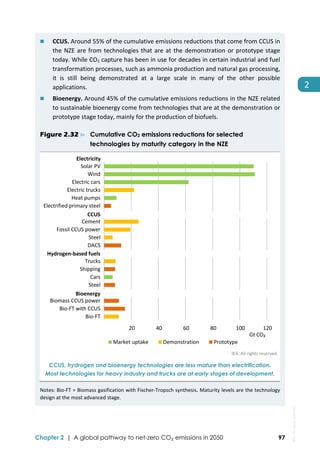
required for electric long‐haul trucks
Li‐S (or other) (650 Wh per kg)
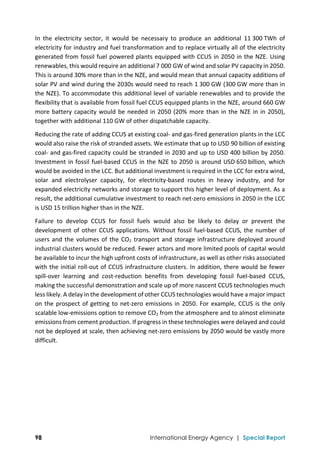
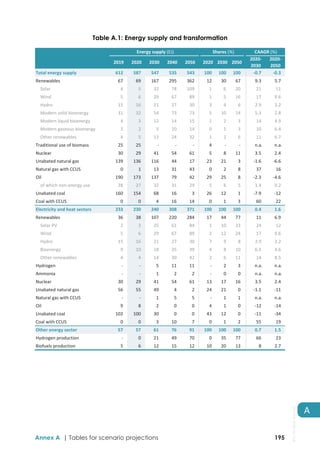
required for electric aircrafts
 
Chapter 2 | A global pathway to net-zero CO₂ emissions in 2050 73
2 
2.5.4 Renewables 
At a global level, renewable energy technologies are the key to reducing emissions from 
electricity supply. Hydropower has been a leading low‐emission source for many decades, 
but it is mainly the expansion of wind and solar that triples renewables generation by 2030 
and increases it more than eightfold by 2050 in the NZE. The share of renewables in total 
electricity generation globally increases from 29% in 2020 to over 60% in 2030 and to nearly 
90%  in  2050  (Figure 2.18).  To  achieve  this,  annual  capacity  additions  of  wind  and  solar 
between 2020 and 2050 are five‐times higher than the average over the last three years. 
Dispatchable  renewables  are  critical  to  maintain  electricity  security,  together  with  other 
low‐carbon generation, energy storage and robust electricity networks. In the NZE, the main 
dispatchable  renewables  globally  in  2050  are  hydropower  (12%  of  generation), 
bioenergy (5%), concentrating solar power (2%) and geothermal (1%).  
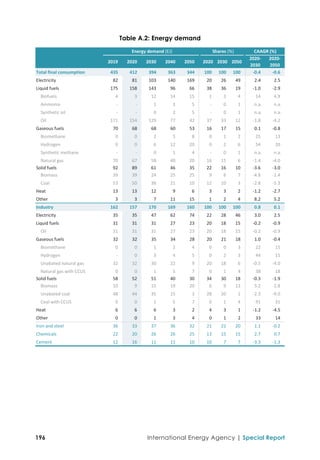
Figure 2.18 ⊳ Fuel shares in total energy use in selected applications in the NZE
IEA. All rights reserved.
Renewables are central to emissions reductions in electricity, and they make major
contributions to cut emissions in buildings, industry and transport both directly and indirectly
Notes: Indirect renewables = use of electricity and district heat produced by renewables. Other low‐carbon 
= nuclear power, facilities equipped with CCUS, and low‐carbon hydrogen and hydrogen‐based fuels. 
IEA.
All
rights
reserved.
 
74 International Energy Agency | Special Report
Renewables  also  play  an  important  role  in  reducing  emissions  in  buildings,  industry  and 
transport. Renewables can be used either indirectly, via the consumption of electricity or 
district heating that was produced by renewables, or directly, mainly to produce heat.  
In transport, renewables play an important indirect role in reducing emissions by generating 
the electricity to power electric vehicles. They also contribute to direct emissions reductions 
through the use of liquid biofuels and biomethane. 
In buildings, renewable energy is mainly used for water and space heating. The direct use of 
renewable energy rises from about 10% of heating demand globally in 2020 to 40% in 2050, 
about three‐quarters of the increase is in the form of solar thermal and geothermal. Deep 
retrofits and energy‐related building codes are paired with renewables whenever possible: 
almost all buildings with available roof space and sufficient solar insolation are equipped with 
solar thermal water heaters by 2050, as they are more productive per square metre than 
solar PV and as heat storage in water tanks is generally more cost‐effective than storage of 
electricity.  Rooftop  solar  PV,  which  produces  renewable  electricity  onsite,  is  currently 
installed  on  around  25 million  rooftops  worldwide;  the  number  increases  to  100 million 
rooftops by 2030 and 240 million by 2050. A further 15% of heating in buildings in 2030 
comes indirectly from renewables in the form of electricity, and this rises to almost 40% in 
2050. 
In industry, bioenergy is the most important direct renewable energy source for low‐ and 
medium‐temperature needs in the NZE. Solar thermal and geothermal also produce low 
temperature heat for use in non‐energy‐intensive industries and ancillary or downstream 
processes in heavy industries. Bioenergy, solar thermal and geothermal together provide 
about 15% of industry heat demand in 2030, roughly double their share in 2010, and this 
increases to 40% in 2050. The indirect use of renewable energy via electricity adds 15% to 
the contribution that renewables make to total industry energy use in 2050. 
Table 2.6 ⊳ Key deployment milestones for renewables
Sector   2020  2030  2050 
Electricity sector       
Renewables share in generation  29%  61%  88% 
Annual capacity additions (GW):  Total solar PV  134  630  630 
               Total wind  114  390  350 
            – of which: Offshore wind  5  80  70 
               Dispatchable renewables  31  120  90 
End‐uses sectors       
Renewable share in TFC  5%  12%  19% 
Households with rooftop solar PV (million)  25  100  240 
Share of solar thermal and geothermal in buildings  2%  5%  12% 
Share of solar thermal and geothermal in industry final consumption 0%  1%  2% 
Note: TFC = total final consumption. 
 
Chapter 2 | A global pathway to net-zero CO₂ emissions in 2050 75
2 
2.5.5 Hydrogen and hydrogen‐based fuels 
The initial focus for hydrogen use in the NZE is the conversion of existing uses of fossil energy 
to  low‐carbon  hydrogen  in  ways  that  do  not  immediately  require  new  transmission  and 
distribution infrastructure. This includes hydrogen use in industry and in refineries and power 
plants, and the blending of hydrogen into natural gas for distribution to end‐users. 
Global hydrogen use expands from less than 90 Mt in 2020 to more than 200 Mt in 2030; the 
proportion of low‐carbon hydrogen rises from 10% in 2020 to 70% in 2030 (Figure 2.19). 
Around half of low‐carbon hydrogen produced globally in 2030 comes from electrolysis and 
the remainder from coal and natural gas with CCUS, although this ratio varies substantially 
between  regions.  Hydrogen  is  also  blended  with  natural  gas  in  gas  networks:  the  global 
average blend in 2030 includes 15% of hydrogen in volumetric terms, reducing CO2 emissions 
from gas consumption by around 6%. 
Figure 2.19 ⊳ Global hydrogen and hydrogen-based fuel use in the NZE
 
IEA. All rights reserved.
The initial focus for hydrogen is to convert existing uses to low-carbon hydrogen;
hydrogen and hydrogen-based fuels then expand across all end-uses
Note: Includes hydrogen and hydrogen contained in ammonia and synthetic fuels. 
These developments facilitate a rapid scaling up of electrolyser manufacturing capacity and 
the parallel development of new hydrogen transport infrastructure. This leads to rapid cost 
reductions  for  electrolysers  and  for  hydrogen  storage,  notably  in  salt  caverns.  Stored 
hydrogen  is  used  to  help  balance  both  seasonal  fluctuations  in  electricity  demand  and 
imbalances  that  may  arise  between  the  demand  for  hydrogen  and  its  supply  by  off‐grid 
renewable systems. During the 2020s, there is also a large increase in the installation of 
end‐use equipment for hydrogen, including more than 15 million hydrogen fuel cell vehicles 
on the road by 2030.  
20%
40%
60%
80%
100%
 100
 200
 300
 400
 500
2020 2025 2030 2035 2040 2045 2050
Mt
Other
Refineries
Iron and steel
Chemicals
Other
Refineries
Industry
Shipping
Aviation
Road
Buildings
Electricity generation
Blended in gas grid
Low‐carbon share
Merchant
Onsite 
IEA.
All
rights
reserved.
 
76 International Energy Agency | Special Report
After  2030,  low‐carbon  hydrogen  use  expands  rapidly  in  all  sectors  in  the  NZE.  In  the 
electricity  sector,  hydrogen  and  hydrogen‐based  fuels  provide  an  important  low‐carbon 
source of electricity system flexibility, mainly through retrofitting existing gas‐fired capacity 
to co‐fire with hydrogen, together with some retrofitting of coal‐fired power plants to co‐fire 
with ammonia. Although these fuels provide only around 2% of overall electricity generation 
in 2050, this translates into very large volumes of hydrogen and makes the electricity sector 
an important driver of hydrogen demand. In transport, hydrogen provides around one‐third 
of fuel use in trucks in 2050 in the NZE: this is contingent on policy makers taking decisions 
that  enable  the  development  of  the  necessary  infrastructure  by  2030.  By  2050, 
hydrogen‐based fuels also provide more than 60% of total fuel consumption in shipping. 
Of the 530 Mt  of hydrogen produced in 2050, around 25% is produced within industrial 
facilities (including refineries), and the remainder is merchant hydrogen (hydrogen produced 
by one company to sell to others). Almost 30% of the low‐carbon hydrogen used in 2050 
takes the form of hydrogen‐based fuels, which include ammonia and synthetic liquids and 
gases. An increasing share of hydrogen production comes from electrolysers, which account 
for 60% of total production in 2050. Electrolysers are powered by grid electricity, dedicated 
renewables in regions with excellent renewable resources and other low‐carbon sources 
such as nuclear power. Rolling out electrolysers at the pace required in the NZE is a key 
challenge given the lack of manufacturing capacity today, as is ensuring the availability of 
sufficient electricity generation capacity. Global trade in hydrogen develops over time in the 
NZE, with large volumes exported from gas and renewables‐rich areas in the Middle East, 
Central and South America and Australia to demand centres in Asia and Europe. 
Table 2.7 ⊳ Key deployment milestones for hydrogen and hydrogen-based fuels
Sector   2020  2030  2050 
Total production hydrogen‐based fuels (Mt)  87  212  528 
Low‐carbon hydrogen production  9  150  520 
    share of fossil‐based with CCUS  95% 46% 38% 
    share of electrolysis‐based  5%  54%  62% 
Merchant production  15  127  414 
Onsite production 73 85 114 
Total consumption hydrogen‐based fuels (Mt)  87  212  528 
Electricity  0 52 102 
    of which hydrogen  0  43  88 
    of which ammonia  0  8  13 
Refineries  36 25 8 
Buildings and agriculture  0  17  23 
Transport  0  25  207 
    of which hydrogen  0 11 106 
    of which ammonia  0  5  56 
    of which synthetic fuels  0  8  44 
Industry  51 93 187 
Note: Hydrogen‐based fuels are reported in million tonnes of hydrogen required to produce them.  
 
Chapter 2 | A global pathway to net-zero CO₂ emissions in 2050 77
2 
2.5.6 Bioenergy 
Global primary demand for bioenergy was almost 65 EJ in 2020, of which about 90% was 
solid biomass. Some 40% of the solid biomass was used in traditional cooking methods which 
is unsustainable, inefficient and polluting, and was linked to 2.5 million premature deaths in 
2020. The use of solid biomass in this manner falls to zero by 2030 in the NZE, to achieve the 
UN Sustainable Development Goal 7. Increases in all forms of modern bioenergy more than 
offset this, 
with production rising from less than 40 EJ in 2020 to around 100 EJ in 2050 
(Figure 2.20).15
 All bioenergy in 2050 comes from sustainable sources and the figures in the 
NZE  for  total  bioenergy  use  are  well  below  estimates  of  global  sustainable  bioenergy 
potential, thus avoiding the risk of negative impacts on biodiversity, fresh water systems, and 
food prices and availability (see section 2.7.2). 
Figure 2.20 ⊳ Total bioenergy supply in the NZE
 
IEA. All rights reserved.
Modern bioenergy use rises to 100 EJ in 2050, meeting almost 20% of total energy needs.
Global demand in 2050 is well below the assessed sustainable potential
Notes: TES = Total energy supply. Conversion losses occur during the production of biofuels and biogases. 
Modern solid bioenergy use rises by about 3% each year on average to 2050. In the electricity 
sector, where demand reaches 35 EJ in 2050, solid bioenergy provides flexible low‐emissions 
generation to complement generation from solar PV and wind, and it removes CO2 from the 
atmosphere when equipped with CCUS. In 2050, electricity generation using bioenergy fuels 
reaches 3 300 TWh, or 5% of total generation. Bioenergy also provides around 50% of district 
heat production. In industry, where demand reaches 20 EJ in 2050, solid bioenergy provides 
high temperature heat and can be co‐fired with coal to reduce the emissions intensity of 
                                                                                                                                
15
 Modern bioenergy includes biogases, liquid biofuels and modern solid biomass harvested from sustainable 
sources. It excludes the traditional use of biomass. 
5%
10%
15%
20%
25%
 20
 40
 60
 80
 100
2010 2020 2030 2040 2050
EJ
Traditional use of biomass
Conversion losses
Biogases
Liquid biofuels
Buildings and agriculture
Industry
Electricity
Modern bioenergy share
share in TES (right axis)
Modern solid bioenergy
IEA.
All
rights
reserved.
 
78 International Energy Agency | Special Report
existing generation assets. Demand is highest for paper and cement production: in 2050, 
bioenergy meets 60% of energy demand in the paper sector and 30% of energy demand for 
cement production. Modern solid bioenergy demand in buildings increases to nearly 10 EJ in 
2030, most of it for use in improved cookstoves as unsustainable traditional uses of biomass 
disappear.  Bioenergy  is  also  increasingly  used  for  space  and  water  heating  in  advanced 
economies.  
Household and village biogas digesters in rural areas provide a source of renewable energy 
and clean cooking for nearly 500 million households by 2030 in the NZE and total biogas use 
rises to 5.5 EJ in 2050 (from under 2 EJ in 2020).16
 Biomethane demand grows to 8.5 EJ, 
thanks to blending mandates for gas networks, with average blending rates increasing to 
above 80% in many regions by 2050. Half of total biomethane use is in the industry sector, 
where  biomethane  replaces  natural  gas  as  a  source  of  process  heat.  The  buildings  and 
transport sectors each account for around a further 20% of biomethane consumption in 
2050. 
One of the key advantages of bioenergy is that it can use existing infrastructure. For example, 
biomethane  can  use  existing  natural  gas  pipelines  and  end‐user  equipment,  while  many 
drop‐in liquid biofuels can use existing oil distribution networks and be used in vehicles with 
only  minor  or  limited  alterations.  BioLPG  –  LPG  derived  from  renewable  feedstocks  –  is 
identical  to  conventional  LPG  and  so  can  be  blended  and  distributed  in  the  same  way. 
Sustainable bioenergy also provides a valuable source of employment and income for rural 
communities, reduces undue burdens on women often tasked with fuel collection, brings 
health  benefits  from  reduced  air  pollution  and  proper  waste  management,  and  reduces 
methane emissions from inefficient combustion and the decomposition of waste. 
Liquid biofuel consumption rises from 1.6 mboe/d in 2020 to 6 mboe/d in 2030 in the NZE, 
mainly  used  in  road  transport.  After  2030,  liquid  biofuels  grow  more  slowly  to  around 
7 mboe/d in 2050 and their use shifts to shipping and aviation  as electricity increasingly 
dominates road transport. Almost half of liquid biofuel use in 2050 is for aviation, where bio‐
kerosene accounts for around 45% of total fuel use in aircraft.  
Bioenergy  with  carbon  capture  and  storage  (BECCS)  plays  a  critical  role  in  the  NZE  in 
offsetting emissions from sectors where the full elimination of emissions is very difficult to 
achieve. In 2050, around 10% of total bioenergy is used in facilities equipped with CCUS and 
around 1.3 Gt CO2 is captured using BECCS. Around 45% of this CO2 is captured in biofuels 
production, 40% in the electricity sector and the rest in heavy industry,  notably cement 
production.  


16
 Biogas is a mixture of methane, CO2 and small quantities of other gases produced by anaerobic digestion of 
organic matter in an oxygen free environment. Biomethane is a near pure source of methane produced either 
by removing CO2 and other contaminants from biogas or through the gasification of solid biomass (IEA, 2020b). 
 
Chapter 2 | A global pathway to net-zero CO₂ emissions in 2050 79
2 
Table 2.8 ⊳ Key deployment milestones for bioenergy
   2020 2030 2050 
Total energy supply (EJ)  63  72  102 
Share of advanced biomass feedstock  27%  85%  97% 
Modern gaseous bioenergy (EJ)  2.1  5.4  13.7 
    Biomethane  0.3  2.3  8.3 
Modern liquid bioenergy (mboe/d)  1.6  6.0  7.0 
    Advanced biofuels  0.1  2.7  6.2 
Modern solid bioenergy (EJ)  32  54  74 
Traditional use of solid biomass (EJ)  25  0  0 
Million people using traditional biomass for cooking  2 340  0  0 
Notes:  mboe/d  =  million  barrels  of  oil  equivalent  per  day.  Bioenergy  from  forest  plantings  is  considered 
advanced when forests are sustainably managed (see section 2.7.2). 
2.5.7 Carbon capture, utilisation and storage 
CCUS  can  facilitate  the  transition  to  net‐zero  CO2  emissions  by:  tackling  emissions  from 
existing assets; providing a way to address emissions from some of the most challenging 
sectors;  providing  a  cost‐effective  pathway  to  scale  up  low‐carbon  hydrogen  production 
rapidly; and allowing for CO2 removal from the atmosphere through BECCS and DACCS. 
In the NZE, policies support a range of measures to establish markets for CCUS investment 
and to encourage use of shared CO2 transport and storage infrastructure by those involved 
in the production of hydrogen and biofuels, the operation of industrial hubs, and retrofitting 
of existing coal‐fired power plants. Capture volumes in the NZE increase marginally over the 
next five years from the current level of around 40  Mt CO2 per year, reflecting projects 
currently under development, but there is a rapid expansion over the following 25 years as 
policy action bears fruit. By 2030, 1.6 Gt CO2 per year is captured globally, rising to 7.6 Gt CO2 
in 2050 (Figure 2.21). Around 95% of total CO2 captured in 2050 is stored in permanent 
geological storage and 5% is used to provide synthetic fuels. Estimates of global geological 
storage  capacity  are  considerably  above  what  is  necessary  to  store  the  cumulative  CO2 
captured and stored in the NZE. A total of 2.4 Gt CO2 is captured in 2050 from the atmosphere 
through  bioenergy  with  CO2  capture  and  direct  air  capture,  of  which  1.9 Gt CO2  is 
permanently stored and 0.5 Gt CO2 is used to provide synthetic fuels in particular for aviation. 
Energy‐related and process CO2 emissions in industry account for almost 40% of the CO2 
captured  in  2050  in  the  NZE.  CCUS  is  particularly  important  for  cement  manufacturing. 
Although efforts are pursued in the NZE to produce cement more efficiently, CCUS remains 
central to efforts to limit the process emissions that occur during cement manufacturing. The 
electricity sector accounts for almost 20% of the CO2 captured in 2050 (of which around 45% 
is  from  coal‐fired  plants,  40%  from  bioenergy  plants  and  15%  from  gas‐fired  plants). 
CCUS‐equipped power plants contribute just 3% of total electricity generation in 2050 but 
the volumes of CO2 captured are comparatively large. In emerging market and developing 
economies, where large numbers of coal power plants have been built relatively recently, 
IEA.
All
rights
reserved.
 
80 International Energy Agency | Special Report
retrofits  play  an  important  role  where  there  are  storage  opportunities.  In  advanced 
economies, gas‐fired plants with CCUS play a bigger role, providing dispatchable electricity 
at relatively low cost in regions with cheap natural gas and existing networks. In 2030, around 
50 GW of coal‐fired power plants (4% of the total at that time) and 30 GW of natural gas 
power plants (1% of the total) are equipped with CCUS, and this rises to 220 GW of coal 
(almost half of the total) and 170 GW of natural gas (7% of the total) capacity in 2050. A 
further 30% of CO2 captured in 2050 comes from fuel transformation, including hydrogen 
and biofuels production as well as oil refining. The remaining 10% is from DAC, which is 
rapidly scaled up from several of pilot projects today to 90 Mt CO2 per year in 2030 and just 
under 1 Gt CO2 per year by 2050. 
Figure 2.21 ⊳ Global CO2 capture by source in the NZE
 
IEA. All rights reserved.
By 2050, 7.6 Gt of CO2 is captured per year from a diverse range of sources. A total of 2.4 Gt
CO2 is captured from bioenergy use and DAC, of which 1.9 Gt CO2 is permanently stored.
Table 2.9 ⊳ Key global milestones for CCUS
2020  2030  2050 
Total CO2 captured (Mt CO2)  40  1 670  7 600 
CO2 captured from fossil fuels and processes  39  1 325  5 245 
     Power  3  340  860 
     Industry  3  360  2 620 
     Merchant hydrogen production  3  455  1 355 
     Non‐biofuels production  30  170  410 
CO2 captured from bioenergy  1  255  1 380 
     Power  0  90  570 
     Industry   0  15  180 
     Biofuels production  1  150  625 
Direct air capture  0  90  985 
    Removal  0  70  630 
 2
 4
 6
 8
2020 2025 2030 2035 2040 2045 2050
Gt CO₂
Direct air capture
Hydrogen production
Biofuels production
Other
Industry combustion
Industry processes
Bioenergy
Gas
Coal
Electricity sector
Industry
Fuel supply
Other
 
Chapter 2 | A global pathway to net-zero CO₂ emissions in 2050 81
2 
2.6 Investment 
The radical transformation of the global energy system required to achieve net‐zero CO2 
emissions in 2050 hinges on a big expansion in investment and a big shift in what capital is 
spent on. The NZE expands annual investment in energy from just over USD 2 trillion globally 
on average over the last five years to almost USD 5 trillion by 2030 and to USD 4.5 trillion by 
2050 (Figure 2.22).17
 Total annual capital investment in energy in the NZE rises from around 
2.5% of global GDP in recent years to about 4.5% in 2030 before falling back to 2.5% by 2050. 
Figure 2.22 ⊳ Annual average capital investment in the NZE
 
IEA. All rights reserved.
Capital investment in energy rises from 2.5% of GDP in recent years to 4.5% by 2030; the
majority is spent on electricity generation, networks and electric end-user equipment
Notes: Infrastructure includes electricity networks, public EV charging, CO2 pipelines and storage facilities, 
direct air capture and storage facilities, hydrogen refuelling stations, and import and export terminals for 
hydrogen, fossil fuels pipelines and terminals. End‐use efficiency investments are the incremental cost of 
improving the energy performance of equipment relative to a conventional design. Electricity systems include 
electricity generation, storage and distribution, and public EV charging. Electrification investments include 
spending  in  batteries  for  vehicles,  heat  pumps  and  industrial  equipment  for  electricity‐based  material 
production routes. 
The shift in what capital is spent on leads to annual investment in electricity generation rising 
from just over USD 500 billion over the last five years to more than USD 1 600 billion in 2030, 
before falling back as the cost of renewable energy technologies continues to decline. Annual 
nuclear investment rises too: it more than doubles by 2050 compared with current levels. 
Annual investment in fuel supply however drops from about USD 575 billion on average over 
                                                                                                                                
17
 Investment levels presented in this report include a broader accounting of efficiency improvements in 
buildings than reported in the IEA World Energy Investment (IEA, 2020c) and so differ from the numbers 
presented there. 
 
 1
 2
 3
 4
 5
2030 2040 2050 2030 2040 2050
Trillion USD (2019)
Other
Fossil fuels
CCUS
Hydrogen
Electricity system
Electrification
Efficiency
Other renewables
Bioenergy
Buildings
Transport
Industry
Infrastructure
Electricity generation
Fuel production
By sector By technology area
2016‐20 2016‐20
Technology area
Sector
IEA.
All
rights
reserved.
 
82 International Energy Agency | Special Report
the last half‐decade to USD 315 billion in 2030 and USD 110 billion in 2050. The share of fossil 
fuel supply in total energy sector investment drops from its 25% level in recent years to just 
7% by 2050: this is partly offset by the rise in spending on low‐emissions fuel supply, such as 
hydrogen, hydrogen‐based fuels and bioenergy. Annual investment in these fuels increases 
to nearly USD 140 billion in 2050. Investment in transport increases significantly in the NZE 
from USD 150 per year in recent years to more than USD 1 100 billion in 2050: this stems 
mainly from the upfront cost of electric cars compared with conventional vehicles despite 
the decline in the cost of batteries.  
By technology area, electrification is the dominant focus in the NZE. In addition to more 
investment in electricity generation, there is a huge increase in investment in expansion and 
modernisation  of  electricity  networks.  Annual  investment  rises  from  USD 260 billion  on 
average in recent years to around USD 800 billion in 2030 and remains about that level to 
2050. Such investment is needed to ensure electricity security in the face of rising electricity 
demand and the proportion of variable generation in the power mix. There is also a large 
increase in investment in the electrification of end‐use sectors, which includes spending on 
EV  batteries,  heat  pumps  and  electricity‐based  industrial  equipment.  In  addition  to 
investment in electrification, there is a moderate increase in investment in hydrogen to 2030 
as production facilities are scaled up, and larger increases after as hydrogen use in transport 
expands: annual investment in hydrogen, including production facilities, refuelling stations 
and end‐user equipment, reaches USD 165 billion in 2030 and over USD 470 billion in 2050. 
There  is  also  an  increase  in  global  investment  in  CCUS  (annual  investment  exceeds 
USD 160 billion by 2050 and in efficiency (around USD 640 billion annual investment by 2050, 
mostly  for  deep  building  retrofits  and  efficient  appliances  in  the  industry  and  buildings 
sectors). 
Financing the investment needed in the NZE involves redirecting existing capital towards 
clean  energy  technologies  and  substantially  increasing  the  overall  level  of  investment  in 
energy. Most of this increase in investment comes from private sources, mobilised by public 
policies that create incentives, set appropriate regulatory frameworks and reform energy 
taxes. However, direct government financing is also needed to boost the development of 
new  infrastructure  projects  and  to  accelerate  innovation  in  technologies  that  are  in  the 
demonstration or prototype phase today. Projects in many emerging market and developing 
economies  are  often  relatively  reliant  on  public  financing,  and  policies  that  ensure  a 
predictable flow of bankable projects have an important role in boosting private investment 
in these economies, as does the scaling up of concessional debt financing and the use of 
development finance. There are extensive cross‐country co‐operation efforts in the NZE to 
facilitate the international flow of capital. 
The  large  increase  in  capital  investment  in  the  NZE  is  partly  compensated  for  by  lower 
operating expenditure. Operating costs account today for a large share of the total cost of 
upstream fuel supply projects and fossil fuel generation projects: the clean technologies that 
play an increasing role in the NZE are characterised by much lower operating costs. 
 
 
Chapter 2 | A global pathway to net-zero CO₂ emissions in 2050 83
2 
2.7 Key uncertainties  
The  road  to  net‐zero  emissions  is  uncertain  for  many  reasons:  we  cannot  be  sure  how 
underlying  economic  conditions  will  change,  which  policies  will  be  most  effective,  how 
people and businesses will respond to market and policy signals, or how technologies and 
their costs will evolve from within or outside the energy sector. The NZE therefore is just one 
possible  pathway  to  achieve  net‐zero  emissions  by  2050.  Against  this  background,  this 
section looks at what the implications would be if the assumptions in the NZE turn out to be 
off the mark with respect to behavioural change, bioenergy and CCUS for fossil fuels. These 
three areas were selected because the assumptions made about them involve a high degree 
of uncertainty and because of their critical contributions to achieve net‐zero emissions by 
2050.  
Figure 2.23 ⊳ Additional electricity demand in 2050 and additional investment
between 2021-2050 for selected areas of uncertainty
 
IEA. All rights reserved.
The absence of behaviour change, restrictions on bioenergy use and failure to develop
fossil fuel CCUS would each raise investment to meet net-zero emissions by USD 4-15 trillion
Notes: No behaviour assumes none of the behavioural changes included in the NZE. Restricted bioenergy 
assumes no increase in land use for bioenergy production. Low fossil CCUS assumes no increase in fossil fuel‐
based CCUS apart from projects already approved or under construction. 
Our analysis clearly highlights that more pessimistic assumptions would add considerably to 
both the costs and difficulty of achieving net‐zero emissions by 2050 (Figure 2.23). 
 Behavioural changes are important in reducing energy demand in transport, buildings 
and  industry.  If  the  changes  in  behaviour  assumed  in  the  NZE  were  not  attainable, 
emissions would be around 2.6 Gt CO2 higher in 2050. Avoiding these emissions through 
the  use  of  additional  low‐carbon  electricity  and  hydrogen  would  cost  an  additional 
USD 4 trillion. 
4%
8%
12%
16%
20%
 3
 5
 8
 10
 13
No
behaviour
Restricted
bioenergy
Low fossil
CCUS
Thousand TWh
Increase from NZE (right axis)
Electricity demand
4%
8%
12%
16%
20%
 4
 8
 12
 16
No
behaviour
Restricted
bioenergy
Low fossil
CCUS
Trillion USD (2019)
Investment 
IEA.
All
rights
reserved.
 
84 International Energy Agency | Special Report
 Bioenergy use grows by 60% between 2020 and 2050 in the NZE and land use for its 
propagation increases by around 25%. Bioenergy use in 2050 in the NZE is well below 
current best estimates of global sustainable bioenergy potential, but there is a high 
degree of uncertainty concerning this level. If land use for bioenergy remains at today’s 
level,  bioenergy  use  in  2050  would  be  around  10%  lower,  and  achieving  net‐zero 
emissions in 2050 would require USD 4.5 trillion extra investment. 
 A failure to develop CCUS for fossil fuels would substantially increase the risk of stranded 
assets and would require around USD 15 trillion of additional investment in wind, solar 
and electrolyser capacity to achieve the same level of emissions reductions. It could also 
critically delay progress on BECCS and DACCS: if these cannot be deployed at scale, then 
achieving net‐zero emissions by 2050 would be very much harder. 
2.7.1 Behavioural change 
Impact of behavioural changes in selected sectors in the NZE 
Changes  in  the  behaviour  of  energy  consumers  play  an  important  role  in  cutting  CO2 
emissions and energy demand growth in the NZE. Behavioural changes reduce global energy 
demand by 37 EJ in 2050, a 10% reduction in energy demand at that time, and without them 
cumulative emissions between 2021 and 2050 would be around 10% higher (Figure 2.24). 
Behavioural change plays a particularly important role in the transport sector.  
Figure 2.24 ⊳ Reduction in total final consumption due to behavioural changes
by fuel in the NZE
 
IEA. All rights reserved.
The impact of behaviour changes and materials efficiency on
final energy consumption increases over time
Note: Other includes coal, hydrogen, geothermal, solar thermal, synthetic oil and synthetic gas. 
Passenger aviation. Demand would grow more than threefold globally between 2020 and 
2050 in the absence of the assumed changes in behaviour in the NZE. About 60% of this 
‐12%
‐9%
‐6%
‐3%
‐ 40
‐ 30
‐ 20
‐ 10
2020 2030 2040 2050
EJ
Oil Natural gas Electricity Heat Modern bioenergy Other
Change in final energy consumption (right axis)
 
Chapter 2 | A global pathway to net-zero CO₂ emissions in 2050 85
2 
growth  would  occur  in  emerging  market  and  developing  economies.  In  the  NZE,  three 
changes lead to a 50% reduction in emissions from aviation in 2050, while reducing the 
number of flights by only 12% (Figure 2.25). 
 Keeping air travel for business purposes at 2019 levels. Although business trips fell to 
almost zero in 2020, they accounted for just over one‐quarter of air travel before the 
pandemic. This avoids around 110 Mt CO2 in 2050 in the NZE. 
 Keeping  long‐haul  flights  (more  than  six  hours)  for  leisure  purposes  at  2019  levels. 
Emissions from an average long‐haul flight are 35‐times greater than from a regional 
flight (less than one hour). This affects less than 2% of flights but avoids 70 Mt CO2 in 
2050. 
 A shift to high‐speed rail. The opportunities for shifting regional flights to high‐speed rail 
vary by region. Globally, we estimate that around 15% of regional flights in 2019 could 
have been shifted given existing rail infrastructure; future high‐speed rail lines ensure 
that by 2050 around 17% could be shifted (IEA, 2019).18
 This would reduce emissions by 
around 45 Mt CO2 in 2050 (high‐speed trains generate no emissions in 2050 in the NZE). 
Figure 2.25 ⊳ Global CO2 emissions from aviation and impact of behavioural
changes in the NZE
IEA. All rights reserved.
Demand for passenger aviation is set to grow significantly by 2050, but behavioural
changes reduce emissions by 50% in 2050 despite reducing flights by only 12%
Notes: Long‐haul = more than 6 hour flight; medium‐haul = 1‐6 hour flight; regional = less than 1 hour. Business 
flights = trips for work purposes; leisure flights = trips for leisure purposes. Average speeds vary by flight 
distance and range from 680‐750 km/h. 
                                                                                                                                
18
 This assumes that: new rail routes avoid water bodies and tunnelling through elevated terrain; travel times 
are  similar  to  aviation;  and  centres  of  demand  are  sufficiently  large  to  ensure  that  high‐speed  rail  is 
economically viable. 
20
40
60
80
100
0.2
0.4
0.6
0.8
1.0
2019 2020 2050
Gt CO
2
Long‐haul
Medium‐haul
Regional
#REF!
Cap long‐haul
Cap business
Shift to high‐speed
Million flights
Emissions reductions
Emissions
‐50%
(right axis)
leisure flights
flights
rail
Behaviour
reductions
IEA.
All
rights
reserved.
 
86 International Energy Agency | Special Report
Car use. A variety of new measures that aim to reduce the use of cars in cities and overall car 
ownership levels are assumed in the NZE. They lead to rapid growth in the rideshare market 
in urban areas, as well as phasing out polluting cars in large cities and replacing them with 
cycling, walking and public transport. The timing of these changes in the NZE depends on 
cities having the necessary infrastructure and public support to ensure a shift away from 
private car use. Between 20‐50% of car trips are shifted to buses, depending on the city in 
question,  with  the  remainder  replaced  by  cycling,  walking  and  public  transport.  These 
changes  reduce  emissions  from  cars  in  cities  by  more  than  320 Mt CO2  in  total  in  the 
mid‐2030s (Figure 2.26). Their impact on emissions fades over time as cars are increasingly 
electrified, but they still have a significant impact on curbing energy use in 2050. 
Figure 2.26 ⊳ Global CO2 emissions savings and car ownership per household
due to behavioural change in the NZE
IEA. All rights reserved.
Policies discouraging car use in cities lead to rapid reductions in CO2 emissions and lower
car ownership levels, though the impact diminishes over time as cars are electrified
The gradual move away from cars in cities also has an impact on car ownership levels. Survey 
data  indicates  that  car‐share  schemes  and  the  provision  of  public  transport  reduces  car 
ownership by up to 35%, with the biggest changes taking place in multiple car households 
(Jochem et al., 2020; Martin, Shaheen and Lidiker, 2010). Without behavioural changes, 35% 
of households would have a car in 2050; with behavioural changes this share falls to around 
20% in the NZE, and two‐car households fall from 13% of the total to less than 5%. 
The changing patterns of mobility in cities in NZE have implications for materials demand. 
Reduced  car  ownership  leads  to  a  small  drop  in  steel  demand  in  2050,  saving  around 
40 Mt CO2 in steel production. Increased cycling would need to be supported by building an 
estimated  80 000 km  of  new  cycle  lanes  globally  over  the  period  to  2050,  generating 
increased demand for cement and bitumen. This effect is small, however: the extra emissions 
associated with this would be less than 5% of the emissions avoided by lower car use. 
‐50
0
50
100
150
200
2020 2030 2040 2050
Ridesharing Cycling and walking Buses
Mt CO
2
CO2 emissions savings
20%
40%
60%
80%
100%
0 cars 1 car 2 cars 3+ cars
Before behaviour change
After behaviour change
Cars per household in 2050
 
Chapter 2 | A global pathway to net-zero CO₂ emissions in 2050 87
2 
How to bring about the behavioural changes in NZE  
Regulations and mandates could enable roughly 70% of the emissions saved by behavioural 
changes in the NZE. Examples include:  
 Upper speed limits, which are reduced over time in the NZE from their current levels to 
100 km/h, cutting emissions from road vehicles by 3% in 2050. 
 Appliance standards, which maximise energy efficiency in the buildings sector. 
 Regulations covering heating temperatures in offices and default cooling temperatures 
for air conditioning units, which reduce excessive thermal demand. 
 Changes initially tackled by market‐based mechanisms, e.g. swapping regional flights for 
high‐speed rail,19
 which can be addressed by regulation over time to mirror changes in 
public sentiment and consumer norms. 
Market‐based instruments use a mix of financial incentives and disincentives to influence 
decision making. They could enable around two‐thirds of the emissions saved by behavioural 
changes in the NZE. Examples include: 
 Congestion pricing and targeted interventions differentiated by vehicle type,20
 such as 
charges aimed at the most polluting vehicles, or preferential parking for clean cars. 
 Transport demand measures that reduce travel, such as fuel taxes and distance‐based 
vehicle insurance and registration fees (Byars, Wei and Handy, 2017). 
 Information measures that help consumers to drive change, such as mandatory labelling 
of embodied or lifecycle emissions in manufacturing and a requirement for companies 
to disclose their carbon emissions.  
Information and awareness measures could enable around 30% of the emissions saved by 
behavioural changes in the NZE. Examples include:  
 Personalised  and  real‐time  travel  planning  information,  which  facilitates  a  switch  to 
walking, cycling and public transport. 
 Product labelling and public awareness campaigns in combination, which help make 
recycling widespread and habitual.  
 Comparisons  with  consumption  patterns  of  similar  households,  which  can  reduce 
wasteful energy use by up to 20% (Aydin, Brounen and Kok, 2018). 
Not all the behavioural changes in the NZE would be equally easy to achieve everywhere, 
and policy interventions would need to draw on insights from behavioural science and take 
into account existing behavioural norms and cultural preferences. Some behavioural changes 
may be more socially acceptable than others. Citizen assemblies in the United Kingdom and 
                                                                                                                                
19
 A law banning domestic flights  where a  rail alternative of under two‐and‐a‐half hours  exists has been 
proposed in France (Assemblee Nationale, 2021). 
20
 Congestion charging is currently used in 11 major cities and has been shown to reduce traffic volumes by up 
to 27%. Low‐emissions zones charge vehicles to enter urban zones based vehicle type and currently exist in 
15 countries (TFL, 2021; Tools of Change, 2014; European Commission, 2021). 
IEA.
All
rights
reserved.
 
88 International Energy Agency | Special Report
France indicate a large level of support for taxes on frequent and long‐distance flyers and for 
banning polluting vehicles from city centres; conversely, measures that limit car ownership 
or reduce speed limits have gained less acceptance (Convention Citoyenne pour le Climat, 
2021; Climate Assembly UK, 2020). Behavioural changes which reduce energy use in homes 
may be particularly well supported: a recent survey showed 85% support for line‐drying 
clothes and switching off appliances, and only 20% of people felt that reducing temperature 
settings in homes was undesirable (Newgate Research and Cambridge Zero, 2021). 
Table 2.10 ⊳ Key behavioural changes in the NZE
  Policy options  Related policy‐goals 
Cost‐
effectiveness 
Timeliness 
Social 
acceptability 
CO
2
 emissions 
impact 
Low‐car cities 
 Phase out ICE cars from 
large cities. 
 Rideshare all urban car trips. 
 
 Low‐emissions zones. 
 Access restrictions. 
 Parking restrictions. 
 Registration caps. 
 Parking pricing. 
 Congestion charges. 
 Investment in cycling lanes 
and public transportation. 
 
 Air pollution 
mitigation. 
 Public health. 
 Reduced congestion. 
 Urban space. 
 Beautification and 
liveability. 
       
Fuel‐efficient driving 
 Reduce motorway speeds to 
less than 100 km/h. 
 Eco‐driving. 
 Raise air conditioning 
temperature in cars by 3 °C. 
 
 Speed limits. 
 Real‐time fuel efficiency 
displays. 
 Awareness campaigns. 
 
 Road safety. 
 Reduced noise 
pollution.         
Reduce regional flights 
 Replace all flights <1h where 
high‐speed rail is a feasible 
alternative. 
 
 High‐speed rail investment. 
 Subsidies for high‐speed rail 
travel. 
 Price premiums. 
 Lower air pollution. 
 Lower noise pollution.        
Reduce international flights 
 Keep air travel for business 
purposes at 2019 levels.  
 Keep long‐haul flights for 
leisure at 2019 levels. 
 
 Awareness campaigns. 
 Price premiums. 
 Corporate targets. 
 Frequent‐flyer levies. 
 Lower air pollution. 
 Lower noise pollution.        
Space heating 
 Target average set‐point 
temperatures of 19‐20 °C. 
 
 Awareness campaigns. 
 Consumption feedback. 
 Corporate targets. 
 
 Public health. 
 Energy affordability.         
Space cooling 
 Target average set‐point 
temperatures of 24‐25 °C. 
 
 Awareness campaigns. 
 Consumption feedback. 
 Corporate targets. 
 Public health. 
 Energy affordability.         
 = poor match  = neutral match  = good match 
Notes: Large cities = cities over 1 million inhabitants. ICE = internal combustion engine. CO2 emissions impact 
= cumulative reductions 2020‐2050. Eco‐driving = early upshifting as well as avoiding sudden acceleration, 
stops or idling. The number of jobs that can be done at home varies considerably by region, globally, an 
average of 20% of jobs can be done at home. 
 
Chapter 2 | A global pathway to net-zero CO₂ emissions in 2050 89
2 
The behavioural changes in the NZE would bring wider benefits in terms of air pollution in 
cities, road safety, noise pollution, congestion and health. Attitudes to policy interventions 
can change quickly when co‐benefits become apparent. For example, support for congestion 
charging  in  Stockholm  jumped  from  less  than  40%  when  the  scheme  was  introduced  to 
around 70% three years later; a similar trend was seen in Singapore, London and other cities, 
all of which experienced declines in air pollution after the introduction of charging (Tools of 
Change, 2014; DEFRA, 2012). 
Are net‐zero emissions by 2050 still possible without behavioural change? 
If the behavioural changes described in the NZE were not to materialise, final energy use 
would  be  27  EJ  and  emissions  1.7 Gt CO2  higher  in  2030,  and  they  would  be  37 EJ  and 
2.6 Gt CO2 higher in 2050. This would further increase the already unprecedented ramp‐up 
needed in low‐carbon technologies. The share of EVs in the global car fleet would need to 
increase from around 20% in 2030 to 45% to ensure the same level of emissions reductions 
(Figure 2.27). Achieving the same reduction in emissions in homes would require electric 
heat  pumps  sales  to  reach  680 million  in  2030  (compared  with  440 million  in  the  NZE). 
Without  gains  in  materials  efficiency,  the  share  of  low‐carbon  primary  steel  production 
would  need  to  be  more  than  twice  as  high  in  2030  as  in  the  NZE.  In  2050,  the  use  of 
sustainable aviation fuels would also need to rise to 7 mboe/d (compared with 5 mboe/d in 
the NZE). Emissions from cement and steel production would be 1.7 Gt CO2 higher in 2050 
than in the NZE, and so require increased deployment of CCUS in industry, deployment of 
electric arc furnaces and more use of low‐carbon hydrogen. 
Figure 2.27 ⊳ Share of low-carbon technologies and fuels with and without
behavioural change in 2030 in the NZE
 
IEA. All rights reserved.
In the absence of behavioural changes, the share of low-emissions technologies in end-
uses in 2030 would need to be much larger to achieve the same emissions as in the NZE
Notes: Electric cars = share of electric cars on the road globally. Sustainable aviation fuels = biojet kerosene 
and synthetic jet kerosene. Low‐carbon steel refers to primary steel production. 
10%
20%
30%
40%
50%
Electric cars Heat pumps in
residential buildings
Low‐carbon steel Sustainable aviation
fuels
NZE Additional without behaviour changes 2020
IEA.
All
rights
reserved.
 
90 International Energy Agency | Special Report
2.7.2 Bioenergy and land‐use change 
Modern  forms  of  bioenergy  play  a  key  role  in  achieving  net‐zero  emissions  in  the  NZE. 
Bioenergy is a versatile renewable energy source that can be used in all sectors, and it can 
often  make  use  of  existing  transmission  and  distribution  infrastructure  and  end‐user 
equipment.  But  there  are  constraints  on  expanding  the  supply  of  bioenergy:  with  finite 
potential  for  bioenergy  production  from  waste  streams,  there  are  possible  trade‐offs 
between  expanding  bioenergy  production,  achieving  sustainable  development  goals  and 
avoiding conflicts with other land uses, notably food production.  
The level of bioenergy use in the NZE takes account of these constraints: bioenergy demand 
in  2050  is  around  100 EJ.  The  global  sustainable  bioenergy  potential  in  2050  has  been 
assessed to be at least 100 EJ (Creutzig, 2015) and recent assessments estimate a potential 
between  150‐170 EJ  when  integrating  relevant  UN  Sustainable  Development  Goals 
(Frank, 2021;  IPCC,  2019;  IPCC,  2014;  Wu,  2019).  However,  there  is  a  high  degree  of 
uncertainty  over  the  precise  levels  of  this  potential.  Using  modelling  developed  in 
co‐operation  with  IIASA,  here  we  examine  the  implications  for  achieving  net‐zero  CO2 
emissions by 2050 if the available levels of sustainable bioenergy were to be lower. We also 
examine  what  would  need  to  be  done  to  achieve  large  reductions  in  emissions  from 
agriculture, forestry and other land use (AFOLU). 
Ensuring a sustainable supply of bioenergy 
Most  liquid  biofuels  produced  today  come  from  dedicated  bioenergy  crops  such  as 
sugarcane, corn or oil crops, often known as conventional biofuels. The expanded use of 
feedstocks and arable land to produce these biofuels can conflict with food production. In 
the NZE, there is a shift towards the use of sustainable, certified agricultural products and 
wood.  Biofuel  production  processes  in  the  NZE  use  advanced  conversion  technologies 
coupled with CCUS where possible (see section 3.3.2). The emphasis is also on advanced 
bioenergy feedstocks, including waste streams from other processes, short‐rotation woody 
crops  and  feedstocks  that  do  not  require  the  use  of  arable  land.  Advanced  bioenergy 
accounts  for  the  vast  majority  of  bioenergy  supply  in  the  NZE  by  2050.  The  use  of 
conventional energy crops for biofuel production grows from around 9 EJ in 2020 to around 
11 EJ in 2030, but then falls by 70% to 3 EJ in 2050 (including feedstocks consumed in the 
biofuel production processes).  
Advanced bioenergy feedstocks that do not require land include organic waste streams from 
agriculture and industry, and woody residues from forest harvesting and wood processing. 
Investment in comprehensive waste collection and sorting in the NZE unlocks around 45 EJ 
of bioenergy supply from various organic waste streams which is primarily used to produce 
biogases and advanced biofuels (Figure 2.28). Woody residues from wood processing and 
forest harvesting provide a further 20 EJ of bioenergy in 2050 in the NZE – less than half of 
current best estimates of the total sustainable potential. Bioenergy can also be produced 
 
Chapter 2 | A global pathway to net-zero CO₂ emissions in 2050 91
2 
from dedicated short‐rotation woody crops (25 EJ of bioenergy supply in 2050).21
 Sustainably 
managed forestry fuelwood or plantations22
 and tree plantings integrated with agricultural 
production via agroforestry systems that do not conflict with food production or biodiversity 
provide just over 10 EJ of bioenergy in 2050. 
Figure 2.28 ⊳ Global bioenergy supply by source in the NZE
 
IEA. All rights reserved.
Bioenergy use increases by around 60% between 2020 and 2050,
while shifting away from conventional feedstocks and the traditional use of biomass
Note: Organic waste streams include agricultural residues, food processing, industrial and municipal organic 
waste streams; they do not require land area. 
Source: IEA analysis based on IIASA data. 
The total land area dedicated to bioenergy production in the NZE increases from 330 million 
hectares (Mha) in 2020 to 410 Mha in 2050. In 2050, around 270 Mha is forest, representing 
around one‐quarter of the total area of global managed forests, and around 5% of total forest 
area. There is 130 Mha of land used for short‐rotation advanced bioenergy crops in 2050 and 
10 Mha for conventional bioenergy crops. There is no overall increase in cropland use for 
bioenergy production in the NZE from today’s level and no bioenergy crops are developed 
on forested land in the NZE.23
 As well as allowing a much greater level of bioenergy crop 
production on marginal lands, woody energy crops can produce twice as much bioenergy per 
hectare as conventional bioenergy crops.  
                                                                                                                                
21
 Woody short‐rotation coppice crops grown on crop land, pasture land or marginal lands not suited to food 
crops. 
22
 Sustainable forestry management ensures that the carbon stock and carbon absorption capability of the 
forest is expanded or remains unchanged. 
23
 Of the 140 Mha land used for bioenergy crops in 2050, 70 Mha are marginal lands or land currently used for 
livestock grazing and 70 Mha are cropland. There is a 60 Mha increase in cropland use for woody crops to 2050 
in the NZE but this is offset by a reduction in cropland use for producing conventional biofuel feedstocks. 
 20
 40
 60
 80
 100
2010 2020 2030 2040 2050
EJ
Forestry plantings
Short‐rotation woody crops
Forest and wood residues
Organic waste streams
Traditional use of biomass
Conventional bioenergy crops
IEA.
All
rights
reserved.
 
92 International Energy Agency | Special Report
Total land use for bioenergy in the NZE is well below estimated ranges of potential land 
availability that take full account of sustainability constraints, including the need to protect 
biodiversity hotspots and to meet the UN Sustainable Development Goal 15 on biodiversity 
and land use. The certification of bioenergy products and strict control of what land can be 
converted to expand forestry plantations and woody energy crops nevertheless is critical to 
avoid land‐use conflict issues. Certification is also critical to ensure the integrity of CO2 offsets 
(see Chapter 1), the use of which should be carefully managed and restricted to sectors that 
lack alternative mitigation options. A related land‐use issue is how to tackle emissions that 
arise from outside the energy sector (Box 2.3). 
Box 2.3 ⊳ Balancing emissions from land use, agriculture and forestry
To limit the global temperature rise, all sources of GHG emissions need to decline to close 
to zero or to be offset with CDR. The energy sector accounted for around three quarters 
of total GHG emissions in recent years. The largest source of GHG emissions other than 
the energy sector is agriculture, forestry and other land use (AFOLU), which produced 
between  10‐12 Gt CO2‐eq  net  GHG  emissions  in  recent  years.24
  CO2  emissions  from 
AFOLU were around 5‐6 Gt CO2, and nitrous oxide and methane emissions were around 
5‐6 Gt CO2‐eq (IPCC, 2019). 
Options  to  reduce  emissions  from  AFOLU  and  enhance  removals  include:  halting 
deforestation; improving forest management practices; instituting farming practices that 
increase  soil  carbon  levels;  and  afforestation.  A  number  of  companies  have  recently 
expressed interest in these sorts of nature‐based solutions to offset emissions from their 
operations (see Chapter 1). For afforestation, converting around 170 Mha (roughly half 
the size of India) to forests would sequester around 1 Gt CO2 annually by 2050. 
Achieving net‐zero energy‐related and industrial process CO2 emissions by 2050 in the 
NZE does not rely on any offsets from outside the energy sector. But commensurate 
action on AFOLU would help limit climate change. The energy‐sector transformation in 
the NZE would reduce CO2 emissions from AFLOU in 2050 by around 150 Mt CO2 given 
the switch away from conventional crops and the increase in short rotation advanced‐
bioenergy crop production on marginal lands and pasture land. To reduce emissions from 
AFOLU further would require reducing deforestation by two‐thirds by 2050, instituting 
improved forest management practices and planting around 250 Mha of new forests. The 
combined impact of these changes would reduce CO2 emissions from AFOLU to zero by 
2040  and  absorb  1.3 Gt CO2  annually  by  2050.  In  this  case,  cumulative  AFOLU  CO2 
emissions between 2020 and 2050 would be around 40 Gt CO2. 
Non‐CO2 emissions from livestock, as well as other agricultural emissions, may be more 
difficult to mitigate given the link between livestock production and nitrous oxide and 
methane  emissions.  Changes  to  farming  practices  and  technology  improvements, 
                                                                                                                                
24
 AFOLU emissions are emissions from anthropogenic activities and do not include CO2 emissions removal 
from the atmosphere by natural land sinks. 
 
Chapter 2 | A global pathway to net-zero CO₂ emissions in 2050 93
2 
including changes to animal feed, could help to reduce these emissions, but it may be 
necessary to use afforestation to offset these emissions entirely. An alternative could be 
to reduce these emissions by reducing the demand for livestock products. For example, 
we estimate that reducing meat consumption in households with the highest levels of 
per capita consumption today to the global average level would reduce GHG emissions 
by more than 1 Gt CO2‐eq in 2050. Lower demand for livestock products would reduce 
the pasture needed globally for livestock by close to 200 Mha and the cropland that is 
used to grow feed for livestock by a further 80 Mha. 
Are net‐zero emissions by 2050 possible without expanding land use for bioenergy? 
Estimates  of  the  global  sustainable  bioenergy  potential  are  subject  to  a  high  degree  of 
uncertainty,  in  particular  over  the  extent  to  which  new  land  area  could  sustainably  be 
converted  to  bioenergy  production.  As  a  result,  the  NZE  takes  a  cautious  approach  to 
bioenergy  use,  with  consumption  in  2050  (100 EJ)  well  below  the  latest  estimates  that 
integrate relevant SDGs, which suggest a potential between 150‐170 EJ. But it is possible that 
the land available to provide sustainable bioenergy is even more limited. Here we explore 
the  implications  for  emissions  of  restricting  land  use  for  dedicated  bioenergy  crops  and 
forestry plantations to around 330 Mha, which is what is used today. 
Figure 2.29 ⊳ Impact on electricity demand and ability to achieve net-zero
emissions by 2050 without expanded bioenergy land use
 
IEA. All rights reserved.
Achieving net-zero emissions without expanding bioenergy land use would require a
further 3 200 TWh from solar PV and wind, increasing capacity in the NZE by nearly 10%
Limiting land use to 330 Mha would reduce available bioenergy supply in 2050 by more than 
10 EJ. This would mostly take the form of a reduction in the availability of short‐rotation 
woody energy crops, which are mainly used in the NZE in place of fossil fuels to provide high 
temperature heat for industrial processes and for electricity generation. Without bioenergy, 
 30
 60
 90
 120
EJ
NZE Without expanding bioenergy land use
Bioenergy use Electricity demand Solar PV and wind 
 20
 40
 60
 80
Thousand TWh
 8
 16
 24
 32
Thousand GW
IEA.
All
rights
reserved.
 
94 International Energy Agency | Special Report
it is likely that hydrogen and synthetic methane would be used instead, and their production 
would require around 70 Mt of hydrogen in 2050 (15% more than in the NZE). If this were to 
be produced through the use of electrolysis it would require around 750 GW of electrolyser 
capacity and increase electricity demand in 2050 by around 3 200 TWh (Figure 2.29). 
The additional electricity that would be needed could be produced using renewables, which 
would require an additional 1 700 GW of wind and solar PV capacity and almost 350 GW of 
additional battery capacity in 2050. Annual capacity additions during the 2030s would need 
to be 160 GW higher than in the NZE. The additional wind, solar, battery and electrolyser 
capacity, together with the electricity networks and storage needed to support this higher 
level of deployment would cost more than USD 5 trillion by 2050. This is USD 4.5 trillion more 
than would be needed if the use of bioenergy were to be expanded as envisaged in the NZE, 
and would increase the total investment needed in the NZE by 3%. While it might therefore 
be  possible  still  to  achieve  net‐zero  emissions  in  2050  without  expanding  land  use  for 
bioenergy, this would make the energy transition significantly more expensive. 
2.7.3 CCUS applied to emissions from fossil fuels 
A total of 7.6 Gt CO2 is captured in 2050 in the NZE, almost 50% of which is from fossil fuel 
combustion, 20% is from industrial processes, and around 30% is from bioenergy use with 
CO2 capture and DAC (Figure 2.30). The use of CCUS with fossil fuels provides almost 70% of 
the total growth in CCUS to 2030 in the NZE. Yet the prospects for the rapid scaling up of 
CCUS are very uncertain for economic, political and technical reasons. Here we look at the 
implications  for reaching net‐zero emissions in 2050 if  fossil  fuel  CCUS does not expand 
beyond existing and planned projects. 
Figure 2.30 ⊳ CCUS by sector and emissions source in the NZE
 
IEA. All rights reserved.
Fossil fuel emissions account for almost 70% of total CO2 capture in 2030
and almost 50% in 2050
Note: DAC = direct air capture. 
 1
 2
 3
2020
2030
2040
2050
2020
2030
2040
2050
2020
2030
2040
2050
2020
2030
2040
2050
Gt CO
2
Atmosphere
Industrial
processes
Bioenergy
Fossil fuels
Electricity Industry Fuel supply DAC
CO2 source
 
Chapter 2 | A global pathway to net-zero CO₂ emissions in 2050 95
2 
Are net‐zero emissions by 2050 possible without fossil fuel‐based CCUS? 
Fossil fuel‐based CCUS applications comprise most of the CCUS projects added to 2030 in the 
NZE. These projects help to reduce risks for other non‐fossil fuel CCUS applications that are 
essential to reach net zero. In view of the challenges that fossil fuel‐based CCUS projects face, 
we have constructed a Low CCUS Case (LCC) in which no new fossil fuel CCUS projects are 
developed beyond those already under construction or approved for development. In the 
LCC, CO2 emissions captured from fossil fuels are only around 150 Mt in 2050, compared with 
3 600 Mt in 2050 in the NZE. 
In industry, the lack of new fossil fuel CCUS projects leads in the LCC to 1.2 Gt of additional 
CO2 emissions compared with the NZE in 2050. It would be necessary to use alternative 
technologies to eliminate these emissions in order to achieve net zero by 2050. A number of 
technologies that are at the prototype stage of development would be needed, such as 
electric cement kilns or electric steam crackers for high‐value chemicals production (see 
Box 2.4). Assuming that these technologies could be demonstrated and deployed at scale, 
this  would  increase  electricity  demand  by  around  2 400 TWh  and  hydrogen  demand  in 
industry  by  around  45 Mt  in  2050.  It  would  also  be  necessary  to  replace  the  145 Mt  of 
hydrogen that is produced in the NZE from fossil fuels equipped with CCUS. Provision of this 
190 Mt of hydrogen through electrolysis would require an additional 2 000 GW capacity of 
electrolysers in 2050 (almost 60% more than in the NZE) and an additional 9 000 TWh of 
electricity (Figure 2.31).  
Figure 2.31 ⊳ Impacts of achieving net-zero emissions by 2050 without
expanded fossil fuel-based CCUS
 
IEA. All rights reserved.
Failure to deploy fossil fuel-based CCUS would significantly increase electricity demand
and require much more solar, wind and electrolyser capacity
Note: LCC = Low CCUS Case where CCUS applied to fossil fuels is restricted to projects under construction or 
approved for development today. 
 20
 40
 60
NZE LCC NZE LCC
Thousand TWh
Electricity demand
Hydrogen Industry Other
2030 2050
Electricity for:
 10
 20
 30
NZE LCC NZE LCC NZE LCC NZE LCC
Thousand GW
Capacity
Solar PV Wind Electrolysers Batteries
2030 2050 2030 2050
Capacity:
IEA.
All
rights
reserved.
 
96 International Energy Agency | Special Report
Box 2.4 ⊳ Technology innovation in the NZE
Innovation is key to developing new clean energy technologies and advancing existing 
ones. The importance of innovation increases as we get closer to 2050 because existing 
technologies will not be able to get us all the way along the path to net‐zero emissions. 
Almost  50%  of  the  emissions  reductions  needed  in  2050  in  the  NZE  depend  on 
technologies that are at the prototype or demonstration stage, i.e. are not yet available 
on the market (see Chapter 4).  
After a new idea makes its way from the drawing board to the laboratory and out into 
the world, there are four key stages in the clean energy innovation pipeline (IEA, 2020d). 
But the pathway to maturity can be long and success is not guaranteed. 
 Prototype. A concept is developed into a design and then into a prototype for a new 
device, e.g. a furnace that produces steel with pure hydrogen instead of coal. 
 Demonstration. The first examples of a new technology are introduced at the size 
of  a  full‐scale  commercial  unit,  e.g.  a  system  that  captures  CO2  emissions  from 
cement plants. 
 Market uptake. The technology is being deployed in a number of markets. However, 
it  either  has  a  cost  and  performance  gap  with  established  technologies  (e.g. 
electrolysers for hydrogen production) or it is competitive but there are still barriers, 
such as integration with existing infrastructure or consumer preferences, to reaching 
its full market potential (e.g. heat pumps). Policy attention is needed in both cases 
to stimulate wider diffusion to reduce costs and to overcome existing barriers, with 
more of the costs and risks being borne gradually by the private sector.  
 Maturity.  The  technology  has  reached  market  stability,  and  new  purchases  or 
installations  are  constant  or  even  declining  in  some  environments  as  newer 
technologies start to compete with the stock of existing assets, e.g. hydropower 
turbines. 
Innovation is critical in the NZE to bring new technologies to market and to improve 
emerging  technologies,  including  for  electrification,  CCUS,  hydrogen  and  sustainable 
bioenergy. The degree of reliance on innovation in the NZE varies across sectors and 
along the various steps of the value chains involved (Figure 2.32). 
 Electrification. Almost 30% of the 170 Gt CO2 cumulative emissions reductions from 
the use of low‐emissions electricity in the NZE comes from technologies that are 
currently  at  prototype  or  demonstration  stage,  such  as electricity‐based  primary 
steel production or electric trucks.  
 Hydrogen. Not all steps of the low‐carbon hydrogen value chain are available on the 
market today. The majority of demand technologies, such as hydrogen‐based steel 
production, are only at the demonstration or prototype stage. These deliver more 
than 75% of the cumulative emissions reductions in the NZE related to hydrogen.  
 
Chapter 2 | A global pathway to net-zero CO₂ emissions in 2050 97
2 
 CCUS. Around 55% of the cumulative emissions reductions that come from CCUS in 
the NZE are from technologies that are at the demonstration or prototype stage 
today. While CO2 capture has been in use for decades in certain industrial and fuel 
transformation processes, such as ammonia production and natural gas processing, 
it  is  still  being  demonstrated  at  a  large  scale  in  many  of  the  other  possible 
applications.  
 Bioenergy. Around 45% of the cumulative emissions reductions in the NZE related 
to sustainable bioenergy come from technologies that are at the demonstration or 
prototype stage today, mainly for the production of biofuels.  
Figure 2.32 ⊳ Cumulative CO2 emissions reductions for selected
technologies by maturity category in the NZE
 
IEA. All rights reserved. 
CCUS, hydrogen and bioenergy technologies are less mature than electrification.
Most technologies for heavy industry and trucks are at early stages of development.
Notes: Bio‐FT = Biomass gasification with Fischer‐Tropsch synthesis. Maturity levels are the technology 
design at the most advanced stage.  
 20  40  60  80  100  120
Bio‐FT
Bio‐FT with CCUS
Biomass CCUS power
Steel
Cars
Shipping
Trucks
DACS
Steel
Fossil CCUS power
Cement
Electrified primary steel
Heat pumps
Electric trucks
Electric cars
Wind
Solar PV
Gt CO₂
Market uptake Demonstration Prototype
CCUS
Hydrogen‐based fuels
Electricity
Bioenergy
IEA.
All
rights
reserved.
 
98 International Energy Agency | Special Report
In  the  electricity  sector,  it  would  be  necessary  to  produce  an  additional  11 300 TWh  of 
electricity for industry and fuel transformation and to replace virtually all of the electricity 
generated from fossil fuel powered plants equipped with CCUS in 2050 in the NZE. Using 
renewables, this would require an additional 7 000 GW of wind and solar PV capacity in 2050. 
This is around 30% more than in the NZE, and would mean that annual capacity additions of 
solar PV and wind during the 2030s would need to reach 1 300 GW (300 GW more than in 
the NZE). To accommodate this additional level of variable renewables and to provide the 
flexibility that is available from fossil fuel CCUS equipped plants in the NZE, around 660 GW 
more battery capacity would be needed in 2050 (20% more than in the NZE in in 2050), 
together with additional 110 GW of other dispatchable capacity. 
Reducing the rate of adding CCUS at existing coal‐ and gas‐fired generation plants in the LCC 
would also raise the risk of stranded assets. We estimate that up to USD 90 billion of existing 
coal‐ and gas‐fired capacity could be stranded in 2030 and up to USD 400 billion by 2050. 
Investment in fossil fuel‐based CCUS in the NZE to 2050 is around USD 650 billion, which 
would be avoided in the LCC. But additional investment is required in the LCC for extra wind, 
solar  and  electrolyser  capacity,  for  electricity‐based  routes  in  heavy  industry,  and  for 
expanded electricity networks and storage to support this higher level of deployment. As a 
result, the additional cumulative investment to reach net‐zero emissions in 2050 in the LCC 
is USD 15 trillion higher than in the NZE. 
Failure  to  develop  CCUS  for  fossil  fuels  would  also  be  likely  to  delay  or  prevent  the 
development of other CCUS applications. Without fossil fuel‐based CCUS, the number of 
users and the volumes of the CO2 transport and storage infrastructure deployed around 
industrial clusters would be reduced. Fewer actors and more limited pools of capital would 
be available to incur the high upfront costs of infrastructure, as well as other risks associated 
with the initial roll‐out of CCUS infrastructure clusters. In addition, there would be fewer 
spill‐over  learning  and  cost‐reduction  benefits  from  developing  fossil  fuel‐based  CCUS, 
making the successful demonstration and scale up of more nascent CCUS technologies much 
less likely. A delay in the development of other CCUS technologies would have a major impact 
on the prospect of getting to net‐zero emissions in 2050. For example, CCUS is the only 
scalable low‐emissions option to remove CO2 from the atmosphere and to almost eliminate 
emissions from cement production. If progress in these technologies were delayed and could 
not be deployed at scale, then achieving net‐zero emissions by 2050 would be vastly more 
difficult. 
 
Chapter 3 | Sectoral pathways to net-zero emissions by 2050 99
Chapter 3 
Sectoral pathways to net-zero emissions by 2050

 Fossil fuel use falls drastically in the Net‐Zero Emissions Scenario (NZE) by 2050, and 
no new oil and natural gas fields are required beyond those that have already been 
approved for development. No new coal mines or mine extensions are required. Low‐
emissions fuels – biogases, hydrogen and hydrogen‐based fuels – see rapid growth. 
They account for almost 20% of global final energy in 2050, compared with 1% in 
2020. More than 500 Mt of low‐carbon hydrogen is produced in 2050, of which about 
60%  is  produced  using  electrolysis  that  accounts  for  20%  of  global  electricity 
generation in 2050. Liquid biofuels provide 45% of global aviation fuel in 2050.  
 Electricity demand grows rapidly in the NZE, rising 40% from today to 2030 and more 
than two‐and‐a‐half‐times to 2050, while emissions from generation fall to net‐zero 
in aggregate in advanced economies by 2035 and globally by 2040. Renewables drive 
the transformation, up from 29% of generation in 2020 to 60% in 2030 and nearly 90% 
in 2050. From 2030 to 2050, 600 GW of solar PV and 340 GW of wind are added each 
year. The least‐efficient coal plants are phased out by 2030 and all unabated coal by 
2040. Investment in electricity grids triples to 2030 and remains elevated to 2050.  
 In industry, emissions drop by 20% to 2030 and 90% to 2050. Around 60% of heavy 
industry emissions reductions in 2050 in the NZE come from technologies that are not 
ready for market today: many of these use hydrogen or CCUS. From 2030, all new 
industry capacity additions are near‐zero emissions. Each month from 2030, the world 
equips 10 new and existing heavy industry plants with CCUS, adds 3 new hydrogen‐
based industrial plants and adds 2 GW of electrolyser capacity at industrial sites.  
 In transport, emissions drop by 20% to 2030 and 90% to 2050. The initial focus is on 
increasing the operational and technical efficiency of transport systems, modal shifts, 
and the electrification of road transport. By 2030, electric cars account for over 60% 
of car sales (4.6% in 2020) and fuel cell or electric vehicles are 30% of heavy truck sales 
(less than 0.1% in 2020). By 2035, nearly all cars sold globally are electric, and by 2050 
nearly  all  heavy  trucks  sold  are  fuel  cell  or  electric.  Low‐emissions  fuels  and 
behavioural changes help to reduce emissions in long‐distance transport, but aviation 
and shipping remain challenging and account for 330 Mt CO2 emissions in 2050.  
 In buildings, emissions drop by 40% to 2030 and more than 95% to 2050. By 2030, 
around  20%  of  the  existing  building  stock  worldwide  is  retrofitted  and  all  new 
buildings  comply  with  zero‐carbon‐ready  building  standards.  Over  80%  of  the 
appliances  sold  are  the  most  efficient  models  available  by  2025  in  advanced 
economies and by the mid‐2030s worldwide. There are no new fossil fuel boilers sold 
from 2025, except where they are compatible with hydrogen, and sales of heat pumps 
soar.  By  2050,  electricity  provides  66%  of  energy  use  in  buildings  (33%  in  2020). 
Natural gas use for heating drops by 98% in the period to 2050. 
S U M M A R Y
IEA.
All
rights
reserved.
 
100 International Energy Agency | Special Report
3.1 Introduction 
The  Net‐Zero  Emissions  by  2050  Scenario  (NZE)  involves  a  global  energy  system 
transformation that is unparalleled in its speed and scope. This chapter looks at how the 
main  sectors  are  transformed,  as  well  as  the  specific  challenges  and  opportunities  this 
involves  (Figure 3.1).  It  covers  the  supply  of  fossil  and  low‐emissions  fuels,  electricity 
generation and the three main end‐use sectors – industry, transport and buildings. For each 
sector, we set out some key technology and infrastructure milestones on which the NZE 
depends for its successful delivery. Further we discuss what key policy decisions are needed, 
and by when, to achieve these milestones. Recognising that there is no single pathway to 
achieve net‐zero emissions by 2050 and that there are many uncertainties related to clean 
energy transitions, in this chapter we also explore the implications of choosing not to rely on 
certain fuels, technologies or emissions reduction options across the transformation and 
end‐use sectors. 
Figure 3.1 ⊳ CO2 emissions by sector in the NZE
 
IEA. All rights reserved.
Emissions fall fastest in the power sector, with transport, buildings and industry seeing steady
declines to 2050. Reductions are aided by the increased availability of low-emissions fuels
Note:  Other  =  agriculture,  fuel  production,  transformation  and  related  process  emissions,  and  direct  air 
capture.  
3.2  Fossil fuel supply 
3.2.1 Energy trends in the Net‐Zero Emissions Scenario 
Coal use declines from 5 250 million tonnes of coal equivalent (Mtce) in 2020 to 2 500 Mtce 
in  2030  and  to  less  than  600 Mtce  in  2050.  Even  with  increasing  deployment  of  carbon 
capture,  utilisation  and  storage  (CCUS),  coal  use  in  2050  is  90%  lower  than  in  2020 
‐ 5
0
 5
 10
 15
2010 2020 2030 2040 2050
Gt CO₂
Power Buildings Transport Industry Other
 
Chapter 3 | Sectoral pathways to net-zero emissions by 2050 101
3
(Figure 3.2). Oil demand never returns to its 2019 peak and it declines from 88 million barrels 
per day (mb/d) in 2020 to 72 mb/d in 2030 and to 24 mb/d in 2050, a fall of almost 75% 
between 2020 and 2050. Natural gas quickly rebounds from the dip in demand in 2020 and 
rises through to the mid‐2020s, reaching a peak of around 4 300 billion cubic metres (bcm), 
before dropping to 3 700 bcm in 2030 and to 1 750 bcm in 2050. By 2050, natural gas use is 
55% lower than in 2020. 
Figure 3.2 ⊳ Coal, oil and natural gas production in the NZE
IEA. All rights reserved.
Between 2020 and 2050, demand for coal falls by 90%, oil by 75%, and natural gas by 55%
Oil 
The trajectory of oil demand in the NZE means that no exploration for new resources is 
required and, other than fields already approved for development, no new oil fields are 
necessary. However, continued investment in existing sources of oil production are needed. 
On average oil demand in the NZE falls by more than 4% per year between 2020 and 2050. If 
all capital investment in producing oil fields were to cease immediately, this would lead to a 
loss of over 8% of supply each year. If investment were to continue in producing fields but 
no new fields were developed, then the average annual loss of supply would be around 4.5% 
(Figure 3.3). The difference is made up by fields that are already approved for development. 
These dynamics are reflected in the oil price in the NZE, which drops to around USD 35/barrel 
in  2030  and  USD 25/barrel  in  2050.  This  price  trajectory  is  largely  determined  by  the 
operating costs for fields currently in operation, and only a very small volume of existing 
production would need to be shut in. However, income from oil production in all countries 
is much lower in the NZE than in recent years,1
 and the NZE projects significant stranded 
                                                                                                                                
1
 Governments may also reduce or eliminate upstream taxes to ensure that production costs are below the oil 
price to maintain domestic production. 
 50
 100
 150
 200
1990 2000 2010 2020 2030 2040 2050
EJ
Historical Projected
Natural gas
Oil
Coal
IEA.
All
rights
reserved.
 
102 International Energy Agency | Special Report
capital and stranded value.2
 The oil price in the NZE would be sufficient in principle to cover 
the cost of developing new fields for the lowest cost producers, including those in the Middle 
East, but it is assumed that major resource holders do not proceed with investment in new 
fields because doing so would create significant additional downward pressure on prices. 
The  refining  sector  also  faces  major  challenges  in  the  NZE.  Refinery  throughput  drops 
considerably and there are significant changes in product demand. With rapid electrification 
of the vehicle fleet, there is a major drop in demand for traditional refined products such as 
gasoline  and  diesel,  while  demand  for  non‐combusted  products  such  as  petrochemicals 
increases. In recent years, around 55% of oil demand was for gasoline and diesel, but this 
drops to less than 15% in 2050, while the share of ethane, naphtha and liquefied petroleum 
gas (LPG) rises from 20% in recent years to almost 60% in 2050. This shift accentuates the 
drop  in  oil  demand  for  refiners,  and  refinery  runs  fall  by  85%  between  2020  and  2050. 
Refiners are used to coping with changing demand patterns, but the scale of the changes in 
the  NZE  would  inevitably  lead  to  refinery  closures,  especially  for  refineries  not  able  to 
concentrate primarily on petrochemical operations or the production of biofuels.  
Figure 3.3 ⊳ Oil and natural gas production in the NZE
IEA. All rights reserved.
No new oil and natural gas fields are required beyond those already approved for
development. Supply is increasingly concentrated in a few major producing countries
Natural gas 
No new natural gas fields are needed in the NZE beyond those already under development. 
Also not needed are many of the liquefied natural gas (LNG) liquefaction facilities currently 
under construction or at the planning stage. Between 2020 and 2050, natural gas traded as 
                                                                                                                                
2
 Stranded capital is capital investment in fossil fuel infrastructure that is not recovered over the operating 
lifetime of the asset because of reduced demand or reduced prices resulting from climate policies. Stranded 
value is a reduction in the future revenue generated by an asset or asset owner assessed at a given point in 
time because of reduced demand or reduced prices resulting from climate policies (IEA, 2020a). 
 25
 50
 75
 100
 125
2010 2020 2030 2040 2050
mb/d
Middle East North America Eurasia Africa Asia Pacific Central and South America Europe
Oil
 1
 2
 3
 4
 5
2010 2020 2030 2040 2050
Thousand bcm
Natural gas
 
Chapter 3 | Sectoral pathways to net-zero emissions by 2050 103
3
LNG falls by 60% and trade by pipeline falls by 65%. During the 2030s, global natural gas 
demand declines by more than 5% per year on average, meaning that some fields may be 
closed prematurely or shut in temporarily. Declines in natural gas demand slow after 2040, 
and more than half of natural gas use globally in 2050 is to produce hydrogen in facilities 
with CCUS. The large level of hydrogen, also produced using electrolysis, and biomethane in 
the NZE, means that the decline in total gaseous fuels is more muted than the decline in 
natural gas. This has important implications for the future of the gas industry (see Chapter 4).  
Coal 
No new coal mines or extensions of existing ones are needed in the NZE as coal demand 
declines precipitously. Demand for coking coal falls at a slightly slower rate than for steam 
coal, but existing sources of production are sufficient to cover demand through to 2050. Such 
a decline in coal demand would have major consequences for employment in coal mining 
regions (see Chapter 4). There is a slowdown in the rate of decline in the 2040s as coal 
production facilities are increasingly equipped with CCUS: in the NZE, around 80% of coal 
produced in 2050 applies CCUS. 
3.2.2 Investment in oil and gas 
Upstream oil and gas investment averages about USD 350 billion each year from 2021 to 
2030 in the NZE (Figure 3.4). This is similar to the level in 2020, but around 30% lower than 
average  levels  during  the  previous  five  years.  Once  fields  under  development  start 
production, all of the upstream investment in the NZE is to support operations in existing 
fields; after 2030, total annual upstream investment is around USD 170 billion each year.  
Figure 3.4 ⊳ Investment in oil and natural gas supply in the NZE
IEA. All rights reserved.
Once fields under development start production, all upstream oil and gas
investment is spent on maintaining production at existing fields
Note: Investment in new fields in the 2021‐2030 period is for projects that are already under construction or 
have been approved. 
 200
 400
 600
1991‐
2000
2001‐
2010
2011‐
2020
2021‐
2030
2031‐
2040
2041‐
2050
1991‐
2000
2001‐
2010
2011‐
2020
2021‐
2030
2031‐
2040
2041‐
2050
Billion USD (2019)
Refining
Transport
Existing
New
Oil Natural gas
Fields
IEA.
All
rights
reserved.
 
104 International Energy Agency | Special Report
3.2.3 Emissions from fossil fuel production 
Emissions from the supply chains of coal, oil and natural gas fall dramatically in the NZE. The 
global average greenhouse gas (GHG) emissions intensity of oil production today is just under 
100 kilogrammes of carbon‐dioxide equivalent (kg CO2‐eq) per barrel. Without changes, a 
large proportion of global production would become uneconomic, as CO2 prices are applied 
to  the  full  value  chains  of  fossil  fuels.  For  example,  by  2030  the  CO2  price  in  advanced 
economies in the NZE is USD 100 per tonne of CO2 (tCO2), which would add USD 10 to the 
cost of producing each barrel at today’s average level of emissions intensity.  
Methane constitutes about 60% of emissions from the coal and natural gas supply chains and 
about 35% of emissions from the oil supply chain. In the NZE, total methane emissions from 
fossil fuels fall by around 75% between 2020 and 2030, equivalent to a 2.5 gigatonne of 
carbon‐dioxide equivalent (Gt CO2‐eq) reduction in GHG emissions (Figure 3.5). Around one‐
third of this decline is a result of an overall reduction in fossil fuel consumption, but the larger 
share comes from a huge increase in the deployment of emissions reduction measures and 
technologies, which leads to the elimination of all technically avoidable methane emissions 
by 2030 (IEA, 2020a).  
Figure 3.5 ⊳ Methane emissions from coal, oil and natural gas in the NZE
 
IEA. All rights reserved.
Methane emissions from fossil fuels fall by 75% between 2020 and 2030 as result of a
concerted global effort to deploy all available reduction measures and technologies
Note: Mt = million tonnes. 
Actions to reduce the emissions intensity of existing oil and gas operations in the NZE leads 
to: the end of all flaring; the use of CCUS with centralised sources of emissions (including to 
capture natural sources of CO2 that are often extracted with natural gas); and significant 
electrification  of  upstream  operations  (often  making  use  of  off‐grid  renewable  energy 
sources).  
1 200
2 400
3 600
 40
 80
 120
2000 2005 2010 2015 2020 2025 2030
Mt CO₂‐eq
Mt methane
Natural gas Oil Coal
 
Chapter 3 | Sectoral pathways to net-zero emissions by 2050 105
3
The NZE inevitably brings significant challenges for fossil fuel industries and those who work 
in them, but it also brings opportunities. Coal mining declines dramatically in the NZE, but 
the mining of minerals needed for clean energy transitions increases very rapidly, and mining 
expertise is likely to be highly valued in this context. The oil and gas industry could play a key 
role in helping to develop at scale a number of clean energy technologies such as CCUS, low‐
carbon hydrogen, biofuels and offshore wind. Scaling up these technologies and bringing 
down their costs will rely on large‐scale engineering and project management capabilities, 
qualities  that  are  a  good  match  to  those  of  large  oil  and  gas  companies.  These  issues, 
including the question of how to help those affected by the major changes implied by the 
NZE, are discussed in more detail in Chapter 4.  
3.3 Low‐emissions fuel supply 
3.3.1 Energy trends in the Net‐Zero Emissions Scenario  
Reaching net‐zero emissions will require low‐emissions fuels3
 where energy needs cannot 
easily or economically be met by electricity (Figure 3.6). This is likely to be the case for some 
modes of long‐distance transport (trucks, aviation and shipping) and of heat and feedstock 
supply  in  heavy  industry.  Some  low‐emissions  fuels  are  effectively  drop‐in,  i.e.  they  are 
compatible with the existing fossil fuel distribution infrastructure and end‐use technologies, 
and require few if any modifications to equipment or vehicles. 
Low‐emissions fuels today account for just 1% of global final energy demand, a share that 
increases to 20% in 2050 in the NZE. Liquid biofuels meet 14% of global transport energy 
demand in 2050, up from 4% in 2020; hydrogen‐based fuels meet a further 28% of transport 
energy needs by 2050. Low‐carbon gases (biomethane, synthetic methane and hydrogen) 
meet 35% of global demand for gas supplied through networks in 2050, up from almost zero 
today. The combined share of low‐carbon hydrogen and hydrogen‐based fuels in total final 
energy use worldwide reaches 13% in 2050. Hydrogen and ammonia also provide important 
low‐emissions sources of power system flexibility and contribute 2% of overall electricity 
generation in 2050, which is enough to make the electricity sector an important driver of 
hydrogen demand. 
                                                                                                                                
3
 Low‐emissions fuels refer to liquid biofuels, biogas and biomethane, and hydrogen‐based fuels (hydrogen, 
ammonia and synthetic hydrocarbon fuels) that do not emit CO2 from fossil fuels directly when used and also 
emit very little when being produced. For example, hydrogen produced from natural gas with CCUS and high 
capture rates (90% or higher) is considered a low‐emissions fuel, but not if produced without CCUS. 
IEA.
All
rights
reserved.
 
106 International Energy Agency | Special Report
Figure 3.6 ⊳ Global supply of low-emissions fuels by sector in the NZE
 
IEA. All rights reserved.
Low-emissions fuels in the form of liquid biofuels, biomethane, hydrogen-based fuels
help to decarbonise sectors where direct electrification is challenging
Notes: TFC = total final consumption. Low‐carbon gases in the gas grid refers to the blending of biomethane, 
hydrogen and synthetic methane with natural gas in a gas network for use in buildings, industry, transport and 
electricity generation. Synfuels refer to synthetic hydrocarbon fuels produced from hydrogen and CO2. Final 
energy consumption of hydrogen includes, in addition to the final energy consumption of hydrogen, ammonia 
and synthetic hydrocarbon fuels, the on‐site hydrogen production in the industry sector.  
3.3.2 Biofuels4
 
Around 10% of the global primary supply of modern bioenergy (biomass excluding traditional 
uses for cooking) was consumed as liquid biofuels for road transport and 6% was consumed 
as  biogases  (biogas  and  biomethane)  to  provide  power  and  heat  in  2020,  with  the  rest 
directly  used  for  electricity  generation  and  heating  in  the  residential  sector.  Supply 
accelerates sharply in the NZE with liquid biofuels expanding by a factor of almost four and 
biogases increasing by a factor of six by 2050.  
All but about 7% of liquid biofuels for transport are currently produced from conventional 
crops such as sugarcane, corn and soybeans. Such crops directly compete with arable land 
that can be used for food production, which limits the scope for expanding output. So most 
of the growth in biofuels in the NZE comes from advanced feedstocks such as wastes and 
residues and woody energy crops grown on marginal lands and cropland not suitable for food 
                                                                                                                                
4
 Liquids and gases produced from bioenergy. 
10% 20% 30% 40%
2020
2030
2050
2020
2030
2050
2020
2030
2050
Shipping
Aviation
Road transport
Biomethane
Hydrogen
Synthetic methane
Buildings
Industry
Transport ‐ hydrogen
Transport ‐ ammonia
Transport ‐ synfuels
Liquid biofuels in transport
Low‐carbon gases in gas grid
Hydrogen‐based fuels in TFC
 
Chapter 3 | Sectoral pathways to net-zero emissions by 2050 107
3
production (see section 2.7.2). Advanced liquid biofuel production technology using woody 
feedstock expands rapidly over the next decade in the NZE, and its contribution to liquid 
biofuels jumps from less than 1% in 2020 to almost 45% in 2030 and 90% in 2050 (Figure 3.7). 
By 2030, production reaches 2.7 million barrels of oil equivalent per day (mboe/d) by 2030, 
underpinned by biomass gasification using the Fischer‐Tropsch process (bio‐FT) and cellulosic 
ethanol, mostly to produce drop‐in substitutes for diesel and jet kerosene. Advanced liquid 
biofuel production increases by an additional 130% to more than 6 mboe/d in 2050, the bulk 
of which is biokerosene. 
Figure 3.7 ⊳ Global biofuels production by type and technology in the NZE
 
IEA. All rights reserved.
Liquid biofuel production quadruples while that of biogases expands sixfold between 2020
and 2050, underpinned by the development of sustainable biomass supply chains
Notes:  EJ  =  exajoules;  CCUS = carbon  capture,  utilisation  and  storage.  Conventional  ethanol  refers  to 
production using food energy crops. Advanced ethanol refers to production using wastes and residues and 
non‐food energy crops grown on marginal and non‐arable land. Conventional biodiesel includes fatty acid and 
methyl esters (FAME) route using food energy crops. Advanced biodiesel includes biomass‐based Fischer‐
Tropsch and HEFA routes using wastes, residues and non‐food energy crops grown on marginal and non‐arable 
land. Biomethane includes biogas upgrading and biomass gasification‐based routes.  
Production  using  these  feedstocks  is  mostly  under  development  today.  Current  output 
capacity, principally cellulosic ethanol, is about 2.5 thousand barrels of oil equivalent per day 
(kboe/d).  The  NZE  assumes  that  projects  currently  in  the  pipeline  in  Japan,  the  United 
Kingdom and the United States will bring these technologies to the market within the next 
few years. The scale up required for all advanced liquid biofuels (including from waste oils) 
over the next decade is equivalent to building one 55 kboe/d biorefinery every ten weeks 
(the world’s largest biorefinery has capacity of 28 kboe/d).  
The supply of these biofuels after 2030 shifts rapidly in the NZE from passenger vehicles and 
light trucks, where electrification is increasingly the order of the day, to heavy road freight, 
shipping  and  aviation.  Ammonia  makes  inroads  into  shipping.  Advanced  liquid  biofuels 
increase their share of the global aviation fuel market from 15% in 2030 to 45% in 2050. 
 5  10  15
2050
2040
2030
2020
2050
2040
2030
2020
EJ
Biogas
Biomethane
Conventional ethanol
Advanced ethanol
Conventional biodiesel
Advanced biodiesel and biokerosene
with CCUS
Liquid biofuels
Gaseous biofuels
IEA.
All
rights
reserved.
 
108 International Energy Agency | Special Report
Advanced biofuels such as hydrogenated esters and fatty acids (HEFA) and bio‐FT are able to 
adjust their product slates (up to a point) from renewable diesel to biokerosene, and existing 
ethanol  plants,  especially  those  that  can  be  retrofitted  with  CCUS  or  integrated  with 
cellulosic feedstock, also make a contribution.  
The supply of biogases increases even more than liquid biofuels. Injection into gas networks 
expands from under 1% of total gas volume in 2020 to almost 20% in 2050, reducing the 
emissions intensity of the network‐based gas. Biomethane is mostly produced by upgrading 
biogas produced from anaerobic digestion of feedstocks such as agricultural residues like 
manure and biogenic municipal solid waste, thereby avoiding methane emissions that would 
otherwise be released. Due to the dispersed nature of these feedstocks, this assumes the 
construction  of  thousands  of  injection  sites  and  associated  distribution  lines  every  year. 
Biogas and biomethane are also used as clean cooking fuels and in electricity generation in 
the NZE.  
The production of biofuels can be combined with CCUS at a relatively low cost in some biofuel 
production  routes  (ethanol,  bio‐FT,  biogas  upgrading)  because  the  processes  involved 
release very pure streams of CO2. In the NZE, the use of biofuels with CCUS results in annual 
carbon  dioxide  removal  (CDR)  of  0.6 Gt CO2  in  2050,  which  offset  residual  emissions  in 
transport and industry. 
3.3.3 Hydrogen and hydrogen‐based fuels  
Hydrogen use in the energy sector today is largely confined to oil refining and the production 
of ammonia and methanol in the chemicals industry. Global hydrogen demand was around 
90 million tonnes (Mt) in 2020, mainly produced from fossil fuels (mostly natural gas) and 
emitting  close  to  900 Mt CO2.  Both  the  amount  needed  and  the  production  route  of 
hydrogen change radically in the NZE. Demand increases almost sixfold to 530 Mt in 2050, of 
which  half  is  used  in  heavy  industry  (mainly  steel  and  chemicals  production)  and  in  the 
transport sector; 30% is converted into other hydrogen‐based fuels, mainly ammonia for 
shipping and electricity generation, synthetic kerosene for aviation and synthetic methane 
blended into gas networks; and 17% is used in gas‐fired power plants to balance increasing 
electricity  generation  from  solar  PV  and  wind  and  to  provide  seasonal  storage.  Overall, 
hydrogen‐based fuels5
 account for 13% of global final energy demand in 2050 (Figure 3.8). 
Ammonia is used today as feedstock in the chemical industry, but in the NZE it is also used 
as fuel in various energy applications, benefitting from its lower transport cost and higher 
energy density than hydrogen. Ammonia accounts for around 45% of global energy demand 
for shipping in 2050 in the NZE. Co‐firing with ammonia is also a potential early option to 
reduce CO2 emissions in existing coal‐fired power plants. The toxicity of ammonia means that 
its handling is likely to be limited to professionally trained operators, which could restrict its 
potential. 
                                                                                                                                
5
 Hydrogen‐based fuels are defined as hydrogen, ammonia as well as synthetic hydrocarbon fuels produced 
from hydrogen and CO2. 
 
Chapter 3 | Sectoral pathways to net-zero emissions by 2050 109
3
Figure 3.8 ⊳ Global production of hydrogen by fuel and hydrogen demand
by sector in the NZE
IEA. All rights reserved.
Hydrogen production jumps sixfold by 2050, driven by water electrolysis and natural gas
with CCUS, to meet rising demand in shipping, road transport and heavy industry
Note: Refining CNR = hydrogen by‐product from catalytic naphtha reforming at refineries. 
Synthetic kerosene meets around one‐third of global aviation fuel demand in 2050 in the 
NZE. Its manufacture at bioenergy‐fired power or biofuel production plants requires CO2 
captured from the atmosphere. CO2 from these sources can be considered carbon neutral, 
as it results in no net emissions when the fuel is used. There is scope for the co‐production 
of  advanced  liquid  biofuels  and  synthetic  liquid  fuels  from  hydrogen  and  CO2,  with  the 
integration of the two processes reducing the overall liquid fuel production costs. Alongside 
synthetic liquid fuels, enough synthetic methane is produced from hydrogen and CO2 in 2050 
to meet 10% of demand for network supplied gas in the buildings, industry and transport 
sectors. 
By  2050,  hydrogen  production  in  the  NZE  is  almost  entirely  based  on  low‐carbon 
technologies:  water  electrolysis  accounts  for  more  than  60%  of  global  production,  and 
natural gas in combination with CCUS for almost 40%. Global electrolyser capacity reaches 
850 gigawatts  (GW)  by  2030  and  3 600 GW  by  2050,  up  from  around  0.3 GW  today. 
Electrolysis absorbs close to 15 000 terawatt‐hours (TWh), or 20% of global electricity supply 
in 2050, largely from renewable resources (95%), but also from nuclear power (3%) and fossil 
fuels with CCUS (2%). Natural gas use for hydrogen production with CCUS is 925 bcm in 2050, 
or around 50% of global natural gas demand, with 1.8 Gt CO2 being captured. 
Scaling up deployment of technologies and related manufacturing capacity will be critical to 
reducing  costs.  Water  electrolysers  are  available  on  the  market  today  and  hydrogen 
production from natural gas with CCUS has been demonstrated at a commercial scale (there 
are seven plants in operation around the world). The choice between the two depends on 
 200
 400
 600
2020 2030 2040 2050
Mt
Fossil with CCUS
Refining CNR Electricity
Hydrogen production
25%
50%
75%
Shipping Road
transport
Aviation Chemicals Iron and
steel
Synthetic fuels Ammonia Hydrogen
Share of hydrogen fuels by sector in 2050
IEA.
All
rights
reserved.
 
110 International Energy Agency | Special Report
economic factors, mainly the cost of natural gas and electricity, and on whether CO2 storage 
is available. For natural gas with CCUS, production costs in the NZE are around USD 1‐2 per 
kilogramme (kg) of hydrogen in 2050, with gas costs typically accounting for 15‐55% of total 
production costs. For water electrolysis, learning effects and economies of scale result in 
CAPEX  cost  reductions  of  60%  in  the  NZE  by  2030  compared  to  2020.  Production  cost 
reductions hinge on lowering the cost of low‐carbon electricity, as electricity accounts for 
50‐85%  of  total  production  costs,  depending  on  the  electricity  source  and  region.  The 
average cost of producing hydrogen from renewables drops in the NZE from USD 3.5‐7.5/kg 
today to around USD 1.5‐3.5/kg in 2030 and USD 1‐2.5/kg in 2050 – essentially about the 
same as the cost of producing with natural gas with CCUS. 
Converting hydrogen into other energy carriers, such as ammonia or synthetic hydrocarbon 
fuels, involves even higher costs. But it results in fuels that can be more easily transported 
and  stored,  and  which  are  also  often  compatible  with  existing  infrastructure  or  end‐use 
technologies (as in the case of ammonia for shipping or synthetic kerosene for aviation). For 
ammonia,  the  additional  synthesis  step  increases  the  production  costs  by  around  15% 
compared with hydrogen (mainly due to additional conversion losses and equipment costs).  
The  relatively  high  cost  of  synthetic  hydrocarbon  fuels  explains  why  their  use  is  largely 
restricted to aviation in the NZE, where alternative low‐carbon options are limited. Synthetic 
kerosene  costs  were  USD 300‐700/barrel  in  2020:  although  these  costs  fall  to 
USD 130‐300/barrel by 2050 in the NZE as the costs of electricity from renewables and CO2 
feedstocks decline, the cost of synthetic kerosene remains far higher than the projected 
USD 25/barrel cost of conventional kerosene in 2050 in the NZE. The supply of CO2, captured 
from bioenergy equipped with CCUS or direct air capture (DAC), needed to make these fuels 
is  a  relevant  cost  factor,  accounting  for  USD 15‐70/barrel  of  the  cost  of  synthetic 
hydrocarbon fuels in 2050. Closing these cost gaps implies penalties for fossil kerosene or 
support  measures  for  synthetic  kerosene  corresponding  to  a  CO2  price  of 
USD 250‐400/tonne. 
Increasing global demand for low‐carbon hydrogen in the NZE provides a means for countries 
to  export  renewable  electricity  resources  that  could  not  otherwise  be  exploited.  For 
example,  Chile  and  Australia  announced  ambitions  to  become  major  exporters  in  their 
national  hydrogen  strategies.  With  declining  demand  for  natural  gas  in  the  NZE,  gas‐
producing countries could join this market by exporting hydrogen produced from natural gas 
with CCUS. Long‐distance transport of hydrogen, however, is difficult and costly because of 
its low energy density, and can add around USD 1‐3/kg of hydrogen to its price. This means 
that,  depending  on  each  country’s  own  circumstances,  producing  hydrogen  domestically 
may  be  cheaper  than  importing  it,  even  if  domestic  production  costs  from  low‐carbon 
electricity  or  natural  gas  with  CCUS  are  relatively  high.  International  trade  nevertheless 
becomes increasingly important in the NZE: around half of global ammonia and a third of 
synthetic liquid fuels are traded in 2050.  
 
Chapter 3 | Sectoral pathways to net-zero emissions by 2050 111
3
3.3.4 Key milestones and decision points 
Table 3.1 ⊳ Key milestones in transforming low-emissions fuels
Sector   2020  2030  2050 
Bioenergy       
Share of modern biofuels in modern bioenergy 
(excluding conversion losses) 
20%  45%  48% 
Advanced liquid biofuels (mboe/d)  0.1  2.7  6.2 
Share of biomethane in total gas networks  <1%  2%  20% 
CO2 captured and stored from biofuels production (Mt CO2)  1  150  625 
Hydrogen       
Production (Mt H2)  87  212  528 
    of which: low‐carbon (Mt H2)  9  150  520 
Electrolyser capacity (GW)  <1  850  3 585 
Electricity demand for hydrogen‐related production (TWh)  1  3 850  14 500 
CO2 captured from hydrogen production (Mt CO2)  135  680  1 800 
Number of export terminals at ports for hydrogen and ammonia trade  0  60  150 
Note: mboe/d = million barrels of oil equivalent per day; Mt = million tonnes; H2 = hydrogen. 
Biofuels 
Several  sustainability  frameworks  considering  net  lifecycle  GHG  emissions  and  other 
sustainability indicators exist in different regions, e.g. the Renewable Energy Directive II in 
the  European  Union,  RenovaBio  in  Brazil  and  the  Low‐C  Fuel  Standards  in  California. 
However, the scope, methodology and sustainability metrics of these frameworks differ. 
Global consensus on a sustainability framework and indicators within the next few years 
would help stimulate investment; this should be a priority. Such a framework should cover 
all forms of bioenergy (liquid, gaseous and solid) and other low‐emissions fuels, and should 
strive  for  continuous  environmental  performance  improvement.  Certification  schemes 
ideally should be developed in parallel.  
Another early priority is for governments to assess national sustainable biomass feedstock 
potential as soon as possible to establish the quantities and types of wastes, residues and 
marginal lands suitable for energy crops. Assessments should provide the basis for national 
roadmaps for all liquid and gaseous biofuels, and strategies for low‐emissions fuels. Early 
decisions will be needed in this context about how to support the sustainable collection of 
wastes and residues from the forestry, agriculture, animal and  food industries and from 
advanced municipal solid waste sorting systems: in the NZE, support measures are in place 
by 2025. Measures might usefully include low‐emissions fuels standards that incentivise the 
use of biofuels as feedstock. International knowledge‐sharing would help with the design of 
such measures and assist efficient dissemination of best practices from regions with existing 
collection  systems,  e.g.  for  forestry  residues  in  Nordic  countries  and  used  cooking  oil 
collection in Europe, China and Southeast Asia countries. 
IEA.
All
rights
reserved.
 
112 International Energy Agency | Special Report
Governments  will  also  need  to  decide  how  best  to  support  biogas  installations  and 
distribution in order to move away from traditional uses of biomass for cooking and heating 
by 2030. Such practices remain widespread in some developing countries. They are best 
tackled as part of broader programmes to promote clean cooking alongside improving access 
to electricity and LPG. 
Decisions will be needed by 2025 on how best to create markets for sustainable biofuels and 
close the cost gap between biofuels and fossil fuels. Measures will need to incentivise the 
rapid  development  and  deployment  of  advanced  liquid  biofuel  technologies  in  end‐use 
sectors (particularly heavy‐duty trucking, shipping and aviation), using mechanisms such as 
low‐carbon fuel standards, biofuel mandates and CO2 removal credits. Measures that could 
boost  the  scaling  up  of  advanced  biofuels  production  in  the  next  four  years  include: 
incentives for co‐processing bio‐oil in existing oil refineries or fully converting oil refineries 
to  biorefineries;  retrofitting  ethanol  plants  with  CCUS;  and  integrating  cellulosic  ethanol 
production with existing ethanol plants.  
New infrastructure will be needed to provide for the injection of more biomethane into gas 
networks and to transport and store the CO2 captured from ethanol and bio‐FT biofuel plants. 
Governments  should  prioritise  the  co‐development  of  biogas  upgrading  facilities  and 
biomethane injection sites by 2030, ensuring that particular attention is paid to minimising 
fugitive biomethane emissions from the supply chain. Where biomass availability allows, 
governments may see value in encouraging the deployment of biofuel plants with CCUS near 
existing industrial hubs where integrated CCUS projects are planned, such as the Humber 
region in the United Kingdom. 
Hydrogen‐based fuels 
An immediate priority should be for governments to assess the opportunities and challenges 
of developing a low‐carbon hydrogen industry as part of national hydrogen strategies or 
roadmaps. Decisions will be needed on whether to produce hydrogen domestically from low‐
carbon electricity via water electrolysis or from gas with CCUS or a combination of both, or 
whether to rely on imported hydrogen‐based fuels. Building technology leadership along the 
hydrogen supply chain could help create jobs and stimulate economic growth. 
Decisions will be needed during the next decade on how best to bring down the costs of low‐
carbon  hydrogen  production.  Switching  existing  hydrogen  production  in  industry  and  oil 
refining from unabated fossil fuels to low‐carbon hydrogen is one possible way to ramp up 
low‐carbon hydrogen production in applications that have large demand already available. 
Financial support instruments, such as contracts for differences, could help to reduce the 
current  cost  gap  of  low‐carbon  hydrogen  production  compared  to  existing  unabated 
production from fossil fuels. 
Decisions will also be needed on how best to scale up hydrogen. Industrial ports could be a 
good starting point, since they may provide access to low‐carbon hydrogen supply in the 
form of offshore wind or CO2 storage. They also offer scope to promote new port‐related 
 
Chapter 3 | Sectoral pathways to net-zero emissions by 2050 113
3
uses for hydrogen, e.g. shipping and delivery trucks, and they could become the first nodes 
of  an  international  hydrogen  trade  network.  The  establishment  of  hydrogen  trade  will 
require  the  development  of  methodologies  to  determine  the  carbon  footprint  of  the 
different  hydrogen  production  routes  and  the  adoption  of  guarantees  of  origin  and 
certification schemes for low‐carbon hydrogen (and hydrogen‐based fuels). 
Blending hydrogen into existing gas networks offers another early avenue to scale up low‐
carbon  hydrogen  production  and  trigger  cost  reductions.  International  harmonisation  of 
safety standards and national regulations on allowed concentrations of hydrogen in gas grids 
would  help  with  this,  as  would  the  adoption  of  blending  quotas  or  low‐emissions  fuel 
standards.  
Repurposing  existing  gas  pipelines,  where  technically  feasible,  with  declining  natural  gas 
demand and connecting large hydrogen demand hubs to transport hydrogen could result in 
low  cost  and  low  regret  opportunities  to  kick‐start  the  development  of  new  hydrogen 
infrastructure. Developing the infrastructure for hydrogen at the pace required in the NZE 
would involve considerable investment risks along the value chain of production, transport 
and  demand  ranging  from  hydrogen  production  technologies  through  to  low‐emissions 
electricity  generation  and  CO2  transport  and  storage.  Governments  and  local  authorities 
could play an important role by co‐ordinating the planning processes among the various 
stakeholders; direct public investment or public‐private partnerships could help to develop 
necessary  shared  infrastructure  for  hydrogen;  and  international  co‐operation  and  cross‐
border initiatives could help to share investment burdens and risks and so facilitate large‐
scale deployments, as in the EU Important Projects of Common European Interest. 
3.4 Electricity sector 
3.4.1 Energy and emissions trends in the Net‐Zero Emissions Scenario  
The NZE involves both a significant increase in electricity needs – the result of an increase in 
economic activity, rapid electrification of end‐uses and expansion of hydrogen production by 
electrolysis  –  and  a  radical  transformation  in  the  way  electricity  is  generated.  Global 
electricity demand was 23 230 TWh in 2020 with an average growth rate of 2.3% per year 
over the previous decade. It climbs to 60 000 TWh in 2050 in the NZE, an average increase of 
3.2% per year.  
Emerging  market  and  developing  economies  account  for  75%  of  the  projected  global 
increase in electricity demand to 2050 (Figure 3.9). Their demand increases by half by 2030 
and triples by 2050, driven by expanding population and rising incomes and living standards, 
as well new sources of demand linked to decarbonisation. In advanced economies, electricity 
demand returns to growth after a decade‐long lull, nearly doubling between 2020 and 2050, 
driven mostly by end‐use electrification and hydrogen production. 
IEA.
All
rights
reserved.
 
114 International Energy Agency | Special Report
Figure 3.9 ⊳ Electricity demand by sector and regional grouping in the NZE
 
IEA. All rights reserved.
Electrification of end-uses and hydrogen production raise electricity demand worldwide,
with a further boost to expand services in emerging market and developing economies
The transformation of the electricity sector is central to achieving net‐zero emissions in 2050. 
Electricity  generation  is  the  single  largest  source  of  energy‐related  CO2  emissions  today, 
accounting  for  36%  of  total  energy‐related  emissions.  CO2  emissions  from  electricity 
generation  worldwide  totalled  12.3 Gt  in  2020,  of  which  9.1 Gt  was  from  coal‐fired 
generation, 2.7 Gt from gas‐fired plants and 0.6 Gt from oil‐fired plants. In the NZE, CO2 
emissions from electricity generation fall to zero in aggregate in advanced economies in the 
2030s. They fall to zero in emerging market and developing economies around 2040. 
Renewables contribute most to decarbonising electricity in the NZE: global generation from 
renewables nearly triples by 2030 and grows eightfold by 2050 (Figure 3.10). This raises the 
share of renewables in total output from 29% in 2020 to over 60% in 2030 and nearly 90% in 
2050. Solar PV and wind race ahead, becoming the leading sources of electricity globally 
before  2030:  each  generates  over  23 000 TWh  by  2050,  equivalent  to  about  90%  of  all 
electricity produced in the world in 2020. Pairing battery storage systems with solar PV and 
wind  to  improve  power  system  flexibility  and  maintain  electricity  security  becomes 
commonplace  in  the  late  2020s,  complemented  by  demand  response  for  short  duration 
flexibility  and  hydropower  or  hydrogen  for  flexibility  across  days  or  even  seasons. 
Hydropower is the largest low‐carbon source of electricity today and steadily grows in the 
NZE, doubling by 2050. Generation using bioenergy – in dedicated plants and as biomethane 
delivered through gas networks – doubles to 2030 and increases nearly fivefold by 2050.  
 10
 20
 30
 40
2010 2020 2030 2040 2050
Thousand TWh
Industry Transport Buildings Hydrogen supply District heating Other
Advanced economies
2010 2020 2030 2040 2050
Emerging market and developing economies
 
Chapter 3 | Sectoral pathways to net-zero emissions by 2050 115
3
Figure 3.10 ⊳ Global electricity generation by source in the NZE
 
IEA. All rights reserved.
Solar and wind power race ahead, raising the share of renewables in total generation
from 29% in 2020 to nearly 90% in 2050, complemented by nuclear, hydrogen and CCUS
Nuclear power also makes a significant contribution in the NZE, its output rising steadily by 
40% to 2030 and doubling by 2050, though its overall share of generation is below 10% in 
2050. At its peak in the early 2030s, global nuclear capacity additions reach 30 GW per year, 
five‐times  the  rate  of  the  past  decade.  In  advanced  economies,  lifetime  extensions  for 
existing reactors are pursued in many countries as they are one of the most cost‐effective 
sources  of  low‐carbon  electricity  (IEA,  2019),  while  new  construction  expands  to  about 
4.5 GW  per  year  on  average  from  2021  to  2035,  with  an  increasing  emphasis  on  small 
modular reactors. Despite these efforts, the nuclear share of total generation in advanced 
economies falls from 18% in 2020 to 10% in 2050. Two‐thirds of new nuclear power capacity 
in the NZE is built in emerging market and developing economies mainly in the form of large‐
scale  reactors,  where  the  fleet  of  reactors  quadruples  to  2050.  This  raises  the  share  of 
nuclear in electricity generation in those countries from 5% in 2020 to 7% in 2050 (as well as 
nuclear meeting 4% of commercial heat demand in 2050). 
Nuclear power technologies have advanced in recent years, with several first‐of‐a‐kind large‐
scale reactors completed that include enhanced safety features. While projects have been 
completed on schedule in China, Russia and the United Arab Emirates, there have been 
substantial delays and cost overruns in Europe and the United States. Small modular reactors 
and  other  advanced  reactor  designs  are  moving  towards  full‐scale  demonstration,  with 
scalable designs, lower upfront costs and the potential to improve the flexibility of nuclear 
power in terms of both operations and outputs, e.g. electricity, heat or hydrogen.  
Retrofitting coal‐ and gas‐fired capacity with CCUS or co‐firing with hydrogen‐based fuels 
enables existing assets to contribute to the transition while cutting emissions and supporting 
electricity  security.  The  best  opportunities  for  CCUS  are  at  large,  young  facilities  with  
 5
 10
 15
 20
 25
2010 2020 2030 2040 2050
Thousand TWh
20%
40%
60%
80%
100%
2020 2030 2050
Oil
Unabated natural gas
Unabated coal
Fossil fuels with CCUS
Hydrogen based
Nuclear
Other renewables
Hydropower
Wind
Solar PV
IEA.
All
rights
reserved.
 
116 International Energy Agency | Special Report
available  space  to  add  capture  equipment  and  in  locations  with  CO2  storage  options  or 
demand for use. Opportunities are concentrated in China for coal‐fired power plants and the 
United States for gas‐fired capacity. While they provide just 2% of total generation from 2030 
to 2050 in the NZE, retrofitted plants capture a total of 15 Gt CO2 emissions over the period.  
Carbon capture technologies remain at an early stage of commercialisation. Two commercial 
power plants have been equipped with CCUS over the past five years, and there are currently 
18 CCUS power projects in development worldwide. Completing these projects in a timely 
manner  and  driving  down  costs  through  learning‐by‐doing  will  be  critical  to  further 
expansion. An alternative would be to retrofit existing coal‐ and gas‐fired power plants to 
co‐fire  high  shares  of  hydrogen‐based  fuels.  In  the  NZE,  hydrogen‐based  fuels  generate 
900 TWh of electricity in 2030 and 1 700 TWh in 2050 in this way (about 2.5% of global 
generation in both years). A large‐scale (1 GW) demonstration project to co‐fire with 20% 
ammonia  is  underway  in  2021,  with  aims  to  move  towards  ammonia‐only  combustion. 
Manufacturers have signalled that future gas turbine designs will be capable of co‐firing high 
shares of hydrogen. While the investment needed to co‐fire hydrogen‐based fuels looks to 
be modest, relatively high fuel costs point to targeted applications to support power system 
stability and flexibility rather than bulk power. 
The global use of unabated fossil fuels in electricity generation is sharply reduced in the NZE. 
Unabated coal‐fired generation is cut by 70% by 2030, including the phase‐out of unabated 
coal in advanced economies, and phased out in all other regions by 2040. Large‐scale oil‐fired 
generation is phased out in the 2030s. Generation using natural gas without carbon capture 
rises in the near term, replacing coal, but starts falling by 2030 and is 90% lower by 2040 
compared with 2020. 
The electricity sector is the first to achieve net‐zero emissions mainly because of the low 
costs, widespread policy support and maturity of an array of renewable energy technologies. 
Solar PV is first among them: it is the cheapest new source of electricity in most markets and 
has policy support in more than 130 countries. Onshore wind is also a market‐ready low cost 
technology that is widely supported and can be scaled up quickly, rivalling the low costs of 
solar  PV  where  conditions  are  good,  though  it  faces  public  opposition  and  extensive 
permitting and licensing processes in several markets. Offshore wind technology has been 
maturing rapidly in recent years; its deployment is poised to accelerate in the near term. The 
current focus is on fixed‐bottom installations, but floating offshore wind starts to make a 
major contribution from around 2030 in the NZE, helping to unlock the enormous potential 
that exists around the world. Hydropower, bioenergy and geothermal technologies are well 
established,  mature  and  flexible  renewable  energy  sources.  As  dispatchable  generating 
options, they will be critical to electricity security, complemented by batteries, which have 
seen sharp cost reductions, have proven their ability to provide high‐value grid services and 
can be built in a matter of months in most locations. Concentrating solar and marine power 
are less mature technologies, but innovation could see them make important contributions 
in the long term.   
 
Chapter 3 | Sectoral pathways to net-zero emissions by 2050 117
3
3.4.2 Key milestones and decision points 
Table 3.2 ⊳ Key milestones in transforming global electricity generation
Category 
 
Decarbonisation of 
electricity sector 
 Advanced economies in aggregate: 2035. 
 Emerging market and developing economies: 2040. 
Hydrogen‐based 
fuels 
 Start retrofitting coal‐fired power plants to co‐fire with ammonia and gas turbines 
to co‐fire with hydrogen by 2025. 
Unabated  
fossil fuel 
 Phase out all subcritical coal‐fired power plants by 2030 (870 GW existing plants 
and 14 GW under construction). 
 Phase out all unabated coal‐fired plants by 2040. 
 Phase out large oil‐fired power plants in the 2030s. 
 Unabated natural gas‐fired generation peaks by 2030 and is 90% lower by 2040. 
Category  2020  2030  2050 
Total electricity generation (TWh)  26 800  37 300  71 200 
Renewables       
Installed capacity (GW)  2 990  10 300  26 600 
Share in total generation  29%  61%  88% 
Share of solar PV and wind in total generation   9%  40%  68% 
Carbon capture, utilisation and storage (CCUS) generation (TWh)       
Coal and gas plants equipped with CCUS  4  460  1 330 
Bioenergy plants with CCUS  0  130  840 
Hydrogen and ammonia       
Average blending in global coal‐fired generation (without CCUS)  0%  3%  100% 
Average blending in global gas‐fired generation (without CCUS)  0%  9%  85% 
Unabated fossil fuels       
Share of unabated coal in total electricity generation  35%  8%  0.0% 
Share of unabated natural gas in total electricity generation  23%  17%  0.4% 
Nuclear power  2016‐20  2021‐30  2031‐50 
Average annual capacity additions (GW)  7  17  24 
Infrastructure     
Electricity networks investment in USD billion (2019)  260  820  800 
Substations capacity (GVA)  55 900  113 000  290 400 
Battery storage (GW)  18  590  3 100 
Public EV charging (GW)  46  1 780  12 400 
Note: GW = gigawatts; GVA = gigavolt amperes. 
Transforming the electricity sector in the way envisioned in the NZE involves large capacity 
additions for all low‐emissions fuels and technologies. Global renewables capacity more than 
triples to 2030 and increases ninefold to 2050. From 2030 to 2050, this means adding more 
than 600 GW of solar PV capacity per year on average and 340 GW of wind capacity per year  
including replacements (Figure 3.11), while offshore wind becomes increasingly important 
IEA.
All
rights
reserved.
 
118 International Energy Agency | Special Report
over time (over 20% of total wind additions from 2021 to 2050, compared with 7% in 2020). 
The annual deployment of battery capacity in the electricity sector needs to scale up in 
parallel, from 3 GW in 2019 to 120 GW in 2030 and over 240 GW in 2040. Retrofitting existing 
coal‐ and gas‐fired power plants also needs to get underway. 
Figure 3.11 ⊳ Solar PV and wind installed capacity in the NZE
 
IEA. All rights reserved.
Solar PV and wind need to scale up rapidly to decarbonise electricity,
with total solar PV capacity growing 20-fold and wind 11-fold by 2050
Figure 3.12 ⊳ Global investment in electricity networks in the NZE
 
IEA. All rights reserved.
Electricity network investment triples to 2030 and remains elevated to 2050,
meeting new demand, replacing ageing infrastructure and integrating more renewables
4 000
8 000
12 000
16 000
2010 2020 2030 2040 2050
GW
Emerging market and developing economies Advanced economies
Solar PV
2010 2020 2030 2040 2050
Wind
 300
 600
 900
1 200
2020 2030 2040 2050
Billion USD (2019)
Grid investment
25%
50%
75%
100%
2021‐30 2031‐40 2041‐50
Replacement
Renewables
Increased
demand
Driver for grid investment
 
Chapter 3 | Sectoral pathways to net-zero emissions by 2050 119
3
Investment in electricity networks will be crucial to achieving this transformation. Global 
electricity networks that took over 130 years to build need to more than double in total 
length by 2040 and increase by another 25% by 2050. Total grid investment needs to rise to 
USD 820 billion by 2030, and USD 1 trillion in 2040, before falling back after electricity is fully 
decarbonised and the growth of renewables slows to match demand growth (Figure 3.12). 
Replacing ageing infrastructure is an important part of network investment through to 2050 
in the NZE. 
Governments face several key decisions in the electricity sector if they are to follow the 
pathway to net‐zero emissions by 2050 envisioned in the NZE particularly about how to best 
use  existing  power  plants.  For  retrofits  of  coal‐  or  gas‐fired  capacity,  either  with  carbon 
capture or co‐firing with hydrogen‐based fuels (or full conversion), decisions are needed to 
support  first‐of‐a‐kind  projects  before  2030  before  widespread  retirement  of  unabated 
plants becomes necessary. For other fossil fuel power stations, decisions about phase outs 
are  needed.  Coal‐fired  power  plants  should  be  phased  out  completely  by  2040  unless 
retrofitted, starting with the least‐efficient designs by 2030 (Figure 3.13). This would require 
shutting 870 GW of existing subcritical coal capacity globally (11% of all power capacity) and 
international collaboration to facilitate substitutes. By 2040, all large‐scale oil‐fired power 
plants  should  be  phased  out.  Natural  gas‐fired  generation  remains  an  important  part  of 
electricity supply through to 2050, but strong government support will be needed to ensure 
that CCUS is deployed soon and on a large scale.  
Figure 3.13 ⊳ Coal-fired electricity generation by technology in the NZE
 
IEA. All rights reserved.
Coal-fired power accounted for 27% of global energy CO2 emissions in 2020, and in the
NZE, all subcritical plants are phased out by 2030 and all plants without CCUS by 2040
Notes: APC = Announced Pledges Case; IGCC = integrated gasification combined‐cycle. Ammonia includes 
co‐firing and full conversion of coal plants.  
 2
 4
 6
 8
 10
2010 2020 2030 2040 2050
Thousand TWh
Equipped with CCUS
Ammonia
Combined heat and power
Ultra‐supercritical and IGCC
Supercritical
Subcritical
Generation from coal‐fired
plants in the APC
IEA.
All
rights
reserved.
 
120 International Energy Agency | Special Report
The path to net‐zero emissions could be facilitated by early government action to help move 
several technologies that provide power system flexibility through the demonstration phases 
and bring them to market. Expanding the set of energy storage technologies to complement 
batteries and addressing emerging needs for longer duration seasonal storage would be of 
particular value. Technical solutions to support the stability of power grids with high shares 
of solar and wind would also benefit from research and development (R&D) support. 
There are three important sets of decisions to be made concerning nuclear power: lifetime 
extensions;  pace  of  new  construction;  and  advances  in  nuclear  power  technology.  In 
advanced  economies,  decisions  need  to  be  made  about  new  construction  and  the  large 
number of nuclear power plants that may be retired over the next decade absent action to 
extend  their  lifetimes  and  make  the  required  investment.  Without  further  lifetime 
extensions  and  new  projects  beyond  those  already  under  construction,  nuclear  power 
output  in  advanced  economies  will  decline  by  two‐thirds  over  the  next  two  decades 
(IEA, 2019). In emerging market and developing economies, there are decisions to be made 
about the pace of new nuclear power construction. From 2011 to 2020, an average of 6 GW 
of  new  nuclear  capacity  came  online  each  year.  By  2030,  the  rate  of  new  construction 
increases to 24 GW per year in the NZE. The third set of decisions concerns the extent of 
government support for advanced nuclear technologies, particularly those related to small 
modular reactors and high‐temperature gas reactors, both of which can expand markets for 
nuclear power beyond electricity. 
Figure 3.14 ⊳ Additional global alternative capacity needed in a Low Nuclear
and CCUS Case
 
IEA. All rights reserved.
Sharply reducing the roles of nuclear power and carbon capture would require even faster
growth in solar PV and wind, making achieving the net zero goal more costly and less likely
Note: The Low Nuclear and CCUS Case assumes that global nuclear power output is about 60% lower in 2050 
than in the NZE due to no additional lifetime extensions or new nuclear projects in advanced economies and 
no expansion of the current pace of construction in emerging market and developing economies, and that the 
amount of coal‐ and gas‐fired capacity equipped with CCUS is 99% lower than in the NZE. 
‐1 000
 0
1 000
2 000
3 000
2025 2030 2035 2040 2045 2050
GW
Other dispatchable
Batteries
Solar PV
Wind
CCUS
Nuclear
 
Chapter 3 | Sectoral pathways to net-zero emissions by 2050 121
3
Failing to take timely decisions on nuclear power and CCUS would raise the costs of a net‐
zero emissions pathway and add to the risk of not meeting the goal by placing an additional 
burden on wind and solar to scale up even more quickly than in the NZE (Figure 3.14). In a 
Low Nuclear and CCUS Case, we assume that global nuclear power output is 60% lower in 
2050 than in the NZE as a result of no additional nuclear lifetime extensions or new projects 
in advanced economies and no expansion of the current pace of construction in emerging 
market  and  developing  economies,  and  that  only  the  announced  CCUS  projects  are 
completed (representing 1% of the CCUS capacity added in the NZE).  
Our analysis indicates that the burden of replacing those sources of low‐carbon generation 
would fall mainly on solar PV and wind power, calling for 2 400 GW more capacity than in 
the NZE – an amount far exceeding their combined global capacity in operation in 2020 
(Figure 3.14). There would also be a need for about 480 GW of battery capacity above and 
beyond the 3 100 GW deployed in the NZE, plus more than 300 GW of other dispatchable 
capacity to meet demand in all seasons and ensure system adequacy. This would call for an 
additional USD 2 trillion investment in power plants and related grid assets (net of lower 
investment in nuclear and CCUS). Taking account of avoided fuel costs, the estimated total 
additional cost of electricity to consumers between 2021 and 2050 is USD 260 billion.  
3.5 Industry 
3.5.1 Energy and emission trends in the Net‐Zero Emissions Scenario  
As  the  second‐largest  global  source  of  energy  sector  CO2  emissions,  industry  has  a  vital 
contribution to make in achieving the net zero goal. Industrial CO2 emissions6
 (including from 
energy use and production processes) totalled about 8.4 Gt in 2020. Advanced economies 
accounted for around 20% and emerging market and developing economies for around 80%, 
although complex global supply chains for the production of materials and manufacturing 
mean  that  advanced  economies  generally  consume  far  more  finished  goods  than  they 
produce. 
Three  heavy  industries  –  chemicals,  steel  and  cement  –  account  for  nearly  60%  of  all 
industrial energy consumption and around 70% of CO2 emissions from the industry sector. 
Production is highly concentrated in emerging market and developing economies, which 
account for 70‐90% of the combined output of these commodities (Figure 3.15). China alone 
was responsible for almost 60% of both steel and cement production in 2020. These bulk 
materials  are  essential  inputs  to  our  modern  way  of  life,  with  few  cost‐competitive 
substitutes; the challenge is to carry on producing these materials without emitting CO2.  
The outlook for global materials demand in the NZE is one of plateaus and small increases. 
This is in stark contrast with the growth seen during the last two decades when global steel 
                                                                                                                                
6
 All CO2 emissions in this section refer to direct CO2 emissions from the industry sector unless otherwise 
specified. 
 
IEA.
All
rights
reserved.
 
122 International Energy Agency | Special Report
demand rose by 2.1‐times, cement by 2.4‐times and plastics (a key group of material outputs 
from  the  chemical  sector)  by  1.9‐times  in  response  to  global  economic  and  population 
expansion.  When  economies  are  developing,  per  capita  material  demand  tends  to  rise 
rapidly to build up stocks of goods and infrastructure. As economies mature, future demand 
stems primarily from the need to refurbish and replace these stocks, the levels of which tend 
to saturate. In the NZE, flattening or even declining demand in many countries around the 
world leads to slower global demand growth. Some countries such as India see higher growth 
in steel and cement production, while production in China declines considerably following its 
industrial boom period after the turn of the millennium.  
Figure 3.15 ⊳ Global CO2 emissions from industry by sub-sector in the NZE
 
IEA. All rights reserved.
The majority of residual emissions in industry in 2050 come
from heavy industries in emerging market and developing economies
Note: Other includes the production of aluminium, paper, other non‐metallic minerals and other non‐ferrous 
metals, and a series of light industries.  
Certain segments of material demand increase rapidly to support the required expansion of 
energy‐related  infrastructure  in  the  NZE,  notably  renewable  electricity  generation  and 
transport infrastructure. The additional infrastructure required for these two segments by 
2050  relative  to  today  alone  contributes  roughly  10%  of  steel  demand  in  2050.  But  co‐
ordinated  cross‐sectoral  strategies,  including  modal  shifts  in  transport  and  building 
renovation,  as  well  as  other  changes  in  design,  manufacturing  methods,  construction 
practices and consumer behaviour, more than offset this increase. Overall, global demand 
for steel in 2050 is 12% higher than today, primary chemicals is 30% higher and cement 
demand is broadly flat.  
CO2 emissions from heavy industry decline by 20% by 2030 and 93% by 2050 in the NZE. 
Optimising the operational efficiency of equipment, adopting the best available technologies 
for new capacity additions and measures to improve material efficiency play an important 
 50
 100
 150
 200
 2
 4
 6
 8
2020 2030 2040 2050 2020 2030 2040 2050
Index (2020 = 100)
Gt CO
2
Chemicals Steel Cement Other Material production  (right axis)
Advanced economies Emerging market and developing economies
 
Chapter 3 | Sectoral pathways to net-zero emissions by 2050 123
3
part in this. However, there are limits to how much emissions can be reduced by these 
measures.  Almost  60%  of  emissions  reductions  in  2050  in  the  NZE  are  achieved  using 
technologies that are under development today (large prototype or demonstration scale) 
(Figure 3.16).  
Figure 3.16 ⊳ Global CO2 emissions in heavy industry and reductions by
mitigation measure and technology maturity category in the NZE
 
IEA. All rights reserved.
An array of measures reduces emissions in heavy industry,
with innovative technologies like CCUS and hydrogen playing a critical role
Hydrogen  and  CCUS  technologies  together  contribute  around  50%  of  the  emissions 
reductions in heavy industry in 2050 in the NZE. These technologies enable the provision of 
large amounts of high‐temperature heat, which in many cases cannot be easily provided by 
electricity with current technologies, and help to reduce process emissions from the chemical 
reactions inherent in some industrial production. Bioenergy also makes a contribution in a 
wide array of industrial applications.  
Aside from the need for high‐temperature heat and process emissions, two factors explain 
the slower pace of emissions reductions in heavy industries relative to other areas of the 
energy system. First, the ease with which many industrial materials and products can be 
traded globally means that markets are competitive and margins are low. This leaves little 
room to absorb additional costs stemming from the adoption of more expensive production 
pathways. It will take time to develop robust global co‐operation and technology transfer 
frameworks  or  domestic  solutions  to  enable  a  level  playing  field  for  these  technologies. 
Second, heavy industries use capital‐intensive and long‐lived equipment, which slows the 
deployment of innovative low‐emission technologies. Capacity additions in the period to 
2030 – before a large‐scale roll‐out of innovative processes can take place – largely explain 
the persistence of industrial emissions in 2050, more than 80% of which are in emerging 
market  and  developing  economies.  Strategically  timed  investment  in  low‐carbon 
technologies could help minimise early retirements (Box 3.1). 
 2
 4
 6
 8
2020 2050 2020 2050
Gt CO
2
Activity
CCUS
Energy efficiency
Other fuel shifts
Electrification
Other renewables
Bioenergy
Hydrogen
Material efficiency
Prototype
Demonstration
Market uptake
Mature
‐95%
+39%
Maturity 
Measure
Mitigation measures Maturity of measures
IEA.
All
rights
reserved.
 
124 International Energy Agency | Special Report
Box 3.1 ⊳ Investment cycles in heavy industry
For heavy industry, the year 2050 is just one investment cycle away. Average lifetimes of 
emissions‐intensive assets such as blast furnaces and cement kilns are around 40 years. 
After about 25 years of operation, however, plants often undergo a major refurbishment 
to extend their lifetimes.  
The challenge is to ensure that innovative near‐zero emissions industrial technologies 
that are at large prototype and demonstration stage today reach markets within the next 
decade, when around 30% of existing assets will have reached 25 years of age and thus 
face an investment decision. If these innovative technologies are not ready, or not used 
even  if  ready,  this  would  have  a  major  negative  impact  on  the  pace  of  emissions 
reductions or risk an increase in stranded assets (Figure 3.17). Conversely, if they are 
ready, and if existing plants are retrofit or replaced with them at the 25‐year investment 
decision point, this could reduce projected cumulative emissions to 2050 from existing 
heavy industry assets by around 40%. The critical window of opportunity from now to 
2030 should not be missed. 
Figure 3.17 ⊳ CO2 emissions from existing heavy industrial assets in the NZE
 
IEA. All rights reserved. 
Intervening at the end of the next 25-year investment cycle could help unlock
60 Gt CO2, around 40% of projected emissions from existing heavy industry assets
 
The energy mix in industry changes radically in the NZE. The share of fossil fuels in total 
energy use declines from around 70% today to 30% in 2050. The vast majority of fossil fuels 
still being used then are in heavy industries, mainly as chemical feedstock (50%) or in plants 
equipped  with  CCUS  (around  30%).  Electricity  is  the  dominant  fuel  in  industrial  energy 
demand growth, with its share of total industrial energy consumption rising from 20% in 2020 
to 45% in 2050. Some 15% of this electricity is used to produce hydrogen. Bioenergy plays an 
important role, contributing 15% of total energy use in 2050, but sustainable supplies are 
 2
 4
 6
2020 2030 2040 2050
Gt CO
2
Existing 
infrastructure:
Typical lifetime
Existing infrastructure: 25‐year 
investment cycle
NZE (heavy industry)
 
Chapter 3 | Sectoral pathways to net-zero emissions by 2050 125
3
limited, and it is also in high demand in the power and transport sectors. Renewable solar 
and geothermal technologies to provide heat make a small but fast growing contribution 
(Figure 3.18). 
Figure 3.18 ⊳ Global final industrial energy demand by fuel in the NZE
 
IEA. All rights reserved.
Fossil fuel use in industry is halved by 2050, replaced primarily by electricity and bioenergy
Notes: Industrial energy consumption includes chemical feedstock and energy consumed in blast furnaces and 
coke ovens. Hydrogen refers to imported hydrogen and excludes captive hydrogen generation. Electricity for 
hydrogen refers to electricity used in the production of captive hydrogen via electrolysis. 
Chemicals production 
In the NZE, emissions from the chemicals sub‐sector fall from 1.3 Gt in 2020 to 1.2 Gt in 2030 
and around 65 Mt in 2050. The share of fossil fuels in total energy use falls from 83% in 2020 
(mostly oil and natural gas), to 76% in 2030 and 61% in 2050. Oil remains the largest fuel 
used in primary chemicals production by 2050 in the NZE, along with smaller quantities of 
gas and coal. 
Technologies  that  are  currently  available  on  the  market  account  for  almost  80%  of  the 
emissions savings achieved globally in the chemical industry by 2030 in the NZE relative to 
today.  They  include  recycling  and  re‐use  of  plastics  and  more  efficient  use  of  nitrogen 
fertilisers, which reduce the demand for primary chemicals, and measures to increase energy 
efficiency. Beyond 2030, the bulk of emissions reductions result from the use of technologies 
whose integration in chemical processes is under development today, including certain CCUS 
applications and electrolytic hydrogen generated directly from variable renewable electricity 
(Figure 3.19).  CCUS‐equipped  conventional  routes  and  pyrolysis  technologies  are  most 
competitive in regions with access to low cost natural gas, while electrolysis is the favoured 
option in regions where the deployment of CCUS is impeded by a lack of infrastructure or 
public acceptance. 
20%
40%
60%
80%
100%
2020 2030 2040 2050
Coal Coal with CCUS Oil Natural gas
Natural gas with CCUS Electricity Electricity for hydrogen Heat (imported)
Bioenergy and waste Other renewables Hydrogen (imported)
Total industry
2020 2030 2040 2050
Heavy industry
IEA.
All
rights
reserved.
 
126 International Energy Agency | Special Report
Figure 3.19 ⊳ Global industrial production of bulk materials by production
route in the NZE
 
IEA. All rights reserved.
Near-zero emissions routes dominate cement, primary steel and chemicals
production by 2050, with key roles for CCUS and hydrogen-based technologies
Notes: CCUS = carbon capture, utilisation and storage. Chemicals refers to the production of primary chemicals 
(ethylene, propylene, benzene, toluene, mixed xylenes, ammonia and methanol). Steel refers to primary steel 
production.  Other  includes  innovative  processes  that  utilise  bioenergy  and  directly  electrify  production. 
Hydrogen‐based refers to electrolytic hydrogen. Fossil fuel‐based hydrogen with CCUS is included in the CCUS‐
equipped category. 
Iron and steel production 
In the NZE, global CO2 emissions from the iron and steel sub‐sector fall from 2.4 Gt in 2020 
to 1.8 Gt in 2030 and 0.2 Gt in 2050, as the unabated use of fossil fuels falls sharply. Their 
share of the overall fuel mix  drops from  85% today to just over 30% in  2050. The steel 
industry remains one of the last sectors using significant amounts of coal in 2050, primarily 
due to its importance as a chemical reduction agent, albeit mostly in conjunction with CCUS. 
The NZE sees a radical technological transformation of the iron and steel sub‐sector based 
largely on a major shift from coal to electricity. By 2050, electricity and other non‐fossil fuels 
account for nearly 70% of final energy demand in the sector, up from just 15% in 2020. This 
shift is driven by technologies such as scrap‐based electric arc furnaces (EAF), hydrogen‐
based  direct  reduced  iron  (DRI)  facilities,  iron  ore  electrolysis  and  the  electrification  of 
ancillary equipment. The share of coal in total energy use drops from 75% in 2020 to 22% by 
2050 in the NZE, of which 90% is used in conjunction with CCUS. 
Technologies that are currently on the market deliver around 85% of emissions savings in 
steel production to 2030. They include material and energy efficiency measures and a major 
increase in scrap‐based production – which requires only around one‐tenth of the energy of 
primary steel production – driven primarily by increased scrap availability as more products 
reach their end‐of‐life. Partial hydrogen injection into commercial blast furnaces and DRI 
25%
50%
75%
100%
2020 2030 2050 2020 2030 2050 2020 2030 2050
Conventional routes
Other
Hydrogen‐based
CCUS‐equipped
Chemicals Steel Cement
Innovative routes
 
Chapter 3 | Sectoral pathways to net-zero emissions by 2050 127
3
furnaces gain pace in the mid‐2020s, building on pilot projects testing the practice today. 
After 2030, the bulk of emission reductions come from the use of technologies that are under 
development,  including  hydrogen‐based  DRI  and  iron  ore  electrolysis.  Several 
CCUS‐equipped process technologies are deployed in parallel, including innovative smelting 
reduction, natural gas‐based DRI production (particularly in regions with low natural gas 
prices) and innovative blast furnace retrofit arrangements in regions with relatively young 
plants.  
Cement production 
Producing a tonne of cement today generates around 0.6 tonnes CO2 on average, two‐thirds 
of which are process emissions generated from carbon released from the raw materials used. 
Fossil fuels – mostly coal plus some petroleum coke – account for 90% of thermal energy 
needs.  
Increased blending of alternative materials into cement to replace a portion of clinker (the 
active  and  most  emissions‐intensive  ingredient),  lower  demand  for  cement  and  energy 
efficiency measures deliver around 40% of the emissions savings in 2030 compared with 
2020. Through use of blended cements, the global clinker‐to‐cement ratio declines from 0.71 
in 2020 to 0.65 in 2030. The ratio continues to decline after 2030, but more slowly, reaching 
0.57  in  2050  (blended  cements  could  reach  a  clinker‐to‐cement  ratio  as  low  as  0.5,  but 
market application potential depends on regional contexts). Limestone and calcined clay are 
the main alternative materials used in blended cements by 2050. Since 0.5 is the lowest 
technically achievable clinker‐to‐cement ratio, other measures are needed to achieve deeper 
emission reductions. 
After 2030 in the NZE, the bulk of emissions reductions come from the use of technologies 
that  are  under  development  today.  CCUS  is  the  most  important,  accounting  for  55%  of 
reductions in 2050 relative to today. In many cases, it is more cost‐effective in the NZE to 
apply  CCUS  to  fossil  fuel  combustion  emissions  than  to  switch  to  zero‐emissions  energy 
sources. Coal use is eliminated from cement production by 2050, when natural gas accounts 
for about 40% of thermal energy (up from 15% today), biomass and renewable waste for a 
further 35% (up from less than 5% today), hydrogen and direct electrification for just about 
15%,  and  oil  products  and  non‐renewable  waste  for  the  remainder.  Constraints  on  the 
availability of sustainable biomass supplies prevent it from claiming a higher share. Direct 
electrification of cement kilns is at the small prototype stage today, and so only starts to be 
deployed after 2040 on a small scale. From the 2040s, hydrogen provides around 10% of 
thermal energy needs in cement kilns, although blending of small amounts begins earlier. 
Innovative types of cement based on alternative binding materials that limit or avoid the 
generation of process emissions, and even enable CO2 capture during the curing process, are 
either still at much earlier stages of development relative to other options like CCUS, or have 
limited applicability. 
IEA.
All
rights
reserved.
 
128 International Energy Agency | Special Report
Box 3.2 ⊳ What about other industry sub-sectors?
Steel, cement and chemicals are not the only outputs from the industry sector. It also 
includes  other  energy‐intensive  sub‐sectors  such  as  aluminium,  paper,  other  non‐
metallic  minerals  and  non‐ferrous  metals,  as  well  as  light  industries  that  produce 
vehicles, machinery, food, timber, textiles and other consumer goods, together with the 
energy consumed in construction and mining operations. 
Emissions from the light industries decline by around 30% by 2030 and around 95% by 
2050 in the NZE. In contrast to the heavy industries, most of the technologies required 
for deep emission reductions in these sub‐sectors are available on the market and ready 
to deploy. This is in part because more than 90% of total heat demand is low/medium‐
temperature, which can be more readily and efficiently electrified. 
Figure 3.20 ⊳ Share of heating technology by temperature level in light
industries in the NZE
IEA. All rights reserved. 
The share of electricty in satisfying heat demand for light industries rises
from less than 20% today to around 40% in 2030 and about 65% in 2050
Notes: Light industries excludes non‐specified industrial energy consumption. Low/medium‐temperature 
heat corresponds to 0‐400 °C and high‐temperature heat to >400 °C. Other heat sources includes solar 
thermal and geothermal heaters, as well as imported heat from the power and fuel transformation sector. 
Electricity accounts for around 40% of heat demand by 2030 and about 65% by 2050. For 
low‐ (<100 °C) and some medium‐ (100‐400 °C) temperature heat, electrification includes 
an important role for heat pumps (accounting for about 30% of total heat demand in 
2050). In the NZE, around 500 MW of heat pumps need to be installed every month over 
the next 30 years. Along with electrification, there are smaller roles for hydrogen and 
bioenergy for high‐temperature heat (>400 °C), accounting for around 20% and around 
15% respectively of total energy demand in 2050 (Figure 3.20). The rate of electrolyser 
capacity deployment is much lower than heavy industries, but the unit sizes will also be 
25% 50% 75% 100%
2050
2030
2020
2050
2030
2020
2050
2030
2020 Fossil fuel heater
Biomass heater
Electric heater
Hydrogen heater
Heat pump
Other heat sources
Mining and construction
Food and tobacco
Machinery
Textile and leather
Transport equipment
Wood and wood products
Low/medium‐temperature heat demand by technology
Heat demand by sub‐sector
High‐temperature heat demand by technology
Sub‐sectors
Technology
 
Chapter 3 | Sectoral pathways to net-zero emissions by 2050 129
3
much  smaller.  About  5%  of  heat  demand  is  satisfied  by  direct  use  of  renewables, 
including solar thermal and geothermal heating technologies.  
Energy  efficiency  also  plays  a  critical  role  in  these  manufacturing  industries,  notably 
through  increased  efficiency  in  electric  motors  (conveyers,  pumps  and  other  driven 
systems). By 2030, 90% of the motor sales in other industries are Class 3 or above.  
3.5.2 Key milestones and decision points 
Table 3.3 ⊳ Key milestones in transforming global heavy industry sub-sectors
Category 
Heavy industry   2035: virtually, all capacity additions are innovative low‐emissions routes. 
Industrial motors   2035: all electric motors sales are best in class. 
Category  2020  2030  2050 
Total industry       
Share of electricity in total final consumption  21%  28%  46% 
Hydrogen demand (Mt H2)  51  93  187 
CO2 captured (Mt CO2)  3  375  2 800 
Chemicals       
Share of recycling:  reuse in plastics collection  17%  27%  54% 
  reuse in secondary production  8%  14%  35% 
Hydrogen demand (Mt H2)  46  63  83 
  with on‐site electrolyser capacity (GW)  0  38  210 
Share of production via innovative routes  1%  13%  93% 
CO2 captured (Mt CO2)  2  70  540 
Steel       
Recycling, re‐use: scrap as share of input  32%  38%  46% 
Hydrogen demand (Mt H2)  5  19  54 
  with on‐site electrolyser capacity (GW)  0  36  295 
Share of primary steel production:  
hydrogen‐based DRI‐EAF  0%  2%  29% 
  iron ore electrolysis‐EAF  0%  0%  13% 
  CCUS‐equipped processes  0%  6%  53% 
CO2 captured  1  70  670 
Cement       
Clinker to cement ratio  0.71  0.65  0.57 
Hydrogen demand (Mt H2)  0  2  12 
Share of production via innovative routes  0%  9%  93% 
CO2 captured (Mt CO2)  0  215  1 355 
Note:  DRI = direct reduced iron; EAF = electric arc furnace. 
From 2030  onwards, all new capacity additions in industry in the  NZE  feature near‐zero 
emissions technologies. Much of the heavy industry capacity that will be added and replaced 
IEA.
All
rights
reserved.
 
130 International Energy Agency | Special Report
in  the  coming  years  is  in  emerging  market  and  developing  economies;  they  may  expect 
financial support from advanced economies. Each month from 2030 to 2050, the NZE implies 
an additional 10 industrial plants equipped with CCUS, three additional fully hydrogen‐based 
industrial plants and 2 GW of extra electrolyser capacity at industrial sites. While challenging, 
this is achievable. For comparison, about 12 heavy industrial facilities were built from scratch 
on average per month in China alone from 2000 to 2015. By 2050, nearly all production in 
heavy industry is with near‐zero emissions technologies. 
Decisive action from governments is imperative to achieve clean energy transitions in heavy 
industry at the scale and pace envisioned in the NZE. Within the next two years, governments 
in advanced economies will need to take decisions about funding for R&D for critical near‐
zero emissions industrial technologies and for mitigating the investment risks associated with 
demonstrating  them  at  scale.  This  should  lead  to  at  least  two  or  three  commercial 
demonstration projects for each technology in different regions, and to market deployment 
by the mid‐2020s. International co‐ordination and co‐operation would facilitate better use 
of resources and help prevent gaps in funding.  
Governments  also  need  to  take  early  decisions  on  large‐scale  deployment  of  near‐zero 
emissions technologies. By 2024 in advanced economies and 2026 in emerging market and 
developing economies, governments should have in place a strategy for incorporating near‐
zero emissions technologies into the next series of capacity additions and replacements for 
steel and chemical plants, which should include decisions about whether to pursue CCUS, 
hydrogen or a combination of both. If they are to succeed, those strategies need to include 
concrete plans for developing and financing the necessary infrastructure for CCUS and/or 
hydrogen,  together  with  clean  electricity  generation  for  hydrogen  production.  The 
construction of the required infrastructure should begin as soon as possible given the long 
lead‐times involved.  
Within a similar timeframe, governments of countries that produce cement should decide 
how  to  develop  the  necessary  CCUS  infrastructure  for  that  sub‐sector,  including  the 
necessary legal and regulatory frameworks. Importing countries should make plans to move 
progressively  to  exclusive  use  of  low‐emissions  cement,  which  may  involve  the  need  to 
support the development of CCUS‐equipped facilities elsewhere in order to ensure supplies 
and to avoid a disproportionate burden being placed on other countries. 
Strategies must be underpinned by specific policies. By 2025, all countries should have a long‐
term CO2 emissions reduction policy framework in place to provide certainty that the next 
wave  of  investment  in  capacity  additions  will  feature  near‐zero  emissions  technologies. 
Successful  strategies  are  likely  to  require  initial  measures  such  as  carbon  contracts  for 
difference, public procurement and incentives to encourage private sector procurement. As 
new technologies are deployed and costs decline, there is likely to be a strong case by about 
2030 for replacing these initial measures with others such as CO2 taxes, emissions trading 
systems and emissions performance standards. Financing support for near‐zero emissions 
capacity additions may also have an important role to play through measures such as low 
interest and concessional loans and blended finance, as well as through contributions by 
 
Chapter 3 | Sectoral pathways to net-zero emissions by 2050 131
3
advanced  economies  to  funds  that  support  projects  in  emerging  market  and  developing 
economies. Strategies should also include measures to reduce industrial emissions through 
material  efficiency,  for  example  by  revising  design  regulations,  adopting  incentives  to 
promote longer product and building lifetimes, and improving systems for collecting and 
sorting materials for recycling. 
There is a strong case for an international agreement on the transition to near‐zero emissions 
for  globally  traded  products  by  the  mid‐2020s  so  as  to  establish  a  level  playing  field. 
Alternatively,  countries  may  need  to  resort  to  measures  to  shield  domestic  near‐zero 
emissions production from competition from products that create emissions. Any such policy 
would need to be designed to respect the regulatory frameworks governing international 
trade, such as those of the World Trade Organization. 
Even with accelerated innovation timelines and strong policies in place, some high‐emitting 
capacity additions will be  needed to meet  demand in the next decade before near‐zero 
emissions technologies are available. It would make sense for governments to require any 
new capacity to incorporate retrofit‐ready designs so that unabated capacity added in the 
next  few  years  has  the  technical  capacity  and  space  requirement  to  integrate  near‐zero 
emissions technologies in coming years. Beyond 2030, investment in the NZE is confined to 
innovative near‐zero emissions process routes. 
Governments should not overlook the need for measures to spur deployment of already 
available  near‐zero  emissions  technologies  in  light  manufacturing  industries.  Adopting  a 
carbon price and then sufficiently increasing the price over time – through carbon taxes or 
emissions trading systems for larger manufacturers – may be the simplest way to achieve 
that objective. Other regulatory measures such as tradeable low‐carbon fuel and emissions 
standards could yield the same outcome, but may involve greater administrative complexity. 
Technology mandates are likely to be needed to achieve the energy efficiency savings in the 
NZE, such as minimum energy performance standards for new motors and boilers. Tailored 
programmes and incentives for small and medium enterprises could also play a helpful role. 
3.6 Transport 
3.6.1 Energy and emission trends in the Net‐Zero Emissions Scenario  
The global transport sector emitted over 7 Gt CO2 in 2020, and nearly 8.5 Gt in 2019 before 
the Covid‐19 pandemic.7 
In the NZE, transport sector CO2 emissions are slightly over 5.5 Gt 
in 2030. By 2050 they are around 0.7 Gt – a 90% drop relative to 2020 levels. CO2 emissions 
decline even with rapidly rising passenger travel, which nearly doubles by 2050, and rising 
freight activity, which increases by two‐and‐a‐half‐times from current levels, and an increase 
in the global passenger car fleet from 1.2 billion vehicles in 2020 to close to 2 billion in 2050. 
                                                                                                                                
7
 Unless otherwise noted, CO2 emissions reported here are direct emissions from fossil fuel combusted during 
the operation of vehicles. 
IEA.
All
rights
reserved.
 
132 International Energy Agency | Special Report
The transport  modes do  not  decarbonise at the same rate because technology maturity 
varies markedly between them (Figure 3.21). CO2 emissions from two/three‐wheelers almost 
cease by 2040, followed by cars, vans and rail in the late 2040s. Emissions from heavy trucks, 
shipping and aviation fall by an annual average of 6%  between 2020 and 2050, but still 
collectively amount to more than 0.5 Gt CO2 in 2050. This reflects projected activity growth 
and that many of the technologies needed to reduce CO2 emissions in long distance transport 
are  currently  under  development  and  do  not  start  to  make  substantial  inroads  into  the 
market in the coming decade.  
Figure 3.21 ⊳ Global CO2 transport emissions by mode and share of emissions
reductions to 2050 by technology maturity in the NZE
 
IEA. All rights reserved.
Passenger cars can make use of low-emissions technologies on the market, but major
advances are needed for heavy trucks, shipping and aviation to reduce their emissions
Notes:  Other  road  =  two/three  wheelers  and  buses.  Shipping  and  aviation  include  both  domestic  and 
international operations. See Box 2.4 for details on the maturity categories. 
Decarbonisation of the transport sector in the NZE relies on policies to promote modal shifts 
and  more  efficient  operations  across  passenger  transport  modes  (see  sections 
2.5.7 and 4.4.3),8
 as well as improvements in energy efficiency. It also depends on two major 
technology transitions: shifts towards electric mobility (electric vehicles [EVs] and fuel cell 
electric vehicles [FCEVs])9
 and shifts towards higher fuel blending ratios and direct use of 
                                                                                                                                
8
  Examples  of  efficient  operations  include:  seamless  integration  of  various  modes  (inter‐modality)  and 
“Mobility as a Service” in passenger transport; logistics measures in road freight, e.g. backhauling, night‐time 
deliveries, real‐time routing; slow steaming in shipping; and air traffic management, e.g. landing and take‐off 
scheduling in aviation. 
9
 EVs include battery electric vehicles, plug‐in hybrid electric‐gasoline vehicles and plug‐in hybrid electric‐diesel 
vehicles. FCEVs contain a battery and electric motor and are capable of operating without tailpipe emissions. 
1
2
3
4
2010 2020 2030 2040 2050
Gt CO
2
Light‐duty vehicles Heavy trucks
Other road Shipping
Aviation Rail
CO₂ emissions by mode
25%
50%
75%
100%
Heavy
trucks
Shipping Aviation
Mature Market uptake
Demonstration Prototype
Technology maturity by mode
 
Chapter 3 | Sectoral pathways to net-zero emissions by 2050 133
3
low‐carbon  fuels  (biofuels  and  hydrogen‐based  fuels).  These  shifts  are  likely  to  require 
interventions to stimulate investment in supply infrastructure and to incentivise consumer 
uptake.  
Transport has traditionally been heavily reliant on oil products, which accounted for more 
than  90%  of  transport  sector  energy  needs  in  2020  despite  inroads  from  biofuels  and 
electricity (Figure 3.22). In the NZE, the share of oil drops to less than 75% in 2030 and slightly 
over 10% by 2050. By the early 2040s, electricity becomes the dominant fuel in the transport 
sector worldwide in the NZE: it accounts for nearly 45% of total final consumption in 2050, 
followed by hydrogen‐based fuels (28%) and bioenergy (16%). Biofuels almost reach a 15% 
blending share in oil products by 2030 in road transport, which reduces oil needs by around 
4.5 million barrels of oil equivalent per day (mboe/d). Beyond 2030, biofuels are increasingly 
used for aviation and shipping, where the scope for using electricity and hydrogen is more 
limited. Hydrogen carriers (such as ammonia) and low‐emissions synthetic fuels also supply 
increasing shares of energy demand in these modes. 
Figure 3.22 ⊳ Global transport final consumption by fuel type and mode
in the NZE
 
IEA. All rights reserved.
Electricity and hydrogen-based fuels account for more than
70% of transport energy demand by 2050
Note: LDVs = Light‐duty vehicles; Other road = two/three wheelers and buses. 
Road vehicles 
Electrification plays a central role in decarbonising road vehicles in the NZE. Battery cost 
declines of almost 90% in a decade have boosted sales of electric passenger cars by 40% on 
average  over  the  past  five  years.  Battery  technology  is  already  relatively  commercially 
competitive. FCEVs start to make inroads in the 2020s in the NZE. The electrification of heavy 
trucks  moves  more  slowly  due  to  the  weight  of  the  batteries,  high  energy  and  power 
 30
 60
 90
 120
2020 2030 2040 2050
EJ
Other
Aviation
Shipping
Rail
Heavy trucks
LDVs
Other road
Hydrogen‐
based fuels
Bioenergy
Electricity
Fossil fuels
Consumption by fuel
2020 2030 2050
Consumption by mode
Fuels
Modes
IEA.
All
rights
reserved.
 
134 International Energy Agency | Special Report
requirements required for charging, and limits on driving ranges. But fuel cell heavy trucks 
make significant progress, mainly after 2030 (Figure 3.23). The number of battery electric, 
plug‐in hybrid and fuel cell electric light‐duty vehicles (cars and vans) on the world’s roads 
reaches 350 million in 2030 and almost 2 billion in 2050, up from 11 million in 2020. The 
number of electric two/three‐wheelers also rises rapidly, from just under 300 million today 
to 600 million in 2030 and 1.2 billion in 2050. The electric bus fleet expands from 0.5 million 
in 2020 to 8 million in 2030 and 50 million in 2050.  
Figure 3.23 ⊳ Global share of battery electric, plug-in hybrid and fuel cell
electric vehicles in total sales by vehicle type in the NZE
IEA. All rights reserved.
Sales of battery electric, plug-in hybrid and fuel cell electric vehicles soar globally
Note: Light‐duty vehicles = passenger cars and vans; Heavy trucks = medium‐ and heavy‐freight trucks. 
Light‐duty vehicles are electrified faster in advanced economies over the medium term and 
account  for  around  75%  of  sales  by  2030.  In  emerging  and  developing  economies,  they 
account for about 50% of sales. Almost all light‐duty vehicle sales in advanced economies are 
battery electric, plug‐in hybrid or fuel cell electric by the early 2030s and in emerging and 
developing economies by the mid‐2030s. 
For heavy trucks that operate over long distances, currently biofuels are the main viable 
commercial alternative to diesel, and they play an important role in lowering emissions from 
heavy‐duty  trucks  over  the  2020s.  Beyond  2030,  the  number  of  electric  and  hydrogen‐
powered heavy trucks increases in the NZE as supporting infrastructure is built and as costs 
decline (lower battery costs, energy density improvements and lower costs to produce and 
deliver  hydrogen)  (IEA,  2020b).  This  coincides  with  a  reduction  in  the  availability  of 
sustainable bioenergy, as limited supplies increasingly go to hard‐to‐abate segments such as 
aviation and shipping, though biofuels still meet about 10% of fuel needs for heavy‐duty 
trucks in 2050 (see Chapter 2). Advanced economies have a higher market share of battery 
20%
40%
60%
80%
100%
2020 2030 2050 2020 2030 2050 2020 2030 2050
Battery electric Plug‐in hybrid electric Fuel cell electric
Light‐duty vehicles Heavy trucks Two/three‐wheelers
 
Chapter 3 | Sectoral pathways to net-zero emissions by 2050 135
3
electric and fuel cell electric heavy‐duty trucks sales in 2030, more than twice the level in 
emerging market and developing economies, although this gap closes towards 2050. 
Figure 3.24 ⊳ Heavy trucks distribution by daily driving distance, 2050
 
IEA. All rights reserved.
Driving distance is the key factor affecting powertrain choice for trucks
Realising the objectives of the NZE depends on rapid scaling up of battery manufacturing 
(current announced production capacity for 2030 would cover only 50% of required demand 
in  that  year),  and  on  the  rapid  introduction  on  the  market  of  next  generation  battery 
technology (solid state batteries) between 2025 and 2030. Electrified road systems using 
conductive or inductive power transfer to provide electricity to trucks offer an alternative for 
battery electric and fuel cell electric trucks on long‐distance operations, but these systems 
too would need rapid development and deployment. 
Aviation10
 
The NZE assumes that air travel, measured in revenue‐passenger kilometres, increases by 
only around 3% per year to 2050 relative to 2020. This compares with about around 6% over 
the 2010‐19 period. The NZE assumes that aviation growth is constrained by comprehensive 
government policies that promote a shift towards high‐speed rail and rein in expansion of 
long‐haul  business  travel,  e.g.  through  taxes  on  commercial  passenger  flights  (see 
section 2.5.2).  
Global CO2 emissions from aviation rise in the NZE from about 640 Mt in 2020 (down from 
around 1 Gt in 2019) to a peak of 950 Mt by around 2025. Emissions then fall to 210 Mt in 
2050 as the use of low‐emissions fuels grows. Emissions are hard to abate because aviation 
                                                                                                                                
10
  Aviation  considered  here  includes  both  domestic  and  international  flights.  While  the  focus  here  is  on 
commercial  passenger  aviation,  dedicated  freight  and  general  (military  and  private)  aviation,  which 
collectively account for more than 10% of fuel use and emissions, are also included in the energy and emissions 
accounting. 
 0.05%
 0.10%
 0.15%
 0.20%
 0.25%
0  200  400  600  800 1 000
Probability density
Daily driving distance (km)
Battery 
electric
Fuel cell 
electric
IEA.
All
rights
reserved.
 
136 International Energy Agency | Special Report
requires fuel with a high energy density. Emissions in aviation comprise just over 10% of 
unabated CO2 emissions from fossil fuels and industrial processes in 2050.  
In the NZE, the global use of jet kerosene declines to about 3 EJ in 2050 from 9 EJ in 2020 
(and around 14.5 EJ in 2019 before the Covid‐19 crisis), and its share of total energy use falls 
from  almost  100%  to  just  over  20%.  The  use  of  sustainable  aviation  fuel  (SAF)  starts  to 
increase significantly in the late‐2020s. In 2030, around 15% of total fuel consumption in 
aviation is SAF, most of which is biojet kerosene (a type of liquid biofuel). This is estimated 
to increase the ticket price for a mid‐haul flight (1 200 km) by about USD 3 per passenger. By 
2050,  biojet  kerosene  meets  45%  of  total  fuel  consumption  in  aviation  and  synthetic 
hydrogen‐based fuels meet about 30%. This is estimated to increase the ticket price for a 
mid‐haul flight in 2050 by about USD 10 per passenger. The NZE also sees the adoption of 
commercial battery electric and hydrogen aircraft from 2035, but they account for less than 
2% of fuel consumption in 2050. 
Operational  improvements,  together  with  fuel  efficiency  technologies  for  airframes  and 
engines, also help to reduce CO2 emissions by curbing the pace of fuel demand growth in the 
NZE.  These  improvements  are  incremental,  but  revolutionary  technologies  such  as  open 
rotors, blended wing‐body airframes and hybridisation could bring further gains and enable 
the industry to meet the International CiviI Aviation Organization’s (ICAO) ambitious 2050 
efficiency targets (IEA, 2020b). 
Maritime shipping11
 
Maritime  shipping  was  responsible  for  around  830 Mt  CO2  emissions  worldwide  in  2020 
(880 Mt CO2 in 2019), which is around 2.5% of total energy sector emissions. Due to a lack of 
available  low‐carbon  options  on  the  market  and  the  long  lifetime  of  vessels  (typically 
25‐35 years),  shipping  is  one  of  the  few  transport  modes  that  does  not  achieve  zero 
emissions by 2050 in the NZE. Nevertheless, emissions from shipping decline by 6% annually 
to 120 Mt CO2 in 2050. 
In the short term, there is considerable potential for curbing fuel consumption in shipping 
through measures to optimise operational efficiency and improve energy efficiency. Such 
approaches include slow steaming and the use of wind‐assistance technologies (IEA, 2020b). 
In the medium to long term, significant emissions reductions are achieved in the NZE by 
switching to low‐carbon fuels such as biofuels, hydrogen and ammonia. Ammonia looks likely 
to  be  a  particularly  good  candidate  for  scaling  up,  and  a  critical  fuel  for  long‐range 
transoceanic journeys that need fuel with high energy density. 
Ammonia and hydrogen are the main low‐carbon fuels for shipping adopted over the next 
three decades in the NZE, their combined share of total energy consumption in shipping 
reaching around 60% in 2050. The 20 largest ports in the world account for more than half 
of global cargo (UNCTAD, 2018); they could become industrial hubs to produce hydrogen and 
                                                                                                                                
11
 Maritime shipping here includes both domestic and international operations.  
 
Chapter 3 | Sectoral pathways to net-zero emissions by 2050 137
3
ammonia for use in both chemical and refining industries, as well as for refuelling ships. 
Internal combustion engines for ammonia‐fuelled vessels are currently being developed by 
two of the largest manufacturers of maritime engines and are expected to become available 
on the market by 2024. Sustainable biofuels provide almost 20% of total shipping energy 
needs in 2050. Electricity plays a very minor role, as the relatively low energy density of 
batteries  compared  with  liquid  fuels  makes  it  suitable  only  for  shipping  routes  of  up  to 
200 km.  Even  with  an  85%  increase  in  battery  energy  density  in  the  NZE  as  solid  state 
batteries come to market, only short‐distance shipping routes can be electrified.  
Rail 
Rail transport is the most energy‐efficient and least carbon‐intensive way to move people 
and second only to shipping for carrying goods. Passenger rail almost doubles its share of 
total transport activity to 20% by 2050 in the NZE, with particularly rapid growth in urban 
and high‐speed rail (HSR), the latter of which contributes to curbing growth in air travel. 
Global CO2 emissions from the rail sector fall from 95 Mt CO2 in 2020 (100 Mt CO2 in 2019) 
to almost zero by 2050 in the NZE, driven primarily by rapid electrification. 
Figure 3.25 ⊳ Global energy consumption by fuel and CO2 intensity in
non-road sectors in the NZE
 
IEA. All rights reserved.
Railways rely heavily on electricity to decarbonise, while shipping and aviation
curb emissions mainly by switching to low-emissions fuels
Note: Synthetic fuel = low‐emissions synthetic hydrogen‐based fuels. 
In the NZE, all new tracks on high‐throughput corridors are electrified from now on, while 
hydrogen and battery electric trains, which have recently been demonstrated in Europe, are 
adopted on rail lines where throughput is too low to make electrification economically viable. 
Oil use, which accounted for 55% of total energy consumption in the rail sector in 2020, falls 
to almost zero in 2050: it is replaced by electricity, which provides over 90% of rail energy 
needs and by hydrogen which provides another 5%. 
10
20
30
40
50
 20%
 40%
 60%
 80%
 100%
2020 2030 2040 2050 2020 2030 2040 2050 2020 2030 2040 2050
gCO₂/MJ
Oil Gas Bioenergy Hydrogen Ammonia Electricity Synthetic fuel CO₂ intensity
Rail Maritime shipping Aviation
(right axis)
IEA.
All
rights
reserved.
 
138 International Energy Agency | Special Report
3.6.2 Key milestones and decision points 
Table 3.4 ⊳ Key milestones in transforming the global transport sector
Category 
 
Road transport   2035: no new passenger internal combustion engine car sales globally 
Aviation and 
shipping 
 Implementation of strict carbon emissions intensity reduction targets as soon as 
possible. 
Category  2020  2030  2050 
Road transport       
Share of PHEV, BEV and FCEV in sales:  cars  5%  64%  100% 
  two/three‐wheelers  40%  85%  100% 
  bus  3%  60%  100% 
  vans  0%  72%  100% 
  heavy trucks  0%  30%  99% 
Biofuel blending in oil products  5%  13%  41% 
Rail       
Share of electricity and hydrogen in total energy consumption  43%  65%  96% 
Activity increase due to modal shift (index 2020=100)  100  100  130 
Aviation       
Synthetic hydrogen‐based fuels share in total aviation energy consumption 0%  2%  33% 
Biofuels share in total aviation energy consumption  0%  16%  45% 
Avoided demand from behaviour measures (index 2020=100)  0  20  38 
Shipping       
Share in total shipping energy consumption:  Ammonia  0%  8%  46% 
  Hydrogen  0%  2%  17% 
  Bioenergy  0%  7%  21% 
Infrastructure       
EV public charging (million units)  1.3  40  200 
Hydrogen refuelling units  540  18 000  90 000 
Share of electrified rail lines  34%  47%  65% 
Note: PHEV = plug‐in hybrid electric vehicles; BEV = battery electric vehicles; FCEV = fuel cell electric vehicles. 
Electrification is the main option to reduce CO2 emissions from road and rail modes, the 
technologies are already on the market and should be accelerated immediately, together 
with the roll‐out of recharging infrastructure for EVs. Deep emission reductions in the hard‐
to‐abate  sectors  (heavy  trucks,  shipping  and  aviation)  require  a  massive  scale  up  of  the 
required technologies over the next decade, which today are largely at the prototype and 
demonstration stages, together with plans for the development of associated infrastructure, 
including hydrogen refuelling stations. 
 
Chapter 3 | Sectoral pathways to net-zero emissions by 2050 139
3
The transformation of transport required to be on track to reduce emissions in line with the 
NZE calls for a range of government decisions over the next decade. In the next few years, 
all  governments  need  to  eliminate  fossil  fuel  subsidies  and  encourage  switching  to  low‐
carbon technologies and fuels across the entire transport sector. Before 2025, governments 
need to define clear R&D priorities for all the technologies that can contribute to decarbonise 
transport in line with their strategic priorities and needs. Ideally this would be informed by 
international dialogue and collaboration. R&D is critical in particular for battery technology, 
which should be an immediate priority. 
To achieve the emissions reductions required by the NZE, governments also need to move 
quickly to signal the end of sales of new internal combustion engine cars. Early commitments 
would help the private sector to make the necessary investment in new powertrains, relative 
supply chains and refuelling infrastructure (see section 4.3.4). This is particularly important 
for the supply of battery metals, which require long‐term planning (IEA, 2021a). 
By  2025,  the  large‐scale  deployment  of  EV  public  charging  infrastructure  in  urban  areas 
needs to be sufficiently advanced to allow households without access to private chargers to 
opt  for  EVs.  Governments  should  ensure  sustainable  business  models  for  companies 
installing chargers, remove barriers to planning and construction, and put in place regulatory, 
fiscal and technological measures to enable and encourage smart charging, and to ensure 
that EVs support electricity grid stability and stimulate the adoption of variable renewables 
(IEA, 2021b).  
For  heavy  trucks,  battery  electric  trucks  are  just  beginning  to  become  available  on  the 
market, and fuel cell electric technologies are expected to come to market in the next few 
years. Working in collaboration with truck manufacturers, governments should take steps in 
the near term to prioritise the rapid commercial adoption of battery electric and fuel cell 
electric  trucks.  By  2030,  they  should  take  stock  of  the  competitive  prospects  for  these 
technologies, so as to focus R&D on the most important challenges and allow adequate time 
for strategic infrastructure deployment, thus paving the way for large‐scale adoption during 
the 2030s. 
Governments need to define their strategies for low‐carbon fuels in shipping and aviation by 
2025 at the latest, given the slow turnover rate of the fleets, after which they should rapidly 
implement  them.  International  co‐operation  and  collaboration  will  be  crucial  to  success. 
Priority action should target the most heavily used ports and airports so as to maximise the 
impact of initial investment. Harbours near industrial areas are ideally placed to become low‐
carbon fuel hubs.  
   
IEA.
All
rights
reserved.
 
140 International Energy Agency | Special Report
Box 3.3 ⊳ What would be the implications of an all-electric approach to
emissions reductions in the road transport sector?
The use of a variety of fuels in road transport is a core component of the NZE. However, 
governments might want to consider an all‐electric route to eliminate CO2 emissions from 
transport, especially if other technologies such as FCEVs and advanced biofuels fail to 
develop as projected. We have therefore developed an All‐Electric Case which looks at 
the implications of electrifying all road vehicle modes. In the NZE, decarbonisation of road 
transport occurs primarily via the adoption of plug‐in hybrid electric vehicles (PHEVs), 
battery electric vehicles (BEVs), fuel cell electric vehicles (FCEVs) and advanced biofuels. 
The All‐Electric Case assumes the same rate of road transport decarbonisation as the NZE, 
but achieved via battery electric vehicles alone.  
The All‐Electric Case depends on even further advances in battery technologies than the 
NZE that lead to energy densities of at least 400 Watt hours per kilogramme (Wh/kg) by 
the 2030s at costs that would make BEV trucks preferable to FCEV trucks in long‐haul 
operations. This would mean 30% more BEVs (an additional 350 million) on the road in 
2030 than in the NZE. Over sixty five million public chargers would be needed to support 
the vehicles, requiring a cumulative investment of around USD 300 billion, 35% higher 
than the NZE. This would require faster expansion of battery manufacturing. The annual 
global battery capacity additions for BEVs in 2030 would be almost 9 TWh, requiring 
80 giga‐factories (assuming 35 GWh per year output) more than in the NZE, or an average 
of over two per month from now to 2030. 
The increased use of electricity for road transport would also create additional challenges 
for the electricity sector. The total electricity demand for road transport (11 000 TWh or 
15% of total electricity consumption in 2050), would be roughly the same in both cases, 
when account is taken of demand for electrolytic hydrogen. However, the electrolytic 
hydrogen  in  the  NZE  can  be  produced  flexibly,  in  regions  and  at  times  with  surplus 
renewables‐based capacity and from dedicated (off‐grid) renewable power. Peak power 
demand  in  the  All‐Electric  Case,  taking  into  consideration  the  flexibility  that  enables 
smart charging of cars, is about one‐third (2 000 GW) higher than in the NZE, mainly due 
to the additional evening/overnight charging of buses and trucks. If not coupled with 
energy storage devices, ultra‐fast chargers for heavy‐duty vehicles could cause additional 
spikes in demand, putting even more strain on electricity grids. 
While  full  electrification  of  road  transport  is  possible,  it  could  involve  additional 
challenges  and  undesirable  side  effects.  For  example,  it  could  increase  pressure  on 
electricity  grids,  requiring  significant  additional  investment,  and  increasing  the 
vulnerability  of  the  transport  system  to  power  disruptions.  Fuel  diversification  could 
bring benefits in terms of resilience and energy security.  
 
Chapter 3 | Sectoral pathways to net-zero emissions by 2050 141
3
Figure 3.26 ⊳ Global electricity demand and battery capacity for road
transport in the NZE and the All-Electric Case
 
IEA. All rights reserved. 
Both direct electricity consumption and vehicle battery capacity in 2050
increase by about a quarter in the All-Electric Case relative to the NZE
Note: AEC = All‐Electric Case. 
3.7 Buildings 
3.7.1 Energy and emission trends in the Net‐Zero Emissions Scenario  
Floor area in the buildings sector worldwide is expected to increase 75% between 2020 and 
2050, of which 80% is in emerging market and developing economies. Globally, floor area 
equivalent to the surface of the city of Paris is added every week through to 2050. Moreover, 
buildings in many advanced economies have long lifetimes and around half of the existing 
buildings stock will still be standing in 2050. Demand for appliances and cooling equipment 
continues  to  grow,  especially  in  emerging  market  and  developing  economies  where 
650 million air conditioners are added by 2030 and another 2 billion by 2050 in the NZE. 
Despite this demand growth, total CO2 emissions from the buildings sector decline by more 
than 95% from almost 3 Gt in 2020 to around 120 Mt in 2050 in the NZE.12
   
Energy  efficiency  and  electrification  are  the  two  main  drivers  of  decarbonisation  of  the 
buildings sector in the NZE (Figure 3.27). That transformation relies primarily on technologies 
                                                                                                                                
12
 All CO2 emissions in this section refer to direct CO2 emissions unless otherwise specified. The NZE also 
pursues reductions in emissions linked to construction materials used in buildings. These embodied emissions 
are cut by 40% per square metre of new floor area by 2030, with material efficiency strategies cutting cement 
and steel use by 50% by 2050 relative to today through measures at the design, construction, use and end‐of‐
life phases. 
4 000
8 000
12 000
2020 2030 2050 2030 2050
NZE AEC
TWh
Two/three‐wheelers Buses Cars and vans Heavy trucks Electrolytic H₂
Electricity demand
 100
 200
 300
2020 2030 2050 2030 2050
NZE AEC
TWh
On‐road battery capacity
IEA.
All
rights
reserved.
 
142 International Energy Agency | Special Report
already  available  on  the  market,  including  improved  envelopes  for  new  and  existing 
buildings,  heat  pumps,  energy‐efficient  appliances,  and  bioclimatic  and  material‐efficient 
building  design.  Digitalisation  and  smart  controls  enable  efficiency  gains  that  reduce 
emissions  from  the  buildings  sector  by  350 Mt CO2  by  2050.  Behaviour  changes  are  also 
important in the NZE, with a reduction of almost 250 Mt CO2 in 2030 reflecting changes in 
temperature  settings  for  space  heating  or  reducing  excessive  hot  water  temperatures. 
Additional behaviour changes such as greater use of cold temperature clothes washing and 
line  drying,  facilitate  the  decarbonisation  of  electricity  supply.  There  is  scope  for  these 
reductions to be achieved rapidly and at no cost. 
Figure 3.27 ⊳ Global direct CO2 emissions reductions by mitigation measure in
buildings in the NZE
 
IEA. All rights reserved.
Electrification and energy efficiency account for nearly 70% of buildings-related emissions
reductions through to 2050, followed by solar thermal, bioenergy and behaviour
Notes: Activity = change in energy  service demand related to rising population, increased floor area and 
income per capita. Behaviour = change in energy service demand from user decisions, e.g. changing heating 
temperatures.  Avoided  demand  =  change  in  energy  service  demand  from  technology  developments,  e.g. 
digitalisation.  
Rapid shifts to zero‐carbon‐ready technologies see the share of fossil fuels in energy demand 
in the buildings sector drop to 30% by 2030, and to 2% by 2050 in the NZE. The share of 
electricity in the energy mix reaches almost 50% by 2030 and 66% by 2050, up from 33% in 
2020 (Figure 3.28). All end‐uses today dominated by fossil fuels are increasingly electrified in 
the NZE, with the share of electricity in space heating, water heating and cooking increasing 
from less than 20% today to more than 40% in 2050. District energy networks and low‐carbon 
gases, including hydrogen‐based fuels, remain significant in 2050 in regions with high heating 
needs, dense urban populations and existing gas or district heat networks. Bioenergy meets 
nearly one‐quarter of overall heat demand in the NZE by 2050, over 50% of bioenergy use is 
for  cooking,  nearly  all  in  emerging  market  and  developing  economies,  where  2.7 billion 
 1
 2
 3
 4
2020 2030 2050
Gt CO
2
Activity
Behaviour and
avoided demand
Energy efficiency
Electrification
Hydrogen‐based
Bioenergy
Other renewables
Other fuel shifts
+29%
‐51%
+96%
‐97%
Measures
Mitigation measures
Activity
 
Chapter 3 | Sectoral pathways to net-zero emissions by 2050 143
3
people gain access to clean cooking by 2030 in the NZE. Space heating demand drops by two‐
thirds between 2020 and 2050, driven by improvement in energy efficiency and behavioural 
changes such as the adjustment of temperature set points.  
Figure 3.28 ⊳ Global final energy consumption by fuel and end-use
application in buildings in the NZE
 
IEA. All rights reserved.
Fossil fuel use in the buildings sector declines by 96% and space heating energy needs
by two-thirds to 2050, thanks mainly to energy efficiency gains
Note: Other includes desalination and traditional use of solid biomass which is not allocated to a specific 
end‐use.  
Zero‐carbon‐ready buildings 
The NZE pathway for the buildings sector requires a step change improvement in the energy 
efficiency and flexibility of the stock and a complete shift away from fossil fuels. To achieve 
this, more than 85% of buildings need to comply with zero‐carbon‐ready building energy 
codes  by  2050  (Box 3.4).  This  means  that  mandatory  zero‐carbon‐ready  building  energy 
codes for all new buildings need to be introduced in all regions by 2030, and that retrofits 
need to be carried out in most existing buildings by 2050 to enable them to meet zero‐
carbon‐ready building energy codes. 
Retrofit rates increase from less than 1% per year today to about 2.5% per year by 2030 in 
advanced economies: this means that around 10 million dwellings are retrofitted every year. 
In emerging market and developing economies, building lifetimes are typically lower than in 
advanced economies, meaning that retrofit rates by 2030 in the NZE are lower, at around 2% 
per year. This requires the retrofitting of 20 million dwellings per year on average to 2030. 
To  achieve  savings  at  the  lowest  cost  and  to  minimise  disruption,  retrofits  need  to  be 
comprehensive and one‐off.  
 25  50  75  100  125
2050
2030
2020
2050
2030
2020
EJ
Space heating
Water heating
Space cooling
Lighting
Cooking
Appliances
Other
Coal
Oil
Natural gas
Hydrogen
Electricity
District energy
Renewables
Traditional use of
By fuel
By end‐use
End‐uses
Fuels
biomass
IEA.
All
rights
reserved.
 
144 International Energy Agency | Special Report
Box 3.4 ⊳ Towards zero-carbon-ready buildings
Achieving  decarbonisation  of  energy  use  in  the  sector  requires  almost  all  existing 
buildings to undergo a single in‐depth retrofit by 2050, and new construction to meet 
stringent efficiency standards. Building energy codes covering new and existing buildings 
are  the  fundamental  policy  instrument  to  drive  such  changes.  Building  energy  codes 
currently exist or are under development in only 75 countries, and codes in around 40 of 
these countries are mandatory for both the residential and services sub‐sectors. In the 
NZE, comprehensive zero‐carbon‐ready building codes are implemented in all countries 
by 2030 at the latest. 
What is a zero‐carbon‐ready building?  
A zero‐carbon‐ready building is highly energy efficient and either uses renewable energy 
directly,  or  uses  an  energy  supply  that  will  be  fully  decarbonised  by  2050,  such  as 
electricity or district heat. This means that a zero‐carbon‐ready building will become a 
zero‐carbon  building  by  2050,  without  any  further  changes  to  the  building  or  its 
equipment. 
Zero‐carbon‐ready buildings should adjust to user needs and maximise the efficient and 
smart  use  of  energy,  materials  and  space  to  facilitate  the  decarbonisation  of  other 
sectors. Key considerations include:  
 Scope. Zero‐carbon‐ready building energy codes should cover building operations 
(scope 1 and 2) as well as emissions from the manufacturing of building construction 
materials and components (scope 3 or embodied carbon emissions).  
 Energy use. Zero‐carbon‐ready energy codes should recognise the important part 
that  passive  design  features,  building  envelope  improvements  and  high  energy 
performance  equipment  play  in  lowering  energy  demand,  reducing  both  the 
operating cost of buildings and the costs of decarbonising the energy supply.  
 Energy supply. Whenever possible, new and existing zero‐carbon‐ready buildings 
should integrate locally available renewable resources, e.g. solar thermal, solar PV, 
PV  thermal  and  geothermal,  to  reduce  the  need  for  utility‐scale  energy  supply. 
Thermal  or  battery  energy  storage  may  be  needed  to  support  local  energy 
generation. 
 Integration  with  power  systems.  Zero‐carbon‐ready  building  energy  codes  need 
buildings to become a flexible resource for the energy system, using connectivity 
and automation to manage building electricity demand and the operation of energy 
storage devices, including EVs.  
 Buildings and construction value chain. Zero‐carbon‐ready building energy codes 
should  also  target  net‐zero  emissions  from  material  use  in  buildings.  Material 
efficiency strategies can cut cement and steel demand in the buildings sector by 
more than a third relative to baseline trends, and embodied emissions can be further 
reduced  by  more  robust  uptake  of  bio‐sourced  and  innovative  construction 
materials. 
 
Chapter 3 | Sectoral pathways to net-zero emissions by 2050 145
3
Heating and cooling 
Building envelope improvements in zero‐carbon‐ready retrofit and new buildings account for 
the majority of heating and cooling energy intensity reductions in the NZE, but heating and 
cooling technology also makes a significant contribution. Space heating is transformed in the 
NZE, with homes heated by natural gas falling from nearly 30% of the total today to less than 
0.5% in 2050, while homes using electricity for heating rise from nearly 20% of the total today 
to 35% in 2030 and about 55% in 2050 (Figure 3.29). High efficiency electric heat pumps 
become the primary technology choice for space heating in the NZE, with worldwide heat 
pump  installations  per  month  rising  from  1.5 million  today  to  around  5 million  by  2030 
and 10 million by 2050. Hybrid heat pumps are also used in some of the coldest climates, but 
meet no more than 5% of heating demand in 2050. 
Figure 3.29 ⊳ Global building and heating equipment stock by type and useful
space heating and cooling demand intensity changes in the NZE
 
IEA. All rights reserved.
By 2050, over 85% of buildings are zero-carbon-ready, reducing average useful heating
intensity by 75%, with heat pumps meeting over half of heating needs
Notes: ZCRB refers to buildings meeting zero‐carbon‐ready building energy codes. Other for building envelope 
refers to envelopes that do not meet zero‐carbon‐ready building energy codes. Other for heating equipment 
stock includes resistive heaters, and hybrid and gas heat pumps. 
Not all buildings are best decarbonised with heat pumps, however, and bioenergy boilers, 
solar thermal, district heat, low‐carbon gases in gas networks and hydrogen fuel cells all play 
a role in making the global building stock zero‐carbon‐ready by 2050. Bioenergy meets 10% 
of space heating needs by 2030 and more than 20% by 2050. Solar thermal is the preferred 
renewable technology for water heating, especially where heat demand is low; in the NZE it 
meets  35%  of  demand  by  2050,  up  from  7%  today.  District  heat  networks  remain  an 
attractive  option  for  many  compact  urban  centres  where  heat  pump  installation  is 
impractical, in the NZE they provide more than 20% of final energy demand for space heating 
in 2050, up from a little over 10% today. 
 25
 50
 75
 100
 100
 200
 300
 400
2020 2030 2050
Index (2020 = 100)
Billion m²
Retrofit ZCRB New ZCRB Other
Heating Cooling
Building envelope
Intensity (right axis):
 1
 2
 3
 4
2020 2030 2050
Billion units
Coal and oil Gas District heat
Biomass Solar thermal Hydrogen
Heat pumps Other
Heating equipment stock
IEA.
All
rights
reserved.
 
146 International Energy Agency | Special Report
There are no new coal and oil boilers sold globally from 2025 in the NZE. Sales of gas boilers 
fall by more than 40% from current levels by 2030 and by 90% by 2050. By 2025 in the NZE, 
any gas boilers that are sold are capable of burning 100% hydrogen and therefore are zero‐
carbon‐ready. The share of low‐carbon gases (hydrogen, biomethane, synthetic methane) in 
gas distributed to buildings rises from almost zero to 10% by 2030 to above 75% by 2050. 
Buildings that meet the standards of zero‐carbon‐ready building energy codes drive down 
the need not only for space heating but also for space cooling – the fastest growing end‐use 
in  buildings  since  2000.  Space  cooling  represented  only  5%  of  total  buildings  energy 
consumption worldwide in 2020, but demand for cooling is likely to grow strongly in the 
coming decades with rising incomes and a hotter climate. In the NZE, 60% of households 
have an air conditioner in 2050, up from 35% in 2020. High‐performance building envelopes, 
including bioclimatic designs and insulation, can reduce the demand for space cooling by 
30‐50%, while providing greater resilience during extreme heat events. In the NZE, electricity 
demand  for  space  cooling  grows  annually  by  1%  to  reach  2 500 TWh  in  2050.  Without 
2 000 TWh of savings from residential building envelope improvements and higher efficiency 
equipment, space cooling demand would be almost twice as high. 
Appliances and lighting 
Electric appliances and lighting become much more efficient over the next three decades in 
the NZE thanks to policy measures and technical advances. By 2025 in the NZE, over 80% of 
all  appliances  and  air  conditioners  sold  in  advanced  economies  are  the  best  available 
technologies today in these markets, and this share increases to 100% by the mid‐2030s. In 
emerging market and developing economies, which account for over half of appliances and 
air conditioners by 2050, the NZE assumes a wave of policy action over the next decade which 
leads  to  80%  of  equipment  sold  in  these  markets  in  2030  being  as  efficient  as  the  best 
available technologies in advanced economies today, increasing to close to 100% by 2050 
(Figure 3.30). The share of light‐emitting diode (LED) lamps in total lightbulb sales reaches 
100% by 2025 in all regions. Minimum energy performance standards are complemented by 
requirements  for  smart  control  of  appliances  to  facilitate  demand‐side  response  in  all 
regions.  
Energy use in buildings will be increasingly focused on electric, electronic and connected 
equipment and appliances. The share of electricity in energy consumption in buildings rises 
from 33% in 2020 to around two‐thirds in 2050 in the NZE, with many buildings incorporating 
decentralised  electricity  generation  using  local  solar  PV  panels,  battery  storage  and  EV 
chargers. The number of residential buildings with solar PV panels increases from 25 million 
to 240 million over the same period. In the NZE, smart control systems shift flexible uses of 
electricity  in  time  to  correspond  with  generation  from  local  renewables,  or  to  provide 
flexibility services to the power system, while optimised home battery and EV charging allow 
households to interact with the grid. These developments help improve electricity supply 
security  and  lower  the  cost  of  the  energy  transition  by  making  it  easier  and  cheaper  to 
integrate renewables into the system.  
 
Chapter 3 | Sectoral pathways to net-zero emissions by 2050 147
3
Figure 3.30 ⊳ Global change in electricity demand by end-use in the buildings
sector
 
IEA. All rights reserved.
Energy efficiency is critical to mitigate electricity demand growth for appliances and air
conditioning, with savings more than offsetting the impact of electrifying heat
3.7.2 Key milestones and decision points 
Table 3.5 ⊳ Key milestones in transforming global buildings sector
Category 
New buildings   From 2030: all new buildings are zero‐carbon‐ready. 
Existing buildings   From 2030: 2.5% of buildings are retrofitted to be zero‐carbon‐ready each year. 
Category  2020  2030  2050 
Buildings       
Share of existing buildings retrofitted to the zero‐carbon‐ready level  <1%  20%  >85% 
Share of zero‐carbon‐ready new buildings construction  5%  100%  100% 
Heating and cooling       
Stock of heat pumps (million units)  180  600  1 800 
Million dwellings using solar thermal  250  400  1 200 
Avoided residential energy demand from behaviour  n.a.  12%  14% 
Appliances and lighting       
Appliances: unit energy consumption (index 2020=100)  100  75  60 
Lighting: share of LED in sales  50%  100%  100% 
Energy access       
Population with access to electricity (billion people)  7.0  8.5  9.7 
Population with access to clean cooking (billion people)  5.1  8.5  9.7 
Energy infrastructure in buildings       
Distributed solar PV generation (TWh)  320  2 200  7 500 
EV private chargers (million units)  270  1 400  3 500 
 10
 20
 30
2020 Activity Electrification Efficiency Behaviour 2050
Thousand TWh
Heat needs Appliances Space cooling Lighting
+101%
+37%
‐93% ‐9%
IEA.
All
rights
reserved.
 
148 International Energy Agency | Special Report
Near‐term government decisions are required for energy codes and standards for buildings, 
fossil  fuel  phase  out,  use  of  low‐carbon  gases,  acceleration  of  retrofits  and  financial 
incentives to encourage investment in building sector energy transitions. Decisions will be 
most effective if they focus on decarbonising the entire value chain, taking into account not 
only buildings but also the energy and infrastructure networks that supply them, as well as 
wider considerations including the role of the construction sector and urban planning. Such 
decisions are likely to bring wider benefits, notably in reducing fuel poverty. 
Near‐term government action is needed to ensure that zero‐carbon‐ready buildings become 
the new norm across the world before 2030 for both new construction and retrofits. This 
requires  governments  to  act  before  2025  to  ensure  that  zero‐carbon‐ready  compliant 
building energy codes are implemented by 2030 at the latest. While this goal applies to all 
regions, ways to achieve zero‐carbon‐ready buildings vary significantly across regions and 
climate  zones,  and  the  same  is  true  for  heating  and  cooling  technology  strategies. 
Governments should consider paving the way by making public buildings zero‐carbon‐ready 
in the coming decade. 
Governments will need to find ways to make new zero‐carbon‐ready buildings and retrofits 
affordable  and  attractive  to  owners  and  occupants  by  overcoming  financial  barriers, 
addressing split incentive barriers and minimising disruption to building use. Building energy 
performance certificates, green lease agreements, green bond financing and pay‐as‐you save 
models could all play a part.  
Making zero‐carbon‐ready building retrofits a central pillar of economic recovery strategies 
in the early 2020s is a no‐regrets action to jumpstart progress towards a zero‐emissions 
building sector. Foregoing the opportunity to make energy use in buildings more efficient 
would drive up electricity demand linked to electrification of energy use in the buildings 
sector and make decarbonising the energy system significantly more difficult and more costly 
(Box 3.5).  
Box 3.5 ⊳ What would be the impact of global retrofit rates not rising to 2.5%?
Decarbonising heating in existing buildings in the NZE rests upon a deep retrofit of the 
majority  of  the  existing  building  stock.  Having  almost  all  buildings  meet 
zero‐carbon‐ready building energy codes by 2050 would require retrofit rates of 2.5% 
each year by 2030, up from less than 1% today. Retrofits can be disruptive for occupants, 
require high upfront investment and may face permitting difficulties. These issues make 
achieving  the  required  pace  and  depth  of  retrofits  in  the  coming  years  the  biggest 
challenge facing the buildings sector.  
Any  delay  in  reaching  2.5%  of  annual  retrofits  by  2030  would  require  such  a  steep 
subsequent  ramp  up  as  to  make  retrofitting  the  vast  majority  of  buildings  by  2050 
virtually impossible. Modelling indicates that a delay of ten years in the acceleration of 
retrofitting, would increase residential space heating energy demand by 25% and space 
 
Chapter 3 | Sectoral pathways to net-zero emissions by 2050 149
3
cooling demand by more than 20%, translating to a 20% increase in electricity demand in 
2050 relative to the NZE (Figure 3.31). This would put more strain on the power sector, 
which  would  need  to  install  more  low‐carbon  generation  capacity.  Policies  and  fuel 
switching would still drive down fossil fuel demand in the Delayed Retrofit Case, but an 
additional 15 EJ of fossil fuels would be burned by 2050, emitting 1 Gt of CO2. 
Figure 3.31 ⊳ Global residential space heating and cooling energy
demand in the NZE and Delayed Retrofit Case
 
IEA. All rights reserved. 
Delays in the ramp up of retrofit rates and depth would be almost impossible to catch
up, placing further strain on the power sector and pushing up fossil fuel demand
 
Governments need to establish policies for coal and oil boilers and furnaces for space and 
water heating, which in the NZE are no longer available for sale from 2025. They also need 
to take action to ensure that new gas boilers are able to operate with low‐carbon gases 
(hydrogen ready) in decarbonised gas networks. This puts a premium on the availability of 
compelling alternatives to the types of boilers being phased out, including the use of heat 
pumps, efficient wood stoves (using sustainable supplies of wood), district energy, solar PV, 
solar thermal and other renewable energy technologies. Which alternatives are best will 
depend  to  some  extent  on  local  conditions,  but  electrification  will  be  the  most  energy‐
efficient  and  cost‐effective  low‐carbon  option  in  most  cases,  and  decarbonising  and 
expanding district energy networks is likely to make sense where densities allow. The use of 
biomethane or hydrogen in existing or upgraded gas networks may be the best option in 
areas where more efficient alternatives are not possible. 
Governments also face decisions on minimum energy performance standards (MEPS). The 
NZE sees all countries introduce MEPS for all main appliance categories set at the most 
stringent levels prevailing in advanced economies by 2025 at the latest. Among others, this 
would mean ending the sale of incandescent, halogen and compact fluorescent lamps by that 
 3
 6
 9
 12
 15
 18
2020 2025 2030 2035 2040 2045 2050
EJ
NZE Delayed Retrofit Case
Fossil fuels
Electricity and district heat
IEA.
All
rights
reserved.
 
150 International Energy Agency | Special Report
time. Setting MEPS at the right level will require careful planning; international collaboration 
to align standards and objectives could play a helpful role in keeping costs down.  
The systemic nature of the NZE means that strategies and policies for buildings will work best 
if they are aligned with those being adopted for power systems, urban planning and mobility. 
This would help to ensure the successful scaling up of building‐integrated PV technologies, 
battery storage and smart controls to make buildings active service providers to grids. It 
would  also  help  to  foster  the  deployment  of  smart  EV  charging  infrastructure.  Policies 
incentivising dense and mixed‐use urban planning coupled with easy access to local services 
and public transport could reduce reliance on personal vehicles (see Chapter 2). There are 
also  links  between  buildings  strategies  and  measures  to  reduce  the  embodied  carbon 
emissions of new construction, which falls by 95% by 2050 in the NZE.  


Chapter 4 | Wider implications of achieving net-zero emissions 151
Chapter 4 
Wider implications of achieving net-zero emissions
 Economy: In our Net‐Zero Emissions by 2050 Scenario (NZE), global CO2 emissions 
reach net zero by 2050 and investment rises across electricity, low‐emissions fuels, 
infrastructure and end‐use sectors. Clean energy employment increases by 14 million 
to 2030, but employment in oil, gas and coal declines by around 5 million. There are 
varying results for different regions, with job gains not always occurring in the same 
place, or matching the same skill set, as job losses. The increase in jobs and investment 
stimulates economic output, resulting in a net increase in global GDP to 2030. But oil 
and gas revenues in producer economies are 80% lower in 2050 than in recent years 
and tax revenues from retail oil and gas sales in importing countries are 90% lower. 
 Energy industry: There is a major contraction in fossil fuel production, but companies 
that  produce  these  fuels  have  skills  and  resources  that  could  play  a  key  role  in 
developing new low‐emissions fuels and technologies. The electricity industry scales 
up to meet demand rising over two‐and‐a‐half‐fold to 2050 and becomes more capital 
intensive,  focusing  on  renewables,  sources  of  flexibility  and  grids.  Large  energy‐
consuming companies, vehicle manufacturers and their suppliers adjust designs and 
retool factories while improving efficiency and switching to alternative fuel supplies. 
 For citizens who lack access to electricity and clean cooking, the NZE delivers universal 
access by 2030. This costs around USD 40 billion a year over the next decade and adds 
less than 0.2% to CO2 emissions. For citizens the world over, the NZE brings profound 
changes, and their active support is essential if it is to succeed. Around three‐quarters 
of  behavioural  changes  in  the  NZE  can  be  directly  influenced  or  mandated  by 
government policies. The cost of energy is also an important issue for citizens, and the 
proportion of disposable household income spent on energy over the period to 2050 
remains  stable  in  emerging  market  and  developing  economies,  despite  a  large 
increase in demand for modern energy services.  
 Government  action  is  central  to  achieve  net‐zero  emissions  globally  by  2050;  it 
underpins the decisions made by all other actors. Four particular points are worth 
stressing. First, the NZE depends on actions that go far beyond the remit of energy 
ministers, and requires a co‐ordinated cross‐government approach. Second, the fall 
in oil and gas demand in the NZE may reduce some traditional energy security risks, 
but they do not disappear, while potential new vulnerabilities emerge from increasing 
reliance on electricity systems and critical minerals. Third, accelerated innovation is 
needed.  The  emissions  cuts  to  2030  in  the  NZE  can  be  mostly  achieved  with 
technologies on the market today, but almost half of the reductions in 2050 depend 
on technologies that are currently under development. Fourth, an unprecedented 
level  of  international  co‐operation  is  needed.  This  helps  to  accelerate  innovation, 
develop  international  standards  and  facilitate  new  infrastructure  to  link  national 
markets. Without the co‐operation assumed in the NZE, the transition to net‐zero 
emissions would be delayed by decades. 
S U M M A R Y
IEA.
All
rights
reserved.
152 International Energy Agency | Special Report
4.1 Introduction 
Achieving net‐zero emissions by 2050 is a monumental task, especially against a backdrop of 
increasing  economic  and  population  growth.  It  calls  for  an  unwavering  focus  from  all 
governments, working together with industries and citizens, to ensure that the transition to 
global net‐zero emissions proceeds in a co‐ordinated way without delay. In this chapter, we 
look at what the changes that deliver net‐zero emissions globally by 2050 in the NZE would 
mean for the economy, the energy industry, citizens and governments. 
Figure 4.1 ⊳ Selected global milestones for policies, infrastructure and
technology deployment in the NZE
IEA. All rights reserved.
There are multiple milestones on the way to global net-zero emissions by 2050.
If any sector lags, it may prove impossible to make up the difference elsewhere.
‐5
0
5
10
15
20
25
30
35
40
2020 2025 2030 2035 2040 2045 2050
Gt CO₂
Buildings Transport Industry Electricity and heat Other
2045
150 Mt low‐carbon hydrogen
850 GW electrolysers
435 Mt low‐carbon hydrogen
3 000 GW electrolysers
4 Gt CO2 captured
Phase‐out of 
unabated coal in 
advanced economies
2030
Universal energy access
60% of global car 
sales are electric
1 020 GW annual solar 
and wind additions
All new buildings are 
zero‐carbon‐ready
Most new clean 
technologies in heavy 
industry demonstrated 
at scale
All industrial 
electric motor sales 
are best in class
No new ICE car sales
2035
Overall net‐zero 
emissions electricity in 
advanced economies
Most appliances and 
cooling systems sold 
are best in class
50% of heavy truck 
sales are electric
7.6 Gt CO2 captured
No new unabated 
coal plants approved 
for development
2021
2025
No new sales of 
fossil fuel boilers
2040
More than 90% of 
heavy industrial 
production is 
low‐emissions
2050
Almost 70% of 
electricity generation 
globally from solar PV 
and wind
More than 85% 
of buildings are 
zero‐carbon‐ready
50% of heating demand 
met by heat pumps
Phase‐out of all 
unabated coal and oil 
power plants
Net‐zero emissions 
electricity globally
50% of fuels used 
in aviation are 
low‐emissions
Around 90% of existing 
capacity in heavy 
industries reaches end
of investment cycle
50% of existing 
buildings retrofitted 
to zero‐carbon‐ready 
levels
No new oil and gas 
fields approved for 
development; no 
new coal mines or 
mine extensions
 
Chapter 4 | Wider implications of achieving net-zero emissions 153
4 
Wide‐ranging measures and regulations in the NZE help to influence or change the purchases 
that individuals make, the way they heat and cool their homes, and their means of transport. 
Many industries, especially those that are currently involved in the production of energy or 
are  large‐scale  users  of  energy,  also  face  change.  Some  of  the  shifts  for  individuals  and 
industries may be unpopular, underscoring the fact that it is essential to ensure that the 
energy transition is transparent, just and cost‐effective, and to persuade citizens of the need 
for reform. These changes deliver significant benefits. There are around 790 million people 
who do not have access to electricity today and 2.6 billion people who do not have access to 
clean cooking options. The NZE shows how emissions reductions can go hand‐in‐hand with 
efforts to provide universal access to electricity and clean cooking, and to improve air quality. 
It provides significant opportunities too, with clean energy technologies providing many new 
business  opportunities  and  jobs,  and  with  innovations  that  stimulate  new  industrial 
capacities. 
Underpinning all of these changes are decisions taken by governments. This will require 
wholehearted buy‐in from all levels of government and from all countries. The magnitude of 
the changes required to reach global net‐zero emissions by 2050 are not within the power of 
government energy or environment departments alone to deliver, nor within the power of 
individual  countries.  It  will  involve  an  unprecedented  level  of  global  collaboration,  with 
recognition  of  and  sensitivity  to  differences  in  the  stages  of  development  of  individual 
countries,  and  an  appreciation  of  the  difficulties  faced  by  particular  communities  and 
members of society, especially those who may be negatively affected by the transition to 
net‐zero emissions. In the NZE, governments start by setting unequivocal long‐term targets, 
ensuring that these are fully supported from the outset by explicit, near‐term targets and 
policy measures that clearly set out the pathway, and that recognise each country’s unique 
starting  conditions,  to  support  the  deployment  of  new  infrastructure  and  technologies 
(Figure 4.1). 
4.2 Economy 
4.2.1 Investment and financing 
The transition to net‐zero emissions by 2050 requires a substantial ramp up in the investment 
of  electricity,  infrastructure  and  the  end‐use  sectors.  The  largest  increase  over  the  next 
decade is in electricity generation: annual investment increases from about USD 0.5 trillion 
over the past five years to USD 1.6 trillion in 2030 (Figure 4.2). By 2030, annual investment 
in  renewables  in  the  electricity  sector  is  around  USD 1.3 trillion,  slightly  more  than  the 
highest level ever spent on fossil fuel supply (USD 1.2 trillion in 2014). Annual investment in 
clean energy infrastructure increases from around USD 290 billion over the past five years to 
about USD 880 billion in 2030. This is for electricity networks, public electric vehicle (EV) 
charging stations, hydrogen refuelling stations and import and export terminals, direct air 
capture  and  CO2  pipelines  and  storage  facilities.  Annual  investment  in  low‐carbon 
technologies in end‐use sectors rises from USD 530 billion in recent years to USD 1.7 trillion 
IEA.
All
rights
reserved.
 
154 International Energy Agency | Special Report
in 2030.1
 This includes spending on deep retrofitting of buildings, transformation of industrial 
processes, and the purchase of new low‐emissions vehicles and more efficient appliances.  
After  2030,  annual  electricity  generation  investment  falls  by  one‐third  to  2050.  A  lot  of 
infrastructure for a low‐emissions electricity sector is established within the first decade of 
the NZE, and the cost of renewables continues to decline after 2030. In end‐use sectors, there 
are continued increases in investment in EVs, carbon capture, utilisation and storage (CCUS) 
and hydrogen use in industry and transport, and more efficient buildings and appliances.  
Global investment in fossil fuel supply falls steadily from about USD 575 billion on average 
over the past  five years to USD 110 billion in 2050 in the NZE, with upstream fossil fuel 
investment restricted to maintaining production at existing oil and natural gas fields. This 
investment reflects the fact that fossil fuels are still used in 2050 in the NZE in processes 
where  they  are  paired  with  CCUS,  in  non‐emitting  processes  (such  as  petrochemical 
manufacturing),  and  in  sectors  where  emissions  reductions  are  most  challenging  (with 
emissions offset by carbon dioxide removal). Investment in low‐emissions fuels increases 
more than thirty‐fold between 2020 and 2050, reaching about USD 135 billion in 2050. This 
is split roughly equally between the production of hydrogen and hydrogen‐based fuels, and 
the production of biofuels. 
Over the 2021‐50 period in the NZE, annual average total energy sector investment as a share 
of gross domestic product (GDP) is around 1% higher than over the past five years. The 
private  sector  is  central  to  finance  higher  investment  needs.  It  requires  enhanced 
collaboration between developers, investors, public financial institutions and governments. 
Collaboration will be especially important over the next five to ten years for the development 
of large infrastructure projects and for technologies in the demonstration or prototype phase 
today such as some hydrogen and CCUS applications. Companies and investors have declared 
strong  interest  to  invest  in  clean  energy  technologies,  but  turning  interest  into  actual 
investment at the levels required in the NZE also depends on public policies.  
Some obstacles to investment need to be tackled. Many emerging market and developing 
economies  are  reliant  on  public  sources  to  finance  energy  projects  and  new  industrial 
facilities. In some cases, improvements in regulatory and policy frameworks would facilitate 
the international flow of long‐term capital to support the development of both new and 
existing clean energy technologies. The rapid growth in investment in transport and buildings 
in the NZE presents a different kind of challenge for policy makers. In many cases, an increase 
in capital spending for an efficient appliance or low‐emissions vehicle would be more than 
offset by lower expenditure on fuels and electricity over the product lifetime, but some 
low‐income households and small and medium enterprises may not be able to afford the 
upfront capital required. 
                                                                                                                                
1
  Investment  levels  presented  in  this  report  include  a  broader  accounting  of  efficiency  improvements  in 
buildings and differ from that reported in the IEA World Energy Investment report (IEA, 2020a). End‐use 
efficiency investments are the incremental cost of improving the energy performance of equipment relative 
to a conventional design. 
 
Chapter 4 | Wider implications of achieving net-zero emissions 155
4 
Figure 4.2 ⊳ Global average annual energy investment needs by sector and
technology in the NZE
IEA. All rights reserved.
Investment increases rapidly in electricity generation, infrastructure and end-use sectors.
Fossil fuel investment drops sharply, partly offset by a rise in low-emissions fuels.
Notes: CCUS = carbon capture, utilisation and storage; EV = electric vehicle.  Infrastructure includes electricity 
networks, public EV charging, CO2 pipelines and storage facilities, direct air capture and storage facilities, 
hydrogen refuelling stations, and import and export terminals for hydrogen. 
4.2.2 Economic activity 
The  energy  transition  required  for  net‐zero  emissions  by  2050  will  affect  all  economic 
activities directly or indirectly. In co‐ordination with the International Monetary Fund, we 
have modelled the medium‐term global macroeconomic impact of the changes in the energy 
 0.5  1.0  1.5  2.0
2016‐20
2021‐30
2031‐40
2041‐50
2016‐20
2021‐30
2031‐40
2041‐50
2016‐20
2021‐30
2031‐40
2041‐50
2016‐20
2021‐30
2031‐40
2041‐50
Oil
Natural gas
Coal
Low‐emissions fuels
Fossil fuels without CCUS
Fossil fuels with CCUS
Nuclear
Renewables
Battery storage
Electricity grids
EV chargers
Hydrogen infrastructure
Direct air capture
CO₂ transport and storage
Renewables
Hydrogen
Efficiency
Electrification
CCUS
Electricity
Trillion USD (2019)
Fuels
End‐use
Infrastructure
IEA.
All
rights
reserved.
 
156 International Energy Agency | Special Report
sector that occur in the NZE. This analysis shows that the surge in private and government 
spending  on  clean  energy  technologies  in  the  NZE  creates  a  large  number  of  jobs  and 
stimulates economic output in the engineering, manufacturing and construction industries. 
This results in annual GDP growth that is nearly 0.5% higher than the levels in the Stated 
Policies Scenario (STEPS)2
 during latter half of the 2020s (Figure 4.3).3
 
Figure 4.3 ⊳ Change in annual growth rate of global GDP in the NZE relative
to the STEPS
IEA. All rights reserved.
The surge in government and private investment in the NZE has a positive impact
on global GDP, but there are large differences between regions
Notes: GDP = gross domestic product. Reduction in rents stem mainly from lower fossil fuel income. 
Source: IEA analysis based on IMF. 
There are large differences in macroeconomic impacts between regions. The decline in fossil 
fuel use and prices results in a fall in GDP in the producer economies,4
 where revenues from 
oil and gas sales often cover a large share of public spending on education, health care and 
other public services. The drop in oil and gas demand, and the consequent fall in international 
prices for oil and gas, cause net income in producer economies to drop to historic lows 
(Figure 4.4). Some countries with the lowest cost oil resources (including members of the 
                                                                                                                                
2
 The IEA Stated Policies Scenario is the projection for the global energy system based on the policies and 
measures  that  governments  around  the  world  have  already  put  in  place  and  on  announced  policies  as 
expressed in official targets and plans, such as Nationally Determined Contributions put forward under the 
Paris Agreement (see Chapter 1). 
3
 The estimated general equilibrium macroeconomic impact of the increase in public and private investment 
and  the  reduction  in  oil‐related  revenue  contained  in  the  NZE  has  been  provided  by  the  International 
Monetary Fund using its Global Integrated Monetary and Fiscal Model (GIMF). 
4
 Producer economies are large oil and gas exporters that rely on hydrocarbon revenues to finance a significant 
proportion of their national budgets, including countries in the Middle East, Russia and the Caspian region. 
‐0.1%
0.0%
 0.1%
 0.2%
 0.3%
 0.4%
 0.5%
2021‐25 2026‐30
Private investment
Government investment
Reduction in rent
Net change
 
Chapter 4 | Wider implications of achieving net-zero emissions 157
4 
Organization  of  the  Petroleum  Exporting  Countries  [OPEC])  gain  market  share  in  these 
circumstances, but even they would see large falls in revenues. Structural reforms would be 
needed  to  address  the  societal  challenges,  including  those  to  accelerate  the  process  of 
reforming  inefficient  fossil  fuel  subsidies  and  to  speed  up  moves  to  use  hydrocarbon 
resources  to  produce  low‐emissions  fuels,  e.g.  hydrogen  and  hydrogen‐based  fuels  (see 
section 4.3.1).  
Figure 4.4 ⊳ Income from oil and gas sales in producer economies in the NZE
IEA. All rights reserved.
Structural reforms and new sources of revenue are needed in producer economies,
but these are unlikely to compensate fully for a large drop in oil and gas income
The macroeconomic effects of the NZE are very uncertain. They depend on a host of factors 
including: how government expenditure is financed; benefits from improvements to health; 
changes in consumer bills; broad impact of changes in consumer behaviour; and potential 
for productivity spill‐overs from accelerated energy innovation. Nonetheless, impacts are 
likely to be lower than assessments of the cost of climate change damages (OECD, 2015). It 
is also likely that a co‐ordinated, orderly transition can be executed without major global 
systemic financial impacts, but this will require close attention from governments, financial 
regulators and the corporate sector. 
4.2.3 Employment 
Employment  in  the  energy  sector  shifts  markedly  in  the  NZE  in  response  to  changes  in 
investment  and  spending  on  energy.  We  estimate  that  today  roughly  40 million  people 
around  the  world  work  directly  in  the  oil,  gas,  coal,  renewables,  bioenergy  and  energy 
network industries (IEA, 2020b). In the NZE, clean energy employment increases by 14 million 
 0.4
 0.8
 1.2
 1.6
 2.0
 200
 400
 600
 800
1 000
1971‐
80
1981‐
90
1991‐
00
2001‐
10
2011‐
20
2021‐
30
2031‐
40
2041‐
50
Thousand USD per capita
Billion USD (2019)
Oil Natural gas Per capita income (right axis)
IEA.
All
rights
reserved.
 
158 International Energy Agency | Special Report
to 2030, while employment in oil, gas and coal fuel supply and power plants declines by 
around 5 million, leading to a net increase of nearly 9 million jobs (Figure 4.5).  
Figure 4.5 ⊳ Global energy sector employment in the NZE, 2019-2030
IEA. All rights reserved.
Overall employment in the energy sector increases by almost 9 million to 2030
as jobs created in clean energy sectors outpace losses in fossil fuels
Jobs created would not necessarily be in the same area where jobs are lost, plus the skill sets 
required for the clean energy jobs may not be directly transferable. Job losses would be most 
pronounced  in  communities  that  are  heavily  dependent  on  fossil  energy  production  or 
transformation activities. Even where the number of direct energy jobs lost is small, the 
impact on the local economy may be significant. Government support would almost certainly 
be needed to manage these transitions in a just, people‐centred way. In preparation, a better 
understanding of current energy industry employment is needed. A useful action would be 
for  governments  to  adopt  more  detailed  surveying  approaches  for  energy  industry 
employment, such as those used in the US Energy & Employment Report (NASEO and Energy 
Futures Initiative, 2021). 
In addition to the 14 million new clean energy jobs created in the NZE, other new jobs are 
created by changes in spending on more efficient appliances, electric and fuel cell vehicles, 
and  building  retrofits  and  energy‐efficient  construction.  These  changes  would  require  a 
further 16 million workers, meaning that there would be 30 million more people working in 
clean energy, efficiency and low‐emissions technologies by 2030 in the NZE (Figure 4.6).5
 
Investment  in  electricity  generation,  electricity  networks,  EV  manufacturing  and  energy 
efficiency  are  among  the  areas  that  will  open  up  new  employment  opportunities.  For 
example, jobs in solar and wind more than quadruple in the NZE over current levels. Nearly 
two‐thirds of workers in these sectors by 2030 in the NZE would be highly skilled and the 
                                                                                                                                
5
 This includes new jobs and jobs filled by moving current employment from one type of production to another. 
 10
 20
 30
 40
 50
 60
2019 2030
Million jobs
Bioenergy
Electricity
Coal
Oil and gas
Losses
Growth
 
Chapter 4 | Wider implications of achieving net-zero emissions 159
4 
majority require substantial training. In addition, with the more than doubling of total energy 
investment, new employment opportunities will arise in associated areas such as wholesale 
trading, financial and legal services. 
In many cases it may be possible to shift workers to new product lines within the same 
company, for example in vehicle manufacturing as production reconfigures to EVs. However, 
there would be larger risks for specialised supply chain companies that provide products and 
services, e.g. internal combustion engines that are replaced by new components such as 
batteries.  
Figure 4.6 ⊳ New workers in clean energy and related sectors and shares by
skill level and occupation in the NZE and the STEPS in 2030
 
IEA. All rights reserved.
About 30 million new workers are needed by 2030 to meet increased demand for clean
energy, efficiency, and low-emissions technologies; over half are highly skilled positions
Note: EVs = electric vehicles. 
The  new  jobs  created  in  the  NZE  tend  to  have  more  geographic  flexibility  and  a  wider 
distribution than is the case today. Around 40% are jobs located close to where the work is 
being  done,  e.g.  building  efficiency  improvements  or  wind  turbine  installation,  and  the 
remaining  are  jobs  tied  to  manufacturing  sites.  Today  the  manufacturing  capacity  for  a 
number of clean energy technologies, such as batteries and solar photovoltaic panels, is 
concentrated  in  particular  areas,  notably  China.  The  rapid  increase  in  demand  for  clean 
energy technologies in the NZE requires new production capacity to come online that could 
be located in any region. Those countries and companies that move first may enjoy strategic 
advantages in capturing burgeoning demand. 
 10  20  30
STEPS
NZE
Grids
Power generation
EVs
Bioenergy production
Efficiency
End‐use renewables
Innovative technologies
Additional workers in clean energy and related sectors (millions)
Skill level
Occupation
20% 40% 60% 80% 100%
Professional
38%
Construction
23%
High 65% Medium 27% Low 8%
Positions by occupation and skill level in the NZE
Manufacturing
28%
Other
12%
IEA.
All
rights
reserved.
 
160 International Energy Agency | Special Report
4.3 Energy industry 
4.3.1 Oil and gas 
The  energy  transition  envisioned  in  the  NZE  involves  a  major  contraction  of  oil  and  gas 
production with far‐reaching implications for all the companies that produce these fuels. Oil 
demand falls from around 90 million barrels per day (mb/d) in 2020 to 24 mb/d in 2050, while 
natural gas demand falls from 3 900 billion cubic metres (bcm) to around 1 700 bcm. No fossil 
fuel exploration is required in the NZE as no new oil and natural gas fields are required 
beyond those that have already been approved for development. This represents a clear 
threat to company earnings, but there are also opportunities. The resources and skills of the 
oil and gas industry are a good match with some of the new technologies needed to tackle 
emissions in sectors where reductions are likely to be most challenging, and to produce some 
of the low‐emissions liquids and gases for which there is a rapid increase in demand in the 
NZE (see Chapter 2). By partnering with governments and other stakeholders, the oil and gas 
industry could play a leading role in developing these fuels and technologies at scale, and in 
establishing new business models. 
The oil and gas industry is highly diverse, and various companies could pursue very different 
strategies in the transition to net‐zero emissions. Minimising emissions from core oil and gas 
operations  however  should  be  a  first‐order  priority  for  all  oil  and  gas  companies.  This 
includes tackling methane emissions that occur during operations (they fall by 75% between 
2020 and 2030 in the NZE) and eliminating flaring. Companies should also electrify operations 
using renewable electricity wherever possible, either by purchasing electricity from the grid 
or  by  integrating  off‐grid  renewable  energy  sources  into  upstream  facilities  or  transport 
infrastructure.  Producers  that  can  demonstrate  strong  and  effective  action  to  reduce 
emissions can credibly argue that their oil and gas resources should be preferred over higher 
emissions options. 
Some oil and gas companies may choose to become “energy companies” focused on low‐
emissions technologies and fuels, including renewable electricity, electricity distribution, EV 
charging and batteries. Several technologies that are critical to the achievement of net‐zero 
emissions, such as CCUS, hydrogen, bioenergy and offshore wind, look especially well‐suited 
to some of the existing skills, competencies and resources of oil and gas companies.  
 Carbon capture, utilisation and storage. The oil and gas industry is already the global 
leader in developing and deploying CCUS. Of the 40 million tonnes (Mt) of CO2 captured 
today  at  large‐scale  facilities,  around  three‐quarters  is  captured  from  oil  and  gas 
operations, which often produce concentrated streams of CO2 that are relatively easy 
and cost effective to capture (IEA, 2020c). The oil and gas industry also has the large‐
scale engineering, pipeline, sub‐surface and project management skills and capabilities 
to handle large volumes of CO2 and to help scale up the deployment of CCUS.  
 
Chapter 4 | Wider implications of achieving net-zero emissions 161
4 
 Low‐emissions  hydrogen  and  hydrogen‐based  fuels.  Oil  and  gas  companies  could 
contribute  to  developing  and  deploying  low‐emissions  hydrogen  in  several  ways 
(IEA, 2019a). Nearly 40% of hydrogen production in 2050 in the NZE is from natural gas 
in facilities equipped with CCUS, providing an important opportunity for companies and 
countries to utilise their natural gas resources in a way that is consistent with net‐zero 
emissions. Of the total output of 530 Mt of hydrogen in 2050, about 30% is processed 
into  ammonia  and  synthetic  fuels  (equivalent  to  around  7.5 mboe/d).  The 
transformation processes involved have many potential synergies with the skills and 
equipment used in oil and gas processing and refining. Oil and gas companies also have 
long experience of transporting liquids and gases by pipeline and ships.  
 Advanced  biofuels  and  biomethane.  The  production  of  advanced  biofuels  grows 
substantially  in  the  NZE,  but  this  depends  critically  on  continued  technological 
innovation. Many oil and gas companies have active R&D programmes in these areas 
and  could  become  leading  producers.  Biomethane  –  a  low‐emissions  alternative  to 
natural gas – can be produced in large centralised facilities, which could be a good fit 
with the knowledge and technical expertise of existing gas producers (IEA, 2020d). 
 Offshore wind. About 40% of the lifetime costs of a standard offshore wind project 
involve significant synergies with the offshore oil and gas sector (IEA, 2019b). The oil and 
gas industry has considerable experience of working in offshore locations, which could 
be of value in the construction of foundations and subsea structures for offshore wind 
farms, especially when using vessels during installation and operation. The experience 
of maintaining safety standards in oil and gas companies could also be helpful during 
maintenance and inspection of offshore wind farms once they are in operation.  
Oil  and  gas  companies  are  well‐placed  to  accelerate  the  pace  of  development  and 
deployment of these technologies, and to gain a commercial edge over other companies. In 
the NZE, investment in low‐emissions technologies suited to the skills and expertise of oil 
and gas companies exceeds that in traditional oil and gas operations by 2030. Total capital 
spending  on  these  technologies  and  on  traditional  oil  and  gas  operations  averages 
USD 650 billion per year over 2021‐50, just less than annual investment in oil and gas projects 
between 2016 and 2020 (Figure 4.7).  
Not all oil and gas companies will choose to follow a strategy of diversifying into other types 
of energy. For example, it is far from certain that national oil companies will be charged by 
their state owners to diversify and develop low‐emissions energy sources outside their core 
area of activity; other companies may decide simply to concentrate on supplying oil and 
natural gas as cleanly and efficiently as possible, and to return income to shareholders. What 
is clear, however, is that no oil and gas company would be unaffected by the NZE and that 
all parts of the industry need to decide how to respond (IEA, 2020e). 
IEA.
All
rights
reserved.
 
162 International Energy Agency | Special Report
Figure 4.7 ⊳ Annual average investment in oil and gas and low-emissions
technologies with synergies for the oil and gas industry in the NZE
IEA. All rights reserved.
Investment in low-emissions technologies suited to the skills and expertise of
oil and gas companies exceeds investment in traditional operations by 2030
Note: CCUS = carbon capture, utilisation and storage. 
4.3.2 Coal 
The precipitous decline in coal use projected in the NZE would have major implications for 
the  future  of  mining  companies  and  countries  with  large  existing  production  capacities. 
Around 470 million tonnes of coal equivalent (Mtce) of coal used in the NZE in 2050 is in 
facilities equipped with CCUS (80% of global coal demand in 2050), which prevents an even 
sharper decline in demand. But no new coal mines or mine extensions are needed in the NZE. 
Retraining and regional revitalisation programmes would be essential to reduce the social 
impact  of  job  losses  at  the  local  level  and  to  enable  workers  and  communities  to  find 
alternative  livelihoods.  There  could  also  be  opportunities  to  locate  new  clean  energy 
facilities, including the new processing facilities that are needed for critical minerals, in the 
areas most affected by mine closures.  
For mining companies, however, the contraction in coal demand in the NZE could be offset 
by the need to increase mining of other raw minerals, including those vital to many clean 
energy technologies, such as copper, lithium and nickel (IEA, 2021a). Global demand for 
these critical minerals rises rapidly in the NZE (Figure 4.8). For example, demand for lithium 
for use in batteries expands by a factor of 30 by 2030, while demand for rare earths, primarily 
used for making EV motors and wind turbines, increases by a factor of ten by 2030. Critical 
mineral resources are not always located in the same locations or countries as existing coal 
mines, but the skills and experience of mining companies will be essential to ensure that the 
supply of these minerals is able to match demand at reasonable prices. By the 2040s, the size 
of the global market for these minerals approaches that for coal today. 
 200
 400
 600
 800
2016‐
20
2021‐
30
2031‐
40
2041‐
50
2016‐
20
2021‐
30
2031‐
40
2041‐
50
Billion USD (2019)
Oil Natural gas CCUS Hydrogen Bioenergy Offshore wind
Oil and natural gas Low‐emissions technologies
 
Chapter 4 | Wider implications of achieving net-zero emissions 163
4 
Figure 4.8 ⊳ Global value of coal and selected critical minerals in the NZE
 
IEA. All rights reserved.
The market for critical minerals approaches that of coal today in the 2040s
Notes: Includes total revenue for coal and for selected critical minerals used in clean energy technologies. The 
prices of critical minerals are based on conservative assumptions about cost increases (around a 10%‐20% 
increase from current levels to 2050). 
4.3.3 Electricity 
Getting to net‐zero emissions calls for a massive expansion of the electricity sector to power 
the needs of a growing global economy, the electrification of end‐uses that previously used 
fossil  fuels,  and  the  production  of  hydrogen  from  electrolysis.  While  electricity  demand 
increases more than two‐and‐a‐half times, the rapid transformation of the industry means 
that total electricity supply costs triple from 2020 to 2050 in the NZE, raising average costs 
per unit of electricity generation modestly (Figure 4.9).  
The electricity supply industry also becomes much more capital intensive, accelerating a 
recent trend. The share of capital in total costs rises from less than 60% in 2020 (already ten 
percentage points higher than in 2010) to about 80% in 2050. This is largely due to a massive 
increase in renewable energy and the corresponding need for more network capacity and 
sources of flexibility, including battery storage. In the late 2020s and 2030s, the upgrading 
and  replacement  of  existing  solar  and  wind  capacity  as  they  come  to  the  end  of  their 
operating lives also boosts capital needs.6
 New nuclear power capacity additions add further 
capital spending in the NZE. The rising capital intensity of the electricity industry increases 
the importance of limiting risk for new investment and ensuring sufficient revenues in all 
years for grid operators to fund rising investment needs – a point underlined by the financial 
difficulties experienced by some network companies in 2020 due to depressed electricity 
demand resulting from the Covid‐19 crisis (IEA, 2020f). 
                                                                                                                                
6
  They  typically  need  replacing  after  25‐30  years  of  operation,  whereas  many  conventional  hydropower, 
nuclear and coal plants operate far longer albeit with periodic additional investment. 
 100
 200
 300
 400
 500
Billion USD (2019)
Coal
Rare earth
Silicon
Manganese
Cobalt
Graphite
Nickel
Lithium
Copper
Critical minerals
2020 2030 2040 2050
IEA.
All
rights
reserved.
 
164 International Energy Agency | Special Report
Figure 4.9 ⊳ Global electricity supply costs by component in the NZE
 
IEA. All rights reserved.
Electricity system costs triple to 2050, raising average supply costs modestly;
the massive growth of renewables makes the industry more capital intensive
Notes: Electricity supply costs include all the direct costs to produce and transmit electricity to consumers. 
Battery storage systems are included in power plant capital recovery. 
The rising share of renewables in the electricity generation mix has important implications 
for  the  design  of  electricity  markets.  When  the  shares  of  solar,  wind,  other  variable 
renewables and nuclear power reach high levels, available electricity supply at no marginal 
cost is often above electricity demand, resulting in a wholesale price of electricity that is zero 
or even negative. By 2050, without changes in electricity market design, about 7% of wind 
and solar output in the NZE would be above and beyond what can be integrated (and so 
curtailed), and the share of zero‐price hours in the year would increase to around 30% in 
major markets from close to zero today, despite the active use of demand response. If the 
share of renewables in the electricity generation mix is to rise as envisioned in the NZE, it 
would therefore be highly desirable to effect significant changes in the design of electricity 
markets so as to provide signals for investment, including investment in sources of flexibility 
such as battery storage and dispatchable power plants. 
The increase in electricity use inevitably raises associated costs. Operating and maintaining 
power plants worldwide costs close to USD 1 trillion in 2050 in the NZE, two‐and‐a‐half times 
the level in 2020. In 2020, upkeep at fossil fuel power plants accounted for USD 150 billion, 
and  renewables  required  nearly  as  much,  mostly  for  hydropower.  By  2050,  the  cost  of 
operating and maintaining renewables reaches USD 780 billion, most it needed for wind and 
solar photovoltaics (PV) as a result of their massive scaling up: offshore wind alone accounts 
for USD 90 billion.  
 20
 40
 60
 80
 100
 120
 1
 2
 3
 4
 5
 6
2010 2020 2030 2040 2050
USD per MWh (2019)
Grids Power plant capital recovery
Power plant operations and maintenance Fuel
CO₂ price Average cost (right axis)
Trillion USD (2019)
20%
40%
60%
80%
100%
2010 2020 2030 2040 2050
 
Chapter 4 | Wider implications of achieving net-zero emissions 165
4 
The sharp reduction of fossil fuel use in the electricity industry and lower fuel prices mean 
that costs related to fuel and CO2 prices are significantly reduced. This continues a recent 
trend driven by near record‐low natural gas prices in many markets. Even with rising CO2 
prices over time, the rapid decarbonisation of electricity means that fuel and CO2 make up a 
declining share of total costs, falling from about one‐quarter in 2020 to 5% in 2050. The 
balance  of  fuel  costs  shifts  towards  low‐emissions  sources,  mainly  nuclear  power  and 
bioenergy (including with CCUS), though some still remains related to natural gas and coal 
used in power plants equipped with CCUS. 
One challenge in this context is what to do about the coal‐fired power plants in operation. In 
2020, over 2 100 gigawatts (GW) of power plants worldwide used coal to produce electricity 
and heat, and they emitted nearly 30% of all energy‐related CO2 emissions. Options include 
retrofitting  coal‐fired  power  plants  with  CCUS  technologies,  co‐firing  with  biomass  or 
ammonia;  repurposing  coal  plants  to  focus  on  providing  flexibility;  and,  where  feasible, 
phasing  them  out.  In  the  NZE,  all  unabated  coal‐fired  power  plants  are  phased  out  in 
advanced economies by 2030 and in emerging market and developing economies by 2040. 
As a result, emissions from coal‐fired power plants fall from 9.8 gigatonnes (Gt) in 2020 to 
3.0 Gt in 2030 and to just 0.1 Gt by 2040 (residual emissions from coal with CCUS plants).7
  
Another challenge is related to the scale of capacity retirements envisaged and associated 
site rehabilitation, starting with coal. The pace of retirement of coal‐fired power plants over 
2020‐50 is nearly triple that of the past decade. Decommissioning at each site can often last 
a decade and entail significant cost, and may involve closing a mine as well. In some cases, it 
may be financially attractive to build a renewable energy project on the same site, taking 
advantage of the grid connection and limiting the cost of rehabilitation. Thousands of natural 
gas‐fired and oil‐fired power plants are also retired by 2050, though these sites are often 
strategically located on the grid and many are likely to be replaced directly with battery 
storage systems. 
The  large  fleet  of  ageing  nuclear  reactors  in  advanced  economies  means  their 
decommissioning increases, despite many reactor lifetime extensions. In the NZE, annual 
average nuclear retirements globally are 60% higher over the next 30 years than in the last 
decade. Each nuclear decommissioning project can span decades, with costs ranging from 
several hundred million dollars to well over USD 1 billion for large reactors (NEA, 2016). 
4.3.4 Energy‐consuming industries 
The changes in the NZE would have an enormous impact on industries that manufacture 
vehicles and their material and component suppliers. Around 95% of all the cars and nearly 
all  of  the  trucks  sold  worldwide  in  2020  were  conventional  vehicles  with  an  internal 
combustion engine. In the NZE, about 60% of global car sales in 2030 are EVs, and 85% of 
                                                                                                                                
7
 A CO2 capture rate of 90% is assumed, though higher rates are technically possible with reduced efficiencies 
and additional costs (IEA, 2020g). 
IEA.
All
rights
reserved.
 
166 International Energy Agency | Special Report
heavy‐duty trucks sold in 2040 are EVs or fuel cell vehicles. In the NZE, vehicle component 
suppliers and vehicle manufacturers alike retool factories, change designs to incorporate 
batteries  and  fuel  cells,  and  adjust  supply  chains  to  minimise  the  lifecycle  emissions 
intensities  of  vehicles.  This  provides  opportunities  to  redesign  existing  parts  and 
manufacturing processes to improve efficiency and lower costs. 
The rapid increase in EV sales in the NZE requires an immediate scale up of new supply chains 
for batteries as well as recharging and low‐emissions refuelling infrastructure. In the NZE, 
battery  production  capacity  increases  to  more  than  6.5 terawatt‐hours  (TWh)  by  2030, 
compared with less than 0.2 TWh in 2020. Any delay in expanding battery manufacturing 
capacity would have a detrimental impact on the roll‐out of EVs and slow cost reductions for 
other clean energy technologies that benefit in the NZE from having similar manufacturing 
processes and know‐how (such as fuel cell vehicles and electrolysers). 
In aviation and shipping, liquid low‐emissions fuels are central to cut emissions. Switching to 
some of these would have little impact on vessel design: the use of hydrogen‐based fuels or 
biofuels  in  shipping  would  only  require  changes  to  the  motor  and  fuel  system,  and  bio‐
kerosene  or  synthetic  kerosene  can  operate  with  existing  aircraft.  New  bunkering  and 
refuelling infrastructure are needed in the NZE, however, and the use of these low‐emissions 
fuels  also  requires  new  safety  and  standardisation  standards,  protocols  for  permitting, 
construction  and  design,  as  well  as  international  regulation,  monitoring,  reporting  and 
verification of their production and use.  
In heavy industrial sectors – steel, cement and chemicals – most deep emissions reduction 
technologies are not available on the market today. In the NZE, material producers soon 
demonstrate near‐zero emission processes, aided by government risk‐sharing mechanisms, 
and start to adapt their existing production assets. For multinational companies, this includes 
developing technology transfer strategies to roll‐out processes across plants. International 
co‐operation would help to ensure a level playing field for all. Within countries, efforts focus 
on  industrial  hubs  in  order  to  accelerate  emissions  reductions  across  multiple  industrial 
sectors by promoting economies of scale for new infrastructure (such as CO2 transport and 
storage) and supplies of low‐emissions energy. 
Materials  producers  work  with  governments  in  the  NZE  to  create  an  international 
certification  system  for  near‐zero  emission  materials  to  differentiate  them  from 
conventional ones. This would enable buyers of materials such as vehicle manufacturers and 
construction  companies  to  enter  into  commercial  agreements  to  purchase  near‐zero 
emissions materials at a price premium. In most cases, the premium would result in only a 
modest impact on the final price of the product price given that materials generally account 
for a small portion of manufacturing costs (Material Economics, 2019). 
 
Chapter 4 | Wider implications of achieving net-zero emissions 167
4 
4.4 Citizens 
4.4.1 Energy‐related Sustainable Development Goals 
An inclusive and people‐centred transition is key to the world moving rapidly, collectively 
and consistently toward net‐zero emissions by mid‐century. The NZE achieves the United 
Nations energy‐related Sustainable Development Goals (SDGs) of universal access to clean 
modern energy by 2030 (SDG 7.1) and reducing premature deaths caused by air pollution 
(SDG 3.9).  The  technologies,  options  and  measures  used  to  achieve  full  access  to  low‐
emissions electricity and clean cooking solutions by 2030 in the NZE also help to reduce 
greenhouse gas (GHG) emissions from household energy use. 
Energy access 
About 790 million people worldwide did not have access to electricity in 2020, most of them 
living  in  sub‐Saharan  Africa  and  developing  Asia.  Around  2.6 billion  people  did  not  have 
access to clean cooking options: 35% of them were in sub‐Saharan Africa, 25% in India and 
15% in China. A lack of access to energy not only impedes economic development, but also 
causes serious harm to health and is a barrier to progress on gender equality and education.8
 
Figure 4.10 ⊳ People gaining access to electricity by type of connection in
emerging market and developing economies in the NZE
IEA. All rights reserved.
More than 80% of people gaining access to electricity by 2030 are supplied
renewable power and just over half via off-grid systems
                                                                                                                                
8
  Households  relying  on  the  traditional  use  of  biomass  for  cooking  dedicate  around  1.4 hours  each  day 
collecting firewood and several hours cooking with inefficient stoves, a burden largely borne by women (IEA, 
2017). 
 200
 400
 600
 800
1 000
2020 2025 2030
Million people
Stand‐alone renewables
Stand‐alone
Mini‐grids renewables
Mini‐grids
Grid renewables
Grid
Without access
IEA.
All
rights
reserved.
 
168 International Energy Agency | Special Report
Around 45% of those who lack access to electricity by 2030 gain it via a connection to a main 
grid,  while  the  rest  are  served  by  mini‐grids  (30%)  and  stand‐alone  solutions  (25%) 
(Figure 4.10). Almost all off‐grid or mini‐grid solutions are 100% renewable. Decentralised 
systems that rely on diesel generators, which are also deployed in some  grid‐connected 
systems  to  compensate  for  low  reliability,  are  phased  out  later  and  replaced  with  solar 
storage  systems.  Achieving  full  access  does  not  lead  to  a  significant  increase  in  global 
emissions: in 2030 it adds less than 0.2% to CO2 emissions. Achieving full access to electricity 
also brings efficiency gains and accelerates the electrification of appliances, which become 
critical to emissions reductions in buildings after 2030 in emerging market and developing 
economies. 
For clean cooking, 55% of those gaining access by 2030 in the NZE do so through improved 
biomass cookstoves (ICS) fuelled by modern biomass, biogas or ethanol, 25% through the 
use of liquefied petroleum gas (LPG) and 20% via electric cooking solutions (Figure 4.11). LPG 
is the main fuel adopted in urban areas and ICS is the main option in rural areas. The use of 
LPG results in a slight increase in CO2 emissions in 2030 but a net reduction in overall GHG 
emissions due to reduced methane, nitrous oxides and black carbon emissions from the 
traditional use of biomass. In addition, LPG is increasingly decarbonised after 2030 using bio‐
sourced  butane  and  propane  (bioLPG)  produced  sustainably  from  municipal  solid  waste 
(MSW) and other renewable feedstocks. The technical potential of bioLPG production from 
MSW in 2050 in Africa could be enough to satisfy the cooking needs of more than 750 million 
people (GLPGP, 2020; Liquid Gas Europe, 2021). 
Figure 4.11 ⊳ Primary cooking fuel by share of population in emerging market
and developing economies in the NZE
IEA. All rights reserved.
Traditional biomass is entirely replaced with modern energy by 2030, mainly in the form of
bioenergy and LPG; by 2050, electricity, bioenergy and bioLPG meet most cooking needs
Notes: Modern bioenergy includes improved cook stoves, biogas and ethanol. Liquefied petroleum gas (LPG) 
includes fossil and renewable fuel. 
20%
40%
60%
80%
100%
2020 2025 2030 2035 2040 2050
Other polluting
Traditional biomass
Modern bioenergy
Natural gas
LPG
Electricity
With Access
Without Access
 
Chapter 4 | Wider implications of achieving net-zero emissions 169
4 
The achievement of universal access to clean energy by 2030 requires governments and 
donors to put expanding access at the heart of recovery plans and programmes. There would 
be  multiple  benefits:  investing  heavily  in  energy  access  would  provide  an  immediate 
economic boost, create local jobs and bring durable improvements to social well‐being by 
modernising health services and food chains. In the NZE, around USD 35 billion is spent each 
year improving access to electricity and almost USD 7 billion each year on clean cooking 
solutions for people in low‐income countries from now to 2030.  
Air pollution and health 
More than 90% of people around the world are exposed to polluted air today. Such pollution 
led to around 5.4 million premature deaths in 2020, undermining economic productivity and 
placing extra stress on healthcare systems. Most of these deaths were in emerging market 
and developing economies. Just over half were caused by exposure to outdoor air pollution; 
the remainder resulted from breathing polluted air indoors, caused mainly by the traditional 
use of biomass for cooking and heating.  
Energy‐related emissions of the three major air pollutants – sulphur dioxide (SO2), nitrogen 
oxides (NOX) and fine particulate matter (PM2.5) – fall rapidly in the NZE. SO2 emissions fall by 
85% between 2020 and 2050, mainly as a result of the large‐scale phase‐out of coal‐fired 
power plants and industrial facilities. NOX emissions also drop by around 85% as a result of 
the  increased  use  of  electricity,  hydrogen  and  ammonia  in  the  transport  sector.  The 
increased uptake of clean cooking fuels in developing countries, together with air pollution 
control  measures  in  industry  and  transport,  results  in  a  90%  drop  in  PM2.5  emissions 
(Figure 4.12). The reduction in air pollution in the NZE leads to roughly a halving in premature 
deaths in 2050 compared with 2020, saving the lives of about 2 million people per year, 
around 85% of them in emerging market and developing economies. 
Figure 4.12 ⊳ Global premature deaths and air pollutant emissions in the NZE
 
IEA. All rights reserved.
Reductions in major air pollutants mean 2 million fewer premature deaths per year
Sources: IEA analysis based on IIASA. 
 1
 2
 3
 4
 5
2020 2050
Million people
Advanced economies
Emerging market and developing economies
Premature deaths
PM2.5
SO2
NOx
 20
 40
 60
 80
 100
2020 2030 2040 2050
Index (2020 = 100)
Change in air pollutant emissions
IEA.
All
rights
reserved.
 
170 International Energy Agency | Special Report
4.4.2 Affordability 
Total spending on energy 
Energy affordability is a key concern for governments, businesses and households. Global 
direct  spending  on  energy,  i.e.  the  total  fuel  bills  paid  by  all  end  users,  which  totalled 
USD 6.3 trillion in 2020, increases by 45% to 2030 and 75% to 2050, in large part reflecting 
population and GDP growth over this period. As a share of global GDP, the figures look rather 
different: total direct spending on energy holds steady at around 8% out to 2030 (similar to 
the average over the last five years), but then declines to 6% in 2050. This decline offsets a 
significant  share  of  the  higher  cost  of  buying  new,  more  efficient  energy‐consuming 
equipment. 
A portion of the increase in energy spending in the NZE is related to rising CO2 prices and the 
removal  of  consumption  subsidies  for  fossil  fuels  and  electricity.  CO2  pricing  (taxes  and 
trading schemes) paid by end users at its peak generates global revenues in the NZE of close 
to  USD 700 billion  each  year  between  2030  and  2035,  before  declining  steadily  due  to 
declining overall emissions: these revenues could be recycled into economies or otherwise 
used to improve consumer welfare, particularly for low‐income households. The NZE also 
sees  the  progressive  removal  of  consumption  subsidies  for  fossil  fuels,  many  of  which 
disproportionally  benefit  wealthier  segments  of  the  population  that  use  more  of  the 
subsidised  fuel.  Phasing  out  the  subsidies  would  provide  more  efficient  price  signals  for 
consumers, and spur more energy conservation and measures to improve energy efficiency. 
The impact of phasing out subsidies on lower income households could be offset through 
direct payment schemes or other means at lower overall costs to the economy. 
Figure 4.13 ⊳ Global energy spending by fuel in the NZE
IEA. All rights reserved.
Total energy spending increases by 75% to 2050, mainly on electricity
Note: Other = hydrogen‐based and synthetic fuels, and district heating.  
 20%
 40%
 60%
 80%
100%
2010 2020 2030 2040 2050
Oil products Natural gas Coal Electricity Bioenergy Other
 2
 4
 6
 8
 10
2010 2020 2030 2040 2050
Trillion USD (2019)
 
Chapter 4 | Wider implications of achieving net-zero emissions 171
4 
The  transformation  of  the  global  energy  system  in  the  NZE  drives  a  major  shift  in  the 
composition of energy spending. Spending on electricity at USD 2.7 trillion in 2020 (45% of 
total energy spending) exceeded spending on oil products for the first time and it rises to 
over USD 8.5 trillion in 2050 (80% of total energy spending) (Figure 4.13). Retail electricity 
prices increase by 50% on average, contributing to the total increase. Spending on oil, which 
has  dominated  overall  energy  spending  for  decades,  goes  into  long‐term  decline  in  the 
2020s, its share of spending falling from 40% in 2020 to just 5% in 2050. Spending on natural 
gas and coal also declines in the long term, offset by higher spending on low‐emissions fuels. 
Spending on bioenergy reaches about USD 900 billion per year by 2040, while other low‐
emissions fuels, including hydrogen‐based products, gain a foothold and establish a market 
worth of around USD 600 billion per year by 2050. 
Household spending on energy 
Direct spending by households on energy, including for heating, cooling, electricity and fuel 
for passenger cars, falls as a share of disposable income in the NZE, though there are large 
differences between countries (Figure 4.14).  
Figure 4.14 ⊳ Average annual household energy bill in the NZE
IEA. All rights reserved.
The proportion of disposable household income spent on energy is stable in emerging
market and developing economies, and drops substantially in advanced economies
Note: Hydrogen‐based includes hydrogen, ammonia and synthetic fuels. 
In advanced economies, the average annual bill declines from about USD 2 800 in 2020 to 
USD 2 300  in  2030,  thanks  to  a  strong  push  on  energy  efficiency  and  cost‐effective 
electrification. Oil products make up close to half of household energy bills in 2020, but this 
falls to 30% in 2030 and almost zero in 2050, due to a rapid shift to EVs and to downward 
pressure on oil prices. Natural gas bills, which make up almost 10% of the total today, also 
1%
2%
3%
4%
5%
6%
 500
1 000
1 500
2 000
2 500
3 000
2020 2030 2050 2020 2030 2050
USD (2019)
Hydrogen‐based
District heating
Bioenergy
Electricity
Coal
Natural gas
Oil products
Share of income
Advanced economies Emerging market and 
developing economies
(right axis)
IEA.
All
rights
reserved.
 
172 International Energy Agency | Special Report
fall to almost zero in 2050 with the electrification of heating and cooking. Electricity rises 
from about 35% of household fuel bills in 2020 to 90% in 2050, increasing the sensitivity of 
households to electricity prices and consumption. Increasing incomes mean that household 
spending on energy as a share of disposable income drops from 4% in 2020 to 2% in 2050. 
In  emerging  market  and  developing  economies,  there  is  a  huge  increase  in  demand  for 
modern energy services linked to expanding populations, economic growth, rising incomes 
and universal access to electricity and clean cooking options. As in advanced economies, 
electricity accounts for the vast majority of energy bills in 2050. The use of more efficient 
appliances and equipment curbs some of the increase in demand, but household bills still 
increase in the NZE by over 60% to 2030 and more than double by 2050. As a percentage of 
disposable income, however, bills in emerging market and developing economies remain 
around 4%, and there are large social and economic benefits from increased energy use. 
Figure 4.15 ⊳ Change in household spending on energy plus energy-related
investment in the NZE relative to 2020
IEA. All rights reserved.
Total household spending on energy increases modestly in emerging market and
developing economies, leaving over 90% of additional income available for other uses
Taking  into  account  additional  investment  in  electricity‐consuming  equipment  such  as 
efficient  appliances  and  electric  vehicles,  spending  on  energy  plus  related  investment  is 
USD 1.30 higher per day per household globally in 2050 than in 2020 in the NZE. This modest 
increase means that expenditure on energy makes up a smaller share of disposable income 
in 2050 than it does today, though the impacts vary by country. In advanced economies, 
additional investment in electrification, energy efficiency and renewable energy costs about 
USD 750 per household by 2030 and USD 720 in 2050, which is fully offset by reductions in 
the  level  of  energy  bills  (Figure 4.15).  In  emerging  market  and  developing  economies,  a 
‐2%
‐1%
0%
1%
2%
‐1 000
‐ 500
0
 500
1 000
2030 2050 2030 2050
USD (2019)
Other
Renewables
Energy efficiency
Electrification
Energy bill per
Net change
Net change share of
Investment recovery
Variable costs
disposable income 
(right axis)
household
Emerging market and
developing economies
Advanced
economies
 
Chapter 4 | Wider implications of achieving net-zero emissions 173
4 
growing basket of energy services means increased use of energy, and total energy‐related 
household spending increases. Additional investment moderates the change in energy bills, 
with  the  result  that  total  energy‐related  spending  takes  2  percentage  points  more  of 
household disposable income in 2030 and 1 percentage point more in 2050 than today. 
4.4.3 Behavioural changes  
Behavioural changes play an important part in reducing energy demand and emissions in the 
NZE, especially in sectors where technical options for cutting emissions are limited in 2050. 
While  it  is  citizens  and  companies  that  modify  their  behaviour,  the  changes  are  mostly 
enabled by the policies and investments made by governments, and in some instances, they 
are required by laws or regulations. The Covid‐19 pandemic has increased general awareness 
of the potential effectiveness of behavioural changes, such as mask‐wearing, and working 
and schooling at home. The crisis demonstrated that people can make behavioural changes 
at significant speed and scale if they understand the changes to be justified, and that it is 
necessary for governments to explain convincingly and to provide clear guidance about what 
changes are needed and why they are needed. 
Figure 4.16 ⊳ Emissions reductions from policy-driven and discretionary
behavioural changes by citizens and companies in the NZE
IEA. All rights reserved.
Three-quarters of the emissions saved by behavioural changes could be
directly influenced or mandated by government policies
Around three‐quarters of the emissions saved by behavioural changes between 2020 and 
2050  in  the  NZE  could  be  directly  influenced  or  mandated  by  government  policy 
(Figure 4.16). They include mitigation measures such as phasing out polluting cars from large 
cities  and  reducing  speed  limits  on  motorways.  The  other  one‐quarter  involves  more 
discretionary  behavioural  changes,  such  as  reducing  wasteful  energy  use  in  homes  and 
‐1 500
‐1 000
‐ 500
2030 2040 2050 2030 2040 2050
Mt CO₂
Influenced or mandated by policies Discretionary behavioural changes
Citizens Companies
IEA.
All
rights
reserved.
 
174 International Energy Agency | Special Report
offices,  though  even  these  types  of  changes  could  be  promoted  through  awareness 
campaigns  and  other  means.  Around  10%  of  emissions  savings  directly  influenced  or 
mandated  by  government  policy  would  require  new  or  redirected  investment  in 
infrastructure. For example, the shift in the NZE from regional flights to high‐speed rail would 
necessitate building around 170 000 kilometres of new track globally by 2050 (a tripling of 
2020 levels).  
Behavioural changes made by citizens and companies play a roughly equal role in reducing 
emissions in the NZE. Most changes in road transport and energy‐saving in homes would 
depend on individuals, whereas the private sector has the primary role in reducing energy 
demand  in  commercial  buildings  and  pursuing  materials  efficiency  in  manufacturing. 
Companies can also influence behavioural changes indirectly, for example, by promoting the 
use of public transport by employees that commute or encouraging working from home. 
However,  a  simple  distinction  between  the  role  for  individuals  and  companies  masks  a 
complex underlying dynamic: it is ultimately citizens as consumers of energy‐related goods 
and services who shape corporate strategies, but at the same time companies do much to 
influence and generate consumer demand through marketing and advertising. In the NZE, 
consumers  and  companies  move  together  in  adopting  behavioural  changes,  with 
governments setting the direction of those changes and facilitating them via effective and 
sustained policy support. 
The behavioural changes in the NZE happen to different extents in different regions, and 
reflect a range of geographical and infrastructure constraints, as well as existing behavioural 
norms  and  cultural  preferences.  In  countries  with  low  rates  of  car  ownership  or  energy 
service demand in buildings, many of the behavioural changes in advanced economies in NZE 
would not be relevant or appropriate. As a result, around half of the emissions savings from 
behavioural changes are in emerging market and developing economies, despite around 95% 
of activity growth in buildings and road transport between 2020 and 2050 occurring there. 
Nevertheless,  there  are  significant  opportunities  in  emerging  market  and  developing 
economies  for  materials  efficiency  and  urban  design  to  decouple  growth  in  economic 
prosperity and energy services from increases in emissions. For example, around 85% of CO2 
emissions reductions from cement and steel making in 2050 are due to gains in materials 
efficiency in emerging market and developing economies. 
Cities are important to the behavioural changes in the NZE. Urban design can reduce the 
average  city  dweller’s  carbon  footprint  by  up  to  60%  by  shaping  lifestyle  choices  and 
influencing day‐to‐day behaviour. For example, compact cities with clustered amenities can 
shorten average trip lengths; digitalisation can help shared private mobility to become the 
de facto option to accommodate much of the growth in service demand; and urban green 
infrastructure can reduce cooling demand (Feyisa, Dons & Meilby, 2014). 
 
Chapter 4 | Wider implications of achieving net-zero emissions 175
4 
4.5 Governments 
4.5.1 Energy security 
Energy security is an important consideration for governments and those they serve, and the 
pathway to net‐zero emissions must take account of it. Concerns about energy security have 
traditionally  been  associated  with  oil  and  natural  gas  supplies.  The  drop  in  oil  and  gas 
demand and the increased diversity of the energy sources used in the NZE may reduce some 
risks, but they do not disappear. There are also new potential vulnerabilities associated with 
the need to maintain reliable, flexible and secure electricity systems, and with the increase 
in  demand  for  raw  minerals  for  clean  energy  technologies.  Improving  energy  efficiency 
remains the central measure for increasing energy security – even with rapid growth in low‐
emissions electricity generation, the safest energy supplies are those that are not needed.  
Oil and gas security 
No new oil and natural gas fields are required in the NZE beyond those already approved for 
development, and supplies become increasingly concentrated in a small number of low‐cost 
producers. For oil, OPEC’s share of global oil supply grows from around 37% in recent years 
to 52% in 2050, a level higher than at any point in the history of oil markets (Figure 4.17). For 
natural gas, inter‐regional liquefied natural gas (LNG) trade increases from 420 bcm in 2020 
over the next five years but it then falls to around 160 bcm in 2050. Nearly all exports in 2050 
come from the lowest cost and lowest emissions producers. This means that the importance 
of ensuring adequate supplies of oil and natural gas to the smooth functioning of the global 
energy system would be quantitatively lower in 2050 than today, but it does not suggest that 
the risk of a shortfall in supply or sudden price rise is necessarily going to diminish, and a 
shortfall or sudden price rise would still have large repercussions for a number of sectors.  
Figure 4.17 ⊳ Global oil supply and LNG exports by region in the NZE
 
IEA. All rights reserved.
Increased reliance on OPEC and other producer economies suffering from falling
oil and gas revenues could pose a risk to supply security in consuming countries
10%
20%
30%
40%
50%
 20
 40
 60
 80
 100
1971 2010 2050
Share of OPEC (right axis)
Oil (mb/d)
OPEC
Non‐OPEC
 100
 200
 300
 400
 500
1971 1990 2010 2030 2050
North America Russia Australia
Southeast Asia Middle East Africa
Other
LNG exports (bcm)
IEA.
All
rights
reserved.
 
176 International Energy Agency | Special Report
Even if the timing and ambition of emission reduction policies are clear, the changes in the 
NZE clearly have implications for producers and consumers alike. Many producer economies 
would see oil and gas revenues drop to some of the lowest ever levels (see section 4.2.2). 
Even  if  these  producers  increase  their  market  share,  and  diversify  their  economies  and 
sources of tax revenue, they are likely to struggle to finance essential spending at current 
levels. This could have knock‐on effects for social stability, and that in turn could potentially 
threaten the smooth delivery of oil and gas to consuming countries. Moves on the part of 
producer economies to gain market share or a failure to maintain upstream operations while 
managing the extreme strains that would be placed on their fiscal balances could lead to 
turbulent and volatile markets, greatly complicating the task facing policy makers. 
Electricity security 
The rapid electrification of all sectors in the NZE, and the associated increase in electricity’s 
share of total final consumption from 20% in 2020 to nearly 50% in 2050, puts electricity 
even more at the heart of energy security across the world than it already is (IEA, 2020h). 
Greater reliance on electricity has both positive and negative implications for overall energy 
security.  One  advantage  for  energy‐importing  countries  is  that  they  become  more 
self‐sufficient, since a much higher share of electricity supply is based on domestic sources 
in the NZE than is the case for other fuels. However the increased importance of electricity 
means  that  any  electricity  system  disruption  would  have  larger  impacts.  Electricity 
infrastructure is often more vulnerable to physical shocks such as extreme weather events 
than  pipelines  and  underground  storage  facilities,  and  climate  change  is  likely  to  put 
increasing pressure on electricity systems, for example through more frequent droughts that 
might decrease the availability of water for hydropower and for cooling at thermal power 
plants. The resilience of electricity systems needs to be enhanced to mitigate these risks and 
maintain  electricity  security,  including  through  more  robust  contingency  planning,  with 
solutions based on digital technologies and physical system hardening (IEA, 2021b).  
Cybersecurity could pose an even greater risk to electricity security as systems incorporate 
more digitalised monitoring and controls in a growing number of power plants, electricity 
network assets and storage facilities. Policy makers have a central part to play in ensuring 
that the cyber resilience of electricity is enhanced, and there are a number of ways in which 
they can pursue this (IEA, 2021c). 
Maintaining  electricity  security  also  requires  a  range  of  measures  to  ensure  flexibility, 
adequacy and reliability at all times. Enhanced electricity system flexibility is of particular 
importance  as  the  share  of  variable  renewables  in  the  generation  mix  rises.  As  a 
consequence, electricity system flexibility quadruples globally in the NZE in parallel with a 
more than two‐and‐a half‐fold increase in electricity supply.9
 A portfolio of flexibility sources 
–  including  power  plants,  energy  storage  and  demand  response  supported  by  electricity 
                                                                                                                                
9
 Electricity system flexibility is quantified here based on hour‐to‐hour ramping needs, which is only one aspect 
of flexibility that also includes actions on much shorter time scales to maintain frequency and other ancillary 
services. 
 
Chapter 4 | Wider implications of achieving net-zero emissions 177
4 
networks – is used to match supply and demand at all times of the year, under varying 
weather conditions and levels of demand. There is a significant shift in the NZE from using 
coal‐ and gas‐fired power plants for the provision of flexibility to the use of renewables, 
hydrogen, battery storage, and demand‐side response (Figure 4.18). 
Figure 4.18 ⊳ Electricity system flexibility by source in the NZE
 
IEA. All rights reserved.
To meet four-times the amount of hour-to-hour flexibility needs,
batteries and demand response step up to become the primary sources of flexibility
Electricity  demand  also  becomes  much  more  flexible  as  a  result  of  the  use  of  demand 
response measures, e.g. to shift consumption to times when renewable energy is plentiful. 
Conventional sources of demand response such as moderating industry activities remain 
important, but new areas of demand response such as smart charging of EVs unlock valuable 
new  ways  of  supplementing  them.10
  As  the  EV  fleet  expands  in  the  NZE,  EVs  provide  a 
significant  portion  of  total  electricity  system  flexibility.  Although  the  technology  already 
exists, the roll‐out of smart charging has been slow to date due to institutional and regulatory 
barriers; these hurdles are overcome in the NZE. Measures are also implemented to ensure 
that  the  digitalisation  of  charging  and  other  sources  of  flexibility  does  not  compromise 
cybersecurity, and that potential social acceptance issues are addressed. 
Energy storage also plays an important role in the provision of flexibility in the NZE. The 
deployment of battery storage systems is already starting to accelerate and to contribute to 
the management of short‐duration flexibility needs, but the massive scale up to 3 100 GW of 
storage  in  2050  (with  four  hour  duration  on  average)  envisaged  in  the  NZE  hinges  on 
overcoming current regulatory and market design barriers. Pumped hydropower offers an 
attractive means of providing flexibility over a matter of hours and days, while hydrogen has 
                                                                                                                                
10
 Smart chargers share real‐time data with a centralised platform to allow system operators to optimise 
charging profiles based on how much energy the vehicle needs over a specified span of time, how much is 
available, the price of wholesale electricity, grid congestion and other parameters. 
20% 40% 60% 80% 100%
2050
2020
2050
2020
Coal
Natural gas
Oil
Hydrogen‐based
Nuclear
Hydro
Other renewables
Batteries
Demand response
Advanced 
economies
Emerging
market and 
developing economies
IEA.
All
rights
reserved.
 
178 International Energy Agency | Special Report
the potential to play an important part in longer term seasonal storage since it can be stored 
in converted gas storage facilities that have several orders of magnitude more capacity than 
battery storage projects.  
Dispatchable power is essential to the secure transition of electricity systems, and in the NZE 
this comes increasingly from low‐emissions sources. Hydropower provides a significant part 
of  flexibility  in  many  electricity  systems  today,  and  this  continues  in  the  future,  with 
particular emphasis on expanding pumped hydro facilities. Nuclear power and geothermal 
plants, though designed for baseload generation, also provide a degree of flexibility in the 
NZE, but there are constraints on how much these sources can be expanded. This leaves an 
important role for thermal power plants that are equipped with carbon capture or use low‐
emissions fuels. For example, the use of sustainable biomass or low‐emissions ammonia in 
existing  coal  plants  offers  a  way  of  allowing  these  facilities  to  continue  to  contribute  to 
flexibility and capacity adequacy, while at the same time reducing CO2 emissions. Additional 
measures will also be necessary to maintain power system stability (Box 4.1). 
Box 4.1 ⊳ Power system stability with high shares of variable renewables
Stability is a key feature of electricity security, allowing systems to remain in balance and 
withstand  disturbances  such  as  sudden  generator  or  grid  outages.  Historically, 
conventional  generators such as nuclear, hydro and fossil fuels have been central to 
electricity system stability, providing inertia with rotating machines that allow stored 
kinetic energy to be instantly converted into power in case of a system disturbance, and 
generating a voltage signal that helps all generators remain synchronous. 
In contrast, newer technologies such as solar PV, wind and batteries are connected to the 
system through converters. They generally do not contribute to system inertia and are 
configured  as  “grid‐following”  units,  synchronising  to  conventional  generators. 
Maintaining system stability will call for new approaches as the share of converter based 
resources, and in particular variable renewables, rises much higher in electricity systems. 
There is a growing body of knowledge and studies on stability in systems with high shares 
of  variable  renewables.  For  example,  a  recent  joint  study  by  the  IEA  and  RTE,  the 
transmission system operator in France, analyses the conditions under which it would be 
technically feasible to integrate high shares of variable renewables in France (IEA, 2021d). 
Based on the findings of this study:  
 One option to ensure stability for a net zero power system is to maintain a minimum 
amount of conventional generation from low‐carbon technologies during hours of 
high shares VRE output. This approach to maintain stability comes at the cost of solar 
and wind curtailment at high shares. 
 Updated grid codes can be used to call for variable renewables and batteries to 
provide  fast  frequency  response  services,  which  can  help  reduce  the  amount  of 
conventional generation needed for stability. 
 
Chapter 4 | Wider implications of achieving net-zero emissions 179
4 
 Synchronous condensers are able to provide inertia without generating electricity. 
The  technology  is  already  proven  at  GW‐scale  in  Denmark  and  also  in  South 
Australia, but experience needs to be expanded at larger scale. 
 Grid‐forming converters can allow variable renewables and batteries to generate a 
voltage signal, though experience with this approach needs to move beyond micro‐
grids and small islands to large interconnected systems. 
Demonstration projects, stakeholder consultations and international collaboration will 
be critical to fully understand the merits of each of these four approaches and the scope 
for a portfolio of options that would most cost‐effectively achieve net zero emissions 
while maintaining electricity security. 
Electricity networks support and enable the use of all sources of flexibility, balancing demand 
and supply over large areas. Timely investment in grids to minimise congestion and expand 
the size of the areas where supply and demand are balanced will be critical to making the 
best use of solar PV and wind projects, and ensuring affordable and reliable supplies of 
electricity. Expanding long‐distance transmission also makes a key contribution in the NZE, 
since a lack of available land near demand centres and other factors mean new sources of 
generation are often located in remote areas. It is important that new transmission systems 
are  built  with  variable,  bidirectional  operation  in  mind  in  order  to  maximise  the  use  of 
available flexibility sources, and that regulatory and market arrangements support flexible 
connections  between  systems.  The  key  value  of  interconnections  comes  from 
complementary  electricity  demand  and  wind  patterns:  solar PV  output  is  more  highly 
correlated than wind over large areas.  
The NZE sees a major increase in demand for critical minerals such as copper, lithium, nickel, 
cobalt and rare earth elements that are essential for many clean energy technologies. There 
are several potential vulnerabilities that could hinder the adequate supply of these minerals 
and lead to price volatility (IEA, 2021a). Today’s production and processing operations for 
many  minerals  are  highly  concentrated  in  a  small  number  of  countries,  making  supplies 
vulnerable to political instability, geopolitical risks and possible export restrictions. In many 
cases,  there  are  also  concerns  about  land‐use  changes,  competition  for  scarce  water 
resources, corruption and misuse of government resources, fatalities and injuries to workers, 
and human rights abuses, including the use of child labour. New critical mineral projects can 
have long lead times, so the rapid increase in demand in the NZE could lead to a mismatch 
in timing between supply and demand. The international trade and investment regime is key 
to maintaining reliable mineral supplies, but policy support and international co‐ordination 
will be needed to ensure the application of rigorous environmental and social regulations. 
IEA.
All
rights
reserved.
 
180 International Energy Agency | Special Report
4.5.2 Infrastructure 
Getting to net‐zero emissions will require huge amounts of new infrastructure and lots of 
modifications  to  existing  assets.  Energy  infrastructure  is  transformed  in  the  NZE  as  all 
countries  and  regions  move  from  systems  supporting  the  use  of  fossil  fuels  and  the 
distribution of conventionally generated electricity to systems based largely on renewable 
electricity and low‐emissions fuels. In many emerging market and developing economies, the 
provision of large amounts of infrastructure would be necessary in the coming decades in 
any case, creating a window of opportunity to support the transition to a net‐zero emissions 
economy. In all countries, governments will play a central role in planning, financing and 
regulating the development of infrastructure. Some of the main infrastructure components 
– electricity networks and EV charging, pipelines systems for low‐emissions fuels and CO2, 
and transport infrastructure – are discussed below. 
The rapid increase in electricity demand in the NZE and the transition to renewable energy 
call for an expansion and modernisation of electricity networks (Figure 4.19). This would 
require a sharp reversal in the recent trend of declining investment: failure to achieve this 
would almost certainly make the energy transition for net‐zero emissions impossible. Tariff 
design and permitting procedures also need to be revised to reflect fundamental changes in 
the provision and uses of electricity. Some of the main considerations include: 
 Long‐distance transmission. Most of the growth in renewables in the NZE comes from 
centralised sources. Yet the best solar and wind resources are often in remote regions, 
requiring new transmission connections. Ultra high‐voltage direct current systems are 
likely to play an important role in supporting transmission over long distances. 
 Local distribution. Energy efficiency gains in households and wider use of rooftop solar 
PV mean surplus electricity will be available more often, while electric heat pumps and 
residential  EV  charging  points  will  require  electricity  to  be  more  widely  available. 
Together these developments point to the need for substantial increases in distribution 
network capacity.  
 Grid  substations.  The  massive  expansion  of  solar  PV  and  wind  requires  new  grid 
substations:  their  capacity  expands  by  more  than  57 000 GW  in  the  NZE  by  2030, 
doubling current capacity globally. 
 EV charging. Major new public charging networks are built in the NZE, including in work 
places, highway service stations and residential complexes, to support EV expansion and 
long‐distance driving on highways.  
 Digitalisation of networks. With a large increase in the use of connected devices, the 
digitalisation of grid assets supports more flexible grid operations, better management 
of variable renewables and more efficient demand response.  
 
Chapter 4 | Wider implications of achieving net-zero emissions 181
4 
Figure 4.19 ⊳ Annual average electricity grid expansion, replacement and
substation capacity growth in the NZE
 
IEA. All rights reserved.
Grid and substation expansion is driven largely by the massive deployment of renewables
and electrification of end-uses, with a rising digital share of infrastructure
Note: Substation capacity here assumes active electricity is equal to apparent electricity.  
Pipelines continue to play a key role in the transmission and distribution of energy in the 
NZE: 
 Given the rapid decline of fossil fuels, significant investment in new oil and gas pipelines 
are not needed in the NZE. However investment is needed to link the production of low‐
emissions liquids and gases with consumption centres, and to convert existing pipelines 
and associated distribution infrastructure for the use of these low‐emissions fuels. Some 
low‐emissions fuels, such as biomethane and synthetic hydrogen‐based fuels, can make 
use of existing infrastructure without any modifications, but pure hydrogen requires a 
retrofit of existing pipelines. New dedicated hydrogen infrastructure is also needed in 
the  NZE,  for  example  to  move  hydrogen  produced  in  remote  areas  with  excellent 
renewable resources to demand centres.  
 The expansion of CCUS in the NZE requires investment in CO2 transport and storage 
capacity. By 2050, 7.6 Gt of CO2 is captured worldwide, requiring a large amount of 
pipeline and shipping infrastructure linking the facilities where CO2 is captured with 
storage  sites.  Industrial  clusters,  including  ports,  may  offer  the  best  near‐term 
opportunities  to  build  CO2  pipeline  and  hydrogen  infrastructure,  as  the  various 
industries in those clusters using the new infrastructure would be able to share the 
upfront investment needs (Figure 4.20). 
20%
40%
60%
 2
 4
 6
2016‐
20
2021‐
30
2031‐
40
2041‐
50
Million km
Refurbishments Renewables and demand increase Share of digitalisation (right axis)
Grid expansion and replacements
 4
 8
 12
2016‐
20
2021‐
30
2031‐
40
2041‐
50
Thousand GW
Grid substation capacity growth
IEA.
All
rights
reserved.
 
182 International Energy Agency | Special Report
Figure 4.20 ⊳ Illustrative example of a shared CO2 pipeline in an
industrial cluster
IEA. All rights reserved.
Deployment of technologies like CCUS and hydrogen and their enabling infrastructure
would benefit strongly from a cross-sectoral approach in industrial clusters
Transforming transport infrastructure represents both a challenge and an opportunity. The 
challenge arises from the potential increase in the energy and carbon intensity of economic 
growth during the infrastructure development phase.11
 Steel and cement are the two main 
components  of  virtually  all  infrastructure  projects,  but  they  are  also  among  the  most 
challenging sectors to decarbonise. The opportunity comes from the scope that exists in 
some countries to develop infrastructure from scratch in a way that is compatible with the 
net  zero  goal.  Countries  undergoing  rapid  urbanisation  today  can  design  and  steer  new 
infrastructure development towards higher urban density and high‐capacity mass transit in 
tandem with EV charging and low‐emissions fuelling systems.  
Rail has an important part to play as transport infrastructure is developed. The NZE sees 
large‐scale investment in all regions in high‐speed trains to replace both long‐distance car 
driving and short‐haul aviation. It also sees large‐scale investment in all regions in track, 
control systems, rolling stock modernisation and combined freight facilities to improve speed 
and flexibility for just‐in‐time logistical operations and thus support a shift of freight from 
road to rail, especially for container traffic. 
                                                                                                                                
11
 The modelling for the NZE incorporates the increase in steel and cement that is required to build additional 
transport  infrastructure  (roads,  cars  and  trucks)  and  energy  infrastructure,  e.g.  power  plants  and  wind 
turbines. 
 
Chapter 4 | Wider implications of achieving net-zero emissions 183
4 
4.5.3 Tax revenues from retail energy sales 
The slump in the consumption of fossil fuels required to get to net‐zero emissions would 
result in the loss of a large amount of tax revenue in many countries, given that fuels such as 
oil‐based transport fuels and natural gas are often subject to high excise or other special 
taxes. In recent years, energy‐related taxes accounted for around 4% of total government 
tax  revenues  in  advanced  economies  on  average  and  3.5%  in  emerging  market  and 
developing economies, but they provided as much as 10% in some countries (OECD, 2020). 
Figure 4.21 ⊳ Global revenues from taxes on retail sales of oil and gas in the
NZE
 
IEA. All rights reserved.
Tax revenues slump from retail sales of oil and gas
Tax revenue from oil and natural gas retail sales falls by close to 90% between 2020 and 2050 
in the NZE (Figure 4.21). Governments are likely to need to rely on some combination of 
other tax revenues and public spending reforms to compensate. Some taxation measures 
focused on the energy sector could be useful. However, any such taxes would need to be 
carefully  designed  to  minimise  their  impact  on  low‐income  households,  as  poorer 
households spend a higher percentage of their disposable income on electricity and heating. 
Options for energy‐related taxes include: 
 CO2 prices. These are introduced in all regions in the NZE, albeit at different levels for 
countries and sectors, which provide additional revenue streams. The reduction in oil 
and natural gas excise taxes is more than compensated over the next 15 years by higher 
revenues from CO2 prices related to these fuels paid by end users and other sectors, but 
these too fall as the global energy system moves towards net‐zero emissions. 
 Road fees and congestion charges. These would have the added benefit of discouraging 
driving and encouraging switching to other less carbon‐intensive modes of transport.  
 200
 400
 600
 800
1 000
2010 2020 2030 2040 2050
Billion USD (2019)
Oil excise tax
Natural gas excise tax
IEA.
All
rights
reserved.
 
184 International Energy Agency | Special Report
 Increasing taxation on electricity. Higher taxes on all electricity sales could generate 
substantial revenues, especially since large increases in price often have little effect on 
consumption. This might be counterproductive, however, as it would reduce the cost‐
effectiveness of both EVs and heat pumps, which could slow their adoption, although 
this risk could be mitigated by the introduction of CO2 prices.  
Natural gas is currently less taxed than transport fuels in most countries. Introducing and 
raising CO2 prices for natural gas used in buildings, mostly for heating, would accelerate 
energy efficiency improvements and boost government revenues, although care would be 
needed to avoid disproportionately impacting low‐income households. Taxing natural gas 
used  in  industry  would  improve  the  competitiveness  of  less  carbon‐intensive  fuels  and 
technologies  such  as  hydrogen,  but  would  run  the  risk  of  undermining  the  international 
competitiveness  of  energy‐intensive  sectors  and  carbon  leakage  in  the  absence  of 
co‐ordinated global action or border carbon‐tax adjustments. 
4.5.4 Innovation 
Without a major acceleration in clean energy innovation, reaching net‐zero emissions by 
2050 will not be achievable. Technologies that are available on the market today provide 
nearly all of the emissions reductions required to 2030 in the NZE to put the world on track 
for  net‐zero  emissions  by  2050.  However,  reaching  net‐zero  emissions  will  require  the 
widespread use after 2030 of technologies that are still under development today. In 2050, 
almost 50% of CO2 emissions reductions in the NZE come from technologies currently at 
demonstration or prototype stage (Figure 4.22). This share is even higher in sectors such as 
heavy industry and long‐distance transport. Major innovation efforts are vital in this decade 
so that the technologies necessary for net‐zero emissions reach markets as soon as possible. 
Figure 4.22 ⊳ Global CO2 emissions changes by technology maturity category
in the NZE
 
IEA. All rights reserved.
While the emissions reductions in 2030 mostly rely on technologies on the market, those
under development today account for almost half of the emissions reductions in 2050
‐60
‐45
‐30
‐15
0
 15
 30
2030 2050
Gt CO₂
Activity
Behaviour
Mature
Market uptake
Demonstration
Large prototype
Small prototype/lab
Net reductions
On the market
Under development
 
Chapter 4 | Wider implications of achieving net-zero emissions 185
4 
Innovation cycles for early stage clean energy technologies are much more rapid in the NZE 
than what has typically been achieved historically, and most clean energy technologies that 
have not been demonstrated at scale today reach markets by 2030 at the latest. This means 
the time from first prototype to market introduction is on average 20% faster than the fastest 
energy technology developments in the past, and around 40% faster than was the case for 
solar PV (Figure 4.23). Technologies at the demonstration stage, such as CCUS in cement 
production or low‐emissions ammonia‐fuelled ships, are brought into the market in the next 
three to four years. Hydrogen‐based steel production, direct air capture (DAC) and other 
technologies at the large prototype stage reach the market in about six years, while most 
technologies at small prototype stage – such as solid state refrigerant‐free cooling or solid 
state batteries – do so within the coming nine years. 
Figure 4.23 ⊳ Time from first prototype to market introduction for selected
technologies in the NZE and historical examples
 
IEA. All rights reserved.
Technology development cycles are cut by around 20%
from the fastest developments seen in the past
Note: H2 = hydrogen; CCUS = carbon capture, utilisation and storage; LED = light‐emitting diode; Li‐ion = 
lithium‐ion. 
Sources: IEA analysis based on Carbon Engineering, 2021; Greco, 2019; Tenova, 2018; Gross, 2018; European 
Cement Research Academy, 2012; Kamaya, 2011; Zemships, 2008. 
An acceleration of this magnitude is clearly ambitious. It requires technologies that are not 
yet  available  on  the  market  to  be  demonstrated  very  quickly  at  scale  in  multiple 
configurations and in various regional contexts. In most cases, these demonstrations are run 
in  parallel  in  the  NZE.  This  is  in  stark  contrast  with  typical  practice  in  technology 
development: learning is usually transferred across consecutive demonstration projects in 
different contexts to build confidence before widespread deployment commences.  
The acceleration that is needed also requires a large increase in investment in demonstration 
projects. In the NZE, USD 90 billion is mobilised as soon as possible to complete a portfolio 
1950 1960 1970 1980 1990 2000 2010 2020 2030
H₂ ship
CCUS in cement production
H₂ direct reduced iron
Direct air capture
Solid‐state battery
Solid‐state cooling
LEDs
Wind power
Solar PV
Li‐ion battery
Small protoype Large prototype Demonstration
Up to 2020:
Remaining time to market ‐ NZE
Years
from prototype to market
13
16
30
10
16
20
10
30
30
20
Fast historical examples
IEA.
All
rights
reserved.
 
186 International Energy Agency | Special Report
of demonstration projects before 2030: this is much more than the roughly USD 25 billion 
budgeted  by  governments  to  2030.  Most  of  these  projects  are  concerned  with  the 
electrification  of  end‐uses,  CCUS,  hydrogen  and  sustainable  bioenergy,  mainly  for  long‐
distance transport and heavy industrial applications.  
Increased public funding helps to manage the risks of such first‐of‐a‐kind projects and to 
leverage private investment in research and development (R&D) in the NZE. This represents 
a  reversal  of  recent  trends:  government  spending  on  energy  R&D  worldwide,  including 
demonstration projects, has fallen as a share of GDP from a peak of almost 0.1% in 1980 to 
just 0.03% in 2019. Public funding also becomes better aligned with the innovations needed 
to  reach  net‐zero  emissions.  In  the  NZE,  electrification,  CCUS,  hydrogen  and  sustainable 
bioenergy account for nearly half of the cumulative emissions reductions to 2050. Just three 
technologies are critical in enabling around 15% of the cumulative emissions reductions in 
the  NZE  between  2030  and  2050:  advanced  high‐energy  density  batteries,  hydrogen 
electrolysers and DAC. 
Governments drive innovation in the NZE 
Bringing  new  energy  technologies  to  market  can  often  take  several  decades,  but  the 
imperative of reaching net‐zero emissions globally by 2050 means that progress has to be 
much faster. Experience has shown that the role of government is crucial in shortening the 
time needed to bring new technology to market and to diffuse it widely (IEA, 2020i). The 
government role includes educating people, funding R&D, providing networks for knowledge 
exchange, protecting intellectual property, using public procurement to boost deployment, 
helping  companies  innovate,  investing  in  enabling  infrastructure  and  setting  regulatory 
frameworks for markets and finance.  
Knowledge transfer from first‐mover countries can also help in the acceleration needed, and 
is particularly important in the early phases of adoption when new technologies are typically 
not competitive with incumbent technologies. For example, in the case of solar PV, national 
laboratories played a key role in the early development phase in the United States, projects 
supported directly by government in Japan created market niches for initial deployment and 
government  procurement  and  incentive  policies  in  Germany,  Italy,  Spain,  United  States, 
China,  Australia  and  India  fostered  a  global  market.  Lithium‐ion  (Li‐ion)  batteries  were 
initially developed through public and private research that took place mostly in Japan, their 
first energy‐related commercial operation was made possible in the United States, and mass 
manufacturing today is primarily in China. 
Many of the biggest clean energy technology challenges could benefit from a more targeted 
approach to speed up progress  (Diaz Anadon, 2012; Mazzucato, 2018). In the NZE, concerted 
government  action  leverages  private  sector  investment  and  leads  to  advances  in  clean 
energy technologies that are currently at different stages of development. 
 To 2030, the focus of government action is  on bringing new zero‐  or low‐emissions 
technologies to market. For example, in the NZE, steel starts to be produced using low‐
emissions hydrogen at the scale of a conventional steel plant, large ships start to be 
 
Chapter 4 | Wider implications of achieving net-zero emissions 187
4 
fuelled by low‐emissions ammonia and electric trucks begin operating on solid state 
batteries. In parallel, there is rapid acceleration in the deployment of low‐emissions 
technologies that are already available on the market but that have not yet reached 
mass  market  scale,  bringing  down  the  costs  of  manufacturing,  construction  and 
operating such technologies due to learning‐by‐doing and economies of scale. 
 From 2030 to 2040, technology advances are consolidated to scale up nascent low‐
emissions  technologies  and  expand  clean  energy  infrastructure.  Clean  energy 
technologies  that  are  in  the  laboratory  or  at  small  prototype  stage  today  become 
commercial. For example, fuels are replaced by electricity in cement kilns and steam 
crackers for high value chemicals production. 
 From 2040 to 2050, technologies at a very early stage of development today are adopted 
in  promising  niche  markets.  By  2050,  clean  energy  technologies  that  are  at 
demonstration or large prototype stage today become mainstream for purchases and 
new  installations,  and  they  compete  with  present  conventional  technologies  in  all 
regions. For example, ultra high‐energy density batteries are used in aircraft for short 
flights. 
4.5.5 International co‐operation 
The  pathway  to  net‐zero  emissions  by  2050  will  require  an  unprecedented  level  of 
international co‐operation between governments. This is not only a matter of all countries 
participating in efforts to meet the net zero goal, but also of all countries working together 
in  an  effective  and  mutually  beneficial  manner.  Achieving  net‐zero  emissions  will  be 
extremely challenging for all countries, but the challenges are toughest and the solutions 
least easy to deliver in lower income countries, and technical and financial support will be 
essential  to  ensure  the  early  stage  deployment  of  key  mitigation  technologies  and 
infrastructure in many of these countries. Without international co‐operation, emissions will 
not fall to net zero by 2050.  
There are four aspects of international co‐operation that are particularly important (Victor, 
Geels and Sharpe, 2019).  
 International demand signals and economies of scale. International co‐operation has 
been critical to the cost reductions seen in the past for many key energy technologies. 
It can accelerate knowledge transfer and promote economies of scale. It can also help 
align the creation of new demand for clean energy technologies and fuels in one region 
with the development of supply in other regions. These benefits need to be weighed 
against  the  importance  of  creating  domestic  jobs  and  industrial  capacities,  and  of 
ensuring supply chain resilience.  
 Managing trade and competitiveness. Industries that operate in a number of countries 
need  standardisation  to  ensure  inter‐operability.  Progress  on  innovation  and  clean 
energy technology deployment in sectors such as heavy industry has been inhibited in 
the  past  by  uncoordinated  national  policies  and  a  lack  of  internationally  agreed 
IEA.
All
rights
reserved.
 
188 International Energy Agency | Special Report
standards.  The  development  of  such  standards  could  accelerate  energy  technology 
development and deployment. 
 Innovation, demonstration and diffusion. Clean energy R&D and patenting is currently 
concentrated  in  a  handful  of  places:  United  States,  Europe,  Japan,  Korea  and  China 
accounted for more than 90% of clean energy patents in 2014‐18. Progress towards 
net‐zero  emissions  would  be  increased  by  moving  swiftly  to  extend  experience  and 
knowledge of clean energy technologies in countries that are not involved in their initial 
development, and by funding first‐of‐a‐kind demonstration projects in emerging market 
and developing economies. International programmes to fund demonstration projects, 
especially in sectors where technologies are large and complex, would accelerate the 
innovation process (IEA, 2020i).  
 Carbon dioxide removal (CDR) programmes. CDR technologies such as bioenergy and 
DAC equipped with CCUS are essential to provide emissions reductions at a global level. 
International co‐operation is needed to fund and certify these programmes, so as to 
make  the  most  of  suitable  land,  renewable  energy  potential  and  storage  resources, 
wherever they may be. International emissions trading mechanisms could play a role in 
offsetting emissions in some sectors or areas with negative emissions, though any such 
mechanisms would require a high degree of co‐ordination to ensure market functioning 
and integrity.  
The  NZE  assumes  that  international  co‐operation  policies,  measures  and  efforts  are 
introduced to overcome these hurdles. To explore the potential implications of a failure to 
do so, we have devised a Low International Co‐operation Case (Box 4.2). This examines what 
would happen if national efforts to mitigate climate change ramp up in line with the level of 
effort in the NZE but co‐operation frameworks are not developed at the same speed. It shows 
that the lack of international co‐operation has a major impact on innovation, technology 
demonstration, market co‐ordination and ultimately on the emissions pathway.  
Box 4.2 ⊳ Framing the Low International Co-operation Case
To develop the Low International Co‐operation Case, technologies and mitigation options 
were  assessed  and  grouped  based  on  their  current  degree  of  maturity  and  the 
importance of international co‐operation to their deployment. Mature technologies in 
markets that are firmly established and that have a low exposure to international co‐
operation  are  assumed  to  have  the  same  deployment  pathways  as  in  the  NZE. 
Technologies and mitigation options where co‐operation is needed to achieve scale and 
avoid duplication, that have a large exposure to international trade and competitiveness, 
that  depend  on  large  and  very  capital‐intensive  demonstration  programmes,  or  that 
require support to create market pull and standardisation to ensure inter‐operability, are 
assumed to be deployed more slowly (Malhotra and Schmidt, 2020). Compared with the 
NZE, these technologies are delayed by 5‐10 years in their initial deployment in advanced 
economies and by 10‐15 years in emerging market and developing economies. 
 
Chapter 4 | Wider implications of achieving net-zero emissions 189
4 
Figure 4.24 ⊳ CO2 emissions in the Low International Co-operation Case
and the NZE
 
IEA. All rights reserved.
Without international co-operation, the transition to net zero would be delayed by decades
Weak  international  co‐operation  slows  the  deployment  of  mitigation  options  that  are 
currently in the demonstration phase (Figure 4.24). This includes emissions reductions in 
heavy industry, trucks, aviation, shipping and CDR. The energy transition proceeds unevenly 
as a result. Over the next 20 years in the Low International Co‐operation Case, emissions 
decline at a rapid but still slower pace than in the NZE in electricity generation, cars, light 
industry and buildings. However, emissions reductions are much slower in other areas. After 
the mid‐2030s, the pace of emissions reductions worldwide slows markedly relative to the 
NZE, and the transition to net zero is delayed by decades. Just over 40% of the 15 Gt CO2 of 
emissions remaining in 2050 are in heavy industry, where the slower pace of demonstration 
and  diffusion  of  mitigation  technologies  is  particularly  significant  (Figure 4.25).  A  further 
one‐third of the residual emissions in 2050 are from aviation, shipping and trucks. Here the 
slower scale up and diffusion of advanced biofuels, hydrogen‐based fuels and high‐energy 
density batteries hinders progress. The absence of co‐operation to support the deployment 
of  new  projects  in  emerging  market  and  developing  economies  means  that  emissions 
reductions there are much slower than in the NZE.  
These  results  highlight  the  importance  for  governments  of  strengthening  international 
co‐operation. A strong push is needed to accelerate innovation and the demonstration of 
key technologies, especially for complex technologies in emerging market and developing 
economies  where  costs  for  first‐of‐a‐kind  projects  are  generally  higher,  and  to  address 
concerns about international trade and competitiveness so as to ensure a just transition for 
all. 
 10
 20
 30
 40
2010 2030 2050 2070 2090
Gt CO₂
NZE
Low International Co‐operation Case
IEA.
All
rights
reserved.
 
190 International Energy Agency | Special Report
Figure 4.25 ⊳ CO2 emissions in the Low International Co-operation Case and
the NZE in selected sectors in 2050
IEA. All rights reserved.
CO2 emissions in 2050 in the Low International Co-operation Case
are concentrated in the industry and transport sectors
Note: Other energy sector = fuel production and direct air capture. 
 
‐ 2
0
 2
 4
 6
 8
Heavy
industry
Aviation and
shipping
Trucks Electricity
generation
Other energy
sector
Cars Light
industry
Gt CO₂
Low International Co‐operation Case NZE
ANNEXESIEA.
All
rights
reserved.
 
Annex A | Tables for scenario projections 193
Annex A 
Tables for scenario projections
General note to the tables 
This annex includes global historical and projected data for the Net‐Zero Emissions by 2050 
scenario  for  the  following  data  sets:  energy  supply,  energy  demand,  gross  electricity 
generation  and  electrical  capacity,  carbon  dioxide  (CO2)  emissions  from  fossil  fuel 
combustion and industrial processes, and selected economic and activity indicators. 
The definitions for fuels and sectors are in Annex C. Common abbreviations used in the tables 
include: EJ = exajoules; CAAGR = compound average annual growth rate; CCUS = carbon 
capture, utilisation and storage. Consumption of fossil fuels in facilities without CCUS are 
classified as “unabated”. 
Both in the text of this report and in the tables, rounding may lead to minor differences 
between totals and the sum of their individual components. Growth rates are calculated on 
a compound average annual basis and are marked “n.a.” when the base year is zero or the 
value exceeds 200%. Nil values are marked “‐”. 
To download the tables in Excel format go to:  iea.li/nzedata.  
Data sources 
The formal base year for the scenario projections is 2019, as this is the last year for which a 
complete picture of energy demand and production is available. However, we have used 
more recent data when available, and we include our 2020 estimates for energy production 
and demand in this annex. Estimates for the year 2020 are based on updates of the IEA’s 
Global Energy Review reports which are derived from a number of sources, including the 
latest monthly data submissions to the IEA’s Energy Data Centre, other statistical releases 
from national administrations, and recent market data from the IEA Market Report Series 
that cover coal, oil, natural gas, renewables and power.  
Historical  data  for  gross  electrical  capacity  are  drawn  from  the  S&P  Global  Market 
Intelligence  World  Electric  Power  Plants  Database  (March  2020  version)  and  the 
International Atomic Energy Agency PRIS database. 
Definitional note: A.1. Energy supply and transformation table 
Total energy supply (TES) is equivalent to electricity and heat generation plus “other energy 
sector” excluding electricity and heat, plus total final consumption (TFC) excluding electricity 
and heat. TES does not include ambient heat from heat pumps or electricity trade. Solar in 
TES includes solar PV generation, concentrating solar power and final consumption of solar 
thermal. Other renewables in TES include geothermal, and marine (tide and wave) energy 
for  electricity  and  heat  generation.  Hydrogen  production  and  biofuels  production  in  the 
other energy sector account for the energy input required to produce merchant hydrogen 
(mainly natural gas and electricity) and for the conversion losses to produce biofuels (mainly 
primary  solid  biomass)  used  in  the  energy  sector.  While  not  itemised  separately,  non‐
renewable waste and other sources are included in TES. 
IEA.
All
rights
reserved.
 
194 International Energy Agency | Special Report
Definitional note: A.2. Energy demand table 
Sectors comprising total final consumption (TFC) include industry (energy use and feedstock), 
transport, buildings (residential, services and non‐specified other) and other (agriculture and 
other non‐energy use). Energy demand from international marine and aviation bunkers are 
included in transport totals.  
Definitional note: A.3. Electricity tables 
Electricity generation expressed in terawatt‐hours (TWh) and installed electrical capacity 
data expressed in gigawatts (GW) are both provided on a gross basis (i.e. includes own use 
by the generator). Projected gross electrical capacity is the sum of existing capacity and 
additions, less retirements. While not itemised separately, other sources are included in total 
electricity generation.  
Definitional note: A.4. CO2 emissions table 
Total  CO2  includes  carbon  dioxide  emissions  from  the  combustion  of  fossil  fuels  and 
non‐renewable  wastes,  from  industrial  and  fuel  transformation  processes  (process 
emissions) as well as CO2 removals. Three types of CO2 removals are presented: 
 Captured  and  stored  emissions  from  the  combustion  of  bioenergy  and  renewable 
wastes (typically electricity generation).  
 Captured and stored process emissions from biofuels production. 
 Captured and stored carbon dioxide from the atmosphere, which is reported as direct 
air carbon capture and storage (DACCS).  
The  first  two  entries  are  often  reported  as  bioenergy  with  carbon  capture  and  storage 
(BECCS). Note that some of the CO2 captured from biofuels production and direct air capture 
is used to produce synthetic fuels, which is not included as CO2 removal. 
Total  CO2  captured  includes  the  carbon  dioxide  captured  from  CCUS  facilities  (such  as 
electricity generation or industry) and atmospheric CO2 captured through direct air capture 
but excludes that captured and used for urea production.  
Definitional note: A.5. Economic and activity indicators 
The  emission  intensity  expressed  in  kilogrammes  of  carbon  dioxide  per  kilowatt‐hour 
(kg CO2/kWh) is calculated based on electricity‐only plants and the electricity component of 
combined heat and power (CHP) plants. 1
 
Other  abbreviations  used  include:  PPP  =  purchasing  power  parity;  GJ  =  gigajoules; 
Mt = million  tonnes;  pkm  =  passenger‐kilometres;  tkm  =  tonnes‐kilometres;  m2
  =  square 
metres. 
                                                                                                                                
1
  To derive the associated electricity‐only emissions from CHP plants, we assume that the heat production of 
a CHP plant is 90% efficient and the remainder of the fuel input is allocated to electricity generation. 
Table A.1: Energy supply and transformation
Energy supply (EJ) Shares (%) CAAGR (%)
2019 2020 2030 2040 2050 2020 2030 2050
2020‐
2030
2020‐
2050
Total energy supply 612    587    547    535    543    100   100   100   ‐0.7    ‐0.3   
Renewables 67   69   167   295   362   12   30   67   9.3   5.7  
Solar 4    5    32    78    109    1   6   20   21    11   
Wind 5    6    29    67    89   1   5   16   17    9.6   
Hydro 15    16    21   27    30    3   4   6   2.9    2.2   
Modern solid bioenergy 31   32   54   73   73   5   10   14   5.3   2.8   
Modern liquid bioenergy 4    3    12    14    15    1   2   3   14    4.9   
Modern gaseous bioenergy 2   2   5   10   14   0   1   3   10   6.4   
Other renewables 4    5    13    24    32    1   2   6   11    6.7   
Traditional use of biomass 25    25    ‐    ‐    ‐    4   ‐   ‐   n.a. n.a.
Nuclear 30    29    41    54    61    5   8   11   3.5 2.4
Unabated natural gas 139    136    116    44    17    23   21   3   ‐1.6 ‐6.6
Natural gas with CCUS 0    1    13    31    43    0   2   8   37 16
Oil 190    173    137    79    42    29   25   8   ‐2.3  ‐4.6
of which non‐energy use 28    27    32   31    29    5   6   5   1.4 0.2
Unabated coal 160    154    68    16    3    26   12   1   ‐7.9 ‐12
Coal with CCUS 0    0    4    16    14    0   1   3   60 22
Electricity and heat sectors 233   230   240   308   371   100   100   100   0.4    1.6   
Renewables 36    38    107    220    284    17   44   77   11    6.9   
Solar PV 2   3   25   61   84   1   10   23   24   12  
Wind 5    6    29    67    89   2   12   24   17    9.6   
Hydro 15    16    21   27    30    7   9   8   2.9    2.2   
Bioenergy 9    10    18    35    39    4   8   10   6.3    4.6   
Other renewables 4    4    14    30    42    2   6   11   14    8.5   
Hydrogen ‐    ‐    5    11    11   ‐   2   3   n.a. n.a.
Ammonia ‐    ‐    1    2    2    ‐   0   0   n.a. n.a.
Nuclear 30    29    41    54    61    13   17   16   3.5 2.4
Unabated natural gas 56    55    49    4    2    24   21   0   ‐1.1 ‐11
Natural gas with CCUS ‐    ‐    1    5    5    ‐   1   1   n.a. n.a.
Oil 9    8    2    0    0    4   1   0   ‐12  ‐14
Unabated coal 102    100    30    0    0    43   12   0   ‐11 ‐34
Coal with CCUS 0    0    3    10    7    0   1   2   55 19
Other energy sector 57   57   61   76   91   100   100   100   0.7    1.5   
Hydrogen production ‐    0    21    49    70    0   35   77   66    23   
Biofuels production 5    6    12    15    12    10   20   13   8    2.7  
Annex A | Tables for scenario projections 195
A
IEA.
All
rights
reserved.
Table A.2: Energy demand
Energy demand (EJ) Shares (%) CAAGR (%)
2019 2020 2030 2040 2050 2020 2030 2050
2020‐
2030
2020‐
2050
Total final consumption 435    412    394    363    344    100   100   100   ‐0.4    ‐0.6   
Electricity 82   81   103   140   169   20   26   49   2.4   2.5  
Liquid fuels 175   158   143   96   66   38   36   19   ‐1.0   ‐2.9   
Biofuels 4    3    12    14    15    1   3   4   14    4.9   
Ammonia ‐    ‐    1    3    5    ‐   0   1   n.a. n.a.
Synthetic oil ‐    ‐    0    2    5    ‐   0   1   n.a. n.a.
Oil 171   154   129   77   42   37   33   12   ‐1.8  ‐4.2 
Gaseous fuels 70    68    68    60    53    16   17   15   0.1 ‐0.8
Biomethane 0    0    2    5    8    0   1   2   25 13
Hydrogen 0    0    6    12    20    0   2   6   54 20
Synthetic methane ‐    ‐    0    1    4    ‐   0   1   n.a. n.a.
Natural gas 70    67    58    40    20    16   15   6   ‐1.4 ‐4.0
Solid fuels 92    89    61    46    35    22   16   10   ‐3.6 ‐3.0
Biomass 39    39    24    25    25    9   6   7   ‐4.8 ‐1.4
Coal 53    50    38    21    10    12   10   3   ‐2.8 ‐5.3
Heat 13    13    12    9    6    3   3   2   ‐1.2 ‐2.7
Other  3    3    7    11   15    1   2   4   8.2 5.2
Industry 162    157    170    169    160    100   100   100   0.8    0.1   
Electricity 35    35    47    62    74    22   28   46   3.0    2.5   
Liquid fuels 31    31    31    27    23    20   18   15   ‐0.2    ‐0.9   
Oil 31    31    31    27    23    20   18   15   ‐0.2    ‐0.9   
Gaseous fuels 32    32    35    34    28    20   21   18   1.0    ‐0.4   
Biomethane 0    0    1    2    4    0   0   3   22    15   
Hydrogen ‐    0    3    4    5    0   2   3   44    15   
Unabated natural gas 32    32    30    22    9    20   18   6   ‐0.5    ‐4.0   
Natural gas with CCUS 0    0    1    5    7    0   1   4   38    18   
Solid fuels 58    52    51    40    30    34   30   18   ‐0.3    ‐1.9   
Biomass 10    9    15    19    20    6   9   13   5.2    2.8   
Unabated coal 48    44    35    15    3    28   20   2   ‐2.3    ‐9.0   
Coal with CCUS 0    0    1    5    7    0   1   4   91    31   
Heat 6    6    6    3    2    4   3   1   ‐1.2    ‐4.5  
Other 0    0   1    3   4    0   1   2   33   14   
Iron and steel 36    33    37    36    32    21   22   20   1.1    ‐0.2  
Chemicals 22    20    26    26    25    13   15   15   2.7    0.7   
Cement 12    16    11    11    10    10   7   7   ‐3.3    ‐1.3   
International Energy Agency | Special Report
196
Table A.2: Energy demand
Energy demand (EJ) Shares (%) CAAGR (%)
2019 2020 2030 2040 2050 2020 2030 2050
2020‐
2030
2020‐
2050
Transport 122    105    102    85    80    100   100   100   ‐0.3    ‐0.9   
Electricity 1    1    7    22    35    1   7   44   17    11   
Liquid fuels 115    99    89    53    30    94   87   38   ‐1.0    ‐3.9   
Biofuels 4    3    13    16    16    3   13   21   15    5.6   
Oil 111    96    76    35    9    91   74   12   ‐2.2    ‐7.4   
Gaseous fuels 5    5    6    10    15    5   6   18   2.1    3.7   
Biomethane 0    0    1    1    2    0   0   2   23    11   
Hydrogen 0    0    1    6    13    0   1   16   92    34   
Natural gas 5    5    4    2    0    5   4   0   ‐1.5    ‐11   
Road 90    81    73    57    50    77   72   63   ‐0.9    ‐1.6   
Passenger cars 47    41    30    19    17    39   29   21   ‐3.1    ‐2.9   
Trucks 27    25    28    24    22    24   27   28   1.1    ‐0.4   
Aviation 14    8    13    13    14    8   13   18   4.6    1.7   
Shipping 12    11    11    10    10    10   11   12   0.4    ‐0.3   
Buildings 129    127    99    89    86    100   100   100   ‐2.4    ‐1.3   
Electricity 43    42    45    51    57    33   46   66   0.7    1.0   
Liquid fuels 13    13    9    4    2    10   10   2   ‐3.2    ‐6.0   
Biofuels 0    0    0    1    1    0   0   1   26    12   
Oil 13    13    9    4    1    10   9   1   ‐3.4    ‐7.7   
Gaseous fuels 30    28    23    13    6    22   23   7   ‐2.1    ‐4.9   
Biomethane 0    0    1    2    2    0   1   2   29    11   
Hydrogen ‐    0    2    2    2    0   2   2   103    27   
Natural gas 30    28    19    7    1    22   20   1   ‐3.8    ‐12   
Solid fuels 34    34    10    7    6    27   10   7   ‐11    ‐5.5   
Modern biomass 5    5    9    7    6    4   9   7   6.9    0.9   
Traditional use of biomass 25    25    ‐    ‐    ‐    20   ‐   ‐   n.a.   n.a.  
Coal 4    4    1    0    0    3   1   0   ‐12    ‐21   
Heat 7    7    6    5    4    5   6   5   ‐1.2    ‐1.6   
Other 2    3    5    8    11    2   5   12   7.1    4.8   
Residential 91    90    67    59    58    71   67   67   ‐3.0    ‐1.5   
Services 38    36    32    30    28    29   33   33   ‐1.2    ‐0.9   
Other 22    23    22    20    18    100   100   100   ‐0.5    ‐0.9   
Annex A | Tables for scenario projections 197
A
IEA.
All
rights
reserved.
Table A.3: Electricity
Electricity Generation (TWh) Shares (%) CAAGR (%)
2019 2020 2030 2040 2050 2020 2030 2050
2020‐
2030
2020‐
2050
Total generation 26 922  26 778  37 316  56 553  71 164  100   100   100   3.4    3.3   
Renewables 7 153  7 660  22 817  47 521  62 333  29   61   88   12    7.2   
Solar PV  665   821  6 970  17 031  23 469  3   19   33   24    12   
Wind 1 423  1 592  8 008  18 787  24 785  6   21   35   18    9.6   
Hydro 4 294  4 418  5 870  7 445  8 461  17   16   12   2.9    2.2   
Bioenergy  665   718  1 407  2 676  3 279  3   4   5   7.0    5.2   
   of which BECCS ‐  ‐   129   673   842  ‐   0   1   n.a.   n.a.  
CSP  14   14   204   880  1 386  0   1   2   31    17   
Geothermal  92   94   330   625   821  0   1   1   13    7.5   
Marine  1   2   27   77   132  0   0   0   28    14   
Nuclear 2 792  2 698  3 777  4 855  5 497  10   10   8   3.4    2.4   
Hydrogen‐based ‐  ‐   875  1 857  1 713  ‐   2   2   n.a.   n.a.  
Fossil fuels with CCUS  1   4   459  1 659  1 332  0   1   2   61    21   
Coal with CCUS  1   4   289   966   663  0   1   1   54    19   
Natural gas with CCUS ‐  ‐   170   694   669  ‐   0   1   n.a.   n.a.  
Unabated fossil fuels 16 941  16 382  9 358   632   259  61   25   0   ‐5.4    ‐13   
Coal 9 832  9 426  2 947   0   0  35   8   0   ‐11    ‐40   
Natural gas 6 314  6 200  6 222   626   253  23   17   0   0.0    ‐10   
Oil  795   756   189   6   6  3   1   0   ‐13    ‐15   
Electrical Capacity (GW) Shares (%) CAAGR (%)
2019 2020 2030 2040 2050 2020 2030 2050
2020‐
2030
2020‐
2050
Total capacity 7 484  7 795  14 933  26 384  33 415  100   100   100   6.7    5.0   
Renewables 2 707  2 994  10 293  20 732  26 568  38   69   80   13    7.5   
Solar PV  603   737  4 956  10 980  14 458  9   33   43   21    10   
Wind  623   737  3 101  6 525  8 265  9   21   25   15    8.4   
Hydro 1 306  1 327  1 804  2 282  2 599  17   12   8   3.1    2.3   
Bioenergy  153   171   297   534   640  2   2   2   5.7    4.5   
   of which BECCS ‐  ‐   28   125   152  ‐   0   0   n.a.   n.a.  
CSP  6   6   73   281   426  0   0   1   28    15   
Geothermal  15   15   52   98   126  0   0   0   13    7.4   
Marine  1   1   11   32   55  0   0   0   34    16   
Nuclear  415   415   515   730   812  5   3   2   2.2    2.3   
Hydrogen‐based ‐  ‐   139  1 455  1 867  ‐   1   6   n.a.   n.a.  
Fossil fuels with CCUS  0   1   81   312   394  0   1   1   66    25   
Coal with CCUS  0   1   53   182   222  0   0   1   59    22   
Natural gas with CCUS ‐  ‐   28   130   171  ‐   0   1   n.a.   n.a.  
Unabated fossil fuels 4 351  4 368  3 320  1 151   677  56   22   2   ‐2.7    ‐6.0   
Coal 2 124  2 117  1 192   432   158  27   8   0   ‐5.6    ‐8.3   
Natural gas 1 788  1 829  1 950   679   495  23   13   1   0.6    ‐4.3   
Oil  440   422   178   39   25  5   1   0   ‐8.3    ‐9.0   
Battery storage  11   18   585  2 005  3 097  0   4   9   42    19   
International Energy Agency | Special Report
198
Table A.4: CO2
emissions
A
CAAGR (%)
2019    2020    2030    2040    2050   
2020‐
2030
2020‐
2050
Total CO2* 35 926    33 903    21 147    6 316     0    ‐4.6    ‐55.4   
Combustion activities (+) 33 499    31 582    19 254    6 030     940    ‐4.8    ‐11   
Coal 14 660    14 110    5 915    1 299     195    ‐8.3    ‐13   
Oil 11 505    10 264    7 426    3 329     928    ‐3.2    ‐7.7   
Natural gas 7 259    7 138    5 960    1 929     566    ‐1.8    ‐8.1   
Bioenergy and waste  75     71    ‐ 48    ‐ 528    ‐ 748    n.a.   n.a.  
Industry removals (‐)  1     1     214     914    1 186    75    28   
Biofuels production  1     1     142     385     553    68    24   
Direct air capture ‐    ‐     71     528     633    n.a.   n.a.  
Electricity and heat sectors 13 821    13 504    5 816    ‐ 81    ‐ 369    ‐8.1    n.a.  
Coal 10 035    9 786    2 950     102     69    ‐11    ‐15   
Oil  655     628     173     6     6    ‐12    ‐14   
Natural gas 3 131    3 089    2 781     268     128    ‐1.0    ‐10   
Bioenergy and waste ‐    ‐    ‐ 87    ‐ 457    ‐ 572    n.a.   n.a.  
Other energy sector* 1 457    1 472     679    ‐ 85    ‐ 368    ‐7.4    n.a.  
Final consumption* 20 647    18 928    14 723    7 011    1 370    ‐2.5    ‐8.4   
Coal 4 486    4 171    2 935    1 186     117    ‐3.5    ‐11   
Oil 10 272    9 077    6 973    3 242     880    ‐2.6    ‐7.5   
Natural gas 3 451    3 332    2 668    1 453     303    ‐2.2    ‐7.7   
Bioenergy and waste  75     71     40    ‐ 70    ‐ 176    ‐5.6    n.a.  
Industry* 8 903    8 478    6 892    3 485     519    ‐2.0    ‐8.9   
Iron and steel 2 507    2 349    1 778     859     220    ‐2.7    ‐7.6   
Chemicals 1 344    1 296    1 199     654     66    ‐0.8    ‐9.5   
Cement 2 461    2 334    1 899     906     133    ‐2.0    ‐9.1   
Transport 8 290    7 153    5 719    2 686     689    ‐2.2    ‐7.5   
Road 6 116    5 483    4 077    1 793     340    ‐2.9    ‐8.9   
Passenger cars 3 121    2 746    1 626     547     85    ‐5.1    ‐11   
Trucks 1 835    1 721    1 614     890     198    ‐0.6    ‐6.9   
Aviation 1 019     621     783     469     210    2.4    ‐3.5   
Shipping  883     800     705     348     122    ‐1.3    ‐6.1   
Buildings 3 007    2 860    1 809     685     122    ‐4.5    ‐10   
Residential 2 030    1 968    1 377     541     108    ‐3.5    ‐9.2   
Services  977     892     432     144     14    ‐7.0    ‐13   
Total CO2 removals  1     1     317    1 457    1 936    79    29   
Total CO2 captured  40     40    1 665    5 619    7 602    45    19   
*Includes industrial process emissions.
CO2 emissions (Mt CO2)
199
Annex A | Tables for scenario projections
IEA.
All
rights
reserved.
Table A.5: Economic and Activity Indicators
International Energy Agency | Special Report
200
Indicator CAAGR (%)
2019  2020  2030  2040  2050 
2020‐
2030
2020‐
2050
Population (million) 7 672  7 753  8 505  9 155  9 692  0.9    0.7   
GDP (USD 2019 billion, PPP) 134 710 128 276 184 037 46 960
2 316 411 3.7    3.1   
17 558  16 545  21 638  26 975  32 648  2.7    2.3   
4.543  4.578 2.973  2.164  1.716  ‐4.2    ‐3.2   
GDP per capita (USD 2019, PPP)
TES/GDP (GJ per USD 1 000, PPP)
TFC/GDP (GJ per USD 1 000, PPP) 3.231  3.208  2.139  1.468  1.086  ‐4.0    ‐3.5   
TES per capita (GJ) 79.77  75.74  64.33  58.38  56.03  ‐1.6    ‐1.0   
CO2 intensity of electricity generation
(kg CO2 per kWh)
0.468  0.438  0.138  ‐0.001  ‐0.005  ‐11     n.a.
Activity CAAGR (%)
2019  2020  2030  2040  2050 
2020‐
2030
2020‐
2050
Industrial production
 538   529   641   686   688  1.9    0.9   
1 869  1 781  1 937  1 958  1 987  0.8    0.4   
Primary chemicals (Mt)
Steel (Mt)
Cement (Mt) 4 215  4 054  4 258  4 129  4 032  0.5    ‐0.0   
Transport
15 300  14 261  15 775  19 159  24 517  1.0    1.8   
26 646  25 761  38 072  49 756  59 990  4.0    2.9   
8 160  2 780  10 250  12 060  15 650  14    5.9   
Passenger cars (billion pkm)
Trucks (billion tkm)
Aviation* (billion pkm)
Shipping (billion tkm) 107 225 109 153 155 621 209 905 291 032 3.6    3.3   
Buildings
49 670  49 825  58 867  68 576  78 157  1.7    1.5   
190 062  192 558  235 745  290 696  345 183  2.0    2.0   
Services floor area (million m2
)
Residential floor area (million m2
)
Million households 2 095  2 116  2 435  2 765  3 051  1.4    1.2   
*Aviation passenger‐kilometre refers to commercial passenger aviation and excludes activity on dedicated cargo freight and military
aviation.
 
Annex B | Technology costs 201
Annex B 
Technology costs
Electricity generation 
Table B.1 ⊳ Electricity generation technology costs by selected region
in the NZE
  Financing 
rate  
(%) 
  Capital costs 
($/kW) 
Capacity factor 
(%) 
Fuel, CO2  
and O&M 
($/MWh) 
LCOE  
($/MWh) 
   All  2020  2030  2050  2020 2030 2050 2020 2030 2050 2020  2030  2050 
United States     
Nuclear  8.0  5 000  4 800 4 500 90  80  75  30  30  30  105  110  110 
Coal  8.0  2 100  2 100 2 100 20  n.a.  n.a.  90  170  235  220  n.a.  n.a. 
Gas CCGT  8.0  1 000  1 000 1 000 55  25  n.a.  50  80  105  70  125  n.a. 
Solar PV  3.7  1 140  620 420 21  22  23  10  10  10  50  30  20 
Wind onshore  3.7  1 540  1 420 1 320 42  43  44  10  10  10  35  35  30 
Wind offshore  4.5  4 040  2 080 1 480 42  46  48  35  20  15  115  60  40 
European Union   
Nuclear  8.0  6 600  5 100 4 500 75  75  70  35  35  35  150  120  115 
Coal  8.0  2 000  2 000 2 000 20  n.a.  n.a.  120  205  275  250  n.a.  n.a. 
Gas CCGT  8.0  1 000  1 000 1 000 40  20  n.a.  65  95  120  100  150  n.a. 
Solar PV  3.2  790  460 340 13  14  14  10  10  10  55  35  25 
Wind onshore  3.2  1 540  1 420 1 300 29  30  31  15  15  15  55  45  40 
Wind offshore  4.0  3 600  2 020 1 420 51  56  59  15  10  5  75  40  25 
China   
Nuclear  7.0  2 800  2 800 2 500 80  80  80  25  25  25  65  65  60 
Coal  7.0  800  800 800 60  n.a.  n.a.  75  135  195  90  n.a.  n.a. 
Gas CCGT  7.0  560  560 560 45  35  n.a.  75  100  120  90  115  n.a. 
Solar PV  3.5  750  400 280 17  18  19  10  5  5  40  25  15 
Wind onshore  3.5  1 220  1 120 1 040 26  27  27  15  10  10  45  40  40 
Wind offshore  4.3  2 840  1 560 1 000 34  41  43  25  15  10  95  45  30 
India   
Nuclear  7.0  2 800  2 800 2 800 70  70  70  30  30  30  75  75  75 
Coal  7.0  1 200  1 200 1 200 50  n.a.  n.a.  35  50  75  65  n.a.  n.a. 
Gas CCGT  7.0  700  700 700 55  50  n.a.  45  45  50  55  60  n.a. 
Solar PV  5.8  580  310 220 20  21  21  5  5  5  35  20  15 
Wind onshore  5.8  1 040  980 940 26  28  29  10  10  10  50  45  40 
Wind offshore  6.6  2 980  1 680 1 180 32  37  38  25  15  10  130  70  45 
Notes:  O&M  =  operation  and  maintenance;  LCOE  =  levelised  cost  of  electricity;  kW  =  kilowatt;  MWh  = 
megawatt‐hour; CCGT = combined‐cycle gas turbine; n.a. = not applicable. Cost components and LCOE figures 
are rounded.  
Sources: IEA analysis; IRENA Renewable Costing Alliance; IRENA (2020). 
IEA.
All
rights
reserved.
 
202 International Energy Agency | Special Report
 Major contributors to the LCOE include: overnight capital costs; capacity factor that 
describes the average output over the year relative to the maximum rated capacity 
(typical  values  provided);  the  cost  of  fuel  inputs;  plus  operation  and  maintenance. 
Economic lifetime assumptions are 25 years for solar PV, onshore and offshore wind. 
 Weighted average costs of capital (WACC) reflect analysis for utility‐scale solar PV in the 
World Energy Outlook 2020 (IEA, 2020) and for offshore wind from the Offshore Wind 
Outlook 2019 (IEA, 2019). Onshore wind was assumed to have the same WACC as utility‐
scale solar PV. A standard WACC was assumed for nuclear power, coal‐ and gas‐fired 
power plants (7‐8% based on the stage of economic development).  
 Fuel, CO2 and O&M costs reflect the average over the ten years following the indicated 
date in the projections.  
 The capital costs for nuclear power represent the “nth‐of‐a‐kind” costs for new reactor 
designs, with substantial cost reductions from the first‐of‐a‐kind projects. 
Batteries and hydrogen 
Table B.2 ⊳ Capital costs for batteries and hydrogen production
technologies in the NZE
  2020  2030  2050 
Battery packs for transport applications (USD/kWh)  130 ‐ 155  75 ‐ 90  55 ‐ 80 
Low‐temperature electrolysers (USD/kWe)  835 ‐ 1 300  255 ‐ 515  200 ‐ 390 
Natural gas with CCUS (USD/kW H2)  1 155 ‐ 2 010  990 ‐ 1 725  935 ‐ 1 625 
Notes: kWh = kilowatt‐hour; kWe = kilowatt electric; CCUS = carbon capture, utilisation and storage; H2 = 
hydrogen. Capital costs for electrolysers and hydrogen production from natural gas with CCUS are overnight 
costs. 
Source: IEA analysis. 
 
Annex C | Definitions 203
Annex C 
Definitions
This  annex  provides  general  information  on  terminology  used  throughout  this  report 
including: units and general conversion factors; definitions of fuels, processes and sectors; 
regional and country groupings; and abbreviations and acronyms. 
Units 
Area  km2
  square kilometre 
  Mha  million hectares 
     
Batteries  Wh/kg  Watt hours per kilogramme 
     
Coal  Mtce  million tonnes of coal equivalent (equals 0.7 Mtoe) 
     
Distance  km  kilometre 
     
Emissions  ppm  parts per million (by volume) 
  tCO2  tonnes of carbon dioxide 
  Gt CO2‐eq  gigatonnes of carbon‐dioxide equivalent (using 100‐year global 
warming potentials for different greenhouse gases) 
  kg CO2‐eq  kilogrammes of carbon‐dioxide equivalent 
  g CO2/km  grammes of carbon dioxide per kilometre 
  kg CO2/kWh  kilogrammes of carbon dioxide per kilowatt‐hour 
     
Energy  EJ  exajoule 
  PJ  petajoule 
  TJ  terajoule 
  GJ  gigajoule 
  MJ  megajoule 
  boe  barrel of oil equivalent 
  toe  tonne of oil equivalent 
  ktoe  thousand tonnes of oil equivalent 
  Mtoe  million tonnes of oil equivalent  
  MBtu  million British thermal units 
  kWh  kilowatt‐hour 
  MWh  megawatt‐hour  
  GWh  gigawatt‐hour 
  TWh  terawatt‐hour 
     
Gas  bcm  billion cubic metres 
  tcm  trillion cubic metres 
     
Mass  kg  kilogramme (1 000 kg = 1 tonne) 
  kt  kilotonnes (1 tonne x 103
) 
  Mt  million tonnes (1 tonne x 106
) 
  Gt   gigatonnes (1 tonne x 109) 
     
IEA.
All
rights
reserved.
 
204 International Energy Agency | Special Report
Monetary  USD million   1 US dollar x 106
 
  USD billion   1 US dollar x 109
 
  USD trillion   1 US dollar x 1012
 
  USD/tCO2  US dollars per tonne of carbon dioxide 
     
Oil  kb/d  thousand barrels per day 
  mb/d  million barrels per day 
  mboe/d  million barrels of oil equivalent per day 
     
Power  W  watt (1 joule per second) 
  kW  kilowatt (1 watt x 103
) 
  MW  megawatt (1 watt x 106
) 
  GW  gigawatt (1 watt x 109
) 
  TW  terawatt (1 watt x 1012
) 
General conversion factors for energy 
    Multiplier to convert to: 
    EJ  Gcal  Mtoe  MBtu  GWh 
Convert from: 
EJ  1  238.8 x 106
  23.88  9.47.8 x 103
  2.778 x 105
 
Gcal  4.1868 x 10‐9
  1  10‐7
  3.968  1.163 x 10‐3
 
Mtoe  4.1868 x 10‐2
  107
  1  3.968 x 107
  11 630 
MBtu  1.0551 x 10‐9
  0.252  2.52 x 10‐8
  1  2.931 x 10‐4
 
GWh  3.6 x 10‐6
  860  8.6 x 10‐5
  3 412  1 
Note: There is no generally accepted definition of boe; typically the conversion factors used vary from 7.15 to 
7.40 boe per toe. 
Currency conversions 
Exchange rates 
(2019 annual average) 
1 US dollar (USD) 
 equals: 
British Pound  0.78 
Chinese Yuan Renminbi  6.91 
Euro  0.89 
Indian Rupee  70.42 
Indonesian Rupiah  14 147.67 
Japanese Yen  109.01 
Russian Ruble  64.74 
South African Rand  14.45 
Source: OECD National Accounts Statistics: purchasing power parities and exchange rates dataset, July 2020. 
 
 
Annex C | Definitions 205
C 
Definitions 
Advanced bioenergy: Sustainable fuels produced from non‐food crop feedstocks, which are 
capable of delivering significant lifecycle greenhouse gas emissions savings compared with 
fossil fuel alternatives, and which do not directly compete with food and feed crops for 
agricultural land or cause adverse sustainability impacts. This definition differs from the one 
used for “advanced biofuels” in US legislation, which is based on a minimum 50% lifecycle 
greenhouse gas reduction and which, therefore, includes sugar cane ethanol. 
Agriculture: Includes all energy used on farms, in forestry and for fishing. 
Agriculture,  forestry  and  other  land  use  (AFOLU)  emissions:  Includes  greenhouse  gas 
emissions from agriculture, forestry and other land use.  
Ammonia (NH3): Is a compound of nitrogen and hydrogen. It can be used directly as a fuel in 
direct combustion process, and in fuel cells or as a hydrogen carrier. To be a low‐carbon fuel, 
ammonia  must  be  produced  from  low‐carbon  hydrogen,  the  nitrogen  separated  via  the 
Haber process, and electricity needs are met by low‐carbon electricity. 
Aviation: This transport mode includes both domestic and international flights and their use 
of aviation fuels. Domestic aviation covers flights that depart and land in the same country; 
flights for military purposes are also included. International aviation includes flights that land 
in a country other than the departure location.  
Back‐up generation capacity: Households and businesses connected to a main power grid 
may also have back‐up electricity generation capacity that, in the event of disruption, can 
provide  electricity.  Back‐up  generators  are  typically  fuelled  with  diesel  or  gasoline  and 
capacity can be as little as a few kilowatts. Such capacity is distinct from mini‐grid and off‐
grid systems that are not connected to a main power grid. 
Biodiesel: Diesel‐equivalent, processed fuel made from the transesterification (a chemical 
process that converts triglycerides in oils) of vegetable oils and animal fats. 
Bioenergy:  Energy  content  in  solid,  liquid  and  gaseous  products  derived  from  biomass 
feedstocks and biogas. It includes solid biomass, liquid biofuels and biogases.  
Biogas: A mixture of methane, carbon dioxide and small quantities of other gases produced 
by anaerobic digestion of organic matter in an oxygen‐free environment. 
Biogases: Include biogas and biomethane. 
Biomethane: Biomethane is a near‐pure source of methane produced either by upgrading 
biogas (a process that removes any CO2 and other contaminants present in the biogas) or 
through  the  gasification  of  solid  biomass  followed  by  methanation.  It  is  also  known  as 
renewable natural gas. 
Buildings:  The  buildings  sector  includes  energy  used  in  residential,  commercial  and 
institutional buildings and non‐specified other. Building energy use includes space heating 
and cooling, water heating, lighting, appliances and cooking equipment.  
IEA.
All
rights
reserved.
 
206 International Energy Agency | Special Report
Bunkers: Includes both international marine bunkers and international aviation bunkers. 
Capacity  credit:  Proportion  of  the  capacity  that  can  be  reliably  expected  to  generate 
electricity during times of peak demand in the grid to which it is connected. 
Carbon capture, utilisation and storage (CCUS): The process of capturing CO2 emissions from 
fuel  combustion,  industrial  processes  or  directly  from  the  atmosphere.  Captured  CO2 
emissions can be stored in underground geological formations, onshore or offshore or used 
as an input or feedstock to create products. 
Clean  energy:  Includes  renewables,  energy  efficiency,  low‐carbon  fuels,  nuclear  power, 
battery storage and carbon capture, utilisation and storage. 
Clean cooking facilities: Cooking facilities that are considered safer, more efficient and more 
environmentally sustainable than the traditional facilities that make use of solid biomass 
(such  as  a  three‐stone  fire).  This  refers  primarily  to  improved  solid  biomass  cookstoves, 
biogas systems, liquefied petroleum gas stoves, ethanol and solar stoves. 
Coal: Includes both primary coal (including lignite, coking and steam coal) and derived fuels 
(including patent fuel, brown‐coal briquettes, coke‐oven coke, gas coke, gas‐works gas, coke‐
oven gas, blast furnace gas and oxygen steel furnace gas). Peat is also included. 
Concentrating  solar  power  (CSP):  Solar  thermal  power/electric  generation  systems  that 
collect and concentrate sunlight to produce high temperature heat to generate electricity. 
Conventional  liquid  biofuels:  Fuels  produced  from  food  crop  feedstocks.  These  liquid 
biofuels are commonly referred to as first generation and include sugar cane ethanol, starch‐
based ethanol, fatty acid methyl esther (FAME) and straight vegetable oil (SVO). 
Decomposition analysis: Statistical approach that decomposes an aggregate indicator to 
quantify the relative contribution of a set of pre‐defined factors leading to a change in the 
aggregate  indicator.  This  report  uses  an  additive  index  decomposition  of  the  type 
Logarithmic Mean Divisia Index (LMDI). 
Demand‐side integration (DSI): Consists of two types of measures: actions that influence 
load shape such as energy efficiency and electrification; and actions that manage load such 
as demand‐side response. 
Demand‐side response (DSR): Describes actions which can influence the load profile such as 
shifting  the  load  curve  in  time  without  affecting  the  total  electricity  demand,  or  load 
shedding  such  as  interrupting  demand  for  short  duration  or  adjusting  the  intensity  of 
demand for a certain amount of time. 
Dispatchable  generation:  Refers  to  technologies  whose  power  output  can  be  readily 
controlled ‐ increased to maximum rated capacity or decreased to zero ‐ in order to match 
supply with demand. 
Electricity demand: Defined as total gross electricity generation less own use generation, 
plus net trade (imports less exports), less transmissions and distribution losses. 
 
Annex C | Definitions 207
C 
Electricity generation: Defined as the total amount of electricity generated by power only or 
combined heat and power plants including generation required for own use. This is also 
referred to as gross generation. 
Energy sector CO2 emissions: Carbon dioxide emissions from fuel combustion (excluding 
non‐renewable waste). Note that this does not include fugitive emissions from fuels, CO2 
from transport, storage emissions or industrial process emissions. 
Energy sector GHG emissions: CO2 emissions from fuel combustion plus fugitive and vented 
methane, and nitrous dioxide (N2O) emissions from the energy and industry sectors. 
Energy services: See useful energy. 
Ethanol: Refers to bio‐ethanol only. Ethanol is produced from fermenting any biomass high 
in carbohydrates. Today, ethanol is made from starches and sugars, but second‐generation 
technologies will allow it to be made from cellulose and hemicellulose, the fibrous material 
that makes up the bulk of most plant matter. 
Fischer‐Tropsch synthesis: Catalytic production process for the production of synthetic fuels. 
Natural gas, coal and biomass feedstocks can be used. 
Gases: Includes natural gas, biogases, synthetic methane and hydrogen. 
Geothermal: Geothermal energy is heat derived from the sub‐surface of the earth. Water 
and/or steam carry the geothermal energy to the surface. Depending on its characteristics, 
geothermal  energy  can  be  used  for  heating  and  cooling  purposes  or  be  harnessed  to 
generate clean electricity if the temperature is adequate.  
Heat (end‐use): Can be obtained from the combustion of fossil or renewable fuels, direct 
geothermal or solar heat systems, exothermic chemical processes and electricity (through 
resistance heating or heat pumps which can extract it from ambient air and liquids). This 
category  refers  to  the  wide  range  of  end‐uses,  including  space  and  water  heating,  and 
cooking in buildings, desalination and process applications in industry. It does not include 
cooling applications. 
Heat  (supply):  Obtained  from  the  combustion  of  fuels,  nuclear  reactors,  geothermal 
resources and the capture of sunlight. It may be used for heating or cooling, or converted 
into  mechanical  energy  for  transport  or  electricity  generation.  Commercial  heat  sold  is 
reported under total final consumption with the fuel inputs allocated under electricity and 
heat sectors. 
Hydrogen: Hydrogen is used in the energy system to refine hydrocarbon fuels and as an 
energy carrier in its own right. It is also produced from other energy products for use in 
chemicals production. As an energy carrier it can be produced from hydrocarbon fuels or 
from the electrolysis of water with electricity, and can be burned or used in fuel cells for 
electricity and heat in a wide variety of applications. To be low‐carbon hydrogen, either the 
emissions associated with fossil‐based hydrogen production must be prevented (for example 
by carbon capture, utilisation and storage) or the electricity input to hydrogen produced 
from water must be low‐carbon electricity. In this report, final consumption of hydrogen 
IEA.
All
rights
reserved.
 
208 International Energy Agency | Special Report
includes demand for pure hydrogen and excludes hydrogen produced and consumed onsite 
by  the  same  entity.  Demand  for  hydrogen‐based  fuels  such  as  ammonia  or  synthetic 
hydrocarbons are considered separately. 
Hydrogen‐based fuels: Include ammonia and synthetic hydrocarbons (gases and liquids). 
Hydrogen‐based is used in figures to refer to hydrogen and hydrogen‐based fuels. 
Hydropower: The energy content of the electricity produced in hydropower plants, assuming 
100% efficiency. It excludes output from pumped storage and marine (tide and wave) plants. 
Industry: The sector includes fuel used within the manufacturing and construction industries. 
Key industry branches include iron and steel, chemicals and petrochemicals, cement, and 
pulp and paper. Use by industries for the transformation of energy into another form or for 
the  production  of  fuels  is  excluded  and  reported  separately  under  other  energy  sector. 
Consumption of fuels for the transport of goods is reported as part of the transport sector, 
while consumption by off‐road vehicles is reported under industry. 
International  aviation  bunkers:  Includes  the  deliveries  of  aviation  fuels  to  aircraft  for 
international  aviation.  Fuels  used  by  airlines  for  their  road  vehicles  are  excluded.  The 
domestic/international split is determined on the basis of departure and landing locations 
and not by the nationality of the airline. For many countries this incorrectly excludes fuels 
used by domestically owned carriers for their international departures. 
International marine bunkers: Covers fuels delivered to ships of all flags that are engaged in 
international navigation. The international navigation may take place at sea, on inland lakes 
and waterways, and in coastal waters. Consumption by ships engaged in domestic navigation 
is excluded. The domestic/international split is determined on the basis of port of departure 
and port of arrival, and not by the flag or nationality of the ship. Consumption by fishing 
vessels and by military forces is excluded and included in residential, services and agriculture. 
Investment: All investment data and projections reflect spending across the lifecycle of a 
project, i.e. the capital spent is assigned to the year when it is incurred. Investments for oil, 
gas and coal include production, transformation and transportation; those for the power 
sector  include  refurbishments,  uprates,  new  builds  and  replacements  for  all  fuels  and 
technologies  for  on‐grid,  mini‐grid  and  off‐grid  generation,  as  well  as  investment  in 
transmission and distribution, and battery storage. Investment data are presented in real 
terms in year‐2019 US dollars unless otherwise stated.  
Light‐duty vehicles (LDV): include passenger cars and light commercial vehicles (gross vehicle 
weight <3.5 tonnes). 
Liquid biofuels: Liquid fuels derived from biomass or waste feedstocks and include ethanol 
and biodiesel. They can be classified as conventional and advanced liquid biofuels according 
to the bioenergy feedstocks and technologies used to produce them and their respective 
maturity.  Unless  otherwise  stated,  liquid  biofuels  are  expressed  in  energy‐equivalent 
volumes of gasoline and diesel. 
 
Annex C | Definitions 209
C 
Liquids: Includes oil, liquid biofuels (expressed in energy‐equivalent volumes of gasoline and 
diesel), synthetic oil and ammonia. 
Low‐carbon  electricity:  Includes  renewable  energy  technologies,  hydrogen‐based 
generation,  nuclear  power  and  fossil  fuel  power  plants  equipped  with  carbon  capture, 
utilisation and storage. 
Low‐emissions  fuels:  Include  liquid  biofuels,  biogas  and  biomethane,  hydrogen,  and 
hydrogen‐based fuels that do not emit any CO2 from fossil fuels directly when used and also 
emit very little when being produced. 
Marine: Represents the mechanical energy derived from tidal movement, wave motion or 
ocean current and exploited for electricity generation.  
Merchant hydrogen: Hydrogen produced by one company to sell to others; equivalent to 
hydrogen reported in total final consumption. 
Mini‐grids: Small grid systems linking a number of households or other consumers. 
Modern bioenergy: Includes modern solid biomass, liquid biofuels and biogases harvested 
from sustainable sources. It excludes the traditional use of biomass. 
Modern  energy  access:  Includes  household  access  to  a  minimum  level  of  electricity; 
household access to safer and more sustainable cooking and heating fuels, and stoves; access 
that enables productive economic activity; and access for public services. 
Modern renewables: Includes all uses of renewable energy with the exception of traditional 
use of solid biomass. 
Modern  solid  biomass:  Refers  to  the  use  of  solid  biomass  in  improved  cookstoves  and 
modern technologies using processed biomass such as pellets.  
Natural gas: Comprises gases occurring in deposits, whether liquefied or gaseous, consisting 
mainly of methane. It includes both “non‐associated” gas originating from fields producing 
hydrocarbons only in gaseous form, and “associated” gas produced in association with crude 
oil as well as methane recovered from coal mines (colliery gas). Natural gas liquids (NGLs), 
manufactured gas (produced from municipal or industrial waste, or sewage) and quantities 
vented or flared are not included. Gas data in cubic metres are expressed on a gross calorific 
value basis and are measured at 15 °C and at 760 mm Hg (“Standard Conditions”). Gas data 
expressed in tonnes of oil equivalent, mainly for comparison reasons with other fuels, are on 
a net calorific basis. The difference between the net and the gross calorific value is the latent 
heat of vaporisation of the water vapour produced during combustion of the fuel (for gas the 
net calorific value is 10% lower than the gross calorific value). 
Natural gas liquids (NGLs): Liquid or liquefied hydrocarbons produced in the manufacture, 
purification and stabilisation of natural gas. These are those portions of natural gas which 
are recovered as liquids in separators, field facilities or gas processing plants. NGLs include 
but are not limited to ethane (when it is removed from the natural gas stream), propane, 
butane, pentane, natural gasoline and condensates.  
IEA.
All
rights
reserved.
 
210 International Energy Agency | Special Report
Network gases: Includes natural gas, biomethane, synthetic methane and hydrogen blended 
in a gas network. 
Non‐energy use: Fuels used for chemical feedstocks and non‐energy products. Examples of 
non‐energy products include lubricants, paraffin waxes, asphalt, bitumen, coal tars and oils 
as timber preservatives.  
Nuclear: Refers to the primary energy equivalent of the electricity produced by a nuclear 
plant, assuming an average conversion efficiency of 33%.  
Off‐grid systems: Stand‐alone systems for individual households or groups of consumers. 
Offshore wind: Refers to electricity produced by wind turbines that are installed in open 
water, usually in the ocean. 
Oil: Oil production includes both conventional and unconventional oil. Petroleum products 
include  refinery  gas,  ethane,  liquid  petroleum  gas,  aviation  gasoline,  motor  gasoline,  jet 
fuels,  kerosene,  gas/diesel  oil,  heavy  fuel  oil,  naphtha,  white  spirit,  lubricants,  bitumen, 
paraffin, waxes and petroleum coke.  
Other energy sector: Covers the use of energy by transformation industries and the energy 
losses in converting primary energy into a form that can be used in the final consuming 
sectors. It includes losses by gas works, petroleum refineries, blast furnaces, coke ovens, coal 
and  gas  transformation  and  liquefaction,  biofuels  production  and  the  production  of 
hydrogen and hydrogen‐based fuels. It also includes energy own use in coal mines, in oil and 
gas  extraction,  in  direct  air  capture,  in  biofuels  production  and  in  electricity  and  heat 
production. Transfers and statistical differences are also included in this category. 
Power generation: Refers to fuel use in electricity plants, heat plants and combined heat and 
power (CHP) plants. Both main activity producer plants and small plants that produce fuel 
for their own use (auto‐producers) are included. 
Productive uses: Energy used towards an economic purpose: agriculture, industry, services 
and non‐energy use. Some energy demand from the transport sector, e.g. freight, could also 
be considered as productive, but is treated separately. 
Renewables:  Includes  bioenergy,  geothermal,  hydropower,  solar  photovoltaics  (PV), 
concentrating solar power (CSP), wind and marine (tide and wave) energy for electricity and 
heat generation.  
Residential: Energy used by households including space heating and cooling, water heating, 
lighting, appliances, electronic devices and cooking equipment. 
Services:  Energy  used  in  commercial  facilities,  e.g.  hotels,  offices,  catering,  shops,  and 
institutional buildings, e.g. schools, hospitals, offices. Energy use in services includes space 
heating and cooling, water heating, lighting, equipment, appliances and cooking equipment. 
Shale gas: Natural gas contained within a commonly occurring rock classified as shale. Shale 
formations are characterised by low permeability, with more limited ability of gas to flow 
through  the  rock  than  is  the  case  with  a  conventional  reservoir.  Shale  gas  is  generally 
produced using hydraulic fracturing. 
 
Annex C | Definitions 211
C 
Shipping/navigation:  This  transport  sub‐sector  includes  both  domestic  and  international 
navigation and their use of marine fuels. Domestic navigation covers the transport of goods 
or persons on inland waterways and for national sea voyages (starts and ends in the same 
country without any intermediate foreign port). International navigation includes quantities 
of  fuels  delivered  to  merchant  ships  (including  passenger  ships)  of  any  nationality  for 
consumption during international voyages transporting goods or passengers.  
Solar photovoltaic (PV): Electricity produced from solar photovoltaic cells.  
Solid biomass: Includes charcoal, fuelwood, dung, agricultural residues, wood waste and 
other solid wastes. 
Steam coal: Type of coal that is mainly used for heat production or steam‐raising in power 
plants and, to a lesser extent, in industry. Typically, steam coal is not of sufficient quality for 
steel making. Coal of this quality is also commonly known as thermal coal. 
Synthetic methane: Low‐carbon synthetic methane is produced through the methanation of 
low‐carbon hydrogen and carbon dioxide from a biogenic or atmospheric source. 
Synthetic  oil:  Low‐carbon  synthetic  oil  produced  through  Fischer  Tropsch  conversion  or 
methanol synthesis from syngas, a mixture of hydrogen (H2) and carbon monoxide (CO). 
Total  energy  supply  (TES):  Represents  domestic  demand  only  and  is  broken  down  into 
electricity and heat generation, other energy sector and total final consumption. 
Total final consumption (TFC): Is the sum of consumption by the various end‐use sectors. 
TFC  is  broken  down  into  energy  demand  in  the  following  sectors:  industry  (including 
manufacturing  and  mining),  transport,  buildings  (including  residential  and  services)  and 
other  (including  agriculture  and  non‐energy  use).  It  excludes  international  marine  and 
aviation bunkers, except at world level where it is included in the transport sector. 
Total final energy consumption (TFEC): Is a variable defined primarily for tracking progress 
towards  target  7.2  of  the  UN  Sustainable  Development  Goals.  It  incorporates  total  final 
consumption (TFC) by end‐use sectors but excludes non‐energy use. It excludes international 
marine and aviation bunkers, except at world level. Typically this is used in the context of 
calculating the renewable energy share in total final energy consumption (Indicator 7.2.1 of 
the Sustainable Development Goals), where TFEC is the denominator. 
Total primary energy demand (TPED): See total energy supply 
Traditional use of solid biomass: Refers to the use of solid biomass with basic technologies, 
such as a three‐stone fire, often with no or poorly operating chimneys. 
Transport: Fuels and electricity used in the transport of goods or people within the national 
territory irrespective of the economic sector within which the activity occurs. This includes 
fuel and electricity delivered to vehicles using public roads or for use in rail vehicles; fuel 
delivered to vessels for domestic navigation; fuel delivered to aircraft for domestic aviation; 
and  energy  consumed  in  the  delivery  of  fuels  through  pipelines.  Fuel  delivered  to 
international  marine  and  aviation  bunkers  is  presented  only  at  the  world  level  and  is 
excluded from the transport sector at a domestic level. 
IEA.
All
rights
reserved.
 
212 International Energy Agency | Special Report
Trucks:  Includes  medium  trucks  (gross  vehicle  weight  3.5‐15  tonnes)  and  heavy  trucks 
(>15 tonnes). 
Useful energy: Refers to the energy that is available to end‐users to satisfy their needs. This 
is also referred to as energy services demand. As result of transformation losses at the point 
of use, the amount of useful energy is lower than the corresponding final energy demand for 
most technologies. Equipment using electricity often has higher conversion efficiency than 
equipment using other fuels, meaning that for a unit of energy consumed electricity can 
provide more energy services. 
Wind: electricity produced by wind turbines from the kinetic energy of wind.  
Woody energy crops: Short‐rotation plantings of woody biomass for bioenergy production, 
such as coppiced willow and miscanthus. 
Variable renewable energy (VRE): Refers to technologies whose maximum output at any 
time depends on the availability of fluctuating renewable energy resources. VRE includes a 
broad array of technologies such as wind power, solar PV, run‐of‐river hydro, concentrating 
solar power (where no thermal storage is included) and marine (tidal and wave).  
Zero‐carbon‐ready  buildings:  A  zero‐carbon‐ready  building  is  highly  energy  efficient  and 
either uses renewable energy directly, or an energy supply that can be fully decarbonised, 
such as electricity or district heat. 
Zero‐emissions vehicles (ZEVs): Vehicles which are capable of operating without tailpipe CO2 
emissions (battery electric vehicles and fuel cell vehicles). 
Regional and country groupings 
Advanced economies: OECD regional grouping and Bulgaria, Croatia, Cyprus1,2
, Malta and 
Romania. 
Africa: North Africa and sub‐Saharan Africa regional groupings. 
Asia Pacific: Southeast Asia regional grouping and Australia, Bangladesh, China, India, Japan, 
Korea,  Democratic  People’s  Republic  of  Korea,  Mongolia,  Nepal,  New Zealand,  Pakistan, 
Sri Lanka, Chinese Taipei, and other Asia Pacific countries and territories.3
 
Caspian: Armenia, Azerbaijan, Georgia, Kazakhstan, Kyrgyzstan, Tajikistan, Turkmenistan and 
Uzbekistan. 
Central and South America: Argentina, Plurinational State of Bolivia (Bolivia), Brazil, Chile, 
Colombia, Costa Rica, Cuba, Curaçao, Dominican Republic, Ecuador, El Salvador, Guatemala, 
Haiti,  Honduras,  Jamaica,  Nicaragua,  Panama,  Paraguay,  Peru,  Suriname,  Trinidad  and 
Tobago, Uruguay, Bolivarian Republic of Venezuela (Venezuela), and other Central and South 
American countries and territories.4
 
China: Includes the (People's Republic of) China and Hong Kong, China. 
 
Annex C | Definitions 213
C 
Figure C.1 ⊳ Main country groupings
 
 
Note: This map is without prejudice to the status of or sovereignty over any territory, to the delimitation of international frontiers and boundaries 
and to the name of any territory, city or area. 
Developing  Asia:  Asia  Pacific  regional  grouping  excluding  Australia,  Japan,  Korea  and 
New Zealand. 
Emerging  market  and  developing  economies:  All  other  countries  not  included  in  the 
advanced economies regional grouping. 
Eurasia: Caspian regional grouping and the Russian Federation (Russia). 
Europe: European Union regional grouping and Albania, Belarus, Bosnia and Herzegovina, 
North  Macedonia,  Gibraltar,  Iceland,  Israel5
,  Kosovo,  Montenegro,  Norway,  Serbia, 
Switzerland, Republic of Moldova, Turkey, Ukraine and United Kingdom. 
European Union: Austria, Belgium, Bulgaria, Croatia, Cyprus1,2
, Czech Republic, Denmark, 
Estonia,  Finland,  France,  Germany,  Greece,  Hungary,  Ireland,  Italy,  Latvia,  Lithuania, 
Luxembourg,  Malta,  Netherlands,  Poland,  Portugal,  Romania,  Slovak  Republic,  Slovenia, 
Spain and Sweden. 
IEA  (International  Energy  Agency):  OECD  regional  grouping  excluding  Chile,  Colombia, 
Iceland, Israel, Latvia, Lithuania and Slovenia. 
Latin America: Central and South America regional grouping and Mexico.  
Middle East: Bahrain, Islamic Republic of Iran (Iran), Iraq, Jordan, Kuwait, Lebanon, Oman, 
Qatar, Saudi Arabia, Syrian Arab Republic (Syria), United Arab Emirates and Yemen. 
Non‐OECD: All other countries not included in the OECD regional grouping. 
Non‐OPEC: All other countries not included in the OPEC regional grouping. 
IEA.
All
rights
reserved.
 
214 International Energy Agency | Special Report
North Africa: Algeria, Egypt, Libya, Morocco and Tunisia.  
North America: Canada, Mexico and United States. 
OECD  (Organisation  for  Economic  Co‐operation  and  Development):  Australia,  Austria, 
Belgium,  Canada,  Chile,  Colombia,  Czech  Republic,  Denmark,  Estonia,  Finland,  France, 
Germany,  Greece,  Hungary,  Iceland,  Ireland,  Israel,  Italy,  Japan,  Korea,  Latvia,  Lithuania, 
Luxembourg, Mexico, Netherlands, New Zealand, Norway, Poland, Portugal, Slovak Republic, 
Slovenia, Spain, Sweden, Switzerland, Turkey, United Kingdom and United States.  
OPEC (Organisation of the Petroleum Exporting Countries): Algeria, Angola, Republic of the 
Congo (Congo), Equatorial Guinea, Gabon, the Islamic Republic of Iran (Iran), Iraq, Kuwait, 
Libya,  Nigeria,  Saudi  Arabia,  United  Arab  Emirates  and  Bolivarian  Republic  of  Venezuela 
(Venezuela). 
Southeast Asia: Brunei Darussalam, Cambodia, Indonesia, Lao People’s Democratic Republic 
(Lao  PDR),  Malaysia,  Myanmar,  Philippines,  Singapore,  Thailand  and  Viet Nam.  These 
countries are all members of the Association of Southeast Asian Nations (ASEAN). 
Sub‐Saharan Africa: Angola, Benin, Botswana, Cameroon, Republic of the Congo (Congo), 
Côte d’Ivoire, Democratic Republic of the Congo, Eritrea, Ethiopia, Gabon, Ghana, Kenya, 
Mauritius, Mozambique, Namibia, Niger, Nigeria, Senegal, South Africa, South Sudan, Sudan, 
United Republic of Tanzania (Tanzania), Togo, Zambia, Zimbabwe and other African countries 
and territories.6
 
Country notes 
1
 Note by Turkey: The information in this document with reference to “Cyprus” relates to the southern part of 
the island. There is no single authority representing both Turkish and Greek Cypriot people on the island. 
Turkey recognises the Turkish Republic of Northern Cyprus (TRNC). Until a lasting and equitable solution is 
found within the context of the United Nations, Turkey shall preserve its position concerning the “Cyprus 
issue”. 
2
 Note by all the European Union Member States of the OECD and the European Union: The Republic of Cyprus 
is recognised by all members of the United Nations with the exception of Turkey. The information in this 
document relates to the area under the effective control of the Government of the Republic of Cyprus. 
3
 Individual data are not available and are estimated in aggregate for: Afghanistan, Bhutan, Cook Islands, Fiji, 
French  Polynesia,  Kiribati,  Macau  (China),  Maldives,  New  Caledonia,  Palau,  Papua  New  Guinea,  Samoa, 
Solomon Islands, Timor‐Leste and Tonga and Vanuatu.  
4
 Individual data are not available and are estimated in aggregate for: Anguilla, Antigua and Barbuda, Aruba, 
Bahamas,  Barbados,  Belize,  Bermuda,  Bonaire,  British  Virgin  Islands,  Cayman  Islands,  Dominica,  Falkland 
Islands  (Malvinas),  French  Guiana,  Grenada,  Guadeloupe,  Guyana,  Martinique,  Montserrat,  Saba,  Saint 
Eustatius, Saint Kitts and Nevis, Saint Lucia, Saint Pierre and Miquelon, Saint Vincent and Grenadines, Saint 
Maarten, Turks and Caicos Islands. 
5
 The statistical data for Israel are supplied by and under the responsibility of the relevant Israeli authorities. 
The use of such data by the OECD and/or the IEA is without prejudice to the status of the Golan Heights, East 
Jerusalem and Israeli settlements in the West Bank under the terms of international law. 
6 
Individual data are not available and are estimated in aggregate for: Burkina Faso, Burundi, Cabo Verde, 
Central  African  Republic,  Chad,  Comoros,  Djibouti,  Kingdom  of  Eswatini,  Gambia,  Guinea,  Guinea‐Bissau, 
Lesotho, Liberia, Madagascar, Malawi, Mali, Mauritania, Réunion, Rwanda, Sao Tome and Principe, Seychelles, 
Sierra Leone, Somalia and Uganda. 
 
Annex C | Definitions 215
C 
Abbreviations and Acronyms 
AFOLU  agriculture forestry and other land use 
APC  Announced Pledges Case 
ASEAN  Association of Southeast Asian Nations 
BECCS  bioenergy equipped with CCUS 
BEV  battery electric vehicles 
CCUS  carbon capture, utilisation and storage 
CDR  carbon dioxide removal 
CFL  compact fluorescent lamp 
CH4  methane 
CHP  combined heat and power; the term co‐generation is sometimes used 
CNG  compressed natural gas 
CO  carbon monoxide 
CO2  carbon dioxide 
CO2‐eq  carbon‐dioxide equivalent 
COP  Conference of Parties (UNFCCC) 
CSP  concentrating solar power 
DAC  direct air capture 
DACCS  direct air capture with carbon capture and storage 
DER  distributed energy resources 
DSI  demand‐side integration 
DSO  distribution system operator 
DSR  demand‐side response 
EAF  electric arc furnaces 
EHOB  extra‐heavy oil and bitumen 
ETP  Energy Technology Perspectives 
EU  European Union 
EV  electric vehicle 
FCEV    fuel cell electric vehicle 
GDP  gross domestic product 
GHG  greenhouse gases 
GTL  gas‐to‐liquids 
HEFA  hydrogenated esters and fatty acids 
ICE  internal combustion engine 
IEA  International Energy Agency 
IIASA  International Institute for Applied Systems Analysis 
IMF  International Monetary Fund 
IOC  international oil company 
IPCC  Intergovernmental Panel on Climate Change 
LCC 
LDVs 
Low CCUS Case 
light‐duty vehicles 
LCV  light‐commercial vehicle 
LED  light‐emitting diode 
IEA.
All
rights
reserved.
 
216 International Energy Agency | Special Report
LNG  liquefied natural gas 
LPG  liquefied petroleum gas 
MEPS  minimum energy performance standards 
NDCs  Nationally Determined Contributions 
NEA  Nuclear Energy Agency (an agency within the OECD) 
NGLs  natural gas liquids 
NGV  natural gas vehicle 
NOC  national oil company 
NOX  nitrogen oxides 
N2O  nitrous dioxide 
NZE  Net‐Zero Emissions Scenario 
OECD  Organisation for Economic Co‐operation and Development 
OPEC  Organization of the Petroleum Exporting Countries 
PHEV  plug‐in hybrid electric vehicles 
PLDV  passenger light‐duty vehicle 
PM  particulate matter 
PM2.5  fine particulate matter 
PPP  purchasing power parity 
PV  photovoltaics 
R&D  research and development 
RD&D  research, development and demonstration 
SAF  sustainable aviation fuel 
SDG    Sustainable Development Goals (United Nations) 
SO2  sulphur dioxide 
SR1.5  IPCC Special Report on the impacts of global warming of 1.5°C 
above pre‐industrial levels 
STEPS  Stated Policies Scenario 
T&D  transmission and distribution 
TES  total energy supply 
TFC  total final consumption 
TFEC  total final energy consumption 
TPED  total primary energy demand 
UEC  unit energy consumption 
UN  United Nations 
UNDP  United Nations Development Programme 
UNEP  United Nations Environment Programme 
UNFCCC  United Nations Framework Convention on Climate Change 
UK  United Kingdom 
US  United States 
VRE  variable renewable energy 
WEO  World Energy Outlook 
WHO  World Health Organization 
ZEV  Zero‐emissions vehicle 
 
 
Annex D | References 217
Annex D 
References
Chapter 1: Announced net zero pledges and the energy sector 
climatewatchdata (2021), https://www.climatewatchdata.org/ndc‐overview. 
European  Commission  (2018),  2018  ‐  Vision  for  a  long‐term  EU  strategy  for  reducing 
greenhouse gas emissions, https://ec.europa.eu/clima/policies/strategies/2050_en. 
IEA  (International  Energy  Agency)  (2021),  Global  Energy  Review  2021, 
https://www.iea.org/reports/global‐energy‐review‐2021.  
– (2020a),  Sustainable  Recovery,  https://www.iea.org/reports/sustainable‐recovery/a‐
sustainable‐recovery‐plan‐for‐the‐energy‐sector. 
– (2020b), World Energy Outlook 2020, https://www.iea.org/reports/world‐energy‐outlook‐
2020. 
– (2020c),  Energy  Technology  Perspectives  2020,  https://www.iea.org/reports/energy‐
technology‐perspectives‐2020. 
– (2020c),  World  Energy  Balances  2020  edition:  database  documentation, 
http://wds.iea.org/wds/pdf/WORLDBAL_Documentation.pdf. 
– (2020e), Special Report on Clean Energy Innovation, https://www.iea.org/reports/clean‐
energy‐innovation. 
IPCC (Intergovernmental Panel on Climate Change) (2018), Global Warming of 1.5°C. An IPCC 
Special Report on the impacts of global warming of 1.5°C above pre‐industrial levels, IPCC, 
https://www.ipcc.ch/sr15/. 
WRI  and  WBCSD  (World  Resources  Institute  and  World  Business  Council  for  Sustainable 
Development) (2004), The Greenhouse Gas Protocol: A Corporate Accounting and Reporting 
Standard,  WRI  and  WBCSD,  Washington,  DC,  https://ghgprotocol.org/sites/default/files/ 
standards/ghg‐protocol‐revised.pdf. 
Chapter 2: A global pathway to net‐zero CO₂ emissions in 2050 
Amann,  M.  et  al.  (2011),  "Cost‐effective  control  of  air  quality  and  greenhouse  gases  in 
Europe: Modelling and policy applications", Environmental Modelling, Vol 26, pp. 1489‐1501. 
Anderson  et  al.  (2013),  Getting  to  know  GIMF:  The  Simulation  Properties  of  the  Global 
Integrated  Monetary  and  Fiscal  Model,  International  Monetary  Fund,  Washington,  DC, 
https://www.imf.org/external/pubs/ft/wp/2013/wp1355.pdf. 
Assemblee  Nationale  (2021),  (Proposed  law  aiming  to  replace  domestic  flights  by  train), 
PROPOSITION DE LOI visant à replacer les vols intérieurs par le train, https://www.assemble 
e‐nationale.fr/dyn/15/textes/l15b2005_proposition‐loi. 
IEA.
All
rights
reserved.
 
218 International Energy Agency | Special Report
Aydin, E., D. Brounen and N. Kok (2018), "Information provision and energy consumption: 
Evidence  from  a  field  experiment",  Energy  Economics,  Vol.  71,  pp.  403‐411., 
https://doi.org/10.1016/j.eneco.2018.03.008. 
Byars, M., Y. Wei and S. Handy (2017), State‐Level Strategies for Reducing Vehicle Miles of 
Travel, https://bit.ly/2LvA6nn. 
Climate  Assembly  United  Kingdom  (2020),  The  path  to  net  zero, 
https://www.climateassembly.uk/report/read/final‐report.pdf. 
Convention Citoyenne pour le Climat (2021), (Proposals of the Citizens Climate Convention), 
Les  Propositions  de  la  Convention  Citoyenne  pour  le  Climat, 
https://propositions.conventioncitoyennepourleclimat.fr/. 
DEFRA (UK Department for Environment, Food & Rural Affairs) (2012), London congestion 
charge  detailed  assessment,  https://uk‐air.defra.gov.uk/assets/documents/reports/cat09/ 
0505171128_London_Congestion_Charge_Detailed_Assessment.doc. 
European  Commission  (2021),  Urban  Access  Regulations  in  Europe, 
https://urbanaccessregulations.eu/countries‐mainmenu‐147. 
Frank, S. (2021), "Land‐based climate change mitigation potentials within the agenda for 
sustainable  development",  Environmental  Research  Letters,  Vol.  16/2,  https://doi.org/ 
10.1088/1748‐9326/abc58a. 
IEA  (International  Energy  Agency)  (2021),  The  Role  of  Critical  Minerals  in  Clean  Energy 
Transitions,  IEA,  https://www.iea.org/reports/the‐role‐of‐critical‐minerals‐in‐clean‐energy‐
transitions. 
– (2020a),  World  Energy  Balances  2020  edition:  database  documentation, 
http://wds.iea.org/wds/pdf/WORLDBAL_Documentation.pdf. 
– (2020b),  Outlook  for  Biogas  and  Biomethane:  Prospects  for  organic  growth, 
https://www.iea.org/reports/outlook‐for‐biogas‐and‐biomethane‐prospects‐for‐organic‐
growth. 
– (2020c),  World  Energy  Investment,  2020,  https://www.iea.org/reports/world‐energy‐
investment‐2020. 
– (2020d), Energy Technology Perspectives 2020: Special Report on Clean Energy Innovation, 
https://www.iea.org/reports/clean‐energy‐innovation. 
– (2019), The Future of Rail, https://www.iea.org/reports/the‐future‐of‐rail. 
IMF (International Monetary Fund) (2020a), June 2020: A Crisis Like No Other, An Uncertain 
Recovery,  https://www.imf.org/‐/media/Files/Publications/WEO/2020/Update/June/ 
English/WEOENG202006.ashx 
– (2020b), World Economic Outlook Database, April 2020 Edition, Washington DC. 
 
Annex D | References 219
D 
IPCC (Intergovernmental Panel on Climate Change) (2019), Climate Change and Land: An IPCC 
Special  Report  on  Climate  Change,  Desertification,  Land  Degradation,  Sustainable  Land 
Management,  Food  Security,  and  Greenhouse  Gas  Fluxes  in  Terrestrial  Ecosystems, 
https://www.ipcc.ch/srccl/.  
– (2018), Global Warming of 1.5°C. An IPCC Special Report on the impacts of global warming 
of 1.5°C above pre‐industrial levels and related global greenhouse gas emission pathways, in 
the context of strengthening the global response to the threat of climate change, sustainable 
development and efforts to eradicate poverty, https://www.ipcc.ch/sr15/. 
– (2014), Climate Change 2014: Synthesis Report, Contribution of Working Groups I, II and III 
to  the  Fifth  Assessment  Report  of  the  Intergovernmental  Panel  on  Climate  Change, 
https://www.ipcc.ch/report/ar5/syr/. 
Jochem et al. (2020), "Does free‐floating carsharing reduce private vehicle ownership? The 
case of SHARE NOW in European cities", Transportation Research Part A: Policy and Practice, 
Vol. 141, pp. 373‐295, https://doi.org/10.1016/j.tra.2020.09.016. 
Laxton,  D.  et  al.  (2010),  The  Global  Integrated  Monetary  and  Fiscal  Model  (GIMF)  –
Theoretical Structure, International Monetary Fund, Washington, DC, https://www.imf.org/ 
~/media/Websites/IMF/imported‐full‐text‐pdf/external/pubs/ft/wp/2010/_wp1034.ashx. 
Martin,  Shaheen  and  Lidiker  (2010),  "Carsharings  impact  on  household  vehicle  holdings: 
Results for a North American shared‐use vehicle survey", Presented at 89th Annual Meeting 
of the Transportation Research Board, Washington DC, https://doi.org/10.3141/2143‐19. 
Newgate  Research  and  Cambridge  Zero  (2021),  Net  Zero  Public  Dialogue, 
https://assets.publishing.service.gov.uk/government/uploads/system/uploads/attachment
_data/file/969401/net‐zero‐public‐dialogue.pdf. 
Oxford  Economics  (2020),  Oxford  Economics  Global  Economic  Model,  (database), 
https://www.oxfordeconomics.com/global‐economic‐model, August 2020 update, Oxford. 
TFL (Transport for London) (2021), Congestion charge factsheet, https://content.tfl.gov.uk/ 
congestion‐charge‐factsheet.pdf.pdf. 
Tools of Change (2014), Stockholm's Congestion Pricing, https://www.toolsofchange.com/ 
userfiles/Stockholm%20Congestion%20Pricing%20‐%20FINAL%202014.pdf. 
UNDESA (United Nations Department of Economic and Social Affairs) (2019), 2019 Revision 
of World Population Prospects, https://population.un.org/wpp/. 
Wu, W. H. (2019), "Global advanced bioenergy potential under environmental protection 
policies  and  societal  transformation  measures",  GCB  Bioenergy,  Vol.  11,  pp.  1041‐1055, 
https://doi.org/10.1111/gcbb.12614. 
IEA.
All
rights
reserved.
 
220 International Energy Agency | Special Report
Chapter 3: Sectoral pathways to net‐zero emissions by 2050 
IEA  (International  Energy  Agency)  (2021a),  The  Role  of  Critical  Minerals  in  Clean  Energy 
Transitions,  https://www.iea.org/reports/the‐role‐of‐critical‐minerals‐in‐clean‐energy‐
transitions. 
– (2021b), Global EV Outlook 2020, https://www.iea.org/reports/global‐ev‐outlook‐2021. 
– (2020a),  The  Oil  and  Gas  Industry  in  Energy  Transitions,  https://www.iea.org/reports/ 
the‐oil‐and‐gas‐industry‐in‐energy‐transitions. 
– (2020b), Energy Technology Perspectives 2020, IEA, https://www.iea.org/reports/energy‐
technology‐perspectives‐2020.  
– (2019),  Nuclear  Power  in  a  Clean  Energy  System,  https://www.iea.org/reports/nuclear‐
power‐in‐a‐clean‐energy‐system. 
UNCTAD  (United  Nations  Conference  on  Trade  and  Development)  (2018),  Review  
of  Maritime  Transport  2018,  UNCTAD,  https://unctad.org/en/PublicationsLibrary/ 
rmt2018_en.pdf. 
Chapter 4: Wider implications of achieving net‐zero emissions 
Carbon Engineering (2021), https://carbonengineering.com/our‐story/. 
Diaz Anadon, L. (2012), “Missions‐oriented RD&D institutions in energy between 2000 and 
2010: A comparative analysis of China, the United Kingdom, and the United States”, Research 
Policy, Vol. 41, pp. 1742‐1756, https://doi.org/10.1016/j.respol.2012.02.015. 
European  Cement  Research  Academy  (2012),  ECRA  CCS  Project:  Report  on  phase  III, 
https://ecraonline.org/fileadmin/redaktion/files/pdf/ECRA_Technical_Report_CCS_Phase_I
II.pdf. 
Feyisa, Dons & Meilby (2014), "Efficiency of parks in mitigating urban heat island effect: an 
example  from  Addis  Ababa",  Landscape  and  Urban  Planning,  Vol.  123,  pp.  87–95, 
https://doi.org/10.1016/j.landurbplan.2013.12.008. 
GLPGP (The Global LPG Partnership) (2020), Assessing Potential for BioLPG Production and 
use  within  the  Cooking  Energy  Sector  in  Africa,  https://mecs.org.uk/wp‐
content/uploads/2020/09/GLPGP‐Potential‐for‐BioLPG‐Production‐and‐Use‐as‐Clean‐
Cooking‐Energy‐in‐Africa‐2020.pdf. 
Greco, A. et al. (2019), "A review of the state of the art of solid‐state caloric cooling processes 
at  room‐temperature  before  2019",  International  Journal  of  Refrigeration,  pp.  66‐88, 
https://doi.org/10.1016/j.ijrefrig.2019.06.034. 
Gross, R. (2018), “How long does innovation and commercialisation in the energy sector 
take?  Historical  case  studies  of  the  timescale  from  invention  to  widespread 
commercialisation in the energy supply and end‐use technology”, Energy Policy, Vol. 123, pp. 
682‐299, https://doi.org/10.1016/j.enpol.2018.08.061. 
 
Annex D | References 221
D 
IEA  (International  Energy  Agency)  (2021a),  The  Role  of  Critical  Minerals  in  Clean  Energy 
Transitions,  https://www.iea.org/reports/the‐role‐of‐critical‐minerals‐in‐clean‐energy‐
transitions. 
– (2021b), Climate Resilience, https://www.iea.org/reports/climate‐resilience. 
– (2021c),  Enhancing  Cyber  Resilience  in  Electricity  Systems,  https://www.iea.org/ 
reports/enhancing‐cyber‐resilience‐in‐electricity‐systems. 
– (2021d), Conditions and requirements for the technical feasibility of a power system with a 
high share of renewables in France towards 2050, https://www.iea.org/reports/conditions‐
and‐requirements‐for‐the‐technical‐feasibility‐of‐a‐power‐system‐with‐a‐high‐share‐of‐
renewables‐in‐france‐towards‐2050. 
– (2020a),  World  Energy  Investment,  2020,  https://www.iea.org/reports/world‐energy‐
investment‐2020. 
– (2020b), Sustainable Recovery: World Energy Outlook Special Report, https://www.iea.org/ 
reports/sustainable‐recovery. 
– (2020c), Energy Technology Perspectives: Special Report on Carbon Capture Utilisation and 
Storage, https://www.iea.org/reports/ccus‐in‐clean‐energy‐transitions. 
– (2020d),  Outlook  for  Biogas  and  Biomethane:  Prospects  for  organic  growth, 
https://www.iea.org/reports/outlook‐for‐biogas‐and‐biomethane‐prospects‐for‐organic‐
growth. 
– (2020e), The Oil and Gas Industry in Energy Transitions, https://www.iea.org/reports/the‐
oil‐and‐gas‐industry‐in‐energy‐transitions. 
– (2020f), World Energy Outlook 2020, https://www.iea.org/reports/world‐energy‐outlook‐
2020. 
– (2020g),  The  Role  of  CCUS  in  Low‐Carbon  Power  Systems,  https://www.iea.org/ 
reports/the‐role‐of‐ccus‐in‐low‐carbon‐power‐systems. 
– (2020h),  Power  Systems  in  Transition,  https://www.iea.org/reports/power‐systems‐in‐
transition/electricity‐security‐matters‐more‐than‐ever. 
– (2020i), Energy Technology Perspectives 2020: Special Report on Clean Energy Innovation, 
https://www.iea.org/reports/clean‐energy‐innovation. 
– (2019a), The Future of Hydrogen, https://www.iea.org/reports/the‐future‐of‐hydrogen. 
– (2019b),  Offshore  Wind  Outlook  2019,  https://www.iea.org/reports/offshore‐wind‐
outlook‐2019. 
– (2017), Energy Access Outlook 2017: from Poverty to Prosperity: World Energy Outlook 
Special Report, https://www.iea.org/reports/energy‐access‐outlook‐2017 
IEA.
All
rights
reserved.
 
222 International Energy Agency | Special Report
Kamaya,  N.  (2011),  "A  lithium  superionic  conductor",  Nature  Materials,  pp.  682‐686, 
https://doi.org/10.1038/nmat3066. 
Liquid  Gas  Europe  (2021),  BioLPG:  A  Renewable  Pathway  Towards  2050, 
https://www.liquidgaseurope.eu/news/biolpg‐a‐renewable‐pathway‐towards‐2050. 
Malhotra, A. and T. Schmidt (2020), "Accelerating Low‐Carbon Innovation", Joule, pp. 2259‐
2267, https://doi.org/10.1016/j.joule.2020.09.004. 
Material Economics (2019), Industrial Transformation 2050: Pathways to Net‐Zero Emissions 
from EU Heavy Industry, University of Cambridge for Sustainability Leadership, Cambridge, 
United Kingdom. 
Mazzucato, M. (2018), "Mission‐oriented Innovation Policies: Challenges and Opportunities", 
Industrial  and  Corporate  Change,  Vol.  27/5,  pp.  803‐815,  https://doi.org/10.1093/icc/ 
dty034. 
NASEO and Energy Futures Initiative (2021), United States Energy & Employment Report, 
https://www.usenergyjobs.org/. 
NEA  (Nuclear  Energy  Agency)  (2016),  Cost  Benchmarking  for  Nuclear  Power  Plant 
Decommissioning, https://doi.org/10.1787/acae0e3b‐en. 
OECD (Organisation for Economic Co‐operation and Development) (2020), Environmentally 
related tax revenue, OECD Statistics, https://stats.oecd.org/. 
– (2015), The Economic Consequences of Climate Change, https://www.oecd.org/env/the‐
economic‐consequences‐of‐climate‐change‐9789264235410‐en.htm. 
Tenova  (2018),  HYL  News,  https://www.tenova.com/fileadmin/user_upload/HYL_News_‐
_December_2018.pdf. 
Victor, D., Geels, F. and S. Sharpe (2019), Accelerating the Low Carbon Transition: The case 
for stronger, more targeted and co‐ordinated international action, The Energy Transitions 
Commission, London. 
Zemships  (2008),  One  Hundred  Passengers  and  Zero  Emissions:  The  first‐ever  passenger 
vessel  to  sail  propelled  by  fuel  cells,  https://ec.europa.eu/environment/life/project/ 
Projects/index.cfm?fuseaction=home.s. 
Annex B: Technology costs 
IEA  (International  Energy  Agency)  (2020),  World  Energy  Outlook  2020, 
https://www.iea.org/reports/world‐energy‐outlook‐2020. 
– (2019),  Offshore  Wind  Outlook  2019,  IEA,  Paris,  https://www.iea.org/reports/offshore‐
wind‐outlook‐2019. 
IRENA (International Renewable Energy Agency) (2020), Renewable Costing Alliance, IRENA, 
Abu Dhabi, https://www.irena.org/statistics, accessed 15 July 2020. 
This publication reflects the views of the IEA Secretariat but does not necessarily reflect
those of individual IEA member countries. The IEA makes no representation or warranty,
express or implied, in respect of the publication’s contents (including its completeness or
accuracy) and shall not be responsible for any use of, or reliance on, the publication. Unless
otherwise indicated, all material presented in figures and tables is derived from IEA data
and analysis.
This publication and any map included herein are without prejudice to the status of
or sovereignty over any territory, to the delimitation of international frontiers and
boundaries and to the name of any territory, city or area.
IEA. All rights reserved.
IEA Publications
International Energy Agency
Website: www.iea.org
Contact information: www.iea.org/about/contact
Typeset in France by IEA - May 2021
Cover design: IEA
Photo credits: © ShutterStock

IEA Flagship report : Net Zero by 2050

  • 1.
    Net Zero by 2050 ARoadmap for the Global Energy Sector
  • 2.
    Net Zero by 2050 ARoadmap for the Global Energy Sector Net Zero by 2050 Interactive iea.li/nzeroadmap Net Zero by 2050 Data iea.li/nzedata
  • 3.
    The IEA examinesthe full spectrum of energy issues including oil, gas and coal supply and demand, renewable energy technologies, electricity markets, energy efficiency, access to energy, demand side management and much more. Through its work, the IEA advocates policies that will enhance the reliability, affordability and sustainability of energy in its 30 member countries, 8 association countries and beyond. Please note that this publication is subject to specific restrictions that limit its use and distribution. The terms and conditions are available online at www.iea.org/t&c/ This publication and any map included herein are without prejudice to the status of or sovereignty over any territory, to the delimitation of international frontiers and boundaries and to the name of any territory, city or area. Source: IEA. All rights reserved. International Energy Agency Website: www.iea.org IEA member countries: Australia Austria Belgium Canada Czech Republic Denmark Estonia Finland France Germany Greece Hungary Ireland Italy Japan Korea Luxembourg Mexico Netherlands New Zealand Norway Poland Portugal Slovak Republic Spain Sweden Switzerland Turkey United Kingdom United States The European Commission also participates in the work of the IEA IEA association countries: Brazil China India Indonesia Morocco Singapore South Africa Thailand INTERNATIONAL ENERGY AGENCY
  • 4.
      Foreword 3 Foreword  We are approaching a decisive moment for international efforts to tackle the climate crisis –  a great challenge of our times. The number of countries that have pledged to reach net‐zero  emissions by mid‐century or soon after continues to grow, but so do global greenhouse gas  emissions. This gap between rhetoric and action needs to close if we are to have a fighting  chance of reaching net zero by 2050 and limiting the rise in global temperatures to 1.5 °C.   Doing so requires nothing short of a total transformation of the energy systems that underpin  our economies. We are in a critical year at the start of a critical decade for these efforts. The  26th Conference of the Parties (COP26) of the United Nations Framework Convention on  Climate Change in November is the focal point for strengthening global ambitions and action  on climate by building on the foundations of the 2015 Paris Agreement. The International  Energy  Agency (IEA)  has  been  working  hard  to  support  the  UK  government’s  COP26  Presidency to help make it the success the world needs. I was delighted to co‐host the IEA‐ COP26 Net Zero Summit with COP26 President Alok Sharma in March, where top energy and  climate leaders from more than 40 countries highlighted the global momentum behind clean  energy transitions.  The discussions at that event fed into this special report, notably through the Seven Key  Principles for Implementing Net Zero that the IEA presented at the Summit, which have been  backed by 22 of our member governments to date. This report maps out how the global  energy sector can reach net zero by 2050. I believe the report – Net Zero by 2050: A roadmap  for the global energy system – is one of the most important and challenging undertakings in  the IEA’s history. The Roadmap is the culmination of the IEA’s pioneering work on energy  data modelling, combining for the first time the complex models of our two flagship series,  the World Energy Outlook and Energy Technology Perspectives. It will guide the IEA’s work  and will be an integral part of both those series going forward.  Despite the current gap between rhetoric and reality on emissions, our Roadmap shows that  there are still pathways to reach net zero by 2050. The one on which we focus is – in our  analysis – the most technically feasible, cost‐effective and socially acceptable. Even so, that  pathway  remains  narrow  and  extremely  challenging,  requiring  all  stakeholders  –  governments, businesses, investors and citizens – to take action this year and every year  after so that the goal does not slip out of reach.  This  report  sets  out  clear  milestones  –  more  than  400  in  total,  spanning  all  sectors  and  technologies – for what needs to happen, and when, to transform the global economy from  one dominated by fossil fuels into one powered predominantly by renewable energy like  solar and wind. Our pathway requires vast amounts of investment, innovation, skilful policy  design and implementation, technology deployment, infrastructure building, international  co‐operation and efforts across many other areas.  Since the IEA’s founding in 1974, one of its core missions has been to promote secure and  affordable energy supplies to foster economic growth. This has remained a key concern of  our Roadmap, drawing on special analysis carried out with the International Monetary Fund  and the International Institute for Applied Systems Analysis. It shows that the enormous  IEA. All rights reserved.
  • 5.
      4 International EnergyAgency | Special Report challenge of transforming our energy systems is also a huge opportunity for our economies,  with the potential to create millions of new jobs and boost economic growth.   Another guiding principle of the Roadmap is that clean energy transitions must be fair and  inclusive, leaving nobody behind. We have to ensure that developing economies receive the  financing and technological know‐how they need to continue building their energy systems  to meet the needs of their expanding populations and economies in a sustainable way. It is  a moral imperative to bring electricity to the hundreds of millions of people who currently  are deprived of access to it, the majority in of them in Africa.   The transition to net zero is for and about people. It is paramount to remain aware that not  every worker in the fossil fuel industry can ease into a clean energy job, so governments   need to promote training and devote resources to facilitating new opportunities. Citizens  must be active participants in the entire process, making them feel part of the transition and  not  simply  subject  to  it.  These  themes  are  among  those  being  explored  by  the  Global  Commission on People‐Centred Clean Energy Transitions, which I convened at the start of  2021  to  examine  how  to  enable  citizens  to  benefit  from  the  opportunities  and  navigate   the  disruptions  of  the  shift  to  a  clean  energy  economy.  Headed  by  Prime  Minister  Mette Frederiksen  of  Denmark  and  composed  of  government  leaders,  ministers  and  prominent thinkers, the Global Commission will make public its key recommendations ahead  of COP26 in November.  The pathway laid out in our Roadmap is global in scope, but each country will need to design  its own strategy, taking into account its specific circumstances. There is no one‐size‐fits‐all  approach  to  clean  energy  transitions.  Plans  need  to  reflect  countries’  differing  stages  of  economic  development:  in  our  pathway,  advanced  economies  reach  net  zero  before  developing economies do. As the world’s leading energy authority, the IEA stands ready to  provide  governments  with  support  and  advice  as  they  design  and  implement  their  own  roadmaps, and to encourage the international co‐operation across sectors that is so essential  to reaching net zero by 2050.  This landmark report would not have been possible without the extraordinary dedication of  the IEA colleagues who have worked so tirelessly and rigorously on it. I would like to thank  the  entire  team  under  the  outstanding  leadership  of  my  colleagues  Laura Cozzi  and  Timur Gül.  The  world  has  a  huge  challenge  ahead  of  it  to  move  net  zero  by  2050  from  a  narrow  possibility  to  a  practical  reality.  Global  carbon  dioxide  emissions  are  already  rebounding  sharply as economies recover from last year’s pandemic‐induced shock. It is past time for  governments to act, and act decisively to accelerate the clean energy transformation.   As this report shows, we at the IEA are fully committed to leading those efforts.  Dr Fatih Birol  Executive Director  International Energy Agency 
  • 6.
      Acknowledgements 5 Acknowledgements  This study, a cross‐agency effort, was prepared by the World Energy Outlook team and the  Energy Technology Perspectives team. The study was designed and directed by Laura Cozzi,  Chief Energy Modeller and Head of Division for Energy Demand Outlook, and Timur Gül,  Head of Division for Energy Technology Policy.  The  lead authors  and  co‐ordinators  were:  Stéphanie Bouckaert,  Araceli Fernandez Pales,  Christophe McGlade,  Uwe Remme  and  Brent Wanner.  Laszlo Varro,  Chief  Economist,  Davide D’Ambrosio and Thomas Spencer were also part of the core team.   The  other  main  authors  were:  Thibaut Abergel  (buildings),  Yasmine Arsalane  (economic  outlook, electricity), Praveen Bains (biofuels), Jose Miguel Bermudez Menendez (hydrogen),  Elizabeth Connelly  (transport),  Daniel Crow  (behaviour),  Amrita Dasgupta  (innovation),  Chiara Delmastro  (buildings),  Timothy Goodson  (buildings,  bioenergy),  Alexandre Gouy  (industry),  Paul Hugues  (industry),  Lilly Lee  (transport),  Peter Levi  (industry),   Hana Mandova  (industry),  Ariane Millot  (buildings),  Paweł Olejarnik  (fossil  fuel  supply),  Leonardo Paoli  (innovation,  transport),  Faidon Papadimoulis  (data  management),  Sebastian Papapanagiotou  (electricity  networks),  Francesco Pavan  (hydrogen),  Apostolos Petropoulos  (transport),  Ryszard Pośpiech  (data  management),  Leonie Staas  (behaviour, industry), Jacopo Tattini (transport), Jacob Teter (transport), Gianluca Tonolo  (energy access), Tiffany Vass (industry) and Daniel Wetzel (jobs).  Other  contributors  were:  Lucila  Arboleya  Sarazola,  Simon  Bennett,  Cyril  Cassisa,  Arthur  Contejean,  Musa  Erdogan,  Enrique  Gutierrez  Tavarez,  Taku  Hasegawa,  Shai  Hassid,  Zoe  Hungerford,  Tae‐Yoon  Kim,  Vanessa  Koh,  Luca  Lo  Re,  Christopher  Lowans,  Raimund  Malischek, Mariachiara Polisena and Per Anders Widell.  Caroline Abettan, Teresa Coon, Marina Dos Santos, Marie Fournier‐S’niehotta, Reka Koczka  and Diana Louis provided essential support.  Edmund Hosker carried editorial responsibility and Debra Justus was the copy‐editor.   The  International  Monetary  Fund  (IMF),  in  particular  Benjamin Hunt,  Florence Jaumotte,  Jared Thomas Bebee  and  Susanna Mursula,  partnered  with  the  IEA  to  provide  the  macroeconomic analysis. The International Institute for Applied Systems Analysis (IIASA), in  particular Peter Rafaj, Gregor Kiesewetter, Wolfgang Schöpp, Chris Heyes, Zbigniew Klimont,  Pallav Purohit, Laura Warnecke, Binh Nguyen, Nicklas Forsell, Stefan Frank, Petr Havlik and  Mykola Gusti,  partnered  with  the  IEA  to  provide  analysis  and  related  indicators  on  air  pollution and greenhouse gas emissions from land use.  Valuable  comments  and  feedback  were  provided  by  other  senior  management  and  numerous  other  colleagues  within  the  International  Energy  Agency.  In  particular  Keisuke Sadamori,  Mechthild Wörsdörfer,  Amos Bromhead,  Dan Dorner,  Nick Johnstone,  Pascal Laffont,  Toril Bosoni,  Peter Fraser,  Paolo Frankl,  Tim Gould,  Tom Howes,  Brian Motherway,  Aad  van  Bohemen,  César  Alejandro  Hernández,  Samantha  McCulloch,  Sara Moarif,  Heymi Bahar,  Adam Baylin‐Stern,  Niels Berghout,  Sara Budinis,  Jean‐Baptiste Dubreuil, Carlos Fernández Alvarez, Ilkka Hannula , Jeremy Moorhouse and  Stefan Lorenczik.  IEA. All rights reserved.
  • 7.
      6 International EnergyAgency | Special Report Valuable input to the analysis was provided by: Trevor Morgan (independent consultant) and  David Wilkinson (independent consultant).   Thanks go to the IEA Communications and Digital Office (CDO), particularly to Jad Mouawad,  Head of CDO, and to Astrid Dumond, Jon Custer, Tanya Dyhin, Merve Erdil, Grace Gordon,  Christopher Gully, Jethro Mullen, Julie Puech, Rob Stone, Gregory Viscusi, Therese Walsh and  Wonjik Yang for their help in producing and promoting the report and website materials.   Finally, thanks to Ivo Letra of the IEA Information Systems Unit for his essential support in  the production process, and to the IEA’s Office of Legal Counsel, Office of Management and  Administration, and Energy Data Centre for the assistance each provided throughout the  preparation of this report.    Peer reviewers  Many senior government officials and international experts provided input and reviewed  preliminary drafts of the report. Their comments and suggestions were of great value. They  include:  Aimee Aguilar Jaber  Organisation for Economic Co‐operation and Development (OECD)  Keigo Akimoto  Research Institute of Innovative Technology for the Earth, Japan  Doug Arent  National Renewable Energy Laboratory (NREL), United States  Daniel Balog  Permanent Delegation of Hungary to the OECD  Georg Bäuml  Volkswagen  Harmeet Bawa  Hitachi ABB Power Grids  Pete Betts  Grantham Research Institute on Climate Change and the  Environment, United Kingdom  Sama Bilbao y Leon  World Nuclear Association  Diane Cameron  Nuclear Energy Agency  Rebecca Collyer  European Climate Foundation  Russell Conklin  US Department of Energy  François Dassa  EDF  Jelte de Jong  Ministry of Economic Affairs and Climate Policy, The Netherlands  Carl de Maré  ArcelorMittal  Guillaume De Smedt  Air Liquide  Agustin Delgado  Iberdrola  Johanna Fiksdahl  Permanent Delegation of Norway to the OECD  Alan Finkel  Special Advisor to the Australian Government on Low Emissions  Technology  Niklas Forsell  International Institute for Applied Systems Analysis (IIASA)  James Foster  UK Department for Business, Energy and Industrial Strategy  Hiroyuki Fukui  Toyota  Rosanna Fusco  Eni  Li Gao  Ministry of Ecology and Environment of the People’s Republic of  China 
  • 8.
      Acknowledgements 7 François Gautier  Permanent Delegation of France to the OECD  Oliver Geden German Institute for International and Security Affairs  Dolf Gielen  International Renewable Energy Agency (IRENA)  Francesca Gostinelli  Enel  Jae H. Jung  Ministry of Foreign Affairs, Republic of Korea  Michael Hackethal  Ministry for Economic Affairs and Industry, Germany    Peter Wood  Shell  Selwin Hart  United Nations   David Hawkings  Natural Resources Defense Council  Jacob Herbers  US Department of Energy  Takashi Hongo  Mitsui & Co. Global Strategic Studies Institute, Japan  Christina Hood  Compass Climate, New Zealand  Michael Kelly  World LPG Association  Sir David King  Cambridge University  Ken Koyama  The Institute of Energy Economics, Japan  Fabien Kreuzer  DG Energy, European Commission  Joyce Lee  Global Wind Energy Council (GWEC)  Chen Linhao  Ministry of Science and Technology of the People’s Republic of  China  Todd Litman  Victoria Transport Policy Institute, Canada  Claude Lorea  Global Cement and Concrete Association  Ritu Mathur  The Energy and Resources Institute (TERI)  Vincent Minier  Schneider Electric  Steve Nadel  American Council for an Energy‐Efficient Economy  Stefan Nowak  Technology Collaboration Programme on Photovoltaic Power  Systems (PVPS TCP)  Brian Ó Gallachóir  MaREI, SFI Research Centre for Energy, Climate and Marine,  University College Cork  Henri Paillère  International Atomic Energy Agency (IAEA)  Yongduk Pak  Korea Energy Economics Institute (KEEI)  Alessandra Pastorelli  Permanent Delegation of Italy to the OECD  Jonathan Pershing  US State Department  Glen Peters  Centre for International Climate and Environmental Research  (CICERO)  Stephanie Pfeifer  Institutional Investors Group on Climate Change (IIGCC)  Cédric Philibert  Independent consultant  Lynn Price  Lawrence Berkeley National Laboratory, United States  Andrew Purvis  World Steel  Julia Reinaud  Breakthrough Energy  Yamina Saheb  OpenEXP  Ignacio Santelices  Sustainable Energy Agency, Chile   Andreas Schäfer  University College London  Vivian Scott  The University of Edinburgh 
  • 9.
    8 International EnergyAgency | Special Report Simon Sharpe  Cabinet Office, United Kingdom  Adnan Shihab Eldin  Formerly Kuwait Foundation for the Advancement of Sciences  Toshiyuki Shirai  Ministry of Economy, Trade and Industry, Japan  Adam Sieminski  KAPSARC  Stephan Singer  Climate Action Network  Varun Sivaram  US State Department  Jim Skea  Imperial College London  Jeff Stehm  Task Force on Climate‐Related Financial Disclosures  Jonathan Stern  Oxford Institute for Energy Studies  Wim Thomas  Independent consultant  David Turk  US Department of Energy  Fritjof Unander  Research Council of Norway  Rob van der Meer  The European Cement Association (CEMBUREAU)  Noé van Hulst  International Partnership for Hydrogen and Fuel Cells in the  Economy  Tom van Ierland  DG for Climate Action, European Commission  David Victor  University of California, San Diego  Amanda Wilson  Natural Resources Canada  Harald Winkler  University of Cape Town  Markus Wolf  Electric Power Research Institute (EPRI), United States  Markus Wråke  Swedish Energy Research Centre  William Zimmern  BP  The individuals and organisations that contributed to this study are not responsible for any  opinions or judgments it contains. All errors and omissions are solely the responsibility of the  IEA.  This  document  and  any  map  included  herein  are  without  prejudice  to  the  status  of  or  sovereignty over any territory, to the delimitation of international frontiers and boundaries  and to the name of any territory, city or area.  Comments and questions are welcome and should be addressed to:  Laura Cozzi and Timur Gül  Directorate of Sustainability, Technology and Outlooks  International Energy Agency  9, rue de la Fédération  75739 Paris Cedex 15  France  E‐mail: IEANZE2050@iea.org  Web: www.iea.org 
  • 10.
      Table of Contents9 Table of Contents    Foreword........................................................................................................................... 3  Acknowledgements ........................................................................................................... 5  Executive summary ......................................................................................................... 13  Announced net zero pledges and the energy sector  29  1.1  Introduction  ................................................................................................... 30  1.2  Emissions reduction targets and net zero pledges ........................................ 31  1.2.1  Nationally Determined Contributions ............................................... 31  1.2.2  Net‐zero emissions pledges ............................................................... 32  1.3  Outlook for emissions and energy in the STEPS ............................................ 36  1.3.1  CO2 emissions .................................................................................... 36  1.3.2  Total energy supply, total final consumption and  electricity  generation ......................................................................................... 37  1.3.3  Emissions from existing assets .......................................................... 39  1.4  Announced Pledges Case  ............................................................................... 40  1.4.1  CO2 emissions .................................................................................... 41  1.4.2  Total energy supply ........................................................................... 43  1.4.3  Total final consumption ..................................................................... 44  1.4.4  Electricity generation  ......................................................................... 45  A global pathway to net‐zero CO₂ emissions in 2050  47  2.1  Introduction  ................................................................................................... 48  2.2  Scenario design  .............................................................................................. 48  2.2.1  Population and GDP  ........................................................................... 50  2.2.2  Energy and CO2 prices  ........................................................................ 51  2.3  CO2 emissions ................................................................................................ 53  2.4  Total energy supply and total final consumption .......................................... 56  2.4.1  Total energy supply ........................................................................... 56  2.4.2  Total final consumption ..................................................................... 60  2.5  Key pillars of decarbonisation ....................................................................... 64  2.5.1  Energy efficiency  ................................................................................ 65  2.5.2  Behavioural change ........................................................................... 67  2.5.3  Electrification ..................................................................................... 70  1  2  IEA. All rights reserved.
  • 11.
      10 International EnergyAgency | Special Report 2.5.4  Renewables ....................................................................................... 73  2.5.5  Hydrogen and hydrogen‐based fuels  ................................................. 75  2.5.6  Bioenergy ........................................................................................... 77  2.5.7  Carbon capture, utilisation and storage ............................................ 79  2.6  Investment .................................................................................................... 81  2.7  Key uncertainties ........................................................................................... 83  2.7.1  Behavioural change ........................................................................... 84  2.7.2  Bioenergy and land‐use change  ......................................................... 90  2.7.3  CCUS applied to emissions from fossil fuels ...................................... 94  Sectoral pathways to net‐zero emissions by 2050  99  3.1  Introduction  ................................................................................................. 100  3.2  Fossil fuel supply ......................................................................................... 100  3.2.1  Energy trends in the Net‐Zero Emissions Scenario .......................... 100  3.2.2  Investment in oil and gas ................................................................. 103  3.2.3  Emissions from fossil fuel production  .............................................. 104  3.3  Low‐emissions fuel supply ........................................................................... 105  3.3.1  Energy trends in the Net‐Zero Emissions Scenario .......................... 105  3.3.2  Biofuels ............................................................................................ 106  3.3.3  Hydrogen and hydrogen‐based fuels  ............................................... 108  3.3.4  Key milestones and decision points  ................................................. 111  3.4  Electricity sector .......................................................................................... 113  3.4.1  Energy and emissions trends in the Net‐Zero Emissions Scenario .. 113  3.4.2  Key milestones and decision points  ................................................. 117  3.5  Industry ....................................................................................................... 121  3.5.1  Energy and emission trends in the Net‐Zero Emissions Scenario .... 121  3.5.2  Key milestones and decision points  ................................................. 129  3.6  Transport ..................................................................................................... 131  3.6.1  Energy and emission trends in the Net‐Zero Emissions Scenario .... 131  3.6.2  Key milestones and decision points  ................................................. 138  3.7  Buildings ...................................................................................................... 141  3.7.1  Energy and emission trends in the Net‐Zero Emissions Scenario .... 141  3.7.2  Key milestones and decision points  ................................................. 147  3 
  • 12.
      Table of Contents11 Wider implications of achieving net‐zero emissions  151  4.1  Introduction  ................................................................................................. 152  4.2  Economy ...................................................................................................... 153  4.2.1  Investment and financing ................................................................ 153  4.2.2  Economic activity ............................................................................. 155  4.2.3  Employment .................................................................................... 157  4.3  Energy industry  ............................................................................................ 160  4.3.1  Oil and gas ....................................................................................... 160  4.3.2  Coal .................................................................................................. 162  4.3.3  Electricity ......................................................................................... 163  4.3.4  Energy‐consuming industries .......................................................... 165  4.4  Citizens ........................................................................................................ 167  4.4.1  Energy‐related Sustainable Development Goals ............................. 167  4.4.2  Affordability ..................................................................................... 170  4.4.3  Behavioural changes ........................................................................ 173  4.5  Governments ............................................................................................... 175  4.5.1  Energy security ................................................................................ 175  4.5.2  Infrastructure  ................................................................................... 180  4.5.3  Tax revenues from retail energy sales ............................................. 183  4.5.4  Innovation  ........................................................................................ 184  4.5.5  International co‐operation .............................................................. 187    Annexes  191  Annex A. Tables for scenario projections ....................................................................... 193  Annex B. Technology costs ............................................................................................ 201  Annex C. Definitions ...................................................................................................... 203  Annex D. References ..................................................................................................... 217  4  IEA. All rights reserved.
  • 14.
      Summary for policymakers 13 Summary for policy makers  The energy sector is the source of around three‐quarters of greenhouse gas emissions  today  and  holds  the  key  to  averting  the  worst  effects  of  climate  change,  perhaps  the  greatest challenge humankind has faced. Reducing global carbon dioxide (CO2) emissions to  net zero by 2050 is consistent with efforts to limit the long‐term increase in average global  temperatures to 1.5 °C. This calls for nothing less than a complete transformation of how we  produce, transport and consume energy. The growing political consensus on reaching net  zero is cause for considerable optimism about the progress the world can make, but the  changes required to reach net‐zero emissions globally by 2050 are poorly understood. A huge  amount of work is needed to turn today’s impressive ambitions into reality, especially given  the range of different situations among countries and their differing capacities to make the  necessary changes. This special IEA report sets out a pathway for achieving this goal, resulting  in a clean and resilient energy system that would bring major benefits for human prosperity  and well‐being.  The  global  pathway  to  net‐zero  emissions  by  2050  detailed  in  this  report  requires  all  governments to significantly strengthen and then successfully implement their energy and  climate  policies.  Commitments  made  to  date  fall  far  short  of  what  is  required  by  that  pathway. The number  of countries that have pledged to achieve net‐zero emissions has  grown rapidly over the last year and now covers around 70% of global emissions of CO2. This  is a huge step forward. However, most pledges are not yet underpinned by near‐term policies  and measures. Moreover, even if successfully fulfilled, the pledges to date would still leave  around 22 billion tonnes of CO2 emissions worldwide in 2050. The continuation of that trend  would be consistent with a temperature rise in 2100 of around 2.1 °C. Global emissions fell  in 2020 because of the Covid‐19 crisis but are already rebounding strongly as economies  recover. Further delay in acting to reverse that trend will put net zero by 2050 out of reach.  In this Summary for Policy Makers, we outline the essential conditions for the global energy  sector to reach net‐zero CO2 emissions by 2050. The pathway described in depth in this  report achieves this objective with no offsets from outside the energy sector, and with low  reliance on negative emissions technologies. It is designed to maximise technical feasibility,  cost‐effectiveness and social acceptance while ensuring continued economic growth and  secure energy supplies. We highlight the priority actions that are needed today to ensure the  opportunity of net zero by 2050 – narrow but still achievable – is not lost. The report provides  a  global  view,  but  countries  do  not  start  in  the  same  place  or  finish  at  the  same  time:  advanced  economies  have  to  reach  net  zero  before  emerging  markets  and  developing  economies, and assist others in getting there. We also recognise that the route mapped out  here is a path, not necessarily the path, and so we examine some key uncertainties, notably  concerning the roles played by bioenergy, carbon capture and behavioural changes. Getting  to net zero will involve countless decisions by people across the world, but our primary aim  is to inform the decisions made by policy makers, who have the greatest scope to move the  world closer to its climate goals.    IEA. All rights reserved.
  • 15.
      14 International EnergyAgency | Special Report Net zero by 2050 hinges on an unprecedented clean technology push to 2030  The path to net‐zero emissions is narrow: staying on it requires immediate and massive  deployment  of  all  available  clean  and  efficient  energy  technologies.  In  the  net‐zero  emissions pathway presented in this report, the world economy in 2030 is some 40% larger  than today but uses 7% less energy. A major worldwide push to increase energy efficiency is  an  essential  part  of  these  efforts,  resulting  in  the  annual  rate  of  energy  intensity  improvements averaging 4% to 2030 – about three‐times the average rate achieved over the  last two decades. Emissions reductions from the energy sector are not limited to CO2: in our  pathway, methane emissions from fossil fuel supply fall by 75% over the next ten years as a  result  of  a  global,  concerted  effort  to  deploy  all  available  abatement  measures  and  technologies.  Ever‐cheaper renewable energy technologies give electricity the edge in the race to zero.  Our pathway calls for scaling up solar and wind rapidly this decade, reaching annual additions  of 630 gigawatts (GW) of solar photovoltaics (PV) and 390 GW of wind by 2030, four‐times  the record levels set in 2020. For solar PV, this is equivalent to installing the world’s current  largest solar park roughly every day. Hydropower and nuclear, the two largest sources of  low‐carbon  electricity  today,  provide  an  essential  foundation  for  transitions.  As  the  electricity sector becomes cleaner, electrification emerges as a crucial economy‐wide tool  for reducing emissions. Electric vehicles (EVs) go from around 5% of global car sales to more  than 60% by 2030.  Make the 2020s the decade of massive clean energy expansion All the technologies needed to achieve the necessary deep cuts in global emissions by  2030 already exist, and the policies that can drive their deployment are already proven.  As  the  world  continues  to  grapple  with  the  impacts  of  the  Covid‐19  pandemic,  it  is  essential  that  the  resulting  wave  of  investment  and  spending  to  support  economic  recovery is aligned with the net zero pathway. Policies should be strengthened to speed  the deployment of clean and efficient energy technologies. Mandates and standards are  vital  to  drive  consumer  spending  and  industry  investment  into  the  most  efficient  technologies. Targets and competitive auctions can enable wind and solar to accelerate  the electricity sector transition. Fossil fuel subsidy phase‐outs, carbon pricing and other  market reforms can ensure appropriate price signals. Policies should limit or provide  disincentives for the use of certain fuels and technologies, such as unabated coal‐fired  power  stations,  gas  boilers  and  conventional  internal  combustion  engine  vehicles.  Governments  must  lead  the  planning  and  incentivising  of  the  massive  infrastructure  investment, including in smart transmission and distribution grids.  P R I O R I T Y   A C T I O N
  • 16.
      Summary for policymakers 15 Key clean technologies ramp up by 2030 in the net zero pathway Note: MJ = megajoules; GDP = gross domestic product in purchasing power parity.  Net zero by 2050 requires huge leaps in clean energy innovation  Reaching net zero by 2050 requires further rapid deployment of available technologies as  well as widespread use of technologies that are not on the market yet. Major innovation  efforts must occur over this decade in order to bring these new technologies to market in  time. Most of the global reductions in CO2 emissions through 2030 in our pathway come from  technologies  readily  available  today.  But  in  2050,  almost  half  the  reductions  come  from  technologies that are currently at the demonstration or prototype phase. In heavy industry  and long‐distance transport, the share of emissions reductions from technologies that are  still under development today is even higher.  The biggest innovation opportunities concern advanced batteries, hydrogen electrolysers,  and  direct  air  capture  and  storage.  Together,  these  three  technology  areas  make  vital  contributions  the  reductions  in  CO2  emissions  between  2030  and  2050  in  our  pathway.  Innovation over the next ten years – not only through research and development (R&D) and  demonstration but also through deployment – needs to be accompanied by the large‐scale  construction of the infrastructure the technologies will need. This includes new pipelines to  transport captured CO2 emissions and systems to move hydrogen around and between ports  and industrial zones.     10  20  30  40  50  60 2020 2030 x 18  200  400  600  800 1 000 1 200 2020 2030 x 4 Solar PV Wind Capacity additions (GW) Electric car sales (millions) Energy intensity of GDP (MJ per USD ppp)  1  2  3  4  5 2020 2030 4% per  year IEA. All rights reserved.
  • 17.
      16 International EnergyAgency | Special Report Prepare for the next phase of the transition by boosting innovation Clean  energy  innovation  must  accelerate  rapidly,  with  governments  putting  R&D,  demonstration and deployment at the core of energy and climate policy.  Government R&D spending needs to be increased and reprioritised. Critical areas such as  electrification, hydrogen, bioenergy and carbon capture, utilisation and storage (CCUS)  today  receive  only  around  one‐third  of  the  level  of  public  R&D  funding  of  the  more  established  low‐carbon  electricity  generation  and  energy  efficiency  technologies.  Support is also needed to accelerate the roll‐out of demonstration projects, to leverage  private investment in R&D, and to boost overall deployment levels to help reduce costs.  Around USD 90 billion of public money needs to be mobilised globally as soon as possible  to complete a portfolio of demonstration projects before 2030. Currently, only roughly  USD 25 billion is budgeted for that period. Developing and deploying these technologies  would  create  major  new  industries,  as  well  as  commercial  and  employment  opportunities.  Annual CO2 emissions savings in the net zero pathway, relative to 2020    20% 40% 60% 80% 100% 2030 2050 Behaviour changes Technologies in the market Technologies under development P R I O R I T Y   A C T I O N
  • 18.
      Summary for policymakers 17 The transition to net zero is for and about people  A transition of the scale and speed described by the net zero pathway cannot be achieved  without sustained support and participation from citizens. The changes will affect multiple  aspects of people’s lives – from transport, heating and cooking to urban planning and jobs.  We estimate that around 55% of the cumulative emissions reductions in the pathway are  linked  to  consumer  choices  such  as  purchasing  an  EV,  retrofitting  a  house  with  energy‐ efficient  technologies  or  installing  a  heat  pump.  Behavioural  changes,  particularly  in  advanced economies – such as replacing car trips with walking, cycling or public transport,  or  foregoing  a  long‐haul  flight  –  also  provide  around  4%  of  the  cumulative  emissions  reductions.  Providing electricity to around 785 million people that have no access and clean cooking  solutions to 2.6 billion people that lack those options is an integral part of our pathway.  Emissions reductions have to go hand‐in‐hand with efforts to ensure energy access for all by  2030. This costs around USD 40 billion a year, equal to around 1% of average annual energy  sector investment, while also bringing major co‐benefits from reduced indoor air pollution.  Some of the changes brought by the clean energy transformation may be challenging to  implement, so decisions must be transparent, just and cost‐effective. Governments need  to ensure that clean energy transitions are people‐centred and inclusive. Household energy  expenditure as a share of disposable income – including purchases of efficient appliances  and fuel bills – rises modestly in emerging market and developing economies in our net zero  pathway as more people gain access to energy and demand for modern energy services  increases  rapidly.  Ensuring  the  affordability  of  energy  for  households  demands  close  attention: policy tools that can direct support to the poorest include tax credits, loans and  targeted subsidies.  Clean energy jobs will grow strongly but must be spread widely Energy  transitions  have  to  take  account  of  the  social  and  economic  impacts  on  individuals and communities, and treat people as active participants.  The transition to net zero brings substantial new opportunities for employment, with  14 million jobs created by 2030 in our pathway thanks to new activities and investment  in clean energy. Spending on more efficient appliances, electric and fuel cell vehicles, and  building retrofits and energy‐efficient construction would require a further 16 million  workers. But these opportunities are often in different locations, skill sets and sectors  than the jobs that will be lost as fossil fuels decline. In our pathway, around 5 million jobs  are lost. Most of those jobs are located close to fossil fuel resources, and many are well  paid, meaning structural changes can cause shocks for communities with impacts that  persist  over  time.  This  requires  careful  policy  attention  to  address  the  employment  P R I O R I T Y   A C T I O N IEA. All rights reserved.
  • 19.
      18 International EnergyAgency | Special Report losses. It will be vital to minimise hardships associated with these disruptions, such as by  retraining workers, locating new clean energy facilities in heavily affected areas wherever  possible, and providing regional aid.  Global employment in energy supply in the net zero pathway, 2019-2030    An energy sector dominated by renewables  In the net zero pathway, global energy demand in 2050 is around 8% smaller than today,  but it serves an economy more than twice as big and a population with 2 billion more  people. More efficient use of energy, resource efficiency and behavioural changes combine  to offset increases in demand for energy services as the world economy grows and access to  energy is extended to all.  Instead of fossil fuels, the energy sector is based largely on renewable energy. Two‐thirds  of total energy supply in 2050 is from wind, solar, bioenergy, geothermal and hydro energy.  Solar  becomes  the  largest  source,  accounting  for  one‐fifth  of  energy  supplies.  Solar  PV  capacity increases 20‐fold between now and 2050, and wind power 11‐fold.  Net zero means a huge decline in the use of fossil fuels. They fall from almost four‐fifths of  total energy supply today to slightly over one‐fifth by 2050. Fossil fuels that remain in 2050  are used in goods where the carbon is embodied in the product such as plastics, in facilities  fitted with CCUS, and in sectors where low‐emissions technology options are scarce.  Electricity accounts for almost 50% of total energy consumption in 2050. It plays a key role  across all sectors – from transport and buildings to industry – and is essential to produce low‐ emissions fuels such as hydrogen. To achieve this, total electricity generation increases over   20  40  60 2019 2030 Million jobs Bioenergy Electricity Coal Oil and gas Losses Growth
  • 20.
      Summary for policymakers 19 two‐and‐a‐half‐times between today and 2050. At the same time, no additional new final  investment decisions should be taken for new unabated coal plants, the least efficient coal  plants  are  phased  out  by  2030,  and  the  remaining  coal  plants  still  in  use  by  2040  are  retrofitted. By 2050, almost 90% of electricity generation comes from renewable sources,  with wind and solar PV together accounting for nearly 70%. Most of the remainder comes  from nuclear.  Emissions from industry, transport and buildings take longer to reduce. Cutting industry  emissions by 95% by 2050 involves major efforts to build new infrastructure. After rapid  innovation progress through R&D, demonstration and initial deployment between now and  2030 to bring new clean technologies to market, the world then has to put them into action.  Every month from 2030 onwards, ten heavy industrial plants are equipped with CCUS, three  new hydrogen‐based industrial plants are built, and 2 GW of electrolyser capacity are added  at industrial sites. Policies that end sales of new internal combustion engine cars by 2035 and  boost electrification underpin the massive reduction in transport emissions. In 2050, cars on  the road worldwide run on electricity or fuel cells. Low‐emissions fuels are essential where  energy needs cannot easily or economically be met by electricity. For example, aviation relies  largely on biofuels and synthetic fuels, and ammonia is vital for shipping. In buildings, bans  on new fossil fuel boilers need to start being introduced globally in 2025, driving up sales of  electric heat pumps. Most old buildings and all new ones comply with zero‐carbon‐ready  building energy codes.1   Set near-term milestones to get on track for long-term targets Governments need to provide credible step‐by‐step plans to reach their net zero goals,  building confidence among investors, industry, citizens and other countries.  Governments must put in place long‐term policy frameworks to allow all branches of  government  and  stakeholders  to  plan  for  change  and  facilitate  an  orderly  transition.  Long‐term national low‐emissions strategies, called for by the Paris Agreement, can set  out a vision for national transitions, as this report has done on a global level. These long‐ term objectives need to be linked to measurable short‐term targets and policies. Our  pathway details more than 400 sectoral and technology milestones to guide the global  journey to net zero by 2050.                                                                                                                                   1  A zero‐carbon‐ready building is highly energy efficient and either uses renewable energy directly or uses an  energy supply that will be fully decarbonised by 2050, such as electricity or district heat.  P R I O R I T Y   A C T I O N IEA. All rights reserved.
  • 21.
    20 International EnergyAgency | Special Report Key milestones in the pathway to net zero ‐5 0 5 10 15 20 25 30 35 40 2020 2025 2030 2035 2040 2045 2050 Gt CO₂ Buildings Transport Industry Electricity and heat Other 2045 150 Mt low‐carbon hydrogen 850 GW electrolysers 435 Mt low‐carbon hydrogen 3 000 GW electrolysers 4 Gt CO2 captured Phase‐out of  unabated coal in  advanced economies 2030 Universal energy access 60% of global car  sales are electric 1 020 GW annual solar  and wind additions All new buildings are  zero‐carbon‐ready Most new clean  technologies in  heavy industry  demonstrated at scale All industrial  electric motor sales  are best in class No new ICE car sales 2035 Overall net‐zero  emissions electricity  in advanced  economies Most appliances and  cooling systems sold  are best in class 50% of heavy truck  sales are electric 7.6 Gt CO2 captured No new unabated  coal plants approved  for development 2021 2025 No new sales of  fossil fuel boilers 2040 More than 90% of  heavy industrial  production is  low‐emissions 2050 Almost 70% of  electricity generation  globally from solar PV  and wind More than 85%  of buildings are  zero‐carbon‐ready 50% of heating demand  met by heat pumps Phase‐out of all  unabated coal and oil  power plants Net‐zero emissions  electricity globally 50% of fuels used  in aviation are  low‐emissions Around 90% of  existing capacity in  heavy industries  reaches end of  investment cycle 50% of existing  buildings retrofitted  to zero‐carbon‐ready  levels No new oil and gas  fields approved for  development; no  new coal mines or  mine extensions
  • 22.
      Summary for policymakers 21 There is no need for investment in new fossil fuel supply in our net zero  pathway  Beyond  projects  already  committed  as  of  2021,  there  are  no  new  oil  and  gas  fields  approved for development in our pathway, and no new coal mines or mine extensions are  required. The unwavering policy focus on climate change in the net zero pathway results in  a  sharp  decline  in  fossil  fuel  demand,  meaning  that  the  focus  for  oil  and  gas  producers  switches  entirely  to  output  –  and  emissions  reductions  –  from  the  operation  of  existing  assets. Unabated coal demand declines by 90% to just 1% of total energy use in 2050. Gas  demand declines by 55% to 1 750 billion cubic metres and oil declines by 75% to 24 million  barrels per day (mb/d), from around 90 mb/d in 2020.  Clean electricity generation, network infrastructure and end‐use sectors are key areas for  increased investment. Enabling infrastructure and technologies are vital for transforming  the energy system. Annual investment in transmission and distribution grids expands from  USD 260 billion today to USD 820 billion in 2030. The number of public charging points for  EVs rises from around 1 million today to 40 million in 2030, requiring annual investment of  almost USD 90 billion in 2030. Annual battery production for EVs leaps from 160 gigawatt‐ hours (GWh) today to 6 600 GWh in 2030 – the equivalent of adding almost 20 gigafactories2   each year for the next ten years. And the required roll‐out of hydrogen and CCUS after 2030  means  laying  the  groundwork  now:  annual  investment  in  CO2  pipelines  and  hydrogen‐ enabling infrastructure increases from USD 1 billion today to around USD 40 billion in 2030.  Drive a historic surge in clean energy investment Policies need to be designed to send market signals that unlock new business models  and mobilise private spending, especially in emerging economies.  Accelerated delivery of international public finance will be critical to energy transitions,  especially in developing economies, but ultimately the private sector will need to finance  most  of  the  extra  investment  required.  Mobilising  the  capital  for  large‐scale  infrastructure  calls  for  closer  co‐operation  between  developers,  investors,  public  financial institutions and governments. Reducing risks for investors will be essential to  ensure successful and affordable clean energy transitions. Many emerging market and  developing economies, which rely mainly on public funding for new energy projects and  industrial facilities, will need to reform their policy and regulatory frameworks to attract  more private finance. International flows of long‐term capital to these economies will be  needed  to  support  the  development  of  both  existing  and  emerging  clean  energy  technologies.                                                                                                                                   2  Battery gigafactory capacity assumption = 35 gigawatt‐hours per year.  P R I O R I T Y   A C T I O N IEA. All rights reserved.
  • 23.
      22 International EnergyAgency | Special Report Clean energy investment in the net zero pathway    An unparalleled clean energy investment boom lifts global economic growth  Total  annual  energy  investment  surges  to  USD  5  trillion  by  2030,  adding  an  extra  0.4 percentage point a year to annual global GDP growth, based on our joint analysis with  the International Monetary Fund. This unparalleled increase – with investment in clean  energy and energy infrastructure more than tripling already by 2030 – brings significant  economic benefits as the world emerges from the Covid‐19 crisis. The jump in private and  government spending creates millions of jobs in clean energy, including energy efficiency, as  well as in the engineering, manufacturing and construction industries. All of this puts global  GDP 4% higher in 2030 than it would be based on current trends.  Governments have a key role in enabling investment‐led growth and ensuring that the  benefits are shared by all. There are large differences in macroeconomic impacts between  regions.  But  government  investment  and  public  policies  are  essential  to  attract  large  amounts of private capital and to help offset the declines in fossil fuel income that many  countries will experience. The major innovation efforts needed to bring new clean energy  technologies  to  market  could  boost  productivity  and  create  entirely  new  industries,  providing opportunities to locate them in areas that see job losses in incumbent industries.  Improvements in air quality provide major health benefits, with 2 million fewer premature  deaths globally from air pollution in 2030 than today in our net zero pathway. Achieving  universal energy access by 2030 would provide a major boost to well‐being and productivity  in developing economies.   1  2  3  4  5 2016‐20 2030 2050 Trillion USD (2019) End‐use Energy infrastructure Electricity generation Low‐emissions fuels
  • 24.
      Summary for policymakers 23 New energy security concerns emerge, and old ones remain  The contraction of oil and natural gas production will have far‐reaching implications for all  the countries and companies that produce these fuels. No new oil and natural gas fields are  needed in our pathway, and oil and natural gas supplies become increasingly concentrated  in a small number of low‐cost producers. For oil, the OPEC share of a much‐reduced global  oil supply increases from around 37% in recent years to 52% in 2050, a level higher than at  any point in the history of oil markets. Yet annual per capita income from oil and natural gas  in producer economies falls by about 75%, from USD 1 800 in recent years to USD 450 by the  2030s, which could have knock‐on societal effects. Structural reforms and new sources of  revenue are needed, even though these are unlikely to compensate fully for the drop in oil  and gas income. While traditional supply activities decline, the expertise of the oil and natural  gas industry fits well with technologies such as hydrogen, CCUS and offshore wind that are  needed to tackle emissions in sectors where reductions are likely to be most challenging.  The energy transition requires substantial quantities of critical minerals, and their supply  emerges as a significant growth area. The total market size of critical minerals like copper,  cobalt, manganese and various rare earth metals grows almost sevenfold between 2020 and  2030 in the net zero pathway. Revenues from those minerals are larger than revenues from  coal well before 2030. This creates substantial new opportunities for mining companies. It  also creates new energy security concerns, including price volatility and additional costs for  transitions, if supply cannot keep up with burgeoning demand.  The  rapid  electrification  of  all  sectors  makes  electricity  even  more  central  to  energy  security around the world than it is today. Electricity system flexibility – needed to balance  wind and solar with evolving demand patterns – quadruples by 2050 even as retirements of  fossil fuel capacity reduce conventional sources of flexibility. The transition calls for major  increases in all sources of flexibility: batteries, demand response and low‐carbon flexible  power plants, supported by smarter and more digital electricity networks. The resilience of  electricity systems to cyberattacks and other emerging threats needs to be enhanced.  Address emerging energy security risks now Ensuring  uninterrupted  and  reliable  supplies  of  energy  and  critical  energy‐related  commodities at affordable prices will only rise in importance on the way to net zero.  The focus of energy security will evolve as reliance on renewable electricity grows and  the  role  of  oil  and  gas  diminishes.  Potential  vulnerabilities  from  the  increasing  importance  of  electricity  include  the  variability  of  supply  and  cybersecurity  risks.  Governments need to create markets for investment in batteries, digital solutions and  electricity  grids  that  reward  flexibility  and  enable  adequate  and  reliable  supplies  of  electricity. The growing dependence on critical minerals required for key clean energy  technologies  calls  for  new  international  mechanisms  to  ensure  both  the  timely  P R I O R I T Y   A C T I O N IEA. All rights reserved.
  • 25.
      24 International EnergyAgency | Special Report availability of supplies and sustainable production. At the same time, traditional energy  security concerns will not disappear, as oil production will become more concentrated.  Global energy security indicators in the net zero pathway Note: mb/d = million barrels per day; Mt = million tonnes.  International co‐operation is pivotal for achieving net‐zero emissions by 2050  Making  net‐zero  emissions  a  reality  hinges  on  a  singular,  unwavering  focus  from  all  governments – working together with one another, and with businesses, investors and  citizens. All stakeholders need to play their part. The wide‐ranging measures adopted by  governments at all levels in the net zero pathway help to frame, influence and incentivise  the  purchase  by  consumers  and  investment  by  businesses.  This  includes  how  energy  companies invest in new ways of producing and supplying energy services, how businesses  invest in equipment, and how consumers cool and heat their homes, power their devices and  travel.  Underpinning all these changes are policy decisions made by governments. Devising cost‐ effective national and regional net zero roadmaps demands co‐operation among all parts of  government that breaks down silos and integrates energy into every country’s policy making  on finance, labour, taxation, transport and industry. Energy or environment ministries alone  cannot carry out the policy actions needed to reach net zero by 2050.  Changes in energy consumption result in a significant decline in fossil fuel tax revenues. In  many countries today, taxes on diesel, gasoline and other fossil fuel consumption are an  important source of public revenues, providing as much as 10% in some cases. In the net zero  pathway, tax revenue from oil and gas retail sales falls by about 40% between 2020 and 2030.  Managing this decline will require long‐term fiscal planning and budget reforms.   10  20  30  40  50 2020 2050 20% 40% 60% 80% 100% 2020 2050  20  40  60  80  100 2020 2050 Oil supply (mb/d) Share of solar PV and wind  in electricity generation Critical minerals demand (Mt) 52%  OPEC share 34% 
  • 26.
    Summary for policymakers 25 The  net  zero  pathway  relies  on  unprecedented  international  co‐operation  among  governments, especially on innovation and investment. The IEA stands ready to support  governments in preparing national and regional net zero roadmaps, to provide guidance and  assistance in implementing them, and to promote international co‐operation to accelerate  the energy transition worldwide.  Take international co-operation to new heights This is not simply a matter of all governments seeking to bring their national emissions  to net zero – it means tackling global challenges through co‐ordinated actions.  Governments  must  work  together  in  an  effective  and  mutually  beneficial  manner  to  implement  coherent  measures  that  cross  borders.  This  includes  carefully  managing  domestic job creation and local commercial advantages with the collective global need  for  clean  energy  technology  deployment.  Accelerating  innovation,  developing  international standards and co‐ordinating to scale up clean technologies needs to be  done in a way that links national markets. Co‐operation must recognise differences in the  stages of development of different countries and the varying situations of different parts  of society. For many rich countries, achieving net‐zero emissions will be more difficult  and  costly  without  international  co‐operation.  For  many  developing  countries,  the  pathway to net zero without international assistance is not clear. Technical and financial  support is needed to ensure deployment of key technologies and infrastructure. Without  greater international co‐operation, global CO2 emissions will not fall to net zero by 2050.  Global energy-related CO2 emissions in the net zero pathway and Low International Co-operation Case Note: Gt = gigatonnes.   10  20  30  40 2010 2030 2050 2070 2090 Gt CO 2 NZE Low International Cooperation Case P R I O R I T Y   A C T I O N IEA. All rights reserved.
  • 27.
    Net Zero Emissionsby 2050 Interactive iea.li/nzeroadmap 2035 2020 2030 Industry Other Power Transport Unabated coal, natural gas and oil account for over 60% of total electricity generation Solar PV and wind accounts for almost 10% of total electricity generation Retrofit rates below 1% globally Fossil fuels account for almost 80% of TES 40 Mt CO2 captured 5% of global car sales are electric 33.9 Total CO2 emissions (Gt) Buildings 2.9Gt 8.5Gt 1.9Gt 13.5Gt 7.2Gt From 2021: No new oil and gas fields approved for development; no new coal mines or mine extensions From 2021: No new unabated coal plants approved for development Most new clean technologies in heavy industry demonstrated at scale 60% of global car sales are electric 150 Mt low-carbon hydrogen; 850 GW electrolysers All new buildings are zero-carbon-ready Universal energy access 1 020 GW annual solar and wind additions Phase-out of unabated coal in advanced economies Industry Other Power Transport Buildings 1.8Gt 6.9Gt 0.9Gt 5.8Gt 5.7Gt 21.1 Total CO2 emissions (Gt) All industrial electric motor sales are best in class Virtually all heavy industry capacity additions are innovative low-emissions routes No new internal combustion engine car sales 50% of heavy truck sales are electric 4 Gt CO2 captured Overall net-zero emissions electricity in advanced economies Most appliances and cooling systems sold are best in class Capacity fitted with CCUS or co-firing hydrogen-based fuels reaches 6% of total generation Industry Other Power Transport Buildings 1.2Gt 5.2Gt 0.1Gt 2.1Gt 4.1Gt 12.8 Total CO2 emissions (Gt)
  • 28.
    2040 2050 Net Zero Emissionsby 2050 Interactive iea.li/nzeroadmap 50% of existing buildings retrofitted to zero-carbon-ready levels Around 90% of existing capacity in heavy industries reaches end of investment cycle 50% of fuels used in aviation are low-emissions Oil demand is 50% of 2020 level Net-zero emissions electricity globally Phase-out of all unabated coal and oil power plants Electrolyser capacity reaches 2 400 GW Industry Other Power Transport Buildings 0.7Gt 3.5Gt -0.5Gt -0.1Gt 2.7Gt 6.3 Total CO2 emissions (Gt) 33.9 Total CO2 emissions (Gt) More than 90% of heavy industrial production is low-emissions More than 85% of buildings are zero-carbon-ready 7.6 Gt CO2 captured Renewables reach almost 90% of total electricity generation Almost 70% of electricity generation globally from solar PV and wind 520 Mt low-carbon hydrogen Industry Other Power Transport Buildings 0.1Gt 0.5Gt -1Gt -0.4Gt 0.7Gt 0 Total CO2 emissions (Gt) IEA. All rights reserved.
  • 30.
      Chapter 1 |Announced net zero pledges and the energy sector 29 Chapter 1  Announced net zero pledges and the energy sector  There has been a rapid increase over the last year in the number of governments  pledging to reduce greenhouse gas emissions to net zero. Net zero pledges to date  cover around 70% of global GDP and CO2 emissions. However, fewer than a quarter  of  announced  net  zero  pledges  are  fixed  in  domestic  legislation  and  few  are  yet  underpinned by specific measures or policies to deliver them in full and on time.    The Stated Policies Scenario (STEPS) takes account only of specific policies that are in  place or have been announced by governments. Annual energy‐related and industrial  process CO2 emissions rise from 34 Gt in 2020 to 36 Gt in 2030 and remain around  this level until 2050. If emissions continue on this trajectory, with similar changes in  non‐energy‐related GHG emissions, this would lead to a temperature rise of around  2.7 °C by 2100 (with a 50% probability). Renewables provide almost 55% of global  electricity generation in 2050 (up from 29% in 2020), but clean energy transitions lag  in other sectors. Global coal use falls by 15% between 2020 and 2050; oil use in 2050  is 15% higher than in 2020; and natural gas use is almost 50% higher.     The Announced Pledges Case (APC) assumes that all announced national net zero  pledges  are  achieved  in  full  and  on  time,  whether  or  not  they  are  currently  underpinned by specific policies. Global energy‐related and industrial process CO2  emissions  fall  to  30 Gt  in  2030  and  22 Gt  in  2050.  Extending  this  trajectory,  with  similar action on non‐energy‐related GHG emissions, would lead to a temperature rise  in 2100 of around 2.1 °C (with a 50% probability). Global electricity generation nearly  doubles  to  exceed  50 000 TWh  in  2050.  The  share  of  renewables  in  electricity  generation rises to nearly 70% in 2050. Oil demand does not return to its 2019 peak  and  falls  about  10%  from  2020  to  80 mb/d  in  2050.  Coal  use  drops  by  50%  to  2 600 Mtce in 2050, while natural gas use expands by 10% to 4 350 bcm in 2025 and  remains about that level to 2050.   Efficiency, electrification and the replacement of coal by low‐emissions sources in  electricity  generation  play  a  central  role  in  achieving  net  zero  goals  in  the  APC,  especially over the period to 2030. The relative contributions of nuclear, hydrogen,  bioenergy and CCUS vary across countries, depending on their circumstances.    The divergence in trends between the APC and the STEPS shows the difference that  current net zero pledges could make, while underlining at the same time the need for  concrete policies and short‐term plans that are consistent with long‐term net zero  pledges. However, the APC also starkly highlights that existing net zero pledges, even  if  delivered  in  full,  fall  well  short  of  what  is  necessary  to  reach  global  net‐zero  emissions by 2050.  S U M M A R Y IEA. All rights reserved.
  • 31.
      30 International EnergyAgency | Special Report 1.1 Introduction  November 2021 will see the most important UN Framework Convention on Climate Change  (UNFCCC) Conference of the Parties (COP 26) since the Paris Agreement was signed in 2015.  As COP 26 approaches, an increasing number of countries have announced long‐term goals  to  achieve  net‐zero  greenhouse  gas  (GHG)  emissions  over  the  coming  decades.  On  31 March 2021, the International Energy Agency (IEA) hosted a Net Zero Summit to take  stock of the growing list of commitments from countries and companies to reach the goals  of the Paris Agreement, and to focus on the actions necessary to start turning those net zero  goals into reality.  Achieving those goals will be demanding. The Covid‐19 pandemic delivered a major shock to  the world economy, resulting in an unprecedented 5.8% decline in CO2 emissions in 2020.  However, our monthly data show that global energy‐related CO2 emissions started to climb  again in December 2020, and we estimate that they will rebound to around 33 gigatonnes of  carbon dioxide (Gt CO2) in 2021, only 1.2% below the level in 2019 (IEA, 2021). Sustainable  economic recovery packages offered a unique opportunity to make 2019 the definitive peak  in global emissions, but the evidence so far points to a rebound in emissions in parallel with  renewed economic growth, at least in the near term (IEA, 2020a).  Recent  IEA  analyses  examined  the  technologies  and  policies  needed  for  countries  and  regions  to  achieve  net‐zero  emissions  energy  systems.  The  World  Energy  Outlook  2020  examined what would be needed over the period to 2030 to put the world on a path towards  net‐zero  emissions  by  2050  in  the  context  of  the  pandemic‐related  economic  recovery  (IEA, 2020b). The Faster Innovation Case in Energy Technology Perspectives 2020 explored  whether net‐zero emissions could be achieved globally by 2050 through accelerated energy  technology development and deployment alone: it showed that, relative to baseline trends,  almost half of the emissions savings needed in 2050 to reach net‐zero emissions rely on  technologies that are not yet commercially available (IEA, 2020c).   This special report, prepared at the request of the UK President of the COP 26, incorporates  the insights and lessons learned from both reports to create a comprehensive and detailed  pathway,  or  roadmap,  to  achieve  net‐zero  energy‐related  and  industrial  process  CO2  emissions globally by 2050. It assesses the costs of achieving this goal, the likely impacts on  employment and the economy, and the wider implications for the world. It also highlights  the key milestones for  technologies, infrastructure, investment and policy  that are needed  along the road to 2050.   This report is set out in four chapters:   Chapter 1 explores the outlook for global CO2  emissions and energy supply and use  based on existing policies and pledges. It sets out projections of global energy use and  emissions based on the Stated Policies Scenario (STEPS), which includes only the firm  policies that are in place or have been announced by countries, including Nationally 
  • 32.
      Chapter 1 |Announced net zero pledges and the energy sector 31 1  Determined  Contributions.  It  also  examines  the  Announced  Pledges  Case  (APC),  a  variant of the STEPS that assumes that all of the net zero targets announced by countries  around the world to date are met in full.   Chapter 2 presents the Net‐Zero Emissions by 2050 Scenario (NZE), which describes  how energy demand and the energy mix will need to evolve if the world is to achieve  net‐zero emissions by 2050. It also assesses the corresponding investment needs and  explores key uncertainties surrounding technology and consumer behaviour.   Chapter 3 examines the implications of the NZE for various sectors, covering fossil fuel  supply,  the  supply  of  low‐emissions  fuels  (such  as  hydrogen,  ammonia,  biofuels,  synthetic fuels and biomethane) and the electricity, transport, industry and buildings  sectors. It highlights the key changes required to achieve net‐zero emissions in the NZE  and the major milestones that are needed along the way.   Chapter 4 explores the implications of the NZE for the economy, the energy industry,  citizens and governments.  1.2 Emissions reduction targets and net zero pledges  1.2.1 Nationally Determined Contributions  Under  the  Paris  Agreement,  Parties 1 are  required  to  submit  Nationally  Determined  Contributions (NDCs) to the UNFCCC and to implement policies with the aim of achieving  their stated objectives. The process is dynamic; it requires Parties to update their NDCs every  five years in a progressive manner to reflect the highest possible ambition. The first round of  NDCs,  submitted  by  191 countries,  covers  more  than  90%  of  global  energy‐related  and  industrial  process  CO2  emissions. 2  The  first  NDCs  included  some  targets  that  were  unconditional  and  others  that  were  conditional  on  international  support  for  finance,  technology and other means of implementation.  As of 23 April 2021, 80 countries have submitted new or updated NDCs to the UNFCCC,  covering just over 40% of global CO2 emissions (Figure 1.1).3  Many of the updated NDCs  include  more  stringent  targets  than  in  the  initial  round  of  NDCs,  or  targets  for  a  larger  number of sectors or for a broader coverage of GHGs. In addition, 27 countries and the  European Union have communicated long‐term low GHG emissions development strategies  to the UNFCCC, as requested by the Paris Agreement. Some of these strategies incorporate  a net zero pledge.                                                                                                                                   1  Parties refers to the 197 members of the UNFCCC which includes all United Nations member states, United  Nations General Assembly Observer State of Palestine, UN non‐member states Niue and the Cook Islands and  the European Union.  2  Unless otherwise stated, CO2 emissions in this report refer to energy‐related and industrial process CO2  emissions.   3  Several countries have indicated that they intend to submit new or updated NDCs later in 2021 or in 2022.  IEA. All rights reserved.
  • 33.
      32 International EnergyAgency | Special Report Figure 1.1 ⊳ Number of countries with NDCs, long-term strategies and net zero pledges, and their shares of 2020 global CO2 emissions IEA. All rights reserved. Around 40% of countries that have ratified the Paris Agreement have updated their NDCs, but net zero pledges cover around 70% of global CO2 emissions 1.2.2 Net‐zero emissions pledges  There has been a rapid increase in the number of governments making pledges to reduce  GHG emissions to net zero (Figure 1.2). In the Paris Agreement, countries agreed to “achieve  a balance between anthropogenic emissions by sources and removals by sinks of greenhouse  gases in the second‐half of the century”. The Intergovernmental Panel on Climate Change  (IPCC) Special Report on Global Warming of 1.5 °C highlighted the importance of reaching  net‐zero  CO2 emissions globally by mid‐century or sooner  to avoid the worst impacts of  climate change (IPCC, 2018).  Net‐zero  emissions  pledges  have  been  announced  by  national  governments,  subnational  jurisdictions,  coalitions4  and  a  large  number  of  corporate  entities  (see  Spotlight).  As  of  23 April 2021,  44 countries  and  the  European  Union  have  pledged  to  meet  a  net‐zero  emissions target: in total they account for around 70% of global CO2 emissions and GDP  (Figure 1.3).  Of  these,  ten  countries  have  made  meeting  their  net  zero  target  a  legal  obligation, eight are proposing to make it a legal obligation, and the remainder have made  their pledges in official policy documents.                                                                                                                                    4  Examples include: the UN‐led Climate Ambition Alliance in which signatories signal they are working towards  achieving net‐zero emissions by 2050; and the Carbon Neutrality Coalition launched at the UN Climate Summit  in 2017, in which signatories commit to develop long‐term low GHG emissions strategies in line with limiting  temperature rises to 1.5 °C.   25% 50% 75% 100%  50  100  150  200 First NDC New or updated NDC NZE pledges Long‐term strategy NZE targets in law Number of countries Share of global 2020 CO₂ emissions (right axis)
  • 34.
      Chapter 1 |Announced net zero pledges and the energy sector 33 1  Figure 1.2 ⊳ Number of national net zero pledges and share of global CO2 emissions covered   IEA. All rights reserved. There has been a significant acceleration in net-zero emissions pledges announced by governments, with an increasing number enshrined in law Notes: In law = a net zero pledge has been approved by parliament and is legally binding. Proposed = a net  zero pledge has been proposed to parliament to be voted into law. In policy document = a net zero pledge has  been proposed but does not have legally binding status.   Figure 1.3 ⊳ Coverage of announced national net zero pledges IEA. All rights reserved. Countries accounting for around 70% of global CO2 emissions and GDP have set net zero pledges in law, or proposed legislation or in an official policy document Note: GDP = gross domestic product at purchasing power parity.  20% 40% 60% 80% 100%  10  20  30  40  50 2015 2016 2017 2018 2019 2020 2021 Q1 Share of CO₂ emissions Countries with pledges In law Proposed In policy documents Global CO₂ covered (right axis) 20% 40% 60% 80% 100% GDP CO₂ emissions Population Countries Advanced economies Emerging market and developing economies Not covered IEA. All rights reserved.
  • 35.
      34 International EnergyAgency | Special Report In contrast to some of the shorter term commitments contained within NDCs, few net zero  pledges  are  supported  by  detailed  policies  and  firm  routes  to  implementation.  Net‐zero  emissions pledges also vary considerably in their timescale and scope. Some key differences  include:   GHG coverage. Most pledges cover all GHG emissions, but some include exemptions or  different  rules  for  certain  types  of  emissions.  For  example,  New  Zealand’s  net  zero  pledge covers all GHGs except biogenic methane, which has a separate reduction target.    Sectoral boundaries. Some pledges exclude emissions from specific sectors or activities.  For  example,  the  Netherlands  aims  to  achieve  net‐zero  GHG  emissions  only  in  its  electricity sector (as part of an overall aim to reduce total GHG emissions by 95%), and  some countries, including France, Portugal and Sweden, exclude international aviation  and shipping.   Use of carbon dioxide removal (CDR). Pledges take varying approaches to account for  CDR within a country’s sovereign territory. CDR options include natural CO2 sinks, such  as  forests  and  soils,  as  well  as  technological  solutions,  such  as  direct  air capture  or  bioenergy  with  carbon  capture  and  storage.  For  example,  Uruguay  has  stated  that  natural CO2 sinks will be used to help it reach net‐zero emissions, while Switzerland plans  to use CDR technologies to balance a part of its residual emissions in 2050.   Use  of  international  mitigation  transfers.  Some  pledges  allow  GHG  mitigation  that  occurs outside a country’s borders to be counted towards the net zero target, such as  through the transfer of carbon credits, while others do not. For example, Norway allows  the potential use of international transfers, while France explicitly rules them out. Some  countries, such as Sweden, allow such transfers but specify an upper limit to their use.   Timeframe. The majority of pledges, covering 35% of global CO2 emissions in 2020,  target net‐zero emissions by 2050, but Finland aims to reach that goal by 2035, Austria  and Iceland by 2040 and Sweden by 2045. Among others, the People’s Republic of China  (hereafter China) and Ukraine have set a target date after 2050.  How are businesses responding to the need to reach net-zero emissions? There has been a rapid rise in net‐zero emissions announcements from companies in  recent years: as of February 2021, around 110 companies that consume large amounts  of  energy  directly  or  produce  energy‐consuming  goods  have  announced  net‐zero  emissions goals or targets.   Around 60‐70% of global production of heating and cooling equipment, road vehicles,  electricity  and  cement  is  from  companies  that  have  announced  net‐zero  emissions  targets  (Figure 1.4).  Nearly  60%  of  gross  revenue  in  the  technology  sector  is  also  generated  by  companies  with  net‐zero  emission  targets.  In  other  sectors,  net  zero  S P O T L I G H T
  • 36.
      Chapter 1 |Announced net zero pledges and the energy sector 35 1  pledges cover 30‐40% of air and shipping operations, 15% of transport logistics and 10%  of construction.  All these shares are likely to keep growing as more companies make  pledges.  Figure 1.4 ⊳ Sectoral activity of large energy-related companies with announced pledges to reach net-zero emissions by 2050 IEA. All rights reserved. Some sectors are more advanced in terms of the extent of net zero targets by companies active in the sector Notes: Scope 1 = direct emissions from energy and other sources owned or controlled. Scope 2 = indirect  emissions from the production of electricity and heat, and fuels purchased and used. Scope 3 = indirect  emissions from sources not owned or directly controlled but related to their activities (such as employee  travel,  extraction,  transport  and  production  of  purchased  materials  and  fuels,  and  end‐use  of  fuels,  products and services). Partial value chain includes Scope 1 and 2 emissions and Scope 3 emissions in  specific geographic locations or sections of a company’s value chain.  Source: IEA analysis based on company reports from the largest 10‐25 companies within each sector.  Company pledges may not be readily comparable. Most companies account for emissions  and  set  net  zero  pledges  based  on  the  GHG  Protocol  (WRI,  WBCSD,  2004),  but  the  coverage  and  timeframe  of  these  pledges  varies  widely.  Some  cover  only  their  own  emissions, for example by shifting to the use of zero‐emissions electricity in offices and  production  facilities,  and  by  eliminating  the  use  of  oil  in  transport  or  industrial  operations, e.g. FedEx, ArcelorMittal and Maersk. Others also cover wider emissions from  certain  parts  of  their  values  chains,  e.g.  Renault  in  Europe,  or  all  indirect  emissions  related to their activities, e.g. Daikin, Toyota, Shell, Eni and Heidelberg. Around 60% of  pledges aim to achieve net‐zero emissions by 2050, but several companies have set an  earlier deadline of 2030 or 2040.  Around 40% of companies that have announced net zero pledges have yet to set out how  they aim to achieve them. For those with detailed plans, the main options include direct  emissions reductions, use of CO2 removal technologies, such as afforestation, bioenergy  20% 40% 60% 80% 100% Construction Transport logistics Oil and gas Shipping operations Aircraft Passenger airlines Steel Technology Power Road vehicles Cement Heating and cooling Scope 1+2+3 Partial value chain Scope 1+2 No target IEA. All rights reserved.
  • 37.
      36 International EnergyAgency | Special Report with  carbon  capture,  utilisation  and  storage  (CCUS),  or  direct  air  capture  with  CO2  storage, and purchasing emissions (credits generated through emissions reductions that  occur elsewhere). The use of offsets could be a cost‐effective mechanism to eliminate  emissions from parts of value chains where emissions reductions are most challenging,  provided that schemes to generate emissions credits result in permanent, additional and  verified emissions reductions. However, there is likely to be a limited supply of emissions  credits  consistent  with  net‐zero  emissions  globally  and  the  use  of  such  credits  could  divert investment from options that enable direct emissions reductions.  1.3 Outlook for emissions and energy in the STEPS  The IEA Stated Policies Scenario (STEPS) illustrates the consequences of existing and stated  policies for the energy sector. It draws on the latest information regarding national energy  and climate plans and the policies that underpin them. It takes account of all policies that are  backed by robust implementing legislation or regulatory measures, including the NDCs that  countries have put forward under the Paris Agreement up to September 2020 and the energy  components of announced economic stimulus and recovery packages. So far, few net‐zero  emissions pledges have been backed up by detailed policies, implementation plans or interim  targets: most net zero pledges therefore are not included in the STEPS.  1.3.1 CO2 emissions   Global CO2 emissions in the STEPS bring about only a marginal overall improvement in recent  trends. Switching to renewables leads to an early peak in emissions in the electricity sector,  but reductions across all sectors fall far short of what is required for net‐zero emissions in  2050. Annual CO2 emissions rebound quickly from the dip caused by the Covid‐19 pandemic  in 2020: they increase from 34 Gt in 2020 to 36 Gt in 2030 and then remain around this level  until 2050 (Figure 1.5). If emissions trends were to continue along the same trajectory after  2050,  and  with  commensurate  changes  in  other  sources  of  GHG  emissions,  the  global  average surface temperature rise would be around 2.7 °C in 2100 (with a 50% probability).   There is strong divergence between the outlook for emissions in advanced economies on one  hand  and  the  emerging  market  and  developing  economies  on  the  other.  In  advanced  economies, despite a small rebound in the early 2020s, CO2 emissions decline by about a  third between 2020 and 2050, thanks to the impact of policies and technological progress in  reducing energy demand and switching to cleaner fuels. In emerging market and developing  economies, energy demand continues to grow strongly because of increased population,  brisk  economic  growth,  urbanisation  and  the  expansion  of  infrastructure:  these  effects  outweigh  improvements  in  energy  efficiency  and  the  deployment  of  clean  technologies,  causing CO2 emissions to grow by almost 20% by the mid‐2040s, before declining marginally  to 2050.  
  • 38.
      Chapter 1 |Announced net zero pledges and the energy sector 37 1  Figure 1.5 ⊳ Energy-related and industrial process CO2 emissions by region and sector in the STEPS    IEA. All rights reserved. Global CO2 emissions rebound quickly after 2020 and then plateau, with declines in advanced economies offset by increases elsewhere Note: Other = agriculture and own use in the energy sector.  1.3.2 Total energy supply, total final consumption and   electricity generation  The projected trends in CO2 emissions in the STEPS result from changes in the amount of  energy used and the mix of fuels and technologies. Total energy supply (TES)5  worldwide  rises by just over 30% between 2020 and 2050 in the STEPS (Figure 1.6). Without a projected  annual average reduction of 2.2% in energy intensity, i.e. energy use per unit of GDP, TES in  2050 would be around 85% higher. In advanced economies, energy use falls by around 5% to  2050, despite a 75% increase in economic activity over the period. In emerging market and  developing economies, energy use increases by 50% to 2050, reflecting a tripling of economic  output between 2020 and 2050. Despite the increase in GDP and energy use in emerging  market and developing economies, 750 million people still have no access to electricity in  2050, more than 95% of them in sub‐Saharan Africa, and 1.5 billion people continue to rely  on the traditional use of bioenergy for cooking.  The global fuel mix changes significantly between 2020 and 2050. Coal use, which peaked in  2014, falls by around 15%. Having fallen sharply in 2020 due to the pandemic, oil demand  rebounds quickly, returning to the 2019 level of 98 million barrels per day (mb/d) by 2023  and reaching a plateau of around 104 mb/d shortly after 2030. Natural gas demand increases  from 3 900 billion cubic metres (bcm) in 2020 to 4 600 bcm in 2030 and 5 700 bcm in 2050.  Nuclear energy grows by 15% between 2020 and 2030, mainly reflecting expansions in China.                                                                                                                                    5  Total primary energy supply (or total primary energy demand) has been renamed total energy supply in  accordance with the International Recommendations for Energy Statistics (IEA, 2020d).   10  20  30  40 2010 2030 2050 Gt CO₂ Region Advanced economies Emerging market and developing economies International bunkers 2010 2030 2050 Sector Electricity Industry Transport Buildings Other IEA. All rights reserved.
  • 39.
      38 International EnergyAgency | Special Report Figure 1.6 ⊳ Total energy supply and CO2 emissions intensity in the STEPS   IEA. All rights reserved. Coal use declines, oil plateaus and renewables and natural gas grow substantially to 2050 Note: EJ = exajoule; MJ = megajoule; TES = total energy supply.  Total final consumption increases in all sectors in the STEPS, led by electricity and natural gas  (Figure 1.7). All the growth is in emerging market and developing economies. The biggest  change  in  energy  use  is  in  the  electricity  sector  (Figure 1.8).  Global  electricity  demand  increases by 80% between 2020 and 2050, around double the overall rate of growth in final  energy consumption. More than 85% of the growth in global electricity demand comes from  emerging market and developing economies. Coal continues to play an important role in  electricity generation in those economies to 2050, despite strong growth in renewables: in  advanced economies, the use of coal for electricity generation drops sharply.   Figure 1.7 ⊳ Total final consumption by sector and fuel in the STEPS   IEA. All rights reserved. Final energy consumption grows on average by 1% per year between 2020 and 2050, with electricity and natural gas meeting most of the increase  15  30  45  60  50  100  150  200 2000 2010 2020 2030 2040 2050 gCO₂/MJ EJ Coal Oil Natural gas Renewables Traditional use of biomass Nuclear CO₂ intensity of TES (right axis) 2010 2050 Industry Transport Buildings 2010 2050  50  100  150  200  250 2010 2050 EJ Coal Oil Natural gas Hydrogen Electricity Heat Modern Bioenergy Other renewables Traditional use of biomass
  • 40.
      Chapter 1 |Announced net zero pledges and the energy sector 39 1  Figure 1.8 ⊳ Electricity generation by fuel and share of coal in the STEPS   IEA. All rights reserved. Emerging market and developing economies drive most of the increase in global electricity demand, met mainly by renewables and gas, though coal remains important 1.3.3 Emissions from existing assets  The energy sector contains a large number of long‐lived and capital‐intensive assets. Urban  infrastructure,  pipelines,  refineries,  coal‐fired  power  plants,  heavy  industrial  facilities,  buildings and large hydro power plants can have technical and economic lifetimes of well  over 50 years. If today’s energy infrastructure was to be operated until the end of the typical  lifetime in a manner similar to the past, we estimate that this would lead to cumulative  energy‐related and industrial process CO2 emissions between 2020 and 2050 of just under  650 Gt CO2. This is around 30% more than the remaining total CO2 budget consistent with  limiting global warming to 1.5 °C with a 50% probability (see Chapter 2).   The electricity sector accounts for more than 50% of the total emissions that would come  from existing assets; 40% of total emissions would come from coal‐fired power plants alone.  Industry  is  the  next  largest  sector,  with  steel,  cement,  chemicals  and  other  industry  accounting  for  around  30%  total  emissions  from  existing  assets.  The  long  lifetime  of  production facilities in these sub‐sectors (typically 30‐40 years for a blast furnace or cement  kiln) and the relatively young age of the global capital stock explain their large contribution.  Transport accounts for just over 10% of emissions from existing assets and the buildings  sector accounts for just under 5%. The lifetime of vehicles and equipment in the transport  and buildings sectors is generally much shorter than is the case in electricity and industry –  passenger cars, for example, are generally assumed to have a lifetime of around 17 years –  but associated infrastructure networks such as roads, electricity networks and gas grids have  very long lifetimes.  There  are  some  large  regional  differences  in  emissions  levels  from  existing  assets  (Figure 1.9). Advanced economies tend to have much older capital stocks than emerging  market and developing economies, particularly in the electricity sector, and existing assets  will reach the end of their lifetimes earlier. For example, the average age of coal‐fired power  20% 40% 60%  10  20  30 2010 2020 2030 2040 2050 2010 2020 2030 2040 2050 Thousand TWh Coal Oil Natural gas Nuclear Renewables Share of coal (right axis) Advanced economies Emerging market and developing economies IEA. All rights reserved.
  • 41.
      40 International EnergyAgency | Special Report plants in China is 13 years and 16 years in the rest of Asia, compared to around 35 years in  Europe and 40 years in the United States (IEA, 2020e).   Figure 1.9 ⊳ Emissions from existing infrastructure by sector and region IEA. All rights reserved. Emerging market and developing economies account for three-quarters of cumulative emissions from existing infrastructure through to 2050 1.4 Announced Pledges Case  The Announced Pledges Case (APC) assumes that all national net‐zero emissions pledges are  realised in full and on time. It therefore goes beyond the policy commitments incorporated  in the STEPS. The aim of the APC is to see how far full implementation of the national net‐ zero emissions pledges would take the world towards reaching net‐zero emissions, and to  examine the scale of the transformation of the energy sector that such a path would require.   The  way  these  pledges  are  assumed  to  be  implemented  in  the  APC  has  important  implications  for  the  energy  system.  A  net  zero  pledge  for  all  GHG  emissions  does  not  necessarily mean that CO2 emissions from the energy sector need to reach net zero.  For  example, a country’s net zero plans may envisage some remaining energy‐related emissions  are offset by the absorption of emissions from forestry or land use, or by negative emissions  arising from the use of bioenergy or direct capture of CO2 from the air (DAC) with CCUS.6  It  is not possible to know exactly how net zero pledges will be implemented, but the design of  the APC, particularly with respect to the details of the energy system pathway, has been  informed by the pathways that a number of national bodies have developed to support net  zero pledges (Box 1.1). Policies in countries that have not yet made a net zero pledge are  assumed to be the same as in the STEPS. Non policy assumptions, including population and  economic growth, are the same as in the STEPS.                                                                                                                                   6  For  example,  in  recent  economy‐wide  net  zero  mitigation  pathways  for  the  European  Union,  around  140‐210 million tonnes CO2 of emissions from the energy sector remain in 2050, which are offset by CDR from  managed land‐use sinks, and bioenergy and DAC with CCUS (European Commission, 2018).   5  10  15  20  25 2020 2030 2040 2050 Gt CO₂ Electricity Industry Transport Buildings Other Advanced economies 2020 2030 2040 2050 Emerging market and developing economies
  • 42.
      Chapter 1 |Announced net zero pledges and the energy sector 41 1  Box 1.1 ⊳ Consultations with national bodies on achieving national net- zero emissions goals To help inform its work on net zero pathways, the IEA engaged in extensive consultations  with experts in academia and national bodies that have developed pathways to support  net zero pledges made by governments. This includes groups that have developed net‐ zero emissions pathways for several countries including China, European Union, Japan,  United Kingdom and United States, as well as the IPCC. These pathways were not used  directly as input for the APC, but the discussions informed our modelling of national  preferences and constraints within each jurisdiction and to benchmark the overall level  of energy‐related CO2 emissions reductions that are commensurate with economy‐wide  net zero goals.  1.4.1 CO2 emissions  In the APC, there is a small rebound in emissions to 2023, although this is much smaller than  the increase that immediately followed the financial crisis in 2008‐09. Emissions never reach  the previous peak of 36 Gt CO2. Global CO2 emissions fall around 10% to 30 Gt in 2030 and  to 22 Gt in 2050. This is around 35% below the level in 2020 and 14 Gt CO2 lower than in the  STEPS (Figure 1.10). If emissions continue this trend after 2050, and with a similar level of  changes in non‐energy‐related GHG emissions, the global average surface temperature rise  in 2100 would be around 2.1 °C (with a 50% probability).  Figure 1.10 ⊳ Global energy-related and industrial process CO2 emissions by scenario and reductions by region, 2010-2050   IEA. All rights reserved. Achieving existing net zero pledges would reduce emissions globally to 22 Gt CO2 in 2050, a major reduction compared with current policies but still far from net-zero emissions  10  20  30  40 2010 2020 2030 2040 2050 Gt CO₂ United States European Union Japan Korea China Other STEPS APC IEA. All rights reserved.
  • 43.
      42 International EnergyAgency | Special Report The net zero pledges that have been made to date therefore make a major difference to the  current trajectory for CO2 emissions. Equally, however, existing net zero pledges fall well  short of what is necessary to reach net‐zero emissions globally by 2050. This highlights the  importance of concrete policies and plans to deliver in full long‐term net zero pledges. It also  underlines the value of other countries making (and delivering on) net zero pledges: the more  countries that do so, and the more ambitious those pledges are, the more the gap will narrow  with what is needed to reach net‐zero emissions by 2050.  The largest drop in CO2 emissions is in the APC is in the electricity sector with global emissions  falling  by  nearly  60%  between  2020  and  2050.  This  occurs  despite  a  near‐doubling  of  electricity demand as energy end‐uses are increasingly electrified, notably in transport and  buildings (Figure 1.11). This compares with a fall in emissions of less than 15% in the STEPS.  Figure 1.11 ⊳ Global CO2 emissions by sector in the STEPS and APC   IEA. All rights reserved. Announced net zero pledges would cut emissions in 2050 by 60% in the electricity sector, 40% in buildings, 25% in industry and just over 10% in transport The transport and industry sectors see a less marked fall in CO2 emissions to 2050 in the APC,  with increases in energy demand in regions without net zero pledges partially offsetting  emissions reduction efforts in other regions. Emissions from the buildings sector decline by  around 40% between 2020 and 2050, compared with around 5% in the STEPS: fossil fuel use  in buildings is mostly to provide heating, and countries that have made pledges account for  a relatively high proportion of global heating demand.   Even in regions with net zero pledges, there are some residual emissions in 2050, mainly in  industry  and  transport.  This  reflects  the  scarcity  of  commercially  available  options  to  eliminate all emissions from heavy‐duty trucks, aviation, shipping and heavy industry.   10  20  30  40 2000 2010 2020 2030 2040 2050 2030 2040 2050 Gt CO₂ Other Buildings Transport Industry Electricity STEPS APC
  • 44.
      Chapter 1 |Announced net zero pledges and the energy sector 43 1  1.4.2 Total energy supply  Global total energy supply increases by more than 15% between 2020 and 2050 in the APC,  compared with a third in the STEPS (Figure 1.12). Energy intensity falls on average by around  2.6% per year to 2050 compared with 2.2% in the STEPS. There is a substantial increase in  energy  demand  in  emerging  market  and  developing  economies,  where  economic  and  population growth is fastest and where there are fewer net zero pledges, which outweighs  the reductions in energy demand in the countries with net zero pledges.  Figure 1.12 ⊳ Total energy supply by source in STEPS and APC   IEA. All rights reserved. Announced net zero pledges lift renewables in the APC from 12% of total energy supply in 2020 to 35% in 2050, mainly at the expense of coal and oil The global increase in energy supply in the APC is led by renewables, which increase their  share in the energy mix from 12% in 2020 to 35% by 2050 (compared with 25% in 2050 in  the STEPS). Solar photovoltaics (PV) and wind in the electricity sector together contribute  about  50%  of  the  growth  in  renewables  supply,  and  bioenergy  contributes  around  30%.  Bioenergy use doubles in industry, triples in electricity generation and grows by a factor of  four in transport: it plays an important role in reducing emissions from heat supply and  removing CO2 from the atmosphere when it is combined with CCUS. Nuclear maintains its  share of the energy mix, its output rising by a quarter to 2030 (compared with a 15% increase  in the STEPS), driven by lifetime extensions  at existing plants and new reactors in some  countries.  Global coal use falls significantly more rapidly in the APC than in the STEPS. It drops from  5 250 million tonnes of coal equivalent (Mtce) in 2020 to 4 000 Mtce in 2030 and 2 600 Mtce  in 2050 (compared with 4 300 Mtce in the STEPS in 2050). Most of this decline is due to  reduced coal‐fired electricity generation in countries with net zero pledges as plants are  repurposed, retrofitted or retired. In advanced economies, unabated coal‐fired power plants   200  400  600  800 2000 2010 2020 2030 2040 2050 2030 2040 2050 EJ Renewables Nuclear Natural gas Oil Coal STEPS APC IEA. All rights reserved.
  • 45.
      44 International EnergyAgency | Special Report are generally phased out over the next 10‐15 years. China’s coal consumption for electricity  declines by 85% between 2020 and 2050 on its path towards carbon neutrality in 2060. These  declines more than offset continued growth for coal in countries without net zero pledges.  Globally, coal use in industry falls by 25% between 2020 and 2050, compared with a 5%  decline in the STEPS.   Oil demand recovers slightly in the early 2020s but never again reaches its historic peak in  2019. It declines to 90 mb/d in the early 2030s and to 80 mb/d in 2050, around 25 mb/d  lower than in the STEPS, thanks to a strong push to electrify transport and shifts to biofuels  and hydrogen, especially in regions with pledges. Natural gas demand increases from about  3 900 bcm in 2020 to around 4 350 bcm in 2025, but is then broadly flat to 2050 (it continues  to grow to around 5 700 bcm in the STEPS).   1.4.3  Total final consumption  Global  energy  use  continues  to  grow  in  all  major  end‐use  sectors  in  the  APC,  albeit  substantially  more  slowly  than  in  the  STEPS  (Figure 1.13).  Total  final  consumption  (TFC)  increases by around 20% in 2020‐50, compared with a 35% increase globally in the STEPS.  Measures to improve energy efficiency play a major role in the APC in reducing demand  growth in countries with net zero pledges. Without those efficiency gains, electricity demand  growth  would  make  it  much  harder  for  renewables  to  displace  fossil  fuels  in  electricity  generation. The biggest reduction in energy demand relative to the STEPS is in transport,  thanks to an accelerated shift to electric vehicles (EVs), which are around three‐times as  energy efficient as conventional internal combustion engine vehicles.   Figure 1.13 ⊳ Total final consumption in the APC   IEA. All rights reserved. Announced net zero pledges lead to a shift away from fossil fuels globally to electricity, renewables and hydrogen. Electricity’s share rises from 20% to 30% in 2050 25% 50% 75% 100% 2020 2030 2040 2050 TFC shares  50  100  150  200 2020 2030 2040 2050 2020 2030 2040 2050 2020 2030 2040 2050 EJ Coal Oil Natural gas Hydrogen Heat Electricity Renewables Traditional use of biomass Industry Buildings Transport
  • 46.
      Chapter 1 |Announced net zero pledges and the energy sector 45 1  The fuel mix in final energy use shifts substantially in the APC. By 2050, electricity is the  largest single fuel used in all  sectors except transport, where oil remains dominant. The  persistence of oil in transport stems partly from the extent of its continued use in countries  without net zero pledges, and partly from the difficulty of electrifying substantial parts of the  transport sector, notably trucking and aviation. Electricity does make inroads into transport,  however, and rapid growth in the uptake of EVs puts oil use into decline after 2030, with EVs  accounting for around 35% of global passenger car sales by 2030 and nearly 50% in 2050 in  the APC (versus around 25% in the STEPS in 2050). Electrification in the buildings sector is  also much faster in the APC than in the STEPS.   The direct use of renewables expands in all end‐use sectors globally through to 2050. Modern  bioenergy  accounts  for  the  bulk  of  this  growth,  predominantly  through  the  blending  of  biomethane into natural gas networks and liquid biofuels in transport. This occurs mainly in  regions with net zero pledges. Hydrogen and hydrogen‐based fuels play a larger role in the  APC than in the STEPS, reaching almost 15 exajoules (EJ) in 2050, though they still account  for only 3% of total final consumption worldwide in 2050. Transport accounts for more than  two‐thirds of all hydrogen consumption in 2050. In parallel, on‐site hydrogen production in  the industry and refining sectors gradually shifts towards low‐carbon technologies.  1.4.4 Electricity generation  Global electricity generation nearly doubles during the next three decades in the APC, rising  from  about  26 800 terawatt‐hours  (TWh)  in  2020  to  over  50 000 TWh  in  2050,  some  4 000 TWh higher than in the STEPS. Low‐emissions energy sources provide all the increase.  The share of renewables in electricity generation rises from 29% in 2020 to nearly 70% in  2050, compared with about 55% in the STEPS, as solar PV and wind race ahead of all other  sources of generation (Figure 1.14). By 2050, solar PV and wind together account for almost  half of electricity supply. Hydropower also continues to expand, emerging as the third‐largest  energy  source  in  the  electricity  mix  by  2050.  Nuclear  power  increases  steadily  too,  maintaining its global market share of about 10%, led by increases in China. Natural gas use  in electricity increases slightly to the mid‐2020s before starting to fall back, while coal’s share  of electricity generation falls from around 35% in 2020 to below 10% in 2050. At that point,  20% of the remaining coal‐fired output comes from plants equipped with CCUS.  Hydrogen and ammonia start to emerge as fuel inputs to electricity generation by around  2030, used largely in combination with natural gas in gas turbines and with coal in coal‐fired  power  plants.  This  extends  the  life  of  existing  assets,  contributes  to  electricity  system  adequacy  and  reduces  the  overall  costs  of  transforming  the  electricity  sectors  in  many  countries. Total battery capacity also rises substantially, reaching 1 600 gigawatts (GW) in  2050, 70% more than in the STEPS.  IEA. All rights reserved.
  • 47.
      46 International EnergyAgency | Special Report Figure 1.14 ⊳ Global electricity generation by source in the APC   IEA. All rights reserved. Renewables reach new heights in the APC, rising from just under 30% of electricity supply in 2020 to nearly 70% in 2050, while coal-fired generation steadily declines Note: Other renewables = geothermal, solar thermal and marine.   2  4  6  8  10  12  14 2010 2020 2030 2040 2050 Thousand TWh 20% 40% 60% 80% 100% 2020 2030 2050 Oil Unabated natural gas Unabated coal Fossil fuels with CCUS Hydrogen based Nuclear Other renewables Hydropower Wind Solar PV
  • 48.
      Chapter 2 |A global pathway to net-zero CO₂ emissions in 2050 47 Chapter 2  A global pathway to net-zero CO₂ emissions in 2050  The Net‐Zero Emissions by 2050 Scenario (NZE) shows what is needed for the global  energy sector to achieve net‐zero CO2 emissions by 2050. Alongside corresponding  reductions in GHG emissions from outside the energy sector, this is consistent with  limiting the global temperature rise to 1.5 °C without a temperature overshoot (with  a  50%  probability).  Achieving  this  would  require  all  governments  to  increase  ambitions from current Nationally Determined Contributions and net zero pledges.    In the NZE, global energy‐related and industrial process CO2 emissions fall by nearly  40% between 2020 and 2030 and to net zero in 2050. Universal access to sustainable  energy is achieved by 2030. There is a 75% reduction in methane emissions from fossil  fuel use by 2030. These changes take place while the global economy more than  doubles through to 2050 and the global population increases by 2 billion.   Total energy supply falls by 7% between 2020 and 2030 in the NZE and remains at  around this level to 2050. Solar PV and wind become the leading sources of electricity  globally before 2030 and together they provide nearly 70% of global generation in  2050. The traditional use of bioenergy is phased out by 2030.   Coal demand declines by 90% to less than 600 Mtce in 2050, oil declines by 75% to  24 mb/d, and natural gas declines by 55% to 1 750 bcm. The fossil fuels that remain  in  2050  are  used  in  the  production  of  non‐energy  goods  where  the  carbon  is  embodied in the product (like plastics), in plants with carbon capture, utilisation and  storage (CCUS), and in sectors where low‐emissions technology options are scarce.   Energy efficiency, wind and solar provide around half of emissions savings to 2030 in  the NZE. They continue to deliver emissions reductions beyond 2030, but the period  to 2050 sees increasing electrification, hydrogen use and CCUS deployment, for which  not all technologies are available on the market today, and these provide more than  half of emissions savings between 2030 and 2050. In 2050, there is 1.9 Gt of CO2  removal  in  the  NZE  and  520 million  tonnes  of  low‐carbon  hydrogen  demand.  Behavioural changes by citizens and businesses avoid 1.7 Gt CO2 emissions in 2030,  curb energy demand growth, and facilitate clean energy transitions.   Annual energy sector investment, which averaged USD 2.3 trillion globally in recent  years, jumps to USD 5 trillion by 2030 in the NZE. As a share of global GDP, average  annual energy investment to 2050 in the NZE is around 1% higher than in recent years.   The NZE taps into all opportunities to decarbonise the energy sector, across all fuels  and all technologies. But the path to 2050 has many uncertainties. If behavioural  changes were to be more limited than envisaged in the NZE, or sustainable bioenergy  less  available,  then  the  energy  transition  would  be  more  expensive.  A  failure  to  develop CCUS for fossil fuels could delay or prevent the development of CCUS for  process emissions from cement production and carbon removal technologies, making  it much harder to achieve net‐zero emissions by 2050.  S U M M A R Y IEA. All rights reserved.
  • 49.
      48 International EnergyAgency | Special Report 2.1 Introduction  Achieving  a  global  energy  transition  that  is  compatible  with  the  world’s  climate  goals  is  unquestionably  a  formidable  task.  As  highlighted  in  Chapter  1,  current  pledges  by  governments to reduce emissions to net zero collectively cover around 70% of today’s global  economic activity and global CO2 emissions. The Announced Pledges Case shows that, if all  those pledges were met in full, it would narrow the gap between where we are heading and  where we need to be to achieve net‐zero emissions by 2050 worldwide. But it also shows  that the gap would remain large. Meeting all existing net zero pledges in full would still leave  22 gigatonnes (Gt) of energy‐related and industrial process CO2 emissions globally in 2050,  consistent with a temperature rise in 2100 of around 2.1 °C (with a 50% probability).   In this chapter, we examine the energy sector transformation which is embodied in our  Net‐Zero Emissions by 2050 Scenario. First, it provides an overview of the key assumptions  and  market  dynamics  underlying  the  projections,  including  projected  fossil  fuel  and  CO2  prices. It discusses trends in global CO2 emissions, energy use and investment, including the  key roles played by efficiency measures, behavioural change, electrification, renewables,  hydrogen and hydrogen‐based fuels, bioenergy, and carbon capture, utilisation and storage  (CCUS). Further, it discusses some of the key uncertainties surrounding the global pathway  towards net‐zero emissions related to behavioural change, the availability of sustainable  bioenergy, and the deployment of CCUS for fossil fuels. The transformation of specific energy  sectors is assessed and discussed in detail in Chapter 3.  2.2 Scenario design  The Net‐Zero Emissions by 2050 Scenario (NZE) is designed to show what is needed across  the main sectors by various actors, and by when, for the world to achieve net‐zero energy‐ related and industrial process CO2 emissions by 2050.1  It also aims to minimise methane  emissions from the energy sector. In recent years, the energy sector was responsible for  around three‐quarters of global greenhouse gas (GHG) emissions. Achieving net‐zero energy‐ related and industrial process CO2 emissions by 2050 in the NZE does not rely on action in  areas other than the energy sector, but limiting climate change does require such action. We  therefore additionally examine the reductions in CO2 emissions from land use that would be  commensurate  with  the  transformation  of  the  energy  sector  in  the  NZE,  working  in  co‐operation with the International Institute for Applied Systems Analysis (IIASA). In parallel  with action on reducing all other sources of GHG emissions, achieving net‐zero CO2 emissions  from the energy sector by 2050 is consistent with around a 50% chance of limiting the long‐ term  average  global  temperature  rise  to  1.5 °C  without  a  temperature  overshoot  (IPCC, 2018).                                                                                                                                   1  Unless otherwise stated, carbon dioxide (CO2) emissions in this chapter refer to energy‐related and industrial  process CO2 emissions. Net‐zero CO2 emissions refers to zero CO2 emissions to the atmosphere, or with any  residual CO2 emissions offset by CO2 removal from direct air capture or bioenergy with carbon capture and  storage.  
  • 50.
      Chapter 2 |A global pathway to net-zero CO₂ emissions in 2050 49 2  The NZE aims to ensure that energy‐related and industrial process CO2 emissions to 2030 are  in line with reductions in 1.5 °C scenarios with no or low or limited temperature overshoot  assessed in the IPCC in its Special Report on Global Warming of 1.5 °C.2  In addition, the NZE  incorporates concrete action on the energy‐related United Nations Sustainable Development  Goals related to achieving universal energy access by 2030 and delivering a major reduction  in air pollution. The projections in the NZE were generated by a hybrid model that combines  components  of  the  IEA’s  World  Energy  Model  (WEM),  which  is  used  to  produce  the  projections in the annual World Energy Outlook, and the Energy Technology Perspectives  (ETP) model.  Box 2.1 ⊳ International Energy Agency modelling approach for the NZE A new, hybrid modelling approach was adopted to develop the NZE and combines the  relative strengths of the WEM and the ETP model. The WEM is a large‐scale simulation  model designed to replicate how competitive energy markets function and to examine  the implications of policies on a detailed sector‐by‐sector and region‐by‐region basis. The  ETP  model  is  a  large‐scale  partial‐optimisation  model  with  detailed  technology  descriptions  of  more  than  800 individual  technologies  across  the  energy  conversion,  industry, transport and buildings sectors.  This is the first time this modelling approach has been implemented. The combination of  the  two  models  allows  for  a  unique  set  of  insights  on  energy  markets,  investment,  technologies, and the level and detail of policies that would be needed to bring about the  energy sector transformation in the NZE.   Results from the WEM and ETP model have been coupled with the Greenhouse Gas ‐ Air  Pollution  Interactions  and  Synergies  (GAINS)  model  developed  by  IIASA  (Amann et al., 2011). The GAINS model is used to evaluate air pollutant emissions and  resultant health impacts linked to air pollution. For the first time, IEA model results have  also been coupled with the IIASA’s Global Biosphere Management Model (GLOBIOM) to  provide data on land use and net emissions impacts of bioenergy demand.   The impacts of changes in investment and spending on global GDP in the NZE have been  estimated  by  the  International  Monetary  Fund  (IMF)  using  the  Global  Integrated  Monetary and Fiscal (GIMF) model. GIMF is a multi‐country dynamic stochastic general  equilibrium  model  used  by  the  IMF  for  policy  and  risk  analysis  (Laxton  et  al.,  2010;  Anderson et al., 2013). It has been used to produce the IMF’s World Economic Outlook  scenario analyses since 2008.  There are many possible paths to achieve net‐zero CO2 emissions globally by 2050 and many  uncertainties that could affect any of them; the NZE is therefore a path, not the path to net‐ zero emissions. Much depends, for example, on the pace of innovation in new and emerging                                                                                                                                   2  The IPCC classifies scenarios as “no or limited temperature overshoot”, if temperatures exceed 1.5 °C by less  than 0.1 °C but return to less than 1.5 °C in 2100, and as “higher overshoot”, if temperatures exceed 1.5 °C by  0.1‐0.4 °C but return to less than 1.5 °C in 2100.  IEA. All rights reserved.
  • 51.
      50 International EnergyAgency | Special Report technologies,  the  extent  to  which  citizens  are  able  or  willing  to  change  behaviour,  the  availability  of  sustainable  bioenergy  and  the  extent  and  effectiveness  of  international  collaboration. We investigate some of the key alternatives and uncertainties here and in  Chapter 3. The Net‐Zero Emissions by 2050 Scenario is built on the following principles.   The uptake of all the available technologies and emissions reduction options is dictated  by costs, technology maturity, policy preferences, and market and country conditions.   All countries co‐operate towards achieving net‐zero emissions worldwide. This involves  all countries participating in efforts to meet the net zero goal, working together in an  effective and mutually beneficial way, and recognising the different stages of economic  development of countries and regions, and the importance of ensuring a just transition.    An orderly transition across the energy sector. This includes ensuring the security of fuel  and  electricity  supplies  at  all  times,  minimising  stranded  assets  where  possible  and  aiming to avoid volatility in energy markets.  2.2.1 Population and GDP  The energy sector transformation in the NZE occurs against the backdrop of large increases  in the world’s population and economy (Figure 2.1). In 2020, there were around 7.8 billion  people in the world; this is projected to increase by around 750 million by 2030 and by nearly  2 billion people by 2050 in line with the median variant of the United Nations projections  (UNDESA, 2019). Nearly all of the population increase is in emerging market and developing  economies: the population of Africa alone increases by more than 1.1 billion between 2020  and 2050.   Figure 2.1 ⊳ World population by region and global GDP in the NZE   IEA. All rights reserved. By 2050, the world’s population expands to 9.7 billion people and the global economy is more than twice as large as in 2020 Notes: GDP = gross domestic product in purchasing power parity; C & S America = Central and South America.  Sources: IEA analysis based on UNDESA (2019); Oxford Economics (2020); IMF (2020a, 2020b).   100  200  300  400  500  2  4  6  8  10 2000 2010 2020 2030 2040 2050 Trillion USD (2019) Billion people Rest of world Eurasia Middle East North America C & S America Southeast Asia Europe Africa India China Global GDP (right axis)
  • 52.
      Chapter 2 |A global pathway to net-zero CO₂ emissions in 2050 51 2  The  world’s  economy  is  assumed  to  recover  rapidly  from  the  impact  of  the  Covid‐19  pandemic. Its size returns to pre‐crisis levels in 2021. From 2022, the GDP growth trend is  close to the pre‐pandemic rate of around 3% per year on average, in line with assessments  from the IMF. The response to the pandemic leads to a large increase in government debt,  but resumed growth, along with low interest rates in many countries, make this manageable  in the long term. By 2030, the world’s economy is around 45% larger than in 2020, and by  2050 it is more than twice as large.   2.2.2 Energy and CO2 prices  Projections of future energy prices are inevitably subject to a high degree of uncertainty. In  IEA scenarios, they are designed to maintain an equilibrium between supply and demand.  The rapid drop in oil and natural gas demand in the NZE means that no fossil fuel exploration  is required and no new oil and natural gas fields are required beyond those that have already  been approved for development. No new coal mines or mine extensions are required either.  Prices are increasingly set by the operating costs of the marginal project required to meet  demand, and this results in significantly lower fossil fuel prices than in recent years. The oil  price  drops  to  around  USD 35/barrel  by  2030  and  then  drifts  down  slowly  towards  USD 25/barrel in 2050.   Table 2.1 ⊳ Fossil fuel prices in the NZE  Real terms (USD 2019)   2010  2020  2030  2040  2050   IEA crude oil (USD/barrel)   91  37  35  28  24   Natural gas (USD/MBtu)              United States   5.1  2.1  1.9  2.0  2.0   European Union   8.7  2.0  3.8  3.8  3.5   China   7.8  5.7  5.2  4.8  4.6   Japan   12.9  5.7  4.4  4.2  4.1   Steam coal (USD/tonne)              United States   60  45  24  24  22   European Union   108  56  51  48  43   Japan   125  75  57  53  49   Coastal China   135  81  60  54  50  Notes: MBtu = million British thermal units. The IEA crude oil prices are a weighted average import price among  IEA member countries. Natural gas prices are weighted averages expressed on a gross calorific‐value basis. US  natural gas prices reflect the wholesale price prevailing on the domestic market. The European Union and  China gas prices reflect a balance of pipeline and liquefied natural gas (LNG) imports, while Japan gas prices  solely reflect LNG imports. LNG prices used are those at the customs border, prior to regasification. Steam  coal prices are weighted averages adjusted to 6 000 kilocalories per kilogramme. US steam coal prices reflect  mine‐mouth  price  plus  transport  and  handling  cost.  Coastal  China  steam  coal  price  reflects  a  balance  of  imports and domestic sales, while the European Union and Japanese steam coal prices are solely for imports.   IEA. All rights reserved.
  • 53.
      52 International EnergyAgency | Special Report In  line  with  the  principle  of  orderly  transitions  governing  the  NZE,  the  trajectory  for  oil  markets and prices avoids excessive volatility. What happens depends to a large degree on  the strategies adopted by resource‐rich governments and their national oil companies. In the  NZE it is assumed that, despite having lower cost resources at their disposal, they restrict  investment in new fields. This limits the need for the shutting in and closure of higher cost  production. The market share of major resource‐rich countries nevertheless still rises in the  NZE due to the large size and slow decline rates of their existing fields.  Producer economies could pursue alternative approaches. Faced with rapidly falling oil and  gas demand, they could, for example, opt to increase production so as to capture an even  larger share of the market. In this event, the combination of falling demand and increased  availability of low cost oil would undoubtedly lead to even lower – and probably much more  volatile – prices. In practice, the options open to particular producer countries would depend  on  their  resilience  to  lower  oil  prices  and  on  the  extent  to  which  export  markets  have  developed for low‐emissions fuels that could be produced from their natural resources.   Anticipating  and  mitigating  feedbacks  from  the  supply  side  is  a  central  element  of  the  discussion about orderly energy transitions. A drop in prices usually results in some rebound  in  demand,  and  policies  and  regulations  would  be  essential  to  avoid  this  leading  to  any  increase  in  the  unabated  use  of  fossil  fuels,  which  would  undermine  wider  emissions  reduction efforts.  As the energy sector transforms, more fuels are traded globally, such as hydrogen‐based  fuels and biofuels. The prices of these commodities are assumed to be set by the marginal  cost of domestic production or imports within each region.  A  broad  range  of  energy  policies  and  accompanying  measures  are  introduced  across  all  regions to reduce emissions in the NZE. This includes: renewable fuel mandates; efficiency  standards; market reforms; research, development and deployment; and the elimination of  inefficient fossil fuel subsidies. Direct emissions reduction regulations are also needed in  some cases. In the transport sector, for example, regulations are implemented to reduce  sales  of  internal  combustion  engine  vehicles  and  increase  the  use  of  liquid  biofuels  and  synthetic fuels in aviation and shipping, as well as measures to ensure that low oil prices do  not lead to an increase in consumption.  CO2 prices are introduced across all regions in the NZE (Table 2.2). They are assumed to be  introduced  in  the  immediate  future  across  all  advanced  economies  for  the  electricity  generation, industry and energy production sectors, and to rise on average to USD 130 per  tonne (tCO2) by 2030 and to USD 250/tCO2 by 2050. In a number of other major economies  – including China, Brazil, Russia and South Africa – CO2 prices in these sectors are assumed  to rise to around USD 200/tCO2  in 2050. CO2 prices are introduced in all other emerging  market and developing economies,  although it is assumed  that they pursue more direct  policies to adapt and transform their energy systems and so the level of CO2 prices is lower  than elsewhere. 
  • 54.
      Chapter 2 |A global pathway to net-zero CO₂ emissions in 2050 53 2  Table 2.2 ⊳ CO2 prices for electricity, industry and energy production in the NZE USD (2019) per tonne of CO2  2025  2030  2040  2050  Advanced economies  75  130  205  250  Selected emerging market and  developing economies*  45  90  160  200  Other emerging market and  developing economies  3  15  35  55  * Includes China, Russia, Brazil and South Africa.  2.3 CO2 emissions  Global  energy‐related  and  industrial  process  CO2  emissions  in  the  NZE  fall  to  around  21 Gt CO2 in 2030 and to net‐zero in 2050 (Figure 2.2).3  CO2 emissions in advanced economies  as a whole fall to net zero by around 2045 and these countries collectively remove around  0.2 Gt CO2 from the atmosphere in 2050. Emissions in several individual emerging market  and developing economies also fall to net zero well before 2050, but in aggregate there are  around 0.2 Gt CO2 of remaining emissions in this group of countries in 2050. These are offset  by CO2 removal in advanced economies to provide net‐zero CO2 emissions at the global level.   Figure 2.2 ⊳ Global net CO2 emissions in the NZE   IEA. All rights reserved. CO2 emissions fall to net zero in advanced economies around 2045 and globally by 2050. Per capita emissions globally are similar by the early-2040s. Note: Includes CO2 emissions from international aviation and shipping.                                                                                                                                   3  In the period to 2030, CO2 emissions in the NZE fall at a broadly similar rate to the P2 illustrative pathway in  the IPCC SR 1.5 (IPCC, 2018). The P2 scenario is described as “a scenario with … shifts towards sustainable and  healthy  consumption  patterns,  low‐carbon  technology  innovation,  and  well‐managed  land  systems  with  limited societal acceptability for BECCS [bioenergy with carbon capture and storage]”. After 2030, emissions  in the NZE fall at a much faster pace than in the P2 scenario, which has 5.6 Gt CO2 of residual energy sector  and industrial process CO2 emissions remaining in 2050.  ‐10 0 10 20 30 40 2010 2020 2030 2040 2050 Gt CO₂ Advanced economies Emerging market and developing economies CO₂ emissions ‐3 0 3 6 9 12 2010 2020 2030 2040 2050 tCO₂ per capita Per capita CO₂ emissions IEA. All rights reserved.
  • 55.
      54 International EnergyAgency | Special Report Several emerging market and developing economies with a very large potential for producing  renewables‐based electricity and bioenergy are also a key source of carbon dioxide removal  (CDR). This includes making use of renewable electricity sources to produce large quantities  of biofuels with CCUS, some of which is exported, and to carry out direct air capture with  carbon capture and storage (DACCS).  Per capita CO2 emissions in advanced economies drop from around 8 tCO2 per person in 2020  to around 3.5 tCO2 in 2030, a level close to the average in emerging market and developing  economies  in  2020.  Per  capita  emissions  also  fall  in  emerging  market  and  developing  economies, but from a much lower starting point. By the early 2040s, per capita emissions in  both regions are broadly similar at around 0.5 tCO2 per person.   Cumulative global energy‐related and industrial process CO2 emissions between 2020 and  2050  amount  to  just  over  460 Gt  in  the  NZE.  Assuming  parallel  action  to  address  CO2  emissions from agriculture, forestry and other land use (AFOLU) over the period to 2050  would result in around 40 Gt CO2 from AFOLU (see section 2.7.2). This means that total CO2  emissions from all sources – some 500 Gt CO2 – are in line with the CO2 budgets included in  the  IPCC  SR1.5,  which  indicated  that  the  total  CO2  budget  from  2020  consistent  with  providing a 50% chance of limiting warming to 1.5 °C is 500 Gt CO2 (IPCC, 2018). 4  As well as  reducing CO2 emissions to net‐zero, the NZE seeks to reduce non‐CO2 emissions from the  energy sector. Methane emissions from fossil fuel production and use, for example, fall from  115 million tonnes (Mt) methane in 2020 (3.5 Gt CO2‐equivalent [CO2‐eq])5  to 30 Mt in 2030  and 10 Mt in 2050.  The fastest and largest reductions in global emissions in the NZE are initially seen in the  electricity sector (Figure 2.3). Electricity generation was the largest source of emissions in  2020, but emissions drop by nearly 60% in the period to 2030, mainly due to major reductions  from coal‐fired power plants, and the electricity sector becomes a small net negative source  of emissions around 2040. Emissions from the buildings sector fall by 40% between 2020 and  2030 thanks to a shift away from the use of fossil fuel boilers, and retrofitting the existing  building stock to improve its energy performance. Emissions from industry and transport  both fall by around 20% over this period, and their pace of emissions reductions accelerates  during the 2030s as the roll‐out of low‐emissions fuels and other emissions reduction options  is scaled up. Nonetheless, there are a number of areas in transport and industry in which it  is difficult to eliminate emissions entirely – such as aviation and heavy industry – and both  sectors have a small level of residual emissions in 2050. These residual emissions are offset  with applications of BECCS and DACCS.                                                                                                                                     4  This budget is based on Table 2.2 of the IPCC SR1.5 (IPCC, 2018). It assumes 0.53 °C additional warming from  the 2006‐2015 period to give a remaining CO2 budget from 2018 of 580 Gt CO2. There were around 80 Gt CO2  emissions emitted from 2018 to 2020.  5  Non‐CO2 gases are converted to CO2‐equivalents based on the 100‐year global warming potentials reported  by the IPCC 5th Assessment Report (IPCC, 2014). One tonne of methane is equivalent to 30 tonnes of CO2.  
  • 56.
      Chapter 2 |A global pathway to net-zero CO₂ emissions in 2050 55 2  Figure 2.3 ⊳ Global net-CO2 emissions by sector, and gross and net CO2 emissions in the NZE IEA. All rights reserved. Emissions from electricity fall fastest, with declines in industry and transport accelerating in the 2030s. Around 1.9 Gt CO2 are removed in 2050 via BECCS and DACCS. Notes:  Other = agriculture,  fuel  production,  transformation  and  related  process  emissions,  and  direct  air  capture. BECCS = bioenergy with carbon capture and storage; DACCS = direct air capture with carbon capture  and storage. BECCS and DACCS includes CO2 emissions captured and permanently stored.  The  NZE  includes  a  systematic  preference  for  all  new  assets  and  infrastructure  to  be  as  sustainable and efficient as possible, and this accounts for 50% of total emissions reductions  in  2050.  Tackling  emissions  from  existing  infrastructure  accounts  for  another  35%  of  reductions  in  2050,  while  behavioural  changes  and  avoided  demand,  including  materials  efficiency6   gains  and  modal  shifts  in  the  transport  sector,  provide  the  remaining  15%  of  emissions reductions (see section 2.5.2). A wide range of technologies and measures are  deployed in the NZE to reduce emissions from existing infrastructure such as power plants,  industrial facilities, buildings, networks, equipment and appliances. The NZE is designed to  minimise  stranded  capital  where  possible,  i.e.  cases  where  the  initial  investment  is  not  recouped, but in many cases early retirements or lower utilisation lead to stranded value, i.e.  a reduction in revenue.   The rapid deployment of more energy‐efficient technologies, electrification of end‐uses and  swift growth of renewables all play a central part in reducing emissions across all sectors in  the NZE (Figure 2.4). By 2050, nearly 90% of all electricity generation is from renewables, as  is around 25% of non‐electric energy use in industry and buildings. There is also a major role  for emerging fuels and technologies, notably hydrogen and hydrogen‐based fuels, bioenergy  and CCUS, especially in sectors where emissions are often most challenging to reduce.                                                                                                                                   6  Materials efficiency includes strategies that reduce material demand, or shift to the use of lower emissions  materials or lower emissions production routes. Examples include lightweighting and recycling.  ‐5 0 5 10 15 2010 2020 2030 2040 2050 Gt CO₂ Electricity Buildings Transport Industry Other Sector ‐10 0 10 20 30 40 2010 2020 2030 2040 2050 Gross CO₂  emissions BECCS and DACCS Net CO₂  emissions Gross and net CO₂ emissions IEA. All rights reserved.
  • 57.
      56 International EnergyAgency | Special Report Figure 2.4 ⊳ Average annual CO2 reductions from 2020 in the NZE   IEA. All rights reserved. Renewables and electrification make the largest contribution to emissions reductions, but a wide range of measures and technologies are needed to achieve net-zero emissions Notes:  Activity  =  changes  in  energy  service  demand  from  economic  and  population  growth.  Behaviour = change  in  energy  service  demand  from  user  decisions,  e.g.  changing  heating  temperatures.  Avoided demand = change in energy service demand from technology developments, e.g. digitalisation.  2.4 Total energy supply and final energy consumption   2.4.1 Total energy supply7   Total energy supply falls to 550 exajoules (EJ) in 2030, 7% lower than in 2020 (Figure 2.5).  This occurs despite significant increases in the global population and economy because of a  fall  in  energy  intensity  (the  amount  of  energy  used  to  generate  a  unit  of  GDP).  Energy  intensity falls by 4% on average each year between 2020 and 2030. This is achieved through  a  combination  of  electrification,  a  push  to  pursue  all  energy  and  materials  efficiency  opportunities, behavioural changes that reduce demand for energy services, and a major  shift  away  from  the  traditional  use  of  bioenergy.8   This  level  of  improvement  in  energy  intensity is much greater than has been achieved in recent years: between 2010 and 2020,  average annual energy intensity fell by less then 2% each year.  After 2030, continuing electrification of end‐use sectors helps to reduce energy intensity  further, but the emphasis on maximising energy efficiency improvements in the years up to                                                                                                                                   7  The terms total primary energy supply (TPES) or total primary energy demand (TPED) have been renamed as  total  energy  supply  (TES)  in  accordance  with  the  International  Recommendations  for  Energy  Statistics  (IEA, 2020a).  8  Modern forms of cooking require much less energy than the traditional use of biomass in inefficient stoves.  For  example,  cooking  with  a  liquefied  petroleum  gas  stove  uses  around  five‐times  less  energy  than  the  traditional use of biomass.  ‐60 ‐40 ‐20 0 20 2021‐25 2026‐30 2031‐35 2036‐40 2041‐45 2046‐50 Gt CO 2 Activity Behaviour and avoided demand Energy supply efficiency Buildings efficiency Industry efficiency Transport efficiency Electric vehicles Other electrification Hydrogen Wind and solar Transport biofuels Other renewables Other power CCUS industry CCUS power and fuel supply Net emissions reduction
  • 58.
      Chapter 2 |A global pathway to net-zero CO₂ emissions in 2050 57 2  2030 limits the available opportunities in later years. At the same time, increasing production  of new fuels, such as advanced biofuels, hydrogen and synthetic fuels, tends to push up  energy use. As a result, the rate of decline in energy intensity between 2030 and 2050 slows  to 2.7% per year. With continued economic and population growth, this means that total  energy supply falls slightly between 2030 and 2040 but then remains broadly flat to 2050.  Total energy supply in 2050 in the NZE is close to the level in 2010, despite a global population  that is nearly 3 billion people higher and a global economy that is over three‐times larger.  Figure 2.5 ⊳ Total energy supply in the NZE   IEA. All rights reserved. Renewables and nuclear power displace most fossil fuel use in the NZE, and the share of fossil fuels falls from 80% in 2020 to just over 20% in 2050 The energy mix in 2050 in the NZE is much more diverse than today. In 2020, oil provided  30% of total energy supply, while coal supplied 26% and natural gas 23%. In 2050, renewables  provide two‐thirds of energy use, split between bioenergy, wind, solar, hydroelectricity and  geothermal (Figure 2.6). There is also a large increase in energy supply from nuclear power,  which nearly doubles between 2020 and 2050.  There are large reductions in the use of fossil fuels in the NZE. As a share of total energy  supply, they fall from 80% in 2020 to just over 20% in 2050. However, their use does not fall  to zero in 2050: significant amounts are still used in producing non‐energy goods, in plants  with  CCUS,  and  in  sectors  where  emissions  are  especially  hard  to  abate  such  as  heavy  industry and long‐distance transport. All remaining emissions in 2050 are offset by negative  emissions elsewhere (Box 2.2). Coal use falls from 5 250 million tonnes of coal equivalent  (Mtce) in 2020 to 2 500 Mtce in 2030 and to less than 600 Mtce in 2050 – an average annual  decline of 7% each year from 2020 to 2050. Oil demand dropped below 90 million barrels  per day (mb/d) in 2020 and demand does not return to its 2019 peak: it falls to 72 mb/d in  2030 and 24 mb/d in 2050 – an annual average decline of more than 4% from 2020 to 2050.  Natural gas use dropped to 3 900 billion cubic metres (bcm) in 2020, but exceeds its previous   100  200  300  400  500  600 2000 2010 2020 2030 2040 2050 EJ Other Other renewables Wind Solar Hydro Traditional use of biomass Modern gaseous bioenergy Modern liquid bioenergy Modern solid bioenergy Nuclear Natural gas Oil Coal IEA. All rights reserved.
  • 59.
      58 International EnergyAgency | Special Report 2019 peak in the mid‐2020s before starting to decline as it is phased out in the electricity  sector. Natural gas use declines to 3 700 bcm in 2030 and 1 750 bcm in 2050 – an annual  average decline of just under 3% from 2020 to 2050.  Figure 2.6 ⊳ Total energy supply of unabated fossil fuels and low-emissions energy sources in the NZE   IEA. All rights reserved. Some fossil fuels are still used in 2050 in the production of non-energy goods, in plants equipped with CCUS, and in sectors where emissions are hard to abate Note: Low‐emissions includes the use of fossil fuels with CCUS and in non‐energy uses.  Box 2.2 ⊳ Why does fossil fuel use not fall to zero in 2050 in the NZE? In total, around 120 EJ of fossil fuels is consumed in 2050 in the NZE relative to 460 EJ in  2020. Three main reasons underlie why fossil fuel use does not fall to zero in 2050, even  though the energy sector emits no CO2 on a net basis:   Use for non‐energy purposes. More than 30% of total fossil fuel use in 2050 in the  NZE – including 70% of oil use – is in applications where the fuels are not combusted  and so do not result in any direct CO2 emissions (Figure 2.7). Examples include use  as  chemical  feedstocks  and  in  lubricants,  paraffin  waxes  and  asphalt.  There  are  major efforts to limit fossil fuel use in these applications in the NZE, for instance  global plastic collection rates for recycling rising from 15% in 2020 to 55% in 2050,  but fossil fuel use in non‐energy applications still rises slightly to 2050.   Use with CCUS. Around half of fossil fuel use in 2050 is in plants equipped with CCUS  (around  3.5 Gt CO2  emissions  are  captured  from  fossil  fuels  in  2050).  Around  925 bcm of natural gas is converted to hydrogen with CCUS. In addition, around  470 Mtce of coal and 225 bcm of natural gas are used with CCUS in the electricity  and industrial sectors, mainly to extend the operations of young facilities and reduce  stranded assets.   100  200  300  400  500  600 2010 2020 2030 2040 2050 2010 2020 2030 2040 2050 EJ Other renewables Solar Wind Traditional use of biomass Modern bioenergy Hydro Nuclear Natural gas Oil Coal Unabated fossil fuels Low‐emissions
  • 60.
      Chapter 2 |A global pathway to net-zero CO₂ emissions in 2050 59 2   Use in sectors where technology options are scarce. The remaining 20% of fossil  fuel use in 2050 in the NZE is in sectors where the complete elimination of emissions  is  particularly  challenging.  Mostly  this  is  oil,  as  it  continues  to  fuel  aviation  in  particular. A small amount of unabated coal and natural gas are used in industry and  in  the  production  of  energy.  The  unabated  use  of  fossil  fuel  results  in  around  1.7 Gt CO2 emissions in 2050, which are fully offset by BECCS and DACCS.  Figure 2.7 ⊳ Fossil fuel use and share by sector in 2050 in the NZE   IEA. All rights reserved.  More than 30% of fossil fuel use in 2050 is not combusted and so does not result in direct CO2 emissions, around 50% is paired with CCUS Notes:  Non‐combustion  includes  use  for  non‐emitting,  non‐energy  purposes  such  as  petrochemical  feedstocks, lubricants and asphalt. Energy production includes fuel use for direct air capture.  Solid, liquid and gaseous fuels continue to play an important role in the NZE, which sees large  increases in bioenergy and hydrogen (Figure 2.8). Around 40% of bioenergy used today is for  the traditional use of biomass in cooking: this is rapidly phased out in the NZE. Modern forms  of solid biomass, which can be used to reduce emissions in both the electricity and industry  sectors, rise from 32 EJ in 2020 to 55 EJ in 2030 and 75 EJ in 2050, offsetting a large portion  of a drop in coal demand. The use of low‐emissions liquid fuels, such as ammonia, synthetic  fuels and liquid biofuels, increases from 3.5 EJ (1.6 million barrels of oil equivalent per day  [mboe/d]) in 2020 to just above 25 EJ (12.5 mboe/d) in 2050. The supply of low‐emissions  gases, such as hydrogen, synthetic methane, biogas and biomethane rises from 2 EJ in 2020  to 17 EJ in 2030 and 50 EJ in 2050. The increase in gaseous hydrogen production between  2020  and  2030  in  the  NZE  is  twice  as  fast  as  the  fastest  ten‐year  increase  in  shale  gas  production in the United States.   20% 40% 60% 80% 100%  10  20  30  40  50 Non‐ combustion Energy production Industry Power Transport Buildings EJ with CCUS without CCUS with CCUS without CCUS with CCUS without CCUS Share of sector Coal Natural gas Oil total (right axis) IEA. All rights reserved.
  • 61.
      60 International EnergyAgency | Special Report Figure 2.8 ⊳ Solid, liquid and gaseous fuels in the NZE IEA. All rights reserved. Increases in low-emissions solids, liquids and gases from bioenergy, hydrogen and hydrogen-based fuels offset some of the declines in coal, oil and natural gas Notes:  Hydrogen  conversion  losses  =  consumption  of  natural  gas  when  producing  low‐carbon  merchant  hydrogen using steam methane reforming. Hydrogen‐based includes hydrogen, ammonia and synthetic fuels.  2.4.2 Total final consumption  Total final consumption worldwide rebounds marginally following its 5% drop in 2020, but it  never returns to 2019 levels in the NZE (435 EJ). It falls by just under 1% each year on average  between 2025 and 2050 to 340 EJ. Energy efficiency measures and electrification are the two  main contributing factors, with behavioural changes and materials efficiency also playing a  role.  Without  these  improvements,  final  energy  consumption  in  2050  would  be  around  640 EJ,  around  90%  higher  than  the  level  in  the  NZE.  Final  consumption  of  electricity  increases by 25% from 2020 to 2030, and by 2050 it is more than double the level in 2020.  The increase in electricity consumption from end‐uses sectors and from hydrogen production  means that overall annual electricity demand growth is equivalent to adding an electricity  market the size of India every year in the NZE. The share of electricity in global final energy  consumption jumps from 20% in 2020 to 26% in 2030 and to around 50% in 2050 (Figure 2.9).  The direct use of renewables in buildings and industry together with low‐emissions fuels such  as bioenergy and hydrogen‐based fuels provide a further 28% of final energy consumption  in  2050;  fossil  fuels  comprise  the  remainder,  most  of  which  are  used  in  non‐emitting  processes or in facilities equipped with CCUS.  In industry, most of the global emissions reductions in the NZE during the period to 2030 are  delivered through energy and materials efficiency improvements, electrification of heat, and  fuel switching to solar thermal, geothermal and bioenergy. Thereafter, CCUS and hydrogen  play an increasingly important role in reducing CO2 emissions, especially in heavy industries  such as steel, cement and chemicals. Electricity consumption in industry more than doubles  between 2020 and 2050, providing 45% of total industrial energy needs in 2050 (Figure 2.10).   50  100  150  200 2000 2010 2020 2030 2040 2050 2000 2010 2020 2030 2040 2050 2000 2010 2020 2030 2040 2050 EJ Coal Oil Natural gas Hydrogen conversion Traditional biomass Modern bioenergy Hydrogen‐based Solids Liquids Gases losses
  • 62.
      Chapter 2 |A global pathway to net-zero CO₂ emissions in 2050 61 2  The  demand  for  merchant  hydrogen  in  industry  increases  from  less  than  1 Mt  today  to  around 40 Mt in 2050. A further 10% of industrial energy demand in 2050 is met by fossil  fuels used in plants equipped with CCUS.   Figure 2.9 ⊳ Global total final consumption by fuel in the NZE   IEA. All rights reserved. The share of electricity in final energy use jumps from 20% in 2020 to 50% in 2050 Note: Hydrogen‐based includes hydrogen, ammonia and synthetic fuels.  In transport, there is a rapid transition away from oil worldwide, which provided more than  90% of fuel use in 2020. In road transport, electricity comes to dominate the sector, providing  more than 60% of energy use in 2050, while hydrogen and hydrogen‐based fuels play a  smaller role, mainly in fuelling long‐haul heavy‐duty trucks. In shipping, energy efficiency  improvements significantly reduce energy needs (especially up to 2030), while advanced  biofuels and hydrogen‐based fuels, such as ammonia, increasingly displace oil. In aviation,  the use of synthetic liquids and advanced biofuels grows rapidly, and their share of total  energy  demand  rises  from  almost  zero  today  to  almost  80%  in  2050.  Overall,  electricity  becomes  the  dominant  fuel  in  the  transport  sector  globally  by  the  early  2040s,  and  it  accounts for around 45% of energy consumption in the sector in 2050 (compared with 1.5%  in  2020).  Hydrogen  and  hydrogen‐based  fuels  account  for  nearly  30%  of  consumption  (almost zero in 2020) and bioenergy for a further 15% (around 4% in 2020).  In buildings, the electrification of end‐uses including heating leads to demand for electricity  increasing by around 35% between 2020 and 2050: it becomes the dominant fuel, reaching  16 000 terawatt‐hours (TWh) in 2050, and accounting for two‐thirds of total buildings sector  energy consumption. By 2050, two‐thirds of residential buildings in advanced economies and  around 40% of residential buildings in emerging market and developing economies are fitted  with a heat pump. Onsite renewables‐based energy systems such as solar water heaters and  biomass boilers provide a further quarter of final energy use in the buildings sector in 2050  (up from 6% in 2020). Low‐emissions district heating and hydrogen provide only 7% of energy  use, but play a significant role in some regions.    50  100  150  200  250  300  350 2010 2020 2030 2040 2050 2010 2020 2030 2040 2050 EJ Oil Natural gas Coal Heat Modern bioenergy Traditional use of biomass Hydrogen‐based Other renewables Fossil fuels unabated Fossil fuels with CCUS Hydrogen‐based Nuclear Solar PV and wind Hydro Other renewables Fuels and other Electricity use Fuels and other Electricity use IEA. All rights reserved.
  • 63.
      62 International EnergyAgency | Special Report Figure 2.10 ⊳ Global final energy consumption by sector and fuel in the NZE   IEA. All rights reserved. There is a wholesale shift away from unabated fossil fuel use to electricity, renewables, hydrogen and hydrogen-based fuels, modern bioenergy and CCUS in end-use sectors Note: Hydrogen‐based includes hydrogen, ammonia and synthetic fuels.  Buildings energy consumption falls by 25% between 2020 and 2030, largely as a result of a  major push to improve efficiency and to phase out the traditional use of solid biomass for  cooking:  it  is  replaced  by  liquefied  petroleum  gas  (LPG),  biogas,  electric  cookers  and  improved bioenergy stoves. Universal access to electricity is achieved by 2030, and this adds  less than 1% to global electricity demand in 2030. Energy consumption in the buildings sector  contracts by around 15% between 2030 and 2050 given continued efficiency improvements  and  electrification.  By  2050,  energy  use  in  buildings  is  35%  lower  than  in  2020.  Energy  efficiency  measures  –  including  improving  building  envelopes  and  ensuring  that  all  new  appliances brought to market are the most efficient models available – play a key role in  limiting  the  rise  in  electricity  demand  in  the  NZE.  Without  these  measures,  electricity  demand in buildings would be around 10 000 TWh higher in 2050, or around 70% higher than  the level in the NZE.   How does the NZE compare with similar 1.5 °C scenarios assessed by the IPCC? The IPCC SR1.5 includes 90 individual scenarios that have at least a 50% chance of limiting  warming in 2100 to 1.5 °C (IPCC, 2018).9  Only 18 of these scenarios have net‐zero CO2  energy sector and industrial process emissions in 2050. In other words, only one‐in‐five  of the 1.5 °C scenarios assessed by the IPCC have the same level of emissions reduction                                                                                                                                   9  Includes 53 scenarios with no or limited temperature overshoot and 37 scenarios with a higher temperature  overshoot.   40  80  120  160  200 2010 2020 2030 2040 2050 2010 2020 2030 2040 2050 2010 2020 2030 2040 2050 EJ Other Hydrogen‐based Other renewables Modern bioenergy Traditional use of biomass Electricity Fossil fuels with CCUS Unabated fossil fuels Industry Transport Buildings S P O T L I G H T
  • 64.
      Chapter 2 |A global pathway to net-zero CO₂ emissions in 2050 63 2  ambition  for  the  energy  and  industrial  process  sectors  to  2050  as  the  NZE.10   Some  comparisons between these 18 scenarios and the NZE in 2050 (Figure 2.11):  Figure 2.11 ⊳ Comparison of selected indicators of the IPCC scenarios and the NZE in 2050   IEA. All rights reserved. The NZE has the lowest level of energy-related CDR and bioenergy of any scenario that achieves net-zero energy sector and industrial process CO2 emissions in 2050 Notes: CCUS = carbon capture, utilisation and storage; CDR = carbon direct removal; TES = total energy  supply; TFC = total final consumption. Energy‐related CDR includes CO2 captured through bioenergy with  CCUS and direct air capture with CCUS and put into permanent storage. Wind and solar share are given  as a percentage of total electricity generation. Only 17 of the 18 scenarios assessed by the IPCC report  hydrogen use in TFC.    Use of CCUS. The scenarios assessed by the IPCC have a median of around 15 Gt CO2  captured using CCUS in 2050, more than double the level in the NZE.    Use of CDR. CO2 emissions captured and stored from BECCS and DACCS in the IPCC  scenarios range from 3.5‐16 Gt CO2 in 2050, compared with 1.9 Gt CO2 in the NZE.                                                                                                                                    10  The low‐energy demand scenario has around 4.5 Gt CO2 energy sector and industrial process emissions in  2050 and is not included in this comparison.  10 20 30 40 EJ Hydrogen in TFC 25% 50% 75% 100% Wind and solar share  80  160  240  320 EJ Bioenergy TES  5  10  15  20 Gt CO 2 CCUS  5  10  15  20 Gt CO₂ Energy‐related CDR  150  300  450  600 EJ Scenarios assessed by IPCC NZE TFC IEA. All rights reserved.
  • 65.
      64 International EnergyAgency | Special Report  Bioenergy. The IPCC scenarios use a median of 200 EJ of primary bioenergy in 2050  (compared with 63 EJ today) and a number use more than 300 EJ. The NZE uses  100 EJ of primary bioenergy in 2050.    Energy  efficiency.  Total  final  consumption  in  the  IPCC  scenarios  range  from  300‐550 EJ in 2050 (compared with around 410 EJ in 2020). The NZE has final energy  consumption of 340 EJ in 2050.   Hydrogen.  The  IPCC  scenarios  have  a  median  of  18 EJ  hydrogen  in  total  final  consumption in 2050, compared with 33 EJ in the NZE.11    Electricity generation. The shares of wind and solar in total electricity generation in  2050 in the IPCC scenarios range from around 15‐80% with a median value of 50%.  In the NZE, wind and solar provide 70% of total generation in 2050.  2.5 Key pillars of decarbonisation  Achieving the rapid reduction in CO2 emissions over the next 30 years in the NZE requires a  broad  range  of  policy  approaches  and  technologies  (Figure 2.12).  The  key  pillars  of  decarbonisation  of  the  global  energy  system  are  energy  efficiency,  behavioural  changes,  electrification, renewables, hydrogen and hydrogen‐based fuels, bioenergy and CCUS.  Figure 2.12 ⊳ Emissions reductions by mitigation measure in the NZE, 2020-2050   IEA. All rights reserved. Solar, wind and energy efficiency deliver around half of emissions reductions to 2030 in the NZE, while electrification, CCUS and hydrogen ramp up thereafter Notes: Activity = energy service demand changes from economic and population growth. Behaviour = energy  service demand changes from user decisions, e.g. changing heating temperatures. Avoided demand = energy  service demand changes from technology developments, e.g. digitalisation. Other fuel shifts = switching from  coal and oil to natural gas, nuclear, hydropower, geothermal, concentrating solar power or marine.                                                                                                                                   11   The  NZE  value  for  hydrogen  includes  the  total  energy  content  of  hydrogen  and  hydrogen‐based  fuels  consumed in final energy consumption.   15  30  45 2020 2030 2050 Gt CO₂ Activity Behaviour and avoided demand Energy efficiency Hydrogen‐based Electrification Bioenergy Wind and solar Other fuel shifts CCUS +24% ‐50% +51% ‐100% Mitigation measures Measures Measures
  • 66.
      Chapter 2 |A global pathway to net-zero CO₂ emissions in 2050 65 2  2.5.1 Energy efficiency  Minimising  energy  demand  growth  through  improvements  in  energy  efficiency  makes  a  critical contribution in the NZE. Many efficiency measures in industry, buildings, appliances  and transport can be put into effect and scaled up very quickly. As a result, energy efficiency  measures are front‐loaded in the NZE, and they play their largest role in curbing energy  demand and emissions in the period to 2030. Although energy efficiency improves further  after 2030, its contribution to overall emissions reductions falls as other mitigation measures  play  an  expanding  role.  Without  the  energy  efficiency,  behavioural  changes  and  electrification measures deployed in the NZE, final energy consumption would be around  300 EJ higher in 2050, almost 90% above the 2050 level in the NZE (Figure 2.13). Efficiency  improvements also help reduce the vulnerability of businesses and consumers to potential  disruptions to electricity supplies.  Figure 2.13 ⊳ Total final consumption and demand avoided by mitigation measure in the NZE   IEA. All rights reserved. Energy efficiency plays a key role in reducing energy consumption across end-use sectors Notes: CCUS = carbon capture utilisation and storage. Other fuel switch includes switching to hydrogen‐related  fuels, bioenergy, solar thermal, geothermal, or district heat.  In the buildings sector, many efficiency measures yield financial savings as well as reducing  energy  use  and  emissions.  In  the  NZE,  there  are  immediate  and  rapid  improvements  in  energy efficiency in buildings, mainly from large‐scale retrofit programmes. Around 2.5% of  existing residential buildings in advanced economies are retrofitted each year to 2050 in the  NZE to comply with zero‐carbon‐ready building standards12  (compared with a current retrofit  rate of less than 1%). In emerging market and developing economies, building replacement                                                                                                                                   12  A zero‐carbon‐ready building is highly energy efficient and uses either renewable energy directly or from an  energy supply that will be fully decarbonised by 2050 in the NZE (such as electricity or district heat). A zero‐ carbon‐ready building will become a zero‐carbon building by 2050, without further changes to the building or  its equipment (see Chapter 3).   100  200  300 2020 2030 2050 2020 2030 2050 2020 2030 2050 EJ NZE demand Electricity Other fuel switch Efficiency Behaviour Industry Buildings Transport Avoided due to: IEA. All rights reserved.
  • 67.
      66 International EnergyAgency | Special Report rates are higher and the annual rate of retrofits is around 2% through to 2050. By 2050, the  vast majority of existing residential buildings are retrofitted to be zero‐carbon buildings.  Energy‐related building codes are introduced in all regions by 2030 to ensure that virtually  all  new  buildings  constructed  are  zero‐carbon‐ready.  Minimum  energy  performance  standards  and  replacement  schemes  for  low‐efficiency  appliances  are  introduced  or  strengthened in the 2020s in all countries. By the mid‐2030s, nearly all household appliances  sold worldwide are as efficient as the most efficient models available today.  In  the  transport  sector,  stringent   fuel‐economy  standards  and  ensuring   no  new   passenger cars running on internal combustion engines (ICEs) are sold globally from 2035  result in a rapid shift in vehicle sales toward much more efficient electric vehicles (EVs).13  The  impact on efficiency is seen in the 2030s, as the composition of the vehicle stock changes:  electric cars make up 20% of all cars on the road in 2030 and 60% in 2040 (compared with  1% today). Continuous improvements in the fuel economy of heavy road vehicles take place  through to 2050 as they switch to electricity or fuel cells, while efficiency in shipping and  aviation improves as more efficient planes and ships replace existing stock.   In the industry sector, most manufacturing stock is already quite efficient, but there are still  opportunities  for  energy  efficiency  improvements.  Energy  management  systems,  best‐in‐class industrial equipment such as electric motors, variable speed drives, heaters and  grinders  are  installed,  and  process  integration  options  such  as  waste  heat  recovery  are  exploited to their maximum economic potentials in the period to 2030 in the NZE. After 2030,  the  rate  of  efficiency  improvement  slows  because  many  of  the  technologies  needed  to  reduce  emissions  in  industry  in  the  NZE  require  more  energy  than  their  equivalent  conventional technologies. The use of CCUS, for example, increases energy consumption to  operate  the  capture  equipment,  and  producing  electrolytic  hydrogen  on‐site  requires  additional energy than that needed for the main manufacturing process.  Table 2.3 ⊳ Key global milestones for energy efficiency in the NZE Sector   2020  2030  2050  Total energy supply  2010‐20  2020‐30  2030‐50  Annual energy intensity improvement (MJ per USD GDP)  ‐1.6%  ‐4.2%  ‐2.7%  Industry      Energy intensity of direct reduced iron from natural gas (GJ per tonne)  12  11  10  Process energy intensity of primary chemicals (GJ per tonne)  17  16  15  Transport      Average fuel consumption of ICE heavy trucks fleet (index 2020=100) 100 81  63  Buildings        Share of zero‐carbon‐ready buildings in total stock  <1%  25%  >85%  New buildings: heating & cooling energy consumption (index 2020=100) 100 50  20  Appliances: unit energy consumption (index 2020=100) 100 75  60  Notes: ICE = internal combustion engine; zero‐carbon‐ready buildings = see description in section 3.7.                                                                                                                                   13  In 2020, the average battery electric car required around 30% of the energy of the average ICE car to provide  the same level of activity.  
  • 68.
      Chapter 2 |A global pathway to net-zero CO₂ emissions in 2050 67 2  2.5.2 Behavioural change  The wholescale transformation of the energy sector demonstrated in the NZE cannot be  achieved without the active and willing participation of citizens. It is ultimately people who  drive  demand  for  energy‐related  goods  and  services,  and  societal  norms  and  personal  choices will play a pivotal role in steering the energy system onto a sustainable path. Just  under  40%  of  emissions  reductions  in  the  NZE  result  from  the  adoption  of  low‐carbon  technologies  that  require  massive  policy  support  and  investment  but  little  direct  engagement from citizens or consumers, e.g. technologies in electricity generation or steel  production. A further 55% of emissions reductions require a mixture of the deployment of  low‐carbon  technologies  and  the  active  involvement  or  engagement  of  citizens  and  consumers,  e.g.  installing  a  solar  water  heater  or  buying  an  EV.  A  final  8%  of  emissions  reductions stem from behavioural changes and materials efficiency gains that reduce energy  demand, e.g. flying less for business purposes (Figure 2.14). Consumer attitudes can also  impact investment decisions by businesses concerned about public image.   In the NZE, behavioural change refers to changes in ongoing or repeated behaviour on the  part of consumers which impact energy service demand or the energy intensity of an energy‐ related activity.14  Reductions in energy service demand in the NZE also come from advances  in technology, but these are not counted as behavioural changes. For example, increased  digitalisation and a growing market share of smart appliances, such as smart thermostats or  space‐differentiated thermal controls reduce the necessity for people to play an active role  in energy saving in homes over time in the NZE.   There are three main types of behavioural change included in the NZE. A wide range of  government interventions could be used to motivate these changes (see section 2.7.1).   Reducing  excessive  or  wasteful  energy  use.  This  includes  reducing  energy  use  in  buildings and on roads, e.g. by reducing indoor temperature settings, adopting energy  saving practices in homes and limiting driving speeds on motorways to 100 kilometres  per hour.    Transport mode switching. This includes a shift to cycling, walking, ridesharing or taking  buses  for  trips  in  cities  that  would  otherwise  be  made  by  car,  as  well  as  replacing  regional air travel by high‐speed rail in regions where this is feasible. Many of these  types of behavioural changes would represent a break in familiar or habitual ways of life  and as such would require a degree of public acceptance and even enthusiasm. Many  would also require new infrastructure, such as cycle lanes and high‐speed rail networks,  clear policy support and high quality urban planning.   Materials efficiency gains. This includes reduced demand for materials, e.g. higher rates  of recycling, and improved design and construction of buildings and vehicles. The scope  for gains to some extent reflects societal preferences. For instance, in some places there                                                                                                                                   14  This means, for example, that purchasing an electric heat pump instead of a gas boiler is not considered as  a  behavioural  change,  as  it  is  both  an  infrequent  event  and  does  not  necessarily  impact  energy  service  demand.  IEA. All rights reserved.
  • 69.
      68 International EnergyAgency | Special Report has been a shift away from the use of single‐use plastics in recent years, a trend that  accelerates in the NZE. Gains in materials efficiency depend on a mixture of technical  innovation in manufacturing and buildings construction, standards and regulations to  support best‐practice and ensure universal adoption of these innovations, and increased  recycling in society at large.  Figure 2.14 ⊳ Role of technology and behavioural change in emissions reductions in the NZE   IEA. All rights reserved. Around 8% of emissions reductions stem from behavioural changes and materials efficiency Notes: Low‐carbon technologies include low‐carbon electricity generation, low‐carbon gases in end‐uses and  biofuels.  Low‐carbon  technologies  with  the  active  involvement  of  citizens  includes  fuel  switching,  electrification  and  efficiency  gains  in  end‐uses.  Behavioural  changes  and  materials  efficiency  includes  transport mode switching, curbing excessive or wasteful energy use, and materials efficiency measures.   Three‐quarters  of  the  emissions  reductions  from  behavioural  changes  in  the  NZE  are  achieved through targeted government policies supported by infrastructure development,  e.g.  a  shift  to  rail  travel  supported  by  high‐speed  railways.  The  remainder  come  from  adopting voluntary changes in energy saving habits, mainly in homes. Even in this case, public  awareness campaigns can help shape day‐to‐day choices about how consumers use energy.  (Details of what governments can do to help bring about behavioural changes are discussed  in Chapter 4).   Behavioural changes reduce energy‐related activity by around 10‐15% on average over the  period to 2050 in the NZE, reducing overall global energy demand by over 37 EJ in 2050  (Figure 2.15). In 2030, around 1.7 Gt CO2 emissions are avoided, 45% of which come from  transport,  notably  through  measures  to  phase  out  car  use  in  cities  and  to  improve  fuel  economy. For example, reducing speed limits on motorways to 100 km/h reduces emissions  from road transport by 3% or 140 Mt CO2 in 2030. A shift away from single occupancy car use  towards ridesharing or cycling and walking in large cities saves a further 185 Mt CO2. Around  ‐35 ‐30 ‐25 ‐20 ‐15 ‐10 ‐5 2020 2030 2040 2050 Gt CO 2 Low‐carbon  technologies Low‐carbon  technologies with the  active involvement  of consumers  Behavioural changes and materials
  • 70.
      Chapter 2 |A global pathway to net-zero CO₂ emissions in 2050 69 2  40% of emissions savings in 2030 occur in industry because of improvements in materials  efficiency and increased recycling, with the biggest impacts coming from reducing waste and  improving the design and construction of buildings. The remainder of emissions savings in  2030 are from behavioural changes in buildings, for example adjusting space heating and  cooling temperatures.  Figure 2.15 ⊳ CO2 emissions and energy demand reductions from behavioural changes and materials efficiency in the NZE   IEA. All rights reserved. By 2030, behaviour changes and materials efficiency gains reduce emissions by 1.7 Gt CO2, and energy demand by 27 EJ; reductions increase further through to 2050 In  2050,  the  growing  importance  of  low‐emissions  electricity  and  fuels  in  transport  and  buildings means that 90% of emissions reductions are in industry, predominantly in those  sectors where it is most challenging to tackle emissions directly. Material efficiency alone  reduces demand for cement and steel by 20%, saving around 1 700 Mt CO2. Of the emissions  reductions  in  transport  in  2050,  nearly  80%  come  from  measures  to  reduce  passenger  aviation demand, with the remainder from road transport.   The scope, scale and speed of adoption of the behavioural changes in the NZE varies widely  between regions, depending on several factors including the ability of existing infrastructure  to support such changes and differences in geography, climate, urbanisation, social norms  and cultural values. For example, regions with high levels of private car use today see a more  gradual shift than others towards public transport, shared car use, walking and cycling; air  travel is assumed to switch to high‐speed rail on existing or potential routes only where trains  could  offer  a  similar  journey  time;  and  the  potential  for  moderating  air  conditioning  in  buildings and vehicles takes into account seasonal effects and humidity. Wealthier regions  generally have higher levels of per capita energy‐related activity, and behavioural changes  play an especially important role in these regions in reducing excessive or wasteful energy  consumption.  ‐40 ‐32 ‐24 ‐16 ‐8 2030 2040 2050 EJ ‐3.0 ‐2.4 ‐1.8 ‐1.2 ‐0.6 2030 2040 2050 Gt CO₂ Transport Buildings Industry Emissions Energy demand IEA. All rights reserved.
  • 71.
      70 International EnergyAgency | Special Report Most of the behavioural changes in the NZE would have some effect on nearly everyone’s  daily life, but none represents a radical departure from energy‐reducing practices already  experienced in many parts of the world today. For example, in Japan an awareness campaign  has  successfully  reduced  cooling  demand  in  line  with  the  reductions  assumed  in  many  regions in the NZE by 2040; legislation to limit urban car use has been introduced in many  large cities; and speed limit reductions to around 100 km/h (the level adopted globally in the  NZE by 2030) have been tested in the United Kingdom and Spain to reduce air pollution and  improve safety.  Table 2.4 ⊳ Key global milestones for behavioural change in the NZE Sector   Year  Milestone  Industry  2020   Global average plastics collection rate = 17%.     2030   Global average plastics collection rate = 27%.    Lightweighting reduces the weight of an average passenger car by 10%.    2050   Global average plastics collection rate = 54%.   Efficiency of fertiliser use improved by 10%.  Transport  2030   Eco‐driving and motorway speed limits of 100 km/h introduced.   Use of ICE cars phased out in large cities.    2050   Regional flights are shifted to high‐speed rail where feasible.    Business and long‐haul leisure air travel does not exceed 2019 levels.  Buildings  2030   Space heating temperatures moderated to 19‐20 °C on average.    Space cooling temperatures moderated to 24‐25°C on average.    Excessive hot‐water temperatures reduced.    2050   Use of energy‐intensive materials per unit of floor area decreases by 30%.   Building lifetime extended by 20% on average.   Note: Eco‐driving involves pre‐emptive stopping and starting; ICE = internal combustion engine.  2.5.3 Electrification  The direct use of low‐emissions electricity in place of fossil fuels is one of the most important  drivers of emissions reductions in the NZE, accounting for around 20% of the total reduction  achieved by 2050. Global electricity demand more than doubles between 2020 and 2050,  with the largest absolute rise in electricity use in end‐use sectors taking place in industry,  which registers an increase of more than 11 000 TWh between 2020 and 2050. Much of this  is due to the increasing use of electricity for low‐ and medium‐temperature heat and in  secondary scrap‐based steel production (Figure 2.16).  In transport, the share of electricity increases from less than 2% in 2020 to around 45% in  2050  in  the  NZE.  More  than  60%  of  total  passenger  car  sales  globally  are  EVs  by  2030  (compared with 5% of sales in 2020), and the car fleet is almost fully electrified worldwide  by 2050 (the remainder are hydrogen‐powered cars). The increase in electric passenger car  sales globally over the next ten years is over twenty‐times higher than the increase in ICE car  sales over the last decade. Electrification is slower for trucks because it depends on higher 
  • 72.
      Chapter 2 |A global pathway to net-zero CO₂ emissions in 2050 71 2  density  batteries  than  those  currently  available  on  the  market,  especially  for  long‐haul  trucking,  and  on  new  high‐power  charging  infrastructure:  electric  trucks  nevertheless  account for around 25% of total heavy truck sales globally by 2030 and around two‐thirds in  2050. The electrification of shipping and aviation is much more limited and only gets under  way after large improvements in battery energy density (see section 3.6) (Figure 2.17). In the  NZE, demand for batteries for transport reaches around 14 TWh in 2050, 90‐times more than  in 2020. Growth in battery demand translates into an increasing demand for critical minerals.  For example, demand for lithium for use in batteries grows 30‐fold to 2030 and is more than  100‐times higher in 2050 than in 2020 (IEA, 2021).  Figure 2.16 ⊳ Global electricity demand and share of electricity in energy consumption in selected applications in the NZE   IEA. All rights reserved. Global electricity demand more than doubles in the period to 2050, with the largest rises to produce hydrogen and in industry Notes: Merchant hydrogen = hydrogen produced by one company to sell to others. Light‐duty vehicles =  passenger cars and vans. Heavy trucks = medium‐freight trucks and heavy‐freight trucks.  In buildings, electricity demand is moderated in the NZE by a huge push to improve the  efficiency  of  appliances,  cooling,  lighting  and  building  envelopes.  But  a  large  increase  in  activity, along with the widespread electrification of heating through the use of heat pumps,  means that electricity demand in buildings still rises steadily over the period reaching 66% of  total energy consumption in buildings in 2050.  Alongside the growth in the direct use of electricity in end‐use sectors, there is also a huge  increase in the use of electricity for hydrogen production. Merchant hydrogen produced  using electrolysis requires around 12 000 TWh in 2050 in the NZE, which is greater than  current total annual electricity demand of China and the United States combined.  25% 50% 75% 4 000 8 000 12 000 Merchant hydrogen Heavy industry Light industry Heating in buildings Cooking Light‐duty vehicles Heavy‐ trucks TWh 2020 2030 2050 2020 2030 2050 Electricity demand: Electricity share in consumption (right axis): IEA. All rights reserved.
  • 73.
      72 International EnergyAgency | Special Report Figure 2.17 ⊳ Battery demand growth in transport and battery energy density in the NZE   IEA. All rights reserved. Nearly 20 battery giga-factories open every year to 2030 to satisfy battery demand for electric cars in the NZE; higher density batteries are needed to electrify long-haul trucks Notes: Li‐S = lithium‐sulphur battery; Wh per kg = Watt hours per kilogramme.  The acceleration of electricity demand growth from 2% per year over the past decade to 3%  per year through to 2050, together with a significantly increased share of variable renewable  electricity generation, means that annual electricity sector investment in the NZE is three‐ times higher on average than in recent years. The rise in electricity demand also calls for  extensive  efforts  to  ensure  the  stability  and  flexibility  of  electricity  supply  through  demand‐side management, the operation of flexible low‐emissions sources of generation  including hydropower and bioenergy, and battery storage.  Table 2.5 ⊳ Key global milestones for electrification in the NZE Sector   2020 2030 2050  Share of electricity in total final consumption  20%  26%  49%  Industry    Share of steel production using electric arc furnace  24%  37%  53%  Electricity share of light industry  43%  53%  76%  Transport        Share of electric vehicles in stock:  cars 1% 20% 86%    two/three‐wheelers  26%  54%  100%    bus  2%  23%  79%    vans  0%  22%  84%    heavy trucks  0%  8%  59%  Annual battery demand for electric vehicles (TWh)  0.16  6.6  14  Buildings        Heat pumps installed (millions)  180  600  1 800  Share of heat pumps in energy demand for heating  7%  20%  55%  Million people without access to electricity  786  0  0  200 400 600 800 4 8 12 16 2010 2020 2030 2040 2050 Wh per kg TWh per year Long‐haul trucks Cars, buses, delivery trucks Battery cell density (right axis) Solid state (400 Wh per kg) required for electric long‐haul trucks Li‐S (or other) (650 Wh per kg) required for electric aircrafts
  • 74.
      Chapter 2 |A global pathway to net-zero CO₂ emissions in 2050 73 2  2.5.4 Renewables  At a global level, renewable energy technologies are the key to reducing emissions from  electricity supply. Hydropower has been a leading low‐emission source for many decades,  but it is mainly the expansion of wind and solar that triples renewables generation by 2030  and increases it more than eightfold by 2050 in the NZE. The share of renewables in total  electricity generation globally increases from 29% in 2020 to over 60% in 2030 and to nearly  90%  in  2050  (Figure 2.18).  To  achieve  this,  annual  capacity  additions  of  wind  and  solar  between 2020 and 2050 are five‐times higher than the average over the last three years.  Dispatchable  renewables  are  critical  to  maintain  electricity  security,  together  with  other  low‐carbon generation, energy storage and robust electricity networks. In the NZE, the main  dispatchable  renewables  globally  in  2050  are  hydropower  (12%  of  generation),  bioenergy (5%), concentrating solar power (2%) and geothermal (1%).   Figure 2.18 ⊳ Fuel shares in total energy use in selected applications in the NZE IEA. All rights reserved. Renewables are central to emissions reductions in electricity, and they make major contributions to cut emissions in buildings, industry and transport both directly and indirectly Notes: Indirect renewables = use of electricity and district heat produced by renewables. Other low‐carbon  = nuclear power, facilities equipped with CCUS, and low‐carbon hydrogen and hydrogen‐based fuels.  IEA. All rights reserved.
  • 75.
      74 International EnergyAgency | Special Report Renewables  also  play  an  important  role  in  reducing  emissions  in  buildings,  industry  and  transport. Renewables can be used either indirectly, via the consumption of electricity or  district heating that was produced by renewables, or directly, mainly to produce heat.   In transport, renewables play an important indirect role in reducing emissions by generating  the electricity to power electric vehicles. They also contribute to direct emissions reductions  through the use of liquid biofuels and biomethane.  In buildings, renewable energy is mainly used for water and space heating. The direct use of  renewable energy rises from about 10% of heating demand globally in 2020 to 40% in 2050,  about three‐quarters of the increase is in the form of solar thermal and geothermal. Deep  retrofits and energy‐related building codes are paired with renewables whenever possible:  almost all buildings with available roof space and sufficient solar insolation are equipped with  solar thermal water heaters by 2050, as they are more productive per square metre than  solar PV and as heat storage in water tanks is generally more cost‐effective than storage of  electricity.  Rooftop  solar  PV,  which  produces  renewable  electricity  onsite,  is  currently  installed  on  around  25 million  rooftops  worldwide;  the  number  increases  to  100 million  rooftops by 2030 and 240 million by 2050. A further 15% of heating in buildings in 2030  comes indirectly from renewables in the form of electricity, and this rises to almost 40% in  2050.  In industry, bioenergy is the most important direct renewable energy source for low‐ and  medium‐temperature needs in the NZE. Solar thermal and geothermal also produce low  temperature heat for use in non‐energy‐intensive industries and ancillary or downstream  processes in heavy industries. Bioenergy, solar thermal and geothermal together provide  about 15% of industry heat demand in 2030, roughly double their share in 2010, and this  increases to 40% in 2050. The indirect use of renewable energy via electricity adds 15% to  the contribution that renewables make to total industry energy use in 2050.  Table 2.6 ⊳ Key deployment milestones for renewables Sector   2020  2030  2050  Electricity sector        Renewables share in generation  29%  61%  88%  Annual capacity additions (GW):  Total solar PV  134  630  630                 Total wind  114  390  350              – of which: Offshore wind  5  80  70                 Dispatchable renewables  31  120  90  End‐uses sectors        Renewable share in TFC  5%  12%  19%  Households with rooftop solar PV (million)  25  100  240  Share of solar thermal and geothermal in buildings  2%  5%  12%  Share of solar thermal and geothermal in industry final consumption 0%  1%  2%  Note: TFC = total final consumption. 
  • 76.
      Chapter 2 |A global pathway to net-zero CO₂ emissions in 2050 75 2  2.5.5 Hydrogen and hydrogen‐based fuels  The initial focus for hydrogen use in the NZE is the conversion of existing uses of fossil energy  to  low‐carbon  hydrogen  in  ways  that  do  not  immediately  require  new  transmission  and  distribution infrastructure. This includes hydrogen use in industry and in refineries and power  plants, and the blending of hydrogen into natural gas for distribution to end‐users.  Global hydrogen use expands from less than 90 Mt in 2020 to more than 200 Mt in 2030; the  proportion of low‐carbon hydrogen rises from 10% in 2020 to 70% in 2030 (Figure 2.19).  Around half of low‐carbon hydrogen produced globally in 2030 comes from electrolysis and  the remainder from coal and natural gas with CCUS, although this ratio varies substantially  between  regions.  Hydrogen  is  also  blended  with  natural  gas  in  gas  networks:  the  global  average blend in 2030 includes 15% of hydrogen in volumetric terms, reducing CO2 emissions  from gas consumption by around 6%.  Figure 2.19 ⊳ Global hydrogen and hydrogen-based fuel use in the NZE   IEA. All rights reserved. The initial focus for hydrogen is to convert existing uses to low-carbon hydrogen; hydrogen and hydrogen-based fuels then expand across all end-uses Note: Includes hydrogen and hydrogen contained in ammonia and synthetic fuels.  These developments facilitate a rapid scaling up of electrolyser manufacturing capacity and  the parallel development of new hydrogen transport infrastructure. This leads to rapid cost  reductions  for  electrolysers  and  for  hydrogen  storage,  notably  in  salt  caverns.  Stored  hydrogen  is  used  to  help  balance  both  seasonal  fluctuations  in  electricity  demand  and  imbalances  that  may  arise  between  the  demand  for  hydrogen  and  its  supply  by  off‐grid  renewable systems. During the 2020s, there is also a large increase in the installation of  end‐use equipment for hydrogen, including more than 15 million hydrogen fuel cell vehicles  on the road by 2030.   20% 40% 60% 80% 100%  100  200  300  400  500 2020 2025 2030 2035 2040 2045 2050 Mt Other Refineries Iron and steel Chemicals Other Refineries Industry Shipping Aviation Road Buildings Electricity generation Blended in gas grid Low‐carbon share Merchant Onsite  IEA. All rights reserved.
  • 77.
      76 International EnergyAgency | Special Report After  2030,  low‐carbon  hydrogen  use  expands  rapidly  in  all  sectors  in  the  NZE.  In  the  electricity  sector,  hydrogen  and  hydrogen‐based  fuels  provide  an  important  low‐carbon  source of electricity system flexibility, mainly through retrofitting existing gas‐fired capacity  to co‐fire with hydrogen, together with some retrofitting of coal‐fired power plants to co‐fire  with ammonia. Although these fuels provide only around 2% of overall electricity generation  in 2050, this translates into very large volumes of hydrogen and makes the electricity sector  an important driver of hydrogen demand. In transport, hydrogen provides around one‐third  of fuel use in trucks in 2050 in the NZE: this is contingent on policy makers taking decisions  that  enable  the  development  of  the  necessary  infrastructure  by  2030.  By  2050,  hydrogen‐based fuels also provide more than 60% of total fuel consumption in shipping.  Of the 530 Mt  of hydrogen produced in 2050, around 25% is produced within industrial  facilities (including refineries), and the remainder is merchant hydrogen (hydrogen produced  by one company to sell to others). Almost 30% of the low‐carbon hydrogen used in 2050  takes the form of hydrogen‐based fuels, which include ammonia and synthetic liquids and  gases. An increasing share of hydrogen production comes from electrolysers, which account  for 60% of total production in 2050. Electrolysers are powered by grid electricity, dedicated  renewables in regions with excellent renewable resources and other low‐carbon sources  such as nuclear power. Rolling out electrolysers at the pace required in the NZE is a key  challenge given the lack of manufacturing capacity today, as is ensuring the availability of  sufficient electricity generation capacity. Global trade in hydrogen develops over time in the  NZE, with large volumes exported from gas and renewables‐rich areas in the Middle East,  Central and South America and Australia to demand centres in Asia and Europe.  Table 2.7 ⊳ Key deployment milestones for hydrogen and hydrogen-based fuels Sector   2020  2030  2050  Total production hydrogen‐based fuels (Mt)  87  212  528  Low‐carbon hydrogen production  9  150  520      share of fossil‐based with CCUS  95% 46% 38%      share of electrolysis‐based  5%  54%  62%  Merchant production  15  127  414  Onsite production 73 85 114  Total consumption hydrogen‐based fuels (Mt)  87  212  528  Electricity  0 52 102      of which hydrogen  0  43  88      of which ammonia  0  8  13  Refineries  36 25 8  Buildings and agriculture  0  17  23  Transport  0  25  207      of which hydrogen  0 11 106      of which ammonia  0  5  56      of which synthetic fuels  0  8  44  Industry  51 93 187  Note: Hydrogen‐based fuels are reported in million tonnes of hydrogen required to produce them.  
  • 78.
      Chapter 2 |A global pathway to net-zero CO₂ emissions in 2050 77 2  2.5.6 Bioenergy  Global primary demand for bioenergy was almost 65 EJ in 2020, of which about 90% was  solid biomass. Some 40% of the solid biomass was used in traditional cooking methods which  is unsustainable, inefficient and polluting, and was linked to 2.5 million premature deaths in  2020. The use of solid biomass in this manner falls to zero by 2030 in the NZE, to achieve the  UN Sustainable Development Goal 7. Increases in all forms of modern bioenergy more than  offset this,  with production rising from less than 40 EJ in 2020 to around 100 EJ in 2050  (Figure 2.20).15  All bioenergy in 2050 comes from sustainable sources and the figures in the  NZE  for  total  bioenergy  use  are  well  below  estimates  of  global  sustainable  bioenergy  potential, thus avoiding the risk of negative impacts on biodiversity, fresh water systems, and  food prices and availability (see section 2.7.2).  Figure 2.20 ⊳ Total bioenergy supply in the NZE   IEA. All rights reserved. Modern bioenergy use rises to 100 EJ in 2050, meeting almost 20% of total energy needs. Global demand in 2050 is well below the assessed sustainable potential Notes: TES = Total energy supply. Conversion losses occur during the production of biofuels and biogases.  Modern solid bioenergy use rises by about 3% each year on average to 2050. In the electricity  sector, where demand reaches 35 EJ in 2050, solid bioenergy provides flexible low‐emissions  generation to complement generation from solar PV and wind, and it removes CO2 from the  atmosphere when equipped with CCUS. In 2050, electricity generation using bioenergy fuels  reaches 3 300 TWh, or 5% of total generation. Bioenergy also provides around 50% of district  heat production. In industry, where demand reaches 20 EJ in 2050, solid bioenergy provides  high temperature heat and can be co‐fired with coal to reduce the emissions intensity of                                                                                                                                   15  Modern bioenergy includes biogases, liquid biofuels and modern solid biomass harvested from sustainable  sources. It excludes the traditional use of biomass.  5% 10% 15% 20% 25%  20  40  60  80  100 2010 2020 2030 2040 2050 EJ Traditional use of biomass Conversion losses Biogases Liquid biofuels Buildings and agriculture Industry Electricity Modern bioenergy share share in TES (right axis) Modern solid bioenergy IEA. All rights reserved.
  • 79.
      78 International EnergyAgency | Special Report existing generation assets. Demand is highest for paper and cement production: in 2050,  bioenergy meets 60% of energy demand in the paper sector and 30% of energy demand for  cement production. Modern solid bioenergy demand in buildings increases to nearly 10 EJ in  2030, most of it for use in improved cookstoves as unsustainable traditional uses of biomass  disappear.  Bioenergy  is  also  increasingly  used  for  space  and  water  heating  in  advanced  economies.   Household and village biogas digesters in rural areas provide a source of renewable energy  and clean cooking for nearly 500 million households by 2030 in the NZE and total biogas use  rises to 5.5 EJ in 2050 (from under 2 EJ in 2020).16  Biomethane demand grows to 8.5 EJ,  thanks to blending mandates for gas networks, with average blending rates increasing to  above 80% in many regions by 2050. Half of total biomethane use is in the industry sector,  where  biomethane  replaces  natural  gas  as  a  source  of  process  heat.  The  buildings  and  transport sectors each account for around a further 20% of biomethane consumption in  2050.  One of the key advantages of bioenergy is that it can use existing infrastructure. For example,  biomethane  can  use  existing  natural  gas  pipelines  and  end‐user  equipment,  while  many  drop‐in liquid biofuels can use existing oil distribution networks and be used in vehicles with  only  minor  or  limited  alterations.  BioLPG  –  LPG  derived  from  renewable  feedstocks  –  is  identical  to  conventional  LPG  and  so  can  be  blended  and  distributed  in  the  same  way.  Sustainable bioenergy also provides a valuable source of employment and income for rural  communities, reduces undue burdens on women often tasked with fuel collection, brings  health  benefits  from  reduced  air  pollution  and  proper  waste  management,  and  reduces  methane emissions from inefficient combustion and the decomposition of waste.  Liquid biofuel consumption rises from 1.6 mboe/d in 2020 to 6 mboe/d in 2030 in the NZE,  mainly  used  in  road  transport.  After  2030,  liquid  biofuels  grow  more  slowly  to  around  7 mboe/d in 2050 and their use shifts to shipping and aviation  as electricity increasingly  dominates road transport. Almost half of liquid biofuel use in 2050 is for aviation, where bio‐ kerosene accounts for around 45% of total fuel use in aircraft.   Bioenergy  with  carbon  capture  and  storage  (BECCS)  plays  a  critical  role  in  the  NZE  in  offsetting emissions from sectors where the full elimination of emissions is very difficult to  achieve. In 2050, around 10% of total bioenergy is used in facilities equipped with CCUS and  around 1.3 Gt CO2 is captured using BECCS. Around 45% of this CO2 is captured in biofuels  production, 40% in the electricity sector and the rest in heavy industry,  notably cement  production.                                                                                                                                        16  Biogas is a mixture of methane, CO2 and small quantities of other gases produced by anaerobic digestion of  organic matter in an oxygen free environment. Biomethane is a near pure source of methane produced either  by removing CO2 and other contaminants from biogas or through the gasification of solid biomass (IEA, 2020b). 
  • 80.
      Chapter 2 |A global pathway to net-zero CO₂ emissions in 2050 79 2  Table 2.8 ⊳ Key deployment milestones for bioenergy    2020 2030 2050  Total energy supply (EJ)  63  72  102  Share of advanced biomass feedstock  27%  85%  97%  Modern gaseous bioenergy (EJ)  2.1  5.4  13.7      Biomethane  0.3  2.3  8.3  Modern liquid bioenergy (mboe/d)  1.6  6.0  7.0      Advanced biofuels  0.1  2.7  6.2  Modern solid bioenergy (EJ)  32  54  74  Traditional use of solid biomass (EJ)  25  0  0  Million people using traditional biomass for cooking  2 340  0  0  Notes:  mboe/d  =  million  barrels  of  oil  equivalent  per  day.  Bioenergy  from  forest  plantings  is  considered  advanced when forests are sustainably managed (see section 2.7.2).  2.5.7 Carbon capture, utilisation and storage  CCUS  can  facilitate  the  transition  to  net‐zero  CO2  emissions  by:  tackling  emissions  from  existing assets; providing a way to address emissions from some of the most challenging  sectors;  providing  a  cost‐effective  pathway  to  scale  up  low‐carbon  hydrogen  production  rapidly; and allowing for CO2 removal from the atmosphere through BECCS and DACCS.  In the NZE, policies support a range of measures to establish markets for CCUS investment  and to encourage use of shared CO2 transport and storage infrastructure by those involved  in the production of hydrogen and biofuels, the operation of industrial hubs, and retrofitting  of existing coal‐fired power plants. Capture volumes in the NZE increase marginally over the  next five years from the current level of around 40  Mt CO2 per year, reflecting projects  currently under development, but there is a rapid expansion over the following 25 years as  policy action bears fruit. By 2030, 1.6 Gt CO2 per year is captured globally, rising to 7.6 Gt CO2  in 2050 (Figure 2.21). Around 95% of total CO2 captured in 2050 is stored in permanent  geological storage and 5% is used to provide synthetic fuels. Estimates of global geological  storage  capacity  are  considerably  above  what  is  necessary  to  store  the  cumulative  CO2  captured and stored in the NZE. A total of 2.4 Gt CO2 is captured in 2050 from the atmosphere  through  bioenergy  with  CO2  capture  and  direct  air  capture,  of  which  1.9 Gt CO2  is  permanently stored and 0.5 Gt CO2 is used to provide synthetic fuels in particular for aviation.  Energy‐related and process CO2 emissions in industry account for almost 40% of the CO2  captured  in  2050  in  the  NZE.  CCUS  is  particularly  important  for  cement  manufacturing.  Although efforts are pursued in the NZE to produce cement more efficiently, CCUS remains  central to efforts to limit the process emissions that occur during cement manufacturing. The  electricity sector accounts for almost 20% of the CO2 captured in 2050 (of which around 45%  is  from  coal‐fired  plants,  40%  from  bioenergy  plants  and  15%  from  gas‐fired  plants).  CCUS‐equipped power plants contribute just 3% of total electricity generation in 2050 but  the volumes of CO2 captured are comparatively large. In emerging market and developing  economies, where large numbers of coal power plants have been built relatively recently,  IEA. All rights reserved.
  • 81.
      80 International EnergyAgency | Special Report retrofits  play  an  important  role  where  there  are  storage  opportunities.  In  advanced  economies, gas‐fired plants with CCUS play a bigger role, providing dispatchable electricity  at relatively low cost in regions with cheap natural gas and existing networks. In 2030, around  50 GW of coal‐fired power plants (4% of the total at that time) and 30 GW of natural gas  power plants (1% of the total) are equipped with CCUS, and this rises to 220 GW of coal  (almost half of the total) and 170 GW of natural gas (7% of the total) capacity in 2050. A  further 30% of CO2 captured in 2050 comes from fuel transformation, including hydrogen  and biofuels production as well as oil refining. The remaining 10% is from DAC, which is  rapidly scaled up from several of pilot projects today to 90 Mt CO2 per year in 2030 and just  under 1 Gt CO2 per year by 2050.  Figure 2.21 ⊳ Global CO2 capture by source in the NZE   IEA. All rights reserved. By 2050, 7.6 Gt of CO2 is captured per year from a diverse range of sources. A total of 2.4 Gt CO2 is captured from bioenergy use and DAC, of which 1.9 Gt CO2 is permanently stored. Table 2.9 ⊳ Key global milestones for CCUS 2020  2030  2050  Total CO2 captured (Mt CO2)  40  1 670  7 600  CO2 captured from fossil fuels and processes  39  1 325  5 245       Power  3  340  860       Industry  3  360  2 620       Merchant hydrogen production  3  455  1 355       Non‐biofuels production  30  170  410  CO2 captured from bioenergy  1  255  1 380       Power  0  90  570       Industry   0  15  180       Biofuels production  1  150  625  Direct air capture  0  90  985      Removal  0  70  630   2  4  6  8 2020 2025 2030 2035 2040 2045 2050 Gt CO₂ Direct air capture Hydrogen production Biofuels production Other Industry combustion Industry processes Bioenergy Gas Coal Electricity sector Industry Fuel supply Other
  • 82.
      Chapter 2 |A global pathway to net-zero CO₂ emissions in 2050 81 2  2.6 Investment  The radical transformation of the global energy system required to achieve net‐zero CO2  emissions in 2050 hinges on a big expansion in investment and a big shift in what capital is  spent on. The NZE expands annual investment in energy from just over USD 2 trillion globally  on average over the last five years to almost USD 5 trillion by 2030 and to USD 4.5 trillion by  2050 (Figure 2.22).17  Total annual capital investment in energy in the NZE rises from around  2.5% of global GDP in recent years to about 4.5% in 2030 before falling back to 2.5% by 2050.  Figure 2.22 ⊳ Annual average capital investment in the NZE   IEA. All rights reserved. Capital investment in energy rises from 2.5% of GDP in recent years to 4.5% by 2030; the majority is spent on electricity generation, networks and electric end-user equipment Notes: Infrastructure includes electricity networks, public EV charging, CO2 pipelines and storage facilities,  direct air capture and storage facilities, hydrogen refuelling stations, and import and export terminals for  hydrogen, fossil fuels pipelines and terminals. End‐use efficiency investments are the incremental cost of  improving the energy performance of equipment relative to a conventional design. Electricity systems include  electricity generation, storage and distribution, and public EV charging. Electrification investments include  spending  in  batteries  for  vehicles,  heat  pumps  and  industrial  equipment  for  electricity‐based  material  production routes.  The shift in what capital is spent on leads to annual investment in electricity generation rising  from just over USD 500 billion over the last five years to more than USD 1 600 billion in 2030,  before falling back as the cost of renewable energy technologies continues to decline. Annual  nuclear investment rises too: it more than doubles by 2050 compared with current levels.  Annual investment in fuel supply however drops from about USD 575 billion on average over                                                                                                                                   17  Investment levels presented in this report include a broader accounting of efficiency improvements in  buildings than reported in the IEA World Energy Investment (IEA, 2020c) and so differ from the numbers  presented there.     1  2  3  4  5 2030 2040 2050 2030 2040 2050 Trillion USD (2019) Other Fossil fuels CCUS Hydrogen Electricity system Electrification Efficiency Other renewables Bioenergy Buildings Transport Industry Infrastructure Electricity generation Fuel production By sector By technology area 2016‐20 2016‐20 Technology area Sector IEA. All rights reserved.
  • 83.
      82 International EnergyAgency | Special Report the last half‐decade to USD 315 billion in 2030 and USD 110 billion in 2050. The share of fossil  fuel supply in total energy sector investment drops from its 25% level in recent years to just  7% by 2050: this is partly offset by the rise in spending on low‐emissions fuel supply, such as  hydrogen, hydrogen‐based fuels and bioenergy. Annual investment in these fuels increases  to nearly USD 140 billion in 2050. Investment in transport increases significantly in the NZE  from USD 150 per year in recent years to more than USD 1 100 billion in 2050: this stems  mainly from the upfront cost of electric cars compared with conventional vehicles despite  the decline in the cost of batteries.   By technology area, electrification is the dominant focus in the NZE. In addition to more  investment in electricity generation, there is a huge increase in investment in expansion and  modernisation  of  electricity  networks.  Annual  investment  rises  from  USD 260 billion  on  average in recent years to around USD 800 billion in 2030 and remains about that level to  2050. Such investment is needed to ensure electricity security in the face of rising electricity  demand and the proportion of variable generation in the power mix. There is also a large  increase in investment in the electrification of end‐use sectors, which includes spending on  EV  batteries,  heat  pumps  and  electricity‐based  industrial  equipment.  In  addition  to  investment in electrification, there is a moderate increase in investment in hydrogen to 2030  as production facilities are scaled up, and larger increases after as hydrogen use in transport  expands: annual investment in hydrogen, including production facilities, refuelling stations  and end‐user equipment, reaches USD 165 billion in 2030 and over USD 470 billion in 2050.  There  is  also  an  increase  in  global  investment  in  CCUS  (annual  investment  exceeds  USD 160 billion by 2050 and in efficiency (around USD 640 billion annual investment by 2050,  mostly  for  deep  building  retrofits  and  efficient  appliances  in  the  industry  and  buildings  sectors).  Financing the investment needed in the NZE involves redirecting existing capital towards  clean  energy  technologies  and  substantially  increasing  the  overall  level  of  investment  in  energy. Most of this increase in investment comes from private sources, mobilised by public  policies that create incentives, set appropriate regulatory frameworks and reform energy  taxes. However, direct government financing is also needed to boost the development of  new  infrastructure  projects  and  to  accelerate  innovation  in  technologies  that  are  in  the  demonstration or prototype phase today. Projects in many emerging market and developing  economies  are  often  relatively  reliant  on  public  financing,  and  policies  that  ensure  a  predictable flow of bankable projects have an important role in boosting private investment  in these economies, as does the scaling up of concessional debt financing and the use of  development finance. There are extensive cross‐country co‐operation efforts in the NZE to  facilitate the international flow of capital.  The  large  increase  in  capital  investment  in  the  NZE  is  partly  compensated  for  by  lower  operating expenditure. Operating costs account today for a large share of the total cost of  upstream fuel supply projects and fossil fuel generation projects: the clean technologies that  play an increasing role in the NZE are characterised by much lower operating costs.   
  • 84.
      Chapter 2 |A global pathway to net-zero CO₂ emissions in 2050 83 2  2.7 Key uncertainties   The  road  to  net‐zero  emissions  is  uncertain  for  many  reasons:  we  cannot  be  sure  how  underlying  economic  conditions  will  change,  which  policies  will  be  most  effective,  how  people and businesses will respond to market and policy signals, or how technologies and  their costs will evolve from within or outside the energy sector. The NZE therefore is just one  possible  pathway  to  achieve  net‐zero  emissions  by  2050.  Against  this  background,  this  section looks at what the implications would be if the assumptions in the NZE turn out to be  off the mark with respect to behavioural change, bioenergy and CCUS for fossil fuels. These  three areas were selected because the assumptions made about them involve a high degree  of uncertainty and because of their critical contributions to achieve net‐zero emissions by  2050.   Figure 2.23 ⊳ Additional electricity demand in 2050 and additional investment between 2021-2050 for selected areas of uncertainty   IEA. All rights reserved. The absence of behaviour change, restrictions on bioenergy use and failure to develop fossil fuel CCUS would each raise investment to meet net-zero emissions by USD 4-15 trillion Notes: No behaviour assumes none of the behavioural changes included in the NZE. Restricted bioenergy  assumes no increase in land use for bioenergy production. Low fossil CCUS assumes no increase in fossil fuel‐ based CCUS apart from projects already approved or under construction.  Our analysis clearly highlights that more pessimistic assumptions would add considerably to  both the costs and difficulty of achieving net‐zero emissions by 2050 (Figure 2.23).   Behavioural changes are important in reducing energy demand in transport, buildings  and  industry.  If  the  changes  in  behaviour  assumed  in  the  NZE  were  not  attainable,  emissions would be around 2.6 Gt CO2 higher in 2050. Avoiding these emissions through  the  use  of  additional  low‐carbon  electricity  and  hydrogen  would  cost  an  additional  USD 4 trillion.  4% 8% 12% 16% 20%  3  5  8  10  13 No behaviour Restricted bioenergy Low fossil CCUS Thousand TWh Increase from NZE (right axis) Electricity demand 4% 8% 12% 16% 20%  4  8  12  16 No behaviour Restricted bioenergy Low fossil CCUS Trillion USD (2019) Investment  IEA. All rights reserved.
  • 85.
      84 International EnergyAgency | Special Report  Bioenergy use grows by 60% between 2020 and 2050 in the NZE and land use for its  propagation increases by around 25%. Bioenergy use in 2050 in the NZE is well below  current best estimates of global sustainable bioenergy potential, but there is a high  degree of uncertainty concerning this level. If land use for bioenergy remains at today’s  level,  bioenergy  use  in  2050  would  be  around  10%  lower,  and  achieving  net‐zero  emissions in 2050 would require USD 4.5 trillion extra investment.   A failure to develop CCUS for fossil fuels would substantially increase the risk of stranded  assets and would require around USD 15 trillion of additional investment in wind, solar  and electrolyser capacity to achieve the same level of emissions reductions. It could also  critically delay progress on BECCS and DACCS: if these cannot be deployed at scale, then  achieving net‐zero emissions by 2050 would be very much harder.  2.7.1 Behavioural change  Impact of behavioural changes in selected sectors in the NZE  Changes  in  the  behaviour  of  energy  consumers  play  an  important  role  in  cutting  CO2  emissions and energy demand growth in the NZE. Behavioural changes reduce global energy  demand by 37 EJ in 2050, a 10% reduction in energy demand at that time, and without them  cumulative emissions between 2021 and 2050 would be around 10% higher (Figure 2.24).  Behavioural change plays a particularly important role in the transport sector.   Figure 2.24 ⊳ Reduction in total final consumption due to behavioural changes by fuel in the NZE   IEA. All rights reserved. The impact of behaviour changes and materials efficiency on final energy consumption increases over time Note: Other includes coal, hydrogen, geothermal, solar thermal, synthetic oil and synthetic gas.  Passenger aviation. Demand would grow more than threefold globally between 2020 and  2050 in the absence of the assumed changes in behaviour in the NZE. About 60% of this  ‐12% ‐9% ‐6% ‐3% ‐ 40 ‐ 30 ‐ 20 ‐ 10 2020 2030 2040 2050 EJ Oil Natural gas Electricity Heat Modern bioenergy Other Change in final energy consumption (right axis)
  • 86.
      Chapter 2 |A global pathway to net-zero CO₂ emissions in 2050 85 2  growth  would  occur  in  emerging  market  and  developing  economies.  In  the  NZE,  three  changes lead to a 50% reduction in emissions from aviation in 2050, while reducing the  number of flights by only 12% (Figure 2.25).   Keeping air travel for business purposes at 2019 levels. Although business trips fell to  almost zero in 2020, they accounted for just over one‐quarter of air travel before the  pandemic. This avoids around 110 Mt CO2 in 2050 in the NZE.   Keeping  long‐haul  flights  (more  than  six  hours)  for  leisure  purposes  at  2019  levels.  Emissions from an average long‐haul flight are 35‐times greater than from a regional  flight (less than one hour). This affects less than 2% of flights but avoids 70 Mt CO2 in  2050.   A shift to high‐speed rail. The opportunities for shifting regional flights to high‐speed rail  vary by region. Globally, we estimate that around 15% of regional flights in 2019 could  have been shifted given existing rail infrastructure; future high‐speed rail lines ensure  that by 2050 around 17% could be shifted (IEA, 2019).18  This would reduce emissions by  around 45 Mt CO2 in 2050 (high‐speed trains generate no emissions in 2050 in the NZE).  Figure 2.25 ⊳ Global CO2 emissions from aviation and impact of behavioural changes in the NZE IEA. All rights reserved. Demand for passenger aviation is set to grow significantly by 2050, but behavioural changes reduce emissions by 50% in 2050 despite reducing flights by only 12% Notes: Long‐haul = more than 6 hour flight; medium‐haul = 1‐6 hour flight; regional = less than 1 hour. Business  flights = trips for work purposes; leisure flights = trips for leisure purposes. Average speeds vary by flight  distance and range from 680‐750 km/h.                                                                                                                                   18  This assumes that: new rail routes avoid water bodies and tunnelling through elevated terrain; travel times  are  similar  to  aviation;  and  centres  of  demand  are  sufficiently  large  to  ensure  that  high‐speed  rail  is  economically viable.  20 40 60 80 100 0.2 0.4 0.6 0.8 1.0 2019 2020 2050 Gt CO 2 Long‐haul Medium‐haul Regional #REF! Cap long‐haul Cap business Shift to high‐speed Million flights Emissions reductions Emissions ‐50% (right axis) leisure flights flights rail Behaviour reductions IEA. All rights reserved.
  • 87.
      86 International EnergyAgency | Special Report Car use. A variety of new measures that aim to reduce the use of cars in cities and overall car  ownership levels are assumed in the NZE. They lead to rapid growth in the rideshare market  in urban areas, as well as phasing out polluting cars in large cities and replacing them with  cycling, walking and public transport. The timing of these changes in the NZE depends on  cities having the necessary infrastructure and public support to ensure a shift away from  private car use. Between 20‐50% of car trips are shifted to buses, depending on the city in  question,  with  the  remainder  replaced  by  cycling,  walking  and  public  transport.  These  changes  reduce  emissions  from  cars  in  cities  by  more  than  320 Mt CO2  in  total  in  the  mid‐2030s (Figure 2.26). Their impact on emissions fades over time as cars are increasingly  electrified, but they still have a significant impact on curbing energy use in 2050.  Figure 2.26 ⊳ Global CO2 emissions savings and car ownership per household due to behavioural change in the NZE IEA. All rights reserved. Policies discouraging car use in cities lead to rapid reductions in CO2 emissions and lower car ownership levels, though the impact diminishes over time as cars are electrified The gradual move away from cars in cities also has an impact on car ownership levels. Survey  data  indicates  that  car‐share  schemes  and  the  provision  of  public  transport  reduces  car  ownership by up to 35%, with the biggest changes taking place in multiple car households  (Jochem et al., 2020; Martin, Shaheen and Lidiker, 2010). Without behavioural changes, 35%  of households would have a car in 2050; with behavioural changes this share falls to around  20% in the NZE, and two‐car households fall from 13% of the total to less than 5%.  The changing patterns of mobility in cities in NZE have implications for materials demand.  Reduced  car  ownership  leads  to  a  small  drop  in  steel  demand  in  2050,  saving  around  40 Mt CO2 in steel production. Increased cycling would need to be supported by building an  estimated  80 000 km  of  new  cycle  lanes  globally  over  the  period  to  2050,  generating  increased demand for cement and bitumen. This effect is small, however: the extra emissions  associated with this would be less than 5% of the emissions avoided by lower car use.  ‐50 0 50 100 150 200 2020 2030 2040 2050 Ridesharing Cycling and walking Buses Mt CO 2 CO2 emissions savings 20% 40% 60% 80% 100% 0 cars 1 car 2 cars 3+ cars Before behaviour change After behaviour change Cars per household in 2050
  • 88.
      Chapter 2 |A global pathway to net-zero CO₂ emissions in 2050 87 2  How to bring about the behavioural changes in NZE   Regulations and mandates could enable roughly 70% of the emissions saved by behavioural  changes in the NZE. Examples include:    Upper speed limits, which are reduced over time in the NZE from their current levels to  100 km/h, cutting emissions from road vehicles by 3% in 2050.   Appliance standards, which maximise energy efficiency in the buildings sector.   Regulations covering heating temperatures in offices and default cooling temperatures  for air conditioning units, which reduce excessive thermal demand.   Changes initially tackled by market‐based mechanisms, e.g. swapping regional flights for  high‐speed rail,19  which can be addressed by regulation over time to mirror changes in  public sentiment and consumer norms.  Market‐based instruments use a mix of financial incentives and disincentives to influence  decision making. They could enable around two‐thirds of the emissions saved by behavioural  changes in the NZE. Examples include:   Congestion pricing and targeted interventions differentiated by vehicle type,20  such as  charges aimed at the most polluting vehicles, or preferential parking for clean cars.   Transport demand measures that reduce travel, such as fuel taxes and distance‐based  vehicle insurance and registration fees (Byars, Wei and Handy, 2017).   Information measures that help consumers to drive change, such as mandatory labelling  of embodied or lifecycle emissions in manufacturing and a requirement for companies  to disclose their carbon emissions.   Information and awareness measures could enable around 30% of the emissions saved by  behavioural changes in the NZE. Examples include:    Personalised  and  real‐time  travel  planning  information,  which  facilitates  a  switch  to  walking, cycling and public transport.   Product labelling and public awareness campaigns in combination, which help make  recycling widespread and habitual.    Comparisons  with  consumption  patterns  of  similar  households,  which  can  reduce  wasteful energy use by up to 20% (Aydin, Brounen and Kok, 2018).  Not all the behavioural changes in the NZE would be equally easy to achieve everywhere,  and policy interventions would need to draw on insights from behavioural science and take  into account existing behavioural norms and cultural preferences. Some behavioural changes  may be more socially acceptable than others. Citizen assemblies in the United Kingdom and                                                                                                                                   19  A law banning domestic flights  where a  rail alternative of under two‐and‐a‐half hours  exists has been  proposed in France (Assemblee Nationale, 2021).  20  Congestion charging is currently used in 11 major cities and has been shown to reduce traffic volumes by up  to 27%. Low‐emissions zones charge vehicles to enter urban zones based vehicle type and currently exist in  15 countries (TFL, 2021; Tools of Change, 2014; European Commission, 2021).  IEA. All rights reserved.
  • 89.
      88 International EnergyAgency | Special Report France indicate a large level of support for taxes on frequent and long‐distance flyers and for  banning polluting vehicles from city centres; conversely, measures that limit car ownership  or reduce speed limits have gained less acceptance (Convention Citoyenne pour le Climat,  2021; Climate Assembly UK, 2020). Behavioural changes which reduce energy use in homes  may be particularly well supported: a recent survey showed 85% support for line‐drying  clothes and switching off appliances, and only 20% of people felt that reducing temperature  settings in homes was undesirable (Newgate Research and Cambridge Zero, 2021).  Table 2.10 ⊳ Key behavioural changes in the NZE   Policy options  Related policy‐goals  Cost‐ effectiveness  Timeliness  Social  acceptability  CO 2  emissions  impact  Low‐car cities   Phase out ICE cars from  large cities.   Rideshare all urban car trips.     Low‐emissions zones.   Access restrictions.   Parking restrictions.   Registration caps.   Parking pricing.   Congestion charges.   Investment in cycling lanes  and public transportation.     Air pollution  mitigation.   Public health.   Reduced congestion.   Urban space.   Beautification and  liveability.          Fuel‐efficient driving   Reduce motorway speeds to  less than 100 km/h.   Eco‐driving.   Raise air conditioning  temperature in cars by 3 °C.     Speed limits.   Real‐time fuel efficiency  displays.   Awareness campaigns.     Road safety.   Reduced noise  pollution.          Reduce regional flights   Replace all flights <1h where  high‐speed rail is a feasible  alternative.     High‐speed rail investment.   Subsidies for high‐speed rail  travel.   Price premiums.   Lower air pollution.   Lower noise pollution.         Reduce international flights   Keep air travel for business  purposes at 2019 levels.    Keep long‐haul flights for  leisure at 2019 levels.     Awareness campaigns.   Price premiums.   Corporate targets.   Frequent‐flyer levies.   Lower air pollution.   Lower noise pollution.         Space heating   Target average set‐point  temperatures of 19‐20 °C.     Awareness campaigns.   Consumption feedback.   Corporate targets.     Public health.   Energy affordability.          Space cooling   Target average set‐point  temperatures of 24‐25 °C.     Awareness campaigns.   Consumption feedback.   Corporate targets.   Public health.   Energy affordability.           = poor match  = neutral match  = good match  Notes: Large cities = cities over 1 million inhabitants. ICE = internal combustion engine. CO2 emissions impact  = cumulative reductions 2020‐2050. Eco‐driving = early upshifting as well as avoiding sudden acceleration,  stops or idling. The number of jobs that can be done at home varies considerably by region, globally, an  average of 20% of jobs can be done at home. 
  • 90.
      Chapter 2 |A global pathway to net-zero CO₂ emissions in 2050 89 2  The behavioural changes in the NZE would bring wider benefits in terms of air pollution in  cities, road safety, noise pollution, congestion and health. Attitudes to policy interventions  can change quickly when co‐benefits become apparent. For example, support for congestion  charging  in  Stockholm  jumped  from  less  than  40%  when  the  scheme  was  introduced  to  around 70% three years later; a similar trend was seen in Singapore, London and other cities,  all of which experienced declines in air pollution after the introduction of charging (Tools of  Change, 2014; DEFRA, 2012).  Are net‐zero emissions by 2050 still possible without behavioural change?  If the behavioural changes described in the NZE were not to materialise, final energy use  would  be  27  EJ  and  emissions  1.7 Gt CO2  higher  in  2030,  and  they  would  be  37 EJ  and  2.6 Gt CO2 higher in 2050. This would further increase the already unprecedented ramp‐up  needed in low‐carbon technologies. The share of EVs in the global car fleet would need to  increase from around 20% in 2030 to 45% to ensure the same level of emissions reductions  (Figure 2.27). Achieving the same reduction in emissions in homes would require electric  heat  pumps  sales  to  reach  680 million  in  2030  (compared  with  440 million  in  the  NZE).  Without  gains  in  materials  efficiency,  the  share  of  low‐carbon  primary  steel  production  would  need  to  be  more  than  twice  as  high  in  2030  as  in  the  NZE.  In  2050,  the  use  of  sustainable aviation fuels would also need to rise to 7 mboe/d (compared with 5 mboe/d in  the NZE). Emissions from cement and steel production would be 1.7 Gt CO2 higher in 2050  than in the NZE, and so require increased deployment of CCUS in industry, deployment of  electric arc furnaces and more use of low‐carbon hydrogen.  Figure 2.27 ⊳ Share of low-carbon technologies and fuels with and without behavioural change in 2030 in the NZE   IEA. All rights reserved. In the absence of behavioural changes, the share of low-emissions technologies in end- uses in 2030 would need to be much larger to achieve the same emissions as in the NZE Notes: Electric cars = share of electric cars on the road globally. Sustainable aviation fuels = biojet kerosene  and synthetic jet kerosene. Low‐carbon steel refers to primary steel production.  10% 20% 30% 40% 50% Electric cars Heat pumps in residential buildings Low‐carbon steel Sustainable aviation fuels NZE Additional without behaviour changes 2020 IEA. All rights reserved.
  • 91.
      90 International EnergyAgency | Special Report 2.7.2 Bioenergy and land‐use change  Modern  forms  of  bioenergy  play  a  key  role  in  achieving  net‐zero  emissions  in  the  NZE.  Bioenergy is a versatile renewable energy source that can be used in all sectors, and it can  often  make  use  of  existing  transmission  and  distribution  infrastructure  and  end‐user  equipment.  But  there  are  constraints  on  expanding  the  supply  of  bioenergy:  with  finite  potential  for  bioenergy  production  from  waste  streams,  there  are  possible  trade‐offs  between  expanding  bioenergy  production,  achieving  sustainable  development  goals  and  avoiding conflicts with other land uses, notably food production.   The level of bioenergy use in the NZE takes account of these constraints: bioenergy demand  in  2050  is  around  100 EJ.  The  global  sustainable  bioenergy  potential  in  2050  has  been  assessed to be at least 100 EJ (Creutzig, 2015) and recent assessments estimate a potential  between  150‐170 EJ  when  integrating  relevant  UN  Sustainable  Development  Goals  (Frank, 2021;  IPCC,  2019;  IPCC,  2014;  Wu,  2019).  However,  there  is  a  high  degree  of  uncertainty  over  the  precise  levels  of  this  potential.  Using  modelling  developed  in  co‐operation  with  IIASA,  here  we  examine  the  implications  for  achieving  net‐zero  CO2  emissions by 2050 if the available levels of sustainable bioenergy were to be lower. We also  examine  what  would  need  to  be  done  to  achieve  large  reductions  in  emissions  from  agriculture, forestry and other land use (AFOLU).  Ensuring a sustainable supply of bioenergy  Most  liquid  biofuels  produced  today  come  from  dedicated  bioenergy  crops  such  as  sugarcane, corn or oil crops, often known as conventional biofuels. The expanded use of  feedstocks and arable land to produce these biofuels can conflict with food production. In  the NZE, there is a shift towards the use of sustainable, certified agricultural products and  wood.  Biofuel  production  processes  in  the  NZE  use  advanced  conversion  technologies  coupled with CCUS where possible (see section 3.3.2). The emphasis is also on advanced  bioenergy feedstocks, including waste streams from other processes, short‐rotation woody  crops  and  feedstocks  that  do  not  require  the  use  of  arable  land.  Advanced  bioenergy  accounts  for  the  vast  majority  of  bioenergy  supply  in  the  NZE  by  2050.  The  use  of  conventional energy crops for biofuel production grows from around 9 EJ in 2020 to around  11 EJ in 2030, but then falls by 70% to 3 EJ in 2050 (including feedstocks consumed in the  biofuel production processes).   Advanced bioenergy feedstocks that do not require land include organic waste streams from  agriculture and industry, and woody residues from forest harvesting and wood processing.  Investment in comprehensive waste collection and sorting in the NZE unlocks around 45 EJ  of bioenergy supply from various organic waste streams which is primarily used to produce  biogases and advanced biofuels (Figure 2.28). Woody residues from wood processing and  forest harvesting provide a further 20 EJ of bioenergy in 2050 in the NZE – less than half of  current best estimates of the total sustainable potential. Bioenergy can also be produced 
  • 92.
      Chapter 2 |A global pathway to net-zero CO₂ emissions in 2050 91 2  from dedicated short‐rotation woody crops (25 EJ of bioenergy supply in 2050).21  Sustainably  managed forestry fuelwood or plantations22  and tree plantings integrated with agricultural  production via agroforestry systems that do not conflict with food production or biodiversity  provide just over 10 EJ of bioenergy in 2050.  Figure 2.28 ⊳ Global bioenergy supply by source in the NZE   IEA. All rights reserved. Bioenergy use increases by around 60% between 2020 and 2050, while shifting away from conventional feedstocks and the traditional use of biomass Note: Organic waste streams include agricultural residues, food processing, industrial and municipal organic  waste streams; they do not require land area.  Source: IEA analysis based on IIASA data.  The total land area dedicated to bioenergy production in the NZE increases from 330 million  hectares (Mha) in 2020 to 410 Mha in 2050. In 2050, around 270 Mha is forest, representing  around one‐quarter of the total area of global managed forests, and around 5% of total forest  area. There is 130 Mha of land used for short‐rotation advanced bioenergy crops in 2050 and  10 Mha for conventional bioenergy crops. There is no overall increase in cropland use for  bioenergy production in the NZE from today’s level and no bioenergy crops are developed  on forested land in the NZE.23  As well as allowing a much greater level of bioenergy crop  production on marginal lands, woody energy crops can produce twice as much bioenergy per  hectare as conventional bioenergy crops.                                                                                                                                    21  Woody short‐rotation coppice crops grown on crop land, pasture land or marginal lands not suited to food  crops.  22  Sustainable forestry management ensures that the carbon stock and carbon absorption capability of the  forest is expanded or remains unchanged.  23  Of the 140 Mha land used for bioenergy crops in 2050, 70 Mha are marginal lands or land currently used for  livestock grazing and 70 Mha are cropland. There is a 60 Mha increase in cropland use for woody crops to 2050  in the NZE but this is offset by a reduction in cropland use for producing conventional biofuel feedstocks.   20  40  60  80  100 2010 2020 2030 2040 2050 EJ Forestry plantings Short‐rotation woody crops Forest and wood residues Organic waste streams Traditional use of biomass Conventional bioenergy crops IEA. All rights reserved.
  • 93.
      92 International EnergyAgency | Special Report Total land use for bioenergy in the NZE is well below estimated ranges of potential land  availability that take full account of sustainability constraints, including the need to protect  biodiversity hotspots and to meet the UN Sustainable Development Goal 15 on biodiversity  and land use. The certification of bioenergy products and strict control of what land can be  converted to expand forestry plantations and woody energy crops nevertheless is critical to  avoid land‐use conflict issues. Certification is also critical to ensure the integrity of CO2 offsets  (see Chapter 1), the use of which should be carefully managed and restricted to sectors that  lack alternative mitigation options. A related land‐use issue is how to tackle emissions that  arise from outside the energy sector (Box 2.3).  Box 2.3 ⊳ Balancing emissions from land use, agriculture and forestry To limit the global temperature rise, all sources of GHG emissions need to decline to close  to zero or to be offset with CDR. The energy sector accounted for around three quarters  of total GHG emissions in recent years. The largest source of GHG emissions other than  the energy sector is agriculture, forestry and other land use (AFOLU), which produced  between  10‐12 Gt CO2‐eq  net  GHG  emissions  in  recent  years.24   CO2  emissions  from  AFOLU were around 5‐6 Gt CO2, and nitrous oxide and methane emissions were around  5‐6 Gt CO2‐eq (IPCC, 2019).  Options  to  reduce  emissions  from  AFOLU  and  enhance  removals  include:  halting  deforestation; improving forest management practices; instituting farming practices that  increase  soil  carbon  levels;  and  afforestation.  A  number  of  companies  have  recently  expressed interest in these sorts of nature‐based solutions to offset emissions from their  operations (see Chapter 1). For afforestation, converting around 170 Mha (roughly half  the size of India) to forests would sequester around 1 Gt CO2 annually by 2050.  Achieving net‐zero energy‐related and industrial process CO2 emissions by 2050 in the  NZE does not rely on any offsets from outside the energy sector. But commensurate  action on AFOLU would help limit climate change. The energy‐sector transformation in  the NZE would reduce CO2 emissions from AFLOU in 2050 by around 150 Mt CO2 given  the switch away from conventional crops and the increase in short rotation advanced‐ bioenergy crop production on marginal lands and pasture land. To reduce emissions from  AFOLU further would require reducing deforestation by two‐thirds by 2050, instituting  improved forest management practices and planting around 250 Mha of new forests. The  combined impact of these changes would reduce CO2 emissions from AFOLU to zero by  2040  and  absorb  1.3 Gt CO2  annually  by  2050.  In  this  case,  cumulative  AFOLU  CO2  emissions between 2020 and 2050 would be around 40 Gt CO2.  Non‐CO2 emissions from livestock, as well as other agricultural emissions, may be more  difficult to mitigate given the link between livestock production and nitrous oxide and  methane  emissions.  Changes  to  farming  practices  and  technology  improvements,                                                                                                                                   24  AFOLU emissions are emissions from anthropogenic activities and do not include CO2 emissions removal  from the atmosphere by natural land sinks. 
  • 94.
      Chapter 2 |A global pathway to net-zero CO₂ emissions in 2050 93 2  including changes to animal feed, could help to reduce these emissions, but it may be  necessary to use afforestation to offset these emissions entirely. An alternative could be  to reduce these emissions by reducing the demand for livestock products. For example,  we estimate that reducing meat consumption in households with the highest levels of  per capita consumption today to the global average level would reduce GHG emissions  by more than 1 Gt CO2‐eq in 2050. Lower demand for livestock products would reduce  the pasture needed globally for livestock by close to 200 Mha and the cropland that is  used to grow feed for livestock by a further 80 Mha.  Are net‐zero emissions by 2050 possible without expanding land use for bioenergy?  Estimates  of  the  global  sustainable  bioenergy  potential  are  subject  to  a  high  degree  of  uncertainty,  in  particular  over  the  extent  to  which  new  land  area  could  sustainably  be  converted  to  bioenergy  production.  As  a  result,  the  NZE  takes  a  cautious  approach  to  bioenergy  use,  with  consumption  in  2050  (100 EJ)  well  below  the  latest  estimates  that  integrate relevant SDGs, which suggest a potential between 150‐170 EJ. But it is possible that  the land available to provide sustainable bioenergy is even more limited. Here we explore  the  implications  for  emissions  of  restricting  land  use  for  dedicated  bioenergy  crops  and  forestry plantations to around 330 Mha, which is what is used today.  Figure 2.29 ⊳ Impact on electricity demand and ability to achieve net-zero emissions by 2050 without expanded bioenergy land use   IEA. All rights reserved. Achieving net-zero emissions without expanding bioenergy land use would require a further 3 200 TWh from solar PV and wind, increasing capacity in the NZE by nearly 10% Limiting land use to 330 Mha would reduce available bioenergy supply in 2050 by more than  10 EJ. This would mostly take the form of a reduction in the availability of short‐rotation  woody energy crops, which are mainly used in the NZE in place of fossil fuels to provide high  temperature heat for industrial processes and for electricity generation. Without bioenergy,   30  60  90  120 EJ NZE Without expanding bioenergy land use Bioenergy use Electricity demand Solar PV and wind   20  40  60  80 Thousand TWh  8  16  24  32 Thousand GW IEA. All rights reserved.
  • 95.
      94 International EnergyAgency | Special Report it is likely that hydrogen and synthetic methane would be used instead, and their production  would require around 70 Mt of hydrogen in 2050 (15% more than in the NZE). If this were to  be produced through the use of electrolysis it would require around 750 GW of electrolyser  capacity and increase electricity demand in 2050 by around 3 200 TWh (Figure 2.29).  The additional electricity that would be needed could be produced using renewables, which  would require an additional 1 700 GW of wind and solar PV capacity and almost 350 GW of  additional battery capacity in 2050. Annual capacity additions during the 2030s would need  to be 160 GW higher than in the NZE. The additional wind, solar, battery and electrolyser  capacity, together with the electricity networks and storage needed to support this higher  level of deployment would cost more than USD 5 trillion by 2050. This is USD 4.5 trillion more  than would be needed if the use of bioenergy were to be expanded as envisaged in the NZE,  and would increase the total investment needed in the NZE by 3%. While it might therefore  be  possible  still  to  achieve  net‐zero  emissions  in  2050  without  expanding  land  use  for  bioenergy, this would make the energy transition significantly more expensive.  2.7.3 CCUS applied to emissions from fossil fuels  A total of 7.6 Gt CO2 is captured in 2050 in the NZE, almost 50% of which is from fossil fuel  combustion, 20% is from industrial processes, and around 30% is from bioenergy use with  CO2 capture and DAC (Figure 2.30). The use of CCUS with fossil fuels provides almost 70% of  the total growth in CCUS to 2030 in the NZE. Yet the prospects for the rapid scaling up of  CCUS are very uncertain for economic, political and technical reasons. Here we look at the  implications  for reaching net‐zero emissions in 2050 if  fossil  fuel  CCUS does not expand  beyond existing and planned projects.  Figure 2.30 ⊳ CCUS by sector and emissions source in the NZE   IEA. All rights reserved. Fossil fuel emissions account for almost 70% of total CO2 capture in 2030 and almost 50% in 2050 Note: DAC = direct air capture.   1  2  3 2020 2030 2040 2050 2020 2030 2040 2050 2020 2030 2040 2050 2020 2030 2040 2050 Gt CO 2 Atmosphere Industrial processes Bioenergy Fossil fuels Electricity Industry Fuel supply DAC CO2 source
  • 96.
      Chapter 2 |A global pathway to net-zero CO₂ emissions in 2050 95 2  Are net‐zero emissions by 2050 possible without fossil fuel‐based CCUS?  Fossil fuel‐based CCUS applications comprise most of the CCUS projects added to 2030 in the  NZE. These projects help to reduce risks for other non‐fossil fuel CCUS applications that are  essential to reach net zero. In view of the challenges that fossil fuel‐based CCUS projects face,  we have constructed a Low CCUS Case (LCC) in which no new fossil fuel CCUS projects are  developed beyond those already under construction or approved for development. In the  LCC, CO2 emissions captured from fossil fuels are only around 150 Mt in 2050, compared with  3 600 Mt in 2050 in the NZE.  In industry, the lack of new fossil fuel CCUS projects leads in the LCC to 1.2 Gt of additional  CO2 emissions compared with the NZE in 2050. It would be necessary to use alternative  technologies to eliminate these emissions in order to achieve net zero by 2050. A number of  technologies that are at the prototype stage of development would be needed, such as  electric cement kilns or electric steam crackers for high‐value chemicals production (see  Box 2.4). Assuming that these technologies could be demonstrated and deployed at scale,  this  would  increase  electricity  demand  by  around  2 400 TWh  and  hydrogen  demand  in  industry  by  around  45 Mt  in  2050.  It  would  also  be  necessary  to  replace  the  145 Mt  of  hydrogen that is produced in the NZE from fossil fuels equipped with CCUS. Provision of this  190 Mt of hydrogen through electrolysis would require an additional 2 000 GW capacity of  electrolysers in 2050 (almost 60% more than in the NZE) and an additional 9 000 TWh of  electricity (Figure 2.31).   Figure 2.31 ⊳ Impacts of achieving net-zero emissions by 2050 without expanded fossil fuel-based CCUS   IEA. All rights reserved. Failure to deploy fossil fuel-based CCUS would significantly increase electricity demand and require much more solar, wind and electrolyser capacity Note: LCC = Low CCUS Case where CCUS applied to fossil fuels is restricted to projects under construction or  approved for development today.   20  40  60 NZE LCC NZE LCC Thousand TWh Electricity demand Hydrogen Industry Other 2030 2050 Electricity for:  10  20  30 NZE LCC NZE LCC NZE LCC NZE LCC Thousand GW Capacity Solar PV Wind Electrolysers Batteries 2030 2050 2030 2050 Capacity: IEA. All rights reserved.
  • 97.
      96 International EnergyAgency | Special Report Box 2.4 ⊳ Technology innovation in the NZE Innovation is key to developing new clean energy technologies and advancing existing  ones. The importance of innovation increases as we get closer to 2050 because existing  technologies will not be able to get us all the way along the path to net‐zero emissions.  Almost  50%  of  the  emissions  reductions  needed  in  2050  in  the  NZE  depend  on  technologies that are at the prototype or demonstration stage, i.e. are not yet available  on the market (see Chapter 4).   After a new idea makes its way from the drawing board to the laboratory and out into  the world, there are four key stages in the clean energy innovation pipeline (IEA, 2020d).  But the pathway to maturity can be long and success is not guaranteed.   Prototype. A concept is developed into a design and then into a prototype for a new  device, e.g. a furnace that produces steel with pure hydrogen instead of coal.   Demonstration. The first examples of a new technology are introduced at the size  of  a  full‐scale  commercial  unit,  e.g.  a  system  that  captures  CO2  emissions  from  cement plants.   Market uptake. The technology is being deployed in a number of markets. However,  it  either  has  a  cost  and  performance  gap  with  established  technologies  (e.g.  electrolysers for hydrogen production) or it is competitive but there are still barriers,  such as integration with existing infrastructure or consumer preferences, to reaching  its full market potential (e.g. heat pumps). Policy attention is needed in both cases  to stimulate wider diffusion to reduce costs and to overcome existing barriers, with  more of the costs and risks being borne gradually by the private sector.    Maturity.  The  technology  has  reached  market  stability,  and  new  purchases  or  installations  are  constant  or  even  declining  in  some  environments  as  newer  technologies start to compete with the stock of existing assets, e.g. hydropower  turbines.  Innovation is critical in the NZE to bring new technologies to market and to improve  emerging  technologies,  including  for  electrification,  CCUS,  hydrogen  and  sustainable  bioenergy. The degree of reliance on innovation in the NZE varies across sectors and  along the various steps of the value chains involved (Figure 2.32).   Electrification. Almost 30% of the 170 Gt CO2 cumulative emissions reductions from  the use of low‐emissions electricity in the NZE comes from technologies that are  currently  at  prototype  or  demonstration  stage,  such  as electricity‐based  primary  steel production or electric trucks.    Hydrogen. Not all steps of the low‐carbon hydrogen value chain are available on the  market today. The majority of demand technologies, such as hydrogen‐based steel  production, are only at the demonstration or prototype stage. These deliver more  than 75% of the cumulative emissions reductions in the NZE related to hydrogen.  
  • 98.
      Chapter 2 |A global pathway to net-zero CO₂ emissions in 2050 97 2   CCUS. Around 55% of the cumulative emissions reductions that come from CCUS in  the NZE are from technologies that are at the demonstration or prototype stage  today. While CO2 capture has been in use for decades in certain industrial and fuel  transformation processes, such as ammonia production and natural gas processing,  it  is  still  being  demonstrated  at  a  large  scale  in  many  of  the  other  possible  applications.    Bioenergy. Around 45% of the cumulative emissions reductions in the NZE related  to sustainable bioenergy come from technologies that are at the demonstration or  prototype stage today, mainly for the production of biofuels.   Figure 2.32 ⊳ Cumulative CO2 emissions reductions for selected technologies by maturity category in the NZE   IEA. All rights reserved.  CCUS, hydrogen and bioenergy technologies are less mature than electrification. Most technologies for heavy industry and trucks are at early stages of development. Notes: Bio‐FT = Biomass gasification with Fischer‐Tropsch synthesis. Maturity levels are the technology  design at the most advanced stage.    20  40  60  80  100  120 Bio‐FT Bio‐FT with CCUS Biomass CCUS power Steel Cars Shipping Trucks DACS Steel Fossil CCUS power Cement Electrified primary steel Heat pumps Electric trucks Electric cars Wind Solar PV Gt CO₂ Market uptake Demonstration Prototype CCUS Hydrogen‐based fuels Electricity Bioenergy IEA. All rights reserved.
  • 99.
      98 International EnergyAgency | Special Report In  the  electricity  sector,  it  would  be  necessary  to  produce  an  additional  11 300 TWh  of  electricity for industry and fuel transformation and to replace virtually all of the electricity  generated from fossil fuel powered plants equipped with CCUS in 2050 in the NZE. Using  renewables, this would require an additional 7 000 GW of wind and solar PV capacity in 2050.  This is around 30% more than in the NZE, and would mean that annual capacity additions of  solar PV and wind during the 2030s would need to reach 1 300 GW (300 GW more than in  the NZE). To accommodate this additional level of variable renewables and to provide the  flexibility that is available from fossil fuel CCUS equipped plants in the NZE, around 660 GW  more battery capacity would be needed in 2050 (20% more than in the NZE in in 2050),  together with additional 110 GW of other dispatchable capacity.  Reducing the rate of adding CCUS at existing coal‐ and gas‐fired generation plants in the LCC  would also raise the risk of stranded assets. We estimate that up to USD 90 billion of existing  coal‐ and gas‐fired capacity could be stranded in 2030 and up to USD 400 billion by 2050.  Investment in fossil fuel‐based CCUS in the NZE to 2050 is around USD 650 billion, which  would be avoided in the LCC. But additional investment is required in the LCC for extra wind,  solar  and  electrolyser  capacity,  for  electricity‐based  routes  in  heavy  industry,  and  for  expanded electricity networks and storage to support this higher level of deployment. As a  result, the additional cumulative investment to reach net‐zero emissions in 2050 in the LCC  is USD 15 trillion higher than in the NZE.  Failure  to  develop  CCUS  for  fossil  fuels  would  also  be  likely  to  delay  or  prevent  the  development of other CCUS applications. Without fossil fuel‐based CCUS, the number of  users and the volumes of the CO2 transport and storage infrastructure deployed around  industrial clusters would be reduced. Fewer actors and more limited pools of capital would  be available to incur the high upfront costs of infrastructure, as well as other risks associated  with the initial roll‐out of CCUS infrastructure clusters. In addition, there would be fewer  spill‐over  learning  and  cost‐reduction  benefits  from  developing  fossil  fuel‐based  CCUS,  making the successful demonstration and scale up of more nascent CCUS technologies much  less likely. A delay in the development of other CCUS technologies would have a major impact  on the prospect of getting to net‐zero emissions in 2050. For example, CCUS is the only  scalable low‐emissions option to remove CO2 from the atmosphere and to almost eliminate  emissions from cement production. If progress in these technologies were delayed and could  not be deployed at scale, then achieving net‐zero emissions by 2050 would be vastly more  difficult. 
  • 100.
      Chapter 3 |Sectoral pathways to net-zero emissions by 2050 99 Chapter 3  Sectoral pathways to net-zero emissions by 2050  Fossil fuel use falls drastically in the Net‐Zero Emissions Scenario (NZE) by 2050, and  no new oil and natural gas fields are required beyond those that have already been  approved for development. No new coal mines or mine extensions are required. Low‐ emissions fuels – biogases, hydrogen and hydrogen‐based fuels – see rapid growth.  They account for almost 20% of global final energy in 2050, compared with 1% in  2020. More than 500 Mt of low‐carbon hydrogen is produced in 2050, of which about  60%  is  produced  using  electrolysis  that  accounts  for  20%  of  global  electricity  generation in 2050. Liquid biofuels provide 45% of global aviation fuel in 2050.    Electricity demand grows rapidly in the NZE, rising 40% from today to 2030 and more  than two‐and‐a‐half‐times to 2050, while emissions from generation fall to net‐zero  in aggregate in advanced economies by 2035 and globally by 2040. Renewables drive  the transformation, up from 29% of generation in 2020 to 60% in 2030 and nearly 90%  in 2050. From 2030 to 2050, 600 GW of solar PV and 340 GW of wind are added each  year. The least‐efficient coal plants are phased out by 2030 and all unabated coal by  2040. Investment in electricity grids triples to 2030 and remains elevated to 2050.    In industry, emissions drop by 20% to 2030 and 90% to 2050. Around 60% of heavy  industry emissions reductions in 2050 in the NZE come from technologies that are not  ready for market today: many of these use hydrogen or CCUS. From 2030, all new  industry capacity additions are near‐zero emissions. Each month from 2030, the world  equips 10 new and existing heavy industry plants with CCUS, adds 3 new hydrogen‐ based industrial plants and adds 2 GW of electrolyser capacity at industrial sites.    In transport, emissions drop by 20% to 2030 and 90% to 2050. The initial focus is on  increasing the operational and technical efficiency of transport systems, modal shifts,  and the electrification of road transport. By 2030, electric cars account for over 60%  of car sales (4.6% in 2020) and fuel cell or electric vehicles are 30% of heavy truck sales  (less than 0.1% in 2020). By 2035, nearly all cars sold globally are electric, and by 2050  nearly  all  heavy  trucks  sold  are  fuel  cell  or  electric.  Low‐emissions  fuels  and  behavioural changes help to reduce emissions in long‐distance transport, but aviation  and shipping remain challenging and account for 330 Mt CO2 emissions in 2050.    In buildings, emissions drop by 40% to 2030 and more than 95% to 2050. By 2030,  around  20%  of  the  existing  building  stock  worldwide  is  retrofitted  and  all  new  buildings  comply  with  zero‐carbon‐ready  building  standards.  Over  80%  of  the  appliances  sold  are  the  most  efficient  models  available  by  2025  in  advanced  economies and by the mid‐2030s worldwide. There are no new fossil fuel boilers sold  from 2025, except where they are compatible with hydrogen, and sales of heat pumps  soar.  By  2050,  electricity  provides  66%  of  energy  use  in  buildings  (33%  in  2020).  Natural gas use for heating drops by 98% in the period to 2050.  S U M M A R Y IEA. All rights reserved.
  • 101.
      100 International EnergyAgency | Special Report 3.1 Introduction  The  Net‐Zero  Emissions  by  2050  Scenario  (NZE)  involves  a  global  energy  system  transformation that is unparalleled in its speed and scope. This chapter looks at how the  main  sectors  are  transformed,  as  well  as  the  specific  challenges  and  opportunities  this  involves  (Figure 3.1).  It  covers  the  supply  of  fossil  and  low‐emissions  fuels,  electricity  generation and the three main end‐use sectors – industry, transport and buildings. For each  sector, we set out some key technology and infrastructure milestones on which the NZE  depends for its successful delivery. Further we discuss what key policy decisions are needed,  and by when, to achieve these milestones. Recognising that there is no single pathway to  achieve net‐zero emissions by 2050 and that there are many uncertainties related to clean  energy transitions, in this chapter we also explore the implications of choosing not to rely on  certain fuels, technologies or emissions reduction options across the transformation and  end‐use sectors.  Figure 3.1 ⊳ CO2 emissions by sector in the NZE   IEA. All rights reserved. Emissions fall fastest in the power sector, with transport, buildings and industry seeing steady declines to 2050. Reductions are aided by the increased availability of low-emissions fuels Note:  Other  =  agriculture,  fuel  production,  transformation  and  related  process  emissions,  and  direct  air  capture.   3.2  Fossil fuel supply  3.2.1 Energy trends in the Net‐Zero Emissions Scenario  Coal use declines from 5 250 million tonnes of coal equivalent (Mtce) in 2020 to 2 500 Mtce  in  2030  and  to  less  than  600 Mtce  in  2050.  Even  with  increasing  deployment  of  carbon  capture,  utilisation  and  storage  (CCUS),  coal  use  in  2050  is  90%  lower  than  in  2020  ‐ 5 0  5  10  15 2010 2020 2030 2040 2050 Gt CO₂ Power Buildings Transport Industry Other
  • 102.
      Chapter 3 |Sectoral pathways to net-zero emissions by 2050 101 3 (Figure 3.2). Oil demand never returns to its 2019 peak and it declines from 88 million barrels  per day (mb/d) in 2020 to 72 mb/d in 2030 and to 24 mb/d in 2050, a fall of almost 75%  between 2020 and 2050. Natural gas quickly rebounds from the dip in demand in 2020 and  rises through to the mid‐2020s, reaching a peak of around 4 300 billion cubic metres (bcm),  before dropping to 3 700 bcm in 2030 and to 1 750 bcm in 2050. By 2050, natural gas use is  55% lower than in 2020.  Figure 3.2 ⊳ Coal, oil and natural gas production in the NZE IEA. All rights reserved. Between 2020 and 2050, demand for coal falls by 90%, oil by 75%, and natural gas by 55% Oil  The trajectory of oil demand in the NZE means that no exploration for new resources is  required and, other than fields already approved for development, no new oil fields are  necessary. However, continued investment in existing sources of oil production are needed.  On average oil demand in the NZE falls by more than 4% per year between 2020 and 2050. If  all capital investment in producing oil fields were to cease immediately, this would lead to a  loss of over 8% of supply each year. If investment were to continue in producing fields but  no new fields were developed, then the average annual loss of supply would be around 4.5%  (Figure 3.3). The difference is made up by fields that are already approved for development.  These dynamics are reflected in the oil price in the NZE, which drops to around USD 35/barrel  in  2030  and  USD 25/barrel  in  2050.  This  price  trajectory  is  largely  determined  by  the  operating costs for fields currently in operation, and only a very small volume of existing  production would need to be shut in. However, income from oil production in all countries  is much lower in the NZE than in recent years,1  and the NZE projects significant stranded                                                                                                                                   1  Governments may also reduce or eliminate upstream taxes to ensure that production costs are below the oil  price to maintain domestic production.   50  100  150  200 1990 2000 2010 2020 2030 2040 2050 EJ Historical Projected Natural gas Oil Coal IEA. All rights reserved.
  • 103.
      102 International EnergyAgency | Special Report capital and stranded value.2  The oil price in the NZE would be sufficient in principle to cover  the cost of developing new fields for the lowest cost producers, including those in the Middle  East, but it is assumed that major resource holders do not proceed with investment in new  fields because doing so would create significant additional downward pressure on prices.  The  refining  sector  also  faces  major  challenges  in  the  NZE.  Refinery  throughput  drops  considerably and there are significant changes in product demand. With rapid electrification  of the vehicle fleet, there is a major drop in demand for traditional refined products such as  gasoline  and  diesel,  while  demand  for  non‐combusted  products  such  as  petrochemicals  increases. In recent years, around 55% of oil demand was for gasoline and diesel, but this  drops to less than 15% in 2050, while the share of ethane, naphtha and liquefied petroleum  gas (LPG) rises from 20% in recent years to almost 60% in 2050. This shift accentuates the  drop  in  oil  demand  for  refiners,  and  refinery  runs  fall  by  85%  between  2020  and  2050.  Refiners are used to coping with changing demand patterns, but the scale of the changes in  the  NZE  would  inevitably  lead  to  refinery  closures,  especially  for  refineries  not  able  to  concentrate primarily on petrochemical operations or the production of biofuels.   Figure 3.3 ⊳ Oil and natural gas production in the NZE IEA. All rights reserved. No new oil and natural gas fields are required beyond those already approved for development. Supply is increasingly concentrated in a few major producing countries Natural gas  No new natural gas fields are needed in the NZE beyond those already under development.  Also not needed are many of the liquefied natural gas (LNG) liquefaction facilities currently  under construction or at the planning stage. Between 2020 and 2050, natural gas traded as                                                                                                                                   2  Stranded capital is capital investment in fossil fuel infrastructure that is not recovered over the operating  lifetime of the asset because of reduced demand or reduced prices resulting from climate policies. Stranded  value is a reduction in the future revenue generated by an asset or asset owner assessed at a given point in  time because of reduced demand or reduced prices resulting from climate policies (IEA, 2020a).   25  50  75  100  125 2010 2020 2030 2040 2050 mb/d Middle East North America Eurasia Africa Asia Pacific Central and South America Europe Oil  1  2  3  4  5 2010 2020 2030 2040 2050 Thousand bcm Natural gas
  • 104.
      Chapter 3 |Sectoral pathways to net-zero emissions by 2050 103 3 LNG falls by 60% and trade by pipeline falls by 65%. During the 2030s, global natural gas  demand declines by more than 5% per year on average, meaning that some fields may be  closed prematurely or shut in temporarily. Declines in natural gas demand slow after 2040,  and more than half of natural gas use globally in 2050 is to produce hydrogen in facilities  with CCUS. The large level of hydrogen, also produced using electrolysis, and biomethane in  the NZE, means that the decline in total gaseous fuels is more muted than the decline in  natural gas. This has important implications for the future of the gas industry (see Chapter 4).   Coal  No new coal mines or extensions of existing ones are needed in the NZE as coal demand  declines precipitously. Demand for coking coal falls at a slightly slower rate than for steam  coal, but existing sources of production are sufficient to cover demand through to 2050. Such  a decline in coal demand would have major consequences for employment in coal mining  regions (see Chapter 4). There is a slowdown in the rate of decline in the 2040s as coal  production facilities are increasingly equipped with CCUS: in the NZE, around 80% of coal  produced in 2050 applies CCUS.  3.2.2 Investment in oil and gas  Upstream oil and gas investment averages about USD 350 billion each year from 2021 to  2030 in the NZE (Figure 3.4). This is similar to the level in 2020, but around 30% lower than  average  levels  during  the  previous  five  years.  Once  fields  under  development  start  production, all of the upstream investment in the NZE is to support operations in existing  fields; after 2030, total annual upstream investment is around USD 170 billion each year.   Figure 3.4 ⊳ Investment in oil and natural gas supply in the NZE IEA. All rights reserved. Once fields under development start production, all upstream oil and gas investment is spent on maintaining production at existing fields Note: Investment in new fields in the 2021‐2030 period is for projects that are already under construction or  have been approved.   200  400  600 1991‐ 2000 2001‐ 2010 2011‐ 2020 2021‐ 2030 2031‐ 2040 2041‐ 2050 1991‐ 2000 2001‐ 2010 2011‐ 2020 2021‐ 2030 2031‐ 2040 2041‐ 2050 Billion USD (2019) Refining Transport Existing New Oil Natural gas Fields IEA. All rights reserved.
  • 105.
      104 International EnergyAgency | Special Report 3.2.3 Emissions from fossil fuel production  Emissions from the supply chains of coal, oil and natural gas fall dramatically in the NZE. The  global average greenhouse gas (GHG) emissions intensity of oil production today is just under  100 kilogrammes of carbon‐dioxide equivalent (kg CO2‐eq) per barrel. Without changes, a  large proportion of global production would become uneconomic, as CO2 prices are applied  to  the  full  value  chains  of  fossil  fuels.  For  example,  by  2030  the  CO2  price  in  advanced  economies in the NZE is USD 100 per tonne of CO2 (tCO2), which would add USD 10 to the  cost of producing each barrel at today’s average level of emissions intensity.   Methane constitutes about 60% of emissions from the coal and natural gas supply chains and  about 35% of emissions from the oil supply chain. In the NZE, total methane emissions from  fossil fuels fall by around 75% between 2020 and 2030, equivalent to a 2.5 gigatonne of  carbon‐dioxide equivalent (Gt CO2‐eq) reduction in GHG emissions (Figure 3.5). Around one‐ third of this decline is a result of an overall reduction in fossil fuel consumption, but the larger  share comes from a huge increase in the deployment of emissions reduction measures and  technologies, which leads to the elimination of all technically avoidable methane emissions  by 2030 (IEA, 2020a).   Figure 3.5 ⊳ Methane emissions from coal, oil and natural gas in the NZE   IEA. All rights reserved. Methane emissions from fossil fuels fall by 75% between 2020 and 2030 as result of a concerted global effort to deploy all available reduction measures and technologies Note: Mt = million tonnes.  Actions to reduce the emissions intensity of existing oil and gas operations in the NZE leads  to: the end of all flaring; the use of CCUS with centralised sources of emissions (including to  capture natural sources of CO2 that are often extracted with natural gas); and significant  electrification  of  upstream  operations  (often  making  use  of  off‐grid  renewable  energy  sources).   1 200 2 400 3 600  40  80  120 2000 2005 2010 2015 2020 2025 2030 Mt CO₂‐eq Mt methane Natural gas Oil Coal
  • 106.
      Chapter 3 |Sectoral pathways to net-zero emissions by 2050 105 3 The NZE inevitably brings significant challenges for fossil fuel industries and those who work  in them, but it also brings opportunities. Coal mining declines dramatically in the NZE, but  the mining of minerals needed for clean energy transitions increases very rapidly, and mining  expertise is likely to be highly valued in this context. The oil and gas industry could play a key  role in helping to develop at scale a number of clean energy technologies such as CCUS, low‐ carbon hydrogen, biofuels and offshore wind. Scaling up these technologies and bringing  down their costs will rely on large‐scale engineering and project management capabilities,  qualities  that  are  a  good  match  to  those  of  large  oil  and  gas  companies.  These  issues,  including the question of how to help those affected by the major changes implied by the  NZE, are discussed in more detail in Chapter 4.   3.3 Low‐emissions fuel supply  3.3.1 Energy trends in the Net‐Zero Emissions Scenario   Reaching net‐zero emissions will require low‐emissions fuels3  where energy needs cannot  easily or economically be met by electricity (Figure 3.6). This is likely to be the case for some  modes of long‐distance transport (trucks, aviation and shipping) and of heat and feedstock  supply  in  heavy  industry.  Some  low‐emissions  fuels  are  effectively  drop‐in,  i.e.  they  are  compatible with the existing fossil fuel distribution infrastructure and end‐use technologies,  and require few if any modifications to equipment or vehicles.  Low‐emissions fuels today account for just 1% of global final energy demand, a share that  increases to 20% in 2050 in the NZE. Liquid biofuels meet 14% of global transport energy  demand in 2050, up from 4% in 2020; hydrogen‐based fuels meet a further 28% of transport  energy needs by 2050. Low‐carbon gases (biomethane, synthetic methane and hydrogen)  meet 35% of global demand for gas supplied through networks in 2050, up from almost zero  today. The combined share of low‐carbon hydrogen and hydrogen‐based fuels in total final  energy use worldwide reaches 13% in 2050. Hydrogen and ammonia also provide important  low‐emissions sources of power system flexibility and contribute 2% of overall electricity  generation in 2050, which is enough to make the electricity sector an important driver of  hydrogen demand.                                                                                                                                   3  Low‐emissions fuels refer to liquid biofuels, biogas and biomethane, and hydrogen‐based fuels (hydrogen,  ammonia and synthetic hydrocarbon fuels) that do not emit CO2 from fossil fuels directly when used and also  emit very little when being produced. For example, hydrogen produced from natural gas with CCUS and high  capture rates (90% or higher) is considered a low‐emissions fuel, but not if produced without CCUS.  IEA. All rights reserved.
  • 107.
      106 International EnergyAgency | Special Report Figure 3.6 ⊳ Global supply of low-emissions fuels by sector in the NZE   IEA. All rights reserved. Low-emissions fuels in the form of liquid biofuels, biomethane, hydrogen-based fuels help to decarbonise sectors where direct electrification is challenging Notes: TFC = total final consumption. Low‐carbon gases in the gas grid refers to the blending of biomethane,  hydrogen and synthetic methane with natural gas in a gas network for use in buildings, industry, transport and  electricity generation. Synfuels refer to synthetic hydrocarbon fuels produced from hydrogen and CO2. Final  energy consumption of hydrogen includes, in addition to the final energy consumption of hydrogen, ammonia  and synthetic hydrocarbon fuels, the on‐site hydrogen production in the industry sector.   3.3.2 Biofuels4   Around 10% of the global primary supply of modern bioenergy (biomass excluding traditional  uses for cooking) was consumed as liquid biofuels for road transport and 6% was consumed  as  biogases  (biogas  and  biomethane)  to  provide  power  and  heat  in  2020,  with  the  rest  directly  used  for  electricity  generation  and  heating  in  the  residential  sector.  Supply  accelerates sharply in the NZE with liquid biofuels expanding by a factor of almost four and  biogases increasing by a factor of six by 2050.   All but about 7% of liquid biofuels for transport are currently produced from conventional  crops such as sugarcane, corn and soybeans. Such crops directly compete with arable land  that can be used for food production, which limits the scope for expanding output. So most  of the growth in biofuels in the NZE comes from advanced feedstocks such as wastes and  residues and woody energy crops grown on marginal lands and cropland not suitable for food                                                                                                                                   4  Liquids and gases produced from bioenergy.  10% 20% 30% 40% 2020 2030 2050 2020 2030 2050 2020 2030 2050 Shipping Aviation Road transport Biomethane Hydrogen Synthetic methane Buildings Industry Transport ‐ hydrogen Transport ‐ ammonia Transport ‐ synfuels Liquid biofuels in transport Low‐carbon gases in gas grid Hydrogen‐based fuels in TFC
  • 108.
      Chapter 3 |Sectoral pathways to net-zero emissions by 2050 107 3 production (see section 2.7.2). Advanced liquid biofuel production technology using woody  feedstock expands rapidly over the next decade in the NZE, and its contribution to liquid  biofuels jumps from less than 1% in 2020 to almost 45% in 2030 and 90% in 2050 (Figure 3.7).  By 2030, production reaches 2.7 million barrels of oil equivalent per day (mboe/d) by 2030,  underpinned by biomass gasification using the Fischer‐Tropsch process (bio‐FT) and cellulosic  ethanol, mostly to produce drop‐in substitutes for diesel and jet kerosene. Advanced liquid  biofuel production increases by an additional 130% to more than 6 mboe/d in 2050, the bulk  of which is biokerosene.  Figure 3.7 ⊳ Global biofuels production by type and technology in the NZE   IEA. All rights reserved. Liquid biofuel production quadruples while that of biogases expands sixfold between 2020 and 2050, underpinned by the development of sustainable biomass supply chains Notes:  EJ  =  exajoules;  CCUS = carbon  capture,  utilisation  and  storage.  Conventional  ethanol  refers  to  production using food energy crops. Advanced ethanol refers to production using wastes and residues and  non‐food energy crops grown on marginal and non‐arable land. Conventional biodiesel includes fatty acid and  methyl esters (FAME) route using food energy crops. Advanced biodiesel includes biomass‐based Fischer‐ Tropsch and HEFA routes using wastes, residues and non‐food energy crops grown on marginal and non‐arable  land. Biomethane includes biogas upgrading and biomass gasification‐based routes.   Production  using  these  feedstocks  is  mostly  under  development  today.  Current  output  capacity, principally cellulosic ethanol, is about 2.5 thousand barrels of oil equivalent per day  (kboe/d).  The  NZE  assumes  that  projects  currently  in  the  pipeline  in  Japan,  the  United  Kingdom and the United States will bring these technologies to the market within the next  few years. The scale up required for all advanced liquid biofuels (including from waste oils)  over the next decade is equivalent to building one 55 kboe/d biorefinery every ten weeks  (the world’s largest biorefinery has capacity of 28 kboe/d).   The supply of these biofuels after 2030 shifts rapidly in the NZE from passenger vehicles and  light trucks, where electrification is increasingly the order of the day, to heavy road freight,  shipping  and  aviation.  Ammonia  makes  inroads  into  shipping.  Advanced  liquid  biofuels  increase their share of the global aviation fuel market from 15% in 2030 to 45% in 2050.   5  10  15 2050 2040 2030 2020 2050 2040 2030 2020 EJ Biogas Biomethane Conventional ethanol Advanced ethanol Conventional biodiesel Advanced biodiesel and biokerosene with CCUS Liquid biofuels Gaseous biofuels IEA. All rights reserved.
  • 109.
      108 International EnergyAgency | Special Report Advanced biofuels such as hydrogenated esters and fatty acids (HEFA) and bio‐FT are able to  adjust their product slates (up to a point) from renewable diesel to biokerosene, and existing  ethanol  plants,  especially  those  that  can  be  retrofitted  with  CCUS  or  integrated  with  cellulosic feedstock, also make a contribution.   The supply of biogases increases even more than liquid biofuels. Injection into gas networks  expands from under 1% of total gas volume in 2020 to almost 20% in 2050, reducing the  emissions intensity of the network‐based gas. Biomethane is mostly produced by upgrading  biogas produced from anaerobic digestion of feedstocks such as agricultural residues like  manure and biogenic municipal solid waste, thereby avoiding methane emissions that would  otherwise be released. Due to the dispersed nature of these feedstocks, this assumes the  construction  of  thousands  of  injection  sites  and  associated  distribution  lines  every  year.  Biogas and biomethane are also used as clean cooking fuels and in electricity generation in  the NZE.   The production of biofuels can be combined with CCUS at a relatively low cost in some biofuel  production  routes  (ethanol,  bio‐FT,  biogas  upgrading)  because  the  processes  involved  release very pure streams of CO2. In the NZE, the use of biofuels with CCUS results in annual  carbon  dioxide  removal  (CDR)  of  0.6 Gt CO2  in  2050,  which  offset  residual  emissions  in  transport and industry.  3.3.3 Hydrogen and hydrogen‐based fuels   Hydrogen use in the energy sector today is largely confined to oil refining and the production  of ammonia and methanol in the chemicals industry. Global hydrogen demand was around  90 million tonnes (Mt) in 2020, mainly produced from fossil fuels (mostly natural gas) and  emitting  close  to  900 Mt CO2.  Both  the  amount  needed  and  the  production  route  of  hydrogen change radically in the NZE. Demand increases almost sixfold to 530 Mt in 2050, of  which  half  is  used  in  heavy  industry  (mainly  steel  and  chemicals  production)  and  in  the  transport sector; 30% is converted into other hydrogen‐based fuels, mainly ammonia for  shipping and electricity generation, synthetic kerosene for aviation and synthetic methane  blended into gas networks; and 17% is used in gas‐fired power plants to balance increasing  electricity  generation  from  solar  PV  and  wind  and  to  provide  seasonal  storage.  Overall,  hydrogen‐based fuels5  account for 13% of global final energy demand in 2050 (Figure 3.8).  Ammonia is used today as feedstock in the chemical industry, but in the NZE it is also used  as fuel in various energy applications, benefitting from its lower transport cost and higher  energy density than hydrogen. Ammonia accounts for around 45% of global energy demand  for shipping in 2050 in the NZE. Co‐firing with ammonia is also a potential early option to  reduce CO2 emissions in existing coal‐fired power plants. The toxicity of ammonia means that  its handling is likely to be limited to professionally trained operators, which could restrict its  potential.                                                                                                                                   5  Hydrogen‐based fuels are defined as hydrogen, ammonia as well as synthetic hydrocarbon fuels produced  from hydrogen and CO2. 
  • 110.
      Chapter 3 |Sectoral pathways to net-zero emissions by 2050 109 3 Figure 3.8 ⊳ Global production of hydrogen by fuel and hydrogen demand by sector in the NZE IEA. All rights reserved. Hydrogen production jumps sixfold by 2050, driven by water electrolysis and natural gas with CCUS, to meet rising demand in shipping, road transport and heavy industry Note: Refining CNR = hydrogen by‐product from catalytic naphtha reforming at refineries.  Synthetic kerosene meets around one‐third of global aviation fuel demand in 2050 in the  NZE. Its manufacture at bioenergy‐fired power or biofuel production plants requires CO2  captured from the atmosphere. CO2 from these sources can be considered carbon neutral,  as it results in no net emissions when the fuel is used. There is scope for the co‐production  of  advanced  liquid  biofuels  and  synthetic  liquid  fuels  from  hydrogen  and  CO2,  with  the  integration of the two processes reducing the overall liquid fuel production costs. Alongside  synthetic liquid fuels, enough synthetic methane is produced from hydrogen and CO2 in 2050  to meet 10% of demand for network supplied gas in the buildings, industry and transport  sectors.  By  2050,  hydrogen  production  in  the  NZE  is  almost  entirely  based  on  low‐carbon  technologies:  water  electrolysis  accounts  for  more  than  60%  of  global  production,  and  natural gas in combination with CCUS for almost 40%. Global electrolyser capacity reaches  850 gigawatts  (GW)  by  2030  and  3 600 GW  by  2050,  up  from  around  0.3 GW  today.  Electrolysis absorbs close to 15 000 terawatt‐hours (TWh), or 20% of global electricity supply  in 2050, largely from renewable resources (95%), but also from nuclear power (3%) and fossil  fuels with CCUS (2%). Natural gas use for hydrogen production with CCUS is 925 bcm in 2050,  or around 50% of global natural gas demand, with 1.8 Gt CO2 being captured.  Scaling up deployment of technologies and related manufacturing capacity will be critical to  reducing  costs.  Water  electrolysers  are  available  on  the  market  today  and  hydrogen  production from natural gas with CCUS has been demonstrated at a commercial scale (there  are seven plants in operation around the world). The choice between the two depends on   200  400  600 2020 2030 2040 2050 Mt Fossil with CCUS Refining CNR Electricity Hydrogen production 25% 50% 75% Shipping Road transport Aviation Chemicals Iron and steel Synthetic fuels Ammonia Hydrogen Share of hydrogen fuels by sector in 2050 IEA. All rights reserved.
  • 111.
      110 International EnergyAgency | Special Report economic factors, mainly the cost of natural gas and electricity, and on whether CO2 storage  is available. For natural gas with CCUS, production costs in the NZE are around USD 1‐2 per  kilogramme (kg) of hydrogen in 2050, with gas costs typically accounting for 15‐55% of total  production costs. For water electrolysis, learning effects and economies of scale result in  CAPEX  cost  reductions  of  60%  in  the  NZE  by  2030  compared  to  2020.  Production  cost  reductions hinge on lowering the cost of low‐carbon electricity, as electricity accounts for  50‐85%  of  total  production  costs,  depending  on  the  electricity  source  and  region.  The  average cost of producing hydrogen from renewables drops in the NZE from USD 3.5‐7.5/kg  today to around USD 1.5‐3.5/kg in 2030 and USD 1‐2.5/kg in 2050 – essentially about the  same as the cost of producing with natural gas with CCUS.  Converting hydrogen into other energy carriers, such as ammonia or synthetic hydrocarbon  fuels, involves even higher costs. But it results in fuels that can be more easily transported  and  stored,  and  which  are  also  often  compatible  with  existing  infrastructure  or  end‐use  technologies (as in the case of ammonia for shipping or synthetic kerosene for aviation). For  ammonia,  the  additional  synthesis  step  increases  the  production  costs  by  around  15%  compared with hydrogen (mainly due to additional conversion losses and equipment costs).   The  relatively  high  cost  of  synthetic  hydrocarbon  fuels  explains  why  their  use  is  largely  restricted to aviation in the NZE, where alternative low‐carbon options are limited. Synthetic  kerosene  costs  were  USD 300‐700/barrel  in  2020:  although  these  costs  fall  to  USD 130‐300/barrel by 2050 in the NZE as the costs of electricity from renewables and CO2  feedstocks decline, the cost of synthetic kerosene remains far higher than the projected  USD 25/barrel cost of conventional kerosene in 2050 in the NZE. The supply of CO2, captured  from bioenergy equipped with CCUS or direct air capture (DAC), needed to make these fuels  is  a  relevant  cost  factor,  accounting  for  USD 15‐70/barrel  of  the  cost  of  synthetic  hydrocarbon fuels in 2050. Closing these cost gaps implies penalties for fossil kerosene or  support  measures  for  synthetic  kerosene  corresponding  to  a  CO2  price  of  USD 250‐400/tonne.  Increasing global demand for low‐carbon hydrogen in the NZE provides a means for countries  to  export  renewable  electricity  resources  that  could  not  otherwise  be  exploited.  For  example,  Chile  and  Australia  announced  ambitions  to  become  major  exporters  in  their  national  hydrogen  strategies.  With  declining  demand  for  natural  gas  in  the  NZE,  gas‐ producing countries could join this market by exporting hydrogen produced from natural gas  with CCUS. Long‐distance transport of hydrogen, however, is difficult and costly because of  its low energy density, and can add around USD 1‐3/kg of hydrogen to its price. This means  that,  depending  on  each  country’s  own  circumstances,  producing  hydrogen  domestically  may  be  cheaper  than  importing  it,  even  if  domestic  production  costs  from  low‐carbon  electricity  or  natural  gas  with  CCUS  are  relatively  high.  International  trade  nevertheless  becomes increasingly important in the NZE: around half of global ammonia and a third of  synthetic liquid fuels are traded in 2050.  
  • 112.
      Chapter 3 |Sectoral pathways to net-zero emissions by 2050 111 3 3.3.4 Key milestones and decision points  Table 3.1 ⊳ Key milestones in transforming low-emissions fuels Sector   2020  2030  2050  Bioenergy        Share of modern biofuels in modern bioenergy  (excluding conversion losses)  20%  45%  48%  Advanced liquid biofuels (mboe/d)  0.1  2.7  6.2  Share of biomethane in total gas networks  <1%  2%  20%  CO2 captured and stored from biofuels production (Mt CO2)  1  150  625  Hydrogen        Production (Mt H2)  87  212  528      of which: low‐carbon (Mt H2)  9  150  520  Electrolyser capacity (GW)  <1  850  3 585  Electricity demand for hydrogen‐related production (TWh)  1  3 850  14 500  CO2 captured from hydrogen production (Mt CO2)  135  680  1 800  Number of export terminals at ports for hydrogen and ammonia trade  0  60  150  Note: mboe/d = million barrels of oil equivalent per day; Mt = million tonnes; H2 = hydrogen.  Biofuels  Several  sustainability  frameworks  considering  net  lifecycle  GHG  emissions  and  other  sustainability indicators exist in different regions, e.g. the Renewable Energy Directive II in  the  European  Union,  RenovaBio  in  Brazil  and  the  Low‐C  Fuel  Standards  in  California.  However, the scope, methodology and sustainability metrics of these frameworks differ.  Global consensus on a sustainability framework and indicators within the next few years  would help stimulate investment; this should be a priority. Such a framework should cover  all forms of bioenergy (liquid, gaseous and solid) and other low‐emissions fuels, and should  strive  for  continuous  environmental  performance  improvement.  Certification  schemes  ideally should be developed in parallel.   Another early priority is for governments to assess national sustainable biomass feedstock  potential as soon as possible to establish the quantities and types of wastes, residues and  marginal lands suitable for energy crops. Assessments should provide the basis for national  roadmaps for all liquid and gaseous biofuels, and strategies for low‐emissions fuels. Early  decisions will be needed in this context about how to support the sustainable collection of  wastes and residues from the forestry, agriculture, animal and  food industries and from  advanced municipal solid waste sorting systems: in the NZE, support measures are in place  by 2025. Measures might usefully include low‐emissions fuels standards that incentivise the  use of biofuels as feedstock. International knowledge‐sharing would help with the design of  such measures and assist efficient dissemination of best practices from regions with existing  collection  systems,  e.g.  for  forestry  residues  in  Nordic  countries  and  used  cooking  oil  collection in Europe, China and Southeast Asia countries.  IEA. All rights reserved.
  • 113.
      112 International EnergyAgency | Special Report Governments  will  also  need  to  decide  how  best  to  support  biogas  installations  and  distribution in order to move away from traditional uses of biomass for cooking and heating  by 2030. Such practices remain widespread in some developing countries. They are best  tackled as part of broader programmes to promote clean cooking alongside improving access  to electricity and LPG.  Decisions will be needed by 2025 on how best to create markets for sustainable biofuels and  close the cost gap between biofuels and fossil fuels. Measures will need to incentivise the  rapid  development  and  deployment  of  advanced  liquid  biofuel  technologies  in  end‐use  sectors (particularly heavy‐duty trucking, shipping and aviation), using mechanisms such as  low‐carbon fuel standards, biofuel mandates and CO2 removal credits. Measures that could  boost  the  scaling  up  of  advanced  biofuels  production  in  the  next  four  years  include:  incentives for co‐processing bio‐oil in existing oil refineries or fully converting oil refineries  to  biorefineries;  retrofitting  ethanol  plants  with  CCUS;  and  integrating  cellulosic  ethanol  production with existing ethanol plants.   New infrastructure will be needed to provide for the injection of more biomethane into gas  networks and to transport and store the CO2 captured from ethanol and bio‐FT biofuel plants.  Governments  should  prioritise  the  co‐development  of  biogas  upgrading  facilities  and  biomethane injection sites by 2030, ensuring that particular attention is paid to minimising  fugitive biomethane emissions from the supply chain. Where biomass availability allows,  governments may see value in encouraging the deployment of biofuel plants with CCUS near  existing industrial hubs where integrated CCUS projects are planned, such as the Humber  region in the United Kingdom.  Hydrogen‐based fuels  An immediate priority should be for governments to assess the opportunities and challenges  of developing a low‐carbon hydrogen industry as part of national hydrogen strategies or  roadmaps. Decisions will be needed on whether to produce hydrogen domestically from low‐ carbon electricity via water electrolysis or from gas with CCUS or a combination of both, or  whether to rely on imported hydrogen‐based fuels. Building technology leadership along the  hydrogen supply chain could help create jobs and stimulate economic growth.  Decisions will be needed during the next decade on how best to bring down the costs of low‐ carbon  hydrogen  production.  Switching  existing  hydrogen  production  in  industry  and  oil  refining from unabated fossil fuels to low‐carbon hydrogen is one possible way to ramp up  low‐carbon hydrogen production in applications that have large demand already available.  Financial support instruments, such as contracts for differences, could help to reduce the  current  cost  gap  of  low‐carbon  hydrogen  production  compared  to  existing  unabated  production from fossil fuels.  Decisions will also be needed on how best to scale up hydrogen. Industrial ports could be a  good starting point, since they may provide access to low‐carbon hydrogen supply in the  form of offshore wind or CO2 storage. They also offer scope to promote new port‐related 
  • 114.
      Chapter 3 |Sectoral pathways to net-zero emissions by 2050 113 3 uses for hydrogen, e.g. shipping and delivery trucks, and they could become the first nodes  of  an  international  hydrogen  trade  network.  The  establishment  of  hydrogen  trade  will  require  the  development  of  methodologies  to  determine  the  carbon  footprint  of  the  different  hydrogen  production  routes  and  the  adoption  of  guarantees  of  origin  and  certification schemes for low‐carbon hydrogen (and hydrogen‐based fuels).  Blending hydrogen into existing gas networks offers another early avenue to scale up low‐ carbon  hydrogen  production  and  trigger  cost  reductions.  International  harmonisation  of  safety standards and national regulations on allowed concentrations of hydrogen in gas grids  would  help  with  this,  as  would  the  adoption  of  blending  quotas  or  low‐emissions  fuel  standards.   Repurposing  existing  gas  pipelines,  where  technically  feasible,  with  declining  natural  gas  demand and connecting large hydrogen demand hubs to transport hydrogen could result in  low  cost  and  low  regret  opportunities  to  kick‐start  the  development  of  new  hydrogen  infrastructure. Developing the infrastructure for hydrogen at the pace required in the NZE  would involve considerable investment risks along the value chain of production, transport  and  demand  ranging  from  hydrogen  production  technologies  through  to  low‐emissions  electricity  generation  and  CO2  transport  and  storage.  Governments  and  local  authorities  could play an important role by co‐ordinating the planning processes among the various  stakeholders; direct public investment or public‐private partnerships could help to develop  necessary  shared  infrastructure  for  hydrogen;  and  international  co‐operation  and  cross‐ border initiatives could help to share investment burdens and risks and so facilitate large‐ scale deployments, as in the EU Important Projects of Common European Interest.  3.4 Electricity sector  3.4.1 Energy and emissions trends in the Net‐Zero Emissions Scenario   The NZE involves both a significant increase in electricity needs – the result of an increase in  economic activity, rapid electrification of end‐uses and expansion of hydrogen production by  electrolysis  –  and  a  radical  transformation  in  the  way  electricity  is  generated.  Global  electricity demand was 23 230 TWh in 2020 with an average growth rate of 2.3% per year  over the previous decade. It climbs to 60 000 TWh in 2050 in the NZE, an average increase of  3.2% per year.   Emerging  market  and  developing  economies  account  for  75%  of  the  projected  global  increase in electricity demand to 2050 (Figure 3.9). Their demand increases by half by 2030  and triples by 2050, driven by expanding population and rising incomes and living standards,  as well new sources of demand linked to decarbonisation. In advanced economies, electricity  demand returns to growth after a decade‐long lull, nearly doubling between 2020 and 2050,  driven mostly by end‐use electrification and hydrogen production.  IEA. All rights reserved.
  • 115.
      114 International EnergyAgency | Special Report Figure 3.9 ⊳ Electricity demand by sector and regional grouping in the NZE   IEA. All rights reserved. Electrification of end-uses and hydrogen production raise electricity demand worldwide, with a further boost to expand services in emerging market and developing economies The transformation of the electricity sector is central to achieving net‐zero emissions in 2050.  Electricity  generation  is  the  single  largest  source  of  energy‐related  CO2  emissions  today,  accounting  for  36%  of  total  energy‐related  emissions.  CO2  emissions  from  electricity  generation  worldwide  totalled  12.3 Gt  in  2020,  of  which  9.1 Gt  was  from  coal‐fired  generation, 2.7 Gt from gas‐fired plants and 0.6 Gt from oil‐fired plants. In the NZE, CO2  emissions from electricity generation fall to zero in aggregate in advanced economies in the  2030s. They fall to zero in emerging market and developing economies around 2040.  Renewables contribute most to decarbonising electricity in the NZE: global generation from  renewables nearly triples by 2030 and grows eightfold by 2050 (Figure 3.10). This raises the  share of renewables in total output from 29% in 2020 to over 60% in 2030 and nearly 90% in  2050. Solar PV and wind race ahead, becoming the leading sources of electricity globally  before  2030:  each  generates  over  23 000 TWh  by  2050,  equivalent  to  about  90%  of  all  electricity produced in the world in 2020. Pairing battery storage systems with solar PV and  wind  to  improve  power  system  flexibility  and  maintain  electricity  security  becomes  commonplace  in  the  late  2020s,  complemented  by  demand  response  for  short  duration  flexibility  and  hydropower  or  hydrogen  for  flexibility  across  days  or  even  seasons.  Hydropower is the largest low‐carbon source of electricity today and steadily grows in the  NZE, doubling by 2050. Generation using bioenergy – in dedicated plants and as biomethane  delivered through gas networks – doubles to 2030 and increases nearly fivefold by 2050.    10  20  30  40 2010 2020 2030 2040 2050 Thousand TWh Industry Transport Buildings Hydrogen supply District heating Other Advanced economies 2010 2020 2030 2040 2050 Emerging market and developing economies
  • 116.
      Chapter 3 |Sectoral pathways to net-zero emissions by 2050 115 3 Figure 3.10 ⊳ Global electricity generation by source in the NZE   IEA. All rights reserved. Solar and wind power race ahead, raising the share of renewables in total generation from 29% in 2020 to nearly 90% in 2050, complemented by nuclear, hydrogen and CCUS Nuclear power also makes a significant contribution in the NZE, its output rising steadily by  40% to 2030 and doubling by 2050, though its overall share of generation is below 10% in  2050. At its peak in the early 2030s, global nuclear capacity additions reach 30 GW per year,  five‐times  the  rate  of  the  past  decade.  In  advanced  economies,  lifetime  extensions  for  existing reactors are pursued in many countries as they are one of the most cost‐effective  sources  of  low‐carbon  electricity  (IEA,  2019),  while  new  construction  expands  to  about  4.5 GW  per  year  on  average  from  2021  to  2035,  with  an  increasing  emphasis  on  small  modular reactors. Despite these efforts, the nuclear share of total generation in advanced  economies falls from 18% in 2020 to 10% in 2050. Two‐thirds of new nuclear power capacity  in the NZE is built in emerging market and developing economies mainly in the form of large‐ scale  reactors,  where  the  fleet  of  reactors  quadruples  to  2050.  This  raises  the  share  of  nuclear in electricity generation in those countries from 5% in 2020 to 7% in 2050 (as well as  nuclear meeting 4% of commercial heat demand in 2050).  Nuclear power technologies have advanced in recent years, with several first‐of‐a‐kind large‐ scale reactors completed that include enhanced safety features. While projects have been  completed on schedule in China, Russia and the United Arab Emirates, there have been  substantial delays and cost overruns in Europe and the United States. Small modular reactors  and  other  advanced  reactor  designs  are  moving  towards  full‐scale  demonstration,  with  scalable designs, lower upfront costs and the potential to improve the flexibility of nuclear  power in terms of both operations and outputs, e.g. electricity, heat or hydrogen.   Retrofitting coal‐ and gas‐fired capacity with CCUS or co‐firing with hydrogen‐based fuels  enables existing assets to contribute to the transition while cutting emissions and supporting  electricity  security.  The  best  opportunities  for  CCUS  are  at  large,  young  facilities  with    5  10  15  20  25 2010 2020 2030 2040 2050 Thousand TWh 20% 40% 60% 80% 100% 2020 2030 2050 Oil Unabated natural gas Unabated coal Fossil fuels with CCUS Hydrogen based Nuclear Other renewables Hydropower Wind Solar PV IEA. All rights reserved.
  • 117.
      116 International EnergyAgency | Special Report available  space  to  add  capture  equipment  and  in  locations  with  CO2  storage  options  or  demand for use. Opportunities are concentrated in China for coal‐fired power plants and the  United States for gas‐fired capacity. While they provide just 2% of total generation from 2030  to 2050 in the NZE, retrofitted plants capture a total of 15 Gt CO2 emissions over the period.   Carbon capture technologies remain at an early stage of commercialisation. Two commercial  power plants have been equipped with CCUS over the past five years, and there are currently  18 CCUS power projects in development worldwide. Completing these projects in a timely  manner  and  driving  down  costs  through  learning‐by‐doing  will  be  critical  to  further  expansion. An alternative would be to retrofit existing coal‐ and gas‐fired power plants to  co‐fire  high  shares  of  hydrogen‐based  fuels.  In  the  NZE,  hydrogen‐based  fuels  generate  900 TWh of electricity in 2030 and 1 700 TWh in 2050 in this way (about 2.5% of global  generation in both years). A large‐scale (1 GW) demonstration project to co‐fire with 20%  ammonia  is  underway  in  2021,  with  aims  to  move  towards  ammonia‐only  combustion.  Manufacturers have signalled that future gas turbine designs will be capable of co‐firing high  shares of hydrogen. While the investment needed to co‐fire hydrogen‐based fuels looks to  be modest, relatively high fuel costs point to targeted applications to support power system  stability and flexibility rather than bulk power.  The global use of unabated fossil fuels in electricity generation is sharply reduced in the NZE.  Unabated coal‐fired generation is cut by 70% by 2030, including the phase‐out of unabated  coal in advanced economies, and phased out in all other regions by 2040. Large‐scale oil‐fired  generation is phased out in the 2030s. Generation using natural gas without carbon capture  rises in the near term, replacing coal, but starts falling by 2030 and is 90% lower by 2040  compared with 2020.  The electricity sector is the first to achieve net‐zero emissions mainly because of the low  costs, widespread policy support and maturity of an array of renewable energy technologies.  Solar PV is first among them: it is the cheapest new source of electricity in most markets and  has policy support in more than 130 countries. Onshore wind is also a market‐ready low cost  technology that is widely supported and can be scaled up quickly, rivalling the low costs of  solar  PV  where  conditions  are  good,  though  it  faces  public  opposition  and  extensive  permitting and licensing processes in several markets. Offshore wind technology has been  maturing rapidly in recent years; its deployment is poised to accelerate in the near term. The  current focus is on fixed‐bottom installations, but floating offshore wind starts to make a  major contribution from around 2030 in the NZE, helping to unlock the enormous potential  that exists around the world. Hydropower, bioenergy and geothermal technologies are well  established,  mature  and  flexible  renewable  energy  sources.  As  dispatchable  generating  options, they will be critical to electricity security, complemented by batteries, which have  seen sharp cost reductions, have proven their ability to provide high‐value grid services and  can be built in a matter of months in most locations. Concentrating solar and marine power  are less mature technologies, but innovation could see them make important contributions  in the long term.   
  • 118.
      Chapter 3 |Sectoral pathways to net-zero emissions by 2050 117 3 3.4.2 Key milestones and decision points  Table 3.2 ⊳ Key milestones in transforming global electricity generation Category    Decarbonisation of  electricity sector   Advanced economies in aggregate: 2035.   Emerging market and developing economies: 2040.  Hydrogen‐based  fuels   Start retrofitting coal‐fired power plants to co‐fire with ammonia and gas turbines  to co‐fire with hydrogen by 2025.  Unabated   fossil fuel   Phase out all subcritical coal‐fired power plants by 2030 (870 GW existing plants  and 14 GW under construction).   Phase out all unabated coal‐fired plants by 2040.   Phase out large oil‐fired power plants in the 2030s.   Unabated natural gas‐fired generation peaks by 2030 and is 90% lower by 2040.  Category  2020  2030  2050  Total electricity generation (TWh)  26 800  37 300  71 200  Renewables        Installed capacity (GW)  2 990  10 300  26 600  Share in total generation  29%  61%  88%  Share of solar PV and wind in total generation   9%  40%  68%  Carbon capture, utilisation and storage (CCUS) generation (TWh)        Coal and gas plants equipped with CCUS  4  460  1 330  Bioenergy plants with CCUS  0  130  840  Hydrogen and ammonia        Average blending in global coal‐fired generation (without CCUS)  0%  3%  100%  Average blending in global gas‐fired generation (without CCUS)  0%  9%  85%  Unabated fossil fuels        Share of unabated coal in total electricity generation  35%  8%  0.0%  Share of unabated natural gas in total electricity generation  23%  17%  0.4%  Nuclear power  2016‐20  2021‐30  2031‐50  Average annual capacity additions (GW)  7  17  24  Infrastructure      Electricity networks investment in USD billion (2019)  260  820  800  Substations capacity (GVA)  55 900  113 000  290 400  Battery storage (GW)  18  590  3 100  Public EV charging (GW)  46  1 780  12 400  Note: GW = gigawatts; GVA = gigavolt amperes.  Transforming the electricity sector in the way envisioned in the NZE involves large capacity  additions for all low‐emissions fuels and technologies. Global renewables capacity more than  triples to 2030 and increases ninefold to 2050. From 2030 to 2050, this means adding more  than 600 GW of solar PV capacity per year on average and 340 GW of wind capacity per year   including replacements (Figure 3.11), while offshore wind becomes increasingly important  IEA. All rights reserved.
  • 119.
      118 International EnergyAgency | Special Report over time (over 20% of total wind additions from 2021 to 2050, compared with 7% in 2020).  The annual deployment of battery capacity in the electricity sector needs to scale up in  parallel, from 3 GW in 2019 to 120 GW in 2030 and over 240 GW in 2040. Retrofitting existing  coal‐ and gas‐fired power plants also needs to get underway.  Figure 3.11 ⊳ Solar PV and wind installed capacity in the NZE   IEA. All rights reserved. Solar PV and wind need to scale up rapidly to decarbonise electricity, with total solar PV capacity growing 20-fold and wind 11-fold by 2050 Figure 3.12 ⊳ Global investment in electricity networks in the NZE   IEA. All rights reserved. Electricity network investment triples to 2030 and remains elevated to 2050, meeting new demand, replacing ageing infrastructure and integrating more renewables 4 000 8 000 12 000 16 000 2010 2020 2030 2040 2050 GW Emerging market and developing economies Advanced economies Solar PV 2010 2020 2030 2040 2050 Wind  300  600  900 1 200 2020 2030 2040 2050 Billion USD (2019) Grid investment 25% 50% 75% 100% 2021‐30 2031‐40 2041‐50 Replacement Renewables Increased demand Driver for grid investment
  • 120.
      Chapter 3 |Sectoral pathways to net-zero emissions by 2050 119 3 Investment in electricity networks will be crucial to achieving this transformation. Global  electricity networks that took over 130 years to build need to more than double in total  length by 2040 and increase by another 25% by 2050. Total grid investment needs to rise to  USD 820 billion by 2030, and USD 1 trillion in 2040, before falling back after electricity is fully  decarbonised and the growth of renewables slows to match demand growth (Figure 3.12).  Replacing ageing infrastructure is an important part of network investment through to 2050  in the NZE.  Governments face several key decisions in the electricity sector if they are to follow the  pathway to net‐zero emissions by 2050 envisioned in the NZE particularly about how to best  use  existing  power  plants.  For  retrofits  of  coal‐  or  gas‐fired  capacity,  either  with  carbon  capture or co‐firing with hydrogen‐based fuels (or full conversion), decisions are needed to  support  first‐of‐a‐kind  projects  before  2030  before  widespread  retirement  of  unabated  plants becomes necessary. For other fossil fuel power stations, decisions about phase outs  are  needed.  Coal‐fired  power  plants  should  be  phased  out  completely  by  2040  unless  retrofitted, starting with the least‐efficient designs by 2030 (Figure 3.13). This would require  shutting 870 GW of existing subcritical coal capacity globally (11% of all power capacity) and  international collaboration to facilitate substitutes. By 2040, all large‐scale oil‐fired power  plants  should  be  phased  out.  Natural  gas‐fired  generation  remains  an  important  part  of  electricity supply through to 2050, but strong government support will be needed to ensure  that CCUS is deployed soon and on a large scale.   Figure 3.13 ⊳ Coal-fired electricity generation by technology in the NZE   IEA. All rights reserved. Coal-fired power accounted for 27% of global energy CO2 emissions in 2020, and in the NZE, all subcritical plants are phased out by 2030 and all plants without CCUS by 2040 Notes: APC = Announced Pledges Case; IGCC = integrated gasification combined‐cycle. Ammonia includes  co‐firing and full conversion of coal plants.    2  4  6  8  10 2010 2020 2030 2040 2050 Thousand TWh Equipped with CCUS Ammonia Combined heat and power Ultra‐supercritical and IGCC Supercritical Subcritical Generation from coal‐fired plants in the APC IEA. All rights reserved.
  • 121.
      120 International EnergyAgency | Special Report The path to net‐zero emissions could be facilitated by early government action to help move  several technologies that provide power system flexibility through the demonstration phases  and bring them to market. Expanding the set of energy storage technologies to complement  batteries and addressing emerging needs for longer duration seasonal storage would be of  particular value. Technical solutions to support the stability of power grids with high shares  of solar and wind would also benefit from research and development (R&D) support.  There are three important sets of decisions to be made concerning nuclear power: lifetime  extensions;  pace  of  new  construction;  and  advances  in  nuclear  power  technology.  In  advanced  economies,  decisions  need  to  be  made  about  new  construction  and  the  large  number of nuclear power plants that may be retired over the next decade absent action to  extend  their  lifetimes  and  make  the  required  investment.  Without  further  lifetime  extensions  and  new  projects  beyond  those  already  under  construction,  nuclear  power  output  in  advanced  economies  will  decline  by  two‐thirds  over  the  next  two  decades  (IEA, 2019). In emerging market and developing economies, there are decisions to be made  about the pace of new nuclear power construction. From 2011 to 2020, an average of 6 GW  of  new  nuclear  capacity  came  online  each  year.  By  2030,  the  rate  of  new  construction  increases to 24 GW per year in the NZE. The third set of decisions concerns the extent of  government support for advanced nuclear technologies, particularly those related to small  modular reactors and high‐temperature gas reactors, both of which can expand markets for  nuclear power beyond electricity.  Figure 3.14 ⊳ Additional global alternative capacity needed in a Low Nuclear and CCUS Case   IEA. All rights reserved. Sharply reducing the roles of nuclear power and carbon capture would require even faster growth in solar PV and wind, making achieving the net zero goal more costly and less likely Note: The Low Nuclear and CCUS Case assumes that global nuclear power output is about 60% lower in 2050  than in the NZE due to no additional lifetime extensions or new nuclear projects in advanced economies and  no expansion of the current pace of construction in emerging market and developing economies, and that the  amount of coal‐ and gas‐fired capacity equipped with CCUS is 99% lower than in the NZE.  ‐1 000  0 1 000 2 000 3 000 2025 2030 2035 2040 2045 2050 GW Other dispatchable Batteries Solar PV Wind CCUS Nuclear
  • 122.
      Chapter 3 |Sectoral pathways to net-zero emissions by 2050 121 3 Failing to take timely decisions on nuclear power and CCUS would raise the costs of a net‐ zero emissions pathway and add to the risk of not meeting the goal by placing an additional  burden on wind and solar to scale up even more quickly than in the NZE (Figure 3.14). In a  Low Nuclear and CCUS Case, we assume that global nuclear power output is 60% lower in  2050 than in the NZE as a result of no additional nuclear lifetime extensions or new projects  in advanced economies and no expansion of the current pace of construction in emerging  market  and  developing  economies,  and  that  only  the  announced  CCUS  projects  are  completed (representing 1% of the CCUS capacity added in the NZE).   Our analysis indicates that the burden of replacing those sources of low‐carbon generation  would fall mainly on solar PV and wind power, calling for 2 400 GW more capacity than in  the NZE – an amount far exceeding their combined global capacity in operation in 2020  (Figure 3.14). There would also be a need for about 480 GW of battery capacity above and  beyond the 3 100 GW deployed in the NZE, plus more than 300 GW of other dispatchable  capacity to meet demand in all seasons and ensure system adequacy. This would call for an  additional USD 2 trillion investment in power plants and related grid assets (net of lower  investment in nuclear and CCUS). Taking account of avoided fuel costs, the estimated total  additional cost of electricity to consumers between 2021 and 2050 is USD 260 billion.   3.5 Industry  3.5.1 Energy and emission trends in the Net‐Zero Emissions Scenario   As  the  second‐largest  global  source  of  energy  sector  CO2  emissions,  industry  has  a  vital  contribution to make in achieving the net zero goal. Industrial CO2 emissions6  (including from  energy use and production processes) totalled about 8.4 Gt in 2020. Advanced economies  accounted for around 20% and emerging market and developing economies for around 80%,  although complex global supply chains for the production of materials and manufacturing  mean  that  advanced  economies  generally  consume  far  more  finished  goods  than  they  produce.  Three  heavy  industries  –  chemicals,  steel  and  cement  –  account  for  nearly  60%  of  all  industrial energy consumption and around 70% of CO2 emissions from the industry sector.  Production is highly concentrated in emerging market and developing economies, which  account for 70‐90% of the combined output of these commodities (Figure 3.15). China alone  was responsible for almost 60% of both steel and cement production in 2020. These bulk  materials  are  essential  inputs  to  our  modern  way  of  life,  with  few  cost‐competitive  substitutes; the challenge is to carry on producing these materials without emitting CO2.   The outlook for global materials demand in the NZE is one of plateaus and small increases.  This is in stark contrast with the growth seen during the last two decades when global steel                                                                                                                                   6  All CO2 emissions in this section refer to direct CO2 emissions from the industry sector unless otherwise  specified.    IEA. All rights reserved.
  • 123.
      122 International EnergyAgency | Special Report demand rose by 2.1‐times, cement by 2.4‐times and plastics (a key group of material outputs  from  the  chemical  sector)  by  1.9‐times  in  response  to  global  economic  and  population  expansion.  When  economies  are  developing,  per  capita  material  demand  tends  to  rise  rapidly to build up stocks of goods and infrastructure. As economies mature, future demand  stems primarily from the need to refurbish and replace these stocks, the levels of which tend  to saturate. In the NZE, flattening or even declining demand in many countries around the  world leads to slower global demand growth. Some countries such as India see higher growth  in steel and cement production, while production in China declines considerably following its  industrial boom period after the turn of the millennium.   Figure 3.15 ⊳ Global CO2 emissions from industry by sub-sector in the NZE   IEA. All rights reserved. The majority of residual emissions in industry in 2050 come from heavy industries in emerging market and developing economies Note: Other includes the production of aluminium, paper, other non‐metallic minerals and other non‐ferrous  metals, and a series of light industries.   Certain segments of material demand increase rapidly to support the required expansion of  energy‐related  infrastructure  in  the  NZE,  notably  renewable  electricity  generation  and  transport infrastructure. The additional infrastructure required for these two segments by  2050  relative  to  today  alone  contributes  roughly  10%  of  steel  demand  in  2050.  But  co‐ ordinated  cross‐sectoral  strategies,  including  modal  shifts  in  transport  and  building  renovation,  as  well  as  other  changes  in  design,  manufacturing  methods,  construction  practices and consumer behaviour, more than offset this increase. Overall, global demand  for steel in 2050 is 12% higher than today, primary chemicals is 30% higher and cement  demand is broadly flat.   CO2 emissions from heavy industry decline by 20% by 2030 and 93% by 2050 in the NZE.  Optimising the operational efficiency of equipment, adopting the best available technologies  for new capacity additions and measures to improve material efficiency play an important   50  100  150  200  2  4  6  8 2020 2030 2040 2050 2020 2030 2040 2050 Index (2020 = 100) Gt CO 2 Chemicals Steel Cement Other Material production  (right axis) Advanced economies Emerging market and developing economies
  • 124.
      Chapter 3 |Sectoral pathways to net-zero emissions by 2050 123 3 part in this. However, there are limits to how much emissions can be reduced by these  measures.  Almost  60%  of  emissions  reductions  in  2050  in  the  NZE  are  achieved  using  technologies that are under development today (large prototype or demonstration scale)  (Figure 3.16).   Figure 3.16 ⊳ Global CO2 emissions in heavy industry and reductions by mitigation measure and technology maturity category in the NZE   IEA. All rights reserved. An array of measures reduces emissions in heavy industry, with innovative technologies like CCUS and hydrogen playing a critical role Hydrogen  and  CCUS  technologies  together  contribute  around  50%  of  the  emissions  reductions in heavy industry in 2050 in the NZE. These technologies enable the provision of  large amounts of high‐temperature heat, which in many cases cannot be easily provided by  electricity with current technologies, and help to reduce process emissions from the chemical  reactions inherent in some industrial production. Bioenergy also makes a contribution in a  wide array of industrial applications.   Aside from the need for high‐temperature heat and process emissions, two factors explain  the slower pace of emissions reductions in heavy industries relative to other areas of the  energy system. First, the ease with which many industrial materials and products can be  traded globally means that markets are competitive and margins are low. This leaves little  room to absorb additional costs stemming from the adoption of more expensive production  pathways. It will take time to develop robust global co‐operation and technology transfer  frameworks  or  domestic  solutions  to  enable  a  level  playing  field  for  these  technologies.  Second, heavy industries use capital‐intensive and long‐lived equipment, which slows the  deployment of innovative low‐emission technologies. Capacity additions in the period to  2030 – before a large‐scale roll‐out of innovative processes can take place – largely explain  the persistence of industrial emissions in 2050, more than 80% of which are in emerging  market  and  developing  economies.  Strategically  timed  investment  in  low‐carbon  technologies could help minimise early retirements (Box 3.1).   2  4  6  8 2020 2050 2020 2050 Gt CO 2 Activity CCUS Energy efficiency Other fuel shifts Electrification Other renewables Bioenergy Hydrogen Material efficiency Prototype Demonstration Market uptake Mature ‐95% +39% Maturity  Measure Mitigation measures Maturity of measures IEA. All rights reserved.
  • 125.
      124 International EnergyAgency | Special Report Box 3.1 ⊳ Investment cycles in heavy industry For heavy industry, the year 2050 is just one investment cycle away. Average lifetimes of  emissions‐intensive assets such as blast furnaces and cement kilns are around 40 years.  After about 25 years of operation, however, plants often undergo a major refurbishment  to extend their lifetimes.   The challenge is to ensure that innovative near‐zero emissions industrial technologies  that are at large prototype and demonstration stage today reach markets within the next  decade, when around 30% of existing assets will have reached 25 years of age and thus  face an investment decision. If these innovative technologies are not ready, or not used  even  if  ready,  this  would  have  a  major  negative  impact  on  the  pace  of  emissions  reductions or risk an increase in stranded assets (Figure 3.17). Conversely, if they are  ready, and if existing plants are retrofit or replaced with them at the 25‐year investment  decision point, this could reduce projected cumulative emissions to 2050 from existing  heavy industry assets by around 40%. The critical window of opportunity from now to  2030 should not be missed.  Figure 3.17 ⊳ CO2 emissions from existing heavy industrial assets in the NZE   IEA. All rights reserved.  Intervening at the end of the next 25-year investment cycle could help unlock 60 Gt CO2, around 40% of projected emissions from existing heavy industry assets   The energy mix in industry changes radically in the NZE. The share of fossil fuels in total  energy use declines from around 70% today to 30% in 2050. The vast majority of fossil fuels  still being used then are in heavy industries, mainly as chemical feedstock (50%) or in plants  equipped  with  CCUS  (around  30%).  Electricity  is  the  dominant  fuel  in  industrial  energy  demand growth, with its share of total industrial energy consumption rising from 20% in 2020  to 45% in 2050. Some 15% of this electricity is used to produce hydrogen. Bioenergy plays an  important role, contributing 15% of total energy use in 2050, but sustainable supplies are   2  4  6 2020 2030 2040 2050 Gt CO 2 Existing  infrastructure: Typical lifetime Existing infrastructure: 25‐year  investment cycle NZE (heavy industry)
  • 126.
      Chapter 3 |Sectoral pathways to net-zero emissions by 2050 125 3 limited, and it is also in high demand in the power and transport sectors. Renewable solar  and geothermal technologies to provide heat make a small but fast growing contribution  (Figure 3.18).  Figure 3.18 ⊳ Global final industrial energy demand by fuel in the NZE   IEA. All rights reserved. Fossil fuel use in industry is halved by 2050, replaced primarily by electricity and bioenergy Notes: Industrial energy consumption includes chemical feedstock and energy consumed in blast furnaces and  coke ovens. Hydrogen refers to imported hydrogen and excludes captive hydrogen generation. Electricity for  hydrogen refers to electricity used in the production of captive hydrogen via electrolysis.  Chemicals production  In the NZE, emissions from the chemicals sub‐sector fall from 1.3 Gt in 2020 to 1.2 Gt in 2030  and around 65 Mt in 2050. The share of fossil fuels in total energy use falls from 83% in 2020  (mostly oil and natural gas), to 76% in 2030 and 61% in 2050. Oil remains the largest fuel  used in primary chemicals production by 2050 in the NZE, along with smaller quantities of  gas and coal.  Technologies  that  are  currently  available  on  the  market  account  for  almost  80%  of  the  emissions savings achieved globally in the chemical industry by 2030 in the NZE relative to  today.  They  include  recycling  and  re‐use  of  plastics  and  more  efficient  use  of  nitrogen  fertilisers, which reduce the demand for primary chemicals, and measures to increase energy  efficiency. Beyond 2030, the bulk of emissions reductions result from the use of technologies  whose integration in chemical processes is under development today, including certain CCUS  applications and electrolytic hydrogen generated directly from variable renewable electricity  (Figure 3.19).  CCUS‐equipped  conventional  routes  and  pyrolysis  technologies  are  most  competitive in regions with access to low cost natural gas, while electrolysis is the favoured  option in regions where the deployment of CCUS is impeded by a lack of infrastructure or  public acceptance.  20% 40% 60% 80% 100% 2020 2030 2040 2050 Coal Coal with CCUS Oil Natural gas Natural gas with CCUS Electricity Electricity for hydrogen Heat (imported) Bioenergy and waste Other renewables Hydrogen (imported) Total industry 2020 2030 2040 2050 Heavy industry IEA. All rights reserved.
  • 127.
      126 International EnergyAgency | Special Report Figure 3.19 ⊳ Global industrial production of bulk materials by production route in the NZE   IEA. All rights reserved. Near-zero emissions routes dominate cement, primary steel and chemicals production by 2050, with key roles for CCUS and hydrogen-based technologies Notes: CCUS = carbon capture, utilisation and storage. Chemicals refers to the production of primary chemicals  (ethylene, propylene, benzene, toluene, mixed xylenes, ammonia and methanol). Steel refers to primary steel  production.  Other  includes  innovative  processes  that  utilise  bioenergy  and  directly  electrify  production.  Hydrogen‐based refers to electrolytic hydrogen. Fossil fuel‐based hydrogen with CCUS is included in the CCUS‐ equipped category.  Iron and steel production  In the NZE, global CO2 emissions from the iron and steel sub‐sector fall from 2.4 Gt in 2020  to 1.8 Gt in 2030 and 0.2 Gt in 2050, as the unabated use of fossil fuels falls sharply. Their  share of the overall fuel mix  drops from  85% today to just over 30% in  2050. The steel  industry remains one of the last sectors using significant amounts of coal in 2050, primarily  due to its importance as a chemical reduction agent, albeit mostly in conjunction with CCUS.  The NZE sees a radical technological transformation of the iron and steel sub‐sector based  largely on a major shift from coal to electricity. By 2050, electricity and other non‐fossil fuels  account for nearly 70% of final energy demand in the sector, up from just 15% in 2020. This  shift is driven by technologies such as scrap‐based electric arc furnaces (EAF), hydrogen‐ based  direct  reduced  iron  (DRI)  facilities,  iron  ore  electrolysis  and  the  electrification  of  ancillary equipment. The share of coal in total energy use drops from 75% in 2020 to 22% by  2050 in the NZE, of which 90% is used in conjunction with CCUS.  Technologies that are currently on the market deliver around 85% of emissions savings in  steel production to 2030. They include material and energy efficiency measures and a major  increase in scrap‐based production – which requires only around one‐tenth of the energy of  primary steel production – driven primarily by increased scrap availability as more products  reach their end‐of‐life. Partial hydrogen injection into commercial blast furnaces and DRI  25% 50% 75% 100% 2020 2030 2050 2020 2030 2050 2020 2030 2050 Conventional routes Other Hydrogen‐based CCUS‐equipped Chemicals Steel Cement Innovative routes
  • 128.
      Chapter 3 |Sectoral pathways to net-zero emissions by 2050 127 3 furnaces gain pace in the mid‐2020s, building on pilot projects testing the practice today.  After 2030, the bulk of emission reductions come from the use of technologies that are under  development,  including  hydrogen‐based  DRI  and  iron  ore  electrolysis.  Several  CCUS‐equipped process technologies are deployed in parallel, including innovative smelting  reduction, natural gas‐based DRI production (particularly in regions with low natural gas  prices) and innovative blast furnace retrofit arrangements in regions with relatively young  plants.   Cement production  Producing a tonne of cement today generates around 0.6 tonnes CO2 on average, two‐thirds  of which are process emissions generated from carbon released from the raw materials used.  Fossil fuels – mostly coal plus some petroleum coke – account for 90% of thermal energy  needs.   Increased blending of alternative materials into cement to replace a portion of clinker (the  active  and  most  emissions‐intensive  ingredient),  lower  demand  for  cement  and  energy  efficiency measures deliver around 40% of the emissions savings in 2030 compared with  2020. Through use of blended cements, the global clinker‐to‐cement ratio declines from 0.71  in 2020 to 0.65 in 2030. The ratio continues to decline after 2030, but more slowly, reaching  0.57  in  2050  (blended  cements  could  reach  a  clinker‐to‐cement  ratio  as  low  as  0.5,  but  market application potential depends on regional contexts). Limestone and calcined clay are  the main alternative materials used in blended cements by 2050. Since 0.5 is the lowest  technically achievable clinker‐to‐cement ratio, other measures are needed to achieve deeper  emission reductions.  After 2030 in the NZE, the bulk of emissions reductions come from the use of technologies  that  are  under  development  today.  CCUS  is  the  most  important,  accounting  for  55%  of  reductions in 2050 relative to today. In many cases, it is more cost‐effective in the NZE to  apply  CCUS  to  fossil  fuel  combustion  emissions  than  to  switch  to  zero‐emissions  energy  sources. Coal use is eliminated from cement production by 2050, when natural gas accounts  for about 40% of thermal energy (up from 15% today), biomass and renewable waste for a  further 35% (up from less than 5% today), hydrogen and direct electrification for just about  15%,  and  oil  products  and  non‐renewable  waste  for  the  remainder.  Constraints  on  the  availability of sustainable biomass supplies prevent it from claiming a higher share. Direct  electrification of cement kilns is at the small prototype stage today, and so only starts to be  deployed after 2040 on a small scale. From the 2040s, hydrogen provides around 10% of  thermal energy needs in cement kilns, although blending of small amounts begins earlier.  Innovative types of cement based on alternative binding materials that limit or avoid the  generation of process emissions, and even enable CO2 capture during the curing process, are  either still at much earlier stages of development relative to other options like CCUS, or have  limited applicability.  IEA. All rights reserved.
  • 129.
      128 International EnergyAgency | Special Report Box 3.2 ⊳ What about other industry sub-sectors? Steel, cement and chemicals are not the only outputs from the industry sector. It also  includes  other  energy‐intensive  sub‐sectors  such  as  aluminium,  paper,  other  non‐ metallic  minerals  and  non‐ferrous  metals,  as  well  as  light  industries  that  produce  vehicles, machinery, food, timber, textiles and other consumer goods, together with the  energy consumed in construction and mining operations.  Emissions from the light industries decline by around 30% by 2030 and around 95% by  2050 in the NZE. In contrast to the heavy industries, most of the technologies required  for deep emission reductions in these sub‐sectors are available on the market and ready  to deploy. This is in part because more than 90% of total heat demand is low/medium‐ temperature, which can be more readily and efficiently electrified.  Figure 3.20 ⊳ Share of heating technology by temperature level in light industries in the NZE IEA. All rights reserved.  The share of electricty in satisfying heat demand for light industries rises from less than 20% today to around 40% in 2030 and about 65% in 2050 Notes: Light industries excludes non‐specified industrial energy consumption. Low/medium‐temperature  heat corresponds to 0‐400 °C and high‐temperature heat to >400 °C. Other heat sources includes solar  thermal and geothermal heaters, as well as imported heat from the power and fuel transformation sector.  Electricity accounts for around 40% of heat demand by 2030 and about 65% by 2050. For  low‐ (<100 °C) and some medium‐ (100‐400 °C) temperature heat, electrification includes  an important role for heat pumps (accounting for about 30% of total heat demand in  2050). In the NZE, around 500 MW of heat pumps need to be installed every month over  the next 30 years. Along with electrification, there are smaller roles for hydrogen and  bioenergy for high‐temperature heat (>400 °C), accounting for around 20% and around  15% respectively of total energy demand in 2050 (Figure 3.20). The rate of electrolyser  capacity deployment is much lower than heavy industries, but the unit sizes will also be  25% 50% 75% 100% 2050 2030 2020 2050 2030 2020 2050 2030 2020 Fossil fuel heater Biomass heater Electric heater Hydrogen heater Heat pump Other heat sources Mining and construction Food and tobacco Machinery Textile and leather Transport equipment Wood and wood products Low/medium‐temperature heat demand by technology Heat demand by sub‐sector High‐temperature heat demand by technology Sub‐sectors Technology
  • 130.
      Chapter 3 |Sectoral pathways to net-zero emissions by 2050 129 3 much  smaller.  About  5%  of  heat  demand  is  satisfied  by  direct  use  of  renewables,  including solar thermal and geothermal heating technologies.   Energy  efficiency  also  plays  a  critical  role  in  these  manufacturing  industries,  notably  through  increased  efficiency  in  electric  motors  (conveyers,  pumps  and  other  driven  systems). By 2030, 90% of the motor sales in other industries are Class 3 or above.   3.5.2 Key milestones and decision points  Table 3.3 ⊳ Key milestones in transforming global heavy industry sub-sectors Category  Heavy industry   2035: virtually, all capacity additions are innovative low‐emissions routes.  Industrial motors   2035: all electric motors sales are best in class.  Category  2020  2030  2050  Total industry        Share of electricity in total final consumption  21%  28%  46%  Hydrogen demand (Mt H2)  51  93  187  CO2 captured (Mt CO2)  3  375  2 800  Chemicals        Share of recycling:  reuse in plastics collection  17%  27%  54%    reuse in secondary production  8%  14%  35%  Hydrogen demand (Mt H2)  46  63  83    with on‐site electrolyser capacity (GW)  0  38  210  Share of production via innovative routes  1%  13%  93%  CO2 captured (Mt CO2)  2  70  540  Steel        Recycling, re‐use: scrap as share of input  32%  38%  46%  Hydrogen demand (Mt H2)  5  19  54    with on‐site electrolyser capacity (GW)  0  36  295  Share of primary steel production:   hydrogen‐based DRI‐EAF  0%  2%  29%    iron ore electrolysis‐EAF  0%  0%  13%    CCUS‐equipped processes  0%  6%  53%  CO2 captured  1  70  670  Cement        Clinker to cement ratio  0.71  0.65  0.57  Hydrogen demand (Mt H2)  0  2  12  Share of production via innovative routes  0%  9%  93%  CO2 captured (Mt CO2)  0  215  1 355  Note:  DRI = direct reduced iron; EAF = electric arc furnace.  From 2030  onwards, all new capacity additions in industry in the  NZE  feature near‐zero  emissions technologies. Much of the heavy industry capacity that will be added and replaced  IEA. All rights reserved.
  • 131.
      130 International EnergyAgency | Special Report in  the  coming  years  is  in  emerging  market  and  developing  economies;  they  may  expect  financial support from advanced economies. Each month from 2030 to 2050, the NZE implies  an additional 10 industrial plants equipped with CCUS, three additional fully hydrogen‐based  industrial plants and 2 GW of extra electrolyser capacity at industrial sites. While challenging,  this is achievable. For comparison, about 12 heavy industrial facilities were built from scratch  on average per month in China alone from 2000 to 2015. By 2050, nearly all production in  heavy industry is with near‐zero emissions technologies.  Decisive action from governments is imperative to achieve clean energy transitions in heavy  industry at the scale and pace envisioned in the NZE. Within the next two years, governments  in advanced economies will need to take decisions about funding for R&D for critical near‐ zero emissions industrial technologies and for mitigating the investment risks associated with  demonstrating  them  at  scale.  This  should  lead  to  at  least  two  or  three  commercial  demonstration projects for each technology in different regions, and to market deployment  by the mid‐2020s. International co‐ordination and co‐operation would facilitate better use  of resources and help prevent gaps in funding.   Governments  also  need  to  take  early  decisions  on  large‐scale  deployment  of  near‐zero  emissions technologies. By 2024 in advanced economies and 2026 in emerging market and  developing economies, governments should have in place a strategy for incorporating near‐ zero emissions technologies into the next series of capacity additions and replacements for  steel and chemical plants, which should include decisions about whether to pursue CCUS,  hydrogen or a combination of both. If they are to succeed, those strategies need to include  concrete plans for developing and financing the necessary infrastructure for CCUS and/or  hydrogen,  together  with  clean  electricity  generation  for  hydrogen  production.  The  construction of the required infrastructure should begin as soon as possible given the long  lead‐times involved.   Within a similar timeframe, governments of countries that produce cement should decide  how  to  develop  the  necessary  CCUS  infrastructure  for  that  sub‐sector,  including  the  necessary legal and regulatory frameworks. Importing countries should make plans to move  progressively  to  exclusive  use  of  low‐emissions  cement,  which  may  involve  the  need  to  support the development of CCUS‐equipped facilities elsewhere in order to ensure supplies  and to avoid a disproportionate burden being placed on other countries.  Strategies must be underpinned by specific policies. By 2025, all countries should have a long‐ term CO2 emissions reduction policy framework in place to provide certainty that the next  wave  of  investment  in  capacity  additions  will  feature  near‐zero  emissions  technologies.  Successful  strategies  are  likely  to  require  initial  measures  such  as  carbon  contracts  for  difference, public procurement and incentives to encourage private sector procurement. As  new technologies are deployed and costs decline, there is likely to be a strong case by about  2030 for replacing these initial measures with others such as CO2 taxes, emissions trading  systems and emissions performance standards. Financing support for near‐zero emissions  capacity additions may also have an important role to play through measures such as low  interest and concessional loans and blended finance, as well as through contributions by 
  • 132.
      Chapter 3 |Sectoral pathways to net-zero emissions by 2050 131 3 advanced  economies  to  funds  that  support  projects  in  emerging  market  and  developing  economies. Strategies should also include measures to reduce industrial emissions through  material  efficiency,  for  example  by  revising  design  regulations,  adopting  incentives  to  promote longer product and building lifetimes, and improving systems for collecting and  sorting materials for recycling.  There is a strong case for an international agreement on the transition to near‐zero emissions  for  globally  traded  products  by  the  mid‐2020s  so  as  to  establish  a  level  playing  field.  Alternatively,  countries  may  need  to  resort  to  measures  to  shield  domestic  near‐zero  emissions production from competition from products that create emissions. Any such policy  would need to be designed to respect the regulatory frameworks governing international  trade, such as those of the World Trade Organization.  Even with accelerated innovation timelines and strong policies in place, some high‐emitting  capacity additions will be  needed to meet  demand in the next decade before near‐zero  emissions technologies are available. It would make sense for governments to require any  new capacity to incorporate retrofit‐ready designs so that unabated capacity added in the  next  few  years  has  the  technical  capacity  and  space  requirement  to  integrate  near‐zero  emissions technologies in coming years. Beyond 2030, investment in the NZE is confined to  innovative near‐zero emissions process routes.  Governments should not overlook the need for measures to spur deployment of already  available  near‐zero  emissions  technologies  in  light  manufacturing  industries.  Adopting  a  carbon price and then sufficiently increasing the price over time – through carbon taxes or  emissions trading systems for larger manufacturers – may be the simplest way to achieve  that objective. Other regulatory measures such as tradeable low‐carbon fuel and emissions  standards could yield the same outcome, but may involve greater administrative complexity.  Technology mandates are likely to be needed to achieve the energy efficiency savings in the  NZE, such as minimum energy performance standards for new motors and boilers. Tailored  programmes and incentives for small and medium enterprises could also play a helpful role.  3.6 Transport  3.6.1 Energy and emission trends in the Net‐Zero Emissions Scenario   The global transport sector emitted over 7 Gt CO2 in 2020, and nearly 8.5 Gt in 2019 before  the Covid‐19 pandemic.7  In the NZE, transport sector CO2 emissions are slightly over 5.5 Gt  in 2030. By 2050 they are around 0.7 Gt – a 90% drop relative to 2020 levels. CO2 emissions  decline even with rapidly rising passenger travel, which nearly doubles by 2050, and rising  freight activity, which increases by two‐and‐a‐half‐times from current levels, and an increase  in the global passenger car fleet from 1.2 billion vehicles in 2020 to close to 2 billion in 2050.                                                                                                                                   7  Unless otherwise noted, CO2 emissions reported here are direct emissions from fossil fuel combusted during  the operation of vehicles.  IEA. All rights reserved.
  • 133.
      132 International EnergyAgency | Special Report The transport  modes do  not  decarbonise at the same rate because technology maturity  varies markedly between them (Figure 3.21). CO2 emissions from two/three‐wheelers almost  cease by 2040, followed by cars, vans and rail in the late 2040s. Emissions from heavy trucks,  shipping and aviation fall by an annual average of 6%  between 2020 and 2050, but still  collectively amount to more than 0.5 Gt CO2 in 2050. This reflects projected activity growth  and that many of the technologies needed to reduce CO2 emissions in long distance transport  are  currently  under  development  and  do  not  start  to  make  substantial  inroads  into  the  market in the coming decade.   Figure 3.21 ⊳ Global CO2 transport emissions by mode and share of emissions reductions to 2050 by technology maturity in the NZE   IEA. All rights reserved. Passenger cars can make use of low-emissions technologies on the market, but major advances are needed for heavy trucks, shipping and aviation to reduce their emissions Notes:  Other  road  =  two/three  wheelers  and  buses.  Shipping  and  aviation  include  both  domestic  and  international operations. See Box 2.4 for details on the maturity categories.  Decarbonisation of the transport sector in the NZE relies on policies to promote modal shifts  and  more  efficient  operations  across  passenger  transport  modes  (see  sections  2.5.7 and 4.4.3),8  as well as improvements in energy efficiency. It also depends on two major  technology transitions: shifts towards electric mobility (electric vehicles [EVs] and fuel cell  electric vehicles [FCEVs])9  and shifts towards higher fuel blending ratios and direct use of                                                                                                                                   8   Examples  of  efficient  operations  include:  seamless  integration  of  various  modes  (inter‐modality)  and  “Mobility as a Service” in passenger transport; logistics measures in road freight, e.g. backhauling, night‐time  deliveries, real‐time routing; slow steaming in shipping; and air traffic management, e.g. landing and take‐off  scheduling in aviation.  9  EVs include battery electric vehicles, plug‐in hybrid electric‐gasoline vehicles and plug‐in hybrid electric‐diesel  vehicles. FCEVs contain a battery and electric motor and are capable of operating without tailpipe emissions.  1 2 3 4 2010 2020 2030 2040 2050 Gt CO 2 Light‐duty vehicles Heavy trucks Other road Shipping Aviation Rail CO₂ emissions by mode 25% 50% 75% 100% Heavy trucks Shipping Aviation Mature Market uptake Demonstration Prototype Technology maturity by mode
  • 134.
      Chapter 3 |Sectoral pathways to net-zero emissions by 2050 133 3 low‐carbon  fuels  (biofuels  and  hydrogen‐based  fuels).  These  shifts  are  likely  to  require  interventions to stimulate investment in supply infrastructure and to incentivise consumer  uptake.   Transport has traditionally been heavily reliant on oil products, which accounted for more  than  90%  of  transport  sector  energy  needs  in  2020  despite  inroads  from  biofuels  and  electricity (Figure 3.22). In the NZE, the share of oil drops to less than 75% in 2030 and slightly  over 10% by 2050. By the early 2040s, electricity becomes the dominant fuel in the transport  sector worldwide in the NZE: it accounts for nearly 45% of total final consumption in 2050,  followed by hydrogen‐based fuels (28%) and bioenergy (16%). Biofuels almost reach a 15%  blending share in oil products by 2030 in road transport, which reduces oil needs by around  4.5 million barrels of oil equivalent per day (mboe/d). Beyond 2030, biofuels are increasingly  used for aviation and shipping, where the scope for using electricity and hydrogen is more  limited. Hydrogen carriers (such as ammonia) and low‐emissions synthetic fuels also supply  increasing shares of energy demand in these modes.  Figure 3.22 ⊳ Global transport final consumption by fuel type and mode in the NZE   IEA. All rights reserved. Electricity and hydrogen-based fuels account for more than 70% of transport energy demand by 2050 Note: LDVs = Light‐duty vehicles; Other road = two/three wheelers and buses.  Road vehicles  Electrification plays a central role in decarbonising road vehicles in the NZE. Battery cost  declines of almost 90% in a decade have boosted sales of electric passenger cars by 40% on  average  over  the  past  five  years.  Battery  technology  is  already  relatively  commercially  competitive. FCEVs start to make inroads in the 2020s in the NZE. The electrification of heavy  trucks  moves  more  slowly  due  to  the  weight  of  the  batteries,  high  energy  and  power   30  60  90  120 2020 2030 2040 2050 EJ Other Aviation Shipping Rail Heavy trucks LDVs Other road Hydrogen‐ based fuels Bioenergy Electricity Fossil fuels Consumption by fuel 2020 2030 2050 Consumption by mode Fuels Modes IEA. All rights reserved.
  • 135.
      134 International EnergyAgency | Special Report requirements required for charging, and limits on driving ranges. But fuel cell heavy trucks  make significant progress, mainly after 2030 (Figure 3.23). The number of battery electric,  plug‐in hybrid and fuel cell electric light‐duty vehicles (cars and vans) on the world’s roads  reaches 350 million in 2030 and almost 2 billion in 2050, up from 11 million in 2020. The  number of electric two/three‐wheelers also rises rapidly, from just under 300 million today  to 600 million in 2030 and 1.2 billion in 2050. The electric bus fleet expands from 0.5 million  in 2020 to 8 million in 2030 and 50 million in 2050.   Figure 3.23 ⊳ Global share of battery electric, plug-in hybrid and fuel cell electric vehicles in total sales by vehicle type in the NZE IEA. All rights reserved. Sales of battery electric, plug-in hybrid and fuel cell electric vehicles soar globally Note: Light‐duty vehicles = passenger cars and vans; Heavy trucks = medium‐ and heavy‐freight trucks.  Light‐duty vehicles are electrified faster in advanced economies over the medium term and  account  for  around  75%  of  sales  by  2030.  In  emerging  and  developing  economies,  they  account for about 50% of sales. Almost all light‐duty vehicle sales in advanced economies are  battery electric, plug‐in hybrid or fuel cell electric by the early 2030s and in emerging and  developing economies by the mid‐2030s.  For heavy trucks that operate over long distances, currently biofuels are the main viable  commercial alternative to diesel, and they play an important role in lowering emissions from  heavy‐duty  trucks  over  the  2020s.  Beyond  2030,  the  number  of  electric  and  hydrogen‐ powered heavy trucks increases in the NZE as supporting infrastructure is built and as costs  decline (lower battery costs, energy density improvements and lower costs to produce and  deliver  hydrogen)  (IEA,  2020b).  This  coincides  with  a  reduction  in  the  availability  of  sustainable bioenergy, as limited supplies increasingly go to hard‐to‐abate segments such as  aviation and shipping, though biofuels still meet about 10% of fuel needs for heavy‐duty  trucks in 2050 (see Chapter 2). Advanced economies have a higher market share of battery  20% 40% 60% 80% 100% 2020 2030 2050 2020 2030 2050 2020 2030 2050 Battery electric Plug‐in hybrid electric Fuel cell electric Light‐duty vehicles Heavy trucks Two/three‐wheelers
  • 136.
      Chapter 3 |Sectoral pathways to net-zero emissions by 2050 135 3 electric and fuel cell electric heavy‐duty trucks sales in 2030, more than twice the level in  emerging market and developing economies, although this gap closes towards 2050.  Figure 3.24 ⊳ Heavy trucks distribution by daily driving distance, 2050   IEA. All rights reserved. Driving distance is the key factor affecting powertrain choice for trucks Realising the objectives of the NZE depends on rapid scaling up of battery manufacturing  (current announced production capacity for 2030 would cover only 50% of required demand  in  that  year),  and  on  the  rapid  introduction  on  the  market  of  next  generation  battery  technology (solid state batteries) between 2025 and 2030. Electrified road systems using  conductive or inductive power transfer to provide electricity to trucks offer an alternative for  battery electric and fuel cell electric trucks on long‐distance operations, but these systems  too would need rapid development and deployment.  Aviation10   The NZE assumes that air travel, measured in revenue‐passenger kilometres, increases by  only around 3% per year to 2050 relative to 2020. This compares with about around 6% over  the 2010‐19 period. The NZE assumes that aviation growth is constrained by comprehensive  government policies that promote a shift towards high‐speed rail and rein in expansion of  long‐haul  business  travel,  e.g.  through  taxes  on  commercial  passenger  flights  (see  section 2.5.2).   Global CO2 emissions from aviation rise in the NZE from about 640 Mt in 2020 (down from  around 1 Gt in 2019) to a peak of 950 Mt by around 2025. Emissions then fall to 210 Mt in  2050 as the use of low‐emissions fuels grows. Emissions are hard to abate because aviation                                                                                                                                   10   Aviation  considered  here  includes  both  domestic  and  international  flights.  While  the  focus  here  is  on  commercial  passenger  aviation,  dedicated  freight  and  general  (military  and  private)  aviation,  which  collectively account for more than 10% of fuel use and emissions, are also included in the energy and emissions  accounting.   0.05%  0.10%  0.15%  0.20%  0.25% 0  200  400  600  800 1 000 Probability density Daily driving distance (km) Battery  electric Fuel cell  electric IEA. All rights reserved.
  • 137.
      136 International EnergyAgency | Special Report requires fuel with a high energy density. Emissions in aviation comprise just over 10% of  unabated CO2 emissions from fossil fuels and industrial processes in 2050.   In the NZE, the global use of jet kerosene declines to about 3 EJ in 2050 from 9 EJ in 2020  (and around 14.5 EJ in 2019 before the Covid‐19 crisis), and its share of total energy use falls  from  almost  100%  to  just  over  20%.  The  use  of  sustainable  aviation  fuel  (SAF)  starts  to  increase significantly in the late‐2020s. In 2030, around 15% of total fuel consumption in  aviation is SAF, most of which is biojet kerosene (a type of liquid biofuel). This is estimated  to increase the ticket price for a mid‐haul flight (1 200 km) by about USD 3 per passenger. By  2050,  biojet  kerosene  meets  45%  of  total  fuel  consumption  in  aviation  and  synthetic  hydrogen‐based fuels meet about 30%. This is estimated to increase the ticket price for a  mid‐haul flight in 2050 by about USD 10 per passenger. The NZE also sees the adoption of  commercial battery electric and hydrogen aircraft from 2035, but they account for less than  2% of fuel consumption in 2050.  Operational  improvements,  together  with  fuel  efficiency  technologies  for  airframes  and  engines, also help to reduce CO2 emissions by curbing the pace of fuel demand growth in the  NZE.  These  improvements  are  incremental,  but  revolutionary  technologies  such  as  open  rotors, blended wing‐body airframes and hybridisation could bring further gains and enable  the industry to meet the International CiviI Aviation Organization’s (ICAO) ambitious 2050  efficiency targets (IEA, 2020b).  Maritime shipping11   Maritime  shipping  was  responsible  for  around  830 Mt  CO2  emissions  worldwide  in  2020  (880 Mt CO2 in 2019), which is around 2.5% of total energy sector emissions. Due to a lack of  available  low‐carbon  options  on  the  market  and  the  long  lifetime  of  vessels  (typically  25‐35 years),  shipping  is  one  of  the  few  transport  modes  that  does  not  achieve  zero  emissions by 2050 in the NZE. Nevertheless, emissions from shipping decline by 6% annually  to 120 Mt CO2 in 2050.  In the short term, there is considerable potential for curbing fuel consumption in shipping  through measures to optimise operational efficiency and improve energy efficiency. Such  approaches include slow steaming and the use of wind‐assistance technologies (IEA, 2020b).  In the medium to long term, significant emissions reductions are achieved in the NZE by  switching to low‐carbon fuels such as biofuels, hydrogen and ammonia. Ammonia looks likely  to  be  a  particularly  good  candidate  for  scaling  up,  and  a  critical  fuel  for  long‐range  transoceanic journeys that need fuel with high energy density.  Ammonia and hydrogen are the main low‐carbon fuels for shipping adopted over the next  three decades in the NZE, their combined share of total energy consumption in shipping  reaching around 60% in 2050. The 20 largest ports in the world account for more than half  of global cargo (UNCTAD, 2018); they could become industrial hubs to produce hydrogen and                                                                                                                                   11  Maritime shipping here includes both domestic and international operations.  
  • 138.
      Chapter 3 |Sectoral pathways to net-zero emissions by 2050 137 3 ammonia for use in both chemical and refining industries, as well as for refuelling ships.  Internal combustion engines for ammonia‐fuelled vessels are currently being developed by  two of the largest manufacturers of maritime engines and are expected to become available  on the market by 2024. Sustainable biofuels provide almost 20% of total shipping energy  needs in 2050. Electricity plays a very minor role, as the relatively low energy density of  batteries  compared  with  liquid  fuels  makes  it  suitable  only  for  shipping  routes  of  up  to  200 km.  Even  with  an  85%  increase  in  battery  energy  density  in  the  NZE  as  solid  state  batteries come to market, only short‐distance shipping routes can be electrified.   Rail  Rail transport is the most energy‐efficient and least carbon‐intensive way to move people  and second only to shipping for carrying goods. Passenger rail almost doubles its share of  total transport activity to 20% by 2050 in the NZE, with particularly rapid growth in urban  and high‐speed rail (HSR), the latter of which contributes to curbing growth in air travel.  Global CO2 emissions from the rail sector fall from 95 Mt CO2 in 2020 (100 Mt CO2 in 2019)  to almost zero by 2050 in the NZE, driven primarily by rapid electrification.  Figure 3.25 ⊳ Global energy consumption by fuel and CO2 intensity in non-road sectors in the NZE   IEA. All rights reserved. Railways rely heavily on electricity to decarbonise, while shipping and aviation curb emissions mainly by switching to low-emissions fuels Note: Synthetic fuel = low‐emissions synthetic hydrogen‐based fuels.  In the NZE, all new tracks on high‐throughput corridors are electrified from now on, while  hydrogen and battery electric trains, which have recently been demonstrated in Europe, are  adopted on rail lines where throughput is too low to make electrification economically viable.  Oil use, which accounted for 55% of total energy consumption in the rail sector in 2020, falls  to almost zero in 2050: it is replaced by electricity, which provides over 90% of rail energy  needs and by hydrogen which provides another 5%.  10 20 30 40 50  20%  40%  60%  80%  100% 2020 2030 2040 2050 2020 2030 2040 2050 2020 2030 2040 2050 gCO₂/MJ Oil Gas Bioenergy Hydrogen Ammonia Electricity Synthetic fuel CO₂ intensity Rail Maritime shipping Aviation (right axis) IEA. All rights reserved.
  • 139.
      138 International EnergyAgency | Special Report 3.6.2 Key milestones and decision points  Table 3.4 ⊳ Key milestones in transforming the global transport sector Category    Road transport   2035: no new passenger internal combustion engine car sales globally  Aviation and  shipping   Implementation of strict carbon emissions intensity reduction targets as soon as  possible.  Category  2020  2030  2050  Road transport        Share of PHEV, BEV and FCEV in sales:  cars  5%  64%  100%    two/three‐wheelers  40%  85%  100%    bus  3%  60%  100%    vans  0%  72%  100%    heavy trucks  0%  30%  99%  Biofuel blending in oil products  5%  13%  41%  Rail        Share of electricity and hydrogen in total energy consumption  43%  65%  96%  Activity increase due to modal shift (index 2020=100)  100  100  130  Aviation        Synthetic hydrogen‐based fuels share in total aviation energy consumption 0%  2%  33%  Biofuels share in total aviation energy consumption  0%  16%  45%  Avoided demand from behaviour measures (index 2020=100)  0  20  38  Shipping        Share in total shipping energy consumption:  Ammonia  0%  8%  46%    Hydrogen  0%  2%  17%    Bioenergy  0%  7%  21%  Infrastructure        EV public charging (million units)  1.3  40  200  Hydrogen refuelling units  540  18 000  90 000  Share of electrified rail lines  34%  47%  65%  Note: PHEV = plug‐in hybrid electric vehicles; BEV = battery electric vehicles; FCEV = fuel cell electric vehicles.  Electrification is the main option to reduce CO2 emissions from road and rail modes, the  technologies are already on the market and should be accelerated immediately, together  with the roll‐out of recharging infrastructure for EVs. Deep emission reductions in the hard‐ to‐abate  sectors  (heavy  trucks,  shipping  and  aviation)  require  a  massive  scale  up  of  the  required technologies over the next decade, which today are largely at the prototype and  demonstration stages, together with plans for the development of associated infrastructure,  including hydrogen refuelling stations. 
  • 140.
      Chapter 3 |Sectoral pathways to net-zero emissions by 2050 139 3 The transformation of transport required to be on track to reduce emissions in line with the  NZE calls for a range of government decisions over the next decade. In the next few years,  all  governments  need  to  eliminate  fossil  fuel  subsidies  and  encourage  switching  to  low‐ carbon technologies and fuels across the entire transport sector. Before 2025, governments  need to define clear R&D priorities for all the technologies that can contribute to decarbonise  transport in line with their strategic priorities and needs. Ideally this would be informed by  international dialogue and collaboration. R&D is critical in particular for battery technology,  which should be an immediate priority.  To achieve the emissions reductions required by the NZE, governments also need to move  quickly to signal the end of sales of new internal combustion engine cars. Early commitments  would help the private sector to make the necessary investment in new powertrains, relative  supply chains and refuelling infrastructure (see section 4.3.4). This is particularly important  for the supply of battery metals, which require long‐term planning (IEA, 2021a).  By  2025,  the  large‐scale  deployment  of  EV  public  charging  infrastructure  in  urban  areas  needs to be sufficiently advanced to allow households without access to private chargers to  opt  for  EVs.  Governments  should  ensure  sustainable  business  models  for  companies  installing chargers, remove barriers to planning and construction, and put in place regulatory,  fiscal and technological measures to enable and encourage smart charging, and to ensure  that EVs support electricity grid stability and stimulate the adoption of variable renewables  (IEA, 2021b).   For  heavy  trucks,  battery  electric  trucks  are  just  beginning  to  become  available  on  the  market, and fuel cell electric technologies are expected to come to market in the next few  years. Working in collaboration with truck manufacturers, governments should take steps in  the near term to prioritise the rapid commercial adoption of battery electric and fuel cell  electric  trucks.  By  2030,  they  should  take  stock  of  the  competitive  prospects  for  these  technologies, so as to focus R&D on the most important challenges and allow adequate time  for strategic infrastructure deployment, thus paving the way for large‐scale adoption during  the 2030s.  Governments need to define their strategies for low‐carbon fuels in shipping and aviation by  2025 at the latest, given the slow turnover rate of the fleets, after which they should rapidly  implement  them.  International  co‐operation  and  collaboration  will  be  crucial  to  success.  Priority action should target the most heavily used ports and airports so as to maximise the  impact of initial investment. Harbours near industrial areas are ideally placed to become low‐ carbon fuel hubs.       IEA. All rights reserved.
  • 141.
      140 International EnergyAgency | Special Report Box 3.3 ⊳ What would be the implications of an all-electric approach to emissions reductions in the road transport sector? The use of a variety of fuels in road transport is a core component of the NZE. However,  governments might want to consider an all‐electric route to eliminate CO2 emissions from  transport, especially if other technologies such as FCEVs and advanced biofuels fail to  develop as projected. We have therefore developed an All‐Electric Case which looks at  the implications of electrifying all road vehicle modes. In the NZE, decarbonisation of road  transport occurs primarily via the adoption of plug‐in hybrid electric vehicles (PHEVs),  battery electric vehicles (BEVs), fuel cell electric vehicles (FCEVs) and advanced biofuels.  The All‐Electric Case assumes the same rate of road transport decarbonisation as the NZE,  but achieved via battery electric vehicles alone.   The All‐Electric Case depends on even further advances in battery technologies than the  NZE that lead to energy densities of at least 400 Watt hours per kilogramme (Wh/kg) by  the 2030s at costs that would make BEV trucks preferable to FCEV trucks in long‐haul  operations. This would mean 30% more BEVs (an additional 350 million) on the road in  2030 than in the NZE. Over sixty five million public chargers would be needed to support  the vehicles, requiring a cumulative investment of around USD 300 billion, 35% higher  than the NZE. This would require faster expansion of battery manufacturing. The annual  global battery capacity additions for BEVs in 2030 would be almost 9 TWh, requiring  80 giga‐factories (assuming 35 GWh per year output) more than in the NZE, or an average  of over two per month from now to 2030.  The increased use of electricity for road transport would also create additional challenges  for the electricity sector. The total electricity demand for road transport (11 000 TWh or  15% of total electricity consumption in 2050), would be roughly the same in both cases,  when account is taken of demand for electrolytic hydrogen. However, the electrolytic  hydrogen  in  the  NZE  can  be  produced  flexibly,  in  regions  and  at  times  with  surplus  renewables‐based capacity and from dedicated (off‐grid) renewable power. Peak power  demand  in  the  All‐Electric  Case,  taking  into  consideration  the  flexibility  that  enables  smart charging of cars, is about one‐third (2 000 GW) higher than in the NZE, mainly due  to the additional evening/overnight charging of buses and trucks. If not coupled with  energy storage devices, ultra‐fast chargers for heavy‐duty vehicles could cause additional  spikes in demand, putting even more strain on electricity grids.  While  full  electrification  of  road  transport  is  possible,  it  could  involve  additional  challenges  and  undesirable  side  effects.  For  example,  it  could  increase  pressure  on  electricity  grids,  requiring  significant  additional  investment,  and  increasing  the  vulnerability  of  the  transport  system  to  power  disruptions.  Fuel  diversification  could  bring benefits in terms of resilience and energy security.  
  • 142.
      Chapter 3 |Sectoral pathways to net-zero emissions by 2050 141 3 Figure 3.26 ⊳ Global electricity demand and battery capacity for road transport in the NZE and the All-Electric Case   IEA. All rights reserved.  Both direct electricity consumption and vehicle battery capacity in 2050 increase by about a quarter in the All-Electric Case relative to the NZE Note: AEC = All‐Electric Case.  3.7 Buildings  3.7.1 Energy and emission trends in the Net‐Zero Emissions Scenario   Floor area in the buildings sector worldwide is expected to increase 75% between 2020 and  2050, of which 80% is in emerging market and developing economies. Globally, floor area  equivalent to the surface of the city of Paris is added every week through to 2050. Moreover,  buildings in many advanced economies have long lifetimes and around half of the existing  buildings stock will still be standing in 2050. Demand for appliances and cooling equipment  continues  to  grow,  especially  in  emerging  market  and  developing  economies  where  650 million air conditioners are added by 2030 and another 2 billion by 2050 in the NZE.  Despite this demand growth, total CO2 emissions from the buildings sector decline by more  than 95% from almost 3 Gt in 2020 to around 120 Mt in 2050 in the NZE.12     Energy  efficiency  and  electrification  are  the  two  main  drivers  of  decarbonisation  of  the  buildings sector in the NZE (Figure 3.27). That transformation relies primarily on technologies                                                                                                                                   12  All CO2 emissions in this section refer to direct CO2 emissions unless otherwise specified. The NZE also  pursues reductions in emissions linked to construction materials used in buildings. These embodied emissions  are cut by 40% per square metre of new floor area by 2030, with material efficiency strategies cutting cement  and steel use by 50% by 2050 relative to today through measures at the design, construction, use and end‐of‐ life phases.  4 000 8 000 12 000 2020 2030 2050 2030 2050 NZE AEC TWh Two/three‐wheelers Buses Cars and vans Heavy trucks Electrolytic H₂ Electricity demand  100  200  300 2020 2030 2050 2030 2050 NZE AEC TWh On‐road battery capacity IEA. All rights reserved.
  • 143.
      142 International EnergyAgency | Special Report already  available  on  the  market,  including  improved  envelopes  for  new  and  existing  buildings,  heat  pumps,  energy‐efficient  appliances,  and  bioclimatic  and  material‐efficient  building  design.  Digitalisation  and  smart  controls  enable  efficiency  gains  that  reduce  emissions  from  the  buildings  sector  by  350 Mt CO2  by  2050.  Behaviour  changes  are  also  important in the NZE, with a reduction of almost 250 Mt CO2 in 2030 reflecting changes in  temperature  settings  for  space  heating  or  reducing  excessive  hot  water  temperatures.  Additional behaviour changes such as greater use of cold temperature clothes washing and  line  drying,  facilitate  the  decarbonisation  of  electricity  supply.  There  is  scope  for  these  reductions to be achieved rapidly and at no cost.  Figure 3.27 ⊳ Global direct CO2 emissions reductions by mitigation measure in buildings in the NZE   IEA. All rights reserved. Electrification and energy efficiency account for nearly 70% of buildings-related emissions reductions through to 2050, followed by solar thermal, bioenergy and behaviour Notes: Activity = change in energy  service demand related to rising population, increased floor area and  income per capita. Behaviour = change in energy service demand from user decisions, e.g. changing heating  temperatures.  Avoided  demand  =  change  in  energy  service  demand  from  technology  developments,  e.g.  digitalisation.   Rapid shifts to zero‐carbon‐ready technologies see the share of fossil fuels in energy demand  in the buildings sector drop to 30% by 2030, and to 2% by 2050 in the NZE. The share of  electricity in the energy mix reaches almost 50% by 2030 and 66% by 2050, up from 33% in  2020 (Figure 3.28). All end‐uses today dominated by fossil fuels are increasingly electrified in  the NZE, with the share of electricity in space heating, water heating and cooking increasing  from less than 20% today to more than 40% in 2050. District energy networks and low‐carbon  gases, including hydrogen‐based fuels, remain significant in 2050 in regions with high heating  needs, dense urban populations and existing gas or district heat networks. Bioenergy meets  nearly one‐quarter of overall heat demand in the NZE by 2050, over 50% of bioenergy use is  for  cooking,  nearly  all  in  emerging  market  and  developing  economies,  where  2.7 billion   1  2  3  4 2020 2030 2050 Gt CO 2 Activity Behaviour and avoided demand Energy efficiency Electrification Hydrogen‐based Bioenergy Other renewables Other fuel shifts +29% ‐51% +96% ‐97% Measures Mitigation measures Activity
  • 144.
      Chapter 3 |Sectoral pathways to net-zero emissions by 2050 143 3 people gain access to clean cooking by 2030 in the NZE. Space heating demand drops by two‐ thirds between 2020 and 2050, driven by improvement in energy efficiency and behavioural  changes such as the adjustment of temperature set points.   Figure 3.28 ⊳ Global final energy consumption by fuel and end-use application in buildings in the NZE   IEA. All rights reserved. Fossil fuel use in the buildings sector declines by 96% and space heating energy needs by two-thirds to 2050, thanks mainly to energy efficiency gains Note: Other includes desalination and traditional use of solid biomass which is not allocated to a specific  end‐use.   Zero‐carbon‐ready buildings  The NZE pathway for the buildings sector requires a step change improvement in the energy  efficiency and flexibility of the stock and a complete shift away from fossil fuels. To achieve  this, more than 85% of buildings need to comply with zero‐carbon‐ready building energy  codes  by  2050  (Box 3.4).  This  means  that  mandatory  zero‐carbon‐ready  building  energy  codes for all new buildings need to be introduced in all regions by 2030, and that retrofits  need to be carried out in most existing buildings by 2050 to enable them to meet zero‐ carbon‐ready building energy codes.  Retrofit rates increase from less than 1% per year today to about 2.5% per year by 2030 in  advanced economies: this means that around 10 million dwellings are retrofitted every year.  In emerging market and developing economies, building lifetimes are typically lower than in  advanced economies, meaning that retrofit rates by 2030 in the NZE are lower, at around 2%  per year. This requires the retrofitting of 20 million dwellings per year on average to 2030.  To  achieve  savings  at  the  lowest  cost  and  to  minimise  disruption,  retrofits  need  to  be  comprehensive and one‐off.    25  50  75  100  125 2050 2030 2020 2050 2030 2020 EJ Space heating Water heating Space cooling Lighting Cooking Appliances Other Coal Oil Natural gas Hydrogen Electricity District energy Renewables Traditional use of By fuel By end‐use End‐uses Fuels biomass IEA. All rights reserved.
  • 145.
      144 International EnergyAgency | Special Report Box 3.4 ⊳ Towards zero-carbon-ready buildings Achieving  decarbonisation  of  energy  use  in  the  sector  requires  almost  all  existing  buildings to undergo a single in‐depth retrofit by 2050, and new construction to meet  stringent efficiency standards. Building energy codes covering new and existing buildings  are  the  fundamental  policy  instrument  to  drive  such  changes.  Building  energy  codes  currently exist or are under development in only 75 countries, and codes in around 40 of  these countries are mandatory for both the residential and services sub‐sectors. In the  NZE, comprehensive zero‐carbon‐ready building codes are implemented in all countries  by 2030 at the latest.  What is a zero‐carbon‐ready building?   A zero‐carbon‐ready building is highly energy efficient and either uses renewable energy  directly,  or  uses  an  energy  supply  that  will  be  fully  decarbonised  by  2050,  such  as  electricity or district heat. This means that a zero‐carbon‐ready building will become a  zero‐carbon  building  by  2050,  without  any  further  changes  to  the  building  or  its  equipment.  Zero‐carbon‐ready buildings should adjust to user needs and maximise the efficient and  smart  use  of  energy,  materials  and  space  to  facilitate  the  decarbonisation  of  other  sectors. Key considerations include:    Scope. Zero‐carbon‐ready building energy codes should cover building operations  (scope 1 and 2) as well as emissions from the manufacturing of building construction  materials and components (scope 3 or embodied carbon emissions).    Energy use. Zero‐carbon‐ready energy codes should recognise the important part  that  passive  design  features,  building  envelope  improvements  and  high  energy  performance  equipment  play  in  lowering  energy  demand,  reducing  both  the  operating cost of buildings and the costs of decarbonising the energy supply.    Energy supply. Whenever possible, new and existing zero‐carbon‐ready buildings  should integrate locally available renewable resources, e.g. solar thermal, solar PV,  PV  thermal  and  geothermal,  to  reduce  the  need  for  utility‐scale  energy  supply.  Thermal  or  battery  energy  storage  may  be  needed  to  support  local  energy  generation.   Integration  with  power  systems.  Zero‐carbon‐ready  building  energy  codes  need  buildings to become a flexible resource for the energy system, using connectivity  and automation to manage building electricity demand and the operation of energy  storage devices, including EVs.    Buildings and construction value chain. Zero‐carbon‐ready building energy codes  should  also  target  net‐zero  emissions  from  material  use  in  buildings.  Material  efficiency strategies can cut cement and steel demand in the buildings sector by  more than a third relative to baseline trends, and embodied emissions can be further  reduced  by  more  robust  uptake  of  bio‐sourced  and  innovative  construction  materials. 
  • 146.
      Chapter 3 |Sectoral pathways to net-zero emissions by 2050 145 3 Heating and cooling  Building envelope improvements in zero‐carbon‐ready retrofit and new buildings account for  the majority of heating and cooling energy intensity reductions in the NZE, but heating and  cooling technology also makes a significant contribution. Space heating is transformed in the  NZE, with homes heated by natural gas falling from nearly 30% of the total today to less than  0.5% in 2050, while homes using electricity for heating rise from nearly 20% of the total today  to 35% in 2030 and about 55% in 2050 (Figure 3.29). High efficiency electric heat pumps  become the primary technology choice for space heating in the NZE, with worldwide heat  pump  installations  per  month  rising  from  1.5 million  today  to  around  5 million  by  2030  and 10 million by 2050. Hybrid heat pumps are also used in some of the coldest climates, but  meet no more than 5% of heating demand in 2050.  Figure 3.29 ⊳ Global building and heating equipment stock by type and useful space heating and cooling demand intensity changes in the NZE   IEA. All rights reserved. By 2050, over 85% of buildings are zero-carbon-ready, reducing average useful heating intensity by 75%, with heat pumps meeting over half of heating needs Notes: ZCRB refers to buildings meeting zero‐carbon‐ready building energy codes. Other for building envelope  refers to envelopes that do not meet zero‐carbon‐ready building energy codes. Other for heating equipment  stock includes resistive heaters, and hybrid and gas heat pumps.  Not all buildings are best decarbonised with heat pumps, however, and bioenergy boilers,  solar thermal, district heat, low‐carbon gases in gas networks and hydrogen fuel cells all play  a role in making the global building stock zero‐carbon‐ready by 2050. Bioenergy meets 10%  of space heating needs by 2030 and more than 20% by 2050. Solar thermal is the preferred  renewable technology for water heating, especially where heat demand is low; in the NZE it  meets  35%  of  demand  by  2050,  up  from  7%  today.  District  heat  networks  remain  an  attractive  option  for  many  compact  urban  centres  where  heat  pump  installation  is  impractical, in the NZE they provide more than 20% of final energy demand for space heating  in 2050, up from a little over 10% today.   25  50  75  100  100  200  300  400 2020 2030 2050 Index (2020 = 100) Billion m² Retrofit ZCRB New ZCRB Other Heating Cooling Building envelope Intensity (right axis):  1  2  3  4 2020 2030 2050 Billion units Coal and oil Gas District heat Biomass Solar thermal Hydrogen Heat pumps Other Heating equipment stock IEA. All rights reserved.
  • 147.
      146 International EnergyAgency | Special Report There are no new coal and oil boilers sold globally from 2025 in the NZE. Sales of gas boilers  fall by more than 40% from current levels by 2030 and by 90% by 2050. By 2025 in the NZE,  any gas boilers that are sold are capable of burning 100% hydrogen and therefore are zero‐ carbon‐ready. The share of low‐carbon gases (hydrogen, biomethane, synthetic methane) in  gas distributed to buildings rises from almost zero to 10% by 2030 to above 75% by 2050.  Buildings that meet the standards of zero‐carbon‐ready building energy codes drive down  the need not only for space heating but also for space cooling – the fastest growing end‐use  in  buildings  since  2000.  Space  cooling  represented  only  5%  of  total  buildings  energy  consumption worldwide in 2020, but demand for cooling is likely to grow strongly in the  coming decades with rising incomes and a hotter climate. In the NZE, 60% of households  have an air conditioner in 2050, up from 35% in 2020. High‐performance building envelopes,  including bioclimatic designs and insulation, can reduce the demand for space cooling by  30‐50%, while providing greater resilience during extreme heat events. In the NZE, electricity  demand  for  space  cooling  grows  annually  by  1%  to  reach  2 500 TWh  in  2050.  Without  2 000 TWh of savings from residential building envelope improvements and higher efficiency  equipment, space cooling demand would be almost twice as high.  Appliances and lighting  Electric appliances and lighting become much more efficient over the next three decades in  the NZE thanks to policy measures and technical advances. By 2025 in the NZE, over 80% of  all  appliances  and  air  conditioners  sold  in  advanced  economies  are  the  best  available  technologies today in these markets, and this share increases to 100% by the mid‐2030s. In  emerging market and developing economies, which account for over half of appliances and  air conditioners by 2050, the NZE assumes a wave of policy action over the next decade which  leads  to  80%  of  equipment  sold  in  these  markets  in  2030  being  as  efficient  as  the  best  available technologies in advanced economies today, increasing to close to 100% by 2050  (Figure 3.30). The share of light‐emitting diode (LED) lamps in total lightbulb sales reaches  100% by 2025 in all regions. Minimum energy performance standards are complemented by  requirements  for  smart  control  of  appliances  to  facilitate  demand‐side  response  in  all  regions.   Energy use in buildings will be increasingly focused on electric, electronic and connected  equipment and appliances. The share of electricity in energy consumption in buildings rises  from 33% in 2020 to around two‐thirds in 2050 in the NZE, with many buildings incorporating  decentralised  electricity  generation  using  local  solar  PV  panels,  battery  storage  and  EV  chargers. The number of residential buildings with solar PV panels increases from 25 million  to 240 million over the same period. In the NZE, smart control systems shift flexible uses of  electricity  in  time  to  correspond  with  generation  from  local  renewables,  or  to  provide  flexibility services to the power system, while optimised home battery and EV charging allow  households to interact with the grid. These developments help improve electricity supply  security  and  lower  the  cost  of  the  energy  transition  by  making  it  easier  and  cheaper  to  integrate renewables into the system.  
  • 148.
      Chapter 3 |Sectoral pathways to net-zero emissions by 2050 147 3 Figure 3.30 ⊳ Global change in electricity demand by end-use in the buildings sector   IEA. All rights reserved. Energy efficiency is critical to mitigate electricity demand growth for appliances and air conditioning, with savings more than offsetting the impact of electrifying heat 3.7.2 Key milestones and decision points  Table 3.5 ⊳ Key milestones in transforming global buildings sector Category  New buildings   From 2030: all new buildings are zero‐carbon‐ready.  Existing buildings   From 2030: 2.5% of buildings are retrofitted to be zero‐carbon‐ready each year.  Category  2020  2030  2050  Buildings        Share of existing buildings retrofitted to the zero‐carbon‐ready level  <1%  20%  >85%  Share of zero‐carbon‐ready new buildings construction  5%  100%  100%  Heating and cooling        Stock of heat pumps (million units)  180  600  1 800  Million dwellings using solar thermal  250  400  1 200  Avoided residential energy demand from behaviour  n.a.  12%  14%  Appliances and lighting        Appliances: unit energy consumption (index 2020=100)  100  75  60  Lighting: share of LED in sales  50%  100%  100%  Energy access        Population with access to electricity (billion people)  7.0  8.5  9.7  Population with access to clean cooking (billion people)  5.1  8.5  9.7  Energy infrastructure in buildings        Distributed solar PV generation (TWh)  320  2 200  7 500  EV private chargers (million units)  270  1 400  3 500   10  20  30 2020 Activity Electrification Efficiency Behaviour 2050 Thousand TWh Heat needs Appliances Space cooling Lighting +101% +37% ‐93% ‐9% IEA. All rights reserved.
  • 149.
      148 International EnergyAgency | Special Report Near‐term government decisions are required for energy codes and standards for buildings,  fossil  fuel  phase  out,  use  of  low‐carbon  gases,  acceleration  of  retrofits  and  financial  incentives to encourage investment in building sector energy transitions. Decisions will be  most effective if they focus on decarbonising the entire value chain, taking into account not  only buildings but also the energy and infrastructure networks that supply them, as well as  wider considerations including the role of the construction sector and urban planning. Such  decisions are likely to bring wider benefits, notably in reducing fuel poverty.  Near‐term government action is needed to ensure that zero‐carbon‐ready buildings become  the new norm across the world before 2030 for both new construction and retrofits. This  requires  governments  to  act  before  2025  to  ensure  that  zero‐carbon‐ready  compliant  building energy codes are implemented by 2030 at the latest. While this goal applies to all  regions, ways to achieve zero‐carbon‐ready buildings vary significantly across regions and  climate  zones,  and  the  same  is  true  for  heating  and  cooling  technology  strategies.  Governments should consider paving the way by making public buildings zero‐carbon‐ready  in the coming decade.  Governments will need to find ways to make new zero‐carbon‐ready buildings and retrofits  affordable  and  attractive  to  owners  and  occupants  by  overcoming  financial  barriers,  addressing split incentive barriers and minimising disruption to building use. Building energy  performance certificates, green lease agreements, green bond financing and pay‐as‐you save  models could all play a part.   Making zero‐carbon‐ready building retrofits a central pillar of economic recovery strategies  in the early 2020s is a no‐regrets action to jumpstart progress towards a zero‐emissions  building sector. Foregoing the opportunity to make energy use in buildings more efficient  would drive up electricity demand linked to electrification of energy use in the buildings  sector and make decarbonising the energy system significantly more difficult and more costly  (Box 3.5).   Box 3.5 ⊳ What would be the impact of global retrofit rates not rising to 2.5%? Decarbonising heating in existing buildings in the NZE rests upon a deep retrofit of the  majority  of  the  existing  building  stock.  Having  almost  all  buildings  meet  zero‐carbon‐ready building energy codes by 2050 would require retrofit rates of 2.5%  each year by 2030, up from less than 1% today. Retrofits can be disruptive for occupants,  require high upfront investment and may face permitting difficulties. These issues make  achieving  the  required  pace  and  depth  of  retrofits  in  the  coming  years  the  biggest  challenge facing the buildings sector.   Any  delay  in  reaching  2.5%  of  annual  retrofits  by  2030  would  require  such  a  steep  subsequent  ramp  up  as  to  make  retrofitting  the  vast  majority  of  buildings  by  2050  virtually impossible. Modelling indicates that a delay of ten years in the acceleration of  retrofitting, would increase residential space heating energy demand by 25% and space 
  • 150.
      Chapter 3 |Sectoral pathways to net-zero emissions by 2050 149 3 cooling demand by more than 20%, translating to a 20% increase in electricity demand in  2050 relative to the NZE (Figure 3.31). This would put more strain on the power sector,  which  would  need  to  install  more  low‐carbon  generation  capacity.  Policies  and  fuel  switching would still drive down fossil fuel demand in the Delayed Retrofit Case, but an  additional 15 EJ of fossil fuels would be burned by 2050, emitting 1 Gt of CO2.  Figure 3.31 ⊳ Global residential space heating and cooling energy demand in the NZE and Delayed Retrofit Case   IEA. All rights reserved.  Delays in the ramp up of retrofit rates and depth would be almost impossible to catch up, placing further strain on the power sector and pushing up fossil fuel demand   Governments need to establish policies for coal and oil boilers and furnaces for space and  water heating, which in the NZE are no longer available for sale from 2025. They also need  to take action to ensure that new gas boilers are able to operate with low‐carbon gases  (hydrogen ready) in decarbonised gas networks. This puts a premium on the availability of  compelling alternatives to the types of boilers being phased out, including the use of heat  pumps, efficient wood stoves (using sustainable supplies of wood), district energy, solar PV,  solar thermal and other renewable energy technologies. Which alternatives are best will  depend  to  some  extent  on  local  conditions,  but  electrification  will  be  the  most  energy‐ efficient  and  cost‐effective  low‐carbon  option  in  most  cases,  and  decarbonising  and  expanding district energy networks is likely to make sense where densities allow. The use of  biomethane or hydrogen in existing or upgraded gas networks may be the best option in  areas where more efficient alternatives are not possible.  Governments also face decisions on minimum energy performance standards (MEPS). The  NZE sees all countries introduce MEPS for all main appliance categories set at the most  stringent levels prevailing in advanced economies by 2025 at the latest. Among others, this  would mean ending the sale of incandescent, halogen and compact fluorescent lamps by that   3  6  9  12  15  18 2020 2025 2030 2035 2040 2045 2050 EJ NZE Delayed Retrofit Case Fossil fuels Electricity and district heat IEA. All rights reserved.
  • 151.
      150 International EnergyAgency | Special Report time. Setting MEPS at the right level will require careful planning; international collaboration  to align standards and objectives could play a helpful role in keeping costs down.   The systemic nature of the NZE means that strategies and policies for buildings will work best  if they are aligned with those being adopted for power systems, urban planning and mobility.  This would help to ensure the successful scaling up of building‐integrated PV technologies,  battery storage and smart controls to make buildings active service providers to grids. It  would  also  help  to  foster  the  deployment  of  smart  EV  charging  infrastructure.  Policies  incentivising dense and mixed‐use urban planning coupled with easy access to local services  and public transport could reduce reliance on personal vehicles (see Chapter 2). There are  also  links  between  buildings  strategies  and  measures  to  reduce  the  embodied  carbon  emissions of new construction, which falls by 95% by 2050 in the NZE.        
  • 152.
      Chapter 4 |Wider implications of achieving net-zero emissions 151 Chapter 4  Wider implications of achieving net-zero emissions  Economy: In our Net‐Zero Emissions by 2050 Scenario (NZE), global CO2 emissions  reach net zero by 2050 and investment rises across electricity, low‐emissions fuels,  infrastructure and end‐use sectors. Clean energy employment increases by 14 million  to 2030, but employment in oil, gas and coal declines by around 5 million. There are  varying results for different regions, with job gains not always occurring in the same  place, or matching the same skill set, as job losses. The increase in jobs and investment  stimulates economic output, resulting in a net increase in global GDP to 2030. But oil  and gas revenues in producer economies are 80% lower in 2050 than in recent years  and tax revenues from retail oil and gas sales in importing countries are 90% lower.   Energy industry: There is a major contraction in fossil fuel production, but companies  that  produce  these  fuels  have  skills  and  resources  that  could  play  a  key  role  in  developing new low‐emissions fuels and technologies. The electricity industry scales  up to meet demand rising over two‐and‐a‐half‐fold to 2050 and becomes more capital  intensive,  focusing  on  renewables,  sources  of  flexibility  and  grids.  Large  energy‐ consuming companies, vehicle manufacturers and their suppliers adjust designs and  retool factories while improving efficiency and switching to alternative fuel supplies.   For citizens who lack access to electricity and clean cooking, the NZE delivers universal  access by 2030. This costs around USD 40 billion a year over the next decade and adds  less than 0.2% to CO2 emissions. For citizens the world over, the NZE brings profound  changes, and their active support is essential if it is to succeed. Around three‐quarters  of  behavioural  changes  in  the  NZE  can  be  directly  influenced  or  mandated  by  government policies. The cost of energy is also an important issue for citizens, and the  proportion of disposable household income spent on energy over the period to 2050  remains  stable  in  emerging  market  and  developing  economies,  despite  a  large  increase in demand for modern energy services.    Government  action  is  central  to  achieve  net‐zero  emissions  globally  by  2050;  it  underpins the decisions made by all other actors. Four particular points are worth  stressing. First, the NZE depends on actions that go far beyond the remit of energy  ministers, and requires a co‐ordinated cross‐government approach. Second, the fall  in oil and gas demand in the NZE may reduce some traditional energy security risks,  but they do not disappear, while potential new vulnerabilities emerge from increasing  reliance on electricity systems and critical minerals. Third, accelerated innovation is  needed.  The  emissions  cuts  to  2030  in  the  NZE  can  be  mostly  achieved  with  technologies on the market today, but almost half of the reductions in 2050 depend  on technologies that are currently under development. Fourth, an unprecedented  level  of  international  co‐operation  is  needed.  This  helps  to  accelerate  innovation,  develop  international  standards  and  facilitate  new  infrastructure  to  link  national  markets. Without the co‐operation assumed in the NZE, the transition to net‐zero  emissions would be delayed by decades.  S U M M A R Y IEA. All rights reserved.
  • 153.
    152 International EnergyAgency | Special Report 4.1 Introduction  Achieving net‐zero emissions by 2050 is a monumental task, especially against a backdrop of  increasing  economic  and  population  growth.  It  calls  for  an  unwavering  focus  from  all  governments, working together with industries and citizens, to ensure that the transition to  global net‐zero emissions proceeds in a co‐ordinated way without delay. In this chapter, we  look at what the changes that deliver net‐zero emissions globally by 2050 in the NZE would  mean for the economy, the energy industry, citizens and governments.  Figure 4.1 ⊳ Selected global milestones for policies, infrastructure and technology deployment in the NZE IEA. All rights reserved. There are multiple milestones on the way to global net-zero emissions by 2050. If any sector lags, it may prove impossible to make up the difference elsewhere. ‐5 0 5 10 15 20 25 30 35 40 2020 2025 2030 2035 2040 2045 2050 Gt CO₂ Buildings Transport Industry Electricity and heat Other 2045 150 Mt low‐carbon hydrogen 850 GW electrolysers 435 Mt low‐carbon hydrogen 3 000 GW electrolysers 4 Gt CO2 captured Phase‐out of  unabated coal in  advanced economies 2030 Universal energy access 60% of global car  sales are electric 1 020 GW annual solar  and wind additions All new buildings are  zero‐carbon‐ready Most new clean  technologies in heavy  industry demonstrated  at scale All industrial  electric motor sales  are best in class No new ICE car sales 2035 Overall net‐zero  emissions electricity in  advanced economies Most appliances and  cooling systems sold  are best in class 50% of heavy truck  sales are electric 7.6 Gt CO2 captured No new unabated  coal plants approved  for development 2021 2025 No new sales of  fossil fuel boilers 2040 More than 90% of  heavy industrial  production is  low‐emissions 2050 Almost 70% of  electricity generation  globally from solar PV  and wind More than 85%  of buildings are  zero‐carbon‐ready 50% of heating demand  met by heat pumps Phase‐out of all  unabated coal and oil  power plants Net‐zero emissions  electricity globally 50% of fuels used  in aviation are  low‐emissions Around 90% of existing  capacity in heavy  industries reaches end of investment cycle 50% of existing  buildings retrofitted  to zero‐carbon‐ready  levels No new oil and gas  fields approved for  development; no  new coal mines or  mine extensions
  • 154.
      Chapter 4 |Wider implications of achieving net-zero emissions 153 4  Wide‐ranging measures and regulations in the NZE help to influence or change the purchases  that individuals make, the way they heat and cool their homes, and their means of transport.  Many industries, especially those that are currently involved in the production of energy or  are  large‐scale  users  of  energy,  also  face  change.  Some  of  the  shifts  for  individuals  and  industries may be unpopular, underscoring the fact that it is essential to ensure that the  energy transition is transparent, just and cost‐effective, and to persuade citizens of the need  for reform. These changes deliver significant benefits. There are around 790 million people  who do not have access to electricity today and 2.6 billion people who do not have access to  clean cooking options. The NZE shows how emissions reductions can go hand‐in‐hand with  efforts to provide universal access to electricity and clean cooking, and to improve air quality.  It provides significant opportunities too, with clean energy technologies providing many new  business  opportunities  and  jobs,  and  with  innovations  that  stimulate  new  industrial  capacities.  Underpinning all of these changes are decisions taken by governments. This will require  wholehearted buy‐in from all levels of government and from all countries. The magnitude of  the changes required to reach global net‐zero emissions by 2050 are not within the power of  government energy or environment departments alone to deliver, nor within the power of  individual  countries.  It  will  involve  an  unprecedented  level  of  global  collaboration,  with  recognition  of  and  sensitivity  to  differences  in  the  stages  of  development  of  individual  countries,  and  an  appreciation  of  the  difficulties  faced  by  particular  communities  and  members of society, especially those who may be negatively affected by the transition to  net‐zero emissions. In the NZE, governments start by setting unequivocal long‐term targets,  ensuring that these are fully supported from the outset by explicit, near‐term targets and  policy measures that clearly set out the pathway, and that recognise each country’s unique  starting  conditions,  to  support  the  deployment  of  new  infrastructure  and  technologies  (Figure 4.1).  4.2 Economy  4.2.1 Investment and financing  The transition to net‐zero emissions by 2050 requires a substantial ramp up in the investment  of  electricity,  infrastructure  and  the  end‐use  sectors.  The  largest  increase  over  the  next  decade is in electricity generation: annual investment increases from about USD 0.5 trillion  over the past five years to USD 1.6 trillion in 2030 (Figure 4.2). By 2030, annual investment  in  renewables  in  the  electricity  sector  is  around  USD 1.3 trillion,  slightly  more  than  the  highest level ever spent on fossil fuel supply (USD 1.2 trillion in 2014). Annual investment in  clean energy infrastructure increases from around USD 290 billion over the past five years to  about USD 880 billion in 2030. This is for electricity networks, public electric vehicle (EV)  charging stations, hydrogen refuelling stations and import and export terminals, direct air  capture  and  CO2  pipelines  and  storage  facilities.  Annual  investment  in  low‐carbon  technologies in end‐use sectors rises from USD 530 billion in recent years to USD 1.7 trillion  IEA. All rights reserved.
  • 155.
      154 International EnergyAgency | Special Report in 2030.1  This includes spending on deep retrofitting of buildings, transformation of industrial  processes, and the purchase of new low‐emissions vehicles and more efficient appliances.   After  2030,  annual  electricity  generation  investment  falls  by  one‐third  to  2050.  A  lot  of  infrastructure for a low‐emissions electricity sector is established within the first decade of  the NZE, and the cost of renewables continues to decline after 2030. In end‐use sectors, there  are continued increases in investment in EVs, carbon capture, utilisation and storage (CCUS)  and hydrogen use in industry and transport, and more efficient buildings and appliances.   Global investment in fossil fuel supply falls steadily from about USD 575 billion on average  over the past  five years to USD 110 billion in 2050 in the NZE, with upstream fossil fuel  investment restricted to maintaining production at existing oil and natural gas fields. This  investment reflects the fact that fossil fuels are still used in 2050 in the NZE in processes  where  they  are  paired  with  CCUS,  in  non‐emitting  processes  (such  as  petrochemical  manufacturing),  and  in  sectors  where  emissions  reductions  are  most  challenging  (with  emissions offset by carbon dioxide removal). Investment in low‐emissions fuels increases  more than thirty‐fold between 2020 and 2050, reaching about USD 135 billion in 2050. This  is split roughly equally between the production of hydrogen and hydrogen‐based fuels, and  the production of biofuels.  Over the 2021‐50 period in the NZE, annual average total energy sector investment as a share  of gross domestic product (GDP) is around 1% higher than over the past five years. The  private  sector  is  central  to  finance  higher  investment  needs.  It  requires  enhanced  collaboration between developers, investors, public financial institutions and governments.  Collaboration will be especially important over the next five to ten years for the development  of large infrastructure projects and for technologies in the demonstration or prototype phase  today such as some hydrogen and CCUS applications. Companies and investors have declared  strong  interest  to  invest  in  clean  energy  technologies,  but  turning  interest  into  actual  investment at the levels required in the NZE also depends on public policies.   Some obstacles to investment need to be tackled. Many emerging market and developing  economies  are  reliant  on  public  sources  to  finance  energy  projects  and  new  industrial  facilities. In some cases, improvements in regulatory and policy frameworks would facilitate  the international flow of long‐term capital to support the development of both new and  existing clean energy technologies. The rapid growth in investment in transport and buildings  in the NZE presents a different kind of challenge for policy makers. In many cases, an increase  in capital spending for an efficient appliance or low‐emissions vehicle would be more than  offset by lower expenditure on fuels and electricity over the product lifetime, but some  low‐income households and small and medium enterprises may not be able to afford the  upfront capital required.                                                                                                                                   1   Investment  levels  presented  in  this  report  include  a  broader  accounting  of  efficiency  improvements  in  buildings and differ from that reported in the IEA World Energy Investment report (IEA, 2020a). End‐use  efficiency investments are the incremental cost of improving the energy performance of equipment relative  to a conventional design. 
  • 156.
      Chapter 4 |Wider implications of achieving net-zero emissions 155 4  Figure 4.2 ⊳ Global average annual energy investment needs by sector and technology in the NZE IEA. All rights reserved. Investment increases rapidly in electricity generation, infrastructure and end-use sectors. Fossil fuel investment drops sharply, partly offset by a rise in low-emissions fuels. Notes: CCUS = carbon capture, utilisation and storage; EV = electric vehicle.  Infrastructure includes electricity  networks, public EV charging, CO2 pipelines and storage facilities, direct air capture and storage facilities,  hydrogen refuelling stations, and import and export terminals for hydrogen.  4.2.2 Economic activity  The  energy  transition  required  for  net‐zero  emissions  by  2050  will  affect  all  economic  activities directly or indirectly. In co‐ordination with the International Monetary Fund, we  have modelled the medium‐term global macroeconomic impact of the changes in the energy   0.5  1.0  1.5  2.0 2016‐20 2021‐30 2031‐40 2041‐50 2016‐20 2021‐30 2031‐40 2041‐50 2016‐20 2021‐30 2031‐40 2041‐50 2016‐20 2021‐30 2031‐40 2041‐50 Oil Natural gas Coal Low‐emissions fuels Fossil fuels without CCUS Fossil fuels with CCUS Nuclear Renewables Battery storage Electricity grids EV chargers Hydrogen infrastructure Direct air capture CO₂ transport and storage Renewables Hydrogen Efficiency Electrification CCUS Electricity Trillion USD (2019) Fuels End‐use Infrastructure IEA. All rights reserved.
  • 157.
      156 International EnergyAgency | Special Report sector that occur in the NZE. This analysis shows that the surge in private and government  spending  on  clean  energy  technologies  in  the  NZE  creates  a  large  number  of  jobs  and  stimulates economic output in the engineering, manufacturing and construction industries.  This results in annual GDP growth that is nearly 0.5% higher than the levels in the Stated  Policies Scenario (STEPS)2  during latter half of the 2020s (Figure 4.3).3   Figure 4.3 ⊳ Change in annual growth rate of global GDP in the NZE relative to the STEPS IEA. All rights reserved. The surge in government and private investment in the NZE has a positive impact on global GDP, but there are large differences between regions Notes: GDP = gross domestic product. Reduction in rents stem mainly from lower fossil fuel income.  Source: IEA analysis based on IMF.  There are large differences in macroeconomic impacts between regions. The decline in fossil  fuel use and prices results in a fall in GDP in the producer economies,4  where revenues from  oil and gas sales often cover a large share of public spending on education, health care and  other public services. The drop in oil and gas demand, and the consequent fall in international  prices for oil and gas, cause net income in producer economies to drop to historic lows  (Figure 4.4). Some countries with the lowest cost oil resources (including members of the                                                                                                                                   2  The IEA Stated Policies Scenario is the projection for the global energy system based on the policies and  measures  that  governments  around  the  world  have  already  put  in  place  and  on  announced  policies  as  expressed in official targets and plans, such as Nationally Determined Contributions put forward under the  Paris Agreement (see Chapter 1).  3  The estimated general equilibrium macroeconomic impact of the increase in public and private investment  and  the  reduction  in  oil‐related  revenue  contained  in  the  NZE  has  been  provided  by  the  International  Monetary Fund using its Global Integrated Monetary and Fiscal Model (GIMF).  4  Producer economies are large oil and gas exporters that rely on hydrocarbon revenues to finance a significant  proportion of their national budgets, including countries in the Middle East, Russia and the Caspian region.  ‐0.1% 0.0%  0.1%  0.2%  0.3%  0.4%  0.5% 2021‐25 2026‐30 Private investment Government investment Reduction in rent Net change
  • 158.
      Chapter 4 |Wider implications of achieving net-zero emissions 157 4  Organization  of  the  Petroleum  Exporting  Countries  [OPEC])  gain  market  share  in  these  circumstances, but even they would see large falls in revenues. Structural reforms would be  needed  to  address  the  societal  challenges,  including  those  to  accelerate  the  process  of  reforming  inefficient  fossil  fuel  subsidies  and  to  speed  up  moves  to  use  hydrocarbon  resources  to  produce  low‐emissions  fuels,  e.g.  hydrogen  and  hydrogen‐based  fuels  (see  section 4.3.1).   Figure 4.4 ⊳ Income from oil and gas sales in producer economies in the NZE IEA. All rights reserved. Structural reforms and new sources of revenue are needed in producer economies, but these are unlikely to compensate fully for a large drop in oil and gas income The macroeconomic effects of the NZE are very uncertain. They depend on a host of factors  including: how government expenditure is financed; benefits from improvements to health;  changes in consumer bills; broad impact of changes in consumer behaviour; and potential  for productivity spill‐overs from accelerated energy innovation. Nonetheless, impacts are  likely to be lower than assessments of the cost of climate change damages (OECD, 2015). It  is also likely that a co‐ordinated, orderly transition can be executed without major global  systemic financial impacts, but this will require close attention from governments, financial  regulators and the corporate sector.  4.2.3 Employment  Employment  in  the  energy  sector  shifts  markedly  in  the  NZE  in  response  to  changes  in  investment  and  spending  on  energy.  We  estimate  that  today  roughly  40 million  people  around  the  world  work  directly  in  the  oil,  gas,  coal,  renewables,  bioenergy  and  energy  network industries (IEA, 2020b). In the NZE, clean energy employment increases by 14 million   0.4  0.8  1.2  1.6  2.0  200  400  600  800 1 000 1971‐ 80 1981‐ 90 1991‐ 00 2001‐ 10 2011‐ 20 2021‐ 30 2031‐ 40 2041‐ 50 Thousand USD per capita Billion USD (2019) Oil Natural gas Per capita income (right axis) IEA. All rights reserved.
  • 159.
      158 International EnergyAgency | Special Report to 2030, while employment in oil, gas and coal fuel supply and power plants declines by  around 5 million, leading to a net increase of nearly 9 million jobs (Figure 4.5).   Figure 4.5 ⊳ Global energy sector employment in the NZE, 2019-2030 IEA. All rights reserved. Overall employment in the energy sector increases by almost 9 million to 2030 as jobs created in clean energy sectors outpace losses in fossil fuels Jobs created would not necessarily be in the same area where jobs are lost, plus the skill sets  required for the clean energy jobs may not be directly transferable. Job losses would be most  pronounced  in  communities  that  are  heavily  dependent  on  fossil  energy  production  or  transformation activities. Even where the number of direct energy jobs lost is small, the  impact on the local economy may be significant. Government support would almost certainly  be needed to manage these transitions in a just, people‐centred way. In preparation, a better  understanding of current energy industry employment is needed. A useful action would be  for  governments  to  adopt  more  detailed  surveying  approaches  for  energy  industry  employment, such as those used in the US Energy & Employment Report (NASEO and Energy  Futures Initiative, 2021).  In addition to the 14 million new clean energy jobs created in the NZE, other new jobs are  created by changes in spending on more efficient appliances, electric and fuel cell vehicles,  and  building  retrofits  and  energy‐efficient  construction.  These  changes  would  require  a  further 16 million workers, meaning that there would be 30 million more people working in  clean energy, efficiency and low‐emissions technologies by 2030 in the NZE (Figure 4.6).5   Investment  in  electricity  generation,  electricity  networks,  EV  manufacturing  and  energy  efficiency  are  among  the  areas  that  will  open  up  new  employment  opportunities.  For  example, jobs in solar and wind more than quadruple in the NZE over current levels. Nearly  two‐thirds of workers in these sectors by 2030 in the NZE would be highly skilled and the                                                                                                                                   5  This includes new jobs and jobs filled by moving current employment from one type of production to another.   10  20  30  40  50  60 2019 2030 Million jobs Bioenergy Electricity Coal Oil and gas Losses Growth
  • 160.
      Chapter 4 |Wider implications of achieving net-zero emissions 159 4  majority require substantial training. In addition, with the more than doubling of total energy  investment, new employment opportunities will arise in associated areas such as wholesale  trading, financial and legal services.  In many cases it may be possible to shift workers to new product lines within the same  company, for example in vehicle manufacturing as production reconfigures to EVs. However,  there would be larger risks for specialised supply chain companies that provide products and  services, e.g. internal combustion engines that are replaced by new components such as  batteries.   Figure 4.6 ⊳ New workers in clean energy and related sectors and shares by skill level and occupation in the NZE and the STEPS in 2030   IEA. All rights reserved. About 30 million new workers are needed by 2030 to meet increased demand for clean energy, efficiency, and low-emissions technologies; over half are highly skilled positions Note: EVs = electric vehicles.  The  new  jobs  created  in  the  NZE  tend  to  have  more  geographic  flexibility  and  a  wider  distribution than is the case today. Around 40% are jobs located close to where the work is  being  done,  e.g.  building  efficiency  improvements  or  wind  turbine  installation,  and  the  remaining  are  jobs  tied  to  manufacturing  sites.  Today  the  manufacturing  capacity  for  a  number of clean energy technologies, such as batteries and solar photovoltaic panels, is  concentrated  in  particular  areas,  notably  China.  The  rapid  increase  in  demand  for  clean  energy technologies in the NZE requires new production capacity to come online that could  be located in any region. Those countries and companies that move first may enjoy strategic  advantages in capturing burgeoning demand.   10  20  30 STEPS NZE Grids Power generation EVs Bioenergy production Efficiency End‐use renewables Innovative technologies Additional workers in clean energy and related sectors (millions) Skill level Occupation 20% 40% 60% 80% 100% Professional 38% Construction 23% High 65% Medium 27% Low 8% Positions by occupation and skill level in the NZE Manufacturing 28% Other 12% IEA. All rights reserved.
  • 161.
      160 International EnergyAgency | Special Report 4.3 Energy industry  4.3.1 Oil and gas  The  energy  transition  envisioned  in  the  NZE  involves  a  major  contraction  of  oil  and  gas  production with far‐reaching implications for all the companies that produce these fuels. Oil  demand falls from around 90 million barrels per day (mb/d) in 2020 to 24 mb/d in 2050, while  natural gas demand falls from 3 900 billion cubic metres (bcm) to around 1 700 bcm. No fossil  fuel exploration is required in the NZE as no new oil and natural gas fields are required  beyond those that have already been approved for development. This represents a clear  threat to company earnings, but there are also opportunities. The resources and skills of the  oil and gas industry are a good match with some of the new technologies needed to tackle  emissions in sectors where reductions are likely to be most challenging, and to produce some  of the low‐emissions liquids and gases for which there is a rapid increase in demand in the  NZE (see Chapter 2). By partnering with governments and other stakeholders, the oil and gas  industry could play a leading role in developing these fuels and technologies at scale, and in  establishing new business models.  The oil and gas industry is highly diverse, and various companies could pursue very different  strategies in the transition to net‐zero emissions. Minimising emissions from core oil and gas  operations  however  should  be  a  first‐order  priority  for  all  oil  and  gas  companies.  This  includes tackling methane emissions that occur during operations (they fall by 75% between  2020 and 2030 in the NZE) and eliminating flaring. Companies should also electrify operations  using renewable electricity wherever possible, either by purchasing electricity from the grid  or  by  integrating  off‐grid  renewable  energy  sources  into  upstream  facilities  or  transport  infrastructure.  Producers  that  can  demonstrate  strong  and  effective  action  to  reduce  emissions can credibly argue that their oil and gas resources should be preferred over higher  emissions options.  Some oil and gas companies may choose to become “energy companies” focused on low‐ emissions technologies and fuels, including renewable electricity, electricity distribution, EV  charging and batteries. Several technologies that are critical to the achievement of net‐zero  emissions, such as CCUS, hydrogen, bioenergy and offshore wind, look especially well‐suited  to some of the existing skills, competencies and resources of oil and gas companies.    Carbon capture, utilisation and storage. The oil and gas industry is already the global  leader in developing and deploying CCUS. Of the 40 million tonnes (Mt) of CO2 captured  today  at  large‐scale  facilities,  around  three‐quarters  is  captured  from  oil  and  gas  operations, which often produce concentrated streams of CO2 that are relatively easy  and cost effective to capture (IEA, 2020c). The oil and gas industry also has the large‐ scale engineering, pipeline, sub‐surface and project management skills and capabilities  to handle large volumes of CO2 and to help scale up the deployment of CCUS.  
  • 162.
      Chapter 4 |Wider implications of achieving net-zero emissions 161 4   Low‐emissions  hydrogen  and  hydrogen‐based  fuels.  Oil  and  gas  companies  could  contribute  to  developing  and  deploying  low‐emissions  hydrogen  in  several  ways  (IEA, 2019a). Nearly 40% of hydrogen production in 2050 in the NZE is from natural gas  in facilities equipped with CCUS, providing an important opportunity for companies and  countries to utilise their natural gas resources in a way that is consistent with net‐zero  emissions. Of the total output of 530 Mt of hydrogen in 2050, about 30% is processed  into  ammonia  and  synthetic  fuels  (equivalent  to  around  7.5 mboe/d).  The  transformation processes involved have many potential synergies with the skills and  equipment used in oil and gas processing and refining. Oil and gas companies also have  long experience of transporting liquids and gases by pipeline and ships.    Advanced  biofuels  and  biomethane.  The  production  of  advanced  biofuels  grows  substantially  in  the  NZE,  but  this  depends  critically  on  continued  technological  innovation. Many oil and gas companies have active R&D programmes in these areas  and  could  become  leading  producers.  Biomethane  –  a  low‐emissions  alternative  to  natural gas – can be produced in large centralised facilities, which could be a good fit  with the knowledge and technical expertise of existing gas producers (IEA, 2020d).   Offshore wind. About 40% of the lifetime costs of a standard offshore wind project  involve significant synergies with the offshore oil and gas sector (IEA, 2019b). The oil and  gas industry has considerable experience of working in offshore locations, which could  be of value in the construction of foundations and subsea structures for offshore wind  farms, especially when using vessels during installation and operation. The experience  of maintaining safety standards in oil and gas companies could also be helpful during  maintenance and inspection of offshore wind farms once they are in operation.   Oil  and  gas  companies  are  well‐placed  to  accelerate  the  pace  of  development  and  deployment of these technologies, and to gain a commercial edge over other companies. In  the NZE, investment in low‐emissions technologies suited to the skills and expertise of oil  and gas companies exceeds that in traditional oil and gas operations by 2030. Total capital  spending  on  these  technologies  and  on  traditional  oil  and  gas  operations  averages  USD 650 billion per year over 2021‐50, just less than annual investment in oil and gas projects  between 2016 and 2020 (Figure 4.7).   Not all oil and gas companies will choose to follow a strategy of diversifying into other types  of energy. For example, it is far from certain that national oil companies will be charged by  their state owners to diversify and develop low‐emissions energy sources outside their core  area of activity; other companies may decide simply to concentrate on supplying oil and  natural gas as cleanly and efficiently as possible, and to return income to shareholders. What  is clear, however, is that no oil and gas company would be unaffected by the NZE and that  all parts of the industry need to decide how to respond (IEA, 2020e).  IEA. All rights reserved.
  • 163.
      162 International EnergyAgency | Special Report Figure 4.7 ⊳ Annual average investment in oil and gas and low-emissions technologies with synergies for the oil and gas industry in the NZE IEA. All rights reserved. Investment in low-emissions technologies suited to the skills and expertise of oil and gas companies exceeds investment in traditional operations by 2030 Note: CCUS = carbon capture, utilisation and storage.  4.3.2 Coal  The precipitous decline in coal use projected in the NZE would have major implications for  the  future  of  mining  companies  and  countries  with  large  existing  production  capacities.  Around 470 million tonnes of coal equivalent (Mtce) of coal used in the NZE in 2050 is in  facilities equipped with CCUS (80% of global coal demand in 2050), which prevents an even  sharper decline in demand. But no new coal mines or mine extensions are needed in the NZE.  Retraining and regional revitalisation programmes would be essential to reduce the social  impact  of  job  losses  at  the  local  level  and  to  enable  workers  and  communities  to  find  alternative  livelihoods.  There  could  also  be  opportunities  to  locate  new  clean  energy  facilities, including the new processing facilities that are needed for critical minerals, in the  areas most affected by mine closures.   For mining companies, however, the contraction in coal demand in the NZE could be offset  by the need to increase mining of other raw minerals, including those vital to many clean  energy technologies, such as copper, lithium and nickel (IEA, 2021a). Global demand for  these critical minerals rises rapidly in the NZE (Figure 4.8). For example, demand for lithium  for use in batteries expands by a factor of 30 by 2030, while demand for rare earths, primarily  used for making EV motors and wind turbines, increases by a factor of ten by 2030. Critical  mineral resources are not always located in the same locations or countries as existing coal  mines, but the skills and experience of mining companies will be essential to ensure that the  supply of these minerals is able to match demand at reasonable prices. By the 2040s, the size  of the global market for these minerals approaches that for coal today.   200  400  600  800 2016‐ 20 2021‐ 30 2031‐ 40 2041‐ 50 2016‐ 20 2021‐ 30 2031‐ 40 2041‐ 50 Billion USD (2019) Oil Natural gas CCUS Hydrogen Bioenergy Offshore wind Oil and natural gas Low‐emissions technologies
  • 164.
      Chapter 4 |Wider implications of achieving net-zero emissions 163 4  Figure 4.8 ⊳ Global value of coal and selected critical minerals in the NZE   IEA. All rights reserved. The market for critical minerals approaches that of coal today in the 2040s Notes: Includes total revenue for coal and for selected critical minerals used in clean energy technologies. The  prices of critical minerals are based on conservative assumptions about cost increases (around a 10%‐20%  increase from current levels to 2050).  4.3.3 Electricity  Getting to net‐zero emissions calls for a massive expansion of the electricity sector to power  the needs of a growing global economy, the electrification of end‐uses that previously used  fossil  fuels,  and  the  production  of  hydrogen  from  electrolysis.  While  electricity  demand  increases more than two‐and‐a‐half times, the rapid transformation of the industry means  that total electricity supply costs triple from 2020 to 2050 in the NZE, raising average costs  per unit of electricity generation modestly (Figure 4.9).   The electricity supply industry also becomes much more capital intensive, accelerating a  recent trend. The share of capital in total costs rises from less than 60% in 2020 (already ten  percentage points higher than in 2010) to about 80% in 2050. This is largely due to a massive  increase in renewable energy and the corresponding need for more network capacity and  sources of flexibility, including battery storage. In the late 2020s and 2030s, the upgrading  and  replacement  of  existing  solar  and  wind  capacity  as  they  come  to  the  end  of  their  operating lives also boosts capital needs.6  New nuclear power capacity additions add further  capital spending in the NZE. The rising capital intensity of the electricity industry increases  the importance of limiting risk for new investment and ensuring sufficient revenues in all  years for grid operators to fund rising investment needs – a point underlined by the financial  difficulties experienced by some network companies in 2020 due to depressed electricity  demand resulting from the Covid‐19 crisis (IEA, 2020f).                                                                                                                                   6   They  typically  need  replacing  after  25‐30  years  of  operation,  whereas  many  conventional  hydropower,  nuclear and coal plants operate far longer albeit with periodic additional investment.   100  200  300  400  500 Billion USD (2019) Coal Rare earth Silicon Manganese Cobalt Graphite Nickel Lithium Copper Critical minerals 2020 2030 2040 2050 IEA. All rights reserved.
  • 165.
      164 International EnergyAgency | Special Report Figure 4.9 ⊳ Global electricity supply costs by component in the NZE   IEA. All rights reserved. Electricity system costs triple to 2050, raising average supply costs modestly; the massive growth of renewables makes the industry more capital intensive Notes: Electricity supply costs include all the direct costs to produce and transmit electricity to consumers.  Battery storage systems are included in power plant capital recovery.  The rising share of renewables in the electricity generation mix has important implications  for  the  design  of  electricity  markets.  When  the  shares  of  solar,  wind,  other  variable  renewables and nuclear power reach high levels, available electricity supply at no marginal  cost is often above electricity demand, resulting in a wholesale price of electricity that is zero  or even negative. By 2050, without changes in electricity market design, about 7% of wind  and solar output in the NZE would be above and beyond what can be integrated (and so  curtailed), and the share of zero‐price hours in the year would increase to around 30% in  major markets from close to zero today, despite the active use of demand response. If the  share of renewables in the electricity generation mix is to rise as envisioned in the NZE, it  would therefore be highly desirable to effect significant changes in the design of electricity  markets so as to provide signals for investment, including investment in sources of flexibility  such as battery storage and dispatchable power plants.  The increase in electricity use inevitably raises associated costs. Operating and maintaining  power plants worldwide costs close to USD 1 trillion in 2050 in the NZE, two‐and‐a‐half times  the level in 2020. In 2020, upkeep at fossil fuel power plants accounted for USD 150 billion,  and  renewables  required  nearly  as  much,  mostly  for  hydropower.  By  2050,  the  cost  of  operating and maintaining renewables reaches USD 780 billion, most it needed for wind and  solar photovoltaics (PV) as a result of their massive scaling up: offshore wind alone accounts  for USD 90 billion.    20  40  60  80  100  120  1  2  3  4  5  6 2010 2020 2030 2040 2050 USD per MWh (2019) Grids Power plant capital recovery Power plant operations and maintenance Fuel CO₂ price Average cost (right axis) Trillion USD (2019) 20% 40% 60% 80% 100% 2010 2020 2030 2040 2050
  • 166.
      Chapter 4 |Wider implications of achieving net-zero emissions 165 4  The sharp reduction of fossil fuel use in the electricity industry and lower fuel prices mean  that costs related to fuel and CO2 prices are significantly reduced. This continues a recent  trend driven by near record‐low natural gas prices in many markets. Even with rising CO2  prices over time, the rapid decarbonisation of electricity means that fuel and CO2 make up a  declining share of total costs, falling from about one‐quarter in 2020 to 5% in 2050. The  balance  of  fuel  costs  shifts  towards  low‐emissions  sources,  mainly  nuclear  power  and  bioenergy (including with CCUS), though some still remains related to natural gas and coal  used in power plants equipped with CCUS.  One challenge in this context is what to do about the coal‐fired power plants in operation. In  2020, over 2 100 gigawatts (GW) of power plants worldwide used coal to produce electricity  and heat, and they emitted nearly 30% of all energy‐related CO2 emissions. Options include  retrofitting  coal‐fired  power  plants  with  CCUS  technologies,  co‐firing  with  biomass  or  ammonia;  repurposing  coal  plants  to  focus  on  providing  flexibility;  and,  where  feasible,  phasing  them  out.  In  the  NZE,  all  unabated  coal‐fired  power  plants  are  phased  out  in  advanced economies by 2030 and in emerging market and developing economies by 2040.  As a result, emissions from coal‐fired power plants fall from 9.8 gigatonnes (Gt) in 2020 to  3.0 Gt in 2030 and to just 0.1 Gt by 2040 (residual emissions from coal with CCUS plants).7    Another challenge is related to the scale of capacity retirements envisaged and associated  site rehabilitation, starting with coal. The pace of retirement of coal‐fired power plants over  2020‐50 is nearly triple that of the past decade. Decommissioning at each site can often last  a decade and entail significant cost, and may involve closing a mine as well. In some cases, it  may be financially attractive to build a renewable energy project on the same site, taking  advantage of the grid connection and limiting the cost of rehabilitation. Thousands of natural  gas‐fired and oil‐fired power plants are also retired by 2050, though these sites are often  strategically located on the grid and many are likely to be replaced directly with battery  storage systems.  The  large  fleet  of  ageing  nuclear  reactors  in  advanced  economies  means  their  decommissioning increases, despite many reactor lifetime extensions. In the NZE, annual  average nuclear retirements globally are 60% higher over the next 30 years than in the last  decade. Each nuclear decommissioning project can span decades, with costs ranging from  several hundred million dollars to well over USD 1 billion for large reactors (NEA, 2016).  4.3.4 Energy‐consuming industries  The changes in the NZE would have an enormous impact on industries that manufacture  vehicles and their material and component suppliers. Around 95% of all the cars and nearly  all  of  the  trucks  sold  worldwide  in  2020  were  conventional  vehicles  with  an  internal  combustion engine. In the NZE, about 60% of global car sales in 2030 are EVs, and 85% of                                                                                                                                   7  A CO2 capture rate of 90% is assumed, though higher rates are technically possible with reduced efficiencies  and additional costs (IEA, 2020g).  IEA. All rights reserved.
  • 167.
      166 International EnergyAgency | Special Report heavy‐duty trucks sold in 2040 are EVs or fuel cell vehicles. In the NZE, vehicle component  suppliers and vehicle manufacturers alike retool factories, change designs to incorporate  batteries  and  fuel  cells,  and  adjust  supply  chains  to  minimise  the  lifecycle  emissions  intensities  of  vehicles.  This  provides  opportunities  to  redesign  existing  parts  and  manufacturing processes to improve efficiency and lower costs.  The rapid increase in EV sales in the NZE requires an immediate scale up of new supply chains  for batteries as well as recharging and low‐emissions refuelling infrastructure. In the NZE,  battery  production  capacity  increases  to  more  than  6.5 terawatt‐hours  (TWh)  by  2030,  compared with less than 0.2 TWh in 2020. Any delay in expanding battery manufacturing  capacity would have a detrimental impact on the roll‐out of EVs and slow cost reductions for  other clean energy technologies that benefit in the NZE from having similar manufacturing  processes and know‐how (such as fuel cell vehicles and electrolysers).  In aviation and shipping, liquid low‐emissions fuels are central to cut emissions. Switching to  some of these would have little impact on vessel design: the use of hydrogen‐based fuels or  biofuels  in  shipping  would  only  require  changes  to  the  motor  and  fuel  system,  and  bio‐ kerosene  or  synthetic  kerosene  can  operate  with  existing  aircraft.  New  bunkering  and  refuelling infrastructure are needed in the NZE, however, and the use of these low‐emissions  fuels  also  requires  new  safety  and  standardisation  standards,  protocols  for  permitting,  construction  and  design,  as  well  as  international  regulation,  monitoring,  reporting  and  verification of their production and use.   In heavy industrial sectors – steel, cement and chemicals – most deep emissions reduction  technologies are not available on the market today. In the NZE, material producers soon  demonstrate near‐zero emission processes, aided by government risk‐sharing mechanisms,  and start to adapt their existing production assets. For multinational companies, this includes  developing technology transfer strategies to roll‐out processes across plants. International  co‐operation would help to ensure a level playing field for all. Within countries, efforts focus  on  industrial  hubs  in  order  to  accelerate  emissions  reductions  across  multiple  industrial  sectors by promoting economies of scale for new infrastructure (such as CO2 transport and  storage) and supplies of low‐emissions energy.  Materials  producers  work  with  governments  in  the  NZE  to  create  an  international  certification  system  for  near‐zero  emission  materials  to  differentiate  them  from  conventional ones. This would enable buyers of materials such as vehicle manufacturers and  construction  companies  to  enter  into  commercial  agreements  to  purchase  near‐zero  emissions materials at a price premium. In most cases, the premium would result in only a  modest impact on the final price of the product price given that materials generally account  for a small portion of manufacturing costs (Material Economics, 2019). 
  • 168.
      Chapter 4 |Wider implications of achieving net-zero emissions 167 4  4.4 Citizens  4.4.1 Energy‐related Sustainable Development Goals  An inclusive and people‐centred transition is key to the world moving rapidly, collectively  and consistently toward net‐zero emissions by mid‐century. The NZE achieves the United  Nations energy‐related Sustainable Development Goals (SDGs) of universal access to clean  modern energy by 2030 (SDG 7.1) and reducing premature deaths caused by air pollution  (SDG 3.9).  The  technologies,  options  and  measures  used  to  achieve  full  access  to  low‐ emissions electricity and clean cooking solutions by 2030 in the NZE also help to reduce  greenhouse gas (GHG) emissions from household energy use.  Energy access  About 790 million people worldwide did not have access to electricity in 2020, most of them  living  in  sub‐Saharan  Africa  and  developing  Asia.  Around  2.6 billion  people  did  not  have  access to clean cooking options: 35% of them were in sub‐Saharan Africa, 25% in India and  15% in China. A lack of access to energy not only impedes economic development, but also  causes serious harm to health and is a barrier to progress on gender equality and education.8   Figure 4.10 ⊳ People gaining access to electricity by type of connection in emerging market and developing economies in the NZE IEA. All rights reserved. More than 80% of people gaining access to electricity by 2030 are supplied renewable power and just over half via off-grid systems                                                                                                                                  8   Households  relying  on  the  traditional  use  of  biomass  for  cooking  dedicate  around  1.4 hours  each  day  collecting firewood and several hours cooking with inefficient stoves, a burden largely borne by women (IEA,  2017).   200  400  600  800 1 000 2020 2025 2030 Million people Stand‐alone renewables Stand‐alone Mini‐grids renewables Mini‐grids Grid renewables Grid Without access IEA. All rights reserved.
  • 169.
      168 International EnergyAgency | Special Report Around 45% of those who lack access to electricity by 2030 gain it via a connection to a main  grid,  while  the  rest  are  served  by  mini‐grids  (30%)  and  stand‐alone  solutions  (25%)  (Figure 4.10). Almost all off‐grid or mini‐grid solutions are 100% renewable. Decentralised  systems that rely on diesel generators, which are also deployed in some  grid‐connected  systems  to  compensate  for  low  reliability,  are  phased  out  later  and  replaced  with  solar  storage  systems.  Achieving  full  access  does  not  lead  to  a  significant  increase  in  global  emissions: in 2030 it adds less than 0.2% to CO2 emissions. Achieving full access to electricity  also brings efficiency gains and accelerates the electrification of appliances, which become  critical to emissions reductions in buildings after 2030 in emerging market and developing  economies.  For clean cooking, 55% of those gaining access by 2030 in the NZE do so through improved  biomass cookstoves (ICS) fuelled by modern biomass, biogas or ethanol, 25% through the  use of liquefied petroleum gas (LPG) and 20% via electric cooking solutions (Figure 4.11). LPG  is the main fuel adopted in urban areas and ICS is the main option in rural areas. The use of  LPG results in a slight increase in CO2 emissions in 2030 but a net reduction in overall GHG  emissions due to reduced methane, nitrous oxides and black carbon emissions from the  traditional use of biomass. In addition, LPG is increasingly decarbonised after 2030 using bio‐ sourced  butane  and  propane  (bioLPG)  produced  sustainably  from  municipal  solid  waste  (MSW) and other renewable feedstocks. The technical potential of bioLPG production from  MSW in 2050 in Africa could be enough to satisfy the cooking needs of more than 750 million  people (GLPGP, 2020; Liquid Gas Europe, 2021).  Figure 4.11 ⊳ Primary cooking fuel by share of population in emerging market and developing economies in the NZE IEA. All rights reserved. Traditional biomass is entirely replaced with modern energy by 2030, mainly in the form of bioenergy and LPG; by 2050, electricity, bioenergy and bioLPG meet most cooking needs Notes: Modern bioenergy includes improved cook stoves, biogas and ethanol. Liquefied petroleum gas (LPG)  includes fossil and renewable fuel.  20% 40% 60% 80% 100% 2020 2025 2030 2035 2040 2050 Other polluting Traditional biomass Modern bioenergy Natural gas LPG Electricity With Access Without Access
  • 170.
      Chapter 4 |Wider implications of achieving net-zero emissions 169 4  The achievement of universal access to clean energy by 2030 requires governments and  donors to put expanding access at the heart of recovery plans and programmes. There would  be  multiple  benefits:  investing  heavily  in  energy  access  would  provide  an  immediate  economic boost, create local jobs and bring durable improvements to social well‐being by  modernising health services and food chains. In the NZE, around USD 35 billion is spent each  year improving access to electricity and almost USD 7 billion each year on clean cooking  solutions for people in low‐income countries from now to 2030.   Air pollution and health  More than 90% of people around the world are exposed to polluted air today. Such pollution  led to around 5.4 million premature deaths in 2020, undermining economic productivity and  placing extra stress on healthcare systems. Most of these deaths were in emerging market  and developing economies. Just over half were caused by exposure to outdoor air pollution;  the remainder resulted from breathing polluted air indoors, caused mainly by the traditional  use of biomass for cooking and heating.   Energy‐related emissions of the three major air pollutants – sulphur dioxide (SO2), nitrogen  oxides (NOX) and fine particulate matter (PM2.5) – fall rapidly in the NZE. SO2 emissions fall by  85% between 2020 and 2050, mainly as a result of the large‐scale phase‐out of coal‐fired  power plants and industrial facilities. NOX emissions also drop by around 85% as a result of  the  increased  use  of  electricity,  hydrogen  and  ammonia  in  the  transport  sector.  The  increased uptake of clean cooking fuels in developing countries, together with air pollution  control  measures  in  industry  and  transport,  results  in  a  90%  drop  in  PM2.5  emissions  (Figure 4.12). The reduction in air pollution in the NZE leads to roughly a halving in premature  deaths in 2050 compared with 2020, saving the lives of about 2 million people per year,  around 85% of them in emerging market and developing economies.  Figure 4.12 ⊳ Global premature deaths and air pollutant emissions in the NZE   IEA. All rights reserved. Reductions in major air pollutants mean 2 million fewer premature deaths per year Sources: IEA analysis based on IIASA.   1  2  3  4  5 2020 2050 Million people Advanced economies Emerging market and developing economies Premature deaths PM2.5 SO2 NOx  20  40  60  80  100 2020 2030 2040 2050 Index (2020 = 100) Change in air pollutant emissions IEA. All rights reserved.
  • 171.
      170 International EnergyAgency | Special Report 4.4.2 Affordability  Total spending on energy  Energy affordability is a key concern for governments, businesses and households. Global  direct  spending  on  energy,  i.e.  the  total  fuel  bills  paid  by  all  end  users,  which  totalled  USD 6.3 trillion in 2020, increases by 45% to 2030 and 75% to 2050, in large part reflecting  population and GDP growth over this period. As a share of global GDP, the figures look rather  different: total direct spending on energy holds steady at around 8% out to 2030 (similar to  the average over the last five years), but then declines to 6% in 2050. This decline offsets a  significant  share  of  the  higher  cost  of  buying  new,  more  efficient  energy‐consuming  equipment.  A portion of the increase in energy spending in the NZE is related to rising CO2 prices and the  removal  of  consumption  subsidies  for  fossil  fuels  and  electricity.  CO2  pricing  (taxes  and  trading schemes) paid by end users at its peak generates global revenues in the NZE of close  to  USD 700 billion  each  year  between  2030  and  2035,  before  declining  steadily  due  to  declining overall emissions: these revenues could be recycled into economies or otherwise  used to improve consumer welfare, particularly for low‐income households. The NZE also  sees  the  progressive  removal  of  consumption  subsidies  for  fossil  fuels,  many  of  which  disproportionally  benefit  wealthier  segments  of  the  population  that  use  more  of  the  subsidised  fuel.  Phasing  out  the  subsidies  would  provide  more  efficient  price  signals  for  consumers, and spur more energy conservation and measures to improve energy efficiency.  The impact of phasing out subsidies on lower income households could be offset through  direct payment schemes or other means at lower overall costs to the economy.  Figure 4.13 ⊳ Global energy spending by fuel in the NZE IEA. All rights reserved. Total energy spending increases by 75% to 2050, mainly on electricity Note: Other = hydrogen‐based and synthetic fuels, and district heating.    20%  40%  60%  80% 100% 2010 2020 2030 2040 2050 Oil products Natural gas Coal Electricity Bioenergy Other  2  4  6  8  10 2010 2020 2030 2040 2050 Trillion USD (2019)
  • 172.
      Chapter 4 |Wider implications of achieving net-zero emissions 171 4  The  transformation  of  the  global  energy  system  in  the  NZE  drives  a  major  shift  in  the  composition of energy spending. Spending on electricity at USD 2.7 trillion in 2020 (45% of  total energy spending) exceeded spending on oil products for the first time and it rises to  over USD 8.5 trillion in 2050 (80% of total energy spending) (Figure 4.13). Retail electricity  prices increase by 50% on average, contributing to the total increase. Spending on oil, which  has  dominated  overall  energy  spending  for  decades,  goes  into  long‐term  decline  in  the  2020s, its share of spending falling from 40% in 2020 to just 5% in 2050. Spending on natural  gas and coal also declines in the long term, offset by higher spending on low‐emissions fuels.  Spending on bioenergy reaches about USD 900 billion per year by 2040, while other low‐ emissions fuels, including hydrogen‐based products, gain a foothold and establish a market  worth of around USD 600 billion per year by 2050.  Household spending on energy  Direct spending by households on energy, including for heating, cooling, electricity and fuel  for passenger cars, falls as a share of disposable income in the NZE, though there are large  differences between countries (Figure 4.14).   Figure 4.14 ⊳ Average annual household energy bill in the NZE IEA. All rights reserved. The proportion of disposable household income spent on energy is stable in emerging market and developing economies, and drops substantially in advanced economies Note: Hydrogen‐based includes hydrogen, ammonia and synthetic fuels.  In advanced economies, the average annual bill declines from about USD 2 800 in 2020 to  USD 2 300  in  2030,  thanks  to  a  strong  push  on  energy  efficiency  and  cost‐effective  electrification. Oil products make up close to half of household energy bills in 2020, but this  falls to 30% in 2030 and almost zero in 2050, due to a rapid shift to EVs and to downward  pressure on oil prices. Natural gas bills, which make up almost 10% of the total today, also  1% 2% 3% 4% 5% 6%  500 1 000 1 500 2 000 2 500 3 000 2020 2030 2050 2020 2030 2050 USD (2019) Hydrogen‐based District heating Bioenergy Electricity Coal Natural gas Oil products Share of income Advanced economies Emerging market and  developing economies (right axis) IEA. All rights reserved.
  • 173.
      172 International EnergyAgency | Special Report fall to almost zero in 2050 with the electrification of heating and cooking. Electricity rises  from about 35% of household fuel bills in 2020 to 90% in 2050, increasing the sensitivity of  households to electricity prices and consumption. Increasing incomes mean that household  spending on energy as a share of disposable income drops from 4% in 2020 to 2% in 2050.  In  emerging  market  and  developing  economies,  there  is  a  huge  increase  in  demand  for  modern energy services linked to expanding populations, economic growth, rising incomes  and universal access to electricity and clean cooking options. As in advanced economies,  electricity accounts for the vast majority of energy bills in 2050. The use of more efficient  appliances and equipment curbs some of the increase in demand, but household bills still  increase in the NZE by over 60% to 2030 and more than double by 2050. As a percentage of  disposable income, however, bills in emerging market and developing economies remain  around 4%, and there are large social and economic benefits from increased energy use.  Figure 4.15 ⊳ Change in household spending on energy plus energy-related investment in the NZE relative to 2020 IEA. All rights reserved. Total household spending on energy increases modestly in emerging market and developing economies, leaving over 90% of additional income available for other uses Taking  into  account  additional  investment  in  electricity‐consuming  equipment  such  as  efficient  appliances  and  electric  vehicles,  spending  on  energy  plus  related  investment  is  USD 1.30 higher per day per household globally in 2050 than in 2020 in the NZE. This modest  increase means that expenditure on energy makes up a smaller share of disposable income  in 2050 than it does today, though the impacts vary by country. In advanced economies,  additional investment in electrification, energy efficiency and renewable energy costs about  USD 750 per household by 2030 and USD 720 in 2050, which is fully offset by reductions in  the  level  of  energy  bills  (Figure 4.15).  In  emerging  market  and  developing  economies,  a  ‐2% ‐1% 0% 1% 2% ‐1 000 ‐ 500 0  500 1 000 2030 2050 2030 2050 USD (2019) Other Renewables Energy efficiency Electrification Energy bill per Net change Net change share of Investment recovery Variable costs disposable income  (right axis) household Emerging market and developing economies Advanced economies
  • 174.
      Chapter 4 |Wider implications of achieving net-zero emissions 173 4  growing basket of energy services means increased use of energy, and total energy‐related  household spending increases. Additional investment moderates the change in energy bills,  with  the  result  that  total  energy‐related  spending  takes  2  percentage  points  more  of  household disposable income in 2030 and 1 percentage point more in 2050 than today.  4.4.3 Behavioural changes   Behavioural changes play an important part in reducing energy demand and emissions in the  NZE, especially in sectors where technical options for cutting emissions are limited in 2050.  While  it  is  citizens  and  companies  that  modify  their  behaviour,  the  changes  are  mostly  enabled by the policies and investments made by governments, and in some instances, they  are required by laws or regulations. The Covid‐19 pandemic has increased general awareness  of the potential effectiveness of behavioural changes, such as mask‐wearing, and working  and schooling at home. The crisis demonstrated that people can make behavioural changes  at significant speed and scale if they understand the changes to be justified, and that it is  necessary for governments to explain convincingly and to provide clear guidance about what  changes are needed and why they are needed.  Figure 4.16 ⊳ Emissions reductions from policy-driven and discretionary behavioural changes by citizens and companies in the NZE IEA. All rights reserved. Three-quarters of the emissions saved by behavioural changes could be directly influenced or mandated by government policies Around three‐quarters of the emissions saved by behavioural changes between 2020 and  2050  in  the  NZE  could  be  directly  influenced  or  mandated  by  government  policy  (Figure 4.16). They include mitigation measures such as phasing out polluting cars from large  cities  and  reducing  speed  limits  on  motorways.  The  other  one‐quarter  involves  more  discretionary  behavioural  changes,  such  as  reducing  wasteful  energy  use  in  homes  and  ‐1 500 ‐1 000 ‐ 500 2030 2040 2050 2030 2040 2050 Mt CO₂ Influenced or mandated by policies Discretionary behavioural changes Citizens Companies IEA. All rights reserved.
  • 175.
      174 International EnergyAgency | Special Report offices,  though  even  these  types  of  changes  could  be  promoted  through  awareness  campaigns  and  other  means.  Around  10%  of  emissions  savings  directly  influenced  or  mandated  by  government  policy  would  require  new  or  redirected  investment  in  infrastructure. For example, the shift in the NZE from regional flights to high‐speed rail would  necessitate building around 170 000 kilometres of new track globally by 2050 (a tripling of  2020 levels).   Behavioural changes made by citizens and companies play a roughly equal role in reducing  emissions in the NZE. Most changes in road transport and energy‐saving in homes would  depend on individuals, whereas the private sector has the primary role in reducing energy  demand  in  commercial  buildings  and  pursuing  materials  efficiency  in  manufacturing.  Companies can also influence behavioural changes indirectly, for example, by promoting the  use of public transport by employees that commute or encouraging working from home.  However,  a  simple  distinction  between  the  role  for  individuals  and  companies  masks  a  complex underlying dynamic: it is ultimately citizens as consumers of energy‐related goods  and services who shape corporate strategies, but at the same time companies do much to  influence and generate consumer demand through marketing and advertising. In the NZE,  consumers  and  companies  move  together  in  adopting  behavioural  changes,  with  governments setting the direction of those changes and facilitating them via effective and  sustained policy support.  The behavioural changes in the NZE happen to different extents in different regions, and  reflect a range of geographical and infrastructure constraints, as well as existing behavioural  norms  and  cultural  preferences.  In  countries  with  low  rates  of  car  ownership  or  energy  service demand in buildings, many of the behavioural changes in advanced economies in NZE  would not be relevant or appropriate. As a result, around half of the emissions savings from  behavioural changes are in emerging market and developing economies, despite around 95%  of activity growth in buildings and road transport between 2020 and 2050 occurring there.  Nevertheless,  there  are  significant  opportunities  in  emerging  market  and  developing  economies  for  materials  efficiency  and  urban  design  to  decouple  growth  in  economic  prosperity and energy services from increases in emissions. For example, around 85% of CO2  emissions reductions from cement and steel making in 2050 are due to gains in materials  efficiency in emerging market and developing economies.  Cities are important to the behavioural changes in the NZE. Urban design can reduce the  average  city  dweller’s  carbon  footprint  by  up  to  60%  by  shaping  lifestyle  choices  and  influencing day‐to‐day behaviour. For example, compact cities with clustered amenities can  shorten average trip lengths; digitalisation can help shared private mobility to become the  de facto option to accommodate much of the growth in service demand; and urban green  infrastructure can reduce cooling demand (Feyisa, Dons & Meilby, 2014). 
  • 176.
      Chapter 4 |Wider implications of achieving net-zero emissions 175 4  4.5 Governments  4.5.1 Energy security  Energy security is an important consideration for governments and those they serve, and the  pathway to net‐zero emissions must take account of it. Concerns about energy security have  traditionally  been  associated  with  oil  and  natural  gas  supplies.  The  drop  in  oil  and  gas  demand and the increased diversity of the energy sources used in the NZE may reduce some  risks, but they do not disappear. There are also new potential vulnerabilities associated with  the need to maintain reliable, flexible and secure electricity systems, and with the increase  in  demand  for  raw  minerals  for  clean  energy  technologies.  Improving  energy  efficiency  remains the central measure for increasing energy security – even with rapid growth in low‐ emissions electricity generation, the safest energy supplies are those that are not needed.   Oil and gas security  No new oil and natural gas fields are required in the NZE beyond those already approved for  development, and supplies become increasingly concentrated in a small number of low‐cost  producers. For oil, OPEC’s share of global oil supply grows from around 37% in recent years  to 52% in 2050, a level higher than at any point in the history of oil markets (Figure 4.17). For  natural gas, inter‐regional liquefied natural gas (LNG) trade increases from 420 bcm in 2020  over the next five years but it then falls to around 160 bcm in 2050. Nearly all exports in 2050  come from the lowest cost and lowest emissions producers. This means that the importance  of ensuring adequate supplies of oil and natural gas to the smooth functioning of the global  energy system would be quantitatively lower in 2050 than today, but it does not suggest that  the risk of a shortfall in supply or sudden price rise is necessarily going to diminish, and a  shortfall or sudden price rise would still have large repercussions for a number of sectors.   Figure 4.17 ⊳ Global oil supply and LNG exports by region in the NZE   IEA. All rights reserved. Increased reliance on OPEC and other producer economies suffering from falling oil and gas revenues could pose a risk to supply security in consuming countries 10% 20% 30% 40% 50%  20  40  60  80  100 1971 2010 2050 Share of OPEC (right axis) Oil (mb/d) OPEC Non‐OPEC  100  200  300  400  500 1971 1990 2010 2030 2050 North America Russia Australia Southeast Asia Middle East Africa Other LNG exports (bcm) IEA. All rights reserved.
  • 177.
      176 International EnergyAgency | Special Report Even if the timing and ambition of emission reduction policies are clear, the changes in the  NZE clearly have implications for producers and consumers alike. Many producer economies  would see oil and gas revenues drop to some of the lowest ever levels (see section 4.2.2).  Even  if  these  producers  increase  their  market  share,  and  diversify  their  economies  and  sources of tax revenue, they are likely to struggle to finance essential spending at current  levels. This could have knock‐on effects for social stability, and that in turn could potentially  threaten the smooth delivery of oil and gas to consuming countries. Moves on the part of  producer economies to gain market share or a failure to maintain upstream operations while  managing the extreme strains that would be placed on their fiscal balances could lead to  turbulent and volatile markets, greatly complicating the task facing policy makers.  Electricity security  The rapid electrification of all sectors in the NZE, and the associated increase in electricity’s  share of total final consumption from 20% in 2020 to nearly 50% in 2050, puts electricity  even more at the heart of energy security across the world than it already is (IEA, 2020h).  Greater reliance on electricity has both positive and negative implications for overall energy  security.  One  advantage  for  energy‐importing  countries  is  that  they  become  more  self‐sufficient, since a much higher share of electricity supply is based on domestic sources  in the NZE than is the case for other fuels. However the increased importance of electricity  means  that  any  electricity  system  disruption  would  have  larger  impacts.  Electricity  infrastructure is often more vulnerable to physical shocks such as extreme weather events  than  pipelines  and  underground  storage  facilities,  and  climate  change  is  likely  to  put  increasing pressure on electricity systems, for example through more frequent droughts that  might decrease the availability of water for hydropower and for cooling at thermal power  plants. The resilience of electricity systems needs to be enhanced to mitigate these risks and  maintain  electricity  security,  including  through  more  robust  contingency  planning,  with  solutions based on digital technologies and physical system hardening (IEA, 2021b).   Cybersecurity could pose an even greater risk to electricity security as systems incorporate  more digitalised monitoring and controls in a growing number of power plants, electricity  network assets and storage facilities. Policy makers have a central part to play in ensuring  that the cyber resilience of electricity is enhanced, and there are a number of ways in which  they can pursue this (IEA, 2021c).  Maintaining  electricity  security  also  requires  a  range  of  measures  to  ensure  flexibility,  adequacy and reliability at all times. Enhanced electricity system flexibility is of particular  importance  as  the  share  of  variable  renewables  in  the  generation  mix  rises.  As  a  consequence, electricity system flexibility quadruples globally in the NZE in parallel with a  more than two‐and‐a half‐fold increase in electricity supply.9  A portfolio of flexibility sources  –  including  power  plants,  energy  storage  and  demand  response  supported  by  electricity                                                                                                                                   9  Electricity system flexibility is quantified here based on hour‐to‐hour ramping needs, which is only one aspect  of flexibility that also includes actions on much shorter time scales to maintain frequency and other ancillary  services. 
  • 178.
      Chapter 4 |Wider implications of achieving net-zero emissions 177 4  networks – is used to match supply and demand at all times of the year, under varying  weather conditions and levels of demand. There is a significant shift in the NZE from using  coal‐ and gas‐fired power plants for the provision of flexibility to the use of renewables,  hydrogen, battery storage, and demand‐side response (Figure 4.18).  Figure 4.18 ⊳ Electricity system flexibility by source in the NZE   IEA. All rights reserved. To meet four-times the amount of hour-to-hour flexibility needs, batteries and demand response step up to become the primary sources of flexibility Electricity  demand  also  becomes  much  more  flexible  as  a  result  of  the  use  of  demand  response measures, e.g. to shift consumption to times when renewable energy is plentiful.  Conventional sources of demand response such as moderating industry activities remain  important, but new areas of demand response such as smart charging of EVs unlock valuable  new  ways  of  supplementing  them.10   As  the  EV  fleet  expands  in  the  NZE,  EVs  provide  a  significant  portion  of  total  electricity  system  flexibility.  Although  the  technology  already  exists, the roll‐out of smart charging has been slow to date due to institutional and regulatory  barriers; these hurdles are overcome in the NZE. Measures are also implemented to ensure  that  the  digitalisation  of  charging  and  other  sources  of  flexibility  does  not  compromise  cybersecurity, and that potential social acceptance issues are addressed.  Energy storage also plays an important role in the provision of flexibility in the NZE. The  deployment of battery storage systems is already starting to accelerate and to contribute to  the management of short‐duration flexibility needs, but the massive scale up to 3 100 GW of  storage  in  2050  (with  four  hour  duration  on  average)  envisaged  in  the  NZE  hinges  on  overcoming current regulatory and market design barriers. Pumped hydropower offers an  attractive means of providing flexibility over a matter of hours and days, while hydrogen has                                                                                                                                   10  Smart chargers share real‐time data with a centralised platform to allow system operators to optimise  charging profiles based on how much energy the vehicle needs over a specified span of time, how much is  available, the price of wholesale electricity, grid congestion and other parameters.  20% 40% 60% 80% 100% 2050 2020 2050 2020 Coal Natural gas Oil Hydrogen‐based Nuclear Hydro Other renewables Batteries Demand response Advanced  economies Emerging market and  developing economies IEA. All rights reserved.
  • 179.
      178 International EnergyAgency | Special Report the potential to play an important part in longer term seasonal storage since it can be stored  in converted gas storage facilities that have several orders of magnitude more capacity than  battery storage projects.   Dispatchable power is essential to the secure transition of electricity systems, and in the NZE  this comes increasingly from low‐emissions sources. Hydropower provides a significant part  of  flexibility  in  many  electricity  systems  today,  and  this  continues  in  the  future,  with  particular emphasis on expanding pumped hydro facilities. Nuclear power and geothermal  plants, though designed for baseload generation, also provide a degree of flexibility in the  NZE, but there are constraints on how much these sources can be expanded. This leaves an  important role for thermal power plants that are equipped with carbon capture or use low‐ emissions fuels. For example, the use of sustainable biomass or low‐emissions ammonia in  existing  coal  plants  offers  a  way  of  allowing  these  facilities  to  continue  to  contribute  to  flexibility and capacity adequacy, while at the same time reducing CO2 emissions. Additional  measures will also be necessary to maintain power system stability (Box 4.1).  Box 4.1 ⊳ Power system stability with high shares of variable renewables Stability is a key feature of electricity security, allowing systems to remain in balance and  withstand  disturbances  such  as  sudden  generator  or  grid  outages.  Historically,  conventional  generators such as nuclear, hydro and fossil fuels have been central to  electricity system stability, providing inertia with rotating machines that allow stored  kinetic energy to be instantly converted into power in case of a system disturbance, and  generating a voltage signal that helps all generators remain synchronous.  In contrast, newer technologies such as solar PV, wind and batteries are connected to the  system through converters. They generally do not contribute to system inertia and are  configured  as  “grid‐following”  units,  synchronising  to  conventional  generators.  Maintaining system stability will call for new approaches as the share of converter based  resources, and in particular variable renewables, rises much higher in electricity systems.  There is a growing body of knowledge and studies on stability in systems with high shares  of  variable  renewables.  For  example,  a  recent  joint  study  by  the  IEA  and  RTE,  the  transmission system operator in France, analyses the conditions under which it would be  technically feasible to integrate high shares of variable renewables in France (IEA, 2021d).  Based on the findings of this study:    One option to ensure stability for a net zero power system is to maintain a minimum  amount of conventional generation from low‐carbon technologies during hours of  high shares VRE output. This approach to maintain stability comes at the cost of solar  and wind curtailment at high shares.   Updated grid codes can be used to call for variable renewables and batteries to  provide  fast  frequency  response  services,  which  can  help  reduce  the  amount  of  conventional generation needed for stability. 
  • 180.
      Chapter 4 |Wider implications of achieving net-zero emissions 179 4   Synchronous condensers are able to provide inertia without generating electricity.  The  technology  is  already  proven  at  GW‐scale  in  Denmark  and  also  in  South  Australia, but experience needs to be expanded at larger scale.   Grid‐forming converters can allow variable renewables and batteries to generate a  voltage signal, though experience with this approach needs to move beyond micro‐ grids and small islands to large interconnected systems.  Demonstration projects, stakeholder consultations and international collaboration will  be critical to fully understand the merits of each of these four approaches and the scope  for a portfolio of options that would most cost‐effectively achieve net zero emissions  while maintaining electricity security.  Electricity networks support and enable the use of all sources of flexibility, balancing demand  and supply over large areas. Timely investment in grids to minimise congestion and expand  the size of the areas where supply and demand are balanced will be critical to making the  best use of solar PV and wind projects, and ensuring affordable and reliable supplies of  electricity. Expanding long‐distance transmission also makes a key contribution in the NZE,  since a lack of available land near demand centres and other factors mean new sources of  generation are often located in remote areas. It is important that new transmission systems  are  built  with  variable,  bidirectional  operation  in  mind  in  order  to  maximise  the  use  of  available flexibility sources, and that regulatory and market arrangements support flexible  connections  between  systems.  The  key  value  of  interconnections  comes  from  complementary  electricity  demand  and  wind  patterns:  solar PV  output  is  more  highly  correlated than wind over large areas.   The NZE sees a major increase in demand for critical minerals such as copper, lithium, nickel,  cobalt and rare earth elements that are essential for many clean energy technologies. There  are several potential vulnerabilities that could hinder the adequate supply of these minerals  and lead to price volatility (IEA, 2021a). Today’s production and processing operations for  many  minerals  are  highly  concentrated  in  a  small  number  of  countries,  making  supplies  vulnerable to political instability, geopolitical risks and possible export restrictions. In many  cases,  there  are  also  concerns  about  land‐use  changes,  competition  for  scarce  water  resources, corruption and misuse of government resources, fatalities and injuries to workers,  and human rights abuses, including the use of child labour. New critical mineral projects can  have long lead times, so the rapid increase in demand in the NZE could lead to a mismatch  in timing between supply and demand. The international trade and investment regime is key  to maintaining reliable mineral supplies, but policy support and international co‐ordination  will be needed to ensure the application of rigorous environmental and social regulations.  IEA. All rights reserved.
  • 181.
      180 International EnergyAgency | Special Report 4.5.2 Infrastructure  Getting to net‐zero emissions will require huge amounts of new infrastructure and lots of  modifications  to  existing  assets.  Energy  infrastructure  is  transformed  in  the  NZE  as  all  countries  and  regions  move  from  systems  supporting  the  use  of  fossil  fuels  and  the  distribution of conventionally generated electricity to systems based largely on renewable  electricity and low‐emissions fuels. In many emerging market and developing economies, the  provision of large amounts of infrastructure would be necessary in the coming decades in  any case, creating a window of opportunity to support the transition to a net‐zero emissions  economy. In all countries, governments will play a central role in planning, financing and  regulating the development of infrastructure. Some of the main infrastructure components  – electricity networks and EV charging, pipelines systems for low‐emissions fuels and CO2,  and transport infrastructure – are discussed below.  The rapid increase in electricity demand in the NZE and the transition to renewable energy  call for an expansion and modernisation of electricity networks (Figure 4.19). This would  require a sharp reversal in the recent trend of declining investment: failure to achieve this  would almost certainly make the energy transition for net‐zero emissions impossible. Tariff  design and permitting procedures also need to be revised to reflect fundamental changes in  the provision and uses of electricity. Some of the main considerations include:   Long‐distance transmission. Most of the growth in renewables in the NZE comes from  centralised sources. Yet the best solar and wind resources are often in remote regions,  requiring new transmission connections. Ultra high‐voltage direct current systems are  likely to play an important role in supporting transmission over long distances.   Local distribution. Energy efficiency gains in households and wider use of rooftop solar  PV mean surplus electricity will be available more often, while electric heat pumps and  residential  EV  charging  points  will  require  electricity  to  be  more  widely  available.  Together these developments point to the need for substantial increases in distribution  network capacity.    Grid  substations.  The  massive  expansion  of  solar  PV  and  wind  requires  new  grid  substations:  their  capacity  expands  by  more  than  57 000 GW  in  the  NZE  by  2030,  doubling current capacity globally.   EV charging. Major new public charging networks are built in the NZE, including in work  places, highway service stations and residential complexes, to support EV expansion and  long‐distance driving on highways.    Digitalisation of networks. With a large increase in the use of connected devices, the  digitalisation of grid assets supports more flexible grid operations, better management  of variable renewables and more efficient demand response.  
  • 182.
      Chapter 4 |Wider implications of achieving net-zero emissions 181 4  Figure 4.19 ⊳ Annual average electricity grid expansion, replacement and substation capacity growth in the NZE   IEA. All rights reserved. Grid and substation expansion is driven largely by the massive deployment of renewables and electrification of end-uses, with a rising digital share of infrastructure Note: Substation capacity here assumes active electricity is equal to apparent electricity.   Pipelines continue to play a key role in the transmission and distribution of energy in the  NZE:   Given the rapid decline of fossil fuels, significant investment in new oil and gas pipelines  are not needed in the NZE. However investment is needed to link the production of low‐ emissions liquids and gases with consumption centres, and to convert existing pipelines  and associated distribution infrastructure for the use of these low‐emissions fuels. Some  low‐emissions fuels, such as biomethane and synthetic hydrogen‐based fuels, can make  use of existing infrastructure without any modifications, but pure hydrogen requires a  retrofit of existing pipelines. New dedicated hydrogen infrastructure is also needed in  the  NZE,  for  example  to  move  hydrogen  produced  in  remote  areas  with  excellent  renewable resources to demand centres.    The expansion of CCUS in the NZE requires investment in CO2 transport and storage  capacity. By 2050, 7.6 Gt of CO2 is captured worldwide, requiring a large amount of  pipeline and shipping infrastructure linking the facilities where CO2 is captured with  storage  sites.  Industrial  clusters,  including  ports,  may  offer  the  best  near‐term  opportunities  to  build  CO2  pipeline  and  hydrogen  infrastructure,  as  the  various  industries in those clusters using the new infrastructure would be able to share the  upfront investment needs (Figure 4.20).  20% 40% 60%  2  4  6 2016‐ 20 2021‐ 30 2031‐ 40 2041‐ 50 Million km Refurbishments Renewables and demand increase Share of digitalisation (right axis) Grid expansion and replacements  4  8  12 2016‐ 20 2021‐ 30 2031‐ 40 2041‐ 50 Thousand GW Grid substation capacity growth IEA. All rights reserved.
  • 183.
      182 International EnergyAgency | Special Report Figure 4.20 ⊳ Illustrative example of a shared CO2 pipeline in an industrial cluster IEA. All rights reserved. Deployment of technologies like CCUS and hydrogen and their enabling infrastructure would benefit strongly from a cross-sectoral approach in industrial clusters Transforming transport infrastructure represents both a challenge and an opportunity. The  challenge arises from the potential increase in the energy and carbon intensity of economic  growth during the infrastructure development phase.11  Steel and cement are the two main  components  of  virtually  all  infrastructure  projects,  but  they  are  also  among  the  most  challenging sectors to decarbonise. The opportunity comes from the scope that exists in  some countries to develop infrastructure from scratch in a way that is compatible with the  net  zero  goal.  Countries  undergoing  rapid  urbanisation  today  can  design  and  steer  new  infrastructure development towards higher urban density and high‐capacity mass transit in  tandem with EV charging and low‐emissions fuelling systems.   Rail has an important part to play as transport infrastructure is developed. The NZE sees  large‐scale investment in all regions in high‐speed trains to replace both long‐distance car  driving and short‐haul aviation. It also sees large‐scale investment in all regions in track,  control systems, rolling stock modernisation and combined freight facilities to improve speed  and flexibility for just‐in‐time logistical operations and thus support a shift of freight from  road to rail, especially for container traffic.                                                                                                                                   11  The modelling for the NZE incorporates the increase in steel and cement that is required to build additional  transport  infrastructure  (roads,  cars  and  trucks)  and  energy  infrastructure,  e.g.  power  plants  and  wind  turbines. 
  • 184.
      Chapter 4 |Wider implications of achieving net-zero emissions 183 4  4.5.3 Tax revenues from retail energy sales  The slump in the consumption of fossil fuels required to get to net‐zero emissions would  result in the loss of a large amount of tax revenue in many countries, given that fuels such as  oil‐based transport fuels and natural gas are often subject to high excise or other special  taxes. In recent years, energy‐related taxes accounted for around 4% of total government  tax  revenues  in  advanced  economies  on  average  and  3.5%  in  emerging  market  and  developing economies, but they provided as much as 10% in some countries (OECD, 2020).  Figure 4.21 ⊳ Global revenues from taxes on retail sales of oil and gas in the NZE   IEA. All rights reserved. Tax revenues slump from retail sales of oil and gas Tax revenue from oil and natural gas retail sales falls by close to 90% between 2020 and 2050  in the NZE (Figure 4.21). Governments are likely to need to rely on some combination of  other tax revenues and public spending reforms to compensate. Some taxation measures  focused on the energy sector could be useful. However, any such taxes would need to be  carefully  designed  to  minimise  their  impact  on  low‐income  households,  as  poorer  households spend a higher percentage of their disposable income on electricity and heating.  Options for energy‐related taxes include:   CO2 prices. These are introduced in all regions in the NZE, albeit at different levels for  countries and sectors, which provide additional revenue streams. The reduction in oil  and natural gas excise taxes is more than compensated over the next 15 years by higher  revenues from CO2 prices related to these fuels paid by end users and other sectors, but  these too fall as the global energy system moves towards net‐zero emissions.   Road fees and congestion charges. These would have the added benefit of discouraging  driving and encouraging switching to other less carbon‐intensive modes of transport.    200  400  600  800 1 000 2010 2020 2030 2040 2050 Billion USD (2019) Oil excise tax Natural gas excise tax IEA. All rights reserved.
  • 185.
      184 International EnergyAgency | Special Report  Increasing taxation on electricity. Higher taxes on all electricity sales could generate  substantial revenues, especially since large increases in price often have little effect on  consumption. This might be counterproductive, however, as it would reduce the cost‐ effectiveness of both EVs and heat pumps, which could slow their adoption, although  this risk could be mitigated by the introduction of CO2 prices.   Natural gas is currently less taxed than transport fuels in most countries. Introducing and  raising CO2 prices for natural gas used in buildings, mostly for heating, would accelerate  energy efficiency improvements and boost government revenues, although care would be  needed to avoid disproportionately impacting low‐income households. Taxing natural gas  used  in  industry  would  improve  the  competitiveness  of  less  carbon‐intensive  fuels  and  technologies  such  as  hydrogen,  but  would  run  the  risk  of  undermining  the  international  competitiveness  of  energy‐intensive  sectors  and  carbon  leakage  in  the  absence  of  co‐ordinated global action or border carbon‐tax adjustments.  4.5.4 Innovation  Without a major acceleration in clean energy innovation, reaching net‐zero emissions by  2050 will not be achievable. Technologies that are available on the market today provide  nearly all of the emissions reductions required to 2030 in the NZE to put the world on track  for  net‐zero  emissions  by  2050.  However,  reaching  net‐zero  emissions  will  require  the  widespread use after 2030 of technologies that are still under development today. In 2050,  almost 50% of CO2 emissions reductions in the NZE come from technologies currently at  demonstration or prototype stage (Figure 4.22). This share is even higher in sectors such as  heavy industry and long‐distance transport. Major innovation efforts are vital in this decade  so that the technologies necessary for net‐zero emissions reach markets as soon as possible.  Figure 4.22 ⊳ Global CO2 emissions changes by technology maturity category in the NZE   IEA. All rights reserved. While the emissions reductions in 2030 mostly rely on technologies on the market, those under development today account for almost half of the emissions reductions in 2050 ‐60 ‐45 ‐30 ‐15 0  15  30 2030 2050 Gt CO₂ Activity Behaviour Mature Market uptake Demonstration Large prototype Small prototype/lab Net reductions On the market Under development
  • 186.
      Chapter 4 |Wider implications of achieving net-zero emissions 185 4  Innovation cycles for early stage clean energy technologies are much more rapid in the NZE  than what has typically been achieved historically, and most clean energy technologies that  have not been demonstrated at scale today reach markets by 2030 at the latest. This means  the time from first prototype to market introduction is on average 20% faster than the fastest  energy technology developments in the past, and around 40% faster than was the case for  solar PV (Figure 4.23). Technologies at the demonstration stage, such as CCUS in cement  production or low‐emissions ammonia‐fuelled ships, are brought into the market in the next  three to four years. Hydrogen‐based steel production, direct air capture (DAC) and other  technologies at the large prototype stage reach the market in about six years, while most  technologies at small prototype stage – such as solid state refrigerant‐free cooling or solid  state batteries – do so within the coming nine years.  Figure 4.23 ⊳ Time from first prototype to market introduction for selected technologies in the NZE and historical examples   IEA. All rights reserved. Technology development cycles are cut by around 20% from the fastest developments seen in the past Note: H2 = hydrogen; CCUS = carbon capture, utilisation and storage; LED = light‐emitting diode; Li‐ion =  lithium‐ion.  Sources: IEA analysis based on Carbon Engineering, 2021; Greco, 2019; Tenova, 2018; Gross, 2018; European  Cement Research Academy, 2012; Kamaya, 2011; Zemships, 2008.  An acceleration of this magnitude is clearly ambitious. It requires technologies that are not  yet  available  on  the  market  to  be  demonstrated  very  quickly  at  scale  in  multiple  configurations and in various regional contexts. In most cases, these demonstrations are run  in  parallel  in  the  NZE.  This  is  in  stark  contrast  with  typical  practice  in  technology  development: learning is usually transferred across consecutive demonstration projects in  different contexts to build confidence before widespread deployment commences.   The acceleration that is needed also requires a large increase in investment in demonstration  projects. In the NZE, USD 90 billion is mobilised as soon as possible to complete a portfolio  1950 1960 1970 1980 1990 2000 2010 2020 2030 H₂ ship CCUS in cement production H₂ direct reduced iron Direct air capture Solid‐state battery Solid‐state cooling LEDs Wind power Solar PV Li‐ion battery Small protoype Large prototype Demonstration Up to 2020: Remaining time to market ‐ NZE Years from prototype to market 13 16 30 10 16 20 10 30 30 20 Fast historical examples IEA. All rights reserved.
  • 187.
      186 International EnergyAgency | Special Report of demonstration projects before 2030: this is much more than the roughly USD 25 billion  budgeted  by  governments  to  2030.  Most  of  these  projects  are  concerned  with  the  electrification  of  end‐uses,  CCUS,  hydrogen  and  sustainable  bioenergy,  mainly  for  long‐ distance transport and heavy industrial applications.   Increased public funding helps to manage the risks of such first‐of‐a‐kind projects and to  leverage private investment in research and development (R&D) in the NZE. This represents  a  reversal  of  recent  trends:  government  spending  on  energy  R&D  worldwide,  including  demonstration projects, has fallen as a share of GDP from a peak of almost 0.1% in 1980 to  just 0.03% in 2019. Public funding also becomes better aligned with the innovations needed  to  reach  net‐zero  emissions.  In  the  NZE,  electrification,  CCUS,  hydrogen  and  sustainable  bioenergy account for nearly half of the cumulative emissions reductions to 2050. Just three  technologies are critical in enabling around 15% of the cumulative emissions reductions in  the  NZE  between  2030  and  2050:  advanced  high‐energy  density  batteries,  hydrogen  electrolysers and DAC.  Governments drive innovation in the NZE  Bringing  new  energy  technologies  to  market  can  often  take  several  decades,  but  the  imperative of reaching net‐zero emissions globally by 2050 means that progress has to be  much faster. Experience has shown that the role of government is crucial in shortening the  time needed to bring new technology to market and to diffuse it widely (IEA, 2020i). The  government role includes educating people, funding R&D, providing networks for knowledge  exchange, protecting intellectual property, using public procurement to boost deployment,  helping  companies  innovate,  investing  in  enabling  infrastructure  and  setting  regulatory  frameworks for markets and finance.   Knowledge transfer from first‐mover countries can also help in the acceleration needed, and  is particularly important in the early phases of adoption when new technologies are typically  not competitive with incumbent technologies. For example, in the case of solar PV, national  laboratories played a key role in the early development phase in the United States, projects  supported directly by government in Japan created market niches for initial deployment and  government  procurement  and  incentive  policies  in  Germany,  Italy,  Spain,  United  States,  China,  Australia  and  India  fostered  a  global  market.  Lithium‐ion  (Li‐ion)  batteries  were  initially developed through public and private research that took place mostly in Japan, their  first energy‐related commercial operation was made possible in the United States, and mass  manufacturing today is primarily in China.  Many of the biggest clean energy technology challenges could benefit from a more targeted  approach to speed up progress  (Diaz Anadon, 2012; Mazzucato, 2018). In the NZE, concerted  government  action  leverages  private  sector  investment  and  leads  to  advances  in  clean  energy technologies that are currently at different stages of development.   To 2030, the focus of government action is  on bringing new zero‐  or low‐emissions  technologies to market. For example, in the NZE, steel starts to be produced using low‐ emissions hydrogen at the scale of a conventional steel plant, large ships start to be 
  • 188.
      Chapter 4 |Wider implications of achieving net-zero emissions 187 4  fuelled by low‐emissions ammonia and electric trucks begin operating on solid state  batteries. In parallel, there is rapid acceleration in the deployment of low‐emissions  technologies that are already available on the market but that have not yet reached  mass  market  scale,  bringing  down  the  costs  of  manufacturing,  construction  and  operating such technologies due to learning‐by‐doing and economies of scale.   From 2030 to 2040, technology advances are consolidated to scale up nascent low‐ emissions  technologies  and  expand  clean  energy  infrastructure.  Clean  energy  technologies  that  are  in  the  laboratory  or  at  small  prototype  stage  today  become  commercial. For example, fuels are replaced by electricity in cement kilns and steam  crackers for high value chemicals production.   From 2040 to 2050, technologies at a very early stage of development today are adopted  in  promising  niche  markets.  By  2050,  clean  energy  technologies  that  are  at  demonstration or large prototype stage today become mainstream for purchases and  new  installations,  and  they  compete  with  present  conventional  technologies  in  all  regions. For example, ultra high‐energy density batteries are used in aircraft for short  flights.  4.5.5 International co‐operation  The  pathway  to  net‐zero  emissions  by  2050  will  require  an  unprecedented  level  of  international co‐operation between governments. This is not only a matter of all countries  participating in efforts to meet the net zero goal, but also of all countries working together  in  an  effective  and  mutually  beneficial  manner.  Achieving  net‐zero  emissions  will  be  extremely challenging for all countries, but the challenges are toughest and the solutions  least easy to deliver in lower income countries, and technical and financial support will be  essential  to  ensure  the  early  stage  deployment  of  key  mitigation  technologies  and  infrastructure in many of these countries. Without international co‐operation, emissions will  not fall to net zero by 2050.   There are four aspects of international co‐operation that are particularly important (Victor,  Geels and Sharpe, 2019).    International demand signals and economies of scale. International co‐operation has  been critical to the cost reductions seen in the past for many key energy technologies.  It can accelerate knowledge transfer and promote economies of scale. It can also help  align the creation of new demand for clean energy technologies and fuels in one region  with the development of supply in other regions. These benefits need to be weighed  against  the  importance  of  creating  domestic  jobs  and  industrial  capacities,  and  of  ensuring supply chain resilience.    Managing trade and competitiveness. Industries that operate in a number of countries  need  standardisation  to  ensure  inter‐operability.  Progress  on  innovation  and  clean  energy technology deployment in sectors such as heavy industry has been inhibited in  the  past  by  uncoordinated  national  policies  and  a  lack  of  internationally  agreed  IEA. All rights reserved.
  • 189.
      188 International EnergyAgency | Special Report standards.  The  development  of  such  standards  could  accelerate  energy  technology  development and deployment.   Innovation, demonstration and diffusion. Clean energy R&D and patenting is currently  concentrated  in  a  handful  of  places:  United  States,  Europe,  Japan,  Korea  and  China  accounted for more than 90% of clean energy patents in 2014‐18. Progress towards  net‐zero  emissions  would  be  increased  by  moving  swiftly  to  extend  experience  and  knowledge of clean energy technologies in countries that are not involved in their initial  development, and by funding first‐of‐a‐kind demonstration projects in emerging market  and developing economies. International programmes to fund demonstration projects,  especially in sectors where technologies are large and complex, would accelerate the  innovation process (IEA, 2020i).    Carbon dioxide removal (CDR) programmes. CDR technologies such as bioenergy and  DAC equipped with CCUS are essential to provide emissions reductions at a global level.  International co‐operation is needed to fund and certify these programmes, so as to  make  the  most  of  suitable  land,  renewable  energy  potential  and  storage  resources,  wherever they may be. International emissions trading mechanisms could play a role in  offsetting emissions in some sectors or areas with negative emissions, though any such  mechanisms would require a high degree of co‐ordination to ensure market functioning  and integrity.   The  NZE  assumes  that  international  co‐operation  policies,  measures  and  efforts  are  introduced to overcome these hurdles. To explore the potential implications of a failure to  do so, we have devised a Low International Co‐operation Case (Box 4.2). This examines what  would happen if national efforts to mitigate climate change ramp up in line with the level of  effort in the NZE but co‐operation frameworks are not developed at the same speed. It shows  that the lack of international co‐operation has a major impact on innovation, technology  demonstration, market co‐ordination and ultimately on the emissions pathway.   Box 4.2 ⊳ Framing the Low International Co-operation Case To develop the Low International Co‐operation Case, technologies and mitigation options  were  assessed  and  grouped  based  on  their  current  degree  of  maturity  and  the  importance of international co‐operation to their deployment. Mature technologies in  markets that are firmly established and that have a low exposure to international co‐ operation  are  assumed  to  have  the  same  deployment  pathways  as  in  the  NZE.  Technologies and mitigation options where co‐operation is needed to achieve scale and  avoid duplication, that have a large exposure to international trade and competitiveness,  that  depend  on  large  and  very  capital‐intensive  demonstration  programmes,  or  that  require support to create market pull and standardisation to ensure inter‐operability, are  assumed to be deployed more slowly (Malhotra and Schmidt, 2020). Compared with the  NZE, these technologies are delayed by 5‐10 years in their initial deployment in advanced  economies and by 10‐15 years in emerging market and developing economies. 
  • 190.
      Chapter 4 |Wider implications of achieving net-zero emissions 189 4  Figure 4.24 ⊳ CO2 emissions in the Low International Co-operation Case and the NZE   IEA. All rights reserved. Without international co-operation, the transition to net zero would be delayed by decades Weak  international  co‐operation  slows  the  deployment  of  mitigation  options  that  are  currently in the demonstration phase (Figure 4.24). This includes emissions reductions in  heavy industry, trucks, aviation, shipping and CDR. The energy transition proceeds unevenly  as a result. Over the next 20 years in the Low International Co‐operation Case, emissions  decline at a rapid but still slower pace than in the NZE in electricity generation, cars, light  industry and buildings. However, emissions reductions are much slower in other areas. After  the mid‐2030s, the pace of emissions reductions worldwide slows markedly relative to the  NZE, and the transition to net zero is delayed by decades. Just over 40% of the 15 Gt CO2 of  emissions remaining in 2050 are in heavy industry, where the slower pace of demonstration  and  diffusion  of  mitigation  technologies  is  particularly  significant  (Figure 4.25).  A  further  one‐third of the residual emissions in 2050 are from aviation, shipping and trucks. Here the  slower scale up and diffusion of advanced biofuels, hydrogen‐based fuels and high‐energy  density batteries hinders progress. The absence of co‐operation to support the deployment  of  new  projects  in  emerging  market  and  developing  economies  means  that  emissions  reductions there are much slower than in the NZE.   These  results  highlight  the  importance  for  governments  of  strengthening  international  co‐operation. A strong push is needed to accelerate innovation and the demonstration of  key technologies, especially for complex technologies in emerging market and developing  economies  where  costs  for  first‐of‐a‐kind  projects  are  generally  higher,  and  to  address  concerns about international trade and competitiveness so as to ensure a just transition for  all.   10  20  30  40 2010 2030 2050 2070 2090 Gt CO₂ NZE Low International Co‐operation Case IEA. All rights reserved.
  • 191.
      190 International EnergyAgency | Special Report Figure 4.25 ⊳ CO2 emissions in the Low International Co-operation Case and the NZE in selected sectors in 2050 IEA. All rights reserved. CO2 emissions in 2050 in the Low International Co-operation Case are concentrated in the industry and transport sectors Note: Other energy sector = fuel production and direct air capture.    ‐ 2 0  2  4  6  8 Heavy industry Aviation and shipping Trucks Electricity generation Other energy sector Cars Light industry Gt CO₂ Low International Co‐operation Case NZE
  • 192.
  • 194.
      Annex A |Tables for scenario projections 193 Annex A  Tables for scenario projections General note to the tables  This annex includes global historical and projected data for the Net‐Zero Emissions by 2050  scenario  for  the  following  data  sets:  energy  supply,  energy  demand,  gross  electricity  generation  and  electrical  capacity,  carbon  dioxide  (CO2)  emissions  from  fossil  fuel  combustion and industrial processes, and selected economic and activity indicators.  The definitions for fuels and sectors are in Annex C. Common abbreviations used in the tables  include: EJ = exajoules; CAAGR = compound average annual growth rate; CCUS = carbon  capture, utilisation and storage. Consumption of fossil fuels in facilities without CCUS are  classified as “unabated”.  Both in the text of this report and in the tables, rounding may lead to minor differences  between totals and the sum of their individual components. Growth rates are calculated on  a compound average annual basis and are marked “n.a.” when the base year is zero or the  value exceeds 200%. Nil values are marked “‐”.  To download the tables in Excel format go to:  iea.li/nzedata.   Data sources  The formal base year for the scenario projections is 2019, as this is the last year for which a  complete picture of energy demand and production is available. However, we have used  more recent data when available, and we include our 2020 estimates for energy production  and demand in this annex. Estimates for the year 2020 are based on updates of the IEA’s  Global Energy Review reports which are derived from a number of sources, including the  latest monthly data submissions to the IEA’s Energy Data Centre, other statistical releases  from national administrations, and recent market data from the IEA Market Report Series  that cover coal, oil, natural gas, renewables and power.   Historical  data  for  gross  electrical  capacity  are  drawn  from  the  S&P  Global  Market  Intelligence  World  Electric  Power  Plants  Database  (March  2020  version)  and  the  International Atomic Energy Agency PRIS database.  Definitional note: A.1. Energy supply and transformation table  Total energy supply (TES) is equivalent to electricity and heat generation plus “other energy  sector” excluding electricity and heat, plus total final consumption (TFC) excluding electricity  and heat. TES does not include ambient heat from heat pumps or electricity trade. Solar in  TES includes solar PV generation, concentrating solar power and final consumption of solar  thermal. Other renewables in TES include geothermal, and marine (tide and wave) energy  for  electricity  and  heat  generation.  Hydrogen  production  and  biofuels  production  in  the  other energy sector account for the energy input required to produce merchant hydrogen  (mainly natural gas and electricity) and for the conversion losses to produce biofuels (mainly  primary  solid  biomass)  used  in  the  energy  sector.  While  not  itemised  separately,  non‐ renewable waste and other sources are included in TES.  IEA. All rights reserved.
  • 195.
      194 International EnergyAgency | Special Report Definitional note: A.2. Energy demand table  Sectors comprising total final consumption (TFC) include industry (energy use and feedstock),  transport, buildings (residential, services and non‐specified other) and other (agriculture and  other non‐energy use). Energy demand from international marine and aviation bunkers are  included in transport totals.   Definitional note: A.3. Electricity tables  Electricity generation expressed in terawatt‐hours (TWh) and installed electrical capacity  data expressed in gigawatts (GW) are both provided on a gross basis (i.e. includes own use  by the generator). Projected gross electrical capacity is the sum of existing capacity and  additions, less retirements. While not itemised separately, other sources are included in total  electricity generation.   Definitional note: A.4. CO2 emissions table  Total  CO2  includes  carbon  dioxide  emissions  from  the  combustion  of  fossil  fuels  and  non‐renewable  wastes,  from  industrial  and  fuel  transformation  processes  (process  emissions) as well as CO2 removals. Three types of CO2 removals are presented:   Captured  and  stored  emissions  from  the  combustion  of  bioenergy  and  renewable  wastes (typically electricity generation).    Captured and stored process emissions from biofuels production.   Captured and stored carbon dioxide from the atmosphere, which is reported as direct  air carbon capture and storage (DACCS).   The  first  two  entries  are  often  reported  as  bioenergy  with  carbon  capture  and  storage  (BECCS). Note that some of the CO2 captured from biofuels production and direct air capture  is used to produce synthetic fuels, which is not included as CO2 removal.  Total  CO2  captured  includes  the  carbon  dioxide  captured  from  CCUS  facilities  (such  as  electricity generation or industry) and atmospheric CO2 captured through direct air capture  but excludes that captured and used for urea production.   Definitional note: A.5. Economic and activity indicators  The  emission  intensity  expressed  in  kilogrammes  of  carbon  dioxide  per  kilowatt‐hour  (kg CO2/kWh) is calculated based on electricity‐only plants and the electricity component of  combined heat and power (CHP) plants. 1   Other  abbreviations  used  include:  PPP  =  purchasing  power  parity;  GJ  =  gigajoules;  Mt = million  tonnes;  pkm  =  passenger‐kilometres;  tkm  =  tonnes‐kilometres;  m2   =  square  metres.                                                                                                                                   1   To derive the associated electricity‐only emissions from CHP plants, we assume that the heat production of  a CHP plant is 90% efficient and the remainder of the fuel input is allocated to electricity generation. 
  • 196.
    Table A.1: Energysupply and transformation Energy supply (EJ) Shares (%) CAAGR (%) 2019 2020 2030 2040 2050 2020 2030 2050 2020‐ 2030 2020‐ 2050 Total energy supply 612    587    547    535    543    100   100   100   ‐0.7    ‐0.3    Renewables 67   69   167   295   362   12   30   67   9.3   5.7   Solar 4    5    32    78    109    1   6   20   21    11    Wind 5    6    29    67    89   1   5   16   17    9.6    Hydro 15    16    21   27    30    3   4   6   2.9    2.2    Modern solid bioenergy 31   32   54   73   73   5   10   14   5.3   2.8    Modern liquid bioenergy 4    3    12    14    15    1   2   3   14    4.9    Modern gaseous bioenergy 2   2   5   10   14   0   1   3   10   6.4    Other renewables 4    5    13    24    32    1   2   6   11    6.7    Traditional use of biomass 25    25    ‐    ‐    ‐    4   ‐   ‐   n.a. n.a. Nuclear 30    29    41    54    61    5   8   11   3.5 2.4 Unabated natural gas 139    136    116    44    17    23   21   3   ‐1.6 ‐6.6 Natural gas with CCUS 0    1    13    31    43    0   2   8   37 16 Oil 190    173    137    79    42    29   25   8   ‐2.3  ‐4.6 of which non‐energy use 28    27    32   31    29    5   6   5   1.4 0.2 Unabated coal 160    154    68    16    3    26   12   1   ‐7.9 ‐12 Coal with CCUS 0    0    4    16    14    0   1   3   60 22 Electricity and heat sectors 233   230   240   308   371   100   100   100   0.4    1.6    Renewables 36    38    107    220    284    17   44   77   11    6.9    Solar PV 2   3   25   61   84   1   10   23   24   12   Wind 5    6    29    67    89   2   12   24   17    9.6    Hydro 15    16    21   27    30    7   9   8   2.9    2.2    Bioenergy 9    10    18    35    39    4   8   10   6.3    4.6    Other renewables 4    4    14    30    42    2   6   11   14    8.5    Hydrogen ‐    ‐    5    11    11   ‐   2   3   n.a. n.a. Ammonia ‐    ‐    1    2    2    ‐   0   0   n.a. n.a. Nuclear 30    29    41    54    61    13   17   16   3.5 2.4 Unabated natural gas 56    55    49    4    2    24   21   0   ‐1.1 ‐11 Natural gas with CCUS ‐    ‐    1    5    5    ‐   1   1   n.a. n.a. Oil 9    8    2    0    0    4   1   0   ‐12  ‐14 Unabated coal 102    100    30    0    0    43   12   0   ‐11 ‐34 Coal with CCUS 0    0    3    10    7    0   1   2   55 19 Other energy sector 57   57   61   76   91   100   100   100   0.7    1.5    Hydrogen production ‐    0    21    49    70    0   35   77   66    23    Biofuels production 5    6    12    15    12    10   20   13   8    2.7   Annex A | Tables for scenario projections 195 A IEA. All rights reserved.
  • 197.
    Table A.2: Energydemand Energy demand (EJ) Shares (%) CAAGR (%) 2019 2020 2030 2040 2050 2020 2030 2050 2020‐ 2030 2020‐ 2050 Total final consumption 435    412    394    363    344    100   100   100   ‐0.4    ‐0.6    Electricity 82   81   103   140   169   20   26   49   2.4   2.5   Liquid fuels 175   158   143   96   66   38   36   19   ‐1.0   ‐2.9    Biofuels 4    3    12    14    15    1   3   4   14    4.9    Ammonia ‐    ‐    1    3    5    ‐   0   1   n.a. n.a. Synthetic oil ‐    ‐    0    2    5    ‐   0   1   n.a. n.a. Oil 171   154   129   77   42   37   33   12   ‐1.8  ‐4.2  Gaseous fuels 70    68    68    60    53    16   17   15   0.1 ‐0.8 Biomethane 0    0    2    5    8    0   1   2   25 13 Hydrogen 0    0    6    12    20    0   2   6   54 20 Synthetic methane ‐    ‐    0    1    4    ‐   0   1   n.a. n.a. Natural gas 70    67    58    40    20    16   15   6   ‐1.4 ‐4.0 Solid fuels 92    89    61    46    35    22   16   10   ‐3.6 ‐3.0 Biomass 39    39    24    25    25    9   6   7   ‐4.8 ‐1.4 Coal 53    50    38    21    10    12   10   3   ‐2.8 ‐5.3 Heat 13    13    12    9    6    3   3   2   ‐1.2 ‐2.7 Other  3    3    7    11   15    1   2   4   8.2 5.2 Industry 162    157    170    169    160    100   100   100   0.8    0.1    Electricity 35    35    47    62    74    22   28   46   3.0    2.5    Liquid fuels 31    31    31    27    23    20   18   15   ‐0.2    ‐0.9    Oil 31    31    31    27    23    20   18   15   ‐0.2    ‐0.9    Gaseous fuels 32    32    35    34    28    20   21   18   1.0    ‐0.4    Biomethane 0    0    1    2    4    0   0   3   22    15    Hydrogen ‐    0    3    4    5    0   2   3   44    15    Unabated natural gas 32    32    30    22    9    20   18   6   ‐0.5    ‐4.0    Natural gas with CCUS 0    0    1    5    7    0   1   4   38    18    Solid fuels 58    52    51    40    30    34   30   18   ‐0.3    ‐1.9    Biomass 10    9    15    19    20    6   9   13   5.2    2.8    Unabated coal 48    44    35    15    3    28   20   2   ‐2.3    ‐9.0    Coal with CCUS 0    0    1    5    7    0   1   4   91    31    Heat 6    6    6    3    2    4   3   1   ‐1.2    ‐4.5   Other 0    0   1    3   4    0   1   2   33   14    Iron and steel 36    33    37    36    32    21   22   20   1.1    ‐0.2   Chemicals 22    20    26    26    25    13   15   15   2.7    0.7    Cement 12    16    11    11    10    10   7   7   ‐3.3    ‐1.3    International Energy Agency | Special Report 196
  • 198.
    Table A.2: Energydemand Energy demand (EJ) Shares (%) CAAGR (%) 2019 2020 2030 2040 2050 2020 2030 2050 2020‐ 2030 2020‐ 2050 Transport 122    105    102    85    80    100   100   100   ‐0.3    ‐0.9    Electricity 1    1    7    22    35    1   7   44   17    11    Liquid fuels 115    99    89    53    30    94   87   38   ‐1.0    ‐3.9    Biofuels 4    3    13    16    16    3   13   21   15    5.6    Oil 111    96    76    35    9    91   74   12   ‐2.2    ‐7.4    Gaseous fuels 5    5    6    10    15    5   6   18   2.1    3.7    Biomethane 0    0    1    1    2    0   0   2   23    11    Hydrogen 0    0    1    6    13    0   1   16   92    34    Natural gas 5    5    4    2    0    5   4   0   ‐1.5    ‐11    Road 90    81    73    57    50    77   72   63   ‐0.9    ‐1.6    Passenger cars 47    41    30    19    17    39   29   21   ‐3.1    ‐2.9    Trucks 27    25    28    24    22    24   27   28   1.1    ‐0.4    Aviation 14    8    13    13    14    8   13   18   4.6    1.7    Shipping 12    11    11    10    10    10   11   12   0.4    ‐0.3    Buildings 129    127    99    89    86    100   100   100   ‐2.4    ‐1.3    Electricity 43    42    45    51    57    33   46   66   0.7    1.0    Liquid fuels 13    13    9    4    2    10   10   2   ‐3.2    ‐6.0    Biofuels 0    0    0    1    1    0   0   1   26    12    Oil 13    13    9    4    1    10   9   1   ‐3.4    ‐7.7    Gaseous fuels 30    28    23    13    6    22   23   7   ‐2.1    ‐4.9    Biomethane 0    0    1    2    2    0   1   2   29    11    Hydrogen ‐    0    2    2    2    0   2   2   103    27    Natural gas 30    28    19    7    1    22   20   1   ‐3.8    ‐12    Solid fuels 34    34    10    7    6    27   10   7   ‐11    ‐5.5    Modern biomass 5    5    9    7    6    4   9   7   6.9    0.9    Traditional use of biomass 25    25    ‐    ‐    ‐    20   ‐   ‐   n.a.   n.a.   Coal 4    4    1    0    0    3   1   0   ‐12    ‐21    Heat 7    7    6    5    4    5   6   5   ‐1.2    ‐1.6    Other 2    3    5    8    11    2   5   12   7.1    4.8    Residential 91    90    67    59    58    71   67   67   ‐3.0    ‐1.5    Services 38    36    32    30    28    29   33   33   ‐1.2    ‐0.9    Other 22    23    22    20    18    100   100   100   ‐0.5    ‐0.9    Annex A | Tables for scenario projections 197 A IEA. All rights reserved.
  • 199.
    Table A.3: Electricity Electricity Generation (TWh)Shares (%) CAAGR (%) 2019 2020 2030 2040 2050 2020 2030 2050 2020‐ 2030 2020‐ 2050 Total generation 26 922  26 778  37 316  56 553  71 164  100   100   100   3.4    3.3    Renewables 7 153  7 660  22 817  47 521  62 333  29   61   88   12    7.2    Solar PV  665   821  6 970  17 031  23 469  3   19   33   24    12    Wind 1 423  1 592  8 008  18 787  24 785  6   21   35   18    9.6    Hydro 4 294  4 418  5 870  7 445  8 461  17   16   12   2.9    2.2    Bioenergy  665   718  1 407  2 676  3 279  3   4   5   7.0    5.2       of which BECCS ‐  ‐   129   673   842  ‐   0   1   n.a.   n.a.   CSP  14   14   204   880  1 386  0   1   2   31    17    Geothermal  92   94   330   625   821  0   1   1   13    7.5    Marine  1   2   27   77   132  0   0   0   28    14    Nuclear 2 792  2 698  3 777  4 855  5 497  10   10   8   3.4    2.4    Hydrogen‐based ‐  ‐   875  1 857  1 713  ‐   2   2   n.a.   n.a.   Fossil fuels with CCUS  1   4   459  1 659  1 332  0   1   2   61    21    Coal with CCUS  1   4   289   966   663  0   1   1   54    19    Natural gas with CCUS ‐  ‐   170   694   669  ‐   0   1   n.a.   n.a.   Unabated fossil fuels 16 941  16 382  9 358   632   259  61   25   0   ‐5.4    ‐13    Coal 9 832  9 426  2 947   0   0  35   8   0   ‐11    ‐40    Natural gas 6 314  6 200  6 222   626   253  23   17   0   0.0    ‐10    Oil  795   756   189   6   6  3   1   0   ‐13    ‐15    Electrical Capacity (GW) Shares (%) CAAGR (%) 2019 2020 2030 2040 2050 2020 2030 2050 2020‐ 2030 2020‐ 2050 Total capacity 7 484  7 795  14 933  26 384  33 415  100   100   100   6.7    5.0    Renewables 2 707  2 994  10 293  20 732  26 568  38   69   80   13    7.5    Solar PV  603   737  4 956  10 980  14 458  9   33   43   21    10    Wind  623   737  3 101  6 525  8 265  9   21   25   15    8.4    Hydro 1 306  1 327  1 804  2 282  2 599  17   12   8   3.1    2.3    Bioenergy  153   171   297   534   640  2   2   2   5.7    4.5       of which BECCS ‐  ‐   28   125   152  ‐   0   0   n.a.   n.a.   CSP  6   6   73   281   426  0   0   1   28    15    Geothermal  15   15   52   98   126  0   0   0   13    7.4    Marine  1   1   11   32   55  0   0   0   34    16    Nuclear  415   415   515   730   812  5   3   2   2.2    2.3    Hydrogen‐based ‐  ‐   139  1 455  1 867  ‐   1   6   n.a.   n.a.   Fossil fuels with CCUS  0   1   81   312   394  0   1   1   66    25    Coal with CCUS  0   1   53   182   222  0   0   1   59    22    Natural gas with CCUS ‐  ‐   28   130   171  ‐   0   1   n.a.   n.a.   Unabated fossil fuels 4 351  4 368  3 320  1 151   677  56   22   2   ‐2.7    ‐6.0    Coal 2 124  2 117  1 192   432   158  27   8   0   ‐5.6    ‐8.3    Natural gas 1 788  1 829  1 950   679   495  23   13   1   0.6    ‐4.3    Oil  440   422   178   39   25  5   1   0   ‐8.3    ‐9.0    Battery storage  11   18   585  2 005  3 097  0   4   9   42    19    International Energy Agency | Special Report 198
  • 200.
    Table A.4: CO2 emissions A CAAGR (%) 2019   2020    2030    2040    2050    2020‐ 2030 2020‐ 2050 Total CO2* 35 926    33 903    21 147    6 316     0    ‐4.6    ‐55.4    Combustion activities (+) 33 499    31 582    19 254    6 030     940    ‐4.8    ‐11    Coal 14 660    14 110    5 915    1 299     195    ‐8.3    ‐13    Oil 11 505    10 264    7 426    3 329     928    ‐3.2    ‐7.7    Natural gas 7 259    7 138    5 960    1 929     566    ‐1.8    ‐8.1    Bioenergy and waste  75     71    ‐ 48    ‐ 528    ‐ 748    n.a.   n.a.   Industry removals (‐)  1     1     214     914    1 186    75    28    Biofuels production  1     1     142     385     553    68    24    Direct air capture ‐    ‐     71     528     633    n.a.   n.a.   Electricity and heat sectors 13 821    13 504    5 816    ‐ 81    ‐ 369    ‐8.1    n.a.   Coal 10 035    9 786    2 950     102     69    ‐11    ‐15    Oil  655     628     173     6     6    ‐12    ‐14    Natural gas 3 131    3 089    2 781     268     128    ‐1.0    ‐10    Bioenergy and waste ‐    ‐    ‐ 87    ‐ 457    ‐ 572    n.a.   n.a.   Other energy sector* 1 457    1 472     679    ‐ 85    ‐ 368    ‐7.4    n.a.   Final consumption* 20 647    18 928    14 723    7 011    1 370    ‐2.5    ‐8.4    Coal 4 486    4 171    2 935    1 186     117    ‐3.5    ‐11    Oil 10 272    9 077    6 973    3 242     880    ‐2.6    ‐7.5    Natural gas 3 451    3 332    2 668    1 453     303    ‐2.2    ‐7.7    Bioenergy and waste  75     71     40    ‐ 70    ‐ 176    ‐5.6    n.a.   Industry* 8 903    8 478    6 892    3 485     519    ‐2.0    ‐8.9    Iron and steel 2 507    2 349    1 778     859     220    ‐2.7    ‐7.6    Chemicals 1 344    1 296    1 199     654     66    ‐0.8    ‐9.5    Cement 2 461    2 334    1 899     906     133    ‐2.0    ‐9.1    Transport 8 290    7 153    5 719    2 686     689    ‐2.2    ‐7.5    Road 6 116    5 483    4 077    1 793     340    ‐2.9    ‐8.9    Passenger cars 3 121    2 746    1 626     547     85    ‐5.1    ‐11    Trucks 1 835    1 721    1 614     890     198    ‐0.6    ‐6.9    Aviation 1 019     621     783     469     210    2.4    ‐3.5    Shipping  883     800     705     348     122    ‐1.3    ‐6.1    Buildings 3 007    2 860    1 809     685     122    ‐4.5    ‐10    Residential 2 030    1 968    1 377     541     108    ‐3.5    ‐9.2    Services  977     892     432     144     14    ‐7.0    ‐13    Total CO2 removals  1     1     317    1 457    1 936    79    29    Total CO2 captured  40     40    1 665    5 619    7 602    45    19    *Includes industrial process emissions. CO2 emissions (Mt CO2) 199 Annex A | Tables for scenario projections IEA. All rights reserved.
  • 201.
    Table A.5: Economicand Activity Indicators International Energy Agency | Special Report 200 Indicator CAAGR (%) 2019  2020  2030  2040  2050  2020‐ 2030 2020‐ 2050 Population (million) 7 672  7 753  8 505  9 155  9 692  0.9    0.7    GDP (USD 2019 billion, PPP) 134 710 128 276 184 037 46 960 2 316 411 3.7    3.1    17 558  16 545  21 638  26 975  32 648  2.7    2.3    4.543  4.578 2.973  2.164  1.716  ‐4.2    ‐3.2    GDP per capita (USD 2019, PPP) TES/GDP (GJ per USD 1 000, PPP) TFC/GDP (GJ per USD 1 000, PPP) 3.231  3.208  2.139  1.468  1.086  ‐4.0    ‐3.5    TES per capita (GJ) 79.77  75.74  64.33  58.38  56.03  ‐1.6    ‐1.0    CO2 intensity of electricity generation (kg CO2 per kWh) 0.468  0.438  0.138  ‐0.001  ‐0.005  ‐11     n.a. Activity CAAGR (%) 2019  2020  2030  2040  2050  2020‐ 2030 2020‐ 2050 Industrial production  538   529   641   686   688  1.9    0.9    1 869  1 781  1 937  1 958  1 987  0.8    0.4    Primary chemicals (Mt) Steel (Mt) Cement (Mt) 4 215  4 054  4 258  4 129  4 032  0.5    ‐0.0    Transport 15 300  14 261  15 775  19 159  24 517  1.0    1.8    26 646  25 761  38 072  49 756  59 990  4.0    2.9    8 160  2 780  10 250  12 060  15 650  14    5.9    Passenger cars (billion pkm) Trucks (billion tkm) Aviation* (billion pkm) Shipping (billion tkm) 107 225 109 153 155 621 209 905 291 032 3.6    3.3    Buildings 49 670  49 825  58 867  68 576  78 157  1.7    1.5    190 062  192 558  235 745  290 696  345 183  2.0    2.0    Services floor area (million m2 ) Residential floor area (million m2 ) Million households 2 095  2 116  2 435  2 765  3 051  1.4    1.2    *Aviation passenger‐kilometre refers to commercial passenger aviation and excludes activity on dedicated cargo freight and military aviation.
  • 202.
      Annex B |Technology costs 201 Annex B  Technology costs Electricity generation  Table B.1 ⊳ Electricity generation technology costs by selected region in the NZE   Financing  rate   (%)    Capital costs  ($/kW)  Capacity factor  (%)  Fuel, CO2   and O&M  ($/MWh)  LCOE   ($/MWh)     All  2020  2030  2050  2020 2030 2050 2020 2030 2050 2020  2030  2050  United States      Nuclear  8.0  5 000  4 800 4 500 90  80  75  30  30  30  105  110  110  Coal  8.0  2 100  2 100 2 100 20  n.a.  n.a.  90  170  235  220  n.a.  n.a.  Gas CCGT  8.0  1 000  1 000 1 000 55  25  n.a.  50  80  105  70  125  n.a.  Solar PV  3.7  1 140  620 420 21  22  23  10  10  10  50  30  20  Wind onshore  3.7  1 540  1 420 1 320 42  43  44  10  10  10  35  35  30  Wind offshore  4.5  4 040  2 080 1 480 42  46  48  35  20  15  115  60  40  European Union    Nuclear  8.0  6 600  5 100 4 500 75  75  70  35  35  35  150  120  115  Coal  8.0  2 000  2 000 2 000 20  n.a.  n.a.  120  205  275  250  n.a.  n.a.  Gas CCGT  8.0  1 000  1 000 1 000 40  20  n.a.  65  95  120  100  150  n.a.  Solar PV  3.2  790  460 340 13  14  14  10  10  10  55  35  25  Wind onshore  3.2  1 540  1 420 1 300 29  30  31  15  15  15  55  45  40  Wind offshore  4.0  3 600  2 020 1 420 51  56  59  15  10  5  75  40  25  China    Nuclear  7.0  2 800  2 800 2 500 80  80  80  25  25  25  65  65  60  Coal  7.0  800  800 800 60  n.a.  n.a.  75  135  195  90  n.a.  n.a.  Gas CCGT  7.0  560  560 560 45  35  n.a.  75  100  120  90  115  n.a.  Solar PV  3.5  750  400 280 17  18  19  10  5  5  40  25  15  Wind onshore  3.5  1 220  1 120 1 040 26  27  27  15  10  10  45  40  40  Wind offshore  4.3  2 840  1 560 1 000 34  41  43  25  15  10  95  45  30  India    Nuclear  7.0  2 800  2 800 2 800 70  70  70  30  30  30  75  75  75  Coal  7.0  1 200  1 200 1 200 50  n.a.  n.a.  35  50  75  65  n.a.  n.a.  Gas CCGT  7.0  700  700 700 55  50  n.a.  45  45  50  55  60  n.a.  Solar PV  5.8  580  310 220 20  21  21  5  5  5  35  20  15  Wind onshore  5.8  1 040  980 940 26  28  29  10  10  10  50  45  40  Wind offshore  6.6  2 980  1 680 1 180 32  37  38  25  15  10  130  70  45  Notes:  O&M  =  operation  and  maintenance;  LCOE  =  levelised  cost  of  electricity;  kW  =  kilowatt;  MWh  =  megawatt‐hour; CCGT = combined‐cycle gas turbine; n.a. = not applicable. Cost components and LCOE figures  are rounded.   Sources: IEA analysis; IRENA Renewable Costing Alliance; IRENA (2020).  IEA. All rights reserved.
  • 203.
      202 International EnergyAgency | Special Report  Major contributors to the LCOE include: overnight capital costs; capacity factor that  describes the average output over the year relative to the maximum rated capacity  (typical  values  provided);  the  cost  of  fuel  inputs;  plus  operation  and  maintenance.  Economic lifetime assumptions are 25 years for solar PV, onshore and offshore wind.   Weighted average costs of capital (WACC) reflect analysis for utility‐scale solar PV in the  World Energy Outlook 2020 (IEA, 2020) and for offshore wind from the Offshore Wind  Outlook 2019 (IEA, 2019). Onshore wind was assumed to have the same WACC as utility‐ scale solar PV. A standard WACC was assumed for nuclear power, coal‐ and gas‐fired  power plants (7‐8% based on the stage of economic development).    Fuel, CO2 and O&M costs reflect the average over the ten years following the indicated  date in the projections.    The capital costs for nuclear power represent the “nth‐of‐a‐kind” costs for new reactor  designs, with substantial cost reductions from the first‐of‐a‐kind projects.  Batteries and hydrogen  Table B.2 ⊳ Capital costs for batteries and hydrogen production technologies in the NZE   2020  2030  2050  Battery packs for transport applications (USD/kWh)  130 ‐ 155  75 ‐ 90  55 ‐ 80  Low‐temperature electrolysers (USD/kWe)  835 ‐ 1 300  255 ‐ 515  200 ‐ 390  Natural gas with CCUS (USD/kW H2)  1 155 ‐ 2 010  990 ‐ 1 725  935 ‐ 1 625  Notes: kWh = kilowatt‐hour; kWe = kilowatt electric; CCUS = carbon capture, utilisation and storage; H2 =  hydrogen. Capital costs for electrolysers and hydrogen production from natural gas with CCUS are overnight  costs.  Source: IEA analysis. 
  • 204.
      Annex C |Definitions 203 Annex C  Definitions This  annex  provides  general  information  on  terminology  used  throughout  this  report  including: units and general conversion factors; definitions of fuels, processes and sectors;  regional and country groupings; and abbreviations and acronyms.  Units  Area  km2   square kilometre    Mha  million hectares        Batteries  Wh/kg  Watt hours per kilogramme        Coal  Mtce  million tonnes of coal equivalent (equals 0.7 Mtoe)        Distance  km  kilometre        Emissions  ppm  parts per million (by volume)    tCO2  tonnes of carbon dioxide    Gt CO2‐eq  gigatonnes of carbon‐dioxide equivalent (using 100‐year global  warming potentials for different greenhouse gases)    kg CO2‐eq  kilogrammes of carbon‐dioxide equivalent    g CO2/km  grammes of carbon dioxide per kilometre    kg CO2/kWh  kilogrammes of carbon dioxide per kilowatt‐hour        Energy  EJ  exajoule    PJ  petajoule    TJ  terajoule    GJ  gigajoule    MJ  megajoule    boe  barrel of oil equivalent    toe  tonne of oil equivalent    ktoe  thousand tonnes of oil equivalent    Mtoe  million tonnes of oil equivalent     MBtu  million British thermal units    kWh  kilowatt‐hour    MWh  megawatt‐hour     GWh  gigawatt‐hour    TWh  terawatt‐hour        Gas  bcm  billion cubic metres    tcm  trillion cubic metres        Mass  kg  kilogramme (1 000 kg = 1 tonne)    kt  kilotonnes (1 tonne x 103 )    Mt  million tonnes (1 tonne x 106 )    Gt   gigatonnes (1 tonne x 109)        IEA. All rights reserved.
  • 205.
      204 International EnergyAgency | Special Report Monetary  USD million   1 US dollar x 106     USD billion   1 US dollar x 109     USD trillion   1 US dollar x 1012     USD/tCO2  US dollars per tonne of carbon dioxide        Oil  kb/d  thousand barrels per day    mb/d  million barrels per day    mboe/d  million barrels of oil equivalent per day        Power  W  watt (1 joule per second)    kW  kilowatt (1 watt x 103 )    MW  megawatt (1 watt x 106 )    GW  gigawatt (1 watt x 109 )    TW  terawatt (1 watt x 1012 )  General conversion factors for energy      Multiplier to convert to:      EJ  Gcal  Mtoe  MBtu  GWh  Convert from:  EJ  1  238.8 x 106   23.88  9.47.8 x 103   2.778 x 105   Gcal  4.1868 x 10‐9   1  10‐7   3.968  1.163 x 10‐3   Mtoe  4.1868 x 10‐2   107   1  3.968 x 107   11 630  MBtu  1.0551 x 10‐9   0.252  2.52 x 10‐8   1  2.931 x 10‐4   GWh  3.6 x 10‐6   860  8.6 x 10‐5   3 412  1  Note: There is no generally accepted definition of boe; typically the conversion factors used vary from 7.15 to  7.40 boe per toe.  Currency conversions  Exchange rates  (2019 annual average)  1 US dollar (USD)   equals:  British Pound  0.78  Chinese Yuan Renminbi  6.91  Euro  0.89  Indian Rupee  70.42  Indonesian Rupiah  14 147.67  Japanese Yen  109.01  Russian Ruble  64.74  South African Rand  14.45  Source: OECD National Accounts Statistics: purchasing power parities and exchange rates dataset, July 2020.   
  • 206.
      Annex C |Definitions 205 C  Definitions  Advanced bioenergy: Sustainable fuels produced from non‐food crop feedstocks, which are  capable of delivering significant lifecycle greenhouse gas emissions savings compared with  fossil fuel alternatives, and which do not directly compete with food and feed crops for  agricultural land or cause adverse sustainability impacts. This definition differs from the one  used for “advanced biofuels” in US legislation, which is based on a minimum 50% lifecycle  greenhouse gas reduction and which, therefore, includes sugar cane ethanol.  Agriculture: Includes all energy used on farms, in forestry and for fishing.  Agriculture,  forestry  and  other  land  use  (AFOLU)  emissions:  Includes  greenhouse  gas  emissions from agriculture, forestry and other land use.   Ammonia (NH3): Is a compound of nitrogen and hydrogen. It can be used directly as a fuel in  direct combustion process, and in fuel cells or as a hydrogen carrier. To be a low‐carbon fuel,  ammonia  must  be  produced  from  low‐carbon  hydrogen,  the  nitrogen  separated  via  the  Haber process, and electricity needs are met by low‐carbon electricity.  Aviation: This transport mode includes both domestic and international flights and their use  of aviation fuels. Domestic aviation covers flights that depart and land in the same country;  flights for military purposes are also included. International aviation includes flights that land  in a country other than the departure location.   Back‐up generation capacity: Households and businesses connected to a main power grid  may also have back‐up electricity generation capacity that, in the event of disruption, can  provide  electricity.  Back‐up  generators  are  typically  fuelled  with  diesel  or  gasoline  and  capacity can be as little as a few kilowatts. Such capacity is distinct from mini‐grid and off‐ grid systems that are not connected to a main power grid.  Biodiesel: Diesel‐equivalent, processed fuel made from the transesterification (a chemical  process that converts triglycerides in oils) of vegetable oils and animal fats.  Bioenergy:  Energy  content  in  solid,  liquid  and  gaseous  products  derived  from  biomass  feedstocks and biogas. It includes solid biomass, liquid biofuels and biogases.   Biogas: A mixture of methane, carbon dioxide and small quantities of other gases produced  by anaerobic digestion of organic matter in an oxygen‐free environment.  Biogases: Include biogas and biomethane.  Biomethane: Biomethane is a near‐pure source of methane produced either by upgrading  biogas (a process that removes any CO2 and other contaminants present in the biogas) or  through  the  gasification  of  solid  biomass  followed  by  methanation.  It  is  also  known  as  renewable natural gas.  Buildings:  The  buildings  sector  includes  energy  used  in  residential,  commercial  and  institutional buildings and non‐specified other. Building energy use includes space heating  and cooling, water heating, lighting, appliances and cooking equipment.   IEA. All rights reserved.
  • 207.
      206 International EnergyAgency | Special Report Bunkers: Includes both international marine bunkers and international aviation bunkers.  Capacity  credit:  Proportion  of  the  capacity  that  can  be  reliably  expected  to  generate  electricity during times of peak demand in the grid to which it is connected.  Carbon capture, utilisation and storage (CCUS): The process of capturing CO2 emissions from  fuel  combustion,  industrial  processes  or  directly  from  the  atmosphere.  Captured  CO2  emissions can be stored in underground geological formations, onshore or offshore or used  as an input or feedstock to create products.  Clean  energy:  Includes  renewables,  energy  efficiency,  low‐carbon  fuels,  nuclear  power,  battery storage and carbon capture, utilisation and storage.  Clean cooking facilities: Cooking facilities that are considered safer, more efficient and more  environmentally sustainable than the traditional facilities that make use of solid biomass  (such  as  a  three‐stone  fire).  This  refers  primarily  to  improved  solid  biomass  cookstoves,  biogas systems, liquefied petroleum gas stoves, ethanol and solar stoves.  Coal: Includes both primary coal (including lignite, coking and steam coal) and derived fuels  (including patent fuel, brown‐coal briquettes, coke‐oven coke, gas coke, gas‐works gas, coke‐ oven gas, blast furnace gas and oxygen steel furnace gas). Peat is also included.  Concentrating  solar  power  (CSP):  Solar  thermal  power/electric  generation  systems  that  collect and concentrate sunlight to produce high temperature heat to generate electricity.  Conventional  liquid  biofuels:  Fuels  produced  from  food  crop  feedstocks.  These  liquid  biofuels are commonly referred to as first generation and include sugar cane ethanol, starch‐ based ethanol, fatty acid methyl esther (FAME) and straight vegetable oil (SVO).  Decomposition analysis: Statistical approach that decomposes an aggregate indicator to  quantify the relative contribution of a set of pre‐defined factors leading to a change in the  aggregate  indicator.  This  report  uses  an  additive  index  decomposition  of  the  type  Logarithmic Mean Divisia Index (LMDI).  Demand‐side integration (DSI): Consists of two types of measures: actions that influence  load shape such as energy efficiency and electrification; and actions that manage load such  as demand‐side response.  Demand‐side response (DSR): Describes actions which can influence the load profile such as  shifting  the  load  curve  in  time  without  affecting  the  total  electricity  demand,  or  load  shedding  such  as  interrupting  demand  for  short  duration  or  adjusting  the  intensity  of  demand for a certain amount of time.  Dispatchable  generation:  Refers  to  technologies  whose  power  output  can  be  readily  controlled ‐ increased to maximum rated capacity or decreased to zero ‐ in order to match  supply with demand.  Electricity demand: Defined as total gross electricity generation less own use generation,  plus net trade (imports less exports), less transmissions and distribution losses. 
  • 208.
      Annex C |Definitions 207 C  Electricity generation: Defined as the total amount of electricity generated by power only or  combined heat and power plants including generation required for own use. This is also  referred to as gross generation.  Energy sector CO2 emissions: Carbon dioxide emissions from fuel combustion (excluding  non‐renewable waste). Note that this does not include fugitive emissions from fuels, CO2  from transport, storage emissions or industrial process emissions.  Energy sector GHG emissions: CO2 emissions from fuel combustion plus fugitive and vented  methane, and nitrous dioxide (N2O) emissions from the energy and industry sectors.  Energy services: See useful energy.  Ethanol: Refers to bio‐ethanol only. Ethanol is produced from fermenting any biomass high  in carbohydrates. Today, ethanol is made from starches and sugars, but second‐generation  technologies will allow it to be made from cellulose and hemicellulose, the fibrous material  that makes up the bulk of most plant matter.  Fischer‐Tropsch synthesis: Catalytic production process for the production of synthetic fuels.  Natural gas, coal and biomass feedstocks can be used.  Gases: Includes natural gas, biogases, synthetic methane and hydrogen.  Geothermal: Geothermal energy is heat derived from the sub‐surface of the earth. Water  and/or steam carry the geothermal energy to the surface. Depending on its characteristics,  geothermal  energy  can  be  used  for  heating  and  cooling  purposes  or  be  harnessed  to  generate clean electricity if the temperature is adequate.   Heat (end‐use): Can be obtained from the combustion of fossil or renewable fuels, direct  geothermal or solar heat systems, exothermic chemical processes and electricity (through  resistance heating or heat pumps which can extract it from ambient air and liquids). This  category  refers  to  the  wide  range  of  end‐uses,  including  space  and  water  heating,  and  cooking in buildings, desalination and process applications in industry. It does not include  cooling applications.  Heat  (supply):  Obtained  from  the  combustion  of  fuels,  nuclear  reactors,  geothermal  resources and the capture of sunlight. It may be used for heating or cooling, or converted  into  mechanical  energy  for  transport  or  electricity  generation.  Commercial  heat  sold  is  reported under total final consumption with the fuel inputs allocated under electricity and  heat sectors.  Hydrogen: Hydrogen is used in the energy system to refine hydrocarbon fuels and as an  energy carrier in its own right. It is also produced from other energy products for use in  chemicals production. As an energy carrier it can be produced from hydrocarbon fuels or  from the electrolysis of water with electricity, and can be burned or used in fuel cells for  electricity and heat in a wide variety of applications. To be low‐carbon hydrogen, either the  emissions associated with fossil‐based hydrogen production must be prevented (for example  by carbon capture, utilisation and storage) or the electricity input to hydrogen produced  from water must be low‐carbon electricity. In this report, final consumption of hydrogen  IEA. All rights reserved.
  • 209.
      208 International EnergyAgency | Special Report includes demand for pure hydrogen and excludes hydrogen produced and consumed onsite  by  the  same  entity.  Demand  for  hydrogen‐based  fuels  such  as  ammonia  or  synthetic  hydrocarbons are considered separately.  Hydrogen‐based fuels: Include ammonia and synthetic hydrocarbons (gases and liquids).  Hydrogen‐based is used in figures to refer to hydrogen and hydrogen‐based fuels.  Hydropower: The energy content of the electricity produced in hydropower plants, assuming  100% efficiency. It excludes output from pumped storage and marine (tide and wave) plants.  Industry: The sector includes fuel used within the manufacturing and construction industries.  Key industry branches include iron and steel, chemicals and petrochemicals, cement, and  pulp and paper. Use by industries for the transformation of energy into another form or for  the  production  of  fuels  is  excluded  and  reported  separately  under  other  energy  sector.  Consumption of fuels for the transport of goods is reported as part of the transport sector,  while consumption by off‐road vehicles is reported under industry.  International  aviation  bunkers:  Includes  the  deliveries  of  aviation  fuels  to  aircraft  for  international  aviation.  Fuels  used  by  airlines  for  their  road  vehicles  are  excluded.  The  domestic/international split is determined on the basis of departure and landing locations  and not by the nationality of the airline. For many countries this incorrectly excludes fuels  used by domestically owned carriers for their international departures.  International marine bunkers: Covers fuels delivered to ships of all flags that are engaged in  international navigation. The international navigation may take place at sea, on inland lakes  and waterways, and in coastal waters. Consumption by ships engaged in domestic navigation  is excluded. The domestic/international split is determined on the basis of port of departure  and port of arrival, and not by the flag or nationality of the ship. Consumption by fishing  vessels and by military forces is excluded and included in residential, services and agriculture.  Investment: All investment data and projections reflect spending across the lifecycle of a  project, i.e. the capital spent is assigned to the year when it is incurred. Investments for oil,  gas and coal include production, transformation and transportation; those for the power  sector  include  refurbishments,  uprates,  new  builds  and  replacements  for  all  fuels  and  technologies  for  on‐grid,  mini‐grid  and  off‐grid  generation,  as  well  as  investment  in  transmission and distribution, and battery storage. Investment data are presented in real  terms in year‐2019 US dollars unless otherwise stated.   Light‐duty vehicles (LDV): include passenger cars and light commercial vehicles (gross vehicle  weight <3.5 tonnes).  Liquid biofuels: Liquid fuels derived from biomass or waste feedstocks and include ethanol  and biodiesel. They can be classified as conventional and advanced liquid biofuels according  to the bioenergy feedstocks and technologies used to produce them and their respective  maturity.  Unless  otherwise  stated,  liquid  biofuels  are  expressed  in  energy‐equivalent  volumes of gasoline and diesel. 
  • 210.
      Annex C |Definitions 209 C  Liquids: Includes oil, liquid biofuels (expressed in energy‐equivalent volumes of gasoline and  diesel), synthetic oil and ammonia.  Low‐carbon  electricity:  Includes  renewable  energy  technologies,  hydrogen‐based  generation,  nuclear  power  and  fossil  fuel  power  plants  equipped  with  carbon  capture,  utilisation and storage.  Low‐emissions  fuels:  Include  liquid  biofuels,  biogas  and  biomethane,  hydrogen,  and  hydrogen‐based fuels that do not emit any CO2 from fossil fuels directly when used and also  emit very little when being produced.  Marine: Represents the mechanical energy derived from tidal movement, wave motion or  ocean current and exploited for electricity generation.   Merchant hydrogen: Hydrogen produced by one company to sell to others; equivalent to  hydrogen reported in total final consumption.  Mini‐grids: Small grid systems linking a number of households or other consumers.  Modern bioenergy: Includes modern solid biomass, liquid biofuels and biogases harvested  from sustainable sources. It excludes the traditional use of biomass.  Modern  energy  access:  Includes  household  access  to  a  minimum  level  of  electricity;  household access to safer and more sustainable cooking and heating fuels, and stoves; access  that enables productive economic activity; and access for public services.  Modern renewables: Includes all uses of renewable energy with the exception of traditional  use of solid biomass.  Modern  solid  biomass:  Refers  to  the  use  of  solid  biomass  in  improved  cookstoves  and  modern technologies using processed biomass such as pellets.   Natural gas: Comprises gases occurring in deposits, whether liquefied or gaseous, consisting  mainly of methane. It includes both “non‐associated” gas originating from fields producing  hydrocarbons only in gaseous form, and “associated” gas produced in association with crude  oil as well as methane recovered from coal mines (colliery gas). Natural gas liquids (NGLs),  manufactured gas (produced from municipal or industrial waste, or sewage) and quantities  vented or flared are not included. Gas data in cubic metres are expressed on a gross calorific  value basis and are measured at 15 °C and at 760 mm Hg (“Standard Conditions”). Gas data  expressed in tonnes of oil equivalent, mainly for comparison reasons with other fuels, are on  a net calorific basis. The difference between the net and the gross calorific value is the latent  heat of vaporisation of the water vapour produced during combustion of the fuel (for gas the  net calorific value is 10% lower than the gross calorific value).  Natural gas liquids (NGLs): Liquid or liquefied hydrocarbons produced in the manufacture,  purification and stabilisation of natural gas. These are those portions of natural gas which  are recovered as liquids in separators, field facilities or gas processing plants. NGLs include  but are not limited to ethane (when it is removed from the natural gas stream), propane,  butane, pentane, natural gasoline and condensates.   IEA. All rights reserved.
  • 211.
      210 International EnergyAgency | Special Report Network gases: Includes natural gas, biomethane, synthetic methane and hydrogen blended  in a gas network.  Non‐energy use: Fuels used for chemical feedstocks and non‐energy products. Examples of  non‐energy products include lubricants, paraffin waxes, asphalt, bitumen, coal tars and oils  as timber preservatives.   Nuclear: Refers to the primary energy equivalent of the electricity produced by a nuclear  plant, assuming an average conversion efficiency of 33%.   Off‐grid systems: Stand‐alone systems for individual households or groups of consumers.  Offshore wind: Refers to electricity produced by wind turbines that are installed in open  water, usually in the ocean.  Oil: Oil production includes both conventional and unconventional oil. Petroleum products  include  refinery  gas,  ethane,  liquid  petroleum  gas,  aviation  gasoline,  motor  gasoline,  jet  fuels,  kerosene,  gas/diesel  oil,  heavy  fuel  oil,  naphtha,  white  spirit,  lubricants,  bitumen,  paraffin, waxes and petroleum coke.   Other energy sector: Covers the use of energy by transformation industries and the energy  losses in converting primary energy into a form that can be used in the final consuming  sectors. It includes losses by gas works, petroleum refineries, blast furnaces, coke ovens, coal  and  gas  transformation  and  liquefaction,  biofuels  production  and  the  production  of  hydrogen and hydrogen‐based fuels. It also includes energy own use in coal mines, in oil and  gas  extraction,  in  direct  air  capture,  in  biofuels  production  and  in  electricity  and  heat  production. Transfers and statistical differences are also included in this category.  Power generation: Refers to fuel use in electricity plants, heat plants and combined heat and  power (CHP) plants. Both main activity producer plants and small plants that produce fuel  for their own use (auto‐producers) are included.  Productive uses: Energy used towards an economic purpose: agriculture, industry, services  and non‐energy use. Some energy demand from the transport sector, e.g. freight, could also  be considered as productive, but is treated separately.  Renewables:  Includes  bioenergy,  geothermal,  hydropower,  solar  photovoltaics  (PV),  concentrating solar power (CSP), wind and marine (tide and wave) energy for electricity and  heat generation.   Residential: Energy used by households including space heating and cooling, water heating,  lighting, appliances, electronic devices and cooking equipment.  Services:  Energy  used  in  commercial  facilities,  e.g.  hotels,  offices,  catering,  shops,  and  institutional buildings, e.g. schools, hospitals, offices. Energy use in services includes space  heating and cooling, water heating, lighting, equipment, appliances and cooking equipment.  Shale gas: Natural gas contained within a commonly occurring rock classified as shale. Shale  formations are characterised by low permeability, with more limited ability of gas to flow  through  the  rock  than  is  the  case  with  a  conventional  reservoir.  Shale  gas  is  generally  produced using hydraulic fracturing. 
  • 212.
      Annex C |Definitions 211 C  Shipping/navigation:  This  transport  sub‐sector  includes  both  domestic  and  international  navigation and their use of marine fuels. Domestic navigation covers the transport of goods  or persons on inland waterways and for national sea voyages (starts and ends in the same  country without any intermediate foreign port). International navigation includes quantities  of  fuels  delivered  to  merchant  ships  (including  passenger  ships)  of  any  nationality  for  consumption during international voyages transporting goods or passengers.   Solar photovoltaic (PV): Electricity produced from solar photovoltaic cells.   Solid biomass: Includes charcoal, fuelwood, dung, agricultural residues, wood waste and  other solid wastes.  Steam coal: Type of coal that is mainly used for heat production or steam‐raising in power  plants and, to a lesser extent, in industry. Typically, steam coal is not of sufficient quality for  steel making. Coal of this quality is also commonly known as thermal coal.  Synthetic methane: Low‐carbon synthetic methane is produced through the methanation of  low‐carbon hydrogen and carbon dioxide from a biogenic or atmospheric source.  Synthetic  oil:  Low‐carbon  synthetic  oil  produced  through  Fischer  Tropsch  conversion  or  methanol synthesis from syngas, a mixture of hydrogen (H2) and carbon monoxide (CO).  Total  energy  supply  (TES):  Represents  domestic  demand  only  and  is  broken  down  into  electricity and heat generation, other energy sector and total final consumption.  Total final consumption (TFC): Is the sum of consumption by the various end‐use sectors.  TFC  is  broken  down  into  energy  demand  in  the  following  sectors:  industry  (including  manufacturing  and  mining),  transport,  buildings  (including  residential  and  services)  and  other  (including  agriculture  and  non‐energy  use).  It  excludes  international  marine  and  aviation bunkers, except at world level where it is included in the transport sector.  Total final energy consumption (TFEC): Is a variable defined primarily for tracking progress  towards  target  7.2  of  the  UN  Sustainable  Development  Goals.  It  incorporates  total  final  consumption (TFC) by end‐use sectors but excludes non‐energy use. It excludes international  marine and aviation bunkers, except at world level. Typically this is used in the context of  calculating the renewable energy share in total final energy consumption (Indicator 7.2.1 of  the Sustainable Development Goals), where TFEC is the denominator.  Total primary energy demand (TPED): See total energy supply  Traditional use of solid biomass: Refers to the use of solid biomass with basic technologies,  such as a three‐stone fire, often with no or poorly operating chimneys.  Transport: Fuels and electricity used in the transport of goods or people within the national  territory irrespective of the economic sector within which the activity occurs. This includes  fuel and electricity delivered to vehicles using public roads or for use in rail vehicles; fuel  delivered to vessels for domestic navigation; fuel delivered to aircraft for domestic aviation;  and  energy  consumed  in  the  delivery  of  fuels  through  pipelines.  Fuel  delivered  to  international  marine  and  aviation  bunkers  is  presented  only  at  the  world  level  and  is  excluded from the transport sector at a domestic level.  IEA. All rights reserved.
  • 213.
      212 International EnergyAgency | Special Report Trucks:  Includes  medium  trucks  (gross  vehicle  weight  3.5‐15  tonnes)  and  heavy  trucks  (>15 tonnes).  Useful energy: Refers to the energy that is available to end‐users to satisfy their needs. This  is also referred to as energy services demand. As result of transformation losses at the point  of use, the amount of useful energy is lower than the corresponding final energy demand for  most technologies. Equipment using electricity often has higher conversion efficiency than  equipment using other fuels, meaning that for a unit of energy consumed electricity can  provide more energy services.  Wind: electricity produced by wind turbines from the kinetic energy of wind.   Woody energy crops: Short‐rotation plantings of woody biomass for bioenergy production,  such as coppiced willow and miscanthus.  Variable renewable energy (VRE): Refers to technologies whose maximum output at any  time depends on the availability of fluctuating renewable energy resources. VRE includes a  broad array of technologies such as wind power, solar PV, run‐of‐river hydro, concentrating  solar power (where no thermal storage is included) and marine (tidal and wave).   Zero‐carbon‐ready  buildings:  A  zero‐carbon‐ready  building  is  highly  energy  efficient  and  either uses renewable energy directly, or an energy supply that can be fully decarbonised,  such as electricity or district heat.  Zero‐emissions vehicles (ZEVs): Vehicles which are capable of operating without tailpipe CO2  emissions (battery electric vehicles and fuel cell vehicles).  Regional and country groupings  Advanced economies: OECD regional grouping and Bulgaria, Croatia, Cyprus1,2 , Malta and  Romania.  Africa: North Africa and sub‐Saharan Africa regional groupings.  Asia Pacific: Southeast Asia regional grouping and Australia, Bangladesh, China, India, Japan,  Korea,  Democratic  People’s  Republic  of  Korea,  Mongolia,  Nepal,  New Zealand,  Pakistan,  Sri Lanka, Chinese Taipei, and other Asia Pacific countries and territories.3   Caspian: Armenia, Azerbaijan, Georgia, Kazakhstan, Kyrgyzstan, Tajikistan, Turkmenistan and  Uzbekistan.  Central and South America: Argentina, Plurinational State of Bolivia (Bolivia), Brazil, Chile,  Colombia, Costa Rica, Cuba, Curaçao, Dominican Republic, Ecuador, El Salvador, Guatemala,  Haiti,  Honduras,  Jamaica,  Nicaragua,  Panama,  Paraguay,  Peru,  Suriname,  Trinidad  and  Tobago, Uruguay, Bolivarian Republic of Venezuela (Venezuela), and other Central and South  American countries and territories.4   China: Includes the (People's Republic of) China and Hong Kong, China. 
  • 214.
      Annex C |Definitions 213 C  Figure C.1 ⊳ Main country groupings     Note: This map is without prejudice to the status of or sovereignty over any territory, to the delimitation of international frontiers and boundaries  and to the name of any territory, city or area.  Developing  Asia:  Asia  Pacific  regional  grouping  excluding  Australia,  Japan,  Korea  and  New Zealand.  Emerging  market  and  developing  economies:  All  other  countries  not  included  in  the  advanced economies regional grouping.  Eurasia: Caspian regional grouping and the Russian Federation (Russia).  Europe: European Union regional grouping and Albania, Belarus, Bosnia and Herzegovina,  North  Macedonia,  Gibraltar,  Iceland,  Israel5 ,  Kosovo,  Montenegro,  Norway,  Serbia,  Switzerland, Republic of Moldova, Turkey, Ukraine and United Kingdom.  European Union: Austria, Belgium, Bulgaria, Croatia, Cyprus1,2 , Czech Republic, Denmark,  Estonia,  Finland,  France,  Germany,  Greece,  Hungary,  Ireland,  Italy,  Latvia,  Lithuania,  Luxembourg,  Malta,  Netherlands,  Poland,  Portugal,  Romania,  Slovak  Republic,  Slovenia,  Spain and Sweden.  IEA  (International  Energy  Agency):  OECD  regional  grouping  excluding  Chile,  Colombia,  Iceland, Israel, Latvia, Lithuania and Slovenia.  Latin America: Central and South America regional grouping and Mexico.   Middle East: Bahrain, Islamic Republic of Iran (Iran), Iraq, Jordan, Kuwait, Lebanon, Oman,  Qatar, Saudi Arabia, Syrian Arab Republic (Syria), United Arab Emirates and Yemen.  Non‐OECD: All other countries not included in the OECD regional grouping.  Non‐OPEC: All other countries not included in the OPEC regional grouping.  IEA. All rights reserved.
  • 215.
      214 International EnergyAgency | Special Report North Africa: Algeria, Egypt, Libya, Morocco and Tunisia.   North America: Canada, Mexico and United States.  OECD  (Organisation  for  Economic  Co‐operation  and  Development):  Australia,  Austria,  Belgium,  Canada,  Chile,  Colombia,  Czech  Republic,  Denmark,  Estonia,  Finland,  France,  Germany,  Greece,  Hungary,  Iceland,  Ireland,  Israel,  Italy,  Japan,  Korea,  Latvia,  Lithuania,  Luxembourg, Mexico, Netherlands, New Zealand, Norway, Poland, Portugal, Slovak Republic,  Slovenia, Spain, Sweden, Switzerland, Turkey, United Kingdom and United States.   OPEC (Organisation of the Petroleum Exporting Countries): Algeria, Angola, Republic of the  Congo (Congo), Equatorial Guinea, Gabon, the Islamic Republic of Iran (Iran), Iraq, Kuwait,  Libya,  Nigeria,  Saudi  Arabia,  United  Arab  Emirates  and  Bolivarian  Republic  of  Venezuela  (Venezuela).  Southeast Asia: Brunei Darussalam, Cambodia, Indonesia, Lao People’s Democratic Republic  (Lao  PDR),  Malaysia,  Myanmar,  Philippines,  Singapore,  Thailand  and  Viet Nam.  These  countries are all members of the Association of Southeast Asian Nations (ASEAN).  Sub‐Saharan Africa: Angola, Benin, Botswana, Cameroon, Republic of the Congo (Congo),  Côte d’Ivoire, Democratic Republic of the Congo, Eritrea, Ethiopia, Gabon, Ghana, Kenya,  Mauritius, Mozambique, Namibia, Niger, Nigeria, Senegal, South Africa, South Sudan, Sudan,  United Republic of Tanzania (Tanzania), Togo, Zambia, Zimbabwe and other African countries  and territories.6   Country notes  1  Note by Turkey: The information in this document with reference to “Cyprus” relates to the southern part of  the island. There is no single authority representing both Turkish and Greek Cypriot people on the island.  Turkey recognises the Turkish Republic of Northern Cyprus (TRNC). Until a lasting and equitable solution is  found within the context of the United Nations, Turkey shall preserve its position concerning the “Cyprus  issue”.  2  Note by all the European Union Member States of the OECD and the European Union: The Republic of Cyprus  is recognised by all members of the United Nations with the exception of Turkey. The information in this  document relates to the area under the effective control of the Government of the Republic of Cyprus.  3  Individual data are not available and are estimated in aggregate for: Afghanistan, Bhutan, Cook Islands, Fiji,  French  Polynesia,  Kiribati,  Macau  (China),  Maldives,  New  Caledonia,  Palau,  Papua  New  Guinea,  Samoa,  Solomon Islands, Timor‐Leste and Tonga and Vanuatu.   4  Individual data are not available and are estimated in aggregate for: Anguilla, Antigua and Barbuda, Aruba,  Bahamas,  Barbados,  Belize,  Bermuda,  Bonaire,  British  Virgin  Islands,  Cayman  Islands,  Dominica,  Falkland  Islands  (Malvinas),  French  Guiana,  Grenada,  Guadeloupe,  Guyana,  Martinique,  Montserrat,  Saba,  Saint  Eustatius, Saint Kitts and Nevis, Saint Lucia, Saint Pierre and Miquelon, Saint Vincent and Grenadines, Saint  Maarten, Turks and Caicos Islands.  5  The statistical data for Israel are supplied by and under the responsibility of the relevant Israeli authorities.  The use of such data by the OECD and/or the IEA is without prejudice to the status of the Golan Heights, East  Jerusalem and Israeli settlements in the West Bank under the terms of international law.  6  Individual data are not available and are estimated in aggregate for: Burkina Faso, Burundi, Cabo Verde,  Central  African  Republic,  Chad,  Comoros,  Djibouti,  Kingdom  of  Eswatini,  Gambia,  Guinea,  Guinea‐Bissau,  Lesotho, Liberia, Madagascar, Malawi, Mali, Mauritania, Réunion, Rwanda, Sao Tome and Principe, Seychelles,  Sierra Leone, Somalia and Uganda. 
  • 216.
      Annex C |Definitions 215 C  Abbreviations and Acronyms  AFOLU  agriculture forestry and other land use  APC  Announced Pledges Case  ASEAN  Association of Southeast Asian Nations  BECCS  bioenergy equipped with CCUS  BEV  battery electric vehicles  CCUS  carbon capture, utilisation and storage  CDR  carbon dioxide removal  CFL  compact fluorescent lamp  CH4  methane  CHP  combined heat and power; the term co‐generation is sometimes used  CNG  compressed natural gas  CO  carbon monoxide  CO2  carbon dioxide  CO2‐eq  carbon‐dioxide equivalent  COP  Conference of Parties (UNFCCC)  CSP  concentrating solar power  DAC  direct air capture  DACCS  direct air capture with carbon capture and storage  DER  distributed energy resources  DSI  demand‐side integration  DSO  distribution system operator  DSR  demand‐side response  EAF  electric arc furnaces  EHOB  extra‐heavy oil and bitumen  ETP  Energy Technology Perspectives  EU  European Union  EV  electric vehicle  FCEV    fuel cell electric vehicle  GDP  gross domestic product  GHG  greenhouse gases  GTL  gas‐to‐liquids  HEFA  hydrogenated esters and fatty acids  ICE  internal combustion engine  IEA  International Energy Agency  IIASA  International Institute for Applied Systems Analysis  IMF  International Monetary Fund  IOC  international oil company  IPCC  Intergovernmental Panel on Climate Change  LCC  LDVs  Low CCUS Case  light‐duty vehicles  LCV  light‐commercial vehicle  LED  light‐emitting diode  IEA. All rights reserved.
  • 217.
      216 International EnergyAgency | Special Report LNG  liquefied natural gas  LPG  liquefied petroleum gas  MEPS  minimum energy performance standards  NDCs  Nationally Determined Contributions  NEA  Nuclear Energy Agency (an agency within the OECD)  NGLs  natural gas liquids  NGV  natural gas vehicle  NOC  national oil company  NOX  nitrogen oxides  N2O  nitrous dioxide  NZE  Net‐Zero Emissions Scenario  OECD  Organisation for Economic Co‐operation and Development  OPEC  Organization of the Petroleum Exporting Countries  PHEV  plug‐in hybrid electric vehicles  PLDV  passenger light‐duty vehicle  PM  particulate matter  PM2.5  fine particulate matter  PPP  purchasing power parity  PV  photovoltaics  R&D  research and development  RD&D  research, development and demonstration  SAF  sustainable aviation fuel  SDG    Sustainable Development Goals (United Nations)  SO2  sulphur dioxide  SR1.5  IPCC Special Report on the impacts of global warming of 1.5°C  above pre‐industrial levels  STEPS  Stated Policies Scenario  T&D  transmission and distribution  TES  total energy supply  TFC  total final consumption  TFEC  total final energy consumption  TPED  total primary energy demand  UEC  unit energy consumption  UN  United Nations  UNDP  United Nations Development Programme  UNEP  United Nations Environment Programme  UNFCCC  United Nations Framework Convention on Climate Change  UK  United Kingdom  US  United States  VRE  variable renewable energy  WEO  World Energy Outlook  WHO  World Health Organization  ZEV  Zero‐emissions vehicle   
  • 218.
      Annex D |References 217 Annex D  References Chapter 1: Announced net zero pledges and the energy sector  climatewatchdata (2021), https://www.climatewatchdata.org/ndc‐overview.  European  Commission  (2018),  2018  ‐  Vision  for  a  long‐term  EU  strategy  for  reducing  greenhouse gas emissions, https://ec.europa.eu/clima/policies/strategies/2050_en.  IEA  (International  Energy  Agency)  (2021),  Global  Energy  Review  2021,  https://www.iea.org/reports/global‐energy‐review‐2021.   – (2020a),  Sustainable  Recovery,  https://www.iea.org/reports/sustainable‐recovery/a‐ sustainable‐recovery‐plan‐for‐the‐energy‐sector.  – (2020b), World Energy Outlook 2020, https://www.iea.org/reports/world‐energy‐outlook‐ 2020.  – (2020c),  Energy  Technology  Perspectives  2020,  https://www.iea.org/reports/energy‐ technology‐perspectives‐2020.  – (2020c),  World  Energy  Balances  2020  edition:  database  documentation,  http://wds.iea.org/wds/pdf/WORLDBAL_Documentation.pdf.  – (2020e), Special Report on Clean Energy Innovation, https://www.iea.org/reports/clean‐ energy‐innovation.  IPCC (Intergovernmental Panel on Climate Change) (2018), Global Warming of 1.5°C. An IPCC  Special Report on the impacts of global warming of 1.5°C above pre‐industrial levels, IPCC,  https://www.ipcc.ch/sr15/.  WRI  and  WBCSD  (World  Resources  Institute  and  World  Business  Council  for  Sustainable  Development) (2004), The Greenhouse Gas Protocol: A Corporate Accounting and Reporting  Standard,  WRI  and  WBCSD,  Washington,  DC,  https://ghgprotocol.org/sites/default/files/  standards/ghg‐protocol‐revised.pdf.  Chapter 2: A global pathway to net‐zero CO₂ emissions in 2050  Amann,  M.  et  al.  (2011),  "Cost‐effective  control  of  air  quality  and  greenhouse  gases  in  Europe: Modelling and policy applications", Environmental Modelling, Vol 26, pp. 1489‐1501.  Anderson  et  al.  (2013),  Getting  to  know  GIMF:  The  Simulation  Properties  of  the  Global  Integrated  Monetary  and  Fiscal  Model,  International  Monetary  Fund,  Washington,  DC,  https://www.imf.org/external/pubs/ft/wp/2013/wp1355.pdf.  Assemblee  Nationale  (2021),  (Proposed  law  aiming  to  replace  domestic  flights  by  train),  PROPOSITION DE LOI visant à replacer les vols intérieurs par le train, https://www.assemble  e‐nationale.fr/dyn/15/textes/l15b2005_proposition‐loi.  IEA. All rights reserved.
  • 219.
      218 International EnergyAgency | Special Report Aydin, E., D. Brounen and N. Kok (2018), "Information provision and energy consumption:  Evidence  from  a  field  experiment",  Energy  Economics,  Vol.  71,  pp.  403‐411.,  https://doi.org/10.1016/j.eneco.2018.03.008.  Byars, M., Y. Wei and S. Handy (2017), State‐Level Strategies for Reducing Vehicle Miles of  Travel, https://bit.ly/2LvA6nn.  Climate  Assembly  United  Kingdom  (2020),  The  path  to  net  zero,  https://www.climateassembly.uk/report/read/final‐report.pdf.  Convention Citoyenne pour le Climat (2021), (Proposals of the Citizens Climate Convention),  Les  Propositions  de  la  Convention  Citoyenne  pour  le  Climat,  https://propositions.conventioncitoyennepourleclimat.fr/.  DEFRA (UK Department for Environment, Food & Rural Affairs) (2012), London congestion  charge  detailed  assessment,  https://uk‐air.defra.gov.uk/assets/documents/reports/cat09/  0505171128_London_Congestion_Charge_Detailed_Assessment.doc.  European  Commission  (2021),  Urban  Access  Regulations  in  Europe,  https://urbanaccessregulations.eu/countries‐mainmenu‐147.  Frank, S. (2021), "Land‐based climate change mitigation potentials within the agenda for  sustainable  development",  Environmental  Research  Letters,  Vol.  16/2,  https://doi.org/  10.1088/1748‐9326/abc58a.  IEA  (International  Energy  Agency)  (2021),  The  Role  of  Critical  Minerals  in  Clean  Energy  Transitions,  IEA,  https://www.iea.org/reports/the‐role‐of‐critical‐minerals‐in‐clean‐energy‐ transitions.  – (2020a),  World  Energy  Balances  2020  edition:  database  documentation,  http://wds.iea.org/wds/pdf/WORLDBAL_Documentation.pdf.  – (2020b),  Outlook  for  Biogas  and  Biomethane:  Prospects  for  organic  growth,  https://www.iea.org/reports/outlook‐for‐biogas‐and‐biomethane‐prospects‐for‐organic‐ growth.  – (2020c),  World  Energy  Investment,  2020,  https://www.iea.org/reports/world‐energy‐ investment‐2020.  – (2020d), Energy Technology Perspectives 2020: Special Report on Clean Energy Innovation,  https://www.iea.org/reports/clean‐energy‐innovation.  – (2019), The Future of Rail, https://www.iea.org/reports/the‐future‐of‐rail.  IMF (International Monetary Fund) (2020a), June 2020: A Crisis Like No Other, An Uncertain  Recovery,  https://www.imf.org/‐/media/Files/Publications/WEO/2020/Update/June/  English/WEOENG202006.ashx  – (2020b), World Economic Outlook Database, April 2020 Edition, Washington DC. 
  • 220.
      Annex D |References 219 D  IPCC (Intergovernmental Panel on Climate Change) (2019), Climate Change and Land: An IPCC  Special  Report  on  Climate  Change,  Desertification,  Land  Degradation,  Sustainable  Land  Management,  Food  Security,  and  Greenhouse  Gas  Fluxes  in  Terrestrial  Ecosystems,  https://www.ipcc.ch/srccl/.   – (2018), Global Warming of 1.5°C. An IPCC Special Report on the impacts of global warming  of 1.5°C above pre‐industrial levels and related global greenhouse gas emission pathways, in  the context of strengthening the global response to the threat of climate change, sustainable  development and efforts to eradicate poverty, https://www.ipcc.ch/sr15/.  – (2014), Climate Change 2014: Synthesis Report, Contribution of Working Groups I, II and III  to  the  Fifth  Assessment  Report  of  the  Intergovernmental  Panel  on  Climate  Change,  https://www.ipcc.ch/report/ar5/syr/.  Jochem et al. (2020), "Does free‐floating carsharing reduce private vehicle ownership? The  case of SHARE NOW in European cities", Transportation Research Part A: Policy and Practice,  Vol. 141, pp. 373‐295, https://doi.org/10.1016/j.tra.2020.09.016.  Laxton,  D.  et  al.  (2010),  The  Global  Integrated  Monetary  and  Fiscal  Model  (GIMF)  – Theoretical Structure, International Monetary Fund, Washington, DC, https://www.imf.org/  ~/media/Websites/IMF/imported‐full‐text‐pdf/external/pubs/ft/wp/2010/_wp1034.ashx.  Martin,  Shaheen  and  Lidiker  (2010),  "Carsharings  impact  on  household  vehicle  holdings:  Results for a North American shared‐use vehicle survey", Presented at 89th Annual Meeting  of the Transportation Research Board, Washington DC, https://doi.org/10.3141/2143‐19.  Newgate  Research  and  Cambridge  Zero  (2021),  Net  Zero  Public  Dialogue,  https://assets.publishing.service.gov.uk/government/uploads/system/uploads/attachment _data/file/969401/net‐zero‐public‐dialogue.pdf.  Oxford  Economics  (2020),  Oxford  Economics  Global  Economic  Model,  (database),  https://www.oxfordeconomics.com/global‐economic‐model, August 2020 update, Oxford.  TFL (Transport for London) (2021), Congestion charge factsheet, https://content.tfl.gov.uk/  congestion‐charge‐factsheet.pdf.pdf.  Tools of Change (2014), Stockholm's Congestion Pricing, https://www.toolsofchange.com/  userfiles/Stockholm%20Congestion%20Pricing%20‐%20FINAL%202014.pdf.  UNDESA (United Nations Department of Economic and Social Affairs) (2019), 2019 Revision  of World Population Prospects, https://population.un.org/wpp/.  Wu, W. H. (2019), "Global advanced bioenergy potential under environmental protection  policies  and  societal  transformation  measures",  GCB  Bioenergy,  Vol.  11,  pp.  1041‐1055,  https://doi.org/10.1111/gcbb.12614.  IEA. All rights reserved.
  • 221.
      220 International EnergyAgency | Special Report Chapter 3: Sectoral pathways to net‐zero emissions by 2050  IEA  (International  Energy  Agency)  (2021a),  The  Role  of  Critical  Minerals  in  Clean  Energy  Transitions,  https://www.iea.org/reports/the‐role‐of‐critical‐minerals‐in‐clean‐energy‐ transitions.  – (2021b), Global EV Outlook 2020, https://www.iea.org/reports/global‐ev‐outlook‐2021.  – (2020a),  The  Oil  and  Gas  Industry  in  Energy  Transitions,  https://www.iea.org/reports/  the‐oil‐and‐gas‐industry‐in‐energy‐transitions.  – (2020b), Energy Technology Perspectives 2020, IEA, https://www.iea.org/reports/energy‐ technology‐perspectives‐2020.   – (2019),  Nuclear  Power  in  a  Clean  Energy  System,  https://www.iea.org/reports/nuclear‐ power‐in‐a‐clean‐energy‐system.  UNCTAD  (United  Nations  Conference  on  Trade  and  Development)  (2018),  Review   of  Maritime  Transport  2018,  UNCTAD,  https://unctad.org/en/PublicationsLibrary/  rmt2018_en.pdf.  Chapter 4: Wider implications of achieving net‐zero emissions  Carbon Engineering (2021), https://carbonengineering.com/our‐story/.  Diaz Anadon, L. (2012), “Missions‐oriented RD&D institutions in energy between 2000 and  2010: A comparative analysis of China, the United Kingdom, and the United States”, Research  Policy, Vol. 41, pp. 1742‐1756, https://doi.org/10.1016/j.respol.2012.02.015.  European  Cement  Research  Academy  (2012),  ECRA  CCS  Project:  Report  on  phase  III,  https://ecraonline.org/fileadmin/redaktion/files/pdf/ECRA_Technical_Report_CCS_Phase_I II.pdf.  Feyisa, Dons & Meilby (2014), "Efficiency of parks in mitigating urban heat island effect: an  example  from  Addis  Ababa",  Landscape  and  Urban  Planning,  Vol.  123,  pp.  87–95,  https://doi.org/10.1016/j.landurbplan.2013.12.008.  GLPGP (The Global LPG Partnership) (2020), Assessing Potential for BioLPG Production and  use  within  the  Cooking  Energy  Sector  in  Africa,  https://mecs.org.uk/wp‐ content/uploads/2020/09/GLPGP‐Potential‐for‐BioLPG‐Production‐and‐Use‐as‐Clean‐ Cooking‐Energy‐in‐Africa‐2020.pdf.  Greco, A. et al. (2019), "A review of the state of the art of solid‐state caloric cooling processes  at  room‐temperature  before  2019",  International  Journal  of  Refrigeration,  pp.  66‐88,  https://doi.org/10.1016/j.ijrefrig.2019.06.034.  Gross, R. (2018), “How long does innovation and commercialisation in the energy sector  take?  Historical  case  studies  of  the  timescale  from  invention  to  widespread  commercialisation in the energy supply and end‐use technology”, Energy Policy, Vol. 123, pp.  682‐299, https://doi.org/10.1016/j.enpol.2018.08.061. 
  • 222.
      Annex D |References 221 D  IEA  (International  Energy  Agency)  (2021a),  The  Role  of  Critical  Minerals  in  Clean  Energy  Transitions,  https://www.iea.org/reports/the‐role‐of‐critical‐minerals‐in‐clean‐energy‐ transitions.  – (2021b), Climate Resilience, https://www.iea.org/reports/climate‐resilience.  – (2021c),  Enhancing  Cyber  Resilience  in  Electricity  Systems,  https://www.iea.org/  reports/enhancing‐cyber‐resilience‐in‐electricity‐systems.  – (2021d), Conditions and requirements for the technical feasibility of a power system with a  high share of renewables in France towards 2050, https://www.iea.org/reports/conditions‐ and‐requirements‐for‐the‐technical‐feasibility‐of‐a‐power‐system‐with‐a‐high‐share‐of‐ renewables‐in‐france‐towards‐2050.  – (2020a),  World  Energy  Investment,  2020,  https://www.iea.org/reports/world‐energy‐ investment‐2020.  – (2020b), Sustainable Recovery: World Energy Outlook Special Report, https://www.iea.org/  reports/sustainable‐recovery.  – (2020c), Energy Technology Perspectives: Special Report on Carbon Capture Utilisation and  Storage, https://www.iea.org/reports/ccus‐in‐clean‐energy‐transitions.  – (2020d),  Outlook  for  Biogas  and  Biomethane:  Prospects  for  organic  growth,  https://www.iea.org/reports/outlook‐for‐biogas‐and‐biomethane‐prospects‐for‐organic‐ growth.  – (2020e), The Oil and Gas Industry in Energy Transitions, https://www.iea.org/reports/the‐ oil‐and‐gas‐industry‐in‐energy‐transitions.  – (2020f), World Energy Outlook 2020, https://www.iea.org/reports/world‐energy‐outlook‐ 2020.  – (2020g),  The  Role  of  CCUS  in  Low‐Carbon  Power  Systems,  https://www.iea.org/  reports/the‐role‐of‐ccus‐in‐low‐carbon‐power‐systems.  – (2020h),  Power  Systems  in  Transition,  https://www.iea.org/reports/power‐systems‐in‐ transition/electricity‐security‐matters‐more‐than‐ever.  – (2020i), Energy Technology Perspectives 2020: Special Report on Clean Energy Innovation,  https://www.iea.org/reports/clean‐energy‐innovation.  – (2019a), The Future of Hydrogen, https://www.iea.org/reports/the‐future‐of‐hydrogen.  – (2019b),  Offshore  Wind  Outlook  2019,  https://www.iea.org/reports/offshore‐wind‐ outlook‐2019.  – (2017), Energy Access Outlook 2017: from Poverty to Prosperity: World Energy Outlook  Special Report, https://www.iea.org/reports/energy‐access‐outlook‐2017  IEA. All rights reserved.
  • 223.
      222 International EnergyAgency | Special Report Kamaya,  N.  (2011),  "A  lithium  superionic  conductor",  Nature  Materials,  pp.  682‐686,  https://doi.org/10.1038/nmat3066.  Liquid  Gas  Europe  (2021),  BioLPG:  A  Renewable  Pathway  Towards  2050,  https://www.liquidgaseurope.eu/news/biolpg‐a‐renewable‐pathway‐towards‐2050.  Malhotra, A. and T. Schmidt (2020), "Accelerating Low‐Carbon Innovation", Joule, pp. 2259‐ 2267, https://doi.org/10.1016/j.joule.2020.09.004.  Material Economics (2019), Industrial Transformation 2050: Pathways to Net‐Zero Emissions  from EU Heavy Industry, University of Cambridge for Sustainability Leadership, Cambridge,  United Kingdom.  Mazzucato, M. (2018), "Mission‐oriented Innovation Policies: Challenges and Opportunities",  Industrial  and  Corporate  Change,  Vol.  27/5,  pp.  803‐815,  https://doi.org/10.1093/icc/  dty034.  NASEO and Energy Futures Initiative (2021), United States Energy & Employment Report,  https://www.usenergyjobs.org/.  NEA  (Nuclear  Energy  Agency)  (2016),  Cost  Benchmarking  for  Nuclear  Power  Plant  Decommissioning, https://doi.org/10.1787/acae0e3b‐en.  OECD (Organisation for Economic Co‐operation and Development) (2020), Environmentally  related tax revenue, OECD Statistics, https://stats.oecd.org/.  – (2015), The Economic Consequences of Climate Change, https://www.oecd.org/env/the‐ economic‐consequences‐of‐climate‐change‐9789264235410‐en.htm.  Tenova  (2018),  HYL  News,  https://www.tenova.com/fileadmin/user_upload/HYL_News_‐ _December_2018.pdf.  Victor, D., Geels, F. and S. Sharpe (2019), Accelerating the Low Carbon Transition: The case  for stronger, more targeted and co‐ordinated international action, The Energy Transitions  Commission, London.  Zemships  (2008),  One  Hundred  Passengers  and  Zero  Emissions:  The  first‐ever  passenger  vessel  to  sail  propelled  by  fuel  cells,  https://ec.europa.eu/environment/life/project/  Projects/index.cfm?fuseaction=home.s.  Annex B: Technology costs  IEA  (International  Energy  Agency)  (2020),  World  Energy  Outlook  2020,  https://www.iea.org/reports/world‐energy‐outlook‐2020.  – (2019),  Offshore  Wind  Outlook  2019,  IEA,  Paris,  https://www.iea.org/reports/offshore‐ wind‐outlook‐2019.  IRENA (International Renewable Energy Agency) (2020), Renewable Costing Alliance, IRENA,  Abu Dhabi, https://www.irena.org/statistics, accessed 15 July 2020. 
  • 224.
    This publication reflectsthe views of the IEA Secretariat but does not necessarily reflect those of individual IEA member countries. The IEA makes no representation or warranty, express or implied, in respect of the publication’s contents (including its completeness or accuracy) and shall not be responsible for any use of, or reliance on, the publication. Unless otherwise indicated, all material presented in figures and tables is derived from IEA data and analysis. This publication and any map included herein are without prejudice to the status of or sovereignty over any territory, to the delimitation of international frontiers and boundaries and to the name of any territory, city or area. IEA. All rights reserved. IEA Publications International Energy Agency Website: www.iea.org Contact information: www.iea.org/about/contact Typeset in France by IEA - May 2021 Cover design: IEA Photo credits: © ShutterStock