How do you envision the City of
the Future
Express Yourself – Question L
Cristobal Sapena Lafuente
Open and Green
Image Source: http://6iee.com/data/uploads/20/573874.jpg
Pedestrian Superblocks
 Superblocks are being introduced already in
Barcelona and Vitoria.
 The aim is to open blocks to pedestrians
 The trend will expand to whole city
centers and boroughs
 Cities will minimize carspace
 More people walking around is proven to
revitalise small businesses and local
economies
 This in turn creates a more cohesive local
society and feeling of comunal belonging
 This also responds to growing demand for
cleaner cities, as cars are one of the mayor
contaminants (noise and pollution-wise)
Image Source: http://www.vox.com/2016/8/4/12342806/barcelona-superblocks
Driverless Public Transport
 As cars disappear from superblock interiors,
Public Transport will beome the main inter-city
transport mode
 Subway Systems will dominate as they are
less intrusive and polluting
 Bus routes will also be relegated to outside of
superblocks as demand for open spaces grow
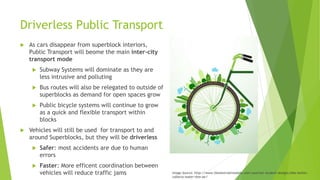
 Public bicycle systems will continue to grow
as a quick and flexible transport within
blocks
 Vehicles will still be used for transport to and
around Superblocks, but they will be driverless
 Safer: most accidents are due to human
errors
 Faster: More efficent coordination between
vehicles will reduce traffic jams Image Source: http://www.thealternativedaily.com/austrian-student-designs-bike-bottle-
collects-water-thin-air/
More Sustainable
 Clean Energy
 Green Roofs will moderate energy use
(warmer in winter and cooler in
summer) and provide a more pleasant
and clean environment
 Solar Panels will develop to be
inconspicuous and prevalent (for
example in windows) reducing energy
demand.
 Green Spaces
 With less cars and more space, cities
will increase green spaces for
wellbeing and aesthetic reasons
 Sustainable Urban Drainage Systems
(SuDS) will reduce water usage and
flood risk from urbanisation.
Image Source: http://xpsolutions.com/Resources/suds-are-we-ready-for-flow-through-structures/
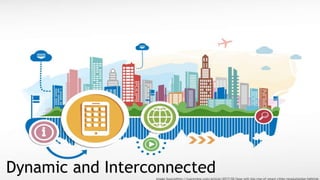
Dynamic and Interconnected
Economic Motors
 Dynamic drivers of the economy
 The closeness of multiple industries
generates economies of scale, synergies
and innovation
 Economic opportunities will make
urbanisation deepen, relegating rural areas
to vacation spots or specific industry towns
(which will continue to automate)
 However businesses will decentralize
 Large company offices will be a thing of the
past
 More dynamic workplace: Companies will
gather in Hubs to maximise synergies
 More flexible: Many employees will work
mostly at home
Image Source: http://oakland.new.impacthub.net/
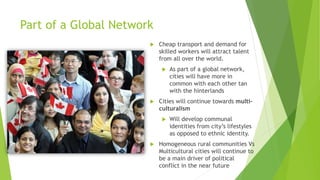
Part of a Global Network
 Cheap transport and demand for
skilled workers will attract talent
from all over the world.
 As part of a global network,
cities will have more in
common with each other tan
with the hinterlands
 Cities will continue towards multi-
culturalism
 Will develop communal
identities from city’s lifestyles
as opposed to ethnic identity.
 Homogeneous rural communities Vs
Multicultural cities will continue to
be a main driver of political
conflict in the near future
Thank You!

IE Application: Express Yourself

  • 1.
    How do youenvision the City of the Future Express Yourself – Question L Cristobal Sapena Lafuente
  • 2.
    Open and Green ImageSource: http://6iee.com/data/uploads/20/573874.jpg
  • 3.
    Pedestrian Superblocks  Superblocksare being introduced already in Barcelona and Vitoria.  The aim is to open blocks to pedestrians  The trend will expand to whole city centers and boroughs  Cities will minimize carspace  More people walking around is proven to revitalise small businesses and local economies  This in turn creates a more cohesive local society and feeling of comunal belonging  This also responds to growing demand for cleaner cities, as cars are one of the mayor contaminants (noise and pollution-wise) Image Source: http://www.vox.com/2016/8/4/12342806/barcelona-superblocks
  • 4.
    Driverless Public Transport As cars disappear from superblock interiors, Public Transport will beome the main inter-city transport mode  Subway Systems will dominate as they are less intrusive and polluting  Bus routes will also be relegated to outside of superblocks as demand for open spaces grow  Public bicycle systems will continue to grow as a quick and flexible transport within blocks  Vehicles will still be used for transport to and around Superblocks, but they will be driverless  Safer: most accidents are due to human errors  Faster: More efficent coordination between vehicles will reduce traffic jams Image Source: http://www.thealternativedaily.com/austrian-student-designs-bike-bottle- collects-water-thin-air/
  • 5.
    More Sustainable  CleanEnergy  Green Roofs will moderate energy use (warmer in winter and cooler in summer) and provide a more pleasant and clean environment  Solar Panels will develop to be inconspicuous and prevalent (for example in windows) reducing energy demand.  Green Spaces  With less cars and more space, cities will increase green spaces for wellbeing and aesthetic reasons  Sustainable Urban Drainage Systems (SuDS) will reduce water usage and flood risk from urbanisation. Image Source: http://xpsolutions.com/Resources/suds-are-we-ready-for-flow-through-structures/
  • 6.
  • 7.
    Economic Motors  Dynamicdrivers of the economy  The closeness of multiple industries generates economies of scale, synergies and innovation  Economic opportunities will make urbanisation deepen, relegating rural areas to vacation spots or specific industry towns (which will continue to automate)  However businesses will decentralize  Large company offices will be a thing of the past  More dynamic workplace: Companies will gather in Hubs to maximise synergies  More flexible: Many employees will work mostly at home Image Source: http://oakland.new.impacthub.net/
  • 8.
    Part of aGlobal Network  Cheap transport and demand for skilled workers will attract talent from all over the world.  As part of a global network, cities will have more in common with each other tan with the hinterlands  Cities will continue towards multi- culturalism  Will develop communal identities from city’s lifestyles as opposed to ethnic identity.  Homogeneous rural communities Vs Multicultural cities will continue to be a main driver of political conflict in the near future
  • 9.